


Abstract
Enhancing the carrying capacity of the ecological environment serves as a pivotal pathway to achieving sustainable development and also constitutes a concrete response to the UN SDGs. Based on a provincial panel dataset covering 30 Chinese provinces spanning 2011–2023, the present work examines how digital finance shapes EECC and explores the corresponding transmission mechanisms. Findings from the empirical analysis confirm that digital finance exerts a significant positive effect in boosting ecological environmental carrying capacity. Heterogeneity tests further show that this catalytic influence is most salient in eastern China, while it lacks statistical significance or even turns negative in the central and western areas. Meanwhile, the catalytic function of digital finance becomes more distinct in highly urbanized areas. Mechanism analysis verifies that digital finance assumes a partial mediating function by cutting down energy consumption intensity and boosting human capital accumulation. Further analysis reveals that as digital finance matures, the above impact exhibits increasing marginal returns. Our spatial spillover assessment further indicates that digital finance contributes to stronger EECC within host provinces, while also facilitating coordinated improvements in this key indicator across neighboring jurisdictions. Accordingly, we propose that economies speed up the building of digital-related infrastructure, expand the outreach of digital finance, and properly steer the orderly movement of population, thus facilitating the eco-friendly sustainable advancement of the natural environment.
1. Introduction
Ecological environment carrying capacity (abbreviated as EECC) can be defined as the upper limit that an ecosystem can sustain biological populations and human activities without compromising its internal structure and functions [1]. It functions as a vital instrument for promoting ecological civilization [2] and acts as a core gauge for holistically evaluating the coordination between regional demographics, natural resources, and environmental systems, together with the sustainability of economic growth [3]. This concept mirrors the supportive potential of ecosystems for human socioeconomic endeavors and the steady supply capacity of resources and environmental systems [4]. In the context of global concerted progress toward the UN SDGs (SDG6, 7, 11, 13, 14, 15), strengthening EECC has emerged as a pivotal agenda drawing extensive attention across the globe. The EPEEP 2025 Congress, with the theme of “Green Innovation for Harmonious Coexistence”, further underscores the vital pathway of advancing environmental protection and economic development in a coordinated manner to achieve mutual benefit and win-win outcomes. At present, China is actively responding to the UN SDGs, accelerating the all-around green transformation of its economy and society, and making dedicated efforts to strengthen EECC.
Nevertheless, it should be acknowledged that the fundamental pressures on the ecological environment have not been fundamentally alleviated [5], the resource and environmental carrying capacity in some regions is approaching its upper limit [6], the tension between economic growth and ecological conservation remains prominent, and improvements in ecological quality still fall behind the overall progress of societal and economic advancement [7]. Simultaneously, environmental challenges in other parts of the world also exhibit distinct regional characteristics and transformative pressures. For instance, Vietnam is grappling with multiple environmental pressures, such as water, air, and soil pollution amid its rapid economic growth; the Great Lakes region of North America once confronted a water supply security crisis due to severe drought and has been continuously addressing complex issues, including emerging chemical pollution. Against this backdrop, effectively reconciling the prominent tension between development and conservation and substantially strengthening EECC represents not only an intrinsic need for promoting the harmonious coexistence of humans and nature but also a pivotal route to realizing global sustainable development and fostering the green transition of socioeconomic systems.
Exploring effective pathways and innovative tools to drive the improvement of regional ecological environments and elevate their carrying capacity has emerged as a cutting-edge topic in theoretical and policy research. As the lifeblood of modern economic systems, finance fulfills a policy-guiding function in advancing the low-carbon shift in socioeconomic systems, and is regarded as a critical regulatory tool for environmental governance [8]. In particular, driven by the rapid progress of emerging digital tools such as artificial intelligence, cloud services, and distributed ledger technologies, their deep fusion with the financial industry has spawned digital finance as an innovative operational paradigm. By lowering the costs associated with financial services and transactions [9] and broadening the reach and accessibility of financial provision, digital finance exhibits enormous potential in advancing inclusive growth and underpinning entrepreneurship and innovation [10], while also unlocking new avenues for tackling ecological and environmental challenges via financial approaches [11]. Against this backdrop, can digital finance—a novel financial model characterized by both inclusive attributes and technological empowerment—serve as an effective lever for enhancing the EECC? What are its inherent mechanisms of action? Clarifying these questions will not only help expand the research frontier regarding the economic and social external effects of digital finance but also elevate the EECC through financial technology innovation.
2. Literature Review
Theoretical research on EECC is grounded in the in-depth interpretation and quantitative assessment of its core connotation. In the initial stage, scholars predominantly conceptualized carrying capacity from a unidimensional perspective, with a primary focus on natural resource fields, including land, water, and mineral resources. Within this stream of literature, investigations into land-based population loading capacity and primary-industry water resource loading capacity have been the most widespread [12]. These studies underscored the quantitative assessment of natural resource supply potential and exhibited a clear practical orientation, but often neglected the integrity and dynamic characteristics of ecosystems. Following the emergence of sustainable development theory, several researchers have highlighted a close linkage between resource-environmental carrying capacity and socioeconomic sustainability [13]. They further proposed that its conceptual meaning should evolve from a narrow resource-oriented constraint toward an integrated framework covering resource availability, environmental assimilation capability, ecological stability, and other multidimensional components [14]. Some scholars pointed out that analyses based solely on resource supply or environmental capacity can hardly fully reflect the ecological constraints of regional development and have theoretical limitations, and the introduction of the ecological footprint method has made up for this deficiency to a certain extent [15]. By quantifying the demands of human activities on ecosystems, this method enables the dynamic assessment of carrying pressure. Furthermore, EECC can be viewed as a critical threshold that constrains the magnitude, depth, and pace of human socioeconomic activities, particularly those related to economic development [16]. It is emphasized that it is not only the fundamental support of natural systems, but also a product of the interaction and coupled evolution of natural and socio-economic systems [17]. Against this background, the research paradigm concerning EECC has shifted from a “single-factor” lens to a “multi-dimensional” framework, moving from a “static threshold” to a “dynamic equilibrium” and from a “purely natural attribute” to a “nature–society integrated attribute”. This conceptual progression lays a robust theoretical groundwork for quantitatively assessing the coordinated development level of human-land systems.
Simultaneously with studies on connotation, explorations into measurement methods of carrying capacity have also been widely conducted. Overall, the evolution of measurement approaches demonstrates a clear trajectory: shifting from single-dimensional to multi-dimensional frameworks, and from static evaluation to dynamic simulation. Early studies relied heavily on relatively static evaluation models. For instance, the Agricultural Ecological Zone method [18] focuses on assessing population carrying capacity mainly from the perspective of land productive potential. The Supply–Demand Balance approach, by contrast, judges the carrying status through comparing resource supply with human demand [19]. With the introduction of systematic thinking and advances in computational capability, research methods have gradually evolved toward dynamization and predictability. Scholars have employed time-series analysis to capture the evolutionary trends of carrying capacity [20], adopted system dynamics models to simulate the interactive feedback among subsystems such as population, resources, and the environment [21], and explored neural network models to address nonlinear relationships and conduct complex predictions [22]. These approaches have considerably improved the dynamics and foresight of relevant assessments. Given the comprehensiveness and complexity of regional sustainable development systems, the limitations of single methods have become increasingly prominent. Since the late 1990s, research attention has shifted to establishing multi-dimensional and integrated comprehensive evaluation frameworks. The ecological footprint method, which converts human demands into areas of biologically productive land, provides a comparable standardized indicator [23]. The comprehensive evaluation method realizes multi-factor integrated assessment through constructing systematic indicator systems and assigning corresponding weights [24]. Statistical techniques, including principal component analysis, have also been widely applied to dimensionality reduction and key influencing factor extraction [25]. Such an evolution from single methods to integrated frameworks has effectively promoted the transformation of carrying capacity theory from an abstract concept into a quantifiable, comparable, and operable empirical tool for decision-making.
Among the diverse socioeconomic forces shaping the ecological environment, in addition to drivers related to human activities [26], finance—acting as a key pillar of the modern economic system—has witnessed its resource allocation role exert a growing influence on the natural environment, which has gradually become a central topic in scholarly discussions. Mainstream academic perspectives have primarily focused on the field of green finance, delving into how policy instruments such as green credit [27] and green bonds [28] guide capital flow toward environmental protection industries and green projects through a capital allocation mechanism of “selecting the superior and eliminating the inferior” [29]. By restricting financing channels for high-pollution and high-energy-consuming sectors, these instruments further enhance regional environmental quality and resource utilization efficiency [30]. In addition, market-oriented mechanisms like environmental insurance are recognized as crucial supplementary tools for dispersing environmental risks and strengthening corporate environmental responsibilities [31], thereby enriching the institutional tool system of green finance. In recent years, with the rapid advancement of digital technology, its penetration has exerted varying impacts on the environment, and existing studies have explored these effects mainly from both positive and negative angles. Proponents of the positive view argue that digital finance, leveraging its advantages of broad coverage, low transaction costs, and high operational efficiency, effectively mitigates information asymmetry among enterprises and expands the accessibility of financing for microeconomic entities [32]. Moreover, through multiple pathways—including digital technology empowerment [33], promotion of green consumption behaviors [34], and optimization of factor resource allocation [35]—it indirectly improves ecological quality, enhances ecological resilience [36], and provides new financial support for achieving sustainable development goals. On the contrary, the negative academic viewpoint holds that digital technology is a “double-edged sword” [37], and its widespread application also brings environmental challenges. In particular, the consumption of electrical resources has surged globally due to the popularization of digital technology, as reported by the International Energy Agency (IEA). Furthermore, digital technology may exacerbate regional development imbalances and widen the “green divide”: technologically advanced regions are more likely to reap emission reduction dividends, while developing countries still rely heavily on conventional energy sources [38]. At the same time, regions with superior digital infrastructure may even siphon resources from neighboring areas, with the offsetting effect outweighing the radiation effect [39]. If not properly addressed, the “energy rebound effect” may offset the emission reduction gains brought by digital technology, leading to an increase rather than a decrease in overall emissions [40].
In summary, prior academic work on EECC has provided a robust theoretical underpinning for the present investigation. Nonetheless, the current literature still presents considerable scope for further extension. In terms of research focus, most contributions center on how digital finance affects individual environmental indicators, with insufficient systematic examination of its holistic influence on overall EECC. In terms of viewpoint integration, existing studies hold divergent opinions on the environmental impacts of digital technology empowerment, with both positive and negative arguments coexisting, and no consistent conclusion has been reached yet. In terms of research depth, relevant discussions mostly remain at the level of theoretical explanation or partial mechanism verification, and the empirical exploration of multiple transmission pathways is still insufficient. Against the limitations outlined above, this paper’s novel marginal insights are concentrated in three key dimensions: First, constructing an extensible analytical framework to provide a methodological reference for the systematic evaluation of the ecological effects of digital finance. Second, this paper unpacks several broad transmission channels, including energy intensity, human capital, and population mobility, thereby enriching theoretical insights into the intricate nexus between digital finance and ecological sustainability. Third, identifying its nonlinear threshold characteristics and spatial spillover effects, which provides a basis for transnational policy coordination and differentiated governance.
3. Theoretical Analysis
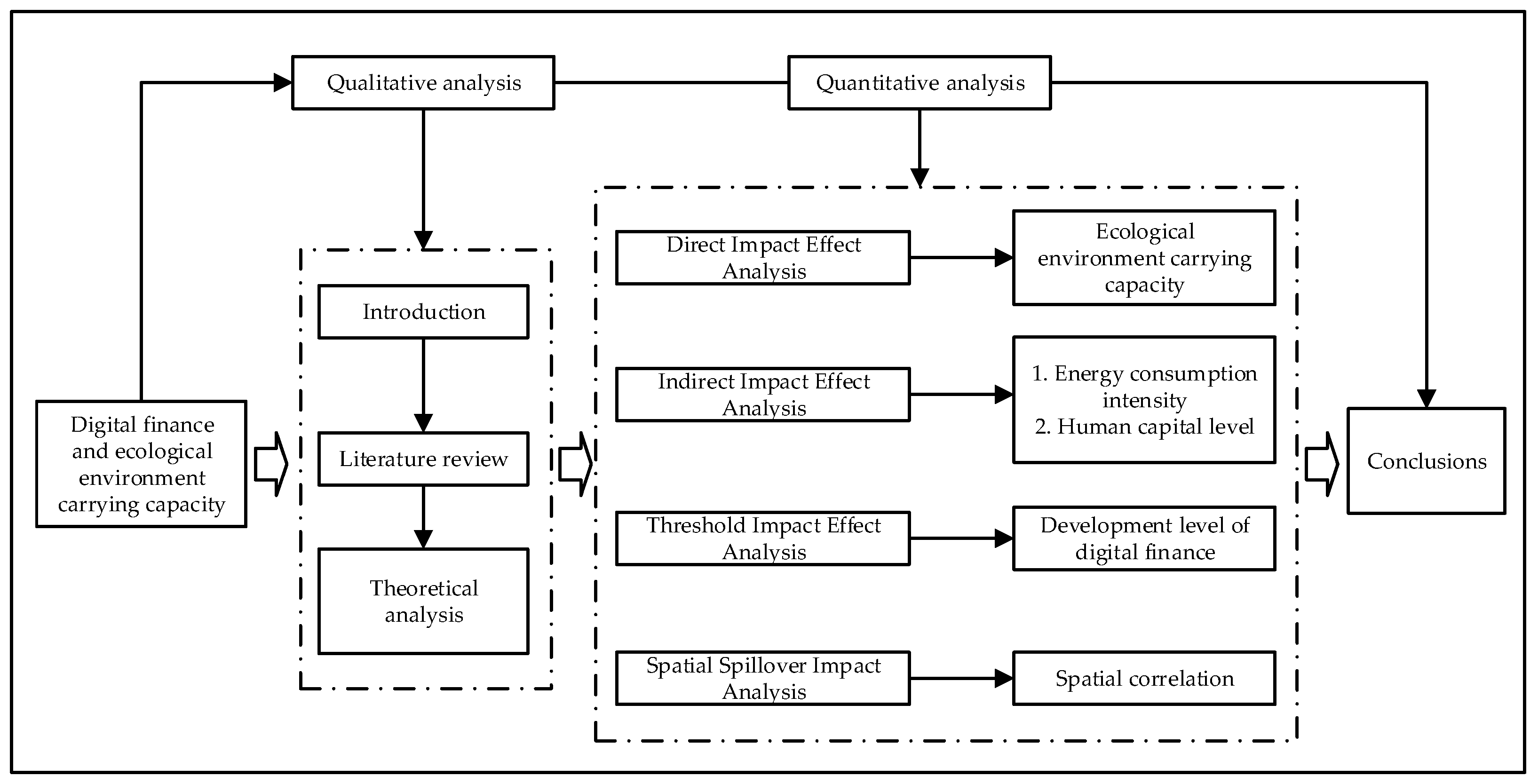
For ease of understanding and analysis, the technical roadmap of the article is shown in Figure 1.
Figure 1.
Technical roadmap.
3.1. Direct Impact Effect Analysis
The direct impact of digital finance on EECC can be theoretically interpreted from two coordinated dimensions: the optimization of market mechanisms and the empowerment of human development. From the perspective of market logic, digital finance reduces service thresholds and improves financial accessibility [41], optimizes capital allocation efficiency [42], and mitigates adverse selection and moral hazards by enhancing information symmetry [43]. It thereby directs capital toward production sectors with higher resource efficiency, curbing extensive resource development through market mechanisms and fostering the green upgrading of industrial structures [44]. Notably, while this process enhances energy efficiency, it may also trigger a potential rise in total energy consumption due to the expansion of economic activities, known as the “rebound effect”. From the viewpoint of human development, digital finance eases credit constraints on small and micro-enterprises and provides critical support for their green transition and sustainable development. Meanwhile, green financial products and environmental information disclosure mechanisms raise the awareness of environmental costs and responsibilities among firms and the public, and digital credit systems strengthen environmental compliance constraints. Furthermore, platform-based operations lower public participation costs in environmental governance and transaction costs in green financing, further stimulating the enthusiasm of multiple stakeholders for collaborative governance.
3.2. Indirect Impact Effect Analysis
3.2.1. Consumption Intensity Analysis
In terms of market functioning, digital finance enables accurate credit evaluation and risk pricing through big data and artificial intelligence technologies [45]. It employs market-oriented mechanisms to direct credit funds preferentially toward energy-saving and environmental protection projects, reduces the cost of green financing, and directly improves the efficiency of energy and resource utilization. Regarding development empowerment, digital finance enhances financial inclusion and provides equitable financial support for the “long-tail groups” such as micro, small, and medium-sized enterprises [46]. This framework not only reinforces economic resilience but also refines the structure of resource allocation and lifts total factor productivity via the expansion of technology- and knowledge-intensive sectors [47], thus providing an economic basis for lowering energy intensity from a structural perspective. The integration of these two dimensions helps regions achieve the decoupling of economic growth from ecological degradation [48].
3.2.2. Human Capital Level Analysis
Human development lies at the core. Digital finance expands the scope of financial services and reduces access costs [49]. Its convenient digital educational credit eases household liquidity constraints [50], directly contributing to the continuous accumulation of human capital [51] and injecting endogenous drivers into economic growth. High-quality human capital is not only equipped with strong technological absorption and innovation capabilities, which promote the transformation of industries toward knowledge-intensive sectors [52] and reduce dependence on natural resources [53], but is also usually accompanied by stronger environmental awareness and governance capacity. Accordingly, it can jointly elevate environmental carrying capacity via two complementary dimensions: the technological supply side and the green demand side.
3.3. Threshold Impact Effect Analysis
The ecological impact of digital finance evolves with the deepening of its development level, reflecting a paradigm shift from providing basic market services to enhancing market functions, and finally to embedding sustainable development values. In the initial stage, digital finance is centered on the popularization of mobile payments and digital accounts, which mainly improve the accessibility of financial services [54], with indirect and limited environmental benefits. In the intermediate stage, with the advancement of big data risk control and other technologies, digital finance transforms from “wide coverage” to “deep integration” [55]. Its role as a market “signaling mechanism” and “screening device” is strengthened, enabling more effective capital reallocation away from energy-intensive and pollution-intensive projects, thereby significantly enhancing the green orientation of capital allocation [42]. In the later high-level stage, digital finance is deeply embedded in economic and social operations. Innovative technologies, including blockchain and IoT, enable the internalization of environmental externalities, with ESG principles embedded into product design frameworks. Platforms begin to proactively build green scenarios, ultimately promoting the inherent integration of market logic, human well-being, and ecological values.
3.4. Spatial Spillover Impact Analysis
Through market interconnection and knowledge-sharing mechanisms, digital finance transforms local development dividends into regional ecological well-being. The demonstration effect lays a cognitive foundation: successful local green development models [56] can be learned and replicated by neighboring regions [57], thereby lowering their transition costs. The technological spillover effect acts as the core channel, as locally generated green technological innovations and fintech solutions [58] can radiate to surrounding areas via corporate cooperation and platform expansion, strengthening their environmental governance capacity. The industrial linkage effect reflects structural impacts, whereby the green transformation of local industries drives coordinated upgrading in adjacent regions through industrial chain connections. Collectively, these effects demonstrate that the development of digital finance can transcend geographical boundaries and promote the overall improvement of regional EECC through networks of markets and knowledge.
4. Materials and Methods
4.1. Model Design
Construct the following double fixed effects model:
Here, represents the ecological environment carrying capacity (denoted as EECC), while represents digital finance (denoted as Dig-fin). captures the complete array of control variables; and are double fixed effects; denotes the stochastic error term; Others are estimated coefficients.
In terms of mechanism pathways, this article refers to existing research practices [59] and adds the following model based on Equation (1):
Here, Mi,t represents energy consumption intensity (denoted as Ener) and human capital level (denoted as Huma), respectively.
4.2. Variable Settings
4.2.1. Dependent Variable
Drawing on the evaluation ideas and framework of the Food and Agriculture Organization of the UN [60], this paper intends to construct an indicator system from three aspects: economic, resource, and environmental carrying capacity. Furthermore, based on the research findings of existing scholars [61], the entropy-weighted TOPSIS method is employed to measure the EECC. Of these components, economic carrying capacity largely mirrors the status of local economic advancement, together with the corresponding environmental pressure and supportive potential it brings to the ecosystem. This dimension is typically measured by indicators including gross domestic product and per capita disposable income of the local population. Resource carrying capacity focuses on the supply capacity and utilization efficiency of natural resources within a region, with key elements including land and water resources as the core. Environmental carrying capacity primarily measures the capacity of regional ecosystems to accommodate and purify exogenous pollution loads, with a focus on the emission intensity of industrial “three wastes” (For detailed indicators, please refer to the Supplementary Materials Table S1).
4.2.2. Independent Variable
Digital Finance. This article uses the Digital Finance Index developed by the Institute of Digital Finance, Peking University, to measure three dimensions: coverage breadth, usage depth, and digitalization level [62].
4.2.3. Mediating Variable
There are three main mediating variables. Among them, energy consumption intensity is proxied by the total per capita energy consumption. Human capital is gauged by the proportion of students in standard higher education institutions relative to the overall urban populace.
4.2.4. Control Variables
This paper mainly controls for such influencing factors as transportation infrastructure level (denoted as Tran), industrial structure upgrading (denoted as Indu), technological innovation level (denoted as Tech), and fixed asset investment (denoted as Fixe). Transportation infrastructure is captured by the natural logarithm of highway mileage. Industrial structure advancement is captured by the ratio of secondary-sector output to tertiary-sector output. Technological innovation is proxied via the logarithm of granted invention patents. Fixed asset investment is indicated by the weight of total fixed asset investment in GDP.
4.3. Data Sources
This investigation employs panel data covering 30 provincial-level divisions in China over 2011–2023 as the analytical sample, omitting the Xizang Autonomous Region, Hong Kong, Macao, and Taiwan owing to extensive data unavailability. Given that certain statistics have not been updated beyond 2023, we confine the balanced dataset to the period up to that year. Linear interpolation is employed to address data gaps for the relevant provinces, with detailed statistics reported in Table 1.
Table 1.
Descriptive statistical results.
5. Empirical Result Analysis
5.1. Baseline Test Results Analysis
Before conducting regression analysis, this study conducted a VIF test on all variables, and the result was 1.9600 (less than 10), indicating no multicollinearity. This confirms that multicollinearity is not a serious concern within the variable set. Estimation outcomes are summarized in Table 2. Models (1) and (2) document the findings obtained under the random-effects setup, where the estimated parameters linked to digital finance stand at 0.3663 and 0.2797, respectively. These findings confirm that digital finance exerts a positive impact on the EECC. After controlling for the additional variables, the estimated coefficients decline marginally, indicating that forces including industrial structure and technological innovation have absorbed part of the explanatory role of digital finance.
Table 2.
Baseline test results.
To mitigate endogeneity bias, we further adopt the dual fixed-effects specification for estimation, and the corresponding findings are reported in Models (3) and (4). The estimated parameters associated with digital finance increase to 0.6005 and 0.5618, respectively, and both remain highly statistically significant. Once individual and time fixed effects are accounted for, these estimates exceed those derived from the random-effects specification. This suggests that the baseline framework may have produced downward-biased results by overlooking time-invariant unobserved heterogeneity and common temporal shocks. After controlling for such systematic influences, our dual fixed-effects specification permits a more precise identification of how digital finance exerts a net boosting influence on EECC.
5.2. Robustness and Endogeneity Tests Results Analysis
We assess the stability of our baseline findings via multiple robustness checks (see Table 3). First, we incorporate the one-period and two-period lags of EECC, whose corresponding parameters stand at 0.8542 and 1.0261. This pattern reveals that the influence of digital finance unfolds gradually and strengthens over successive periods. Second, we augment the benchmark specification with additional controls, including aggregate social consumption and the incidence of natural disasters. The estimated parameter for digital finance stands at 0.5104 and remains highly significant at the 1% level, reinforcing the credibility of our core inferences. Third, we re-estimate the model after excluding provincial-level municipalities. The coefficient declines to 0.3954, implying that the ecological improvement driven by digital finance tends to be more salient in economically advanced regions with more mature financial systems.
Table 3.
Robustness test results.
This article uses the two-stage least squares method for endogeneity testing. In addition to lagged independent variables by one period, the interaction term between terrain undulation and digital finance is also introduced as an instrumental variable. The lag term is highly correlated with the current variable, satisfying the relevance requirement; as a natural geographical feature, topographic relief is exogenous, and its interaction term can capture the heterogeneity of financial services across different geographical contexts, thereby enhancing the identification power. Diagnostics from the instrumental variable procedure yield an F-statistic of 36.7645 and a minimum eigenvalue of 74.4602, while the p-value associated with the overidentifying restrictions test stands at 0.2115. These statistics collectively satisfy the required conditions for instrument validity and exogeneity. As reported in Table 4, the 2SLS estimation yields a parameter of 0.6138 for digital finance. This confirms that, even after accounting for endogeneity, digital finance continues to exert a stable and favorable influence on ecological carrying capacity.
Table 4.
Endogeneity test results.
Furthermore, to better tackle potential concerns associated with the earlier instrumental variables, this study constructs a supplementary instrument using the product of the 1984 count of post and telecommunications offices and the independent variable. Regression outcomes reveal that the corresponding coefficient stands at 0.6058, implying that digital finance still fosters enhancements in EECC following the instrument replacement. Additionally, to alleviate biases stemming from omitted variables and reverse causality, the system GMM approach is employed. Estimation results further verify that digital finance continues to exert a significant favorable influence on EECC.
5.3. Heterogeneity Test Results Analysis
We next explore the heterogeneous effects of digital finance on EECC across two dimensions: geographic location and urbanization degree, as shown in Table 5. With respect to regional heterogeneity, the parameter estimate for digital finance in eastern areas reaches 1.0611, signifying a pronounced positive contribution to EECC. This is mainly attributed to the region’s sound economic foundation, improved digital infrastructure, and strong residents’ usage capabilities, enabling digital finance to effectively support green consumption and the low-carbon transformation. The coefficient in the central region is negative and insignificant, which may be due to the structural imbalance in the popularization of digital finance—some groups struggle to truly integrate into the system, leading to resource misallocation and even stimulating the expansion of high-energy-consuming industries, thereby exacerbating environmental pressures. The coefficient in the western region is insignificant. Constrained by geographical conditions and population distribution, the breadth of digital coverage is insufficient, and service penetration is not deep enough to form a scale effect.
Table 5.
Heterogeneity test results.
In terms of differences in urbanization levels, regions where the urbanization rate exceeds the national average are categorized as highly urbanized, with the remaining areas classified as low-urbanization regions. Estimation outcomes reveal that the corresponding parameter stands at 0.6268 for highly urbanized areas, whereas the estimate for low-urbanization regions remains positive yet statistically insignificant. This is mainly because population agglomeration improves the marginal service efficiency of digital finance platforms, reduces transaction costs and information frictions, and makes it easier for funds to flow to environment-friendly projects. In contrast, in low-urbanization regions, due to sparse population, weak digital access capabilities, and low financial literacy, digital finance cannot form effective coverage, resulting in an insignificant ecological effect.
5.4. Mechanism Path Test Results Analysis
Table 6 reports the examination outcomes for the three mediating channels. First, the analysis focusing on the energy consumption intensity channel yields a parameter of −20.4253 for digital finance, which is highly significant. This finding confirms that digital finance acts to lower energy consumption intensity. After incorporating this mediating variable, the coefficient of digital finance on the EECC stands at 0.4825, and the coefficient of energy consumption intensity is −0.0038. The results suggest that the rise in energy consumption intensity would inhibit the EECC, while digital finance can indirectly enhance the regional EECC by reducing energy consumption intensity, verifying the validity of the mediating effect of this pathway.
Table 6.
Mechanism path test results.
Second, the analysis centered on the human capital channel yields a parameter of 1.8972, underscoring that digital finance effectively fosters the buildup of human capital. In the extended mediation specification, the parameter linking this human capital measure to EECC stands at 0.0099, while the corresponding estimate for digital finance declines to 0.5431. This pattern verifies that human capital plays a partial mediating role as digital finance shapes ecological carrying capacity. In concrete terms, digital finance broadens access to financial support, sustains investment in education, healthcare, and workforce capabilities, thereby advancing talent development and fostering ecological enhancement.
6. Expand Discussion and Analysis
6.1. Threshold Effect Test Results Analysis
This article refers to Hansen’s [63] threshold model testing method to construct a dual threshold panel model for the development level of digital finance, as shown below:
Here, represents the level of development of digital finance (denoted as Dig-fin-lev); and stand for dual threshold values; represents the indicator function; represents the constant term, and is the coefficient for .
In Table 7, the first threshold is 0.2279, and the second threshold is 0.3303. By contrast, the third threshold value (0.2810) is not statistically significant. These findings indicate that the impact of digital finance on EECC exhibits a regime-dependent pattern, varying with the development level of digital finance itself.
Table 7.
Threshold value test results.
Estimates from the dual-threshold specification reported in Table 8 reveal a significant nonlinear relationship between digital finance and the EECC. When the level of digital finance remains below the first threshold of 0.2279, its impact coefficient stands at 0.1726, indicating that digital finance exerts a facilitating effect on EECC. As digital finance advances to the moderate development stage, falling within the range of 0.2279 to 0.3303, the impact coefficient rises to 0.2029, signifying a further amplification of its promotional role. After crossing the second threshold of 0.3303, the impact coefficient increases to 0.2228, which demonstrates that the effect of digital finance on EECC exhibits a gradual increasing trend alongside the improvement of its own development level. A plausible explanation for this phenomenon is that high-level digital finance reduces transaction costs and alleviates information asymmetry. By leveraging big data and artificial intelligence to achieve dynamic assessment of environmental risks and intelligent matching of green projects, it systematically enhances the endogenous capacity of finance to support sustainable development.
Table 8.
Threshold effect test results.
6.2. Spatial Spillover Effect Test Results Analysis
This article constructs the following spatial Durbin model:
Among them, is the spatial weight matrix, which mainly selects the adjacency (0, 1) spatial matrix, geographic spatial matrix, and economic distance matrix for empirical testing. The geographic spatial matrix uses the latitude and longitude of provincial capitals, while the economic distance matrix uses the reciprocal of the difference in per capita GDP between regions. ρ is the spatial autoregressive coefficient. and represent the influence of the local explanatory variable on the local dependent variable.
As documented in Table 9, between 2011 and 2023, the global Moran’s I statistics for both digital financial development and EECC are significantly positive and satisfy various significance criteria. This evidence confirms that both variables feature strong positive spatial dependence across the sample. In particular, high-value clusters tend to neighbor one another (high–high clustering), while low-value zones tend to adjoin fellow low-value areas (low–low clustering), thus forming a clear spatial clustering structure. Meanwhile, Moran’s I index of EECC was insignificant in 2011 (p = 0.119), became significant starting in 2012 (p = 0.034), and remained significant after 2013. This indicates that its spatial agglomeration effect gradually took shape and consolidated around 2013. This pattern can be attributed to two key factors. For one thing, ecological civilization has been formally designated as a national strategy since 2012, and the rollout of regional joint prevention and control regimes has boosted coordination in cross-regional environmental regulation and governance. For another, ecological governance typically exhibits time-lag effects and notable spatial spillover features. With improved infrastructure connectivity and the refinement of ecological compensation mechanisms, the effects of earlier investments have gradually materialized, strengthening the convergence and spatial correlation of regional environmental quality.
Table 9.
Global autocorrelation test results.
As shown in Table 10, the estimation results of the autoregressive coefficient for the dependent variable indicate that the spatial lag coefficients of EECC under the three matrix specifications are 0.3888, 0.2310, and 0.2123, respectively, which reveal a significant positive spatial dependence of EECC across regions. This phenomenon may stem from the connectivity of ecological systems among regions and the gradual improvement of cross-regional environmental policy coordination mechanisms, which drive the changes in the ecological environment of neighboring areas.
Table 10.
Spatial spillover effect test results.
We further employ the partial derivative approach to decompose the impacts, so as to identify the direct, indirect, and total impacts with greater precision. The results show that under the three matrix settings, the direct effect coefficients of digital finance on local EECC are 0.4490, 0.5268, and 0.5249, respectively, indicating that digital finance in the local region exerts a direct impact on EECC, which verifies the previous arguments. By comparing the direct effects with the estimated coefficients of the model, the feedback effects are 0.0234 (0.4490–0.4256), 0.0108 (0.5268–0.5160), and 0.0149 (0.5249–0.5102), respectively. In economic terms, ignoring spatial interdependence would lead to an underestimation of the actual impact of digital finance by approximately 2.34%, 1.08%, and 1.49% under the three specifications. The main reason is that conventional econometric models fail to capture the reverse feedback effects triggered by policy spillovers or development externalities from neighboring regions.
More importantly, the indirect impacts of digital finance stand at 0.2544, 0.1607, and 0.1333 in sequence, and each coefficient achieves statistical significance. This finding reveals that advances in digital finance generate favorable outcomes for the local economy, while also boosting ecological conditions in neighboring regions via channels including capital spillovers and technological learning. Such results highlight a pronounced positive cross-regional spatial spillover. The total effect captures both intra-regional and inter-regional influences holistically, offering further confirmation that digital finance serves as a dual driver in advancing ecologically sustainable growth across regions.
7. Conclusions
Strengthening ecological environment carrying capacity stands as a pivotal avenue for promoting the integrated advancement of the economy, society, and natural ecosystems, as well as for attaining the UN SDGs. The research findings indicate that the development of digital finance provides a practical and feasible pathway for resolving the prominent contradiction between development and protection, as well as enhancing the EECC. Specifically, digital finance exerts a significant direct promoting effect on the EECC, which macroscopically responds to the core concern of how to alleviate resource and environmental pressures and coordinate the relationship between the economy and the environment. Drawing on a series of heterogeneity analyses, this paper demonstrates that the beneficial influence exerted by digital finance on EECC is particularly pronounced in eastern zones and highly urbanized districts, whereas its function is muted and even turns adverse in central and western locales. This precisely suggests that improving the EECC requires targeted responses to the structural differences in contradictions faced by different regions. The mechanism pathway test shows that digital finance mainly functions through two channels: reducing energy consumption intensity and enhancing human capital accumulation. This provides a comprehensive explanation for the mechanism issue of “how” to coordinate protection and development, i.e., promoting green transformation through energy conservation, consumption reduction, and human capital empowerment. Extended analysis further reveals that the ecological benefits of digital finance increase with the leap in its own development level and exhibit a significant positive spatial spillover effect. This enriches the understanding of the improvement pathway from the dimensions of dynamic evolution and regional coordination, indicating that by deepening the development of digital finance and promoting regional linkage, the EECC can be systematically enhanced, thereby providing an important basis for green transformation under the global SDGs.
In light of the empirical findings documented above, we put forward several targeted policy implications:
First, adopt regionally tailored promotion strategies and prioritize the deployment of digital infrastructure and financial capability building in central and western areas. Given that eastern regions have already established a mature digital financial ecosystem and strong environmental governance frameworks, these areas should keep acting as pioneers and benchmarks for further development. For the central and western regions, it is necessary to increase financial support and technology transfer efforts, improve the coverage of rural digital networks, enhance residents’ digital literacy and the service capacity of financial institutions, and prevent the digital divide from exacerbating regional development imbalances.
Second, advance the deep fusion of digital finance with green finance, prioritizing backing for low-carbon tech innovation, energy conservation, and emissions-reduction initiatives. Policy support should be directed to incentivize financial institutions to launch data-driven green credit schemes underpinned by big-data risk management. Targeted financing should be channeled toward energy-efficient sectors and clean production technologies, while digital infrastructures can be employed to facilitate environmental transparency and carbon footprint monitoring. This will enhance the green orientation of capital allocation and effectively reduce energy consumption intensity.
Third, strengthen the financial support mechanism for human capital investment and improve workers’ green skills and environmental awareness. We can expand the opportunities for low-income groups to receive green skills training by establishing digital inclusive education loans and special funds for vocational skills training, and enhance their ability to participate in the green economy, thus realizing the coordinated evolution of economic development, employment promotion, and ecological protection.
Fourth, construct a cross-regional collaborative development mechanism for digital finance to unlock spatial spillover effects. It is recommended to establish digital finance cooperation platforms based on urban agglomerations and economic circles, promote data sharing, credit mutual recognition, and service interconnection, facilitate the diffusion of advanced experience and technologies to surrounding regions, and form a new pattern of regional ecological governance featuring development driven by key areas and linked development across the board.
Fifth, establish and improve the ecological environment supervision system. Based on regional development levels and market maturity, implement classified and phased environmental supervision policies, and coordinate the use of restrictive regulations and incentive measures. Meanwhile, efforts should be stepped up to refine the relevant legal and regulatory framework, specify criteria for environmental liability determination and data governance, and furnish solid institutional safeguards and innovation room for digital finance to underpin green development.
Supplementary Materials
The following supporting information can be downloaded at: https://www.mdpi.com/article/10.3390/su18062743/s1, S1: Evaluation index system of ecological environmental carrying capacity; S2: Clarification on evaluation methods: Why does the comprehensive framework include different types of indicators; S3: Improvement and revision of the theoretical basis for indicator selection and attribute setting; S4: Supplementary testing on suggestions made by peer reviewers. Reference [64] is cited in the Supplementary Materials.
Author Contributions
Conceptualization, A.Z.; data curation, A.Z. and K.L.; formal analysis, A.Z. and K.L.; funding acquisition, K.L.; investigation, A.Z. and K.L.; methodology, A.Z.; project administration, K.L.; resources, K.L.; software, A.Z. and K.L.; supervision, A.Z.; validation, A.Z.; visualization, A.Z. and K.L.; writing—original draft preparation, A.Z. and K.L.; writing—review and editing, A.Z. and K.L. All authors have read and agreed to the published version of the manuscript.
Funding
This research received no external funding.
Institutional Review Board Statement
Not applicable.
Informed Consent Statement
Not applicable.
Data Availability Statement
The data presented in this study are openly available in the National Bureau of Statistics at https://www.stats.gov.cn/, accessed on 9 February 2026.
Acknowledgments
We sincerely thank the anonymous reviewers for valuable comments on the manuscript.
Conflicts of Interest
The authors declare no conflicts of interest.
References
- Xue, Q.; Song, W.; Zhang, Y.L.; Mu, F.Y. Research progress on ecological environment carrying capacity: Connotation, evaluation methods, and hot topics. J. Resour. Ecol. 2017, 8, 514–525. [Google Scholar] [CrossRef] [Scilit]
- Zhang, Q.L.; Cao, J.L.; Xu, Z.Y. Exploring the goal synergy between the ecological carrying capacity of Miyun District and the development of the ecological home-study industry in Beijing. J. Landsc. Res. 2023, 15, 45–48. [Google Scholar] [CrossRef]
- Zhang, G.J.; Deng, C.X.; Liu, Y.J. Ecological carrying capacity assessment incorporating ecosystem service flows. Environ. Rev. 2024, 32, 592–610. [Google Scholar] [CrossRef] [Scilit]
- Zhou, Y.; Huang, Y.; Liu, W. Understanding the conflict between an ecological environment and human activities in the process of urbanization: A case study of Ya’an City, China. Sustainability 2024, 16, 6616. [Google Scholar] [CrossRef] [Scilit]
- Zhuang, G.Y.; Chen, Y.L. Ecological security and risk prevention from the perspective of “double carbon”. Guizhou Soc. Sci. 2024, 44, 112–118. Available online: https://d.wanfangdata.com.cn/periodical/gzshkx202405015 (accessed on 8 March 2026).
- Cheng, Q.S. Research on the Optimization of China’s Energy Structure Under the Carbon Emission Peak Target. Master’s Thesis, Graduate School of Chinese Academy of Social Sciences, Beijing, China, 2015. [Google Scholar]
- Wang, Z.Q.; Liu, L. Mechanism and path of ecological civilization construction—Enlightenment from Zhejiang’s practice of the important thought of “two mountains”. Stud. Mao Zedong Deng Xiaoping Theor. 2016, 33, 39–44+91–92. [Google Scholar]
- Zhu, Y.; Zhang, J.T. Research on the impact of digital finance development on the green and low-carbon transformation of the urban economy. Urban Probl. 2022, 41, 64–71+81. [Google Scholar] [CrossRef]
- Fu, Z.; Wang, H. Competition or co-opetition: Financial inclusion and banking system development empowered by digital finance. Stud. Int. Financ. 2021, 36, 65–75. [Google Scholar] [CrossRef]
- Shen, W. Financial supervision challenges and technocratic solutions in the digital economy era. Shanghai J. Econ. 2024, 44, 99–115. [Google Scholar] [CrossRef]
- Liu, T.; Xu, Z.Y.; Zhang, K.L. The impact of digital finance on economic development and ecological environment synergy. J. Tianjin Univ. Financ. Econ. 2022, 42, 21–36. [Google Scholar] [CrossRef]
- Wang, Y.P. Comprehensive evaluation and comparison of China’s ecological carrying capacity. Stat. Decis. 2012, 28, 114–118. [Google Scholar] [CrossRef]
- Lan, S.X.; Li, M.F.; Wang, P.; Fu, X.H.; Zhu, J.; Xu, M.; Wang, X.N.; Peng, X.L. Research progress and method review of resource and environment carrying capacity. J. Cent. South Univ. For. Technol. (Soc. Sci.) 2022, 16, 21–30. [Google Scholar] [CrossRef]
- Zhang, C.; Zhao, Y.W.; Yu, L.; Xu, T. Research on ecological carrying capacity of Muping district, Yantai city. Bull. Soil Water Conserv. 2012, 32, 271–275. [Google Scholar] [CrossRef]
- Nakajima, E.S.; Ortega, E. Carrying capacity using emergy and a new calculation of the ecological footprint. Ecol. Indic. 2016, 60, 1200–1207. [Google Scholar] [CrossRef] [Scilit]
- Cui, F.J. A preliminary study on environmental carrying capacity. China Popul. Resour. Environ. 1995, 7, 80–84. [Google Scholar]
- Huang, Z.L. Research on the Coupling Relationship Between Social Economy and Ecological Environment in the Ebinur Lake Basin of Xinjiang. Master’s Thesis, Xinjiang Normal University, Xinjiang, China, 2006. [Google Scholar]
- Huang, X.J.; Zhou, Y. Research method review of resource and environment carrying capacity. Chin. J. Environ. Manag. 2018, 10, 36–42+54. [Google Scholar] [CrossRef]
- Li, Q.H.; Zhao, Y.M.; Jiang, Z.P.; Wang, Z.G. Research on water supply-demand balance and carrying capacity of oasis irrigation area in the northeast of Ulan Buh desert. Bull. Soil Water Conserv. 2005, 25, 24–27. [Google Scholar] [CrossRef]
- Wang, L.L. Analysis of the Dongting Lake Water Resource System Based on Uncertainty Theory. Doctoral Thesis, Hunan University, Changsha, China, 2008. [Google Scholar]
- Yu, P. Evaluation research on water resource carrying capacity based on system dynamics. Ind. Saf. Environ. Prot. 2013, 39, 38–41. [Google Scholar]
- Song, C.L.; Shuai, H. Spatial-temporal pattern and early warning of ecological carrying capacity in the Changzhutan urban agglomeration. J. Cent. South Univ. For. Technol. (Soc. Sci.) 2020, 14, 45–55. [Google Scholar] [CrossRef]
- Kou, L.X.; Bao, C.K.; Jiang, D.H. Application of ecological footprint in environmental impact assessment of urban planning—A case study of Suzhou urban system planning. Resour. Environ. Yangtze Basin 2008, 17, 119–123. [Google Scholar]
- Zeng, W.H.; Xue, Y.L.; Jia, Z.M. Construction and empirical research on the technical method system for water environment carrying capacity evaluation. Environ. Prot. 2017, 45, 17–24. [Google Scholar] [CrossRef]
- Wang, X.P.; Ding, S.X. Dynamic evaluation of population, resource, and environment carrying capacity in the Three-River-Source region—A case study of Golog Tibetan Autonomous Prefecture, Qinghai Province. Ecol. Econ. 2015, 31, 149–152. [Google Scholar]
- Bole, Y.; Rina, S.; Guga, S.; Na, M.L.; Fan, S.M.; Zhang, J.Q. Evaluation of resources, environment, and ecological carrying capacity from the perspective of “production-living-ecology” spaces: A case study of western Jilin Province, China. J. Clean. Prod. 2025, 491, 144770. [Google Scholar] [CrossRef] [Scilit]
- Luo, Z.X.; Mahmood, N.; Zhang, J.J. Articulating the role of green finance and natural resources in the environment: Aggregate and disaggregate analysis of natural resources. Chin. J. Popul. Resour. Environ. 2025, 23, 96–105. [Google Scholar] [CrossRef] [Scilit]
- Jian, Y.R. Green bonds and green environment: Exploring innovative financing mechanisms for environmental project sustainability. Environ. Sci. Pollut. Res. 2023, 30, 122293–122303. [Google Scholar] [CrossRef] [Scilit]
- Wu, Y.T.; Zhang, Y.; Ni, D.H. Can green finance achieve a win-win situation between urban ecological and economic benefits?—Based on the dual perspectives of environmental regulation and capital allocation. J. Shanghai Univ. Financ. Econ. 2024, 26, 46–59. [Google Scholar] [CrossRef]
- Habiba, U.; Zhang, R.W.; Sarwar, M.A. Assessing the impact of green finance and the digital economy on energy transition: A multiquantile analysis of E7 countries’ progress towards SDGs 7, 9, 13 and COP28. Appl. Ecol. Environ. Res. 2025, 23, 8941–8968. [Google Scholar] [CrossRef] [Scilit]
- Wang, Y.; He, H.F. Research on China’s environmental pollution and environmental liability insurance system. Econ. Theory Bus. Manag. 2008, 23, 57–61. [Google Scholar]
- Xie, W.M.; Wu, H.; Feng, Y.J. Does digital finance alleviate the financing constraints of private enterprises? Syst. Eng. Theory Pract. 2021, 41, 3129–3146. [Google Scholar]
- Shu, H.; Huang, T.T. Mechanism and effect of digital finance on corporate green technological innovation. Nanjing J. Soc. Sci. 2024, 35, 47–58. [Google Scholar] [CrossRef]
- Wu, J.N.; Zhang, X.B.; He, Z.H.; Lu, B.K. The effect of digital inclusive finance on the development of the green economy in China: A panel data analysis. Environ. Dev. Sustain. 2025, 27, 29075–29103. [Google Scholar] [CrossRef] [Scilit]
- Guan, C.H.; Zhang, W. An empirical study on the impact of digital finance on the efficiency of industrial resource allocation—Based on weekly return data of primary industries. J. Technol. Econ. 2022, 41, 146–158. [Google Scholar]
- Jiang, W.; Jiang, N.N. From sustainable development towards resilience: Does digital finance matter in enhancing ecological resilience? Sustain. Dev. 2025, 33, 2535–2552. [Google Scholar] [CrossRef] [Scilit]
- Peng, Y.C. The legal path of cross-departmental co-governance of tax credit in the digital era. Tax Econ. Res. 2025, 30, 49–57. [Google Scholar] [CrossRef]
- Cheng, N.; Sang, Y.M. Research on the energy conservation and emission reduction effect of the digital economy under the upgrading of the “double control” target. Soc. Sci. Front. 2025, 48, 76–87. [Google Scholar]
- Hu, J.; Zhang, H.; Irfan, M. How does digital infrastructure construction affect low-carbon development? A multidimensional interpretation of evidence from China. J. Clean. Prod. 2023, 396, 136467. [Google Scholar] [CrossRef] [Scilit]
- Gao, W.L.; Peng, Y.; Hu, X.N. Research on the impact of digital economy on urban energy conservation and emission reduction under the “dual carbon” goal. Urban Probl. 2023, 42, 25–37. [Google Scholar] [CrossRef]
- Mu, X.W.; Sheng, Z.J.; Zhao, T.W. Research on the impact of China’s digital finance development on the optimization and upgrading of industrial structure. Econ. Probl. 2022, 44, 10–20. [Google Scholar] [CrossRef]
- Feng, S.X.; Xu, Z. Digital finance, financial intermediation and capital allocation efficiency. Reform 2021, 37, 40–55. [Google Scholar]
- Zhou, M.; Xing, M.Q. Improvement of provincial resource allocation efficiency by digital economy: Theoretical mechanism and empirical test. J. Shanxi Univ. (Philos. Soc. Sci. Ed.) 2025, 48, 75–87. [Google Scholar] [CrossRef]
- Deng, L. Research on the Impact of Commercial Banks’ Digital Transformation on Their Ability to Serve the Real Economy. Master’s Thesis, Guizhou University of Finance and Economics, Guiyang, China, 2024. [Google Scholar] [CrossRef]
- Yu, J.T.; Zhang, R.; Gong, X.Y. How does digital finance affect green total factor productivity?—Dynamic characteristics, mechanism identification and spatial effect. Mod. Econ. Sci. 2022, 44, 42–56. [Google Scholar]
- Duan, Y.Q.; He, L.Z.; Ke, H. Digital finance, technology-intensive manufacturing and green development. Shanghai J. Econ. 2021, 41, 89–105. [Google Scholar] [CrossRef]
- Jiang, H.; Tang, S.F.; Wu, W.Y. Research on the impact of digital transformation on commercial banks’ risk-taking—Theoretical logic and empirical evidence. Stud. Int. Financ. 2023, 38, 62–73. [Google Scholar] [CrossRef]
- Zhou, L.; Zhang, N.; Chen, Q.Y. The impact of China’s financial development on energy efficiency from a low-carbon perspective. Enterp. Econ. 2013, 33, 16–20. [Google Scholar] [CrossRef]
- Yi, X.J.; Zhou, L. Does the development of digital inclusive finance significantly affect residents’ consumption?—Micro evidence from Chinese households. J. Financ. Res. 2018, 61, 47–67. [Google Scholar]
- Ma, Y.C.; Hu, L. The impact of digital inclusive finance development on the equity of educational opportunities. China Econ. Educ. Rev. 2024, 9, 3–25. [Google Scholar] [CrossRef]
- Geng, Z.X.; Sun, Q.X. Delaying retirement age, human capital accumulation and economic growth. Stat. Res. 2024, 41, 111–123. [Google Scholar] [CrossRef]
- Lu, G.Y.; Chai, X.L. Paths of human capital promoting industrial cluster upgrading. J. Zhejiang Sci.-Tech. Univ. (Soc. Sci.) 2016, 36, 522–527. [Google Scholar]
- Guo, D.; Qi, F.Y.; Wang, R.K.; Li, L. How does digital inclusive finance affect the ecological environment? Evidence from Chinese prefecture-level cities. J. Environ. Manag. 2023, 342, 118158. [Google Scholar] [CrossRef] [Scilit]
- Li, G.Q.; Gao, P. Mobile internet accessibility, financial exclusion and commercial health insurance participation—Evidence from CHFS data. Theory Pract. Financ. Econ. 2022, 43, 56–63. [Google Scholar] [CrossRef]
- Xu, P.J.; Wu, S.H. Research on the innovation and development of supply chain finance model under the background of “Internet +”. Reform Econ. Syst. 2018, 36, 133–138. [Google Scholar]
- Xu, T.Y. Legal Regulation of Information Sharing by Financial Holding Companies. Master’s Thesis, East China University of Political Science and Law, Shanghai, China, 2022. [Google Scholar] [CrossRef]
- Guan, X.L. Digital finance, spatial spillover and green economic growth. Hebei Financ. 2023, 29, 17–23+44. [Google Scholar] [CrossRef]
- Han, X.F.; Zheng, Z.J.; Song, W.F.; Li, B.X. Dynamic impact of digital finance on green technological innovation regulated by environmental regulation. Chin. J. Manag. 2023, 20, 1180–1188. [Google Scholar]
- Wen, Z.L.; Zhang, L.; Hou, J.T.; Liu, H.Y. The mediating effect test procedure and its application. Acta Psychol. Sin. 2004, 49, 614–620. [Google Scholar]
- Food and Agriculture Organization of the United Nations (FAO). Potential Population Supporting Capacities of Lands in the Developing World; FAO: Rome, Italy, 1977. [Google Scholar]
- Lei, X.P.; Qiu, G.H. An empirical study on the evaluation of regional resource and environment carrying capacity based on the entropy weight TOPSIS model. Acta Sci. Circumstantiae 2016, 36, 314–323. [Google Scholar] [CrossRef]
- Wu, Z.; Zhou, F.Y. The impact of digital inclusive finance on the urban-rural income gap under the background of common prosperity. Jianghan Trib. 2023, 66, 22–29. [Google Scholar]
- Hansen, B.E. Threshold effects in non-dynamic panels: Estimation, testing, and inference. J. Econom. 1999, 93, 345–368. [Google Scholar] [CrossRef] [Scilit]
- Grossman, G.M.; Krueger, A.B. Economic Growth and the Environment. Q. J. Econ. 1995, 110, 353–377. [Google Scholar] [CrossRef] [Scilit]

Disclaimer/Publisher’s Note: The statements, opinions and data contained in all publications are solely those of the individual author(s) and contributor(s) and not of MDPI and/or the editor(s). MDPI and/or the editor(s) disclaim responsibility for any injury to people or property resulting from any ideas, methods, instructions or products referred to in the content. |
© 2026 by the authors. Licensee MDPI, Basel, Switzerland. This article is an open access article distributed under the terms and conditions of the Creative Commons Attribution (CC BY) license.