


Abstract
Integrating health-oriented physical activity into community-scale walking environments is a key strategy for promoting healthy aging within sustainable urban development. However, community walking environments are often planned and managed without systematic evaluation frameworks to determine whether daily walking conditions effectively support health-oriented physical activity. To address this gap, this study proposes a planning-oriented health effectiveness assessment framework that translates exercise prescription principles into spatial, functional, and managerial performance indicators. Based on the Frequency, Intensity, Time, Type, Volume, and Progression (FITT-VP) exercise prescription framework, a multi-method approach was adopted. Evaluation indicators were identified through a structured literature review and refined using the Delphi method. User perception differences were incorporated using the Kano model, and the Technique for Order Preference by Similarity to an Ideal Solution (TOPSIS) was applied to quantitatively evaluate and rank the health effectiveness of community walking environments. The framework was empirically tested through a case study of Binshui communities in the Jimei District of Xiamen, China. The outcomes imply that priority indicators include progression route planning integrity, interval training feasibility, multifunctional training area match, monthly maintenance frequency, nighttime illumination uniformity. Community walking environments can function as effective everyday planning instruments for promoting physical activity among aging populations when exercise science principles are systematically embedded into urban design and management. By operationalizing exercise prescription principles as planning performance criteria, this study advances sustainable urban planning research and provides an evidence-based assessment tool for age-friendly neighborhood regeneration and community health governance.
1. Introduction
Non-communicable diseases (NCDs), including cardiovascular diseases, diabetes, chronic respiratory diseases, and cancers, have become the leading causes of mortality worldwide, largely driven by sedentary lifestyles and insufficient physical activity. In China, NCDs account for approximately 86.6% of all deaths and affect over 400 million people, creating growing pressure on public health systems, urban governance, and community resource allocation, particularly in rapidly aging societies [1,2,3,4,5,6]. Insufficient physical activity is recognized as a major modifiable risk factor for NCDs development [7], prompting planning and health strategies to emphasize the role of everyday environments in supporting routine physical activity. Walking, as the most accessible form of daily exercise, plays a key role in promoting community health and supporting healthy aging. This direction aligns with the “Healthy China 2030” initiative, which advocates integrating sports and medicine to prevent and manage NCDs through non-pharmaceutical approaches [8,9,10]. Although healthy aging is emphasized, community walking environments serve residents of all age groups; therefore, this study includes participants from multiple age groups to capture diverse activity needs and perceptions. However, the translation of exercise prescription principles into urban planning and community walking environment design remains limited. To address this gap, this study develops a planning-oriented evaluation framework for community walking environments based on exercise prescription principles.
Exercise prescriptions define structured physical activity requirements based on the FITT-VP principles—Frequency, Intensity, Time, Type, Volume, and Progression—which collectively specify the conditions necessary for effective and safe exercise [11,12]. Although originally developed for individualized health management, these principles also provide a transferable planning logic for evaluating whether everyday environments can support health-oriented physical activity. From a healthy aging and sustainable urban planning perspective [13], the key question is not merely whether exercise prescriptions exist, but whether community walking environments are spatially and functionally capable of supporting these requirements in daily life. This issue is particularly relevant for older adults, whose physical capacity, safety sensitivity, and need for gradual progression impose specific demands on the design and management of community walking environments.
Walking and other moderate-intensity aerobic activities are widely recognized as accessible and effective forms of physical activity for reducing the risk of obesity, diabetes, cardiovascular diseases, and functional decline among older adults [14,15]. Accordingly, community walking environments have become a fundamental component of neighborhood-scale public infrastructure and an important carrier of age-friendly and health-supportive urban environments [16,17,18]. Recent policies, such as the Community Fitness Infrastructure Improvement Plan (2023), further emphasize the integration of basic sports facilities and health guidance systems into community settings [19]. Despite these policy efforts, many existing community walking environments remain poorly aligned with the specific requirements of healthy aging [20,21]. Common deficiencies include limited support for exercise intensity regulation, inadequate service coverage for older residents, insufficient safety and comfort conditions, and low overall utilization rates [22,23,24]. These shortcomings constrain the ability of community walking environments to function as effective platforms for promoting healthy aging in daily life.
Existing research on community walking and trail environments has generated valuable insights into environmental quality, accessibility, safety, and user satisfaction [25,26,27,28]. However, much of this literature remains fragmented and primarily descriptive, focusing on isolated spatial attributes while lacking planning-oriented evaluation frameworks capable of assessing whether community walking environments systematically support the physiological and behavioral requirements of healthy aging [29,30]. In particular, limited attention has been paid to how community walking environments can be evaluated and optimized to accommodate age-related changes in physical capacity, safety needs, and long-term activity engagement. As a result, planners and local governments often lack operational assessment tools to identify performance gaps between existing walking infrastructure and health-supportive requirements for aging populations.
To address these gaps, this study develops a comprehensive and quantifiable health effectiveness assessment framework for community walking environments from a sustainable urban planning perspective. By translating FITT-VP exercise prescription principles into spatial, functional, and managerial performance indicators, the proposed framework evaluates whether community-scale walking environments can support recommended physical activity levels for healthy aging in daily life. Specifically, this study aims to:
Develop a health effectiveness evaluation framework for community walking environments through a systematic literature review and Delphi-based expert consultation.
Apply correlation analysis and multi-criteria decision-making methods to construct a robust indicator system and quantitatively evaluate spatial differences in health effectiveness within the study area.
Identify and analyze the spatial deficiencies that hinder the health effectiveness of the environment.
2. Materials and Methods
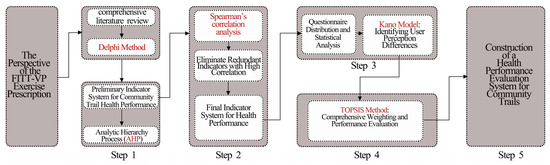
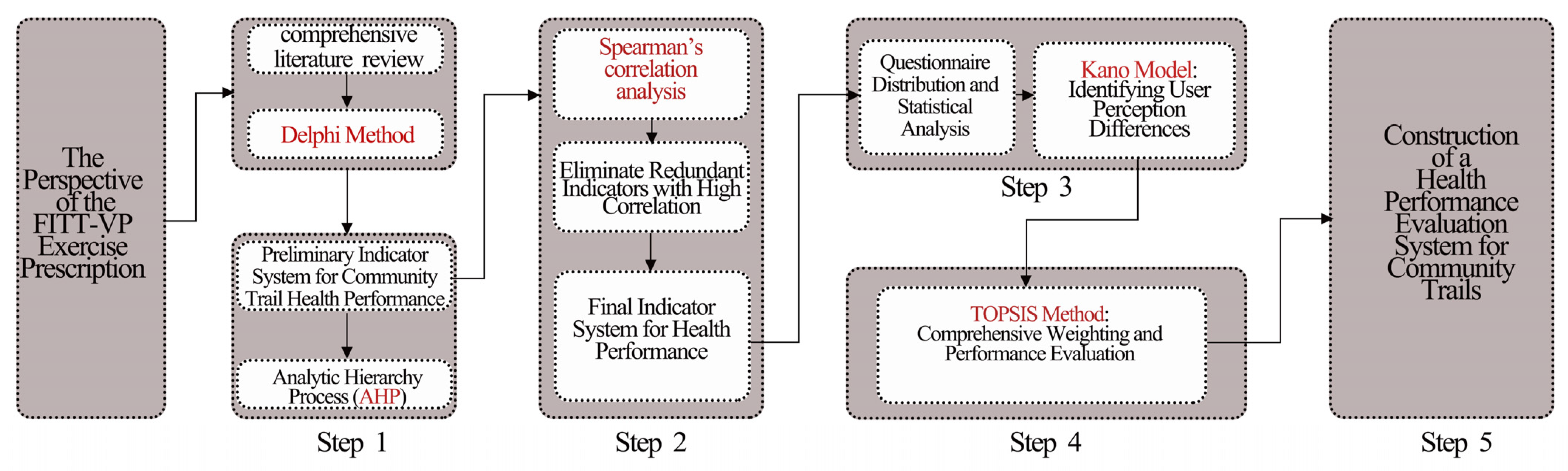
This study adopts a multi-stage, planning-oriented methodological framework that integrates theoretical grounding, indicator development, expert consensus, user perception analysis, and quantitative evaluation to assess the health effectiveness of community walking environments. The overall research framework and technical route are illustrated in Figure 1.
Figure 1.
Research Framework.
The research process consists of five sequential stages, each serving a specific function in translating exercise prescription principles into an operational assessment tool applicable to urban and community planning contexts.
2.1. Conceptual and Theoretical Foundations
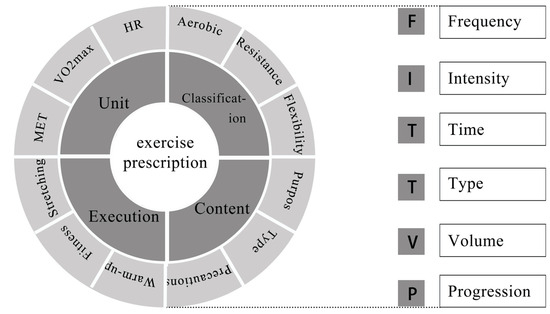
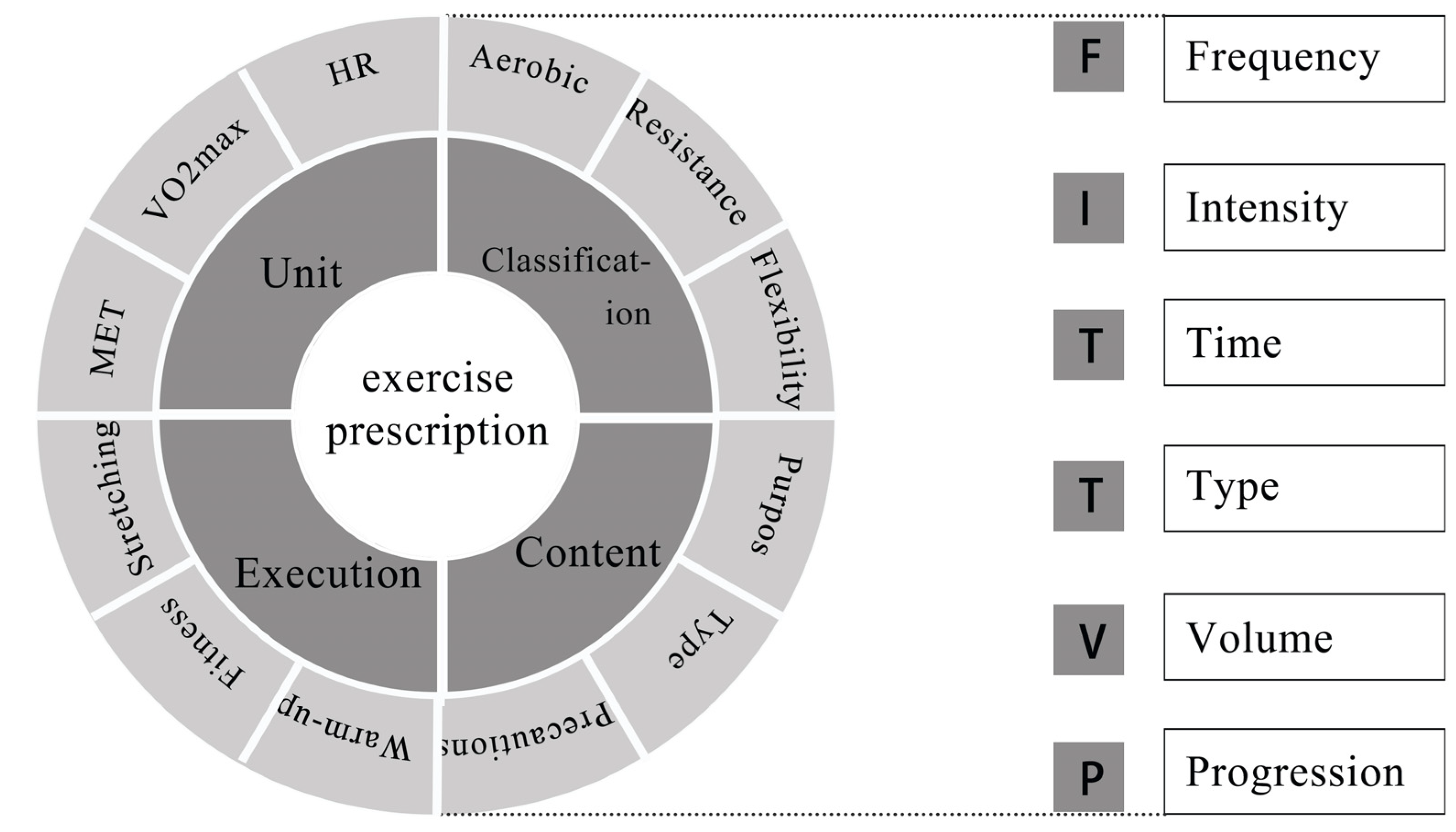
The FITT-VP exercise prescription framework was adopted as the theoretical foundation for defining the core dimensions of health-oriented physical activity (Figure 2) [31]. Rather than applying FITT-VP as a clinical intervention model, this study interprets its components—Frequency, Intensity, Time, Type, Volume, and Progression—as performance requirements that community walking environments should be capable of supporting in residents’ daily activities [32]. These dimensions provide a conceptual basis for evaluating whether walking environments can function as effective planning instruments for promoting regular physical activity, particularly among aging populations and individuals with long-term health management needs [33,34].
Figure 2.
Components of the FITT-VP principle.
2.2. Study Area
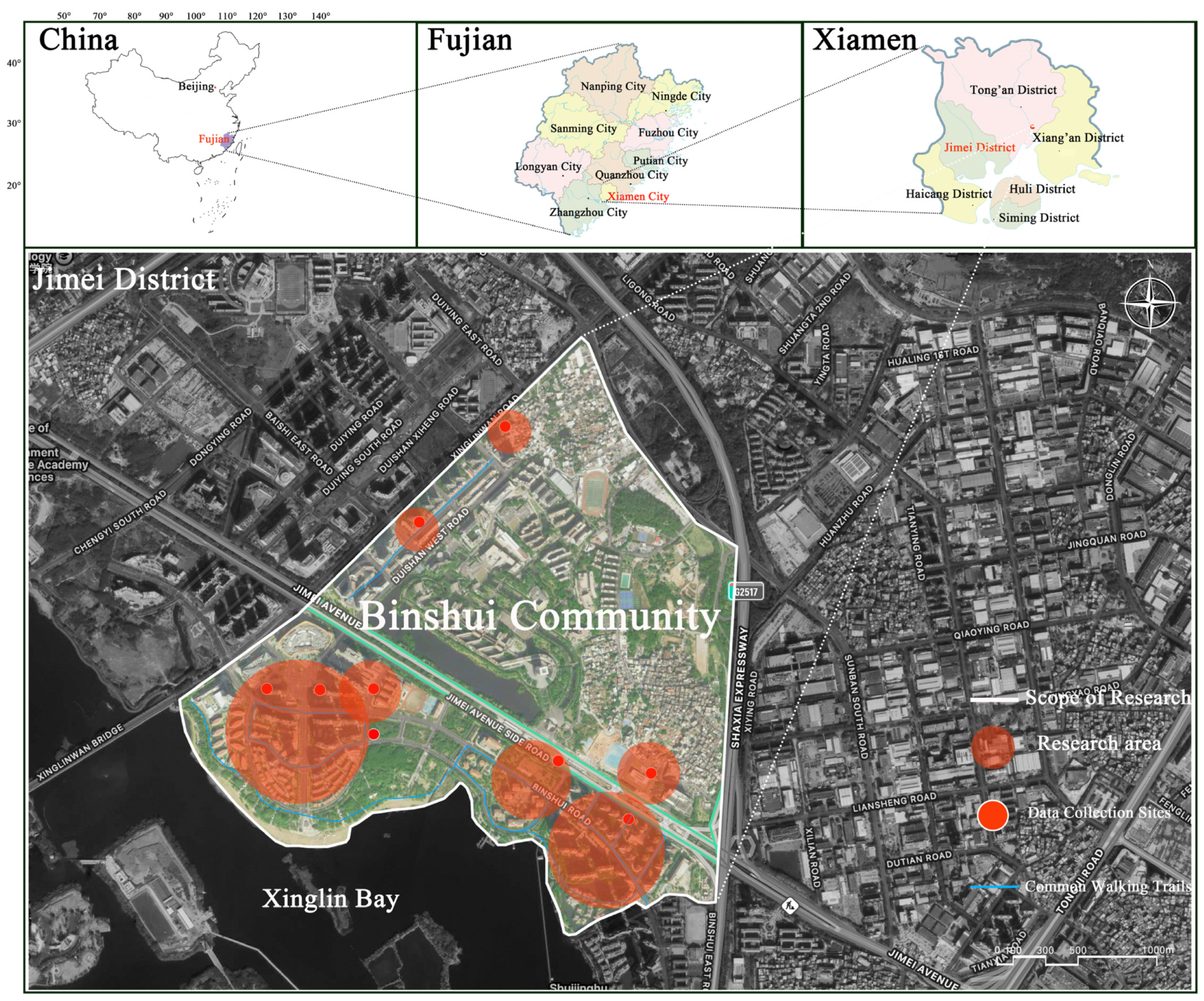
Binshui Community in Jimei District, Xiamen, were selected as the case study area for three main reasons (Figure 3). First, the area represents a typical aging Binshui community in rapidly urbanizing Chinese cities, where walking constitutes a primary form of daily physical activity among older adults. Second, the community contains an established but aging community walking network, making it suitable for evaluating health effectiveness and identifying optimization potential. Third, the availability of detailed spatial data and long-term field investigation supported a comprehensive and reliable empirical assessment.
Figure 3.
Research Area.
2.3. Indicators for Health Effectiveness Evaluation
A preliminary pool of evaluation indicators was established through a comprehensive literature review covering walkability, built environment and health, community fitness infrastructure, and age-friendly urban design. To refine this indicator pool, the Delphi method was employed. The Delphi process aimed to identify spatial, functional, and managerial attributes that are closely associated with health-supportive physical activity at the community scale. Based on methodological recommendations suggesting that 10–18 experts are sufficient to achieve reliable consensus while maintaining effective communication, 12 experts were invited from the fields of public health, sports medicine, health management, and community planning (Table 1). This interdisciplinary composition ensured both professional diversity and relevance to health-oriented community walking environments.
Table 1.
Background Information of Delphi Method Experts.
2.4. Indicator System
The Delphi method was further applied through multiple rounds of structured expert consultation to refine and validate the indicator system. Experts evaluated each indicator in terms of relevance, clarity, and practical applicability from a planning and implementation perspective. Through iterative feedback and consensus building, redundant or weak indicators were modified or eliminated, resulting in a structured indicator system suitable for neighborhood-scale assessment.
The finalized indicator system is presented in Table 2, including indicator definitions, objective measurement methods, and corresponding literature sources. These indicators translate exercise prescription principles into measurable spatial, functional, and managerial attributes that can be directly evaluated within a community planning context.
Table 2.
Identification and explanation of core indicators based on the FITT-VP framework.
2.5. Spearman’s Correlation Analysis for Indicator Screening
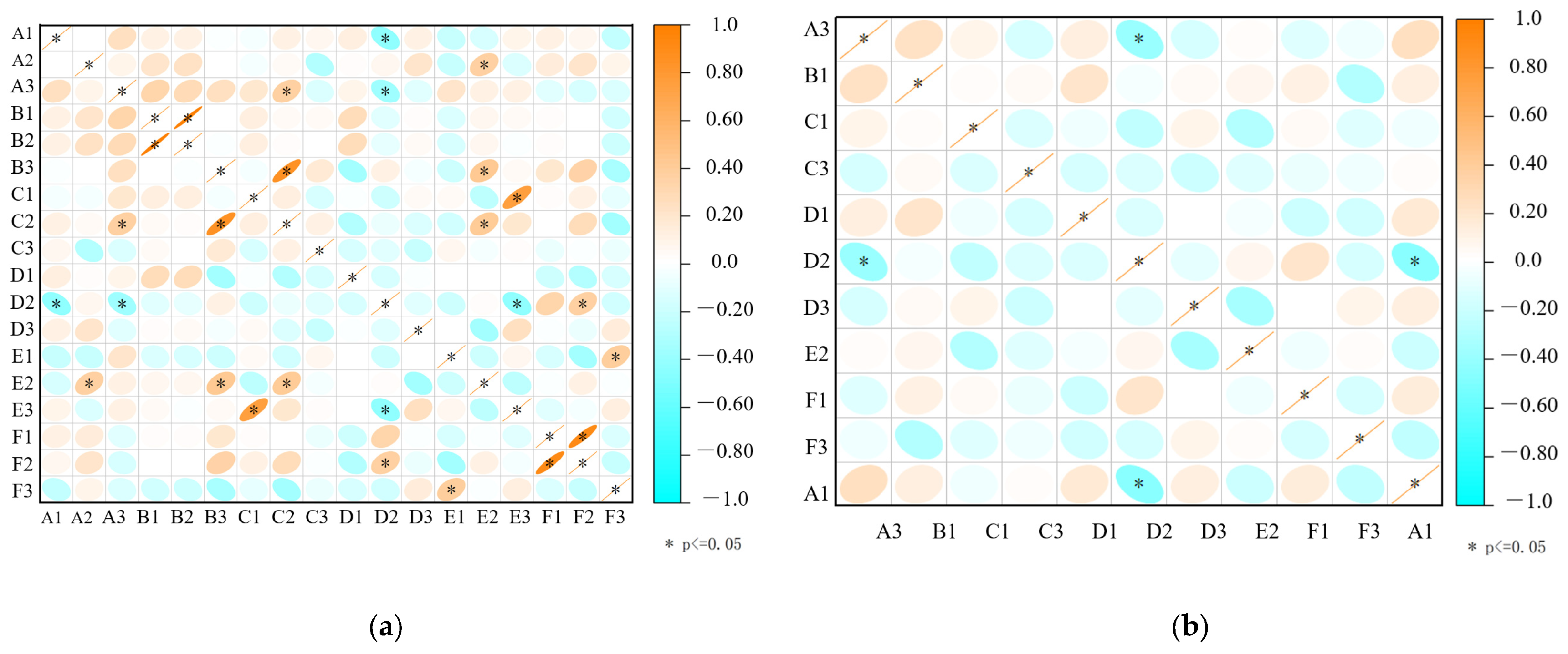
To ensure the independence and robustness of the evaluation system, Spearman’s rank correlation analysis was conducted among candidate indicators, and Variance Inflation Factor (VIF) values were calculated to detect potential multicollinearity. Several indicators exhibited strong correlations with others, including Daily Opening Duration, Slope Grading Signage Quantity, Heart Rate Detection Device Quantity, Number of Timing Points per Session, Single Loop Total Distance, Safety Warning Sign Density, and Progression Training Guidance Signage Quantity. These indicators were sequentially removed to reduce redundancy (Figure 4).
Figure 4.
Correlation analysis results: (a) before indicator screening; (b) after indicator screening.
2.6. Data Source
Recognizing that the effectiveness of community walking environments depends not only on expert-defined standards but also on user experience, this study incorporated user perception analysis using the Kano model. Questionnaire surveys were conducted to capture residents’ satisfaction levels and demand characteristics related to different walking environment attributes. To reflect actual usage patterns of community walking environments, respondents from different age groups were included. While older adults represent an important target group in healthy aging, walking environments are shared public spaces used by all residents.
From 4 to 31 October 2023, a total of 316 questionnaires (Appendix A) were randomly distributed to community walking environment users during peak activity periods (weekdays: 16:30–22:00; weekends: 09:00–22:00) (Figure 5). All questionnaires were collected on-site immediately after completion to ensure data accuracy (Appendix B). For elderly participants who experienced difficulties with reading or writing, semi-structured interviews were conducted by the research team. Each questionnaire item was explained in detail, and satisfaction ratings were recorded accordingly.
Figure 5.
Characteristics of Survey Participants.
The survey collected demographic and behavioral information, including age, gender, activity duration, weekly usage frequency, and primary activity type. After excluding incomplete responses, 305 valid questionnaires were obtained, yielding an effective response rate of 96.52%. Although this study focuses on promoting healthy aging, the survey results indicate that walking spaces are actively used by multiple age groups, highlighting the need for inclusive planning strategies benefiting both older and younger residents.
2.7. Analysis of User Perceptions and Behavioral Insights
The Kano model was applied to classify indicators into must-be, performance, and attractive attributes, thereby integrating experiential and behavioral dimensions into the planning-oriented evaluation framework (Table 3). To quantify perception strength, Better–Worse coefficients were calculated to reflect satisfaction gains when an attribute is present and dissatisfaction when it is absent (Equations (1) and (2)). These coefficients were subsequently used to adjust indicator priorities. To assess the robustness of the evaluation results, sensitivity analyses were conducted under alternative weight scenarios (Equation (3)).
Table 3.
Kano Model Attribute Classification.
The Kano model was applied to classify indicators into must-be, performance, and attractive attributes, thereby integrating experiential and behavioral dimensions into the planning-oriented evaluation framework. To quantify perception strength, Better–Worse coefficients were calculated to reflect satisfaction gains when an attribute is present and dissatisfaction when it is absent (Equations (1) and (2)):
where Better (SI) is the “better” coefficient, also known as the Satisfaction Index (SI), which quantifies the proportion of positive evaluations (“Outstanding” and “Acceptable”) relative to the total number of valid responses. Worse (DSI) is the “worse” coefficient, or the Dissatisfaction Index (DSI), which measures the proportion of negative evaluations (“Marginal” and “Intolerable”) within the total valid responses and is multiplied by −1 to render it as a negative-valued metric.
These coefficients were subsequently used to adjust indicator priorities. To assess the robustness of the evaluation results, sensitivity analyses were conducted under alternative weight scenarios (Equation (3)):
where, Rₙ is the overall importance score for the n-th attribute, a composite metric that integrates both satisfaction and dissatisfaction, Bₙ is the Better (SI) value for the n-th attribute, while Wₙ is the Worse (DSI) value.
2.8. Comprehensive Assessment of Community Walking Environment Performance
To quantitatively evaluate the health effectiveness of community walking environments, an entropy-weighted TOPSIS (Technique for Order Preference by Similarity to Ideal Solution) multi-criteria decision-making model was employed. Indicator weights were first determined objectively using the entropy method, and subsequently adjusted by incorporating user perception coefficients to better reflect actual usage priorities and behavioral preferences.
Within the TOPSIS framework, the positive ideal solution (PIS) and negative ideal solution (NIS) were defined to represent the optimal and least favorable performance levels across all indicators (Equations (4) and (5)):
where A* is the Positive Ideal Solution (PIS), a hypothetical optimal alternative composed of the best possible values for all evaluation criteria, A− is the Negative Ideal Solution (NIS), a hypothetical worst alternative constituted by the worst possible values for all evaluation criteria.
Based on these reference points, the weighted Euclidean distances of each community walking environment segment to the PIS and NIS were calculated (Equations (6) and (7)):
where dᵢ* is the weighted Euclidean distance from the i-th alternative to the positive ideal solution A*. A smaller dᵢ* indicates that the alternative is closer to the “optimal” state, dᵢ− is the weighted Euclidean distance from the i-th alternative to the negative ideal solution A−, wⱼ is the weight of the j-th evaluation criterion, reflecting its relative importance compared to other criteria, typically satisfying Σ wⱼ = 1, aᵢⱼ is the normalized score or value of the i-th alternative on the j-th evaluation criterion, aⱼ*: Denotes the value of the j-th evaluation criterion in the positive ideal solution A*,aⱼ−: Denotes the value of the j-th evaluation criterion in the negative ideal solution A−.
The relative closeness coefficient () was then derived for each segment (Equation (8)),
where a higher value indicates closer proximity to the ideal solution and, consequently, superior health performance.
The resulting rankings were used to identify strengths and deficiencies among existing trail segments and to reveal key performance gaps between current walking environments and health-supportive requirements. The findings provide an empirical basis for proposing targeted spatial design and management optimization strategies, offering evidence-based support for neighborhood-scale regeneration and sustainable urban planning.
3. Results
3.1. Questionnaire-Based User Behavior and Demand Characteristics
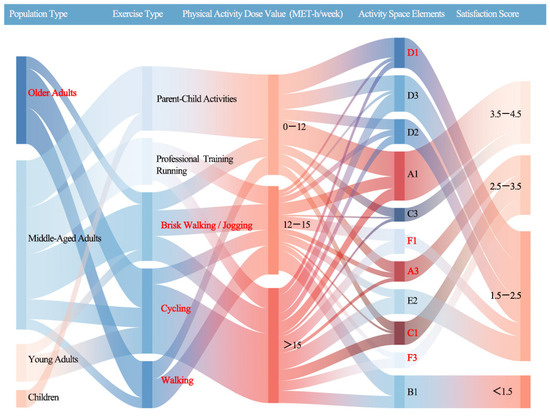
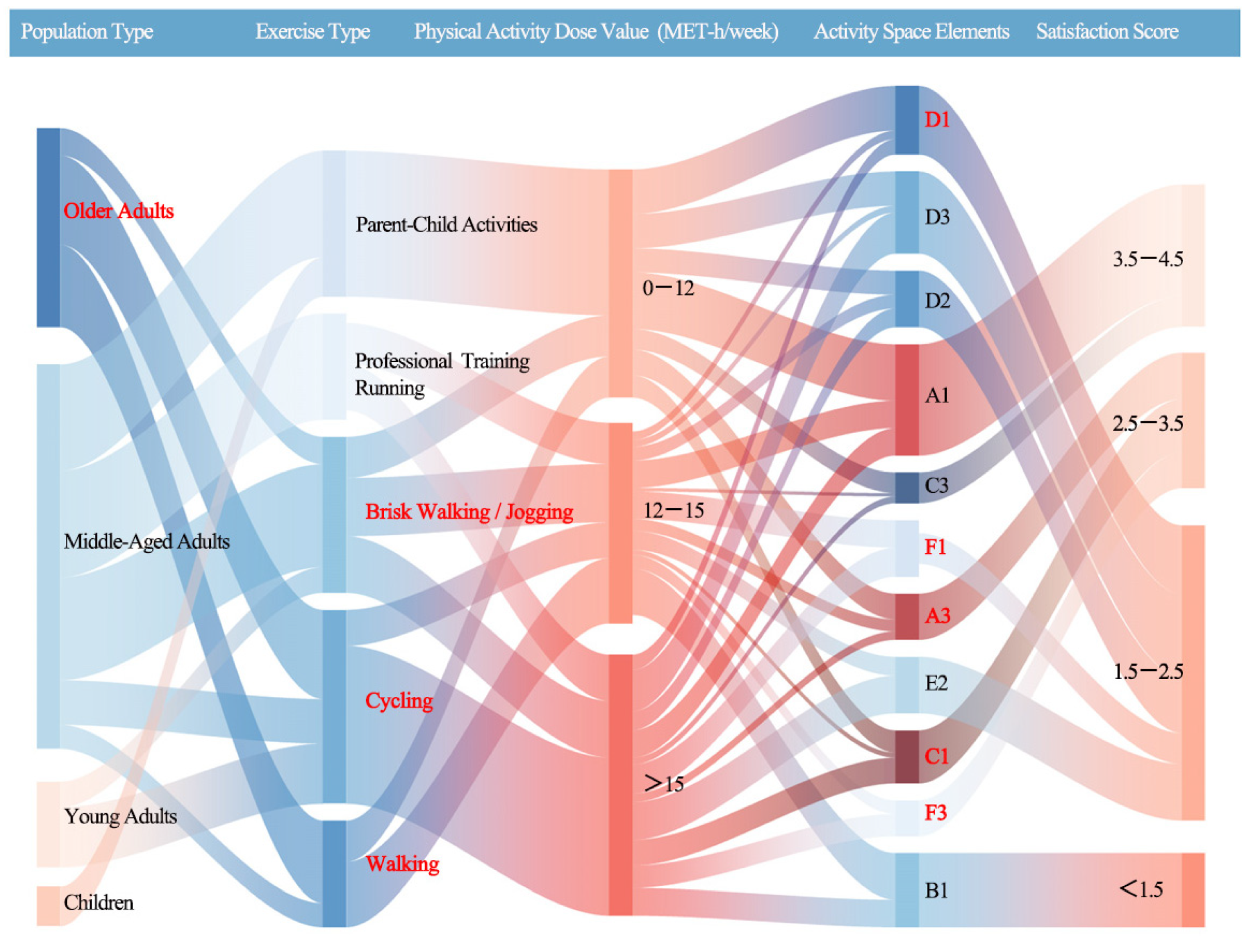
Among the respondents, older adults accounted for 28.9%, middle-aged adults for 54.1%, youth for 12.1%, and children for 4.9%. Reported activity types included leisure walking (15.01%), brisk walking or jogging (22.03%), cycling (27.36%), professional running (15.02%), and parent–child activities (20.58%) (Figure 5). Notably, older adults predominantly engaged in leisure walking, reflecting the importance of low- to moderate-intensity exercise that is safe, accessible, and comfortable. Middle-aged adults tended to participate in brisk walking and cycling, indicating a need for spaces that support higher-intensity activities, while youth and children were mainly involved in parent–child interactions, highlighting family-oriented activity demands. These patterns underscore the diversity of community users but particularly emphasize that, in aging urban neighborhoods, walking environments indicate the importance of age-friendly features such as Service Coverage Radius (A1), Exercise Type Guidance Sign Clarity (D3), Nighttime Illumination Uniformity (C1), and Interval Training Feasibility (F3). Designing trails with flexibility and multi-functionality can accommodate varying activity intensities across age groups while enhancing the health-promoting potential of walking spaces for older adults, which is central to sustainable, age-adapted community planning.
3.2. User Demand Prioritization Using the Kano Model
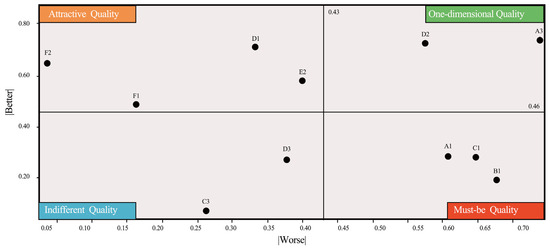
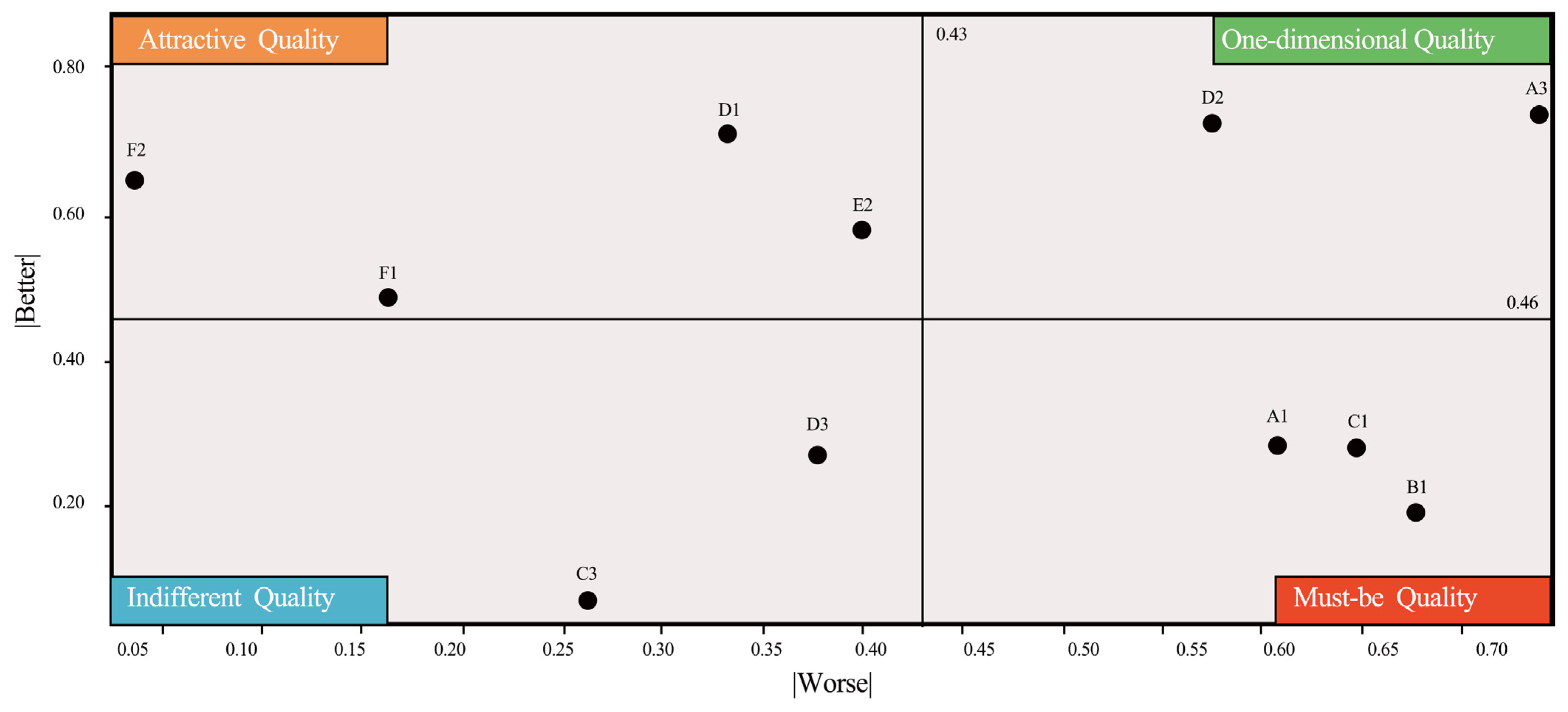
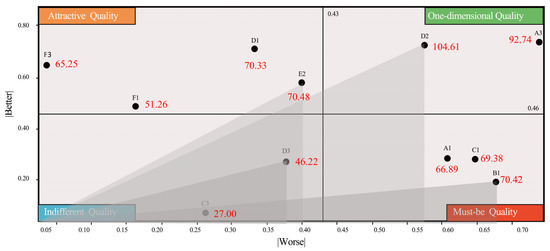
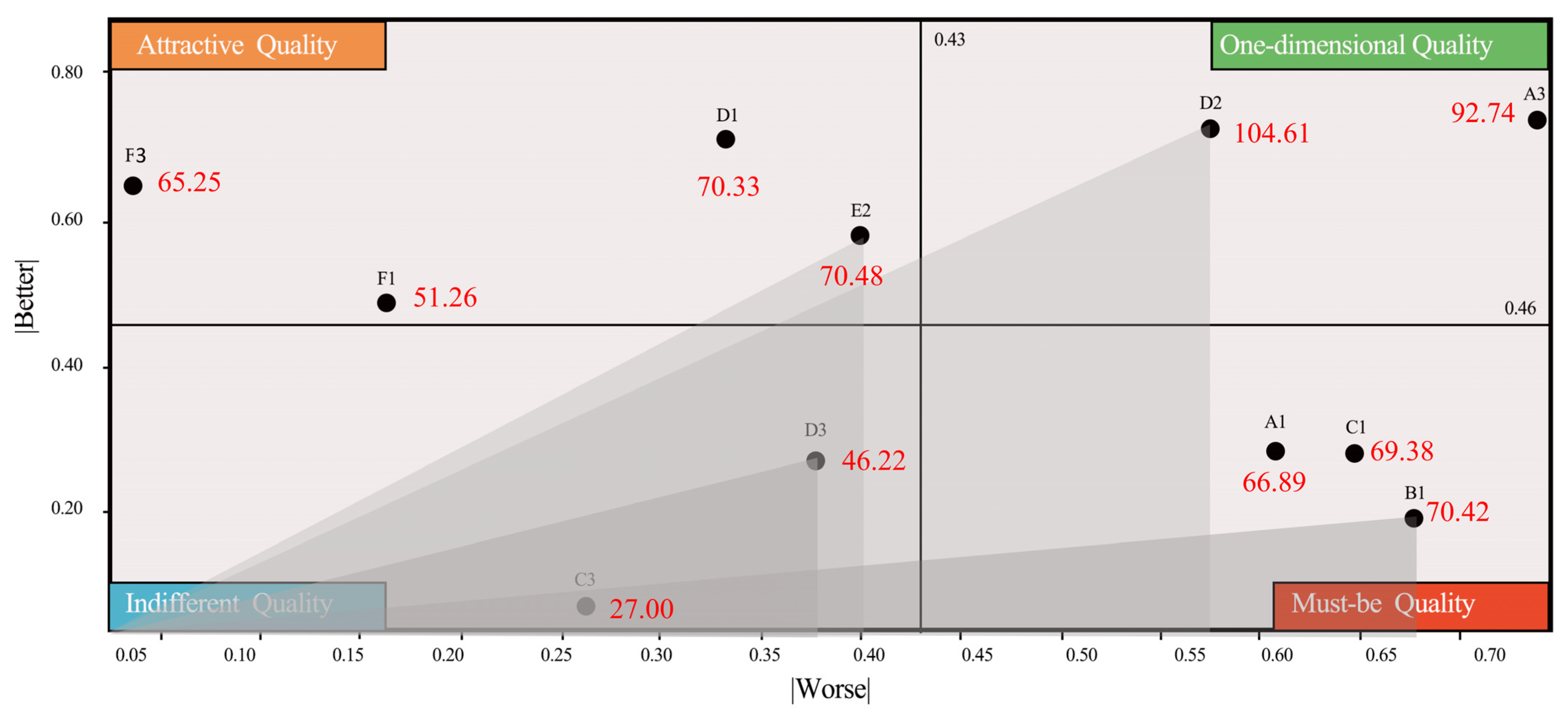
Based on the Kano model results, the eleven evaluated indicators were classified into four categories: three Must-be attributes, two One-dimensional attributes, four Attractive attributes, and two Indifferent attributes (Figure 6).
Figure 6.
Results of the Kano Model Analysis.
The analysis indicates that Service Coverage Radius (A1), Intensity Grading Signage Quantity (B1), and Nighttime Illumination Uniformity (C1) function as Must-be attributes, representing essential baseline conditions for community walking environments that support safe and accessible physical activity for healthy aging; deficiencies in these aspects directly reduce user satisfaction regardless of other improvements. Monthly Maintenance Frequency (A3) and Trail Segmentation Number (D2) are One-dimensional attributes, meaning user satisfaction increases or decreases proportionally with improvements in maintenance quality and route continuity, both of which are critical for sustaining regular walking behavior among aging populations. In contrast, Distance Between Refreshment Facilities (E2), Multifunctional Training Area Match (D1), Progression Route Planning Integrity (F1), and Progression Training Guidance Signage Quantity (F2) are Attractive attributes, significantly enhancing user experience when present by supporting diversified and progressive exercise, thereby encouraging longer participation and improving the health benefits of walking for healthy aging. Meanwhile, Exercise Type Guidance Sign Clarity (D3) and Peak Hour Crowd Management Capacity (C3) are classified as Indifferent attributes, suggesting that under current conditions they exert limited influence on satisfaction, as users prioritize accessibility, safety, and route quality—core factors enabling continuous physical activity in aging-friendly communities.
The mean values of the Better (B = 0.46) and Worse (W = 0.43) coefficients served as comparative thresholds to position each indicator within four quadrants. Following the established priority rule M > O > A > I, the final hierarchy of user demand importance was obtained: Must-be: B1 > C1 > A1 One-dimensional: D2 > A3 Attractive: E2 > D1 > F3 > F1Indifferent: D3 > C3 (Figure 7).
Figure 7.
Results of the Kano Model Sensitivity Analysis.
3.3. Integrated Evaluation Results and Spatial Improvement Priorities
To comprehensively evaluate the health effectiveness of the walking environment in the Binshui community, this study integrates entropy-weighted TOPSIS analysis with Delphi-based expert scoring, thereby enabling a comparison between objective data-driven differentiation and normative professional judgment.
The entropy results indicate that Progression Route Planning Integrity (F1) obtained the highest weight (0.105862), followed by Service Coverage Radius (A1) (0.105340) and Interval Training Feasibility (F3) (0.105162), all belonging to the high-weight category (>0.1044). These findings suggest that route continuity, accessibility thresholds, and intensity regulation capacity constitute the most discriminative spatial factors influencing health effectiveness in the current community context. In contrast, D3 (0.005028) and E2 (0.006341) fall into the low-weight category (<0.08), reflecting limited spatial variability and minimal contribution to the composite score (Table 4).
Table 4.
Entropy-weighted TOPSIS results for secondary indicators.
Notably, entropy weights represent data dispersion rather than normative importance; indicators with greater spatial heterogeneity receive higher weights even if experts conceptually regard other baseline factors as critical. When compared with the Delphi results, a methodological distinction becomes evident. Experts consistently emphasized foundational attributes—such as accessibility, safety, and basic service guarantees—as threshold conditions necessary for healthy aging and exercise prescription implementation. The divergence arises because the Delphi method captures normative judgments grounded in health theory and planning standards, whereas entropy weighting reflects empirical variability within the specific case area. In essence, expert scoring identifies what should be important, while entropy-TOPSIS reveals what most strongly differentiates current spatial performance. By integrating both perspectives with older adults’ demand–satisfaction analysis, priority improvement areas can be more precisely determined. Indicators that simultaneously exhibit high objective weight, high demand, and low or moderate satisfaction—particularly F1, D1, A3, C1, and F3—are identified as key intervention targets (Table 5), indicating that future spatial optimization should focus on enhancing route continuity, maintenance quality, supportive facility completeness, nighttime illumination, and graded intensity environments to better support sustainable daily physical activity in aging communities.
Table 5.
Older Adults’ Demand, Satisfaction, and Improvement Needs of Indicators.
4. Discussion
This study proposes a planning-oriented framework to evaluate the health effectiveness of community walking environments by translating FITT-VP exercise prescription principles into measurable spatial, functional, and management indicators. By combining expert consultation, statistical screening, user perception analysis, and multi-criteria decision-making methods, the framework establishes a practical linkage between exercise science and community-scale planning. The results indicate that the indicator system is methodologically reliable and applicable for identifying performance gaps in existing walking environments, particularly in aging communities where daily physical activity is essential for health maintenance.
4.1. Methodological Innovation and Scientific Rigor from a Planning Perspective
This study advances existing research by embedding the FITT-VP exercise prescription framework into a planning-oriented evaluation system, shifting assessment from descriptive infrastructure provision toward performance-based evaluation of health-support capacity. The framework integrates objective spatial and managerial indicators with user-centered experiential attributes, combining measurable conditions—such as service coverage, route segmentation, and continuity—with user perceptions of safety, comfort, and functional suitability, recognizing that health effectiveness results from interactions between spatial provision and behavioral response. Methodological rigor is strengthened through the combined application of the Delphi method, Kano model, and entropy-weighted TOPSIS approach, which integrate expert judgment, differentiated user needs, and objective data variability within a unified analytical framework. The high Kendall’s coefficient of concordance (W = 0.812), together with satisfactory reliability and validity indicators (Cronbach’s α = 0.896; cumulative variance explained = 76.32%), confirms the internal consistency and robustness of the evaluation system.
4.2. Interpretation of Key Results and Planning Implications
The results indicate that exercise intensity and cumulative exercise volume are the most influential dimensions shaping the health effectiveness of community walking environments, consistent with public health evidence that sufficient intensity and duration are essential for achieving measurable health benefits, particularly among older adults and individuals with chronic diseases. Compared with prior studies focusing primarily on macro-scale factors such as land-use mix [46,47,48], street connectivity [49,50,51], and environmental aesthetics [52,53], this study highlights the importance of micro-scale, exercise-supportive design and management features, including intensity grading signage, lighting uniformity, and progression-oriented route planning. The prominence of these indicators suggests that community walking environments should move beyond basic walkability toward systems that support cumulative and sustained physical activity in daily life. Priority indicators identified through expert weighting and user perception analysis—such as service coverage radius, lighting uniformity, and route continuity—reflect core planning requirements related to accessibility, safety, and functional continuity, which are particularly critical in aging communities and for populations managing chronic diseases. The importance of progression-related indicators further indicates that walking environments should incorporate graded routes, guidance systems, and flexible training options that encourage long-term participation and gradual improvement. By translating exercise prescription requirements into measurable planning criteria, this study provides planners and local governments with an operational tool to evaluate health performance and guide targeted interventions in community regeneration and infrastructure upgrading processes.
Among the evaluated factors, F1: Progression Route Planning Integrity shows high demand but low satisfaction and carries the highest weight, indicating that route continuity and hierarchical organization remain insufficient in certain sections due to fragmented connections between older residential clusters and newly developed waterfront sections in Jimei. Improving continuous walking loops and strengthening connections between residential areas and waterfront routes would better support sustained daily exercise, particularly for older residents.
F3: Interval Training Feasibility, D1: Multifunctional Training Area Match and A3: Monthly Maintenance Frequency both demonstrate high demand with insufficient satisfaction, suggesting that existing facilities do not fully support progressive and diversified exercise patterns. The results indicate the need for better distribution of small activity and resting nodes along waterfront and internal community segments, enabling users to adjust exercise intensity more flexibly during walking activities.
C1: Nighttime Illumination Uniformity shows high demand with medium satisfaction, implying that although nighttime walking is generally feasible, uneven lighting conditions in some sections still influence route usability. Enhancing illumination continuity along frequently used waterfront sections, particularly those located farther from residential interfaces, would help maintain evening physical activity.
Overall, the results suggest that improvements in route continuity, exercise-supportive facilities, and nighttime environmental conditions represent the main spatial aspects requiring attention in the study area.
5. Conclusions
This study proposes a planning-oriented framework to evaluate the health effectiveness of community walking environments by translating FITT-VP exercise prescription principles into measurable spatial, functional, and management indicators. The results show that exercise intensity and cumulative exercise volume are the most influential dimensions, with priority improvements including intensity classification signage, service coverage radius, nighttime lighting uniformity, and functional zoning of walking routes. The framework provides a practical assessment tool to support planning and renewal strategies for health-oriented community walking environments, particularly in aging communities.
This study has several limitations. The empirical analysis was limited to the Binshui community in Jimei District, Xiamen, and the relatively small sample size may limit generalizability. The framework focuses on general physical activity needs rather than disease-specific exercise requirements, and the evaluation mainly relies on spatial indicators and user perception data. Future research will expand case studies and involve physical therapists in indicator development and validation to better integrate disease-specific and rehabilitation-oriented exercise prescriptions. Despite these limitations, the study offers an exploratory approach for incorporating exercise prescription principles into community walking environment assessment and planning practice.
Author Contributions
Conceptualization, X.Z. and Y.Z.; Methodology, X.Z. and Y.Z.; Software, W.F.; Validation, W.F. and H.G.; Formal analysis, W.F. and H.G.; Investigation, X.Z., W.F. and H.G.; Resources, X.Z., W.F. and H.G.; Data curation, X.Z., W.F. and H.G.; Writing—original draft, X.Z., W.F. and H.G.; Writing—review & editing, X.Z. and H.G.; Visualization, W.F. and Y.Z.; Supervision, X.Z. and Y.Z.; Project administration, X.Z.; Funding acquisition, X.Z. and Y.Z. All authors have read and agreed to the published version of the manuscript.
Funding
Project supported by the Natural Science Foundation of Fujian Province, China (Grant No. 2024J01086), Huaqiao University’s Academic Project Supported by the Fundamental Research Funds for the Central Universities (Grant No. 20241XD006).
Institutional Review Board Statement
The study was conducted in accordance with the Declaration of Helsinki, and approved by the Institutional Review Board (or Ethics Committee) of College of Medicine, Huaqiao University (protocol code M2025044 and date of approval 20 December 2025).
Informed Consent Statement
Informed consent was obtained from all subjects involved in the study.
Data Availability Statement
The original contributions presented in this study are included in the article. Further inquiries can be directed to the corresponding author.
Acknowledgments
We are deeply grateful to Binshui Community and the community hospital for their cooperation and support in this survey.
Conflicts of Interest
The authors declare no conflicts of interest.
Abbreviations
The following abbreviations are used in this manuscript:
| NCDs | Non-communicable diseases |
| EP | Exercise Prescription |
| FITT-VP | Frequency, Intensity, Time, Type, Volume, Progression |
| METs | Metabolic Equivalents |
Appendix A. Questionnaire on Satisfaction with the Binshui Health Trail in Jimei District
Appendix A.1. Part I: Basic Information
Please provide the following background information. Your responses will remain strictly confidential and will be used for research purposes only.
- 1.
- Gender
- ①
- Female
- ②
- Male
- 2.
- Age
- ①
- Under 18
- ②
- 18–30
- ③
- 31–45
- ④
- 46–60
- ⑤
- Above 60
- 3.
- Frequency of weekly use of the community walking environment
- ①
- Once
- ②
- 2–3 times
- ③
- 4–5 times
- ④
- 6–7 times
- ⑤
- Rarely or never
- 4.
- Primary purposes for utilizing the community walking environment
- ①
- Leisure walking
- ②
- Brisk walking/jogging
- ③
- Professional running
- ④
- Parent–child activities
- ⑤
- Cycling
Appendix A.2. Part II: Importance Scale
For each item, please indicate how important you consider the factor to be when evaluating the urban walking environment. Use the following scale:
- 5 = Extremely Important
- 4 = Very Important
- 3 = Moderately Important
- 2 = Slightly Important
- 1 = Not Important at All.
Table A1.
Questionnaire on importance scale.
Appendix B. Statistical Results of the Questionnaire Survey
Table A2.
Results of the Questionnaire Survey.
References
- Zhao, Y.; Gao, Y.; Li, M.; Bai, Y.; Liu, D.; Mi, S.; Wang, Z.; Zhao, W. Quantitative Analysis on NCDs Prevention and Control Policies Based on the Perspective of Policy Instruments—China, 1990–2020. China CDC Wkly. 2022, 4, 397–402. [Google Scholar] [CrossRef] [Scilit] [PubMed]
- Dilaver, I.; Karakullukcu, S.; Gurcan, F.; Topbas, M.; Ursavas, O.F.; Beyhun, N.E. Climate Change and Non-Communicable Diseases: A Bibliometric, Content, and Topic Modeling Analysis. Sustainability 2025, 17, 2394. [Google Scholar] [CrossRef] [Scilit]
- Wu, H.; Wang, Y.; Zhang, H.; Yin, X.; Wang, L.; Wang, L. An Investigation into the Health Status of the Elderly Population in China and the Obstacles to Achieving Healthy Aging. Sci. Rep. 2024, 14, 31123. [Google Scholar] [CrossRef] [Scilit]
- Liu, H.; Yin, P.; Qi, J.; Zhou, M. Burden of Non-Communicable Diseases in China and Its Provinces, 1990–2021: Results from the Global Burden of Disease Study 2021. Chin. Med. J. 2024, 137, 2325–2333. [Google Scholar] [CrossRef] [Scilit] [PubMed]
- Cuckler, G.A.; Sisko, A.M.; Poisal, J.A.; Keehan, S.P.; Smith, S.D.; Madison, A.J.; Wolfe, C.J.; Hardesty, J.C. National Health Expenditure Projections, 2017–2026: Despite Uncertainty, Fundamentals Primarily Drive Spending Growth. Health Aff. 2018, 37, 482–492. [Google Scholar] [CrossRef] [Scilit]
- Zhou, J.; Yao, Z.; Xu, S.; Long, Y.; Zeng, Z.; Qin, J.; Ding, N.; Su, Y. Global Burden of 13 Non-Communicable Diseases Attributable to High Fasting Plasma Glucose from the GBD 2021 Study. Nutr. Diabetes 2025, 15, 50. [Google Scholar] [CrossRef] [Scilit]
- Lee, I.-M.; Shiroma, E.J.; Lobelo, F.; Puska, P.; Blair, S.N.; Katzmarzyk, P.T. Effect of Physical Inactivity on Major Non-Communicable Diseases Worldwide: An Analysis of Burden of Disease and Life Expectancy. Lancet 2012, 380, 219–229. [Google Scholar] [CrossRef] [Scilit]
- Health Promotion. Available online: https://www.who.int/teams/health-promotion/enhanced-wellbeing/ninth-global-conference/healthy-china (accessed on 12 December 2025).
- Hills, A.P.; Jayasinghe, S.; Arena, R.; Byrne, N.M. Global Status of Cardiorespiratory Fitness and Physical Activity—Are We Improving or Getting Worse? Prog. Cardiovasc. Dis. 2024, 83, 16–22. [Google Scholar] [CrossRef] [Scilit]
- Malik, Z.I.; Ahmad, A.M.R. Non-Communicable Disease (NCD) Burden and Their Contributing Factors among Women. Health Care Women Int. 2025, 46, 687–701. [Google Scholar] [CrossRef] [Scilit]
- Bull, F.C.; Al-Ansari, S.S.; Biddle, S.; Borodulin, K.; Buman, M.P.; Cardon, G.; Carty, C.; Chaput, J.-P.; Chastin, S.; Chou, R.; et al. World Health Organization 2020 Guidelines on Physical Activity and Sedentary Behaviour. Br. J. Sports Med. 2020, 54, 1451–1462. [Google Scholar] [CrossRef] [Scilit]
- Tao, D.; Awan-Scully, R.; Cole, A.; Gao, Y.; Ash, G.I.; Gu, Y.; Dutheil, F.; Sun, Y.; Baker, J.S. Integration of Exercise Prescription into Medical Provision as a Treatment for Non-Communicable Diseases: A Scoping Review. Front. Public Health 2023, 11, 1126244. [Google Scholar] [CrossRef] [Scilit]
- Chen, P.; Li, F.; Harmer, P. Healthy China 2030: Moving from Blueprint to Action with a New Focus on Public Health. Lancet Public Health 2019, 4, e447. [Google Scholar] [CrossRef] [Scilit] [PubMed]
- Hu, N.; Yin, W.; Noon, R.I.; Alabdullatif, N. The Longitudinal Relationship Between Physical Functions and Cognitive Functions Among Middle-Aged and Older Adults in Primary Care. Int. J. Environ. Res. Public Health 2025, 22, 908. [Google Scholar] [CrossRef] [Scilit] [PubMed]
- Wood, T.; Pantelis, J.; Watson, M.; Olson, R. Preventive Maintenance for Recreational Trails; Minnesota Department of Transportation: St. Paul, MN, USA, 2009. [Google Scholar]
- Knuiman, M.W.; Christian, H.E.; Divitini, M.L.; Foster, S.A.; Bull, F.C.; Badland, H.M.; Giles-Corti, B. A Longitudinal Analysis of the Influence of the Neighborhood Built Environment on Walking for Transportation: The RESIDE Study. Am. J. Epidemiol. 2014, 180, 453–461. [Google Scholar] [CrossRef] [Scilit]
- Riske, T. The Effectiveness of Trail Mitigation and Theory-Grounded Signage in An Economical Approach to Reducing Social Trail Behaviors; Arizona State University: Tempe, AZ, USA, 2018. [Google Scholar]
- Nguyen, H. An Overview of Trails and Trail Signs in Outdoor Recreation. Bachelor’s Thesis, Lapland University of Applied Sciences, Rovaniemi, Finland, 2017. [Google Scholar]
- Stevenson, L.C.; Pabel, A.; MacGregor, C.; Law, L.; Judd, J.A. The Influence of Trail Design on the Impacts of Walkers, Mountain Bikers and Multi-Use Trail Users: An Environmentally Responsible Approach. J. Responsible Tour. Manag. 2022, 2, 31–54. [Google Scholar] [CrossRef] [Scilit]
- Xu, B.; Shi, Q.; Zhang, Y. Evaluation of the Health Promotion Capabilities of Greenway Trails: A Case Study in Hangzhou, China. Land 2022, 11, 547. [Google Scholar] [CrossRef] [Scilit]
- Kolkos, G.; Kantartzis, A.; Stergiadou, A.; Arabatzis, G. Development of Semi-Mountainous and Mountainous Areas: Design of Trail Paths, Optimal Spatial Distribution of Trail Facilities, and Trail Ranking via MCDM-VIKOR Method. Sustainability 2024, 16, 9966. [Google Scholar] [CrossRef] [Scilit]
- Chen, J.; Tao, Z.; Wu, W.; Wang, L.; Chen, D. Influence of Urban Park Pathway Features on the Density and Intensity of Walking and Running Activities: A Case Study of Shanghai City. Land 2024, 13, 156. [Google Scholar] [CrossRef] [Scilit]
- Veitch, J.; Timperio, A.; Salmon, J.; Hall, S.J.; Abbott, G.; Flowers, E.P.; Turner, A.I. Examination of the Acute Heart Rate and Salivary Cortisol Response to a Single Bout of Walking in Urban and Green Environments: A Pilot Study. Urban For. Urban Green. 2022, 74, 127660. [Google Scholar] [CrossRef] [Scilit]
- Paraskevopoulou, A.T.; Chletsou, M.; Malesios, C. Runners Experience Lower Heart Rate, Increased Speed, and Joy/Calm on Routes with Trees, by the Sea and through Parks: Implications for Climate Change Design. Sustainability 2022, 14, 16280. [Google Scholar] [CrossRef] [Scilit]
- Frank, L.D.; Sallis, J.F.; Saelens, B.E.; Leary, L.; Cain, K.; Conway, T.L.; Hess, P.M. The Development of a Walkability Index: Application to the Neighborhood Quality of Life Study. Br. J. Sports Med. 2010, 44, 924–933. [Google Scholar] [CrossRef] [Scilit] [PubMed]
- Wang, X.; Zhang, J.; Wu, C. Users’ Recreation Choices and Setting Preferences for Trails in Urban Forests in Nanjing, China. Urban For. Urban Green. 2022, 73, 127602. [Google Scholar] [CrossRef] [Scilit]
- Yang, Q.; Gao, X.; Lindquist, M.; Song, Y.; Shen, X. Temporal and Spatial Dynamics of Peak-Time Urban Park Visitation: Investigating Influencing Factors Across Scales in Post-Pandemic Detroit. Urban For. Urban Green. 2025, 112, 128871. [Google Scholar] [CrossRef] [Scilit]
- Shang, X.; Duan, Y. A Model for Integrated Use of Fitness Facilities and Public Sports Space in New Community Housing Design. Int. J. Hous. Sci. Its Appl. 2025, 46, 6751–6756. [Google Scholar] [CrossRef] [Scilit]
- Zhang, D.; Peng, J.; Yang, Z. Identifying Urban Agglomeration’s Range: Integrating Clustering and Accessibility Analysis. Cities 2026, 171, 106708. [Google Scholar] [CrossRef] [Scilit]
- Kim, K.; Horner, M.W. Integrating People in Place-Based Accessibility Measures: Design and Application of a Mode Choice Accessibility Model. Ann. Am. Assoc. Geogr. 2025, 115, 854–875. [Google Scholar] [CrossRef] [Scilit]
- Baptista, F.M.; Andias, R.; Rocha, N.P.; Silva, A.G. A Practice Guide for Physical Therapists Prescribing Physical Exercise for Older Adults. J. Aging Phys. Act. 2024, 32, 771–783. [Google Scholar] [CrossRef] [Scilit]
- Huang, L. Exercise Therapy for Knee Osteoarthritis: FITT-VP Principle. In Biological Sciences and Environmental Health; CRC Press: Boca Raton, FL, USA, 2024; pp. 143–149. [Google Scholar]
- Cunningham, G.O.; Michael, Y.L. Concepts Guiding the Study of the Impact of the Built Environment on Physical Activity for Older Adults: A Review of the Literature. Am. J. Health Promot. 2004, 18, 435–443. [Google Scholar] [CrossRef] [Scilit]
- Gunn, L.D.; Mavoa, S.; Boulangé, C.; Hooper, P.; Kavanagh, A.; Giles-Corti, B. Designing Healthy Communities: Creating Evidence on Metrics for Built Environment Features Associated with Walkable Neighbourhood Activity Centres. Int. J. Behav. Nutr. Phys. Act. 2017, 14, 164. [Google Scholar] [CrossRef] [Scilit]
- Zou, J.; Jiang, H.; Ying, W.; Qiu, B. Scenic Influences on Walking Preferences in Urban Forest Parks from Top-View and Eye-Level Perspectives. Forests 2024, 15, 2020. [Google Scholar] [CrossRef] [Scilit]
- Tian, Y. Enhancing Pedestrian Satisfaction: A Quantitative Analysis on Visual Perception Factors. Ph.D. Thesis, Maharishi International University, Fairfield, IA, USA, 2025. [Google Scholar]
- Molnár, A.J. Synergistic Planning of Long-Distance and Local Trails: A Twin Case Study of Trail Network Development in Northern Transdanubia. Tour. Plan. Dev. 2022, 19, 245–278. [Google Scholar] [CrossRef] [Scilit]
- Lee, S.; Chung, W.J.; Jeong, C. Exploring Sentiment Analysis and Visitor Satisfaction along Urban Liner Trails: A Case of the Seoul Trail, South Korea. Land 2024, 13, 1349. [Google Scholar] [CrossRef] [Scilit]
- Bagnall, A.-M.; Southby, K.; Jones, R.; Pennington, A.; South, J.; Corcoran, R. Systematic Review of Community Infrastructure (Place and Space) to Boost Social Relations and Community Wellbeing: Five Year Refresh; What Works Centre for Wellbeing: London, UK, 2023. [Google Scholar]
- Arroyo, N.C. Perceptions of Trail Safety in Humboldt County, California: An Analysis of Safety Concerns, Factors That Impact Trail Use, and the Value People Place on Trails. Master’s Thesis, California State Polytechnic University, Arcata, CA, USA, 2023. [Google Scholar]
- Àvila Callau, A.; Erdozain, M.; Farías-Torbidoni, E.I.; de-Miguel, S. Linking Forest Planning and Recreational Trail Design: A GIS Approach for Enhancing the Social Use of Forests. Environ. Manag. 2025, 75, 2150–2168. [Google Scholar] [CrossRef] [Scilit] [PubMed]
- Levinger, P.; Panisset, M.; Parker, H.; Batchelor, F.; Tye, M.; Hill, K.D. Guidance about Age-friendly Outdoor Exercise Equipment and Associated Strategies to Maximise Usability for Older People. Health Promot. J. Aust. 2021, 32, 475–482. [Google Scholar] [CrossRef] [Scilit] [PubMed]
- Billany, R.E.; Smith, A.C.; Hutchinson, G.M.; Graham-Brown, M.P.M.; Nixon, D.G.D.; Bishop, N.C. Feasibility and Acceptability of High-Intensity Interval Training and Moderate-Intensity Continuous Training in Kidney Transplant Recipients: The PACE-KD Study. Pilot Feasibility Stud. 2022, 8, 106. [Google Scholar] [CrossRef] [Scilit] [PubMed]
- Martland, R.; Onwumere, J.; Stubbs, B.; Gaughran, F. A Feasibility Study of High Intensity Interval Training Intervention in Inpatient Mental Health Settings. Psychiatry Res. Commun. 2024, 4, 100173. [Google Scholar] [CrossRef] [Scilit]
- Li, F.; Harmer, P.; Fitzgerald, K.; Winters-Stone, K. A Cognitively Enhanced Online Tai Ji Quan Training Intervention for Community-Dwelling Older Adults with Mild Cognitive Impairment: A Feasibility Trial. BMC Geriatr. 2022, 22, 76. [Google Scholar] [CrossRef] [Scilit]
- Iannillo, A.; Fasolino, I. Land-Use Mix and Urban Sustainability: Benefits and Indicators Analysis. Sustainability 2021, 13, 13460. [Google Scholar] [CrossRef] [Scilit]
- Zhuo, Y.; Jing, X.; Wang, X.; Li, G.; Xu, Z.; Chen, Y.; Wang, X. The Rise and Fall of Land Use Mix: Review and Prospects. Land 2022, 11, 2198. [Google Scholar] [CrossRef] [Scilit]
- Nabil, N.A.; Abd Eldayem, G.E. Influence of Mixed Land-Use on Realizing the Social Capital. HBRC J. 2015, 11, 285–298. [Google Scholar] [CrossRef] [Scilit]
- Zlatkovic, M.; Zlatkovic, S.; Sullivan, T.; Bjornstad, J.; Shahandashti, S.K.F. Assessment of Effects of Street Connectivity on Traffic Performance and Sustainability within Communities and Neighborhoods through Traffic Simulation. Sustain. Cities Soc. 2019, 46, 101409. [Google Scholar] [CrossRef] [Scilit]
- Koohsari, M.J.; Sugiyama, T.; Lamb, K.E.; Villanueva, K.; Owen, N. Street Connectivity and Walking for Transport: Role of Neighborhood Destinations. Prev. Med. 2014, 66, 118–122. [Google Scholar] [CrossRef] [Scilit]
- Al-Saaidy, H.J.; Alobaydi, D.; Abdullah, S.F. Street Networks and Urban Sustainability by Quantifying Connectivity, Accessibility, and Walkability for Resilient Cities. Civ. Eng. J. 2025, 11, 2421–2439. [Google Scholar] [CrossRef] [Scilit]
- Smith, T.; Nelischer, M.; Perkins, N. Quality of an Urban Community: A Framework for Understanding the Relationship between Quality and Physical Form. Landsc. Urban Plan. 1997, 39, 229–241. [Google Scholar] [CrossRef] [Scilit]
- Zhu, Z.; He, Q.; Zhu, X. Spatial Analysis for the Landscape Visual Aesthetic Quality of Urban Residential Districts Based on 3D City Modeling. Sustainability 2022, 14, 11500. [Google Scholar] [CrossRef] [Scilit]

Disclaimer/Publisher’s Note: The statements, opinions and data contained in all publications are solely those of the individual author(s) and contributor(s) and not of MDPI and/or the editor(s). MDPI and/or the editor(s) disclaim responsibility for any injury to people or property resulting from any ideas, methods, instructions or products referred to in the content. |
© 2026 by the authors. Licensee MDPI, Basel, Switzerland. This article is an open access article distributed under the terms and conditions of the Creative Commons Attribution (CC BY) license.