


Abstract
The intensive management of double-cropping rice systems relies on high inputs of fertilizer and labor to sustain high yields. However, this leads to substantial reactive nitrogen (Nr) losses and severe environmental degradation. Although both enhanced-efficiency nitrogen fertilizers (EENFs) and deep placement are recognized for mitigating specific Nr loss pathways within individual seasons, robust field evidence for their combined, cross-seasonal efficacy across multiple loss pathways remains scarce. This study assessed the integrated agronomic, environmental, and economic performance of deep-placed EENFs in a double-rice cropping system. The EENFs included stabilized urea (SU) and controlled-release urea (CRU). Nitrogen release patterns differed significantly between fertilizers: SU showed strong season-dependent dynamics, while CRU provided a stable, consistent supply across both early and late rice seasons, achieving superior synchronization with crop nitrogen demand. Crucially, deep placement was indispensable for reducing environmental risks. The integrated strategy of deep-placing CRU (CRUD) facilitated a “spatiotemporal dual regulation” of nitrogen, spatially mitigating surface losses via deep placement and temporally synchronizing nutrient release with crop demand via the controlled-release mechanism. Compared with conventional surface-applied urea, CRUD significantly enhanced grain yield (16.1% and 17.5%), increased nitrogen recovery efficiency (41.5% and 67.4%), reduced total N losses (42.3% and 31.3%), and improved net economic benefits (35.0% and 30.9%) in early and late rice, respectively. It provides a concrete, actionable solution for advancing sustainable intensification in double-cropping rice systems, contributing directly to Sustainable Development Goals (SDGs).
1. Introduction
The double-cropping rice (Oryza sativa L.) system in southern China plays a key role in ensuring food security [1]. This system contributes 20–30% to the national yield [2]. The high nitrogen (N) loss in double-cropping rice has resulted in a low nitrogen use efficiency (NUE), posing significant threats to agricultural sustainability [3]. The relatively short sowing and harvesting intervals in the double-cropping rice system result in a shortage of labor during the “rush-harvesting” and “rush-planting” phases. This not only threatens the sustainability of agricultural production [4], but also undermines farmer’s willingness to maintain the double-cropping rice system. Studies have shown that in the past decade, the planting area of double-cropping rice in China has been decreasing year by year [5,6].
The beneficial effects of enhanced-efficiency nitrogen fertilizers on increasing yield, improving nitrogen use efficiency, and reducing reactive nitrogen emissions in double-cropping rice systems have been well-documented [7,8,9,10,11]. The single application of controlled-release urea (CRU) boosts rice yield by 7.3–12.6%, increases nitrogen use efficiency by 44–53%, reduces ammonia volatilization by 28.9% and 30.2%, and decreases N2O losses by 10.4% and 16.1% in early-season rice and late-season rice [7]. In addition, compared to urea, CRU lowers nitrogen concentrations in surface water by 24.9–33.8%, leading to a 25.0–35.3% decrease in total nitrogen (TN) runoff loss and a 30.3–41.7% reduction in TN leaching loss [12]. Stabilized urea (SU) is prepared by adding urease inhibitors and/or nitrification inhibitors, N-(n-butyl) thiophosphoric triamide (NBPT) or dicyandiamide (DCD) to urea, in order to reduce the rates of nitrogen hydrolysis and/or nitrification. Previous studies reported that NBPT-enhanced urea increased early- and late-season rice yields by 8.0% and 14.0%, respectively [9], while DCD-enhanced urea raised yields by 6.0% and 4.2%. Similarly, dual-inhibitor urea reduced NH3 emissions by 76%, boosted yield by 4%, and improved NUE by 43% [10]; another study showed that dual inhibitors further curtailed nitrogen leaching by 22.1% [11]. In a double-cropping rice system, SU was demonstrated to decrease cumulative NH3 volatilization by 9.57–22.27% and N2O emissions by 8.77–15.67% relative to conventional practice [8].
Beyond application of enhanced-efficiency nitrogen fertilizer, mechanized deep placement—applying fertilizers at 5–10 cm soil depth—effectively minimizes N exposure at the soil-water interface also demonstrated environmental and agronomic benefits [13,14,15]. Numerous studies have shown deep placement of urea increases rice yields by 5–23.5%, improves recovery efficiency of nitrogen (REN) by 19.5–38.8%, and enhances economic benefits by 14.0–25.2% [13,14,16,17,18]. The integration of enhanced-efficiency nitrogen fertilizers with deep placement techniques demonstrates significant synergistic potential. Deep-placed CRU has been reported to optimizes soil nitrogen supply in double-cropping rice systems, achieving yield increases of 2.44–13.17% and improving REN by 16.7–21.0% [15]. Mechanical side-deep fertilization combined with CRU reduces NH3 emissions in early rice by 23–62% [4]. Similarly, deep-placed urea combined with nitrification inhibitors was found to reduces NH3 volatilization and N2O emissions by approximately 70% [19]. Additionally, the combination of dual urease and nitrification inhibitors with deep-placed urea reduce N2O emissions and NH3 volatilization by 43–57%, while increasing yields by 12–13% [20].
Although enhanced-efficiency nitrogen fertilizer and deep application techniques have demonstrated significant advantages, existing research has predominantly focused on isolated single seasons or individual reactive nitrogen (Nr) loss pathways, with insufficient attention to cross-seasonal integrated studies that address multi-pathway Nr losses. These gaps hinder the understanding of nitrogen supply and crop demand synchronization under varying environmental conditions in early and late rice. To address this, the present study conducted a comprehensive evaluation in a double-cropping rice system through two-season field experiments, synchronously monitoring yield, nitrogen uptake dynamics, multi-pathway Nr losses (NH3, N2O, leaching, and runoff), and net economic and environmental benefits (NEEB). We hypothesized that the combination of deep placement and enhanced-efficiency nitrogen fertilizers (EENFs) would synergistically synchronize nitrogen supply with crop demand, thereby further reducing nitrogen losses while improving nitrogen use efficiency. By elucidating this “nutrient supply–nitrogen uptake–nitrogen loss continuum” in early and late rice seasons, this study provides a scientific basis for optimizing nitrogen management practices in double-cropping rice systems.
2. Materials and Methods
2.1. Experimental Site Overview
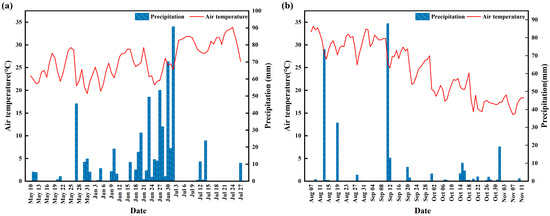
The experiment was conducted in 2024 in Furongdun Town, Pengze County, Jiangxi Province, China (29°35′–30°06′ N, 116°22′–116°53′ E), which experiences a subtropical monsoon climate. According to local meteorological records, the early and late rice growing seasons had average temperatures of 26.5 °C and 24.5 °C, and total precipitation of 587.6 mm and 276.3 mm, respectively (Figure 1). The soil was classified as a hydragric paddy soil, with the following physicochemical properties (0–20 cm depth): sand 26.0%, silt 39.0%, and clay 35.0% (clay loam) organic matter 16.0 g/kg, alkali-hydrolyzable nitrogen 108.0 mg/kg, Olsen phosphorus 10.1 mg/kg, available potassium 97.9 mg/kg, cation exchange capacity 12.0 cmol/kg, bulk density 1.3 g/cm3, and pH 7.9.
Figure 1.
Precipitation and temperature change in the whole period of rice in 2024 double-cropping rice: (a) early season, (b) late season.
2.2. Test Materials
The experiment was conducted in a double-cropping rice system in 2024. The early rice cultivar Lingliangyou 211 (Table S1) was raised using substrate trays with a seedling age of 25 days. Transplanting occurred on 10 May 2024, with 3 seedlings per hill at a spacing of 30 cm × 15 cm (approximately 66.7 seedlings/m2). Basal fertilizer was applied at transplanting, with topdressing on 7 June 2024, and harvesting on 27 July 2024. The late rice cultivar Longxiangyou 130 (Table S1) was sown on 9 July 2024, and raised with a seedling age of 27 days. Transplanting took place on 6 August 2024, with 3 seedlings per hill at a spacing of 25 cm × 16.5 cm (approximately 72.7 seedlings/m2). Basal fertilizer was applied at transplanting, with topdressing on 12 September 2024, and harvesting on 12 November 2024. Fertilizer sources included conventional urea (U, N 46.6%), supplied by Henan Xinlianxin Chemical Industry Group Co., Ltd., Xinxiang, China; controlled-release urea (CRU, N 43.0%, a polymer-coated urea releasing nitrogen via diffusion through the membrane, with 60-day and 90-day release durations for early rice and late rice, respectively), supplied by Xinyangfeng Agricultural Technology Co., Ltd., Jingmen, China; and stabilized urea (N 42.1%, containing the urease inhibitor NBPT and the nitrification inhibitor DCD), supplied by Stanley Agricultural Group Co., Ltd., Linyi, China. Superphosphate (P2O5, 12.0%) and potassium chloride (K2O, 60.0%) were used as phosphorus and potassium sources, respectively.
2.3. Experimental Design
Seven nitrogen application treatments were established in the field experiment: no nitrogen control (CK), conventional urea surface application (U), conventional urea deep placement (UD), stabilized urea surface application (SU), stabilized urea deep placement (SUD), controlled-release urea surface application (CRU), and controlled-release urea deep placement (CRUD). Surface application involved broadcasting the fertilizer evenly across the plot followed by light incorporation into the soil surface (approximately 2–3 cm depth) using a rake for light tillage to ensure initial mixing. For deep placement, the basal fertilizer was applied 5 cm to the side of each transplanted rice plant, at a depth of 10 cm. A randomized complete block design was used, with three replicates per treatment. Fertilizer rates followed local conventional levels: N–P2O5–K2O = (165, 90, 105 kg ha−1) for early rice; N–P2O5–K2O = (180, 75, 135 kg ha−1) for late rice. All P and K fertilizers were applied as a single basal dose. U and UD were split in a 7:3 ratio (basal: panicle initiation) to simulate the local farmers’ conventional practice, while SU, SUD, CRU and CRUD were applied as single basal doses. A randomized complete block design was used with three replicates per treatment, and each plot covered an area of 70 m2. Water management maintained a 3–5 cm shallow layer throughout growth stages, except for a 1-week mid-season drainage for aeration and field drying at maturity.
2.4. Sample Collection and Analysis
2.4.1. Plant Sample Collection and Analysis
Plant samples were collected at key rice growth stages (seedling, tillering, jointing, heading, and maturity) to determine dry matter accumulation and total nitrogen content. At maturity, plants were harvested and separated into grains and straw. Biomass was measured as dry weight after oven-drying at 105 °C for 30 min (enzyme deactivation) followed by 80 °C until constant weight. Samples were ground, sieved through a 0.15 mm mesh, and analyzed for TN using a carbon–nitrogen analyzer (PRIMACS SNC90-IC-E, Skalar Analytical B.V., Shanghai, China). Nitrogen uptake was calculated as dry matter weight multiplied by nitrogen content. Indicators related to nitrogen use efficiency were calculated as follows:
where AEN is the agronomic efficiency of nitrogen (kg kg−1); REN is the recovery efficiency of nitrogen (%); NPE is the nitrogen physiological efficiency (kg kg−1); PFP is the partial factor productivity of nitrogen (kg kg−1); Y, YN, Y0 are rice yield under each treatment, with and without nitrogen application (kg ha−1), respectively; RN is nitrogen application rate (kg ha−1); UN and U0 are nitrogen uptake with and without nitrogen application (kg ha−1), respectively.
2.4.2. Soil Sample Collection
Soil samples were collected concurrently with plant samples at key growth stages (seedling, tillering, jointing, heading, and maturity). Using a soil auger (5 cm diameter), samples were taken from 0–20 cm depth at five points per plot and mixed to form a composite sample per treatment. Samples were extracted with 1 mol L−1 KCl (soil: solution ratio 1:5), and NH4+-N and NO3−-N contents were determined using a continuous flow analyzer (AA3, Bran + Luebbe, Norderstedt, Germany).
2.4.3. Measurement of Reactive Nitrogen Loss
NH3 volatilization flux was measured using the continuous airflow enclosure method [21]. A cylindrical chamber (radius 0.1 m, height 0.15 m) was inserted 5 cm into the soil, with a gas pump (flow rate 15 L min−1) maintaining exchange. Absorption solution (0.05 mol L−1 H2SO4) was collected daily (9:00–11:00 and 14:00–16:00) and analyzed for NH3 using a continuous flow analyzer (SNM 01G030, Skalar Analytical B.V., China). Sampling occurred daily for 7 days post-N application, then every 10 days until undetectable. NH3 volatilization flux was calculated as
where FAV is NH3 volatilization flux (kg N ha−1 d−1), C is NH4+-N concentration (mg L−1), V is absorption volume (L), 104 is area conversion, r is chamber radius (m), and 6 is the extrapolation factor (4 h to 24 h).
N2O emissions were measured using the static chamber-gas chromatography method. Chambers (50 cm × 50 cm × 50 cm) were sealed during 8:00–12:00, with 20 mL gas samples collected every 15 min (four per event) into evacuated vials. Sampling was three times weekly in the first week post-N, then every 10 days, intensifying to 3–4 days during wet-dry transitions. N2O concentrations were analyzed using gas chromatography (Agilent 7890A, Agilent Technologies, Inc., Beijing, China). N2O flux FN2O was calculated as
where FN2O is flux (μg N m−2 h−1), ρ is N2O density (1.25 kg m−3), and T is temperature (°C), H is chamber height (m), dc/dt is concentration change (nL L−1 h−1), 28/44 converts N2O to N.
Cumulative emissions (CF, kg N ha−1) for NH3 or N2O were calculated as
where F and Fi+1 are consecutive fluxes, t is interval day (d).
Leaching samples were collected every 10 days using PVC lysimeters (100 cm length, 1–5 μm pore size) installed at 80 cm depth. Runoff samples were obtained from plot outlets following rainfall events (≥20 mm daily), volume was calculated from rainfall and height differences. All samples were filtered and stored at −20 °C until analyzed for inorganic nitrogen (NO3−-N and NH4+-N) using a continuous flow analyzer (AA3, Bran + Luebbe, Germany). Leaching and runoff losses are calculated as follows:
where Ci is the total inorganic nitrogen concentration (mg L−1) Vi is volume (L ha−1), and 10−2 is conversion. Concentrations were measured using the same analyzer.
2.5. Measurement of Net Ecosystem Economic Benefit
Net ecosystem economic benefit (NEEB, CNY ha−1) was calculated as [22]
where Y is yield revenue (CNY ha−1), AC is agricultural cost (CNY ha−1, including pesticides, labor, seeds, and fertilizers; Table S2), and EC is environmental cost (CNY ha−1, including the costs of greenhouse gas emissions, acidification, eutrophication, and human health impacts). Greenhouse gas cost = [N2O + 0.01 × NH3 + 0.0075 × (TN-Nrunoff + TN-Nleaching)] × 298 × 0.15, Acidification cost = 0.84 × NH3 × 17/14 × 1.88 × 5.0, Eutrophication cost = [0.42 × (NO3−Nrunoff + NO3−-Nleaching) × 62/14 + 0.33 × (NH4+-NNH3 + NH4+-Nrunoff + NH4+-Nleaching) × 17/14 × 4.26] [23,24], Human health cost = [4.47 × 10⁻⁴ × NH3 ×17/14 + 2.77 × 10⁻⁴ × N2O × (44/28)] [25].
2.6. Statistical Analysis
Graphs were created using Origin Pro 2025 (version 2025b, Origin Lab Corporation, Northampton, MA, USA). Statistical analyses were performed using IBM SPSS Statistics 27 (IBM Corp., Armonk, NY, USA). Two-way analysis of variance (ANOVA) was performed to evaluate the effects of fertilizer type (FT), fertilization method (FM), and their interactions (FM × FT). The control treatment (CK, without nitrogen) was excluded from the two-way ANOVA model to maintain a balanced factorial design, but was included in a one-way ANOVA to allow for multiple comparisons among all individual treatments. Duncan’s multiple range test was used to determine significant differences at the p < 0.05 level.
3. Results
3.1. Soil Nitrogen Content
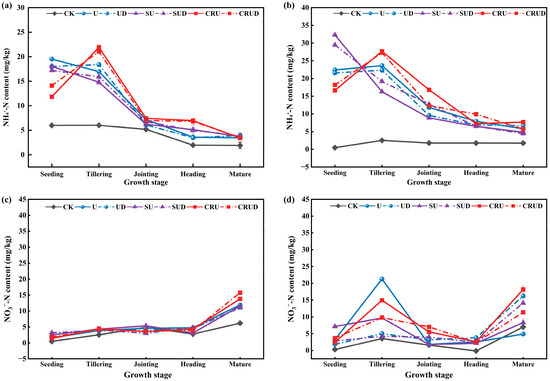
Soil NH4+-N content exhibited distinct stage-specific variations, regulated by nitrogen fertilizer type and placement (Figure 2a,b). Surface application resulted in the seedling-stage order of U > SU > CRU (p < 0.05). Subsequently, CRU maintained the highest levels with a gradual decline, while SU and U decreased steadily to maturity. Deep placement reduced seedling-stage NH4+-N in UD (vs. U, p < 0.05) but elevated its level at tillering in both UD and SUD (vs. surface application, p < 0.05). In contrast, CRUD and CRU showed nearly identical temporal dynamics, indicating minimal impact of placement depth. Soil NO3−-N showed no significant treatment differences for most of the season, remaining low initially and increasing toward maturity due to improved aeration. Notably, at maturity, NO3−-N under CRU and CRUD was significantly higher than in all other treatments (p < 0.05).
Figure 2.
Inorganic soil nitrogen content across growth stages under varying fertilizer types and placement methods: (a,c) early rice season, (b,d) late rice season. CK, no nitrogen fertilizer; U, conventional urea surface application; UD, conventional urea deep placement; SU, stabilized urea surface application; SUD, stabilized urea deep placement; CRU, controlled-release urea surface application; CRUD, controlled-release urea deep placement.
Soil mineral nitrogen dynamics for the 2024 late rice season are detailed in Figure 2c,d. For NH4+-N under surface application, the seedling-stage order was SU > U > CRU (p < 0.05). CRU peaked at tillering (26.6 mg N kg−1, p < 0.05) maintaining significantly higher levels than other treatments thereafter, while SU dropped significantly below U after tillering (p < 0.05). Deep placement significantly increased NH4+-N in SUD (vs. SU, p < 0.05) from tillering to jointing, significantly reduced it in CRUD at jointing (vs. CRU, p < 0.05), and caused no marked change in UD versus U. Regarding NO3−-N, surface application led to the highest peak for U at tillering (20.2 mg N kg−1, p < 0.05), followed by CRU (13.9 mg N kg−1, p < 0.05). SU showed significantly elevated early levels but mid-season suppression (p < 0.05). In contrast, deep placement significantly reduced these tillering-stage NO3−-N, peaks by 80.6% (UD), 63.8% (SUD), and 37.2% (CRUD) (p < 0.05).
3.2. Rice Nitrogen Uptake
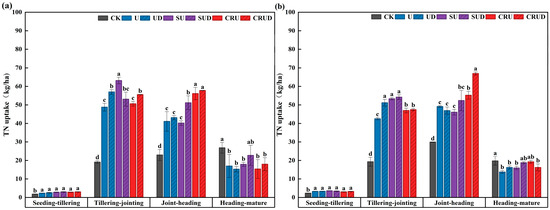
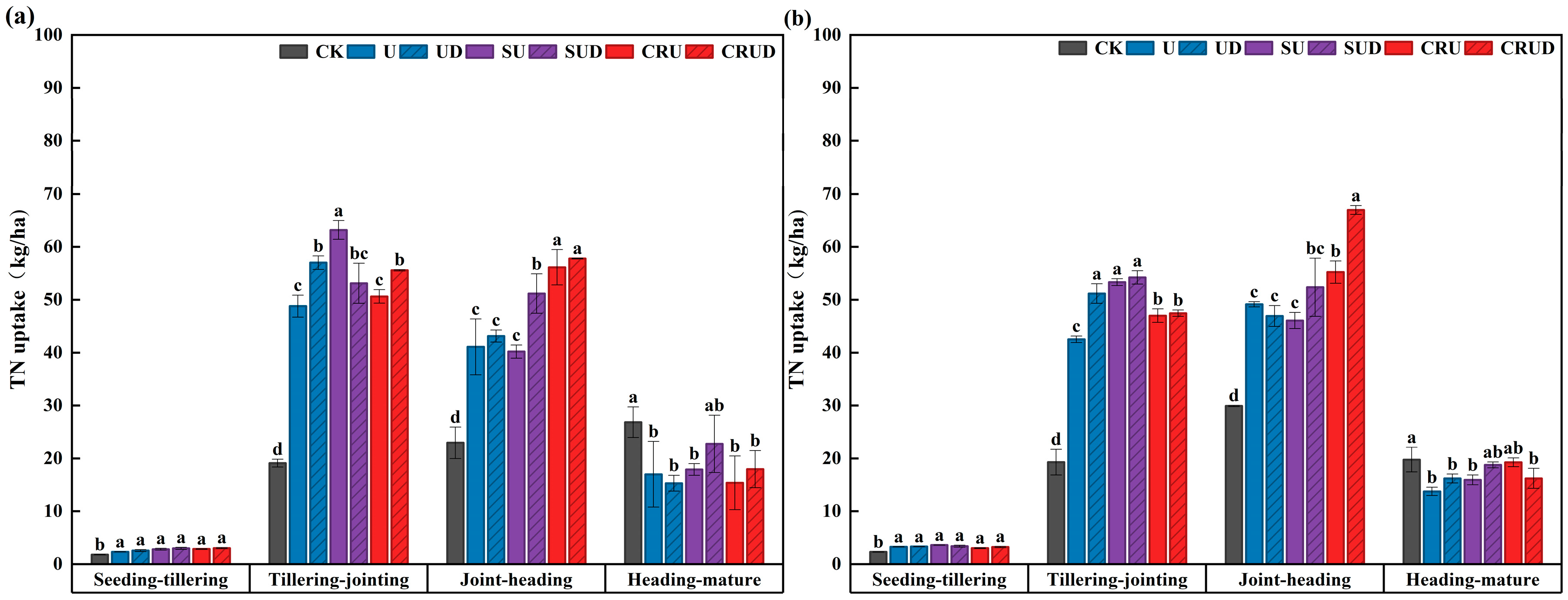
In the early rice season, nitrogen uptake peaked during the tillering–jointing and jointing-heading stages, constituting 27.0–50.9% and 32.4–44.9% of the total uptake, respectively (Figure 3a). All nitrogen treatments significantly outperformed the CK during the seedling–tillering stage (p < 0.05), regardless of fertilizer type or placement depth. At tillering–jointing, surface-applied SU uptake was significantly greater than that of U and CRU (which did not differ), whereas under deep placement, no significant differences were found among SUD, CRUD, and UD. Deep placement significantly increased uptake for U and CRU but decreased it for SU (p < 0.05). During jointing–heading, CRU led under surface application, and CRUD under deep placement, with deep placement also significantly boosting SUD uptake (p < 0.05). By the heading–maturity stage, no significant differences existed among nitrogen treatments, yet the CK was significantly higher than all others.
Figure 3.
Temporal patterns of incremental nitrogen uptake across growth stages under different fertilizer types and placement methods: (a) early rice season, (b) late rice season. Different lowercase letters within a column indicate significant differences among treatments according to Duncan’s multiple range test at p < 0.05. CK, no nitrogen fertilizer; U, conventional urea surface application; UD, conventional urea deep placement; SU, stabilized urea surface application; SUD, stabilized urea deep placement; CRU, controlled-release urea surface application; CRUD, controlled-release urea deep placement.
Nitrogen uptake in the late rice season exhibited a bimodal pattern, with peaks at the tillering–jointing (27.1–44.8%) and jointing-heading (38.7–50.0%) stages (Figure 3b). While all nitrogen treatments significantly outperformed the CK during seedling–tillering, their relative performance shifted in later stages. At tillering–jointing under surface application, uptake ranked SU > CRU > U. Deep placement altered this order, with UD and SUD surpassing CRUD, and significantly boosting UD uptake. By jointing–heading, CRU led under surface application and CRUD under deep placement, where deep placement also specifically enhanced CRU uptake. At maturity under surface application, the CK showed unexpectedly higher uptake than U and SU, whereas deep placement equalized all treatments with no significant effects.
3.3. Yield
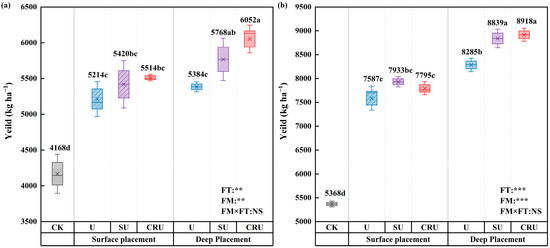
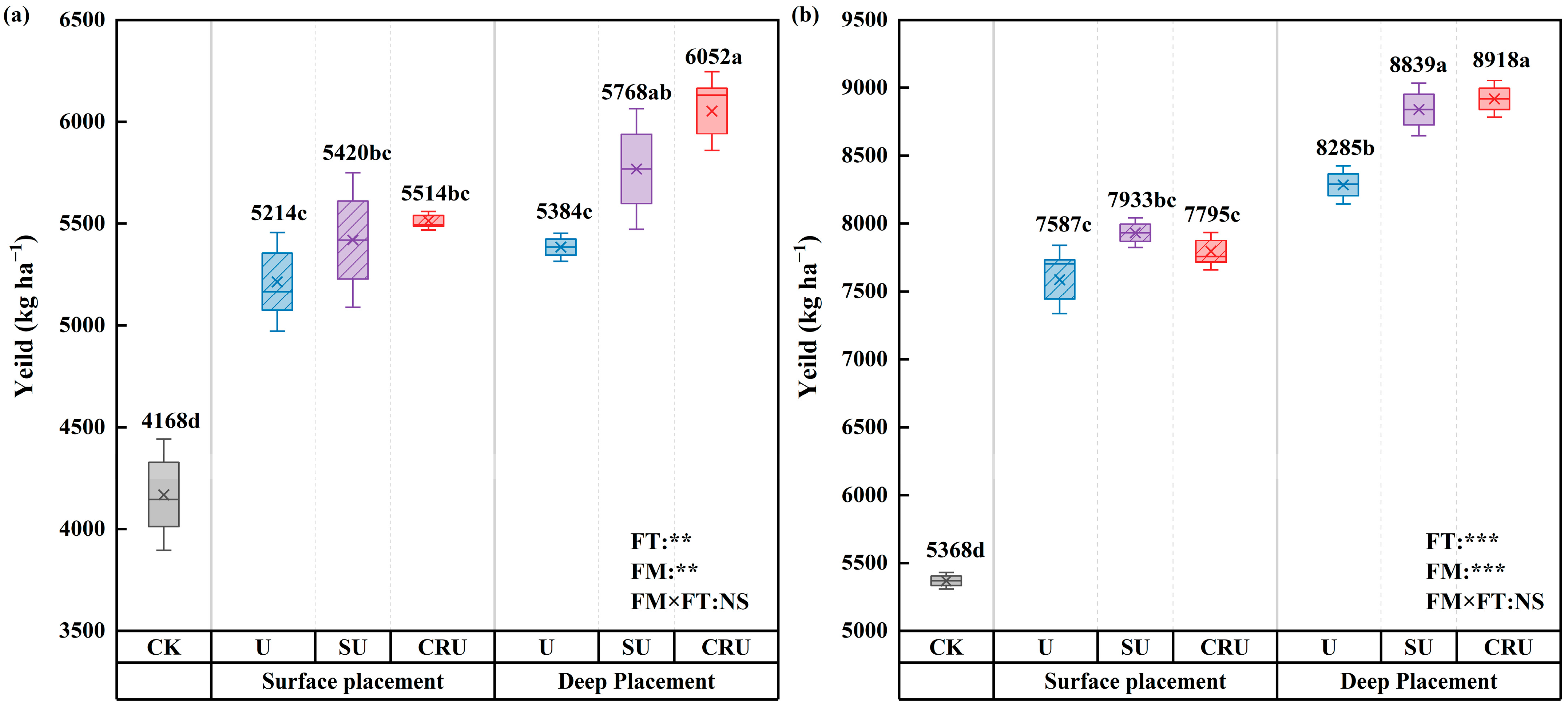
In the early rice season, both nitrogen fertilizer type and application method significantly affected yield, with no significant interaction (FT × FM, p > 0.05) (Figure 4a). While all fertilizer treatments outperformed the no-nitrogen control (CK), their relative efficacy depended on placement. Under surface application, yields did not differ significantly among fertilizers. With deep placement, however, CRUD and SUD yields were 12.4% and 7.1% higher than UD, respectively. Deep placement increased CRU yield by 9.8% compared to its surface application, but did not significantly affect U or SU yields. Overall, relative to conventional urea (U), CRUD and SUD boosted yields by 16.1% and 10.6%, respectively.
Figure 4.
Rice grain yield in double-cropping rice: (a) early season, (b) late season. Different lowercase letters within a column indicate significant differences among treatments according to Duncan’s multiple range test at p < 0.05. FT: fertilizer type; FM: fertilization method; CK, no nitrogen fertilizer; U, urea; SU, stabilized urea; CRU, controlled-release urea; NS: not significant. **, *** represent significance at p < 0.01, and p < 0.001 levels, respectively, from a two-way ANOVA.
In the 2024 late rice season, both nitrogen fertilizer type and application method significantly influenced grain yield, with no significant interaction (FT × FM, p > 0.05) (Figure 4b). All nitrogen treatments significantly exceeded the no-nitrogen control (CK, 5368 kg ha−1). While no yield differences were detected among fertilizer types under surface application, deep placement resulted in significantly higher yields for CRUD and SUD than for UD by 7.6% and 6.7%, respectively. Compared to surface application, deep placement increased yields of U, SU, and CRU by 9.2%, 11.4%, and 14.4%. Relative to conventional urea (U), deep application boosted yields by 9.2% for UD, 16.5% for SUD, and 17.5% for CRUD.
3.4. Nitrogen Use Efficiency
In early rice season, ANOVA indicated that nitrogen fertilizer type significantly affected AEN, REN, and PFP (p < 0.05), while the application method significantly influenced AEN, NPE, and PFP (p < 0.05) (Table 1). Regarding AEN, no significant differences were observed among fertilizers under surface application. However, under deep application, both the AEN of SUD and CRUD significantly outperformed that of UD. Interestingly, the response to deep application varied by nitrogen fertilizer type: deep placement significantly increased the AEN of CRU (by 40.1% compared to surface CRU) but had no significant effect on U or SU. Compared to U, SUD and CRUD increased AEN by 69.8% and 80.4%, respectively. No significant differences in REN were found between SU and CRU regardless of the application method, but both consistently maintained significantly higher REN than the U. Specifically, SUD and CRUD showed significantly higher REN than U, with increases of 48.2% and 41.5%, respectively. Deep application had no significant effect on REN for any nitrogen fertilizer type in early rice. For PFP, no significant differences were found under surface application. Under deep application, CRUD was significantly higher than UD, though statistically similar to SUD. Finally, regarding NPE, few significant differences were observed, except that the NPE of CRUD was significantly higher than that of SU.
Table 1.
Indicators related to nitrogen use efficiency.
In late rice season, nitrogen fertilizer type significantly affected AEN, REN, and PFP, while the application method had a significant influence on AEN, REN, NPE, and PFP. Under surface application, no significant differences in AEN were observed among nitrogen fertilizer types (Table 1). However, under deep application, both SUD and CRUD were significantly higher than UD, although there was no significant difference between SUD and CRUD. The application method significantly increased AEN across all fertilizer types. Deep application increased AEN by 31.4%, 35.3%, and 46.3% for U, SU, and CRU, respectively, compared to their surface counterparts. Regarding REN, SU and CRU consistently outperformed U. Under surface application, SU and CRU were significantly higher than U by 27.8% and 42.4%, respectively. Similarly, under deep application, SUD and CRUD significantly exceeded UD by 41.5% and 54.2%, respectively. Deep application further enhanced REN for the enhanced-efficiency fertilizers, increasing it by 17.6% (CRU) and 20.3% (SU) compared to surface application, whereas no significant deep-application effect was observed for U. Compared to U, SUD and CRUD increased REN by 53.7% and 67.4%, respectively. For PFP, trends were similar to AEN. No significant differences were found among nitrogen fertilizers types under surface application. In contrast, under deep application, SUD and CRUD were significantly higher than UD. Deep application consistently improved PFP for all treatments, with increases of 9.2% for U, 11.4% for SU, and 14.4% for CRU compared to surface application. The NPE of U was significantly higher than CRU under surface application. However, deep application significantly improved the NPE of the CRU, with CRUD exceeding surface CRU by 23.8%.
3.5. Nr Losses
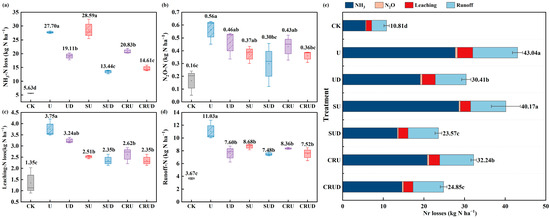
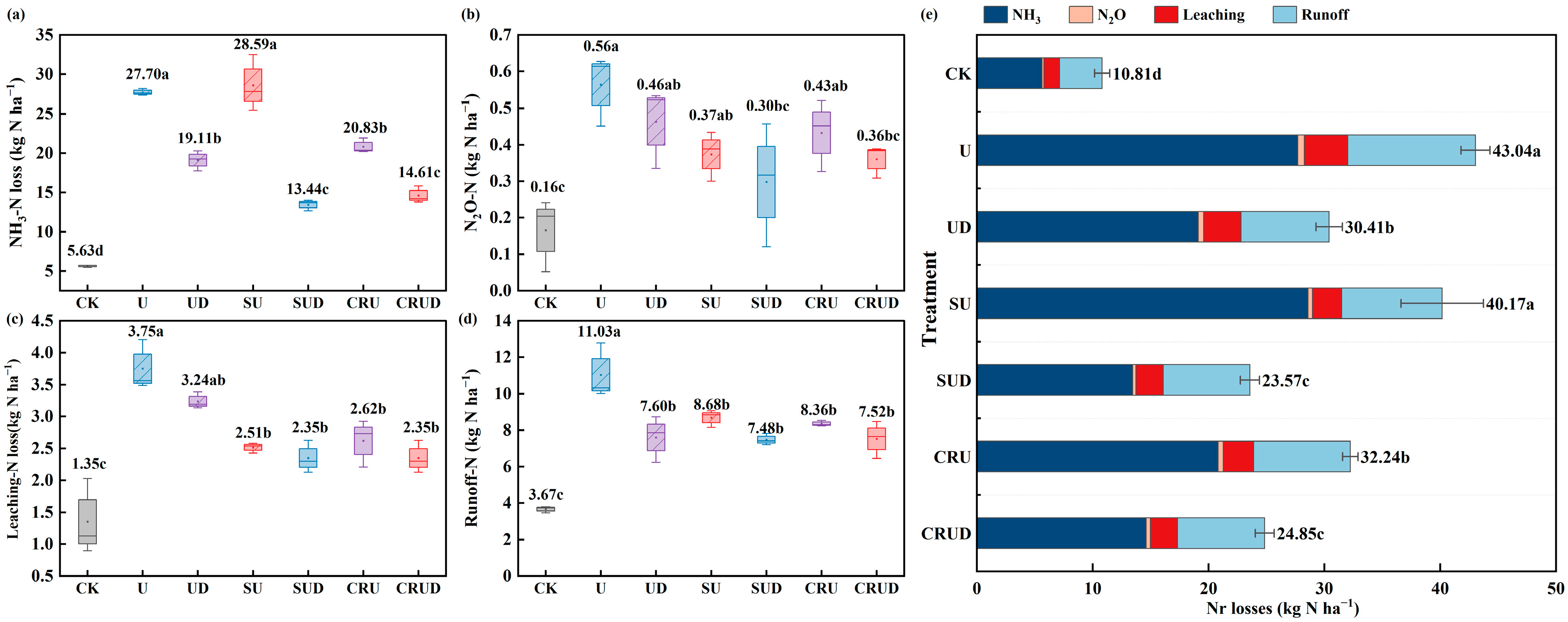
Ammonia volatilization and runoff were the primary pathways for Nr loss in both early and late rice seasons (Figure 5 and Figure 6). All nitrogen treatments significantly increased total Nr loss compared to CK. In the early rice season, compared to U, SU significantly increased NH3 volatilization by 3.2%, although reduced leaching by 32.8%, runoff losses by 21.3% and did not significantly affect N2O emission and total Nr losses. CRU reduced total Nr losses by 25.1% (p < 0.05) with NH3 volatilization by 24.8% (p < 0.05), leaching by 30.1% (p < 0.05), runoff by 24.3% and N2O by 23.2% (p > 0.05); Compared to their respective surface treatments, UD, SUD and CRUD reduce total Nr losses by 29.4%, 41.3% and 22.9%, NH3 volatilization by 31.0%, 53.0% and 29.8%, and runoff by 31.1%, 13.8% and 10.0%, respectively. Compared to U, SUD and CRUD significantly mitigated total Nr losses by 45.2% and 42.3%, respectively. Specifically, SUD decreased NH3 volatilization by 51.5%, N2O emissions by 46.4%, leaching by 37.3%, and runoff by 32.2%. Likewise, CRUD achieved reductions of 47.3% for NH3 volatilization, 35.7% for N2O emissions, 37.3% for leaching, and 31.8% for runoff.
Figure 5.
(a) Ammonia (NH3) volatilization, (b) nitrous oxide (N2O) emission, (c) leaching loss, (d) runoff loss, (e) total reactive nitrogen loss in the early rice season. Different lowercase letters within a column indicate significant differences among treatments according to Duncan’s multiple range test at p < 0.05. CK, no nitrogen fertilizer; U, conventional urea surface application; UD, conventional urea deep placement; SU, stabilized urea surface application; SUD, stabilized urea deep placement; CRU, controlled-release urea surface application; CRUD, controlled-release urea deep placement.
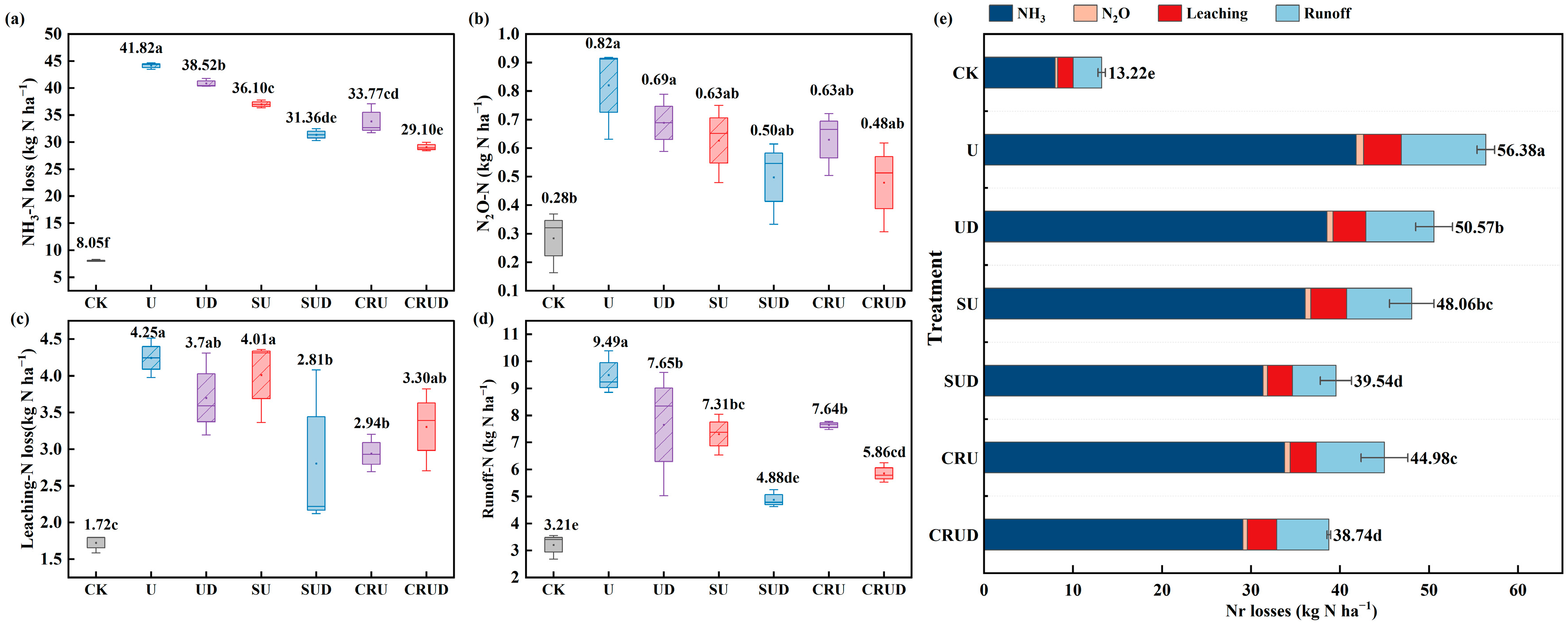
Figure 6.
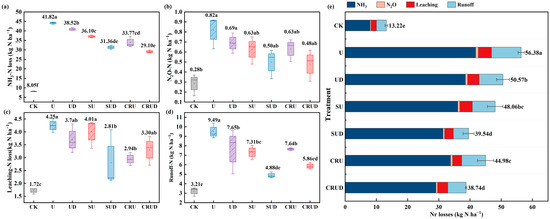
(a) Ammonia (NH3) volatilization, (b) nitrous oxide (N2O) emission, (c) leaching loss, (d) runoff loss, (e) total reactive nitrogen loss in the late rice season. Different lowercase letters within a column indicate significant differences among treatments according to Duncan’s multiple range test at p < 0.05. CK, no nitrogen fertilizer; U, conventional urea surface application; UD, conventional urea deep placement; SU, stabilized urea surface application; SUD, stabilized urea deep placement; CRU, controlled-release urea surface application; CRUD, controlled-release urea deep placement.
In the late rice season, SU reduced total Nr losses by 14.8%, with NH3 volatilization and runoff losses reduced by 13.7% and 22.9% (Figure 6). CRU reduced total Nr losses by 20.2%, NH3 volatilization and runoff losses reduced by 19.3% and 19.5%. Similarly, UD reduced total Nr losses by 10.3%, with NH3 volatilization and runoff reduced by 7.8% and 19.4%. Compared to SU, SUD reduced total Nr losses by 17.7%, with NH3 volatilization, leaching, and runoff reduced by 13.1%, 30.1%, and 33.3%. Compared to CRU, CRUD reduced total Nr losses by 13.8%, with NH3 volatilization and runoff reduced by 13.8% and 23.4%, but leaching losses increased by 12.4%. Compared to U, SUD and CRUD significantly decreased total Nr losses by 29.9% and 31.3%, respectively. Specifically, SUD significantly reduced NH3 volatilization by 25.0%, leaching by 33.9%, and runoff by 48.6%, while showing no significant difference in N2O emissions. Similarly, CRUD significantly reduced NH3 volatilization by 30.4% and runoff by 38.3%, but had no significant effect on N2O emissions or leaching losses.
3.6. Net Ecosystem Economic Benefit
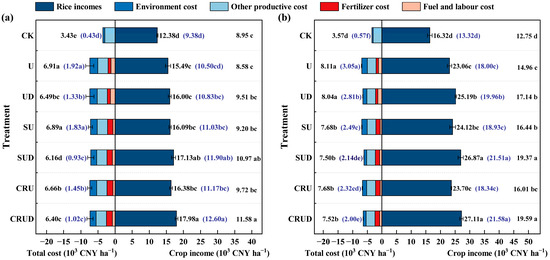
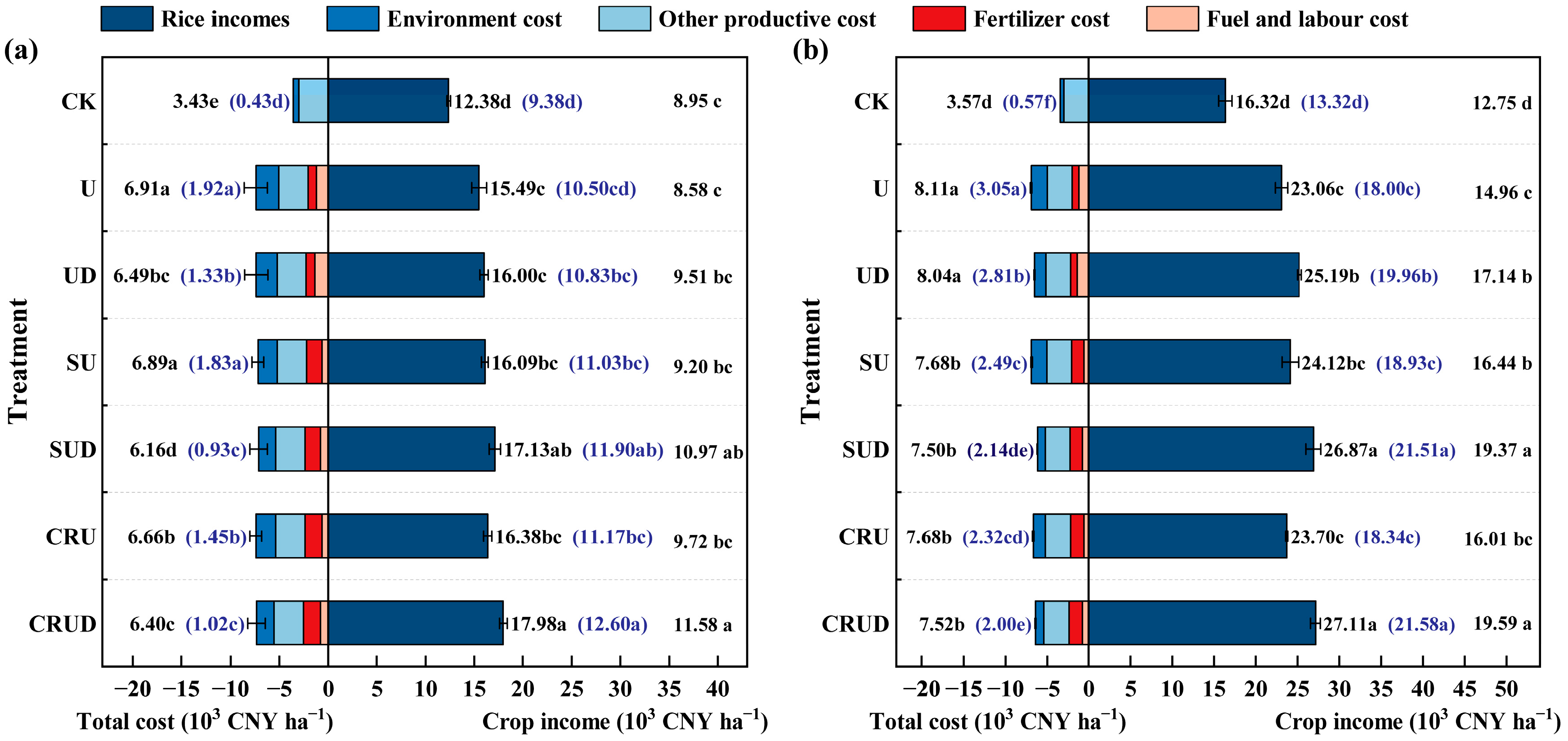
In early rice season, economic and environmental benefits are shown in Figure 7a. Under surface application, no significant NEEB differences were observed among U, SU, and CRU. Under deep placement, only CRUD achieved a significantly higher NEEB than UD. Notably, CRUD exhibited the highest NEEB, by increasing 20.0% farmers’ income and reducing 46.9% environmental costs compared to U (p < 0.05). Similarly, SUD demonstrated substantial benefits, increasing 13.3% farmers’ income and decreasing 51.6% environmental costs relative to U. Although UD significantly reduced 30.7% environmental costs relative to U, the increase in farmers’ income and NEEB were limited by 3.1% and 10.8% (p > 0.05).
Figure 7.
Net ecosystem economic benefit (NEEB) in double-cropping rice: (a) early rice season and (b) late rice season. Values within parentheses represent environmental costs (left) and farmer income (right). Different lowercase letters indicate significant differences among treatments according to Duncan’s multiple range test at p < 0.05 Treatments: CK, no nitrogen fertilizer; U, conventional urea surface application; UD, conventional urea deep placement; SU, stabilized urea surface application; SUD, stabilized urea deep placement; CRU, controlled-release urea surface application; CRUD, controlled-release urea deep placement.
Economic and environmental benefits of late rice are distinct from the early season, (Figure 7b). Under surface application, SU and CRU significantly improved NEEB by 9.9% and 7.0% respectively compared to U (p < 0.05). Under deep placement, CRUD and SUD achieved the highest NEEB; they showed no significant difference from each other but significantly outperformed UD. Notably, CRUD and SUD exhibited superior performance, increasing farmers’ income by 19.9% and 19.5%, reducing environmental costs by 34.4% and 29.8%, respectively. Although UD significantly enhanced NEEB relative to U—driven by a 10.9% increase in farmers’ income and a 7.9% reduction in environmental costs—the overall benefit gains remained inferior to those of CRUD and SUD.
4. Discussion
4.1. Soil Nitrogen Dynamics
Soil nitrogen dynamics across growth stages reflect nitrogen supply capacity [26], influenced by nitrogen fertilizer type, application methods, and environmental factors. As shown in Figure 1, rainfall is more concentrated in early rice, while late rice features higher initial temperatures followed by a decline [6]. CRU exhibited a consistent two-phase signature across both seasons: an initial NH4+-N minimum imposed by the polymer barrier, followed by a pronounced NH4+-N peak precisely at tillering that remained elevated thereafter. This pattern underscores both the robustness of CRU’s delayed-release mechanism [27,28,29] and its tight synchrony with tillering nitrogen demand [30]. In the late rice, the NH4+-N content of SU at the seedling stage exceeded that of U, whereas in early rice, U maintained a higher initial value (Figure 2b). This suggests that the higher initial temperatures in the late rice season accelerated urea hydrolysis. Early rice maintained low NO3−-N levels in early growth stages under persistent flooding, which inhibited nitrification. Meanwhile, late rice exhibited a pronounced NO3−-N supply peak during tillering (Figure 2b). This difference stemmed primarily from the irrigation practice in late rice: untimely irrigation led to intermittent soil desiccation, thereby creating aerobic conditions that promoted nitrification [31,32]. Across both seasons, deep placement minimally influenced CRU’s temporal profile, with CRUD and CRU showing comparable NH4+-N trajectories (peak at tillering, then decline). For U and SU, deep placement reduced NH4+-N supply at the seedling stage and enhancing tillering NH4+-N supply than surface placement in both seasons, facilitating nutrient synchrony between supply and crop demand (Figure 2a). These results aligned with prior observations [14,33] and highlighted the critical roles of deep placement [34].
4.2. Nitrogen Uptake, Nitrogen Use Efficiency and Yield
Nitrogen uptake in rice typically exhibits a bimodal pattern, with peaks during the tillering–jointing and jointing-heading stages (Figure 3), underscoring stage-specific nitrogen demands. This study found that, although SU and CRU exhibited significantly different nitrogen uptake patterns during key growth stages under surface application—SU outperforming in the tillering–jointing stage and CRU leading in the jointing–heading stage, the more efficient nitrogen supply of CRU and SU did not translate into significant yield gains regardless of rice seasons. While SU and CRU sharply increased the proportion of fertilizer nitrogen recovered by the crop (REN), they delivered no measurable gain—irrespective of whether the nitrogen source was fertilizer alone (AEN) or the combined fertilizer-and-soil pool (PFP). Indeed, both enhanced-efficiency fertilizer (CRU and SU) failed to improve, and even significantly depressed the conversion of absorbed nitrogen into grain yield (NPE) for double-cropping rice, especially for the late-season (Table 1). This suggests that, under surface application of enhanced-efficiency fertilizer (CRU and SU), the enhanced nitrogen uptake may be inefficiently allocated to excessive vegetative growth, creating a translocation bottleneck from uptake to yield [35]. By contrast, a significant nitrogen uptake was still observed during the maturity stage under CK. Previous studies have emphasized that plant nitrogen acquisition is primarily regulated by internal nitrogen demand rather than external nitrogen supply [36]. In the present study, under prolonged nitrogen limitation, CK plants likely maintained a relatively high nitrogen uptake capacity as an adaptive strategy to meet their physiological nitrogen demand.
A deep placement of U increased nitrogen uptake during the tillering–jointing stage by 16.9% and 20.4% in early and late rice, respectively. This enhanced uptake translated into a significant yield gain of 9.2% in the late rice season, whereas the 3.3% increase in early rice was not statistically significant. It showed no significant effect on REN, NPE, AEN, or PFP in early rice, nor on REN and NPE in late rice, but significantly elevated AEN and PFP in the late season. In the early rice season, concentrated rainfall likely attenuated the benefits of deep placement by facilitating upward nutrient migration. Deep placement of CRU significantly increased nitrogen uptake (tillering–jointing in early rice; jointing-heading in late rice), accompanied by improved NPE and AEN in early rice and enhanced REN, NPE, AEN, and PFP in late rice, resulting in significant yield increases of 9.8% and 14.4% in early and late-rice season, respectively (Table 1). Deep placement of CRU significantly boosted nitrogen uptake, NUE, and yield by enhancing root-zone nitrogen availability, despite showing no significant impact on bulk soil mineral nitrogen content (Figure 2). This is attributed to the fact that CRU-released nutrients were largely retained in the surface soil (0–20 cm) irrespective of application depth (surface: 2–3 cm vs. deep: 10 cm). In early rice, deep placement of SU shifted nitrogen uptake from the tillering–jointing stage (−16.0%) to the jointing–heading stage (+27.3%) (Figure 3); however, this shift did not significantly improve yield or any of the use efficiency indicators (REN, NPE, AEN, PFP). For late rice, deep placement of SU increased nitrogen uptake during the jointing-heading stage by 13.7% (p > 0.05), coupled with which significant improvements in REN, AEN, and PFP, ultimately led to a 9.9% yield increase. The benefit of deep placement of SU on nitrogen uptake and utilization was greater in late than in early rice, a pattern similar to that of deep placement of U. The reduced effect in early rice is attributed to substantial rainfall, whereas in late rice, the improvement was achieved by maintaining a more sustained and effective NH4+-N supply that enhanced mid-to-late season nitrogen uptake and conversion.
4.3. Environmental Benefits
In double-cropping rice systems, NH3 volatilization predominates the total Nr losses, accounting for 57.0%~79.3% of the total Nr losses. This is followed by runoff losses, which constitute 12.3%~31.7% of the total Nr losses (Figure 5 and Figure 6). Compared with U, SU reduced 6.7% Nr losses in early rice mainly by decreasing runoff, whereas 14.8% Nr losses in late rice the dominant pathways were NH3 volatilization and runoff. Runoff loss was governed by the mineral-N content in the soil at the time of the event: across three rainfall events (27 May, 23 and 27 June) in early-rice season and a single event (12 September) in late-rice season, SU consistently maintained lower NH4+-N than U, with NO3−-N remaining similar. Notably, SU marginally lowered soil NH4+-N at the seedling stage of early rice and significantly elevated it in late rice (Figure 2a,b); nevertheless, SU failed to curb NH3 volatilization during the early-rice season yet achieved a marked reduction in the late-rice season. This discrepancy is attributed to the predominantly anaerobic conditions between the seedling and tillering stages of early rice, which impede activation of the urease inhibitor NBPT. In the late rice season, although high temperatures accelerated urea hydrolysis, the soil wetting-drying cycles induced by intermittent irrigation likely created aerobic conditions, as reported for alternate wetting and drying water management in paddy soils [37]. These conditions likely enhanced the inhibitory effect of NBPT on urea hydrolysis [38]. Concurrently, improved soil aeration promoted the conversion of NH4+-N to NO3−-N and reducing the persistence of high NH4+-N concentrations at the soil surface. Collectively, these processes may have contributed to the significant reduction in cumulative NH3 volatilization losses observed during the late-rice season. Relative to U, CRU reduced 25.1% and 20.2% of Nr losses for early- and late-season respectively, via all four pathways; three of these reductions were significant, with only N2O failing to reach significance. This superior performance exceeds that of SU and is attributable to CRU’s release being governed primarily by coating properties, while remaining insensitive to soil microbial activity, salinity, pH or ionic strength. Consequently, CRU provides a more comprehensive and seasonal stable mitigation of Nr losses.
Regardless of nitrogen fertilizer types, deep placement consistently reduced total Nr losses. Compared with surface application, deep placement of U, SU and CRU lowered total Nr losses by 12.6, 16.6 and 7.4 kg ha−1 in early rice and by 5.8, 8.5 and 6.2 kg ha−1 in late rice, respectively. Among the three nitrogen fertilizer types, deep placement of CRU achieved the smallest reduction in Nr losses. Figure 2 shows that deep placement had a weaker effect on soil mineral-N content under CRU than under U or SU, chiefly because nitrogen not yet released from CRU remained protected even under surface application. By contrast, U and SU—especially when surface-applied in a single dose—left more nitrogen in the surface layer soil, increasing upward migration to flood water and raising both NH3 and runoff losses. Deep placement markedly curtailed NH3 volatilization for all three fertilizers in both seasons; additionally, the NH3-mitigation effect of deep placement was more pronounced in early rice than in late rice (Figure 1 and Figure 2). The high temperatures during the early phase of the late-rice season accelerated upward NH4+ movement, further weakening the barrier effect of deep placement. Across both early- and late-rice seasons, the synergistic combination of enhanced-efficiency fertilizers and deep placement consistently achieved larger reductions in Nr losses than either surface application of the enhanced-efficiency fertilizers or deep placement of conventional nitrogen alone [39].
4.4. Economic Benefits
The NEEB deducted environmental costs of Nr losses from farmers’ income to guide sustainable nitrogen management. Relative to surface placement of urea (U), neither enhanced-efficiency fertilizer (SU or CRU) increased NEEB in the early-rice season (Figure 7). This outcome can be attributed to the lack of a significant yield increase in early rice from the surface application of either enhanced-efficiency fertilizer (Figure 4), which in turn limited the derived yield benefits (Figure 7a); SU failed to reduce Nr losses (Figure 5a) and their associated environmental cost (Figure 7a). The labor saved by single application of SU was offset by higher fertilizer purchase prices. Although surface placement of CRU did lower Nr losses and environmental costs, these savings plus the single-application labor saving were counteracted by the premium paid for the enhanced fertilizer purchase prices. In the late-rice season, surface placement of SU (p < 0.05) and CRU (p > 0.05) both improved NEEB. As in early rice, surface application of the two enhanced-efficiency fertilizers did not enhance yield or yield benefits, but the reduction in environmental costs and the labor saved by single application exceeded the additional fertilizer cost.
Deep placement consistently enhanced the NEEB across both early and late rice seasons for all fertilizer types. The only exceptions were that, in the early season, the increases for deep placement of U and SU over their surface-applied counterparts did not reach statistical significance, whereas all other deep-placement comparisons showed significant improvements. The main reason lies in the significant yield gains from deep placement across all tested fertilizers in late rice and for CRU in early rice, except for the non-significant responses of U and SU in the early season. Furthermore, deep placement significantly reduced Nr loss and the associated environmental costs in both early and late rice seasons, regardless of nitrogen fertilizer type. These benefits in yield enhancement and emission reduction substantially outweighed the additional fuel costs incurred by deep placement. It underscored that relying solely on enhanced-efficiency fertilizer may be insufficient for improvement: deep placement is needed to regulate nitrogen uptake and minimize Nr losses [40], thereby achieving higher environmental and economic benefits, consistent with broader strategies for improving nitrogen use efficiency in crops to support sustainable agriculture [41]. Our findings also confirm deep placement of conventional nitrogen fertilizer (UD) achieved higher NEEB than surface placement (U), while deep placement of enhanced-efficiency fertilizer (CRUD and SUD) further surpassed UD, yielding the highest NEEB gains.
4.5. Strengths, Weaknesses and Future Directions
This study investigated the effects of nitrogen fertilizer type and application method on the complete chain of soil nitrogen dynamics, crop nitrogen uptake, and reactive nitrogen losses. It provided a comprehensive assessment of the three-fold benefits—productivity, efficiency, and environmental performance—of nitrogen management strategies. Through field trials conducted under contrasting climatic conditions of early and late rice seasons, the research elucidated that deep placement of controlled-release urea (CRU) is the optimal strategy for synergistically increasing yield, enhancing nitrogen use efficiency, and reducing nitrogen losses. Limitations of this study include a lack of in-depth mechanistic analysis regarding how fertilizer type and placement depth affect soil nitrogen transformation processes and root-soil interactions. Furthermore, the experiment was conducted on a field with relatively high native soil fertility, which may have contributed to the observed lower nitrogen use efficiency values. Machine-transplanted rice with single-time deep placement of fertilizer (DPF) is an innovative practice that integrates seedling transplanting with the precise application of fertilizer near the root zone. The broader adoption of this mechanized side-deep placement technology will be crucial for translating these research findings into widespread agricultural practice.
5. Conclusions
Although surface application of enhanced-efficiency nitrogen fertilizers significantly improved nitrogen recovery efficiency (REN), it did not translate into significant yield increases in the double-cropping rice system. Surface application alone is not recommended for early rice, as concentrated rainfall can diminish their efficacy. In contrast, deep placement, which further delays nitrogen supply and enhances root-zone nitrogen availability in the double-cropping rice system, was particularly effective in the late season, yielding substantially greater improvements in grain yield, nitrogen use efficiency, and net ecosystem economic benefit (NEEB) by effectively mitigating high-temperature-induced volatilization losses from the soil surface. Across both seasons, deep-placed CRU consistently demonstrated superior performance: it maximized the delay in nitrogen supply, increased nitrogen uptake, boosted yields (by 16.1% and 17.5%), enhanced REN (by 41.5% and 67.4%), reduced reactive nitrogen (Nr) losses (by 42.3% and 31.3%), and improved economic returns (by 35.0% and 30.9%) compared to conventional surface placement of urea.
Supplementary Materials
The following supporting information can be downloaded at: https://www.mdpi.com/article/10.3390/su18052613/s1, Figure S1: Fluxes and losses of reactive N under different fertilizer types and placement methods in early rice; Figure S2: Fluxes and losses of reactive N under different fertilizer types and placement methods in late rice; Table S1: Key agronomic traits of the early and late season rice varieties; Table S2: Cost of agricultural means of production.
Author Contributions
F.Z.: Data curation, Writing—original draft, Formal analysis, Software, Visualization. C.Y.: Data curation, Investigation. X.L.: Data curation, Investigation. T.M.: Supervision, Validation. Y.Z.: Supervision, Validation. Y.Y.: Supervision, Validation. J.Z.: Supervision, Validation. X.Y.: Supervision, Validation. Y.S.: Conceptualization, Methodology, Writing—review and editing, Validation, Project administration, Resources. X.Z.: Supervision, Validation, Resources. All authors have read and agreed to the published version of the manuscript.
Funding
This work was supported by the Key Technologies Research and Development Program (2022YFD1700605) and the National Natural Science Foundation of China (32172681).
Institutional Review Board Statement
Not applicable.
Informed Consent Statement
Not applicable.
Data Availability Statement
The original contributions presented in this study are included in the article/Supplementary Materials. Further inquiries can be directed to the corresponding author.
Conflicts of Interest
Authors Yanjun Yue, Jie Zhang and Xintao Yang are employees of Henan Xinlianxin Chemicals Group Co., Ltd., Xinxiang, Henan 453700, China. The remaining authors declare that the research was conducted in the absence of any commercial or financial relationships that could be construed as potential conflicts of interest.
References
- Li, S.; Lu, Z.; Zhao, J.; Luo, M.; Chen, F.; Chu, Q. Changes in planting methods will change the potential distribution of rice in South China under climate warming. Agric. For. Meteorol. 2023, 331, 109355. [Google Scholar] [CrossRef] [Scilit]
- Deng, N.; Grassini, P.; Yang, H.; Huang, J.; Cassman, K.G.; Peng, S. Closing yield gaps for rice self-sufficiency in China. Nat. Commun. 2019, 10, 1725. [Google Scholar] [CrossRef] [Scilit]
- Yuan, S.; Peng, S. Exploring the Trends in Nitrogen Input and Nitrogen Use Efficiency for Agricultural Sustainability. Sustainability 2017, 9, 1905. [Google Scholar] [CrossRef] [Scilit]
- Chen, Z.; Wang, Q.; Ma, J.; Zhao, J.; Huai, Y.; Ma, J.; Ye, J.; Yu, Q.; Zou, P.; Sun, W.; et al. Combing mechanical side-deep fertilization and controlled-release nitrogen fertilizer to increase nitrogen use efficiency by reducing ammonia volatilization in a double rice cropping system. Front. Environ. Sci. 2022, 10, 1006606. [Google Scholar] [CrossRef] [Scilit]
- Huang, M.; Chen, J.; Cao, F. Estimating the expected planting area of double- and single-season rice in the Hunan-Jiangxi region of China by 2030. Sci. Rep. 2022, 12, 6207. [Google Scholar] [CrossRef] [Scilit] [PubMed]
- Wang, D.; Huang, J.; Nie, L.; Wang, F.; Ling, X.; Cui, K.; Li, Y.; Peng, S. Integrated crop management practices for maximizing grain yield of double-season rice crop. Sci. Rep. 2017, 7, 38982. [Google Scholar] [CrossRef] [Scilit] [PubMed]
- Su, N.; Ronga, X.; Xie, G.; Chang, T.; Zhang, Y.; Peng, J.; Luo, G. Effectiveness of a 10-year continuous reduction of controlled-release nitrogen fertilizer on production, nitrogen loss and utilization of double-cropping rice. Sci. Total Environ. 2024, 912, 168857. [Google Scholar] [CrossRef] [Scilit]
- Zeng, K.; Wang, S.; Zhu, W.; Tian, Y.; Yin, B. Effects of nitrogen application methods combined with urease/nitrification inhibitor on decreasing NH3 volatilization and N2O emission in rice season. J. Plant Nutr. Fertil. 2023, 29, 220–231. (In Chinese) [Google Scholar] [CrossRef]
- Lu, Y.; Nie, J.; Liao, Y.; Zhou, X.; Wang, Y.; Tang, W. Effects of urease and nitrification inhibitor on yield, nitrogen efficiency and soil nitrogen balance under double-rice cropping system. J. Plant Nutr. Fertil. 2018, 24, 95–104. (In Chinese) [Google Scholar] [CrossRef]
- Li, T.; Zhang, W.; Yin, J.; Chadwick, D.; Norse, D.; Lu, Y.; Liu, X.; Chen, X.; Zhang, F.; Powlson, D.; et al. Enhanced-efficiency fertilizers are not a panacea for resolving the nitrogen problem. Glob. Change Biol. 2018, 24, e511–e521. [Google Scholar] [CrossRef] [Scilit]
- He, T.H.; Yuan, J.J.; Xiang, J.; Lin, Y.X.; Luo, J.F.; Lindsey, S.; Liao, X.; Liu, D.Y.; Ding, W.X. Combined biochar and double inhibitor application offsets NH3 and N2O emissions and mitigates N leaching in paddy fields. Environ. Pollut. 2022, 292, 118344. [Google Scholar] [CrossRef] [Scilit]
- Qi, D.; Zhu, J.; Wang, X. Nitrogen loss via runoff and leaching from paddy fields with the proportion of controlled-release urea and conventional urea rates under alternate wetting and drying irrigation. Environ. Sci. Pollut. Res. 2023, 30, 61741–61752. [Google Scholar] [CrossRef] [Scilit] [PubMed]
- Lan, C.; Zou, J.; Li, J.; Xu, H.; Lin, W.; Weng, P.; Fang, C.; Zhang, Z.; Chen, H.; Lin, W. Slow-release fertilizer deep placement increased rice yield and reduced the ecological and environmental impact in Southeast China: A life-cycle perspective. Field Crops Res. 2024, 306, 109224. [Google Scholar] [CrossRef] [Scilit]
- Yao, Y.; Zhang, M.; Tian, Y.; Zhao, M.; Zhang, B.; Zhao, M.; Zeng, K.; Yin, B. Urea deep placement for minimizing NH3 loss in an intensive rice cropping system. Field Crops Res. 2018, 218, 254–266. [Google Scholar] [CrossRef] [Scilit]
- Ke, J.; He, R.; Hou, P.; Ding, C.; Ding, Y.; Wang, S.; Liu, Z.; Tang, S.; Ding, C.; Chen, L.; et al. Combined controlled-released nitrogen fertilizers and deep placement effects of N leaching, rice yield and N recovery in machine-transplanted rice. Agric. Ecosyst. Environ. 2018, 265, 402–412. [Google Scholar] [CrossRef] [Scilit]
- Li, L.; Tian, H.; Zhang, M.; Fan, P.; Ashraf, U.; Liu, H.; Chen, X.; Duan, M.; Tang, X.; Wang, Z.; et al. Deep placement of nitrogen fertilizer increases rice yield and nitrogen use efficiency with fewer greenhouse gas emissions in a mechanical direct-seeded cropping system. Crop J. 2021, 9, 1386–1396. [Google Scholar] [CrossRef] [Scilit]
- Wu, M.; Li, G.; Li, W.; Liu, J.; Liu, M.; Jiang, C.; Li, Z. Nitrogen Fertilizer Deep Placement for Increased Grain Yield and Nitrogen Recovery Efficiency in Rice Grown in Subtropical China. Front. Plant Sci. 2017, 8, 1227. [Google Scholar] [CrossRef] [Scilit]
- Wu, Q.; Wang, Y.-h.; Ding, Y.-f.; Tao, W.-k.; Gao, S.; Li, Q.-x.; Li, W.-w.; Liu, Z.-h.; Li, G.-h. Effects of different types of slow- and controlled-release fertilizers on rice yield. J. Integr. Agric. 2021, 20, 1503–1514. [Google Scholar] [CrossRef] [Scilit]
- Zhang, C.; Song, X.; Zhang, Y.; Wang, D.; Rees Robert, M.; Ju, X. Using nitrification inhibitors and deep placement to tackle the trade-offs between NH3 and N2O emissions in global croplands. Glob. Change Biol. 2022, 28, 4409–4422. [Google Scholar] [CrossRef] [Scilit]
- Drury, C.F.; Agomoh, I.V.; Yang, X.; Phillips, L.A.; Reynolds, W.D.; Helmers, M.J.; Calder, W.; Hedge, T. Stacking nitrogen management practices: Combining double-slot fertilizer injection with urease and nitrification inhibitors improves yields and reduces ammonia and nitrous oxide emissions. Soil Sci. Soc. Am. J. 2024, 88, 1309–1323. [Google Scholar] [CrossRef] [Scilit]
- Kissel, D.E.; Brewer, H.L.; Arkin, G.F. Design and Test of a Field Sampler for Ammonia Volatilization. Soil Sci. Soc. Am. J. 1977, 41, 1133–1138. [Google Scholar] [CrossRef] [Scilit]
- Wang, B.; Shen, Y.; Xie, W.; Zhu, S.; Zhao, X.; Wang, S. FeIII-tannic acid-modified waterborne polymer-coated urea has agronomic, environmental and economic benefits in flooded rice paddy. J. Clean. Prod. 2021, 321, 129013. [Google Scholar] [CrossRef] [Scilit]
- Cai, S.; Pittelkow, C.M.; Zhao, X.; Wang, S. Winter legume-rice rotations can reduce nitrogen pollution and carbon footprint while maintaining net ecosystem economic benefits. J. Clean. Prod. 2018, 195, 289–300. [Google Scholar] [CrossRef] [Scilit]
- Xia, Y.; Yan, X. Ecologically optimal nitrogen application rates for rice cropping in the Taihu Lake region of China. Sustain. Sci. 2012, 7, 33–44. [Google Scholar] [CrossRef] [Scilit]
- Wang, Y.; Lu, Y. Evaluating the potential health and economic effects of nitrogen fertilizer application in grain production systems of China. J. Clean. Prod. 2020, 264, 121635. [Google Scholar] [CrossRef] [Scilit]
- Gu, J.; Yang, J. Nitrogen (N) transformation in paddy rice field: Its effect on N uptake and relation to improved N management. Crop Environ. 2022, 1, 7–14. [Google Scholar] [CrossRef] [Scilit]
- Jin, S.; Yue, G.; Feng, L.; Han, Y.; Yu, X.; Zhang, Z. Preparation and Properties of a Coated Slow-Release and Water-Retention Biuret Phosphoramide Fertilizer with Superabsorbent. J. Agric. Food Chem. 2011, 59, 322–327. [Google Scholar] [CrossRef] [Scilit]
- Shen, Y.; Wang, B.; Zhu, S.; Xie, W.; Wang, S.; Zhao, X. Single application of a new polymer-coated urea improves yield while mitigates environmental issues associated with winter wheat grown in rice paddy soil. Field Crops Res. 2022, 285, 108592. [Google Scholar] [CrossRef] [Scilit]
- Wang, C.; Sun, H.; Zhang, J.; Zhang, X.; Lu, L.; Shi, L.; Zhou, S. Effects of different fertilization methods on ammonia volatilization from rice paddies. J. Clean. Prod. 2021, 295, 126299. [Google Scholar] [CrossRef] [Scilit]
- Zhang, Z.; Wang, Y.; Wang, Z.; Ashraf, U.; Mo, Z.; Tian, H.; Duan, M.; Li, Y.; Tang, X.; Pan, S. Precise delivery of nitrogen at tillering stage enhances grain yield and nitrogen use efficiency in double rice cropping systems of South China. Field Crops Res. 2022, 289, 108736. [Google Scholar] [CrossRef] [Scilit]
- Aamer, M.; Hassan, M.U.; Shaaban, M.; Rasul, F.; Haiying, T.; Qiaoying, M.; Batool, M.; Rasheed, A.; Chuan, Z.; Qitao, S.; et al. Rice straw biochar mitigates N2O emissions under alternate wetting and drying conditions in paddy soil. J. Saudi Chem. Soc. 2021, 25, 101172. [Google Scholar] [CrossRef] [Scilit]
- Zhou, S.; Sun, H.; Bi, J.; Zhang, J.; Riya, S.; Hosomi, M. Effect of water-saving irrigation on the N2O dynamics and the contribution of exogenous and endogenous nitrogen to N2O production in paddy soil using 15N tracing. Soil Tillage Res. 2020, 200, 104610. [Google Scholar] [CrossRef] [Scilit]
- Liu, J.; Liu, H.; Huang, S.; Yang, X.; Wang, B.; Li, X.; Ma, Y. Nitrogen efficiency in long-term wheat–maize cropping systems under diverse field sites in China. Field Crops Res. 2010, 118, 145–151. [Google Scholar] [CrossRef] [Scilit]
- Gaihre, Y.K.; Singh, U.; Islam, S.M.M.; Huda, A.; Islam, M.R.; Satter, M.A.; Sanabria, J.; Islam, M.R.; Shah, A.L. Impacts of urea deep placement on nitrous oxide and nitric oxide emissions from rice fields in Bangladesh. Geoderma 2015, 259–260, 370–379. [Google Scholar] [CrossRef] [Scilit]
- Hu, K.; Zhao, P.; Wu, K.; Yang, H.; Yang, Q.; Fan, M.; Long, G. Reduced and deep application of controlled-release urea maintained yield and improved nitrogen-use efficiency. Field Crops Res. 2023, 295, 108876. [Google Scholar] [CrossRef] [Scilit]
- Glass, A.D.M. Nitrogen Use Efficiency of Crop Plants: Physiological Constraints upon Nitrogen Absorption. Crit. Rev. Plant Sci. 2003, 22, 453–470. [Google Scholar] [CrossRef]
- Haque, A.N.; Uddin, M.K.; Sulaiman, M.F.; Amin, A.M.; Hossain, M.; Solaiman, Z.M.; Mosharrof, M. Biochar with Alternate Wetting and Drying Irrigation: A Potential Technique for Paddy Soil Management. Agriculture 2021, 11, 367. [Google Scholar] [CrossRef] [Scilit]
- Cantarella, H.; Otto, R.; Soares, J.R.; Silva, A.G.d.B. Agronomic efficiency of NBPT as a urease inhibitor: A review. J. Adv. Res. 2018, 13, 19–27. [Google Scholar] [CrossRef] [Scilit]
- Min, J.; Sun, H.; Wang, Y.; Pan, Y.; Kronzucker, H.J.; Zhao, D.; Shi, W. Mechanical side-deep fertilization mitigates ammonia volatilization and nitrogen runoff and increases profitability in rice production independent of fertilizer type and split ratio. J. Clean. Prod. 2021, 316, 128370. [Google Scholar] [CrossRef] [Scilit]
- Zhang, Y.; Zhu, J.; Li, C.; Peng, H.; Liu, J.; Luo, Y.; Song, M.; Dai, Y.; Deng, K.; Ji, X. Optimizing fertilizer application and straw return to fields to minimize nitrogen and phosphorus runoff losses in double-rice cropping systems. Agric. Water Manag. 2025, 317, 109601. [Google Scholar] [CrossRef] [Scilit]
- Hirel, B.; Tétu, T.; Lea, P.J.; Dubois, F. Improving Nitrogen Use Efficiency in Crops for Sustainable Agriculture. Sustainability 2011, 3, 1452–1485. [Google Scholar] [CrossRef] [Scilit]

Disclaimer/Publisher’s Note: The statements, opinions and data contained in all publications are solely those of the individual author(s) and contributor(s) and not of MDPI and/or the editor(s). MDPI and/or the editor(s) disclaim responsibility for any injury to people or property resulting from any ideas, methods, instructions or products referred to in the content. |
© 2026 by the authors. Licensee MDPI, Basel, Switzerland. This article is an open access article distributed under the terms and conditions of the Creative Commons Attribution (CC BY) license.