


Abstract
In thermal power plants, fly ash produced from coal combustion is a solid waste that requires large storage areas and poses environmental risks. In addition, coal ash can contain significant amounts of critical elements, including rare earth elements and yttrium (REY). Despite high supply risks, demand for REY is increasing in parallel with technological developments. Therefore, the recovery of REY from coal ash is becoming increasingly important for both solid waste disposal and as a raw material source. This study presents an integrated geochemical assessment of REY in fly ashes from coal-fired thermal power plants in Türkiye, based on systematically compiled and harmonised datasets. The REY concentration of fly ash varies between 134.00 and 429.48, with an average of 230.06 ppm. Light REY are predominant in all samples. The proportion of critical REY averages 34.75, with the highest value calculated at 42% in fly ash from the Yatağan thermal power plant. While most fly ashes show L-type enrichment, there are also samples showing M-type and H-type enrichment. According to initial national-scale estimates, coal fly ashes in Türkiye may contain approximately 3.7–5 kt of rare earth oxides per year. Despite their low REY content, Turkish fly ashes can be considered a potential source for REY recovery when considering the large waste volume, in conjunction with an integrated evaluation strategy. This study establishes a geochemical basis for future process-oriented and recovery-focused investigations.
1. Introduction
REY, comprising lanthanides and yttrium, form a group of elements with chemically similar properties. Due to their unique chemical and physical properties, they have become indispensable in numerous high-tech applications such as batteries, catalysts, electric vehicles, computers, and renewable energy technologies [1,2]. REY are generally found within carbonatites, alkaline granites and weathering crust-type deposits, which constitute the main sources of global REY supply [3]. The fact that the majority of REY deposits are located in just a few countries [1] and the increasing demand for these elements have led researchers to explore secondary REY sources. Accordingly, REY research in coal and coal ash has gained momentum in recent years (e.g., [4,5,6,7,8,9,10,11,12,13,14,15,16,17]). In some coal beds and coal ashes, comparable levels of REY have been detected compared to traditional REY deposits [6,18,19,20].
Worldwide, coal-fired thermal power plants produce very large volumes of solid residues each year, with fly ash being the primary component. REY, not being volatile elements, can become 4–10 times more concentrated in the ash after combustion [2]. The mode of occurrence of REY in ash is crucial for their recovery potential. Many studies have shown that REY are largely retained in the aluminosilicate glass phase of fly ash [8,21,22,23,24]. In recent years, significant work has been carried out on the recovery of REY from coal ash [9,11,25,26,27,28,29,30,31,32,33]. These studies have demonstrated that coal fly ash and bottom ash can be secondary sources for REY. However, due to challenges such as high leaching costs, process complexity, and variable ash geochemistry, REY production from coal combustion residues has not yet reached commercial-scale applicability [23]. Nevertheless, the environmental burden posed by vast ash stocks and the necessity to utilise these wastes rather than dispose of them have made coal-ash REY research into a strategic field, both economically and in terms of environmental sustainability.
In Türkiye, a significant portion of energy demand is met from domestic coal resources [34]. This situation leads to the production of significant amounts of coal combustion residues. Researchers have conducted several studies focusing on specific thermal power plants and have contributed data on REY concentrations in fly ash to the literature [35,36,37,38,39,40,41,42]. However, there is no comprehensive study that systematically compiles the REY data of fly ash from thermal power plants in Türkiye, examines their distribution and enrichment patterns, and evaluates their economic potential. This study aims to systematically compile all REY data on fly ash from coal-fired thermal power plants in Türkiye found in peer-reviewed literature and re-evaluate these data in the context of global literature. In this context, the REY concentrations reported in fly ash from different Turkish thermal power plants have been compared on a common scale, the potential geochemical hosts of REY in fly ash have been discussed considering current mineralogical findings, and the strengths and weaknesses of evaluating Turkish fly ash as a source of REY, along with future research priorities, have been identified and discussed.
2. Materials and Methods
This study is based on a synthesis and analytical re-evaluation of previously published data reporting REY concentrations in fly ash samples obtained from coal-fired thermal power plants in Türkiye. Only peer-reviewed original research articles were considered. For a study to be included in the dataset, criteria such as quantitative reporting of REY concentrations in fly ash, identification of the thermal power plant from which the fly ash was obtained, and comparability of the data in terms of analytical scope and reporting units were required. Studies lacking plant-level identification or reporting incomplete REY datasets were excluded. When ranges were reported in the original publications, the mean values provided by the authors were used. When multiple unit-specific or time-dependent samples were reported for a single power plant, these were treated as separate fly ash datasets to preserve intra-plant variability. Depending on the source study, the number of fly ash samples analysed per power plant ranged from a single composite sample to up to 25 separate samples.
The analytical methods used in the source studies were primarily inductively coupled plasma–mass spectrometry (ICP-MS). One dataset (Yatağan thermal power plant) was analysed using inductively coupled plasma–optical emission spectroscopy (ICP-OES). The original studies applied their own quality control procedures; however, detection limits and analytical uncertainties were not consistently reported. As standard deviations and confidence intervals were not available for all datasets, statistical uncertainty could not be uniformly assessed. Therefore, comparisons in this study are based primarily on relative REY distribution models, enrichment classifications, and compositional indices rather than on the exact equivalence of absolute concentrations.
In addition to these methodological considerations, particular attention was paid to the processing of values reported below the detection limit (bdl). In some fly ash samples, certain REY values were reported as bdl. These values were considered as 0 in numerical calculations. This represents a conservative approach for total concentrations. In UCC-normalised REY distribution patterns, bdl values were calculated as bdl = 0.5 × min detected value, based on the minimum value measured for the same element in the entire dataset. This process was performed solely for the purpose of creating the distribution pattern and does not affect the total REY and derived indices. As detection limits were not reported in a uniform manner in the original publications, bdl values may lead to minor underestimations, particularly in some HREY-focused ratios. However, as the number of datasets containing bdl values is limited, their impact on the overall enrichment type classification and compositional trends is considered minimal.
The REY concentrations per element were converted to the rare earth oxide (REO) basis, which is standard in resource potential assessments. The conversion was performed using the ratio between the atomic mass of each element and the molecular mass of its stable oxide form.
In this study, the ternary classification proposed by Seredin and Dai [3] was used for the geochemical grouping of REY. According to this classification, light rare earth elements (LREY: La-Sm), medium rare earth elements (MREY: Eu-Y) and heavy rare earth elements (HREY: Ho-Lu) were evaluated as separate groups. This classification was applied to determine the distribution of fly ash samples between groups and to characterise REY fractionation behaviour.
The normalised distribution-based type classification (L-type, M-type and H-type) developed by Seredin and Dai [3] was used to define REY enrichment types. LaN/LuN > 1 values represent L-type enrichment, LaN/SmN < 1, GdN/LuN > 1 values represent M-type enrichment, and LaN/LuN < 1 values represent H-type enrichment. In this study, the triple market/technological classification system proposed by Seredin [43] was also used to evaluate the economic potential of REY. Accordingly, REY were classified as critical (Nd, Eu, Tb, Dy, Y and Er), uncritical (La, Pr, Sm and Gd) and excessive (Ce, Ho, Tm, Yb and Lu) elements. It is acknowledged that criticality classifications are dynamic and may evolve over time depending on market conditions and policy priorities; the framework applied here serves as a comparative compositional indicator rather than a fixed economic definition.
The outlook coefficient (Coutl) was used in the industrial assessment of the REY composition. Coutl was calculated, as defined by Seredin [43], by dividing the ratio of critical REY to total REY content by the ratio of abundant REY:
Coutl = (Nd + Eu + Tb + Dy + Er + Y/ΣREY)/(Ce + Ho + Tm + Yb + Lu/ΣREY)
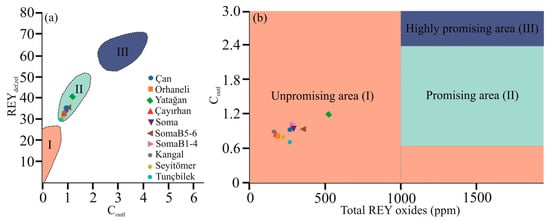
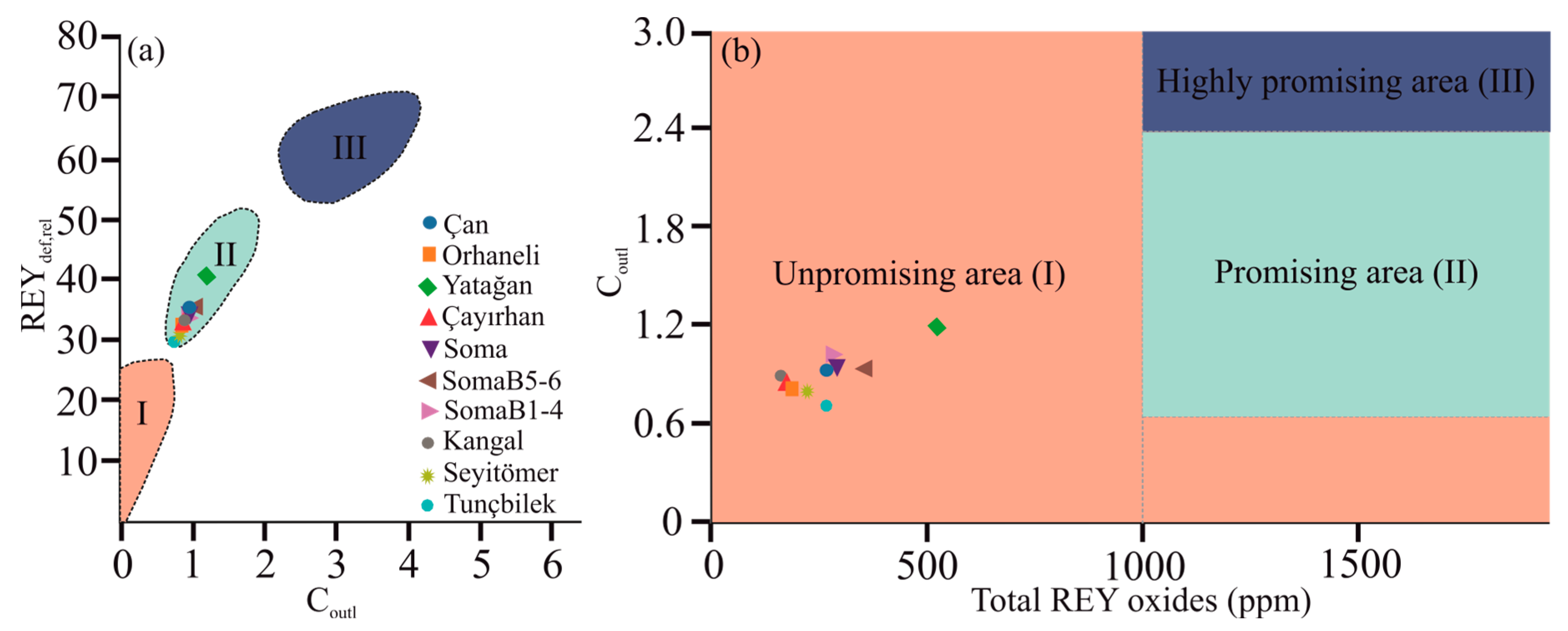
The obtained Coutl values were evaluated using the REYdef,rel–Coutl diagram proposed by Seredin [43]; compositional quality interpretations were made according to the areas where the samples were located.
The concentration coefficient (CC) approach was used to determine the relative richness/poverty levels of fly ash in terms of REY. According to the classification proposed by Dai et al. [44], elements with CC values > 2 were classified as enriched, elements in the 0.5–2 range as normal, and those with values < 0.5 as depleted. These values were calculated using the world coal ash average composition [45] as a reference.
Ce and Eu anomalies were calculated to evaluate anomalous REY behaviour. These anomalies were evaluated as geochemical indicators related to source lithology and oxidation degree in the interpretation of normalised REY distribution patterns. All normalised values were calculated using the upper continental crust (UCC) reference [46].
δEu values were calculated using the formula proposed by Bau and Dulski [47]:
δEu = EuN/(SmN × 0.67 + TbN × 0.33)
δCe values were calculated according to the approach of Dai et al. [6]:
δCe = CeN/(LaN × 0.5 + PrN × 0.5)
3. Results and Discussion
3.1. Characteristics of Feed Coals and Associated Fly Ashes
Turkish lignites generally have high moisture, ash, volatile matter and sulphur content, while offering a low calorific value [48,49]. A total of 75% of Turkish lignites have a calorific value below 2500 kcal/kg, while only 8% have a calorific value above 3000 kcal/kg [50]. Among the thermal power plant feed coals examined, only those from the Çan and Yatağan power plants have calorific values above 3000 kcal/kg.
The mineral matter present in coal affects its industrial and technological properties and causes various environmental problems [51]. The inorganic content of feed coals consists predominantly of clay minerals, quartz, feldspars, calcite, gypsum, pyrite, and dolomite [35,36,37,38,39,40,42]. Significant amounts of siderite are found in the Soma, Tunçbilek and Seyitömer feed coals [52], while zeolite group minerals are found in the Çan and Çayırhan feed coals [40,52].
The mineralogical compositions of fly ashes obtained from different thermal power plants in Türkiye are largely similar. However, there are some differences depending on each plant’s combustion conditions, boiler technology, and feed coal characteristics. The mineralogical compositions of the fly ashes are divided into three groups: primary minerals inherited from the coal, secondary phases formed during combustion, and tertiary phases crystallised during transport and storage in the disposal area [53]. High levels of amorphous aluminosilicate glass have been detected, particularly in fly ash samples from Yatağan, Orhaneli, Çayırhan and Soma [35,36,37,42]. Quartz and feldspars are the main components in all fly ash samples [35,36,37,38,39,41]. This indicates that the mineral assemblage is largely controlled by detrital minerals inherited from the feed coals. The presence of quartz in fly ash is related to its presence in the feed coal [54]. Some of the quartz may originate from particles adhering to the feed coal during storage and transport [53]. Feldspars can be of primary or secondary origin. Secondary feldspars can crystallise from silicate melts or form as a result of reactions with Ca, K and Na oxides released during combustion and transformations above 900 °C [55]. Anhydrite, calcite, hematite, lime, portlandite, mullite, cristobalite and various Ca-Mg silicate minerals are also detected in fly ash samples. In fly ashes from some thermal power plants (Soma, Kangal, Orhaneli, Çayırhan), minerals associated with high temperatures or limestone additions, such as ettringite, gehlenite, melilite, periclase, spinel, and magnetite, are observed [36,37,39]. The presence of Ca-rich phases such as anhydrite, lime, portlandite, gehlenite, and melilite reflects the mineralogical effect of combustion conditions and the limestone additions applied in some power plants. In addition, pyrite, pyrrhotite, pentlandite, apatite, barite, ilmenite, Ti-oxides and, in places, monazite and other phosphate minerals are found in varying proportions in most fly ash samples [38,41].
Amorphous aluminosilicate glass phases derived from clay minerals, whose original crystal structures are largely destroyed during combustion, as well as feldspars and phosphate minerals such as monazite and apatite, may act as potential host phases for REY. However, the contribution of these minerals to the REY content may vary depending on factors such as their abundance, crystal chemistry, and post-combustion phase transformations. The mineral phases associated with REY in fly ash are considered a factor that may influence potential extraction behaviour [8,24].
The SiO2, Al2O3, Fe2O3, and CaO compositions of Turkish fly ashes are given in Table 1. The Soma and Çan samples have high CaO contents (17.39–28.91%), and these fly ashes present a high-calcium chemical character. The Çayırhan, Yatağan, and Orhaneli samples show a transitional composition with medium CaO values (14.55–19.59%). The Tunçbilek and Seyitömer fly ashes, with low CaO contents (<5%) and relatively high Al2O3-Fe2O3 values, are close to an aluminosilicate-dominant character.
Table 1.
Selected major oxide contents (SiO2, Al2O3, Fe2O3, CaO; wt%) of fly ashes from the investigated power plants.
3.2. REY Concentrations in Turkish Fly Ashes
The REY concentrations of fly ash samples from thermal power plants in Türkiye are given in Table 2. The most abundant REY in Turkish fly ash is Ce. The amount of Ce in the samples constitutes more than one-third of ∑REY. La is the second most abundant REY in all samples except Yatağan fly ash. La and Ce account for more than 50% of ∑REY. In general, Turkish fly ash exhibits a typical abundance order of Ce > La > Nd > Y, consistent with global coal, world coal ash [45] and Turkish low-rank coal [56]. However, the Y concentration in the fly ash from the Yatağan thermal power plant, similar to the Yatağan feed coal [52], exceeds La and Nd, making it the second most abundant element after Ce. Furthermore, it is significantly higher than the Y concentrations in the other samples examined.
Table 2.
REY concentrations (ppm) in the Turkish fly ashes.
The ∑REY concentrations of Turkish fly ash range from 134.00 to 429.48 ppm. The mean and median ∑REY values were calculated as 230.06 and 227.33 ppm, respectively. These values indicate that the REY concentrations in Turkish fly ash are lower than those in world coal ash (403.5 ppm, ref. [45]). However, it is comparable to the average REY concentration in European coal ash (278.7 ppm, ref. [23]). The REO values, with a mean of 416.89 and a median value of 412.20, are also lower than the REO content reported for world coal ash [45]. Comparison with the global coal ash average is used here as a geochemical reference framework rather than as a direct indicator of economic viability.
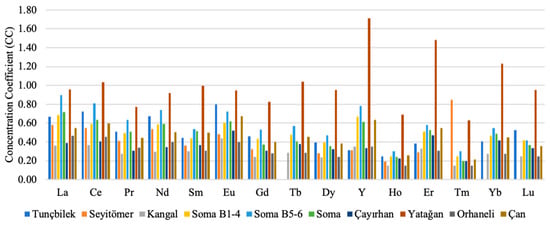
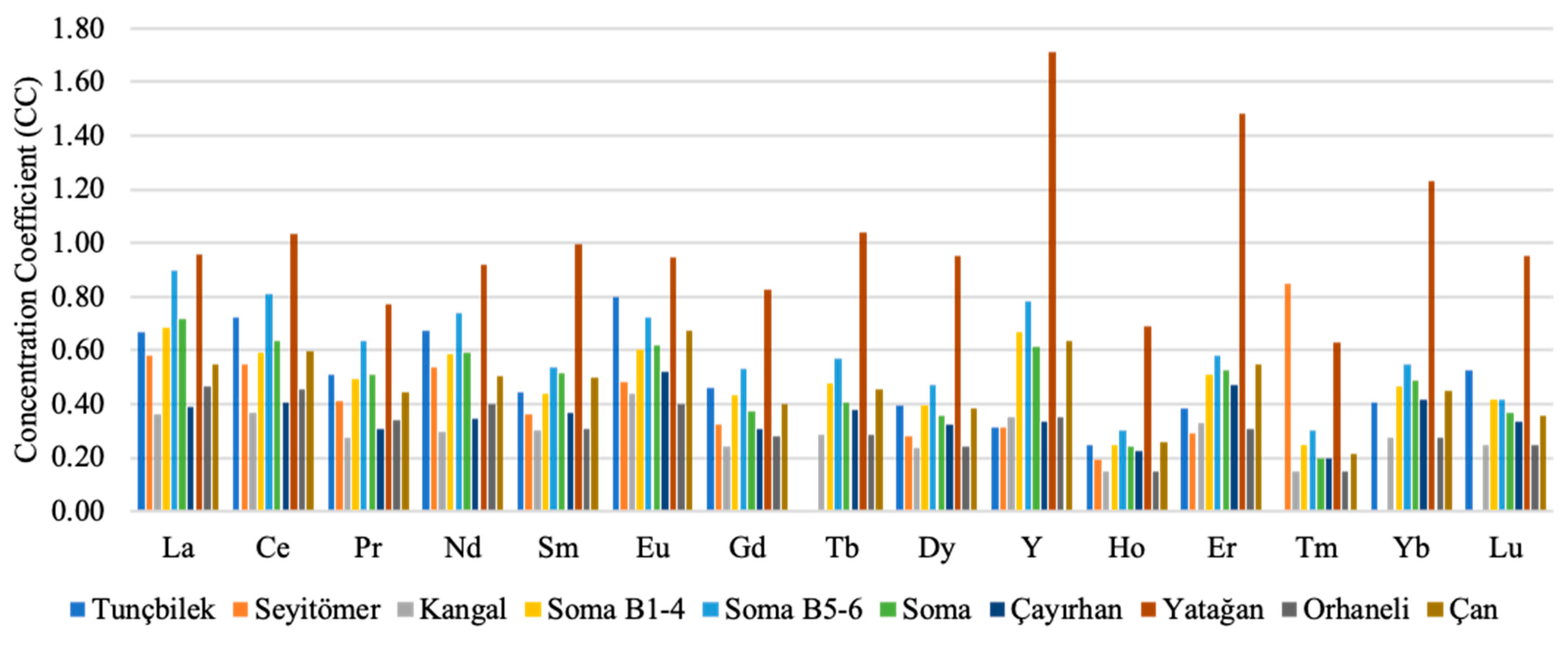
CC, calculated based on global coal ash average values, indicates significant differences among the thermal power plants examined (Figure 1). For most REY in the fly ash from Tunçbilek, Seyitömer, Kangal, Çayırhan, and Orhaneli, CC values are below 0.5, indicating relative depletion with respect to the global coal ash reference. The CC values in the fly ash from the Soma and Çan thermal power plants are generally below 1, but most REY are at normal levels. The fly ash from the Yatağan thermal power plant differs from other fly ashes. In particular, CC values for Y and some HREY (Er, Yb) are above 1 but remain below 2, indicating moderate relative enrichment.
Figure 1.
Power plant-specific CC of REY in fly ashes, normalised to average world coal ash values after Ketris and Yudovich [45].
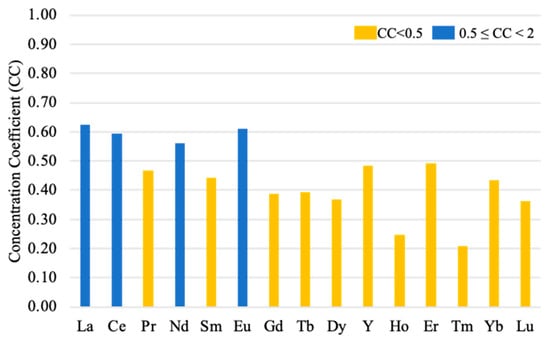
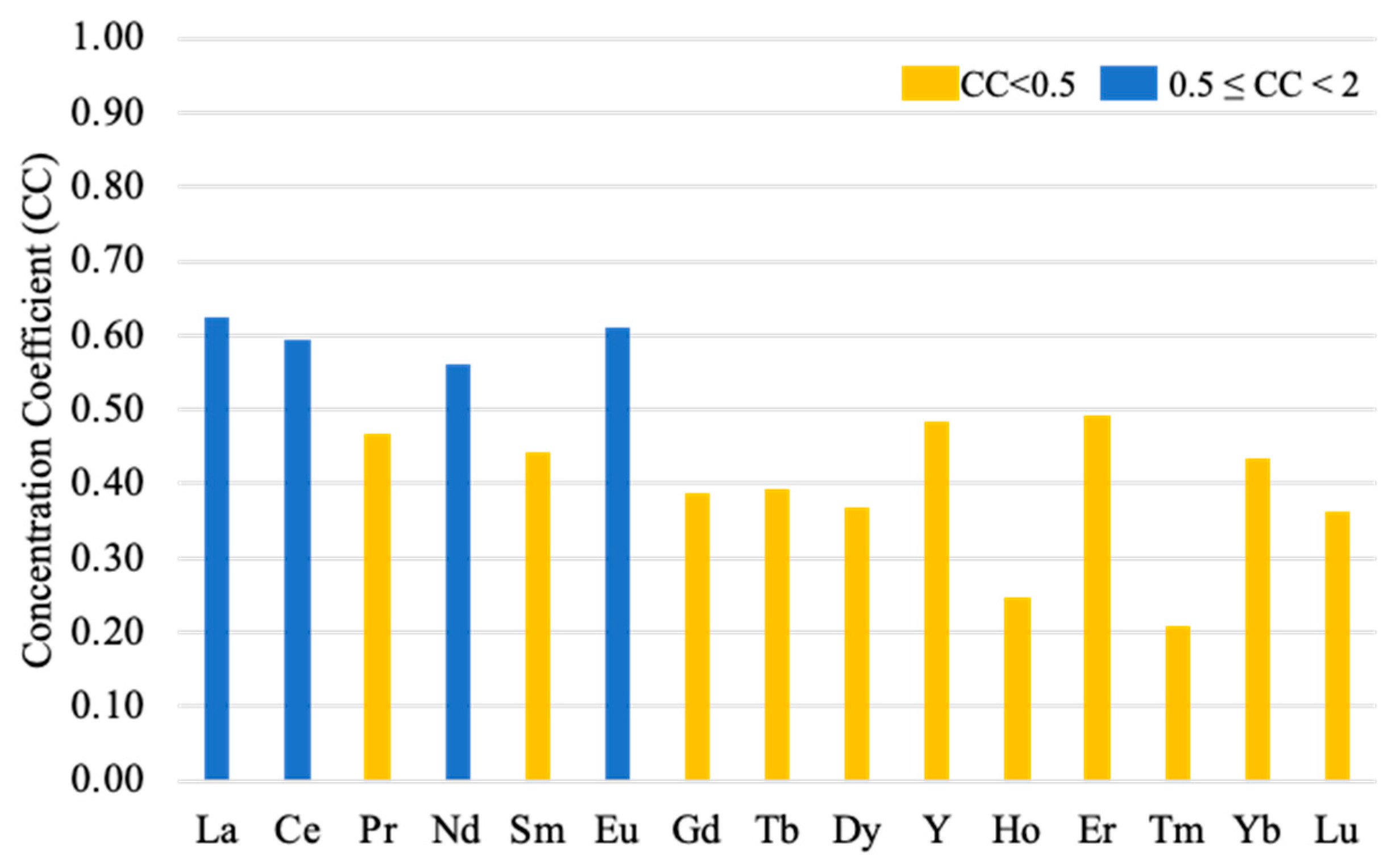
When evaluated using the mean REY composition of the entire dataset, CC values display a consistent decreasing trend from LREY to HREY (Figure 2). CC values for LREY range from 0.44 to 0.62, while those for MREY range from 0.37 to 0.61, and those for HREY range from 0.21 to 0.49. This indicates that relative to the global coal ash benchmark, most REY in Turkish fly ash occur at lower concentrations. La, Ce, Nd, and Eu, however, are within the normal range. The relatively lower MREY and HREY values may reflect variations in the abundance and stability of accessory minerals containing HREY and their redistribution during combustion. In coal-bearing systems, HREY are commonly associated with resistant minerals such as zircon or xenotime; differences in the abundance of such minerals may therefore influence the observed patterns. A gradual decrease from LREY to HREY may also indicate a provenance effect, but detailed mineralogical data would be required to confirm this interpretation.
Figure 2.
CC of REY in Turkish fly ashes, normalised to average world coal ash values after Ketris and Yudovich [45].
3.3. REY Distribution Patterns and Geochemical Characteristics
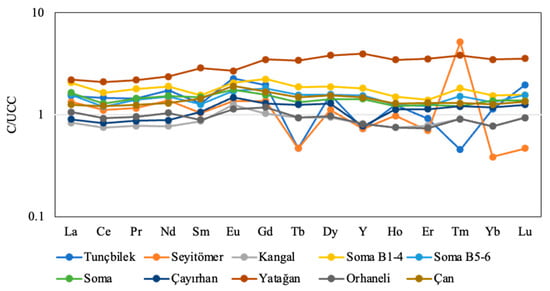
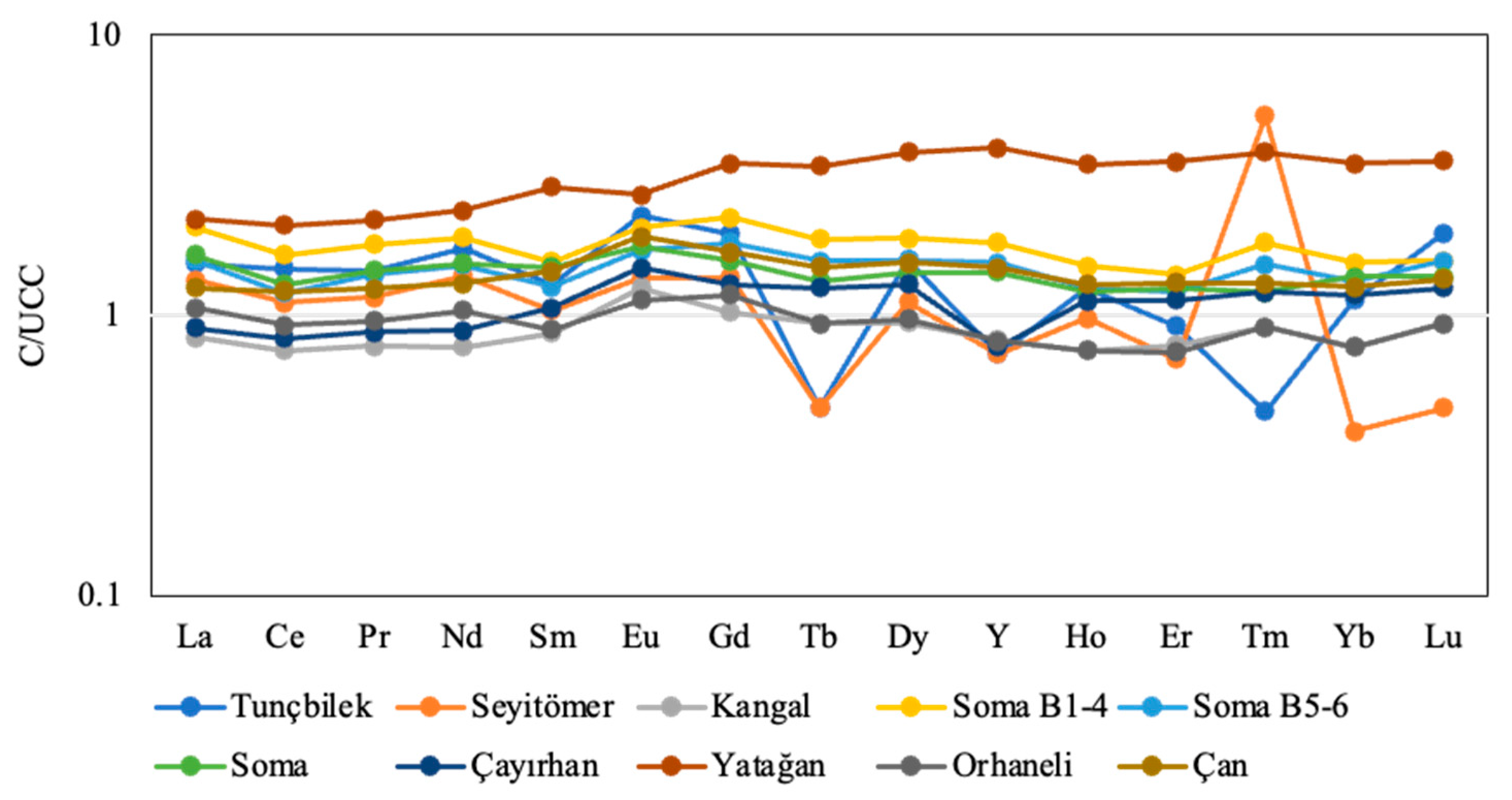
Normalised REY distribution patterns according to UCC values indicate that Turkish fly ash is generally enriched compared to UCC (Figure 3). The patterns start with normalised values close to or slightly above the unit value for UCC in the La-Sm range (LREY) for most thermal power plant ash. Significant differences are observed between thermal power plants in the Sm-Gd (MREY) and Ho-Lu (HREY) ranges (especially Tb-Lu). Significant decreases in normalised values around Tb and Y were observed in Tunçbilek, Seyitömer, Orhaneli and Kangal fly ashes. In the Soma and Çan samples, the patterns are more balanced and closer to UCC. Yatağan fly ash, particularly in the Gd-Lu range, shows a marked relative enrichment compared to UCC, distinguishing it from other power plants. This suggests that Yatağan ash may have a different geochemical character in terms of HREY behaviour. This distinct signature likely reflects a source-controlled effect associated with the metamorphic and crystalline basement rocks of the Menderes Massif, which supplies sedimentary material to the basin. Similar UCC-normalised REY distribution patterns have also been reported by Erik [56] for Orhaneli, Çan, Çayırhan, Kangal, Yatağan and Tunçbilek coals. In this study, the LREY dominance and the fluctuating behaviour in the MREY–HREY range observed in coal samples are generally consistent with the fly ash patterns examined here. This consistency indicates that the REY distribution patterns in the fly ash are primarily inherited from the feed coal [8,57,58]. Although primary distribution trends appear to be preserved, combustion-related processes, including mineral phase transformations and redistribution between glassy and crystalline components, may influence the relative behaviour of certain elements.
Figure 3.
Distribution patterns of REY in Turkish fly ashes, normalised to UCC values after Taylor and McLennan [46].
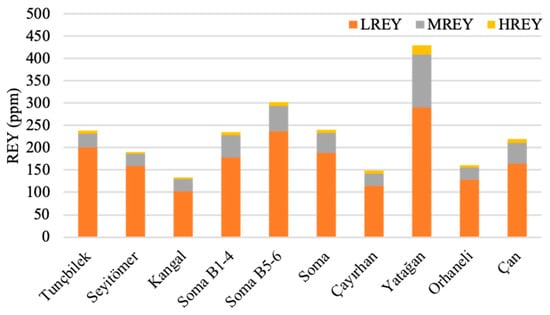
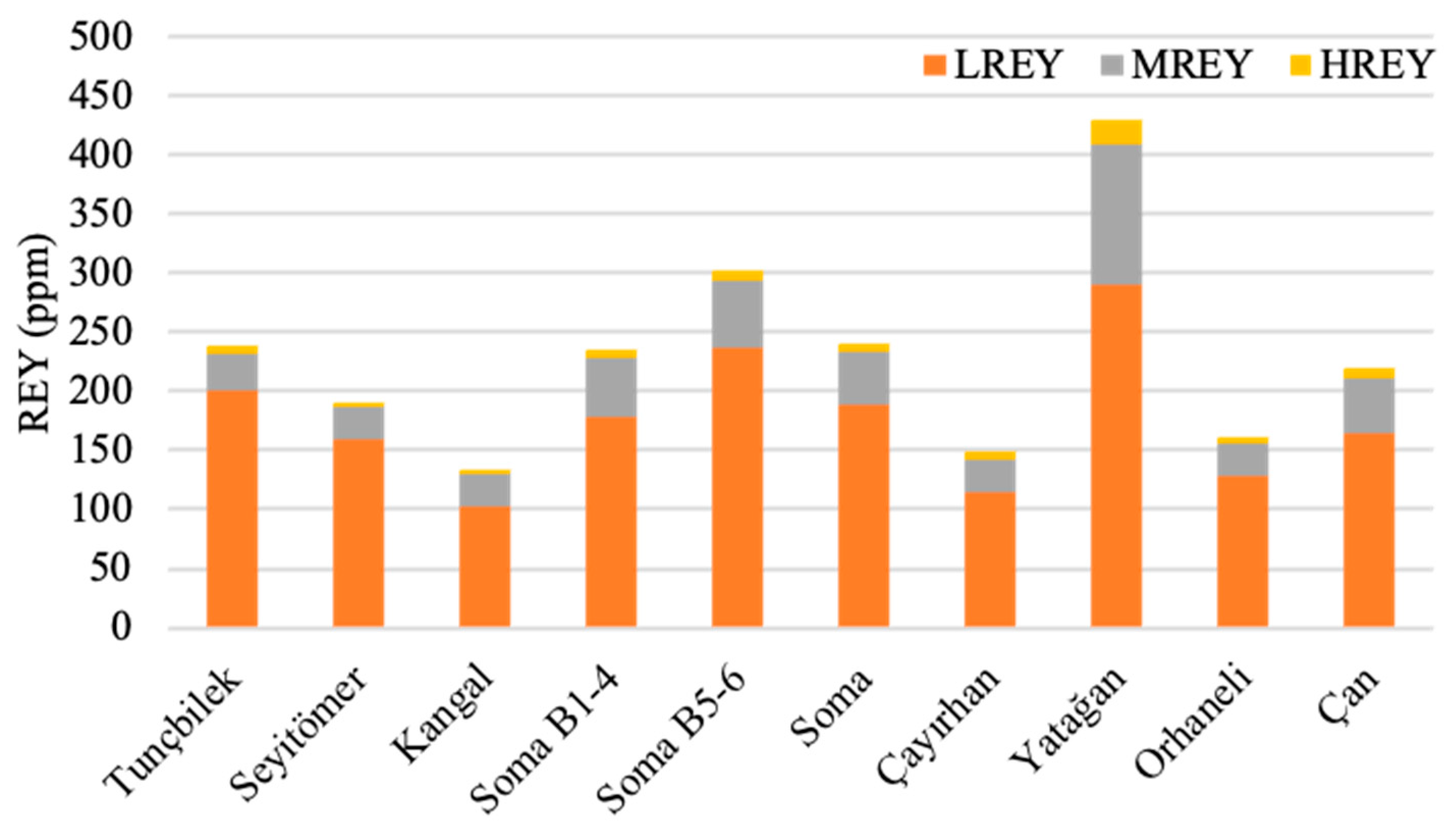
The LREY, MREY, and HREY in Turkish fly ashes vary between 102.4 and 290.14 ppm, 26.3–118.40 ppm, and 4.08–20.94 ppm, respectively (Table 3). In all fly ash samples, the dominant group is LREY, with an average of 176.42 ppm. The MREY and HREY groups follow, with average concentrations of 45.69 ppm and 7.94 ppm, respectively. This distribution among the REY groups is consistent with the distribution of REY groups in coal ash worldwide [23,45]. Yatağan thermal power plant fly ash follows the general trend but contains 3–5 times more HREY than other plant ashes (Figure 4). The LREY/MREY, LREY/HREY and MREY/HREY ratios reflect the degree of REY differentiation in fly ash. These ratios are 22.21, 3.86 and 5.75 on average, respectively, indicating that Turkish fly ash has a high degree of fractionation. When power plant-specific values are considered, the fly ashes from the Seyitömer, Soma, Orhaneli and Çan power plants have relatively higher MREY/HREY ratios.
Table 3.
Summary of REY group concentrations (ppm), group ratios, and Ce–Eu anomalies in Turkish fly ashes.
Figure 4.
Distribution of LREY, MREY, and HREY concentrations in Turkish fly ashes.
Most Turkish fly ashes are L-type in character. Soma, Orhaneli and Çan fly ashes exhibit distinct LREY enrichment with LaN/LuN values in the range of 1.01–1.32. Tunçbilek and Yatağan fly ashes are H-type in character due to low LaN/LuN ratios calculated in the range of 0.62–0.78. Kangal, Çayırhan, and Çan fly ashes, on the other hand, show M-type enrichment. In these samples, the LaN/LuN and GdN/LuN values are close to 1, indicating that the fractional distribution does not show a pronounced slope. The observation of H-type distribution models in ashes with low total REY contents indicates that REY fractionation pattern is not solely dependent on concentration levels. This suggests that REY groups may be distributed in different proportions across mineral phases or geochemical processes.
All Turkish fly ashes exhibit a weak negative Ce anomaly (δCe = 0.81–0.99). It is known that Ce in coals either shows no anomaly or exhibits a negative/weak negative anomaly [6]. The negative Ce anomaly, resulting from Ce4+/Ce3+ fractionation caused by weathering and oxidation processes in the sediment source region, has been frequently reported in the coal and ash literature [14,20,59,60,61]. In addition to source-derived inherited characteristics, combustion-related phase redistribution or the preferential retention of Ce in refractory minerals may also contribute to the observed fly ash signature. Eu shows positive anomalies in all fly ash samples (δEu = 1.23–1.40) except Yatağan fly ash (δEu = 0.88). Coals derived from sedimentary source regions composed of mafic basalts are characterised by positive Eu anomalies [6]. Positive Eu anomalies may result from Eu enrichment due to the isomorphous substitution of Eu2+ for Ca2+ in Ca-rich minerals such as plagioclase feldspars [62]. Coals formed with input from felsic or felsic-intermediate terrestrial materials generally exhibit negative Eu anomalies [6]. Negative Eu anomalies can also be observed in coals exposed to hydrothermal fluids, indicating that the temperatures of the hydrothermal fluids were <200 °C [6]. Alternatively, combustion-related redistribution or differences in the abundance Ca-bearing minerals in the feed coal may have contributed to the negative Eu anomaly observed at Yatağan.
3.4. Compositional Quality of REY in Fly Ashes
The REY composition quality of the fly ash samples examined was evaluated using the Coutl and REYdef,rel indices based on critical element ratios, a methodology widely utilised for the preliminary assessment of coal-based resources [3,20]. Coutl values ranged from 0.72 to 1.18 (Table 4), indicating a moderate proportion of critical elements relative to ∑REY. Consequently, when plotted on a Coutl-REO diagram (Figure 5b), all samples fall within the unpromising field due to their relatively low ∑REY content. However, the fact that all samples fall within the promising area of the Coutl-REYdef,rel diagram (Figure 5a) indicates that the fly ash is not entirely low in value from a compositional perspective.
Table 4.
Concentrations of critical, uncritical, and excessive REY (ppm), critical REY percentages, and compositional quality indices of Turkish fly ashes.
Figure 5.
(a) REYdef,rel–Coutl diagram and (b) Coutl–REO diagram of Turkish fly ashes. Fields indicate compositional quality classes: I—unpromising area; II—promising area; III—highly promising area. Classification schemes follow the approaches proposed by [43] for diagram (a) and [63] for diagram (b).
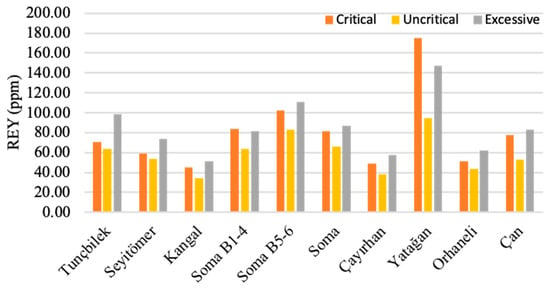
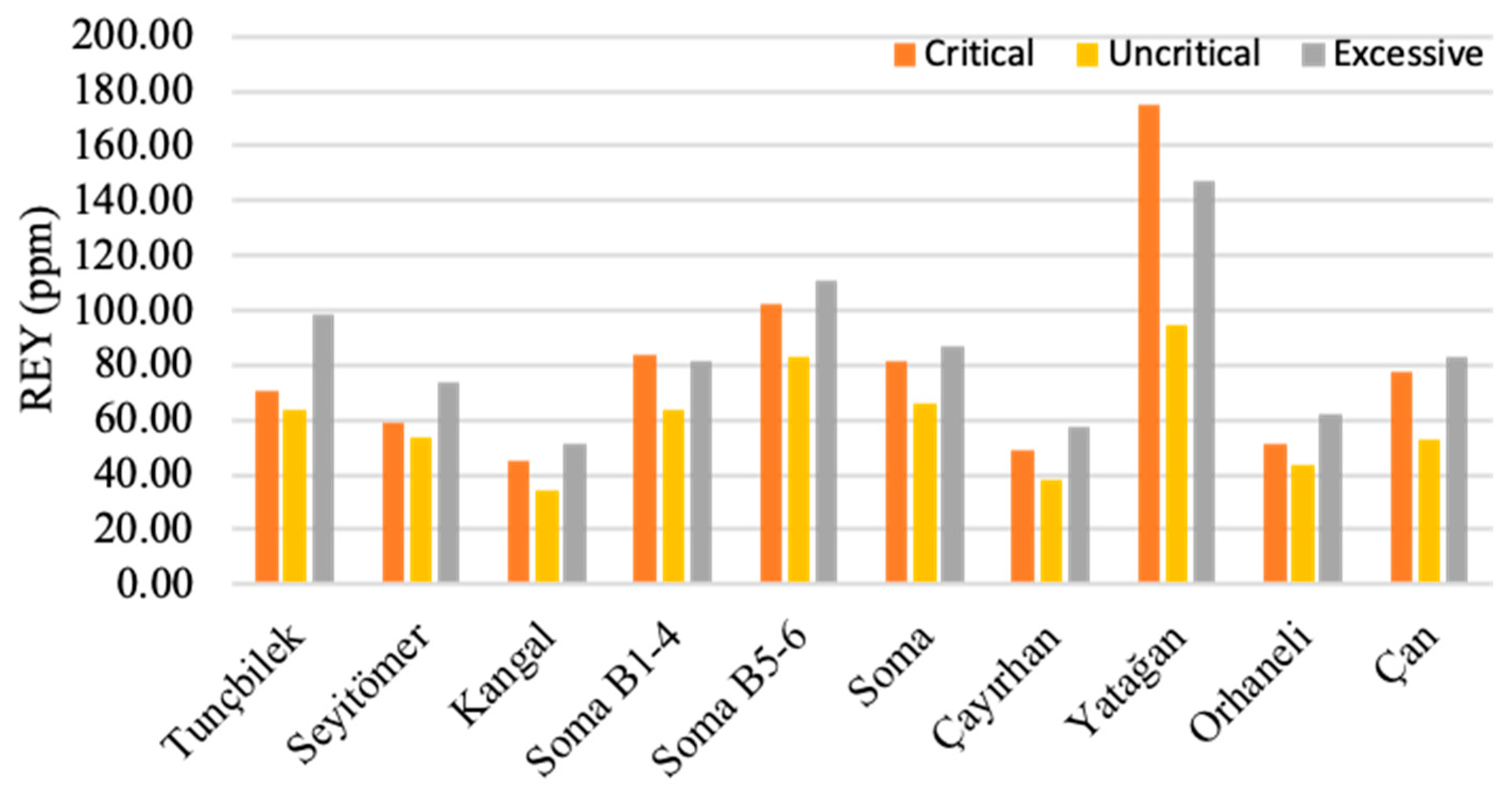
In the thermal power plant-based assessment, significant inter-plant variability was observed among the fly ashes. Yatağan fly ash has both the highest total REO value (518.33 ppm) and the highest Coutl (1.18) and REYdef,rel (40.73) values, clearly differentiating it from other samples in terms of critical REY composition (Figure 6). While the average critical REY content in Turkish fly ash is 34.75%, the values across the studied plants range from 30.39% in Tunçbilek to 42.00% in Yatağan, indicating a diverse compositional spectrum. This average is comparable to the global benchmarks for world, European, American, and Chinese coal fly ash (35.2% [45]; 34%, 37%, and 39%, ref. [23], respectively). Statistical evaluation of the dataset reveals that most Turkish samples cluster around a Coutl range of 0.72–1.02, with Yatağan behaving as a significant outlier in terms of enrichment potential. Although the Soma samples have relatively high total REO contents (283.14–364.60 ppm), their Coutl values remain at approximately 0.90, indicating that the REY composition has an LREY-dominant character. The Tunçbilek, Seyitömer, Çayırhan, Orhaneli, Çan and Kangal samples, on the other hand, offer limited compositional quality with both low total REO and low critical REY content. These compositional characteristics are generally consistent with the REY distribution patterns. Most fly ashes exhibit L-type behaviour, and the HREY contribution remains limited. The H-type behaviour observed in the Yatağan sample has caused an increase in both Coutl and REYdef,rel values by increasing heavy REY components. However, the Tunçbilek fly ash, which similarly exhibits H-type characteristics, has shown low Coutl and REYdef,rel values. This discrepancy highlights that H-type classification is a qualitative descriptor of fractionation rather than a quantitative measure of resource potential. In Tunçbilek, H-type behaviour occurs at comparatively low total ∑REY concentrations, representing a relative enrichment. In contrast, Yatağan’s H-type enrichment is combined with a high absolute ∑REY concentration, suggesting a more substantial contribution of HREY-bearing minerals. Therefore, geochemical classification should be integrated with absolute concentration data to avoid the limitations of categorical descriptors.
Figure 6.
Critical and non-critical REY concentrations of the Turkish fly ashes.
3.5. Implications for REY Recovery from Fly Ash
REY concentration alone does not determine recovery feasibility, as extraction capability is largely dependent on mineralogical host phases and their behaviour during combustion and subsequent processing. REY in coal are generally associated with detrital minerals (zircon, monazite, xenotime), APS minerals, oxides, carbonates, or organic matter [3]. However, REY-bearing minerals in fly ash are generally less prominent than in feed coal due to reasons such as the ability of refractory REY-bearing minerals to melt at lower effective temperatures in multi-component boiler systems, the reduction in particle size, and the diffusion of REY into glassy phases [20]. The literature reports that REY in fly ash are mostly distributed in the amorphous aluminosilicate glass phase and, to a lesser extent, in phosphate minerals, Fe-oxides, and partially in Ca-silicate phases [8,11,22,23,25,64]. The presence of mullite, feldspars, Ca-Mg silicates, phosphate minerals, and abundant amorphous aluminosilicate glass detected in Turkish fly ashes suggests that similar phase associations are possible in these materials. The glass phase can trap a significant portion of REY within it and typically exhibits low reactivity in direct acid leaching [22,65]. Monazite and apatite are resistant carriers, particularly for LREY and MREY, and may require more aggressive leaching conditions (e.g., concentrated acid or alkali fusion) [23]. This mineralogical diversity indicates that a sequential approach may be necessary to efficiently recover REY. Furthermore, according to the literature, the most effective way to recover REY from coal ash is to combine physical (size, density, magnetic separation, flotation) and hydrometallurgical methods [23,32].
Soma and especially Yatağan fly ashes exhibit relatively high REO contents as well as differing compositional characteristics. Soma is relatively favourable in terms of critical LREY, with an L-type pattern and moderate Coutl value. Yatağan, on the other hand, is important in terms of critical HREY and Y concentration, with an H-type pattern and the highest Coutl value in this study. This difference implies two different source types. Therefore, the recovery flow schemes to be developed for each will differ according to the characteristics of the target element group. Based on the geochemical data provided in Section 3.1 and the major oxide compositions given in Table 1, a preliminary mineralogical inference can be made about the REY host minerals in these fly ashes. The high CaO contents observed in the fly ashes from Soma, Çan, and Orhaneli are consistent with trends in the literature indicating that Ca-rich ashes may be more sensitive to acid [28,30]. In contrast, the relatively high aluminosilicate content in Yatağan fly ash may cause lower solubility [11]. This situation indicates that some sites with low REY content should not be completely disregarded due to their mineralogical advantages, while solubility limitations should be considered in some sites with high REY content.
3.6. Resource Potential and Economic Considerations for Turkish Fly Ashes
Coal-fired thermal power plants in Türkiye produce very large quantities of fly ash. According to data from the Turkish Statistical Institute [66], thermal power plants generate 26.5 million tonnes of waste annually, 84.6% of which is ash and slag. A total of 86.9% of the waste is accumulated in storage areas. A very small portion of the waste is sent to licenced facilities and used in the backfilling of mines/quarries. These figures show that coal combustion residues, including fly ash, have not yet been economically evaluated in Türkiye. There is a huge stockpile of ash that has accumulated over decades, and new waste continues to accumulate every year. Since national statistics do not distinguish fly ash from other combustion residues, a clear fly ash ratio (f) was applied to the ash–slag stream for first-order scale assessment. Using the average REO concentration determined for Turkish fly ashes in this study, the implied REO content corresponds to approximately 6.2 × f kt per year (and 5.4 × f kt per year for the settled fraction), which is equivalent to ~3.7–5.0 kt/year of annual emerging REO and ~3.2–4.3 kt/year of potential REO entering stockpiles (assuming f = 0.60–0.80 and 86.9% storage). This estimate was derived from the basins examined in this study and does not represent a national average; it provides, however, a first-order scale approach to REO potentially associated with coal combustion residues in Türkiye. Similar scale-based estimates have been applied in other national contexts. For example, Taggart et al. [30] converted large ash stocks in major basins in the United States into annual REO production capacity estimates (8.9 kt/year). Methodologically, the current calculation follows a comparable volumetric approach for Türkiye. However, such assessments aim to provide a scale perspective rather than direct production equivalence.
Although the REY content of fly ash obtained from Turkish lignite is below the proposed economic threshold of 1000 ppm (REO) for REY deposits found in primary coal beds [3], economic cut-off grades for secondary materials can vary significantly. Fly ash represents a finely grained waste material that has already been extracted, eliminating the mining and grinding costs associated with traditional REY ores [23]. Furthermore, recent initiatives by the US Department of Energy have demonstrated the technical feasibility of recovering high-purity critical minerals (including REY) from low-grade source materials at concentrations of approximately 300 ppm [67]. Therefore, when evaluating the feasibility of REY recovery from fly ash, concentration thresholds should be considered.
The literature indicates that REY production from coal ash alone has low economic viability due to high leaching costs [23,68]. However, it is also emphasised that REY production from coal ash can potentially be made economically viable through a multi-product approach [19]. Fly ash is a raw material rich in Al, Si, and Fe [69] and has advantages such as construction additive, Al recovery, and zeolite production [70,71,72]. The mineralogical diversity of Turkish fly ash provides a suitable basis for REY recovery in integrated applications. In this context, considering the characteristics of ash in Türkiye and the potential for value-added material applications, zeolite conversion may be technically feasible. This potential is supported by the high levels of amorphous aluminosilicate glass [35,36,37,42] detected in fly ash obtained from Yatağan, Orhaneli, Çayırhan and Soma; this glass can function as a reactive precursor for zeolite crystallisation. Furthermore, the SiO2/Al2O3 ratios calculated from the major oxide data (Table 1) range from 1.86 in Çan to 3.87 in Çayırhan, which is within or close to the composition ranges reported for fly ash-based zeolite synthesis systems [73,74,75]. Although the present study does not experimentally evaluate zeolite formation, these compositional characteristics suggest that integrated REY recovery–zeolite conversion approaches warrant further investigation. Such a multi-product strategy could enhance the overall economic viability of REY extraction from fly ash. Additionally, Turkish feed coals contain significant amounts of Cr, Cs, Mo, Ni, Rb, Th, U, and V, while Çayırhan, Seyitömer, Tunçbilek, and Soma feed coal also contain significant amounts of boron [52]. This indicates that many critical elements are likely to be enriched together in the same ash matrix. Thus, REY recovery processes may achieve economic potential not only through single-metal targets but also through multi-element strategies.
4. Conclusions
This study presents the first integrated assessment of REY geochemistry, compositional quality, and volumetric resource perspective of fly ashes in Türkiye. Although the average ∑REY content is below the global coal ash average, it is comparable to European values, highlights the importance of regional benchmarking. While most fly ashes exhibit L-type behaviour, Yatağan and Tunçbilek fly ashes display a distinct H-type enrichment. The integration of fractionation patterns with absolute REO content demonstrates that geochemical classification alone is insufficient for resource evaluation.
A first-order national-scale estimation indicates that Turkish fly ash may contain approximately 3.7–5.0 kt REO per year in annual arisings, with 3.2–4.3 kt potentially entering stockpiles. Although these values represent scale approximations rather than a national-grade inventory, they provide quantitative context for evaluating secondary resource potential.
Even though the REY content of Turkish fly ash is below the 1000 ppm (REO) economic threshold, its large waste volume, critical element ratios, and compatibility with integrated multi-product recovery strategies could make it worthy of consideration as a secondary resource. Future studies, especially in Yatağan, should focus on mineral-phase-controlled extraction behaviour of site-specific ashes, pilot-scale leaching optimisation, and techno-economic evaluation.
Funding
This research received no external funding.
Institutional Review Board Statement
Not applicable.
Informed Consent Statement
Not applicable.
Data Availability Statement
Data are contained within the article.
Conflicts of Interest
The author declares no conflicts of interest.
References
- Balaram, V. Potential Future Alternative Resources for Rare Earth Elements: Opportunities and Challenges. Minerals 2023, 13, 425. [Google Scholar] [CrossRef] [Scilit]
- Reedy, R.C.; Scanlon, B.R.; Bagdonas, D.A.; Hower, J.C.; James, D.; Kyle, J.R.; Uhlman, K. Coal Ash Resources and Potential for Rare Earth Element Production in the United States. Int. J. Coal Sci. Technol. 2024, 11, 74. [Google Scholar] [CrossRef] [Scilit]
- Seredin, V.V.; Dai, S.F. Coal Deposits as Potential Alternative Sources for Lanthanides and Yttrium. Int. J. Coal Geol. 2012, 94, 67–93. [Google Scholar] [CrossRef] [Scilit]
- Blissett, R.S.; Smalley, N.; Rowson, N.A. An Investigation into Six Coal Fly Ashes from the United Kingdom and Poland to Evaluate Rare Earth Element Content. Fuel 2014, 119, 236–239. [Google Scholar] [CrossRef] [Scilit]
- Franus, W.; Wiatros-Motyka, M.M.; Wdowin, M. Coal Fly Ash as a Resource for Rare Earth Elements. Environ. Sci. Pollut. Res. 2015, 22, 9464–9474. [Google Scholar] [CrossRef] [Scilit]
- Dai, S.F.; Graham, I.T.; Ward, C.R. A Review of Anomalous Rare Earth Elements and Yttrium in Coal. Int. J. Coal Geol. 2016, 159, 82–95. [Google Scholar] [CrossRef] [Scilit]
- Hower, J.C.; Dai, S.; Eskenazy, G. Distribution of Uranium and Other Radionuclides in Coal and Coal Combustion Products, with Discussion of Occurrences of Combustion Products in Kentucky Power Plants. Coal Combust. Gasif. Prod. 2016, 8, 44–53. [Google Scholar]
- Kolker, A.; Scott, C.; Hower, J.C.; Vazquez, J.A.; Lopano, C.L.; Dai, S.F. Distribution of Rare Earth Elements in Coal Combustion Fly Ash, Determined by SHRIMP-RG Ion Microprobe. Int. J. Coal Geol. 2017, 184, 1–10. [Google Scholar] [CrossRef] [Scilit]
- Lin, R.; Howard, B.H.; Roth, E.A.; Bank, T.L.; Granite, E.J.; Soong, Y. Enrichment of Rare Earth Elements from Coal and Coal By-Products by Physical Separations. Fuel 2017, 200, 506–520. [Google Scholar] [CrossRef] [Scilit]
- Arbuzov, S.I.; Chekryzhov, I.Y.; Finkelman, R.B.; Sun, Y.Z.; Zhao, C.L.; Il’enok, S.S.; Blokhin, M.G.; Zarubina, N.V. Comments on the Geochemistry of Rare-Earth Elements (La, Ce, Sm, Eu, Tb, Yb, Lu) with Examples from Coals of North Asia (Siberia, Russian Far East, North China, Mongolia, and Kazakhstan). Int. J. Coal Geol. 2019, 206, 106–120. [Google Scholar] [CrossRef] [Scilit]
- Wang, Z.; Dai, S.; Zou, J.; French, D.; Graham, I.T. Rare Earth Elements and Yttrium in Coal Ash from the Luzhou Power Plant in Sichuan, Southwest China: Concentration, Characterization and Optimized Extraction. Int. J. Coal Geol. 2019, 203, 1–14. [Google Scholar] [CrossRef] [Scilit]
- Qin, G.; Cao, D.; Wei, Y.; Wang, A.; Liu, J. Geochemical Characteristics of the Permian Coals in the Junger-Hebaopian Mining District, Northeastern Ordos Basin, China: Key Role of Paleopeat-Forming Environments in Ga-Li-REY Enrichment. J. Geochem. Explor. 2020, 213, 106494. [Google Scholar] [CrossRef] [Scilit]
- Yang, B.; Cheng, C.; Li, Y.; Cheng, W.; Zang, J.; Lai, X.; Wang, X. Modes of Occurrence and Pre-Concentration of Rare Earth Elements in No. 17 Coal in Liupanshui Coalfield, China. J. Rare Earths 2022, 40, 1323–1332. [Google Scholar] [CrossRef] [Scilit]
- Das, A.; Kumar, R.; Patel, S.S.; Saha, C.; Das, A.; Mandal, H.; Patel, R.S. Geochemical Variations of Major, Trace, Rare Earth Elements in Some Gondwana and Eocene Coals of India with a Comparison of Their Germanium, Lithium, and Mercury Content. Geochemistry 2023, 83, 125960. [Google Scholar] [CrossRef] [Scilit]
- Karadirek, S. Future Prospects of Rare Earth Elements in Coal and Coal Ash: Based on Mapping of Global Research (1973–2023). J. Eng. Sci. Des. 2024, 12, 430–442. [Google Scholar] [CrossRef] [Scilit]
- Wu, G.; Ma, Z.; Li, G.; Bo, C. The Distribution and Enrichment Characteristics of Rare Earth Elements between Coals and Coal Ashes from Four Coal-Fired Power Plants. RSC Adv. 2024, 14, 2678–2686. [Google Scholar] [CrossRef] [Scilit]
- Mkhize, M.; Wagner, N.; Bada, S. The Distribution and Occurrence of Rare Earth Elements (REEs) in Coal and Industrial Scale Boiler and Gasifier Ash. Fuel 2026, 405, 136618. [Google Scholar] [CrossRef] [Scilit]
- Hower, J.C.; Ruppert, L.F.; Eble, C.F. Lanthanide, Yttrium, and Zirconium Anomalies in the Fire Clay Coal Bed, Eastern Kentucky. Int. J. Coal Geol. 1999, 39, 141–153. [Google Scholar] [CrossRef] [Scilit]
- Dai, S.; Finkelman, R.B. Coal as a Promising Source of Critical Elements: Progress and Future Prospects. Int. J. Coal Geol. 2018, 186, 155–164. [Google Scholar] [CrossRef] [Scilit]
- Dai, S.F.; Finkelman, R.B.; Hower, J.C.; French, D.; Graham, I.T.; Zhao, L. Inorganic Geochemistry of Coal; Elsevier: Amsterdam, The Netherlands, 2023; ISBN 0323956351. [Google Scholar]
- Hood, M.; Taggart, R.; Smith, R.; Hsu-Kim, H.; Henke, K.; Graham, U.; Groppo, J.; Unrine, J.; Hower, J. Rare Earth Element Distribution in Fly Ash Derived from the Fire Clay Coal, Kentucky. Coal Combust. Gasif. Prod. 2017, 9, 22–33. [Google Scholar] [CrossRef] [Scilit]
- Liu, P.; Huang, R.; Tang, Y. Comprehensive Understandings of Rare Earth Element (REE) Speciation in Coal Fly Ashes and Implication for REE Extractability. Environ. Sci. Technol. 2019, 53, 5369–5377. [Google Scholar] [CrossRef] [Scilit]
- Fu, B.; Hower, J.C.; Zhang, W.; Luo, G.; Hu, H.; Yao, H. A Review of Rare Earth Elements and Yttrium in Coal Ash: Content, Modes of Occurrences, Combustion Behavior, and Extraction Methods. Prog. Energy Combust. Sci. 2022, 88, 100954. [Google Scholar] [CrossRef] [Scilit]
- Wu, G.; Shi, N.; Wang, T.; Cheng, C.-M.; Wang, J.; Tian, C.; Pan, W.-P. Enrichment and Occurrence Form of Rare Earth Elements during Coal and Coal Gangue Combustion. Environ. Sci. Pollut. Res. 2022, 29, 44709–44722. [Google Scholar] [CrossRef] [Scilit] [PubMed]
- Taggart, R.K.; Hower, J.C.; Hsu-Kim, H. Effects of Roasting Additives and Leaching Parameters on the Extraction of Rare Earth Elements from Coal Fly Ash. Int. J. Coal Geol. 2018, 196, 106–114. [Google Scholar] [CrossRef] [Scilit]
- Mondal, S.; Ghar, A.; Satpati, A.K.; Sinharoy, P.; Singh, D.K.; Sharma, J.N.; Sreenivas, T.; Kain, V. Recovery of Rare Earth Elements from Coal Fly Ash Using TEHDGA Impregnated Resin. Hydrometallurgy 2019, 185, 93–101. [Google Scholar] [CrossRef] [Scilit]
- Yang, Z.; Wang, C.; Liu, D.; Li, Y.; Ning, Y.; Yang, S.; Zhang, Y.; Tang, Y.; Tang, Z.; Zhang, W. Investigation of Elements (U, V, Sr, Ga, Cs and Rb) Leaching and Mobility in Uranium-Enriched Coal Ash with Thermochemical Treatment. J. Clean. Prod. 2019, 233, 115–125. [Google Scholar] [CrossRef] [Scilit]
- King, J.F.; Taggart, R.K.; Smith, R.C.; Hower, J.C.; Hsu-Kim, H. Aqueous Acid and Alkaline Extraction of Rare Earth Elements from Coal Combustion Ash. Int. J. Coal Geol. 2018, 195, 75–83. [Google Scholar] [CrossRef] [Scilit]
- Lin, R.; Stuckman, M.; Howard, B.H.; Bank, T.L.; Roth, E.A.; Macala, M.K.; Lopano, C.; Soong, Y.; Granite, E.J. Application of Sequential Extraction and Hydrothermal Treatment for Characterization and Enrichment of Rare Earth Elements from Coal Fly Ash. Fuel 2018, 232, 124–133. [Google Scholar] [CrossRef] [Scilit]
- Taggart, R.K.; Hower, J.C.; Dwyer, G.S.; Hsu-Kim, H. Trends in the Rare Earth Element Content of U.S.-Based Coal Combustion Fly Ashes. Environ. Sci. Technol. 2016, 50, 5919–5926. [Google Scholar] [CrossRef] [Scilit]
- Zhang, W.; Honaker, R. Enhanced Leachability of Rare Earth Elements from Calcined Products of Bituminous Coals. Miner. Eng. 2019, 142, 105935. [Google Scholar] [CrossRef] [Scilit]
- Pan, J.; Nie, T.; Vaziri Hassas, B.; Rezaee, M.; Wen, Z.; Zhou, C. Recovery of Rare Earth Elements from Coal Fly Ash by Integrated Physical Separation and Acid Leaching. Chemosphere 2020, 248, 126112. [Google Scholar] [CrossRef] [Scilit] [PubMed]
- Hower, J.C.; Eble, C.F.; Hopps, S.D.; Morgan, T.D.; Edwards, V.A. Petrology and Geochemistry of the Middle Pennsylvanian (Langsettian) Clintwood Coalbed, Pike County, Kentucky. Int. J. Coal Sci. Technol. 2025, 12, 22. [Google Scholar] [CrossRef] [Scilit]
- TKI Turkey Coal Enterprises Coal (Lignite) Sector Report. 2024. Available online: https://www.tki.gov.tr/en-US (accessed on 20 November 2025).
- Karayigit, A.I.; Onacak, T.; Gayer, R.A.; Goldsmith, S. Mineralogy and Geochemistry of Feed Coals and Their Combustion Residues from the Cayirhan Power Plant, Ankara, Turkey. Appl. Geochem. 2001, 16, 911–919. [Google Scholar] [CrossRef] [Scilit]
- Esenlik, S.; Karayigit, A.I.; Bulut, Y.; Querol, X.; Alastuey, A.; Font, O. Element Behaviour During Combustion in Coal-Fired Orhaneli Power Plant, Bursa-Turkey. Geologica. Acta 2006, 4, 439–449. [Google Scholar] [CrossRef] [Scilit]
- Karayigit, A.I.; Bulut, Y.; Karayigit, G.; Querol, X.; Alastuey, A.; Vassilev, S.; Vassileva, C. Mass Balance of Major and Trace Elements in a Coal-Fired Power Plant. Energy Sources Part A Recovery Util. Environ. Eff. 2006, 28, 1311–1320. [Google Scholar] [CrossRef] [Scilit]
- Karayigit, A.; Yigitler, O.; Querol, X.; Mastalerz, M.; Oskay, R.; Hower, J. Mineralogy and Geochemistry of Feed Coals and Combustion Residues from Tunçbilek and Seyitömer Coal-Fired Power Plants in Western Turkey. Coal Combust. Gasif. Prod. 2019, 11, 18–31. [Google Scholar] [CrossRef]
- Karayigit, A.I.; Oskay, R.G.; Gayer, R.A. Mineralogy and Geochemistry of Feed Coals and Combustion Residues of the Kangal Power Plant (Sivas, Turkey). Turk. J. Earth Sci. 2019, 28, 438–456. [Google Scholar] [CrossRef] [Scilit]
- Baba, A.; Gurdal, G.; Yucel, D.S. Enrichment of Trace Element Concentrations in Coal and Its Combustion Residues and Their Potential Environmental and Human Health Impact: Can Coal Basin, NW Turkey as a Case Study. Int. J. Environ. Technol. Manag. 2016, 19, 455–480. [Google Scholar] [CrossRef] [Scilit]
- Kursun, I.; Ozkan, S.; Kiliç, A.; Terzi, M.; Narangerel, E. Recovery of Trace Elements with Uranium and Thorium from Yatagan Thermal Power Plant Fly Ashes by Leaching. Physicochem. Probl. Miner. Process. 2016, 52, 588–596. [Google Scholar]
- Kursun, I.; Terzi, M. Research on the Solubility of Radioactive Elements in the Ashes from the Soma in Turkey. Miner. Process. Extr. Metall. Rev. 2016, 37, 27–33. [Google Scholar] [CrossRef] [Scilit]
- Seredin, V.V. A New Method for Primary Evaluation of the Outlook for Rare Earth Element Ores. Geol. Ore Depos. 2010, 52, 428–433. [Google Scholar] [CrossRef] [Scilit]
- Dai, S.F.; Seredin, V.V.; Ward, C.R.; Hower, J.C.; Xing, Y.W.; Zhang, W.G.; Song, W.J.; Wang, P.P. Enrichment of U-Se-Mo-Re-V in Coals Preserved within Marine Carbonate Successions: Geochemical and Mineralogical Data from the Late Permian Guiding Coalfield, Guizhou, China. Miner. Depos. 2015, 50, 159–186. [Google Scholar] [CrossRef] [Scilit]
- Ketris, M.P.; Yudovich, Y.E. Estimations of Clarkes for Carbonaceous Biolithes: World Averages for Trace Element Contents in Black Shales and Coals. Int. J. Coal Geol. 2009, 78, 135–148. [Google Scholar] [CrossRef] [Scilit]
- Taylor, S.R.; McLennan, S.M. The Continental Crust: Its Composition and Evolution; Blackwell: Oxford, UK, 1985. [Google Scholar]
- Bau, M.; Dulski, P. Distribution of Yttrium and Rare-Earth Elements in the Penge and Kuruman Iron-Formations, Transvaal Supergroup, South Africa. Precambrian Res. 1996, 79, 37–55. [Google Scholar] [CrossRef] [Scilit]
- Palmer, C.A.; Tuncali, E.; Dennen, K.O.; Coburn, T.C.; Finkelman, R.B. Characterization of Turkish Coals: A Nationwide Perspective. Int. J. Coal Geol. 2004, 60, 85–115. [Google Scholar] [CrossRef] [Scilit]
- Tuncali, E.; Çiftçi, B.; Yavuz, N.; Toprak, S.; Köker, A.; Gencer, Z.; Ayçık, H.; Pahin, N. Chemical and Technological Properties of Turkish Tertiary Coals; General Directorate of Mineral Research and Exploration, Ed.; General Directorate of Mineral Research and Exploration: Ankara, Turkey, 2002; ISBN 6595-47-7. [Google Scholar]
- Şengüler, İ. Lignite Explorations in Turkey: New Projects and New Reserves. In Proceedings of the 27th Annual International Pittsburgh Coal Conference, İstanbul, Turkey, 11–14 October 2010. [Google Scholar]
- Vassilev, S.V.; Vassileva, C.G. Occurrence, Abundance and Origin of Minerals in Coals and Coal Ashes. Fuel Process. Technol. 1996, 48, 85–106. [Google Scholar] [CrossRef] [Scilit]
- Karayigit, A.I.; Gayer, R.A.; Querol, X.; Onacak, T. Contents of Major and Trace Elements in Feed Coals from Turkish Coal-Fired Power Plants. Int. J. Coal Geol. 2000, 44, 169–184. [Google Scholar] [CrossRef] [Scilit]
- Pędziwiatr, A.; Potysz, A.; Uzarowicz, Ł. Combustion Wastes from Thermal Power Stations and Household Stoves: A Comparison of Properties, Mineralogical and Chemical Composition, and Element Mobilization by Water and Fertilizers. Waste Manag. 2021, 131, 136–146. [Google Scholar] [CrossRef] [Scilit]
- Meij, R.; Nagengast, S.; Winkel, H. The Occurrence of Quartz in Coal Fly Ash Particles. Inhal. Toxicol 2000, 12, 109–116. [Google Scholar] [CrossRef] [Scilit]
- Vassilev, S.V.; Vassileva, C.G. Mineralogy of Combustion Wastes from Coal-Fired Power Stations. Fuel Process. Technol. 1996, 47, 261–280. [Google Scholar] [CrossRef] [Scilit]
- Erik, N. A Non-Traditional Resource for Critical Minerals; Rare Earths (REY+Sc) Contents of Some Turkish Low Rank Coals. Kahramanmaraş Sütçü İmam Univ. J. Eng. Sci. 2022, 25, 155–172. [Google Scholar] [CrossRef] [Scilit]
- Dai, S.; Zhao, L.; Hower, J.C.; Johnston, M.N.; Song, W.; Wang, P.; Zhang, S. Petrology, Mineralogy, and Chemistry of Size-Fractioned Fly Ash from the Jungar Power Plant, Inner Mongolia, China, with Emphasis on the Distribution of Rare Earth Elements. Energy Fuels 2014, 28, 1502–1514. [Google Scholar] [CrossRef] [Scilit]
- Dai, S.; Seredin, V.V.; Ward, C.R.; Jiang, J.; Hower, J.C.; Song, X.; Jiang, Y.; Wang, X.; Gornostaeva, T.; Li, X.; et al. Composition and Modes of Occurrence of Minerals and Elements in Coal Combustion Products Derived from High-Ge Coals. Int. J. Coal Geol. 2014, 121, 79–97. [Google Scholar] [CrossRef] [Scilit]
- Biswas, S.; Moroeng, O.M.; Wagner, N.J. Mineralogy and Geochemical Controls on the Distribution of REY-Ga-Se-Nb Enrichment in the No. 6 Coal Seam, Soutpansberg Coalfield, South Africa. Ore Geol. Rev. 2024, 174, 106310. [Google Scholar] [CrossRef] [Scilit]
- Perämäki, S.E.; Tiihonen, A.J.; Väisänen, A.O. Occurrence and Recovery Potential of Rare Earth Elements in Finnish Peat and Biomass Combustion Fly Ash. J. Geochem. Explor. 2019, 201, 71–78. [Google Scholar] [CrossRef] [Scilit]
- Lu, Q.; Qin, S.; Bai, H.; Wang, W.; Qi, D.; He, X.; Zhang, B. Geochemistry of Rare Earth Elements and Yttrium in Late Permian Coals from the Zhongliangshan Coalfield, Southwestern China. Front. Earth Sci. 2023, 17, 230–250. [Google Scholar] [CrossRef] [Scilit]
- Birk, D.; White, J.C. Rare Earth Elements in Bituminous Coals and Underclays of the Sydney Basin, Nova Scotia: Element Sites, Distribution, Mineralogy. Int. J. Coal Geol. 1991, 19, 219–251. [Google Scholar] [CrossRef] [Scilit]
- Dai, S.F.; Xie, P.P.; Jia, S.H.; Ward, C.R.; Hower, J.C.; Yan, X.Y.; French, D. Enrichment of U-Re-V-Cr-Se and Rare Earth Elements in the Late Permian Coals of the Moxinpo Coalfield, Chongqing, China: Genetic Implications from Geochemical and Miner-alogical Data. Ore. Geol. Rev. 2017, 80, 1–17. [Google Scholar] [CrossRef] [Scilit]
- Pan, J.; Zhou, C.; Liu, C.; Tang, M.; Cao, S.; Hu, T.; Ji, W.; Luo, Y.; Wen, M.; Zhang, N. Modes of Occurrence of Rare Earth Elements in Coal Fly Ash: A Case Study. Energy Fuels 2018, 32, 9738–9743. [Google Scholar] [CrossRef] [Scilit]
- Pan, J.; Hassas, B.V.; Rezaee, M.; Zhou, C.; Pisupati, S. V Recovery of Rare Earth Elements from Coal Fly Ash through Sequential Chemical Roasting, Water Leaching, and Acid Leaching Processes. J. Clean. Prod. 2021, 284, 124725. [Google Scholar] [CrossRef] [Scilit]
- TUIK. Waste Statistic. 2024. Available online: https://data.tuik.gov.tr/Bulten/Index?p=Atik-Istatistikleri-2024-54134 (accessed on 3 October 2025).
- United States Department of Energy. Recovery of Rare Earth Elements and Critical Materials from Coal and Coal Byproducts: Report to Congress; United States Department of Energy: Washington, DC, USA, 2022. Available online: https://www.energy.gov/sites/default/files/2022-05/Report%20to%20Congress%20on%20Recovery%20of%20Rare%20Earth%20Elements%20and%20Critical%20Minerals%20from%20Coal%20and%20Coal%20By-Products.pdf (accessed on 21 February 2026).
- Peterson, R.; Heinrichs, M.; Argumedo, D.; Taha, R.; Winecki, S.; Johnson, K.; Lane, A.; Riordan, D. Recovery of Rare Earth Elements from Coal and Coal Byproducts via a Closed Loop Leaching Process: Final Report; United States Department of Energy: Washington, DC, USA, 2017.
- Tian, X.M.; Guo, Z.Q.; Zhu, D.Q.; Pan, J.; Yang, C.C.; Li, S.W. Recovery of Valuable Elements from Coal Fly Ash: A Review. Environ. Res. 2025, 282, 121928. [Google Scholar] [CrossRef] [Scilit]
- Ren, X.; Xiao, L.; Qu, R.; Liu, S.; Ye, D.; Song, H.; Wu, W.; Zheng, C.; Wu, X.; Gao, X. Synthesis and Characterization of a Single Phase Zeolite A Using Coal Fly Ash. RSC Adv. 2018, 8, 42200–42209. [Google Scholar] [CrossRef] [Scilit]
- Querol, X.; Moreno, N.; Umaña, J.C.; Alastuey, A.; Hernández, E.; López-Soler, A.; Plana, F. Synthesis of Zeolites from Coal Fly Ash: An Overview. Int. J. Coal Geol. 2002, 50, 413–423. [Google Scholar] [CrossRef] [Scilit]
- Tauanov, Z.; Azat, S.; Baibatyrova, A. A Mini-Review on Coal Fly Ash Properties, Utilization and Synthesis of Zeolites. Int. J. Coal. Prep. Util. 2022, 42, 1968–1990. [Google Scholar] [CrossRef] [Scilit]
- Korpa, A.; Teneqja, V.; Gjyli, S.; Andoni, A. Parameters Affecting the Synthesis of X and A Zeolites from Coal Fly Ash. EJGEO 2021, 2, 53–59. [Google Scholar] [CrossRef] [Scilit]
- Rayalu, S.S.; Udhoji, J.S.; Munshi, K.N.; Hasan, M.Z. Highly crystalline zeolite—A from flyash of bituminous and lignite coal combustion. J. Hazard. Mater. 2001, 88, 107–121. [Google Scholar] [CrossRef] [Scilit]
- Gjyli, S.; Korpa, A.; Teneqja, V.; Siliqi, D.; Belviso, C. Siliceous Fly Ash Utilization Conditions for Zeolite Synthesis. Environ. Sci. Proc. 2021, 6, 24. [Google Scholar] [CrossRef] [Scilit]

Disclaimer/Publisher’s Note: The statements, opinions and data contained in all publications are solely those of the individual author(s) and contributor(s) and not of MDPI and/or the editor(s). MDPI and/or the editor(s) disclaim responsibility for any injury to people or property resulting from any ideas, methods, instructions or products referred to in the content. |
© 2026 by the author. Licensee MDPI, Basel, Switzerland. This article is an open access article distributed under the terms and conditions of the Creative Commons Attribution (CC BY) license.