


Abstract
Public digital cultural service (PDCS) platforms are central to promoting equitable access to cultural resources in the digital era; however, sustaining users’ continued engagement remains a key challenge for public-sector platforms. This study examines the psychological mechanisms underlying users’ continued use intention toward PDCS platforms within a public governance context. Building on the Technology Acceptance Model (TAM) and the Information Systems Success Model (ISSM), an integrated framework is developed that incorporates perceived government support as a moderating mechanism, thereby extending technology acceptance research to public digital cultural services. Empirical analysis, employing structural equation modeling, was conducted on survey data collected from 789 PDCS platform users in China. The results demonstrate that perceived usefulness and perceived ease of use both exert significant positive impacts on users’ continued use intention toward PDCS platforms. Perceived ease of use positively influences perceived usefulness, which further mediates the relationship between perceived ease of use and continued use intention. Additionally, information quality and system quality are confirmed to be positive antecedents of both perceived usefulness and perceived ease of use. More importantly, perceived government support significantly enhances the positive effects of both perceived usefulness and perceived ease of use on users’ continued use intention. By integrating individual technology acceptance mechanisms with institutional support factors, this study deepens understanding of user engagement in public digital cultural services and offers practical implications for enhancing platform sustainability through improvements in system design, information quality, and government support strategies.
1. Introduction
As of January 2025, the 55th statistical report on internet development in China reveals a massive digital ecosystem with 1.108 billion internet users [1]. Against this backdrop, digital technologies have profoundly empowered the cultural sector, giving rise to a novel paradigm known as public digital cultural services (PDCSs), commonly referred to as the “Cultural Cloud.” This system has emerged as a critical vehicle for advancing the modernization of cultural governance. In the Chinese context, PDCSs refer to digital cultural services provided to the public by entities such as government bodies and societal actors at either no cost or low cost, with the aim of meeting the basic digital cultural needs of citizens [2,3]. Driven by the National Cultural Cloud of China, local governments have developed regional public cultural cloud platforms under the “6 + X” model (six core functions plus localized modules), forming a clustered public cultural cloud ecosystem. By August 2024, the National Cultural Cloud had aggregated 572,000 digital resources, covering 98% of county-level administrative regions nationwide, with 1.647 billion cumulative visits, 4.893 million registered individual users, and average monthly and daily active users exceeding 500,000 and 45,000, respectively [4]. These achievements have significantly enhanced the quality and efficiency of PDCSs. In the digital era, sustaining user engagement with PDCS platforms is pivotal to elevating the overall quality of public cultural services. This challenge is not unique to China but represents a global concern in digital public service delivery, as governments worldwide seek to leverage digital platforms to provide accessible, equitable, and engaging cultural content [5,6]. The Chinese case, with its large-scale, state-coordinated “Cultural Cloud” ecosystem, thus offers a critical context for examining how national digital governance models shape user behavior in ways that both converge with and diverge from international patterns. Therefore, in-depth research into the mechanisms driving users’ continued usage intention (CUI) in this context holds significant theoretical and practical value.
Research on users’ CUI of digital platforms mainly focuses on two types: non-government-led platforms, such as online learning platforms [7], the online purchasing platforms [8], digital logistics platforms [9], and government-led platforms, such as e-government platforms [10,11]. As a government-led initiative, PDCS platforms exhibit unique characteristics, yet prior research suffers from three critical limitations. First, regarding sample representativeness, previous studies predominantly rely on single-platform case analyzes, such as Liu and Wei’s [12] investigation of the National Public Culture Cloud APP, Liu et al.’s [13] survey of Jiangsu’s Public Culture Cloud, lacking cross-platform comparative validation, and Liang et al.’s [14] investigation on users’ CUI of the “Cloud Tour Dunhuang” digital museum, lacking cross-platform comparative verification. Second, a notable theoretical fragmentation persists. Foundational theories such as the Technology Acceptance Model (TAM) [15], the Information System Success Model (ISSM) [16], and the Stimulus-Organism-Response (S-O-R) [17] framework have been widely applied to analyze digital platform user behavior. However, current research has yet to effectively integrate these complementary perspectives into a coherent analytical framework. Such a framework is needed to systematically explain the psychological mechanisms underlying PDCS users’ continuance intention. Third, there is a noticeable neglect of context-specific variables: A fundamental distinction exists between government-led and non-government-led digital platforms. Government-led platforms are fundamentally dedicated to public service delivery. In this setting, governmental support, which includes policy guarantees, resource investment, and service supervision, constitutes a critical factor in shaping user perceptions and behaviors. However, existing research on digital platform continuance intention has not adequately addressed this contextual difference, failing to incorporate “perceived government support (PGS)” as a key context-specific variable in the public service scenario. Crucially, for government-led PDCS platforms, users’ perceived level of government support may significantly moderate their behavioral intentions by influencing trust, perceived reliability, and expected benefits of the platform.
Therefore, the study develops an integrated theoretical framework for elucidating users’ CUI toward PDCS platforms by synthesizing TAM and ISSM, while innovatively introducing PGS as a critical moderating variable. To empirically test the hypothesized relationships among the constructs, this study conducted a comprehensive questionnaire survey targeting users of PDCS platforms across multiple regions in China, and analyzed the collected data using structural equation modeling. While the integration of TAM and ISSM is well-established, and the moderating role of government support is conceptually anticipated in public-sector contexts, the specific configuration and empirical validation of this integrated model within the unique institutional and cultural ecosystem of China’s PDCSs remain underexplored. This study does not claim theoretical novelty in model components. Instead, it aims to empirically test and refine the role of perceived government support as a “trust multiplier” within this framework, transforming perceived usefulness into assured value and elevating ease of use to a signal of governance quality. By elucidating these mechanisms, the research provides a transferable analytical lens for examining user continuance in similar state-led digital service environments worldwide.
2. Theoretical Grounding and Hypotheses
2.1. Technology Acceptance Model
The Technology Acceptance Model (TAM) was proposed by Davis [18], and its theoretical roots can be traced back to the Theory of Reasoned Action. The TAM takes perceived usefulness (PU) and perceived ease of use (PEOU) as core variables, aiming to explain individuals’ adoption behavior toward new technologies. According to TAM, individuals’ perceptions of PU (belief in technology enhancing task efficiency) and PEOU (belief in the effort required for technology use) jointly shape their attitudes toward the technology, thereby influencing actual usage behavior through behavioral intention [19]. As research deepens, scholars have extended TAM by introducing external variables (such as subjective norms, technology anxiety, etc.) to enhance its explanatory power in complex technological scenarios. The TAM has been validated in various fields, especially in digital platforms such as electronic medical systems, online learning platforms, and mobile internet [20,21,22,23]. Seminal international studies have applied TAM to understand user adoption of E-Learning Platform Usage in Europe [24], the digital divide and t-government in North America [25], and mobile applications in Southeast Asia [26]. This cross-cultural validation underscores TAM’s robustness as a foundational framework. However, the interplay between TAM and state-specific institutional factors, such as the degree of government involvement in service delivery, remains an area for further contextual exploration, particularly in non-Western settings. PDCSs are a typical form of digital platforms. Therefore, the conceptual model of this study incorporates the two core variables from the TAM, namely PU and PEOU, to examine the CUI of PDCS users.
PU refers to the extent to which users believe that using a certain technology or system can effectively enhance their task performance [18]. PEOU refers to users’ perception of the effort required during the technology usage process [18]. In the context of PDCSs, PU is manifested in users’ subjective evaluations of the service’s functional value, such as whether it helps in accessing cultural resources. PEOU is reflected in users’ comprehensive subjective evaluations of the service interface’s friendliness, ease of operation, and learning costs. In research on PDCSs, TAM has been applied in scenarios such as digital libraries [27], mobile museums [28], digital cultural heritage platforms [29], and public cultural clouds [12], exploring topics such as user behavior [30], willingness for continued use [31], and information avoidance and sharing behavior [32]. The above studies indicate that PU and PEOU have a significant positive impact on user satisfaction and willingness for continued use [20]. Building on this theoretical foundation, we posit that within the context of PDCSs, users’ PU and PEOU may further mediate their continuance intentions. Specifically, the cognitive appraisal of PU and PEOU serves as critical antecedents that amplify users’ motivation to sustain engagement with these services. Furthermore, the direct impact of PEOU on PU (i.e., enhancing PU through PEOU) has theoretical support [20], a relationship that also needs to be verified in digital cultural contexts.
This leads to the following hypotheses:
H1.
PU is positively correlated with the CUI of PDCS users.
H2.
PEOU is positively correlated with the CUI of PDCS users.
H3.
PEOU is positively correlated with the PU of PDCS users.
H4.
PU mediates the relationship between PEOU and the CUI of PDCS users.
2.2. Information System Success Model
DeLone and McLean’s [33] Information System Success Model (ISSM) provides a foundational framework widely adopted for assessing the efficacy of information systems. Its evaluation is structured around three central dimensions: system quality (SQ), information quality (IQ), and service quality. Its broad applicability has been demonstrated in diverse international contexts, including e-government assessments in the US and Europe [34], digital information systems in the Middle East [35], and e-learning platforms in East Asia [36]. The model also exhibits strong explanatory power in public digital services. For example, Mohammadi [37] integrated ISSM with TAM to examine online learning platforms, finding that SQ and IQ significantly influence learning intention and satisfaction. Similarly, Veeramootoo et al. [38] identified SQ, user satisfaction, and usage habits as key drivers of continuance intention in e-government systems. Within PDCSs, IQ and SQ remain pivotal for shaping user behavioral intentions, as high-quality content and robust technical design enhance user experience and sustain engagement [39]. Therefore, this study introduces two external variables from the ISSM, namely IQ and SQ. These variables are integrated with PU and PEOU from the TAM to investigate users’ CUI toward PDCS platforms.
On the one hand, IQ refers to the resource quality provided by information systems, which directly impacts user experience [34]. In PDCSs, IQ encompasses dimensions such as reliability, richness, and timeliness [39]. Users’ PEOU and PU of the platform primarily derive from the information or content delivered by the system; thus, IQ critically shapes these perceptions [40,41]. This aligns with Hua et al. [42], who identified IQ as an antecedent of PU in their ISSM. Collectively, these studies underscore that in public digital services, IQ not only enhances users’ PEOU and PU but also indirectly drives behavioral intentions. PDCSs also fall within the realm of public digital services. Therefore, IQ may positively impact users’ PEOU and PU in PDCSs.
On the other hand, SQ refers to the functional performance level of information systems, specifically encompassing dimensions such as availability, navigability, reliability, responsiveness, compatibility, and security [34]. In the context of PDCSs, SQ similarly encompasses these dimensions. Higher perceived SQ in public digital cultural platforms correlates with stronger user perceptions of PEOU and PU, as robust technical functionalities reduce cognitive effort and amplify utility [43]. Empirical evidence confirms that SQ significantly enhances both PEOU and PU [44]. For instance, Liu et al. [13] identified system quality as a key driver of PEOU and PU in their study on WeChat library adoption. Building on the preceding work, Sun et al. [45] provided additional empirical support for the favorable influence of SQ, as well as information and service quality, on both PEOU and PU, which are critical factors in promoting the sustained use of WeChat-based library services. Notably, Nie et al. [46] extended these findings to online health services, demonstrating that perceived information and SQ jointly foster continuance intentions. Therefore, in PDCSs, SQ should also have a positive impact on users’ PEOU and PU. This study focuses on examining the influence of the technical and content attributes of PDCS platforms on user perceptions and continuance usage intention. By integrating frameworks from the ISSM and TAM, this study focuses on two dimensions that directly reflect a platform’s technical performance and core content, namely SQ and IQ. While service quality holds theoretical and practical relevance, its conceptualization exhibits partial overlap with the online and self-service attributes inherent to PDCSs. Furthermore, service quality tends to demonstrate substantial variability across distinct service types, which may introduce complexity to the analytical framework. To uphold model parsimony and emphasize the core mechanisms under investigation, this study prioritizes technical and content dimensions. These constructs possess greater universal explanatory power in digital service contexts, thereby safeguarding the depth and specificity of the research findings.
This leads to the following hypotheses:
H5.
IQ is positively correlated with the PU of PDCS users.
H6.
IQ is positively correlated with the PEOU of PDCS users.
H7.
SQ is positively correlated with the PU of PDCS users.
H8.
SQ is positively correlated with the PEOU of PDCS users.
2.3. Moderating Effect of Perceived Government Support
The government-led nature of PDCS platforms means that users’ continuance behavior is influenced not only by platform technical features but also critically by their perception of government support. Thus, by integrating the ISSM and TAM, this study introduces “perceived government support (PGS)” as a moderating variable to reveal how external institutional contexts interact with individuals’ technology acceptance psychology, thereby systematically explaining continued usage of public digital platforms.
PGS refers to the subjective cognition and evaluation of the supportive measures provided by the government in terms of policies, resources, technology, or services by users or organizations [47,48]. This concept extends beyond the Chinese context and aligns with international research on institutional trust in governance [49], the role of state capacity in technology diffusion [50], and citizen-state relations [51]. Examining this construct within China’s distinctive governance model thus contributes to a more nuanced understanding of how state support mechanisms operate across different political and cultural environments. This concept emphasizes how individuals or groups interpret and evaluate the supportive actions and effectiveness of the government in specific areas (such as digital transformation, public services, etc.). In other words, PGS is a comprehensive concept that encompasses government support measures in various aspects, such as policies, technology, security, and IQ, which directly influence individuals’ willingness to accept and use a particular project. Among them, policy support involves the government issuing relevant laws and policies, technical support involves the government protecting user data security through technological means, and financial investment involves direct or indirect government funding. Within the domain of PDCSs, for platform users, perceiving that the government is enhancing the level of PDCSs, safeguarding users’ cultural rights, introducing various supportive policies and measures, ultimately providing rich, personalized, free, or low-cost cultural resources and facilities, etc. When platform users PGS, they are more likely to use PDCS platforms.
From an integrated perspective, the ISSM and TAM are closely linked in explaining CUI. In ISSM, SQ and IQ shape users’ evaluations of system performance and content value, which subsequently influence PU and PEOU in TAM, and these perceptions directly determine CUI. In the context of PDCS platforms, PGS serves as an institutional assurance mechanism embedded in this process by enhancing the credibility and stability of the SQ and IQ, reducing perceived uncertainty, and strengthening platform legitimacy. Thus, PGS serves to amplify the influence that both IQ and PEOU exert on users’ continuance intention. Therefore, this study integrates PGS as a moderating variable, bridging ISSM and TAM, to investigate users’ continuance intentions toward PDCS platforms.
PGS has been validated as a key factor in moderating user intention and behavior in various fields. For example, in the field of mobile government promotion, PGS is an important influencing factor for users to use mobile government services [48,52]. In addition, Ramanathan et al. [53] pointed out that government support strongly moderates the relationship between the usability of radio frequency identification and its adoption. Li et al. [54] demonstrated in a study on agricultural e-commerce entrepreneurship that government support can enhance farmers’ perception of the usefulness and ease of use of e-commerce entrepreneurship, thereby enhancing their enthusiasm for participation. In the realm of PDCSs, the government serves as a pivotal external environmental architect whose support exerts significant influence on users’ continuance behaviors. When users perceive governmental policy support and resource investment in these service platforms, such positive perceptions directly shape their CUI and actual usage behaviors.
This leads to the following hypotheses:
H9.
PGS positively moderates the relationship between PU and the CUI of PDCS users.
H10.
PGS positively moderates the relationship between PEOU and the CUI of PDCS users.
3. Research Methodology
3.1. Questionnaire Design and Development
A mixed-methods survey involving online and offline questionnaires was developed for this study. To ascertain the measurement instrument’s validity and reliability, a preliminary pilot study was executed preceding the main data collection phase. This included semi-structured interviews with 20 randomly selected PDCS users and a small-scale paper-based pre-survey. Drawing upon participants’ evaluations of the items’ clarity, relevance, and comprehensiveness, the questionnaire underwent iterative refinements across multiple cycles to achieve optimal design.
The final instrument consisted of three sections: (1) filter questions to screen eligible respondents, anchored by a core question on prior usage of public digital cultural services (e.g., the National Digital Library, municipal cultural cloud platforms, or online museum archives). Only respondents who answered affirmatively proceeded to subsequent sections; (2) socio-demographic items capturing gender, age, education, and occupation; and (3) measurement items assessing the key constructs: IQ, SQ, PEOU, PU, PGS, and CUI. All measurement items used a 7-point Likert scale ranging from 1 (“strongly disagree”) to 7 (“strongly agree”).
3.2. Data Collection and Sampling Procedure
Data collection was conducted between September and November 2024 using a mixed-mode survey design. To address the absence of a complete sampling frame for PDCS users, a purposive convenience sampling approach was employed, supplemented by demographic quotas to enhance sample representativeness.
The offline survey was administered by trained research assistants at high-traffic digital service points in public libraries, museums, and cultural centers across multiple urban areas. Following eligibility screening, participants received a modest monetary incentive upon questionnaire completion. Of the 680 questionnaires distributed through this channel, 668 were retained as valid responses after initial validation, yielding a validity rate of 98.2%. Concurrently, the online survey was distributed via the Wenjuanxing platform to culturally oriented online communities without monetary incentives. Following data validation, 121 of the 400 initial submissions satisfied the quality criteria and were retained for analysis.
All collected responses (N = 1080) underwent standardized validation procedures to exclude incomplete, inconsistent, or speeded submissions. The final analytical dataset comprised 789 valid responses, representing an aggregate effective response rate of 73.05%. This dual-channel approach balanced incentivized depth from the offline component with unincentivized breadth from the online component, enabling the capture of diverse user perspectives.
3.3. Data Analysis Methods
The data analysis was conducted utilizing SPSS 27 and AMOS 28 software. Based on Anderson’s [55] two-step method, a two-step model was adopted. A two-step analytical procedure was adopted. The first step, performed in SPSS 27, involved assessing scale reliability, validity, and sampling adequacy for factor analysis (KMO = 0.878). Confirmatory factor analysis (CFA) was then conducted to evaluate the measurement model. In the second step, structural equation modeling was utilized to estimate the structural model, assessing its fit and testing the research hypotheses. The mediating effect was analyzed by bootstrapping, and the number of resampling was 5000 times. To test the moderating effect, all predictor variables and the moderator were mean-centered, and interaction terms were generated by multiplying the mean-centered predictors with the moderator.
4. Data Analysis
4.1. Demographics
The sample exhibited a near-equal gender split (48.5% male, 51.5% female) and featured a high proportion of younger adults (52.9% aged 19-35), aligning with the common user profile of such services. A relatively high education level was observed, as 69.3% of respondents reported a bachelor’s degree or higher. Occupational diversity was evident, with the largest representations from enterprise employees (38.7%) and students (30.5%). Overall, the sample captures a wide spectrum of key demographic characteristics, supporting its representativeness. Table 1 summarizes the detailed sample composition.
Table 1.
Respondent demographics.
4.2. Measurement Model Evaluation
4.2.1. Testing for Common Method Variance
This study adopted a two-pronged strategy to mitigate potential common method bias, incorporating both procedural controls and statistical remedies. Procedurally, respondent anonymity was guaranteed, questionnaire items were carefully designed and randomized, and scale endpoints were clearly anchored to reduce ambiguity.
Statistically, two complementary tests were conducted. Harman’s single-factor test and the unmeasured latent method construct (ULMC) approach. In the Harman’s test, the first factor explained 40.43% of the total variance, below the 50% cutoff [56]. Under the ULMC approach [57], adding a common method factor did not yield significant model fit improvement (ΔCFI = 0.015, ΔTLI = 0.021, ΔRMSEA = 0.017), and the method factor explained only marginal variance. Collectively, these findings suggest that common method bias did not substantially affect the study’s results.
4.2.2. Reliability and Convergent Validity
As reported in Table 2, the Cronbach’s α coefficients for all constructs range from 0.856 to 0.950, exceeding the recommended cutoff value of 0.70 and demonstrating satisfactory internal consistency reliability [58]. Furthermore, all measurement items exhibit standardized factor loadings between 0.711 and 0.970, which are above the acceptable threshold of 0.60 [59]. The composite reliability (C.R) values vary from 0.867 to 0.951, surpassing the suggested minimum level of 0.70 [60]. In addition, the average variance extracted (AVE) for each construct falls between 0.687 and 0.867, well above the recommended criterion of 0.50, thereby confirming adequate convergent validity [61].
Table 2.
Reliability and validity.
4.2.3. Discriminant Validity
Table 3 demonstrates the discriminant validity among the constructs. The square root of the average variance extracted (AVE) for each variable exceeds its correlation coefficients with other constructs, confirming adequate discriminant validity. This indicates that the scale possesses good discriminant validity, meeting the criteria established by Fornell and Larcker [61].
Table 3.
Discriminant Validity Analysis Results.
4.3. Structural Model Evaluation
After establishing the adequacy of the measurement model, the structural model was subsequently evaluated to test the proposed hypotheses.
4.3.1. Multicollinearity Test
To assess multicollinearity, variance inflation factor (VIF) analysis was employed. The results show that all VIF values fall within a range of 1.351 to 1.602, with tolerance levels exceeding 0.1. This indicates that multicollinearity does not pose a substantial issue in this study, consistent with established thresholds in the literature [62,63].
4.3.2. Overall Model Fit Assessment
The theoretical framework’s goodness-of-fit was evaluated through the structural model. Results indicated a χ2/df ratio of 3.002, which meets the conventional acceptability threshold of 5 [64]. Key fit indices, including GFI (0.959) and AGFI (0.940), surpassed their respective benchmarks of 0.9 and 0.8, reflecting a strong model fit. The RMSEA value of 0.050 also fell within the acceptable range (0.080). Furthermore, the NFI (0.972) and CFI (0.981) both exceeded the standard cutoff of 0.9, indicating good model alignment. Additional indices, such as IFI (0.981), PNFI (0.759), and PGFI (0.655), further supported the model’s consistency with the empirical data.
4.3.3. Hypothesis Testing
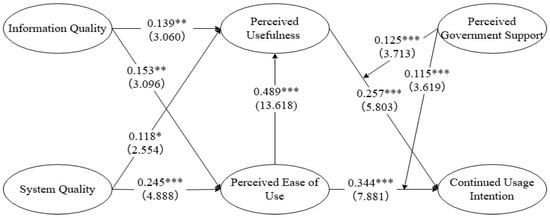
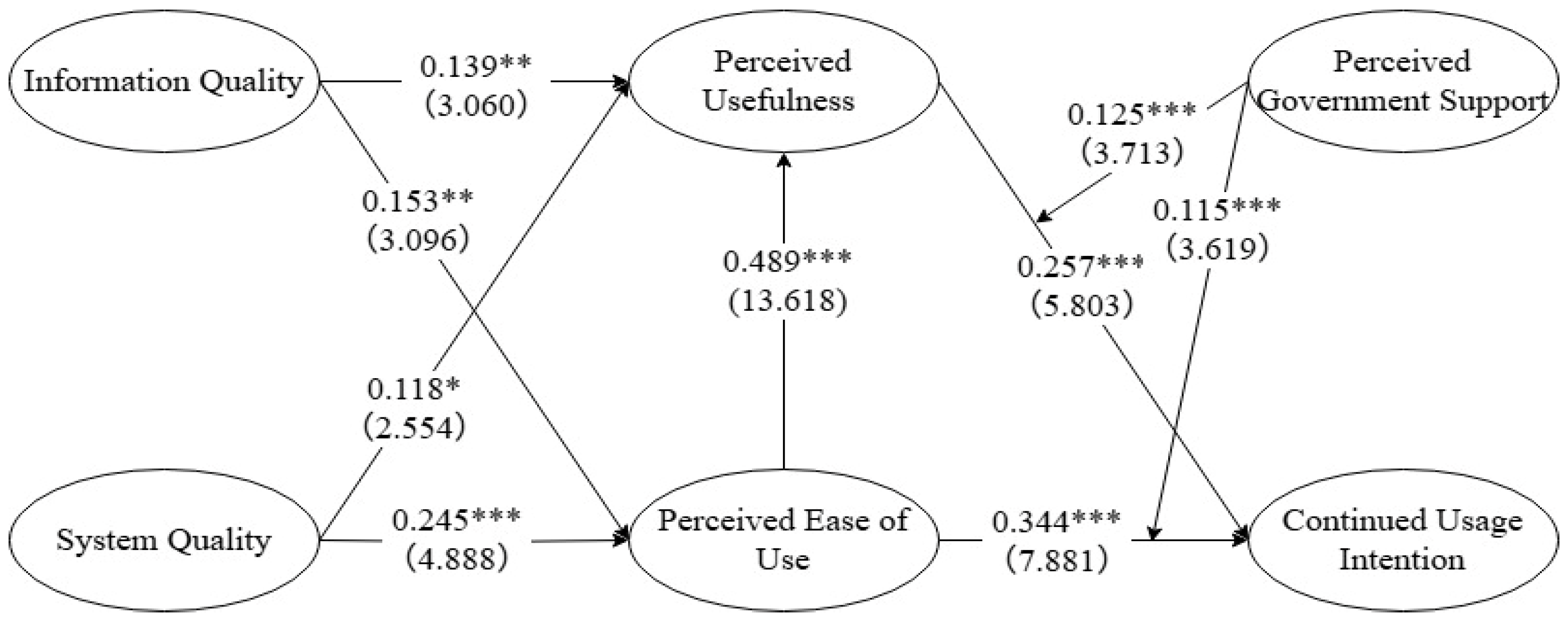
The path test results of the structural model in this study are shown in Table 4 and Figure 1. Both PU and PEOU were positively and significantly linked to users’ CUI (β = 0.257, p < 0.001 and β = 0.344, p < 0.001, respectively). The above results support H1 and H2. The regression path from PEOU to PU is also significantly positive, supporting H3. The regression pathways from IQ and SQ to PU were also significantly positive, supporting H5 and H7. The regression pathways from IQ and SQ to PEOU were also significantly positive, supporting H6 and H8.
Table 4.
Structural model path analysis and hypothesis results.
Figure 1.
Path Coefficient in Structural Equation Model (Note: * p < 0.05, ** p < 0.01, *** p < 0.001).
4.4. Mediated Effect Analysis
The mediating role of PU was examined using the Bias-Corrected Bootstrap method. As shown in Table 5, the direct effect of PEOU on CUI was 0.345, the indirect effect was 0.146, and the total effect was 0.491. The 95% confidence interval for the indirect effect ranged from 0.093 to 0.211, excluding zero. These results indicate that PEOU influences users’ CUI indirectly through PU, thus supporting H4.
Table 5.
Summary table of effects of multiple intermediation.
4.5. Moderated Effect Analysis
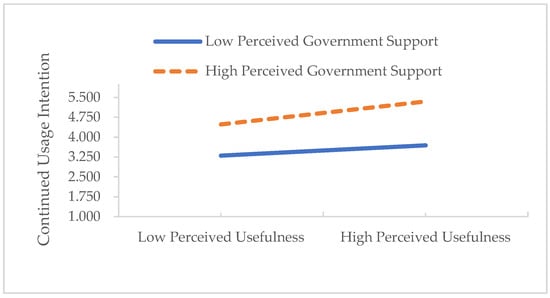
To assess moderating effects, mean-centered indicator values were calculated before creating interaction terms between the moderator and predictor variables—a method validated by Ping [65] for evaluating path models with latent variable interactions. In this study, interaction terms involving PEOU, PU, and PGS were incorporated into a baseline regression to examine the moderating role of government support on users’ PU, PEOU, and CUI. Results indicate that the moderating effect of PGS on the relationship between PEOU and CUI was significant (p < 0.001), as was its effect on the relationship between PU and CUI (p < 0.001). These findings provide support for H9 and H10. The path estimates and t-values for the interaction effects are detailed in Table 6 and Figure 1.
Table 6.
Regression Results.
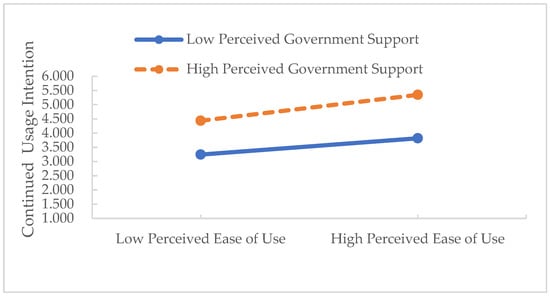
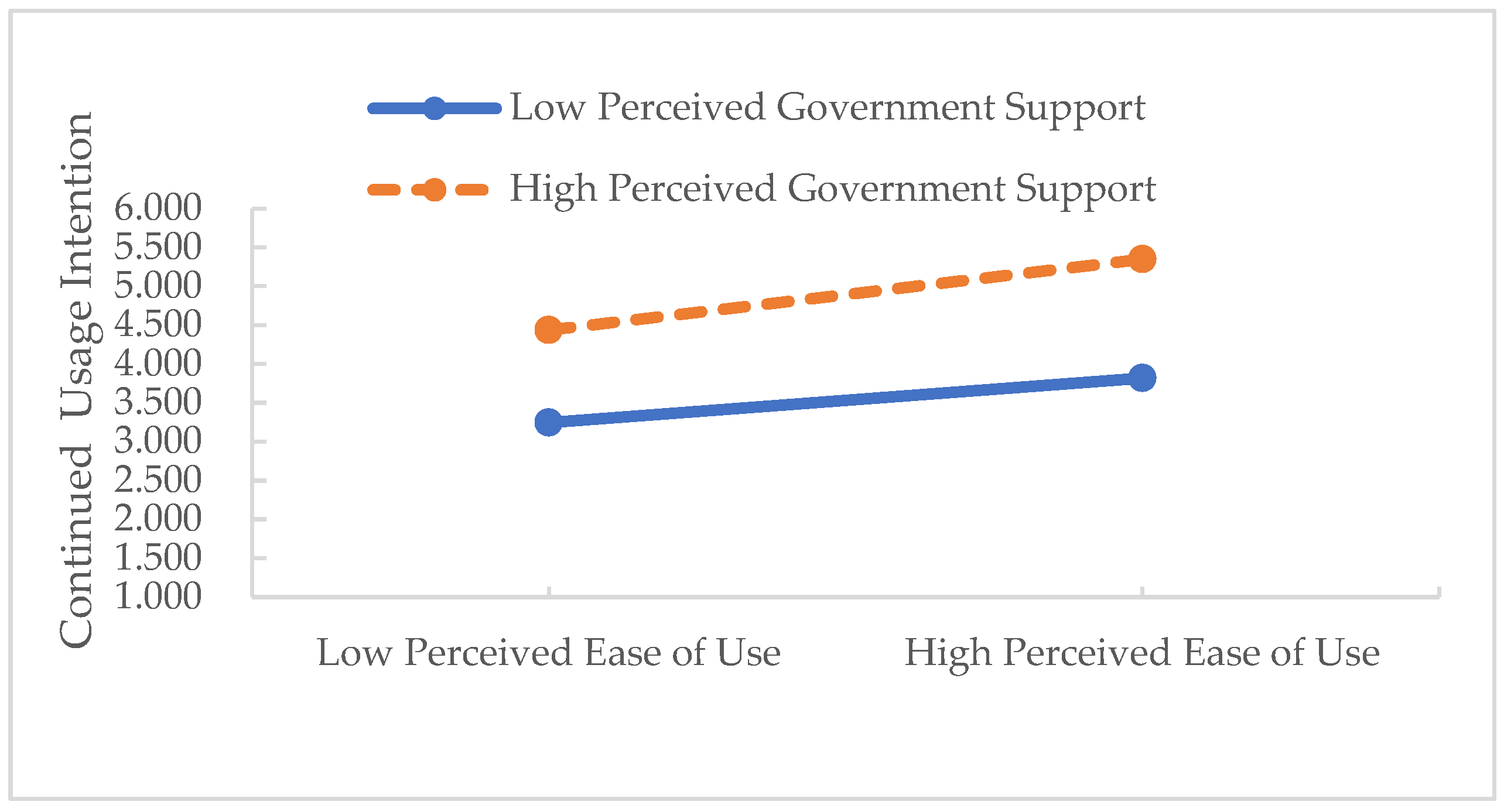
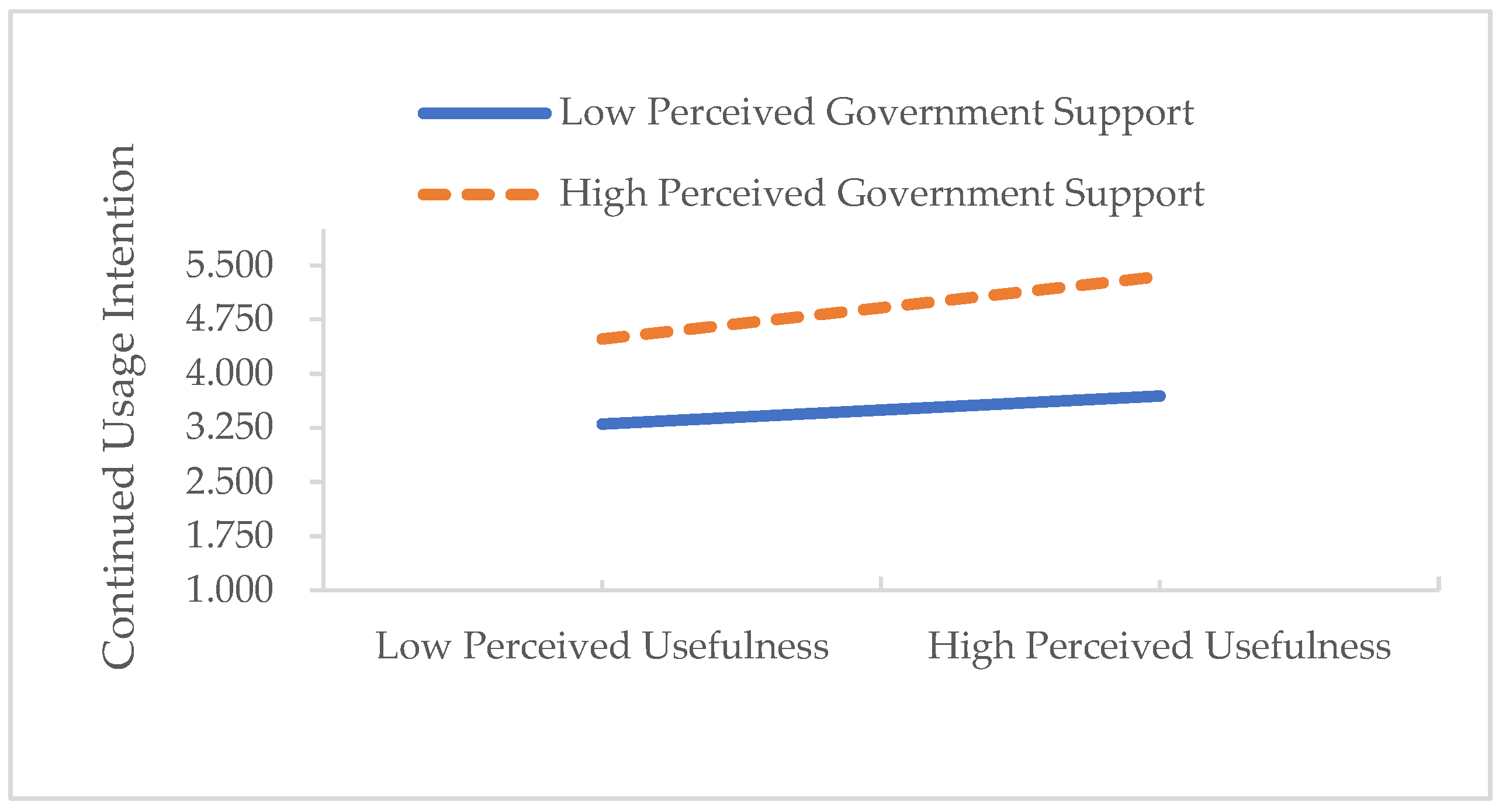
To further confirm the moderating role of PGS (H9 and H10), the slope test developed by Aiken et al. [66] was applied to analyze the interaction effect. As illustrated in Figure 2 and Figure 3, as the level of PGS increases, PEOU exerts a progressively stronger influence on CUI. This indicates that PGS amplifies the relationship between PEOU and CUI, supporting H9. Similarly, heightened levels of perceived government enhance the effect of PU on CUI, suggesting that PGS also strengthens the relationship between PU and CUI, thereby supporting H10.
Figure 2.
Moderation Effect of PGS on the Relationship between PEOU and CUI.
Figure 3.
Moderation Effect of PGS on the Relationship between PU and CUI.
5. Discussion and Implications
5.1. Discussion
First, the analytical outcomes reveal that IQ exhibits a significant positive association with both PU and PEOU. This result is consistent with Tseng’s study [67] on the adoption of distance learning and with Gupta’s research [68] concerning the intention to use information-based applications. As a key factor determining the core value of PDCSs, IQ is reflected in the accuracy, richness, and update efficiency of cultural resources. For instance, the “Yue Shenghuo Xingsha Cultural Tourism Cloud” platform in Changsha County, China, updates event information in real time and supports online reservations, strengthening user’ perception of information usefulness through content completeness and timeliness. Its personalized recommendation and efficient resource localization functions also reduce users’ information burden and enhance their perception of ease of use. Unlike commercial platforms that focus on efficiency and satisfaction [69], IQ in PDCSs possesses both technical attributes and institutional connotations. It serves as a signal of government credibility, service legitimacy, and public value, reducing user uncertainty and enhancing platform trust while reflecting the government’s ability to fulfill public cultural responsibilities in the digital era.
Second, SQ exerts a significant positive impact on both PU and PEOU, which is consistent with the findings of Rezvani et al. [70] regarding library applications and the research of Jo et al. [71] on ERP system applications. As the foundation of information transmission, SQ not only covers the technical stability, operational smoothness, and rational functional design of platform hardware and software, directly affecting user experience and reliability, but also goes beyond mere technical attributes to reflect the effectiveness of digital governance [72]. Taking the “Cultural Shanghai Cloud” platform in Shanghai, China as an example, it pushes tens of thousands of cultural activities monthly and maintains lag-free operation even under high-concurrency access, ensuring a smooth reservation experience and effectively enhancing users’ recognition of platform value as well as their perceptions of ease of use and usefulness. From the perspective of digital governance [72], high SQ not only optimizes the convenience of function use but also conveys the government’s commitment to providing reliable and inclusive digital public services. It helps lower participation thresholds, promotes digital inclusion [73], and is particularly important for groups with relatively insufficient digital skills. Ultimately, it facilitates users’ acceptance and continuous use of the platform by strengthening institutional trust and the reliability of public services.
Third, both PU and PEOU exert a significant positive impact on users’ CUI, with PU playing a mediating role between PEOU and CUI. This conclusion is consistent with the findings of Ming and Guo [74] on mobile libraries, as well as with the results of relevant studies on digital platforms such as mobile social networks [75,76]. Specifically, when users recognize the value of PDCS platforms, they tend to continue using these platforms to gain more benefits, and such positive experiences will further strengthen their usage intention. As a core dimension of user experience, platform operational convenience can not only reduce users’ cognitive and operational costs and foster positive emotions such as a sense of friendliness and belonging, but also help users quickly identify platform value to further stimulate their CUI. This mechanism breaks the traditional notion that “usefulness equals participation”, highlighting the pivotal role of ease of use. While verifying the relationships proposed by the traditional TAM, this study further interprets these mechanisms in the context of public services. It points out that users’ continuous use of PDCSs is not merely driven by the maximization of personal utility, but is closely associated with their recognition of public value and cultural benefits [77]. PEOU facilitates initial participation, while PU reinforces users’ belief that continuous participation can yield cultural and social value. The combined effect of the two drives the establishment of long-term and stable usage relationships between users and platforms.
Fourth, PGS exerts a significant positive moderating effect on the relationships between PU, PEOU, and users’ CUI. This conclusion is consistent with the findings of Mensah et al. [48], highlighting the government’s pivotal role in the development of PDCSs. In the context of public digital services, this moderating effect manifests as a dual enhancement mechanism. From the perspectives of institutional trust [49] and signaling theory [78], government endorsement is interpreted by users as a credible signal of platform legitimacy and long-term operational commitment, thereby amplifying the impact of individual perceptions on continuous usage intention. On the one hand, at the level of PU, government support transforms instrumental utility into guaranteed value, reassuring users that platform resources possess not only functional practicality but also official recognition, as well as financial and quality reliability, which reduces future uncertainties. On the other hand, at the level of PEOU, government support elevates technical features to indicators of governance quality. User-friendly interfaces are regarded as evidence that the government responds to public demands and practices a user-centric philosophy, strengthening users’ sense of gain and the trust-based pathway. This makes PGS function as a trust multiplier, a mechanism that is particularly crucial in non-market and public goods sectors. In the Chinese context, this mechanism can further enhance user trust through priority resource allocation and institutional guarantees. Similar moderating effects have been verified in other fields; the research by Ma and An [79] on corporate collaborative innovation performance and the study by Yang et al. [80] on volunteers’ willingness to sustain participation both confirm its positive role. However, from the perspective of digital governance [72], excessive government support carries potential negative effects (Crowding-Out Effect) [81]. It may trigger platform path dependence and innovation inertia, weaken responsiveness to user needs, and even reduce users’ sense of participation and co-construction awareness due to administrative intervention, thereby limiting the interactive and collaborative potential of services. Therefore, although government support yields positive effects, it should be positioned as a facilitator rather than a replacement for platform independent operations and user-driven innovation practices, so as to support the long-term sustainable development of PDCS platforms.
5.2. Theoretical Implications
Initially, this study innovates the theoretical framework based on a multi-factor perspective, breaking through the limitations of the single-perspective approach in previous research on PDCSs. By creatively integrating the TAM and ISSM, and incorporating PGS as a moderating variable, it constructs a novel theoretical framework for examining the psychological factors influencing users’ continued use of PDCS platforms. Existing research on users’ CUI has largely centered on two perspectives: institutional rules [82] and stakeholders [83]. However, these studies have not sufficiently accounted for the complex psychological dynamics underlying user cooperation. Based on the previous research results, this paper proposes a new framework that organically integrates individual psychological factors and government support factors from the perspectives of stakeholders and institutional rules, providing a more systematic and comprehensive theoretical perspective for a deeper understanding of the psychological mechanisms behind users’ continued use of PDCS platforms.
Secondly, in the study of factors affecting users’ sustained participation in PDCSs, it was confirmed that PU plays a mediating role between PEOU and CUI. Although PU and PEOU have been deeply studied in multiple academic fields and are recognized to affect user acceptance and behavioral tendencies [84], there is still disagreement among scholars regarding the mediating effect of PU in the context of the association between PEOU and CUI. By incorporating PU as a mediator within the research model, this study not only validates its positive influence on the relationship between PEOU and CUI but also extends the theoretical discourse on CUI. The findings underscore the critical mediating function of PU, offering a refined explanatory mechanism within digital governance and institutional contexts.
Lastly, this study demonstrates that PGS positively moderates the effects of both PU and PEOU on users’ CUI regarding PDCSs. In information technology acceptance research, factors affecting CUI have often been confined to individual needs [85] and satisfaction, neglecting the institutional and governance dimensions. However, in the context of PDCSs, this study addresses this gap by integrating PGS as a moderating variable, thereby extending the theoretical lens to include digital governance and institutional perspectives. Moreover, although governmental involvement is frequently acknowledged as a contextual factor in public-sector digital initiatives, its conceptualization as a user-perceived psychological construct within technology adoption models remains underexplored. This study advances the literature by embedding PGS into the integrated TAM-ISSM framework, thereby transcending purely techno-informational explanations and introducing institutional trust and policy legitimacy as critical psychological amplifiers in the continuance intention process. This comprehensive perspective emphasizes the collaborative interaction between individuals and the government in public cultural services, providing a solid theoretical basis for constructing a more efficient public cultural service system. At the same time, this integrative approach provides a more comprehensive understanding of how state-led digital platforms foster sustained user engagement over time.
5.3. Practical Implications
First, platform operators should enhance IQ and SQ with explicit consideration of their effects on PU and PEOU. Standardized and transparent content governance mechanisms, such as multi-stage review procedures, can improve users’ perceptions of information accuracy, reliability, and completeness, thereby strengthening PU. The integration of distinctive local cultural resources and the continuous updating of diverse cultural content can further increase content relevance and value perception. In addition, efficient information dissemination mechanisms (e.g., real-time notifications and adaptive content feeds) can reduce information uncertainty and time costs, reinforcing users’ beliefs regarding the platform’s practical utility. The use of big data analytics and artificial intelligence to enable personalized content recommendation can further enhance PU and user satisfaction by aligning services with individual preferences.
Second, SQ improvements should be explicitly oriented toward reducing usage effort and cognitive burden to enhance PEOU. Simplifying functional structures, streamlining operational processes, and ensuring interface consistency across devices can lower perceived complexity. Interface design should integrate localized cultural elements while maintaining intuitive navigation and clear interaction logic to accommodate users with varying levels of digital literacy. Furthermore, to systematically gather user input and optimize the experience, mechanisms such as in-platform surveys, suggestion modules, and iterative usability testing are essential. They enable the detection of usability issues, lower perceived effort, and build user trust in the platform.
Third, policymakers should reinforce PGS as a psychological assurance mechanism that moderates users’ behavioral responses. The results suggest that PGS amplifies the influence of PU and PEOU on continuance intention, achieved through mitigating perceived risk and uncertainty while concurrently bolstering platform legitimacy. Accordingly, governments should provide visible and stable policy signals through clear regulatory frameworks, long-term funding commitments, and transparent governance arrangements. Financial instruments, including targeted subsidies, tax incentives, and dedicated cultural development funds, can enhance users’ expectations of platform sustainability, thereby increasing their willingness to continue using platforms perceived as useful and easy to use. Cross-regional and inter-departmental collaboration can further improve service consistency and reliability, reinforcing users’ trust and normative acceptance.
Finally, governments should enhance the visibility of their involvement to strengthen users’ awareness of institutional endorsement and social legitimacy. Coordinated communication strategies that integrate traditional and digital media can increase the salience of governmental support, while high-profile cultural events and digital campaigns associated with public platforms can signal long-term commitment, reduce uncertainty regarding service continuity, and reinforce the psychological conditions under which PU and PEOU translate into sustained usage behavior.
5.4. Limitations and Future Studies
This study has several limitations that also suggest directions for theoretical extension. First, while the proposed model explains users’ continuance intention toward PDCSs, future research could extend the framework to incorporate other user behaviors, stakeholder interactions, and user heterogeneity to deepen understanding of platform governance dynamics. Second, although the model integrates core constructs from the TAM and ISSM, future studies should incorporate service quality and examine its interaction with information and SQ to further advance IS-based explanations in public digital service contexts.
6. Conclusions
By establishing a theoretical framework integrating the ISSM and TAM, with PGS incorporated as a moderator, this research investigates the underlying psychological mechanisms governing users’ continuance intention toward PDCSs. The results suggest that both PU and PEOU are significantly associated with users’ CUI toward PDCS platforms. PEOU also positively affects PU, which in turn mediates the relationship between PEOU and CUI. Furthermore, IQ and SQ are established as key antecedents that enhance both PU and PEOU. Most notably, PGS significantly amplifies the positive impact of both PU and PEOU on users’ CUI.
The theoretical contributions of this study lie in three progressive dimensions. First, by extending the integrated TAM-ISSM framework to the under-researched field of PDCSs, a context-specific multi-factor analysis model is constructed, which expands the application scope of technology acceptance theory in public services. Second, verifying the mediating mechanism of PU between PEOU and CUI uncovers the internal psychological pathway through which technological attributes influence user behavior, advancing the behavioral interpretation theory in the digital governance context. Finally, government support is innovatively reconstructed from a macro institutional variable into a user-perceived psychological moderating factor (PGS), establishing a theoretical link between the institutional environment and individual cognition. This provides a new analytical perspective integrating institutional and cognitive dimensions for understanding the sustainable development of state-led digital platforms.
Author Contributions
Y.L. and A.C.: Formal Analysis; Investigation; Z.X.: Methodology; Resources; Software; H.X. and G.H.: Writing—Original Draft; Writing—Review and Editing. All authors have read and agreed to the published version of the manuscript.
Funding
This research was funded by the National Social Science Fund of China, project “Research on Cross-Boundary Collaborative Governance of Public Cultural Service Organizations in the Digital Context” (Grant No. 22CGL055).
Institutional Review Board Statement
This research has received ethical exemption from the Ethics Review Committee of Hunan Agricultural University. This study strictly adhered to the principle of informed consent to ensure that all participants fully understood the research purpose and voluntarily agreed to participate. To protect the privacy and confidentiality of the participants, all responses are anonymous.
Informed Consent Statement
Informed consent was obtained from all subjects involved in this study.
Data Availability Statement
The data presented in this study are available upon request from the corresponding author.
Conflicts of Interest
The authors declare no conflicts of interest.
References
- China Internet Network Information Center (CNNIC). The 55th Statistical Report on Internet Development in China. 2025. Available online: https://www.100ec.cn/detail--6646318.html (accessed on 20 March 2025).
- Wang, M.; Hua, Y.; Sun, H.L.; Chen, Y. Bridging the rural digital divide: Avoiding the user churn of rural public digital cultural services. Aslib J. Inf. Manag. 2023, 75, 730–751. [Google Scholar] [CrossRef] [Scilit]
- Wang, M.; Hua, Y.; Sun, H.L.; Chen, Y.; Jiang, L. User churn behavior model of rural public digital cultural services: An empirical study in China. Libr. Hi Tech 2022, 40, 1267–1288. [Google Scholar]
- National Data Administration. Ten Typical Cases of Digital China Construction: National Public Cultural Cloud Development. 2024. Available online: https://www.nda.gov.cn/sjj/ywpd/sjzg/1018/20241018142111935290834_pc.html (accessed on 20 March 2025).
- Rhinesmith, C. Public libraries, digital equity coalitions, and the public good. Public Libr. Q. 2026, 45, 94–118. [Google Scholar] [CrossRef] [Scilit]
- Jaillant, L.; Mitchell, O.; Ewoh-Opu, E.; Urbaneja, M.H. How can we improve the diversity of archival collections with ai? opportunities, risks, and solutions. AI Soc. 2025, 40, 4447–4459. [Google Scholar] [CrossRef] [Scilit] [PubMed]
- Al-Maroof, R.S.; Salloum, S.A. An integrated model of continuous intention to use of google classroom. In Recent Advances in Intelligent Systems and Smart Applications; Al-Emran, M., Shaalan, K., Hassanien, A., Eds.; Studies in Systems, Decision and Control; Springer: Cham, Switzerland, 2020; Volume 295, pp. 329–347. [Google Scholar] [CrossRef] [Scilit]
- Shetu, S.N. Determinants of generation Z consumers’ mobile online shopping apps continuance intention to use during COVID-19 and beyond—An empirical study. Futur. Bus. J. 2025, 11, 25. [Google Scholar] [CrossRef] [Scilit]
- Liu, Y.; Zhao, S.; Zhao, S. Adoption of digital logistics platforms in the maritime logistics industry: Based on diffusion of innovations and extended technology acceptance. Humanit. Soc. Sci. Commun. 2025, 12, 791. [Google Scholar] [CrossRef] [Scilit]
- Li, Y.; Shang, H. Service quality, perceived value, and citizens’ continuous-use intention regarding e-government: Empirical evidence from China. Inf. Manag. 2020, 57, 103197. [Google Scholar] [CrossRef] [Scilit]
- Ahmad, M.O.; Ahmed, I.; Al-Baik, O.; Hussein, A.H.; Abu Alhaija, M.A.; Albizri, A. Unlocking citizen confidence: Examining trust and continuance intentions in digital services. J. Asia Bus. Stud. 2025, 19, 1104–1128. [Google Scholar] [CrossRef] [Scilit]
- Liu, R.; Wei, J.Z. Research on public willingness to use the national public culture cloud APP. Inf. Doc. Serv. 2020, 41, 39–48. Available online: https://kns.cnki.net/kcms2/article/abstract?v=hGV7VzEtU5k6fEguoeNaMFg5TMPwRS98ffNQH2S-NlVEju5mg_0RDKfSNIVTvVa9LnoJG3LtNdBCfq9ufK0EItguLoQWNLSO99orz0b3IZ8afGwafbh04kaXIsxkJY8UasFsTpeEYu0YYy_Q1Q9xd6cdljz3SHlCdXcuB4BQKYU=&uniplatform=NZKPT (accessed on 20 March 2025). (In Chinese)
- Liu, J.J.; Kuang, L.; Pan, J.; Zheng, J. Research on users’ continuance intention for provincial public cultural cloud wechat. Libr. J. 2022, 41, 47–57. (In Chinese) [Google Scholar] [CrossRef]
- Liang, N.; Wang, X. Determinants of digital museum users’ continuance intention—An integrated model combining an enhanced TAM3 and UTAUT. Sustainability 2026, 18, 492. [Google Scholar] [CrossRef] [Scilit]
- Guo, W.; Bao, Q.; Lee, K.Y.; Guo, M. Promoting sustainable digital cultural heritage preservation: A study on designers’ satisfaction with a digital platform using TAM, TTF, and ANN. Sustainability 2025, 17, 10554. [Google Scholar] [CrossRef] [Scilit]
- Abed, S.S.; Alkadi, R.S. Sustainable Development through fintech: Understanding the adoption of buy now pay later (BNPL) applications by generation Z in Saudi Arabia. Sustainability 2024, 16, 6368. [Google Scholar] [CrossRef] [Scilit]
- Deng, K.; Zhang, C.; Song, M.; Hu, X. Exploring key factors influencing generation z users’ continuous use intention on human-ai collaboration in secondhand fashion e-commerce platforms. Sustainability 2026, 18, 964. [Google Scholar] [CrossRef] [Scilit]
- Davis, F.D. Perceived usefulness, perceived ease of use, and user acceptance of information technology. MIS Q. 1989, 13, 319–340. [Google Scholar] [CrossRef] [Scilit]
- Wang, Y.; Lu, L.Y.; Zhang, R.; Ma, Y.; Zhao, S.; Liang, C. The willingness to continue using wearable devices among the elderly: SEM and FsQCA analysis. BMC Med. Inform. Decis. Mak. 2023, 23, 218. [Google Scholar] [CrossRef] [Scilit]
- Marangunić, N.; Granić, A. Technology acceptance model: A literature review from 1986 to 2013. Univers. Access Inf. Soc. 2015, 14, 81–95. [Google Scholar] [CrossRef] [Scilit]
- Wang, W.Y.; He, X.; Zhang, X.; Chu, Y.; Li, C.; Chen, B.; Zhao, J. Willingness of healthcare professionals in China to continue participating in and recommend telemedicine post COVID-19 pandemic. Sci. Rep. 2025, 15, 9581. [Google Scholar] [CrossRef] [Scilit]
- Al-Emran, M.; Arpaci, I.; Salloum, S.A. An empirical examination of continuous intention to use m-learning: An integrated model. Educ. Inf. Technol. 2020, 25, 2899–2918. [Google Scholar] [CrossRef] [Scilit]
- Saeed Al-Maroof, R.; Alhumaid, K.; Salloum, S. The continuous intention to use e-learning, from two different perspectives. Educ. Sci. 2020, 11, 6. [Google Scholar] [CrossRef] [Scilit]
- Dimulescu, C. E-Learning platform usage and acceptance of technology after the COVID-19 pandemic: The case of transilvania university. Sustainability 2023, 15, 16120. [Google Scholar] [CrossRef] [Scilit]
- Sipior, J.; Ward, B.; Connolly, R. The digital divide and t-government in the united states: Using the technology acceptance model to understand usage. Eur. J. Inf. Syst. 2011, 20, 308–328. [Google Scholar] [CrossRef] [Scilit]
- Jou, Y.-T.; Mariñas, K.A.; Saflor, C.S.; Baleña, A.; Gutierrez, C.J.; Dela Fuente, G.; Manzano, H.M.; Tanglao, M.S.; Verde, N.A.; Alvarado, P.; et al. Investigating various factors influencing the accessibility of digital government with egov PH mobile application. Sustainability 2024, 16, 992. [Google Scholar] [CrossRef] [Scilit]
- Shivdas, A.; Menon, D.G.; Nair, C.S. Antecedents of acceptance and use of a digital library system: Experience from a tier 3 Indian city. Electron. Libr. 2020, 38, 170–185. [Google Scholar] [CrossRef] [Scilit]
- Wei, Q.Y.; Yao, Y.; Li, Y.T. The empirical research on factors of wechat library users’ usage intentions. Libr. Inf. Serv. 2018, 62, 68–75. (In Chinese) [Google Scholar] [CrossRef]
- Villaespesa, E. Museum collections and online users: Development of a segmentation model for the metropolitan museum of art. Visit. Stud. 2019, 22, 233–252. [Google Scholar] [CrossRef] [Scilit]
- Wang, X.W.; Liu, W.L.; Jia, F.Q.; Zhang, C. An empirical study on influencing factors of live-streaming app using behavior. Libr. Inf. Serv. 2020, 64, 22–31. (In Chinese) [Google Scholar] [CrossRef]
- Huang, B.X.; Zhu, X.D. A study of factors on continuous usage of social mobile APP. J. Mod. Inf. 2016, 36, 57–64. Available online: https://kns.cnki.net/kcms2/article/abstract?v=hGV7VzEtU5ko6YhgoIRY14HcHLr9PP1t-qD91LNk5DrQRyyONWew_65pppm-BRst3J2jNBZKB9dp_O_5XcLX2X8Xqd3V0UBlBthuJTM59lFpykz9OUgdEJw--kGezm9wg1vZWgooKDOFJW4EuguSc3YbYgKaKapqzh88v3rCN44=&uniplatform=NZKPT (accessed on 20 March 2025). (In Chinese)
- Jiang, Z.Y.; Cao, D.; Xie, W.Y. Research on influencing factors of users’ information sharing behaviors in online health communities from the perspective of information ecology. Res. Libr. Sci. 2020, 21, 32–44. (In Chinese) [Google Scholar] [CrossRef]
- DeLone, W.H.; McLean, E.R. Information systems success: The quest for the dependent variable. Inf. Syst. Res. 1992, 3, 60–95. [Google Scholar] [CrossRef] [Scilit]
- DeLone, W.H.; McLean, E.R. The delone and mclean model of information systems success: A ten-year update. J. Manag. Inf. Syst. 2003, 19, 9–30. [Google Scholar] [CrossRef] [Scilit]
- Almuqrin, A.; Mutambik, I.; Alomran, A.; Zhang, J.Z. Information system success for organizational sustainability: Exploring the public institutions in saudi arabia. Sustainability 2023, 15, 9233. [Google Scholar] [CrossRef] [Scilit]
- Zheng, H.; Qian, Y.; Wang, Z.; Wu, Y. Research on the influence of e-learning quality on the intention to continue e-learning: Evidence from SEM and fsQCA. Sustainability 2023, 15, 5557. [Google Scholar] [CrossRef] [Scilit]
- Mohammadi, H. Investigating users’ perspectives on e-learning: An integration and IS success model. Comput. Hum. Behav. 2015, 45, 359–374. [Google Scholar] [CrossRef] [Scilit]
- Veeramootoo, N.; Nunkoo, R.; Dwivedi, Y.K. What determines success of an e-government service? Validation of an integrative model of e-filing continuance usage. Gov. Inf. Q. 2018, 35, 161–174. [Google Scholar] [CrossRef] [Scilit]
- Wei, J.Z.; Wang, Y.Y. Empirical research on user satisfaction of national public culture cloud platform. Inf. Doc. Serv. 2020, 41, 30–38. Available online: https://kns.cnki.net/kcms2/article/abstract?v=hGV7VzEtU5nIOa8ZZup_dCxURUG2Np3yt6cSV8FnWaRoWgcaF5shlkdSteZGFsK-RLKmMkgpZCbfMMnCSaliGQ966mO6zRjyZYOuOjx2A07qPVSNeDGKyQNjiyrJhH8xLZK-u6mX-xoje3zAvjvsBTN1UAA9cXF0eqpgsTQaQ7A=&uniplatform=NZKPT (accessed on 20 March 2025). (In Chinese)
- Yoon, Y.-i.; Hyun, D. The effect of SNS information quality on determinants of continuous use. Korean J. Hosp. Tour. 2016, 25, 1735. Available online: http://www.dbpia.co.kr/Journal/ArticleDetail/NODE06700703 (accessed on 20 March 2025).
- Pan, L.; Pan, X.; Mo, X.; Xia, T. Factors influencing willingness to continue using online sports videos: Expansion based on ECT and TPB theoretical models. Behav. Sci. 2024, 14, 510. [Google Scholar] [CrossRef] [Scilit]
- Hua, Y.; Sun, H.L.; Chen, Y. How to improve elderly users’ intention to use public digital cultural services: From the perspective of trust. Libr. Hi Tech 2023, 43, 114–131. [Google Scholar] [CrossRef] [Scilit]
- Guan, L. Research on the influencing factors of reading promotion effect in academic library WeChat platform from the perspective of TAM and D&M. Library 2020, 6, 80–89. (In Chinese) [Google Scholar] [CrossRef]
- Ghazal, S.; Aldowah, H.; Umar, I.; Bervell, B. Acceptance and satisfaction of learning management system enabled blended learning based on a modified DeLone-McLean information system success model. Int. J. Inf. Technol. Proj. Manag. 2018, 9, 52–71. [Google Scholar] [CrossRef] [Scilit]
- Sun, S.W.; Gan, C.; Song, C. Continuance intention to use libraries’ WeChat official accounts: Based on D&M model. Libr. Trib. 2017, 37, 101–108. Available online: https://kns.cnki.net/kcms2/article/abstract?v=6WbqZcVy3rhsXxJ6HHfRPSPZJ0aX0STTb7XANO37E-M15Fgh6_7KdtFoRQrWWOMl-dYT8AgN12wmR2A1ByQyAB6CbYTprP4vj5d9LLkyhUSwZB73nlsrJw8Redb8RX9tSvnfzhCLNV_HlY6QcSSn7po_vGVnVfOFx2KIMStEFWo=&uniplatform=NZKPT (accessed on 20 March 2025). (In Chinese)
- Nie, L.; Oldenburg, B.; Cao, Y.; Ren, W. Continuous usage intention of mobile health services: Model construction and validation. BMC Health Serv. Res. 2023, 23, 442. [Google Scholar] [CrossRef] [Scilit] [PubMed]
- Junnonyang, E. Integrating TAM, perceived risk, trust, relative advantage, government support, social influence and user satisfaction as predictors of mobile government adoption behavior in Thailand. Int. J. Ebusiness Egovernment Stud. 2021, 13, 159–178. Available online: https://sobiad.org/menuscript/index.php/ijebeg/article/download/519/35 (accessed on 20 March 2025).
- Mensah, I.K.; Gomado, D.E.; Mwakapesa, D.M.; Ukolov, V.F. The determinants of mobile government services adoption: The moderating effect of perceived government support (PGS). Inf. Dev. 2024, 40, 110–130. [Google Scholar] [CrossRef] [Scilit]
- Natan-Krup, D.; Mizrahi, S. Putting auditing in the context of democratic governance: The question of auditing discretion from the public’s perspective. Public Manag. Rev. 2025, 27, 3125–3149. [Google Scholar] [CrossRef] [Scilit]
- Ding, J. The rise and fall of technological leadership: General-purpose technology diffusion and economic power transitions. Int. Stud. Q. 2024, 68, 13. [Google Scholar] [CrossRef] [Scilit]
- Lehrer, R.; Bahnsen, O.; Müller, K.; Neunhoeffer, M.; Gschwend, T.; Juhl, S. Rallying around the leader in times of crises: The opposing effects of perceived threat and anxiety. Eur. J. Political Res. 2025, 64, 697–718. [Google Scholar] [CrossRef] [Scilit]
- Mandari, H.E.; Chong, Y.-L.; Wye, C.-K. The influence of government support and awareness on rural farmers’ intention to adopt mobile government services in Tanzania. J. Syst. Inf. Technol. 2017, 19, 42–64. [Google Scholar] [CrossRef] [Scilit]
- Ramanathan, R.; Ramanathan, U.; Ko, L.W.L. Adoption of RFID technologies in UK logistics: Moderating roles of size, barcode experience and government support. Expert Syst. Appl. 2014, 41, 230–236. [Google Scholar] [CrossRef] [Scilit]
- Li, Q.H.; Zheng, J.; Zhang, M.Y. Accessibility, former experience, government support, and peasants’ entrepreneurial intention on electronic commerce. Shandong Soc. Sci. 2022, 3, 118–125. (In Chinese) [Google Scholar] [CrossRef]
- Anderson, J.C.; Gerbing, D.W. Structural equation modeling in practice: A review and recommended two-step approach. Psychol. Bull. 1988, 103, 411–423. [Google Scholar] [CrossRef]
- Podsakoff, P.M.; Mackenzie, S.B.; Podsakoff, N.P. Sources of method bias in social science research and recommendations on how to control it. Annu. Rev. Psychol. 2012, 63, 539–569. [Google Scholar] [CrossRef] [Scilit]
- Richardson, H.A.; Simmering, M.J.; Sturman, M.C. A Tale of three perspectives: Examining post hoc statistical techniques for detection and correction of common method variance. organ. Res. Methods 2009, 12, 762–800. Available online: https://ecommons.cornell.edu/server/api/core/bitstreams/c9d30a70-8cc4-4a21-937d-4bd97ce14e63/content (accessed on 20 March 2025). [CrossRef] [Scilit]
- Nunnally, J.C. Psychometric Theory, 2nd ed.; McGraw-Hill: New York, NY, USA, 1978. [Google Scholar]
- Chin, W.W.; Gopal, A.; Salisbury, W.D. Advancing the theory of adaptive structuration: The development of a scale to measure faithfulness of appropriation. Inf. Syst. Res. 1997, 8, 342–367. [Google Scholar] [CrossRef] [Scilit]
- Sarstedt, M.; Ringle, C.M.; Hair, J.F. Partial least squares structural equation modeling. In Handbook of Market Research; Homburg, C., Klarmann, M., Vomberg, A., Eds.; Springer International Publishing: Cham, Switzerland, 2021; pp. 587–632. [Google Scholar]
- Fornell, C.; Larcker, D.F. Evaluating structural equation models with unobservable variables and measurement error. J. Mark. Res. 1981, 18, 39–50. [Google Scholar] [CrossRef] [Scilit]
- Cohen, J.; Cohen, P.; West, S.G.; Aiken, L.S. Applied Multiple Regression/Correlation Analysis for the Behavioral Sciences; Routledge: London, UK, 2013. [Google Scholar]
- Zhang, X.; Guo, X.; Ho, S.Y.; Lai, K.H.; Vogel, D. Effects of emotional attachment on mobile health-monitoring service usage: An affect transfer perspective. Inf. Manag. 2021, 58, 103312. [Google Scholar] [CrossRef] [Scilit]
- Kline, R. Principles and Practice of Structural Equation Modeling, 5th ed.; Guilford Press: New York, NY, USA, 2023. [Google Scholar]
- Ping, R.A. A parsimonious estimating technique for interaction and quadratic latent variables. J. Market. Res. 1995, 32, 336–347. [Google Scholar] [CrossRef] [Scilit]
- Aiken, L.S.; West, S.G. Multiple Regression: Testing and Interpreting Interactions; Sage Publications, Inc.: Thousand Oaks, CA, USA, 1991. [Google Scholar]
- Tseng, C.-H.; Wang, C.-T.; Hsu, C.-H.; Liu, J.-W. Behavioral Intention to Use Distance Teaching in the Pandemic Era. Front. Psychol. 2022, 13, 879316. [Google Scholar] [CrossRef] [Scilit]
- Gupta, P.; Prashar, S.; Vijay, T.S.; Parsad, C. Examining the influence of antecedents of continuous intention to use an informational app: The role of perceived usefulness and perceived ease of use. Int. J. Bus. Inf. Syst. 2021, 36, 270–287. [Google Scholar] [CrossRef] [Scilit]
- Kennedyd, S.I.; Marjerison, R.K.; Yu, Y.; Zi, Q.; Tang, X.; Yang, Z. E-commerce engagement: A prerequisite for economic sustainability—An empirical examination of influencing factors. Sustainability 2022, 14, 4554. [Google Scholar] [CrossRef] [Scilit]
- Rezvani, S.; Heidari, S.; Roustapisheh, N.; Dokhanian, S. The effectiveness of system quality, habit, and effort expectation on library application use intention: The mediating role of perceived usefulness, perceived ease of use, and user satisfaction. Int. J. Bus. Inf. Syst. 2022, 1, 1–18. [Google Scholar] [CrossRef] [Scilit]
- Jo, H.; Bang, Y. Understanding continuance intention of enterprise resource planning (ERP): TOE, TAM, and IS success model. Heliyon 2023, 9, 21019. [Google Scholar] [CrossRef] [Scilit] [PubMed]
- Chang, C.C. Digital transformation and public value in sustainable governance: The role of taiwan’s smart city mobile payment platform in development, digital service, and citizen engagement. Sustainability 2026, 18, 63. [Google Scholar] [CrossRef] [Scilit]
- Zhu, J.; Liu, C. Exploring the multidimensional hierarchy of sustainable living experience in inclusive innovation districts: The case of silicon alley. Sustainability 2026, 18, 550. [Google Scholar] [CrossRef] [Scilit]
- Ming, J.R.; Guo, C.Q. Dynamic empirical research of user’s intention to use mobile library. Libr. Dev. 2018, 10, 73–79. Available online: https://kns.cnki.net/kcms2/article/abstract?v=tQ02qvqxHS8wkuGqeKdYM-hrXgipXeqjJUXaZ7kaXl5pW7SlYfB2JYJ5j-Dls3_R_8JN62iA9kwSApEmPlzGxn2UAhwwyYZ0GWJhEcN3IxR2lGgl6Y07faZeWe20uqlIddwh-YxZPkvv-p7AO3qkddw-08nZXH9iubr6tu0h1NM=&uniplatform=NZKPT (accessed on 20 March 2025). (In Chinese)
- Cao, Y.; Qin, X.; Li, J.; Long, Q.; Hu, B. Exploring seniors’ continuance intention to use mobile social network sites in China: A cognitive-affective-conative model. Univ Access Inf Soc. 2022, 21, 71–92. [Google Scholar] [CrossRef] [Scilit]
- Chang, G.L.; Bi, Q.; Fei, L.L. An analysis of users’ continuance intention to use wechat public platform: Based on the expectation confirmation model and media system dependency theory. Res. Libr. Sci. 2017, 22, 85–92. Available online: https://kns.cnki.net/kcms2/article/abstract?v=tQ02qvqxHS9uvtvlzx_66pcGnypcU9tdX7OOmy2orJFie2cDgTvlD5Y9eXw05T9wDIlcvPsHMS76ED4IzebkPOzMKa8ahVAMop3CQEYLxp9C-B94VZp0Di9E69o7niGjQnffSzsRzQ6p0lMQpSYiQyVZfxr9ENVZ6oU1Zgiig1U=&uniplatform=NZKPT (accessed on 20 March 2025). (In Chinese)
- Grüb, B.; Martin, S. Public value of cultural heritages towards a better understanding of citizens’ valuation of Austrian museums. Cult. Trends 2020, 29, 337–358. [Google Scholar] [CrossRef] [Scilit]
- An, L.; Kang, S.; Lee, W.J. Entrepreneurial signals and external financing: How investment discourse sentiment moderates the effects of patents and market orientation. Sustainability 2026, 18, 421. [Google Scholar] [CrossRef] [Scilit]
- Ma, L.; An, L.R. The mechanism of cooperative motivation on firms’ cooperative innovation performance: A moderated mediation model based on perception of government support. Front. Sci. Technol. Eng. Manag. 2016, 35, 13–18. Available online: https://kns.cnki.net/kcms2/article/abstract?v=hGV7VzEtU5mU-ZP9WIb57VcnizsaxhJIUyYmcIclYB-kVWQr8pnL-TiR6kJC4NP1miTzm_cOor3jVMKfBcPsyGCaJfMI4Ndmag3wrBy28sVYsk7FwvMLfHze9TLjr9SQxY-YaFInlaVmlOYAaWJB9OBdgqNHQjtTR4aOMbzt9Dw=&uniplatform=NZKPT (accessed on 20 March 2025). (In Chinese)
- Yang, H.L.; Ding, Z.B.; Xiao, R.F. The impact of poverty alleviation volunteers’ motivation on intention to continue: The moderating effect of perception of government support. Front. Sci. Technol. Eng. Manag. 2021, 40, 53–60. Available online: https://kns.cnki.net/kcms2/article/abstract?v=hGV7VzEtU5mc_xsQQMgMOddCjBIQGN5CcvB-_gvljNxokrhl17QXqg_-SSPowOkcaxPLJv7-DaEyeyavBkfN135Fv0b3NVTZJCrD4_6HXMVKZwm5EIpHKDduNFHaOr9mDV_gWnSxCdhFC91j_p4pQDLEOg_PhCgnuAKzlqsINVo=&uniplatform=NZKPT (accessed on 20 March 2025). (In Chinese)
- Corduneanu, R.; Dudau, A.; Kominis, G. Crowding-in or crowding-out: The contribution of self-determination theory to public service motivation. Public Manag. Rev. 2020, 22, 1070–1089. [Google Scholar] [CrossRef] [Scilit]
- Li, S.H.; Xing, L. Sustaining cooperation between government and social organizations in public cultural services purchase. Libr. Trib. 2022, 42, 96–106. (In Chinese) [Google Scholar] [CrossRef]
- Xing, L. Strategy Adjustment and benefit sharing: How local governments in western—China maintain the cooperation with social organizations—Take the purchase of public cultural services in city c of sichuan province as an example. Local Gov. Res. 2023, 4, 29–41+78. (In Chinese) [Google Scholar] [CrossRef]
- Huang, G.X.; Ren, Y.C. Linking technological functions of fitness mobile apps with continuance usage among Chinese users: Moderating role of exercise self-efficacy. Comput. Hum. Behav. 2020, 103, 151–160. [Google Scholar] [CrossRef] [Scilit]
- Yan, Y.F.; Ma, M.G. The multi-identity construction principle of social organizations’ participation in public cultural services. Acad. J. Zhongzhou 2023, 5, 97–103. (In Chinese) [Google Scholar] [CrossRef]

Disclaimer/Publisher’s Note: The statements, opinions and data contained in all publications are solely those of the individual author(s) and contributor(s) and not of MDPI and/or the editor(s). MDPI and/or the editor(s) disclaim responsibility for any injury to people or property resulting from any ideas, methods, instructions or products referred to in the content. |
© 2026 by the authors. Licensee MDPI, Basel, Switzerland. This article is an open access article distributed under the terms and conditions of the Creative Commons Attribution (CC BY) license.