


Abstract
It is a hot topic to enhance the stability, security, and sustainability of industrial chains, against the backdrop of adjustments and rising uncertainty in global value chains. Using Chinese A-share listed firms from 2012 to 2022 as the research sample, this study treats the establishment of Cross-Border E-Commerce Comprehensive Pilot Zones (CBECCPZs) as a quasi-natural experiment and employs a difference-in-differences approach to empirically examine the impact of digital trade (DT) on industrial chain resilience (ICR) and its underlying mechanisms. The findings demonstrate that DT exerts a significantly positive effect on ICR, providing strong support for the long-term sustainability of the economic system. This conclusion remains robust after a series of robustness checks, including the incorporation of high-dimensional fixed effects, exclusion of confounding policy effects, adjustments to the sample, dimension-specific tests, consideration of lagged effects, and propensity score matching. Mechanism analysis reveals that DT strengthens ICR primarily by promoting firms’ digital transformation and improving human capital levels. The heterogeneity results suggest that the contribution of digital trade to resilience differs markedly across structural dimensions: the effect is more significant among firms located in eastern regions, state-owned enterprises, firms operating in regions with higher levels of digitalization, manufacturing firms, firms in more competitive industries, and firms with stronger internal control systems. From the perspective of ICR, this study elucidates the intrinsic mechanisms through which DT fosters high-quality development and sustainable economic growth. The findings provide robust empirical evidence for understanding the strategic role of DT in enhancing the security, stability, and sustainable operation of industrial chains and in building a modern industrial system that is autonomous, controllable, secure, and efficient. Moreover, the study offers important policy implications for governments seeking to advance DT institutional innovation and promote coordinated regional development, as well as for firms aiming to leverage DT to enhance long-term competitiveness and achieve sustainable development goals.
1. Introduction
In recent years, China’s industry chain system has been continuously improved, with expanding industrial scale and significantly enhanced supporting capabilities. A modern industrial system characterized by a relatively complete structure and multiple layers has gradually taken shape, and China has become deeply integrated into global industry chain networks, emerging as an important participant in the international division of labor. However, amid increasingly complex geopolitical dynamics, intensified competition among major powers, and the resurgence of de-globalization tendencies, external uncertainties have risen markedly. As a result, the industry chain is facing substantially higher exposure to shocks, with disruptions such as “chain breaks” and production stoppages occurring more frequently in certain sectors, posing serious challenges to the stable operation of the industrial system. Against this backdrop, enhancing the resilience and security of the industry chain has been elevated to the level of a national strategy. The Third Plenary Session of the 20th CPC Central Committee made systematic arrangements around “improving institutional mechanisms for enhancing the resilience and security of industry and supply chains,” explicitly identifying the strengthening of ICR as a critical lever for safeguarding national economic security and promoting high-quality development. Ensuring the safe and stable operation of industry chains is not only essential for coping with external shocks but also a key foundation for sustaining long-term economic growth. The resilience of industrial chains is generally defined as the comprehensive ability of an industrial chain system to absorb and resist risks, maintain basic functions, achieve rapid recovery, and make adaptive adjustments and transformations in response to external shocks [1]. Relevant studies commonly emphasize that ICR not only reflects the ability to recover after external demand or environmental shocks but also encompasses the ability of the industrial chain to sustain operations and improve functionality through structural adjustments, technological innovation, and organizational restructuring during shocks. At the same time, some literature, from the perspective of capability structure, understands industrial chain resilience as an endogenous capability system composed of resistance, recovery, and evolutionary abilities, supported by external institutional forces such as government support [2], which together determine the performance of the industrial chain in short-term emergency response and long-term adaptive innovation [3]. Consequently, enhancing industrial chain resilience has attracted increasing attention from both scholars and policymakers in China.
As a new form of trade that relies primarily on information networks and digital platforms and is supported by the widespread application of digital technologies, DT profoundly reshapes the modes of exchange for goods and services and fundamentally transforms traditional trade patterns. It represents an important manifestation of the deep integration between modern information technologies and the global economy. In recent years, DT has developed rapidly and has gradually become a key driving force for China’s economic transformation and upgrading. According to the China Digital Trade Development Report 2025 released by the Ministry of Commerce of the People’s Republic of China, the total value of China’s digitally deliverable services trade reached USD 406.72 billion in 2024, representing a year-on-year increase of 5.4%, while the total import and export volume related to DT amounted to approximately RMB 1.32 trillion in the first half of 2025, up 5.7% year on year. Meanwhile, the Report of the 20th National Congress of the Communist Party of China explicitly proposed to “promote the optimization and upgrading of trade in goods, innovate mechanisms for the development of trade in services, develop DT, and accelerate the building of a strong trading nation,” further highlighting the strategic position of DT in China’s new system of an open economy. Compared with traditional trade forms, DT exhibits significant advantages, including higher transaction efficiency, lower transaction costs, and faster information transmission. Moreover, by overcoming geographical and time-zone constraints, DT enables the efficient cross-regional allocation of resources, thereby creating new opportunities for industry chains to enhance stability, adaptability, and recovery capacity in complex and volatile environments. DT promotes the transformation of industry chains toward a networked structure characterized by centralized control and decentralized spatial distribution, giving rise to virtual network agglomeration centered on platforms or core firms. As a result, organizational boundaries within industry chains become increasingly blurred, and their structures more flattened, collaborative, and flexible, which helps narrow value distribution gaps and optimize the overall division of labor [4]. Therefore, an in-depth investigation into the impact of digital trade on industrial chain resilience is of significant theoretical and practical importance. Specifically, this study seeks to address the following questions: How does digital trade affect industrial chain resilience? Through which mechanisms does this effect operate? And under what heterogeneous conditions do these effects vary? Anchored in prior research and centered on these questions, this paper contributes to the literature by clarifying the socioeconomic effects of DT and identifying viable pathways for strengthening ICR.
2. Literature Review
The literature relevant to this study mainly falls into several strands, among which the first investigates the economic effects of DT. The extant literature has systematically investigated the economic and social impacts of DT from multiple perspectives, including environmental outcomes, industrial structure upgrading and global value chain positioning, as well as macroeconomic effects. From an environmental perspective, Li et al. [5], using panel data from 46 countries at different stages of development over the period 2007–2021, demonstrate that DT contributes to a substantial reduction in carbon emissions.; however, the emission-reduction effects exhibit significant heterogeneity across countries with different levels of development. Furthermore, Li et al. [6], from a city-level perspective, point out that DT does not directly affect carbon emission efficiency but indirectly improves it through mediating channels such as promoting green technological innovation, facilitating industrial agglomeration, and optimizing energy structure. Dai et al. [7] demonstrate that DT significantly enhances green total factor productivity, and that trade openness and foreign direct investment positively moderate this effect, thereby strengthening the role of DT in driving green transformation. Xiong et al. [8] further show that the association between DT and green productivity exhibits nonlinear characteristics rather than a straightforward linear pattern: it is negative at low to medium quantiles but turns significantly positive at high quantiles.
In terms of industrial structure upgrading and value chain evolution, existing studies generally suggest that DT reshapes industrial division patterns through channels such as technology transfer and factor allocation. Zhao et al. [9], based on cross-border digital trade data between China and Russia, find that DT effectively enhances a country’s position in the global value chain by promoting technology transfer, expanding capital accumulation, and optimizing human resource allocation. Luo [10], from a domestic regional perspective, points out that DT development can drive industrial structure upgrading through technological empowerment and market “pressure” mechanisms. Additionally, factors such as upgrading of household consumption, higher levels of openness, reduced urban-rural income gaps, and accelerated urbanization also contribute to strengthening the pathways for industrial structure optimization. Liu et al. [11] further find that DT promotes the improvement and reallocation of technological complexity in manufacturing exports through industrial structure upgrading, and that this effect exhibits a clear nonlinear pattern. Li et al. [12] highlight that, in terms of new quality productive forces, DT significantly boosts their development and sustains their growth potential by advancing digital technology innovation and facilitating industrial structure upgrading.
The second strand of research focuses on ICR. Regarding the concept of industrial chains, its theoretical origins can be traced back to the late 18th century, when classical economist Adam Smith, in The Wealth of Nations, emphasized the importance of division of labor, noting that industrial production is a complex system composed of a series of interlinked processes. Crescenzi et al. [13] argue that, in order to ensure the safety and controllability of industrial chains and to achieve industrial adjustment and upgrading, firms must adopt advanced technologies as a supporting foundation. Possessing advanced technologies and maintaining autonomous and controllable operations are fundamental prerequisites for an industrial chain to demonstrate high resilience. It is important to note that ICR reflects a capability, rather than a single outcome. Chen et al. [14] further conceptualize industrial chain resilience as the elasticity and adaptability exhibited by an industrial chain when facing internal or external shocks. Specifically, when exposed to shocks from international markets or external environments, a resilient industrial chain can maintain stability, prevent structural disruptions, and adjust operations to restore its pre-shock state, and may even transform crises into opportunities for upgrading. Lin et al. [15] conceptualize resilience as the industrial chain’s ability to respond rapidly to disruptions and restore connectivity, operational continuity, and control, thereby effectively preventing and coping with interruptions. Building on the existing literature, this study considers ICR to comprise resistance capability and recovery capability. Resistance capability reflects the ability of the industrial chain to withstand external shocks and maintain stability under pressure. Recovery capability is defined as the ability to swiftly restore operations to the state they were in prior to a disruption. Together, these two dimensions enable industrial chains to self-regulate and adapt to changes in the external environment, ensuring continuity and stability even in turbulent conditions.
Regarding the factors influencing ICR, existing studies have systematically examined its determinants from multiple perspectives, including technological advancement, digital transformation, financial support, and institutional environment. At the level of technology and digital infrastructure, Du et al. [16], using panel data from 30 Chinese provinces between 2012 and 2023, find that smart logistics effectively enhances the resilience of manufacturing industry chains by reducing transaction costs and improving logistics efficiency. Wang et al. [17] further point out that artificial intelligence technologies can strengthen the stability and shock-resistance of manufacturing industry chains by improving firms’ ESG performance, promoting knowledge spillovers, and increasing stock price synchronicity. Yang et al. [18], employing multiple econometric methods, show that digital infrastructure construction significantly promotes ICR. Chen et al. [19], at the city level, find that digital infrastructure continuously enhances industry chain resilience by bridging the digital divide, cultivating digital human capital, and improving innovation quality. Xue et al. [20] demonstrate that intelligent technologies positively influence ICR, with digital finance enhancing this effect.
At the firm level, regarding digital transformation, Wang et al. [21], based on data from listed companies and input-output tables, find that corporate digital transformation helps alleviate factor misallocation, thereby enhancing ICR. Sun et al. [2] show that digital transformation strengthens the stability and recovery capacity of industry chains by promoting upstream cooperation diversification and fostering substantive innovation. Li et al. [22] further confirm the significant positive impact of digital transformation on ICR.
Regarding financial support and institutional environment, Lin et al. [23] find that digital inclusive finance significantly strengthens the resilience of agricultural industry chains by improving agricultural production efficiency. Studies by Zheng et al. [24] and Wang et al. [25] indicate that a favorable business environment and supply chain finance can significantly enhance regional ICR, with supply chain finance serving as a key mediating factor, and foreign direct investment playing an important transmission role between business environment optimization and ICR. Tian [26] further finds that supply chain finance policies can substantially improve ICR, with fiscal investment intensity and financial development level acting as mediators. Zhou et al. [27] show a significant “U-shaped” relationship between government subsidies and the resilience of resource-based enterprise industry chains, mainly through alleviating financing constraints, increasing customer dependency, and enhancing R&D capabilities. Yan [28] highlights that, through improved governance efficiency and the stimulation of innovation and entrepreneurial vitality, public data openness plays a significant role in promoting urban ICR.
Existing studies have extensively examined the economic effects of DT and issues related to ICR; however, several limitations remain. On the one hand, research on DT has largely focused on macro-level environmental impacts, with insufficient micro-level causal identification from the perspective of ICR. On the other hand, although the literature on ICR acknowledges the importance of digitalization, it has paid limited attention to the systematic effects of DT as an open institutional arrangement. Methodologically, most existing studies rely on static analyses, making it difficult to effectively identify the net effects of policy shocks. In terms of mechanisms, prior research tends to adopt a single transmission pathway, failing to integrate multiple channels such as firms’ digital transformation and improvements in human capital. Based on this, the marginal contributions of this study are threefold. First, from a research perspective, we integrate DT with ICR, expanding the research boundary on the determinants of ICR. Existing literature pays relatively limited attention to DT, a new form of openness with both technological and institutional attributes. By taking the establishment of CBECCPZ as the entry point, we systematically examine the impact of DT on ICR, providing new empirical evidence for understanding its role in building a secure, controllable, and more resilient modern industrial chain system. Second, from a mechanism perspective, we reveal the internal transmission pathways through which DT enhances ICR from two dimensions: corporate digital transformation and human capital. Compared with existing studies that focus on single mechanisms, our analysis is more comprehensive and clearly illustrates how DT strengthens ICR through multiple micro-level channels. Third, from a policy perspective, we conduct multidimensional heterogeneity analyses to reveal structural differences in the empowering effects of DT on ICR, providing a basis for the government to implement targeted and differentiated policies. Our analysis reveals that the effect is more significant for firms situated in eastern regions, state-owned enterprises, regions with advanced digitalization, manufacturing firms, and firms characterized by higher industry competition and stronger internal control mechanisms. These insights help deepen understanding of the applicability and marginal effects of DT policies, offering more targeted guidance for promoting high-quality DT development and enhancing industry chain security.
3. Theoretical Analysis and Research Hypotheses
3.1. DT and ICR
The industrial chain is a complex adaptive system composed of multiple actors and hierarchical levels, and its resilience depends on the efficiency of information feedback, the flexibility of resource allocation, and the capacity for structural reconfiguration under uncertain environments. As data increasingly becomes a core economic factor, DT reshapes traditional trade patterns through digital technologies and platform mechanisms, substantially altering the operational logic of industrial chains. On one hand, DT enhances data connectivity and information feedback across chain segments, improving the system’s ability to perceive and respond to external shocks. On the other hand, platform-based and intelligent mechanisms reduce institutional frictions in cross-regional resource allocation, facilitating rapid structural adjustments and functional upgrading. Therefore, DT provides a critical institutional and technological foundation for systematically enhancing ICR.
At the level of coordination efficiency, DT leverages technologies such as the industrial internet, 5G, and the Internet of Things to integrate data across production, cross-border logistics, customs clearance, and payment processes, increasing transparency and coordination within the chain. According to information asymmetry theory and transaction cost theory, improved information transparency reduces search and coordination costs for upstream and downstream actors, thereby enhancing operational stability. Moreover, DT uses big data analytics and intelligent algorithms to optimize demand forecasting and capacity scheduling, mitigating the amplification of demand fluctuations along the chain and enabling the early identification of potential supply disruptions and logistical risks.
Regarding resource allocation, DT overcomes the temporal and spatial constraints of traditional trade through platformization and digitalization, promoting more efficient and diversified allocation of industrial chain resources. New institutional economics posits that institutional transaction costs are key constraints on resource allocation efficiency. By relying on cross-border e-commerce platforms and digital port systems, DT reduces firms’ costs and barriers to participating in global value chains, enhancing cross-regional resource flows. Furthermore, digital technologies drive the evolution of industrial chains from centralized layouts to multi-source, distributed structures. Resilience theory suggests that diversified supply structures reduce dependency on any single region or channel. DT platforms provide firms with technical support to quickly connect with alternative suppliers, allowing flexible adjustments in resource allocation under external shocks and improving the chain’s adaptability to environmental changes.
At the level of value upgrading, DT promotes the transformation of firms toward a “product–service–data” integrated model. Global value chain upgrading theory indicates that firms can achieve functional upgrading and improve their position in the global division of labor by extending into high-value segments such as R&D, digital services, and system integration. DT provides firms with practical pathways to embed themselves in the high-value segments of the chain. From the perspective of dynamic capabilities, industrial chain resilience not only reflects the capacity to withstand shocks but also the ability to recover and reorganize afterward. By integrating resources across multiple actors within a platform-based ecosystem, DT enhances the chain’s capacity to reconfigure resources and coordinate production under sudden shocks, thereby shortening recovery times and supporting the sustained enhancement of industrial chain resilience. On this basis, Hypothesis 1 is formulated as follows:
H1:
DT enhances ICR.
3.2. DT, Corporate Digital Transformation and ICR
As a new form of trade centered on data elements and digital platforms, DT imposes higher requirements on firms in terms of technology adoption, production organization, and management practices, thereby incentivizing accelerated integration of digital technologies. In participating in cross-border e-commerce platforms, digitalized supply chains, and online trading systems, firms often need to restructure traditional business processes and implement technologies such as big data analytics, cloud computing, and smart manufacturing to digitally upgrade R&D, production, procurement, sales, and after-sales services, significantly improving operational efficiency and responsiveness. Second, DT enhances trade efficiency, reduces transaction costs, breaks down information barriers, accelerates the flow of resources and information, and shortens trade processes, thereby creating a more efficient, transparent, and convenient trading environment for firms. These advantages not only promote the digital upgrading of traditional trade practices but also drive firms to implement systematic innovations in operational models, management processes, and organizational structures, thereby accelerating the overall process of digital transformation [29].
Corporate digital transformation helps enhance ICR under uncertain environments. On the one hand, a key advantage of digitalization lies in its capacity for real-time information processing. Technologies such as Internet of Things sensors, radio-frequency identification (RFID) tags, and cloud-based tracking systems provide end-to-end, real-time visibility into the status of goods, inventories, and production processes. This rich stream of timely information enables firms to detect disruptions or anomalies at an early stage [30], allowing them to promptly adjust production plans and inventory strategies and thereby mitigate the disruptive impact of shocks on industrial chain operations. On the other hand, digital transformation promotes more flexible and modular production and organizational models, allowing firms to switch suppliers and sales channels more efficiently, enhancing substitutability and reconfiguration capacity within the industry chain. From an industrial chain–wide perspective, firms’ digital transformation further strengthens coordination and linkages among upstream and downstream partners, thereby improving inter-firm collaboration efficiency [21]. Interconnected digital systems and platforms reduce cross-firm coordination costs, improve information sharing and process integration, and help form a stable and efficient digital collaborative network. When local nodes experience shocks, industry chain participants can quickly communicate and coordinate through digital systems, enhancing overall stability and continuity. On this basis, Hypothesis 2 is formulated as follows:
H2:
DT enhances ICR by promoting corporate digital transformation.
3.3. DT, Human Capital and ICR
As a new form of trade that heavily relies on digital technologies and platform operations, DT imposes higher requirements on workers’ knowledge structure and skill levels. Firms participating in DT need talent with data analysis, platform operation, understanding of cross-border regulations, and digital collaboration capabilities, which motivates them to continuously optimize their human resource structures and invest in attracting and cultivating highly skilled employees. On one hand, DT accelerates the skill upgrading of internal employees. Through the widespread use of digital tools and online systems, employees continuously accumulate experience in using digital technologies in daily production and management, enhancing their ability to understand and respond to complex environmental changes. On the other hand, DT expands firms’ access to external high-end talent. Digital platforms reduce geographical constraints, making it easier for firms to attract professionals with specialized skills and international perspectives, thereby improving overall human capital quality.
Improvements in human capital contribute to the formation of a “public pool” of high-skilled talent, generating agglomeration effects that provide sustained intellectual support for industrial chain development. On the one hand, human capital is a core factor and prerequisite for product innovation and manufacturing development. The concentration and accumulation of talent facilitate knowledge and information sharing, enabling the complementary integration of external knowledge and internal capabilities. This process lays the foundation for breakthroughs in key core technologies and the enhancement of industrial competitiveness, while also strengthening the innovation capacity and recovery capability of industrial chains [31]. On the other hand, as a critical production factor, human capital plays a central role in industrial transformation and upgrading. First, it enables the transformation of general knowledge into industry-specific expertise, increases product value added, and drives industries toward higher value-added and technology-intensive development. Second, human capital improves factor allocation efficiency, enhances labor productivity, and reduces frictions among production factors, thereby promoting industrial restructuring and upgrading. Finally, the agglomeration of human capital generates knowledge spillovers that foster industrial clustering, raise overall labor productivity, and provide strong support for industrial transformation and upgrading [32]. The deepening of industrial transformation and upgrading further enhances supply–demand chain efficiency, strengthens the stability of firm linkages, reshapes the spatial configuration of industrial chains, and significantly improves their innovative capacity. By injecting new vitality into industrial chains and enhancing their ability to withstand external shocks, these processes ultimately contribute to stronger industrial chain resilience [33]. On this basis, Hypothesis 3 is formulated as follows:
H3:
DT enhances ICR by improving firms’ human capital.
4. Study Design
4.1. Model Setup
To empirically test Hypothesis 1, the following baseline regression model is constructed:
In the model, is the dependent variable, representing the resilience of the industry chain. is the key independent variable, representing digital trade. represents control variables that may affect the resilience of the industry chain. is the individual fixed effect, is the time fixed effect, and is the random disturbance term.
4.2. Variable Definition
4.2.1. Dependent Variable
Industry Chain Resilience (Resil). Following Fang et al. [34], we measure ICR from two dimensions: firm-level resilience and structural resilience. A composite industrial chain resilience index is calculated using the entropy weight–TOPSIS method, and the resulting score is multiplied by 100 to measure the level of ICR. The specific indicators selected are shown in Table 1. Among the indicators, the deviation of firm performance is measured by economic performance residuals, defined as the difference between the observed actual value and the estimated value. The specific calculation method is as follows:
where denotes firm economic performance, measured as the ratio of earnings before interest and taxes (EBIT) to the number of employees. X represents a set of control variables affecting firm performance, including firm size, leverage ratio, operating revenue growth rate, firm age, and board size. , , and denote firm, industry, province, and year fixed effects, respectively, and is the stochastic error term.
The degree of “deviation” between production fluctuations and demand fluctuations is calculated as follows:
where denotes firm output, and denotes firm demand, proxied by the cost of sales. Var(⋅) represents the standard deviation of a variable. To eliminate time trends, the above variables are transformed using logarithms and first differences.
The vertical integration index is calculated as follows:
where the components are defined as follows: Main Business Revenue = Total Operating Revenue − Other Business Revenue; After tax Net Profit = Net Profit − Taxes and Surcharges; Normal Profit = Main Business Revenue − Main Business Cost − (Selling Expenses + Administrative Expenses + Financial Expenses); Main Business Cost = Total Operating Cost − Other Business Cost; Value Added = Main Business Revenue + Net Inventory − (Cash Paid for Purchased Goods and Services + Net Advances Paid + Net Notes Payable + Net Accounts Payable)/(1 + VAT Rate on Purchased Goods).
Table 1.
ICR Evaluation Framework.
4.2.2. Independent Variable
Digital Trade (DID): Firms located in cities where a CBECCPZ has been established are assigned a value of 1 for the year of establishment and subsequent years; otherwise, the value is 0.
4.2.3. Mediating Variables
Digital Transformation of Enterprises (Digital): Following the study by Wu et al. [35], the key characteristic terms of digital transformation in corporate annual reports are searched and counted using Python 3.12 to construct an indicator of digital transformation. Human Capital Level (HC): Defined as the number of employees with at least a college-level education.
4.2.4. Control Variables
The control variables include financial leverage (LEV), defined as total liabilities at year-end divided by total assets; duality (Dual), coded as 1 if the chairman and CEO are the same person and 0 otherwise; ownership balance (Balance), calculated as the sum of the shareholding ratios of the second to tenth largest shareholders divided by that of the largest shareholder; proportion of independent directors (Indep), as the number of independent directors divided by the total number of board members; board size (Board), measured as the natural logarithm of the number of board members; Firm Age (Age) is defined as ln(1 + the number of years since the firm was established); and largest shareholder’s shareholding (Top1), as the proportion of shares held by the largest shareholder. Variable definitions are summarized in Table 2.
Table 2.
Variable Description.
4.2.5. Data Sources and Descriptive Statistics
We use data from Chinese A-share listed companies from 2012 to 2022 as our research sample. On this basis, we screened and processed the sample as follows: Observations from ST-listed companies and records with missing critical variables were omitted, with a limited amount of missing data supplemented via linear interpolation. The data were obtained from the CSMAR database and the Wind database. Descriptive statistics for each variable are presented in Table 3.
Table 3.
Descriptive Statistics of Variables.
5. Results and Analysis
5.1. Parallel Trends Test
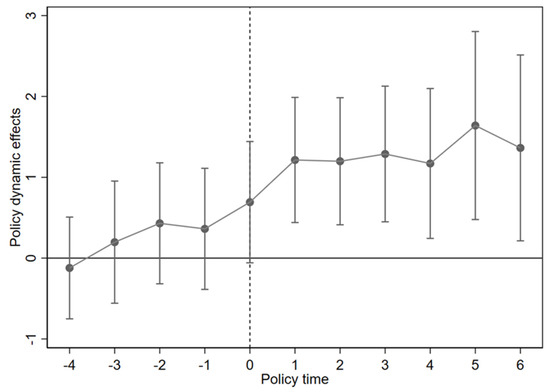
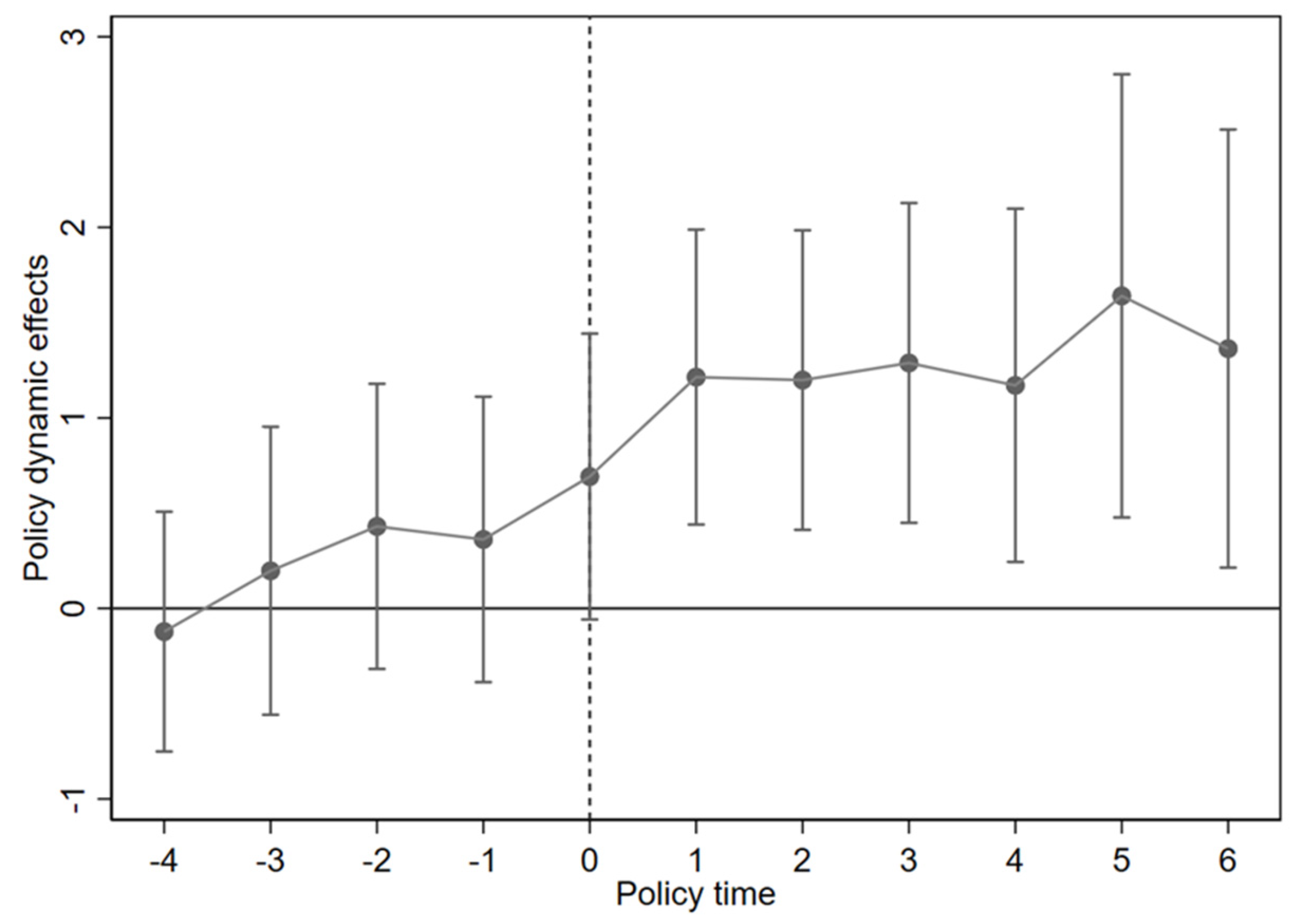
The parallel trends assumption is a key prerequisite for the validity of the difference-in-differences (DID) approach, requiring that the treatment and control groups exhibit consistent trends prior to the policy intervention. The results in Figure 1 show that before the establishment of the CBECCPZ, there was no significant difference in the level of ICR between the treatment and control groups. After the policy implementation, however, the treatment group experienced a noticeable increase in ICR. These findings indicate that the model used in this study satisfies the parallel trends assumption.
Figure 1.
Results of the parallel trends test.
5.2. Estimation Results from the Baseline Regression
Table 4 summarizes the baseline regression analysis of the effect of CBECCPZ establishment on ICR. Column (1) shows estimates without controlling for fixed effects or other covariates. Column (2) introduces individual and time fixed effects, and Column (3) additionally includes relevant control variables. Column (4) incorporates both fixed effects and the full set of controls simultaneously. In all models, the coefficient associated with the pilot zone establishment is positive and significant at the 5% level or better, confirming Hypothesis 1.
Table 4.
Results of the Baseline Regression.
5.3. Robustness Tests
5.3.1. Placebo Test
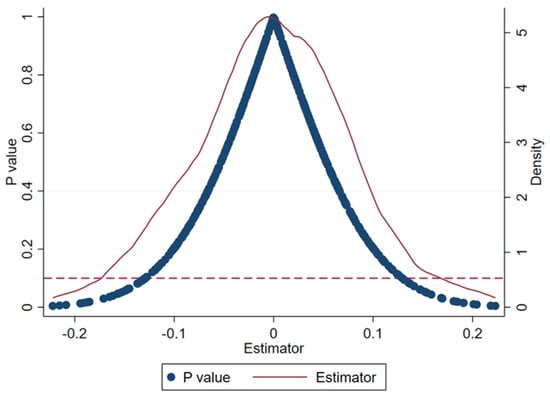
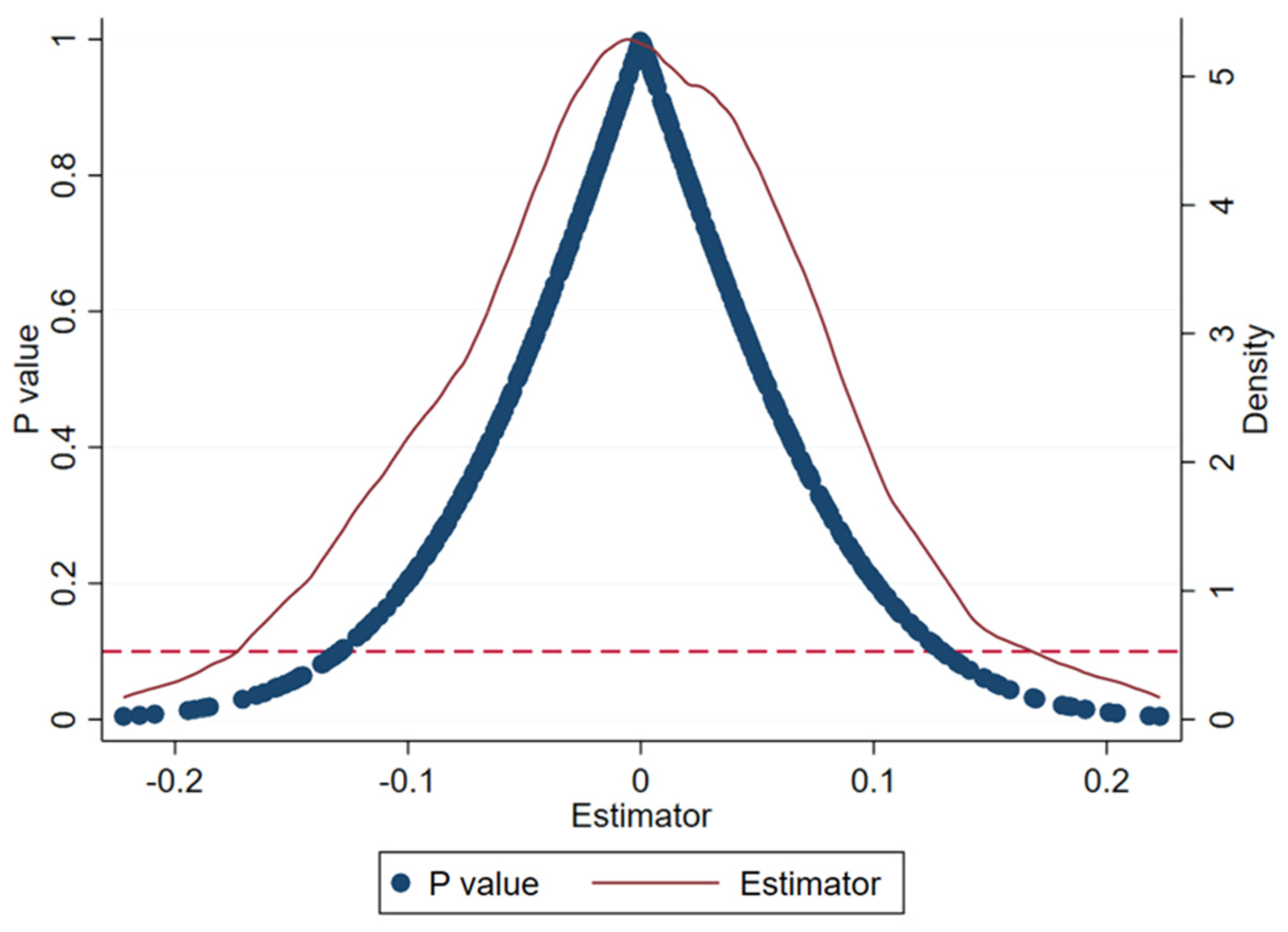
To rule out the potential influence of random factors on the baseline regression results, we conduct a placebo test using a random repeated sampling method on Model (1). Specifically, we perform 1000 random samples and estimate the model for each sample to obtain the distribution of the estimated coefficients. As shown in Figure 2, the coefficients obtained from the random samples are concentrated around zero and exhibit a normal distribution, which is clearly different from the estimated coefficient of 0.393. The analysis confirms that the positive association between CBECCPZ establishment and ICR is statistically robust, reinforcing the validity of the baseline regression outcomes.
Figure 2.
Results of the placebo test.
5.3.2. High-Dimensional Fixed Effects
To mitigate the potential influence of factors such as geographic differences on the research results, we further control for unobservable geographic characteristics that vary over time, aiming to reduce endogeneity in the empirical analysis and re-estimate the model. Columns (1)–(3) of Table 5 present the results with city fixed effects, industry fixed effects, and both fixed effects included simultaneously, respectively. The coefficient of DT is consistently significant across all three specifications, reinforcing the robustness of the study’s core conclusions.
Table 5.
High-Dimensional Fixed Effects and Controlling for Other Policies.
5.3.3. Controlling for Other Policies
Accurate identification of DT’s effect on ICR requires controlling for possible confounding influences arising from other simultaneous pilot initiatives. Accordingly, we carefully identify three types of policies that may constitute interference: the Science and Technology Finance Pilot Policy, the Broadband China Pilot Policy, and the list of Gigabit Cities. These policies are incorporated into the model as dummy variables, with their setup consistent with that of the independent variable. We introduce these policy variables sequentially and simultaneously to control for their potential impact. Table 5 reports the related regression results: Columns (4)–(6) present the estimates after controlling for each of the three policies individually, while Column (7) shows the results when all three policy variables are included simultaneously. Across all specifications, the coefficient of DT remains positive and significant, indicating that even after effectively controlling for other policy interventions, the positive effect of DT on ICR remains robust, and the study findings are highly reliable.
5.3.4. Adjusted Sample
To account for potential confounding effects from municipalities directly under central government, which may have unique policies and resources influencing DT’s impact on ICR, we exclude Beijing, Shanghai, Tianjin, and Chongqing from the regressions. Column (1) of Table 6 shows the results after adjusting the sample, showing that the estimated coefficient remains positive and significant at the 5% level. This indicates that even after excluding these municipalities, DT still effectively promotes ICR. Furthermore, considering that the COVID-19 pandemic in 2020 may have caused abnormal shocks to industry chain operations and the development of DT, we perform an additional robustness test by excluding data from 2020. The results presented in Column (2) of Table 7 indicate that, even after controlling for the pandemic’s effects, DT continues to exert a significant positive impact on ICR, with a coefficient of 0.396 significant at the 1% level. This provides evidence that the beneficial effect of DT on ICR is robust and resilient to both special policy regions and unforeseen external shocks.
Table 6.
Results of sample adjustments and dimension-specific tests.
5.3.5. Dimension-Wise Regression of ICR
To examine the impact of DT in more detail, we further decompose ICR into two dimensions, the resilience of industry chain actors and the resilience of industry chain structure, and conduct dimension-wise regressions. DT shows a significant positive effect on both dimensions, with estimated coefficients of 0.386 and 0.730, each significant at the 1% level. This indicates that DT not only enhances the risk resistance of core enterprises (actor resilience) but also effectively optimizes the overall network structure and coordination efficiency of the industry chain (structural resilience), thereby jointly improving the overall ICR.
5.3.6. Lagged Dependent Variables
To examine the persistence and dynamic effects of digital trade on ICR, as well as to mitigate potential reverse causality, we regress the dependent variable—industry chain resilience—lagged by one period and two periods, respectively. Findings in Table 7 reveal that DT exerts a statistically significant positive impact on ICR at both the one-period and two-period lags. This indicates that DT not only significantly enhances current ICR but also exerts persistent and lagged effects, continuing to influence resilience over the following one to two years, thereby strengthening the robustness of our findings over time.
Table 7.
Other Robustness Check Results.
5.3.7. Propensity Score Matching
To address potential endogeneity arising from sample selection bias, we conduct a robustness check using the propensity score matching (PSM) method. By matching each treated firm with the most similar control firms, we construct a more comparable sample. The regression results after PSM show that the coefficient of digital trade remains positive. Although the significance level declines slightly, the core conclusion remains unchanged. This indicates that, after controlling for systematic differences in observable characteristics, the positive effect of digital trade on ICR still holds, thereby enhancing the credibility of our baseline regression results.
5.3.8. Adding City-Level Control Variables to the Model
In addition to the original controls, the analysis incorporates other variables that could influence ICR: financial development, measured by the number of city-level technology and finance companies; population density, as the natural logarithm of registered population per unit of land area; economic development, measured by the natural logarithm of per capita GDP; urbanization rate, calculated as the ratio of non-agricultural population to registered population; government intervention, defined as local government general budget expenditures relative to regional GDP; and industrial structure sophistication, measured as the ratio of tertiary to secondary industry value added. Column (4) of Table 7 shows that, after adding these variables, the coefficient for digital trade remains 0.360 and significant at the 1% level, confirming the robustness of the results.
5.3.9. Replace the Dependent Variable
This study draws on the approach of Wang et al. [17] to remeasure the dependent variable, industrial chain resilience, by constructing a resilience index based on the two dimensions of resistance and recovery. Column (5) shows that after substituting the dependent variable, the coefficient of digital trade remains positive and statistically significant, consistent with the baseline regression results.
5.3.10. Replace the Independent Variable
We follow the approach of Zheng et al. [36] to construct a digital trade development index from three dimensions: infrastructure, industrial base, and development potential. The resulting index is used as an alternative independent variable for digital trade in robustness tests. Column (6) of Table 7 shows that the coefficient of digital trade remains positive and statistically significant, indicating that the conclusion that digital trade enhances industrial chain resilience holds even when the independent variable is replaced.
6. Further Analysis
6.1. Mechanism Test
Guided by the theoretical analysis and hypotheses, we explore the pathways through which DT affects ICR by focusing on enterprise digital transformation (Digital) and human capital level (HC). Extending Model (1), we employ a mediation effect model to assess whether the hypothesized pathways operate as theorized.
Column (1) of Table 8 indicates that DT significantly and positively affects ICR at the 1% level, demonstrating that enterprise digital transformation is a primary mechanism underlying this effect. DT compels enterprises to adopt digital technologies and restructure business processes, improving the flexibility and responsiveness of production organization and supply chain coordination, thus strengthening the industry chain’s capacity to adapt and recover from disruptions. Hypothesis 2 is thus supported. As reported in Column (2), the coefficient of DT on human capital is positive and significant at the 1% level, confirming that human capital accumulation constitutes a crucial pathway through which DT strengthens ICR. DT promotes knowledge diffusion, skills training, and talent mobility, systematically improving the overall quality and technical adaptability of personnel in the industry chain. High-quality human capital not only enables more effective use of digital technologies to optimize production and management processes but also provides innovative solutions and rapid learning capabilities in the face of external shocks, thus increasing the adaptability and recovery capacity of all components within the industrial chain. This allows the industry chain to continuously accumulate core capabilities to cope with various risks over the long term. Hypothesis 3 is supported.
Table 8.
Estimation Results from the Mediation Model.
6.2. Heterogeneity Analysis
6.2.1. Regional Heterogeneity
This study divides the full sample of firms into two groups based on the region of their registered location, eastern and central and western regions, and conducts group-wise regressions. Columns (1)–(2) of Table 9 show that DT positively affects ICR in the Eastern region but has no significant effect in the Central and Western regions. This indicates a clear regional heterogeneity in the effect of DT on ICR, with a more pronounced impact in the Eastern region. This may be because the Eastern region generally possesses more developed digital infrastructure (e.g., high-speed networks, data centers), a more mature e-commerce ecosystem, and higher levels of human capital, providing a solid hardware and software foundation for the implementation and effectiveness of DT policies. In addition, the Eastern region exhibits a higher degree of marketization, and enterprises there have stronger capabilities to connect with international markets and adapt to digital rules, allowing them to more quickly translate DT facilitation into tangible improvements in supply chain optimization and market expansion. Conversely, enterprises in the Central and Western regions may be constrained by structural or resource-related factors in digital access, logistics support, and business awareness, so the penetration and transformation effects of DT have not yet fully materialized, resulting in an overall non-significant statistical impact on ICR.
Table 9.
Regional and Ownership Heterogeneity Results.
6.2.2. Ownership Heterogeneity
The nature of a firm’s ownership determines its access to resources, governance structure, and responsiveness to policies, which may, in turn, affect the effectiveness of DT. Based on ownership type, we divide the sample into state-owned enterprises (SOEs) and non-state-owned enterprises (non-SOEs) for testing. As shown in Columns (3) and (4) of Table 9, the effect of DT is positive and significant for both state-owned and non-state-owned enterprises, with a stronger and more pronounced effect observed for SOEs. This indicates that DT promotes ICR for both types of enterprises, but its effect is stronger for SOEs. This heterogeneity may be explained by several factors. First, in terms of policy implementation, SOEs often carry more national strategic missions and respond more rapidly and thoroughly to pilot policies such as cross-border e-commerce comprehensive experimental zones, with stronger organizational support for resource allocation and project implementation. Second, in terms of resource endowment, SOEs generally have more stable financing channels, broader social networks, and closer connections with government departments, enabling them to integrate the funds, data, and policy support needed for DT more effectively, thereby gaining an advantage in digital transformation and supply chain restructuring. Third, although non-SOEs are more flexible and market-sensitive, they may face higher trial-and-error costs and resource constraints in the early stages of transformation, making the policy benefits of DT more gradual. Therefore, the enhancement effect of DT on ICR is more pronounced and stronger among SOEs.
6.2.3. Heterogeneity in Digitalization Levels
Considering the differences in digital infrastructure and application environments, we further explore whether the impact of DT on ICR exhibits heterogeneity across regions with different levels of digitalization. Drawing on the study by Li et al. [37], we classify Beijing, Guangdong, Zhejiang, Shanghai, Jiangsu, Shandong, Tianjin, Fujian, Sichuan, Chongqing, and Henan as regions with high digitalization levels, while the remaining provinces are classified as regions with low digitalization levels. Grouped regressions are then conducted, and the results are presented in Columns (1) and (2) of Table 10. The results show that in highly digitalized regions, DT has a significant positive effect on ICR (coefficient = 0.312, 10% significance), while the effect is not statistically significant in less digitalized regions. This implies that the contribution of DT to strengthening ICR is more evident where digital development is higher. A possible explanation is that regions with higher digitalization levels generally possess more advanced digital infrastructure, a richer pool of technical talent, and a more mature digital ecosystem, enabling local enterprises to more efficiently leverage the platforms, data, and trade opportunities provided by cross-border e-commerce pilot zones, thereby fully realizing the policy benefits of DT. Furthermore, higher regional digitalization levels imply stronger knowledge spillovers and synergistic effects within the region. The introduction of DT can interact positively with existing local digital industries, accelerating technology integration and business model innovation, thus generating a more significant promotion effect on ICR.
Table 10.
Heterogeneity in Digitalization Level and Industry.
6.2.4. Industry Heterogeneity
Based on the industry attributes of firms, we divide the sample into manufacturing and non-manufacturing enterprises to examine the heterogeneous impact of DT across different industry types. For manufacturing enterprises, DT has a coefficient of 0.352, significant at the 5% level, whereas for non-manufacturing enterprises, the coefficient is 0.565, significant at the 10% level, highlighting differential effects across sectors. For manufacturing enterprises, the core role of DT lies in process optimization and cost reduction. It achieves this by accurately matching international market supply and demand, reducing intermediary links, lowering search and transaction costs, and promoting the service-oriented extension of manufacturing. This effect is typically gradual and permeating, mainly reflected in efficiency improvements and marginal profit enhancements, which explains why the absolute value of the coefficient is relatively small. However, due to the high standardization of manufacturing processes and the tight integration of global supply chains, the cost-saving and efficiency-enhancing effects of DT are widespread and stable, resulting in high statistical significance across the sample. In contrast, for non-manufacturing enterprises, DT is more disruptive, with its core logic revolving around business model innovation and value creation. Digital technologies not only reduce barriers to service trade but can also directly generate entirely new digital products and services. The resulting revenue growth and value-added increases are more direct and substantial, which explains the larger regression coefficient. However, due to the high heterogeneity within the non-manufacturing sector—from traditional commerce to high-tech services—differences in digital foundations, business models, and responsiveness and adaptability to DT are substantial. This leads to greater dispersion in the positive effects of DT across firms and relatively weaker sample consistency, which accounts for the slightly lower significance level.
6.2.5. Industry Competitiveness
We use the industry-level Lerner index to measure the degree of competition, with higher values indicating more intense competition. Using the industry median as the cutoff, we divide the sample into groups with high and low industry competitiveness. The regression results are reported in Columns (1) and (2) of Table 11. In the group with high industry competition, the coefficient of DT is 0.527 and is positive and significant at the 1% level; in contrast, in the group with low industry competition, the coefficient is negative and not statistically significant. This indicates that the promoting effect of DT on ICR is more pronounced in more competitive market environments. A possible explanation is that, in highly competitive markets, firms face greater survival and innovation pressures, which motivate them to leverage new channels, technologies, and information provided by DT to optimize supply chains, expand markets, and improve operational efficiency, thereby enhancing their ability to withstand risks and adapt to changes, ultimately contributing to overall ICR. In contrast, in less competitive or more monopolistic industries, firms lack both external pressure and internal incentives to pursue digital transformation, which limits the effectiveness of DT policies.
Table 11.
Industry Competitiveness and Internal Control Levels.
6.2.6. Heterogeneity in Internal Control Levels
The quality of a firm’s internal governance is a key factor affecting its ability to respond to external shocks and seize new opportunities. We measure internal control levels using the Internal Control Index for Chinese listed companies published by the DIBO database and divide the sample into high and low internal control groups based on the median. In the high internal control group, the coefficient of DT is significantly positive at the 5% level; in the low internal control group, the coefficient is not statistically significant. A sound and effective internal control mechanism is an important prerequisite for DT to enhance ICR. High-level internal control indicates that a firm has more standardized decision-making processes, a more complete risk management system, and more efficient resource allocation capabilities. When DT introduces new business models and technological shocks, these firms can adjust strategies and integrate resources more quickly and orderly, reducing friction costs and uncertainties during the transformation process, thereby more effectively converting the external opportunities provided by DT into internal competitiveness and enhanced stability and resilience of the industry chain. In contrast, firms with weak internal controls may struggle to absorb and capitalize on the positive impacts of DT due to chaotic management, uncontrolled risks, or misallocation of resources.
7. Research Limitations and Prospects for Future Study
Despite using a quasi-natural experimental design to examine the relationship between DT and ICR based on the establishment of CBECCPZ and a difference-in-differences approach, yielding a series of robust findings, several avenues for further research remain.
First, the data dimension can be expanded. This study primarily constructs ICR indicators based on listed firms, which provides advantages in data availability and comparability, but does not fully capture small and medium-sized enterprises (SMEs) or non-listed firms. As a result, the effect of DT on a broader set of firms may be underestimated. Future research could combine customs micro-trade data or firm survey data to obtain a more comprehensive depiction of industrial chain participants.
Second, resilience measurement can be further refined. The current ICR indicators do not directly capture real-time recovery speed or the degree of supply chain disruption under sudden shocks. Subsequent studies could incorporate logistics tracking data or supply chain network data to construct dynamic resilience metrics, more accurately reflecting the capacity to withstand shocks and recover.
Third, mechanisms require deeper exploration. This study primarily validates the mediating roles of digital transformation and human capital enhancement but has not fully examined the micro-level transmission pathways through which DT affects resilience, such as data flow, platform ecosystem development, or cross-border payment efficiency. Future research could investigate mechanisms from the perspectives of platform firm behavior, data-sharing networks, or algorithmic optimization.
Fourth, institutional heterogeneity has not been fully identified. The effectiveness of CBECCPZ may vary with regional digital infrastructure, business environment, and government governance capacity. Future studies could further examine the differentiated resilience effects of DT policies under varying regional institutional conditions to enhance policy generalizability.
Fifth, an international comparative perspective is needed. This study focuses on the Chinese context, whereas countries differ significantly in digital governance rules, cross-border data flow policies, and positions in global value chains. Future research could conduct cross-country comparative analyses to test the generalizability and institutional dependence of DT’s impact on ICR.
8. Conclusions and Recommendations
8.1. Conclusions
Using Chinese A-share listed companies from 2012 to 2022 as the research sample, this study investigates the impact of DT on industrial chain resilience and its underlying mechanisms. The results indicate that DT has a significant driving effect on the enhancement of industrial chain resilience, and this conclusion remains robust after multiple rounds of robustness tests, further confirming the critical role of DT in strengthening industrial chain resilience. Furthermore, heterogeneity analyses reveal that the positive effect of DT on industrial chain resilience is more pronounced for firms in eastern regions, state-owned enterprises, firms located in highly digitalized regions, manufacturing firms, firms operating in highly competitive industries, and firms with stronger internal control systems. Mechanism analyses show that DT enhances industrial chain resilience primarily by promoting firms’ digital transformation and improving human capital.
8.2. Recommendations
8.2.1. Government Level
Optimizing the digital trade development ecosystem and strengthening the enabling foundations. The government should accelerate the improvement of supporting policies and regulations for digital trade. Detailed rules should be introduced in key areas such as cross-border data flows, digital intellectual property protection, and recognition of electronic contracts, in order to remove institutional barriers to the free flow of data and create a rule-of-law and standardized environment for the deep integration of digital trade and industrial chains. At the same time, investment in digital infrastructure should be increased, with a focus on extending new infrastructure—such as 5G networks, industrial internet, and the Internet of Things—to central and western regions. This will help narrow regional digital divides and address the uneven regional contribution of digital trade to industrial chain resilience, enabling enterprises in central and western China to equally enjoy the benefits of digital trade development. Moreover, the government could establish dedicated funds for digital trade development to support enterprises in building digital trade platforms and innovating cross-border digital services. Conditional policy incentives, such as tax reductions and interest-subsidized financing, can further stimulate market participants’ engagement in digital trade.
Implementing differentiated policy guidance and unlocking heterogeneity dividends. Differentiated policy guidance should be implemented to fully unleash heterogeneity dividends. For eastern regions, priority should be given to building core hubs of digital trade. Pilot programs in cross-border digital services and digital product trade innovation should be encouraged, enabling eastern enterprises to further strengthen industrial chain coordination and resilience through digital trade and to play a demonstrative and leading role. For central and western regions, efforts should focus on cultivating digital trade industrial clusters and guiding the gradient transfer of digital trade resources from eastern to central and western areas. Projects such as the “Eastern Data, Western Computing” initiative can facilitate the integration of central and western enterprises into digital trade networks. Regarding enterprise characteristics, state-owned enterprises should be supported to play a leading role by integrating upstream and downstream industrial chain resources through digital trade and establishing digital collaborative platforms. Meanwhile, market entry barriers for private enterprises participating in digital trade should be removed to ensure fair competition among enterprises with different ownership structures. For manufacturing enterprises, targeted policies should be introduced to promote the deep integration of digital trade and manufacturing, supporting firms in expanding overseas markets and optimizing supply chain layouts through digital trade, thereby enhancing industrial chain risk resistance. For enterprises operating in highly competitive industries with strong internal control capabilities, greater investment in digital trade should be encouraged to leverage competitive and governance advantages and form a virtuous cycle of “digital trade plus efficient governance”.
Focusing on action mechanisms and strengthening policy coordination. To promote enterprise digital transformation, the government should advance the empowerment of traditional industries through digital technologies, support firms in conducting digital upgrading and smart factory construction, and encourage digital service enterprises to provide customized digital solutions for upstream and downstream firms in industrial chains, consequently mitigating the costs of digital transformation for small- and medium-sized firms. Meanwhile, a digital transformation evaluation system should be established, incorporating transformation performance into the assessment criteria of enterprise support policies, so as to guide firms to proactively advance digital transformation. In terms of enhancing human capital, talent cultivation and introduction mechanisms should be optimized. Universities and vocational institutions should establish programs in digital trade, digital technologies, and industrial chain management to foster interdisciplinary talents. Talent attraction initiatives should be implemented to draw high-end overseas professionals in digital trade and industrial chain digital operations to work and start businesses domestically. At the same time, digital skills training for existing enterprise employees should be strengthened to improve the overall human capital quality of the entire industrial chain, providing solid talent support for digital trade in enhancing industrial chain resilience.
8.2.2. Enterprise Level
Increasing digital trade investment and seizing enabling opportunities. Enterprises should fully recognize the critical role of digital trade in enhancing industrial chain resilience and increase investment in digital trade based on their own characteristics. Manufacturing enterprises, firms in eastern regions, and state-owned enterprises should leverage their respective advantages to proactively develop cross-border digital trade businesses. By relying on cross-border e-commerce platforms and digital trade service platforms, they can expand overseas market channels, optimize supply chain resource allocation, and improve industrial chain coordination efficiency and risk resistance. Small and medium-sized enterprises should actively utilize third-party digital trade service platforms to lower participation barriers and gradually enhance their digital operational capabilities. Meanwhile, enterprises should strengthen the construction of industry competition awareness and internal control systems. By improving internal control mechanisms and upgrading governance capacity, firms can enhance the transmission efficiency of digital trade in empowering industrial chain resilience, thereby fully unleashing heterogeneity advantages.
Leveraging digital transformation to activate mechanism transmission effectiveness. Enterprises should regard digital transformation as a core strategic priority and promote comprehensive digital upgrading across production, operation, and management processes. In the production stage, intelligent manufacturing equipment and systems should be introduced to realize automated and smart control of production processes, thereby improving production efficiency and product quality. In the supply chain stage, digital collaborative platforms should be established to enable information sharing and resource coordination with upstream and downstream enterprises, accurately match market demand, and reduce supply chain fluctuation risks. In the marketing stage, digital technologies such as big data and artificial intelligence should be utilized to analyze consumer demand, implement precision marketing, and expand market share. Meanwhile, enterprises should strengthen the synergistic linkage between digital transformation and digital trade. Digital transformation can enhance enterprises’ capacity to participate in digital trade, while digital trade can in turn stimulate deeper digital transformation, forming a virtuous cycle of mutual reinforcement. This process enables digital transformation to fully play its mediating role in digital trade empowerment of industrial chain resilience.
Emphasizing human capital development and consolidating talent support foundations. Enterprises should establish sound mechanisms for talent cultivation, introduction, and incentives to meet the demands of digital trade development and industrial chain resilience enhancement. On the one hand, firms should increase investment in internal training by regularly providing programs on digital trade knowledge, digital skills, and industrial chain management, thereby improving employees’ comprehensive capabilities and building a professional digital talent pool. On the other hand, enterprises should actively attract high-end digital trade professionals as well as technical and managerial talents specialized in digital transformation to optimize the talent structure. Meanwhile, a scientific incentive system should be established by linking digital trade performance and digital transformation outcomes with employee compensation and promotion, thus stimulating employees’ enthusiasm for participating in digital trade and digital transformation. Through improving human capital levels, enterprises can further strengthen the empowering effect of digital trade on industrial chain resilience.
8.2.3. Regional and Industry Level
Strengthening regional coordination and promoting optimal resource allocation. Eastern regions should leverage their first-mover advantages in digital trade and industrial chain development to establish coordinated cooperation mechanisms with central and western regions. Through industrial transfer, technology diffusion, and talent exchange, eastern regions can drive digital trade development and industrial chain upgrading in central and western areas. Meanwhile, joint construction of digital trade industrial parks and cross-border digital trade platforms across eastern, central, and western regions should be encouraged to facilitate cross-regional flows of data, technology, talent, and capital. This approach can narrow regional development gaps and form a digital trade development pattern characterized by “eastern leadership and central–western follow-up,” thereby enhancing overall national industrial chain resilience. At the same time, key regions such as the Beijing–Tianjin–Hebei area, the Yangtze River Delta, and the Guangdong–Hong Kong–Macao Greater Bay Area should be promoted to build core clusters for digital trade, strengthen intra-regional industrial chain coordination, and improve regional industrial chain risk resistance.
Promoting industry associations’ leadership in building collaborative development platforms. Industry associations should play a bridging role by taking the lead in establishing collaborative development platforms for digital trade and industrial chain coordination. They should organize activities such as enterprise exchanges, technical seminars, and experience-sharing sessions to promote resource integration and complementary advantages among firms. In sectors with high competition intensity, industry associations should guide enterprises to regulate market competition order, foster a healthy competitive environment, and encourage joint responses to external risks and challenges through digital trade. In industries with relatively low levels of digitalization, industry associations should cooperate with digital service providers to carry out digital empowerment training, disseminate advanced digital transformation experiences, and enhance the overall digitalization level of the industry. Meanwhile, industry associations should strengthen communication and coordination with government departments, reflect enterprises’ demands, provide references for policy formulation, and promote the construction of a digital trade policy environment that aligns with industry development needs.
Author Contributions
Conceptualization, J.L. and R.L.; methodology, J.L. and R.L.; software, J.L. and R.L.; resources, J.L. and R.L.; data curation, J.L. and R.L.; writing—original draft preparation, J.L. and R.L.; writing—review and editing, J.L., R.L. and Z.W.; supervision, J.L., R.L. and Z.W.; project administration, Z.W.; funding acquisition, J.L. All authors have read and agreed to the published version of the manuscript.
Funding
This research is supported by the Key Project of the National Social Science Fund of China [grant number 25JYA007].
Data Availability Statement
Readers may contact the corresponding author to obtain the data used here.
Acknowledgments
We would like to express our gratitude to all the individuals and organizations who have supported this study, and we are very grateful for the valuable advice and assistance received during this study.
Conflicts of Interest
The authors declare no conflicts of interest.
References
- Zhu, T.; Zhu, T.; Zhao, L. Impact of New Quality Productive Forces on the Resilience of Industrial Chains: The Moderating Role of Digital Finance. Int. Rev. Econ. Financ. 2025, 102, 104333. [Google Scholar] [CrossRef] [Scilit]
- Sun, K.; Wang, H.; Ye, S. How does digital transformation enhance industrial chain resilience? Evidence from China. Financ. Res. Lett. 2025, 75, 106896. [Google Scholar] [CrossRef] [Scilit]
- Cui, J.; Du, D. New quality productive forces, urban-rural integration and industrial chain resilience. Int. Rev. Econ. Financ. 2025, 102, 104245. [Google Scholar] [CrossRef] [Scilit]
- Wu, X.; Duan, B. Does the nature of digital trade enhance industrial chain resilience? J. Cap. Univ. Econ. Bus. 2025, 27, 20–38. [Google Scholar] [CrossRef]
- Li, X.; Hu, Y.; Ding, L.; Huang, Q.; Jiang, Y. Impact of the digital trade on lowering carbon emissions in 46 countries. Sci. Rep. 2024, 14, 25957. [Google Scholar] [CrossRef] [Scilit]
- Li, Y.; Zheng, Z.; Zhao, M.; Liu, Z. How does digital trade impact urban carbon emissions efficiency? Evidence from China’s cross-border e-commerce pilot zones. J. Clean. Prod. 2024, 456, 142363. [Google Scholar] [CrossRef] [Scilit]
- Dai, S.; Tang, D.; Li, Y.; Lu, H. Digital trade, trade openness, FDI, and green total factor productivity. Int. Rev. Financ. Anal. 2025, 97, 103777. [Google Scholar] [CrossRef] [Scilit]
- Xiong, S.; Luo, R. Investigating the relationship between digital trade, natural resources, energy transition, and green productivity: Moderating role of R&D investment. Resour. Policy 2023, 86, 104069. [Google Scholar] [CrossRef] [Scilit]
- Zhao, Z.; Gao, G. The impact of digital trade on China’s position in the GVC: An empirical analysis based on Sino-Russian cross-border panel data. Sustainability 2024, 16, 5493. [Google Scholar] [CrossRef] [Scilit]
- Luo, J. The impact of digital trade development on industrial structure upgrading under the new development pattern: Evidence from provinces along the Yangtze River Economic Belt. Commer. Econ. Res. 2022, 20, 185–188. [Google Scholar] [CrossRef]
- Liu, Y.; Hu, W.; Luo, K.; Guo, Y.; Wang, Z. How does digital trade promote and reallocate the export technology complexity of the manufacturing industry? Evidence from 30 Chinese provinces, 2011–2020. PLoS ONE 2023, 18, e0291464. [Google Scholar] [CrossRef] [Scilit] [PubMed]
- Li, D.; Zhou, Y. Digital Trade Empowering the Development of New Quality Productive Forces. Price Mon. 2024, 11, 47–56. [Google Scholar] [CrossRef]
- Crescenzi, R.; Pietrobelli, C.; Rabellotti, R. Corrigendum to: Innovation drivers, value chains and the geography of multinational corporations in Europe. J. Econ. Geogr. 2017, 17, 925. [Google Scholar] [CrossRef] [Scilit]
- Chen, X.; Liu, Y.; Zhou, K. Research on the Path of Digital Economy to Improve China’s Industrial Chain Resilience. Econ. Syst. Reform 2022, 1, 95–102. [Google Scholar]
- Lin, J.; Lin, S.; Benitez, J.; Luo, X.R.; Ajamieh, A. How to build supply chain resilience: The role of fit mechanisms between digitally-driven business capability and supply chain governance. Inf. Manag. 2023, 60, 103747. [Google Scholar] [CrossRef] [Scilit]
- Du, J.; Wang, J.; Liang, J.; Liang, R. Research on the impact of smart logistics on the the manufacturing industry chain resilience. Sci. Rep. 2025, 15, 9052. [Google Scholar] [CrossRef] [Scilit]
- Wang, L.; Lin, R.; Xie, W. Research on the Impact of Artificial Intelligence on the Resilience of the Manufacturing Industry Chain. Sustainability 2025, 17, 9775. [Google Scholar] [CrossRef] [Scilit]
- Yang, L.; Liu, Y. The impact of digital infrastructure on industrial chain resilience: Evidence from China’s manufacturing. Technol. Anal. Strateg. Manag. 2025, 37, 1112–1128. [Google Scholar] [CrossRef] [Scilit]
- Chen, Y.; Jiang, C.; Peng, L.; Zhao, S.; Chen, C. Digital infrastructure construction and urban industrial chain resilience: Evidence from the “Broadband China” strategy. Sustain. Cities Soc. 2025, 121, 106228. [Google Scholar] [CrossRef] [Scilit]
- Xue, F.; Zhu, T. Research on the Impact Effect and Internal Mechanism of Intelligent Technology on industrial chain resilience. Financ. Res. Lett. 2025, 84, 107789. [Google Scholar] [CrossRef] [Scilit]
- Wang, H.; Yang, L.; Feng, Y. How does digital economy affect the industry chain resilience in China? Humanit. Soc. Sci. Commun. 2024, 11, 1529. [Google Scholar] [CrossRef] [Scilit]
- Li, X.; Wang, T. Digital transformation, financial support, and industry chain resilience. Financ. Res. Lett. 2025, 89, 109236. [Google Scholar] [CrossRef] [Scilit]
- Lin, S.; Miao, S. The Enhancing Effect and Role Path of Digital Finance on the Resilience of Agricultural Industry Chain. Financ. Res. Lett. 2025, 83, 107697. [Google Scholar] [CrossRef] [Scilit]
- Zheng, Y.; Guo, Y.; Yan, J. Business environment and industrial chain resilience. Financ. Res. Lett. 2025, 75, 106886. [Google Scholar] [CrossRef] [Scilit]
- Wang, L.; Duan, L. Optimization of Business Environment, Supply Chain Finance, and Industrial Chain Resilience. Financ. Res. Lett. 2025, 86, 108867. [Google Scholar] [CrossRef] [Scilit]
- Tian, Y. Supply chain finance and industrial chain resilience: Based on the pilot “chain chief” system. Int. Rev. Financ. Anal. 2025, 104892, in press. [Google Scholar] [CrossRef] [Scilit]
- Zhou, W.; Song, Y.; Xu, D.; Zhang, Y. Government subsidies and industrial chain resilience: Evidence from Chinese resource-based enterprises. Resour. Policy 2025, 102, 105525. [Google Scholar] [CrossRef] [Scilit]
- Yan, J. Assessing the link between digital government development and urban industrial chain resilience: Evidence from public data openness. Environ. Impact Assess. Rev. 2025, 112, 107796. [Google Scholar] [CrossRef] [Scilit]
- Chen, K.; Xie, J. Digital trade and corporate ESG performance—Evidence from China. Int. Rev. Econ. Financ. 2025, 103, 104417. [Google Scholar] [CrossRef] [Scilit]
- Li, P.; Chen, Y.; Guo, X. Digital transformation and supply chain resilience. Int. Rev. Econ. Financ. 2025, 99, 104033. [Google Scholar] [CrossRef] [Scilit]
- Yang, C.; Fu, Q.; Li, L. Research on the mechanism and effect of digital transformation on the resilience of industrial chain—Comparison of resilience dimensions of manufacturing industrial chain. Stud. Sci. Sci. 2025, 43, 2532–2543+2585. [Google Scholar] [CrossRef]
- Zhao, W.; Zhu, J. Human Capital, Technological Progress and the Transformation and Upgrading of China’s Cultural Industry: An Analysis based on the Mediating Effect Model. Econ. Issues 2023, 2, 85–93. [Google Scholar] [CrossRef]
- Hui, X. Pilot Free Trade Zone Construction, Industrial Transformation-Upgrading and Industrial Chain Resilience. Stat. Decis. 2024, 40, 162–167. [Google Scholar] [CrossRef]
- Fang, H.; Jiang, C.; Li, X. Digital Technology Innovation and the Enhancement of Industrial Chain Resilience: An Examination from the Perspective of Node. Enterp. Econ. Dyn. 2025, 2, 127–144. [Google Scholar]
- Wu, F.; Hu, H.; Lin, H.; Ren, X. Enterprise Digital Transformation and Capital Market Performance: Empirical Evidence from Stock Liquidity. Manag. World 2021, 37, 130–144+10. [Google Scholar] [CrossRef]
- Zheng, J.; Nie, Y.; Ma, X. Research on the Effects and Mechanisms of Digital Trade on the Optimal Layout of New Urbanization. China Circ. Econ. 2025, 39, 60–72. [Google Scholar] [CrossRef]
- Li, X.; Chen, Z.; Chen, Y. Digital Transformation of Enterprises and Financial Performance: Evidence from Digital Patent Data of Listed Companies. Technol. Econ. 2024, 43, 73–87. [Google Scholar]

Disclaimer/Publisher’s Note: The statements, opinions and data contained in all publications are solely those of the individual author(s) and contributor(s) and not of MDPI and/or the editor(s). MDPI and/or the editor(s) disclaim responsibility for any injury to people or property resulting from any ideas, methods, instructions or products referred to in the content. |
© 2026 by the authors. Licensee MDPI, Basel, Switzerland. This article is an open access article distributed under the terms and conditions of the Creative Commons Attribution (CC BY) license.