


Abstract
Urban built environments face unprecedented challenges in resource management and sustainability, necessitating innovative approaches that integrate circular economy principles with construction technologies. This study addresses the critical research gap at the intersection of circular city initiatives and modular integrated construction (MiC) by employing a structured literature review methodology to systematically analyze existing knowledge. Following PRISMA guidelines, the search screened 438 papers (209 on MiC, 229 on Circular City Initiatives), of which 68 papers were included after quality appraisal for thematic synthesis using MAXQDA. The analysis offers a structured basis for operationalizing circular economy principles in the construction sector and provides a roadmap for future inquiry. The research develops a conceptional requirement matrix framework that bridges circular city principles with MiC implementation. Through systematic analysis, the study establishes six key requirements for construction technologies resulting from circular city initiatives and evaluates them against the six key MiC characteristics: prefabrication and assembly; speed and efficiency; quality and safety; standardization and mass production; sustainability; integration with technology. This matrix represents the first systematic approach to operationalizing circular economy principles through modular construction methodologies. The framework reveals that MiC constitutes a transformative paradigm for circular urban development through multiple synergistic pathways: prefabrication enhances reversibility and durability, extending service life and enabling material loop closure; eco-design integration improves safety and quality standards; deconstructability facilitates adaptive reuse; and BIM-based tools enhance material efficiency and recycling capabilities. The requirement matrix demonstrates strong alignment between circular city requirements and MiC characteristics, with adaptive reuse and modularity showing the strongest correspondence. Stakeholder engagement and policy support emerge as critical enablers across all implementation dimensions. While the framework is grounded in a structured literature review, it remains theoretical and serves as a foundation for future empirical validation.
1. Introduction
Urban environments face unprecedented sustainability challenges [1]. Cities account for over 70% of global CO2 emissions, yet recent circular city initiatives demonstrate measurable impact: Amsterdam’s CE implementation reduced construction waste by 35% between 2016–2020, while Copenhagen’s circular procurement achieved 50% material reuse in public buildings. The construction sector, responsible for 39% of carbon emissions, represents the primary target for circular economy interventions, with the EU mandating 70% C&D waste recycling by 2025 [2,3,4].
The construction industry traditionally follows a linear “take, make, dispose” model. This approach involves extracting raw materials, transforming them into construction materials, and disposing them after a building’s lifecycle ends [5].
Modular integrated construction (MiC) has emerged as a promising technology for sustainable building practices, characterized by off-site manufacturing and on-site assembly [6,7]. Empirical reviews document that MiC reduces construction time through parallel processing of modules and site preparation, while life cycle assessments demonstrate MiC’s potential for waste minimization and improved resource efficiency when supported by design-for-disassembly principles [8].
MiC’s circular economy potential in developing economies has been evaluated through LCA, demonstrating reduced waste generation and a lower environmental impact compared to conventional methods [9,10]. However, its broader implementation is hindered by challenges including regulatory issues, lack of standardized practices, and difficulties in coordinating among stakeholders, which contribute to limited uptake in some construction sectors [11,12].
Previous studies have shown that modular integrated construction (MiC) supports sustainable development by enabling the reuse and recycling of building materials through design for disassembly, which extends component lifecycles and reduces resource demand [9,13,14]. This method addresses urbanization challenges by offering flexible and relocatable solutions while contributing to climate change mitigation by lowering greenhouse gas emissions and improving energy efficiency [7,15,16].
Research on circular city initiatives and the MiC methodology intersection remains limited. Research primarily focuses on implementing circular economy strategies for urban sustainability, examining cities’ transition from linear to circular systems for resource efficiency and waste reduction. The potential synergies from MiC technologies remain unexplored in current research [15]. There exists a necessity for comprehensive frameworks that incorporate MiC into circular city initiatives. Extant research frequently addresses MiC, sustainability, and urban planning in isolation, lacking a holistic approach that synthesizes these elements into a cohesive framework [17,18]. The development of such frameworks can facilitate the adoption of MiC in circular city initiatives and provide a roadmap for future research and practice.
This literature review article aims to address the research question of how MiC technologies support urban sustainability transitions. It critically examines the gap between circular city initiatives and MiC technologies, focusing on how off-site manufacturing and modular assembly contribute to advancing sustainable urban development through closed-loop resource systems.
In the primary section of the study, the framework of circular cities principles is initially examined. The three fundamental criteria of a circular city framework—resource management, sustainability goals, and socioeconomic benefits—are presented. Subsequently, six requirements for construction technology are derived from these principles. To establish a connection to MiC, six key characteristics are illustrated in a hexagonal model. The framework developed from this analysis evaluates each individual requirement within a matrix, aligning them with the key characteristics and categorizing them accordingly.
2. Material and Methods
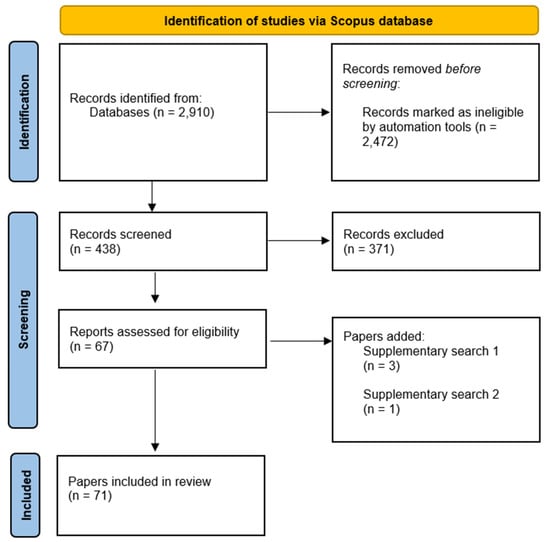
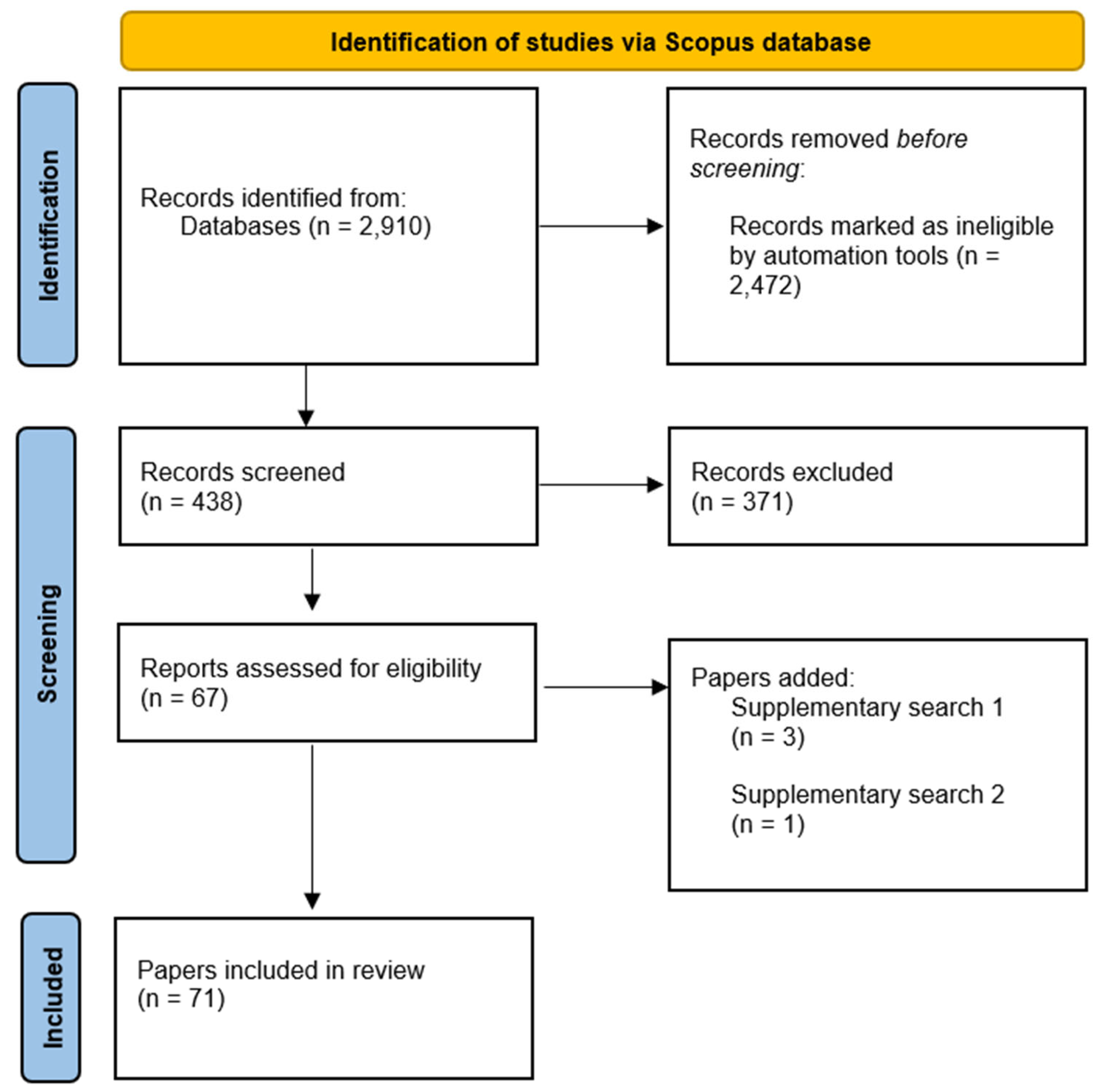
This study employs a structured literature review (SLR) methodology and is reported in line with the Preferred Reporting Items for Systematic Reviews and Meta-Analyses (PRISMA) 2020 guidelines to ensure transparency and reproducibility. The study selection process is documented in a PRISMA-style flow diagram (Figure 1), and the completed PRISMA 2020 checklist is provided as Supplementary Materials. The review protocol was not prospectively registered, as common protocol registration platforms such as PROSPERO are primarily designed for health-related systematic reviews and do not typically cover built-environment or sustainability research. The literature search was conducted using the Scopus database, focusing on publications from 2016 to 2025 to capture recent developments in circular city initiatives and modular integrated construction (MiC) technologies.
Figure 1.
PRISMA-style flow diagram.
Two separate search queries were applied in the TITLE-ABS-KEY fields: (1) “Modular” AND “Integrated” AND “Construction,” which initially retrieved 2541 records; (2) “Circular” AND “City” AND “Initiatives,” which yielded 369 records. Both sets were refined by restricting document types to articles, review papers, and conference papers published in English, and by focusing on relevant subject areas including engineering, environmental sciences, and social sciences. After these filters, 209 and 229 papers remained from the first and second queries, respectively, resulting in a combined dataset of 438 papers.
The selected papers were critically appraised based on: (i) clarity of research design, (ii) transparency of data and methods, and (iii) relevance to the intersection of circular city initiatives and MiC or circular construction technologies. Studies with insufficient methodological rigor were included only for contextual background and excluded from the core analysis. This process yielded a final set of 67 papers for in-depth review.
The final corpus was imported into MAXQDA 2022 for systematic coding using an iteratively developed codebook. This codebook combined deductive top-level codes (e.g., resource management, sustainability goals, socioeconomic benefits), with inductive sub-codes such as design for disassembly. Thematic synthesis was supported by frequency analysis to assess the prominence of key themes and requirements.
Regarding journal distribution, the selected papers span a range of peer-reviewed journals primarily within the fields of engineering, environmental sciences, and social sciences, reflecting the interdisciplinary nature of the research topic. The majority of included studies are published in journals with strong relevance to sustainable urban development, circular economy, and construction technology.
To establish the study’s theoretical foundations, in the final step a supplementary targeted search was conducted for the Triple Bottom Line (TBL) and Urban Metabolism (UM) frameworks. For the TBL foundation, a specific search string (“Triple Bottom Line” AND “Sustainable framework”) was executed in Scopus for the period 2020–2025, refined by “construction” and “circular cities.” This yielded 77 documents, from which three papers were selected. Complementing this, the Urban Metabolism framework was established through the selection of a representative foundational study to anchor the resource flow analysis.
In Figure 1, the identification, screening, and inclusion of studies is summarized in a PRISMA-style flow diagram.
3. Literature Review
The literature at the intersection of circular city initiatives and modular integrated construction remains fragmented, with most studies addressing these topics separately. This section analysis and synthesizes key themes and identifies research gaps that justify the present study.
3.1. Circular City Initiatives and the Built Environment
Circular city initiatives and the built environment circular cities represent the application of circular economy principles to urban systems, yet the literature remains conceptually fragmented. Meanwhile, comparative studies identify recurring themes—resource management, sustainability goals, and socioeconomic benefits—as foundational to circular city frameworks [19]. These studies highlight two critical limitations. First, cities report progress through pilots and business engagement but lack a shared operational definition of circularity. Second, and most critically for this study, the integration with construction technology decision making remains largely absent from circular city roadmaps. In construction, research emphasizes lifecycle thinking, design for disassembly, and material recycling; however, much of this work targets end-of-life strategies or product-level interventions rather than city-scale integration and governance alignment [20]. Consequently, the translation of circular objectives into explicit construction technology requirements remains underspecified at the urban program and policy levels.
3.2. Modular Integrated Construction (MiC): State of Knowledge
MiC involves off-site manufacturing and on-site assembly, commonly characterized by six features: prefabrication and assembly, speed and efficiency, quality and safety, standardization and mass production, sustainability, and integration with digital tools [21,22]. Evidence indicates potential benefits for reduced waste, improved resource efficiency, and lower embodied impacts when supported by design for disassembly and digital coordination. Reviews and roadmaps identify enabling conditions such as supply-chain orchestration, stakeholder engagement, and regulatory support, alongside constraints related to standardization limits and adoption barriers [9,14]. While these studies advance the technical and project-level understanding of MiC, they rarely map MiC characteristics systematically to circular city requirements or governance mechanisms at scale.
MiC is not inherently circular; its alignment with circular economy principles depends on its configuration. From an industrial ecology view, prefabrication can reduce waste and improve efficiency but may create linear building types if deconstructability is not prioritized. From a socio-technical perspective, MiC creates new value chains and digital requirements that can support or hinder circular practices based on stakeholder capabilities and regulations [9].
3.3. Theoretical Foundations and Tensions
While frameworks such as Urban Metabolism (UM) provide rigorous quantitative methods for mapping physical resource flows in circular cities. Reference to [23], they often lack the structural capacity to evaluate the non-physical drivers of construction innovation—specifically economic viability and social impact. Since modular integrated construction (MiC) is adopted not only for material efficiency but for its speed, cost-effectiveness, and potential to address housing shortages, a purely metabolic framework would fail to capture these critical value drivers [23].
The Triple Bottom Line (TBL) framework serves as the structural foundation for this study, selected for its proven capacity to operationalize sustainability in the built environment. Recent scholarship validates TBL as the essential theoretical basis for holistic evaluation of building performance across environmental, economic, and social dimensions. Beyond assessment, TBL has evolved into a strategic mechanism for business model innovation, linking environmental decision making directly to economic competitiveness and corporate planning. Furthermore, TBL is identified as the critical enabling framework for evaluating emerging construction technologies, ensuring that efficiency gains do not compromise social or ecological integrity. Consequently, TBL provides the necessary multi-dimensional architecture to map circular city criteria against MiC requirements, integrating resource management (environmental), sustainability goals (ecological resilience), and socioeconomic benefits (social and economic dimensions) into a coherent operationalization model [24,25,26].
3.4. Research Gaps and Study Rationale
The existing literature highlights three critical gaps that this study aims to address. First, there is a notable fragmentation between the circular city and modern methods of construction (e.g., MiC) domains, which are often investigated independently. This separation limits the development of integrated frameworks that effectively operationalize circularity principles through construction technologies. Bridging this divide is essential to foster holistic approaches that incorporate both urban circularity goals and the technological advancements in MiC.
Second, prior research lacks a structured alignment model that systematically maps city-level circular economy requirements onto the specific characteristics and capabilities of MiC. Without this mapping, it remains challenging to translate broad circularity objectives into actionable construction practices. Third, most existing contributions remain conceptual, with limited empirical validation. This underscores the need for stakeholder-informed and case-based studies to ground theoretical models in practical realities, thereby enhancing their relevance for policy formulation and industry adoption. To address this research question, the study adopts a structured literature review (SLR) because the intersection of circular city initiatives and MiC is nascent and fragmented, with limited empirical data and no consolidated framework. The SLR enables a comprehensive and transparent synthesis of existing conceptual and empirical contributions across circular economy, urban planning and construction technology domains, which is necessary to derive robust requirements for construction technologies and to identify how existing MiC characteristics align with these requirements.
4. Results
4.1. Framework of Circular City Principles
To operationalize circular city principles for the construction sector, we synthesized three fundamental criteria: resource management, sustainability goals, and socioeconomic benefits, which form the basis for deriving technology requirements. These three criteria correspond directly to the environmental, social, and economic dimensions of the Triple Bottom Line framework.
In Table 1, the key criteria of the circular city framework are mapped. Resource managements focuses on closing material loops by recycling and reusing materials to minimize waste and resource consumption [3,19]. Sustainability goals emphasize creating ecologically regenerative and resilient urban environments with reduced ecological footprints [19,27]. Socioeconomic benefits include economic diversification, social integration, and improved public health through sustainable urban ecosystems [3,19,28].
Table 1.
Key criteria of circular city framework.
Implementing these criteria requires policy and governance structures that establish clear guidelines and oversight mechanisms to monitor progress, alongside stakeholder engagement to secure buy-ins from key groups [20,22]. Innovative approaches leverage technologies and best practices, combining policy frameworks with problem solving to develop adaptable circular city strategies [17,21].
4.2. Key Requirements to Construction Technologies
Based on the identified gaps in current research and practice, this study proposes six key requirements (RQ-x) for construction technologies in circular city initiatives.
- Requirement 1: Reversibility and Durability (RQ-1)
Construction technologies should prioritize reversibility and durability to extend building lifecycles and facilitate material reuse or recycling [29]. While durability focuses on creating long-lasting structures that resist degradation, reversibility focuses on enabling change, adaptation, and eventual disassembly. These concepts are complementary rather than contradictory—durable components that can be disassembled and reused represent the ideal intersection of these requirements.
- Requirement 2: Eco-Design and Life Cycle Thinking (RQ-2)
This requirement emphasizes minimizing resource use and waste throughout a building’s existence [30]. Life Cycle Thinking (LCT) “offers a holistic approach by integrating sustainability considerations from design to demolition” [31]. It differs from reversibility by focusing on environmental impact minimization rather than technical disassembly feasibility [32].
- Requirement 3: Adaptive Reuse and Modularity (RQ-3)
Construction technologies must emphasize adaptive reuse capabilities and modular design principles to support easier updates, repairs, and reconfiguration throughout the building lifecycle. This approach extends building lifespans while reducing environmental impacts through enhanced flexibility and adaptability [32].
- Requirement 4: Material efficiency and Recycling (RQ-4)
Alternative materials and effective recycling processes—especially for high-impact materials such as concrete—are essential to reduce raw material consumption and minimize waste generation [30,33].
- Requirement 5: Stakeholder Engagement and Knowledge Sharing (RQ-5)
The successful implementation of circular practices requires collaboration among stakeholders, including local authorities, to overcome knowledge gaps and the sector’s entrenched linear mindset [34,35].
- Requirement 6: Policy and Regulatory Support (RQ-6)
Policy and regulatory support is needed to drive adoption of circular practices, with instruments such as public procurement and zoning laws requiring integration across policy areas [34].
Together, RQ1–RQ6 translate the Triple Bottom Line perspective into operational requirements for construction technologies in circular city projects.
This comprehensive approach, combining technological innovation, stakeholder engagement, and supportive policies, is key to transitioning the construction industry toward a more sustainable, circular model. Table 2 shows these six key requirements for construction technologies, related papers, and key takeaways.
Table 2.
Key requirements for construction technologies.
4.3. Key Characteristics of Modular Integrated Construction
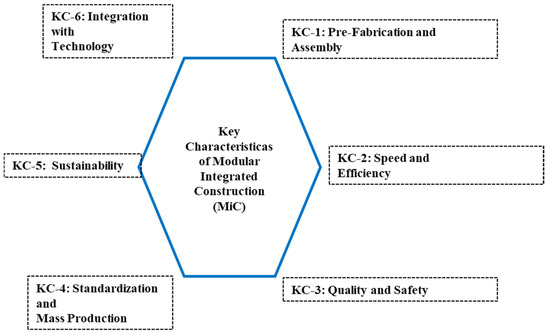
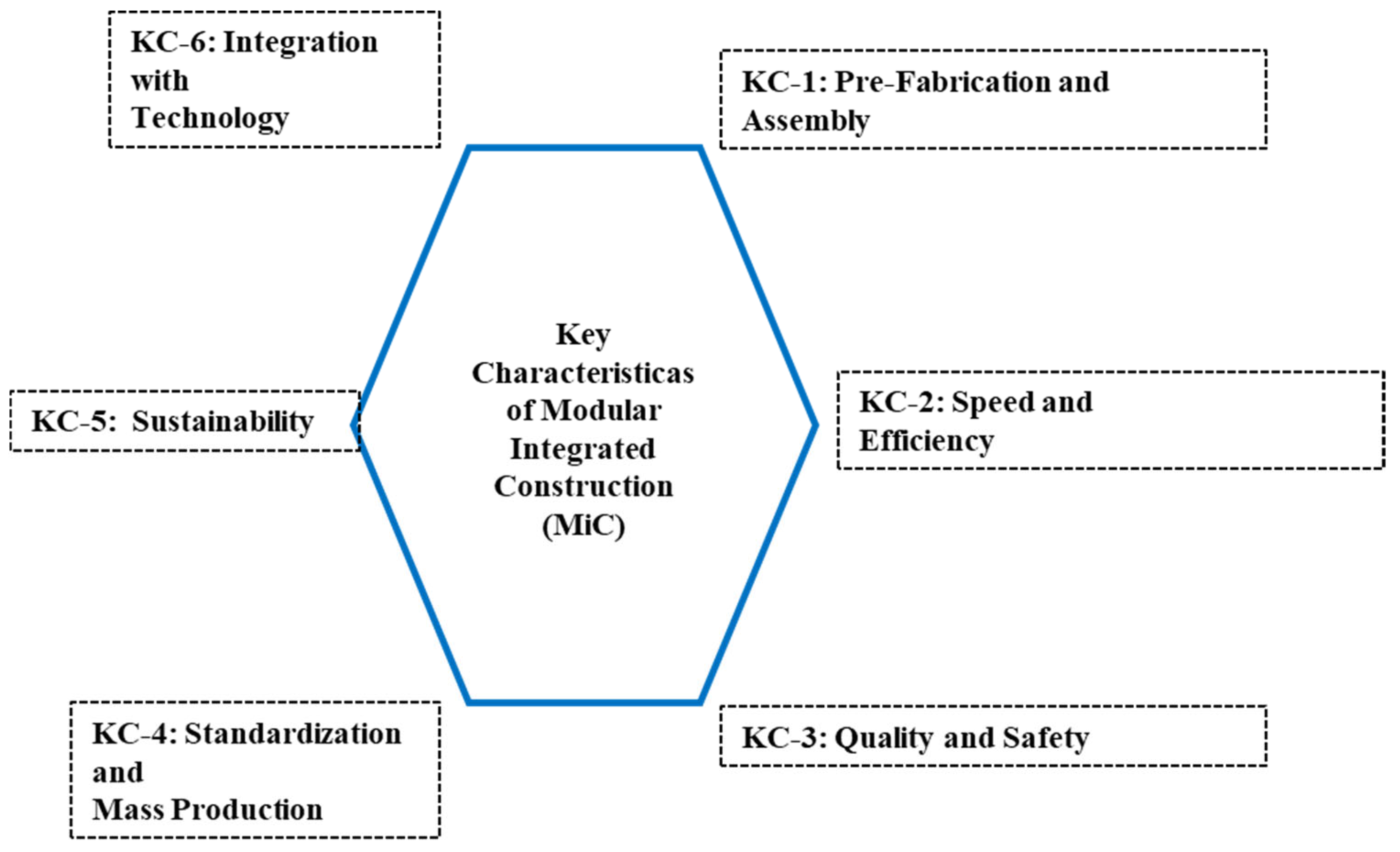
Six principal characteristics (KC-x) of modular integrated construction (Mic) were identified and conceptualized in a hexagonal model in Figure 2.
Figure 2.
Hexagon of MiC key characteristics.
- Prefabrication and assembly (KC-1) form the foundation of modular integrated construction (MiC), involving the production of modules in a controlled factory environment before transportation to the construction site for assembly. This process ensures high-quality control and efficient resource utilization [21,22].
- Another KC of MiC is the significant increase in speed and efficiency (KC-2). The construction timeline is compressed as modules are produced concurrently with site preparation, enabling parallel processing and reducing the overall project duration [21,36].
- Moreover, the factory-based production inherent in MiC leads to enhanced quality and safety (KC-3). Controlled environments allow for better quality control measures and provide safer working conditions compared to traditional on-site construction methods [22,37].
- This approach also facilitates standardization and mass production (KC-4), relying on standardized modules that enable cost reduction through economies of scale. However, it is important to note that this standardization can potentially limit design flexibility [21,38].
- Another notable characteristic of MiC is its contribution to sustainability (KC-5). The method is environmentally friendly due to reduced waste generation and lower energy consumption during the construction process.
- Furthermore, MiC demonstrates excellent potential for integration with technology (KC-6). It can be seamlessly integrated with digital technologies such as Building Information Modeling (BIM), enhancing design accuracy and overall project management efficiency [21,22].
Viewed through the Triple Bottom Line lens, these MiC characteristics offer concrete mechanisms for delivering environmental improvements, socioeconomic value, and cost-efficient project delivery within circular city initiatives.
4.4. Development of a Requirement Matrix (RM-X)
The theoretical framework conceptualizes circular cities as socio-technical systems where industrial ecology objectives—such as closing loops and reducing impacts—are integrated into technologies, organizational practices, and governance arrangements. MiC exemplifies this socio-technical configuration: its technical features enable reversibility, modularity, and digital traceability, while its project-delivery model relies on stakeholder coordination and regulatory support.
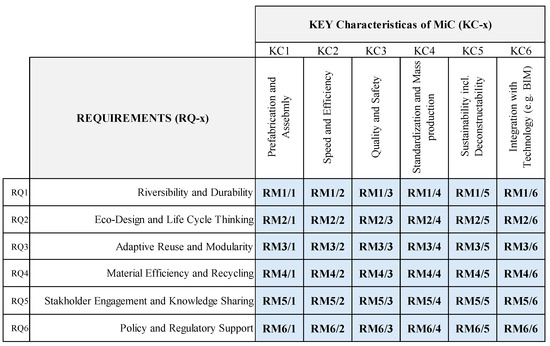
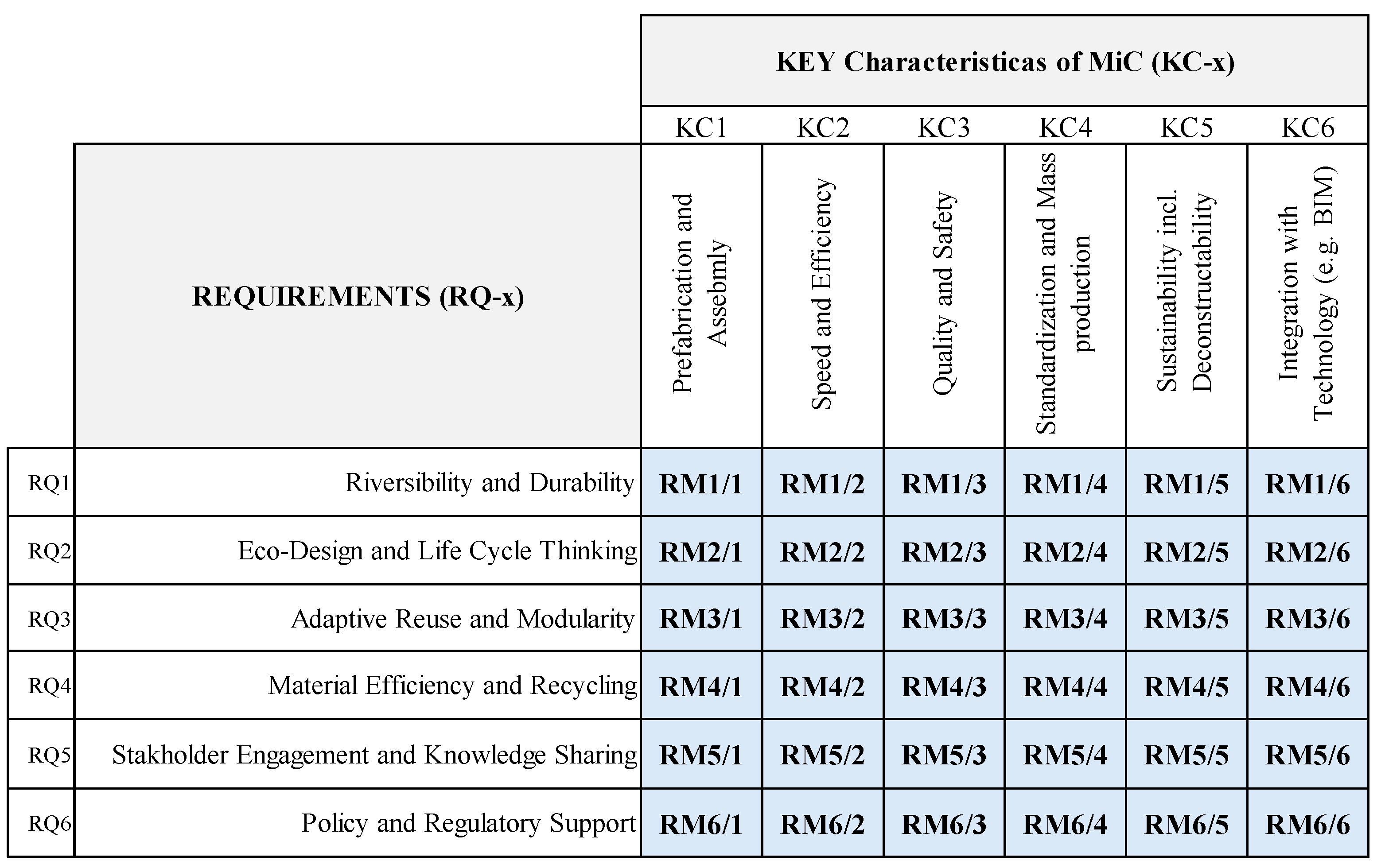
To operationalize this framework, the requirement matrix (RM-x) in Figure 3 was developed to evaluate how each MiC characteristic theoretically meets specific circular city requirements. RM-x aligns six construction industry requirements, derived from circular economy principles in urban contexts, with key MiC characteristics identified through a thematic analysis of the recent literature. While this approach offers theoretical rigor and structural clarity, empirical testing is necessary to validate its applicability.
Figure 3.
Requirement matrix (RM-x).
This matrix evaluates the relevance between these two aspects. Each element within the matrix, defined by the key requirements (RQ-x|X-axis) and the key characteristics (KC-x|Y-axis), is assigned a unique index. The initial digit represents the X-axis, while the subsequent digit following the slash denotes the Y-axis.
In the Discussion Section, these requirements (RQ-x) are evaluated for the key characteristics (KC-x) of MiC in a horizontal manner within the matrix. Specifically, the assessment is conducted according to the six requirements (RQ1–RQ6) in relation to the six key characteristics of MiC (KC1–KC6). By aligning RQ1–RQ6 with KC1–KC6, the requirement matrix operationalizes the Triple Bottom Line framework, showing how MiC can simultaneously address environmental, social, and economic objectives of circular cities. The RM indices therefore provide a structured representation of where MiC most strongly contributes to each TBL dimension and where further empirical investigation is needed.
An overview of the included studies and their key characteristics (author, year, focus area, research method, and contribution to the framework) is provided in Table A1 (Study Characteristics) in the Appendix A.
5. Discussion
5.1. Reversibility and Durability
Reversibility and durability are essential criteria for circular building technologies, aiming to extend service life and close material loops. Reversibility involves designing buildings for easy disassembly, while durability ensures long-lasting structures. Prefabrication in modular integrated construction (MiC) supports circular construction by enabling straightforward disassembly and component reuse, aligning with principles of adaptability and disassembly [39]. The link between reversibility, durability, and prefabrication (RM1/1) highlights design for disassembly and extended service life as key indicators for circular construction, consolidating prior research that mainly focused on component-level reversibility rather than prefabricated MiC systems [40,41]. This matrix presents these as explicit requirements for MiC in circular urban contexts.
The speed and efficiency requirement (RM1/2) correlates with reversibility, as faster disassembly reduces construction time, though durability shows no direct effect on construction duration, since durable systems may either shorten or lengthen it. MiC’s factory-based production enhances quality control and safety (RM1/3) compared to traditional methods by shifting assembly to industrially controlled environments, thereby extending building service life [40]. Standardization and mass production (RM1/4) further improve reversibility and durability by ensuring structural integrity and consistent quality, strengthening MiC as a durable construction solution [22,42,43].
Integrating sustainability and deconstructability (RM1/5) reinforces both reversibility and durability; durable materials reduce replacements and resource use, but without reversibility, durable components risk becoming waste [6,29]. From a Triple Bottom Line (TBL) perspective, these criteria mainly address environmental goals through extended service life and material loop closure while supporting economic performance by preserving asset value over multiple cycles.
Digital technologies (RM1/6), including Building Information Modeling (BIM) and IoT monitoring, play a crucial role by enabling real-time project management and sustainability tracking, which facilitates compliance with environmental standards. These tools link environmental benefits from reversibility and durability with cost control and risk reduction throughout the construction lifecycle [12]. These digital enablers translate TBL goals into operational indicators by linking environmental gains from reversibility and durability with cost control and risk reduction at project level.
5.2. Eco-Design and Life Cycle Thinking
Eco-design and life cycle thinking (LCT) are central to sustainable construction within circular city initiatives, particularly in modular integrated construction (MiC), which emphasizes prefabrication and assembly (RM2/1). Prefabrication enables efficient resource use and waste reduction by supporting design for disassembly (DfD), enhancing reuse and recycling potential [9,10,44]. While prior studies highlight MiC as suitable for DfD and LCT, these strategies are rarely embedded within a broader circular city framework. Positioning eco-design and LCT in RQ-2 clarifies their concrete expectations for MiC projects.
MiC’s speed and efficiency (RM2/2) benefit from eco-design principles like DfD, which facilitate faster assembly and disassembly, supporting material circularity [9,10]. Life cycle thinking optimizes all construction phases to minimize environmental impact, reduce waste, and improve resource efficiency through material reuse and recycling [6,45]. These approaches operationalize the environmental pillar of the Triple Bottom Line (TBL) while reinforcing economic efficiency and social responsibility via safe-and-sustainable-by-design (SSbD) methods.
Safety and quality (RM2/3) are integral to eco-design and LCT, with SSbD ensuring materials and processes are environmentally friendly and safe for health [46]. Integrating safety into design reduces risks throughout the building lifecycle, extending SSbD principles beyond materials and product policy to MiC project delivery and quality management [46,47,48]. This framing embeds health and safety as core social dimensions of circular construction.
Standardization (RM2/4) underpins eco-design and LCT by establishing consistent criteria for assessing and reducing environmental impacts throughout the product lifecycle, ensuring reliable implementation and performance [45,49,50]. In mass production, eco-design and lean design combined with Industry 4.0 technologies facilitate the efficient production of eco-efficient modular components that meet sustainability goals [51,52].
Sustainability and deconstructability (RM2/5) are key MiC features aligned with circular economy principles. Effective deconstructability relies on integrating component data into material databases, supporting the concept of buildings as material banks to maximize material reuse and minimize waste [53]. Deconstruction analytics further optimize end-of-life performance, enabling efficient material recovery and fostering closed-loop construction systems essential for circularity [54,55].
Digital technologies like BIM and Industry 4.0 (RM2/6) enhance eco-design, LCT, and lean construction by improving efficiency, sustainability, and circular economy strategies, advancing MiC’s eco-efficiency and sustainability [51]. The strong links between RQ-2, standardization, mass production, and technological integration (RM2/4, RM2/6) confirm that Industry 4.0, BIM, and Life Cycle Assessment are critical enablers of circular construction. The matrix clarifies these digital and lean approaches primarily operationalize eco-design and life cycle thinking, with more indirect effects on stakeholder engagement or policy support.
5.3. Adaptive Reuse and Modularity
Adaptive reuse and modularity are central to circular economy strategies in construction, with prefabricated modular building systems (RM3/1) enabling component reuse and waste reduction through off-site manufacturing and design for disassembly (DfD) [6,9,44]. From a Triple Bottom Line (TBL) perspective, these approaches combine environmental benefits from avoided demolition with economic flexibility and social gains such as affordable, adaptable housing.
MiC’s speed and efficiency (RM3/2) facilitate rapid construction and adaptation, supporting sustainable urban transitions by reducing time and resource demands [18,56]. Quality and safety (RM3/3) are ensured through rigorous off-site and on-site inspections, enhancing durability and making structures suitable for multiple life cycles [57]. Factory-based production also improves worker safety compared to traditional sites [58]. Prefabricated components and modules manufactured in a factory setting offer a safer environment for workers compared to traditional construction sites. The industrialized processes employed in factories contribute to the maintenance of safety and quality standards.
Standardization and mass production (RM3/4) underpin adaptive reuse by enabling easy disassembly, reconfiguration, and reuse of modular components, essential for circular cities adapting to changing needs with minimal resource use [58].
Sustainability and deconstructability (RM3/5) further support circularity by enabling selective dismantling and material recovery, maximizing asset utility and minimizing waste [59,60,61]. This integration exemplifies how adaptive modular systems address all three TBL dimensions at an urban scale.
Technological integration in MiC (RM3/6), including BIM, enhances design, management, and reuse of components, reducing waste and resource consumption in line with circular economy principles [62].
The consistent patterns across RM3/1–RM3/6 demonstrate that adaptive reuse and modularity are the clearest expressions of MiC’s circular potential, systematizing scattered literature claims. Despite growing interest in circular construction tools and stakeholder collaboration, explicit focus on MiC projects remains limited [63].
5.4. Material Efficiency and Recycling
Modular integrated construction (MiC) enhances material efficiency and recycling by reducing waste through precise prefabrication (RM4/1) and enabling easy disassembly and reassembly of components, key to circular design [64,65]. This aligns with LCA findings, showing lower waste and higher recycling potential for prefabricated systems, though those often focus only on environmental aspects. The matrix explicitly links material efficiency and recycling (RQ-4) to MiC’s organizational and technological features.
By shortening project durations, MiC reduces energy use and emissions on-site (RM4/2), supporting the environmental and economic pillars of the Triple Bottom Line (TBL) [11]. Improved safety and quality (RM4/3) further optimize resource use and promote sustainable practices, minimizing waste through precise prefabrication and fewer on-site errors [38].
Standardization and mass production (RM4/4) advance resource efficiency by encouraging durable, repairable, and recyclable materials, extending product lifespans and facilitating reuse [66,67]. While standardization may limit design variety, it clearly supports recyclability and material traceability.
Sustainability and deconstructability (RM4/5) enable efficient recovery and reuse of components, forming the basis for circular material loops essential to a circular economy [55]. Technologies like BIM (RM4/6) provide frameworks to manage materials sustainably, reduce waste, and embed circularity metrics into MiC projects, translating TBL goals into measurable indicators [68]. The matrix positions MiC as a practical platform for emerging circularity tools such as material passports and BIM-based assessments, highlighting its suitability as a pilot for these innovations.
In conclusion, the following pertains to requirement RQ4: Material efficiency and recycling directly contribute to the environmental dimension of the Triple Bottom Line (TBL) by minimizing resource consumption and emissions. Concurrently, precision prefabrication enhances the economic dimension by reducing material costs and losses associated with waste.
5.5. Stakeholder Engagement and Knowledge Sharing
Effective stakeholder engagement and knowledge sharing are crucial for MiC projects, enabling seamless collaboration among designers, manufacturers, and contractors throughout prefabrication and assembly phases (RM5/1). This collaborative approach ensures design specifications translate effectively into manufacturing processes and assembly sequences, reducing fragmentation and improving integration across the value chain. Early alignment of technical requirements, prefabrication standards, and assembly protocols minimizes errors, rework, and delays during the critical assembly stage [68].
From a TBL perspective, stakeholder engagement and knowledge sharing serve as key social enablers that determine whether the environmental and economic benefits of MiC can be realized in practice. Open information exchange accelerates decision making, resolves conflicts early, and streamlines workflows—factors essential to meeting the rapid timelines typical of MiC projects (RM5/2). Committed stakeholders collaboratively establish and uphold quality and safety standards (RM5/3), sharing best practices and lessons learned to reduce risks and improve project outcomes [69].
This pattern resonates with city-level circular transition studies that identify fragmented responsibilities and weak coordination as core barriers to implementing circular economy strategies in the built environment. By linking stakeholder engagement to specific MiC characteristics (especially KC-1, KC-2, and KC-3 in RM5/1–RM5/3), the matrix makes clear that collaboration is not an abstract governance ideal but a prerequisite for translating modular designs into reliable, rapid and safe project delivery.
Stakeholder collaboration is also vital for developing and adopting standardized components and processes (RM5/4), supporting benchmarking and the consistent application of mass production techniques [41]. Furthermore, it is essential for integrating sustainability goals (RM5/5), such as material selection and deconstructability, into MiC projects. Knowledge sharing fosters innovation and the adoption of sustainable practices.
Earlier research on off-site construction emphasized the need for standards and digital collaboration platforms but treated these primarily as technical or contractual challenges. In contrast, the requirement matrix frames standardization, sustainability, and digital tools as outcomes of knowledge sharing, thereby aligning MiC practice with broader circular city goals related to learning, experimentation, and capacity-building. Consequently, the matrix confirms that collaborative capabilities are a cross-cutting TBL requirement rather than a peripheral governance add-on.
5.6. Policy and Regulatory Support
Policy and regulatory support are foundational enablers for MiC, directly influencing all six core characteristics. Regulatory frameworks and supportive policies are essential for facilitating offsite prefabrication (RM6/1) by ensuring that building codes, standards, and approval processes accommodate modular components and their assembly methods. Overly stringent or outdated regulations can impede the adoption of prefabrication practices [70].
To address this, policies that streamline approvals, provide clear guidelines, and offer incentives can significantly reduce project timelines (RM6/2), thereby supporting MiC’s promise of faster construction and improved efficiency. However, regulatory bottlenecks remain a common barrier to realizing these benefits [58].
These findings confirm that regulatory uncertainty and misalignment of building codes are among the most frequently cited obstacles to MiC adoption and circular construction more broadly. The strong relevance of RQ-6 to prefabrication and speed (RM6/1, RM6/2) underscores that MiC’s headline advantages cannot be fully realized without corresponding adaptations in approval procedures and technical standards. Policy and regulatory support form the institutional layer through which TBL objectives are translated into binding rules, incentives, and procurement criteria for MiC.
Quality acceptance standards and safety regulations tailored to MiC (RM6/3) are critical for stakeholder confidence and public acceptance. These standards ensure that all materials and processes meet stringent safety and quality benchmarks specific to MiC applications. Compliance with RM6/3 facilitates regulatory approval and supports consistent manufacturing practices, ultimately underpinning trust among manufacturers, regulators, and end-users alike [71]. Additionally, government-led standardization initiatives and regulatory harmonization (RM6/4) promote mass production by providing clear specifications and reducing market fragmentation. The lack of authoritative specifications is a recognized barrier, necessitating policy intervention to foster industry-wide standards [38].
Where existing studies often call generically for ‘supportive policy frameworks’, the matrix specifies that quality acceptance, standardization initiatives and regulatory harmonization primarily underpin KC-3 and KC-4, i.e., reliable quality and scalable mass production. This adds analytical precision to policy discussions by indicating which MiC characteristics are most sensitive to regulatory design.
Environmental protection policies and sustainability incentives (RM6/5) drive MiC adoption by promoting waste reduction, resource efficiency, and deconstructability. Policy frameworks can mandate or encourage sustainable practices, amplifying MiC’s environmental benefits [59]. Furthermore, policies that encourage or require the use of digital technologies (RM6/6) in regulatory submissions and project delivery foster greater integration of technology in MiC. Regulatory clarity around digital processes supports innovation and efficiency [70].
The identified links between RQ-6 and sustainability incentives as well as digital-process requirements (RM6/5, RM6/6) extend emerging policy debates on green public procurement and digital building logbooks to the modular construction context. Consequently, the framework suggests that MiC could serve as an early adopter sector for policy instruments combining environmental performance criteria with mandatory digital data flow. Positioning these policy instruments explicitly within the TBL helps cities design regulatory mixes that balance environmental stringency with socioeconomic inclusiveness and market feasibility.
6. Conclusions
This study aimed to synthesize existing evidence on how modular integrated construction (MiC) technologies can support circular city initiatives through a structured literature review and the development of a requirement matrix. The resulting framework serves as a theoretical lens linking circular city criteria to six construction technology requirements (RQ1–RQ6) and six MiC characteristics (KC1–KC6), highlighting areas of potential alignment and identifying where relationships remain ambiguous or under-explored. Rather than demonstrating realized impacts, the matrix indicates MiC’s configurational potential to contribute to circular urban development.
The findings reveal that reversibility and durability are most strongly supported when prefabrication and standardized interfaces are explicitly designed for disassembly. Eco-design and life cycle thinking are primarily operationalized through digital tools such as BIM and LCA, alongside shared standards. Adaptive reuse and modularity emerge as the areas of greatest theoretical synergy, where MiC’s modular logic aligns closely with circular city goals of reconfigurability and extended asset life. Material efficiency, stakeholder engagement, and policy support are identified as necessary but highly context-dependent enablers. The analysis also highlights inherent trade-offs, including those between construction speed and long-term durability, and between standardization and design flexibility. Many promising links depend on project governance, regulatory frameworks, and cross-stakeholder collaboration, which the current literature only partially addresses, especially regarding city-scale policy mixes and procurement practices. Several limitations constrain the strength of these conclusions. The study relies exclusively on secondary sources, focuses on publications from 2016 to 2025, and lacks primary stakeholder input or detailed case studies. Consequently, the requirement matrix should be viewed as a hypothesis-generating framework that organizes existing insights and identifies promising mechanisms, rather than as evidence of validated causal relationships between MiC and circular city outcomes.
Practically, MiC’s configurational potential offers valuable guidance for circular urban development strategies, but successful implementation depends on project governance, policy mixes, and stakeholder collaboration. Policymakers and practitioners should carefully consider trade-offs and context-specific enablers when integrating MiC with circular city objectives. Academically, this framework invites empirical validation through comparative case studies, stakeholder interviews, and survey-based assessments across diverse urban and regulatory contexts. Future research should focus on testing the strongest theoretical links—particularly those related to adaptive reuse, material efficiency, and policy design—refining requirement categories, and quantifying trade-offs among time, cost, environmental performance, and socioeconomic outcomes. This study provides a structured foundation for advancing empirical research on MiC and circular cities rather than a definitive blueprint for practice.
Supplementary Materials
The following supporting information can be downloaded at https://www.mdpi.com/article/10.3390/su18041817/s1, Table S1: PRISMA 2020 Checklist. Ref. [72] cited in Supplementary Materials.
Author Contributions
Conceptualization, J.Z., S.F. and F.R.; methodology, J.Z. and U.R.G.; validation, F.R. and U.R.G.; formal analysis, F.R.; investigation, S.F.; resources, J.Z.; data curation, J.Z. and S.F.; writing—original draft preparation, J.Z. and U.R.G.; writing—review and editing, F.R. and U.R.G.; visualization, J.Z.; supervision, J.Z.; project administration, S.F. All authors have read and agreed to the published version of the manuscript.
Funding
This research received no external funding.
Institutional Review Board Statement
Not applicable.
Informed Consent Statement
Not applicable.
Data Availability Statement
The original contributions presented in this study are included in the article/Supplementary Materials. Further inquiries can be directed to the corresponding author.
Conflicts of Interest
The authors declare no conflict of interest.
Appendix A
Table A1.
Characteristics of Included Studies (n = 71).
References
- Lakatos, E.S.; Yong, G.; Szilagyi, A.; Clinci, D.S.; Georgescu, L.; Iticescu, C.; Cioca, L.-I. Conceptualizing Core Aspects on Circular Economy in Cities. Sustainability 2021, 13, 7549. [Google Scholar] [CrossRef] [Scilit]
- Charef, R. A Digital Framework for the Implementation of the Circular Economy in the Construction Sector: Expert Opinions. Sustainability 2024, 16, 5849. [Google Scholar] [CrossRef] [Scilit]
- Williams, J. Circular cities. Urban Stud. 2019, 56, 2746–2762. [Google Scholar] [CrossRef] [Scilit]
- Brincat, C.; de Graaf, I.; Vargas, C.L.; Mitsios, A.; Neubauer, N.; Adams, K.; Hobbs, G. Study on Measuring the Application of Circular Approaches in the Construction Industry Ecosystem; European Commission: Brussels, Belgium, 2023. [Google Scholar]
- Benachio, G.L.F.; Freitas, M.D.C.D.; Tavares, S.F. Circular economy in the construction industry: A systematic literature review. J. Clean. Prod. 2020, 260, 121046. [Google Scholar] [CrossRef] [Scilit]
- Garusinghe, G.D.A.U.; Perera, B.A.K.S.; Weerapperuma, U.S. Integrating Circular Economy Principles in Modular Construction to Enhance Sustainability. Sustainability 2023, 15, 11730. [Google Scholar] [CrossRef] [Scilit]
- Sajid, Z.W.; Ullah, F.; Qayyum, S.; Masood, R. Climate Change Mitigation through Modular Construction. Smart Cities 2024, 7, 566–596. [Google Scholar] [CrossRef] [Scilit]
- Coskun, C.; Lee, J.; Xiao, J.; Graff, G.; Kang, K.; Besiktepe, D. Opportunities and Challenges in the Implementation of Modular Construction Methods for Urban Revitalization. Sustainability 2024, 16, 7242. [Google Scholar] [CrossRef] [Scilit]
- Jayawardana, J.; Sandanayake, M.; Kulatunga, A.K.; Jayasinghe, J.A.S.C.; Zhang, G.; Osadith, S.A.U. Evaluating the Circular Economy Potential of Modular Construction in Developing Economies—A Life Cycle Assessment. Sustainability 2023, 15, 16336. [Google Scholar] [CrossRef] [Scilit]
- Dewagoda, K.G.; Ng, S.T.; Kumaraswamy, M.M.; Chen, J. Design for Circular Manufacturing and Assembly (DfCMA): Synergising Circularity and Modularity in the Building Construction Industry. Sustainability 2024, 16, 9192. [Google Scholar] [CrossRef] [Scilit]
- Nguyen, T.D.H.N.; Moon, H.; Ahn, Y. Critical Review of Trends in Modular Integrated Construction Research with a Focus on Sustainability. Sustainability 2022, 14, 12282. [Google Scholar] [CrossRef] [Scilit]
- Loo, B.P.Y.; Wong, R.W.M. Towards a Conceptual Framework of Using Technology to Support Smart Construction: The Case of Modular Integrated Construction (MiC). Buildings 2023, 13, 372. [Google Scholar] [CrossRef] [Scilit]
- Li, J.; Andersen, L.V.; Hudert, M.M. The Potential Contribution of Modular Volumetric Timber Buildings to Circular Construction: A State-of-the-Art Review Based on Literature and 60 Case Studies. Sustainability 2023, 15, 16203. [Google Scholar] [CrossRef] [Scilit]
- Mackenbach, S.; Zeller, J.C.; Osebold, R. A Roadmap towards Circularity—Modular Construction as a Tool for Circular Economy in the Built Environment. IOP Conf. Ser. Earth Environ. Sci. 2020, 588, 052027. [Google Scholar] [CrossRef] [Scilit]
- Kyrö, R.; Jylhä, T.; Peltokorpi, A. Embodying circularity through usable relocatable modular buildings. Facilities 2019, 37, 75–90. [Google Scholar] [CrossRef] [Scilit]
- Khan, A.A.; Yu, R.; Liu, T.; Gu, N.; Walsh, J. Volumetric Modular Construction Risks: A Comprehensive Review and Digital-Technology-Coupled Circular Mitigation Strategies. Sustainability 2023, 15, 7019. [Google Scholar] [CrossRef] [Scilit]
- Ghisellini, P.; Cialani, C.; Ulgiati, S. A Review on Circular Economy: The Expected Transition to a Balanced Interplay of Environmental and Economic Systems. J. Clean. Prod. 2016, 114, 11–32. [Google Scholar] [CrossRef] [Scilit]
- Joensuu, T.; Edelman, H.; Saari, A. Circular economy practices in the built environment. J. Clean. Prod. 2020, 276, 124215. [Google Scholar] [CrossRef] [Scilit]
- Williams, J. Circular Cities: What Are the Benefits of Circular Development? Sustainability 2021, 13, 5725. [Google Scholar] [CrossRef] [Scilit]
- Prendeville, S.; Cherim, E.; Bocken, N. Circular Cities: Mapping Six Cities in Transition. Environ. Innov. Soc. Transit. 2018, 26, 171–194. [Google Scholar] [CrossRef] [Scilit]
- Gao, A. Characteristics and Application of Modular Integrated Construction. Highlights Sci. Eng. Technol. 2022, 28, 206–212. [Google Scholar] [CrossRef] [Scilit]
- Thai, H.-T.; Ngo, T.; Uy, B. A review on modular construction for high-rise buildings. Structures 2020, 28, 1265–1290. [Google Scholar] [CrossRef] [Scilit]
- Fernandes, J.; Ferrão, P. Urban Metabolism-Based Approaches for Promoting Circular Economy in Buildings Refurbishment. Environments 2023, 10, 13. [Google Scholar] [CrossRef] [Scilit]
- Balasubramanian, S.; Shukla, V.; Islam, N.; Manghat, S. Construction Industry 4.0 and Sustainability: An Enabling Framework. IEEE Trans. Eng. Manag. 2021, 71, 1–19. [Google Scholar] [CrossRef] [Scilit]
- Poderytė, I.; Banaitienė, N.; Banaitis, A. Life Cycle Sustainability Assessment of Buildings: A Scientometric Analysis. Buildings 2025, 15, 381. [Google Scholar] [CrossRef] [Scilit]
- Nogueira, E.; Gomes, S.; Lopes, J.M. Triple Bottom Line, Sustainability, and Economic Development: What Binds Them Together? A Bibliometric Approach. Sustainability 2023, 15, 6706. [Google Scholar] [CrossRef] [Scilit]
- Williams, J. Circular cities: Planning for circular development in European cities. Eur. Plan. Stud. 2022, 31, 14–35. [Google Scholar] [CrossRef] [Scilit]
- Brglez, K.; Perc, M.; Lukman, R.K. The complexity and interconnectedness of circular cities and the circular economy for sustainability. Sustain. Dev. 2023, 32, 2049–2065. [Google Scholar] [CrossRef] [Scilit]
- Antonini, E.; Boeri, A.; Lauria, M.; Giglio, F. Reversibility and Durability as Potential Indicators for Circular Building Technologies. Sustainability 2020, 12, 7659. [Google Scholar] [CrossRef] [Scilit]
- Bonoli, A.; Zanni, S.; Serrano-Bernardo, F. Sustainability in Building and Construction within the Framework of Circular Cities and European New Green Deal. The Contribution of Concrete Recycling. Sustainability 2021, 13, 2139. [Google Scholar] [CrossRef] [Scilit]
- Tran, D.B.; Tran, V.T.; Pham, X.A.; Nguyen, V.T. A General Framework for Sustainability Assessment of Buildings: A Life-Cycle Thinking Approach. Sustainability 2023, 15, 10770. [Google Scholar] [CrossRef] [Scilit]
- Imen, Ö. Construction and built environment in circular economy: A comprehensive literature review. J. Clean. Prod. 2021, 305, 127180. [Google Scholar] [CrossRef] [Scilit]
- Norouzi, M.; Chàfer, M.; Cabeza, L.F.; Jiménez, L.; Boer, D. Circular economy in the building and construction sector: A scientific evolution analysis. J. Build. Eng. 2021, 44, 102704. [Google Scholar] [CrossRef] [Scilit]
- Campbell-Johnston, K.; Cate, J.T.; Elfering-Petrovic, M.; Gupta, J. City level circular transitions: Barriers and limits in Amsterdam, Utrecht and The Hague. J. Clean. Prod. 2019, 235, 1232–1239. [Google Scholar] [CrossRef] [Scilit]
- Tirado, R.; Aublet, A.; Laurenceau, S.; Habert, G. Challenges and Opportunities for Circular Economy Promotion in the Building Sector. Sustainability 2022, 14, 1569. [Google Scholar] [CrossRef] [Scilit]
- Hyun, H.; Kim, H.; Lee, H.-S.; Park, M.; Lee, J. Integrated Design Process for Modular Construction Projects to Reduce Rework. Sustainability 2020, 12, 530. [Google Scholar] [CrossRef] [Scilit]
- Wuni, I.Y.; Shen, G.Q. Barriers to the adoption of modular integrated construction: Systematic review and meta-analysis, integrated conceptual framework, and strategies. J. Clean. Prod. 2020, 249, 119347. [Google Scholar] [CrossRef] [Scilit]
- Wuni, I.Y.; Shen, G.Q.; Osei-Kyei, R. Quantitative evaluation and ranking of the critical success factors for modular integrated construction projects. Int. J. Constr. Manag. 2020, 22, 2108–2120. [Google Scholar] [CrossRef] [Scilit]
- Dams, B.; Maskell, D.; Shea, A.; Allen, S.; Driesser, M.; Kretschmann, T.; Walker, P.; Emmitt, S. A circular construction evaluation framework to promote designing for disassembly and adaptability. J. Clean. Prod. 2021, 316, 128122. [Google Scholar] [CrossRef] [Scilit]
- Wuni, I.Y.; Shen, G.Q.P.; Mahmud, A.T. Critical risk factors in the application of modular integrated construction: A systematic review. Int. J. Constr. Manag. 2019, 22, 133–147. [Google Scholar] [CrossRef] [Scilit]
- Wuni, I.Y.; Shen, G.Q. Critical success factors for modular integrated construction projects: A review. Build. Res. Inf. 2019, 48, 763–784. [Google Scholar] [CrossRef] [Scilit]
- Ferdous, W.; Bai, Y.; Ngo, T.D.; Manalo, A.; Mendis, P. New advancements, challenges and opportunities of multi-storey modular buildings—A state-of-the-art review. Eng. Struct. 2019, 183, 883–893. [Google Scholar] [CrossRef] [Scilit]
- Lacey, A.W.; Chen, W.; Hao, H.; Bi, K. Structural response of modular buildings—An overview. J. Build. Eng. 2018, 16, 45–56. [Google Scholar] [CrossRef] [Scilit]
- Zhuang, G.-L.; Shih, S.-G.; Wagiri, F. Circular economy and sustainable development goals: Exploring the potentials of reusable modular components in circular economy business model. J. Clean. Prod. 2023, 414, 137503. [Google Scholar] [CrossRef] [Scilit]
- Kong, L.; Wang, L.; Li, F.; Tian, G.; Li, J.; Cai, Z.; Zhou, J.; Fu, Y. A life-cycle integrated model for product eco-design in the conceptual design phase. J. Clean. Prod. 2022, 363, 132516. [Google Scholar] [CrossRef] [Scilit]
- Soeteman-Hernández, L.G.; Blanco, C.F.; Koese, M.; Sips, A.J.; Noorlander, C.W.; Peijnenburg, W.J. Life cycle thinking and safe-and-sustainable-by-design approaches for the battery innovation landscape. iScience 2023, 26, 106060. [Google Scholar] [CrossRef] [Scilit]
- Petit-Boix, A.; Llorach-Massana, P.; Sanjuan-Delmás, D.; Sierra-Pérez, J.; Vinyes, E.; Gabarrell, X.; Rieradevall, J.; Sanyé-Mengual, E. Application of life cycle thinking towards sustainable cities: A review. J. Clean. Prod. 2017, 166, 939–951. [Google Scholar] [CrossRef] [Scilit]
- Foschi, E.; Zanni, S.; Bonoli, A. Combining Eco-Design and LCA as Decision-Making Process to Prevent Plastics in Packaging Application. Sustainability 2020, 12, 9738. [Google Scholar] [CrossRef] [Scilit]
- Navajas, A.; Uriarte, L.; Gandía, L.M. Application of Eco-Design and Life Cycle Assessment Standards for Environmental Impact Reduction of an Industrial Product. Sustainability 2017, 9, 1724. [Google Scholar] [CrossRef] [Scilit]
- Joachimiak-Lechman, K. Life cycle perspective in design and product development. Eng. Manag. Prod. Serv. 2024, 16, 143–156. [Google Scholar] [CrossRef] [Scilit]
- Dahmani, N.; Benhida, K.; Belhadi, A.; Kamble, S.; Elfezazi, S.; Jauhar, S.K. Smart circular product design strategies towards eco-effective production systems: A lean eco-design industry 4.0 framework. J. Clean. Prod. 2021, 320, 128847. [Google Scholar] [CrossRef] [Scilit]
- Vacchi, M.; Siligardi, C.; Cedillo-González, E.I.; Ferrari, A.M.; Settembre-Blundo, D. Industry 4.0 and Smart Data as Enablers of the Circular Economy in Manufacturing: Product Re-Engineering with Circular Eco-Design. Sustainability 2021, 13, 10366. [Google Scholar] [CrossRef] [Scilit]
- Guerriero, A.; Busio, F.; Saidani, M.; Boje, C.; Mack, N. Combining Building Information Model and Life Cycle Assessment for Defining Circular Economy Strategies. Sustainability 2024, 16, 4561. [Google Scholar] [CrossRef] [Scilit]
- Akanbi, L.A.; Oyedele, L.O.; Omoteso, K.; Bilal, M.; Akinade, O.O.; Ajayi, A.O.; Delgado, J.M.D.; Owolabi, H.A. Disassembly and deconstruction analytics system (D-DAS) for construction in a circular economy. J. Clean. Prod. 2019, 223, 386–396. [Google Scholar] [CrossRef] [Scilit]
- Lynch, N. Unbuilding the city: Deconstruction and the circular economy in Vancouver. Environ. Plan. A Econ. Space 2022, 54, 1586–1603. [Google Scholar] [CrossRef] [Scilit]
- Marika, G.; Beatrice, M.; Francesca, A. Adaptive Reuse and Sustainability Protocols in Italy: Relationship with Circular Economy. Sustainability 2021, 13, 8077. [Google Scholar] [CrossRef] [Scilit]
- Li, C.; Mak, S.; Tang, W.F.; Chen, Y.H.; Lam, S.K. How HK Construction Inspector would enhance the offsite Quality Inspection China Manufacturing Plant for MiC Projects? In Proceedings of the 2020 IEEE International Symposium on Product Compliance Engineering-Asia (ISPCE-CN), Chongqing/Hong Kong, China, 6–8 November 2020; pp. 1–6. [Google Scholar]
- Khan, A.; Yu, R.; Liu, T.; Guan, H.; Oh, E. Drivers towards Adopting Modular Integrated Construction for Affordable Sustainable Housing: A Total Interpretive Structural Modelling (TISM) Method. Buildings 2022, 12, 637. [Google Scholar] [CrossRef] [Scilit]
- Sanchez, B.; Haas, C. Capital project planning for a circular economy. Constr. Manag. Econ. 2017, 36, 303–312. [Google Scholar] [CrossRef] [Scilit]
- Bertino, G.; Kisser, J.; Zeilinger, J.; Langergraber, G.; Fischer, T.; Österreicher, D. Fundamentals of Building Deconstruction as a Circular Economy Strategy for the Reuse of Construction Materials. Appl. Sci. 2021, 11, 939. [Google Scholar] [CrossRef] [Scilit]
- Sanchez, B.; Rausch, C.; Haas, C. Deconstruction programming for adaptive reuse of buildings. Autom. Constr. 2019, 107, 102921. [Google Scholar] [CrossRef] [Scilit]
- Santos, P.; Cervantes, G.C.; Zaragoza-Benzal, A.; Byrne, A.; Karaca, F.; Ferrández, D.; Salles, A.; Bragança, L. Circular Material Usage Strategies and Principles in Buildings: A Review. Buildings 2024, 14, 281. [Google Scholar] [CrossRef] [Scilit]
- Zhang, Q.; Ali, Z.M.; Abidin, N.Z. Sustainable adaptive reuse of historic buildings: Development of a framework from systematic review. npj Herit. Sci. 2025, 13, 619. [Google Scholar] [CrossRef] [Scilit]
- Dumée, L.F. Circular Materials and Circular Design—Review on Challenges Towards Sustainable Manufacturing and Recycling. Circ. Econ. Sustain. 2021, 2, 9–23. [Google Scholar] [CrossRef] [Scilit] [PubMed]
- Doussoulin, J.P.; Bittencourt, M. How effective is the construction sector in promoting the circular economy in Brazil and France? A waste input-output analysis. Struct. Change Econ. Dyn. 2022, 60, 47–58. [Google Scholar] [CrossRef] [Scilit]
- Kedir, F.; Hall, D.M. Resource efficiency in industrialized housing construction—A systematic review of current performance and future opportunities. J. Clean. Prod. 2020, 286, 125443. [Google Scholar] [CrossRef] [Scilit]
- Cormenier, T.; Patra, M.; Garnier, C. European CEN-CENELEC Standardization on Material Efficiency for longer lifespan within Circular Economy. In Proceedings of the International Conference on Components and Systems for DC Grids, ELTEE 2018, Grenoble, France, 16–17 October 2018. [Google Scholar]
- Jiang, L.; van den Berg, M.; Voordijk, H.; Adriaanse, A. Material efficiency insights with bim-based circularity assessment: A design science research study. In Proceedings of the 38th Annual ARCOM Conference 2022, Glasgow, UK, 5–7 September 2022. [Google Scholar]
- Zhan, W.; Pan, W.; Law, W.; Shen, H. Stakeholders’ Knowledge, Attitudes, and Intentions of Adopting Modular Integrated Construction for Sustainable Development in Hong Kong. J. Manag. Eng. 2024, 40, 04023070. [Google Scholar] [CrossRef] [Scilit]
- Jin, X.; Ekanayake, E.; Shen, G.Q. Critical policy drivers for Modular integrated Construction projects in Hong Kong. Build. Res. Inf. 2021, 50, 467–484. [Google Scholar] [CrossRef] [Scilit]
- Jin, X.; Shen, G.; Luo, L.; Zhou, X. Influence of policies on stakeholders to drive the success of modular integrated construction in Hong Kong. Eng. Constr. Arch. Manag. 2024, 32, 2814–2843. [Google Scholar] [CrossRef] [Scilit]
- Page, M.J.; McKenzie, J.E.; Bossuyt, P.M.; Hoffmann, T.C.; Mulrow, C.D.; Shamseer, L.; Tetzlaff, J.M.; Akl, E.A.; Brennan, S.E.; Chou, R.; et al. The PRISMA 2020 statement: An updated guideline for reporting systematic reviews. BMJ 2021, 372, n71. [Google Scholar] [CrossRef] [Scilit] [PubMed]

Disclaimer/Publisher’s Note: The statements, opinions and data contained in all publications are solely those of the individual author(s) and contributor(s) and not of MDPI and/or the editor(s). MDPI and/or the editor(s) disclaim responsibility for any injury to people or property resulting from any ideas, methods, instructions or products referred to in the content. |
© 2026 by the authors. Licensee MDPI, Basel, Switzerland. This article is an open access article distributed under the terms and conditions of the Creative Commons Attribution (CC BY) license.