


Abstract
The study examines the relationship between entrepreneurial education and society’s approach to green energy. The findings highlight the crucial importance of this process for promoting an ecological and responsible economy. The starting point is the assumption that entrepreneurial competencies, particularly innovation and communication competencies and learning ability, can foster the perception of RES technologies as solutions that combine economic profitability with environmental benefits. Based on a literature review, a research gap was identified regarding the insufficient number of empirical analyses demonstrating the relationship between entrepreneurship education, key competencies, and attitudes toward renewable energy technologies. The study is quantitative in nature and is based on the analysis of survey data collected among high school and university students. The obtained results indicate that the effectiveness of entrepreneurship education is determined by the interaction of individual competencies and environmental conditions. Innovation and communication competencies and learning ability enhance educational outcomes, while technological barriers can significantly limit their positive impact. The analysis highlights the importance of a supportive institutional environment for the effective utilization of educational potential. On this basis, recommendations were formulated for the design of entrepreneurial education programs, emphasizing the need to integrate content related to renewable energy sources, the development of future competences and the reduction in technological barriers as elements supporting the transformation towards sustainable development.
1. Introduction
Global warming and rising energy consumption are the main challenges facing modern nations. These problems necessitate a fundamental shift in our approach to managing natural resources. Implementing sustainable and environmentally sound development models is becoming a key solution. Contemporary energy transformation extends far beyond the realm of technology and engineering. It is a profound social and educational process, requiring us to redefine our current attitudes toward energy. Without broad education and a social understanding of the mechanisms of this change, the full implementation of sustainable development models would be impossible [1,2,3]. Its implementation requires the development of new types of competencies combining economic knowledge, the ability to innovate, and environmental awareness. Contemporary entrepreneurship education serves as a bridge between economics and ecology. It equips citizens with the competencies necessary to respond to the rapid changes taking place in the global economy. Such education not only facilitates finding a foothold in the new job market but also actively supports environmental protection initiatives.
The definition of entrepreneurship has changed over time. It has moved from a narrow understanding (only a business) to a broader one. It now denotes the ability to cope with uncertain conditions. Entrepreneurship is the ability to identify and then capitalize on emerging opportunities [4,5,6]. Today’s curricula emphasize so-called future competencies. These include creativity, strategic planning, and teamwork. Skillful risk management is also crucial. However, it turns out that business knowledge alone is not enough. To ensure sustainable development, we need a much broader perspective [7,8,9,10,11]. Entrepreneurship education should be linked to energy topics. This approach teaches how to generate economic value in a responsible manner. Students gain the tools to create innovations that deliver real social and ecological benefits [11,12,13,14,15].
Although interest in this topic is growing, research findings on the impact of entrepreneurship education on sustainable development are inconsistent. The literature indicates that such education effectively develops analytical and creative skills. However, these competencies do not directly lead to specific actions in the renewable energy sector. This indicates a gap between the knowledge acquired and its practical application in the field of renewable energy [11]. The literature still lacks sufficient empirical evidence on this topic. We do not know exactly how specific teaching content and methods influence students’ actual environmental decisions. Data is particularly scarce regarding their willingness to invest in modern energy technologies. Clear answers are lacking as to whether education actually encourages young people to financially engage in sustainable development solutions.
Previous research has focused primarily on general entrepreneurial attitudes. However, these analyses often ignore the specific conditions of the green energy sector. As a result, there is a lack of studies that consider the unique characteristics and challenges specific to the renewable energy industry [16]. As a result, we still know little about the psychological and educational mechanisms that link entrepreneurship education with sustainable development efforts. Self-efficacy seems particularly important here. It determines a person’s ability to make decisions in uncertain conditions. Risk perception is an equally important factor. It directly influences willingness to invest in modern, albeit often expensive, renewable energy technologies.
This study combines educational and psychological perspectives. It offers an opportunity to explain how entrepreneurship education influences pro-environmental attitudes and engagement in energy transition. Quantitative methods are used in the research section, allowing for a multifaceted assessment of the relationship between education and the implementation of sustainable development principles.
The main goal of the study is to determine how entrepreneurial education influences the development of pro-innovation and pro-ecological attitudes among students. The analysis considers the psychological mechanisms and teaching methods that facilitate the integration of renewable energy sources into the teaching process. An important element is also examining how this education supports realistic decision-making regarding green energy. This approach allows for an assessment of the role of teaching in preparing young people for active participation in the energy transition.
2. Literature Review
Research on the relationship between entrepreneurship education and the development of the renewable energy sector is gaining importance and is being conducted with increasing intensity. Despite this, this area is still considered a relatively new field of study. Currently, there is a rapid increase in publications exploring this topic. However, there is still a need for further exploration to better understand the processes occurring within it [3,4,5,17]. The literature increasingly supports the view that entrepreneurship education serves not only as a tool for supporting individual competences but also as a mechanism influencing economic and energy transformation processes [1,2,18,19,20]. As a result, entrepreneurship is beginning to be conceptualized more broadly—as a driver of change that supports sustainable development goals [21,22,23]. One of the first areas to attempt to combine entrepreneurship with energy were online courses [24,25]. Beltrán Hernández de Galindo, Romero-Rodriguez, and Ramirez Montoya demonstrated that although MOOCs on sustainable energy attracted a wide audience, only 14.29% of participants saw their potential for creating a RES-related venture [26]. This result reveals a limited perception of “green” business opportunities even in environments that are declared to be entrepreneurial.
Mohamed and Sheikh Ali, conducting a cross-sectional analysis of research from 2009–2019, noted that entrepreneurship education is most often studied in a general manner, relying primarily on the theory of planned behavior and social learning [27]. Topics related to energy and renewable energy sources are addressed only marginally. This demonstrates the insufficient level of research on entrepreneurial education in the context of sustainable development. Currently, there is a distinct lack of studies that comprehensively connect these two areas. This situation indicates a significant research gap that requires further analysis.
The importance of entrepreneurship for green energy was strongly emphasized by Bendig, Brüss, and Degen based on a review of publications [16]. They noted that adaptive approaches dominate, while transformational approaches—key to changing market structures—are studied much less frequently. Eitan and co-authors, on the other hand, demonstrated the diverse and multidimensional nature of the renewable energy entrepreneur ecosystem [28], which indicates the need for flexible educational models.
From a regional perspective, Haldar demonstrated that local factors—institutional and cultural—can either foster or hinder the development of sustainable entrepreneurship [29]. At the same time, a growing number of studies emphasize the importance of entrepreneurial education in building sustainable development competencies. These include both analytical and social skills. It is indicated that such education allows for the effective combination of theoretical knowledge with practical actions for the benefit of the environment. This makes entrepreneurial education a crucial tool supporting the achievement of environmental goals [8,9,10]. The review by Hagebakken, Reimers and Solstad showed that entrepreneurship can strengthen local transformational capacities [11], and bibliometric analyses indicate the growing importance of links between entrepreneurship education and sustainable development goals [7,12,13,14,30,31].
Edokpolor, Somorin, and other researchers [15,32,33,34,35,36,37,38] emphasize the importance of practical skills, as well as the potential of new technologies, such as artificial intelligence, in personalizing entrepreneurship education [39,40,41]. This is confirmed by meta-analyses, which show that entrepreneurship education supports the development of intentions, knowledge, and attitudes conducive to undertaking business initiatives [42,43,44,45]. Further studies indicate that entrepreneurship education strengthens a sense of agency, especially in individuals without prior exposure to entrepreneurship [8,46,47], although its effects depend on the quality of the program and the institutional context [48,49,50]. This aligns with the sustainable entrepreneurship literature, which shows that entrepreneurs can create markets that support environmental protection [51,52,53,54,55], but this requires appropriate strategic and institutional competencies [56,57,58,59,60]. Research on competencies for sustainable development indicates that systemic, normative, and strategic competencies are particularly important [61,62], which can form the foundation for designing teaching modules in the field of renewable energy [63,64]. Simultaneously, work in the field of entrepreneurship psychology emphasizes the importance of moral factors and pro-environmental values in the process of opportunity recognition [65,66,67,68,69].
To understand the specificity of renewable energy, it is necessary to refer to research on barriers to the implementation of energy technologies [70,71,72,73,74], which indicates a combination of economic, infrastructural, and social obstacles. Research on community energy shows that the motivations of project participants are complex [75,76,77,78], which is important for designing education that engages students in real-world projects.
Simultaneously, IRENA/ILO reports indicate a growing global demand for “green competencies” [79,80,81,82,83,84,85], while EU documents suggest the need for systemic integration of renewable energy and ESG content in educational programs. Despite this, the literature indicates significant gaps: the dominance of conceptual research, the lack of transformational analyses, insufficient consideration of entrepreneurial heterogeneity, and the limited use of practical methods.
3. Materials and Methods
This study utilizes a quantitative empirical research design, supported by a structured literature review to establish a theoretical framework. The empirical component focuses on identifying the relationships between educational effectiveness, innovation competencies, technological attitudes, and pro-environmental orientation related to renewable energy technologies.
3.1. Sample and Data Collection
Data were collected using a structured questionnaire, completed by a total of 800 respondents, including 400 high school students and 400 university students. A purposive sampling strategy was employed to ensure the inclusion of respondents who had experience with formal educational environments relevant to entrepreneurship education and technological competencies. Participation in the study was voluntary and anonymous.
3.2. Research Instrument
The research instrument was a structured survey consisting of items rated on a five-point Likert scale (1—strongly disagree, 5—strongly agree). The questionnaire was developed based on a literature review on entrepreneurship education, innovation competencies, and the use of technology in education.
The instrument encompassed six main research constructs, measured using a total of 24 items:
Innovation competencies (INN1–INN5)—5 items assessing the ability to generate new ideas, creativity, and readiness to implement innovative solutions.
Communication competencies (COM1–COM4)—4 items addressing the ability to collaborate, present ideas, and communicate effectively.
Learning skills (LEARN1–LEARN4)—4 items measuring adaptability, self-regulation, and the ability to independently acquire knowledge.
Technology approach (TECH1–TECH3)—3 items describing comfort with technology and openness to new digital tools.
Technological barriers (BARR1–BARR4)—4 items identifying infrastructural, technical, and institutional constraints that hinder the learning process.
Educational Effectiveness (EFF1–EFF4)—4 items assessing perceived outcomes of the educational process, including the usefulness of acquired knowledge and its application in the context of entrepreneurship and innovation.
The scales used are original tools, developed on the basis of existing scales and conceptual definitions present in the literature, and then adapted to the context of entrepreneurial education and renewable energy technologies.
The questionnaire also included sociodemographic variables such as gender, age, educational level, type of educational institution, and field of study. The full text of the measurement items is presented in Supplementary Materials, which allows for the assessment of construct validity and replicability of the study. Scale reliability was verified using Cronbach’s alpha, and the structure of the variables was examined using exploratory factor analysis and principal component analysis (PCA).
3.3. Research Hypotheses and Conceptual Model
The conceptual model developed in this study integrates key constructs derived from the literature on entrepreneurship education, future-oriented competencies, and the use of technology in education for sustainable development. The model assumes that the effectiveness of entrepreneurship education in the context of renewable energy technologies is the result of the interaction of individual competencies and contextual factors.
The model assumes that innovation competencies, communication competencies, and learning ability serve as key explanatory variables that positively influence the perceived effectiveness of education. These competencies reflect an individual’s ability to creatively solve problems, collaborate, adapt, and implement new solutions in the educational and technological environment.
Attitudes toward technology were conceptualized as a factor supporting the development of innovative competencies and as a variable that indirectly enhances educational outcomes. Openness to technology and comfort with its use promote active learning and increase willingness to engage in innovation related to renewable energy sources.
At the same time, the model considers technological barriers as a limiting contextual factor. These barriers—including insufficient infrastructure, technical issues, and a lack of institutional support—negatively impact educational effectiveness and weaken the positive impact of individual competencies on educational outcomes.
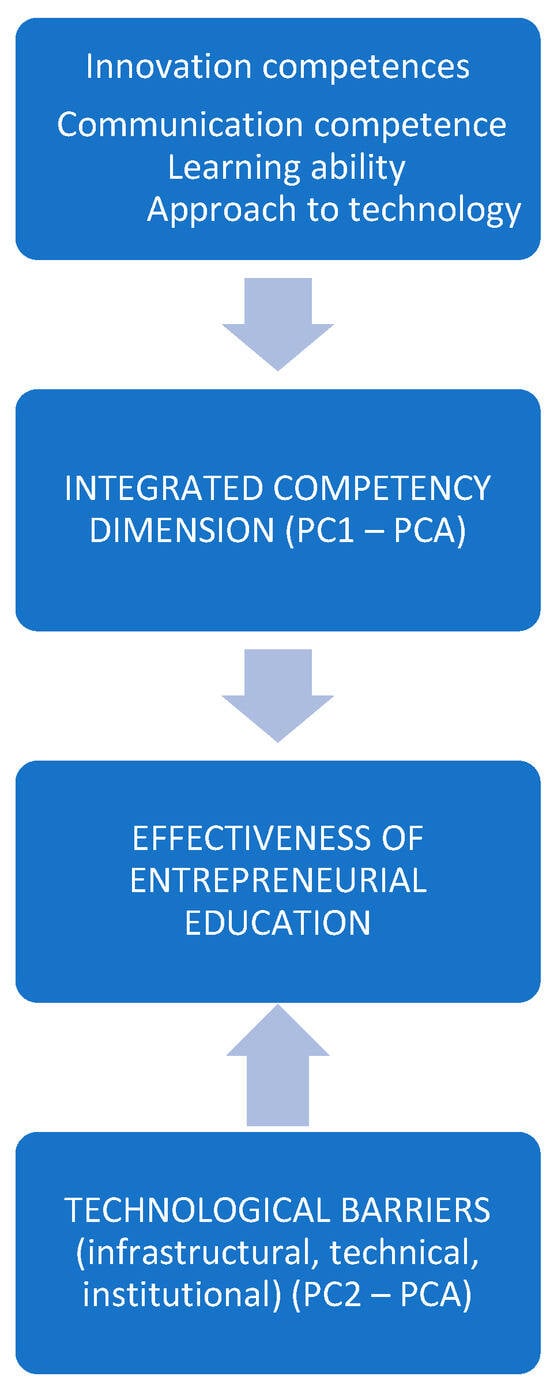
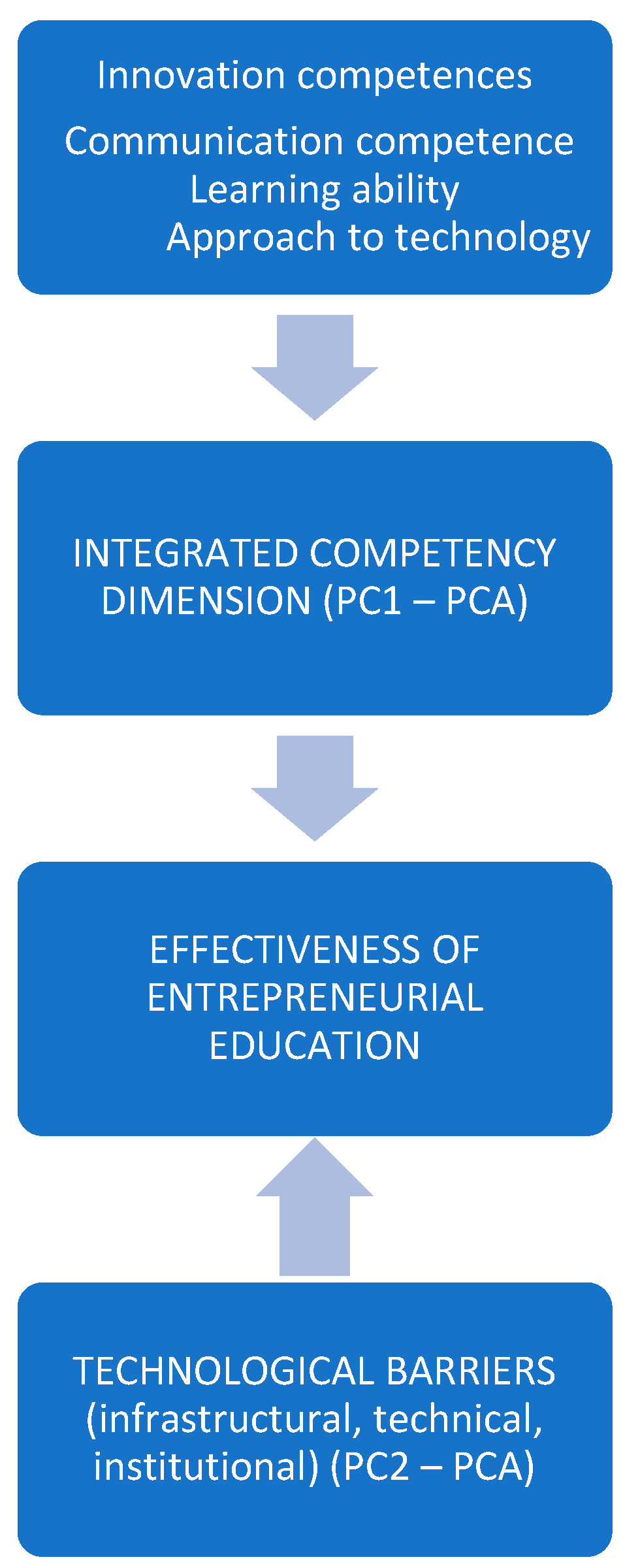
The relationships between the studied constructs, including both direct and indirect relationships, are presented in Figure 1, which illustrates the proposed conceptual framework and provides the basis for formulating and empirically testing the research hypotheses.
Figure 1.
Conceptual model of the relationship between entrepreneurial education competencies, attitudes toward technology, technological barriers, and educational effectiveness in the context of renewable energy technologies.
The model assumes directional relationships (paths) between individual competencies, attitudes toward technology, technological barriers, and educational effectiveness. The statistical significance of these relationships was verified using Pearson correlation coefficients, with a conventional significance level of p < 0.05.
Figure 1 is illustrative and conceptual in nature and does not constitute a direct output from statistical software, but rather a synthetic visualization of the relationships confirmed by quantitative analyses.
The conceptual framework of the study presents the relationships between key constructs describing the effectiveness of entrepreneurial education in the context of renewable energy technologies. At the center of the model is the effectiveness of entrepreneurial education, treated as an outcome variable reflecting the perceived outcomes of the educational process.
The explanatory variables include innovation competencies, communication competencies, learning ability, and attitudes toward technology, which represent the individual development potential of participants in the educational process. These constructs form a coherent competency area reflecting both soft and digital competencies, important from the perspective of entrepreneurial education and pro-ecological innovation.
In parallel, the model considers technological barriers, which act as a limiting factor. These include infrastructural, technical, and institutional conditions that may weaken the positive impact of individual competencies on educational effectiveness. The framework assumes that these barriers function as a separate dimension, related to educational outcomes but not simply the opposite of individual competencies.
The overall model reflects the multidimensional nature of entrepreneurial education, in which educational effectiveness is the result of the coexistence of individual resources and environmental conditions.
Figure 1 serves as a conceptual flow diagram, presenting the directions of interactions between the variables included in the study.
The presented conceptual framework provides the basis for formulating research hypotheses regarding the relationships between individual constructs. Based on this model, it was assumed that innovative and communication competencies, learning ability, and attitudes toward technology are positively associated with educational effectiveness, while technological barriers demonstrate a negative relationship. Hypotheses H1–H5 were formulated in a way that allows for their empirical verification using correlational analyses and principal component analysis.
H1:
Innovation competencies are significantly and positively related to the effectiveness of entrepreneurship education.
H2:
Communication competencies and learning ability demonstrate a significant and positive relationship with the effectiveness of entrepreneurship education.
H3:
A positive attitude toward technology is significantly and positively related to the effectiveness of entrepreneurship education.
H4:
Technological barriers are significantly and negatively related to the effectiveness of entrepreneurship education.
H5:
Innovation competencies, communication competencies, learning ability, and attitude toward technology form a common, integrated competency dimension that is associated with the effectiveness of entrepreneurship education.
The hypotheses were tested using Pearson correlation analysis and principal component analysis (PCA), which allowed for the assessment of both the direct relationships between variables and their latent structure.
All hypotheses refer to the relationships between variables measured using Likert scales and are operationalized as statistically significant Pearson correlation coefficients and factor loadings in PCA.
3.4. Data Analysis
Statistical analyses were conducted using SPSS software (version 28). Descriptive statistics were calculated to summarize the sample characteristics. Principal component analysis (PCA) was used to identify latent dimensions underlying the observed variables and to reduce the dimensionality of the data. Additionally, correlation and regression analyses were used to examine the relationships between educational effectiveness, innovation competencies, technological barriers, and pro-environmental innovation intentions. Statistical significance was assessed at conventional levels.
4. Results
4.1. Correlation Analysis
Pearson correlation analysis was conducted to initially assess the relationships between variables. The results indicate clear and logical connections between the key constructs of the entrepreneurship education model (Table 1).
Table 1.
Correlation matrix (Pearson r).
The strongest positive correlations with educational effectiveness were observed for communication (r = 0.72) and innovation competencies (r = 0.71). This indicates that individuals who are better at communication, teamwork, and idea presentation achieve higher educational outcomes. The high correlation with innovation competencies indicates the importance of creativity, generating new solutions, and design thinking in the entrepreneurship education process.
Significant positive relationships were also found for attitude to technology (r = 0.70) and learning ability (r = 0.68). These results suggest that openness to digital technologies and adaptive learning enhance the effectiveness of educational programs.
The only variable exhibiting a negative correlation with educational effectiveness was technological barriers (r = −0.32). These barriers include limited access to digital infrastructure, low levels of technical support, and ICT competency gaps. Their presence undermines the ability to fully utilize the educational potential of entrepreneurship programs.
4.2. Principal Component Analysis (PCA)
In the next step, Principal Component Analysis (PCA) was conducted, the aim of which was to identify the latent structure of the studied variables and reduce their dimensionality. PCA allows for the detection of latent dimensions that explain the covariation of the observed constructs.
The first component (PC1) is characterized by high loadings for innovation competencies (0.82), approach to technology (0.79), learning ability (0.76), and communication (0.74) (Table 2). PC1 represents an integrated dimension of development competencies, encompassing both soft and digital skills. The moderate loading for educational effectiveness (0.58) indicates that its level is largely determined by this set of competencies.
Table 2.
PCA—factor loadings (PC1, PC2).
The second component (PC2) is dominated by technological barriers (0.60). The remaining variables achieve only moderate values. This means that PC2 reflects the dimension of infrastructural and organizational difficulties, which operates relatively independently of individual competencies.
4.3. Eigenvalues and Explained Variance
The eigenvalue table (Table 3) indicates that all components have eigenvalues close to 1. The first component (PC1) explains 15.50% of the variance, and the second (PC2) 15.09%. Together, the first two components explain 30.59% of the total variance.
Table 3.
Eigenvalues and percentage of total variance explained for each construct (based on PCA).
To achieve a level close to 60% of explained variance, it was necessary to include the first four components (PC1–PC4). The even distribution of eigenvalues indicates the absence of a single dominant latent factor. The data structure is multidimensional, which is typical for research on soft and technological skills.
4.4. Principal Component Network Analysis
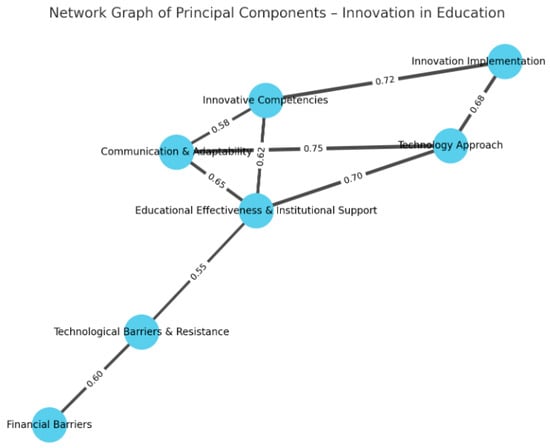
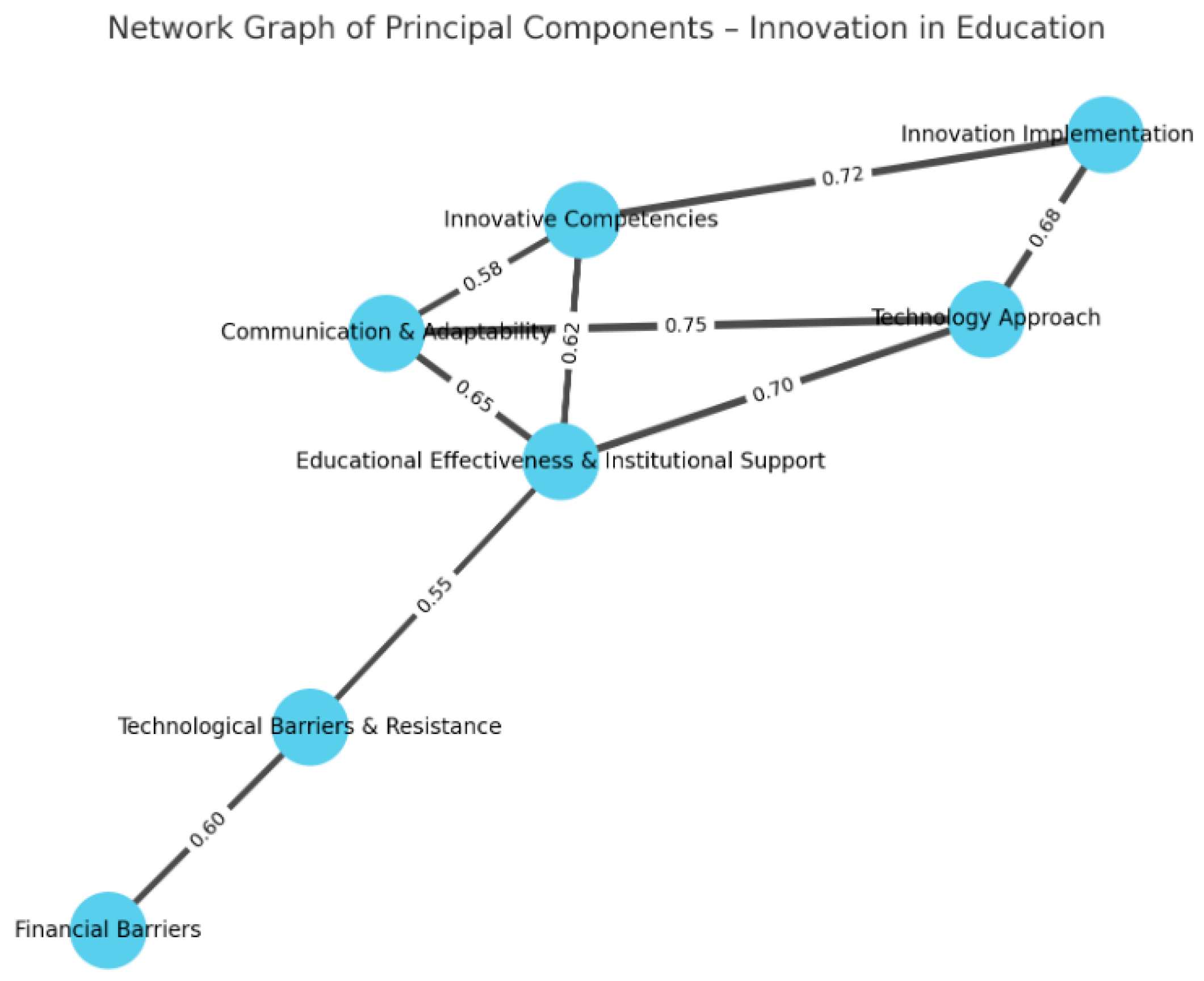
To further examine the relationships between the latent constructs identified through PCA, a principal component network analysis was conducted. The network was constructed using pairwise correlations between components PC1–PC7, where nodes represent individual components and edges represent the strength of their connections (Figure 2). The resulting network reveals a differentiated structure with varying degrees of betweenness centrality. PC1, representing integrated communication and adaptive competencies, occupies the most central position in the network. It is strongly connected to PC2 and PC3, indicating its key role in linking individual competencies with perceived educational effectiveness.
Figure 2.
Network graph of principal components (PC1–PC7).
PC2, associated with attitudes toward technology, also demonstrates strong connectivity, particularly with the components related to innovation intentions and educational outcomes. This suggests that openness to technology serves as an important connecting factor within the overall structure of the model.
PC3, interpreted as educational effectiveness combined with institutional support, serves as an intermediary node. It connects competency-related components with those reflecting structural constraints, emphasizing its integrative role within the network.
The barrier-related components, namely PC4 and PC7, form a distinct substructure. Their strong interconnectedness indicates that technological and financial barriers tend to co-occur and jointly influence other components, rather than acting as isolated constraints.
Overall, the network structure confirms that the analyzed components form a coherent, yet non-hierarchical system. The central components related to communication, adaptability, and technological attitudes influence both innovation-related and barrier-related constructs, supporting the multidimensional nature of entrepreneurship education.
Nodes represent principal components extracted from the PCA. Edge thickness reflects the strength of correlations between components. Central components indicate higher connectivity within the network, highlighting key relationships among competencies, attitudes toward technology, barriers, and educational effectiveness.
5. Discussion
The aim of this study was to identify key factors supporting the effectiveness of entrepreneurial education in the context of renewable energy technologies, with particular emphasis on innovation and communication competencies, and attitudes toward technology. The obtained results allow for the formulation of several important interpretative conclusions that complement the existing literature.
First, analysis of the structure of relationships between the studied constructs indicates that communication competencies and learning ability serve an integrating function with other areas of educational development. This means that the effectiveness of entrepreneurial education does not result solely from the transfer of technical knowledge but is largely based on the ability to collaborate, adapt, and exchange knowledge. These conclusions are consistent with previous studies that emphasize the role of soft skills as a foundation for shaping innovative and entrepreneurial attitudes.
Second, the significant role of innovation competencies suggests their mediating function between attitudes toward technology and the perceived effectiveness of education. Openness to technology and comfort in using it do not directly translate into educational outcomes unless they are supported by the ability to think creatively, experiment, and implement new solutions. This result strengthens the argument that education in the field of renewable energy sources should combine a technological component with the active development of innovative competencies.
At the same time, the obtained results show that technological barriers constitute a distinct but significant dimension influencing the educational process. Limited access to infrastructure, technical problems, and insufficient institutional support undermine the potential benefits of modern teaching methods. Importantly, these barriers do not eliminate the importance of individual competencies, but rather modify the way they are applied in educational practice. This indicates the need for a systemic approach to implementing technological education, encompassing both the development of student competencies and appropriate organizational support.
The study results also provide important practical implications. The design of entrepreneurial education programs in the field of renewable energy should consider the parallel development of communication skills, learning abilities, and innovation. Instead of focusing solely on technical content, curricula should promote teamwork, project-based learning, and solving real-world technological problems. This approach can promote not only increased educational effectiveness but also increased readiness to implement pro-ecological innovations.
However, the study is not without limitations. First, the cross-sectional nature of the analysis does not allow for the formulation of causal conclusions. Second, the data are based on self-assessment by respondents, which may pose a risk of subjective responses. Future research could incorporate a longitudinal approach and expand the analysis to include behavioral indicators or qualitative data, which would allow for a deeper interpretation of the obtained results.
From a practical perspective, entrepreneurship education linked to renewable energy technologies may take the form of project-based courses in which students develop business concepts for renewable energy solutions, such as small-scale photovoltaic installations or energy efficiency services. Similar effects may also be achieved through interdisciplinary training modules combining basic technical knowledge with entrepreneurial problem-solving and teamwork, which have been increasingly implemented in higher education programs focused on sustainability and digital transformation.
In summary, this study confirms that the effectiveness of entrepreneurial education in the context of renewable energy technologies is a multidimensional phenomenon, determined by both individual competencies and institutional factors. The obtained results strengthen the argument for a holistic approach to educational design, combining the development of innovative, communication, and technological competencies with the reduction in systemic barriers.
6. Conclusions
The analyses conducted confirm that the effectiveness of entrepreneurial education in the context of renewable energy technologies is determined by the interaction of individual competencies and the environmental conditions in which the educational process is implemented. The obtained results indicate that innovation and communication competencies, as well as the ability to learn, are key resources supporting the effectiveness of education, while technological barriers can significantly limit their positive impact.
Analysis of the relationships between the studied constructs shows that positive attitudes toward technology and developed innovation competencies enhance educational outcomes, but only when embedded in a supportive institutional environment. This means that the mere availability of technology or a declared openness to innovation are not sufficient if they are accompanied by infrastructural, organizational, or systemic constraints. In this sense, the effectiveness of entrepreneurial education should be viewed as the result of a dynamic interaction between individual potential and the quality of the educational environment.
The obtained results emphasize the need for a holistic approach to designing educational programs focused on sustainable development and renewable energy sources. Effective entrepreneurial education should integrate the development of innovation and communication competencies with the development of positive attitudes toward technology, while minimizing technological barriers through appropriate institutional and organizational support. This approach not only improves the quality of education but also increases readiness to undertake pro-environmental innovations.
The contribution of this study lies in empirically confirming the multidimensional nature of entrepreneurial education in the field of renewable energy technologies and identifying key areas for educational intervention. The results can provide a useful foundation for policymakers, curriculum designers, and educational institutions seeking to strengthen future-proof competencies and support the transition towards sustainable development.
Supplementary Materials
The following supporting information can be downloaded at: https://www.mdpi.com/article/10.3390/su18031471/s1.
Funding
This research received no external funding.
Institutional Review Board Statement
The study presented here is exempt from ethical review because, in the field of scientific research using survey techniques (diagnostic testing), this study is waived for ethical review by Jacob of Paradies Academy Rector’s Committee for Research Ethics.
Informed Consent Statement
Informed consent for participation was obtained from all subjects involved in the study.
Data Availability Statement
The original contributions presented in this study are included in the article. Further inquiries can be directed to the corresponding author.
Conflicts of Interest
The author declares no conflicts of interest.
Abbreviations
| PCA | Principal Component Analysis |
| SPSS | Statistical Package for the Social Sciences |
| OZE | Renewable Energy Sources |
| PC | Principal Component |
References
- Jardim, J.; Bártolo, A.; Pinho, A. Towards a global entrepreneurial culture: A systematic review of the effectiveness of entrepreneurship education programs. Educ. Sci. 2021, 11, 398. [Google Scholar] [CrossRef] [Scilit]
- Soomro, B.A.; Shah, N. Entrepreneurship education, entrepreneurial self-efficacy, need for achievement and entrepreneurial intention among commerce students in Pakistan. Educ. Train. 2022, 64, 107–125. [Google Scholar] [CrossRef] [Scilit]
- Rauf, R.; Wijaya, H.; Tari, E. Entrepreneurship education based on environmental insight: Opportunities and challenges in the new normal era. Cogent Arts Humanit. 2021, 8, 1945756. [Google Scholar] [CrossRef] [Scilit]
- Seikkula-Leino, J.; Jónsdóttir, S.R.; Håkansson-Lindqvist, M.; Westerberg, M.; Eriksson-Bergström, S. Responding to global challenges through education: Entrepreneurial, sustainable, and pro-environmental education in Nordic teacher education curricula. Sustainability 2021, 13, 12808. [Google Scholar] [CrossRef] [Scilit]
- Neergaard, H.; Robinson, S.; Jones, S. Transformative learning in the entrepreneurship education process: The role of pedagogical nudging and reflection. Int. J. Entrep. Behav. Res. 2021, 27, 251–277. [Google Scholar] [CrossRef] [Scilit]
- Baggen, Y.; Lans, T.; Gulikers, J. Making entrepreneurship education available to all: Design principles for educational programs stimulating an entrepreneurial mindset. Entrep. Educ. Pedagog. 2022, 5, 347–374. [Google Scholar] [CrossRef] [Scilit]
- Rosário, A.T.; Raimundo, R. Sustainable entrepreneurship education: A systematic bibliometric literature review. Sustainability 2024, 16, 784. [Google Scholar] [CrossRef] [Scilit]
- Lourenço, F.; Jones, O.; Jayawarna, D. Promoting sustainable development: The role of entrepreneurship education. Int. Small Bus. J. 2013, 31, 841–865. [Google Scholar] [CrossRef] [Scilit]
- Johnson, M.P.; Schaltegger, S. Entrepreneurship for sustainable development: A review and multilevel causal mechanism framework. Entrep. Theory Pract. 2020, 44, 1141–1173. [Google Scholar] [CrossRef] [Scilit]
- Sharma, S.; Goyal, D.P.; Singh, A. Systematic review on sustainable entrepreneurship education (SEE): A framework and analysis. World J. Entrep. Manag. Sustain. Dev. 2021, 17, 372–395. [Google Scholar] [CrossRef] [Scilit]
- Hagebakken, G.; Reimers, C.; Solstad, E. Entrepreneurship education as a strategy to build regional sustainability. Sustainability 2021, 13, 2529. [Google Scholar] [CrossRef] [Scilit]
- Sobczak, A. Entrepreneurship in the education of university students. In Conferences of the Department Informatics; Publishing House Science and Economics Varna: Varna, Bulgaria, 2019; pp. 331–342. [Google Scholar]
- Hardie, B.; Highfield, C.; Lee, K. Entrepreneurship education today for students’ unknown futures. J. Pedagog. Res. 2020, 4, 401–417. [Google Scholar] [CrossRef] [Scilit]
- Akhmetshin, E.M.; Mueller, J.E.; Chikunov, S.O.; Fedchenko, E.A.; Pronskaya, O.N. Innovative technologies in entrepreneurship education: The case of European and Asian countries. J. Entrep. Educ. 2019, 22, 1–15. [Google Scholar]
- Nowaczyk, G.; Sobczak, A. Role of entrepreneurship education in higher education institutions in the process of business development in Poland. Int. Entrep. Rev. 2016, 2, 43–52. [Google Scholar]
- Bendig, D.; Brüss, L.; Degen, F. Entrepreneurship in the renewable energy sector: A systematic literature review of types, characteristics, and sustainability impacts. Renew. Sustain. Energy Rev. 2025, 212, 115337. [Google Scholar] [CrossRef] [Scilit]
- Liang, Y.; Wang, H.; Hong, W.C. Sustainable development evaluation of innovation and entrepreneurship education of clean energy major in colleges and universities based on SPA-VFS and GRNN optimized by chaos bat algorithm. Sustainability 2021, 13, 5960. [Google Scholar] [CrossRef] [Scilit]
- Chahal, J.; Shoukat, M.H.; Ayoubi, R. How entrepreneurial environment and education influence university students’ entrepreneurial intentions: The mediating role of entrepreneurial motivation. High. Educ. Ski. Work-Based Learn. 2024, 14, 591–609. [Google Scholar] [CrossRef] [Scilit]
- Lv, Y.; Chen, Y.; Sha, Y.; Wang, J.; An, L.; Chen, T.; Huang, X.; Huang, Y.; Huang, L. How entrepreneurship education at universities influences entrepreneurial intention: Mediating effect based on entrepreneurial competence. Front. Psychol. 2021, 12, 655868. [Google Scholar] [CrossRef] [Scilit]
- Sobczak, A.; Barwińska-Małajowicz, A.; Witek, J.; Kłak, D.; Soboń, D.; Nogga, M. Cultivating Green Collar Entrepreneurs: The Influence of Economic and Environmental Knowledge on University Students’ Entrepreneurial Intentions in the Field of Renewable Energy Sources—The Moderating Role of Self-Efficacy. Energies 2025, 18, 6016. [Google Scholar] [CrossRef] [Scilit]
- Mahendra, O. The Role of Entrepreneurship in Driving Sustainable Development. J. EduHealth 2023, 14, 48–52. [Google Scholar]
- Karimi, M.S.; Doostkouei, S.G.; Shaiban, M.; Easvaralingam, Y.; Khan, Y.A. Investigating the role of entre-preneurship in advancing renewable energy for sustainable development: Evidence from a System-GMM panel data approach. Sustain. Dev. 2024, 32, 3329–3343. [Google Scholar] [CrossRef] [Scilit]
- Philip, L.D.; Emir, F.; Udemba, E.N. Investigating possibility of achieving sustainable development goals through renewable energy, technological innovation, and entrepreneur: A study of global best practice policies. Environ. Sci. Pollut. Res. 2022, 29, 60302–60313. [Google Scholar] [CrossRef] [Scilit]
- Chen, L.; Ifenthaler, D.; Yau, J.Y.K. Online and blended entrepreneurship education: A systematic review of applied educational technologies. Entrep. Educ. 2021, 4, 191–232. [Google Scholar] [CrossRef] [Scilit]
- Welsh, D.H.; Dragusin, M. The new generation of massive open online course (MOOCS) and entrepreneurship education. Small Bus. Inst. J. 2013, 9, 51–65. [Google Scholar]
- Beltrán Hernández de Galindo, M.D.J.; Romero-Rodriguez, L.M.; Ramirez Montoya, M.S. Entrepreneurship competencies in energy sustainability MOOCs. J. Entrep. Emerg. Econ. 2019, 11, 598–616. [Google Scholar] [CrossRef] [Scilit]
- Mohamed, N.A.; Sheikh Ali, A.Y. Entrepreneurship education: Systematic literature review and future research directions. World J. Entrep. Manag. Sustain. Dev. 2021, 17, 644–661. [Google Scholar] [CrossRef] [Scilit]
- Eitan, A.; Rosen, G.; Herman, L.; Fishhendler, I. Renewable energy entrepreneurs: A conceptual framework. Energies 2020, 13, 2554. [Google Scholar] [CrossRef] [Scilit]
- Haldar, S. Sustainable entrepreneurship development in the renewable energy sector: Insights from Gujarat, India. Afr. J. Sci. Technol. Innov. Dev. 2021, 13, 873–885. [Google Scholar] [CrossRef] [Scilit]
- Nowaczyk, G.; Sobczak, A. Przedsiębiorczość w Kształceniu Studentów, Dorosłych i Seniorów; Kształtowanie kompetencji przedsiębiorczych, wyd; Rachwał, T., Ed.; FRSE: Edinburgh, Scotland, 2019. [Google Scholar] [CrossRef] [Scilit]
- Oliver, P.G.; Oliver, S. Innovative online learning in entrepreneurship education: The impact of embedding real-life industry practice in the virtual learning environment. Ind. High. Educ. 2022, 36, 756–767. [Google Scholar] [CrossRef] [Scilit]
- Edokpolor, J.E. Entrepreneurship education and sustainable development: Mediating role of entrepreneurial skills. Asia Pac. J. Innov. Entrep. 2020, 14, 329–339. [Google Scholar] [CrossRef] [Scilit]
- Guo, D.; Yang, D.; Zhang, H.; Song, J.; Zhang, R.; Xu, R.; Zhu, Q.; Ma, S.; Wang, P.; He, Y.; et al. Deepseek-r1: Incentivizing reasoning capability in llms via reinforcement learning. arXiv 2025, arXiv:2501.12948. [Google Scholar]
- Sousa, M.J.; Costa, J.M. Discovering entrepreneurship competencies through problem-based learning in higher education students. Educ. Sci. 2022, 12, 185. [Google Scholar] [CrossRef] [Scilit]
- Edokpolor, J.E.; Somorin, K. Entrepreneurship education programme and its influence in developing entrepreneurship key competencies among undergraduate students. Probl. Educ. 21st Century 2017, 75, 144. [Google Scholar] [CrossRef] [Scilit]
- Mutalimov, V.; Volkovitckaia, G.; Buymov, A.; Syzdykov, S.; Stepanova, D. Professional entrepreneurial competencies and creativity skills formation under the influence of educational practices of start-up projects development. J. Tech. Educ. Train. 2021, 13, 42–55. [Google Scholar] [CrossRef] [Scilit]
- Ferreras-Garcia, R.; Sales-Zaguirre, J.; Serradell-López, E. Developing entrepreneurial competencies in higher education: A structural model approach. Educ. Train. 2021, 63, 720–743. [Google Scholar] [CrossRef] [Scilit]
- Henry, C.; Hill, F.; Leitch, C. Entrepreneurship Education and Training: The Issue of Effectiveness; Routledge: Oxfordshire, UK, 2017. [Google Scholar]
- Sobczak, A. Wpływ kompetencji kierownika projektu na sukces zarządzania projektem. Przedsiębiorczość Zarządzanie 2014, XV, 243–254. [Google Scholar]
- Chen, L.; Ifenthaler, D.; Yau, J.Y.K.; Sun, W. Artificial intelligence in entrepreneurship education: A scoping review. Educ. Train. 2024, 66, 589–608. [Google Scholar] [CrossRef] [Scilit]
- Kangiwa, B.I.; Oludare, O.E.; Nassarawa, H.S.; Abubakar, N.S.; Efeoma, E.L.; Enefola, H.A. Leveraging artificial intelligence for enhancing entrepreneurship and creativity in STEM education. J. Educ. Res. Pract 2024. Available online: https://berkeleypublications.com/bjerp/article/download/196/177 (accessed on 12 July 2025).
- Mu, Q.; Zhao, Y. Transforming entrepreneurship education in the age of artificial intelligence. Resour. Data J. 2024, 3, 2–20. [Google Scholar]
- Martin, B.C.; McNally, J.J.; Kay, M.J. Examining the formation of human capital in entrepreneurship: A meta-analysis of entrepreneurship education outcomes. J. Bus. Ventur. 2013, 28, 211–224. [Google Scholar] [CrossRef] [Scilit]
- Acharya, S.R.; Chandra, Y. Entrepreneurship skills acquisition through education: Impact of the nurturance of knowledge, skills, and attitude on new venture creation. Int. J. Educ. Pedogogical Sci. 2019, 13. Available online: https://www.academia.edu/download/94167851/10010060.pdf (accessed on 12 July 2025).
- Rakhimova, Z.; Topildiev, B.; Nazarov, S.; Kadirova, M.; Sobirova, N.; Rustamova, M.; Nusratova, K. Fostering Entrepreneurial Competencies in Higher Education: Trends, Challenges, Legal Issues and Impacts on Student Success. Qubahan Acad. J. 2025, 5, 114–142. [Google Scholar] [CrossRef] [Scilit]
- Rauch, A.; Hulsink, W. Putting entrepreneurship education where the intention to act lies: An investigation into the impact of entrepreneurship education on entrepreneurial behavior. Acad. Manag. Learn. Educ. 2015, 14, 187–204. [Google Scholar] [CrossRef] [Scilit]
- Fairchild, R. An entrepreneur’s choice of venture capitalist or angel-financing: A behavioral game-theoretic approach. J. Bus. Ventur. 2011, 26, 359–374. [Google Scholar] [CrossRef] [Scilit]
- Hameed, I.; Zaman, U.; Waris, I.; Shafique, O. A serial-mediation model to link entrepreneurship education and green entrepreneurial behavior: Application of resource-based view and flow theory. Int. J. Environ. Res. Public Health 2021, 18, 550. [Google Scholar] [CrossRef] [Scilit]
- Debarliev, S.; Janeska-Iliev, A.; Stripeikis, O.; Zupan, B. What can education bring to entrepreneurship? Formal versus non-formal education. J. Small Bus. Manag. 2022, 60, 219–252. [Google Scholar] [CrossRef] [Scilit]
- Ahmad, M.I.S.; Idrus, M.I.; Rijal, S. The role of education in fostering entrepreneurial spirit in the young generation. J. Contemp. Adm. Manag. (ADMAN) 2023, 1, 93–100. [Google Scholar] [CrossRef] [Scilit]
- Li, W.; Sun, Y.; Gao, Y. Relationship between green entrepreneurship orientation, integration of opportunity and resource capacities and sustainable competitive advantage. Front. Psychol. 2022, 13, 1068734. [Google Scholar] [CrossRef] [Scilit]
- Tekala, K.; Baradarani, S.; Alzubi, A.; Berberoğlu, A. Green entrepreneurship for business sustainability: Do environmental dynamism and green structural capital matter? Sustainability 2024, 16, 5291. [Google Scholar] [CrossRef] [Scilit]
- Lee, B.H.; Georgallis, P.P.; Struben, J. Sustainable entrepreneurship under market uncertainty: Opportunities, challenges and impact. In Handbook on the Business of Sustainability; Edward Elgar Publishing Limited: Cheltenham, UK, 2022; pp. 252–272. [Google Scholar]
- Kwilinski, A.; Lyulyov, O.; Pimonenko, T. Green economic development and entrepreneurship transformation. Entrep. Bus. Econ. Rev. 2024, 12, 157–175. [Google Scholar] [CrossRef] [Scilit]
- Al-Mamary, Y.H. Factors shaping green entrepreneurial intentions towards green innovation: An integrated model. Future Bus. J. 2025, 11, 21. [Google Scholar] [CrossRef] [Scilit]
- Gibb, A. In pursuit of a new ‘enterprise’ and ‘entrepreneurship’ paradigm for learning: Creative destruction, new values, new ways of doing things and new combinations of knowledge. Int. J. Manag. Rev. 2002, 4, 233–269. [Google Scholar] [CrossRef] [Scilit]
- González-López, M.J.; Pérez-López, M.C.; Rodríguez-Ariza, L. Clearing the hurdles in the entrepreneurial race: The role of resilience in entrepreneurship education. Acad. Manag. Learn. Educ. 2019, 18, 457–483. [Google Scholar] [CrossRef] [Scilit]
- Wilson, K.E.; Vyakarnam, S.; Volkmann, C.; Mariotti, S.; Rabuzzi, D. Educating the next wave of entrepreneurs: Unlocking entrepreneurial capabilities to meet the global challenges of the 21st century. In World Economic Forum: A Report of the Global Education Initiative; World Economic Forum: Geneva, Switzerland, 2009. [Google Scholar]
- York, J.G.; Venkataraman, S. The entrepreneur–environment nexus: Uncertainty, innovation, and allocation. J. Bus. Ventur. 2010, 25, 449–463. [Google Scholar] [CrossRef] [Scilit]
- Bradley, S.W.; Kim, P.H.; Klein, P.G.; McMullen, J.S.; Wennberg, K. Policy for innovative entrepreneurship: Institutions, interventions, and societal challenges. Strateg. Entrep. J. 2021, 15, 167–184. [Google Scholar] [CrossRef] [Scilit]
- Quashie, R.; Fugar, F.D.; Antwi-Afari, P.; Ng, S.T. Evaluating the key competency skills of construction professionals for the attainment of circular construction in developing economies. Clean. Prod. Lett. 2024, 6, 100060. [Google Scholar] [CrossRef] [Scilit]
- Tariq, M.U. Developing a Model for Sustainable Entrepreneurship Competencies: Strategic Decision-Making for a Green Future. In Building a Green Future Through Essential Decision-Making Competencies; IGI Global Scientific Publishing: Hershey, PA, USA, 2025; pp. 137–158. [Google Scholar]
- Buzzao, G.; Rizzi, F. On the conceptualization and measurement of dynamic capabilities for sustainability: Building theory through a systematic literature review. Bus. Strategy Environ. 2021, 30, 135–175. [Google Scholar] [CrossRef] [Scilit]
- Buhr, M.; Harms, D.; Schaltegger, S. Individual change agents for corporate sustainability transformation: A systematic literature review. Benchmarking Int. J. 2023, 30, 4221–4247. [Google Scholar] [CrossRef] [Scilit]
- Sarma, S.; Attaran, S.; Attaran, M. Sustainable entrepreneurship: Factors influencing opportunity recognition and exploitation. Int. J. Entrep. Innov. 2024, 25, 56–69. [Google Scholar] [CrossRef] [Scilit]
- Zhang, Y.; Jiang, S. Pro-Environmental Personal Norms and Subjective Norms Related to AI-Driven Green Entrepreneurship Intention: A Qualitative Insight to Explore Students in Higher Education Institutions. Afr. Educ. Res. J. 2025, 13, 83–99. [Google Scholar]
- Ploum, L.; Blok, V.; Lans, T.; Omta, O. Exploring the relation between individual moral antecedents and entrepreneurial opportunity recognition for sustainable development. J. Clean. Prod. 2018, 172, 1582–1591. [Google Scholar] [CrossRef] [Scilit]
- Cai, L.; Kwasi Sampene, A.; Khan, A.; Oteng-Agyeman, F.; Tu, W.; Robert, B. Does entrepreneur moral reflectiveness matter? Pursing low-carbon emission behavior among SMEs through the relationship between environmental factors, entrepreneur personal concept, and outcome expectations. Sustainability 2022, 14, 808. [Google Scholar] [CrossRef] [Scilit]
- Bugdol, M.; Borys, T.; Puciato, D. The concept of pro-environmental organisation vs. environmental virtue theory. Ekon. Sr. 2024, 90. Available online: https://agro.icm.edu.pl/agro/element/bwmeta1.element.agro-1860bdfd-9dc8-438f-9588-21963ea8f501/c/897_Bugdol_et_al.pdf (accessed on 12 July 2025). [CrossRef] [Scilit]
- Streimikiene, D.; Baležentis, T.; Volkov, A.; Morkūnas, M.; Žičkienė, A.; Streimikis, J. Barriers and drivers of renewable energy penetration in rural areas. Energies 2021, 14, 6452. [Google Scholar] [CrossRef] [Scilit]
- Juszczyk, O.; Juszczyk, J.; Juszczyk, S.; Takala, J. Barriers for renewable energy technologies diffusion: Empirical evidence from Finland and Poland. Energies 2022, 15, 527. [Google Scholar] [CrossRef] [Scilit]
- Reddy, S.; Painuly, J.P. Diffusion of renewable energy technologies—Barriers and stakeholders’ perspectives. Renew. Energy 2004, 29, 1431–1447. [Google Scholar] [CrossRef] [Scilit]
- Dace, E.; Cascavilla, A.; Bianchi, M.; Chioatto, E.; Zecca, E.; Ladu, L.; Yilan, G. Barriers to transitioning to a circular bio-based economy: Findings from an industrial perspective. Sustain. Prod. Consum. 2024, 48, 407–418. [Google Scholar] [CrossRef] [Scilit]
- Gajdzik, B.; Wolniak, R.; Nagaj, R.; Grebski, W.W.; Romanyshyn, T. Barriers to renewable energy source (RES) installations as determinants of energy consumption in EU countries. Energies 2023, 16, 7364. [Google Scholar] [CrossRef] [Scilit]
- Shortall, R.; Mengolini, A.; Gangale, F. Citizen engagement in EU collective action energy projects. Sustainability 2022, 14, 5949. [Google Scholar] [CrossRef] [Scilit]
- Karytsas, S.; Theodoropoulou, E. Determinants of citizens’ involvement in community energy initiatives. Int. J. Sustain. Energy 2022, 41, 1836–1848. [Google Scholar] [CrossRef] [Scilit]
- De Simone, E.; Rochira, A.; Mannarini, T. Individual and community catalysts for Renewable Energy Communities (RECs) development. Curr. Opin. Psychol. 2025, 62, 101987. [Google Scholar] [CrossRef] [Scilit]
- Ahlemeyer, K.; Griese, K.M.; Wawer, T.; Siebenhüner, B. Success factors of citizen energy cooperatives in north western Germany: A conceptual and empirical review. Energy Sustain. Soc. 2022, 12, 29. [Google Scholar] [CrossRef] [Scilit]
- Malamatenios, C. Renewable energy sources: Jobs created, skills required (and identified gaps), education and training. Renew. Energy Environ. Sustain. 2016, 1, 23. [Google Scholar] [CrossRef] [Scilit]
- Apostolopoulos, N.; Kakouris, A.; Liargovas, P.; Borisov, P.; Radev, T.; Apostolopoulos, S.; Daskou, S.; Anastasopoulou, E.Ε. Just transition policies, power plant workers and green entrepreneurs in Greece, Cyprus and Bulgaria: Can education and retraining meet the challenge? Sustainability 2023, 15, 16307. [Google Scholar] [CrossRef] [Scilit]
- Auktor, G.V. Green Industrial Skills for a Sustainable Future; United Nations Industrial Development Organization: Vienna, Austria, 2020. [Google Scholar]
- Gull, S.; Idrees, H. Green training and organizational efficiency: Mediating role of green competencies. Eur. J. Train. Dev. 2022, 46, 105–119. [Google Scholar] [CrossRef] [Scilit]
- Baruah, B.; Ward, T.; Jackson, N.; Gbadebo, A. Addressing the skills gap for facilitating renewable energy entrepreneurship—An analysis of the wind energy sector. In Proceedings of the 2018 Majan International Conference (MIC); IEEE: New York, NY, USA, 2018; pp. 1–7. [Google Scholar]
- Available online: https://www.irena.org/Publications/2024/Oct/Renewable-energy-and-jobs-Annual-review-2024 (accessed on 12 July 2025).
- Yaqub, R.M.S.; ur Rehman, H.M.Z.; Manzoor, S.F.; Daud, M. Fostering Sustainability in Vocational Training Institutes: The Intersection of Green Human Resource Management (Ghrm) and Green Technical Vocational Education and Training (Gtvet) Skills. Contemp. J. Soc. Sci. Rev. 2024, 2, 1243–1269. [Google Scholar]

Disclaimer/Publisher’s Note: The statements, opinions and data contained in all publications are solely those of the individual author(s) and contributor(s) and not of MDPI and/or the editor(s). MDPI and/or the editor(s) disclaim responsibility for any injury to people or property resulting from any ideas, methods, instructions or products referred to in the content. |
© 2026 by the author. Licensee MDPI, Basel, Switzerland. This article is an open access article distributed under the terms and conditions of the Creative Commons Attribution (CC BY) license.