


Abstract
The quality of life of a host community residing in a tourist destination is significantly influenced by the consequences of tourism development in the region. Such development generates both positive impacts, such as benefits, and negative impacts, or costs, simultaneously. The main aim of the study was to analyse the relationship between residents’ perception of tourism’s dual impact (positive and negative) on the host community and their attitude towards sustainable tourism development in the Krishna-Braj Tourism Circuit in the province of Uttar Pradesh of India. The study also examined the nature of the relationship between personal benefits drawn from tourism development and residents’ perception of tourism’s dual impact on the host community. The social exchange theory served as the foundation of the study. The tourism sustainability framework, which includes three pillars, viz., economic, environmental, and socio-cultural tourism impacts, was used to analyse the dual impact of tourism on residents in the region. In total, 370 residents were identified using a proportionate quota sampling technique and interviewed. Structural equation modelling was used to test the proposed theoretical model and to examine the hypothesised relationship between study variables. The study found that residents drawing personal benefits from tourism development (such as income, job, socialisation, etc.) in the region tend to perceive tourism impacts positively and show supportive attitudes toward sustainable tourism development in the region. At the same time, the influence of personal benefits from tourism development on perceived negative impacts was found not significant. Additionally, positive perceived tourism impacts significantly shaped residents’ attitudes, while the expected negative influence of negative tourism impacts on attitudes was unsupported. In a nutshell, the study supports that the bene-fits residents derive from tourism strongly shape their perceptions and support sustainable tourism development in the region.
1. Introduction
Residents in the host community are core stakeholders in tourism. The success of the tourism industry depends on the attractions at the destination and the hospitality of residents [1,2] in the region. A friendly attitude may support tourism development in the region, whereas hostile behaviours may restrain the development of the tourism sector. Residents’ rage, apathy, or lack of trust finally passes on to the tourists and may result in their unwillingness to revisit and recommend the destination [2,3,4]. Residents’ attitude toward tourism development is crucial, and their support for it is closely tied to destinations’ success and sustainability [5,6,7]. Tourism development in a region brings positive impacts, i.e., benefits, as well as negative impacts, i.e., costs [8,9,10,11,12].
Traditionally, the tourism sustainability framework includes three pillars, i.e., the economic, environmental, and socio-cultural impacts of tourism [9,13]. Therefore, all positive and negative impacts can further be categorised as economic, socio-cultural, or environmental impacts [14,15,16]. By evaluating such tourism impacts, local residents develop their attitudes and extent of support toward its future development in the region [5]. Contemporary research on tourism has mainly emphasised ecological aspects and often overlooked the economic aspects of tourism. However, a comprehensive understanding of sustainability requires the integration of three interconnected pillars: environmental, economic, and socio-cultural [16].
Tourism development in a region brings many economic, social, cultural, and environmental changes to the lives of the host community. Consequently, the host community’s attitude and support are essential for the sustainability of the tourism industry in the region [1]. Residents’ quality of life in a community is impacted by the consequences of tourism development, which may include more people coming to the region, increased use of roads, and a changed local economy [1,4]. The aim of tourism development in a region may fail if the development does not receive local support. Success depends not only on attractions in the region but also on residents’ attitudes and hospitality. If the host community expresses anger, apathy, and mistrust, tourists may feel unwelcome in the region and avoid revisits [17]. Consequently, understanding local attitudes and their influences is crucial for gaining support for tourism developments.
Problem statement: ‘To study a host community’s perceptions regarding the dual impact of tourism and their attitude towards sustainable tourism development in the region’.
More specifically, the study aims to address the following three research questions:
- How do residents’ personal benefits from tourism development (PBTD) affect their perceived positive impacts of tourism (PPTI) and perceived negative impacts of tourism (NPTI) in the region?
- How do residents’ personal benefits from tourism development (PBTD) affect their attitude towards support for further tourism development (ATTD) in the region?
- How do residents’ perceived positive impacts of tourism (PPTI) and perceived negative impacts of tourism (NPTI) affect their attitude towards support for further tourism development (ATTD)?
2. Theoretical Background
Several studies have established that the theoretical framework of the social exchange theory (SET) can be effectively used to examine residents’ perceptions and their support for tourism development in a region [5,6,11,18,19,20]. SET is a general sociological theory that holds that individuals often engage in an exchange if they expect to get more benefits than costs [21]. According to SET, the social exchange, i.e., expected benefits and costs to the residents, serves as the basis for evaluating tourism development as well as support in the region.
Some researchers believe that SET alone is insufficient to describe the antecedents of residents’ attitudes and support tourism development [22,23]. However, most of the researchers preferred the SET over other frameworks [24,25] and advocated it as the preferred framework for elucidating residents’ attitudes [5,6,11,19,20,25].
Recently, the study of subjective well-being was introduced into tourism research, focusing mainly on the impacts of tourism on locals in the region [26,27]. It reflects people’s evaluations of their own lives and their affective reactions to their experiences in the region [28]. Although studies on the relationship between tourist arrivals and residents’ subjective well-being exist in the literature [29], the investigation of the causal direction of the relationship is still a challenge [27].
An aroused interest in tourism impacts encouraged impact assessment studies. A growing number of tourism impact studies highlighted the significance of understanding the relationship between tourism development in a region and its dual impacts [18,30]. Many studies have emphasised examining the host community’s attitudes towards the dual impacts of tourism and their consequent support for the development of the tourism industry [18,31].
2.1. Social Exchange Theory
For decades, the social exchange theory (SET) has been used to understand and examine residents’ support for tourism development [12,18,21,30,32]. The social exchange theory emphasises that residents weigh up several benefits and costs of tourism while deciding their support for sustainable tourism development. Perdue, Long, and Allen (1990) applied the social exchange theory to investigate factors influencing residents’ support for tourism development and to further develop a preliminary structural model [18]. They analysed data to investigate relationships among residents’ own characteristics, personal benefits, perceived dual impact (viz., positive and negative) of tourism, and support for tourism development [18]. Later, Ap (1992) used SET to propose a framework that explored the reasons behind residents’ perceived positive or negative tourism impacts [21]. Gursoy, Jurowski, and Uysal (2002) collected data from five counties surrounding a Virginia (USA) recreation region and developed a model on host community support for tourism development based on the factors influencing reactions [33]. They revealed that the host community’s support for tourism development was influenced by the perceived costs and benefits of the tourism development [33]. Stylidis, Biran, Sit, and Szivas (2014) investigated residents’ support for tourism development by using the triple bottom line approach (economic, socio-cultural, and environmental impacts of tourism) of the social exchange theory [14].
2.2. Perceived Tourism Impacts and Residents’ Support for Tourism Development
Host community support for tourism is essential to the development of destinations in a sustainable manner. Tourism development may lead to economic, environmental, and social changes affecting the perception of tourism impacts and activating behavioural and emotional responses among residents [4]. Several studies have investigated such responses to tourism development under the socio-psychological theoretical frameworks that help understand the changes in attitudes towards tourism in the region [13,31].
The term ‘tourism impact’ has gained significant attention in the tourism literature. Residents’ attitude towards tourism is based on their evaluation of tourism impacts, i.e., on the basis of expected benefits or costs obtained [21]. Many previous studies have applied SET to explore associations between residents’ perceived tourism impacts (positive/negative) and their attitude/support for tourism development [10,11]. The majority of such studies asserted that stronger residents perceived that positive tourism impacts, i.e., benefits, lead to greater support for tourism development. At the same time, a strong perceived negative tourism impact, i.e., costs, leads to weak support for tourism development [8].
Scholars have referred to tourism development as a double-edged sword as it brings positive impacts, i.e., benefits, and negative impacts, i.e., costs, simultaneously [4,6,11,34]. All positive and negative impacts may further be categorised into any of three categories, namely economic, socio-cultural, and environmental [14,15]. Residents’ support of tourism and their participation in tourism-related activities lead to a reduction of the negative impacts and increase the positive impacts of tourism in the host communities [33,35].
2.3. Residents’ Perception of the Positive and Negative Impacts of Tourism
Tourism scholars support the notion that residents’ positive perceptions of tourism impact can result in support for tourism development in the region [19,25,32]. Perdue, Long, and Allen (1990) applied the social exchange theory to investigate factors influencing residents’ support for tourism development and to further develop a preliminary structural model [18]. They analysed data collected from several places in the US state of Colorado to investigate relationships among residents’ characteristics, personal benefits, perceived tourism impacts (positive and negative), and support for tourism development. The study found that the perceived positive and negative tourism impacts had no association with residents’ characteristics when controlling the personal benefits. Furthermore, residents’ support of tourism development in the region was negatively (positively) related to the perceived negative (positive) impact of tourism in the region [18]. Afterwards, Ap (1992) used SET to propose a framework that explores reasons behind residents’ perceived positive or negative tourism impacts [21].
Studies have found that communities should attract more tourists as this would bring economic benefits [33], lead to a higher quality of life [4,33,34] and employment opportunities [34,36], changing residents’ relationships with one another and with their community, as well as opportunities for shopping and recreation [18,33]. An increase in residents’ quality of life and standard of living strengthens towns’ business networks and helps preserve monuments and archaeological sites, as well as residents’ identity and cultural pride [4,37]. Most previous research studies that examined the relationship between tourism’s dual impact (i.e., benefits and costs) and residents’ attitudes found a positive relationship between perceived positive tourism impacts and attitudes towards tourism development in the region [18,19,25,32].
On the one hand, tourism has become a means to stimulate economic growth, particularly in developing countries; on the other hand, however, there are significant social, cultural, and environmental costs of tourism development in the region [12,26,38].
Tourism development in the region may also result in friction and have unfavourable, i.e., negative, economic, social, cultural, and environmental effects. Increasing tourism in the region increases crowds in recreational regions [3,4,39], the perception of crime [40], as well as traffic congestion and parking problems [3,4,18,30,38]. Tourism development may cause more inconvenience to locals during the peak of the tourism season in the region. Increasing standards of living and improved economic conditions of residents may increase the cost of living [8,38,41] and may cause social evils such as drug and alcohol abuse, environmental damage, as well as increases in waste and pollution [3,38,39]. The inconvenience caused by tourism and collateral damage may result in the local residents forming and sustaining negative attitudes towards tourism in the region.
Sever (2023) found that intensive tourism development had a modest but statistically significant negative effect on residents’ happiness in the host community [4]. Furthermore, crowding stress among residents negatively affected their perceived quality of life [4]. It is an important reason for stress and is closely associated with traffic congestion, environmental pollution, heightened cost of living, and overused public utilities in the region [38]. Tourism-related stressors such as daily troubles or everyday irritation make life less convenient. The social and psychological reasons for crowding-related stress have been insufficiently addressed in the tourism literature [31].
In recent years, the phenomenon of overtourism has gained widespread academic coverage, prompted by increasing instances of anti-tourism protests by locals against tourism development in the region [13,31]. Overtourism refers to the pressures of tourists on host communities. When the impacts of tourism exceed the level thresholds of the psychological, physical, ecological, socio-economic, and political limits of residents in the destination, it impacts various types of tourist destinations, and its effects are mainly seen in urban destinations [9]. The growth of urban tourism exacerbates inherent city issues such as gentrification, housing access, and congestion. Undisputedly, most of the scholars found a positive relationship between the positive tourism impacts and residents’ support for tourism development in the region. Many studies mention that residents who do not anticipate benefits from tourism development in the region showed weak positive attitudes toward tourism, which further resulted in lean tourism-related support [41,42]. Several other scholars also supported that the perceived cost or negative impact is negatively related to residents’ attitudes towards tourism development in the region [9,18,32]. Overtourism is linked to perceived social density and change in residents’ attitudes towards tourists [31]. It may also result in ‘tourismphobia’, which is caused by tourism pressure creating a negative local response of locals that sometimes obscures movements against tourism’s negative impacts [17].
2.4. Personal Benefits from Tourism Development, Perceived Impacts, and Residents’ Support
Studies found an association between host community personal benefit from tourism, positive tourism impacts, and additional support for tourism [11,18,21,43]. Residents consider the social exchange positively when it is personally beneficial to them and negatively when it is personally non-beneficial to them. As long as residents in the host community expect tourism to benefit them more than the cost, they would participate in the exchange to support tourism development [21,44]. Even if the perceived costs of tourism outweigh the perceived benefits of tourism, residents who think of themselves as more aware of tourism are more likely to appreciate the benefits of tourism [7]. Perdue et al. (1990) developed a model explaining residents’ support for tourism development [18]. They incorporated two constructs as antecedent variables into the model, namely ‘personal benefits from tourism’ and ‘perceived tourism impacts’ (positive and negative) [18]. Many other scholars such as Kang et al. (2018) and Frleta et al. (2020), also developed their models by using SET-related antecedents to depict residents’ support for tourism development [5,11].
Numerous studies have established that residents who feel tourism development would personally benefit them were more responsible towards it and more strongly perceived the possible impacts of tourism. For example, Perdue, Long, and Kang (1995) [45] extended the work performed by Perdue et al. (1990) [18] to further understand residents’ support for tourism. They applied a structural-equation-model-based approach and established that residents’ anticipated personal benefits were significantly related to the perceived impacts and support for tourism [45]. Ko and Stewart (2002) [41] also based their study on the model developed by Perdue et al. (1990) [18]. Their study, however, found an insignificant relationship between personal benefits from tourism development and perceived negative tourism impacts [41]. These findings conflicted with the findings of previous studies such as Perdue et al. (1990) [18] but were consistent with others such as Gursoy et al. (2002) [33].
Vargas-Sánchez, Oomdo Valle, da Costa Mendes, and Silva (2015) [43] mentioned that residents in the community who receive personal benefits from tourism development in the region perceive the positive impacts of tourism more strongly and the negative impacts of tourism less strongly. It finally results in a strong positive attitude towards tourism development in the region [43]. A few years later, Kang and Lee (2018) also supported previous scholars by concluding that locals who perceive personal benefits from tourism development tend to react positively to it [11]. It further results in their support for further tourism development in the region [11]. Frleta and Jurdana (2020) investigated the residents’ perceptions of tourism impacts and their support for future tourism development with respect to the received benefits in terms of employment from tourism in Istria (Croatia) [5]. They found that locals receiving direct benefits from the tourism industry in terms of employment expressed stronger support for future development as compared to non-recipients of such benefits [5].
Recently, the study of subjective well-being that explores the effects of tourism on local residents emerged in tourism studies [26,27]. Such studies include people’s assessments of their own lives and their emotional responses to their own experiences [28]. Factors such as income, employment, and quality of life [38] are often recognised as prominent determinants of subjective well-being that affect resident attitudes and support toward tourism development. Tourism activity may affect the quality of life of residents in the host community in multiple ways, such as changing residents’ way of living as well as standard of living and generating employment opportunities in the region [38]. Studies reported that those receiving benefits from tourism tend to exhibit a more positive perception of tourism impacts than other residents in the region [26,36,46]. Using principles of SET, Látková1 and Vogt (2012) [3] built their study on the Perdue, Long, and Allen (1990) model [18]. They examined the extent to which the personal benefits from tourism and the perceived dual impacts of tourism (positive and negative) are related to residents’ support for tourism development in the region. They held that residents with perceived positive tourism impacts were more supportive of additional tourism development compared to residents with negative tourism impacts [3]. Simultaneously, residents who do not anticipate benefits from tourism development in the region express less positive attitudes toward tourism development in the region [42]. On the other hand, some studies also found no associations among host community personal benefits from tourism, perceived negative tourism impacts, and support for tourism [44,47,48].
2.5. Research Gap and Significance of the Study
Globally, there are several studies on residents’ attitudes towards tourism development using the social exchange theory [1,21,36]. The majority of previous studies were conducted on ecotourism [49,50], island tourism [19,20,42], sports and event tourism [10,51,52], rural tourism [3,37], etc. Studies specifically emphasising host community perception at sacred sites where cultural identity, religious sentiments, and heritage strongly shape host community perceptions are limited globally and scarce in the Indian context.
Furthermore, the use of the three-pillar tourism sustainability framework, which encompasses economic, environmental, and socio-cultural tourism impacts, is also overlooked in the study of host community contexts, particularly at pilgrimage sites. Though a few studies examined the multi-dimensional effects of tourism on residents [19,49,51], none of these was conducted at a pilgrimage destination. Most research scholars studied economic, environmental, social, and cultural impacts of tourism in isolation [12,14,16,17,21,24,30,31,50] and ignored the combined impact of the three-pillar tourism sustainability framework on host community perception towards tourism development.
A few recent studies highlighted overtourism [13,17], local stress [38], well-being, emotions, and stress [27,29,46], yet studies on pilgrimage destinations like the Krishna-Braj Tourist Circuit are rare. Overcongestion, pollution, infrastructure strain, and densification directly affect the host community perception.
India’s pilgrimage sites, such as the Krishna-Braj Tourist Circuit, host millions of cultural tourists annually but lack authentic quantitative research studies. The study fills the above-discussed gaps and significantly contributes to the literature as it applies social exchange theory and utilises all three pillars of the tourism sustainability framework (economic, environmental, and socio-cultural) together to study the dual impact (both positive and negative) of tourism on host community perception towards tourism development, especially at sacred pilgrimage sites.
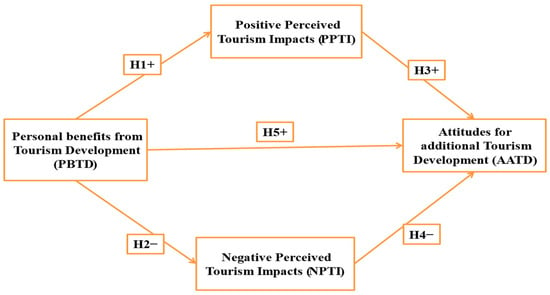
The conceptual model of the present study (Figure 1) is hugely influenced by the social exchange theory (SET) and is based on the model developed by Perdue et al. (1990) [18]. Each path in the model conceptually represents a hypothesised relationship along with the direction of either a positive (+) effect or a negative (−) effect.
Figure 1.
Conceptual model.
Based on a detailed review of pertinent literature, the following hypotheses were formulated:
H1.
Residents’ personal benefits from tourism development (PBTD) have significant and positive influences on their perceived positive impacts of tourism (PPTI) in the region.
H2.
Residents’ personal benefits from tourism development (PBTD) have significant and negative influences on their perceived negative impacts of tourism (NPTI) in the region.
H3.
Residents’ personal benefits from tourism development (PBTD) have a significant and positive influence on their attitude towards support for further tourism development (ATTD) in the region.
H4.
Residents’ perceived positive impacts of tourism (PPTI) have a significant and positive influence on their attitude towards support for further tourism development (ATTD).
H5.
Residents’ perceived negative impacts of tourism (NPTI) have a significant and negative influence on their attitude towards support for further tourism development (ATTD).
3. Materials and Methods
3.1. Study Area
Krishna-Braj Circuit is one among six tourism circuits identified by the Ministry of Tourism, Provincial Government of Uttar Pradesh (India). The Braj region encompasses both sides of the Yamuna River, with its centre at the twin cities of Mathura–Vrindavan in the province of Uttar Pradesh. It is located approximately 150 km south of New Delhi (the National Capital of India). The Krishna-Braj Circuit geographically covers a few of the most sacred places related to the birth and childhood of Lord Krishna and Radha Rani.
It is one of the most sacred sites and the main centre of pilgrimage for Hindu devotees and cultural tourists around the world. The culture of Mathura is famous worldwide for its art, religion, and festivals. It is also an active centre of Buddhism and Jainism. In 2022, Mathura saw more than 65.39 million tourist visits. The Shri Krishna Janambhoomi, Mathura temple, is one of the most frequently visited temples in India. It is a Hindu temple built around the prison cell where, according to Hindu scriptures, Lord Krishna was born. It is presently situated next to the Kesava Deo Temple and the Shahi Eid Gah Mosque [53]. The original temple was believed to be built by King Vajranabha, Krishna’s great-grandson, in the 6th century BC. It was later renovated by King Vikramaditya and many times rebuilt over the centuries. During the period of foreign invasions and socio-political unrest in the region, the temple is said to have been destroyed 17 times in its history and rebuilt by Hindu kings [54]. Official records of the Mughals mention that, most recently, the Krishna Janambhoomi temple was destroyed in 1670 by the emperor Aurangzeb. A Shahi Eidgah mosque was built, which still stands there [55,56,57]. The present temple complex, which is adjacent to the mosque, was built with financial help from industrialists and Hindu devotees in the 20th century. The ecological character of the Braj region substantially changed in the last 200 years, with a heavy fall in the number of wild animals and deforestation. Entwistle, in 1987, mentioned that there were only a few groves left in the Braj region, and also that many sacred sites in the Braj region were encroached upon by human agricultural settlements [56].
3.2. Population and Sample
The entire Krishna-Braj Circuit in Uttar Pradesh constituted the population of the study. At the present time, the Krishna-Braj Circuit covers the Mathura–Vrindavan municipal corporations (or Nagar Nigam) along with the Notified Area Council (NAC) (or Nagar Panchayat) of Govardhan, Radhakund, Nandgaon, Barsana, Gokul Mahavan, Baldev, Kokilavan, and municipal corporations (or Nagar Nigam) of Hathras [54]. There are few sites related to Buddhism and Jainism in the study area. To make the study focused on places related to the childhood and early life of Lord Krishna, it was decided not to consider Kokilavan and Hathras for further study. Table 1 provides the size and composition of the population of the study.
The study used proportionate quota sampling to draw a sample from the population. In total, 370 residents from the entire Krishna-Braj Tourism Circuit made up the study population. The current study collected 370 responses, which were sufficient to conduct structured equation modelling (SEM) and ensure adequate statistical power and reliability. The size of the sample was determined using SEM guidelines. The recommended minimum sample for SEM is 200–400 [58,59]. Hu and Bentler (1999) suggested that at least 10 participants per estimated parameter are required for SEM [60], and the study included 33 parameters, suggesting a minimum sample of 330.
The most recent 2011 census data obtained from the Government of India [61] identified Mathura as the most populous city, with 349,909 residents (71% of the circuit’s population) in the region, and it therefore constitutes the largest proportionate share of the sample, with 262 participants. Vrindavan, the second most populous city, contributed 13% of the population, corresponding to a proportionate sample size of 47 residents. Smaller towns (Notified Area Council (NAC) or Nagar Panchayat) such as Govardhan, Barsana, and Nandgaon, each holding about 2 to 5% of the circuit’s population, are allocated between 6 and 17 respondents. Notably, Radhakund and Gokul, with populations of 7511 and 4916, respectively, receive the smallest proportionate sample sizes, with six and four residents from the region (Table 1). The distribution ensures a proportional representation of each city of the Krishna-Braj Circuit in the sample. Proportionate quota sampling was used to ensure adequate representation of the diverse resident groups spread across the Krishna-Braj Circuit. The region consisted of many small towns and villages that differed in population, socio-economic profiles, tourism infrastructure, and pilgrimage activities. In such settings, quota sampling is widely recognised as a useful technique as it captures proportional representation of key subgroups in the population [62,63].
Table 1.
Population and sample of the Krishna-Braj Tourism Circuit [61].
The study sample included adult residents of both genders, representing diverse occupations and residency status. A large majority of respondents belonged to the younger age group; 79.2% of respondents belonged to the less than 40 years age category. The middle-aged group (40–62 years) represented 18.1% of the respondents. Only a small proportion (2.7%) were above 62 years of age. The marital status distribution reveals that most participants are unmarried (60.3%), compared to 39.7% who were married. A total of 40% of respondents were engaged in public or private sector jobs, reflecting a substantial working population. Further, 12.2% of respondents were business owners. The remaining 47.8% consisted of residents who were farmers, homemakers, students, or dependents.
3.3. Instrument
The study used self-reported questionnaires for data collection in the Krishna-Braj region. The questionnaires were self-administered between August and September 2024. The questionnaire was prepared after a detailed review of literature pertaining to the residents’ attitudes towards tourism development in the region and perceptions of the dual impacts of tourism [18,33,40,43,45,64].
The instrument consists of two parts. The first part contained questions related to the socio-demographic profile of residents. The questions in part 1 were based on nominal, ordinal, and interval scales. The second part contained attitude measurement statements consisting of a series of statements related to the positive and negative (economic, social, and environmental) impacts of tourism. The second part also contained measurement statements related to personal benefits from tourism development (PBTD). The questionnaire was pre-tested with ten randomly selected residents from the Krishna-Braj Tourism Circuit. As a result, some questions were deleted, and some questions were modified to improve their clarity. The statements in part 2 were developed on a five-point Likert scale, ranging from strongly agree to strongly disagree. Questionnaire items measuring observed variables were adopted from previous studies on tourism impacts and resident support for tourism development. The study’s latent construct ‘personal benefits from tourism development’ was measured using items adopted from studies of Perdue et al. (1990), Ko and Stewart (2002), Látková and Vogt (2012), and Nunkoo and So (2016) [3,18,41,44]. Items for measuring dual (positive and negative) impacts of tourism on the host community’s economy, environment, society, and culture were drawn from studies conducted by Yoon and Gentry (2009), Ko and Stewart (2002), Dyer et al. (2007), Gursoy and Rutherford (2004), and García et al. (2016) [24,40,41,51,65]. Finally, questionnaire items used to measure latent construct ‘attitudes toward additional tourism development’ were taken from Perdue et al. 1990, Ko and Stewart (2002), McGehee and Andereck (2004), and Látková and Vogt (2012) [3,18,37,41].
3.4. Data Analysis
The study used AMOS 24.0 and SPSS 22.0 to analyse the data obtained from the questionnaire. Firstly, a descriptive analysis was applied to summarise the sample residents’ characteristics in the Krishna-Braj Circuit. Thereafter, confirmatory factor analysis (CFA) using structural equation modelling (SEM) was performed to confirm the reliability and validity of all constructs. Assessing the normality of the data is a prerequisite for conducting SEM. Therefore, the study analysed the skewness and kurtosis of the observed variables before running CFA. Heterotrait–monotrait (HTMT) ratios were also examined to further ensure the sound discriminant validity of the model.
4. Results
As indicated in Table 2, the absolute values of skewness were less than 3, and those of kurtosis were less than 10, and therefore they satisfied the assumption of normality.
Table 2.
Descriptive statistics and normality.
4.1. Measurement Model Fit: Initial Model
The initial model derived from the literature contained eight latent constructs and thirty-three observed variables (Table 3). A detailed investigation of the initial measurement model indicated that the latent constructs PBTD and ATTD both constituted three observed variables with associated error terms e27 to e29 and e30 to e32, respectively. Further, latent constructs P_EcoI constituted four observed variables (e1 to e4), P_SCI constituted six observed variables (e5 to e10), P_EnvI constituted three observed variables (e11 to e13). At the same time, the latent construct N_EcoI constituted three observed variables (e24 to e26), N_SCI constituted seven observed variables (e18 to e23), N_EnvI constituted four observed variables (e14 to e17).
Table 3.
Standardised regression weights in the initial measurement model.
The initial measurement model derived from the literature was a bad fit (CMIN/DF = 4.22, CFI = 0.795, SRMR = 0.107, RMSEA = 0.09) and therefore needed to be improved.
4.2. Improvised Measurement Model Assessment
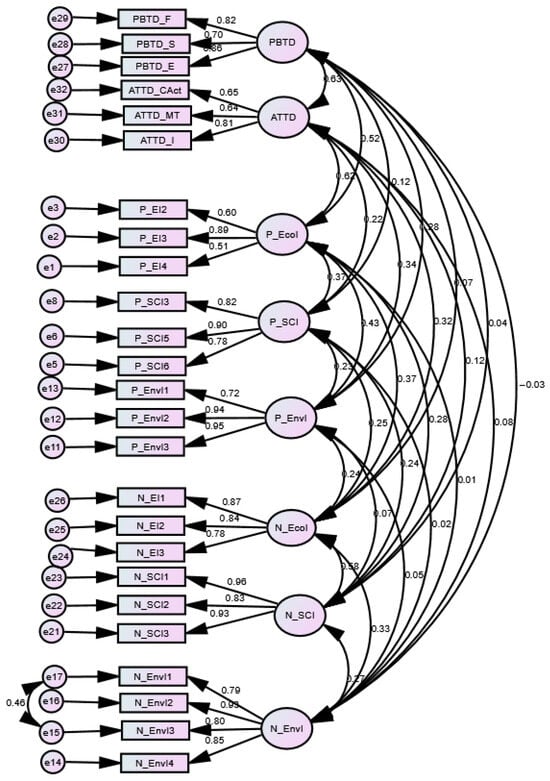
To achieve the measurement model fit, it was decided to delete a total of eight observed variables that had very low standardised regression weights. Deleted observed variables were N_SCI4, N_SCI5, N_SCI6, N_SCI7, P_SCI1, P_SCI2, P_SCI4, and P_EI1 with very low standardised regression weights of 0.486, 0.318, 0.304, 0.282, 0.315, 0.280, 0.285, and 0.537, respectively. The improvised measurement model contains eight latent constructs and twenty-five observed variables (Figure 2). The improvised measurement model demonstrated an acceptable model fit at χ2/df = 2.787 (excellent); TLI (rho2) = 0.910 (acceptable); CFI = 0.926 (excellent); SRMR = 0.059 (excellent); RMSEA = 0.07 (acceptable).
Figure 2.
Improvised measurement model.
4.3. Reliability and Validity of the Model
Table 4 presents results related to the reliability and validity of the measurement model. The model was examined for both convergent and discriminant validity.
Table 4.
Reliability and validity of the measurement model.
Heterotrait–monotrait (HTMT) ratios were also examined to further ensure the sound discriminant validity of the model (Table 5). The absolute values of the HTMT ratio were less than the critical threshold limit of 0.85, ensuring the discriminant validity of the latent constructs [58].
Table 5.
HTMT analysis.
4.4. Assessment of Structural Model
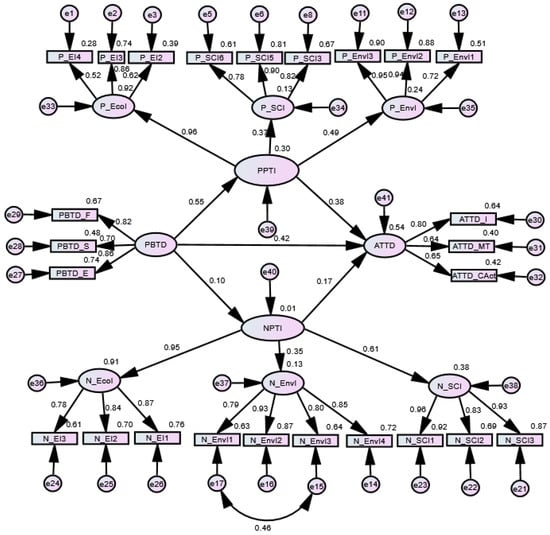
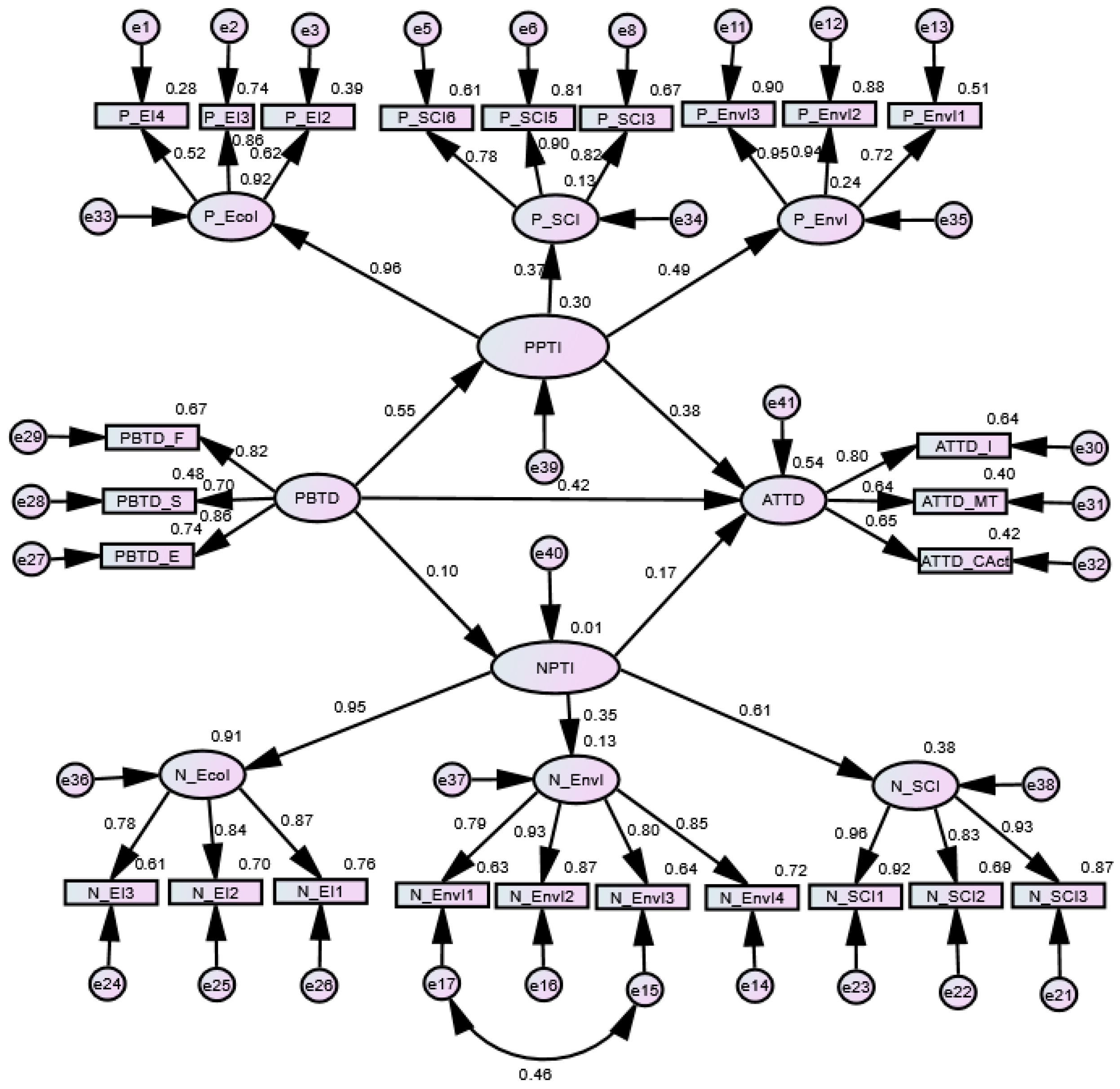
The structural equation model built through AMOS was applied to test the relationship. The fit indices for the structural model are shown in Figure 3. The fit indices fell within the acceptable range at: CMIN/df = 2.910 (excellent), TLI (rho 2) = 0.90 (acceptable), CFI = 0.91 (acceptable), SRMR = 0.08 (acceptable), and RMSEA 0.07 (acceptable).
Figure 3.
Structural model.
5. Discussion
Ensuring the normality of collected data is a crucial step before running structural equation modelling (SEM). Therefore, to evaluate normality, the study examined the skewness and kurtosis of the observed variables. Table 2 clearly indicates that all observed variables under the latent constructs exhibited skewness and kurtosis values within acceptable ranges (skewness < |1| and kurtosis < |2|) for SEM. Consequently, the data can be considered normal, and no substantial transformations are required for SEM analysis.
5.1. Measurement of Model Fit and Improvement
Table 3 provided the standardised regression weights from an initial measurement model, indicating the strength and direction of the relationship between the observed variables and their respective latent constructs. Higher values suggest a stronger relationship or influence. The observed variables PBTD_E, PBTD_S, and PBTD_F load onto the latent variable PBTD with high standardised regression weights of 0.859, 0.698, and 0.823, respectively. The observed variables ATTD_I, ATTD_MT, and ATTD_CAct loaded onto the latent variable ATTD with a high standardised regression weight of 0.810 and moderately high standardised regression weights of 0.639 and 0.652, respectively. The observed variable P_EI3 loads onto the latent construct P_EcoI with a high standardised regression weight of 0.842; at the same time, P_EI4, P_EI2, and P_EI1 were moderately loaded (0.519, 0.624, and 0.537, respectively). Observed variables P_SCI6, P_SCI5, and P_SCI3 had weights of 0.784, 0.880, and 0.830, respectively, indicating a relatively strong positive relationship with the latent construct P_SCI. Conversely, P_SCI4 and P_SCI2 have lower weights of 0.285 and 0.280, respectively, indicating weaker associations. Furthermore, observed variables P_EnvI3, P_EnvI2, and P_EnvI1 had a strong positive relationship (0.945, 0.942, and 0.718, respectively) with the latent construct P_EnvI. Observed variables N_EnvI1, N_EnvI2, N_EnvI3, and N_EnvI4 were connected to the latent construct N_EcoI. N_EnvI2 indicated a strong positive relationship (0.890) with the latent construct N_EnvI. N_EnvI3, N_EnvI4, and N_EnvI1 (0.863, 0.831, and 0.859, respectively) follow closely, suggesting a strong relationship with N_EnvI as well. Furthermore, observed variables N_SCI1 and N_SCI3 had very high weights of 0.962 and 0.926, indicating a very strong positive relationship with the latent construct N_SCI. N_SCI2 follows closely, which indicates a very strong relationship (0.834). N_SCI4, with a weight of 0.486, represents a moderate association. At the same time, N_SCI5, N_SCI6, and N_SCI7 (0.318, 0.304, and 0.282, respectively) suggested very weak relationships with N_SCI compared to the other indicators. Finally, observed variables N_EI1, N_EI2, and N_EI3 (0.873, 0.838, and 0.78, respectively) indicated a strong positive relationship with the latent construct N_EcoI. The initial measurement model derived from the literature was evaluated using goodness-of-fit indices, which are standard measures to assess how well the hypothesised model fits the data. The initial measurement model derived from the literature was a bad fit (CMIN/DF = 4.22, CFI = 0.795, SRMR = 0.107, RMSEA = 0.09) and therefore needed to be improved.
To achieve the measurement model fit, it was decided to delete a total of eight observed variables that had very low standardised regression weights. Deleted observed variables were N_SCI4, N_SCI5, N_SCI6, N_SCI7, P_SCI1, P_SCI2, P_SCI4, and P_EI1 with very low standardised regression weights of 0.486, 0.318, 0.304, 0.282, 0.315, 0.280, 0.285, and 0.537, respectively. The remaining variables were retained in the improvised measurement model. An investigation of modification indices also helped to achieve acceptable model fit estimates. Drawing the covariance between error terms e15 and e17 with the highest modification index (32.91) further improved the model fit. The improvised measurement model contains eight latent constructs and twenty-five observed variables (Figure 2).
The improvised measurement model demonstrated an acceptable model fit with χ2/df = 2.787 (excellent), TLI (rho2) = 0.910 (acceptable); CFI = 0.926 (excellent); SRMR = 0.059 (excellent); RMSEA = 0.07 (acceptable). It indicated a more robust representation of the data and adherence to theoretical expectations.
5.2. Reliability and Validity of the Improvised Measurement Model
The composite reliability (CR) for all eight latent constructs was found to be above the threshold limit of 0.7 (Table 4). The average variance extracted (AVE) value for all the latent constructs was above the threshold limit of 0.5, except for P_EcoI with an AVE value of 0.472 and ATTD with an AVE value of 0.496 (very close to the threshold limit). Malhotra and Dash (2011) argued that AVE is often too strict and, therefore, reliability can be established through the CR value alone [66]. Finally, the CR and AVE values together ensured a high reliability and convergent validity for the improvised measurement model as displayed in Figure 2.
The improvised measurement model demonstrated discriminant validity because the square root of the AVE of each construct, viz., P_EcoI (0.687), P_SCI (0.836), P_EnvI (0.875), N_EnvI (0.845), N_SCI (0.910), N_EcoI (0.832), PBTD (0.796), and ATTD (0.705), exceeded their highest correlation coefficient with the remaining constructs [66,67]. The absolute values of the HTMT ratio were lower than the critical threshold of 0.85, ensuring the discriminant validity of the latent constructs [58].
5.3. Structural Model Assessment
A good-fitting model is accepted for further analysis if the value of CMIN/df, the goodness of fit (GFI) index, the Tucker and Lewis index (TLI), and the confirmatory fit index (CFI) are more than 0.90 (Hair et al., 2022 [59]). Furthermore, an adequately fitting model was accepted if the AMOS calculated value of the standardised root mean square residual (SRMR) and root mean square error approximation (RMSEA) are between 0.05 and 0.08 (<0.05 is excellent and between 0.05 and 0.08 is acceptable).
The fit indices for the structural model shown in Figure 3 fell within the acceptable range: CMIN/df = 2.910 (excellent), TLI (rho 2) = 0.90 (acceptable), CFI = 0.91 (acceptable), SRMR = 0.08 (acceptable), and RMSEA 0.07 (acceptable).
The squared multiple correlations (R2) were 0.30 for ‘positive perceived tourism impact’ (PPTI), which shows that 30% of variance in the dependent construct PPTI is accounted for by the independent construct PBTD. At the same time, R2 was 0.01 for ‘negative perceived tourism impact’ (NPTI), which shows that only 1% of variance in the dependent construct NPTI is accounted for by the independent construct PBTD. Furthermore, R2 was 0.54 for ‘attitude towards additional tourism development’ (ATTD), which shows that 54% of variance in the dependent construct ATTD is accounted for by independent constructs PPTI, PBTD, and NPTI together (Figure 3).
5.4. Hypothesis Results Reporting
PPTI ← PBTD: The study assessed the impact of personal benefits from tourism development in the region (PBTD) on positive perceived tourism impact (PPTI). The impact of PBTD on PPTI was positive and significant (β = 0.55, t = 6.57, p < 0.001), and therefore H1 was supported (Table 6).
Table 6.
Hypothesis testing.
Many previous studies such as Perdue et al., 1995; Andereck and Nyaupane, 2011; Nawijn and Mitas, 2012; Vargas-Sánchez et al., 2015; Uysal et al., 2018, Kang and Lee, 2018; Frleta and Jurdana, 2020 supported this finding [5,11,26,36,43,45,46]. Previous researchers extended the work performed by Perdue et al. (1990) [18] to further understand residents’ support for tourism and established that residents’ perceptions of personal benefits were significantly related to the perceived impacts. Previous studies, such as Andereck et al. (2011), Nawijn et al. (2012), and Uysal et al. (2018) [26], reported that those receiving benefits from tourism tend to report a more positive perception of the impact of tourism than other residents in the community [26,36,46].
NPTI ← PBTD: The study assessed the impact of personal benefits from tourism development in the region (PBTD) on the perceived negative impacts of tourism (NPTI). The impact of PBTD on NPTI was not significant (β = 0.099, t= 6.57, p = 0.112), and therefore H2 was not supported. The result was supported by the findings of many previous scholars (Uysal et al., 2018 and Gursoy et al., 2002) [26,33]. Ko and Stewart (2002) [41] based their study on the model developed by Perdue et al. (1990) [18]. They found an insignificant relationship between personal benefits from tourism development in the region and their perceived negative impacts of tourism [41].
ATTD ← PBTD: The study assessed the impact of personal benefits from tourism development in the region (PBTD) on attitude towards tourism development (ATTD) in the region. The impact of PBTD on ATTD was positive and significant (β = 0.415 t = 1.59, p < 0.001), and therefore H3 was supported.
The finding was supported by findings of many previous researchers, such as Perdue et al. (1990), Perdue et al. (1995), and Vargas-Sánchez et al. (2015) [18,43,45]. These researchers also found a significant relationship between residents’ anticipated personal benefits and their support for tourism development in the region.
ATTD ← PPTI and ATTD ← NPTI: The study assessed the impact of positive perceived tourism impact (PPTI) on attitude towards tourism development (ATTD). The impact of PPTI on ATTD was positive and significant (β = 0.381, t = 3.89, p < 0.001), and therefore H4 was supported.
The study assessed the impact of negative perceived tourism impact (NPTI) on attitude towards tourism development (ATTD). The impact of PPTI on ATTD was positive and significant (β = 0.381, t = 3.89, p < 0.001), and therefore H4 was supported. The finding was consistent with the findings of García et al. (2016) [51]. The scholar found that native residents had more unfavourable attitudes towards economic, socio-cultural, and environmental impacts as compared to foreign residents in the region.
Látková1 and Vogt (2012) [3] built their study on the Perdue, Long, and Allen (1990) [18] model and investigated the extent to which personal benefits from tourism and perceived dual impacts (positive and negative) of tourism are related to support for tourism development in the region. They held that residents with perceived positive tourism impacts were more supportive of additional tourism development as compared to residents with negative tourism impacts. Simultaneously, residents who do not anticipate benefits from tourism development in the region express less positive attitudes toward tourism development in the region [3]. Vargas-Sánchez, Oomdo Valle, da Costa Mendes, and Silva (2015) [43] mentioned that residents in the community who receive personal benefits from tourism development in the area perceive the positive impacts of tourism more strongly and the negative impacts of tourism less strongly. It finally results in a strong positive attitude towards tourism development in the region [43]. A few years later, Kang and Lee (2018) [11] also supported previous scholars by concluding that locals who perceive personal benefits from tourism development tend to react positively to it. It further results in their support for further tourism development in the region [11]. Frleta and Jurdana (2020) [5] investigated the residents’ perceptions of various tourism impacts as well as residents’ support for future tourism development with respect to the received benefits in terms of employment from tourism in Istria (Croatia). They found that locals receiving direct benefits from the tourism industry in terms of employment expressed stronger support for future development as compared to non-recipients of such benefits [5].
6. Conclusions
The main aim of the study was to analyse the relationship between residents’ perception of tourism’s dual impact (positive and negative) on the host community and their attitude towards sustainable tourism development in the region. The study also examined the nature of the relationship between personal benefits drawn from tourism development in the region and residents’ perception of tourism’s impact on the host community. The tourism sustainability framework, which includes three pillars, viz., economic, environmental, and socio-cultural tourism impact, was used to analyse the positive and negative impact of tourism on residents in the host community.
The study found that the initial measurement model, incorporating eight latent constructs and thirty-three observed variables, required refinement to achieve an acceptable fit. The model’s fitness indices improved significantly by eliminating eight low-weight variables and also modifying some error covariances. The improvised model demonstrated high reliability through composite reliability (CR) values above the threshold limit of 0.7. It also achieved acceptable convergent validity, despite some AVE values falling slightly below the threshold limit. Furthermore, the structural model confirmed acceptable fit indices, supporting the relationships between personal benefits from tourism, perceived impacts, and attitudes toward further development. The findings of the study established that personal benefits significantly and positively influenced perceived positive impacts (PPTI) and attitudes toward tourism development (ATTD). On the other hand, the influence on perceived negative impacts (NPTI) was not significant. Additionally, positive perceived tourism impacts significantly shaped residents’ attitudes, while the expected negative influence of NPTI on attitudes was unsupported. Overall, the study supports that the benefits residents derive from tourism strongly shape their perceptions and openness to sustainable future tourism development.
7. Implications of the Study
The Krishna-Braj Circuit is not only a tourist destination; it is a sacred cultural heritage site in India. Findings of the study bring some important policy implications to planners and decisionmakers, especially in the Indian context. The study highlighted many issues such as employment opportunity, standard of living, commodification of culture and heritage, overcrowding, erosion of local identity, and crime to assist policymakers and planners in maintaining a balance between residents’ personal benefits, economic gains, and issues such as environmental protection, cultural sensitivity, and heritage preservation. By integrating the three pillars of the tourism sustainability framework, the study helps policymakers understand how tourism development in a region can become socially acceptable, economically viable, and environmentally responsible.
The study also brings important implications for local administration. Local authorities can formulate strategies for participatory tourism and engage the host community in supporting tourism development. It is also helpful in mitigating the adverse impacts of tourism and promoting a healthy social exchange between residents and tourists. Though the study was conducted in the province of Uttar Pradesh of India, its findings may be generalised to many other pilgrimage destinations across the country. India has several sacred destinations of high cultural importance that share characteristics like those of the Krishna-Braj Circuit. Theoretically, this study extends understanding and application of the social exchange theory (SET) by showcasing how dual impacts (positive and negative both) can influence both host community participation and support for sustainable tourism development in a region, particularly on a sacred pilgrimage site.
8. Limitations and Suggestions
The study used data obtained through a questionnaire measuring host community perception and their support for tourism development. Though the study findings may be relevant to many other similar Indian pilgrimage destinations, their application to pilgrimage destinations of other parts of the world is questionable. Future research studies should address more qualitative dimensions of cultural and heritage tourism. Such an investigation would provide a more comprehensive understanding of the impact of tourism on a pilgrimage site. In addition, the study was cross-sectional in nature. Future researchers may conduct longitudinal studies that track long-term effects of tourism on the host community at the pilgrimage site, which would be useful in formulating sustainable strategies for additional tourism development in the region. Due care was taken to avoid all potential sources of error, including sampling, measurement, and data analysis, etc. However, respondents’ bias and prejudice, as well as human error caused by fatigue and cognitive overload, cannot be completely denied. Hence, we suggest readers and future researchers interpret the study’s findings and conclusions in the light of the aforementioned limitations. Due to the non-availability of an updated sample frame and other practical reasons, the study employed a non-probability proportionate quota sampling technique. However, future researchers may employ stronger probability sampling techniques such as systematic sampling or stratified random sampling, wherever feasible. There are many stakeholders of tourism development in a community, including residents, tourists, tourism enterprises, government, temple administrations, NGOs, and civil societies. The present study included only residents in the host community. Therefore, future studies may include other tourism stakeholders. Finally, there was a serious lack of literature on host community perceptions of tourism and their support for tourism on the pilgrimage site. In the absence of India-specific literature, the study relied on foreign literature, mainly from Western countries.
Author Contributions
Writing—original draft: A.M.; Conceptualisation: A.M. and E.H.R.; Administration: A.M.; Methodology: A.M.; Formal Analysis: A.M. and E.H.R.; Writing—review and editing: E.H.R. All authors have read and agreed to the published version of the manuscript.
Funding
This research received no external funding.
Institutional Review Board Statement
The study was conducted in accordance with the Declaration of Helsinki, and approved by the Institutional Review Board of University School of Business, Chandigarh University, Mohali (protocol code 2024/06/18 and 28 June 2024).
Informed Consent Statement
Informed consent was obtained from all participants involved in the study.
Data Availability Statement
All data supporting the findings of this study are included within the article. Additional data are available from the authors upon reasonable request.
Conflicts of Interest
The authors declare no conflicts of interest.
References
- Gursoy, D.; Chi, C.G.; Dyer, P. Locals’ attitudes toward mass and alternative tourism: The case of Sunshine Coast, Australia. J. Travel Res. 2010, 49, 381–394. [Google Scholar] [CrossRef] [Scilit]
- Erul, E.; Woosnam, K.M.; McIntosh, W.A. Considering emotional solidarity and the theory of planned behavior in explaining behavioral intentions to support tourism development. J. Sustain. Tour. 2020, 28, 1158–1173. [Google Scholar] [CrossRef] [Scilit]
- Látková, P.; Vogt, C.A. Residents’ attitudes toward existing and future tourism development in rural communities. J. Travel Res. 2012, 51, 50–67. [Google Scholar] [CrossRef] [Scilit]
- Sever, I. Residents’ adaptation to intensive tourism development. Ann. Tour. Res. Empir. Insights 2023, 4, 100107. [Google Scholar] [CrossRef] [Scilit]
- Soldić Frleta, D.; Smolčić Jurdana, D. Insights into differences in residents’ attitudes. Tourism 2020, 68, 170–180. [Google Scholar] [CrossRef] [Scilit]
- Qin, X.; Shen, H.; Ye, S.; Zhou, L. Revisiting residents’ support for tourism development: The role of tolerance. J. Hosp. Tour. Manag. 2021, 47, 114–123. [Google Scholar] [CrossRef] [Scilit]
- Woosnam, K.M.; Joo, D.; Gaither, C.J.; Ribeiro, M.A.; Sánchez, J.J.; Brooks, R.; Lee, D.K. Residents’ behavioral support for tourism in a burgeoning rural destination. J. Outdoor Recreat. Tour. 2024, 48, 100816. [Google Scholar] [CrossRef] [Scilit]
- Nunkoo, R.; Gursoy, D. Residents’ support for tourism. An Identity Perspective. Ann. Tour. Res. 2012, 39, 243–268. [Google Scholar] [CrossRef] [Scilit]
- Peeters, P.; Gössling, S.; Klijs, J.; Milano, C.; Novelli, M.; Dijkmans, C.; Eijgelaar, E.; Hartman, S.; Heslinga, J.; Isaac, R.; et al. Research for TRAN Committee—Overtourism: Impact and Possible Policy Responses; European Parliament: Brussels, Belgium, 2018. [Google Scholar] [CrossRef]
- Chi, C.G.Q.; Ouyang, Z.; Xu, X. Changing perceptions and reasoning process: Comparison of residents’ pre- and post-event attitudes. Ann. Tour. Res. 2018, 70, 39–53. [Google Scholar] [CrossRef] [Scilit]
- Kang, S.K.; Lee, J. Support of marijuana tourism in Colorado: A residents’ perspective using social exchange theory. J. Destin. Mark. Manag. 2018, 9, 310–319. [Google Scholar] [CrossRef] [Scilit]
- Woo, E.; Kim, H.; Kim, Y.G. Touristification phenomenon and support for tourism development. Anatolia 2022, 33, 65–78. [Google Scholar] [CrossRef] [Scilit]
- Mihalic, T. Conceptualising overtourism: A sustainability approach. Ann. Tour. Res. 2020, 84, 103025. [Google Scholar] [CrossRef] [Scilit]
- Stylidis, D.; Biran, A.; Sit, J.; Szivas, E.M. Residents’ support for tourism development: The role of residents’ place image and perceived tourism impacts. Tour. Manag. 2014, 45, 260–274. [Google Scholar] [CrossRef] [Scilit]
- Martín, H.S.; de los Salmones Sánchez, M.M.G.; Herrero, Á. Residents’ attitudes and behavioural support for tourism in host communities. J. Travel Tour. Mark. 2018, 35, 231–243. [Google Scholar] [CrossRef] [Scilit]
- Donaire, J.A.; Galí, N.; Coromina, L. Evaluating tourism scenarios within the limit of acceptable change framework in Barcelona. Ann. Tour. Res. Empir. Insights 2024, 5, 100145. [Google Scholar] [CrossRef] [Scilit]
- Milano, C. Overtourism, malestar social y turismofobia. Un debate controvertido. PASOS Rev. Tur. Patrim. Cult. 2018, 18, 551–564. [Google Scholar] [CrossRef] [Scilit]
- Perdue, R.R.; Long, P.T.; Allen, L. Resident support for tourism development. Ann. Tour. Res. 1990, 17, 586–599. [Google Scholar] [CrossRef] [Scilit]
- Eslami, S.; Khalifah, Z.; Mardani, A.; Streimikiene, D. Community attachment, tourism impacts, quality of life and residents’ support for sustainable tourism development. J. Travel Tour. Mark. 2019, 36, 1061–1079. [Google Scholar] [CrossRef] [Scilit]
- Martín, J.C.; Moreira, P.; Román, C. A hybrid-fuzzy segmentation analysis of residents’ perception towards tourism in Gran Canaria. Tour. Econ. 2020, 26, 1282–1304. [Google Scholar] [CrossRef] [Scilit]
- Ap, J. Residents’ perceptions on tourism impacts. Ann. Tour. Res. 1992, 19, 665–690. [Google Scholar] [CrossRef] [Scilit]
- Rasoolimanesh, S.M.; Jaafar, M.; Kock, N.; Ramayah, T. A revised framework of social exchange theory to investigate the factors influencing residents’ perceptions. Tour. Manag. Perspect. 2015, 16, 335–345. [Google Scholar] [CrossRef] [Scilit]
- Chang, K.C. The affecting tourism development attitudes based on the social exchange theory and the social network theory. Asia Pac. J. Tour. Res. 2021, 26, 167–182. [Google Scholar] [CrossRef] [Scilit]
- Gursoy, D.; Rutherford, D.G. Host attitudes toward tourism. Ann. Tour. Res. 2004, 31, 495–516. [Google Scholar] [CrossRef] [Scilit]
- Hadinejad, A.; Moyle, B.D.; Scott, N.; Kralj, A.; Nunkoo, R. Residents’ attitudes to tourism: A review. Tour. Rev. 2019, 74, 150–165. [Google Scholar] [CrossRef] [Scilit]
- Uysal, M.; Sirgy, M.J.; Kruger, S. Managing Quality of Life in Tourism and Hospitality; CAB International: Wallingford, UK, 2018. [Google Scholar]
- Joseph Sirgy, M. Promoting quality-of-life and well-being research in hospitality and tourism. J. Travel Tour. Mark. 2019, 36, 1–13. [Google Scholar] [CrossRef] [Scilit]
- Organisation for Economic Co-Operation and Development. OECD Guidelines on Measuring Subjective Well-Being; OECD: Paris, France, 2013. [Google Scholar]
- Ivlevs, A. Happy Hosts? International Tourist Arrivals and Residents’ Subjective Well-being in Europe. J. Travel Res. 2017, 56, 599–612. [Google Scholar] [CrossRef] [Scilit]
- Nunkoo, R.; Ramkissoon, H. Modeling community support for a proposed integrated resort project. J. Sustain. Tour. 2010, 18, 257–277. [Google Scholar] [CrossRef] [Scilit]
- Gossling, S.; McCabe, S.; Chen, N. A socio-psychological conceptualisation of overtourism. Ann. Tour. Res. 2020, 84, 102976. [Google Scholar] [CrossRef] [Scilit]
- Gursoy, D.; Ouyang, Z.; Nunkoo, R.; Wei, W. Residents’ impact perceptions of and attitudes towards tourism development: A meta-analysis. J. Hosp. Mark. Manag. 2019, 28, 306–333. [Google Scholar] [CrossRef] [Scilit]
- Gursoy, D.; Jurowski, C.; Uysal, M. Resident attitudes: A structural modeling approach. Ann. Tour. Res. 2002, 29, 79–105. [Google Scholar] [CrossRef] [Scilit]
- Nunkoo, R.; Ramkissoon, H. Structural equation modelling and regression analysis in tourism research. Curr. Issues Tour. 2012, 15, 777–802. [Google Scholar] [CrossRef] [Scilit]
- Tosun, C. Host perceptions of impacts: A comparative tourism study. Ann. Tour. Res. 2002, 29, 231–253. [Google Scholar] [CrossRef] [Scilit]
- Andereck, K.L.; Nyaupane, G.P. Exploring the Nature of Tourism and Quality of Life Perceptions among Residents. J. Travel Res. 2011, 50, 248–260. [Google Scholar] [CrossRef] [Scilit]
- McGehee, N.G.; Andereck, K.L. Factors predicting rural residents’ support of tourism. J. Travel Res. 2004, 43, 131–140. [Google Scholar] [CrossRef] [Scilit]
- Jordan, E.J.; Spencer, D.M.; Prayag, G. Tourism impacts, emotions and stress. Ann. Tour. Res. 2019, 75, 213–226. [Google Scholar] [CrossRef] [Scilit]
- Nunkoo, R.; Ramkissoon, H. Gendered theory of planned behaviour and residents’ support for tourism. Curr. Issues Tour. 2010, 13, 525–540. [Google Scholar] [CrossRef] [Scilit]
- Dyer, P.; Gursoy, D.; Sharma, B.; Carter, J. Structural modeling of resident perceptions of tourism and associated development on the Sunshine Coast, Australia. Tour. Manag. 2007, 28, 409–422. [Google Scholar] [CrossRef] [Scilit]
- Ko, D.W.; Stewart, W.P. A structural equation model of residents’ attitudes for tourism development. Tour. Manag. 2002, 23, 521–530. [Google Scholar] [CrossRef] [Scilit]
- Ribeiro, M.A.; Pinto, P.; Silva, J.A.; Woosnam, K.M. Residents’ attitudes and the adoption of pro-tourism behaviours: The case of developing island countries. Tour. Manag. 2017, 61, 523–537. [Google Scholar] [CrossRef] [Scilit]
- Vargas-Sánchez, A.; Oom do Valle, P.; da Costa Mendes, J.; Silva, J.A. Residents’ attitude and level of destination development: An international comparison. Tour. Manag. 2015, 48, 199–210. [Google Scholar] [CrossRef] [Scilit]
- Nunkoo, R.; So, K.K.F. Residents’ Support for Tourism. J. Travel Res. 2016, 55, 847–861. [Google Scholar] [CrossRef] [Scilit]
- Perdue, R.R.; Long, P.T.; Kang, Y.S. Resident Support for Gambling as a Tourism Development Strategy. J. Travel Res. 1995, 34, 3–11. [Google Scholar] [CrossRef] [Scilit]
- Nawijn, J.; Mitas, O. Resident Attitudes to Tourism and Their Effect on Subjective Well-Being. J. Travel Res. 2012, 51, 531–541. [Google Scholar] [CrossRef] [Scilit]
- Nunkoo, R. Tourism development and trust in local government. Tour. Manag. 2015, 46, 623–634. [Google Scholar] [CrossRef] [Scilit]
- Rasoolimanesh, S.M.; Ali, F.; Jaafar, M. Modeling residents’ perceptions of tourism development: Linear versus non-linear models. J. Destin. Mark. Manag. 2018, 10, 1–9. [Google Scholar] [CrossRef] [Scilit]
- Abuhay, T.; Teshome, E.; Mulu, G. A tale of duality: Community perceptions towards the ecotourism impacts on Simien Mountains National Park, Ethiopia. Reg. Sustain. 2023, 4, 453–464. [Google Scholar] [CrossRef] [Scilit]
- Etongo, D.; Lafleur, H.; Vel, T. Community perceptions and attitudes towards the management of protected areas in Seychelles with Morne Seychellois National Park as case study. World Dev. Sustain. 2023, 3, 100091. [Google Scholar] [CrossRef] [Scilit]
- Almeida-García, F.; Peláez-Fernández, M.Á.; Balbuena-Vázquez, A.; Cortés-Macias, R. Residents’ perceptions of tourism development in Benalmádena (Spain). Tour. Manag. 2016, 54, 259–274. [Google Scholar] [CrossRef] [Scilit]
- Gursoy, D.; Kendall, K.W. Hosting mega events. Ann. Tour. Res. 2006, 33, 603–623. [Google Scholar] [CrossRef] [Scilit]
- Mathura Krishna Janambhoomi Temple: What Is the History and How to Visit—India Today. Available online: https://www.indiatoday.in/information/story/mathura-krishna-janambhoomi-temple-what-is-the-history-and-how-to-visit-1726880-2020-09-30 (accessed on 3 October 2025).
- Krishna-Braj Circuit|Welcome to UP Tourism-Official Website of Department of Tourism, Government of Uttar Pradesh, India. Available online: https://uptourism.gov.in/en/page/krishna-braj-circuit (accessed on 3 October 2025).
- Mathura Court Admits Plea to Remove Mosque Adjacent Krishna Janmabhoomi—The Hindu. Available online: https://www.thehindu.com/news/national/mathura-court-admits-plea-to-remove-mosque-adjacent-krishna-janmabhoomi/article32875442.ece (accessed on 3 October 2025).
- Entwistle, A.W. Braj: Centre of Krishna Pilgrimage; E. Forsten: Groningen, The Netherlands, 1987. [Google Scholar]
- Yamunan, S. In Mathura Krishna janmasthan, Ayodhya Playbook Is Being Used to Claim Hindu Rights over Mosque. Scroll. 2020. Available online: https://scroll.in/article/974389/in-mathura-the-ayodhya-playbook-is-being-deployed-again-to-claim-hindu-rights-over-idgah-mosque (accessed on 5 October 2025).
- Kline, R.B.; Little, T.D. Principles and Practice of Structural Equation Modeling, 4th ed.; The Guilford Press: New York, NY, USA, 2016. [Google Scholar]
- Hair, J.F.; Hult, G.T.M.; Ringle, C.M.; Marko, S. A Primer on Partial Least Squares Structural Equation Modeling (PLS-SEM); SAGE Publications, Inc.: Thousand Oaks, CA, USA, 2022. [Google Scholar]
- Hu, L.; Bentler, P.M. Cutoff criteria for fit indexes in covariance structure analysis: Conventional criteria versus new alternatives. Struct. Equ. Model. 1999, 6, 1–55. [Google Scholar] [CrossRef] [Scilit]
- Census of India. Mathura Tehsil—Mathura, Uttar Pradesh: Villages & Towns Data. Census Population 2011. Available online: https://www.census2011.co.in/data/subdistrict/764-mathura-mathura-uttar-pradesh.html#google_vignette (accessed on 5 October 2025).
- Kalton, G. Introduction to Survey Sampling; SAGE Publications: Beverly Hills, CA, USA, 1983. [Google Scholar]
- Henry, G.T. Practical Sampling; SAGE Publications: Newbury Park, CA, USA, 1990. [Google Scholar]
- Gursoy, D.; Kim, K.; Uysal, M. Perceived impacts of festivals and special events by organizers: An extension and validation. Tour. Manag. 2004, 25, 171–181. [Google Scholar] [CrossRef] [Scilit]
- Yoon, S.Y.; Gentry, M. Racial and ethnic representation in gifted programs: Current status of and implications for gifted Asian American students. Gift. Child. Q. 2009, 53, 121–136. [Google Scholar] [CrossRef] [Scilit]
- Malhotra, N.K.; Das, S. Marketing Research an Applied Orientation, 7th ed.; Pearson Education: London, UK, 2019. [Google Scholar]
- Fornell, C.; Larcker, D.F. Evaluating Structural Equation Models with Unobservable Variables and Measurement Error. J. Mark. Res. 1981, 18, 39–54. [Google Scholar] [CrossRef] [Scilit] [PubMed]

Disclaimer/Publisher’s Note: The statements, opinions and data contained in all publications are solely those of the individual author(s) and contributor(s) and not of MDPI and/or the editor(s). MDPI and/or the editor(s) disclaim responsibility for any injury to people or property resulting from any ideas, methods, instructions or products referred to in the content. |
© 2026 by the authors. Licensee MDPI, Basel, Switzerland. This article is an open access article distributed under the terms and conditions of the Creative Commons Attribution (CC BY) license.