1. Introduction
FAO assessments estimate that agrifood systems generate hidden economic, social, and environmental costs equivalent to about 10% of global GDP, underscoring the need for context-specific case studies to support inclusive policy design [
1]. At the same time, previous studies indicate that the similarities, differences, and relationships between circular economy and sustainability remain ambiguously defined, which blurs their conceptual boundaries and constrains their effective application in research and practice [
2]. In this context, rural poverty remains predominant in many developing regions, and while the role of agriculture as an engine of growth has become context-dependent, rural development policies—particularly those addressing market failures—remain crucial for including the rural poor in economic growth [
3]. Agricultural innovation adoption is not a binary decision but a continuous and sequential process shaped by economic, socio-cultural, and institutional factors, often involving the simultaneous or staged adoption of multiple technologies [
4].
Cambodia provides a relevant national context in which to examine these issues. Empirical evidence from Cambodia indicates that income diversification plays an important role in shaping rural livelihoods and household wellbeing. Ham Kimkong et al. (2023) [
5] examined income diversification and household wellbeing in rural farming communities of Tang Krasang and Trapang Trabek in Stung Chreybak, Kampong Chhnang, Cambodia, and found that diversification of income sources is positively associated with improved living standards, including better access to education, healthcare, and housing, thereby supporting sustainable livelihoods among smallholder farm households. Earlier work by Seng (2015) [
6] analyzed the welfare effects of off-farm income diversification in rural Cambodia and showed that participation in salary-paid employment is positively associated with higher per capita food consumption among farm households, whereas engagement in self-employment does not generate similar welfare gains. At the institutional level, Ofori et al. (2019) [
7] highlighted that while commercial vegetable cooperative membership does not directly increase agricultural income, it improves technology choice, access to credit and information through training, and that diversification into higher-value crops such as horticulture can contribute to farm income growth.
To further contextualize the Cambodian case, it is also important to outline the positioning and economic significance of the country’s major crops, drawing on recent data and empirical evidence. Based on the ILO Modelled Estimates (ILOEST), agriculture accounted for approximately 37% of total employment in Cambodia in 2023 [
8]. Given this continued reliance on agriculture, a substantial body of empirical research has adopted case study approaches to examine both crop-specific production dynamics and broader rural livelihood outcomes in Cambodia. In the rice sector, case study–based analyses have been widely used to investigate production constraints and input-use dynamics. Hak Keo et al. (2025) [
9] found that rice productivity in Battambang and Svay Rieng provinces is primarily driven by land size and chemical input use, highlighting the importance of sustainable input management in Cambodian rice farming. Similarly, Siek Darith et al. (2025) [
10] found that herbicide costs, harvester rental costs, and cultivated land area are the most significant determinants of rice yield in Preah Vihear Province, Cambodia. Beyond rice production, case study based research has also been applied to examine agricultural communities and livelihood strategies associated with other major crops. Beban and Gironde (2023) [
11] show that cassava market volatility in Cambodia has generated diverse smallholder pathways and reinforced social inequalities, challenging linear assumptions of agrarian transition. Similarly, Medialdia et al. (2024) [
12] find that CamGAP adoption among Cambodian mango smallholders reduces food losses and improves food safety, thereby facilitating access to crossborder markets.
In this context, other emerging cash crops in Cambodia have also begun to attract research and policy interest. The cashew sector has been formally recognized by the Royal Government of Cambodia as a priority agricultural sector, as reflected in the National Cashew Policy 2022–2027 [
13], which was approved by the Council of Ministers in January 2023. The policy identifies cashew as a strategically important crop and sets explicit targets for improving production, promoting industrialization, increasing post-harvest value addition, and diversifying export markets. This policy emphasis reflects the growing importance of cashew cultivation for rural livelihoods. The Cambodia Agriculture Survey 2020 reports that approximately 236,000 agricultural holdings, accounting for about 11.6% of total farm holdings in Cambodia, are engaged in cashew production [
14].
However, despite the growing policy attention and the increasing number of studies on cashew production and value chains, empirical case study based research on the Cambodian cashew sector remains very limited. In contrast, a growing body of international literature has examined cashew cultivation in other producing regions from diverse perspectives. Previous studies have focused on improving productivity through breeding and germplasm selection, as evidenced by cashew improvement research in Zambia [
15]. Other empirical studies have analyzed farm-level technical efficiency and resource-use patterns in cashew production systems, such as those conducted in Ghana [
16]. In addition, livelihood-oriented research from India highlights the positive effects of cashew cultivation on smallholder income, food security, and overall well-being [
17].
In addition to studies on cashew cultivation and livelihoods, a growing body of international literature has focused on the utilization of cashew by-products as a means of enhancing the sustainability and economic performance of cashew value chains. Review studies report that only a limited share of the cashew fruit is utilized as food, while large volumes of by-products—such as nut shells, cashew apples, bagasse, and pruning residues—remain underutilized despite their potential for conversion into value-added products [
18]. Other existing studies analyses further emphasize that these residual biomasses contain bioactive and functional compounds and highlight the application of biorefinery and circular economy approaches, including sequential extraction techniques, to recover high value products for food, pharmaceutical, and cosmetic industries [
19]. Existing studies demonstrate a wide range of utilization pathways for cashew related by-products across technological, agricultural, and industrial domains. Research has shown that cashew nut shells can be converted into activated carbon materials with high surface area and stable electrochemical performance, indicating their potential for energy storage applications within a circular economy framework [
20]. Other studies evaluating anaerobic digestion of cashew nut shells report that resulting digestates contain nutrients that can improve soil properties and promote root growth, particularly in maize, although issues related to salinity and phytotoxicity necessitate post-treatment such as composting for safe agricultural application [
21]. In parallel, studies on cashew nut shell liquid (CNSL) demonstrate its potential as a renewable feedstock for producing biobased surfactants and other industrial chemicals, offering environmentally friendly alternatives to petrochemical-based products [
22].
Beyond cashew nut shells, research on cashew apple utilization indicates that this largely discarded component of the harvest can be transformed into value-added food products, such as plant-based meat alternatives with favorable techno-functional properties and consumer acceptance [
23]. Additional studies further demonstrate the feasibility of producing cellulose nanocrystals from cashew apple bagasse, highlighting its potential as a renewable source for high-value biomaterials [
24]. Finally, agronomic studies on cashew production systems show that canopy management practices—including training, pruning, and high-density planting—can significantly enhance yield and profitability, while simultaneously generating substantial pruning residues as a by-product of orchard management [
25].
However, most of these technologies remain at the laboratory or pilot scale and require substantial capital investment, specialized equipment, and technical expertise. As a result, their adoption remains limited in developing country rural contexts, where smallholder farmers face strong resource and capacity constraints. This gap between technical potential and practical implementation highlights the need for context specific case studies that focus on locally feasible and socially inclusive byproduct utilization pathways.
Empirical evidence from West Africa demonstrates that valorization of cashew apples can generate substantial income gains and poverty reduction along the cashew value chain. In Benin, an economic analysis of the cashew apple value chain shows that income derived from cashew apple harvesting reduced poverty among harvesters by approximately 6%, while poverty levels among juice traders declined by 3.36%; moreover, income from cashew apple processing was sufficient to lift processors above the poverty line, corresponding to a 135.8% reduction in poverty, with about 71% of apple juice exported to regional and international markets [
26]. Similarly, a study from Nigeria reports that farming households engaged in value addition achieved significantly higher net incomes (USD 487.26 per farmer) compared with those not adding value (USD 306.29), alongside a favorable benefit–cost ratio of 1:2.30, indicating the strong economic viability of cashew apple valorization [
27].
Based on preliminary field observations and interviews with local farm owners, it is hypothesized that cashew apple utilization as a standalone business activity is not financially viable under current production and market conditions in Cambodia.
In small-scale cashew production systems, yield variability and seasonal production cycles contribute to pronounced fluctuations in income and employment opportunities. A 20-year study in Jacaraú, Paraíba, Brazil, reported a more than tenfold difference in per-hectare yields between the lowest and highest yielding years [
28]. Such pronounced interannual variability implies that income streams relying on a single cashew-related activity are highly exposed to production and market risks, particularly in smallholder contexts with limited capacity for risk buffering. Under these conditions, reliance on cashew apple utilization as a standalone business activity may exacerbate income instability rather than mitigate it. At the same time, the integration of multiple cashew by-products may offer opportunities to stabilize farm income, improve overall profitability, and create supplementary employment during off-harvest periods. Against this background, and based on preliminary field observations and interviews with local farm owners, this study formulates and tests the following hypotheses.
Previous studies have noted that the conceptual boundaries between the circular economy and broader sustainability concepts remain ambiguous, and that insufficiently explicit definitions may hinder their effective application in empirical research and practice [
2]. In light of this, the present study adopts an operational definition of “circular agriculture” at the farm level, focusing on the systematic and intentional reintegration of multiple by-products into production, energy use, and income diversification pathways, rather than on general sustainability outcomes or ad hoc residue reuse.
The objective of this study is to empirically evaluate the economic, labor-related, and local energy supply impacts of cashew by-product utilization under medium-sized cashew production systems in rural Cambodia. Specifically, this study examines the financial viability of cashew apple utilization as a standalone activity, assesses the economic effects of integrating multiple cashew by-products—including cashew apples, nut shells, and pruning residues—and analyzes their contributions to farm-level profitability, income stability, rural employment, and local energy supply through the utilization of biomass residues. Based on the above objective, the preceding discussion, and preliminary field observations, this study formulates and tests the following hypotheses.
H1. Cashew apple utilization, when implemented as a standalone processing activity, is not financially viable under current production, labor, and market conditions in medium-sized cashew systems within a smallholder-dominated regional context in rural Cambodia.
H2. The integrated utilization of multiple cashew by-products—including cashew apples, nut shells, and pruning residues—improves overall farm-level profitability and income stability compared with single-product utilization strategies.
H3. Cashew by-product utilization contributes to rural employment creation and labor income stabilization, particularly during low-yield years and off-harvest periods, within cashew-producing communities characterized by smallholder dominance.
By adopting a field based case study approach grounded in locally observed production and market conditions, this research contributes to the literature in three ways. First, it provides rare empirical evidence on the Cambodian cashew sector, where case study based economic analyses remain limited. Second, it moves beyond technology-oriented valorization studies by focusing on socially inclusive and low-cost by product utilization pathways that are feasible for smallholder farmers. Third, it offers policy relevant insights into how integrated circular economy practices can strengthen rural livelihoods, reduce income volatility, and support sustainable community development in developing country contexts.
The remainder of this paper is structured as follows.
Section 2 describes the study area, data collection, and methodological framework used to evaluate the economic and labor-related impacts of cashew by-product utilization.
Section 3 presents the empirical results of the farm-level and labor-level analyses.
Section 4 discusses the results in relation to the stated hypotheses and existing literature, highlighting contextual implications and limitations. Finally,
Section 5 summarizes the main conclusions and outlines policy-relevant implications.
2. Methods
This study adopts a field-based case study approach to empirically evaluate the economic and labor related impacts of cashew by-product utilization under medium-sized commercial cashew production system in rural Cambodia. Primary data were collected through household surveys, semi-structured interviews, and field observations in a cashew-producing community, and were complemented by accounting-based cost–benefit analysis and descriptive economic indicators to assess both monetary and labor-related outcomes under locally observed production and market conditions.
Given the single-case design and the absence of a comparable control group, this study does not apply inferential statistical methods such as regression or variance analysis. The objective is not to estimate population-level parameters, but to identify economic mechanisms, cost structures, and labor dynamics associated with cashew by-product utilization under real farm conditions. Accordingly, the analysis relies on scenario-based comparisons across different utilization configurations and yield conditions.
2.1. Study Area and Case Selection
Cambodia is an emerging cashew-producing country characterized by a large number of smallholder farms. According to the Summary Report: Cambodian Cashew Value Chain Analysis [
14], there are approximately 236,000 cashew-producing holdings nationwide, accounting for about 11.6% of all farm holdings, with an average farm size of 3.5 ha. The same report notes that Cambodia has relatively large average smallholder farm sizes among major cashew-producing countries, second only to Côte d’Ivoire, and that Cambodia has achieved substantially higher average cashew productivity of approximately 1.3 t·ha
−1 compared with less than 0.4 t·ha
−1 in Côte d’Ivoire [
14]. These national-level figures highlight both the importance of cashew as a rural livelihood crop and the diversity of production conditions across cashew-producing regions in Cambodia.
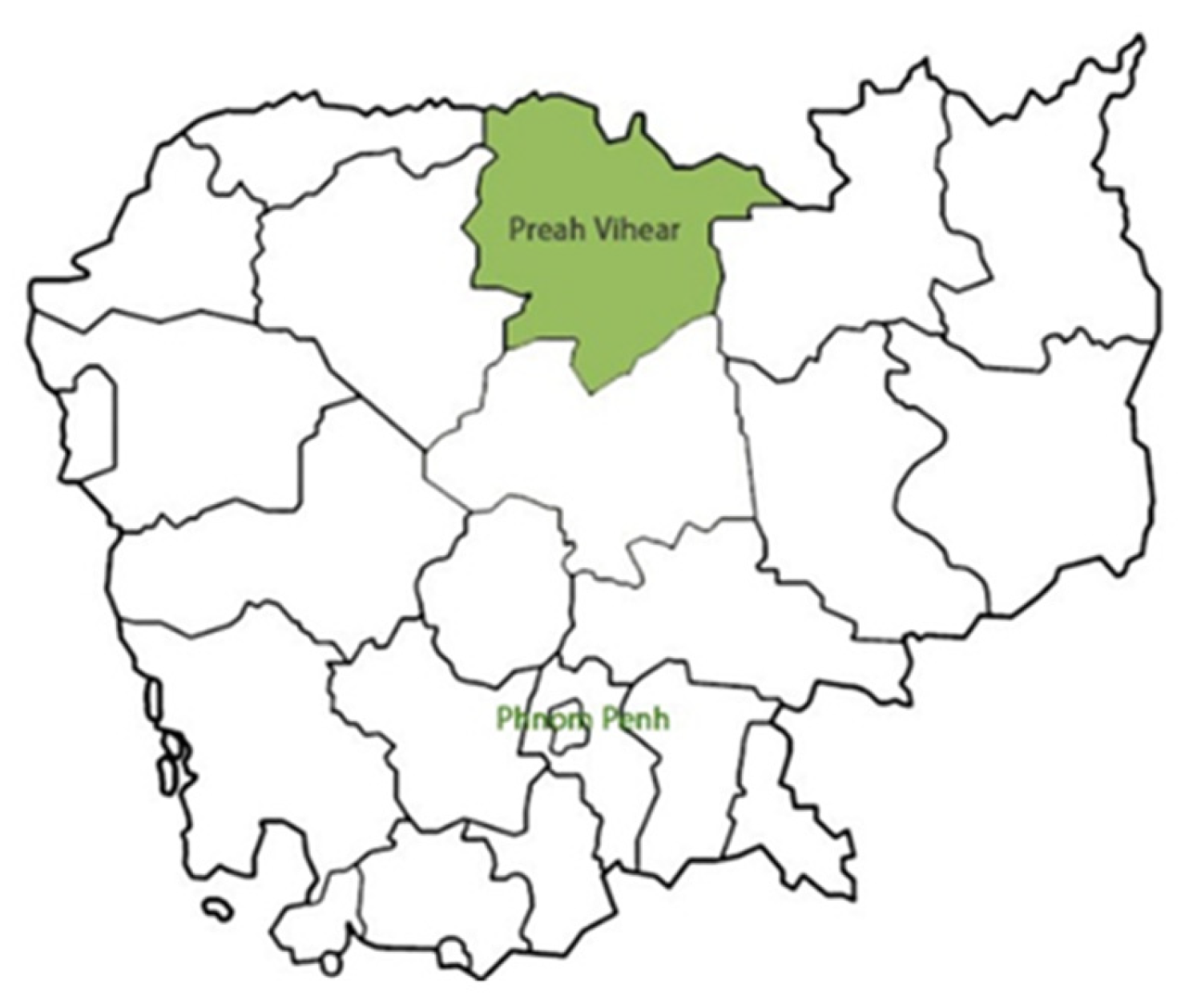
This study was conducted in Preah Vihear Province, one of the major cashew-producing regions in Cambodia (
Figure 1). In this province, cashew cultivation is predominantly managed by smallholder farmers relying on traditional agricultural practices, while processing infrastructure remains underdeveloped. Consequently, most producers sell harvested raw cashew nuts to local traders without on-site processing, and cashew apples are typically left uncollected in orchards. Other residues such as bagasse, nut shells, and pruning branches are also often underutilized, either being discarded or used only in limited informal ways. This local context represents a typical structural barrier to circular utilization, as by-products are generated in dispersed smallholder systems but are rarely converted into marketable outputs due to constraints in labor availability, equipment, and market access.
Against this background, the present study intentionally selected a medium-sized commercial cashew farm with an attached small-scale processing facility in Preah Vihear Province as an information-rich case where integrated by-product utilization is actively practiced. The selected farm covers approximately 70 ha and contains around 20,000 cashew trees, yielding an estimated 100–200 t of raw cashew nuts annually. Of this production, about 30 t are processed domestically in a small factory adjacent to the farm, while the remaining harvest is sun-dried and sold as unprocessed raw nuts to local traders, who subsequently export them to Vietnam for kernel processing. Because the national average holding size is 3.5 ha [
14], the case-study farm is not a typical smallholder farm but an information-rich case representing medium-scale commercial operations that are increasingly important for domestic processing initiatives and early-stage industrialization within Cambodia’s cashew sector. Such farms can function as early adopters of processing and residue utilization practices that are not yet feasible for most smallholders.
Within the provincial context, the selected farm represents a relatively advanced management model. In contrast to common practices where pruning is limited or residues are not marketed, the farm conducts systematic pruning by hiring local laborers, thereby creating seasonal employment opportunities. It also actively collects and utilizes cashew apples and other by-products that are usually discarded, reflecting a forward-looking effort to improve resource-use efficiency, diversify income sources, and strengthen rural livelihoods through practical utilization of underused materials. This combination of commercial scale production, a small processing facility, and active by-product utilization makes the farm particularly suitable for assessing both farm-level profitability and labor-level income implications of circular strategies.
For this research, semi-structured interviews were conducted with the owner of the cashew farm and processing facility in August and October 2025. This period corresponds to the post-harvest phase of the cashew production cycle, during which kernel processing activities intensify and pruning operations are actively conducted. Conducting fieldwork in this period enabled direct observation and more reliable recording of processing practices, labor inputs, and by-product flows under actual operating conditions, rather than relying solely on retrospective reporting. In addition, the owner provided representative sample materials of various cashew by-products for analysis in May 2023.
The purpose of this case selection is not statistical representativeness, but analytical depth. By examining a farm where integrated by-product utilization is already implemented, this study can assess the economic feasibility, labor implications, and practical constraints of utilization strategies that remain difficult to observe in farms where such practices are absent. At the same time, the analysis emphasizes unit-based indicators (e.g., per ton of raw cashew nuts and per hectare), which supports analytical transferability of key relationships—such as cost structures and by-product generation ratios—to smaller-scale smallholder contexts, while acknowledging that absolute income levels and investment capacity differ by farm size. The findings therefore provide evidence-based insights that may inform adaptation and incremental scaling of circular by-product utilization pathways within smallholder-dominated cashew production systems in Cambodia.
2.2. Data Collection and Field Survey Design
In this study, five product streams are considered: cashew kernels, cashew apple juice, cashew apple bagasse, cashew nut shells, and pruning branches. These product streams were selected to represent both the primary output of cashew farming and the major by-products generated during harvesting, processing, and orchard management.
Farm-level data were obtained through semi-structured interviews with the farm owner and direct field observations conducted at the study site in August 2025, corresponding to the post harvest period when kernel processing and pruning activities are actively carried out. The studied farm produces high quality cashew nuts and provides employment and income opportunities for farm workers residing in the surrounding community. At present, only cashew kernels and pruning branches are commercially utilized at the farm. However, this study also evaluates cashew apple juice, cashew apple bagasse, and cashew nut shells as potential marketable products under different utilization scenarios. Cashew nut shells are unavoidably generated during kernel extraction and are therefore treated as by-products that incur no additional production costs. In contrast, cashew apple collection and processing are currently minimal in local practice; accordingly, their associated labor inputs, processing costs, and material losses are explicitly incorporated into the economic analysis.
2.3. Cost and Profitability Analysis of Cashew Apple Utilization
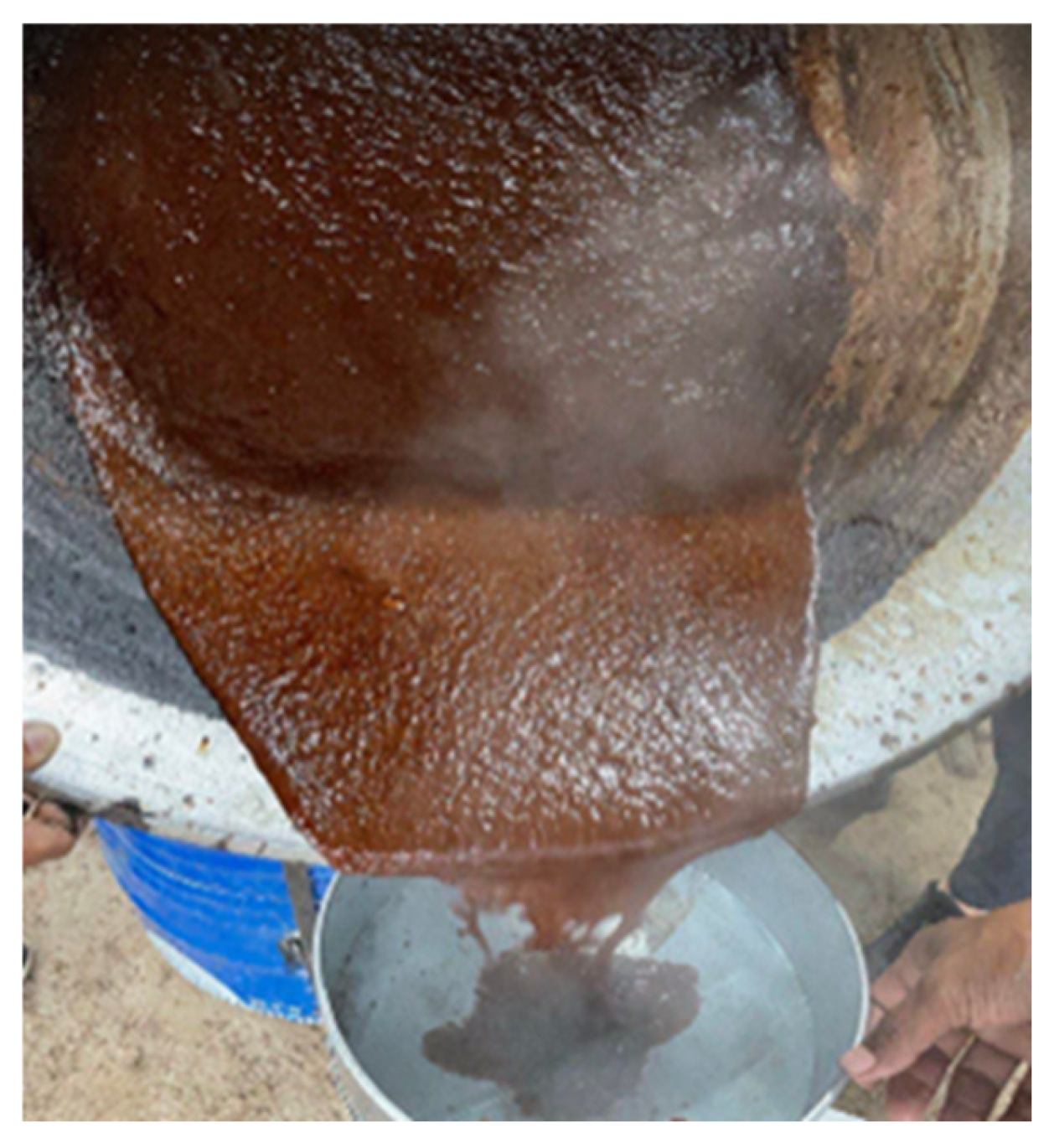
Figure 2 shows the concentrated cashew apple juice. This subsection describes the estimation method used to determine the amount of concentrated cashew apple juice obtained from freshly collected fruits, as well as the associated processing costs, including harvesting, transportation, pressing, and concentration. The estimation was based on field observations and reflects practical collection and labor conditions rather than idealized laboratory yields.
2.3.1. Cashew Apple Juice Production Parameters
Table 1 presents the parameters obtained from previous studies, semi structured interviews, and field observations conducted between August and October 2025 at the study site.
Table 2 summarizes the internal parameters used during this estimation. The average fruit weight (W
fruit) was assumed to be 0.08 kg per apple based on field samples collected by the author in Kampong Thom Province, Cambodia, in 2021. These measurements were obtained from fresh cashew apples (M23 variety) and are consistent with the range (≈60–90 g per fruit) reported in previous studies from Vietnam and other Southeast Asian regions [
25,
28]. Three collection scenarios for cashew apples were evaluated: 1 ton, 3 tons, and 10 tons. The juice recovery rate (r) was assumed to range between 81% and 87%, based on previously reported values for cashew apples processed in neighboring regions. Hanh et al. (2024) reported an average extraction yield of 83.9 ± 0.4% for mechanically pressed cashew apples in Binh Phuoc Province, Vietnam [
29], which is geographically and climatically comparable to northeastern Cambodia. Accordingly, a range of ±3% around this reference value (≈84%) was applied to represent possible variation under Cambodian field conditions, where no published quantitative data are currently available. Cashew apples were collected within a 500 m radius of the processing facility and transported by two workers to the juice processing site. The harvesting cost for cashew apples was set to 0.15 USD·kg
−1. This value corresponds to the wage rate actually paid for raw cashew nut harvesting [
30] at the farm examined in this study.
2.3.2. Concentrated Cashew Apple Juice Yield
The yield of concentrated cashew apple juice was estimated using the parameters de-fined in
Table 1 and
Table 2. All masses were treated as equivalent to volumes (1 kg ≈ 1 L) because of the juice’s low density.
- 1.
Raw juice amount
where
is the mass of collected cashew apples (kg), and
r is the juice recovery rate (−).
- 2.
Net raw juice after process loss
where
is the processing loss ratio during extraction and boiling (−).
- 3.
Number of processing batches
where
is the volume of raw juice processed per batch (L·batch
−1)
- 4.
Concentrated juice output
where
is the concentration ratio (volume reduction factor, −).
- 5.
Processing duration
where
denotes the number of batches processed per day (batch·day
−1).
2.3.3. Cost Estimation
The total production cost of concentrated cashew apple juice was estimated by combining harvesting, labor, and fuel costs as follows.
- 1.
Harvesting cost
where
is the unit harvesting cost per kg of fruit (USD·kg
−1).
- 2.
Labor cost
where
represents the daily labor cost based on total working hours (21 person·h day
−1) and
w is the hourly wage rate (USD·h
−1).
- 3.
Fuel cost
where
is the unit fuel cost per batch (USD·batch
−1).
- 4.
Revenue
where
is the selling price of concentrated juice (USD·L
−1).
- 5.
Gross profit
To emphasize direct operational feasibility, indirect costs such as packaging, transportation, and equipment depreciation were not included in this preliminary Estimation.
2.4. Integrated by Product Utilization Scenarios and Income Stability Analysis
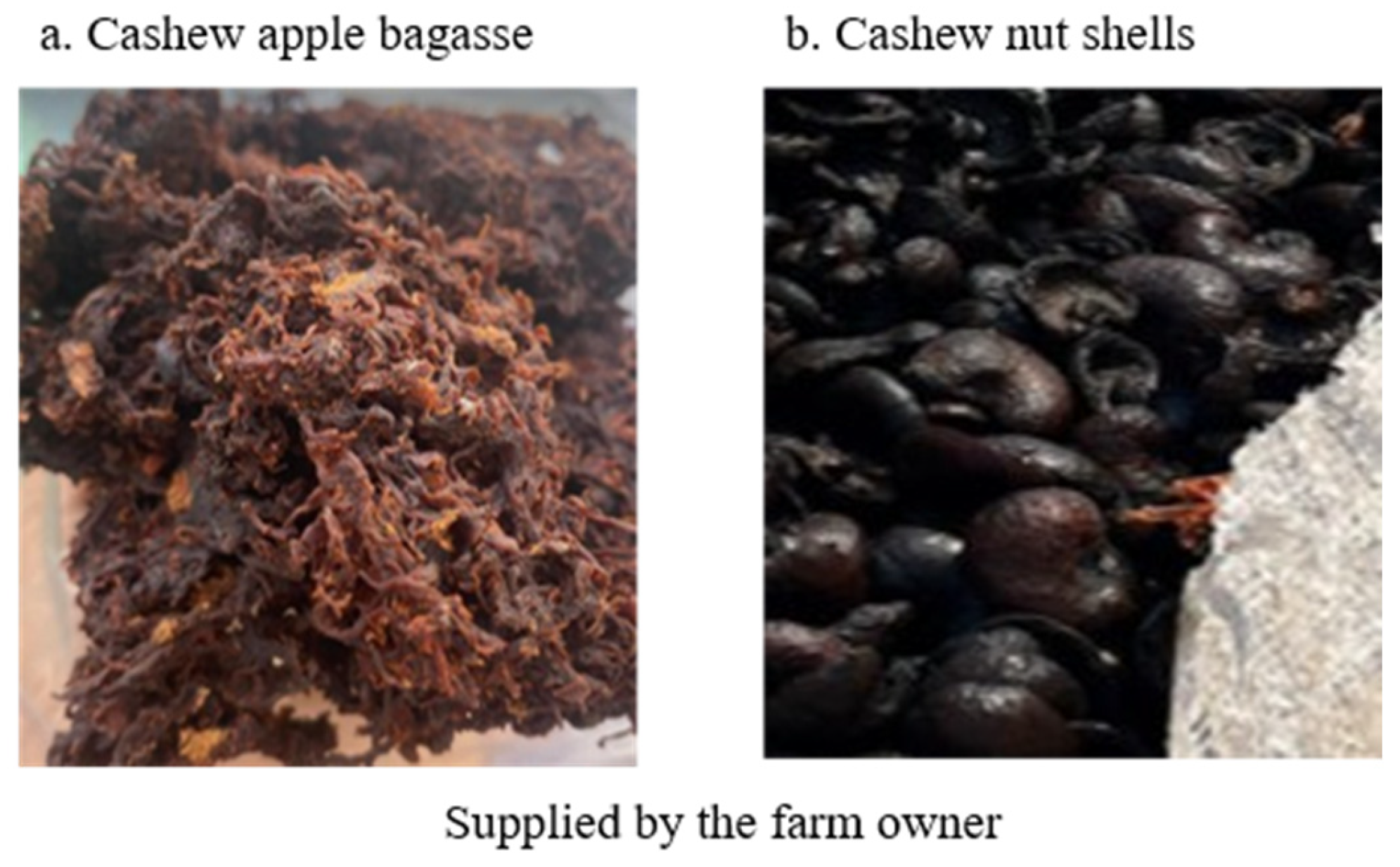
A farm owner in Preah Vihear Province, Cambodia, provided cashew residue samples. Cashew apple bagasse was collected in March 2023 immediately after juice extraction. The bagasse was sun dried for two weeks and subsequently stored indoors for one month as analytical samples prior to laboratory analysis. Cashew nut shells were obtained in May 2023 during kernel processing. All samples were transported to Japan and analyzed at Sanko Environmental Research Center Co., Ltd. (Tokyo, Japan). The analyses followed Japanese Industrial Standards (JIS) and included the determination of moisture content, ash content, volatile matter, fixed carbon, higher heating value, lower heating value, and elemental composition (C, H, N, S, Cl, and O). These analytical data were used to evaluate the fuel properties of the residues. The results for cashew apple bagasse and cashew nut shells are presented in
Table 3, and photographs of the samples are shown in
Figure 3.
2.5. Labor Input, Employment Effects, and Income Stabilization Analysis
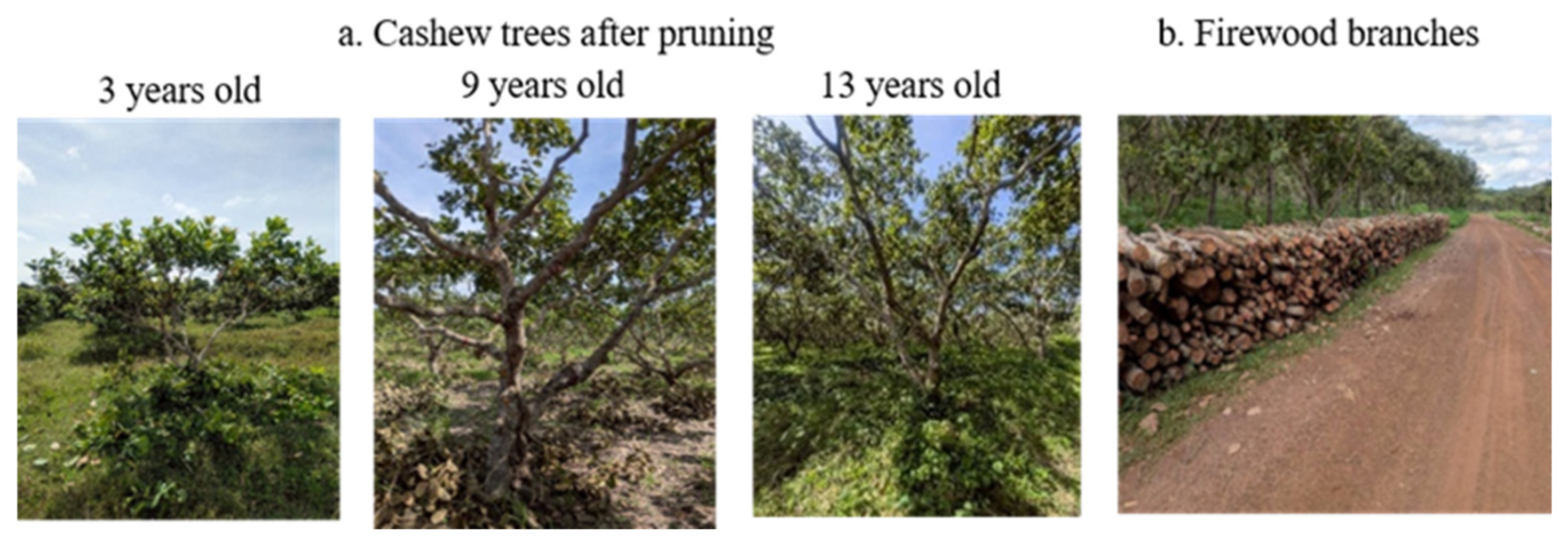
Information on pruning practices in cashew orchards was collected through semi structured interviews with farm owners and field workers in August 2025. The interviews focused on the timing of pruning, labor organization, payment systems, and branch management practices. In addition, workers with varying levels of experience were asked about the labor time required for trees of different ages and for specific tasks such as the removal of large diameter branches. A photograph of a cashew nut tree is shown in
Figure 4.
4. Discussion
4.1. Economic Viability of Cashew Apple Utilization as a Standalone Activity (H1)
To clarify the effect of farm size on the results, it is useful to distinguish between total farm-level income and unit-based profitability indicators. In this study, increases in farm size primarily affect the absolute quantity of cashew by-products generated, such as nut shells and pruning residues, thereby increasing total supplementary income. However, profit indicators expressed per unit of land area (USD·ha−1) or per unit of production (USD·t−1 of raw cashew nuts) do not increase proportionally with farm size.
This relative scale neutrality arises because the generation of by-products is largely determined by biological and management factors, such as tree density, pruning practices, and processing yield per ton of nuts, rather than by technological economies of scale. For example, cashew nut shells are generated at a relatively fixed ratio of approximately 0.8 t per ton of processed nuts, and pruning residues are produced at broadly stable volumes per hectare under comparable orchard management practices. As a result, while larger plantations generate higher total income from by-product utilization, profit levels expressed on a per-hectare basis remain broadly comparable across farm sizes.
These findings suggest that the economic advantages of integrated by-product utilization do not appear to rely exclusively on large landholdings but could potentially be adapted by smallholder farms on a per-unit basis, provided that labor and collection challenges are addressed. Consequently, the observed patterns are analytically informative for smallholder contexts, even though absolute income gains at the household level increase with farm size.
In line with the objective of examining low-cost and locally feasible circular economy practices for strengthening rural livelihoods, this study indicates that the economic value of cashew by-product utilization cannot be evaluated solely on the basis of farm-level profitability. Hypothesis 1 (H1) proposed that cashew apple processing alone would not be sufficient to generate positive net income under prevailing smallholder conditions in rural Cambodia. The results consistently indicate that cashew apple juice production remains economically unviable under prevailing rural wage conditions, as net profits remain negative across all examined collection volumes. These results are therefore consistent with H1.
This outcome contrasts with empirical evidence from West Africa, where cashew apple valorization has been reported to generate positive net incomes and poverty reduction effects [
26,
27]. The discrepancy underscores the strong context dependency of cashew apple utilization outcomes and suggests that differences in labor costs, processing organization, market access, and institutional support play a critical role in shaping economic feasibility. In the Cambodian context examined here, the combination of high labor intensity and limited output prices constrains the profitability of standalone apple processing, highlighting the limitations of single-product valorization strategies under smallholder conditions.
4.2. Effects of Integrated Cashew By-Product Utilization on Farm-Level Performance (H2)
These additional analyses are included to assess whether the by-products generated in smallholder-based cashew production systems have practical economic relevance beyond their immediate market value. In particular, the estimation of energy- and material-related properties provides a basis for evaluating whether cashew nut shells and pruning residues can realistically contribute to farm-level cost reduction, income diversification, or local energy substitution under prevailing rural conditions.
However, when cashew apple processing is assessed as part of an integrated by-product utilization system, a different picture emerges. Pruned branches and cashew nut shells provide relatively stable and largely yield-independent value streams that contribute to farm operations and, potentially, to local energy use. In particular, cashew nut shells and pruning residues generate additional economic value while functioning as locally available renewable energy resources for drying and heating, which may reduce reliance on external fuels under appropriate conditions.
Although cashew apple processing remains unprofitable at the farm level, the combined utilization of multiple by-products enhances overall system performance in the context examined in this study, thereby supporting H2. By diversifying income sources and reducing exposure to yield-related risks, integrated by-product utilization may improve farm-level income stability compared with reliance on single-product strategies. This finding aligns with broader circular economy literature emphasizing the importance of system-level integration rather than isolated valorization technologies [
18,
19].
4.3. Employment Stabilization and Labor Income Effects Under Yield Variability (H3)
A central contribution of this study lies in its analysis of employment stability under conditions of variable nut yields. In smallholder-dominated cashew systems in general, labor income from nut harvesting declines proportionally when total production decreases due to climatic or market-related factors. In contrast, labor demand for cashew apple collection and processing is largely independent of nut yield.
As a result, apple collection can function as a flexible employment opportunity that partially offsets income losses during low-yield years. The relative importance of this supplementary income increases as nut production declines, supporting H3 and indicating that by-product utilization plays a particularly important role under adverse production conditions. This mechanism is consistent with pronounced interannual yield variability reported for cashew systems in other producing regions [
28].
From the perspective of farm management, cashew apple processing represents a financial cost rather than a direct source of profit. Nevertheless, when farm-level losses are compared with the wages generated for local workers, a strongly positive relationship is observed. For each unit of financial loss incurred by the farm through apple processing, a larger amount of wage income is distributed to rural households. This suggests that cashew apple utilization should be interpreted not primarily as a profit-oriented activity, but rather as a mechanism that supports employment stability and household income diversification within the local rural economy.
4.4. Implications for Livelihood Resilience and Sustainable Rural Development
The integrated utilization framework examined in this study suggests that combining multiple by-product pathways may contribute to livelihood resilience in smallholder-based cashew production systems. Specifically, the coexistence of relatively stable employment associated with kernel processing and more flexible labor demand for apple collection, pruning, and shell handling can reduce the sensitivity of household income to annual yield fluctuations. By distributing labor demand across different activities and seasons, integrated by-product utilization may help smooth employment opportunities over production cycles compared with reliance on nut harvesting alone.
Under the scenarios examined in this study, the combination of multiple labor activities is associated with a more balanced employment structure than single-product strategies, particularly in years of reduced nut production. While this analysis does not directly measure long-term livelihood resilience, the observed patterns indicate that diversified by-product utilization can play a buffering role against income volatility linked to climatic and production variability.
In addition to economic and employment-related effects, partial utilization of cashew apples may generate potential ecological co-benefits. Leaving a portion of fallen apples in the orchard returns organic matter to the soil, which can contribute to soil fertility and ecosystem functioning over time. Although the present study focuses primarily on economic and labor-related outcomes, these observations highlight the relevance of integrated evaluation approaches. Future research should combine life-cycle assessment, longitudinal income analysis, and socio-economic modeling to better identify trade-offs among wage generation, farm profitability, energy use, and ecological sustainability smallholder-dominated cashew regions.
5. Conclusions
This study examined the economic and labor-related impacts of cashew by-product utilization within a medium-sized commercial farm situated in a smallholder-dominated production landscape in rural Cambodia. In this study, “income stability” and “economic resilience” are used in a relative and context-specific sense to describe the extent to which diversified by-product utilization helps buffer income and employment against interannual yield variability, rather than as absolute measures of long-term economic performance.
The results indicate that, under prevailing rural wage and market conditions, cashew apple juice production alone does not generate positive net returns, confirming its limited financial viability as a standalone activity. By contrast, the integrated utilization of multiple by-products yields more robust outcomes. The utilization of cashew nut shells and pruning branches provides relatively stable and largely yield-independent income streams, which, when combined with limited cashew apple utilization, contribute to improved farm-level income stability. These effects are driven primarily by biologically and management-determined by-product generation ratios rather than scale-dependent processing efficiencies, indicating that the observed patterns offer analytical transferability to smallholder contexts, although practical implementation would require scaling adaptations. From a labor perspective, cashew apple collection generates supplementary employment opportunities that become particularly important in low-yield years, when income from nut harvesting declines. Although apple processing entails additional labor costs for farm operators, it contributes to stabilizing household labor income at the community level by providing employment during periods of reduced harvesting activity.
Taken together, these findings suggest that cashew apple processing should not be promoted in isolation, but can play a complementary role within an integrated by-product utilization strategy that combines nut shell energy recovery, pruning residue management, and coordinated labor allocation. Such integrated, low-cost utilization pathways offer a more context-appropriate approach to strengthening rural income stability and livelihood resilience in smallholder-based cashew production systems.
This study is subject to several limitations, including its single-case design and the absence of a life-cycle assessment framework. Future research should therefore extend the analysis to multiple farms of different scales and incorporate environmental performance indicators. Nevertheless, the present case study provides empirically grounded insights into locally feasible circular economy practices that may support sustainable rural development in comparable cashew-producing regions.