


Abstract
Economic growth is required for making progress in most of the sustainable development goals (SDGs). Energy access and quality education, along with gender equality, are amongst the SDGS and have also been amongst the essential factors to achieve improvement in economic growth. Hence, this research explores the impact of energy poverty alleviation, education quality, and gender equality on per capita GDP across E7 economies for the years of 2000–2024 benefiting from panel econometrics. The panel causality analysis uncovers a bidirectional causality between energy poverty alleviation, gender equality, and economic growth but a bilateral causal nexus from education quality to economic growth. Further, the cointegration coefficients indicate that education quality and gender equality are drivers of economic growth in E7 countries, while energy poverty alleviation is a positive determinant of economic growth in only China, India, and Indonesia.
1. Introduction
Worldwide socio-economic development has heterogeneously increased from the Industrial Revolution. Therefore, economic and social inequalities in the world have grown remarkably over time. Further, significant environmental impairments mainly resulting from global warming, climate change, economic and population growth, fossil energy use, urbanization, and deforestation have accompanied this global economic expansion [1,2]. The growing social and economic inequalities and environmental impairment in the world prompted the United Nations (UN) to seek solutions to overcome these global problems. As a consequence, the concept of sustainable development was first put forward globally at the 1972 UN Conference of Stockholm on the Human Environment, and the recognition of the concept was considerably increased with the document entitled “Our Common Future” [3].
In this regard, the UN members specified Millennium Development Goals at the Millennium Summit of New York to eradicate hunger and poverty, ensure universal access to primary education, enhance gender equality, improve maternal mortality, and reduce child mortality, fight malaria, HIV/AIDS, and other illnesses, improve environmental sustainability, and improve worldwide cooperation for development by 2015 [4]. Then, the 2030 Agenda for Sustainable Development involving 17 SDGs was accepted at the UN Sustainable Development Summit in 2015 [3]. Affordable and clean energy (SDG7), education quality (SDG4), and gender equality (SDG5) are amongst 17 SDGs, and these three SDGs are also critical to aid the achievement of the other SDGs such as industry, innovation, and infrastructure; decent work and economic growth; and reduced inequalities. For this reason, this study aims at analyzing the role of energy poverty alleviation, quality education, and gender equality on per capita GDP in the E7 countries, seven countries demonstrating the greatest economic performance from the emerging economies in the recent three decades.
In this context, the diverse hypotheses of conservation, growth, feedback, and neutrality have been developed about the nexus between economic growth and energy. The growth hypothesis asserts that energy use is a driver of economic growth while the conservation hypothesis claims the opposite, a causality running from economic growth to energy use. However, the feedback hypothesis points out a mutual interaction between energy use and economic growth, but the neutrality hypothesis suggests that significant interplay between economic growth and energy use does not exist [5]. Therefore, improvements in energy poverty reduction are expected to influence economic growth provided that the hypotheses of growth and feedback are valid. In this regard, Rehman and Deyuan [6], Doğanalp et al. [7], Olusegun et al. [8], Singh and Inglesi-Lotz [9], Castro-Cárdenas and Ibarra-Yunez [10], Algül [11], and Yang and Gan [12] have uncovered that improvements in energy poverty positively impact economic growth in countries with different socio-economic characteristics.
On the other hand, human capital has been suggested as one of main drivers of economic growth within the scope of endogenous growth models [13,14]. Therefore, gender equality can positively impact economic growth via higher female labor force participation, human capital accumulation, improvements in labor market efficiency, and productivity growth [15]. Furthermore, increasing the share of women in the economy can support economic growth through increasing competitiveness, financial stability, and economic diversification and decrease income inequality and negative economic effects of population aging [16,17,18,19].
Finally, education is one of the key instruments behind human capital, and it can positively affect economic growth by means of fostering productivity, innovation, entrepreneurship, and facilitating knowledge transfer about new technologies and products [20,21,22,23]. In this regard, quality of education is critical for the development of new technologies, innovation, and entrepreneurial ideas [24]. However, previous studies have usually analyzed the nexus between indicators of education quantity such as enrollment rates and schooling years and economic growth [24,25].
In conclusion, this article aims to focus on the following research questions in the sample of E7 countries: Does energy poverty alleviation, along with education quality, matter for economic growth in the long term? What is the interaction amongst energy poverty alleviation, education quality, and economic growth? Therefore, the main hypotheses of this study rest on the associated literature and are identified as follows:
H1.
There exists a positive relationship between energy poverty alleviation and economic growth in the long term.
H2.
There exists a positive relationship between education quality and economic growth in the long term.
H3.
There exists a positive relationship between gender equality and economic growth in the long term.
This study aims to make a contribution to the associated literature in two aspects. Both energy and education are amongst main factors underlying economic growth. Therefore, researchers have intensively explored the effect of diverse indicators of energy use and education on economic growth as summarized in the literature overview. However, many countries have already faced significant energy poverty worldwide. Therefore, the first empirical contribution of this research paper is to investigate the effect of energy poverty alleviation on economic growth. The secondary contribution of this article is to examine the effect of education quality on economic growth, considering that most of the empirical studies have investigated the association between indicators of education quantity and economic growth. The remaining part of this research paper is constructed as follows: Section 2 overviews the literature on the nexus amongst energy poverty alleviation, education quality, gender equality, and economic growth. Section 3 introduces data and methodological issues. Section 4 presents and evaluates the empirical results, while Section 5 finishes the study with limitations, policy implications, and future research implications.
2. Literature Summary
Decent work and economic growth are one of 17 SDGs and are also important for achieving the remaining SDGs such as no poverty, zero hunger, and good health [1]. Many factors have been put forward as drivers of economic growth in the associated literature [26,27,28]. This research was conducted to unveil the effect of energy poverty reduction alleviation, quality education, and gender equality on economic growth regarding the limited number of research studies on the effect of energy poverty, education quality, and gender equality on economic growth.
2.1. Energy Poverty and Economic Growth
Energy is one of the requisite inputs to economic activities. For this reason, the researchers have concentrated intensely on the connection between diverse energy use indicators and economic growth [29,30], but the nexus between economic growth and energy poverty alleviation has been explored in a sample of underdeveloped, developing, and emerging economies as of the 2010s. In the limited literature, researchers have usually proxied energy poverty by access to clean fuels and technologies for cooking and access to electricity. Furthermore, empirical studies have utilized different econometric methods such as regression, ARDL, estimators of DOLS, FMOLS, PMG, and AMG and causality analyses. In the literature, most of the researchers such as Rehman and Deyuan [6], Doğanalp et al. [7], Olusegun et al. [8], Singh and Inglesi-Lotz [9], Castro-Cárdenas and Ibarra-Yunez [10], Algül [11], and Yang and Gan [12] identified a positive link between different indicators of energy poverty alleviation and economic growth despite different samples and methodologies. However, different findings of Olusegun et al. [8] and John and Deinde [31] in Nigeria can result from different methodologies (ARDL vs. regression) or different study periods (1980–2018 vs. 1990–2021). Lastly, Ansari et al. [32] and Çelik and Polat [33], respectively, revealed an insignificant relationship between electricity access and economic growth in Sub-Saharan African states and D-8 countries, and this insignificant relationship between electricity access and economic growth can be extrapolated from the samples’ socio-economic development levels.
In this context, Rehman and Deyuan [6] questioned the connection between access to electricity and economic growth in Pakistan between 1990 and 2016 by means of ARDL and disclosed a positive connection between access to electricity by urban population and economic growth but a negative relation between access to electricity by rural population and economic growth. Doğanalp et al. [7] also explored the influence of energy poverty-impacted access to clean fuels and technologies for cooking, education, and employment, as well as inflation on GDP per capita in the BRICS states across the 2001–2018 term through PVAR, FMOLS, and DOLS, and revealed a positive impact of energy poverty alleviation on GDP per capita and a bidirectional causal nexus running from energy poverty to GDP per capita.
Olusegun et al. [8] investigated the link between energy poverty (access to electricity) and GDP in Nigeria between and 1990 and 2021 by means of regression and identified a positive effect of access to electricity on GDP. John and Deinde [31] also analyzed the influence of energy poverty represented by access to electricity and access to clean fuel and technology on GDP growth in Nigeria during the years of 1980–2018 via ARDL method but disclosed a negative effect of energy poverty indicators on GDP growth.
Singh and Inglesi-Lotz [9] also explored the influence of electricity access on economic growth in Sub-Saharan countries between 1990 and 2016 by means of regression and disclosed a positive effect of access to electricity on economic growth. Castro-Cárdenas and Ibarra-Yunez [10] analyzed the effect of energy poverty represented by electricity access on GDP per capita in Latin American states over the years of 1990–2018 by means of ARDL and PMG and unveiled that increases in electricity access positively impacted per capita GDP.
Algül [11] studied the effect of energy poverty on economic growth in Türkiye during the 2007–2021 period by means of FMOLS and DOLS estimators and discovered that increments in the use of household electricity positively affected GDP per capita. Yang and Gan [12] also studied the effect of energy poverty index on per capita GDP in China over the 2007–2017 period through regression and uncovered that alleviation of energy poverty fostered economic growth in western and eastern regions of China but had an insignificant effect on economic growth in the central region of China.
Ansari et al. [32] researched the effect of energy poverty proxied by electricity access on per capita GDP in the Sub-Saharan African states for the years of 1995–2018 by means of cointegration and regression methods and found an insignificant connection between electricity access and per capita GDP and a two-way causal connection between electricity access and per capita GDP. Similarly, Çelik and Polat [33] investigated the influence of energy poverty represented by electricity access on per capita GDP in D-8 countries for the 1990–2021 period by using an augmented mean group (AMG) estimator, identifying an insignificant interplay between electricity access and per capita GDP.
Last, Manga [34] researched the causal connection between electricity access and per capita GDP in seven less-developed countries between 1995 and 2016 through the Kónya causality test and found a two-way causal relation between electricity access and per capita GDP in the Central African Republic and Madagascar, a one-way causal relation from per capita GDP to access to electricity in Burkina Faso and Malawi, and a one-way causal relation from electricity access to per capita GDP in Haiti.
2.2. Education Quality and Economic Growth
The connection between diverse educational indicators and economic growth has been commonly analyzed through regression in various countries and country groups, and approximately all research articles in Table 1 have discovered a positive effect of education indicators, such as education index, enrolment rates of primary, secondary, and tertiary school, schooling years, number of colleges or universities, pupil–teacher ratio, and governmental education expenditures, on economic growth. Nevertheless, Arman et al. [35] suggests that quality of education rather than number of schooling years matters for economic growth. In this regard, only Musibau et al. [24] and Goczek et al. [36], respectively, have examined the impact of education quality proxied by PISA score on economic growth in OECD members and Indonesia through regression approach and found a positive effect of quality education on economic growth. Furthermore, the studies using quantity indicators of education, such as Marquez-Ramos and Mourelle [37], Ziberi et al. [38], Bah [39], and Abu Alfoul et al. [40], identified a positive link between educational indicators and economic growth.
Table 1.
The recent literature on the connection between education indicators and economic growth.
2.3. Gender Equality and Economic Growth
In the growth literature, the connection between gender equality and economic growth has been interrogated by few academicians; these studies have investigated the effect of gender equality on economic growth in developed, developing, and underdeveloped countries through regression approach and revealed that gender equality is a significant determinant of economic growth in nearly all countries with diverse socio-economic development levels [15,45,46,47,48,49,50,51,52].
In this context, Karoui and Feki [45] studied the influence of gender inequality on economic growth in Maghreb countries (Algeria, Libya, Mauritania, Morocco, and Tunisia) between 1985 and 2011 through regression and unveiled a negative impact of gender inequality over economic growth. Onogwu [46] also studied the link between gender inequality and GDP per capita in 29 Sub-Saharan African (SSA) states between 1996 and 2019 via regression method and disclosed a negative impact of gender inequality on GDP per capita.
Kim et al. [47] developed a theoretical framework for the link between economic growth and gender inequality and analyzed it through the micro data of Asian economies, suggesting that improvements in gender equality may foster economic growth via enhancing human capital accumulation and changing time allocation of the female population. On the other side, Bertay et al. [15] investigated the effect of gender inequality on economic growth in Australia, Austria, Canada, Ireland, New Zealand, and Sweden through a difference-in-differences approach and revealed that high-female-share industries grew relatively faster in the countries with more gender equality.
Yi et al. [48] analyzed the interplay between gender inequality indicators and economic growth in Nigeria by means of regression and content- and consistency-based analysis and revealed a negative relation between economic growth and indicators of gender inequality. Similarly, Akinwande et al. [49] examined the interplay between gender inequality, economic growth, inflation, and financial development in Nigeria during the period of 1980–2020 by cointegration and causality approaches. The findings of the causality test uncovered a significant influence of gender inequality over economic growth during short, medium, and long terms.
Koengkan et al. [50] disclosed a negative growth effect of gender inequality in Latin America states and the Caribbean regions between 1996 and 2016 by means of regression approach. Similarly, Ram et al. [51] unveiled a negative impact of gender disparities over economic growth in 158 states through utilization of cross-national panel data.
Juhásová et al. [52] surveyed the relation between gender-related indicators and GDP per capita in 21 EU countries between 2015 and 2019 by regression and uncovered a positive effect of gender equality index and female employment rate on GDP per capita. Lastly, Ngepah et al. [53] studied the link amidst economic growth and gender inequality in developing states over the years from 1960 to 2019 by way of dynamic regression and panel ARDL, and their results pointed out a negative relation between economic growth and gender inequality.
3. Data and Methodology
This study researches the effect of energy poverty, quality education, and gender equality on economic growth in E7 economies for the years of 2000–2024 through cointegration and causality approaches. The variables of the econometric analysis along with their explanation are summarized in Table 2. In this regard, economic growth is substituted by per capita GDP and sourced from the World Bank [54]. On the other hand, energy poverty alleviation, education quality, and gender equality, respectively, are represented by indices of SDG7 (affordable and clean energy), SDG4 (quality education), and SDG5 (gender equality), and these variables are sourced from Sachs et al. [55]. Each SDG index score is calculated on a scale of 0 to 100 and can be interpreted as a percentage towards optimal performance [55]. The SDG indices are calculated based on data from international organizations (World Bank, WHO, OECD, ILO, FAO, etc.) and data from non-official institutions such as Gallup World Poll, the Tax Justice Network, and Oxfam; SDG scores from different editions cannot be compared due to methodological changes and changes in the indicators [55].
Table 2.
Variables of the study.
In this regard, the SDG7 index is calculated based on electricity access, access to clean fuels and technology for cooking, ratio of renewable energy in total energy use, and CO2 emissions from fuel combustion [55]. In the empirical literature, electricity access, access to clean fuels and technology for cooking, and energy poverty index have been used as a proxy for energy poverty [6,7,12,31]. In this study, the SDG7 index is used as a proxy for energy poverty because it is also an indicator of sustainable energy access for all persons by regarding not only electricity consumption but also access to clean fuels and technology for cooking, ratio of renewable energy in total energy use, and CO2 emissions from fuel combustion.
On the other hand, quality education is included in the analyses as a control variable and proxied by the SDG4 index, computed as a combination of literacy rate, participation in pre-primary organized learning, primary enrollment, rate of lower secondary completion, attainment of tertiary education, PISA performance, dependence of changes in mathematics performance on socio-economic status, and underachievement in mathematics [55].
Last, the SDG5 index is calculated using demand for modern methods of family planning, rate of female-to-male mean schooling years, rate of female-to-male labor force participation, the number of women in national parliament, and gender wage gap. These indices obtain a value between 0 and 100, and greater values demonstrate improvements in access to energy, gender equality, and quality education (see Sachs et al. [55] for methodology).
This study prefers to employ the composite measures of SDG7, SDG4, and SDG5 indices instead of a single indicator such as electricity access, PISA performance, female labor participation, and gender wage gap considering the multifaceted structure of energy access, education quality, and gender equality and difficulty of representing these variables with a single indicator.
The influence of energy poverty alleviation, quality education, and gender equality on per capita GDP is analyzed in the E7 countries for the period of 2000–2024. The calculation of SDG7, SDG4, and SDG5 indices as of 2000 leads us to determine the dataset period as 2000–2024. A cointegration test is conducted by means of Gauss 12.0, cross-sectional dependence (CSD), slope homogeneity, stationarity, and causality tests along with AMG estimation, which are implemented by Stata 17.0.
The mean values of per capita GDP and indices of ENGYPOV, QUALEDU, and GENEQ shown in Table 3 are USD 6865.926, 65.861, 88.180, and 56.452, respectively, but per capita values considerably differ among the E7 countries, while ENGYPOV, QUALEDU, and GENEQ show moderate changes amongst the E7 countries.
Table 3.
Descriptive statistics of the series utilized in the econometric analyses.
The econometric model of the study is presented in Equation (1). The explained variable is GDPC (GDP per capita), and explanatory variables are ENGYPOV (energy poverty alleviation), EDUQUAL (education quality), and GENEQ (gender equality)
where i and t represent E7 countries and years of 2000–2024, respectively.
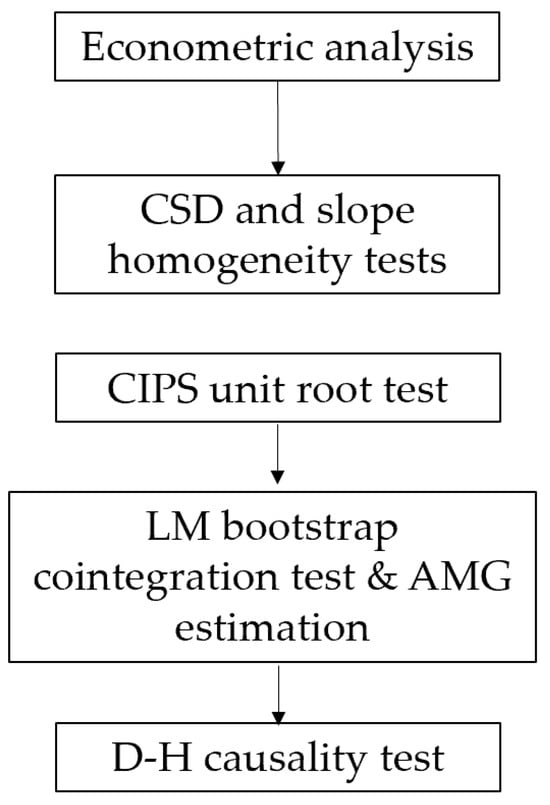
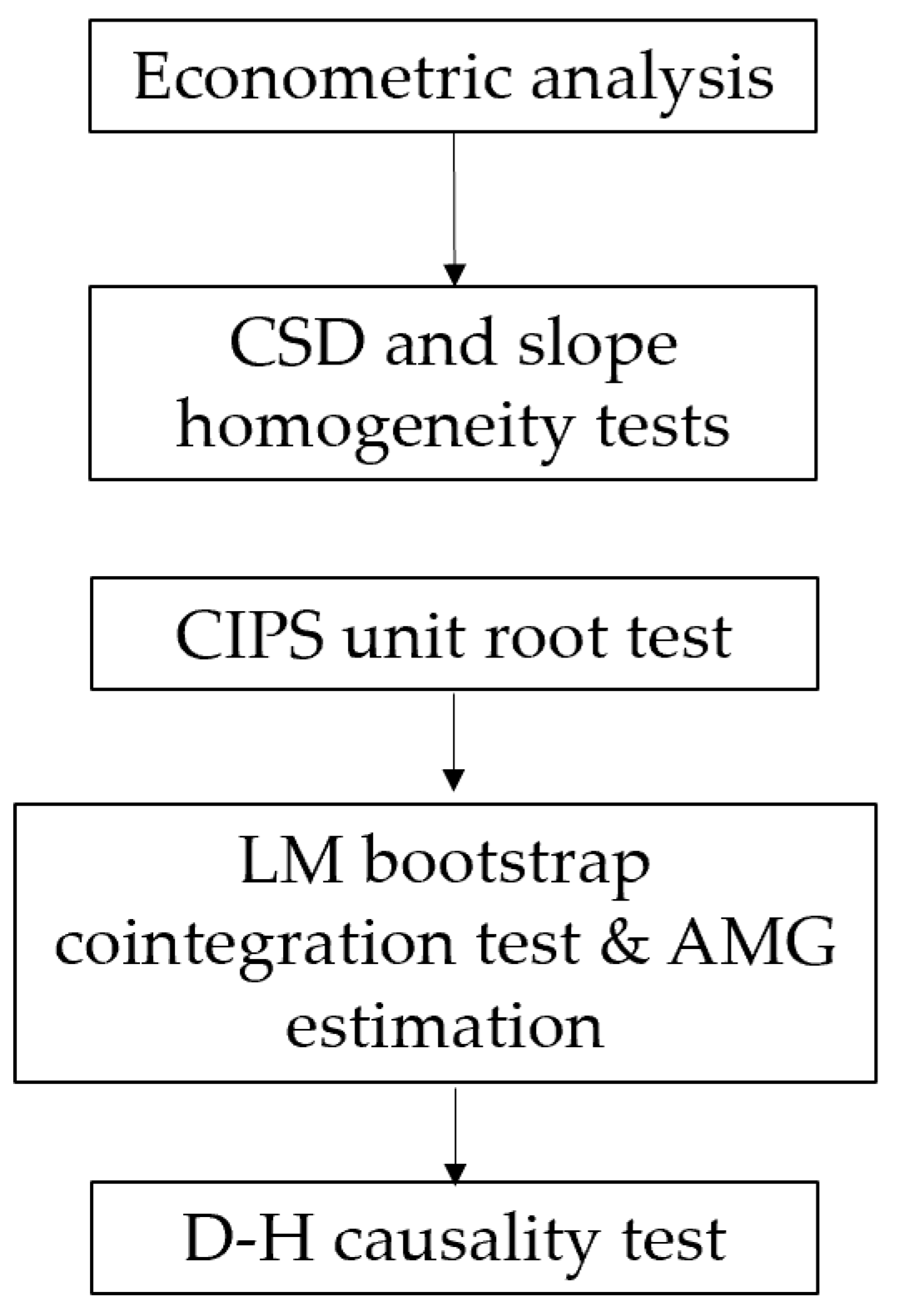
This study follows the methodological approach in Figure 1. First, CSD and slope homogeneity tests are performed. Then, CIPS unit root test is run to identify the integration levels of GDPC, ENGYPOV, EDUQUAL, and GENEQ by taking notice of CSD’s existence for the dataset. In the light of the outcomes of CSD and slope homogeneity tests, the long-term connection among GDPC, ENGYPOV, EDUQUAL, and GENEQ are interrogated by way of LM bootstrap cointegration test introduced by Westerlund and Edgerton [56] regarding the strong characteristics of this test under the existence of CSD, heterogeneity, and small sample size. Cointegration coefficients of panel and E7 members are identified by utilizing the AMG estimator of Eberhardt and Bond [57], taking notice of CSD and heterogeneity’s presence in the dataset. The AMG estimator is based on Equation (2):
where is the explained variable, is explanatory variables, are group fixed effects capturing time-variant heterogeneity, captures the unobserved common factors with heterogeneous factor loadings, and and are the error terms capturing the omitted variables impact [57]. We use the AMG estimator rather than CCEMG (Common Correlated Effects Mean Group) of Pesaran [58] because the AMG estimator uses a two-step approach to forecast the unobserved common dynamic effects and allows for CSD through utilization of a common dynamic effect parameter in the estimation process, while the CCEMG estimator employs linear combinations of cross-sectional means of the observed effects, dependent, and independent variables [59].
Figure 1.
Methodological approach of the article.
Lastly, causal links among ENGYPOV, EDUQUAL, GENEQ, and GDPC are analyzed by utilizing the D-H (Dumitrescu and Hurlin [60]) test, which takes notice of slope heterogeneity and results in robust outcomes from the CSD’s existence.
4. Results and Discussion
In this section, CSD and slope homogeneity of the dataset are firstly interrogated with tests of LM and delta tilde, and their outcomes are introduced in Table 4. In light of the CSD tests’ outcomes, the H0 hypothesis of CSD independence is not accepted, and CSD existence in the dataset is thereby inferred. In a similar vein, the H0 hypothesis of homogeneity is not accepted as a result of slope homogeneity tests, and the existence of heterogeneity in the dataset is identified.
Table 4.
CSD and slope homogeneity analyses.
The stationarity of GDPC, ENGYPOV, EDUQUAL, and GENEQ should be determined to identify the appropriate cointegration and causality methods. Hence, the CIPS unit root test is practiced to examine whether GDPC, ENGYPOV, EDUQUAL, and GENEQ have a unit root or not owing to the CSD’s existence, and the related statistics are introduced in Table 5. The CIPS test’s findings demonstrate that GDPC, ENGYPOV, QUALEDU, and GENEQ include the unit root at original values, but first differences of all series do not include the unit root.
Table 5.
Unit root analysis.
The presence of cointegration relation amongst ENGYPOV, EDUQUAL, GENEQ, and GDPC is explored by LM cointegration approach, and test statistics along with asymptotic and bootstrap probability figures are introduced in Table 6. The bootstrap probability values indicate the acceptance of the null hypothesis for both models. On the contrary, the asymptotic probability values imply the denial of the null hypothesis for both models. In the present case, the null hypothesis (presence of cointegration nexus amongst the series) is accepted by taking notice of the significant CSD amongst ENGYPOV, EDUQUAL, GENEQ, and GDPC. Thus, we conclude a significant long-term relation amongst ENGYPOV, EDUQUAL, GENEQ, and GDPC.
Table 6.
Cointegration analysis.
The long-term impact of ENGYPOV, EDUQUAL, and GENEQ on per capita GDP are identified as benefiting from the AMG estimator and are introduced in Table 7. The cointegration coefficients indicate that improvements in energy poverty alleviation significantly foster economic expansion in China, India, and Indonesia. Further, quality education is found to be a positive determinant of economic growth at the panel level and in all E7 countries. Lastly, improvements in gender equality positively impact economic growth at the panel level and in all E7 countries except Türkiye.
Table 7.
AMG estimation.
Energy is one of the irrevocable inputs to economic expansion and, in turn, alleviation of energy poverty, which are theoretically anticipated to support economic growth. Our findings unveil that improvements in energy poverty positively impact economic growth in only China, India, and Indonesia, but long-term effects of energy poverty alleviation on economic growth at the panel level and in Brazil, Mexico, Russia, and Türkiye are revealed to be insignificant. In this context, the SDG7 index, proxy of energy access, was significantly increased in China, India, and Indonesia between 2000 and 2024 while it was nearly stable in Russia, Mexico, Türkiye, and Brazil. Furthermore, China, India, and Indonesia have experienced many more increases in per capita GDP than that of Brazil, Mexico, and Russia. Therefore, the heterogeneity in the impact of energy access on economic growth is evaluated to have probably resulted from heterogeneity in the E7 countries’ energy poverty alleviation and their different stages of economic development level during the 2000–2024 period. Consequently, a positive effect of energy poverty alleviation on economic growth in China, India, and Indonesia supports theoretical expectations and is confirmed by the results of Rehman and Deyuan [6], Doğanalp et al. [7], Olusegun et al. [8], Singh and Inglesi-Lotz [9], Castro-Cárdenas and Ibarra-Yunez [10], Algül [11], and Yang and Gan [12].
On the other hand, education is one of the crucial factors behind human capital, proposed as one of the dominant factors behind economic growth. Education quality can simultaneously impact economic growth through multiple channels of labor productivity, innovation, and development of new business ideas and technologies. Therefore, the impact of education quality on economic growth is expected to be stronger than that of energy poverty alleviation. The positive effect of education quality on economic growth in all E7 countries and relatively higher cointegration coefficients confirm these theoretical expectations. Furthermore, in the related empirical literature, only Goczek et al. [36] and Musibau et al. [24] investigated the effect of education quality proxied by PISA score on economic growth, and they also revealed a positive relationship between education quality and economic growth similar with our outcomes.
In a similar manner, improvements in gender equality are expected to positively impact economic growth through multiple channels of enhancing female labor force participation, human capital accumulation, improvements in labor market efficiency, and productivity growth. Furthermore, gender equality can also support economic growth through channels of competitiveness, financial stability, economic diversification, improvements in income inequality, and decreases in negative economic effects of population aging. Consequently, the presence of many direct and indirect channels in which gender equality impacts economic growth leads us to expect a relatively stronger impact of gender equality on economic growth than that of energy poverty alleviation. Our positive long-term effect of gender equality on economic growth in all E7 countries excluding Türkiye confirms the validity of these theoretical views. Furthermore, the results of many empirical studies for developed, developing, and underdeveloped countries such as Karoui and Feki [45], Kim et al. [47], Onogwu [46], Koengkan et al. [50], Yi et al. [48], Ram et al. [51], Juhásová et al. [52], Ngepah et al. [53], and Akinwande et al. [49] also support our outcomes.
The causal connection amongst energy poverty, gender equality, quality education, and per capita GDP is analyzed by means of the D-H non-causality test, and its results introduced in Table 8 show the presence of two-way causality amongst energy poverty, gender equality, and per capita GDP but one-way causality from quality education to per capita GDP.
Table 8.
D-H causality test.
The causal link between indicators of energy poverty and economic growth were investigated only by Manga [34], Doğanalp et al. [7], and Ansari et al. [32]. The direction of the causality can be changed based on socio-economic characteristics of countries and proxies of energy poverty. Manga [34] and Ansari et al. [32] disclosed a two-way causal connection between economic growth and electricity access in Central African Republic and Madagascar and the SSA states, respectively. On the other hand, Manga [34] and Doğanalp et al. [7] revealed a unilateral causality from electricity access to per capita GDP in Haiti and BRICS states. Lastly, Manga [34] found a one-way causal relation from per capita GDP to electricity access in Burkina Faso and Malawi. Therefore, our results confirm the validity of feedback hypothesis and are supported by the outcomes of Manga [34] and Ansari et al. [32] for the Central African Republic and Madagascar and the SSA economies.
In the growth literature, the causal relation between indicators of quality education and economic growth has not been researched adequately yet. Only Musibau et al. [24] discovered one-way causality from quality education proxied by PISA score to economic growth in OECD countries, supporting our results. Furthermore, studies investigating the causality between quantity indicators of education and economic growth such as Budsayaplakorn and Sompornserm [43] and Triyani [44] also uncovered one-way causality from education indicators to economic growth. Last, only Akinwande et al. [49] from the relevant literature examined the causality between economic growth and gender inequality in Nigeria and discovered a unidirectional causal link from gender inequality to economic growth, different from our two-way causality between two variables. However, this different causality can be originated in relatively higher development levels of E7 countries.
5. Conclusions
Economic growth is one of the main goals of all countries and is closely related to achievement in economic development, unemployment, welfare, health, and overall sustainable development. Therefore, this study explores the effect of energy poverty reduction and education quality along with gender equality on per capita GDP across E7 countries during the period of 2000–2024, considering the limited number of studies on growth effects of energy poverty alleviation, education quality, and gender equality.
However, this study contains the following limitations:
The study duration begins as of 2000 because the series of energy poverty, quality education, and gender equality are calculated as of 2000. Furthermore, the sample is limited to E7 countries which have experienced significant rates of economic growth along with problems regarding energy access.
Many economic, institutional, and social factors can impact economic growth. However, this study focused on the long-term impact of energy access, education quality, and gender equality on economic growth considering the extensive literature on other determinants of economic growth. Therefore, the LM bootstrap cointegration test and AMG estimator are utilized to minimize the potential omitted variable bias.
In the econometric analyses, energy poverty, education quality, and gender equality are proxied by composite indicators of the SDG7 index, SDG4 index, and SDG5 index, respectively, rather than a single variable such as electricity access, PISA score, and female labor participation rate, considering the multifaceted structure of these concepts and difficulty of representing these variables with a single indicator. However, use of composite indices can mask of opposing effects of sub-components, and weighting of sub-components may also result in decreases in robustness of the results. Furthermore, it should be noted that use of sources from many official and non-official institutions in calculation of these indices may reduce their reliability.
The findings of the D-H causality analysis uncover a bidirectional causal link amongst energy poverty reduction, gender equality, and per capita GDP but a unilateral causal link from education quality to per capita GDP. Furthermore, cointegration analysis also demonstrates that energy poverty alleviation makes a positive contribution to economic growth only in China, India, and Indonesia. However, both quality education and gender equality foster economic expansion at the panel level and in most of the E7 economies in the long-term. Furthermore, the growth effect of quality education and gender equality is found to be greater than that of energy poverty reduction, owing to the presence of multiple interaction channels amongst education quality, gender equality, and economic growth.
Based on the empirical consequences of this research, the following policy recommendations would be beneficial to support economic growth in the E7 countries:
Access to affordable and clean energy is still relatively lower in E7 countries than that of developed countries. Therefore, further investments in renewable energy production and development of energy efficiency would make a contribution to energy poverty alleviation and, in turn, economic growth.
Education programs should be constantly updated by integrating education with rapidly changing technologies such as information and communication technologies and artificial intelligence, and teachers should be able to adapt to the changing global conditions through regular training programs.
Institutional, social, and legal measures, such as empowering girls through education, laws protecting women in the workplace, and specification of women’s quota for some positions in public and private sectors, should be taken.
Future studies could be carried out to uncover the influence of quality education on transmission channels such as labor productivity, innovation, entrepreneurship, and technological progress, which can impact economic growth.
Author Contributions
Conceptualization, Ö.F.Ö., G.S., and Y.B.; methodology, Ö.F.Ö. and Y.B.; formal analysis, Ö.F.Ö., G.S., and Y.B.; data curation, Ö.F.Ö. and G.S.; writing—original draft preparation, Ö.F.Ö., G.S., and Y.B.; writing—review and editing, Ö.F.Ö., G.S., and Y.B.; supervision, Ö.F.Ö. All authors have read and agreed to the published version of the manuscript.
Funding
This research received no external funding.
Institutional Review Board Statement
Not applicable.
Informed Consent Statement
Not applicable.
Data Availability Statement
The data of this research are obtained from the following open access resources: World Bank at https://data.worldbank.org/indicator/NY.GDP.PCAP.KD (accessed on 20 July 2025) and Sachs et al. [55].
Conflicts of Interest
The authors do not declare any conflicts of interest.
Abbreviations
The following abbreviations are used in this manuscript:
| AMG | Augmented mean group |
| ARDL | Autoregressive distributed lag |
| BRICS | Brazil, Russia, India, China, and South Africa |
| CCEMG | Common correlated effects mean group |
| CSD | Cross-sectional dependence |
| D-H | Dumitrescu and Hurlin |
| DOLS | Dynamic modified ordinary least square |
| FMOLS | Fully modified ordinary least square |
| GDP | Gross domestic product |
| LM | Lagrange multiplier |
| PISA | Program for International Student Assessment |
| PMG | Pooled mean group |
| PVAR | Panel vector autoregression |
| SDGs | Sustainable development goals |
| SSA | Sub-Saharan Africa |
| UN | United Nations |
| USD | United States Dollar |
References
- Shaheen, A.; Sheng, J.; Arshad, S.; Muhammad, H.; Salam, S. Forecasting the Determinants of Environmental Degradation: A Gray Modeling Approach. Energy Sources Part A Recovery Util. Environ. Eff. 2025, 47, 1084–1104. [Google Scholar] [CrossRef] [Scilit]
- Du, M.; Antunes, J.; Wanke, P.; Chen, Z. Ecological Efficiency Assessment under the Construction of Low-carbon City: A Perspective of Green Technology Innovation. J. Environ. Plan. Manag. 2022, 65, 1727–1752. [Google Scholar] [CrossRef] [Scilit]
- UN. Sustainable Development. 2025. Available online: https://sdgs.un.org/goals (accessed on 13 July 2025).
- UN. Millenium Development Goals and Beyond 2015. 2025. Available online: https://www.un.org/millenniumgoals/bkgd.shtml (accessed on 13 July 2025).
- Salari, M.; Kelly, I.; Daytch, N.; Javid, R.C. Economic growth and renewable and non-renewable energy consumption: Evidence from the U.S. states. Renew. Energy 2021, 178, 50–65. [Google Scholar] [CrossRef] [Scilit]
- Rehman, A.; Deyuan, Z. Investigating the linkage between economic growth, electricity access, energy use, and population growth in Pakistan. Appl. Sci. 2018, 8, 2442. [Google Scholar] [CrossRef] [Scilit]
- Doğanalp, N.; Ozsolak, B.; Aslan, A. The effects of energy poverty on economic growth: A panel data analysis for BRICS countries. Environ. Sci. Pollut. Res. 2021, 28, 50167–50178. [Google Scholar] [CrossRef] [Scilit] [PubMed]
- Olusegun, A.K.; Adefunke, A.M.; Usman, D.I.; Daniel, A.A.; Kabir, O.O.; Fiberesima, N.G. Energy poverty and economic growth in Nigeria: An empirical analysis from 1990–2021. Asian J. Soc. Sci. Manag. Technol. 2023, 5, 138–145. [Google Scholar]
- Singh, K.; Inglesi-Lotz, R. The role of energy poverty on economic growth in sub-Saharan African countries. Econ. Energy Environ. Policy 2021, 10, 105–122. [Google Scholar] [CrossRef] [Scilit]
- Castro-Cárdenas, C.; Ibarra-Yunez, A. Understanding the link between energy poverty and economic growth in Latin America. Contaduría Adm. 2023, 68, 175–198. [Google Scholar] [CrossRef] [Scilit]
- Algül, Y. Energy Poverty and Its Effect on Economic Growth in Türkiye. Hitit Sos. Bilim. Derg. 2024, 17, 517–536. [Google Scholar] [CrossRef] [Scilit]
- Yang, F.; Gan, Q. Effect of Energy Poverty Alleviation on High-Quality Economic Development: An Empirical Study Based on China. Energies 2024, 17, 5085. [Google Scholar] [CrossRef] [Scilit]
- Lucas, R. On the mechanics of economic development. J. Mon. 1988, 38, 195–213. [Google Scholar] [CrossRef] [Scilit]
- Romer, P. Human capital and growth: Theory and evidence. In Carnegie-Rochester Conference Series on Public Policy; Elsevier: Amsterdam, The Netherlands, 1990; Volume 32, pp. 251–286. [Google Scholar]
- Bertay, A.; Dordevic, L.; Sever, C. Gender Inequality and Economic Growth: Evidence from Industry-Level Data. IMF Work. Pap. 2020, 119, 20. Available online: https://www.imf.org/en/Publications/WP/Issues/2020/07/03/Gender-Inequality-and-Economic-Growth-Evidence-from-Industry-Level-Data-49478 (accessed on 16 July 2025). [CrossRef] [Scilit]
- Sahay, R.; Cihak, M. Women in Finance: A Case for Closing Gaps. In IMF Staff Discussion Note 2018/005; International Monetary Fund: Washington, DC, USA, 2018. [Google Scholar]
- Baloch, A.; Noor, Z.M.; Habibullah, M.S.; Bani, N.Y.M. The Effect of the Gender Equality on Income Inequality: A Dynamic Panel Approach. J. Ekon. Malays. 2018, 52, 3–17. [Google Scholar] [CrossRef] [Scilit]
- Kazandjian, R.; Kolovich, L.; Kochhar, K.; Newiak, M. Gender Equality and Economic Diversification. In IMF Working Paper 16/140; International Monetary Fund: Washington, DC, USA, 2016. [Google Scholar]
- Zvezdanović Lobanova, J.; Kelić, V.; Zvezdanović, M. Population Ageing and Gender Gap: A Dual Challenge to Economic Growth. Stanovništvo 2025, 63, 29–50. [Google Scholar] [CrossRef] [Scilit]
- Schultz, T.W. Investment in human capital. In the American Economic Review; American Economic Association: Nashville, TN, USA, 1961; Volume 51, pp. 1–17. [Google Scholar]
- Biasi, B.; Deming, D.J.; Moser, P. Education and Innovation; National Bureau of Economic Research: Cambridge, MA, USA, 2021; Available online: https://www.nber.org/system/files/working_papers/w28544/w28544.pdf (accessed on 20 July 2025).
- Ahn, K.; Winters, J.V. Does education enhance entrepreneurship? Small Bus. Econ. 2023, 61, 717–743. [Google Scholar] [CrossRef] [Scilit]
- Kreutzer, R.T. Education and Knowledge Transfer. In Understanding Artificial Intelligence; Future of Business and Finance; Springer: Wiesbaden, Germany, 2024. [Google Scholar] [CrossRef] [Scilit]
- Musibau, H.; Vespignani, J.; Yanotti, M.B. Education Quality and Economic Growth: A New International Measure of Quality of Education; MPRA Paper 122859; University Library of Munich: Munich, Germany, 2024; Available online: https://mpra.ub.uni-muenchen.de/122859/ (accessed on 12 July 2025).
- Benos, N.; Zotou, S. Education and economic growth: A meta-regression analysis. World Dev. 2014, 64, 669–689. [Google Scholar] [CrossRef] [Scilit]
- Barro, R.J. Determinants of Economic Growth: A Cross-Country Empirical Study; NBER Working Papers 5698; National Bureau of Economic Research, Inc.: Cambridge, MA, USA, 1996. [Google Scholar]
- Bruns, S.B.; Ioannidis, J.P.A. Determinants of economic growth: Different time different answer? J. Macroecon. 2020, 63, 103185. [Google Scholar] [CrossRef] [Scilit]
- Linh, T.D.T. Determinants of economic growth in Asian countries. J. Int. Stud. 2024, 17, 44–55. [Google Scholar] [CrossRef] [Scilit]
- Omri, A. An international literature survey on energy-economic growth nexus: Evidence from country-specific studies. Renew. Sustain. Energy Rev. 2014, 38, 951–959. [Google Scholar] [CrossRef] [Scilit]
- Ahmad, N.; Aghdam, R.Z.F.; Butt, I.; Naveed, A. Citation-based systematic literature review of energy-growth nexus: An overview of the field and content analysis of the top 50 influential papers. Energy Econ. 2020, 86, 104642. [Google Scholar] [CrossRef] [Scilit]
- John, A.S.; Deinde, I.G. Energy poverty, climate change and economic growth. Energy 2021, 4, 98–115. [Google Scholar] [CrossRef] [Scilit]
- Ansari, M.A.; Villanthenkodath, M.A.; Akram, V.; Rath, B.N. The nexus between ecological footprint, economic growth, and energy poverty in sub-Saharan Africa: A technological threshold approach. Environ. Dev. Sustain. 2023, 25, 7823–7850. [Google Scholar] [CrossRef] [Scilit]
- Çelik, H.; Polat, M.A. The nexus economic growth and energy poverty: Evidence from D-8 countries. Bmij 2024, 12, 663–673. [Google Scholar] [CrossRef] [Scilit]
- Manga, M. The relationship between energy poverty and economic growth. Bull. Econ. Theory Anal. 2020, 5, 101–114. [Google Scholar] [CrossRef] [Scilit]
- Arman, A.; Purwandaya, B.; Saefuddin, A. The Impact of Quality of Education and Higher Education on Economic Growth. J. Econ. Educ. 2020, 9, 64–70. [Google Scholar] [CrossRef] [Scilit]
- Goczek, Ł.; Witkowska, E.; Witkowski, B. How Does Education Quality Affect Economic Growth? Sustainability 2021, 13, 6437. [Google Scholar] [CrossRef] [Scilit]
- Marquez-Ramos, L.; Mourelle, E. Education and economic growth: An empirical analysis of nonlinearities. Appl. Econ. Anal. 2019, 27, 21–45. [Google Scholar] [CrossRef] [Scilit]
- Ziberi, B.F.; Rexha, D.; Ibraimi, X.; Avdiaj, B. Empirical Analysis of the Impact of Education on Economic Growth. Economies 2022, 10, 89. [Google Scholar] [CrossRef] [Scilit]
- Bah, I.A. The relationship between education and economic growth: A cross-country analysis. Res. Soc. Dev. 2023, 12, e19312540522. [Google Scholar] [CrossRef] [Scilit]
- Abu Alfoul, M.N.; Bazhair, A.H.; Khatatbeh, I.N.; Arian, A.G.; Abu Al-Foul, M.N. The Effect of Education on Economic Growth in Sub-Saharan African Countries: Do Institutions Matter? Economies 2024, 12, 300. [Google Scholar] [CrossRef] [Scilit]
- Li, J.; Xue, E.; Wei, Y.; He, Y. How popularising higher education affects economic growth and poverty alleviation: Empirical evidence from 38 countries. Humanit. Soc. Sci. Commun. 2024, 11, 520. [Google Scholar] [CrossRef] [Scilit]
- Jusaj, Y.; Zogaj, V.; Rexhepi, G.; Abazi-Alili, H. The Role of Education on Economic Growth: An Empirical Analysis of Central and Eastern European Countries. In Navigating Economic Uncertainty—Vol. 1. ISCBE 2024; Ramadani, V., Bexheti, A., Abazi-Alili, H., Leal, C., Peixeira Marques, C., Eds.; Springer Proceedings in Business and Economics; Springer: Cham, Switzerland, 2025; Vol. 1. [Google Scholar] [CrossRef] [Scilit]
- Budsayaplakorn, S.; Sompornserm, T. Human capital development via education and economic growth in ASEAN economic community. Kasetsart J. Soc. Sci. 2021, 42, 473–481. [Google Scholar] [CrossRef] [Scilit]
- Triyani, T.H. Causality between higher education with economic growth in Indonesia. Me-Dia Trend 2021, 16, 32–39. [Google Scholar] [CrossRef] [Scilit]
- Karoui, K.; Feki, R. Gender Inequality and Economic Development. Bus. Econ. J. 2015, 6, 1000180. [Google Scholar]
- Onogwu, D.J. Gender Inequality and Economic Development: Evidence from Sub-Saharan Africa. MPRA Paper No. 111209. 2021. Available online: https://mpra.ub.uni-muenchen.de/111209/ (accessed on 25 July 2025).
- Kim, J.; Lee, J.W.; Shin, K. A Model of Gender Inequality and Economic Growth. In ADB Economics Working Paper Series; Asian Development Bank: Metro Manila, Philippines, 2016; Available online: https://www.adb.org/sites/default/files/publication/180687/ewp-475.pdf (accessed on 25 July 2025).
- Yi, A.K.J.; Oboh, J.S.; Othman, Z.; Sufian, J. The impact of gender inequality on economic growth: An explanatory sequential mixed methods study of female labour participation in the civil service. Eur. J. Gov. Econ. (EJGE) 2022, 11, 210–233. [Google Scholar] [CrossRef] [Scilit]
- Akinwande, T.S.; Turuc, F.; Seraj, M.; Ozdeser, H. The link between gender inequality, financial development, and economic growth in Nigeria: A spectral Granger causality approach. Sustain. Dev. 2025, 33, 2429–2439. [Google Scholar] [CrossRef] [Scilit]
- Koengkan, M.; Fuinhas, J.A.; Belucio, M.; Kazemzadeh, E.; Poveda, Y.E.M.; Alavijeh, N.K.; Santiago, R. The consequences of gender inequality on Latin America’s economic growth: Macroeconomic evidence. Sexes 2022, 3, 396–412. [Google Scholar] [CrossRef] [Scilit]
- Ram, H.; Dhakad, M.; Chakravorty, S.; Goli, S. Does gender inequality affect economic development? An evidence based on analysis of cross-national panel data of 158 countries. SSRN Electron. J. 2024, 158, 1–22. [Google Scholar] [CrossRef] [Scilit]
- Juhásová, S.; Buleca, J.; Tóth, P.; Mirdala, R. The Impact of Gender Inequality on Gdp in EU Countries. Central Eur. J. Public Policy 2023, 17, 13–32. [Google Scholar] [CrossRef] [Scilit]
- Ngepah, N.; Saba, C.S.; Tinga, C.L.M. Gender Inequality and Economic Growth in Developing Countries. Econ. Internazionale/Int. Econ. 2024, 77, 371–416. [Google Scholar]
- World Bank. GDP per Capita (Constant 2015 US$), 2025. Available online: https://data.worldbank.org/indicator/NY.GDP.PCAP.KD (accessed on 20 July 2025).
- Sachs, J.D.; Lafortune, G.; Fuller, G.; Iablonovski, G. Financing Sustainable Development to 2030 and Mid-Century. In Sustainable Development Report 2025; SDSN: Paris, France; Dublin University Press: Dublin, Ireland, 2025. [Google Scholar] [CrossRef]
- Westerlund, J.; Edgerton, D.L. A Panel Bootstrap Cointegration Test. Eco Lett. 2007, 97, 185–190. [Google Scholar] [CrossRef] [Scilit]
- Eberhart, M.; Bond, S.R. Cross-sectional Dependence in Non-stationary Panel Models: A Novel Estimator. In Proceedings of the 5th Nordic Econometric Meetings, Lund, Sweden, 29–31 October 2009. [Google Scholar]
- Pesaran, M.H. Estimation and Inference in Large Heterogeneous Panels with Multifactor Error Structure. Econometrica 2006, 74, 967–1012. [Google Scholar] [CrossRef] [Scilit]
- Eberhardt, M. Estimating panel time-series models with heterogeneous slopes. Stata J. 2012, 12, 61–71. [Google Scholar] [CrossRef] [Scilit]
- Dumitrescu, E.I.; Hurlın, C. Testing for Granger Noncausality in Heterogeneous Panels. Econ. Model. 2012, 29, 1450–1460. [Google Scholar] [CrossRef] [Scilit]

Disclaimer/Publisher’s Note: The statements, opinions and data contained in all publications are solely those of the individual author(s) and contributor(s) and not of MDPI and/or the editor(s). MDPI and/or the editor(s) disclaim responsibility for any injury to people or property resulting from any ideas, methods, instructions or products referred to in the content. |
© 2026 by the authors. Licensee MDPI, Basel, Switzerland. This article is an open access article distributed under the terms and conditions of the Creative Commons Attribution (CC BY) license.