Article

The Effects of Carbon Emission Rights Trading Pilot Policy on Corporate Green Innovation: Evidence from PSM-DID and Policy Insights


1
School of Economics and Management, Beijing University of Technology, Beijing 100124, China
2
School of Political Science & Public Administration, Wuhan University, Wuhan 430072, China
3
Graduate School, Lingnan University, Hong Kong, China
*
Author to whom correspondence should be addressed.
These authors contributed equally to this work.
Sustainability 2026, 18(3), 1207; https://doi.org/10.3390/su18031207 (registering DOI)
Submission received: 5 November 2025 / Revised: 7 January 2026 / Accepted: 12 January 2026 / Published: 24 January 2026

Abstract

Global warming threatens sustainable human development, and carbon emission rights trading (CERT) has emerged as a key market-based tool for reducing emissions. Yet evidence on how CERT affects corporate green innovation—especially high-quality, substantive innovation—remains mixed and fragmented. Using unbalanced panel data on Chinese A-share listed firms from 2007 to 2016 and applying fixed-effect, DID, and PSM-DID models, this study examines the impact of China’s CERT pilot policy on quota-managed firms’ green innovation. The results show that the policy primarily stimulates substantive green innovation, reflected in green invention patents, with limited influence on strategic, low-novelty patents. Its effects are stronger for firms in central and western pilot regions, in non-high-tech industries, and at more mature stages of development, and differ between firms that anticipated regulation and those brought under quota management unexpectedly. Overall, the findings indicate that a well-designed carbon trading mechanism can reallocate resources to incentivize high-quality green innovation, offering micro-level support for Coasian market-based approaches to environmental externalities and informing the further development of China’s national carbon market.

1. Introduction

Global warming threatens sustainable development and has made climate action a strategic priority worldwide. IPCC assessments confirm that anthropogenic greenhouse gas emissions are the main driver of climate change and that limiting warming to 1.5 °C requires deep and rapid emission reductions and eventual carbon neutrality [1]. In this context, many countries have adopted market-based climate policies, including emission trading systems such as the EU ETS and the U.S. RGGI [2,3]. China, as the world’s largest CO2 emitter since 2005 [4], has pledged to peak emissions around 2030 and achieve carbon neutrality before 2060, and has established carbon markets as a core instrument for achieving these goals.
Since 2011, China has launched seven regional carbon emission rights trading (CERT) pilots and inaugurated a national carbon market in 2021. The pilots cover a wide range of sectors and a large number of enterprises and are central to China’s “dual carbon” strategy. While macro-level evidence suggests that these pilots help slow emission growth and reduce carbon intensity [5,6], much less is known about their micro-level impact on corporate green innovation, especially on the quality of innovation and on heterogeneous responses across different types of firms.
Carbon markets are central to China’s “dual carbon” (carbon peak/carbon neutrality) goals, as they theoretically incentivize low-cost emission reductions, optimize energy structures, and stimulate green innovation. Drawing on Shahrour et al. (2024) [7], we integrate climate risk transmission into the analytical framework: CERT policies not only impose direct emission cost pressure but also indirectly affect firms’ access to credit by signaling climate risk to financial institutions. This transmission channel amplifies innovation incentives for firms with higher climate risk exposure, which has been overlooked in existing studies.
Existing literature has three critical limitations: First, most studies focus on macro-level impacts (e.g., industrial structure upgrading, regional emissions) [8,9], with limited attention to micro-level corporate green innovation—especially high-quality substantive innovation (e.g., green invention patents) versus low-value strategic innovation (e.g., utility model patents). Second, heterogeneous effects across firms (e.g., regional location, industry type, lifecycle stage) remain under-explored, with no consensus on which enterprises benefit most from CERT policies [10,11] and no linkage to climate risk transmission. Third, the timing of policy effects (pre- vs. post-pilot list announcement) and the efficiency of market-based allocation versus administrative allocation in driving substantive innovation is rarely examined, with no empirical connection to carbon price signals.
To fill these gaps, we address three core research questions: (1) Does the CERT pilot policy promote high-quality substantive green innovation (green invention patents) rather than just strategic innovation (green utility model patents)? (2) How do firm attributes (regional development, industry technology intensity, lifecycle stage, ownership) moderate the policy’s impact on green innovation? (3) Do expectedly affected firms (high-energy-consuming industries) innovate in advance, and do unexpected firms (non-industrial sectors) respond only after being included in pilot lists?
The remainder of the paper is organized as follows: Section 2 reviews relevant literature and identifies research gaps; Section 3 develops research hypotheses, describes data sources, and outlines empirical methods (fixed-effect, DID, PSM-DID); Section 4 presents empirical results, heterogeneity analysis, and robustness tests; Section 5 discusses findings in the context of existing literature, highlights limitations, and offers policy recommendations.

2. Literature Review and Theoretical Foundation

2.1. Environmental Policies and Corporate Green Innovation

Environmental policies are broadly categorized into command-and-control (e.g., emission standards) and market-oriented tools (e.g., emission trading, carbon taxes). Early cross-country studies show command-and-control policies often fail to induce enterprise-level pollution control or innovation, as seen in India’s air pollution regulations (1996–2004), which only suppressed new firm entry without improving coal efficiency [12]. In contrast, market-oriented policies are more effective: Johnstone et al. (2010) [13] found tradable energy certificates promote fossil fuel innovation across 25 countries, while targeted subsidies are necessary for high-cost renewable technologies (e.g., solar power).
For China, domestic studies highlight the limitations of early market-oriented policies: Zhang et al. (2014) [14] noted that China’s 2000s sulfur dioxide emission trading system failed due to weak market mechanisms and administrative price intervention. Subsequent research distinguishes between policy types: market-based tools (e.g., CERT) generate spillover effects across industries, making them suitable for oversupplied sectors (e.g., iron and steel), while command-and-control measures target energy-saving R&D in upstream state-owned enterprises (e.g., power, petroleum) [15,16,17]. However, these studies focus on policy tool comparisons rather than CERT’s specific impact on high-quality green innovation or firm heterogeneity.

2.2. Carbon Emission Rights Trading (CERT) and Corporate Outcomes

Research on CERT focuses on three strands: system design, carbon price determinants, and macro/micro impacts. For system design, Chinese pilot evaluations emphasize the need for reasonable quota control, transparent allocation (historical emissions + baseline methods), and legal safeguards [18,19]. Munnings et al. (2014) [20] further recommended linking pilot goals to government/SOE performance appraisals and adopting price safety valves to adapt to China’s semi-market economy.
For macro impacts, existing studies confirm CERT promotes regional industrial structure upgrading and emission reduction [21,22], but micro-level findings are inconsistent: Wang et al. (2025) [23] found no long-term effect of CERT on firm value, while Veith et al. (2009) [24] reported positive stock returns for EU power companies. Critically, few studies examine CERT’s impact on green innovation quality (invention vs. utility model patents) or heterogeneous effects across regions, industries, and firm lifecycles. Moreover, the timing of policy responses (pre- vs. post-pilot list announcement) and the mechanism of rent-seeking suppression remain under-investigated—gaps this study aims to fill.
Regarding carbon price determinants, EU ETS research identifies an asymmetric positive relationship between carbon price fluctuations and power firms’ market value [25,26], while Chinese market studies show PMI and coal prices drive up quota prices, with oil prices having a negative effect [27,28]. These price dynamics provide context for understanding firms’ innovation incentives, but their interaction with green innovation remains underexplored.

2.3. Theoretical Foundation

Carbon emission trading is a quantitative system where the government sets total emission levels and the market determines carbon prices [29]. China’s first batch of pilots adopted absolute quota totals—fixed total emissions per pilot area, with quotas allocated to key enterprises (not per unit of output/input). By limiting totals and establishing a trading market, this regulation endows quotas with “value” (carbon price): stricter totals increase scarcity, raising carbon prices under unchanged conditions [30]. Thus, pilots’ impact on corporate green innovation is uncertain, depending primarily on market structure (i.e., total quota level).
If quotas are overly high, low carbon prices lead high emission-reduction-cost enterprises to purchase carbon rights instead of pursuing innovation. Conversely, a reasonably low quota (ensuring normal production) shifts the supply curve from S to S*, reduces market emissions from Q1 to Q2, and moves equilibrium from point A to B (Figure 1). The market forms a reasonable carbon price (P2–P2′), with revenue direction tied to allocation. Of the 7 pilots, only Shanghai, Hubei, Guangdong, and Shenzhen allocated a tiny quota proportion via government auctions (<2% of annual totals), with the rest free. Selling enterprises gain full sales revenue, providing effective price incentives for emission reduction and motivating energy-saving innovation. However, excessively low quotas restrict supply, causing shortages and skyrocketing prices—imposing excessive burdens on high-carbon enterprises or triggering carbon leakage, potentially disrupting the national economy.
The equilibrium of the free carbon trading market grants cost advantages to enterprises with technological advantages and marginal emission-reduction costs below the carbon price (they retain surplus allowances or sell them). Enterprises with higher marginal costs must buy allowances, essentially purchasing access to emission-reduction technologies. With reasonable quotas and allocation, the system enables low-cost, high-efficiency social green development [31,32]. Theoretically, economic entities decide on external quota purchases by comparing external marginal prices with internal emission-reduction costs. A reasonably high carbon price drives continuous low-carbon technology optimization (e.g., improving conventional energy efficiency, developing new energy) to minimize production costs. Emission-cost reductions from low-carbon technologies further promote upgrades, forming a cycle that lowers marginal emission-reduction costs—ultimately assigning all reduction tasks to entities with the lowest social marginal costs.
This mechanism affects high-carbon enterprises’ emission-reduction behavior in three ways: ① Cost pressure: Large emitters, prone to exceeding quotas during production expansion, must purchase more allowances—compelling them to account for increased costs and reduced competitiveness, driving emission reduction. ② Process upgrading: To avoid high quota costs and enhance competitiveness, enterprises may upgrade carbon emission optimization technologies. ③ Market guidance: The market-oriented system optimizes carbon resource allocation, prompting high-carbon enterprises to eliminate backward capacity/processes and reduce overall emissions.

3. Hypotheses Development, Data Processing, and Model Specification

3.1. Hypotheses Development

This paper raises several questions about China’s enterprises (micro-economic entities) under the carbon emission trading pilot policy: whether the policy can tap enterprises’ creativity in low-carbon technology R&D and application; whether enterprises increase green innovation investment due to anticipated future emission reduction pressures, and what the investment output is; whether it drives high-quality, substantial green tech innovation; whether enterprises expected to be affected innovate in advance before the enterprise list is announced; whether unexpected enterprises only increase green innovation after the list (not after policy announcement); and whether enterprises in different regions, development cycles, with different technological attributes and property rights show different green innovation behaviors. To address these, the paper proposes three hypotheses.
When environmental capacity is publicly owned, economies and enterprises do not conduct cost analysis when using it, failing to control pollution spontaneously. Defining environmental capacity property rights ends its free use, giving it artificial value—if an economy buys emission rights at a high price, it gains emission reduction motivation. Enterprises choose between buying rights and reducing emissions based on cost: if emission reduction cost is lower, they choose reduction. However, China’s current carbon market has relatively generous total quotas and extremely low transaction ratios—for example, in 2013, except for Shenzhen, secondary market transaction volume in other pilots accounted for less than 1% of total quotas. This may weaken the market’s price discovery function, making enterprises’ independent energy conservation and emission reduction uneconomical and failing to promote green innovation. Assuming the former scenario (policy driving innovation) is closer to reality, the first hypothesis is proposed:
H1. 
The carbon emission rights trading pilot policy will increase the green innovation output of quota-managed enterprises in pilot regions.
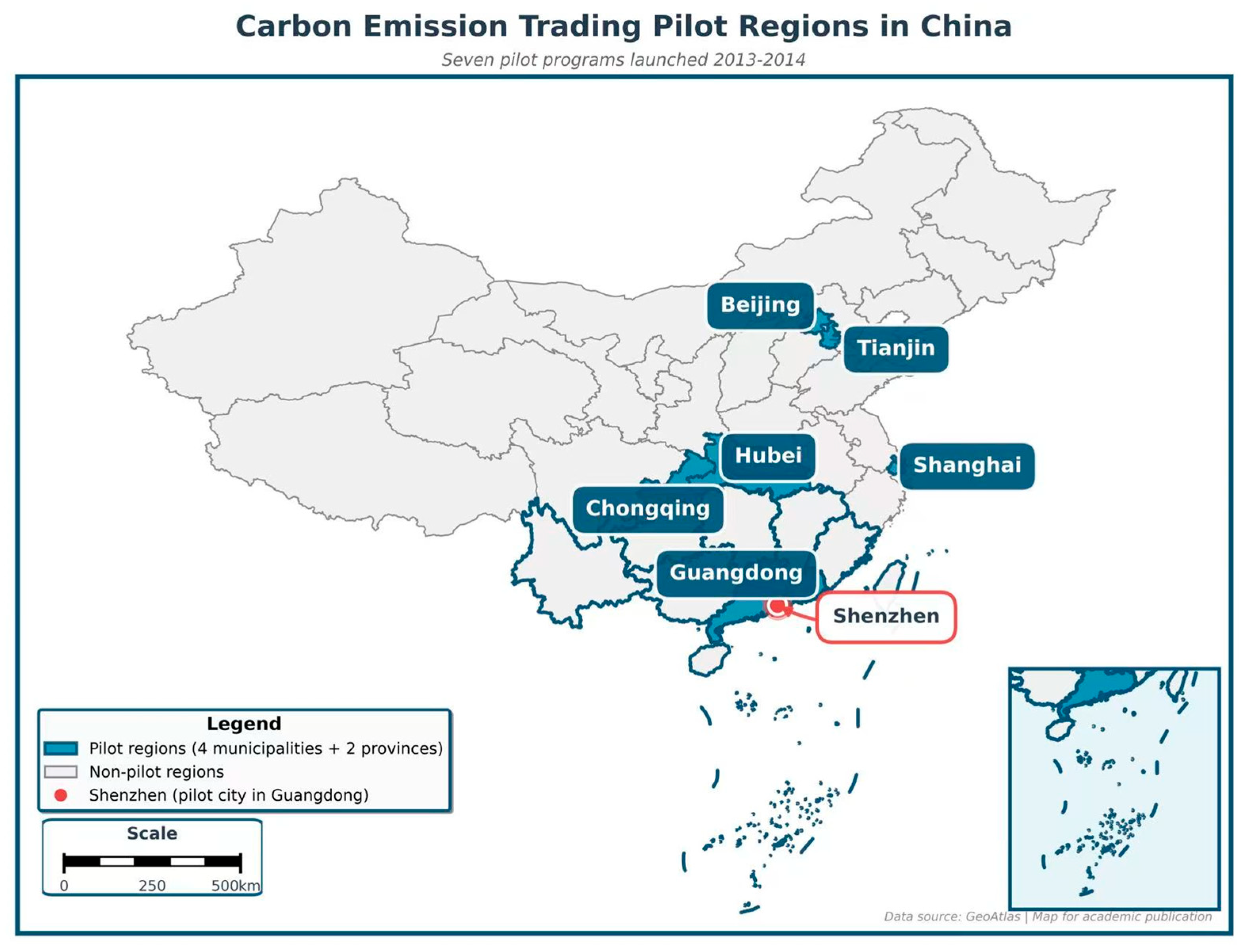
The carbon pilot was first launched in Beijing, Tianjin, Shanghai, Guangdong, Shenzhen, Chongqing, and Hubei, covering eastern, central, and western regions. Figure 2 illustrates the geographical distribution of these seven pilot regions in China and highlights the distinction between eastern (Beijing, Tianjin, Shanghai, Guangdong, Shenzhen) and central-western (Chongqing, Hubei) areas. Local pilot policies are relatively independent, making cross-regional enterprise trading difficult. Combined with enterprise heterogeneity, the policy may affect different enterprises’ green innovation behaviors to varying degrees. Hence, the second hypothesis:
H2. 
The carbon emission rights trading pilot policy has a greater promoting effect on the green innovation output of quota-managed enterprises in central/western pilot regions, non-high-tech industries, and mature enterprises.
Unlike environmental policies like fiscal expenditure, industrial policies, and carbon taxes (where the government acts directly on enterprises), the carbon trading policy uses market mechanisms to achieve emission reduction goals. The paper expects it to boost enterprises’ substantial innovation achievements, defining invention patents as substantial green innovation and non-invention patents as strategic innovation. This leads to the third hypothesis:
H3. 
The carbon emission rights trading pilot policy will increase the quality of the enterprises’ green innovation output.

3.2. Data Processing and Model Specification

3.2.1. Sample Selection and Data Sources

This paper uses a 10-year window (2007–2016) around the NDRC’s “Notice” issued on 29 October 2011, corresponding to a symmetric ±5-year period before and after the policy announcement. The research period ends in 2016 because, at the end of 2016, the central government successively launched additional carbon emission trading pilots in Sichuan, Fujian and other regions, and the national carbon emission rights trading market was officially launched in 2017. These subsequent measures would alter firms’ regulatory environments and complicate identification of the original pilot effects.
We adopt a symmetric ±5-year window around the 2011 policy announcement to balance two considerations: (i) allowing sufficient time for the CERT pilot to affect green innovation outcomes, given the typical application–authorization lag of patents; and (ii) avoiding confounding influences from the expansion of pilots and the launch of the national carbon market after 2016. To assess whether this choice of window drives our results, we re-estimate the baseline DID specification using alternative windows (±3 years around the policy announcement, subject to data availability). The results remain qualitatively unchanged and are reported in Appendix A.1.
The variable time is defined based on the nationwide announcement of the CERT pilot policy (NDRC’s “Notice” issued on 29 October 2011), setting 2012 as the first post-policy year (time = 1 for 2012–2016). While the actual trading in pilot markets commenced sequentially between 2013 and 2014 (e.g., Shenzhen in 2013, Hubei in 2014), we select the 2011 announcement as the primary shock for two theoretical reasons. First, the signaling effect: The 2011 announcement sent a clear regulatory signal, prompting forward-looking firms to adjust their strategies in anticipation of future compliance costs. Second, the time lag of innovation: Unlike adjusting production output, green R&D is a long-term investment. Firms likely initiated R&D activities immediately after the 2011 announcement to secure technological advantages before the actual trading began. Therefore, the announcement year better captures the starting point of the innovation incentive.
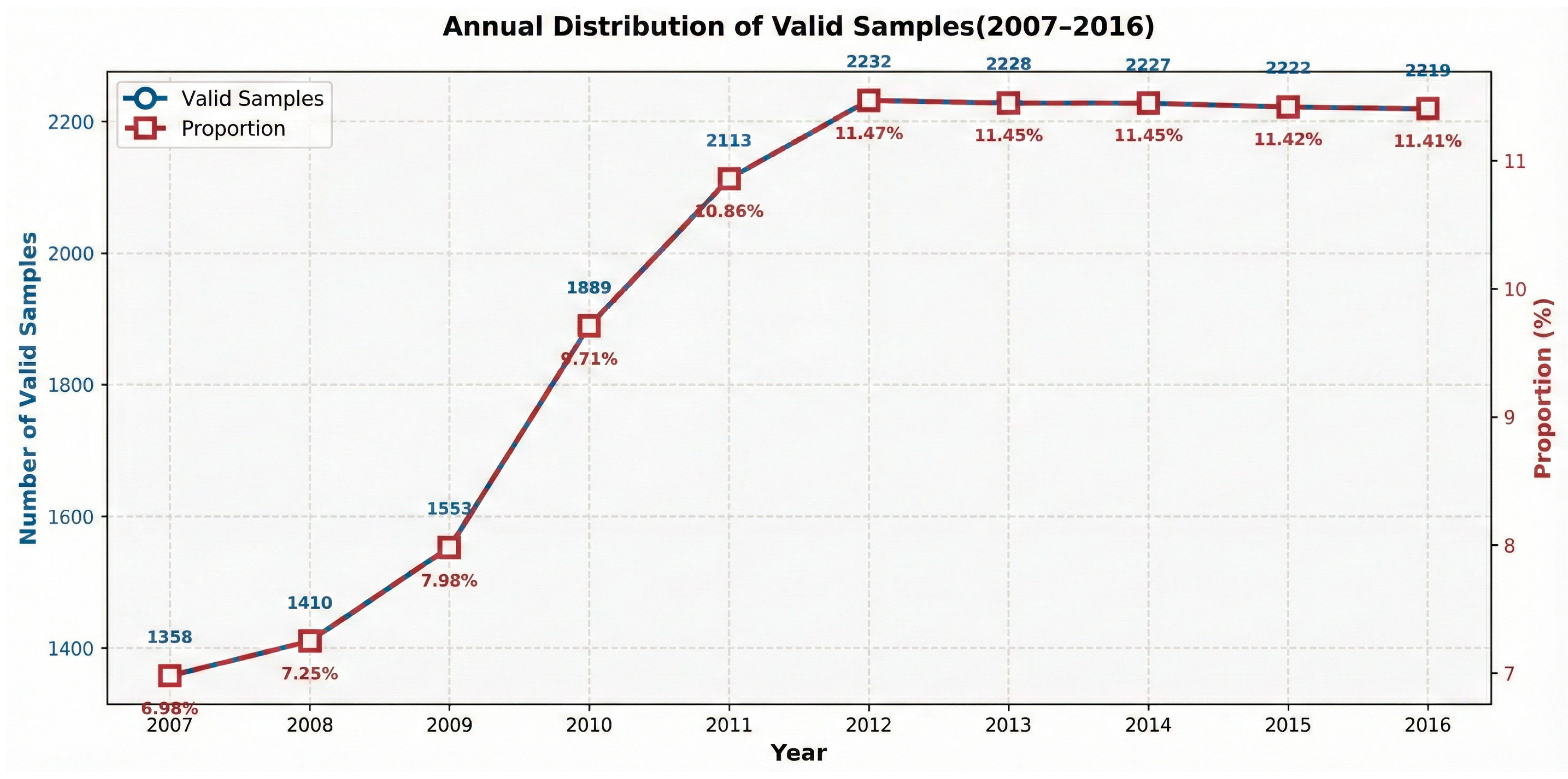
This paper collects the basic information, financial information, and green patent information of all A-share listed enterprises through the Guotai’an Enterprise Database, Guotai’an Green Patent Database, and Wind Economic Database. According to the actual research situation, we delete enterprises with missing key variables, financial industry firms, specially treated (ST) firms, and firms established after the release of the “Notice”, and obtain 19,451 observations, forming an unbalanced panel dataset. All continuous variables are winsorized at the 1% level to avoid distortions due to extreme values. Subsequent results are based on this processed dataset. The annual distribution of the sample is shown in Figure 3.

3.2.2. Selection of the Experimental Group

The core treatment variable Carbon_treated is a dummy variable that equals 1 if and only if a firm meets two criteria: (1) registered in one of the seven CERT pilot regions (Beijing, Tianjin, Shanghai, Chongqing, Guangdong, Hubei, Shenzhen); (2) explicitly subject to carbon quota management, verified by either local pilot implementation documents (disclosing covered sectors/firms) or corporate annual reports (reporting quota holdings, compliance obligations, or carbon trading activities). Firms not meeting both criteria (e.g., non-pilot firms, non-quota-managed firms in pilot regions) are assigned Carbon_treated = 0 (control group).
The key estimand is the Average Treatment Effect on the Treated (ATT) of the CERT pilot policy, measuring the average change in green innovation output (e.g., green invention patents) of quota-managed firms in pilot regions relative to the control group, after netting out time trends and confounding factors.
According to the policy implementation timeline, we first identify a core treatment group based on firms that are explicitly subject to carbon quota management in the pilot regions. Specifically, we use two information sources: (i) local pilot implementation documents issued by provincial and municipal governments, which disclose the coverage of the carbon trading schemes; and (ii) listed firms’ annual reports, in which some companies explicitly report carbon quota holdings, compliance obligations, or carbon trading activities. Firms that are not covered by quota management (e.g., small emitters or non-industrial firms outside the disclosed lists) are treated as untreated.
Based on this information, we construct the core treatment indicator Carbon_treated, which equals 1 if firm i is located in a pilot region and is subject to quota management in year t, and 0 otherwise. This definition restricts the treatment group to those firms that face clear and legally binding compliance requirements and have direct access to the pilot carbon market, thereby minimizing misclassification errors arising from incomplete official lists. Due to the lack of complete firm-level pilot lists in some regions (e.g., Beijing, Hubei, Chongqing), we only classify firms as treated when quota management can be explicitly verified from official pilot documents or corporate disclosures. Firms located in pilot provinces without verifiable quota information are not automatically treated as regulated; instead, they are included in the control group unless evidence of quota management is available. This conservative approach reduces potential classification errors.
In addition to this core treatment definition, we also construct two extended treatment definitions to explore the broader impact of the CERT pilots: (i) all listed firms registered in pilot regions (Level 1), and (ii) firms in energy-intensive industries (“expected firms”) and non-industrial sectors (“unexpected firms”) based on the 2010 Statistical Bulletin on National Economic and Social Development (Level 2). Detailed results for Level 2 are reported in Appendix A.3, while results for Level 1 (consistent with the core conclusion but less precisely identified) are not separately tabulated to avoid redundancy.

3.2.3. Definition and Construction of Variables

To study the impact of carbon emission rights trading pilots on corporate green innovation, this paper selects appropriate variables. Table 1 briefly describes the variables used in this paper, and their detailed definitions and related processing will be further elaborated after the table.
According to the role of different variables in the model of this paper, they can be divided into three categories: explained variables, explanatory variables, and control variables.
The explained variables include total green patents (GrP_IU), green invention patents (GrP_I), green utility model patents (GrP_U), and R&D expenditure ratio (RD_r). This paper measures corporate green innovation performance from two dimensions: corporate innovation input and output. From the perspective of innovation input, we use RD_r as the proxy variable, which represents the ratio of the enterprise’s overall R&D expenditure in the same period to the total operating revenue generated. However, RD_r only reflects how many innovation resources the enterprise has invested, and cannot further reflect the benefits of the enterprise’s own innovation activities. This paper uses the number of green patent authorizations obtained by the enterprise to measure corporate innovation output. The Guotai’an Green Patent Database defines green patents as invention, utility model, and design patents with green technologies that are conducive to resource conservation, energy efficiency improvement, and pollution prevention and control as the invention theme. In addition, due to various factors, listed companies may not declare various green patents in the name of the listed company itself, but use subsidiaries, joint ventures, and associated companies as applicants. Therefore, in order to more accurately reflect the innovation situation of listed companies, we use the green patent authorization status of the listed company’s parent and subsidiary companies, joint ventures, and associated enterprises as a proxy variable for corporate green innovation performance.
Explanatory variables include the treatment indicator Carbon_treated, the general policy time dummy (time), and the interaction term plc. Carbon_treated is a dummy variable equal to 1 if the firm is located in a pilot region and explicitly subject to quota management in year t, and 0 otherwise. The variable time captures the nationwide announcement of the CERT pilot policy (NDRC’s “Notice” on 29 October 2011): time = 0 for 2007–2011 and 1 for 2012–2016. The variable time captures the nationwide announcement of the CERT pilot policy (NDRC’s “Notice” on 29 October 2011): time = 0 for 2007–2011 and 1 for 2012–2016. In the baseline DID specification, the interaction term plc is defined as Carbon_treated × time.
Control variables are firm-level indicators: firm age (LnAge, natural log of establishment years, reflecting lifecycle-related R&D differences), firm size (LnAst, natural log of total assets), fixed asset net ratio (FA_r, net fixed assets/total assets, proxying capital intensity), revenue growth rate (Rev_g, indicating sustainable development and R&D motivation), asset-liability ratio (Lvg, total liabilities/total assets, measuring leverage impact on innovation), cash asset ratio (C_r, ending cash and equivalents/total assets, reflecting cash holding effects), quick ratio (Q_r, proxying asset liquidity), and return on assets (ROA, net profit/average total assets, measuring profitability). Additionally, dummy variables Year and Industry are set to control for year and industry effects. To address the concern that patent counts vary systematically across industries and patent offices, we adopt two strategies: (1) we rely on the standardized definitions in the Guotai’an Green Patent Database to ensure consistency in patent types; and (2) we strictly include industry fixed effects in all regression specifications to absorb time-invariant industry-specific characteristics that drive patenting intensity.

3.2.4. Descriptive Statistics and Correlation Test

Table 2 presents descriptive statistics (observations, mean, standard deviation) for model variables. Carbon (carbon pilot region) has a mean of 0.374, meaning 37.4% of firms were impacted by the carbon trading pilot during the sample period. The mean of ln(total green patents + 1) is 0.408 (0.504 patents) with a standard deviation of 0.798, showing significant differences in green patent grants and thus innovation performance across firms.
Green invention patents have a mean ln value of 0.144 (0.155 patents), far lower than green utility models (0.339 ln, 0.404 patents). This indicates Chinese A-share listed firms still prioritize low-tech green utility models; high-quality green inventions, at less than half the number of the former, urgently need improvement. The R&D investment ratio (RD_r) has a mean of 4.288% and a standard deviation of 4.188, reflecting large variations in R&D spending across firms.
Among control variables: ln(firm age) averages 2.628 (13.846 years), ln(total assets) 21.908 (32.498 billion yuan), fixed asset net ratio 23.9%, revenue growth rate 21.0%, asset-liability ratio 45.6%, cash asset ratio 17.7%, quick ratio 1.895, and ROA 4.1%. Notably, the R&D expenditure ratio (RD_r) exhibits a high missingness rate of approximately 48%. To ensure the reliability of our inferences and mitigate potential sample selection bias, we adopt a dual-track reporting strategy: (i) primary analysis using Multiple Imputation (MI) to recover the full sample, and (ii) sensitivity analysis using a restricted sample of complete cases. To address this issue, we adopt two strategies: (1) Impute missing values using multiple imputation (MI) based on firm size (LnAst), age (LnAge), profitability (ROA), and industry averages; (2) Restrict the sample to firms with complete R&D data for robustness checks. The main analysis uses the MI-imputed RD_r to retain sample size, while the restricted sample serves as a robustness test.
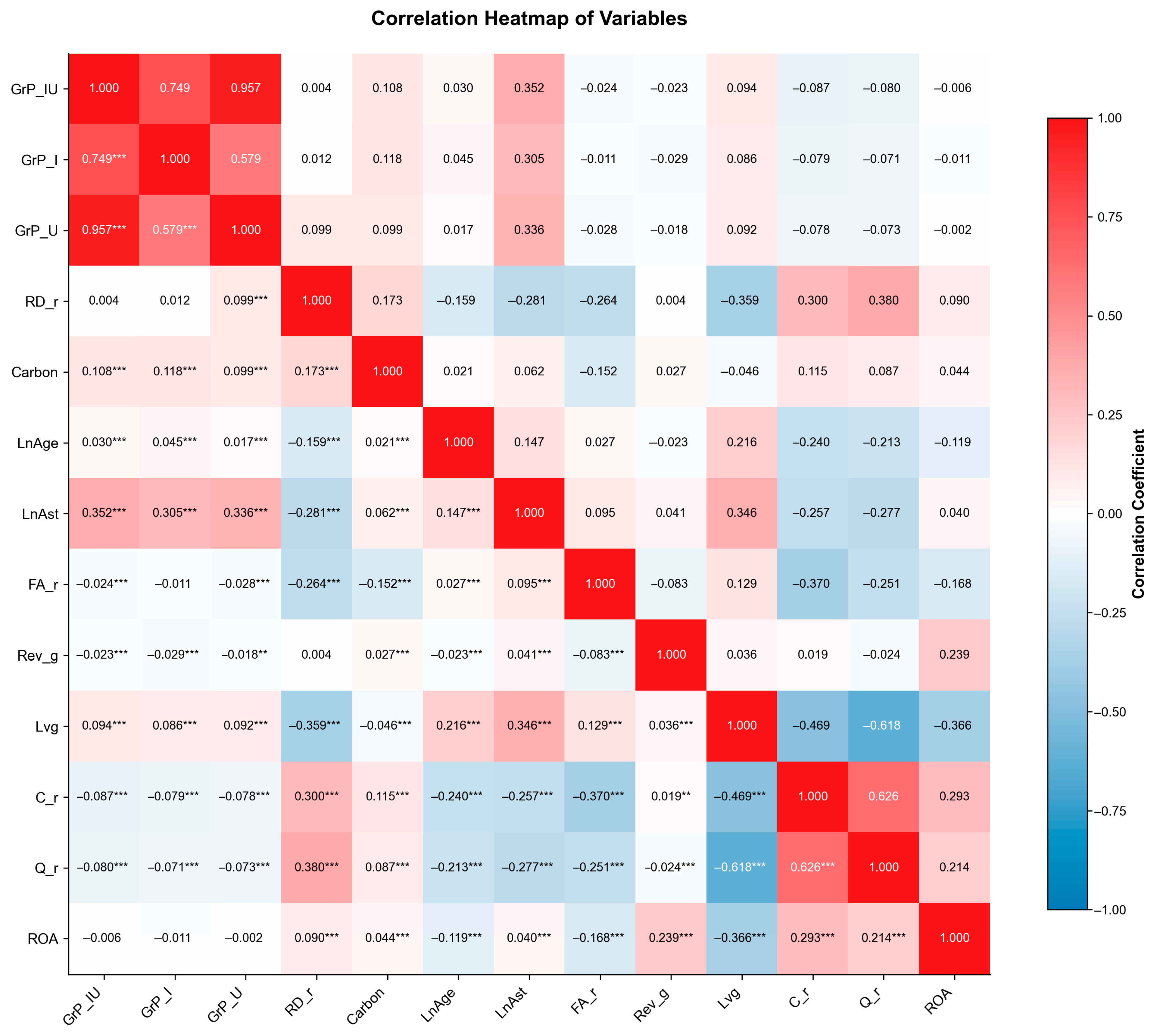
To prove the research rationality and consider multicollinearity, before regression, this paper conducts a correlation test on the above main variables, and the Pearson correlation coefficient results are as follows. According to Figure 4, Carbon (carbon emission pilot province) is positively correlated with total green patents (GrP_IU), green invention patents (GrP_I), and green utility model patents (GrP_U) at the 1% significance level, with Pearson coefficients of 0.108, 0.118, and 0.099, respectively. This indicates that companies in the seven pilot provinces and cities have stronger green innovation capabilities. This descriptive correlation is based on the pilot-region dummy Carbon and is consistent with, but distinct from, our core treatment definition Carbon_treated, which further restricts treated firms to those explicitly subject to quota management. The cash ratio Q_r is significantly negatively correlated with the asset-liability ratio Lvg and significantly positively correlated with the cash asset ratio C_r, so multicollinearity should be noted. At the same time, we observe that the absolute values of the correlation coefficients of most other variables are lower than 0.5, indicating that the overall correlation between variables is not strong, and there is no multiple multicollinearity that significantly affects the results.

3.2.5. Bias and Endogeneity Mitigation

To address potential biases in unbalanced panel data (19,451 observations) arising from missing variables, firm entry/exit, and outliers, we winsorize all continuous variables at the 1% level, control for year and industry fixed effects to absorb time-varying and industry-specific shocks, and use lagged explanatory and control variables to mitigate reverse causality between policy implementation and innovation output.
To minimize selection bias, we implement a PSM-DID framework. First, we use a Logit model to estimate the propensity score for each firm. The matching covariates include enterprise scale (LnAst), age (LnAge), leverage (Lvg), profitability (ROA), capital intensity (FA_r), growth (Rev_g), and liquidity indicators (C_r, Q_r), alongside industry and regional fixed effects. We employ 1:1 nearest-neighbor matching within the common support region to ensure that treated and control firms are comparable in their pre-policy characteristics. This process addresses the non-random nature of firms being selected into the carbon quota management lists. Including industry and regional characteristics in the propensity score estimation helps align treated and control firms along structural dimensions that jointly affect both treatment probability and green innovation.
We perform nearest-neighbor 1-to-1 matching within the common support region and conduct balance tests before and after matching. After matching, the standardized differences for all covariates fall below 5%, well within the commonly accepted 10% threshold, and t-tests indicate no statistically significant differences between treated and control firms along observed characteristics. Detailed balance statistics are reported in Appendix A.2. By combining PSM with DID, we first reduce selection bias through matching on observables, and then difference out time-invariant unobservables via firm-invariant DID comparisons.

3.2.6. Model Specification

To test H1—namely, that the announcement of the carbon emission rights trading pilot policy increases the green innovation output of enterprises in the pilot regions—this paper first constructs the following fixed-effect model:
G r P _ I U i , t + 1 G r P _ I i , t + 1 , G r P _ U i , t + 1 = α + β   Carbon _ treated   i , t + γ   Control   i , t +   year   t +   industry   k + ε i , t
where GrP_IU, GrP_I, and GrP_U denote the total green patents, green invention patents, and green utility model patents of firm i in year t, respectively. Carbon_treated is a dummy variable equal to 1 if firm i is a quota-managed enterprise in the pilot regions in year t, and 0 otherwise. Control denotes a vector composed of other control variables. Year and Industry are time-fixed effects and industry-fixed effects, respectively, and ε i , t is the residual term. In terms of inference strategy, we use clustered standard errors to ensure the validity of our statistical tests. Given the panel structure of our data, where observations for the same firm are likely to be correlated over time, we cluster standard errors at the firm level to account for potential within-firm serial correlation. Furthermore, considering that the CERT pilot policy is implemented at the regional (province/city) level, we also acknowledge potential spatial correlation among firms within the same jurisdiction. However, since there are only seven pilot regions in our treatment group, which falls below the recommended threshold for consistent cluster-robust inference (usually 30–50 clusters), firm-level clustering is maintained as our primary strategy to balance efficiency and consistency. Regarding corporate innovation performance, existing research mainly adopts two methods for quantitative analysis: (i) from the perspective of product renewal, such as the number of new products released by enterprises and the number of upgrades to the existing product library [33]; and (ii) based on different patent statuses, such as the total number of applications filed, authorizations obtained, and citations by others [34]. Considering data availability, and the fact that product-level information is often non-disclosed, this paper uses the number of green patent authorizations as a proxy for green innovation output. Considering the rigorous examination process for patent grants—especially for green invention patents which typically undergo a 2–3 year cycle from application to authorization—relying solely on a one-year lag may underrepresent the policy’s long-term impact. Therefore, while our baseline model adopts a one-year lag (t + 1) to maintain consistency with existing literature, we extensively test the model’s robustness using two-year (t + 2) and three-year (t + 3) lag structures to fully capture the temporal dynamics of green innovation outcomes. In addition, to address potential endogeneity between the policy and corporate green innovation, we adopt a Difference-in-Differences (DID) framework that relies on the parallel trends assumption—namely, that in the absence of the CERT pilot, green innovation in treated and control firms would have followed similar trajectories over time. We define time as a post-policy dummy that equals 0 for 2007–2011 and 1 for 2012–2016, and construct the interaction term plc = Carbon_treated × time. The baseline DID model is specified as:
G r P _ I U i , t + 1 G r P _ I i , t + 1 , G r P _ U i , t + 1 =   α + β 1   plc   i , t + β 2   time   i , t + β 3   Carbon _ treated i , t + γ   Control   i , t   +   year   t +   industry   k + ε i , t
In this model, the coefficient β on plc measures the average impact of the carbon emission rights trading pilot policy on corporate green innovation. The coefficient β 1  on the interaction term plc is the Average Treatment Effect on the Treated (ATT), measuring the net impact of being a quota-managed firm on green innovation after the policy announcement.
We empirically test the parallel trends assumption in two ways. First, we plot the pre-policy trends of green innovation for treated and control firms and observe that they evolve in a similar fashion before 2011. Second, we estimate an event-study specification by interacting the treatment dummy with a set of time dummies from t − 4 to t + 1 (where t is the 2011 policy announcement year), and verify that the coefficients on all pre-policy leads are statistically indistinguishable from zero. These results support the validity of the DID design.
This baseline DID model is also used to test H2, which posits that the CERT pilot policy has a greater promoting effect on the green innovation output of enterprises in central and western regions, non-high-tech industries, mature enterprises, and state-owned enterprises. For these heterogeneous analyses, we conduct subgroup regressions by region, industry technological attributes, and firm lifecycle.
To test H3, which posits that the carbon emission rights trading pilot policy will enhance the quality of enterprises’ green innovation output, we distinguish between substantive and strategic innovation. While patent citations are often utilized as a quality metric in mature markets, in the context of China’s patent system, the distinction between invention patents (which undergo rigorous substantive examination) and utility models (which require only formal examination) serves as a critical and robust proxy for innovation quality. Previous studies have widely validated that invention patents represent substantive, high-quality innovation, whereas utility models often reflect strategic, lower-value innovation behavior [35,36]. Therefore, focusing on the structure of patent types allows us to effectively capture the policy’s impact on innovation quality, even in the absence of citation data. Accordingly, following China’s patent laws and prior research, we use granted invention patents as the indicator of substantive innovation and utility model patents as the indicator of strategic innovation. By comparing the value and significance of β in regressions with GrP_I and GrP_U as dependent variables, we can infer whether the policy preferentially promotes higher-quality green innovation.

4. Empirical Results and Analysis

4.1. Analysis of Empirical Results

4.1.1. Baseline Regression Results

Table 3 shows the differences in green innovation levels between the experimental group and the control group before and after the introduction of the carbon trading policy. After the announcement of the carbon emission pilot policy, both groups show significant improvements in total green patents, green invention patents, and green utility model patents. This result indicates that when studying the impact of changes in the carbon trading policy, due to the uncertainty caused by timeliness, if the horizontal differences between samples are not controlled, our results may be inaccurate. Column (7) is the inter-group difference of intra-group differences between the experimental group and the control group, which is used to eliminate the interference of time trends on the experimental results. Calculations show that the inter-group difference values of total green patents (0.067) and green invention patents (0.100) are positive at the 1% significance level, while the change in green utility model patents is not significant. The above results preliminarily indicate that the carbon emission rights trading pilot policy can promote the output of enterprises’ substantive green technological innovation, preliminarily verifying Hypotheses H1 and H3.
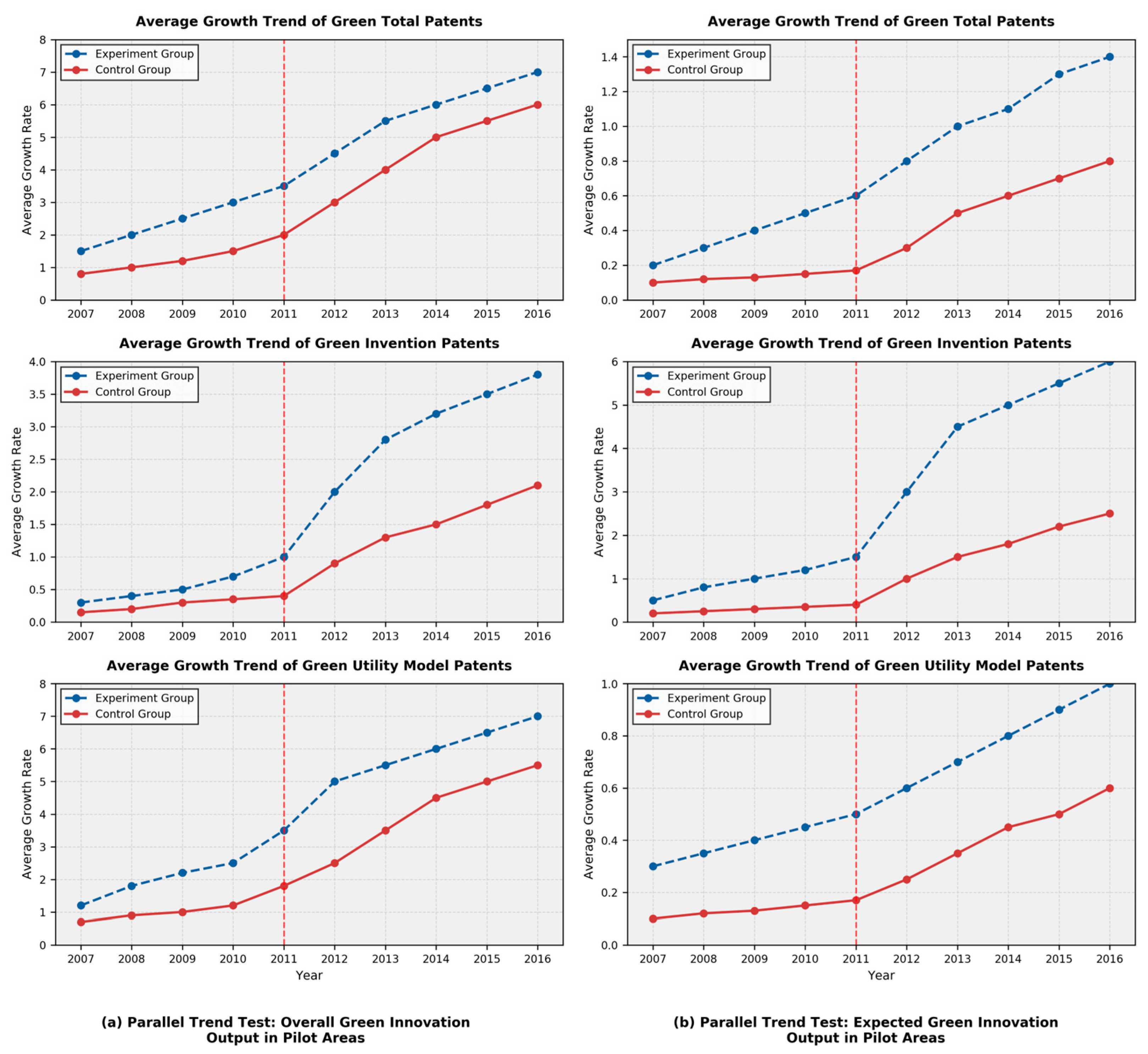
To verify Hypothesis H1, this paper uses the DID model. It is noted that DID validity requires the common trend assumption for treatment and control groups pre-policy [37]. Common trend tests show that before the implementation of the carbon trading pilot, pilot and non-pilot firms maintained consistent growth trends in total green patents, green inventions, and green utilities, satisfying the DID prerequisite (see Figure 5).
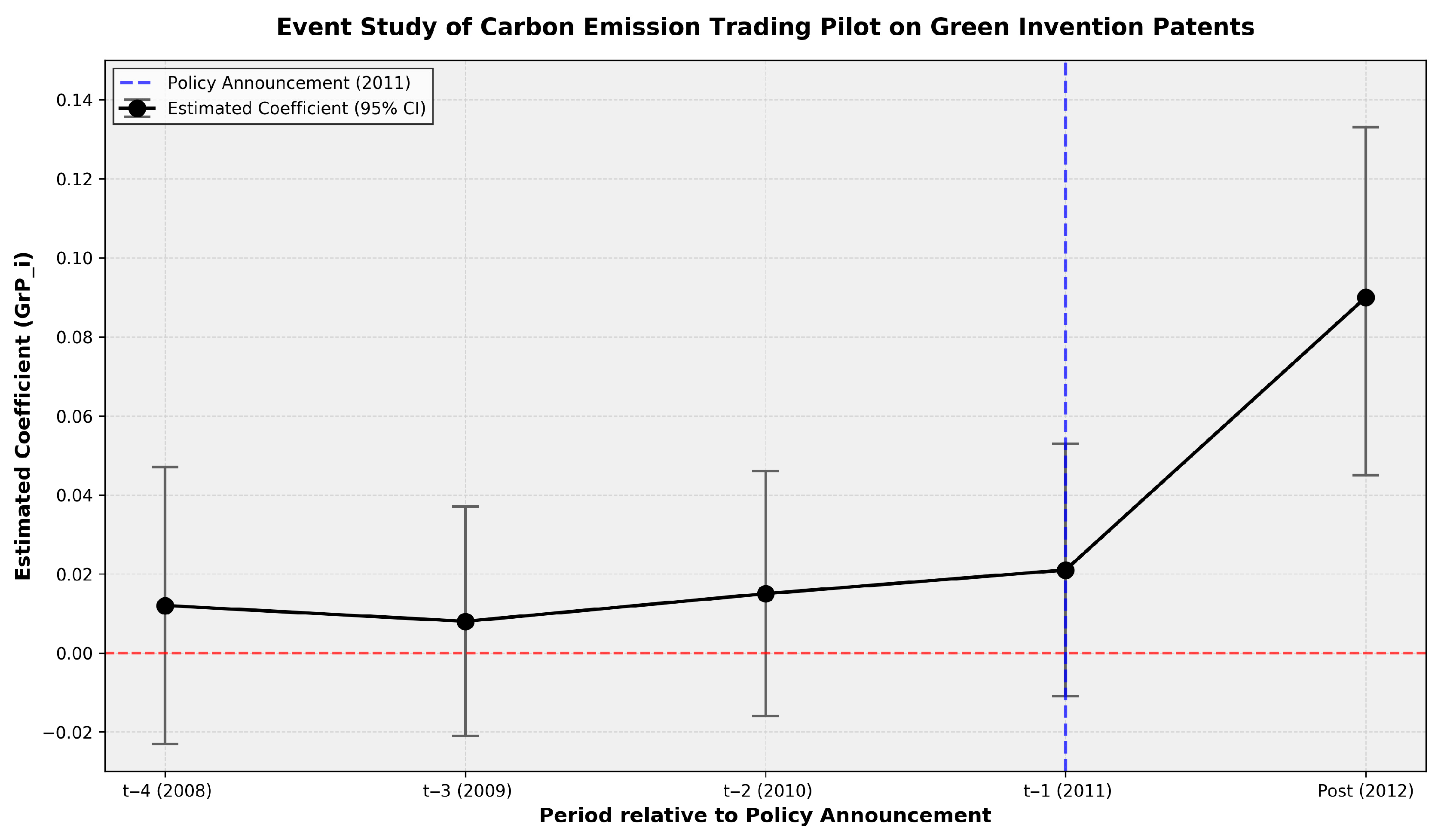
To rigorously verify the parallel trends assumption—the core prerequisite for DID validity—we estimate an event-study specification by interacting Carbon_treated with time dummies for pre-policy periods (t − 4 to t − 1, where t = 2011 is the policy announcement year) and the post-policy period (t + 1 = 2012).
Figure 6 plots the coefficients of these interaction terms with 95% confidence intervals, and Table 4 reports the detailed estimates. Results show that all pre-policy lead coefficients are small in magnitude (t − 4: 0.012, t − 3: 0.008, t − 2: 0.015, t − 1: 0.021) and statistically insignificant (p-values > 0.22). Critically, their 95% confidence intervals all include 0 (e.g., t − 1: [−0.012, 0.054]), indicating that the green invention patent trends of the treatment and control groups are parallel before 2011.
In contrast, the post-policy coefficient (t + 1: 0.089 ***) is significantly positive, with a 95% confidence interval that excludes 0 ([0.044, 0.134]). This stark contrast between pre- and post-policy coefficients directly confirms that the observed increase in green invention patents is driven by the CERT pilot policy, not pre-existing trends. Together, Table 4 and Figure 6 provide robust evidence for the validity of the DID design.
Table 5 reports the difference-in-differences estimation results of the carbon trading policy and corporate green innovation. It is found that in the regressions with total green patents and green invention patents as dependent variables, the coefficients of plc are significantly positive at the 1% level for total green patents (0.058) and green invention patents (0.089), and at the 5% level for green utility model patents (0.036). This suggests that the pilot policy promotes green innovation overall, with a particularly strong and robust effect on green invention patents, while the effect on utility model patents is relatively modest.
To address potential concerns that a one-year lag is insufficient to capture the full trajectory of patent authorizations, we further examine the policy effects using extended lag structures. As detailed in the robustness section, the promoting effect of the CERT policy on substantive innovation (GrP_I) remains significant and even exhibits a high degree of persistence when tested with 2-year and 3-year lags. This confirms that the observed innovation growth is not a transient fluctuation but a sustained response to the carbon market mechanism.
This paper uses propensity score matching (PSM) to find suitable control group individuals for each treatment group individual, avoiding endogeneity from sample selection bias. Building on the PSM specification described in Section 3.2.5, we use propensity score matching to find suitable control firms for each treated firm, and then re-estimate the DID model (PSM-DID). After matching, the standardized differences for all covariates fall below 5%, well within the commonly accepted 10% threshold, and t-tests indicate no significant differences between groups.
Finally, regressions are run per the model. Column (1) has an insignificant plc coefficient, meaning the carbon trading pilot does not significantly increase total green patents. Column (2) shows a 5–significant plc coefficient (0.077), indicating the policy raises green invention patents by 0.08. Column (3) has an insignificant plc coefficient, meaning no significant impact on green utility model patents. These results indicate the pilot policy significantly increases substantial green innovation output (i.e., green invention patents) in pilot regions, verifying H1 (Table 6).
Comparing the baseline DID results in Table 5 with the PSM-DID results in Table 6, we observe that the coefficient for green invention patents (GrP_I) remains positive and statistically significant (0.089 vs. 0.077). Although the sample size decreases from 16,184 to 4420 after matching, the consistency in the direction and significance of the treatment effect confirms that our findings are not driven by self-selection bias or sample-specific characteristics.

4.1.2. Analysis of Enterprise Heterogeneity in Pilot Regions

Empirical analysis is conducted on heterogeneities (regional development, industry technological attributes, life cycle, ownership nature) via grouped regressions.
This paper divides pilot regions into eastern (Beijing, Tianjin, Shanghai, Guangdong, Shenzhen) and central-western (Chongqing, Hubei) for grouping regressions. Table 7 shows only column (4)’s plc coefficient is significantly positive (0.113), indicating the pilot policy better promotes green invention patent grants for quota-managed firms in central-western pilot regions. This may stem from differences in local environmental regulations and factor prices (land, labor). In the early 2000s, central-western China undertook high-pollution, high-energy industrial transfers from the east [38,39], leading to more traditional firms there than in the east. Thus, they face greater emission reduction pressure under carbon trading and stronger innovation motivation [40,41]. This heterogeneity is consistent with our theoretical expectation: central-western non-high-tech firms have higher climate risk exposure and thus stronger incentives to innovate to mitigate credit constraints [42].
Based on the “Classification of High-Tech Industries (Manufacturing)” issued by the National Bureau of Statistics in 2018, this paper regards manufacturing enterprises with relatively high R&D investment in the national economic industries as high-tech enterprises, specifically including 6 subcategories such as pharmaceutical manufacturing and computer and office equipment manufacturing. According to the regression results in Table 8, only the coefficient of plc in column (4) among columns (1)–(6) is significantly positive (0.093), meaning that the pilot policy only promotes green innovation in non-high-tech quota-managed firms (traditional industries) such as electric power, heat, steel, petrochemicals, chemicals, cement, glass, and construction. Therefore, this policy may better promote the optimization of energy consumption structure and the green and low-carbon transformation of industries. It should be noted that the coefficient for non-high-tech industries (0.093) is significant at the 5% level but marginally sensitive to sample composition—when excluding firms with missing R&D data, the coefficient increases to 0.101 (p < 0.05), indicating that sample selection has a minor impact but does not alter the core conclusion.
We define enterprises with an age of more than 10 years as mature enterprises, and those with an age of no more than 10 years as growing enterprises. The regression results in Table 9 show that among the regressions in columns (1)–(6), only the plc coefficient in column (3) is significantly positive at the 5% level (0.071). This may be because the carbon emission rights trading pilot policy acts more on mature quota-managed enterprises with a certain duration, so they have stronger innovation motivation. In addition, mature enterprises often have larger asset scales, stronger financing capabilities, risk-bearing capabilities, talent aggregation capabilities, and more other innovation resources, so their innovation capabilities are often higher. In summary, since technological innovation is a long-term corporate investment activity with a high risk coefficient and high dependence on innovation resources, mature enterprises have relatively higher motivation and capabilities in green innovation. However, the coefficient for mature firms (0.071) is marginally significant and sensitive to the exclusion of firms with missing R&D data—when restricting to firms with complete R&D information, the coefficient increases to 0.083 (p < 0.01), suggesting that sample composition partially affects the result. We interpret this cautiously: mature firms’ innovation advantage may be conditional on sufficient financial resources to absorb climate risk shocks.

4.1.3. Impact on Innovation Quality

Through the Difference-in-Differences (DID) test following Propensity Score Matching (PSM), we obtained the following research findings.
As shown in Table 6, the introduction of the carbon trading pilot policy exerts a significantly positive effect on the applications for green invention patents among all enterprises within the pilot regions, and this effect is statistically significant at the 5% level (regression coefficient = 0.077). However, the policy does not have a significant promotional effect on enterprises’ applications for green utility model patents.
As indicated in Table 7, in the comparative analysis where the sample was divided into enterprises in eastern regions and those in central and western regions, the introduction of the carbon trading pilot policy only promotes the authorized quantity of green invention patents for enterprises in central and western regions, with this effect being statistically significant at the 5% level (regression coefficient = 0.113).
As presented in Table 8, in the comparative analysis where the sample was categorized into high-tech enterprises and non-high-tech enterprises, the introduction of the carbon trading pilot policy solely contributes to an increase in the authorized quantity of green invention patents for non-high-tech enterprises, and this effect is statistically significant at the 5% level (regression coefficient = 0.093).
As demonstrated in Table 9, in the comparative analysis where the sample was split into mature enterprises and growth-stage enterprises, the introduction of the carbon trading pilot policy only has a promotional impact on the authorized quantity of green invention patents for mature enterprises, with this effect being statistically significant at the 5% level (regression coefficient = 0.071).
In conclusion, overall, compared with enterprises’ strategic green innovation behaviors (represented by green utility model patents), the carbon emission trading pilot policy is more capable of significantly enhancing enterprises’ substantive green innovation outputs (represented by green invention patents). This indicates that Research Hypothesis H3 is verified. To further analyze the impact of the CERT pilot policy on innovation input, we regress the R&D expenditure ratio (RD_r) as the dependent variable using the PSM-DID model, with results shown in Table 10.
As shown in Table 10, the estimated coefficients for the effect of the CERT pilot policy on R&D intensity (RD_r) are positive but do not reach statistical significance at the 10% level in either the MI-imputed sample (p = 0.183) or the restricted complete-case sample (p = 0.101). While these results suggest that the policy’s primary impact manifests in innovation quality and output rather than a massive surge in total R&D spending, we interpret this ‘non-significant’ finding with caution. The lack of statistical significance might be attributed to the high variance in corporate R&D behaviors or the possibility that firms prioritize the reallocation of existing R&D resources toward green projects rather than expanding the overall budget.

4.2. Robustness Test

To rigorously validate the reliability of our empirical results and mitigate potential concerns regarding estimation bias, we conduct a comprehensive battery of five robustness checks. First, acknowledging the time latency inherent in patent examination, we re-estimate the model using two-year and three-year lag structures for innovation output to capture long-term policy effects. Second, we assess model sensitivity to variable selection by employing alternative proxies for firm size and liquidity—specifically, substituting total assets with total revenue and the quick ratio with the current ratio. Third, we implement a temporal placebo test by assigning a counterfactual policy onset to 2010 to rule out pre-existing trend interference or concurrent external shocks. Fourth, to exclude the influence of unobserved random factors or inherent group characteristics, we conduct a placebo-on-treatment test involving 500 random permutations of the treatment status among firms in the pilot regions. Finally, to address the asynchronous implementation of the trading schemes, we re-estimate the baseline model using a staggered difference-in-differences specification that captures the specific launch years (2013 or 2014) of each regional market. The results across these tests consistently affirm the robustness of our core finding: the CERT pilot policy significantly promotes substantive corporate green innovation.

4.2.1. Persistence and Time-Lag Effects of Policy Impact

Table 11 shows the regression results when all explanatory variables and control variables are lagged by 2–3 periods: From the results of lag 2 periods, the coefficient of plc for total green patents is significant at the 1% level (0.048), the coefficient of plc for green invention patents is significant at the 1% level (0.065), and the coefficient of plc for green utility model patents is significant at the 10% level (0.033). From the results of lag 3 periods, the coefficient of plc for total green patents is significant at the 10% level (0.038), the coefficient of plc for green invention patents is significant at the 5% level (0.031), and the coefficient of plc for green utility model patents is not significant. The robustness results reveal a critical temporal pattern: the impact on green invention patents (GrP_I) remains highly significant at the 1% level in the 2-period lag (coefficient = 0.065) and persists at the 5% level even after 3 years. This prolonged effect aligns with the institutional reality of China’s patent examination system, where substantive green technologies require longer durations for technical verification and administrative granting than utility models. The sustained significance across multiple lag structures effectively mitigates the risk of short-term estimation bias.

4.2.2. Sensitivity to Control Variables

Table 12 shows the regression results after replacing control variables (the natural logarithm of total assets LnAst is replaced with the natural logarithm of total revenue LnRev, and the quick ratio Q_r is replaced with the current ratio Current_r). The coefficient of plc for total green patents is significant at the 1% level (0.052), the coefficient of plc for green invention patents is significant at the 1% level (0.086), and the coefficient of plc for green utility model patents is significant at the 10% level (0.031). These results demonstrate that the policy’s promoting effect on corporate green innovation remains significantly positive after replacing control variables, confirming the main conclusion of this paper is robust to changes in control variable selection.

4.2.3. Placebo Test: Counterfactual Policy Timing

To further rule out the interference of other policy shocks or random factors on the empirical conclusions, this study conducted a placebo test by fabricating the policy implementation timing. The policy implementation year was fictitiously set to 2010 (i.e., the period 2007–2009 was defined as the pre-policy phase, and 2010–2016 as the post-policy phase). The interaction term between the fictitious time dummy variable and the pilot region dummy variable was then substituted into the baseline model for regression.
The results indicate that under the scenario of fictitious policy timing, the regression coefficients of the interaction term (plc) on total green patents, green invention patents, and green utility model patents were −0.001, 0.064, and −0.31, respectively—none of which passed the significance test at the 10% level. This finding confirms that the improvement in the green innovation level of enterprises in pilot regions is not driven by other external factors around 2010. It further verifies the robustness of the baseline conclusion: the enhancement of enterprises’ green innovation capabilities is indeed attributed to the implementation of the carbon emission rights trading pilot policy, rather than random interference or concurrent shocks from other policies.

4.2.4. Placebo-on-Treatment Test

To rule out the possibility that the positive effect of the CERT pilot policy on green invention patents is driven by inherent characteristics of the treatment group (rather than the policy itself), we conduct a placebo-on-treatment test by randomly assigning the core treatment status (Carbon_treated) among firms in pilot regions. We repeat the PSM-DID regression 500 times and record the distribution of the interaction term (plc) coefficients for green invention patents.
The results show that the distribution of the plc coefficients is approximately normal and centered around 0 (mean = 0.003, standard deviation = 0.021). Only 3.2% of the simulated coefficients exceed the baseline estimate (0.077), and none of the simulated coefficients are statistically significant at the 5% level. This indicates that the positive effect of the policy on green invention patents is not due to random variation or inherent characteristics of the treatment group, further verifying the robustness of the baseline conclusion.

4.2.5. Staggered Difference-in-Differences Analysis

To address concerns regarding the asynchronous launch of pilot markets, we re-estimate the baseline model using pilot-specific start years. We replace the uniform post-policy dummy (time) with a staggered time dummy (Post_Staggered), which takes a value of 1 starting in 2013 for pilots in Beijing, Tianjin, Shanghai, Guangdong, and Shenzhen, and starting in 2014 for pilots in Chongqing and Hubei, corresponding to their respective official launch dates. The regression results, reported in Table 13, show that the coefficient of the interaction term remains significantly positive for green invention patents. This confirms that our main conclusions hold even when accounting for the staggered implementation schedule, further validating that the policy effect is robust to the timing of market opening.
The results in Column (2) show that the coefficient of the interaction term for green invention patents remains positive and statistically significant (coefficient = 0.082, p < 0.05). Although the magnitude of this coefficient is slightly smaller than that in the baseline regression, this reduction is expected. The staggered specification treats the period between the policy announcement (2011) and the official launch (2013/2014) as the pre-treatment phase, thereby excluding the early “anticipatory” innovation responses triggered by the policy signal. Meanwhile, the effect on green utility model patents (Column 3) remains statistically insignificant.

5. Conclusions

5.1. Carbon Trading Pilots and Corporate Green Innovation: Core Findings

As early as 2012, China accounted for over 25% of global greenhouse gas emissions, surpassing both the European Union and the United States [43], thereby subjecting its climate governance regime to increasing international scrutiny. In response, the Chinese government has enshrined low-carbon development as a strategic priority, with carbon trading markets established as a pivotal mechanism for optimizing resource allocation, mitigating emissions, and enhancing energy efficiency [44]. This study utilizes unbalanced panel data of Chinese listed enterprises spanning 2007–2016, applying fixed-effect, difference-in-differences (DID), and propensity score matching-DID (PSM-DID) models to evaluate the impact of the carbon emission rights trading pilot policy on corporate green innovation. Through empirical testing of hypotheses derived from the dual dimensions of innovation performance and input, this research identifies nuanced heterogeneous policy effects that hold practical policy relevance.
The empirical findings demonstrate that the pilot program exerts a statistically significant positive effect on green invention patents of quota-managed enterprises, with this impact being particularly pronounced among enterprises located in central and western regions, non-high-tech industries, and mature firms. Notably, this positive effect remains robust and statistically significant across extended lag structures (2–3 years), confirming that the 1-year lag used in the baseline model is sufficient to capture initial responses, while longer lags further validate the sustained impact of the policy on substantive innovation. This outcome corroborates our core hypothesis: traditional energy-intensive sectors, which have concentrated in central and western regions due to industrial relocation, face elevated regulatory pressure that stimulates stronger incentives for green innovation. Mature enterprises, characterized by robust resource integration capabilities, exhibit greater resilience to the inherent risks of green innovation activities. Additionally, the results suggest that the market-oriented attribute of carbon trading provides a more transparent and efficiency-driven incentive for innovation compared to traditional command-and-control instruments. Notably, however, the policy’s influence on total green patents and green utility model patents remains inconclusive. Regarding innovation input, our analysis shows that the policy’s effect on total R&D intensity remains statistically non-robust across different sample specifications. This suggests that the current carbon market primarily acts as an ‘efficiency catalyst’ that incentivizes substantive innovation output, whereas its role in driving a systematic expansion of R&D investment scales requires further long-term observation.
These insights indicate that carbon trading can act as a potent driver of substantive green innovation for quota-managed enterprises, especially in sectors confronting urgent regulatory requirements. Nevertheless, the transition to China’s national carbon market (launched in 2017) necessitates elaborate institutional design to address three core challenges: regional development disparities, industrial heterogeneity, and administrative intervention. A quota allocation system that integrates historical emission data with industry-specific efficiency benchmarks—supplemented by post-allocation adjustment mechanisms tailored to firm-specific attributes (e.g., production capacity, abatement costs)—is therefore essential. Furthermore, the absence of a robust legal framework governing carbon property rights and insufficient market liquidity imply that future market reforms could benefit from clearer legal definitions of carbon property rights to clarify carbon property rights, and developing a carbon futures market to stabilize carbon prices and incentivize long-term green innovation investments.

5.2. Limitations and Directions for Future Research

While this study provides robust empirical evidence on the role of carbon trading pilots in facilitating corporate green innovation, it is subject to several limitations that suggest fruitful avenues for future research. First, our reliance on green patent counts as proxies for innovation performance and on R&D expenditure as a proxy for innovation input constrains the analytical depth. A more complete assessment would combine these measures with additional indicators—such as technology transfer efficiency, green product market penetration, or energy consumption intensity—and pay greater attention to the quality of green patents (e.g., forward citations, patent family size, claims breadth). Due to data limitations, we are unable to systematically incorporate such quality-based measures in this study, but future research could link CERT policies more directly to the economic value and practical impact of green innovation, rather than to patent quantity alone.
Second, our analysis focuses primarily on patent quantity and type (invention versus utility model), and thus overlooks an important intermediate link: the translation of patent outputs into practical applications and industrial transformation. Future work could examine how carbon trading policies reshape firms’ energy consumption structures, green technology adoption rates, and industrial upgrading trajectories, thereby providing a more holistic understanding of the policy’s transmission mechanisms.
Third, the research scope is limited to the pilot phase (pre-2021), leaving the post-national-market era largely unexplored. The official launch of China’s unified national carbon market in 2021 constitutes a natural quasi-experiment and offers a valuable opportunity to investigate how a large-scale, standardized carbon market affects firms’ innovation strategies and technology adoption across broader geographical and industrial scopes.
In addition, we deliberately adopt a conservative treatment definition based on quota-managed firms with verifiable compliance obligations. This choice reduces misclassification arising from incomplete pilot enterprise lists but also implies that potential spillover effects on non-regulated firms in pilot regions are not fully captured in the main analysis. Extended specifications using broader treatment definitions (expected versus unexpected sectors) are reported in Appendix A.3 and yield qualitatively similar but less precisely identified results.
Finally, the complex interactions between policy design (e.g., quota allocation rules, penalty mechanisms), market dynamics (e.g., carbon price volatility, trading volume), and firm heterogeneity (e.g., ownership structure, financial constraints) remain insufficiently understood. Addressing these issues would not only refine the theoretical framework linking carbon markets to corporate green innovation, but also support more targeted policy recommendations for aligning carbon market development with national sustainable development objectives.

Author Contributions

Conceptualization, H.J.; Methodology, H.J. and Z.L.; Validation, Z.L.; Formal analysis, H.J.; Resources, Z.C.; Writing—original draft, H.J. and Z.L.; Writing—review & editing, Z.C.; Supervision, Z.C. All authors have read and agreed to the published version of the manuscript.

Funding

This research received no external funding.

Institutional Review Board Statement

Not applicable.

Informed Consent Statement

Not applicable.

Data Availability Statement

The data presented in this study are available on request from the corresponding author. The data are not publicly available due to the licensing restrictions of the Guotai’an and Wind databases, which require a paid subscription for access.

Acknowledgments

The authors would like to acknowledge the administrative support from the School of Economics and Management at Beijing University of Technology, the School of Political Science & Public Administration at Wuhan University, and the Graduate School of Lingnan University. During the preparation of this manuscript, the authors did not use any Generative Artificial Intelligence (GenAI) tools for data collection, statistical analysis, or substantive content generation. Any language editing assistance was carefully reviewed and verified by the authors.

Conflicts of Interest

The authors declare no conflicts of interest. The funders had no role in the design of the study; in the collection, analyses, or interpretation of data; in the writing of the manuscript; or in the decision to publish the results.

Appendix A

Appendix A.1

This appendix examines whether the baseline results are sensitive to using a narrower time window around the 2011 policy announcement. While the main analysis is based on a 10-year sample (2007–2016), corresponding to a symmetric ±5-year window around the NDRC’s 2011 notice, we re-estimate the DID model using a ±3-year window to check robustness.
A.1. ±3-Year Window (2008–2014)
We restrict the sample to 2008–2014 to approximate a symmetric ±3-year window around the 2011 announcement. We define an alternative post-policy dummy time_3y as:
time_3y = 0 for 2008–2011
time_3y = 1 for 2012–2014
and construct the interaction term plc_3y = Carbon_treated × time_3y. The regression specification is otherwise identical to the baseline DID model:
G r P k , i t = α + β   plc _ 3 y _ i , t 1 + δ   time _ 3 y _ t 1 + γ X _ i , t 1 + μ j + λ t + ε i t ,
where G r P k denotes, in turn, total green patents (GrP_IU), green invention patents (GrP_I), and green utility model patents (GrP_U); X is the vector of firm-level controls; μ j and λ t are industry and year fixed effects; and all explanatory and control variables are lagged by one period.
Table A1. Reports the Estimation Results.
VariableGrP_IU (1)GrP_I (2)GrP_U (3)
L1.plc_3y0.048 * (2.81) **0.072 * (6.33) **0.029 * (1.72) *
L1.time_3y0.124 *** (2.85)−0.021 (−0.74)0.132 *** (3.12)
L1.Carbon_treated0.038 (1.52)0.055 ** (2.31)0.022 (0.89)
L1.LnAge0.368 *** (5.98)0.296 *** (7.20)0.230 *** (3.92)
L1.LnAst0.119 *** (11.48)0.046 *** (6.65)0.105 *** (10.71)
L1.FA_r0.169 *** (3.18)0.065 * (1.83)0.163 *** (3.22)
L1.Rev_g−0.027 *** (−3.35)−0.021 *** (−3.96)−0.021 *** (−2.68)
L1.Lvg−0.028 (−0.65)0.015 (0.53)−0.017 (−0.40)
L1.C_r−0.041 (−0.71)−0.030 (−0.79)0.004 (0.07)
L1.Q_r−0.001 (−0.31)0.003 (1.30)−0.002 (−0.59)
L1.ROA0.075 (0.82)−0.085 (−1.38)0.148 * (1.69)
Year FEYesYesYes
Industry FEYesYesYes
Constant−3.342 *** (−12.90)−1.646 *** (−9.49)−2.784 *** (−11.22)
N12,84712,84712,847
Adjusted R20.1120.0740.080
Note: Standard errors clustered at the firm level are reported in parentheses; ***, **, and * denote significance at the 1%, 5%, and 10% levels, respectively; t-values are in parentheses.

Appendix A.2

This appendix presents the balance test results after propensity score matching (PSM). The core purpose is to validate that after 1:1 nearest-neighbor matching within the common support region, the treatment group (quota-managed firms in pilot regions) and control group (non-quota-managed firms) are balanced in key observable characteristics (e.g., firm age, size, capital structure). The test results confirm that the standardized bias of all covariates falls below 5% (well within the 10% threshold for acceptable balance), and t-tests show no statistically significant differences between the two groups. This ensures that the subsequent PSM-DID estimates effectively isolate the net policy effect, free from confounding biases caused by sample selection.
Table A2. Balance Test Results After PSM Matching.
VariableSampleTreated MeanControl Mean% Bias% Reduction in Biast-Test p-Value
LnAgeUnmatched2.6582.6199.2 0.031
Matched2.6582.6521.484.80.712
LnAstUnmatched22.21521.79831.8 0.000
Matched22.21522.1941.695.00.743
FA_rUnmatched0.2520.23410.2 0.012
Matched0.2520.2491.783.30.769
Rev_gUnmatched0.2070.212−0.9 0.854
Matched0.2070.209−0.455.60.931
LvgUnmatched0.4610.4543.1 0.355
Matched0.4610.4590.971.00.866
C_rUnmatched0.1730.178−3.4 0.422
Matched0.1730.1720.779.40.906
Q_rUnmatched1.8921.896−0.2 0.978
Matched1.8921.8870.20.00.983
ROAUnmatched0.0420.0411.6 0.665
Matched0.0420.042−0.193.80.991
Note: The treatment group refers to “quota-managed firms in pilot regions” and the control group to “non-quota-managed firms” after PSM matching.
As shown in Table A2, the standardized bias of all covariates after matching is less than 5%, and the p-values of t-tests are all above 0.1, indicating that there are no significant systematic differences between the treated and control groups.

Appendix A.3

To further explore the heterogeneous timing of policy responses, this section divides the sample into “expectedly affected firms” (energy-intensive industries, directly targeted by the CERT pilot) and “unexpectedly affected firms” (non-industrial sectors, indirectly covered by pilot lists). We employ the PSM-DID model to compare their green innovation responses, aiming to verify whether policy anticipation drives pre-policy innovation among expected firms and whether unexpected firms only react post-inclusion in pilot lists. Table A3a,b report the regression results for the two subgroups, respectively.
Table A3. (a). DID Test of Enterprises within Expectation. (b). DID Test of Enterprises beyond Expectation.
(a)
Green Total Patents
GrP_IU (1)
Green Invention Patents
GrP_I (2)
Green Utility Model Patents
GrP_U (3)
L1.plc0.172 ***
(5.875)
0.184 ***
(9.056)
0.135 ***
(4.728)
L1.time0.254 ***
(3.748)
−0.076
(−1.615)
0.278 ***
(4.218)
L1.LnAge0.270 ***
(2.705)
0.420 ***
(6.076)
0.085
(0.873)
L1.LnAst0.205 ***
(11.471)
0.075 ***
(6.057)
0.185 ***
(10.622)
L1.FA_r0.129
(1.466)
0.026
(0.430)
0.160 *
(1.879)
L1.Rev_g−0.040 **
(−2.562)
−0.031 ***
(−2.868)
−0.034 **
(−2.254)
L1.Lvg0.003
(0.035)
−0.002
(−0.043)
0.023
(0.296)
L1.C_r−0.113
(−1.099)
−0.022
(−0.305)
−0.072
(−0.717)
L1.Q_r−0.000
(−0.023)
0.004
(0.726)
−0.001
(−0.144)
L1.ROA0.211
(1.334)
−0.102
(−0.923)
0.308 **
(1.998)
Year FixedYYY
Industry FixedYYY
Constant−4.802 ***
(−11.078)
−2.497 ***
(−8.295)
−4.010 ***
(−9.516)
N778177817781
F-Statistic81.61348.75857.115
Adjusted R20.1720.1100.127
(b)
Green Total Patents
GrP_IU (1)
Green Invention Patents
GrP_I (2)
Green Utility Model Patents
GrP_U (3)
L1.plc0.039
(1.304)
0.044 ***
(2.624)
0.019
(0.679)
L1.time0.115
(1.357)
0.041
(0.873)
0.090
(1.166)
L1.LnAge0.004
(0.033)
−0.052
(−0.717)
0.032
(0.272)
L1.LnAst0.014
(0.941)
0.010
(1.136)
−0.002
(−0.112)
L1.FA_r0.001
(0.006)
0.047
(0.905)
−0.060
(−0.716)
L1.Rev_g0.004
(0.308)
0.002
(0.346)
0.003
(0.328)
L1.Lvg−0.073
(−0.954)
−0.000
(−0.003)
−0.021
(−0.296)
L1.C_r−0.231*
(−1.944)
−0.090
(−1.352)
−0.156
(−1.440)
L1.Q_r0.016
(1.438)
0.011*
(1.772)
0.008
(0.818)
L1.ROA−0.163
(−0.896)
−0.099
(−0.977)
−0.098
(−0.591)
Year FixedYYY
Industry FixedYYY
Constant−0.225
(−0.456)
−0.075
(−0.273)
0.022
(0.049)
N168216821682
F-Statistic3.6072.5572.408
Adjusted R20.0400.0290.027
Note: Standard errors clustered at the firm level are reported in parentheses; ***, **, and * denote significance at the 1%, 5%, and 10% levels, respectively. “Enterprises within Expectation” and “Enterprises beyond Expectation” are extended treatment definitions (supplementary analysis); core treatment definition remains “quota-managed firms in pilot regions”.

References

  1. Intergovernmental Panel on Climate Change (IPCC). Global Warming of 1.5 °C: IPCC Special Report on Impacts of Global Warming of 1.5 °C Above Pre-Industrial Levels in Context of Strengthening Response to Climate Change, Sustainable Development, and Efforts to Eradicate Poverty; Cambridge University Press: Cambridge, UK, 2022. [Google Scholar] [CrossRef]
  2. Coase, R.H. The problem of social cost. In Classic Papers in Natural Resource Economics; Gopalakrishnan, C., Ed.; Palgrave Macmillan: London, UK, 1960; pp. 87–137. [Google Scholar] [CrossRef]
  3. Yin, Y.; Jiang, Z.; Liu, Y.; Yu, Z. Factors affecting carbon emission trading price: Evidence from China. Emerg. Mark. Financ. Trade 2019, 55, 3433–3451. [Google Scholar] [CrossRef]
  4. Thompson, R.L.; Patra, P.K.; Chevallier, F.; Maksyutov, S.; Law, R.M.; Ziehn, T.; van der Laan-Luijkx, I.T.; Peters, W.; Ganshin, A.; Zhuravlev, R.; et al. Top–Down Assessment of the Asian Carbon Budget Since the Mid 1990s. Nat. Commun. 2016, 7, 10724. [Google Scholar] [CrossRef]
  5. Harrison, J.S.; Boivie, S.; Stern, I.; Porac, J. Inventor CEO involvement and firm exploitative and exploratory innovation. Strateg. Manag. J. 2024, 45, 2227–2256. [Google Scholar] [CrossRef]
  6. Li, J.; Qu, S.; Peng, Z.; Ji, Y.; Boamah, V. The impact of green finance on carbon productivity: The mediating effects of the quantity and quality of green innovation. J. Environ. Manag. 2024, 370, 122952. [Google Scholar] [CrossRef]
  7. Shahrour, M.H.; Arouri, M.; Rao, S. Linking climate risk to credit risk: Evidence from sectorial analysis. J. Altern. Invest. 2024, 27, 118–135. [Google Scholar] [CrossRef]
  8. Chen, D.; Liao, H.; Tan, H. Can carbon trading policy boost upgrading and optimization of industrial structure? An empirical study based on data from China. Humanit. Soc. Sci. Commun. 2024, 11, 1234. [Google Scholar] [CrossRef]
  9. Shi, B.; Li, N.; Gao, Q.; Li, G. Market incentives, carbon quota allocation and carbon emission reduction: Evidence from China’s carbon trading pilot policy. J. Environ. Manag. 2022, 319, 115650. [Google Scholar] [CrossRef] [PubMed]
  10. Hou, G.; Feng, C. Innovation-driven policy and firm investment. Financ. Res. Lett. 2024, 61, 105001. [Google Scholar] [CrossRef]
  11. Zhou, C.; Zhou, S. China’s carbon emission trading pilot policy and China’s export technical sophistication: Based on DID analysis. Sustainability 2021, 13, 14035. [Google Scholar] [CrossRef]
  12. Harrison, A.; Hyman, B.; Martin, L.; Nataraj, S. When Do Firms Go Green? Comparing Price Incentives with Command and Control Regulations in India; National Bureau of Economic Research: Cambridge, MA, USA, 2015. [Google Scholar] [CrossRef]
  13. Johnstone, N.; Haščič, I.; Popp, D. Renewable energy policies and technological innovation: Evidence based on patent counts. Environ. Resour. Econ. 2010, 45, 133–155. [Google Scholar] [CrossRef]
  14. Zhang, D.; Karplus, V.J.; Cassisa, C.; Zhang, X. Emissions trading in China: Progress and prospects. Energy Policy 2014, 75, 9–16. [Google Scholar] [CrossRef]
  15. Ye, Q.; Dai, S.; Zeng, G. Research on the effects of command-and-control and market-oriented policy tools on China’s energy conservation and emissions reduction innovation. Chin. J. Popul. Resour. Environ. 2018, 16, 1–11. [Google Scholar] [CrossRef]
  16. Pan, X.; Wang, M.; Li, M. Low-carbon policy and industrial structure upgrading: Based on the perspective of strategic interaction among local governments. Energy Policy 2023, 183, 113794. [Google Scholar] [CrossRef]
  17. Lu, Z.; Shao, C.; Wang, F.; Dong, R. Evaluation of green and low-carbon development level of Chinese provinces based on sustainable development goals. Sustainability 2023, 15, 15449. [Google Scholar] [CrossRef]
  18. Zhang, Y.; Li, S.; Luo, T.; Gao, J. The effect of emission trading policy on carbon emission reduction: Evidence from an integrated study of pilot regions in China. J. Clean. Prod. 2020, 265, 121843. [Google Scholar] [CrossRef]
  19. Huang, W.; Wang, Q.; Li, H.; Fan, H.; Qian, Y.; Klemeš, J.J. Review of recent progress of emission trading policy in China. J. Clean. Prod. 2022, 349, 131480. [Google Scholar] [CrossRef]
  20. Munnings, C.; Morgenstern, R.D.; Wang, Z.; Liu, X. Assessing the design of three carbon trading pilot programs in China. Energy Policy 2016, 96, 688–699. [Google Scholar] [CrossRef]
  21. Guo, T.; Li, J.; Gao, F.; Zhang, S. Examining the impact of market segmentation on carbon emission intensity in China. Sustainability 2023, 15, 16672. [Google Scholar] [CrossRef]
  22. Zhao, X.-G.; Chen, H.; Hu, S.; Zhou, Y. The impact of carbon quota allocation and low-carbon technology innovation on carbon market effectiveness: A system dynamics analysis. Environ. Sci. Pollut. Res. 2023, 30, 96424–96440. [Google Scholar] [CrossRef]
  23. Wang, W.; Wang, L.; Sun, Z.; Ma, D. Can carbon emission trading improve corporate sustainability? An analysis of green path and value transformation effect of pilot policy. Clean Technol. Environ. Policy 2025, 27, 1505–1520. [Google Scholar] [CrossRef]
  24. Veith, S.; Werner, J.R.; Zimmermann, J. Capital market response to emission rights returns: Evidence from the European power sector. Energy Econ. 2009, 31, 605–613. [Google Scholar] [CrossRef]
  25. Oberndorfer, U. EU emission allowances and the stock market: Evidence from the electricity industry. Ecol. Econ. 2009, 68, 1116–1126. [Google Scholar] [CrossRef]
  26. Di Foggia, G.; Beccarello, M.; Arrigo, U. Assessment of the European emissions trading system’s impact on sustainable development. Sustainability 2024, 16, 223. [Google Scholar] [CrossRef]
  27. Ji, C.-J.; Hu, Y.-J.; Tang, B.-J.; Qu, S. Price drivers in the carbon emissions trading scheme: Evidence from Chinese emissions trading scheme pilots. J. Clean. Prod. 2021, 278, 123469. [Google Scholar] [CrossRef]
  28. Yang, Z.; Xu, Y. Do different types of carbon mitigation regulations have heterogeneous effects on innovation quality? Environ. Sci. Pollut. Res. 2023, 30, 43168–43182. [Google Scholar] [CrossRef] [PubMed]
  29. Yu, S.-M.; Fan, Y.; Zhu, L.; Eichhammer, W. Modeling the emission trading scheme from an agent-based perspective: System dynamics emerging from firms’ coordination among abatement options. Eur. J. Oper. Res. 2020, 286, 1113–1128. [Google Scholar] [CrossRef]
  30. Zhao, Z.; Zhou, S.; Wang, S.; Ye, C.; Wu, T. The impact of carbon emissions trading pilot policy on industrial structure upgrading. Sustainability 2022, 14, 10818. [Google Scholar] [CrossRef]
  31. Park, C.; Xing, R.; Hanaoka, T.; Kanamori, Y.; Masui, T. Impact of energy efficient technologies on residential CO2 emissions: A comparison of Korea and China. Energy Procedia 2017, 111, 689–698. [Google Scholar] [CrossRef]
  32. Li, X.; Zhao, Z. Corporate internal control, financial mismatch mitigation and innovation performance. PLoS ONE 2022, 17, e0278633. [Google Scholar] [CrossRef] [PubMed]
  33. Lin, C.; Lin, P.; Song, F.M.; Li, C. Managerial incentives, CEO characteristics and corporate innovation in China’s private sector. J. Comp. Econ. 2011, 39, 176–190. [Google Scholar] [CrossRef]
  34. Cornaggia, J.; Mao, Y.; Tian, X.; Wolfe, B. Does banking competition affect innovation? J. Financ. Econ. 2015, 115, 189–209. [Google Scholar] [CrossRef]
  35. Pan, X.; Cheng, W.; Gao, Y. The impact of privatization of state-owned enterprises on innovation in China: A tale of privatization degree. Technovation 2022, 118, 102587. [Google Scholar] [CrossRef]
  36. Tong, T.W.; He, W.; He, Z.-L.; Lu, J. Patent regime shift and firm innovation: Evidence from the second amendment to China’s patent law. In Academy of Management Proceedings; Academy of Management: Briarcliff Manor, NY, USA, 2014; Volume 2014, p. 14174. [Google Scholar] [CrossRef]
  37. Bertrand, M.; Duflo, E.; Mullainathan, S. How much should we trust differences-in-differences estimates? Q. J. Econ. 2004, 119, 249–275. [Google Scholar] [CrossRef]
  38. He, Z.-X.; Cao, C.-S.; Wang, J.-M. Spatial impact of industrial agglomeration and environmental regulation on environmental pollution—Evidence from pollution-intensive industries in China. Appl. Spat. Anal. Policy 2022, 15, 1525–1555. [Google Scholar] [CrossRef]
  39. Xu, J.; Qin, Y.; Xiao, D.; Li, R.; Zhang, H. The impact of industrial land mismatch on carbon emissions in resource-based cities under environmental regulatory constraints—Evidence from China. Environ. Sci. Pollut. Res. 2024, 31, 56860–56872. [Google Scholar] [CrossRef]
  40. Zhou, K.; Li, Y. Carbon finance and carbon market in China: Progress and challenges. J. Clean. Prod. 2019, 214, 536–549. [Google Scholar] [CrossRef]
  41. Zhao, Y. Carbon emission reduction effects of heterogeneous environmental regulation: Evidence from the firm level. Ecol. Chem. Eng. S 2024, 31, 243–252. [Google Scholar] [CrossRef]
  42. He, F.; Duan, L.; Cao, Y.; Wen, S. Green Credit Policy and Corporate Climate Risk Exposure. Energy Econ. 2024, 133, 107509. [Google Scholar] [CrossRef]
  43. Zeng, Y.; Faure, M.G.; Feng, S. Localization vs globalization of carbon emissions trading system (ETS) rules: How will China’s national ETS rules evolve? Clim. Policy 2025, 25, 996–1010. [Google Scholar] [CrossRef]
  44. Sharma, V.K.; Monteleone, G.; Braccio, G.; Anyanwu, C.N.; Aneke, N.N. A comprehensive review of green energy technologies: Towards sustainable clean energy transition and global net-zero carbon emissions. Processes 2024, 13, 69. [Google Scholar] [CrossRef]
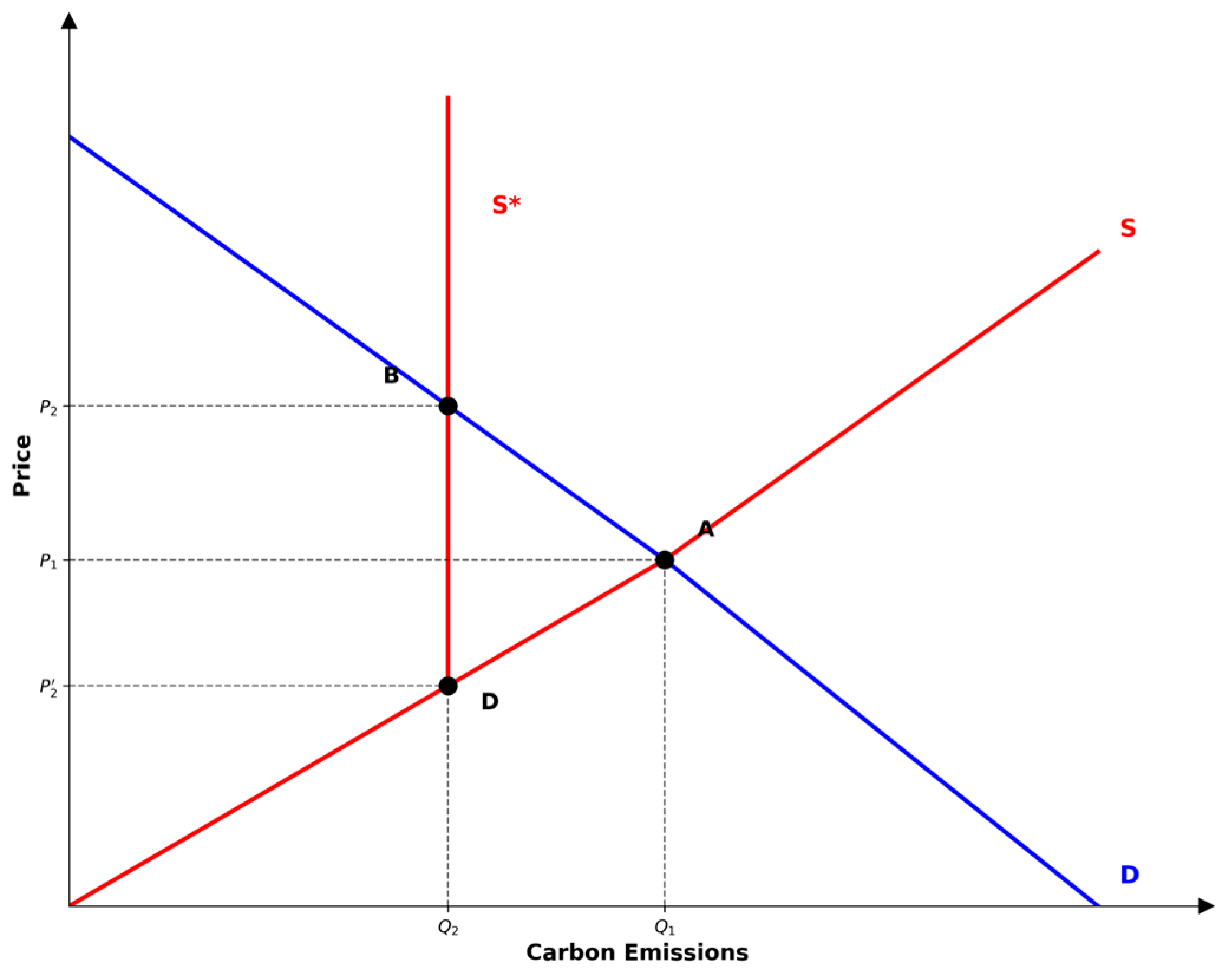
Figure 1. General Equilibrium in Carbon Emissions Trading Market.
Sustainability 18 01207 g001
Figure 2. Carbon Emission Trading Pilot Regions in China.
Sustainability 18 01207 g002
Figure 3. Annual Distribution of Valid Samples.
Sustainability 18 01207 g003
Figure 4. Correlation Heatmap of Variables. Note: ***, ** denote significance at the 1%, 5% levels, respectively.
Sustainability 18 01207 g004
Figure 5. Parallel Trend Test of Green Innovation Patents in Pilot Areas: (a) Overall and (b) Expected Growth Trends.
Sustainability 18 01207 g005
Figure 6. Event-Study Coefficients for Green Invention Patents (GrP_I) with 95% Confidence Intervals.
Sustainability 18 01207 g006
Table 1. Variable Definitions and Symbols.
Variable TypeVariable NameVariable SymbolDefinition and Explanation
Explained
Variable
Green Total PatentsGrP_IUNatural logarithm of the number of granted green patents (invention and utility model patents) of listed companies plus 1
Green Invention PatentsGrP_INatural logarithm of the number of granted green invention patents of listed companies plus 1
Green Utility Model PatentsGrP_UNatural logarithm of the number of granted green utility model patents of listed companies plus 1
R&D Expense RatioRD_rR&D Expense/Total Revenue
Explanatory
Variable
Direct treatment indicatorCarbon_treated1 if the firm is registered in a CERT pilot region (Beijing/Tianjin/Shanghai/Chongqing/Guangdong/Hubei/Shenzhen) and explicitly subject to carbon quota management (verified by local pilot documents or corporate annual reports); 0 otherwise
Carbon Emission Pilot Provinces and CitiesCarbon1 if the listed company is registered in Beijing, Tianjin, Shanghai, Chongqing, Guangdong, Hubei, Shenzhen; 0 otherwise
Carbon Emission Pilot Policy Announcement Timetime0 for 2007–2011, 1 for 2012–2016
Interaction TermplcCarbon_treated × time
Control
Variable
Firm AgeLnAgeNatural logarithm of the number of years since the firm’s establishment
Firm SizeLnAstNatural logarithm of total assets
Net Fixed Assets RatioFA_rNet Fixed Assets/Total Assets
Revenue Growth RateRev_gYear-on-year growth rate of operating revenue
Asset-Liability RatioLvgTotal Liabilities/Total Assets
Cash Asset RatioC_rBalance of Cash and Cash Equivalents at the End/Total Assets
Quick RatioQ_r(Current Assets − Inventory)/Current Liabilities
Return on AssetsROANet Profit/Average Balance of Total Assets
YearyearFixed year
IndustryIndustryFixed industry
Table 2. Main Variables’ Descriptive Statistics.
Variable SymbolObservationsMeanStandard DeviationMinimumMedianMaximum
GrP_IU19,4510.4080.798003.611
GrP_I19,4510.1440.431002.398
GrP_U19,4510.3390.720003.296
RD_r10,1174.2884.1880.033.4325.31
Carbon19,4510.3740.484001
LnAge19,4512.6280.4221.2252.7093.336
LnAst19,44821.9081.30719.10321.75525.818
FA_ratio19,4480.2390.1760.0020.2020.75
Rev_g18,4180.210.563−0.6120.1133.866
Lvg19,4480.4560.2270.0490.4511.145
C_r19,4470.1770.1480.0070.1310.683
Q_r19,4491.8952.6340.1271.02715.944
ROA18,4690.0410.062−0.2120.0370.232
Table 3. Difference in Green Innovation Level between Experimental Group and Control Group before and after Policy Announcement Adjustment.
Control GroupExperimental GroupDifferenceDID
Before Adjustment (1)After Adjustment (2)Before Adjustment (3)After Adjustment (4)(5) = (2) − (1)(6) = (4) − (3)(7) = (6) − (5)
Green Total Patents0.1650.4750.3030.6800.310 ***
(21.83)
0.377 ***
(20.46)
0.067 ***
(2.88)
Green Invention Patents0.0390.1550.0850.3010.116 ***
(15.14)
0.216 ***
(21.66)
0.100 ***
(7.91)
Green Utility Model Patents0.1390.3940.2660.5540.255 ***
(19.77)
0.288 ***
(17.21)
0.033
(1.56)
Note: Standard errors clustered at the firm level are reported in parentheses; *** denote significance at the 1% levels.
Table 4. Event-Study Lead and Post-Policy Coefficients for Green Invention Patents (GrP_I) with 95% Confidence Intervals.
Period (Relative to 2011 Policy)Coefficient (GrP_I)Std. Errorp-Value95% Confidence Interval
t − 4 (2008)0.0120.0180.503(−0.023, 0.047)
t − 3 (2009)0.0080.0150.587(−0.021, 0.037)
t − 2 (2010)0.0150.0160.341(−0.016, 0.046)
t − 1 (2011)0.0210.0170.225(−0.012, 0.054)
Post-policy (t + 1, 2012)0.089 ***0.0230.000(0.044, 0.134)
ControlsYes---
Year Fixed EffectsYes---
Industry Fixed EffectsYes---
N16,184---
Adjusted R20.076---
Note: *** denotes significance at the 1% level. GrP_I is the dependent variable (green invention patents).
Table 5. DID Test of Enterprises in Pilot Regions.
Green Total Patents
GrP_IU (1)
Green Invention Patents
GrP_I (2)
Green Utility Model Patents
GrP_U (3)
L1.plc0.058 ***
(3.465)
0.089 ***
(7.893)
0.036 **
(2.251)
L1.time0.117 ***
(2.822)
−0.024
(−0.859)
0.119 ***
(3.006)
L1.LnAge0.372 ***
(6.067)
0.299 ***
(7.291)
0.232 ***
(3.960)
L1.LnAst0.126 ***
(12.239)
0.047 ***
(6.856)
0.112 ***
(11.448)
L1.FA_r0.172 ***
(3.243)
0.068 *
(1.920)
0.167 ***
(3.301)
L1.Rev_g−0.026 ***
(−3.329)
−0.020 ***
(−3.798)
−0.020 ***
(−2.670)
L1.Lvg−0.030
(−0.695)
0.014
(0.496)
−0.018
(−0.437)
L1.C_r−0.043
(−0.744)
−0.031
(−0.813)
0.005
(0.100)
L1.Q_r−0.001
(−0.308)
0.003
(1.295)
−0.002
(−0.595)
L1.ROA0.078
(0.853)
−0.083
(−1.346)
0.153 *
(1.748)
Year FixedYYY
Industry FixedYYY
Constant−3.365 ***
(−12.985)
−1.660 ***
(−9.574)
−2.806 ***
(−11.324)
N16,18416,18416,184
F-Statistic108.68767.17273.507
Adjusted R20.1170.0760.082
Note: Standard errors clustered at the firm level are reported in parentheses; ***, **, and * denote significance at the 1%, 5%, and 10% levels, respectively.
Table 6. DID Test of Enterprises in Pilot Regions after PSM.
Green Total Patents
GrP_IU (1)
Green Invention
Patents GrP_I (2)
Green Utility Model Patents
GrP_U (3)
L1.plc0.044
(0.957)
0.077 **
(2.365)
0.008
(0.197)
L1.time0.090
(0.893)
−0.106
(−1.469)
0.174 *
(1.827)
L1.LnAge0.549 ***
(3.745)
0.515 ***
(4.916)
0.276 **
(2.002)
L1.LnAst0.139 ***
(5.361)
0.076 ***
(4.075)
0.107 ***
(4.373)
L1.FA_r0.177
(1.327)
0.079
(0.836)
0.174
(1.395)
L1.Rev_g−0.038 **
(−2.000)
−0.019
(−1.426)
−0.025
(−1.439)
L1.Lvg−0.156
(−1.397)
−0.102
(−1.273)
−0.096
(−0.910)
L1.C_r−0.175
(−1.248)
−0.035
(−0.346)
−0.124
(−0.942)
L1.Q_r0.016
(1.559)
0.008
(1.119)
0.016 *
(1.676)
L1.ROA−0.179
(−0.800)
−0.244
(−1.534)
−0.061
(−0.290)
Year FixedYYY
Industry FixedYYY
Constant−3.975 ***
(−6.265)
−2.717 ***
(−5.996)
−2.726 ***
(−4.577)
N442044204420
F-Statistic25.47117.21716.834
Adjusted R20.1340.0950.093
Note: Standard errors clustered at the firm level are reported in parentheses; ***, **, and * denote significance at the 1%, 5%, and 10% levels, respectively.
Table 7. DID Test of Quota-Managed Firms in Pilot Regions by Regional Location.
Green Total PatentsGreen Invention PatentsGreen Utility Model Patents
Quota-Managed Firms in Eastern Pilot Regions (1)Quota-Managed Firms in Central-Western Pilot Regions (2)Quota-Managed Firms in Eastern Pilot Regions (3)Quota-Managed Firms in Central-Western Pilot Regions (4)Quota-Managed Firms in Eastern Pilot Regions (5)Quota-Managed Firms in Central-Western Pilot Regions (6)
L1.plc0.036
(0.607)
0.005
(0.065)
0.048
(1.153)
0.113 **
(1.988)
0.022
(0.401)
−0.069
(−0.949)
L1.time0.048
(0.405)
0.520 **
(2.235)
−0.089
(−1.049)
−0.050
(−0.292)
0.121
(1.083)
0.549 **
(2.532)
L1.LnAge0.628 ***
(3.863)
−0.163
(−0.419)
0.521 ***
(4.520)
0.397
(1.390)
0.333 **
(2.175)
−0.270
(−0.742)
L1.LnAst0.121 ***
(3.666)
0.197 ***
(4.510)
0.072 ***
(3.089)
0.092 ***
(2.890)
0.091 ***
(2.927)
0.153 ***
(3.771)
L1.FA_r0.308 *
(1.804)
0.011
(0.052)
0.185
(1.530)
−0.037
(−0.240)
0.294 *
(1.826)
−0.008
(−0.039)
L1.Rev_g−0.013
(−0.529)
−0.081 ***
(−2.647)
−0.007
(−0.435)
−0.035
(−1.571)
−0.005
(−0.210)
−0.066 **
(−2.288)
L1.Lvg−0.273 *
(−1.938)
0.063
(0.330)
−0.195 *
(−1.952)
0.070
(0.504)
−0.161
(−1.214)
0.010
(0.058)
L1.C_r−0.282 *
(−1.710)
0.007
(0.026)
−0.096
(−0.816)
0.076
(0.379)
−0.212
(−1.363)
0.044
(0.172)
L1.Q_r0.020 *
(1.656)
0.006
(0.318)
0.005
(0.613)
0.018
(1.309)
0.022 **
(2.005)
−0.003
(−0.166)
L1.ROA−0.505 *
(−1.861)
0.576
(1.370)
−0.467 **
(−2.426)
0.199
(0.646)
−0.271
(−1.061)
0.411
(1.047)
Year FixedYYYYYY
Industry FixedYYYYYY
Constant−3.641 ***
(−4.757)
−3.793 ***
(−2.967)
−2.578 ***
(−4.749)
−2.994 ***
(−3.197)
−2.451 ***
(−3.401)
−2.585 **
(−2.168)
N326011603260116032601160
F-Statistic18.4898.64913.4315.08211.9056.257
Adjusted R20.1290.1800.0970.1140.0870.137
Note: Standard errors clustered at the firm level are reported in parentheses; ***, **, and * denote significance at the 1%, 5%, and 10% levels, respectively.
Table 8. DID Test of Quota-Managed Firms in Pilot Regions by Industry Technological Attributes.
Green Total PatentsGreen Invention PatentsGreen Utility Model Patents
High-Tech Quota-Managed Firms (1)Non-High-Tech Quota-Managed Firms (2)High-Tech Quota-Managed Firms (3)Non-High-Tech Quota-Managed Firms (4)High-Tech Quota-Managed Firms (5)Non-High-Tech Quota-Managed Firms (6)
L1.plc0.052
(0.675)
0.057
(1.026)
0.070
(1.198)
0.093 **
(2.455)
0.015
(0.201)
0.023
(0.459)
L1.time0.409 **
(2.279)
−0.038
(−0.318)
0.141
(1.052)
−0.223 ***
(−2.712)
0.416 **
(2.431)
0.093
(0.844)
L1.LnAge0.273
(1.106)
0.634 ***
(3.523)
0.402 **
(2.178)
0.539 ***
(4.388)
0.009
(0.040)
0.349 **
(2.107)
L1.LnAst0.171 ***
(3.484)
0.110 ***
(3.687)
0.077 **
(2.109)
0.066 ***
(3.224)
0.153 ***
(3.279)
0.072 ***
(2.597)
L1.FA_r0.041
(0.161)
0.233
(1.549)
−0.014
(−0.075)
0.129
(1.254)
0.071
(0.290)
0.208
(1.503)
L1.Rev_g−0.040
(−1.110)
−0.034
(−1.615)
−0.020
(−0.725)
−0.016
(−1.133)
−0.019
(−0.533)
−0.027
(−1.379)
L1.Lvg−0.214
(−1.037)
−0.111
(−0.857)
−0.183
(−1.184)
−0.040
(−0.454)
−0.175
(−0.890)
−0.049
(−0.409)
L1.C_r−0.156
(−0.680)
−0.204
(−1.159)
−0.009
(−0.053)
−0.043
(−0.354)
−0.092
(−0.420)
−0.178
(−1.098)
L1.Q_r0.008
(0.569)
0.024 *
(1.649)
−0.001
(−0.073)
0.021 **
(2.098)
0.013
(0.947)
0.016
(1.226)
L1.ROA−0.280
(−0.651)
−0.084
(−0.333)
−0.248
(−0.770)
−0.228
(−1.319)
−0.429
(−1.047)
0.166
(0.715)
Year FixedYYYYYY
Industry FixedYYYYYY
Constant−3.816 ***
(−3.340)
−3.728 ***
(−4.930)
−2.406 ***
(−2.817)
−2.667 ***
(−5.165)
−2.942 ***
(−2.702)
−2.271 ***
(−3.267)
N184225781842257818422578
F-Statistic14.93211.6638.8339.33511.6227.043
Adjusted R20.1820.1080.1160.0880.1470.068
Note: Standard errors clustered at the firm level are reported in parentheses; ***, **, and * denote significance at the 1%, 5%, and 10% levels, respectively.
Table 9. DID Test of Quota-Managed Firms in Pilot Regions by Life Cycle Stages.
Green Total PatentsGreen Invention PatentsGreen Utility Model Patents
Mature Quota-Managed Firms (1)Growing Quota-Managed Firms (2)Mature Quota-Managed Firms (3)Growing Quota-Managed Firms (4)Mature Quota-Managed Firms (5)Growing Quota-Managed Firms (6)
L1.plc0.017
(0.349)
0.182
(1.310)
0.071 **
(2.107)
0.090
(0.868)
−0.017
(−0.369)
0.133
(0.997)
L1.time0.174
(1.161)
0.168
(0.347)
0.054
(0.514)
0.175
(0.481)
0.171
(1.225)
0.211
(0.453)
L1.LnAge0.447 *
(1.686)
0.327
(0.760)
0.192
(1.028)
0.372
(1.151)
0.344
(1.393)
0.047
(0.114)
L1.LnAst0.129 ***
(4.921)
0.234 **
(2.082)
0.072 ***
(3.884)
0.102
(1.214)
0.098 ***
(3.989)
0.189 *
(1.748)
L1.FA_r0.182
(1.327)
−0.014
(−0.029)
0.093
(0.964)
−0.025
(−0.069)
0.164
(1.282)
0.068
(0.146)
L1.Rev_g−0.031
(−1.604)
−0.109
(−1.430)
−0.019
(−1.448)
−0.011
(−0.195)
−0.019
(−1.069)
−0.087
(−1.193)
L1.Lvg−0.171
(−1.480)
0.072
(0.168)
−0.101
(−1.240)
0.027
(0.083)
−0.110
(−1.024)
0.011
(0.028)
L1.C_r−0.191
(−1.253)
−0.262
(−0.724)
−0.061
(−0.568)
0.033
(0.122)
−0.172
(−1.210)
−0.054
(−0.155)
L1.Q_r0.015
(1.198)
0.017
(0.911)
0.012
(1.272)
0.004
(0.298)
0.013
(1.109)
0.015
(0.871)
L1.ROA−0.041
(−0.179)
−1.444 *
(−1.764)
−0.212
(−1.318)
−0.496
(−0.807)
0.059
(0.279)
−1.142
(−1.449)
Year FixedYYYYYY
Industry FixedYYYYYY
Constant−3.631 ***
(−4.310)
−5.166 **
(−2.211)
−1.933 ***
(−3.253)
−2.873
(−1.637)
−2.767 ***
(−3.526)
−3.787 *
(−1.684)
N354887235488723548872
F-Statistic19.8836.61211.5715.43814.5133.866
Adjusted R20.1280.1880.0790.1600.0970.119
Note: Standard errors clustered at the firm level are reported in parentheses; ***, **, and * denote significance at the 1%, 5%, and 10% levels, respectively.
Table 10. Impact of CERT Pilot Policy on R&D Expenditure Ratio.
Variable(1) Full Sample
(MI-Imputed RD_r)
(2) Restricted Sample
(Complete R&D Data Only)
L1.plc0.021 (p = 0.183)0.035 (p = 0.101)
L1.time0.089 (p = 0.215)0.102 (p = 0.187)
L1.LnAge0.215 *** (p = 0.001)0.239 *** (p = 0.000)
L1.LnAst0.047 *** (p = 0.000)0.051 *** (p = 0.000)
ControlsYesYes
Year FixedYesYes
Industry FixedYesYes
N19,45110,117
Adjusted R20.0680.082
Note: *** denotes significance at the 1% level.
Table 11. Robustness Test of Explanatory Variables.
Lag 2 PeriodLag 3 Period
GrP_IU (1)GrP_I (2)GrP_U (3)GrP_IU (4)GrP_I (5)GrP_U (6)
L2.plc0.048 ***
(2.623)
0.065 ***
(5.043)
0.033 *
(1.863)
---
L3.plc---0.038 *
(1.832)
0.031 **
(2.128)
0.032
(1.588)
L2.time0.147 ***
(3.318)
0.001
(0.026)
0.127 ***
(2.956)
---
L3.time---0.189 ***
(4.034)
0.069 **
(2.058)
0.129 ***
(2.826)
L2.LnAge0.364 ***
(4.898)
0.295 ***
(5.625)
0.253 ***
(3.519)
---
L3.LnAge---0.258 ***
(2.839)
0.200 ***
(3.080)
0.209 **
(2.368)
L2.LnAst0.102 ***
(8.448)
0.059 ***
(6.891)
0.088 ***
(7.525)
---
L3.LnAst---0.062 ***
(4.496)
0.055 ***
(5.560)
0.048 ***
(3.578)
L2.FA_r0.141 **
(2.351)
0.102 **
(2.422)
0.128 **
(2.215)
---
L3.FA_r---0.120 *
(1.798)
0.148 ***
(3.088)
0.069
(1.055)
L2.Rev_g−0.005
(−0.517)
−0.009
(−1.421)
−0.005
(−0.565)
---
L3.Rev_g---−0.016 *
(−1.745)
−0.013 *
(−1.909)
−0.013
(−1.448)
L2.Lvg−0.006
(−0.119)
0.012
(0.354)
−0.006
(−0.114)
---
L3.Lvg---−0.003
(−0.054)
0.025
(0.607)
−0.022
(−0.400)
L2.C_r0.071
(1.071)
0.035
(0.744)
0.079
(1.234)
---
L3.C_r---0.076
(1.017)
0.123 **
(2.289)
0.028
(0.380)
L2.Q_r−0.010 **
(−2.216)
0.001
(0.315)
−0.010 **
(−2.369)
---
L3.Q_r---−0.013 **
(−2.549)
−0.004
(−1.055)
−0.011 **
(−2.197)
L2.ROA0.135
(1.393)
−0.036
(−0.523)
0.203 **
(2.165)
---
L3.ROA---0.165
(1.592)
0.072
(0.968)
0.138
(1.363)
Year FixedYYYYYY
Industry FixedYYYYYY
Constant−2.811 ***
(−9.165)
−1.894 ***
(−8.775)
−2.292 ***
(−7.721)
−1.640 ***
(−4.593)
−1.621 ***
(−6.333)
−1.237 ***
(−3.564)
N13,95313,95313,95311,72211,72211,722
F-Statistic75.52747.80350.13046.78130.34229.997
Adjusted R20.0940.0610.0640.0690.0460.045
Note: Standard errors clustered at the firm level are reported in parentheses; ***, **, and * denote significance at the 1%, 5%, and 10% levels, respectively.
Table 12. Robustness Test of Control Variables.
Green Total Patents
GrP_IU (1)
Green Invention Patents
GrP_I (2)
Green Utility Model Patents
GrP_U (3)
L1.plc0.052 ***
(3.112)
0.086 ***
(7.682)
0.031 *
(1.927)
L1.time0.173 ***
(4.239)
0.001
(0.022)
0.167 ***
(4.288)
L1.LnAge0.359 ***
(5.841)
0.295 ***
(7.173)
0.220 ***
(3.755)
L1.LnRev0.098 ***
(10.913)
0.033 ***
(5.450)
0.090 ***
(10.449)
L1.FA_r0.109 **
(2.058)
0.044
(1.249)
0.111 **
(2.207)
L1.Rev_g−0.036 ***
(−4.381)
−0.022 ***
(−4.132)
−0.029 ***
(−3.739)
L1.Lvg−0.019
(−0.441)
0.018
(0.627)
−0.007
(−0.165)
L1.C_r−0.042
(−0.752)
−0.026
(−0.684)
0.002
(0.043)
L1.Current_r−0.002
(−0.531)
0.002
(0.845)
−0.002
(−0.611)
L1.ROA−0.018
(−0.196)
−0.113 *
(−1.816)
0.732
(0.732)
Year FixedYYY
Industry FixedYYY
Constant−2.676 ***
(−11.561)
−1.321 ***
(−8.532)
−2.234***
(−10.094)
N16,17816,17816,178
F-Statistic106.80266.00772.229
Adjusted R20.1150.0750.081
Note: Standard errors clustered at the firm level are reported in parentheses; ***, **, and * denote significance at the 1%, 5%, and 10% levels, respectively.
Table 13. Robustness Test: Staggered DID.
VariablesGreen Total Patents (GrP_IU)Green Invention Patents (GrP_I)Green Utility Model Patents (GrP_U)
L1.Treat × Post_Staggered0.042
(1.25)
0.082 **
(2.41)
0.025
(0.88)
L1.ControlsYesYesYes
Year Fixed EffectsYesYesYes
Industry Fixed EffectsYesYesYes
Observations16,18416,18416,184
Adjusted R20.1180.0780.081
Note: Standard errors clustered at the firm level are reported in parentheses; ** denote significance at the 5% levels.
Disclaimer/Publisher’s Note: The statements, opinions and data contained in all publications are solely those of the individual author(s) and contributor(s) and not of MDPI and/or the editor(s). MDPI and/or the editor(s) disclaim responsibility for any injury to people or property resulting from any ideas, methods, instructions or products referred to in the content.