


Abstract
Dawn delivery, in which orders placed before midnight arrive by morning, is routine in South Korea, yet its social costs are less visible than its environmental ones. This study asks how speed expectations, as documented publicly, and platform operating design shape dawn delivery work, and how firms and policymakers treat its social side. We conducted an embedded case study of Coupang, with Kurly as a limited contrast case, coding 30 public documents, and analyzed the 2023 Korean Working Conditions Survey (462 delivery workers, 78 working at night). At Coupang, the documents link late cut-offs, multi-trip night shifts, per-parcel pay and unpaid non-delivery duties to long shifts with little rest. Nationally, delivery workers doing any night work show no statistically detectable difference in monthly income from other delivery workers but work 8.7 more hours a week. Disclosures quantify environmental gains but do not report drivers’ hours or night work, and the interventions discussed address hours more often than design. This study contributes a framework linking the speed norm, platform design, job demands and resources and sustainability disclosure. For practice, it identifies delivery windows, pay rules and disclosure of drivers’ working time, not only hour caps, as levers for sustainable fast delivery.
1. Introduction
South Korean e-commerce has turned overnight delivery into an everyday expectation: a consumer who orders before midnight expects the parcel at the door by early morning. Coupang’s Rocket Wow membership, which bundles dawn and same-day delivery with free shipping, reached about 14 million members at the end of 2023 [1] and about 15 million in 2024 [2]. The service reached Jeju Island in February 2025 [3]. Counting Market Kurly and other platforms, roughly 20 million people use nighttime delivery [2]. Kurly was the first Korean company to offer dawn delivery, and today Kurly and Coupang are described as running two distinct operating models for the practice [4]. Rapid delivery creates value for retailers and customers [5], but it also reshapes how last-mile work is organized [6,7].
The speed has an operational counterpart that consumers rarely see. Orders placed close to midnight must be picked, packed, sorted, loaded and delivered within a few hours, which concentrates labor into the night. The International Agency for Research on Cancer classifies night-shift work as probably carcinogenic to humans (Group 2A) [8], and shift work is linked to disturbed sleep, vascular events and accidents [9,10,11]. Testimonies gathered by Korean unions describe warehouse workers given about one hour to pick, pack, sort and load orders received before midnight, and a courier’s death recognized as work-related, with delivery-deadline pressure identified as an aggravating factor [12]. An online survey of 679 Coupang contract drivers conducted by the couriers’ union in September 2025 found an average working day of 11.1 h, with 22.6 min for meals and rest [1].
Policy has moved quickly. An interim report of a study commissioned by the Ministry of Employment and Labor recommended limiting night delivery work to no more than 12 times a month and four consecutive days [13,14]. A social dialogue body agreed in January 2026 to cap night delivery at 46–50 h a week and 8 h a day [15], and a tentative deal in March 2026 fixed a weekly limit of 48 h [16]. In August 2026, amendments to the Occupational Safety and Health Act and the Living Logistics Service Industry Development Act were introduced that would limit night work to 10 h a day and 12 times a month [17,18]. The workers affected are divided. A National Assembly Research Service report found that 45.5% of late-night drivers chose night work because it paid more than daytime work. In a survey by the Coupang Partners Association, 93% of 2405 night drivers opposed time limits [2,19].
This tension is a sustainability problem in the full triple-bottom-line sense [20,21], yet research on quick commerce has concentrated on its environmental side, with comparisons of last-mile greenhouse gas emissions a recurring theme [22,23]. Firms mainly report environmental gains: Coupang states that its reusable Eco-fresh bags eliminated an estimated 61,000 tons of polystyrene in 2024 and that merged delivery saved more than 2500 tons of CO2 [24]. Whether the social pillar, worker well-being under night work, receives comparable attention is an open empirical question.
Research on sustainable supply chains increasingly asks how human behavior shapes outcomes, from worker well-being to consumer choices and behavioral interventions [25,26,27]. Dawn delivery is a case in which behavior operates at three levels at once. Consumers set the speed expectation, platforms translate it into cut-off times, shift patterns and pay rules, and workers adapt within those constraints. Existing studies tend to examine one level at a time, such as consumer responses to green claims in quick commerce [28], Korean consumers’ satisfaction with fast delivery and their loyalty to it [29,30,31], or the metabolic and cardiovascular health of Korean night workers [32,33]. Korean labor studies of dawn delivery examine the worker level in depth [34,35] but not its link to consumer expectations or to firms’ sustainability claims. In the English- and Korean-language literature we reviewed, we found no study that links the three levels for Korean dawn delivery. The health risks of night work and the control exercised by delivery platforms are well documented; their connection to consumer expectations and to firms’ sustainability disclosures is not.
This paper explains how consumer speed expectations and platform operating design jointly produce the working conditions of dawn delivery in Korea, and what this implies for sustainable logistics. We use an embedded case study of Coupang’s dawn delivery system, with Kurly as a limited, illustrative contrast case, built from 30 public documents, and supplement it with descriptive and associational evidence from the 2023 Korean Working Conditions Survey (KWCS). Its novelty lies in connecting consumer expectations, operating design and worker conditions within one case, not in discovering the risks of night work, which are well established. The paper makes one conceptual and three empirical contributions. First, conceptually, it proposes a chain that links the demand-side speed norm to platform design, worker demands and resources, well-being and sustainability outcomes. Second, it documents from the public record how one platform’s operating design, namely its cut-off, delivery rounds, pay rule and non-delivery duties, translates the norm into night work. A second firm illustrates which features are shared across operating models. Third, it shows that national survey data qualify the income rationale for night work: night delivery workers show no statistically detectable difference in monthly income from other delivery workers while working longer. Fourth, it draws implications for interventions, which so far act mainly on hours rather than on the design that produces them. In doing so, it addresses how human behavior, on the demand side and in the workforce, shapes the sustainability of supply chains and logistics.
2. Literature Review
2.1. Fast Delivery and Sustainability
Speed has long been treated as a source of competitive advantage: firms that compress the time between customer demand and fulfillment gain an edge [36]. Quick commerce is the current extreme of this logic, and grocery retailers have redesigned fulfillment and last-mile distribution around narrow delivery windows [23,37]. Research on its sustainability has focused mainly on emissions. Fast shipping can raise emissions because it limits consolidation; a case study in Mexico reported increases of up to 15% in total CO2 emissions from faster deliveries [38]. A systematic review has compared the last-mile emissions of quick commerce and conventional e-commerce [22], and a study of quick-commerce delivery found that electric vehicles and dark stores reduce carbon intensity [39].
Consumers appear in this stream mainly as recipients of green claims, which they may trust or read as greenwashing [28,40]. Korean evidence points the same way. In interviews with nine regular users of dawn delivery platforms, users reflected on the labor and packaging costs of the service, but that reflection stayed private; eco-friendly curation and reusable bags gave users a green frame that some read with suspicion [41]. What this stream does not explain is why the speed expectation persists, or who bears its social costs.
2.2. Behavior in Operations and Sustainable Supply Chains
Behavioral operations research holds that people in operations systems do not behave as the idealized agents of analytical models, and that performance depends on how designs interact with human judgment, fatigue and motivation [25,26,42]. Human factors research in logistics makes the same point for warehouse and order-picking work [27,43]. Sustainable supply chain management (SSCM) integrates environmental, social and economic goals across the chain [44,45,46], and its social dimension covers working conditions and worker health [47,48]; empirical work shows that social practices affect triple-bottom-line performance [49]. Recent studies link workplace behavior to sustainability outcomes; for example, green talent management shapes employees’ motivation and attitudes, which mediate the adoption of green logistics practices [50]. Such studies commonly draw on the theory of planned behavior [51].
Data-driven work on behavior in logistics is a second strand. OpenPack, a public multimodal dataset, records the packing work of 16 subjects with error annotations and order information [52], but it was recorded in a laboratory that mimics a logistics center and does not capture the pressures of platform-managed night operations. Behavioral studies of the demand side and the labor side of the same system are seldom combined.
2.3. Night Work, Platform Labor and Worker Well-Being
The health evidence on night work is substantial. Night and shift work disturb sleep and circadian rhythms [9,53], raise the risk of vascular events [10], and increase fatigue-related accidents [11,54], which calls for preventive work design [55]. Korean studies using national data link night work to higher glycated hemoglobin (HbA1c) [32] and to cardiovascular disease (odds ratio [OR] of 1.58 in the third KWCS) [33]. The KWCS itself is a state-approved national survey of about 50,000 workers, repeated every three years, that covers working hours, work intensity, work–life balance and health [56].
Delivery work adds features of platform labor. Algorithmic management allocates tasks, sets targets and monitors workers in ways that expand control while leaving formal autonomy intact [57,58,59,60]. Studies of couriers and gig drivers show how such control combines with piece-rate pay, income dependence and precarity [61,62,63,64], how riders internalize time pressure [65], and how they accept physical risk to sustain earnings [66,67]. A Korean case study of Coupang’s Rocket Delivery finds the same pattern: layered subcontracting and app-based task allocation increase control while the legally responsible employer becomes harder to identify, an “invisible conveyor belt” [34]. Many couriers work under agency contracts and are paid per parcel, so income depends on volume [4]. A 2025 study of more than one thousand night delivery workers reported working weeks of over 60 h, with sleep disorders and depression three to four times as common as among other Korean workers [3]. A qualitative study described the health management of Korean food-delivery riders [68].
For dawn delivery specifically, interviews with eight workers on wage, dependent self-employed and gig contracts document circadian disruption, sleep problems, fatigue and accident risk across all three groups [35]. Workers chose night work for its higher pay and lighter traffic, and dependent self-employed drivers described very long days, sometimes combined with a second job [35]. The interim report of the ministry-commissioned study measured heart rate and blood pressure among day and night parcel workers and recommended limits on night shifts alongside reform of fixed cut-off times and multi-round shifts [13].
2.4. The Korean Context and the Research Gap
Commentary often attributes Korean demand for speed to a ppalli-ppalli (“hurry-hurry”) culture [69]. We treat this as a label for an observable expectation, not as an explanation. Social acceleration theory argues that competition and technology together raise the pace of life [70,71], which fits a market in which platforms compete on delivery windows. Korean media scholars describe the resulting work as “speed-competitive labor” [72], and a labor-law professor argued that consumers rely on late-night delivery because they lack time to shop by day [2]. Coupang launched Rocket Delivery in 2014 as next-day delivery by directly employed staff, choosing speed rather than price as its point of difference [73], after disputes over its use of non-commercial vehicles [74]. Kurly introduced dawn delivery in 2015 on a full cold chain [75] and is described as using two delivery rounds of about 50 parcels each [4,76].
Korean academic work on the two firms, the last stream in Table 1, falls into consumer, firm-level, labor and spatial, and discourse studies, but only the labor and spatial studies look at workers. Consumer studies treat fast delivery as a service-quality problem: satisfaction predicts loyalty [29], almost all surveyed dawn delivery users intend to keep using it [30], free delivery has the largest effect on Coupang loyalty [31], and adopting dawn delivery raises customers’ weekly spending [77]. Firm-level studies present Coupang’s model as environmentally efficient and its social contribution as job numbers rather than job quality [78,79,80]. Labor and spatial studies examine labor control [34], workers’ precarity [35] and the “parcel city” of night work [76], and discourse studies show that use of the service stays stable through controversies [72,81]. None connects the consumer norm, the platform’s design and worker well-being in one comparative frame (Table 1).
Table 1.
Four literature streams and the gap they leave.
Three terms used in this literature need to be kept apart. Rapid delivery is any delivery promise shorter than the market norm. Quick commerce delivers groceries on demand, often within an hour, from dark stores using riders [23,37]. Dawn delivery batches orders placed before a late-evening cut-off and delivers them overnight, in scheduled rounds, before a morning deadline [4]. We draw on quick-commerce research for its findings on emissions and consumer trust, not for its labor model, which rests on on-demand riders rather than scheduled night rounds. Platform-labor research explains how algorithmic control and piece rates shape couriers’ choices [57,58,59,60,61,62,63,64], and the job demands–resources model introduced in Section 3.1 explains how demands and resources produce strain. Neither asks where the demands come from or how their costs appear in a firm’s sustainability reporting. The framework in Section 3 adds these two links: the consumer norm that operating design turns into job demands, and the disclosure through which the social cost of speed becomes visible or does not.
3. Theoretical Framework and Research Questions
3.1. Lenses
Demand-side speed norm. Social acceleration theory explains how competition and technology raise the pace at which people expect things to happen [70,71]. Service research adds that consumers weigh the time and effort costs of obtaining a service, so speed is valued as convenience [82,83]. In our case the norm is also a firm strategy, since platforms compete on delivery windows [36]: Coupang chose speed rather than price as its point of difference [73], and loyalty rests on free delivery for members as much as on speed [31]. We therefore use the term for three linked elements that the codebook keeps apart: consumers’ expectation that late orders arrive by morning (code SN1), the firm’s advertised promise and cut-off (SN2), and the membership benefits and habits that hold users (SN3). Competition between platforms is treated as the mechanism that links them, not as part of the norm, and we make no claim about consumers’ attitudes or intentions, which the documents do not measure. The three elements need not reflect one underlying norm, so the Results report evidence on each separately.
Platform operating design. Behavioral operations research treats system design as a determinant of how people behave under load [25,42], and algorithmic management research shows that platforms structure workers’ choices through allocation, targets and monitoring [57,59]. For dawn delivery, the design variables are cut-off times, the number of delivery rounds, sorting and bag-handling duties, per-parcel pay and the employment arrangement.
Job demands and resources. The job demands–resources (JD-R) model holds that strain arises when demands outweigh resources such as autonomy, pay, rest and support, while resources also sustain motivation [84,85,86,87]; it builds on the demand–control model [88]. It suits a case in which night work and time pressure coexist with earnings and flexibility, a combination visible in drivers’ mixed views on hour limits [19,35].
Social sustainability. We treat worker well-being as the social pillar of a firm’s sustainability performance, next to environmental and economic outcomes [20,21,44], which lets us ask whether firms’ sustainability positions balance the pillars. By sustainability position we mean what a firm discloses and states publicly about these pillars, not its actual performance, which the documents do not allow us to measure.
3.2. Conceptual Model
Figure 1 reads left to right: platform design translates the speed norm into demands and resources, which shape well-being, which in turn defines the social side of the firm’s sustainability position. Regulation and social dialogue act on design and on the demand–resource balance, and platform success feeds back into the norm; a business-history study of Coupang judges that consumers used to next-day delivery are unlikely to accept slower service again [73]. For coding, the speed norm was operationalized through subscriber counts, consumer statements and the marketing of delivery windows, and platform design through cut-offs, rounds, duties, pay, contracts and app-based control. Demands covered night and weekly hours, deadline pressure, volume and strain; resources covered earnings, autonomy, rest, support and insurance. Well-being and behavior covered health data, testimonies, rulings, second jobs and positions on limits, and the sustainability position covered environmental, social and governance (ESG) disclosures, statements and risk factors. The propositions below assess the middle of the chain (P1–P3) and its disclosure end (P4). The link from the norm to design is not tested: firms both respond to and cultivate speed expectations [73], so we treat it as running both ways and describe it rather than test its direction. Consumer expectations are not measured directly; they are inferred from documented use, membership and stated preferences. The link from well-being to the sustainability position is examined only as a question of disclosure.
Figure 1.
Conceptual model linking the consumer speed norm to firms’ sustainability positions. Solid arrows show the hypothesized chain, labelled with the propositions that assess each link; the two-way link between the norm and design is described but not tested; dashed arrows show the points at which regulation acts.
3.3. Research Questions and Propositions
RQ1. How do consumer speed expectations and platform operating design jointly shape the job demands and resources of dawn delivery work at Coupang? RQ2. What consequences for worker well-being and behavior are documented, and where does Kurly’s operating model differ? RQ3. How do the firms’ sustainability disclosures and stakeholders’ proposed interventions treat the social dimension relative to the environmental one, and do they target design and demand or only working hours?
Following case study practice, propositions guide the analysis and are assessed by pattern matching, not statistical tests [89].
Proposition 1 (P1).
Shorter windows between order cut-off and delivery, together with per-parcel pay, raise job demands and reduce resources such as rest and autonomy.
Proposition 2 (P2).
Operating models that spread work across more delivery rounds are associated with fewer documented reports of acute time pressure than single-window models. P2 follows from the reasoning that spreading the night’s volume across rounds lowers the load carried in each [4,76]. It was set before the analysis, and we report it as stated although the evidence did not allow it to be assessed (Section 5.6).
Proposition 3 (P3).
Because earnings function as a resource, workers’ positions on hour limits are ambivalent, and opposition to limits coexists with documented health strain.
Proposition 4 (P4).
Firms’ public sustainability disclosures give more space to environmental measures than to worker well-being in night operations.
4. Materials and Methods
This study combines a qualitative embedded case study of Coupang’s dawn delivery system, with Kurly as a limited contrast case, built from public documents, and a descriptive and associational analysis of national survey data, in a convergent mixed-methods logic [90]. The two strands were integrated at the interpretation stage. The survey was used to ask whether the demands, resources and income patterns documented for Coupang also appear in the delivery occupation nationally (P1, P3), and Section 5.6 sets the document and survey evidence side by side for each proposition. Because the survey identifies neither platforms nor operating rules, it can be consistent with a proposition but cannot test the platform-level mechanism.
4.1. Research Design
We use an embedded single-case design [89,91]. The case is Coupang’s dawn delivery system, from order cut-off through fulfillment, sorting and last-mile delivery, and its embedded units are the operating design, the workforce and the firm’s disclosures. Coupang was chosen because it is the firm most associated with dawn delivery in Korea and the subject of most of the public record. Coupang files annual reports on Form 10-K with the U.S. Securities and Exchange Commission [92,93]. Kurly, which introduced dawn delivery in 2015 [75], is included as a limited, illustrative contrast case on design and disclosure: the sources describe differences in delivery rounds [4,13], and both firms took part in the 2026 social dialogue [16]. Because Kurly is not publicly listed and files no comparable reports, we rely on its announced results and on press and court reports [94,95]. Evidence on Kurly’s workers is thin, so we compare the two firms on design and disclosure only, not on worker outcomes.
4.2. Data Sources and Sampling
We used document analysis [96] with purposive sampling: we started from key policy, company, union and news documents and followed the documents and figures they cited, so that each claim could be triangulated across source types. To check coverage and to add Korean-language sources, we then searched the BigKinds news archive of the Korea Press Foundation [97] on 9 October 2026. Nine Boolean queries, three each on Coupang, Kurly and night-delivery policy, covered articles dated 1 January 2024 to 30 September 2026 (query strings in Supplementary Table S10). The searches returned 24,103 records, or 14,520 unique articles after merging on the archive’s article identifier. We removed 496 articles flagged as duplicates by the archive and 566 that repeated another article’s headline. We also removed 9880 whose headlines contained no term on work, health, policy, consumers or packaging, and 329 on unrelated business topics such as share prices or data breaches. The headlines and archive abstracts of the remaining 3249 articles were screened against the corpus. Of the on-topic articles, 2467 named Coupang in the headline and 62 named Kurly (11 named both), with coverage peaking in November and December 2025. Twenty-five articles were shortlisted and ten were added [98,99,100,101,102,103,104,105,106,107]. An article was added if it met three conditions: it concerned night or dawn delivery work at Coupang or Kurly, or the policy on it; it was original reporting rather than a rewritten press release; and it reported a fact, figure, voice or firm comparison not already in the corpus. The added articles were therefore chosen for what they contribute, not as a sample of coverage, and the corpus represents the range of documented positions rather than the volume of reporting. Documents were included if they were dated between August 2024 and 4 October 2026, addressed Coupang, Kurly or dawn delivery generally, and contained verifiable facts, figures or first-hand testimony. Opinion pieces without evidence and duplicates were excluded; one opinion column was retained because it is the only available source for the Coupang Partners Association survey sample [19]. Where an English summary or translation was shorter than the Korean original, we coded the original; the ministry-commissioned study is therefore cited from the original Hankyoreh 21 report [13]. The final corpus contains 30 documents (Table 2): 14 in English and 16 in Korean. The unit of analysis is the register entry; the two Form 10-K filings form one entry (D14) and were coded as one disclosure series. Each document was entered in a register recording identifier, date, source type, firm, language, URL, date added to the project, voice and coding scope. For the ESG reports and the two Form 10-K filings, coding was limited to sections on operations, delivery, workforce, health and safety, environment and risk factors (for the filings, Items 1 and 1A). Korean academic studies were used to interpret the evidence but not coded as case documents.
Table 2.
Document corpus by source category (N = 30).
4.3. Coding and Analysis
We applied abductive thematic analysis [114]. The codebook contains seven parent codes (speed norm, platform design, job demands, job resources, well-being and behavior, sustainability position, interventions) and 35 child codes, each linked to a research question or proposition (Supplementary Table S2). Workforce claims were split into claims about delivery and warehouse workers and claims about the workforce in general. Intervention codes were classified by target: the delivery window, hours, frequency, design, pay, the consumer norm or health surveillance. Measures that set when delivery may take place were coded separately from measures on how long or how often people work and from measures on how work is organized. Further codes marked passages about one firm in documents covering both, figures that conflicted between sources, and passages that fitted no code. The coding unit was the shortest passage that made a complete claim, and statements by firms, unions, associations and commentators were coded as positions of their authors, not as facts. Documents were coded in their original language, Korean or English, and quotations from Korean sources are given in English translation. After a pilot on one document, all 30 documents were coded against the codebook in MAXQDA [115], and each coded passage was checked against the source text. The coding entered in MAXQDA was then checked against the coding record by comparing, for every document, the number of segments per code, and discrepancies were corrected. This check confirms that the codes were entered as recorded, not that they were applied consistently; the agreement check below addresses consistency. After all documents had been coded, the codebook was revised once. Workforce claims were split into claims about delivery and warehouse workers and claims about the workforce in general, and measures on the delivery window were separated from measures on working hours and work design. All affected passages were recoded and the counts rechecked. A coded segment is one code applied to one passage; because many passages carry more than one code, the first coding comprised 892 coded segments on 432 passages.
To check consistency, A.G., who had not taken part in the first coding, independently coded six English-language documents (D01, D02, D04, D08, D12 and D20) with the same codebook and coding unit and without access to the first coding. These documents contained 201 of the 892 coded segments of the first coding (22.5%), and the second coding produced 286. Agreement was computed in MAXQDA [115] at two levels. At document level, the two codings agreed on whether a code was present in 72 of the 95 document–code pairs in which either coder used it (75.8%). Including the pairs in which neither used it, they agreed on 211 of 234 pairs (90.2%; Cohen’s κ = 0.79). At the segment level, a segment counted as matched when the other coding had a segment with the same code overlapping it by at least 90%. On this strict criterion, agreement was κ = 0.45 (Brennan–Prediger), and with an overlap of at least 60% it was κ = 0.58. At 60% overlap, the share of matched segments ranged from 39% for platform design to 71% for well-being and behavior (Supplementary Table S11). Most of the 197 unmatched segments (141) came from the second coding, which was the broader one. In 106 of them, the other coder had applied the same code in the same paragraph to a passage of different length. Most disagreement therefore concerned where a segment begins and ends rather than which code applies; the disagreements over code choice were spread across many pairs of codes, none accounting for more than four. Korean-language documents were not double-coded because the second coder does not read Korean.
The coders then discussed every disagreement and agreed on a decision for each. None of the 106 boundary differences required a change. The discussion clarified the codebook definitions of lock-in (SN3), non-delivery duties (PD3), algorithmic control (PD6), the two workforce codes (SP2a and SP2b), risk disclosure (SP4) and conflicting figures (CONFLICT) (Supplementary Table S2). Applying the clarified definitions to all 30 documents, including the 24 that were not double-coded (8 in English and 16 in Korean), and correcting the coding errors found in the discussion, changed 36 codings: 16 were added, 18 removed and 2 reassigned. Fifteen of the removals were risk-disclosure codings on passages that named no worker issue, such as climate, data-security and competition risks. The final coding comprises 890 coded segments on 428 passages (reduced from 892 segments on 432 passages after the corrections described above), 838 of them child codes (Supplementary Table S3). The agreement figures above refer to the coding before discussion; all other counts in this paper refer to the final coding.
The coded segments were analyzed in three steps. The first was a cross-case matrix of codes by firm. The second examined the co-occurrence of design codes with demand and resource codes (P1, P3) and the distribution of environmental and worker-related disclosure codes (P4). The third tallied intervention segments by target (RQ3). Each proposition was judged supported, partly supported, not supported or not assessable. Trustworthiness followed the criteria of credibility, dependability, confirmability and transferability [116]. Figures that conflicted between sources were flagged during coding and resolved by retrieving the originals. Two Coupang Partners Association surveys of 2405 and 2000 drivers are reported separately [2,19,110], and a third report of the first survey, giving 2045 drivers [3], is not used. The union’s survey of 679 drivers is reported as published [1] rather than as summarized by an institute [4]. A deceased driver’s weekly hours are taken from the compensation committee’s findings [1] rather than press estimates [3], and Rocket Wow membership is given with dates [1,2]. Where several documents reported the same survey or figure, it was treated as one piece of evidence and traced to its original source, so repeated reporting was not counted as corroboration. Conflicting figures were not averaged: the original source was preferred, and figures from parties to the dispute were reported as their claims. In the Results, statements by firms, unions, associations and political actors are attributed to them, while findings of courts, compensation bodies, government-commissioned studies and researchers are reported as such. In what follows, we distinguish what the documents report, what the national survey shows about the delivery occupation and our interpretation linking the two; the document evidence is descriptive and the survey evidence associational.
4.4. Analysis of the Korean Working Conditions Survey
To place the cases in national context, we analyzed the microdata of the seventh KWCS, conducted in 2023. This state-approved survey (approval No. 380002) covers 50,195 employed people aged 15 or older, drawn by two-stage stratified cluster sampling from the 2021 register-based census [56,117,118]. The survey does not identify employers, so the analysis describes the occupation, not Coupang or Kurly. We defined three groups using the Korean Standard Classification of Occupations (KSCO) [119]: delivery workers (KSCO 922, n = 462); motor-vehicle drivers and loading workers (KSCO 873 and 921, n = 1380); and all other workers (n = 48,353). Because KSCO 922 also includes food-delivery riders and postal carriers, we repeated key estimates for delivery workers in land transport and warehousing (Korean Standard Industrial Classification [KSIC] [120], divisions 49 and 52, n = 247), the closest proxy for parcel delivery. Of the 78 delivery workers who work at night, 55 are in these two divisions, all in land transport; 13 work in food and beverage service and 8 in retail trade. The public file cannot identify dawn grocery couriers as such. The public file records industry only at the two-digit level, so parcel delivery (KSIC 49401) cannot be separated from quick-service delivery (49402).
Night work was measured in two ways. The main exposure is working at least two hours between 22:00 and 05:00 on at least one day a month. The second is working eight or more consecutive hours that include 00:00–05:00 in the past six months, close to the bill’s definition of night work as seven or more consecutive hours that include midnight to 5 a.m. [17]. Following the JD-R model [84], indicators were grouped into demands, resources and outcomes. Demands are weekly hours, hours above the 52 h statutory ceiling, tight deadlines and high speed for at least three-quarters of the time, pace set by customers, automatic task allocation and heavy loads. Resources are breaks when wished, enough time, control over pace, piece-rate pay and net monthly income; hourly income is monthly income divided by (weekly hours times 52/12) for respondents working at least 5 h a week. Outcomes are frequent sleep problems; a World Health Organization Five Well-Being Index (WHO-5) score of 50 or below (poor well-being) or 28 or below (likely depression) on the 0–100 scale [121,122]; general fatigue; perceived health or safety risk; and poor fit between working hours and family or social life. All estimates use the final weight with strata and primary sampling units; standard errors come from Taylor linearization [123,124]. In the combined sample of transport and delivery occupations (KSCO 873, 921 and 922), survey-weighted logistic regressions estimated each outcome on night work, delivery occupation, age, gender and own-account self-employment (M1), with three demands and two resources added in M2. The analysis is cross-sectional and makes no causal claim. Hourly income was also modeled on a log scale with adjustment for employment status, age, gender and industry, and Benjamini–Hochberg q-values were computed for the 16 comparisons between night and non-night delivery workers. Analyses were run in Python 3.13 with pandas, NumPy and SciPy, and regressions were fitted with statsmodels; survey-weighted estimates and Taylor-linearized standard errors were computed with purpose-written code (File S1). Each estimate uses the respondents with valid data on the variables involved, so sample sizes differ by outcome and are reported in the tables. The code was validated against the samplics package (version 0.6.0), whose Taylor-linearized domain estimates reproduced our point estimates exactly and our standard errors to within 0.01% for the indicators compared between night and non-night delivery workers.
5. Results
5.1. Case Profiles
Table 3 sets Coupang’s system against Kurly’s as a contrast. The evidence is asymmetric. Coupang is documented by two securities filings, ESG reports, union surveys, a government-commissioned study, a National Assembly hearing and extensive news coverage. Kurly appears mainly through financial results, packaging reports, one court ruling and one report from a logistics center. Of the 890 coded segments, 444 come from documents on Coupang and 90 from documents on Kurly; the rest come from documents on both firms (241) and general policy documents (115). Segments are assigned to a firm by the Firm variable for each document in Table S1; within the documents on both firms, 23 segments concern Coupang only and eight Kurly only (codes FIRM-C and FIRM-K). Kurly documents carry no codes for drivers’ working hours, rest or positions on limits; their health and injury codes concern a road accident in 2020 [111] and day laborers in a logistics center [107].
Table 3.
Comparison of the Coupang and Kurly dawn delivery systems.
5.2. RQ1: How the Speed Norm and Platform Design Shape Demands and Resources
Use of the service is large, its defense is organized and it is anchored in firm strategy, but it is also contested. A consumer index ranks dawn delivery first among 40 markets, with about 20 million users [19]. A petition opposing restrictions passed 50,000 signatures within weeks and drew 67,928 in a month [14,103]. In a consumer survey, 64% said that stopping dawn delivery would be inconvenient [103], and Korean consumer studies show strong loyalty [29,30,31]. These figures measure use and organized defense of the service (SN1, SN3), not consumers’ normative preferences. Yet in a survey of 1000 employees in March 2026, 67.7% said they would accept losing dawn delivery if night work were limited, and 63.0% put workers’ health before consumers’ convenience [104]. Coupang’s filings describe cut-offs as late as midnight [93] and free next-day delivery 365 days a year [92], so the firm converts the norm into a window of about seven hours between cut-off and arrival.
At Coupang, the coded documents tie demands to four design features. The first is the deadline: drivers make three trips during a night shift and must still meet the 7 a.m. deadline [1,2]. They learn the night’s volume only one to two hours before starting, must deliver all of it, and can have their routes changed through agency ratings if they fall short [13]. A union official described the result as “extremely demanding workloads” [2]. The second is pay: Quickflex drivers are paid per parcel and, in an online survey by the couriers’ union, reported working 11.1 h a day with 22.6 min of rest [1]. The third is non-delivery work. Drivers sort their own parcels and collect reusable Fresh Bags, which the ministry-commissioned study puts at about 50 extra stops a night [13]. Collection pays 100 won a bag, while dismantling and cleaning, about another hour, are unpaid and not in the contract [106]. Because working time is counted from the first scan at loading, this work falls outside the 12 h and 60 h limits of the earlier social agreements [100]. The fourth is control: one app allocates and tracks work for directly employed and contract workers alike, while layered subcontracting keeps the firm at a legal distance [34], a pattern documented for platform work elsewhere [61,62]. Across the corpus, cut-off codes co-occur with time-pressure codes in six of 22 segments and with night-work codes in seven, and non-delivery duties co-occur with long hours in five of 18. These are small counts in a purposive corpus, so they illustrate the documented pattern rather than measure its strength. This study links the pattern to hours of 1.5 to 2 times the permissible maximum estimated from heart rate, a maximum that was lower at Coupang (5.7 h) than at other carriers (6.3 h). It recommends estimated delivery windows instead of rigid cut-offs and no penalties for justified delays [13].
Resources are mainly financial and temporal, and the financial premium is per parcel, not per hour. Night deliveries pay about 29–30% more per parcel than day deliveries (our calculation from [1]). A National Assembly Research Service report found that 45.5% of late-night drivers chose night work for its income [19], but in the Coupang Partners Association survey only 29% cited pay, against 43% who cited easier roads and 22% daytime flexibility [2]. An industry survey of 1203 drivers gives the same order: night drivers at Coupang and Kurly prefer nights for lighter traffic (36.7%), higher income (32.9%) and free daytime (20.7%) [101]. The same survey shows a resource specific to Coupang’s design: 62% of its drivers work five days a week or fewer, against 1–5% at other carriers, because agencies arrange and pay for substitute drivers [101]. The March 2026 agreement provides that sorting is excluded from drivers’ duties or paid at least the minimum wage [16]. Kurly shows a different but thinly documented design: two rounds [4,76], a fixed monthly payment in the one documented case, and the same app-based control, although the appeal court found that the driver had considerable discretion [111].
5.3. RQ2: Documented Consequences for Well-Being and Behavior
For Coupang, the best-documented consequences are three. The first is working weeks of over 60 h, with sleep disorders and depression three to four times as common as among other workers [3]. The second is blood pressure that fell too little during sleep in two of the four night drivers measured in the ministry-commissioned study’s pilot [13], too few to generalize. The third is two deaths recognized as work-related by the Korea Workers’ Compensation and Welfare Service, whose decisions are administrative rulings on compensation claims rather than court judgments. According to the Service’s occupational disease committee, a Quickflex driver who died in May 2024 had worked an average of 74 h 24 min a week over the four weeks before onset, with night hours weighted by 30%, on fixed night shifts six days a week [1]. A subcontracted driver killed in a crash at 2:10 a.m. in Jeju in November 2025 had, according to his union, worked long consecutive night shifts without adequate rest; the Service approved his claim, as reported on 4 January 2026 [102]. At a National Assembly hearing in December 2025, Coupang’s chief executive said he knew of no evidence that night work was harder than day work [100]. Interviews across contract types describe circadian disruption, sleep problems and fatigue-related accident risk [35]. For Kurly, the coded documents contain no comparable outcome data for drivers. One court case concerns a driver seriously injured before dawn in December 2020 [111], and a report from a Kurly logistics center describes day laborers in a freezer at −20 °C working until 1 a.m., with repeated falls and perfunctory safety training [107].
Behavioral responses point in two directions. Drivers often oppose hour limits. In surveys by the Coupang Partners Association, itself a party to the dispute, 93% of 2405 night drivers opposed restricting late-night delivery [2,19], and in February 2026, 91.5% of 2000 drivers opposed 40 or 46 h weekly limits [110]. In September 2026, the association reported that 98% of 3319 drivers surveyed opposed a limit of 12 night shifts a month and 97% expected their income to fall [125]. If night delivery were banned, 56.8% of night drivers in the industry survey would look for other night work and only 25.6% for day work [101]. One driver said a cut in hours would force him “to take on a second job or quit delivery work” and that delivering a fixed volume in less time would raise labor intensity and accident risk [110]. Others accept limits on their own terms: a union member who drives nights on weekends supported reducing night work but opposed a ban between midnight and 5 a.m., asking instead for a later deadline and higher rates so that he could rest for 30 min during the shift [1]. Across the corpus, codes for positions on limits co-occur with earnings in seven of 19 segments and with autonomy in five, again small counts that illustrate rather than measure the pattern. The ministry-commissioned study anticipated the income response [14], and dependent self-employed dawn workers described taking second jobs [35].
5.4. RQ3: Disclosures and Interventions
Disclosures. Coupang’s documents contain 29 environmental, 36 workforce (19 on delivery and warehouse workers and 17 on the workforce in general), 26 other social and 29 risk segments, so worker-related claims are not scarce, but their content is narrow. Coupang’s sustainability page lists five initiatives, four of them environmental (merged deliveries cutting more than 2500 tons of CO2, removal of 61,000 tons of polystyrene, route optimization avoiding nearly 10,000 tons of CO2, circular fashion) and one community-related; none addresses delivery workers [24]. The 2023 and 2024 ESG reports describe diversity, training, ISO 45001 [126] certification of logistics centers, robotics, cooled rest areas, health checkups and safety inspections for trucks and motorcycles. Six of their worker-related passages mention drivers, and none reports drivers’ hours, night work, rest, deadlines or pay [108,109]. The same reports quantify emissions and packaging (Scope 1 and 2 emissions; 100,000 tons of cardboard reduced) [109]. The asymmetry is one of measurement: environmental results are reported as quantities, whereas for delivery workers the reports describe programs without indicators of working time. Nor do the reports say whether their workforce programs cover the contracted Quickflex drivers who do much of the night delivery. Most passages refer to employees or team members, and the only program named for contracted delivery partners concerns vehicle inspections for Coupang Eats riders [109]. The Form 10-K filings treat workers as a source of risk rather than of claims. They defend the independent-contractor status of delivery partners and list scrutiny of worker safety and the Serious Accidents Punishment Act. The filing for 2025, but not that for 2024, names a ban on nighttime deliveries supported by the Korean Confederation of Trade Unions as a risk that would end dawn delivery [92,93]. Kurly’s disclosures concern packaging, such as an all-paper program that cut vinyl by 831 tons and Styrofoam by about 4000 tons in 2019 [112], and its results announcements contain nothing on drivers [94,95]. Korean ESG studies reach the same picture [78,79,80], and none of the disclosures follows a workforce health indicator standard such as the Global Reporting Initiative standard GRI 403 [127].
Interventions. Table 4 lists the main interventions. Hours limits appear in 32 coded segments across 15 documents, design measures in 20 segments across nine documents and pay measures in 17 segments across seven documents. Frequency limits appear in 12 segments across eight documents, measures aimed at the consumer norm in eight segments across five documents, limits on the delivery window in six segments across six documents, and health surveillance in five segments across four documents. Hours and frequency together (44 segments) thus outnumber design and window measures together (26). Of the 100 intervention segments, 44 (44%) concern hours or frequency, 26 design or the window, 17 pay, eight the consumer norm and five health surveillance. These are segments within documents, not distinct measures, and one measure may be reported in several documents. These counts describe the coded corpus, in which events that drew media attention are over-represented, not the weight each measure carried in the policy process. None of the measures in Table 4 had entered into force by the cut-off date; the status column distinguishes proposals, recommendations, agreements and bills, and the dialogue meeting planned for 30 September 2026 was postponed without a new date [125]. Most design measures concern non-delivery duties, penalties for lateness and the scope of regulation. The ministry-commissioned study proposed replacing the fixed deadline with estimated delivery times [13], and the couriers’ union asked for a later deadline and fewer items for 7 a.m. delivery [1,2]. Five of the six window segments report the union’s proposal to stop delivery between midnight and 5 a.m. [1,2,3,12,103], and the sixth a labor attorney’s call to prohibit night work in principle [104]; no firm commits to changing either the window or the deadline. Coupang’s logistics subsidiary rejected both the stop and limits on items, citing the overwork that compressed delivery time would cause and the diversity of consumer demand [1]. The consumer norm is addressed by this study, which proposed a cap on total night-delivery volume and argued that higher fees could curb excessive demand [13,14]. The union pointed to Japan, where retailers now reward customers who choose slower delivery [1]. Users reflect on labor costs without changing their use [41,81].
Table 4.
Interventions on dawn delivery work, September 2025 to September 2026.
5.5. National Context: Evidence from the KWCS
Table 5 compares delivery workers with drivers and loaders and with all other workers. About one delivery worker in five (20.5%) works at night at least once a month, roughly three times the share among all workers (6.6%). In addition, 7.3% of delivery workers worked full overnight shifts in the past six months. Delivery is the most demanding group on almost every other indicator. Delivery workers average 46.7 h a week against 39.6 for all workers, and 27.5% exceed the 52 h ceiling. They work to tight deadlines and at high speed about twice as often as others, and 64.1% say their pace is set by customers. Resources run the other way, with fewer able to take a break when they wish (33.8% vs. 42.2%). Outcomes follow the same gradient: 40.0% believe their work puts their health or safety at risk (all workers 11.5%), 45.6% report poor work–life fit (21.9%) and 16.7% screen positive for depression (11.6%), while frequent sleep problems are not markedly more common (9.5% vs. 8.3%). The parcel-delivery proxy gives the same picture, with somewhat more night work (25.0%).
Table 5.
Night work, demands, resources and outcomes by occupational group, KWCS 2023 (survey-weighted % with 95% CI; hours are means).
Night versus non-night delivery work. Comparing the 78 delivery workers who work at night with the 383 who do not (one did not answer; Table 6, Figure 2) shows how night work is packaged with other demands. Night delivery workers work 8.7 h a week more (6.0 after adjustment; Table S5) and are more likely to exceed 52 h, to work to tight deadlines and at high speed, and to have tasks allocated automatically. They are also more likely to see their work as a risk to health or safety and to report poor work–life fit.
Table 6.
Night and non-night delivery workers (KSCO 922), KWCS 2023. Survey-weighted percentages and means with 95% CI; differences in percentage points unless stated; income in 10,000 Korean won (KRW) per month. Each row uses the respondents with a valid answer: 78 night and 383 non-night workers, except weekly hours and hours > 52 (73 and 358), tight deadlines and heavy loads (78 and 382), breaks when wished (77 and 383), enough time (77 and 381), piece-rate pay, asked of wage earners only (42 and 231), monthly income (71 and 340), hourly income, which needs valid income and hours (68 and 316), health and safety risk (77 and 380) and WHO-5 (78 and 382). p values are before correction; Benjamini–Hochberg-corrected results are given in the text and in Figure 2.
Figure 2.
Differences between night and non-night delivery workers, shown separately for percentage points, hours and won (survey-weighted, 95% CI; * p < 0.05 before correction; † q < 0.05 after Benjamini–Hochberg correction across the 16 comparisons in Table 6; n by row as in Table 6). Source: seventh KWCS, conducted in 2023; authors’ analysis.
Night work does not pay more per hour. Monthly net income shows no statistically detectable difference (+3.7 ten-thousand won, 95% CI −30.5 to 37.8), but because night workers work longer, their derived hourly income is lower: 14,442 won against 17,270 won, or 16% lower in means. A few high values lift the non-night mean. After adjustment for employment status, age, gender and industry, the gap is 11% (95% confidence interval [CI] 1–21%). It is 7% and not statistically significant when own-account drivers, whose net income is after vehicle costs, are excluded; 7% and not significant among wage earners only; and 16% within the parcel-delivery proxy (Table S5). The hourly gap therefore depends on employment status, on how vehicle costs enter the net income that own-account drivers report, and on the estimator (Table S8; the trimmed difference is only just significant, p = 0.045), so we treat the lower hourly rate as suggestive. The robust result is that monthly income shows no detectable difference while night delivery workers work more hours. Weighted medians show the same pattern (13,462 against 15,385 won an hour); because income or hours are missing for some respondents, the hourly comparison rests on 68 night and 316 non-night workers. Restricted to the parcel-delivery proxy, the gap is larger: night workers work 8.0 more hours a week (95% CI 4.5 to 11.4) and earn 14,114 against 17,948 won an hour, a difference of −3834 won (95% CI −6293 to −1374). Differences in WHO-5, fatigue and sleep point in the expected direction but are imprecise with 78 night workers. Because the main measure also counts occasional night work, the differences are much larger among the 29 delivery workers who work full overnight shifts. They earn more per month but the same per hour, and report frequent sleep problems (32.9% against 7.7%) and poor well-being (61.7% against 37.3%) far more often (Table S6). Across nights worked per month, weekly hours rise and hourly income falls, while perceived health risk rises only among those working 10 or more nights a month (Table S7); all five trends with p < 0.05 remain below q = 0.05 after Benjamini–Hochberg correction across the eight trend tests in Table S7. Night and non-night delivery workers also differ in composition: night workers are younger and almost all work in land transport (Table S4). After Benjamini–Hochberg correction across the 16 comparisons in Table 6, all differences with p < 0.05 remain below q = 0.05 except automated task allocation and heavy loads (q = 0.06). Table S4 is not corrected for multiple comparisons.
The findings rest on different exposure measures, which do not always agree. Table 6 and Figure 2 compare any night work (78 workers) with none; Table S6 compares full overnight shifts (29 workers) with none; Table S7 groups workers by nights per month; and Table 7 uses any night work in the combined sample of transport and delivery occupations. Perceived health risk is elevated mainly among those working 10 or more nights a month (70.2%, against 34.2% with none and 26.0% with 1–9 nights). Frequent sleep problems differ sharply by full overnight work (32.9% against 7.7%) but show no trend across nights per month (p = 0.674). Poor work–life fit differs by any night work (60.6% against 42.4%; OR 2.48 in Table 7) but hardly by full overnight work (45.2% against 45.7%). The full-overnight and 10-or-more-nights groups are small, and night workers are younger and far more often work 60 h or more (41.9% against 15.5%; Table S4), so these patterns may reflect group size, definition and composition as much as night work itself.
Table 7.
Survey-weighted logistic regressions in the combined sample of transport and delivery occupations (KSCO 873, 921 and 922), KWCS 2023: odds ratios (95% CI). M1 adjusts for delivery occupation, age, gender and own-account self-employment; M2 adds hours > 52, tight deadlines, high speed, breaks when wished and control over pace; n refers to M2 (M1: 1818–1823). Re-estimated on the M2 sample, M1 gives odds ratios for night work of 1.80 (1.21–2.67) * for sleep problems, 1.15 (0.86–1.54) for WHO-5 ≤ 50, 1.34 (0.99–1.83) for general fatigue and 2.62 (1.93–3.55) * for poor work–life fit (Table S9). Full coefficients are given in Table S9. * p < 0.05.
Regression results. In the combined sample of transport and delivery occupations (Table 7), night work is associated with frequent sleep problems (OR 1.66, 95% CI 1.14–2.41), general fatigue (OR 1.43, 1.06–1.93) and poor work–life fit (OR 2.48, 1.85–3.32) after adjustment for delivery occupation, age, gender and self-employment. Night work is not associated with poor well-being on the WHO-5 (OR 1.03, 0.78–1.36 in M1; 1.07, 0.79–1.45 in M2), so the associations concern sleep and work–life fit, and less robustly fatigue, rather than general well-being. In the sample with complete data for M2, the fatigue association is borderline in M1 (OR 1.34, 0.99–1.83) and falls to 1.23 (0.90–1.69) when demands and resources are added; the odds ratios for sleep problems fall from 1.80 to 1.53 and for poor work–life fit from 2.62 to 2.22 (Table 7). This is compatible with the JD-R reading that long hours and tight pace accompany night work, but cross-sectional data cannot separate mediation from confounding, and changes in odds ratios between models also reflect their non-collapsibility. Resources matter independently. Workers who can take a break when they wish are less likely to report poor well-being (OR 0.59, 0.44–0.78), as are those who control their pace (OR 0.71, 0.52–0.96). Control over pace is, however, also associated with more frequent sleep problems (OR 1.58, 1.06–2.37), and this association did not differ between own-account and other workers (interaction p = 0.79). It may reflect selection, for instance if drivers who set their own pace also take on irregular or night work, or reverse causation, and we do not interpret it causally. Delivery workers report poor work–life fit more often than drivers and loaders even after adjustment (OR 1.73, 1.25–2.40).
5.6. Assessment of the Propositions
Table 8 sets out the judgments. P1 and P3 draw on both the documents and the KWCS; P2 and P4 rest on the documents alone, and the co-occurrence counts behind P1 and P3 are small. Because the survey cannot observe platform-specific deadlines or operating rules, its evidence is consistent with P1 rather than a test of it, and P1 is judged to be supported for Coupang on the documents alone.
Table 8.
Assessment of propositions against the coded documents and the KWCS.
6. Discussion
6.1. Speed Is a Design Variable as Well as a Norm
The documents support treating the speed norm and the platform’s operating design as separate links. The norm is widely shared and actively defended: consumers petitioned against restrictions [14], rank the service first among consumer markets [19] and stay loyal to it [29,30,31]. It is also a firm strategy built on speed [73,93] and held in place by membership benefits [31], consistent with evidence that rapid delivery raises sales [5]. The documents point to design as the main mechanism through which the norm is translated into night work, and to one feature in particular: the fixed deadline backed by penalties for lateness [2,13]. The national data are consistent with this reading, since 64.1% of delivery workers say their pace is set by customers’ demands, compared with 40.3% of all workers. The survey describes the delivery occupation as a whole, not Coupang’s workforce, so it places the case in context rather than validating it.
This matters for P2. At Coupang, three trips within the same 7 a.m. deadline are reported to add time on the road and raise pressure [2], and the ministry-commissioned study treats multi-round shifts as part of the problem [13]. The documents thus suggest that several rounds under one fixed deadline can be demanding, but they cannot show whether two rounds produce less pressure than three; the window between cut-off and deadline and the sanctions attached to it may matter as much as the number of rounds. We therefore restate this as an emergent proposition for future testing rather than as a result: under a fixed delivery deadline, adding rounds raises time pressure unless the deadline moves with them (P2′). Social acceleration [70,71] and service convenience research [82] explain why consumers reward speed, but they also imply that a norm sustained by competition will not soften unless someone changes the terms of competition, which most coded interventions leave intact.
6.2. Income as a Resource Explains the Ambivalence, but Not Fully
The JD-R model [84,87] predicts what we see: heavy demands and strain, together with a resource, earnings, that workers do not want to lose. Opposition to hour limits [2,110] is therefore not irrational. It is what per-parcel pay produces when a limit cuts income without touching the rate, a mechanism also described for couriers in other countries [61,63,65]. The national survey sharpens the point: night delivery workers do not earn more per hour; their monthly income shows no detectable difference although they work about nine hours more each week. One reading is that the per-parcel night premium [1] rewards volume rather than time. The survey cannot show this directly, since it identifies neither platforms nor parcel rates, and the pattern could also reflect who selects into night work, differences in employment status, or the vehicle and operating costs that own-account drivers bear. A cap on hours removes exactly the hours through which that income is earned, which is why drivers expect to take second jobs [110] and why the ministry-commissioned study paired its limits with compensation and higher night fees [14].
The documents also qualify the income account. Only 29% of night drivers in the association’s survey named pay as their main reason for night work, against 43% who named easier roads and 22% daytime flexibility [2], and an industry survey ranks pay second to lighter traffic [101]. Night work thus offers resources other than pay, such as autonomy over the day, in line with research on the autonomy that platform work can offer alongside algorithmic control [61]. Interventions that cut night hours without replacing these resources are likely to meet resistance even if income is protected.
6.3. What the Kurly Contrast Can and Cannot Say
Kurly was included to show whether a smaller firm with a two-round model organizes night work differently from a large, listed platform with per-parcel pay and multiple night trips. The firms differ in rounds [2,4,76] and, in the one documented Kurly case, in pay [111]. They share the 7 a.m. deadline [1,113], app-based control of subcontracted drivers [34,111] and the same position in the 2026 social dialogue, where both sought a 50 h cap and two rest days after five workdays [16,98], although Kurly did not join the dialogue at its launch [99]. The contrast therefore informs design and disclosure but not outcomes. The asymmetry may itself be informative: Coupang must describe worker-safety scrutiny as a business risk [93], whereas Kurly, not yet listed, speaks through results announcements that stress profitability [94,95]. The court ruling on a Kurly driver also shows why comparisons of employee and contractor models are hard [111], and the two firms built their models on different advantages [73,75], so differences in night work may reflect product mix as well as design. The comparison is therefore limited: differences in the documents available on each firm should not be read as differences in practice, and the absence of Kurly reports on drivers’ hours or health does not show that conditions there are better.
6.4. Social Sustainability Is the Less Visible Pillar
The disclosure pattern partly matches P4. Coupang reports emissions and material savings with precise figures [24,108,109], and Kurly reports packaging reductions in tons [112]; Kurly’s results even show how the environmental cost of speed becomes visible when heat forces extra packaging [113]. Comparable figures for the social cost of the same speed, such as hours, sleep or injuries, are absent. Worker issues are not missing from the reports, but they appear as diversity, benefits, safety training or business risk [93,108,109], not as indicators of the working time that dawn delivery requires. The finding concerns disclosure, not performance: the absence of working-time indicators does not show that conditions are poor, and the presence of safety programs does not show that they are adequate. It shows that the social cost of speed cannot be assessed from the firms’ reports, as the environmental cost partly can. This is the imbalance that critics of triple-bottom-line reporting have identified [128], and Korean ESG research finds it in retail as well [79]. Consumers respond to environmental signals [28], but the social cost of the same service has no equivalent signal. Users reflect privately on labor costs [41], and online commenters who link regulation to worker health keep using the service [81]. The visible consumer response to restrictions is a petition to keep the service [14,103], although most employees in one survey say they would accept slower delivery [104].
6.5. Implications
For policy, hour and frequency limits should be paired with measures on the link before them: the delivery window, penalties for lateness, per-parcel rates, non-delivery duties and the way working time is counted [13,14,16,100]. Limits should also replace the non-pay resources that night work offers, such as flexibility over the day, if they are to win drivers’ support. For platforms, disclosing hours, breaks, night shifts and health indicators for delivery workers, for example under GRI 403 [127], would make the social pillar comparable with the environmental one. For consumers, the norm is malleable in principle: the debate has traced demand for dawn delivery to working time that leaves no daytime to shop [2], and the ministry study proposed price signals [14]. A credible social signal at the point of purchase, comparable to the green signals users already receive [28], is a behavioral intervention worth testing. More broadly, the case shows human behavior operating at both ends of a supply chain, with consumers’ expectations on the demand side and workers’ choices under platform rules on the supply side linked by a design that firms control. Of these implications, pairing limits with design measures and disclosing working time follow from our findings; replacing the non-pay resources of night work and a point-of-purchase signal are proposals that need testing.
6.6. Limitations
First, the evidence is secondary: worker experience is seen through unions, journalists, courts and researchers, and the Korean interview studies are small [34,35]. Second, the corpus is purposive and modest (30 documents); several documents report positions or surveys of parties to the dispute [19,101,110]; the selection may favor events and voices that drew media attention; the BigKinds results were screened by headline and archive abstract, not full text; and agreement between coders, checked on the English-language documents only, was moderate at the segment level and lowest for the platform design codes (Section 4.3). Third, Kurly evidence is thinner than Coupang evidence, and the absence of Kurly reports on drivers’ hours or health cannot show that conditions there are better. Fourth, policy was changing up to the cut-off date of 4 October 2026, and later developments are not covered. Fifth, the KWCS identifies occupations, not platforms, and KSCO 922 mixes parcel couriers with food-delivery riders and postal carriers. Only 78 delivery workers report night work, and few full-time dawn couriers are reached (7.3% report an eight-hour overnight shift), which may explain why sleep problems are less elevated than in a study of dedicated night workers [3]. Among the 29 delivery workers who do work such shifts, frequent sleep problems are about four times as common as among other delivery workers. The survey was fielded in 2023, so it cannot evaluate the operating and policy changes of 2025–2026 that the documents describe; its measures are self-reported and cross-sectional. Finally, the framework is assessed only in part: the link from the norm to design is described rather than tested, and P2 could not be assessed.
7. Conclusions
This study asked how consumer speed norms and platform operating design shape dawn delivery work at Coupang, with Kurly as a limited contrast, what consequences follow for workers, and how firms and stakeholders treat the social dimension of sustainability. First, the documents point to platform design as the main mechanism through which the speed norm is translated into night work, and to the fixed delivery deadline with its penalties as the feature they cite most. Several trips within the same deadline were reported to add pressure rather than relieve it, although the evidence cannot show whether fewer rounds would reduce it. Second, the consequences for workers are serious and the income rationale for night work is weaker than it appears. In the 2023 KWCS, delivery workers who do any night work show no statistically detectable difference in monthly income from other delivery workers while working 8.7 more hours a week. Their lower hourly income (about 11% after adjustment) is only suggestive, since it depends on employment status and the estimator, and the 29 who work full overnight shifts earn more per month but the same per hour (Table S6). In the combined sample of transport and delivery occupations, night work is associated with sleep problems and poor work–life fit, and less robustly with fatigue, but not with general well-being. Third, the social pillar is the less visible one. Both firms report environmental measures in detail, while delivery drivers’ hours and night work are reported nowhere and appear only as a business risk in Coupang’s filings. Hours and frequency account for the largest share of the intervention segments (44 of 100).
The paper contributes an integrated framework linking demand-side norms, platform design, worker demands and resources and a firm’s sustainability position, showing that this chain can be studied with public documents and national survey data. Sustainable fast delivery, on this evidence, requires changing delivery windows, pay rules and disclosure, not only capping hours. The mechanism may not be specific to Korea. Amazon’s Delivery Service Partner and Flex programs also place drivers with subcontractors or treat them as independent contractors while routes, volumes and pace are set by an app [129,130], as with the “invisible conveyor belt” of Coupang’s Rocket Delivery [34]; this is a parallel worth testing, not evidence of a general mechanism. The questions raised here, namely who sets the deadline, who bears the hours and whose hours are disclosed, may therefore apply to delivery companies elsewhere. So may the levers: operational design and labor practices can be changed to balance service efficiency with worker well-being and social sustainability.
Future work can add interviews with drivers and managers at both firms, link survey or administrative data to firm-level operating models, test consumer willingness to accept slower delivery or a labor signal at the point of purchase, and follow both firms’ disclosures after the night work rules and Kurly’s listing take effect.
Future research could also apply industrial engineering methods to the design variables this study identified. Optimization and workforce scheduling models in last-mile research have mainly addressed cost and service [6,7]; they could instead treat the delivery deadline, the number of rounds and the volume assigned to each driver as decision variables, with working-time and rest limits as hard constraints. Such models would need to reflect that dispatch authority is split between the platform’s algorithm and local agencies, which change routes and arrange substitute drivers [13,101], so an optimal plan may not be implementable without deciding who controls each variable. Simulation could compare, for one delivery camp, three rounds with a fixed 7 a.m. deadline against two rounds with an estimated delivery window, in terms of hours worked, lateness and emissions. Wider windows also allow more consolidation [38], so the same change may serve both the social and the environmental pillar. Demand forecasting could size the caps on night-delivery volume that the ministry-commissioned study proposed [13], and experiments with green labels and time-slot nudges [131] could test whether customers will choose slower slots when the social cost is shown.
Supplementary Materials
The following supporting information can be downloaded at: https://www.mdpi.com/article/10.3390/su182312067/s1. Table S1: Document register; Table S2: Codebook; Table S3: Coded segments; Tables S4–S9: KWCS supplementary analyses (composition of night and non-night delivery workers, adjusted income models, full overnight shifts, nights per month, hourly income estimators, full regression coefficients); Table S10: BigKinds search strings; Table S11: Intercoder agreement by code; File S1: KWCS analysis code.
Author Contributions
Conceptualization, T.C.; methodology, T.C. and B.N.Y.; validation, A.G.; formal analysis, T.C., B.N.Y. and A.G.; investigation, T.C. and B.N.Y.; data curation, T.C. and B.N.Y.; writing—original draft preparation, T.C. and B.N.Y.; writing—review and editing, T.C., B.N.Y. and A.G. All authors have read and agreed to the published version of the manuscript.
Funding
This research received no external funding.
Institutional Review Board Statement
Not applicable. This study used published documents and anonymized public-use survey microdata and involved no contact with human participants.
Informed Consent Statement
Not applicable.
Data Availability Statement
The KWCS microdata are not public: researchers can apply for them to the Occupational Safety and Health Research Institute of the Korea Occupational Safety and Health Agency [117], and File S1 can be rerun on the file once access is granted. The document register, codebook, coded segments and analysis code are provided as Supplementary Materials.
Acknowledgments
The authors used Claude Opus 5.5 (Anthropic, San Francisco, CA, USA) for a critical review of the draft, and they considered the suggestions before revising the manuscript. The authors have reviewed and edited all output and take full responsibility for the content of this publication.
Conflicts of Interest
The authors declare no conflicts of interest.
Abbreviations
The following abbreviations are used in this manuscript:
| ESG | Environmental, social and governance |
| GRI | Global Reporting Initiative |
| HbA1c | Glycated hemoglobin |
| JD-R | Job demands–resources |
| KRW | Korean won |
| KSCO | Korean Standard Classification of Occupations |
| KSIC | Korean Standard Industrial Classification |
| KWCS | Korean Working Conditions Survey |
| NYSE | New York Stock Exchange |
| OR | Odds ratio |
| SSCM | Sustainable supply chain management |
| WHO-5 | World Health Organization Five Well-Being Index |
References
- Jeon, H.-W. Coupang’s Dawn Delivery: A Dispute in Which so Many People are Implicated. Sisain. 30 November 2025. Available online: https://www.sisain.co.kr/news/articleView.html?idxno=56823 (accessed on 12 October 2026). (In Korean)
- Park, U. Courier Health vs. Consumer Convenience at Center of Midnight Delivery Dispute. The Korea Times. 6 November 2025. Available online: https://www.koreatimes.co.kr/southkorea/society/20251106/courier-health-vs-consumer-convenience-at-center-of-midnight-delivery-dispute (accessed on 6 October 2026).
- Moon, J. Korea Can’t Live Without Dawn Delivery. Can it Still Protect the Workers Behind it? The Korea Herald. 6 November 2025. Available online: https://www.koreaherald.com/article/10609730 (accessed on 6 October 2026).
- Korea Institute for Labor Safety and Health (KILSH). Is Nighttime Work in Logistics Delivery Truly Unavoidable? January 2026. Available online: https://kilsh.or.kr/en/is-nighttime-work-in-logistics-delivery-truly-unavoidable-jan-2026/ (accessed on 9 October 2026).
- Fisher, M.L.; Gallino, S.; Xu, J.J. The value of rapid delivery in omnichannel retailing. J. Mark. Res. 2019, 56, 732–748. [Google Scholar] [CrossRef] [Scilit]
- Savelsbergh, M.; Van Woensel, T. 50th anniversary invited article—City logistics: Challenges and opportunities. Transp. Sci. 2016, 50, 579–590. [Google Scholar] [CrossRef] [Scilit]
- Boysen, N.; Fedtke, S.; Schwerdfeger, S. Last-mile delivery concepts: A survey from an operational research perspective. OR Spectr. 2021, 43, 1–58. [Google Scholar] [CrossRef] [Scilit]
- IARC Working Group on the Identification of Carcinogenic Hazards to Humans. Night Shift Work. In IARC Monographs on the Identification of Carcinogenic Hazards to Humans; International Agency for Research on Cancer: Lyon, France, 2020; Volume 124. [Google Scholar]
- Kecklund, G.; Axelsson, J. Health consequences of shift work and insufficient sleep. BMJ 2016, 355, i5210. [Google Scholar] [CrossRef] [Scilit] [PubMed]
- Vyas, M.V.; Garg, A.X.; Iansavichus, A.V.; Costella, J.; Donner, A.; Laugsand, L.E.; Janszky, I.; Mrkobrada, M.; Parraga, G.; Hackam, D.G. Shift work and vascular events: Systematic review and meta-analysis. BMJ 2012, 345, e4800. [Google Scholar] [CrossRef] [Scilit] [PubMed]
- Folkard, S.; Tucker, P. Shift work, safety and productivity. Occup. Med. 2003, 53, 95–101. [Google Scholar] [CrossRef] [Scilit] [PubMed]
- UNI Global Union. Korean Union Raises Alarm over Health Crisis from Excessive Overnight Work. 19 November 2025. Available online: https://uniglobalunion.org/news/kfsu-overnight-work-concerns-2025/ (accessed on 9 October 2026).
- Ryu, S.-W. Ministry of Employment and Labor Commissioned Report Obtained: Blood-Pressure Risk Confirmed in Late-Night Parcel Delivery Drivers. Hankyoreh 21. 30 December 2025. Available online: https://h21.hani.co.kr/arti/society/society_general/58598.html (accessed on 12 October 2026). (In Korean)
- Kim, Y.-J. Policymakers Review Proposal to Cap Night Shifts for Delivery Workers to 12 Per Month. Korea JoongAng Daily. 29 December 2025. Available online: https://www.koreajoongangdaily.com/business/policymakers-review-proposal-to-cap-night-shifts-for-delivery-workers-to-12-per-month/12284743 (accessed on 9 October 2026).
- Do, H.-W. Korea Delivery Industry Agrees to Limit Night Work to 46–50 Hours Weekly, 8 Hours Daily. Seoul Economic Daily. 23 January 2026. Available online: https://en.sedaily.com/politics/2026/01/23/korea-delivery-industry-agrees-to-limit-night-work-to-46-50 (accessed on 9 October 2026).
- Park, H.-Y. Korea Reaches Tentative Deal to Cap Night Delivery Workers’ Hours at 48 Per Week. Seoul Economic Daily. 20 March 2026. Available online: https://en.sedaily.com/politics/2026/03/19/korea-reaches-tentative-deal-to-cap-night-delivery-workers-20260320 (accessed on 9 October 2026).
- The Public. Not Only Dawn Delivery Drivers: Limit of 12 Night Shifts a Month Proposed. The Public. 26 August 2026. Available online: https://www.thepublic.kr/news/articleView.html?idxno=316237 (accessed on 9 October 2026). (In Korean)
- Safety Journal. Rep. Park Hong-Bae Moves to Limit Parcel Workers’ Late-Night Work to 12 Times a Month. Safety Journal. 15 September 2026. Available online: https://www.anjunj.com/news/articleView.html?idxno=50642 (accessed on 9 October 2026). (In Korean)
- Lee, K.-Y. Night Work Curbs will Land on Consumers, not Just Firms. Seoul Economic Daily. 14 September 2026. Available online: https://en.sedaily.com/opinion/2026/09/14/night-work-curbs-will-land-on-consumers-not-just-firms (accessed on 9 October 2026).
- Elkington, J. Cannibals with Forks: The Triple Bottom Line of 21st Century Business; Capstone: Oxford, UK, 1997. [Google Scholar]
- Dyllick, T.; Hockerts, K. Beyond the business case for corporate sustainability. Bus. Strategy Environ. 2002, 11, 130–141. [Google Scholar] [CrossRef] [Scilit]
- Gund, H.P.; Daniel, J. Q-commerce or e-commerce? A systematic state of the art on comparative last-mile logistics greenhouse gas emissions literature review. Int. J. Ind. Eng. Oper. Manag. 2024, 6, 185–207. [Google Scholar] [CrossRef] [Scilit]
- Mangiaracina, R.; Perego, A.; Seghezzi, A.; Tumino, A. Innovative solutions to increase last-mile delivery efficiency in B2C e-commerce: A literature review. Int. J. Phys. Distrib. Logist. Manag. 2019, 49, 901–920. [Google Scholar] [CrossRef] [Scilit]
- Coupang, Inc. 5 Ways Coupang Is Building a More Sustainable Future. 7 May 2026. Available online: https://www.aboutcoupang.com/coupang-sustainability-initiatives/ (accessed on 9 October 2026).
- Bendoly, E.; Donohue, K.; Schultz, K.L. Behavior in operations management: Assessing recent findings and revisiting old assumptions. J. Oper. Manag. 2006, 24, 737–752. [Google Scholar] [CrossRef] [Scilit]
- Croson, R.; Schultz, K.; Siemsen, E.; Yeo, M.L. Behavioral operations: The state of the field. J. Oper. Manag. 2013, 31, 1–5. [Google Scholar] [CrossRef] [Scilit]
- Neumann, W.P.; Winkelhaus, S.; Grosse, E.H.; Glock, C.H. Industry 4.0 and the human factor—A systems framework and analysis methodology for successful development. Int. J. Prod. Econ. 2021, 233, 107992. [Google Scholar] [CrossRef] [Scilit]
- Choubey, V.; Joshi, P.; Chakraborty, D.; Khare, A.; Appolloni, A. Signals vs. reality: Consumer responses to green claims in quick commerce. Bus. Strategy Environ. 2025, 34, 3656–3671. [Google Scholar] [CrossRef] [Scilit]
- Kim, J.-M. The effects of Coupang Rocket Delivery satisfaction on purchase intention and brand loyalty: Price sensitivity as a moderating variable. J. Brand Des. Assoc. Korea 2021, 19, 67–76. (In Korean) [Google Scholar] [CrossRef]
- Park, N.-H.; Lee, J.-B.; Kang, M.-C. The effect of motivations for using online dawn delivery services on perceived value and behavioral intention. J. Distrib. Manag. Res. 2024, 27, 101–114. (In Korean) [Google Scholar] [CrossRef] [Scilit]
- Kang, S.; Hyun, B.-H. A study on the key factors of delivery service quality affecting online shopping mall loyalty: Focusing on Coupang’s Rocket Delivery. Korean J. Mark. 2021, 36, 49–77. (In Korean) [Google Scholar] [CrossRef] [Scilit]
- Lee, Y.-S.; Joo, J.H.; Park, E.-C. Association between nighttime work and HbA1c levels in South Korea. Healthcare 2022, 10, 1977. [Google Scholar] [CrossRef] [Scilit] [PubMed]
- Park, S.; Nam, J.; Lee, J.-K.; Oh, S.-S.; Kang, H.-T.; Koh, S.-B. Association between night work and cardiovascular diseases: Analysis of the 3rd Korean Working Conditions Survey. Ann. Occup. Environ. Med. 2015, 27, 15. [Google Scholar] [CrossRef] [Scilit] [PubMed]
- Ko, T.; Lee, S.-Y. New labor control and the concealment of employer responsibility in the digital platform economy: A case study of Coupang’s “Rocket Delivery service”. Korea Soc. Policy Rev. 2025, 32, 81–118. (In Korean) [Google Scholar]
- Kim, T.-H.; Lee, S.-Y.; Park, J.-S. Shadow of dawn delivery: Precariousness of dawn delivery workers and directions for institutional improvement. Labor Policy Res. 2022, 22, 1–31. (In Korean) [Google Scholar] [CrossRef]
- Stalk, G. Time—The next source of competitive advantage. Harv. Bus. Rev. 1988, 66, 41–51. [Google Scholar]
- Hübner, A.H.; Kuhn, H.; Wollenburg, J. Last mile fulfilment and distribution in omni-channel grocery retailing: A strategic planning framework. Int. J. Retail Distrib. Manag. 2016, 44, 228–247. [Google Scholar] [CrossRef] [Scilit]
- Muñoz-Villamizar, A.; Velázquez-Martínez, J.C.; Haro, P.; Ferrer, A.; Mariño, R. The environmental impact of fast shipping ecommerce in inbound logistics operations: A case study in Mexico. J. Clean. Prod. 2021, 283, 125400. [Google Scholar] [CrossRef] [Scilit]
- Sarkar, M. Is quick delivery related to quick-commerce environmentally sustainable? Eur. J. Dev. Stud. 2024, 4, 44–53. [Google Scholar] [CrossRef] [Scilit]
- Lyon, T.P.; Montgomery, A.W. The means and end of greenwash. Organ. Environ. 2015, 28, 223–249. [Google Scholar] [CrossRef] [Scilit]
- Kim, J.-H.; Keum, H. From curated commerce to ethical consumption: An exploratory study of ‘early-morning delivery’ platform users. Media Gend. Cult. 2023, 38, 5–46. (In Korean) [Google Scholar] [CrossRef] [Scilit]
- Gino, F.; Pisano, G. Toward a theory of behavioral operations. Manuf. Serv. Oper. Manag. 2008, 10, 676–691. [Google Scholar] [CrossRef] [Scilit]
- Grosse, E.H.; Glock, C.H.; Neumann, W.P. Human factors in order picking: A content analysis of the literature. Int. J. Prod. Res. 2017, 55, 1260–1276. [Google Scholar] [CrossRef] [Scilit]
- Seuring, S.; Müller, M. From a literature review to a conceptual framework for sustainable supply chain management. J. Clean. Prod. 2008, 16, 1699–1710. [Google Scholar] [CrossRef] [Scilit]
- Carter, C.R.; Rogers, D.S. A framework of sustainable supply chain management: Moving toward new theory. Int. J. Phys. Distrib. Logist. Manag. 2008, 38, 360–387. [Google Scholar] [CrossRef] [Scilit]
- Ahi, P.; Searcy, C. A comparative literature analysis of definitions for green and sustainable supply chain management. J. Clean. Prod. 2013, 52, 329–341. [Google Scholar] [CrossRef] [Scilit]
- Pagell, M.; Wu, Z. Building a more complete theory of sustainable supply chain management using case studies of 10 exemplars. J. Supply Chain Manag. 2009, 45, 37–56. [Google Scholar] [CrossRef] [Scilit]
- Mani, V.; Gunasekaran, A.; Delgado, C. Enhancing supply chain performance through supplier social sustainability: An emerging economy perspective. Int. J. Prod. Econ. 2018, 195, 259–272. [Google Scholar] [CrossRef] [Scilit]
- Gimenez, C.; Sierra, V.; Rodon, J. Sustainable operations: Their impact on the triple bottom line. Int. J. Prod. Econ. 2012, 140, 149–159. [Google Scholar] [CrossRef] [Scilit]
- Sánchez-Rodríguez, A.; Pérez-Campdesuñer, R.; García-Vidal, G.; Fernández-Ochoa, Y.; Martínez-Vivar, R.; Alvarez-Subía, F.I. Human behavioral drivers of sustainable supply chains: The role of green talent management in Ecuadorian MSMEs. Sustainability 2025, 17, 8810. [Google Scholar] [CrossRef] [Scilit]
- Ajzen, I. The theory of planned behavior. Organ. Behav. Hum. Decis. Process. 1991, 50, 179–211. [Google Scholar] [CrossRef] [Scilit]
- Yoshimura, N.; Morales, J.; Maekawa, T.; Hara, T. OpenPack: A large-scale dataset for recognizing packaging works in IoT-enabled logistic environments. In Proceedings of the IEEE International Conference on Pervasive Computing and Communications (PerCom), Biarritz, France, 11–15 March 2024. [Google Scholar]
- Åkerstedt, T. Shift work and disturbed sleep/wakefulness. Occup. Med. 2003, 53, 89–94. [Google Scholar] [CrossRef] [Scilit] [PubMed]
- Williamson, A.; Lombardi, D.A.; Folkard, S.; Stutts, J.; Courtney, T.K.; Connor, J.L. The link between fatigue and safety. Accid. Anal. Prev. 2011, 43, 498–515. [Google Scholar] [CrossRef] [Scilit] [PubMed]
- Costa, G. Shift work and health: Current problems and preventive actions. Saf. Health Work 2010, 1, 112–123. [Google Scholar] [CrossRef] [Scilit] [PubMed]
- Cho, Y. Data resource profile: The Korean Working Conditions Survey (KWCS). Ann. Occup. Environ. Med. 2023, 35, e49. [Google Scholar] [CrossRef] [Scilit] [PubMed]
- Kellogg, K.C.; Valentine, M.A.; Christin, A. Algorithms at work: The new contested terrain of control. Acad. Manag. Ann. 2020, 14, 366–410. [Google Scholar] [CrossRef] [Scilit]
- Rosenblat, A.; Stark, L. Algorithmic labor and information asymmetries: A case study of Uber’s drivers. Int. J. Commun. 2016, 10, 3758–3784. [Google Scholar]
- Möhlmann, M.; Zalmanson, L.; Henfridsson, O.; Gregory, R.W. Algorithmic management of work on online labor platforms: When matching meets control. MIS Q. 2021, 45, 1999–2022. [Google Scholar] [CrossRef] [Scilit]
- Duggan, J.; Sherman, U.; Carbery, R.; McDonnell, A. Algorithmic management and app-work in the gig economy: A research agenda for employment relations and HRM. Hum. Resour. Manag. J. 2020, 30, 114–132. [Google Scholar] [CrossRef] [Scilit]
- Wood, A.J.; Graham, M.; Lehdonvirta, V.; Hjorth, I. Good gig, bad gig: Autonomy and algorithmic control in the global gig economy. Work Employ. Soc. 2019, 33, 56–75. [Google Scholar] [CrossRef] [Scilit] [PubMed]
- Veen, A.; Barratt, T.; Goods, C. Platform-capital’s ‘app-etite’ for control: A labour process analysis of food-delivery work in Australia. Work Employ. Soc. 2020, 34, 388–406. [Google Scholar] [CrossRef] [Scilit]
- Schor, J.B.; Attwood-Charles, W.; Cansoy, M.; Ladegaard, I.; Wengronowitz, R. Dependence and precarity in the platform economy. Theory Soc. 2020, 49, 833–861. [Google Scholar] [CrossRef] [Scilit] [PubMed]
- Kalleberg, A.L. Precarious work, insecure workers: Employment relations in transition. Am. Sociol. Rev. 2009, 74, 1–22. [Google Scholar] [CrossRef] [Scilit]
- Sun, P. Your order, their labor: An exploration of algorithms and laboring on food delivery platforms in China. Chin. J. Commun. 2019, 12, 308–323. [Google Scholar] [CrossRef] [Scilit]
- Gregory, K. ‘My life is more valuable than this’: Understanding risk among on-demand food couriers in Edinburgh. Work Employ. Soc. 2021, 35, 316–331. [Google Scholar] [CrossRef] [Scilit]
- Christie, N.; Ward, H. The health and safety risks for people who drive for work in the gig economy. J. Transp. Health 2019, 13, 115–127. [Google Scholar] [CrossRef] [Scilit]
- Kim, S.; Woo, M.S.; Hong, S. Health and health management among motorcycle-based food delivery workers in South Korea: A qualitative interview study. Int. J. Qual. Stud. Health Well-Being 2026, 21, 2613971. [Google Scholar] [CrossRef] [Scilit] [PubMed]
- Li, H.; Song, Z.; Wang, Y.; Deng, Y.; Xu, Y. Multidimensional analysis and sustainable pathways of South Korea’s e-commerce development model. J. China-Korea Stud. 2025, 20, 321–347. [Google Scholar]
- Rosa, H. Social Acceleration: A New Theory of Modernity; Columbia University Press: New York, NY, USA, 2013. [Google Scholar]
- Wajcman, J. Pressed for Time: The Acceleration of Life in Digital Capitalism; University of Chicago Press: Chicago, IL, USA, 2015. [Google Scholar]
- Lee, S.; Choi, N.-J.; Lee, Y. Discourse competition over “Coupang” among newspapers. J. Commun. Res. 2022, 59, 148–194. (In Korean) [Google Scholar] [CrossRef]
- Shin, I.; Jee, E. An analysis of the development of the online retail market through the Coupang case and its implications. Korean J. Bus. Hist. 2025, 40, 101–121. (In Korean) [Google Scholar] [CrossRef]
- Park, J.-S.; Lee, T.-H. Obstacles to the development of the courier industry from the delivery war of social commerce: The case of Coupang’s Rocket Delivery. Korea Manag. Consult. Rev. 2016, 16, 173–184. (In Korean) [Google Scholar]
- Kang, S.-K.; Park, H.; Choi, W. Market Kurly’s management strategy in the COVID-19 era: Focusing on the VRIO framework and strategic innovation and culture. J. Cult. Ind. 2022, 22, 105–114. (In Korean) [Google Scholar] [CrossRef] [Scilit]
- Kim, L. A macro-spatial study of the “parcel city” phenomenon: Focusing on Market Kurly’s Saetbyeol delivery service. Space Soc. 2022, 32, 203–247. (In Korean) [Google Scholar] [CrossRef]
- Lim, B.; Han, S.-L. Analysis of the effect of dawn delivery service provision by grocery retailers: Econometric model verification using consumer purchase data. J. Channel Retail. 2024, 29, 1–13. (In Korean) [Google Scholar] [CrossRef] [Scilit]
- Suh, Y.; Kim, T. A study on Coupang’s ESG management: Centering on Rocket Delivery. J. Prod. Res. 2022, 40, 67–75. (In Korean) [Google Scholar] [CrossRef]
- Suh, Y.; Lee, H.; Jung, Y. ESG strategy and cases in the distribution industry: Focusing on Walmart, Amazon, Emart and Coupang. J. Channel Retail. 2022, 27, 77–99. (In Korean) [Google Scholar] [CrossRef] [Scilit]
- Yang, M.-R.; Han, A.-R. Developing an ESG-oriented integrated design framework for enhancing the sustainability of logistics services in China and South Korea: Focusing on Coupang and JD. J. Next-Gener. Converg. Inf. Serv. Technol. 2025, 14, 367–380. (In Korean) [Google Scholar] [CrossRef] [Scilit]
- Kim, W.-B.; Kim, J.-D. The paradox of convenience and social cost: A structural and dynamic analysis of social media users’ perception of last-mile logistics using text mining. J. Korea Acad.-Ind. Coop. Soc. 2026, 27, 91–97. (In Korean) [Google Scholar] [CrossRef] [Scilit]
- Berry, L.L.; Seiders, K.; Grewal, D. Understanding service convenience. J. Mark. 2002, 66, 1–17. [Google Scholar] [CrossRef] [Scilit]
- Seiders, K.; Voss, G.B.; Godfrey, A.L.; Grewal, D. SERVCON: Development and validation of a multidimensional service convenience scale. J. Acad. Mark. Sci. 2007, 35, 144–156. [Google Scholar] [CrossRef] [Scilit]
- Bakker, A.B.; Demerouti, E. The Job Demands-Resources model: State of the art. J. Manag. Psychol. 2007, 22, 309–328. [Google Scholar] [CrossRef] [Scilit]
- Demerouti, E.; Bakker, A.B.; Nachreiner, F.; Schaufeli, W.B. The job demands-resources model of burnout. J. Appl. Psychol. 2001, 86, 499–512. [Google Scholar] [CrossRef] [Scilit]
- Schaufeli, W.B.; Bakker, A.B. Job demands, job resources, and their relationship with burnout and engagement: A multi-sample study. J. Organ. Behav. 2004, 25, 293–315. [Google Scholar] [CrossRef] [Scilit]
- Bakker, A.B.; Demerouti, E. Job demands–resources theory: Taking stock and looking forward. J. Occup. Health Psychol. 2017, 22, 273–285. [Google Scholar] [CrossRef] [Scilit] [PubMed]
- Karasek, R.A. Job demands, job decision latitude, and mental strain: Implications for job redesign. Adm. Sci. Q. 1979, 24, 285–308. [Google Scholar] [CrossRef] [Scilit]
- Yin, R.K. Case Study Research and Applications: Design and Methods, 6th ed.; Sage: Thousand Oaks, CA, USA, 2018. [Google Scholar]
- Creswell, J.W.; Plano Clark, V.L. Designing and Conducting Mixed Methods Research, 3rd ed.; Sage: Thousand Oaks, CA, USA, 2018. [Google Scholar]
- Eisenhardt, K.M. Building theories from case study research. Acad. Manag. Rev. 1989, 14, 532–550. [Google Scholar] [CrossRef] [Scilit]
- Coupang, Inc. Annual Report on Form 10-K for the Fiscal Year Ended December 31, 2024; U.S. Securities and Exchange Commission: Washington, DC, USA, 2025. [Google Scholar]
- Coupang, Inc. Annual Report on Form 10-K for the Fiscal Year Ended December 31, 2025; U.S. Securities and Exchange Commission: Washington, DC, USA, 2026. [Google Scholar]
- Cho, J.-H. Kurly Posts Operating Profit of 13.1 Billion Won Last Year, its First Annual Profit. Ajunews. 4 March 2026. Available online: https://www.ajunews.com/view/20260304141029912 (accessed on 9 October 2026). (In Korean)
- Lim, H.-S. Kurly’s Q2 Operating Profit Hits Record 27.4 Billion Won; IPO Preparations on Track. Asia Business Daily. 12 August 2026. Available online: https://view.asiae.co.kr/article/2026081214551138835 (accessed on 9 October 2026). (In Korean)
- Bowen, G.A. Document analysis as a qualitative research method. Qual. Res. J. 2009, 9, 27–40. [Google Scholar] [CrossRef] [Scilit]
- Korea Press Foundation. BigKinds: News Big Data and Analysis Service. Available online: https://www.bigkinds.or.kr (accessed on 9 October 2026).
- Kim, N.-H. Coupang and Kurly Objections Sink Agreement on a 48-Hour Week for Dawn Delivery. Kyunghyang Shinmun. 7 April 2026. Available online: https://www.khan.co.kr/article/202604071914001 (accessed on 12 October 2026). (In Korean)
- Kim, D.-Y. “Pledged to Stop Courier Overwork”: Parcel Dialogue Body Launched Without Kurly. Seoul Economic Daily. 26 September 2025. Available online: http://www.sedaily.com/NewsView/2GY1WN2SF9 (accessed on 12 October 2026). (In Korean)
- Nam, J.-H. Coupang Chief Executive: “Let Us do Dawn Delivery”; Claim of no Difference Between Day and Night Work Causes Uproar. Hankyoreh. 31 December 2025. Available online: http://www.hani.co.kr/arti/society/labor/1237399.html (accessed on 12 October 2026). (In Korean)
- Jeon, M.-J. Couriers Working Five Days a Week or Fewer: Coupang CLS 62%, Lotte 4%, CJ 1.5%. Digital Times. 11 July 2025. Available online: https://www.dt.co.kr/article/12003322 (accessed on 12 October 2026). (In Korean)
- Park, M.-R. Industrial Accident Recognized for Coupang Courier who Died During Dawn Delivery in Jeju. Kyunghyang Shinmun. 4 January 2026. Available online: https://www.khan.co.kr/article/202601041555001 (accessed on 12 October 2026). (In Korean)
- Lee, M.-S. Petition Against a Dawn Delivery Ban Passes 50,000 Signatures and Goes to Committee Review. Dong-A Ilbo. 7 December 2025. Available online: https://www.donga.com/news/Economy/article/all/20251207/132915418/1 (accessed on 12 October 2026). (In Korean)
- Kim, Y.-J. Fine Without Dawn Delivery: 68% of Employees Say Health Comes First and They will Accept the Inconvenience. Seoul Economic Daily. 1 April 2026. Available online: https://www.sedaily.com/article/20026686 (accessed on 12 October 2026). (In Korean)
- Park, H.-Y. Federation of Korean Trade Unions, Coupang and Kurly: “Regulate all late-night freight transport”. Seoul Economic Daily. 5 March 2026. Available online: https://www.sedaily.com/article/20015822 (accessed on 12 October 2026). (In Korean)
- Lee, J.-I. 100 Won to Collect, Nothing to Clean: Coupang’s Unpaid Work not in the Contract. MBC Newsdesk. 17 June 2026. Available online: https://imnews.imbc.com/replay/2026/nwdesk/article/6830967_37004.html (accessed on 12 October 2026). (In Korean)
- Park, J.-S.; Jang, J. Reportage: Workers at Market Kurly’s Logistics Center Work Amid Safety Neglect. Kyeonggi Shinmun. 11 August 2024. Available online: https://www.kgnews.co.kr/news/article.html?no=805102 (accessed on 12 October 2026). (In Korean)
- Coupang, Inc. ESG Spotlight 2023; Coupang: Seattle, WA, USA, 2025; Available online: https://www.aboutcoupang.com/wp-content/uploads/2025/04/Coupang-2023-ESG-Report_vFF.pdf (accessed on 9 October 2026).
- Coupang, Inc. ESG Spotlight 2024; Coupang: Seattle, WA, USA, 2026; Available online: https://s206.q4cdn.com/919117365/files/doc_news/2026/2024_ESG-Report_20260417_Final.pdf (accessed on 9 October 2026).
- Lim, S.-Y.; Noh, Y.-R. ‘Dawn Delivery’ Drivers Oppose Government’s Working Hour Limit. Korea JoongAng Daily. 11 February 2026. Available online: https://www.koreajoongangdaily.com/business/dawn-delivery-drivers-oppose-governments-working-hour-limit/12240283 (accessed on 9 October 2026).
- Min, K.-J. Seoul High Court: Market Kurly Dawn Delivery Driver is a ‘Courier’ Covered by Industrial Accident Insurance. Hankyung. 10 January 2025. Available online: https://www.hankyung.com/article/202501108568i (accessed on 9 October 2026). (In Korean)
- Seo, Y.-G. ESG Leaders] Lee Min-Gyu, Kurly Packaging Planning Team Leader: Reduce Over-Packaging and Resolve the Dilemma with Appropriate Packaging. Green Economy News. 15 October 2024. Available online: https://www.greened.kr/news/articleView.html?idxno=319303 (accessed on 9 October 2026). (In Korean)
- BigGo Finance. Fresh Food Melts Under Heat Wave: Kurly’s Q2 Packaging Costs Surge 30%. 13 August 2026. Available online: https://finance.biggo.com/news/1faf4004-7c6f-4434-8292-67fbb414b066 (accessed on 9 October 2026).
- Braun, V.; Clarke, V. Using thematic analysis in psychology. Qual. Res. Psychol. 2006, 3, 77–101. [Google Scholar] [CrossRef] [Scilit]
- VERBI Software. MAXQDA Analytics Pro, Version 27.0.0 [Computer Software]; VERBI Software: Berlin, Germany, 2026; Available online: https://www.maxqda.com (accessed on 9 October 2026).
- Lincoln, Y.S.; Guba, E.G. Naturalistic Inquiry; Sage: Beverly Hills, CA, USA, 1985. [Google Scholar]
- Occupational Safety and Health Research Institute (OSHRI). Korean Working Conditions Survey (KWCS). Available online: https://www.kosha.or.kr/eoshri/resources/KWCS.do (accessed on 9 October 2026).
- Ko, J.; Kim, T.; Park, S.; Yang, Y. The 7th Korean Working Conditions Survey: Data User Guide; Occupational Safety and Health Research Institute: Ulsan, Korea, 2023. (In Korean) [Google Scholar]
- Statistics Korea Notice No. 2017-191; Korean Standard Classification of Occupations, 7th Revision. Statistics Korea: Daejeon, Republic of Korea, 2017.
- Statistics Korea Notice No. 2017-13; Korean Standard Industrial Classification, 10th Revision. Statistics Korea: Daejeon, Republic of Korea, 2017.
- Topp, C.W.; Østergaard, S.D.; Søndergaard, S.; Bech, P. The WHO-5 Well-Being Index: A systematic review of the literature. Psychother. Psychosom. 2015, 84, 167–176. [Google Scholar] [CrossRef] [Scilit] [PubMed]
- Lee, H.S.; Kim, G.H.; Jung, S.W.; Lee, J.-H.; Lee, K.-J.; Kim, J.J. The association between perceived discriminations and well-being in Korean employed workers: The 4th Korean Working Conditions Survey. Ann. Occup. Environ. Med. 2017, 29, 46. [Google Scholar] [CrossRef] [Scilit] [PubMed]
- Binder, D.A. On the variances of asymptotically normal estimators from complex surveys. Int. Stat. Rev. 1983, 51, 279–292. [Google Scholar] [CrossRef] [Scilit] [PubMed]
- Lumley, T. Complex Surveys: A Guide to Analysis Using R; Wiley: Hoboken, NJ, USA, 2010. [Google Scholar]
- NewDaily. Drivers Push Back Against a Limit of 12 Night Shifts a Month: “Measures for Lost Income First”. NewDaily Biz. 30 September 2026. Available online: https://biz.newdaily.co.kr/site/data/html/2026/09/30/2026093000134.html (accessed on 9 October 2026). (In Korean)
- ISO 45001:2018; Occupational Health and Safety Management Systems—Requirements with Guidance for Use. International Organization for Standardization: Geneva, Switzerland, 2018.
- Global Reporting Initiative. GRI 403: Occupational Health and Safety 2018; Global Sustainability Standards Board: Amsterdam, The Netherlands, 2018. [Google Scholar]
- Milne, M.J.; Gray, R. W(h)ither ecology? The triple bottom line, the Global Reporting Initiative, and corporate sustainability reporting. J. Bus. Ethics 2013, 118, 13–29. [Google Scholar] [CrossRef] [Scilit]
- Schneider, D.; Weil, D.; Su, J.; Bruey, K. Amazon Drives Low Wages: The Unraveling of Workplace Protections for Delivery Drivers; The Shift Project, Harvard Kennedy School: Cambridge, MA, USA, 2025; Available online: https://shift.hks.harvard.edu/amazon-drives-low-wages/ (accessed on 3 November 2026).
- Pinto, M. Delivering Precarity: How Amazon Flex’s Labor Model Harms Workers and What to Do About It; National Employment Law Project: New York, NY, USA, 2025; Available online: https://www.nelp.org/app/uploads/2025/07/Delivering-Precarity-How-Amazon-Flex-Harms-Workers-and-What-to-Do-About-It.pdf (accessed on 3 November 2026).
- Agatz, N.; Fan, Y.; Stam, D. The impact of green labels on time slot choice and operational sustainability. Prod. Oper. Manag. 2021, 30, 2285–2303. [Google Scholar] [CrossRef] [Scilit]
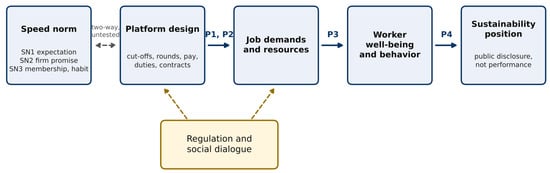
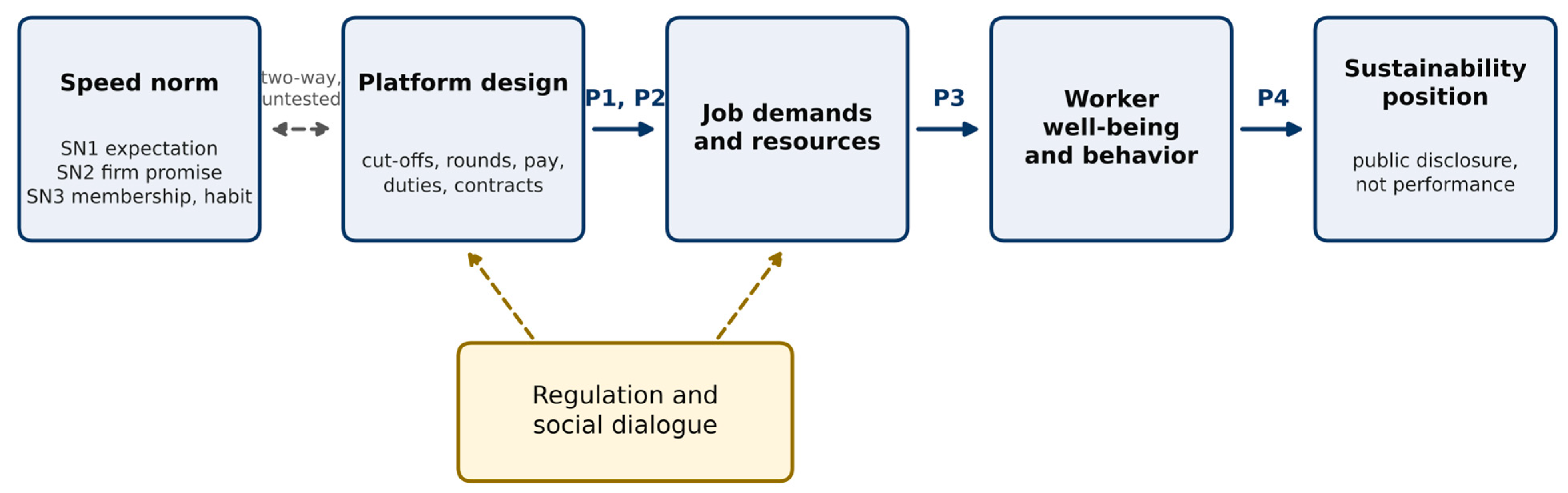
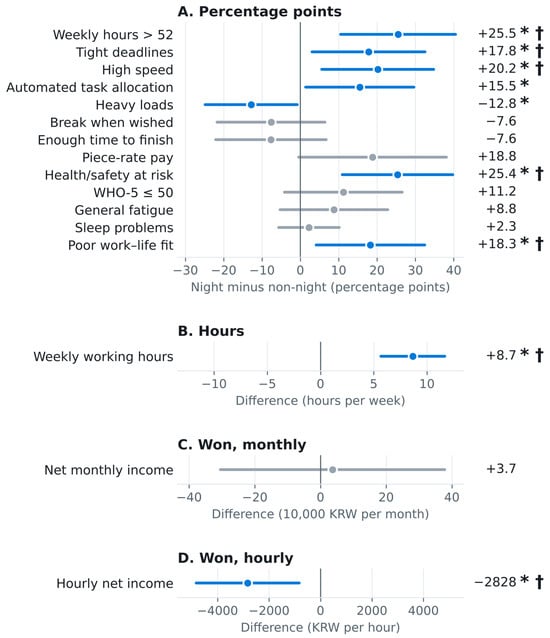
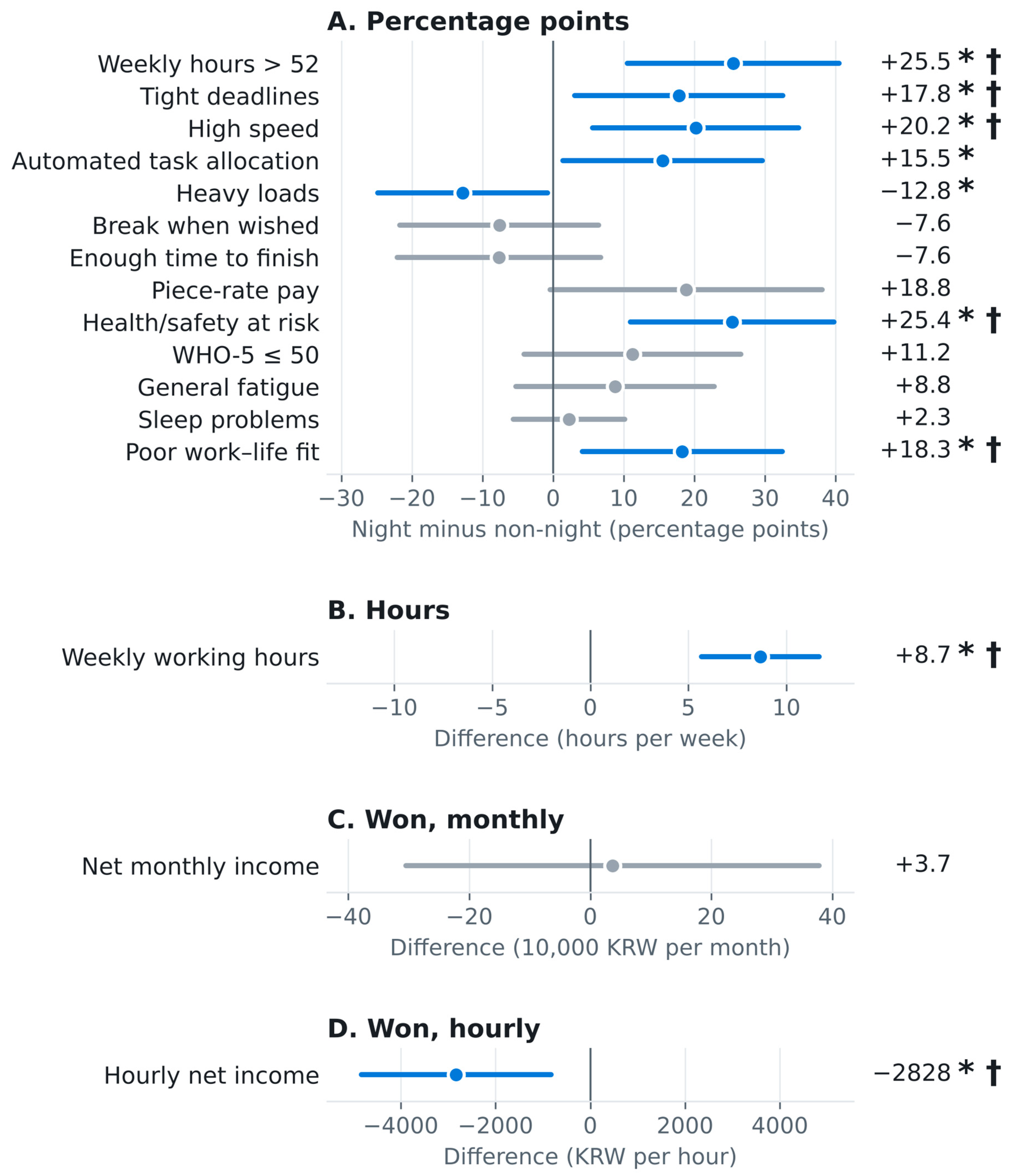

Disclaimer/Publisher’s Note: The statements, opinions and data contained in all publications are solely those of the individual author(s) and contributor(s) and not of MDPI and/or the editor(s). MDPI and/or the editor(s) disclaim responsibility for any injury to people or property resulting from any ideas, methods, instructions or products referred to in the content. |
© 2026 by the authors. Licensee MDPI, Basel, Switzerland. This article is an open access article distributed under the terms and conditions of the Creative Commons Attribution (CC BY) license.