


Abstract
Brown grease (BG) is a waste-lipid feedstock that has been converted into biobased lubricant base oils with a broad viscosity range, although low-temperature flow remains a limitation. In this study, four BG-derived base oils—fatty acid isopentyl esters (FAPEc), hydroxylated fatty acid ethyl esters (h-FAEEc), hydroxylated brown grease (Hydro BGc), and epoxidized fatty acid isopentyl esters (e-FAPEc)—were mixed with three commercial pour point depressants (PPDs) at 0.5, 1.0, and 2.5 wt.%. Two PPDs were polymethacrylate-based additives, and the suffix “c” refers to crude BG. Pour point, DSC transitions, viscosity, and viscosity index (VI) were measured. FAPEc showed the largest pour point decrease, from −6 to −15 °C, using 0.5 wt.% PPD-2 (PD-555C) or 1.0 wt.% PPD-1 (PD-585). For h-FAEEc, 0.5 wt.% PPD-1 lowered the pour point from 8 to 0 °C. Hydro BGc showed only a small decrease (14 to 11 °C), while e-FAPEc remained at 3 °C regardless of PPD addition. With 0.5 wt.% PPD-2, e-FAPEc had kinematic viscosities of 60.5 and 15.5 mm2/s at 40 and 100 °C, compared to 65.2 and 7.67 mm2/s for the neat oil. The estimated VI increased from 74.6 to 272. Changes in DSC transitions did not always correspond to lower pour points. The results show that PPD performance varies with base-oil chemistry, additive type, and concentration.
1. Introduction
Lubricants reduce friction and wear between moving surfaces and are used to control heat generation and extend equipment life [1,2,3]. Most lubricant base stocks are petroleum-derived, which has increased interest in renewable and environmentally acceptable alternatives [4,5,6]. Biobased oils are attractive because they can provide good lubricity, high viscosity index, biodegradability, and renewable carbon content [7,8,9]. However, unmodified biobased oils do not meet every performance requirement of a finished lubricant. Chemical modification and additives are commonly needed to improve properties such as oxidative stability, cold flow, and viscosity–temperature behavior [10,11,12].
Vegetable oils are among the most studied renewable feedstocks for lubricant production [9,13,14,15,16,17,18,19,20,21,22,23,24,25,26,27]. Their triglyceride structures provide polar ester groups that promote surface interactions and good lubricity, but conventional vegetable oils can have poor oxidative stability and poor low-temperature flow [28,29,30]. As temperature decreases, crystallization of fatty-acid components can restrict flow and eventually produce a semi-solid material. The temperature and extent of this behavior depend on fatty-acid composition and molecular structure. Esterification, transesterification, epoxidation, hydroxylation, and other chemical modifications have therefore been investigated to improve the properties of vegetable-oil-derived lubricants [31,32,33].
The use of virgin edible oils for large-volume industrial products can also compete with food and agricultural uses [34,35,36], whereas waste lipids provide an alternative source of fatty-acid-derived material without requiring a virgin edible-oil feedstock. Waste cooking oils have consequently been investigated as surrogates for plant oils in applications ranging from structural materials to fuels, polymers, and other value-added products, including lubricants, thus providing routes for valorization [37,38,39,40,41,42,43,44,45,46,47,48,49,50,51,52,53,54,55].
Brown grease (BG) is a heterogeneous waste-lipid stream collected from grease traps and related food service and wastewater operations. In contrast to refined vegetable oils, BG can contain free fatty acids (FFAs), mono-, di-, and triglycerides, water, solids, pigments, phospholipids, and trace metals. A full breakdown of the brown grease used in this study was reported previously [56]. This composition limits direct use of BG but provides a low-value lipid feedstock for chemical conversion. In our previous work, BG was converted into lubricant base oils through esterification, epoxidation, and hydroxylation [56]. Further modification of BG-derived alkyl esters showed that ester structure and oxidative functionalization could be used to tune viscosity and cold-flow behavior over a broad range [57].
Pour point depressants (PPDs) are lubricant additives used to improve low-temperature flow [58,59,60]. Polymeric PPDs can affect viscosity and pour point by changing crystallization temperature and energy or by influencing crystal aggregation [61]. Even small changes in crystal size or morphology can delay or prevent the formation of networks that restrict bulk flow. Polymethacrylate (PMA) additives are commonly used for this purpose [61,62,63]. Their effectiveness depends on both the additive structure and the composition of the base oil. Previous work with vegetable oils showed that base oil response to PPDs varied with fatty-acid composition and that DSC transitions did not always track directly with pour point [64,65,66]. An important distinction is that DSC reports on phase-transition heat flow, whereas pour point is an operational measure of macroscopic flow under specified test conditions. As a result, a shift in a DSC thermogram does not necessarily indicate a change in the flow threshold.
The commercial additives used herein provide a useful set of PPD chemistries for comparing the BG-derived oils. Functional PD-585 and PD-555C are PMA-based additives marketed for biobased lubricant formulations, while PD-564 is described by the supplier as a proprietary cold-flow modifier for selected synthetic biobased base stocks. PD-585 is also marketed as a multifunctional PMA that can act as both a PPD and a viscosity modifier. These differences allow the cold-flow response to be considered together with changes in viscosity–temperature behavior. Although the influence of chemical modification on properties of BG-derived base oils has been established [56,57], the influence of commercial PPDs on pour point, thermal transitions, and viscosity behavior remained unknown. The present study assesses properties of four BG-derived base oils with three commercial PPDs at three loadings each.
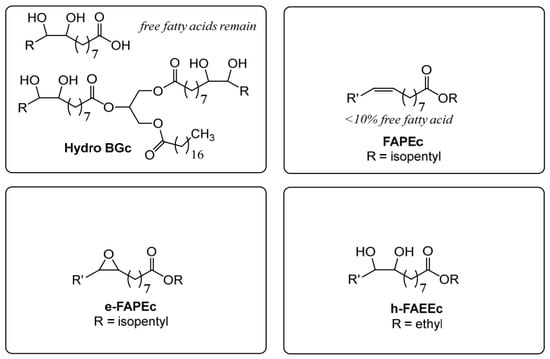
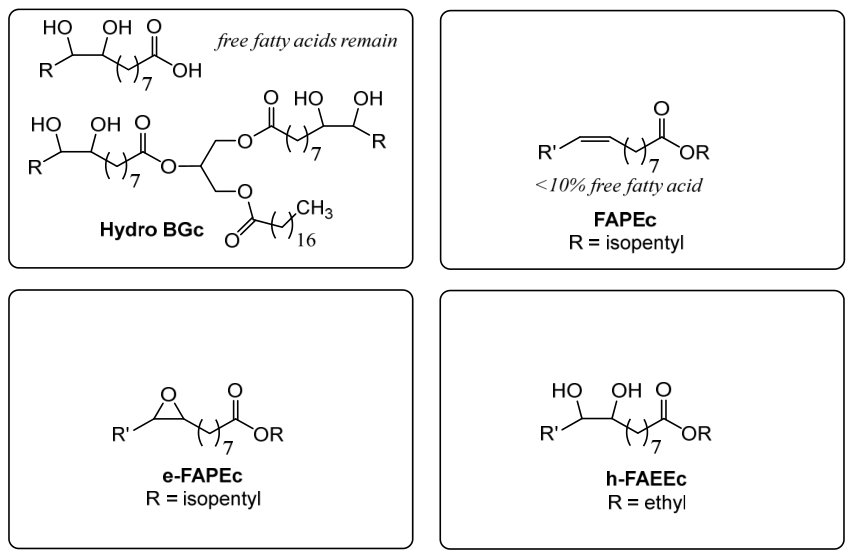
In this work, the three commercial PPDs were evaluated at 0.5, 1.0, and 2.5 wt.% loadings in four of the most promising base oils from the prior studies: FAPEc, h-FAEEc, Hydro BGc, and e-FAPEc (Figure 1). Pour point, differential scanning calorimetry (DSC), dynamic and kinematic viscosity, and viscosity index (VI) were measured for each formulation. The objective was to determine how the response to a commercial PPD changes with base-oil chemistry and additive loading. This study builds on our previous BG base-oil work by focusing on the formulation of chemically modified oils and comparing their selected physicochemical properties at the laboratory scale.
Figure 1.
Chemical structures for the four chemically modified brown grease base oils used for the additive study.
2. Materials and Methods
2.1. Materials
Reagents were used as received from Millipore Sigma (Burlington, MA, USA), Acros Organics (Geel, Belgium), and Thermo Fisher Scientific (Waltham, MA, USA). Suppliers for brown grease were omitted to avoid endorsement or bias. FAPEc was prepared by converting BG fatty-acid components to isopentyl esters, and e-FAPEc by epoxidizing the remaining olefins in FAPEc. h-FAEEc was prepared by hydroxylating BG-derived fatty acid ethyl esters, and Hydro BGc by hydroxylating BG. The detailed synthesis and workup followed the previously reported procedures [56,57]. The nomenclature used herein follows previous work: BG refers to brown grease, the “c” denotes material derived from crude BG, FAEE and FAPE designate fatty acid ethyl and isopentyl esters, respectively, and the prefixes “h-“ and “e-“ denote hydroxylated and epoxidized derivatives, respectively.
Three commercial pour point depressants from Functional Products Inc. were used in this study: Functional PD-585 (PPD-1), PD-555C (PPD-2), and PD-564 (PPD-3). According to the manufacturer, PPD-1 and PPD-2 are polymethacrylate-based additives intended for biobased oils. PPD-3, however, is described as a functionalized polyalkylmethacrylate blend in highly refined mineral oil. Since the exact polymer structure and composition of PPD-3 are proprietary, any discussion of its structure–property relationships is limited to what can be inferred from the polymer class reported by the supplier.
Each formulation was prepared independently. Viscosity, density, pour point, and DSC were measured using a single specimen (n = 1). Viscosity and density were measured at 40 and 100 °C, while pour point was determined from a single test, observing at intervals of 3 °C. DSC measurements were performed through three successive heating/cooling cycles on the same specimen. As no independent replicate measurements were performed, statistical variability could not be determined.
2.2. Preparation of PPD-Modified Base Oils
Each BG-derived base oil was formulated separately with PPD-1, PPD-2, or PPD-3 at 0.5, 1.0, and 2.5 wt.%. PPD concentration is expressed as the weight percentage of the commercial additive as received in the final formulation. Samples were prepared on a 2–5 g scale and heated at 50 °C with stirring at 100 rpm for 3 h to homogenize the additive and base oil. The formulations were stored at room temperature in sealed 20 mL glass scintillation vials until further characterization was required. The unmodified base oil was used as the control and was stored and handled under the same conditions as the PPD formulations. PPD formulations were prepared from the same batches of base oils previously characterized (Table 1). The experimental procedures used to characterize the formulations were consistent with those used in the previous studies.
Table 1.
Physicochemical properties of the unmodified brown-grease-derived base oils.
2.3. Viscosity and Density
Dynamic viscosity (μ) was measured at 40 and 100 °C using an Anton Paar MCR 302e rheometer (Graz, Austria)equipped with a CP50-0.5 measuring cone (0.5°, Graz, Austria) at a constant shear rate of 50 s−1. Samples were allowed to equilibrate at their respective temperatures for 15 min before measurements were collected, during which viscosity was monitored for 2 min. Viscosity remained stable under the applied conditions.
Density measurements were performed at 40 and 100 °C using a P200 micropipette (Gilson, Middleton, WI, USA) to dispense 100 µL aliquots. Samples were equilibrated at the testing temperature for 30 min before an aliquot was withdrawn and transferred into a preweighed container. The mass of each aliquot was determined using an analytical balance, and density was calculated by dividing the measured mass by the nominal volume of 100 µL. A single measurement was performed for each formulation at each temperature. Kinematic viscosity (ν, mm2 s−1) was determined from the dynamic viscosity (μ, mPa·s) and density (ρ, g/mL) measured at each temperature, using ν = μ/ρ. VI was calculated from the unrounded ν40 and ν100 values using ASTM D2270 (as adapted in [47]). However, these values are estimates since the viscosity and density measurements were obtained by rheometry and volume displacement rather than standard test methods. VI was not reported for formulations with ν100 below 2.0 mm2 s−1, as these fall outside the range covered by ASTM D2270.
2.4. Pour Point
Pour points were measured using 2–5 g of each formulation in 20 mL glass scintillation vials. Samples were cooled from room temperature to 20 °C, then cooled further in 3 °C increments. For samples expected to have lower pour points, testing was sometimes started below 20 °C. At each temperature, samples were held for 30 min before tilting the vials 90° for 5 s to check for flow. The lowest temperature at which flow was observed was recorded as the pour point. This method was modified from ASTM D97-17b (as adapted in [47]) by using smaller test containers and sample quantities, along with changes to the cooling and observation procedures.
2.5. DSC
Differential scanning calorimetry (DSC) measurements were collected using a Mettler Toledo DSC 3 STARe System from −60 to 140 °C at 10 °C·min−1 under N2 (200 mL·min−1). Approximately 5 mg of each sample was placed in an aluminum pan and crimp-sealed for DSC analysis. Three heating and cooling cycles were performed, with the third cycle used to obtain the melting and crystallization peak temperatures. Enthalpies (J/g) were determined by manually selecting the peak boundaries and baselines in Mettler Toledo STARe software (v. 21.0).
3. Results and Discussion
3.1. Selection of BG-Derived Base Oils and Commercial PPDs
Four BG-derived base oils were selected to compare PPD performance across different chemical structures and viscosity ranges. FAPEc is a low-viscosity branched fatty-acid ester with the lowest pour point of the four oils. h-FAEEc contains hydroxyl groups on a fatty-acid ethyl ester framework, while Hydro BGc contains hydroxyl functionality within the more heterogeneous BG-derived glyceride/FFA mixture. e-FAPEc contains epoxide functionality on the isopentyl ester framework and is considerably more viscous than FAPEc. The kinematic viscosity of e-FAPEc was 65.2 mm2 s−1 at 40 °C and 7.67 mm2 s−1 at 100 °C, while FAPEc had values of 7.51 and 2.03 mm2 s−1 at the same temperatures. This difference may be due in part to the polar oxirane groups introduced during epoxidation, as these groups can change how the molecules interact and pack together. However, the results do not show how much these interactions contribute to the higher viscosity of e-FAPEc.
Table 1 summarizes the properties of the four unmodified base oils; the origin of each dataset is identified in the table note. The structural descriptions of the four oils follow the previously reported preparation and characterization using 1H NMR and FTIR spectroscopy, confirming the functional groups introduced through esterification, epoxidation, and hydroxylation [56,57]. Figure 1 depicts representative structures of the crude-BG-derived mixtures rather than single-component materials.
The four oils therefore provide a direct comparison of ester structure and oxidative functionalization. Prior to additive incorporation, FAPEc had a pour point of −6 °C, h-FAEEc 8 °C, Hydro BGc 14 °C, and e-FAPEc 3 °C in the samples used for this study. These values were used as the untreated base-oil references when evaluating the effects of PPD addition. The same base-oil batches and experimental procedures were used in the present study to maintain consistency between the measurements. The differences in their starting properties made it possible to determine whether the three commercial PPDs produced similar responses across the BG-derived base-oil platform.
The three PPDs also differ in their intended applications. PPD-1 and PPD-2 are PMA-based additives marketed for vegetable-oil-containing formulations, whereas PPD-3 is a proprietary additive marketed for selected synthetic biobased base stocks. The supplier reports that PPD treatment of vegetable oils can produce substantial improvements in low-temperature flow, although the response depends on the oil and additive [67]. Loadings of 0.5, 1.0, and 2.5 wt.% were used here to compare the effect of additive identity and concentration.
3.2. Effect of PPD Loading on Pour Point
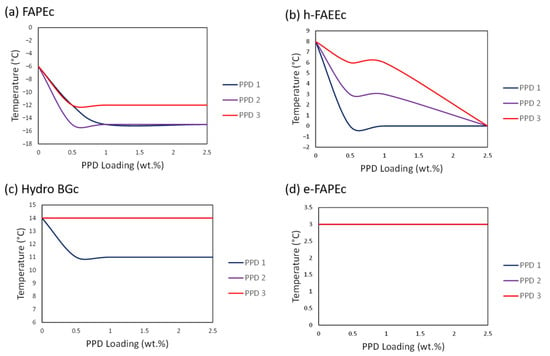
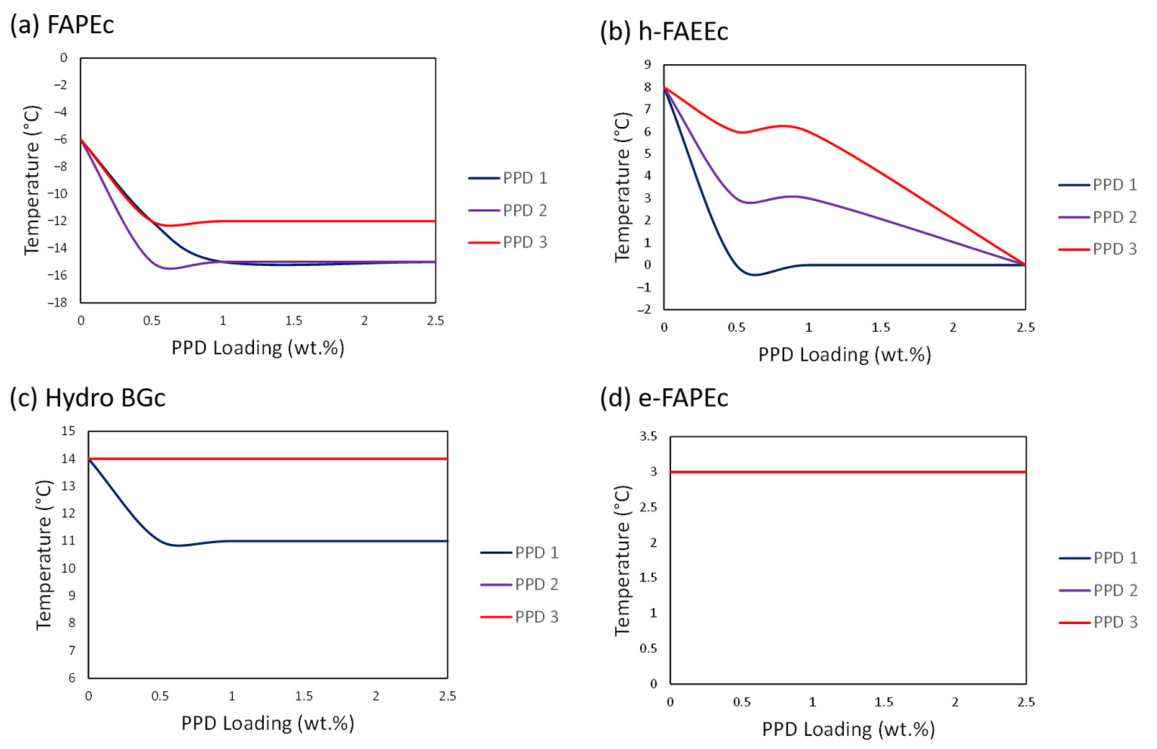
PPD response depended on both the base oil and the additive (Figure 2). FAPEc showed the largest change. The unmodified oil had a pour point of −6 °C. With PPD-1, the pour point decreased to −12 °C at 0.5 wt.% and to −15 °C at 1.0 wt.%. Increasing the loading to 2.5 wt.% did not lower the pour point further.
Figure 2.
Effects on cold flow performance with different PPDs and loadings for (a) FAPEc, (b) h-FAEEc, (c) Hydro BGc, and (d) e-FAPEc.
PPD-2 reached the same minimum pour point at a lower loading. FAPEc containing 0.5 wt.% PPD-2 had a pour point of −15 °C, and the value remained −15 °C at 1.0 and 2.5 wt.%. PPD-3 lowered the pour point to −12 °C at 0.5 wt.%, with no further change at higher loading. The largest decrease measured for FAPEc was therefore 9 °C, but the loading required to reach this value depended on the PPD.
For FAPEc, PPD-2 loading of 0.5 wt.% and PPD-1 loading of 1.0 wt.% effected the lowest observed pour points, with no additional effect at higher loadings. Similar pour point depressions to −33 °C for canola oil and −24 °C for high-oleic sunflower oil were reported when 1 wt.% PPD was added, again with no further benefit at higher PPD loadings [68,69].
Base oil h-FAEEc responded to all three additives, although the concentration dependence differed. The unmodified oil had a pour point of 8 °C. PPD-1 lowered the pour point to 0 °C at 0.5 wt.%, and it remained at 0 °C at higher loadings. PPD-2 gave 3 °C at 0.5 and 1.0 wt.% and 0 °C at 2.5 wt.%. PPD-3 gave 6 °C at 0.5 and 1.0 wt.% and 0 °C at 2.5 wt.%. Thus, each PPD lowered the pour point of h-FAEEc, but PPD-1 reached the minimum measured value at the lowest loading.
Hydro BGc showed a much smaller response. Its initial pour point was 14 °C. PPD-1 lowered the value to 11 °C at all three loadings, while PPD-2 and PPD-3 produced no measured change from 14 °C. Because ASTM D97 reports pour point in 3 °C increments, the change observed with PPD-1 corresponds to a single test increment and should be interpreted accordingly.
One of the base oils, e-FAPEc, showed no change in pour point with any of the additives at any loading. The unmodified oil and every PPD formulation remained at 3 °C. FAPEc and e-FAPEc contain the same isopentyl ester group, but e-FAPEc is produced by epoxidation of the remaining unsaturation. Previous work showed that this modification increased viscosity and raised the pour point relative to FAPEc [57]. The present results show that the two base oils also respond differently to the same commercial PPDs.
The lowest pour points were observed with 0.5 wt.% PPD-2 for FAPEc (−15 °C) and 0.5 wt.% PPD-1 for h-FAEEc (0 °C). Higher loadings did not further decrease the measured pour points, while e-FAPEc showed no change at any tested concentration. These results show that increasing PPD concentration does not necessarily improve pour point or overall formulation performance. However, the observed plateaus do not confirm saturation of a specific molecular mechanism, and similar variations in pour point across commercial PPD concentrations have been reported in the literature [70,71,72,73,74,75,76,77,78,79].
3.3. Crystallization and Melting Behavior of PPD-Modified Base Oils
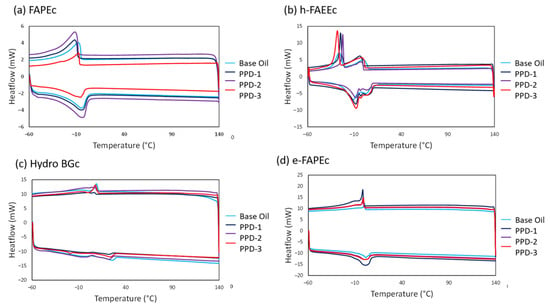
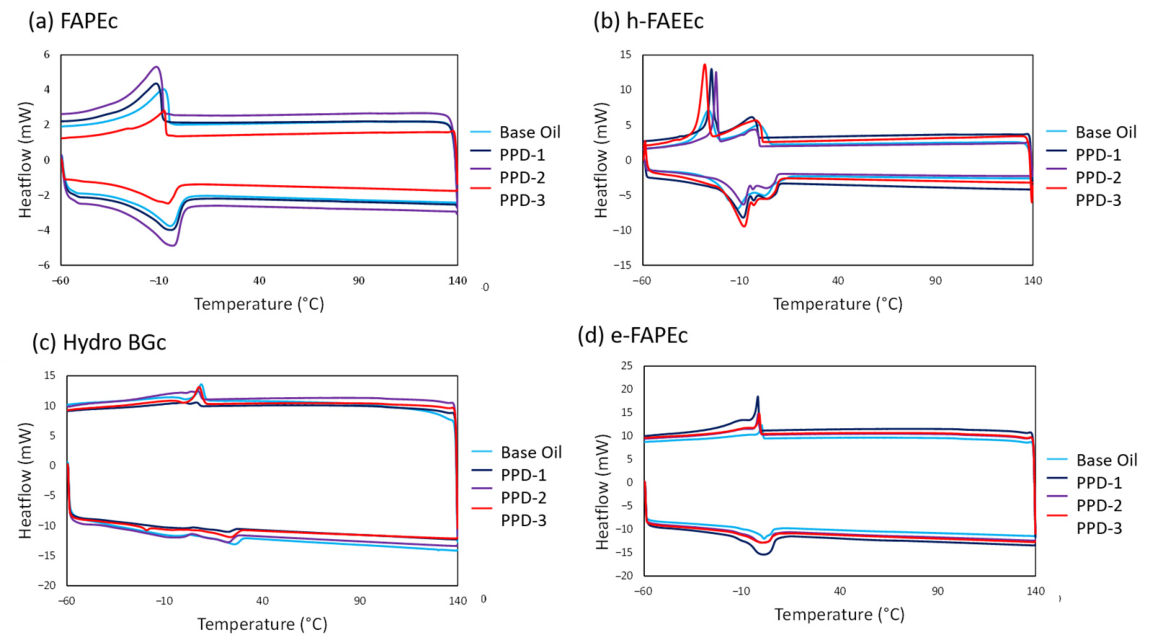
DSC was used to compare changes in crystallization and melting behavior with the pour-point results (Table S1, Figures S1–S40). Quantitative crystallization and melting parameters for the four neat oils and 36 PPD-containing formulations are summarized in Table S1. Peak temperatures and mass-normalized enthalpies are reported separately for each resolved transition; the third-cycle thermograms describe a common programmed thermal history rather than independent replication. The four unmodified oils showed different thermal transitions, as expected from their different chemical structures. Figure 3 compares each base oil with the corresponding 2.5 wt.% PPD formulations.
Figure 3.
DSC thermograms representing (a) FAPEc, (b) h-FAEEc, (c) Hydro BGc, and (d) e-FAPEc. Each represented PPD is shown for 2.5 wt.% loading. Third heating and cooling cycles are shown with endothermic peaks pointing down in these thermograms.
FAPEc showed the clearest case where a change in crystallization behavior accompanied improved pour point. The unmodified oil had a crystallization peak near −9 °C and a melting peak near −5 °C. With PPD-1, the crystallization peak was −9 °C at 0.5 wt.%, −10 °C at 1.0 wt.%, and −12 °C at 2.5 wt.%. Over the same loading range, the pour point changed from −6 °C to −12, −15, and −15 °C, respectively.
PPD-2 gave a crystallization peak of −9 °C at 0.5 wt.% and approximately −10 °C at 1.0 and 2.5 wt.%, while all three formulations had a pour point of −15 °C. PPD-3 behaved differently: the crystallization peak shifted slightly upward to approximately −8 °C, but the pour point still decreased to −12 °C. The FAPEc data therefore show that the position of the main DSC crystallization peak does not by itself predict the measured pour point.
Although pour point provides a useful assessment of bulk flow under specified test conditions, DSC reports on heat flow and associated phase transitions that can provide additional insight into the mechanisms behind observed temperature-dependent flow and viscosity. Polymethacrylate-based PPDs are known to influence crystal growth and solid network formation but do not necessarily prevent crystallization, in line with the lower FAPEc pour points observed with little change in the observed crystallization peaks [80,81].
After PPD addition, h-FAEEc showed multiple crystallization transitions. With PPD-1, the higher-temperature crystallization peak shifted from approximately 0 °C at 0.5 wt.% to −3 °C at 2.5 wt.%, while a second transition shifted from approximately −22 to −25 °C. PPD-2 gave a primary transition between 0 and −2 °C and a lower-temperature transition near −22 °C. PPD-3 gave a primary transition between 0 and −3 °C, with the lower-temperature crystallization reaching approximately −28 °C at 2.5 wt.%.
The multiple transitions are consistent with the compositional complexity of the BG-derived material. However, the present DSC data are not sufficient to assign individual peaks to specific fatty-acid components, so the transitions are discussed only as separate crystallization events.
Hydro BGc had higher-temperature thermal transitions and showed a smaller change in crystallization temperature. The unmodified oil had a crystallization peak near 11 °C and a melting peak near 28 °C. PPD-1 shifted crystallization to approximately 8–10 °C and lowered the melting peak to approximately 21 °C. PPD-2 and PPD-3 also changed the DSC transitions, even though neither additive changed the measured pour point. For Hydro BGc, a shift in the DSC transition therefore did not necessarily produce a measurable change in pour point.
The main crystallization peak for e-FAPEc was observed near 2 °C, compared to approximately 0 °C for most samples containing PPDs. Despite this difference, the pour point remained at 3 °C for every formulation tested. The change in the DSC peak therefore did not correspond to a change in the measured pour point. It should also be considered that the 2 °C difference is less than the 3 °C increments used during pour point testing, and that DSC and pour point measure different properties. Compared to FAPEc, epoxidation may alter the polarity and packing of the fatty acid esters, which could affect how the additives interact with the oil. The unchanged pour point may also be related to crystal connectivity or the viscosity of the remaining liquid. However, these measurements do not provide enough information to determine the cause.
Overall, the additives affected thermal transitions and pour points differently. For h-FAEEc, changes in the crystallization peaks were accompanied by lower pour points, although these peaks could not be assigned to specific components or flow-limiting events. For Hydro BGc, lower crystallization and melting peaks did not always result in lower pour points. Similarly, e-FAPEc showed an approximately 2 °C shift in its main crystallization peak, while the pour point remained at 3 °C. These results suggest that the additives may influence crystallization and solid-network formation differently depending on the base oil, although the measurements alone cannot confirm a specific mechanism. DSC and pour point measurements therefore provide different information about low-temperature behavior.
3.4. Effect of PPD Addition on Viscosity and Viscosity–Temperature Behavior
Viscosity was measured at 40 and 100 °C to determine whether PPD addition changed the rheological properties of the base oils in addition to cold flow (Table 2). The magnitude of the change depended on the base oil, PPD, and loading.
Table 2.
Viscosity, density, and comparative viscosity-index estimates for the PPD-containing formulations.
Unmodified FAPEc had ν40 = 7.51 mm2 s−1 and ν100 = 2.03 mm2 s−1. At 2.5 wt.% PPD, ν40 increased to 9.62 mm2 s−1 with PPD-1, 8.37 mm2 s−1 with PPD-2, and 11.3 mm2 s−1 with PPD-3. The corresponding ν100 values were 2.53, 2.17, and 2.91 mm2 s−1. The viscosity response was not monotonic at lower loadings, indicating that the effect of the additives cannot be described simply as a concentration-dependent increase in viscosity.
Several formulations changed ν100 more strongly than ν40, which affected the calculated VI. This behavior is relevant for PPD-1 because PD-585 is marketed as a multifunctional PMA that can also function as a viscosity modifier. The observed viscosity changes are therefore consistent with the stated commercial function of the additive, although the present study did not determine the polymer mechanism directly.
Samples of h-FAEEc also showed additive-dependent viscosity changes. Across the PPD formulations, ν40 ranged from 9.98 to 16.8 mm2 s−1 and ν100 from 2.51 to 4.36 mm2 s−1. At 2.5 wt.% PPD-1, ν40 and ν100 were 16.8 and 4.18 mm2 s−1, respectively. At the same loading of PPD-3, the values were 14.7 and 4.36 mm2 s−1. Both formulations had a pour point of 0 °C, showing that the additives changed viscosity–temperature behavior while also improving low-temperature flow.
Hydro BGc was the most viscous oil in the formulation series, with ν40 = 128 mm2 s−1 and ν100 = 12.7 mm2 s−1 before PPD addition. At 2.5 wt.%, ν40 increased to 144, 142, and 151 mm2 s−1 with PPD-1, PPD-2, and PPD-3, respectively. These viscosity changes were larger than the changes in pour point: only PPD-1 lowered the measured pour point, and that decrease was 3 °C.
The addition of PPDs had varying effects on the VI of the BG-derived base oils, with calculated values ranging from negative values to greater than 200. One notable example was e-FAPEc containing 0.5 wt.% PPD-2, which had a VI of 272 compared to 74.6 for e-FAPEc alone. At 40 °C, the kinematic viscosity decreased slightly from 65.2 to 60.5 mm2/s following the addition of PPD-2. In contrast, the viscosity at 100 °C increased from 7.67 to 15.5 mm2/s. The higher VI can therefore be attributed to the smaller decrease in viscosity as the temperature increased. Although the PPD had a considerable effect on the viscosity at 100 °C, further investigation would be needed to determine the interactions responsible for this behavior. It is also important to consider that VI only accounts for viscosity changes with temperature and does not determine the mechanical shear stability or overall performance of the lubricant.
e-FAPEc provided the clearest separation between viscosity–temperature behavior and pour point. The unmodified oil had ν40 = 65.2 mm2 s−1 and ν100 = 7.67 mm2 s−1. PPD-1 increased ν100 to 13.4–16.6 mm2 s−1, while PPD-2 gave 11.8–15.5 mm2 s−1. Despite these changes, the pour point remained at 3 °C for every formulation. Thus, a large change in viscosity–temperature behavior did not necessarily correspond to improved cold flow.
The changes in viscosity may be related to the behavior of PMA additives, although polymer conformation and interactions with the base oils were not examined in this study. Negative VI values or those above 200 do not necessarily indicate an error in calculation, but the accuracy of these values depends on the viscosity measurements and whether they fall within the applicable calculation range. VI only describes how kinematic viscosity changes with temperature and should not be used alone to determine lubricant performance or resistance to mechanical shear. This type of response is consistent with the behavior of polymeric viscosity modifiers, including PMAs [82].
The viscosity measurements therefore show a second effect of PPD formulation that is separate from pour-point depression. Some formulations changed both cold flow and viscosity–temperature behavior, while others changed viscosity with little or no change in pour point. Pour point, ν40, ν100, and VI should therefore be considered together when evaluating these formulations.
3.5. Implications for BG-Derived Lubricant Formulation
Comparison of the four base oils shows that PPD performance depends strongly on the base-oil/additive combination. FAPEc and h-FAEEc showed the largest decreases in pour point. Hydro BGc showed only a one-increment decrease with PPD-1, and e-FAPEc showed no measured change.
FAPEc already had the lowest pour point of the four untreated oils because of its branched isopentyl ester structure. PPD formulation lowered the value further, from −6 to −15 °C. The FAPEc results show that chemical modification of the base oil and subsequent additive formulation can be used together to improve cold-flow performance.
h-FAEEc also responded to PPD addition despite its hydroxyl functionality. Its pour point decreased from 8 to 0 °C with PPD-1 and with the highest loadings of PPD-2 and PPD-3. This result shows that the cold-flow limitation of this hydroxylated ester can be reduced through additive formulation.
e-FAPEc provides the contrasting case. DSC and viscosity changed after PPD addition, but the pour point did not. Increasing PPD concentration therefore cannot be assumed to improve cold flow, even when other measurements show that the formulation has changed.
The loading needed to reach the lowest measured pour point also depended on the additive. In FAPEc, PPD-2 reached −15 °C at 0.5 wt.%, whereas PPD-1 required 1.0 wt.% to reach the same value. In h-FAEEc, PPD-1 reached 0 °C at 0.5 wt.%, while PPD-2 and PPD-3 reached 0 °C only at 2.5 wt.%. Higher additive loading therefore did not consistently provide better performance.
Taken together, the measurements show three responses to PPD addition: changes in crystallization behavior, changes in macroscopic cold flow, and changes in viscosity–temperature behavior. These responses were not always coupled. The formulation that produced the largest change in one property did not necessarily produce the largest change in another.
This behavior is important for BG-derived oils because the feedstock is compositionally heterogeneous. Chemical conversion changes the bulk properties of BG, but the resulting oils still contain distributions of fatty-acid-derived components that can affect crystallization and additive response. A single PPD treatment is therefore unlikely to be optimal for every BG-derived base oil.
DSC transitions and viscosity showed changes that did not always correspond to changes in pour point. For example, e-FAPEc with 0.5 wt.% PPD-2 had ν40 and ν100 values of 60.5 and 15.5 mm2 s−1, compared to 65.2 and 7.67 mm2 s−1 for the unmodified oil. The corresponding VI estimate increased from approximately 75 to 272. Although this work shows how formulation affects selected base-oil properties, further testing of oxidative stability, long-term formulation stability, biodegradability, and performance under intended service conditions is needed to determine their suitability for specific lubricant applications.
4. Conclusions
Four BG-derived base oils were formulated with three commercial PPDs at 0.5, 1.0, and 2.5 wt.% to determine how base-oil chemistry, additive identity, and loading affect cold-flow and viscosity–temperature behavior. The response varied considerably among the four base oils.
Addition of commercial PPDs to BG-derived base oils produced different responses depending on the formulation. The pour point of FAPEc decreased from −6 to −15 °C with either 0.5 wt.% PPD-2 or 1.0 wt.% PPD-1. In contrast, h-FAEEc showed a smaller decrease to 0 °C with 0.5 wt.% PPD-1, while Hydro BGc showed only minor changes. The pour point of e-FAPEc remained at 3 °C for all formulations tested.
DSC showed that PPD addition changed crystallization and melting behavior, but the thermal transitions did not always follow the pour-point response. This was most evident for Hydro BGc and e-FAPEc, where DSC transitions changed with little or no change in pour point. The additives also changed ν40, ν100, and calculated VI, showing that viscosity–temperature behavior can change independently of pour point.
The results presented in this study were obtained from single measurements of each formulation, without independent replicates. For Hydro BGc, the decrease in pour point from 14 to 11 °C with PPD-1 represents a single 3 °C observation interval. Additionally, the estimated VI of e-FAPEc increased from 74.6 to 272 with 0.5 wt.% PPD-2. These results indicate changes in the measured properties following PPD addition, but additional measurements would be needed to determine their reproducibility and variability.
Although these measurements demonstrate formulation-dependent changes in key properties of this new class of base oils, further evaluation of oxidative stability and biodegradability is needed to determine their long-term suitability for lubricant applications.
Supplementary Materials
The following supporting information can be downloaded at: https://www.mdpi.com/article/10.3390/su182311939/s1, Table S1: Quantitative DSC parameters for the four unmodified BG-derived base oils and the 36 PPD-containing formulations, determined from the third heating/cooling cycle; Figure S1: DSC traces of the third heating and cooling cycles for FAPEc; Figure S2: DSC traces for FAPEc with PPD-1 at 0.5 wt.%; Figure S3: DSC traces for FAPEc with PPD-1 at 1.0 wt.%; Figure S4: DSC traces for FAPEc with PPD-1 at 2.5 wt.%; Figure S5: DSC traces for FAPEc with PPD-2 at 0.5 wt.%; Figure S6: DSC traces for FAPEc with PPD-2 at 1.0 wt.%; Figure S7: DSC traces for FAPEc with PPD-2 at 2.5 wt.%; Figure S8: DSC traces for FAPEc with PPD-3 at 0.5 wt.%; Figure S9: DSC traces for FAPEc with PPD-3 at 1.0 wt.%; Figure S10: DSC traces for FAPEc with PPD-3 at 2.5 wt.%; Figure S11: DSC traces of the third heating and cooling cycles for h-FAEEc; Figure S12: DSC traces for h-FAEEc with PPD-1 at 0.5 wt.%; Figure S13: DSC traces for h-FAEEc with PPD-1 at 1.0 wt.%; Figure S14: DSC traces for h-FAEEc with PPD-1 at 2.5 wt.%; Figure S15: DSC traces for h-FAEEc with PPD-2 at 0.5 wt.%; Figure S16: DSC traces for h-FAEEc with PPD-2 at 1.0 wt.%; Figure S17: DSC traces for h-FAEEc with PPD-2 at 2.5 wt.%; Figure S18: DSC traces for h-FAEEc with PPD-3 at 0.5 wt.%; Figure S19: DSC traces for h-FAEEc with PPD-3 at 1.0 wt.%; Figure S20: DSC traces for h-FAEEc with PPD-3 at 2.5 wt.%; Figure S21: DSC traces of the third heating and cooling cycles for Hydro BGc; Figure S22: DSC traces for Hydro BGc with PPD-1 at 0.5 wt.%; Figure S23: DSC traces for Hydro BGc with PPD-1 at 1.0 wt.%; Figure S24: DSC traces for Hydro BGc with PPD-1 at 2.5 wt.%; Figure S25: DSC traces for Hydro BGc with PPD-2 at 0.5 wt.%; Figure S26: DSC traces for Hydro BGc with PPD-2 at 1.0 wt.%; Figure S27: DSC traces for Hydro BGc with PPD-2 at 2.5 wt.%; Figure S28: DSC traces for Hydro BGc with PPD-3 at 0.5 wt.%; Figure S29: DSC traces for Hydro BGc with PPD-3 at 1.0 wt.%; Figure S30: DSC traces for Hydro BGc with PPD-3 at 2.5 wt.%; Figure S31: DSC traces of the third heating and cooling cycles for e-FAPEc; Figure S32: DSC traces for e-FAPEc with PPD-1 at 0.5 wt.%; Figure S33: DSC traces for e-FAPEc with PPD-1 at 1.0 wt.%; Figure S34: DSC traces for e-FAPEc with PPD-1 at 2.5 wt.%; Figure S35: DSC traces for e-FAPEc with PPD-2 at 0.5 wt.%; Figure S36: DSC traces for e-FAPEc with PPD-2 at 1.0 wt.%; Figure S37: DSC traces for e-FAPEc with PPD-2 at 2.5 wt.%; Figure S38: DSC traces for e-FAPEc with PPD-3 at 0.5 wt.%; Figure S39: DSC traces for e-FAPEc with PPD-3 at 1.0 wt.%; Figure S40: DSC traces for e-FAPEc with PPD-3 at 2.5 wt.%.
Author Contributions
Conceptualization, R.C.S.; methodology, R.C.S.; formal analysis, Y.B.K.; investigation, Y.B.K.; resources, R.C.S.; data curation, Y.B.K.; writing—original draft preparation, all authors; writing—review and editing, all authors; supervision, R.C.S.; funding acquisition, R.C.S. and A.D.S. All authors have read and agreed to the published version of the manuscript.
Funding
Funding for this project from the National Science Foundation (DMR-2612687 to RCS) and from the South Carolina Department of Agriculture ACRE program (to ADS and RCS) is gratefully acknowledged.
Institutional Review Board Statement
Not applicable.
Informed Consent Statement
Not applicable.
Data Availability Statement
Data are provided in the Supplementary Materials or can be requested from the corresponding author.
Conflicts of Interest
The authors declare no conflicts of interest.
Abbreviations
The following abbreviations are used in this manuscript:
| PPD | Pour point depressant |
| DSC | Differential scanning calorimetry |
| VI | Viscosity index |
| FAPEc | Fatty acid isopentyl ester derived from crude brown grease |
| e-FAPEc | Epoxidized fatty acid isopentyl ester derived from crude brown grease |
| Hydro BGc | Hydroxylated brown grease derived from crude brown grease |
| h-FAEEc | Hydroxylated fatty acid ethyl ester derived from crude brown grease |
| BG | Brown grease |
| PPD-1 | Functional PD-585 |
| PPD-2 | Functional PD-555C |
| PPD-3 | Functional PD-564 |
References
- Ardah, S.; Profito, F.J.; Dini, D. A comprehensive review and trends in lubrication modelling. Adv. Colloid Interface Sci. 2025, 342, 103492. [Google Scholar] [CrossRef] [Scilit] [PubMed]
- Shu, J.; Espejo, C.; Kalin, M.; Morina, A. Synergism between bio-based oleate ester and low-concentration ZDDP under reciprocating contacts. Tribol. Int. 2024, 192, 109252. [Google Scholar] [CrossRef] [Scilit]
- Zhao, J.; Sheng, W.; Li, Z.; Zhang, H.; Zhu, R. Effect of lubricant selection on the wear characteristics of spur gear under oil-air mixed lubrication. Tribol. Int. 2022, 167, 107382. [Google Scholar] [CrossRef] [Scilit]
- Uppar, R.; Dinesha, P.; Kumar, S. Yield optimization of nonedible vegetable oil-based bio-lubricant using design of experiments. Environ. Dev. Sustain. 2024, 26, 29557–29582. [Google Scholar] [CrossRef] [Scilit]
- Hamnas, A.; Unnikrishnan, G. Green lubrication: Mustard oil-based bio-lubricant enhanced with waste eggshell-derived CaO nanoparticles for sustainable and eco-friendly industrial solutions. J. Clean. Prod. 2024, 453, 142184. [Google Scholar] [CrossRef] [Scilit]
- Zhou, B.; Wang, N.; Fan, Y.; Lin, Y.; Liu, S.; Liu, G. Catalytic coproduction of renewable lubricant base oils and diesel fuels from bio-lipids and aromatics via alkylation and hydrodeoxygenation. Green Chem. 2025, 27, 11944–11960. [Google Scholar] [CrossRef] [Scilit]
- Filon, D.; Anastopoulos, G.; Karonis, D. Synthesis and Evaluation of Bio-Lubricants from Renewable Raw Materials. Lubricants 2024, 12, 446. [Google Scholar] [CrossRef] [Scilit]
- Martín-Alfonso, M.A.; Rubio-Valle, J.F.; Hinestroza, J.P.; Martín-Alfonso, J.E. Impact of Vegetable Oil Type on the Rheological and Tribological Behavior of Montmorillonite-Based Oleogels. Gels 2022, 8, 504. [Google Scholar] [CrossRef] [Scilit] [PubMed]
- Hamnas, A.; Unnikrishnan, G. Bio-lubricants from vegetable oils: Characterization, modifications, applications and challenges—Review. Renew. Sustain. Energy Rev. 2023, 182, 113413. [Google Scholar] [CrossRef] [Scilit]
- Sarker, M.I.; Mainali, K.; Sharma, B.K.; Yadav, M.P.; Ngo, H.; Ashby, R.D. Synthesized biolubricants from naturally derived oleic acid: Oxidative stability and cold flow performance. Ind. Crops Prod. 2023, 204, 117315. [Google Scholar] [CrossRef] [Scilit]
- Khan, S.; Das, P.; Radwan, A.B.; Thaher, M.; Abdulquadir, M.; Faisal, M.; Kasak, P.; Hawari, A.H.; Al-Jabri, H. Biolubricant Synthesis by Additization and Chemical Modification from Lipid-Rich Brackish Coelastrella sp. Using a Biorefinery Approach. ACS Sustain. Chem. Eng. 2024, 12, 7289–7299. [Google Scholar] [CrossRef] [Scilit]
- Khan, S.; Das, P.; Quadir, M.A.; Thaher, M.; Annamalai, S.N.; Mahata, C.; Hawari, A.H.; Al Jabri, H. A comparative physicochemical property assessment and techno-economic analysis of biolubricants produced using chemical modification and additive-based routes. Sci. Total Environ. 2022, 847, 157648. [Google Scholar] [CrossRef] [Scilit] [PubMed]
- Muthurathinam, S.G.; Perumal, A.V. Synthesis, characterization and tribological investigation of vegetable oil methyl esters based bio-lubricants. Ind. Crops Prod. 2023, 203, 117098. [Google Scholar] [CrossRef] [Scilit]
- McNutt, J.; He, Q. Development of biolubricants from vegetable oils via chemical modification. J. Ind. Eng. Chem. 2016, 36, 1–12. [Google Scholar] [CrossRef] [Scilit]
- Panchal, T.M.; Patel, A.; Chauhan, D.D.; Thomas, M.; Patel, J.V. A methodological review on bio-lubricants from vegetable oil based resources. Renew. Sustain. Energy Rev. 2017, 70, 65–70. [Google Scholar] [CrossRef] [Scilit]
- Salimon, J.; Salih, N.; Yousif, E. Biolubricants: Raw materials, chemical modifications and environmental benefits. Eur. J. Lipid Sci. Technol. 2010, 112, 519–530. [Google Scholar] [CrossRef] [Scilit]
- Zainal, N.A.; Zulkifli, N.W.M.; Gulzar, M.; Masjuki, H.H. A review on the chemistry, production, and technological potential of bio-based lubricants. Renew. Sustain. Energy Rev. 2018, 82, 80–102. [Google Scholar] [CrossRef] [Scilit]
- Uppar, R.; Dinesha, P.; Kumar, S. A critical review on vegetable oil-based bio-lubricants: Preparation, characterization, and challenges. Environ. Dev. Sustain. 2023, 25, 9011–9046. [Google Scholar] [CrossRef] [Scilit]
- Kurre, S.K.; Yadav, J. A review on bio-based feedstock, synthesis, and chemical modification to enhance tribological properties of biolubricants. Ind. Crops Prod. 2023, 193, 116122. [Google Scholar] [CrossRef] [Scilit]
- Nogales-Delgado, S.; Encinar, J.M.; González, J.F. A Review on Biolubricants Based on Vegetable Oils through Transesterification and the Role of Catalysts: Current Status and Future Trends. Catalysts 2023, 13, 1299. [Google Scholar] [CrossRef] [Scilit]
- Soodoo, N.; Bouzidi, L.; Narine, S.S. Fundamental Structure–Function Relationships in Vegetable Oil-Based Lubricants: A Critical Review. Lubricants 2023, 11, 284. [Google Scholar] [CrossRef] [Scilit]
- Singh, Y.; Sharma, A.; Singla, A. Non-edible vegetable oil-based feedstocks capable of bio-lubricant production for automotive sector applications—A review. Environ. Sci. Pollut. Res. 2019, 26, 14867–14882. [Google Scholar] [CrossRef] [Scilit] [PubMed]
- Erhan, S.Z.; Asadauskas, S. Lubricant basestocks from vegetable oils. Ind. Crops Prod. 2000, 11, 277–282. [Google Scholar] [CrossRef] [Scilit]
- Sharma, B.K.; Adhvaryu, A.; Liu, Z.; Erhan, S.Z. Chemical modification of vegetable oils for lubricant applications. J. Am. Oil Chem. Soc. 2006, 83, 129–136. [Google Scholar] [CrossRef] [Scilit]
- Erhan, S.Z.; Sharma, B.K.; Liu, Z.; Adhvaryu, A. Lubricant Base Stock Potential of Chemically Modified Vegetable Oils. J. Agric. Food Chem. 2008, 56, 8919–8925. [Google Scholar] [CrossRef] [Scilit] [PubMed]
- Campanella, A.; Rustoy, E.; Baldessari, A.; Baltanás, M.A. Lubricants from chemically modified vegetable oils. Bioresour. Technol. 2010, 101, 245–254. [Google Scholar] [CrossRef] [Scilit] [PubMed]
- Hwang, H.-S.; Erhan, S.Z. Synthetic lubricant basestocks from epoxidized soybean oil and Guerbet alcohols. Ind. Crops Prod. 2006, 23, 311–317. [Google Scholar] [CrossRef] [Scilit]
- Saka, A.; Abor, T.K.; Okafor, A.C.; Okoronkwo, M.U. Thermo-rheological and tribological properties of low- and high-oleic vegetable oils as sustainable bio-based lubricants. RSC Sustain. 2024, 3, 1461–1476. [Google Scholar] [CrossRef] [Scilit]
- Lee, C.T.; Lee, M.B.; Chong, W.W.F.; Ng, J.-H.; Wong, K.J.; Chong, C.T. Boundary Lubricity of Vegetable-Oil-Derived Trimethylolpropane (TMP) Ester. Lubricants 2022, 10, 346. [Google Scholar] [CrossRef] [Scilit]
- Prasannakumar, P.; Edla, S.; Thampi, A.D.; Arif, M.; Santhakumari, R. A comparative study on the lubricant properties of chemically modified Calophyllum inophyllum oils for bio-lubricant applications. J. Clean. Prod. 2022, 339, 130733. [Google Scholar] [CrossRef] [Scilit]
- Abdel-Hameed, H.S.; El-Saeed, S.M.; Ahmed, N.S.; Nassar, A.M.; El-Kafrawy, A.F.; Hashem, A.I. Chemical transformation of Jojoba oil and Soybean oil and study of their uses as bio-lubricants. Ind. Crops Prod. 2022, 187, 115256. [Google Scholar] [CrossRef] [Scilit]
- Xie, M.; Xu, D.; Shen, J.; Zhang, C. Achieving the good thermal-stability and lubricity via a dihydroxy biolubricant from the agro-waste of Codonopsis pilosula. Renew. Energy 2024, 221, 119867. [Google Scholar] [CrossRef] [Scilit]
- Obanla, O.R.; Mohammed, F.U.; Alebiosu, O.S.; Ojewumi, M.E.; Oladimeji, T.E.; Babatunde, D.E. Study on the Lubricating Properties of Castor (Ricinus communis) and Hydroxylated Rubber (Hevea brasiliensis) Seed Oil. ACS Omega 2021, 6, 28471–28476. [Google Scholar] [CrossRef] [Scilit] [PubMed]
- Tiwari, M.; Sastry, S.V.A.R.; Kumar, S. Development of bio-lubricants from Madhuca longifolia and Ricinus communis oils via 3-step chemical modification process for enhanced properties. Can. J. Chem. Eng. 2026, 104, 1863–1876. [Google Scholar] [CrossRef] [Scilit]
- Prasannakumar, P.; Sankarannair, S.; Harikrishna, P.H.; Pranav, S.; Ardra Lekshmi, A.; Smitha Chandran, S.; Santhakumari, R.; Jyothi, S.N. Hybrid biolubricant formulation from chemically modified non-edible oils reinforced with green additives for enhanced tribological, rheological, and thermal performance. Fuel 2026, 424, 139331. [Google Scholar] [CrossRef] [Scilit]
- Duarte, F.J.; Paes, V.F.; dos Santos, F.V.; Cunha, A.L.; dos Santos, A.J.; Porto, M.P.; Correa, D.S.; Costa Corgozinho, C.N.; Abrão, A.M. Biolubricants derived from Brazilian Cerrado for drilling under hybrid lubrication/cooling. Fuel 2026, 422, 139060. [Google Scholar] [CrossRef] [Scilit]
- Joshi, J.R.; Bhanderi, K.K.; Patel, J.V.; Karve, M. Chemical modification of waste cooking oil for the biolubricant production through transesterification process. J. Indian Chem. Soc. 2023, 100, 100909. [Google Scholar] [CrossRef] [Scilit]
- Negi, R.S.; Singh, R.K.; Atray, N.; Singh, S.K. Potential valorization of used cooking oil into novel biolubricating grease through chemical modification and its performance evaluation. Ind. Crops Prod. 2023, 205, 117555. [Google Scholar] [CrossRef] [Scilit]
- Mengistu, N.G.; Mekonen, M.W.; Ayalew, Y.G.; Demisie, L.F.; Nega, T. Experimental investigation on diesel engine performance and emission characteristics using waste cooking oil blended with diesel as biodiesel fuel. Discov. Energy 2024, 4, 26. [Google Scholar] [CrossRef] [Scilit]
- Mahadas, N.A.; Sanchez, L.A.H.; Suhail, A.; Price, J.; Anik, A.M.; Kanan, M.W.; Kuksenok, O.; Tang, C. Transforming Waste Cooking Oil into Linear and Branched Polyethylene Mimics. J. Am. Chem. Soc. 2025, 147, 45585–45594. [Google Scholar] [CrossRef] [Scilit] [PubMed]
- Asare, M.A.; de Souza, F.M.; Gupta, R.K. Waste to Resource: Synthesis of Polyurethanes from Waste Cooking Oil. Ind. Eng. Chem. Res. 2022, 61, 18400–18411. [Google Scholar] [CrossRef] [Scilit]
- Cappello, M.; Filippi, S.; Rossi, D.; Cinelli, P.; Anguillesi, I.; Camodeca, C.; Orlandini, E.; Polacco, G.; Seggiani, M. Waste-Cooking-Oil-Derived Polyols to Produce New Sustainable Rigid Polyurethane Foams. Sustainability 2024, 16, 9456. [Google Scholar] [CrossRef] [Scilit]
- Staroń, A.; Chwastowski, J.; Kijania-Kontak, M.; Wiśniewski, M.; Staroń, P. Bio-enriched composite materials derived from waste cooking oil for selective reduction of odour intensity. Sci. Rep. 2024, 14, 16311. [Google Scholar] [CrossRef] [Scilit] [PubMed]
- Zhang, K.; Xiong, J.; Ruiz, C.; Zhang, J. Design and performance assessment of sustainable road pothole patching materials using waste cooking oil, plastic, and reclaimed asphalt pavement. Constr. Build. Mater. 2024, 429, 136426. [Google Scholar] [CrossRef] [Scilit]
- Huang, J.; Huo, Y.; Su, Q.; Lu, D.; Wu, Y.; Dong, X.; Gao, Y. Sustainable high-strength alkali-activated slag concrete is achieved by recycling emulsified waste cooking oil. Front. Mater. 2024, 11, 1388122. [Google Scholar] [CrossRef] [Scilit]
- Ksor, Y.B.; Smith, A.D.; Smith, R.C. Effect of Diisocyanate Structure on Polyurethanes Prepared From Brown Grease-Derived Polyols. ChemistrySelect 2026, 11, e05873. [Google Scholar] [CrossRef] [Scilit]
- Ksor, Y.B.; Tennyson, A.G.; Smith, A.D.; Smith, R.C. Brown Grease as a Precursor to Polyol Monomer for Polyurethane Synthesis. ChemistrySelect 2025, 10, e03006. [Google Scholar] [CrossRef] [Scilit]
- Wijeyatunga, S.K.; Sauceda-Oloño, P.Y.; Kapuge Dona, N.L.; Guinati, B.G.S.; Derr, K.M.; Tisdale, K.A.; Smith, A.D.; Tennyson, A.G.; Smith, R.C. Static and Dynamic Assessments of a Sulfur-Triglyceride Composite for Antimicrobial Surface Applications. Molecules 2025, 30, 1614. [Google Scholar] [CrossRef] [Scilit] [PubMed]
- Sauceda-Oloño, P.Y.; Guinati, B.G.S.; Smith, A.D.; Smith, R.C. Influence of Additives on Flame-Retardant, Thermal, and Mechanical Properties of a Sulfur–Triglyceride Polymer Composite. J. Compos. Sci. 2024, 8, 304. [Google Scholar] [CrossRef] [Scilit]
- Sauceda-Oloño, P.Y.; Lopez, C.V.; Patel, B.K.; Smith, A.D.; Smith, R.C. Influence of Thermal and Chemical Stresses on Thermal Properties, Crystal Morphology, and Mechanical Strength Development of a Sulfur Polymer Composite. Macromol 2024, 4, 240–252. [Google Scholar] [CrossRef] [Scilit]
- Lopez, C.V.; Derr, K.M.; Smith, A.D.; Tennyson, A.G.; Smith, R.C. Chemical, Thermal, and Mechanical Properties of Sulfur Polymer Composites Comprising Low-Value Fats and Pozzolan Additives. Chemistry 2023, 5, 2166–2181. [Google Scholar] [CrossRef] [Scilit]
- Lopez, C.V.; Smith, A.D.; Smith, R.C. Evaluation of Animal Fats and Vegetable Oils as Comonomers in Polymer Composite Synthesis: Effects of Plant/Animal Sources and Comonomer Composition on Composite Properties. Macromol. Chem. Phys. 2023, 224, 2300233. [Google Scholar] [CrossRef] [Scilit]
- Sauceda-Olono, P.Y.; Borbon-Almada, A.C.; Gaxiola, M.; Smith, A.D.; Tennyson, A.G.; Smith, R.C. Thermal and Mechanical Properties of Recyclable Composites Prepared from Bio-Olefins and Industrial Waste. J. Compos. Sci. 2023, 7, 248. [Google Scholar] [CrossRef] [Scilit]
- Lopez, C.V.; Smith, A.D.; Smith, R.C. High strength composites from low-value animal coproducts and industrial waste sulfur. RSC Adv. 2022, 12, 1535–1542. [Google Scholar] [CrossRef] [Scilit] [PubMed]
- Smith, A.D.; Smith, R.C.; Tennyson, A.G. Sulfur-Containing Polymers Prepared from Fatty Acid-Derived Monomers: Application of Atom-Economical Thiol-ene/Thiol-yne Click Reactions and Inverse Vulcanization Strategies. Sustain. Chem. 2020, 1, 209–237. [Google Scholar] [CrossRef] [Scilit]
- Ksor, Y.B.; Smith, A.D.; Smith, R.C. Sustainable base oils from non-edible fats: Performance of esterified, epoxidized, and hydroxylated brown grease. RSC Adv. 2025, 15, 50036–50044. [Google Scholar] [CrossRef] [Scilit] [PubMed]
- Ksor, Y.B.; Smith, A.D.; Smith, R.C. Brown grease-derived ester base oils: Tunable viscosity and cold-flow behaviour. RSC Adv. 2026, 16, 36359–36367. [Google Scholar] [CrossRef] [Scilit] [PubMed]
- El-Bahnasawi, A.H.; El-Segaey, A.A.; Albohy, S.A.H.; El-Azabawy, O.E.; Arafa, E.I.; El-Koly, N.G.; Al-Shafey, H.I. Evaluation of newly copolymers and their montmorillonite nanocomposite as cold flow improver for petroleum lubricating oil. Sci. Rep. 2023, 13, 14991. [Google Scholar] [CrossRef] [Scilit] [PubMed]
- El-Bahnasawi, A.H.; Albohy, S.A.H.; El-Azabawy, O.E.; El-Segaey, A.A.; El-Koly, N.G.; Al-Shafey, H.I. Comparison between methacrylate copolymers and their magnetite nanocomposite as pour point depressant for lubricating base oil. Discov. Appl. Sci. 2024, 6, 69. [Google Scholar] [CrossRef] [Scilit]
- Xia, X.; Li, C.; Dai, S.; Duan, Z.; Lian, W.; Yao, B.; Sun, G.; Yang, F. Modification effect of macroporous comb-like polymeric pour point depressants on the flow behavior of model waxy oils. Fuel 2022, 314, 123113. [Google Scholar] [CrossRef] [Scilit]
- Lei, X.; Wang, H.; Bai, Z.; Zhang, X.; Lin, H.; Han, S. The effects of grafted multiple phenolic antioxidants onto polymethacrylate type pour point depressants on the low-temperature flowability and oxidation stability of biodiesel blends. Renew. Energy 2024, 228, 120616. [Google Scholar] [CrossRef] [Scilit]
- Ren, F.; Lu, Y.; Sun, B.; Wang, C.; Yan, J.; Lin, H.; Xue, Y.; Han, S. Structure regulation and influence of comb copolymers as pour point depressants on low temperature fluidity of diesel fuel. Energy 2022, 254, 124438. [Google Scholar] [CrossRef] [Scilit]
- Sun, Z.; Yan, B.; Jing, G.; Yang, Y.; Li, H.; Zhang, F. Influence of Chemical Grafting Method on the Performance of SiO2 Nanocomposite Pour Point Depressant. Processes 2023, 11, 1159. [Google Scholar] [CrossRef] [Scilit]
- Asadauskas, S.; Erhan, S.Z. Depression of pour points of vegetable oils by blending with diluents used for biodegradable lubricants. J. Am. Oil Chem. Soc. 1999, 76, 313–316. [Google Scholar] [CrossRef] [Scilit]
- Adhvaryu, A.; Erhan, S.Z.; Perez, J.M. Wax appearance temperatures of vegetable oils determined by differential scanning calorimetry: Effect of triacylglycerol structure and its modification. Thermochim. Acta 2002, 395, 191–200. [Google Scholar] [CrossRef] [Scilit]
- Mohanan, A.; Bouzidi, L.; Narine, S.S. Harnessing the synergies between lipid-based crystallization modifiers and a polymer pour point depressant to improve pour point of biodiesel. Energy 2017, 120, 895–906. [Google Scholar] [CrossRef] [Scilit]
- Functional Products Inc. Polymethacrylates: Viscosity Index Improvers and Pour Point Depressants; Functional Products Inc.: Macedonia, OH, USA, 2018. [Google Scholar]
- de Araujo-Silva, R.; Vieira, A.C.; de Campos Giordano, R.; Fernandez-Lafuente, R.; Tardioli, P.W. Enzymatic Synthesis of Fatty Acid Isoamyl Monoesters from Soybean Oil Deodorizer Distillate: A Renewable and Ecofriendly Base Stock for Lubricant Industries. Molecules 2022, 27, 2692. [Google Scholar] [CrossRef] [Scilit] [PubMed]
- Delgado, M.A.; Quinchia, L.A.; Spikes, H.A.; Gallegos, C. Suitability of ethyl cellulose as multifunctional additive for blends of vegetable oil-based lubricants. J. Clean. Prod. 2017, 151, 1–9. [Google Scholar] [CrossRef] [Scilit]
- El-Segaey, A.A.; Roshdy, A.A.; Khidr, T.T.; Mohammed, H.A. Synergistic effects of terpolymer and its oleic modified nano-bentonite nanocomposite for cold flow enhancement for diesel fuel. Sci. Rep. 2025, 15, 39369. [Google Scholar] [CrossRef] [Scilit] [PubMed]
- Elganidi, I.; Elarbe, B.; Ridzuan, N.; Abdullah, N. Synthesis, characterisation and pre-evaluation of a novel terpolymer as pour point depressants to improve the Malaysian crude oil flowability. J. Pet. Explor. Prod. Technol. 2022, 12, 2067–2081. [Google Scholar] [CrossRef] [Scilit]
- Eke, W.I.; Kyei, S.K.; Achugasim, O.; Ajienka, J.A.; Akaranta, O. Pour point depression and flow improvement of waxy crude oil using polyethylene glycol esters of cashew nut shell liquid. Appl. Petrochem. Res. 2021, 11, 199–208. [Google Scholar] [CrossRef] [Scilit]
- Ghosh, P.; Hoque, M.; Karmakar, G.; Das, M.K. Dodecyl methacrylate and vinyl acetate copolymers as viscosity modifier and pour point depressant for lubricating oil. Int. J. Ind. Chem. 2017, 8, 197–205. [Google Scholar] [CrossRef] [Scilit]
- Nasser, R.M.; Ahmed, N.S.; Nassar, A.M. Terpolymers for modifying the performance properties of engine oil. Appl. Petrochem. Res. 2015, 5, 61–69. [Google Scholar] [CrossRef] [Scilit]
- Wang, J.; Cao, L.; Han, S. Effect of polymeric cold flow improvers on flow properties of biodiesel from waste cooking oil. Fuel 2014, 117, 876–881. [Google Scholar] [CrossRef] [Scilit]
- Ghosh, P.; Das, M. Study of the influence of some polymeric additives as viscosity index improvers and pour point depressants—Synthesis and characterization. J. Pet. Sci. Eng. 2014, 119, 79–84. [Google Scholar] [CrossRef] [Scilit]
- Chastek, T.Q. Improving cold flow properties of canola-based biodiesel. Biomass Bioenergy 2011, 35, 600–607. [Google Scholar] [CrossRef] [Scilit]
- Shrestha, D.S.; Van Gerpen, J.; Thompson, J. Effectiveness of Cold Flow Additives on Various Biodiesels, Diesel, and Their Blends. Trans. ASABE 2008, 51, 1365–1370. [Google Scholar] [CrossRef] [Scilit]
- Chiu, C.-W.; Schumacher, L.G.; Suppes, G.J. Impact of cold flow improvers on soybean biodiesel blend. Biomass Bioenergy 2004, 27, 485–491. [Google Scholar] [CrossRef] [Scilit]
- Conrad, A.; Hodapp, A.; Hochstein, B.; Willenbacher, N.; Jacob, K.-H. Low-Temperature Rheology and Thermoanalytical Investigation of Lubricating Oils: Comparison of Phase Transition, Viscosity, and Pour Point. Lubricants 2021, 9, 99. [Google Scholar] [CrossRef] [Scilit]
- Jayadas, N.H.; Nair, K.P. Coconut oil as base oil for industrial lubricants—Evaluation and modification of thermal, oxidative and low temperature properties. Tribol. Int. 2006, 39, 873–878. [Google Scholar] [CrossRef] [Scilit]
- Sparnacci, K.; Frison, T.; Podda, E.; Antonioli, D.; Laus, M.; Notari, M.; Assanelli, G.; Atzeni, M.; Merlini, G.; Po, R. Core-crosslinked star copolymers as viscosity index improvers for lubricants. ACS Appl. Polym. Mater. 2022, 4, 8722–8730. [Google Scholar] [CrossRef] [Scilit]

Disclaimer/Publisher’s Note: The statements, opinions and data contained in all publications are solely those of the individual author(s) and contributor(s) and not of MDPI and/or the editor(s). MDPI and/or the editor(s) disclaim responsibility for any injury to people or property resulting from any ideas, methods, instructions or products referred to in the content. |
© 2026 by the authors. Licensee MDPI, Basel, Switzerland. This article is an open access article distributed under the terms and conditions of the Creative Commons Attribution (CC BY) license.