


The authors would like to make the following corrections to the published paper [1]. The changes are as follows:
Error in Figure
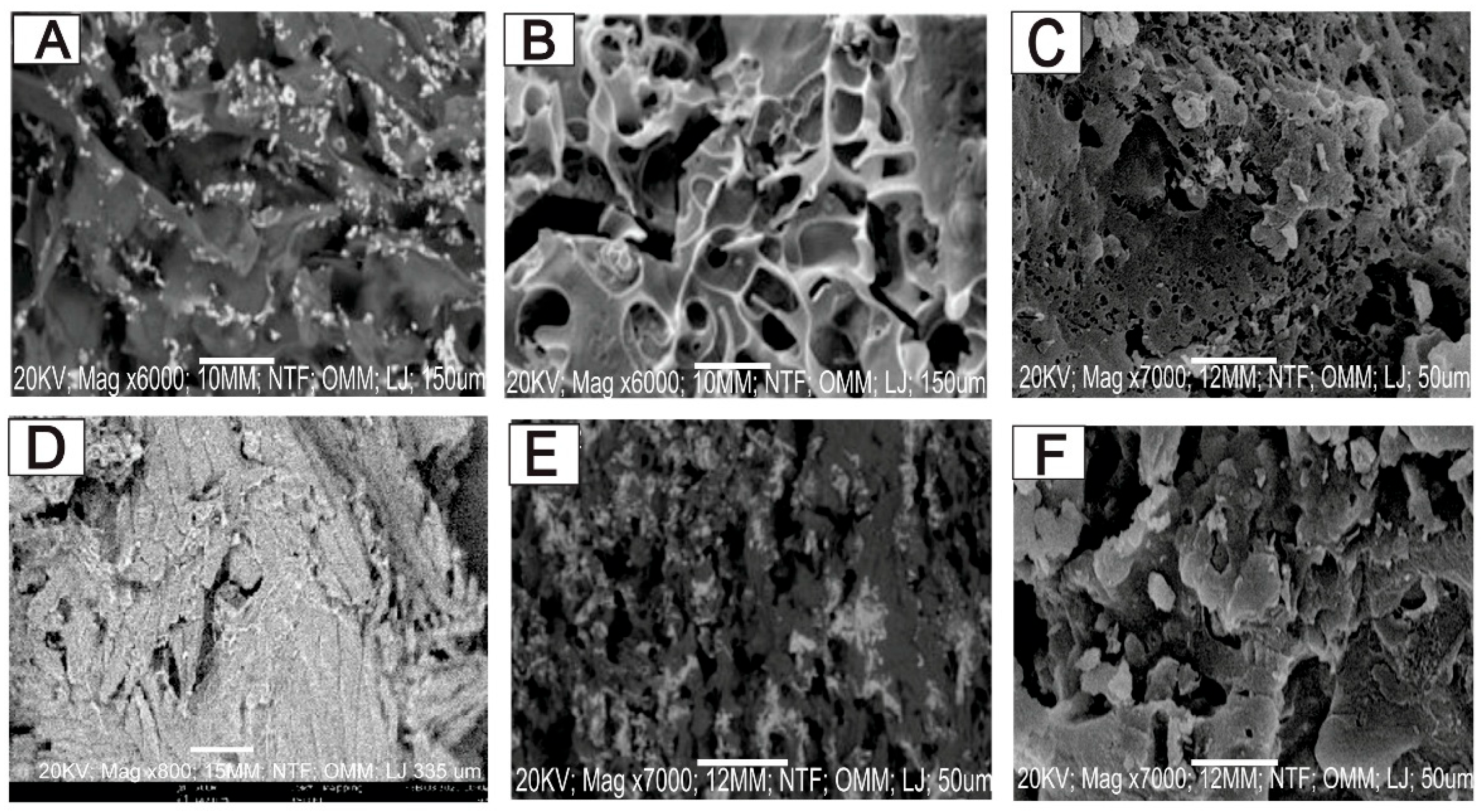
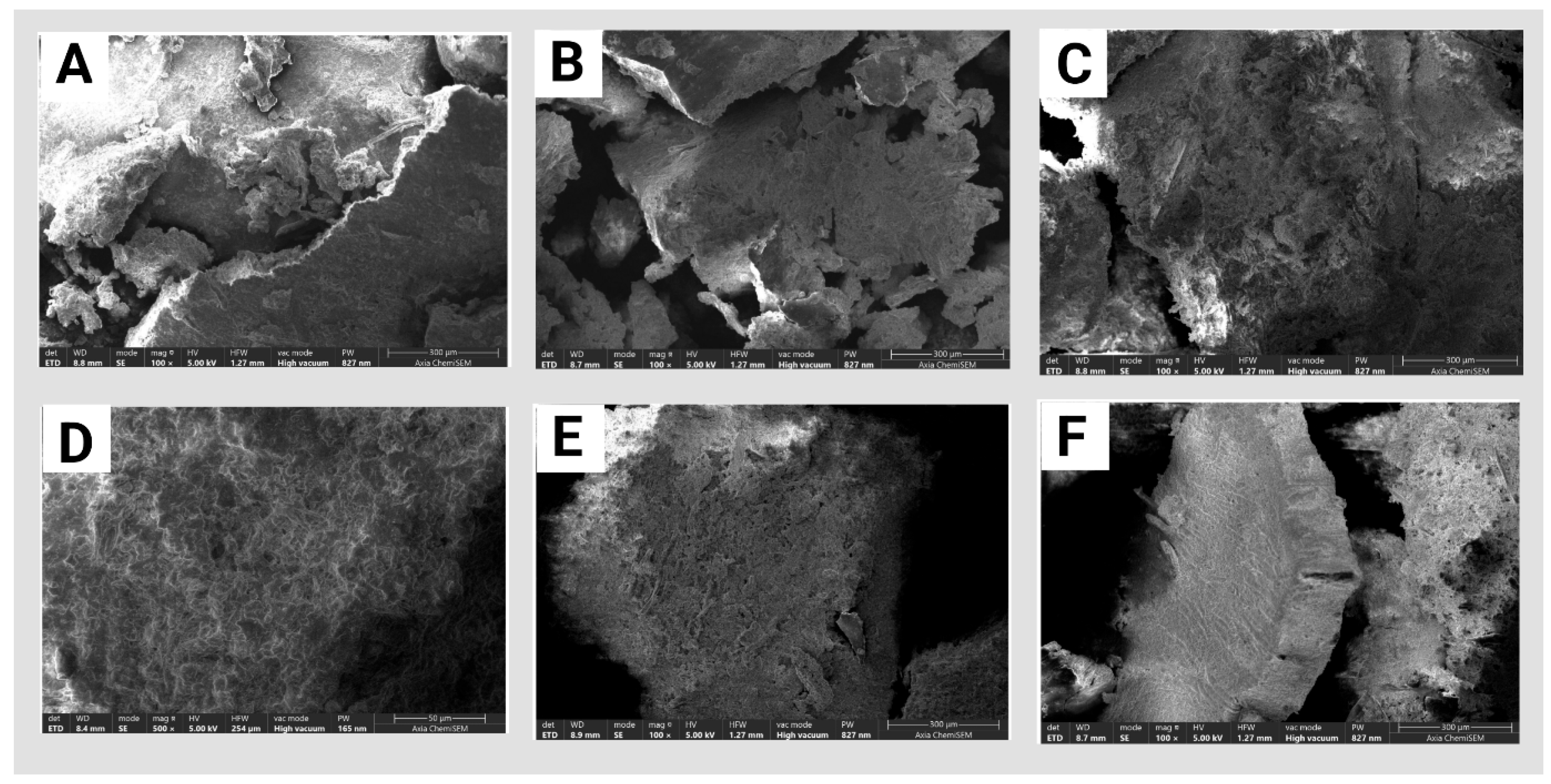
In the original publication, there was a mistake in Figure 4. SEM images of (P-PA (A), E-PA (B), I-PA (C), spent P-PA (D), spent E-PA (E), spent I-PA (F)) as published. The wrong image was unknowingly presented during the manuscript preparation. The corrected Figure 4. SEM images of (P-PA (A), E-PA (B), I-PA (C), spent P-PA (D), spent E-PA (E), spent I-PA (F)) appears below.
Original Figure 4:
Updated Figure 4:
Text Correction
Following the correction of Figure 4, the corresponding description in the text has been updated to ensure consistency with the revised figure. A correction has been made to Section 3. Results and Discussion; Section 3.1.2. SEM Analysis.
Original text:
The surface morphologies of the adsorbents before modification, after modification, and after adsorption under different magnifications are presented in (Figure 4). The pure adsorbent (see Figure 4A) shows shallow pore structures. However, after modification (Figure 4B,C), the outer surface showed a heterogeneous, rough, uneven display of its surface with sufficient cavities, which will possibly be favorable for the adsorption of Pb(II) ion. The rough, sufficient, and larger cavities observed could be attributed to the impacts of the activation on the sorbent [25].
After adsorption, due to the presence of Pb(II) impurities, the SEM image revealed a homogenous and filled surface (Figure 4E,F) [64]. Similar observations have been reported by other researchers [23,65]. Shafiq et al. [65] developed a biosorbent from Eucalyptus camdulensis biochar. Before adsorption, the external EU-biochar surface was rough and had significant pore structures, while after adsorption processes, the adsorbent surface consisted of minute particles and brighter zones.
Updated text:
The surface morphologies of the adsorbents before modification, after modification and after adsorption are presented in Figure 4. The adsorbent before modification (see Figure 4A) shows a cracked and uneven surface with limited pores. Similar morphologies were also observed for the adsorbents after modification (see Figure 4B,C). However, there was the observable presence of large agglomerates and pores, which could be attributed to the impact of the chemical activation [25]. The pore cavities and irregular shapes observed have been reported to be favorable for the adsorption of Pb(II) ions [64]. The higher pore cavities observed after modification are also consistent with the BET analysis result, which indicated an increase in pore diameter and surface area for (E-PA) after modification.
After adsorption, there were observable changes in the surface morphologies of the adsorbents. The SEM image revealed a homogenous, smoother, less porous, and filled surface, which could be attributed to the presence of Pb(II) impurities (see Figure 4D,F). Similar observations have been reported by other researchers [23,65]. Shafiq et al. (2021) [65] developed a biosorbent from Eucalyptus camdulensis biochar. Before adsorption, the external EU-biochar surface was rough and had significant pore structures, while after adsorption processes, the adsorbent surface consisted of minute particles and brighter zones. Further, the observed decrease in pore cavities and smoother surface after adsorption suggest potential for pore filling and surface adsorption [64].
References
Reference [64] should be replaced with the following new reference.
Original reference 64: Ahmad, M.; Ahmad, M.; Usman, A.R.A.; Al-Faraj, A.S.; Abduljabbar, A.S.; Al-Wabel, M.I. Biochar Composites with Nano Zerovalent Iron and Eggshell Powder for Nitrate Removal from Aqueous Solution with Coexisting Chloride Ions. Environ. Sci. Pollut. Res. 2017, 25, 25757–25771. https://doi.org/10.1007/s11356-017-0125-9.
Updated reference 64: Wei, F.; Jin, S.; Yao, C.; Wang, T.; Zhu, S.; Ma, Y.; Qiao, H.; Shan, L.; Wang, R.; Lian, X.; et al. Revealing the Combined Effect of Active Sites and Intra-Particle Diffusion on Adsorption Mechanism of Methylene Blue on Activated Red-Pulp Pomelo Peel Biochar. Molecules 2023, 28, 4426. https://doi.org/10.3390/molecules28114426.
The authors state that the scientific conclusions are unaffected. This correction was approved by the Academic Editor. The original publication has also been updated.
Reference
- Ezugwu, A.L.; Abugu, H.O.; Ucheana, I.A.; Eze, S.I.; Egbueri, J.C.; Aigbodion, V.S.; Akpomie, K.G. Sequestration of Lead Ion in Aqueous Solution onto Chemically Pretreated Pycnanthus angolensis Seed Husk: Implications for Wastewater Treatment. Sustainability 2023, 15, 15446. [Google Scholar] [CrossRef] [Scilit]
Disclaimer/Publisher’s Note: The statements, opinions and data contained in all publications are solely those of the individual author(s) and contributor(s) and not of MDPI and/or the editor(s). MDPI and/or the editor(s) disclaim responsibility for any injury to people or property resulting from any ideas, methods, instructions or products referred to in the content. |
© 2026 by the authors. Licensee MDPI, Basel, Switzerland. This article is an open access article distributed under the terms and conditions of the Creative Commons Attribution (CC BY) license.