


Abstract
Revegetation of mine tailings is constrained by their acidity, low fertility, and elevated concentrations of potentially toxic elements. This study explored the growth and elemental accumulation of three perennial grasses, Phleum pratense ‘Tirom’, Lolium perenne ‘Mara’ and Festuca pratensis ‘Transilvan’, in substrates containing polymetallic tailings from the Aurul pond (Baia Mare, Romania) in a 12-week pot experiment with a 3 × 4 factorial design (36 pots in total). The tailings were used unamended or mixed with municipal green-waste compost, natural zeolite loaded with NH4+ from livestock-farm leachate, or both. Because of the high amendment-to-tailings ratios, the tailings represented approximately 9% of substrate volume in the single-amendment treatments and 5% in the combined treatment. Plant growth, fresh aboveground biomass, and substrate-to-plant transfer factors (TFs) of Cr, Ni, Cu, As, Cd, Pb, Mn, Zn, and Fe were determined. All three species grew very poorly on unamended tailings (final height 0.5–4 cm; biomass 0.05–2.1 g pot−1), whereas amendment-dominated substrates supported greater plant height (12.5–16.8 cm) and fresh aboveground biomass (7.5–11 g pot−1), with small differences among them. TFs remained below 1 for Cr, Ni, Cu, Cd, Pb, and Fe in all amended treatments. Descriptive comparisons indicated that zeolite-containing substrates showed lower Cd and Zn TFs than compost alone, while the combined substrate showed lower As and Mn TFs than single-amendment treatments. However, As TFs exceeded 1 in all treatments (1.95–3.21), indicating persistent arsenic accumulation. Because elemental concentrations were determined from a single composite sample per species–treatment combination, TF comparisons were descriptive and exploratory and did not support statistical significance testing. These findings demonstrate improved grass establishment in amendment-dominated substrates rather than the effectiveness of low-rate tailings amendment. Further studies using higher tailings proportions, field-relevant amendment rates, and independent chemical replicates are required to assess the feasibility of assisted phytostabilization as a sustainable option for mine-site rehabilitation based on local waste-derived amendments.
1. Introduction
Mine tailings from ore processing are nutrient-deficient substrates with unsuitable physicochemical properties and elevated concentrations of potentially toxic elements (PTEs) that create an environment unfavorable to establishing vegetation needed for stabilization, erosion reduction, and limiting the dispersal of particulate matter [1,2,3]. In the Baia Mare mining district (NW Romania), tailings ponds resulting from the processing of polymetallic and gold ores are located close to settlements, agricultural land, and rivers, and the dispersal of fine particles from their exposed slopes is a persistent environmental concern [4,5]. Unlike phytoextraction, phytostabilization prioritizes contaminant immobilization, erosion reduction, and limiting metal transfer to aboveground plant parts by maintaining persistent vegetative cover [6]. Amending such substrates with organic or mineral materials can both reduce the mobility and transfer of potentially toxic elements and create conditions conducive to biomass growth [7,8,9]. Adding compost can increase organic matter content, improve fertility and substrate pH, and, through interactions between organic matter and metals, reduce their availability to plants [10]. Compost-assisted phytostabilization has been demonstrated under both greenhouse and field conditions [11,12,13,14]. However, organic amendments may also mobilize anionic elements such as arsenic [15]. Zeolites, by contrast, have high ion-exchange capacity and sorption properties that may retain certain metallic elements and reduce their mobility within the substrate [16]. Zeolitic tuff from Maramureș County has shown good sorption capacity for Pb2+, Cu2+, and Zn2+ [17]. Zeolites also retain NH4+ and can therefore be loaded with ammonium recovered from nitrogen-rich waste streams, acting as a nitrogen source for plants [18,19]. Therefore, combining compost and zeolite may have a complementary effect, where improvements in substrate properties through the addition of organic matter and nutrients are coupled with increased capacity to retain elements through ion-exchange and sorption processes [20].
Grasses play an important role in the phytostabilization of heavy-metal-contaminated soils, and species of the Poaceae family have performed well owing to their rapid growth, dense fibrous root systems, and stress tolerance [21]. Other studies indicate that applying organic and/or mineral amendments creates favorable conditions for the growth of perennial grasses with phytostabilizing effects, such as Phleum pratense [22], Lolium perenne [3,6,23,24], and Festuca pratensis [25]. However, differences in root structure, establishment rate, nutrient requirements, and metal tolerance can lead to species-specific responses to amendments. In grass-based systems, compost improved plant growth and the substrate’s biological fertility, but reductions in the bioaccessibility of potentially toxic elements were not always statistically significant [26]. Moreover, high biomass and amendment application can also promote metal uptake without guaranteeing reduced ecological risk; phytostabilization performance should therefore be assessed using both vegetation and contaminant-transfer indicators [3,27].
Despite growing interest in assisted phytostabilization, comparative information on the performance of Phleum pratense, Lolium perenne, and Festuca pratensis grown on mine tailings remains limited, and, to our knowledge, NH4+-loaded zeolite applied alone and in combination with compost has rarely been evaluated for this purpose. Loading local zeolitic tuff with ammonium from livestock-farm leachate and combining it with municipal green-waste compost would also valorize two local waste streams in a circular approach to mine-site rehabilitation. We hypothesized that (i) amendment application would improve grass establishment and biomass production compared with unamended tailings; (ii) the combined zeolite–compost treatment would be associated with lower PTE transfer to aboveground tissues than either amendment alone; and (iii) the response would be species- and element-specific. Accordingly, the study aimed to: (i) evaluate the establishment and biomass production of P. pratense ‘Tirom’, L. perenne ‘Mara’ and F. pratensis ‘Transilvan’ on tailings from the Aurul pond (Baia Mare, Romania); (ii) compare the effects of compost, NH4+-loaded zeolite and their combination; and (iii) describe the transfer of PTEs from the amended substrates to aboveground plant tissues using transfer factors as a screening indicator, without directly measuring immobilization. The study’s novelty lies in simultaneously assessing three perennial grass species and two functionally distinct amendments, including NH4+-loaded zeolite obtained from a local waste stream, applied individually and in combination, within the same experimental framework. By integrating plant productivity with contaminant-transfer indicators, this preliminary screening study aims to identify plant–amendment combinations that warrant further testing for the phytostabilization of mine tailings. The study also addresses sustainability by testing an ecological remediation approach for land degraded by mining activities, based on locally available natural resources, the valorization of organic and agricultural waste, and the mitigation of the environmental impacts associated with tailings contamination. In this way, it relates to three dimensions of sustainable development: the environmental dimension, through the potential to restore vegetation cover and ecosystem functions and to reduce erosion; the economic dimension, through the use of locally available materials and the recovery of nutrients from waste streams; and the social dimension, through the potential reduction in pollution risks for communities living near tailings ponds.
2. Materials and Methods
A pot experiment employing a 3 × 4 factorial design (three grass species × four substrate treatments; three replicate pots per combination; 36 pots in total) was conducted to assess grass establishment, biomass production, and elemental transfer in substrates containing mine tailings mixed with compost, NH4+-loaded zeolite, or both.
2.1. Materials Used
The experiment evaluated three perennial grass species: Phleum pratense ‘Tirom’, Lolium perenne ‘Mara’, and Festuca pratensis ‘Transilvan’. We collected mine tailings from the Aurul tailings pond embankment and amended them with locally sourced green-waste compost from the municipal composting facility operated by the Public Service for the Urban Environment—Baia Mare (SPAU) and zeolitic tuff from Valea Morii, Bârsana (Maramureș County).
Before preparing the substrate, we enriched the zeolite with ammonium ions by contacting it with leachate from local livestock farms. We selected these amendments to promote the use of locally available resources and recover nutrients from organic waste streams.
2.2. Conducting the Experiment
Four substrate treatments were prepared (Table 1): T1, unamended tailings (control); T2, tailings + compost; T3, tailings + NH4+-loaded zeolite; and T4, tailings + NH4+-loaded zeolite + compost. The amendments were thoroughly mixed with the tailings at volumetric ratios of 1:10 (tailings:compost) for T2, 1:10 (tailings:NH4+-loaded zeolite) for T3, and 1:10:10 (tailings:NH4+-loaded zeolite:compost) for T4, so that the tailings accounted for approximately 9% (T2, T3) and 5% (T4) of the substrate volume.
Table 1.
Experimental design: three grass species × four substrate treatments, with three replicate pots per combination (36 pots in total). Codes in the table identify the pots (species letter + treatment number).
Polyethylene pots (12 cm diameter, 690 mL) with drainage holes and individual trays for leachate collection were each filled with 500 g of substrate and sown with 0.10 g of seeds of a single species. Each species × treatment combination was replicated three times. Pots were coded A (P. pratense), B (L. perenne) and C (F. pratensis), followed by the treatment number (Table 1). For chemical analysis, material collected from the three replicate pots of each species × treatment combination was pooled to obtain a single composite sample, which was analyzed once rather than separately for each replicate.
The experiment was carried out under laboratory conditions at the Technical University of Cluj-Napoca, North University Centre of Baia Mare, Romania, from 8 April to 30 June 2018 (12 weeks). Plants were maintained at ambient room temperature (approximately 20–24 °C), and relative humidity was not actively controlled. Plants were exposed exclusively to natural daylight entering through west-facing laboratory windows, without supplemental artificial lighting; the natural photoperiod varied from approximately 13 to 16 h over the experimental period. Pots were randomly arranged and repositioned weekly to minimize positional effects.
After sowing, the pots were watered with double-distilled water (50 mL per pot) daily during the first week, then twice a week or whenever the substrate appeared dry, applying equal amounts of water to all pots. Plant height was measured weekly in each pot throughout the 12 weeks using a ruler held vertically, from the substrate surface to the tip of the gently straightened leaves. In each pot, the two tallest plants were measured and their mean was recorded as the pot value, to avoid relying on a single, possibly atypical, plant. Seedling emergence and the number of established plants per pot were not recorded.
At the end of the 12 weeks, the plants were cut at the substrate surface, and the fresh aboveground biomass of each pot was weighed using an analytical balance (Shimadzu, type ATX324R; Shimadzu Corporation, Kyoto, Japan).
2.3. Characterization of Mine Tailings
The tailings used in this study were collected from the Aurul tailings pond, located southwest of the municipality of Baia Mare. This lowland pond, an active facility where operations were temporarily suspended, was constructed between 1996 and 1998 with an impermeable base and a water drainage and recirculation system to store tailings from reprocessing the Meda tailings deposit [28,29]. It has a design capacity of 15 million tonnes and was filled to one-third by 2006, when it was temporarily closed [4]. The pond lies approximately 2900 m from the built-up area of Baia Mare, 1400 m from Tăuții Măgherăuș and 800 m from the western edge of Săsar; it borders pasture to the north and agricultural land to the east, and is adjacent to the Săsar pond and the Săsar and Lăpuș rivers to the south–southeast and to the Bozânta pond to the southwest [28].
Tailings were sampled from the embankment slope of the pond, owned by SC Romaltyn Mining SRL, in March 2018. To obtain a homogeneous sample, we collected material from 30 points on the slope at a depth of 5–20 cm, after first removing the surface layer, which was either oxidized or covered by a thin layer of soil.
The tailings material is predominantly mineral mining material, ranging from fine-grained to sandy, with particle sizes below 1 mm and, in some areas, up to a few millimeters [5]. Its matrix consists of silicates, clay minerals, iron oxides and oxyhydroxides, carbonates, and residual sulfides such as pyrite, chalcopyrite, arsenopyrite, galena, and sphalerite. The material contains Fe, Cu, Pb, Zn, As, Cd, and other elements associated with polymetallic ores, as well as potential traces of processing reagents and metal–cyanide complexes [5].
Mine tailings’ fine grain size and sulfide content increase geochemical reactivity and oxidation-driven acidification, raising the risk of metal mobilization and phytotoxic effects. Consequently, their use as a plant growth substrate is constrained by their mineral nature, low fertility, and contamination potential, necessitating organic amendments, pH adjustment, and the monitoring of pH levels and bioavailable metals [5].
The mine tailings were strongly acidic (pH 4.1 ± 0.3) and moderately saline (EC 2880 ± 330 µS cm−1), with a predominantly sandy texture (78% sand, 22% silt) (Table 2). Organic carbon (0.6 ± 0.1%) and available P (8.5 ± 0.7 mg kg−1) were low, and the cation-exchange capacity (12 ± 2 cmol kg−1) indicated limited nutrient retention. The high total sulfur content (2.2 ± 0.2%), consistent with residual sulfides, suggests a potential for further acidification through sulfide oxidation. Among the potentially toxic elements (Table 2), Cu (130.1 mg kg−1) and Pb (76.0 mg kg−1) exceeded the alert thresholds for sensitive land use under Romanian legislation (Order 756/1997); Mn (1508 mg kg−1) was close to its alert threshold, and Cr, As, and Cd exceeded the normal values, whereas Zn and Ni remained within the normal range. Overall, the tailings represent an acidic, nutrient-poor substrate with an elevated metal load, i.e., restrictive conditions for plant establishment that justify the use of amendments [30].
Table 2.
Physicochemical characteristics of the mine tailings substrate.
2.4. Characterization of Compost
We obtained the compost used to enrich the nutrient content of the sowing substrate from the composting facility operated by SPAU (Baia Mare Urban Environment Public Service). We selected compost that had reached the final maturation stage and was sieved to remove large particles. Before sampling, we removed the upper 5–10 cm layer. We then collected eight subsamples from a compost batch and thoroughly mixed them to obtain one representative, homogeneous composite sample.
We then passed the samples through sieves with mesh sizes of 10, 2, and 0.25 mm. Only the subsample used for moisture determination was oven-dried at 105 °C until constant mass; a 500 g portion of each sample was retained as a backup. The compost used in the pot experiment was only air-dried at ambient temperature (20 ± 4 °C) and was not oven-dried. To determine moisture content, pH, soluble nutrients (nitrogen, ammonium, magnesium, phosphorus, and potassium), total organic carbon (TOC), and total nitrogen (TN), we ground the samples to a particle size below 10 mm. Before TOC and TN analyses, we dried the corresponding subsamples at 40 °C.
We determined moisture content gravimetrically by drying a compost sample at 105 °C until constant mass and expressed it as a percentage. We measured pH potentiometrically in a compost suspension prepared with 0.01 M CaCl2 at a solution-to-compost ratio of 10:1, using an InoLab 730 laboratory pH meter (WTW, Weilheim, Germany).
Total organic carbon was quantified by catalytic oxidation followed by non-dispersive infrared detection (NDIR), and total nitrogen was determined by chemiluminescence detection (CLD). Humic substances were determined according to the method established by the International Humic Substances Society [35,36]. Humic substances were extracted with 0.1 M NaOH solution and subsequently quantified after oxidation with potassium permanganate.
The compost exhibits physicochemical properties favorable for use as a soil amendment: a neutral pH (7.14), 38.6% moisture content, moderate soluble salt content (2058 µS cm−1), a high proportion of humus (36.4%), and a balanced C:N ratio (16.6). The total nitrogen content (3.2% dry matter) exceeds the recommended minimum value, indicating a substantial nutrient contribution for grass crops (Table 3).
Table 3.
Physicochemical parameters of the compost.
2.5. Characterization of Zeolitic Tuff and Leachate
The zeolitic tuff was sampled from the quarry at Valea Morii, Bârsana Commune, Maramureș County. The zeolite used is a natural volcanic tuff composed mainly of clinoptilolite and characterized by high SiO2 (72.42%) and Al2O3 (12.22%) contents. Its porous structure confers ion-exchange, adsorption, and water-retention capacities, properties that can influence the availability of mineral elements and the growth conditions for grasses within the tailings substrate. Adsorption efficiency increases as particle size decreases [17].
We ground the material to a micron-scale particle size using a mortar and pestle. The experiment used zeolite with a particle size of < 65 µm.
As an eco-friendly approach, we brought the collected zeolite into contact with leachate from the runoff of manure piles on small-scale livestock farms. Chemical analysis of the leachate revealed an NH4+ concentration of 77.3 mg L−1.
To load the zeolite with ammonium, the zeolite and the leachate were mixed at a solid-to-liquid ratio of 1:10 (g:mL) and agitated for 3 h on a Heidolph Unimax 1010 orbital shaker (Heidolph Scientific Products GmbH, Schwabach, Germany).
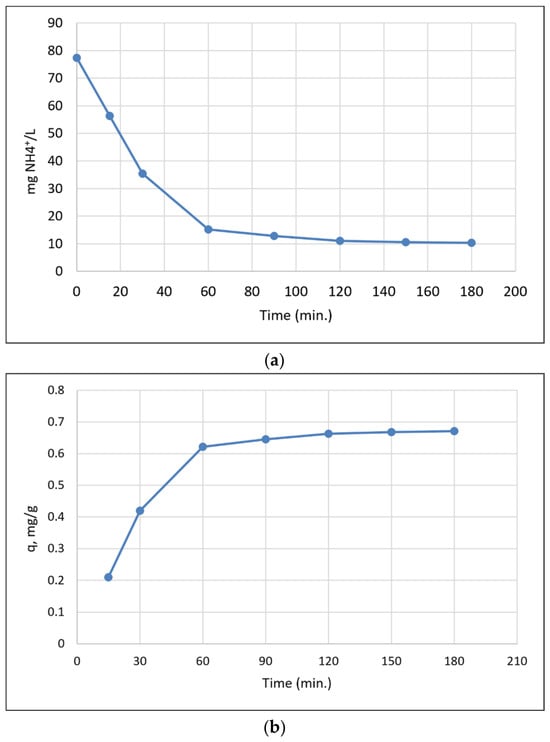
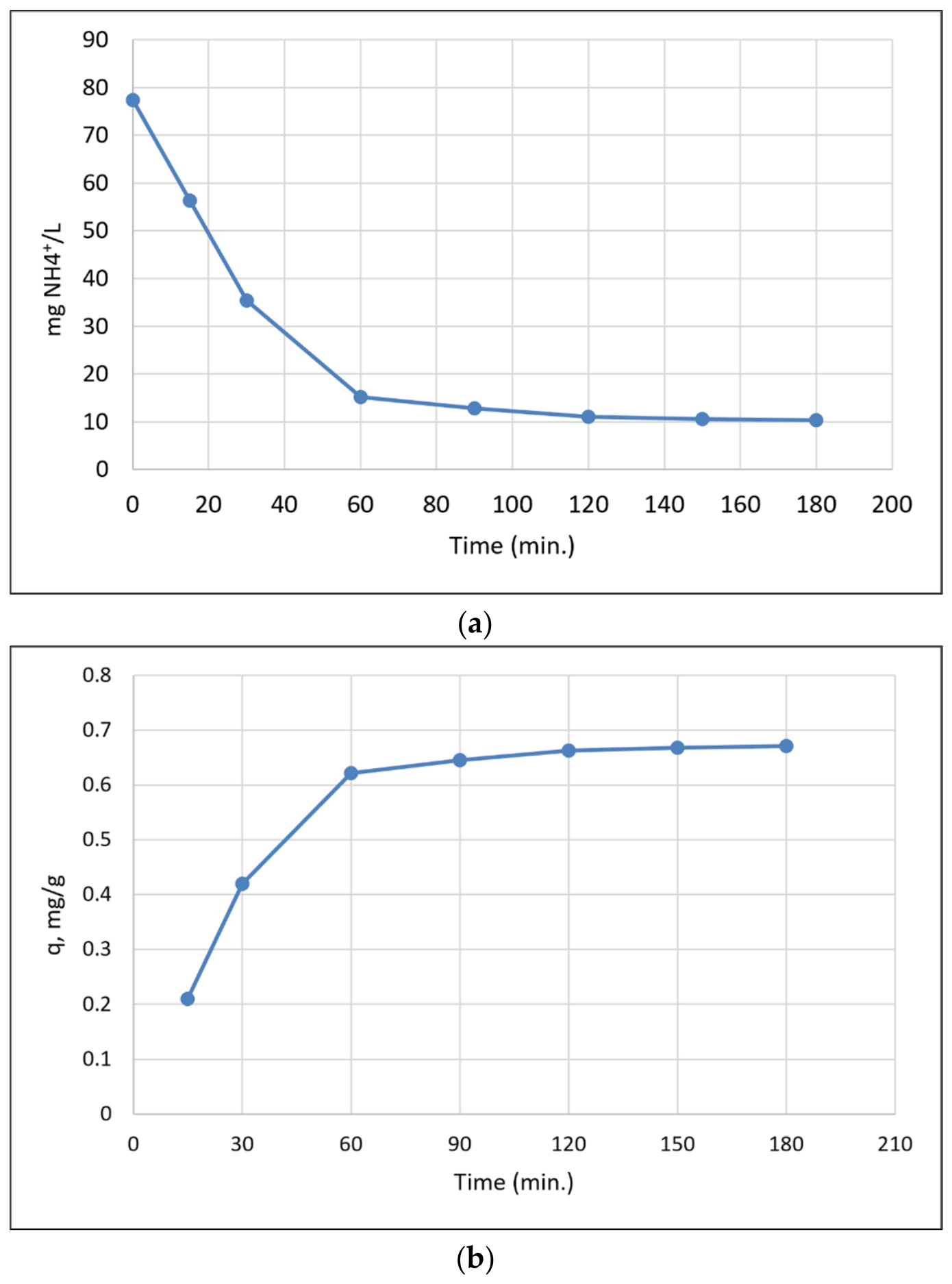
Leachate samples were collected in 15 mL glass tubes after 15, 30, 60, 90, 120, 150, and 180 min of contact to determine the NH4+ concentration (Figure 1). The mixture was then left to stand until 24 h after the start of contact, when the NH4+ concentration was determined again to confirm that equilibrium had been reached, and the NH4+-loaded zeolite was separated by filtration.
Figure 1.
Loading zeolite with ammonium: (a) NH4+ concentration in the leachate during contact with the zeolite; (b) ammonium adsorption capacity of the zeolite.
The adsorption capacity for the ammonium ion from the leachate was calculated using the following relationship [17,38]:
where
- q—amount of ammonium ion adsorbed per unit mass of zeolite (mg g−1);
- C0—initial concentration of NH4+ in the solution (mg NH4+/L);
- C—equilibrium concentration of NH4+ (mg NH4+/L);
- V—volume of the contact solution (mL);
- m—mass of the zeolite (g).
The ammonium ion concentration was determined spectrophotometrically using a molecular absorption spectrophotometer, in accordance with the analytical standard SR ISO 7150-1:2001 [39]. The method is based on the formation of a blue-green colored compound, measurable photometrically at 655 nm, resulting from the reaction of ammonium ions with sodium salicylate and the hypochlorite ion (generated in situ via the basic hydrolysis of sodium dichloroisocyanurate) in the presence of sodium nitroprusside. Concentrations were determined using a calibration curve generated on an Agilent UV-Vis spectrophotometer (Agilent Technologies, Inc., Santa Clara, CA, USA) from a a NIST-traceable Merck reference material (Merck KGaA, Darmstadt, Germany), with a correlation coefficient (R2) of 0.9983.
2.6. Selection of Grass Species and Cultivars
Three perennial grass cultivars were used: Phleum pratense ‘Tirom’, Lolium perenne ‘Mara’ and Festuca pratensis ‘Transilvan’. Perennial grasses were chosen because they can form a persistent vegetative cover with dense fibrous root systems, which is central to the phytostabilization of mine tailings [21]. All three species have been investigated on metal-contaminated substrates (P. pratense [22], L. perenne [3,6,23,24] and F. pratensis [25]), but they differ in growth habit and establishment rate, which allowed species-specific responses to the amendments to be compared under identical substrate and growth conditions. All three are synthetic cultivars developed at the Research-Development Institute for Grassland Brașov and registered in Romania in 1979 (‘Tirom’), 1989 (‘Mara’) and 1988 (‘Transilvan’). ‘Tirom’ is recommended for pasture mixtures, ‘Transilvan’ for hay production or mixed use, and ‘Mara’ for pastures and turf, all in areas with adequate moisture [40]. Because they were bred and tested under Romanian conditions, these cultivars are expected to be well adapted to the regional climate, making the results directly relevant to the revegetation of tailings ponds in the region. Seeds were obtained from the Research-Development Institute for Grassland Brașov, Romania.
2.7. Methodology for Determining Metal Concentrations in the Substrate and Plants
We prepared the sample as a composite by collecting material from several points across the slope surface. We combined and homogenized the collected samples to obtain a representative sample of the material under investigation. We obtained the sample for laboratory analysis from the homogenized composite sample using the quartering method. At harvest, the substrate from the three replicate pots of each treatment was likewise combined into one composite sample, which was used to calculate the transfer factors. We dried a 100 g portion of each subsample at ambient temperature (T = 23 ± 2 °C), milled it, and sieved it through a 1 mm mesh sieve using a Retsch AS200 device (Retsch GmbH, Haan, Germany). We then weighed 1 ± 0.05 g of substrate and mineralized it in Teflon tubes in a Milestone Ethos Easy microwave oven (Milestone Srl, Sorisole, Italy). Mineralization was performed with an acid mixture consisting of 18 mL HCl 37%, 6 mL HNO3 65%, and 2 mL H2O2 30%, in two stages: (i) the temperature was increased to 200 °C over 10 min; and (ii) the temperature was maintained at 200 °C for 15 min (Digestion Application Note DG_EN_12) [41].
For each treatment, 0.5 g of aboveground biomass (composite sample of the three replicate pots), oven-dried at 105 °C and ground, was mineralized in Teflon tubes in a Milestone Ethos Easy microwave system (Milestone Srl, Sorisole, Italy). The acid mixture contained 1 mL of 96% H2SO4, 20 mL of 65% HNO3, and 4 mL of 30% H2O2, and the procedure comprised two stages: (i) heating to 200 °C over 10 min and (ii) holding at 200 °C for 20 min (Digestion Application Note DG-FO-58) [42].
Following mineralization, the solutions obtained from the substrate and plant samples were transferred to 100 mL volumetric flasks and made up to volume with ultrapure water. The metal concentrations were then determined under the analytical conditions presented in Table 4, using a PerkinElmer PinAAcle 900T atomic absorption spectrometer (PerkinElmer Inc., Waltham, MA, USA): Fe, Mn and Zn by flame atomization (SR 13315:1996 [34], SR 8662-2:1996 [32] and SR ISO 8288:2001 [33], respectively), and Cr, Ni, Cu, As, Cd and Pb by electrothermal atomization (SR EN ISO 15586:2004 [31]).
Table 4.
Analytical conditions used to determine metallic and metalloid elements.
The accuracy of the analytical results was assessed using the certified reference material NIST SRM 2710a (Montana I Soil—Highly Elevated Trace Element Concentrations, National Institute of Standards and Technology, Gaithersburg, MD, USA), which was processed using the same analytical procedure as the substrate samples [43]. For the metals of interest, the measured values met the acceptability criteria specified in the reference material quality certificate (uncertainty, k = 2), and the recovery rate was 95–105%.
Substrate-to-plant transfer factors (TFs), also referred to as bioconcentration factors (BCF) [2], were calculated as
where
- Cplant—element concentration in the aboveground biomass (mg kg−1);
- Csubstrate—element concentration in the substrate of the same treatment at harvest (mg kg−1), both expressed on a dry-weight basis.
For each treatment, element concentrations were determined from one composite sample obtained by pooling the substrate and, separately, the aboveground biomass from the three replicate pots; TF values are therefore reported as single values without measures of variability, and they were evaluated descriptively (Section 2.9). The biomass produced on unamended tailings (A1, B1, C1) was insufficient for elemental analysis; consequently, TFs could not be determined for these treatments, and comparisons are limited to the amended treatments.
To compare the As, Cd and Pb concentrations in the grasses, expressed on a dry-matter basis, with the EU maximum limits for feed (Directive 2002/32/EC), which refer to a moisture content of 12%, the values were converted as follows:
where
- CDM—metal concentration expressed on a dry matter basis (mg kg−1 DM);
- C12% moisture—metal concentration expressed at 12% moisture (mg kg−1 feed);
- 0.88.—dry matter fraction of feed containing 12% moisture.
2.8. Growth Indices
Total growth increment (TGI) is defined as the difference between the final and initial height of the grass species [44,45,46].
where
- Hf—final height (week 12);
- Hi—initial height (week 1).
The mean weekly growth rate (MWGR) was calculated as the ratio of total growth to the duration of the experiment (growth intervals) (cm·week−1) [44,47].
where
- n—number of weekly measurements (n = 12).
Relative growth rate (RGR) represents plant growth relative to the initial size [44,46,47].
Plant height and biomass are reported as means of three replicate pots.
The temporal dynamics of plant height were described by fitting second-order polynomial functions:
where
- H—plant height (cm);
- t—time (weeks);
- a, b, and c—regression coefficients [44].
The time of maximum predicted height (tmax) was calculated as
These regressions were fitted to the weekly mean heights of each species × treatment combination and were used to describe growth trajectories rather than to test treatment effects.
2.9. Data Analysis
Growth parameters were available as means of the three replicate pots, and element concentrations were determined on one composite sample per species × treatment combination (Section 2.7). Consequently, each species × treatment combination was represented by a single value, and no inferential statistical tests were applied. Treatment effects were evaluated descriptively by comparing mean values and relative (%) differences among treatments. The study should therefore be regarded as a preliminary screening experiment, and the observed differences require confirmation in experiments with replicate-level measurements.
3. Results and Discussion
3.1. Loading the Zeolite with Ammonium Ions
The NH4+ concentration in the leachate decreased from 77.3 mg L−1 to about 15 mg L−1 within the first 60 min of contact and reached equilibrium (≈10 mg L−1) after 180 min (Figure 1a), corresponding to the removal of about 87% of the initial NH4+.
Accordingly, the adsorption capacity of the zeolite calculated with Equation (1) increased rapidly during the first hour (0.62 mg g−1 at 60 min) and then leveled off at approximately 0.67 mg g−1 (Figure 1b).
3.2. Grass Establishment, Growth and Biomass
The first seedlings appeared 10 ± 2 days after sowing, and by day 16 ± 2, the grasses had begun to develop vigorously, displaying an intense green color.
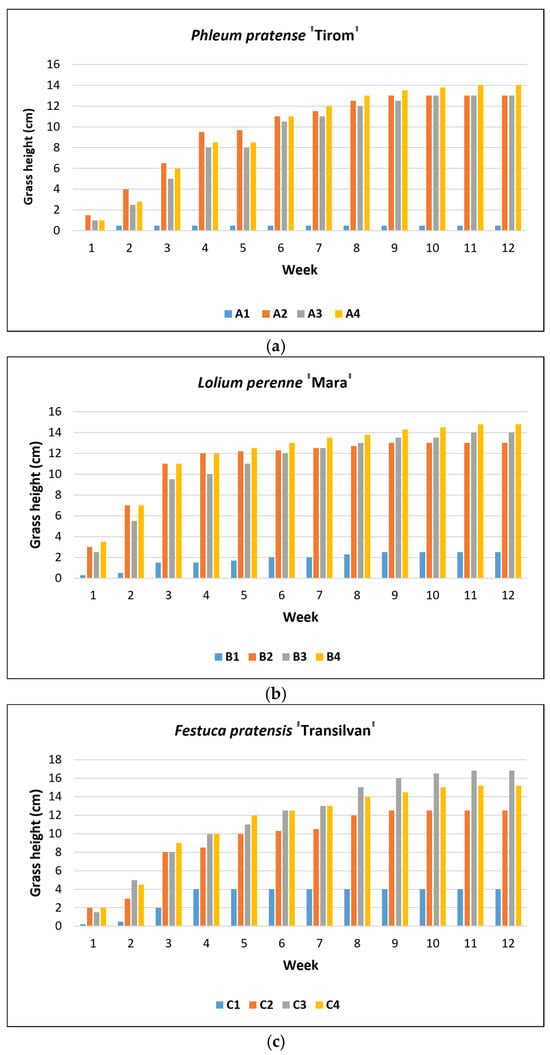
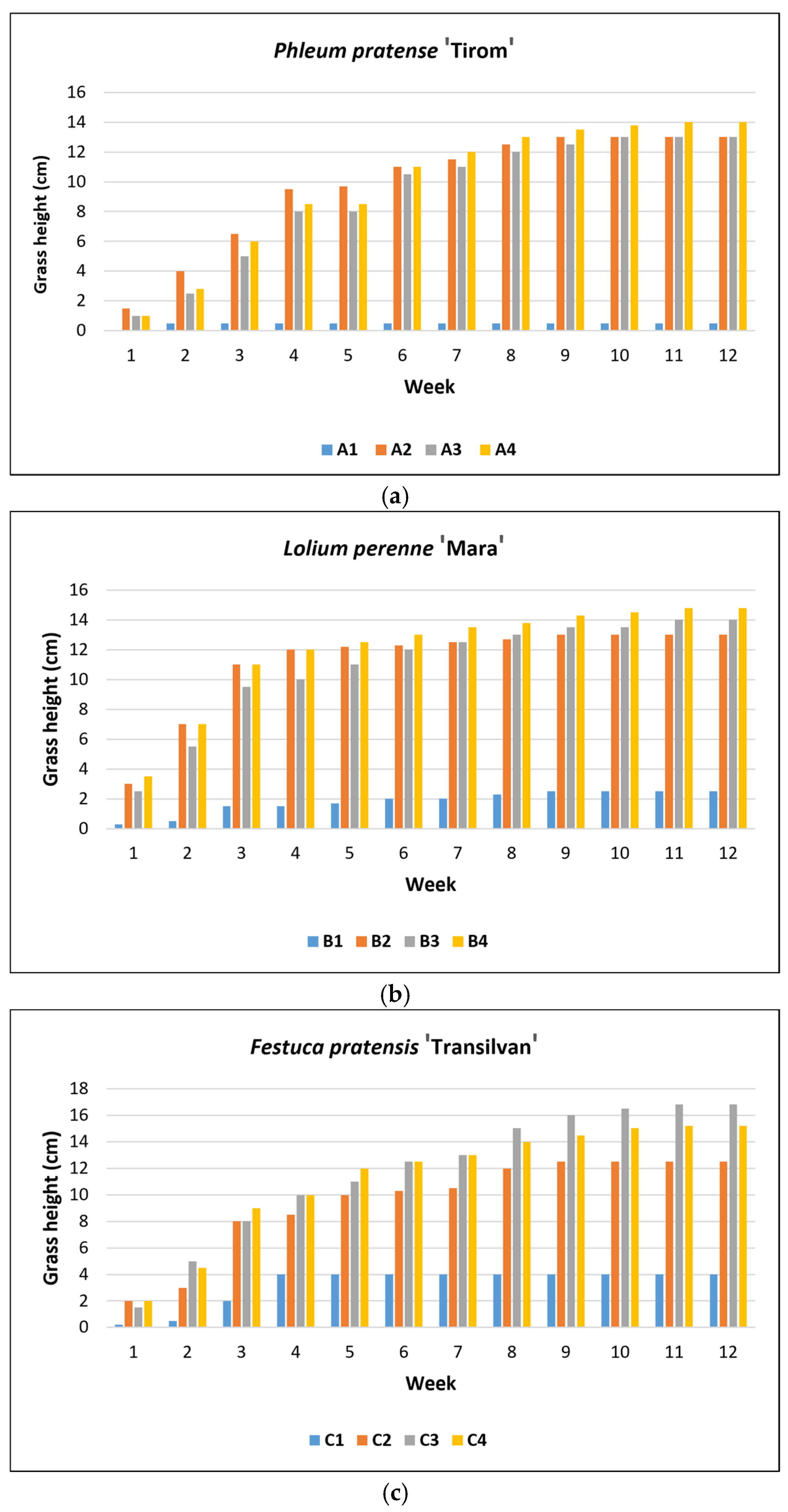
All three species established poorly on unamended tailings, where final heights were only 0.5 cm (P. pratense), 2.5 cm (L. perenne) and 4 cm (F. pratensis), whereas growth was greater in all amended treatments, with final heights of 12.5–16.8 cm (Figure 2a–c; Table 5). As shown in Figure 2a, P. pratense grew fastest on compost during the first four weeks (9.5 cm in week 4, compared with 8.0–8.5 cm on the other amended substrates). From week 6 onwards, however, plants on the combined amendment (A4) overtook those on compost and reached the greatest final height (14 cm), whereas growth on compost (A2) and zeolite (A3) leveled off at 13 cm from weeks 9–10. On unamended tailings (A1), plants stopped growing after the second week, at 0.5 cm.
Figure 2.
Growth dynamics of the three grass species under the four substrate treatments: (a) P. pratense; (b) L. perenne; (c) F. pratensis. Codes: A, P. pratense; B, L. perenne; C, F. pratensis; 1, unamended tailings (control); 2, tailings + compost; 3, tailings + NH4+-loaded zeolite; 4, tailings + NH4+-loaded zeolite + compost (Table 1). Values are means of three replicate pots. Variability could not be shown because only treatment means were recorded.
Table 5.
Growth indices and fresh biomass of the three grass species on the four substrate treatments.
L. perenne grew rapidly during the first three weeks on compost (B2) and on the combined amendment (B4), reaching 11 cm in week 3, whereas growth on zeolite (B3) was initially slower (9.5 cm). After week 4, growth on compost slowed markedly and plateaued at 13 cm, while plants on the combined amendment and on zeolite continued to grow, reaching 14.8 and 14 cm, respectively (Figure 2b). On unamended tailings (B1), height increased only slowly, to 2.5 cm by week 9.
F. pratensis showed similar growth on zeolite (C3) and on the combined amendment (C4) until week 7 (13 cm in both treatments); thereafter, plants on zeolite continued to grow and reached the greatest height of all treatments (16.8 cm), whereas those on the combined amendment reached 15.2 cm and those on compost (C2) leveled off at 12.5 cm from week 9 (Figure 2c). F. pratensis was also the species least affected by the unamended tailings (C1), reaching 4 cm, although its growth stopped after week 4.
Comparing the three species, L. perenne established fastest, reaching 9.5–11 cm on the amended substrates by week 3, compared with 8–9 cm for F. pratensis and only 5–6.5 cm for P. pratense, which is advantageous for the rapid formation of a protective vegetation cover. F. pratensis reached the greatest final heights and was the most tolerant of the unamended tailings, but its response depended most strongly on the type of amendment (12.5–16.8 cm). In contrast, P. pratense showed the slowest initial growth and was the most sensitive to unamended tailings, yet when amended it reached final heights (13–14 cm) similar to those of L. perenne (13–14.8 cm).
In all amended treatments, height increased until approximately weeks 9–11 and then leveled off (Figure 2a–c), while the initially vigorous green leaves turned pale green. This pattern may indicate the end of the main vegetative growth phase and/or the depletion of available nitrogen in the pots.
Second-order polynomial functions described the temporal dynamics of plant height in the amended treatments well (R2 = 0.87–0.99). The negative quadratic coefficients (a) indicate decelerating growth, and the vertices of the fitted curves, corresponding to the predicted time of maximum height, occurred between weeks 8.6 and 11.6 (Table 5), consistent with the growth plateau observed in Figure 2a–c. The latest vertices were obtained for the zeolite-containing treatments of F. pratensis (C3, week 11.6) and P. pratense (A3 and A4, week 10.9), suggesting a more prolonged growth period in the presence of NH4+-loaded zeolite.
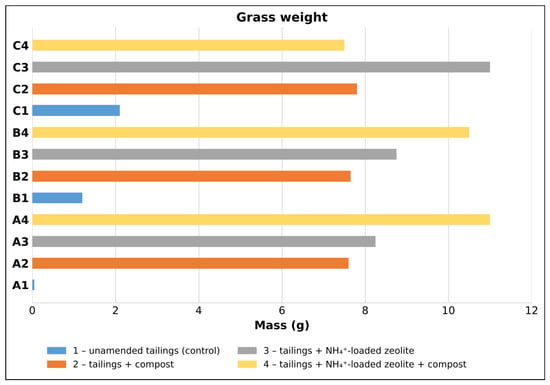
Aboveground biomass at harvest followed a broadly similar pattern (Figure 3; Table 5): it was higher in all amended treatments than on unamended tailings, whereas the differences among compost, zeolite and the combined amendment were small. On unamended tailings, biomass was only 0.05 g (P. pratense), 1.2 g (L. perenne) and 2.1 g (F. pratensis) per pot. The highest biomass was obtained for P. pratense with the combined amendment (A4, 11 g), for F. pratensis with zeolite alone (C3, 11 g) and for L. perenne with the combined amendment (B4, 10.5 g). P. pratense was thus the species most sensitive to unamended tailings but showed the strongest response to the combined amendment. Height and biomass did not always respond in the same way: F. pratensis on the combined amendment (C4) reached 15.2 cm but produced only 7.5 g, the lowest biomass among the amended treatments.
Figure 3.
Fresh aboveground biomass of the three grass species at harvest (week 12). Codes: A, P. pratense; B, L. perenne; C, F. pratensis; 1, 1–4, substrate treatments (Table 1). Values are means of three replicate pots. Variability could not be shown because only treatment means were recorded.
Table 5 summarizes the growth indices and final biomass.
TGI ranged from 0.5–3.8 cm on unamended tailings to 10.0–15.3 cm in the amended treatments, and MWGR ranged from 0.05–0.35 to 0.91–1.39 cm week−1, with the highest values recorded for F. pratensis on zeolite (C3). F. pratensis showed the highest RGR on unamended tailings (C1, 1900%); however, this reflects the very small initial height (0.2 cm) rather than higher productivity, as confirmed by the low biomass (2.1 g). TGI and biomass were therefore used as the main indicators for comparing treatments.
Overall, although the differences among amendments were small, NH4+-loaded zeolite, applied alone or combined with compost, produced the highest TGI and biomass in all three species, and the response to amendments was species-specific. For P. pratense, both TGI and biomass increased in the order compost < zeolite < combined amendment. For L. perenne, the combined amendment produced the highest biomass, although its TGI was similar to that obtained with zeolite alone, suggesting that the combination mainly favored biomass accumulation rather than height growth. For F. pratensis, zeolite alone was more effective than the combined amendment for both height and biomass, indicating a particularly favorable response to NH4+-loaded zeolite. The positive effect of zeolite may relate to the gradual release of adsorbed NH4+ and to the improved water retention conferred by its porous structure [18,19]. The combined amendment was thus associated with the highest biomass in two of the three species, although a synergistic effect cannot be confirmed without a formal analysis of the zeolite × compost interaction. These results indicate that amendment effectiveness depends on both the amendment type and the biological characteristics of each species.
However, these comparisons should be interpreted with caution: although sowing was standardized at 0.10 g of seeds per pot, species-specific differences in seed size, germination and seedling establishment may have led to different plant densities and, consequently, different biomass production. Comparisons among treatments within the same species are therefore more reliable than comparisons between species.
3.3. Transfer of Metals and Metalloids to Aboveground Biomass
We used transfer factors (TFs) to assess element transfer from the substrate to plant tissues across species and treatments (Table 6). TF values above 1 indicate relatively high element accumulation in plant tissues compared with substrate concentrations, whereas values below 1 indicate lower relative accumulation. Because elemental concentrations were determined from a single composite sample pooled from three replicate pots per species–treatment combination (Section 2.7), TF comparisons were descriptive and exploratory, without statistical significance testing (Section 2.9).
Table 6.
Transfer factors (TFs) from substrate to aboveground biomass.
Arsenic showed the highest shoot-to-substrate concentration ratio (TF = 1.948–3.209), followed by Zn (0.747–1.832) and Mn (0.332–1.126). For Cr, Ni, Cu, Cd, Pb, and Fe, all values remained below 1 in all treatments, suggesting predominant retention in the substrate and/or efficient exclusion mechanisms at the root level. However, as roots were not analyzed, these two mechanisms cannot be distinguished.
The results indicate that amendment type influenced elemental transfer. After averaging the values across the three species, the compost treatment was associated with mean TFs of 0.104 for Cr, 0.411 for Ni, 0.301 for Cd, 0.126 for Pb, 0.976 for Mn, 1.624 for Zn, and 0.093 for Fe. In the zeolite treatment, the mean values decreased to 0.078 for Cr, 0.305 for Ni, 0.116 for Cd, 0.753 for Mn, 1.085 for Zn, and 0.063 for Fe. The marked reduction in Cd transfer in the presence of zeolite, approximately 61% compared with the compost treatment, together with the lower Zn transfer, is consistent with the zeolitic material’s high cation-exchange capacity and sorptive surface area. These properties may reduce the metal fraction available for root uptake. However, this effect was not uniform across all elements: the mean Cu TF varied little among treatments (0.23–0.24), while the mean Pb TF increased in the zeolite treatment (from 0.126 to 0.166) because of the high value recorded for L. perenne (B3 = 0.361). Therefore, the effect of zeolite cannot be generalized across elements. Part of this decrease may also reflect a dilution effect associated with greater biomass production, which could not be separated from reduced element availability in the present design.
The combined zeolite and compost amendment was associated with the lowest mean TFs for Ni, Cu, As, Pb and Mn. The mean TFs for Cr, Zn, and Fe were similar to those obtained with zeolite alone, whereas the mean Cd TF was higher (0.179 vs. 0.116). Compared with the compost-only treatment, the averages calculated across the three species were approximately 59% lower for Mn, 46% lower for Pb, 43% lower for Ni, 40% lower for Cd, 32% lower for Zn and Fe, 27% lower for As, and 24% lower for Cr, whereas Cu transfer decreased by only about 2%. This response may suggest that the two amendments are complementary: zeolite can retain cations through ion exchange and adsorption, while organic matter in compost can provide functional groups that complex metals and alter the substrate’s pH, cation exchange capacity, and microbial activity. This remains a plausible mechanistic interpretation; confirming immobilization requires data on pH, dissolved organic carbon, and extractable metal fractions. A dilution effect cannot be excluded for any element; however, F. pratensis showed lower As, Pb and Mn TFs with the combined amendment than with zeolite alone despite producing less biomass (7.5 vs. 11 g pot−1), which suggests that dilution alone does not explain these differences.
Arsenic behaved differently. All TF values exceeded 1, regardless of species or treatment, with the maximum recorded in L. perenne grown on tailings amended with compost (B2 = 3.209). Zeolite applied alone did not reduce As transfer: the mean across the three species increased from 2.728 with compost to 2.897 with zeolite alone. This is consistent with the negatively charged framework of clinoptilolite, which retains cations but has little affinity for anionic arsenate species. In contrast, the zeolite–compost combination was associated with a lower mean (1.988), with the lowest values observed in F. pratensis (C4 = 1.948) and L. perenne (B4 = 2.003).
The responses were also species-specific. Based on the mean values obtained for the three amendments, F. pratensis had the highest TFs for Cr (0.100) and Ni (0.350), while P. pratense had the highest values for Cu (0.276), Mn (0.809), and Zn (1.474). L. perenne had the highest mean values for As (2.712), Pb (0.207), and Fe (0.082). These differences may reflect plant-specific characteristics, such as root system structure, root exudates, growth rate, and how elements are absorbed, immobilized, and transported within the plant. These results suggest that species selection should match the dominant contaminant. For example, F. pratensis limited Mn and Zn transfer relatively well, but not Ni transfer, whereas P. pratense restricted Pb and Fe transfer but showed the highest Zn and Mn transfer.
The analysis of the essential micronutrients Zn and Mn highlights the combined influence of plant species and amendment type on their transfer. For Zn, TF values exceeded 1 in all treatments planted with P. pratense and L. perenne. For F. pratensis, TF values fell below 1 in treatments amended with zeolite (C3 = 0.747) and the zeolite–compost mixture (C4 = 0.945). Given the relatively low total Zn concentration in the tailings (98.4 mg kg−1; Table 2), TF values above 1 for this essential micronutrient are of less concern than those recorded for As. For Mn, TF values greater than 1 were recorded only in the compost-treated treatments with P. pratense (A2 = 1.126) and L. perenne (B2 = 1.114). Applying the zeolite–compost combination reduced the TF for Mn to 0.431, 0.425, and 0.332, depending on the species. These results suggest that the combined amendment reduced Mn transfer. However, the nutritional status of the plants should be assessed because excessive immobilization of essential elements may impair their growth and, consequently, the vegetative stabilization of the tailings.
For metals of high toxicological concern (Cd, Pb and Ni), the lowest TF values were generally recorded in treatments amended with zeolite or the zeolite–compost mixture. For Cd, the minimum value was 0.112 for L. perenne in treatment B3; for Pb, it was 0.056 for F. pratensis in treatment C4; and for Ni, it was 0.205 for L. perenne in treatment B4. However, some atypical responses, such as the increase in the TF for Pb to 0.361 in treatment B3 and the persistence of a value of 0.235 for Cd in treatment C4, indicate that the effects of the amendments vary by species. These results may reflect changes in rhizosphere chemistry or differences between total element concentrations in the substrate and the fraction available to plants. Because these values are based on a single composite sample per treatment, further experiments should confirm these isolated responses.
Overall, compared with compost alone, the combined zeolite–compost amendment was associated with lower mean TFs for all elements except Cu, which was practically unchanged, with the largest decreases for Mn, Pb, Ni and Cd (40–59%); however, for Cd, zeolite alone showed the lowest mean TF, whereas for Zn the two zeolite-containing treatments were similar. The response varied by species and element, and As TFs remained above 1 in all treatments; species–amendment combinations should therefore be selected according to the dominant contaminant. Because TFs could not be determined for the unamended treatments (Section 2.7) and were based on composite samples, these comparisons are limited to the amended treatments and require confirmation with replicate-level analyses. A low TF alone cannot demonstrate phytostabilization effectiveness, which should also be assessed through biomass production, plant tolerance, substrate cover and absolute element concentrations in plant tissues.
Arsenic’s behavior, which differed from that of cationic metals, may be explained by its predominantly anionic form and by its competition with phosphate for the same sorption sites and transport mechanisms. Because compost also supplies phosphate and dissolved organic matter, it may increase As mobility, as reported for organic amendments in mining soils [15]. However, dissolved organic matter can also mobilize or immobilize As depending on pH, redox conditions, and Fe and Mn oxide content. The persistence of TF values above 1, even with the combined treatment, indicates that As transfer remains the limiting factor in the tested phytostabilization system. Because TF is a ratio, high values may occur at relatively low substrate concentrations and cannot by themselves establish whether the biomass is safe for use as forage; the absolute As concentrations in the shoots are therefore compared with feed limits in Section 3.5.
The accumulation of arsenic (As) and essential micronutrients in grasses grown on amended mine tailings is influenced by the substrate’s physicochemical properties and the processes that govern their availability. Although total As concentrations in the substrates ranged from 7.66 to 11.20 mg kg−1 (dry weight), grass biomass contained 20.81–29.94 mg kg−1 (dry weight), with no consistent reduction in the amended treatments. Huo et al. [48] showed that iron oxyhydroxides, specifically ferrihydrite, can reduce arsenic availability and uptake through adsorption. However, in our study, increasing total Fe concentration in the substrate (4125–10,125 mg kg−1 dry weight) was not associated with a systematic decrease in As accumulation in the grasses. This discrepancy may be explained by iron reactivity and mineralogical form, as well as by organic matter’s influence on arsenic mobility. Without data on bioavailable As fractions, reactive Fe oxides, and dissolved organic carbon, these mechanisms remain hypotheses that require experimental verification.
Regarding micronutrients, the T4 treatment (tailings + NH4+-loaded zeolite + compost) resulted in lower Mn and Zn concentrations across all three species than the T2 treatment (tailings + compost). These reductions ranged from approximately 30–45% for Mn and 20–32% for Zn, suggesting alterations in the availability or uptake of these elements. He et al. [49] noted that decreased Cd uptake in barley seedlings treated with SiO2 nanoparticles may be linked to changes in mineral homeostasis and physiological responses. This study underscores the importance of evaluating amendments not only for contaminant accumulation but also for their effects on plant nutrition. However, the reduction in Mn and Zn concentrations observed in our research cannot be attributed solely to immobilization within the substrate, nor can it be interpreted as a nutritional deficiency without further assessments of element bioavailability, biomass production, and the physiological status of the grasses.
Consequently, the results suggest that organic and zeolitic amendments differentially influence the transfer of elements from mine tailings to grasses; therefore, evaluating their efficacy must account for both reduced contaminant accumulation and the maintenance of the plants’ nutritional balance.
3.4. Limitations and Implications for Field Application
Table 7 compares the present results with previous studies on amendment-assisted phytostabilization of mine-impacted substrates. As observed for vetiver grass on gold-mine tailings, which died within four weeks without compost [50], and for Cu-smelter-contaminated soils in Katanga [51], vegetation established very poorly on the unamended substrate, indicating that, under the tested conditions, amendments were necessary for vegetation establishment on these tailings. The marked increase in biomass after amendment also agrees with Pérez-de-Mora et al. [27], who reported a 5–9-fold increase in Agrostis stolonifera biomass in amended mine-spill soil, and with Gil-Loaiza et al. [11], where compost-assisted planting produced a canopy cover of 21–61% on acidic tailings after 41 months. As with the mineral sorbents tested by Radziemska [52], the mineral amendment used here (NH4+-loaded zeolite) increased biomass, while TF values remained below unity for Cr, Ni, Cu, Cd, Pb, and Fe. In contrast, the persistent As transfer is consistent with Baragaño et al. [15], who showed that organic fertilization mobilized As unless it was combined with an As-immobilizing material, and with Gil-Loaiza et al. [11], who found As concentrations above domestic animal toxicity limits in grass shoots at the lowest compost rate. Finally, Pérez-de-Mora et al. [27] showed that the beneficial effect of amendments on plant trace-element concentrations may diminish after the first year, and Madejón et al. [53] reported that trace-element availability continued to change 14 years after amendment. The effects observed in the present 12-week pot experiment should therefore be confirmed under field conditions and over longer periods, using both vegetation and transfer indicators.
Table 7.
Comparison of the present results with previous studies on amendment-assisted phytostabilization of mine-impacted substrates.
The amendment rates used in this study were high, with the tailings representing only about 9% (T2, T3) and 5% (T4) of the substrate volume. The improved growth in the amended treatments may therefore partly reflect the dilution of the tailings by the amendments. Because TFs were calculated relative to element concentrations in the amended substrate at harvest, they are not directly biased by this dilution; however, lower TFs alone cannot be taken as evidence of immobilization without data on bioavailable element fractions. Moreover, the results cannot be directly extrapolated to field conditions, where previous studies achieved vegetation establishment with compost rates of 10–30% [11,50]. In addition, the experiment was conducted in pots under laboratory conditions with natural daylight and uncontrolled humidity over 12 weeks. Field trials with lower, practically applicable amendment rates and longer monitoring periods are therefore needed to confirm these findings.
From a sustainability perspective, the cultivation of P. pratense, L. perenne and F. pratensis on tailings amended with compost and NH4+-loaded zeolite may contribute to the ecological rehabilitation of degraded land. The amendments enabled plant establishment, and the resulting vegetation cover could limit the dispersion of dust particles by wind erosion, although dust emission was not measured in this study. The use of compost follows circular-economy principles, while NH4+-loaded zeolite may improve nitrogen-use efficiency by recycling ammonium recovered from livestock-farm leachate. The approach is therefore in line with the United Nations 2030 Agenda for Sustainable Development, specifically SDG 15 (Life on Land), target 15.3, by potentially contributing to the restoration of degraded land, and SDG 12 (Responsible Consumption and Production), target 12.5, by reusing organic and agricultural residues. In addition, loading the zeolite removed about 87% of the NH4+ from the livestock-farm leachate (Section 3.1), so the amendment-preparation step itself may reduce a nitrogen load that would otherwise reach surface waters, which also relates to SDG 6 (Clean Water and Sanitation), target 6.3. However, the high amendment rates used here would require large volumes of material at field scale, and the As concentrations in the aboveground biomass (Section 3.5) indicate that the established vegetation should serve protective functions rather than forage production. Long-term applicability therefore requires optimizing amendment rates, assessing vegetation persistence, and validating substrate stabilization under field conditions.
3.5. Aboveground Biomass Safety
The concentrations of arsenic (As), cadmium (Cd), and lead (Pb) determined in the grass species P. pratense, L. perenne, and F. pratensis, calculated at a 12% moisture content, were compared with the maximum permissible limits for forage of plant origin, in accordance with Directive 2002/32/EC [54,55]. The limits considered were 2 mg kg−1 for As, 1 mg kg−1 for Cd, and 30 mg kg−1 for Pb; the latter limit applies to “forage” (roughage), a category that includes both grass and hay.
Arsenic showed the largest exceedances of the legislative limits, with concentrations ranging from 18.31 to 26.35 mg kg−1, values approximately 9.2 to 13.2 times higher than the maximum permissible limit of 2 mg kg−1. These exceedances occurred across all three species and all amended treatments (T2–T4), with the highest L. perenne concentration under treatment T2 (26.35 mg kg−1). These results indicate pronounced arsenic accumulation in plant biomass, which may limit the use of the analyzed grasses as feed materials.
For cadmium, concentrations ranged from 0.16 to 0.48 mg kg−1 and remained below the maximum permissible limit of 1 mg kg−1 in all samples. The highest value was recorded for F. pratensis in treatment T4 (0.48 mg kg−1), representing 48% of the legislative limit. Consequently, all analyzed samples comply with Directive 2002/32/EC requirements for cadmium content.
For lead, concentrations ranged from 4.76 to 28.84 mg kg−1, with the highest value in L. perenne (treatment T3). Although these concentrations approach the 30 mg kg−1 limit for roughage, none of the samples exceeded the legislative threshold for this category. Nevertheless, the relatively high values recorded in some treatments highlight the need to monitor lead accumulation in forage plants.
For Cu, Zn, Fe, Mn, Cr, and Ni, Directive 2002/32/EC does not set general maximum limits for the natural concentrations found in grasses. Iron (Fe), copper (Cu), manganese (Mn), and zinc (Zn) are recognized as essential trace elements in animal nutrition (Regulation (EC) No 1334/2003) [56]. They showed variable concentrations in grasses grown on amended tailings. In the dry biomass, concentrations ranged from 24.17–41.95 mg kg−1 for Cu, 671.85–1581.60 mg kg−1 for Mn, 433.81–1015.32 mg kg−1 for Fe, and 91.86–227.11 mg kg−1 for Zn. P. pratense and L. perenne showed the highest Mn concentrations under treatment T2 (tailings + compost), whereas treatment T4 (tailings + NH4+-loaded zeolite + compost) generally produced lower Mn and Zn concentrations. Although these elements play essential nutritional roles, high concentrations, particularly of Mn and Zn, may pose a risk of excessive intake if the grass is used as animal forage. Because EU feed legislation does not set specific maximum limits for the natural concentrations of these elements in grasses, safety assessment must consider the nutritional requirements and tolerance levels of the animal species, as well as the plants’ contribution to the total feed ration.
4. Conclusions
This 12-week pot experiment showed that compost and NH4+-loaded zeolite, applied alone or in combination, can support the growth and biomass of Phleum pratense, Lolium perenne and Festuca pratensis on acidic, nutrient-poor polymetallic mine tailings, on which all three species grew very poorly without amendment. Differences among the three amendments in plant growth were small, although the zeolite-containing treatments tended to produce the highest biomass. Element transfer to aboveground biomass depended on the amendment: the combined zeolite–compost treatment showed lower As and Mn TFs than both single amendments, whereas zeolite, alone or combined, showed lower Cd and Zn TFs than compost. Because element concentrations were determined on composite samples, these differences should be confirmed in replicated experiments. TF values remained below 1 for Cr, Ni, Cu, Cd, Pb, and Fe in all amended treatments, but As TFs exceeded 1 in all of them, identifying arsenic transfer as the main limitation of the tested approach.
The results identify arsenic as the primary element responsible for non-compliance in the analyzed grasses, while cadmium and lead concentrations remained below the maximum permissible limits. These findings underscore the importance of individually assessing inorganic contaminants in plant biomass intended for animal feed, particularly in areas where the soil is contaminated with metals and metalloids.
Loading local zeolitic tuff with ammonium from livestock-farm leachate and combining it with municipal compost may thus offer a way to valorize local waste streams for revegetating mine tailings, in line with circular-economy principles and the sustainable management of degraded mining land. Because of arsenic accumulation, vegetation established in this way should be considered as a protective cover rather than as a source of forage. However, given the high amendment rates, the use of composite samples, and the short duration of the experiment, these findings should be confirmed in field trials with lower, practically applicable amendment rates, replicate-level analyses, measurements of bioavailable element fractions, and absolute element concentrations in plant tissues.
Overall, this study contributes to the development of vegetation-based strategies for the sustainable rehabilitation of mine tailings, in which plant cover can enhance substrate stability and potentially reduce dust dispersion. By integrating organic and mineral amendments derived from local resources, the proposed approach supports the transition from passive mine-waste management toward the active ecological rehabilitation of degraded land, in line with the United Nations Sustainable Development Goals.
Author Contributions
Conceptualization, I.S., I.M.S. and V.M.; methodology, I.S., A.M., V.M., I.M.S. and M.Ș.; investigation, I.S., I.M.S., V.M., M.Ș. and A.M.; resources, I.S., A.M., M.Ș., V.M. and I.M.S.; writing—original draft preparation, I.S., I.M.S., V.M., M.Ș., A.M. and H.V.; writing—review and editing, I.S., I.M.S., V.M., M.Ș. and H.V. All authors have read and agreed to the published version of the manuscript.
Funding
This research received no external funding.
Institutional Review Board Statement
Not applicable.
Informed Consent Statement
Not applicable.
Data Availability Statement
The data presented in this study are available on request from the corresponding author.
Conflicts of Interest
The authors declare no conflicts of interest.
References
- Wong, M.H. Ecological restoration of mine degraded soils, with emphasis on metal contaminated soils. Chemosphere 2003, 50, 775–780. [Google Scholar] [CrossRef] [Scilit] [PubMed]
- Mendez, M.O.; Maier, R.M. Phytostabilization of Mine Tailings in Arid and Semiarid Environments—An Emerging Remediation Technology. Environ. Health Perspect. 2008, 116, 278–283. [Google Scholar] [CrossRef] [Scilit] [PubMed]
- Sarathchandra, S.S.; Rengel, Z.; Solaiman, Z.M. Metal uptake from iron ore mine tailings by perennial ryegrass (Lolium perenne L.) is higher after wheat straw than after wheat straw biochar amendment. Plant Soil 2024, 502, 481–496. [Google Scholar] [CrossRef] [Scilit]
- Modoi, O.C.; Ozunu, A.; Stezar, I.C. Risks Associated with Soil Pollution in the Vicinity of the Tailings Ponds Located West of Baia Mare Municipality. ProEnvironment 2010, 3, 534–540. (In Romanian) [Google Scholar]
- Modoi, O.-C.; Vlad, Ș.-N.; Stezar, I.-C.; Manciula, D.; Gagiu, A.C.; Mărginean, S. Integrated tailing dams management in Baia Mare area, Romania. Environ. Eng. Manag. J. 2011, 10, 43–51. [Google Scholar] [CrossRef] [Scilit]
- Sarathchandra, S.S.; Rengel, Z.; Solaiman, Z.M. Remediation of heavy metal-contaminated iron ore tailings by applying compost and growing perennial ryegrass (Lolium perenne L.). Chemosphere 2022, 288, 132573. [Google Scholar] [CrossRef] [Scilit] [PubMed]
- Beesley, L.; Moreno-Jiménez, E.; Gomez-Eyles, J.L. Effects of biochar and greenwaste compost amendments on mobility, bioavailability and toxicity of inorganic and organic contaminants in a multi-element polluted soil. Environ. Pollut. 2010, 158, 2282–2287. [Google Scholar] [CrossRef] [Scilit] [PubMed]
- Misaelides, P. Application of natural zeolites in environmental remediation: A short review. Microporous Mesoporous Mater. 2011, 144, 15–18. [Google Scholar] [CrossRef] [Scilit]
- Hargreaves, J.C.; Adl, M.S.; Warman, P.R. A review of the use of composted municipal solid waste in agriculture. Agric. Ecosyst. Environ. 2008, 123, 1–14. [Google Scholar] [CrossRef] [Scilit]
- Diquattro, S.; Garau, G.; Pinna, M.V.; Garau, M.; Bagella, S.; Obinu, L.; Porceddu, A.; Roggero, P.P.; Castaldi, P. Long-term influence of a municipal solid waste compost on the functionality and biodiversity of a soil contaminated with potentially toxic elements. Appl. Soil Ecol. 2025, 212, 106220. [Google Scholar] [CrossRef] [Scilit]
- Gil-Loaiza, J.; White, S.A.; Root, R.A.; Solís-Dominguez, F.A.; Hammond, C.M.; Chorover, J.; Maier, R.M. Phytostabilization of mine tailings using compost-assisted direct planting: Translating greenhouse results to the field. Sci. Total Environ. 2016, 565, 451–461. [Google Scholar] [CrossRef] [Scilit] [PubMed]
- Visconti, D.; Alvarez-Robles, M.J.; Fiorentino, N.; Fagnano, M.; Clemente, R. Use of Brassica juncea and Dactylis glomerata for the phytostabilization of mine soils amended with compost or biochar. Chemosphere 2020, 260, 127661. [Google Scholar] [CrossRef] [Scilit] [PubMed]
- Garau, M.; Castaldi, P.; Diquattro, S.; Pinna, M.V.; Senette, C.; Roggero, P.P.; Garau, G. Combining grass and legume species with compost for assisted phytostabilization of contaminated soils. Environ. Technol. Innov. 2021, 22, 101387. [Google Scholar] [CrossRef] [Scilit]
- Hosseinniaee, S.; Jafari, M.; Tavili, A.; Zare, S. Role of compost in assisted phytostabilization via three naturally occurring species on mine-contaminated soil and health risk alleviation for livestock. Environ. Technol. Innov. 2024, 36, 103754. [Google Scholar] [CrossRef] [Scilit]
- Baragaño, D.; Forján, R.; Álvarez, N.; Gallego, J.R.; González, A. Zero valent iron nanoparticles and organic fertilizer assisted phytoremediation in a mining soil: Arsenic and mercury accumulation and effects on the antioxidative system of Medicago sativa L. J. Hazard Mater. 2022, 433, 128748. [Google Scholar] [CrossRef] [Scilit] [PubMed]
- Shi, W.Y.; Shao, H.B.; Li, H.; Shao, M.A.; Du, S. Progress in the remediation of hazardous heavy metal-polluted soils by natural zeolite. J. Hazard. Mater. 2009, 170, 1–6. [Google Scholar] [CrossRef] [Scilit] [PubMed]
- Smical, I.; Mihaly-Cozmuţa, L.; Costin, D. Research concerning the influence of several factors on Pb2+, Cu2+ and Zn2+ ions adsorption by natural zeolite tuff from Maramureş county, Northern Romania. AES Bioflux 2010, 2, 171–180. [Google Scholar]
- Kocatürk-Schumacher, N.P.; Zwart, K.; Bruun, S.; Jensen, L.S.; Sørensen, H.; Brussaard, L. Recovery of nutrients from the liquid fraction of digestate: Use of enriched zeolite and biochar as nitrogen fertilizers. J. Plant Nutr. Soil Sci. 2019, 182, 187–195. [Google Scholar] [CrossRef] [Scilit]
- Foereid, B.; Alvarenga, E.; Szocs, J.; Makadi, M. Ammonium sorbed to zeolite is partly available to wheat in the first growth cycle. Agronomy 2019, 9, 122. [Google Scholar] [CrossRef] [Scilit]
- Da Silva Rodrigues Viana, R.; Moura Chagas, J.K.; Paz-Ferreiro, J.; De Figueiredo, C.C. Enhanced remediation of heavy metal-contaminated soils using biochar and zeolite combinations with additives: A meta-analysis. Environ. Pollut. 2025, 367, 125617. [Google Scholar] [CrossRef] [Scilit] [PubMed]
- Patra, D.K.; Acharya, S.; Pradhan, C.; Patra, H.K. Poaceae plants as potential phytoremediators of heavy metals and eco-restoration in contaminated mining sites. Environ. Technol. Innov. 2021, 21, 101293. [Google Scholar] [CrossRef] [Scilit]
- Ghazaryan, K.; Movsesyan, H.; Ghazaryan, N.; Watts, B.A. Copper phytoremediation potential of wild plant species growing in the mine-polluted areas of Armenia. Environ. Pollut. 2019, 249, 491–501. [Google Scholar] [CrossRef] [Scilit] [PubMed]
- Alvarenga, P.; Gonçalves, A.P.; Fernandes, R.M.; de Varennes, A.; Vallini, G.; Duarte, E.; Cunha-Queda, A.C. Evaluation of composts and liming materials in the phytostabilization of a mine soil using perennial ryegrass. Sci. Total Environ. 2008, 406, 43–56. [Google Scholar] [CrossRef] [Scilit] [PubMed]
- Santibáñez, C.; Verdugo, C.; Ginocchio, R. Phytostabilization of copper mine tailings with biosolids: Implications for metal uptake and productivity of Lolium perenne. Sci. Total Environ. 2008, 395, 1–10. [Google Scholar] [CrossRef] [Scilit] [PubMed]
- Soleimani, M.; Hajabbasi, M.A.; Afyuni, M.; Mirlohi, A.; Borggaard, O.K.; Holm, P.E. Effect of Endophytic Fungi on Cadmium Tolerance and Bioaccumulation by Festuca arundinacea and Festuca pratensis. Int. J. Phytoremediat. 2010, 12, 535–549. [Google Scholar] [CrossRef] [Scilit] [PubMed]
- Visconti, D.; Ventorino, V.; Fagnano, M.; Woo, S.L.; Pepe, O.; Adamo, P.; Caporale, A.G.; Carrino, L.; Fiorentino, N. Compost and microbial biostimulant applications improve plant growth and soil biological fertility of a grass-based phytostabilization system. Environ. Geochem. Health 2023, 45, 787–807. [Google Scholar] [CrossRef] [Scilit] [PubMed]
- Pérez-de-Mora, A.; Madejón, E.; Burgos, P.; Cabrera, F. Trace element availability and plant growth in a mine-spill-contaminated soil under assisted natural remediation II. Plants. Sci. Total Environ. 2006, 363, 38–45. [Google Scholar] [CrossRef] [Scilit] [PubMed]
- Ecoterra Ing. SRL. Site Report for SC Romaltyn Mining SRL (Updated in 2012); Ecoterra Ing. SRL: Baia Mare, Romania, 2012; Available online: http://romaltyn.ro/assets/Raport_de_amplasament_Romaltyn.pdf (accessed on 20 July 2026). (In Romanian)
- Modoi, C. Reconstrucția Ecologică a Unor Situri Contaminate Situate în Arealele Miniere. Studiu de Caz: Depozitele de Deșeuri Miniere din Regiunea Baia Mare. Ph.D. Thesis, Universitatea Babeș-Bolyai, Cluj-Napoca, România, 2010. [Google Scholar]
- Ministry of Waters; Forests and Environmental Protection. Order No. 756 of 3 November 1997 Approving the Regulation on Environmental Pollution Assessment; Official Gazette of Romania: Bucharest, Romania, 1997; Volume 303 bis, p. 199. [Google Scholar]
- SR EN ISO 15586:2004; Water Quality—Determination of Trace Elements Using Atomic Absorption Spectrometry with Graphite Furnace. ASRO: Bucharest, Romania, 2004.
- SR 8662-2:1996; Water Quality—Determination of Manganese Content—Atomic Absorption Spectrometric Method. ASRO: Bucharest, Romania, 1996.
- SR ISO 8288:2001; Water Quality—Determination of Cobalt, Nickel, Copper, Zinc, Cadmium and Lead Content—Flame Atomic Absorption Spectrometric Method. ASRO: Bucharest, Romania, 2001.
- SR 13315:1996/C91:2008; Water Quality—Determination of Iron Content—Atomic Absorption Spectrometric Method. ASRO: Bucharest, Romania, 2008.
- Swift, R.S. Organic Matter Characterization. In Methods of Soil Analysis, Part 3: Chemical Methods; Sparks, D.L., Ed.; Soil Science Society of America: Madison, WI, USA, 1996; Volume 5, pp. 1011–1069. [Google Scholar]
- Smical, I.; Muntean, A.; Micle, V. Influence of Some Natural Organic Additives on the Quality of Vegetal Compost. Environ. Eng. Manag. J. 2016, 15, 1041–1048. [Google Scholar] [CrossRef] [Scilit]
- National Research and Development Institute for Soil Science (ICPA). Agro-Chemistry and Environment: Codes of Practice—Composting; ICPA: Bucharest, Romania, 2014; Available online: http://www.icpa.ro/documente/coduri/Compostarea.pdf (accessed on 24 August 2026). (In Romanian)
- Zuhairi, W.Y. Sorption capacity on lead, copper and zinc by clay soils from South Wales, United Kingdom. Environ. Geol. 2003, 45, 236–242. [Google Scholar] [CrossRef] [Scilit]
- SR ISO 7150-1:2001; Water Quality—Determination of Ammonium—Part 1: Manual Spectrometric Method. ASRO: Bucharest, Romania, 2001.
- Maruşca, T.; Tod, M.; Silistru, D.; Dragomir, N.; Schitea, M. Main Varieties of Perennial Grasses and Legumes for Grasslands; “Gheorghe Ionescu-Şişeşti” Academy of Agricultural and Forestry Sciences: Bucharest, Romania; Grassland Research and Development Institute: Brașov, Romania, 2011; p. 52. [Google Scholar]
- Milestone. Soil: Digestion Application Note DG-EN-12; Application Field: Environment; Rev. 03_04; Milestone: Sorisole, Italy.
- Milestone. Grass: Digestion Application Note DG-FO-58; Application Field: Food/Feed; Rev. 03_04; Milestone: Sorisole, Italy.
- Mackey, E.; Johnson, C.; Lindstrom, R.; Long, S.; Marlow, A.; Murphy, K.; Paul, R.; Popelka-Filcoff, R.; Rabb, S.; Sieber, J.; et al. Certification of Three NIST Renewal Soil Standard Reference Materials for Element Content: SRM 2709a San Joaquin Soil, SRM 2710a Montana Soil I, and SRM 2711a Montana Soil II; NIST Special Publication (National Institute of Standards and Technology): Gaithersburg, MD, USA, 2010. [Google Scholar] [CrossRef] [Scilit]
- Hunt, R. Basic Growth Analysis; Unwin Hyman: London, UK, 1990. [Google Scholar] [CrossRef] [Scilit]
- Radford, P.J. Growth Analysis Formulae: Their Use and Abuse. Crop Sci. 1967, 7, 171–175. [Google Scholar] [CrossRef] [Scilit]
- Evans, G.C. The Quantitative Analysis of Plant Growth; Blackwell Scientific Publications: Oxford, UK, 1972; Volume 1, 734p. [Google Scholar]
- Lambers, H.; Oliveira, R.S. Plant Physiological Ecology, 3rd ed.; Springer: Cham, Switzerland, 2019; 736p. [Google Scholar] [CrossRef] [Scilit]
- Huo, L.; Huang, D.; Zeng, X.; Su, S.; Wang, Y.; Bai, L.; Wu, C. Arsenic availability and uptake by edible rape (Brassica campestris L.) grown in contaminated soils spiked with carboxymethyl cellulose-stabilized ferrihydrite nanoparticles. Environ. Sci. Pollut. Res. 2018, 25, 15080–15088. [Google Scholar] [CrossRef] [Scilit] [PubMed]
- He, S.; Lian, X.; Zhang, B.; Liu, X.; Yu, J.; Gao, Y.; Zhang, Q.; Sun, H. Nano silicon dioxide reduces cadmium uptake, regulates nutritional homeostasis and antioxidative enzyme system in barley seedlings (Hordeum vulgare L.) under cadmium stress. Environ. Sci. Pollut. Res. 2023, 30, 67552–67564. [Google Scholar] [CrossRef] [Scilit] [PubMed]
- Mlalazi, N.; Chimuka, L.; Simatele, M.D. The effect of compost and moringa leaf extract biostimulant on the phytoremediation of gold mine tailing in South Africa using Chrysopogon zizanioides (L.) Roberty. Nat.-Based Solut. 2025, 8, 100266. [Google Scholar] [CrossRef] [Scilit]
- Ngoy Shutcha, M.; Faucon, M.-P.; Kamengwa Kissi, C.; Colinet, G.; Mahy, G.; Ngongo Luhembwe, M.; Visser, M.; Meerts, P. Three years of phytostabilisation experiment of bare acidic soil extremely contaminated by copper smelting using plant biodiversity of metal-rich soils in tropical Africa (Katanga, DR Congo). Ecol. Eng. 2015, 82, 81–90. [Google Scholar] [CrossRef] [Scilit]
- Radziemska, M. Study of applying naturally occurring mineral sorbents of Poland (dolomite halloysite, chalcedonite) for aided phytostabilization of soil polluted with heavy metals. Catena 2018, 163, 123–129. [Google Scholar] [CrossRef] [Scilit]
- Madejón, P.; Domínguez, M.T.; Gil-Martínez, M.; Navarro-Fernández, C.M.; Montiel-Rozas, M.M.; Madejón, E.; Murillo, J.M.; Cabrera, F.; Marañón, T. Evaluation of amendment addition and tree planting as measures to remediate contaminated soils: The Guadiamar case study (SW Spain). Catena 2018, 166, 34–43. [Google Scholar] [CrossRef] [Scilit]
- EU. Directive 2002/32/EC of the European Parliament and of the Council of 7 May 2002 on undesirable substances in animal feed. Off. J. Eur. Communities 2002, L140, 10–22. [Google Scholar]
- EU. Commission Regulation (EU) No 1275/2013 of 6 December 2013 amending Annex I to Directive 2002/32/EC of the European Parliament and of the Council as regards maximum levels for arsenic, cadmium, lead, nitrites, volatile mustard oil and harmful botanical impurities. Off. J. Eur. Union 2013, L328, 86–92. [Google Scholar]
- EU. Commission Regulation (EC) No 1334/2003 of 25 July 2003 amending the conditions for authorization of a number of additives in feedingstuffs belonging to the group of trace elements. Off. J. Eur. Union 2003, L187, 11–15. [Google Scholar]

Disclaimer/Publisher’s Note: The statements, opinions and data contained in all publications are solely those of the individual author(s) and contributor(s) and not of MDPI and/or the editor(s). MDPI and/or the editor(s) disclaim responsibility for any injury to people or property resulting from any ideas, methods, instructions or products referred to in the content. |
© 2026 by the authors. Licensee MDPI, Basel, Switzerland. This article is an open access article distributed under the terms and conditions of the Creative Commons Attribution (CC BY) license.