


Abstract
Against the backdrop of deeper integration between advanced manufacturing and modern services, this study examines how digital services trade openness affects the low-carbon transition of manufacturing. Using panel data for 19 manufacturing industries across 51 countries from 2014 to 2022, we find that digital services trade openness significantly reduces manufacturing carbon emission intensity. Heterogeneity analysis shows that this effect is more pronounced in countries with higher levels of economic development and greater economic servitization, as well as in non-pollution-intensive industries and those occupying lower positions in global value chains. Mechanism analyses provide empirical evidence consistent with the potential roles of input servitization and digital technology spillovers. Moreover, the extended analysis reveals that a sound institutional environment and well-developed digital infrastructure strengthen the emission-reduction effect, highlighting the importance of combining external openness with domestic institutional conditions and digital infrastructure.
1. Introduction
As the foundation of global value chains and the real economy, manufacturing undertakes large-scale material production with high energy consumption and constitutes a major source of global CO2 emissions. According to estimates from the OECD and IEA, the manufacturing industry contributes 40% of global carbon dioxide emissions, amounting to approximately 16 gigatonnes annually. The report further predicts that if the manufacturing industry’s decarbonization is not accelerated, meeting the Paris Agreement’s 1.5 °C temperature limit will be difficult. Amid increasing pressure from global environmental governance, promoting the low-carbon transition of manufacturing has become a key task for achieving global sustainable development.
Meanwhile, the digital economy is profoundly reshaping the organizational forms, delivery modes, and value-creation logic of international trade, thereby driving the growth of digital services trade as a new form of trade [1]. Existing studies have recognized the environmental implications of this trend. Building on the traditional scale, composition, and technique effects framework for trade-induced environmental impacts, they examine the issue from the perspectives of trade expansion, industrial restructuring, and technological progress, and provide evidence that digital services trade helps reduce carbon emissions [2,3,4].
Compared with traditional trade, digital services trade has more distinctive contemporary characteristics and stronger implications for environmental governance. Rather than a simple online extension of traditional services trade, digital services trade is a new form of trade that relies on internet-based technologies to provide knowledge- and technology-intensive digital services [5]. In essence, it involves the cross-border flow of intangible factors, with data serving as a key carrier [6]. This suggests that digital services not only participate in international specialization as an independent service sector and inherit the environmental benefits associated with general trade openness, but, more importantly, also serve as indispensable productive intermediate inputs. Owing to their high degree of digitalization, technology intensity, remote deliverability, and strong penetration, digital service factors can be deeply embedded in the manufacturing production system [7], thereby reshaping manufacturing input structures, production organization, and resource allocation efficiency. As a result, they have increasingly become key drivers of high-end, intelligent, and green manufacturing development. Therefore, the significance of digital services trade openness is no longer confined to expanding trade volume. More importantly, by reducing the costs of accessing cross-border digital services and lowering institutional transaction barriers, it enables manufacturing industries to more fully access high-quality global digital service resources, thereby reshaping their low-carbon transition pathways and contributing to the achievement of global climate commitments.
Based on this, this study examines the impact of digital services trade openness on the low-carbon transition of manufacturing at the country–industry level and further analyzes its underlying mechanisms and heterogeneous effects. The potential contributions of this study are as follows. First, this study extends the literature on digital services trade and environmental performance by providing industry-level evidence of its carbon-reduction effects. By integrating digital services trade restrictions with industry-specific input–output linkages, it demonstrates that greater openness significantly reduces manufacturing carbon emission intensity, highlighting the environmental benefits of institutional trade liberalization. Second, in terms of transmission mechanisms, existing studies have examined the environmental effects of manufacturing servitization and digital technology, yet paid limited attention to the role of digital services trade openness in facilitating these processes. From the perspective of inter-industry input–output linkages, this study provides empirical evidence consistent with the potential roles of manufacturing input servitization and digital technology spillovers in the relationship between digital services trade openness and manufacturing carbon emission intensity, thereby offering further insights into the possible mechanisms underlying their association. Third, this study further explores the two dimensions of domestic institutional quality and digital infrastructure, revealing the importance of complementary conditions for unlocking the environmental benefits of digital services trade openness. It provides theoretical foundations and practical paths for the coordinated advancement of the low-carbon transition in manufacturing.
The remainder of this paper is organized as follows. Section 2 presents the literature review. Section 3 explains the theoretical mechanisms. Section 4 introduces the empirical model and data. Section 5 reports the empirical results, including baseline regression, robustness tests, heterogeneity tests, and mechanism tests. Section 6 presents the extended analysis. Section 7 concludes the study and presents relevant policy implications.
2. Literature Review
2.1. Low-Carbon Transformation of the Manufacturing Industry
The low-carbon transition in manufacturing can be reflected in reductions in total carbon emissions or carbon emission intensity [8,9,10,11], as well as in improvements in carbon productivity, carbon emission efficiency, or green total factor productivity [12,13,14]. With the rapid development of the digital economy, a growing body of literature examines the impacts of digitalization on environmental quality [15,16]. Digital finance [17], digital intelligence transformation [18], digital technology [19], and the industrial internet [20] have all been shown to exert positive effects on the low-carbon transition of manufacturing. In particular, as digital services become increasingly embedded in manufacturing production processes [21], manufacturing servitization has also been regarded as an important pathway for the low-carbon transition of manufacturing. It can facilitate the green transformation and upgrading of manufacturing by substituting for natural resource inputs [22], reducing dependence on fossil energy [23], improving energy use efficiency and management efficiency [24], creating value added [25], enhancing production efficiency [26], promoting technological innovation [27], and upgrading human capital [28].
These studies provide an important foundation for understanding the roles of digital transformation and service inputs in manufacturing decarbonization. However, relatively limited attention has been paid to how international trade policies affect manufacturers’ access to digital service inputs to achieve low-carbon transition. In this context, digital services trade openness offers a complementary perspective by highlighting the institutional conditions that facilitate the cross-border flow of digital services.
2.2. Digital Services Trade
By reducing trade costs and promoting regulatory integration, digital services trade openness not only facilitates the development of global digital services trade [29], but also exerts notable spillover effects on digital goods trade [30]. In terms of its economic effects, digital services trade has been shown to enhance technological innovation across countries [31] and promote economic growth in importing countries [32], while digital trade barriers significantly undermine GVC resilience [33]. With respect to environmental effects, Liu et al. (2025) [2] found that digital services trade can reduce carbon emissions in RCEP economies, primarily through scale effects and technological effects, while the composition effect is statistically insignificant. Liu and Wang (2026) [3] further confirmed, based on multinational panel data, that digital services trade can enhance carbon total factor productivity by driving technological progress and industrial structure upgrading. In addition, using a sample of developing countries, Zhou et al. (2025) [4] revealed that the relationship between digital services trade and carbon emission efficiency is not simply linear, but follows a U-shaped pattern, which is shaped by factors such as digital infrastructure and industrial structure. More recently, Liu et al. (2025) [34] shifted the analytical focus from trade scale to trade network position, finding that countries’ strategic positions in the global digital services trade network are negatively associated with carbon emissions. This effect is transmitted through scale, energy structure, and technology channels and is accompanied by significant spatial spillover effects [35].
Overall, existing studies provide important insights into the environmental effects of digital services trade. However, most of the literature carries out macro-level analyses from the perspectives of trade scale and network position. Few studies regard digital services trade openness as a form of institutional openness to explore its impacts on downstream manufacturing industries. Due to the industry heterogeneity of input–output linkages between digital services and manufacturing, aggregate-level analyses may mask cross-industry differences in the exposure to digital services trade policies and the resulting environmental effects. Accordingly, it is necessary to investigate the carbon-reduction effects, potential transmission mechanisms, and enabling conditions of digital services trade openness at the country–industry level.
3. Mechanism Analysis
As an important component of the service sector, the digital services sector generally has lower direct energy consumption and material input intensity in production, and thus exhibits greener, lower-carbon, and cleaner characteristics than manufacturing [36]. Meanwhile, digital services trade is primarily delivered across borders through data, information, and knowledge flows and relies less on physical transportation and traditional logistics activities. As a result, it imposes relatively lower direct pressure on the environment [37]. More importantly, as an important form of high-level openness in the digital economy era, digital services trade openness affects the low-carbon transition of manufacturing primarily by deeply reshaping manufacturing production systems through the cross-border flow of digital service factors.
Digital services trade openness lowers market entry barriers and reduces digital trade barriers, enabling a broader range of market participants to share more equally in the benefits of global digital services trade. This is particularly beneficial for less-developed regions and micro, small, and medium-sized enterprises and represents one of its key advantages over traditional services trade [38]. For example, liberalizing telecommunications services expands the coverage of digital infrastructure, enabling micro, small, and medium-sized enterprises to access high-speed, stable, and secure networks at lower costs. This, consequently, strengthens the digital capabilities of manufacturing and creates conditions for manufacturing firms to adopt green and intelligent production technologies, such as energy consumption monitoring and pollution early-warning systems [39]. Similarly, liberalizing digital financial services lowers the threshold for manufacturing firms to access cross-border financial services, facilitates the provision of international financial services, and overcomes the limitations of traditional finance, including physical outlets and information asymmetry [40]. It thereby expands the accessibility and coverage of inclusive finance, provides more diversified and efficient international financial support for financing in manufacturing, and helps small and medium-sized manufacturing enterprises alleviate financial constraints during the green and low-carbon transition [41].
Hypothesis 1.
Digital services trade openness promotes the low-carbon transition of manufacturing.
3.1. Input Servitization Effect
The input servitization effect captures the growing dependence of manufacturing on service inputs in production, as reflected in the rising share of service inputs in manufacturing’s intermediate input structure [42]. The digital economy has deepened the integration of manufacturing and services [43], making access to intermediate service inputs from digital service industries crucial for manufacturing [44].
Digital services trade openness lowers institutional barriers for advanced foreign digital services to enter domestic markets and intensifies competition in domestic digital service markets. This, in turn, broadens the channels through which manufacturing firms can access digital service intermediates, enabling domestic manufacturing industries to overcome constraints in domestic digital service supply and source digital service inputs from global markets at lower prices, higher quality, and greater variety [45]. This process accelerates the input servitization of manufacturing [46] and supports its low-carbon transition. First, as a clean and efficient intermediate input, digital services can directly improve the production and resource allocation efficiency of downstream manufacturing industries [47]. Moreover, by empowering traditional production factors and enhancing their output elasticity, digital services can generate scale effects, thereby reducing energy consumption and carbon emissions per unit of output and promoting the green transformation of manufacturing [48]. Second, digital services perform both factor-substitution and factor-complementarity functions. On the one hand, they can substitute for part of energy inputs, optimize the energy use structure, and reduce energy consumption in the manufacturing process [23]. On the other hand, they can complement the existing managerial capabilities of manufacturing firms by continuously improving the precision, flexibility, and coordination of production decisions, thereby enhancing overall management efficiency and achieving energy savings and emission reduction throughout the entire production process [24]. Third, digital services promote the emergence of new low-carbon-oriented models and business formats. By extensively embedding digital value-added services, such as customer demand platforms, manufacturing firms can promptly capture market demand dynamics and consumer preferences, thereby forming a new service-oriented manufacturing model characterized by “consumer orientation plus flexible production.” This new model not only effectively reduces production uncertainty and restrains disorderly production, but also changes the standardized, homogeneous, and mass-production patterns under traditional production modes [49]. As a result, it reduces excess capacity, improves resource utilization efficiency [50], and substantially advances the green and low-carbon transformation and upgrading of manufacturing. Therefore, the following hypothesis is proposed:
Hypothesis 2.
Digital services trade openness promotes the low-carbon transition of manufacturing through the input servitization effect.
3.2. Digital Technology Spillover Effect
Improving production technologies is key to addressing environmental pollution. In this process, trade liberalization plays an important role by facilitating cross-border technology flows and knowledge diffusion [51]. Compared with goods trade, digital services trade carries higher value-added technological elements in the form of algorithms, data, software, and platforms [52,53]. In essence, it serves as an integrated carrier of frontier digital technologies and is characterized by a high degree of technology and knowledge intensity. Moreover, the non-rivalry, non-excludability, and replicability of digital technologies [54] enable digital service factors to continuously stimulate knowledge interaction and collaborative innovation as they flow across regions and industries [55], thereby generating diffusion capabilities far beyond those of traditional traded products. Through vertical industrial linkages between digital services and manufacturing, such strong technology spillovers enable advanced digital technology factors to flow efficiently into the manufacturing sector [56]. This constitutes the internal foundation through which digital services trade empowers the green transformation of manufacturing, and this spillover effect is continuously unleashed as the level of openness increases. On the one hand, this process provides digital technological support for efficient, energy-saving, and low-carbon production in manufacturing, thereby lowering the threshold for green transformation. By accessing digital service systems, manufacturing firms become automatically embedded in the technological ecosystem of the digital service industry, and their emission-reduction capabilities are strengthened in tandem with technological upgrades on the service side. On the other hand, this process injects initial momentum into a “free-riding” leap in manufacturing firms’ technological capabilities, encouraging them to increase green inputs and innovation activities and thereby forming endogenous drivers of low-carbon transition. In the process of using and adapting external digital technologies, manufacturing firms internalize, absorb, and re-innovate digital technologies through learning-by-doing effects. This continuously amplifies green innovation outputs, optimizes production processes and environmental protection measures, and ultimately curbs carbon emissions effectively [44]. Accordingly, the following hypothesis is proposed:
Hypothesis 3.
Digital services trade openness promotes the low-carbon transition of manufacturing through the digital technology spillover effect.
4. Empirical Model and Data
4.1. Empirical Model
To examine the impact of digital services trade openness on the low-carbon transition of manufacturing, this study follows Van Der Marel and Ferracane (2021) [57] and specifies the following baseline regression model:
where the subscripts i, m, t indicate country, manufacturing industry, and year, respectively. The dependent variable, is defined as the natural logarithm of manufacturing carbon emission intensity, while denotes digital services trade openness lagged by one period. The lagged specification is adopted for two reasons. First, changes in digital services trade policies may take time to affect downstream manufacturing activities, suggesting that their effects on carbon emissions may materialize with a delay. Second, lagging the core explanatory variable may help mitigate potential endogeneity arising from reverse causality (Van Der Marel and Ferracane, 2021) [57]. The vector includes a set of control variables; and refer to country–industry fixed effects and year fixed effects, respectively. is the error term.
4.2. Measurement of Manufacturing Carbon Emission Intensity
Manufacturing carbon emission intensity is measured by the amount of carbon emissions generated per unit of industrial output [11].
4.3. Measurement of Digital Services Trade Openness
According to UNCTAD, digital services trade comprises six broad sectors, including ICT services, insurance and financial services, professional services, sales and marketing services, research and development services, and education services. The WTO further classifies the statistical scope of digital services trade into eight categories: charges for the use of intellectual property, n.i.e.; computer services; financial services; information services; insurance and pension services; personal, cultural, and recreational services; telecommunications services; and other business services. This indicates that the statistical scope of digital services trade has not yet been fully unified.
Drawing on the digital-intensity classification developed by Calvino et al. (2018) [58], this study identifies highly digital-intensive service industries and matches them with the corresponding sectoral classifications in the OECD Inter-Country Input–Output (ICIO) database. To measure digital services trade restrictions, we combine information from the OECD Services Trade Restrictiveness Index (STRI) and the Digital Services Trade Restrictiveness Index (DSTRI) database. Specifically, sector-specific STRI values are used for service industries with corresponding sectoral coverage, while the country-level DSTRI is assigned to the remaining service industries, as detailed in Table S1. Both indices range from 0 to 1, with higher values indicating greater trade restrictiveness.
Following the input–output linkage approach of Beverelli et al. (2017) [59], this study constructs a country–industry-level measure of digital services trade openness by weighting the openness of individual digital service sectors according to their input linkages with downstream manufacturing industries. To reduce potential endogeneity arising from contemporaneous changes in production structures, the direct digital service input coefficients from 2013, before the sample period, are used as fixed weights (Van Der Marel and Ferracane, 2021) [57]. The openness indicator is calculated as follows:
where the subscripts i, m, d and t denote country, manufacturing industry, digital service sector, and year, respectively. The variable captures the trade restrictiveness measure assigned to digital service sector d in country i and year t, based on either the sector-specific STRI or the country-level DSTRI, as specified in Table S1. The coefficient measures the direct input requirement of digital service sector d by manufacturing industry m in 2013. A higher value indicates greater exposure to a more open digital services trade environment.
4.4. Control Variables
Following Beverelli et al. (2025) [39] and Chen et al. (2025) [44], this study incorporates control variables at both the industry and country levels to account for other factors potentially affecting manufacturing carbon emission intensity.
At the industry level, the control variables include: (1) Labor productivity (lnLP): calculated as value added per employee in each manufacturing industry and expressed in logarithmic form to capture output efficiency per unit of labor. (2) Global value chain participation (GVCpar), represented by the index developed by Koopman et al. (2010) [60].
At the country level, the controls include: (1) Goods trade openness (lnGTO): calculated as the ratio of total merchandise exports and imports to GDP and expressed in logarithmic form. (2) Foreign direct investment (FDI): proxied by net FDI inflows. (3) Energy structure (lnES): measured as the logarithm of the share of electricity generated from oil, natural gas, and coal in total electricity generation. (4) Environmental regulation (ER): proxied by an index constructed following Harris et al. (2002) [61]. Specifically, GDP per unit of energy use is ranked in descending order across countries (cross-sectional ranking) and over time (time-series ranking). The resulting rankings are summed, and the aggregated scores are re-ranked across countries. Finally, the resulting ranks are divided by the total number of countries to obtain the ER indicator.
4.5. Data Sources and Descriptions
This study employs a country–industry–year panel dataset covering 51 countries and 19 manufacturing industries over the period 2014–2022. The digital services trade openness indicator is constructed using data from the 2025 edition of the OECD Inter-Country Input–Output (ICIO) database, the OECD Services Trade Restrictiveness Index (STRI) database, and the OECD Digital Services Trade Restrictiveness Index (DSTRI) database. Data on manufacturing carbon emission intensity are obtained from the OECD Greenhouse Gas Footprints (GHGFP) database. Industry-level control variables are drawn from the OECD-TIM and OECD-TiVA databases, while country-level control variables are sourced from the World Bank’s World Development Indicators (WDI) database. For certain country–industry–year observations, gross output is zero in the OECD ICIO database, preventing the calculation of the corresponding ratio-based indicators. After excluding observations with undefined or missing values, the final sample forms an unbalanced panel. The descriptive statistics of all variables are reported below (Table 1).
Table 1.
Descriptive statistics.
5. Empirical Results
5.1. Baseline Regression Results
The baseline regression results for the impact of digital services trade openness on the low-carbon transition of downstream manufacturing industries are presented in Table 2. Column (1) reports the estimates with only digital services trade openness included as the core explanatory variable. The coefficient on digital services trade openness is −0.123 and is statistically significant at the 1% level, indicating that a one-unit increase in the digital services trade openness index is associated with an approximately 11.6% reduction in manufacturing carbon emission intensity, providing preliminary support for Hypothesis 1. Columns (2) and (3) sequentially introduce industry-level and country-level control variables, while accounting for country–industry and year fixed effects. The coefficient on digital services trade openness remains negative and statistically significant at the 5% level, further supporting the core findings of this study.
Table 2.
Baseline regression results.
5.2. Resolving Potential Endogeneity Problems
Although this study employs predetermined digital service input weights from 2013 and a one-period lag of digital services trade openness to mitigate potential endogeneity, the estimates may still be affected by omitted variables and reverse causality. To further assess the robustness of the baseline results, this study adopts an instrumental variable two-stage least squares (IV-2SLS) approach.
(1) Following Huang et al. (2019) [62], this study constructs the first instrumental variable (IV1) by interacting the number of fixed telephone subscriptions per 100 people in 1984, obtained from the WDI database, with the two-period lag of industry-level digital services trade openness. On the one hand, historical fixed telephone penetration reflects a country’s early telecommunications infrastructure development, which exhibits a certain degree of path dependence and may exert a persistent influence on subsequent digital services trade openness. On the other hand, given the substantial time gap between 1984 and the sample period (2014–2022), contemporaneous manufacturing carbon emissions cannot affect the historical component of the instrument.
Column (1) of Table 3 reports the first-stage regression results, showing that IV1 is significantly and positively associated with digital services trade openness, consistent with theoretical expectations. The Kleibergen–Paap rk LM and Kleibergen–Paap rk Wald F statistics exceed their respective critical values, suggesting that underidentification and weak-instrument concerns are not evident. The second-stage estimates reported in Column (2) show that the coefficient on digital services trade openness remains significantly negative, further supporting the robustness and reliability of the baseline findings.
Table 3.
Endogeneity test.
(2) Drawing on Gao et al. (2020) [63], this study constructs an alternative instrumental variable (IV2) using the average digital services trade openness of other manufacturing industries within the same country, excluding the focal industry. The rationale for this instrument is twofold. First, manufacturing industries within the same economy are subject to a common trade policy environment, implying that the average openness of other manufacturing industries is likely to be correlated with that of the focal industry. Second, digital services trade openness in other manufacturing industries is less likely to directly affect carbon emissions in the focal industry, providing a potential basis for the exclusion restriction. As reported in Columns (3) and (4) of Table 3, IV2 passes the Kleibergen–Paap rk LM underidentification test. The coefficient on digital services trade openness remains significantly negative.
5.3. Robustness Tests
5.3.1. Adjusting the Scope of Digital Service Industries
Ferracane and Van Der Marel (2021) [64] define publishing, motion picture, video, television programme production and broadcasting activities (J58T60), telecommunications (J61), and computer programming and information service activities (J62_63) as “pure digital service sectors”. Referring to this definition, this study redefines the scope of digital service industries and recalculates the digital services trade openness indicator accordingly to conduct a robustness test. The results reported in Column (1) of Table 4 show that, whether based on the extended definition used in the baseline regression or on the pure digital service sector definition proposed by Ferracane and Van Der Marel (2021) [64], the estimated coefficient of digital services trade openness remains significantly negative.
Table 4.
Robustness tests.
5.3.2. Changing the Measurement Perspective of Digital Services Trade Openness
The baseline regression employs direct input coefficients to measure manufacturing industries’ dependence on digital service inputs. To examine the robustness of the findings, this study replaces the direct input coefficients with total requirement coefficients and reconstructs the digital services trade openness indicator accordingly. As reported in Column (2) of Table 4, the coefficient on digital services trade openness remains significantly negative under this alternative specification, further confirming the robustness of the baseline results.
5.3.3. Winsorization
To avoid the potential interference of extreme values in the sample with the regression results, all variables included in the model are winsorized at the 1st and 99th percentiles, and the baseline model is re-estimated. Column (3) of Table 4 reports the estimation results after winsorization. The coefficient on digital services trade openness remains significantly negative, indicating that the baseline findings are robust.
5.3.4. Excluding the Impact of Exceptional Events
The COVID-19 pandemic in 2020 disrupted global production activities, potentially affecting the economic and environmental outcomes observed during the sample period. To assess whether the baseline findings are sensitive to this disruption, this study excludes observations from 2020 and re-estimates the baseline model. As reported in Column (4) of Table 4, the estimated coefficient of digital services trade openness is −0.135 and is significant at the 5% level, providing further support for the robustness of the baseline findings.
5.4. Heterogeneity Tests
5.4.1. Country Heterogeneity
Considering that the impact of digital services trade openness on carbon emissions may vary across countries, this study conducts the following heterogeneity analysis from two perspectives: economic development and economic servitization.
(1) Economic development. Following Li et al. (2022) [65], this study divides the sample into groups with higher and lower levels of economic development using the median GDP per capita as the cutoff. As reported in Columns (1) and (2) of Table 5, digital services trade openness significantly reduces manufacturing carbon emission intensity in countries with higher levels of economic development, whereas the estimated coefficient is not statistically significant in countries with lower levels of economic development. The between-group coefficient difference test further supports the presence of heterogeneous effects. One possible explanation is that more economically developed countries generally have better-developed digital infrastructure and more advanced digital service industries, enabling manufacturers to access, absorb, and utilize foreign digital service inputs more effectively. These advantages may facilitate the integration of digital services into manufacturing production, improve resource allocation and energy efficiency, and thereby enhance the carbon-reduction benefits of digital services trade openness. By contrast, limitations in digital infrastructure, specialized service provision, and technological absorptive capacity may constrain the realization of these environmental benefits in less economically developed countries.
Table 5.
Country heterogeneity.
(2) Economic servitization. A higher degree of economic servitization may provide favorable conditions for the integration of manufacturing and services, thereby facilitating the utilization of digital services in manufacturing production. Accordingly, the level of economic servitization may influence the carbon-reduction effect of digital services trade openness. To examine this possibility, this study divides the sample into high- and low-servitization groups based on the median share of service value added in GDP. The estimates presented in Columns (3) and (4) of Table 5 indicate that digital services trade openness significantly reduces manufacturing carbon emission intensity in countries with higher levels of economic servitization, while the corresponding coefficient remains negative but statistically insignificant in countries with lower levels. The between-group coefficient difference test yields a p-value of 0.057, indicating that the difference is statistically significant at the 10% level. These findings suggest that the carbon-reduction effect of digital services trade openness is more pronounced in economies with higher levels of servitization. A more developed service sector may facilitate the integration of foreign digital service inputs into manufacturing production processes, thereby improving their utilization and enhancing the potential environmental benefits of trade openness.
5.4.2. Manufacturing Industry Heterogeneity
To explore the heterogeneous impact of digital services trade openness on manufacturing carbon emissions, especially whether this impact varies across manufacturing industries with different characteristics, this study conducts grouped regressions from two dimensions: pollution intensity and global value chain (GVC) position.
(1) Pollution intensity. Drawing on Busse (2004) [66], manufacturing industries are classified into pollution-intensive and non-pollution-intensive industries. The regression results in Columns (1) and (2) of Table 6 show that digital services trade openness significantly reduces carbon emission intensity in non-pollution-intensive industries, whereas its coefficient is not statistically significant in pollution-intensive industries. The between-group coefficient difference test further supports the presence of heterogeneous effects across industries with different pollution intensities. This difference can be explained from the perspectives of technology and production structure. For highly polluting industries such as chemicals and metal smelting, the production process is highly dependent on energy-intensive physical or chemical reactions, and carbon emissions mainly originate from energy-intensive inputs and high-carbon production processes. The efficiency improvements and management optimization brought about by digital services trade openness are difficult to substitute for the core production stages with high carbon emissions, and therefore have only a limited impact on overall carbon emission intensity. By contrast, non-pollution-intensive industries have greater flexibility in integrating with digital services and are more likely to achieve process optimization and efficiency improvement through digitalization and intelligent transformation, thereby reducing carbon emission intensity more effectively.
Table 6.
Manufacturing industry heterogeneity.
(2) Global value chain (GVC) position: Following Koopman et al. (2010) [60], this study calculates the global value chain (GVC) position index and divides the manufacturing sample into high- and low-GVC-position groups based on the median value of the index in the initial sample year. Columns (3)–(4) of Table 6 report the grouped regression results. The estimates in Columns (3) and (4) of Table 6 indicate that digital services trade openness significantly reduces carbon emission intensity in industries occupying lower GVC positions, whereas the estimated coefficient is not statistically significant in industries with higher GVC positions. The between-group coefficient difference test further confirms significant heterogeneity across industries with different GVC positions. Compared with industries occupying higher positions in global value chains, those with lower GVC positions are more likely to engage in processing and manufacturing activities with relatively low value added, leaving greater room for improvement in digital technology adoption and service input utilization. By reducing the costs of accessing cross-border digital services, digital services trade openness facilitates the adoption of advanced technologies and specialized service inputs, thereby improving resource allocation and energy efficiency and generating carbon-reduction benefits. In contrast, industries with higher GVC positions generally possess more advanced technological capabilities and more efficient resource allocation, resulting in relatively limited marginal gains from further trade openness. These findings are consistent with a potential catch-up mechanism, suggesting that the environmental benefits of digital services trade openness may be more readily realized in manufacturing industries with greater opportunities for efficiency improvements.
5.5. Mechanism Tests
In light of the theoretical mechanism analysis and to test Hypotheses 2 and 3, this study specifies the following mechanism model, drawing on the existing literature [19]:
where M denotes the proposed mechanism variable, whose proxy measures are described in detail in the following section. The core explanatory variable, control variables, and fixed effects remain consistent with those specified in the baseline model.
5.5.1. Input Servitization Effect
To examine the input servitization mechanism, this study employs foreign producer-service input intensity as a proxy for the degree of input servitization in manufacturing. The rationale is that digital services trade openness primarily affects the accessibility and transaction costs of cross-border services. Therefore, compared with aggregate servitization measures that also include domestic service inputs, foreign producer-service input intensity more directly captures changes in the service input structure induced by digital services trade openness. The regression results reported in Column (1) of Table 7 show that the coefficient on digital services trade openness is positive and statistically significant at the 10% level, indicating that greater openness significantly promotes input servitization in manufacturing. Furthermore, Column (2) reveals a significantly negative relationship between foreign producer-service input intensity and manufacturing carbon emission intensity. Taken together, these findings provide empirical evidence consistent with the proposed input servitization effect, suggesting that digital services trade openness is associated with greater manufacturing input servitization and that higher levels of input servitization are associated with lower manufacturing carbon emission intensity.
Table 7.
Mechanism analysis.
5.5.2. Digital Technology Spillover Effect
Due to data availability constraints, following Li and Gao (2026) [67], this study uses the number of publications in the field of Computer Science indexed by the SCImago database to measure digital technological output at the country level. This measure is then allocated to manufacturing industries based on their respective shares of value added to capture the potential for digital technology spillovers. The regression results reported in Column (3) of Table 7 show that the estimated coefficient on digital services trade openness is significantly positive, indicating that greater openness contributes to the accumulation and diffusion of digital technology. Furthermore, Column (4) reveals that higher levels of digital technological output are associated with a significant reduction in manufacturing carbon emission intensity. Overall, these findings highlight the potential role of digital technology spillovers in the relationship between digital services trade openness and manufacturing carbon emission intensity, providing empirical evidence consistent with Hypothesis 3.
6. Extended Analysis
Digital services trade openness is a key manifestation of high-level openness in the digital economy era and serves as an external driver of the low-carbon transition in manufacturing. Nevertheless, the realization of its emission-reduction potential depends not only on external openness itself, but also on the supporting capacity of the domestic enabling environment. In this regard, institutional quality and digital infrastructure constitute two critical dimensions of the domestic support system. Institutional quality represents the “soft” environment, which facilitates regulatory alignment, reduces institutional frictions, and enhances compatibility with international economic and trade rules. Digital infrastructure, by contrast, provides the “hard” foundation for the diffusion, absorption, and application of digital technologies in manufacturing production. Therefore, based on Equation (1), this study introduces variables capturing these two dimensions, together with their interaction terms with digital services trade openness, to examine whether domestic institutional and infrastructural conditions strengthen its effect on manufacturing carbon emissions:
where Z denotes the moderating variable, which refers to the domestic institutions and infrastructure in the following regressions. Other notations are the same as those defined above.
6.1. Institutional Quality
Currently, global economic and trade rules are undergoing profound changes. The focus of new-generation trade agreements, such as CPTPP and DEPA, has shifted from “at-the-border” measures to “behind-the-border” issues. Non-economic issues, including intellectual property rights and anti-corruption, have also become key areas of negotiation, making it increasingly important for countries to build an institutional environment that ensures fair competition [37]. Against this background, digital services trade openness no longer concerns only market access but also serves as a test of the domestic institutional “soft environment.” Without a sound domestic institutional environment, countries will be unable to align effectively with high-standard international economic and trade rules. As a result, the quality and level of digital services trade openness will be substantially weakened, and the high-quality digital services available to manufacturing industries will become rather limited, thereby affecting the pace of their low-carbon transition.
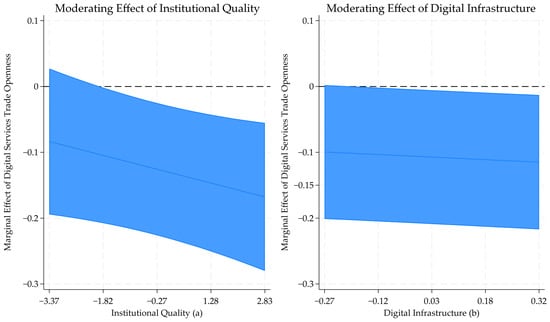
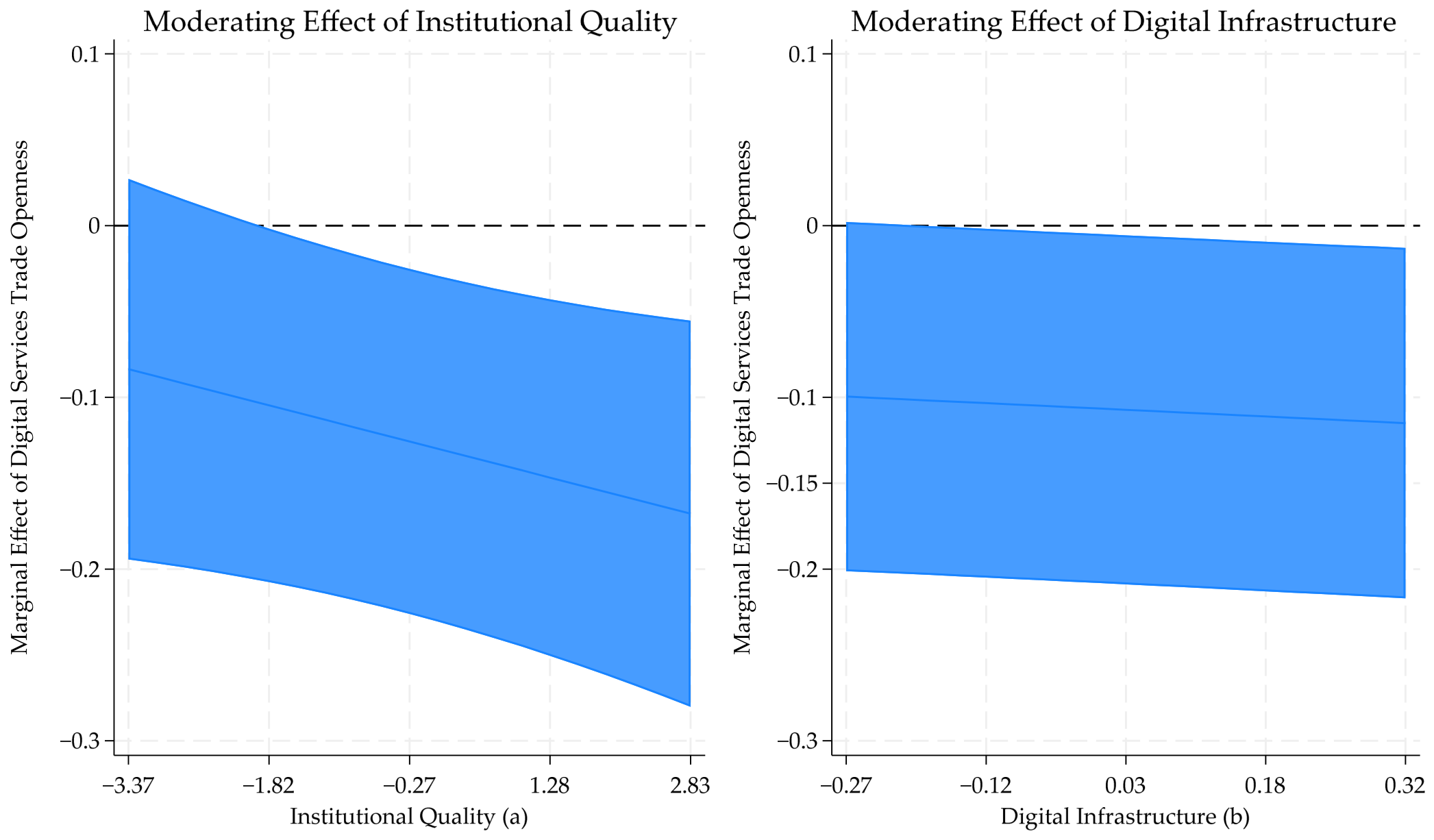
Building on this, following the approach of Gyau et al. (2026) [68], this study constructs a composite index of institutional quality using the World Bank’s Worldwide Governance Indicators (WGI) through principal component analysis (PCA). A higher index value indicates a more favorable institutional environment. As reported in Column (1) of Table 8, the coefficient on the interaction term is significantly negative, suggesting that a better institutional environment strengthens the negative effect of digital services trade openness on manufacturing carbon emission intensity. This finding indicates that improvements in institutional quality can amplify the carbon-reduction benefits of digital services trade openness. As shown in Figure 1a, the marginal effect becomes increasingly negative as institutional quality improves. The pattern is consistent with the negative interaction coefficients reported in Column (1) of Table 8, providing further evidence that institutional quality may strengthen the carbon-reduction effect of digital services trade openness.
Table 8.
Extended analysis.
Figure 1.
Moderating effects of institutional quality and digital infrastructure. Notes: Panel (a) shows the marginal effects of digital services trade openness across different levels of institutional quality, while Panel (b) presents the corresponding effects across different levels of digital infrastructure. The solid lines represent the estimated marginal effects on the logarithm of manufacturing carbon emission intensity, and the shaded areas indicate 95% confidence intervals. Both moderating variables are evaluated from their 10th to 90th percentiles. The dashed horizontal lines indicate zero marginal effects.
6.2. Digital Infrastructure
Because digital services trade is inherently intangible [69], its actual effectiveness in empowering the green transformation of manufacturing depends heavily on the reception and application of relevant digital services. This capability, to a large extent, is determined by the level of local hard facilities, namely the development of digital infrastructure.
Following Ndubuisi et al. (2021) [70], this study constructs a composite digital infrastructure index using the entropy-weighted TOPSIS method with three indicators: mobile cellular subscriptions (per 100 people), fixed telephone subscriptions (per 100 people), and individuals using the Internet (% of population). The data are obtained from the WDI database. A higher index value indicates a more developed digital infrastructure environment.
The regression results in Column (2) of Table 8 show that the coefficient on the interaction term is significantly negative, indicating that better-developed digital infrastructure strengthens the carbon-reduction effect of digital services trade openness on manufacturing. Digital services and related technologies made accessible through greater trade openness require well-developed local digital infrastructure to facilitate their absorption and integration into downstream manufacturing production processes, thereby contributing to carbon emission reductions. Conversely, inadequate digital infrastructure may constrain the effective absorption and utilization of digital services and technological resources from abroad, limiting the realization of the environmental benefits associated with digital services trade openness and weakening its carbon-reduction effect. Figure 1b further illustrates that the marginal effect becomes gradually more negative as digital infrastructure improves, consistent with the regression results.
7. Conclusions and Policy Implications
Using panel data for 19 disaggregated manufacturing industries across 51 countries from 2014 to 2022, this study empirically examines the impact of digital services trade openness on manufacturing carbon emission intensity. The results show the following:
Digital services trade openness significantly reduces carbon emission intensity in manufacturing, and this finding remains valid after addressing endogeneity concerns and conducting a series of robustness tests. The heterogeneity analysis indicates that the emission-reduction effect of digital services trade openness on manufacturing varies significantly across countries and industries. At the country level, the effect is significant in economies with high levels of economic development and servitization. At the industry level, the carbon-reduction effect of digital services trade openness is more pronounced in non-pollution-intensive industries and industries occupying lower positions in global value chains. The mechanism analysis suggests that input servitization and digital technology spillovers may play important roles in the negative relationship between digital services trade openness and manufacturing carbon emission intensity. Extended analysis reveals that improving the domestic institutional environment and digital infrastructure development can strengthen the inhibitory effect of digital services trade openness on manufacturing carbon emissions.
Based on these findings, we propose the following policy implications. First, countries should seize the strategic opportunities brought about by the rapid development of global digital trade, further remove institutional barriers that constrain the development of digital services trade, and actively integrate into the global digital services trade network. By lowering market entry thresholds for digital services, optimizing rules for cross-border data flows, improving digital service regulatory systems, and deepening international cooperation in digital services trade, countries can further aggregate global digital service resources and continuously expand the supply of high-quality digital service factors.
Second, governments should improve the quality and efficiency of the service sector and strengthen the industrial foundation for service–manufacturing integration. To achieve this, policy frameworks supporting the development of the service sector should be strengthened in accordance with its development needs and current conditions to create a favorable development environment, accelerate the development of advanced service industries and digital service industries, optimize the structure of the service sector, improve service quality, and enhance the development mechanism linking services and manufacturing. These efforts will promote inter-industry integration and accelerate the integrated development of manufacturing and services.
Third, differentiated policies should be implemented according to manufacturing industries’ pollution intensity and global value chain (GVC) positions. For non-pollution-intensive industries and those occupying lower GVC positions, greater emphasis should be placed on expanding access to high-quality digital services and promoting their integration into manufacturing production to enhance resource allocation efficiency and facilitate low-carbon transition. For pollution-intensive industries, digital services trade openness should be complemented by cleaner production technologies, energy efficiency improvements, and equipment upgrading. Meanwhile, industries occupying higher GVC positions should be encouraged to strengthen green technological innovation and explore additional opportunities for emission reductions.
Finally, national governments should reduce institutional uncertainty and compliance costs, create a fair and equitable development environment, strengthen institutional alignment and coordination, and optimize the institutional “soft environment.” At the same time, governments should expand investment in digital infrastructure, optimize its spatial layout, bridge the digital divide, and improve its “hard facilities.” By advancing both “soft” and “hard” conditions, governments can accelerate the realization of the green dividends brought about by digital services trade openness.
Admittedly, this study leaves considerable room for improvement. First, although the analysis employs the 2025 edition of the OECD ICIO database, the sample period is limited to 2014–2022, restricting the examination of long-term effects. Future research could extend the analysis as updated data become available. Second, subsequent scholarship may explore the environmental effects of digital services trade from the micro firm-level perspective, thereby forming a more comprehensive understanding of manufacturing carbon emission issues.
Supplementary Materials
The following supporting information can be downloaded at: https://www.mdpi.com/article/10.3390/su182111400/s1. Table S1. Digital service industries.
Author Contributions
Conceptualization, Q.S. and Y.W.; methodology, Y.W. and K.W.; software, Y.W.; validation, Q.S. and K.W.; data curation, Y.W.; writing—original draft, Y.W.; writing—review and editing, Q.S. and K.W.; supervision, Q.S. All authors have read and agreed to the published version of the manuscript.
Funding
This research received no external funding.
Institutional Review Board Statement
Not applicable.
Informed Consent Statement
Not applicable.
Data Availability Statement
All the data are publicly available, and proper sources have been cited in the text.
Conflicts of Interest
The authors declare no conflicts of interest.
References
- Jiang, M.; Jia, P. Does the level of digitalized service drive the global export of digital service trade? Evidence from global perspective. Telemat. Inform. 2022, 72, 101853. [Google Scholar] [CrossRef] [Scilit]
- Liu, H.; Liu, L.; Lin, L. Assessing the relationship between digital service trade and carbon emissions: Evidence from RCEP countries. Int. J. Environ. Sci. Technol. 2025, 22, 12317–12330. [Google Scholar] [CrossRef] [Scilit]
- Liu, Y.; Wang, X. Digital service trade and carbon total factor productivity: Empirical evidence from cross-country panel data. Environ. Dev. Sustain. 2026, 28, 20429–20463. [Google Scholar] [CrossRef] [Scilit]
- Zhou, S.; Lu, B.; Wang, S. Can the digital transformation of service trade alleviate global warming? An analysis from the perspective of developing economies. Energy Econ. 2025, 148, 108619. [Google Scholar] [CrossRef] [Scilit]
- United States International Trade Commission (USITC). Digital Trade 1: Market Opportunities and Key Foreign Trade Restrictions; USITC: Washington, DC, USA, 2017. Available online: https://www.usitc.gov/publications/332/pub4716.pdf (accessed on 20 March 2026).
- Casalini, F.; López González, J. Trade and Cross-Border Data Flows; OECD Trade Policy Papers, No. 220; OECD Publishing: Paris, France, 2019. [Google Scholar] [CrossRef]
- Pezzotta, G.; Arioli, V.; Adrodegari, F.; Rapaccini, M.; Saccani, N.; Rakić, S.; Marjanovic, U.; West, S.; Stoll, O.; Wiesner, S.A.; et al. The digital servitization of manufacturing sector: Evidence from a worldwide digital servitization survey. In Advances in Production Management Systems; Springer: Cham, Switzerland, 2023. [Google Scholar] [CrossRef] [Scilit]
- Chen, Y.; Du, D.; Zhang, Q.; Li, X. Global industrial robots trade network structure and its impact on manufacturing carbon intensity. Technol. Soc. 2025, 83, 102981. [Google Scholar] [CrossRef] [Scilit]
- De Haas, R.; Popov, A. Finance and green growth. Econ. J. 2023, 133, 637–668. [Google Scholar] [CrossRef] [Scilit]
- He, P.; Tian, X.; Zhang, J.; Yu, S.; Li, S.; Lin, C.; Chen, L.; Qian, L. Can the China–Europe Railway Express reduce carbon dioxide emissions? New mechanism of the manufacturing industry substitution effect. Econ. Anal. Policy 2024, 82, 1384–1405. [Google Scholar] [CrossRef] [Scilit]
- Ye, C.; Ye, Q.; Shi, X.; Sun, Y. Technology gap, global value chain and carbon intensity: Evidence from global manufacturing industries. Energy Policy 2020, 137, 111094. [Google Scholar] [CrossRef] [Scilit]
- Sharma, H.; Padhi, B. Transiting towards green productivity: Evidence from Indian organized manufacturing industries. J. Environ. Manag. 2025, 373, 123662. [Google Scholar] [CrossRef] [Scilit] [PubMed]
- Shi, Z.; Loh, L.; Wu, H.; Han, D. Smarter and cleaner: How does energy digitalization affect carbon productivity? Energy Strateg. Rev. 2024, 52, 101347. [Google Scholar] [CrossRef] [Scilit]
- Wang, S.; Yu, D.; Sun, M. Can internet development improve carbon emission efficiency for manufacturing? The role of market integration. J. Environ. Manag. 2024, 366, 121815. [Google Scholar] [CrossRef] [Scilit] [PubMed]
- Muzammal, R.; Peng, X.; Wang, H.; Bah, A.S. Does the synergy between digitalization and sustainability matter for agricultural productivity in Asia? Cogent Food Agric. 2026, 12, 2641283. [Google Scholar] [CrossRef] [Scilit]
- Ramos-Meza, C.S.; Zhanbayev, R.; Bilal, H.; Sultan, M.; Pekergin, Z.B.; Arslan, H.M. Does digitalization matter in green preferences in nexus of output volatility and environmental quality? Environ. Sci. Pollut. Res. 2021, 28, 66957–66967. [Google Scholar] [CrossRef] [Scilit] [PubMed]
- Yan, B.; Wang, F.; Chen, T.; Liu, S.; Bai, X. Digital finance, environmental regulation and emission reduction in manufacturing industry: New evidence incorporating dynamic spatial-temporal correlation and competition. Int. Rev. Econ. Financ. 2023, 83, 750–763. [Google Scholar] [CrossRef] [Scilit]
- Cao, B.; Li, L.; Zhang, K.; Ma, W. The influence of digital intelligence transformation on carbon emission reduction in manufacturing firms. J. Environ. Manag. 2024, 367, 121987. [Google Scholar] [CrossRef] [Scilit] [PubMed]
- Xu, Y.; Wu, B.; Shuai, L. Is digital technology the panacea for alleviating carbon lock-in in manufacturing? Environ. Dev. Sustain. 2025. [Google Scholar] [CrossRef] [Scilit]
- Cao, Y.; Liu, S.; Deng, A. Digital carbon neutrality: A new way explored by industrial internet. Environ. Dev. Sustain. 2025, 27, 27125–27142. [Google Scholar] [CrossRef] [Scilit]
- Opazo-Basáez, M.; Vendrell-Herrero, F.; Bustinza, O.F. Digital service innovation: A paradigm shift in technological innovation. J. Serv. Manag. 2022, 33, 97–120. [Google Scholar] [CrossRef] [Scilit]
- Rothenberg, S. Sustainability through servicizing. MIT Sloan Manag. Rev. 2007, 48, 83–90. [Google Scholar]
- Tang, Y.; Zhu, S.; Luo, Y.; Duan, W. Input servitization, global value chain, and carbon mitigation: An input-output perspective of global manufacturing industry. Econ. Model. 2022, 117, 106069. [Google Scholar] [CrossRef] [Scilit]
- Doni, F.; Corvino, A.; Bianchi Martini, S. Servitization and sustainability actions: Evidence from European manufacturing companies. J. Environ. Manag. 2019, 234, 367–378. [Google Scholar] [CrossRef] [Scilit] [PubMed]
- Brouillat, E. Recycling and extending product-life: An evolutionary model. J. Evol. Econ. 2009, 19, 437–461. [Google Scholar] [CrossRef] [Scilit]
- Crozet, M.; Milet, E. Should everybody be in services? The effect of servitization on manufacturing firm performance. J. Econ. Manag. Strateg. 2017, 26, 820–841. [Google Scholar] [CrossRef] [Scilit]
- Bettiol, M.; Capestro, M.; Di Maria, E.; Micelli, S. Overcoming pandemic challenges through product innovation: The role of digital technologies and servitization. Eur. Manag. J. 2022, 40, 707–717. [Google Scholar] [CrossRef] [Scilit] [PubMed]
- Deng, Y.; Rong, C.; Chen, R. Does manufacturing servitization reduce emissions intensity? evidence from China. Appl. Econ. 2024, 56, 3904–3919. [Google Scholar] [CrossRef] [Scilit]
- Chen, Q.; Shen, Y. Estimating the welfare effects of digital service trade liberalisation. World Econ. 2026, 49, 422–442. [Google Scholar] [CrossRef] [Scilit]
- Xiang, X.; Zhao, J. Enhancing sustainable development through digital service trade liberalization: Analyzing the effects and mechanisms on bilateral imports. Sustainability 2025, 17, 1823. [Google Scholar] [CrossRef] [Scilit]
- Wen, H.; Chen, W.; Zhou, F. Does digital service trade boost technological innovation? international evidence. Socioecon. Plan. Sci. 2023, 88, 101647. [Google Scholar] [CrossRef] [Scilit]
- Hao, S.; Chen, Z.; Wang, C.C.; Hung, C.Y. Impact of digital service trade barriers and cross-border digital service inputs on economic growth. Sustainability 2023, 15, 14547. [Google Scholar] [CrossRef] [Scilit]
- Ding, Y.; Sun, Y.; Gu, W.; Zhang, X. Digital services trade barriers and the resilience of global value chains. World Econ. 2026, 49, 804–820. [Google Scholar] [CrossRef] [Scilit]
- Liu, Z.; Li, H.; Pan, Y. How do countries’ network positions in global digital service trade affect carbon emissions: A social network perspective. Econ. Anal. Policy 2025, 88, 511–528. [Google Scholar] [CrossRef] [Scilit]
- Zhou, F.; Chen, Y.; Lee, C.C. Leveraging digital service trade for a low-carbon future: The roles of network embedding, spillovers, and policy pathways. Technol. Soc. 2026, 85, 103231. [Google Scholar] [CrossRef] [Scilit]
- Levinson, A. Pollution and international trade in services. Int. Environ. Agreem. Polit. Law Econ. 2010, 10, 93–105. [Google Scholar] [CrossRef] [Scilit]
- Azmeh, S.; Foster, C.; Echavarri, J. The international trade regime and the quest for free digital trade. Int. Stud. Rev. 2020, 22, 671–692. [Google Scholar] [CrossRef] [Scilit]
- López González, J.; Ferencz, J. Digital Trade and Market Openness; OECD Trade Policy Papers, No. 217; OECD Publishing: Paris, France, 2018. [Google Scholar] [CrossRef]
- Beverelli, C.; Breitkopf, M.; Fiorini, M.; Tresa, E. Services Trade and Environmental Sustainability: Conceptual Linkages and Empirical Patterns; OECD Trade Policy Papers, No. 292; OECD Publishing: Paris, France, 2025. [Google Scholar] [CrossRef] [Scilit]
- Ozili, P.K. Impact of digital finance on financial inclusion and stability. Borsa Istanb. Rev. 2018, 18, 329–340. [Google Scholar] [CrossRef] [Scilit]
- Wen, X.; Fan, X.; Li, J.; Yu, Y. Can digital inclusive finance promote the green transformation of manufacturing SMEs? Evidence from China. Environ. Dev. Sustain. 2026. [Google Scholar] [CrossRef] [Scilit]
- Huang, G.; Ma, L.; Xietian, Z.; Huang, X. Servitization of manufacturing and China’s power status upgrading of global value network. Struct. Change Econ. Dyn. 2024, 68, 313–328. [Google Scholar] [CrossRef] [Scilit]
- Belvedere, V.; Grando, A.; Bielli, P. A quantitative investigation of the role of information and communication technologies in the implementation of a product-service system. Int. J. Prod. Res. 2013, 51, 410–426. [Google Scholar] [CrossRef] [Scilit]
- Chen, F.; Luo, K.; Taghizadeh-Hesary, F. How does upstream service liberalization benefit downstream manufacturing firms’ emissions reduction performance? Energy Econ. 2025, 145, 108449. [Google Scholar] [CrossRef] [Scilit]
- Casalini, F.; López González, J.; Moïsé, E. Approaches to Market Openness in the Digital Age; OECD Trade Policy Papers, No. 219; OECD Publishing: Paris, France, 2019. [Google Scholar] [CrossRef]
- Bilbao-Ubillos, J.; Camino-Beldarrain, V.; Intxaurburu-Clemente, G.; Velasco-Balmaseda, E. Connecting Industry 4.0, servitisation and sustainability: Territorial implications for global value chains. Bus. Strateg. Environ. 2026, 35, 5973–5986. [Google Scholar] [CrossRef] [Scilit]
- Benz, S.; Jaax, A.; Fiorini, M.; van Lieshout, E. Right Here, Right Now? New Evidence on the Economic Effects of Services Trade Reform; OECD Trade Policy Papers, No. 271; OECD Publishing: Paris, France, 2023. [Google Scholar] [CrossRef] [Scilit]
- Dai, X.; Yang, S. Digital empowerment, source of digital input and green manufacturing. China Ind. Econ. 2022, 22, 83–101. (In Chinese) [Google Scholar]
- Wünderlich, N.V.; von Wangenheim, F.; Bitner, M.J. High tech and high touch: A framework for understanding user attitudes and behaviors related to smart interactive services. J. Serv. Res. 2013, 16, 3–20. [Google Scholar] [CrossRef] [Scilit]
- Georgakopoulos, D.; Jayaraman, P.P. Internet of things: From internet scale sensing to smart services. Computing 2016, 98, 1041–1058. [Google Scholar] [CrossRef] [Scilit]
- World Trade Organization. World Trade Report 2023: Re-Globalization for a Secure, Inclusive and Sustainable Future; WTO: Geneva, Switzerland, 2023. [Google Scholar]
- Karam, F.; Zaki, C. A new dawn for MENA firms: Service trade liberalization for more competitive exports. Appl. Econ. 2020, 52, 19–35. [Google Scholar] [CrossRef] [Scilit]
- Zareian Baghdad Abadi, F.; Liu, W. Dual pathways to innovation in the age of digitalization: How the digital silk road transforms quality and quantity of innovation in member countries and China. Econ. Anal. Policy 2026, 90, 1582–1606. [Google Scholar] [CrossRef] [Scilit]
- Goldfarb, A.; Tucker, C. Digital economics. J. Econ. Lit. 2019, 57, 3–43. [Google Scholar] [CrossRef] [Scilit]
- Zou, H.; Ji, H.; Qin, H.; Guo, Y.; Yang, X. Research on the strategy evolution of knowledge innovation in an enterprise digital innovation ecosystem: Kinetic and potential perspectives. IEEE Access 2022, 10, 78764–78779. [Google Scholar] [CrossRef] [Scilit]
- Li, G.; Lin, D. Digital inputs and industrial green transformation: Perspectives on intra-industry impacts and inter-industry spillover effects. Front. Environ. Sci. 2025, 13, 1689916. [Google Scholar] [CrossRef] [Scilit]
- Van Der Marel, E.; Ferracane, M.F. Do data policy restrictions inhibit trade in services? Rev. World Econ. 2021, 157, 727–776. [Google Scholar] [CrossRef] [Scilit]
- Calvino, F.; Criscuolo, C.; Marcolin, L.; Squicciarini, M. A Taxonomy of Digital Intensive Sectors; OECD Science, Technology and Industry Working Papers, No. 2018/14; OECD Publishing: Paris, France, 2018. [Google Scholar] [CrossRef]
- Beverelli, C.; Fiorini, M.; Hoekman, B. Services trade policy and manufacturing productivity: The role of institutions. J. Int. Econ. 2017, 104, 166–182. [Google Scholar] [CrossRef] [Scilit]
- Koopman, R.; Powers, W.; Wang, Z.; Wei, S.-J. Give Credit Where Credit Is Due: Tracing Value Added in Global Production Chains; Working Paper No. 16426; National Bureau of Economic Research: Cambridge, MA, USA, 2010. [Google Scholar] [CrossRef] [Scilit]
- Harris, M.N.; Konya, L.; Matyas, L. Modelling the impact of environmental regulations on bilateral trade flows: OECD, 1990–1996. World Econ. 2002, 25, 387–405. [Google Scholar] [CrossRef] [Scilit]
- Huang, Q.H.; Yu, Y.Z.; Zhang, S.L. Internet development and productivity growth in manufacturing industry: Internal mechanism and China experiences. China Ind. Econ. 2019, 8, 5–23. (In Chinese) [Google Scholar]
- Gao, Y.; Zhao, D.; Yu, L.; Yang, H. Influence of a new agricultural technology extension mode on farmers’ technology adoption behavior in China. J. Rural Stud. 2020, 76, 173–183. [Google Scholar] [CrossRef] [Scilit]
- Ferracane, M.F.; van der Marel, E.L. Regulating Personal Data: Data Models and Digital Services Trade; World Bank Policy Research Working Paper No. 9596; World Bank: Washington, DC, USA, 2021. [Google Scholar] [CrossRef] [Scilit]
- Li, F.; Lin, Z.; Huang, L.; Yang, C. Environmental regulation and global value chain division position: Analysis based on global transnational data. Energy Policy 2022, 168, 113101. [Google Scholar] [CrossRef] [Scilit]
- Busse, M. Trade, Environmental Regulations and the World Trade Organization: New Empirical Evidence; Policy Research Working Paper. No. 3361; The World Bank: Washington, DC, USA, 2004. [Google Scholar]
- Li, H.; Gao, Y. Transnational digital infrastructure and scientific collaboration: Evidence from the Asia Africa Europe-1 (AAE-1) submarine cable. China Econ. Rev. 2026, 95, 102603. [Google Scholar] [CrossRef] [Scilit]
- Gyau, E.B.; Adu, D.; Appiah, M.; Musah, S. Leveraging AI technology innovation for disaster risk reduction and resilience: Examining the mechanisms of financial development, globalization, and institutional quality. Technol. Forecast. Soc. Change 2026, 233, 124854. [Google Scholar] [CrossRef] [Scilit]
- Aaronson, S.A. What are we talking about when we talk about digital protectionism? World Trade Rev. 2019, 18, 541–577. [Google Scholar] [CrossRef] [Scilit]
- Ndubuisi, G.; Otioma, C.; Tetteh, G.K. Digital infrastructure and employment in services: Evidence from Sub-Saharan African countries. Telecommun. Policy 2021, 45, 102153. [Google Scholar] [CrossRef] [Scilit]

Disclaimer/Publisher’s Note: The statements, opinions and data contained in all publications are solely those of the individual author(s) and contributor(s) and not of MDPI and/or the editor(s). MDPI and/or the editor(s) disclaim responsibility for any injury to people or property resulting from any ideas, methods, instructions or products referred to in the content. |
© 2026 by the authors. Licensee MDPI, Basel, Switzerland. This article is an open access article distributed under the terms and conditions of the Creative Commons Attribution (CC BY) license.