


Abstract
Living intangible cultural heritage (ICH) challenges integrated STEAM education because curricular coherence does not itself establish permission for cultural representation. We retrospectively audited a three-round Delphi archive relevant to Chinese higher education (18 coded experts; 44, 53 and 52 rated prompts; 2682 ratings) and separately synthesised a prospective Culture–Technology–Ethics (CTE) lens. The recalculated mean item ratings were 3.9533, 4.6646 and 4.6603 across the rounds; 43 of 52 final-round means exceeded 4.50. The 49 Round-2/Round-3 content links include 35 lexical matches and 14 reworded propositions, limiting longitudinal comparison; 41 of 72 Round-2 priority answers exceeded their selection caps and cannot support compliant rankings. The CTE synthesis differentiates cultural decision standing (C), pedagogical purpose (T) and accountable stewardship (E), proposing a use-specific review before the consequential circulation of educational artefacts. This is a bounded authorial proposition supported by heritage-governance literature, not a Delphi-validated measurement model, demonstrated cultural permission or evidence of educational and sustainability effects.
1. Introduction
Education for sustainable development (ESD) calls for interdisciplinary learning that addresses social responsibility and cultural diversity, including SDG 4.7 [1,2,3]. Integrated STEM and STEAM commonly operationalise this objective through authentic tasks, coordinated disciplines and the assessment of learning outcomes [4,5,6,7,8]. Their prevailing curricular test is internal coherence: whether objectives, pedagogy, technologies and assessment fit together. That test is necessary, but its application to living cultural knowledge leaves an implicit premise unexamined. Approval to teach or assess an artefact does not, by itself, establish authority to record, reinterpret or disseminate the cultural practice on which it draws. The distinction becomes consequential when a classroom product is shared beyond its original educational setting.
Intangible cultural heritage (ICH) makes this distinction analytically salient because the 2003 UNESCO Convention locates its recognition and recreation in communities and practitioners [9], while heritage scholarship examines how formal representation can reshape meaning and authority [10,11]. Chinese universities can legitimately define heritage-oriented coursework, select technical tools and grade student work [12,13,14]; those curricular powers do not necessarily determine who may authorise a particular recording, interpretation or reuse. This is a potential conflict between decision functions, not evidence that any university in the present archive violated a community’s rights, nor that one practitioner represents an entire community.
Relevant theories address adjacent but non-identical decisions. Constructive alignment examines alignment of learning activities and assessment [15]; culturally situated learning asks whose knowledge enters educational practice [16,17,18,19,20]; technology–pedagogy frameworks assess instructional fit [21,22,23]; and heritage ethics, CARE and responsible innovation examine standing, access, oversight and reuse [24,25,26,27,28,29,30]. Recent work already integrates AI ethics with STEAM [31], studies interpretive participation in digital ICH curation [32] and maps heritage stakeholders’ decision rights through ATHRIAN [33]. The gap is therefore not a general absence of ethical or participatory frameworks. It is a narrower empirical and procedural question: does an existing university approval process distinguish the authority to assess a student artefact from permission for its specified cultural use, or does it already perform that distinction adequately? The latter possibility is a genuine alternative to any claimed CTE increment.
A direct answer would require decisions and records about particular artefacts: academic approval, affected claimants, permitted uses, objections and subsequent circulation. The available Delphi archive contains expert ratings about curriculum, not such permissions or outcomes. This evidentiary mismatch explains the article’s two-part design. First, a retrospective document-and-score audit reconstructs the 2026 three-round record and bounds comparisons across altered items (RQ1–RQ2). Second, a problem-driven synthesis compares the distinct decision functions established in the learning-design and heritage-governance literature, using the Delphi findings only as bounded educational context (RQ3). This second step formulates a prospective decision rule; it neither retroactively measures cultural permission nor validates a three-factor or causal model.
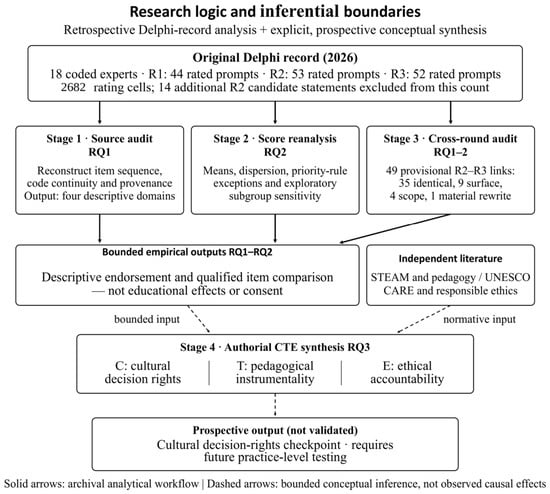
RQ1 asks which item changes, expert-code continuity and documentary limits can be reconstructed. RQ2 asks which educational propositions this purposive panel endorsed and what, if anything, its cross-round and subgroup comparisons legitimately describe. RQ3 asks whether a use-specific permission check is conceptually warranted alongside existing academic and heritage approvals. Figure 1 traces the two-part workflow; the question-to-method mapping is presented in Section 3.1. The proposed Culture–Technology–Ethics (CTE) lens distinguishes cultural decision standing (C), pedagogical instrumentality (T) and accountable stewardship (E). Its proposed increment is conditional: only a future comparison showing a consequential gap missed by existing procedures could establish additional utility. This study claims expert-description and transparent theoretical proposition, not demonstrated educational, cultural or sustainability effects.
Figure 1.
Research design and inferential boundaries. Solid arrows describe the retrospective archival workflow; dashed arrows indicate limited inputs to a distinct authorial theory synthesis, not causal paths or a validated three-factor model.
2. Theoretical Framework and Context
2.1. Living Heritage and the Limits of Curricular Relevance
ICH education involves embodied learning, interpretation and social conditions of transmission; formalising an activity within a university may alter what is represented and who speaks for it [9,10,11,20]. We therefore treat cultural legitimacy as a prospective property of decision procedures rather than an intrinsic property of a heritage-themed lesson or a favourable expert score. Its assessment would require identifying potentially affected bearers, the particular cultural material or use at issue, and any applicable rights to object, restrict or correct. Importantly, an individual heritage practitioner serving on an educational expert panel is not thereby authorised to consent on behalf of every affected community.
2.2. Integrated STEAM, Learning Purpose and Technology
Purposeful integration need not allocate equal instructional time to all STEAM disciplines [4,5,6,34]. Constructive alignment links outcomes, activities and assessment [15]; situated learning places participation within social practice [20]; and TPACK and affordance-oriented design clarify how tools support learning rather than serve as ends in themselves [21,22,23]. These theories supply a rationale for analysing audio, modelling materials or producing digital artefacts, but do not determine permissions governing the cultural objects used. In turn, responsible innovation, heritage research and data governance address access, attribution, accountability and reuse [11,14,24,25,26,27,28,29,35,36,37]. For the present conceptual analysis, pedagogical suitability and culturally situated authority are therefore treated as separate decision questions, even when the same technology is involved.
2.3. CTE as a Prospective, Non-Equivalent Governance Test
We propose CTE as three non-substitutable decision questions rather than a set of factors extracted from scores. C (cultural legitimacy) addresses whose culturally situated standing is relevant to a specified act of representation, transformation or circulation [9,11,24,30]. T (pedagogical instrumentality) addresses which learning purpose a disciplinary or technical choice advances [4,15,21,22,23]. E (ethical accountability) addresses how decisions remain documented, restricted when appropriate, answerable and revisable [24,25,26,27,28,29,30]. C concerns authority, T concerns educational justification and E concerns procedures of stewardship. A process may satisfy any one without satisfying the other two. Their literature-derived separation and unequal Delphi anchors are reconstructed in Section 3.8; no factorial or predictive validation is claimed.
The proposed cultural decision-rights checkpoint is considered when a learning activity selects, represents, records, transforms or transfers living cultural material, particularly when the audience, reuse or permanence exceeds an agreed teaching context. It asks educators to specify the exact material and intended use; identify potentially affected and differently situated claimants rather than presume one spokesperson; distinguish academic assessment from cultural permission; document consultation, disagreement and use conditions; and reconsider these conditions before consequential dissemination. The checkpoint is not an automatic community veto, an assertion that every use requires the same form of consent, or a substitute for relevant law. In an acoustic-analysis task, for example, academic grading of measurements alone does not authorise public release of the recording; the authority question depends on the particular recording, contributors and intended dissemination.
Table 1 distinguishes the instructional questions answered by established approaches from the artefact-specific cultural-use permission question; it does not imply that participatory heritage governance lacks safeguards. The direct rival governance accounts are considered in §3.8 [32,33].
Table 1.
Established analytical approaches and the remaining artefact-use permission question.
3. Materials and Methods
3.1. Design, Unit of Analysis and Record Status
The study comprises two linked but non-equivalent components (Figure 1). A retrospective source and score audit first reconstructs the completed Delphi record: item-level ratings (149 item-round variables; 2682 cells), 18 repeated anonymous codes, questionnaire changes and chronology (RQ1–RQ2). A subsequent problem-driven conceptual synthesis compares these bounded observations with independent scholarship to formulate a prospective CTE decision test (RQ3). Table 2 assigns each procedure its question, rationale, alternative and inferential boundary. Descriptive recomputation can characterise scores; neither it nor later theory synthesis authenticates all historical platform events or tests permission outcomes.
Table 2.
Alignment of research questions, analytical choices and permissible claims.
3.2. Panel Composition and Cultural-Background Limitation
The purposive panel comprised six STEAM/educational-technology specialists (S1–S6), eight ICH researchers (ICH-1–ICH-8) and four practice-based ICH specialists (ICH-H1–ICH-H4). The supplied roster records China for all experts and Chinese as their working language. This selection is suitable for eliciting perspectives on Chinese higher-education curriculum design but is not a probability sample of teachers, heritage communities or China as a whole. Delphi guidance supports expertise-based selection while requiring transparent reporting of panel constitution [38,39,40].
Four practitioners specialised in embroidery, lacquer art or jade carving; no recruited practitioner is documented as a representative Khoomei bearer. The panel consequently has a 14-to-four academic/practitioner imbalance, relevant to interpreting institution-facing judgements but not sufficient to assess bearer-led legitimacy. Recorded ethnicity labels were used only for a separately qualified sensitivity analysis; those labels do not measure cultural identification, stand independently verified or indicate authorisation by any community.
Each of the three supplied English respondent-level workbooks contains 18 distinct expert codes, occurring once per round (source columns: N for Round 1 and H for Rounds 2–3). This supports pseudonym-level cross-round linkage and a comparison at the expert, rather than item-as-person, level. The same codes appear in the research-team tracking register and all 18 individually examined consent-stage documents. The restricted consent inventory records one unique code per document, written dates from 4 to 11 April 2026, and embedded signature-area images. One form (ICH-3) is dated 11 April, the first Round-1 survey day; its within-day signing and response order is not established from a date-only entry. Legal identity, the authenticity of signatures and platform participation remain separate from the observed file contents, and are checked by the research team under restricted access.
3.3. Development of the 41 Operational Prompts and 52-Item Final Instrument
The Round-1 instrument recorded three definition ratings and 41 operational prompts (5 objectives, 10 curriculum statements, 15 pedagogical statements and 11 perceived barriers). Round 2 contained 53 operational ratings and 14 separate binary candidate prompts; Round 3 contained 52 scored prompts (7/13/16/16). The study audits these changing instruments as documentary evidence rather than treating the final set as a prospectively validated scale. Latest original-rating files and the newly provided concise three-round feedback tables support reconstruction of score distributions and candidate trajectories. Those later feedback summaries explicitly identify themselves as retrospective reconstructions, not authenticated records of contemporaneous transmission. They also explain that low ratings did not automatically require removal and high ratings did not guarantee retention.
The single indexed crosswalk (Table S1) identifies all 49 reconstructed R2–R3 content links by their round-specific IDs and recovered English translations of the originally administered Chinese statements. Four R2 core prompts were not retained as rated R3 items; three R3 prompts instead relate to separate R2 supplementary candidates (Table S3). Matching numerical suffixes do not establish item identity, notably, R2 IISCD11 versus the new R3 IISCD11. These retrospective classifications are not represented as contemporaneous signed editing decisions.
A comparison of recovered English translations assigns each of the 49 links to an explicit class: 35 lexical matches, nine surface-language variants, four changes of scope or emphasis, and one materially expanded proposition (Table S1). These are English-text judgements, not certified equivalence of the Chinese questionnaires administered to respondents. Only lexical matches permit an English-wording-controlled descriptive comparison; translated agreement alone cannot prove fixed-item measurement invariance. Table S1 separatelyrecords 22 later editorial changes between the recovered Round-3 English wording and its subsequently integrated version. These are not the same as the 14 historical R2-to-R3 English-wording differences. Six post-survey ethics-related expansions, including one among the three newly rated concepts, were not themselves scored by the expert panel (Table S4).
The investigator reports ending the Delphi after the third round because participation was complete, final ratings were broadly high, most linked item means changed little and the investigator judged that an additional round would be unlikely to yield substantial information [38,40,41]. Among the 49 content links, 40 absolute mean changes were at most 0.25, 42 medians were unchanged, and 636 of 882 expert-item pairs retained the same numeric score. These metrics are retrospective and mix lexically unchanged with revised statements; they cannot establish individual opinion stability for a fixed questionnaire. The semantic classification in Table S1 bounds that inference, and no preregistered numeric stopping rule is claimed.
3.4. Ethics, Chronology and Provenance Reconciliation
The archival chronology draws on the newest three English rating exports, original Credamo project references supplied by the investigator, and separately identified feedback summaries. The reported survey windows were 11–30 April, 8–25 May and 6–20 June 2026; the actual exported response ranges were 11–22 April, 9–18 May and 9–18 June. The final Round-3 recorded response was 18 June 2026 at 13:27:43. Feedback-project response dates, as indexed in the investigator-supplied feedback register, span 25–28 April, 21–23 May and 20–23 June (Table S5). The recorded acknowledgements support reported feedback receipt; dates are not treated as provider-certified opening, closure or outbound transmission events. UKM approval JEP-2025-751 covered the wider doctoral protocol from 3 April 2026 to 2 April 2027, with 150 described by the investigator as the protocol maximum rather than this Delphi sample (n = 18). The 18 consent files carry written dates between 4 and 11 April; these are participant-level consent records rather than proof of particular email-dispatch times.
The corresponding author confirms that six genuine Credamo projects—three contemporaneous questionnaires and three associated feedback-receipt projects—are available for authorised editorial source inspection. According to the research team and its 18-code tracking register, the feedback projects contain individual expert confirmations of receiving the feedback in each round (18 recorded confirmations per round). The original project entries allow the editor to examine the individual acknowledgement, expert code, and response date, rather than relying solely on retrospectively reconstructed feedback reports. The researcher-provided survey response-management screenshots separately corroborate the corrected survey answer-end times. Source URLs, feedback entries, linked records and screenshots are restricted; the analyst has not independently logged into each source project. The original invitation describes email communication, whereas actual response capture was recorded in Credamo; the distinction between communication channel and response platform is retained rather than assuming an email-only questionnaire. An acknowledgement is evidence of recorded receipt, not a platform-provider certificate of the outbound transmission pathway.
A three-source reconciliation pairs each of five changed calendar-date entries in earlier English source-file transcriptions (two Round-2 and three Round-3) with the latest exported value and the matching end time on researcher-provided Credamo response-management screenshots. All five corrected timestamps match the platform display to the second. The earlier transcriptions preserved only minute precision and, in these five entries, transcribed the calendar date incorrectly; the research team has verified these as source-file transcription errors and confirms that the rated responses were not altered. The screenshots corroborate the correct displayed times, while independently certifying that the internal cause of transcription remains outside their evidentiary scope. In the latest 18 coded Round-2/Round-3 pairs, hours and minutes coincide, seconds differ, and 15 pairs are 31 calendar days apart (the other intervals are 30, 29 and 27 days). The investigator attributes this timing pattern to coincidence; the observed pattern alone establishes neither a feedback effect nor misconduct.
Table 3 identifies the corrected dates supported by platform displays and, separately, the available recorded feedback-receipt confirmations. Table S8 reports only de-identified evidence counts and verification boundaries. The confidential editorial register provides the five coded old/new timestamps, their source-cell locations, screenshot cross-references, and the six original Credamo project URLs; it also identifies the feedback-project acknowledgement records to be examined by the editor. Corrected times govern the manuscript, while earlier source-file transcriptions are retained for audit rather than overwritten. These evidence families have distinct roles: screenshot-matched corrections establish the displayed end-time values, while coded feedback acknowledgements establish recorded receipt; neither alone authenticates provider-side transmission events or causal Delphi feedback effects.
Table 3.
Evidence status and required source-level verification for the retrospective Delphi audit.
3.5. Rating, Decision and Statistical Conventions
We recalculated all 149 item-round descriptive profiles from the latest investigator-supplied rating files: 44 Round-1, 53 Round-2 and 52 Round-3 five-point prompts with 18 non-missing responses each (2682 ratings). The unweighted item-mean averages were 3.9533, 4.6646 and 4.6603. Table S2 releases all 149 scored-item labels with counts at response values 1–5, permitting independent recomputation of each mean and sample SD (denominator n − 1) without releasing linked respondent records; medians and Type-7 quartiles/IQRs are also provided. The historical screening rule (mean > 3.66 or mode = 5), >4.50 high-endorsement label and dispersion flags were study-specific decisions rather than universal Delphi stopping criteria [38,39,40,41]. Individual-level paired and group-level permutation checks require separately protected data.
To assess whether the aggregate profile was evidently dominated by a recorded professional stratum, we calculated each respondent’s mean across the 52 Round-3 ordinal ratings and compared these 18 respondent-level summaries across the 6/8/4 professional groups using exploratory Kruskal–Wallis analysis. A two-sided exhaustive permutation contrast compared four practice specialists with the other fourteen (3060 group assignments). A separate recorded Han/non-Han roster-label contrast used 31,824 possible allocations and is strongly confounded with professional groups. These analyses were preferred to 52 item-wise significance tests, which would multiply comparisons while pseudo-replicating participants. They were not preregistered, are low-powered with ceiling-concentrated scores, and cannot establish group equivalence, ethnic effects or community representativeness.
Of the 49 linked concepts, 40 absolute mean differences were at most 0.25 and the mean absolute difference was 0.1553; this is a content-link summary, not a common-item longitudinal estimator. Within the 35 lexically matched English pairs, 31 had absolute item-mean changes of at most 0.25 (mean absolute change 0.1429); the nine surface-language, four scope-change and one materially expanded pairs remain separately flagged in Table S1. Overall, 636/882 numeric participant–item ratings matched and 30/49 linked items had at least 12/18 identical responses, but pooled proportions that mix rewritten propositions cannot prove within-person opinion stability. The six later editorial ethics expansions are not counted as rated changes or an additional Delphi round.
3.6. Priority Selections and Anomalous Responses
A distinct Round-2 question asked 18 respondents to prioritise options in four domains (72 respondent-domain answers), with documented caps of two, three, two and two choices. Forty-one answers exceeded a cap, and one pedagogical answer included an option outside the 17-item pool. We retained the raw answers and treated in-range mentions as exploratory descriptions rather than capped rankings; strict-compliance counts are also documented. Because all eighteen pedagogy answers were noncompliant with the cap, no compliant pedagogical priority ranking exists. This decision prevents arbitrary truncation or imputation of answers.
3.7. Delphi Feedback, Retrospective Interpretation and CTE Coding
According to the research team and the feedback tracking register, the three original Credamo feedback projects contain individual expert confirmations of receiving the round-specific feedback (18 confirmations in each round). These contemporary feedback-project responses can be checked through the six editor-restricted project links; they should not be conflated with the retrospective summaries prepared for this revision. The recorded confirmations support a claim of reported feedback receipt, but do not independently establish the provider-side email or messaging transmission pathway. Across-round score comparisons remain descriptive and are not attributed causally to receipt of feedback.
Post-survey wording has a separate evidential status. Six ethics-related clauses in the subsequently integrated third-round English headers (IISCD2, IISCD3, IISCD5, IISCD12, IISPI11 and DIISP12) were not demonstrated to have been administered in June 2026. Their textual provenance isindexed in Table S4; score summaries are based on the corresponding original rated items, not retrospectively extended ethical propositions.
The archive-to-theory interface is classified as D (direct rated-stem support), L (external theoretical or governance literature) and A (authors’ present conceptual inference). Generic ICH introductions cannot establish collective cultural consent, and a rated reference to STEAM as a technical means does not evaluate a particular AI or recording technology. These evidence labels describe the present reconstruction, not a historical 2026 coding protocol or a claimed intercoder-reliability study. The public item-indexed Table S1 and post-survey wording Table S4 identify the rated-item boundaries; Section 3.8 develops the resulting CTE claim–source distinctions. Neither Delphi ratings nor the six later ethical text expansions validate the proposed CTE checkpoint.
3.8. Conceptual Synthesis: Deriving CTE and Its Decision-Rights Checkpoint
The conceptual component is a problem-driven theory synthesis in Jaakkola’s sense [42], with Jabareen’s emphasis on linked but distinct concepts used as a methodological reference [43]. It is neither a systematic literature review, a grounded-theory study nor a retrospectively claimed preregistered coding exercise. The explanandum is a specific division of authority: an academically well-designed heritage task may still lack justified permission for a culturally consequential use. We reconstructed a claim–ground–warrant chain from the already cited theoretical corpus and the recovered rated stems: source propositions were kept separate, their individual decision functions examined, and only then combined into a conditional design proposition. This is a present-day justification of the proposed lens; it is not evidence of the exact historical order in which the authors first conceived CTE.
Conceptual sources were selected purposively for their decision functions, not through an exhaustive or preregistered systematic review. Each source had to (i) address an educational-purpose, cultural-standing or accountability decision relevant to a heritage-mediated task; (ii) contribute a function not established by the Delphi ratings; and (iii) support the specific inference without turning normative guidance into observed community permission. Constructive alignment, integrated STEM and TPACK/affordances inform T [4,15,21,22,23]; UNESCO heritage and cautiously analogous CARE principles inform C [9,11,24,30]; and responsible innovation and data/AI ethics inform E [25,26,27,28,29]. The rival set explicitly includes the STEAM–AI framework [31], Chinese museum ICH research [32] and ATHRIAN governance [33]. This retrospective source-selection account explains the current synthesis; it is not evidence of an original 2026 coding log. CARE does not automatically create a transferable legal regime for Chinese ICH.
The synthesis distinguishes rated Delphi anchors (D), independent published warrants (L) and untested authorial inferences (A). As documented in Table 4, T has direct curricular and pedagogical anchors, whereas claims about collective cultural permission (C), detailed stewardship arrangements (E) and the use-specific checkpoint require literature and normative reasoning. None is a Delphi-derived latent factor or observed outcome.
Table 4.
CTE claim–source audit: Delphi anchors (D), published warrants (L) and proposed inferences (A).
The proposed checkpoint follows a conditional argument, not an automatic rule: (P1) a university’s authority to assess a learning outcome does not, by itself, settle culturally situated permissions; (P2) culturally consequential representation or circulation can engage parties and restrictions beyond the classroom; therefore, (P3) the institution should identify the decision object, relevant claims to standing, conditions of use, accountable reviewer and any unresolved dissent before irreversible dissemination. This inference does not prescribe one bearer, one consultation mechanism or a universal prohibition when agreement is absent. Where authority is disputed, the proposed response is to record competing claims, seek context-appropriate review and consider deferring irreversibly public release; routine technical work with no culturally consequential representation may not require the same checkpoint. These are normative choices whose legitimacy and feasibility must be assessed in future settings. The P1–P3 sequence is a conceptual warrant for a proposed review, not evidence that a permission gap occurred, that the checkpoint was implemented, or that it causally prevented harm.
Two discriminating countercases test whether the three questions can be collapsed. First, a technically accurate and instructionally aligned recording may fail C if no appropriate standing or use permission is established, even if an institutional ethics form exists (E). Second, a culturally authorised recording may fail T if the learning objectives and assessment do not require its use. A third case differentiates C from E: identifying a qualified contributor does not alone settle retention, access, correction or downstream licensing. These are conceptual stress tests, not observed cases. The checkpoint adds a timing- and decision-object-specific translation of established principles; it does not assert that participation, co-design, UNESCO ethics or CARE were previously without authority safeguards.
Direct comparison is necessary because the proposed checkpoint is not conceptually unprecedented. Constructive alignment and TPACK examine instructional coherence [15,21,22,23]; living-heritage and participatory scholarship can already address standing and restrictions [9,11,24,30]. More direct alternatives provide STEAM–AI ethics [31], participation and interpretive-authority analysis in Chinese digital ICH curation [32], and stakeholder decision-rights mapping in ATHRIAN [33]. CTE therefore proposes a conditional, artefact-and-use-specific decision rule rather than an empirically established mechanism: before consequential circulation, an institution could separately document its authority to assess the learning product and the standing or permissions applicable to its cultural use. If existing approval, co-design or licensing already performs that check, CTE adds no demonstrated function. Table 4 identifies the supporting premises, rival practices and required future comparisons.
4. Results
4.1. Item Pools and Evidential Maturity (RQ1)
The reconstructed archive contains 44, 53 and 52 rated prompts from the same 18 recorded expert codes (RQ1). Table S1 identifies the 49 proposed R2–R3 content links and their 35/9/4/1 English semantic classes; Table S2 reportsthe 149 item-level marginal rating profiles. The later ethics integrations are not counted as historically administered rated propositions.
Source-event authentication and the distinct survey and feedback records are documented in §3.4 and Table 3, rather than interpreted as additional educational outcomes.
Table 5 summarises the historical English-stem categories indexed individually in Table S1. Its denominator is 49 R2–R3 links; the 22 post-survey English header edits constitute a separate comparison, not another measure of historical cross-round change.
Table 5.
Recovered English Round-2/Round-3 wording correspondence (not certified equivalence of deployed Chinese items).
In particular, changing a proposition about disciplinary primacy, team membership or ecosystem scope does not become evidence of fixed-item individual stability merely because two means are numerically similar.
4.2. Final-Round Descriptive Profile (RQ2)
For RQ2, final-round item means ranged from 4.333 to 4.944 (sample SDs, 0.236–0.705). The unweighted mean of the 52 item means was 4.6603; 43 means strictly exceeded 4.50, seven equalled 4.50 and two were below it. All final-round Type-7 IQRs were at most 1. For the separate 49-concept crosswalk, the mean absolute item-mean difference was 0.1553; 40 differences were no greater than 0.25 and all were no greater than 0.50. These are favourable within-panel descriptive ratings and modest aggregate shifts, but modified wording and ceiling clustering rule out treating them as respondent-level stability or proof of educational effects.
In the deliberately exploratory professional-composition check, mean within-expert Round-3 scores were 4.6571 for STEAM specialists (n = 6), 4.6707 for ICH researchers (n = 8) and 4.6442 for practitioners (n = 4). Kruskal–Wallis yielded H = 0.4435 (asymptotic p = 0.8011); the four practitioners differed from the other 14 by −0.0206 rating points (exact permutation p = 0.6500, 3060 assignments). A recorded Han/non-Han label comparison differed by +0.0345 in favour of non-Han-coded experts (exact permutation p = 0.3332, 31,824 assignments). Small groups, purposive selection, high ratings and confounding make these checks descriptive sensitivity probes rather than equivalence tests, cultural-effect estimates or substitutes for Khoomei bearer participation.
Examples include critical thinking and problem solving (IISCD-11, M = 4.83), avoiding equal coverage of every STEAM subject in each lesson (IISPI-16, M = 4.89), and two perceived institutional-constraint statements (DIISP-4 and DIISP-11, M = 4.94). The latter are expert perceptions, not independently measured prevalence of constraints across Chinese universities.
The rated prompts identify interdisciplinary problem design (IISCD-3), co-teaching (IISPI-2) and non-maximal disciplinary coverage (IISPI-16), providing the clearest empirical context for T. They do not measure AI, VR or acoustic tool performance, collective cultural permission or refusal; Table 4 deliberately assigns those later governance claims to different evidence sources.
4.3. Four Curriculum and Institutional Domains (RQ1–RQ2)
Table 6 interprets the four final-round reporting domains as different curriculum decisions: educational aims, course configuration, classroom enactment and perceived institutional support. Their 7/13/16/16 item counts are already reported in Table 5; the present comparison instead clarifies what each domain means and what its ratings cannot establish. None is a statistically validated latent factor.
Table 6.
Distinct interpretive purposes and evidence limits of the four final-round domains.
4.4. Strength and Limits of Technology-Specific Evidence (RQ2)
Only IISPI-1 and IISPI-6 explicitly refer to STEAM as a technical means within heritage education. The record therefore informs the choice of pedagogical functions, not the effectiveness or safety of particular technologies. Table 7 shifts from survey evidence to illustrative task-specific risks and possible mitigations drawn from the separate literature; no listed technology or safeguard was tested in Delphi.
Table 7.
Task-specific educational uses, potential cultural risks and illustrative mitigations (not Delphi-tested).
4.5. Priority Selections and Documented Anomalies (RQ2)
The 72 Round-2 priority answers include 41 responses exceeding selection caps (nine objectives, none for curriculum, eighteen for pedagogy and fourteen for barriers) and one out-of-pool pedagogical option. The cap-violation totals are investigator-verified and documented as aggregate countsin Table S9, but valid-option mention frequencies and respondent-level rule checks cannot be independently recomputed from the public package without the restricted 72-answer priority-selection record. No defensible compliant pedagogical ranking can be calculated: zero of eighteen pedagogy answers meet the recorded cap. Consequently, the manuscript does not base curriculum priorities or its CTE synthesis on formal rankings from this defective item type.
4.6. What Is Empirically Observed and What Is Proposed (RQ3)
The archive answers RQ1–RQ2 through recoverable item histories and descriptive panel ratings. RQ3 is a different task: to justify a future cultural-use decision question by combining those bounded educational observations with independent governance scholarship. Table 4 specifies the empirical, literary and authorial elements; the checkpoint is not an additional Delphi outcome.
The Delphi evidence is strongest for pedagogical purposes (T), weaker for institutional conditions relevant to E, and does not directly measure collective permission (C). Table 8 specifies the distinct records and comparative indicators required before asserting that the proposed checkpoint improves upon an existing authorisation process.
Table 8.
Prospective comparative validation of CTE against existing approval workflows.
5. Discussion
5.1. RQ1: What Operational Structure Can the Delphi Record Support?
RQ1 establishes the recorded instrument structure, code continuity and provisional content links—not identical constructs across rounds. Table 5 summarises the English-wording categories, while Table S1 retains the full item-by-item crosswalk; neither certifies administered Chinese equivalence or within-person stability for rewritten prompts.
Because only four of the 18 panel members were practitioners and none is documented as an authorised Khoomei community representative, their curriculum judgements cannot substitute for use-specific community permission records.
5.2. RQ2: What Can High Expert Endorsement Establish?
The answer to RQ2 is strong descriptive endorsement of several pedagogical and organisational propositions by this specific panel. A 4.6603 average of item means describes expert ratings, not the benefits of STEAM instruction. Forty-one cap-violating priority answers make formal priority rankings inadmissible; wording changes restrict longitudinal interpretation. The professional-group tests add a small sensitivity check but no proof that practice expertise or cultural positions are equivalent. The meaning of an expert score is therefore narrower than either observed educational improvement or social permission.
Within this purposive panel, higher scores identify purposeful integration, collaboration and perceived institutional constraints as curriculum questions for further investigation, not as measured effects or the prevalence of barriers across universities [4,5,6,15,44,45,46,47,48]. The absence of a rated community-permission item cannot itself indicate expert support or opposition to that principle. RQ3 therefore requires a distinct literature-based argument.
5.3. RQ3: What Does the Prospective CTE Lens Add?
RQ3 concerns a prospective decision architecture, not a third empirical result. The inferential chain remains asymmetric: (D) the archive identifies curricular and institutional priorities, with its clearest anchors for T; (L) learning, cultural-standing and stewardship scholarship separately explains T, C and E [9,11,15,21,22,23,24,25,26,27,28,29,30]; and (A) the authors propose a conditional decision-object checkpoint. Direct competitors already include STEAM–AI ethics [31], Chinese ICH interpretation/governance [32] and digital-heritage multi-stakeholder decision-rights mapping [33]. CTE could demonstrate additional value only if future comparisons established that existing approval procedures miss the permissions or use conditions governing a specified educational artefact. No Delphi score documents that missing link in practice, verifies any community’s consent, or demonstrates superiority to existing approval procedures.
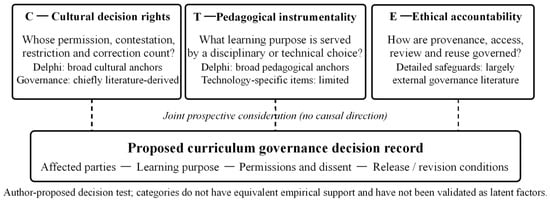
The proposed decision record would specify: the cultural object and anticipated audience; the academic purpose and assessor (T); affected parties, any conflicting standing claims and permissions specific to the stated use (C); and access, restrictions, dissent, review responsibility and a revision trigger (E). For disputed claims, recording dissent and considering deferral of irreversible release is a prospective safeguard, not evidence that either institution or one claimant has final authority. Its threshold must be proportionate to the use: ordinary classroom problem solving and open online circulation of a sensitive recording need not trigger identical procedures. Nor should this checkpoint be equated with general legal compliance or with consent supplied by one Delphi expert.
Figure 2 turns the separate C, T and E questions into one prospective decision review, whereas Table 4 audits the provenance of the underlying claims. Table 8 serves a different purpose: it specifies what a subsequent comparative study would need to observe to determine whether this review adds anything beyond established approval procedures.
Figure 2.
Proposed culture–technology–ethics (CTE) decision review. Dashed links signal prospective joint consideration, not causal estimates, Delphi-validated factors or demonstrated implementation.
Table 7 offers activity-level examples rather than a universal risk ranking: a sound model may be technically accurate yet culturally misleading, while archival or AI uses introduce different possibilities for unpermitted reuse or synthetic imitation. These proposed mitigations come from the learning-design and governance literature, not from tested Delphi interventions [14,21,22,23,24,25,26,27,28,29,31,35,36,37,49,50].
By contrast, Table 8 is an evaluation protocol rather than a second safeguard list. It pairs each possible CTE function with the minimum future records and discriminating comparisons—including missed permission gaps, response to objections, learning coherence and administrative cost—needed to assess incremental value against ordinary approval or co-design.
The proposed checkpoint could demonstrate incremental value only if future evaluation found that its use-specific review identified consequential permission or accountability gaps that existing educational or participatory approvals would otherwise miss. Future matched-task comparisons must therefore measure stakeholder acceptability and corrected uses alongside learning continuity, delay and administrative cost. Equivalent decisions from ordinary workflows, or disproportionate exclusion and burden, would count against an additional CTE procedure. No such comparison was undertaken in the present Delphi study.
5.4. Limitations, Research Integrity and Future Research
The five corrected answer-end timestamps are now supported by old/new export comparisons and matching researcher-provided Credamo survey-management displays. The research team identifies the discrepancies as earlier source-file transcription errors, without any identified change to scored responses. In addition, the original feedback-project entries and 18-code tracking register provide author-confirmed recipient acknowledgements for each round; the individual records can be inspected by the editor under restricted access. These records support documented receipt, not an independently certified transmission mechanism. Table S8 discloses aggregate verification status without code-linked source data; Table S2 independently reproduces 149 marginal item statistics, while independent subgroup reanalysis requires a separately authorised respondent-linked extract, not enclosed in this package.
The purposive panel is academically weighted and includes no documented authorised Khoomei delegation. Its ratings cannot establish community permission, course effectiveness or the practical performance of CTE. The 41 noncompliant priority responses cannot sustain capped rankings, and subgroup contrasts remain exploratory.
Future research should compare existing university approval, participatory co-design or rights review procedures and the optional CTE checkpoint in deliberately matched tasks. The comparison should preregister the cultural-use object and risk threshold, identity of the academic assessor, affected claimants and any disagreement procedure; record permission status, restrictions and review decisions; and measure errors prevented, correction/withdrawal requests, acceptability to affected practitioners, delays, administrative cost and preservation of intended learning outcomes. These measurements should distinguish genuine additional protection from a re-labelled existing approval form. Where relevant voices conflict, no single respondent or cultural label should be treated as automatic collective authorisation. This evaluation is proposed for future work and was not conducted in the present retrospective Delphi analysis.
6. Conclusions
RQ1 reconstructs the 18 recorded codes, 44/53/52 rated prompts and 49 proposed cross-round item links, classified as 35 lexical matches, nine surface variants, four scope changes and one material expansion (Table S1). RQ2 establishes high final-round item ratings within this panel (43/52 > 4.50), with 149 marginal profiles reproducible from published frequencies (Table S2). Neither claim establishes fixed-item longitudinal stability, subgroup equivalence, educational impact or permission to represent living heritage.
RQ3 offers a distinct, conditional theoretical claim: cultural standing (C), educational purpose (T) and stewardship (E) pose different decision questions at the point of a culturally consequential artefact use. The checkpoint is an authorial synthesis, with stronger Delphi anchors for T and literature-dependent warrants for C and E; post-survey ethics additions were not scored. No causal implementation has been evaluated, and an existing approval mechanism may already perform the same review. Prospective comparison is therefore required before asserting incremental benefit.
Supplementary Materials
The following supporting information can be downloaded at: https://www.mdpi.com/article/10.3390/su182111386/s1. The public de-identified workbook contains Table S1 (49 round-specific stem links, semantic classes and later-edit flags), Table S2 (149 five-point frequency profiles with reproducible means, sample SDs, medians and Type-7 quartiles), Table S3 (R2 discontinued items and R3 candidate-related additions), Table S4 (six post-survey ethical text integrations), Table S5 (aggregate response chronology), Table S6 (RQ–method–warrant summary), Table S7 (evidence manifest), Table S8 (de-identified reconciliation of five historical timestamp transcriptions and the three feedback-receipt project records) and Table S9 (aggregate priority-rule exceptions with explicit non-reproducibility boundary). The editor-only E1–E8 workbook contains coded old/new dates, 18 coded R2–R3 time pairs, six original source URLs, a screenshot manifest, research-team verification statements, a three-round feedback acknowledgement index, an 18-code consent inventory and a delivery checklist. The links for the three rounds of raw data collection platforms have been provided and verified. A respondent-level rating matrix and 72 respondent-domain priority answers are not included in E1–E8 or the present restricted zip; their independently reproducible person-level analyses would require those additional protected source extracts.
Author Contributions
Conceptualisation, S.Y., N.A.M. and S.B.A.H.; methodology, S.Y. and N.A.M.; formal analysis, S.Y.; investigation, S.Y.; data curation, S.Y.; writing—original draft preparation, S.Y.; writing—review and editing, S.Y., N.A.M. and S.B.A.H.; visualisation, S.Y.; supervision, N.A.M.; project administration, S.Y. All authors have read and agreed to the published version of the manuscript.
Funding
This research received no external funding.
Institutional Review Board Statement
The wider doctoral study received approval from the Universiti Kebangsaan Malaysia Research Ethics Committee under JEP-2025-751. The corrected UKM letter of 21 May 2026 states that the approval covers the period 3 April 2026 to 2 April 2027 and names the categories relevant to the Delphi panel. The approval letter substantiates the protocol period; the consent-register and survey chronology are documented and separately source-checked by the research team, not certified by the ethics letter itself. The investigator confirms UKM’s maximum recruitment limit of 150 distinct people for the umbrella doctoral project; the letter’s listed category counts (111 in total) do not need to exhaust that ceiling. The present Delphi analysis concerns 18 experts across three rounds (54 main-round responses), not 150 actual participants. The ceiling interpretation is based on the investigator’s stated UKM requirement, while the corrected letter itself labels 150 as “Total”.
Informed Consent Statement
All 18 separately supplied Delphi invitation-and-consent DOCX files were reviewed again: each identifies one of the 18 unique panel pseudonyms (S1–S6, ICH-1–ICH-8 and ICH-H1–ICH-H4), has a written date between 4 and 11 April 2026, and contains image material in the consent/signature portion. The restricted E7 register cross-indexes every file to its code and written date without disclosing signatures in the public supplement. Original signers and execution timing were checked by the research team under restricted access; the file-level review establishes code/date/signature-image presence and does not disclose identity certificates. The investigator reports that experts retained their pseudonyms throughout the three rounds; the three English source workbooks now each show all 18 pseudonyms once per round, verifying repeat code labels while confirmation of signer identities remains restricted. Unredacted consent documents, signatures and identifying information are maintained separately for authorised restricted editorial inspection, subject to ethics and privacy protections. Research-participation consent does not confer collective permission to represent or publish living cultural knowledge.
Data Availability Statement
The original contributions presented in this study are included in the article/Supplementary Material. Further inquiries can be directed to the corresponding author. Public Supplementary Tables S1–S9 provide de-identified rating-frequency profiles for all 149 prompts (2682 ratings), allowing independent recomputation of marginal means and sample SDs, alongside 49-item comparability and aggregate provenance data. Five incorrect dates introduced when transcribing earlier source files (two Round 2; three Round 3) are identified in an old/new audit and the corrected end times match the investigator-provided Credamo platform screenshots to the second; comparison of the linked scoring cells found no change in item ratings. The research team has checked the cause of these differences and confirms that they were transcription errors. The research team also confirms that three original Credamo feedback projects retain 18 expert-coded receipt acknowledgements per round, providing records for authorised editorial review of reported feedback receipt. The six source URLs, four screenshots, five-row correction record and 18 consent originals are indexed or supplied through the restricted editorial package; recorded feedback confirmations can be inspected through the original projects. Person-linked rating matrices and respondent-level priority selections are not part of that package and would require a separate approved controlled release for independent replication. This record-based verification does not claim provider-certified transmission logs, a causal Delphi feedback effect, or that later ethical wording was scored in the original survey.
Conflicts of Interest
The authors declare no conflicts of interest.
Abbreviations
| AI | Artificial intelligence |
| AR | Augmented reality |
| CTE | Culture–Technology–Ethics |
| ESD | Education for sustainable development |
| ICH | Intangible cultural heritage |
| IQR | Interquartile range |
| SAMR | Substitution Augmentation Modification Redefinition |
| SD | Standard deviation |
| SDG | Sustainable Development Goal |
| STEAM | Science, technology, engineering, arts, and mathematics |
| TPACK | Technological Pedagogical Content Knowledge |
| XR | Extended reality |
References
- United Nations. Transforming Our World: The 2030 Agenda for Sustainable Development; A/RES/70/1; United Nations: New York, NY, USA, 2015. [Google Scholar]
- UNESCO. Education for Sustainable Development Goals: Learning Objectives; UNESCO: Paris, France, 2017. [Google Scholar] [CrossRef] [Scilit]
- UNESCO. Education for Sustainable Development: A Roadmap; UNESCO: Paris, France, 2020. [Google Scholar]
- Kelley, T.R.; Knowles, J.G. A conceptual framework for integrated STEM education. Int. J. STEM Educ. 2016, 3, 11. [Google Scholar] [CrossRef] [Scilit]
- Roehrig, G.H.; Dare, E.A.; Ring-Whalen, E.; Wieselmann, J.R. Understanding coherence and integration in integrated STEM curriculum. Int. J. STEM Educ. 2021, 8, 2. [Google Scholar] [CrossRef] [Scilit]
- Hallström, J.; Norström, P.; Schönborn, K.J. Authentic STEM education through modelling: An international Delphi study. Int. J. STEM Educ. 2023, 10, 62. [Google Scholar] [CrossRef] [Scilit]
- Hsiao, P.-W.; Su, C.-H. A Study on the Impact of STEAM Education for Sustainable Development Courses and Its Effects on Student Motivation and Learning. Sustainability 2021, 13, 3772. [Google Scholar] [CrossRef] [Scilit]
- Martín-Sánchez, A.; González-Gómez, D.; Jeong, J.S. Service Learning as an Education for Sustainable Development (ESD) Teaching Strategy: Design, Implementation, and Evaluation in a STEM University Course. Sustainability 2022, 14, 6965. [Google Scholar] [CrossRef] [Scilit]
- UNESCO. Convention for the Safeguarding of the Intangible Cultural Heritage; UNESCO: Paris, France, 2003. [Google Scholar]
- Kirshenblatt-Gimblett, B. Intangible heritage as metacultural production. Mus. Int. 2004, 56, 52–65. [Google Scholar] [CrossRef] [Scilit]
- Smith, L. Uses of Heritage; Routledge: Abingdon-on-Thames, UK, 2006. [Google Scholar]
- Yan, W.-J.; Li, K.-R. Sustainable Cultural Innovation Practice: Heritage Education in Universities and Creative Inheritance of Intangible Cultural Heritage Craft. Sustainability 2023, 15, 1194. [Google Scholar] [CrossRef] [Scilit]
- Huang, Y.; Liu, H.; Gu, J. Designing a learning ecosystem for intangible cultural heritage in short-term study abroad: An outcome-based education case study. Humanit. Soc. Sci. Commun. 2026. [Google Scholar] [CrossRef] [Scilit]
- He, Z.; Wen, C. Construction of digital creation development model of intangible cultural heritage crafts in China. Humanit. Soc. Sci. Commun. 2024, 11, 1745. [Google Scholar] [CrossRef] [Scilit]
- Biggs, J. Enhancing teaching through constructive alignment. High. Educ. 1996, 32, 347–364. [Google Scholar] [CrossRef] [Scilit]
- Aikenhead, G.S. Science education: Border crossing into the subculture of science. Stud. Sci. Educ. 1996, 27, 1–52. [Google Scholar] [CrossRef] [Scilit]
- Bang, M.; Medin, D. Cultural processes in science education: Supporting the navigation of multiple epistemologies. Sci. Educ. 2010, 94, 1008–1026. [Google Scholar] [CrossRef] [Scilit]
- Shultz, M.; Nissen, J.; Close, E.; Van Dusen, B. The role of epistemological beliefs in STEM faculty’s decisions to use culturally relevant pedagogy at Hispanic-Serving Institutions. Int. J. STEM Educ. 2022, 9, 32. [Google Scholar] [CrossRef] [Scilit] [PubMed]
- Matindike, F.; Ramdhany, V. Incorporating indigenous knowledge perspectives in integrated STEM education: A systematic review. Res. Sci. Technol. Educ. 2025, 43, 1022–1042. [Google Scholar] [CrossRef] [Scilit]
- Lave, J.; Wenger, E. Situated Learning: Legitimate Peripheral Participation; Cambridge University Press: Cambridge, UK, 1991. [Google Scholar]
- Mishra, P.; Koehler, M.J. Technological pedagogical content knowledge: A framework for teacher knowledge. Teach. Coll. Rec. 2006, 108, 1017–1054. [Google Scholar] [CrossRef] [Scilit]
- Bower, M. Affordance analysis: Matching learning tasks with learning technologies. Educ. Media Int. 2008, 45, 3–15. [Google Scholar] [CrossRef] [Scilit]
- Laurillard, D. Teaching as a Design Science: Building Pedagogical Patterns for Learning and Technology; Routledge: Abingdon-on-Thames, UK, 2012. [Google Scholar]
- Carroll, S.R.; Garba, I.; Figueroa-Rodríguez, O.L.; Holbrook, J.; Lovett, R.; Materechera, S.; Parsons, M.; Raseroka, K.; Rodriguez-Lonebear, D.; Rowe, R.; et al. The CARE principles for Indigenous data governance. Data Sci. J. 2020, 19, 43. [Google Scholar] [CrossRef] [Scilit]
- Stilgoe, J.; Owen, R.; Macnaghten, P. Developing a framework for responsible innovation. Res. Policy 2013, 42, 1568–1580. [Google Scholar] [CrossRef] [Scilit]
- Floridi, L.; Cowls, J. A unified framework of five principles for AI in society. Harv. Data Sci. Rev. 2019, 1. [Google Scholar] [CrossRef] [Scilit]
- Nguyen, A.; Ngo, H.N.; Hong, Y.; Dang, B.; Nguyen, B.-P.T. Ethical principles for artificial intelligence in education. Educ. Inf. Technol. 2023, 28, 4221–4241. [Google Scholar] [CrossRef] [Scilit] [PubMed]
- Chan, C.K.Y. A comprehensive AI policy education framework for university teaching and learning. Int. J. Educ. Technol. High. Educ. 2023, 20, 38. [Google Scholar] [CrossRef] [Scilit]
- Williamson, B.; Bayne, S.; Shay, S. The datafication of teaching in higher education: Critical issues and perspectives. Teach. High. Educ. 2020, 25, 351–365. [Google Scholar] [CrossRef] [Scilit]
- UNESCO. Ethical Principles for Safeguarding Intangible Cultural Heritage; Decision 10.COM 15.a; Intergovernmental Committee for the Safeguarding of the Intangible Cultural Heritage: Paris, France, 2015; Available online: https://ich.unesco.org/en/decisions/10.COM/15.a (accessed on 7 September 2026).
- Torres-Rivera, A.D.; Rendón Peña, A.A.; Díaz-Torres, S.T.; Díaz-Torres, L.A. Ethical Integration of AI and STEAM Pedagogies in Higher Education: A Sustainable Learning Model for Society 5.0. Sustainability 2025, 17, 8525. [Google Scholar] [CrossRef] [Scilit]
- Lang, L.; Cao, K.; Yuan, Y. From Visibility to Sustainability: Knowledge Translation in Museum-Based Digital Curation of Intangible Cultural Heritage. Sustainability 2026, 18, 8824. [Google Scholar] [CrossRef] [Scilit]
- Brinia, V.; Kountouri, E.; Petrochilos, N.; Georgaka, V.; Sourlas, D.; Tziros, G.; Pramatari, A.; Karagiannaki, A.; Karatosiou, A.; Skarpinakis, E. The ATHRIAN Framework: Integrating Cultural Heritage, Digital Innovation and Sustainability. Sustainability 2026, 18, 9883. [Google Scholar] [CrossRef] [Scilit]
- English, L.D. STEM education K-12: Perspectives on integration. Int. J. STEM Educ. 2016, 3, 3. [Google Scholar] [CrossRef] [Scilit]
- Csoba DeHass, M.; Collins, L.; Taitt, A.; Raymond-Yakoubian, J.; Doering, T.; Ellanna, L.N.; Hollinger, E.; Gonzalez, J.; John, E., Jr.; Martinez, D.; et al. Ethical considerations in the use of 3D technologies to preserve and perpetuate Indigenous heritage. Am. Antiq. 2025, 90, 282–306. [Google Scholar] [CrossRef] [Scilit]
- Sianturi, M.; Lee, J.-S.; Cumming, T.M. Using technology to facilitate partnerships between schools and Indigenous parents: A narrative review. Educ. Inf. Technol. 2023, 28, 6141–6164. [Google Scholar] [CrossRef] [Scilit]
- Maulana, M.R.; Sukmayadi, Y.; Sunaryo, A.; Tresnadi, S. Digitalization of Tradition: An Android-Based Gamelan Degung Sundanese Application to Improve Musicianship Skills is Higher Education. Promusika 2025, 13, 59–70. [Google Scholar] [CrossRef] [Scilit]
- Beiderbeck, D.; Frevel, N.; von der Gracht, H.A.; Schmidt, S.L.; Schweitzer, V.M. Preparing, conducting, and analyzing Delphi surveys: Cross-disciplinary practices, new directions, and advancements. MethodsX 2021, 8, 101401. [Google Scholar] [CrossRef] [Scilit] [PubMed]
- Okoli, C.; Pawlowski, S.D. The Delphi method as a research tool: An example, design considerations and applications. Inf. Manag. 2004, 42, 15–29. [Google Scholar] [CrossRef] [Scilit]
- Jünger, S.; Payne, S.A.; Brine, J.; Radbruch, L.; Brearley, S.G. Guidance on Conducting and REporting DElphi Studies (CREDES) in palliative care: Recommendations based on a methodological systematic review. Palliat. Med. 2017, 31, 684–706. [Google Scholar] [CrossRef] [Scilit] [PubMed]
- Diamond, I.R.; Grant, R.C.; Feldman, B.M.; Pencharz, P.B.; Ling, S.C.; Moore, A.M.; Wales, P.W. Defining consensus: A systematic review recommends methodological criteria for reporting of Delphi studies. J. Clin. Epidemiol. 2014, 67, 401–409. [Google Scholar] [CrossRef] [Scilit] [PubMed]
- Jaakkola, E. Designing conceptual articles: Four approaches. AMS Rev. 2020, 10, 18–26. [Google Scholar] [CrossRef] [Scilit]
- Jabareen, Y. Building a conceptual framework: Philosophy, definitions, and procedure. Int. J. Qual. Methods 2009, 8, 49–62. [Google Scholar] [CrossRef] [Scilit]
- Margot, K.C.; Kettler, T. Teachers’ perception of STEM integration and education: A systematic literature review. Int. J. STEM Educ. 2019, 6, 2. [Google Scholar] [CrossRef] [Scilit]
- Shernoff, D.J.; Sinha, S.; Bressler, D.M.; Ginsburg, L. Assessing teacher education and professional development needs for the implementation of integrated approaches to STEM education. Int. J. STEM Educ. 2017, 4, 13. [Google Scholar] [CrossRef] [Scilit] [PubMed]
- Stohlmann, M.; Moore, T.J.; Roehrig, G.H. Considerations for Teaching Integrated STEM Education. J. Pre-Coll. Eng. Educ. Res. 2012, 2, 4. [Google Scholar] [CrossRef] [Scilit]
- Henderson, C.; Beach, A.; Finkelstein, N. Facilitating change in undergraduate STEM instructional practices: An analytic review of the literature. J. Res. Sci. Teach. 2011, 48, 952–984. [Google Scholar] [CrossRef] [Scilit]
- Penuel, W.R.; Fishman, B.J.; Yamaguchi, R.; Gallagher, L.P. What Makes Professional Development Effective? Strategies That Foster Curriculum Implementation. Am. Educ. Res. J. 2007, 44, 921–958. [Google Scholar] [CrossRef] [Scilit]
- Jafari, E. Leadership readiness for AI chatbots in higher education: A Delphi-based managerial competency and governance framework. Humanit. Soc. Sci. Commun. 2026. [Google Scholar] [CrossRef] [Scilit]
- Lan, G.; Feng, X.; Du, S.; Song, F.; Xiao, Q. Integrating ethical knowledge in generative AI education: Constructing the GenAI-TPACK framework for university teachers’ professional development. Educ. Inf. Technol. 2025, 30, 15621–15644. [Google Scholar] [CrossRef] [Scilit]

Disclaimer/Publisher’s Note: The statements, opinions and data contained in all publications are solely those of the individual author(s) and contributor(s) and not of MDPI and/or the editor(s). MDPI and/or the editor(s) disclaim responsibility for any injury to people or property resulting from any ideas, methods, instructions or products referred to in the content. |
© 2026 by the authors. Licensee MDPI, Basel, Switzerland. This article is an open access article distributed under the terms and conditions of the Creative Commons Attribution (CC BY) license.