


Abstract
More public spending on education does not necessarily translate into better educational conditions. Using provincial panel data from China (2006–2019), this study examines how different measures of public education finance are associated with three educational indicators: Primary-school Student–Teacher Ratio, Junior-secondary Student–Teacher Ratio, and Illiteracy. The findings reveal that these relationships vary across fiscal measures, educational outcomes, and model specifications. Government appropriation for education is associated with lower student–teacher ratios in parsimonious models, whereas local fiscal education expenditure is negatively associated with illiteracy in simpler specifications. However, these associations become less consistent after additional fiscal and socioeconomic controls are introduced. Significant interaction effects emerge for both student–teacher ratios, but not for illiteracy, indicating that conditional fiscal associations vary across educational outcomes. These findings suggest that higher education expenditure alone is an insufficient indicator of educational improvement. For SDG 4 and social sustainability, the findings highlight the value of distinguishing fiscal measures and considering multiple educational outcomes in a comprehensive, context-sensitive assessment of public financing beyond expenditure levels.
1. Introduction
Education finance is a sustainability concern because maintaining educational opportunity requires resources for both current provision and the capabilities of future generations. The 2030 Agenda recognizes education within the social dimension of sustainable development, and Sustainable Development Goal 4 (SDG 4) encompasses schooling, literacy, and the supply of qualified teachers [1,2].
More public spending does not automatically translate into better education. Governments often expand education budgets in the expectation that additional resources will improve schooling conditions, widen access, and strengthen educational outcomes. Yet the empirical relationship between fiscal inputs and educational performance is far from mechanical. Whether additional resources improve schooling conditions and educational outcomes depends on how funds are allocated, on how spending is implemented, and on whether it is translated into measurable social outcomes. Aggregate expenditure totals alone, therefore, provide an incomplete picture: they do not show how resources are distributed, which level of government bears expenditure responsibility, or how financing reaches schools and students. Research on public expenditure has shifted from asking how much governments spend to examining funding structures, allocation, and institutional context [3,4]. These dimensions matter because education finance bears on both current service provision and longer-term social sustainability.
China offers a particularly revealing setting for examining this issue. Education is financed and delivered through a multilevel fiscal system in which subnational governments bear substantial expenditure responsibilities, while fiscal resources are mobilized through multiple and partly overlapping channels. This makes education finance more complex than a simple division between “central” and “local” spending. Two indicators commonly reported in Chinese fiscal and education statistics: local fiscal expenditure on education and government appropriation for education. Local fiscal expenditure reflects education spending recorded in subnational fiscal budgets, whereas government appropriation for education is a broader accounting category covering government-related education funding. Importantly, the latter should not be interpreted as a direct measure of central-government transfers to provinces.
Research on public expenditure shows that its associations with social outcomes vary across spending categories and institutional settings [4]. Studies of fiscal decentralization and vertical fiscal imbalance further suggest that these associations depend partially on how expenditure responsibilities and fiscal resources are distributed across levels of government [5,6,7]. Evidence from China likewise shows that the consequences of both vary across regions and policy domains [8,9]. Aggregate spending alone may therefore provide an incomplete picture of how fiscal arrangements relate to educational conditions, and it leaves open the question of when more education financing corresponds to better outcomes and when it does not.
Educational outcomes also capture different dimensions of provision. Primary- and junior-secondary-school student–teacher ratios describe staffing conditions at different stages of schooling, whereas adult illiteracy reflects a broader, longer-term educational condition. Examining these indicators separately helps assess whether the associations with education financing vary across educational dimensions.
This study addresses that question using a provincial panel covering 31 provincial-level units in China from 2006 to 2019. It distinguishes between local fiscal expenditure on education and government appropriation for education and examines their associations with three education-related outcomes: the primary-school and junior-secondary-school student–teacher ratios and adult illiteracy. Specifically, it asks: (1) How are the two fiscal measures associated with these outcomes across provinces? (2) Do these associations differ between staffing conditions and adult illiteracy? and (3) Does the association of one fiscal measure with these outcomes vary with the level of the other fiscal measure?
Research has identified long-term benefits of sustained school spending [10], questioned the effectiveness of input-based education policies [11], and highlighted the roles of local accountability and fiscal responses in China’s education financing [12]. Building on this work, this study offers an institutionally conditioned and outcome-specific analysis of education finance. It distinguishes two partially overlapping fiscal measures, compares their within-province associations with primary- and junior-secondary-school student–teacher ratios and adult illiteracy, and examines whether the association of one measure varies with the level of the other. By treating staffing and illiteracy as distinct outcomes, the study relates public financing to educational service capacity and accumulated literacy—conditions relevant to social sustainability and SDG 4. Because the analysis is observational and provincial, it identifies conditional associations rather than causal effects and does not directly measure sustainability.
2. Literature Review and Conceptualization
2.1. Education Expenditure and Outcomes
Education spending can shape educational outcomes by affecting the resources available to schools, including teachers, facilities, instructional materials, and student support. Whether higher expenditure produces better outcomes, however, depends on how these resources are used. Evidence from school finance reforms suggests that sustained increases in funding can improve educational attainment and student achievement, particularly in lower-income districts. Additional funding has also been associated with changes in the composition of school inputs, such as increased teacher staffing, smaller classes, and greater capital investment, indicating that fiscal resources may work through several channels rather than through spending levels alone [10,13].
At the same time, a long-standing concern in the education literature is that additional resources do not automatically translate into better performance. The effects of conventional school inputs have often been uneven across settings, and the relationship between spending and learning appears to depend on teacher quality, incentives, resource allocation, and institutional capacity. Similar patterns have been observed in developing countries, where the effects of school and teacher inputs vary substantially across programs and contexts [11,14]. The relevant question, therefore, is not simply whether education spending increases, but whether additional fiscal resources are converted into the types of services that matter for educational outcomes. Recent studies further highlight the importance of fiscal context and heterogeneous educational outcomes. Jackson and Mackevicius [15], through a meta-analysis of school spending evaluations in the United States, find positive average effects on educational outcomes, while identifying variation across populations and policy contexts. In China, Fan et al. [16] show that increased local education expenditure is associated with lower educational inequality, although the magnitude of this relationship diminishes with greater local fiscal autonomy. Similarly, Yan et al. [17] demonstrate that fiscal pressure can reduce local education expenditure, highlighting the role of fiscal institutions in resource allocation. Altogether, these findings reinforce the need to examine education financing in relation to institutional conditions and distinct educational outcomes.
This distinction is important for the outcome measures used in this study. Student–teacher ratios reflect the intensity of teaching resources and are therefore better understood as indicators of educational service capacity than as direct measures of learning. Research on class size nevertheless suggests that staffing conditions can affect student achievement, which makes the student–teacher ratio a substantively relevant indicator of education provision [18,19]. By contrast, illiteracy among the population aged 15 and above captures a broader and more cumulative educational outcome. Examining these indicators separately allows the analysis to distinguish between the resource conditions under which education is delivered and a longer-term social outcome of education. It also leaves open the possibility that fiscal inputs are associated differently with different dimensions of education, which is central to the analysis that follows.
The sustainability relevance of these indicators follows from their different educational roles. Staffing capacity provides context for the schooling and teacher-supply priorities of SDG targets 4.1 and 4.c, while adult illiteracy is relevant to the literacy priority of target 4.6 [2]. Student–teacher ratios do not measure teacher qualifications or learning achievement, and the illiteracy measure is not a complete assessment of literacy and numeracy. These connections therefore guide interpretation without treating the selected variables as official SDG indicators.
2.2. Intergovernmental Fiscal Context in China
How education is financed matters as much as how much is spent. Fiscal decentralization gives subnational governments greater responsibility for public services and may allow spending to respond more closely to local needs. Problems arise, however, when these responsibilities are not matched by sufficient revenue capacity. This mismatch is central to the concept of vertical fiscal imbalance and can affect both the level and composition of local expenditure [5]. The consequences of decentralization therefore depend on the fiscal and institutional conditions under which local governments operate [6]. In China, this issue is particularly relevant because local governments bear major responsibilities for education and other public services while their fiscal resources remain closely connected to the broader intergovernmental system.
Intergovernmental transfers can ease these fiscal constraints, but they do not simply add to local resources. Local governments may adjust their own expenditure when outside funds become available, meaning that the effect of transfers depends partially on the fiscal response they generate. The introduction of Title I grants in the United States, for example, shows that federal education funding can be partially offset by changes in local fiscal behavior [20]. Similar concerns arise in China, where transfers intended to support education do not always produce equivalent increases in local education spending or improvements in educational outcomes, particularly when local governments reallocate their own resources or face different accountability incentives [12,21].
The Chinese literature also shows that the distribution of revenue and expenditure responsibilities can shape local spending priorities. Greater expenditure decentralization without corresponding revenue autonomy may encourage local governments to direct resources toward capital construction rather than education [22]. Vertical fiscal imbalance has also been associated with differences in basic-education performance across provinces, while its effects appear to vary with regional conditions and policy settings [8]. Research in other policy areas similarly suggests that fiscal imbalance can alter subnational incentives and expenditure choices [9]. These findings make the intergovernmental fiscal environment relevant to the interpretation of education spending, without implying that any particular combination of fiscal indicators constitutes a direct measure of vertical fiscal imbalance.
This distinction is important for the two fiscal measures used in this study. Local fiscal expenditure on education records education spending in local fiscal accounts, whereas government appropriation for education is a broader category of government-related resources devoted to education. The two measures therefore capture different, but partially overlapping, dimensions of public education finance and should not be interpreted as mutually exclusive local- and central-government expenditures. For the same reason, their interaction is not treated as a direct measure of vertical fiscal imbalance. Instead, it is used to examine whether the association between one fiscal measure and educational outcomes varies with the level of the other. The interaction therefore examines whether the association between one fiscal measure and educational outcomes varies with the level of the other, rather than directly measuring vertical fiscal imbalance or behavioral relationships between funding sources.
3. Research Design
3.1. Research Questions
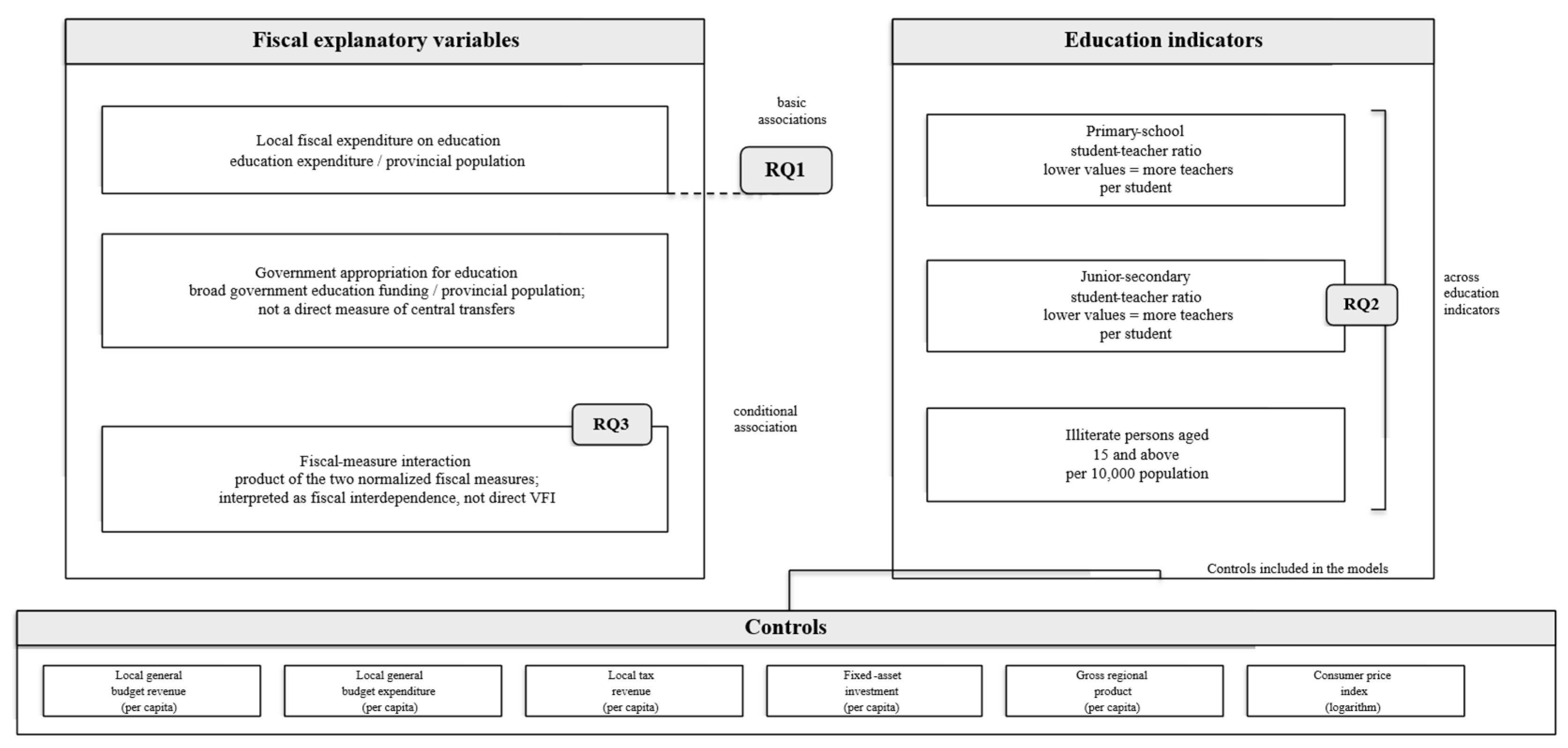
The literature suggests that the relationship between education financing and educational provision may vary across fiscal arrangements and across different dimensions of education. As outlined in Figure 1, to examine fiscal conditions relevant to social sustainability, the study addresses three research questions:
Figure 1.
Conceptual framework. Note: The interaction term is interpreted as fiscal interdependence rather than a direct measure of vertical fiscal imbalance (VFI).
RQ1: How is education financing associated with education-related outcomes across Chinese provinces?
Public education financing can support teacher recruitment, infrastructure, and other school inputs. Prior research links increased funding to improved educational conditions and attainment, although these associations depend on resource allocation and institutional capacity [10,11,13,14]. Higher financing may therefore be associated with lower student–teacher ratios and, over time, lower illiteracy. This study examines these associations across provincial education indicators, treating local fiscal expenditure on education and government appropriation for education separately because their statistical coverage differs.
H1a.
Higher local fiscal expenditure on education is associated with lower primary-school student–teacher ratio, junior-secondary student–teacher ratio, and illiteracy.
H1b.
Higher government appropriation for education is associated with lower primary-school student–teacher ratio, junior-secondary student–teacher ratio, and illiteracy.
RQ2: Do these associations differ across different dimensions of education?
Education financing may not be related to all outcomes in the same way. The primary- and junior-secondary student–teacher ratios mainly reflect staffing intensity and educational service capacity, whereas illiteracy among the population aged 15 and above captures a broader and more cumulative educational outcome. Research on educational resources and class size provides a basis for examining staffing-related indicators separately from broader educational outcomes [18,19]. Accordingly, the relationships between fiscal resources and educational indicators are expected to vary across educational dimensions. Comparing these indicators allows the analysis to examine whether the relationship with fiscal resources varies across different dimensions of education.
H2.
The associations between government education financing and educational indicators differ across educational dimensions, with more direct and consistent negative associations expected for student–teacher ratios than for Illiteracy.
RQ3: Does the association between each education-finance measure and educational outcomes vary with the level of the other measure?
Research on fiscal decentralization and intergovernmental finance shows that expenditure patterns are shaped by fiscal responsibilities, budget constraints, and allocation incentives [5,6,12,20,21,22]. This suggests that the association between education financing and educational conditions may vary with fiscal context.
Local fiscal expenditure on education and government appropriation for education are distinct but partly overlapping indicators, not mutually exclusive local and central funding channels. Their interaction tests whether the association between either measure and education outcomes varies with the level of the other. It represents a conditional statistical association; it does not directly measure vertical fiscal imbalance or establish fiscal complementarity, substitution, or interdependence.
H3.
The association between each education-finance measure and educational outcomes varies with the level of the other measure.
3.2. Data and Measures
The study constructs a province-year panel covering 31 provincial-level units in mainland China from 2006 to 2019, excluding Hong Kong, Macao, and Taiwan according to National Bureau of Statistics. The sample ends in 2019 to avoid the disruptions associated with the COVID-19 pandemic. Subsequently, China’s Double Reduction Policy, introduced in July 2021, sought to reduce excessive homework and off-campus extra-curriculum tutoring burdens in compulsory education while improving school-based educational services. These developments introduced additional fiscal and institutional changes that could complicate comparisons with earlier years. Restricting the analysis through 2019 therefore provides a more consistent institutional setting for examining the associations between education financing and educational outcomes. The data are drawn primarily from official Chinese statistical yearbooks. Because several variables are unavailable for some province-year observations, the number of observations varies across model specifications.
Three indicators are used to capture different dimensions of education. The primary-school student–teacher ratio and the junior-secondary-school student–teacher ratio measure the intensity of teaching resources in compulsory education, with lower ratios indicating more teachers relative to students. These measures reflect educational service capacity rather than student achievement itself. The third indicator is the number of illiterate individuals aged 15 and above per 10,000 population, which captures a broader and more cumulative dimension of educational attainment. The dataset does not contain standardized test scores, graduation outcomes, or direct measures of teacher quality, and the three indicators should therefore not be interpreted as comprehensive measures of educational quality. Their relevance to social sustainability lies in the educational conditions they describe; they do not directly measure educational equity or achievement of SDG 4.
The analysis uses two measures of education financing. Local fiscal expenditure on education refers to education expenditure recorded in local fiscal accounts. Government appropriation for education is a broader measure of government-related fiscal resources devoted to education and is not interpreted as central-government expenditure or as a direct measure of central transfers to provinces. The two indicators therefore capture distinct but partially overlapping dimensions of public education finance. Both are divided by provincial population to account for differences in population size across provinces. These measures represent fiscal resources per resident rather than expenditure per enrolled student.
Before estimation, monetary variables were converted to constant 2019 prices using chained provincial CPI. The financing measures and monetary controls were then divided by provincial population where applicable. They therefore represent real fiscal resources per resident, not expenditure per enrolled student. The logged annual CPI is retained as an additional control in Models 3 and 4.
The models include time-varying provincial controls for fiscal capacity and economic conditions: local general budget revenue, local general public budget expenditure, tax revenue, gross regional product, and fixed-asset investment. Table 1 presents the descriptive statistics, and Table 2 summarizes variable construction and measurement.
Table 1.
Descriptive statistics.
Table 2.
Variable operationalization.
3.3. Methodology
The empirical analysis uses province fixed-effects models. A Hausman test rejects the null hypothesis that the difference between the fixed- and random-effects estimates is not systematic (p = 0.0013), supporting the fixed-effects specification. Province fixed effects absorb unobserved characteristics that remain constant within provinces over time. The coefficients are therefore estimated from within-province changes in fiscal and socioeconomic conditions over the study period.
The general specification is:
where Yit denotes one of the three education indicators for province (i) in year (t); Xit contains the two education-finance measures and, where specified, their interaction; Zit represents the time-varying fiscal and socioeconomic controls; αi denotes province fixed effects; and εit is the error term. The interaction coefficient indicates whether the within-province association between one fiscal measure and an education indicator varies with the level of the other measure. It is interpreted as a conditional statistical association, not as a direct measure of vertical fiscal imbalance or as evidence of fiscal complementarity, substitution, or interdependence.
Yit = αi + βXit + γZit + εit,
The empirical design identifies associations rather than causal effects. Education expenditure may respond to changes in educational conditions, creating the possibility of reverse causality, while unobserved time-varying factors may influence both fiscal allocation and education indicators. Province fixed effects account for time-invariant provincial characteristics but do not eliminate these sources of endogeneity. The results are therefore interpreted as within-province associations rather than causal estimates.
The three outcome measures differ in their temporal properties and should therefore be interpreted carefully. The number of illiterate persons aged 15 and above is a cumulative stock measure that may reflect historical education, population age structure, mortality, and migration, in addition to recent educational conditions. The student–teacher ratio is jointly determined by the number of teachers and the number of enrolled students and may change because of teacher recruitment, staff departures, enrollment changes, demographic shifts, or migration. Accordingly, the estimated associations should not be interpreted as immediate short-term effects of current education expenditure. Differences across the outcomes may also reflect their distinct measurement structures and adjustment processes over time.
4. Empirical Analysis
4.1. Primary-School Student–Teacher Ratio
Table 3 reports the fixed-effects estimates for the primary-school student–teacher ratio. In the parsimonious specification, government appropriation for education is negatively and significantly associated with the student–teacher ratio, whereas local fiscal education expenditure is not statistically significant. After local fiscal and socioeconomic controls are introduced, neither education-finance measure remains statistically significant. In Model 4, the interaction between local fiscal education expenditure and government appropriation for education is positive and statistically significant. This result indicates that the association between one financing measure and the primary-school student–teacher ratio varies with the level of the other financing measure. Because the model uses province fixed effects, these estimates represent within-province conditional associations after accounting for time-invariant provincial characteristics; they do not establish causal effects.
Table 3.
Fixed-effects estimates for primary-school student–teacher ratio.
4.2. Junior-Secondary Student–Teacher Ratio
Table 4 reports the fixed-effects estimates for the junior-secondary student–teacher ratio. In the parsimonious specification, local fiscal education expenditure is positively and significantly associated with the student–teacher ratio, while government appropriation for education is negatively and significantly associated with it. After local fiscal and socioeconomic controls are introduced, neither education-finance measure remains statistically significant. In Model 4, the interaction between the two fiscal measures is positive and statistically significant, indicating that the within-province association between one financing measure and the junior-secondary student–teacher ratio varies with the level of the other measure. Because the two fiscal indicators are not mutually exclusive measures of central and local spending, this interaction represents a conditional association between the two forms of education financing rather than direct evidence of vertical fiscal imbalance or central–local fiscal conflict. The estimates do not establish causal effects.
Table 4.
Fixed-effects estimates for junior-secondary student–teacher ratio.
4.3. Illiteracy Outcome
Table 5 reports the fixed-effects estimates for the number of illiterate persons aged 15 and above per 10,000 population. Local fiscal education expenditure is negatively and significantly associated with illiteracy in Models 1 and 2, but this association is no longer statistically significant after the additional fiscal and socioeconomic controls are introduced. Government appropriation for education is positively and significantly associated with illiteracy in Model 1, but it is not statistically significant in Models 2–4. The interaction between local fiscal education expenditure and government appropriation for education is not statistically significant in Model 4. Therefore, the estimates do not provide robust evidence that the combination of the two financing measures is associated with lower illiteracy. Because the two fiscal measures do not represent mutually exclusive central- and local-government spending, their interaction should be interpreted as a conditional association rather than as a direct measure of vertical fiscal imbalance. The estimates identify within-province conditional associations and do not establish causal effects.
Table 5.
Fixed-effects estimates for illiteracy outcome.
5. Discussion
5.1. Interpreting Heterogeneous Fiscal Associations
The results differ across the three education indicators Government appropriation for education is negatively and significantly associated with both student–teacher ratios in Model 1, but neither association is statistically significant in Models 2 and 3. Local fiscal education expenditure is not statistically significant for the primary-school ratio in these additive models; it is positively and significantly associated with the junior-secondary ratio in Model 1 but not statistically significant in Models 2 and 3. For illiteracy, local fiscal education expenditure is negatively and significantly associated with the outcome in Models 1 and 2 but not statistically significant in Model 3, whereas government appropriation is positively and significantly associated with the outcome only in Model 1. In Model 4, the interaction is positive and statistically significant for both student–teacher ratios but not statistically significant for illiteracy. These patterns describe variation across the reported estimates, rather than a formal test of differences between outcomes.
In the interaction specification, the slope on local fiscal education expenditure equals its main-effect coefficient plus the interaction coefficient multiplied by government appropriation; the association for government appropriation is defined analogously. Thus, the positive interaction coefficients in the staffing models indicate fitted slopes that become more positive as the other financing measure increases. They do not establish that either marginal association is itself positive or statistically significant at observed financing levels. Because marginal associations and their confidence intervals are not reported in the current analysis, the tables do not establish the magnitude or precision of these associations across financing levels.
Adult illiteracy is a cumulative, stock-related educational outcome shaped by historical enrollment and schooling, population age structure, mortality, and migration. Changes in the indicator may reflect cohort replacement or changes in population composition as well as literacy acquisition. Annual education expenditure, by contrast, is a flow measured over a single year. An association between current expenditure and adult illiteracy therefore cannot be treated as evidence of an immediate literacy response to current funding.
The student–teacher ratio is a contemporaneous ratio, defined here as enrolled students divided by teachers. Its numerator and denominator can both change: a lower ratio may reflect more teachers, fewer enrolled students, or both, while a higher ratio may reflect expanding enrollment rather than declining teacher numbers. The assembled dataset contains the ratios but not separate teacher and student counts, so the analysis cannot distinguish these components empirically. The available data do not show how education funds are divided among different uses and do not include direct measures of teacher quality or school infrastructure. It is therefore not possible to identify a specific mechanism behind the results. Differences between the staffing and illiteracy associations cannot be attributed directly to short-term expenditure effects.
5.2. Intergovernmental Transfers
Government appropriation for education is a broad fiscal category that may include resources from several channels and does not separately identify transfers from the central government. Local fiscal education expenditure and government appropriation are also partly overlapping accounting measures, rather than mutually exclusive sources of local and central funding. Their interaction is consequently not a direct measure of vertical fiscal imbalance, and its significance cannot establish complementarity, substitution, or behavioral fiscal interdependence. Distinguishing those mechanisms would require a reconciliation of the underlying accounting categories and separate measures of transfers and locally financed expenditure.
Lü [21] studies Chinese counties affected by the 1994–2000 8-7 poverty reduction program, using an income eligibility threshold in a fuzzy regression discontinuity design. The study evaluates a mix of program-related transfers through local education spending and changes in adult illiteracy between the 1990, 2000, and 2010 censuses, and finds no systematic improvement in these outcomes. The lack of a stable negative government-appropriation association in our results is compatible with caution about assuming automatic educational gains from additional public resources. It is not a replication of that program evaluation: our exposure is a broad provincial funding measure in a later period, and our models do not isolate transfer eligibility or an exogenous transfer increase.
Ding, Lu, and Ye [12] use itemized education-finance data for approximately 1600 central and western Chinese counties during 1998–2011. Their difference-in-differences design exploits variation in the timing and funding ratios of the 2006 education finance reform, examining budgetary, extra-budgetary, and total school spending per pupil. They find that increases in budgetary spending were offset by reductions in other spending, limiting gains in total funding. Their account-level evidence demonstrates why the definition of a fiscal measure matters. Our two aggregate measures neither separate those accounts nor identify the same reform contrast; the present interaction coefficients therefore cannot establish comparable crowding out or local fiscal responses.
5.3. Land Finance
Jia, Guo, and Zhang [22] analyze Chinese county data for 1997–2006 using dynamic panel models and GMM estimation. They distinguish revenue decentralization from expenditure decentralization and examine government expenditure levels and composition, including education shares. Their finding that expenditure decentralization is associated with a shift toward capital construction concerns expenditure allocation, whereas our outcomes concern staffing ratios and adult illiteracy. Their results motivate attention to fiscal institutions but do not identify the mechanism behind our provincial associations.
Ding, Niu, and Lichtenberg [23] study Chinese prefecture-level cities during 1999–2006, distinguishing land-conveyance revenue from budgetary revenue and examining public-sector outcomes such as infrastructure provision and primary-school teacher numbers. They use city and year fixed effects, with instrumental-variable estimation for selected outcomes, and infer spending preferences indirectly from these relationships. Their evidence favors an infrastructure-oriented interpretation of land revenues, but it does not establish that land finance explains the present education-finance coefficients. Their fiscal exposure, city-level setting, outcome definitions, and pre-2007 period differ from those in our 2006–2019 provincial analysis.
The current data do not include land-conveyance revenue, so this explanation cannot be tested directly. No empirical heterogeneity tests by fiscal autonomy, transfer dependence, or reliance on land finance are reported here. Such comparisons would require transparent and reproducible indicators, consistent fiscal coverage over time, and re-estimation of the models. These institutional factors remain questions for further investigation rather than explanations verified by the current results.
5.4. External Validity and Limitations
The findings should be interpreted within the institutional setting of China’s intergovernmental fiscal system. They may be most relevant to systems in which subnational governments carry substantial expenditure responsibilities while local revenue autonomy is limited and intergovernmental transfers remain important. They should not be assumed to generalize directly to decentralized systems in which local governments possess broad autonomous taxing powers.
Faguet and Sánchez [6] provide a useful institutional comparison through municipal analyses of decentralization in Bolivia and Colombia. Their study examines Bolivian investment patterns around the 1994 reform using 1987–1996 data and Colombian decentralization during 1994–2004, assessing investment responsiveness and public-school enrollment. Their reform-based comparisons concern the allocation of fiscal responsibilities and resources at the municipal level, whereas the present study relates provincial education-finance levels to staffing ratios and illiteracy in a later period. Differences in government level, institutional change, and educational outcomes prevent a direct comparison of coefficients or an assumption that the same mechanisms operate in China.
The empirical design also places several limits on interpretation. Province fixed effects account for time-invariant differences across provinces, but they do not resolve reverse causality or omitted factors that change over time. The estimates therefore describe within-province conditional associations, and common temporal trends, changing demographic conditions, or expenditure responses to educational needs may influence the results. They do not identify the causal effects of fiscal expenditure.
Sample composition also changes across specifications: each outcome has 368 observations in Model 1, 301 in Model 2, and 208 in Models 3 and 4, although all models include 31 provinces. Changes in statistical significance across Models 1–3 therefore cannot be attributed solely to the addition of controls, because the estimation samples also differ. Moreover, a statistically insignificant coefficient does not establish the absence of an association, and differences in significance do not by themselves demonstrate that coefficients differ statistically.
All monetary regressors are expressed in constant 2019 RMB per resident using provincial CPI deflation; Models 3 and 4 also retain the original log CPI control. This improves comparability over time but does not resolve endogeneity or differences in fiscal accounting coverage. The fiscal measures are expressed relative to total provincial population rather than student enrollment, so they should be read as per-resident fiscal resources rather than per-student expenditure. The dataset also does not separately identify central education transfers or land-based fiscal resources. These issues limit the precision with which the estimated relationships can be interpreted and point to areas where more detailed fiscal, demographic, and education data would be useful. The analysis also does not directly measure educational equity, intergenerational outcomes, or fiscal sustainability; its provincial indicators cannot establish progress across all SDG 4 targets.
5.5. Comparison with Previous Research
The present study examines 31 Chinese provincial-level units over 2006–2019 using two partly overlapping education-finance measures per resident, expressed in constant 2019 RMB. Its province fixed-effects estimates concern conditional associations with staffing ratios and adult illiteracy, rather than the causal effects of an externally induced funding change. This distinction is important when comparing the findings with previous research on education expenditure and educational outcomes.
The findings contribute to the longstanding debate on whether additional education spending necessarily improves educational outcomes. Hanushek [11] questions the effectiveness of conventional input-based schooling policies, emphasizing the importance of institutional incentives and resource utilization. In contrast, Jackson, Johnson, and Persico [10] provide causal evidence that sustained increases in school spending can improve educational attainment and long-term economic outcomes. Using court-mandated school finance reforms in the United States, their event-study and instrumental-variable analyses identify benefits from prolonged funding exposure during school-age years. The absence of consistently significant negative associations in our fuller specifications does not directly contradict these findings. Our study examines contemporaneous provincial associations with staffing ratios and adult illiteracy rather than the long-term effects of school spending per pupil. Differences in aggregation, exposure duration, outcome measurement, and identification strategies therefore limit direct comparisons.
Institutional arrangements also influence how fiscal resources are allocated and translated into educational provision. Lafortune, Rothstein, and Schanzenbach [13] find that school finance reforms in the United States generated sustained spending increases and subsequent achievement gains in low-income districts. In China, Ding et al. [12] demonstrate that the effects of intergovernmental education transfers depend on heterogeneous accountability arrangements and local fiscal responses. These studies highlight the importance of institutional conditions in shaping the relationship between education financing and educational outcomes. Our analysis extends this discussion by examining two partly overlapping measures of public education finance within China’s multilevel fiscal system. However, because the measures do not separately identify intergovernmental transfers and locally financed expenditure, their interaction cannot directly establish fiscal substitution, complementarity, or specific behavioral responses.
Taken together, these comparisons highlight three theoretical implications. First, fiscal associations may vary depending on how education financing is measured. Second, these associations differ across educational indicators, particularly between contemporaneous student–teacher ratios and cumulative illiteracy. Third, significant interaction effects for both student–teacher ratios suggest conditional relationships between fiscal measures and educational conditions. These findings contribute to an institutionally conditioned and outcome-specific understanding of education finance. Future research should examine whether fiscal autonomy, transfer dependence, and land-finance incentives explain these relationships.
6. Policy Implications for Social Sustainability
The findings are consistent with the view that assessments of education finance benefit from considering educational conditions alongside expenditure levels. If these associations reflect causal processes, the relevant policy questions would concern how financing relates to the continuity of education services, access to educational resources, and the conditions supporting human capital over time. These are interpretations relevant to sustainable education, rather than causal conclusions directly verified by the present indicators.
Assessing service continuity would require evidence on the stability of teacher employment and school operations across budget cycles, while assessing resource accessibility would require information on how staffing and facilities are distributed across schools and population groups. Evaluating long-term human capital conditions would require evidence on learning, attainment, and literacy across cohorts. The present models do not test these dimensions directly. The results instead suggest a need for further examination of whether predictable funding and the distribution of resources are associated with sustained educational provision; they do not identify an optimal funding level or mix.
SDG 4-oriented monitoring could combine these measures with direct evidence on learning, teacher qualifications, and access among disadvantaged groups, which the present provincial data do not provide. Such evidence could help assess whether changes in financing coincide with more continuous and accessible services and stronger long-term educational conditions, without treating aggregate spending growth or a single staffing ratio as proof of sustainability.
7. Conclusions
The findings do not support a simple relationship between higher education spending and better educational conditions. The associations vary across fiscal measures, education indicators, and model specifications. Government appropriation is negatively and significantly associated with both student–teacher ratios only in the parsimonious models, while local fiscal education expenditure is negatively and significantly associated with illiteracy in the first two specifications. The interaction is positive and statistically significant for both staffing ratios but not statistically significant for illiteracy. These estimates do not establish a stable negative relationship between government appropriation and adult illiteracy, nor do they demonstrate causal effects of either financing measure.
Local fiscal expenditure on education and government appropriation for education capture different but partly overlapping dimensions of public education finance; they are not mutually exclusive measures of local and central government spending. The interaction coefficients cannot establish vertical fiscal imbalance, complementarity, substitution, or behavioral fiscal interdependence. Province fixed effects control for time-invariant provincial characteristics, while time-varying confounding and reverse causality remain unresolved. Differences between the stock-related illiteracy outcome and the contemporaneous staffing ratios also limit any interpretation in terms of short-term expenditure effects.
The contribution to sustainability research is an account of how public financing relates to staffing capacity and literacy within China’s intergovernmental fiscal system. Its relevance lies in informing questions about education-service continuity, resource accessibility, and long-term human capital conditions. These connections remain interpretive: the study does not directly establish improvements in sustainable education, identify their causal mechanisms, or show how benefits are distributed across population groups.
Author Contributions
Conceptualization, M.Z. and S.D.; methodology, M.Z.; software, M.Z.; validation, M.Z. and S.D.; formal analysis, M.Z.; investigation, M.Z.; resources, M.Z.; data curation, M.Z.; writing—original draft preparation, M.Z.; writing—review and editing, M.Z. and S.D.; visualization, M.Z.; supervision, M.Z.; project administration, M.Z.; funding acquisition, S M.Z. All authors have read and agreed to the published version of the manuscript.
Funding
This research was funded by the Fundamental Research Funds for the Central Universities, grant number FRF-BRB-26-016; the China Postdoctoral Science Foundation, grant number 2025T001ZGMK; and the Ministry of Human Resources and Social Security, grant number H20250461.
Institutional Review Board Statement
Not applicable.
Informed Consent Statement
Not applicable.
Data Availability Statement
The data used in this study were compiled from publicly available Chinese statistical yearbooks (https://www.stats.gov.cn/sj/ndsj/, accessed on 20 September 2026). The processed dataset is available from the corresponding author upon reasonable request.
Conflicts of Interest
The authors declare no conflict of interest.
References
- United Nations General Assembly. Transforming Our World: The 2030 Agenda for Sustainable Development; Resolution A/RES/70/1; United Nations: New York, NY, USA, 2015; Available online: https://sdgs.un.org/2030agenda (accessed on 23 October 2026).
- United Nations Department of Economic and Social Affairs. Goal 4. Available online: https://sdgs.un.org/goals/goal4 (accessed on 23 October 2026).
- Devarajan, S.; Swaroop, V.; Zou, H.-F. The composition of public expenditure and economic growth. J. Monet. Econ. 1996, 37, 313–344. [Google Scholar] [CrossRef] [Scilit]
- Zhang, J.; Li, X.; Tang, J. Effect of public expenditure on fertility intention to have a second child or more: Evidence from China’s CGSS survey data. Cities 2022, 128, 103812. [Google Scholar] [CrossRef] [Scilit]
- Boadway, R.; Tremblay, J.-F. A theory of fiscal imbalance. FinanzArchiv 2006, 62, 1–27. [Google Scholar] [CrossRef] [Scilit]
- Faguet, J.-P.; Sánchez, F. Decentralization’s effects on educational outcomes in Bolivia and Colombia. World Dev. 2008, 36, 1294–1316. [Google Scholar] [CrossRef] [Scilit]
- Jalil, A.; Feridun, M.; Sawhney, B.L. Growth effects of fiscal decentralization: Empirical evidence from China’s provinces. Emerg. Mark. Finance Trade 2014, 50, 176–195. [Google Scholar] [CrossRef] [Scilit]
- Liu, C.; Ke, X. The impact of vertical fiscal imbalance on the performance of basic education services among Chinese provinces. Econ. Issues 2015, 1, 7–14. (In Chinese) [Google Scholar]
- Huang, Y.; Zhou, Y. How does vertical fiscal imbalance affect environmental pollution in China? New perspective to explore fiscal reform’s pollution effect. Environ. Sci. Pollut. Res. 2020, 27, 31969–31982. [Google Scholar] [CrossRef] [Scilit] [PubMed]
- Jackson, C.K.; Johnson, R.C.; Persico, C. The effects of school spending on educational and economic outcomes: Evidence from school finance reforms. Q. J. Econ. 2016, 131, 157–218. [Google Scholar] [CrossRef] [Scilit]
- Hanushek, E.A. The failure of input-based schooling policies. Econ. J. 2003, 113, F64–F98. [Google Scholar] [CrossRef] [Scilit]
- Ding, Y.; Lu, F.; Ye, X. Intergovernmental transfer under heterogeneous accountabilities: The effects of the 2006 Chinese Education Finance Reform. Econ. Educ. Rev. 2020, 77, 101985. [Google Scholar] [CrossRef] [Scilit]
- Lafortune, J.; Rothstein, J.; Schanzenbach, D.W. School finance reform and the distribution of student achievement. Am. Econ. J. Appl. Econ. 2018, 10, 1–26. [Google Scholar] [CrossRef] [Scilit]
- Glewwe, P.W.; Hanushek, E.A.; Humpage, S.D.; Ravina, R. School resources and educational outcomes in developing countries: A review of the literature from 1990 to 2010. In Education Policy in Developing Countries; Glewwe, P., Ed.; University of Chicago Press: Chicago, IL, USA, 2013; pp. 13–64. [Google Scholar] [CrossRef] [Scilit]
- Jackson, C.K.; Mackevicius, C. What Impacts Can We Expect from School Spending Policy? Evidence from Evaluations in the United States. Am. Econ. J. Appl. Econ. 2024, 16, 412–446. [Google Scholar] [CrossRef] [Scilit]
- Fan, J.; Huang, J.; Sessions, J.G.; Ye, J. Local education expenditures and educational inequality in China. Manch. Sch. 2023, 91, 283–305. [Google Scholar] [CrossRef] [Scilit]
- Yan, J.; Qin, Y.; Gong, X. The impact of fiscal pressure on education expenditure: Evidence from China. PLoS ONE 2025, 20, e0327484. [Google Scholar] [CrossRef] [Scilit] [PubMed]
- Krueger, A.B. Experimental estimates of education production functions. Q. J. Econ. 1999, 114, 497–532. [Google Scholar] [CrossRef] [Scilit]
- Krueger, A.B. Economic considerations and class size. Econ. J. 2003, 113, F34–F63. [Google Scholar] [CrossRef] [Scilit]
- Cascio, E.U.; Gordon, N.; Reber, S. Local responses to federal grants: Evidence from the introduction of Title I in the South. Am. Econ. J. Econ. Policy 2013, 5, 126–159. [Google Scholar] [CrossRef] [Scilit]
- Lü, X. Intergovernmental transfers and local education provision—Evaluating China’s 8-7 National Plan for Poverty Reduction. China Econ. Rev. 2015, 33, 200–211. [Google Scholar] [CrossRef] [Scilit]
- Jia, J.; Guo, Q.; Zhang, J. Fiscal decentralization and local expenditure policy in China. China Econ. Rev. 2014, 28, 107–122. [Google Scholar] [CrossRef] [Scilit]
- Ding, C.; Niu, Y.; Lichtenberg, E. Spending preferences of local officials with off-budget land revenues of Chinese cities. China Econ. Rev. 2014, 31, 265–276. [Google Scholar] [CrossRef] [Scilit]

Disclaimer/Publisher’s Note: The statements, opinions and data contained in all publications are solely those of the individual author(s) and contributor(s) and not of MDPI and/or the editor(s). MDPI and/or the editor(s) disclaim responsibility for any injury to people or property resulting from any ideas, methods, instructions or products referred to in the content. |
© 2026 by the authors. Licensee MDPI, Basel, Switzerland. This article is an open access article distributed under the terms and conditions of the Creative Commons Attribution (CC BY) license.