


Abstract
Indigenous knowledge systems and practices may offer important pathways to negotiating the modern challenges posed by human-induced climate change. The article reports upon an initial field inquiry into the Indigenous techniques of glacier grafting, for increasing glacier mass and hence water supply, prevalent in the Gilgit-Baltistan region of northern Pakistan. We deem the practice of ‘Glacier Marriages’, as it is locally called, to be illustrative of how Indigenous knowledge is mobilized in unexpected ways to adjust to climatic and hydrologic variability. We take stock of the state of scientific understanding of the technique, based upon field work on two reportedly successful glacier grafted sites in Baltistan. We argue that one important challenge is developing a scientifically rigorous understanding of the physical processes that may contribute to the success of the technique. Such knowledge could enable replication of the technique in other high mountain environments vulnerable to climate change. Beyond the scientific mystery, we reflect upon the paradigmatic challenges that the technique poses to how modern scientific and Indigenous knowledge may interface to enable climate change adaptation. Glacier marriages’ offer a provocation to modern knowledge systems to redefine foundational ontological and epistemological assumptions. We offer the multiple evidence-based approach (MEBA) as a way forward for modern and Indigenous knowledge to interface, and conclude with some key questions that may inform future research on this Indigenous technique.
1. Introduction
For too long, Indigenous knowledge systems and adjustment techniques to ever dynamic biophysical environments have been undervalued, if not outright dismissed by modern science. Increasingly, there is greater attention to Indigenous knowledge systems and technologies as a complement to the modern high science of climate change and technocratic Adaptation regime [1]. Carmona et al. [2] argue that the acknowledgement, however, still has a long way to go from treating Indigenous people as vulnerable victims of climate change to active agents, who may have some strengths to offer modern science and society. Taking Carmona et al.’s [2] critique on board, we engage with the cultural phenomena of glacial grafting in the mountainous Baltistan region of Pakistan, as a conduit to reflect upon: (1) its efficacy in enabling climate adaptation vs. water conservation, (2) the veracity of the adaptation enterprise as it stands, and (3) the questions it poses for the development of a new heuristic enabling a critical dialogue between modern science and Indigenous knowledge and practices. The term ‘modern’ is not used here in a colloquial normative or temporal sense, but as a historically specific intellectual and cultural phenomena that Peet and Watts [3] call a ‘regional [European] discursive formation’, which thanks to European colonization of the globe has become universalized.
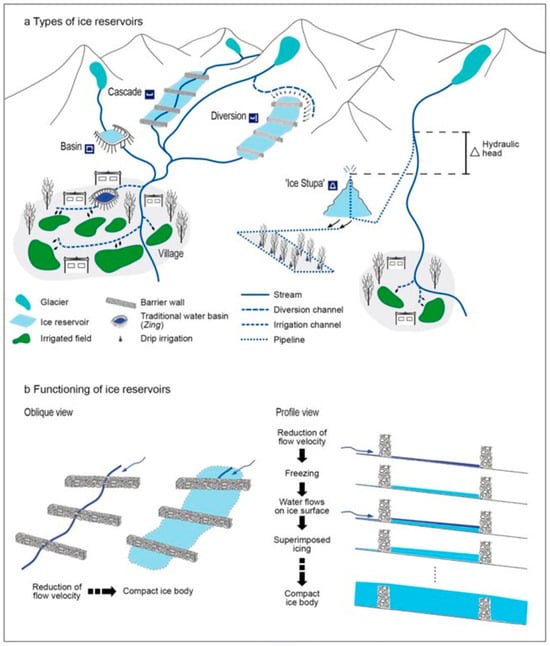
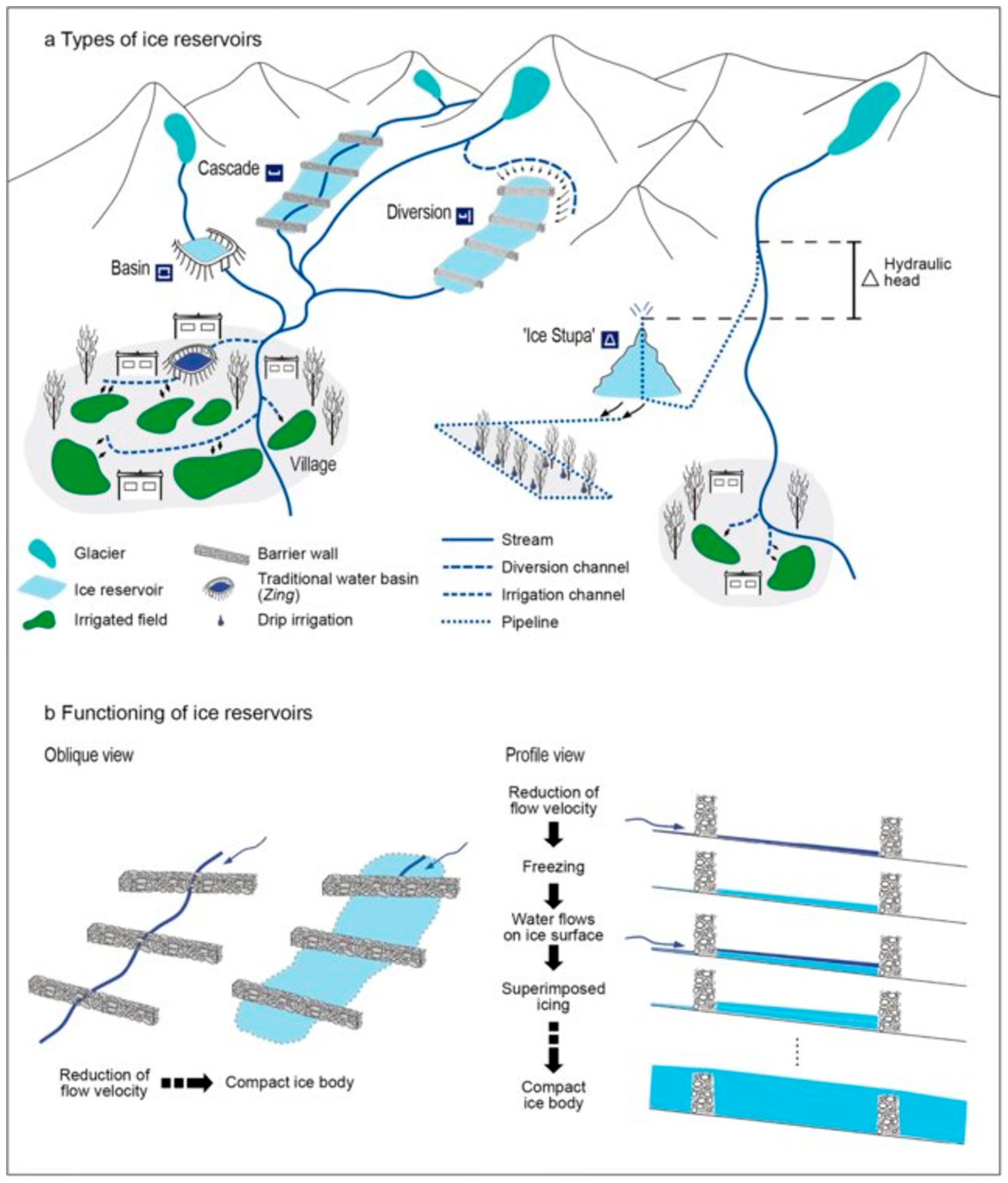
The Baltistan region is home to the Karakoram and Himalaya mountain ranges, with some of the highest mountains and largest glacier fields outside of the polar regions in the world. The largely agro-pastoralist Balti rural society, like neighbouring Ladakh, has long been dependent upon glacial melt for its domestic and agricultural water supply [4,5]. With increasing prosperity from a largely remittance and tourist-based economy, as well as changing cropping mix and agricultural intensification, the water demand has increased in the region. In the arid high mountain ranges, the local populations always undertook the construction of complex and labour intensive irrigation infrastructure. With increasing climate variability, however, the glacial/ice field sources of water have been more erratic. In neighbouring Ladakh and to a lesser extent in Baltistan, there is increasing development of artificial glacier/ice field development technology & practices, the best known one being an ice stupa in Ladakh. An ice stupa, as developed in Ladakh, is a water fountain constructed at a lower point to be fed water from a stream up the mountain slope. The water flowing into the fountain freezes during winters at the lower elevation and melts sooner than the higher altitude sources of streams. It thereby provides supplementary water to downhill communities during the sowing season of April when water is scarce and high mountain snow has not melted. Nϋsser et al. [5] documented three other techniques of building: ice cascades, diversion ice cascades, and ice basins (Figure 1). However, predating the largely NGO facilitated development of ice stupas is the practice of glacier grafting, locally known as glacier marriages, in Baltistan.
Figure 1.
Schematic representations of different ice storage and cultivation techniques. Source: [5]. Used with permission.
In our experience and reading of the artificial glacier/ice stupa literature, there is largely an engineering, financing, and then cultural acceptance, and social equity of benefits issue [5]. The older practice of glacier marriages, however, is a richer scientific and social science research problem. The practice is premised upon the foundational belief in Balti cosmology that glaciers are living beings and hence have genders [6]. Lighter coloured ice glaciers, better known and understood by modern science, are deemed to be female, and those with greater debris cover are deemed to be male. Through history, for reasons elaborated on below, Balti villages have taken ice from male and female glaciers and grafted (i.e., put the ice from the two glaciers typically in a cavity below the overlying rocks onto the local glaciers, with the belief that the grafted ice grows a baby glacier that grows up into an adult one in time. The ‘adult’ glacier presumably continues to sustain the communities dependent upon its meltwater. The motivation for glacier grafting has traditionally been to enhance and sustain water supply for agriculture, though the technique could have relevance for climate change adaptation going forward.
During a research visit to Baltistan in the summer of 2023 to investigate the practice of glacier grafting, we visited two glaciers that had purportedly been grafted by the communities during the past two decades. The field visit happened after requisite Institutional Review Board (IRB) clearance for ethical research with human subjects had been obtained. There were no formal questionnaires or interview protocols administered during the field visit. Instead, one on one conversations with field guides and three opportunistic group conversations with community members and local researchers were conducted, consistent with the IRB standards of ethical research, insuring informed consent and the anonymity of the respondents.
The community members’ insistence and reports on how much the glacier had grown from their intervention, and our own relative ignorance of the physical processes through which the glacier might have grown, present a set of research problems themselves. On the physical side, we know very little about the processes of energy and mass fluxes in sites typical for their development. For instance, how does the process of grafting alter the thermodynamic microclimate or hydrology of the boulder fields? If so, are such perturbations sufficient to drive ice accretion at the desired scale? If not, could they be suitably refined to satisfy this aim? These are a set of physical science-based questions that we hope to find answers to.
On the social science side, we are interested in why specifically were the labour intensive glacier grafting practices undertaken? What governs the timing of the interventions? And what is the distribution of the benefits from the perceived and real changes in water supply to the communities? But more in a reflexive heuristic mode, we ask: what avenues does the study of this Indigenous engineering technology open up for understanding how modern science might explain and benefit from Indigenous knowledge and practices?
In the section below, we summarize the geographical and cultural context of glacier grafting/marriage in Baltistan with some reference to the extant practice of ice stupas in the region and neighbouring Ladakh. In the following section, we report our observations from our field visit and reflect upon the state of scientific knowledge and the gaps therein that future research needs to address. In the penultimate section, we report upon the relevance of glacier grafting to wider debates around climate adaptation, Indigenous knowledge, and human non-human relations. We conclude with reflections on how a research agenda on glacier grafting might enable a deeper engagement between modern science and Indigenous knowledge to enrich both as well as enable innovative pathways to negotiating issues of livelihood and cultural continuity in the context of climate change.
2. Geographical and Cultural Context
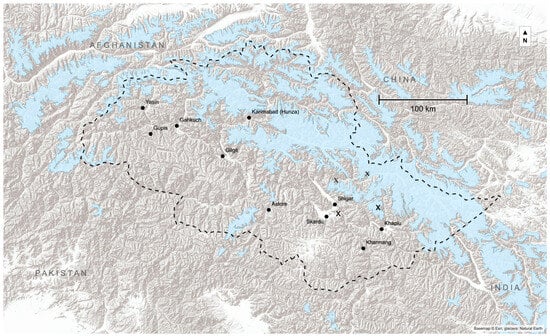
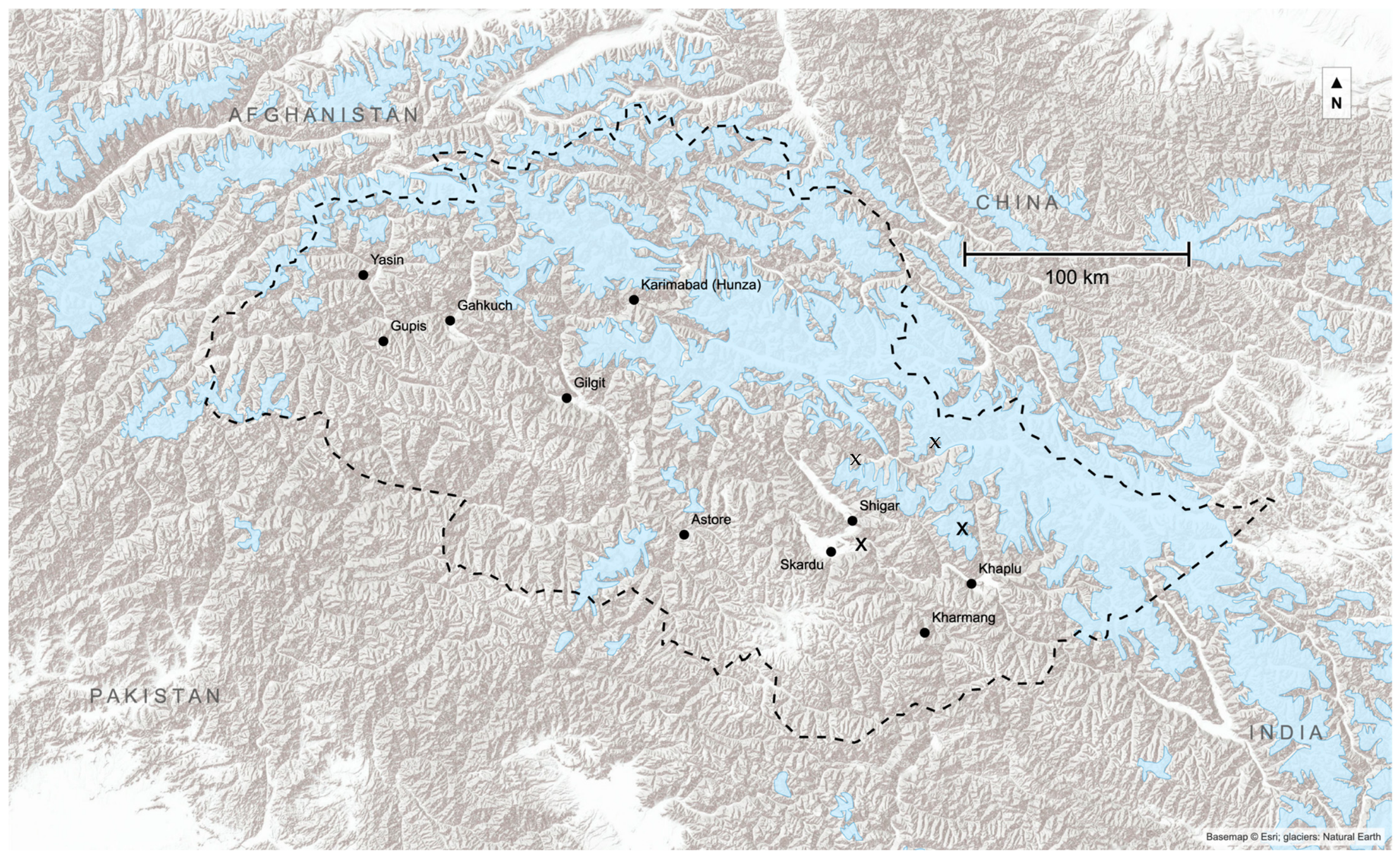
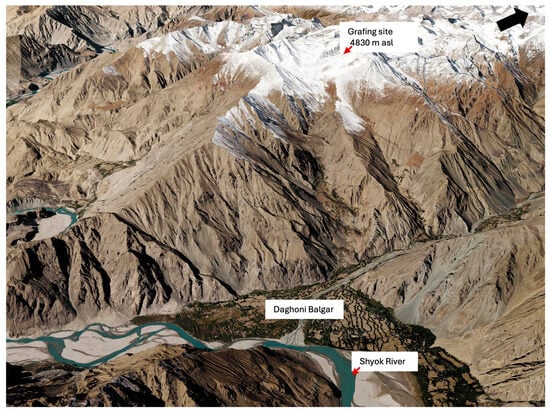
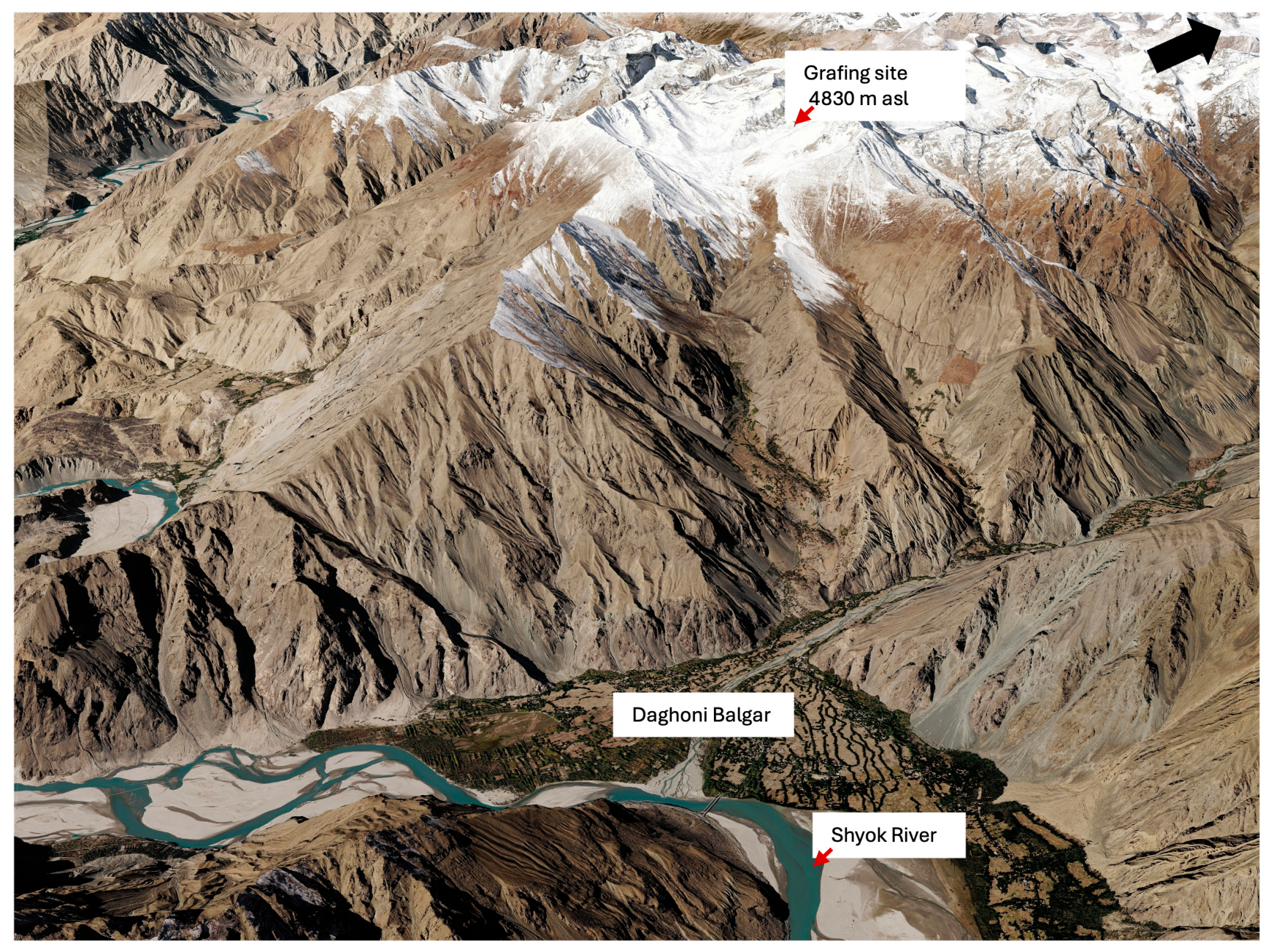
Perched between the Greater Himalayan range to the south and Karakoram range to the North, Baltistan constitutes the Indus and Shyok River valleys downstream from Ladakh and Tibet to the east (Figure 2). The region is an upland desert in the rain shadow of the Himalayas and the Karakoram ranges. The population of the region according to the 2017 census was a little above 303,214 spread over 31,000 km2. While almost all of the population is concentrated in the valley floor, which ranges from 2500 to 3500 m, the water supply for agriculture and domestic use is largely from high mountain streams and springs from the high elevation glaciers and ice fields. In a few places where there are inhabited alluvial fans closer to the main stem of the Indus and Shyok Rivers, some gravity-based diversion from the river channels is undertaken, for example, in one of our study villages, Daghoni Balgar (Figure 3). However, the overwhelming dependence remains on stream flows from glaciers to maintain pastures and agriculture higher up in the valley.
Figure 2.
A general map of the Gilgit-Baltistan region in northern Pakistan. The ‘X’ marks the two field study sites.
Figure 3.
Study village of Daghoni Balghar. The black arrow points to North. (Source: Google Earth).
Baltistan is one of the most heavily militarized regions in the world, where the Pakistani and Indian armies frequently engage in artillery duels over the disputed Siachen Glacier. It is also a Mecca for international and domestic tourists, as well as mountaineers flocking to climb the many mountains including the world’s second highest, K2, and some of the largest glaciers outside of the polar region, including the Baltoro, Biafo, and Trango Glaciers. The region supports a vibrant tourist economy, with many hotels and resorts hosting tourists of all budgets and providing, most often, low paid employment to the local Balti population. In addition, significant, largely male, migration has taken place in down country cities like Karachi and Rawalpindi as well as the Gulf, making remittances a significant contributor to household livelihood structures. The upshot of the migration is a lack of labor for agriculture and associated irrigation management, with important gendered impacts in terms of women’s workloads [7].
The Baltistan region has been at the peripheries of the Pakistani state and culture. It is one of the two Shia Muslim dominated regions, the other one being neighbouring Gilgit, in a largely Sunni dominated state. By virtue of it being part of the disputed Kashmir state historically, and geographically being a borderland between Pakistan, India, and China, the region has never really enjoyed the political representation and democratic rights that the rest of Pakistan has enjoyed intermittently in civilian democratic interludes between direct military rule [8,9]. The Sunni sectarian overtones of the Pakistani Islamic state building has furthermore had deleterious consequences in terms of sectarian conflict and state repression [10,11].
Despite the ingress of down country sectarian politics and increasing disaffection about continued disenfranchisement, the syncretic moorings of Balti society remain a strong force in governing its posture toward human–non-human relations. Although the Iranian dominated version of Shia Islam is ascendent in Baltistan, the original Tibeto-Buddhist cultural and linguistic practices and cosmologies coupled with the Noorbakhshi sufi aligned Shia Islam remain influential [12]. During our visit to Baltistan, from the regional elites with higher education degrees from abroad, to local agro-pastoralists, everyone insisted that because glaciers move, grow, recede, and die—attributes of a living being—they are hence living entities. Such cosmologies incorporating ontological pluralism in human–non-human relations is a core attribute of Indigeneity [13,14,15,16]. The Balti people may have been Islamic for centuries, a dominant Abrahamic spiritual tradition, but that is not unlike other Christianized Indigenous people (e.g., the Diné people in North America or Musahar people in Nepal) [17]. It is their dynamic relationship to the Pakistani state, ontological pluralism characterizing their cosmology, and place-based spatial practices that lend them the quality of being Indigenous. We therefore look upon glacier grafting and the cosmology associated with it through the Indigenous practices lens, with the acknowledgment that those practices are not static in time or place, or represent an undifferentiated popular subjectivity, but are rather responsive to external interventions and internal differences.
Gagné [18] (p. 203), contesting the conventional representation of local knowledge and places as ‘timeless’ in the Himalayas in the context of Baltistan, argues:
If knowing is shaped by places, it follows that a transformed place may impact the process of knowing and a transformed sense of place may affect practices.
Baltistan is a transformed place, not just by virtue of some of the above-mentioned socio-political changes, but also by the biophysical process of climate change. However, climate change has also had locally differentiated impacts. We elaborate upon that changed biophysical and hydroclimatic context below.
3. The Science and Practice of Glacier Grafting: Hydroclimatic Context
Despite a general trend of alpine glacier recession globally, the Karakoram range has been home to the ‘Karakoram anomaly’, where glaciers in the region are anomalously growing [19]. While global glaciers outside of the Greenland and Antarctic ice sheet have lost a reported 480 ± 200 kg year−1 m−2 between 1961 and 2016 [20], glaciers in the Karakoram are currently growing at 120 ± 140 kg year−1 m−2 [21].
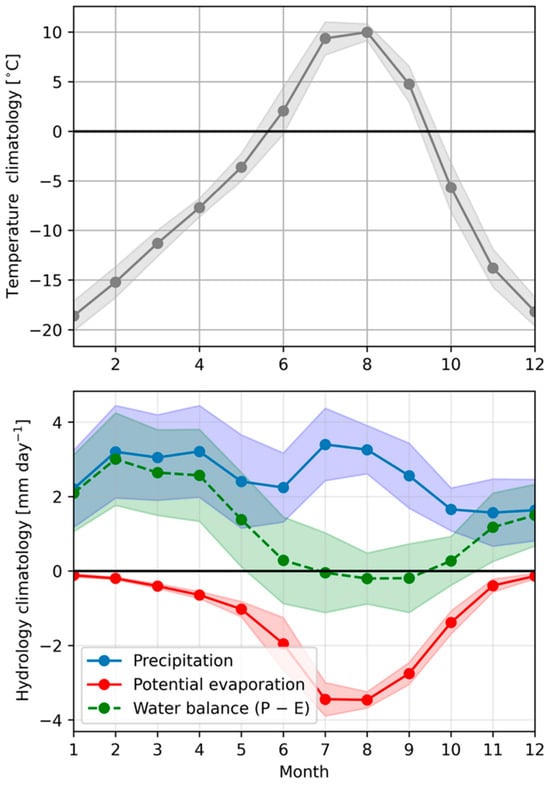
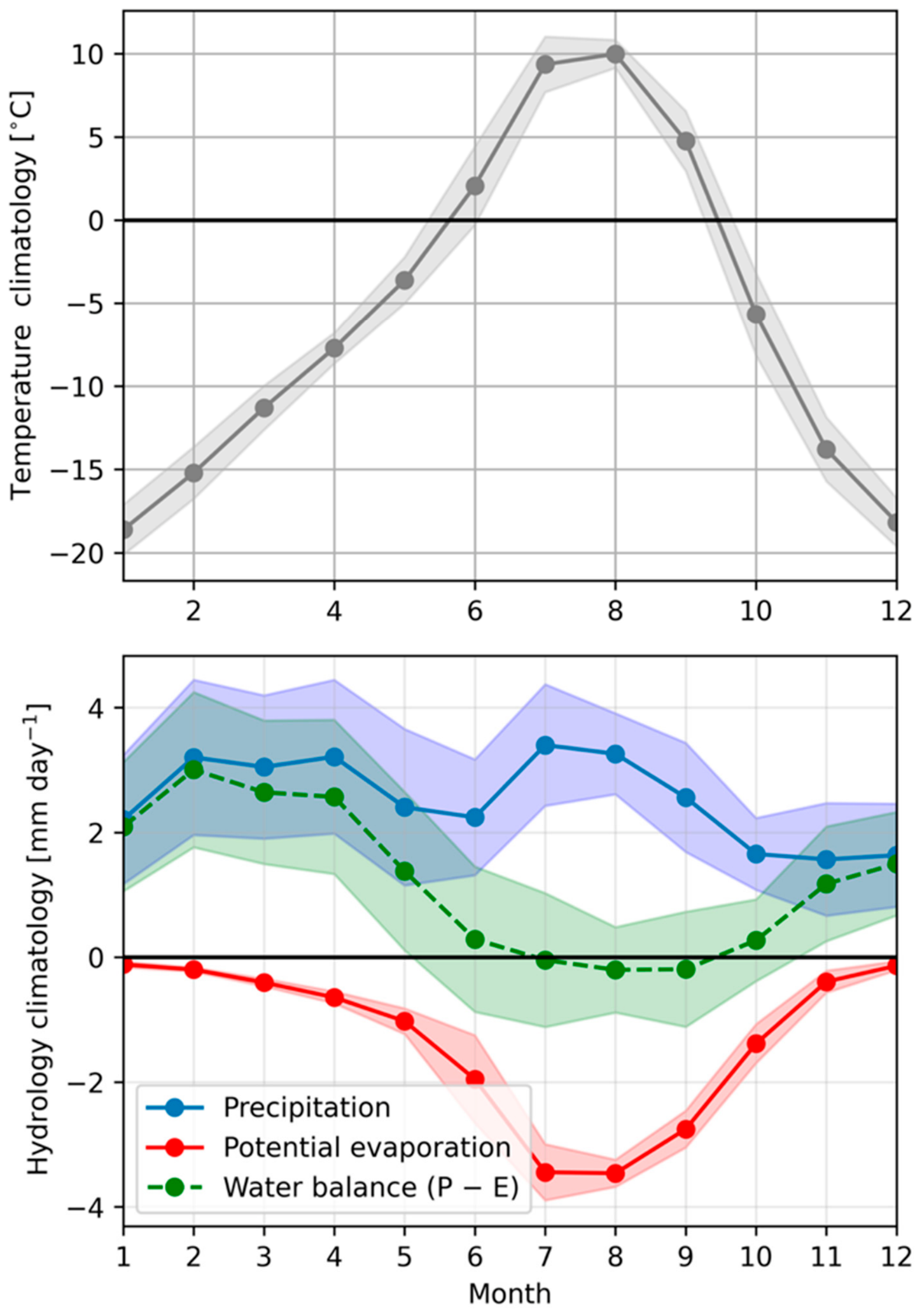
The drivers of the regional scale anomaly are complex and not fully understood [19]. Regardless, at a local scale, these drivers give Gilgit-Baltistan a hydroclimatic context that may promote glacier growth and therefore help explain the emergence of glacier grafting there. The region experiences strong and asynchronous seasonal cycles in air temperature and precipitation (Figure 4); air temperature peaks in summer, while precipitation peaks in winter due to the penetration of westerly disturbances—weather systems that originate to the west of the Himalayas and travel eastward with the mid-latitude westerly winds, bringing high precipitation [22]. The surface water balance is therefore at its seasonal minimum during summer (Figure 4). This situation is in stark contrast to further east in the Himalaya-Karakoram (HK) region, which experiences its highest precipitation during the Indian Summer Monsoon [23].
Figure 4.
(top panel) Temperature and (bottom panel) hydrological climatology for the Karakoram region, generated by the authors using monthly mean reanalysis data (01/1995–12/2024) in the ERA5 dataset [24]. Note that the Karakoram region is defined here as a 0.75° × 0.75° box centered on 35 N, 76 E. The bands around the lines indicate the 1st standard deviation around the mean values.
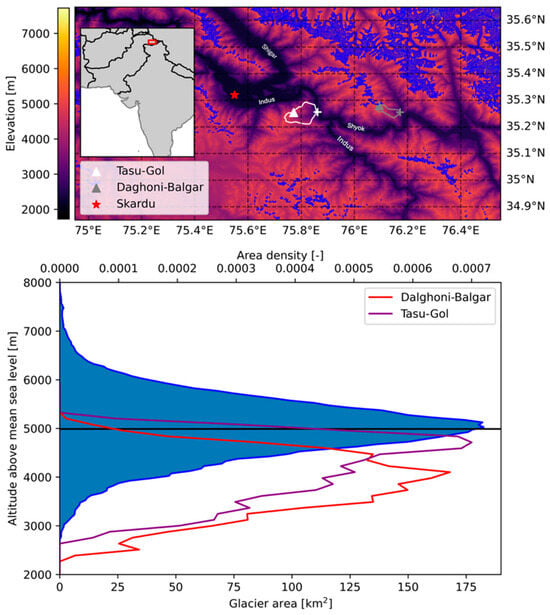
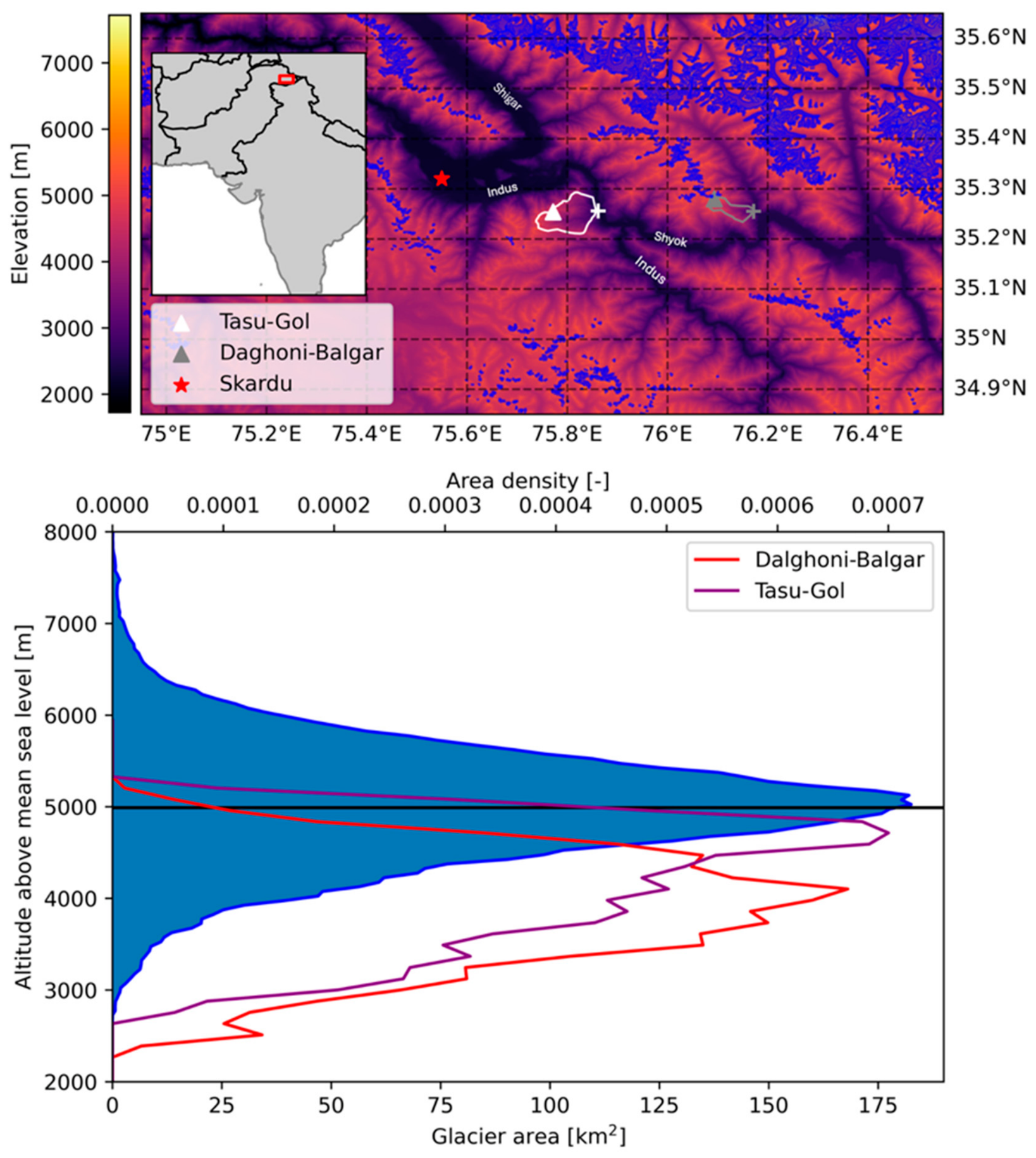
Critically, however, the minimum surface water availability is not reflected in the discharge of the region’s major rivers—including the Shyok, Shigar, and Upper Indus, which are all in view (but out of reach for water use) of the glacier grafting communities we visited (Figure 5). Instead, for these rivers, which have catchments extending to altitudes exceeding 7000 m above sea level (Figure 5), peak flow occurs in summer (despite minimum surface water availability) because high air temperatures and solar radiation drive extensive melting across large glacier surface areas. The Shyok, for example, has almost half of its catchment above 5000 m—roughly the average altitude of glaciers in the region (Figure 5)—and experiences almost 60% of its annual flow during just July and August [25]. The glacier grafting catchments of Dalghoni Balgar and Tasu Gol, however, do not sit high enough to sustain permanent glaciers. Therefore, as confirmed by participants in the field, surface runoff decreases in the summer after seasonal snowpack has ablated. Indeed, in hotter summers, surface water availability and soil moisture in these lower-altitude catchments will likely be reduced further by higher temperatures driving greater surface evaporation; the discharge of the Upper Indus and Shyok, however, increases as summer temperatures climb due to amplified glacier melting [25]. For our communities, water stress may indeed be greatest when the region’s major rivers—in sight but mostly out of reach for water use—swell with glacier meltwater. From a hydroclimatic perspective, it is perhaps no surprise that the act of artificially constructing glaciers has emerged within our study catchments.
Figure 5.
(Top) Locations of the Tasu Gol and Daghoni Balgar grafted glaciers (triangles). The locations of the Indus, Shigar, and Shyok River valleys are shown in white font. White and grey polygon outlines indicate the watershed catchments that contribute to the village locations, marked with crosses. Catchments were identified using GRASS watershed routines in QGIS. Elevations were taken from the Shuttle Radar Topographic Mission Radar Topographic Map (SRTM) digital terrain model [26]. Major river basins are annotated. (Bottom) Red and purple lines indicate the hypsometry of the catchments shown in the map in the top panel for Dalghoni Balgar and Tasu Gol, respectively. The blue polygon shows the hypsometry (bottom x-axis) of all glaciers within 100 km of Skardu from the Randolph Glacier Inventory (version 7) [27].
Physical Processes and Glacier Grafting
The physical processes controlling the growth and shrinking of grafted glaciers can be considered within the broader glaciological context of glaciers in the Karakoram region. A glacier is in positive (negative, respectively) mass balance, indicating growth (shrinking) when the accumulation of ice and snow exceeds the losses through melting, sublimation, and calving (together, ablation).
Regarding accumulation, it is important to note that in contrast to most glacial regions, many glaciers in the Karakoram lack a distinct accumulation zone where they receive direct snowfall accumulation and instead receive inputs mostly or wholly from avalanches [28]. Therefore, candidate sites for grafter glaciers might best therefore be located in regions of avalanche convergence.
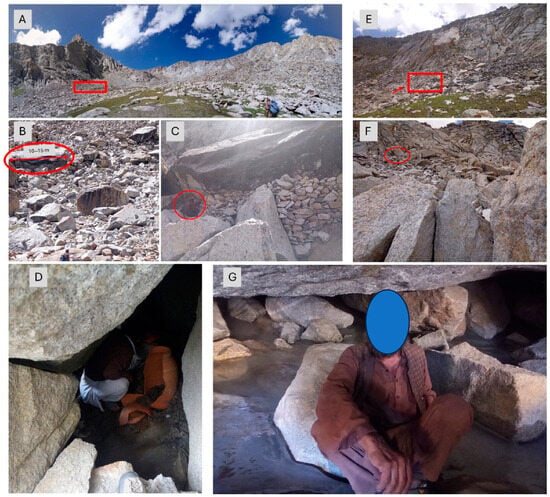
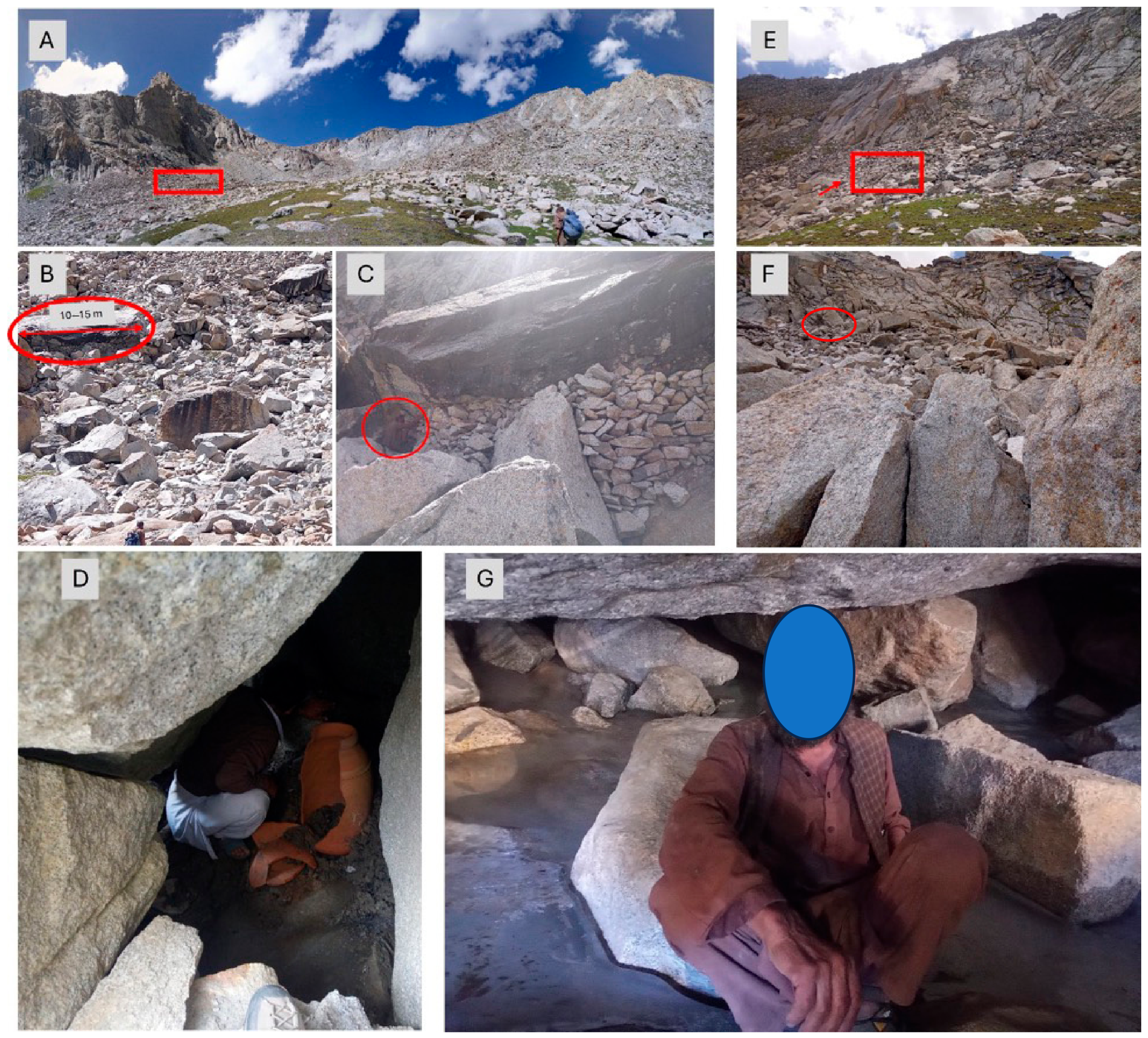
Grafted glaciers are covered with debris and shaded during their marriage, helping to insulate the ice and regulate heat and ice–atmosphere heat exchange, thereby reducing ablation. On glaciers, debris layers thicker than a few centimeters go some way toward reducing ablation, while debris layers over a meter generally prevent any ablation from taking place [29]. Alongside reducing direct heat exchange with the atmosphere, debris cover can reduce the total energy inputs to a glacier by reducing absorbed solar radiation in the same way as geographical shading (e.g., shadows cast by mountains) [30]. In the glacier grafting context, shading is typically achieved using walls, or more commonly, by locating the grafted glaciers in caves or deep pits (Figure 6). Debris cover is a powerful mechanism to reduce glacier ablation, to the extent that it was previously thought to be an important driver of the Karakoram anomaly [31]. In recent years, this picture has been superseded, and it is now understood that hydroclimatic drivers are responsible [19]. However, as highlighted in the previous section, grafted glaciers located in the region are themselves subject to these regional climatic conditions, thereby inheriting the same broad ablation suppression that drives the broader Karakoram anomaly.
Figure 6.
Panel (A) shows the location of the Tasu Gol grafted glacier within the landscape. The red box and arrow show, respectively, the approximate area and aspect of the more detailed field photo shown in (B) (indicating the approximate extent of the grafted glacier). Panel (C) is further zoomed in on the rock below which the grafted glacier was located. Note that the rock walls (our guide circled for scale) have been constructed to help insulate the grafted glacier. Panel (D) shows one of the broken clay pots used to graft the glacier (resting on the debris covered ice surface. Panel (E) is the same as (A) but for the Daghoni Balghar grafted glacier. Panel (F) is a zoomed in photograph (approximate area and orientation indicated by the rectangle and arrow in (E)), with the grafted glacier’s location below the rocks also highlighted (circled in red). Panel (G) shows the grafted glacier of Daghoni Balghar with our field guide sitting on the ice.
The elevation at which grafted glaciers are married may also be important for ablation and accumulation. Higher elevations promote enhanced precipitation through orographic processes, though this may be less important in the Karakoram than in other glacierized region where, as mentioned, inputs are dominated by avalanches. Perhaps more importantly, higher elevations result in lower air temperatures through lapse rate effects, thereby reducing surface heating (when insulating debris cover is not present). Although the valley floors in the Karakoram are located 2500–3500 m above sea level, we found that virtually all successful sites are located at 4000 m or above, underscoring the importance of altitude in the grafting process.
The local geomorphologies of glacier grafting sites also resemble those that sustain natural periglacial ice bodies in the wider Karakoram system, including rock glaciers and talus slopes. Grafted glaciers may embed rock at the outset (Figure 6), which is reminiscent of rock glaciers—slow-moving bodies of ice-rich debris found in mountain environments. As with surface debris, the debris constituting rock glaciers is crucial for insulating the ice, permitting them to survive at elevations and temperatures where bare ice would not persist [32]. Grafted glaciers may also feature air-filled voids (Figure 6), which mimic talus slopes accumulating coarse debris at the base of their rocky slopes; these voids provide a structure that effectively insulates the underlying rock (known as ‘Balch ventilation’).
However, the accreted ice observed in successfully grafted glaciers in Baltistan differ from typical rock glaciers and talus-derived ice in that their accumulated ice typically consists of relatively clean water ice (confirmed by our observations), accreted on decadal timescales, rather than the interstitial or debris-filled ice characteristic of periglacial forms. This suggests different controls on accumulation: rock glaciers and debris-filled talus slopes are sustained largely by ice cementation, while clean ice accreting on grafted glaciers implies accumulation dominated by persistently sub-zero temperatures, which create a thermal regime conducive to ice nucleation, modulated by avalanche deposition, lateral snowmelt ingress, or meltwater ingress that refreezes against the growing ice mass.
4. Contesting Adaptation: Toward New Hybrid Heuristics
Glacier grafting has been ongoing in Baltistan long before climate change came to dominate the global environmental agenda. In Ladakh, the practice of glacier grafting exists as a childhood memory for octogenarian local residents [18]. In Baltistan, it has been continuously practiced through the 20th century, with the latest examples being two decades old. In either case, the local communities or their institutional sponsors/partners in facilitating glacier grafting were not motivated by the need for climate adaptation—it was not part of the conversation in the region two decades ago. From what we understood from our conversations, it was a continuation of a water conservation technique through community efforts. Gagné [18] argues that paradoxically, in Ladakh, just as the local and scientific communities are beginning to recognize glacier recession, they are not performing technical interventions for protection and regeneration of the same that they did in the past. The reason, she argues, is profound changes in the political economy and society of Ladakh because of greater integration into the Indian economy, migration, and a raft of other changes. These changes have undermined the community cohesion and labor availability for undertaking glacier grafting, in addition to removing the economic urgency of maintaining the water supply for irrigation. Nϋsser et al. [5] similarly argue that in Ladakh, other techniques of cryogenic water storage including ice stupas are really water conservation techniques to enhance seasonal water supplies than part of any Indigenous adaptation strategy. Climate change may be the top challenge for modern science and society globally, but it is just one element in the galaxy of social, economic, and environmental changes that are being experienced in the high Himalayas/Karakoram.
The account, in the previous section of glacier grafting and its unintended relevance for longer term adaptation to climate change, raises two paradigmatic questions in our mind, which merit critical reflection. One is the nature of the IPCC and global high science’s framing of adaptation, and the other of the nature of Indigenous knowledge and its relationship to modern science. We engage with the two questions in this section.
Within the broader field of human–environment relations, the adaptation agenda, as framed by the IPCC has come under considerable criticism. One of the pioneering geographers in the water resources and hazards fields, Gilbert White, critiqued ‘adaptation’ on two counts: (1) the intellectual baggage that the term carried from Charles Darwin and Herbert Spencer, where failure to adapt was a failing leading to the ‘natural’ death of the unfit; and (2) it is an ex post facto concept where once human interventions have failed or succeeded, that one can adapt to the given conditions [33,34]. Instead, White argued that:
…human adjustment, by comparison, entails actions that strive to be adaptive, but that address unfolding aspirations, risks, uncertainties, and the inherently limited understanding of the consequences of previous actions (Wescoat [33] (p. 703)).
Gilbert White may have derived some satisfaction, as do we, from the IPCC’s [35] (p. 118) definition of adaptation as ‘the process of adjustment [emphasis added] to actual or expected climate and its effects.’
Beyond Gilbert White’s pragmatic critique of adaptation, others from a political ecology perspective (e.g., see [18,36,37,38]) have pointed to how the focus on adapting to biophysical change in climate occludes the galaxy of political economic and place-based cultural changes that people are simultaneously negotiating in their lives and livelihoods. The questions or arguments in a political ecology register then become: are we adapting to a changed biophysical future from an adapted present? [36]. Or could it be that starting from an unbearable present, the talk of adapting to future climate change is meaningless for the adaptation subjects? [37,38]. Perhaps the IPCC’s adaptation wisdom really is an articulation of a top-down environmental imaginary that enables the internationally funded transformation of places and livelihoods in the image of a neoliberal developmental register [39,40]. Whatever the case may be, in the context of glacier grafting in Baltistan or the more engineered ice stupa, ice cascades, and/or ice fields, the overwhelming evidence in the literature (e.g., see [5,18]) as well as in our experience, is that they are local adjustments to enhance seasonal flows of water, instead of any long-term strategic investments in adaptation to climate change.
Beyond the utilitarian motivation of water conservation, evidently glacier grafting is also derivative from Balti cosmology about the sentient characteristics of glaciers. Balti society has always had glaciers as the context of their existence, and their interactions with them are spiritual as well as political in the sense of place-making and territorialization. One of our local research partners, a respected academic in the region, pointed to us a glacier visible from his house in the regional city of Skardu, as having been made by his ancestors. The pride and sense of ownership in his voice, as in the voices of others who were kind enough to show us their grafted glaciers, was suggestive of place-making through glacier grafting. There is a pomp, circumstance, and ritual associated with glacier grafting. Young men from the village must collect ice from male and female glaciers and must not put the ice down during their hike from the donor glaciers and to the recipient glacier. Once the ice has been deposited in the mother glacier with charcoal, sawdust, and clay pots, as described above, a Balti song is sung, as follows:
Le gang bu ju le, Yang xher ma xher le, yang jikh ma jikh le
Yang la duksa ldiaq pu yod le
Oh! dear baby glacier, don’t feel alone (don’t be nostalgic, miss your parent glacier), don’t be afraid
For your seating, there is a small plain,
Le gang bu ju le, Yang xher ma xher le, yang jikh ma jikh le
Yang la thul ba la braq bzang braqbu yod le,
Oh! dear baby glacier, don’t feel alone (don’t be nostalgic, miss your parent glacier), don’t be afraid
For your climbing here are pure and steep rocks,
Le gang bu ju le, yang jikh ma jikh le Yang xher ma xher le,
Yang la thuk pa la lungba chuu bruk yod,
Oh! dear baby glacier, don’t feel alone (don’t be nostalgic, miss your parent glacier), don’t be afraid
To meet you there are ravines with flushing water,
Le gang bu ju le, Yang xher ma xher le, yang jikh ma jikh le
Yang la duk pa la braq bu dokhmo yod le
Oh! dear baby glacier, don’t feel alone (don’t be nostalgic, miss your parent glacier), don’t be afraid,
To hide (stay protected) there are narrow gorges,
Oh! dear baby glacier, don’t feel alone (don’t be nostalgic, miss your parent glacier, we are with you), don’t be afraid,
(sung by Ms. Abdul Karim, Translated by Mr. Ahmed Nazir).
The above articulates an intense affection and love for a sentient baby glacier, which is not so different from place-based human–non-human relationships of comradery and companionship witnessed among other Indigenous communities [18,41,42]. As discussed above, from a scientific perspective, in the absence of hard observational data, we can speculate and hypothesize how the process may work (for other attempts at the same, please see Tveiten [4]. But we heed Klenk and Meehan [43] in not seeking integration between modern scientific and Balti Indigenous knowledge, given the foundational ontological differences between them. Instead, we take on board the triangulation and multiple evidence-based approach (MEBA) that they propose. The triangulation approach embedded in the pragmatism of John Dewey, in their words (163):
…explicitly “challenges the tendency to frame scientific reliability, social relevance, and social legitimacy as distinct requirements on knowledge, to be traded off against one another” and instead emphasizes “the role of collaborative deliberation and practice knowledge generated through processes of social innovation and experimentation (Popa et al. 2015: 10, cited in [43] (p. 163).
While triangulation invites collaborative deliberation, an essential attribute of our research design, MEBA alerts us to the diversity of knowledge that may emerge from triangulation. We value the diversity and conflict between Indigenous and modern scientific knowledge that may emerge from triangulation. The emergent hybridity of knowledge we deem to be a productive strength rather than a weakness to be buttressed through integration into modern science. The Indigenous practice and knowledge on glacier grafting is a time honored practice and tradition that we hope to assess on its internal criteria of success [43], and along the way perhaps gain scientific understanding of a potentially replicable practice for sustaining high mountain communities around the world. It is in that spirit that we outline a research agenda in the following concluding section.
5. Conclusions: A Multiple Evidence-Based Approach to Glacier Grafting Research
The scientific and social scientific research agenda to emerge from the initial field visits to glacier grafting sites has been alluded to in the foregoing discussion. This agenda is squarely based in the modern scientific knowledge enterprise. The Balti Indigenous knowledge system we propose to bring into conversation with the scientific knowledge under the umbrella of MEBA, however, also offers a more fundamental provocation. The indigenous Balti knowledge that recognizes the sentience and hence agency of glaciers, in a way assigns humans the role of another actant at par with glaciers in the dynamic dance between humans and non-humans [17,44,45,46]. Taking this provocation on board, we offer the following three sets of research questions, under the headings of scientific, social scientific, and Indigenous knowledge of human–non-human interactions as a pathway to understanding the practice, politics, and cosmology of glacier grafting:
- What are the gaps in our understanding of the physical processes driving glacier growth in the practice of glacier grafting? And how do these gaps change across scales, from local to regional to global?
- What are the data requirements to address those gaps?
- How can one measure the physical efficacy of the practice in enhancing ice storage and water supply enhancements?
- What livelihood, cultural, and political factors govern the spatiality and temporality of glacier grafting practices in Baltistan?
- What are the perceived benefits of glacier grafting in the study communities—from cultural, aesthetic to material?
- How do gender-, class-, and ethnicity-based differences influence the distribution of benefits of glacier grafting?
- What is the efficacy of glacier grafting in enabling adjustment to climate change in high mountain communities?
- What technical, social, and economic factors could enable the replication of the technique in other high mountain contexts (e.g., the Andes, Alps, and eastern Himalayas) as an adjustment of climate change?
- How is the agentic quality of glaciers and other non-humans understood, articulated. and manifested in practice in Balti cosmology?
- How can dominant modern knowledge learn from and work with the Indigenous knowledge underpinning glacier grafting practices?
- How are the Balti cosmology and worlding practices adjusting to the changing socio-political, climatic, and material context of Baltistan?
The above are a sample of questions that may drive an research agenda on this very important practice. The agenda is not just about an obscure or cute niche cultural practice, but about twofold paradigmatic concerns of contemporary times: adjustment to climate change and interactions between modern science and Indigenous knowledge. The adjustment to climate change can have wider consequences if the technique can be replicated in comparable environments globally. The science and Indigenous knowledge problematique may point toward different ontological insights that can be mobilized in conjunction with modern knowledge to address the messiest of all messy problems of climate change. The significance of paying heed to practices such as glacier grafting in Baltistan cannot be overemphasized.
Author Contributions
Conceptualization, D.M. and T.M.; methodology, D.M. and T.M.; Formal Analysis, D.M., A.B. and T.M.; Investigation, D.M. and T.M.; Writing—original draft preparation, D.M.; writing review and editing, D.M. and A.B.; visualization, T.M.; project administration, T.M.; funding acquisition, D.M. and T.M. All authors have read and agreed to the published version of the manuscript.
Funding
The research for this manuscript was funded by the King’s Climate and Sustainability Seed Fund.
Institutional Review Board Statement
The study was conducted in accordance with the Declaration of Helsinki, and approved by the College Reasearch Ethics Committee of King’s College, London (protocol code MRA-22/23-38099 and date of approval: 5 June 2023).
Informed Consent Statement
Verbal Informed consent was obtained from the participants. Verbal consent was obtained rather than written because many of the participants were not literate or would have difficulty understanding the formal consent statement or would have felt threatened by a request to sign a formal written statement.
Data Availability Statement
The original contributions presented in this study are included in the article. Further inquiries can be directed to the corresponding author.
Acknowledgments
The help and guidance provided by Zakir Hussein and other staff of the University of Baltistan are gratefully acknowledged. We also acknowledge the facilitation provided by Ahmed Nazir. We also thank the residents of Daghoni Balgar and Tasu Gol for all of their help during the field work.
Conflicts of Interest
The authors declare no conflict of interest.
References
- IPCC. Climate Change 2022: Impacts, Adaptation and Vulnerability; Contribution of Working Group II to the Sixth Assessment Report of the Intergovernmental Panel on Climate Change; Pörtner, H.-O., Roberts, D.C., Tignor, M., Poloczanska, E.S., Mintenbeck, K., Alegría, A., Craig, M., Langsdorf, S., Löschke, S., Möller, V., et al., Eds.; Cambridge University Press: Cambridge, UK; New York, NY, USA, 2022. [Google Scholar] [CrossRef] [Scilit]
- Carmona, R.; Reed, G.; Thorsell, S.; Dorough, D.S.; MacDonald, J.P.; Rai, T.B.; Sanago, G.A. Analysing engagement with Indigenous Peoples in the Intergovernmental Panel on Climate Change’s Sixth Assessment Report. npj Clim. Action 2023, 2, 29. [Google Scholar] [CrossRef] [Scilit]
- Peet, R.; Watts, M. (Eds.) Liberation Ecologies: Environment, Development, Social Movements; Psychology Press: London, UK, 2004. [Google Scholar]
- Tveiten, I.N. Glacier Growing: A Local Response to Water Scarcity in Baltistan and Gilgit, Pakistan. Master’s Thesis, Norwegian University of Life Sciences, Ås, Norway, 2007. [Google Scholar]
- Nüsser, M.; Dame, J.; Kraus, B.; Baghel, R.; Schmidt, S. Socio-hydrology of “artificial glaciers” in Ladakh, India: Assessing adaptive strategies in a changing cryosphere. Reg. Environ. Change 2019, 19, 1327–1337. [Google Scholar] [CrossRef] [Scilit]
- Douglas, E. How to Grow a Glacier. New Sci. 2008, 197, 37–39. [Google Scholar] [CrossRef] [Scilit]
- Ali, A.; Shedayi, A.A.; Khan, A.; Shafaqat, S. How Does Climate Change Impact Remote Mountain Communities? An Empirical Investigation in Gilgit-Baltistan. GeoJournal 2024, 89, 41. [Google Scholar] [CrossRef] [Scilit]
- Kreutzmann, H. Boundaries and Space in Gilgit-Baltistan. Contemp. South Asia 2015, 23, 276–291. [Google Scholar] [CrossRef] [Scilit]
- Ali, N. Delusional States: Feeling, Rule and Development in Pakistan’s Northern Frontier; Cambridge University Press: Cambridge, UK, 2019. [Google Scholar]
- Feyyaz, M. Geopolitics, Statehood, Violence and Space Compression in Gilgit-Baltistan. South Asian Hist. Cult. 2019, 10, 28–45. [Google Scholar] [CrossRef] [Scilit]
- Holden, L. Law, Governance, and Culture in Gilgit-Baltistan: Introduction. South Asian Hist. Cult. 2019, 10, 1–13. [Google Scholar] [CrossRef] [Scilit]
- Dryland, E.; Syed, J. A Postcolonial Perspective on Cultural Identity: The Balti People “of” Pakistan. Equal. Divers. Incl. Int. J. 2011, 30, 41–57. [Google Scholar] [CrossRef] [Scilit]
- Radcliffe, S.A. Geography and Indigeneity I: Indigeneity, Coloniality and Knowledge. Prog. Hum. Geogr. 2017, 41, 220–229. [Google Scholar]
- Radcliffe, S.A. Geography and Indigeneity II: Critical Geographies of Indigenous Body Politics. Prog. Hum. Geogr. 2018, 42, 436–445. [Google Scholar]
- Coombes, B.; Johnson, J.T.; Howitt, R. Indigenous Geographies I: Mere Resource Conflicts? The Complexities in Indigenous Land and Environmental Claims. Prog. Hum. Geogr. 2012, 36, 810–821. [Google Scholar]
- Coombes, B.; Johnson, J.T.; Howitt, R. Indigenous Geographies II: The Aspirational Spaces in Postcolonial Politics: Reconciliation, Belonging and Social Provision. Prog. Hum. Geogr. 2012, 37, 691–700. [Google Scholar]
- Mustafa, D.; Nyaupane, G.; Shrestha, K.; Buzinde, C.; Thanet, D.R.; Vandever, V. Scalar Politics of Indigenous Waterscapes in Navajo Nation and Nepal: Conflict, Conservation and Development. Environ. Plan. E Nat. Space 2025, 8, 209–231. [Google Scholar] [CrossRef] [Scilit]
- Gagné, K. Cultivating Ice over Time: On the Idea of Timeless Knowledge and Places in the Himalayas. Anthropologica 2016, 58, 193–210. [Google Scholar] [CrossRef] [Scilit]
- Farinotti, D.; Immerzeel, W.W.; de Kok, R.J.; Quincey, D.J.; Dehecq, A. Manifestations and Mechanisms of the Karakoram Glacier Anomaly. Nat. Geosci. 2020, 13, 8–16. [Google Scholar] [CrossRef] [Scilit] [PubMed]
- Zemp, M.; Huss, M.; Thibert, E.; Eckert, N.; McNabb, R.; Huber, J.; Barandun, M.; Machguth, H.; Nussbaumer, S.U.; Gärtner-Roer, I.; et al. Global Glacier Mass Changes and Their Contributions to Sea-Level Rise from 1961 to 2016. Nature 2019, 568, 382–386, Correction in Nature 2020, 577, E9. https://doi.org/10.1038/s41586-019-1889-5. [Google Scholar] [CrossRef] [Scilit] [PubMed]
- Berthier, E.; Brun, F. Karakoram Geodetic Glacier Mass Balances between 2008 and 2016: Persistence of the Anomaly and Influence of a Large Rock Avalanche on Siachen Glacier. J. Glaciol. 2019, 65, 494–507. [Google Scholar] [CrossRef] [Scilit]
- Bonekamp, P.N.; de Kok, R.J.; Collier, E.; Immerzeel, W.W. Contrasting Meteorological Drivers of the Glacier Mass Balance between the Karakoram and Central Himalaya. Front. Earth Sci. 2019, 7, 107. [Google Scholar] [CrossRef] [Scilit]
- Azam, M.F.; Kargel, J.S.; Shea, J.M.; Nepal, S.; Haritashya, U.K.; Srivastava, S.; Maussion, F.; Qazi, N.; Chevallier, P.; Dimri, A.P.; et al. Glaciohydrology of the Himalaya-Karakoram. Science 2021, 373, eabf3668. [Google Scholar] [CrossRef] [Scilit] [PubMed]
- Hersbach, H.; Bell, B.; Berrisford, P.; Hirahara, S.; Horányi, A.; Muñoz-Sabater, J.; Nicolas, J.; Peubey, C.; Radu, R.; Schepers, D.; et al. The ERA5 Global Reanalysis. Q. J. R. Meteorol. Soc. 2020, 146, 1999–2049. [Google Scholar] [CrossRef] [Scilit]
- Archer, D. Contrasting Hydrological Regimes in the Upper Indus Basin. J. Hydrol. 2003, 274, 198–210. [Google Scholar] [CrossRef] [Scilit]
- Farr, T.G.; Rosen, P.A.; Caro, E.; Crippen, R.; Duren, R.; Hensley, S.; Kobrick, M.; Palmer, M.; Rodriguez, E.; Roth, L.; et al. The Shuttle Radar Topography Mission. Rev. Geophys. 2007, 45, RG2004. [Google Scholar] [CrossRef] [Scilit]
- RGI 7.0 Consortium. Randolph Glacier Inventory—A Dataset of Global Glacier Outlines, Version 7.0; NSIDC National Snow and Ice Data Center: Boulder, CO, USA, 2023. [Google Scholar] [CrossRef]
- Hewitt, K. Glacier Change, Concentration, and Elevation Effects in the Karakoram Himalaya, Upper Indus Basin. Mt. Res. Dev. 2011, 31, 188–200. [Google Scholar] [CrossRef] [Scilit]
- Vincent, C.; Wagnon, P.; Shea, J.M.; Immerzeel, W.W.; Kraaijenbrink, P.; Shrestha, D.; Soruco, A.; Arnaud, Y.; Brun, F.; Berthier, E.; et al. Reduced Melt on Debris-Covered Glaciers: Investigations from Changri Nup Glacier, Nepal. Cryosphere 2016, 10, 1845–1858. [Google Scholar] [CrossRef] [Scilit]
- Olson, M.; Rupper, S. Impacts of Topographic Shading on Direct Solar Radiation for Valley Glaciers in Complex Topography. Cryosphere 2019, 13, 29–40. [Google Scholar] [CrossRef] [Scilit]
- Hewitt, K. The Karakoram Anomaly? Glacier Expansion and the Elevation Effect, Karakoram Himalaya. Mt. Res. Dev. 2005, 25, 332–340. [Google Scholar] [CrossRef] [Scilit]
- Whalley, W.B.; Martin, H.E. Rock Glaciers II: Models and Mechanisms. Prog. Phys. Geogr. 1992, 16, 127–186. [Google Scholar] [CrossRef] [Scilit]
- Wescoat, J.L., Jr. Gilbert Fowler White (1911–2006), Wisdom in Environmental Geography. Geogr. Rev. 2006, 96, 700–710. [Google Scholar] [CrossRef] [Scilit]
- Cutter, S.L.; Platt, R.H.; Burton, I.; Mitchell, J.K.; Reuss, M.; Rubin, C.B.; Wescoat, J.L., Jr.; Richman, B.T. Reflections on Gilbert F. White: Scholar, Advocate, Friend. Environ. Sci. Policy Sustain. Dev. 2019, 61, 4–21. [Google Scholar] [CrossRef] [Scilit]
- IPCC. Annex II: Glossary. In Climate Change 2014: Synthesis Report; Mach, K.J., Planton, S., von Stechow, C., Eds.; IPCC: Geneva, Switzerland, 2014; pp. 117–130. [Google Scholar]
- Taylor, M. The Political Ecology of Climate Change Adaptation: Livelihoods, Agrarian Change and the Conflicts of Development; Routledge: New York, NY, USA, 2015. [Google Scholar]
- Social Policy and Development Centre (SPDC). Gender and Social Vulnerability to Climate Change: A Study of Disaster-Prone Areas in Sindh; Social Policy and Development Centre: Karachi, Pakistan, 2015; Available online: https://www.spdc.org.pk/publication/gender-and-social-vulnerability-to-climate-change-a-study-of-disaster-prone-areas-in-sindh/ (accessed on 16 October 2026).
- Mustafa, D.; Gioli, G.; Memon, M.; Noshirwani, M.; Idris, I.; Ahmed, N. Pinning Down Social Vulnerability in Sindh Province, Pakistan: From Narratives to Numbers, and Back Again. Disasters 2019, 43, 311–335. [Google Scholar] [CrossRef] [Scilit] [PubMed]
- Paprocki, K. Threatening Dystopias: Development and Adaptation Regimes in Bangladesh. Ann. Am. Assoc. Geogr. 2018, 108, 955–973. [Google Scholar] [CrossRef] [Scilit]
- Paprocki, K. All That Is Solid Melts into the Bay: Anticipatory Ruination and Climate Change Adaptation. Antipode 2019, 51, 295–315. [Google Scholar] [CrossRef] [Scilit]
- Menjil, T.V. Doing Indigenous Epistemology: Internal Debates about Inside Knowledge in Maori Society. Curr. Anthropol. 2019, 60, 155–173. [Google Scholar] [CrossRef] [Scilit] [PubMed]
- Merlan, F. Indigeneity. Curr. Anthropol. 2009, 50, 303–333. [Google Scholar] [CrossRef] [Scilit] [PubMed]
- Klenk, N.; Meehan, K. Climate Change and Transdisciplinary Science: Problematizing the Integration Imperative. Environ. Sci. Policy 2015, 54, 160–167. [Google Scholar] [CrossRef] [Scilit]
- Latour, B. Reassembling the Social: An Introduction to Actor-Network-Theory; Oxford University Press: Oxford, UK, 2005. [Google Scholar]
- Ernwein, M.; Ginn, F.; Palmer, J. The Work That Plans Do: Life, Labour and the Future of Vegetal Economies; transcript Verlag: Bielefeld, Germany, 2021. [Google Scholar]
- Jackson, S.; Barber, M. Historical and Contemporary Waterscapes of North Australia: Indigenous Attitudes to Dams and Water Diversions. Water Hist. 2016, 8, 385–404. [Google Scholar] [CrossRef] [Scilit]
Disclaimer/Publisher’s Note: The statements, opinions and data contained in all publications are solely those of the individual author(s) and contributor(s) and not of MDPI and/or the editor(s). MDPI and/or the editor(s) disclaim responsibility for any injury to people or property resulting from any ideas, methods, instructions or products referred to in the content. |
© 2026 by the authors. Licensee MDPI, Basel, Switzerland. This article is an open access article distributed under the terms and conditions of the Creative Commons Attribution (CC BY) license.