


Abstract
In the context of Türkiye, the decision-making process concerning nuclear energy is characterised by a series of interwoven strategic considerations, including but not limited to energy security, decarbonisation, cost, technological dependence, and public acceptance. The present study employs the SWOT–AHP method, interpreted from the perspective of sustainability, to rank the strategic factors influencing Türkiye’s nuclear energy development in order of priority. A total of 12 experts from academia and public institutions evaluated a 15-factor SWOT matrix. The evaluations were then aggregated using the geometric mean. The highest priorities within the categories were identified as the existence of international co-operations such as Akkuyu NPP project (S2), insufficient technical capacity and infrastructure (W1), localisation in energy and reducing foreign dependency. (O1), and existence of active faults (T3). When category weights were set equal, O1 ranked first in the overall ranking, while social acceptance (W3) and delays in the construction of nuclear energy facilities (T1) ranked at the bottom. While the overall evaluations remained constant, the individual matrices of the majority of the experts exhibited variations. The application of bootstrap resampling revealed that the highest and lowest priorities were supported exclusively (O1 ranked first in 92% of resamples). The overall ranking demonstrated sensitivity to category weights that were not compared by the experts. The results obtained can inform policies that balance supply security with environmental, economic, and social considerations; however, the extant literature calls for further empirical, quantitative, and technical analysis in this area.
1. Introduction
This study aims to address a gap in the existing literature by providing a quantitative evaluation of Türkiye’s nuclear energy priorities using the SWOT-AHP approach, with the intention of offering strategic guidance to decision-makers. Although Türkiye’s growing energy demand is currently met largely through imports [1], efforts are being made to increase domestic production through the Akkuyu and Sinop projects [2]. However, there are few quantitative SWOT-AHP studies in this field, and this research aims to address this gap by basing its analysis on expert opinions.
The research gaps matrix (Table 1) outlines the focus of this study based on a preliminary literature review. The color-coding system used in this study is as follows: dark blue indicates areas where research has been extensively conducted; light blue indicates areas where research has been relatively extensive; and orange indicates areas that have not been sufficiently researched and the gaps addressed in this study.
Table 1.
Research gaps matrix. Cell shading and text markers indicate the extent of prior research: dark blue, ●●● = extensively researched; light blue, ●● = relatively extensively researched; orange, ○ = insufficiently researched (gap addressed in this study).
In this sense our research objectives:
The objective of this study is to employ the SWOT-AHP method to quantitatively prioritise Türkiye’s nuclear energy factors, thereby addressing a methodological gap in the extant literature and providing decision-makers with a guiding framework.
The central research question guiding this study is as follows: In Türkiye’s nuclear energy strategy, which factors are prioritized from a sustainability perspective that takes into account energy security, environmental impacts, economic feasibility, and social dimensions, and how do these priorities differ from those of other countries?
Literature Review
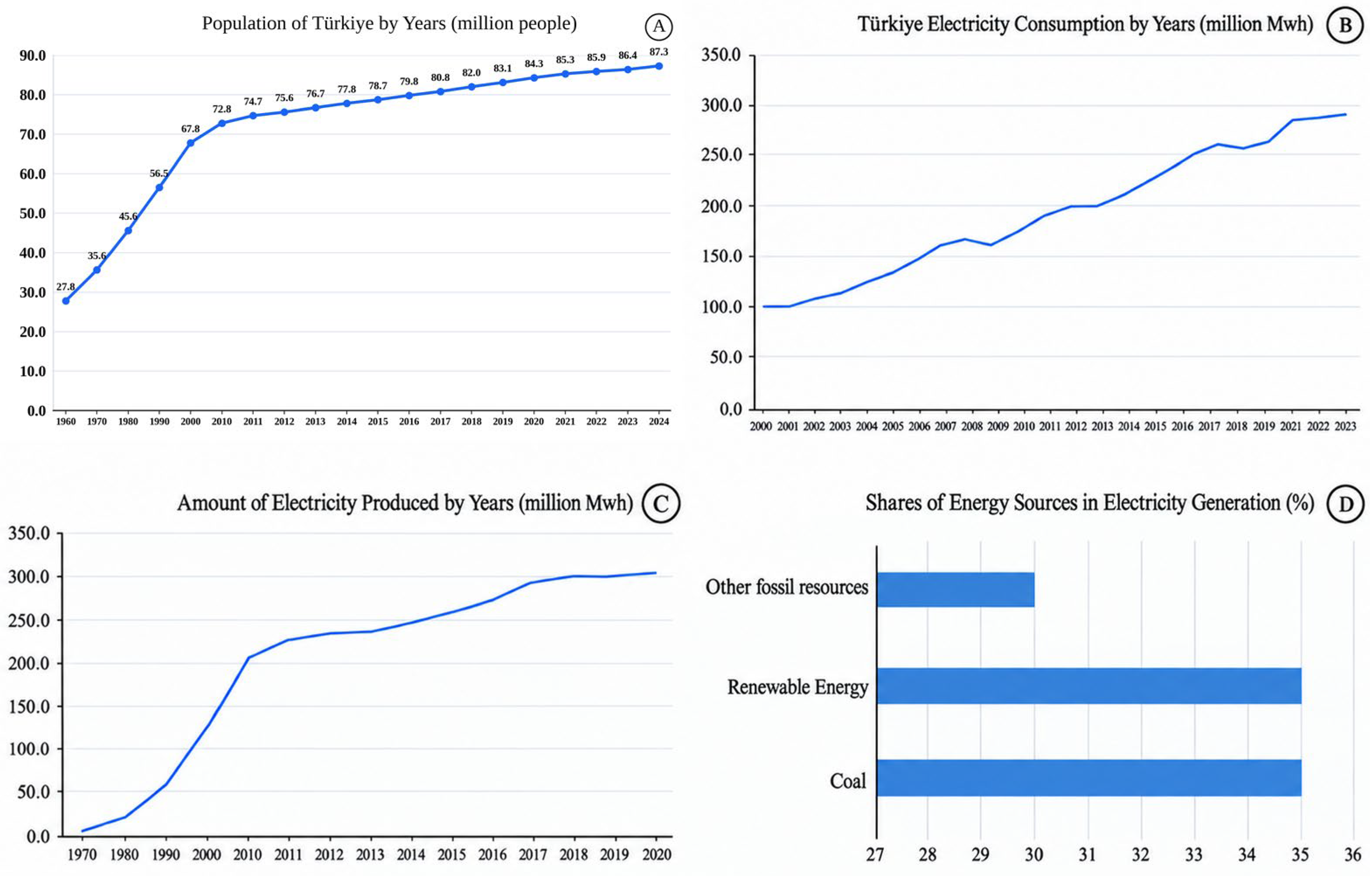
A 71.7% reliance on foreign energy sources (Figure 1) demonstrates just how strategically important diversification is for Türkiye and positions nuclear energy as a central element in long-term planning [3].
Since the vast majority of studies on this topic are still based on SWOT analyses prepared using a qualitative approach, the relevant literature remains limited.
1.1. Energy Planning Studies Conducted for Türkiye
In the context of studies employing MCDM methodologies within the domain of energy planning, ref. [4] developed strategies through the integration of SWOT-ANP and Fuzzy TOPSIS, thereby identifying the SO2 strategy—which aims to position Türkiye as a pivotal energy hub—as the primary area of focus. In a similar vein, ref. [5] placed emphasis on economic and technological criteria through the utilisation of AHP. A number of studies have been conducted that focus on the prioritisation and implementation of renewable energy in Türkiye (see references [6,7,8]).
1.2. Nuclear Energy Policy Assessment Studies
Study [9] emphasises that the utilisation of nuclear energy in less industrialised countries necessitates capacity in three domains: technical, governance, financial feasibility, and public support. Study [10], published in 2025, evaluates China’s nuclear energy models and highlights the need for a comprehensive consideration of economic, technical, environmental, and social dimensions in policy analyses, as well as the importance of multi-criteria decision-making methods in strategic energy planning. As demonstrated in Study [11], published in 2024, the utilisation of nuclear energy has been shown to reduce external dependence, thereby enhancing energy security within the Visegrad countries. The 2019 study [12] under scrutiny here demonstrates the efficacy of fuzzy multi-criteria decision-making methods in the context of energy policy management, particularly in scenarios characterised by uncertainty [13] underlines the significance of regulatory frameworks and governance systems in Slovenia’s nuclear energy roadmap. A 2021 study [14] critically examined the Czechia’s energy strategy, highlighting the high share of nuclear energy in electricity generation [15]. However, the study noted that while this share is “sugarcoating” in the documents, the costs, uncertainties, and implementation challenges are not sufficiently emphasised; [16] conducted a SWOT analysis of Nigeria’s nuclear energy plan and; [17] conducted a SWOT analysis of Ghana’s nuclear energy plan [18] analysed South Africa’s nuclear energy plan using the SWOT-AHP method and demonstrated that the most significant strength is the regulatory framework; [19] conducted a feasibility study on the potential utilisation of nuclear energy in Pakistan. A number of studies have employed the SWOT method to evaluate the applications of nuclear energy in various countries see refs. [20,21,22].
Identified Gaps in the Literature
For instance, extant SWOT analyses of nuclear energy programmes in Nigeria, Ghana, and Bangladesh [16,17,22] predominantly remain at the qualitative description stage. These studies enumerate strengths, weaknesses, opportunities, and threats, but do not specify which of these are the most significant. A smaller number of studies, such as the SWOT–AHP [18] for South Africa or the SWOT–relative importance index analysis [19] for Pakistan, employ quantitative methods to determine relative importance. However, to the best of our knowledge, these studies do not examine the reliability of such prioritisations when expert opinions conflict, nor do they clearly link the prioritised factors to the energy security, economic, environmental, and social dimensions of sustainability. It is therefore evident that the shortcoming addressed in this instance is of an analytical nature rather than geographical. These indicators are concrete in nature and demonstrate the necessity to prioritise strategic factors that are transparent regarding their assumptions and uncertainties. Furthermore, these factors can be interpreted from a sustainability perspective.
In addition to the aforementioned points, Türkiye’s energy transition should be evaluated not only in terms of the creation of new electricity generation capacity, but also in terms of energy security, economic sustainability, low-carbon energy production, and the alignment of long-term energy policies. In this context, it is imperative to undertake a strategic evaluation of Türkiye’s nuclear energy development from a sustainability perspective. A comprehensive literature review was conducted in order to undertake a strategic assessment of the current state of Türkiye’s nuclear energy sector. This was followed by the development of a SWOT matrix based on the findings. The SWOT matrix, a tool used to analyse external factors relevant to the field of nuclear energy, is composed of a total of 15 factors—four strengths, four weaknesses, three opportunities, and four threats—that reflect Türkiye’s current status in this sector.
Figure 1.
Demographic and energy related trends in Türkiye. Data sources: (A): [23]; (B): [24]; (C): [25]; (D): [26].
In order to ascertain the relative importance levels of the factors included in the SWOT matrix, an evaluation was conducted. This evaluation was based on expert opinions and was carried out by an evaluation group consisting of 12 experts. The expert evaluations were analysed using the Analytic Hierarchy Process (AHP) method, and the relative weight of each SWOT factor was calculated through pairwise comparisons. In this regard, it is evident that the SWOT analysis method is deficient in its depth. It is for this reason that the objective of this study is to make the findings more quantitative by integrating the AHP method with the SWOT method. It is evident that the Analytical Hierarchy Process (AHP) is a methodological framework that effectively addresses the criteria involved in decision-making [27]. Consequently, Türkiye’s nuclear programme can be regarded as a strategic decision-making issue rather than merely a technical one. In principle, the utilisation of nuclear energy has the potential to enhance energy security by reducing reliance on imported fuel sources. Moreover, the generation of low-carbon baseload electricity can contribute to the fulfilment of both national decarbonisation commitments and the provision of reliable energy to the population [28,29]. Conversely, these benefits are accompanied by certain drawbacks. The combination of elevated capital expenditures and protracted construction phases engenders economic and financial hazards. Moreover, a 2018 study revealed that 75 percent of delays occurred in the development of next-generation reactors, while the average cost of new reactors escalated by approximately 80 percent [30]. The reliance on foreign suppliers for technology, fuel, and services may merely substitute one form of external dependence with another [31]. Additionally, the programme is obligated to address seismic risks, regulatory and workforce capacity, and the public trust upon which its long-term legitimacy is contingent [32]. The simultaneous optimisation of energy security, decarbonisation, economic costs, technological dependence and public acceptance is a challenging endeavour, with different stakeholders assigning varying degrees of importance to these factors. Consequently, policymakers must not only identify the strengths, weaknesses, opportunities and threats relevant to a nuclear programme intended to contribute to sustainable development, but also determine which of these are most critical. A conventional SWOT analysis may facilitate the ranking of such factors; however, it is unable to elucidate their relative importance. The present study addresses this issue by compiling expert opinions on a SWOT matrix for Türkiye’s nuclear programme and prioritising the factors using the analytic hierarchy process (AHP). The resulting priorities are then interpreted from a sustainability perspective. The experts’ evaluations regarding the pairwise comparisons were used as the primary data source for quantitatively determining the importance levels of the factors. It is evident that the paper presents an analysis of the strengths and weaknesses of Türkiye’s nuclear energy sector, as well as the opportunities and threats it faces. The analysis is not only presented within a qualitative framework, but also prioritised in accordance with expert opinions.
The objective is for the resulting weighting results to provide decision-makers with a guiding framework for the formulation of Türkiye’s nuclear energy policies and the development of existing strategies. In this context, the study aims to contribute to the evaluation of nuclear energy policies in the context of economic sustainability, energy supply security, and long-term energy planning. From a sustainability perspective, the role of nuclear energy in Türkiye’s future energy system should not be evaluated solely in terms of electricity generation capacity or energy supply. Rather, its potential contribution to a sustainable energy transition needs to be considered through a multidimensional framework encompassing environmental, economic, social, and energy-security dimensions. Nuclear power may contribute to the decarbonization of electricity generation and diversification of the energy mix, while issues such as high capital requirements, radioactive waste management, nuclear safety, public acceptance, technological dependence, and long-term institutional capacity may constitute important challenges to its sustainable development. Therefore, identifying and prioritizing the internal strengths and weaknesses as well as the external opportunities and threats associated with nuclear energy is important for supporting evidence-based and sustainability-oriented energy policy formulation in Türkiye. In this context, a systematic assessment of Türkiye’s nuclear energy position can provide policymakers with a broader perspective for balancing the potential benefits and risks of nuclear energy within the country’s long-term sustainable energy transition. However, Table 2 provides an evaluation of the parameters examined in this study from a sustainability standpoint [33,34,35,36].
Table 2.
Expert panel.
In addition to all of this, this study contributes to the existing body of knowledge in this area. The study develops a SWOT matrix specific to Türkiye regarding nuclear energy. It also ranks the factors in order of priority using the AHP method. This is based on the assessments of twelve experts. Furthermore, it tests the robustness of the priorities against inter-expert disagreements and analytical choices. This is done through consistency checks, alternative aggregation rules, the “exclude one expert” method, weight distortions, bootstrap resampling, and alternative category weights. This is done to test how robust the priorities are against inter-expert disagreements and analytical choices. Finally, it links the factors to the relevant Sustainable Development Goals. This is done to interpret the priorities from a sustainability perspective. The purpose of presenting these results is not to provide a comprehensive sustainability assessment, but rather to prioritise strategic factors that take sustainability issues into account. It would be more accurate to characterise this as an empirical, quantitative, and technical study that still requires further work.
2. Materials and Methods
The SWOT analysis was developed in the 1960s by a group led by Robert Franklin Stewart with the aim of improving strategic planning [37]. This study employs SWOT analysis to assess the feasibility of nuclear energy facilities in Türkiye.
SWOT analysis (Strengths, Weaknesses, Opportunities, Threats) is a widely utilised and effective method for multidimensional assessments. The present study aims to assess the current state of nuclear energy in Türkiye by means of a systematic analysis of four components, with a view to providing decision-makers with a strategic perspective.
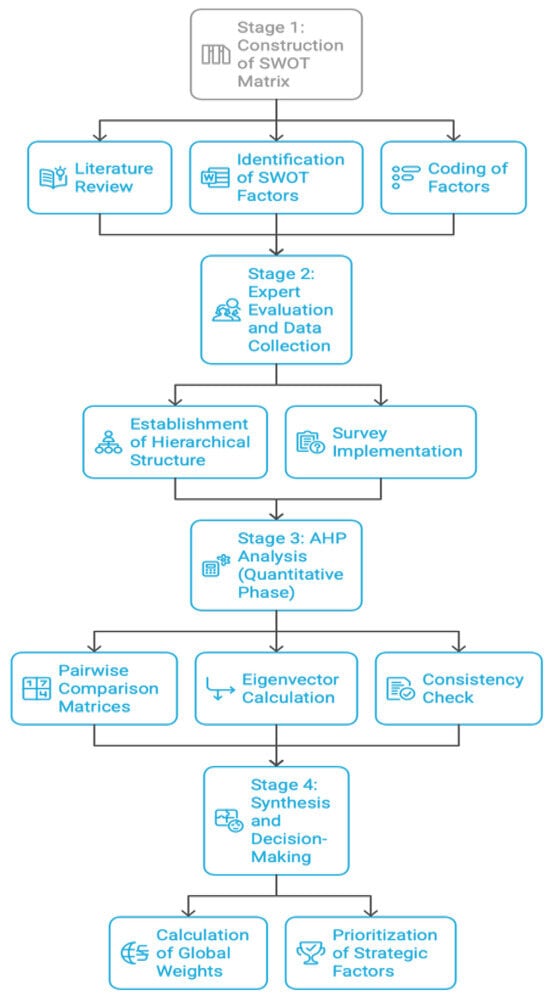
In this study, the Analytic Hierarchy Process (AHP) method was utilised in conjunction with SWOT analysis. The AHP process in this study was performed by entering the geometric means of the questions posed to the experts into the SuperDecisions software. The process was completed using version 2.10.0 of SuperDecisions. The rationale behind the selection of the AHP method is predicated on its capacity to transform the subjective assessments of decision-makers into quantifiable values, thereby facilitating the concurrent evaluation of qualitative and quantitative criteria. In this study, the SWOT analysis has been integrated with the Analytic Hierarchy Process (AHP), which quantifies the subjective evaluations of the decision-makers. The AHP, developed by Thomas L. Saaty, comprises the following stages: formation of a hierarchy, pair-wise comparisons, and consistency analysis [32]. The flowchart illustrating the study’s methodology is available in Figure 2. Individuals interested in further analysis are encouraged to refer to the aforementioned source material.
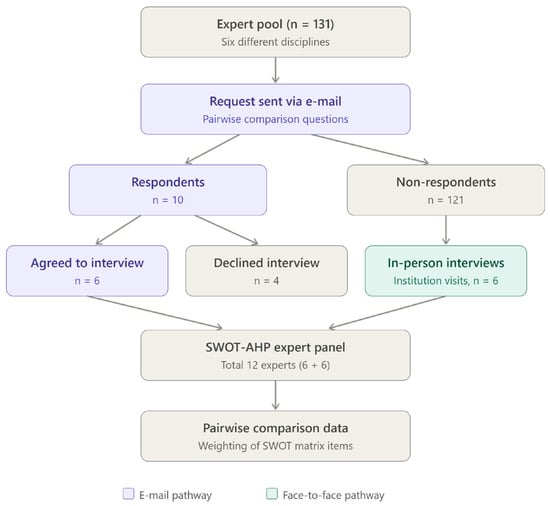
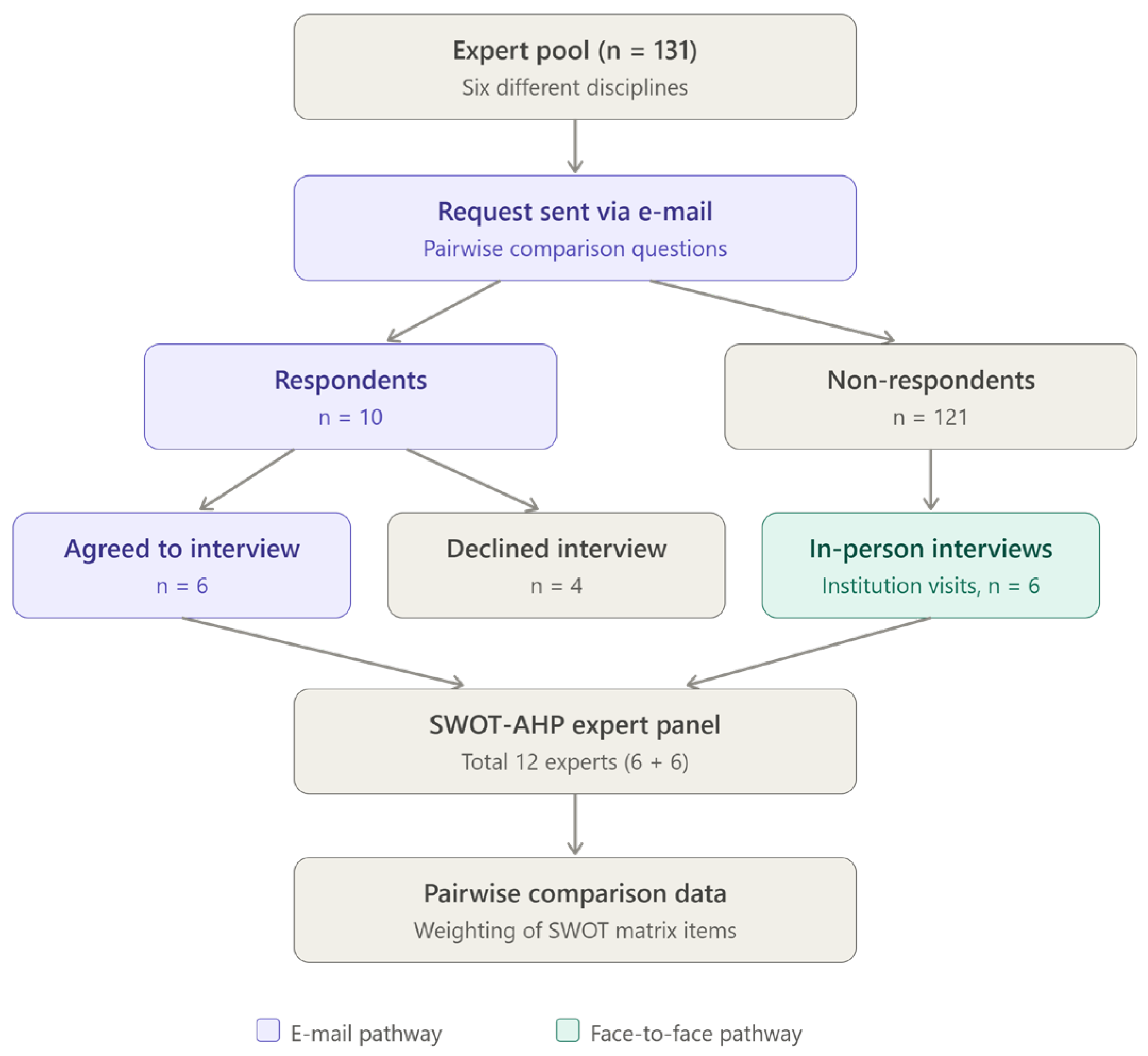
Figure 2.
Expert selection flowchart.
As part of the broader research process, a total of 131 academics from Turkish universities were initially contacted by e-mail. This initial contact pool was established because expert opinions were required for both the nuclear power plant site-selection research and the present SWOT-AHP study. Consequently, the initial pool included academics from several relevant disciplines, including energy-related fields as well as geological sciences and other disciplines associated with nuclear power plant site selection.
Following the initial contact, around eight to ten academics responded to the invitation, and six experts agreed to participate in the expert consultation process for this SWOT-AHP study. These experts were academics whose fields of expertise were directly related to nuclear energy, energy security, energy policy and/or related energy studies. We sought the expert opinions of the other six individuals while visiting the academics we had initially invited, and these individuals were also academics with whom we had the opportunity to speak.
The expert elicitation was conducted through interviews. During each interview, the identified SWOT factors were presented to the expert, and the expert was asked to assess the relative importance of the factors through pairwise comparisons using the AHP framework. The responses provided by each expert were recorded and subsequently incorporated into the AHP analysis. The resulting pairwise comparison judgments were used to construct the comparison matrices and calculate the relative weights of the SWOT factors.
Despite the apparent consistency in the combined CR rates, the opinions of most experts remain inconsistent on an individual basis. Information pertaining to this subject can be found in the “S1_CR” sheet of the attached Excel file.
In the context of the AHP, a comparative analysis was conducted between the SWOT categories and sub-criteria utilising the Saaty scale (1–9) [38]. This analysis was informed by the insights of 12 experts. The participants comprised academics and experts with experience in the energy sector (8–37 years), and the interviews were conducted independently between 10 December 2025 and 10 January 2026. Due to the SWOT matrix’s extensive nature, necessitating comparison of each criterion, the average interview duration was nearly one hour. To obtain expert judgments for the SWOT-AHP analysis, researchers and professionals with expertise in nuclear energy, energy policy, energy systems, and related fields were contacted via e-mail. The experts were identified based on their academic and/or professional experience in areas relevant to nuclear energy and energy policy. In this study, researchers specialising in the fields of energy, nuclear energy, and energy policies were selected as the sample. In the course of the study, a total of 12 experts from Istanbul Technical University, Hacettepe University, Gebze Technical University, and Sakarya University were interviewed. Furthermore, the opinions of four experts specialising in the relevant field at the Ministry of Energy and Natural Resources were sought. Nine of the interviews with the aforementioned experts were conducted in person, while three were conducted remotely via an online connection. Each researcher was tasked with posing comparative inquiries concerning the elements contained within the SWOT matrix, and their responses were meticulously documented. Subsequently, the responses of the experts were integrated into the AHP method to determine the weightings of the criteria.
Figure 2 presents a flowchart illustrating the selection process for the 12 experts included in the study. In order to consult the relevant experts, electronic communications were dispatched to individuals who were academics and who held at least a master’s degree, or who were doctoral students. Table 2 provides a summary of the information obtained from each expert interviewed. It is imperative to emphasise that none of the experts involved in the study had any conflicts of interest and that their participation in the research was entirely voluntary.
The methodology employed in this study is based on the work of [39,40]. Similar research has been conducted in other contexts.
3. Results
Table 3 presents the SWOT analysis prepared for Türkiye; each item is explained along with what it signifies in terms of sustainability and its direct links to the Sustainable Development Goals adopted by the United Nations in 2015. Moreover, the 2024–2028 Twelfth Development Plan places a high priority on the integration of nuclear energy into electricity generation and the connection of the Akkuyu Nuclear Power Plant to the grid, in accordance with the 2053 net-zero target [41].
Table 3.
Sustainability dimensions and related SDG targets of the SWOT factors (authors’ classification).
This matrix provides a comprehensive assessment of the SWOT factors related to nuclear energy using criteria specific to Türkiye.
Strengths
S1: Inclusion of Nuclear Power Plants in Türkiye’s Twelfth Development Plan
It is evident that Articles 134, 255, 275, 506, 510, 510.1, 510.2, 510.3, 510.4, and 515.1 of the Twelfth Development Plan are directly related to nuclear energy [41].
S-2 Existence of International Co-Operations such as Akkuyu NPP Project
The Akkuyu NPP, with an anticipated capacity of 4800 MW, is projected to contribute approximately 10% of Türkiye’s electricity requirements. The project is distinguished by its relatively brief payback period and substantial economic advantages. It is of strategic significance as Türkiye’s inaugural nuclear power plant [42].
S-3 Türkiye Signs Paris Climate Agreement
In 2021, Türkiye’s accession to the Paris Climate Agreement was accompanied by the adoption of a net-zero emissions target for 2053, thereby signifying a significant commitment to environmental sustainability [43].
S-4 Nuclear Energy Facilities Being Base Load Power Facilities
Nuclear power stations have been demonstrated to be reliable baseload sources due to their continuous production capacity. Furthermore, they have been shown to be cost-effective due to their fixed cost structure and economies of scale [44]. Moreover, they enhance grid reliability by balancing fluctuations in renewable energy [45].
Weaknesses
W1: Insufficient Technical Capacity and Infrastructure
Türkiye’s transition to nuclear energy represents a novel development on a global scale, necessitating strategic planning. The paucity of universities in Türkiye offering education in nuclear energy constitutes a primary factor in the limitation of progress in this field [46].
W2: Instability in Political Policies
In Türkiye, energy policies are characterised by a paucity of political stability, coordination and long-term planning. Reports from the International Energy Agency emphasise the necessity to fortify demand forecasts and inter-agency coordination. However, studies on this subject demonstrate a discrepancy between policies and their implementation, in addition to a persistent reliance on fossil fuels [47,48].
W3: Social Acceptance
Accidents such as the Three Mile Island accident, the Chernobyl disaster, and the Fukushima Daiichi nuclear disaster have heightened concerns about nuclear energy. Surveys conducted in the Akkuyu area also indicate that the public is largely opposed to it [49]. It is therefore vital that public acceptance is secured, and that accurate information is disseminated. These findings are indicative of the prevailing attitudes of the general public towards nuclear energy.
W4: High Electricity Costs
According to data from the U.S. Energy Information Administration (2025), electricity generation costs in 2024 were $81.45/MWh for nuclear, $31.86/MWh for solar, and $29.58/MWh for wind [50]. While the high cost of nuclear energy stems from large investments and long construction periods, renewables appear more competitive. Since national conditions influence costs, Türkiye’s high interest rates are expected to make nuclear projects even more expensive [51,52,53].
Opportunities
O1: Localization in Energy Production and Reduction of Foreign Dependency
Türkiye’s high dependence on energy imports necessitates a transition towards nuclear and renewable energy sources. Nuclear energy offers a substantial opportunity in terms of localization and reducing external dependence [3,54].
O2: Abundant Thorium Resources
Türkiye is a country with over 370,000 tonnes of thorium reserves [55]. By developing reactors that utilize thorium, Türkiye could leverage its natural resources and mitigate fuel supply risks associated with uranium.
O3: The Pivotal Function of Nuclear Energy in the Context of Space Exploration
The utilisation of nuclear energy represents a strategic opportunity for the advancement of technology, particularly within the context of space exploration and the objectives of the Turkish National Space Program [56].
Threats
T1: Delays in the Construction of Nuclear Energy Facilities
Delays in the construction of nuclear power plants, particularly those at Akkuyu, pose a significant problem due to a number of factors, including insufficient funding and low public acceptance [57].
T2: Fuel Supply Risk
In the context of Türkiye’s energy security, the nation’s limited reserves of uranium have been identified as a potential risk factor, given the associated increase in its reliance on fuel imports. However, the presence of substantial thorium reserves within the country’s territory offers a potential mitigating strategy to address these concerns [58].
T3: Existence of Active Faults
Türkiye is a country located on active fault lines and has been exposed to many large-scale earthquakes throughout history [59]. Consequently, Türkiye’s geographical position in proximity to active tectonic plates, which engenders considerable seismic hazards, thereby compromising the safety of nuclear power facilities.
T4: Cooling water supply in limited areas
The supply of cooling water poses a significant constraint due to the limited availability of suitable sites and the effects of climate change and [60].
The SWOT factors were then prioritised based on the opinions of experts in the field and weighted using the Analytic Hierarchy Process. The process comprises the establishment of a hierarchical structure, the execution of paired comparisons, the calculation of weights, and the execution of consistency checks. The CR value was consistently less than 0.10 in all comparisons, thereby ensuring the reliability of the results.
Table 4 and Figure 2 present the importance weights of the items under each SWOT heading. The findings are summarised below:
Table 4.
S.W.O.T main values.
Strengths
The most significant factor is S2 (the Akkuyu project), while S3 and S4 are of least importance.
Weaknesses
The most significant issue identified is the lack of technical capacity and infrastructure (38.6%), followed by political instability (34%). It is evident that high costs (18.1%) and social acceptance (9.3%) are of lower importance.
Opportunities
The most critical item: The primary objective identified under the heading ‘O1—Localization of energy and reduction of external dependence’ is both this specific heading and the overarching SWOT matrix.
Threats
The least significant factor is as follows: In the context of the present study, delays in the construction of nuclear power plants are considered to be the least significant factor in both this category and the overall SWOT matrix.
As demonstrated in Table 4, the table presents the priority values obtained by weighting the SWOT factors using the Analytic Hierarchy Process (AHP), alongside the findings of the sensitivity analysis. Given that the consistency ratios (CR) for each SWOT category are below 0.10, the pairwise comparisons are found to be consistent.
It is evident that the factor with the highest priority weight is S2 (0.34654), with S1 (0.24627) ranking second. It is evident that the most significant weakness is W1 (Technical Capacity), which is assigned a weight of 0.38592 and occupies the primary position in the ranking. Among the opportunities presented, the O1 (Localization) factor is of particular significance, with a high priority value of 0.60000. Within the domain of threats, T3 (Active Faults) has been identified as the primary contributing factor, with a weighting of 0.36878.
As part of the sensitivity analysis, scenarios involving a 10% increase and decrease in global weights were examined. This analysis indicates that the rankings of the O1 (Localization) and T3 (Active Faults) factors remained constant in both scenarios, thereby maintaining their initial positions as first and second, respectively. It was observed that the W1 (Technical Capacity) factor also maintained its third-place position in both scenarios. These findings demonstrate that the established priorities remain consistent and stable despite changes in weights.
As demonstrated in Table 4 above, it is evident that the category weights have been set to an equal value of 0.25. The CR values refer to the aggregate (geometric mean) matrices. Factors with equal rankings (S3/S4, O2/O3) are to be considered as equivalent. It is also necessary to address the discrepancy between Table 4 and Table 5 As illustrated in Table 3, the primary results are presented alongside local and global weights, rankings, and CR. In contrast, Table 6 incorporates uncertainty, confidence intervals for the weights, rank intervals, and probabilities. Moreover, whereas Table 4 presents the geometric mean of expert judgments rounded to the nearest whole number (Saaty scale), Table 7 presents the unrounded geometric mean as raw values.
Table 5.
Bootstrap uncertainty of global weights and ranks (10,000 resamples of the 12 experts).
Table 6.
Strength chart.
Table 7.
The raw data, geometric means and values entered into SuperDecisions.
The raw data can be found in Table 7 below. The table also presents the geometric mean values as well as their rounded versions, due to the SuperDecisions version 2.10.0 software’s requirement for integer inputs.
In order to ascertain the robustness of the analysis, the top criteria were subjected to a ±10% sensitivity analysis. The results remained unchanged across all scenarios. This finding serves to confirm the model’s reliability and stability.
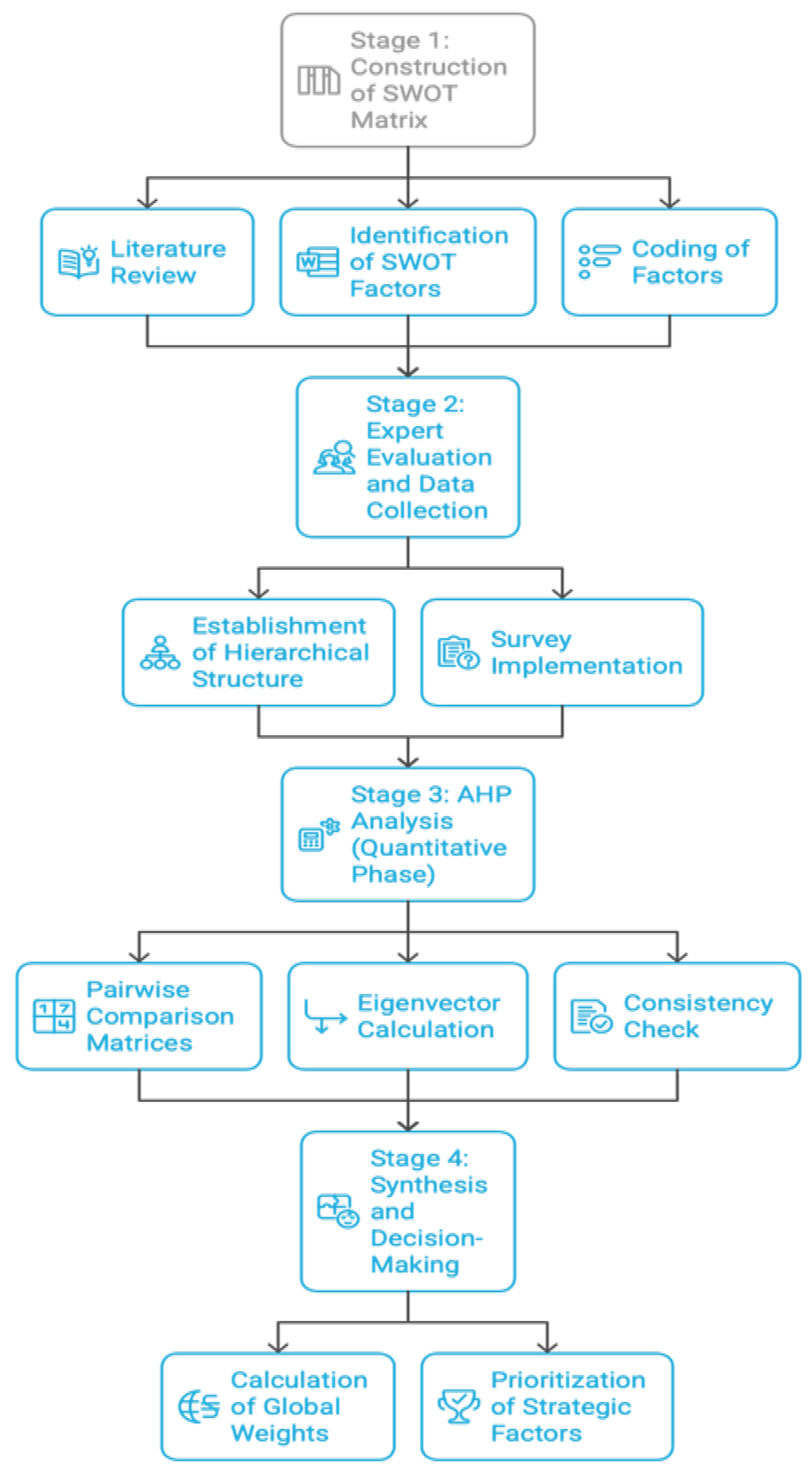
The following figure illustrates the flowchart for this study (Figure 3).
Figure 3.
Implementation of SWOT-AHP Model to The Study.
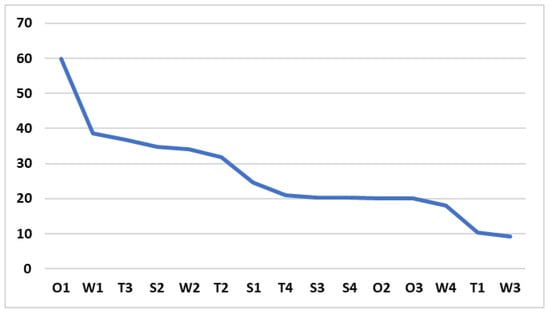
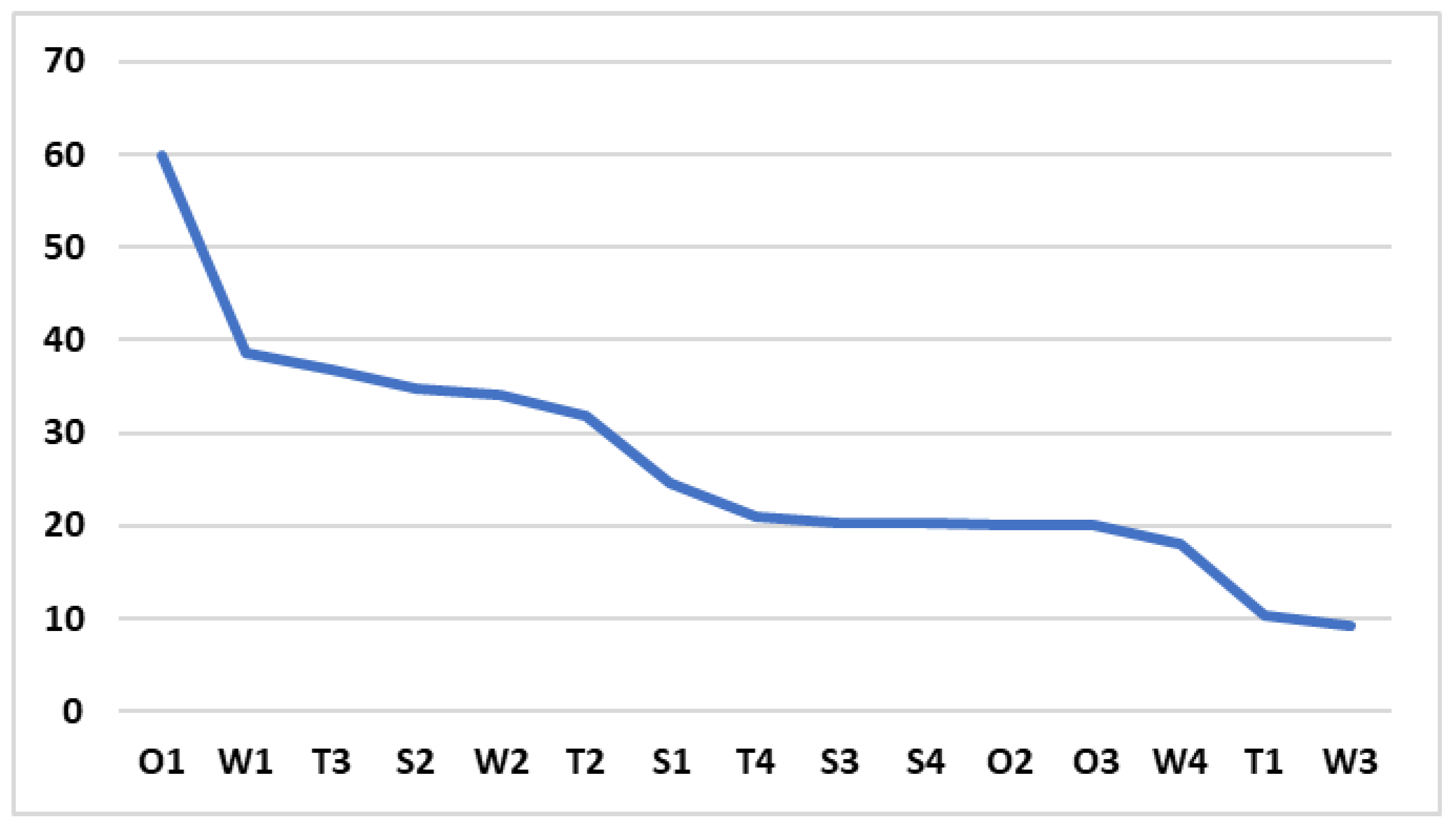
As illustrated in Table 4 and Figure 4 below, the definitions of all SWOT matrix items, along with the quantitative evaluations derived from the AHP analysis, are presented. The item with the highest score, at 60%, was item O1, “energy localization,” while the item deemed the least prioritized was item T1, “delays in the construction of nuclear power plants.”
Figure 4.
Weighted distribution of SWOT matrix elements.
In Table 6 above, baseline aggregated judgments were rounded to Saaty’s scale (as entered in SuperDecisions). Arithmetic mean yielded CR > 0.10 for the S (0.19) and T (0.15) matrices and is shown for comparison only. At ±10% and ±30%, the global weight of one factor is changed at a time while the others are held constant.
Baseline: unrounded geometric mean of the experts’ judgments with equal category weights (0.25). Baseline ranks therefore differ for some intermediate factors from those in Table 6, which uses judgments rounded to Saaty’s scale as entered in SuperDecisions. The highest (O1) and lowest-ranked factors (W3, T1) are the same in both.
As illustrated in Table 8, the sensitivity of the global rankings is contingent on the alternative category weights. According to Table 8, rank 1 = highest priority. For each scenario, a value of 0.40 (or 0.10) was assigned to the specified category, and the remainder was distributed equally among the other three categories; the “Equal” value serves as the baseline (0.25 each). Spearman: correlation between the base ranking and the ranking. The rankings within each category are the same across all scenarios. Factors with equal scores share the same ranking.
Table 8.
Sensitivity of global ranks to alternative category weights.
Table 9 below presents the findings of studies that used the same or similar methods as our study. The results of the South African study, which is methodologically fully aligned with our study, show similarities to our findings. In the relevant study [18], the O1 criterion (*Energy export and demand*) in the “opportunities” category received the highest score at 52.09%. In the present study, the criterion O1, which was defined as “Energy localization and reduction of external dependence”, was identified as the most significant criterion, with a weight of 60%. Despite the fact that the two criteria do not refer to the exact same elements, they demonstrate conceptual proximity in terms of strengthening energy supply and enhancing energy security. Furthermore, while the criterion coded as T1, ‘Seismic events’, received the highest score (42.5%) in the ‘Threats’ category in the South African study, the criterion coded as T3, ‘Presence of active faults’, ranked first in the same category in our study with a weight of 36.9%. This finding indicates that seismic hazards were assessed as a significant threat to nuclear energy in both studies.
Table 9.
Comparison with analyses in the literature.
In a separate study [19], which employs a comparable analytical approach—albeit not entirely consistent with our study from a methodological perspective—opportunities and threats were identified as the two most significant categories among the SWOT dimensions. The findings of this study align with the results of previous research, including the fact that criterion O1 in the opportunities category received the highest weight. This supports the importance of opportunities in assessing the potential contributions of nuclear energy. However, it should be noted that due to methodological differences, these results should not be considered directly equivalent. The preceding studies, which addressed the SWOT factors, did not assign quantitative weights to them; consequently, they were not incorporated into the table, thus enabling a comparative evaluation.
4. Discussion
When all results are taken into account, the factor considered most important by the experts—by a significant margin—is factor O1, at 60%. Moreover, the results of the matrix analysis indicate that the W3 and T1 factors are considered to be of least importance. The relative insignificance attributed to these two factors in comparison to the others may be attributable to the characteristics of the expert group under consideration. However, a complementary perspective on the environmental dimension is the assessment of external costs. A study of the Baltic countries, based on damage cost estimates for air pollutants such as sulfur dioxide, nitrogen oxides, and particulate matter derived from previous European studies, revealed that the external costs prevented by renewable electricity are contingent on the generation mix that replaces it. The study found that the benefits were highest in Estonia, where a large portion of electricity generation comes from oil shale [61]. In a similar fashion, the benefits that nuclear energy will provide in Türkiye in terms of external costs will be contingent on the energy source it replaces. It has been demonstrated that the substitution of coal and imported natural gas with nuclear energy will engender a reduction in air pollution that is greater than that achieved by replacing renewable energy capacity. It is also important to highlight the findings of another study in this area. A study conducted in Germany, which closed its nuclear power plants following the Fukushima disaster, demonstrated that the negative environmental impacts resulting from the closure of nuclear power plants were associated with approximately 1100 premature deaths. The aforementioned mortalities were attributable to the deterioration in air quality that ensued from an increased reliance on coal-fired power plants. As demonstrated in [62,63], the present SWOT matrix neglects to account for such effects or other environmental burdens associated with nuclear energy. These include, but are not limited to, radioactive waste management, obligations related to the decommissioning of facilities, life-cycle emissions, and water use. Moreover, the financial implications of these external costs remain to be determined. Consequently, the results of this study should be interpreted not as a comprehensive sustainability assessment but as a prioritisation of strategic factors. An expanded matrix that includes a comparison of external costs between nuclear energy and alternative sources serves as an important guide for future research.
The present study underscores the high energy dependence of Türkiye and highlights the necessity of policies aimed at reducing the country’s external dependence. The present study diverges from the descriptive SWOT studies that are extant in the literature by virtue of the fact that it offers a unique contribution in that it quantitatively determines policy priorities through the integration of SWOT and AHP. The findings indicate that energy strategies must be sensitive to the national context and confirm that the SWOT-AHP serves as a framework for identifying cross-national policy differences.
Moreover, the findings indicate that, from the vantage point of energy security and geopolitical risk, nuclear energy is not merely a mere production option but also a strategic instrument for reducing external reliance. However, this scenario manifests a dual-sided structure that, while ensuring long-term stability, concomitantly engenders novel technological and geopolitical dependencies.
4.1. Methodological and Policy Contributions
The present study addresses a methodological gap in the existing literature by quantitatively prioritising the factors shaping Türkiye’s nuclear energy strategy through the integration of SWOT and AHP within a sustainability-oriented framework. By converting expert opinions into systematic numerical weights, this approach enables a context-specific assessment of how energy security, environmental, economic and social considerations are balanced in Türkiye’s nuclear energy planning. It also demonstrates the adaptability of SWOT to multi-criteria decision-making (MCDM) in the context of sustainable energy policy analysis, while highlighting Türkiye’s strategic profile, which differs from that of other countries.
Despite its contributions, this study has certain limitations from a sustainability perspective. The SWOT matrix adopted here does not explicitly include several environmental sustainability factors, most notably radioactive waste management, and other related long-term considerations. The findings should therefore be interpreted as a prioritisation of the strategic factors covered by the matrix rather than a comprehensive sustainability assessment of nuclear energy. Given that such factors carry long-term and intergenerational implications, their inclusion could influence the relative importance weights obtained in this study. Future research could address this gap by extending the SWOT matrix with waste management, decommissioning and other environmental criteria, and by reassessing the weights with a broader expert panel or complementary approaches such as life-cycle assessment.
The present study is subject to several additional limitations, which in turn define its research agenda. Initially, the panel is composed of twelve experts, selected from a more extensive pool of academics who were contacted. Moreover, while the majority of the experts possess an engineering background, the panel remains constrained in terms of experts specialising in energy policy or energy economics. This scenario may result in a self-selection bias, particularly given the minimal emphasis placed on social acceptance, which may partially mirror the composition of the panel. Consequently, this should not be construed as substantiating evidence that public acceptance holds no significance. A further limitation is that the experts’ evaluations are heterogeneous: Despite the aggregate matrices demonstrating consistency (see Supplementary File Tables S1–S4), 29 out of 48 individual comparison matrices exceeded the 0.10 consistency threshold. Instead, the present study incorporated all experts and tested the robustness. A further limitation is that, since experts were not tasked with comparing the four SWOT categories, these categories were given equal weight. Consequently, the overall ranking is sensitive to this assumption (see Table 6). We therefore treat this as an indicative measure and base our results on intra-category priorities. A further limitation is that the aggregate evaluations were rounded to the Saaty scale prior to their entry into the software; results with unrounded values are reported in Table 7. Fifthly, the factors were interpreted using sustainability dimensions; however, these are not explicit criteria in the AHP hierarchy, and the matrix does not include radioactive waste management, decommissioning obligations, life-cycle emissions, or water use. External costs were not quantified in monetary terms. In conclusion, the AHP assumes independence among factors, which represents a simplification of the underlying principles.
4.2. Future Roadmap
In order to ensure a successful and sustainable nuclear energy policy for Türkiye, a comprehensive and multi-faceted roadmap is required, encompassing short-, medium-, and long-term strategies. In the short term, the rapid commissioning of the Akkuyu NPP is a priority, while in the medium term, the focus is on international cooperation in the development of thorium-based technologies and SMRs. It is vital that, in the long term (2035–2053), there is a commitment to increasing the share of nuclear energy. In order to achieve this, there must be support for advanced reactor technologies and safe site selection. The present framework provides policymakers with an analytical guide for regulation, investment, and risk management.
In addition, the high priority given to energy security-related factors (O1) suggests that nuclear energy’s potential role in Türkiye extends beyond electricity generation and is closely linked to the long-term resilience and diversification of the national energy system. From a sustainability perspective, this finding highlights the need to evaluate nuclear energy within an integrated policy framework that balances its environmental, economic, social and institutional dimensions. Environmentally, nuclear power’s low operational greenhouse gas emissions and its potential to reduce fossil fuel import dependence may support decarbonisation goals (SDG 7 and SDG 13); however, this potential is conditional on the responsible management of long-term challenges such as radioactive waste, decommissioning and seismic risk, as reflected in the considerable weight attached to active faults (T3). Likewise, the prominence of technical capacity and infrastructure deficiencies (W1) indicates that the sustainability of nuclear development depends not only on physical assets but also on regulatory, human and institutional capacity that can be maintained over several decades. The comparatively low weight given to social acceptance (W3) should therefore be interpreted with caution, since public trust and transparent governance remain prerequisites for the long-term legitimacy and intergenerational acceptability of any nuclear programme.
The three highest-priority factors within this category point to three complementary policy instruments. To support energy localization and reduce external dependence (O1), local content requirements in construction, equipment, and service procurement could help develop domestic supply chains and retain economic value within the country, provided that they are introduced gradually and subject to nuclear-grade quality certification. This approach is consistent with the broader economic rationale that domestic investment and economic diversification are essential for reducing resource dependence [64]. With regard to the seismic risk factor (T3), a rigorous licensing framework should require site-specific seismic hazard assessments, compliance with applicable nuclear seismic design requirements, and independent technical review throughout the project lifecycle [65]. Furthermore, seismic risk assessments must encompass the functional interdependencies between the facility and its supporting infrastructure, in addition to the uncertainties surrounding damage and post-earthquake recovery [66]. With regard to inadequate technical capacity and infrastructure (W1), it is essential to implement a nuclear engineering education and workforce programme encompassing specialised undergraduate and graduate curricula, training for regulatory agencies and operators, and scholarships for master’s and doctoral studies at foreign institutions with nuclear programmes. It is recommended that scholarships of this nature be extended to students pursuing related disciplines, including but not limited to civil and geotechnical engineering, materials science, mechanical and electrical engineering, environmental science, radiation protection, law, and public policy. In addition, these scholarships should include a commitment to return to Türkiye and secure employment upon completion of the programme, thereby ensuring the retention of these skills within the Turkish workforce. It is evident that these measures necessitate certain compromises. In the event that domestic suppliers are not yet able to meet nuclear quality requirements, domestic content rules may result in increased costs, extended timelines, or limited supplier competition. This, in turn, may conflict with safety and seismic assurance requirements. The implementation of stringent seismic standards and the licensing process can result in increased costs and extended project timelines. Furthermore, the scarcity of qualified domestic firms can impede the process of localization. The development of workforce programmes is an arduous and protracted process, often requiring a decade or more before yielding tangible outcomes. Consequently, there will persist the necessity for international expertise during this period, which stands in opposition to the objective of reducing reliance. It is therefore vital to establish a clear order of priority. Firstly, capacity building and regulatory preparations must be given the highest priority; secondly, local content should be gradually increased as suppliers become qualified; and thirdly, safety standards must never be compromised in order to achieve localization goals. The measures have been recommended in accordance with a predetermined hierarchy of priority, and no evaluation of their effectiveness or cost has been conducted within the scope of this study. Nuclear and renewable programmes are often presented as substitutes, but our results and the wider literature suggest they can be complements. Nuclear power can provide low-carbon baseload and support grid stability (see S4), which variable renewables such as wind and solar cannot supply alone, while expanding renewables reduces fuel needs and diversifies supply. The sustainability case also depends on what nuclear power displaces. Valuation studies show that the benefits of low-carbon generation depend on the generation mix being replaced: in the Baltic states, the avoided external costs of renewable electricity were largest where oil shale had a large share of generation [61]. Similarly, nuclear energy deployment should prioritize the displacement of fossil-fuel-based electricity generation, particularly coal and natural gas, rather than the substitution of renewable capacity, to maximize its potential contribution to reducing energy-related CO2 emissions [67].
5. Conclusions
Based on the data and comparisons obtained from interviews with 12 experts conducted as part of the research, and by calculating the geometric means of this data, 15 strategic factors in Türkiye’s nuclear development were identified and ranked according to their level of importance. SWOT and AHP analyses were used in conjunction to identify and rank the strategic factors in this study. In this context, the factors that emerged as most significant were international cooperation, represented by the Akkuyu nuclear power plant project (S2, 34.7 per cent); insufficient technical capacity and infrastructure (W1, 38.6 per cent); localisation and the reduction of external dependencies (O1, 60.0 per cent) and the presence of active faults in the country (T3, 36.9 per cent). This result was confirmed by bootstrap resampling, which showed that O1 was at the top, while social acceptance (W3) and construction delays (T1) were at the bottom, and the middle rankings remained unstable. In addition, it should be noted that O1 ranked first in the overall ranking with a total weight of 0.1500. W1 ranked second with a total weight of 0.0965, whilst T3 ranked third with a total weight of 0.0922. Social acceptance (W3), with a weight of 0.0232, and construction delays (T1), with a weight of 0.0258, ranked last. Furthermore, the bootstrap analysis conducted in the study confirmed that the ranking was supported by outliers. O1 ranked first in 92 per cent of the 10,000 samples and was among the top three in 97.2 per cent of them. W3 ranked within the bottom three in 96 per cent of the sample, whilst T1 did so in 91 per cent of the sample. In the analysis, factor O2 exhibited variability between first and thirteenth place as an intermediate factor. In the overall ranking based on the assumption of equal weights, Spearman’s correlations ranged from 0.64 to 0.84. The findings of this study indicate that the primary focus of energy policy should be directed towards the reduction of external reliance. These results suggest through the implementation of local content rules, the development of supply chains, and the establishment of technology transfer regulations. In addition, the promotion and development of domestic technology should be a priority. Following these measures, attention should be directed towards the closure of capacity gaps and the assurance of seismic safety. This can be accomplished through the implementation of measures related to the workforce, infrastructure, and design standards. Only through this multifaceted approach can energy security be safeguarded in conjunction with environmental, economic, and social objectives. The low weights assigned to W3 and T1 reflect relative assessments made by a small panel among the listed factors; they do not indicate that public acceptance or timing and cost control are unimportant, and both remain prerequisites for legitimacy and achieving results. The findings are limited due to the small sample size and possible self-selection bias, the inconsistency of most individual matrices, the equal weighting of categories (which affects the overall ranking), the rounding of ratings, and the neglect of factors such as radioactive waste management. The findings are limited by several factors. Firstly, the small sample size and potential self-selection of the participants may have introduced bias. Secondly, the inconsistency of most individual matrices may have affected the overall ranking. Thirdly, the equal weighting of categories may have influenced the results. Fourthly, the rounding of ratings may have introduced error. Fifthly, the analysis did not consider factors such as radioactive waste management, facility decommissioning, life-cycle emissions, and water use. Finally, the analysis ranked perceived importance without testing causal effects. It is recommended that future research employ larger and more diverse sample groups, establish category weights, expand the matrix to include these factors, and support the prioritisation process with quantitative cost, emissions, and external cost analyses, as well as detailed technical studies on seismic hazard, labour capacity, and the localization of the supply chain.
Supplementary Materials
The following supporting information can be downloaded at: https://www.mdpi.com/article/10.3390/su182111066/s1, Table S1: Individual and aggregated consistency ratios (CR) for each expert and SWOT category; Table S2: Aggregated pairwise comparison matrices (as entered in Super Decisions, and unrounded geometric means) with local weights, λmax, CI and CR; Table S3: Experts’ raw pairwise judgments (n = 12) with geometric mean, geometric standard deviation, range and direction counts; Table S4: Factor ranks in the robustness analyses (unrounded geometric mean, arithmetic mean, leave-one-expert-out, ±10/20/30% perturbation).
Author Contributions
Conceptualization, K.K. and C.A.T.; methodology, K.K. and M.A.M.D.; software, M.A.M.D.; validation, C.A.T., M.A.M.D. and M.F.D.; formal analysis, K.K.; investigation, K.K.; resources, K.K. and M.F.D.; data curation, K.K.; writing—original draft preparation, K.K.; writing—review and editing, C.A.T., M.A.M.D. and M.F.D. visualization, M.A.M.D.; supervision, C.A.T.; project administration, C.A.T. All authors have read and agreed to the published version of the manuscript.
Funding
This research received no external funding.
Institutional Review Board Statement
The present study was conducted in accordance with the Helsinki Declaration and was approved by the Ethics Committee of the Rector’s Office at Sakarya University (protocol number: E-61923333-050.99-537534; approval date: 28th November 2025).
Informed Consent Statement
Informed consent for participation was obtained from all subjects involved in the study.
Data Availability Statement
The data that underpins the conclusions of this study can be accessed through the World Nuclear Association https://world-nuclear.org/, International Atomic Energy Agency https://www.iaea.org/, Turkish Statistical Institute https://www.tuik.gov.tr/Home/Index, World Bank https://data.worldbank.org/, Nuclear Energy Agency https://www.oecd-nea.org/.
Conflicts of Interest
The authors declare no conflicts of interest.
Abbreviations
The following abbreviations are used in this manuscript:
| AHP | Analytic Hierarchy Process |
| ANP | Analytic Network Process |
| Ari. | Arithmetic |
| CR | Consistency Ratio |
| EXP | Expert |
| Geo. | Geometric |
| max | Maximum |
| MCDM | Multi Criteria Decision Making |
| min | Minimum |
| NPP | Nuclear power plant |
| SD | SuperDecisions |
| SDG | Sustainability Development Goal |
| SWOT | Strengths, Weaknesses, Opportunities, and Threats |
| TDP | Türkiye Development Plan |
| TOPSIS | Technique for Order of Preference by Similarity to Ideal Solution |
| U.S | United States of America |
References
- Ozdemir, A.C. Decomposition and decoupling analysis of carbon dioxide emissions in electricity generation by primary fossil fuels in Turkey. Energy 2023, 273, 127264. [Google Scholar] [CrossRef] [Scilit]
- International Atomic Energy Agency. Nuclear Energy for a Net Zero World. Available online: https://www.iaea.org/resources/brochure/nuclear-energy-for-a-net-zero-world (accessed on 19 January 2025).
- World Bank. Energy Imports, Net (% of Energy Use). Available online: https://data.worldbank.org/indicator/EG.IMP.CONS.ZS (accessed on 17 December 2025).
- Ervural, B.C.; Zaim, S.; Demirel, O.F.; Aydin, Z.; Delen, D. An ANP and fuzzy TOPSIS-based SWOT analysis for Turkey’s energy planning. Renew. Sustain. Energy Rev. 2018, 82, 1538–1550. [Google Scholar] [CrossRef] [Scilit]
- Gezen Ucar, M. Integrated entropy-based MCDM methods for investigating the effectiveness of Turkey’s energy policies. Energy Syst. 2024, 17, 717–746. [Google Scholar] [CrossRef] [Scilit]
- Çolak, M.; Kaya, İ. Prioritization of renewable energy alternatives by using an integrated fuzzy MCDM model: A real case application for Turkey. Renew. Sustain. Energy Rev. 2017, 80, 840–853. [Google Scholar] [CrossRef] [Scilit]
- Aksoy, A. Integrated model for renewable energy planning in Turkey. Int. J. Green Energy 2019, 16, 34–48. [Google Scholar] [CrossRef] [Scilit]
- Cesur, F.; Taş, N.; Taş, M. A decision-making model proposal for the use of renewable energy technologies in buildings in Turkey. Energies 2024, 17, 2354. [Google Scholar] [CrossRef] [Scilit]
- Raineri, R.; Binder, J.; Cohen, A.; Muller, A. Peaceful uses of nuclear energy in less industrialized countries: Challenges, opportunities, and acceptance. Energies 2025, 18, 858. [Google Scholar] [CrossRef] [Scilit]
- Cheng, H.; Ye, X.; Liu, X.; Zhang, H.; Zheng, G.; Yang, B.; Wang, T.; Ma, T.; Shi, Q.; Xiong, W. Overview of analysis and evaluation models for China’s nuclear energy development. Energy Strategy Rev. 2025, 60, 101789. [Google Scholar] [CrossRef] [Scilit]
- Hebda, W.; Mišík, M. In search of energy security: Nuclear energy development in the Visegrad Group countries. Energies 2024, 17, 5390. [Google Scholar] [CrossRef] [Scilit]
- Kaya, I.; Çolak, M.; Terzi, F. A comprehensive review of fuzzy multi criteria decision making methodologies for energy policy making. Energy Strategy Rev. 2019, 24, 207–228. [Google Scholar] [CrossRef] [Scilit]
- Samec Berghaus, N.; Fercic, A.; Drnovsek, K. Slovenia’s nuclear energy pathway: Strategic expansion, regulatory hurdles, and future prospects. J. Agric. Environ. Law 2025, 20, 123. [Google Scholar] [CrossRef] [Scilit]
- Osička, J.; Černoch, F.; Zapletalová, V.; Lehotský, L. Too good to be true: Sugarcoating nuclear energy in the Czech national energy strategy. Energy Res. Soc. Sci. 2021, 72, 101865. [Google Scholar] [CrossRef] [Scilit]
- World Nuclear Association. Nuclear Power in the World Today. Available online: https://world-nuclear.org/information-library/current-and-future-generation/nuclear-power-in-the-world-today (accessed on 25 March 2026).
- Ishola, F.A.; Olatunji, O.O.; Ayo, O.O.; Akinlabi, S.A.; Adedeji, P.A.; Inegbenebor, A.O. Sustainable nuclear energy exploration in Nigeria–A SWOT analysis. Procedia Manuf. 2019, 35, 1165–1171. [Google Scholar] [CrossRef] [Scilit]
- Agyekum, E.B.; Ansah, M.N.S.; Afornu, K.B. Nuclear energy for sustainable development: SWOT analysis on Ghana’s nuclear agenda. Energy Rep. 2020, 6, 107–115. [Google Scholar] [CrossRef] [Scilit]
- Uhunamure, S.E.; Agyekum, E.B.; Durowoju, O.S.; Shale, K.; Nethengwe, N.S.; Ekosse, G.I.E.; Adebayo, T.S. Appraisal of nuclear energy as an alternative option in South Africa’s energy scenario: A multicriteria analysis. Appl. Sci. 2021, 11, 10349. [Google Scholar] [CrossRef] [Scilit]
- Abbasi, S.A.; Harijan, K.; Mengal, A.; Shaikh, F.; Mirjat, N.H. Is nuclear power generation a viable alternative to the energy needs of Pakistan?: SWOT-RII analysis. Int. J. Energy Econ. Policy 2021, 11, 529–536. [Google Scholar] [CrossRef] [Scilit]
- Rahmanta, M.A.; Syamsuddin, A.; Tanbar, F. SWOT analysis of utilization of nuclear power plants to support net zero emissions in Indonesia. In Proceedings of the 4th International Conference on High Voltage Engineering and Power Systems; IEEE: Bandung, Indonesia, 2023; pp. 378–383. [Google Scholar] [CrossRef] [Scilit]
- Gual, M.R.; Maturana, M.C.; Júnior, H.D.C.R.; Araújo, N.N. A SWOT analysis of a floating nuclear power plant for electricity generation in Brazil. Braz. J. Radiat. Sci. 2023, 11, 1–17. [Google Scholar] [CrossRef] [Scilit]
- Fahim, F.; Al Farabi, A.; Hasan, M.S.; Sayam, S.N.R. Nuclear energy in Bangladesh: A SWOT analysis. Heliyon 2024, 10, e31933. [Google Scholar] [CrossRef] [Scilit]
- World Bank. Population, Total. Available online: https://data.worldbank.org/indicator/SP.POP.TOTL (accessed on 17 December 2025).
- Turkish Statistical Institute. Electricity Consumption Data (Million MWh). [Figure 1B]. Available online: https://biruni.tuik.gov.tr/medas/?locale=tr (accessed on 11 February 2026).
- Turkish Statistical Institute. Electricity Generation Data (Million MWh). [Figure 1D]. Available online: https://biruni.tuik.gov.tr/medas/?locale=tr (accessed on 12 November 2025).
- International Atomic Energy Agency. Country Nuclear Power Profiles. Available online: https://cnpp.iaea.org/public/countries/TR/profile/highlights (accessed on 17 September 2026).
- Petrillo, A.; Salomon, V.A.P.; Tramarico, C.L. State-of-the-art review on the analytic hierarchy process with benefits, opportunities, costs, and risks. J. Risk Financ. Manag. 2023, 16, 372. [Google Scholar] [CrossRef] [Scilit]
- Krūmiņš, J.; Kļaviņš, M. Investigating the potential of nuclear energy in achieving a carbon-free energy future. Energies 2023, 16, 3612. [Google Scholar] [CrossRef] [Scilit]
- Rehm, T.E. Advanced nuclear energy: The safest and most renewable clean energy. Curr. Opin. Chem. Eng. 2023, 39, 100878. [Google Scholar] [CrossRef] [Scilit]
- Portugal-Pereira, J.; Ferreira, P.; Cunha, J.; Szklo, A.; Schaeffer, R.; Araújo, M. Better late than never, but never late is better: Risk assessment of nuclear power construction projects. Energy Policy 2018, 120, 158–166. [Google Scholar] [CrossRef] [Scilit]
- Wang, W.; Fan, L.W.; Zhou, P. Evolution of global fossil fuel trade dependencies. Energy 2022, 238, 121924. [Google Scholar] [CrossRef] [Scilit]
- Eom, S.; Riznic, J.; Nitheanandan, T.; Kirkhope, K. Regulatory and licensing challenges with Generation-IV nuclear energy systems. In Handbook of Generation IV Nuclear Reactors; Woodhead Publishing: Cambridge, UK, 2023; pp. 837–864. [Google Scholar] [CrossRef] [Scilit]
- Taylor, R.; Bodel, W.; Banford, A.; Butler, G.; Livens, F. Sustainability of Nuclear Energy—A Critical Review from a UK Perspective. Sustainability 2024, 16, 10952. [Google Scholar] [CrossRef] [Scilit]
- Yaqubi, J.; Obaidi, O.; Muqset, A.M. Theoretical Analysis of the Role of Nuclear Energy in Achieving Sustainable Development and Environmental Protection. J. Nat. Sci. Rev. 2026, 4, 246–270. [Google Scholar] [CrossRef] [Scilit]
- Fattahi, A.; Sijm, J.; Van den Broek, M.; Martínez Gordón, R.; Sanchez Dieguez, M.; Faaij, A. Analyzing the Techno-Economic Role of Nuclear Power in the Dutch Net-Zero Energy System Transition. Adv. Appl. Energy 2022, 7, 100103. [Google Scholar] [CrossRef] [Scilit]
- Ghisellini, P.; Passaro, R.; Ulgiati, S. Assessing the Environmental Sustainability and Justice Dimensions of Nuclear Electricity under Circular Economy and Energy Transition Frameworks. J. Clean. Prod. 2025, 491, 144818. [Google Scholar] [CrossRef] [Scilit]
- Puyt, R.W.; Lie, F.B.; Wilderom, C.P. The origins of SWOT analysis. Long Range Plan. 2023, 56, 102304. [Google Scholar] [CrossRef] [Scilit]
- Saaty, T.L. Decision making with the analytic hierarchy process. Int. J. Serv. Sci. 2008, 1, 83–98. [Google Scholar] [CrossRef] [Scilit]
- Bošnjaković, M.; Santa, R. Strategic assessment of building-integrated photovoltaics adoption: A combined SWOT-AHP approach. Energies 2025, 18, 4221. [Google Scholar] [CrossRef] [Scilit]
- Almutairi, K.; Hosseini Dehshiri, S.J.; Hosseini Dehshiri, S.S.; Mostafaeipour, A.; Hoa, A.X.; Techato, K. Determination of optimal renewable energy growth strategies using SWOT analysis, hybrid MCDM methods, and game theory: A case study. Int. J. Energy Res. 2022, 46, 6766–6789. [Google Scholar] [CrossRef] [Scilit]
- Presidency of Strategy and Budget, Republic of Türkiye. Twelfth Development Plan; Presidency of Strategy and Budget: Ankara, Türkiye, 2023. Available online: https://www.sbb.gov.tr/wp-content/uploads/2023/12/On-Ikinci-Kalkinma-Plani_2024-2028_11122023.pdf (accessed on 10 February 2025).
- Saylan, E.; Aygün, C. Thermoeconomic analysis and environmental impact assessment of the Akkuyu nuclear power plant. J. Therm. Anal. Calorim. 2024, 149, 6531–6550. [Google Scholar] [CrossRef] [Scilit]
- United Nations. Paris Agreement. Available online: https://treaties.un.org/Pages/ViewDetails.aspx?src=TREATY&mtdsg_no=XXVII-7-d&chapter=27&clang=_en (accessed on 18 May 2025).
- Stewart, W.R.; Shirvan, K. Capital cost estimation for advanced nuclear power plants. Renew. Sustain. Energy Rev. 2022, 155, 111880. [Google Scholar] [CrossRef] [Scilit]
- Hjelmeland, M.; Nøland, J.K.; Backe, S.; Korpås, M. The role of nuclear energy and baseload demand in capacity expansion planning for low-carbon power systems. Appl. Energy 2025, 377, 124366. [Google Scholar] [CrossRef] [Scilit]
- Council of Higher Education. Hacettepe Üniversitesi Nükleer Enerji Mühendisliği (Program No. 104810592). Available online: https://yokatlas.yok.gov.tr/detay/104810592 (accessed on 17 September 2026).
- Altiparmak, S.O. Policy coherence analysis of Türkiye’s lignite production and the Paris Agreement ratification: An investigation through the water-energy-climate nexus. Int. J. Coal Sci. Technol. 2025, 12, 20. [Google Scholar] [CrossRef] [Scilit]
- Batmaz, A.; Sisman-Aydin, G. Türkiye’s alignment with the Paris Agreement: A comparative policy analysis with Germany and Spain. Sustainability 2025, 17, 3899. [Google Scholar] [CrossRef] [Scilit]
- Akyuz, E. The role of political parties in the public perception of nuclear energy. Electr. J. 2024, 37, 107429. [Google Scholar] [CrossRef] [Scilit]
- U.S. Energy Information Administration. Levelized Costs of New Generation Resources in the Annual Energy Outlook 2025. Available online: https://www.eia.gov/outlooks/aeo/electricity_generation/pdf/AEO2025_LCOE_report.pdf (accessed on 11 November 2025).
- Duan, L.; Petroski, R.; Wood, L.; Caldeira, K. Stylized least-cost analysis of flexible nuclear power in deeply decarbonized electricity systems considering wind and solar resources worldwide. Nat. Energy 2022, 7, 260–269. [Google Scholar] [CrossRef] [Scilit]
- Rothwell, G. Projected electricity costs in international nuclear power markets. Energy Policy 2022, 164, 112905. [Google Scholar] [CrossRef] [Scilit]
- World Bank. Interest Payments (Current LCU). Available online: https://databank.worldbank.org/reports.aspx?source=2&series=GC.XPN.INTP.CN&country= (accessed on 21 February 2026).
- Hale, W. Turkey’s energy dilemmas: Changes and challenges. Middle East. Stud. 2022, 58, 452–466. [Google Scholar] [CrossRef] [Scilit]
- World Nuclear Association. Thorium. Available online: https://world-nuclear.org/information-library/current-and-future-generation/thorium (accessed on 10 April 2025).
- Tchouaso, M.T.; Alam, T.R.; Prelas, M.A. Space nuclear power: Radioisotopes, technologies, and the future. In Photovoltaics for Space; Bailey, S.G., Ed.; Elsevier: Amsterdam, The Netherlands, 2023; pp. 443–488. [Google Scholar] [CrossRef] [Scilit]
- Yüksel, S.; Mikhaylov, A.; Ubay, G.G. Factors Causing Delay in the Installation of Nuclear Power Plants. In Strategic Approaches to Energy Management: Current Trends in Energy Economics and Green Investment; Yüksel, S., Dinçer, H., Eds.; Springer: Cham, Switzerland, 2021; pp. 75–88. [Google Scholar] [CrossRef] [Scilit]
- Nuclear Energy Agency. Uranium 2024: Resources, Production and Demand. Available online: https://www.oecd-nea.org/jcms/pl_103179/uranium-2024-resources-production-and-demand (accessed on 11 February 2026).
- Boğaziçi University Kandilli Observatory and Earthquake Research Institute (KOERI). Major Earthquakes in Turkey. Available online: http://www.koeri.boun.edu.tr/sismo/2/deprem-bilgileri/buyuk-depremler/ (accessed on 13 February 2025).
- Portugal-Pereira, J.; Esteban, M.; Araújo, K. Exposure of future nuclear energy infrastructure to climate change hazards: A review assessment. Energy Strategy Rev. 2024, 53, 101365. [Google Scholar] [CrossRef] [Scilit]
- Lu, J.; Wang, C.; Zhang, C.; Guan, H.; Skare, M.; Streimikisv, J. Avoided external energy costs due to penetration of renewables: Evidence form Baltic States. J. Environ. Manag. 2021, 296, 113247. [Google Scholar] [CrossRef] [Scilit]
- Emblemsvåg, J. Safe, clean, proliferation resistant and cost-effective Thorium based Molten Salt Reactors for sustainable development. Int. J. Sustain. Energy 2022, 41, 514–537. [Google Scholar] [CrossRef] [Scilit]
- Jarvis, S.; Deschenes, O.; Jha, A. The private and external costs of Germany’s nuclear phase-out. J. Eur. Econ. Assoc. 2022, 20, 1311–1346. [Google Scholar] [CrossRef] [Scilit]
- Abbas, S.; Rehman, F.U.; Khan, S.; Rehman, M.Z.; Alonazi, W.B.; Noman, A.A. Crowding-out effect of natural resources on domestic investment: The importance of information communication and technology (ICT) and control of corruption in the Middle East and Central Asia. Sustainability 2022, 14, 13392. [Google Scholar] [CrossRef] [Scilit]
- International Atomic Energy Agency (IAEA). Site Survey and Site Selection for Nuclear Installations; IAEA Safety Standards Series No. SSG-35; IAEA: Vienna, Austria, 2015; Available online: https://www-pub.iaea.org/MTCD/publications/PDF/Pub1690Web-41934783.pdf (accessed on 17 September 2026).
- Tabandeh, A.; Sharma, N.; Gardoni, P. Seismic risk and resilience analysis of networked industrial facilities. Bull. Earthq. Eng. 2024, 22, 255–276. [Google Scholar] [CrossRef] [Scilit]
- Kartal, M.T. The role of consumption of energy, fossil sources, nuclear energy, and renewable energy on environmental degradation in top-five carbon producing countries. Renew. Energy 2022, 184, 871–880. [Google Scholar] [CrossRef] [Scilit]

Disclaimer/Publisher’s Note: The statements, opinions and data contained in all publications are solely those of the individual author(s) and contributor(s) and not of MDPI and/or the editor(s). MDPI and/or the editor(s) disclaim responsibility for any injury to people or property resulting from any ideas, methods, instructions or products referred to in the content. |
© 2026 by the authors. Licensee MDPI, Basel, Switzerland. This article is an open access article distributed under the terms and conditions of the Creative Commons Attribution (CC BY) license.