


Abstract
Food security (FS) is central to China’s economic development and social stability. Accelerating the development of new quality productive forces (NQPFs) provides an important pathway for safeguarding FS. Existing research on agricultural NQPFs, however, has largely remained conceptual or theoretical, with limited systematic evidence on the relationship between NQPFs and FS and insufficient attention to the internal transmission mechanisms, particularly those related to factor levels (FLs). Using panel data for 29 provinces, municipalities, and autonomous regions in China from 2013 to 2023, we employ the entropy-weight method to measure the development level of NQPFs and a two-way fixed-effects model to estimate their effect on FS. We further examine the mediating roles of technological progress, rural human capital, and financial support for agriculture. The results show that NQPFs significantly improve FS, and this finding remains robust across a series of robustness and endogeneity checks. Heterogeneity analysis indicates that the effect is significantly positive in grain production–consumption-balanced regions and in central and western China. Mechanism analysis shows that NQPFs strengthen FS by promoting technological progress, improving rural human capital, and enhancing financial support for agriculture, thereby optimizing the allocation of key production factors. By incorporating FLs into the analysis, this study extends the theoretical framework linking agricultural NQPFs to FS and provides policy implications for improving factor allocation, fostering agricultural NQPFs, and strengthening the capacity to safeguard FS.
1. Introduction
Food security (FS) is a strategic issue affecting human survival and development [1] and remains a top policy priority for governments worldwide [2]. It is essential not only for meeting basic needs and maintaining social stability but also for supporting national economic development, because the grain sector contributes substantially to agricultural growth, farmers’ incomes, and rural prosperity [3,4]. Nevertheless, global FS faces mounting pressure from rapid population growth, constraints on arable land, and intensifying climate change [5,6]. According to the Food and Agriculture Organization of the United Nations (FAO), approximately 730 million people worldwide still face hunger, and malnutrition affects about one-tenth of the global population, particularly in developing countries, where it poses a major barrier to economic development, human well-being, and sustainability [7]. The State of Food Security and Nutrition in the World 2023 reports that approximately 2.4 billion people worldwide lack reliable access to adequate food, accounting for about 29.6% of the global population; nearly 900 million of them experience severe food insecurity [8]. Against this backdrop, the United Nations made ending hunger, achieving food security and improved nutrition, and promoting sustainable agriculture the second Sustainable Development Goal of the 2030 Agenda [9].
However, traditional agricultural production systems are increasingly unable to meet growing global food demand, underscoring the need for transformative improvements in productivity. Against this background, new quality productive forces (NQPFs), driven by advances in artificial intelligence, biotechnology, and digital technologies, offer new approaches to addressing global FS challenges and have attracted increasing scholarly attention [10].
As a developing country with a population exceeding 1.4 billion, the principle that “having grain in hand brings peace of mind” has long been an important guideline in China’s governance and policymaking. Although grain output has continued to rise and reached a new high in 2024, China’s FS still faces uncertainties associated with urbanization, rural labor outmigration [11], and climate change [12], and the policy focus is shifting from quantity alone toward a coordinated balance among quantity, quality, and structural security.
In September 2023, China’s top leadership formally introduced the concept of NQPFs, emphasizing innovation-driven upgrading as a key pathway to high-quality development [13]. In agriculture, NQPFs involve the introduction of new production factors and advanced technologies, together with qualitative improvements in production and operating modes and overall competitiveness [14]. By enabling digital and intelligent farming through applications such as the internet, big data, smart machinery, and science-based cultivation, NQPFs can increase yields and improve product quality while reducing chemical inputs, thereby supporting greener and more efficient grain production [15].
2. Literature Review
Since their introduction, NQPFs have attracted increasing scholarly attention, but their conceptual boundaries remain under discussion. Three broad conceptualizations can be identified. First, drawing on Marxist productivity theory, NQPFs are understood as the qualitative upgrading and recombination of laborers, labor objects, and labor materials [16]. This approach emphasizes changes in the quality of production factors and the efficiency of their coordination. Second, an innovation-centered perspective defines NQPFs as a productivity system driven by scientific and technological innovation and reflected in higher total factor productivity [17]. Third, a broader transformation perspective emphasizes digitalization, green development, industrial upgrading, and organizational innovation as defining features of NQPFs [18,19,20,21]. These approaches are related but not interchangeable. The innovation-centered view provides a relatively focused definition but may understate the roles of human capital, institutions, and factor reallocation. By contrast, the broader transformation view captures the multidimensional nature of NQPFs, but risks conflating them with general modernization or including outcomes, such as productivity growth, that NQPFs are intended to explain. Composite measures may also contain overlapping indicators and remain sensitive to dimension selection and weighting methods.
This study adopts the laborer–labor object–labor material framework because it retains the theoretical structure of productive forces while incorporating human-capital upgrading, technological innovation, digitalization, and green transformation. New-quality laborers represent the knowledge and skills required to create and apply advanced technologies; new-quality labor objects capture the expansion of digital, informational, and environmentally sustainable production domains; and new-quality labor materials reflect the technological and infrastructural conditions that enable advanced production. This framework does not eliminate all measurement ambiguity, but it provides a structured basis for distinguishing NQPFs from any single technological or productivity indicator. It is important to note that the NQPF indicators measured in this study do not equate to the broad concept of regional economic modernization. This study included several provincial-level indicators—such as research and development activities, digital infrastructure, and urban wage levels—because the upgrading of agricultural productivity largely depends on technological, skill, information, and infrastructure support from outside the agricultural sector. Therefore, the NQPFs index reflects the foundation of the region’s ability to promote productivity upgrading, rather than the productivity upgrading capability within the agricultural sector.
The factor-allocation literature provides an important basis for understanding how NQPFs may affect productivity. Aggregate productivity depends not only on the quantity and quality of labor and capital but also on whether these factors are allocated toward their most productive uses. Restuccia and Rogerson [22] show that policy distortions that alter the allocation of resources across heterogeneous producers can substantially reduce aggregate total factor productivity. Similarly, Hsieh and Klenow [23] demonstrate that dispersion in marginal products across firms is evidence of resource misallocation and that reallocating capital and labor can generate sizeable productivity gains.
These allocation problems are particularly important in agriculture. Adamopoulos and Restuccia [24] show that farm-size distortions and the inefficient allocation of land and other inputs can account for substantial agricultural productivity losses. Agricultural productivity therefore depends on the mobility and coordination of land, labor, capital, technology, and information, rather than on input accumulation alone. From this perspective, digital technologies, skilled labor, modern machinery, and improved financial services may raise productivity by reducing information frictions, facilitating technology adoption, easing financing constraints, and reallocating factors toward more efficient agricultural uses. However, these gains are not automatic: unequal access to technology, skills, infrastructure, and finance may reinforce existing differences across regions and producers.
FS is a multidimensional concept extending beyond aggregate food production. The internationally recognized framework defines FS in terms of four interrelated dimensions: availability, economic and physical access, utilization, and stability over time [25]. Accordingly, international studies employ diverse measures, including food supply, crop yields, dietary energy availability, affordability, dietary diversity, household food insecurity, and nutritional outcomes. However, adequate regional food production does not automatically ensure food security when households face income constraints, price volatility, unequal access, or nutritional deficiencies.
International research identifies environmental, technological, economic, and institutional factors as major determinants of FS. Climate change and extreme weather can reduce agricultural productivity and increase the instability of food supplies, although their effects differ across crops and regions [26]. Land degradation, water scarcity, and competition for natural resources further constrain the sustainable expansion of agricultural production. At the same time, improved crop varieties, irrigation, more efficient input use, and climate-smart agricultural practices can raise productivity and strengthen the resilience of food systems [27]. Digital technologies may further improve farm decision-making, resource allocation, market access, and risk management, although unequal access to infrastructure and digital capabilities may limit their benefits [28].
In China, FS constitutes a fundamental national priority and an important foundation for long-term stability [29]. Prior research assesses FS using indicators such as total grain output, major crop yields [30], or food consumption scores [31] and production capacity proxies related to land resources, irrigation, and mechanization [32]. Some studies further construct composite FS indices incorporating production capacity, technological support, and import dependence [33]. The literature also discusses policy objectives and safeguard pathways, stressing strict farmland protection and stabilization of grain-sown areas [34], as well as breakthroughs in core seed resources to address bottlenecks in seed innovation [35]. Moreover, empirical evidence suggests that FS is shaped by resource constraints [36], high-standard farmland construction [37], government policies [38], and agricultural catastrophe insurance [39].
Compared with international studies, which increasingly emphasize access, utilization, stability, and systemic resilience, the Chinese literature remains more strongly focused on grain-production capacity and supply security. Moreover, although international research has examined agricultural technology, climate-smart practices, and digital agriculture separately, limited attention has been paid to how the coordinated upgrading of technology, human capital, production factors, and supporting institutions affects FS. This study addresses this gap by examining NQPFs as a multidimensional productive-force system and investigating their relationship with FS through technological progress, rural labor human capital, and agricultural financial support.
With the introduction of NQPFs, scholars have begun to explore the intrinsic linkages between FS and NQPFs, finding that NQPFs can effectively safeguard FS by breaking resource and environmental constraints, leveraging emerging technologies to enhance growth momentum in grain production, strengthening grain industry chains, increasing farmers’ returns from grain cultivation, and transforming grain production modes [40]. Other studies, drawing on theoretical, historical, and practical logic, argue that NQPFs can safeguard FS by strengthening unified leadership over science and technology, fully leveraging the roles of both the market and the government in resource allocation, and accelerating the cultivation of new-quality human capital [41]. However, most existing studies on the impact of NQPFs on FS remain at the theoretical level; therefore, this study empirically examines the effects of NQPFs on FS.
From a theoretical perspective, the transmission mechanism through which NQPFs affect food security can be explained by several classic theories. First, according to the New Economics of Labor Migration (NELM) [42], labor mobility across urban and rural areas and across sectors affects the human capital structure and factor allocation efficiency in the agricultural sector, thereby influencing food production capacity. Second, innovation diffusion theory suggests that technological innovation does not automatically translate into productivity gains; rather, it must be disseminated and adopted in agriculture through demonstration, learning, and imitation [43]. In this sense, digital technologies, intelligent equipment, and green technologies represented by NQPFs can improve food security by accelerating the diffusion of agricultural technologies. Third, financial intermediation theory emphasizes the important role of the financial system in easing financing constraints, reducing transaction costs, and optimizing resource allocation [44], implying that efficient financial resource allocation can support agricultural technology investment, production expansion, and risk response, thereby strengthening food security. Based on these theories, this study examines the pathways through which NQPFs affect food security from three dimensions: technological progress, human capital, and financial support.
On this basis, this study further proposes that NQPFs may have a positive effect on food security by promoting agricultural technological progress, improving the human capital of rural laborers, and optimizing financial resource allocation.
Although existing studies have made notable progress in this field, several limitations remain. (1) Current discussions on NQPFs largely remain at the conceptual or theoretical level, and the relationship between NQPFs and FS has yet to be articulated through a clear theoretical logic chain and a systematic analytical framework. (2) Existing research tends to focus on the influence of individual production factors—such as technology, labor, or capital—on FS, while lacking a comprehensive perspective to systematically evaluate the overall mechanism through which NQPFs affect FS. (3) Although prior studies have examined regional heterogeneity in the allocation of agricultural production factors, systematic comparative analyses on the differential effects of NQPFs across regions remain insufficient. (4) Most studies treat the mechanism through which NQPFs influence FS as a “black box,” primarily investigating their effects through empirical analysis, while providing limited in-depth discussion of the transmission pathways, factor mechanisms, and underlying internal dynamics shaping FS.
In light of the above, this study makes the following three marginal contributions. (1) Building upon existing theoretical foundations, this study explores the theoretical logic and practical pathways through which NQPFs affect FS and conducts empirical analysis to provide more robust theoretical support for related research. (2) This study integrates NQPFs, factor levels (FLs), and FS into a unified analytical framework, systematically examining the role of production factors in the mechanism by which NQPFs affect FS and identifying potential optimization pathways. (3) Through region-specific grouped empirical analysis, this study identifies heterogeneous effects of NQPFs on FS across different regions, providing new evidence for understanding FS challenges under conditions of unbalanced regional development. This study aims to offer practical implications for enhancing the development level of NQPFs and strengthening FS.
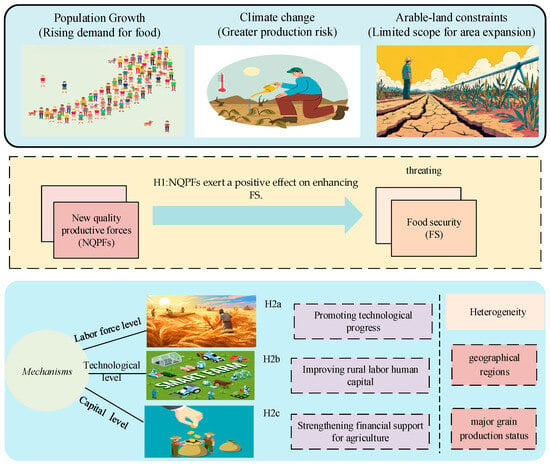
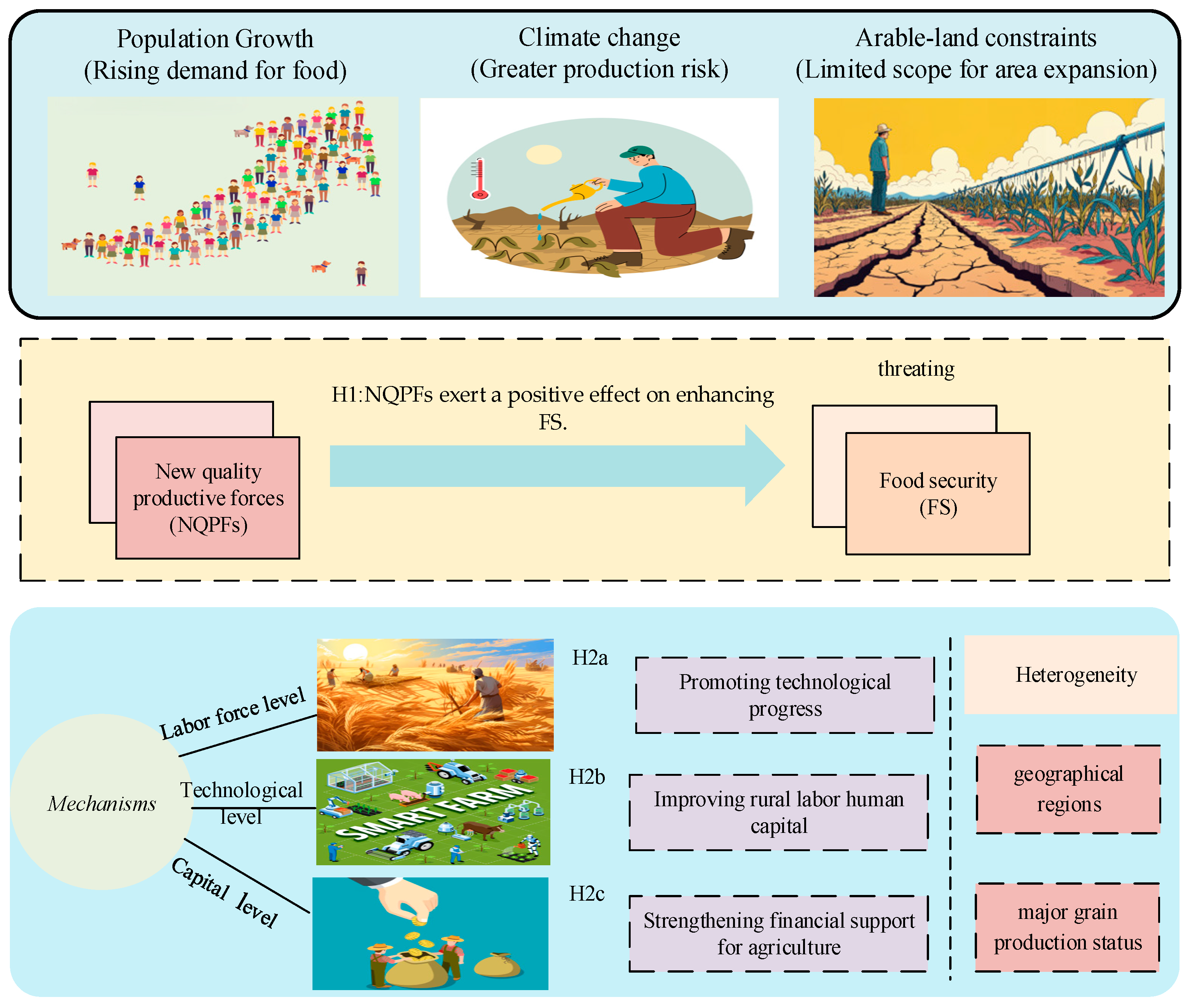
Figure 1 presents the research framework.
Figure 1.
Research framework.
3. Research Hypothesis
FLs have long been central to economic analysis. Both Marxian production theory and economic growth theory suggest that output growth depends on the quantity of factor inputs and improvements in factor productivity. As a cornerstone of the broader economic system, the development of the grain industry is shaped by the levels and efficiency of labor, capital, and technology and is increasingly driven by coordinated interactions among emerging production factors, including technological progress, digital applications, information resources, and organizational upgrading [45]. However, in the context of persistent rural labor outmigration, tighter constraints on arable land, and increasing natural risks, sustainable growth in China’s grain-production capacity can no longer rely solely on the continued accumulation of traditional production inputs.
Against this background, promoting NQPFs in agriculture provide an important pathway for alleviating constraints on FS. NQPFs are characterized by innovation-driven development, a high-technology orientation, the extensive application of data and digital technologies, green transformation, and the upgrading of human capital and organizational institutions [21]. Agricultural NQPFs can support the construction of high-standard farmland and reduce losses at different stages of the grain supply chain, thereby strengthening overall grain-production capacity [46]. With a stronger high-technology orientation than traditional productive forces, NQPFs reshape agricultural production through intelligent, digital, and green approaches, improving factor-allocation efficiency and agricultural total factor productivity while facilitating a shift from experience-based practices to data-driven production [47]. Green technologies also reduce energy consumption and greenhouse gas emissions [48], easing the tension between higher grain yields and resource-environmental constraints and contributing to more efficient, higher-quality, and sustainable grain production [49]. Accordingly, we propose the following hypothesis:
H1.
NQPFs exert a positive effect on enhancing FS.
The technological dimension of NQPFs, particularly digitalization, intelligent equipment, green technology, and innovation integration, provides a direct channel through which NQPFs affect FS. The introduction of technological factors facilitates China’s transition from energy-intensive agriculture toward digital and intelligent agriculture [50]. Induced technological change theory suggests that agricultural technological progress mainly involves mechanical and biochemical innovation, which in grain production is reflected in seed innovation and agricultural mechanization [35]. NQPFs integrate seed-related research, data resources, financial capital, and skilled personnel, thereby facilitating the development and diffusion of improved varieties and helping regions select technological pathways suited to their resource endowments. Meanwhile, the application of the Internet of Things, data analytics, precision seeding, intelligent irrigation, and smart agricultural machinery improves the monitoring and allocation of production factors [51]. Green technologies, such as water-saving irrigation and low-carbon machinery, further improve input-use efficiency while reducing environmental pressures. Thus, the digital, intelligent, green, and innovation-oriented features of NQPFs promote technological progress and strengthen FS. Based on this discussion, we propose the following hypothesis:
H2a.
NQPFs enhance FS by promoting technological progress.
The rural-labor-human-capital mechanism is mainly associated with the human-capital-upgrading, industrial-integration, and organizational-innovation features of NQPFs. According to the New Economics of Labor Migration, rural labor migration can reduce the agricultural labor supply and contribute to labor shortages and farmland abandonment [52,53]. NQPFs promote the integration of rural primary, secondary, and tertiary industries through digital services, agricultural processing, e-commerce, and modern logistics. These activities create diversified employment opportunities and help reduce excessive rural labor outmigration. At the same time, the application of intelligent machinery, digital platforms, and green technologies increases the demand for workers with technical and managerial skills. Through vocational training, agricultural extension, and talent incentives, NQPFs upgrade rural labor human capital and improve the ability of agricultural workers to adopt advanced technologies and conduct specialized grain production. Therefore, NQPFs can alleviate labor constraints and strengthen FS by improving rural labor human capital. Based on this discussion, we propose the following hypothesis:
H2b.
NQPFs enhance FS by improving rural labor human capital.
The financial-support mechanism is linked to the digital-financial, green-financial, and institutional-innovation features of NQPFs. Digital platforms, transaction records, remote sensing information, and digital credit assessments can reduce information asymmetry and transaction costs, thereby improving financial institutions’ ability to evaluate agricultural borrowers. Because grain production is exposed to weather and other production risks, green finance can channel capital toward resource-efficient technologies, larger-scale production, and sustainable grain processing, thereby easing credit constraints and stabilizing grain output [54]. Green insurance can share production risks, protect the returns of grain-producing households, and stabilize planting incentives [55]. In addition, institutional innovation and green-finance standards can restrict financing for highly polluting processing enterprises and encourage cleaner production practices that improve grain quality and supply sustainability [56]. Accordingly, the digital-financial, green-financial, and institutional-innovation features of NQPFs strengthen agricultural financial support and ultimately improve FS. Based on this discussion, we propose the following hypothesis:
H2c.
NQPFs enhance FS by strengthening financial support for agriculture.
4. Research Design
4.1. Variable Selection and Explanation
- (1)
- Dependent variable
The dependent variable in this study is FS. Following Cui and Zhong [30] and the broader conceptual framework of food security, we construct an FS indicator system comprising three dimensions: resilience, adaptability, and transformative capacity. Resilience captures the basic capacity of the grain-production system to maintain a stable supply and is measured using indicators such as the sown area of grain crops and the effective irrigated area. Adaptability reflects the ability of the grain system to maintain supply security, pursue sustainable development, and recover from external environmental changes. It is measured using indicators including employment in the primary industry, the Consumer Price Index for grain products, per capita grain output, grain yield per unit area, pesticide use, agricultural plastic-film use, the amount of chemical fertilizer applied, value added in the primary industry, and natural-disaster response capacity. Transformative capacity reflects the ability of the grain system to improve its structure and efficiency through multistakeholder coordination and technological progress. It is measured using freight volume, rural residents’ income, the development level of agriculture, forestry, animal husbandry, and fisheries, agricultural mechanization, agricultural diesel consumption, and rural electricity consumption. We then use the entropy-weight method to determine indicator weights and calculate the comprehensive FS index.
It should be noted that the FS index primarily reflects grain-production capacity, infrastructure, and resilience, which correspond mainly to the availability and stability dimensions of the international FS framework. Household access to food, dietary quality, and nutritional outcomes are not directly captured because consistent provincial data on these dimensions are unavailable for the sample period. FS in this study should therefore be understood as regional grain-production security rather than food security in its full international sense, and the findings provide evidence mainly on the modernization of regional grain-production systems. The complete indicator system of FS is detailed in Table 1.
Table 1.
FS indicator system.
- (2)
- Independent variable
NQPFs represent an advanced form of productive forces characterized by innovation and fundamentally driven by improvements in quality. Drawing on Huang, Guo [21], Lin, Gu [20], and Liu and He [57], this study constructs an NQPF indicator system across three dimensions: new-quality laborers, new-quality labor objects, and new-quality labor materials. “New-quality laborers” form the human foundation of NQPFs’ development and reflect improvements in workers’ knowledge, skills, and human-capital quality. We measure this dimension using indicators of both human-capital input and output, including the full-time equivalent of research and experimental development (R&D) personnel, the share of employees in the information and software industry, education expenditure, the average number of higher-education students per 100,000 people, the number of higher-education institutions, and the average wage of urban employees. “New-quality labor objects” capture the expansion and upgrading of production objects in the context of digitalization, informatization, and green transformation. This dimension is measured using per capita e-commerce sales, per capita telecommunications business volume, the number of internet broadband access ports, the number of domain names, sulfur dioxide emissions, waste-treatment efficiency, general industrial solid-waste generation, and the share of local fiscal expenditure devoted to environmental protection. “New-quality labor materials” provide the material and technological foundation for NQPFs’ development and reflect both technological R&D and innovation capacity and infrastructure development. We measure this dimension using the operating revenue of high-tech industries, R&D expenditure intensity, the number of domestic patent applications accepted, the share of local fiscal expenditure devoted to science and technology, railway operating mileage, and the mobile-phone penetration rate. Railway mileage and mobile-phone penetration are included as enabling infrastructure rather than direct innovation-output indicators. Railway infrastructure facilitates the circulation and spatial reallocation of labor, technology, information, and production inputs, while mobile-phone penetration provides the basic digital connectivity required for information transmission, digital services, and technology adoption. Both therefore represent the material and digital foundations that support the deployment and coordination of NQPFs. In addition, urban wage levels, the activity of e-commerce, and the level of industrial research and development, which are not specific indicators for agriculture, have also been included in the NQPF indicators. This is because they reflect the supply of skilled labor in the region, the digital market, and the technical knowledge base relied upon for agricultural digitalization, mechanization and innovation development. Therefore, this index should be interpreted as an indicator for measuring the regional NQPF capabilities, rather than a direct measurement indicator for the upgrading of agricultural labor quality. In total, the NQPFs index contains 20 indicators, whose weights are determined using the entropy-weight method; Table 2 provides the complete indicator system.
Table 2.
Indicator system for NQPFs.
- (3)
- Control variables
Control variables are included to reduce potential omitted-variable bias and account for factors other than NQPFs that may affect FS. Following the related literature, we include four controls: industrial structure (IS), land resource endowment (LRE), fiscal support for agriculture (FSA), and fertilizer use intensity (FUI). IS is closely related to agricultural modernization and mechanization and is measured as the ratio of value added in the tertiary sector to that in the secondary sector [21]. LRE is measured as the logarithm of cultivated land area; larger cultivated areas are generally associated with greater total grain output [58]. FSA is measured as the share of public expenditure devoted to agriculture, forestry, and water affairs [20]. Stronger fiscal support can facilitate seed-industry innovation and promote agricultural mechanization and digitalization. FUI is measured as the logarithm of fertilizer consumption [59]. Excessive fertilizer application can damage soil quality and thereby reduce grain-production capacity and undermine FS.
- (4)
- Mechanism variables
Based on the preceding theoretical analysis, NQPFs may affect FS by changing factor levels in technology, labor, and capital. We therefore use these three dimensions as mechanism variables. The technological factor is measured as the logarithm of the number of agricultural technology patents. The labor factor is measured by the educational attainment of the labor force, expressed as average years of schooling [60]. The capital factor is measured using the green finance index [61].
4.2. Data Sources
This study uses panel data for 29 provinces, municipalities, and autonomous regions in China (excluding Xinjiang, Xizang, Hong Kong, Macau, and Taiwan) from 2013 to 2023 to examine the relationship among NQPFs, factor allocation, and FS. Indicator data were obtained from the National Bureau of Statistics, provincial statistical yearbooks, the EPS Database, and other sources. Missing values were imputed using linear interpolation. Table 3 reports the descriptive statistics.
Table 3.
Variables descriptions.
4.3. Research Method
4.3.1. Entropy Weight Method
The level of NQPF development in China is measured using the entropy-weight method. This method assigns indicator weights according to the information contained in each indicator, thereby providing an objective basis for composite evaluation. Compared with subjective weighting approaches, it reduces researcher discretion in determining indicator importance. The calculation proceeds as follows:
Step 1: Standardize the indicators.
where represents the value of indicator j in city i for year t; and denote the maximum and minimum values of each indicator, respectively.
Step 2: Calculate the proportion of indicator j in city i for year t.
Step 3: Calculate the information entropy of the indicator.
Step 4: Calculate the weight of each indicator.
Step 5: Compute the level of NQPFs.
4.3.2. Two-Way Fixed Effects Model
We estimate the relationship between NQPFs and FS using a two-way fixed-effects model specified as follows:
where denotes the dependent variable, indexes regions, and indexes years; is the core explanatory variable, is the vector of control variables, and control for region and year fixed effects, respectively, is the idiosyncratic error term, and is the coefficient of primary interest.
5. Empirical Results and Analysis
5.1. Benchmark Regression Results
To examine the impact of NQPFs on FS, we conducted benchmark regressions using provincial panel data for 2013–2023. The results are reported in Table 4. As shown in Table 4, the coefficient of NQPFs is positive in all four specifications, but its magnitude is sensitive to model specification. It is 0.0966 without controls or fixed effects and 0.1898 with controls but without fixed effects, and it declines to 0.0671 in the fully specified model, where it is significant only at the 10% level. The decline indicates that a substantial part of the raw correlation reflects time-invariant provincial characteristics and common annual shocks. In terms of economic magnitude, a one-standard-deviation increase in NQPFs is associated with an increase in FS of approximately 0.0067, equivalent to about 1.43% of the sample mean of FS and about 13.2% of its standard deviation. This result provides support for H1 in the form of a positive conditional association.
Table 4.
Benchmark regression.
It is worth noting that the coefficients of NQPFs are identified from the time variations within the province after controlling for observable covariates and province-year fixed effects. The identification process requires the condition of conditional strict exogeneity: after controlling for the included covariates and fixed effects, the changes in NQPFs must be uncorrelated with the province-specific time shock impacts on FS. This assumption excludes reverse causality, forward-looking responses, and unaccounted time variation factors that jointly affect NQPFs and FS. Additionally, it requires sufficient endogenous variation within the province and no significant cross-provincial spillover effects that are not modeled. Since these conditions cannot be fully verified, the estimated results should mainly be understood as conditional associations rather than exact causal effects.
To assess whether unobservables could explain our results, we follow Oster [62] and compare the coefficient on NQPFs and the between a restricted model with fixed effects only and the full model with all control variables. We consider two values of the maximum attainable : , and the most conservative . The coefficient-stability parameter is 6.666 when and 3.363 when , both well above the threshold of 1. This means that selection on unobservables would need to be 3.363–6.666 times as strong as selection on observables to explain away the effect of NQPFs. Therefore, our main finding is unlikely to be driven by omitted variables.
5.2. Robustness Check
- (1)
- Remove certain samples
Given the significant differences between the four municipalities—Beijing, Tianjin, Shanghai, and Chongqing—and other provinces in terms of economic development levels, resource endowments, urbanization progress, and grain production conditions, these disparities may exert some influence on the regression results. To test the robustness of this study’s findings, this paper conducts a new regression analysis after excluding the samples from the four municipalities; the results are presented in Table 5 (1). As shown in Column (1), the regression coefficient for NQPFs is 0.0449 and is significantly positive at the 10% level, indicating that even after excluding the samples from the four municipalities, the positive association between NQPFs and FS persists; thus, the baseline regression results demonstrate a certain degree of robustness.
Table 5.
(a) Robustness results. (b) Robustness results.
- (2)
- Exclude some samples
Given the potential impact of external shocks—such as the COVID-19 pandemic—on agricultural production, grain circulation, and FS since 2020, this study re-estimates the regression model after excluding the sample data covering the period 2020–2023. The results presented in Table 5 (2) show that the regression coefficient for NQPFs is 0.1375 and is statistically significant at the 1% level; this indicates that, even after excluding observations from specific years, the positive association between NQPFs and FS remains, thereby further validating the robustness of the baseline regression findings.
- (3)
- Winsorization
To mitigate the influence of extreme observations on the regression results, all continuous variables were winsorized at the 1st and 99th percentiles. The results are reported in Table 5 (3). The coefficient of NQPFs is 0.0624 and remains statistically significant at the 10% level. This finding indicates that the positive association between NQPFs and FS persists after winsorization, thereby confirming the robustness of the baseline results.
- (4)
- Add control variables
To further assess potential omitted-variable bias, we augment the baseline specification with environmental regulation intensity (ERI) and per capita water-resource availability (PCW). ERI captures regional environmental regulatory pressure, while PCW captures differences in water-resource endowment and constraints. As reported in Table 5 (4), the coefficient of NQPFs remains positive and is statistically significant. Overall, after further controlling for potential omitted variables, the estimated results for NQPFs remain substantially unchanged in both direction and statistical significance, thereby further supporting the robustness of the conclusions drawn from the baseline regression.
- (5)
- Replace the dependent variable
We re-construct the FS index using principal component analysis and, alternatively, use the logarithm of grain yield per unit area as the dependent variable. As shown in Table 5b (4) and (5), the coefficients of NQPFs remain significantly positive, indicating that our results are not sensitive to the measurement of FS.
- (6)
- Replace the independent variable
As an additional robustness test, we reconstruct the NQPFs index using PCA, equal weighting, and the CRITIC method. As shown in Table 5b, the coefficients of the three alternative indices are 0.0293, 0.1943, and 0.1794, respectively, and all are positive and statistically significant at the 1% level. The positive association between NQPFs and FS is therefore robust to alternative index-weighting methods.
5.3. Endogeneity Test
Although the baseline specification includes fixed effects and a range of controls, endogeneity may still arise from reverse causality and unobserved province-specific time-varying factors. We adopt the two-stage least squares (2SLS) method for re-estimation; the results are presented in Table 6. The first instrument (IV1) is the one-period lag of NQPFs. The second instrument (IV2) is constructed as the interaction between the number of post offices in each province in 1984 and the lagged national number of internet users. Under the condition of controlling for variables and fixed effects, the historical distribution of post offices only affects FS through non-quantitative postal services (NQPFs). The number of post offices in 1984 reflected the layout of the communication network during the planned economy period, which was mainly determined by administrative arrangements and postal service demands, rather than the subsequent development of grain production. Provinces with higher postal network density in the past were more likely to develop telecommunications and internet infrastructure later, which supports the relevance of this tool. Moreover, since the 1984 data on the number of post offices is time-invariant, any direct horizontal effect of historical postal infrastructure on FS will be absorbed by the province-fixed effects. Therefore, the identification of effects solely from the interaction with the total number of internet users nationwide, and this common time series shock is unlikely to be driven by any single province’s agricultural conditions. Table 6 (1) and (3) report the first-stage results. IV1 and IV2 are positively associated with NQPFs, both significant at the 1% level. Table 6 (2) and (4) present the second-stage estimates. Both estimates are positive and directionally consistent with the baseline result. Overall, the instrumental variable estimation results further support the finding that NQPFs exert a positive promoting effect on FS, thereby enhancing the reliability of the empirical findings presented in this paper.
Table 6.
Endogeneity test results.
To further verify the validity of the instruments, we conduct placebo tests by randomly permuting each instrument across observations 500 times and re-estimating the reduced-form regression of FS on the placebo instrument. If the instruments affect FS only through NQPFs, the placebo instruments should have no systematic effect. As shown in Panel B of Table 6, the mean placebo coefficients are close to zero, far below the true reduced-form estimates. These results indicate that the IV estimates are unlikely to be driven by spurious correlations.
5.4. Mechanism Test
To explore the underlying channels through which NQPFs influence FS, we adopt a two-stage empirical framework to examine the mediating effects of technological, labor, and capital FLs. The corresponding mediation model is formulated as follows:
where denotes the mediating variable and are the coefficient of primary interest in this study. Table 7 reports the regression results for the technical factor, labor factor, and capital factor.
Table 7.
Mechanism analysis.
5.4.1. NQPFs, Digital Techniques, and FS
Table 7 (1) and (2) examine the technological mechanism. The coefficient of NQPFs in the digital-techniques equation is 4.5727 and statistically significant at the 1% level. These findings indicate that NQPFs are closely associated with agricultural technological factors, suggesting that the expansion of NQPFs plays a facilitating role in advancing agricultural technology. With respect to how technological factors influence FS, the accelerating progress in information-based technologies has played a key role in fostering the advanced development of smart agriculture. Smart agriculture enhances cost efficiency, yield growth, and productivity by enabling precision land preparation, precision drip irrigation, and variable-rate fertilization and pesticide application, as well as reducing losses during grain harvesting, transportation, and storage, thereby effectively safeguarding FS [63]. In addition, advancements in the digitalization and intelligent transformation of agricultural equipment represent a key dimension of technological progress and contribute to more efficient resource allocation within agricultural production. By facilitating human–machine collaboration, it significantly enhances grain production efficiency and thus effectively ensures FS [64]. Meanwhile, the realization of FS is inseparable from seed industry innovation, and innovation capacity in the seed sector is a key indicator for assessing FS. Innovation in the seed industry plays a pivotal role in promoting the high-quality development of grain production [35]. The diffusion of digital technologies has accelerated technological innovation within the seed industry, thereby contributing to the revitalization of the sector. This, in turn, provides strong support for FS by ensuring stable and efficient grain production. In summary, NQPFs can safeguard FS by optimizing the allocation of technological factors, thereby validating Hypothesis H2a.
5.4.2. NQPFs, Rural Labor Capital, and FS
Table 7 (3) and (4) examine the rural-labor-capital mechanism. NQPFs are positively associated with rural labor capital, with a coefficient of 1.2051 that is significant at the 1% level. Rural labor capital is also positively associated with FS in Table 7 (4), with a coefficient of 0.0188 that is significant at the 1% level. This relationship is consistent with the argument that NQPFs increase the demand for workers with digital, technical, and managerial skills while supporting agricultural training and the adoption of intelligent equipment. A more skilled agricultural workforce may improve the operation of advanced machinery, the application of digital technologies, and the efficiency of grain production and storage. The results are therefore consistent with rural labor capital serving as a potential transmission channel, providing support for H2b.
5.4.3. NQPFs, Green Finance Index, and FS
Table 7 (5) and (6) examine the financial mechanism. The coefficient of NQPFs in the green-finance equation is 0.2445 and significant at the 1% level. In Table 7 (6), the green finance index is positively associated with FS, with a coefficient of 0.2419 that is significant at the 1% level. These findings are consistent with the view that NQPFs can improve digital financial services, green credit allocation, and agricultural risk management. Better financial support may ease credit constraints, facilitate investment in agricultural technologies and equipment, and help producers cope with climate, disaster, and market risks [65,66]. Thus, the results are consistent with financial support serving as a potential channel linking NQPFs to FS, providing support for H2c.
To mitigate potential reverse causality between the mediators and FS, we adopt a strict temporal sequence in which NQPFs at t − 2 affects each mediator at t − 1, which in turn affects FS at t. Table 8 and Table 9 report the results. NQPFs significantly promote digital techniques, rural labor human capital, and green finance index. Each lagged mediator in turn significantly improves FS. The cluster-bootstrap tests with 1000 replications show that the 95% confidence intervals of the three indirect effects all exclude zero. The indirect effects account for 71.75%, 31.39%, and 86.43% of the total effect, respectively. These results confirm that the three channels remain valid after accounting for temporal ordering.
Table 8.
Mechanism tests based on lagged mediators.
Table 9.
Bootstrap test.
It is important to note that technological progress, rural human capital, and financial support are not distinct operational mechanisms; rather, they may interact in a mutually reinforcing and synergistic manner. On one hand, an improvement in rural human capital levels can enhance the ability of agricultural producers to learn, absorb, and apply digital technologies, intelligent equipment, and other advanced agricultural technologies, thereby increasing the efficiency of translating agricultural technological advances into practical applications; on the other hand, the optimal allocation of financial resources can alleviate the financing constraints faced by agricultural producers, providing the necessary funding support for agricultural technological innovation, equipment investment, and human capital development. Simultaneously, agricultural technological progress can boost labor productivity and capital utilization efficiency, further facilitating the reallocation of labor and financial resources toward more efficient agricultural production activities. Consequently, a mutually reinforcing synergistic mechanism may emerge among technology, labor, and capital factors, collectively driving the improvement of FS levels. The present study examines these three mechanisms separately primarily to identify their respective transmission pathways; this does not imply that these three mechanisms are entirely independent in practice.
5.5. Heterogeneity Analysis
Marked regional differences in economic development, agricultural resource endowments, and grain production imply that the impact of NQPFs on FS is likely to vary across regions. Accordingly, this study classifies the sample along two dimensions—geographical regions and major grain production status—to investigate the heterogeneous effects of NQPFs on FS.
5.5.1. Grain Regions
Given China’s large population and limited arable land, grain-production and grain-consumption responsibilities are distributed unevenly across regions. We therefore distinguish among major grain-producing regions, major grain-consuming regions, and grain-production–consumption-balanced regions. Table 10 reports the subgroup estimates. The coefficient of NQPFs is positive but statistically insignificant in both major grain-producing regions and major grain-consuming regions. In contrast, the coefficient is positive and statistically significant in grain-production–consumption-balanced regions. The possible reason for these findings is that the primary grain-producing areas have long served the critical function of ensuring the nation’s grain supply; consequently, agricultural infrastructure, policy support, and resource inputs are relatively concentrated in these regions, and their FS foundation is already strong, meaning the marginal stimulative effect of NQPFs has not yet fully materialized. In major grain-consuming regions, constrained by factors such as limited land resources, a high level of urbanization, and restricted grain production space, NQPFs are more likely to be applied to the circulation, consumption, and supply security systems, resulting in a relatively limited direct impact on enhancing grain production security. In contrast, grain-production-consumption-balanced regions possess both a solid foundation for grain production and room for improvement; through driving agricultural technological advancement, improving factor allocation, and increasing agricultural production efficiency, NQPFs can more effectively translate into improvements in grain security levels; therefore, their promoting effect is more pronounced. We also conduct pairwise Chow tests to formally assess whether the estimated coefficients differ across these groups. As reported in Table 11, the Chow tests are statistically significant at the 1% level. These results confirm that the effect of NQPFs on FS differs significantly across the three types of grain regions, providing formal evidence of regional heterogeneity.
Table 10.
Heterogeneity Test: Major Grain-Producing Areas, Major Grain-Consuming Areas, and Grain production–consumption balance areas.
Table 11.
Chow tests.
5.5.2. Eastern and Central–Western Regions
Considering differences in resource endowments and economic development, we divide the sample into eastern, central, and western regions. Table 12 reports the subgroup estimates. In the eastern region, the coefficient of NQPFs is negative. One possible explanation is that eastern China has relatively scarce agricultural land, high urbanization, and intense competition between agricultural and non-agricultural sectors for capital, land, and skilled labor. Consequently, advanced production factors may be allocated primarily to higher-return industrial and service activities rather than grain production. Moreover, the region’s relatively advanced infrastructure and technology may leave less scope for additional NQPF development to generate marginal improvements in FS. In the central region, the NQPF coefficient is positive but statistically insignificant. Although the central region has a strong agricultural base, constraints in technology diffusion, infrastructure, and the conversion of general innovation capacity into grain-production capacity may limit the precision and magnitude of the estimated relationship. The result should therefore be interpreted as inconclusive rather than as evidence of a positive effect. In the western region, the coefficient is positive and statistically significant. The larger estimate may reflect greater scope for productivity gains from mechanization, digital infrastructure, improved factor allocation, and green agricultural technologies in areas with initially weaker infrastructure and lower technological penetration. However, whether this coefficient differs statistically from those of the eastern and central regions is determined by the formal coefficient-equality tests rather than by comparisons of subgroup significance alone. The pairwise Chow tests in Table 11 are statistically significant at the 1% level.
Table 12.
Heterogeneity test: east, central, and west China.
These subgroup results should be interpreted cautiously. The analysis is based on 29 provincial units, and dividing the sample reduces the number of independent clusters in each subgroup. This may lower statistical power and widen confidence intervals, particularly for the Chow tests. We therefore distinguish between statistically confirmed coefficient differences and suggestive differences in point estimates. More disaggregated city-, county-, farm-, or household-level data could provide better-powered tests of regional heterogeneity.
6. Discussion
This study constructs multidimensional indices of NQPFs and FS and examines their relationship using a two-way fixed-effects model. The results show a positive conditional association between NQPFs and FS after controlling for observable characteristics and province and year fixed effects. The direction of this association is broadly stable across several alternative specifications, although residual omitted-variable bias and the exclusion restriction of the lagged instrument cannot be fully ruled out. The mechanism analysis suggests that technological progress, rural labor human capital, and agricultural financial support are potential channels linking NQPFs to FS. Digital and technological upgrading may improve the precision and efficiency of agricultural input use; human-capital upgrading may strengthen farmers’ capacity to adopt and manage advanced technologies; and better financial support may ease credit constraints and distribute production risks. These results extend research on agricultural factor misallocation by indicating that FS depends not only on the quantity of inputs but also on the coordination of technology, labor, and capital.
The results also point to regional differences. Across grain-function zones, the positive estimate is concentrated in production–consumption-balanced regions, whereas the estimates for major grain-producing and major grain-consuming regions are not statistically significant. One possible explanation is that major producing regions already have stronger agricultural foundations and policy support, while major consuming regions face greater land constraints and stronger competition from non-agricultural sectors. Balanced regions may combine an established production base with greater scope for improvements in technology, infrastructure, and factor allocation. Geographically, the NQPF coefficient is positive and statistically significant in western China but statistically insignificant in eastern and central China. The larger western estimate may reflect greater marginal returns to mechanization, digital connectivity, infrastructure, and technology diffusion where initial levels are relatively low. In eastern China, scarce agricultural land and competition from industrial and service sectors may weaken the translation of aggregate NQPF development into grain-production capacity.
These regional patterns also illustrate that the level of NQPFs and its contribution to FS are not identical. The eastern region has the most advanced technological infrastructure, R&D capacity, and human capital, yet its estimated coefficient is close to zero, suggesting that these capabilities are largely absorbed by non-agricultural sectors rather than transferred into grain production. Conversely, the western region has relatively lower NQPF levels but a significantly positive estimate, which is consistent with the view that targeted mechanization, extension services, and relatively inexpensive digital solutions can generate substantial productivity gains. The contribution of NQPFs to FS therefore depends not only on their development level but also on whether new production factors are effectively allocated to agriculture.
7. Conclusions, Policy Implications and Limitations
7.1. Conclusions, Policy Implications
Using panel data for 29 Chinese provinces from 2013 to 2023, this study examines the relationship between NQPFs and FS. The two-way fixed-effects estimates show a positive association between NQPFs and FS after controlling for observable regional characteristics. The direction of the result is broadly stable across sample adjustment, winsorization, PCA-based measurement, and extended-control specifications, although concerns about residual omitted variables and the validity of the lagged instrument remain.
The mechanism results are consistent with technological progress, rural labor human capital, and agricultural financial support serving as potential transmission channels. The heterogeneity analysis indicates that NQPFs significantly promote the FS in the western region. Across grain-function regions, the positive relationship is concentrated in grain production–consumption-balanced regions, whereas the estimates for major grain-producing and major grain-consuming regions are insignificant. These subgroup differences should be interpreted together with the formal coefficient-equality tests and the limited number of provincial clusters.
These findings lead to three policy implications. First, agricultural NQPF policies should prioritize the conversion of innovation into grain-production applications. The technological-progress mechanism supports greater investment in seed innovation, precision farming, intelligent machinery, water-saving technologies, and agricultural data services. Policy evaluation should focus on their contribution to productivity, resource-use efficiency, and production resilience rather than on aggregate digital or R&D investment alone.
Second, human-capital and financial policies should complement technological investment. The human-capital results support expanding vocational training in digital equipment operation, farm management, and green production. The financial-support results point to improved agricultural credit assessment, green credit, agricultural insurance, and risk-compensation arrangements, particularly for grain producers facing high production risks and limited collateral.
Third, implementation should reflect regional conditions. In western China, where the estimated association is strongest, priorities include agricultural infrastructure, technology extension, digital connectivity, and access to finance. In eastern China, the near-zero estimate suggests that expanding aggregate NQPF inputs alone may not benefit FS when technology, capital, and skilled labor are concentrated in non-agricultural sectors and agricultural land is constrained. Policies should therefore strengthen the agricultural targeting of innovation resources and protect grain-production capacity. In central China and major grain-producing regions, the insignificant estimates indicate a need to improve technology diffusion, infrastructure, and the conversion of innovation inputs into farm-level productivity before expanding investment.
It is worth noting that there are also challenges in implementing the above suggestions. Digital and green technologies require significant initial investment, which may result in disproportionate benefits for large farms and developed regions. Agricultural credit can alleviate financing constraints, but it may also increase financial and default risks. Regional implementation must strike a balance between efficiency and fairness, especially considering that the western regions have greater development potential but weaker implementation capabilities, while the eastern regions face more intense competition from non-agricultural sectors. Therefore, policies should be implemented in stages, adapted to local conditions, and supported through training, risk sharing, and performance evaluation.
7.2. Limitations and Future Research
This study also has several limitations. First, the analysis is based on 29 provinces and 319 province-year observations. Provincial data conceals substantial heterogeneity across cities, counties, farms, households, and agricultural firms and may produce bias. Province-level relationships should therefore not be interpreted as direct evidence of how individual farmers or firms respond to NQPF development. Future studies could use city-, county-, household-, or farm-level data to examine the micro-level mechanisms through which NQPFs affect FS. Second, although the FS index captures multiple dimensions of production capacity and resilience, it cannot fully represent food access, affordability, nutritional utilization, interregional grain flows, or supply-chain stability. The entropy-weighting method is also sensitive to the dispersion of the underlying indicators. Although a PCA-based measure is used as a robustness check, future studies could combine production, consumption, nutrition, price, trade, and household-access data to develop a more comprehensive FS measure. Third, the empirical design does not definitively establish causality or temporal ordering. Province and year fixed effects absorb time-invariant regional characteristics and common annual shocks, but unobserved province-specific time-varying factors may remain. Future studies could use exogenous policy shocks, mechanism-specific instruments, or higher-frequency and longer-term data to strengthen causal and temporal identification. Fourth, this study examines three mechanisms—technological progress, human capital, and green finance. Additional pathways, including digital infrastructure, agricultural socialized services, land transfer, climate-adaptation capacity, and policy support, merit further investigation. Finally, the empirical analysis is based on Chinese provincial data, which limits the extent to which the findings can be generalized to other countries. The estimated relationship between NQPFs and FS may depend on China’s institutional arrangements, agricultural policy framework, infrastructure, factor markets, and stage of economic development. In countries with different land-tenure systems, levels of agricultural mechanization and digital infrastructure, or patterns of public support, NQPFs may operate through different channels and have effects of different magnitudes. Nevertheless, the proposed framework linking technological progress, human capital, and green finance to food security may provide a useful basis for comparative research. Future studies could test its applicability using cross-country or country-specific data and examine how institutional settings, agricultural resource endowments, and levels of development moderate the effects of NQPFs on different dimensions of FS.
Author Contributions
F.Y.: Conceptualization, Methodology, Editing, Project administration. Data collection and Software, Funding acquisition, Writing—original draft, Writing—review and editing. H.S.: Investigation and Software. M.Z.: Funding acquisition, Data collection and Software, Conceptualization, Writing—review, and editing. W.C.: Conceptualization, Software, Supervision, Writing—review and editing. J.S.: Methodology, Resources, Funding acquisition, Writing—review, and editing. All authors have read and agreed to the published version of the manuscript.
Funding
This research was supported by the University Social Science Research Project of Anhui Province (Nos. 2023AH050203, 2024AH050013, 2024AH050015, 2024AH052383), the Social Science Foundation of Anhui Province (Nos. AHSKF2022D08 and AHSKQ2022D032), the University Social Science Research Project of Anhui Province (No. 2024AH052081).
Data Availability Statement
The datasets supporting the findings of this study are available upon reasonable request.
Conflicts of Interest
The authors declare no conflicts of interest.
Abbreviations
The following abbreviations are used in this manuscript:
| FS | food security |
| NQPFs | new quality productive forces |
| FLs | factor levels |
| IS | industrial structure |
| LRE | land resource endowment |
| FSA | fiscal support for agriculture |
| FUI | fertilizer use intensity |
| ERI | environmental regulation intensity |
| PCW | per capita water resource availability |
References
- Gouvea, R.; Kapelianis, D.; Li, S.; Terra, B. Innovation, ICT & food security. Glob. Food Secur. 2022, 35, 100653. [Google Scholar] [CrossRef] [Scilit]
- Yang, R.; Zhong, C.; Yang, Z.; Yang, S.; Ji, G.; Yu, J.; Cao, L.; Yang, J.; Luo, L.; Shen, Y.; et al. Study on China’s Farmland–Grain resource curse: Empirical testing based on 31 Provinces and 2843 Counties. Land Use Policy 2024, 144, 107241. [Google Scholar] [CrossRef] [Scilit]
- Liu, Y.; Zhou, Y. Reflections on China’s food security and land use policy under rapid urbanization. Land Use Policy 2021, 109, 105699. [Google Scholar] [CrossRef] [Scilit]
- Lee, C.-C.; Zeng, M.; Luo, K. How does climate change affect food security? Evidence from China. Environ. Impact Assess. Rev. 2024, 104, 107324. [Google Scholar] [CrossRef] [Scilit]
- Campbell, B.M.; Vermeulen, S.J.; Aggarwal, P.K.; Corner-Dolloff, C.; Girvetz, E.; Loboguerrero, A.M.; Ramirez-Villegas, J.; Rosenstock, T.; Sebastian, L.; Thornton, P.K.; et al. Reducing risks to food security from climate change. Glob. Food Secur. 2016, 11, 34–43. [Google Scholar] [CrossRef] [Scilit]
- Barrett, C.B. Meeting the global food security challenge: Obstacles and opportunities ahead. Glob. Food Secur. 2016, 11, 1–4. [Google Scholar] [CrossRef] [Scilit]
- Candelise, C.; Saccone, D.; Vallino, E. An empirical assessment of the effects of electricity access on food security. World Dev. 2021, 141, 105390. [Google Scholar] [CrossRef] [Scilit]
- Jiang, T.; Zhong, M.; Gao, A.; Ma, G. Do factor misallocations affect food security? Evidence from China. Agriculture 2024, 14, 729. [Google Scholar] [CrossRef] [Scilit]
- Dangles, O.; Struelens, Q. Is food system research guided by the 2030 Agenda for Sustainable Development? Curr. Opin. Environ. Sustain. 2023, 64, 101331. [Google Scholar] [CrossRef] [Scilit]
- Guo, Y.; Hu, J.; Dou, Y.; Lin, S. Can ESG rating help shape enterprises’ new-quality productivity? Evidence from China. Int. Rev. Econ. Finance 2025, 104, 104654. [Google Scholar] [CrossRef] [Scilit]
- Xue, F.; Hu, Y.N.; Hu, T.; Zhou, R.; Ma, Q.; Fang, X. Urbanization intensified the trade-off between food security and water quality security in the Yangtze River Delta. Earth’s Future 2025, 13, e2025EF006382. [Google Scholar] [CrossRef] [Scilit]
- Lin, B.; Wang, Y. Climate change and China’s food security. Energy 2025, 318, 134852. [Google Scholar]
- Zhang, Z.; Li, P.; Wang, X.; Ran, R.; Wu, W. New energy policy and new quality productive forces: A quasi-natural experiment based on demonstration cities. Econ. Anal. Policy 2024, 84, 1670–1688. [Google Scholar] [CrossRef] [Scilit]
- Wang, J.; Wang, Z.; Wang, H.; Chen, T. Does the new environmental protection law hinder the development of new quality productive forces in industrial enterprises? A quasi-natural experiment in China. J. Clean. Prod. 2025, 517, 145870. [Google Scholar] [CrossRef] [Scilit]
- Rustemi, A.; Dalipi, F. Synergizing IoT, AI, and blockchain for smart agriculture: Challenges, opportunities, and future directions. Internet Things 2025, 34, 101778. [Google Scholar] [CrossRef] [Scilit]
- Chin, T.; Li, Z.; Huang, L.; Li, X. How artificial intelligence promotes new quality productive forces of firms: A dynamic capability view. Technol. Forecast. Soc. Change 2025, 216, 124128. [Google Scholar] [CrossRef] [Scilit]
- Zhang, L. Understanding the new quality productive forces in the energy sector. Energy Nexus 2024, 16, 100352. [Google Scholar] [CrossRef] [Scilit]
- Liu, Z.; Zhang, H.; Guo, C.; Yang, Y. New Quality Productive Forces Enabling High-Quality Development: Mechanism, Measurement, and Empirical Analysis. Sustainability 2025, 17, 8146. [Google Scholar] [CrossRef] [Scilit]
- Zhong, Y.; Lai, H.; Zhang, L.; Guo, L.; Lai, X. Does public data openness accelerate new quality productive forces? Evidence from China. Econ. Anal. Policy 2025, 85, 1409–1427. [Google Scholar] [CrossRef] [Scilit]
- Lin, L.; Gu, T.; Shi, Y. The influence of new quality productive forces on high-quality agricultural development in China: Mechanisms and empirical testing. Agriculture 2024, 14, 1022. [Google Scholar] [CrossRef] [Scilit]
- Huang, Q.; Guo, W.; Wang, Y. A study of the impact of new quality productive forces on agricultural modernization: Empirical evidence from China. Agriculture 2024, 14, 1935. [Google Scholar] [CrossRef] [Scilit]
- Restuccia, D.; Rogerson, R. Policy distortions and aggregate productivity with heterogeneous establishments. Rev. Econ. Dyn. 2008, 11, 707–720. [Google Scholar] [CrossRef] [Scilit]
- Hsieh, C.-T.; Klenow, P.J. Misallocation and manufacturing TFP in China and India. Q. J. Econ. 2009, 124, 1403–1448. [Google Scholar] [CrossRef] [Scilit]
- Adamopoulos, T.; Restuccia, D. The size distribution of farms and international productivity differences. Am. Econ. Rev. 2014, 104, 1667–1697. [Google Scholar] [CrossRef] [Scilit]
- Sumsion, R.M.; June, H.M.; Cope, M.R. Measuring Food Insecurity: The Problem with Semantics. Foods 2023, 12, 1816. [Google Scholar] [CrossRef] [Scilit] [PubMed]
- Wheeler, T.; Von Braun, J. Climate change impacts on global food security. Science 2013, 341, 508–513. [Google Scholar] [CrossRef] [Scilit] [PubMed]
- Lipper, L.; Thornton, P.; Campbell, B.M.; Baedeker, T.; Braimoh, A.; Bwalya, M.; Caron, P.; Cattaneo, A.; Garrity, D.; Henry, K.; et al. Climate-smart agriculture for food security. Nat. Clim. Change 2014, 4, 1068–1072. [Google Scholar] [CrossRef] [Scilit]
- Klerkx, L.; Jakku, E.; Labarthe, P. A review of social science on digital agriculture, smart farming and agriculture 4.0: New contributions and a future research agenda. NJAS Wagening. J. Life Sci. 2019, 90–91, 100315. [Google Scholar] [CrossRef] [Scilit]
- Wang, S.; Wu, H.; Li, J.; Xiao, Q.; Li, J. Assessment of the effect of the main grain-producing areas policy on China’s food security. Foods 2024, 13, 654. [Google Scholar] [CrossRef] [Scilit] [PubMed]
- Cui, X.; Zhong, Z. Climate change, cropland adjustments, and food security: Evidence from China. J. Dev. Econ. 2024, 167, 103245. [Google Scholar] [CrossRef] [Scilit]
- Paul, M., Jr.; Aihounton, G.B.; Lokossou, J.C. Climate-smart agriculture and food security: Cross-country evidence from West Africa. Glob. Environ. Change 2023, 81, 102697. [Google Scholar] [CrossRef] [Scilit]
- Kopittke, P.M.; Menzies, N.W.; Wang, P.; McKenna, B.A.; Lombi, E. Soil and the intensification of agriculture for global food security. Environ. Int. 2019, 132, 105078. [Google Scholar] [CrossRef] [Scilit] [PubMed]
- Ito, J.; Li, X. Interplay between China’s grain self-sufficiency policy shifts and interregional, intertemporal productivity differences. Food Policy 2023, 117, 102446. [Google Scholar] [CrossRef] [Scilit]
- Bai, E.; Guo, W.; Zhang, H.; Tan, Y.; Li, X.; Wei, Z. Degradation mechanism of cultivated land and its protection technology in the central coal-grain overlapped area of China. J. Clean. Prod. 2024, 468, 143075. [Google Scholar] [CrossRef] [Scilit]
- Gong, S.; Wang, B.; Yu, Z.; Cui, Z. Does seed industry innovation in developing countries contribute to sustainable development of grain green production? Evidence from China. J. Clean. Prod. 2023, 406, 137029. [Google Scholar] [CrossRef] [Scilit]
- Cansino-Loeza, B.; Munguía-López, A.D.C.; Ponce-Ortega, J.M. A water-energy-food security nexus framework based on optimal resource allocation. Environ. Sci. Policy 2022, 133, 1–16. [Google Scholar] [CrossRef] [Scilit]
- Gong, Y.; Zhang, Y.; Chen, Y. The Impact of High-Standard Farmland Construction Policy on Grain Quality from the Perspectives of Technology Adoption and Cultivated Land Quality. Agriculture 2023, 13, 1702. [Google Scholar] [CrossRef] [Scilit]
- Rahman, M.S.; Zulfiqar, F.; Ullah, H.; Himanshu, S.K.; Datta, A. Farmers’ perceptions, determinants of adoption, and impact on food security: Case of climate change adaptation measures in coastal Bangladesh. Clim. Policy 2023, 23, 1257–1270. [Google Scholar] [CrossRef] [Scilit]
- Timu, A.G.; Kramer, B. Gender-inclusive, -responsive, and -transformative agricultural insurance: A literature review. Glob. Food Secur. 2023, 36, 100672. [Google Scholar] [CrossRef] [Scilit]
- Yao, Z.; Chen, Y. How Can New Quality Productive Forces Empower Agricultural Sustainable Development in China. Sustainability 2026, 18, 91. [Google Scholar] [CrossRef] [Scilit]
- Fan, Z.; Du, X. Exploring the impact of rural industrial integration on new quality productive forces: Empirical evidence from China. Humanit. Soc. Sci. Commun. 2026, 13, 1792. [Google Scholar] [CrossRef] [Scilit]
- Mukherjee, M.; Fransen, S. Exploring migration decision-making and agricultural adaptation in the context of climate change: A systematic review. World Dev. 2024, 179, 106600. [Google Scholar] [CrossRef] [Scilit]
- Huang, J.; Raja Yusof, R.N.; Abd Rahman, A.; Ab Rahman, R. Determinants of digital technology adoption and its impact on firm performance in manufacturing firms. J. Manuf. Technol. Manag. 2025, 36, 1003–1025. [Google Scholar] [CrossRef] [Scilit]
- Wang, J.; Yao, X.; Zhu, X.; Li, B. Does lean inventory management alleviate financing constraints? J. Manuf. Technol. Manag. 2024, 35, 590–608. [Google Scholar] [CrossRef] [Scilit]
- Acemoglu, D.; Restrepo, P. The race between man and machine: Implications of technology for growth, factor shares, and employment. Am. Econ. Rev. 2018, 108, 1488–1542. [Google Scholar] [CrossRef] [Scilit]
- Xu, D.; Chen, M.; Li, R. How high-standard farmland construction can affect farmers’ grain cultivation behavior: Evidence from rural China. Habitat Int. 2025, 160, 103384. [Google Scholar] [CrossRef] [Scilit]
- Hu, Y.; Jia, X. Empowering the Intelligent Transformation of the Manufacturing Sector Through New Quality Productive Forces: Value Implications, Theoretical Analysis, and Empirical Examination. Sustainability 2025, 17, 7006. [Google Scholar] [CrossRef] [Scilit]
- Habiba, U.; Xinbang, C.; Anwar, A. Do green technology innovations, financial development, and renewable energy use help to curb carbon emissions? Renew. Energy 2022, 193, 1082–1093. [Google Scholar] [CrossRef] [Scilit]
- Fan, M.; Shen, J.; Yuan, L.; Jiang, R.; Chen, X.; Davies, W.J.; Zhang, F. Improving crop productivity and resource use efficiency to ensure food security and environmental quality in China. J. Exp. Bot. 2012, 63, 13–24. [Google Scholar] [CrossRef] [Scilit] [PubMed]
- Xiao, S.; He, Z.; Zhang, W.; Qin, X. The agricultural green production following the technological progress: Evidence from China. Int. J. Environ. Res. Public Health 2022, 19, 9876. [Google Scholar] [CrossRef] [Scilit] [PubMed]
- Soussi, A.; Zero, E.; Sacile, R.; Trinchero, D.; Fossa, M. Smart sensors and smart data for precision agriculture: A review. Sensors 2024, 24, 2647. [Google Scholar] [CrossRef] [Scilit] [PubMed]
- Chen, Z.; Sarkar, A.; Hossain, M.S.; Li, X.; Xia, X. Household labour migration and farmers’ access to productive agricultural services: A case study from Chinese provinces. Agriculture 2021, 11, 976. [Google Scholar] [CrossRef] [Scilit]
- Xu, D.; Deng, X.; Guo, S.; Liu, S. Labor migration and farmland abandonment in rural China: Empirical results and policy implications. J. Environ. Manag. 2019, 232, 738–750. [Google Scholar] [CrossRef] [Scilit] [PubMed]
- Lu, S.; Lu, W.; Xu, M.; Taghizadeh-Hesary, F.; Tang, Y. Water-energy-food security under green finance constraints in Southwest China. Energy Econ. 2023, 118, 106478. [Google Scholar] [CrossRef] [Scilit]
- Han, X.; Wang, Y.; Yu, W.; Xia, X. Coupling and coordination between green finance and agricultural green development: Evidence from China. Finance Res. Lett. 2023, 58, 104221. [Google Scholar] [CrossRef] [Scilit]
- Zhang, G.; Guo, B.; Lin, J. The impact of green finance on enterprise investment and financing. Finance Res. Lett. 2023, 58, 104578. [Google Scholar] [CrossRef] [Scilit]
- Liu, Y.; He, Z. Synergistic industrial agglomeration, new quality productive forces and high-quality development of the manufacturing industry. Int. Rev. Econ. Finance 2024, 94, 103373. [Google Scholar] [CrossRef] [Scilit]
- Li, T.; Long, H.; Zhang, Y.; Tu, S.; Ge, D.; Li, Y.; Hu, B. Analysis of the spatial mismatch of grain production and farmland resources in China based on the potential crop rotation system. Land Use Policy 2017, 60, 26–36. [Google Scholar] [CrossRef] [Scilit]
- Chen, X.; Xing, L.; Wang, K.; Zhang, Y.; Han, X. Nonlinear effects of internet development on chemical fertilizer application intensity: Macro evidence from China. J. Clean. Prod. 2023, 386, 135794. [Google Scholar] [CrossRef] [Scilit]
- Demirgüç-Kunt, A.; Torre, I. Measuring human capital in middle income countries. J. Comp. Econ. 2022, 50, 1036–1067. [Google Scholar] [CrossRef] [Scilit]
- Li, G.; Jia, X.; Khan, A.A.; Khan, S.U.; Ali, M.A.S.; Luo, J. Does green finance promote agricultural green total factor productivity? Considering green credit, green investment, green securities, and carbon finance in China. Environ. Sci. Pollut. Res. 2023, 30, 36663–36679. [Google Scholar] [CrossRef] [Scilit] [PubMed]
- Oster, E. Unobservable selection and coefficient stability: Theory and evidence. J. Bus. Econ. Stat. 2019, 37, 187–204. [Google Scholar] [CrossRef] [Scilit]
- Agrimonti, C.; Lauro, M.; Visioli, G. Smart agriculture for food quality: Facing climate change in the 21st century. Crit. Rev. Food Sci. Nutr. 2021, 61, 971–981. [Google Scholar] [CrossRef] [Scilit] [PubMed]
- Wakweya, R.B. Challenges and prospects of adopting climate-smart agricultural practices and technologies: Implications for food security. J. Agric. Food Res. 2023, 14, 100698. [Google Scholar] [CrossRef] [Scilit]
- Oanh, T.T.K. Sustainable development: Driving force from the relationship between finance inclusion, green finance and green growth. Sustain. Dev. 2024, 32, 2811–2829. [Google Scholar] [CrossRef] [Scilit]
- Lee, C.-C.; Song, T. Green finance and food production: Evidence from cities in China. J. Clean. Prod. 2024, 458, 142423. [Google Scholar] [CrossRef] [Scilit]

Disclaimer/Publisher’s Note: The statements, opinions and data contained in all publications are solely those of the individual author(s) and contributor(s) and not of MDPI and/or the editor(s). MDPI and/or the editor(s) disclaim responsibility for any injury to people or property resulting from any ideas, methods, instructions or products referred to in the content. |
© 2026 by the authors. Licensee MDPI, Basel, Switzerland. This article is an open access article distributed under the terms and conditions of the Creative Commons Attribution (CC BY) license.