


Abstract
This work presents an integrated dynamic modeling framework to support sustainable waste-to-energy conversion, resource recovery, and decentralized renewable electricity generation in small-scale swine farms within the Brazilian rural context. Unmanaged swine manure poses severe environmental and socio-economic hazards, making anaerobic digestion a pivotal technology for circular agricultural systems. In this study, a control-oriented anaerobic digestion model for high-rate reactors is adapted to represent low-cost covered lagoon digesters operating under realistic hydraulic retention times, ambient temperatures, and organic loading rates. The adapted model predicts methane production and maps critical stability boundaries in relation to volatile fatty acid accumulation, enabling proactive process monitoring to prevent operational failure. To link organic waste treatment with sustainable energy access, a mean value model (MVM) of an Otto-cycle internal combustion engine is adjusted for raw biogas and scaled to low-power regimes (10–40 kW) compatible with family-run farms. The coupled framework estimates electricity output and biogas consumption, maintaining dynamic fidelity for control synthesis and facility sizing. Baseline consistency assessment against experimental data from a full-scale 5000-swine facility demonstrated close numerical agreement (2.28% relative error, predicting 685 m3/d versus 701 m3/d observed). Furthermore, the scaled engine model achieved electrical efficiency up to 22% with specific fuel consumption of 0.66 m3/kWh for a 10 kW genset. These results validate the framework as an accessible engineering and decision-support tool for monitoring and quantifying bioenergy production, optimizing decentralized waste treatment, and bolstering the socio-economic and environmental sustainability of rural communities.
1. Introduction
Brazil is one of the world’s largest producers and exporters of animal protein [1], and swine farming stands out as a primary agricultural activity, particularly in the Southern region [2]. These farms generate substantial amounts of manure, which, if not properly managed, can cause severe environmental impacts, primarily affecting soil and water quality [3].
In this context, swine farming is classified as a high-polluting activity due to the large volumes of manure concentrated in small areas. This waste carries high organic loads containing heavy metals, sediments, nutrients, hormones, pathogens, and antibiotics [4,5].
Sustainable development and economic growth must account for the climate impacts and life quality effects of agricultural production. As an alternative for treating livestock waste, anaerobic digesters have gained prominence [6,7]. These systems degrade organic matter while generating high-value-added products, such as biogas and biofertilizers [8].
Anaerobic digestion (AD) is a viable pathway toward more sustainable production systems, as it reduces reliance on conventional energy and chemical fertilizers while providing an efficient method for resource recycling and closing the production cycle [9]. The increasing demand for renewable energy sources, combined with the high density of livestock, points to waste-to-energy as an economically viable option given the relevance of Brazil’s agricultural sector [5].
Despite the advantages of digester technology for organic waste management, the low performance of current biogas systems has hindered its widespread adoption in Brazil [10]. Significant difficulties remain regarding the maintenance and operation of digesters in rural areas, which led many producers to abandon the technology in the past [11].
Consequently, only a negligible portion of Brazilian agricultural properties currently utilize anaerobic digesters for waste disposal [11], and those with installed reactors often fail to use the biogas for electricity generation [12].
In Brazil, the vast majority of producers operate on small-scale, family-owned farms. This configuration represents nearly 80% of rural properties nationwide, with even higher concentrations in Southern areas that lead the production of swine, poultry, and dairy [2]. Family farming plays a crucial role in the Brazilian economy, accounting for a significant portion of rural establishments and employment. This scenario often results in high volumes of manure concentrated in small areas, where the primary treatment method remains open-air slurry lagoons [11].
Therefore, understanding the dynamics of small-scale biogas plants is fundamental for designing control strategies and applying appropriate technologies to achieve technical and economic feasibility. Accordingly, this research addresses the following overarching question: To what extent can mathematical models represent small-scale Brazilian biogas plants fed with swine manure to identify the key parameters governing both anaerobic digestion and energy conversion, and evaluate their impact on overall plant performance?
In this context, the objective of this work is to develop and validate an integrated, control-oriented modeling framework for small-scale biogas plants fed with swine manure, representative of Brazilian rural properties. The study addresses a critical gap in the literature: the need for a coupled mathematical infrastructure that realistically captures the dynamic interactions and transient behaviors between low-cost anaerobic reactors and biogas energy conversion units under decentralized, small-scale operational conditions.
The main proposal of this paper is the adaptation of established dynamic mathematical models to describe both anaerobic digestion in covered lagoon digesters and the conversion of biogas into electrical energy using internal combustion engines operating at reduced power levels. By tailoring these models to the characteristics of swine waste, lagoon-type reactors, and biogas fuel, the work aims to bridge the gap between theoretical modeling and practical application in small-scale rural settings.
The paper investigates the influence of key operational parameters on methane production, process stability, and energy conversion performance, providing insights relevant to design, optimization, and control. To this end, a dynamic anaerobic digestion model is adjusted to reflect the physical and biological characteristics of covered-lagoon digesters. In contrast, a mean-value engine model is modified to represent biogas-fueled operation and scaled power generation. The proposed models are evaluated through simulation and validated against data reported in the literature and from real installations.
Beyond technical feasibility, the proposed modeling architecture directly contributes to environmental and socio-economic sustainability. By providing a low-computational tool to quantify methane recovery, predict reactor stability, and appropriately size decentralized generator sets, this approach bridges the gap between waste management and renewable energy generation in vulnerable rural settings. It fosters a circular bioeconomy model that reduces greenhouse gas emissions from open lagoons, mitigates soil and water pollution, and provides decentralized energetic autonomy for family farmers.
The remainder of this paper is organized as follows. Section 2 presents the literature review. Section 3 describes the anaerobic digestion modeling and its adaptation to covered lagoon digesters. Section 4 introduces the mathematical modeling of the biogas-fueled internal combustion engine. The simulation results and model consistency assessment are discussed during the sections, and the Section 5 concludes the paper and outlines directions for future research.
2. Literature Review
Anaerobic digestion (AD) consists of complex biochemical reactions carried out by microorganisms in environments without free oxygen (anaerobic), called reactors or digesters, in which organic matter is converted into methane gas (CH4) and carbon dioxide (CO2), mainly by acidogenic and methanogenic bacteria [13,14,15].
Due to its low cost, ease of construction, and operation, the covered lagoon digester (CLD) is the model applied in Brazil for animal waste treatment. On the other hand, the CLD lacks automation and control systems, especially at small scales, where its operational dynamics are often neglected, making it a high-potential field for research and development.
The CLD consists of a tank excavated in the soil to dispose of organic matter, waterproofed and covered with a geomembrane that forms a gas holder for storing biogas. In this study, the CLD is treated as a continuous-feed, completely mixed reactor for mass-balance formulation, which lacks a heating system and handles high volumes of waste [16,17]. In practice, a full-scale CLD operating without mechanical agitation exhibits non-ideal hydraulic behavior, such as vertical thermal stratification, gravity sedimentation of volatile solids, and the formation of dead zones.
Hydraulic non-idealities inherently affect the predicted transient dynamics in two opposing ways. First, localized dead zones reduce the effective reaction volume, thereby shortening the actual hydraulic retention time and making the system more vulnerable to volatile fatty acid accumulation and localized acidification during organic shock loads. Second, gravity settling serves as passive biomass retention, decoupling the solid retention time from the liquid phase and physically buffering the reactor against washouts. By using a global complete-mix assumption, the model averages these spatial heterogeneities into lumped macro-kinetic parameters, establishing a conservative performance baseline that serves as a lower bound for kinetic resilience under transient volumetric and organic disturbances.
Due to the small size of the properties and their need for equipment compatible with and suitable for their realities, the use of CLD and biogas by swine producers is very low in Brazil [11,12]. As demonstrated in Casarin [18], which analyzed a comprehensive region with 619 swine producers, 91% are family-run farms, and 96% could convert their entire biogas production into electricity using a generator set of up to 10 kW.
In this context, the behavioral analysis of the processes involved in biogas production and electricity generation is fundamental and relevant to promoting higher quality and reliability in the facilities. Through mathematical models, it is possible to understand the behavior of the variables of interest more efficiently, as well as to simulate under different operating regimes and design control systems.
Most models describing AD use phenomenological modeling, describing what happens within the system under study through data collection and validation [19]. Hill and Barth [20] obtained a phenomenological model for animal waste, described by 9 state variables, validated against experimental data; it was subsequently readjusted and simplified by Hill [21], reducing the state variables to 4 and validating it against experimental data.
The mathematical model by Hill [21] is widely used because it satisfies many practical criteria of digester operation and is simpler than comparable models. In his work, Haugen [22] modifies Hill’s model and adjusts several parameters using experimental data to represent a UASB reactor fed with animal waste, yielding good results validated in the actual reactor.
The model modified by Haugen [22], which is more up-to-date and has used advanced laboratory resources to determine many parameters, will be adopted for the behavioral study of AD in this work. However, it requires some parameters to be adjusted to more faithfully represent a CLD fed with swine waste.
Regarding the conversion of biogas into electricity, most solutions employed in rural areas of Brazil are equipped with internal combustion engines (ICEs) coupled to electric generators. Otto-cycle ICEs (or converted Diesel engines) adapted to operate with biogas are used [23], and solutions for power ratings lower than 30 kVA are virtually non-existent [24,25].
The literature lacks mathematical models for biogas-fueled ICEs, particularly regarding fuel consumption and power generation. Crossley and Cook [26] presented the identification of a mean value model (MVM) that has become widely used in the literature to represent the Otto cycle. To estimate fuel (biogas) consumption and power production for the electrical system, the MVM identified in [26] is suitable for behavioral studies and controller design.
However, it requires its parameters to be adjusted to reflect the behavior of an ICE operating on biogas, a methodology that will be presented throughout this work.
In recent years, the literature on anaerobic digestion (AD) has shifted toward multi-stage predictive strategies [27] and benchmarking specific kinetic models for pig manure treatment in lagoons [28], including more complex models [29]. An enhanced biological model for anaerobic digestion, calibrated through parameter optimization using real-world biogas plant data, was proposed by Kegl and Kralj [30]. Concurrently, conversion configurations have focused on mitigating thermodynamic instabilities in biogas-fueled microscale engines, and an overview is provided in Laskowski et al. [31].
However, a pronounced research gap remains regarding low-order models that couple reduced-power ICE directly with low-cost, unheated, covered lagoons for biogas energy conversion. This work directly addresses this gap by establishing a methodology to adjust and analyze well-established mathematical models for both CLD and ICE, adapted to decentralized small-scale biogas plants.
3. Mathematical Modeling of Anaerobic Digestion
The mathematical model adopted for AD in the reactor is based on the widely used set of equations by Hill [21], later modified by Haugen [22]. The model consists of dynamic equations that represent the composition of biodegradable volatile solids (BVS), volatile fatty acids (VFA), bacterial growth kinetics, and the calculation of methane gas produced.
The four state equations that compose the model are presented below. They consist of the concentrations of BVS () and VFA () in the reactor (in g/L), and the mass balance for acidogenic () and methanogenic () bacteria (in g/L):
where V (L) is the reactor volume, (L/d) is the waste feed flow rate, and (g VS/L) is the concentration of volatile solids (VS) entering the reactor. ((g BVS/L)/(g VS/L)) and ((g VFA/L)/(g BVS/L)) are, respectively, the biodegradability and acidity constants, which define the portion of raw waste that can serve as a substrate for conversion into biogas. , , , , and are experimentally obtained constants. b is the ratio between the solids retention time (SRT) and the hydraulic retention time (HRT), such that .
and are the growth rates of acidogens and methanogens per day, respectively, defined by Monod kinetics:
where (g BVS/L) and (g VFA/L) are the Monod half-velocity constants, and are the maximum reaction rates as a function of the reactor temperature (°C):
The described dynamic equations contribute to the calculation of the methane gas production rate, (L/d):
with being an experimentally obtained constant. The values of the process parameters and input variables used in the work of Haugen et al. [22] are presented in Table 1.
Table 1.
Parameters of Haugen’s model [22].
3.1. Model Adjustment for Covered Lagoon Biodigesters and Swine Waste
From a geographical perspective and considering the characteristics present in Brazil (and not just dynamic simulation), the model by Haugen et al. [22] may not be representative of the volume of CH4 that can be produced on a rural property in this country, where the vast majority of biodigesters consist of a covered lagoon digester (CLD), whose operation is not equivalent to a UASB.
For a UASB-type biodigester, the HRT is shorter than the SRT, so the coefficient b is greater than 1. In continuous-feed biodigesters such as the CLD, this ratio is unity, since the volume of matter entering the process equals that observed at the outlet [22]; therefore, is assumed as a simplifying assumption for a control-oriented model in continuous-flow systems without recycling. Although the influent and effluent volumetric flow rates are equal under steady-state operation, it is well established that physical phenomena such as solids settling, sludge accumulation, stratification, and incomplete mixing can decouple SRT from HRT in CLDs.
In practice, the accumulation of settled biomass can lead to an effective SRT > HRT in the active digestion zones, which may enhance volatile solids degradation and increase methane yield () beyond the theoretical baseline. Conversely, excessive unmixed dead zones can reduce the effective hydraulic volume, shortening the actual HRT. In this framework, setting represents a conservative lower-bound scenario regarding biomass retention, ensuring that the model does not overestimate the system’s kinetic capability to buffer sudden changes in organic loading rates or thermal shocks.
Furthermore, parameters and are obtained from the waste characteristics themselves as a function of the VS concentration. The literature presents many reference values for these parameters concerning animal waste [5,16,32,33].
Mito et al. [5] compiled data from different sources and used the methodology of Chen [32] to estimate the raw biogas production capacity (m3/d) from cattle and swine waste. The obtained parameters proved suitable for estimating the theoretical biogas volume, and the result was compared with actual data from a farm that produces an average of 701 m3 of biogas per day in a CLD with an HRT of 35 days, capable of storing waste from 5000 swine.
In the BiogasFert methodology, Mito et al. [5] defined mean values for the parameters and based on the statistical analysis of data found in the literature. The methodology also validated the value adopted for the volume of effluent produced per animal over the course of the day, based on multiple sources and regulations on waste treatment [34], which is defined as (L/animal/d).
The BiogasFert methodology [5] does not specify the temperature used or monitored in the actual CLD installation. In Franzon [35], an average value of 25 °C is found in the biomass of three different biodigesters; a similar approximate value is also found in [34], and a variation from 20 to 25 °C is observed in [34]. Average values between 24 °C and 28 °C are found in [36]. For simulation purposes, = 25 °C will initially be considered as the reference observed in real CLD installations operating in Brazil.
Table 2 presents the adjusted parameters for the CLD model based on the work conducted by Mito et al. [5] for swine waste. It is understood that the biodigester feed flow is a function of the number of animals in each facility and will therefore be a variable, as will the volume of biomass that can be stored, which is a function of the number of animals and the designed HRT.
Table 2.
Adjusted parameters and input variables for the CLD mathematical model.
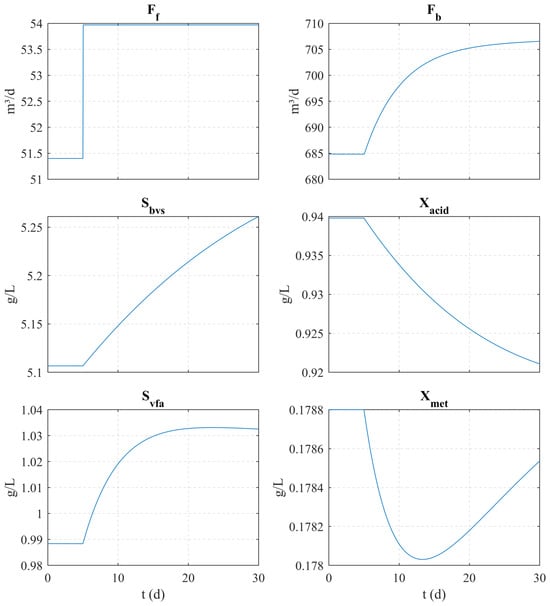
The model was simulated using the adjusted parameters and data set from Table 2 for a facility with 5000 swine, assuming a CH4 proportion of 60% in the biogas, to compare it with the biogas production presented in Mito et al. [5]. The simulation generated a biogas volume of = 685 m3/d (see initial conditions in Figure 1), which is very close to the 679 m3/d obtained in [5] and the 701 m3/d from the actual plant. is used to obtain the raw biogas flow rate.
Figure 1.
Simulated dynamics for the adjusted CLD model, with a step in at t = 5 d.
Due to the unavailability of time-series data in the literature for small-scale CLDs, the current evaluation is restricted to in steady-state consistency assessment against nominal operational benchmarks, rather than a full transient dynamic validation. For the transient comparison, it is noted that the behavior of dynamic curves shown in Figure 1 is very similar to that presented by [22].
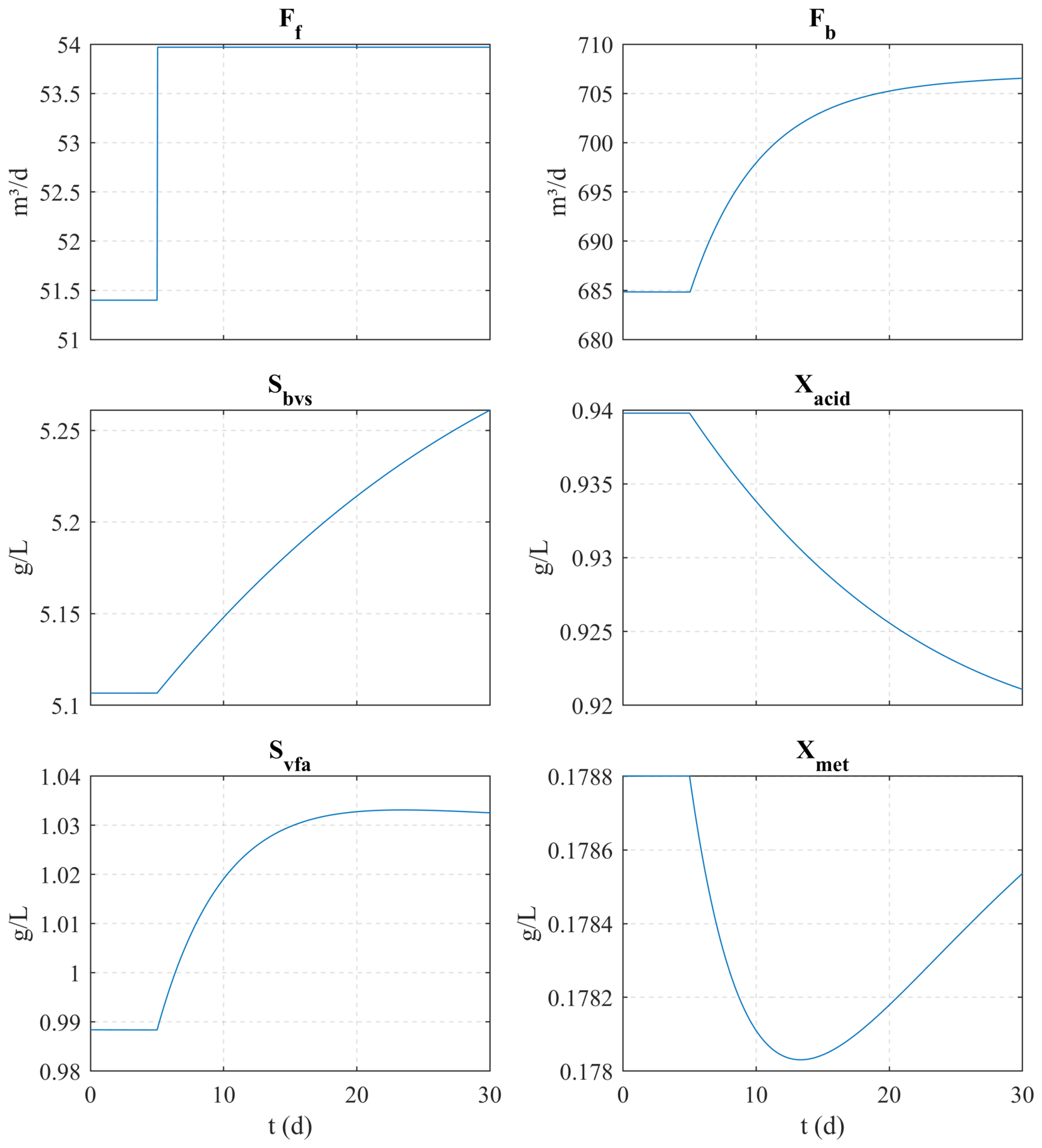
Figure 1 presents the simulated response of the dynamic model to a step in the feed flow rate . The simulation starts at steady state with a constant feed of m3/d, which generates a biogas volume of m3/d. The step in (an increase of 5% at t = 5 d) increases biogas production () and excites the process state variables. The process takes about 15 to 20 days to stabilize biogas production after the feed step, a period also observed in the studies by Silva [37] and Hansen et al. [38].
A formal statistical sensitivity analysis (e.g., for or ) is kept outside the scope of this baseline evaluation, as the framework intentionally focuses on mapping the continuous dynamic behavior of the coupled subsystems directly under some reactor’s operational parameters, such as , VFA concentrations, and feed rate.
3.2. Biodigester Operating Parameters
AD is subject to various environmental conditions and the ecological balance of the microorganisms involved, and its performance depends entirely on operational strategies and process variables. Operational parameters such as HRT, VFA concentrations, feed rate, and temperature are fundamental for the correct operation of biodigesters.
Hill et al. [39] conducted laboratory experiments and a comprehensive literature study with data from reactors fed with swine and cattle waste, reaching a value of = 0.8 g/L as a parameter for good biodigester operation. 0.8 g/L points to an imminent reactor failure with a possible reduction in methane production and system shutdown.
In this work, the selection of a fixed threshold of g/L serves as a macro-kinetic indicator to delineate the safe operating boundaries from regions of imminent process instability. In practical biochemical systems, anaerobic stability is governed by complex, multi-variable interactions involving bicarbonate alkalinity, pH buffering capacity, VFA speciation, free ammonia inhibition, and microbial adaptation. Therefore, a single volatile acid concentration cannot capture these localized chemical dynamics.
However, within the simplified Hill [21] and Haugen et al. [22] framework—which lacks explicit states for pH and alkalinity equilibrium—the g/L threshold is introduced as a conservative operational proxy. In swine manure digestion, which typically exhibits high ammonia nitrogen concentrations and significant inherent alkalinity, stable operation can sometimes be maintained at higher VFA levels. Conversely, in poorly buffered systems, acidification can occur much earlier. Therefore, the g/L boundary should not be interpreted as a universal bioprocess threshold, but rather as a conservative lower-bound operational target for closed-loop control design, ensuring that the control system preemptively mitigates organic overloads before systemic alkalinity depletion occurs.
Temperature () is also a determining factor for biodigester operation and biogas production efficiency. Anaerobic bacteria can grow in different temperature ranges and can develop more rapidly and efficiently in the mesophilic range (25 to 45 °C), this range being the most suitable for the methanogenic phase [14,40]. Temperature variations beyond this ideal range can inhibit the microorganisms involved, potentially causing irreversible damage [8,41].
The linear formulation in Equation (7) represents a classic modeling limitation inherited from the Hill [21] framework. While it accurately maps the kinetic acceleration within the strict mesophilic range typical of unheated CLD, it lacks the mathematical infrastructure to represent high-temperature thermal inhibition or metabolic decay outside that range. In real AD systems operating near or above these thermal thresholds, protein denaturation and irreversible enzymatic damage occur, leading to severe kinetic drops or process failure. Consequently, modeling scenarios involving external thermal shocks above this range would require replacing Equation (7) with nonlinear cardinal temperature models (e.g., the Ratkowsky or Rosso formulations), which are outside the scope of this control-oriented baseline study.
The choice of HRT determines the time the waste remains in the reactor and its volume. Orrico et al. [42] conducted laboratory experiments with different HRTs and observed a 28% increase in biogas production when the HRT was increased from 15 to 36 days. Souza and Campos [43] observed a 27% increase in biogas production per kg of swine manure when the HRT was changed from 15 to 30 days at a temperature of 35 °C.
To evaluate the influence of these parameters and the AD performance in terms of the volume of produced biogas () and the condition , the mathematical model is subjected to different feed volumes (), HRTs, and , observing its corresponding equilibrium point for each combination of these variables.
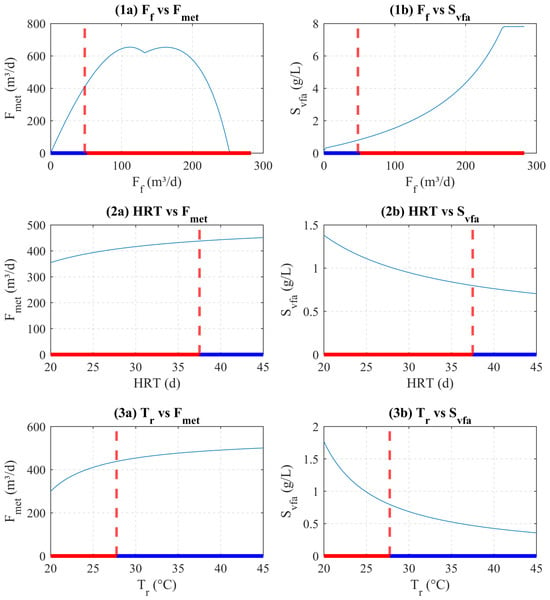
Figure 2 presents the behavior of variables and as a function of (1a, 1b), HRT (2a, 2b), and (3a, 3b). The following are some considerations regarding the results presented, whose analysis is similar to and consistent with that presented in [44]:
Figure 2.
Simulated behavior of and as a function of , , and HRT.
- Graph (1a) shows that the maximum CH4 production occurs within a theoretically restricted operating zone . Based on the selected macro-kinetic threshold, the framework identifies a model-predicted operating boundary at a feed flow rate of m3/d, indicating that the real reactor is operating with a slight feed overload of = 51.4 m3/d (Figure 1) based on the indicator. Furthermore, the larger the feed volume, the higher the flow to the CLD outlet will be, and the lower the organic matter decomposition and biogas production, an effect known as methanogen wash-out.
- Graph (2a) shows that CH4 production grows with increasing HRT, and in (2b) it is possible to observe that the minimum HRT found for is close to 37.5 days. This also demonstrates that the HRT = 35 days attributed to the reference CLD is slightly below the ideal value.
- CH4 production also increases with the increment of , as shown in graph (3a), and increases when decreases. The minimum temperature for is 28 °C (3b). These results show that the presented in Figure 1 is influenced by the nominal temperature adopted as 25 °C.
From a practical and design standpoint, the CLD is built to handle a specific waste volume and will have a fixed HRT. Regarding temperature, it depends on climatic conditions and construction, and it can vary significantly over time if a heating system is not available. Therefore, evaluating with and HRT varying within the acceptable operating range is equally useful for determining the operational and constructive limits of the CLD.
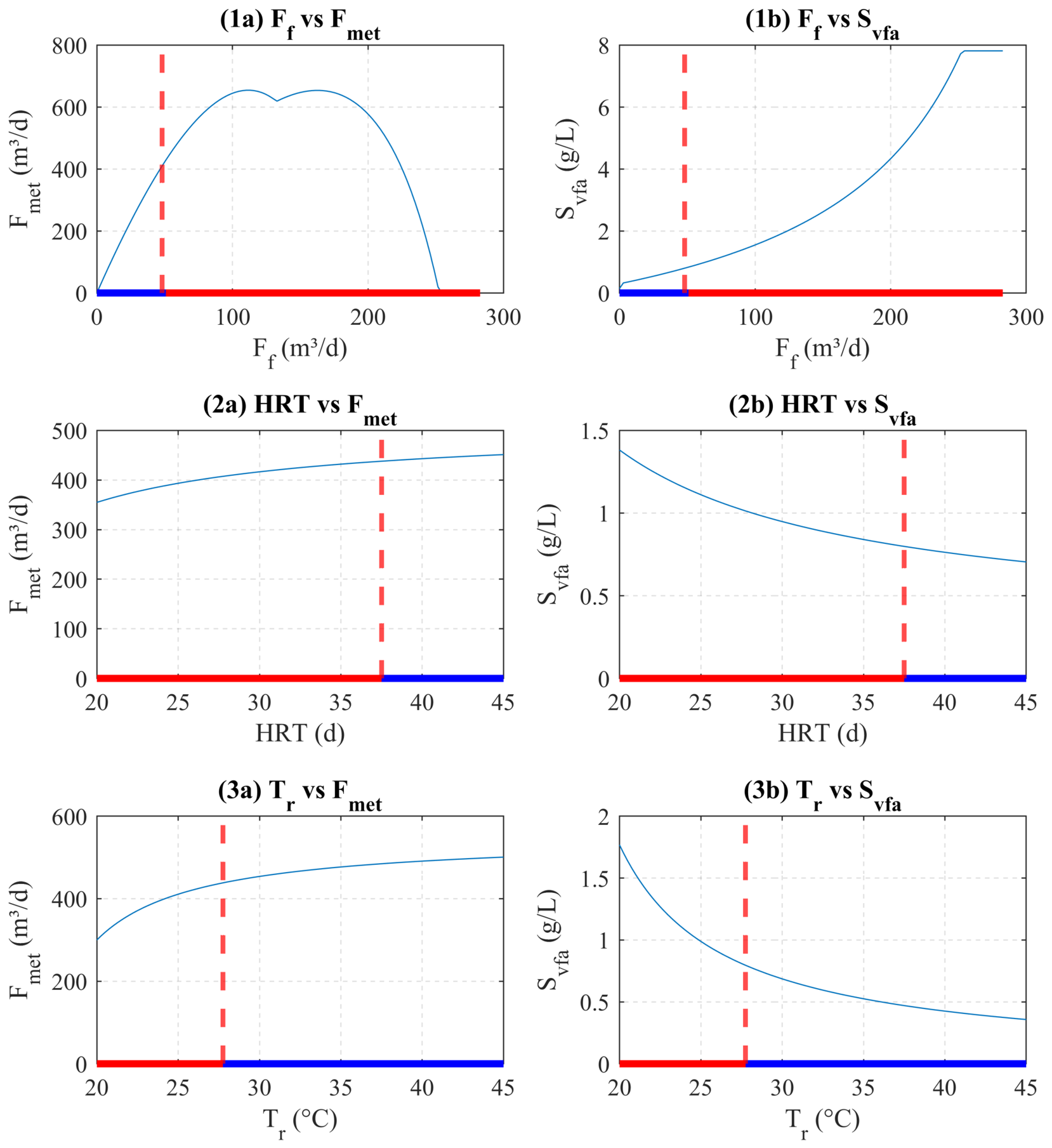
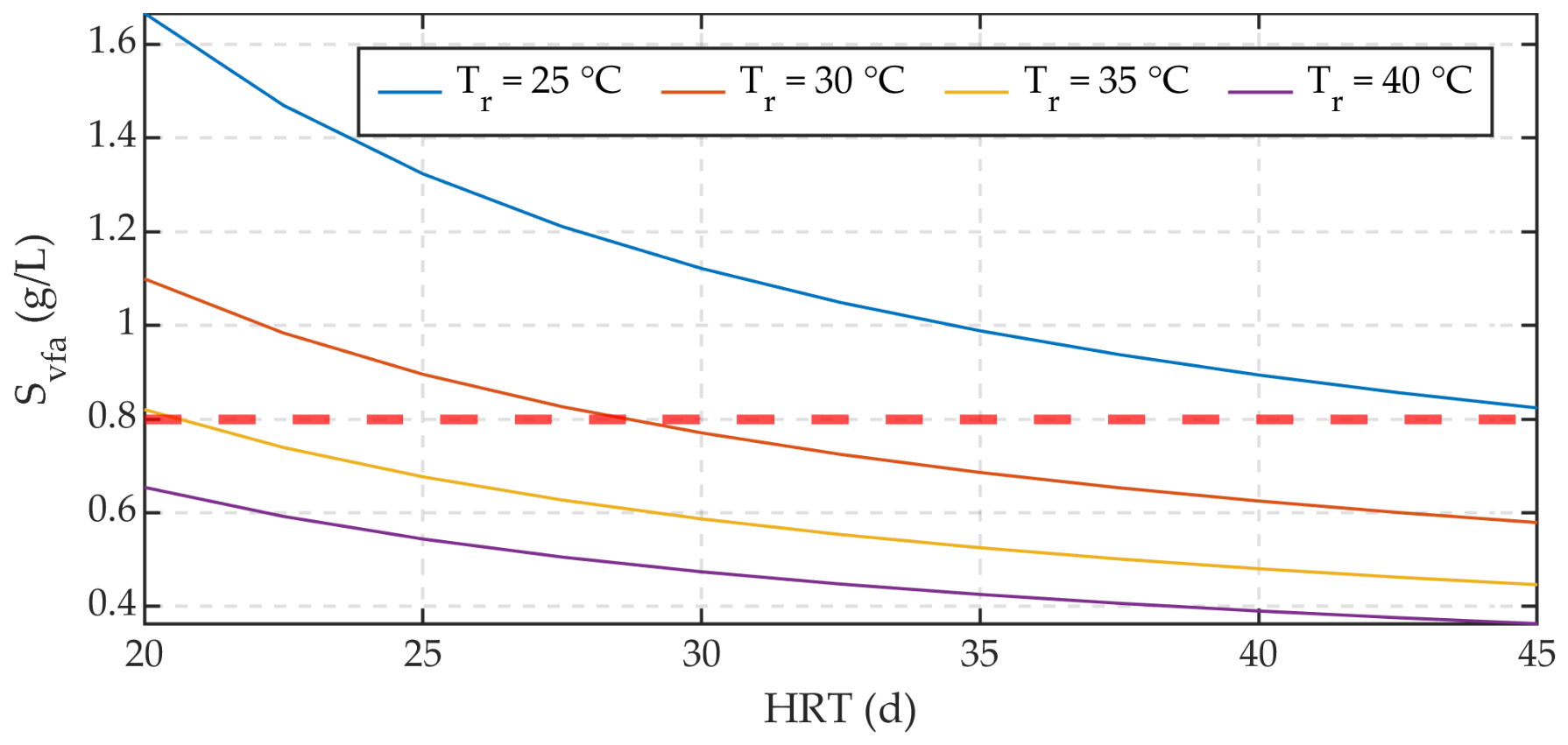
Figure 3 presents the behavior of as a function of and HRT, where the horizontal dashed line represents the safe operating point of = 0.8, the blue intervals on the abscissa indicate safe operation, and the red intervals indicate unsafe operation. It is observed that any HRT value > 20 can be used if > 35 °C, while the HRT must be greater than 45 to maintain < 0.8 if < 25 °C. In this way, it is possible to choose the best HRT for the CLD design by observing the local , or even evaluate situations of inadequate or limited operation caused by one of the presented variables.
Figure 3.
Behavior of as a function of and HRT.
4. Mathematical Modeling of the Internal Combustion Engine
The mathematical model adopted to describe the behavior of the Otto-cycle internal combustion engine (ICE) is the mean value model (MVM) developed by Crossley and Cook [26]. It was chosen for being a widely used model in the literature and easy to manipulate as a control- and design-oriented approximation for tracking macroscopic transient inputs and outputs. It encompasses the dynamics of the air/fuel mixture and mechanical power generation, rather than a high-fidelity predictive combustion model that involves complex thermodynamic cycle equations.
It consists of two differential equations that model the intake manifold pressure dynamics (bar) and the mass flow rate of the air admitted into the cylinder during the intake stroke (g/s), expressed respectively by:
where R (J/kg.K) is the universal gas constant, n (rad/s) is the angular shaft speed, and is the mass flow rate of the air passing through the throttle valve:
is a function of the throttle opening angle (degrees), and represents the sonic flow condition through a function relating to the atmospheric pressure (), as follows:
The ICE shaft rotation is obtained through the balance between the generated torque and the applied load, given by Newton’s second law:
where (rad/s2) is the angular acceleration, (N.m) is the applied load, and J (kg.m2) is the shaft moment of inertia. (N.m) is the torque generated by the ICE, expressed by the following polynomial equation:
where (°) is the spark advance and is the air-to-fuel ratio (AFR).
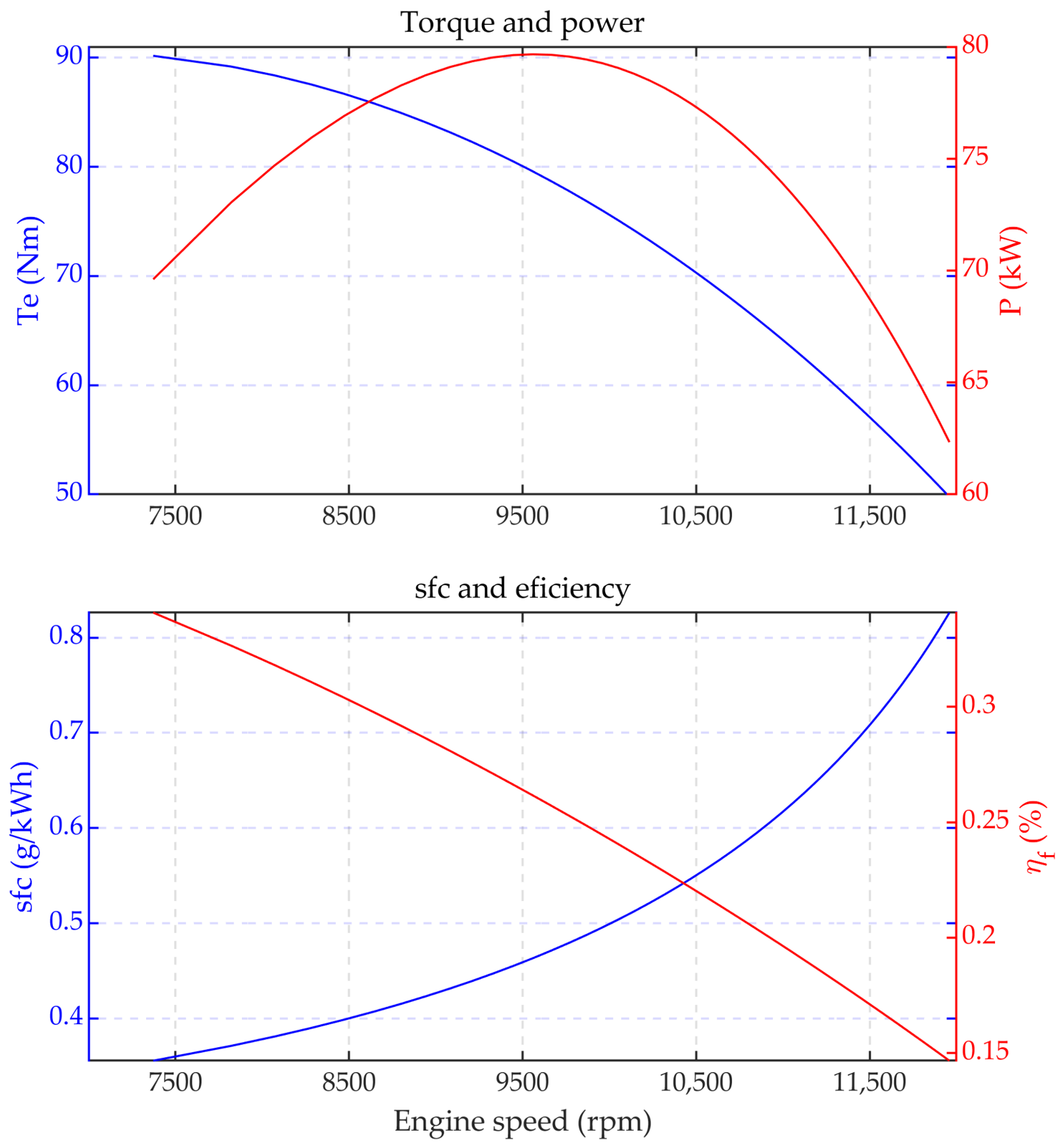
Figure 4 shows the torque (), power (P), specific fuel consumption (sfc), and efficiency () curves, simulated with the original model identified in [26], obtained with a spark advance angle and AFR = 14.7 for gasoline fuel. The model was simulated to determine maximum torque at at WOT (Wide Open Throttle). Maximum torque occurs at a speed of 7100 rpm, and maximum power is approximately 80 kW at 9600 rpm.
Figure 4.
, P, sfc, and curves simulated with original model operating at WOT with and AFR = 14.7.
Adjusting the ICE Mathematical Model for Biogas Operation
Noting that biogas fuel has different characteristics than gasoline, and considering that the scope of family-run farms has an energy demand on the order of 10 kWh [18], the model needs to be adjusted to correspond to lower power ratings and biogas operation.
Model adjustment can be experimental, as performed in the work of Tomasi [45]. However, for biogas fuel, few experimental ICE curves are reported in the literature to adjust the adopted MVM. In this way, and to contribute to the literature on the topic, a methodology is proposed here to model the MVM in a speed and power range compatible with a biogas-powered ICE. Four-pole synchronous generators will be adopted as a reference for electricity generation, operating at a speed of 1800 rpm for a 60 Hz electrical frequency, with a steady-state generator efficiency of , frequently found in biogas generator sets [25,46,47].
The initial adjustment aims to align the maximum torque range with the ICE’s 1800 rpm region. In practical terms, this would be equivalent to including a reduction gear in the transmission between the ICE and the electrical generator. In the MVM, this is given by the ratio of the original model’s maximum-torque speed to the new speed, . This ratio is applied as a multiplier to the variable n in (10) and (15), except for the terms containing the variable in (15), since it is already being adjusted by (10).
It is also necessary to adjust the torque generation of the original MVM and adapt the equations to obtain the desired power at the new speed. For this, is scaled by the ratio between the required power and the maximum power of the original MVM, such that . This ratio is also applied as a multiplier in (10) and (15), except for terms containing the variable in (15), which is already scaled in (10).
The mass AFR is 6.91 for biogas with 65% CH4 (In integrated bio-energy systems, fluctuations in this percentage directly impact overall performance. If the CLD yields a higher CH4 concentration, the total required volumetric biogas flow rate to meet the same energy demand decreases due to the higher energy density. For the ICE, an increased CH4 fraction elevates the fuel’s lower heating value, directly enhancing the dynamic torque generation and system efficiency, while significantly optimizing sfc metrics), and this value will be the new value used in the MVM. In this sense, it is pertinent to adapt the parameters in (15) containing the ratio, such that they are multiplied by the ratio between the gasoline AFR and the biogas AFR, AFRr = AFRg/AFRb = 2.13.
Combustion characteristics in an ICE differ significantly between gaseous fuels (biogas) and liquid fuels (gasoline), requiring an advanced ignition timing relative to the original setting. Souza [48] conducted tests on a biogas-powered ICE and determined that an ignition advance of is a suitable ignition advance, and this value will be used here for the MVM.
It is important to emphasize that the implemented scaling transformations and algebraic adjustments of the MVM are intentionally tailored for control-oriented applications. While switching the fuel matrix from gasoline to raw biogas fundamentally shifts microscopic in-cylinder physics—including laminar flame speed, specific heat ratios, volumetric efficiency limits, and localized knock characteristics—incorporating these high-order thermodynamic phenomena remains outside the scope of this study. By adapting algebraic scaling factors, the MVM maintains the low computational footprint and low-order state-space architecture required for real-time applications, while still providing a macroscopically consistent estimate of power output.
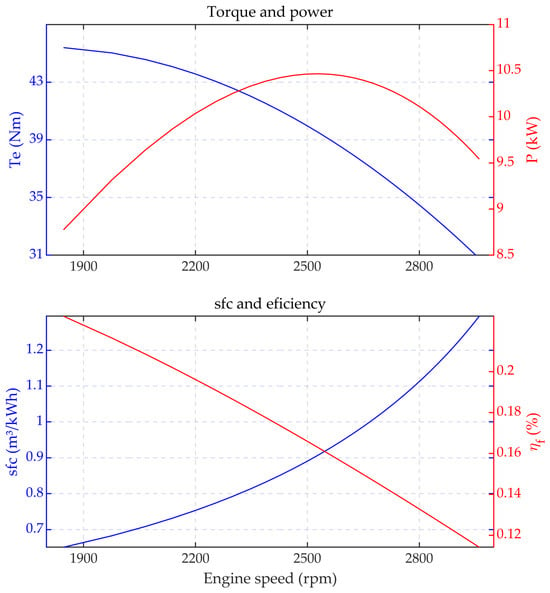
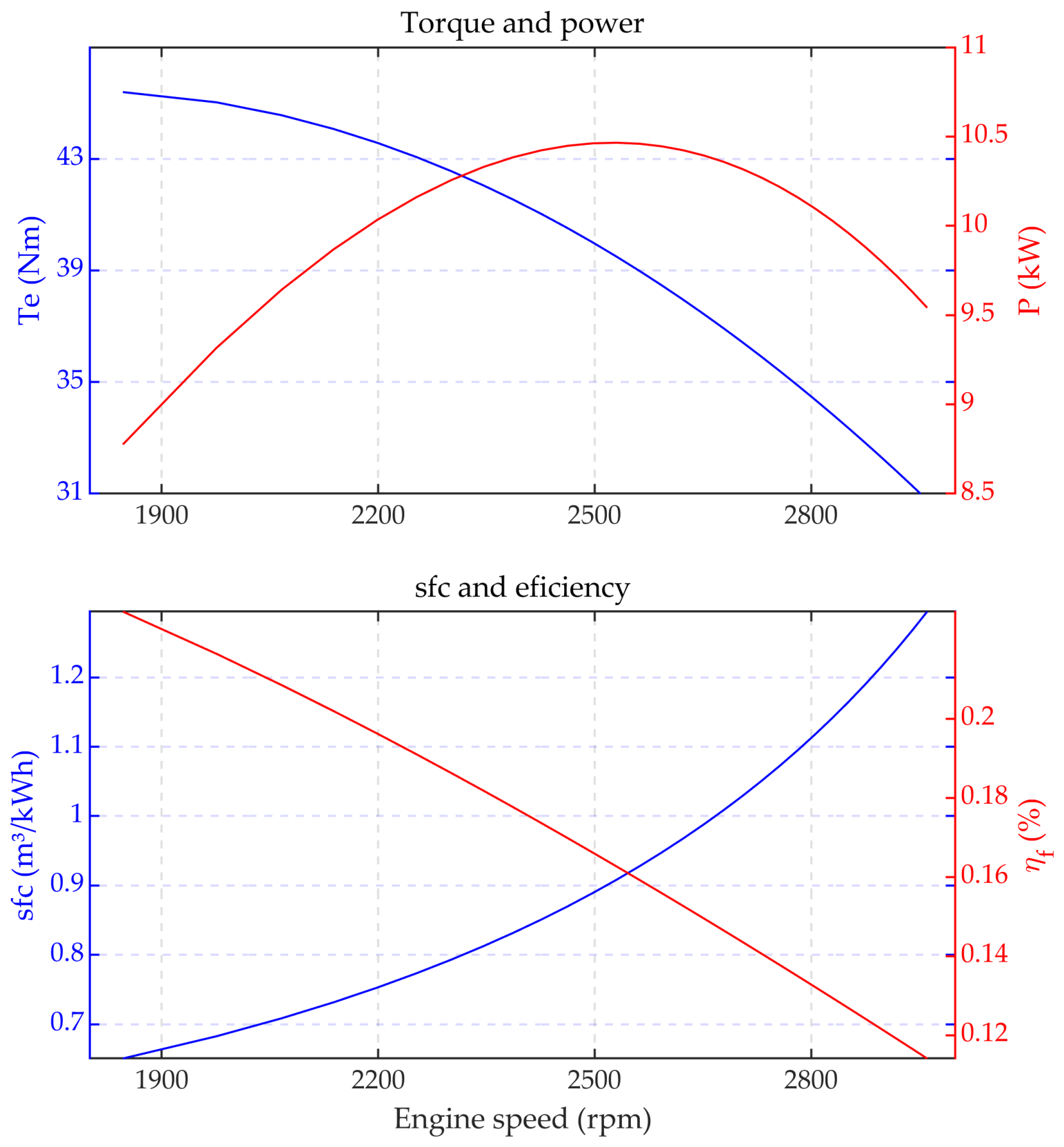
After applying the described methodology to the MVM, the adjusted model was simulated for a new power of 10 kW and biogas operation; the torque, power, sfc, and from simulation are shown in Figure 5. In the simulation setup, the mass flow rate of fuel injected into the ICE manifold represents the total biogas volume. At the same time, the lower heating value is scaled by the CH4 content to ensure that torque generation depends solely on the chemically active energy of the methane carrier. The adjusted model yields above 22% and sfc close to 0.66 m3/kWh in the 1800 rpm region.
Figure 5.
Te, P, sfc, and curves simulated with the adjusted ICE for biogas operation, with P = 10 kW, AFR = 6.9, , and at WOT.
Campos et al. [49] estimated an efficiency of 22.4% and sfc of 0.71 m3/kWh for a 30 kVA generator set fueled with 65% CH4 biogas. Kapadia [50] obtained efficiencies of up to 22% in a small ICE coupled to a 3 kW generator. Huang and Crookes [51] reached an efficiency of 22% for an ICE using biogas at the original gasoline compression ratio.
Marques [52] observed 0.68 m3/kWh in a 76 kW generator set, operating with an efficiency of 22.21%. Martinez et al. [53] obtained a consumption of 0.704 m3/kWh with a 70 kW generator set. Souza et al. [54] evaluated 5 generator sets originally designed for biogas with power between 35 and 75 kW and reached values between 0.7 and 0.73 m3/kWh, with the most efficient generator reaching 27%. Therefore, the observed sfc and values are consistent with the literature and demonstrate that the adapted MVM can be used for design purposes and for biogas consumption estimation in a generator set.
The biogas consumption by the generator set (m3/h) is important data for the design of a power generation plant. Since the biogas volume () produced can be estimated through the equations defining the CLD behavior, it will be possible to determine the generator set power as a function of the facility’s energy demand and biogas availability, allowing for the choice of a suitable ICE with compatible power.
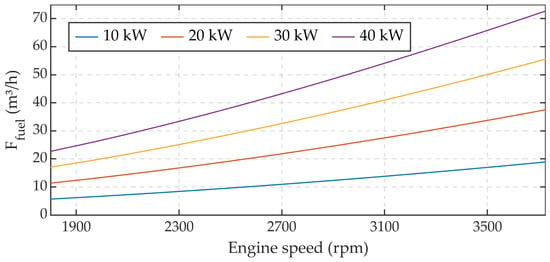
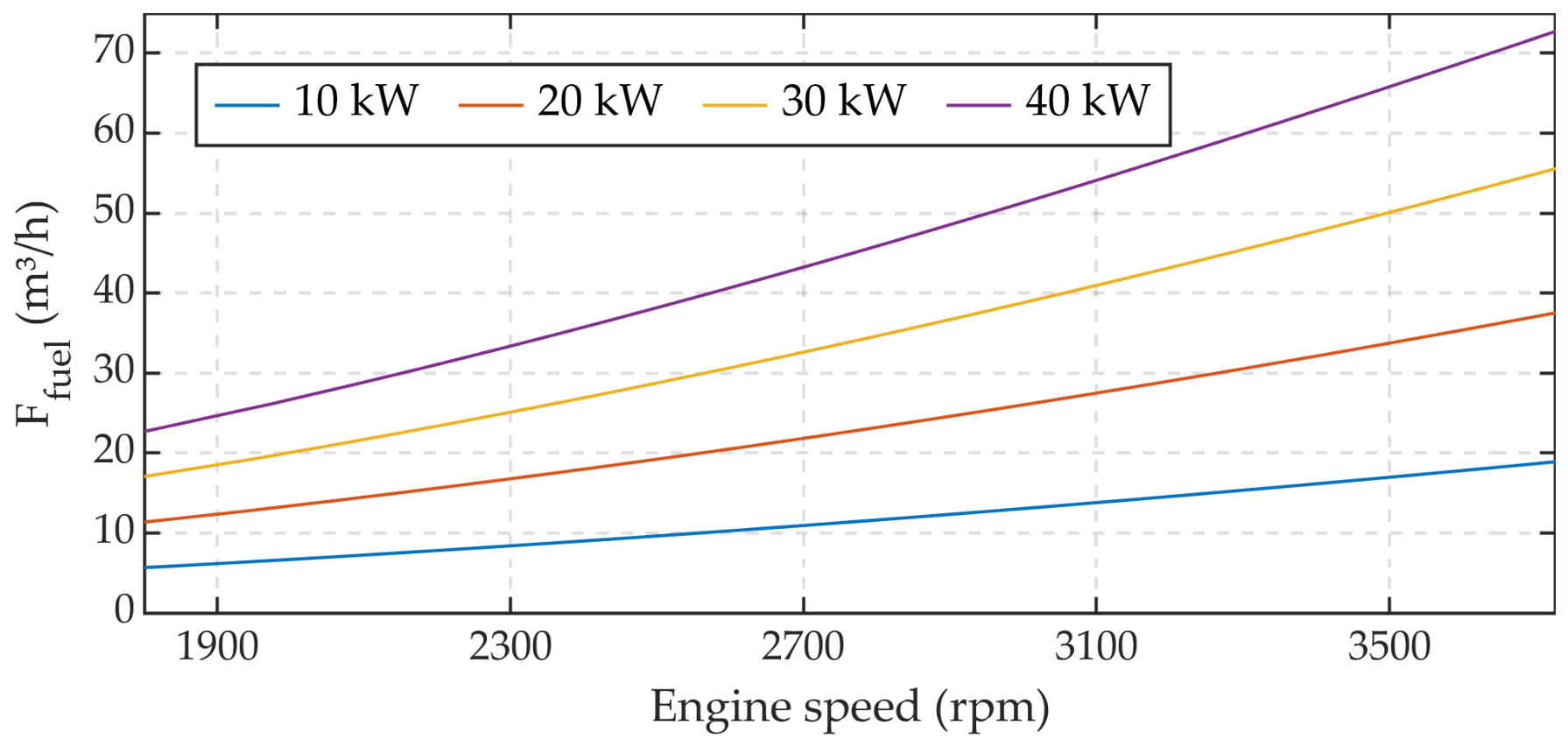
The ICE consumption for different power ratings is presented in Figure 6, where it is evident and expected that an ICE with higher power has higher consumption, and consumption is lower at lower speeds. At low speed, the consumption () is about 6 m3/h for a power of 10 kW and 23 m3/h for 40 kW. The work of Campos et al. [49] found a biogas consumption of 14 m3/h for a generator set to generate 20 kW of electrical energy, which is close to the value for the 20 kW curve generated by the MVM at 1800 rpm, considering that the electrical machine will have [55].
Figure 6.
Power and biogas consumption obtained with the adjusted MVM, considering values between 10 kW and 40 kW for the MVM maximum power adjustment.
For instance, in a static analysis, the CLD simulation shown in Figure 1 operating under initial conditions ( = 685 m3/d) demonstrates that it can run a biogas-fueled ICE at 10 kW and 40 kW for 114 h and 30 h of operation, respectively, in one day (24 h) of biogas production. Hence, beyond its utility for dynamics and control, this model is also highly relevant for design purposes and for providing a clear perspective on power generation.
The engine simulation results serve as a macro-level plausibility check rather than a strict experimental validation of a specific 10 kW ICE asset. Because direct transient experimental data for a standalone 10 kW biogas generator were unavailable in the literature, these indicators were evaluated against a cross-study comparison of operational ranges reported for systems spanning up to 76 kW. While this numerical alignment demonstrates that the parameter-adjusted MVM operates within a realistic thermodynamic envelope, a clear distinction must be made between this comparative assessment and a direct asset validation. Consequently, these metrics confirm the mathematical plausibility of the framework for macro-system evaluation and control design. However, a dedicated experimental campaign would be required to fine-tune the empirical coefficients for a targeted commercial engine.
Therefore, the adjusted MVM predicts the operational behavior of an ICE converting biogas chemical energy into mechanical energy. For simplicity and as it is outside the scope of this work, the dynamics of the electrical generator will not be considered. To obtain the effective electrical power generated in the generator set, the generator efficiency () of the electrical machine can be applied directly to the mechanical power of the ICE. However, other small losses may be observed in practice.
5. Conclusions
This work proposed and evaluated an integrated, control-oriented modeling framework that integrates the dynamic behavior of covered-lagoon anaerobic digesters and biogas-fueled internal combustion engines into a single, practical tool for small-scale swine farms. By adapting well-established models to the realities of Brazilian rural installations—namely, realistic hydraulic retention times, temperature ranges, swine-waste characteristics, and generator power levels—the approach closes an important gap left by models originally conceived for high-rate reactors, large plants, or nominal fuel conditions. In doing so, it preserves essential dynamics without sacrificing usability for simulation, design, and control studies. It enables the identification of safe and critical operating regions (e.g., via VFA behavior), the consistent estimation of methane availability, and the sizing of power generation compatible with family-owned farms. The simulated responses and operating envelopes are consistent with values reported in prior studies and observed in real installations, supporting the representativeness of the adapted framework for the intended scale and context.
At the same time, we recognize that the present formulation is still a model-based, simulation-level instrument. Certain phenomena fall outside the explicit scope of our equations, such as detailed gas–liquid mass-transfer constraints, community shifts and specific inhibition mechanisms, combustion-phasing variability at low methane fractions, fast electrical load transients, and generator–grid interactions. Moreover, parameter tuning relied on literature and plant-reported data rather than a dedicated, site-specific identification campaign. For this reason, results should be interpreted as control-oriented, design-level guidance, with site calibration recommended before deployment. Despite these constraints, our experience indicates that the proposed adaptations already improve fidelity over generic high-rate reactor or engine models at the scales of interest, and crucially make it feasible to study operating limits, control strategies, and energy-use planning in a way that is aligned with how these systems are actually built and run in the field.
A future work will focus on demonstrating the fully coupled dynamic behavior of the integrated framework under transient disturbances—such as feed flow fluctuations and thermal shocks—to evaluate how biochemical reactor variations propagate into engine power availability within a dedicated closed-loop control design study.
Looking ahead, we see three immediate extensions as most impactful: (i) experimental identification and seasonal recalibration in a reference farm to tighten parameter confidence; (ii) controller synthesis and closed-loop studies for start-up, disturbance rejection, and VFA-aware operation; and (iii) coupling with simple economic and reliability metrics to support decision-making about digester sizing, heating/insulation trade-offs, and generator dispatch. Taken together, these steps build on the present contribution and point toward practical tools that can improve technical reliability and the broader adoption of biogas-to-energy solutions in small-scale agricultural contexts.
Author Contributions
Conceptualization, R.T., A.N. and D.W.B.; Methodology, R.T., A.N. and D.W.B.; Validation, A.N.; Formal analysis, R.T., A.N. and D.W.B.; Writing—original draft, R.T.; Writing—review & editing, R.T., A.N. and D.W.B.; Supervision, A.N. and D.W.B. All authors have read and agreed to the published version of the manuscript.
Funding
This study was financed in part by the Coordenação de Aperfeiçoamento de Pessoal de Nível Superior–Brasil (CAPES)–Finance Code 001, under Grant PROAP/AUXPE Proc. 88881.181788/2025-01 through the Graduate Program in Electrical Engineering (PPGEEL) of the Universidade do Estado de Santa Catarina (UDESC). The authors also acknowledge the support and infrastructure provided by UDESC and the Conselho Nacional de Desenvolvimento Científico e Tecnológico (CNPq).
Institutional Review Board Statement
Not applicable.
Informed Consent Statement
Not applicable.
Data Availability Statement
The original contributions presented in this study are included in the article. Further inquiries can be directed to the corresponding author.
Conflicts of Interest
The authors declare no conflicts of interest.
References
- ABPA. Relatório Anual 2025. 2025. Available online: https://abpa-br.org/wp-content/uploads/2025/04/ABPA.-Relatorio-Anual-2025.pdf (accessed on 5 May 2025).
- IBGE. Censo Agropecuário 2017. 2019. Available online: https://sidra.ibge.gov.br/pesquisa/censo-agropecuario/censo-agropecuario-2017/resultados-definitivos (accessed on 7 May 2025).
- Tavares, J.M.R. Modelagem do Consumo De áGua, Produção de Dejetos e Emissão de Gases de Efeito Estufa e Amônia na Suinocultura. Ph.D. Thesis, Universidade Federal de Santa Catarina, Florianópolis, Brazil, 2016. [Google Scholar]
- Kunz, A.; Higarashi, M.M.; de Oliveira, P.A. Tecnologias de manejo e tratamento de dejetos de suínos estudadas no Brasil. Cad. Ciência Tecnol. 2005, 22, 651–665. [Google Scholar]
- Mito, J.Y.d.L.; Kerkhoff, S.; Silva, J.L.G.; Vendrame, M.G.; Steinmetz, R.L.R.; Kunz, A. Metodologia para Estimar o Potencial de Biogás e Biometano a Partir de PlantéIs Suínos e Bovinos no Brasil; Technical Report 196; Embrapa Suínos e Aves: Concórdia, SC, Brazil, 2018. [Google Scholar]
- IMA—Instituto do Meio Ambiente de Santa Catarina. Instrução Normativa n° 11: Suinocultura. 2021. Available online: https://in.ima.sc.gov.br/instrucaoNormativa/downloadPDF/11 (accessed on 10 June 2025).
- Rocha, J.D.; de Souza, D.T.; Pedrão, R.S. Avaliação de um sistema de tratamento de dejetos suínos usando biodigestores no estado de Santa Catarina. In Proceedings of the Anais do 59° Congresso da Sociedade Brasileira de Economia, Administração e Sociologia Rural (SOBER), Brasília, Brazil, 2–6 August 2021. [Google Scholar]
- Fachagentur Nachwachsende Rohstoffe e.V. (FNR). Guia PráTico do Biogás: Geração e Utilização; Technical Report; Ministério da Nutrição, Agricultura e Defesa do Consumidor da Alemanha: Bonn, Germany, 2010. [Google Scholar]
- Abbasi, T.; Tauseef, S.M. Anaerobic digestion for global warming control and energy generation—An overview. Renew. Sustain. Energy Rev. 2012, 16, 3228–3242. [Google Scholar] [CrossRef] [Scilit]
- Offie, I.; Piadeh, F.; Behzadian, K.; Campos, L.C.; Yaman, R. Development of an artificial intelligence-based framework for biogas generation from a micro anaerobic digestion plant. Waste Manag. 2023, 158, 66–75. [Google Scholar] [CrossRef] [Scilit]
- Neto, F.G.; Junior, E.G.; Guesser, F. Biodigestores e biogás na suinocultura Catarinense. Textos Econ. 2019, 22, 204–229. [Google Scholar] [CrossRef] [Scilit]
- Biondo, M.M. Biodigestor: Uma Energia Renovável Pouco Utilizada em SC. 2015. Available online: https://jornalismo3periodo.wordpress.com/2015/07/01/biodigestor-uma-energia-renovavel-pouco-utilizada-em-sc/ (accessed on 15 April 2025).
- Venzon, S.S. Produção de Biogás a Partir da Codigestão da Cama de Frango e áGua Residuária de Abatedouro de Suínos. Master’s Dissertation, Universidade Estadual do Oeste do Paraná, Cascavel, PR, Brazil, 2018. [Google Scholar]
- Wellinger, A.; Murphy, J.; Baxter, D. (Eds.) The Biogas Handbook: Science, Production and Applications; Number 51 in Woodhead Publishing Series in Energy; Woodhead Publishing: Cambridge, UK, 2013. [Google Scholar]
- Schmidell, W.; de Almeida Lima, U.; Borzani, W.; Aquarone, E. Biotecnologia Industrial—Vol. 2: Engenharia Bioquímica; Editora Blucher: São Paulo, Brazil, 2001; Volume 2. [Google Scholar]
- Kunz, A.; de Oliveira, P.A.V. Aproveitamento de dejetos de animais para geração de biogás. Rev. Política Agrícol. 2006, 15, 28–35. [Google Scholar]
- Steinmetz, R.L.; Kunz, A.; Amaral, A.C. Fundamentos da Digestão Anaeróbia, Purificação do Biogás, uso e Tratamento do Digestato; Sbera: Woburn, MA, USA; Embrapa Suínos e Aves: Concórdia, Brazil, 2019. [Google Scholar]
- Casarin, M.A. Microgeração Distribuída de Energia Elétrica a Partir do Biogás de Dejetos Suínos: Uma Contribuição para a Sustentabilidade da Suinocultura. Master’s Thesis, Universidade Federal de Santa Catarina, Florianópolis, Brazil, 2016. [Google Scholar]
- Paladino, O. Data driven modelling and control strategies to improve biogas quality and production from high solids anaerobic digestion: A mini review. Sustainability 2022, 14, 16467. [Google Scholar] [CrossRef] [Scilit]
- Hill, D.T.; Barth, C.L. A dynamic model for simulation of animal waste digestion. J. (Water Pollut. Control Fed.) 1977, 49, 2129–2143. [Google Scholar]
- Hill, D.T. Simplified monod kinetics of methane fermentation of animal wastes. Agric. Wastes 1983, 5, 1–16. [Google Scholar] [CrossRef] [Scilit]
- Haugen, F.; Bakke, R.; Lie, B. Adapting dynamic mathematical models to a pilot anaerobic digestion reactor. Model. Identif. Control 2013, 30, 35–54. [Google Scholar] [CrossRef] [Scilit]
- Aguiar, P.L.d.; Diniz, P.H.S.; Costa, L.R.d.; Rattes, R.A.; Lopes, A.T.; Leitão, R.C.; Barcellos, W.M. Performance evaluation of biogas fueled generator set. J. Braz. Soc. Mech. Sci. Eng. 2021, 43, 409. [Google Scholar] [CrossRef] [Scilit]
- Suzuki, A.B.P.; Fernandes, D.M.; Faria, R.A.P.; Vidal, T.C.M. Uso de biogás em motores de combustão interna. Rev. Bras. Tecnol. Apl. Ciênc. Agrár. 2012, 4, 221–237. [Google Scholar] [CrossRef] [Scilit]
- ERBR. ERBR Grupos Geradores. 2025. Available online: https://www.erbr.com.br/produtos/1/grupo-geradores (accessed on 15 June 2025).
- Crossley, P.R.; Cook, J.A. A nonlinear engine model for drivetrain system development. In Proceedings of the IEEE International Conference ‘Control 91’; IET: Singapore, 1991; pp. 921–925. [Google Scholar]
- Carecci, D.; Dewasme, L.; Ficara, E.; Vande Wouwer, A.; Ferretti, G.; García-Gen, S. Model predictive control of anaerobic co-digestion: Experimental validation of a robust tube-based scheme. Control Eng. Pract. 2026, 174, 107052. [Google Scholar] [CrossRef] [Scilit]
- Lopes, J.O.; Rosa, A.P.; Sousa, I.d.P.; Oliveira, N.S.; Borges, A.C. Mathematical models for estimating methane production in covered lagoon biodigesters treating pig manure. Eng. Agrícol. 2021, 41, 438–448. [Google Scholar] [CrossRef] [Scilit]
- Kegl, T.; Kegl, B.; Kegl, M. Improvement of biogas production utilizing a complex anaerobic digestion model and gradient-based optimization. Energies 2024, 17, 1279. [Google Scholar] [CrossRef] [Scilit]
- Kegl, T.; Kralj, A.K. An enhanced anaerobic digestion BioModel calibrated by parameters optimization based on measured biogas plant data. Fuel 2022, 312, 122984. [Google Scholar] [CrossRef] [Scilit]
- Laskowski, P.P.; Wojs, M.K.; Wiśniowski, P.; Zimakowska-Laskowska, M.; Kozłowski, E. Biogas-fuelled internal combustion engines for micro-scale energy generation: A review of technologies and configurations for systems below 50 kW. Combust. Engines 2026, 206, 34–43. [Google Scholar] [CrossRef] [Scilit]
- Chen, Y.R. Kinetic analysis of anaerobic digestion of pig manure and its design implications. Agric. Wastes 1983, 8, 65–81. [Google Scholar] [CrossRef] [Scilit]
- IPCC—Intergovernmental Panel on Climate Change. Emissions from Livestock and Manure Management. In IPCC Guidelines for National Greenhouse Gas Inventories; IPCC: Geneva, Switzerland, 2006; Volume 4. [Google Scholar]
- Oliveira, P.A.V.d.; Higarashi, M.M. Geração e Utilização de Biogás em Unidades de Produção de Suínos; Technical Report 115; Embrapa Suínos e Aves: Concórdia, SC, Brazil, 2006. [Google Scholar]
- Franzon, G. Estudo da Transferência de Calor em Biodigestores do Tipo Plug-Flow com Três Tipos Diferentes de Cores de GasôMetros e Inserção de Isolante Térmico. Master’s Thesis, Universidade Estadual do Oeste do Paraná, Cascavel, Brazil, 2020. [Google Scholar]
- Tavares, S.G.; Feiden, A.; Correia, A.F.; Soares, C.M.T.; Gregolin, M.R.P. Influência das variações térmicas e climáticas na produção de biogás. Nativa 2016, 4, 287–295. [Google Scholar] [CrossRef] [Scilit]
- Silva, G.H.d. Estudo da Co-Digestão Anaeróbia de Biomassa Vegetal e Dejeto Bovino: Avaliação da Produção de Biogás e do Cultivo de Microalgas No Digestato. Ph.D. Thesis, Universidade Federal de Viçosa, Viçosa, Brazil, 2024. [Google Scholar]
- Hansen, K.H.; Angelidaki, I.; Ahring, B.K. Improving thermophilic anaerobic digestion of swine manure. Water Res. 1999, 33, 1805–1810. [Google Scholar] [CrossRef] [Scilit]
- Hill, D.T.; Cobb, S.A.; Bolte, J.P. Using volatile fatty acid relationships to predict anaerobic digester failure. Trans. ASAE 1987, 30, 496–501. [Google Scholar] [CrossRef] [Scilit]
- Chernicharo, C.A.d.L. Reatores Anaeróbios; Editora UFMG: Belo Horizonte, Brazil, 1997. [Google Scholar]
- Hofmann, F.; Plättner, A.; Lulies, S.; Scholwin, F.; Klinski, S.; Diesel, K.; Urban, W.; Burmeister, F. Einspeisung von Biogas in das Erdgasnetz; Technical Report; Fachagentur Nachwachsende Rohstoffe e.V. (FNR): Gülzow, Germany, 2006. [Google Scholar]
- Orrico, M.A.P.; Orrico, A.C.A.; Lucas Júnior, J.d. Biodigestão anaeróbia de dejetos de suínos com e sem separação da fração sólida em diferentes tempos de retenção hidráulica. Eng. Agrícol. 2009, 29, 474–482. [Google Scholar] [CrossRef] [Scilit][Green Version]
- Souza, C.F.; Campos, J.A. Avaliação do tempo de retenção hidráulica, agitação e temperatura em biodigestores operando com dejetos de suínos. Rev. Bras. Agroecol. 2007. Available online: https://revista.aba-agroecologia.org.br/cad/article/view/2279 (accessed on 27 March 2025).
- Haugen, F.; Bakke, R.; Lie, B. On-Off and PI Control of Methane Gas Production of a Pilot Anaerobic Digestion Reactor. In Modeling, Identification and Control; Telemark University College: Porsgrunn, Norway, 2013; Volume 34, pp. 139–156. [Google Scholar]
- Tomasi, R. Controle De Motor A Combustão Interna Para Uso Em Powertrain De Veículo Híbrido Elétrico. Master’s Thesis, Universidade Federal de Santa Catarina, Florianópolis, Brazil, 2015. [Google Scholar]
- Biogás Motores. Biogás Motores Estacionários. 2025. Available online: https://biogasmotores.com.br/produtos/2-grupos-geradores (accessed on 12 February 2026).
- CHP Brasil. CHP Brasil—Produtos. 2025. Available online: https://chpbrasil.com.br/produtos (accessed on 12 February 2026).
- Souza, J.d. Desempenho de um Motor de Combustão Interna—Ciclo Otto—Operando com Biogás e Gás Natural. Master’s Thesis, Universidade Estadual do Oeste do Paraná, Cascavel, Brazil, 2004. [Google Scholar]
- Campos, V.A.F.d.; Cantagallo, J.P.T.; Llerena-Pizarro, O.R.; Silveira, J.L. Internal combustion engine fueled with biogas: Energetic, economic and environmental analyses. IEEE Lat. Am. Trans. 2019, 17, 1873–1878. [Google Scholar] [CrossRef]
- Kapadia, B.K. Development of a Single Cylinder SI Engine for 100% Biogas Operation. Ph.D. Thesis, Indian Institute of Science, Bengaluru, India, 2007. [Google Scholar]
- Huang, J.; Crookes, R.J. Assessment of simulated biogas as a fuel for the spark ignition engine. Fuel 1998, 77, 1793–1801. [Google Scholar] [CrossRef] [Scilit]
- Marques, C.A. Microgeração de Energia Elétrica em uma Propriedade Rural Utilizando Biogás Como Fonte Primária de Energia Elétrica. Master’s Thesis, Universidade Estadual do Oeste do Paraná, Cascavel, Brazil, 2012. [Google Scholar]
- Martinez, D.G.; Kitamura, D.S.; Silva, F.P.; Souza, S.N.M.; Bastos, R.K.; Souza, C.R.B. Geração de energia elétrica a partir do biogás. Rev. Bras. Eng. Biossist. 2013, 7, 45–54. [Google Scholar] [CrossRef] [Scilit][Green Version]
- Souza, J.d.; Souza, S.N.M.d.; Bassegio, D.; Secco, D.; Nadaletti, W.C. Performance of different engines in biogas-based distributed electricity generation systems. Eng. Agrícol. 2023, 43, e20230120. [Google Scholar] [CrossRef] [Scilit]
- WEG. Características e Especificações de Geradores; WEG: Jaraguá do Sul, Brazil, 2020; Available online: https://static.weg.net/medias/downloadcenter/h68/h68/WEG-curso-dt5-caracter-sticas-e-especifica-o-de-geradores-artigo-tecnico-portugues.pdf (accessed on 10 August 2025).

Disclaimer/Publisher’s Note: The statements, opinions and data contained in all publications are solely those of the individual author(s) and contributor(s) and not of MDPI and/or the editor(s). MDPI and/or the editor(s) disclaim responsibility for any injury to people or property resulting from any ideas, methods, instructions or products referred to in the content. |
© 2026 by the authors. Licensee MDPI, Basel, Switzerland. This article is an open access article distributed under the terms and conditions of the Creative Commons Attribution (CC BY) license.