


Abstract
This paper examines whether board gender diversity conditions the association between ESG performance and dividend policy in Australian-listed firms. We employ an unbalanced panel of 127 ASX-listed companies over 2013–2023, and firm fixed-effects models with Driscoll–Kraay standard errors. The findings reveal that ESG performance is positively associated with dividends per share (DPS). Moreover, female board representation has no direct association with DPS, although it is positively associated with ESG performance. Further analysis shows that the ESG–dividend association strengthens with female representation and is concentrated in boards that have reached a critical mass of women; the marginal effect of ESG on DPS is statistically indistinguishable from zero on boards with fewer than 30% women, but positive and significant once female representation reaches about 30%, where a one-standard-deviation higher ESG score is associated with A$ 0.13 higher DPS (28% of the sample mean). This critical-mass pattern is robust to year fixed effects, winsorisation, and additional governance controls, but it is weaker under firm-clustered standard errors and specific to dividends per share rather than the payout ratio or the dividend yield. Investors and boards should therefore evaluate ESG performance and board composition jointly when assessing dividend capacity.
1. Introduction
Australian-listed firms paid out more than AUD 80 billion in dividends in 2024, which has grown consistently over the past decade despite rising pressure to invest in sustainability. Over the same period, the average ESG scores of the firms in our sample rose from 35.4 to 50.4, and female board representation in the sample climbed from 12.8 per cent to 34.1 per cent, reaching 38.1 per cent on ASX 200 boards and 39.3 per cent on ASX 100 boards [1]. In this context, dividend payouts, ESG performance, and board gender diversity have all increased over time. Whether these developments are related at the firm level or merely coincide is an empirical question with important implications for corporate governance and for investors seeking dividend income from Australian equities.
As firms continue to seek competitive advantages within their industries, there has been a growing need to develop and sustain these advantages through diverse approaches. One of the most widely adopted strategies is aligning business practices with Environmental, Social, and Governance (ESG) goals. This trend has gained more significance since 2015, when the United Nations adopted the 2030 Agenda for Sustainable Development and the Paris Climate Agreement was signed, both of which recommended that organisations needed to start including ESG dimensions in their reports [2]. The adoption of this recommendation has been increasing over the years, and currently more organisations ensure to report the ESG dimensions of their performance. As a way of refining this move, an ESG scoring system was developed which helps to rank or offer information about how an organisation is performing in terms of its environmental responsibility, social practices, and governance structures [2]. This is very important, because these dimensions also influence other aspects of the organisation, such as the cost of capital, capital structure, stakeholder relationships, and, ultimately, the financial decisions firms make, including their dividend payout policy.
In theory, ESG investment competes with dividends [3]. Hence, when all the money is directed to environmental compliance, social programmes, or governance infrastructure, a dollar is not paid to shareholders. In contrast, ESG investment funds distribute dividends, whereby companies with more sustainable practices have a lower risk of litigation, a cheaper cost of capital, and more constrained cash flows, resulting in a surplus that is paid out. Empirical evidence on this question is global and tends to support the second reading, though with a significant qualification, as the association between ESG and dividends is not universal in governance contexts. Salvi et al. [2] showed that there are diminishing returns to ESG expenditures, while Ye et al. [4] found that the governance mix of the board determines whether ESG practices lead to shareholder distributions. Accordingly, this study investigates whether the ESG–dividend association depends on who sits on the board; specifically, whether board gender diversity conditions the link between ESG performance and dividends, whether any such conditioning operates linearly or only beyond a critical mass of female directors, and if it holds in an imputation-tax setting where cash dividends are the dominant channel of shareholder returns.
This paper addresses these questions using a panel of 127 Australian-listed firms between 2013 and 2023. We test four hypotheses: (1) ESG performance is positively associated with dividends; (2) female board representation is positively associated with dividends; (3) female board representation is positively associated with firm-level ESG performance; and (4) gender diversity moderates the ESG–dividend relationship. ESG performance is positively associated with dividends per share (DPS) on average, and female board representation has no direct association with DPS. The ESG × Female interaction is positive and significant, but the marginal-effect profile shows that the moderation is not uniform: the ESG–dividend association is confined to boards at or above a critical mass of roughly 30% women. Below that level, the marginal effect of ESG is close to zero, whereas above it, the effect is positive, statistically significant, and economically meaningful. A data-driven threshold search locates the break at 29%, close to the 30% target that the ASX Corporate Governance Council has recommended for S&P/ASX 300 boards since 2019. The critical-mass result holds under year fixed effects, winsorisation, additional governance controls, and a log specification of DPS; is weaker under firm-clustered standard errors; and does not extend to the payout ratio or the dividend yield—we therefore frame our conclusions in terms of dividends per share.
The economic magnitudes are meaningful in the Australian context. In firms with at least 30% female directors, a one-standard-deviation higher ESG score (13.4 points) is associated with A$ 0.126 higher DPS (0.00938 × 13.45), or 28% of the estimation-sample mean DPS of A$ 0.449. In contrast, in firms below the threshold, the corresponding figure is A$ 0.007 (1.5% of the mean) and is statistically insignificant. The difference of A$ 0.119 per share is equivalent to about A$ 60 million in annual dividends for an illustrative firm with 500 million shares outstanding (A$ 0.119 × 500 million); this figure is illustrative and scales linearly with the number of shares.
The closest prior work that establishes the building blocks is that done by Ye et al. [4], who showed that female board representation raises the probability and level of dividend payouts, particularly in countries with weaker investor protection, where governance mechanisms other than the law must perform the disciplinary function. Salvi et al. [2], in a European panel of 3207 firms, found a positive ESG–dividend link but documented diminishing returns at high ESG levels, suggesting that ESG must be accompanied by governance structures that enforce financial discipline. Alkhawaja et al. [5] showed that gender-diverse boards produce more ESG disclosure across 48 countries, with the effect strongest above a critical mass of three female directors. Hampl and Vágnerová Linnertová [6] extended this framework to show that board gender diversity and ESG jointly predict dividend policy in a cross-country European setting. However, none of these studies isolates Australia. Three gaps follow. First, evidence on whether board gender diversity conditions the ESG–dividend link is scarce outside Europe and emerging markets, and absent for an imputation-tax system. Second, moderation is almost always tested with a single linear interaction term, which leaves untested whether female directors influence financial policy only once they reach a critical mass. Third, prior studies rarely report marginal effects with confidence intervals across the observed distribution of the moderator, which is needed to judge where moderation is empirically supported [7,8]. This setting combines one of the world’s most extensive dividend imputation (franking credit) systems, which creates unusually strong incentives for cash dividends; gender-diversity disclosure recommendations in the ASX Corporate Governance Principles, introduced in 2010 and extended in 2019 to a recommended target of at least 30% of each gender for S&P/ASX 300 boards [9]; and sustainability-risk disclosure on an “if not, why not” basis under Recommendation 7.4 of the same Principles, with mandatory climate-related financial reporting commencing only in 2025.
This paper makes three contributions. First, it shows that the association between ESG performance and dividends is conditional on board compositions and, specifically, that it emerges only once female representation reaches a critical mass of about 30%; a linear interaction is positive and significant but masks this non-linearity. Second, it provides fixed-effects panel evidence on ESG performance, gender diversity, and dividends for Australia, whose imputation system makes cash dividends the primary channel of shareholder returns. Third, by documenting that female representation is not directly associated with dividends but conditions the ESG–dividend association at critical mass, it refines the governance case for board gender diversity: the financial relevance of diverse boards depends on the joint presence of substantive ESG engagement and sufficient female representation to influence board decisions.
Section 2 reviews the literature, presents the conceptual framework, and develops four hypotheses. Section 3 describes the institutional setting, data, and sample construction. Section 4 presents the empirical framework. Section 5 reports the results and robustness tests. Section 6 discusses the implications and Section 7 the limitations and directions for future research, with Section 8 concluding.
2. Literature Review and Hypotheses Development
2.1. Background
The intersection of ESG, board diversity, and dividend policy rests on three complementary theories. First, agency theory treats dividend payouts as a disciplinary mechanism that constrains managerial discretion by reducing the free cash flow available for empire-building [10]. Under this view, governance structures, including ESG engagement and gender-diverse boards, raise dividends by tightening the principal-agent relationship and committing management to disgorging surplus cash [11,12]. Second, stakeholder theory broadens the objective function, where firms that internalise environmental and social obligations build reputational capital and reduce litigation and regulatory risk. Thus, stable excess cash flows are generated that can be distributed to shareholders while simultaneously honouring broader commitments [5,13]. Third, signalling theory adds the market-communication dimension. In this view, high dividend payouts and strong ESG scores both function as valuable signals of underlying financial health, making them complements in the firm’s credibility-building strategy [6,14]. Mapped to the empirical predictions developed below, agency theory underpins H1 (ESG curbs the free cash flow problem and so raises dividends) and H2 (female monitors raise dividends through reduced agency costs); stakeholder theory and the human capital/ethical orientation literature on female directors underpin H3 (women on boards extend the firm’s objective function to environmental and social commitments, lifting ESG performance); and the combined logic of agency and signalling theory underpins H4 (gender-diverse boards both enforce the financial discipline of ESG and make the ESG–dividend signal more credible, so the marginal effect of ESG on dividends is larger in firms with greater female representation).
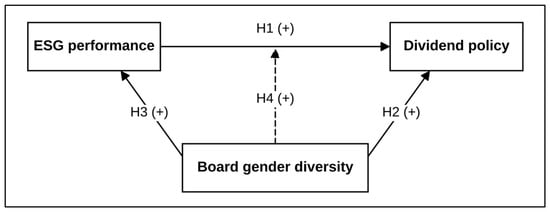
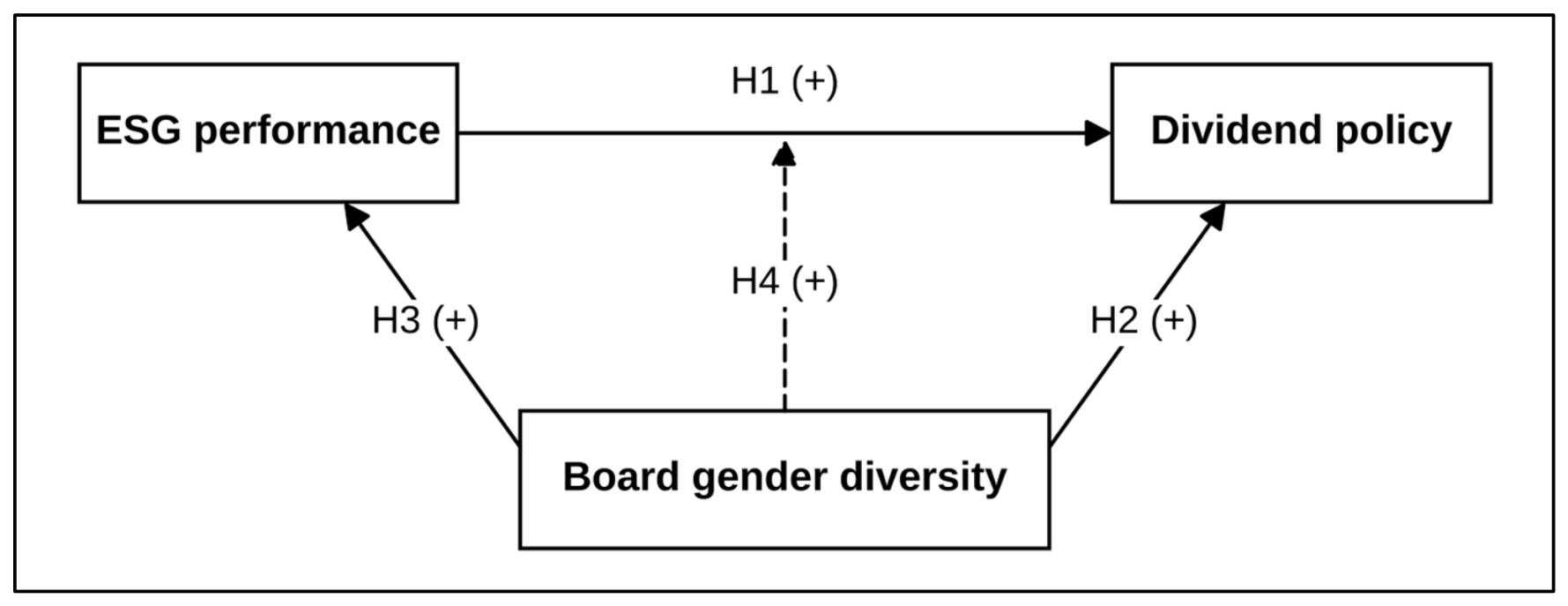
Figure 1 summarises the conceptual framework, whereby ESG performance is expected to be positively associated with dividends (H1), board gender diversity to be positively associated with both dividends (H2) and ESG performance (H3), and board gender diversity to condition the strength of the ESG–dividend association (H4), with critical-mass theory implying that this conditioning emerges once female directors are numerous enough to influence board decisions.
Figure 1.
Conceptual framework.
2.2. ESG Performance and Dividend Policy
A growing body of evidence establishes a positive link between ESG and corporate dividends. Salvi et al. [2] investigated 3207 European firms from 2018 to 2022 and found that higher ESG scores were significantly associated with both dividend payout ratio and dividend yield. Ye et al. [4] demonstrated the same pattern in their global sample. They found a positive link between board-level sustainability orientation and higher dividend distributions. Alkhawaja et al. [5] showed that countries enacting ESG-oriented board composition requirements experienced significant increases in ESG disclosure linked to stronger payout behaviour. The proposed mechanisms are as follows: reduced bankruptcy risk (enabling more stable payouts), lower cost of capital (increasing the net present value of sustainability investments), and enhanced stakeholder relationships (reducing litigation costs that would otherwise compete with dividends for cash). Consistent with these mechanisms, Khatatbeh et al. [15] showed that ESG performance was associated with greater stability among listed commercial banks in the Gulf Cooperation Council countries, and Arian et al. [16] found that sustainable control systems improve investment efficiency, which limits the risk that sustainability spending crowds out distributable cash.
In contrast, however, the same study qualifies this positive link by showing that the marginal payout response to ESG weakens at high ESG levels: Salvi et al. [2] document diminishing marginal returns, with the ESG–dividend response attenuating once ESG-related expenditures begin to erode distributable earnings. Thus, their evidence supports a positive ESG–dividend link on average, albeit one whose strength is conditional on the firm’s position along the ESG investment curve and on the governance structures that translate ESG engagement into financial discipline. Australia’s dividend imputation system makes it a particularly informative setting. Since 1987, Australian companies have been able to attach franking credits to dividends paid out of profits taxed at the corporate rate (currently 30%). Resident shareholders include these credits in assessable income and use them to offset their personal tax liability, and since 2000 excess credits have been refundable in cash. A fully franked dividend of A$ 70, for example, carries a credit of A$ 30, so that an investor with a zero marginal tax rate, such as a superannuation fund in pension phase, receives A$ 100 in total, whereas the same profit retained and realised as a capital gain does not deliver the credit. Corporate tax paid is therefore largely a prepayment of shareholders’ personal tax that can be unlocked only through franked distributions, which explains why domestic investors value cash dividends highly and why Australian payout ratios are high by international standards [17]. The same feature sharpens the trade-off studied here: every dollar retained for ESG investment is a dollar whose franking credits remain trapped at the company level, so the allocation between ESG projects and dividends carries an explicit tax cost for shareholders [18,19].
H1.
ESG performance is positively associated with dividends per share.
2.3. Board Gender Diversity and Dividend Policy
The question of gender diversity in boardrooms has recently become increasingly popular among researchers. This phenomenon is viewed as one of the determinants affecting corporate governance and financing decisions in general and dividend policy in particular [20,21]. More broadly, board composition shapes governance outcomes: Al-Bataineh et al. [22], for example, showed that board social capital strengthens anti-corruption practices among UK FTSE 350 firms. As the literature review shows, diversity in the composition of the board will lead to more effective management practices that, in turn, will affect the policy concerning dividends [21].
Ye et al. [4] demonstrated that both the number and proportion of female directors positively affect the likelihood and level of dividend payouts across their study sample of 22 countries. They argued that female directors are more risk-averse, more monitoring-oriented, and more sensitive to governance norms, making them more likely to deploy dividends as an agency-cost reduction tool. In their study, Salvi et al. [2] noted that gender features of the board are significant independent variables for dividend policy in Europe. The effect of the environment on reducing the effect diminishes in countries with more investor protection, suggesting that an effective regulatory framework could reduce some of the effects from the results. For example, Eissa et al. [23] found that the interaction between board gender diversity and dividends depends on ownership.
A related stream links board gender diversity to the integrity of financial reporting, which bears directly on the credibility of payout decisions. Cumming et al. [24] showed that gender-diverse boards are associated with a lower frequency and severity of securities fraud, and Capezio and Mavisakalyan [25] reported that female board representation is associated with a lower likelihood of corporate fraud among Australian-listed firms. Consistent with this evidence, Srinidhi et al. [26] found that firms with female directors reported higher-quality earnings, and Wahid [27] showed that firms with more women on the board committed fewer financial reporting irregularities. These differences are often attributed to greater risk aversion and a stronger ethical orientation among female directors, although the evidence is more consistent with board-level monitoring effects than with innate gender traits [28]. For dividend policy, the implication is that boards with more women may be less tolerant of earnings manipulation and of cash retention for private benefits, which reinforces the agency rationale for H2 and H4.
H2.
A positive association exists between board gender diversity and dividends per share.
2.4. Board Gender Diversity and ESG Performance
Many examples exist in the Middle East and North Africa (MENA), Australia, and the international business environment, where an increase in female directorship has resulted in extensive disclosures on environmental and social matters, environmental innovation, and overall corporate social performance [5,6,29]. There are two primary mechanisms through which female directors influence firms’ adoption of ESG practices. The first is grounded in the human capital perspective, whereby women enhance the board’s human capital, thereby enabling it to better identify environmental and social issues and incorporate them into strategic initiatives [30]. The second is related to the behavioural aspect, as women are more ethical when dealing with stakeholder interests, resulting in enhanced reporting of sustainable investments [31,32]. As noted by Manita et al. [30], a specific number of women should be part of the board’s work without having the number fall below three women. The literature operationalises critical mass in two ways. Manita et al. [30] and Torchia et al. [33] defined this as an absolute count of at least three female directors, while a parallel stream measures the threshold as a proportion of approximately one third, or about 30%, of board seats [34,35,36,37]. Because Australian boards in our sample have a typical size of around eight directors, these two definitions are numerically close: roughly three women on a typical ASX board correspond to about one third of seats. To avoid ambiguity, we report female representation throughout this paper as a percentage of board seats and interpret the “critical-mass” region of the distribution as approximately one third (30%) of the board, while noting that this percentage corresponds to roughly three female directors in the typical ASX firm. Hence, the mean female board share in our estimation sample is 24.1%, corresponding to two to three female directors on a typical ASX board; whereby a level at or near the critical-mass threshold, making Australia an informative setting for testing whether the gender–ESG link is operating at its intensive margin.
The extent to which female directors can exercise such influence depends on the structural barriers that shape their access to, and power within, the boardroom. Singh et al. [38] identify persistent gender bias and work–life balance pressures as obstacles that continue to restrict women’s progression to board-level positions, and argue that gender-inclusive leadership is both a strategic and an ethical matter. Earlier reviews document similar obstacles, including restricted access to director networks and the tendency of boards to appoint candidates who resemble incumbents [39]. These barriers matter for our analysis, as they explain why female appointments made primarily in response to disclosure pressure may remain token: when women are few, they may lack the voice to alter board decisions [33,40,41]. The influence of female directors on financial policy is therefore expected to be non-linear, emerging once their representation is large enough to overcome these barriers. The same logic underlies the ASX Corporate Governance Council’s recommendation [9] that S&P/ASX 300 entities target at least 30% of directors of each gender.
H3.
Board gender diversity positively correlates with firm-level ESG performance.
2.5. The Moderating Role of Board Gender Diversity
The proposition that board gender diversity positively moderates the ESG–dividend relationship is theoretically grounded in the synergistic integration of agency theory and signalling theory. It is important to clarify how this hypothesis differs from H1. H1 asks whether ESG performance has a positive average effect on dividends per share across the whole sample, irrespective of board composition; it is a statement about the unconditional relationship between ESG and DPS. H4, by contrast, is conditional: it asks whether the strength of that ESG–dividend relationship depends on the level of female board representation. In the empirical specification, H1 is captured by the coefficient on ESG in Equation (1) and H4 by the coefficient on the ESG × Female interaction term in Equation (4). The two hypotheses are therefore complementary rather than overlapping: H1 establishes that the channel exists on average, while H4 identifies the governance condition under which the channel becomes economically and statistically larger. From an agency perspective, female directors are widely acknowledged as diligent, independent, and risk-averse monitors [24,42]. When a firm engages in high-quality ESG practices, it often reduces its idiosyncratic risk, lowers its cost of capital, and generates greater excess cash flows. Thus, a highly gender-diverse board may mitigate agency conflicts by making it more likely that the financial gains from successful ESG strategies are distributed to shareholders as dividends, rather than being hoarded or misallocated by entrenched managers for personal perquisites [43,44]. Additionally, signalling theory suggests that strong ESG investments and the payment of high dividends can act as good signals for investors regarding the future earnings potential and reputation of the business [14,45,46]. Therefore, through the use of diverse boards, which are known for showing a more collaborative and consensual leadership style, BGD is expected to benefit from using high dividends as a signal that the sustainable strategies adopted by the organisation are profitable and do not affect the liquidity of the shareholders.
The main problem considered in this research is the existence of substitutive, complementary, or independent effects of ESG and gender diversity on dividend policies. In a cross-country European setting, Hampl and Vágnerová Linnertová [6] have provided evidence that board gender diversity and ESG interact in shaping dividend policy. They attribute this effect to governance complementarity, whereby gender-diverse boards are better placed to ensure that any ESG initiatives will generate sustainable cash flows that can be used to distribute dividends among shareholders. Similarly, Marie et al. [34] showed that board gender diversity shapes the relationship between ESG performance and cash holdings in China, indicating that female directors influence how ESG engagement translates into corporate cash policy. Without appropriate controls, any ESG practices will simply look cosmetic, as they will only involve increased reporting while no operations will be performed to create cash flows. Female directors may act as additional monitors who help to address this problem, although their capacity to do so is likely to depend on whether they reach a critical mass on the board. It should be noted that in the case of Australia, the emergence of different corporate structures in firms due to gender “if not, why not” disclosure since 2014 offers an opportunity to test this idea.
H4.
Board gender diversity positively moderates the ESG–dividend relationship, such that the positive association between ESG performance and DPS is stronger in firms with higher female board representation once female representation reaches a critical mass.
3. Data and Methodology
The initial dataset combines ESG performance scores, BoardEx board-composition records, and Refinitiv Datastream (Worldscope) financial data for ASX-listed non-financial firms and contains 1307 firm–year observations on 153 firms over 2013–2023. The sample period is determined by the joint availability of the three sources at the time of extraction; firms enter the panel when Refinitiv begins to cover them, so the panel is unbalanced by construction rather than restricted to firms with uninterrupted coverage. Following the screening steps, we lose two observations with missing current assets, 158 observations with a missing price–earnings ratio, and 204 observations with missing fixed-asset data, 155 of which belong to real estate investment trusts. Thus, the final estimation sample comprises 943 firm–year observations on 127 firms, with a median of eight years per firm.
The dependent variable is DPS, or dividends per share (A$), from Refinitiv Datastream, which is adjusted for stock splits and stock dividends, so that changes in DPS are not mechanically driven by changes in share structure. Female is the percentage of female directors on the board (BoardEx). The ESG Score is the Refinitiv ESG score (0–100), a performance-oriented rating that aggregates relative performance across ten categories within the environmental, social and governance pillars, benchmarked against industry peers [47]. Because the score is constructed from publicly reported and verifiable company information, it captures ESG performance as observable to investors rather than pure disclosure volume; however, we acknowledge that ratings from different providers diverge [48]. The control set includes firm size (natural logarithm of total assets), leverage (total debt to total assets), profitability (return on assets, %), growth opportunities (price–earnings ratio), tangibility (fixed assets to total assets), liquidity (current assets to total assets), free cash flow (A$ billion), and three macroeconomic controls: Australian real GDP growth, CPI inflation, and VIX—a market volatility index. Continuous variables enter the baseline models in their raw form; Section 5.5 shows that the results are robust to winsorising all firm-level variables at the 1st and 99th percentiles and to using ln(1 + DPS) to address the right skew of DPS. Table A1 in the Appendix A presents the variables, definitions, and theory sources.
Table 1 presents descriptive statistics for the estimation sample, so that the number of observations matches the regressions. The average firm pays A$ 0.449 per share (median A$ 0.228), consistent with Australia’s high-payout culture under the imputation system; the gap between mean and median, and the maximum of A$ 7.93, indicate a right-skewed distribution, which we address in the robustness tests. Female board representation averages 24.1% (median 25.0%), and 33% of firms have at least 30% female directors. ESG scores average 44.3 out of 100 with a standard deviation of 13.4. Free cash flow and the price–earnings ratio are strongly right-skewed, reflecting the capital intensity of the mining and energy sectors and low-earnings years for some firms. Moreover, Table A2 in the Appendix A shows the pairwise correlations for the study variables; and Appendix A Table A3 shows that excluded firm–years differ systematically from those retained, exhibiting lower dividends, ESG scores, female board representation, and profitability; accordingly, our findings apply to profitable, non-REIT ASX firms with Refinitiv coverage and should not be generalised automatically to all Australian-listed companies.
Table 1.
Descriptive statistics.
4. Empirical Framework
We test the four hypotheses using the fixed-effects panel estimator with firm fixed effects, which removes time-invariant firm heterogeneity, such as industry membership, ownership structure that is stable over time, and corporate culture. The within estimator is consistent regardless of whether the firm effects are correlated with the regressors. The baseline specification controls for common macroeconomic shocks through GDP growth, inflation, and VIX; Section 5.5 replaces these with year fixed effects. The baseline specification tests H1:
where αi are firm fixed effects, Xit is the vector of controls, and εit is the idiosyncratic error. To test H2, ESG is replaced with female, as follows:
DPSit = αi + β1ESGit + β2Xit + εit
DPSit = αi + β1femaleit + β2Xit + εit
To test H3, ESG becomes the dependent variable, as follows:
ESGit = αi + β1femaleit + β2Xit + εit
To test H4, the interaction ESG × Female is added along with both main effects. The moderation specification is:
DPSit = αi + β1ESGit + β2Femaleit + β3(ESG × Female)it + β4Xit + εit
H4 predicts β3 > 0: the marginal effect of ESG on DPS increases with female board representation. The marginal effect of ESG on DPS is β1 + β3 × Female, and the marginal effect of Female is β2 + β3 × ESG. We report both with standard errors and 95% confidence intervals, evaluate them across the observed distribution of the moderator, and plot them together with the distribution of Female [7,8]. Because the linear interaction imposes a moderating effect that rises at a constant rate, we also test the critical-mass prediction directly by allowing the ESG slope to differ below and above a threshold of 30% female directors, whereby the indicator function equals one when female directors account for at least 30% of the board and zero otherwise, as following:
DPSit = αi + γ1ESGit × 1(Femaleit < 30) + γ2ESGit × 1(Femaleit ≥ 30) + γ31(Femaleit ≥ 30) + γ4Xit + εit
Critical-mass theory predicts a positive incremental ESG effect above this threshold (γ2 > 0), with the additional effect exceeding the baseline ESG effect below the threshold (γ2 > γ1). The 30% threshold follows the percentage-based convention in Section 2.4 and the ASX recommendation; to avoid imposing it, we also estimate the threshold by a grid search over 15–40% that minimises the residual sum of squares [49] and assess its significance with a wild cluster bootstrap [50], and we estimate a specification with separate ESG slopes for four bands of female representation (0%, 0–20%, 20–30%, and ≥30%). Inference is based on Driscoll and Kraay [51] standard errors, which are robust to heteroskedasticity, serial correlation, and cross-sectional dependence. Cross-sectional dependence is a first-order concern in our setting, because ESG scores and female board representation rose together across ASX firms over 2013–2023 in response to common regulatory and investor pressures, such that residuals are correlated across firms within years; firm-clustered standard errors allow for serial correlation within firms but ignore this dependence.
5. Empirical Results
5.1. Baseline ESG–Dividend Relationship
Table 2 presents the results for H1–H3. Model 1 presents the estimates of Equation (1). The coefficient on the ESG score is positive (0.0039) and significant at the 5% level (p = 0.015), supporting H1. Economically, a one-standard-deviation higher ESG score (13.4 points) is associated with A$ 0.052 higher DPS (0.0039 × 13.45), or 11.6% of the sample mean of A$ 0.449. The sign is consistent with prior evidence of a positive ESG–dividend association [2,4]. Prior work has attributed this association to agency and financial-discipline channels [43]: Anolick et al. [45] argued that ESG-oriented firms face stronger external scrutiny and maintain more transparent reporting, which reduces the scope for managers to retain surplus cash. Among the controls, free cash flow is the dominant determinant of DPS (coefficient 0.201 per A$ billion), consistent with Jensen’s [10] free cash flow hypothesis. Firm size and profitability are also positive and significant, and growth opportunities are negatively associated with DPS, consistent with firms retaining cash when investment opportunities are valuable. Leverage, tangibility, liquidity, and the macroeconomic controls are insignificant.
Table 2.
Baseline fixed-effects models: Direct associations of ESG and board gender diversity.
5.2. Board Gender Diversity and Dividend Policy
Model 2 replaces ESG with female board share (Table 2, column 2) to examine whether board gender diversity affects DPS. The coefficient on female board (%) is not statistically significant; thus, the direct association with DPS hypothesised in H2 is not supported. One possible explanation lies in the institutional context, wherein during 2013–2023, many ASX firms increased female board appointments under the “if not, why not” reporting regime, meaning that some appointments reflected compliance pressure rather than deliberate governance reform. Where such appointments did not embed female directors in genuine decision-making authority, the behavioural mechanisms through which gender diversity would raise dividends are attenuated. The result is consistent with the institutional qualification in Ye et al. [4], who found that the gender–dividend effect was weakest in well-regulated markets where legal mechanisms already performed the governance role.
5.3. Gender Diversity and ESG Performance
We extend the estimation in Model 3 to examine the association between board gender diversity and ESG performance exhibited in column 3, Table 2. The coefficient on female representation is positive and significant, supporting H3. Moving from the 25th to the 75th percentile of female representation, a gap of 19.0 percentage points, is associated with an ESG score that is 4.4 points higher (0.229 × 19.05), or 0.32 standard deviations—an economically material difference. Firm size and tangibility are also positive and significant, consistent with the view that larger, asset-intensive firms can absorb the fixed costs of ESG infrastructure [52,53].
5.4. Moderating Role of Board Gender Diversity
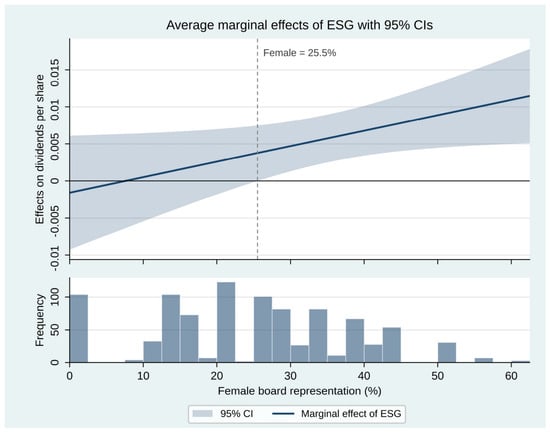
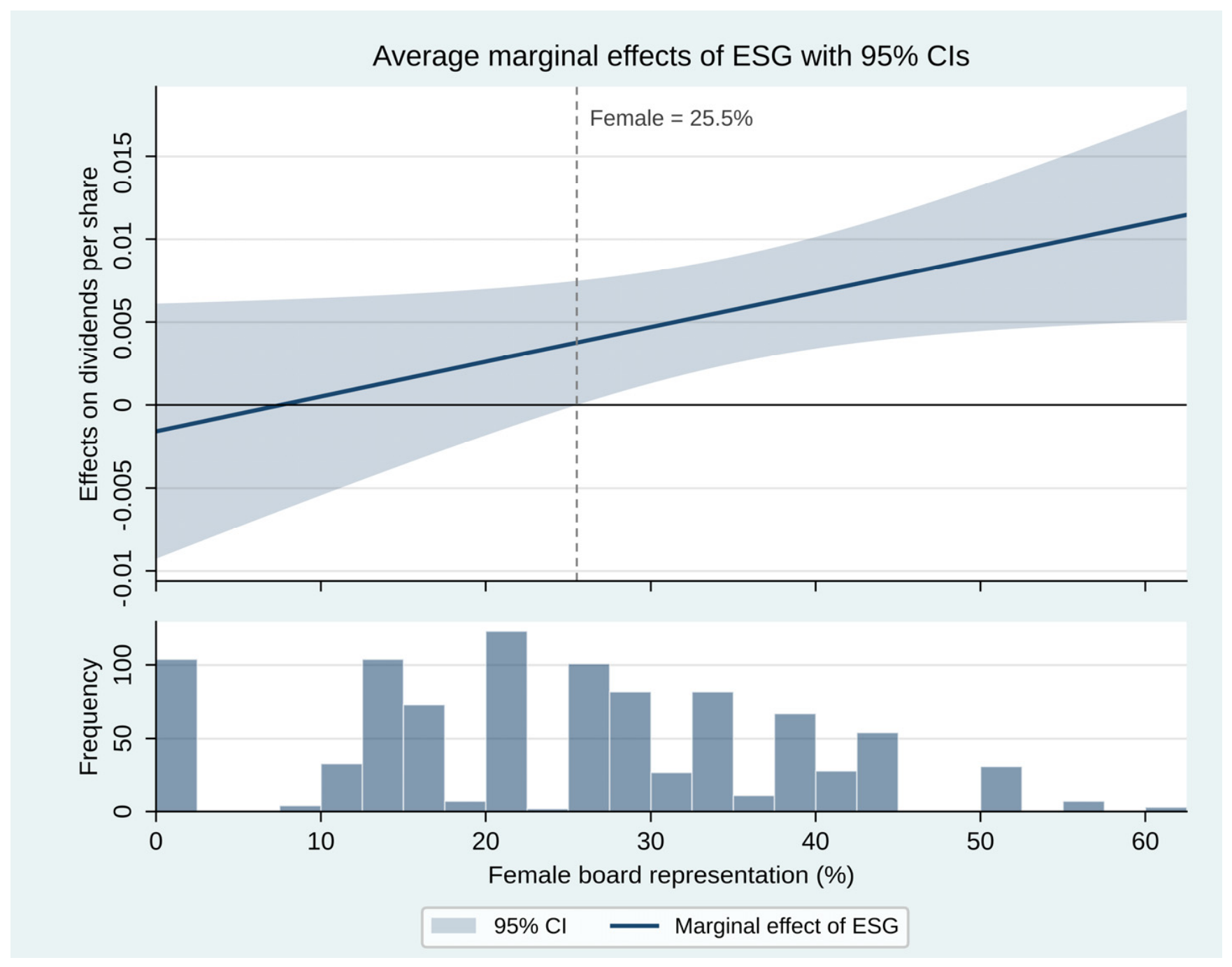
We next examine the main hypothesis, H4. In Table 3, Model 4a includes the ESG score and female representation as separate main effects, and Model 4b adds the interaction ESG × Female. The interaction coefficient is positive (0.00021) and significant at the 5% level, supporting H4. The marginal effects in Panel D show where the moderation operates. The marginal effect of ESG on DPS is β1 + β3 × Female; at the 25th percentile of female representation, it equals −0.00157 + 0.00021 × 14.29 = 0.0014 (95% CI [−0.0038, 0.0066]); at the mean, it equals 0.0034 ([−0.0004, 0.0073]); and at the 75th percentile, it equals 0.0054 ([0.0021, 0.0086]). Figure 2 shows that the confidence interval excludes zero only for female representation of 25.5% or more, a region that contains 43% of the observations, so the estimate is not driven by thinly populated combinations of the two variables.
Table 3.
Moderation analysis: Board gender diversity, critical mass, and the ESG–dividend relationship (H4).
Figure 2.
Marginal effect of ESG on DPS across female board representation (Model 4b), with 95% confidence intervals. The lower panel shows the distribution of female board representation in the estimation sample; the dashed line marks the level above which the confidence interval excludes zero.
The marginal-effect profile points to a threshold rather than a constant rate of amplification, which Models 4c and 4d test directly. In Model 4c, the ESG slope is 0.0005, when fewer than 30% of directors are women and 0.0094 when at least 30% are women; the difference of 0.0089 is significant at the 1% level. Model 4d, which allows separate slopes for four bands of female representation, yields the same picture: the ESG slope is insignificant on boards with no women (−0.0013), with 0–20% women (0.0019) and with 20–30% women (0.0009), and becomes positive and significant only at 30% or more (0.0083). Economically, in critical-mass boards, a one-standard-deviation higher ESG score is associated with A$ 0.126 higher DPS (0.00938 × 13.45), or 28% of mean DPS, compared with A$ 0.007 below the threshold. These results support H4 and indicate that the moderation takes a critical-mass form, consistent with Torchia et al. [33] and Konrad et al. [41].
The negative coefficient on Female in Model 4b does not imply that female representation reduces dividends: it is the marginal effect of Female at an ESG score of zero, which lies outside the observed range (minimum 18.8). Evaluated at the mean ESG score (44.3), the marginal effect of Female is 0.0005; at the 25th percentile of ESG, it is −0.0019; and at the 75th percentile, it is 0.0024. Female representation therefore has no direct association with DPS at any typical level of ESG, consistent with Model 2.
Taken together, the four models describe a conditional pattern. ESG performance is positively associated with dividends on average (H1), although this association depends on the inference method; female representation is associated with higher ESG performance within firms (H3) but not directly with dividends (no support for H2); and the ESG–dividend association strengthens with female representation and is concentrated in firms whose boards have reached a critical mass of female directors (H4). These patterns are consistent with the view that gender-diverse boards help translate ESG engagement into cash distributions.
5.5. Robustness and Alternative Specifications
Table 4 tests whether the results survive when subject to model uncertainty arising from alternative specifications and dividend measures. Row (2) replaces the macroeconomic controls with year fixed effects, which absorb common shocks and regulatory changes. The critical-mass result survives, where the ESG slope for boards with at least 30% women is 0.0104 and differs significantly from the below-threshold slope. The linear ESG × Female interaction is significant only at the 10% level (p = 0.072).
Table 4.
Robustness tests: Key coefficients under alternative specifications.
Row (3) replaces the Driscoll–Kraay errors with firm-clustered errors. We use Driscoll–Kraay errors as the baseline because ESG scores and female representation rose together across firms over 2013–2023. Under clustering, H1 and the linear interaction are not significant. The ESG slope above the threshold remains significant, but its difference from the below-threshold slope is significant only at the 10% level (p = 0.059).
Rows (4) and (6) address the right skew of DPS. Winsorising all firm-level variables at the 1st and 99th percentiles leaves the critical-mass result intact, and so does replacing DPS with ln(1 + DPS). Accordingly, for firms above the threshold, a one-standard-deviation higher ESG score corresponds to about 5.5% higher DPS, compared with 28% of mean DPS in the level specification. Firms with large dividends therefore account for much of the level effect, and the 28% figure should be read in that light.
Row (5) adds the CEO–chair separation score and the governance pillar score, which covers board structure, shareholder rights and compensation practices. Neither control is significant, and the interaction and critical-mass results are unchanged, although H1 weakens to significance at the 10% level. Rows (7) and (8) replace DPS with the dividend payout ratio and the dividend yield. The results show that ESG is positively associated with both. However, for both measures the ESG slopes below and above 30% female representation are positive and do not differ significantly (p = 0.899 and p = 0.461), so the critical-mass result is specific to dividends per share and does not extend to payout measures scaled by earnings or by price.
Overall, the critical-mass result is robust to year fixed effects, winsorisation, additional governance controls, and a log transformation of DPS, but it is weaker under firm-clustered standard errors and absent for the payout ratio and the dividend yield; meanwhile, H1 and the linear interaction are sensitive to the inference method and to year fixed effects. We therefore restrict our conclusions to per-share dividends.
6. Research Implications and Recommendations
The conditional pattern has implications for the three theories that underpin the study. From an agency perspective, the results are consistent with the view that gender diversity complements rather than substitutes for ESG engagement: firms with high ESG ratings but few female directors do not pay higher dividends, whereas firms that combine strong ESG performance with a critical mass of women do. From a stakeholder perspective, the results suggest that ESG engagement and shareholder distributions need not conflict in boards that have reached critical mass. From a signalling perspective, ESG scores appear to be more informative about dividend capacity in firms with gender-diverse boards. This reading accords with evidence that sustainability commitments translate into tangible outcomes only when they are embedded in governance structures with credible monitoring and accountability. For instance, Lu et al. [54] showed that, for the sustainable energy sector, governance quality and institutional integrity shape whether corporate social responsibility commitments are effective. Board composition may play an analogous role at the firm level.
For institutional investors, the results suggest that ESG scores and board gender diversity should be evaluated jointly rather than in isolation when screening for dividend capacity. In firms with fewer than 30% female directors, the marginal ESG–dividend association is statistically indistinguishable from zero; in firms at or above 30%, a one-standard-deviation higher ESG score is associated with A$ 0.126 higher DPS. Dividend-focused ESG screens that ignore board composition may therefore overstate the dividend relevance of ESG in low-diversity firms.
For corporate boards, the findings provide an additional, financial consideration alongside the ethical and reputational arguments that dominate the current debate. The calculation is as follows: the difference between the ESG slopes above and below the threshold is 0.00938 − 0.00050 = 0.00888 A$ per ESG point; multiplied by one standard deviation of ESG (13.45 points), it equals A$ 0.119 per share; for an illustrative firm with 500 million shares outstanding, this corresponds to A$ 0.119 × 500 million ≈ A$ 60 million in annual dividends. Because these estimates are conditional associations, they indicate the dividend relevance of the ESG–diversity combination rather than the payoff that a board could expect from a particular appointment.
For the ASX Corporate Governance Council, the evidence is consistent with the 30% gender target recommended for S&P/ASX 300 entities in the fourth edition of the Principles [9]. Both the imposed 30% split and the data-driven threshold of 29% indicate that the ESG–dividend association emerges at roughly this level, in line with the percentage-based critical-mass threshold of about one third of board seats [33,34,35,36,37], which corresponds to roughly three women on a typical eight-member ASX board [5,30].
7. Research Limitations and Future Research Directions
Five limitations qualify the results. First, the estimation sample comprises 943 firm–years on 127 profitable, non-REIT ASX firms with Refinitiv coverage, selected from an initial panel of 1307 observations. Excluded firm–years pay lower dividends and are less profitable, have lower ESG scores and fewer female directors (Appendix A Table A3). Second, identification rests on within-firm variation. Firm fixed effects remove time-invariant heterogeneity, and our robustness tests add year fixed effects and governance controls, but time-varying firm-specific factors, such as changes in managerial quality, strategy, or ownership, may simultaneously affect ESG performance, board composition and dividends. The “if not, why not” diversity regime introduced by the ASX in 2010 provides some variation in female representation that is driven by disclosure pressure rather than purely voluntary choices, but it does not provide a valid instrument for either ESG or female representation. Our estimates should therefore be interpreted as conditional associations rather than causal effects.
Third, our dataset does not contain ownership concentration, institutional ownership, board size or firm age. Gyapong et al. [20] showed that ownership concentration shapes the gender–dividend relationship in Australia, because concentrated owners may substitute for board monitoring; we partly address this concern with firm fixed effects, which absorb stable ownership structures, and with governance controls, but we cannot test whether the critical-mass result operates independently of, or interacts with, ownership concentration. Fourth, the Refinitiv ESG score measures performance as reflected in publicly reported information, and ratings from different providers diverge [48]. Fifth, the critical-mass result is specific to dividends per share: it does not extend to the payout ratio or the dividend yield, and the difference between the ESG slopes above and below 30% is significant only at the 10% level under firm-clustered standard errors.
Three extensions would refine the findings. First, with board-size data, critical mass could be measured as an absolute count of female directors (zero, one, two, three or more), which would allow a direct comparison of the count-based and percentage-based definitions of critical mass [5,30]. Relatedly, adding ownership concentration and institutional ownership would show whether the critical-mass result operates independently of the ownership channel documented by Gyapong et al. [20].
Second, industry heterogeneities require detailed discussion. It is possible that the interactions between ESG, dividends, and gender are greatest in sectors where the most material ESG risks exist and are measurable—these would include mining, oil and gas, and discretionary activities. Sector-by-sector estimates of the interaction effects could distinguish whether governance complementarity is universal or predominates in high-ESG-materiality sectors, which could, in turn, influence how sector-specific recommendations for good governance should differ. Third, a quasi-experimental design exploiting the 2019 introduction of the 30% gender target for S&P/ASX 300 entities— for example, by comparing firms just inside and outside the index—could move the evidence from conditional association towards causal identification.
8. Conclusions
This study examines how board gender diversity conditions the association between ESG performance and dividend policy in Australian-listed firms. ESG performance is positively associated with dividends per share, and female board representation is positively associated with ESG performance within firms but not directly with dividends. The key finding of this study is that the ESG–dividend association strengthens with female representation and is concentrated in boards with at least 30% women. Accordingly, a one-standard-deviation higher ESG score (13.4 points) is associated with A$ 0.126 higher DPS, or 28% of the sample mean, compared with a statistically insignificant A$ 0.007 below the threshold. This pattern is robust to alternative specifications within per-share dividends, although it is weaker under firm-clustered standard errors and does not extend to the payout ratio or the dividend yield.
The results carry practical implications, whereby ESG scores and board gender balance are complementary indicators of dividend capacity, so investors who consider both are better placed to identify firms able to sustain cash distributions. For regulators, the evidence is consistent with the 30% gender target in the ASX Principles.
In addition, the theoretical case for gender diversity is quite different from the ethical and compliance rationales that are prevalent in policy debates. Our evidence is consistent with the view that, once they reach a critical mass, female directors become part of the governance system through which sustainability commitments are associated with distributions to shareholders, although the mechanism remains to be established. Within the Australian institutional context, this mechanism is especially clear, since a chief source of return for a shareholder is a cash dividend due to the Australian dividend imputation system. The results leave a wish list of future research questions, most importantly whether this mechanism operates with similar effectiveness under different institutional settings.
Author Contributions
Conceptualization, I.N.K.; methodology, A.A.; software, A.A.; validation, A.A.; formal analysis, A.K.B.S., A.A. and A.I.A.; investigation, M.A.; resources, M.A.; data curation, A.K.B.S.; writing—original draft preparation, I.N.K.; writing—review and editing, A.K.B.S., I.N.K., A.I.A. and M.A.; visualization, A.I.A. All authors have read and agreed to the published version of the manuscript.
Funding
This research received no external funding.
Institutional Review Board Statement
Not applicable.
Informed Consent Statement
Not applicable.
Data Availability Statement
The data analysed in this study were obtained from third-party sources and cannot be redistributed by the authors. Firm-level financial variables (dividends per share, firm size, leverage, profitability, asset growth, tangibility, liquidity, and free cash flow) were obtained from Refinitiv Eikon/Datastream; the ESG Disclosure Score (0–100) from the Bloomberg Professional terminal; and board gender diversity (percentage of female directors) from BoardEx. Access to these databases requires an institutional or individual subscription and is subject to the providers’ licensing restrictions. Macroeconomic controls—Australian real GDP growth and CPI inflation—are freely available from the World Bank’s World Development Indicators (https://databank.worldbank.org), and the CBOE Volatility Index (VIX) is publicly available from CBOE. Identical data can be retrieved by applying the sample criteria and variable definitions in Section 3 and Table 1 (ASX-listed firms with continuous Bloomberg ESG coverage, 2013–2023), enabling full replication of the analysis.
Acknowledgments
The Researchers would like to thank the Deanship of Graduate Studies and Scientific Research at Qassim University (https://www.qu.edu.sa) for financial support (QU-APC-2026).
Conflicts of Interest
The authors declare no conflict of interest.
Appendix A
Table A1.
Variable definitions, abbreviations, and data sources.
Table A2.
Pairwise Correlation Matrix.
Table A3.
Comparison of firm–years retained in and excluded from the estimation sample.
References
- Australian Institute of Company Directors (AICD). Australia’s Top Boards Close to 40 Percent Women [Media Release]. 30 June 2025. Available online: https://www.aicd.com.au/news-media/media-releases/2025/australias-top-boards-close-to-40-percent-women.html (accessed on 22 August 2026).
- Salvi, A.; Nirino, N.; Battisti, E.; Gianfrancesco, I. Payout policy and ESG: A European investigation. Res. Int. Bus. Finance 2024, 68, 102189. [Google Scholar] [CrossRef] [Scilit]
- Jain, P.; Malhotra, P. Exploring the connection between environmental, social, and governance (ESG) disclosure and dividend policy: A meta-analytic approach. Rev. Manag. Sci. 2026, 20, 2025–2062. [Google Scholar] [CrossRef] [Scilit]
- Ye, D.; Deng, J.; Liu, Y.; Szewczyk, S.H.; Chen, X. Does board gender diversity increase dividend payouts? Analysis of global evidence. J. Corp. Finance 2019, 58, 1–26. [Google Scholar] [CrossRef] [Scilit]
- Alkhawaja, A.; Hu, F.; Johl, S.; Nadarajah, S. Board gender diversity, quotas, and ESG disclosure: Global evidence. Int. Rev. Financ. Anal. 2023, 90, 102823. [Google Scholar] [CrossRef] [Scilit]
- Hampl, F.; Vagnerová Linnertová, D. How the interaction between board gender diversity and ESG shapes dividend policy. Corp. Soc. Responsib. Environ. Manag. 2025, 32, 2472–2490. [Google Scholar] [CrossRef] [Scilit]
- Brambor, T.; Clark, W.R.; Golder, M. Understanding interaction models: Improving empirical analyses. Polit. Anal. 2006, 14, 63–82. [Google Scholar] [CrossRef] [Scilit]
- Hainmueller, J.; Mummolo, J.; Xu, Y. How much should we trust estimates from multiplicative interaction models? Simple tools to improve empirical practice. Polit. Anal. 2019, 27, 163–192. [Google Scholar] [CrossRef] [Scilit]
- ASX Corporate Governance Council. Corporate Governance Principles and Recommendations, 4th ed.; ASX Limited: Sydney, Australia, 2019. [Google Scholar]
- Jensen, M.C. Agency costs of free cash flow, corporate finance, and takeovers. Am. Econ. Rev. 1986, 76, 323–329. [Google Scholar]
- Muttaqi, J.A.A.; Nur, T. How gender diversity shapes the influence of ESG on dividend policy: Insights from the corporate boards in an emerging market. Corp. Board Role Duties Compos. 2025, 21, 71. [Google Scholar] [CrossRef] [Scilit]
- Aisyah, F.S.N.; Haryati, T.; Vendy, V. Does Board Gender Diversity Moderate ESG, Dividend Policy, and Firm Value Relationships? J. Ris. Akunt. Dan Keuang. 2022, 12, 901–918. [Google Scholar] [CrossRef] [Scilit]
- Arian, A.; Sands, J.; Rahman, H.U.; Khatatbeh, I.N. Corporate social performance through instrumental stakeholder theory: A sector-specific perspective. Manag. Decis. 2025, 63, 1369–1390. [Google Scholar] [CrossRef] [Scilit]
- David, L.K.; Wang, J.; Angel, V.; Amjad, N. ESG scoring and forecasting in China: Advancing sustainable business with multidimensional modeling. J. Asia Pac. Econ. 2025, 30, 128–157. [Google Scholar] [CrossRef] [Scilit]
- Khatatbeh, I.N.; Tayeh, M.; Freihat, A.F.; Aldeki, R.G. ESG and bank stability in Gulf Cooperation Council countries: Empirical evidence from listed commercial banks. S. Afr. J. Econ. Manag. Sci. 2025, 28, 6287. [Google Scholar] [CrossRef] [Scilit]
- Arian, A.G.; Khatatbeh, I.N.; Alharasis, E.E.; Nghiem, X.H. Sustainable control systems and investment efficiency: A global perspective. J. Sustain. Finance Invest. 2026, 1–34. [Google Scholar] [CrossRef] [Scilit]
- Pattenden, K.; Twite, G. Taxes and dividend policy under alternative tax regimes. J. Corp. Finance 2008, 14, 1–16. [Google Scholar] [CrossRef] [Scilit]
- Ignatova, K.; Steeves, C.J. ESG and corporate tax planning. Can. Tax J. 2023, 71, 321. [Google Scholar] [CrossRef] [Scilit]
- Da Silva, P.P.; Vieira, I. ESG disclosure and labour investment efficiency. Res. Econ. 2025, 79, 101060. [Google Scholar] [CrossRef] [Scilit]
- Gyapong, E.; Ahmed, A.; Ntim, C.G.; Nadeem, M. Board gender diversity and dividend policy in Australian listed firms: The effect of ownership concentration. Asia Pac. J. Manag. 2021, 38, 603–643. [Google Scholar] [CrossRef] [Scilit]
- Hazaea, S.A.; Al-Matari, E.M.; Farhan, N.H.; Zhu, J. The impact of board gender diversity on financial performance: A systematic review and agenda for future research. Corp. Gov. Int. J. Bus. Soc. 2023, 23, 1716–1747. [Google Scholar] [CrossRef] [Scilit]
- Al-Bataineh, O.A.M.; Khasawneh, M.; Khatatbeh, I.N.; Ghassab, E.E. The role of board social capital on the anti-corruption practices: The case of the UK FTSE 350. Corp. Gov. Int. J. Bus. Soc. 2026, 1–27. [Google Scholar] [CrossRef] [Scilit]
- Eissa, A.M.; Hamdy, A.; Diab, A. Governmental ownership, board gender diversity, and ESG performance: Evidence from an emerging market. Sustainability 2024, 16, 6963. [Google Scholar] [CrossRef] [Scilit]
- Cumming, D.; Leung, T.Y.; Rui, O. Gender diversity and securities fraud. Acad. Manag. J. 2015, 58, 1572–1593. [Google Scholar] [CrossRef] [Scilit]
- Capezio, A.; Mavisakalyan, A. Women in the boardroom and fraud: Evidence from Australia. Aust. J. Manag. 2016, 41, 719–734. [Google Scholar] [CrossRef] [Scilit]
- Srinidhi, B.; Gul, F.A.; Tsui, J. Female directors and earnings quality. Contemp. Account. Res. 2011, 28, 1610–1644. [Google Scholar] [CrossRef] [Scilit]
- Wahid, A.S. The effects and the mechanisms of board gender diversity: Evidence from financial manipulation. J. Bus. Ethics 2019, 159, 705–725. [Google Scholar] [CrossRef] [Scilit]
- Adams, R.B.; Ferreira, D. Women in the boardroom and their impact on governance and performance. J. Financ. Econ. 2009, 94, 291–309. [Google Scholar] [CrossRef] [Scilit]
- Antari, O.; Sbai, H.; Ed-Dafali, S. Board gender diversity and ESG performance: Evidence from gender diversity reforms in the MENA region. J. Financ. Report. Account. 2025. advance online publication. [Google Scholar] [CrossRef] [Scilit]
- Manita, R.; Bruna, M.G.; Dang, R.; Houanti, L. Board gender diversity and ESG disclosure: Evidence from the USA. J. Appl. Account. Res. 2018, 19, 206–224. [Google Scholar] [CrossRef] [Scilit]
- Grosser, K. Corporate social responsibility and gender equality: Women as stakeholders and the European Union sustainability strategy. Bus. Ethics Eur. Rev. 2009, 18, 290–307. [Google Scholar] [CrossRef] [Scilit]
- Garcia-Sanchez, I.M.; Oliveira, M.C.; Martinez-Ferrero, J. Female directors and gender issues reporting: The impact of stakeholder engagement at country level. Corp. Soc. Responsib. Environ. Manag. 2020, 27, 369–382. [Google Scholar] [CrossRef] [Scilit]
- Torchia, M.; Calabro, A.; Huse, M. Women directors on corporate boards: From tokenism to critical mass. J. Bus. Ethics 2011, 102, 299–317. [Google Scholar] [CrossRef] [Scilit]
- Marie, M.; Qi, B.; Elamer, A.A.; Khatatbeh, I.N.; Al-Fakir Al Rabab’a, E. How does board gender diversity drive the ESG performance-cash holdings relationship? Evidence from China. Int. J. Finance Econ. 2025, 30, 2705–2723. [Google Scholar] [CrossRef] [Scilit]
- Yang, W.; Yang, J.; Gao, Z. Do female board directors promote corporate social responsibility? An empirical study based on the critical mass theory. Emerg. Mark. Finance Trade 2019, 55, 3452–3471. [Google Scholar] [CrossRef] [Scilit]
- Javaid, H.M.; Ain, Q.U.; D’Ecclesia, R. Female directors in the boardroom and intellectual capital performance: Does the “critical mass” matter? Financ. Innov. 2023, 9, 74. [Google Scholar] [CrossRef] [Scilit]
- Barroso, R.; Duan, T.; Guo, S.; Kowalewski, O. Board gender diversity reform and corporate carbon emissions. J. Corp. Finance 2024, 87, 102616. [Google Scholar] [CrossRef] [Scilit]
- Singh, B.; R, H.; A, H.C. Impact of women on corporate boards. Int. J. Creat. Open Res. Eng. Manag. 2026, 2, 374. [Google Scholar] [CrossRef] [Scilit]
- Terjesen, S.; Sealy, R.; Singh, V. Women directors on corporate boards: A review and research agenda. Corp. Gov. Int. Rev. 2009, 17, 320–337. [Google Scholar] [CrossRef] [Scilit]
- Kanter, R.M. Men and Women of the Corporation; Basic Books: New York, NY, USA, 1977. [Google Scholar]
- Konrad, A.M.; Kramer, V.; Erkut, S. Critical mass: The impact of three or more women on corporate boards. Organ. Dyn. 2008, 37, 145–164. [Google Scholar]
- Chen, J.; Leung, W.S.; Goergen, M. The impact of board gender composition on dividend payouts. J. Corp. Finance 2017, 43, 86–105. [Google Scholar] [CrossRef] [Scilit]
- Makhija, H.; Raghukumari, P.S.; Sharma, D. Exploring the Nexus between Company ESG Performance and Dividend Policy: An Aggregate, Disaggregate, and Industry-Wide Panel Analysis. Australas. Account. Bus. Finance J. 2025, 19, 45–63. [Google Scholar] [CrossRef] [Scilit]
- Muhammad, H.; Farooq, M. The effectiveness of board gender diversity and sustainability committees in mitigating ESG controversies. Meditari Account. Res. 2025, 33, 994–1027. [Google Scholar] [CrossRef] [Scilit]
- Anolick, N.; Posselt, H.; Wagner, N. Is ESG more comprehensive than governance? What dividends reveal. Finance Res. Lett. 2026, 93, 109494. [Google Scholar] [CrossRef] [Scilit]
- AlKhayyal, A.M.; Jaafar, A. Board gender diversity, ESG and earnings management: Evidence from the Southeast Asian firms. Asian J. Account. Res. 2026, 1–22. [Google Scholar] [CrossRef] [Scilit]
- Refinitiv. Environmental, Social and Governance Scores from Refinitiv; Methodology Document; Refinitiv: London, UK, 2022. [Google Scholar]
- Berg, F.; Kölbel, J.F.; Rigobon, R. Aggregate confusion: The divergence of ESG ratings. Rev. Finance 2022, 26, 1315–1344. [Google Scholar] [CrossRef] [Scilit]
- Hansen, B.E. Threshold effects in non-dynamic panels: Estimation, testing, and inference. J. Econom. 1999, 93, 345–368. [Google Scholar] [CrossRef] [Scilit]
- Cameron, A.C.; Gelbach, J.B.; Miller, D.L. Bootstrap-based improvements for inference with clustered errors. Rev. Econ. Stat. 2008, 90, 414–427. [Google Scholar] [CrossRef] [Scilit]
- Driscoll, J.C.; Kraay, A.C. Consistent covariance matrix estimation with spatially dependent panel data. Rev. Econ. Stat. 1998, 80, 549–560. [Google Scholar] [CrossRef] [Scilit]
- Burinskienė, A.; Grybaitė, V.; Lapinskienė, G. The link between ESG factors and corporate profitability: Evidence from resource-intensive industries in Europe and the USA. Sustainability 2025, 17, 10714. [Google Scholar] [CrossRef] [Scilit]
- Tahmid, T.; Hoque, M.N.; Said, J.; Saona, P.; Azad, M.A.K. Does ESG initiatives yield greater firm value and performance? New evidence from European firms. Cogent Bus. Manag. 2022, 9, 2144098. [Google Scholar] [CrossRef] [Scilit]
- Lu, J.; Ren, L.; Qiao, J.; Yao, S.; Strielkowski, W.; Streimikis, J. Corporate social responsibility and corruption: Implications for the sustainable energy sector. Sustainability 2019, 11, 4128. [Google Scholar] [CrossRef] [Scilit]

Disclaimer/Publisher’s Note: The statements, opinions and data contained in all publications are solely those of the individual author(s) and contributor(s) and not of MDPI and/or the editor(s). MDPI and/or the editor(s) disclaim responsibility for any injury to people or property resulting from any ideas, methods, instructions or products referred to in the content. |
© 2026 by the authors. Licensee MDPI, Basel, Switzerland. This article is an open access article distributed under the terms and conditions of the Creative Commons Attribution (CC BY) license.