


Abstract
Climate change poses a systemic threat to sustainable development, and engaging businesses in the climate agenda is essential for achieving the Sustainable Development Goals. Small- and medium-sized enterprises have limited resources and are largely exempt from mandatory climate regulation; therefore, the cognitive mechanisms of their owners are of particular importance. This is particularly relevant for Russia, where the rate of warming exceeds the global average, while carbon emission regulation remains in its early stages. This study examines how owners and top managers of Russian small- and medium-sized enterprises perceive, interpret, and translate climate signals into pro-environmental intentions. We applied a qualitative abductive approach based on the Gioia methodology and analyzed ten semi-structured interviews with owners and top managers of micro-, small, and medium-sized enterprises from various industries. The findings were validated through data triangulation using company websites, media publications, and corporate reports, as well as through independent coding. Four aggregate dimensions and two trajectories of intention formation were identified: a pragmatic (defensive) trajectory and a value-oriented (creative) trajectory. Signals are extracted according to an indicative hierarchy, and institutional voids act simultaneously as a barrier and a filter. Intentions emerge as a result of multi-level cognitive processing, in which the owner or top manager acts as the initiator, while the network provides support.
1. Introduction
Today, global warming poses a systemic threat to the long-term sustainable development of humanity. Its consequences, such as rising temperatures, changes in meteorological cycles, and extreme weather events, disrupt the functioning of economic sectors, including energy, agriculture, and infrastructure. To combat climate change, the international community has established a multilevel climate regulation system based on the United Nations Framework Convention on Climate Change (1992), the Kyoto Protocol (1997), and the Paris Agreement (2015). The climate agenda is integrated into the United Nations Sustainable Development Goals (SDGs), which establish specific targets that enterprises contribute to achieving.
Business has become a key player in combating climate change, integrating climate strategies into its operations through investments in low-carbon technologies, participation in carbon markets, and the implementation of climate projects. Corporate behavior regarding the climate agenda is shaped by a complex set of interrelated factors that can be categorized into two groups [1]. Identified stimuli include regulatory pressure [2,3], expected economic benefits [3,4], reputational advantages [5,6], and the personal beliefs of management [7]. Barriers include financial constraints [8,9], the short-term orientation of management [7], information asymmetry [8,10], bureaucratic complexity [2,10], as well as psychological factors and business resistance [8,11].
However, merely listing incentives and barriers fails to reveal the mechanisms of their interaction or explain how climate signals are translated into managerial decisions. Existing research predominantly focuses on the large corporate sector [1], where environmental responsibility is formalized through specialized departments, public reporting, and internal carbon pricing mechanisms [4,6,12,13]. Small- and medium-sized enterprises remain underexplored and are most often examined merely in the context of general barriers and constraints. This leads to two research gaps. The first is an empirical gap: little is known about how owners and top managers of small- and medium-sized enterprises actually notice, interpret, and respond to climate change-related signals. The second is a theoretical gap: the literature lacks a description of the cognitive-behavioral process linking external signals to intentions, especially in contexts where regulatory pressure is weak.
The environmental responsibility of small- and medium-sized companies fundamentally differs from that of large corporations. In small- and medium-sized enterprises, it rarely manifests as formal strategies; instead, it exists in the form of informal practices, operational choices, and managerial decisions that depend heavily on the personal beliefs and values of the owner or top manager. Decision-making is highly personalized, making the cognitive-behavioral orientation of the owner or top manager a crucial mechanism for intention formation.
Russia represents a highly informative analytical context for studying the identified gaps, as high vulnerability to climate change coexists with a regulatory framework that largely bypasses small businesses.
Russia possesses a unique climate vulnerability that significantly distinguishes it from most countries in the world. The Federal Service for Hydrometeorology and Environmental Monitoring (Roshydromet) reports that the average temperature in Russia is rising approximately 2 to 2.5 times faster than the global average and in the Arctic zone, warming rates reach four times the global values [14,15]. These processes are accompanied by the degradation of permafrost, which covers about 65% of the country’s territory, and an increase in the area of forest fires in Siberia and the Far East [15]. At the same time, climate changes have a heterogeneous impact on key industries, manifesting on the one hand in a lengthening of the growing season and increased CO2 concentration, which contribute to yield growth in certain regions, and on the other hand in increasing drought risks in traditional agricultural regions of the southern part of the country [16].
For Russian small- and medium-sized enterprises, physical climate risks are highly heterogeneous and depend on geography and sector: if for southern agricultural enterprises the increasing frequency of droughts and extreme weather events threatens basic profitability [16], then for businesses in permafrost zones, climate changes pose risks to logistics and fixed assets [14]. However, a more significant channel of impact on Russian small- and medium-sized enterprises is indirect pressure through value chains, where large businesses predominate. Unlike large export-oriented companies subject to mandatory carbon reporting and quota mechanisms, small- and medium-sized businesses are not subject to direct climate regulation. Nevertheless, large companies are beginning to extend corresponding climate regulation compliance requirements to contractors and suppliers, thereby forcing small- and medium-sized businesses to integrate into the climate agenda by providing data on the carbon intensity of their products, accounting for indirect emissions, and implementing low-carbon practices.
In addition to the above, over the past decade, there has been a steady trend toward the internationalization of Russian small- and medium-sized enterprises, which are becoming active participants in addressing national objectives for developing non-resource exports. At the same time, partner countries to whose markets Russian exports are reoriented are adapting their own regulatory requirements to global decarbonization trends, creating a cascading spread of climate standards. For instance, the CBAM mechanism, which entered its final phase of implementation on 1 January 2026 acts not only as a direct regulator for European importers but also as a catalyst for the formation of similar mechanisms in third countries. This creates new requirements regarding the carbon footprint of products and value chains for Russian export-oriented companies, including small- and medium-sized businesses. Under these conditions, the search for incentives to engage small- and medium-sized businesses in the climate agenda becomes particularly relevant.
The Russian institutional context, characterized by weak regulatory pressure on small- and medium-sized enterprises, a lack of developed “green” financing instruments, and uncertainty regarding the international recognition of carbon units [17], amplifies the role of the cognitive-behavioral level. This renders institutional incentives insufficient for integrating small- and medium-sized enterprises into the climate agenda. Under these conditions, external signals must be noticed, interpreted, and made sense of by the owner-manager before they can be translated into actionable intentions. Thus, the Russian context allows for the observation of cognitive-behavioral mechanisms in environments where the influence of formal institutions is weak. This distinguishes it from contexts with well-developed carbon policy regulation, where regulatory compliance is likely to dominate the explanation of corporate behavior.
The aim of this study is to investigate the mechanisms underlying the formation of pro-environmental intentions in Russian small- and medium-sized enterprises through qualitative empirical research.
R1: How do owners of Russian small- and medium-sized enterprises notice, interpret, and translate climate signals into pro-environmental intentions, and what boundary conditions explain the variability of this process?
The paper is structured as follows. Section 2 presents the conceptual model and theoretical framework. Section 3 describes the research design, sample, and data collection and analysis methods. Section 4 presents the results. Section 5 discusses the findings, theoretical contribution, practical implications, and limitations. Section 6 presents the conclusions.
2. Literature Review and Theoretical Framework
2.1. Climate Change and Small- and Medium-Sized Enterprises
Small- and medium-sized enterprises are exposed to the impacts of climate change, yet simultaneously represent a significant, albeit understudied, driver of economic decarbonization. Globally, small- and medium-sized businesses account for approximately 13% of global greenhouse gas emissions and consume up to 50% of commercial and industrial energy [18]. Despite this, they remain largely excluded from national and regional climate policies in both developed and developing economies. Small- and medium-sized enterprises are frequently excluded from energy efficiency directives, thereby missing out on the cost-saving opportunities associated with regulatory compliance [18].
Small- and medium-sized businesses are particularly vulnerable to climate shocks due to their limited financial and managerial resources.
Here is the English translation, carefully crafted to maintain a professional, academic tone while ensuring natural phrasing and avoiding repetitive or “AI-sounding” structures:
The operational activities of smaller enterprises are directly affected by extreme weather conditions, supply chain disruptions, rising energy and cooling costs, and shifts in seasonal demand [4,18]. This situation is further complicated by tightening regulations, shifting consumer preferences, and new requirements from large buyers regarding emissions accounting. These challenges are particularly acute for export-oriented enterprises and their suppliers.
The environmental footprint of this economic segment largely stems from its integration into the value chains of large corporations. At the same time, small- and medium-sized enterprises act not merely as passive energy consumers, but as active drivers of the green transition. It is often at this level that climate initiatives are practically implemented: installing solar panels and EV charging stations, transitioning to low-carbon HVAC systems, and piloting circular business models and innovative technologies [18].
Despite this, studies highlight a persistent gap between small- and medium-sized enterprises’ general awareness of climate risks and the actual implementation of decarbonization strategies [19]. In developing economies, business owners and managers typically possess only a superficial understanding of broad concepts, such as global warming, while specialized terminology remains largely unfamiliar to them. Furthermore, awareness of sustainability strategies is often higher at the level of corporate declarations than within actual operational processes [19]. This imbalance is driven by a combination of factors, including vague sustainability goals, a lack of specialized knowledge, limited access to relevant information, and the absence of visible economic benefits from environmental upgrades.
Ultimately, analyzing the role of SMEs in the climate agenda reveals a fundamental contradiction. On the one hand, this sector generates a substantial cumulative environmental footprint and is highly vulnerable to climate shocks. On the other hand, its actual engagement in decarbonization processes remains fragmented. This gap between awareness and action cannot be explained solely by external barriers, such as a lack of financing or weak regulatory pressure. Evidence suggests that even when resources and incentives are present, many enterprises fail to transition from declarations to concrete action, highlighting the critical importance of internal, cognitive decision-making mechanisms. Therefore, to understand the mechanisms driving the engagement of small- and medium-sized enterprises in the climate agenda, it is necessary to shift the research focus from external conditions to the internal cognitive-behavioral processes that mediate the transformation of awareness into a readiness to act. Pro-environmental intentions serve as the intermediary construct between the perception of climate risks and actual behavior. Examining these intentions helps elucidate precisely how the subjective interpretation of signals and personal values foster a sustained readiness for environmental action under conditions of resource constraints and institutional uncertainty.
2.2. Pro-Environmental Intentions
Pro-environmental intentions represent the conscious readiness of an organization or its management to take actions aimed at environmental protection, minimizing negative environmental impacts, and supporting ecological sustainability. This is a multidimensional construct that encompasses values, perception of the external environment, self-identification, and planning [20]. Environmentally responsible intentions are operationalized through various categories: “green” commitments [21,22], commitment to environmental sustainability [22], motivation for corporate sustainability [23], and environmentally responsible firm behavior [20].
The specifics of small- and medium-sized enterprises determine the unique characteristics of pro-environmental intentions. These include personalization, as intentions exist in the form of the owner’s personal beliefs; resource constraints; weak regulatory pressure; and the dominant role of cognitive factors. In small- and medium-sized enterprises, a pronounced intention-behavior gap is observed, where the declared readiness for environmental actions is not realized due to a lack of operational resources or institutional uncertainty [18,19]. This specificity highlights the need to shift the research focus toward cognitive-behavioral decision-making mechanisms. Under conditions of weak regulatory pressure, it is the subjective interpretation of climate signals, altruistic motives, and entrepreneurial alertness that become the dominant factors in intention formation [24,25].
2.3. Conceptual Model
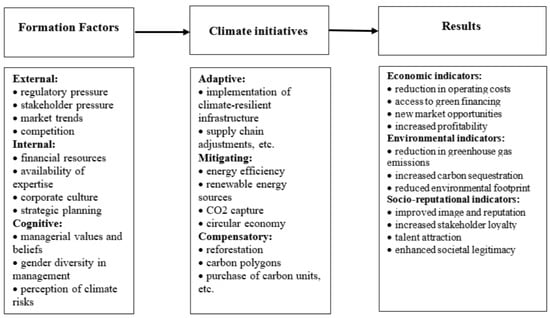
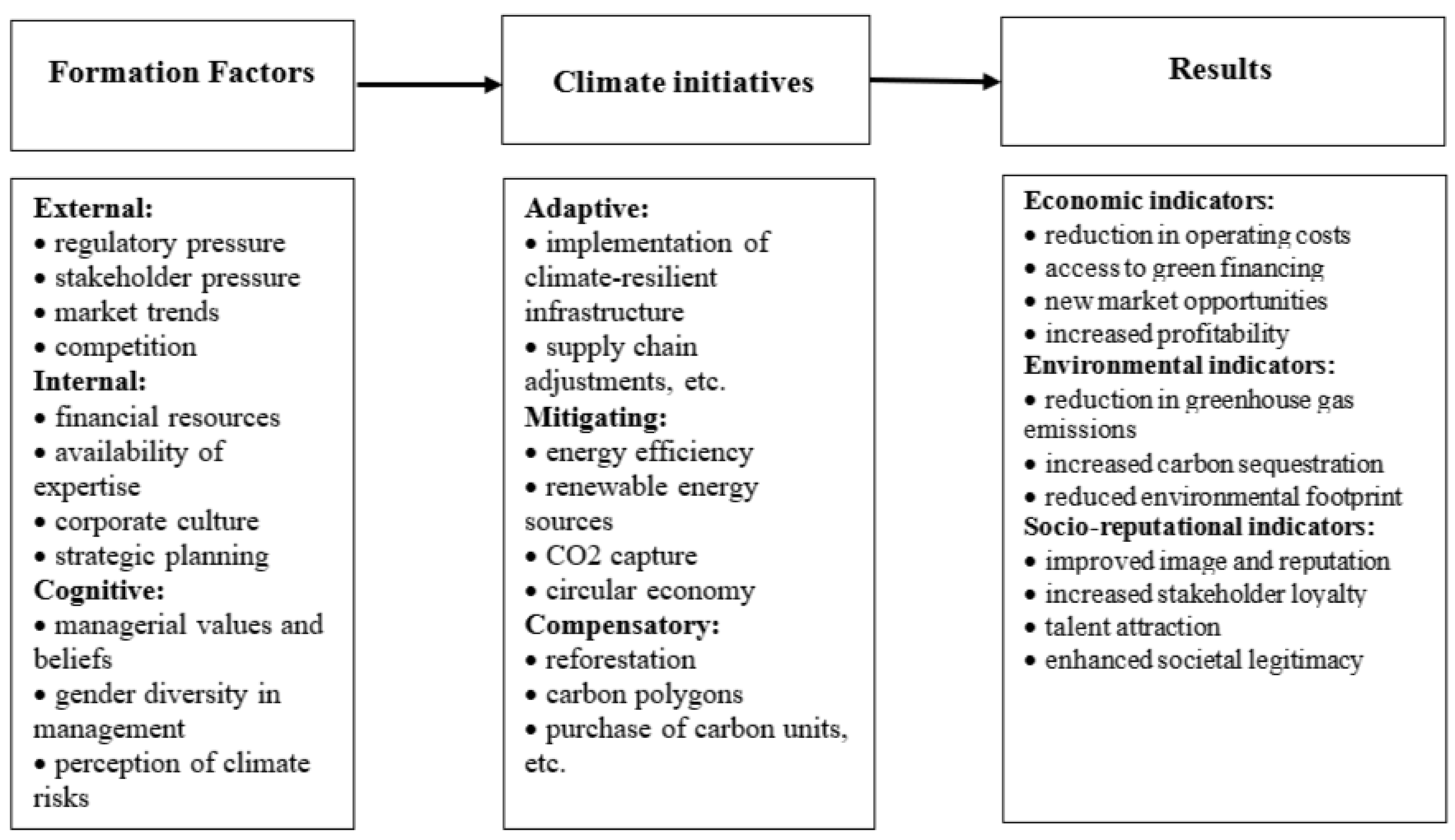
To establish the theoretical framework for this study, a systematic review of theoretical and empirical literature spanning 2017–2025 was conducted in the first stage. It examined business involvement in climate projects and practices, as well as corporate attitudes, roles, and actions within the context of the climate economy [1]. Based on the findings, a conceptual model of the formation of corporate environmental responsibility was developed (Figure 1). The model consists of three main components. Antecedent factors are classified as external, internal, and cognitive. Climate practices are classified as adaptive, mitigating, and compensatory. Outcomes include economic, environmental, and socio-reputational performance indicators.
Figure 1.
Conceptual model of the formation of corporate environmental responsibility. Source: compiled based on [2,3,4,6,7,8,9,10,19].
Factors were included in the model if they were repeatedly identified as determinants of corporate environmental responsibility actions in the reviewed empirical studies [1] and could be attributed to one of the three categories of antecedent factors. The external category encompasses pressures and opportunities arising outside the firm, such as regulation and market conditions. The internal category encompasses organizational resources, culture, and strategic planning. The cognitive category encompasses values, beliefs, and managers’ risk perception, through which external and internal conditions are interpreted.
The logic of the model is grounded in three arguments. First, the sequence from antecedent factors to initiatives and outcomes follows the logic of “attitude-intention-behavior” models, in which behavior is preceded by intention, formed by attitude, subjective norms, and perceived behavioral control [26]. The model adapts this logic to the organizational level, where antecedent factors correspond to the determinants of intention, and climate practices correspond to behavior. Second, the model treats pro-environmental intention as a mediating construct between antecedent factors and practices, since stated readiness does not automatically lead to implementation. Third, outcomes are expected to exert a feedback effect on antecedent factors, for example, through changes in resources or reputation, although this feedback loop is not tracked in the present study.
Two limitations of the model should be noted. It presents theoretically grounded propositions rather than verified causal links. Furthermore, a model of this type identifies which factors are relevant, but does not specify how antecedent factors are transformed into intention. Weick’s sensemaking theory, presented in Section 2.3, addresses this missing element by describing the interpretation process underlying the link between a signal and an intention.
The present study focuses on the stage of pro-environmental intention formation—an intermediate construct between antecedents (signals) and actual actions (initiatives). At the same time, the model allows for the verification of antecedent factors and initiatives within the context of Russian small- and medium-sized enterprises, as well as the documentation of observed implementation outcomes.
2.4. Theoretical Framework
The theoretical foundation of the study is grounded in Karl Weick’s sensemaking theory, which posits that organizational reality is not objectively given but is constructed by individuals through the process of interpreting events, communication, and joint action. Sensemaking is the process through which an ambiguous flow of experience is transformed into a comprehensible situation that can be understood and acted upon. Weick (1995) identifies seven key properties of sensemaking [27]. Sensemaking is grounded in identity, as interpretation depends on how the entrepreneur defines themselves and their organization. It is retrospective, because the meaning of events becomes clear in hindsight, and enactive, because people actively construct their environment through their actions and interpretations. Sensemaking is social, as interpretations are formed in dialogue with the team, partners, and family, and it is ongoing—sensemaking never stops. It is focused on extracted cues, as specific signals are isolated from an endless stream of information, and it is driven by plausibility rather than accuracy, because in conditions of uncertainty, people seek a sufficiently plausible explanation to take action [27].
The choice of K. Weick’s sensemaking theory is driven by several reasons. First, most established theories examining corporate environmental responsibility, such as institutional theory and stakeholder theory, focus on external pressures and assume a clear interpretation of signals, which does not align with the context of Russian small- and medium-sized enterprises. Sensemaking theory complements these approaches by explaining the stage preceding intention formation. Second, climate signals are ambiguous, as the same signal can be perceived as a risk, an opportunity, or noise, and its meaning depends on the interpreter. Sensemaking theory was developed precisely to explain action under conditions of ambiguity [27]. Third, small- and medium-sized enterprises lack specialized departments responsible for corporate environmental responsibility, and the primary site of interpretation is the owner or top manager. Sensemaking theory links interpretation to personal identity, which aligns with the decision-making structure in small- and medium-sized firms. Fourth, sensemaking theory has already been used to explain how managers interpret sustainability and social responsibility issues, for example, in the process model of corporate social responsibility proposed by Basu and Palazzo (2008) [28].
Sensemaking theory is linked to the conceptual model of the formation of corporate environmental responsibility, where extracted cues correspond to the external and internal antecedents as perceived by the owner. Identity and plausibility correspond to the cognitive antecedents that determine which signals are noticed and how they are interpreted. The social and enactive properties correspond to the formation of intention and its transformation into initiatives. The retrospective and ongoing properties imply that this process is iterative rather than linear. Thus, pro-environmental intention is viewed as the outcome of sensemaking.
This approach is particularly relevant for studying small- and medium-sized enterprises, as the owners and top managers of such enterprises operate under conditions of high uncertainty and limited resources, relying on the subjective interpretation of external signals. In the context of the Russian institutional environment, where regulatory pressure on companies is minimal and access to “green” financing is limited, it is the cognitive-behavioral mechanisms of the owner that act as the primary filter, determining whether a climate signal will be noticed, interpreted, and transformed into an intention to act.
3. Materials and Methods
3.1. Research Context and Sample Characteristics
To uncover the process of pro-environmental intention formation as a sensemaking process, a qualitative abductive design was adopted, grounded in the Gioia methodology [29]. This choice was justified on several grounds. First, the research question begins with “how,” which makes a qualitative approach most relevant [30,31]. Second, sensemaking theory presupposes the study of subjective interpretations, which requires access to participants’ narratives. Third, the Gioia methodology ensures a rigorous transition from empirical data to theoretical conclusions through three levels of coding [29].
In Russia, small- and medium-sized enterprises are defined by Federal Law (Federal Law No. 209-FZ of 24 July 2007 “On the Development of Small- and Medium-Sized Entrepreneurship in the Russian Federation”; Russian Federation, 2007). The classification is based on the average number of employees over the previous calendar year, government-established revenue thresholds, and restrictions on the enterprise’s ownership structure (Table 1).
Table 1.
Criteria for small- and medium-sized enterprises in Russia.
The study employs a purposive theoretical sampling strategy, wherein companies were selected not based on representativeness, but on their potential to provide relevant data for the research. The inclusion criteria were as follows: status as a small or medium-sized enterprise in accordance with Russian legislation; the presence of voluntary climate or environmental initiatives; and the involvement of the owner or top management in the decision-making process. The final sample consists of ten companies with an employee count ranging from 7 to 200, thereby encompassing micro-, small, and medium-sized enterprises. Their distribution by industry is presented in Table 2.
Table 2.
Sample composition.
Furthermore, during the study, a typology of companies was developed, encompassing three categories of engagement in the climate agenda. This typology was not a criterion for sample selection (the companies were selected based on the three aforementioned inclusion criteria), but was developed subsequently based on profiles compiled from open sources and interview materials. It served as an analytical tool that structured the initial reading of the data and helped to identify differences in pro-environmental intentions between groups of companies.
Category 1, Firms declaring their environmental responsibility: organizations that openly advocate for environmental responsibility, maintain verifiable sustainability documentation, and actively integrate eco-friendly practices into their core development strategies.
Category 2, “Non-declaring” firms: organizations that implement eco-friendly operational changes primarily to reduce costs (e.g., lowering energy consumption or reducing waste) without positioning these actions as environmental initiatives.
Category 3, Ecocentric business models: enterprises where sustainable development is a fundamental value proposition, and environmental practices are an integral part of their core operations (e.g., organic production or waste recycling) rather than an additional project.
3.2. Data Collection
Semi-structured in-depth interviews were used as the primary data collection method [32]. Data collection was conducted from April to July 2026. The interviews were carried out both in-person and online (via the Yandex Telemost cloud-based web conferencing platform) and lasted from 60 to 90 min. All interviews were audio-recorded with the respondents’ consent and subsequently transcribed verbatim. A total of 10 semi-structured in-depth interviews were conducted with owners and top managers of Russian small- and medium-sized enterprises. The company sizes ranged from 7 to 200 employees, corresponding to the categories of small- and medium-sized enterprises. The sample covered various industries (Table 2).
Ethical standards were strictly observed throughout the study. All interviews were conducted with the informed consent of the respondents. Participants were informed about the research objectives, the intended use of the data, and their right to refuse to answer any question without providing a reason. All personal data (names, company names) were anonymized using sequential codes (Respondent 1, Respondent 2, etc.), and all collected data are presented exclusively in an aggregated form.
The interview guide was developed based on the theoretical framework of the study and included the following thematic blocks: context immersion; perception of climate signals from the external environment; perception of climate opportunities; strategic reorientation; strategic orientation; and the formation of environmentally oriented intentions. During the interviews, we adhered to the “knowing agent” principle [32], treating the respondents as experts in their own experiences.
For data triangulation, supplementary sources of information were utilized, including company websites, public reports, and news and media publications related to the companies’ environmental and climate initiatives. Based on the data gathered from open sources, profiles were prepared for each company and its owner, which provided a preliminary understanding of the company’s activities and positioning within the environmental agenda. This facilitated the refinement of interview questions and enabled the verification of information obtained during the interviews by cross-checking declared positions against factual data.
3.3. Data Analysis
Data analysis was conducted in accordance with the Gioia methodology [29], which entails a systematic transition from empirical data to theoretical inferences, achieved through a three-stage analytical process. In the first stage, first-order codes were identified using the respondents’ own terms (1st-Order Concepts). Each text fragment containing information regarding the perception of signals, their interpretation, decision-making processes, and influencing factors was assigned a code in the respondent’s own language. In the second stage, the codes were grouped into theoretical themes (2nd-Order Themes). At this stage, the initial codes, clustered based on semantic similarity, were consolidated into theoretical themes. Subsequently, in the third stage, the identified themes were aggregated into conceptual categories (Aggregate Dimensions).
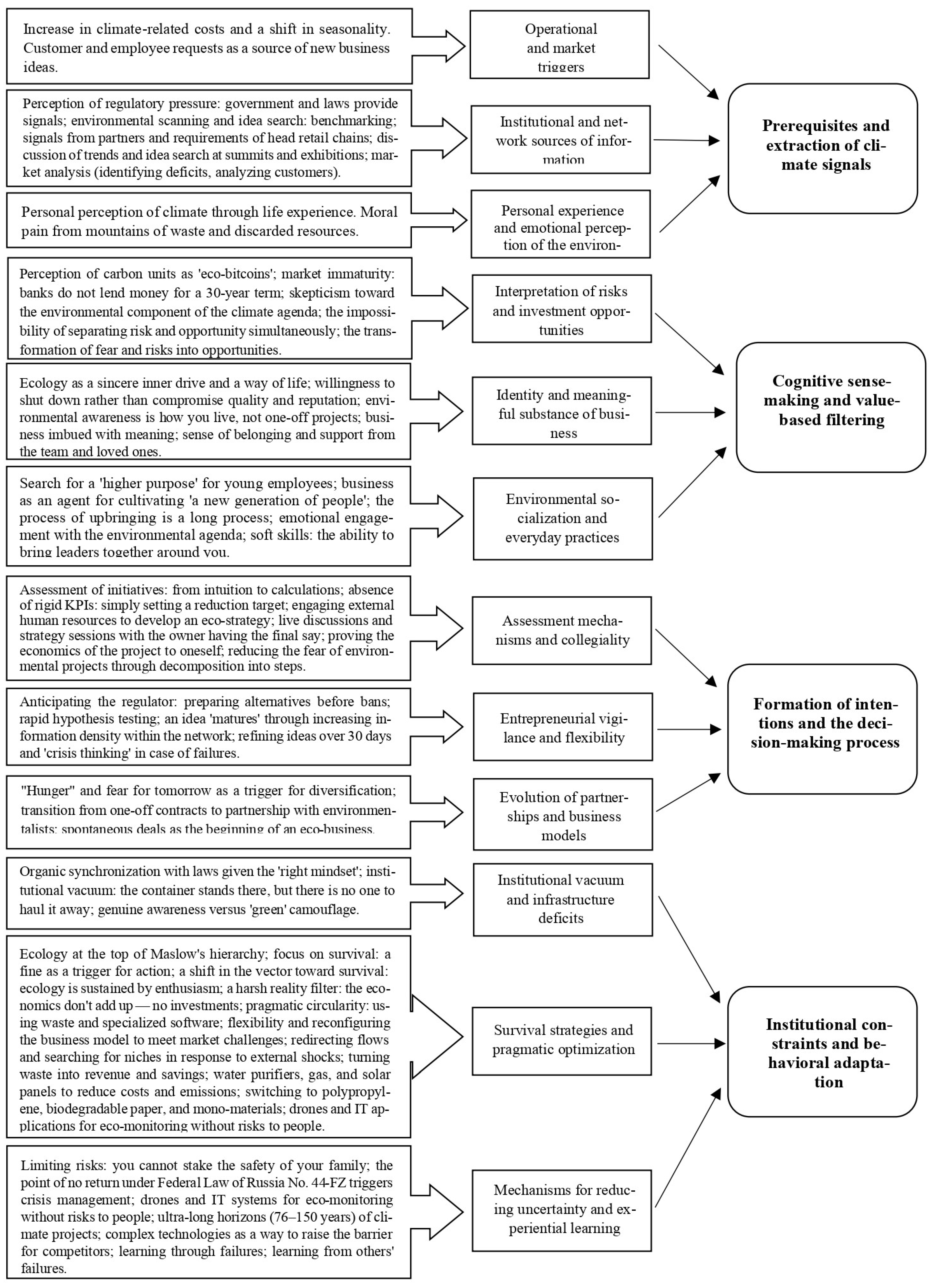
A key element of the data analysis is the visual representation of the findings in the form of a data structure that demonstrates the linkages between first- and second-order codes and aggregate dimensions. This structure allows for tracing the progression from empirical data to theoretical conclusions, which is a crucial component for demonstrating the rigor of qualitative research [29,33].
To ensure the trustworthiness of the research results [34], several approaches were employed. Data triangulation was conducted using multiple data sources. Reflexivity was maintained through regular discussions of the collected data and their interpretation within the research team. An audit trail was established throughout the study, preserving all research materials, including company profiles, interview recordings and transcripts, as well as all coding records, which allowed for the reconstruction and replication of the analytical process. Furthermore, an independent coder, an external researcher, participated in the coding process to verify consistency and minimize subjective bias.
4. Results
The data analysis was conducted in two sequential stages. In the first stage, a narrative analysis of the interviews was performed, aimed at capturing the primary layer of meanings forming in the consciousness of SME owners when encountering climate and environmental signals. In the second stage, three-level coding in accordance with the Gioia methodology was conducted, enabling the transition from narratives to theoretical generalizations.
4.1. Narrative Analysis
Appendix A presents the most representative excerpts from the interviews. Due to the space constraints of the article, an abridged version of the data is provided.
The narrative analysis revealed a high degree of data heterogeneity. Some respondents describe the climate agenda using the language of operational costs and regulatory constraints; others use the language of personal values and identity; and a third group employs the language of competitive opportunities and market niches. At the same time, none of the respondents describe environmental initiatives as a direct and automatic reaction to external institutional pressure. All interviews reveal a common pattern: between an external signal and the readiness to act, there is always an intermediate stage of subjective interpretation, the content and logic of which differ significantly among different owners. This observation raises the question of how exactly this intermediate stage is structured and what mechanisms determine the variability of the trajectories from signal to intention.
Narratives reflect what respondents say but do not reveal the transformation process itself: which signals are noticed first, through what filters they pass, how they are transformed into specific intentions, and what boundary conditions determine the variability of this process. To answer these questions, a three-stage coding process was conducted.
4.2. Coding in Accordance with the Gioia Methodology
The analysis of the 10 semi-structured in-depth interviews yielded 44 first-order codes, which were grouped into 12 second-order themes and 4 aggregate dimensions. The data structure, presented in Appendix B, demonstrates the transition from respondents’ accounts to theoretical generalizations in accordance with the Gioia methodology [29].
The four aggregate dimensions include antecedents and the extraction of climate signals; cognitive sensemaking and value filtering; intention formation and the decision-making process; and institutional constraints and behavioral adaptation. They describe the sequential stages of transforming climate signals into pro-environmental intentions.
4.2.1. Dimension 1: Antecedents and the Extraction of Climate Signals
The first aggregate dimension describes the input conditions: which signals the owners of Russian small- and medium-sized enterprises notice and from what sources they extract them. This dimension encompasses three second-order themes.
Operational and market factors.
The data indicate that a crucial stage in extracting climate signals from the environment is assessing their operational impact. Such impacts include increased costs for air conditioning and energy consumption, shifts in seasonal demand, and changing consumer preferences. Respondents perceive climate change not through abstract data on global warming, but through the specific operational metrics of their enterprises.
Requests from clients and employees also serve as a source of new signals. Unexpected inquiries from clients lead to the development of new services, while changes in employee behavior, such as the rejection of single-use plastic bags and the use of reusable bags, signal a shift in values.
Institutional and network sources of information.
Owners utilize a multi-level structure of channels to receive primary signals. Regulatory signals, such as laws, prohibition lists, and environmental fees, are perceived as the most significant for the manufacturing and packaging sectors. However, for a portion of the respondents, the key source of signals is not the state, but rather monopoly partners, international networks of parent companies, and industry summits. Discussions of trends at industry events, comparative analysis (including international benchmarking), and the analysis of market shortages complement this picture. Several respondents emphasized the role of informal information channels, such as contacts in regulatory bodies, professional networks, and word of mouth.
Personal experience and emotional perception of the environment.
For some respondents, the extraction of climate signals begins not with external sources, but with personal experience, such as memories of snowier winters, observations of changing weather conditions, and emotional reactions to the wasteful use of resources. This theme aligns with Weick’s sensemaking theory, where the retrospective nature of sensemaking is manifested in how the meaning of climate change is constructed by comparing current experiences with the past.
4.2.2. Dimension 2: Cognitive Sensemaking and Value Filtering
The second aggregate dimension reveals the mechanisms for interpreting extracted signals and encompasses three second-order themes.
Interpretation of risks and investment opportunities.
The economic aspect dominates the interpretation of climate signals. Respondents consistently translate the climate agenda into the language of economics. Climate projects are perceived as a form of long-term investment, carbon units as analogs of financial assets, and the climate agenda itself is interpreted primarily as an economic and political process of market redistribution. Respondents note the immaturity of the climate market: banks are reluctant to finance projects with a 30-year or longer horizon, and actual environmental measures are often implemented without public hype.
A key finding is the duality of climate signals. The same climate signal is simultaneously interpreted as both a risk and an opportunity. Respondents do not separate these categories, but rather perceive them as inextricably linked. Fear and risks are transformed into opportunities through entrepreneurial alertness.
Identity and sensemaking in business.
For a portion of the respondents, environmental orientation is not a reaction to external stimuli, but an extension of their personal identity. Environmental consciousness is perceived as a lifestyle and a sincere internal impulse, disconnected from market trends. Several respondents demonstrate a willingness to bear additional costs to achieve environmental goals, which contradicts rational economic logic. Product quality and internal integrity serve as absolute values for which respondents are willing to close their business rather than compromise their principles. Business is perceived as a tool for giving life meaning, rather than merely a source of profit. The search for a “higher purpose” for young employees serves as an additional motivator for environmental initiatives.
Environmental socialization and everyday practices.
Environmental intentions are not limited to formal projects, but manifest in everyday practices and socialization processes. Respondents describe their business as a tool for raising a “new generation of people,” and environmental awareness as an everyday practice rather than a series of one-off projects. The process of raising awareness is characterized as lengthy and challenging, aimed at the next generation. The emotional engagement of employees, for example, by showing videos that evoke an emotional response, serves as a tool for transmitting environmental values within the organization.
4.2.3. Intention Formation and the Decision-Making Process
The third aggregate dimension describes the mechanisms by which sensemaking signals are transformed into specific intentions to act, and includes three second-order themes.
Evaluation mechanisms and collective decision-making.
The decision-making process in small- and medium-sized enterprises is predominantly collective. Respondents describe lively discussions, strategic sessions, and regular working meetings where initiatives are discussed. However, the final decision is usually made by the owner, who takes on the responsibility. The process of evaluating initiatives shifts from intuition to rational calculation; that is, the initial decision is made intuitively and is then subjected to economic validation. Several respondents describe the practice of “self-checking the economic feasibility of a project,” which involves mentally pitching the project to an internal investor.
Formalized environmental key performance indicators are absent. Respondents set emission reduction goals without specific quantitative metrics, which reflects the informal nature of environmental intentions in small- and medium-sized enterprises. Fear associated with environmental projects is reduced by breaking them down into smaller tasks. Involving external resources, such as students and universities, acts as a catalyst for strategy formalization.
Entrepreneurial alertness and flexibility.
The data demonstrate a high speed of decision-making in small- and medium-sized enterprises. Initial actions to test a hypothesis are undertaken within 30 days, and ideas are developed in a short timeframe. Respondents describe a practice of anticipating legislative changes, which involves preparing alternatives before bans come into force. An idea “matures” due to the increasing density of information in the network: respondents and their partners simultaneously ponder the problem, and at a certain point, a transition to action occurs. Flexibility and business model restructuring in response to market challenges, reorientation of flows, and niche seeking in response to external shocks complete the picture of adaptive strategies.
Evolution of partnerships and business models.
Intention formation often occurs not in isolation, but through interaction with partners. Respondents describe the transition from one-off contracts to long-term partnerships, spontaneous deals as the beginning of a new business, and a “thirst for success” as the driving force for diversification. Fear of the future and the inability to guarantee stability act as triggers for forming a model with multiple income streams.
4.2.4. Institutional Constraints and Behavioral Adaptation
The fourth aggregate dimension describes the boundary conditions of the process and includes three second-order themes.
Institutional void and infrastructure deficit.
Institutional deficit is a key obstacle to the implementation of environmental initiatives. Respondents note the lack of certified waste disposal operators, bureaucratic complexities that cause initiatives to “fall through,” and a shortage of infrastructure for waste sorting. The vast geographic scale of the country exacerbates this infrastructure deficit. Several respondents also point out insufficient regulatory oversight, which reduces the effectiveness of the enterprises’ core efforts.
For some respondents, the institutional void manifests as a shift in focus toward survival. Environmental activities are supported solely by enthusiasm, while economic instability leads to the abandonment of long-term planning. Several respondents note that even when the environmental agenda is considered to be “at the top of the hierarchy of needs,” the presence of more pressing issues, such as tax payments or business survival, means that ecology simply “does not receive proper attention.”
Survival strategies and pragmatic optimization.
Under conditions of an institutional void, environmental intentions are realized primarily through pragmatic optimization. Small- and medium-sized enterprises implement internal circularity, including the reuse of packaging, waste compaction, the use of waste as fuel, the adoption of energy-saving technologies, and the transition to recyclable materials. Economic efficiency serves as the main filter: if investments do not yield a profit, respondents refuse to implement them. Technological innovations, such as drones, IT systems for environmental monitoring, and hybrid power plants, serve as tools for realizing environmental intentions, allowing for the simultaneous reduction in both costs and environmental impact.
Mechanisms for reducing uncertainty and experiential learning.
Respondents reduce uncertainty by limiting risks, which includes abandoning high-risk projects that threaten family security, rapidly testing hypotheses, and decomposing tasks. A point of no return, such as signing a contract that cannot be terminated, serves as a driving force for adaptation and triggers crisis management. The ultra-long horizons of climate projects, ranging from 76 to 150 years, contrast with the short-term planning horizon of business, creating a fundamental contradiction.
Learning from the mistakes and failures of others serves as a key mechanism for reducing uncertainty. Respondents described experiencing “panic” during initial failures but perceived them as a necessary condition for learning. Failure is viewed not as a reason to give up, but as a prerequisite for learning. Learning from the mistakes of others, for example, by analyzing the failures of large corporations, complements personal experience. Complex technologies are perceived as a means of raising barriers for competitors, which links environmental initiatives directly to competitive strategy.
4.3. Two Trajectories of Pro-Environmental Intention Formation
The analysis of empirical data revealed two distinct trajectories of environmentally oriented intention formation. The same climate signal can be interpreted in fundamentally different ways depending on the dominant trajectory. A comparison of the trajectories is presented in Table 3.
Table 3.
Trajectories of pro-environmental intention formation.
The pragmatic (defensive) trajectory is characterized by the interpretation of environmental issues as macroeconomic risks and regulatory pressures. The drivers include the fear of government regulation, demands from B2B partners, and the need for diversification. The mechanism for realization involves creating barriers to entry, preempting the regulator, and leveraging environmental initiatives as a competitive shield. This trajectory is characteristic of respondents from the manufacturing sector, environmental consulting, and forestry.
The value-based (creative) trajectory is characterized by the interpretation of environmental issues as an ethical imperative and an extension of personal identity. The drivers include personal empathy, moral disgust toward the wasteful use of resources, and love for the region. The mechanism for realization involves the conscious subsidization of unprofitable eco-practices through the core business. This trajectory is characteristic of respondents from the hospitality, food production, and event services sectors.
Thus, the three-level coding allowed for the systematization of narrative data obtained from ten in-depth interviews and revealed the structure of the pro-environmental intention formation process in Russian small- and medium-sized enterprises. The process of forming pro-environmental intentions is not linear. At each stage, a signal can be filtered, reinterpreted, or blocked, which explains the variability in the responses of small- and medium-sized enterprises to identical external stimuli.
4.4. Alignment Between the Obtained Results, the Conceptual Model, and Sensemaking Theory
Table 4 presents the alignment of empirical themes and dimensions with the elements of the conceptual model (Section 2.3) and the seven properties of sensemaking (Section 2.4). Each property of sensemaking has an empirical counterpart in the data. The theory is refined by two observations. First, in addition to retrospective sensemaking, respondents employ a prospective form, which manifests in anticipating legislative changes and preparing alternatives before bans come into force. Second, the social property takes a distributed form, where the owner initiates the intention, and the team, partners, and professional communities refine and support it. These points are discussed in detail in Section 5.
Table 4.
Alignment of theoretical elements and empirical data.
5. Discussion
5.1. Summary of Findings and Verification of the Conceptual Model
The conceptual model developed in this study (Figure 1) was validated using qualitative data from Russian small- and medium-sized enterprises. The validation was conducted across three components of the model: antecedents, climate practices, and outcomes. The interview data confirm the presence of the three groups of antecedents identified in the model; however, they reveal a specific hierarchy of their significance.
External factors, which act as the dominant driver in studies of large businesses [4,7], take a secondary role in the context of Russian small- and medium-sized enterprises. Respondents acknowledge regulatory signals but perceive them not as an incentive, but rather as a threat to their business model, prompting reactive adaptation. These findings align with those of Kulukui et al. (2019) [3], who demonstrated that companies evaluate regulatory risks as more significant than physical and market risks. In contrast, cognitive factors become dominant. The owner’s values and beliefs, entrepreneurial alertness, and personal identity act as the primary filter determining whether a signal is noticed and how it is interpreted. This aligns with the emphasis on owner-manager values in studies of environmental behavior in small- and medium-sized enterprises [18], as well as with evidence indicating that entrepreneurial ideas shape the confidence with which opportunities are pursued in the context of developing countries [24]. Internal factors were also observed. Financial resources act as a primary filter for decision-making (if investments do not yield a profit, respondents refuse to implement them). Corporate culture in small- and medium-sized enterprises is a direct reflection of the owner’s personal culture, blurring the boundary between the individual and organizational levels. Formal strategic planning is largely absent; strategies exist as personal beliefs and intuitive decisions rather than as formalized responses to external environmental indicators.
Regarding climate initiatives, the data confirm the dominance of mitigation initiatives, such as energy efficiency, the circular economy, and the transition to recyclable materials, which is consistent with previous studies [3,4]. Adaptive initiatives manifest as operational adjustments to changing conditions, such as seasonal shifts or increased air conditioning costs, but do not take the form of the strategic adaptation characteristic of large enterprises [25]. Compensatory initiatives, such as reforestation and carbon sequestration projects, are identified as a potential horizon rather than an implemented practice, due to the ultra-long horizons of climate projects, from 76 to 150 years, which are incompatible with the short-term planning horizons of small- and medium-sized enterprises. Economic outcomes are the most clearly validated, namely the reduction in operational costs through circularity and energy efficiency. Environmental outcomes are recorded at the operational level as waste reduction and emission cuts. Socio-reputational outcomes manifest internally through team cohesion and the attraction of young employees via a “higher purpose,” whereas external reputational advantages do not serve as a significant incentive for Russian small- and medium-sized enterprises [4,5].
Thus, the model is applicable to the context of Russian small- and medium-sized enterprises, but requires contextual adaptation. Among the antecedent factors, cognitive factors predominate; mitigation measures dominate the practices; and socio-reputational outcomes manifest as internal organizational effects.
The three-level coding also revealed that the process of forming environmentally oriented intentions in Russian small- and medium-sized enterprises is non-linear: at each stage, a signal can be filtered, reinterpreted, or blocked. The process begins with the extraction of signals from multiple channels. Respondents perceive climate change not through abstract data, but through the specific operational metrics of their businesses. A consistent hierarchy of signal extraction was identified, wherein priority is determined not by objective significance, but by the direct impact on financial outcomes. Operational and market factors were described as the usual starting point, regulatory signals were prominent in manufacturing and packaging, network sources were crucial for some respondents, and personal experience was pivotal for a specific subgroup. This hierarchy is based on ten interviews and should be validated on larger samples. At the cognitive sensemaking stage, signals pass through a filter defined by the owner’s identity, which directs intention formation toward either a value-based or a pragmatic trajectory. A fundamental pattern of duality was identified: the same signal is simultaneously interpreted as both a risk and an opportunity. The intention formation process is predominantly informal and iterative. Moreover, a pattern of prospective sensemaking was discovered, complementing retrospective sensemaking under conditions of regulatory unpredictability. Ultimately, the institutional void acts simultaneously as a barrier to implementation and as a filter that only allows intentions backed by pragmatic benefits or deep personal values to pass through.
5.2. Theoretical Contributions
This study makes several contributions to the existing literature on environmentally responsible behavior, sensemaking theory, and sustainable entrepreneurship in the context of small- and medium-sized enterprises.
First, the article presents empirical data on the mechanisms of environmental intention formation in Russian small- and medium-sized enterprises, contributing to the literature on corporate environmental behavior. Building on the work of Shen and Zhang (2024) [20], Celso de Matos et al. (2024) [19], and Ab Albakoush and Kiraz (2025) [23], this research expands the understanding of pro-environmental intentions beyond large corporations, where environmental responsibility is formalized through specialized departments, public reporting, and internal carbon pricing mechanisms [2,12,13]. The results show that in small- and medium-sized enterprises, pro-environmental intentions exist primarily in the form of the owner’s personal beliefs and informal operational decisions, rather than formalized strategies. This complements the study by Hampton et al. (2023) [9], who examined the barriers faced by small- and medium-sized enterprises in climate projects but did not identify the cognitive mechanisms through which these barriers are interpreted and overcome. The present study fills this gap by demonstrating that climate signals do not automatically transform into pro-environmental intentions: they pass through a multi-level filter of cognitive-behavioral sensemaking and value-oriented interpretation before forming actionable intentions.
Second, this work identifies and theoretically substantiates two trajectories of pro-environmental intention formation: a pragmatic (defensive) trajectory and a value-based (creative) trajectory, which contributes to understanding the heterogeneity of small- and medium-sized enterprises’ responses to identical external stimuli. The pragmatic trajectory, characterized by the interpretation of environmental issues as macroeconomic risks and regulatory pressure, aligns with the findings of Zhu et al. (2022) [2] and Kulukui et al. (2019) [3] regarding regulatory pressure as a dominant driver for corporate environmental action. However, this study expands on these findings by showing that in the context of Russian small- and medium-sized enterprises, regulatory pressure generates not proactive climate strategies, but reactive adaptation and the creation of competitive barriers. The value-based trajectory, characterized by environmental responsibility as an ethical imperative and an expansion of personal identity, resonates with Stern’s (2000) [35] Value-Belief-Norm theory and the findings of Patzelt and Shepherd (2011) [36] regarding altruistic motives in recognizing environmental opportunities. This research extends their work by demonstrating that in small- and medium-sized enterprises, the value-based trajectory can compensate for the lack of economic incentives through a mechanism of self-subsidizing unprofitable environmental practices from the core business. Importantly, these trajectories are not mutually exclusive; some owners simultaneously exhibit elements of both, which expands the understanding of environmental intentions as a multidimensional construct [20].
Third, this work contributes to the understanding of the boundary conditions shaping environmentally responsible behavior by examining institutional voids as both a barrier and a filter. Previous studies have viewed institutional pressure either as a driver of environmental behavior [2] or as a barrier to its implementation [9]. However, few studies have explored how the absence of institutional infrastructure shapes the very process of intention formation. This study shows that institutional voids, manifested in the lack of certified waste disposal operators, the absence of waste sorting infrastructure, bureaucratic complexities, and the vast geographic scale of the country, not only block the implementation of already formed intentions but also actively filter which intentions can form in the first place. Only intentions backed by either pragmatic economic benefits or deep personal values pass through this filter. This finding expands the institutional theory perspective on corporate environmental behavior [37,38], demonstrating that in conditions of an institutional void, the owner’s cognitive mechanisms become the dominant driver of environmental action, compensating for the lack of formal institutional support structures.
Fourth, this research expands Weick’s sensemaking theory [27] by applying it to the specific context of climate signal interpretation in resource-constrained small- and medium-sized enterprises. The results show that sensemaking in small- and medium-sized enterprises is distributed rather than exclusively individual: the owner initiates the intention, while a network of team members, partners, clients, and professional communities supports, refines, and subsidizes its implementation. This expands the social dimension of sensemaking theory, demonstrating that in small- and medium-sized enterprises, intention is born individually but sustained collectively. The study identifies a consistent hierarchy in the extraction of climate signals, from operational to regulatory, network, market, and personal experience signals. The research expands the property of focusing on extracted cues by indicating that the order is determined not so much by the objective significance of the signal, but by its immediate impact on financial performance. Entrepreneurial alertness acts as a mechanism through which fear and uncertainty are transformed into sources of innovation and competitive advantage, expanding the understanding of the “enacting the environment” property of sensemaking in the specific context of climate change.
Fifth, this study contributes to the literature on the intention-behavior gap in environmental behavior [19,20]. Although previous research has documented the existence of this gap in organizational contexts, this study reveals the specific mechanisms by which small- and medium-sized enterprises bridge it: pragmatic optimization, which means implementing environmental practices only where they reduce costs, and value-oriented persistence, which means adhering to environmental initiatives despite economic logic by self-financing them from core business operations. This expands the understanding of how the gap between stated readiness and actual implementation is managed under conditions of limited resources.
5.3. Practical Implications
The practical implications of this study extend to several groups, including state regulatory bodies, owners of small- and medium-sized enterprises, business support organizations, and companies already implementing environmental initiatives. Since the findings are based on qualitative data, they should be viewed as hypotheses to be tested in pilot projects and policy decisions, rather than as definitively proven facts.
For policymakers and regulatory authorities. The primary barrier described by respondents was institutional voids: the lack of unified standards, clear verification mechanisms, and transparent procedures for interacting with regulators. The data indicate that reducing institutional uncertainty may be just as crucial for engaging small- and medium-sized businesses in the state climate agenda as direct financial subsidies. Based on the analysis, several directions for reducing uncertainty and attracting SMEs can be formulated. First, it is essential to unify the requirements for voluntary climate projects and simplify verification and certification procedures, especially for micro- and small enterprises, which most frequently encounter the bureaucratic complexities that lead to the failure of initiatives. Second, accessible mechanisms for registering carbon units must be created, as uncertainty regarding their recognition and the lack of long-term financing hinder business participation. Third, regional waste management infrastructure must be developed, including the emergence of certified waste disposal and sorting operators, since an infrastructure deficit blocks the implementation of even fully formed intentions. Fourth, public registries of environmentally responsible suppliers and transparent verification rules would reduce the risks of “greenwashing,” which respondents clearly distinguish from genuine environmental practices. It is also worth noting that financial instruments should be tied to short payback periods and measurable operational savings: respondents consistently reject unprofitable investments and note that banks do not provide 30-year loans.
For owners and top managers of small- and medium-sized enterprises. Pragmatic optimization can serve as a natural entry point into the climate agenda. Practices that reduce operational costs—such as energy efficiency, waste reduction, and logistics optimization—can evolve into comprehensive environmental initiatives when filtered through a value-based lens. Existing informal practices within enterprises, such as reusing packaging, compacting waste, or using waste as fuel, should be documented and formalized as climate initiatives. Such documentation is valuable where financial instruments are available, and where supply chain partners of large corporations request environmental information—a source of signals highlighted by the respondents.
For business support organizations, industry associations, and educational institutions. The greatest benefit will come from programs that develop “climate sensitivity”—the ability to recognize environmental signals and interpret them not merely as regulatory constraints, but as potential business opportunities. Owners with high entrepreneurial activity and a focus on market exploration were more likely to view climate signals as opportunities. Therefore, educational modules should be built around recognizing, interpreting, and translating climate signals into actionable strategies, drawing on examples from entrepreneurs who have already implemented such initiatives. Since respondents actively learned from the mistakes of others, unsuccessful projects should also be analyzed as case studies. Given that decision-making in small- and medium-sized enterprises is collegial and relies on the support of key employees, these programs should target not only owners and top managers but also their teams.
For companies already declaring environmental practices. Their practical experience in interacting with regulators and the market should be systematized and shared with regulatory authorities to adjust support measures. Such companies can act as a bridge between the state and the broader business community, signaling real institutional barriers and offering practical solutions. For companies whose business model is inherently eco-friendly, tools for verifying and monetizing these practices are needed—for example, through carbon units, green certificates, or participation in compensatory reforestation programs. Today, their initiatives often remain undeclared and are not reflected in economic models, despite their tangible impact on the climate.
5.4. Limitations and Future Research Directions
This study has several limitations. First, a sample of ten interviews does not allow for statistical generalization; the qualitative research design is intended for an in-depth exploration of cognitive mechanisms rather than for assessing their prevalence. Thematic saturation was not formally assessed, and the findings should not be considered exhaustive. Second, the sample is purposive rather than representative. Since the presence of voluntary climate or environmental initiatives was an inclusion criterion, the results pertain to firms already engaged in such initiatives and cannot explain why other small- and medium-sized enterprises fail to form pro-environmental intentions. Third, the sample combines enterprises of varying sizes, from micro- to medium-sized, across different industries, with only one or two enterprises per industry. The study was not designed to compare size categories or industries, and potential differences between them may remain obscured. Fourth, the respondents were owners or top managers, meaning the narratives reflect their specific perspectives; while triangulation with open sources mitigates this limitation, it does not entirely eliminate it. Fifth, the data are self-reported and may be susceptible to social desirability bias. Sixth, the data were collected during a single time frame (April to July 2026), which precludes tracking changes in intentions over time. Seventh, the company typology was developed during the analysis rather than prior to sampling, and it was used as an analytical tool rather than an explanatory variable. Finally, the study focuses on the formation of pro-environmental intentions and does not extend to their actual implementation. The transition from intention to action is mediated by other factors, such as organizational procedures, resource allocation, and coordination mechanisms, which fall outside the cognitive-value paradigm of this study.
Future research could address these limitations in several ways. Quantitative testing of the identified trajectories on larger samples would enhance the generalizability of the findings. Longitudinal studies could track the dynamics of intention formation and their evolution into actual actions over time. Comparative analysis across different regions of Russia (and potentially in countries with similar institutional voids) would help identify both context-specific and universal patterns. Studies examining the mechanisms of the transition from intention to action would complement these findings by covering the full cycle of environmentally responsible behavior. Furthermore, research into the role of digital technologies in facilitating the formation of environmentally responsible intentions in small- and medium-sized enterprises would be highly timely, given the growing digitalization of business processes and the potential of digital tools to reduce the information asymmetry and transaction costs associated with environmental initiatives.
6. Conclusions
This study examined the mechanisms underlying the formation of environmentally oriented intentions in Russian small- and medium-sized enterprises. The research question focused on how owners of Russian small- and medium-sized enterprises notice, interpret, and translate climate signals into environmentally oriented intentions, and what boundary conditions explain the variability of this process. Ten in-depth, semi-structured interviews with owners and top managers of micro-, small, and medium-sized enterprises across various industries were analyzed using a qualitative abductive approach and the Gioia methodology. The findings of the study address the research question in five key points.
Drawing on a qualitative abductive design utilizing the Gioia methodology, ten in-depth semi-structured interviews with owners of Russian small- and medium-sized enterprises across various industries were analyzed. The results allow us to affirm that the research question has been answered.
First, it was established that climate signals do not automatically translate into pro-environmental intentions. A multi-level filter stands between the signal and the intention, encompassing cognitive sensemaking (translating the signal into the language of economics or values), value-based filtration (the alignment of the signal with the owner’s identity), and behavioral assessment (economic feasibility and perceived control). The process of intention formation is predominantly informal in nature: strategies exist in the form of the owner’s personal beliefs, and decisions are made intuitively with subsequent economic verification.
Second, two distinct trajectories of intention formation were identified: the pragmatic (defensive) trajectory, in which environmental issues are interpreted as macroeconomic risks and regulatory pressures, and the value-based (creative) trajectory, in which environmental responsibility serves as an ethical imperative and an extension of personal identity. These trajectories are not mutually exclusive; however, the dominant logic is typically defined by one of them.
Third, it was established that pro-environmental intentions in small- and medium-sized enterprises are distributed in nature. They are formed not in isolation within the owner’s consciousness, but through interaction with the team, partners, clients, and professional networks. Subjective norms in Russian small- and medium-sized enterprises are shaped by the immediate professional environment rather than by society at large.
Fourth, the institutional vacuum serves as a key boundary condition determining the variability of the process. Under identical external conditions, some owners form pro-environmental intentions, while others reject them in favor of survival. Infrastructure deficits block the realization of even fully formed intentions, and the gap between declaration and action is offset by two strategies—pragmatic optimization and value-based perseverance.
Fifth, the dual nature of climate signals was discovered. The same signal is interpreted simultaneously as both a risk and an opportunity. Entrepreneurial alertness enables the transformation of fear and uncertainty into sources of innovation and competitive advantage.
Author Contributions
Conceptualization, O.Y.; methodology, O.Y.; formal analysis, O.Y.; investigation, O.Y.; data curation, O.N. and E.T.; writing—original draft preparation, O.Y.; writing—review and editing, O.Y.; visualization, O.Y.; supervision, O.N. and E.T. All authors have read and agreed to the published version of the manuscript.
Funding
The work was carried out with the support of the State Assignment of the Ministry of Education and Science of Russia in the field of scientific activity under project No. FZNS-2026-0020 “Assessment of the Resource Potential of Coastal Marine Ecosystems”.
Institutional Review Board Statement
This study is waived for ethical review as in accordance with the internal regulations of Far Eastern Federal University and the national legislation of the Russian Federation, a formal IRB approval number is not required for this type of social science and management research.
Informed Consent Statement
Informed consent was obtained from all subjects involved in the study.
Data Availability Statement
The datasets analyzed during the current study are available from the corresponding author upon reasonable request.
Conflicts of Interest
The authors declare no conflicts of interest.
Appendix A
Table A1.
Narrative Excerpts (Quotes) from Interviews with Owners of Russian SMEs.
Appendix B
Figure A1.
Data Structure (Gioia Methodology) Source: compiled by the author.
References
- Yaryga, O.O. Business attitude towards climate projects: A review of empirical studies. Izvestiya Far Eastern Federal University. Econ. Manag. 2025, 2, 33–59. [Google Scholar]
- Zhu, B.; Xu, C.; Wang, P.; Zhang, L. How does internal carbon pricing affect corporate environmental performance? J. Bus. Res. 2022, 145, 65–77. [Google Scholar] [CrossRef] [Scilit]
- Kouloukoui, D.; Marinho, M.; Gomes, S.; Keeperstock, A.; Torres, E.A.; Torres, F.A. Corporate climate risk management and the implementation of climate projects by the world’s largest emitters. J. Clean. Prod. 2019, 238, 117935. [Google Scholar] [CrossRef] [Scilit]
- Shrestha, D. The impacts of climate change on businesses. Crossing Bord. Int. J. Interdiscip. Stud. 2014, 2, 93–112. [Google Scholar] [CrossRef] [Scilit]
- Henke, L.; Knoth, K.; Sandberg, E. Climate change adaptation in Norwegian businesses—Awareness, integration and barriers. Clim. Risk Manag. 2024, 45, 100647. [Google Scholar] [CrossRef] [Scilit]
- Littlewood, D.; Decelis, R.; Hillenbrand, C.; Holt, D. Examining the drivers and outcomes of corporate commitment to climate change action in European high emitting industry. Bus. Strategy Environ. 2018, 27, 1437–1449. [Google Scholar] [CrossRef] [Scilit]
- Barbedo, M.; Rita, P.; Ramos, R. CEOs’ and directors’ perspective towards environmental sustainability and climate change. J. Clean. Prod. 2025, 496, 145143. [Google Scholar] [CrossRef] [Scilit]
- Liyanaarachchi, G.; Gamage, T.C.; Viglia, G.; Charton-Vassieux, F. Overcoming reactance to climate change: The business-ecology nexus. J. Bus. Res. 2025, 190, 115229. [Google Scholar] [CrossRef] [Scilit]
- Hampton, S.; Blundel, R.; Eadson, W.; Northall, P.; Sugar, K. Crisis and opportunity: Transforming climate governance for SMEs. Glob. Environ. Change 2023, 82, 102707. [Google Scholar] [CrossRef] [Scilit]
- Hu, C.; Pan, W.; Wen, L.; Pan, W. Can climate literacy decrease the gap between pro-environmental intention and behaviour? J. Environ. Manag. 2025, 373, 123929. [Google Scholar] [CrossRef] [Scilit] [PubMed]
- Huang, S.; Wang, X.; Xue, Y.; Zhang, S. CEOs’ climate risk perception bias and corporate debt structure. J. Int. Money Finance 2025, 151, 103254. [Google Scholar] [CrossRef] [Scilit]
- Pakhomova, N.V.; Richter, K.K.; Vetrova, M.A. Global climate challenges, structural shifts in the economy and development of proactive business strategies for achieving carbon neutrality. Vestn. St.-Peterbg. Universiteta. Ekon. 2022, 38, 331–364. [Google Scholar] [CrossRef] [Scilit]
- Lvova, N.A. Managing financial stability of corporations using the model of sustainable business growth. Vestn. Sev.-Kavk. Fed. Univ. 2024, 6, 171–179. [Google Scholar] [CrossRef] [Scilit]
- Ksenofontov, S.S.; Petrov, A.N. Global Change Impacts on Indigenous Sustainability in Sakha Republic: A Synthesis of Knowledge. Sustainability 2024, 16, 1157. [Google Scholar] [CrossRef] [Scilit]
- Shvarts, E.A.; Ptichnikov, A.V.; Romanovskaya, A.A.; Korotkov, V.N.; Baybar, A.S. The Low-Carbon Development Strategy of Russia Until 2050 and the Role of Forests in Its Implementation. Sustainability 2025, 17, 6917. [Google Scholar] [CrossRef] [Scilit]
- Gordeev, R.V.; Pyzhev, A.I.; Zander, E.V. Does Climate Change Influence Russian Agriculture? Evidence from Panel Data Analysis. Sustainability 2022, 14, 718. [Google Scholar] [CrossRef] [Scilit]
- Stepanov, I.A.; Makarov, I.A.; Muzychenko, E.E.; Galimova, K.Z. Global initiatives to prevent “carbon leakage”: Risks and opportunities for Russia. Vestn. Mosk. Universiteta. Seriya 6. Ekon. 2023, 3, 239–260. [Google Scholar] [CrossRef] [Scilit]
- Díaz Tautiva, J.A.; Barros-Celume, S.; Lecuna, A.; Barragan-Rodriguez, C. Navigating climate change: Climate change awareness and strategies in micro, small, and medium-sized enterprises in a developing economy. PLoS ONE 2025, 20, e0327165. [Google Scholar] [CrossRef] [Scilit] [PubMed]
- de Matos, C.A.; Luppi, L.; Veiga, R.T. Assessing the intention-behavior gap in the pro-environmental behavior context: A longitudinal study about water conservation. J. Clean. Prod. 2026, 524, 146499. [Google Scholar] [CrossRef] [Scilit]
- Shen, J.; Zhang, H. Social identity and pro-environmental behavior: Cross-cultural evidence from 48 regions. Sustainability 2024, 16, 11299. [Google Scholar] [CrossRef] [Scilit]
- Chen, Y.; Du, M.; Xie, Y.; Wang, J. Veiled green image: Corporate carbon reduction commitments and employee lawsuits. Finance Res. Lett. 2026, 88, 109336. [Google Scholar] [CrossRef] [Scilit]
- Zhang, J.; Shao, X.; Sun, T. How Does Environmental Sustainability Commitment Affect Corporate Environmental Performance: A Chain Mediation Model. Sustainability 2025, 17, 3461. [Google Scholar] [CrossRef] [Scilit]
- Ab Albakoush, I.A.; Kiraz, A. Investigating the Impact of Corporate Environmental Sustainability Motivations on Environmental Management Practices. Sustainability 2025, 17, 7436. [Google Scholar] [CrossRef] [Scilit]
- Emami, A.; Yoruk, E.; Jones, P. The interplay between market need urgency, entrepreneurial push and pull insights and opportunity confidence in the course of new venture creation in the developing country context. J. Bus. Res. 2023, 163, 113882. [Google Scholar] [CrossRef] [Scilit]
- McKinnon, L.; Moretto, A.; Caniato, F.; Caridi, M.; Danese, P.; Spina, G.; Vinelli, A. Increasing innovation efficiency through environmental practices in the fashion industry: The moderating effect of internationalization and the impact of collaboration. Prod. Plan. Control 2017, 28, 190–201. [Google Scholar]
- Ajzen, I. The theory of planned behavior. Organ. Behav. Hum. Decis. Processes 1991, 50, 179–211. [Google Scholar] [CrossRef] [Scilit]
- Weick, K.E. Sensemaking in Organizations; Sage Publications: Thousand Oaks, CA, USA, 1995; ISBN 0-8039-7177-X. [Google Scholar]
- Basu, K.; Palazzo, G. Corporate social responsibility: A process model of sensemaking. Acad. Manag. Rev. 2008, 33, 122–136. [Google Scholar] [CrossRef] [Scilit]
- Gioia, D.A.; Corley, K.G.; Hamilton, A.L. Seeking Qualitative Rigor in Inductive Research: Notes on the Gioia Methodology. Organ. Res. Methods 2013, 16, 15–31. [Google Scholar]
- Eisenhardt, K.M. Building theories from case study research. Acad. Manag. Rev. 1989, 14, 532–550. [Google Scholar] [CrossRef] [Scilit]
- Yin, R.K. Case Study Research: Design and Methods, 3rd ed.; Sage: Thousand Oaks, CA, USA, 2003. [Google Scholar]
- Rubin, H.J.; Rubin, I.S. Qualitative Interviewing: The Art of Hearing Data, 2nd ed.; Sage: Thousand Oaks, CA, USA, 2005. [Google Scholar]
- Pratt, M.G. Squaring oval pegs in round holes: Contradictions in evaluating and publishing qualitative research in leading North American journals. Organ. Res. Methods 2008, 11, 481–509. [Google Scholar]
- Lincoln, Y.S.; Guba, E.G. Naturalistic Inquiry; Sage: Beverly Hills, CA, USA, 1985. [Google Scholar]
- Stern, P.C. Toward a coherent theory of environmentally significant behavior. J. Soc. Issues 2000, 56, 407–424. [Google Scholar] [CrossRef] [Scilit]
- Patzelt, H.; Shepherd, D.A. Recognizing opportunities for sustainable development. Entrep. Theory Pract. 2011, 35, 631–652. [Google Scholar] [CrossRef] [Scilit]
- Hoffman, A.J. Institutional Evolution and Change: Environmentalism and the U.S. Chemical Industry. Acad. Manag. J. 1999, 42, 351–371. [Google Scholar] [CrossRef] [Scilit] [PubMed][Green Version]
- Suchman, M.C. Managing legitimacy: Strategic and institutional approaches. Acad. Manag. Rev. 1995, 20, 571–610. [Google Scholar] [CrossRef] [Scilit]

Disclaimer/Publisher’s Note: The statements, opinions and data contained in all publications are solely those of the individual author(s) and contributor(s) and not of MDPI and/or the editor(s). MDPI and/or the editor(s) disclaim responsibility for any injury to people or property resulting from any ideas, methods, instructions or products referred to in the content. |
© 2026 by the authors. Licensee MDPI, Basel, Switzerland. This article is an open access article distributed under the terms and conditions of the Creative Commons Attribution (CC BY) license.