


Abstract
This study examines the association between climate-related disclosure and corporate green investment using Chinese A-share listed firms during 2013–2023. The baseline sample comprises 20,446 firm-year observations, while supplementary analyses use samples determined by additional data and model requirements. Three dictionary-based disclosure indices are examined using fixed-effects regressions, Poisson pseudo-maximum likelihood estimation and clustered bootstrap tests of indirect associations. Climate-related disclosure is positively associated with identified environmental capital expenditure across the three dictionaries. A one-standard-deviation increase in the baseline CR96 index corresponds to a 0.0894-percentage-point difference in green investment relative to total assets, equivalent to approximately 54.5% of mean investment and 12.1% of its standard deviation. The mean-relative magnitude reflects the low average investment level in a sample where 81.27% of observations record zero identified expenditure. Evidence is more consistent for recording positive investment; the association with expenditure intensity conditional on positive investment is not robust across dictionaries. All multiple-testing-adjusted confidence intervals for indirect associations through government environmental attention, media attention and analyst coverage include zero. Exploratory external checks show limited correspondence with the composite city climate index and a specification-dependent association between physical-risk language and extreme rainfall. These findings link climate-related disclosure to recorded environmental investment without establishing a causal relationship or robust stakeholder-attention channels.
1. Introduction
Climate change raises questions about how firms allocate resources in response to environmental pressures. Extreme weather can damage infrastructure and interrupt production, while the transition to a lower-carbon economy changes the risks attached to existing assets [1,2]. These pressures have implications for financial stability [3], financial stress [4] and the macroeconomic consequences of climate policy uncertainty [5]. Research on enterprise resilience further illustrates their relevance to corporate decision-making [6]. Environmental investment represents a tangible resource commitment through which firms can respond. Understanding whether the climate concerns expressed in corporate reports correspond to such investment is therefore important for assessing the relationship between corporate disclosure and environmental action.
The economic consequences of climate risk extend across corporate financial performance [7], bond financing costs [8] and supply-chain adaptation [9]. Research on environmental performance [10] and total factor productivity [11] also connects climate concerns with firms’ environmental and productive activities. These studies motivate a more specific question about resource allocation: are firms that devote a larger share of annual-report language to climate-related issues also more likely to commit resources to environmental projects? Answering this question requires attention to the meaning of textual disclosure and to the processes that could connect disclosure with investment. A positive association may reflect responses to environmental pressures, the reporting of projects already undertaken, or a managerial orientation that influences both decisions.
China provides a relevant setting for examining these relationships. Research on environmental regulation and executives’ political experience [12], as well as ESG ratings and green innovation [13], shows how policy and information environments enter analyses of corporate environmental activity. Studies of green bonds and investment efficiency [14] and environmental pollution liability insurance and innovation [15] further highlight the role of financing arrangements. For Chinese listed firms, climate-related investment decisions are situated within this interaction between policy priorities, access to finance, and corporate governance. The institutional setting also gives government, media and capital-market attention distinct roles in the evaluation of corporate environmental commitments.
Existing research has examined several determinants of green investment and innovation. Huang and Lei [16] distinguish the relationships between different forms of environmental regulation and corporate green investment. Liao and Shi [17] connect public appeal, environmental regulation and green investment using provincial evidence from China. Research on management-team decisions adds an internal governance perspective to green technological innovation [18]. More recent studies directly address climate-related corporate responses. Zhou and Feng [19] examine climate risk and green innovation through environmental supervision and managerial decision-making, while Liu, Wu and Kong [20] investigate climate-risk perceptions and corporate green and low-carbon transformation. Li and Tian [21] consider public climate-risk perception, environmental image and green investment. Related evidence connects annual-report climate measures with green investment through public green attention and firms’ strategic orientation [22]. This literature establishes a foundation for examining climate concerns and environmental activity, while making the interpretation of the observed relationships central to further research.
One unresolved issue concerns the relationship between textual measurement and the investment outcome. Studies of weather exposure in annual reports [23] and corporate climate-risk measurement [24] establish the relevance of corporate language for climate research. The interpretation of an index nevertheless depends on its vocabulary and source material. Terms such as green, energy conservation and efficiency can describe environmental strategies and investment projects as well as anticipated risks. Their inclusion can therefore create overlap between the language used to measure climate concerns and the activities represented by green investment. Examining alternative dictionaries helps assess how strongly an estimated relationship depends on this overlap. Comparisons with local climate conditions provide a separate assessment of whether textual variation corresponds to physical conditions.
A second issue concerns the interpretation of potential transmission channels. Reputation theory provides a rationale for expecting firms to respond to stakeholder evaluations [25]. Government environmental attention [26], media coverage [27] and analyst attention [28] have each been examined in relation to environmental activity or green investment. Their empirical measures, however, represent different constructs and levels of observation. Municipal report language captures local policy priorities, while general news and analyst coverage capture firm visibility. The association between these measures and investment requires formal assessment before they can be interpreted as transmission channels. Climate-related bank financing [29], green credit, subsidies, supply-chain requirements and managerial preferences also offer plausible explanations. Distinguishing the overall disclosure–investment association from evidence for particular channels is therefore important for interpreting the contribution of external attention.
This study addresses these measurement and interpretation issues through three objectives. The first is to assess whether climate-related disclosure remains associated with green investment after removing generic environmental terms and accounting for observed firm characteristics and common shocks. The second is to evaluate government environmental attention, media attention and analyst coverage as potential channels using formal indirect-association tests. The third is to examine how the relationship varies across investment participation and intensity, textual risk categories and industry groups. This analysis focuses on climate-related annual-report language and capitalized environmental project expenditure identified in construction-in-progress disclosures. Environmental operating expenditure, investment efficiency and realized emissions reductions fall outside this outcome measure. The geographical and institutional scope is Chinese A-share listed firms.
The empirical analysis covers 2013–2023. The starting panel contains 21,353 firm-year observations, of which 20,446 enter the expanded-control baseline model. Climate-related disclosure is measured using a deduplicated Chinese dictionary and two reduced dictionaries. The regressions include firm, industry-by-year and province-by-year fixed effects, report length, and financial and governance controls. Supplementary specifications add city covariates and prior investment, vary the clustering of standard errors, and accommodate zero investment through Poisson pseudo-maximum likelihood estimation. Channel tests use clustered bootstrap confidence intervals, temporally ordered variables and residual-correlation sensitivity analysis. These specifications assess conditional associations and their sensitivity to the reported modelling choices.
Climate-related disclosure is positively associated with green investment across the three dictionaries. A one-standard-deviation increase in the baseline index corresponds to a 0.0894-percentage-point difference in investment relative to total assets, approximately 12.1% of the sample standard deviation of green investment. Evidence is more consistent for recording positive investment than for expenditure intensity among positive observations. The proposed attention channels receive limited support: all 27 multiple-testing-adjusted confidence intervals for the indirect associations include zero. Transition-related language exhibits a stronger standardized association than physical-risk language, while industry differences vary across dictionaries and estimators. Comparisons with city climate measures indicate limited broad physical-risk alignment, alongside a specification-dependent association between the physical text index and extreme rainfall.
This study contributes evidence on the relationship between corporate climate narratives and identifiable environmental expenditure. Comparisons across three dictionaries assess the sensitivity of this relationship to generic environmental vocabulary. The investment analysis distinguishes participation from expenditure intensity, while formal indirect-association tests evaluate government, media and analyst attention as potential channels. This combination provides a more precise assessment of how disclosure corresponds to resource commitments and how much empirical support the proposed channels receive.
2. Theoretical Analysis and Hypothesis Development
Climate-related corporate responses involve both economic incentives and stakeholder evaluations. Reputation theory explains why firms may attend to the expectations of governments, the public, and capital-market participants [25]. The framework developed below connects these considerations with observable climate-related disclosure and environmental investment. It distinguishes the overall association from three proposed stakeholder-attention channels, each of which generates a separate empirical hypothesis.
2.1. Climate-Related Disclosure and Green Investment
Physical hazards and the transition to a lower-carbon economy can alter the expected returns of corporate assets. Research on climate change and firm performance links climate conditions to operating outcomes [30], while studies of corporate investment behavior examine firms’ responses to climate risk [31]. Environmental projects may offer opportunities to conserve resources, reduce pollution-related costs or prepare production facilities for changing requirements. Greater managerial attention to these issues can therefore increase the priority assigned to environmental investment.
A resource-based perspective provides a complementary explanation. Valuable organizational resources contribute to competitive advantage [32], and environmental investment can support the acquisition and application of knowledge relevant to greener products and processes [33]. Evidence on climate risk and green energy assets also illustrates the relevance of climate concerns to the valuation of environmental opportunities in financial markets [34]. At the firm level, the corresponding proposition is that attention to environmental vulnerabilities and opportunities may accompany greater commitment to capitalized environmental projects. The investment decision concerns the allocation of resources; its eventual operating and environmental benefits depend on project selection and implementation.
Financing conditions can qualify this response. Research on climate risk, bank lending and capital structure links climate concerns with firms’ access to and use of external finance [29,35]. Green-credit policy provides a further connection between financing arrangements and corporate climate responses [36]. Firms facing tighter financial constraints may postpone environmental projects even when their strategic value increases. Disclosure and investment may also reflect a common managerial orientation toward environmental issues. These possibilities imply variation in the strength of the relationship across firms and settings.
The empirical climate index records the prominence of climate-related language in annual reports. Such language can reflect the issues managers consider relevant to operations, financing and future strategy. Evidence on climate-risk perceptions and corporate green and low-carbon transformation supports examining how managerial attention relates to environmental responses [20]. If the strategic and organizational incentives described above dominate financing constraints, greater climate-related disclosure should be associated with greater green investment. This reasoning yields the following directional prediction.
Hypothesis 1.
Climate-related disclosure is positively associated with corporate green investment.
2.2. Government Environmental Attention
Government environmental attention signals the relative importance assigned to environmental issues in the local policy agenda. Firms may use these signals when assessing the future relevance of cleaner production, pollution control and environmental compliance. Research on government environmental attention and environmental investment choices examines how policy priorities relate to firms’ allocation between preventive and end-of-pipe projects [37]. Studies of government environmental attention and green innovation likewise connect the policy agenda with corporate environmental activity [26]. These arguments concern attention expressed in the policy agenda; implementation depends on the instruments and administrative actions through which those priorities are pursued.
Climate concerns can become salient to local governments and firms within the same economic environment. Regional environmental conditions, industrial characteristics and policy developments may be reflected in both municipal work reports and corporate annual reports. The government-attention channel therefore begins with a proposed association between firm disclosure and the city’s environmental agenda. Government environmental attention is a contextual condition shared by firms within a city, reflecting the municipal policy agenda.
When environmental issues receive greater policy attention, firms may anticipate stronger demand for credible environmental commitments and allocate resources accordingly. Investment in identifiable environmental projects can signal alignment with local priorities. Broader stakeholder-management research provides a rationale for considering such alignment alongside corporate green activities [38], while evidence relating climate risk to ESG performance addresses another dimension of firms’ environmental responses [39]. Subsidies, access to green finance and expected compliance costs could also connect policy attention with investment. Under the proposed channel, positive disclosure-attention and attention–investment associations produce a positive indirect association.
Hypothesis 2.
Climate-related disclosure exhibits a positive indirect association with corporate green investment through government environmental attention.
2.3. Media Attention
Media coverage makes corporate activities visible to audiences beyond a firm’s direct stakeholders. Research on the corporate governance role of the media describes how public scrutiny enters firms’ decision environments [40], and studies of media coverage and strategic change examine organizational responses to that scrutiny [41]. Climate-related disclosure may provide information that attracts reporting, particularly when it concerns operational vulnerabilities or environmental commitments. The proposed channel begins with the expectation that greater climate-related disclosure is associated with greater firm visibility in the news.
Visibility can increase the reputational relevance of environmental decisions. Studies of green media attention and corporate transformation [42] and general media coverage and ESG performance [27] motivate examining this relationship. When environmental projects become more visible, firms may have stronger incentives to demonstrate concrete commitments through investment. Research on reputation repair through targeted poverty alleviation provides evidence from a different corporate social-responsibility setting that firms can respond to negative coverage through visible social initiatives [43]. That finding supplies a broader behavioral rationale for reputation-related responses; the investment outcome examined here is capitalized environmental expenditure.
The role of coverage depends on its subject and interpretation. Firm-related news may concern financial performance, products or ownership changes, and both favorable and adverse coverage can increase the observed count. Corporate investment announcements can themselves attract reporting. The present hypothesis concerns general media attention as a potential link between disclosure and investment, with a positive indirect association expected when the visibility and monitoring incentives outweigh pressures for short-term responses.
Hypothesis 3.
Climate-related disclosure exhibits a positive indirect association with corporate green investment through media attention.
2.4. Analyst Coverage
Financial analysts interpret information relevant to firms’ earnings prospects and investment strategies. Research on climate change risk and analyst forecasts connects climate concerns with capital-market assessments [44]. The pricing of carbon risk also indicates that environmental characteristics can be relevant to investor valuations [45]. Firms that discuss climate-related issues more extensively may attract analyst interest because those issues affect expectations about costs, financing needs and future opportunities. Analyst coverage provides a measure of the breadth of professional attention directed toward the firm.
Analysts may make environmental investment more visible and easier for investors to assess. Evidence from French listed firms links analysts’ environmental attention with green investment under the EU Taxonomy framework [28]. Research on analyst forecast announcements also demonstrates the importance of information releases for information asymmetry, with their implications depending on investors’ prior information [46]. Ming et al. [47] examine retail investor attention and environmental performance, providing related evidence about investor attention rather than a direct test of analyst monitoring. These studies motivate an informational connection between attention and environmental decisions while distinguishing the roles of different market participants.
Analyst scrutiny can also create competing incentives. Guo et al. [48] distinguish informational benefits from pressure effects: greater coverage can be associated with lower internal research expenditure and a shift toward other forms of innovation investment. Thus, coverage may reward credible long-term environmental commitments or intensify demands for near-term financial results. A positive indirect association is expected when the informational and monitoring benefits dominate these shorter-term pressures.
Hypothesis 4.
Climate-related disclosure exhibits a positive indirect association with corporate green investment through analyst coverage.
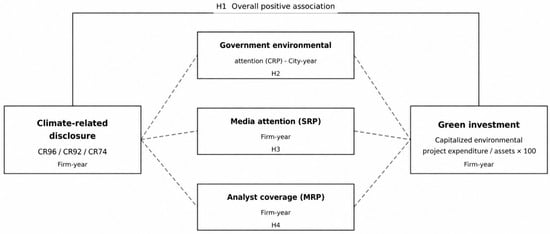
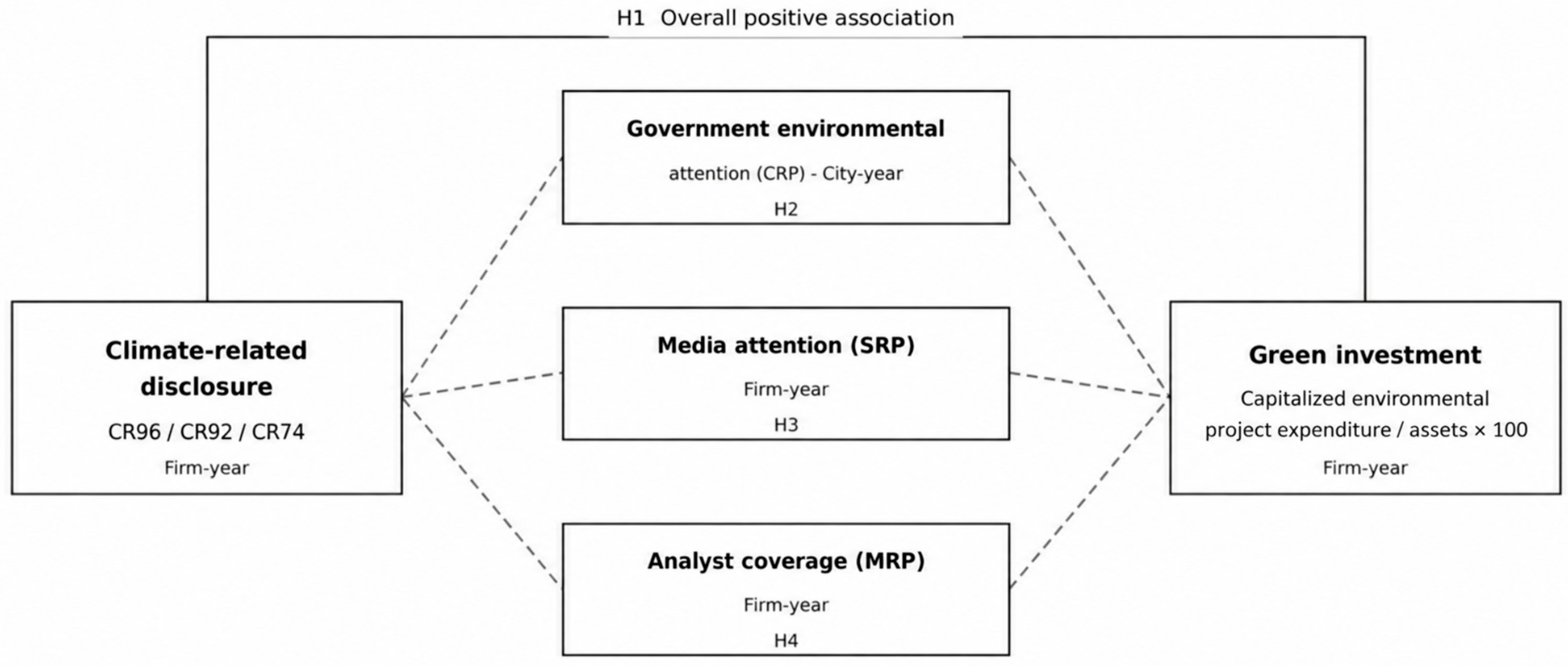
Figure 1 summarizes the hypothesized relationships. H1 concerns the overall disclosure–investment association and H2–H4 concern three indirect associations evaluated separately. Government environmental attention is measured at the city-year level; disclosure, media attention, analyst coverage and investment are measured at the firm-year level. Reputation provides a theoretical motivation for the proposed relationships. The diagram represents these hypotheses, with their empirical assessment presented in Section 4 and Section 5.
Figure 1.
Conceptual framework of climate-related disclosure, stakeholder attention and green investment. Notes: The solid line represents the overall association proposed in H1. Dashed lines represent the separate indirect associations proposed in H2–H4. Line styles distinguish the types of hypothesis; empirical support is assessed in the results. Government environmental attention is a city-level contextual measure. All relationships are formulated as associations.
3. Methods
3.1. Data Sources and Sample Construction
This study examines Chinese A-share listed firms over 2013–2023. The initial panel comprises 21,353 firm-year observations from 2926 firms. Climate-related term frequencies and total annual-report word counts are matched to the panel by firm and fiscal year. Government environmental attention is measured using municipal government work reports, while media coverage is obtained from the China Research Data Service Platform (CNRDS). Financial and corporate governance variables, together with the city climate measures, are obtained from the China Stock Market & Accounting Research Database (CSMAR). Supplementary city economic variables come from a statistical dataset compiled from statistical yearbooks and local statistical bureaus.
Requiring complete observations for the expanded firm controls yields 20,465 firm-year observations. The fixed-effects estimator excludes 19 singleton observations, resulting in a baseline sample of 20,446 observations from 2881 firms. City covariates are merged by city code and year. Of the baseline observations, 147 lack a matching city record and 343 have incomplete city covariates. The exclusion of these observations and a further 12 singletons produces a city-control estimation sample of 19,944 observations. Specifications with and without city covariates are compared using this common sample.
The main estimation sample comprises 20,446 firm-year observations, whereas the common sample used to compare specifications with and without municipal economic covariates comprises 19,944 observations. Additional samples are defined by the timing and estimation requirements of each analysis. Specifications controlling for prior-year investment use a common sample of 16,253 observations with investment observed in the preceding calendar year. Temporally ordered indirect-association models use 12,364 observations, linking disclosure and controls in year t to stakeholder attention in year t + 1 and green investment in year t + 2. These temporal specifications are distinct from both the contemporaneous models and the lagged climate comparisons. Positive-investment, PPML, city-restricted, and external climate analyses apply further specification-specific restrictions. Table A12 summarizes the sample definitions and retained observation counts; detailed restrictions are reported in the notes to the corresponding results tables.
The reconstructed climate indices are winsorized at the pooled 1st and 99th percentiles of the initial 21,353-observation panel. The same percentile rule is applied to cash flow, revenue growth and Tobin’s Q using the available matched observations in that panel. Winsorization thresholds for city covariates are calculated from distinct city-year records represented in the baseline sample, giving each city-year equal weight in determining the cutoffs. All thresholds remain fixed across subsequent sample restrictions and bootstrap replications. State ownership and log firm age retain their source values. Green investment and the original firm controls retain the values recorded in the initial panel.
3.2. Variable Definitions
3.2.1. Green Investment
Green investment (Ginvest) is measured as identified capitalized environmental expenditure reported in the construction-in-progress disclosures of corporate financial statements. These projects include desulfurization and denitrification, wastewater treatment, and energy conservation and emission reduction. Identified expenditure is divided by total assets and multiplied by 100, expressing investment intensity as a percentage of total assets. The measure covers capitalized environmental investment recorded in these disclosures. Environmental operating expenditure and the environmental performance of completed projects lie outside its measurement scope.
3.2.2. Climate-Related Disclosure
The climate-related disclosure measure is adapted from the Chinese annual-report approach of Du, Xu and Yang [49] and situated within the textual measurement literature [23,24]. The source frequency file contains 98 term columns, including duplicate entries for wind power and photovoltaic energy. Each duplicate contains the same frequency values as its corresponding original column. Retaining a single entry for each term yields a baseline dictionary of 96 unique terms, comprising 64 physical-risk terms and 32 transition-related terms. Table 1 presents the English translations, and Appendix A Table A1 reports the original Chinese terms, their translations and their inclusion in each dictionary.
Table 1.
Climate-related dictionary and exclusion rules.
Here, denotes the deduplicated dictionary, () is the supplied frequency of Chinese term (k) in firm (i)’s annual report for year (t), and ( is the total word count of that report. Higher values indicate a greater proportion of climate-related language in annual reports. The index measures climate-related disclosure, which may reflect both attention to climate-related subjects and corporate reporting choices. Its correspondence with local physical climate conditions is examined separately using city climate measures.
Two reduced dictionaries assess sensitivity to broad environmental and operational vocabulary. CR92 excludes green, low carbon, energy conservation and efficiency from CR96. CR74 excludes these four terms and the additional 18 terms listed in Table 1. The three indices share the same report-length denominator and percentage scale. Physical and transition components are constructed separately, with comparisons standardized using their respective standard deviations in the initial research panel. Results distinguish untrimmed and winsorized specifications.
3.2.3. Stakeholder Attention
Stakeholder attention is measured along three dimensions: government environmental attention, media attention and analyst coverage. Government environmental attention (CRP) is calculated as the percentage of environment-related terms in municipal government work reports [26]. Media attention (SRP) is measured as the natural logarithm of one plus the number of firm-related news headlines [50]. Analyst coverage (MRP) is defined as the natural logarithm of one plus the number of analyst teams covering the firm in a given year [48]. CRP captures the prominence of environmental issues in the municipal policy agenda, whereas SRP and MRP capture general firm-level attention from the media and financial analysts, respectively. Each measure enters the indirect-association analysis separately.
3.2.4. Control Variables
The baseline specification controls for firm size, leverage, profitability, CEO duality, ownership concentration, board independence, log annual-report length, cash flow, revenue growth, Tobin’s Q, state ownership and log firm age. Log report length accounts for variation in the volume of annual-report text. Supplementary city-control specifications include log GDP per capita, the tertiary-sector share of GDP, the bank-loan-to-GDP ratio and the fiscal-expenditure-to-GDP ratio. These four city covariates also enter the channel models. Table 2 summarizes the variable definitions.
Table 2.
Variable definitions.
3.3. Empirical Specifications
The association between climate-related disclosure and corporate green investment is estimated using the following model:
where denotes green investment and denotes climate-related disclosure for firm in year . contains firm-level controls and log report length. The terms , and represent firm, industry-by-year and province-by-year fixed effects, respectively. Each dictionary index enters a separate regression. Baseline standard errors are clustered by firm.
Indirect associations through stakeholder attention are estimated as follows:
represents government environmental attention (CRP), media attention (SRP) or analyst coverage (MRP), with each channel estimated separately. contains four city-level covariates. The product measures the conditional indirect association. Temporally ordered specifications relate disclosure and controls at to attention at and investment at , with fixed effects indexed by . The superscripts and distinguish the fixed-effect parameters in the stakeholder-attention and green-investment equations, respectively.
Inference uses 1000 successful cluster-bootstrap replications, resampling firms in the contemporaneous and temporally ordered specifications and cities in the restricted specification. Both 95% percentile confidence intervals and Bonferroni-adjusted intervals across the three channels are reported for each dictionary and specification.
4. Empirical Results
4.1. Sample and Descriptive Statistics
The original panel comprises 21,353 firm-year observations for 2926 Chinese A-share listed firms over 2013–2023. Requiring complete controls and excluding fixed-effect singletons yields 20,446 observations from 2881 firms in 180 cities. Table 3 presents the descriptive statistics; additional sample restrictions are specified in the corresponding table notes.
Table 3.
Descriptive statistics for the main estimation sample.
Green investment averages 0.164% of total assets, with a standard deviation of 0.740 percentage points. Recorded investment is zero in 16,616 observations (81.27%), motivating the PPML and investment-participation analyses. The mean values of CR96, CR92 and CR74 are 0.164, 0.140 and 0.020, respectively.
Appendix A Table A2 reports a Pearson correlation of 0.259 between CR96 and Ginvest. The largest absolute correlation among baseline explanatory variables is 0.509, between size and leverage. Across the three dictionary specifications, maximum pooled VIFs range from 2.279 to 2.288, and maximum VIFs after absorbing fixed effects range from 1.400 to 1.403, indicating modest collinearity (Appendix A Table A3).
4.2. Baseline Association and Economic Magnitude
Table 4 reports positive coefficients of 0.591, 0.645 and 1.605 for CR96, CR92 and CR74, respectively, all significant at the 1% level. The association persists across the reduced dictionaries after controlling for firm characteristics, report length and firm, industry-by-year and province-by-year fixed effects.
Table 4.
Expanded-control baseline estimates.
A one-standard-deviation increase in CR96 is associated with a 0.0894-percentage-point difference in green investment as a share of total assets, conditional on the included controls and fixed effects. This difference is equivalent to approximately 12.1% of the sample standard deviation of Ginvest and 54.5% of its sample mean of 0.164% of total assets. For illustration, holding total assets at RMB 1 billion, a difference of this magnitude corresponds to approximately RMB 894,000 in identified environmental capital expenditure. The corresponding one-standard-deviation differences for CR92 and CR74 are 0.0883 and 0.0785 percentage points, respectively.
The mean-relative comparison should be interpreted in light of the investment distribution: 81.27% of observations record zero identified green investment, resulting in a low unconditional mean. The estimate therefore represents a sizeable difference relative to average recorded investment, while remaining below one tenth of a percentage point of total assets. It describes a conditional association across observations that include both zero and positive investment, rather than a causal percentage increase in expenditure among firms already investing.
4.3. Robustness Checks and Endogeneity Considerations
Table 5 summarizes robustness checks for control selection, statistical inference and model specification.
Table 5.
Specification and inference checks.
4.3.1. Alternative Controls and Clustering
On the common estimation sample, adding firm controls changes the CR96 coefficient from 0.595 to 0.591. Untrimmed added controls yield similar estimates (Appendix A Table A4). Positive associations also persist under city and two-way firm-city clustering (Table 5, Panel A).
4.3.2. Controlling for Prior Investment
Specifications with and without prior-year green investment use the same 16,253 observations. Including prior investment reduces the coefficients from 0.523 to 0.394 for CR96, 0.554 to 0.428 for CR92 and 1.216 to 0.994 for CR74. All remain significant at the 5% level (Table 5, Panel A).
4.3.3. City Controls and Sample Sensitivity
Adding city GDP per capita, industrial structure, credit, and fiscal expenditure controls yields coefficients of 0.588, 0.662 and 1.686 for CR96, CR92 and CR74, respectively. All are significant at the 5% level with city-clustered standard errors on the common sample of 19,944 observations (Table 5, Panel B). Estimates remain similar with untrimmed city controls and after excluding observations associated with an unusually high city-level loan-to-GDP ratio (Appendix A Table A5).
4.3.4. Alternative Estimation
PPML estimates are positive and significant at the 1% level across all three dictionaries, both with and without city controls (Table 5). Section 4.4 examines zero investment and distinguishes investment participation from expenditure intensity.
4.3.5. Endogeneity Considerations
Firm, industry-by-year and province-by-year fixed effects account for time-invariant firm characteristics and common shocks within industries and provinces. Expanded firm controls and supplementary city covariates further address observable differences. Controlling for prior-year green investment yields coefficients of 0.394, 0.428 and 0.994 for CR96, CR92 and CR74, respectively, all significant at the 5% level (Table 5, Panel A). This specification incorporates investment history, subject to the limitations of dynamic fixed-effects estimation.
Following Cinelli and Hazlett [51], omitted-variable sensitivity analysis evaluates the strength of unobserved confounding required to alter the baseline estimates. Under an equal-strength scenario, the partial R2 thresholds required to halve the coefficients are 2.69%, 2.57% and 2.33% for CR96, CR92 and CR74, respectively; reducing the coefficients to zero requires corresponding thresholds of 5.30%, 5.08% and 4.61% (Table 5, Panel C). These values quantify the sensitivity of the estimated associations to omitted confounding.
4.4. Zero Investment and Investment Intensity
PPML coefficients are positive and significant at the 1% level for all three dictionaries (Table 5). The retained sample comprises 8377 observations from 1106 firms, including 4583 zero-investment observations. Its smaller size reflects singleton and separation screening, including the exclusion of firms with consistently zero investment.
Table 6 distinguishes the probability of recording positive green investment from investment intensity conditional on positive expenditure. All three disclosure indices are positively associated with the probability of recording green investment at the 1% level. In the positive-investment sample, however, the coefficients have p-values of 0.091 for CR96, 0.147 for CR92 and 0.141 for CR74. These results provide consistent evidence of an association with investment participation, but do not establish a robust association with expenditure intensity among observations with positive investment. The intensity estimates are conditional on selection into the positive-investment sample. The positive PPML estimates reported above concern the conditional mean of investment in a sample containing both zero and positive observations and do not separately establish an intensive-margin association.
Table 6.
Investment participation and positive investment intensity.
5. Further Analyses
5.1. Potential Stakeholder Channels
Table 7 reports indirect associations through government environmental attention, media attention and analyst coverage, controlling for firm and city characteristics. These variables capture municipal policy attention and general firm coverage. The contemporaneous, temporally ordered and city-restricted specifications contain 19,944, 12,364 and 17,015 observations, respectively; Table 7 explains the sample restrictions.
Table 7.
Indirect associations for CR96.
For CR96, contemporaneous indirect estimates are 0.00026 for government environmental attention, 0.00345 for media attention and 0.00658 for analyst coverage. All 95% percentile confidence intervals include zero. The media and analyst estimates amount to approximately 0.59% and 1.12% of the contemporaneous total coefficient of 0.588. Contemporaneous estimates for CR92 and CR74, and all nine temporally ordered estimates, also have intervals containing zero.
The city-restricted CR96 analyst estimate has a nominal interval above zero, but its Bonferroni-adjusted interval includes zero. Across all 27 estimates, every adjusted interval contains zero (Appendix A Table A7). The evidence therefore provides insufficient support for Hypotheses 2–4.
For contemporaneous CR96, residual correlations of approximately 0.020–0.024 bring the indirect point estimates to zero in the sensitivity analysis (Appendix A Table A8), indicating sensitivity to unobserved common determinants. Financing constraints, green credit or subsidies, supply-chain requirements and managerial attention remain alternative explanations for the disclosure–investment association.
5.2. Differences Between Physical and Transition Text Indices
Joint regressions compare the physical and transition text indices after standardization using their respective original-panel standard deviations. For CR96, the transition coefficient is 0.0907 and the physical coefficient is −0.0034. Their difference is significant under both firm clustering (p < 0.001) and city clustering (p = 0.022). Differences remain positive and significant at the 5% level for CR92 and CR74 (Table 8).
Table 8.
Standardized transition minus physical coefficient comparisons.
The stronger association thus concerns transition-related language, which may reflect environmental strategy and investment orientation. Raw-index comparisons are broadly similar, although the city-clustered CR92 comparison is weaker (p = 0.055; Appendix A Table A9). These comparisons indicate a stronger standardized association for transition-related disclosure than for physical-risk language.
5.3. Industry Heterogeneity
Industry differences vary across dictionaries and estimators. For manufacturing firms, the CR96 interaction is marginally significant in OLS with firm clustering (p = 0.058), insignificant with city clustering (p = 0.126), and significant in PPML (p = 0.047). CR74 interactions are insignificant in both estimators.
For heavily polluting firms, the CR96 interaction is significant in OLS under firm and city clustering (p = 0.008 and 0.004), but insignificant in PPML (p = 0.124). The reduced dictionaries provide weaker evidence, with CR74 differences insignificant across the reported specifications. Appendix A Table A10 presents the complete results. Industry heterogeneity therefore has limited robustness.
5.4. Exploratory External Checks Using City Climate Measures
The city-level climate regressions are exploratory external checks of correspondence between annual-report language and local climatic conditions. They provide supplementary evidence on the interpretation of the textual indices rather than a definitive validation of firm-level physical climate exposure. The contemporaneous and lagged comparisons use 20,280 and 20,270 firm-year observations, respectively, reflecting climate-data availability and fixed-effect singleton removal (Appendix A Table A11).
The composite climate index provides limited evidence of correspondence with the disclosure measures. CR96 is not significantly associated with contemporaneous CPRI (p = 0.483), and the corresponding associations for CR92 and CR74 are also insignificant. For the winsorized physical text index, the contemporaneous association with CPRI is weak (p = 0.085), while the lagged association is insignificant (p = 0.900).
Extreme rainfall shows a positive association with the physical text index, although the strength of the evidence depends on the treatment of the textual measure. For the untrimmed index, the nominal p-value is 0.031 and the Holm-adjusted p-value is 0.123. For the winsorized index, the corresponding values are 0.004 and 0.016. This pattern suggests possible correspondence with a specific local weather dimension, but the broader composite-index results and sensitivity to winsorization limit generalization. The textual indices are therefore interpreted as measures of climate-related disclosure; their correspondence with local climatic conditions remains exploratory.
6. Discussion
6.1. Climate-Related Disclosure and Green Investment
The findings support the positive association proposed in Hypothesis 1. This result complements Zhou and Feng [19], who link climate risk to corporate green innovation, and Liu et al. [20], who associate climate-risk perceptions with green and low-carbon transformation. The present study examines capitalized environmental expenditure, capturing the allocation of financial resources to identifiable projects. Investment commitments, technological innovation, and environmental transformation represent related but distinct dimensions of corporate responses to climate concerns.
Li and Tian [21] provide a closer comparison by linking public climate-risk perception to corporate green investment and identifying a moderating role for environmental image. The present analysis focuses on firms’ own annual-report language. Its positive association with investment suggests that corporate climate narratives contain information relevant to environmental resource allocation. The persistence of this association across reduced dictionaries strengthens the evidence beyond a particular selection of generic environmental terms.
The investment-margin results indicate that climate-related disclosure is more consistently associated with whether firms record identifiable environmental investment than with expenditure intensity conditional on positive investment. Recording positive expenditure does not necessarily identify the initiation of a new project, because the measure may also capture expenditure on ongoing projects. The findings therefore support distinguishing investment participation from expenditure intensity, while leaving the relationship between disclosure and the scale of spending among investing firms unresolved.
6.2. Government Environmental Attention
The indirect-association tests provide insufficient support for Hypothesis 2. Chen et al. [26] find that government environmental attention promote green innovation, particularly strategic innovation. Huang and Lei [16] show that the relationship between environmental regulation and green investment varies across regulatory instruments. These findings emphasize the importance of distinguishing policy attention, regulatory implementation and the corporate outcome under examination.
The present hypothesis concerns whether municipal environmental attention links firm-level climate-related disclosure to green investment. Government work-report language captures the prominence of environmental issues in the local policy agenda. Inspections, penalties, subsidies, and financing arrangements represent more specific instruments through which that agenda may influence investment. Municipal attention is also shared across firms, whereas corporate disclosure and expenditure vary at the firm level.
Comparison with the environmental-supervision explanation advanced by Zhou and Feng [19] highlights differences in both measurement and the relationship being tested. Municipal report language records policy priorities, whereas supervision involves administrative implementation. The present analysis examines the indirect association linking corporate disclosure, municipal attention, and investment; research on environmental supervision examines a different link between governance and corporate activity.
6.3. Media Attention and Analyst Coverage
Hypothesis 3 receives insufficient support across the reported specifications. He et al. [27] find that media coverage improves corporate ESG performance through mechanisms involving analyst attention and agency costs. Their analysis concerns media coverage as an explanatory factor for a broad performance measure. The present study tests the more specific proposition that coverage links climate-related disclosure to capitalized environmental expenditure.
This distinction is relevant because general firm-related news includes reporting on earnings, products and ownership changes alongside environmental issues. Coverage volume captures visibility, while reputational evaluation also depends on the content and interpretation of that coverage. The limited indirect association therefore directs attention to the measurement of climate-specific scrutiny and its relevance to investment decisions.
The evidence for Hypothesis 4 is similarly limited after adjustment for multiple testing. Davrinche et al. [28] report a positive relationship between analysts’ environmental attention and green investment among French listed firms under the EU Taxonomy framework. Their environmental-attention measure differs from the number of analyst teams used here, which captures the breadth of general professional coverage. Measurement and institutional differences provide plausible reasons for the contrasting evidence.
Analyst coverage may also combine competing incentives. Guo et al. [48] distinguish informational benefits from pressure effects and show that coverage influences internal research expenditure and external innovation investment differently. Such competing influences offer a possible explanation for a weak aggregate indirect association. The present estimates leave their relative importance unresolved.
7. Conclusions, Implications and Future Research
7.1. Conclusions
This study examines the association between climate-related disclosure and green investment among Chinese A-share listed firms during 2013–2023. Based on 20,446 firm-year observations, the results indicate a positive conditional association between climate-related annual-report language and identified environmental capital expenditure. This relationship persists across alternative dictionaries, additional controls and supplementary specifications. Evidence is more consistent for investment participation than for expenditure intensity among firms with positive investment.
The findings support Hypothesis 1, while the proposed indirect associations through government environmental attention, media attention and analyst coverage receive insufficient support. All multiple-testing-adjusted confidence intervals for the indirect estimates include zero. Transition-related language exhibits a stronger standardized association than physical-risk language, whereas industry differences vary across specifications. This study connects corporate climate narratives with observable resource commitments and distinguishes this association from its proposed stakeholder channels.
7.2. Managerial and Policy Implications
For corporate managers, the positive disclosure–investment association provides a basis for linking climate-related reporting more closely to capital budgeting. Annual reports could connect material climate-related statements to identifiable environmental projects, specifying project purpose, annual expenditure, implementation stage, and expected completion date. Internal investment records should distinguish pollution treatment, source prevention, and clean-energy substitution [52]. Given the more consistent evidence for investment participation than expenditure intensity, project approval and expenditure scale warrant separate assessment: recording an environmental project establishes a financial commitment, while its scale and effectiveness require evaluation against operational needs and subsequent performance. Project reviews could track energy use, emissions and operating costs against a documented pre-investment baseline.
For policymakers and reporting authorities in China, a standardized environmental expenditure schedule could improve the comparability of corporate disclosures [53,54]. Such a schedule could distinguish current-year additions from accumulated project balances, separate capital expenditure from operating expenses, and identify the purpose and completion status of major projects. Explicit reporting categories for zero expenditure, unavailable information and expenditure outside the classification would improve the interpretation of recorded zeros. Municipal environmental priorities could also be accompanied by implementation indicators, including inspections, penalties, subsidy disbursements and project completion, allowing policy attention and administrative implementation to be assessed separately.
For investors and analysts, climate-related language can serve as an initial signal for further examination of environmental commitments. Assessment could trace reported commitments to project expenditure, financing arrangements and completion records, and then compare planned outcomes with subsequent energy consumption, emissions and operating performance [55,56,57]. Investors and analysts could complement coverage counts with an assessment of whether reports address specific environmental projects, expenditure and implementation outcomes. This approach would support evaluation of the consistency between corporate statements, documented spending and verifiable project progress.
7.3. Limitations and Future Research
First, the textual indices measure climate-related disclosure, which may reflect managerial attention and corporate reporting choices. Dictionary refinement and report-length controls improve measurement transparency, while reporting tone and firm-specific responses to disclosure-policy changes remain potential influences. City-level climate measures also provide incomplete coverage of exposure across operating sites and supply chains. Future research could combine contextual text analysis, geographically detailed climate data and reporting-policy information to distinguish exposure, managerial attention, and disclosure choices.
Second, the observational design leaves reverse causality and unobserved time-varying firm characteristics unresolved. Environmental investment may itself generate climate-related reporting. Research designs based on credibly identified policy or climate shocks could strengthen causal inference. Climate-specific media coverage, enforcement records and direct reputation measures would also improve the assessment of stakeholder channels.
Third, green investment comprises identified capitalized environmental projects, excluding environmental operating expenses and expenditure outside the adopted classification. Recorded zeros indicate an absence of identified expenditure within this reporting boundary. Project-level data could distinguish investment types and connect expenditure with completed capacity, emissions reductions, resource efficiency and financial performance. Such evidence is necessary to assess how financial commitments translate into environmental and economic benefits.
Finally, the findings concern Chinese A-share listed firms during 2013–2023. State involvement in the economy, environmental governance and the institutional structure of media and capital markets shape their interpretation. Comparisons with unlisted firms, other economies, and subsequent periods would clarify how the disclosure–investment relationship varies across institutional settings.
Author Contributions
Conceptualization, Y.Z. (Yuming Zhang), G.S. and Y.Z. (Yanbing Zhang); Methodology, Y.Z. (Yuming Zhang); Software, Y.Z. (Yuming Zhang); Validation, Y.Z. (Yuming Zhang); Formal Analysis, G.S.; Investigation, G.S.; Resources, G.S.; Data Curation, Y.Z. (Yuming Zhang); Writing—Original Draft, Y.Z. (Yuming Zhang); Writing—Review and Editing, G.S.; Supervision, G.S. and Y.Z. (Yanbing Zhang). All authors have read and agreed to the published version of the manuscript.
Funding
This paper is supported by Fundamental Research Funds for the Central Universities under grant 104972026RSCbs0227.
Institutional Review Board Statement
Not applicable.
Informed Consent Statement
Not applicable.
Data Availability Statement
The data presented in this study are available on request from the first author. The data are not publicly available due to privacy.
Conflicts of Interest
The authors declare no conflicts of interest.
Abbreviations
The following abbreviations are used in this manuscript:
| CEO | Chief executive officer |
| CI | Confidence interval |
| CNRDS | China Research Data Service Platform |
| CPRI | City-level composite climate risk index |
| CR | Climate-related disclosure index |
| CR96 | Climate-related disclosure index based on the 96-term deduplicated dictionary |
| CR92 | Climate-related disclosure index excluding four generic terms from CR96 |
| CR74 | Climate-related disclosure index excluding 22 terms from CR96 |
| CRP | Government environmental attention |
| CSMAR | China Stock Market & Accounting Research Database |
| EED | Number of extreme drought days |
| ERD | Number of extreme rainfall days |
| ESG | Environmental, social and governance |
| EU | European Union |
| GDP | Gross domestic product |
| Ginvest | Green investment, measured as identified capitalized environmental expenditure as a percentage of total assets |
| HTD | Number of extreme high-temperature days |
| LTD | Number of extreme low-temperature days |
| MRP | Analyst coverage |
| OLS | Ordinary least squares |
| PPML | Poisson pseudo-maximum likelihood |
| ROA | Return on assets |
| SD | Standard deviation |
| SE | Standard error |
| SRP | Media attention |
| VIF | Variance inflation factor |
Appendix A. Supplementary Empirical Results
The appendix reports supplementary estimates and diagnostics. Baseline models include the firm controls and report length. City covariates enter Table A5 and the channel and sensitivity analyses in Table A7 and Table A8. The remaining tables retain the baseline control specification. All regression models include firm, industry-by-year, and province-by-year fixed effects unless otherwise indicated.
Table A1.
Bilingual climate-related dictionary and index membership.
Table A2.
Pearson correlation matrix.
Table A3.
Variance inflation diagnostics.
Table A4.
Complete baseline and control-set comparisons.
Table A5.
City-control comparisons.
Table A6.
Clustering and investment-margin checks.
Table A7.
Complete indirect associations.
Table A8.
Residual correlations that set indirect point estimates to zero.
Table A9.
Complete standardized risk-type comparisons.
Table A10.
Complete formal industry comparisons.
Table A11.
Exploratory external checks of correspondence with city climate measures.
Table A12.
Sample definitions and observation counts.
References
- Jufri, F.H.; Widiputra, V.; Jung, J. State-of-the-art review on power grid resilience to extreme weather events: Definitions, frameworks, quantitative assessment methodologies, and enhancement strategies. Appl. Energy 2019, 239, 1049–1065. [Google Scholar] [CrossRef] [Scilit]
- Giglio, S.; Kelly, B.; Stroebel, J. Climate Finance. Annu. Rev. Financ. Econ. 2021, 13, 15–36. [Google Scholar] [CrossRef] [Scilit]
- Battiston, S.; Dafermos, Y.; Monasterolo, I. Climate risks and financial stability. J. Financ. Stab. 2021, 54, 100867. [Google Scholar] [CrossRef] [Scilit]
- Diallo, M.N.; Bah, M.M.; Ndiaye, S.N. Climate risk and financial stress in ECOWAS. J. Clim. Finance 2023, 5, 100025. [Google Scholar] [CrossRef] [Scilit]
- Mallea, F.L. Climate policy uncertainty and macroeconomic dynamics: Financial amplification and state-dependent effects. Econ. Model. 2026, 158, 107523. [Google Scholar] [CrossRef] [Scilit]
- Dou, Y.; Zhang, L.; Wang, H.; Wang, Y. Does climate risk inhibit enterprise resilience? Evidence from Chinese listed companies. Theor. Appl. Climatol. 2026, 157, 80. [Google Scholar] [CrossRef] [Scilit]
- Zhang, J.; Li, Y.; Liu, Z.; Zhang, Y.; Miao, X. Does climate risk affect the financial performance of enterprises: Empirical evidence from A-share listed high-water-consuming enterprises in China. Int. Rev. Financ. Anal. 2026, 117, 105243. [Google Scholar] [CrossRef] [Scilit]
- He, F.; Ren, X.; Wang, Y.; Lei, X. Climate risk and corporate bond credit spreads. J. Int. Money Finance 2025, 154, 103297. [Google Scholar] [CrossRef] [Scilit]
- Yuan, M.; Hu, H.; Xue, M.; Li, J. Climate change adaptation, supply chain resilience, and performance: An organizational capability perspective. Oper. Manag. Res. 2026, 19, 33. [Google Scholar] [CrossRef] [Scilit]
- Ren, X.; Li, Y.; Shahbaz, M.; Dong, K.; Lu, Z. Climate risk and corporate environmental performance: Empirical evidence from China. Sustain. Prod. Consum. 2022, 30, 467–477. [Google Scholar] [CrossRef] [Scilit]
- Song, Y.; Wang, C.; Wang, Z. Climate risk, institutional quality, and total factor productivity. Technol. Forecast. Soc. Change 2023, 189, 122365. [Google Scholar] [CrossRef] [Scilit]
- Gao, D.; Li, Y.; Tan, L.F. Can environmental regulation break the political resource curse: Evidence from heavy polluting private listed companies in China. J. Environ. Plan. Manag. 2024, 67, 3190–3216. [Google Scholar] [CrossRef] [Scilit]
- Wang, J.; Ma, M.; Dong, T.; Zhang, Z. Do ESG ratings promote corporate green innovation? A quasi-natural experiment based on SynTao Green Finance’s ESG ratings. Int. Rev. Financ. Anal. 2023, 87, 102623. [Google Scholar] [CrossRef] [Scilit]
- Xu, X.; Zhang, C.; Yang, L. Green bonds: Catalyst or constraint for corporate green investment efficiency? J. Multinatl. Financ. Manag. 2025, 79, 100920. [Google Scholar] [CrossRef] [Scilit]
- Yang, F.; Wang, Y. How does environmental pollution liability insurance promote green innovation of firms? evidence from listed industrial firms in China. Environ. Dev. Sustain. 2026. [Google Scholar] [CrossRef] [Scilit]
- Huang, L.; Lei, Z. How environmental regulation affect corporate green investment: Evidence from China. J. Clean. Prod. 2021, 279, 123560. [Google Scholar] [CrossRef] [Scilit]
- Liao, X.; Shi, X. Public appeal, environmental regulation and green investment: Evidence from China. Energy Policy 2018, 119, 554–562. [Google Scholar] [CrossRef] [Scilit]
- Wang, L.; Zeng, T.; Li, C. Behavior decision of top management team and enterprise green technology innovation. J. Clean. Prod. 2022, 367, 133120. [Google Scholar] [CrossRef] [Scilit]
- Zhou, J.; Feng, Y. Climate risk, environmental supervision, and corporate green innovation. Int. Rev. Financ. Anal. 2025, 107, 104581. [Google Scholar] [CrossRef] [Scilit]
- Liu, X.; Wu, X.; Kong, X. Do Climate-Related Risks Perception Drive Corporate Green and Low-Carbon Transformation? Evidence from Listed Companies in China. Emerg. Mark. Finance Trade 2024, 60, 2938–2959. [Google Scholar] [CrossRef] [Scilit]
- Li, X.; Tian, Q. Public Perception of Climate Risk, Environmental Image, and Corporate Green Investment. Ann. Am. Assoc. Geogr. 2024, 114, 1137–1155. [Google Scholar] [CrossRef] [Scilit]
- Peng, H.; Liu, X.; Zhao, Y. How Does Climate Risk Shape Firms to Green Investment? The Roles of External Stakeholder Attention and Internal Strategic Orientation. Sustainability 2026, 18, 8774. [Google Scholar] [CrossRef] [Scilit]
- Nagar, V.; Schoenfeld, J. Measuring weather exposure with annual reports. Rev. Account. Stud. 2024, 29, 1–32. [Google Scholar] [CrossRef] [Scilit]
- Li, Q.; Shan, H.; Tang, Y.; Yao, V. Corporate Climate Risk: Measurements and Responses. Rev. Financ. Stud. 2024, 37, 1778–1830. [Google Scholar] [CrossRef] [Scilit]
- Fombrun, C.; Shanley, M. What’s in a Name? Reputation Building and Corporate Strategy. Acad. Manag. J. 1990, 33, 233–258. [Google Scholar] [CrossRef] [Scilit]
- Chen, J.; Zhu, D.; Ding, S.; Qu, J. Government environmental concerns and corporate green innovation: Evidence from heavy-polluting enterprises in China. Bus. Strategy Environ. 2024, 33, 1920–1936. [Google Scholar] [CrossRef] [Scilit]
- He, F.; Guo, X.; Yue, P. Media coverage and corporate ESG performance: Evidence from China. Int. Rev. Financ. Anal. 2024, 91, 103003. [Google Scholar] [CrossRef] [Scilit]
- Davrinche, G.; Filbien, J.-Y.; Vigneron, L. Do analysts matter for green investment? Evidence from the EU taxonomy. Econ. Lett. 2025, 250, 112277. [Google Scholar] [CrossRef] [Scilit]
- Huang, H.H.; Kerstein, J.; Wang, C.; Wu, F. Firm climate risk, risk management, and bank loan financing. Strateg. Manag. J. 2022, 43, 2849–2880. [Google Scholar] [CrossRef] [Scilit]
- Pankratz, N.; Bauer, R.; Derwall, J. Climate Change, Firm Performance, and Investor Surprises. Manag. Sci. 2023, 69, 7352–7398. [Google Scholar] [CrossRef] [Scilit]
- Arian, A.; Naeem, M.A. Climate risk and corporate investment behavior in emerging economies. Emerg. Mark. Rev. 2025, 65, 101257. [Google Scholar] [CrossRef] [Scilit]
- Newbert, S.L. Value, rareness, competitive advantage, and performance: A conceptual-level empirical investigation of the resource-based view of the firm. Strateg. Manag. J. 2008, 29, 745–768. [Google Scholar] [CrossRef] [Scilit]
- Awan, U.; Arnold, M.G.; Gölgeci, I. Enhancing green product and process innovation: Towards an integrative framework of knowledge acquisition and environmental investment. Bus. Strategy Environ. 2021, 30, 1283–1295. [Google Scholar] [CrossRef] [Scilit]
- Dutta, A.; Bouri, E.; Rothovius, T.; Uddin, G.S. Climate risk and green investments: New evidence. Energy 2023, 265, 126376. [Google Scholar] [CrossRef] [Scilit]
- Ginglinger, E.; Moreau, Q. Climate Risk and Capital Structure. Manag. Sci. 2023, 69, 7492–7516. [Google Scholar] [CrossRef] [Scilit]
- He, F.; Duan, L.; Cao, Y.; Wen, S.Y. Green credit policy and corporate climate risk exposure. Energy Econ. 2024, 133. [Google Scholar] [CrossRef] [Scilit]
- Liu, K.; Cao, L.; Zhou, J. Front-end or end-of-pipe? the impact of the government focus on corporate environmental investment choices. Finance Res. Lett. 2026, 92, 109530. [Google Scholar] [CrossRef] [Scilit]
- Liu, Y.Y.; Niu, J.J.; Zhou, Y.B.; Huang, R.Q. Achieving corporate sustainable development through social responsibility, green activities, and stakeholders management: A multidirectional cause analysis. Sustain. Dev. 2023, 31, 2997–3007. [Google Scholar] [CrossRef] [Scilit]
- Yin, Z.; Deng, R.; Xia, J.; Zhao, L. Climate risk and corporate ESG performance: Evidence from China. N. Am. J. Econ. Finance 2024, 74, 102245. [Google Scholar] [CrossRef] [Scilit]
- Dyck, A.; Volchkova, N.; Zingales, L. The Corporate Governance Role of the Media: Evidence from Russia. J. Finance 2008, 63, 1093–1135. [Google Scholar] [CrossRef] [Scilit]
- Bednar, M.K.; Boivie, S.; Prince, N.R. Burr Under the Saddle: How Media Coverage Influences Strategic Change. Organ. Sci. 2013, 24, 910–925. [Google Scholar] [CrossRef] [Scilit]
- Chang, K.; Fu, H.; Yang, M.; Cai, X. Impact of media green attention on firm green transformation: Evidence from firm-level financial news in China. Environ. Dev. Sustain. 2026. [Google Scholar] [CrossRef] [Scilit]
- Yang, G.; Wei, S.; Chen, K.; Ren, Y. Repairing damaged reputations through targeted poverty alleviation: Evidence from private companies’ strategies to deal with negative media coverage. China J. Account. Res. 2023, 16, 100306. [Google Scholar] [CrossRef]
- Khiari, C.; Khanchel, I.; Rjiba, H.; Lotto, J.D.; Hussain, N. Climate Change Risk and Financial Market Response: An International Evidence From Performance Forecasts by Financial Analysts. J. Forecast. 2025, 44, 2315–2330. [Google Scholar] [CrossRef] [Scilit]
- Bolton, P.; Kacperczyk, M. Do investors care about carbon risk? J. Financ. Econ. 2021, 142, 517–549. [Google Scholar] [CrossRef] [Scilit]
- Amiram, D.; Owens, E.; Rozenbaum, O. Do information releases increase or decrease information asymmetry? New evidence from analyst forecast announcements. J. Account. Econ. 2016, 62, 121–138. [Google Scholar] [CrossRef] [Scilit]
- Ming, Y.; Li, Y.; Liu, N.; Li, J. Retail investor attention and corporate environmental performance: Evidence from China. Finance Res. Lett. 2023, 56, 104143. [Google Scholar] [CrossRef] [Scilit]
- Guo, B.; Pérez-Castrillo, D.; Toldrà-Simats, A. Firms’ innovation strategy under the shadow of analyst coverage. J. Financ. Econ. 2019, 131, 456–483. [Google Scholar] [CrossRef] [Scilit]
- Du, J.; Xu, X.; Yang, Y. Does Climate Risk Affect the Cost of Equity Capital? Evidence from Textual Analysis of Chinese Listed Companies’ Annual Reports. J. Financ. Res. 2023, 15, 19–46. (In Chinese) [Google Scholar]
- Chen, D.; Zhang, Q. Media attention and corporate digital transformation. Int. Rev. Econ. Finance 2025, 102, 104288. [Google Scholar] [CrossRef] [Scilit]
- Cinelli, C.; Hazlett, C. Making sense of sensitivity: Extending omitted variable bias. J. R. Stat. Soc. Ser. B Stat. Methodol. 2020, 82, 39–67. [Google Scholar] [CrossRef] [Scilit]
- Sun, G.; Song, Y.; Xiao, J.; Xu, D. Artificial Intelligence and Sustainable Aviation Manufacturing: A Perspective from Green Innovation in China. Sustainability 2026, 18, 4298. [Google Scholar] [CrossRef] [Scilit]
- Sun, G.; Mao, Y.; Gong, L. Systematic Green Transformation Brought by Environmental System Reform: Evidence from Environmental Courts and Environmental Information Disclosure of Polluting Enterprises in China. Systems 2026, 14, 1233. [Google Scholar] [CrossRef] [Scilit]
- Yang, K.; Sun, G.; Hu, X.; Wang, Y. Environmental Courts and Supply Chain Financing in China. Sustainability 2025, 17, 10723. [Google Scholar] [CrossRef] [Scilit]
- Guo, Y.; Chen, R.; Allaoui, H.; Choudhary, A.; Li, W. A dual attention graph neural network framework for sustainable supply chain optimization under energy performance contracting. Transp. Res. Part E Logist. Transp. Rev. 2026, 208, 104702. [Google Scholar] [CrossRef] [Scilit]
- Qin, Z.; Sha, Z. Optimizing anthropogenic management practices can effectively enhance the vegetation carbon sequestration in China. J. Environ. Manag. 2026, 411, 130196. [Google Scholar] [CrossRef] [Scilit] [PubMed]
- Huang, L.; Sun, G.; Zhang, J. Artificial Intelligence and Carbon Emissions of Manufacturing Enterprises in China. Sustainability 2026, 18, 7645. [Google Scholar] [CrossRef] [Scilit]

Disclaimer/Publisher’s Note: The statements, opinions and data contained in all publications are solely those of the individual author(s) and contributor(s) and not of MDPI and/or the editor(s). MDPI and/or the editor(s) disclaim responsibility for any injury to people or property resulting from any ideas, methods, instructions or products referred to in the content. |
© 2026 by the authors. Licensee MDPI, Basel, Switzerland. This article is an open access article distributed under the terms and conditions of the Creative Commons Attribution (CC BY) license.