


Abstract
Does the Internet replace guanxi as a source of economic opportunity? Using 13,273 household-year observations from four waves of the China Family Panel Studies (CFPS, 2014–2020), this study examines whether Internet use conditions the marginal association between relational investment and household income quality during an earlier phase of rural digitalization in China. Income quality is measured along four dimensions: adequacy, structure, stability, and cost. We estimate household fixed-effects models with county × year fixed effects using an equal-weighted composite index. In the absence of a strong source of exogenous variation, the estimates are interpreted as conditional associations rather than causal effects. The results show that relational investment and Internet use are both positively associated with income quality, while their interaction is negative. This attenuation is concentrated in income adequacy and structure, with no significant interaction for stability or cost. We therefore interpret the negative interaction as consistent with partial relational uncoupling rather than as uniquely identifying a substitution mechanism: Internet use may weaken selected opportunity-allocation functions of guanxi without displacing guanxi as a social relationship. The supplementary off-farm-employment analysis does not establish mediation, although relational investment remains positively associated with off-farm employment. Heterogeneity is most suggestive among households with stronger non-farm livelihood orientation. Overall, the findings suggest that Internet use may reshape the opportunity-related economic role of guanxi without displacing its broader social functions, with implications for digital inclusion and sustainable rural livelihoods.
1. Introduction
Household livelihood quality is not captured adequately by income level alone. For rural households, the adequacy of income, the diversity of its sources, the stability of income performance, and the resources required to generate income jointly shape the quality of a livelihood [1,2,3,4,5,6]. This multidimensional perspective is especially relevant where formal labor, credit, and information markets remain incomplete. Under such conditions, personal relationships can reduce search and transaction frictions by connecting households to information, employment referrals, credit, and other opportunities. Digital technologies create a potentially different channel to some of these same opportunities by reducing information-search costs and widening the set of observable matches. The key issue is therefore not whether the Internet raises income in general, but whether digital access changes the marginal economic value of maintaining relational ties. The question is not specific to China: relational networks have been shown to moderate how households respond to environmental shocks and migration opportunities in other low- and middle-income settings [7], while digital technologies expand livelihood options only where access to them is broadly distributed [8].
In rural China, reciprocal gift-giving is one observable practice through which guanxi networks are maintained. Existing research shows that social networks can facilitate non-farm employment and job search, while also shaping access to work-related resources and informal support [9,10,11,12,13]. At the same time, guanxi is not costless or uniformly beneficial. Maintaining reciprocal relationships requires expenditure and continuing obligations [14], and empirical research indicates that guanxi can sometimes be used in ways that distort matching or generate unequal access to employment opportunities [10,12,13]. These findings suggest that relational investment has a dual economic character: it can generate valuable access, but the value of that access depends on the functions that relationships perform. This observation motivates the central question of the paper: when digital channels begin to provide information and matching services that overlap with one of those functions, does the marginal association between relational investment and income quality decline even though the relationships themselves remain valuable?
Guanxi refers to a culturally embedded system of personalized and reciprocal social connections that is central to social and economic exchange in China [9,15]. Unlike impersonal market exchange, it is sustained through reciprocal obligations such as gift giving, mutual assistance, and favors, and can function as relational capital where formal institutions are incomplete [15,16]. Its cultural frame is relational rather than contractual, with obligations attached to enduring relationships rather than fully enforceable agreements [17]. Reciprocal gift-giving remains widespread in the sample: 88.1% of household-years record positive gift expenditure, and guanxi continues to shape access to non-farm employment, credit, and informal insurance [9,10,11,12,13,17,18]. At the same time, maintaining such relationships involves recurring expenditure and obligations [14], and guanxi-based allocation may distort matching and generate unequal access to economic opportunities [10,12,13,18].
Two competing interpretations follow. A complementarity perspective predicts that digitally connected households use the Internet to extend the reach of their existing networks, thereby increasing the marginal association between relational investment and income quality [19]. An alternative perspective predicts that standardized online information and matching can partially bypass personalized channels for obtaining opportunities, reducing the marginal premium associated with relational investment [20,21]. Evidence from low- and middle-income settings also shows that connectivity is itself socially stratified, so that access does not automatically translate into equal opportunity [22]. A negative interaction would not imply that social capital disappears or that guanxi becomes irrelevant. It would indicate that one economic function previously tied to personal relationships becomes less exclusive because an alternative channel is available. Other functions, such as trust, reciprocity, informal insurance, and social support, may remain relational and therefore less substitutable [20,23,24].
Against this background, this study examines whether Internet use conditions the marginal association between relational investment and rural household income quality in China. The central argument is that Internet use does not replace guanxi as a social relationship, but may weaken selected economic functions of guanxi related to information, employment, and income-generating opportunities. Specifically, the analysis addresses three questions. First, does Internet use weaken or strengthen the association between relational investment and income quality? Second, if a weakening association is observed, is it concentrated in income adequacy and structure rather than in stability and cost? Third, is the weakening association more pronounced among households whose livelihoods are more oriented toward non-farm employment? Beyond these three questions, we conduct exploratory analyses across regions, network characteristics, the digital information-use indicator, and reported purposes of Internet use. Taken together, the analyses seek to distinguish selective functional substitution in opportunity allocation from a broader erosion of social relationships and to clarify the conditions under which the economic role of relational investment may vary with Internet use.
This study investigates this distinction using four waves of the China Family Panel Studies (CFPS) for 2014, 2016, 2018, and 2020. We estimate household fixed-effects models with county × year fixed effects and village-clustered standard errors. Because the data do not provide an exogenous Internet-access shock, the baseline coefficients are interpreted as conditional associations rather than causal treatment effects. Leave-one-out village-level instruments and alternative identification exercises are used only as supplementary evidence; the paper does not treat them as definitive causal identification because the combined instruments are weakly identified under the high-dimensional fixed-effects specification.
The paper makes four contributions. First, it shifts the outcome of interest from income level to income quality and asks whether digitalization changes the marginal association between relational investment and distinct livelihood dimensions. Second, it develops the concept of partial relational uncoupling to distinguish functional substitution from the disappearance of social ties: digital channels may absorb part of the opportunity-matching function of guanxi while leaving the relational stock and its other functions intact. Third, it documents a theoretically informative boundary to this process. The negative interaction is concentrated in income adequacy and structure rather than stability or cost, consistent with the view that digital matching overlaps more directly with opportunity acquisition than with insurance or other relational functions. Fourth, the heterogeneity results provide suggestive evidence of an access-to-conversion boundary, with the clearest pattern appearing among non-farming households, although formal between-group differences are not uniformly significant. Taken together, the findings are consistent with a selective reallocation of economic functions across relational and standardized channels rather than a wholesale replacement of guanxi.
The remainder of the paper is organized as follows. Section 2 reviews the relevant literature and develops the theoretical framework and hypotheses. Section 3 describes the data, variable construction, and empirical strategy. Section 4 presents the empirical results, including baseline estimates, endogeneity and robustness checks, dimension-specific effects, a supplementary analysis of off-farm employment, heterogeneity analysis, and purpose-specific Internet-use analysis. Section 5 concludes the paper by discussing the main findings, their theoretical and sustainability implications, policy implications, research limitations, and directions for future research.
2. Literature Review and Theoretical Framework
2.1. Income Quality as a Multidimensional Livelihood Outcome
Research on rural household welfare has traditionally focused on income levels and growth. More recent studies conceptualize income quality as a multidimensional outcome, commonly incorporating income adequacy, structure, stability or growth, cost, and knowledge or literacy, although the specific dimensions vary across applications [5,25,26,27,28]. Building on this literature, we measure income quality through four outcome-oriented dimensions: adequacy, structure, stability, and cost. We exclude knowledge because indicators such as education and training are more appropriately viewed as household capabilities or endowments than as realized income outcomes [1]. Adequacy is measured by per capita net income; structure by income-source diversity and the labor-income share; stability by intertemporal income growth and reverse-coded loan burden; and cost by agricultural operating costs relative to income.
Existing studies also differ in how multidimensional income quality is aggregated. Some studies use equal or predetermined weights, which preserve the conceptual importance of each dimension and facilitate interpretation but necessarily impose a priori assumptions about their relative importance [29,30]. Others employ data-driven methods, particularly entropy weighting, to assign greater weight to indicators with more cross-sectional variation [5,31]. Such methods reduce researcher discretion in assigning weights, but greater statistical variation does not necessarily imply greater conceptual importance, and highly dispersed indicators may disproportionately influence the resulting index [29,31]. More generally, the choice of weighting method involves a trade-off between theoretical balance and statistical differentiation [29,30]. Consequently, recent multidimensional income-quality research increasingly treats weighting choice as a measurement issue that should be examined through alternative specifications rather than assuming that any single weighting scheme is intrinsically superior [30,32].
2.2. Relational Investment, Guanxi, and Economic Opportunities
Social capital refers broadly to resources embedded in social relations that can be mobilized for instrumental purposes [33]. Granovetter [34] emphasizes the information-bridging role of weak ties, Coleman [35] highlights trust and coordination, and Putnam [23] extends the concept to collective resources. In rural China, guanxi is embedded in reciprocal practices through which households maintain access to information, trust, referrals, and informal support [17]. Empirical studies further connect social networks with migrant wages, non-farm employment, informal lending, borrowing, and household income [9,10,11,12,13,18,36,37,38,39]. Importantly, these functions are not economically identical. Relationships may generate returns by opening access to opportunities, but they may also provide insurance, reciprocity, and support that depend on repeated interaction. This functional heterogeneity is central to the present study because digitalization is unlikely to affect all dimensions of relational value in the same way.
These economic returns may arise through multiple relational functions, including information sharing, referrals, trust, reciprocity, and informal support, although the relative importance of these functions may vary across economic outcomes [18,40]. The economic return to relational investment can be separated conceptually into at least two functions. The first is an opportunity-allocation function. Acquaintances can transmit information, provide recommendations, make introductions, and offer trust-based endorsement, thereby facilitating access to non-farm employment and other productive opportunities [10,13]. Evidence from rural China shows that guanxi can materially affect access to non-farm jobs, particularly where labor-market information is limited [10], while research on job search emphasizes the informational role of guanxi in reducing information asymmetry [13]. The second is a maintenance or insurance function: relationships may support informal risk sharing, emergency liquidity, reciprocity, and social obligations [11,17]. These two functions imply different exposure to digital substitution. The opportunity-allocation function overlaps directly with standardized search and matching, whereas insurance and reciprocity depend more heavily on repeated social interaction. The central theoretical prediction is therefore not that Internet use eliminates the value of relational investment, but that it may reduce its marginal value specifically where digital channels perform a similar opportunity-allocation function.
2.3. Internet Use and Rural Opportunity Matching
Internet use can reduce information frictions and broaden the economic opportunities available to rural households. Recent evidence from China shows that Internet use can raise rural household income partly by facilitating entrepreneurship and improving access to market opportunities [41]. However, the economic benefits of digitalization depend not only on access but also on households’ ability to use digital technologies effectively. Digital literacy influences how rural households acquire information, participate in labor markets, and convert digital access into income-generating opportunities [42,43]. This distinction between access and conversion is central to our argument: a household may be connected to the Internet without being able to translate connectivity into employment, market, or entrepreneurial opportunities. We therefore view the Internet not simply as a productive asset, but as an alternative information-and-matching infrastructure whose capacity to substitute for relational channels depends on effective use.
The interaction between Internet use and relational resources has received less direct attention. Existing evidence documents complementarity between digital information technology and social capital in poverty reduction [44], while other research shows that social interaction can condition the effects of Internet use on rural household outcomes [45]. These findings establish that digitalization and social relations can coexist and interact, but they do not resolve the more specific substitution question posed here. When standardized digital matching becomes available, does Internet use amplify the economic return to relational resources, or does it reduce the marginal premium attached to personalized access? This distinction matters because the two possibilities imply different interpretations of digital transformation. A positive interaction would suggest network amplification; a negative interaction would instead indicate selective functional substitution, in which some opportunity-related returns to relational investment become less exclusive without implying a general decline in social connectedness.
Two further strands of evidence sharpen this expectation. Recent work on rural China finds that Internet use is associated with the reallocation of household factors, including labor, towards non-farm activities [46], and that it raises household income partly by facilitating entrepreneurship and market access [41]. At the same time, the returns to digital access are heterogeneous and depend on digital literacy as well as on household characteristics that shape the conversion of connectivity into usable information [42,43]. Read together, these studies suggest that the Internet competes with relational channels mainly on the opportunity-matching margin, and mainly for households that can use it effectively.
2.4. Theoretical Mechanism and Hypothesis Development
Where formal labor-market information is limited, guanxi facilitates access to non-farm employment by transmitting information and recommendations [10,13]. As digital search and matching channels expand, households obtain part of this information through less personalized channels, and rural digital infrastructure has been shown to reduce information frictions and facilitate access to migration and employment [47]. The prediction is therefore a decline in the marginal contribution of relational investment to this function rather than the disappearance of the relationship. We refer to this as relational uncoupling: the social tie persists while part of its economic function becomes accessible through a standardized digital channel. Uncoupling is thus functional rather than relational.
This framework generates two competing predictions about the interaction term. If digital opportunity matching partly substitutes for the opportunity-allocation function of relational investment, the interaction between Internet use and relational investment should be negative. If digitally connected households instead use online tools to amplify the advantages embedded in their existing networks, the interaction should be positive.
H1.
Internet use moderates the positive association between relational investment and rural household income quality: the interaction is negative if digital channels substitute for the opportunity-allocation function of relational investment (functional substitution), and positive if digitally connected households use online tools to amplify the advantages embedded in their existing networks (network amplification).
The framework further implies that functional substitution should be uneven across dimensions. Adequacy and structure are directly connected to employment, income generation, and opportunity acquisition, where relational networks facilitate labor-market information while digital channels reduce information constraints [10,46]. Stability and cost are less tied to opportunity matching, because relational networks may continue to provide informal risk sharing and liquidity support [24]. The negative interaction should therefore be most visible in adequacy and structure, while stability and cost are treated as empirical questions. This prediction distinguishes selective functional substitution from the broader claim that digitalization generally weakens social capital.
H2.
Internet use weakens the association between relational investment and income adequacy and structure more strongly than its association with income stability and cost.
A further boundary concerns the conversion of digital access into economic opportunities. Digital access alone does not ensure effective use, and the employment benefits of Internet use in rural China vary across employment types and household characteristics [43,48]. Digital infrastructure also facilitates rural labor mobility mainly by reducing information frictions for households that are already connected to non-farm labor markets [46]. The opportunity-allocation function of relational investment should therefore be most exposed to digital substitution where household livelihoods are oriented toward non-farm employment, and least exposed where relational networks mainly provide insurance or social support. The heterogeneity analysis accordingly focuses first on livelihood structure. The digital information-use indicator is also examined; it counts how many of the three deep Internet activities recorded in the CFPS (learning, work, and business) the household uses substantively, and it is therefore treated as an exploratory extension rather than as a test of the hypothesis.
H3.
The weakening association between relational investment and income quality is stronger among households whose livelihoods are more oriented toward non-farm employment.
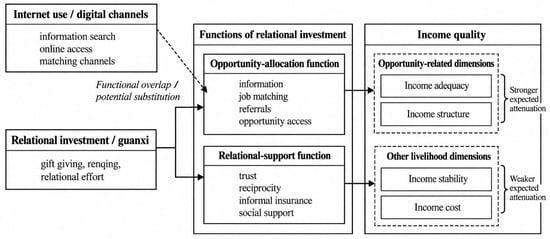
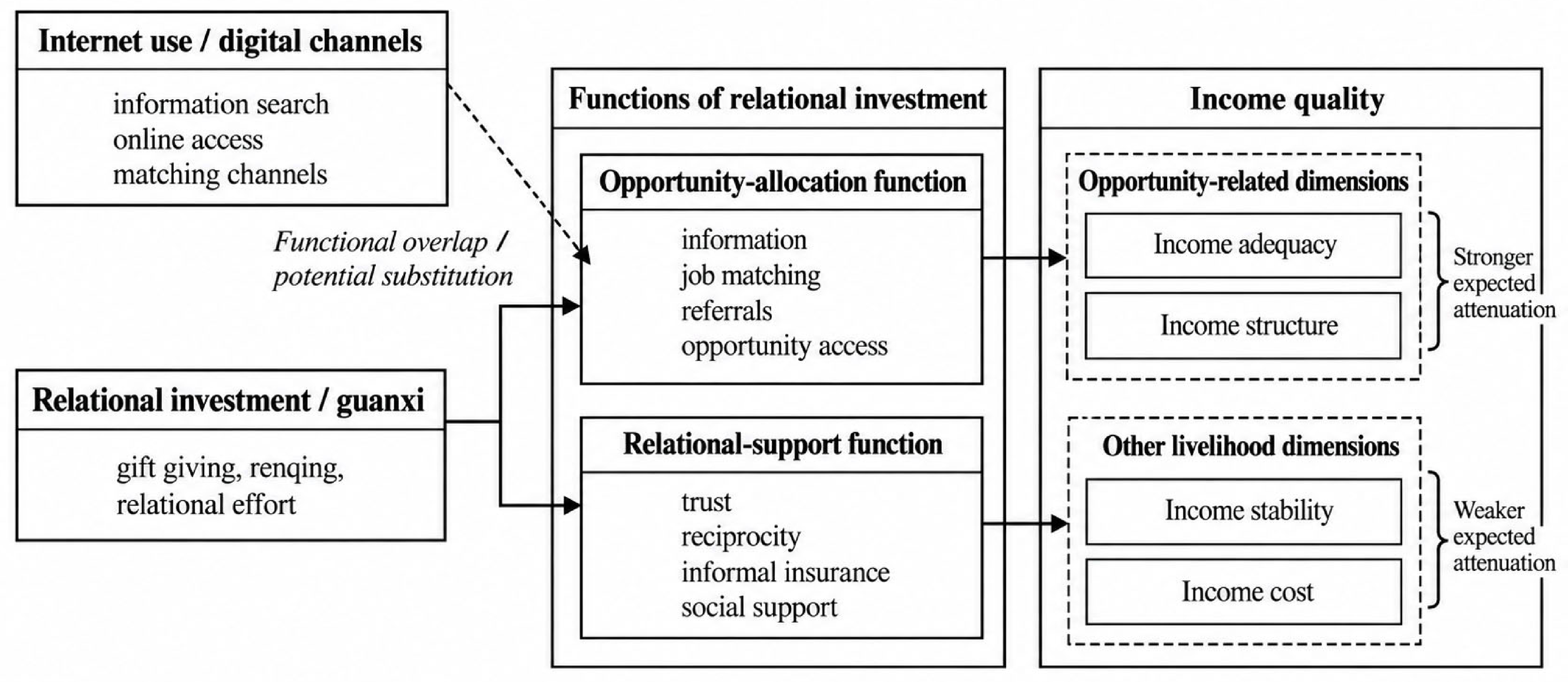
The preceding discussion can be summarized in a unified theoretical framework. Relational investment contributes to household income quality through both opportunity-allocation and relational-support functions, while Internet use may overlap with and potentially substitute for selected opportunity-allocation functions without displacing broader relational-support functions. We define this pattern as partial relational uncoupling: selected economic functions of guanxi may weaken without displacement of guanxi as a social relationship. The extent of this attenuation is expected to vary across income-quality dimensions and household characteristics. Figure 1 summarizes these proposed conceptual relationships.
Figure 1.
Theoretical framework.
3. Research Design
3.1. Data and Sample
The analysis uses four waves of the China Family Panel Studies conducted in 2014, 2016, 2018, and 2020. Household, individual, and community files are matched and observations with missing values in the key variables are removed. The final sample contains 13,273 household-year observations from 3662 rural households, 294 villages, and 28 provincial-level administrative regions. Because livelihood orientation varies within the panel, the heterogeneity analysis classifies household-years as pure-farming, part-time, or non-farming (with detailed definitions reported in Supplementary Section S2). The data structure permits household fixed effects and county × year fixed effects, although the analysis remains observational with respect to Internet use. CFPS data are available to eligible researchers through the official CFPS data platform subject to registration and the applicable data-use agreement; the authors obtained authorized access to the waves used in this study.
3.2. Variable Construction
Income quality. The dependent variable is measured along four dimensions: adequacy, structure, stability, and cost, following the multidimensional income-quality literature [5,27]. Adequacy is measured by log per capita net income; structure combines income-source diversity and the labor-income share; stability is based mainly on intertemporal income growth with loan burden reverse-coded; and cost is measured by the reversed agricultural operating-cost share. Component indicators are standardized and entropy-weighted within each dimension. The four dimensions describe conceptually distinct aspects of income quality, and we do not assume that any one dimension is intrinsically more important than the others. Equal weighting is therefore adopted as a transparent and interpretable benchmark rather than as a theoretically superior rule. The choice of aggregation weights necessarily involves a value judgement, while data-driven weights assign importance according to statistical variation, which need not coincide with substantive importance. Under entropy weighting, for example, stability alone receives 82.0% of the aggregate weight (entropy weights: adequacy 0.023, structure 0.143, stability 0.820, cost 0.015). For this reason, particular emphasis is also placed on the dimension-specific estimates in Section 4.3, which do not depend on the second-stage aggregation rule. Alternative aggregate indices are examined in the robustness analysis [34,35,36].
Relational investment. Relational investment (RI) is measured as the demeaned natural logarithm of one plus household gift expenditure. Gift expenditure has been widely used as an observable proxy for investment in guanxi and reciprocal social relations in China [14,18]. We therefore interpret RI as relational investment rather than as a comprehensive measure of social capital. As a supplementary measurement check, Section 4.2.2 also considers gift expenditure relative to household consumption, which captures the intensity rather than the absolute scale of relational spending.
Internet use. Internet use is measured as the share of household members aged 16 and above who use the Internet, ranging from 0 to 1. This household-level measure captures the possibility that digital information and employment opportunities are shared across household members [47,48]. For interaction models, the variable is mean-centered at 0.3003, the sample mean, to facilitate interpretation of the relational-investment coefficient. Because the baseline measure captures overall household Internet use rather than particular purposes of use, purpose-specific Internet use is examined separately in Section 4.5.
Variables for supplementary analyses. Off-farm employment is measured by the number of household members engaged in off-farm work. The digital information-use indicator counts how many of the three deep Internet activities recorded in the CFPS (learning, work, and business) the household uses at a non-zero, non-never frequency, and households with two or more such activities form the high group; it is used only as an exploratory indicator [42].
Controls. The baseline specification includes demographic, household, production, asset, and village-environment controls: head’s age and schooling, marital status, gender, CPC membership, household size, average health, self-rated health, dependency ratio, number of business items, labor share, cultivated land, housing value, rented-out assets, log transfers and subsidies, log village income, and village disaster exposure. The supplementary off-farm and selected heterogeneity specifications additionally include age squared, trust in neighbors, car ownership, and village broadband coverage. Base-year schooling and housing value are interacted with year indicators to allow households with different initial endowments to follow different trajectories. Table 1 reports descriptive statistics for the main variables used in the estimation.
Table 1.
Descriptive statistics.
3.3. Baseline Specification
We estimate whether Internet use changes the marginal association between relational investment and income quality using the following fixed-effects model:
IQit = α1RIit + α2IUit + α3(RIit × IUit) + Xit’γ + μi + δct + εit
Here, IQit is an income-quality measure, RIit is relational investment, IUit is household Internet use, μi denotes household fixed effects, and δct denotes county × year fixed effects. The coefficient of interest is α3. Household fixed effects absorb time-invariant household characteristics, while county × year effects absorb common county-level shocks such as infrastructure, policy, local market conditions, and broadband construction.
The specification substantially reduces omitted-variable concerns but does not remove time-varying household-level confounding. Because no exogenous Internet-access shock is available, α3 is interpreted as a conditional association rather than a causal treatment effect. Standard errors are clustered at the village level.
3.4. Sensitivity Analyses for Potential Endogeneity
To assess the sensitivity of the baseline association to potential endogeneity, we conduct several supplementary analyses under alternative identifying assumptions. First, we construct leave-one-out village-year peer measures of relational investment and Internet use, together with the corresponding interaction, and use them as instruments for relational investment, Internet use, and their interaction. Excluding the focal household avoids mechanical self-inclusion in the peer measures. However, because households within the same village may be exposed to common social and economic conditions, the exclusion restriction cannot be taken for granted [49,50].
We therefore complement the joint leave-one-out IV specification with several alternative identification assumptions. Specifically, we report a Wooldridge nonlinear generated-instrument specification, a partial-endogeneity specification in which Internet use is treated as conditionally exogenous after controlling for household fixed effects, county-by-year fixed effects, and observed covariates, and a relaxed fixed-effects specification that replaces county-by-year fixed effects with province-by-year fixed effects [51,52]. These specifications are used to examine whether the sign and pattern of the interaction are robust to alternative treatments of potential endogeneity. These exercises are reported as sensitivity checks. They do not establish causal identification: the combined leave-one-out instruments are weakly identified under the high-dimensional fixed-effects specification, and the alternative specifications rely on identifying assumptions that cannot be tested with these data. The resulting estimates should therefore be read as consistent with, rather than as proof of, the proposed interpretation.
3.5. Supplementary Analyses and Empirical Procedures
We conduct two supplementary analyses. First, we examine the relationship between relational investment, Internet use, and household off-farm employment to assess whether the baseline pattern is consistent with differences in access to non-farm employment opportunities. Specifically, off-farm employment is related to relational investment, Internet use, and their interaction, and income quality is subsequently related to off-farm employment and the core explanatory variables. Because the interaction between relational investment and Internet use in the off-farm-employment equation is statistically insignificant, this exercise is treated as supplementary evidence rather than as a formal mediation test [53].
Second, we examine whether the interaction between relational investment and Internet use varies across livelihood structure, region, network characteristics, and the digital information-use indicator. The subgroup estimates are used to describe possible heterogeneity in the baseline association, while differences are interpreted cautiously where formal between-group tests are not statistically significant.
Additional empirical procedures include robustness checks using alternative samples, inference procedures, income-quality constructions, and an alternative relational-investment measure; marginal-effect calculations with 95% confidence intervals; and purpose-specific Internet-use specifications. Formal between-group tests for selected heterogeneity comparisons are reported in Table S4. All estimations were conducted in Stata 15. Fixed-effects models were estimated using reghdfe, while the supplementary IV exercises used ivreghdfe and ivreg2, with ranktest for weak-instrument diagnostics. Detailed operational definitions, grouping rules, robustness procedures, purpose-specific variable construction, random-weight implementation, and inference choices are reported in Supplementary File S1.
4. Results
This section reports the empirical results in five steps. Section 4.1 presents the baseline estimate of the relational-investment × Internet-use interaction. Section 4.2 examines whether that estimate is robust to alternative samples, inference procedures, and constructions of the income-quality index; because the identification exercises are supplementary rather than causal, their full diagnostics are reported in the Supplementary Materials (Tables S1 and S2) and only the key coefficients are summarized here. Section 4.3 separates the interaction by income-quality dimension, which is the core empirical result of the paper. Section 4.4 reports a supplementary analysis of off-farm employment and the heterogeneity results. Section 4.5 examines whether the pattern depends on the reported purposes of Internet use. Two conventions apply throughout: the estimates are conditional associations rather than causal effects, and results that rest on weaker identification or on small subgroups are labelled as exploratory.
4.1. Baseline Results
Table 2 reports the baseline estimates using the equal-weighted income-quality index. Column (1) shows that relational investment and Internet use are both positively associated with rural household income quality. After introducing their interaction in Column (2), the coefficients on relational investment and Internet use remain positive and statistically significant, at 0.0025 (t = 5.33) and 0.0293 (t = 7.16), respectively. More importantly, the interaction between relational investment and Internet use is negative and statistically significant (−0.0033, t = −2.67).
Table 2.
Baseline regression results.
The negative interaction indicates that the positive association between relational investment and income quality becomes weaker as household Internet use increases. This finding supports H1 and is consistent with the proposed interpretation of partial relational uncoupling, whereas the network-amplification alternative, which predicts complementarity, is not supported by the baseline evidence. Importantly, the result does not imply that Internet use eliminates the economic value of guanxi. Rather, it suggests that Internet use is associated with a lower marginal contribution of additional relational investment to income quality, while both relational investment and Internet use remain positively associated with the outcome. The robustness of this result to alternative index construction and identification choices is examined in Section 4.2.
4.2. Sensitivity and Robustness Checks
4.2.1. Sensitivity to Potential Endogeneity
Although the baseline specification controls for household fixed effects, county × year fixed effects, and a rich set of observed covariates, relational investment, Internet use, and their interaction may still be endogenous. We therefore conduct a series of supplementary sensitivity analyses for potential endogeneity using leave-one-out instrumental variables and alternative identification specifications. Full specifications and diagnostic statistics are reported in Table S1 of the Supplementary Materials. Given the limitations of the available instruments, these exercises are used to assess the sensitivity of the baseline association rather than to establish causal effects.
We first jointly instrument relational investment, Internet use, and their interaction using the corresponding leave-one-out village-year peer measures. The estimated interaction remains negative (−0.0876, t = −1.71) and is statistically significant at the 10% level. However, the Kleibergen–Paap rk Wald F statistic is only 1.301, indicating limited instrument strength under the high-dimensional fixed-effects specification. The leave-one-out IV result should therefore be read as a supplementary diagnostic rather than as credible causal identification.
We further examine three alternative specifications. The interaction remains negative under the Wooldridge nonlinear-IV specification (−0.0624, t = −3.04), the partial-endogeneity specification (−0.0425, t = −1.80), and a specification replacing county × year fixed effects with province × year fixed effects (−0.0585, t = −0.93). The first two estimates are statistically significant, whereas the estimate under the relaxed fixed-effects specification is not. Overall, the negative sign of the interaction is preserved across these alternative specifications, although its statistical precision varies. These results strengthen the robustness of the baseline association but do not alter the paper’s interpretation of the estimates as conditional associations rather than causal effects.
Taken together, these specifications provide directional robustness but do not resolve the endogeneity problem; they should not be interpreted as supplying independent causal identification.
4.2.2. Robustness Checks
We conduct three sets of robustness checks, with the full results reported in Table S2 of the Supplementary Materials. First, we vary the sample definition and inference procedure. The interaction between relational investment and Internet use remains negative and statistically significant after 1% winsorization, excluding municipalities, clustering standard errors at the county level, and excluding households with zero gift expenditure. A 500-draw placebo exercise also shows that only 1.0% of the placebo estimates have an absolute t-statistic exceeding that of the baseline estimate. These results indicate that the baseline finding is not sensitive to outliers, sample composition, or the choice of clustering level.
Second, we reconstruct the aggregate income-quality index using alternative weighting methods. The interaction remains negative under entropy, CRITIC, principal-component, and random weighting. It is statistically significant under CRITIC weighting (−0.0048, t = −2.70) and principal-component weighting (−0.0052, t = −2.80), and is negative in all 2000 random-weight draws, of which 81.5% are statistically significant at the 5% level. Under entropy weighting, the interaction remains negative but is not statistically significant (−0.0011, t = −1.41). This attenuation largely reflects the weighting structure: the stability dimension, for which the interaction is close to zero, receives 82.0% of the aggregate entropy weight. The aggregate results should therefore be interpreted as summary evidence rather than as the sole basis of inference. The paper’s main substantive conclusion rests primarily on the dimension-specific contrast in Section 4.3, which does not depend on the second-stage aggregation rule.
Third, we replace log gift expenditure with the share of gift expenditure in household consumption as an alternative measure of relational investment. The interaction is statistically insignificant in the OLS specification (0.0038, t = 0.24), while the corresponding 2SLS estimate is negative but imprecisely estimated (−1.2005, t = −1.00) and rests on a weak first stage. Because this alternative variable measures the relative intensity of gift spending rather than the scale of relational investment, these estimates provide only limited evidence on the robustness of the baseline measure.
Overall, the negative interaction is stable across alternative samples, inference procedures, and most alternative constructions of the income-quality index, although its statistical precision varies across weighting schemes. The robustness results therefore support the stability of the baseline association while also reinforcing the importance of the dimension-specific evidence in Section 4.3.
4.3. Variation Across Income-Quality Dimensions
To further examine whether the moderating role of Internet use differs across dimensions of income quality, we estimate the baseline specification separately for income adequacy, structure, stability, and cost. The results are reported in Table 3.
Table 3.
Dimension-specific effects.
Table 3 shows a differentiated pattern across income-quality dimensions. In Columns (1) and (2), relational investment and Internet use are both positively associated with income adequacy and income structure. More importantly, the interaction between relational investment and Internet use is negative and statistically significant for adequacy (−0.0038, t = −2.26) and structure (−0.0080, t = −2.39). By contrast, the interaction is statistically insignificant for stability and cost.
These results indicate that the negative interaction is concentrated mainly in the dimensions most closely related to income generation and opportunity allocation. Income adequacy reflects the level of household income, while income structure captures income diversification and the relative importance of labor income. Both are closely linked to access to employment, markets, and income-generating opportunities. Digital information and matching channels can provide alternative access to such opportunities and therefore partially reduce the marginal association of relational investment with income quality. In contrast, no significant interaction is observed for stability or cost. The evidence is therefore consistent with H2 and supports a pattern of selective rather than universal functional substitution.
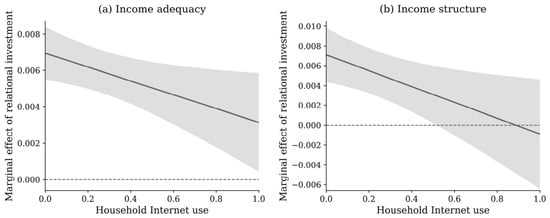
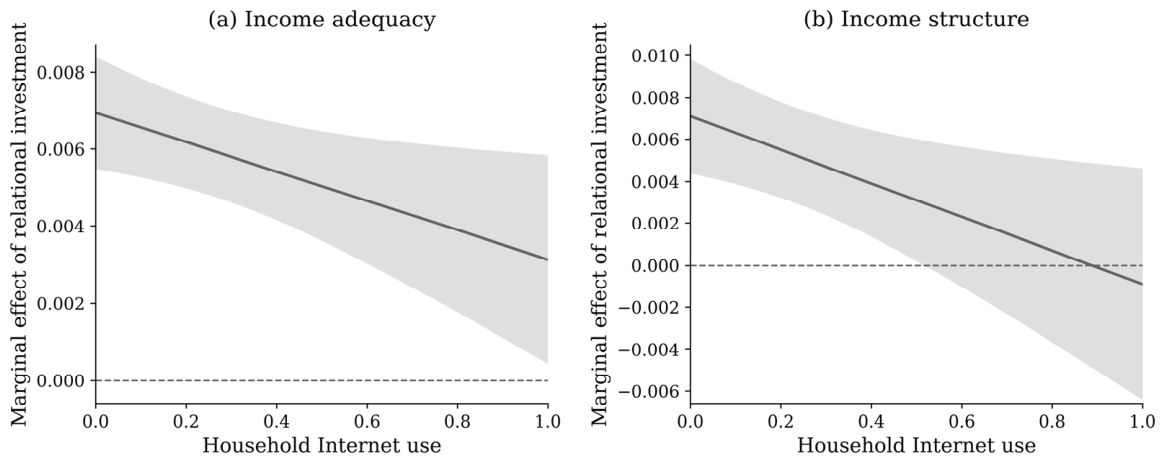
To further illustrate the economic magnitude of the interaction, Figure 2 plots the marginal effect of relational investment at different levels of household Internet use. For income adequacy, the marginal effect of relational investment declines as Internet use increases but remains positive at the highest observed level of Internet use. For income structure, the marginal effect declines more rapidly and approaches zero at high levels of Internet use, although the confidence interval includes zero. This pattern further suggests that digitalization is associated with a weaker, rather than a completely eliminated, opportunity-related return to relational investment.
Figure 2.
Marginal effects of relational investment at different levels of household Internet use. Note: The figure reports the marginal effects of relational investment on income adequacy and income structure at different levels of household Internet use, together with 95% confidence intervals. The dashed horizontal line marks a marginal effect of zero.
4.4. Off-Farm Employment and Heterogeneity Results
The two exercises that follow answer different questions and carry different inferential weight. Section 4.4.1 examines whether the baseline pattern is consistent with a specified opportunity-allocation channel, and it is best read as supplementary evidence rather than as a test of mediation. Section 4.4.2 describes where the pattern is more or less visible and should be read as exploratory evidence.
4.4.1. Off-Farm Employment: Supplementary Evidence
To examine whether the baseline pattern is related to household access to non-farm employment opportunities, we use household off-farm employment as a supplementary indicator. The results are reported in Table 4.
Table 4.
Supplementary analysis of off-farm employment.
Table 4 reports the results for off-farm employment. Relational investment is positively associated with off-farm employment (0.0124, t = 4.89), and off-farm employment is positively associated with income quality (0.0566, t = 27.00). These results indicate that relational investment remains related to household access to non-farm employment opportunities.
However, the interaction between relational investment and Internet use in the off-farm-employment equation is small and statistically insignificant (−0.0004, t = −0.06). The estimates therefore do not establish that Internet use changes the relationship between relational investment and off-farm employment, nor do they establish off-farm employment as a mediating mechanism for the baseline interaction. We accordingly treat the off-farm-employment results as supplementary evidence and do not rely on them for the paper’s main interpretation.
4.4.2. Variation Across Household and Contextual Characteristics
The heterogeneity analysis examines whether the interaction between relational investment and Internet use differs across livelihood structure, region, network characteristics, and the digital information-use indicator. The results are reported in Table 5.
Table 5.
Heterogeneity analysis.
The clearest heterogeneity appears across livelihood structures. The interaction between relational investment and Internet use is negative and statistically significant among non-farming households (−0.0062, t = −2.55), whereas the corresponding coefficients for pure-farming and part-time-farming households are statistically insignificant. This pattern is consistent with the expectation that digital channels overlap more strongly with the opportunity-allocation function of relational investment when household livelihoods are more closely connected to non-farm labor markets. However, formal between-group tests do not establish statistically significant differences in substitution intensity, so the result should be interpreted cautiously.
The evidence for the digital information-use indicator is not conclusive. The interaction is negative in both the high and low digital-information-use groups, but neither estimate is statistically significant. Consistent with the reformulation of H3, we therefore treat the digital information-use indicator as an exploratory extension and do not rely on it in the main argument.
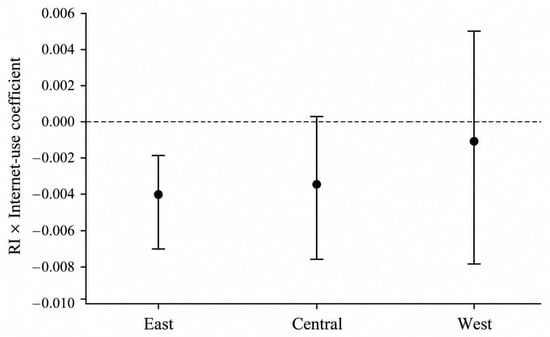
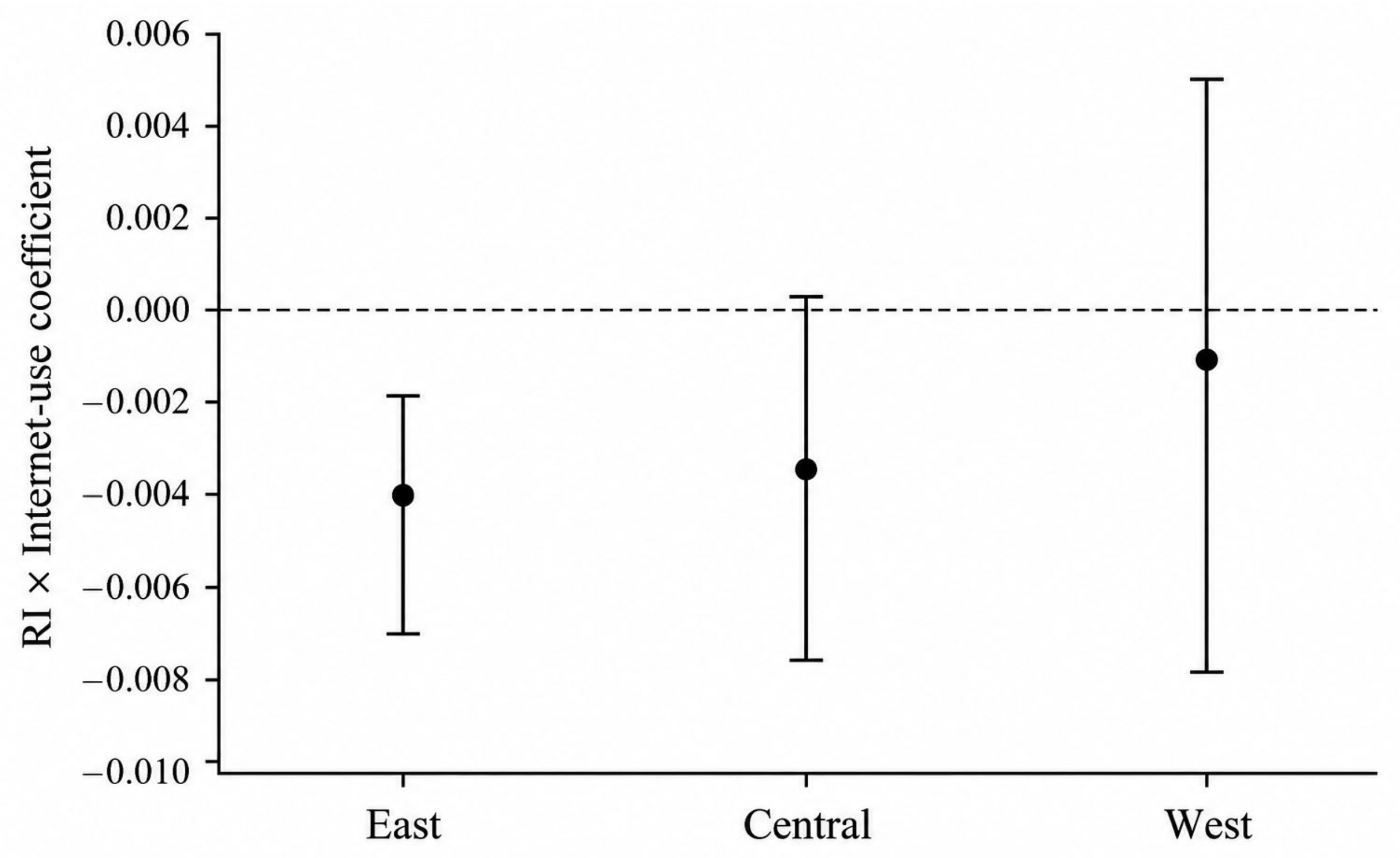
Regional patterns are reported in Table S3 of the Supplementary Materials and displayed in Figure 3. The interaction is largest in absolute magnitude in eastern China (−0.0042, t = −2.88; N = 4747), intermediate in central China (−0.0038, t = −1.75; N = 3945), and smallest in western China (−0.0014, t = −0.42; N = 4581), while Internet use is positively associated with income quality in all three regions (t = 4.59, 4.58, and 3.15, respectively). Because formal between-group tests are not uniformly statistically significant, we describe this gradient as suggestive rather than as established regional heterogeneity. Clan-network density and tie-strength measures also do not reveal stable differences across groups.
Figure 3.
Regional patterns of the relational-investment × Internet-use association. Estimated coefficients on the interaction between relational investment and Internet use: eastern China −0.0042 (t = −2.88; N = 4747), central China −0.0038 (t = −1.75; N = 3945), and western China −0.0014 (t = −0.42; N = 4581). Note: The figure reports the estimated interaction coefficient for each region together with 95% confidence intervals. The dashed vertical line indicates a zero interaction effect. Because formal between-group tests are not uniformly statistically significant, the pattern should be read as suggestive.
Overall, the subgroup pattern is directionally consistent with H3, but the formal between-group test is not statistically significant. The strongest pattern is associated with livelihood structure: the weakening association between relational investment and income quality is more visible among households with a stronger non-farm orientation. By contrast, the evidence for the digital information-use indicator and network characteristics remains exploratory and is not part of the hypothesis.
4.5. Internet-Use Purposes: Supplementary Evidence
To examine whether the baseline interaction is concentrated in a particular form of Internet use, we consider five purpose-specific measures available in the CFPS: learning, work, socializing, entertainment, and business. Each purpose-specific measure is standardized to one standard deviation and entered separately alongside the generic household Internet-use share; both the purpose-specific measure and the generic Internet-use share are interacted with relational investment. All specifications retain the baseline controls, household fixed effects, and county × year fixed effects. The results are reported in Table 6.
Table 6.
Purpose-specific Internet-use specifications.
Table 6 shows that Internet use for work and entertainment is positively associated with income quality at the 1% level, while the estimate for socializing is positive at the 10% level; the estimates for learning and business are not statistically significant. More importantly, the generic relational-investment × Internet-use interaction remains negative and statistically significant across all five purpose-specific specifications, with coefficients ranging from −0.0030 to −0.0032. None of the interactions between relational investment and the individual purpose-specific measures is statistically significant. These findings provide no evidence that the baseline interaction is concentrated in any single reported purpose of Internet use. We therefore treat the purpose-specific results as supplementary evidence rather than as a separate mechanism test.
5. Discussion and Conclusions
5.1. Main Findings
The central argument of this study is that Internet use does not replace guanxi as a social relationship, but may weaken selected economic functions of guanxi, particularly those related to access to information, employment, and income-generating opportunities. The estimates refer to the 2014–2020 period, during which the household Internet-use share in our sample rose from 16.1% in 2014 to 43.3% in 2020. The findings should therefore be read as evidence on an earlier phase of rural digitalization rather than as a description of its current configuration.
Using four waves of the China Family Panel Studies (CFPS), we find that relational investment and Internet use are both positively associated with rural household income quality, while their interaction is negative in the primary specification. The attenuation is concentrated in income adequacy and income structure, whereas the corresponding interactions for income stability and cost are statistically insignificant. This dimension-specific contrast—rather than the statistical significance of any single aggregate index—provides the main empirical basis for the functional-substitution interpretation, while not ruling out alternative explanations. The supplementary analysis of off-farm employment shows that relational investment is positively associated with off-farm employment, and off-farm employment is positively associated with income quality. However, the interaction between relational investment and Internet use is not statistically significant in the off-farm-employment equation, so this analysis does not establish mediation. The heterogeneity analysis further shows that the negative interaction is more pronounced among non-farming households, although formal between-group differences are not statistically established, whereas differences by the digital information-use indicator are not statistically clear. Overall, the results suggest that Internet use is associated with a weaker economic role of relational investment mainly in opportunity-related activities, rather than with a general decline in the importance of rural social relationships.
Alternative explanations for the negative interaction cannot be ruled out and are discussed in Section 5.2.
5.2. Interpretation and Broader Implications
The discussion below interprets the empirical findings within the context of rural China during 2014–2020. Given the observational nature of the analysis, the proposed mechanisms should be understood as interpretations consistent with the evidence rather than as identified causal processes.
These findings contribute to the literature in two related ways. Existing studies show that guanxi and social networks facilitate access to non-farm employment, referrals, and other economic opportunities where formal information channels are incomplete [10,13], while a separate literature shows that Internet use reduces information constraints and expands rural households’ access to non-farm opportunities [47]. This study links the two strands by asking not whether relational investment or Internet use is independently beneficial, but whether Internet use changes the marginal economic role of relational investment. The results are consistent with a shift in the allocation of economic functions between relational and standardized channels: digital channels may increasingly provide information search and opportunity matching, while social relationships continue to provide trust, reciprocity, local knowledge, and informal support [17]. Partial relational uncoupling therefore provides a useful interpretation of the observed pattern without implying that Internet use simply replaces guanxi.
However, the negative interaction is not uniquely attributable to functional substitution. It may also reflect diminishing marginal returns to relational investment at higher levels of digital connectivity, saturation in some relational functions, or unobserved heterogeneity in digital engagement that is correlated with both relational investment and income quality. These alternative explanations cannot be fully ruled out with the available data. The dimension-specific results nevertheless provide some support for the functional-substitution interpretation. The negative interaction is concentrated in income adequacy and structure, which are more closely related to income generation and opportunity acquisition, while the corresponding interactions for stability and cost are statistically insignificant. This pattern is more consistent with an overlap between digital channels and the opportunity-allocation function of guanxi than with a general decline in the returns to relational investment, although it does not rule out dimension-specific diminishing returns. The robustness results further show that the negative interaction is stable across alternative samples, inference procedures, and most alternative index constructions, but these checks establish the stability of the empirical pattern rather than the underlying mechanism. We therefore interpret partial relational uncoupling as an explanation consistent with the evidence rather than as an identified causal mechanism.
With this qualification, the findings also speak to broader debates on social sustainability. Social sustainability concerns social relations, cohesion, equity, and the capacity of communities to sustain the relational resources on which livelihoods depend [54]. Existing evidence suggests that digital channels may complement or partially substitute for different forms of social capital depending on the function involved [8,54,55]. The present results add a rural livelihood perspective to this literature. The attenuation is concentrated in dimensions related to income generation and opportunity acquisition, while no significant interaction is detected for stability or cost. With respect to income resilience, the absence of a statistically significant interaction for the stability dimension suggests that the observed attenuation is concentrated in opportunity-related dimensions rather than in the intertemporal stability of income. This pattern is consistent with the view that digital transformation changes the economic role of relational institutions selectively rather than uniformly. For rural digital inclusion, the key issue is therefore not connectivity alone, but households’ capacity to convert digital access into economic opportunities. For sustainable rural livelihoods, digital channels appear to interact with, rather than simply replace, the relational institutions on which rural households have historically depended [7,8,56].
The regional pattern reported in Section 4.4.2 provides further suggestive evidence. The interaction is largest in absolute magnitude in eastern China and smallest in western China. This gradient is consistent with evidence that the relationship between digital channels and social networks varies with local market conditions and levels of economic development [7,22,56,57]. Where non-farm labor markets and standardized information channels are more developed, relational investment may face more alternative channels for opportunity acquisition; where such markets remain thinner, relational channels may retain a larger role. These regional differences should nevertheless be interpreted cautiously because formal between-group differences are not uniformly statistically significant.
5.3. Policy Implications for Sustainable Rural Digitalization
The findings suggest several tentative implications for rural digital policy. These implications are primarily relevant to national and local policymakers responsible for rural digital development, as well as public and private providers of rural digital services. First, the expansion of digital infrastructure may be complemented by efforts to improve households’ effective use of digital channels for information search, employment, and market access. The negative interaction is concentrated in income dimensions associated with income generation and opportunity acquisition, suggesting that policy attention may need to extend beyond connectivity itself to how digital access is used in livelihood activities; county- and township-level public employment-information platforms and community digital-service stations are concrete vehicles through which such support can be delivered.
Second, digital development need not be viewed as a substitute for existing rural social networks. The results are more consistent with a selective change in the opportunity-related role of relational investment than with a general decline in the importance of guanxi. Digital services may therefore be most useful when they broaden access to standardized information and matching channels while allowing trust, reciprocity, and local support functions to remain embedded in existing social relations; community digital-service stations and basic digital-skills training are examples of how this complementarity can be delivered in practice.
Third, the heterogeneity results suggest that livelihood structure may matter for the role of digital channels. The negative interaction is more visible among households oriented toward non-farm employment, for whom employment information and matching services may be particularly relevant. The corresponding pattern is less evident among farming-oriented households. This suggests caution in applying a uniform digital-service model across livelihood groups and points to the potential value of aligning digital services with households’ livelihood activities and existing local institutions, for example through information-matching modules targeted at non-farm-oriented households and tailored support for farming-oriented ones. These implications should be interpreted cautiously because the estimates refer to rural China during 2014–2020 and do not identify causal policy effects.
5.4. Limitations and Future Research
Several limitations qualify the interpretation of the results. First, household gift expenditure is an observable but incomplete proxy for relational investment. It captures monetary expenditures associated with maintaining social relationships but not network size, tie quality, resource accessibility, or reciprocal obligations. As a supplementary measurement check, we also use gift expenditure relative to household consumption; however, this alternative captures the intensity of relational spending rather than the underlying structure or quality of social ties, and the corresponding estimates are imprecise. Richer network data would allow future work to distinguish more directly among the information, insurance, trust, and support functions of guanxi.
Second, the aggregate income-quality result depends partly on the choice of second-stage weights. The estimated interaction remains negative across alternative aggregation schemes, but its statistical precision varies with the weighting rule. For this reason, the aggregate estimates are best interpreted together with the dimension-specific results in Table 3, which do not depend on the second-stage aggregation of the four dimensions.
Third, potential endogeneity remains unresolved. The combined leave-one-out instruments are weak (KP rk Wald F = 1.301), and the alternative specifications rely on identifying assumptions that cannot be fully tested with the available data. These exercises therefore provide sensitivity evidence rather than causal identification.
Fourth, the available measures of Internet engagement are coarse. It should not be interpreted as a direct measure of digital literacy or digital skill. The digital information-use indicator is a coarse count of how many of the three deep Internet activities recorded in the CFPS (learning, work, and business) a household uses and is therefore treated as exploratory. Section 4.5 examines reported Internet use for learning, work, socializing, entertainment, and business, but the baseline measure captures overall household Internet use and does not distinguish the device through which household members access the Internet. Comparable device-specific measures cannot be constructed across all four survey waves, so we cannot test whether the estimated interaction differs systematically by mode of Internet access. We therefore cannot determine whether the estimated interaction differs systematically across forms of Internet access or modes of use. More detailed measures of digital literacy, devices, platforms, search behavior, and online economic activity would allow sharper tests of how Internet use is translated into economic opportunities.
A final limitation concerns the period covered by the data. The estimates refer to 2014–2020, when the household Internet-use share in our sample increased from 16.1% to 43.3%. This period predates much of the subsequent expansion of short-video platforms, livestream commerce, platform-based employment, and other digital services in rural China. The results should therefore be interpreted as evidence from an earlier phase of rural digitalization rather than as a description of the current digital environment. Accordingly, the findings should not be assumed to generalize directly to the current rural digital environment. Future work using more recent data and stronger sources of exogenous variation could assess whether the patterns reported here persist as rural digital markets and technologies continue to evolve.
Supplementary Materials
The following supporting information can be downloaded at https://www.mdpi.com/article/10.3390/su182010673/s1: Supplementary File S1: Additional Empirical Procedures. Table S1: Sensitivity analyses for potential endogeneity (leave-one-out instrumental variables, Wooldridge nonlinear generated instruments, partial-endogeneity and relaxed fixed-effects specifications). Table S2: Robustness checks (alternative samples and inference procedures, alternative constructions of the income-quality index, and an alternative measure of relational investment). Table S3: Regional patterns of the relational-investment × Internet-use association. Table S4: Formal between-group difference tests for selected heterogeneity dimensions examined in Table 5.
Author Contributions
Conceptualization, F.X., H.L. and H.Z.; Formal analysis, F.X., Z.L., G.S., H.L. and H.Z.; Methodology, Z.L., G.S., H.L. and H.Z.; Software, F.X., Z.L., G.S. and H.Z.; Data curation, F.X., Z.L., G.S. and H.Z.; Supervision, H.Z.; Visualization, F.X.; Funding acquisition, F.X.; Writing—original draft, F.X., Z.L., G.S. and H.Z.; Writing—review and editing, F.X. and H.Z. All authors have read and agreed to the published version of the manuscript.
Funding
This research was funded by the National Social Science Fund of China (23BJY171).
Institutional Review Board Statement
Not applicable.
Informed Consent Statement
Not applicable to this secondary-data analysis.
Data Availability Statement
The data used in this study are from the China Family Panel Studies (CFPS), administered by the Institute of Social Science Survey (ISSS) of Peking University. The data are available to eligible researchers through the official CFPS data platform (https://cfpsdata.pku.edu.cn) subject to registration and the applicable data-use agreement. The authors obtained authorized access to the data used in this study. In accordance with the CFPS data-use agreement, the authors are not permitted to redistribute the raw microdata.
Conflicts of Interest
The authors declare no conflicts of interest.
References
- Wang, S.; Ma, L.; Sun, J. The impact of resettlement location on the income and income quality of relocated households: A micro-level analysis based on 16 counties in 8 provinces. Chin. Rural Econ. 2022, 8, 42–63. (In Chinese) [Google Scholar]
- Yang, S.; Su, L.; Kong, R.; Wang, H.L. Farmers’ income quality: Logical construction, measurement and dynamic evolution. Chin. Rural Econ. 2023, 8, 18–36. (In Chinese) [Google Scholar]
- Ren, J.; Kong, R. A study of farm households’ income quality based on confirmatory factor analysis. J. Chongqing Univ. (Soc. Sci. Ed.) 2016, 22, 54–63. (In Chinese) [Google Scholar]
- Wang, X.; Kong, R. Determinants of migrant workers’ income quality: An empirical analysis based on survey data from 10 provinces. Stat. Inf. Forum 2013, 28, 91–96. (In Chinese) [Google Scholar]
- Yang, X.; Long, Y.; Mola-Yudego, B.; Pelkonen, P.; Xv, Y.; Qu, M. Multidimensional income quality: A new lens on energy poverty in rural China. Energy Policy 2026, 215, 115299. [Google Scholar] [CrossRef] [Scilit]
- Peng, Y.; Su, L.; Kong, R. Income quality and its influence on farm households’ entrepreneurial decisions: Evidence from 1,373 farm household surveys in Shandong, Henan, Shaanxi and Gansu. J. Agrotech. Econ. 2019, 12, 56–67. (In Chinese) [Google Scholar]
- Carrico, A.R.; Wilson Burns, H.; Donato, K.M.; Rahaman, H.; Best, K. Do Social Networks Moderate the Effect of Extreme Weather on Migration? Popul. Dev. Rev. 2026, 52, 403–440. [Google Scholar] [CrossRef] [Scilit]
- Bule, D.L.; Ntuli, H.; Gandidzanwa, C. The Impact of Mobile-Based Digital Technology Adoption on Livelihood Diversification: Evidence from Ethiopia. Dev. Pract. 2026, 1–13. [Google Scholar] [CrossRef] [Scilit]
- Zhang, Y.; Lu, M. Do social networks help raise the wages of migrant workers? Manag. World 2009, 3, 45–54. (In Chinese) [Google Scholar]
- Zhang, X.; Li, G. Does guanxi matter to nonfarm employment? J. Comp. Econ. 2003, 31, 315–331. [Google Scholar] [CrossRef] [Scilit]
- Chang, K.-C.; Wen, M.; Wang, G. Social capital and work among rural-to-urban migrants in China. Asian Popul. Stud. 2011, 7, 275–293. [Google Scholar] [CrossRef] [Scilit]
- Tan, X.; Chu, Z.; Chen, Y.; Xie, F. The Impact of Fertilization Outsourcing Service on Fertilizer Application Rate: Evidence from Chinese Rice Farmers. Front. Sustain. Food Syst. 2026, 10, 1889758. [Google Scholar] [CrossRef] [Scilit]
- Weng, Y.; Xu, H. How guanxi affects job search outcomes in China? Job match and job turnover. China Econ. Rev. 2018, 51, 70–82. [Google Scholar] [CrossRef] [Scilit]
- Bulte, E.; Wang, R.; Zhang, X. Forced gifts: The burden of being a friend. J. Econ. Behav. Organ. 2018, 155, 79–98. [Google Scholar] [CrossRef] [Scilit]
- Hong, J.; Tan, B.; Ng, E.; Davison, R.M.; Wong, L. The Impact of Social Media on Digital Guanxi Development in the Chinese Workplace: A Technology Affordance Perspective. Int. J. Inf. Manag. 2025, 84, 102933. [Google Scholar] [CrossRef] [Scilit]
- Li, J. Monetized Socialization on the Front End: Exchanging Money as Social Activities through Red Packet and Transfer on WeChat. J. Cult. Econ. 2025, 18, 284–303. [Google Scholar] [CrossRef] [Scilit]
- Yan, Y. The Flow of Gifts: Reciprocity and Social Networks in a Chinese Village; Stanford University Press: Stanford, CA, USA, 1996. [Google Scholar]
- Wu, K.; Liu, Y.; Xu, Y.; Sun, H. It pays to have guanxi: How social capital affects household income in China. Int. Stud. Econ. 2023, 18, 370–392. [Google Scholar] [CrossRef] [Scilit]
- Luo, P.; Chen, Y.; Shan, D.; Wang, P. Internet use, social capital and high-quality employment. Technol. Soc. 2025, 83, 103031. [Google Scholar] [CrossRef] [Scilit]
- Yang, T.; Zhang, T. Social capital meets guanxi: Social networks and income inequality in China. China Econ. Rev. 2024, 83, 102094. [Google Scholar] [CrossRef] [Scilit]
- Matsuda, N.; Nomura, S. The temptation of social networks under job search frictions. World Bank Econ. Rev. 2025, 39, 1–25. [Google Scholar] [CrossRef] [Scilit]
- Damoah, C.M. Disability and Digital Inequality: Understanding the Impact of Different Disabilities and Socio-Economic Factors on Internet Use in Ghana. Inf. Commun. Soc. 2026, 29, 610–633. [Google Scholar] [CrossRef] [Scilit]
- Putnam, R.D. Bowling Alone: The Collapse and Revival of American Community; Simon & Schuster: New York, NY, USA, 2000. [Google Scholar]
- Fafchamps, M.; Lund, S. Risk-sharing networks in rural Philippines. J. Dev. Econ. 2003, 71, 261–287. [Google Scholar] [CrossRef] [Scilit]
- Kong, R.; Wang, X. Reflections on the connotation of migrant workers’ income quality. Issues Agric. Econ. 2013, 6, 55–60. (In Chinese) [Google Scholar]
- Hu, B.; Zhang, W.; Wan, C.; Jiang, N.; Xie, F. The Impact of Agricultural Insurance Coverage on Farm Household Income Inequality: Evidence from Corn Farmers in Liaoning Province, China. Front. Sustain. Food Syst. 2026, 10, 1856386. [Google Scholar] [CrossRef] [Scilit]
- Zhang, W.; Feng, J.; Hu, B.; Xie, F. Can Government Regulation Promote the Development of Agricultural Insurance Technology? Evidence from China. Sustainability 2026, 18, 1908. [Google Scholar] [CrossRef] [Scilit]
- Feng, J.; He, S.; Wan, C.; Liu, J.; Xie, F. The Effect of Swine Insurance Participation on Swine Production Efficiency: Evidence from China. PLoS ONE 2025, 20, e0317759. [Google Scholar] [CrossRef] [Scilit] [PubMed]
- Xie, F.; Jiang, N.; Li, H.; Zhao, H.; Yin, G. Beyond Income Growth: Internet Use and Rural Household Income Quality in China. Agriculture 2026, 16, 2133. [Google Scholar] [CrossRef] [Scilit]
- Alkire, S.; Mishra, R.; Selden, L.; Suppa, N. The Global Multidimensional Poverty Index (MPI) 2025: Country Results and Methodological Note; OPHI MPI Methodological Note No. 61; Oxford Poverty and Human Development Initiative, University of Oxford: Oxford, UK, 2025; Available online: https://ophi.org.uk/publications/MN-61 (accessed on 12 August 2026).
- Xu, J.; Wang, C.; Yin, X.; Wang, W. Digital economy and rural household resilience: Evidence from China. Agric. Econ. 2024, 70, 244–263. [Google Scholar] [CrossRef] [Scilit]
- He, Y. Measurement of livelihood resilience and its influencing factors for farmers in poverty alleviation areas: A case study of Yunnan Province, China. Appl. Econ. 2026, 58, 5319–5337. [Google Scholar] [CrossRef] [Scilit]
- Lin, N. Social Capital: A Theory of Social Structure and Action; Cambridge University Press: Cambridge, UK, 2001. [Google Scholar]
- Granovetter, M.S. The strength of weak ties. Am. J. Sociol. 1973, 78, 1360–1380. [Google Scholar] [CrossRef] [Scilit] [PubMed]
- Coleman, J.S. Social capital in the creation of human capital. Am. J. Sociol. 1988, 94, S95–S120. [Google Scholar] [CrossRef] [Scilit] [PubMed]
- Ruan, R.; Zheng, F.; Liu, L. Clan networks and informal lending in rural financial markets. China Econ. Q. 2014, 13, 1017–1042. (In Chinese) [Google Scholar]
- Yin, Z.; Guo, P. Financial literacy and informal lending among farm households: Micro evidence from the China Household Finance Survey. China Econ. Q. 2021, 21, 1025–1046. (In Chinese) [Google Scholar]
- Chai, Z.; Ling, M.; Lyu, J.; Yin, G. Why Non-Farm Employment Quality Matters for Sustainable Agricultural Service Provision? Evidence from a Farmer Survey in Rural China. Sustainability 2026, 18, 7899. [Google Scholar] [CrossRef] [Scilit]
- Zhou, Y.; Tu, Q.; Liang, B.; Yei, J.Y. How is migrant workers’ social capital formed? An analysis based on social networks. J. World Econ. 2019, 2, 170–192. (In Chinese) [Google Scholar]
- Li, X.; Bian, Y. Social networks in China: A thematic review of guanxi scholarship in the past decade. Chin. J. Sociol. 2024, 10, 531–562. [Google Scholar] [CrossRef] [Scilit]
- Feng, L.; Zang, L.; Yao, X. The impact of internet use on entrepreneurial behavior and income: Evidence from Chinese rural households. J. Asian Econ. 2024, 93, 101752. [Google Scholar] [CrossRef] [Scilit]
- Liu, T.; Liao, L. Can farmers’ digital literacy improve income? Empirical evidence from China. PLoS ONE 2024, 19, e0314804. [Google Scholar] [CrossRef] [Scilit] [PubMed]
- Liao, X.; Yin, G.; Zheng, M. A Review of Building Climate-Resilient Agriculture in Smallholder Systems. J. Econ. Surv. 2026. [Google Scholar] [CrossRef] [Scilit]
- Liu, Z.; Wei, Y.; Li, Q.; Lan, J. The mediating role of social capital in digital information technology poverty reduction: An empirical study in urban and rural China. Land 2021, 10, 634. [Google Scholar] [CrossRef] [Scilit]
- Gao, J.; Zhou, J.; Liu, Y. The impact of internet use on rural household energy transition: Moderating effect based on social interaction. Front. Energy Res. 2023, 11, 1078692. [Google Scholar] [CrossRef] [Scilit]
- Huang, T.; Quan, Y.; Li, N. Reallocate to the right place: The heterogeneous effect of internet use on factor allocation of rural households in China. Econ. Anal. Policy 2024, 84, 1328–1346. [Google Scholar] [CrossRef] [Scilit]
- Li, J.; Tang, F.; Yan, D.; Zhao, C. Does digital infrastructure facilitate rural-to-urban migration? Evidence from China. Popul. Space Place 2026, 32, e70270. [Google Scholar] [CrossRef] [Scilit]
- Dong, H.; Yin, G. Agricultural Scale Management: A Review from a Dual-Scale Perspective. J. Econ. Surv. 2026, 40, 2026–2036. [Google Scholar] [CrossRef] [Scilit]
- Gao, M.; Lyu, J.; Zhang, J.; Yin, G. Extreme Heat and Agricultural Mechanization in China: Implications for Climate Adaptation. Humanit. Soc. Sci. Commun. 2026. [Google Scholar] [CrossRef] [Scilit]
- Bramoullé, Y.; Djebbari, H.; Fortin, B. Identification of peer effects through social networks. J. Econom. 2009, 150, 41–55. [Google Scholar] [CrossRef] [Scilit]
- Wooldridge, J.M. Econometric Analysis of Cross Section and Panel Data, 2nd ed.; The MIT Press: Cambridge, MA, USA, 2010. [Google Scholar]
- Bun, M.J.G.; Harrison, T.D. OLS and IV estimation of regression models including endogenous interaction terms. Econom. Rev. 2019, 38, 814–827. [Google Scholar] [CrossRef] [Scilit]
- Imai, K.; Keele, L.; Tingley, D. A general approach to causal mediation analysis. Psychol. Methods 2010, 15, 309–334. [Google Scholar] [CrossRef] [Scilit] [PubMed]
- Herwix, A.; Bogner, K.; Schlaile, M.P. Core Design Principles for Just Sustainability Transitions: A Framework for Transformative Research. Sustain. Sci. 2025, 20, 1833–1862. [Google Scholar] [CrossRef] [Scilit]
- Nguyen, M.H.; Hargittai, E. Digital Inequality in Disconnection Practices: Voluntary Nonuse during COVID-19. J. Commun. 2023, 73, 494–510. [Google Scholar] [CrossRef]
- Rahe, M.L.; Van Leuven, A.J.; Malone, T. Leveraging Social Ties to Financial Gains: Exploring the Impact of Social Capital in Rural Development. J. Rural Stud. 2025, 114, 103539. [Google Scholar] [CrossRef] [Scilit]
- Feng, J.; Zhang, W.; Wang, L.; Hu, B.; Xie, F. Spatial Spillover Effects of Swine Insurance Policy on Swine Production Efficiency in China. Front. Sustain. Food Syst. 2025, 9, 1636598. [Google Scholar] [CrossRef] [Scilit]

Disclaimer/Publisher’s Note: The statements, opinions and data contained in all publications are solely those of the individual author(s) and contributor(s) and not of MDPI and/or the editor(s). MDPI and/or the editor(s) disclaim responsibility for any injury to people or property resulting from any ideas, methods, instructions or products referred to in the content. |
© 2026 by the authors. Licensee MDPI, Basel, Switzerland. This article is an open access article distributed under the terms and conditions of the Creative Commons Attribution (CC BY) license.