


Abstract
Residential outdoor-education programs provide an intensive form of experiential learning in natural settings and are widely expected to strengthen children’s connection to nature and environmental agency, yet evidence that brief programs are associated with changes in established environmental attitudes is mixed. We compared children’s environmental attitudes and connection to nature at the beginning and end of a one-week residential program at Slovenian outdoor-education centers (1396 questionnaires; grades 5–8). Composite scores suggested that only enjoyment of nature changed. Measurement analyses qualified this picture: scalar invariance was rejected for the responsibility and oneness subscales under both continuous and ordinal estimation, and the responsibility items moved in opposite directions—two personal-efficacy items declined while a non-interference item rose—so that their average showed no change. In exploratory rescoring, a two-item measure of personal environmental efficacy was lower at the end of the week (d = −0.24), a decline replicated in held-out schools across 500 random splits, while enjoyment of nature was higher than the composite indicated (d = 0.21). Without a comparison group, these differences cannot be attributed to the program, but they suggest that enjoyment of nature and perceived environmental agency need not move together and that composite scoring can conceal such divergence.
1. Introduction
A positive relationship with the natural world is widely regarded as a foundation for pro-environmental behavior, and outdoor and nature-based education is one of the main practical levers for cultivating it [1,2]. Within education for sustainable development (ESD), immersive outdoor learning is increasingly recognized as an effective means of fostering environmental values, concern, and connectedness with nature [3,4]. Slovenia’s network of Centers for School and Outdoor Education (CŠOD), through which school classes spend a week living and learning in nature, is a large-scale example of this educational approach. A natural question for the program is whether children’s reported relationship with nature differs before and after a one-week residential programme.
Beyond providing exposure to natural environments, residential outdoor programs can also be understood through the lens of place-based or place-responsive education. Rather than treating nature as a generic setting for learning, place-based education emphasizes learning “with” and “from” the ecological, cultural, and social characteristics of particular places, fostering a sense of belonging, responsibility, and stewardship [5,6]. Place-responsive approaches similarly argue that repeated, meaningful engagement with local environments encourages learners to develop emotional attachments and ethical relationships with place, which can provide an important foundation for pro-environmental attitudes and action [5,7]. Although CŠOD residential programs are relatively brief, they immerse pupils in distinctive Slovenian landscapes where environmental learning is embedded in direct experience of local ecosystems, potentially supporting not only environmental knowledge but also stronger place-based connections that underpin broader environmental concern.
Short educational interventions reliably produce cognitive gains, but their effects on attitudes are uneven: studies using cognitive measures of nature connection tend to report increases, whereas studies using affective measures tend to report less consistent results [8]. More recent evidence nevertheless suggests that nature-based interventions can strengthen children’s connection to nature and support broader developmental outcomes, including social skills, self-regulation, attention, motivation, independence, and problem-solving [9]. Similarly, a review of school-led greenspace interventions concluded that nature-based learning in schools can improve children’s positive affect, physical activity, and social relationships, providing additional support for integrating nature into formal education [10]. However, both reviews emphasize considerable heterogeneity in intervention characteristics, participant ages, outcome measures, and study quality, making it difficult to identify which approaches are most effective and under what conditions. Harris et al. further note that relatively few evaluated interventions have been implemented as curriculum-based programs at scale, leaving an important gap in the evidence base [9]. Where short-term gains in environmental attitudes do appear, they often fade—initial increases after one-day programs were not retained weeks later [8], and even a four-day residential programme sustained its effect only among younger children [2]. Against this backdrop, a one-week residential programme embedded within the Slovenian curriculum occupies a particularly informative position, offering an opportunity to examine which facets of environmental attitude are responsive to brief immersion and which are more resistant to change.
In Slovenia, this question has particular educational relevance because outdoor education is embedded within the national primary school curriculum through the concept of “School in Nature” [11], one of the country’s principal curriculum-based mechanisms for implementing education for sustainable development (ESD). Rather than functioning as an extracurricular activity, “School in Nature” is an integral part of primary education, with pupils expected to participate in at least two state-funded residential programs during compulsory schooling. The concept promotes personal and social development, environmental knowledge, and active engagement with nature through interdisciplinary learning in authentic outdoor settings. CŠOD, a public institution established in 1992, is the principal provider of these programs, operating 25 residential centers across Slovenia that collectively serve approximately 75,000 primary and secondary school students each year. As one of the largest and most systematic outdoor education programs in the country, CŠOD represents a distinctive national model for fostering environmental attitudes and connectedness with nature through experiential learning [12]. Preliminary evidence from Slovenian CŠOD programs suggests that participation in a one-week residential stay is associated with small but significant improvements in environmental attitudes and connectedness with nature [13]. The present study builds on this initial evidence by examining programme effects in a substantially larger, multi-center sample using multiple complementary measures of environmental attitudes.
We conceptualize environmental attitude as a multidimensional construct and assess it using three complementary theoretical frameworks. The 2-MEV (Two Major Environmental Value) model distinguishes two higher-order environmental values: Preservation (biocentric orientation towards conservation) and Utilization (an anthropocentric orientation towards the use of nature) [14,15], and has been widely applied in evaluations of outdoor education programs [16]. Schultz’s [17] framework differentiates environmental concern according to its target, distinguishing biospheric, altruistic, and egoistic concerns. Finally, the Connection to Nature Index measures children’s affective relationship with nature across four dimensions: enjoyment of nature, empathy for living creatures, sense of oneness, and sense of responsibility [1]. Together, these frameworks capture complementary value-based, affective, and motivational aspects of environmental attitudes, allowing us to ask not only whether a week in nature changes children’s relationship with the environment, but also which dimensions are most responsive to this form of educational experience.
Against this background, the present study examines whether participation in a one-week CŠOD residential programme is associated with changes in Slovenian pupils’ environmental attitudes. Specifically, we assess changes in environmental values (2-MEV), environmental concern (biospheric, altruistic, and egoistic), and connectedness with nature before and after programme participation. By evaluating one of Europe’s largest curriculum-based outdoor education systems, the study contributes evidence on the extent to which a brief but intensive residential experience may influence different dimensions of children’s environmental attitudes. Because the analysis depends on whether the instrument functions equivalently at the two time points, we report the measurement properties alongside the substantive comparison, and show that this distinction materially changes what the data are found to say.
Accordingly, the study addresses the following research questions (RQs):
- RQ1. To what extent is participation in a one-week CŠOD residential programme associated with changes in children’s environmental values, environmental concern, and connectedness with nature?
- RQ2. Do the instruments used to assess these constructs demonstrate adequate reliability and measurement invariance between the pre- and post-programme measurements?
- RQ3. To what extent do conclusions about programme-related changes differ when based on conventional composite scores compared with analyses that account for measurement invariance and item-level or latent-variable changes?
These questions allow us to distinguish substantive changes in children’s environmental attitudes from apparent changes that may arise from differences in how the constructs are measured across time. The study therefore considers both the magnitude and direction of observed changes and whether the patterns of pre–post differences in different dimensions can be interpreted as genuine changes in the underlying constructs.
The remainder of the paper is structured as follows. Section 2 describes the study design, participants, instruments, and statistical and measurement analyses. Section 3 first presents the comparability of the pre- and post-programme samples and the results of the conventional composite-score analyses, before examining the reliability and measurement invariance of the instruments. We then explore item-level changes and compare these findings with latent-variable and item-response estimates, followed by robustness checks, analyses of ceiling effects, and potential moderators of programme effects. Section 4 discusses the substantive and methodological implications of the findings, considers the study’s limitations and directions for future research, and Section 5 outlines implications for the evaluation and design of residential outdoor education programs.
2. Materials and Methods
2.1. Design and Participants
Pupils completed an identical questionnaire at the beginning and end of a one-week stay at a CŠOD centre. The analyzed dataset comprises 1396 questionnaires—702 at the start (“pre”) and 694 at the end (“post”)—from pupils in grades 5–8 (mean age = 11.9 years) across 16 schools and 6 centres, distributed over three programme types (sport, naturalistic, social-science). Six CŠOD centres were selected because they regularly host the grade groups of interest in this study and together represent approximately one fifth of the CŠOD network, spanning its range of facility sizes. Schools were not directly selected by the researchers; rather, schools annually apply to participate in the national “School in Nature” programme and are allocated to a CŠOD centre according to their requested programme and the availability and capacity of the centres. Thus, the participating schools reflect the regular CŠOD programme allocation process rather than a researcher-selected school sample.
The analyzed programs represented the three principal categories of CŠOD residential provision: naturalistic, sport, and social-science programs. Although each programme emphasizes a different curricular focus, all follow the national “School in Nature” concept and combine interdisciplinary educational activities with residential living in natural settings. Naturalistic programs emphasize field-based environmental and ecological investigations; sport programs focus on outdoor physical activities and skill development; while social-science programs explore local cultural heritage, geography, and society.
Data were collected during regular one-week stays at the participating CŠOD centers. Schools scheduled for a CŠOD stay were invited to participate through the centers, and classes took part when their school leadership and teachers agreed to participate. All pupils present in the participating classes were invited to complete the questionnaire, and no refusals to participate were reported. However, eight fewer pupils completed the questionnaire at the end of the programme, primarily because they had left the programme early, for example due to illness.
The participating schools were located in eight of Slovenia’s twelve statistical regions (Osrednjeslovenska, Podravska, Gorenjska, Goriška, Koroška, Pomurska, Savinjska, and Jugovzhodna Slovenija), providing broad geographical coverage of the country. Schools were not formally classified as urban or rural, as such a distinction is of limited relevance in the Slovenian context due to the relatively even distribution of the population across the country, the small size of its cities and towns, and the close proximity of most settlements to natural and semi-natural environments. Of the completed questionnaires, 50.9% were collected from pupils participating in naturalistic programmes, 40.9% from sport programmes, and 8.2% from social-science programmes. Participant characteristics by measurement wave are presented in Table 1.
Table 1.
Participant characteristics by wave.
The centers did not record an individual pupil identifier, so pre- and post-responses cannot be linked at the level of the individual child; the design is therefore a group-level (repeated cross-sectional) pre/post comparison rather than a paired one. The validity of such a comparison rests on the two waves being drawn from the same population, which we verify directly in Section 3.1.
2.2. Instruments
The questionnaire comprised three established instruments; full item wording, response scales, scoring, and the item-to-subscale mapping are given in Supplementary Table S1. Environmental concern was measured with Schultz’s scale [17]: pupils rated, on a seven-point scale, how concerned they were about environmental problems because of their consequences for twelve targets, four of which form each of the biospheric (BIO; e.g., animals, plants; α = 0.83, ω = 0.89), altruistic (ALTRU; e.g., future generations, humanity; α = 0.74, ω = 0.84), and egoistic (EGO; e.g., my health, my future; α = 0.83, ω = 0.89) subscales. Connection to nature was measured with the 16-item Connection to Nature Index [1] on a five-point scale, scored as enjoyment of nature (UVN; seven items, e.g., “When I am sad, I like to go outside and enjoy nature”; α = 0.85, ω = 0.89), compassion for creatures (SDZB; four items, e.g., “Taking care of animals is important to me”; α = 0.79, ω = 0.87), sense of oneness (OE; three items, e.g., “Humans are part of nature”; α = 0.67, ω = 0.82), and sense of responsibility (OO; three items, e.g., “By picking up litter we can help the environment”; α = 0.67, ω = 0.83). Environmental values were measured with the 20-item 2-MEV scale [14,15] on a five-point scale, scored as Preservation (PRE; nine items, e.g., “Humanity will die out if we do not live in harmony with nature”; α = 0.79, ω = 0.85) and Utilization (UTL; eight items, e.g., “We must clear forests in order to grow crops”; α = 0.81, ω = 0.86). No item is reverse-scored; the two 2-MEV dimensions are scored separately, each in its own direction.
The export supplied individual items and the nine composite scores, but no record of which items constitute which composite. We recovered the mapping by exhaustive search, identifying, for each construct, the item subset whose row mean reproduces the stored composite exactly in the complete cases; every composite was matched to machine precision. Two features of the scoring emerged. Item 5.13 (“I look forward to being outdoors”) is counted in both enjoyment of nature and sense of oneness, so these two subscales share an item and are correlated in part by construction. Three 2-MEV items (6.6, 6.11, 6.13) contribute to neither Preservation nor Utilization.
Item-level missingness was low (2.5% of item responses; at most 7.8% for any single item), although 36% of questionnaires omitted at least one item. Following the scoring of the original dataset, each composite is the mean of the available items, so a composite was missing only when all of its items were missing (0.4–2.2% of questionnaires, depending on the subscale). Composite-based analyses used all available scores, and the factor-analytic and item-response analyses used pupils with complete responses on the subscale concerned (n = 1148–1351). Two out-of-range responses (a value of 8 on items 3.4 and 6.2) were identified; setting them to missing changed no reported estimate by more than 0.01, so the composites are analyzed as originally scored, and these two responses were treated as missing in the ordinal analysis described in Section 2.4.
2.3. Statistical Analysis
Because individual pairing was impossible, each construct was compared between waves with a Mann–Whitney U test, reported alongside effect sizes—the rank-biserial correlation with 95% percentile bootstrap confidence intervals (5000 resamples) and Cohen’s d. With roughly 700 pupils per wave, the study is powered to detect trivially small differences, so interpretation leads with effect sizes rather than p-values. Family-wise error across the nine constructs was controlled with the Holm procedure.
Because the same classes were measured twice but individual responses could not be linked, the two waves are not strictly independent samples, and treating them as such needs justification. For the comparison of means, ignoring the positive correlation between a pupil’s two responses inflates the estimated variance of the difference, so tests and confidence intervals based on independent samples are conservative relative to the paired analysis the design would ideally permit. The standardized mean differences remain appropriate, because they are scaled by the between-pupil standard deviation rather than by the standard deviation of individual change. The estimand is therefore the change in the mean of the participating population between the start and the end of the week, rather than the average individual change. The multi-group factor models described in Section 2.4 likewise treat the waves as independent groups, a limitation we return to in Section 4.
To respect the nested structure of the data (pupils within schools and centers), we additionally fitted random-intercept mixed models for each construct with the pre/post phase as the fixed effect of interest, programme as a covariate, and a school (and, in a robustness variant, centre) random intercept; an adjusted specification added grade. Two pre-specified moderators were examined for any construct that changed: programme type and grade, and a novelty contrast between first-time and returning visitors. Baseline ceiling effects were quantified as the share of pre-stay responses falling within half a scale point of the maximum.
2.4. Measurement Analysis
Comparing composite means across waves rests on assumptions that are testable rather than self-evident: that the items in a subscale measure one construct, that they measure it equally well, that the response scale behaves as an interval scale, and that the instrument functions identically at both time points. We examined each in turn.
Tests of measurement invariance are standard in cross-cultural and longitudinal survey research [18,19] but are rarely applied in evaluations of short educational interventions, where pre/post comparisons of composite scores remain the norm. The concern they address, that an intervention may change how respondents interpret items, not only how they respond to them, is known in the evaluation literature as response shift, and is precisely the scenario an immersive residential programme creates.
Internal consistency was assessed with Cronbach’s alpha and McDonald’s omega, computed for the whole sample and separately within each wave. Measurement invariance across waves was tested with multi-group single-factor confirmatory factor analysis with a mean structure, fitted by maximum likelihood. Three nested models were compared: configural (loadings and intercepts free in both waves), metric (loadings constrained equal), and scalar (loadings and intercepts constrained equal). Only under scalar invariance can a difference in observed means be attributed to the construct rather than to the items, so scalar invariance is a precondition for the comparison reported in Section 3.2. The latent variable was identified by fixing its variance to one and its mean to zero in the pre wave, so the latent mean in the post wave is expressed in pre-wave standard deviations and reads directly as an effect size corrected for measurement error and unequal item weighting. Following convention, invariance was judged by the change in CFI (Comparative Fit Index), with a decrease exceeding 0.010 taken as evidence against it, since the chi-square difference test is sensitive to trivial misfit at this sample size. Where scalar invariance was rejected, we conducted a partial-invariance search, freeing item intercepts one at a time until fit became acceptable. This search is data-driven, so the resulting latent estimates are reported as exploratory.
Maximum-likelihood estimation treats the five- and seven-point items as continuous. Because several items showed pronounced ceiling effects, a situation in which estimators that model the ordinal response process are generally preferable, we repeated the full invariance sequence as a sensitivity analysis, treating all items as ordinal and estimating the models from polychoric correlations with robust weighted least squares (WLSMV), using scaled fit indices and the same ΔCFI criterion; in the ordinal models, scalar invariance constrains item thresholds rather than intercepts.
Because a composite treats the step from 1 to 2 on a Likert scale as equivalent to the step from 4 to 5, and because much of the sample sat close to the maximum scale at baseline, we also fitted a graded response model to each subscale. The model was estimated on both waves pooled so that the item metric is shared, and respondents were scored by expected a posteriori estimation; the waves were then compared on the latent trait. Finally, as a check that does not depend on any latent-variable model, we recomputed each affected composite after removing the single item whose intercept had shifted and compared the result with the original scoring. Removing item 5.16 from the responsibility subscale leaves its two items expressing personal efficacy (5.14 and 5.15); we refer to this two-item measure as personal environmental efficacy, to distinguish it from the original three-item subscale. Because the item to be removed was identified from the same data, the rescored estimates are exploratory. To assess whether this data-driven selection capitalized on chance, we performed a split-sample validation: the 16 schools were randomly divided into two halves 500 times, the partial-invariance search was run in one half to select the item to be freed, and the composite rescored without that item was compared between waves in the other, held-out half.
Because several of our conclusions concern the absence of change, and a non-significant test cannot establish absence, we also estimated the standardized difference for each construct in a Bayesian framework and evaluated it against a region of practical equivalence (ROPE) defined as |δ| < 0.10, the conventional boundary for a negligible effect. Posterior distributions were obtained under weakly informative (Jeffreys) priors on the mean and variance of each wave, propagating uncertainty in both means and both variances into the standardized difference; we report the posterior median, the 95% highest-density interval (HDI), and the proportion of the posterior falling inside the ROPE.
All analyses were conducted in Python 3.14.3 (pandas 3.0.3, NumPy 2.4.6, SciPy 1.17.1, statsmodels 0.14.6, pyreadstat 1.3.5, girth 0.8.0, Matplotlib 3.10.9), except the ordinal sensitivity analysis, which was conducted in R 4.3.3 with lavaan 0.6.17. Code to reproduce every table and figure is available from the authors on request. During the preparation of this study, the authors used the generative AI assistant Claude (Anthropic) to assist in writing and documenting the analysis code and in drafting and editing text, figures, and tables; the authors reviewed and verified all code, analyses, and text and take full responsibility for the content of this publication.
3. Results
3.1. Sample Comparability
The pre and post waves were near-identical in composition: programme mix, grade, and gender shares differed by less than two percentage points, and mean age was effectively equal (standardized mean difference ≈ 0.04). The two waves are thus interchangeable on observed characteristics, supporting the group-level comparison.
3.2. Composite Analysis
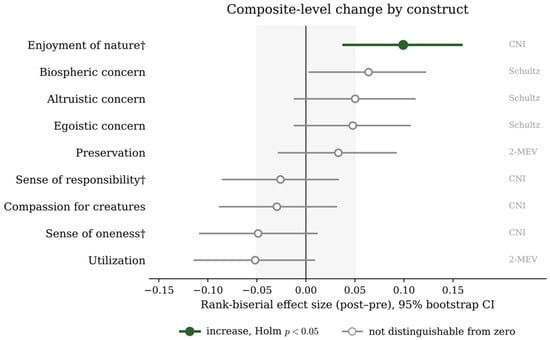
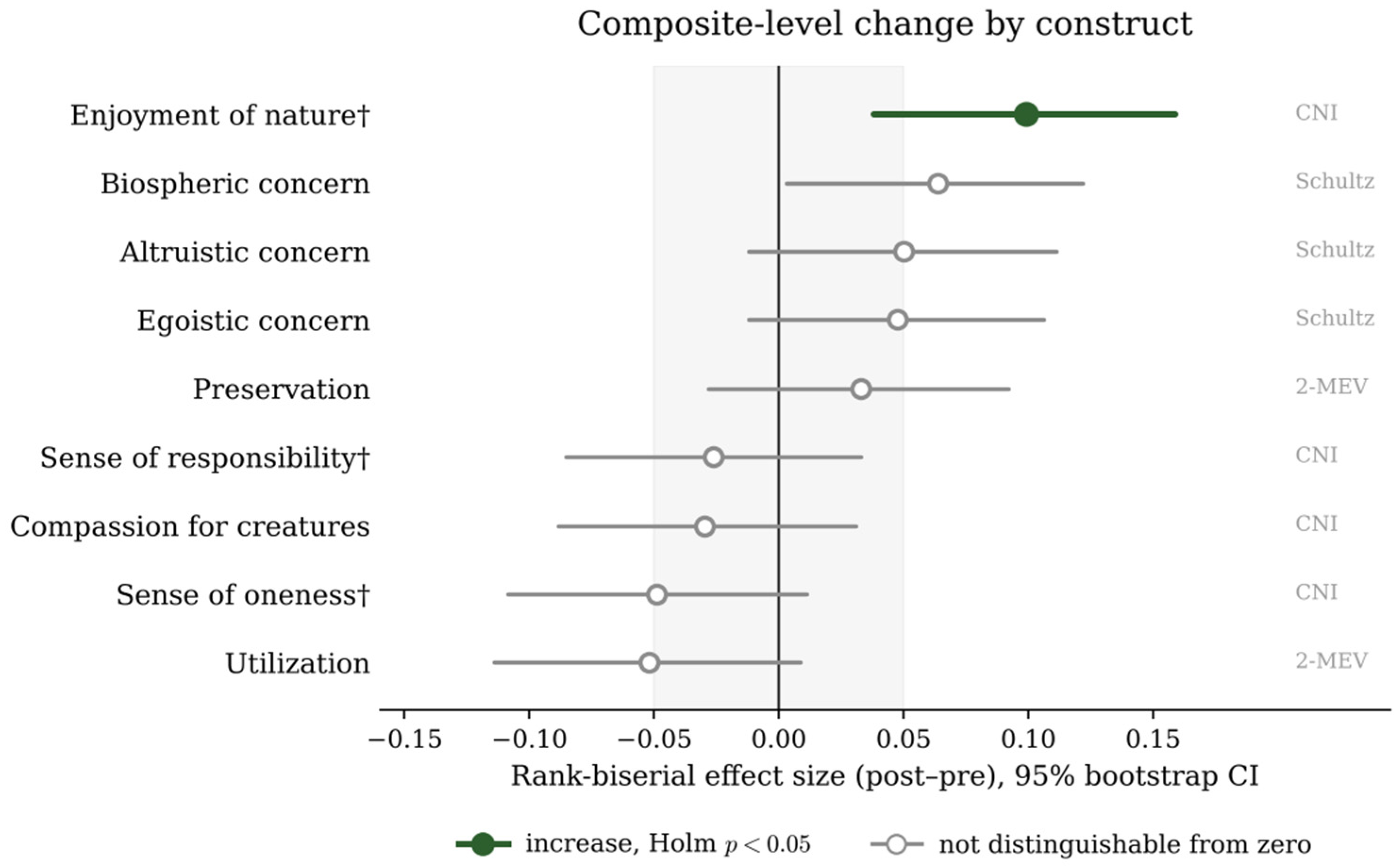
Of the nine constructs, only enjoyment of nature showed a reliable change, rising from a pre-stay mean of 3.64 to 3.77 (rank-biserial = 0.10, 95% CI 0.04–0.16; Cohen’s d = 0.15; Holm-adjusted p = 0.012). No other construct survived multiplicity correction. The value- and identity-laden dimensions did not increase and, where they moved at all, tended slightly downward: sense of oneness drifted from 4.34 to 4.25 and compassion, responsibility, and preservation values were essentially flat (all |d| < 0.08, Holm-adjusted p > 0.28). The contrast is summarized in Table 2 and Figure 1. This is the analysis a composite-based approach yields; Section 3.3, Section 3.4 and Section 3.5 indicate that it does not fully capture what changed.
Table 2.
Descriptive statistics and pre/post change for all nine constructs (post–pre).
Figure 1.
Composite-level change by construct, expressed as rank-biserial effect sizes (post–pre) with 95% percentile bootstrap confidence intervals. Filled markers indicate effects surviving Holm correction across the nine constructs; open markers are not distinguishable from zero. The shaded band marks the region of negligible effect (|r| < 0.05). † denotes constructs for which scalar invariance across waves was rejected under maximum-likelihood estimation (Section 3.3; under ordinal estimation it held for enjoyment of nature), so their composite estimates should not be read as changes in the underlying construct.
3.3. Reliability and Measurement Invariance
Internal consistency was acceptable for most subscales (α = 0.74–0.85) but fell below the conventional threshold for the two three-item Connection to Nature subscales, sense of oneness (α = 0.67) and sense of responsibility (α = 0.67). For both, McDonald’s omega was considerably higher than alpha (0.82 and 0.83), indicating that the items differ appreciably in quality—precisely the condition under which equal weighting distorts a composite. Reliability was higher at the post wave than at the pre wave for every one of the nine subscales, itself a first indication that the instrument did not function identically at the two time points.
Metric invariance held for all nine constructs (ΔCFI > −0.010 throughout), so the items relate to their constructs equivalently in the two waves. Scalar invariance, which is required before observed means may be compared, held for six constructs under maximum likelihood but was rejected for the three that had moved: enjoyment of nature (ΔCFI = −0.019), sense of oneness (−0.023), and sense of responsibility (−0.068). For the six invariant constructs, the latent mean differences were negligible (−0.09 to +0.05), consistent with little or no change in environmental values and concern over the week (Supplementary Table S2).
The nature of the misfit is instructive. For sense of responsibility, the scalar model, constrained to explain all three items with a single latent shift, estimated κ = −0.23 and therefore predicted declines of 0.14, 0.17 and 0.13 points. The observed changes were −0.19, −0.23 and +0.25: the first two items deviate by less than 0.07, while the third deviates by 0.38 and in the opposite direction. Freeing the intercept of that single item restored acceptable fit (χ2 fell from 56.04 on 4 df to 6.47 on 3 df; CFI 0.926 → 0.995). The corresponding item in the other two sub-scales was 5.13 for enjoyment of nature and 5.11 for sense of oneness.
The ordinal (WLSMV) sensitivity analysis reproduced the central result (Supplementary Table S3). Scalar invariance was again rejected for sense of responsibility (ΔCFI = −0.041) and sense of oneness (−0.023); freeing the thresholds of item 5.16 again restored acceptable fit for responsibility (ΔCFI = +0.001), with a latent change of −0.31 (p < 0.001), almost identical to the maximum-likelihood estimate of −0.32, whereas freeing item 5.11 did not restore invariance for sense of oneness (ΔCFI = −0.014). Two results differed. Scalar invariance held for enjoyment of nature under the ordinal model (ΔCFI = −0.007), so its non-invariance under maximum likelihood depends on the estimator, although its latent increase was similar under both (+0.23 under full scalar invariance and +0.26 with item 5.13 freed, against +0.17 and +0.22 under maximum likelihood). Biospheric concern showed a latent increase under the ordinal model (δ = 0.25, p = 0.005, surviving Holm correction across the nine constructs) that was negligible under maximum likelihood (0.05). The share of pupils choosing the highest response category rose by three to six percentage points on all four biospheric items while their means barely moved, which is consistent with a change compressed by the ceiling in linear models; because the single-factor model fitted this subscale poorly (RMSEA = 0.14), we treat this result as suggestive.
3.4. Item-Level Change
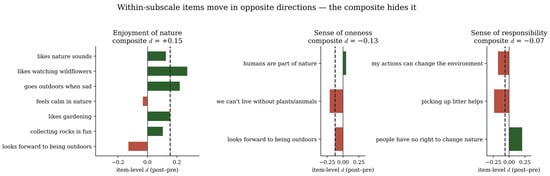
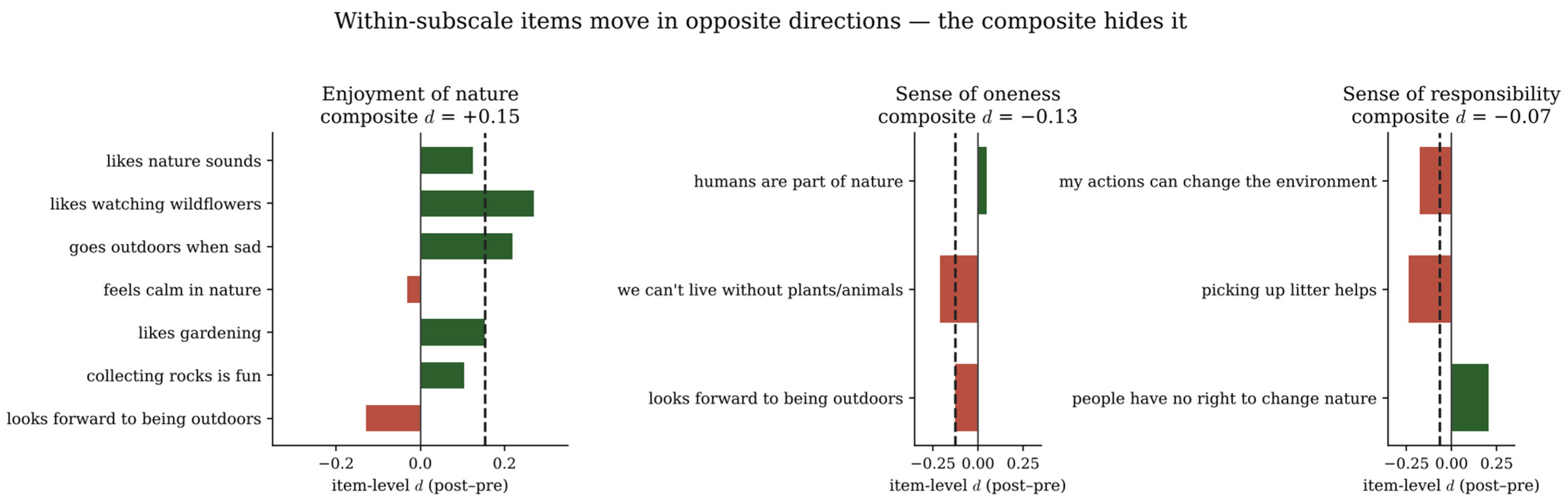
Because the invariance tests localized the problem to single items, we examined change at the item level directly (Table 3, Figure 2). Within enjoyment of nature, six of seven items rose, most strongly “I like watching wildflowers” (d = 0.27) and “when I am sad, I go outdoors” (d = 0.22); only item 5.13 declined (d = −0.13). Within the sense of responsibility, the pattern was starker. Both items expressing personal efficacy declined—“with my actions I can change the natural environment” (d = −0.18) and “by picking up litter we can help the environment” (d = −0.24)—while the third item, “people have no right to change the natural environment”, rose (d = +0.21). These are conceptually distinct claims: the first two concern personal agency, the third concerns non-interference. Averaging them yields a composite change of −0.06, which is arithmetically faithful and substantively empty.
Table 3.
Item-level change within the Connection to Nature subscales and composites rescored without the divergent item.
Figure 2.
Item-level effect sizes within the three Connection to Nature subscales. The dashed line marks the composite effect reported for that subscale. Green bars indicate increases and red bars decreases. Items within a subscale move in opposite directions, so the composite average conceals them.
Rescoring each affected subscale without its divergent item requires no modelling assumptions, but the item to be removed was identified from the invariance analysis of the same data, so these rescored estimates are exploratory (Table 3). Enjoyment of nature rose more strongly than the composite indicated (d = 0.21, p = 0.0001, against d = 0.15). Without item 5.16, the responsibility subscale reduces to its two personal-efficacy items, and this measure of personal environmental efficacy showed a clear decline (d = −0.24, p < 0.0001) where the three-item composite had reported none (d = −0.07, p = 0.26). Sense of oneness behaved differently: rescored on its two remaining items, it was no longer distinguishable from zero (d = −0.09, p = 0.24), and its reliability fell to α = 0.57, so we do not interpret this subscale further.
The split-sample validation indicates that the efficacy result did not arise from capitalizing on chance in the item selection (Supplementary Table S4). Item 5.16 was selected in the training half in all 500 school-level splits, and in the held-out schools personal environmental efficacy declined in every split (median d = −0.24, interquartile range −0.28 to −0.20; p < 0.05 in 96% of splits), whereas the original three-item composite reached p < 0.05 in only 6%. For enjoyment of nature, the selection was less stable (item 5.13 in 73% of splits, item 5.4 or 5.2 in nearly all of the remainder), but the held-out increase was positive in every split (median d = 0.19; p < 0.05 in 90%), whichever item was removed.
3.5. Latent and Item-Response Estimates
Two model-based analyses corroborate the item-level result. Under partial scalar invariance, the latent mean difference was +0.22 for enjoyment of nature and −0.32 for sense of responsibility. Because the item freed in each case was selected by a data-driven search, these estimates are exploratory and are reported for convergence rather than as primary values. The graded response model, which does not assume equal spacing of Likert categories, gave d = 0.19 for enjoyment (p = 0.001) and d = −0.17 for responsibility (p = 0.003), against composite values of 0.15 and −0.07; biospheric concern also doubled, from 0.05 to 0.11 (p = 0.022), though it would not survive multiplicity correction. Across the three approaches—rescored composites, latent means, and item-response scores—the direction and approximate magnitude agree for both constructs.
The Bayesian analysis supports the substantive reading of these results while being appropriately cautious about the null claims (Table 4). For the six constructs that met scalar invariance, the posterior mass inside the ROPE ranged from 64% to 93%, and each posterior median fell well within the region of practical equivalence (|δ| ≤ 0.08). Their 95% HDIs nevertheless extend slightly beyond the ROPE boundary, so the data are best described as strongly consistent with negligible change rather than as establishing equivalence outright; widening the ROPE to |δ| < 0.15 places 90–99% of the posterior mass inside it for all six. By contrast, enjoyment of nature scored without item 5.13 (median δ = 0.21, HDI 0.10 to 0.32) and sense of responsibility scored without item 5.16 (median δ = −0.24, HDI −0.35 to −0.13) both excluded zero and placed almost no posterior mass inside the ROPE (2.6% and 0.6%), with P(δ > 0) = 1.00 and P(δ < 0) = 1.00 respectively. The two effects the paper reports are therefore not merely statistically detectable but practically non-negligible, whereas the six unchanged constructs are, to the extent these data can show it, practically equivalent to no change.
Table 4.
Bayesian estimates of the standardized pre/post difference (δ) with a region of practical equivalence of |δ| < 0.10.
3.6. Robustness
The enjoyment-of-nature effect was stable across model specifications. In the mixed models, the post coefficient was +0.14 with a school random intercept (p = 0.001), +0.14 when additionally adjusted for grade (p = 0.002), and +0.13 with a center random intercept (p = 0.003). The downward drift in sense of oneness reached nominal significance only under the center-level model (p = 0.036), not under the school-level models (p = 0.08–0.09), and would not survive multiplicity control; we therefore treat it as suggestive at most.
3.7. Ceiling Effects
Several constructs were close to their scale maxima before the stay even began. At baseline, 55% of pupils were within half a point of the ceiling for biospheric concern, 57% for egoistic concern, 54% for compassion, and 52% for sense of oneness. This saturation mechanically limits the upward movement these measures could register and is itself relevant to interpreting the flat results. By contrast, enjoyment of nature—the construct that did move—had the most headroom (mean 3.64 on a 1–5 scale, only 15% near ceiling).
3.8. Moderators
Neither programme type nor grade showed a clear moderation of the change in enjoyment of nature, and the novelty contrast was null: the gain did not differ reliably between first-time and returning visitors (interaction p = 0.35), despite most pupils (≈75%) having visited a CŠOD center before.
Because the decline in efficacy could plausibly reflect programme content—for instance, exposure to the scale of environmental problems—we tested whether it varied by programme type. Importantly, all three programme types incorporated elements from all three areas—naturalistic, sport, and social science—but differed in which area was given greater emphasis during the week. The decline in “picking up litter helps” was nevertheless essentially similar across the sport (d = −0.24), naturalistic (d = −0.24), and social-science (d = −0.19) programs. This consistency suggests that the observed decline was not clearly specific to the particular curricular emphasis of any one programme type. One possible interpretation is that the residential experience may have prompted pupils to reflect more critically on their own environmental behavior or on the effectiveness of individual actions, thereby changing how they evaluated their own efficacy. Such a response would be consistent with research suggesting that environmental learning can involve critical and self-reflection and that educational experiences may alter the frame of reference through which participants evaluate themselves. However, this interpretation remains speculative in the present study. Because there was no non-participating comparison group, the observed decline cannot be attributed specifically to the residential experience, and other factors occurring during the same period cannot be excluded.
4. Discussion
Across the beginning and end of the one-week residential period, children’s reported relationship with nature showed a differentiated pattern. Enjoyment of nature increased, and more strongly than the composite analysis suggested, while perceived environmental efficacy declined. Environmental values, biospheric, altruistic and egoistic concern, and compassion for living creatures showed little or no change, and for these constructs the evidence goes beyond a non-significant test: scalar invariance held under maximum likelihood, the latent mean differences were small, and most of the posterior mass lay within the region of practical equivalence. The ordinal analysis qualifies this conclusion for biospheric concern, which showed a latent increase that the ceiling may have hidden from the linear analyses. The dissociation is therefore not simply between what moves and what does not, but between an affective-experiential component that strengthens and a component of personal agency that weakens. This is consistent with evidence that brief environmental education has limited capacity to shift durable value orientations [2,8], but it extends that literature in an unexpected direction: the most responsive facets of the human–nature relationship over a single week are affective and agentic rather than evaluative, and they do not move together.
This pattern is also relevant to the educational rationale of the CŠOD programme, which emphasizes direct engagement with nature as a foundation for broader environmental learning. Although enjoyment of nature represents only one dimension of environmental attitudes, increased positive affect towards natural environments may constitute an important proximal outcome of immersive outdoor education. Positive emotional experiences may strengthen children’s willingness to spend time in natural settings and provide a foundation upon which environmental knowledge, values, and behaviors can gradually develop. This interpretation is consistent with Palmberg and Kuru [20], who argued that outdoor experiences contribute to environmental responsibility primarily through the affective domain by fostering environmental sensitivity, feelings of safety, self-confidence, and empathic relationships with nature. Similarly, Otto and Pensini [21] found that connectedness to nature was a substantially stronger predictor of children’s ecological behavior than environmental knowledge, suggesting that affective engagement with nature represents a key pathway through which outdoor education may contribute to later pro-environmental behavior. Thus, a one-week residential experience may be sufficient to influence the experiential component of the human–nature relationship, even when deeper value orientations remain unchanged, though, as the next section argues, this proximal benefit is accompanied by a countervailing shift that programme evaluations have not previously been positioned to detect. These findings are also consistent with place-responsive perspectives, which view meaningful emotional engagement with particular places as a precursor to developing longer-term environmental responsibility [5].
The observed dissociation between increased enjoyment of nature and stable environmental values aligns with Bogner’s [22] conceptual extension of the 2-MEV model, which distinguishes Appreciation of Nature from the higher-order environmental value dimensions of Preservation and Utilization. This framework proposes that positive experiences and enjoyment of nature constitute a related but conceptually distinct component of environmental attitudes, one that may respond differently to educational experiences. Bogner further notes that the Utilization dimension conflates exploitative and appreciative forms of nature use, which reflect fundamentally different ways of relating to the natural world. In the present study, children’s enjoyment of nature increased following the residential programme, whereas environmental values—including preservation-related orientations—remained unchanged. This pattern supports the proposition that affective appreciation of nature is more responsive to short-term outdoor experiences than relatively stable environmental values. Moreover, the modest association between appreciation and preservation suggests that increased enjoyment of nature should not be interpreted as evidence of an immediate change in value, but rather as a proximal outcome that may provide a foundation for the longer-term development of environmental attitudes and behaviors [22].
The decline in personal environmental efficacy warrants closer attention, because it is a finding that a composite-based analysis would not have surfaced, although it rests on an exploratory rescoring of two items. Both items expressing personal efficacy fell, while the item asserting that humans have no right to alter nature rose by a comparable margin. Read together, these suggest a reorientation rather than random movement: at the end of the week, children endorsed leaving nature alone more strongly and believed less strongly that their own actions make a difference to it. Two cautions apply. The rise in non-interference rests on a single item, and a near-identical 2-MEV Preservation item (“people have no right to change nature as they see fit”) rose only slightly (d = 0.04, p = 0.38), so the non-interference shift is less well supported than the efficacy decline. And without a comparison group, neither shift can be attributed to the programme’s message rather than to other influences during the same week.
Three explanations are available, and the present design cannot adjudicate between them. The first draws on research into awe and the “small self”, in which vast natural stimuli reduce self-focus and the sense of personal significance [23,24]. Notably, one of the naturalistic inductions used in that literature involved standing among towering trees, an experience closely approximating a residential stay in a forest center. That work finds the diminished self accompanied by increased collective engagement, which fits the present pattern rather than contradicting it: the items that declined concern individual capability, whereas the item that rose is a collective normative claim. A shift from individual to collective orientation would produce exactly this profile. The second explanation is semantic: after a week of “leave no trace” instruction, the notion of changing nature may acquire a negative valence, so that children disagree with being able to change the environment because they have learned they should not, rather than because they feel unable. The third invokes the possibility that learning about the scale of environmental problems induces a sense of futility about small individual actions, a concern long raised in environmental education. Against the second and third explanations, the decline was of essentially equal magnitude in the sport, naturalistic and social-science programs, which suggests a cause common to the residential week itself rather than to environmental content. The similarity across programme types is compatible with a shared experience or common contextual factors, but does not identify the mechanism responsible for the observed decline.
Two explanations for the absence of measurable change in environmental values and concern, the six constructs for which scalar invariance held and whose comparison is therefore secure, deserve consideration, and they are not mutually exclusive. The first is substantive: a one-week experience may simply be insufficient to alter relatively stable environmental values, concern, or self-related orientations. This interpretation aligns with evidence that environmental attitudes generally develop through repeated experiences over time rather than through isolated educational events [2,8]. The second possibility concerns measurement constraints. The ceiling diagnostics indicate that these Slovenian schoolchildren entered the programme with already high levels of biocentric concern and connectedness with nature, leaving limited scope for further increases. The ceiling effect occurs when a large proportion of subjects start a study with very high values for the measured variable(s) [25]. This issue may be particularly relevant in the Slovenian context, where outdoor residential education is embedded within compulsory schooling through the “School in Nature” framework. Because many pupils have prior exposure to structured nature-based learning, they may begin with comparatively developed environmental orientations. Consequently, the absence of measurable increases in preservation, connectedness, or biospheric concern may partly reflect limited room for improvement rather than a lack of educational value.
The present findings also refine the conclusions of the earlier evaluation of CŠOD residential programs [13], which reported small but significant improvements in environmental attitudes and connectedness with nature following a one-week stay. Several factors may explain the different pattern observed here. First, the earlier study examined a younger cohort of pupils (10–11 years), whereas the present sample included pupils from grades 5–8 (mean age approximately 12 years). Previous research suggests that younger children exhibit greater responsiveness to short-term nature experiences, with intervention effects diminishing with increasing age [2]. Second, the earlier study relied on composite scores, whereas the present analysis evaluated measurement invariance and latent structure. This more detailed approach revealed that some apparent stability reflects opposing changes within individual items. Together, these findings suggest that short residential programs may produce more nuanced changes in environmental attitudes than conventional composite-score analyses can detect.
The present findings can also be interpreted in light of evaluations of the Earthkeepers programme. Earthkeepers likewise places strong emphasis on immersive experiences in nature and has consistently demonstrated positive effects on children’s environmental values, attitudes, and behaviors [26,27]. Importantly, however, these outcomes are achieved within a programme that extends well beyond the residential component. Earthkeepers begins with a three-day residential experience in nature but continue through at least one month of structured follow-through activities in the classroom and at home, during which students are supported by teachers and parents in practicing environmentally responsible behaviors and reinforcing their connection with nature. Consequently, the broader changes reported in Earthkeepers may reflect the cumulative influence of this sustained educational process rather than the residential experience alone. The observed increase in enjoyment of nature suggests that this affective dimension may be more responsive to short-term changes in context or experience than some of the more established environmental value orientations. However, without a comparison group, it is not possible to determine whether the increase resulted from the residential programme itself or from other factors occurring during the same period.
From the perspective of CŠOD and education for sustainable development, the lack of short-term change in environmental values and concern should therefore not necessarily be interpreted as limited programme effectiveness. The programme operates within a broader developmental process in which repeated experiences, environmental knowledge, social interactions, and opportunities for environmental action may gradually contribute to more stable value orientations. The multidimensional approach adopted in this study is important in this regard: while values and concern may represent longer-term outcomes of environmental education, affective experiences such as enjoyment of nature may represent more immediate outcomes that are responsive to shorter periods of immersion.
These findings also have implications for the evaluation of large-scale outdoor education programs. If brief residential programs primarily reflect proximal affective experiences, evaluation frameworks should avoid relying exclusively on broad environmental values as indicators of success. Future assessments of CŠOD and similar programs may benefit from incorporating more behaviorally oriented outcomes, including willingness to engage in conservation actions, intentions for future nature engagement, environmental self-efficacy, or observed environmentally responsible behaviors. Such measures may be better suited to detecting the types of changes that a short but intensive nature experience can realistically produce, while longitudinal approaches may be needed to capture possible later developments in environmental values and identity. The present results give this recommendation an unexpected sharpness: environmental self-efficacy, listed here as a candidate outcome for future evaluation, is precisely the dimension on which we observed a decline, and it is measured in the existing instrument by only two items whose signal the composite cancelled.
A methodological implication follows for the field more generally. Composite scoring of multi-item attitude scales is near-universal in evaluations of environmental education, and it is rarely accompanied by tests of whether the instrument functions equivalently before and after an intervention. Where an intervention plausibly changes how respondents interpret items, which is a reasonable expectation for any immersive experience, such tests are not a technical refinement but a precondition for interpreting the results at all. In the present data, the constructs that failed scalar invariance under maximum likelihood were exactly those that appeared to change (sense of responsibility under both estimators), and the item-level analysis showed why: a subscale containing conceptually heterogeneous items can register no change while its components move substantially in opposite directions. Reporting subscale reliabilities, testing invariance across waves, and inspecting item-level change are inexpensive safeguards against this class of error, as is checking the conclusions with an ordinal estimator when responses accumulate at the top of the scale.
Limitations: Six constraints bound the interpretation. First, the absence of pupil identifiers means change is estimated at the group level; although the two waves were closely matched on observed characteristics, individual-level change and its variability cannot be recovered. Because the same classes were measured twice, the waves are also not strictly independent; treating them as independent is conservative for the comparison of means, but it is also assumed by the multi-group factor models. Second, and consequently, the failure of scalar invariance cannot be cleanly separated from genuine attitude change: a shift in item intercepts across waves is the signature of response shift, in which an experience alters how respondents interpret the items, and distinguishing this from a change in the underlying construct requires within-person data. Third, there was no non-participating comparison group, which limits causal interpretation of the observed pre–post changes. Although the similar magnitude of the decline in perceived environmental efficacy across the three programme types suggests that the pattern was not specific to a particular curricular focus, this consistency does not demonstrate that the residential experience itself produced the change. Time-related effects, repeated exposure to the questionnaire, fatigue, social desirability, changes in school or daily routines, seasonal influences, or other contemporaneous factors cannot be ruled out. Future studies incorporating a non-participating comparison group, preferably with linked individual-level measurements, would provide a stronger basis for causal attribution. Fourth, the item freed in each partial-invariance model was selected by a data-driven search, which inflates the risk of capitalizing on chance; the latent estimates are therefore exploratory, and we rest the substantive claims on the model-free rescored composites instead, whose item selection was itself informed by the data but replicated in held-out schools. Fifth, the measures are self-report, several sit close to their ceilings, and the single-factor models fitted poorly for biospheric concern and Utilization, so invariance results for those two constructs should be treated with caution; moreover, the scalar-invariance result for enjoyment of nature and the latent estimate for biospheric concern depended on whether the items were treated as continuous or ordinal. Sixth, although the Bayesian analysis places most posterior mass inside the region of practical equivalence for the six unchanged constructs, none of their credible intervals lies entirely within it, so the evidence supports practical equivalence rather than demonstrating it.
Future directions: Recording an anonymous pupil code at both time points would permit a properly paired analysis at negligible cost and would allow response shift to be distinguished from genuine change using the test or similar designs. A delayed third measurement would address retention, which prior work identifies as the crux. Adding a non-participating comparison group would support causal attribution. Most directly, the agency finding invites a study designed to test it: separating individual from collective environmental efficacy in the instrument, including a measure of awe or self-diminishment, and increasing the number of items per subscale so that heterogeneous content is not averaged away. Such a design would determine whether a residential nature programme genuinely relocates children’s sense of agency from the individual to the collective, or whether the present pattern reflects a change in how the items are read.
5. Conclusions
A week of residential outdoor education within Slovenia’s CŠOD network was associated with a differentiated pattern of change in children’s environmental attitudes. The measurement analysis provided little evidence of change in the assessed environmental values and environmental concern, while revealing two more specific and potentially important shifts: children reported greater enjoyment of nature but were simultaneously less convinced that their own actions could make a difference for the environment. Although these effects were modest, and the efficacy result rests on an exploratory rescoring of two items, the lower personal environmental efficacy at the end of the week was hidden by conventional composite scoring, because opposing item-level changes cancelled one another within the responsibility subscale. These findings demonstrate that affective connection to nature and perceived capacity to act for the environment should not be assumed to develop in parallel.
From an environmental education perspective, the findings highlight the complexity of outcomes associated with intensive experiential learning in natural settings. Increased enjoyment of nature can be understood as a valuable proximal outcome of direct engagement with the outdoors and may provide an important foundation for longer-term environmental learning and connectedness to nature. At the same time, stronger affective engagement does not necessarily translate into greater environmental agency. For programs such as those delivered through the CŠOD network, one implication is that opportunities to experience and appreciate nature could be complemented by activities that explicitly support children’s sense of efficacy, responsibility, and capacity to act for the environment. Such an approach may help connect emotional engagement with nature to the broader knowledge, values, and agency required for sustainability-oriented learning.
The findings also have implications beyond the specific programme studied. Short-term outdoor education should not necessarily be expected to transform relatively established environmental values within a single week; rather, its contribution may lie in fostering proximal experiences and dispositions that can develop through sustained educational engagement. At the same time, if environmental agency is an intended outcome of environmental education, it should be addressed explicitly in programme design and assessed directly rather than inferred from broader environmental attitude scales. Finally, the study demonstrates the importance of examining measurement properties and item-level responses when evaluating sustainability education. Composite scores may suggest stability while concealing meaningful and potentially opposing changes within the underlying dimensions of children’s environmental attitudes. Careful measurement is therefore essential for understanding how experiential and outdoor learning contributes to the affective, cognitive, and action-oriented dimensions of sustainability education.
Supplementary Materials
The following supporting information can be downloaded at https://www.mdpi.com/article/10.3390/su182010652/s1. Table S1: Questionnaire items, response scales, and item-to-subscale mapping; Table S2: Measurement invariance across waves — multi-group single-factor CFA, maximum likelihood (main analysis); Table S2b: Partial scalar invariance (maximum likelihood): intercept of one item freed; Table S3: Ordinal sensitivity analysis — multi-group single-factor CFA with WLSMV estimation (polychoric correlations, theta parameterization; lavaan 0.6.17); Table S3b: Partial scalar invariance (WLSMV): thresholds of one item freed; Table S4: Split-sample validation of the data-driven item selection (500 random splits of the 16 schools into two halves).
Author Contributions
Conceptualization, G.T.; data curation, H.R. and Ž.R.; formal analysis, G.T. and H.R.; funding acquisition, G.T.; methodology, K.M. and G.T.; supervision, G.T. and M.R.-Š.; writing—original draft, K.M. and G.T.; writing—review and editing, G.T., K.M., M.R.-Š. and Ž.R.; visualization, K.M. All authors have read and agreed to the published version of the manuscript.
Funding
K.M. was supported by the European Union’s Horizon Europe research and innovation programme under the Marie Skłodowska-Curie COFUND Postdoctoral Programme (SMASH, Grant Agreement No. 101081355), with co-funding from the Republic of Slovenia and the European Union through the European Regional Development Fund. M.R.-Š. was supported by the Slovenian Research Agency research core funding No. P6-0411. G.T. was supported by the Slovenian Research Agency research core funding No. P5-0452.
Institutional Review Board Statement
The study, which involved child participants, was reviewed and approved by review board of the Faculty of Education, University of Ljubljana, on 18 June 2023. Informed consent was obtained from the participants’ parents or legal guardians, and assent was obtained from the participating students prior to their involvement in the study. All procedures were conducted in accordance with the Declaration of Helsinki, relevant national regulations governing research involving minors, and institutional guidelines.
Informed Consent Statement
All procedures were performed in compliance with relevant laws and institutional guidelines and have been approved by the University of Ljubljana, Faculty of Education. Privacy rights of human subjects have been observed and informed consent was obtained for experimentation with human subjects. Participation was voluntary and anonymous.
Data Availability Statement
The data that support the findings of this study are available from the corresponding author upon reasonable request.
Acknowledgments
During the preparation of this study, the authors used the generative AI assistant Claude (Opus 5, Anthropic) to assist in writing and documenting the analysis code and in drafting and editing text, figures, and tables. The authors have reviewed and edited the output and take full responsibility for the content of this publication.
Conflicts of Interest
The authors declare no conflicts of interest.
Abbreviations
The following abbreviations are used in this manuscript:
| CŠOD | Slovenia’s network of Centers for School and Outdoor Education |
| ESD | Education for Sustainable Development |
| PRE | Preservation |
| UTL | Utilization |
| BIO | Biospheric |
| EGO | Egoistic |
| ALTRU | Altruistic |
| UVN | Enjoyment of nature |
| SDZB | Compassion for creatures |
| OE | Sense of oneness |
| OO | Sense of responsibility |
References
- Cheng, J.C.-H.; Monroe, M.C. Connection to nature: Children’s affective attitude toward nature. Environ. Behav. 2012, 44, 31–49. [Google Scholar] [CrossRef] [Scilit]
- Liefländer, A.K.; Fröhlich, G.; Bogner, F.X.; Schultz, P.W. Promoting connectedness with nature through environmental education. Environ. Educ. Res. 2013, 19, 370–384. [Google Scholar] [CrossRef] [Scilit]
- UNESCO. Education for Sustainable Development: A Roadmap; UNESCO: Paris, France, 2020; Available online: https://unesdoc.unesco.org/ark:/48223/pf0000374802 (accessed on 1 September 2026).
- Davis, J. (Ed.) Young Children and the Environment: Early Education for Sustainability, 2nd ed.; Cambridge University Press: Cambridge, UK, 2015. [Google Scholar]
- Lynch, J.; Mannion, G. Place-responsive pedagogies in the Anthropocene: Attuning with the more-than-human. Environ. Educ. Res. 2021, 27, 864–878. [Google Scholar] [CrossRef] [Scilit]
- Sobel, D. Place-Based Education: Connecting Classrooms and Communities; Orion Society: Great Barrington, MA, USA, 2004. [Google Scholar]
- Mannion, G.; Fenwick, A.; Lynch, J. Place-responsive pedagogy: Learning from teachers’ experiences of excursions in nature. Environ. Educ. Res. 2013, 19, 792–809. [Google Scholar] [CrossRef] [Scilit]
- Sellmann, D.; Bogner, F.X. Effects of a 1-day environmental education intervention on environmental attitudes and connectedness with nature. Eur. J. Psychol. Educ. 2013, 28, 1077–1086. [Google Scholar] [CrossRef] [Scilit]
- Harris, N.M.; Hartwell, B.; Thomas, L.; Grace, M. How can nature connectedness and behaviours for learning be deliberately developed in children, adolescents and young adults? A systematic literature review. Child Adolesc. Ment. Health 2025, 30, 168–185. [Google Scholar] [CrossRef] [Scilit]
- Ly, V.; Vella-Brodrick, D.A. Effects of school-led greenspace interventions on mental, physical and social wellbeing in children and adolescents: A systematic review. Educ. Psychol. Rev. 2024, 36, 133. [Google Scholar] [CrossRef] [Scilit]
- Šola v Naravi za Devetletno Osnovno Šolo: Koncept. [Concept of the School in Nature]. Ministrstvo za Šolstvo in Šport: Zavod RS za Šolstvo. 2001. Available online: https://www.csod.si/uploads/file/Zakonska%20izhodisca/Koncept_sole_v_naravi.pdf (accessed on 1 September 2026).
- Center for School and Outdoor Education [Centres for School and Outdoor Education]. CŠOD Website. 2026. Available online: https://www.csod.si/ (accessed on 1 September 2026).
- Rožman, H.; Kokalj, I.; Torkar, G. Students’ environmental attitudes and the outcomes of their participation in a 1-week programme in a Centre for School and Outdoor Education in Slovenia. In Risk and Outdoor Play; Gray, T., Sturges, M., Barnes, J., Eds.; Springer: Singapore, 2025; pp. 179–193. [Google Scholar] [CrossRef] [Scilit]
- Wiseman, M.; Bogner, F.X. A higher-order model of ecological values and its relationship to personality. Personal. Individ. Differ. 2003, 34, 783–794. [Google Scholar] [CrossRef] [Scilit]
- Bogner, F.X.; Wiseman, M. Adolescents’ attitudes towards nature and environment: Quantifying the 2-MEV model. Environmentalist 2006, 26, 247–254. [Google Scholar] [CrossRef] [Scilit]
- Bogner, F.X.; Wiseman, M. Outdoor ecology education and pupils’ environmental perception in preservation and utilization. Sci. Educ. Int. 2004, 15, 27–48. [Google Scholar]
- Schultz, P.W. The structure of environmental concern: Concern for self, other people, and the biosphere. J. Environ. Psychol. 2001, 21, 327–339. [Google Scholar] [CrossRef] [Scilit]
- Vandenberg, R.J.; Lance, C.E. A review and synthesis of the measurement invariance literature. Organ. Res. Methods 2000, 3, 4–70. [Google Scholar] [CrossRef] [Scilit]
- Cheung, G.W.; Rensvold, R.B. Evaluating goodness-of-fit indexes for testing measurement invariance. Struct. Equ. Model. 2002, 9, 233–255. [Google Scholar] [CrossRef] [Scilit]
- Palmberg, I.E.; Kuru, J. Outdoor activities as a basis for environmental responsibility. J. Environ. Educ. 2000, 31, 32–36. [Google Scholar] [CrossRef] [Scilit]
- Otto, S.; Pensini, P. Nature-based environmental education of children: Environmental knowledge and connectedness to nature, together, are related to ecological behaviour. Glob. Environ. Change 2017, 47, 88–94. [Google Scholar] [CrossRef] [Scilit]
- Bogner, F.X. Environmental values (2-MEV) and appreciation of nature. Sustainability 2018, 10, 350. [Google Scholar] [CrossRef] [Scilit]
- Keltner, D.; Haidt, J. Approaching awe, a moral, spiritual, and aesthetic emotion. Cogn. Emot. 2003, 17, 297–314. [Google Scholar] [CrossRef] [Scilit]
- Piff, P.K.; Dietze, P.; Feinberg, M.; Stancato, D.M.; Keltner, D. Awe, the small self, and prosocial behavior. J. Personal. Soc. Psychol. 2015, 108, 883–899. [Google Scholar] [CrossRef] [Scilit]
- Staus, N.L.; O’Connell, K.; Storksdieck, M. Addressing the ceiling effect when assessing STEM out-of-school time experiences. Front. Educ. 2021, 6, 690431. [Google Scholar] [CrossRef] [Scilit]
- Manoli, C.C.; Johnson, B.; Hadjichambis, A.C.; Hadjichambi, D.; Georgiou, Y.; Ioannou, H. Evaluating the impact of the Earthkeepers Earth education program on children’s ecological understandings, values and attitudes, and behaviour in Cyprus. Stud. Educ. Eval. 2014, 41, 29–37. [Google Scholar] [CrossRef] [Scilit]
- Činčera, J.; Johnson, B. Earthkeepers: The relationship between instructional strategies and program outcomes. Envigogika 2022, 17, 1. [Google Scholar] [CrossRef] [Scilit]

Disclaimer/Publisher’s Note: The statements, opinions and data contained in all publications are solely those of the individual author(s) and contributor(s) and not of MDPI and/or the editor(s). MDPI and/or the editor(s) disclaim responsibility for any injury to people or property resulting from any ideas, methods, instructions or products referred to in the content. |
© 2026 by the authors. Licensee MDPI, Basel, Switzerland. This article is an open access article distributed under the terms and conditions of the Creative Commons Attribution (CC BY) license.