


Abstract
As the key load-bearing structure of a coal mine underground reservoir, the coal pillar dam body is subjected to the long-term coupling effect of overburden stress and mine water erosion. To investigate the coupled mechanical-seepage evolution mechanism of coal-rock under mining-induced stress, triaxial compression-seepage tests were conducted on coal samples taken from the coal pillar dam body of the underground reservoir in Chahasu Coal Mine. The effects of confining pressure and stress loading path on the mechanical deformation and permeability evolution of coal-rock were analyzed, a damage-permeability model incorporating fracture compaction, damage-induced cracking, and matrix deformation was established, and sensitivity analysis of key parameters was performed. Additionally, the model’s predictive accuracy was verified against experimental data, and its overall characterization capability was further assessed. The results show that: (1) The peak axial stress, peak deviatoric stress and elastic modulus of coal samples increase exponentially with increasing confining pressure. A distinct inflection point is observed in the stress–strain curve under the unloading confining pressure-axial loading (UCP-AL) and constant confining pressure-axial loading (CCP-AL) paths, with the stress increasing at a markedly higher rate before the inflection point than after it. (2) Under different stress loading paths, the permeability of the coal samples first decreases, then slowly increases, and then rapidly increases with increasing axial strain, and it shows higher sensitivity to deviatoric stress. The minimum permeability exhibits an exponentially decreasing trend with increasing confining pressure. (3) A damage-permeability model incorporating a Logistic-type damage variable was developed to continuously characterize the permeability evolution of coal specimens over the entire loading process from elastic deformation to macroscopic failure. Furthermore, the key model parameters (ω, ζ, and τ) are strongly correlated with confining pressure. (4) The single-stress-parameter model exhibits limitations in characterizing permeability evolution under triaxial stress conditions. To address this deficiency, a multi-parameter modified damage-permeability model was established, in which the effective total stress is used to describe the fracture compaction effect, while the effective deviatoric stress accounts for the damage-induced cracking effect. These laboratory-scale findings provide an experimental and theoretical basis for understanding the stress–damage–seepage evolution of coal. Further upscaling and calibration using field monitoring data (piezometric and drainage measurements from underground reservoir) is required before its application in seepage prediction and stability evaluation of in situ coal pillar dams.
1. Introduction
Western China contributes more than 80% of the national coal output [1], positioning the region as a cornerstone of national energy security. However, this region is characterized by an arid climate, scarce rainfall, and extremely severe water shortages, with total water resources accounting for less than 9.6% of the national total [2]. The stark conflict between coal mining and water co-extraction severely restricts the sustainable development of coal resources, and achieving the co-extraction of coal and water has become a core goal for green and sustainable mining in these mining areas. Underground reservoir technology is considered a feasible sustainable mining approach to alleviate the conflict between energy exploitation and water conservation. By integrating artificial dams with coal pillar dams to form sealed compartments in the goaf, the underground reservoir technology enables the storage, purification, and reuse of mine water [3,4,5], thereby effectively addressing the aforementioned challenges.
Permeability, a key parameter governing seepage in porous media, has been extensively investigated through predictive models for quantitative characterization. Most of these studies have been conducted in the context of coalbed methane (CBM) extraction [6]. Many of these CBM-oriented permeability models are governed by gas sorption–desorption and matrix swelling/shrinkage [7]. Their physical assumptions differ substantially from the fully water-saturated, pure-water flow conditions of the underground coal reservoirs investigated in this work. Based on the relationship between permeability and the horizontal effective stress acting on the fracture structure of coal, Gray [8] proposed an early permeability model in 1987 based on the relationship between permeability and the horizontal effective stress acting on the fracture structure of coal. Subsequently, Seidle [9] developed a permeability model exhibiting an exponential dependence on effective stress based on a simplified seepage medium model. Considering the non-isothermal elastic theory of porous media, Palmer and Mansoori [10] developed the P-M permeability model under the assumptions of uniaxial strain and constant axial stress in coal seams. The model explicitly accounts for the cubic dependence of permeability on porosity, which is induced by adsorption-driven swelling. Shi and Durucan [11] developed the S-D permeability model by assuming that permeability changes were predominantly controlled by horizontal effective stress and seepage medium was an isotropic continuum, yielding an exponential functional form derived from the elastic constitutive equations. Robertson and Christiansen [12] further developed the R-C permeability model by incorporating the effects of stress and adsorption-induced deformation on coal fracture evolution. The three classical models differ in their parameter settings and underlying assumptions [13]. The P-M and S-D models employ effective stress and fracture compressibility as key parameters, consider only elastic fracture deformation without introducing damage variables, and assume an isotropic medium. In contrast, the R-C model introduces a damage variable to quantify fracture degradation and can account for anisotropic behavior, although its original formulation was not specifically developed for unloading stress paths. These models are classical in formulation and physical rationale, and serve as fundamental references for developing new models that incorporate additional influencing factors. For instance, Liu et al. [14] established a combined-form permeability model that accounts for the interaction between cleats and the coal matrix in the seepage medium. Based on the cleat distribution characteristics of seepage media, Zhang et al. [15] developed a new permeability model by revising the constant term of the classical formulation. In summary, most existing permeability models are based on these classical frameworks, with modifications introduced through effective stress variations or adjustments to the geometric parameters of the seepage medium. In this study, the core physical assumption that effective stress governs the evolution of fracture aperture and permeability was retained. However, the assumptions of adsorption-induced matrix swelling and fully reversible elastic deformation were discarded, as both are irrelevant to the pure-water seepage conditions and unloading stress paths considered in this work.
However, changes in the stress state can induce plastic deformation in coal masses or even cause overall instability and failure, leading to order-of-magnitude changes in permeability. In such cases, the aforementioned elastic models are unable to accurately describe the permeability evolution. Moreover, the seepage behavior and permeability evolution of coal under mining disturbance represent typical gas–solid or fluid–solid coupling problems, which necessitate incorporating damage mechanics theory to improve the classical permeability models. Extensive research has been conducted on damage–permeability models [16,17,18,19]. Based on how damage variables are defined and incorporated into the model framework, these models can be broadly classified into constitutive–based and expression–based categories. For instance, Li et al. [20] developed a comparatively simple constitutive damage–permeability model that links permeability to damage evolution in the seepage medium under triaxial stress. Yang et al. [21] constructed a piecewise stress–damage–seepage coupling model by defining damage zones and incorporating the deformation characteristics of the seepage medium. Meng Lei et al. [22] and Zhu and Tang [23] characterized the strength heterogeneity of the seepage medium using the Weibull distribution, and established damage–permeability models by adopting the Drucker–Prager, Mohr–Coulomb, and maximum tensile stress criteria as damage thresholds. Some researchers have incorporated the damage variable directly into the permeability expression to reduce computational cost in model application. For instance, Xue et al. [24] proposed an expression-based damage–permeability model based on acoustic emission(AE) characteristics of the seepage medium under compressive loading. Xue et al. [25] and Zhang et al. [26] introduced damage variables and incorporated effective stress, porosity, volume, and adsorption strain into the formulation of permeability models.
In recent years, preliminary progress has been made in exploring the seepage characteristics of coal-rock masses under coupled effects [27,28,29,30,31,32,33]. In these studies, internal seepage characteristics of the medium are often idealized, and the permeability evolution is typically characterized by various methods, including the permeability prediction model mentioned above. For instance, Xue et al. [34] divided the coal body into three stages: elastic deformation, plastic softening and residual state, and characterized the seepage property changes in mining-affected coal by fitting stress–strain–permeability relationships obtained from triaxial compression tests. Liu [35] idealized the internal seepage within the coal pillar dam as classical Darcy flow, and established a permeability model by incorporating coal creep effects based on the S-D model, followed by numerical simulations. Chen [36] and Liang [37] also idealized the internal seepage properties of mining-affected coal as classical Darcy flow, and simulated seepage behavior using piecewise constitutive and expression-based damage permeability models, respectively. Yan [38] considered the influence of threshold pressure on the seepage inside the coal pillar dam body, and investigated the internal flow behavior by fitting the relationship between permeability and coal–rock stress.
In summary, most existing studies on coal–rock permeability are based on modifications to and extensions of classical models such as Palmer-Mansoori (P-M), Shi-Durucan (S-D) and Robertson-Christiansen (R-C) models. Although numerous studies have investigated the permeability of coal [39,40], most of the resulting permeability models were developed under monotonic loading or constant confining pressure and failed to characterize the dynamic evolution of permeability for water-saturated coal under complex unloading stress paths. The coupling mechanism between mining-induced stress damage and seepage in coal–rock remains insufficiently explored. Moreover, most existing models are limited to two-dimensional curve fitting, and their characterization performance in a triaxial stress state has not been validated, making it difficult to capture the actual seepage behavior of coal–rock under complex mining-induced stress paths. To this end, triaxial compression seepage tests on coal samples under different stress loading paths were conducted, and the mechanical and seepage evolution mechanisms of coal–rock under complex stress conditions were revealed. Additionally, a damage-permeability model and for mining-affected coal was constructed, and its characterization capability under triaxial stress conditions was validated. This study provides a theoretical basis for the safe operation and maintenance of coal pillar dams in underground reservoirs of coal mines, further promoting the sustainable exploitation of ecologically fragile mining areas in western China.
2. Materials and Methods
2.1. Coal Sample Selection
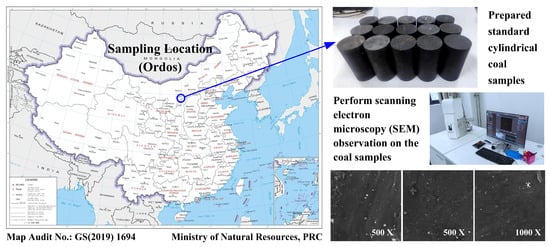
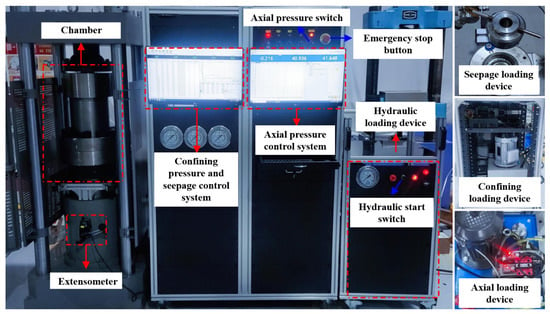
As shown in Figure 1, the coal samples were taken from the No. 3-1 coal seam of Chahasu Coal Mine, Xinjie Mining Area, Dongsheng Coalfield, China. The goaf of this coal seam has been constructed as an underground reservoir for storing and purifying mining-affected water resources. The No. 3-1 coal seam is classified as low-rank bituminous coal. According to the International Society for Rock Mechanics (ISRM) requirements [41], the raw coal samples were processed into standard cylindrical specimens (Φ50 × 100 mm) with good integrity. The axial direction of the prepared cylindrical specimens is perpendicular to the bedding plane. The selected coal samples contained no obvious cracks or macroscopic damage on their surfaces. The parallelism error of the two end faces was within ±0.05 mm, and the end faces were perpendicular to the specimen axis within an axial deviation of ±0.25°, thereby minimizing stress concentration induced by surface irregularities. The scanning electron microscopy (SEM) observations revealed that the coal sample surfaces were relatively dense, dominated by homogeneous and layered structures. The maceral composition was dominated by vitrinite, and no large pores or macroscopic fractures were observed. At magnifications ranging from 500× to 1000×, only a few scattered micropores were identified, and the local microstructure exhibited slight fragmentation. The dry density of coal samples was approximately 1380 kg/m3, the saturated water content was 10.71%, the porosity ranged from 9% to 11%, and the uniaxial compressive strength (UCS) was 41.23 MPa [4].
Figure 1.
Coal sample location and preparation.
2.2. Experimental Equipment
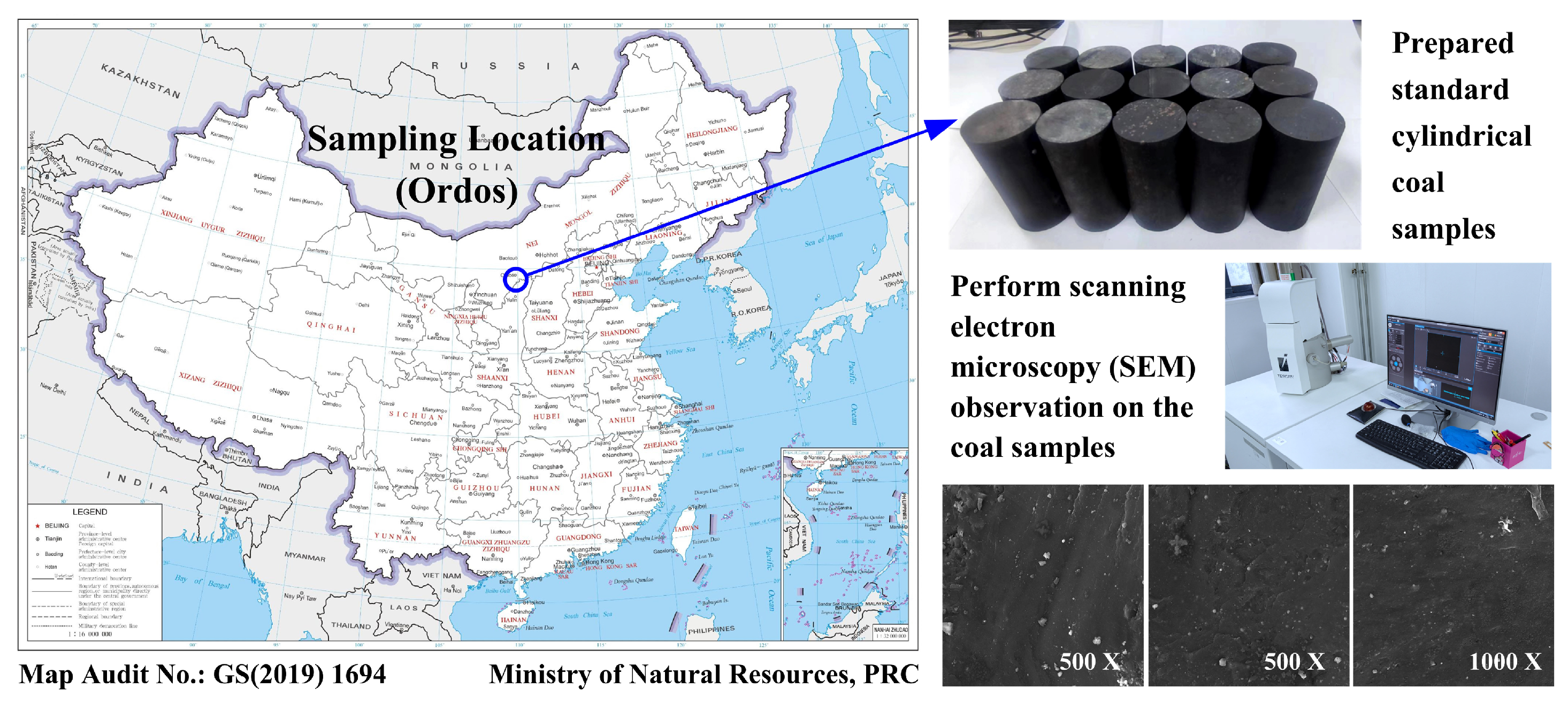
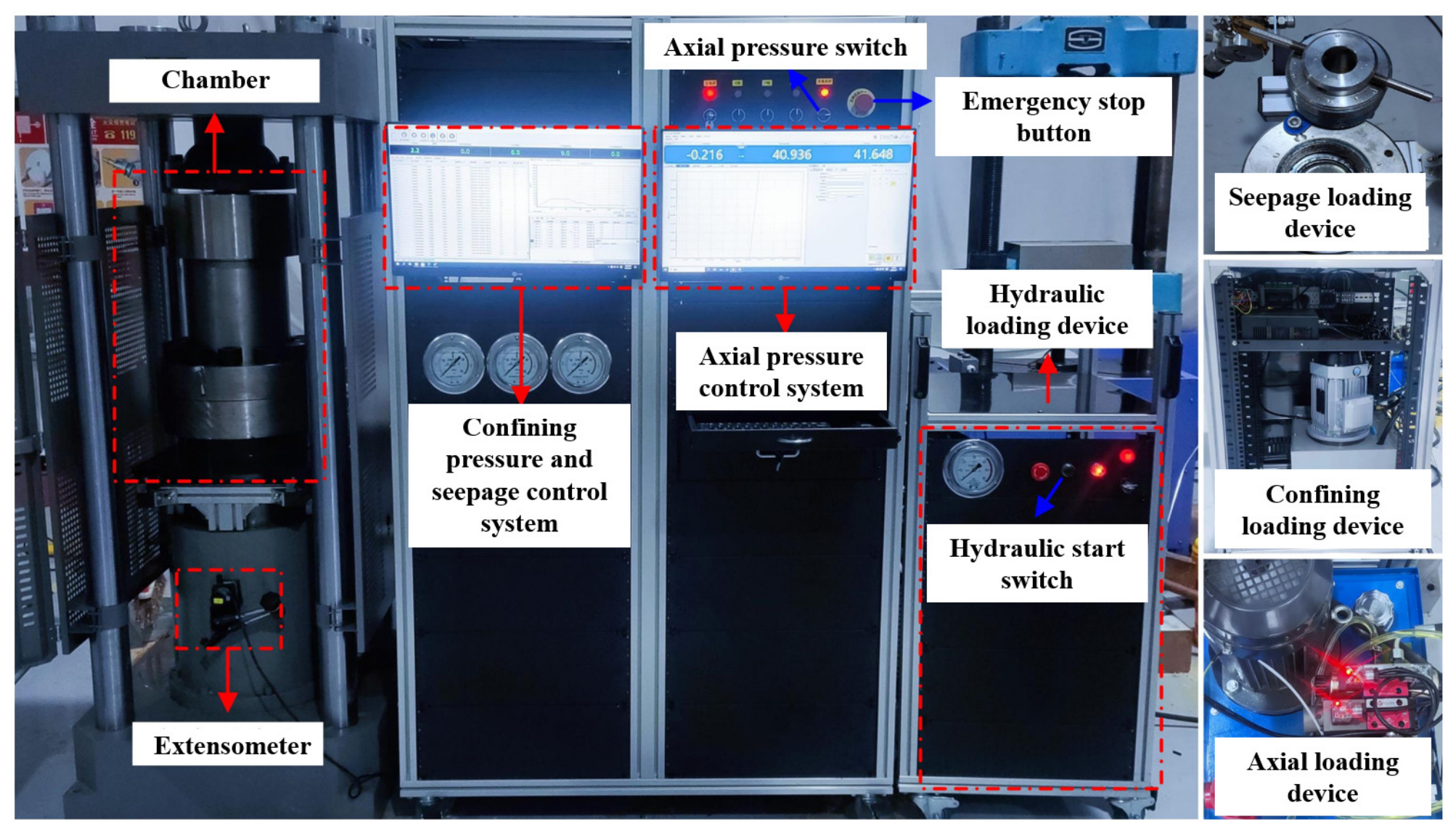
A conventional triaxial hydro-mechanical coupling and seepage testing system for coal–rock (Model CTS24, manufactured in China) was adopted to measure the mechanical and seepage characteristics of the coal samples, as shown in Figure 2. This system employed a modular design and mainly consisted of an axial and confining pressure loading system, a control system for fluid pressurization, depressurization, and pressure stabilization, as well as a data acquisition system, all interconnected via built-in pipelines, vessels, and valves. The maximum confining pressure was 40 MPa, and the maximum axial load was 1000 kN. The main control modes included displacement control and stress control. Available seepage media included gas, liquid, and supercritical carbon dioxide. The maximum seepage pressure was 40 MPa. In this experiment, pure water was used as the seepage medium, and the steady-state method was employed to measure the permeability of the coal samples at room temperature (approximately 20 °C). The permeability calculation method is described in Equation (1).
where k is the permeability, m2; μ is the viscosity of the fluid, Pa·s, taken as approximately 1.0 × 10⁻³ Pa·s at room temperature (20 °C); q is the fluid flow rate, m3/s; L is the length of the sample, m; A is the cross-sectional area of the sample perpendicular to the direction of water flow, m2; Δp is the seepage pressure difference, Pa (or N/m2).
Figure 2.
Main test equipment.
2.3. Experimental Design
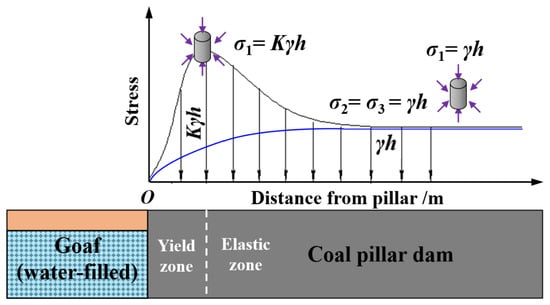
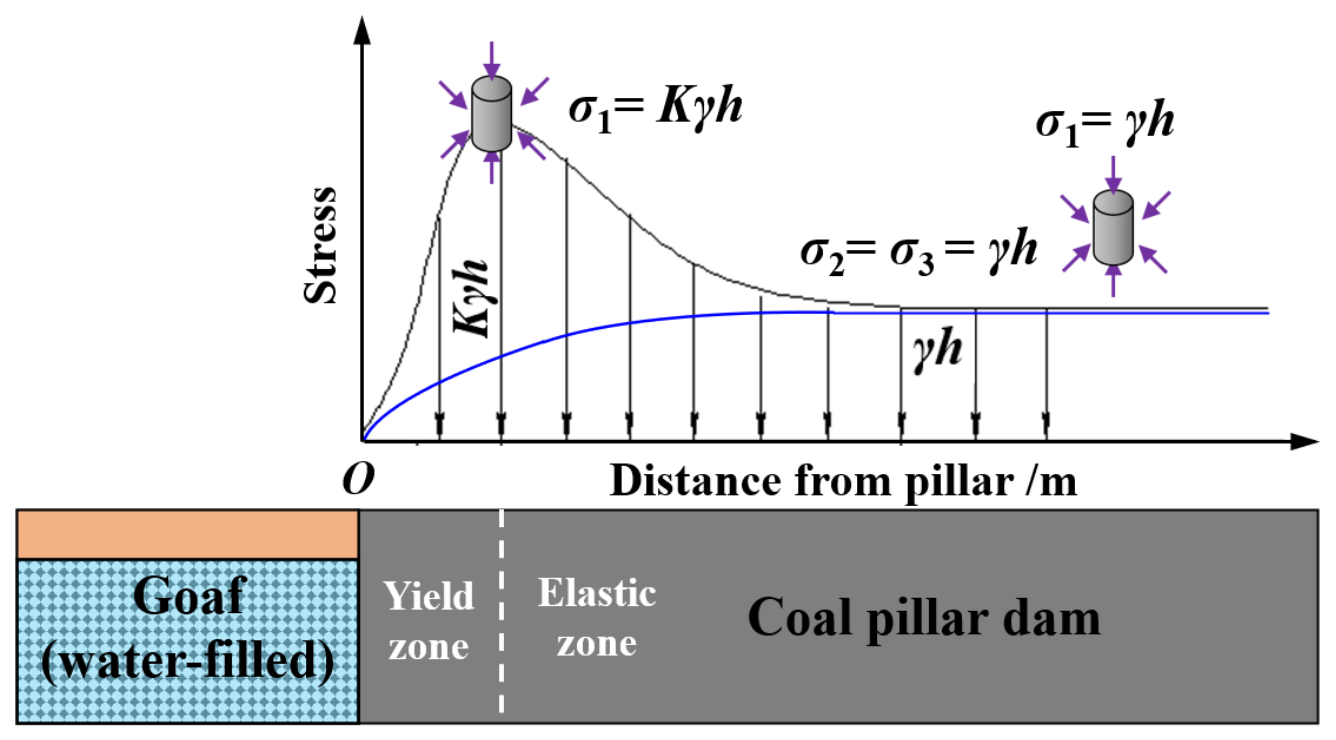
Mining activities (coal extraction, roadway drivage, and chamber excavation) induce stress redistribution in the surrounding rock and cause localized stress concentration, thereby promoting deformation of the coal–rock mass. Taking the coal pillar dam body of the underground reservoir in the Chahasu Coal Mine as an example, the abutment pressure increases with increasing distance from the stopping line of the working face, and after reaching a peak, it gradually decreases to the in situ stress level. In contrast, the horizontal stress increases monotonically to the in situ stress level, as shown in Figure 3.
Figure 3.
Abutment pressure distribution of coal pillar dam.
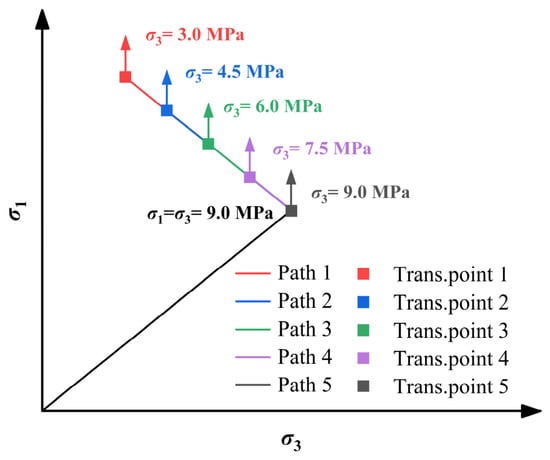
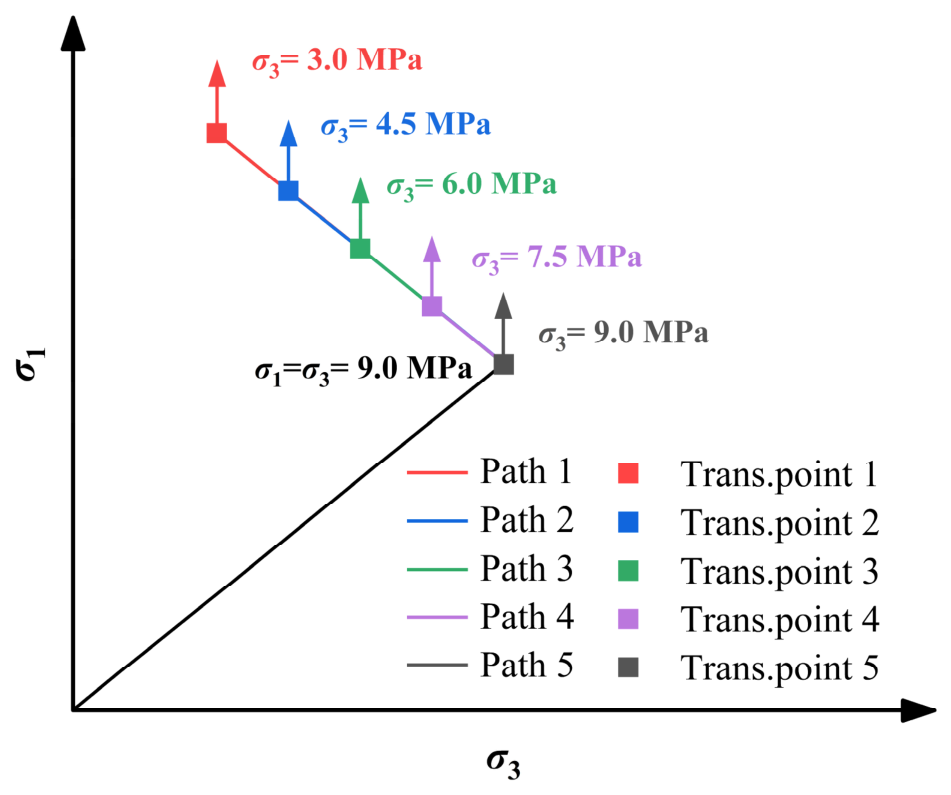
Under the influence of mining-induced stress, the coal mass undergoes a complex stress evolution process, during which its strength and deformation characteristics change significantly, thereby influencing its permeability. In existing studies, the stress loading paths have been simplified, which limits the accurate characterization of seepage behavior in coal–rock under complex stress conditions. The target confining-pressure values were 3.0 MPa, 4.5 MPa, 6.0 MPa, 7.5 MPa and 9.0 MPa, with one specimen used for each group, as shown in Figure 4. The specimen IDs were designated as XCS1–XCS5. The detailed test conditions for all coal specimens are summarized in Table 1.
Figure 4.
Stress loading paths of coal samples.
Table 1.
Test conditions for coal samples.
The specific test procedure was as follows: (1) The coal sample was fully water-saturated in advance and then placed into the triaxial seepage cell; (2) The axial pressure and confining pressure were simultaneously increased to 9.0 MPa, and fluid was injected at 1.5 MPa (with the outlet pressure was maintained at 0 MPa, i.e., atmospheric pressure); (3) After the outlet flow rate became stable, the confining pressure was unloaded to the target confining pressure (3.0 MPa for Path 1, 4.5 MPa for Path 2, 6.0 MPa for Path 3, 7.5 MPa for Path 4, 9.0 MPa for Path 5). During unloading, the axial pressure was continuously increased until specimen failure occurred. (4) Throughout the test, loading was interrupted at predetermined stress levels to ensure their stability until steady-state seepage was established. The stress, strain, and flow rate of the coal sample were recorded throughout the loading process. To facilitate subsequent comparative analysis, the confining pressure unloading rate was set equal to the axial pressure loading rate, consistent with previous studies [36].
3. Results
3.1. Mechanical Properties of Coal Samples
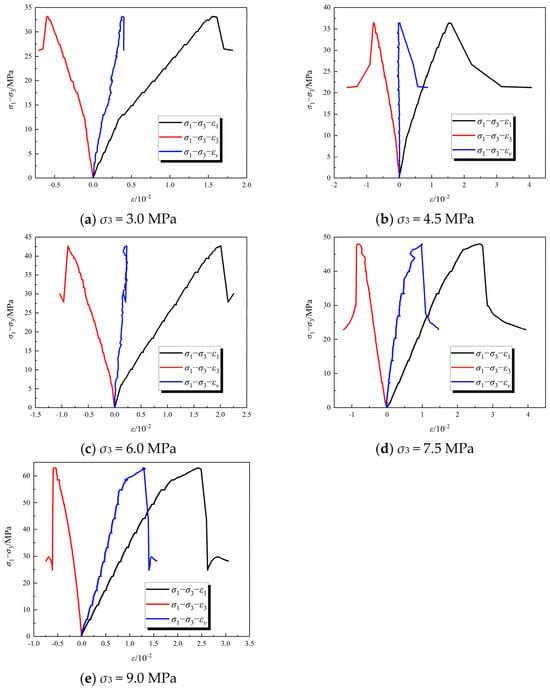
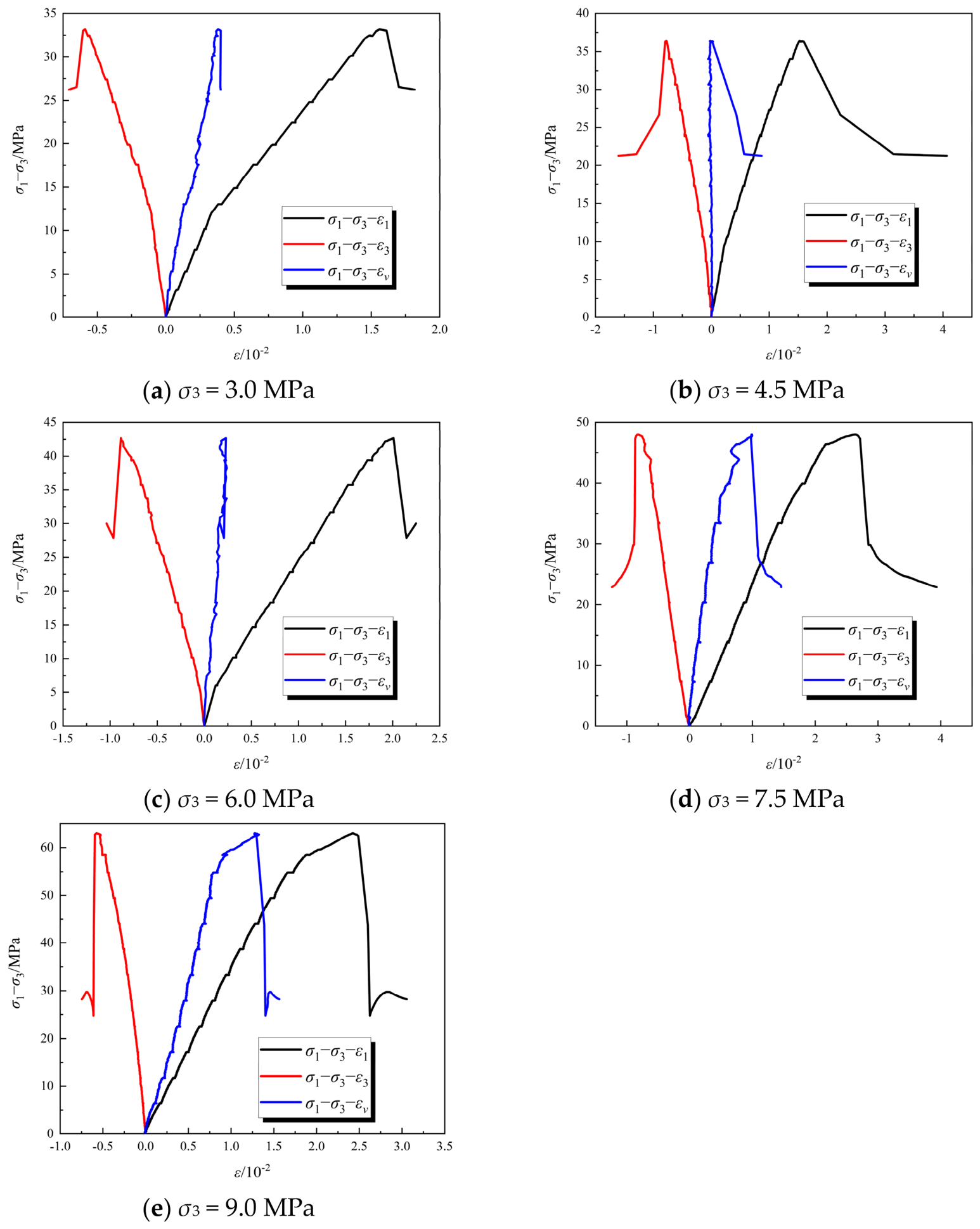
Figure 5 shows the deviatoric stress–strain curves of the coal samples. The stress–strain curves under different loading paths exhibit generally similar variation patterns. As the deviatoric stress (σ1 − σ3) increases, the axial strain ε1 increases while the circumferential strain ε3 decreases. This indicates that the coal sample undergoes compressive deformation in the axial direction, whereas it exhibits circumferential expansion under the Poisson effect induced by axial compression. Unlike conventional triaxial compression tests [42], the deviatoric stress–strain curves of the pre-peak loaded/unloaded coal samples exhibit an obvious inflection in the early loading stage, and the inflection position is not fixed, which is related to the stress loading path design in this study. During the test, when the coal sample reached the in situ stress state (σ1 = σ3 = 9.0 MPa), the testing machine automatically zeroed the strain data, after which the UCP-AL or CCP-AL was carried out. This inflection point results from the transition between the two stress paths, and its location corresponds exactly to the instant when the confining pressure is unloaded to the target value. As shown in Figure 5, the inflection points appear at deviatoric stresses of 12.0, 9.0, 6.0, 3.0, and 0.0 MPa, respectively. This is because the target confining pressures were set to 3.0, 4.5, 6.0, 7.5, and 9.0 MPa, and the confining pressure unloading rate was equal to the axial pressure loading rate. In general, the curve before the inflection point follows a UCP-AL path, while the curve after the inflection point follows a CCP-AL path. The growth rate of deviatoric stress differs between the two stages, being significantly greater than that after it.
Figure 5.
Deviatoric stress–strain curves of coal samples under different confining pressures.
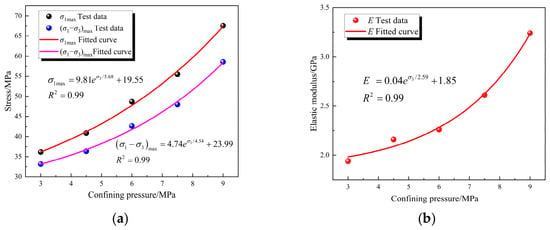
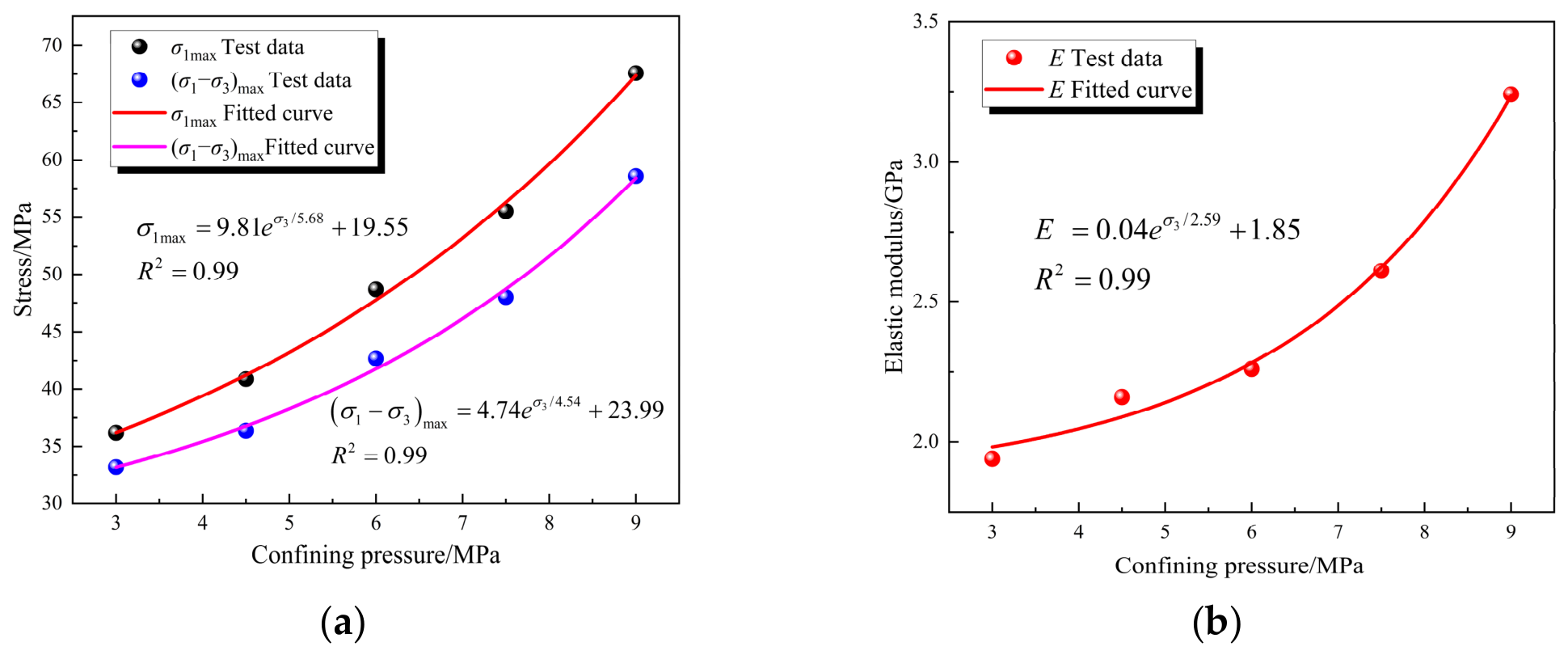
The peak axial stress σ1max and peak deviatoric stress (σ1 − σ3)max represent the compressive strength level of the coal samples. As shown in Figure 6a, for σ3 ranging from 3.0 to 9.0 MPa, σ1max and (σ1 − σ3)max are 36.18/33.18, 40.86/36.36, 48.68/42.68, 55.49/47.99, and 71.98/62.98 MPa, respectively. The corresponding increases are 12.94%/8.58%, 34.55%/28.63%, 53.37%/44.64%, and 98.95%/89.81% relative to the preceding values. Overall, every increase of 1.5 MPa in σ3 leads to an increase of approximately 9.58–31.24% in σ1max and (σ1 − σ3)max relative to the preceding values.
Figure 6.
Variation characteristics of strength parameters of coal samples under different confining pressures: (a) peak axial stress σ1max and peak deviatoric stress; (b) elastic modulus.
The elastic modulus E is usually used to describe the deformation characteristics of coal-rock materials. Similar to the variation patterns of σ1max and (σ1 − σ3)max, the elastic modulus E shows an exponentially increasing trend with increasing σ3, as shown in Figure 6b. This is because the rise in σ3 promotes the closure of pores and fractures within the coal matrix, thereby enhancing its bulk density and structural uniformity. Concurrently, this stress increase enlarges the interfacial contact area among mineral grains and reinforces interparticle mechanical bonding. Consequently, a higher stress is required to induce an equivalent deformation, which is ultimately manifested as an increase in the elastic modulus. An exponential function can be used to characterize the relationships between the σ1max, (σ1 − σ3)max, E and σ3 of coal samples, as shown in Equation (2).
3.2. Seepage Characteristics of Coal Samples
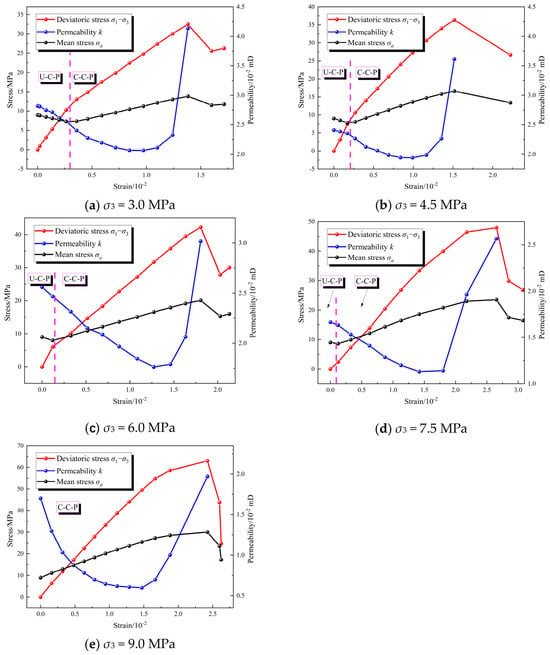
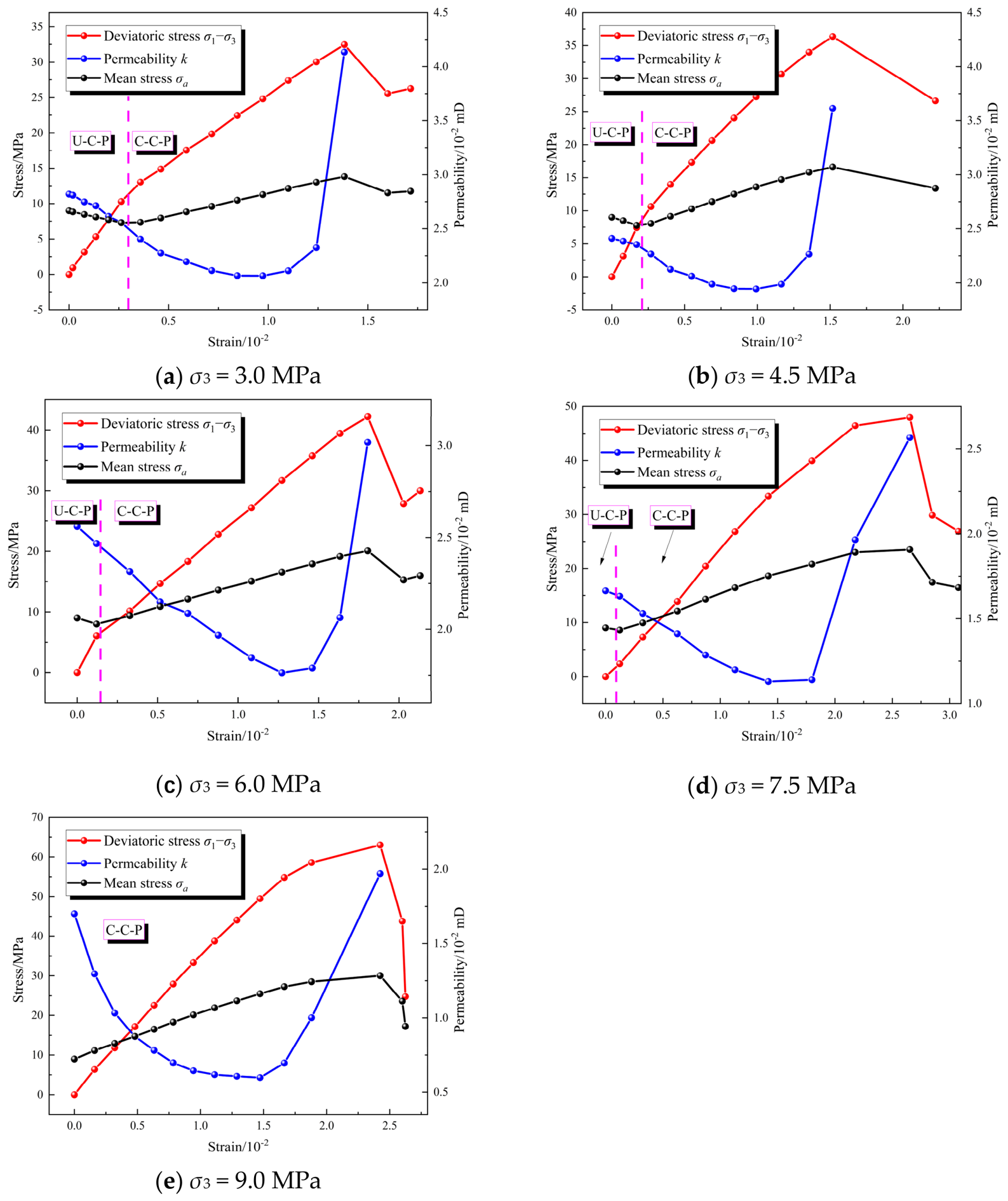
Figure 7 shows the relationships between permeability k and axial stress σ1, deviatoric stress (σ1 − σ3) and strain for the coal specimens. It can be seen that the permeability shows different changing trends at different stages of the stress–strain curve. In the early stage of loading, permeability is generally at a relatively high level. With increasing deviatoric stress, the coal sample successively undergoes the fracture compaction stage, elastic deformation stage, and plastic stable deformation stage. During these stages, permeability tends to decrease, primarily due to the closure of internal pores and overall axial deformation of the coal sample. Upon entering the plastic unstable deformation stage, the degree of damage to the coal sample intensifies, new fractures are formed within the coal sample, and the increased number of seepage pathways promotes an upward trend in permeability. When the deviatoric stress reaches its peak, the coal sample undergoes instability failure and forms macroscopic seepage channels, at which point permeability also reaches its peak. Unlike conventional triaxial seepage compression tests [43], the permeability of the coal samples in this study often experiences a period of slow decline before a rapid decrease (e.g., at σ3 = 3.0 MPa and 4.5 MPa). This phenomenon was also reported by other researchers [36]. This is mainly because when the initial deviatoric stress is 0, both axial pressure and confining pressure are 9.0 MPa, after which the coal sample undergoes an axial pressure increase and confining pressure unloading process. The increase in axial pressure leads to a decreasing size of primary fractures in the vertical direction, while the decrease in confining pressure results in an increasing size of primary fractures in the horizontal direction. The interaction between the two reduces the influence of deviatoric stress on permeability. However, this phenomenon is not pronounced, and the permeability of some coal samples hardly exhibits such a trend (at σ3 = 6.0 MPa and 9.0 MPa).
Figure 7.
Permeability–deviatoric stress–mean stress–axial strain relationship curves of coal samples under different confining pressures. C-C-P denotes constant confining pressure, and U-C-P denotes unloading confining pressure.
In summary, coal sample permeability is closely related to its stress state. The deviatoric stress σd is the difference between the maximum principal stress σ1 and the minimum principal stress σ3, while the mean stress σa is the arithmetic mean of the three-dimensional stress of the coal sample; both can reflect the overall stress state of the coal sample. To analyze the sensitivity of permeability to deviatoric stress σd and mean stress σa, the variation in mean stress with strain is obtained, as shown in Figure 7. The variation trends of deviatoric stress and mean stress exhibit obvious differences. Although the confining pressure unloading process affects the growth rate of deviatoric stress σd, σd generally shows an increasing trend before the yield stage. In contrast, mean stress σa begins to decline in the early stage of loading and only rises after the confining pressure is unloaded to the target value. Combined with existing research results, in the fracture compaction and elastic deformation stages at the early stage of loading, the permeability of the coal sample tends to decrease with increasing external load. As illustrated in Figure 7, when the mean stress σa decreases, permeability decreases at a relatively low rate, rather than showing an increasing trend. As analyzed in Section 3.1 above, the combined effect of increasing axial stress σ1 and decreasing circumferential stress σ3 on the water-conducting fracture pathways of the coal sample is the main reason for this phenomenon. From the perspective of the stress state of the coal sample, during this stage (early stage of loading), mean stress σa is not the primary parameter controlling the variation pattern of permeability k. Furthermore, after the confining pressure σ3 is unloaded to the target value, mean stress σa still needs to undergo a relatively small decrease before the upward trend. However, this process is inconsistent with the monotonic decline in permeability. In contrast, the deviatoric stress σd of the coal sample does not exhibit such a problem. Therefore, regardless of whether UCP-AL is applied, the deviatoric stress σd exhibits higher sensitivity to the variation in permeability k.
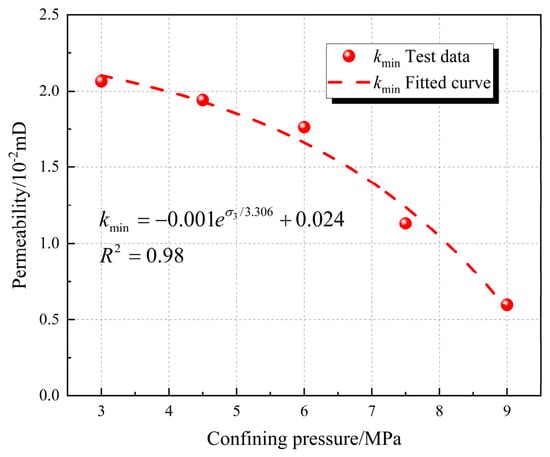
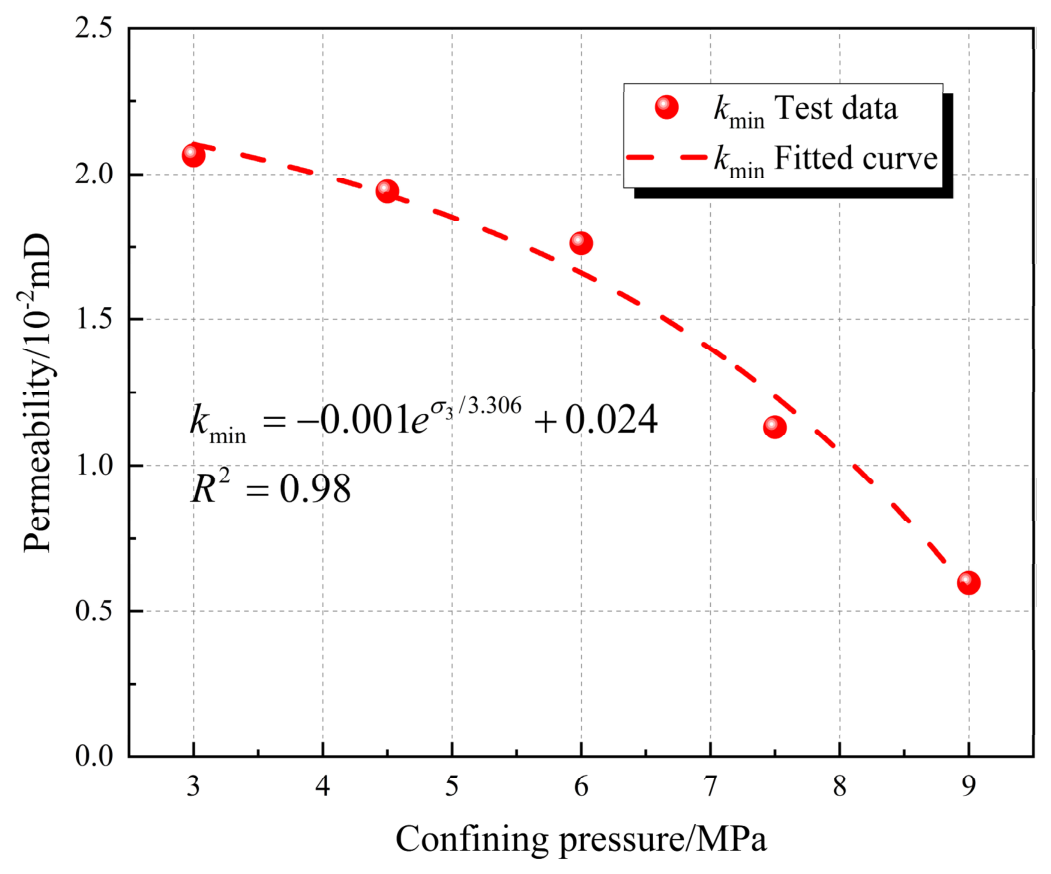
In addition to the stress loading path, confining pressure σ3 also has a significant impact on permeability k. Taking the minimum permeability kmin as an example, when σ3 = 3.0, 4.5, 6.0, 7.5, or 9.0 MPa, kmin is 0.021, 0.019, 0.018, 0.011, and 0.0060 mD, respectively. This indicates that kmin decreases with increasing σ3, as shown in Figure 8. The kmin generally appears near the peak stress and when the coal sample has not yet undergone macroscopic instability failure. At this time, the relatively high stress level weakens the influence of coal sample heterogeneity on permeability to some extent. Therefore, the intrinsic reason for its decrease is still that the increase in confining pressure reduces the width of fractures acting as seepage pathways within the coal sample. Furthermore, an exponential function was adopted to characterize the relationship between kmin and σ3, as shown in Equation (3).
Figure 8.
Effect of confining pressure on minimum permeability.
3.3. Construction of a Damage–Permeability Model
Coal–rock mass, as an anisotropic and heterogeneous porous medium, exhibits a typical dual-pore structure. Generally, this material can be considered as a coal matrix containing pores and fractures. To effectively describe the dual-pore structure characteristics, coal-rock is mostly simplified into regular geometric bodies in existing studies, such as the parallel-plate model, matchstick model, cubic model, capillary model, and sphere model [44]. Based on Darcy’s law and the cubic law, the permeability can be expressed as Equation (4):
where a is the matrix width, φ is the porosity, and m is a non-zero constant.
Compared with fracture deformation, the influence of matrix deformation on permeability is extremely small and can be neglected. Considering the Biot effective stress principle [Equation (5)] and the definition of fracture compressibility [Equation (6)], the relationship between permeability and effective stress can be obtained as Equation (7). This expression represents an idealized permeability model widely adopted in previous studies.
where Δσ is the external load, αc is the Biot coefficient, pc is the pore pressure, and cc is the fracture compressibility.
Nevertheless, the ideal elastic permeability model presented in Equation (7) accurately captures the stress-dependent permeability evolution only when the coal remains undeformed and undamaged (i.e., within the elastic stage). As stress increases, the specimen enters its plastic deformation stage, new fractures are formed within the coal sample, and its damage degree continuously increases. At this time, permeability is jointly affected by multiple factors such as compaction effect, fracturing, and matrix deformation, showing different levels of increase. Consequently, the ideal elastic permeability model in Equation (7) is unable to adapt to the permeability changes in the plastic failure stage. To comprehensively reflect the evolution law of permeability, a permeability model based on the damage and fracture characteristics of coal samples is established in the following sections.
By rearranging Equation (7), we obtain:
where k/k0 is the permeability/initial permeability, a/a0 is the matrix width/initial width, and b/b0 is the fracture/cleat width/initial width.
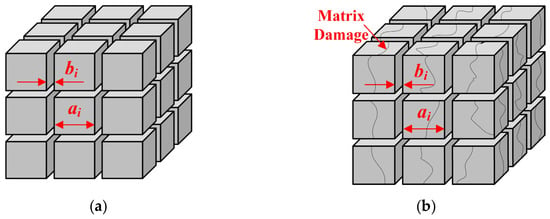
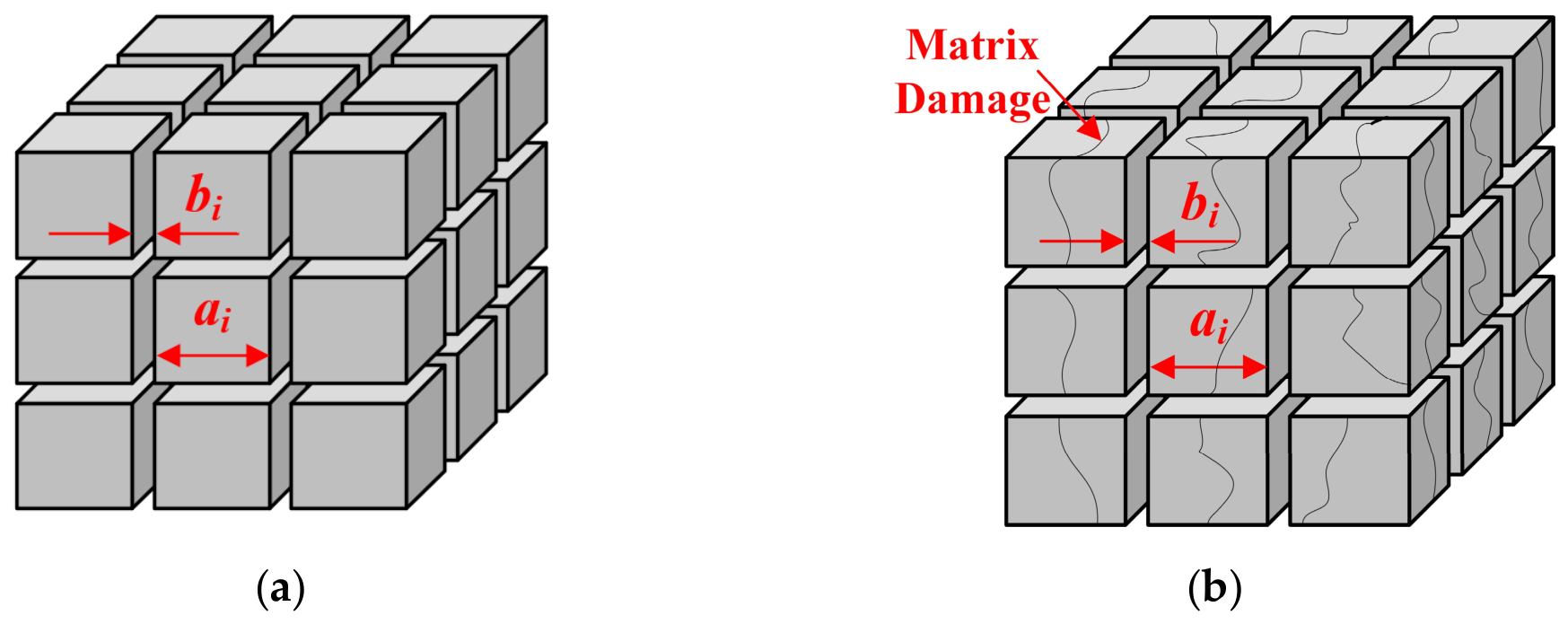
Among them, the term (b/b0)3 specifically represents the effect of coal compaction, which originates from changes in the stress state. The dependence of coal compaction on stress can be quantitatively evaluated by the fracture compressibility coefficient cc, which can be obtained by fitting the changes in stress and permeability in the elastic zone. The term a/a0 quantifies the extent of fracturing within the coal matrix. Specifically, under the action of effective stress, coal undergoes progressive damage, and new fractures are generated. The increase in the number of fractures leads to a decrease in the equivalent matrix width, which in turn results in an additional increase in permeability relative to that predicted by the ideal elastic permeability model, as shown in Figure 9.
Figure 9.
Conceptual model of damage fracture structure in coal-rock: (a) classic cube model; (b) damage cube model.
In the derivation of the ideal elastic permeability model, the permeability is mainly determined by the change in fracture/cleat opening b caused by effective stress, and the change in matrix width a can be ignored. During the plastic failure stage, the stress exceeds the elastic limit, and the coal specimen undergoes plastic deformation. The generation of new fractures, rather than effective stress variation, becomes the dominant factor influencing permeability. At this time, the matrix deformation term a/a0 cannot be ignored, but can be used as a correction to the ideal elastic permeability model as follows:
where ks is the corrected permeability, k is the permeability predicted by the ideal elastic model, k0 is the initial permeability, a(σ) is the matrix deformation influence term, and σ is the stress causing matrix deformation.
In practical research, precisely determining the effective matrix width a of porous media materials poses a significant challenge. However, as revealed by earlier analyses of compression–permeability tests on coal samples, plastic deformation is largely governed by both the mean effective stress σme and the effective deviatoric stress σde, with permeability k exhibiting a particularly strong sensitivity to variations in σde. Therefore, a damage factor L(σde) containing σde can be introduced to characterize the influence of mining-induced fractures on coal permeability:
where L(σde) is the damage factor, and it is a function of the effective deviatoric stress σde.
According to the preceding analysis, permeability evolution in coal samples during loading can be divided into distinct stages. In the elastic stage, permeability is primarily governed by stress-induced closure of existing fractures and cleats, exhibiting only a slight decrease. Once the effective deviatoric stress exceeds the elastic threshold, plastic deformation occurs in the coal sample, triggering the initiation of new fractures and a gradual increase in permeability. As damage accumulates further, the permeability increases sharply. When the effective deviatoric stress exceeds the yield limit, macroscopic failure occurs in the coal sample, and the permeability and damage degree gradually stabilize [45]. Throughout the entire process, the relationship between coal sample damage and effective deviatoric stress exhibits an approximately S-shaped trend: the coal sample damage first increases slowly, then rapidly, and eventually stabilizes. This trend can also be derived from the experimental data. Specifically, by normalizing the measured permeability ks against the ideal permeability kl predicted by the elastoplastic model to obtain the change trend of the damage factor L(σde).
The generalized Logistic equation [46] yields an S-shaped solution curve and can effectively characterize the evolution of a variable that increases rapidly at the initial stage, decelerates progressively, and eventually asymptotically approaches a stable value. This evolution pattern closely resembles the progression of the damage factor investigated herein. Accordingly, the generalized Logistic equation is adopted, and necessary correction parameters are incorporated to describe the damage factor. To mitigate data heteroscedasticity and ensure the positivity of values for logarithmic transformation, the logarithm of L(σde) is taken. The resulting expressions are presented in Equations (11) and (12):
where σde is the effective deviatoric stress, σ1 is the maximum principal stress, σ3 is the minimum principal stress, σc is the compressive strength, ω is the influence coefficient for the permeability damage factor (the higher the damage degree and the more the fractures, the larger ω), ζ is the strength change coefficient, τ is the deviation coefficient, and δ is the anisotropy coefficient (when the material is assumed isotropic, δ = 1).
Combining Equations (10)–(12), we obtain:
After the simplification, Equation (14) is obtained:
Considering coal compaction, fracturing, matrix deformation and other factors, Equation (14) is the established damage permeability model. It is worth noting that, depending on the specific requirements of the study, this model can also be converted into forms expressed by other stress parameters. For instance, Equations (15) and (16) are expanded forms of Equation (14). In this case, the damage factor is a function of σme.
3.4. Verification of the Damage Permeability Model
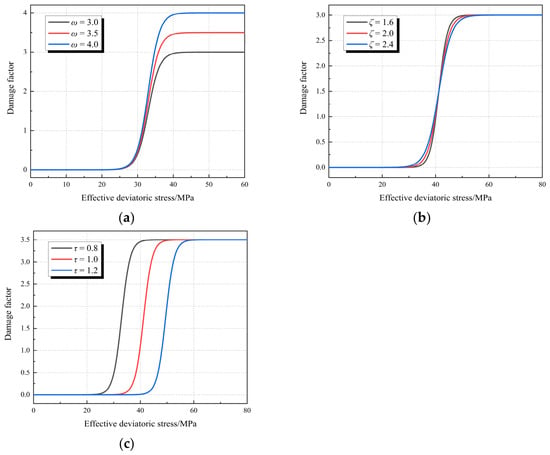
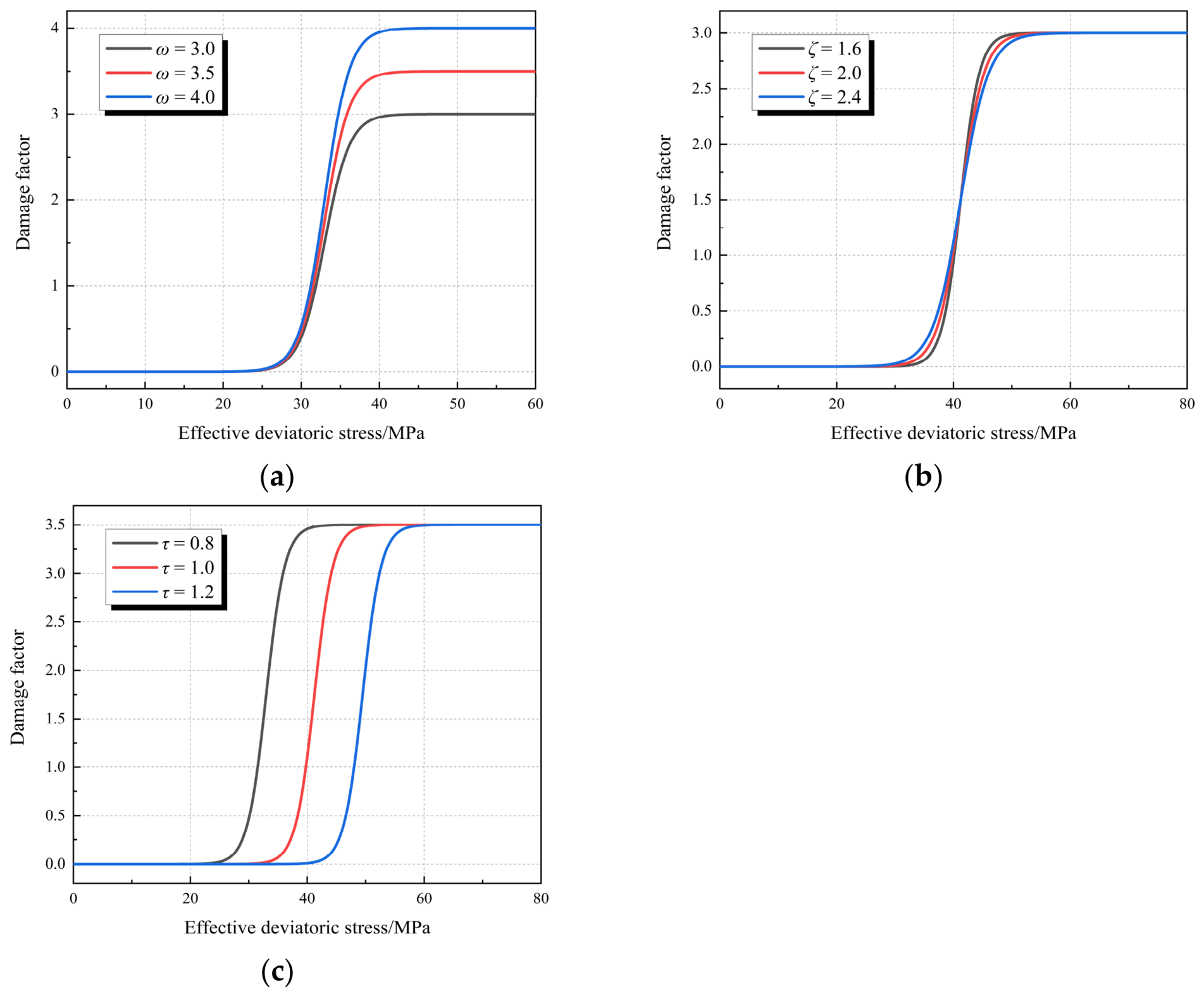
To optimize the damage permeability model in Equation (14) and evaluate the influence of each coefficient on the predicted results, sensitivity analysis was conducted on parameters such as ω, ζ, and τ. Assuming the coal sample is an isotropic material, δ = 1. Table 2 shows the parameter values used in the parameter sensitivity analysis, and Figure 10 displays the analysis results.
Table 2.
Parameter values for sensitivity analysis.
Figure 10.
Model parameter sensitivity analysis: (a) Sensitivity of damage factor to ω; (b) Sensitivity of damage factor to ζ; (c) Sensitivity of damage factor to τ.
It can be seen that when σde is far below its strength limit, the coal sample undergoes elastic deformation but no damage occurs; therefore, L(σde) is 0 in this stage. When σde reaches the damage stress level and approaches the yield strength, new fractures and damage begin to form inside the coal sample, leading to the rapid increase in L(σde). When fixed values were assigned to the parameters ω, ζ, and τ, the comparison results reveal that these parameters do not affect the overall shape of the change in L(σde), but only control a specific indicator. Specifically, ω reflects the level of the maximum damage factor L(σde)max after coal failure. The larger ω, the larger L(σde)max, as shown in Figure 11a. Similarly, ζ and τ affect the starting point and speed of L(σde) change, as shown in Figure 11b,c. For example, when ζ = 1.6, 2.0, and 2.4, the slopes of the damage factor L(σde) within the change interval are 0.42406, 0.35225, and 0.29898, respectively; when τ= 0.8, 1.0, and 1.2, L(σde)max begins to increase at stress levels of 22.18 MPa, 28.98 MPa, and 36.83 MPa, respectively. That is, a larger ζ corresponds to a faster change in L(σde), while a larger τ corresponds to a later onset of the change.
Figure 11.
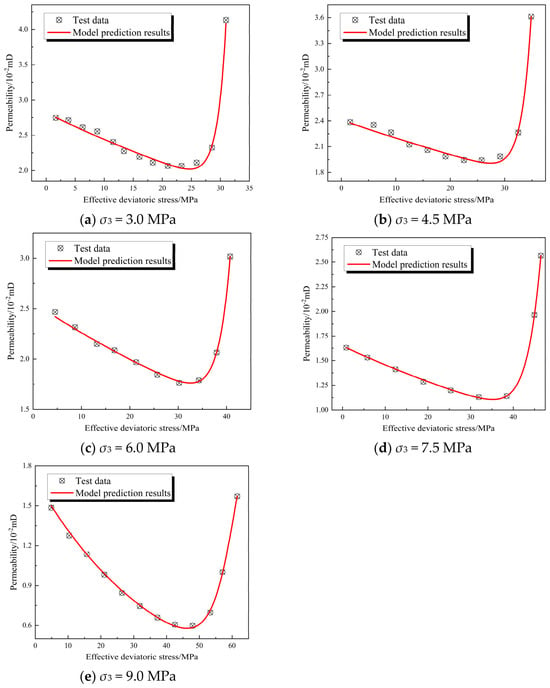
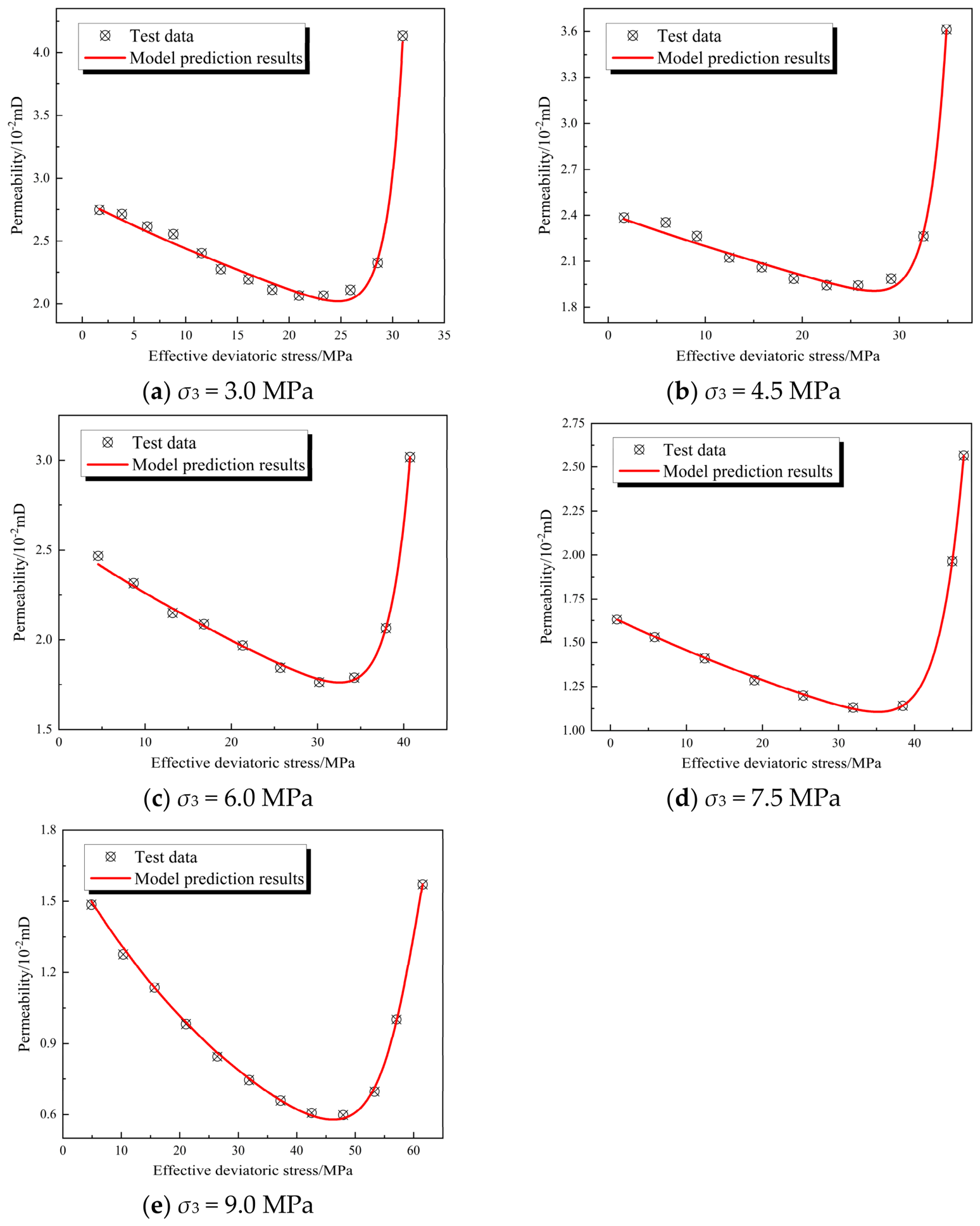
Fitting results of the model and test data.
The nonlinear least squares method is currently the most widely used test data curve fitting method for parameter identification of the coal-rock permeability models [47]. To verify the accuracy of the damage permeability model established in Section 3.3, the nonlinear least squares method was used to perform nonlinear fitting on the triaxial compression seepage test data (σe > 0). The fitting effect is shown in Figure 11.
It can be found that the permeability model prediction curve has a high degree of agreement with the experimental data, and the correlation coefficients R2 are above 0.99 in all cases. This indicates that the model has good applicability for predicting the permeability of mining-induced coal under different confining pressures, and it continuously captures the permeability evolution characteristics of mining-induced coal under various stress-loading stages, verifying the rationality of the proposed model. The model parameter identification results are shown in Table 3.
Table 3.
Parameters for permeability model validation.
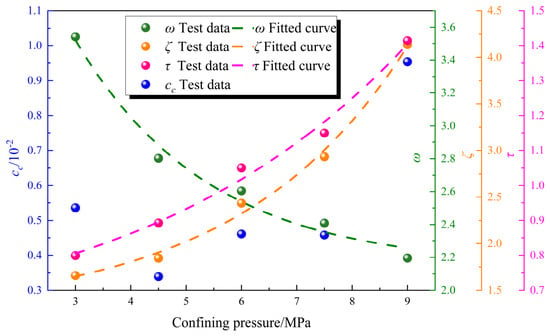
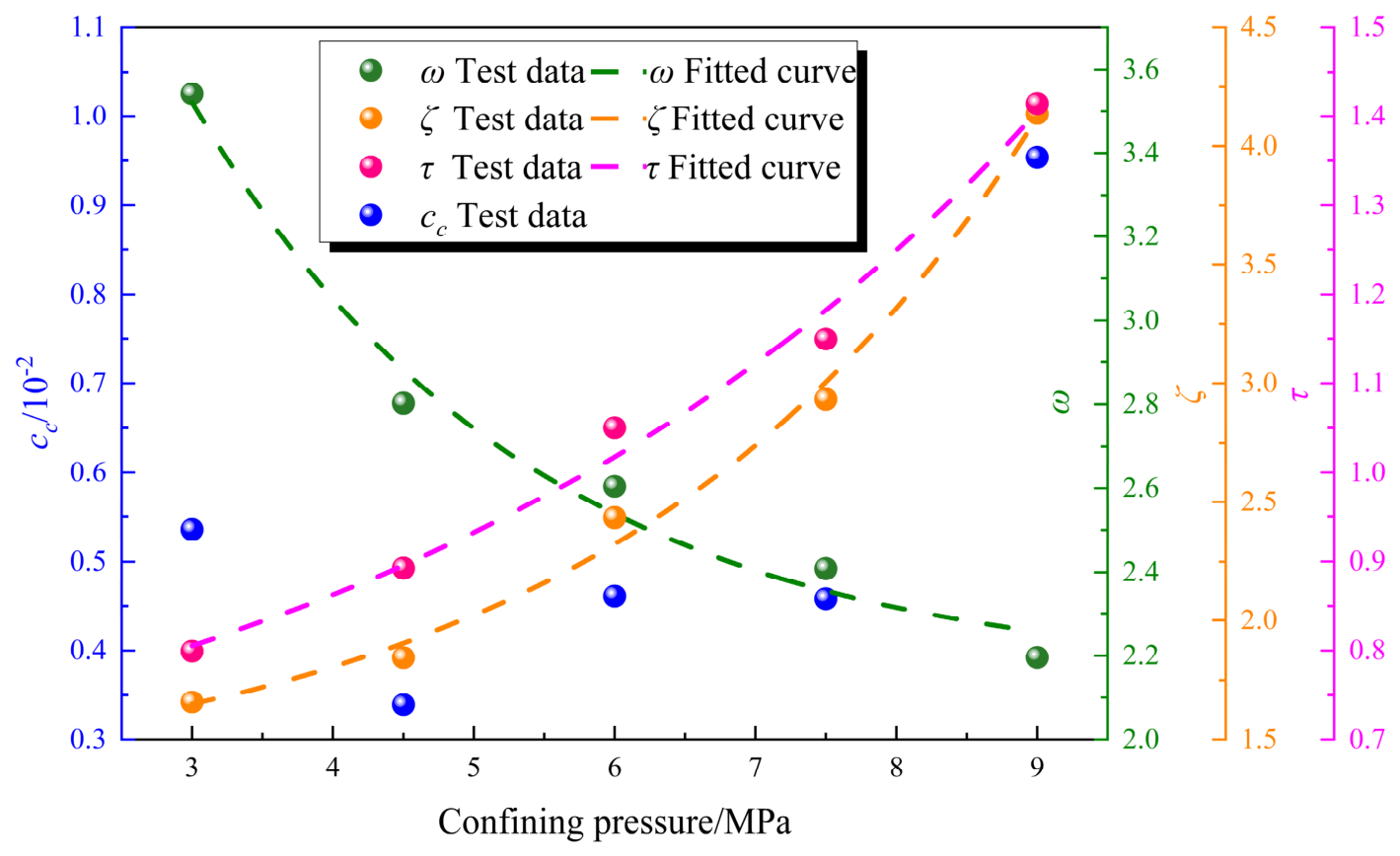
According to Table 3, the evolution relationships of the model identification parameters ω, ζ and τ with confining pressure σ3 are obtained, as shown in Figure 12. With the increase in σ3, the decrease in the damage permeability influence coefficient ω indicates that the larger the confining pressure, the less internal damage and fractures are generated in plastic coal rock under the same stress environment or deformation stage, which is reflected in the change in permeability magnitude; the strength variation coefficient ζ is the primary parameter characterizing the rate of permeability change. Its increasing trend is positively correlated with the degree of elastic–plastic contrast during coal–rock failure (i.e., ζ increases with increasing confining pressure); the deviation coefficient τ is positively correlated with the position of the starting point of permeability change. With the increase in confining pressure, the deviation coefficient τ gradually increases, and the starting point of coal-rock permeability change is correspondingly delayed. In summary, the identified model parameters are strongly correlated with confining pressure, and the corresponding fitting equation is presented in Equation (17).
Figure 12.
Relationship between model parameters and confining pressure.
4. Discussion
The essence of developing a permeability prediction model lies in evaluating how the stress environment affects fracture aperture and matrix dimensions. Therefore, a rational selection of stress parameters that accurately characterize the stress state is of particular importance. The effective deviatoric stress σde, effective mean stress σme, and the effective total stress σe can be used to characterize the stress environment of the material, but there are obvious differences in their characterization effects. As analyzed in Section 3.2, compared with mean stress and total stress, the permeability of coal samples is more sensitive to deviatoric stress, and the direction of permeability variation with deviatoric stress (positive or negative correlation) remains consistent throughout. Thus, when evaluated strictly in terms of two-dimensional permeability–stress curve fitting, the damage permeability model developed herein based on the effective stress parameter σde achieves satisfactory predictive accuracy and sound physical rationality, representing a robust choice at the present stage. Nevertheless, when evaluating the interaction between permeability and the three-dimensional stress field, particularly for application in three-dimensional numerical model simulations, further in-depth investigation and refinement are still required.
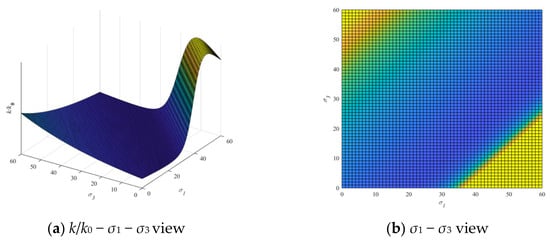
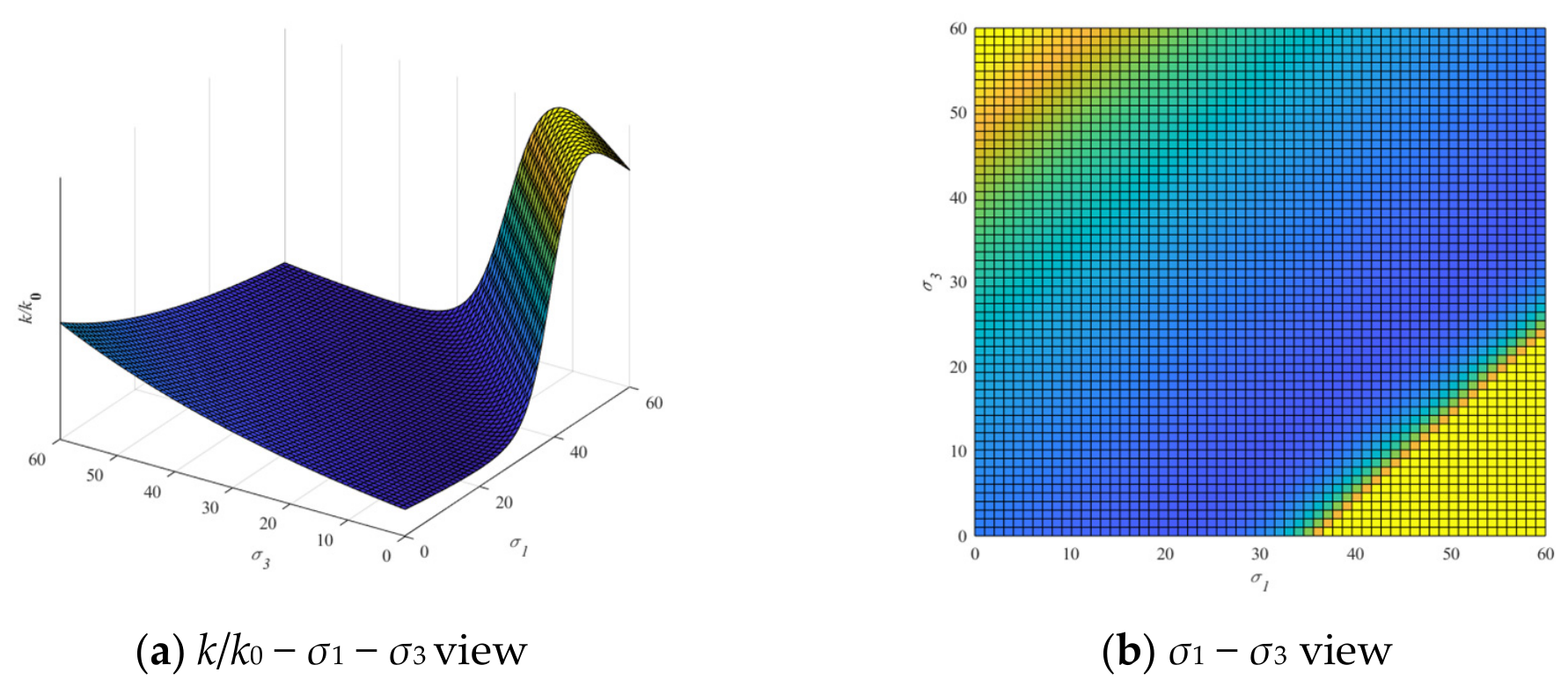
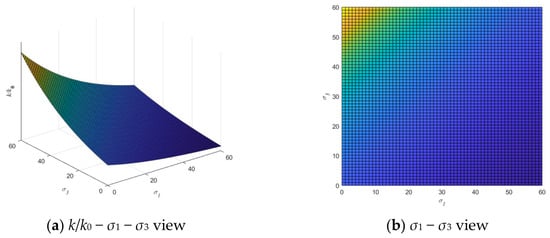
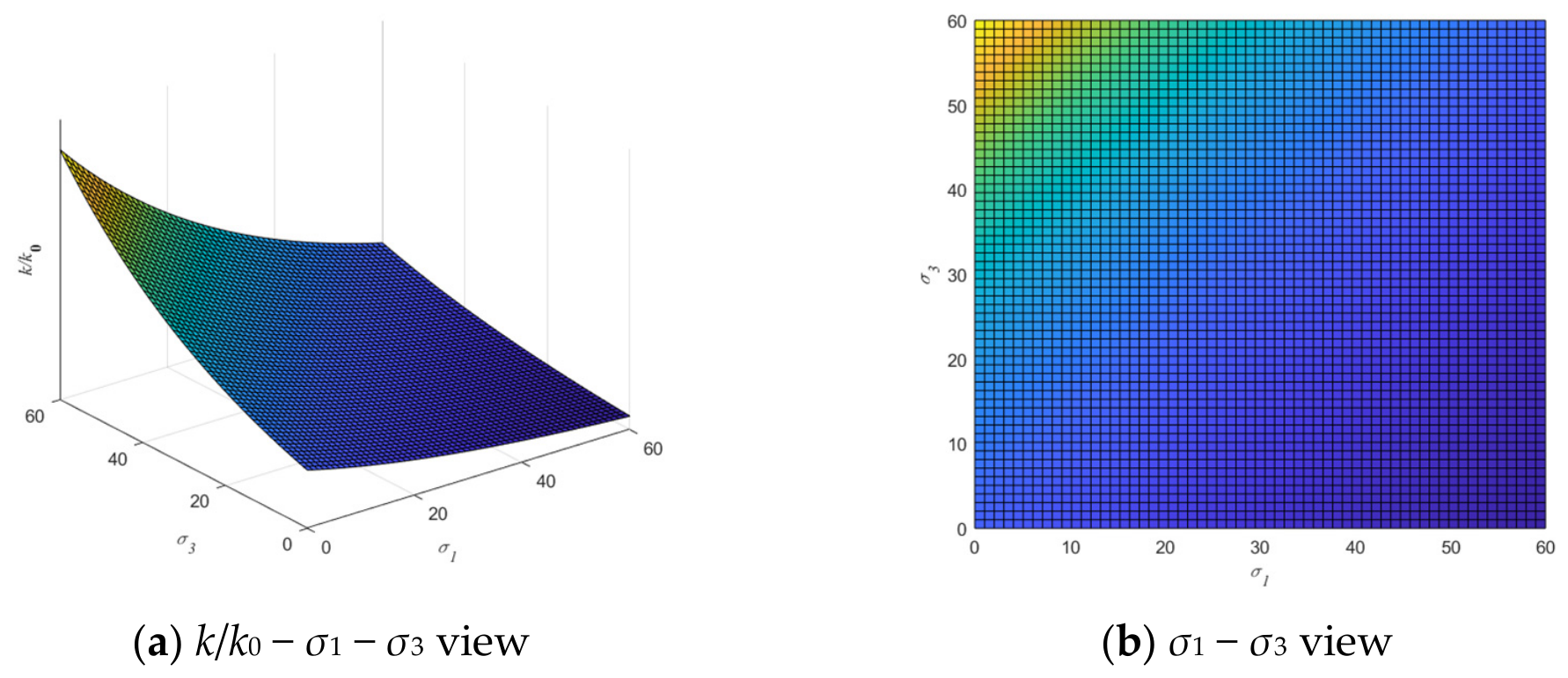
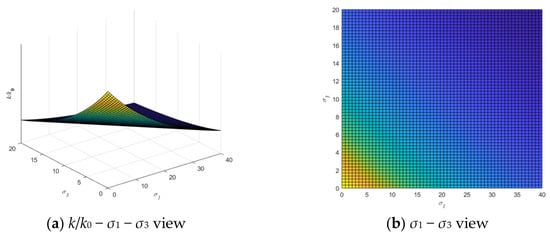
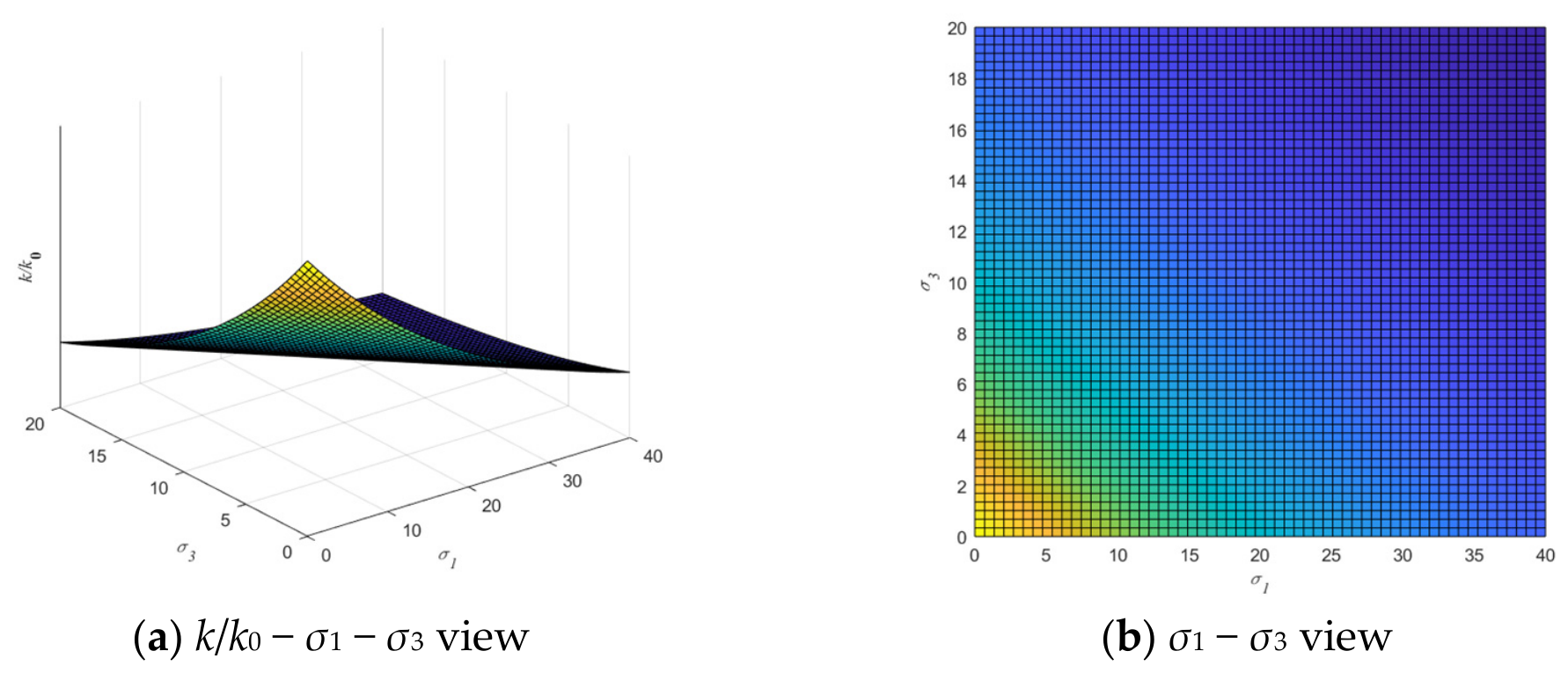
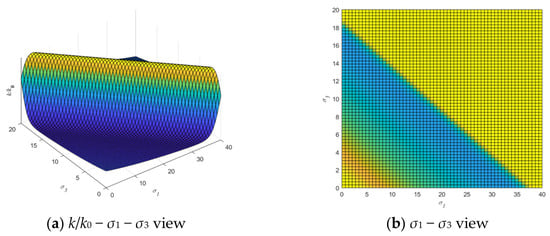
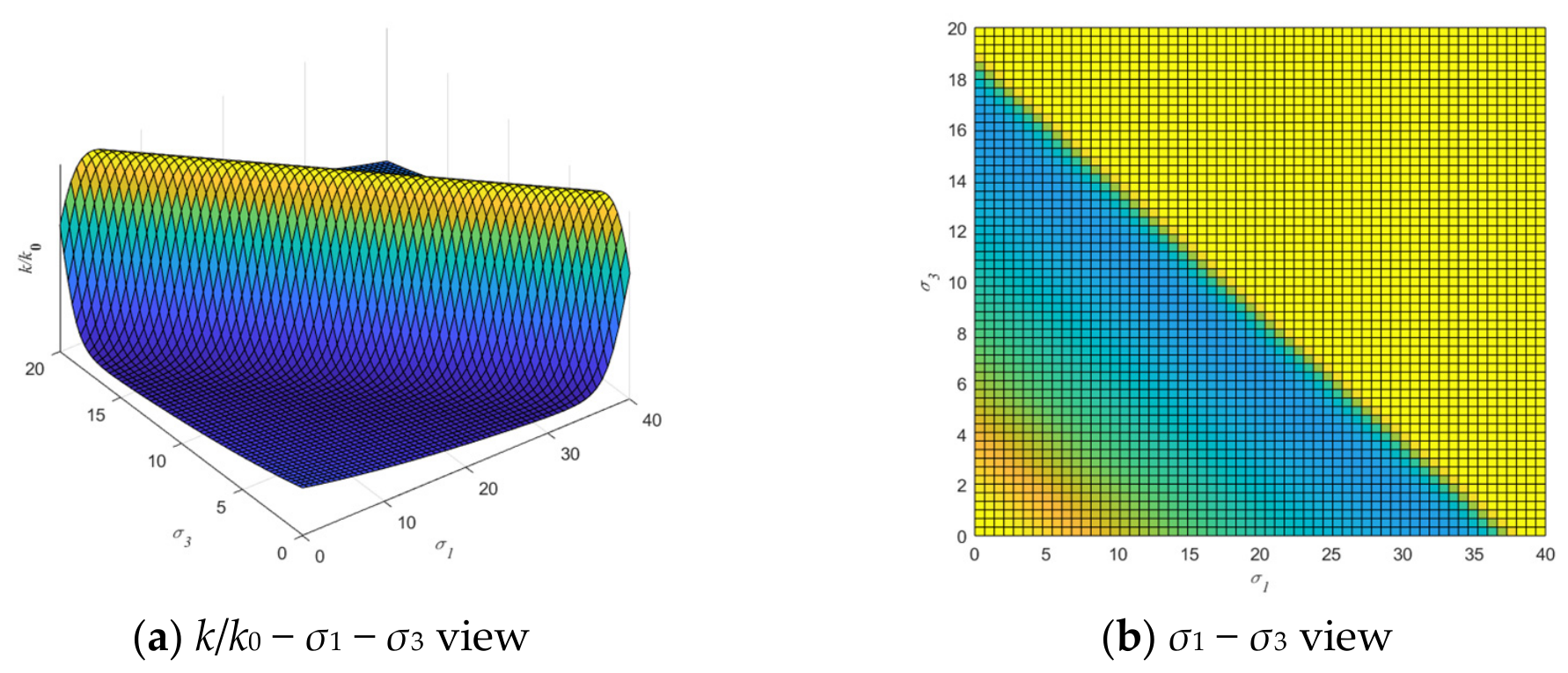
Taking the ideal elastic permeability model and the damage permeability model as examples, when σde is used as the characteristic stress parameter, the relationship between coal permeability k and the maximum principal stress σ1 and the minimum principal stress σ3 is obtained, as shown in Figure 13 and Figure 14.
Figure 13.
Application effect of the damage permeability model based on effective deviatoric stress.
Figure 14.
Application effect of the ideal elastic permeability model based on effective deviatoric stress.
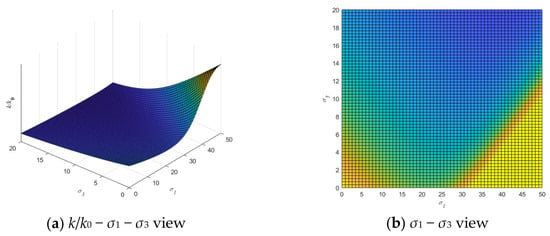
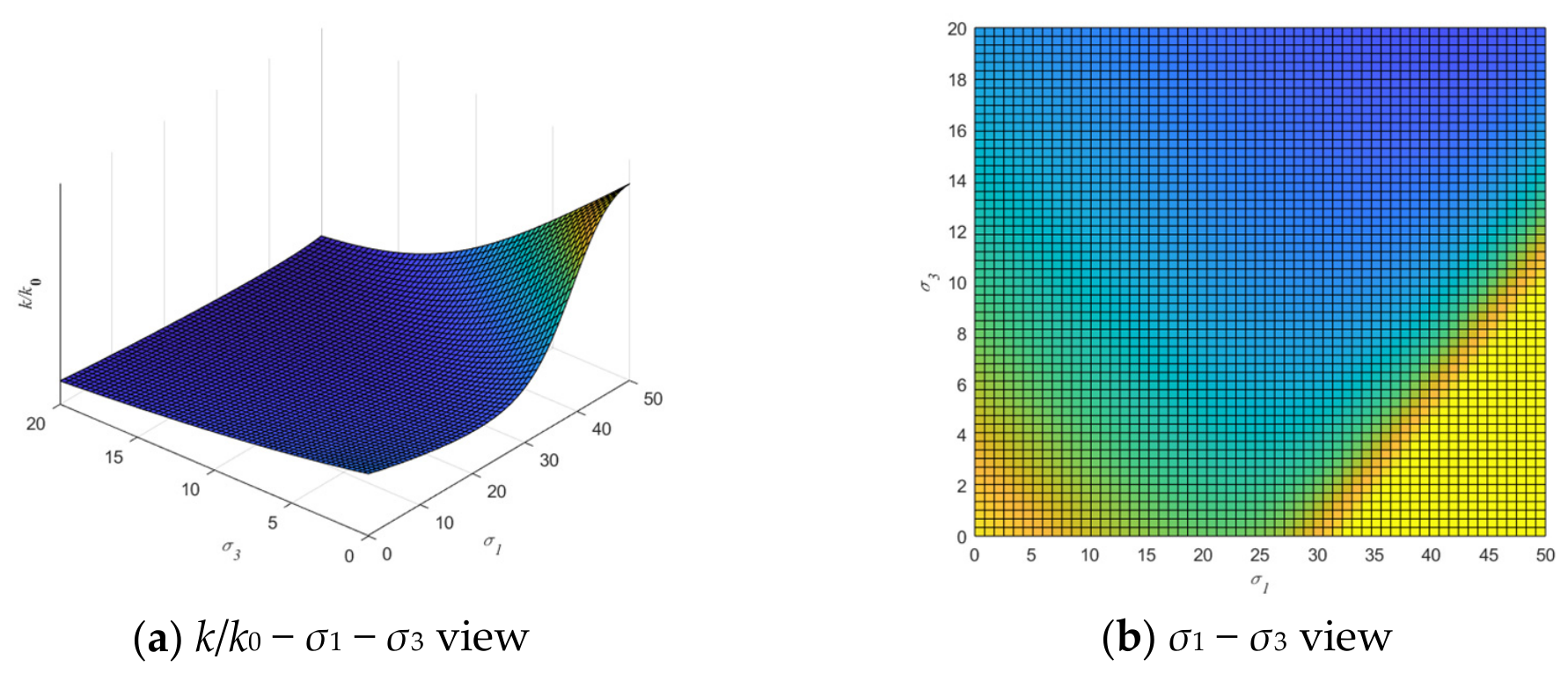
Combined with the previous analysis, the internal fractures of coal-rock mass are successively closed and expanded under the influence of mining-induced stress, and k first decreases and then increases with increasing stress. As shown in Figure 14, in the damage permeability model established based on σde, k increases with the increasing σde, and a permeability damage zone is formed in the interval with higher maximum principal stress (at the lower right corner). This evolutionary trend mainly conforms to the variation law of permeability k after structural damage occurs inside the mining-affected coal mass, but the model’s predictions during the early loading stage still exhibit obvious deficiencies. In other words, when both σ1 and σ3 are at relatively low levels, k should decrease within a certain range with increasing σde. This trend does not appear in the lower-left corner area in Figure 14, but is shifted to the upper-right corner area with lower σ1 and higher σ3. This phenomenon is more obvious in the ideal elastic permeability model established with σde as the stress parameter, as shown in Figure 15. In fact, this phenomenon is essentially attributed to the subtraction operation between σ1 and σ3 inherent in the computation of σde. Clearly, it is extremely inappropriate for describing the relationship between coal permeability and three-dimensional stress over the spatial range.
Figure 15.
Application effect of the ideal elastic permeability model based on effective total stress.
Using the effective total stress σe as the key parameter in the permeability model can substantially mitigate this issue. As shown in Figure 15, in the ideal elastic permeability model established based on σe, the decreasing trend of k in the early loading stage appears near the origin in the three-principal corner. At this time, both σ1 and σ3 are at low levels, which conforms to the real early evolution law of coal-rock permeability. However, the damage permeability model established with σe as the characteristic parameter also has defects in prediction and characterization. As shown in Figure 16, the permeability damage zone (bright high-level area) formed by higher stress is almost symmetrically distributed along the oblique midline passing through the origin of the image. This suggests that when both σ1 and σ3 are at high levels and close in magnitude, k rises significantly. Nevertheless, such a rapid increase is obviously unreasonable. This is because, under the aforementioned stress conditions, the coal-rock mass is in a nearly uniform three-dimensional stress state. Despite the high stress level, the effective deviatoric stress is zero or negligibly small, leading to negligible structural damage and thus no significant permeability increase.
Figure 16.
Application effect of the damage permeability model based on effective total stress.
Based on the above analysis, using a single stress parameter to establish a permeability prediction model cannot adequately describe the relationship between coal permeability and the spatial three-dimensional stress state. Therefore, a multi-stress-parameter approach can be adopted to establish the permeability model, in which σe and σde can be used to characterize the evolution trend of the original permeability of the coal–rock mass and the permeability damage condition. The performance of the permeability model thus established is shown in Figure 17. This method effectively overcomes the deficiencies of the aforementioned single-stress-parameter permeability models and can better describe the relationship between the permeability and the three-principal in situ stress state of the coal–rock mass.
Figure 17.
Application effect of the damage permeability model based on effective total stress and effective deviatoric stress.
At this stage, the damage-permeability model is modified in Equation (18), and its expanded expression is shown in Equation (19).
5. Limitations
This study was carried out on laboratory-scale intact coal samples, and several limitations should be considered when extending laboratory findings to in situ coal pillar-dam engineering.
(1) Scale effect and insufficient replicate specimens. The laboratory specimens are intact coal cores without large-scale in situ geological discontinuities such as macroscopic cleats, partings and mining-induced fractures. The permeability of the field coal-pillar-dam rock mass can be several orders of magnitude higher than that of laboratory core samples. Therefore, the model parameters obtained from laboratory tests cannot be directly applied to field coal pillar dams, and upscaling and field calibration are indispensable. Only one specimen was tested under each confining pressure condition, and no replicate specimens were available; therefore, the variability of experimental results could not be quantified.
(2) Coal seam heterogeneity and bedding/cleat anisotropy. The coal samples were collected from a single coal seam. In situ coal pillars contain interbedded partings and heterogeneous lithology, which cannot be reproduced using homogeneous intact coal samples in our tests. In this triaxial seepage test, seepage flow was parallel to the axial direction of specimens. However, the dominant seepage within the in situ coal pillar dam propagates horizontally along bedding planes and is perpendicular to the maximum principal stress. The bedding-controlled anisotropic seepage effect was not considered in the present experimental scheme.
(3) Water-rock interaction, hydraulic boundary and unloading coupling effect. In situ coal pillar dams experience long-term repeated water immersion, water softening and creep deformation under constant stress. Only short-term loading tests were conducted in this study; long-term creep and damage induced by cyclic water immersion were not considered, which deserve further investigation in future research. The tests were performed within a relatively narrow pressure range under fixed hydraulic conditions, and the coupling effect between final confining pressure and unloading history was not systematically explored. True-triaxial tests, cyclic reservoir operation tests and chemical effects of mine water were not included in the current experimental program.
(4) Damage function, model extrapolation and boundary of engineering inference. Furthermore, the damage factor defined merely by instantaneous stress cannot fully characterize irreversible damage accumulated during unloading. This empirical model is only valid within the stress range covered by the present tests, and extrapolation beyond this range may yield nonphysical permeability values. In addition, laboratory permeability results should be distinguished from unverified engineering inferences regarding coal pillar dam safety and sustainable water storage.
6. Conclusions
The main conclusions from this study are as follows:
(1) The mechanical behavior of coal specimens, including their strength and deformation properties, is significantly affected by the confining pressure level. With increasing confining pressure, the peak axial stress, peak deviatoric stress, and elastic modulus all increase exponentially. Specifically, every 1.5 MPa increase in confining pressure raises these three parameters by 9.58–31.24% relative to their original values. In addition, two stress paths of UCP-AL and CCP-AL produce an evident inflection point in the stress–strain curves. The position of this inflection point is governed by the target confining pressure reached during unloading, and the slope of the stress–strain curve before this point is consistently steeper than that after it.
(2) The permeability of coal specimens under various stress loading paths exhibits a trend of initial decrease, followed by a slow rise and a rapid increase with growing axial strain. Specifically, the permeability continuously declines during the crack compaction and elastic deformation stages. The development of newly generated damage in coal specimens during the plastic deformation stage drives a gradual increase in permeability, which rises rapidly to its peak after macroscopic failure occurs. Compared with the mean stress, the deviatoric stress exerts a stronger sensitivity to the permeability evolution of coal specimens. The minimum permeability of coal specimens decreases exponentially with increasing confining pressure; that is, high confining pressure compresses crack apertures and restrains the development of seepage channels.
(3) A Logistic-type damage factor was introduced to characterize the S-shaped variation trend of mining-induced damage in coal specimens. On this basis, a damage permeability model that considers crack compaction, damage-induced cracking and matrix deformation of coal specimens was established, which can continuously describe the full-stage permeability evolution of coal specimens from elastic deformation to macroscopic failure. The coefficient of determination R2 fitted by multiple groups of experimental data is higher than 0.99. In addition, model parameters (ω, ζ, and τ) present significant correlations with confining pressure, which verifies the accuracy and rationality of the proposed model.
(4) The seepage characterization performance of various stress parameters (i.e., effective deviatoric stress, effective mean stress, and effective total stress) in the triaxial stress space was investigated. The results show that if the permeability model simply adopts either effective deviatoric stress or effective total stress as the sole stress parameter, the initial high-permeability zone in the elastic stage will shift from the low-axial-stress–low-confining-pressure region to the low-axial-stress–high-confining-pressure region, or the damage-induced high-permeability zone will be symmetrically distributed along the midline of the axial stress–confining pressure plane. On this basis, a multi-parameter modified damage permeability model is constructed, in which the effective total stress characterizes crack compaction and the effective deviatoric stress characterizes damage propagation, and its application performance is validated.
From the perspective of sustainable mining for ecologically fragile arid coalfields in western China, this laboratory-scale investigation provides fundamental insights into the coupled mechanical-seepage behavior of coal, which is relevant to underground reservoir technology. The proposed model and analysis results derived from laboratory tests can serve as a reference for coal pillar dam safety assessment under complex stress paths. Nevertheless, as noted in the Limitations section, further research is still needed. Future studies should focus on upscaling laboratory-derived parameters, accounting for bedding- and cleat-induced anisotropic seepage, and conducting long-term hydro-mechanical coupling tests involving repeated water immersion and coal creep. In addition, field monitoring data from the Chahasu underground reservoir should be incorporated to calibrate the model, thereby facilitating the translation of laboratory findings into practical engineering applications.
Author Contributions
Conceptualization, L.Y. and X.L.; methodology, J.M. and L.Y.; validation, P.Z.; formal analysis, P.C. and P.Z.; investigation, Z.C. and J.M.; data curation, L.Y. and P.Z.; writing—original draft preparation, L.Y.; writing—review and editing, X.L.; supervision, L.Y. and X.L. All authors have read and agreed to the published version of the manuscript.
Funding
This research was funded by the Fundamental Research Funds for the Central Universities, Grant No. 2025QN1017; the Jiangsu Funding Program for Excellent Postdoctoral Talent, grant number 2025ZB1; the Postdoctoral Fellowship Program of CPSF, grant number GZC20251248.
Institutional Review Board Statement
Not applicable.
Informed Consent Statement
Not applicable.
Data Availability Statement
The original contributions presented in this study are included in the article. Further inquiries can be directed to the corresponding author.
Conflicts of Interest
The authors declare no conflicts of interest.
References
- National Bureau of Statistics of the People’s Republic of China. China Statistical Yearbook 2025; China Statistics Press: Beijing, China, 2025. [Google Scholar]
- Ministry of Water Resources of the People’s Republic of China. China Water Resources Bulletin 2025; Ministry of Water Resources: Beijing, China, 2026. [Google Scholar]
- Gu, D.Z.; Li, J.F.; Cao, Z.G.; Wu, B.Y.; Jiang, B.B.; Yang, Y.; Yang, J.; Chen, Y.P. Technology and engineering development strategy of water protection and utilization of coal mine in China. J. China Coal Soc. 2021, 46, 3079–3089. [Google Scholar]
- Yu, L.Q.; Yao, Q.L.; Chong, Z.H.; Li, Y.H.; Xu, Q.; Xie, H.X.; Ye, P.Y. Mechanical and micro-structural damage mechanisms of coal samples treated with dry–wet cycles. Eng. Geol. 2022, 304, 106637. [Google Scholar] [CrossRef] [Scilit]
- Yu, L.Q.; Yao, Q.L.; Liu, J.F.; Li, X.H.; Chong, Z.H.; Wang, F.R.; Xie, H.X.; Li, Y.H. Effect of spatial distribution of water on rock mechanical properties and characterization of water diffusion. Constr. Build. Mater. 2025, 470, 140551. [Google Scholar] [CrossRef] [Scilit]
- Zhou, H.W.; Rong, T.L.; Mu, R.Y.; Wang, L.J.; Ren, W.G. Development in modeling approaches to mining-induced permeability of coals. J. China Coal Soc. 2015, 44, 221–235. [Google Scholar]
- Pan, Z.J.; Luke, D.C. Modelling permeability for coal reservoirs: A review of analytical models and testing data. Int. J. Coal Geol. 2012, 92, 1–44. [Google Scholar] [CrossRef] [Scilit]
- Gray, I. Reservoir engineering in coal seams: Part 1-the physical process of gas storage and movement in coal seams. SPE Reserv. Eng. 1987, 2, 28–34. [Google Scholar] [CrossRef] [Scilit]
- Seidle, J.P.; Jeansonne, M.W.; Erickson, D.J. Application of matchstick geometry to stress dependent permeability in coals. In Proceedings of the SPE Rocky Mountain Regional Meeting, Casper, WY, USA, 18–21 May 1992; Society of Petroleum Engineers: Houston, TX, USA, 1992; pp. 433–444. [Google Scholar]
- Palmer, I.; Mansoori, J. How permeability depends on stress and pore pressure in coalbeds: A new model. SPE Reserv. Eval. Eng. 1998, 1, 539–544. [Google Scholar] [CrossRef] [Scilit]
- Shi, J.Q.; Durucan, S. Drawdown induced changes in permeability of coalbeds: A new interpretation of the reservoir response to primary recovery. Transp. Porous Media 2004, 56, 1–6. [Google Scholar] [CrossRef] [Scilit]
- Robertson, E.P.; Christiansen, R.L. A permeability model for coal and other fractured, sorptive-elastic media. SPE J. 2008, 13, 314–324. [Google Scholar] [CrossRef] [Scilit]
- Zhang, J.Y.; Ma, R.S.; Feng, Q.H.; Wang, S.; Wang, L.; Wang, C.G. Permeability evolution of intact and fractured coals subject to varying pore pressures: Laboratory tests and analytical modeling. ACS Omega 2026, 11, 700–713. [Google Scholar] [CrossRef] [Scilit] [PubMed]
- Liu, J.S.; Chen, Z.W.; Elsworth, D.; Miao, X.X.; Mao, X.B. Evaluation of stress-controlled coal swelling processes. Int. J. Coal Geol. 2010, 83, 446–455. [Google Scholar] [CrossRef] [Scilit]
- Zhang, Z.T.; Zhang, R.; Xie, H.P.; Gao, M. The relationships among stress, effective porosity and permeability of coal considering the distribution of natural fractures: Theoretical and experimental analyses. Environ. Earth Sci. 2015, 73, 5997–6007. [Google Scholar] [CrossRef] [Scilit]
- Liu, T.; Lin, B.Q.; Fu, X.H.; Liu, S.M. A new approach modeling per-meability of mining-disturbed coal based on a conceptual model of equivalent fractured coal. J. Nat. Gas Sci. Eng. 2020, 79, 103366. [Google Scholar] [CrossRef] [Scilit]
- Zhang, Z.T.; Zhang, R.; Xie, H.P.; Gao, M.Z.; Zha, E.S.; Jia, Z.Q. An anisotropic coal per-meability model that considers mining-induced stress evolution, microfracture propagation and gas sorption-desorption effects. J. Nat. Gas Sci. Eng. 2017, 46, 664–679. [Google Scholar] [CrossRef] [Scilit]
- Rong, T.L.; Zhou, H.W.; Wang, L.J.; Ren, W.G.; Wang, Z.T.; Su, T. Study on coal permeability model in front of working face under the influence of mining disturbance and temperature coupling. Rock Soil Mech. 2019, 40, 4289–4298. [Google Scholar]
- Ren, Z.J. Numerical study on fracture evolution and gas migration in the surrounding rock of large diameter drilling incrushed-soft coal seam. Min. Saf. Environ. Prot. 2024, 51, 92–101. [Google Scholar]
- Li, X.C.; Nie, B.S.; Liu, F.B.; Wang, G.; Tian, J.W.; Niu, P.P. The relation of gas seepage and coal body damage under the true three dimension stress. Procedia Eng. 2011, 26, 1462–1466. [Google Scholar] [CrossRef] [Scilit]
- Yang, T.H.; Xu, T.; Liu, H.Y.; Tang, C.A.; Shi, B.M.; Yu, Q.X. Stress-damage-flow coupling model and its application to pressure relief coal bed methane in deep coal seam. Int. J. Coal Geol. 2011, 86, 357–366. [Google Scholar] [CrossRef] [Scilit]
- Meng, L. Research on Coal Damage Characteristics and Gas Migration Law of Coal Containing Gas. Master’s Thesis, China University of Mining and Technology (Beijing), Beijing, China, 2013. [Google Scholar]
- Zhu, W.C.; Tang, C.A. Micromechanical model for simulating the fracture process of rock. Rock Mech. Rock Eng. 2004, 37, 25–56. [Google Scholar] [CrossRef] [Scilit]
- Xue, Y.; Gao, F.; Liu, X. Effect of damage evolution of coal on permeability variation and analysis of gas outburst hazard with coal mining. Nat. Hazards 2015, 79, 999–1013. [Google Scholar] [CrossRef] [Scilit]
- Xue, Y.; Gao, F.; Gao, Y.N.; Cheng, H.M.; Liu, Y.K.; Hou, P.; Teng, T. Quantitative evaluation of stress relief and permeability-increasing effects of overlying coal seams for coal mine methane drainage in Wulan coal mine. J. Nat. Gas Sci. Eng. 2016, 32, 122–137. [Google Scholar] [CrossRef] [Scilit]
- Zhang, N.; Li, X.R.; Cheng, H.M.; Teng, T. A coupled damage hydro-mechanical model for gas drainage in low-permeability coalbeds. J. Nat. Gas Sci. Eng. 2016, 35, 1032–1043. [Google Scholar] [CrossRef] [Scilit]
- Yang, Y.; Zhang, D.; Zhang, B.A.; Li, X.M.; He, W.J. Study on the Failure Mechanism and Permeability Characteristics of Gas Containing Sandstone Intercalated Coal. ACS Omega 2022, 7, 6502–6509. [Google Scholar] [CrossRef] [Scilit] [PubMed]
- Pang, M.; Zhang, T.; Meng, Y.; Ling, Z.Q. Experimental study on the permeability of crushed coal medium based on the Ergun equation. Sci. Rep. 2021, 11, 23030. [Google Scholar] [CrossRef] [Scilit] [PubMed]
- Fan, C.; Elsworth, D.; Li, S.; Zhou, L.J.; Yang, Z.H.; Song, Y. Thermo-hydro-mechanical-chemical couplings controlling CH4 production and CO2 sequestration in enhanced coalbed methane recovery. Energy 2019, 173, 1054–1077. [Google Scholar] [CrossRef] [Scilit]
- Fan, C.; Luo, M.; Li, S.; Zhang, H.H.; Yang, Z.H.; Liu, Z. A Thermo-hydro-mechanical-chemical coupling model and its application in acid fracturing enhanced coalbed methane recovery simulation. Energies 2019, 12, 626. [Google Scholar] [CrossRef] [Scilit]
- Zhao, Y.L.; Liu, Q.; Liu, H.; Liao, J.; Chang, L.; Tan, T.; Song, F. Triaxial compression and acoustic emission tests on single cracked limestone and compression-shear fracture model under hydraulic-mechanical coupling action. J. China Coal Soc. 2021, 46, 3855–3868. [Google Scholar]
- Yan, X.; Liu, P.Y.; Huang, Z.Q.; Sun, H.; Zhang, K.; Wang, F.J.; Yao, J. Effect of hydraulic fracture deformation hysteresis on CO2 huff-n-puff performance in shale gas reservoirs. J. Zhejiang Univ. Sci. A 2023, 24, 37–55. [Google Scholar] [CrossRef] [Scilit]
- Liu, B.G.; Yu, M.Y.; Sun, J.L.; Huang, R.; Deng, T.B. Study on mechanical properties and damage constitutive model of shale under hydro-mechanical coupling. Chin. J. Rock Mech. Eng. 2023, 42, 1041–1054. [Google Scholar]
- Xue, Y.; Gao, F.; Liu, X.G.; Liang, X. Permeability and pressure distribution characteristics of the roadway surrounding rock in the damaged zone of an excavation. Int. J. Min. Sci. Technol. 2017, 27, 211–219. [Google Scholar] [CrossRef] [Scilit]
- Liu, Z.C. Study on Permeability Evolution Law of Coal Pillar Dam Under Creep Water Action. Master’s Thesis, China University of Mining and Technology, Xuzhou, China, 2021. [Google Scholar]
- Chen, R. Evolution Characteristics and Application of Permeability of Mining Coal Body. Master’s Thesis, China University of Mining and Technology, Xuzhou, China, 2020. [Google Scholar]
- Liang, Y.W. Permeability Evolution of Damaged Coal and Spatio-Temporal Migration Characteristics of Leaked Methane from Abandoned Wells in Co-Mining of Coal, Oil and Gas. Master’s Thesis, China University of Mining and Technology, Xuzhou, China, 2022. [Google Scholar]
- Yan, H.Y. Characteristics of “Load-Bearing and Permeable” Area of Coal Pillar Dam in Underground Reservoir of Coal Mine. Master’s Thesis, China University of Mining and Technology, Xuzhou, China, 2021. [Google Scholar]
- Zhang, L.; Yang, S.H.; Wu, J.Y.; Liu, R.T.; Pan, H.Y.; Zhang, T.J. Permeability characterization tests of continuous graded coal bodies under effective stresses. J. China Coal Soc. 2024, 49, 3872–3883. [Google Scholar]
- Zhang, X.; Ma, Y.K.; Hu, M.Y.; Zhao, A.H.; Yang, W.W. Experimental study on the correlation between pore evolution characteristics and seepage flow of loaded lignite. Front. Earth Sci. 2025, 12, 1460386. [Google Scholar] [CrossRef] [Scilit]
- Ulusay, R. (Ed.) The ISRM Suggested Methods for Rock Characterization, Testing and Monitoring: 2007–2014; Springer: Cham, Switzerland, 2014. [Google Scholar]
- Yu, D.B.; Zhang, H.I.; Liu, X.L.; Shao, Y.; Mi, D.C.; Lv, X.L. Prediction of damage stress of granite based on energy evolution during triaxial compression process. Sci. Technol. Eng. 2026, 26, 745–753. [Google Scholar]
- Zhang, P.S.; Fang, J.X.; Pei, H.L.; Xu, D.Q.; Ju, Z.Q.; Wang, H.W.; Li, X.; Zhao, M. Mechanics and seepage characteristics of sandstone with axial pore under triaxial compression and post-peak cyclic loading. Coal Eng. 2025, 57, 178–186. [Google Scholar]
- Guo, H.J. Equivalent Characteristics of Dual-Porosity Coal Structure and Their Effects on Coal Mechanical Properties and Permeability. Ph.D. Thesis, China University of Mining and Technology, Xuzhou, China, 2017. [Google Scholar]
- Liu, Q.Q. Damage and Permeability Evolution Mechanism of Dual-Porosity Coal Under Multiple Stress Paths and Its Application. Master’s Thesis, China University of Mining and Technology, Xuzhou, China, 2015. [Google Scholar]
- Verhulst, P.F. Notice sur la loi que la population suit dans son accroissement. Corresp. Math. Phys. 1838, 10, 113–121. [Google Scholar]
- Wang, W.N. Creep-Seepage Characteristics of Water Storage Medium and Evolution Mechanism of Storage Coefficient in Mining Space. Ph.D. Thesis, China University of Mining and Technology, Xuzhou, China, 2023. [Google Scholar]

Disclaimer/Publisher’s Note: The statements, opinions and data contained in all publications are solely those of the individual author(s) and contributor(s) and not of MDPI and/or the editor(s). MDPI and/or the editor(s) disclaim responsibility for any injury to people or property resulting from any ideas, methods, instructions or products referred to in the content. |
© 2026 by the authors. Licensee MDPI, Basel, Switzerland. This article is an open access article distributed under the terms and conditions of the Creative Commons Attribution (CC BY) license.