


Abstract
Against the dual-carbon goal and zero-waste city construction, recycling construction waste is vital for green development, and quality supervision of recycled products is key to sustainable industry development. Traditional supervision suffers from information silos, manual inefficiency, fragmented data, blind spots, and poor traceability, whereas Internet technology enables real-time information sharing and digital supervision. The government, construction enterprise alliances, media platforms, and the public form four core stakeholders whose strategic interactions determine supervision effectiveness. Unlike two- or three-party evolutionary game studies that treat media as passive channels and the public as passive receivers, this paper models media platforms and the public as independent strategic actors: media choose verified versus direct reporting, and the public chooses rational discrimination versus direct belief. These choices are endogenously coupled with government regulation and alliance quality decisions through Internet information dissemination, reputation loss, and regulatory cost mechanisms, forming a bidirectional feedback loop. A four-party evolutionary game model is constructed to analyze strategy evolution and equilibrium. The results show that Internet technology reshapes payoffs and drives the system toward high-quality equilibrium by reducing information asymmetry, strengthening reputation-based discipline, and enabling public rational discrimination. The findings provide theoretical and practical references for optimizing quality supervision and improving resource utilization of recycled products.
1. Introduction
With the acceleration of urbanization, the output of construction waste in China has continued to rise. Disorderly stacking and disposal not only occupy land resources but also cause serious ecological and environmental problems. According to statistics, the annual output of construction waste in China is about 3.5 billion tons, accounting for 30–40% of the total urban waste [1,2]. In the policy documents of “carbon peaking and carbon neutrality” issued by the State Council in 2020, as one of the three industries with the highest carbon emissions, the construction industry is facing an urgent task of energy conservation and emission reduction. Promoting the recycling of construction waste to turn waste into wealth is an inevitable requirement for practicing the concept of green development and implementing the “dual-carbon” strategy [3,4]. In recent years, China has successively issued a number of policies to encourage the recycling of construction waste, clearly putting forward the goal of improving the comprehensive utilization rate of bulk solid waste, and the application of recycled products in highway engineering, municipal construction and other fields has been gradually expanded [5].
However, problems such as uneven quality of recycled products and insufficient market trust are still prominent, and the core crux lies in the imperfect quality supervision system. The traditional supervision mode relies on manual inspection and paper documents, which has disadvantages such as fragmented cross-departmental data, many supervision blind spots, and difficulty in tracing violations, resulting in a high proportion of illegal disposal cases and a long-term lower-than-expected resource utilization rate [6,7,8]. Ma and Hao further noted that stakeholder engagement is a critical yet understudied dimension in China’s construction and demolition waste (C&DW) management, and that aligning stakeholder objectives is essential for effective circular economy implementation [9]. Kolaventi et al. found through a stakeholder survey that the quality of recycled C&D materials and an efficient supply chain are the top priorities, with awareness initiatives essential to drive acceptance of recycled materials [10]. Recent material flow analysis has further shown that the recycling rate reached 39.1% while the utilization rate was only 9.2%, indicating a significant gap between collection and high-value application of recycled products [11]. Collectively, these studies point to the quality supervision of recycled products as the key bottleneck restricting the sustainable development of the C&DW recycling industry.
The rise in Internet technology has provided an opportunity for the upgrading of supervision. Digital means such as “electronic inspection” and “intelligent supervision platforms” have been gradually implemented, realizing full-chain data tracking and collaborative supervision of construction waste, and significantly improving law enforcement efficiency [12]. Recent studies have demonstrated the potential of blockchain technology in enhancing construction waste classification and disposal management. Lin et al. developed a blockchain-based framework and found through system dynamics simulation a 112.12% increase in waste classification, a 49.77% reduction in illegal dumping, and a 13.43% reduction in cost through tamper-proof records and data transparency [13]. Wang et al. developed a cloud-based regional collaborative platform for construction waste management, achieving spatial–temporal optimization of 740 thousand cubic metres of diversified construction waste across seven sections and increasing the comprehensive utilization rate by more than 25% [14]. Wu et al. further introduced a digital platform supervision model based on Shannon’s communication model and Petri nets, demonstrating that digital supervision significantly outperforms traditional supervision in time efficiency by shortening the supervisory information transmission chain [15]. Additionally, Yang et al. proposed a Bayesian–Copula method to characterize the stochastic mechanical behaviour of recycled aggregates, providing probabilistic insights for cleaner production and quality control of recycled products [16]. These studies confirm the technical feasibility of Internet-enabled supervision, but they primarily focus on system design and technical performance rather than the strategic interactions among stakeholders.
In supervision practice, the interest demands of the four stakeholders—the government, construction enterprise alliances, media platforms, and the public—are different: the government pursues a balance between supervision effectiveness and social benefits; enterprises focus on cost control and economic benefits; media platforms need to balance credibility and market competition; and the public considers quality and safety. The strategies of the four parties interact and evolve dynamically. Previous research on construction waste recycling has predominantly adopted two-party or three-party evolutionary game models [17,18,19,20,21,22], often treating the media or the public as exogenous or passive actors. As a result, they cannot fully capture the complex interaction among the four parties empowered by the Internet. This motivates the present study to develop a four-party evolutionary game model that endogenizes media reporting strategies and public information-processing strategies under Internet-enabled supervision.
The main contribution of this study is an integrated one, with its principal novelty lying in the modelling of Internet-enabled supervision and the analysis of media and public opinion mechanisms. First, unlike previous two-party or three-party evolutionary game models, this study develops a four-party evolutionary game model in which the government, construction enterprise alliance, media platforms, and the public are all strategic players. Second, Internet technology is treated as an endogenous factor rather than a background condition. It influences the game equilibrium through three pathways: real-time online information dissemination reduces information asymmetry; the exposure of low-quality products strengthens reputation-based discipline on construction enterprise alliances and media platforms; and public rational discrimination, together with expert verification or refutation of inappropriate reports, reshapes the strategic payoffs of all parties. Third, the model explicitly incorporates media verification and direct reporting, public rational belief and direct belief, reputation losses, supervision costs, penalties, and the probability of expert verification/refutation. This enables the study to reveal the dynamic evolution of each stakeholder’s strategy and the threshold conditions for a high-quality equilibrium. On this basis, the paper provides policy references for optimizing the quality supervision system of recycled construction waste products, including reducing the cost of strict regulation, strengthening reputation and penalty mechanisms, encouraging expert verification, and improving public media literacy.
2. Related Works
2.1. Evolutionary Game Studies on Construction Waste Recycling
Evolutionary game theory has been widely applied to analyze the strategic interactions among stakeholders in construction waste recycling. Most existing studies adopt two-party or three-party models. For example, Su et al. established a tripartite evolutionary game model involving local governments, contractors, and recycling plants, and found that the evolutionary stable strategy of recycling plants depends heavily on production cost and violation penalties, while contractors are significantly influenced by product prices and reputation benefits [23]. Wang et al. constructed a tripartite model of government, construction units, and recycling and reprocessing enterprises, showing that public participation has a significant influence on the strategic choices of all three parties, but the public was treated as an exogenous parameter rather than a strategic player, and the media was absent from their framework [24]. Wang et al. further explored a dynamic evolutionary game model with multiple stakeholders in the C&DW recycling product industry, but the media dimension was still absent [25]. Chen et al. similarly adopted a three-stakeholder evolutionary game perspective to analyze obstacles to C&DW recycling, confirming that multi-party coordination remains a key challenge [26]. Lin et al. constructed a tripartite game model combined with system dynamics to analyze stakeholders’ decisions in a blockchain-based construction waste recycling project, but did not incorporate media platforms as a strategic player [27]. Shao et al. emphasized that construction waste disposal involves complex cooperative mechanisms among multiple stakeholders, and that simulation-based evolutionary game analysis can effectively capture these collaborative dynamics, yet their model also did not treat the media as an independent strategic actor.
These studies provide valuable insights into the incentive mechanisms of construction waste recycling, but they share a common limitation: the media and the public are either excluded or treated as exogenous parameters, and the strategic choices of media platforms (e.g., verified vs. direct reporting) are not modelled. This limits their ability to explain supervision dilemmas in the Internet era, where information dissemination and public opinion feedback play a central role.
2.2. Quality Supervision and Public Participation in Construction Waste Management
Quality supervision of recycled products is essential for ensuring market trust and resource utilization efficiency. Traditional supervision relies on manual inspection and paper documents, which suffers from information silos, fragmented cross-departmental data, and weak traceability [6,7,8]. Ma and Hao highlighted that stakeholder engagement is critical for enhancing circular economy implementation in C&DW management, and that aligning stakeholder objectives is essential [9]. Kolaventi et al. found that the quality of recycled C&D materials and supply chain efficiency are top priorities for stakeholders, and that awareness initiatives are necessary to drive acceptance of recycled materials [10]. Zhu et al. further revealed a substantial gap between the recycling rate and the utilization rate of recycled products, indicating that quality supervision is a key bottleneck [11].
Public participation has also been recognized as an important factor. Wang et al. showed that public participation significantly influences the strategic choices of government, construction units, and recycling enterprises, although the public was treated as an exogenous parameter in their model [24]. However, existing studies rarely model the public as an independent strategic player whose information-processing strategy (rational discrimination vs. direct belief) co-evolves with media reporting and government regulation.
2.3. Media Supervision and Public Opinion in Environmental Governance
Media supervision has been increasingly recognized as an external governance force. Zhang and Li developed a tripartite evolutionary game model linking supervision uncertainty, incentive and penalty structures, and stakeholder behaviour in brownfield pollution governance, demonstrating that uncertain media supervision significantly influences multi-stakeholder behavioural dynamics [28]. A four-party evolutionary game study on local environmental governance further found that media attention reinforces the status of local governments and enterprises as key participants and that negative media exposure shows a substitution effect on public supervision [29]. These findings confirm that media platforms are not merely passive information channels but active strategic players whose reporting decisions affect governance outcomes.
However, in existing evolutionary game models, media platforms are often treated as a unitary actor, without distinguishing between verified reporting and direct reporting. This distinction is critical in the Internet era, where the speed of information dissemination and the risk of misinformation are both amplified. Moreover, the interaction between media reporting strategies and public information-processing strategies remains under-explored. This gap is particularly evident in construction waste recycling, where the economic viability of recycled products is closely tied to public trust and market acceptance, yet media supervision and public opinion have rarely been modelled as endogenous strategic factors [30,31].
2.4. Internet-Enabled Governance and Digital Supervision
The application of Internet technology in construction waste management has attracted growing attention. Lin et al. developed a blockchain-based framework for construction waste classification and disposal management, demonstrating significant improvements in classification rate, illegal dumping reduction, and cost efficiency through tamper-proof records and data transparency [13]. Wang et al. designed a cloud-based regional collaborative platform that achieved spatial–temporal optimization of construction waste and increased the comprehensive utilization rate [14]. Wu et al. proposed a digital supervision model based on Shannon’s communication model and Petri nets, showing that digital supervision shortens the information transmission chain and improves time efficiency compared with traditional supervision [15]. Yang et al. introduced a Bayesian–Copula method to characterize the variability of recycled aggregates, providing probabilistic insights for quality control of recycled products [16].
These studies demonstrate the technical potential of Internet-enabled supervision, but they primarily focus on system design and technical performance. The behavioural mechanisms through which Internet technologies reshape stakeholder incentives, information asymmetry, and equilibrium selection remain under-explored. In particular, the strategic interaction between media reporting, public belief formation, government regulation, and enterprise quality decisions under Internet-enabled supervision has not been systematically modelled.
2.5. Research Gap and Positioning of This Study
Across the four strands of the literature reviewed above, three gaps emerge. First, existing evolutionary game models on construction waste recycling either exclude the media and the public as strategic players or treat them as exogenous parameters, failing to capture the co-evolution of media reporting strategies and public belief formation. Second, media platforms are often modelled as a unitary actor, without distinguishing between verified reporting—which filters low-quality information—and direct reporting, which prioritizes speed over accuracy. Third, Internet technology is typically treated as a background condition or a technical tool rather than an endogenous force that reshapes payoffs and equilibrium selection. Existing evolutionary game studies, including those employing Stackelberg structures or social network perspectives, have advanced our understanding of multi-stakeholder interactions in construction waste management, but they still do not treat media platforms and the public as independent strategic actors whose reporting and belief formation co-evolve with government regulation and enterprise quality decisions [32,33,34].
Our four-party model addresses these gaps by (i) homogenizing both media reporting strategy and public information-processing strategy, (ii) distinguishing verified from direct reporting and rational discrimination from direct belief, and (iii) modelling Internet-enabled information transmission as a mechanism that operates through reduced information asymmetry, reputation-based discipline, and expert verification/refutation. These features make a four-party model not merely an extension of existing three-party models, but a necessary framework for capturing the strategic complexity introduced by Internet-enabled supervision.
3. Materials and Methods
3.1. Analysis of Research System and Model Construction
3.1.1. Role Orientation Analysis of Relevant Stakeholders
Government departments: As supervisors and administrators, their main tasks are to formulate relevant incentive policies and punishment measures, and provide corresponding support and constraints to construction industry alliances and media platforms. They publicize knowledge about construction waste recycling to the public, enhance public awareness of resource utilization and environmental protection, and safeguard the legitimate rights and interests of the public.
Construction industry alliances: As suppliers of raw materials for recycling enterprises and users of recycled products, they are both restricted by policies and entitled to policy subsidies. This category includes recycling enterprises, recycled product manufacturers, construction contractors, and enterprise users of recycled products. These actors are treated as a collective strategic player because they share common interests in policy subsidies, market reputation, and product quality.
Media platforms: They can act as external supervisors. Media supervision can significantly improve the social responsibility of construction industry alliances, thereby reducing many behaviours that are detrimental to public interests. This category includes traditional media, online media, self-media, and expert organizations hosted on media platforms. The latter provide verification or refutation of product quality reports, which is captured by the parameter in Assumption 5.
The public: As beneficiaries of construction waste recycling, the improvement of their recycling awareness, as well as their recognition and application of recycled products, play a significant role in promoting social development. The public includes individual consumers and citizens who process information through either rational discrimination or direct belief.
Justification for stakeholder selection: The four stakeholders are selected because they constitute the core strategic loop of Internet-enabled quality supervision: government regulation, enterprise quality provision, media information transmission, and public feedback. Other relevant actors are either embedded within these categories or modelled through parameters. Specifically, recycling enterprises and construction contractors are included in the construction industry alliance; testing/certification institutions and third-party inspection bodies are modelled through the media verification probability mm and the expert verification/refutation probability ; and individual consumers are represented by the public. This simplification preserves the key mechanisms of the game while keeping the model tractable. Future research can extend the model by treating testing institutions or contractors as independent strategic players.
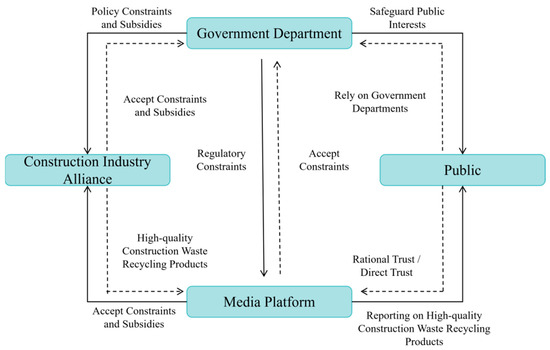
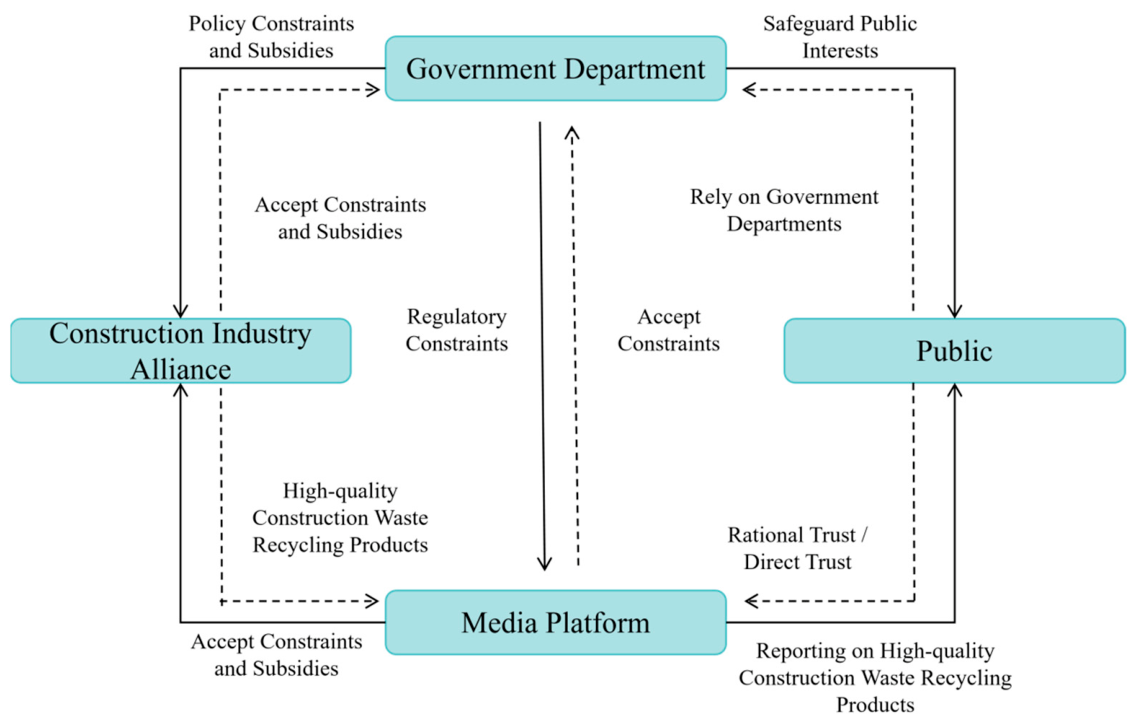
This paper constructs a multi-stakeholder game model of construction waste recycling with government participation. The logical relationship among the multi-stakeholders is shown in Figure 1 below.
Figure 1.
Multi-stakeholder relationship diagram.
3.1.2. Model Construction
To improve transparency and reprehensibility, the parameters used in the simulation are set as dimensionless relative values. They are not intended to represent absolute monetary amounts, but to capture the relative magnitude of revenues, costs, penalties, reputation losses, and information effects. The baseline values and ranges are determined based on the model assumptions and common practice in evolutionary game simulations of construction waste governance. In addition, to construct an evolutionary game model among stakeholders of construction waste recycling products with public opinion guidance under the background of the Internet [18,19,20], and to explore the quality supervision strategies for construction waste recycling products with the participation of government departments, the following assumptions are proposed:
Assumption 1.
The evolutionary game subjects are the government department, the construction industry alliance, the media platform, and the general public. The construction industry alliance releases high-quality construction waste recycling products after conducting in-depth and thorough research with a probability of r. The construction waste recycling products produced without such in-depth research, with a probability of 1 − r, are termed low-quality. High-quality construction waste recycling products require promotion through Internet media platforms, where the probability of media verification reporting is mm, and the probability of direct media reporting is 1 − m. The general public can rationally discern the reports with a probability of pp, or directly believe them with a probability of 1 − p. In the Internet era, particularly in today’s self-media age, the general public is highly sensitive to such reports, leading to actions such as lowered vigilance or blind following. The government department may choose to regulate the release of construction waste resource products by the construction industry or media reports, with a strict regulatory probability of g. The probability of relaxed regulation is thus 1 − g. Extending to the entire population, each probability can be represented as the proportion of the game subject’s group selecting a specific strategy. All four parties are assumed to be risk-neutral and aim to maximize their own expected payoffs. The risk-neutrality assumption is standard in evolutionary game theory. It allows the replicator dynamics to be driven by expected payoff differences and yields interpretation threshold conditions for strategy stability, while keeping the four-party model tractable. We acknowledge that real actors may exhibit loss aversion, bounded rationality, or reference dependence; relaxing this assumption is discussed as a possible extension at the end of this section.
Assumption 2.
The construction industry alliance can obtain sales revenue from construction waste recycling products, which is defined as Φ. The construction industry alliance needs to invest more personnel, time, and more professional instruments and equipment for fully rigorous research and development. The research cost is C, and the cost of construction waste recycling products that have not been fully rigorously researched and developed is C′. Since the revenue of the media platform is closely related to the number of hits, in the Internet era, major media platforms actively seize the opportunity to release construction waste recycling products. The revenue of the media platform is Ψ, the cost of verification reports is , and the cost of direct reports is . The influence of the media platform is denoted by α (α ∈ [0, 1]). It represents the probability that reports published by the platform reach and affect public decision-making. Specifically, for each individual, the probability that they will be affected by the report is α. Some members of the public do not directly believe the report after observing it, but instead make rational distinctions, including searching for information and obtaining relevant information from multiple channels to determine the credibility of the report. Distinguishing requires extra time and effort, and the cost of discrimination is . The cost of strict regulation by government departments is , and the cost of loose regulation is . Here, α is the key parameter that operationalizes Internet technology in the model: it scales all Internet-mediated payoffs and mainly affects the speed of evolutionary adjustment; when it interacts with reputation losses and penalties under specific strategy combinations, it can also influence equilibrium selection.
Assumption 3.
Reporting high-quality construction waste recycling products conveys scientifically credible signals to the public, bringing positive effects of and to the public and the government respectively. Reporting low-quality recycled products conveys misleading signals to the public or raises questions about construction waste recycling products, bringing negative effects of and to the public and the government respectively. These positive and negative effects are transmitted through Internet information dissemination and are therefore affected by , , and .
Assumption 4.
In the Internet era, if government departments can supervise the quality of construction waste recycling products and evaluate their expected social effects before reporting them, find reports of low-quality construction waste recycling products, prevent their release, punish and warn the construction industry alliance and media platform, and set the penalties for the construction industry alliance and media platform as and respectively, the social losses caused by reports of low-quality construction waste recycling products can be effectively avoided. These penalties are imposed when strict regulation detects low-quality direct reporting.
Assumption 5.
When low-quality construction waste recycling products are publicly reported, if the public can rationally distinguish, the reputation of the construction industry alliance will decline, its product research and development capabilities will be questioned, and the reputation loss will be . The credibility of the media platform will be affected, and the browsing and click-through rates will decrease; let this loss be . If the public directly believes low-quality reports, this will have a negative impact on society. If experts certify or refute reports on low-quality construction waste recycling products, the construction industry alliance and media platforms will also suffer reputational damage, expressed as and . The probability that experts certify or refute low-quality construction waste recycling products is . Expert certification can reduce the losses of reporting to the public and society. Specifically, the public’s loss changes from to − , and the government’s loss changes from to − , where and are the positive effects of expert certification or refutation on the public and the government, respectively.
The risk-neutrality assumption follows standard evolutionary game theory, allowing the replicator dynamics to be driven by expected payoffs and keeping the four-party model tractable, although it is a simplification that future research can relax. Internet technology is operationalized through , the influence of online information; , the probability of media verification; , the probability of rational public discrimination; and , the probability of expert verification/refutation. Reputation losses and are triggered when low-quality products are exposed and the public rationally discriminates, while penalties and are imposed under strict government regulation. The rumour/refutation effect thus arises jointly from , and : verified reporting filters low-quality information, rational discrimination prevents blind following, and expert refutation reduces social losses, so that together with strict regulation , these mechanisms determine whether the system converges to high-quality production.
When low-quality construction waste recycling products are publicly reported, if the public can rationally distinguish, the reputation of the construction industry alliance will decline, the product research and development capabilities will be questioned, the reputation loss will be Rr, the credibility of the media platform will be affected, and the browsing and click through rates will decrease. Let the loss be Rm. If the public directly believes that low-quality reports will have a negative impact on society and if experts certify reports on low-quality construction waste recycling products, the construction industry alliance and media platforms will also suffer reputational damage. The possibility of experts certifying low-quality construction waste recycling products is β, and product quality certification can reduce the losses of reporting to the public and society. The positive effects it brings to the public and the government are Tp and Tg, respectively. Considering the government departments’ supervision and the quality of construction waste recycling products reported by media platforms, the four-party game payoff matrix is shown in Table 1.
Table 1.
Payoff matrix for high-quality recycled construction waste products ().
Table 1 reports the single-interaction payoffs for the four parties. In each cell, payoffs are listed in the following fixed order: (Construction Industry Alliance; Media Platform; Government Department; Public). The symbols are defined as follows: is the sales revenue of the alliance; and are the research and development costs for high-quality and low-quality products, respectively; is the media platform revenue; and are the verification and direct reporting costs, respectively; and are the strict and loose regulation costs, respectively; and are the penalties imposed on the alliance and media platform, respectively; and are the positive effects of high-quality reporting on the public and government, respectively; and are the negative effects of low-quality reporting on the public and government, respectively; and are the positive effects of expert certification/refutation on the public and government, respectively; and are the reputation losses of the alliance and media platform, respectively; is the probability of expert certification/refutation; and is the public’s cost of rational discrimination. All entries are single-interaction payoffs; the expected payoffs in Equations (1)–(16) are obtained by multiplying these entries by the Internet influence coefficient and taking expectations over the relevant strategy probabilities.
3.2. Stability Analysis of Strategies for Each Evolutionary Game Player
3.2.1. Stability Analysis of Construction Industry Alliance’s Quality Strategy for Construction Waste Recycling Products
The expected payoffs of the construction industry alliance choosing to provide high-quality or low-quality construction waste recycling products, as well as the replicated dynamic equation and the first-order derivative of the quality strategy, are given respectively as follows:
In the following derivations, is factored out as a common multiplier for all expected payoffs. This is consistent with Assumption 2, where represents the overall intensity of Internet-mediated information transmission. Since does not affect the relative payoff differences, the equilibrium thresholds in Propositions 1–4 are independent of . Expected payoff of the construction industry alliance choosing to provide high-quality construction waste recycling products:
Expected payoff of the construction industry alliance choosing to provide low-quality construction waste recycling products:
From and , the average expected return of the construction industry alliance in providing resource-based products of construction waste can be obtained as . According to the evolutionary game theory, the replicated dynamic differential equation for high-quality recycled construction waste products provided by the construction industry alliance is
In Equation (3), the intermediate factor makes the payoff difference explicit. The coefficient of Φ is m, rather than , because media verification blocks the release of a low-quality product while every direct-reporting state earns gross sales revenue before conditional penalties or reputation losses are deducted.
According to the stability theorem of differential equations, for the construction industry alliance to be in a stable state when choosing to provide high-quality recycled products from construction waste resources, it must satisfy and .
Proposition 1.
Assume 0 < m < 1, 0 < g < 1, and 0 < β < 1. When , the stable strategy of the construction industry alliance is to produce and supply high-quality recycled products from construction waste resource utilization. When , the stable strategy is to produce and supply low-quality recycled products. When p = p0, the stable strategy cannot be determined. The threshold is .
Proof.
Let . For 0 < m < 1, 0 < g < 1, and 0 < β < 1, , so is increasing in . When , > 0, , and ; hence is stable. When , < 0, , and ; hence is stable. When , = 0, , and remains stationary; the stable strategy cannot be determined. □
Proposition 1 shows that, in the Internet era, when the public rationally evaluates reports and when strict regulation and reputational mechanisms are sufficiently strong, the penalties and reputation losses associated with low-quality products can outweigh the cost saving . As a result, high-quality production becomes the stable strategy. Improving public rational discrimination, while strengthening regulation and reputation discipline, therefore promotes high-quality supply.
3.2.2. Stability Analysis of Media Platforms’ Reporting Verification Strategy
The expected returns for media platforms choosing to verify reports or directly release reports, as well as the replicator dynamic equation and first-order derivative of the verification strategy, are respectively as follows:
Expected return for media platforms choosing to verify reports:
Expected return for media platforms choosing to directly release reports:
From and , the average expected return of media platform reports can be obtained as . According to evolutionary game theory, the replicator dynamic differential equation for media platforms choosing to verify reports is
According to the stability theorem of differential equations, for the media strategy to be in a stable state, it must satisfy and .
Proposition 2.
When , the stable strategy of media platforms is to verify reports and cautiously release information that can guide public opinion; when , its stable strategy is to report directly; when , the stable strategy cannot be determined.where the threshold is .
Proof.
From Equation (7), let . Then Since , is increasing in . Setting = 0 gives
Thus, when , and is stable; when , and is stable; when , the stable strategy cannot be determined. □
The specific proof process is similar to that of Proposition 1 and can be obtained similarly. Meanwhile, Proposition 2 also shows that an increase in the strict supervision probability of government regulatory departments will change the stable strategy of media platforms from direct reporting to verified reporting. Similarly, a decrease in the strict supervision probability of government regulatory departments will change the stable strategy of media platforms from verified reporting to direct reporting. It can be seen that in the Internet era, for the release of recycled products from construction waste resource utilization, government regulatory departments need to adopt restrictive measures on the reports of such products to avoid major social losses.
3.2.3. Stability Analysis of Government Departments’ Restrictive Regulation Strategy
The expected payoffs for government departments choosing strict restrictive regulation or loose restrictive regulation, as well as the replicator dynamic equation and first-order derivative of the regulation strategy, are given as follows:
Expected payoff for government departments choosing strict restrictive regulation:
Expected payoff for government departments choosing loose restrictive regulation:
From and , the average expected payoff of the government’s restrictive regulation strategy can be obtained as . According to evolutionary game theory, the replicator dynamic differential equation of the government’s restrictive regulation strategy is
Equation (11) follows directly from . The previous term has been removed; the high-quality payoff difference contributes , while the low-quality regulatory effects contribute .
According to the stability theorem of differential equations, for the government’s restrictive regulation strategy to be in a stable state, it must satisfy and .
Proposition 3.
Assume ,, and . When , the stable strategy of government departments’ restrictive regulation is loose regulation; when , the stable strategy is strict restrictive regulation; when , the stable strategy of government departments cannot be determined. The threshold is .
Proof.
From Equation (11), let . Then Since , under , is strictly decreasing in . Setting = 0 gives
Thus, when , and is stable; when , and is stable; when , the stable strategy cannot be determined. □
The specific proof process is similar to that of Proposition 1 and can be derived similarly. Because , is strictly decreasing in p. Therefore, an increase in the public’s rational discrimination probability lowers and shifts the stable strategy of government regulatory departments from strict regulation to loose regulation. That is, when the public has a high ability to distinguish news information, they can identify the quality of reports on construction waste recycled products, which will not cause serious social losses. In this case, government regulatory departments can save regulatory costs, and the stable strategy is loose regulation. Conversely, if the public is highly likely to believe reports directly, the stable strategy of government regulatory departments is strict regulation to avoid social losses.
3.2.4. Stability Analysis of the Public’s Report Processing Strategy
The expected payoffs for the public choosing rational discrimination or direct belief, as well as the replicator dynamic equation and first-order derivative of the report processing strategy, are given as follows:
Expected payoff for the public choosing the rational discrimination strategy:
Expected payoff for the public choosing the direct belief strategy:
From and , the average expected payoff of the public’s report processing strategy can be obtained as . According to evolutionary game theory, the replicator dynamic differential equation of the public’s report processing strategy is
According to the stability theorem of differential equations, for the public’s report processing strategy to be in a stable state, it must satisfy and .
Proposition 4.
When , the stable strategy of the public is direct belief; when , the stable strategy of the public is rational belief; when , the stable strategy of the public cannot be determined where the threshold is .
Proof.
From Equation (15), let . Then Since , under , is increasing in . Setting = 0 gives
Thus, when , 0 and is stable; when , and is stable; when , the stable strategy cannot be determined. □
The specific proof process is similar to that of Proposition 1 and can be derived similarly. Meanwhile, Proposition 4 shows that an increase in the probability that media platforms verify reports on recycled products from construction waste resource utilization will shift the public’s stable strategy from rational discrimination to direct belief. This is because when media platforms have a high probability of verifying reports, they filter out low-quality reports on construction waste recycled products for the public. The public can then increase their trust in these media platforms and save discrimination costs, so their stable strategy eventually becomes believing the reports released by media platforms. Conversely, if media platforms have a high probability of direct reporting and frequently release low-quality reports on construction waste recycled products, they will lose public trust, and the public’s strategy will shift from direct belief to rational discrimination.
3.3. Interaction Among Propositions and Possible Equilibrium Outcomes
Propositions 1–4 describe the stability conditions for each player separately, but the four replicator equations form a coupled four-dimensional dynamic system. A pure-strategy equilibrium requires the simultaneous satisfaction of the stability conditions in Propositions 1–4.
The joint conditions for the four strategies are as follows:
- Construction enterprise alliance chooses high-quality if ;
- Media platform chooses verified reporting () if ;
- Government chooses strict regulation () if ;
- Public chooses rational discrimination () if .
The opposite strategies are stable when the corresponding inequalities are reversed. Therefore, a fully stable four-strategy equilibrium exists only in specific parameter regions where these inequalities are mutually compatible. For example, high-quality production, verified reporting, strict regulation, and rational discrimination require , , , and , which can hold simultaneously only when and the other thresholds are compatible.
4. Results
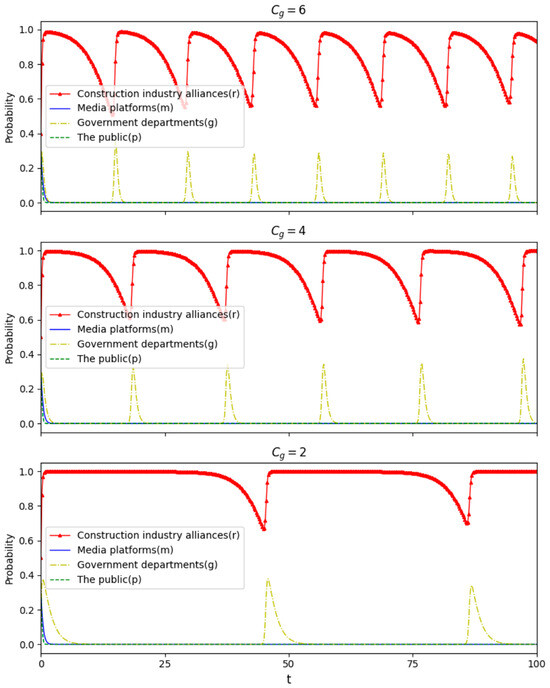
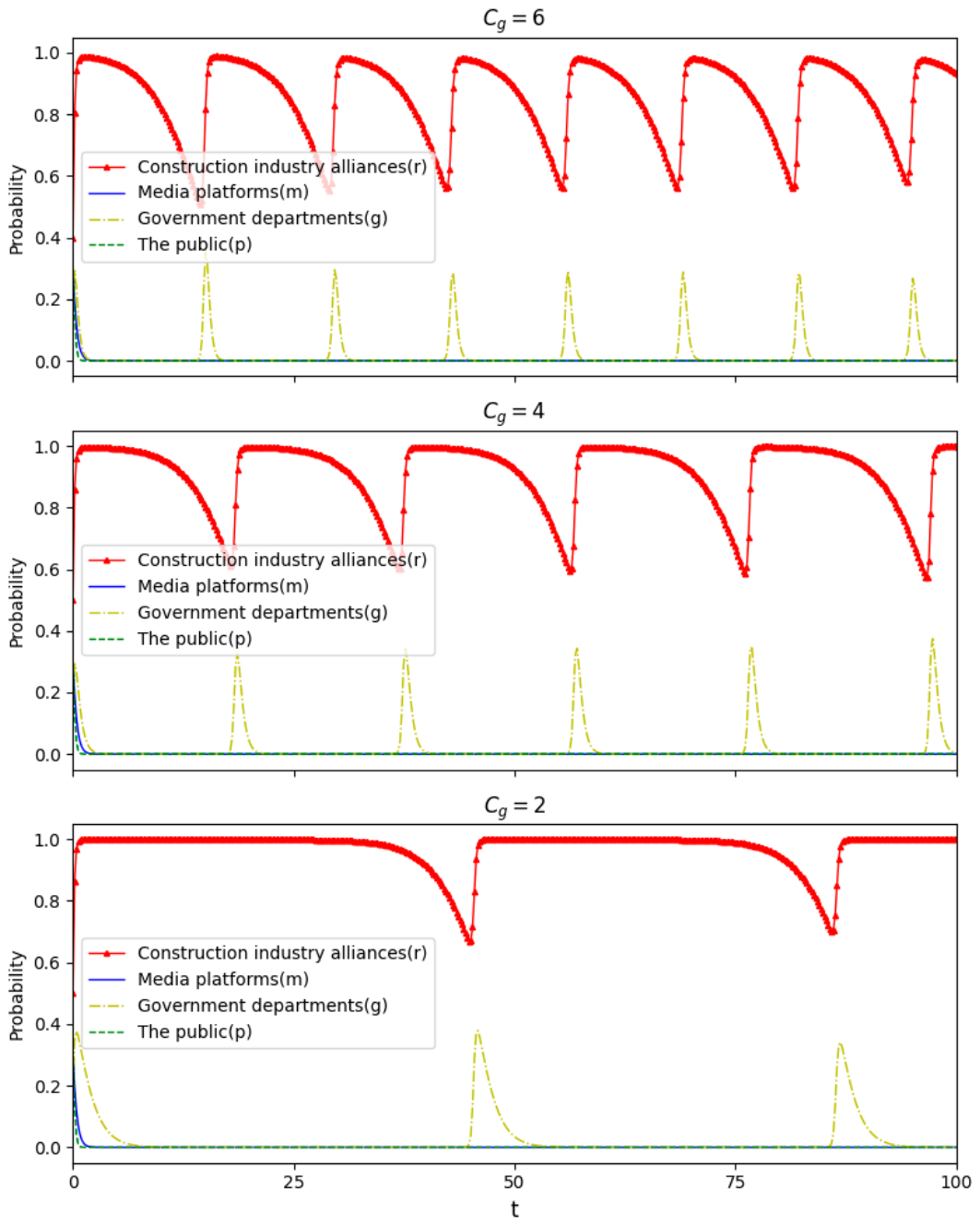
To more intuitively demonstrate the influence of key factors in the replicated dynamic system on the evolutionary process and outcomes of the multi-party game, Python 3.7.1 is employed to conduct numerical simulations of the evolutionary trajectories of all game players. In the baseline simulation, the strict regulation cost is set to 6, 4, and 2 to represent high, medium, and low regulation-cost scenarios. Other parameters are held constant to isolate the effect of . The simulation aims to verify the qualitative evolutionary directions and equilibrium stability rather than to predict absolute probabilities.
4.1. Impact of the Government’s Strict Regulation Cost
Simulations are performed under different values of the government’s strict regulation cost : 6, 4, and 2. As shown in Figure 2, the level of the government’s strict regulation cost affects not only the evolutionary trend of the government’s strategy but also those of the other three parties. Among them, the most significant change appears in the strategic evolution of the construction industry alliance. As the cost required for the government regulator to implement strict supervision decreases, the probability that the construction industry alliance produces high-quality recycled products from construction waste increases significantly, and the duration for which it stabilizes on the pure strategy of providing high-quality research reports becomes longer. Therefore, reducing the cost of strict regulation can stimulate the construction industry alliance to supply high-quality recycled products from construction waste.
Figure 2.
Evolutionary simulation diagram of the four-party evolutionary game when the strict regulation cost is 6, 4 and 2.
4.2. Impact of Reputation Value Loss Caused by Public Feedback
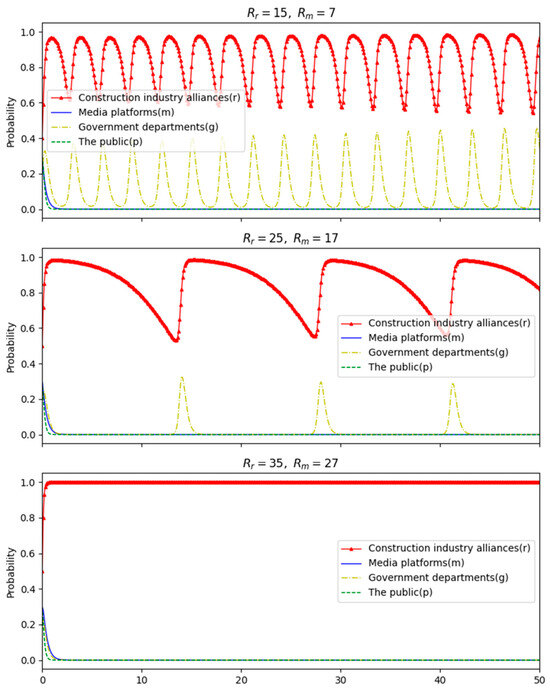
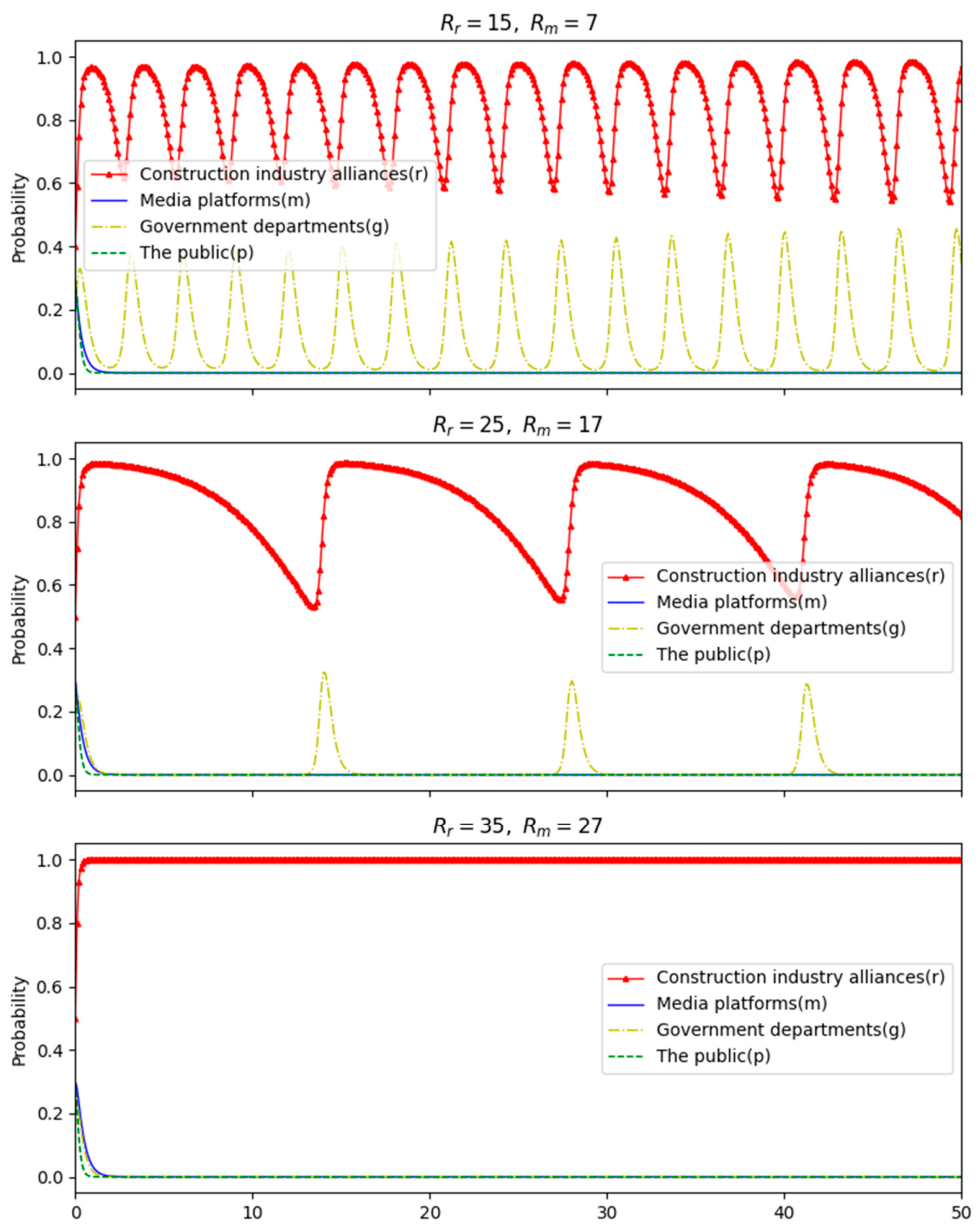
As shown in Figure 3 with the increase in reputation losses suffered by the construction industry alliance and media platforms due to reports on low-quality recycled products, the probability that the alliance produces high-quality construction waste recycled products gradually rises, and it tends to remain in a high-probability region of providing high-quality recycled product research reports within the simulation horizon. As the probability that the construction industry alliance supplies high-quality construction waste recycled products increases, the probabilities that the media platforms and government regulatory departments adopt strict supervision gradually decrease and eventually stabilize at 0. Meanwhile, the probability that the public directly trusts the reports on recycled products stabilizes at 1. Accordingly, the simulation suggests that the public’s information-processing strategy is sensitive to the perceived authority of the alliance and media platforms, but this result is parameter-specific and should not be generalized as a universal behavioural rule.
Figure 3.
Influence of reputation value loss caused by public feedback on the strategy evolution of the four-party game.
4.3. Impact of the Probability of Product Quality Verification by Expert Organizations on Media Platforms
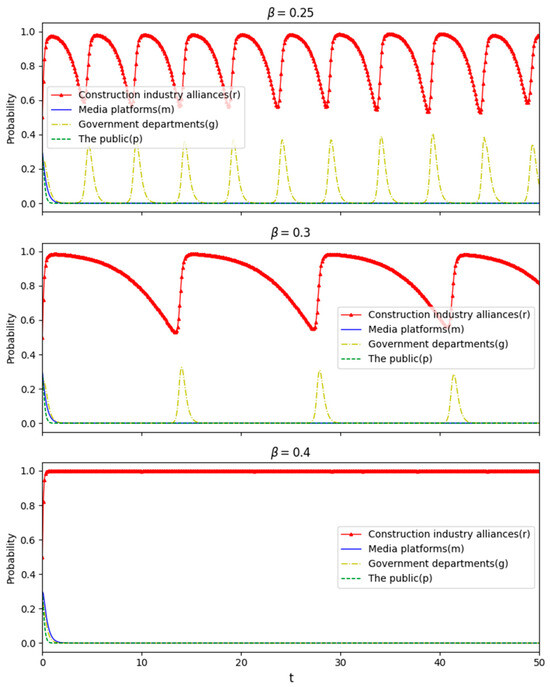
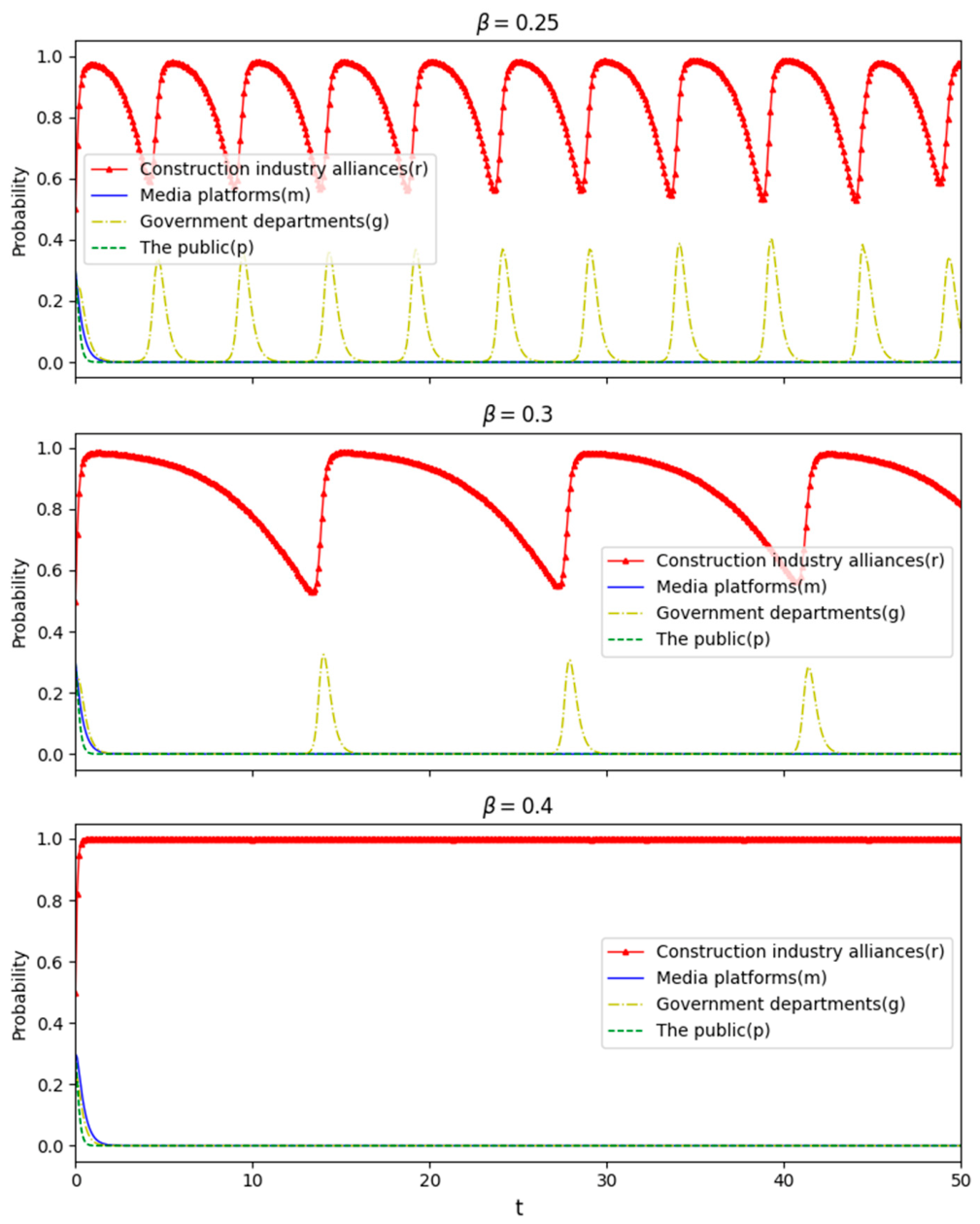
As shown in Figure 4, with the increase in the probability that expert organizations on media platforms verify product quality, the likelihood that the construction industry alliance’s production of low-quality construction waste recycled products will be exposed is greatly improved. This will gradually increase the probability that the alliance releases high-quality research reports, and it will eventually stabilize on the strategy of providing high-quality research reports on construction waste recycled products. Meanwhile, government regulatory departments can gradually relax regulation and save regulatory costs. Therefore, encouraging expert organizations to verify and clarify inappropriate reports on construction waste recycled products can effectively reduce the incidence of low-quality recycled product reports and protect the public interest.
Figure 4.
Influence of the probability of product quality verification by expert organizations on media platforms on the strategy evolution of the four-party game.
4.4. Impact of Government Supervision Mechanism
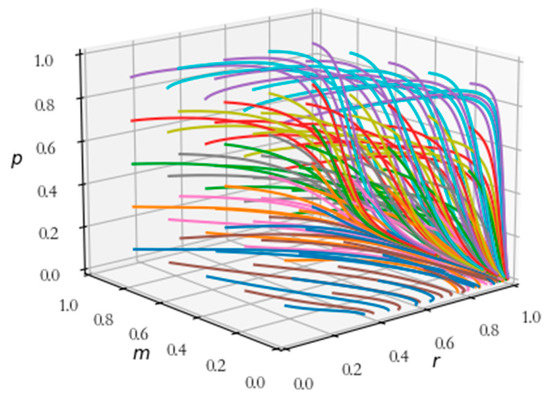
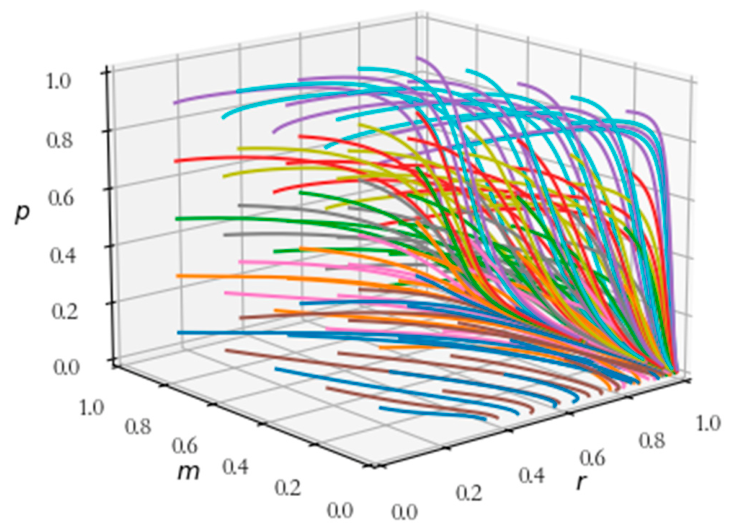
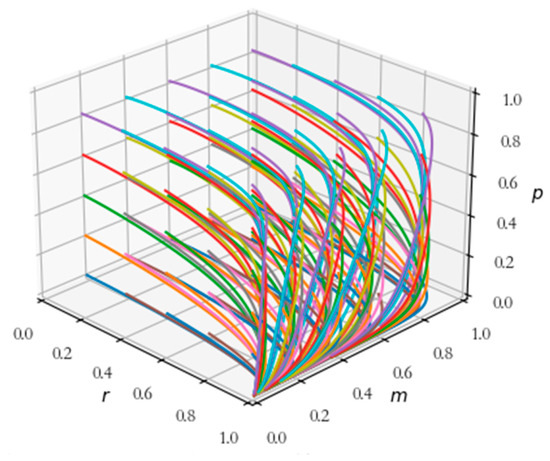
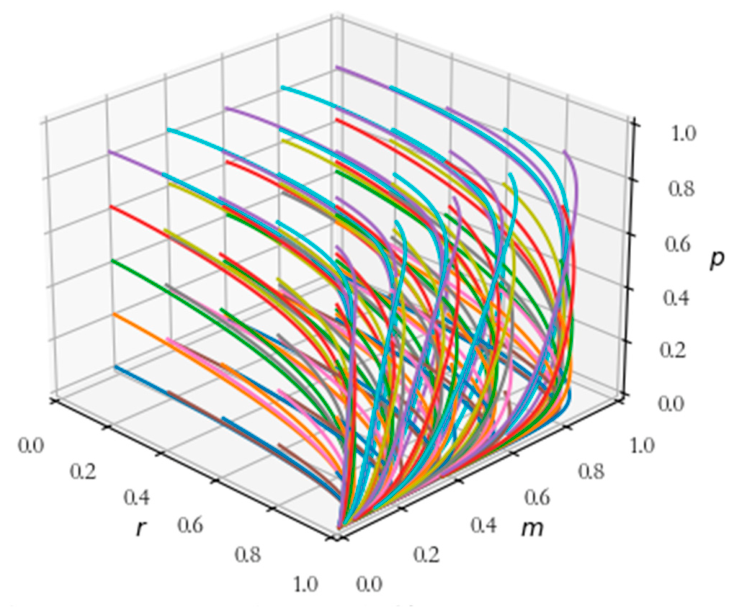
To further verify the effectiveness and feasibility of government departments’ regulatory mechanisms for reports on construction waste recycled products in the Internet era, two scenarios are set: g = 0 (no regulation) and g = 0.9 (strict regulation). Because the full replicator system is four-dimensional, the trajectories are visualized as three-dimensional projections onto the (r, m, p) strategy space under each fixed government strategy. The projections for g = 0 and g = 0.9 are shown in Figure 5 and Figure 6, respectively.
Figure 5.
Three-dimensional projection of the strategy evolution onto the (r, m, p) space under the fixed government strategy g = 0.
Figure 6.
Three-dimensional projection of the strategy evolution onto the (r, m, p) space under the fixed government strategy g = 0.9.
As illustrated in Figure 5, when = 0 (i.e., government departments impose no regulation on reports about construction waste recycled products), the stable strategy of the construction industry alliance is not unique due to the influence of multiple factors such as the probability of expert refutation and the risk of reputation loss. Media platforms tend to choose not to conduct verification and directly report on construction waste recycled products as soon as possible to gain higher returns.
As illustrated in Figure 6, when = 0.9 (i.e., government regulators establish a supervision and restraint mechanism for reports on construction waste recycled products), the system still has no stable point, meaning that the four-party replicator dynamics does not converge to a fixed equilibrium or an evolutionarily stable strategy. Nevertheless, the numerical simulation shows that the probability that the construction industry alliance provides high-quality recycled construction waste products rises to a high level and remains near 1 for extended intervals, although it still exhibits periodic drops. The strategies of the media platform, government, and public also fluctuate rather than settling at constant values. This pattern should be interpreted as bounded oscillation, quasi-periodic behaviour, or a long-lived transient maintained by continued strict regulation, rather than as convergence to a stable strategy. Under sustained strict regulation and high media verification, the public’s direct belief may temporarily increase; however, this trust is conditional and reversible. If government regulation weakens or media verification declines, rational discrimination may rise again. Therefore, the policy implication is not that strict regulation can permanently lock the system into high-quality production, but that maintaining a certain level of regulation can keep the alliance in a high-quality region and reduce the risk of persistent low-quality outcomes.
The simulation results are numerical and parameter-specific. Because the four-party replicator dynamic system may exhibit periodic or quasi-periodic behaviour and may be sensitive to initial values, the observed high-probability outcomes should not be interpreted as permanent equilibria. Future research can conduct bifurcation analysis, Lyapunov exponent estimation, or stochastic perturbation analysis to further examine the robustness of these patterns.
5. Conclusions
Based on the four-party evolutionary game model, the results show that reducing the cost of strict government regulation increases the probability that the construction industry alliance provides high-quality recycled products; increasing reputation loss for the alliance when low-quality products are exposed raises and stabilizes the probability of high-quality supply, thereby reducing the need for strict government supervision and enhancing public trust; encouraging expert organizations to verify and refute inappropriate reports lowers the probability of reports on low-quality construction waste recycled products and protects public interests; and improving public rational discrimination reduces blind trust and reliance on costly strict regulation. The equilibrium analysis further shows that the four strategies can stabilize simultaneously only under specific parameter combinations, and multiple equilibrium outcomes are possible, so policy design should combine Internet-enabled information disclosure, reputation discipline, expert verification, and public rational discrimination to steer the system toward the high-quality equilibrium. Theoretically, the model extends existing two-party and three-party evolutionary game studies by treating media platforms and the public as independent strategic players and by embedding Internet-enabled mechanisms into the payoff matrix and replicator dynamics; however, as a theoretical analysis with dimensionless simulation parameters, it has not been empirically validated, and future work will calibrate and test the model using field surveys, expert interviews, and enterprise-level data.
Author Contributions
Conceptualization, H.L. and Y.W.; methodology, H.L. and F.P.; validation, H.L., F.P., Y.W. and S.Y.; formal analysis, H.L.; data curation, H.L., F.P. and S.Y.; writing—original draft preparation, H.L.; writing—review and editing, H.L.; supervision, Y.W. All authors have read and agreed to the published version of the manuscript.
Funding
This research was funded by the Scientific Research Program for Youth Innovation Teams of Shaanxi Provincial Department of Education (No.: 25JP101).
Institutional Review Board Statement
Not applicable.
Informed Consent Statement
Not applicable.
Data Availability Statement
The original contributions presented in this study are included in the article. Further inquiries can be directed to the corresponding author.
Conflicts of Interest
The authors declare no conflicts of interest.
References
- Wu, T.; Shen, L.; Ge, H.Y. Research on the construction and optimization strategy of collaborative governance mechanism for construction waste resource utilization. Build. Sci. 2025, 41, 296–304. [Google Scholar]
- Trivedi, S.S.; Snehal, K.; Das, B.B.; Barbhuiya, S. A comprehensive review towards sustainable approaches on the processing and treatment of construction and demolition waste. Constr. Build. Mater. 2023, 393, 132125. [Google Scholar] [CrossRef] [Scilit]
- Rong, Y.F.; Sun, X.K.; Zhang, X.Y. Management of construction waste resource utilization under the “zero waste” concept. In Proceedings of the Symposium on Green Building Publication Context “Dual Carbon”, Beijing, China, 20 January 2024; pp. 31–35. [Google Scholar] [CrossRef]
- Wang, J.W.; Song, Y.H.; Wang, W.; Wang, S.; Guo, F.; Lu, J. Marine construction waste recycling mechanism considering public participation and carbon trading: A study on dynamic modeling and simulation based on sustainability policy. Sustainability 2022, 14, 10027. [Google Scholar] [CrossRef] [Scilit]
- Ma, M.X.; Tam, V.W.Y.; Le, K.N.; Butera, A.; Li, W.; Wang, X. Comparative analysis on international construction and demolition waste management policies and laws for policy makers in China. J. Civ. Eng. Manag. 2023, 29, 107–130. [Google Scholar] [CrossRef] [Scilit]
- Zhang, Y.X. Development status of construction waste resource treatment industry in China. Renew. Resour. Circ. Econ. 2023, 16, 22–24. [Google Scholar]
- Wang, Y.; Li, H.; Xue, L.; Gou, W. The evolution of the construction waste recycling system and the willingness to use recycled products in China. Sustainability 2022, 14, 12541. [Google Scholar] [CrossRef] [Scilit]
- Qiao, L.; Tang, Y.; Li, Y.; Liu, M.; Yuan, X.; Wang, Q.; Ma, Q. Life cycle assessment of three typical recycled products from construction and demolition waste. J. Clean. Prod. 2022, 376, 134139. [Google Scholar] [CrossRef] [Scilit]
- Ma, W.; Hao, J.L. Enhancing a circular economy for construction and demolition waste management in China: A stakeholder engagement and key strategy approach. J. Clean. Prod. 2024, 450, 141763. [Google Scholar] [CrossRef] [Scilit]
- Kolaventi, S.S.; Thakur, A.R.; Narain, A.; Venigalla, S.G. Enhancing adoption and usage of recycled C&DW products: Stakeholder insights and key success factors for effective implementation. J. Solid Waste Technol. Manag. 2025, 51, 514–538. [Google Scholar] [CrossRef] [Scilit]
- Zhu, J.; Ye, G.; Wu, P.; Li, Y.; Liu, J. Material flow analysis of construction and demolition waste recycling under circular economy. Clean. Waste Syst. 2025, 11, 100303. [Google Scholar] [CrossRef] [Scilit]
- Li, M.D.; Han, C.F.; Shao, Z.G.; Meng, L. Exploring the evolutionary mechanism of the cross-regional cooperation of construction waste recycling enterprises: A perspective of complex network evolutionary game. J. Clean. Prod. 2024, 434, 139972. [Google Scholar] [CrossRef] [Scilit]
- Lin, Y.H.; Dai, J.; Li, J.; Tao, X. Efficient classification and disposal management of construction waste using blockchain technology and system dynamics. J. Constr. Eng. Manag. 2026, 152, 04025242. [Google Scholar] [CrossRef] [Scilit]
- Wang, H.P.; Qu, X.; Luo, H.; Chen, X.; Hu, H.Y. Design and development of a regional collaborative platform for construction waste management. Buildings 2026, 16, 666. [Google Scholar] [CrossRef] [Scilit]
- Wu, W.; Lyu, Y.; Zheng, C.; Hao, J.L.; Shen, S.; Yu, S. Digital supervision in construction pollution control: Utilizing advanced information models for enhanced supervision and sustainability. Environ. Technol. Innov. 2025, 37, 104038. [Google Scholar] [CrossRef] [Scilit]
- Yang, Y.; Feng, H.; Yin, Z.; Yan, Z.; Zhang, Y. Probabilistic insights into recycled aggregate variability via Bayesian-Copula: Implications for cleaner production and quality control. J. Clean. Prod. 2025, 530, 146842. [Google Scholar] [CrossRef] [Scilit]
- Lu, M.; Huang, Z. Game analysis among key node subjects in the construction waste resource industrial chain. Ecol. Econ. 2018, 34, 131–136. [Google Scholar]
- Lai, X.; Yao, X.; Chen, Y. Resource utilization research on construction waste based on game theory. IOP Conf. Ser. Earth Environ. Sci. 2020, 558, 042054. [Google Scholar] [CrossRef] [Scilit]
- Shao, Z.G.; Li, M.D.; Han, C.F.; Meng, L.; Wu, Q. Collaborative mechanism and simulation of construction waste disposal based on evolutionary game. Chin. J. Manag. Sci. 2024, 32, 324–334. [Google Scholar] [CrossRef]
- Shao, Z.G.; Li, M.D.; Han, C.F.; Meng, L. Evolutionary game model of construction enterprises and construction material manufacturers in the construction and demolition waste resource utilization. Waste Manag. Res. 2023, 41, 477–495. [Google Scholar] [CrossRef] [Scilit] [PubMed]
- Wang, Y.; Wang, C.; Deng, X.; Wu, Z. Evolutionary game analysis of the utilization of construction waste resources based on prospect theory. Sustainability 2023, 15, 2577. [Google Scholar] [CrossRef] [Scilit]
- Song, W.; Hou, G.; Yang, L.; Wang, P.; Guo, Y. Evolutionary game analysis for promoting the realization of construction waste recycling and resource utilization: Based on a multi-agent collaboration perspective. Buildings 2024, 14, 2368. [Google Scholar] [CrossRef] [Scilit]
- Su, Y.; Si, H.; Chen, J.; Wu, G. Promoting the sustainable development of the recycling market of construction and demolition waste: A stakeholder game perspective. J. Clean. Prod. 2020, 277, 122281. [Google Scholar] [CrossRef] [Scilit]
- Wang, Y.; Liu, Y.; Wang, T.; Xing, X.; Geng, X. Evolutionary game and simulation analysis of construction waste recycling from the perspective of stakeholders. PLoS ONE 2024, 19, e0307652. [Google Scholar] [CrossRef] [Scilit] [PubMed]
- Wang, Y.; Qi, L.; Cui, W. Analysis of multi-stakeholder behavioral strategies in the construction and demolition waste recycling industry through an evolutionary game theory. Buildings 2024, 14, 1425. [Google Scholar] [CrossRef] [Scilit]
- Chen, Z.; Li, K.; Tan, H.; Liu, J.; Wu, X.; Wang, P. Paraphrase the obstacles to the recycling of construction and demolition waste: A perspective of the evolutionary game of three stakeholders. Buildings 2024, 14, 3664. [Google Scholar] [CrossRef] [Scilit]
- Lin, Y.H.; Wang, J.; Niu, D.; Nwetlawung, Z.E. Evaluating stakeholders’ decisions in a blockchain-based recycling construction waste project: A hybrid evolutionary game and system dynamics approach. Buildings 2024, 14, 2205. [Google Scholar] [CrossRef] [Scilit]
- Zhang, Y.; Li, X. An evolutionary game study of brownfield pollution governance under uncertain media supervision. Environ. Eng. Sci. 2026, 43, 278–292. [Google Scholar] [CrossRef] [Scilit]
- Sun, Y.; Sun, H.; Sun, P.; Jin, X.; Yang, Y. Elevating the corporate social responsibility level: A media supervision mechanism based on the Stackelberg-evolutionary game model. Omega 2025, 131, 103215. [Google Scholar] [CrossRef] [Scilit]
- Ghaffar, S.H.; Burman, M.; Braimah, N. Pathways to circular construction: An integrated management of construction and demolition waste for resource recovery. J. Clean. Prod. 2020, 244, 118710. [Google Scholar] [CrossRef] [Scilit]
- Hoang, N.H.; Ishigaki, T.; Kubota, R.; Tong, T.K.; Nguyen, T.T.; Nguyen, H.G.; Yamada, M.; Kawamoto, K. Financial and economic evaluation of construction and demolition waste recycling in Hanoi, Vietnam. Waste Manag. 2021, 131, 294–304. [Google Scholar] [CrossRef] [Scilit] [PubMed]
- Ma, L.; Zhang, L. Evolutionary game analysis of construction waste recycling management in China. Resour. Conserv. Recycl. 2020, 161, 104863. [Google Scholar] [CrossRef] [Scilit]
- Yao, J.Y.; Yi, W.; Wang, H.Q.; Zhen, L.; Liu, Y. Stackelberg game model for construction waste disposal network design. Autom. Constr. 2022, 144, 104573. [Google Scholar] [CrossRef] [Scilit]
- Shao, Z.G.; Li, M.D.; Yu, D.H.; Han, C.; Meng, L. Collaborative evolution mechanism and simulation of construction waste recycling stakeholders based on social network. Buildings 2022, 12, 2255. [Google Scholar] [CrossRef] [Scilit]

Disclaimer/Publisher’s Note: The statements, opinions and data contained in all publications are solely those of the individual author(s) and contributor(s) and not of MDPI and/or the editor(s). MDPI and/or the editor(s) disclaim responsibility for any injury to people or property resulting from any ideas, methods, instructions or products referred to in the content. |
© 2026 by the authors. Licensee MDPI, Basel, Switzerland. This article is an open access article distributed under the terms and conditions of the Creative Commons Attribution (CC BY) license.