


Abstract
Phosphate enrichment of surface waters is a major cause of eutrophication, creating demand for low-cost materials that support phosphorus removal and recovery. In this study, Conocarpus waste biochar (CBC) was modified with iron (Fe-CBC), magnesium (Mg-CBC), and both metals (FeMg-CBC) to improve phosphate adsorption. FTIR, XRD, SEM, and elemental analyses confirmed clear changes in surface chemistry and mineral composition after modification. FeMg-CBC showed the strongest overall performance, with higher surface area, faster uptake, and greater adsorption capacity than the mono-metallic materials. Phosphate removal was strongly influenced by pH, adsorbent dosage, and contact time, with optimum performance near pH 6. Adsorption kinetics followed the pseudo-second-order model (R2 = 0.997), while equilibrium data were best described by the Langmuir–Freundlich model. FeMg-CBC achieved Langmuir and Sips capacities of 86.2 and 106.5 mg g−1, respectively. Its enhanced performance was attributed to combined electrostatic attraction, ligand exchange, Mg-phosphate precipitation, and possible interlayer anion exchange within the Fe-Mg layered phase. These findings highlight its potential for wastewater treatment and nutrient recycling.
1. Introduction
Phosphorus (P) is an essential, non-renewable macronutrient that plays a central role in global food production. However, its inefficient management has created two closely related environmental and resource challenges. In agricultural systems, phosphate fertilizers that are not taken up by crops can be transported through surface runoff and drainage into rivers, lakes, and coastal waters. Excess phosphorus in aquatic environments accelerates eutrophication, promotes harmful algal blooms, reduces dissolved oxygen concentrations, and may contribute to cyanotoxin production, with serious consequences for aquatic ecosystems and water quality [1,2]. To limit these impacts, regulatory agencies in many countries have introduced stringent phosphorus discharge limits, commonly within the range of 0.1–2.0 mg P L−1 [3]. At the same time, phosphate rock, the principal raw material used for mineral fertilizer production, is a finite and geographically concentrated resource, raising concerns regarding its long-term availability and security of supply [4]. These challenges are particularly relevant to arid countries such as Saudi Arabia, where freshwater resources are limited and sustainable nutrient management is important for both water protection and agricultural development [5]. Technologies capable of removing phosphorus from contaminated water while also facilitating its recovery and potential reuse are therefore increasingly important.
Several technologies are currently available for phosphate removal, including chemical precipitation, enhanced biological phosphorus removal, membrane filtration, and struvite crystallization. Although effective under appropriate operating conditions, each approach has practical limitations. Chemical precipitation can generate substantial quantities of metal-containing sludge that require further handling and disposal, while biological phosphorus removal is influenced by operational conditions such as temperature, pH, and microbial activity. Membrane-based processes can achieve high separation efficiencies but may involve considerable energy consumption and membrane fouling. Struvite crystallization offers the additional advantage of phosphorus recovery, although its implementation may require relatively complex process control and infrastructure [1,6,7]. Adsorption has consequently attracted considerable attention because of its operational simplicity, relatively low sludge generation, adaptability to different phosphorus concentrations, and potential compatibility with tertiary wastewater treatment [1,3]. Its effectiveness, however, depends strongly on the physicochemical properties and surface chemistry of the adsorbent.
Biochar is a carbon-rich material produced through the thermochemical conversion of biomass under oxygen-limited conditions. It has been widely investigated as an adsorbent because it can be prepared from renewable and waste-derived feedstocks and may possess a porous structure, appreciable surface area, and a variety of oxygen-containing functional groups [8,9]. Nevertheless, pristine biochar generally exhibits limited affinity for phosphate. Under many aqueous conditions, its surface is negatively charged, which can reduce phosphate uptake because of electrostatic repulsion between the adsorbent surface and anionic phosphate species [1,10]. Surface modification with metal species is therefore commonly employed to improve phosphate adsorption by introducing positively charged or chemically reactive sites.
Iron-based modification is particularly effective because iron oxides and hydroxides can bind phosphate through ligand exchange and inner-sphere complex formation. Modification using ferrous sulfate and co-precipitation can produce iron-containing phases, including magnetite (Fe3O4) and poorly crystalline ferrihydrite-like phases, which provide active sites for Fe–O–P bonding, electrostatic attraction, and, under suitable conditions, surface precipitation [1,11]. Magnesium provides a different but complementary pathway. Mg-modified materials may promote phosphate removal through the formation of magnesium phosphate phases such as MgHPO4 and Mg3(PO4)2. Magnesium incorporation can also alter surface-charge characteristics and extend the pH range over which favorable interactions with phosphate occur [12,13]. Combining Fe and Mg within the same biochar matrix may therefore provide several interacting phosphate-removal pathways rather than relying on a single adsorption mechanism.
Previous studies have demonstrated the potential of Fe–Mg-modified materials for phosphate capture. He et al. [13], for example, showed that Mg–Fe co-modified rice-straw biochar removed phosphate through a combination of Mg-associated precipitation and Fe-mediated inner-sphere complexation. Yu et al. [12] reported high phosphate adsorption by MgO–Fe3O4 nanocomposites and attributed the uptake to combined sorption and precipitation processes. Beiyuan et al. [1] further demonstrated that the preparation route and resulting iron mineral phases can substantially influence both adsorption behavior and the dominant phosphorus-removal mechanisms. Despite these advances, relatively few studies have directly compared unmodified biochar with Fe-modified, Mg-modified, and Fe–Mg co-modified counterparts produced from the same precursor biomass under otherwise identical preparation conditions. Such a comparison is important because variations in feedstock, pyrolysis conditions, metal loading, and synthesis procedures can obscure the individual and combined contributions of Fe and Mg. In addition, sulfate-based precursors such as FeSO4·7H2O and MgSO4·7H2O remain comparatively less explored in Fe–Mg biochar systems, even though precursor chemistry may influence mineral formation and subsequent phosphate interactions.
The choice of biomass precursor is equally important because feedstock composition influences the structure, mineral content, surface functionality, and sustainability of the resulting biochar. Conocarpus erectus (buttonwood; Combretaceae) is widely planted as an ornamental and roadside tree in Riyadh and other parts of the Arabian Peninsula. Routine pruning and landscape maintenance generate lignocellulosic residues consisting of leaves, branches, and woody material that can potentially serve as a locally available biomass resource [14,15]. Converting these residues into functional adsorbents provides a route for waste valorization while supporting circular-economy approaches and resource-recovery strategies. The use of such locally available biomass is particularly relevant in arid environments where sustainable water treatment and efficient resource utilization are important environmental priorities.
To the best of our knowledge, the use of Conocarpus pruning waste as a precursor for Fe–Mg bimetallic biochar specifically designed for phosphate removal has not been systematically investigated. We hypothesized that Fe–Mg co-modification would improve phosphate removal compared with modification using either metal alone, as Fe and Mg were expected to contribute through different but complementary mechanisms. Fe was anticipated to bind phosphate mainly through ligand exchange and inner-sphere complexation at Fe–OH sites, whereas Mg could promote the formation of sparingly soluble Mg–phosphate phases. The simultaneous introduction of both metals may also favour the formation of mixed Fe–Mg hydroxide phases, providing additional sites for phosphate uptake. In this study, Conocarpus-derived biochar (CBC), Fe-modified biochar (Fe-CBC), Mg-modified biochar (Mg-CBC), and Fe–Mg co-modified biochar (FeMg-CBC) were prepared from pruning waste collected in Riyadh, Saudi Arabia. The materials were characterized using scanning electron microscopy (SEM), X-ray diffraction (XRD), Fourier-transform infrared spectroscopy (FTIR), Brunauer–Emmett–Teller (BET) surface-area analysis, and zeta-potential measurements. Their phosphate-removal behavior was then compared across different solution pH values, adsorbent dosages, and initial phosphate concentrations. Kinetic and equilibrium isotherm were further employed to evaluate the adsorption process and clarify the contributions of Fe and Mg to the performance of the bimetallic material.
2. Materials and Methods
2.1. Collection and Preparation of Conocarpus Pruning Waste
Conocarpus pruning residues consisting of a mixture of woody chips and fresh leaves were collected following municipal tree-maintenance activities in public green spaces in Riyadh, Saudi Arabia. Conocarpus erectus (Combretaceae) is widely used for urban landscaping in Riyadh and other parts of the Arabian Peninsula because of its ability to tolerate hot and relatively saline environments [14,15]. The collected biomass was first air-dried for 72 h and subsequently oven-dried at 80 °C for 24 h to reduce the remaining moisture content. After drying, the material was mechanically shredded, ball-milled, and sieved to obtain particles smaller than 0.5 mm. The resulting biomass powder was stored in sealed polyethylene bags at room temperature until pyrolysis.
2.2. Biochar Synthesis and Modification
Pristine Conocarpus biochar (CBC) was prepared by pyrolysis of the processed biomass at 500 °C for 2 h [1,3]. After pyrolysis, the produced biochar was ground and passed through a 0.25 mm sieve. The final CBC was stored in sealed amber glass containers in a desiccator until further use. Iron-modified biochar (Fe-CBC) was prepared using a wet precipitation procedure with FeSO4·7H2O as the iron precursor [11,16]. Briefly, 10 g of CBC was added to 400 mL of 0.3 M FeSO4·7H2O solution and stirred magnetically at 200 rpm for 30 min at room temperature to promote contact between the dissolved Fe2+ ions and the biochar surface. The suspension was subsequently heated to 70 °C. A 2 M NaOH solution was then introduced dropwise at approximately 2 mL min−1 while stirring until the pH reached 10.5 ± 0.2. Under these alkaline conditions, iron-containing hydroxide phases precipitated onto and within the biochar matrix. The suspension was maintained at 70 °C for a further 60 min to allow precipitation and aging of the deposited phases. The resulting material was recovered by vacuum filtration and washed repeatedly with deionized water until the conductivity of the filtrate was below 10 μS cm−1. A final wash with absolute ethanol was then performed. The composite was oven-dried at 60 °C for 24 h, ground, and sieved to ≤0.25 mm. The dried intermediate was calcined at 500 °C for 1 h under flowing N2 using a heating rate of 10 °C min−1. The resulting material was designated Fe-CBC and stored under dry conditions until use.
Magnesium-modified biochar (Mg-CBC) was synthesized using MgSO4·7H2O as the Mg2+ precursor [12,13]. Forty grams of MgSO4·7H2O was dissolved in 400 mL of deionized water, after which 10 g of CBC was added. The suspension was stirred at 200 rpm for 2 h to promote interaction between Mg2+ ions and the biochar surface. The mixture was heated to 70 °C, and 2 M NaOH was added gradually under continuous stirring until a pH of 10.5 ± 0.2 was reached. This alkaline treatment promoted precipitation of Mg-containing hydroxide species onto the biochar. The suspension was aged at 70 °C for 60 min and subsequently vacuum-filtered. The solid product was washed repeatedly with deionized water until the filtrate conductivity was below 10 μS cm−1 and then dried at 60 °C for 24 h. The dried intermediate was calcined at 500 °C for 1 h under flowing N2 using a heating rate of 10 °C min−1. This thermal treatment was applied to stabilize the deposited Mg-containing phase and promote its conversion to oxide-containing species within the biochar matrix [12]. After cooling under N2, the material was ground and sieved to ≤0.25 mm and designated Mg-CBC.
Fe–Mg co-modified biochar (FeMg-CBC) was prepared by simultaneous precipitation of Fe and Mg using a nominal Fe molar ratio of 1:2 [12,13]. Appropriate quantities of FeSO4·7H2O and MgSO4·7H2O were dissolved together in deionized water to obtain a total dissolved metal concentration of 0.3 M. Ten grams of CBC was added to 400 mL of the mixed precursor solution. The suspension was ultrasonicated for 30 min at 40 kHz to improve contact and dispersion of Fe2+ and Mg2+ species throughout the biochar suspension. It was then heated to 70 °C, followed by gradual addition of 2 M NaOH under continuous stirring until the pH reached 10.5 ± 0.2. The alkaline conditions induced simultaneous deposition of Fe- and Mg-containing hydroxide phases onto the biochar surface. The suspension was maintained at 70 °C for a further 60 min to allow aging of the precipitated material. The solid composite was recovered by vacuum filtration and washed repeatedly with deionized water until the conductivity of the filtrate was below 10 μS cm−1. The washed material was oven-dried at 60 °C for 24 h. It was subsequently calcined under N2 at 500 °C for 1 h using a heating rate of 10 °C min−1. This step was used to thermally stabilize the deposited metal-containing phases within the biochar matrix [12,13]. After cooling, the composite was ground, sieved to ≤0.25 mm, and stored under dry conditions. The final product was designated FeMg-CBC.
2.3. Physicochemical Characterization
The physicochemical properties of CBC, Fe-CBC, Mg-CBC, and FeMg-CBC were evaluated using complementary microscopic, spectroscopic, diffraction, surface-area, and elemental analyses. Surface morphology was examined using scanning electron microscopy (SEM; EFI S50 Inspect, Amsterdam, The Netherlands). Samples were mounted on aluminum stubs using 12 mm adhesive carbon tape (PELCO, London, UK) and sputter-coated with a thin layer of gold for 60 s using a 108 Auto/SE Sputter Coater (Ted Pella Inc., Redding, CA, USA). SEM images were acquired under high-vacuum conditions at an accelerating voltage of 30 kV, using magnifications ranging from ×300 to ×2000. Elemental distribution was examined using PerkinElmer CHNSO elemental analyzer (PerkinElmer series II, Waltham, MA, USA). The mineralogical phases present in the prepared materials were examined using an X-ray diffractometer (MAXima_X XRD-7000, Shimadzu, Japan) with Cu Kα radiation operated at 30 mA. The samples were scanned in continuous mode at a rate of 2° min−1. Surface functional groups were investigated using Fourier transform infrared (FTIR) spectroscopy (FTIR, Bruker Alpha-Eco ATR-FTIR, Bruker Optics Inc., Coventry, UK), while Brunauer–Emmett–Teller (BET) (TriStar II 3020, Micromeritics, Norcross, GA, USA) was used for specific surface area and pore-size distributions measurements. Surface-charge behavior was assessed by measuring zeta potential over the pH range of 2.0–12.0 using a Zetasizer Nano ZS (Malvern Panalytical, Malvern, UK). The total Fe and Mg contents of CBC, Fe-CBC, Mg-CBC, and FeMg-CBC were determined using inductively coupled plasma optical emission spectroscopy (ICP-OES; Perkin Elmer Optima 4300 DV ICP-OES). Prior to analysis, the samples were subjected to acid digestion using the Hossner method. The pH of each biochar was also measured in deionized water at a solid-to-liquid ratio of 1:20 after shaking for 1 h at 200 rpm [1].
2.4. Phosphate Solution Preparation and Analysis
A 1000 mg P L−1 phosphate stock solution was prepared from KH2PO4. Before use, KH2PO4 was dried at 105 °C for 2 h, after which the required mass was accurately weighed and dissolved in deionized water. Working phosphate solutions were freshly prepared from the stock solution by appropriate dilution to the desired concentrations.
Dissolved phosphate concentrations were determined using the ammonium molybdate–ascorbic acid colorimetric method (molybdenum blue method) in accordance with Standard Method 4500-P E [1,3]. Absorbance was measured at 882 nm using a UV–visible spectrophotometer (UV-1800, Shimadzu, Japan). Calibration standards covering 0.05–5.0 mg P L−1 were used to generate a calibration curve, with coefficients of determination (R2) greater than 0.9999. Calibration was verified at the beginning of each analytical batch. Samples containing phosphate concentrations above the calibration range were appropriately diluted with deionized water before analysis.
2.5. Batch Adsorption Experiments
Batch adsorption experiments were performed in triplicate (n = 3) using 250 mL Erlenmeyer flasks sealed with parafilm and agitated on a rotary shaker at 150 rpm. Unless otherwise specified, the experiments were conducted using an initial phosphate concentration (C0) of 200 mg P L−1, an adsorbent dosage of 1.0 g L−1, an initial pH of 6.0, 0.01 M KCl as the background electrolyte, a temperature of 25 °C, and a contact time of 24 h. At the end of each experiment, the suspensions were filtered through 0.45 μm cellulose acetate membranes, and the filtrates were analyzed immediately for residual phosphate.
The equilibrium adsorption capacity, (qe) (mg g−1), and phosphate removal efficiency, (R) (%), were calculated according to:
where (Co) and (Ce) are the initial and equilibrium phosphate concentrations (mg P L−1), respectively, (V) is the solution volume (L), and (m) is the dry mass of adsorbent (g).
2.5.1. Effects of Solution pH and Adsorbent Dosage
The influence of solution pH on phosphate adsorption was examined over an initial pH range of 2.0–11.0 using 50 mg P L−1 phosphate solutions and an adsorbent dosage of 1.0 g L−1. The pH was adjusted before adsorbent addition using 0.1 M HCl or 0.1 M NaOH. After 24 h of equilibration, both the initial and final pH values were recorded using a calibrated pH meter (INESA DZS-706, Shanghai, China). Phosphate speciation over the investigated pH range was estimated using Visual MINTEQ v.3.1 (KTH, Stockholm, Sweden) and interpreted together with zeta-potential measurements to assess the contribution of surface charge and phosphate speciation to adsorption behavior [1,3].
The effect of adsorbent dosage was evaluated by varying the amount of CBC, Fe-CBC, Mg-CBC, and FeMg-CBC from 0.2 to 2.2 g L−1 in 50 mL of 200 mg P L−1 phosphate solution. These experiments were conducted at pH 6.0 and 25 °C for 24 h. Changes in both phosphate removal efficiency and adsorption capacity were considered when evaluating the influence of adsorbent dosage [1].
2.5.2. Adsorption Kinetics
Adsorption kinetics were investigated using an adsorbent dosage of 1.0 g L−1 and an initial phosphate concentration of 200 mg P L−1 at pH 6.0 and 25 °C. Independent flasks were prepared for each sampling time to avoid changes in the solid-to-liquid ratio caused by repeated sampling. Individual flasks were removed after 5, 10, 20, and 30 min and after 1, 2, 4, 6, 8, 12, 18, and 24 h. The experimental kinetic data were analyzed using pseudo-first-order (PFO), pseudo-second-order (PSO), Elovich, and Power function models.
Pseudo-First-Order (PFO)
ln(qe − qt) = ln qe − k1t
Pseudo-Second-Order (PSO)
Elovich model
Power function model
where qe and qt (mg g−1) are adsorption capacities at equilibrium and at time t (min); k1 (min−1) and k2 (g mg−1 min−1) are the PFO and PSO rate constants; α (mg g−1 min−1) and β (g mg−1) are the Elovich initial rate and desorption constants; kf (mg g−1 min−1) is the power function rate constant and v is the power function exponent, obtained as the slope of ln qt versus ln t.
lnqt = ln kf + v ln t
2.5.3. Adsorption Isotherms
Equilibrium adsorption experiments were carried out using initial phosphate concentrations of 10, 20, 30, 50, 80, 100, 150, and 200 mg P L−1. The adsorbent dosage was maintained at 1.0 g L−1, with an initial pH of 6.0 and a temperature of 25 °C. Samples were equilibrated for 24 h before analysis. The equilibrium data were fitted to the following adsorption models:
Langmuir
Freundlich
Temkin
Langmuir–Freundlich (Sips)
The Langmuir–Freundlich (Sips) model is a distinct three-parameter hybrid isotherm, rather than an average or combination of separately fitted Langmuir and Freundlich models. At low equilibrium concentrations, it approaches Freundlich-type behaviour, whereas at high concentrations it approaches Langmuir-type behaviour with a finite saturation capacity.
In the above equations, qm (mg g−1) is the theoretical maximum adsorption capacity; KL (L mg−1) is the Langmuir constant; KF is the Freundlich coefficient; n is the heterogeneity factor; R (8.314 J mol−1 K−1) is the gas constant; T (K) is absolute temperature; bT (J mol−1) and AT (L g−1) are Temkin constants; Ks and ms are the Langmuir–Freundlich affinity constant and heterogeneity index.
3. Results and Discussion
3.1. FTIR Spectral and XRD Analysis
3.1.1. FTIR Spectral
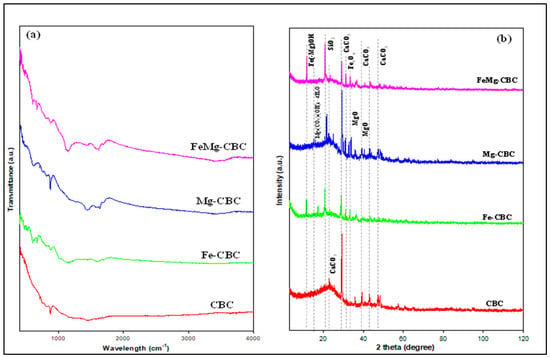
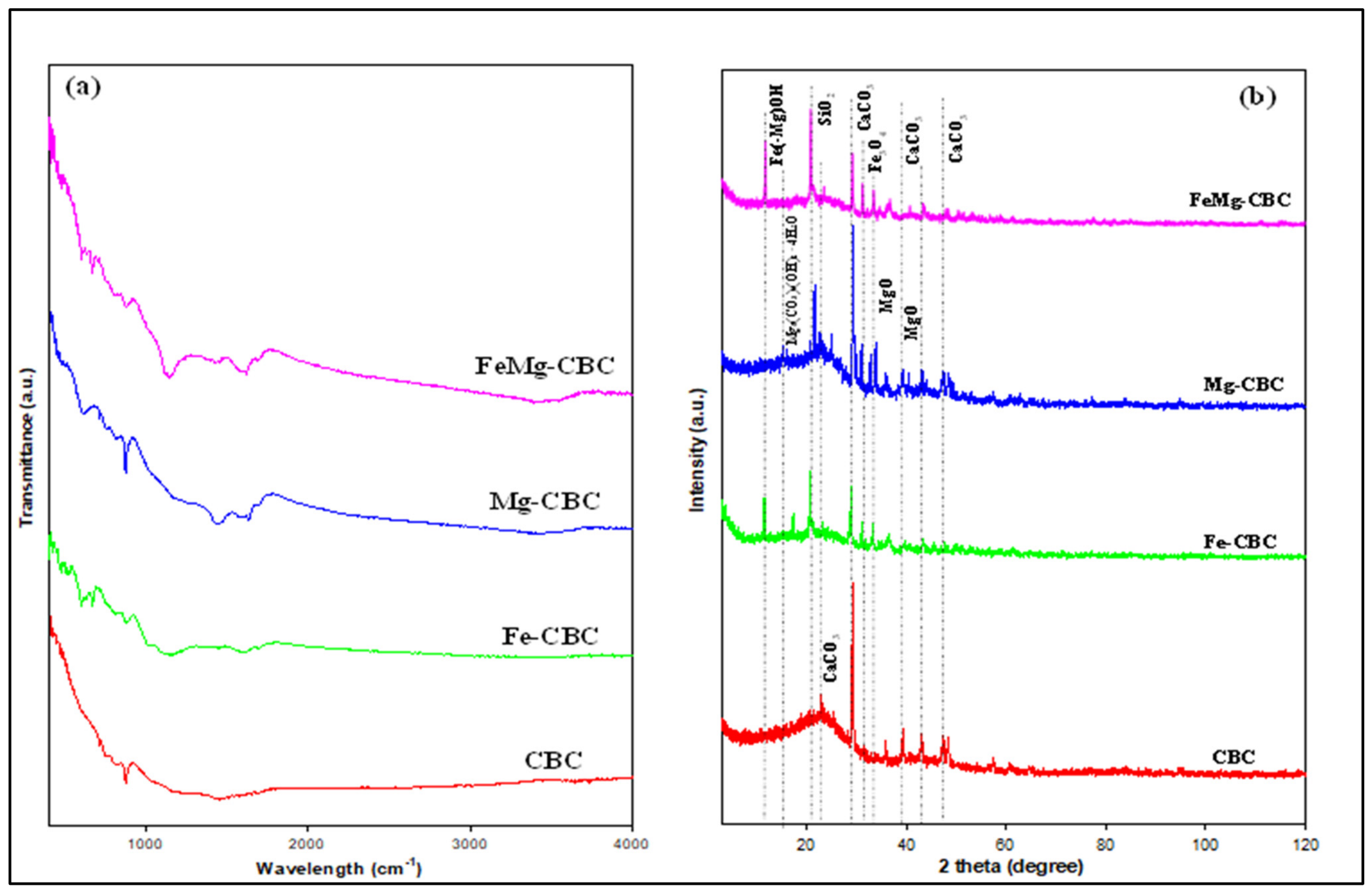
The ATR-FTIR spectra of pristine Conocarpus biochar (CBC), Fe-modified biochar (Fe-CBC), Mg-modified biochar (Mg-CBC), and the bimetallic FeMg-CBC are presented in Figure 1a. The four materials show broadly similar spectral features associated with the carbonaceous biochar matrix, while noticeable changes in band intensity, width, and the low-wavenumber region occur after metal modification. These differences suggest changes in surface functionality and the introduction of metal-containing surface species. A broad absorption band centered at approximately 3420 cm−1 is observed for all samples and is attributed primarily to O–H stretching vibrations associated with surface hydroxyl groups and adsorbed water [1]. The band becomes broader and more pronounced after metal modification, particularly for FeMg-CBC. This change may reflect an increased contribution from hydroxylated metal surface sites in addition to oxygen-containing groups already present on the biochar [11]. A weak band or shoulder around 2920 cm−1, corresponding to aliphatic C–H stretching, is more clearly visible in CBC and decreases in intensity after modification [1]. For Mg-CBC and FeMg-CBC, which underwent an additional thermal treatment at 500 °C, this attenuation may also be related to further loss or transformation of aliphatic surface structures during calcination. A prominent band around 1610 cm−1 is retained in all four materials. This region can contain contributions from aromatic C = C vibrations as well as asymmetric stretching of carboxylate-containing surface groups [1]. Differences in the shape and intensity of this band after Fe and Fe–Mg modification indicate that metal incorporation altered the chemical environment of oxygen-containing groups on the biochar surface. Such changes may arise from interactions between metal species and carboxyl or hydroxyl functionalities, although FTIR alone does not provide sufficient evidence to assign a specific Fe–O–C coordination structure. The feature near 1420 cm−1, commonly associated with carboxylate stretching and O–H deformation, shows comparatively smaller changes among the materials. More pronounced differences are observed around 1030 cm−1, where CBC exhibits a relatively strong C–O stretching band associated with oxygen-containing surface structures. The intensity of this feature decreases and the band becomes broader in the modified materials, with the largest change observed for FeMg-CBC. The attenuation may result from alteration or partial coverage of C–O-containing surface sites by deposited metal phases. The additional thermal treatment applied during the preparation of Mg-CBC and FeMg-CBC may also contribute to changes in this region through further transformation of oxygen-containing carbon structures [13]. A weaker feature around 875 cm−1, attributable to aromatic C–H out-of-plane deformation, similarly decreases after modification [1].
Figure 1.
FTIR (Fourier transform infrared spectroscopy) spectra (a) and XRD (X-ray diffraction) patterns (b) of pristine Conocarpus biochar (CBC), iron-modified Conocarpus biochar (Fe-CBC), magnesium-modified Conocarpus biochar (Mg-CBC), and iron–magnesium co-modified Conocarpus biochar (FeMg-CBC).
The clearest distinction between pristine and metal-modified biochars occurs in the low-wavenumber region below approximately 600 cm−1. CBC shows no prominent resolved band in this region, whereas Fe-CBC exhibits a distinct feature near 560 cm−1. Absorptions within this range are commonly associated with Fe–O vibrations in iron-containing oxide or oxyhydroxide phases and have been reported for Fe-modified biochars [11,17]. Mg-CBC also shows increased absorption in the low-wavenumber region. Vibrational modes associated with Mg–O-containing phases have been reported over a relatively broad range below approximately 750 cm−1 [12,18]; however, the precise Mg phase responsible for this feature cannot be established from FTIR alone and is therefore considered together with the XRD results. FeMg-CBC exhibits a broader and more intense low-frequency absorption than either mono-metallic material. This spectral response is consistent with overlapping vibrations from Fe–O- and Mg–O-containing surface species within the bimetallic composite. Importantly, the higher FTIR intensity should not by itself be interpreted as quantitative evidence of greater metal loading, because absorption intensity is also affected by sample preparation, local bonding environment, and overlapping vibrational modes. Nevertheless, the emergence of low-wavenumber features after modification provides qualitative evidence that the surface chemistry of CBC was substantially altered by incorporation of the metal-containing phases. The corresponding elemental composition and crystalline phases are further evaluated using EDS and XRD.
Overall, the FTIR spectra show three main changes after modification: broadening of the O–H stretching region, attenuation and alteration of several carbon–oxygen-associated bands, and the appearance of low-wavenumber absorptions characteristic of metal–oxygen bonding environments. These changes are most evident in FeMg-CBC and indicate substantial modification of the original biochar surface. When considered together with the XRD and elemental characterization, the FTIR results provide evidence for successful formation of Fe-, Mg-, and Fe–Mg-containing biochar composites and identify oxygen-containing surface groups that may subsequently participate in phosphate binding.
3.1.2. XRD Analysis
The XRD patterns of CBC, Fe-CBC, Mg-CBC, and FeMg-CBC are shown in Figure 1b. All samples exhibit a broad feature around 2θ ≈ 20–26°, characteristic of turbostratic or poorly graphitized carbon commonly observed in biochars produced at moderate pyrolysis temperatures (~500 °C) [1,9]. Pristine CBC shows sharp reflections at 2θ = 23.0°, 29.3°, 36.0°, 39.4°, 43.1°, and 47.4°, which closely match calcite (CaCO3) [19,20]. Their presence in the unmodified material indicates that calcite originated from the mineral fraction of the Conocarpus feedstock. Similar reflections remain visible in the modified composites, showing that the native carbonate phase persisted after Fe and Mg treatment [19,20]. Fe-CBC displays additional reflections that were absent or weak in CBC. A low-angle peak at 2θ = 11.6° is consistent with a basal reflection of an Fe-containing layered hydroxide phase and may indicate formation of a mixed-valence Fe(II)–Fe(III) hydroxysulfate or green-rust-type structure during alkaline precipitation [21]. Peaks at 31.1°, 36.6°, 43.4°, 56.8°, and 61.3° correspond closely to the characteristic reflections of spinel-type magnetite/maghemite (Fe3O4/γ-Fe2O3; JCPDS 19-0629), confirming formation of crystalline iron oxide phases [11,19,22]. A weaker reflection near 20.7° is attributable to quartz (SiO2), a common mineral component of biomass-derived biochar [20].
Mg-CBC exhibits a larger number of crystalline reflections between approximately 29° and 50°. Peaks near 32.9° and 34.0° are consistent with periclase MgO (JCPDS 45-0946), likely produced during calcination of the Mg(OH)2 precursor [12,18,19]. The additional reflection at 15.4° is consistent with hydromagnesite (Mg5(CO3)4(OH)2·4H2O). Formation of such carbonate/hydroxide phases is plausible because MgO can react with atmospheric moisture and CO2 after calcination [12]. The FeMg-CBC pattern differs noticeably from those of the mono-metallic composites. Two low-angle reflections at 11.7° and 23.5° are consistent with the (003) and (006) basal reflections of a hydrotalcite-derived Fe–Mg layered double hydroxide/oxide (LDH/LDO)-type structure [23]. Their formation is compatible with the simultaneous co-precipitation of Fe and Mg at the applied 1:2 molar ratio [21,23]. FeMg-CBC also retains weaker reflections near 31.2°, 36.7°, and 43.5°, associated with spinel-type iron oxides, while the dense MgO/hydromagnesite pattern observed for Mg-CBC is less evident. This suggests that co-precipitation altered the crystallization behavior of the two metals and favored formation of mixed Fe–Mg phases [12,13,23,24].
Overall, the XRD results support successful incorporation of Fe- and Mg-containing crystalline phases into the biochar matrix and are consistent with the FTIR observations in Section 3.1. The low-angle reflections observed for FeMg-CBC are consistent with an Fe–Mg layered structure derived from a hydrotalcite-like phase. However, because the material was calcined at 500 °C, above the typical dehydroxylation range of layered double hydroxides (approximately 250–450 °C), the original LDH structure would not be expected to remain intact. We therefore interpret the phase primarily as an LDH-derived layered double oxide (LDO). Such oxides can partially reconstruct to LDH-like structures when exposed to aqueous solutions containing anions, potentially enabling phosphate uptake through interlayer exchange. Nevertheless, the present XRD data cannot conclusively distinguish between an LDO, a reconstructed LDH, or another mixed Fe–Mg oxide phase. These assignments should therefore be considered plausible interpretations rather than definitive structural identifications, with XPS and in situ XRD recommended for confirmation in future studies.
3.2. SEM Analysis
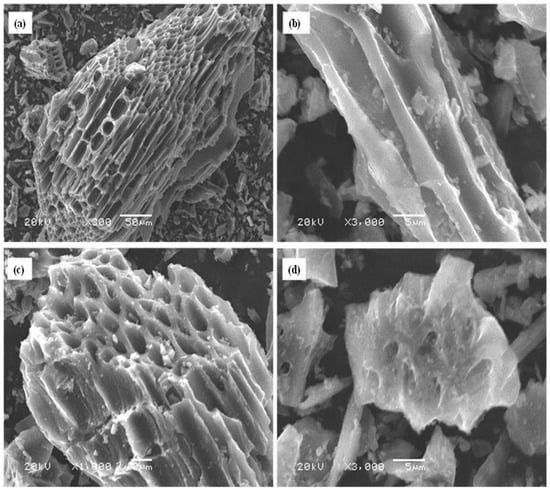
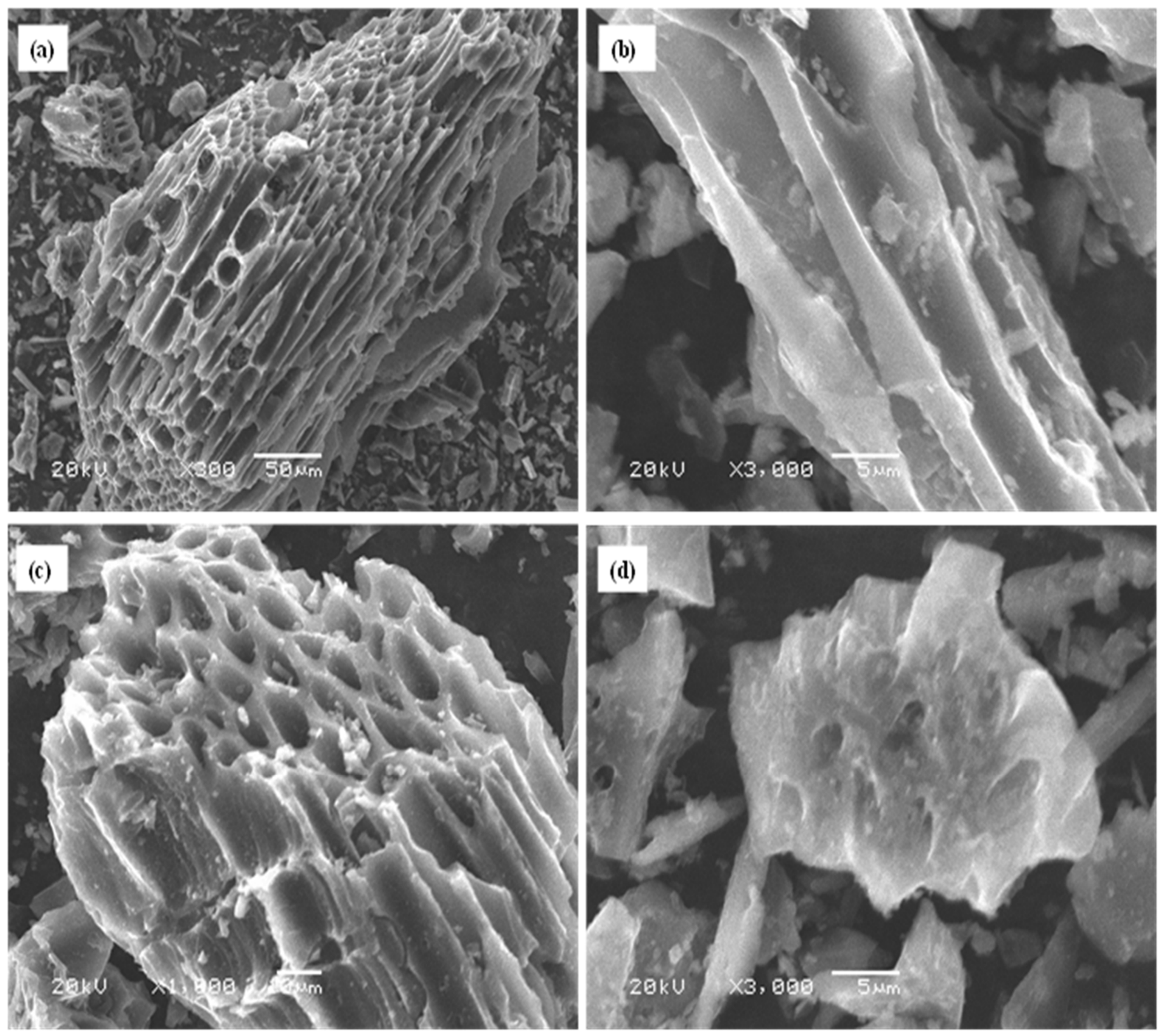
SEM images of CBC, Fe-CBC, Mg-CBC, and FeMg-CBC are presented in Figure 2. The micrographs show clear changes in surface morphology after metal modification, complementing the FTIR and XRD results discussed in the previous sections. Pristine CBC (Figure 2a) retains an open, honeycomb-like porous structure with elongated channels inherited from the vascular architecture of the Conocarpus biomass. The pore walls are relatively smooth and well preserved, which is typical of biomass-derived biochars produced under moderate pyrolysis conditions [1,9,20]. Fe-CBC (Figure 2b) maintains much of the original channel structure but shows numerous small, irregular particles distributed across the surface. These deposits are consistent with the formation of Fe-containing mineral phases during alkaline precipitation and agree with morphologies previously reported for iron- and magnetite-modified biochars [11,17,19]. Mg-CBC (Figure 2c) exhibits a rougher and more heavily coated surface. The channel walls appear thicker, with granular deposits partially narrowing some pore openings. Similar surface coverage has been reported following deposition of MgO- and Mg(OH)2-derived phases on biochar [12,18,25,26]. FeMg-CBC (Figure 2d) shows the greatest morphological change. The original vascular features are less distinct, while the surface appears more continuous, irregular, and locally plate-like. This suggests more extensive co-deposition of Fe- and Mg-containing phases during simultaneous precipitation. Comparable plate-like or coated morphologies have been reported for Mg–Fe co-modified biochars [13,23,25,27] and are consistent with the layered structural features observed in the XRD pattern.
Figure 2.
Scanning electron microscope (SEM) images of (a) pristine Conocarpus biochar (CBC), (b) iron-modified Conocarpus biochar (Fe-CBC), (c) magnesium-modified Conocarpus biochar (Mg-CBC), and (d) iron–magnesium co-modified Conocarpus biochar (FeMg-CBC).
Overall, SEM confirms that metal modification altered the native biochar surface in different ways. Fe-CBC is characterized mainly by discrete surface particles, Mg-CBC by a rough granular coating, and FeMg-CBC by more extensive surface coverage. These morphological changes are likely to influence pore accessibility and the distribution of active sites available for phosphate adsorption.
3.3. Properties of the Adsorbents
The textural, elemental, and proximate properties of CBC, Fe-CBC, Mg-CBC, and FeMg-CBC are summarized in Table 1. BET surface area followed the order FeMg-CBC (172.82 m2 g−1) > CBC (159.65 m2 g−1) > Mg-CBC (148.42 m2 g−1) > Fe-CBC (142.12 m2 g−1), while total pore volume increased from 0.051 cm3 g−1 in CBC to 0.073, 0.078, and 0.089 cm3 g−1 in Fe-CBC, Mg-CBC, and FeMg-CBC, respectively. The lower surface areas of the mono-metallic composites may be related to partial pore blockage by deposited mineral phases, as also suggested by SEM [11,28]. In contrast, FeMg-CBC exhibited both the highest surface area and pore volume, indicating that simultaneous Fe–Mg modification created additional accessible porosity. Furthermore, ICP-OES analysis confirmed effective and largely selective incorporation of the target metals. Fe-CBC contained 408.64 g Fe kg−1, while its Mg content (6.74 g kg−1) was comparable to that of pristine CBC (7.08 g kg−1). Similarly, Mg-CBC contained 314.77 g Mg kg−1, whereas its Fe content (11.47 g kg−1) remained close to the background level of CBC (13.46 g kg−1). These results indicate that the mono-metallic composites were successfully prepared with minimal incorporation of the non-target metal. FeMg-CBC contained substantial amounts of both Fe (228.19 g kg−1) and Mg (112.85 g kg−1), although the loading of each metal was lower than that obtained in the corresponding mono-metallic composite. The Fe and Mg loadings represented approximately 56% and 36% of those achieved for Fe-CBC and Mg-CBC, respectively. This reduction may be associated with competition between Fe and Mg for available precipitation sites during simultaneous co-precipitation [12,13]. The higher Fe loading further suggests that Fe was incorporated more readily than Mg under the co-precipitation conditions used. All four materials were alkaline, although pH decreased from 10.37 for CBC to 10.05 for Mg-CBC, 9.55 for FeMg-CBC, and 9.51 for Fe-CBC. This decrease likely reflects changes in surface chemistry following metal modification, including the formation of hydroxylated metal sites and possible retention of sulfate species from the precursor salts [1,11].
Table 1.
Properties of the materials.
Elemental composition also changed after modification. Carbon content decreased from 42.15% in CBC to 38.9–40.2% in the modified samples, whereas oxygen increased from 6.58% to 8.95–12.85%, consistent with incorporation of oxygen-rich Fe- and Mg-containing phases [1,9,19]. Hydrogen content also increased slightly. Sulfur rose from 0.682% in CBC to 0.985% in Fe-CBC and 1.353% in FeMg-CBC, while Mg-CBC contained 0.852%. The relatively high sulfur content of the Fe-containing composites may reflect residual sulfate associated with iron-bearing layered phases proposed from the XRD results, although this interpretation remains tentative [21]. Furthermore, proximate analysis showed a marked decrease in fixed carbon from 48.82% in CBC to 33.3–36.6% after modification, accompanied by modest increases in volatile matter and moisture. Interestingly, ash content decreased from 18.73% in CBC to 14.67–15.38% in the modified materials, despite the addition of inorganic metal phases. This unexpected trend may partly result from the loss of CO2 and structural water from carbonate and hydroxide phases during thermal analysis, although differences in the ashing procedure should also be considered [1,9,20].
Overall, metal modification altered the porosity, surface chemistry, and elemental composition of Conocarpus biochar. FeMg-CBC showed the most favorable textural properties, with the highest BET surface area and pore volume, providing a plausible structural advantage for phosphate adsorption.
3.4. Effect of Different Parameters on P Adsorption
3.4.1. Effect of Solution pH
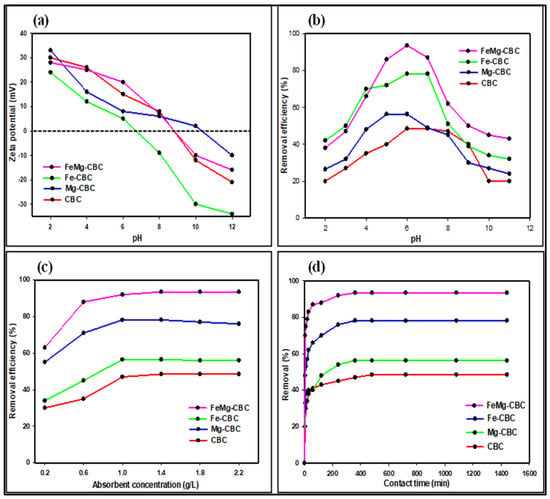
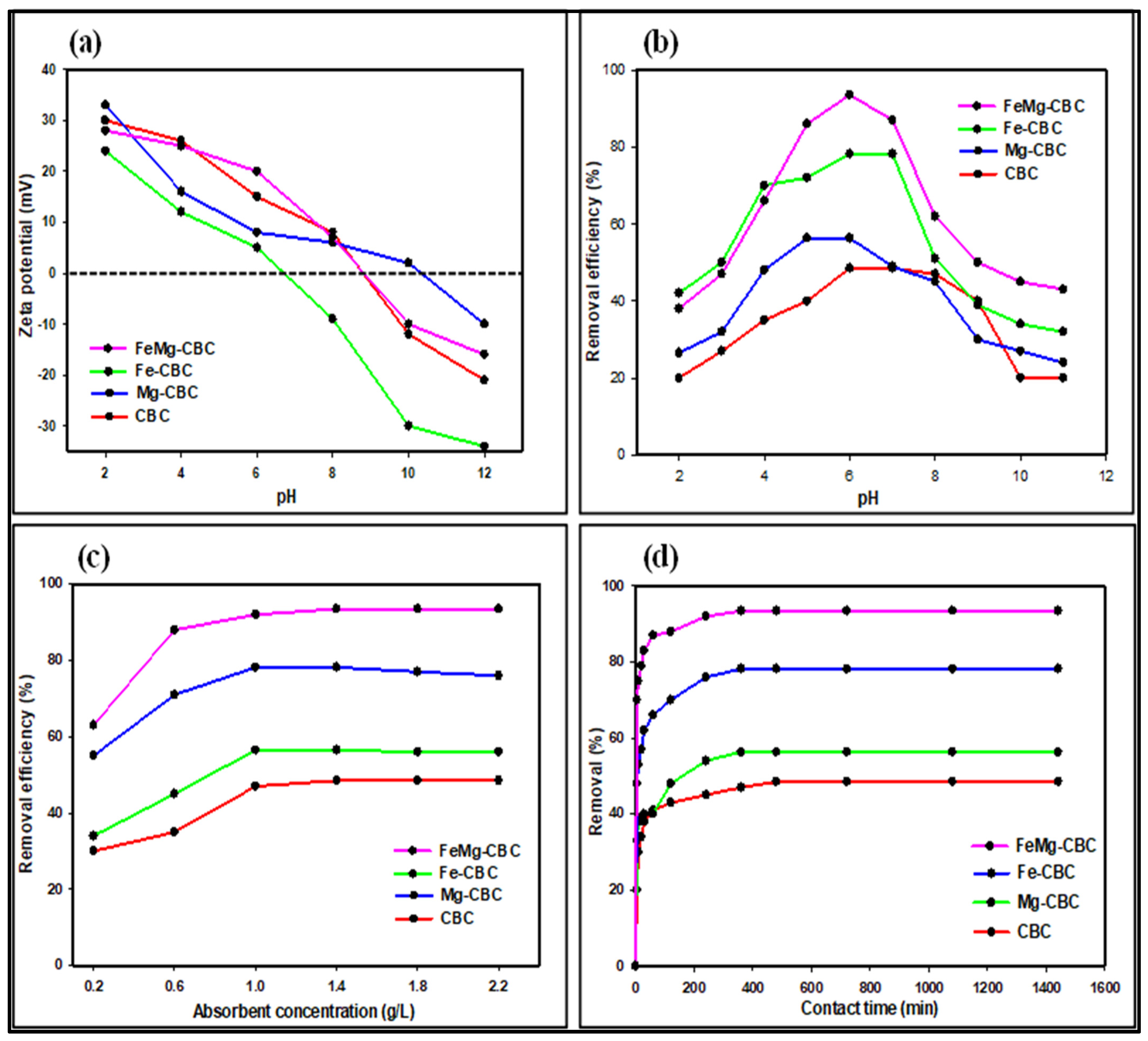
The influence of initial solution pH on phosphate removal by CBC, Fe-CBC, Mg-CBC, and FeMg-CBC is presented in Figure 3b. Across the investigated pH range of 2–11, all four adsorbents showed a characteristic bell-shaped response commonly reported for metal-modified biochars. Phosphate removal was relatively low under strongly acidic conditions, increased toward the weakly acidic-to-neutral region, and then declined progressively under alkaline conditions [11,29,30,31]. FeMg-CBC consistently showed the best performance, reaching a maximum removal efficiency of 93.5% at pH 6 and above 85% at pH 7. This was followed by Fe-CBC, which reached approximately 78.2% removal between pH 6 and 7, Mg-CBC with a maximum of about 56.3% at pH 5–6, and pristine CBC with 47–48.5% removal over pH 6–8. The increase in phosphate removal from pH 2 toward the optimum can be partly explained by phosphate speciation. Below the first dissociation constant of phosphoric acid (pKa1 ≈ 2.15), phosphate is present mainly as H3PO4, whereas the proportion of H2PO4− increases as the pH approaches neutrality. The latter species can interact more readily with metal-associated hydroxyl groups through ligand-exchange reactions [30,31]. At higher pH, the gradual shift toward HPO42−, together with increasing competition from OH− for reactive surface sites, contributes to the decline in adsorption efficiency [11].
Figure 3.
Zeta potential of the sorbent materials (a), effects of solution pH (b), material dosage (c), and contact time (d) on the phosphate removal efficiency.
Unlike some Fe-modified biochars that show a pronounced loss of adsorption at pH ≤ 2 due to dissolution of iron-bearing phases [11], the materials in the present study exhibited a more gradual decrease toward the acidic end of the pH range. This suggests that the Fe- and Mg-containing phases identified by XRD may remain comparatively stable under the tested conditions. However, because dissolved Fe and Mg were not measured in the filtrates, this interpretation should be considered tentative. Differences among the four adsorption profiles also suggest that phosphate uptake is not controlled by the same mechanism in all materials. Fe-CBC and FeMg-CBC show comparatively sharper maxima near pH 6, followed by a noticeable decrease at higher pH. This behavior is consistent with the strong influence of surface charge and ligand exchange involving Fe–OH and Fe–O–P interactions [11,19]. Mg-CBC, in contrast, exhibits a broader pH response, with removal remaining around 56.3% at pH 5–6 and decreasing more gradually to 49% at pH 7. Such behavior agrees with previous reports that Mg-modified biochars can maintain phosphate uptake over a relatively broad pH range because Mg–phosphate precipitation and related surface reactions are less dependent on electrostatic attraction than purely ligand-exchange-controlled systems [29].
Only the initial adjusted pH was recorded; final equilibrium pH was not measured. This is a limitation because the alkaline, carbonate/hydroxide-containing adsorbents may alter the solution pH during adsorption. Future pH-edge experiments should therefore include final-pH measurements to better interpret the observed removal trends.
3.4.2. Zeta Potential of Sorbents
Zeta-potential measurements were performed over pH 2–12 to determine the point of zero charge (pHpzc) of each adsorbent and to assess the contribution of electrostatic interactions to the pH-dependent adsorption behavior shown in Figure 3b. As shown in Figure 3a, all four materials were positively charged at low pH, with the surface potential gradually decreasing and eventually becoming negative as the solution became more alkaline. This trend is typical of oxide- and hydroxide-containing adsorbents [30,31]. The approximate pHpzc values obtained from the zero-crossing points were 6.7 for Fe-CBC, 8.7 for CBC, 8.9 for FeMg-CBC, and 10.3 for Mg-CBC. For Fe-CBC, CBC, and FeMg-CBC, the pHpzc values are broadly consistent with the pH ranges over which phosphate removal begins to decrease. Fe-CBC, which has the lowest pHpzc of 6.7, also shows the earliest and most pronounced decline after its maximum at pH 6–7. Notably, Fe-CBC becomes negatively charged above its point of zero charge (pH > 6.7), yet approximately 55% phosphate removal was still observed at pH 8. This suggests that electrostatic attraction alone cannot account for the observed uptake and supports a contribution from stronger, specific interactions such as Fe–O–P inner-sphere complexation, which can persist even when the surface charge is unfavorable. FeMg-CBC, with a higher pHpzc of 8.9, retains more than 85% phosphate removal through pH 7. These observations indicate that electrostatic attraction between positively charged surface sites and anionic phosphate species contributes to adsorption by the Fe-containing materials, together with the ligand-exchange interactions inferred from FTIR and XRD analyses [11,31]. Mg-CBC shows a somewhat different response. Although it has the highest pHpzc value of 10.3 and therefore remains positively charged over much of the investigated range, its phosphate removal decreases from 56.3% at pH 5–6 to 49% at pH 7 and 45% at pH 8. The decline occurs well before the surface becomes negatively charged, suggesting that electrostatic attraction alone does not govern phosphate uptake by Mg-CBC. Instead, changes in the availability or reactivity of Mg-associated precipitation and surface-complexation sites may play a more important role. This interpretation is consistent with the periclase- and hydromagnesite-related phases discussed earlier and with previous reports describing precipitation-type phosphate removal by Mg-modified biochars [29,31].
Taken together, the pH and zeta-potential results support the selection of pH 6 as the working condition used in the subsequent adsorption experiments. At this pH, all four materials remain on the positively charged side of their respective pHpzc values, which favors interaction with anionic phosphate species. Nevertheless, the results also indicate that the relative importance of electrostatic attraction differs among the materials, with Fe-associated surface interactions appearing more charge-sensitive than the Mg-dominated adsorption pathway.
3.4.3. Effect of Adsorbent Dosage
Phosphate removal increased markedly as the adsorbent dosage increased from 0.2 to 1.0 g L−1, after which only minor changes were observed between 1.0 and 2.2 g L−1 (Figure 3c). For FeMg-CBC, removal increased from 63% at 0.2 g L−1 to 92% at 1.0 g L−1 and remained nearly constant at approximately 92% up to 2.2 g L−1. Fe-CBC showed a similar response, increasing from 55% to 78% over the same dosage range and subsequently remaining within 76–78%. Mg-CBC and CBC also followed this trend, increasing from 34% and 30%, respectively, at 0.2 g L−1 to 56% and 47% at 1.0 g L−1, before leveling off at approximately 48–56%. This behavior is commonly observed for biochar-based phosphate adsorbents and can be attributed to the greater number of available surface sites and functional groups as adsorbent mass increases. Once most of the available phosphate has been removed from solution, further increases in adsorbent dosage have little effect on the overall removal percentage [1,28].
The similar plateau observed at approximately 1.0 g L−1 for all four materials, despite differences in their physicochemical properties, suggests that the leveling-off behavior is mainly related to the fixed amount of phosphate present in the solution rather than complete saturation of the available adsorption sites. At high adsorbent-to-adsorbate ratios, removal efficiency can approach a maximum even though the adsorption capacity per unit mass, (qe), decreases because the available phosphate is distributed over a larger mass of adsorbent [1]. Across the investigated dosage range, the general performance order remained FeMg-CBC > Fe-CBC > Mg-CBC ≈ CBC, in agreement with the trends observed in the pH experiments and the physicochemical properties of the sorbents. This consistent ranking indicates that the superior performance of FeMg-CBC is associated with its intrinsic surface characteristics rather than simply with the amount of adsorbent applied.
3.4.4. Effect of Contact Time
The effect of contact time on phosphate removal is shown in Figure 3d. All four adsorbents exhibited a rapid initial uptake followed by a slower approach to equilibrium, a pattern frequently reported for biochar and metal-modified biochar systems [1,11]. FeMg-CBC removed approximately 80% of its final phosphate uptake within the first 30 min and reached an equilibrium removal of about 93.5% after approximately 360 min. Fe-CBC, Mg-CBC, and CBC showed the same general behavior, reaching equilibrium values of approximately 78%, 56%, and 48%, respectively, within about 240–360 min. No appreciable increase in removal was observed thereafter up to the maximum contact time of 1440 min, indicating that equilibrium had been effectively established. The rapid initial stage is likely associated with the abundance of readily accessible adsorption sites on the external surface and within larger pores. As these sites become progressively occupied, phosphate transport to less accessible regions of the adsorbent becomes slower, and intraparticle diffusion or slower surface reactions may begin to contribute more strongly to the overall uptake process [1,11]. Differences in the equilibrium removal among the four materials are consistent with their contrasting surface and pore characteristics. In particular, the higher surface area and pore volume of FeMg-CBC may provide a larger number of accessible sites, contributing to both its rapid initial uptake and higher final removal efficiency.
The kinetic behavior was further evaluated using the models described in Section 2.5.2. Although the observed two-stage uptake pattern is consistent with previous reports for Fe- and Mg-modified biochars [1,11], the relative importance of surface reaction and intraparticle diffusion is more appropriately assessed from the fitted kinetic parameters and model statistics rather than from the shape of the experimental curves alone.
3.5. Adsorption Kinetic Models
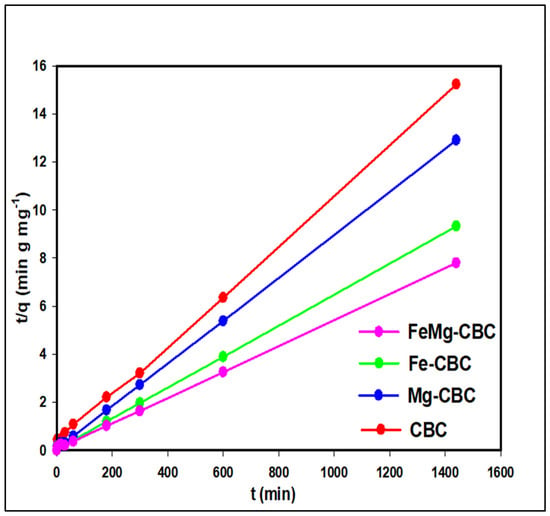
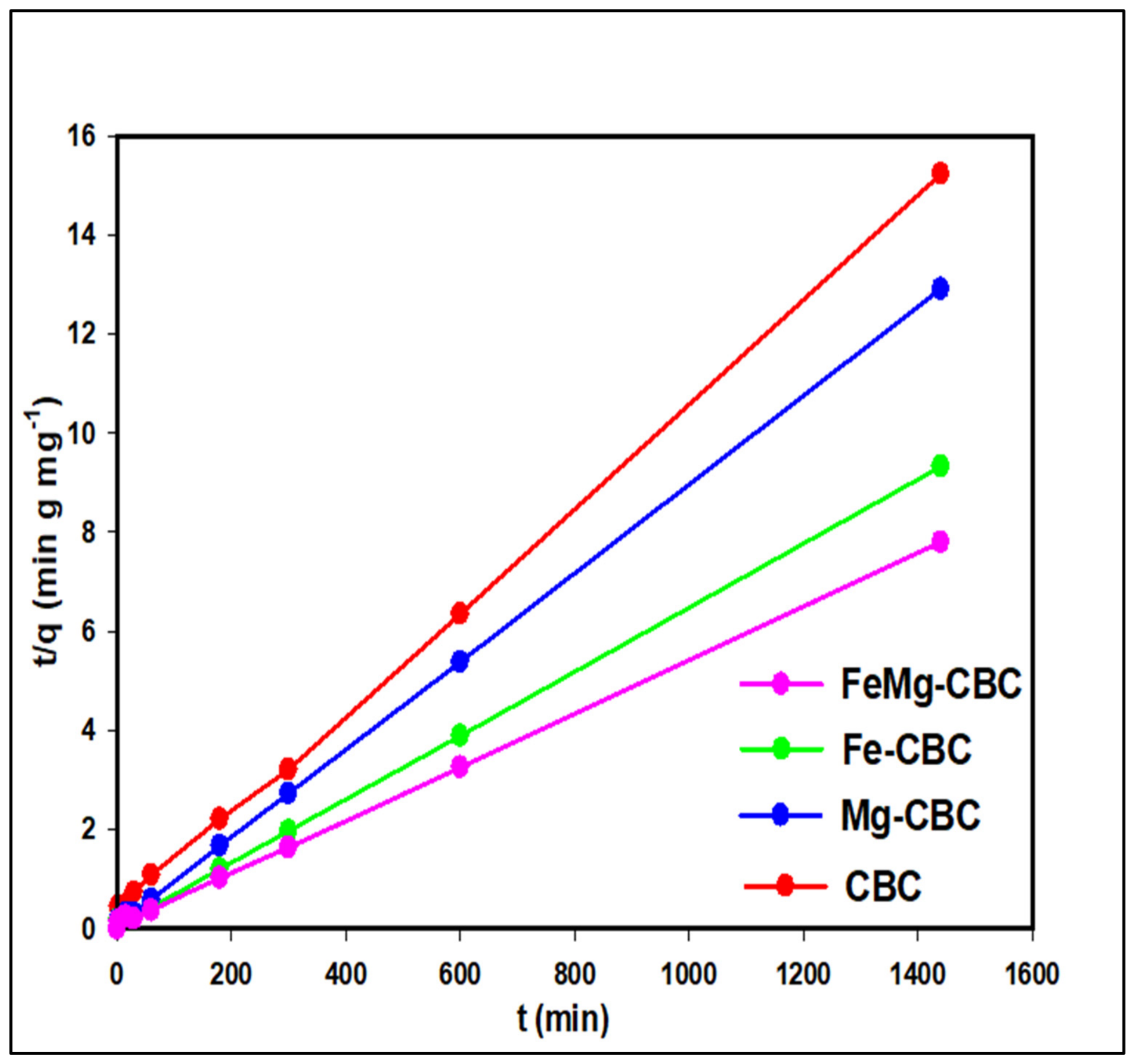
The phosphate adsorption kinetics of CBC, Fe-CBC, Mg-CBC, and FeMg-CBC were evaluated using the pseudo-first-order (PFO), pseudo-second-order (PSO), Elovich, and power function models. The fitted parameters are summarized in Table 2, while the linearized PSO plots are presented in Figure 4. Among the models considered, PSO provided the best overall fit for all four adsorbents, with (R2) values ranging from 0.9973 to 0.9998. These values were substantially higher than those obtained with the Elovich (0.87–0.97), power function (0.69–0.84), and PFO (0.57–0.79) models (Table 2). Similar PSO behavior has frequently been reported for phosphate adsorption by Fe- and Mg-modified biochars [1,11,27]. The strong agreement with PSO suggests that adsorption rate is closely associated with interactions between phosphate and available surface sites. However, a good PSO fit alone does not establish chemisorption as the sole rate-controlling mechanism; ligand exchange involving Fe–OH and Mg–OH groups identified by FTIR remains one plausible contribution to the overall process [1,11,27]. The near-linear PSO plots in Figure 4 further support the suitability of this model over the investigated contact period.
Table 2.
Kinetic models parameters for the sorption of phosphate.
Figure 4.
Pseudo-second-order kinetic fitting for phosphate sorption onto CBC, Fe-CBC, Mg-CBC, and FeMg-CBC.
The PSO-derived equilibrium capacities (qe) followed the order FeMg-CBC (187.09 mg g−1) > Fe-CBC (156.46 mg g−1) > Mg-CBC (112.58 mg g−1) > CBC (96.97 mg g−1). The same general performance order was observed in the pH and dosage experiments and in the reported textural properties. FeMg-CBC also exhibited the highest calculated initial adsorption rate, H (mg g−1 min−1), at 13.16 mg g−1 min−1, compared with 11.60, 11.13, and 3.39 mg g−1 min−1 for Mg-CBC, Fe-CBC, and CBC, respectively. This trend is consistent with the relatively rapid initial phosphate uptake observed for FeMg-CBC in the contact-time study. Interestingly, Mg-CBC showed the largest individual PSO rate constant, (k2) (0.0009 g mg−1 min−1), despite having a lower fitted equilibrium capacity than Fe-CBC and FeMg-CBC. This indicates that the magnitude of (k2) should not be interpreted independently of (qe), since the initial adsorption rate depends on both parameters. The result nevertheless suggests that Mg-CBC approaches its fitted equilibrium relatively rapidly, even though its overall phosphate uptake remains lower than that of the Fe-containing composites. For CBC, the Elovich model also produced a relatively good fit (R2 = 0.9664), although PSO remained superior (R2 = 0.9990). The Elovich model is commonly associated with adsorption on energetically heterogeneous surfaces containing sites with different activation energies [32]. Its stronger secondary fit for CBC may therefore reflect the heterogeneous surface chemistry of pristine biochar, which contains both a disordered carbon matrix and mineral phases such as calcite. Similar behavior has been reported in some biochar–phosphate systems, where the Elovich model can provide a competitive or even better description than PSO [33].
3.6. Adsorption Isotherm Models
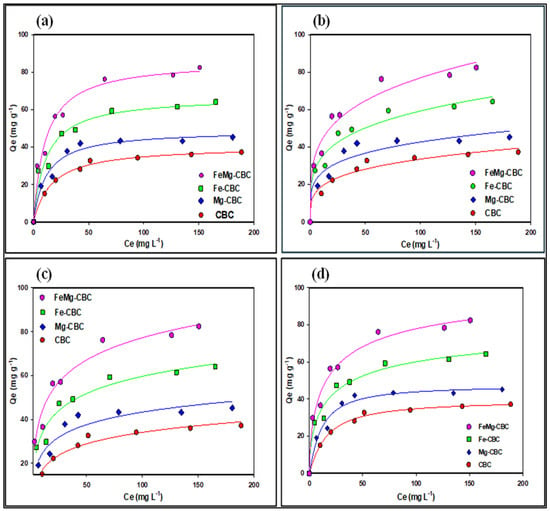
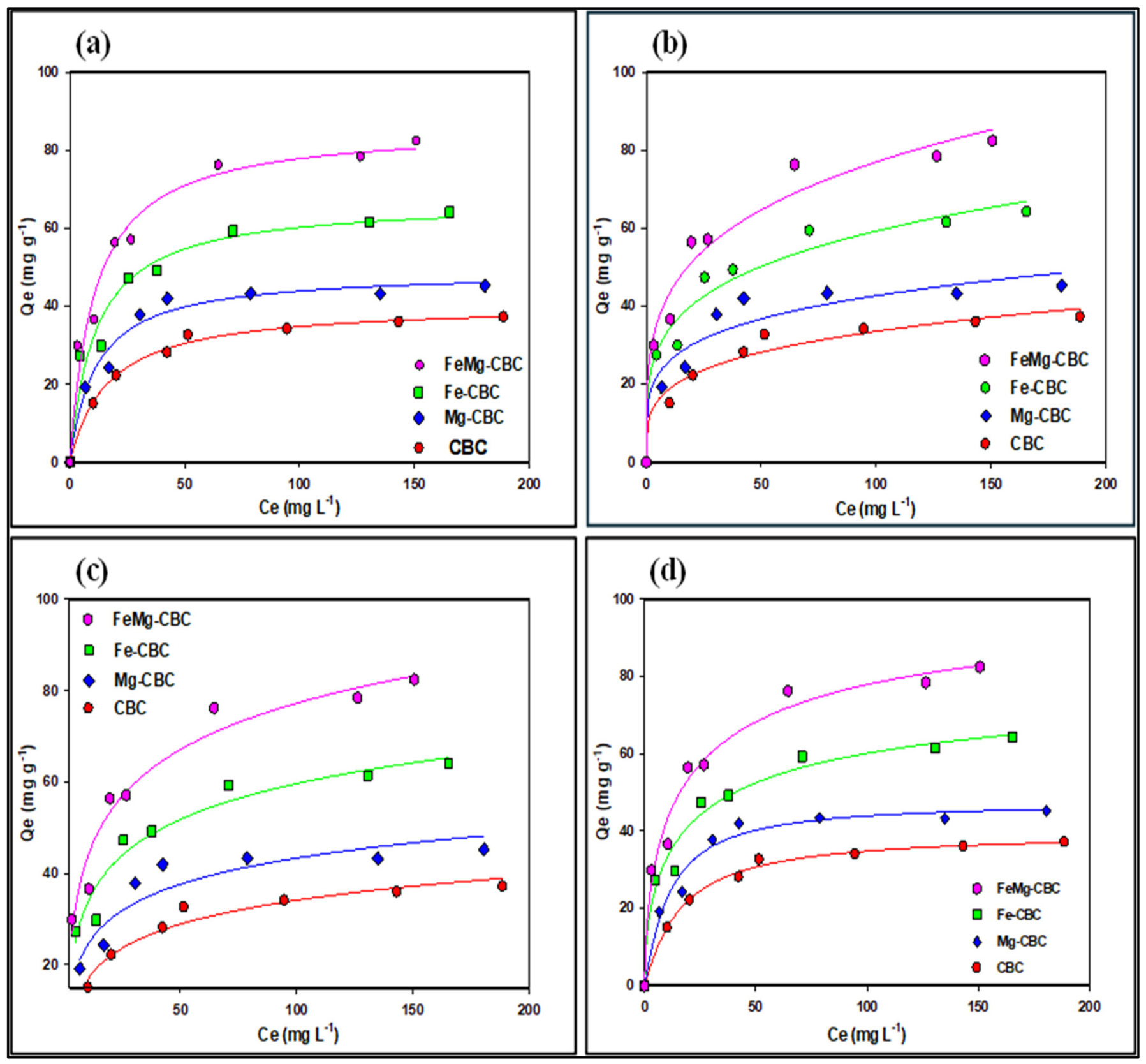
The equilibrium adsorption data for CBC, Fe-CBC, Mg-CBC, and FeMg-CBC were analyzed using the Langmuir, Freundlich, Temkin, and Langmuir–Freundlich isotherm models. The fitted parameters are presented in Table 3, while the corresponding model curves are compared with the experimental (qe) versus (Ce) data in Figure 5. Among the four models, the Langmuir–Freundlich (Sips) equation gave the best overall fit for all adsorbents, with (R2) values ranging from 0.976 to 0.996. It performed slightly better than the Langmuir and Freundlich models and consistently better than the Temkin model (Table 3). The Sips model combines features of the Freundlich and Langmuir equations, approaching Freundlich-type behavior at low equilibrium concentrations and Langmuir-type saturation at higher concentrations. Its superior fit therefore suggests that phosphate adsorption occurs on energetically heterogeneous surfaces while still approaching a finite saturation capacity at higher phosphate loading. Similar behavior has been reported for Fe2O3/MgO-modified biochar evaluated using the same set of isotherm models [19].
Table 3.
Phosphorus adsorption isotherm parameters by the sorbent materials.
Figure 5.
Phosphate sorption isotherm fitting curves for CBC, Fe-CBC, Mg-CBC, and FeMg-CBC: Langmuir (a), Freundlich (b), Temkin (c), and Langmuir–Freundlich (d).
The Langmuir-derived maximum adsorption capacities (QL) followed the order FeMg-CBC (86.195 mg g−1) > Fe-CBC (66.940 mg g−1) > Mg-CBC (48.909 mg g−1) > CBC (40.549 mg g−1). This ranking is consistent with the broader performance trends observed in the kinetic, textural, pH, and dosage experiments. The Freundlich (1/n) values ranged from 0.216 to 0.252 for all four materials. Values below unity are commonly associated with favorable adsorption on heterogeneous surfaces [1,11]. Further differences are apparent from the Sips heterogeneity parameter. Fe-CBC and FeMg-CBC showed exponents below unity (0.583 and 0.611, respectively), indicating a broader distribution of adsorption energies and a more heterogeneous population of available sites. This interpretation is consistent with the coexistence of different Fe-containing surface environments identified in the characterization analyses. In contrast, CBC and Mg-CBC exhibited Sips exponents slightly above unity (1.096 and 1.136, respectively). Values in this range have been associated with adsorption behavior that departs from the conventional heterogeneous case and may approach a more cooperative or relatively uniform adsorption regime [34].
The fitted Sips capacities also differed from the corresponding Langmuir estimates. For Fe-CBC and FeMg-CBC, the Sips capacities were 84.773 and 106.549 mg g−1, respectively, compared with Langmuir values of 66.940 and 86.195 mg g−1. In contrast, the two estimates were much closer for CBC (39.480 versus 40.549 mg g−1) and Mg-CBC (47.517 versus 48.909 mg g−1). This difference suggests that the equilibrium behavior of the Fe-containing adsorbents departs more strongly from the assumptions of an ideal homogeneous Langmuir surface than that of CBC and Mg-CBC. The Temkin model produced the weakest fit overall, with (R2) values ranging from 0.858 to 0.957. Its particularly low fit for Mg-CBC (R2 = 0.858) indicates that the Temkin assumption of a linear decrease in adsorption heat with increasing surface coverage does not describe this material as well as the other models. The Temkin constant (B) followed the general performance order FeMg-CBC > Fe-CBC > Mg-CBC > CBC. However, the absolute magnitude of this parameter was not used independently to distinguish between chemisorption and physisorption. The use of fixed adsorption-energy thresholds for such mechanistic assignments has been questioned because these values do not necessarily translate reliably to adsorption at solid–aqueous interfaces [35].
Overall, the isotherm analysis confirms that FeMg-CBC has the highest equilibrium phosphate capacity among the four materials and exhibits adsorption behavior that is best described by a heterogeneous saturation model. Fe-CBC shows a similar, although less pronounced, deviation from ideal Langmuir behavior, whereas CBC and Mg-CBC are more closely represented by simpler equilibrium descriptions. Together with the pH, zeta-potential, kinetic, and spectroscopic results, these findings support the presence of different adsorption environments in the Fe-containing and Mg-only materials.
3.7. Mechanisms of Phosphorus Adsorption
Phosphate adsorption by carbon-based materials can occur through several pathways, including electrostatic attraction, ligand exchange and inner-sphere complexation, surface precipitation, and, in layered materials, interlayer anion exchange [36]. The combined characterization and adsorption results provide useful evidence for identifying the mechanisms that are most likely to dominate in each adsorbent Normalizing the Langmuir maximum adsorption capacity (Qm) to the incorporated metal content provided further insight into the relative efficiency of the Fe- and Mg-associated sites. Fe-CBC exhibited an uptake of approximately 0.295 mol P per mol Fe, compared with 0.122 mol P per mol Mg for Mg-CBC, indicating a substantially higher phosphate uptake per mole of Fe. This difference is consistent with the proposed contribution of Fe–O–P inner-sphere complexation, compared with the more precipitation-driven Mg-phosphate pathway. Interestingly, FeMg-CBC exhibited an uptake of approximately 0.319 mol P per mol of total metal (Fe + Mg), despite having lower Fe and Mg loadings per gram than either mono-metallic composite. This suggests that its enhanced phosphate uptake cannot be explained solely by the amount of incorporated metal or surface area. Instead, the higher molar uptake points to more effective utilization of the available metal sites following Fe–Mg co-modification and provides evidence for a possible synergistic contribution of the two metals.
For CBC, phosphate uptake appears to be governed mainly by interactions with the native mineral and carbonaceous surface. Its calcite-rich, metal-free structure, relatively high pHpzc (8.7), lowest adsorption capacity (QL = 40.5 mg g−1), and near-homogeneous Sips behavior suggest that electrostatic attraction makes an important contribution. A smaller contribution from Ca–phosphate precipitation following partial calcite dissolution is also possible, although this pathway was not directly confirmed in the present study [20,36]. In Fe-CBC, the available evidence points strongly toward ligand exchange and inner-sphere surface complexation. The involvement of Fe–OH groups observed by FTIR, the Fe-containing crystalline phases identified by XRD, and the particulate Fe-rich surface features observed by SEM all support the presence of reactive iron sites. These structural observations, together with the relatively low pHpzc (6.7), rapid PSO kinetics, and heterogeneous Sips exponent (0.58), are consistent with phosphate binding through the formation of Fe–O–P surface complexes [11,19,27,37], a mechanism directly analogous to the well-documented inner-sphere complexation of arsenate at Fe–OH sites on hydrous ferric oxide, another tetrahedral oxyanion that binds iron oxide surfaces through the same ligand-exchange chemistry proposed here for phosphate [37].
Phosphate removal by Mg-CBC appears to rely more strongly on Mg-associated precipitation and surface reactions. Adsorption begins to decrease well below the material’s high pHpzc (≈10.3), indicating that surface charge alone cannot explain the observed behavior. The Mg-containing phases identified by XRD, together with the rough, heavily coated morphology observed by SEM, support the presence of reactive Mg sites. Its relatively high PSO rate constant and Sips exponent close to unity (1.14) further suggest that phosphate uptake may proceed through formation of Mg–phosphate surface precipitates rather than being controlled primarily by electrostatic attraction [12,18,29]. The behavior of FeMg-CBC is more complex because both metals are present within a structurally different composite. The low-angle (003)/(006) reflections observed by XRD, the relatively high retained sulfur content, and the continuous plate-like morphology are consistent with formation of an Fe–Mg layered phase. If sulfate is present within the interlayer region, phosphate may participate in anion-exchange reactions by replacing interlayer SO42− [23,38]. This pathway could operate alongside Fe-mediated ligand exchange and Mg-associated precipitation, providing several complementary routes for phosphate uptake. Such a combination would be consistent with the higher adsorption capacity, faster uptake, and stronger deviation from simple Langmuir behavior.
Overall, the adsorption mechanism appears to evolve from predominantly surface-charge- and mineral-assisted interactions in CBC to more specific chemical binding pathways in the modified materials. Fe-CBC is mainly associated with Fe-mediated inner-sphere complexation, whereas Mg-CBC shows stronger evidence of precipitation-related uptake. FeMg-CBC combines these interactions with a possible interlayer-exchange contribution from the Fe–Mg layered phase. This multi-pathway behavior is consistent with previous reports showing that co-precipitated Mg–Fe biochars can exhibit stronger phosphate uptake than their mono-metallic counterparts because the bimetallic structure provides additional and chemically distinct adsorption sites [13,23,38].
4. Conclusions
This study demonstrates that Conocarpus pruning waste can be converted into an effective phosphate adsorbent through Fe and Fe–Mg modification. Among the materials tested, FeMg-CBC performed best, showing the highest surface area, the broadest effective pH range, the fastest approach to equilibrium, and the highest fitted adsorption capacities (Langmuir Qm = 86.2 mg g−1; Langmuir–Freundlich Qm = 106.5 mg g−1; pseudo-second-order qe = 187.1 mg g−1). These values were approximately twice those of the mono-metallic composites and more than four times that of pristine CBC. FTIR, XRD, and SEM results showed clear differences among the modified materials. Fe-CBC contained Fe-bearing oxide/hydroxide phases, while Mg-CBC showed Mg-containing oxide/carbonate phases. FeMg-CBC exhibited a distinct low-angle XRD doublet, higher retained sulfate, and a more continuous plate-like morphology. Because calcination at 500 °C exceeds the typical dehydroxylation range of LDHs, this phase is interpreted cautiously as an LDH-derived layered double oxide (LDO). Its possible reconstruction in aqueous solution through the LDO “memory effect” may contribute to phosphate uptake, although this was not directly confirmed.
Overall, the results suggest that phosphate removal involves different mechanisms across the materials: electrostatic interactions for CBC, Fe–O–P ligand exchange and inner-sphere complexation for Fe-CBC, Mg-associated precipitation for Mg-CBC, and a combination of these pathways in FeMg-CBC, with possible additional contribution from interlayer anion exchange. The findings highlight Fe–Mg modification as a promising approach for upgrading Conocarpus pruning waste into a higher-performance phosphate adsorbent.
Author Contributions
Conceptualization, Z.A. and M.A.M.; methodology, Z.A. and M.A.M.; software, Z.A. and M.A.M.; validation, Z.A. and M.A.M.; formal analysis, Z.A. and M.A.M.; investigation, Z.A. and M.A.M.; resources, Z.A.; data curation, M.A.M.; writing—original draft preparation, Z.A. and M.A.M.; writing—review and editing, Z.A. and M.A.M.; visualization, Z.A. and M.A.M.; supervision, Z.A.; project administration, Z.A.; funding acquisition, Z.A. All authors have read and agreed to the published version of the manuscript.
Funding
This research was supported by the Ongoing Research Funding Program (ORF-2026-1259), King Saud University, Riyadh, Saudi Arabia.
Institutional Review Board Statement
Not applicable.
Informed Consent Statement
Not applicable.
Data Availability Statement
The original contributions presented in this study are included in the article. Further inquiries can be directed to the corresponding author.
Acknowledgments
The authors would like to sincerely thank the Deanship of Scientific Research at King Saud University for its substantial support in promoting scientific research and for funding this research work through project no. (ORF-2026-1259).
Conflicts of Interest
The authors declare no conflicts of interest.
References
- Beiyuan, J.; Wu, X.; Ruan, B.; Chen, Z.; Liu, J.; Wang, J.; Li, J.; Xu, W.; Yuan, W.; Wang, H. Highly efficient removal of aqueous phosphate via iron-manganese fabricated biochar: Performance and mechanism. Chemosphere 2024, 364, 143207. [Google Scholar] [CrossRef] [Scilit] [PubMed]
- Almanassra, I.W.; McKay, G.; Kochkodan, V.; Atieh, M.A.; Al-Ansari, T. A state of the art review on phosphate removal from water by biochars. Chem. Eng. J. 2021, 409, 128211. [Google Scholar] [CrossRef] [Scilit]
- Irfan, I.; Inam, M.A.; Iftikhar, R. Comparative phosphate sorption and recovery potential of mono and bimetallic iron–lanthanum impregnated biochar derived via co-pyrolysis of sewage sludge and wheat straw: Highly effective phosphatic fertilizer. J. Water Process Eng. 2024, 66, 106110. [Google Scholar] [CrossRef] [Scilit]
- Brownlie, W.J.; Sutton, M.A.; Reay, D.S.; Heal, K.V.; Hermann, L.; Kabbe, C.; Spears, B.M. Global actions for a sustainable phosphorus future. Nat. Food 2021, 2, 71–74. [Google Scholar] [CrossRef] [Scilit] [PubMed]
- Elsalamony, D.H.; Maamoun, I.; Eljamal, O. Synergistic phosphorus removal from water using core–shell manganese–iron nanocomposites: Adsorption performance and recovery potential. Chemosphere 2026, 394, 144781. [Google Scholar] [CrossRef] [Scilit] [PubMed]
- Ghosh, S.; Lobanov, S.; Lo, V.K. An overview of technologies to recover phosphorus as struvite from wastewater: Advantages and shortcomings. Environ. Sci. Pollut. Res. Int. 2019, 26, 19063–19077. [Google Scholar] [CrossRef] [Scilit] [PubMed]
- Carrillo, V.; Fuentes, B.; Gómez, G.; Vidal, G. Characterization and recovery of phosphorus from wastewater by combined technologies. Rev. Environ. Sci. Biotechnol. 2020, 19, 389–418. [Google Scholar] [CrossRef] [Scilit]
- Bolan, N.; Hoang, S.A.; Beiyuan, J.; Gupta, S.; Hou, D.; Karakoti, A.; Joseph, S.; Jung, S.; Kim, K.-H.; Kirkham, M.B.; et al. Multifunctional applications of biochar beyond carbon storage. Int. Mater. Rev. 2022, 67, 150–200. [Google Scholar] [CrossRef] [Scilit]
- He, M.; Xu, Z.; Hou, D.; Gao, B.; Cao, X.; Ok, Y.S.; Rinklebe, J.; Bolan, N.S.; Tsang, D.C.W. Waste-derived biochar for water pollution control and sustainable development. Nat. Rev. Earth Environ. 2022, 3, 444–460. [Google Scholar] [CrossRef] [Scilit]
- Novais, S.V.; Zenero, M.D.O.; Barreto, M.S.C.; Montes, C.R.; Cerri, C.E.P. Phosphorus removal from eutrophic water using modified biochar. Sci. Total Environ. 2018, 633, 825–835. [Google Scholar] [CrossRef] [Scilit] [PubMed]
- Qin, Y.; Wu, X.; Huang, Q.; Beiyuan, J.; Wang, J.; Liu, J.; Yuan, W.; Nie, C.; Wang, H. Phosphate removal mechanisms in aqueous solutions by three different Fe-modified biochars. Int. J. Environ. Res. Public Health 2023, 20, 326. [Google Scholar] [CrossRef] [Scilit] [PubMed]
- Yu, S.-H.; Wang, Y.; Hua, L.; Fan, M.-Y.; Ren, X.-H.; Zhang, L. Mg-Fe bimetallic oxide nanocomposite for superior phosphate removal and recovery from aquatic environment: Synergistic effects of sorption and struvite crystallization. J. Environ. Chem. Eng. 2024, 12, 112132. [Google Scholar] [CrossRef] [Scilit]
- He, J.; Zhou, J.; Tian, K.; Yang, J. Concurrent removal of phosphate and tetracycline hydrochloride by Mg-Fe co-modified biochar: Performance in batch and fixed-bed column systems. J. Environ. Chem. Eng. 2025, 13, 120146. [Google Scholar] [CrossRef] [Scilit]
- Al-Dobai, S.; Bakhashwain, J.M.; Lymperopoulou, D.S.; Skaraki, K. Characterization of Conocarpus erectus leaf litter and its potential use as soil amendment in Saudi Arabia. Biomass Bioenergy 2021, 146, 106003. [Google Scholar]
- Alharbi, S.A.; Wainwright, M.; Alhussaini, M.S. Characterization of biochar produced from Conocarpus lancifolius. Bioresources 2015, 10, 7104–7116. [Google Scholar]
- Nabi, F.; Kama, R.; Sajid, S.; Qadir, M.; Kanwal, R.; Memon, F.U.; Ma, C.; Li, H. Synergistic effects of Mg and Fe-modified bimetallic biochar for immobilization of As and Cd in agricultural soils. Environ. Chem. Ecotoxicol. 2025, 7, 1059–1071. [Google Scholar] [CrossRef] [Scilit]
- Ma, F.; Zhao, B.; Diao, J.; Jiang, Y.; Zhang, J. Mechanism of phosphate removal from aqueous solutions by biochar supported nanoscale zero-valent iron. RSC Adv. 2020, 10, 39217–39225. [Google Scholar] [CrossRef] [Scilit] [PubMed]
- Xu, S.; Li, D.; Guo, H.; Lu, H.; Qiu, M.; Yang, J.; Shen, F. Solvent-free synthesis of MgO-modified biochars for phosphorus removal from wastewater. Int. J. Environ. Res. Public Health 2022, 19, 7770. [Google Scholar] [CrossRef] [Scilit] [PubMed]
- Manawi, Y.; Al-Gaashani, R.; Simson, S.; Tong, Y.; Lawler, J.; Kochkodan, V. Adsorptive removal of phosphate from water with biochar from acacia tree modified with iron and magnesium oxides. Sci. Rep. 2024, 14, 17414. [Google Scholar] [CrossRef] [Scilit] [PubMed]
- Sahoo, S.S.; Vijay, V.K.; Chandra, R.; Kumar, H. Production and characterization of biochar produced from slow pyrolysis of pigeon pea stalk and bamboo. Clean. Eng. Technol. 2021, 3, 100101. [Google Scholar] [CrossRef] [Scilit]
- Ruby, C.; Usman, M.; Naille, S.; Hanna, K.; Carteret, C.; Mullet, M.; François, M.; Abdelmoula, M. Synthesis and transformation of iron-based layered double hydroxides. Appl. Clay Sci. 2010, 48, 195–202. [Google Scholar] [CrossRef] [Scilit]
- Tu, Y.; Peng, Z.; Xu, P.; Lin, H.; Wu, X.; Yang, L.; Huang, J. Characterization and application of magnetic biochars from corn stalk by pyrolysis and hydrothermal treatment. BioResources 2017, 12, 1077–1089. [Google Scholar] [CrossRef] [Scilit]
- Rahman, S.; Navarathna, C.M.; Das, N.K.; Alchouron, J.; Reneau, P.; Stokes, S.; Thirumalai, R.V.K.G.; Perez, F.; Hassan, E.B.; Mohan, D.; et al. High capacity aqueous phosphate reclamation using Fe/Mg-layered double hydroxide (LDH) dispersed on biochar. J. Colloid Interface Sci. 2021, 597, 182–195. [Google Scholar] [CrossRef] [Scilit] [PubMed]
- Tajuelo Rodriguez, E.; Anovitz, L.M.; Adapa, S.; Yuan, K.; Hensley, D.; Chung, D.Y.; Boebinger, M.G.; Stack, A.G.; Weber, J. Effect of multiple calcination cycles on CO2 capture efficiency during carbonation of MgO in a mineral looping process. Sci. Rep. 2025, 15, 39193. [Google Scholar] [CrossRef] [Scilit] [PubMed]
- Alhujaily, A.; Mao, Y.; Zhang, J.; Ifthikar, J.; Zhang, X.; Ma, F. Facile fabrication of Mg-Fe-biochar adsorbent derived from spent mushroom waste for phosphate removal. J. Taiwan Inst. Chem. Eng. 2020, 117, 75–85. [Google Scholar] [CrossRef] [Scilit]
- Tu, P.; Zhang, G.; Cen, Y.; Huang, B.; Li, J.; Li, Y.; Deng, L.; Yuan, H. Enhanced phosphate adsorption and desorption characteristics of MgO-modified biochars prepared via direct co-pyrolysis of MgO and raw materials. Bioresour. Bioprocess. 2023, 10, 49. [Google Scholar] [CrossRef] [Scilit] [PubMed]
- Qian, J.; Zhou, X.; Cai, Q.; Zhao, J.; Huang, X. The Study of Optimal Adsorption Conditions of Phosphate on Fe-Modified Biochar by Response Surface Methodology. Molecules 2023, 28, 2323. [Google Scholar] [CrossRef] [Scilit] [PubMed]
- Ahuja, R.; Kalia, A.; Sikka, R.; Chaitra, P. Nano modifications of biochar to enhance heavy metal adsorption from wastewaters: A review. ACS Omega 2022, 7, 45825–45836. [Google Scholar] [CrossRef] [Scilit] [PubMed]
- Liu, X.; Zhou, W.; Feng, L.; Wu, L.; Lv, J.; Du, W. Characteristics and mechanisms of phosphorous adsorption by peanut shell-derived biochar modified with magnesium chloride by ultrasonic-assisted impregnation. ACS Omega 2022, 7, 43102–43110. [Google Scholar] [CrossRef] [Scilit] [PubMed]
- Zhang, Q.; Ding, Y.; Lu, L.; Li, J.; Liang, M.; Zhu, Y. Phosphate adsorption onto bagasse iron oxide biochar: Parameter optimization, kinetic analysis, and study of mechanisms. BioResources 2021, 16, 1335–1357. [Google Scholar] [CrossRef] [Scilit]
- Muscarella, S.M.; Badalucco, L.; Laudicina, V.A.; Conte, P. Surface charge and phosphorus retention in metal-activated biochars from different pyrolysis temperatures. Appl. Sci. 2025, 15, 8855. [Google Scholar] [CrossRef] [Scilit]
- Rahman, M.A.; Lamb, D.; Kunhikrishnan, A.; Rahman, M.M. Kinetics, isotherms and adsorption-desorption behavior of phosphorus from aqueous solution using zirconium-iron and iron modified biosolid biochars. Water 2021, 13, 3320. [Google Scholar] [CrossRef] [Scilit]
- Nascimento, L.A.; Rosa, A.P.; França, A.V.; Sousa, R.d.C.S.d.; Moreira, R.P.L. Biochar from swine manure: An alternative for nutrient recovery and slow-release fertilization. ACS Omega 2026, 11, 15201–15212. [Google Scholar] [CrossRef] [Scilit] [PubMed]
- Usevičiūtė, L.; Kaklauskas, A.; Danila, V.; Januševičius, T. Enhanced aqueous phosphate removal using chitosan-modified zirconium-loaded cork biochar. Sci. Rep. 2025, 15, 29240. [Google Scholar] [CrossRef] [Scilit] [PubMed]
- Mudhoo, A.; Pittman, C.U. The Dubinin-Radushkevich models: Dissecting the ps/p to cs/ce replacement in solid-aqueous interfacial adsorption and tracking the validity of E = 8 kJ mol−1 for assigning sorption type. Chem. Eng. Res. Des. 2023, 198, 370–402. [Google Scholar] [CrossRef] [Scilit]
- Kumari, S.; Dong, Y.; Safferman, S.I. Phosphorus adsorption and recovery from waste streams using biochar: Review of mechanisms, modifications, and agricultural applications. Appl. Water Sci. 2025, 15, 162. [Google Scholar] [CrossRef] [Scilit]
- Huo, L.; Zeng, X.; Su, S.; Bai, L.; Zhang, Y. Enhanced removal of As (V) from aqueous solution using modified hydrous ferric oxide nanoparticles. Sci. Rep. 2017, 7, 40765. [Google Scholar] [CrossRef] [Scilit] [PubMed]
- Ding, C.; Long, X.; Zeng, G.; Ouyang, Y.; Lei, B.; Zeng, R.; Wang, J.; Zhou, Z. Efficiency recycling and utilization of phosphate from wastewater using LDHs-modified biochar. Int. J. Environ. Res. Public Health 2023, 20, 3051. [Google Scholar] [CrossRef] [Scilit] [PubMed]

Disclaimer/Publisher’s Note: The statements, opinions and data contained in all publications are solely those of the individual author(s) and contributor(s) and not of MDPI and/or the editor(s). MDPI and/or the editor(s) disclaim responsibility for any injury to people or property resulting from any ideas, methods, instructions or products referred to in the content. |
© 2026 by the authors. Licensee MDPI, Basel, Switzerland. This article is an open access article distributed under the terms and conditions of the Creative Commons Attribution (CC BY) license.