


Abstract
The gamblification of sport has entered a fintech-enabled phase in which betting is no longer merely advertised around sport but designed into the act of watching it—continuous, mobile, frictionless, and seamlessly financed. Because this transformation shortens the pathway between impulse and expenditure, its consequences are increasingly financial; yet the evidence on how it affects the financial wellbeing of fans has not been synthesised. This scoping review, conducted in accordance with the PRISMA-ScR guidelines, mapped research linking the gamblification of sport—in both its marketing and its fintech dimensions—to fan financial wellbeing. Three databases (Scopus, Web of Science, PubMed), supplemented by hand-searching and a Google Scholar sweep, yielded 69 included studies. The evidence is young, expanding, and still largely exploratory in character. It is weighted heavily toward the marketing channel (advertising, sponsorship, inducements, normalisation), which is mature and well-theorised, whereas the fintech affordances of the betting product form a distinct but smaller literature, and financial wellbeing is most often reached only indirectly through marketing-driven overspend. Only five of the 69 studies directly measured a financial outcome, and all five lay within the fintech channel; the intersection at the centre—where the redesigned product meets the financial lives of vulnerable fans—remains largely unoccupied. We reframe this gap as a question of the social sustainability of sport, bearing on equity, wellbeing, and responsible consumption (SDGs 10, 3, and 12), and set out a research and governance agenda to address it.
1. Introduction
Watching sport and wagering on it have become almost inseparable experiences. Across stadiums, broadcasts, and the small luminous screens we carry everywhere, betting has been woven so intimately into the texture of contemporary sport that the two now share a single architecture of attention. Shirt fronts, pitch-side hoardings, half-time odds, and the gentle, constant invitation to “bet now, in-play” have made gambling not an adjacent industry but a defining feature of how sport is produced, broadcast, and consumed [1,2]. Sports betting has, in barely two decades, grown into a vast, data-intensive, and globally expanding market, its revenues rising steeply in many jurisdictions, which has liberalised it [3,4].
Scholars have named this gradual, thorough absorption the gamblification of sport—the deep embedding of gambling within the cultural and commercial life of sporting competition [1,2]. For most of its history, this embedding has been, above all, a story of marketing: the omnipresence of betting sponsorship on jerseys and around grounds [5,6], the persuasive design of wagering advertisements and their symbolic alignment with fan rituals, mateship, and masculinity [7,8], the seductive architecture of inducements and “bonus” offers [9,10], and the steady normalisation of betting as an ordinary companion to being a fan—a normalisation that reaches even children [11,12]. That story is important, and it has been carefully told, including in several recent syntheses [13,14,15,16].
Yet something more consequential has happened alongside it: the product itself has been redesigned. The migration of betting onto mobile applications has dissolved the old frictions of time, place, and pace. A wager that once required a visit to a betting shop is now a single, frictionless touch, available continuously and tailored to the unfolding rhythm of a live match. The rise of live in-play and micro-betting—the capacity to stake, moment by moment, on the next corner, the next point, the next serve—together with cash-out features, embedded payment rails, and gamified interfaces, has transformed sports betting from a discrete, event-bound act into a rapid and continuous financial activity [17,18,19,20]. This is the fintech era of sports betting: a convergence of wagering with data markets, platform design, and digital finance [2,21]. It is no longer merely the advertising of gambling around sport; it is the fintech-enabled design of gambling into the very act of watching.
This transformation carries implications that reach well beyond individual leisure, for it changes the pathway between a moment of excitement and a financial commitment. When betting is continuous, immediate, and seamlessly financed, that pathway becomes remarkably short, and its consequences settle not only in behaviour but in household finances. Emerging evidence, much of it drawn from large-scale banking and transaction data, links intensive gambling—and, for sports betting specifically, its app-based forms—to reduced savings, crowded-out investment, rising consumer debt, and financial distress, with harms concentrated among frequent bettors and already vulnerable households [4,22,23,24]. Much of this financial evidence derives from general-gambling populations; the sports-betting-specific findings come chiefly from transaction-data studies of online sports betting [4]. These consequences are, in turn, part of a broader financialization of everyday life, in which the affordances of digital technologies fold betting into the mundane textures of social and economic experience and into everyday forms of indebtedness [25,26,27]. Financial harm, moreover, falls unevenly: it is most pronounced among younger men, those on lower incomes, and those already at risk [28,29]. It is precisely because these harms are financial that governments have begun to experiment with affordability checks and financial-risk assessments—themselves reliant on the open-banking infrastructure of digital finance—as instruments of harm prevention [29].
Read through the lens of sustainability, these are not private misfortunes but questions of the social sustainability of sport. Gambling is, as recent scholarship insists, an atypical consumer product—one inherently risky even when experienced as beneficial [30]—and its embedding in sport bears directly on responsible consumption (SDG 12), on health and wellbeing (SDG 3), and on the inequalities that harm concentrates and deepens (SDG 10) [31]. The financial wellbeing of sport’s audiences is, in this sense, part of the sustainability of sport itself.
The existing evidence base, however substantial, has not yet been assembled around this precise concern. Recent syntheses illuminate the marketing dimension with real rigour, but their gaze rests on advertising as the exposure and on gambling behaviour or attitudes as the outcome [13,14]. Broader harm frameworks, for their part, treat gambling generically, without attending to the particular technology of the betting product [32]. Two things therefore remain unmapped. First, the fintech affordances that distinguish contemporary sports betting from its earlier forms—the apps, the live and micro-betting formats, the embedded payments—have not been synthesised as a mechanism in their own right. Second, the financial wellbeing of sport audiences, as distinct from their gambling behaviour, has not been drawn together as an outcome. It is at this intersection—where the redesigned architecture of the betting product meets the financial lives of those who follow sport—that the literature is most fragmented and a synthesis most needed.
This scoping review is designed to map that intersection. Rather than test a single hypothesis, it seeks to chart the extent, range, and nature of research linking the gamblification of sport, in both its marketing and fintech dimensions, to the financial wellbeing of fans, and to locate the responses—of governance, regulation, and responsible consumption—that this literature proposes. Deliberately broad in scope, spanning all sports, all regions, and multiple disciplines, the review is intended to reveal not only what is known but where the silences lie, including the geographies and sporting contexts that remain largely unstudied.
Specifically, the review asks the following:
- RQ1: What is the extent, range, and nature of research linking the gamblification of sport to fan financial wellbeing?
- RQ2: Through which mechanisms—marketing (sponsorship, advertising) and fintech affordances (apps, in-play and micro-betting, embedded payments)—is gambling embedded in the sport experience?
- RQ3: Which financial-wellbeing outcomes have been studied and for which populations, including vulnerable subgroups?
- RQ4: What theories, disciplines, designs, and data sources have been used, and where do the gaps lie?
- RQ5: What governance, regulatory, and responsible-consumption responses are proposed, and how do they connect to the social sustainability of sport?
The conceptual framework that guides the review is summarised in Figure 1.
Figure 1.
A conceptual model of fintech-era gamblification as a commercial determinant of the social sustainability of sport. Two channels of gamblification—the marketing embedding of betting and the fintech redesign of the betting product—converge to intensify and normalise betting, shortening the pathway to fan financial (well) being outcomes. This pathway is moderated by vulnerability and acted upon by governance and responsible-consumption levers, and its harms radiate to affected others, households, and communities, bearing on the social sustainability of sport across the Sustainable Development Goals for health and wellbeing (SDG 3), reduced inequalities (SDG 10), and responsible consumption (SDG 12). The whole is read through the complementary lenses of the commercial determinants of health and the financialization of everyday life.
2. Materials and Methods
2.1. Study Design
Given the breadth and interdisciplinarity of the question, a scoping review was chosen as the design best tailored to the task. Scoping reviews are designed to map a broad and heterogeneous field, to clarify key concepts, and to identify gaps, rather than to estimate a pooled effect as a systematic review with meta-analysis would [33]. The review followed the methodological framework established by Arksey and O’Malley [34], as refined by Levac et al. [35] and formalised in the Joanna Briggs Institute (JBI) guidance [36], and is reported in accordance with the Preferred Reporting Items for Systematic Reviews and Meta-Analyses extension for Scoping Reviews (PRISMA-ScR) [37].
2.2. Protocol and Registration
The review was guided by a written protocol prepared a priori, which specified the research questions, eligibility criteria, search strategy, and charting approach set out below and which was followed throughout the review. The protocol was registered with INPLASY (International Platform of Registered Systematic Review and Meta-analysis Protocols), which accepts scoping-review protocols; registration was completed at the analysis stage and is therefore retrospective rather than prospective (registration number INPLASY202690072; https://doi.org/10.37766/inplasy2026.9.0072).
In moving from an a priori plan to the completed review, several scope decisions were refined, which we record here for transparency. First, the backward and forward citation chasing anticipated in the protocol was not performed; supplementary searching was confined to hand-searching of leading journals and a Google Scholar sweep. Second, the planned bibliometric co-word and co-authorship layer was replaced by a focused analysis of review-dimension co-occurrence and temporal change, proportionate to the size of the corpus (Section 3.7). Third, grey literature and regulatory reports were not formally charted but were consulted only to contextualise the findings (Section 2.4). Fourth, inclusion was restricted to peer-reviewed journal articles and reviews, so the conference papers and other non-journal formats anticipated in the protocol were not charted. Fifth, the planned extension of the date threshold to 2000 was not run; the 2007 threshold was retained throughout, with the broader term-block variant serving as the sensitivity check. None of these refinements altered the review’s questions or its core eligibility concept.
2.3. Eligibility Criteria
Eligibility was framed using the population–concept–context (PCC) mnemonic recommended for scoping reviews. The population comprised sport audiences—fans, spectators, and consumers of sport—exposed to sports betting, together with general adult populations studied within a sports-betting context; athletes considered as bettors were eligible as a labelled sub-population. The concept was the gamblification of sport, understood as the embedding of gambling in the sport experience through marketing (sponsorship, advertising) and/or fintech affordances (mobile applications, in-play and micro-betting, embedded payments, gamified design) and/or the relationship of this embedding to financial wellbeing and financial harm. The context was any country or regulatory setting in which commercial, legal, or grey-market sports betting operates, across professional and amateur sport and online and land-based environments.
Studies were included when they concerned sport-related betting (wagering on sport, including horse and greyhound racing and esports) and addressed at least one review dimension—the marketing or fintech mechanisms of its embedding in sport, financial or economic wellbeing/harm, or governance and responsible-consumption responses. Peer-reviewed journal articles and review articles published from 2007 (the threshold of the smartphone era) onward, in English, were eligible. Book chapters, conference papers, editorials, commentaries, preprints, data descriptors, government reports, and study protocols were excluded. Studies were also excluded where gambling was not sport-related; where sports betting appeared only within a pooled general-gambling analysis and was not separately examined; where the design concerned only market efficiency, odds, or outcome prediction or only behavioural, clinical, or problem-gambling constructs, without a marketing, fintech, financial-wellbeing, or governance dimension; and where the studied outcome fell outside these dimensions (for example, violence or substance use). Consistent with scoping-review methodology, studies were not excluded on the basis of their perceived quality, novelty, or magnitude of contribution; the aim was to map the field as it stands, allowing thin, incremental, or repetitive areas to register as findings in their own right rather than to be filtered out by a subjective judgement of significance. A study was treated as sport-related only where wagering on the outcome of sporting events (including horse and greyhound racing and esports) was the subject of the study or was analysed as a distinct category; studies in which sports betting appeared merely as one of several gambling forms within a pooled analysis, and was not examined in its own right, did not meet this threshold and were excluded.
Because the review’s purpose was to map the whole terrain of gamblification, a study was eligible if it addressed any one of the review’s dimensions; not every included study therefore examines fans or financial wellbeing directly. This breadth is deliberate, and its consequences are made fully transparent by the dimension tagging and by the descriptive counts, which show exactly how much of the corpus engages each dimension—and, in particular, how few studies reach financial wellbeing through direct measurement (Section 3.6).
2.4. Information Courses
Three databases were searched systematically: Scopus, Web of Science Core Collection, and PubMed/MEDLINE. These were supplemented by hand-searching the recent contents of leading sport-management and gambling-studies journals and by a Google Scholar sweep. Because some databases were not accessible to the team (SPORTDiscus, for example), these supplementary searches were conducted with particular care. The searches were conducted on 4 August 2026; the exact strings, dates and record counts for each source are provided in Supplementary Material S1. Although the formal charting was confined to peer-reviewed journal articles and reviews so as to keep the evidence map reproducible, a small number of influential non-journal sources—notably major public-health and regulatory reports—were consulted to contextualise the findings and are cited as background where relevant (Section 4.4).
2.5. Search Strategy
The search was built from four concept blocks reflecting the review’s conceptual architecture: sport, gambling, mechanism (marketing and fintech affordances), and outcome (financial wellbeing and harm). The core query combined sport AND gambling AND (mechanism OR outcome), with a broader variant omitting the third and fourth blocks run as a sensitivity check. Within each block a comprehensive set of synonyms and truncated word-stems was used to maximise sensitivity; for the gambling/betting concept, for instance, these included gambl*, betting, bettor*, wager*, bookmaker*, and sportsbook*, while the sport, mechanism, and outcome blocks were expanded in the same way. The complete list of search terms for every concept block, together with the full, reproducible strings for Scopus, Web of Science, and PubMed, is provided in Supplementary Material S1. After searching, results were limited to the period from 2007, to English-language records, and to journal articles and review articles.
2.6. Selection of Sources of Evidence
All records were exported to a reference manager and de-duplicated, and the de-duplicated set was uploaded to Rayyan [38] for screening. The review team comprised eight members working in three groups (of three, three, and two reviewers); the corpus was divided among the groups, and within each group every title and abstract, every full-text eligibility decision, and every charted data item was assessed independently by all members of the group—that is, by two reviewers in one group and by three in each of the other two, so that every record underwent independent duplicate (and, in most cases, triplicate) assessment. Disagreements were identified at the point of comparison and resolved by the two most experienced reviewers, the resulting decision being adopted only once endorsed by the team; formal inter-rater agreement statistics (such as Cohen’s kappa) were not calculated, with agreement being reached through structured discussion and consensus. A pilot calibration on an initial sample preceded the full screen, aligning the reviewers’ application of the criteria and resolving three recurring scope questions: whether commentaries and other non-article publication types should be admitted (they were not; the review was confined to peer-reviewed articles and reviews); whether studies whose only reported outcome lay outside the review’s three dimensions—for example intimate-partner violence or substance use—should be included (they were not); and whether non-wagering monetisation, such as fantasy-sports microtransactions, fell within scope (it did not, the review being confined to wagering on sport). Titles and abstracts were screened first, and reports judged potentially eligible were assessed at full text against the criteria in Section 2.3, with a reason recorded for every full-text exclusion.
The database searches identified 2592 records (Scopus 897, Web of Science 1314, PubMed 381). After 1124 duplicates were removed, 1468 records were screened on title and abstract, of which 916 were excluded. Of the 552 reports sought for retrieval, 55 could not be accessed and 8 were further duplicates, leaving 489 assessed for eligibility, of which 421 were excluded with reasons. One further study was identified through the supplementary Google Scholar search (Section 2.4; Supplementary Material S1). In total, 69 studies were included. The selection process is summarised in the PRISMA-ScR flow diagram (Figure 2). The 55 reports that could not be retrieved represent approximately 10% of those sought for retrieval. Their full texts were not available through the library consortium to which the review team has access, being published in subscription or access-restricted journals; a breakdown by source journal is provided in Supplementary Material S1. Because these full texts could not be obtained, the eligibility of these reports—and the review dimension(s) they might have addressed—could not be determined; they are therefore characterised only by the source journal recorded in the search results.
Figure 2.
PRISMA-ScR flow diagram of study identification, screening, eligibility, and inclusion (final included n = 69).
2.7. Data Charting
Each study was tagged with every review dimension it addressed—marketing, fintech affordances, financial wellbeing, and/or governance—so a study could carry more than one dimension, and the dimension counts therefore sum to more than 69 and are not mutually exclusive. A study was coded to the marketing dimension if it examined the advertising, sponsorship, inducement, or normalisation of betting in sport; to the fintech dimension if it examined an affordance of the betting product (app-based access, live in-play or micro-betting, cash-out, embedded payments, or platformisation); to the financial-wellbeing dimension if it examined a financial exposure or outcome (expenditure, debt, savings, household finances, or financial harm); and to the governance dimension if it examined regulation, responsible-gambling tools, or policy responses (Section 3.1). The corpus comprises both primary studies and secondary syntheses (11 review articles). Reviews were charted and reported as syntheses of existing work, not as independent primary evidence; where a review and one or more of the primary studies it summarises both met eligibility, this overlap is noted in the narrative so that the same underlying findings are not treated as independent support.
2.8. Synthesis of Results
The synthesis proceeded in two complementary layers. A descriptive numerical analysis characterised the distribution of the evidence by year, geography, sport, study design, and review dimension (Section 3.1). A qualitative thematic synthesis then organised the findings along the conceptual framework (Figure 1), the marketing and fintech channels of gamblification, the intensification and normalisation of betting, the financial-wellbeing outcomes and the vulnerabilities that moderate them, and the governance and responsible-consumption responses. The review dimensions charted for each study were confined to the marketing and fintech mechanisms, financial wellbeing, and governance (Section 2.7); the alignment of the findings with the dimensions of social sustainability and with specific Sustainable Development Goals (SDGs 3, 10, and 12) was not part of the charting framework. It was applied interpretively at the synthesis stage, as an organising lens through which to read the mapped evidence, and is presented throughout as the authors’ framework rather than as a category coded from the studies themselves. In keeping with scoping-review methodology, a formal critical appraisal or risk-of-bias assessment of the individual sources was not undertaken, as the review’s purpose is to map the extent, range, and nature of the evidence rather than to synthesise effect estimates or grade the certainty of findings [33,36,37]. Accordingly, the review characterises what the literature examines and where it is silent and does not make claims about the methodological strength of individual studies.
3. Results
3.1. Characteristics of the Included Studies
The review included 69 studies, published between 2008 and 2026 (Table 1). Their most immediate feature is their recency: the field is a young and rapidly expanding one. Only two studies predate 2015, whereas 48 of the 69 (70%) appeared from 2021 onward, with the annual output rising steeply to peaks of ten studies in 2024 and thirteen in 2025 (2026 is represented by four studies at the time of searching). This temporal concentration mirrors the emergence of the very phenomenon the review examines—the migration of sports betting into a continuous, app-based, “fintech-era” activity—and signals a literature still very much in formation.
Table 1.
Characteristics of the 69 included studies, grouped by primary review dimension. Within each group, studies are ordered chronologically to convey the development of the field; the full set of dimensions each study addresses is shown in the Dimension(s) column.
The evidence is also strikingly concentrated in a handful of settings (Figure 3). Australia alone accounts for 32 studies (46%) and the United Kingdom for 13 (19%)—together almost two-thirds of the corpus—with a further ten studies being multi-country or conceptual works without a single national setting. Beyond these, the geography thins to a long tail of individual contributions: Canada (three); the United States, Belgium and Nigeria (two each); and China, Finland, Ireland, Sweden and Zimbabwe (one each). Whole regions are effectively absent—most conspicuously Southeast Europe and the Balkans, but also the greater part of Asia and Latin America—a geographic gap that both limits the transferability of current evidence and marks a clear opportunity for research in under-represented markets.
Figure 3.
Characteristics of the 69 included studies, by year of publication, country/region, review dimension (studies may span more than one), and study design.
Yet these counts must be read with care. The number of studies from a country is a map of research activity, not of gambling itself: it reflects where sports-betting research has been funded, conducted, and published in English, rather than where betting is most prevalent or most harmful. A region’s near-absence from the map may therefore signal not the absence of gambling but its relative invisibility—where betting is informal, unregulated, or simply under-researched, or where it is legally restricted and so less openly examined. The pronounced concentration in Australia and the United Kingdom is thus best understood as evidence of vigorous research communities and acute policy attention in those settings (and, in part, the review’s English-language and database scope), not as a claim that their populations gamble more than others; conversely, the silence over much of Asia, Latin America, Africa, and Southeastern Europe reflects gaps in the research gaze rather than proof that the phenomenon is absent there.
In terms of the sporting context, most studies (39) treated sports betting in general terms; among those focused on a specific sport, football/soccer was dominant (17 studies), followed by racing, usually examined alongside sports betting (10), and esports betting (2). Football’s prominence reflects the concentration of gambling sponsorship and advertising research in European and Australian football codes.
Methodologically, the corpus is encouragingly diverse, and each study was assigned to a single primary design category: qualitative studies (17), experimental and ecological momentary assessment designs (15), review articles (11), surveys (10), conceptual and policy analyses (seven), advertising content analyses (five), studies drawing on secondary or behavioural-tracking data (three), and one study of mixed/other design (one)—69 in total. These design categories are mutually exclusive; the review dimensions reported below are not, as a study may address more than one.
Finally, and most tellingly for the review’s purpose, the studies distribute unevenly across its guiding dimensions (studies may address more than one). The marketing mechanism dominates: 52 of the 69 studies (75%) examine the advertising, sponsorship, or promotional embedding of betting in sport. The financial-wellbeing dimension appears in 34 studies (49%), though frequently by way of marketing-driven overspend rather than direct measures of debt or household finance, while governance features in 24 (35%) and the distinctive fintech-affordance dimension in only 21 (30%) (Figure 3). The marketing literature is thus the well-developed backbone of the field, whereas the fintech and financial pillars—and above all their intersection, where the technology of the betting product meets the financial lives of fans—remain comparatively thin. This imbalance is the central empirical finding of the mapping and the gap the review’s agenda addresses.
3.2. The Marketing Embedding of Gambling in Sport
The largest and most mature body of evidence concerns the marketing channel of gamblification—the many ways in which betting is made visible, desirable, and ordinary within the sporting experience. Three intertwined strands are apparent.
The first strand is sponsorship. A substantial group of studies documents the saturation of sport by gambling sponsorship and the tensions it creates. Analyses of shirt-front and pitch-side sponsorship in British and Australian football describe its rapid growth and global reach and question the propriety of a health-harming product underwriting the game [2,5,6]. Conceptual and stakeholder work frames this as a governance dilemma—clubs’ financial dependence on betting revenue set against the harm to fans and communities [39,49,60]—while experimental and content-analytic studies show how sponsorship shapes betting intentions and reaches even children, who readily recall gambling brands on jerseys [11,46,54]. A recent review consolidates this sponsorship literature into a coherent field [15].
The second strand is advertising content and symbolic appeal, which dissects the persuasive architecture of wagering advertising itself. Content analyses reveal a repertoire of symbolic appeals—fan rituals, mateship, masculinity, winning, thrill, and social belonging—that align betting with the culturally valued meanings of sport and mirror the tactics once used to sell tobacco and alcohol [7,8,13,48]. Frequency analyses of live broadcasts confirm the sheer density of this marketing in and around the game [46,56].
Inducements and direct marketing, the third and rapidly growing strand, examines the “bonus” architecture of wagering—sign-up offers, bonus bets, boosted odds, refer-a-friend schemes, and personalised push messages. Studies document the structural features of these inducements and the difficulty bettors have in comprehending their true cost [9,43,71], and, crucially, point to their behavioural and financial consequences: exposure to advertising and inducements increases betting expenditure and unplanned spending, prompts poorer wagering decisions, and does so most strongly among those already experiencing problems [45,53,64,65,66,70].
Running through all three strands is the theme of normalisation—the quiet redefinition of betting as a natural, even expected, part of following sport. Qualitative and survey work shows this normalisation operating powerfully among young men, for whom betting becomes woven into the sociality of fandom [40,42,55,57,68], and reaching into adolescence and childhood through the sport–gambling nexus [11,12,63]. It extends even to athletes and coaches, among whom gambling is similarly normalised within male sporting culture [86], and it is now embedded institutionally through sports clubs themselves [82].
3.3. The Fintech Affordances of the Betting Product
A smaller but conceptually distinct body of work turns from the marketing of betting to the design of the betting product—the fintech affordances that define the contemporary form. Several studies theorise the underlying transformation: the shift of sports betting from a discrete, event-bound wager into a rapid and continuous activity, propelled by smartphone access, live in-play and micro-event markets, cash-out features, instant deposits, and gamified interfaces [17,18,19,20]. A scoping study of in-play betting and a review of the structural characteristics of fixed-odds products map these features systematically and link them to elevated harm potential [18,19,20].
A parallel strand examines platformisation and the app itself as a site of consumption. Netnographic and qualitative work shows how digital platforms intrude betting into work, time, and the very act of watching sport, intensifying competitive engagement and folding wagering into the mundane, ever-present textures of everyday digital life [21,25,59]. Interview and behavioural studies connect specific affordances to harm—the situational features of smartphone betting and the cash-out function of in-play markets are each associated with more intensive and more harmful play [1,75,77]—while broader accounts trace how structural changes in the online product have reshaped the experience and behaviour of bettors [50]. Together these studies characterise the fintech affordances as a distinct mechanism of harm in their own right, entangled with but separable from marketing. This characterisation rests, however, largely on cross-sectional, qualitative, and theoretical work, and few studies isolate a single affordance experimentally, so it is best read as strongly suggestive rather than demonstrated.
3.4. Financial-Wellbeing Outcomes and the Vulnerabilities That Shape Them
The review’s headline concern—the financial wellbeing of those who bet on sport—is addressed by a smaller and more recent cluster, but one anchored by a small number of studies drawing on more direct financial data. The most direct evidence comes from large-scale financial-data analyses: using household transaction data, Baker et al. [4] show that legalised online sports betting reduces savings, crowds out investment, and increases consumer debt, with effects concentrated among frequent bettors and low-savings households; bank-transaction studies similarly locate sports betting within the finances of indebted individuals [23]. A second route to financial outcomes runs through marketing: several studies show that advertising and inducements translate into measurable expenditure and unplanned spending and that betting outlay rises steeply with problem-gambling severity [45,47,53,66,70].
In charting financial outcomes we distinguished directly measured financial indicators—debt, savings, household transactions, and account-level losses drawn from objective records—from the more common indirect proxies: self-reported betting expenditure, behavioural intentions, and problem-gambling severity. These categories are reported separately, and their cross-tabulation against the fintech affordances (Section 3.6, Table 2) shows that directly measured financial outcomes remain rare, appearing in only five of the sixty-nine studies.
Beyond these behavioural–financial measures, qualitative work reframes the phenomenon as a financialization of everyday life, in which betting apps become entangled with young men’s social worlds and with everyday forms of indebtedness [25]. A distinct and important sub-strand, and one that speaks directly to the sustainability framing, concerns vulnerability in lower-income and developing-economy settings: studies from Nigeria and Zimbabwe examine sports betting as an economic-survival strategy and a channel of financial risk among unemployed and low-income young people, connecting it explicitly to access, ICT, and the Sustainable Development Goals [63,76,78].
Across these outcomes, a recurring pattern of moderation by vulnerability is observed, although—resting largely on cross-sectional and self-report designs—it is best read as a robust association rather than an established causal moderation. Financial harm is repeatedly shown to fall most heavily on younger men, on those with fewer financial resources, and on those already experiencing gambling problems—the same groups most exposed to, and most responsive to, marketing and the frictionless design of the product [4,25,53,78]. Vulnerability thus appears not incidental to the pathway but central to it, even as its precise causal role awaits stronger longitudinal test.
3.5. Governance and Responsible-Consumption Responses
The final theme concerns the responses the literature proposes. At the level of regulation, studies analyse the contested politics of restricting gambling advertising in sport—including the gambling industry’s tobacco-style corporate political activity to resist it—and the legal architecture available to govern it [84,85], while media-framing work shows how the public narrative around sports-betting legalisation has emphasised economic benefit over harm [87]. At the level of consumer protection, a set of studies evaluates responsible-gambling tools applied to sports bettors—deposit limits, limit-setting prompts, in-play self-regulation strategies, and empirically derived lower-risk betting guidelines—with generally modest but real protective effects [29,72,73,75], alongside proposals to redesign safer-gambling messaging for race and sports betting specifically [86]. Finally, stakeholder and fan-facing studies register broad support for restricting gambling sponsorship and marketing in sport, tempered by awareness of clubs’ financial reliance on it [49,52,60]. The recurring conclusion is that individual-level “responsible gambling” measures are necessary but insufficient and that structural, marketing-, and product-level regulation is required to protect fan financial wellbeing as proposed within the peer-reviewed literature mapped here.
3.6. The Under-Mapped Intersection
Read as a whole, the evidence maps unevenly onto the review’s conceptual framework (Figure 1). The marketing channel is richly populated and the governance response well theorised; the fintech channel is distinct but thinner; and the financial-wellbeing outcome, though anchored by a few studies with more direct financial measures, is most often reached indirectly, through marketing-driven expenditure rather than through direct measures of debt, savings, or household financial stability. Critically, the intersection at the centre of the framework—where the fintech affordances of the betting product meet the financial lives of fans and where vulnerability concentrates the harm—is occupied by only a handful of studies [4,17,21,25,77].
To make the review’s central finding concrete, we cross-tabulated the presence of a fintech affordance against the type of financial outcome actually measured (Table 2). Directly measured financial outcomes—objective indicators such as debt, savings, brokerage deposits, account-level net losses, or bank-transaction data—appear in only five of the 69 studies [4,23,72,73,79] and in every case within the online/fintech channel, since such data are generated there; no study outside the fintech channel employed a direct financial measure. The remaining studies that touch financial wellbeing reach it only indirectly—through self-reported betting expenditure, problem-gambling severity, behavioural intentions, or qualitative accounts of hardship. This figure of five studies in sixty-nine is the empirical “thin core” the review foregrounds: the intersection at which a specific product affordance is connected to an objectively measured financial outcome remains almost entirely unoccupied. It is this conspicuous thinness at the core, rather than any absence at the edges, that constitutes the central finding of the mapping and frames the research agenda set out in the Discussion.
Table 2.
Cross-tabulation of fintech affordance against directly measured financial outcome across the 69 included studies. “Directly measured” denotes objective financial indicators (debt, savings, brokerage deposits, account-level net losses, or bank-transaction data) as distinct from self-reported expenditure, problem-gambling indicators, intentions, or qualitative accounts.
3.7. Co-Occurrence of Review Dimensions and Their Evolution over Time
Beyond the frequency of each review dimension, two further patterns illuminate the internal structure of the field. The first concerns how the dimensions co-occur within individual studies (Figure 4A). Marketing, the dominant dimension, most often accompanies financial-wellbeing concerns (21 studies) and governance (17), reflecting a mature literature that ties advertising and sponsorship both to spending and to calls for regulation. The most telling association, however, is the comparatively tight coupling of the fintech and financial dimensions: of the 21 studies addressing fintech affordances, fourteen also engage financial wellbeing—the single strongest cross-theme link in the corpus, and the empirical seam along which the review’s central “thin core” lies. Fintech and governance, by contrast, rarely meet (four studies), signalling that the regulation of the betting product’s design remains largely untheorised.
Figure 4.
Co-occurrence and temporal evolution of the four review dimensions across the 69 included studies. (A) Co-occurrence matrix: diagonal cells give the number of studies addressing each dimension; off-diagonal cells give the number addressing both. (B) Share of each period’s studies addressing each dimension (studies may address more than one).
The second pattern concerns change over time (Figure 4B). Expressed as a share of each period’s output, the marketing dimension, though still dominant, has receded steadily—from around nine in ten of the earliest studies to roughly two-thirds of the most recent—while the financial-wellbeing dimension has risen markedly, from a third of early studies to well over half of those published since 2023. The fintech dimension has grown more modestly but consistently, and governance has fluctuated. The trajectory is unmistakable: the field is maturing outward from its marketing origins toward the financial and technological concerns at the heart of this review, even as the intersection of the two remains sparsely populated.
4. Discussion
4.1. Principal Findings
This scoping review assembled 69 studies to map how the gamblification of sport—in both its marketing and its fintech dimensions—relates to the financial wellbeing of fans. Three findings stand out. First, the field is young, expanding rapidly, and heavily concentrated in Australia and the United Kingdom. Second, it is weighted decisively toward the marketing channel of gamblification: three-quarters of the studies examine advertising, sponsorship, inducements, or normalisation, and this literature is now mature and internally coherent—a coherence that rests on a substantial body of primary studies as well as several overlapping reviews. Third, and most consequentially, the review’s headline concern—the financial wellbeing of sport audiences and its connection to the fintech affordances of the betting product—is comparatively thin, and the intersection at the very centre of the framework—the redesigned product’s bearing on fans’ financial lives—is occupied by only a handful of studies. In short, the field has examined the marketing of sports betting far more closely than its financial consequences.
A note on how we read this evidence is in order. Because a formal appraisal of study quality was not undertaken (Section 2.8), we distinguish throughout between association, experimental evidence, and conceptual argument rather than ranking studies by strength: the firmest causal evidence on financial outcomes comes from a small number of quasi-experimental and transaction-data studies [4,70], whereas much of the marketing literature is cross-sectional, self-report, or content-analytic. We are likewise careful to separate evidence specific to sports betting from evidence on gambling in general—several of the strongest financial and societal-cost figures invoked here derive from general-gambling populations and are cited to indicate the order of magnitude within which sport-embedded betting sits, not as sports-betting-specific effects. Marionneau et al. [23], for instance, examine indebtedness across gambling forms—including casino and lottery play—with sports betting analysed as one channel among several, so such work frames the sport-betting case rather than measuring it.
4.2. What This Review Adds
Existing syntheses have illuminated the marketing dimension with real rigour, but they have done so within tightly bounded terms: advertising as the exposure and gambling behaviour or attitudes as the outcome [13,14,15,16]. Broader harm frameworks, for their part, treat gambling as a generic activity, without attending to the specific technology of its delivery [32]. The present review makes three distinct contributions. It synthesises the fintech affordances of sports betting—apps, live in-play and micro-betting, cash-out, embedded payments—as a mechanism of harm in their own right, distinct from marketing; it draws together the financial wellbeing of fans, rather than their gambling behaviour, as the outcome of interest; and it reads the whole phenomenon through the lens of the social sustainability of sport, connecting it to the responsible-consumption and inequality concerns of the Sustainable Development agenda. To our knowledge, these three threads have not previously been brought together in a single synthesis—a novelty that lies as much in their integration as in any one of them alone.
These three contributions cohere into a single theoretical proposition. We define fintech-era gamblification as the fusion of two channels—the marketing embedding of betting in sport and the fintech redesign of the betting product—into a continuous, frictionless, and seamlessly financed form of consumption, and we position it as a commercial determinant of the social sustainability of sport. The model that formalises this proposition (Figure 1) draws together three literature types that have hitherto run largely in parallel: the commercial determinants of health, which locate harm in the design and marketing practices of industry rather than in individual choice; the financialization of everyday life, which explains how digital finance folds risk into mundane routines; and the social-sustainability strand of the sustainability agenda, with its concern for equity, wellbeing, and responsible consumption. Read together, they reframe fan financial wellbeing not as a private behavioural outcome but as a structural, distributional, and intergenerational property of sport itself—produced upstream, by the architecture of the product and its promotion, and felt downstream, across households, communities, and the Sustainable Development Goals. This integrative framing, rather than any single mechanism or outcome, is the review’s principal theoretical contribution.
4.3. The Fintech Turn and the Thin Core
The most striking pattern is a paradox. The very feature that defines contemporary sports betting—its transformation into a continuous, app-based, seamlessly financed, quasi-investment activity [3,17,21]—is precisely what makes its consequences financial. When a wager embeds a financial claim within an entertainment experience, and when the friction between impulse and expenditure all but disappears, the harms that follow settle in savings, debt, and household stability [4,25]. Yet the evidence connecting the design of the fintech product directly to financial outcomes remains sparse: most studies reach financial wellbeing indirectly, through marketing-driven overspend, and the most directly measured financial evidence (from transaction and banking data) rarely isolates the specific product affordances responsible. The literature has, as it were, described the new machine and counted the money, but has seldom traced the wires between them. This gap is not a marginal omission; it is the empirical centre the field has yet to occupy.
4.4. Financial Wellbeing, Vulnerability, and the Social Sustainability of Sport
A second consistent pattern is the concentration of harm. Across designs and settings, financial harm falls most heavily on younger men, on those with fewer resources, and on those already at risk—the same groups most exposed and most responsive to marketing and to the frictionless product [4,53,78,88]. Vulnerability is therefore not incidental but constitutive of the pathway, and this is what makes gamblification a question of sustainability rather than merely of individual choice. Gambling is an atypical consumer product, inherently risky even when experienced as pleasurable [30]; when it is embedded in sport and delivered through frictionless digital finance, it bears directly on responsible consumption (SDG 12), on health and wellbeing (SDG 3), and on the socio-economic inequalities that harm both reflects and deepens (SDG 10). The financial wellbeing of sport’s audiences is, in this sense, part of the social sustainability of sport itself—a framing that the sports-gambling literature has not, to our knowledge, previously adopted, and one that a developing-economy sub-strand of the evidence makes especially vivid [63,76,78].
Mapped onto the dimensions of social sustainability, the review’s findings arrange themselves with some clarity. The equity dimension—the insistence that benefits and burdens be fairly distributed (SDG 10)—is engaged by the review’s most directly measured financial evidence, which indicates that harm settles disproportionately on younger, poorer, and already vulnerable households while revenue accrues to operators, leagues, and clubs [4,22,88]. The wellbeing dimension (SDG 3) is engaged wherever financial distress spills beyond the ledger into mental health, relationships, and the everyday security of the home, as the transaction-data and survey evidence on gambling more broadly repeatedly documents [22,23,24]. The responsible-consumption dimension (SDG 12) is engaged most directly by the fintech affordances themselves: a product deliberately designed to dissolve the friction between impulse and expenditure sits in evident tension with the ideal of informed, moderated consumption, and it is precisely this tension that the emerging apparatus of affordability checks and financial-risk assessments attempts to govern [29]. And a fourth, less codified dimension—the trust and communal integrity on which sport as a shared cultural institution depends—is quietly drawn down each time the commercial architecture of the game redistributes financial risk toward the supporters whose loyalty sustains it [1,25]. Taken together, these dimensions reframe fan financial wellbeing not as a private matter of self-control but as a shared, institutional, and intergenerational concern—which is precisely the register in which this framing is meant to be read. It should be stressed that this mapping onto the Sustainable Development Goals is our interpretive framing rather than a claim made by the studies themselves. Few of the included studies invoke the SDGs directly—the developing-economy sub-strand [63,76,78] is the exception—and the equity, wellbeing, and responsible-consumption labels are ours, laid over evidence gathered for other purposes. What the studies supply is the substance beneath those labels: distributional outcomes are assessed where harm is shown to concentrate by income and vulnerability [4,22,88]; health and relational spillovers where financial distress is linked to wellbeing [23,24]; and responsible consumption where the frictionless product and its governance are examined [19,29]. The SDG framing organises this evidence and gives it a common vocabulary; it does not add to it, and the intermediate step from a mapped finding to a normative conclusion is one we make explicit rather than assume.
These harms, moreover, do not remain with the individual bettor. Social sustainability is, by its very nature, a relational concern, and the financial consequences of gamblification radiate outward through a wider web of stakeholders—the households and families who absorb the depleted savings and the mounting debts, the employers and workplaces touched by the associated absenteeism, diminished productivity, and unemployment, and the clubs and communities whose social fabric is bound up with the game. The evidence on affected others is sobering: a person experiencing gambling problems is estimated to harm, on average, some six other people—partners, children, relatives, friends, and colleagues [89]—so that the distributional question at the heart of SDG 10 concerns not only who gambles but who bears the cost. Household-level analyses render this concrete: intensive gambling is associated with missed mortgage and credit-card payments, greater reliance on high-cost credit, diminished savings, and a financial distress that settles across the whole household rather than the individual account [4,22]—the latter drawn from general-gambling transaction data. At the societal scale the aggregate burden is substantial: Public Health England estimated the economic and social cost of gambling-related harm in England alone at approximately £1.27 billion in a single year [90], a figure that, while spanning all forms of gambling rather than sport betting specifically, indicates the order of magnitude within which the harms mapped here sit. One stakeholder group, however, remains conspicuously under-examined—the small-business owners and local economies into which betting losses are quietly absorbed—and its near-absence from the evidence is itself a finding, marking a dimension of social sustainability that future research would do well to map.
The governance evidence reinforces this reading. Studies of responsible-gambling tools—deposit limits, limit-setting prompts, and lower-risk guidelines—report modest but real protective effects [29,72,73], yet the recurring conclusion is that such individual-level measures are necessary but insufficient. The weight of the evidence points instead toward structural responses: the regulation of advertising and sponsorship [84,85], the redesign of the product itself, and the emerging apparatus of affordability checks and financial-risk assessments built on open-banking infrastructure [29]. These emerging instruments should not, however, be presented as settled solutions. The effectiveness of affordability checks and financial-risk assessments is as yet largely unevaluated, and they carry genuine trade-offs: they rely on intrusive open-banking data and so raise liberty and privacy concerns [30]; set clumsily, blanket income thresholds may fall regressively on lower-income bettors or displace play toward unregulated markets; and their distributional consequences—precisely who is protected and who is excluded—have not been independently assessed. Read through a social-sustainability lens, this is not a minor caveat but part of the argument: a measure intended to advance equity can undercut it if its own distributional effects go unexamined. We therefore commend these instruments cautiously and flag the independent evaluation of their effectiveness and their equity effects as a priority (Section 4.5).
4.5. Deficiencies in the Evidence and Implications for Research
Before setting out directions for future work, it is worth naming the recurring deficiencies in the existing evidence that those directions are designed to remedy—for these are weaknesses in the chain of inference, not merely gaps in coverage. First, the field leans heavily on cross-sectional, self-report designs, frequently drawn from Australian convenience samples, which can establish association but not causation—a limitation the primary literature itself concedes [51]. Second, and most consequentially, financial wellbeing is more often inferred than measured: many studies reach it indirectly, through marketing-driven expenditure or through problem-gambling indices such as the PGSI, thereby conflating how much is spent, or how disordered the play, with the downstream realities of debt, depleted savings, and household instability; and even the strongest financial evidence, drawn from transaction and banking data, seldom isolates which specific product affordance is responsible. Third, the near-absence of the fintech–governance pairing (Section 3.7) means that the regulation of the betting product’s design, as distinct from its advertising, remains largely untheorised. Fourth, the concentration of evidence in a few high-income, English-speaking jurisdictions limits both its transferability and its capacity to speak to the settings where vulnerability may be most acute. These deficiencies frame the agenda that follows.
The mapping yields a clear agenda. Most urgently, research is needed at the under-mapped core—studies that connect specific fintech affordances (in-play markets, cash-out, micro-betting, embedded payments) directly to financial-wellbeing outcomes, ideally using transaction-level or open-banking data and longitudinal or quasi-experimental designs capable of supporting causal inference, following [4,22]. Second, the striking geographic concentration of the evidence in Australia and the UK limits its transferability and calls for research in the many under-represented settings—most conspicuously Southeast Europe and the Balkans, but also much of Asia and Latin America—where betting cultures, regulatory regimes, and vulnerabilities differ markedly. Third, the field would benefit from greater interdisciplinary integration, bringing the tools of household finance and economics to bear on questions that have largely been studied through public-health and marketing lenses. Fourth, the mapping reveals an almost complete silence on the wider circle of those affected—the partners, children, and households who absorb the harm, and its ripple into workplaces, small businesses, and local economies—a stakeholder dimension that, in the sport-betting context specifically, remains virtually unexamined and merits dedicated study. Finally, the governance instruments now being deployed—particularly affordability checks—require independent evaluation of their effectiveness and their distributional consequences.
4.6. Implications for Policy and Practice
For policymakers and sporting bodies, the review’s central implication is that protecting fan financial wellbeing cannot rest on individual responsibility alone. The balance of the evidence—though largely observational and drawn in significant part from cross-sectional self-report—points toward a shift of emphasis toward structural measures: restrictions on gambling advertising and sponsorship in sport, attention to the harmful design features of the betting product, and financial-risk or affordability safeguards. Because the review maps an unappraised body of evidence spanning cross-sectional self-report, qualitative, observational, experimental, and review designs—which provide different types and levels of evidence—these implications are offered as our interpretation of recurring findings and policy proposals, not as graded conclusions about the certainty or effectiveness of specific interventions; establishing the latter would require the formal critical appraisal that lies beyond the scope of a scoping review. These governance observations map the peer-reviewed literature rather than the complete regulatory evidence base. Regulatory evaluations, government consultations, enforcement reports, and industry codes were not formally charted (Section 2.4) and may contain substantial further evidence on responsible-gambling and governance measures. Accordingly, the structural measures highlighted here—advertising and sponsorship restrictions, product-design controls, and affordability or financial-risk safeguards—are identified as priorities for independent evaluation, not as interventions this review establishes as effective. For sporting organisations specifically, the tension between betting-derived revenue and the wellbeing of supporters—documented repeatedly in the sponsorship literature [49,60]—is a sustainability question that merits explicit governance rather than tacit acceptance.
4.7. Strengths and Limitations
The review’s strengths lie in its breadth, its transparency, and its adherence to PRISMA-ScR reporting: it searched three databases, supplemented by hand-searching and a Google Scholar sweep; it screened and charted every record independently, in duplicate and in most cases triplicate; and it imposed no geographic or sport-type restriction, allowing the geographic and thematic gaps to emerge as findings.
Several limitations temper its conclusions. The review was restricted to English-language, peer-reviewed journal articles and reviews; relevant work in other languages, in grey literature, or in book and conference formats was not captured, as well as articles from inaccessible databases, though targeted supplementary searches were undertaken, and a small number of pivotal public-health and regulatory reports were consulted to contextualise the findings (see Section 2.4) to mitigate this. In keeping with scoping-review methodology, the individual studies were not formally appraised for quality, so the map describes the extent and nature of the evidence rather than its strength. Finally, some deliberate scope decisions—the focus on wagering rather than adjacent monetisation, the requirement that sports betting be examined separately within general-gambling studies, and the restriction of outcomes to the review’s three dimensions—will have excluded work that a differently bounded review might have included. The pronounced Australia/UK concentration probably reflects, in large part, a genuine concentration of research activity and policy attention in those settings; we cannot, however, fully exclude some contribution from the review’s restriction to English-language publications and from the databases that were not accessible, and this qualification should be borne in mind. As with any review, the process carries potential for selection, publication, language, and geographic bias; these were mitigated where possible through independent duplicate-to-triplicate screening and charting, resolution of disagreements by the two most experienced reviewers, and supplementary hand-searching and a Google Scholar sweep to offset the databases that were inaccessible. Formal inter-rater agreement statistics were not computed, with agreement being reached by consensus.
5. Conclusions
The gamblification of sport has entered a new, fintech-enabled phase, in which betting is no longer merely advertised around sport but designed into the very act of watching—continuous, mobile, frictionless, and seamlessly financed. This scoping review mapped how that transformation relates to the financial wellbeing of fans and found a field well developed at its edges but notably thin at its core. The marketing embedding of gambling in sport is well documented and its governance carefully theorised; the fintech affordances of the betting product form a distinct but smaller literature; and the financial wellbeing of fans—the outcome that matters most for the sustainability of sport—is most often reached only indirectly, through marketing-driven overspend rather than through direct evidence on debt, savings, and household stability. Only five of the 69 included studies directly measured a financial outcome. The intersection at the centre—product design and fan finances—remains largely unoccupied.
The review’s contribution is to name and map that intersection and to reframe it as a question of the social sustainability of sport, connected to responsible consumption, health and wellbeing, and the inequalities that gambling harm concentrates and deepens. To hold sport to a standard of social sustainability is to insist that the equity of who bears gambling’s financial burden (SDG 10), the wellbeing of those who carry it (SDG 3), and the responsibility designed—or left undesigned—into the product they consume (SDG 12) are not peripheral externalities but measures of whether sport can remain a shared and trusted good. Where a sport transfers financial risk onto its most committed and most vulnerable followers, it risks weakening the communities that sustain it and the trust on which its social value depends. Protecting fan financial wellbeing, the evidence suggests, will require more than appeals to individual responsibility; it points to the need for structural attention to the marketing, the product design, and the financial architecture of contemporary sports betting—an approach oriented to the longer-term sustainability of sport rather than to short-term revenue. Future research should occupy the empirical core the field has left open—linking fintech affordances directly to financial outcomes, in the diverse settings that current evidence has yet to reach. On the evidence mapped here, the financial wellbeing of sport’s audiences is closely bound up with the sustainability of sport itself.
Supplementary Materials
The following supporting information can be downloaded at https://www.mdpi.com/article/10.3390/su182010457/s1, Supplementary Material S1—Search strategy (databases, full search strings, term lists, supplementary searches, and record counts); Supplementary Material S2—Completed PRISMA-ScR checklist; Supplementary Material S3—Completed PRISMA 2020 checklist; Supplementary Material S4—Full-text exclusions. References [37,86,91,92,93,94,95,96,97,98,99,100,101,102,103,104,105,106,107,108,109,110,111,112,113,114,115,116,117,118,119,120,121,122,123,124,125,126,127,128,129,130,131] are cited in the Supplementary Materials.
Author Contributions
Conceptualization, J.V. and M.F.; methodology, M.F. and S.M.; validation, J.R.-D. and K.S.-P.; formal analysis, B.V.; investigation, J.R.-D. and M.P.; resources, M.P.; data curation, M.F. and B.V.; writing—original draft preparation, J.V.; writing—review and editing, M.F. and K.S.-P.; visualization, B.V.; supervision, T.P.-I.; project administration, T.P.-I. All authors have read and agreed to the published version of the manuscript.
Funding
This research received no external funding.
Institutional Review Board Statement
Not applicable.
Informed Consent Statement
Not applicable.
Data Availability Statement
The data supporting the findings of this review are contained within the article. The characteristics and findings charted from all 69 included studies are presented in full in Table 1; no separate primary dataset was generated or analysed. The search strategy and record counts (Supplementary Material S1), the completed PRISMA-ScR checklist (Supplementary Material S2), the completed PRISMA 2020 checklist (Supplementary Material S3) and the list of full-text exclusions with reasons (Supplementary Material S4) are provided as Supplementary Materials.
Conflicts of Interest
The authors declare no conflicts of interest.
Abbreviations
The following abbreviations are used in this manuscript:
| ICT | Information and Communication Technology |
| INPLASY | International Platform of Registered Systematic Review and Meta-analysis Protocols |
| JBI | Joanna Briggs Institute |
| MEDLINE | Medical Literature Analysis and Retrieval System Online |
| PCC | Population–Concept–Context |
| PRISMA-ScR | Preferred Reporting Items for Systematic Reviews and Meta-Analyses extension for Scoping Reviews |
| SDG 3 | Good Health and Wellbeing |
| SDG 10 | Reduced Inequalities |
| SDG 12 | Responsible Consumption and Production |
References
- Hing, N.; Rockloff, M.; Browne, M. A Bad Bet for Sports Fans: The Case for Ending the “Gamblification” of Sport. Sport Manag. Rev. 2023, 26, 788–812. [Google Scholar] [CrossRef] [Scilit]
- Lopez-Gonzalez, H.; Griffiths, M.D. Understanding the Convergence of Markets in Online Sports Betting. Int. Rev. Sociol. Sport 2018, 53, 807–823. [Google Scholar] [CrossRef] [Scilit]
- Galekwa, R.M.; Tshimula, J.M.; Tajeuna, E.G.; Kyamakya, K. Toward Sports Betting as a Financial Asset: An Investigative Analysis of Risk, Investment Potential, and Future Perspectives. IEEE Access 2026, 14, 38057–38070. [Google Scholar] [CrossRef] [Scilit]
- Baker, S.R.; Balthrop, J.; Johnson, M.J.; Kotter, J.; Pisciotta, K. Gambling Away Stability: Sports Betting’s Impact on Vulnerable Households. J. Financ. Econ. 2026, 183, 104330. [Google Scholar] [CrossRef] [Scilit]
- Bunn, C.; Ireland, R.; Minton, J.; Holman, D.; Philpott, M.; Chambers, S. Shirt Sponsorship by Gambling Companies in the English and Scottish Premier Leagues: Global Reach and Public Health Concerns. Soccer Soc. 2019, 20, 824–835. [Google Scholar] [CrossRef] [Scilit] [PubMed]
- Ireland, R.; Bunn, C.; Chambers, S.; Reith, G. Exploring Fields of Power in the English Premier League. A Qualitative Study into Unhealthy Sponsorships. Sport Soc. 2024, 27, 1419–1436. [Google Scholar] [CrossRef] [Scilit]
- Deans, E.G.; Thomas, S.L.; Daube, M.; Derevensky, J.; Gordon, R. Creating Symbolic Cultures of Consumption: An Analysis of the Content of Sports Wagering Advertisements in Australia. BMC Public Health 2016, 16, 208. [Google Scholar] [CrossRef] [Scilit] [PubMed]
- Lopez-Gonzalez, H.; Guerrero-Solé, F.; Estévez, A.; Griffiths, M. Betting Is Loving and Bettors Are Predators: A Conceptual Metaphor Approach to Online Sports Betting Advertising. J. Gambl. Stud. 2018, 34, 709–726. [Google Scholar] [CrossRef] [Scilit] [PubMed]
- Hing, N.; Sproston, K.; Brook, K.; Brading, R. The Structural Features of Sports and Race Betting Inducements: Issues for Harm Minimisation and Consumer Protection. J. Gambl. Stud. 2017, 33, 685–704. [Google Scholar] [CrossRef] [Scilit] [PubMed]
- Hing, N.; Li, E.; Vitartas, P.; Russell, A.M. On the Spur of the Moment: Intrinsic Predictors of Impulse Sports Betting. J. Gambl. Stud. 2018, 34, 413–428. [Google Scholar] [CrossRef] [Scilit] [PubMed]
- Bestman, A.; Thomas, S.L.; Randle, M.; Thomas, S.D. Children’s Implicit Recall of Junk Food, Alcohol and Gambling Sponsorship in Australian Sport. BMC Public Health 2015, 15, 1022. [Google Scholar] [CrossRef] [Scilit] [PubMed]
- Pitt, H.; Thomas, S.L.; Bestman, A.; Daube, M.; Derevensky, J. Factors That Influence Children’s Gambling Attitudes and Consumption Intentions: Lessons for Gambling Harm Prevention Research, Policies and Advocacy Strategies. Harm Reduct. J. 2017, 14, 11. [Google Scholar] [CrossRef] [Scilit] [PubMed]
- Killick, E.A.; Griffiths, M.D. Sports Betting Advertising: A Systematic Review of Content Analysis Studies. Int. J. Ment. Health Addict. 2023, 21, 3076–3102. [Google Scholar] [CrossRef] [Scilit]
- McGrane, E.; Pryce, R.; Field, M.; Gu, S.; Moore, E.C.; Goyder, E. What Is the Impact of Sports-related Gambling Advertising on Gambling Behaviour? A Systematic Review. Addiction 2025, 120, 589–607. [Google Scholar] [CrossRef] [Scilit] [PubMed]
- De Jans, S.; Hudders, L.; Constandt, B. #Sponsored: A Systematic Literature Review and Theoretical Framework of Gambling Sponsorship Research. J. Advert. 2024, 53, 434–453. [Google Scholar] [CrossRef] [Scilit]
- Etuk, R.; Xu, T.; Abarbanel, B.; Potenza, M.N.; Kraus, S.W. Sports Betting around the World: A Systematic Review. J. Behav. Addict. 2022, 11, 689–715. [Google Scholar] [CrossRef] [Scilit] [PubMed]
- Parke, A.; Parke, J. Transformation of Sports Betting into a Rapid and Continuous Gambling Activity: A Grounded Theoretical Investigation of Problem Sports Betting in Online Settings. Int. J. Ment. Health Addict. 2019, 17, 1340–1359. [Google Scholar] [CrossRef] [Scilit]
- Killick, E.A.; Griffiths, M.D. In-Play Sports Betting: A Scoping Study. Int. J. Ment. Health Addict. 2019, 17, 1456–1495. [Google Scholar] [CrossRef] [Scilit]
- Newall, P.W.; Russell, A.M.; Hing, N. Structural Characteristics of Fixed-Odds Sports Betting Products. J. Behav. Addict. 2021, 10, 371–380. [Google Scholar] [CrossRef] [Scilit] [PubMed]
- Torrance, J.; O’Hanrahan, M.; Carroll, J.; Newall, P. The Structural Characteristics of Online Sports Betting: A Scoping Review of Current Product Features and Utility Patents as Indicators of Potential Future Developments. Addict. Res. Theory 2024, 32, 204–218. [Google Scholar] [CrossRef] [Scilit]
- Cahill, H.D.; Gordon, R.; Gurrieri, L.; Harada, T. How Platformisation Shapes Sports Betting Consumption Practices and Implications for Harm. Mark. Theory 2025, 25, 349–377. [Google Scholar] [CrossRef] [Scilit]
- Muggleton, N.; Parpart, P.; Newall, P.; Leake, D.; Gathergood, J.; Stewart, N. The Association between Gambling and Financial, Social and Health Outcomes in Big Financial Data. Nat. Hum. Behav. 2021, 5, 319–326. [Google Scholar] [CrossRef] [Scilit] [PubMed]
- Marionneau, V.K.; Lahtinen, A.E.; Nikkinen, J.T. Gambling among Indebted Individuals: An Analysis of Bank Transaction Data. Eur. J. Public Health 2023, 34, 342–346. [Google Scholar] [CrossRef] [Scilit] [PubMed]
- Mohan, G. Frequency of Gambling, Mental Health, and Financial Stress among Young Adults. BMC Public Health 2025, 26, 202. [Google Scholar] [CrossRef] [Scilit] [PubMed]
- Coffey, J.; Threadgold, S.; Cook, J.; Curtis, J. ‘Betting with Mates’: Gambling Apps, Masculinities and the Financialisation of Everyday Life. J. Consum. Cult. 2026, 26, 206–222. [Google Scholar] [CrossRef] [Scilit]
- Cox, R.; Kamolsareeratana, A.; Kouwenberg, R. Compulsive Gambling in the Financial Markets: Evidence from Two Investor Surveys. J. Bank. Financ. 2020, 111, 105709. [Google Scholar] [CrossRef] [Scilit]
- Lee, U.; Lewis, L.E.; Mills, D.J. Association between Gambling and Financial Trading: A Systemic Review. F1000Research 2023, 12, 111. [Google Scholar] [CrossRef] [Scilit]
- Badji, S.; Black, N.; Johnston, D.W. Economic, Health and Behavioural Consequences of Greater Gambling Availability. Econ. Model. 2023, 123, 106285. [Google Scholar] [CrossRef] [Scilit]
- Heirene, R.M.; Newall, P. Balancing Harm Prevention and Liberty Preservation When Implementing Financial Risk Assessments for Gambling in the United Kingdom: Insights from Open Banking Data. Addiction 2026, 121, 2646–2658. [Google Scholar] [CrossRef] [Scilit] [PubMed]
- Lind, K.; Palomäki, J.; Grönroos, T.; Salonen, A.H. Beneficial or Harmful? Finns’ Perceptions of the Consequences of Their Gambling on Relationships, Health, and Finances. Int. Gambl. Stud. 2026, 26, 234–256. [Google Scholar] [CrossRef] [Scilit]
- UN. General Assembly. Transforming our World: The 2030 Agenda for Sustainable Development; United Nations: New York, NY, USA, 2015; Available online: https://sdgs.un.org/publications/transforming-our-world-2030-agenda-sustainable-development-17981 (accessed on 5 August 2026).
- Hilbrecht, M.; Baxter, D.; Abbott, M.; Binde, P.; Clark, L.; Hodgins, D.C.; Manitowabi, D.; Quilty, L.; Spångberg, J.; Volberg, R.; et al. The Conceptual Framework of Harmful Gambling: A Revised Framework for Understanding Gambling Harm. J. Behav. Addict. 2020, 9, 190–205. [Google Scholar] [CrossRef] [Scilit] [PubMed]
- Munn, Z.; Peters, M.D.; Stern, C.; Tufanaru, C.; McArthur, A.; Aromataris, E. Systematic Review or Scoping Review? Guidance for Authors When Choosing between a Systematic or Scoping Review Approach. BMC Med. Res. Methodol. 2018, 18, 143. [Google Scholar] [CrossRef] [PubMed]
- Arksey, H.; O’Malley, L. Scoping Studies: Towards a Methodological Framework. Int. J. Soc. Res. Methodol. 2005, 8, 19–32. [Google Scholar] [CrossRef] [Scilit]
- Levac, D.; Colquhoun, H.; O’Brien, K.K. Scoping Studies: Advancing the Methodology. Implement. Sci. 2010, 5, 69. [Google Scholar] [CrossRef] [Scilit] [PubMed]
- Peters, M.D.J.; Marnie, C.; Tricco, A.C.; Pollock, D.; Munn, Z.; Alexander, L.; McInerney, P.; Godfrey, C.M.; Khalil, H. Updated Methodological Guidance for the Conduct of Scoping Reviews. JBI Evid. Synth. 2020, 18, 2119–2126. [Google Scholar] [CrossRef] [Scilit] [PubMed]
- Tricco, A.C.; Lillie, E.; Zarin, W.; O’Brien, K.K.; Colquhoun, H.; Levac, D.; Moher, D.; Peters, M.D.J.; Horsley, T.; Weeks, L.; et al. Prisma Extension for Scoping Reviews (PRISMA-SCR): Checklist and Explanation. Ann. Intern. Med. 2018, 169, 467–473. [Google Scholar] [CrossRef] [Scilit] [PubMed]
- Ouzzani, M.; Hammady, H.; Fedorowicz, Z.; Elmagarmid, A. Rayyan—A Web and Mobile App for Systematic Reviews. Syst. Rev. 2016, 5, 210. [Google Scholar] [CrossRef] [Scilit] [PubMed]
- Lamont, M.; Hing, N.; Gainsbury, S. Gambling on Sport Sponsorship: A Conceptual Framework for Research and Regulatory Review. Sport Manag. Rev. 2011, 14, 246–257. [Google Scholar] [CrossRef] [Scilit]
- Gordon, R.; Gurrieri, L.; Chapman, M. Broadening an Understanding of Problem Gambling: The Lifestyle Consumption Community of Sports Betting. J. Bus. Res. 2015, 68, 2164–2172. [Google Scholar] [CrossRef] [Scilit]
- Hing, N.; Lamont, M.; Vitartas, P.; Fink, E. Sports Bettors’ Responses to Sports-Embedded Gambling Promotions: Implications for Compulsive Consumption. J. Bus. Res. 2015, 68, 2057–2066. [Google Scholar] [CrossRef] [Scilit]
- Deans, E.G.; Thomas, S.L.; Derevensky, J.; Daube, M. The Influence of Marketing on the Sports Betting Attitudes and Consumption Behaviours of Young Men: Implications for Harm Reduction and Prevention Strategies. Harm Reduct. J. 2017, 14, 5. [Google Scholar] [CrossRef] [Scilit] [PubMed]
- Hing, N.; Russell, A.M.; Li, E.; Vitartas, P. Does the Uptake of Wagering Inducements Predict Impulse Betting on Sport? J. Behav. Addict. 2018, 7, 146–157. [Google Scholar] [CrossRef] [Scilit] [PubMed]
- Lopez-Gonzalez, H.; Griffiths, M.D. Betting, Forex Trading, and Fantasy Gaming Sponsorships—A Responsible Marketing Inquiry into the ‘Gamblification’ of English Football. Int. J. Ment. Health Addict. 2018, 16, 404–419. [Google Scholar] [CrossRef] [Scilit] [PubMed]
- Browne, M.; Hing, N.; Russell, A.M.; Thomas, A.; Jenkinson, R. The Impact of Exposure to Wagering Advertisements and Inducements on Intended and Actual Betting Expenditure: An Ecological Momentary Assessment Study. J. Behav. Addict. 2019, 8, 146–156. [Google Scholar] [CrossRef] [Scilit] [PubMed]
- Djohari, N.; Weston, G.; Cassidy, R.; Wemyss, M.; Thomas, S. Recall and Awareness of Gambling Advertising and Sponsorship in Sport in the UK: A Study of Young People and Adults. Harm Reduct. J. 2019, 16, 24. [Google Scholar] [CrossRef] [Scilit] [PubMed]
- Hing, N.; Browne, M.; Russell, A.M.; Greer, N.; Thomas, A.; Jenkinson, R.; Rockloff, M. Where’s the Bonus in Bonus Bets? Assessing Sports Bettors’ Comprehension of Their True Cost. J. Gambl. Stud. 2019, 35, 587–599. [Google Scholar] [CrossRef] [Scilit] [PubMed]
- Torrance, J.; John, B.; Greville, J.; O’Hanrahan, M.; Davies, N.; Roderique-Davies, G. Emergent Gambling Advertising; a Rapid Review of Marketing Content, Delivery and Structural Features. BMC Public Health 2021, 21, 718. [Google Scholar] [CrossRef] [Scilit] [PubMed]
- Boelsen-Robinson, T.; Thow, A.-M.; Lee, N.; Gill, T.; Colagiuri, S. Gambling, Fast Food and Alcohol Sponsorship in Elite Sport—Perspectives from Australian Sporting Fans. BMC Public Health 2022, 22, 2155. [Google Scholar] [CrossRef] [Scilit] [PubMed]
- Hing, N.; Smith, M.; Rockloff, M.; Thorne, H.; Russell, A.M.; Dowling, N.A.; Breen, H. How Structural Changes in Online Gambling Are Shaping the Contemporary Experiences and Behaviours of Online Gamblers: An Interview Study. BMC Public Health 2022, 22, 1620. [Google Scholar] [CrossRef] [Scilit] [PubMed]
- Killick, E.; Griffiths, M.D. Impact of Sports Betting Advertising on Gambling Behavior: A Systematic Review. Addicta Turk. J. Addict. 2022, 8, 201–214. [Google Scholar] [CrossRef] [Scilit]
- Nyemcsok, C.; Pitt, H.; Kremer, P.; Thomas, S.L. Young Men’s Perceptions about the Risks Associated with Sports Betting: A Critical Qualitative Inquiry. BMC Public Health 2022, 22, 867. [Google Scholar] [CrossRef] [Scilit] [PubMed]
- Wardle, H.; Critchlow, N.; Brown, A.; Donnachie, C.; Kolesnikov, A.; Hunt, K. The Association between Gambling Marketing and Unplanned Gambling Spend: Synthesised Findings from Two Online Cross-Sectional Surveys. Addict. Behav. 2022, 135, 107440. [Google Scholar] [CrossRef] [Scilit] [PubMed]
- Alonso-Dos-Santos, M.; Mohammadi, S.; Velasco Vizcaíno, F. The Effect of Articulation in Sports Posters on Betting Behavior. Humanit. Soc. Sci. Commun. 2023, 10, 43. [Google Scholar] [CrossRef] [Scilit]
- Nyemcsok, C.; Pitt, H.; Kremer, P.; Thomas, S.L. “Drugs and Alcohol Get Talked about, Why Not Betting?” Young Men’s Qualitative Insights about Strategies to Prevent Gambling Harm. Health Promot. J. Aust. 2023, 34, 276–283. [Google Scholar] [CrossRef] [Scilit] [PubMed]
- Torrance, J.; Heath, C.; Andrade, M.; Newall, P. Gambling, Cryptocurrency, and Financial Trading App Marketing in English Premier League Football: A Frequency Analysis of in-Game Logos. J. Behav. Addict. 2023, 12, 972–982. [Google Scholar] [CrossRef] [Scilit] [PubMed]
- Di Censo, G.; Delfabbro, P.; King, D.L. Examining the Role of Sports Betting Marketing in Youth Problem Gambling. J. Gambl. Stud. 2024, 40, 2005–2025. [Google Scholar] [CrossRef] [Scilit] [PubMed]
- Garzola, G.C. The Relevance of Marketing in Sports Betting Perceptions and Behaviors across Different Age Groups. J. Gambl. Stud. 2024, 40, 1171–1188. [Google Scholar] [CrossRef] [Scilit] [PubMed]
- Gordon, R.; Harada, T.; Waitt, G.; Gurrieri, L. Reconceptualising Risky and Harmful Consumption through Molar and Molecular Lines: Mobile Smartphone Sports Betting Arrangements. Mark. Theory 2024, 24, 311–337. [Google Scholar] [CrossRef] [Scilit]
- McCarthy, S.; Pitt, H.; Randle, M.; Arnot, G.; Marko, S.; Daube, M.; Thomas, S.L. Community Sports Leaders’ Perceptions of the Risks and Benefits of Gambling Sponsorship in Community Sport. Health Promot. Int. 2024, 39, 149. [Google Scholar] [CrossRef] [Scilit] [PubMed]
- Di Censo, G.; Delfabbro, P.; King, D.L. Mapping Youth Awareness of Sports Betting Advertising during the 2022 FIFA World Cup. J. Gambl. Stud. 2024, 40, 1539–1558. [Google Scholar] [CrossRef] [Scilit] [PubMed]
- Brown, A.; Donnachie, C.; Critchlow, N.; Bunn, C.; Dobbie, F.; Gray, C.M.; Purves, R.; Reith, G.; Wardle, H.; Hunt, K. Changes and Continuities in Gambling Careers during the Covid-19 Pandemic: A Longitudinal Qualitative Study of Regular Sports Bettors in Britain. BMC Public Health 2025, 25, 63. [Google Scholar] [CrossRef] [Scilit] [PubMed]
- Daniel, F.M.; Essien, E.A.; Ukoaka, B.M.; Emeruwa, V.E.; Charlie, A.M.; Udam, N.G.; Kelechi, V.K.; Ameh, S. Prevalence, Patterns, Correlates, and Academic Implications of Sports Betting and Problem Gambling among Nigerian Undergraduates. Discov. Ment. Health 2025, 5, 134. [Google Scholar] [CrossRef] [Scilit] [PubMed]
- Di Censo, G.; Delfabbro, P.; King, D.L. Young People’s Perceptions of the Effects and Value of Sports Betting Inducements. Int. J. Ment. Health Addict. 2025, 23, 1370–1390. [Google Scholar] [CrossRef] [Scilit]
- Han, W.; Saunak, V.V. Bet More—But Only with Me: Role of Celebrity Endorsers in Sports Betting Advertising. J. Gambl. Stud. 2025, 41, 1657–1687. [Google Scholar] [CrossRef] [Scilit] [PubMed]
- Ó Ceallaigh, D.; Timmons, S.; Robertson, D.A.; Lunn, P.D. Effects of Inducements on Sports Gambling and Decision-Errors: An Experimental Study. J. Behav. Addict. 2025, 14, 959–971. [Google Scholar] [CrossRef] [Scilit] [PubMed]
- Hing, N.; Browne, M.; Russell, A.M.; Rockloff, M.; Rawat, V. The High Cost of Direct Marketing from Wagering Operators, Tipsters and Affiliates: An Ecological Momentary Assessment of How Wagering Promotions Drive Betting, Expenditure, and Harm. J. Behav. Addict. 2025, 14, 1355–1367. [Google Scholar] [CrossRef] [Scilit] [PubMed]
- Di Censo, G.; Delfabbro, P.; King, D.L. The Psychosocial and Marketing Factors That Motivate and Sustain Youth Sports Betting in Australia: A Qualitative Study. Int. J. Ment. Health Addict. 2026, 24, 1383–1401. [Google Scholar] [CrossRef] [Scilit]
- Li, G.; Li, Y.; Liu, L. The Impact of Improper Promotion of Sports Lottery on the Harm of Purchasing Sports Lottery: An Intermediary in a Regulatory Chain. Front. Psychiatry 2026, 16, 1670697. [Google Scholar] [CrossRef] [Scilit] [PubMed]
- Rockloff, M.; Browne, M.; Hing, N.; Russell, A.M.; Rawat, V.; Newall, P. Direct Gambling Marketing, Direct Harm: A Randomised Experiment. Addiction 2026, 121, 1907–1919. [Google Scholar] [CrossRef] [Scilit] [PubMed]
- Torrance, J.; Wright, S.; Newall, P.; Crawford, T.; Quigley, M.; Dymond, S. (Mis)Comprehension and (Mistaken) Attractiveness of Financial Gambling Inducements among UK Bettors. J. Gambl. Stud. 2026. [Google Scholar] [CrossRef] [Scilit] [PubMed]
- Broda, A.; LaPlante, D.A.; Nelson, S.E.; LaBrie, R.A.; Bosworth, L.B.; Shaffer, H.J. Virtual Harm Reduction Efforts for Internet Gambling: Effects of Deposit Limits on Actual Internet Sports Gambling Behavior. Harm Reduct. J. 2008, 5, 27. [Google Scholar] [CrossRef] [Scilit] [PubMed]
- Heirene, R.M.; Gainsbury, S.M. Encouraging and Evaluating Limit-setting among On-line Gamblers: A Naturalistic Randomized Controlled Trial. Addiction 2021, 116, 2801–2813. [Google Scholar] [CrossRef] [Scilit] [PubMed]
- Hing, N.; Browne, M.; Rockloff, M.; Russell, A.M.; Tulloch, C.; Lole, L.; Thorne, H.; Newall, P. Situational Features of Smartphone Betting Are Linked to Sports Betting Harm: An Ecological Momentary Assessment Study. J. Behav. Addict. 2023, 12, 1006–1018. [Google Scholar] [CrossRef] [Scilit] [PubMed]
- Coelho, S.G.; Keough, M.T.; Yi, S.; McGrath, D.S.; Kim, H.S. Associations of Self-Regulation Strategy Use with in-Play Betting Intensity and Associated Harms: An Ecological Momentary Assessment Study. Addict. Behav. 2024, 149, 107896. [Google Scholar] [CrossRef] [Scilit] [PubMed]
- Magidi, M.; Gwekwerere, T. Unemployment, Hustling, and Waithood: Exploring Zimbabwean Urban Male Youth’s Utilisation of ICT in Soccer Betting. Humanit. Soc. Sci. Commun. 2024, 11, 711. [Google Scholar] [CrossRef] [Scilit]
- Sinclair, E.S.-L.L.; Clark, L.; Wohl, M.J.A.; Keough, M.T.; Kim, H.S. Cash Outs during In-Play Sports Betting: Who, Why, and What It Reveals. Addict. Behav. 2024, 154, 108008. [Google Scholar] [CrossRef] [Scilit] [PubMed]
- Gbadegesin, A.S.; Akintunde, E.A. Access to Gambling Services among Vulnerable Population: Implications of Online Sports Betting for Sustainable Development in Nigeria. Mod. Geogr. 2025, 20, 1–19. [Google Scholar] [CrossRef] [Scilit]
- Heirene, R.M.; Chandrakumar, D.; Fahey, G.; Huynh, E.L.; Gainsbury, S.M. Development of Lower-Risk Guidelines for Online Sports and Race Betting in Australia Using Objective Behavioural Data. Harm Reduct. J. 2026, 23, 42. [Google Scholar] [CrossRef] [Scilit] [PubMed]
- Hing, N.; Russell, A.M.; Thomas, A.; Jenkinson, R. Hey Big Spender: An Ecological Momentary Assessment of Sports and Race Betting Expenditure by Gambler Characteristics. J. Gambl. Issues 2019, 42, 42–61. [Google Scholar] [CrossRef] [Scilit]
- Vinberg, M.; Wetterborg, D.; Enebrink, P. Gambling at Work: A Qualitative Study of Swedish Elite Athletes, Coaches, and Managers. J. Gambl. Stud. 2021, 37, 1197–1217. [Google Scholar] [CrossRef] [Scilit] [PubMed]
- Constandt, B.; Rosiers, J.; Moernaut, J.; Van Der Hoeven, S.; Willem, A. Part of the Game? Exploring the Prevalence and Normalization of Gambling in Belgian Sports Clubs. Int. J. Environ. Res. Public Health 2022, 19, 6527. [Google Scholar] [CrossRef] [Scilit] [PubMed]
- Hing, N.; Rawat, V.; Lole, L.; Tulloch, C.; Dittman, C.K.; Rockloff, M.; Browne, M. From ‘Quirky and Cool’ to ‘Addicted’: Lived Experiences of Sports Betting Harm in Early Adulthood. Int. J. Ment. Health Addict. 2026, 24, 4058–4076. [Google Scholar] [CrossRef] [Scilit]
- Hancock, L.; Ralph, N.; Martino, F.P. Applying Corporate Political Activity (CPA) Analysis to Australian Gambling Industry Submissions against Regulation of Television Sports Betting Advertising. PLoS ONE 2018, 13, e0205654. [Google Scholar] [CrossRef] [Scilit] [PubMed]
- Dietrich, J.; Raj, M. Sports and Esports as Conduits for Gambling. Univ. Qld. Law J. 2023, 42, 191–222. [Google Scholar] [CrossRef] [Scilit]
- Newall, P.W.; Rockloff, M.; Hing, N.; Thorne, H.; Russell, A.M.; Browne, M.; Armstrong, T. Designing Improved Safer Gambling Messages for Race and Sports Betting: What Can Be Learned from Other Gambling Formats and the Broader Public Health Literature? J. Gambl. Stud. 2023, 39, 913–928. [Google Scholar] [CrossRef] [Scilit] [PubMed]
- Weston, P.W.; Clark, L. Media Portrayal of Sports Betting in Canada before and after Federal Bill C-218. Int. Gambl. Stud. 2025, 25, 432–447. [Google Scholar] [CrossRef] [Scilit]
- Raybould, J.N.; Larkin, M.; Tunney, R.J. Is There a Health Inequality in Gambling Related Harms? A Systematic Review. BMC Public Health 2021, 21, 305. [Google Scholar] [CrossRef] [Scilit] [PubMed]
- Goodwin, B.C.; Browne, M.; Rockloff, M.; Rose, J. A Typical Problem Gambler Affects Six Others. Int. Gambl. Stud. 2017, 17, 276–289. [Google Scholar] [CrossRef] [Scilit]
- Public Health England. The Economic and Social Cost of Harms Associated with Gambling in England: Evidence Review; Public Health England: London, UK, 2021. Available online: https://www.gov.uk/government/publications/gambling-related-harms-evidence-review (accessed on 26 September 2026).
- Armstrong, A.R.; Thomas, A.; Abbott, M. Gambling Participation, Expenditure and Risk of Harm in Australia, 1997–1998 and 2010–2011. J. Gambl. Stud. 2018, 34, 255–274. [Google Scholar] [CrossRef] [Scilit] [PubMed]
- Arnesen, E.; Matsuzawa, K. Sports Betting Legalization Amplifies Emotional Cues & Intimate Partner Violence; CHEPS Working Paper No. 20251001; Center for Health Economics and Policy Studies, San Diego State University: San Diego, CA, USA, 2025; Available online: https://cheps.sdsu.edu/_resources/docs/working-papers/cheps-wp-20251001.pdf (accessed on 9 September 2026).
- Auer, M.; Malischnig, D.; Griffiths, M.D. Gambling Before and During the COVID-19 Pandemic Among European Regular Sports Bettors: An Empirical Study Using Behavioral Tracking Data. Int. J. Ment. Health Addict. 2023, 21, 20–27. [Google Scholar] [CrossRef] [Scilit] [PubMed]
- Auer, M.; Griffiths, M.D. Using Machine-Learning Algorithms to Predict Self-Reported Problem Gambling Among a Sample of Online Gamblers. Int. J. Ment. Health Addict. 2026, 24, 4436–4464. [Google Scholar] [CrossRef] [Scilit]
- Balem, M.; Perrot, B.; Hardouin, J.-B.; Thiabaud, E.; Saillard, A.; Grall-Bronnec, M.; Challet-Bouju, G. Impact of Wagering Inducements on the Gambling Behaviors of On-Line Gamblers: A Longitudinal Study Based on Gambling Tracking Data. Addiction 2022, 117, 1020–1034. [Google Scholar] [CrossRef] [Scilit] [PubMed]
- Balhara, Y.P.S.; Gulati, D.D.K.; Rajguru, A.J. Fantasy Sports as Gaming or Gambling? Perception, Attitudes, and Engagement Behavior of College Students. Indian J. Psychol. Med. 2024, 46, 60–65. [Google Scholar] [CrossRef] [Scilit] [PubMed]
- Barceló-Soler, A.; Armas-Landaeta, C.; Pérez-Aranda, A.; Monreal-Bartolomé, A.; Beltrán-Ruiz, M.; Cabrera-Gil, I.; Camarero-Grados, L.; García-Campayo, J.; López-del-Hoyo, Y. Post-COVID Gambling Habits of Adolescents and Young Adults in Aragon, Spain: A Cross-Sectional Study. BMC Public Health 2025, 25, 2444. [Google Scholar] [CrossRef] [Scilit] [PubMed]
- Bum, C.-H.; Choi, C.; Lee, K. Irrational Beliefs and Social Adaptation of Online Sports Gamblers According to Addiction Level: A Comparative Study. Sustainability 2018, 10, 4314. [Google Scholar] [CrossRef] [Scilit]
- Cameron, L.; Ride, J. The Role of Mental Health in Online Gambling Decisions: A Discrete Choice Experiment. Soc. Sci. Med. 2023, 326, 115885. [Google Scholar] [CrossRef] [Scilit] [PubMed]
- Columb, D.; O’Gara, C. A National Survey of Online Gambling Behaviours. Ir. J. Psychol. Med. 2018, 35, 311–319. [Google Scholar] [CrossRef] [Scilit] [PubMed]
- Dasgupta, K.; Ghimire, K. Gambling and Substance Use: Early Evidence from Sports Betting Laws. Health Econ. 2026, 35, 851–865. [Google Scholar] [CrossRef] [Scilit] [PubMed]
- Depken, C.A.; Gandar, J.M. Integrity Fees in Sports Betting Markets. East. Econ. J. 2021, 47, 76–90. [Google Scholar] [CrossRef] [Scilit] [PubMed]
- Díaz-Bustamante Ventisca, M.; Narros González, M.J.; Martínez-Navarro, G. The Impact of Gambling Advertising on Young People: Identification of Their Latent Attitudes and Perceptions. Cogent Soc. Sci. 2026, 12, 2629625. [Google Scholar] [CrossRef] [Scilit]
- Dowling, N.A.; Wennberg, P.; Wall, H.; Molander, O. Striving Towards National Lower-Risk Gambling Guidelines: An Empirical Investigation Among a Sample of Swedish Gamblers. J. Gambl. Stud. 2025, 41, 753–766. [Google Scholar] [CrossRef] [Scilit] [PubMed]
- Edson, T.C.; Louderback, E.R.; Tom, M.A.; Philander, K.S.; Slabczynski, J.M.; Lee, T.G.; LaPlante, D.A. A Large-Scale Prospective Study of Big Wins and Their Relationship with Future Involvement and Risk among Actual Online Sports Bettors. Comput. Hum. Behav. 2023, 142, 107657. [Google Scholar] [CrossRef] [Scilit]
- Edson, T.C.; Louderback, E.R.; Tom, M.A.; LaPlante, D.A. Multidimensional Loss Chasing among Online Gamblers: Assessing Optimized Thresholds for the Prediction of Gambling Harm. J. Gambl. Stud. 2025, 41, 1443–1467. [Google Scholar] [CrossRef] [Scilit] [PubMed]
- Eisenberg, M.D.; Westermeyer, B.; Meiselbach, M.K. Online Sports Betting Is a Public Policy Issue and a Public Health Issue. JAMA Health Forum 2026, 7, e256926. [Google Scholar] [CrossRef] [Scilit] [PubMed]
- Ghaharian, K.; Puranik, P.; Abarbanel, B.; Taghva, K.; Kraus, S.W.; Singh, A.; Feldman, A.; Bernhard, B. Payments Transaction Data from Online Casino Players and Online Sports Bettors. Data Brief. 2023, 48, 109077. [Google Scholar] [CrossRef] [Scilit] [PubMed]
- Greer, N.; Rockloff, M.; Hing, N.; Browne, M.; King, D.L. Skin Gambling Contributes to Gambling Problems and Harm After Controlling for Other Forms of Traditional Gambling. J. Gambl. Stud. 2023, 39, 225–247. [Google Scholar] [CrossRef] [Scilit] [PubMed]
- Hawker, C.O.; Thomas, A.C.; Merkouris, S.S.; Dias, S.E.; Craigie, G.F.; Gandhi, M.N.; Dowling, N.A. A Cross-Sectional Examination of the Relationships Between Sports and Race Betting Motives, Expenditure, Problem Severity, and Harm in Young Australian Adults. J. Gambl. Stud. 2026. [Google Scholar] [CrossRef] [Scilit] [PubMed]
- Hing, N.; Russell, A.M.; Vitartas, P.; Lamont, M. Demographic, Behavioural and Normative Risk Factors for Gambling Problems Amongst Sports Bettors. J. Gambl. Stud. 2016, 32, 625–641. [Google Scholar] [CrossRef] [Scilit] [PubMed]
- Hing, N.; Russell, A.M.; Browne, M. Risk Factors for Gambling Problems on Online Electronic Gaming Machines, Race Betting and Sports Betting. Front. Psychol. 2017, 8, 779. [Google Scholar] [CrossRef] [Scilit] [PubMed]
- Hing, N.; Lole, L.; Russell, A.M.; Rockloff, M.; King, D.L.; Browne, M.; Newall, P.; Greer, N. Adolescent Betting on Esports Using Cash and Skins: Links with Gaming, Monetary Gambling, and Problematic Gambling. PLoS ONE 2022, 17, e0266571. [Google Scholar] [CrossRef] [Scilit] [PubMed]
- Hing, N.; Rawat, V.; Lole, L.; Tulloch, C.; Dittman, C.K.; Rockloff, M.; Browne, M. Journeys towards Harm: Gambling and Gambling Harm among Young Online Sports Bettors, from Childhood to Early Adulthood; Department of Justice and Community Safety, State Government of Victoria: Melbourne, Australia, 2025. Available online: https://www.justice.vic.gov.au/safer-communities/gambling/gambling-research/gambling-research-reports/young-online-sports-bettors-gambling-harm (accessed on 9 September 2026).
- Jones, M.; Champion, H.; Dighton, G.; Larcombe, J.; Fossey, M.; Dymond, S. Demographic Characteristics, Gambling Engagement, Mental Health, and Associations with Harmful Gambling Risk among UK Armed Forces Serving Personnel. BMJ Mil. Health 2025, 171, 561–567. [Google Scholar] [CrossRef] [Scilit] [PubMed]
- Kim, H.S.; Coelho, S.G.; Vieira, J.L.; Keough, M.T. Dispositional and Contextual Correlates of In-Play Sports Betting and Related Harms: A 2-Week Ecological Momentary Assessment Study. Psychol. Addict. Behav. 2023, 37, 1066–1079. [Google Scholar] [CrossRef] [Scilit] [PubMed]
- Kovařík, F.; Fiedor, D. Soft Forms and Hard Forms of Gambling: A Systematic Review with a Narrative Synthesis. Curr. Addict. Rep. 2025, 12, 42. [Google Scholar] [CrossRef] [Scilit]
- Marionneau, V.; Selin, J.; Impinen, A.; Roukka, T. Availability Restrictions and Mandatory Precommitment in Land-Based Gambling: Effects on Online Substitutes and Total Consumption in Longitudinal Sales Data. BMC Public Health 2024, 24, 809. [Google Scholar] [CrossRef] [Scilit] [PubMed]
- McAuliffe, W.H.B.; Louderback, E.R.; Edson, T.C.; LaPlante, D.A.; Nelson, S.E. Using “Markers of Harm” to Track Risky Gambling in Two Cohorts of Online Sports Bettors. J. Gambl. Stud. 2022, 38, 1337–1369. [Google Scholar] [CrossRef] [Scilit] [PubMed]
- Nedved, J.D.; Ferreira Neto, A.B. Sports Betting Cannibalization: Evidence from Pennsylvania. Econ. Lett. 2024, 245, 112031. [Google Scholar] [CrossRef] [Scilit]
- Nelson, S.E.; Edson, T.C.; Louderback, E.R.; Tom, M.A.; Grossman, A.; LaPlante, D.A. Changes to the Playing Field: A Contemporary Study of Actual European Online Sports Betting. J. Behav. Addict. 2021, 10, 396–411. [Google Scholar] [CrossRef] [Scilit] [PubMed]
- Newall, P.W.; Xiao, L.Y. Gambling Marketing Bans in Professional Sports Neglect the Risks Posed by Financial Trading Apps and Cryptocurrencies. Gaming Law Rev. 2021, 25, 376–378. [Google Scholar] [CrossRef] [Scilit]
- Park, J.J.; McCurdy, L.Y.; Loya, J.M.; Gordon, M.A.; Bold, K.W.; Kiluk, B.D.; Potenza, M.N. Online Sports Betting and Financial Trading in Young Adults: A Qualitative Exploration of Problem Gambling and Behavioral Change to Guide Treatment Development. Cogn. Behav. Pract. 2026. [Google Scholar] [CrossRef] [Scilit]
- Ramezani, C.A.; Ahern, J.J. How Do Financial Market Outcomes Affect Gambling? J. Risk Financ. Manag. 2023, 16, 294. [Google Scholar] [CrossRef] [Scilit]
- Ramezani, C.A.; Ahern, J.J. Business Cycles, Stock Market Wealth, and Gambling at the Racetracks. J. Econ. Stud. 2024, 51, 455–470. [Google Scholar] [CrossRef] [Scilit]
- Rossow, I.; Kesaite, V.; Pallesen, S.; Wardle, H. Concentration of Gambling Spending by Product Type: Analysis of Gambling Accounts Records in Norway. Addict. Res. Theory 2025, 33, 114–121. [Google Scholar] [CrossRef] [Scilit] [PubMed]
- Russell, A.M.; Hing, N.; Browne, M. Risk Factors for Gambling Problems Specifically Associated with Sports Betting. J. Gambl. Stud. 2019, 35, 1211–1228. [Google Scholar] [CrossRef] [Scilit] [PubMed]
- Spångberg, J.; Svensson, J. Associations Between Youth Unemployment and Underage Gambling in Europe. J. Gambl. Issues 2020, 45, 91–110. [Google Scholar] [CrossRef] [Scilit]
- Vieira, J.L.; Coelho, S.G.; Snaychuk, L.A.; Parmar, P.K.; Keough, M.T.; Kim, H.S. Who Makes In-Play Bets? Investigating the Demographics, Psychological Characteristics, and Gambling-Related Harms of In-Play Sports Bettors. J. Behav. Addict. 2023, 12, 547–556. [Google Scholar] [CrossRef] [Scilit] [PubMed]
- Xiao, L.Y.; Demetrovics, Z.; Deery, C.; Heath, C.; Király, O.; King, D.L.; Czakó, A. Global Review of Assessments of Online Gambling Policies Affecting Youths: Bans, Legalisation, Advertising Restrictions, and ‘Responsible Gambling’. Curr. Addict. Rep. 2026, 13, 48. [Google Scholar] [CrossRef] [Scilit]
- Page, M.J.; McKenzie, J.E.; Bossuyt, P.M.; Boutron, I.; Hoffmann, T.C.; Mulrow, C.D.; Shamseer, L.; Tetzlaff, J.M.; Akl, E.A.; Brennan, S.E.; et al. The PRISMA 2020 statement: An updated guideline for reporting systematic reviews. BMJ 2021, 372, n71. [Google Scholar] [CrossRef] [Scilit] [PubMed]
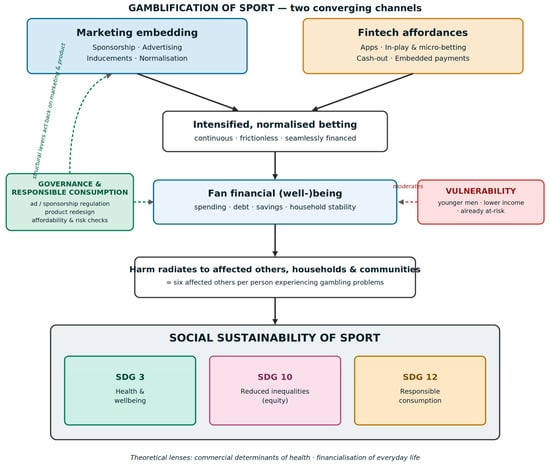
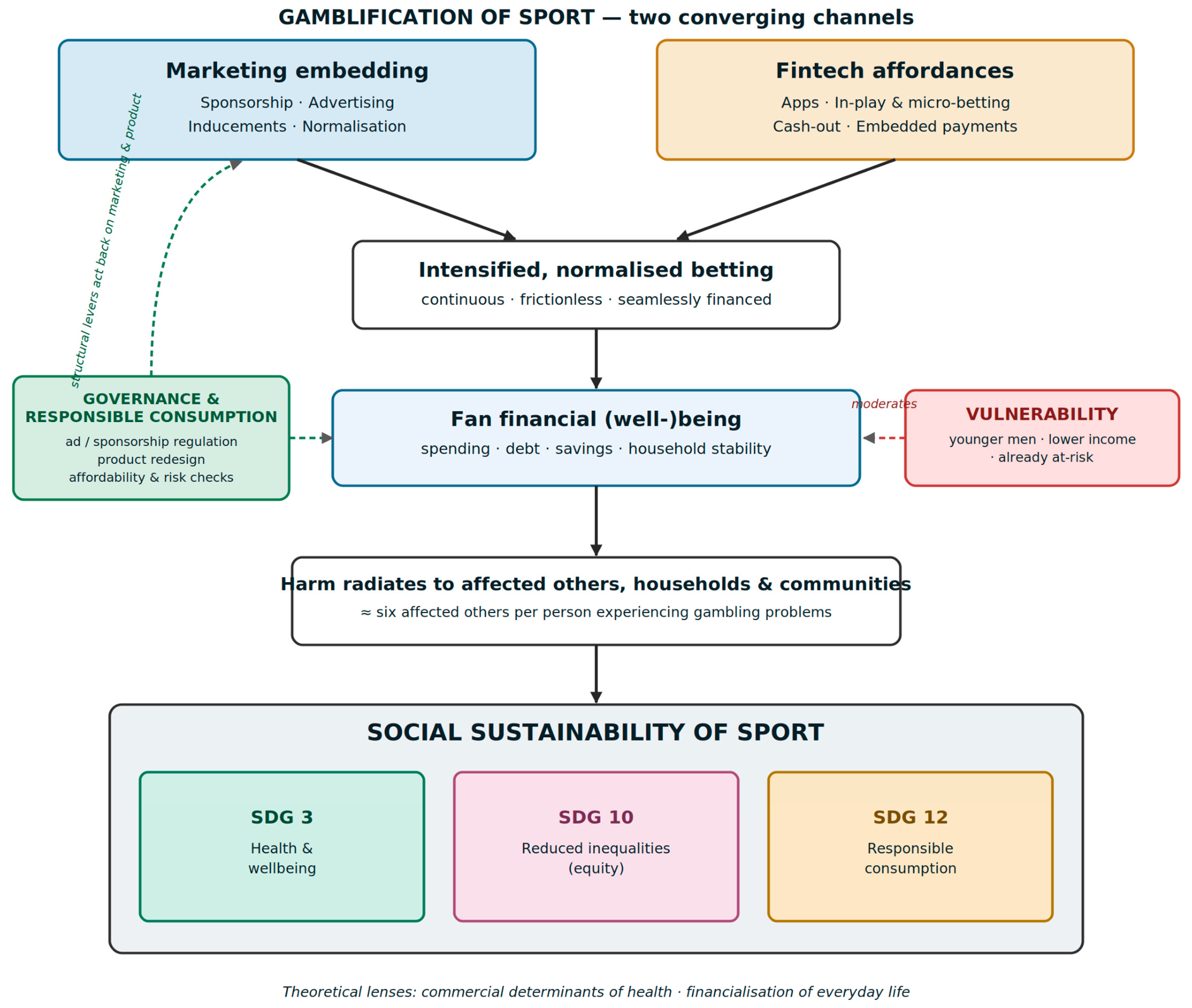
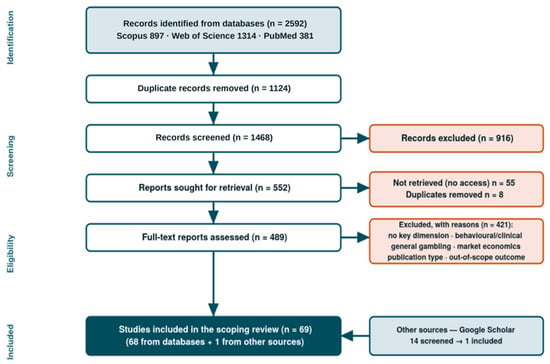
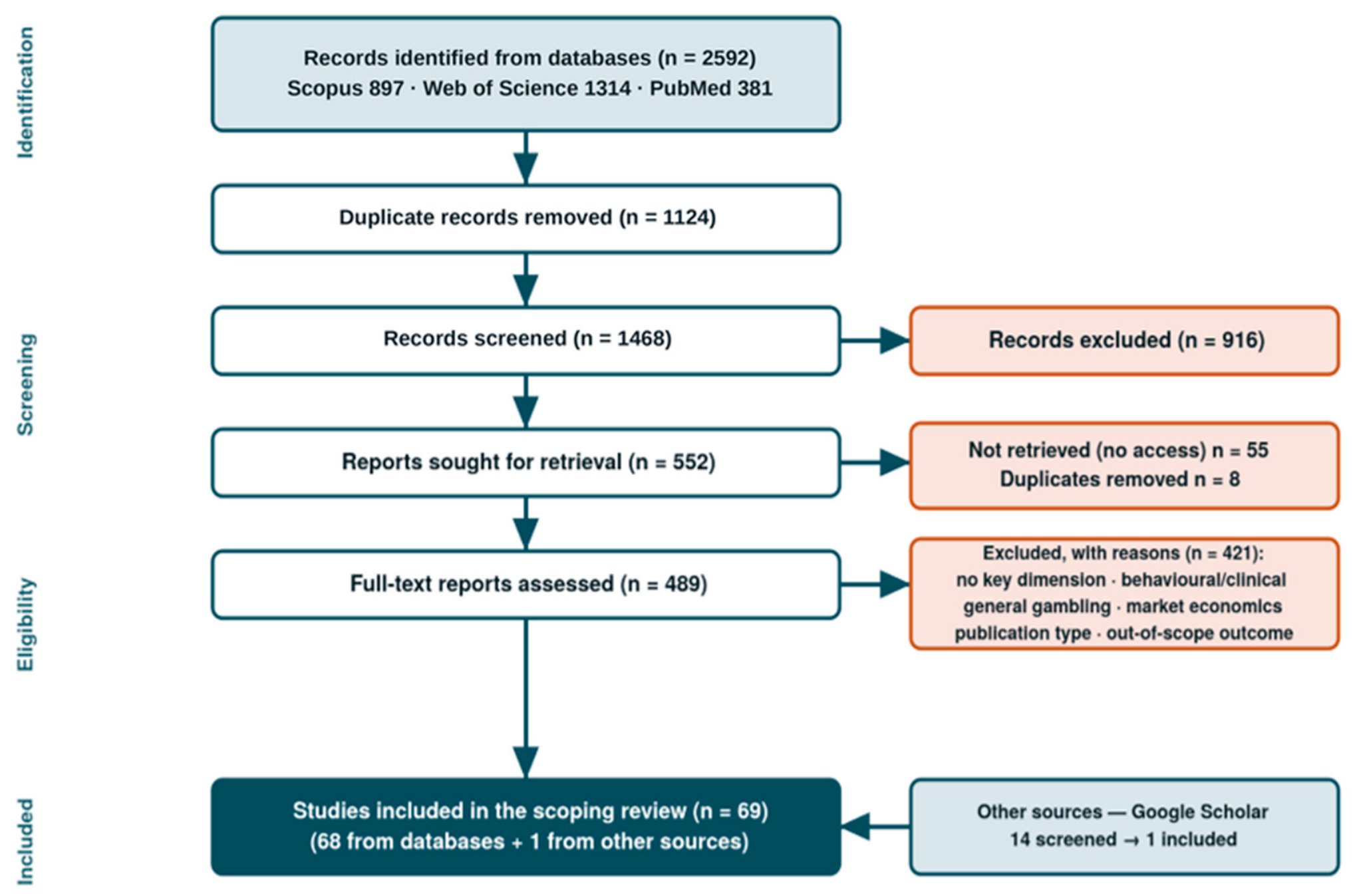
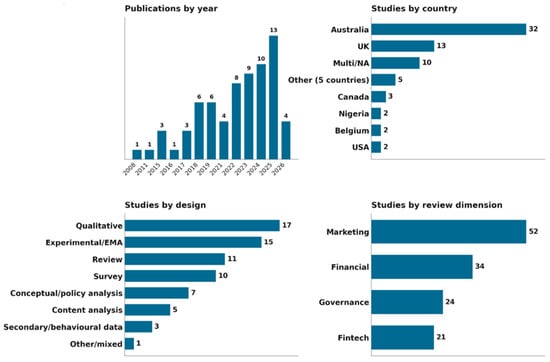
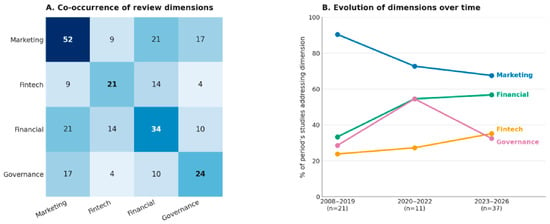

Disclaimer/Publisher’s Note: The statements, opinions and data contained in all publications are solely those of the individual author(s) and contributor(s) and not of MDPI and/or the editor(s). MDPI and/or the editor(s) disclaim responsibility for any injury to people or property resulting from any ideas, methods, instructions or products referred to in the content. |
© 2026 by the authors. Licensee MDPI, Basel, Switzerland. This article is an open access article distributed under the terms and conditions of the Creative Commons Attribution (CC BY) license.