


Abstract
Conflict and turmoil over the last 50 years have impaired Afghanistan’s agricultural and water infrastructure and threatened rural livelihoods and economic stability. This study assesses value-added, home-based, women-empowered agri-processing in Afghanistan as a sustainable strategy to promote rural economic development, empower women, and enhance food security. By analyzing existing literature, global reports, and regional case studies, this paper highlights the roles of adaptable technologies, microcredit mechanisms, and market linkages in building resilient rural economies and overcoming limitations such as land fragmentation, low technology inputs, and poor agri-infrastructure. The main growth drivers would be harnessing adaptable technology, building rural infrastructure, adopting efficient agricultural practices, and connecting to skilled education. The findings underscore the significance of supportive policies and investments in home-based value-added agri-processing to foster sustainable growth, poverty reduction, and economic inclusivity in Afghanistan.
1. Introduction
Afghanistan was historically capable of producing sufficient food to meet domestic demand and maintain a relatively self-sustaining agricultural system. However, decades of conflict, political instability, climate-uncertainties, and deteriorating infrastructure have significantly weakened the country’s agricultural sector. Today Afghanistan has become a net food importer, with a substantial portion of its population relying on international food assistance to meet basic nutritional needs [1].
Given the critical role of agriculture in rural livelihoods and economic development, there is an urgent need to identify sustainable pathways for revitalizing the sector. This paper examines the current state of Afghanistan’s agricultural sector and explores the potential of value-added agri-processing as an alternative rural development strategy. While existing studies have primarily focused on agricultural production, food security, and humanitarian assistance, limited attention has been given to the role of value-added agri-processing in enhancing rural incomes, employment generation, market integration, and economic resilience. This study addresses this research gap by providing a comprehensive assessment of agri-processing opportunities within the Afghan context. The novelty of this research lies in its integration of perspectives on agricultural development, value chain enhancement, and rural economic transformation.
Existing research on Afghanistan’s agricultural sector has primarily focused on agricultural production, food security, and humanitarian food assistance, with limited attention given to value-added agri-processing as a strategy for rural development and economic diversification. Furthermore, insufficient evidence exists on how agri-processing can strengthen agricultural value chains, generate employment opportunities, and enhance farmers’ incomes and livelihoods.
The novelty of this study lies in examining value-added agri-processing as a catalyst for rural transformation rather than merely increasing agricultural production. By integrating food security, value chain development, and rural entrepreneurship within Afghanistan’s unique socio-economic context, the study proposes an Afghanistan-specific framework for value addition and commercialization. At the village level, value-added agri-processing enables farmers and women entrepreneurs to transform raw agricultural products into higher-value, marketable goods, creating local employment, increasing household incomes, reducing post-harvest losses, and strengthening village-based value chains that contribute to rural economic growth and food security. Unlike traditional development approaches that focus primarily on increasing agricultural production, agri-processing captures additional value within rural communities through processing, packaging, branding, and marketing. This approach transforms villages from suppliers of raw commodities into producers of higher-value products, creating sustainable income streams and strengthening local value chains even under conditions of resource scarcity and conflict.
The Afghan economy relies heavily on agriculture, despite only 12% of the land being arable. Agriculture is significantly constrained due to inadequate infrastructure, dependence on erratic spring rains and winter snowmelt for irrigation water, and outdated irrigation technology use [2,3].
Agriculture drives rural economic development, reduces poverty, and creates numerous employment opportunities [4]. A constrained resource base and prolonged civil unrest continue to hinder Afghanistan’s agriculture. Studies [2,3,5] suggest that the rural agricultural sector, in its current form, may not be effective in reducing poverty due to low returns and competition from urban industries. Specifically, these studies highlight that the average income from traditional agriculture remains insufficient compared to urban job opportunities, and the sector’s growth struggles to keep up with city-based industries. In contrast, value-added agri-processing offers a more resilient option for transforming the rural economy. With its limited input and start-up capital requirements, agri-processing can provide higher returns on investment and is less vulnerable to market fluctuations. Processing raw agricultural products into market-ready goods not only increases their market value but also opens new revenue streams. This approach enables women to earn income as entrepreneurs and build social capital to support their families’ prosperity and growth. Furthermore, small-scale production models offer flexibility and adaptability, fostering sustainable economic development even in challenging environments [6,7].
In developing countries, agri-processing accounts 20–35% of wage employment in the manufacturing sector, while agri-business contributes 49% of manufacturing value added and 43% of services value added [8]. Over the past two decades, agricultural infrastructure projects led by organizations such as USAID, ADB, World Bank, UNDP, and FAO have improved watershed management and farming infrastructure, while empowering women and youth to establish sustainable enterprises through agri-processing cooperatives. The Afghanistan Value Chains (AVC) project, funded by USAID, promoted rapid, equitable, and sustainable agricultural growth from 2010 to 2016 [9], involving women in value-added agriculture and the creation of horticulture enterprises. The initiative introduced advanced agri-processing systems to enhance product quality, and training in modern agricultural techniques increased income and yields for smallholder farmers. Special emphasis was placed on integrating women’s home-based cooperatives. This project built on the ten-year USAID Commercial Horticulture & Marketing Project (CHAMP) project, implemented by Roots of Peace, which prioritized the development of women’s cooperatives to empower Afghan farmers and communities, and ensure food security and sustainable livelihoods.
In response to challenges, value-added agri-processing offers a low-capital approach to diversifying income and enhancing nutrition. This paper examines the role of home-based agri-processing in promoting sustainable rural development within Afghanistan’s unique socio-economic context. As traditional agriculture becomes less capable of sustaining economic growth, value-added agriculture, defined as the transformation of primary agricultural products into marketable commodities, becomes increasingly important [10,11]. The primary objective of value-added agri-processing is to reduce poverty by increasing incomes and improving food access for disadvantaged populations. Entrepreneurs can establish value-added processing enterprises using small-scale, flexible, and sustainable business models that do not require advanced equipment [12].
Home-based agri-processing is considered a micro-enterprise and is integrated into village cooperatives, both informal and registered, providing families in Afghanistan with income during winter. Seasonal fluctuations and raw material availability lead to inconsistent production levels, with many participants working part-time or on a seasonal basis. In this context, the paper advocates for women-led value-added processing, highlighting the importance of supporting such initiatives through case studies and measurable indicators of empowerment during the Taliban regime, and assessing the impact on nutritional availability [5].
Addressing rural income limitations, especially during winter, requires diversifying and supplementing income sources to facilitate the transition of labor from traditional agriculture [13,14] to alternative economic activities. Afghan women, among the most impoverished and undereducated populations globally, stand to benefit significantly from value-added agri-processing, with increased economic ownership and improved livelihoods. Despite growing work on value-added agriculture and women’s economic empowerment in low- and middle-income countries, there is little systematic evidence on how home-based agri-processing (HBAP) functions under Afghanistan’s current political and mobility constraints, particularly since the Taliban’s return to power. By focusing on HBAP and women’s participation within Afghanistan’s agrifood value chains, the paper contributes to current discourse on inclusive rural transformation, conflict-aware development, and gendered resilience.
2. Materials and Methods
This study employs a qualitative evidence synthesis of published literature, government documents, and case studies from Afghanistan’s Ministry of Agriculture, as well as international organizations such as USAID, FAO, and the World Bank [15]. To enhance rigor and reproducibility, we implemented a structured review protocol that specifies data sources, search strategies, inclusion and exclusion criteria, and thematic analytical procedures [16]. Because this research is a qualitative evidence synthesis based on published literature, government documents, and program reports rather than on primary data collection, no human participants were directly recruited for the study.
We searched four bibliographic databases—Scopus, Web of Science, AGRIS, and EconLit—and systematically reviewed grey literature from the FAO, the World Bank, the UNDP, UN Women, USAID, ADB, IFAD, and Afghanistan’s Ministry of Agriculture, Irrigation and Livestock (MAIL). Searches combined “Afghanistan” with the terms “agriculture,” “value-added,” “agri-processing,” “value chain,” “women,” “cooperatives,” and “Taliban,” focusing on the period 2010–2025.
Inclusion criteria required that studies: (i) focus primarily on empirical material from Afghanistan or contain a clearly identifiable Afghan component; (ii) topical focus on address value-added agriculture, high-value agricultural products, or HBAP and the women’s participation; and (iii) be peer-reviewed publications or rigorously documented program evaluations. Opinion pieces, media reports lacking empirical evidence, and studies that mentioned Afghanistan only in passing were excluded.
The screening process was conducted in two stages. First, titles and abstracts were reviewed to assess relevance. Second, full-text articles were evaluated against the inclusion criteria. For each eligible document, data was systematically extracted using a standardized matrix that captured information on study context, intervention type, outcomes, constraints, and research methods. The extracted data were then analyzed through thematic content analysis, with themes organized around the study’s research questions and hypotheses.
Data on crop production, technology adoption, microcredit initiatives, and market trends were analyzed through thematic content analysis to assess the viability, opportunities, and challenges of scaling home-based agro-processing enterprises. Attention was given to case studies in dairy production, saffron cultivation, and solar drying of fruits and vegetables, as these sectors offer significant potential for value addition and women-led entrepreneurship. The analysis explored the role of women’s cooperatives and producer groups in promoting enterprise development, strengthening market linkages, and enhancing household incomes. Key constraints, including inadequate infrastructure, limited access to technology, harsh climatic conditions, market volatility, and the impacts of conflict and political instability, were also examined. Furthermore, the review assessed the potential of community-led and market-driven approaches to support sustainable enterprise growth. Special consideration was given to understanding the challenges and opportunities for women’s economic empowerment under the Taliban regime, including restrictions on mobility, employment, access to markets, and participation in formal economic activities, and how these factors influence the sustainability and scalability of home-based agribusiness enterprises.
The following research questions were analyzed:
- Under current institutional and infrastructural constraints, can home-based agri-processing raise women’s incomes and household food security?
- Which policy instruments (e.g., finance, storage/irrigation, quality/certification, market linkages) most effectively enable HBAP while preventing exploitation?
- How do religious/social restrictions on women’s movement/work alter HBAP feasibility, and what operating protocols mitigate risk?
The following analytical propositions, derived from the authors’ previous study and personal experience, guided the evidence synthesis:
- Access to cold storage and irrigation is positively associated with HBAP margins and reduced post-harvest loss.
- Collective action models (women’s producer groups/coops) increase price realization and reduce middleman capture compared to atomized HBAP.
- Where mobility restrictions are binding, HBAP aligned to accepted sectors (food processing, textiles) plus safe-movement protocols maintains income gains relative to non-HBAP households.
To enhance the rigor and credibility of the review, all eligible sources were subjected to a quality assessment process prior to inclusion in the final synthesis. Each study or report was evaluated against four criteria: (1) Methodological rigor—clarity and appropriateness of the research design, data collection procedures, and analytical methods. (2) Relevance—alignment of the study with the research questions, particularly regarding women’s entrepreneurship, home-based agri-processing, and value-added agriculture in Afghanistan. (3) Data transparency and evidence quality—adequacy of data sources, documentation procedures, and the reliability of reported findings. (4) Source credibility—publication in peer-reviewed journals or production by recognized organizations, including government agencies and international development institutions (e.g., FAO, World Bank, USAID, UNDP, IFAD, and MAIL). Sources that lacked sufficient methodological information, presented unsupported claims, or demonstrated limited relevance to the study objectives were excluded. Greater weight was given to peer-reviewed publications and reports produced by reputable international organizations and government agencies. The quality assessment helped ensure that the evidence synthesis was based on reliable, relevant, and methodologically sound sources.
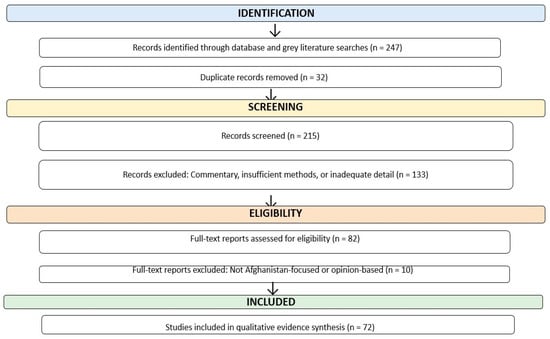
The PRISMA 2020 flow diagram (Figure 1) illustrates the identification, screening, eligibility assessment, and inclusion of studies and reports in the qualitative evidence synthesis. A total of 247 records were identified through databases and grey literature searches. Following the removal of 32 duplicates, 215 records and abstracts were screened, with 143 then excluded. Seventy-two full-text documents were assessed for eligibility, of which 10 were excluded. Ultimately, 72 studies and reports were included in the final qualitative evidence synthesis.
Figure 1.
PRISMA 2020 flow diagram illustrating the identification, screening, eligibility assessment, and inclusion of studies in the qualitative evidence synthesis. Of 247 records identified through database and grey literature searches, 72 studies met the eligibility criteria and were included in the final review.
3. Results
3.1. Value-Added Activities
From a broader perspective, economic development is characterized by a transition from an agricultural to a manufacturing- and services-focused economy. In Afghanistan, this transition has been particularly challenging due to the country’s limited resource base. The manufacturing and service sectors in Afghanistan remain connected to agriculture. Agriculture is still essential for impoverished populations and for initiatives targeting poppy eradication [17]. Given this continued dependency, one direction for economic development could involve transitioning to high-value crops, such as almonds, pistachios, citrus, figs, and dates, along with the establishment of value-added processing enterprises. This strategy increases income at both the household and national levels, promoting crop diversification [18].
Under failing infrastructure, women’s cooperatives and self-help groups have helped women develop their skills through community-based training with basic processing equipment [19]. However, low returns on their products leave farmers with limited options for supporting their families. Poverty and the hindering environment resulting from years of civil unrest have made Afghanistan challenging to develop.
Value-added agricultural activities have been identified globally as critical to rural poverty alleviation and economic diversification [18]. In Afghanistan the reviewed studies and program reports show that typical value-added agricultural processing activities include drying fruits and vegetables, making jams and dairy products, producing oils from oilseeds, and processing silk and cashmere from goat hair. These activities are predominantly small-scale and often organized as home-based or village-level enterprises, especially in areas where women’s mobility outside the household is restricted. Multiple case studies indicate that, when combined with basic processing equipment and training, such activities can generate incremental cash income, smooth seasonal food gaps, and provide entry points for women’s economic participation [1,20,21,22,23].
In contexts like Afghanistan, where farming is mainly subsistence-based, these small-scale processing activities can significantly increase household income, particularly for women who face mobility restrictions [24,25]. Furthermore, microcredit [3] and cooperative models have shown promise in facilitating access to capital and improving market integration.
Value-added activities in Afghanistan are primarily driven by the private sector, with the Ministry of Agriculture, Irrigation, and Livestock (MAIL) playing a role in advising farmers on suitable crop varieties to plant and potential market opportunities. The Ministry of Agriculture and Food also works to assist farmers in developing business plans, accessing international markets, and improving their supply chains, as well as helping them access credit [26].
Dried fruit and nuts (including citrus, apricots, almonds, walnuts, and pomegranates) present a significant opportunity for Afghans, given the prime climate and geography, combined with growing regional and global markets. Exports of dried fruit and nuts are predicted to reach $1 billion by 2030, indicating significant potential in the international market for Afghanistan. Raisins account for the largest share of the horticulture crop in Afghanistan, India, Pakistan, and the Middle East. As of 2024, Afghanistan is producing 520,000 MT of grapes annually. The market demand for these products is enormous and is increasing [27].
3.2. Available Technology
Improved technology in Afghanistan is needed for agricultural production, the value chain, and the agri-processing sector. Value addition through the marketing and processing of natural products generates significantly more revenue compared to the primary production of these same goods, and technology is needed to achieve this premium on agricultural products. There is a lack of information about relevant technologies for small-scale processors in this field, while most existing information in this area primarily applies to medium- and large-scale operations. A technology adoption roadmap with short-, medium-, and long-term interventions would feature technology and socioeconomic infrastructure for HBAP model adoption, including mobile processing units, renewable energy solutions, vocational training programs, digital extension services, cooperative equipment-sharing models, and public–private investment mechanisms.
The technology available in rural Afghanistan, where most agri-processing occurs, is limited and scarce. Some NGOs have established processing centers where producers can be trained on equipment and then rent time on these machines to process their goods.
Solar drying of fruits and vegetables has recently become a prevalent agricultural processing activity among Afghans, enabling them to preserve food. Solar preservation is a straightforward and ancient form of processing that does not require advanced technology. It relies on creating low moisture content, which prevents growth of bacteria, yeast, and mold. Dried food takes up less space and is easier to transport due to its lightness and non-perishability.
Afghanistan is a leading exporter of dried foods, but it often still uses inefficient traditional outdoor direct drying methods with longer drying times. Traditional outdoor drying is also less hygienic and subject to contamination from dust, insects, birds, and animals. However, the additional cost and effort needed for centralized drying technology do not yield a high enough payoff in exchange for the slight improvement in quality and shorter drying period [28].
At one point, there were over 30 raisin-processing plants. Currently, only eight are in operation, and these operations utilize technology that is over 30 years old. In the raisin industry, investments are needed in the following areas: updated machinery, on-farm training and processing demonstrations, improved packaging warehouses, and improved marketing.
Incremental improvement of existing technology is an alternative to new technology. In the case of sun-drying, food can be placed on mats or trays to elevate it off the ground. Cutting food into smaller pieces and blanching are two straightforward methods to enhance drying without requiring new and expensive technology [29].
As with drying, the production of tomato paste in the agri-processing sector is inefficient and labor-intensive in the tomato product sector. Improved appropriate technology would enhance efficiency through increased production, improved quality, and lower prices, thereby benefiting both producers and consumers.
Small-scale oil processing can also add much value at the farm level. Afghanistan produces a wide variety of seeds, but there are almost no processing facilities available for them. Oil demand exists in Afghanistan; currently, this oil is being imported from countries like Iran and Pakistan, while seeds for milling are exported from Afghanistan. If Afghanistan could process these oilseeds, it would capture a greater share of the added value of this product. Small-scale oil mills can be purchased and shared by the community to reduce the initial cost of buying them. Oil extractors can be very efficient, easy to operate, and have low maintenance costs.
Investments in technologies such as cold-storage facilities, adequate roads, and transportation logistics can help alleviate the pressure of Afghanistan being a landlocked nation and improve food distribution and export capabilities [30]. Investments in these areas will reduce waste and spoilage due to a lack of cold storage.
Promoting new technology can occur through demonstrations and education. These workshops serve as a medium through which farmers can be exposed to new technology and can learn through hands-on experiences. It will also enable researchers to assess the feasibility of adopting this technology by farmers, some of whom are uneducated and have limited access to new technology.
3.3. Financial Bottlenecks to Entrepreneurship
It is estimated that more than 50% of micro-enterprises fail within their first three years. Among the surviving 50%, fewer than 1% transition from micro to small-scale enterprises. Lack of credit, limited resource base, and poor infrastructure all contribute to the failure of these enterprises [31]. This high failure rate also serves as a bottleneck in this sector, contributing to entrepreneurs’ reluctance to invest in productive assets or technology. Risk mitigation is needed to overcome the limited availability of credit.
Attracting investors to allocate financial resources in this market is challenging due to the scarcity of experienced managers, inadequate infrastructure, and reliance on uncertain sources of raw materials. There are local Afghan banks and micro-credit institutions available to support rural areas of Afghanistan for HBAP adoption.
Encouraging investments in this area would promote productivity and enable producers to transition into higher-value-added activities through economies of scale. The government is currently exploring ways to enhance the enabling environment for the private sector to promote growth and trade [25].
Some countries discourage the development of small-scale enterprises through legislation, licenses, subsidies, pricing policies, taxation, and protectionism; however, Afghanistan’s investment laws were among the most liberal in the region. These laws [32] allow for 100% foreign ownership, a flat 20% corporate tax rate, no restrictions on inward and outward capital flows, no limitations on profit or other cash repatriation, no import duties on machinery, and a 1% duty on raw and intermediate materials, as well as provisions for international dispute resolution and arbitration. Despite these relatively liberal laws governing investment, accessing credit has been quite challenging.
The most binding constraint in the agri-processing sector is gaining access to credit [33]. Significant unmet demand for credit exists in Afghanistan. The Afghanistan Research and Evaluation Unit initiated a pilot micro-credit program in rural villages in Afghanistan. The introduction of microcredit to these villages was successful, as measured by the repayment rate. Loan sizes were satisfactory for villagers ($30–$3000 USD). The grace period was reportedly helpful, and repayment was straightforward, although the economic benefit of the loans was controversial. Many farmers reported the need to take another loan to repay the first when their harvest was insufficient. The demand for larger loans posed a problem because, in most cases, such funding did not align with the program rules [34].
Households that can gain access to credit participate in both lending and borrowing, and these households often hold multiple debts simultaneously. The diversity of credit practices is significant, and most transactions occur on a no-interest credit basis. Very little of this money is being invested; it is mainly used for “consumption smoothing” or marriage. In many cases, a second loan is required to repay an existing one. The primary reasons for entering credit relations are due to interest in joining a social network for security [35].
A prevalent form of microcredit among women is loosely defined as “group credit.” In this situation, a group of women forms a solidarity lending group. This form of lending enables women who lack access to collateral to secure loans for their economic activities. The group members guarantee each other’s loans. Most groups consist of 10–12 members who live in the same neighborhood. During monthly meetings, savings are collected, and loans are disbursed. A slight and gradual increase in the loan base is achieved. In most of these “group credit” situations, the repayment rate is close to 100% due to the sense of responsibility this group scenario promotes [36].
3.4. Marketing Processed Agri-Products
Producers in the agricultural processing sectors must be familiar with their market. Producers must be aware of their consumer demand [37], product type, quality specifications, mode of supply, and affordability based on where [38] crops are grown (Table 1). Due to the time-consuming nature of producing these goods, understanding the market can help producers avoid wasting materials on products that their customers may not be interested in. For example, many agri-processors in Afghanistan spend a significant amount of time producing jams that do not sell. These jams then lose their quality and shelf life due to prolonged storage. The Afghan jam market cannot compete with imports from Pakistan and Iran [39].
Table 1.
Leading agri-processing in Afghanistan provinces based on available raw material. Source: [11].
Negative perceptions about products made at small and local scales are a constraint. These products are often perceived as of lower quality and possibly unhygienic. Packaging is another constraint in this sector. Jars and packages are costly and complex to access. The use of expensive packaging materials increases the cost of the product for the consumers. As a result, the products are unaffordable. A solution to this problem has been for customers to bring their jars and packaging materials to the market. This makes the product more affordable, and allows for the purchase of the desired quantity.
In addition to being familiar with their market, producers also benefit from creating an organization of processors to facilitate technical training and business services. Access to this type of organization will increase economies of scale, leading to higher production volumes. This organization will also promote linkages with other producers and suppliers of similar goods and services. Producers will also easily access secondary service providers, thereby smoothing the process of specialization, efficiency, and information flow. Training can share best practices like maintaining cold chain transportation, standards compliance, product certification, branding, packaging, export infrastructure, and market information systems. Practical market-development strategies, including geographic indication (GI) branding, cooperative marketing networks, traceability aspects, digital commerce opportunities, women-led marketing associations, export facilitation programs, and strategic partnerships with domestic and international buyers can also be discussed.
Afghanistan has a competitive advantage in the dried fruit and nut sector (Table 1). The limiting constraints of road inaccessibility or poor transportation networks in this market are low because products are stored for extended periods. The dried fruit and nut market in India is valued at $2.2 billion, and Afghanistan currently accounts for only 2% of that market. The potential for growth in this sector is enormous. As Indian consumers’ incomes increase, they demand higher-end food products, including dried fruit and nuts. Entering international markets, such as India, may yield new business opportunities, but this also increases the risk in all areas of the operation. Domestic demands are also growing, offering more security, and are more easily accessed [8].
As mentioned previously, investments in transportation and storage facilities will allow Afghanistan to reach international markets. Afghanistan is strategically located to capitalize on significant markets in China, India, Pakistan, and the Middle East. With Pakistan as an effective trading partner, both countries benefit from “counter-season production” of fruit, based on differences in their climate. A preferential trade agreement signed in 2003 between India and Afghanistan has placed a high priority on Afghan goods, especially significant given the continued growth in India’s income [8].
Afghanistan has numerous comparative advantages that set it apart from other agri-processing markets. They include low labor cost, adequate surface-water availability, production of a wide range of crops, and a good reputation for high-quality organic produce. Capitalizing on these strengths is crucial to gaining success in this market.
3.5. Women’s Participation and HBAP
In Afghanistan, women’s lives are shaped by significant restrictions on their freedom of movement, often confining them to their villages or household compounds. Labeled as “the keepers of family honor,” constraints on women are influenced by factors such as age, wealth, social stigma, household size, labor availability, and ethnicity [40]. These conditions necessitate resilience, as any movement beyond the home requires considerable resistance. Widows in rural Afghanistan experience significant uncertainty, with their futures constrained by externally imposed social and cultural norms.
Participation in the agricultural sector can improve Afghan women’s livelihoods and reduce poverty, as observed among impoverished, undereducated populations worldwide. These challenges have been exacerbated by prolonged civil conflict and entrenched religious and cultural norms. Since 2021, the Taliban regime has imposed further restrictions on education and employment outside the home, making it increasingly difficult to reach women and provide essential resources [41]. Approximately one million widows reside in Afghanistan, and mobility restrictions have made it nearly impossible for women to work outside the home or support their children. Promoting home-based agri-processing is a viable support mechanism to empower widows and women with restricted mobility. Recommended policy interventions include subsidies for small-scale processing equipment, legal reforms to protect the rights of women entrepreneurs, and training programs that focus on skill development and financial literacy.
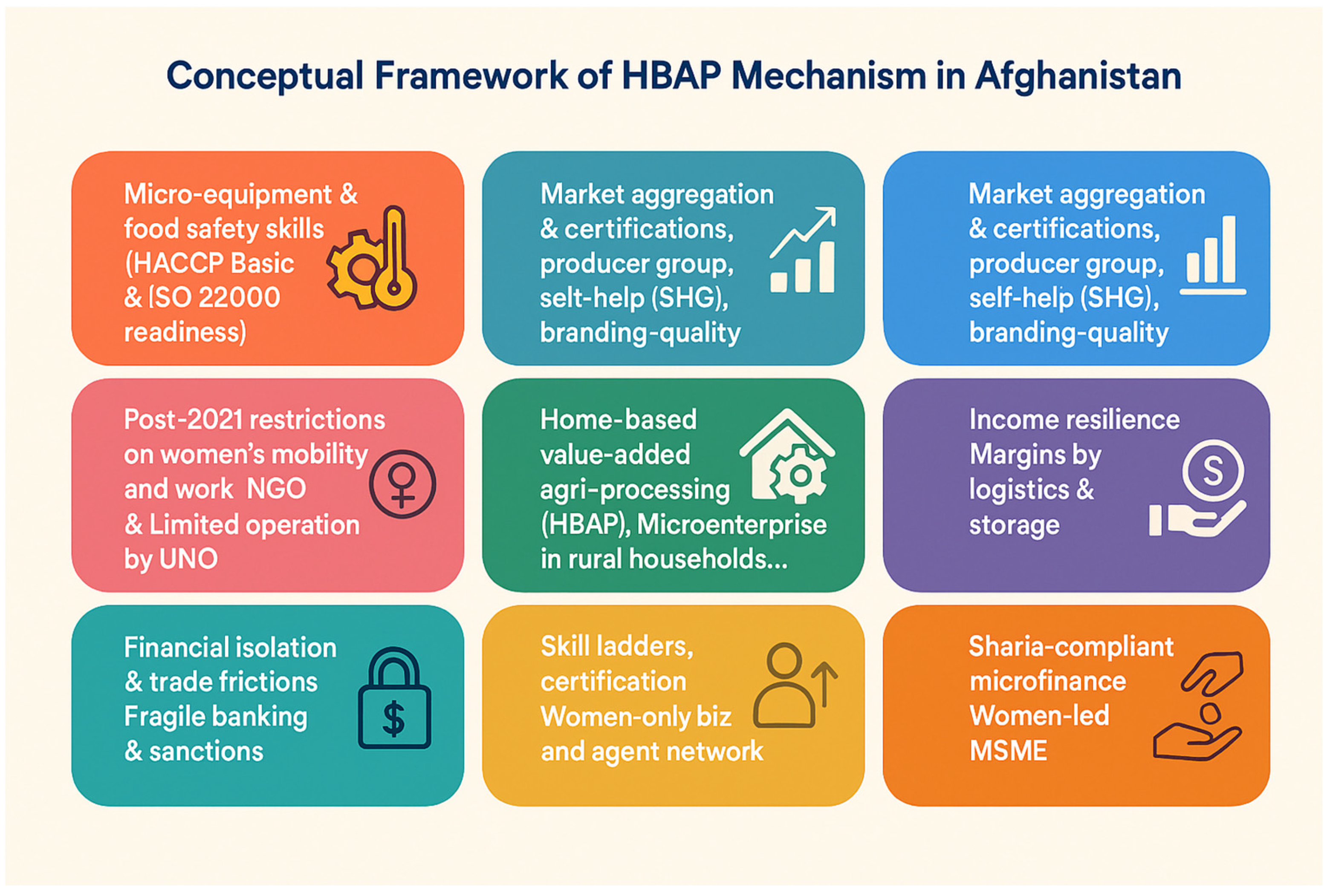
To implement these policies, community engagement is crucial. Establishing partnerships with local NGOs and women’s groups can facilitate the distribution of equipment and training, thereby enhancing the effectiveness of these initiatives. Leveraging mobile technology can improve access to training, enabling women to learn from the comfort of their own homes. Furthermore, legal reforms should be crafted in consultation with local leaders to ensure cultural sensitivity and acceptance (Figure 1). Creating micro-financing options through local microfinance institutions will provide sustainable financial pathways for women to invest in home-based businesses, as depicted in Figure 2 showing the Conceptual Framework of HBAP. These integrated efforts will need support from international organizations to ensure adequate funding and resources, ultimately helping to substantially alleviate poverty and enhance the quality of life for these women and their families.
Women in both rural and urban Afghanistan are frequently described as ‘engines of economic growth’ in policy and program documents, and several studies show that when they can make economic decisions, they often prioritize family welfare, particularly in health and education. Recent estimates suggest that by 2023 there were more than 57,000 women-owned businesses in Afghanistan, with women-owned enterprises growing at approximately twice the rate observed in the United States [41]. However, women are the cheapest source of labor because of gender bias. The jobs provided to them often require little to no skill, thus limiting their ability to improve their skill set and enhance their economic status. Due to globalization, some small-scale enterprises have closed, further reducing the number of jobs available to women.
Despite progress in entrepreneurship, women remain concentrated in low-wage, low-skill segments of the labor market, and face persistent gender wage gaps and restricted access to productive assets. Within this constrained environment, the reviewed evidence identifies HBAP as one of the few feasible livelihood strategies for women—especially widows and women with strict mobility constraints—because it can be carried out within the home or village compound while fulfilling care responsibilities [34,42].
Afghan women often lack access to productive assets, such as land and livestock, which are essential for sustaining their livelihoods. Research demonstrates that women who own these resources manage and utilize them effectively. Asset ownership enhances women’s decision-making power within households. Older women with assets tend to be more self-sufficient and less reliant on extended family support. Additionally, asset ownership enables women to support their families, including in cases of early widowhood [40].
Improving agricultural education for women can strengthen household food security. Agri-processing supports women’s economic independence by enabling them to work from home, promoting their financial autonomy. This cottage-industry model is particularly beneficial, as many women are responsible for large families and are often not permitted to leave home without an escort.
Women enter agri-processing through diverse pathways. Some are “pushed” by hardship, while others are “pulled” by the promise of opportunity. Those driven by necessity often seek quick returns and may exit the sector rapidly, whereas those motivated by ambition are more likely to establish sustainable businesses [43].
The contribution of women to this sector of agriculture has the potential to improve their livelihood and reduce poverty among this section of Afghanistan’s population. Afghan women are among the poorest and most undereducated women in the world. The increased burden of women has been perpetuated by years of civil wars and religious and cultural reasons. Since 2021, under the Taliban regime, which denied access to education and employment outside the home, it has become increasingly complex to reach women and provide them with the resources they need. Women lack access to productive assets. Land and livestock are considered the most critical assets to livelihoods in Afghanistan, but many women do not have ownership of these resources. One study demonstrated women’s ability to manage these resources and utilize them productively when they held ownership positions. When women gained access to these resources, their decision-making power inside the household increased. Older women with ownership of these resources were more capable of taking care of themselves than relying on their extended family. Ownership of these resources would also allow women to support their families, even if widowed at a young age [40].
Food security could increase at the household level if agricultural education were improved for women. Moreover, agri-processing enables women increase their economic independence while in most cases working from home.
Women’s cooperatives are vital in rural Afghanistan. These organizations convert unpaid farm labor into income, add value to agricultural products, and stabilize families during crises. By expanding local markets and services, cooperatives increase rural productivity and resilience, thereby strengthening women’s economic contributions.
From 2008 to 2018, women’s cooperatives specialized in dairy, saffron, and food. By processing milk into yogurt and cheese, or transforming fruits and vegetables into jam, pickles, and dried products, these groups increase the price farmers receive and inject more money into village economies. They were adopted in over 12 provinces in Afghanistan [44].
Cooperatives offer platforms for training in processing, quality control, literacy, and basic business skills, thereby enhancing product quality and competitiveness. Many function as “common interest groups” that manage savings, small loans, and mutual support, strengthening local institutions and social cohesion in rural areas [38]. Women’s cooperatives and self-help groups helped women develop their skills through community-based training with basic processing equipment [45].
Earnings from a women’s saffron cooperative in Herat provided a “second income” to households, helping to cover the costs of schooling and healthcare, and reducing the need to sell assets during shocks. Welt Hunger Life studies revealed that NGO-supported agricultural programs report income increases for participating women and better food security for their families, especially in woman-headed households [46,47].
Figure 2.
Conceptual Framework of HBAP Mechanism in Afghanistan. Source: adapted from [46,47].
Working collectively enables women to purchase inputs and sell products in bulk, negotiate better prices, and connect with traders and, in some cases, export buyers for products such as saffron and dried fruit. Cooperative membership is linked with higher participation of women in farm decision-making and greater say over how income is used, which shifts household and community power dynamics [48].
Women-led businesses are vital for Afghan women entrepreneurs under Taliban rule, but formal credit and markets are severely limited, including access to finance [19]. In 2025, FAO and the UK launched a £10 million initiative to boost rural resilience and food security across 15 provinces by May 2026.
Despite Taliban restrictions, Afghan women entrepreneurs are launching small businesses and cooperatives. However, they face struggles accessing capital. According to a UNDP study reported by Reuters [19], 41% of surveyed female entrepreneurs rely on informal loans to finance their ventures, and approximately 70% require a male guardian to accompany them to the market. Nevertheless, many use tailoring, food preparation, dairy cooperatives, and handicrafts to build income and resilience.
In Bamiyan province, a dairy entrepreneur supports women farmers by organizing cooperatives that process milk into cheese and yogurt. She provides training and equipment, purchasing their produce at fair prices. These cooperatives strengthen community resilience by bringing women farmers into the formal market while preserving traditional livelihoods [13].
The 2024 survey by the United Nations Development Program (UNDP) highlights the struggles and resilience of Afghan women entrepreneurs. A total of 41% of more than 3100 surveyed are in debt, with only about 5% having secured formal bank or microfinance loans [49]. Yet, 80% of these women-led businesses remain the primary source of income for their families. The UNDP reports that its targeted support, which combines microloans, digital literacy, and market access, has benefited 75,000 women-led ventures and created 900,000 jobs, supporting more than 4.5 million Afghans.
This review suggests that dried fruit processing, small-scale oil extraction, and dairy product manufacturing have the highest potential for scalable impact. However, critical barriers include limited access to affordable credit, poor transportation infrastructure, and a lack of standardization in processing techniques. Women’s participation is high in cottage industries, with group lending models significantly improving repayment and sustainability rates.
3.6. Contribution to the Rural Economy Through Market Linkages
Proper market linkages must exist for value-added agri-processing to become a viable source of income for the rural economy [50]. These market linkages create synergy between small producers and consumers, and buyer–seller associations can help ensure consistent supply and demand. When exporters in Afghanistan decide to purchase from a small producer, these producers must consistently provide the contracted quantity and quality. At the same time, to maintain or increase production, small producers must ensure that there is a viable export market that will pay a fair price for their goods. These conditions are more likely to occur if strong buyer–seller linkages exist.
To establish strong market linkages, a high level of demand for the product must be created; hence, establishing solid market linkages is necessary. Primarily, it is essential to understand the market dynamics for this product, starting with consumer interest in agricultural goods and working backward to grow and deliver the finished product [51]. Ensuring a constant demand for both raw materials and final products is imperative.
Trade fairs are the best way to connect farm produce to the market. The Agri-Industrial Trade Fair, hosted by the Nangarhar Directorate of Agriculture, the Eastern Regional Office of the Afghanistan Chamber of Commerce and Industries (ACCI), and the United States Agency for International Development, was held over a three-year period (2009–2012). More than 150 vendors, including farmers, livestock owners, businesspeople, women entrepreneurs, government representatives, and consumers from across the country, attend the event to connect along the supply chain. This event contributed to the development of the licit agricultural sector and promoted the establishment of trade ties [4].
Working with these government agencies can help ensure that adequate procedures are established and that necessary information is readily available. Women’s cooperatives and self-help groups helped women develop their skills through community-based training with basic processing equipment [19].
4. Discussion
The reviewed reports and case studies collectively indicate that value-added, home-based agri-processing (HBAP) can contribute to rural economic transformation in Afghanistan when embedded in supportive institutional and market environments. Targeted investments in basic processing technology, producer training, microfinance, and market infrastructure consistently emerge as necessary conditions for translating HBAP into higher household incomes and greater resilience. By re-analyzing the evidence within an agrifood value-chain framework, the study shows that HBAP’s impact depends on three enabling mechanisms: (i) accessible micro-equipment and food-safety skills; (ii) producer-group aggregation and certification; and (iii) microfinance tailored to women-led micro and small enterprises [18,25]. Addressing packaging and hygiene concerns will also be critical to improving product competitiveness. Policy support must prioritize rural connectivity and inclusive participation to maximize poverty reduction effects [52].
Rather than treating HBAP as a generic “cottage industry,” the synthesis distinguishes specific value-chain segments (e.g., dried fruits, dairy, saffron) and documents their promise and challenges. Several case studies and programs demonstrated the value of cooperatives for connecting farmers with processing technology and markets.
A cooperative can be either a cooperative producer, serving farmer-producers, or a service cooperative, serving consumers. Cooperatives establish contracts with small-scale producers to purchase agricultural goods and redistribute these products to buyers, such as restaurants, grocery stores, and processors. These farming cooperatives have been highly successful, as have similar initiatives in Indonesia and other parts of the developing world. Farmers know that there is a solid demand for their goods, and they receive a fair and stable price for their goods. Consumers of these goods see the amount they will receive and rely on the consistency of deliveries.
After 50 years of political and social conflict, Afghanistan still faces challenges hindering its development into a stable nation. Since traditional agriculture can no longer sustain the livelihood of Afghanistan’s citizens, promoting diversification throughout the private sector remains a critical task. Illicit agriculture is a significant source of income for Afghan farmers. Diversifying and legitimizing Afghanistan’s agricultural sector with high-value food crops will promote the development of agri-processing, which will then generate more revenue. The most significant contribution value-added agriculture will make to Afghanistan’s economy is poverty reduction through increased household income [52].
Several economic and social factors contribute to the challenges of improving the financial situation of rural Afghans. Many people with low incomes in Afghanistan are of low social status, primarily women. People with low incomes are often undereducated and have limited access to land and financial capital. Investments in rural infrastructure, communication systems, credit markets, and education will enhance opportunities in value-added agriculture, contribute to the nonfarm economy, and ultimately alleviate poverty. Economically empowering women will also have a positive impact on Afghanistan’s economy. Societies cannot prosper when half of the population is restricted from participating in the economy. At the very least, value-added agri-processing has the potential to protect the poor from slipping further into poverty.
To promote this sector, proper training of local labor must occur. The skill set available in this area is limited, but it can be improved through training and the enhancement of technical and marketing skills [12]. Value-added agri-processing engages a larger portion of the labor force and extends working hours, resulting in increased household income.
Local non-farm businesses must foster growth by utilizing local goods and traditional technologies. Extension services can encourage the improvement of laborers’ skill sets. The engagement can be accomplished by strengthening the linkages between research and extension and passing information further down the production chain.
We define HBAP within an agrifood value chain framework [9,46,47] and distinguish it from non-farm rural enterprises and cottage industries. Synthesized evidence indicates that HBAP can raise margins via transformation, branding, and quality assurance, conditional on three enabling mechanisms: (1) accessible micro-equipment and food-safety skills; (2) producer-group aggregation and certification; (3) Islamic microfinance tailored to women-led micro-, small and medium-sized enterprises (MSMEs). We propose a skills ladder and governance safeguards to prevent low-skill traps, and identify Afghan case models (e.g., Herat saffron producer groups; FAO western Afghanistan value chains). The study provides context-appropriate policy guidance for building HBAP ecosystems within current constraints [53,54,55].
The use of production linkages will promote consistency and interdependency throughout Afghanistan’s production chains. The demand for raw materials for processing can be met, and then connections can be formed linking these producers with consumers and processors. Currently, despite restrictions under the Taliban regime [56,57,58,59], Afghanistan’s production of local fruits and nuts, their export to the West, and the empowerment of women in Afghanistan [60,61], as well as
Some of the key recommendations for sustaining and growing the present HBAP sector via quality control [59], home-based women’s cooperatives that process agricultural products, remain highly relevant [60,61,62,63]. and more support for products to meet global standards and claim more of the domestic and export markets include:
- Investing in skills ladders: food safety (HACCP-lite), costing, branding, and governance roles for women.
- Strengthening aggregation & certification: producer groups, ISO/organic standards, and traceability systems.
- Expanding Islamic microfinance: Salam/Istisna products tailored for women-led HBAP micro-, small and medium-sized enterprises (MSMEs), which allow transactions before the product is produced.
- Designing for mobility constraints: women-only aggregation points, agent-mediated buyer linkages, and remote ordering.
- Embedding safeguards: price floors, grievance mechanisms, and quotas for women’s leadership in co-ops.
5. Conclusions
Value-added, home-based agri-processing offers a realistic and context-appropriate pathway for incremental rural economic transformation in Afghanistan, particularly for women living under mobility constraints. The qualitative evidence synthesis suggests that HBAP can increase household income, enhance food security, and strengthen resilience when three conditions co-occur: appropriate technology, inclusive finance, and reliable market linkages.
Hence, effective scale-up requires an integrated interventions that combine skills development, cooperative organization, tailored Islamic microfinance, and mobility-aware market arrangements, rather than isolated technology or credit projects. Future research should test these propositions within specific agroclimatic zones and value chains, using mixed method designs and impact evaluations to quantify HBAP’s effects and refine the conceptual framework proposed in this study.
The study contributes by offering policy recommendations and a conceptual framework for leveraging value-added agri-processing to support sustainable rural development, economic diversification, women entrepreneurship and food security in Afghanistan [59,60,61,62,63]. Key themes and recommendations around rural development in Afghanistan include:
- Investing in rural infrastructure, irrigation, storage, and cold chains.
- Expanding women’s entrepreneurship, skills training, and access to microfinance.
- Strengthening market linkages, quality standards, and export opportunities.
- Promoting village cooperatives and home-based agri-processing enterprises.
- Fostering public–private partnerships for sustainable rural development and food
- Increasing farmers’ incomes through value addition.
- Creating local employment and entrepreneurship opportunities.
- Empowering women through home-based enterprises.
- Reducing dependence on food aid and illicit crop production.
- Strengthening resilience, food security, and rural economic diversification.
Value added agri-processing is needed for the future of Afghanistan. Unlike traditional development approaches that focus primarily on increasing agricultural production, agri-processing will capture additional value within rural communities through processing, packaging, branding, and marketing. This approach transforms villages from suppliers of raw commodities into producers of higher-value products, creating sustainable income streams and strengthening local value chains even under conditions of resource scarcity and conflict.
Author Contributions
Conceptualization, A.J. and A.A.; methodology, A.A. and A.J.; validation, A.A., A.J. and N.Y.K.; formal analysis, A.J.; investigation, A.A.; resources, A.J.; data curation, A.A., A.J.; writing—original draft preparation, A.J.; writing—review and editing, A.J., N.Y.K., A.A.; visualization, A.A.; supervision, A.J. All authors have read and agreed to the published version of the manuscript.
Funding
This research received no external funding.
Institutional Review Board Statement
Not applicable.
Informed Consent Statement
Not applicable.
Data Availability Statement
The original contributions presented in this study are included in the article. Further inquiries can be directed at the corresponding author.
Conflicts of Interest
The authors declare no conflicts of interest.
References
- Yar, F.G.M.; Zazia, J.G. Obstacles and Challenges of Rural Development in Afghanistan: Examining Problems and Solutions. J. Locus Penelit. Dan Pengabdi. (J. Univers. Stud.) 2024, 3, 787–796. [Google Scholar] [CrossRef] [Scilit]
- Hansen, K.; Kim, J.J.; Suffian, S.; Mehta, K. Leveraging informal lending mechanisms to facilitate technology transfer and microenterprise in developing countries. Technol. Soc. 2015, 41, 65–75. [Google Scholar] [CrossRef] [Scilit]
- Wasiuddin, N.; Temitope, I.; Aziz, S.; Najam, R.; Gichohi-Wainaina, W.N.; Oldewage-Theron, W. Social Determinants of Rural Household Food Insecurity under the Taliban Regime. Nutrients 2023, 5, 1681. [Google Scholar] [CrossRef] [Scilit]
- Ag Fair. 5 April 2012. Available online: https://m4pafghanistan.blogspot.com/2012/04/ag-fair.html (accessed on 2 December 2012).
- Afshar, A.; Hakimi, M.; Razmju, F.; Yaqoobi, B.; Yahya, M.J. Challenges and Opportunities for Women Farmers in Afghanistan. Int. J. Life Sci. Biotechnol. 2008, 1, 1–9. [Google Scholar] [CrossRef] [Scilit]
- Wilcox, C.S.; Grutzmacher, S.; Ramsing, R.; Rockler, A.; Balch, C.; Safi, M.; Hanson, J. From the field: Empowering women to improve family food security in Afghanistan. Renew. Agric. Food Syst. 2015, 30, 15–21. [Google Scholar] [CrossRef] [Scilit]
- USAID Agriculture Strategy Linking Producers to Markets. Available online: https://sarpn.org/documents/d0000956/P1063-USAID_Producers-Markets_July2004.pdf (accessed on 12 September 2018).
- Afghan Investment Support Agency. Investment in Afghanistan: The Silk Road to Opportunities. 2004. Available online: https://silo.tips/search/8.%20Afghan%20Investment%20Support%20Agency.%20Investment%20in%20Afghanistan:%20The%20Silk%20Road%20to%20Opportunities.%202004 (accessed on 21 October 2008).
- Hashemi, S.M.; Handayanto, E.; Masudin, I.; Zulfikarijah, F.; Jihadi, M. The Effect of Supply Chain Integration, Management Commitment, and Supply Chain Challenges on the Performance of Non-Profit Organizations: Empirical Evidence from Afghanistan. Cogent Bus. Manag. 2022, 9, 2143008. [Google Scholar] [CrossRef] [Scilit]
- Community-Based Agriculture and Rural Development (CBARD). Available online: https://mail.gov.af/en/node/599 (accessed on 12 January 2026).
- Food and Agriculture Organization of the United Nations (FAO). Afghanistan—Survey of the Horticulture Sector 2003. 2004. Available online: www.fao.org/docrep/007/y5163e/y5163e08.htm (accessed on 17 November 2015).
- Practical Action. Agri-Processing, Food and Agriculture. 2007. Available online: http://www.practicalaction.org/?id=Agriprocessing (accessed on 19 October 2008).
- Yousufi, A. Horticulture in Afghanistan: Challenges and opportunities. J. Dev. Sustain. Agric. 2016, 11, 36–42. [Google Scholar]
- Sarhadi, A.W.; Fahim, S.A.; Tangutan, K. Sustainable agricultural development in Afghanistan. J. Dev. Sustain. Agric. 2014, 9, 41–46. [Google Scholar]
- World Bank Report: Afghanistan Unlocking the Potential of Horticulture. 2017. Available online: https://documents1.worldbank.org/curated/en/696611501212586551/pdf/117202-PUBLIC-Output-P158552-final-clean.pdf (accessed on 18 December 2022).
- Jurenas, R. Agriculture in Afghanistan and Neighboring Asian Countries. CRS Report for Congress. 2001. Available online: https://www.everycrsreport.com/files/20011116_RL31190_e220bd55e833bf920a501c1dae4e31a389b832c1.pdf (accessed on 12 January 2008).
- Afghan Investment Support Agency (AISA). Government Role: A Master Plan Highlights Comparative Advantages and Proposes Huge Investments. 2004. Available online: https://www.mybizspot.org/en/afghanistan-investment-support-agency-aisa/ (accessed on 24 March 2012).
- Asian Development Bank. The Islamic Republic of Afghanistan. 2007. Available online: https://www.adb.org/where-we-work/afghanistan (accessed on 17 October 2008).
- UNDP. Report Reveals the Struggle and Resilience of Women Entrepreneurs in Afghanistan. 2024. Available online: https://www.developmentaid.org/news-stream/post/178032/undp-report-women-entrepreneurs-in-afghanistan (accessed on 6 March 2025).
- How Afghan Women Entrepreneurs Are Rebuilding Communities. 2024. Available online: https://borgenproject.org/afghan-women-entrepreneurs-2/ (accessed on 2 January 2026).
- UNDP. Report Reveals the Struggle and Resilience of Women. 2024. Available online: https://www.undp.org/afghanistan/press-releases/undp-report-reveals-struggle-and-resilience-women-entrepreneurs-afghanistan (accessed on 12 December 2025).
- A Precarious Lifeline? Women-Led Business in Afghanistan. 2025. Available online: https://www.crisisgroup.org/asia-pacific/afghanistan/352-precarious-lifeline-women-led-business-afghanistan (accessed on 14 January 2026).
- Over 130,000 Afghan Women Involved in Women-Owned Businesses. Available online: https://english.news.cn/20240823/815d258b01d5479e8033b30dc5aee61e/c.html (accessed on 12 July 2026).
- Listening to Women Entrepreneurs in Afghanistan: Their Struggle and Resilience. 2024. Available online: https://www.undp.org/sites/g/files/zskgke326/files/2024-04/undp-listening-to-women-entrepreneurs-in-afghanistan-17.04.24.pdf (accessed on 21 August 2025).
- Food and Agriculture Organization. Economic and Social Development. Gender and Participation in Agricultural Development Planning: Lessons from Afghanistan. FAO Corporate Document Repository. Women in Development Service. Food and Agriculture Organization of the United Nations. 11 November 2008. Available online: http://www.fao.org/docrep/X0256E/x0256e00.htm (accessed on 18 October 2008).
- Singh, K.P.; Srivastava, A.K.; Srinivas, K.; Singh, S.R.K.; Gupta, H.S. Entrepreneurship Development in Agriculture Through Agri Processing Centre: A Case Study of Almora District in NW Himalaya. Invited Overview No. 2 Vol. IX. February 2007. Available online: https://cigrjournal.org/index.php/Ejounral/article/view/957 (accessed on 13 October 2025).
- Wardak, F.; Venkataramana, M.N.; Wardak, F.B.; Auobi, A.M. The Competitiveness: Afghanistan’s Fresh Grapes Export Performance in the Global Market. J. Exp. Agric. Int. 2024, 46, 395–404. [Google Scholar] [CrossRef] [Scilit]
- Foster, R.; Fazli, F. Solar Food Drying for Afghan Communities. In Proceedings of the Solar 2021 International Solar Energy Society, Boulder, CO, USA, 3–6 August 2021; Available online: https://proceedings.ises.org/conference/solar2021/Solar2021-Proceedings.pdf (accessed on 1 July 2026).
- NMSU. Final Project Report: USAID Afghanistan Water, Agriculture, and Technology Program (AWATT); USAID Afghanistan: Kabul, Afghanistan, 2011.
- Afghan Investment Support Agency. Market Prospects: Afghanistan Could Become the Region’s Largest Organic Farm. 2008. Available online: www.aisa.org.af (accessed on 18 October 2008).
- Leao, I.; Ahmed, M.; Kar, A. Jobs from Agriculture in Afghanistan. World Bank. 2018. Available online: https://documents1.worldbank.org/curated/en/661131517899018100/pdf/123158-PUB-PUBLIC-PUBDATE-2-5-18.pdf (accessed on 12 December 2025).
- Law on Domestic and Foreign Private Investment in Afghanistan. 2009, pp. 1–5. Available online: https://investmentpolicy.unctad.org/investment-laws/laws/2/afghanistan-investment-law (accessed on 14 July 2026).
- USAID/Afghanistan. The Afghanistan Ministry of Agriculture, Animal Husbandry and Food Master Plan. Available online: https://faolex.fao.org/docs/pdf/afg147991.pdf (accessed on 14 July 2026).
- Grace, J. Gender Roles in Agriculture: Case Studies of Five Villages in Northern Afghanistan; Case Study Series; Afghanistan Research and Evaluation Unit: Kabul, Afghanistan, 2004. [Google Scholar]
- Anderson, E.; Kantor, P.; Sim, A. Microcredit, Informal Credit and Rural Livelihoods: A Village Case Study in Bamiyan Province; Case Study Series; Afghanistan Research and Evaluation Unit: Kabul, Afghanistan, 2008. [Google Scholar]
- White, S.; Ag Khan Foundation Canada. Women’s Employment in the Agri and Food Processing Sector: South Asia and East Africa. 9 April 1999. Available online: https://www.akfc.ca (accessed on 27 December 2025).
- Henson, S.; Reardon, T. Private Agri-food Standards: Implications for Food Policy and Agri-food Systems. Food Policy 2005, 30, 241–253. [Google Scholar] [CrossRef] [Scilit]
- Kay, C. Development Strategies and Rural Development: Exploring Synergies to Eradicate Poverty. J. Peasant. Stud. 2009, 36, 103–137. [Google Scholar] [CrossRef] [Scilit]
- Kagohashi, H. Competitiveness for Job Creation: Afghanistan’s Agricultural Value Chains—Stakeholders’ Meeting, MoLSAMD, Kabul, 25 February 2015. ILO Office for Afghanistan. Available online: https://www.ilo.org/sites/default/files/wcmsp5/groups/public/@asia/@ro-bangkok/documents/meetingdocument/wcms_348777.pdf (accessed on 11 September 2025).
- UN Refugee Agency; Housing, Land and, property Task-Force. A brief guide to women’s land right in Afghanistan. 2020. Available online: https://unhabitat.org/sites/default/files/2025/01/hlp-tf_brief-on-women-land-rights.pdf (accessed on 12 January 2026).
- Steiner, S.E. U.S. Commitment to Afghan Women. U.S. Department of State. 2006. Available online: https://2001-2009.state.gov/g/wi/rls/58651.htm (accessed on 18 November 2008).
- Future Center—The Social and Economic Costs of Gender Apartheid. 2024. Available online: https://futureuae.com/en-US/Mainpage/Item/9158/afghanistan-under-the-taliban-the-social-and-economic-costs-of-gender-apartheid (accessed on 9 August 2025).
- Grace, J. Who Owns the Farm? Rural Women’s Access to Land and Livestock; Working Paper Series; Afghanistan Research and Evaluation Unit: Kabul, Afghanistan, 2005. [Google Scholar]
- Boros, R.; McLeod, A. Empowering Women in Afghanistan: Reducing Gender Gaps Through Integrated Dairy Schemes. Food and Agriculture Organization. 2015. Available online: https://openknowledge.fao.org/items/190a717a-eac3-49b0-875e-c432c19ca8f1 (accessed on 21 July 2025).
- Yawar, M.Y.; Greenfield, C. Afghan Women Are Increasingly Turning to Entrepreneurship, but They Face Challenges in Accessing Capital. Reuters. 2024. Available online: https://www.reuters.com/world/asia-pacific/afghan-women-turn-entrepreneurship-struggle-access-capital-2024-04-17/ (accessed on 1 July 2026).
- Welt Hunger Life. Project Update: Afghanistan: An Update from Our Saffron Cooperative. 2021. Available online: https://www.welthungerhilfe.org/news/latest-articles/2021/afghanistan-update-from-the-saffron-cooperative (accessed on 17 December 2025).
- Rahimi, M.R.; Yar, F.G.M. Evaluating Cooperative Membership’s Impact on Rural Household Empowerment: A Mixed-Methods Study in Nangarhar Province, Afghanistan. Randwick Int. Soc. Sci. J. 2025, 6, 245–256. [Google Scholar] [CrossRef] [Scilit]
- Sarfarazi, S.; Mohammadi, F.M. Current Situation, Challenges and Opportunities of Agriculture in Afghanistan. Asian Res. J. Agric. 2024, 17, 1083–1091. [Google Scholar] [CrossRef] [Scilit]
- Afghanistan: FAO and UK Launch GBP 10 Million Initiative to Boost Rural Resilience and Food Security. 2020. Available online: https://www.fao.org/newsroom/detail/afghanistan--fao-and-uk-launch-gbp-10-million-initiative-to-boost-rural-resilience-and-food-security/en#:~:text=boosting%20income%20opportunities (accessed on 15 January 2025).
- Ali, S.A. Home-Based Fruit and Vegetable Processing in Afghanistan. A Manual for Field Workers and Trainers. Book One: Principles of Post-Harvest Handling, Storage, and Processing of Fruits and Vegetables. Food and Agriculture Organization of the United Nations (FAO) and Ministry of Agriculture, Irrigation and Livestock, Afghanistan. 2008. Available online: https://www.academia.edu/43520724/Home_based_Fruit_and_Vegetable_Processing_in_Afghanistan_A_manual_for_field_workers_and_trainers_Book_One_Principles_of_post_harvest_handling_storage_and_processing_of_fruits_and_vegetables (accessed on 1 August 2026).
- Natural Resources Institute. Identifying Market Opportunities. 2003. Available online: https://nri.org/ (accessed on 2 December 2008).
- World Bank. Increasing Value Added, Competitiveness and Productivity in Agriculture. Available online: https://www.worldbank.org/ext/en/country/afghanistan (accessed on 18 November 2008).
- Food Security Cluster (FSCluster). Afghanistan: IPC Acute Food Insecurity Snapshot (September 2024–March 2025). 6 January 2025. Available online: https://fscluster.org/sites/default/files/2025-01/9.IPC_Afghanistan_Acute_Food_Insecurity_Sept2024_Mar2025_Snapshot.pdf (accessed on 20 December 2025).
- World Food Program (WFP). Latest Food Security Report Confirms Fears of Deepening Hunger Crisis in Afghanistan as Winter Sets In. 16 December 2025. Available online: https://www.wfp.org/news/latest-food-security-report-confirms-fears-deepening-hunger-crisis-afghanistan-winter-sets (accessed on 20 December 2025).
- Food Security Information Network (FSIN). Global Report on Food Crises 2024—Afghanistan Country Section. 2024. Available online: https://www.fightfoodcrises.net/sites/default/files/resources/files/GRFC2024-country-AF.pdf (accessed on 20 December 2025).
- United Nations News (UN News)/UNAMA. Restrictions on Afghan Women Continue Unabated. 22 January 2024. Available online: https://news.un.org/en/story/2024/01/1145782 (accessed on 20 December 2025).
- Women Empowered Company. 2024. Available online: https://www.fastcompany.com/91038570/how-this-snack-company-is-employing-afghan-women-in-the-midst-of-the-taliban-crackdown (accessed on 20 December 2025).
- USAID. Afghanistan Value Chains, High Value Crops—Annual Report 2019. Available online: https://beamexchange.org/documents/3089/AVC-Annual-Report-2019.pdf (accessed on 1 July 2026).
- USAID. Afghanistan AMP Final Report. 2023. Available online: https://static1.squarespace.com/static/5b69fa24506fbeb93ef780e2/t/65726bc2a1680d08a751a32c/1764180109026/231012+-+AMP+Final+Report_AJcmnts.pdf (accessed on 17 December 2025).
- Hussain Khail, M.; Chitose, A. The effect of agricultural cooperatives on farm income in rural Afghanistan. Agric. Manag. Res. 2010, 48, 118–123. [Google Scholar]
- Taban, T. How a Young Entrepreneur Set Up a Thriving Food Business in the World’s Worst Country to be a Female. Rukhshana. Available online: https://www.rukhshana.com/en/how-a-young-afghan-entrepreneur-set-up-a-thriving-food-business-in-the-worlds-worst-country-to-be-female/ (accessed on 1 July 2026).
- Integrated Food Security Phase Classification (IPC). Afghanistan: Acute Food Insecurity Situation for September–October 2025 and Projections for November 2025–March 2026 and April–September 2026. 16 December 2025. Available online: https://www.ipcinfo.org/ipc-country-analysis/details-map/en/c/1159816/?iso3=AFG (accessed on 20 December 2025).
- AFGHANISTAN: IPC Acute Food Insecurity Snapshot|September 2024–March 2025. Available online: https://www.ipcinfo.org/fileadmin/user_upload/ipcinfo/docs/IPC_Afghanistan_Acute_Food_Insecurity_Sept2024_Mar2025_Snapshot.pdf (accessed on 20 December 2025).

Disclaimer/Publisher’s Note: The statements, opinions and data contained in all publications are solely those of the individual author(s) and contributor(s) and not of MDPI and/or the editor(s). MDPI and/or the editor(s) disclaim responsibility for any injury to people or property resulting from any ideas, methods, instructions or products referred to in the content. |
© 2026 by the authors. Licensee MDPI, Basel, Switzerland. This article is an open access article distributed under the terms and conditions of the Creative Commons Attribution (CC BY) license.