


Abstract
Community Action Boards constitute fundamental grassroots organizations for democratic participation and infrastructure development across Colombian territories. Nevertheless, these organizations face substantial structural constraints in the formulation, management, and long-term sustainability of projects arising from collective community initiatives. This study analyzes project-management capacities, knowledge-transfer practices, and capacity-building needs in the Central Province of Boyacá, Colombia, and uses this diagnosis to inform context-specific knowledge-transfer strategies for sustainable community project management. The study involved semi-structured interviews with 15 Community Action Board presidents and structured surveys administered to 50 community leaders and active members. The findings reveal significant gaps in formal training, methodological knowledge, and institutional coordination, while existing knowledge is acquired predominantly through informal exchanges of experience. Based on these findings, the study developed a context-specific knowledge-transfer framework comprising three interconnected components—practice-based capacity development, systematization of community knowledge, and interinstitutional coordination—together with a six-module training program and a methodological handbook for sustainable project formulation and management. Conceptually, the framework integrates knowledge conversion, organizational learning, capacity building, social capital, and sustainability within the community project-management context. Practically, the proposed training and methodological resources translate identified capacity gaps into structured guidance for project formulation, resource management, sustainability, and institutional coordination. These outputs constitute context-specific proposals for subsequent stakeholder validation, implementation, and evaluation rather than evidence of demonstrated effectiveness. Participants also highlighted the importance of retaining organizational knowledge during leadership transitions.
1. Introduction
Community Action Boards constitute a fundamental component of citizen participation and community development in Colombia. Law 2166 of 2021, commonly referred to as the Community Action Law (Ley Comunal), defines community action as an organized, autonomous, multiethnic, multicultural, and solidarity-based form of social expression committed to human rights, the community, the environment, and civil society. Its purpose is to promote peaceful coexistence, reconciliation, peacebuilding, and comprehensive and sustainable community development through participatory democracy [1].
Accordingly, Community Action Boards should be understood not merely as representative bodies at the neighborhood or rural-community level, but as grassroots organizations responsible for identifying local needs, prioritizing community demands, leading projects, and facilitating coordination among communities, the State, and other territorial stakeholders. The Colombian Ministry of the Interior recognizes their presence in both rural and urban settings and reports approximately 45,000 Community Action Boards nationwide, underscoring their significance within Colombia’s participatory and organizational landscape [2].
Despite this extensive legal recognition and territorial presence, many Community Action Boards continue to face persistent challenges in addressing complex issues related to infrastructure, public services, social coexistence, environmental management, and local productivity. Their technical capacities remain uneven, and access to structured training, mechanisms for knowledge systematization, and sustained institutional support remains limited.
These constraints are particularly consequential for project management. Formulating projects, preparing budgets, identifying funding sources, establishing partnerships, and monitoring community initiatives require Community Action Boards to transform practical—often fragmented—experience into organizational knowledge that can be systematically applied. When this transformation does not occur, community leadership tends to rely predominantly on empirical practices and individual experience, leaving organizations vulnerable to the loss of institutional memory. These challenges are compounded by limited access to formal training, low or intermediate levels of project-management knowledge, and difficulties in preparing budgets, pursuing funding opportunities, and understanding sustainability across its social, economic, and institutional dimensions.
International scholarship has shown renewed interest in social infrastructure, community organizations, relationship building, asset-based approaches, and the factors that strengthen community development. Contemporary research agendas increasingly emphasize social infrastructure, community-based organizations, and project-based community development, reflecting a shift from deficit-oriented perspectives toward frameworks that foreground local capacities, relationships, and organizational arrangements [3]. Similarly, research on rural societies, rural policy, local organization, and community–environment interactions has highlighted the growing relevance of subnational and local scales for understanding contemporary development processes [4].
Despite the relevance of knowledge management, capacity building, community participation, and sustainability in the existing literature, limited empirical attention has been given to how these dimensions interact in the project-management practices of Colombian Community Action Boards. In particular, there is insufficient context-specific evidence on how existing knowledge-transfer practices, project-management capacities, and perceived training needs can be jointly examined and translated into structured knowledge-transfer mechanisms for sustainable community project management. This gap is especially relevant in territorially based community organizations, where experiential knowledge is frequently transmitted informally and where project formulation and implementation depend on interactions among community organizations, public institutions, and other territorial actors.
Existing research has primarily focused on participatory processes, community governance, and relationships between grassroots organizations and the State. Comparatively less attention has been devoted to approaches that connect an empirical diagnosis of organizational capacities with the design of context-specific mechanisms for knowledge conversion, organizational learning, capacity building, and sustainable project management. The present study addresses this narrower gap without assuming that the proposed mechanisms have already demonstrated effectiveness.
Research on Community Action Boards in Colombia has likewise focused predominantly on participation, governance, and State–society relations. These organizations can participate in rural governance networks, although their involvement is shaped by organizational and interorganizational capacities, sectoral dynamics, and bureaucratic requirements [5]. This evidence suggests that the challenges faced by Community Action Boards cannot be attributed solely to organizational willingness; they also involve the relational and cognitive capacities required to translate community experience into management tools, institutional engagement, and viable collective action.
The study examines project-management capacities, knowledge-transfer practices, and capacity-building needs among Community Action Board presidents and members in the Central Province of Boyacá. It asks: (RQ1) What capacities, practices, and needs characterize these participants? (RQ2) How can the identified gaps inform a context-specific knowledge-transfer framework for sustainable community project management? Using evidence from two participant groups, the study integrates knowledge conversion, organizational learning, social capital, capacity building, and sustainability. It proposes a three-component model, six-module training program, and methodological handbook. These are design-stage outputs, not evaluated interventions. The analysis also considers knowledge continuity during changes in community leadership, without attributing the reported needs to the electoral process.
2. Literature Review
2.1. Theoretical Foundations and Conceptual Approaches
Knowledge management in community-based organizations can be understood as a deliberate process through which knowledge is identified, captured, organized, and shared to improve organizational performance. Within Community Action Boards, this process extends beyond the accumulation of information: it provides a means of transforming experience-based knowledge into structured organizational knowledge capable of supporting informed and effective decision-making. Community knowledge emerges from social practices and from the experience accumulated by community members through everyday activities [6].
The socialization, externalization, combination, and internalization (SECI) model explains how experiential knowledge can be shared, articulated, combined with formal knowledge, and applied [7]. Recent reviews affirm its relevance while calling for complementary perspectives and broader organizational contexts [8]. Studies of tacit knowledge emphasize externalization, documentation, and retention beyond individual knowledge holders [9,10]. These principles are pertinent to Community Action Boards, although technology-intensive methods examined elsewhere cannot be assumed transferable to community settings.
In this study, knowledge transfer, capacity building, organizational learning, social capital, and sustainability are conceptualized as interconnected rather than independent processes. Social capital provides a relational foundation through which community members exchange experience-based knowledge, develop trust, and mobilize collective resources. Evidence from nonprofit organizations shows that interactive organizational learning and shared mission can contribute to social-capital creation and community-building dynamics [11]. Within these relationships, SECI provides a mechanism for understanding the conversion of tacit and explicit knowledge, while organizational learning concerns the retention, reflection, and application of that knowledge in organizational routines. Capacity building is therefore understood not simply as the delivery of training but as the development of technical, organizational, and relational capabilities through which knowledge can be applied and retained over time.
In the Colombian context, capacity building also requires Community Action Boards to strengthen internal networks and preserve institutional continuity across leadership transitions. Community Action Boards are legally recognized grassroots organizations representing the interests and needs of specific local communities. Their mandate encompasses the promotion of social, cultural, economic, and environmental development within their respective areas of influence [12].
Sustainability in community settings extends beyond an exclusively environmental perspective and encompasses economic, social, institutional, and organizational dimensions. Community capacity is central to sustainable-development efforts and is inherently contextual and multidimensional [13]. From this perspective, stronger project-management capacities can support the identification of community needs, project formulation, resource mobilization, institutional coordination, monitoring, and continuity of community initiatives. Sustainable community project management represents the intended application domain of these capabilities, while sustainable community development constitutes the broader territorial outcome to which stronger local capacities may contribute; this relationship is conceptual and should not be interpreted as a causal effect demonstrated by the present study.
The integrated conceptual framework therefore follows a relational sequence: social capital enables knowledge exchange; SECI explains the conversion between tacit and explicit knowledge; organizational learning supports the retention and application of that knowledge; and capacity building translates learning into technical, organizational, and relational capabilities for sustainable community project management. This logic informs three operational mechanisms in the proposed model: practice-based capacity development, knowledge systematization, and interinstitutional coordination. Recent Latin American evidence supports the value of integrating local knowledge, participatory learning, and empirically identified training needs in community capacity-building processes [14], while community-development research highlights the importance of organizing locally generated practices and methodological resources so that community knowledge can be preserved and reused [15].
2.2. Community Action Boards in Colombia
Community Action Boards constitute one of the foundational forms of civil-society organization in Colombia and play a significant role in connecting the State with local communities. Their legal status is established under Law 2166 of 2021 [1], which recognizes them as civic, social, and community-based organizations engaged in social management, operating on a nonprofit basis, and possessing their own legal personality and assets.
This regulatory framework underscores the role of Community Action Boards as institutionalized spaces for citizen participation and authorizes them to enter into solidarity agreements (convenios solidarios) with public-sector entities. This mechanism broadens their scope for action by enabling them to manage public resources for small-scale infrastructure works and social programs, while balancing organizational autonomy with administrative accountability [1].
From a governance perspective, Community Action Boards have an organizational structure intended to facilitate democratic decision-making and effective member representation. They constitute one of Colombia’s longstanding forms of grassroots organization, dating to the mid-twentieth century and serving as mechanisms for channeling citizen participation in both urban and rural settings [5].
Their organizational bodies comprise elected community officers who perform key functions, including the presidency, fiscal oversight, treasury, and secretarial responsibilities. More broadly, their operation can be examined through the lens of public governance. Public affairs are complex phenomena whose management requires the participation of public, private, and social actors [16], while governance emphasizes interaction and collaboration among multiple stakeholders involved in matters of public interest [17].
Community-based public management nevertheless faces persistent challenges, including leadership renewal across generations, the professionalization of administrative functions, and transparent electoral processes. These challenges unfold in territories characterized by multiple spatial dynamics, structural inequalities, and multifactorial disputes, where institutional development, coordination across levels of government, technical knowledge, and social practices are required to address contemporary territorial complexities [18].
Community leaders must also contend with insufficient technical training in project formulation, limited operational resources, and, in some territories, pressures exerted by actors external to community dynamics. Although Community Action Boards are intended to facilitate citizen participation in addressing local problems, they may face criticism when members are perceived as prioritizing individual interests over collective needs [19].
Despite these constraints, community governance remains a political and organizational process through which social leaders develop competencies in negotiation, conflict resolution, and public management. Participation in Community Action Boards has historically been associated with community service and collective self-management, including infrastructure works, road improvements, and initiatives designed to strengthen social cohesion.
A principal strength of Community Action Boards is their proximity to the territories they represent, which affords them direct knowledge of local needs and priorities. Addressing shortcomings in training, transparency, and interinstitutional coordination could strengthen their contribution to socioeconomic and territorial development. Their effectiveness also depends on innovative and responsive leadership capable of fostering sustainable transformation and engaging communities in organizational activities and project formulation [19].
2.3. Knowledge Transfer and Capacity-Building Strategies
Knowledge-transfer and capacity-building strategies for Community Action Boards require a methodological design that reflects the characteristics of community settings, where local knowledge and experience-based expertise are as relevant as formal technical knowledge. Good practices should be adapted to the cultural characteristics and contextual needs of Community Action Boards [20]. Knowledge transfer should therefore not be conceived as the unidirectional transmission of standardized technical content, but as a context-sensitive process integrating community experience with formal management tools. Recent evidence from rural Latin American communities similarly emphasizes that context-specific capacity building can be strengthened by integrating local knowledge, empirically identified training needs, and participatory learning processes [14]. Community-development research also highlights the value of documenting and organizing locally generated practices so that community knowledge can be preserved, shared, and reused over time [15].
Learning processes should combine formal methods, such as structured training workshops, with informal mechanisms based on peer exchange, practical experience, and collaborative problem solving. This combination is particularly relevant in community organizations, where experiential knowledge may be widely distributed among members but insufficiently documented or incorporated into organizational routines.
Organizational learning in community settings is grounded in accumulated experience and systematic reflection on management practices. When such reflection becomes embedded in organizational routines, it can strengthen the capacity of Community Action Boards to engage more effectively with government institutions and other territorial stakeholders. In this sense, knowledge systematization can support organizational learning by converting dispersed experience into accessible collective resources, an approach consistent with recent community-development work emphasizing repositories and methodological resources for sustaining community practices [15].
Project management requires a life-cycle perspective supported by methodologies and tools that facilitate problem identification, planning, budgeting, implementation, monitoring, evaluation, and sustainability. In community settings, however, these tools must remain accessible to participants with heterogeneous educational backgrounds and levels of technical experience.
This approach requires Community Action Board leaders to incorporate strategic-planning tools into project formulation while retaining the participatory character of community decision-making. Technical rigor and community participation should therefore be treated as complementary rather than competing dimensions of sustainable project management.
Effective management within a Community Action Board depends on the integration of technical, administrative, organizational, and relational capacities. Project-management knowledge must be complemented by the ability to mobilize community participation, coordinate with institutional actors, preserve organizational knowledge, and sustain initiatives beyond individual leadership cycles.
Identifying existing capacity gaps therefore provides a necessary basis for designing training processes and knowledge-transfer mechanisms that respond to actual organizational needs. The empirical diagnosis developed in this study was intended to provide that basis and to connect the conceptual framework with the subsequent design of the proposed model, training program, and methodological handbook.
3. Materials and Methods
This study employed a mixed-methods, exploratory and descriptive design combining a quantitative survey component with qualitative semi-structured interviews. The quantitative component characterized participants’ sociodemographic profiles, previous training, project-management experience, knowledge-transfer practices, and perceived capacity-building needs through descriptive analysis. The qualitative component examined the experiences and perspectives of Community Action Board presidents regarding project management, knowledge transfer, sustainability, and institutional coordination. The two components were analyzed independently and integrated at the interpretation and design stages by examining areas of convergence, complementarity, and divergence across common analytical domains. This integration was used to develop a combined empirical diagnosis that informed the proposed knowledge-transfer model, training program, and methodological handbook; it was not used for statistical comparison between the two non-overlapping samples.
The study was conducted in the Central Province of the Department of Boyacá, Colombia, which comprises 161 Community Action Boards. Participants were recruited through non-probability convenience sampling with institutional support from the Secretariat of Government of the Department of Boyacá. Potential participants were contacted by email, WhatsApp, and direct communication in the municipalities included in the study. Inclusion criteria required participants to be adults serving in leadership positions or as active members of a participating Community Action Board. Participation was voluntary and depended on participants’ accessibility, involvement in the organizations included in the study, and willingness to participate.
Two distinct and non-overlapping participant samples were included. The qualitative component comprised 15 Community Action Board presidents who participated in semi-structured interviews, whereas the quantitative component comprised 50 Community Action Board members holding different organizational roles who completed the structured survey. None of the 15 interviewed presidents was included among the 50 survey respondents. The interviews provided leadership perspectives from across the study area, while the survey provided complementary descriptive evidence from members occupying different organizational roles. The sample sizes were not calculated to achieve statistical representativeness of the 161 Community Action Boards and were not intended to support population-level statistical inference. Rather, the two samples were used to obtain complementary perspectives consistent with the exploratory, descriptive, and context-specific purpose of the study. Accordingly, the findings should not be interpreted as statistically representative of all Community Action Boards in the Central Province of Boyacá or Colombia. The main characteristics of the data-collection instruments are summarized in Table 1. The inclusion of participants from different organizational roles and municipalities was intended to capture a range of perspectives within the study area rather than to reproduce the proportional composition of the broader population of 161 Community Action Boards.
Table 1.
Characteristics of the data-collection instruments.
Data collection took place during the first months of 2026: the survey was administered from 3 to 20 March 2026, and interviews were conducted from 26 February to 21 April 2026. These dates preceded the Community Action Board leadership elections scheduled for 26 April 2026. References to leadership renewal in participants’ responses are therefore interpreted as contextual perceptions rather than evidence that the electoral process caused the reported training needs.
The quantitative component was descriptive. Survey data were organized and analyzed using IBM SPSS Statistics (version 31.0) through absolute frequencies, percentages, and descriptive measures of central tendency and dispersion where appropriate. Because participants were recruited through non-probability convenience sampling and the study was exploratory and context-specific, no inferential statistical tests were performed. Quantitative findings are therefore interpreted descriptively and are not intended to support population-level statistical generalization.
Given the non-probability sampling strategy and the substantial missingness in the survey item concerning previous participation in project formulation or management, associations between prior training, project experience, and project-management capacity were not tested inferentially. These relationships should be examined in future studies using larger probability-based samples and instruments designed for inferential analysis.
Qualitative analysis. Interviews were conducted between 26 February and 21 April 2026 and were audio-recorded with participants’ consent. No verbatim transcripts were prepared. Instead, the three researchers jointly reviewed the recorded responses, discussed relevant factors and any differences in interpretation, and reached consensus before documenting the main ideas in a structured response form subsequently consolidated in Microsoft Excel (version 2609). The analytical organization was deductive, guided by the study objectives and interview domains, including technical capacity, knowledge-sharing practices, institutional coordination, and continuity of community leadership. Recurring patterns were compared across records and considered alongside related open-ended survey responses. Participant identifiers (E01–E15 for interviews; Ecu01–Ecu50 for surveys) refer to source records, not to thematic codes. This was a collaborative, consensus-based interpretation, not independent parallel coding; consequently, no formal inter-coder agreement statistic was calculated. The summarized records, rather than verbatim quotations, form the basis of the illustrative evidence reported in Section 4.
Mixed-methods integration. The quantitative and qualitative components were analyzed separately and subsequently integrated at the interpretation and design stages. Survey findings provided descriptive evidence on training, project-management experience, knowledge-transfer practices, and capacity-building priorities, while the interviews provided complementary contextual explanations of leadership experiences, organizational practices, and perceived institutional needs. Convergence and complementarity across the two data sources were examined thematically rather than through participant-level matching because the survey and interview samples were distinct and non-overlapping. The integrated interpretation of both sources informed the identification of recurrent capacity gaps and knowledge-transfer needs and subsequently guided the design of the proposed knowledge-transfer model, training program, and methodological handbook.
4. Results
Analysis of the socio-professional backgrounds and training trajectories of the two independent participant groups revealed limited access to project-management training. Among survey respondents (n = 50), 16 participants (32.0%) reported having received previous training in project management, whereas 34 (68.0%) had not. Among interviewed Community Action Board presidents (n = 15), six (40.0%) reported previous project-management training and nine (60.0%) reported no such training. Interview participants referred to training opportunities provided by the departmental government, municipal administrations, or the National Learning Service (Servicio Nacional de Aprendizaje, SENA, Bogotá, Colombia). Percentages for the two instruments refer to their respective sample denominators and are reported descriptively rather than as direct statistical comparisons.
Previous training and practical participation in community projects were assessed as separate variables. In the interview sample, seven of the 15 presidents (46.7%) reported previous participation in the formulation or management of community projects, whereas eight (53.3%) reported no such experience. This measure should not be conflated with previous training: six of the same 15 interview participants (40.0%) reported having received project-management training, while nine (60.0%) had not. In the survey, the item concerning previous participation in project formulation or management contained substantial missing data: 16 of 50 respondents answered the item, of whom 13 reported previous participation and three did not; 34 respondents did not provide an answer. Accordingly, this survey item is not presented as a percentage of the full survey sample.
The interview accounts further indicated that previous project-related participation was generally sporadic and lacked continuity. Participants described project-management activities as occurring infrequently, suggesting that such practices had not become established as sustained organizational routines.
Taken together, these findings indicate that previous training and practical project experience represent related but distinct dimensions of participants’ backgrounds. Because the study used a descriptive design, no statistical association between training and project-management capacity was tested. Table 2 therefore reports each indicator separately and identifies the relevant denominator and missing responses where applicable.
Table 2.
Summary of key indicators.
Regarding contextual barriers, the quantitative findings were broadly consistent with the perceptions expressed in the interviews. Participants identified limited access to technical support, difficulties in obtaining financial resources, and weaknesses in institutional coordination as recurring constraints on community project management.
With respect to technical and methodological knowledge, the findings revealed inconsistencies in participants’ familiarity with project-management stages, sustainability criteria, and formal tools. These gaps were reflected in the demand for further training in project formulation, budgeting, monitoring, and sustainability.
All 50 survey respondents (100%) considered it important to strengthen the project-management capacities of Community Action Boards. This finding is consistent with the unanimous recognition among the 15 interviewed presidents of the importance of capacity building; 47 of the 50 surveyed members also expressed willingness to participate in future training. These results describe the participating samples and are not population estimates.
When survey respondents (n = 50) were asked to identify their principal priority for further training, project formulation was the most frequently selected area (22/50; 44%), followed by community project management and sustainability (9/50; 18%), strategic partnerships and cooperation networks (7/50; 14%), and budgetary and financial management (6/50; 12%). Interview participants discussed training priorities through open-ended responses that could contain more than one theme. Because the survey and interview questions used different response structures, their frequencies are reported separately rather than treated as directly comparable percentages. Table 3 summarizes these findings.
Table 3.
Most frequently reported training needs.
Within the interview sample (n = 15), multiple training needs could be identified in a single response. Project formulation and budget implementation were each mentioned by 12 presidents (80%), sustainable project management and environmental conservation by nine (60%), and institutional partnerships by six (40%). These percentages represent frequencies of thematic mention and are not mutually exclusive. A clear convergence nevertheless emerged on the broader need for capacity building: all interviewed presidents (15/15) and all survey respondents (50/50) considered strengthening Community Action Board capacities in sustainable project management important. In addition, 94% of survey respondents expressed willingness to participate in training activities. Table 4 presents illustrative qualitative evidence from the participants’ responses and its corresponding thematic interpretation, highlighting issues related to leadership renewal, training continuity, technical capacities, and knowledge sharing.
Table 4.
Illustrative qualitative evidence and thematic interpretation.
Finally, the interviews identified additional applied needs related to budgeting and basic accounting, preparation of plans and schedules, management-oriented digital literacy, and access to institutional platforms. In the survey, 21 of 50 respondents (42%) identified training in project formulation and structuring as a required support tool, while 11 (22%) identified financial and budgeting tools. These diagnostic findings informed the proposed training program described in Section 5.2.
Qualitative records added contextual detail to the descriptive survey results. The examples below illustrate how respondents described knowledge continuity, leadership renewal, practical training needs, and knowledge sharing. E01–E15 identify anonymized interview records from the 15 Community Action Board presidents; Ecu01–Ecu50 identify anonymized records from the 50 surveyed board members. These labels identify the source records rather than analytical categories. The evidence consists of researchers’ summarized records, not verbatim quotations, and was selected to illustrate recurrent or analytically relevant patterns rather than to estimate their prevalence.
The illustrative records show complementary rather than identical perspectives across the two instruments. Interview records emphasize the organizational risks of concentrating expertise, discontinuous training, and the need to prepare incoming leaders; survey records add perspectives on peer learning and training for new members. Together with the descriptive training gaps reported above, these examples support treating knowledge retention and leadership continuity as explicit design considerations. They do not establish how frequently these themes occurred across all Community Action Boards, nor do they demonstrate the effectiveness of the proposed model.
5. Discussion
The findings indicate that project-management capacity in the participating Community Action Boards is constrained not only by access to resources but also by discontinuities in formal training, methodological knowledge, and the organizational retention of experience. This interpretation is supported by the fact that 68% of survey respondents and 60% of interviewed presidents reported no formal project-management training, while participants identified recurrent needs in project formulation, budgeting, sustainability, technical assistance, and institutional coordination. These findings converge with recent Latin American evidence showing that community capacity-building initiatives benefit from recognizing local knowledge and tailoring training to territorially specific needs [14]. The present study extends that perspective to the project-management practices of Colombian Community Action Boards by linking the empirical diagnosis to mechanisms for practice-based capacity development, knowledge systematization, and interinstitutional coordination. Unlike Rojas Casarrubias et al. [14], whose community training program was implemented and evaluated, the training program developed here remains a design-stage proposal and therefore provides no evidence of effectiveness.
The predominance of informal learning suggests that knowledge transfer requires more than information dissemination: experience must be shared, documented, retained, and applied [7,21]. SECI helps interpret exchanges as socialization and the proposed documentation mechanisms as externalization and combination [7,8]. Research on tacit knowledge likewise stresses eliciting experiential knowledge [9,10]. Rather than importing technology-oriented solutions from other settings, the present proposal translates knowledge-conversion principles into accessible community learning and documentation mechanisms.
This emphasis on knowledge systematization also converges with recent community-development research highlighting participation, mobilization of local capacities, and mechanisms for organizing and preserving community practices [15]. Arapovics [15], for example, developed a community knowledge repository and methodological resources from documented community practices. The present study differs in context and scope: rather than cataloguing transferable community services, it addresses the risk that project-management knowledge within Community Action Boards may remain dependent on individual leaders and informal exchanges. The proposed knowledge-systematization component therefore seeks to convert dispersed experience into a reusable collective resource that can support organizational learning and continuity across leadership transitions.
The relational dimension of the findings provides a second connection with previous research. Participants valued horizontal exchange and expressed interest in training and knowledge-sharing networks, while also reporting insufficient institutional support, difficulties in accessing technical assistance, and constraints in obtaining financial resources. This pattern is consistent with research linking organizational learning and a shared mission to create the development of community social capital [11] and with evidence that community capacity for sustainable development is multidimensional and depends on local collaboration and resource mobilization [13]. It also aligns with participatory approaches that emphasize collective learning and locally grounded capacity development [22,23]. In the Community Action Board context, these findings extend the discussion by showing that internal knowledge exchange alone is insufficient: relationships with municipal administrations, the Government of Boyacá, SENA, higher education institutions, and other territorial actors form part of the organizational environment through which technical knowledge, resources, and opportunities may circulate.
The evidence on institutional relationships is not uniformly negative. Although participants identified weaknesses in institutional coordination, some leaders described positive experiences of collaboration with public and educational organizations, particularly for technical capacity building and project co-financing. This combination of constraints and enabling experiences is consistent with previous work showing that bureaucratic requirements, institutional rigidities, and power asymmetries can restrict Community Action Board participation in territorial governance [5], while stronger interinstitutional coordination can facilitate community initiatives [20]. The present findings therefore support interinstitutional coordination as a relational component of the proposed model, not as an assumed solution but as a response to an empirically identified need for more systematic access to external knowledge, technical support, and cooperation networks.
Finally, participants’ understanding of sustainability extended beyond the continuity of project activities to encompass social, economic, institutional, and environmental dimensions. This broader interpretation supports treating sustainability as a cross-cutting orientation rather than as an isolated training topic. Taken together, the findings connect capacity building, organizational learning, social capital, knowledge conversion, and sustainability within a single context-specific explanation of community project-management capacity. The proposed knowledge-transfer model, six-module training program, and methodological handbook translate this integrated interpretation into design-stage outputs. They should be understood as empirically and conceptually informed proposals rather than validated interventions; stakeholder review, pilot implementation, and evaluation are required before conclusions can be drawn regarding feasibility, effectiveness, impact, or transferability beyond the Central Province of Boyacá.
The study contributes an empirically informed conceptual integration rather than a new or validated causal theory. First, it connects SECI-based knowledge conversion with organizational learning and capacity development to explain why informal experience must be documented, shared, and translated into practical project-management skills. Second, the accounts concerning concentrated expertise, discontinuous training, and incoming leaders identify leadership transition as a specific condition under which organizational knowledge retention becomes salient. Third, by linking internal learning processes with social capital and interinstitutional coordination, the proposed framework treats access to external technical support and networks as complementary to internal capacity building. This integration offers analytical propositions for subsequent research in comparable community organizations, while the convenience samples and untested model preclude claims of generalizability or demonstrated impact.
5.1. Proposed Knowledge-Transfer Model
The three components of the proposed model were derived through an interpretive design process that connected recurrent empirical findings from the survey and interviews with the conceptual framework developed in Section 2. The integrated analysis identified three recurrent areas of need: strengthening applicable project-management capacities, preserving and systematizing experience-based community knowledge, and improving coordination with institutional and territorial actors. These empirical areas were interpreted, respectively, through capacity-building and organizational-learning perspectives, SECI-based knowledge-conversion processes, and social-capital and interorganizational knowledge-exchange perspectives. Sustainability was incorporated as a cross-cutting orientation because the identified capacities, knowledge resources, and institutional relationships are intended to support the continuity and sustainable management of community projects. Table 5 summarizes this empirical–conceptual linkage.
Table 5.
Empirical–conceptual linkage underlying the proposed knowledge-transfer model.
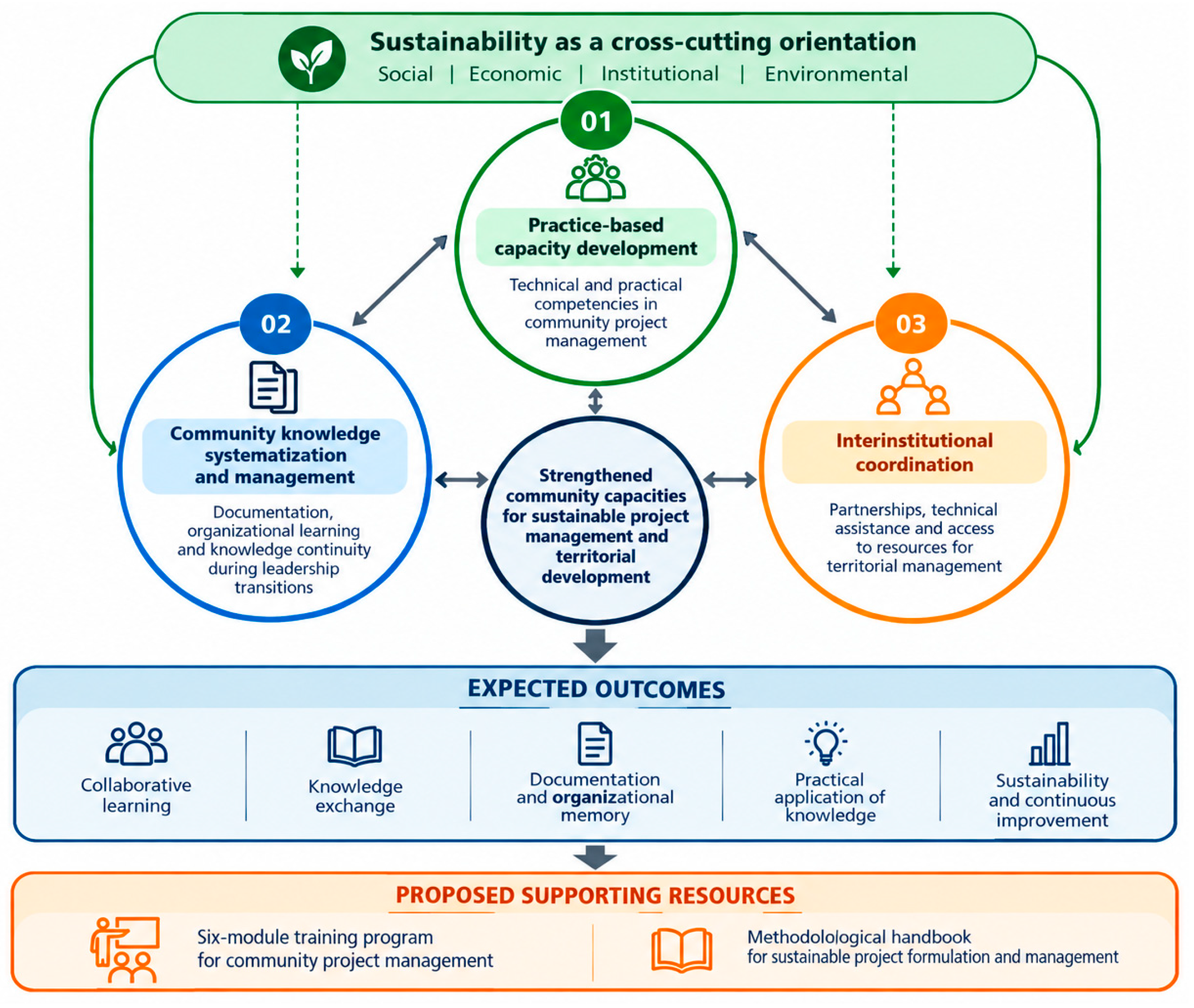
The proposed adaptive model connects three empirical patterns with complementary theoretical mechanisms. Gaps in formulation, budgeting, and sustainability informed practice-based capacity development through organizational learning theory. Informal knowledge transfer informed systematization through SECI and tacit-knowledge conversion. Limited technical assistance and cooperation networks informed interinstitutional coordination through social-capital perspectives. Sustainability is a cross-cutting orientation. This mapping links the diagnosis, conceptual framework, and model components.
The proposed model integrates (1) practice-based capacity development, (2) community knowledge systematization, and (3) interinstitutional coordination. Collaborative learning is intended to support sharing, documentation, retention, and application of knowledge. Neither the model nor the associated training program and handbook were formally validated, piloted, or evaluated with stakeholders or experts. They remain context-specific proposals requiring stakeholder review, pilot implementation, and evaluation.
5.2. Training Program
The empirical diagnosis also informed the design of a proposed six-module training program for Community Action Boards in the Central Province of Boyacá. Its structure responds to recurrent needs identified through the two instruments and follows a progressive pathway from organizational and territorial foundations to knowledge transfer, project formulation, resource management, sustainability, and institutional coordination. Among survey respondents, project formulation was the most frequently selected training priority (22/50; 44%), followed by community project management and sustainability (9/50; 18%), strategic partnerships and cooperation networks (7/50; 14%), and budgetary and financial management (6/50; 12%). These results, together with the qualitative themes identified in the interviews, informed the prioritization of the modules.
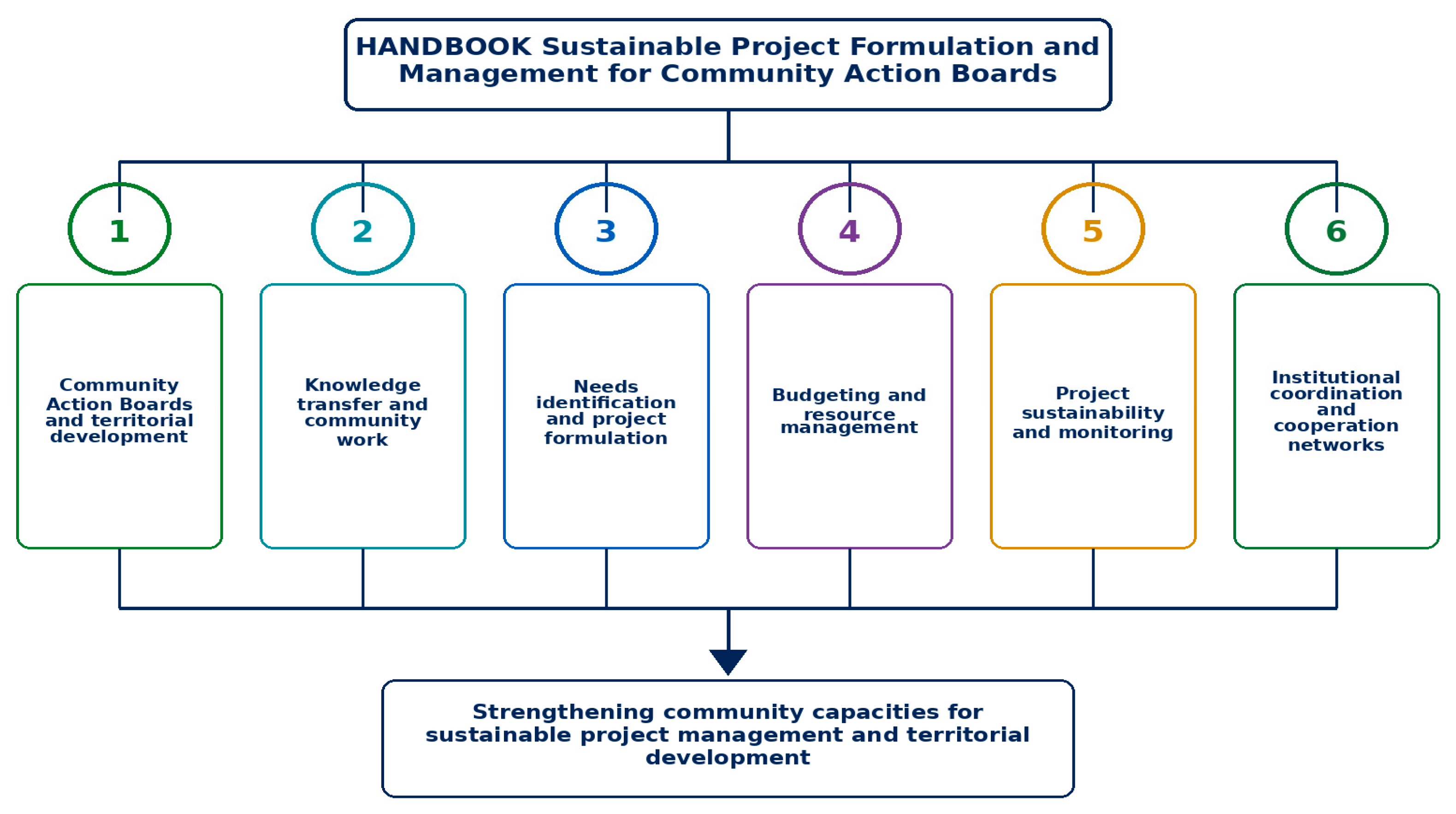
The proposed program comprises 30 h distributed across six sequential modules. Greater instructional time is allocated to needs identification and project formulation (8 h) and to budget and resource management (6 h), reflecting the practical and procedural scope of these components; the remaining four modules are allocated 4 h each. The duration and sequencing are program-design decisions and have not yet been empirically evaluated. Table 6 summarizes the alignment between the diagnostic needs and the proposed training structure.
Table 6.
Empirical alignment between identified needs and the proposed training program.
5.3. Methodological Handbook for Sustainable Project Management
A further proposed output was a methodological handbook for sustainable project formulation and management, adapted to the context of Community Action Boards in the Central Province of Boyacá. The handbook was developed as a practical support resource accompanying the proposed model and training program and is intended to translate the identified capacity-building needs into accessible guidance and tools for community project management. It had not undergone stakeholder or expert validation, pilot testing, or evaluation of usability or effectiveness at the time of the study.
The handbook was structured around the needs identified by Community Action Board presidents and members during the diagnostic phase. Its contents employ accessible language and context-specific examples reflecting rural conditions in Boyacá, with the aim of making the material usable by community leaders with varying levels of formal education.
The opening section introduces the legal framework governing Community Action Boards and their role in territorial development. Subsequent sections provide practical guidance on participatory diagnosis and the identification of local problems, adapting both the Logical Framework Approach and Colombia’s Adjusted General Methodology (MGA) to the dynamics of community action.
The handbook also provides guidance on budget preparation, the identification of funding sources, the design of monitoring indicators, and operational criteria for assessing sustainability across social, economic, institutional, and environmental dimensions. In addition, it incorporates governance guidelines intended to support technical engagement with public institutions and strengthen organizational capacities [24].
The proposed model, training program, and handbook respond to needs identified in the Central Province of Boyacá. Application elsewhere would require adaptation to local organizational capacities, community needs, institutions, training infrastructure, and public-sector relationships.
5.4. Limitations and Future Research
This study has several limitations. First, the non-probability convenience sampling strategy and the context-specific focus on Community Action Boards in the Central Province of Boyacá mean that the two participant samples are not statistically representative of the 161 Community Action Boards in the study area or of Community Action Boards in Colombia. Second, the institutional ecosystem of Boyacá—including relationships with municipal administrations, the departmental government, SENA, higher education institutions, and other territorial actors—forms part of the local context and may differ substantially elsewhere. Third, full verbatim interview transcripts were not produced; instead, the main ideas expressed in each response were documented in structured records and consolidated for deductive thematic analysis. When interpretations required verification, these records were cross-checked against the original audio recordings. Fourth, the proposed model, training program, and methodological handbook were not formally validated by Community Action Board members, external experts, or other stakeholders and were not piloted or evaluated. Future research should therefore begin with stakeholder and expert review, followed by pilot implementation and evaluation of feasibility, usability, uptake, changes in project-management knowledge and capacities, and the extent to which acquired knowledge is transferred into organizational practices. Subsequent studies in other regional settings should also assess which components are transferable and which require contextual adaptation.
6. Conclusions
Within the Central Province of Boyacá, the findings indicate that Community Action Boards play an important role in participatory democracy and community-led local development, while persistent gaps in project-management training, methodological knowledge, and institutional coordination constrain their capacity to formulate and manage sustainable community projects.
The two independent participant groups provided complementary evidence of these needs. Previous training and practical project experience were limited or uneven, while knowledge transfer relied largely on informal and experience-based practices. This pattern highlights the relevance of mechanisms that can organize, share, and preserve community knowledge across leadership transitions.
The study developed three context-specific proposals: a knowledge-transfer model, a 30 h six-module training program, and a methodological handbook. The model integrates capacity development, knowledge systematization, and interinstitutional coordination; the accompanying resources translate identified needs into practical guidance on project formulation, resource management, monitoring, sustainability, and partnerships. Figure 1 and Figure 2 illustrate the conceptual model and its applied methodological pathway.
Figure 1.
Proposed knowledge-transfer model for sustainable community project management. Note: Authors’ own elaboration based on the study findings (2026).
Figure 2.
Contents of the methodological handbook for sustainable project formulation and management. Note: Authors’ own elaboration based on the study findings (2026).
These outputs had not been formally validated, implemented, piloted, or evaluated at the time of the study and should not be interpreted as evidence of effectiveness or impact. Their next research phase requires stakeholder and expert review, implementation, and evaluation within the study context, followed by assessment of potential transferability to other settings under comparable organizational, territorial, and institutional conditions.
The study integrates knowledge conversion, organizational learning, social capital, and capacity building to interpret project-management needs in the Central Province of Boyacá. Its proposed model, training program, and handbook require contextual adaptation and evaluation before application elsewhere.
Author Contributions
Conceptualization, M.A.S.F. and N.S.R.M.; methodology, M.A.S.F., M.d.P.E.B. and N.S.R.M.; formal analysis, M.d.P.E.B.; investigation, M.A.S.F., M.d.P.E.B. and N.S.R.M.; writing—original draft preparation, M.A.S.F. and M.d.P.E.B.; writing—review and editing, M.A.S.F.; project administration, M.A.S.F.; funding acquisition, M.A.S.F. All authors have read and agreed to the published version of the manuscript.
Funding
This research was funded by the Universidad Nacional Abierta y a Distancia (UNAD), Colombia, through Call 13, under research project PIZCBOY132025.
Institutional Review Board Statement
Ethical approval by an institutional review board was not required for this study. The research was conducted in accordance with the ethical considerations established for the project and with applicable Colombian regulations governing social and community-based research, including Law 1581 of 2012 on the protection of personal data. The research protocol ensured respect for participants’ rights and dignity, confidentiality of the information collected, voluntary participation, transparency throughout the research process, and the responsible dissemination of knowledge generated through the study.
Informed Consent Statement
Informed consent for participation was obtained from all subjects involved in the study.
Data Availability Statement
The data presented in this study are available from the corresponding author upon reasonable request. They are not publicly available because of participant-confidentiality considerations and applicable data-protection requirements.
Acknowledgments
The authors thank the Universidad Nacional Abierta y a Distancia (UNAD), its School of Administrative, Accounting, Economic and Business Sciences (ECACEN), participating Community Action Board presidents and members from the Central Province of Boyacá, and the Government of Boyacá and its Secretariat of Government for their support. ChatGPT (GPT 6-OpenAI) was used for English translation, language editing, and stylistic refinement only, not for research data generation, analysis, interpretation, or conclusions. The authors reviewed and verified the text and accept responsibility for the manuscript.
Conflicts of Interest
The authors declare no conflicts of interest.
Abbreviations
The following abbreviations are used in this manuscript:
| UNAD | National Open and Distance University (Universidad Nacional Abierta y a Distancia) |
| ECACEN | School of Administrative, Accounting, Economic and Business Sciences |
| SENA | National Learning Service (Servicio Nacional de Aprendizaje) |
| MGA | Adjusted General Methodology |
| SDGs | Sustainable Development Goals |
| SECI | Socialization, Externalization, Combination, and Internalization |
References
- Congress of the Republic of Colombia. Law 2166 of 2021: Repealing Law 743 of 2002 and Developing Article 38 of the Political Constitution of Colombia Regarding Community Action Organizations. 2021. Available online: https://www.funcionpublica.gov.co/eva/gestornormativo/norma.php?i=184758 (accessed on 14 September 2026).
- Ministry of the Interior of Colombia. Community Action Organizations (OAC). Available online: https://www.mininterior.gov.co/organizaciones-de-accion-comunal-oac/ (accessed on 14 September 2026).
- Lauer, S.; Wong, K.L.Y.; Yan, M.C. Social Infrastructure, Community Organizations, and Friendship Formation: A Scoping Review. Community Dev. J. 2025, 60, 267–285. [Google Scholar] [CrossRef] [Scilit]
- Lang, W.; Gkartzios, M.; Yan, J.; Chen, T.; Tan, S. Community Co-Creation through Knowledge (Co)Production: The Engagement of Universities in Promoting Rural Revitalization in China. J. Rural Stud. 2024, 112, 103455. [Google Scholar] [CrossRef] [Scilit]
- Líppez-De Castro, S.; Guerrero-Rodríguez, F.A.; Tobón, G.J.; Nina-Baltazar, E.A. Community Action Boards and Rural Governance: Challenges for Communities’ Organization and Participation in Six Territories of Nariño, Colombia. Opera 2021, 28, 239–259. [Google Scholar] [CrossRef] [Scilit]
- Marcano Aular, Y.; Marín González, F.; Jiménez, C. Gestión del conocimiento en organizaciones comunales. Análisis desde una dimensión estructural-funcional. Rev. Venez. Anál. Coyunt. 2013, 19, 167–181. [Google Scholar]
- Nonaka, I.; Takeuchi, H. The Knowledge-Creating Company: How Japanese Companies Create the Dynamics of Innovation; Oxford University Press: New York, NY, USA, 1995. [Google Scholar]
- Duong, N.-A.; Nakamoto, R. Mapping the Socialization Externalization Combination Internalization Model's Evolution: A Systematic Literature Review for Future Research. Knowl. Process Manag. 2026, 1–18. [Google Scholar] [CrossRef] [Scilit]
- Seghroucheni, O.Z.; Al Achhab, M.; Lazaar, M. Systematic Review on the Conversion of Tacit Knowledge. In Proceedings of the 2023 7th IEEE Congress on Information Science and Technology (CiSt), Agadir–Essaouira, Morocco, 16–22 December 2023; IEEE: Piscataway, NJ, USA, 2023; pp. 123–128. [Google Scholar] [CrossRef] [Scilit]
- Fenoglio, E.; Kazim, E.; Latapie, H.; Koshiyama, A. Tacit Knowledge Elicitation Process for Industry 4.0. Discov. Artif. Intell. 2022, 2, 6. [Google Scholar] [CrossRef] [Scilit]
- Lim, S.; Min, B.H.; Berlan, D.G. The Nonprofit Role in Building Community Social Capital: A Moderated Mediation Model of Organizational Learning, Innovation, and Shared Mission for Social Capital Creation. Nonprofit Volunt. Sect. Q. 2024, 53, 210–235. [Google Scholar] [CrossRef] [Scilit]
- Romero Leal, K.L. Participación comunitaria en la Junta de Acción Comunal de La Macarena, barrio bohemio de Bogotá. Rev. Ciudades Estados Política 2017, 4, 37–62. [Google Scholar]
- Langmann, S.; Bezemer, P.; Sharafizad, F. Visualising Community Capacity in Sustainable Development. J. Dev. Stud. 2025, 61, 493–517. [Google Scholar] [CrossRef] [Scilit]
- Rojas Casarrubias, C.; Aparicio López, J.L.; Rodríguez Alviso, C.; Castro Bello, M.; Villerías Salinas, S. Community Environmental Leadership and Sustainability: Building Knowledge from the Local Level. Sustainability 2025, 17, 3626. [Google Scholar] [CrossRef] [Scilit]
- Arapovics, M. Sustainable Community Services, Community Working Methods and Practices. Societies 2025, 15, 282. [Google Scholar] [CrossRef] [Scilit]
- Osborne, S.P. Introduction: The (New) Public Governance: A Suitable Case for Treatment? In The New Public Governance? Emerging Perspectives on the Theory and Practice of Public Governance; Osborne, S.P., Ed.; Routledge: London, UK, 2010; pp. 1–16. [Google Scholar]
- Aguilar Villanueva, L.F. Gobernanza y Gestión Pública; Fondo de Cultura Económica: Mexico City, Mexico, 2006. [Google Scholar]
- Morales Caballero, L.Y. La gestión pública como factor del desarrollo institucional en América Latina, 2025: Una revisión sistémica. Aula Virtual 2025, 6, 2487–2505. [Google Scholar] [CrossRef]
- Sánchez Otero, M. Diagnóstico estratégico de las Juntas de Acción Comunal. Económicas CUC 2012, 33, 65–80. [Google Scholar]
- Millán-Pérez, C.A.; Castro-Silva, H.F.; Virgüez, J.F. Methodology for Transferring Human Capital Capacities for Project Management in Community Action Boards: The Colombia Case. AiBi Rev. Investig. Adm. Ing. 2020, 8, 154–164. [Google Scholar] [CrossRef] [Scilit]
- Anand, A.; Muskat, B.; Creed, A.; Zutshi, A.; Csepregi, A. Knowledge Sharing, Knowledge Transfer and SMEs: Evolution, Antecedents, Outcomes and Directions. Pers. Rev. 2021, 50, 1873–1893. [Google Scholar] [CrossRef] [Scilit]
- Chaparro, F. Conocimiento, aprendizaje y capital social como motor de desarrollo. Ci. Inf. 2001, 30, 19–31. [Google Scholar] [CrossRef] [Scilit]
- Davis, L.F.; Ramírez-Andreotta, M.D. Participatory Research for Environmental Justice: A Critical Interpretive Synthesis. Environ. Health Perspect. 2021, 129, 026001. [Google Scholar] [CrossRef] [Scilit] [PubMed]
- Putnam, R.D. Bowling Alone: The Collapse and Revival of American Community; Simon & Schuster: New York, NY, USA, 2000. [Google Scholar]

Disclaimer/Publisher’s Note: The statements, opinions and data contained in all publications are solely those of the individual author(s) and contributor(s) and not of MDPI and/or the editor(s). MDPI and/or the editor(s) disclaim responsibility for any injury to people or property resulting from any ideas, methods, instructions or products referred to in the content. |
© 2026 by the authors. Licensee MDPI, Basel, Switzerland. This article is an open access article distributed under the terms and conditions of the Creative Commons Attribution (CC BY) license.