


Abstract
This study examines the tension between “substance” and “form” in standardized sustainability reporting within an emerging market context. Using 21,964 firm-year observations from Chinese A-share listed companies (2018–2023), we investigate whether the adoption of the Global Reporting Initiative (GRI) framework enhances substantive Environmental, Social, and Governance (ESG) and creates firm value. While baseline regressions suggest a positive link between GRI and ESG performance, rigorously applying Propensity Score Matching (PSM) reveals a critical nuance: the effect of mere framework adoption attenuates after controlling for selection bias, whereas independent assurance remains a robust driver of substantive governance quality. Furthermore, mediation analysis using bootstrap resampling documents a distinct “Labeling Effect”: GRI adoption directly enhances market valuation (Tobin’s Q), yet the indirect path via ESG scores is statistically insignificant. This indicates that investors utilize GRI as a heuristic signal of legitimacy rather than pricing granular performance metrics. We also identify a “Valuation Latency”, where substantive ESG improvements significantly boost operational profitability (ROA) but are not yet fully incorporated into stock prices. Heterogeneity analysis shows these effects are stronger for non-state-owned enterprises (Non-SOEs), supporting the view that private firms leverage standardized reporting and verification to mitigate legitimacy deficits. These findings provide empirical evidence for regulators and investors to distinguish between the “label” of adoption and the “substance” of verification.
1. Introduction
In the wake of global climate change challenges and the overarching goal of sustainable development, corporate sustainability reporting has evolved from a niche voluntary practice to a mainstream expectation in global capital markets [1,2,3]. Credible sustainability disclosure helps investors assess long-term strategic orientation and risk exposure, increasingly becoming a priced component of firm value [4,5]. In China, the world’s largest emerging economy, this shift is accelerated by the government’s “Dual Carbon” goals and the transition toward high-quality development [6]. As regulatory pressure mounts, Chinese listed firms are increasingly adopting international frameworks, such as the Global Reporting Initiative (GRI), to disclose their non-financial performance. However, a critical question remains: Does the adoption of these standardized frameworks reflect a substantive improvement in sustainability governance, or is it merely a symbolic “label” to solicit market valuation premiums?
Existing literature largely assumes a linear relationship: standardized reporting improves transparency, which enhances ESG performance, and subsequently increases firm value [7,8]. However, this conventional wisdom faces challenges in emerging markets where information asymmetry is high and market efficiency is evolving. Fragmented reporting practices and varying levels of investor sophistication create noise, increasing the scope for symbolic reporting and “greenwashing” [9,10]. Consequently, capital markets may struggle to distinguish substantive ESG performance from impression management [11]. While standardization initiatives like GRI aim to reduce this opacity by providing structured indicators [12,13], evidence on their efficacy in China remains mixed. Furthermore, the role of external assurance—a key mechanism for strengthening credibility [14,15]—in moderating these relationships requires deeper investigation.
Despite these advances, prior research typically analyzes reporting quality, assurance, and valuation outcomes separately, leaving a “black box” regarding how they interact. Specifically, few studies have examined the potential decoupling between the signal of disclosure (the reporting label) and the substance of performance (the ESG score) in pricing mechanisms. Does the market reward the act of reporting, or the result of reporting?
To address these unresolved issues, this study investigates the impact of GRI adoption and sustainability assurance on ESG performance and market-based valuation (Tobin’s Q) for Chinese A-share listed firms. Using 21,964 firm-year observations from 2018–2023, we employ fixed-effects models and Propensity Score Matching (PSM) to isolate causal effects. Our empirical results reveal a nuanced picture of China’s green finance market.
First, we find that GRI adoption and sustainability assurance significantly improve ESG performance scores and accounting-based profitability (ROA). This confirms that standardized reporting acts as a governance disciplining mechanism that drives substantive operational improvements, rejecting the view that it is purely “cheap talk” [16].
Second, and most importantly, we identify a “Labeling Effect.” While GRI adoption directly enhances firm value (Tobin’s Q), the mediating path through ESG performance is statistically insignificant. This suggests that investors currently price the “GRI label” as a high-level signal of legitimacy and internationalization but exhibit latency in pricing the specific ESG scores. This finding contrasts with studies in developed markets where ESG performance is often directly priced [4], highlighting a unique valuation inefficiency in the Chinese context.
Third, we observe institutional heterogeneity. The governance-enhancing effects of standardized reporting are significantly stronger for Non-State-Owned Enterprises (Non-SOEs). Lacking the implicit political endorsement enjoyed by SOEs, private firms have stronger incentives to leverage international standards and assurance as compensatory mechanisms to bridge the legitimacy deficit [17].
This study contributes to the literature in three ways. First, it provides mechanism-level evidence on the decoupling between operational benefits (ROA) and market valuation (Tobin’s Q) in emerging markets, challenging the assumption of immediate market efficiency for non-financial information. Second, it distinguishes the distinct roles of financial auditors (Big-4) and specialized sustainability assurance, finding that while Big-4 auditors drive market valuation, specialized assurance drives substantive governance quality. Third, it offers policy-relevant evidence for regulators and investors seeking to differentiate substantive sustainability progress from symbolic reporting in China’s rapidly evolving capital market.
2. Literature Review and Hypothesis Development
2.1. Standardized Sustainability Reporting and ESG Performance
Sustainability reporting frameworks, notably the Global Reporting Initiative (GRI), function as institutional infrastructure designed to mitigate information asymmetry by enhancing the comparability, consistency, and verifiability of non-financial disclosures. Drawing upon institutional theory and voluntary disclosure theory, standardized reporting provides a structured lexicon for communicating sustainability efforts, thereby reducing the processing costs for stakeholders [12,13,18]. Empirical scholarship indicates that the adoption of established frameworks constrains managerial discretion and curtails symbolic reporting, promoting the substantive quality of environmental, social, and governance (ESG) disclosures [16,19].
In emerging economies such as China, where ESG disclosure practices exhibit significant heterogeneity, GRI adoption facilitates institutional isomorphism and alignment with global reporting norms [3,20]. Recent empirical evidence from the Chinese context suggests that firms utilizing indicator-based reporting formats receive more favorable external ESG assessments, as standardized data are more amenable to integration by rating agencies [21,22]. Furthermore, the implementation of such frameworks often necessitates the restructuring of internal data collection systems and sustainability coordination mechanisms, which subsequently translates into substantive improvements in ESG performance [23,24]. Consequently, consistent disclosure enhances the visibility of a firm’s sustainability commitment, enabling third-party rating agencies to evaluate ESG performance with greater accuracy and reduced measurement error [16,25].
Based on these theoretical and empirical antecedents, the following hypothesis is proposed:
Hypothesis 1 (H1).
The adoption of the GRI reporting framework is positively associated with corporate ESG performance.
2.2. ESG Performance and Market-Based Valuation
The nexus between ESG performance and firm value has been the subject of extensive academic scrutiny, with a converging consensus suggesting a non-negative or positive association [4,15]. Signaling theory posits that superior ESG performance serves as a credible signal of robust risk management capabilities and long-term strategic resilience, which investors incorporate into valuation models to adjust discount rates and cash flow expectations [26,27]. Investor-centric literature demonstrates that capital markets utilize ESG information to assess downside risks, regulatory exposure, and the sustainability of future earnings [2,5,28,29].
In the specific context of China’s capital market, ESG ratings are increasingly recognized as material value drivers. Empirical studies document that strong ESG performance is associated with a lower cost of equity capital [1,30] and higher Tobin’s Q, particularly when ownership structures are aligned with long-term value creation [17,31]. Research further suggests that ESG performance enhances firm value by reducing information asymmetry and fostering investor confidence, thereby acting as a buffer against market volatility during exogenous shocks [7,8]. Moreover, substantive ESG improvements—particularly in heavy pollution industries and manufacturing sectors—have been empirically linked to enhanced future financial performance and stakeholder legitimacy [6,32]. Although market inefficiencies in emerging economies may induce a “valuation gap,” prevailing expectations remain that superior sustainability governance contributes to value creation [33,34].
Accordingly, the second hypothesis is formulated as follows:
Hypothesis 2 (H2).
Corporate ESG performance is positively associated with market-based valuation (Tobin’s Q).
2.3. Sustainability Assurance as a Moderator
While standardized disclosure frameworks (e.g., GRI) provide a necessary structure for reporting, they do not inherently guarantee the reliability or veracity of the disclosed information. To mitigate the agency costs associated with “greenwashing” and symbolic disclosure, firms increasingly engage independent third-party sustainability assurance [10,35]. Distinct from financial statement audits which verify historical financial data, sustainability assurance specifically validates the accuracy, completeness, and materiality of non-financial ESG metrics [36,37].
Prior literature establishes sustainability assurance as a critical credibility mechanism. By subjecting a firm’s sustainability claims to external verification, assurance reinforces stakeholder trust and distinguishes substantive ESG commitments from impression management tactics [14,38]. Research focusing on assurance quality suggests that verified reports are perceived as more credible by rating agencies and investors, leading to more accurate—and frequently higher—external ESG assessments [39,40]. In the Chinese market, where trust in voluntary disclosure is historically lower than in developed markets, external assurance signals a firm’s confidence in its data quality and its willingness to submit to external monitoring [41]. Furthermore, assurance effectively mitigates information asymmetry, allowing the market to better interpret standardized disclosures [42]. Consequently, the positive relationship between GRI adoption and ESG performance is expected to be amplified when the disclosure is backed by independent assurance.
Thus, it is hypothesized that:
Hypothesis 3 (H3).
Sustainability assurance positively moderates the relationship between GRI disclosure and ESG performance, such that the relationship is stronger for firms with assured reports.
2.4. ESG Performance as a Mediation Mechanism
The relationship between disclosure frameworks (GRI) and firm value is likely indirect, mediated by the firm’s substantive sustainability performance. Mere adoption of a reporting framework may not yield valuation benefits unless it catalyzes tangible improvements in ESG practices that are valued by investors. Integrating institutional theory with signaling theory, a two-stage mechanism is posited: first, standardized reporting (GRI) and external verification (Assurance) enhance internal governance and data quality, resulting in superior measurable ESG performance; second, this enhanced ESG performance signals lower idiosyncratic risk and better future prospects to the capital market, thereby increasing firm value [1,24].
Recent empirical work supports this mediation pathway, finding that transparency mechanisms influence financial outcomes primarily by improving environmental and governance fundamentals. ESG performance thus functions as the transmission mechanism through which the “structure” of reporting (GRI) is converted into “economic value” (Tobin’s Q). Particularly in China, where regulatory scrutiny on sustainability is intensifying, the market is theorized to reward the substantive ESG outcomes facilitated by standardized reporting rather than the reporting label itself.
Therefore, the final hypothesis is posited:
Hypothesis 4 (H4).
ESG performance mediates the relationship between GRI disclosure and market-based valuation.
3. Methodology
3.1. Research Design
This study employs a quantitative empirical design using an unbalanced panel of Chinese A-share listed firms from 2018 to 2023. The primary objective is to examine whether the adoption of the Global Reporting Initiative (GRI) reporting framework is associated with enhanced ESG performance and subsequent market-based firm valuation, and whether sustainability assurance (distinct from financial audit quality) strengthens these relationships.
To address methodological concerns regarding model transparency and endogeneity, this study adopts a multi-stage panel data regression approach. This approach facilitates a transparent estimation of the determinants of ESG performance (Stage 1) and the valuation consequences of ESG (Stage 2). Furthermore, to rigorously address endogeneity and unobserved heterogeneity, firm fixed-effects (FE) models are utilized for internal governance outcomes, while OLS with industry fixed effects combined with lagged independent variables are applied for valuation outcomes. This design aligns with standard econometric practices in corporate finance and accounting research [22,39].Data processing and statistical analyses were conducted using Stata 18 (StataCorp LLC, College Station, TX, USA).
3.2. Framework Development
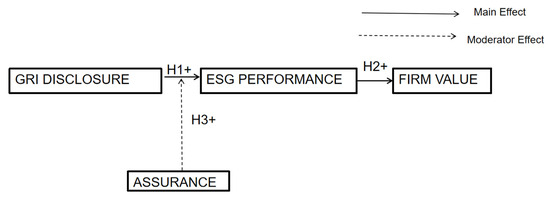
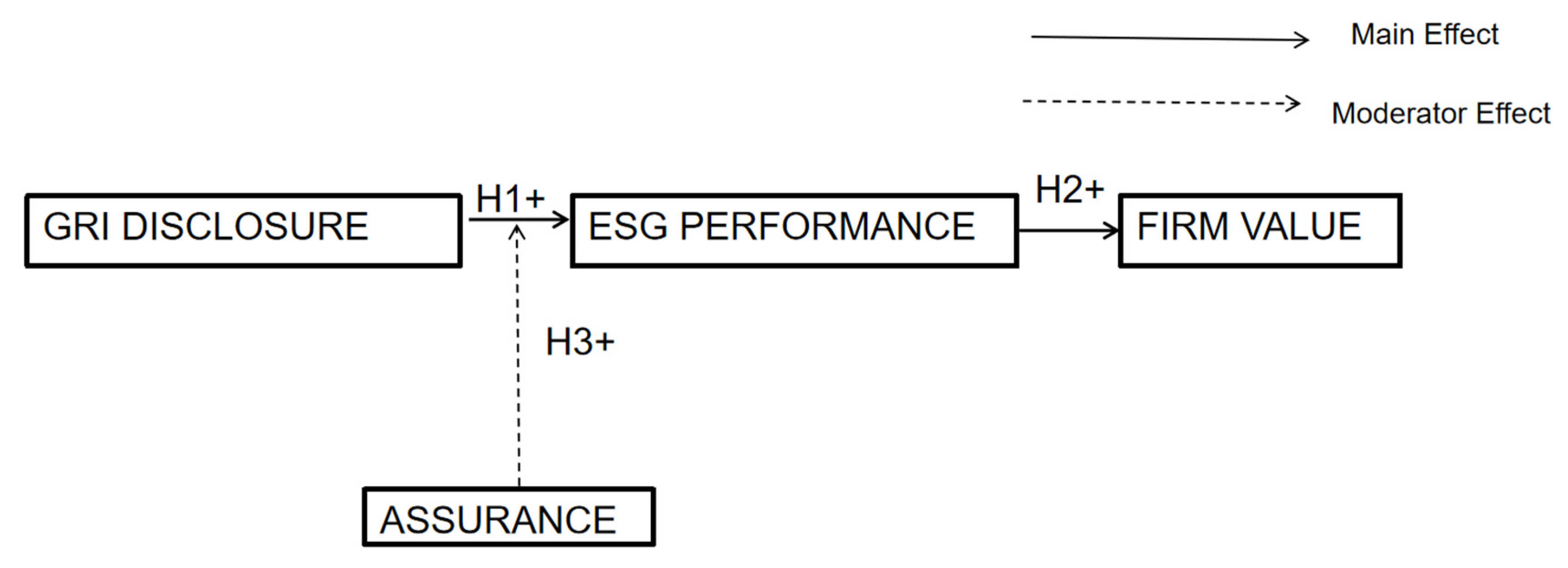
The conceptual model posits GRI adoption as a standardized disclosure mechanism that enhances the consistency and comparability of sustainability reporting. It is hypothesized that improved disclosure practices facilitate better ESG performance by structuring internal reporting processes. Subsequently, ESG performance is expected to contribute to higher firm valuation by strengthening stakeholder perceptions and reducing information asymmetry. Crucially, distinguishing between financial audit quality and sustainability assurance, the framework incorporates Sustainability Assurance as the key moderator. It is posited that third-party assurance on ESG reports—distinct from financial statement audits—improves the credibility of disclosed information, thereby strengthening the link between standardized reporting (GRI) and substantive ESG outcomes. The framework integrates a direct pathway moderated by assurance, and a valuation pathway , as illustrated in Figure 1.
Figure 1.
Conceptual Framework.
3.3. Data and Sample Selection
The initial sample comprises all A-share companies listed on the Shanghai and Shenzhen Stock Exchanges from 2018 to 2023. To ensure the validity and comparability of the dataset, the following screening criteria were applied:
Exclusion of Financial Firms: Firms in the financial sector (banking, insurance, and diversified financials) were excluded due to their unique accounting standards and regulatory environments.
Exclusion of Abnormal Status Firms: Firms classified as “Special Treatment” (ST) or “Particular Transfer” (PT) were excluded to avoid bias arising from financial distress or abnormal trading conditions.
Missing Data: Observations with missing values for key variables were removed.
Data Sources
Financial Data: Extracted from the CSMAR database.
ESG Ratings: Sourced from the Wind database (specifically, the Huazheng ESG rating system). The Huazheng ESG evaluation system is widely recognized in academic research on Chinese listed firms due to its comprehensive coverage and quarterly updates. It assesses corporate sustainability performance across 3 primary pillars (Environmental, Social, and Governance), 14 sub-dimensions, and 26 key indicators. It assigns ratings on a nine-point scale ranging from C to AAA. In this study, we utilize the composite ESG scores provided by the system to capture the granular variation in sustainability performance.
Sustainability Assurance: Obtained from the CSMAR database (Social Responsibility/ESG Research Series). This variable specifically identifies whether the firm’s sustainability report received third-party independent assurance.
GRI Adoption: Retrieved from the CSMAR database. The variable is coded as 1 if the database indicates that the firm reported in accordance with the Global Reporting Initiative (GRI) framework, and 0 otherwise.
Data Pre-processing: To mitigate the influence of outliers, a standard winsorization strategy was implemented. All continuous variables (e.g., TobinQ, Leverage, ROA) were winsorized at the 1st and 99th percentiles. After applying these screening and cleaning procedures, the final unbalanced panel consists of 21,964 firm-year observations for the analysis.
3.4. Variable Measurement
Table 1 provides detailed definitions for all variables.
Table 1.
Variable Definitions.
Independent Variable GRI adoption: A dummy variable equal to 1 if the firm reports using the GRI framework, and 0 otherwise. This captures the commitment to standardized disclosure [11].
Mediator ESG_score: The composite ESG performance score rated by Huazheng (Wind Database). This construct reflects externally assessed sustainability outcomes [4,16].
Moderator Sustainability Assurance (Assurance): A dummy variable equal to 1 if the sustainability report received third-party assurance, and 0 otherwise. This variable captures the specific credibility of non-financial disclosures, distinct from financial audit quality [38,39].
Dependent Variable: Tobin’s Q: Calculated as (Market value of equity + Total liabilities)/Total assets. This market-valuation metric captures investor forward-looking expectations [22].ROA (Robustness): Net income/Total assets, utilized as an alternative accounting-based performance measure.
Control Variables: A comprehensive set of 8 control variables is included to mitigate omitted variable bias. Big 4 (Financial Audit Quality): A dummy variable equal to 1 if the firm is audited by a Big-4 accounting firm. This controls for the spillover effects of high-quality financial reporting environments. Firm Size (Ln_Assets): The natural logarithm of total assets, controlling for size effects. NED_Ratio: The proportion of non-executive directors (Number of NEDs/Board Size), reflecting board independence monitoring capacity. Other controls include Leverage, EPS, SOE status, CEO Duality, and Board Size.
3.5. Model Specification
To rigorously test the hypotheses, the following regression models are estimated. Stage 1: Determinants of ESG Performance (H1 & H3)A high-dimensional fixed-effects model is employed to examine how standardized reporting and assurance influence ESG performance. This specification controls for firm-invariant heterogeneity by including firm fixed effects () and time-specific shocks by including year fixed effects ().
where tests the main effect of GRI adoption (H1), and tests the moderating effect of Sustainability Assurance (H3). Note that Big 4 is included within the vector of Controls to isolate the effect of ESG assurance from financial audit quality. Stage 2: Valuation Consequences (H2). To examine the value relevance of ESG performance, an OLS model with industry fixed effects () and year fixed effects () is estimated.
Notably, unlike Stage 1, this specification utilizes industry fixed effects () rather than firm fixed effects. This choice is driven by the nature of ESG ratings, which tend to exhibit low time-series variation (i.e., “stickiness”) within firms over short periods. Using firm fixed effects in valuation models often absorbs the meaningful cross-sectional variation in ESG performance that investors price, potentially leading to inefficient estimation. Therefore, relying on within-industry variation allows for a more accurate assessment of how the market values sustainability differentiation among peers.
Mediation Effect Analysis (Bootstrap Method)
To robustly test the mediation hypothesis (H4), we employ the Bootstrap method with 1000 replications rather than relying solely on the causal-steps approach. This technique allows us to directly estimate the indirect effect of GRI on Tobin’s Q through ESG performance and construct bias-corrected 95% confidence intervals (CI). The mediation effect is considered statistically significant if the 95% CI does not include zero. In all models, lagged independent variables (e.g., ) are utilized in the valuation stage to address reverse causality. Furthermore, standard errors are clustered at both the firm and year levels in all specifications to account for serial correlation and common time shocks.
3.6. Design of Robustness Checks
To ensure the validity of the findings, several robustness tests are performed, including: (1) Replacing the composite ESG score with pillar-level scores (Environmental, Social, and Governance) to examine heterogeneous effects; and (2) Using ROA as an alternative dependent variable to verify if results hold for accounting-based performance measures.
3.7. Endogeneity Considerations
While the baseline models are designed to minimize bias, endogeneity remains a pervasive concern in corporate governance research. This study addresses potential biases through four specific design features:
- (1)
- Omitted Variable Bias: The Stage 1 model incorporates firm fixed effects to strictly control for time-invariant unobserved firm heterogeneity—such as corporate culture, founding history, or innate management quality. Additionally, the Stage 2 model includes industry fixed effects to absorb sector-specific valuation premiums.
- (2)
- Reverse Causality: In the valuation analysis (Stage 2), lagged independent variables () are employed. This temporal separation mitigates simultaneity bias, addressing the concern that higher-valued firms might simply possess more slack resources to invest in ESG.
- (3)
- Macroeconomic Shocks: All regression specifications include year fixed effects () to absorb time-varying external shocks common to all firms, such as regulatory changes or economic cycles.
- (4)
- Self-Selection Bias (PSM): Recognizing that GRI adoption is a voluntary choice, we employ Propensity Score Matching (PSM) to construct a comparable control group. First, we estimate the probability of GRI adoption using a logit model that includes all control variables. Second, we perform 1:1 nearest neighbor matching (without replacement) to pair each adopting firm with a non-adopting peer that has the closest propensity score. Finally, to ensure the validity of the matching, we conduct balance tests (assessing standardized mean differences) and verify common support (overlap) between the treated and control groups.
By combining rigorous fixed-effects specifications, lagged structures, and matching techniques, this study aims to provide robust estimates of the relationships between standardized disclosure, assurance, and firm value.
4. Results
4.1. Descriptive Analysis
Table 2 presents the descriptive statistics for the main variables used in the regression analysis, based on a final sample of 21,964 firm-year observations. Panel A reports the summary statistics for continuous variables, while Panel B presents the distribution of dichotomous variables. All continuous variables have been winsorized at the 1st and 99th percentiles to mitigate the influence of outliers.
Table 2.
Descriptive Statistics.
Key Variables: As shown in Panel A, the dependent variable, Tobin’s Q, has a mean value of 1.931 and a standard deviation of 1.222. The values range from 0.815 to 8.055, indicating a significant variation in firm valuation across the sample, which facilitates the identification of valuation effects. The primary independent variable, ESG_Score, has a mean of 6.012 with a standard deviation of 0.796. The range (Min = 4.260, Max = 8.280) suggests that while ESG disclosure is widespread, the quality of ESG performance varies substantially among Chinese listed firms.
Adoption Rates (Panel B)—Crucial for Reviewer 2: Panel B reveals the structural characteristics of ESG practices in China’s emerging market.
GRI Adoption: The mean value for GRI is 0.150, indicating that 15.0% of the sample firms have adopted the GRI framework. This suggests that adopting international standards remains a differentiation strategy employed by a subset of high-quality firms rather than a universal baseline.
Sustainability Assurance: Notably, the mean for Assurance is 0.011, implying that only 1.1% of the observations have their ESG reports independently assured. This low ratio contrasts sharply with financial auditing practices (discussed below), highlighting that third-party verification for non-financial information is still in a nascent stage in China. The scarcity of assurance underscores its nature as a high-cost, high-credibility signal in this market context.
Control Variables: Regarding firm characteristics, the average firm size (Ln_Assets) is 22.345. The mean leverage ratio (Leverage) is 0.418. State-owned enterprises (SOE) constitute 31.4% of the sample, reflecting the ownership structure of the A-share market. Crucially, 6.4% of the firms are audited by Big 4 accounting firms (Big 4). The fact that Big 4 financial audits (6.4%) are significantly more common than ESG assurance (1.1%) supports our theoretical distinction between financial legitimacy and non-financial assurance. It confirms that Assurance in our model captures a distinct governance mechanism specific to ESG, rather than merely proxying for general audit quality.
Finally, the average Board_Size is 8.291 with a standard deviation of 1.546 (ranging from 5 to 13). The relatively concentrated distribution of board size supports the use of raw values rather than logarithmic transformation in the regression models.
4.2. Correlation Analysis
Table 3 presents the Pearson correlation matrix for the key variables used in this study. Key Correlations and Hypothesis Support: Consistent with our expectations, the correlation coefficient between GRI and ESG_Score is positive and statistically significant , providing preliminary evidence that adopting international standardized frameworks is associated with superior substantive ESG performance. Similarly, Assurance exhibits a significantly positive correlation with ESG_Score , suggesting that third-party verification effectively serves as a governance mechanism to enhance disclosure quality.Distinction between Assurance and Auditing:It is crucial to note the relationship between Assurance (ESG verification) and Big 4 (financial auditing). While they are positively correlated , the magnitude of this correlation is relatively low. This empirical evidence supports our theoretical argument that ESG assurance acts as a distinct governance signal, separate from the traditional financial auditing provided by Big 4 firms, rather than merely proxying for overall audit quality.
Table 3.
Pearson Correlation Matrix.
Multicollinearity Check:
Regarding the control variables, the correlation coefficients are generally within reasonable limits. The highest absolute correlation observed among independent variables is between Board_Size and NED_Ratio (−0.564), followed by the correlation between Ln_Assets and Leverage (0.439). These values are well below the conventional threshold of 0.7 that typically signals collinearity concerns. To rigorously rule out any potential multicollinearity issues, we calculated the Variance Inflation Factor (VIF) for all explanatory variables. As reported in the untabulated results, the maximum VIF is 1.90 (for Ln_Assets) and the mean VIF is 1.36. These figures are far below the commonly accepted threshold of 10 (Kennedy, 2008) [43], confirming that multicollinearity is not a concern in our regression models.
4.3. Main Regression Results
Table 4 reports the main regression results. Column (1) presents the determinants of ESG performance, while Column (2) examines the valuation effects.
Table 4.
The Impact of GRI and Assurance on ESG and Firm Value.
Determinants of ESG Performance (Model 1):The results in Column (1) strongly support our baseline hypothesis. The coefficient for GRI is positive and statistically significant (), confirming that adopting international reporting frameworks significantly improves substantive ESG.
Regarding the role of assurance, the coefficient for Assurance is also positive and significant (), indicating that third-party verification independently enhances ESG performance. However, the interaction term GRI × Assurance is statistically insignificant (). This suggests that GRI adoption and sustainability assurance operate as independent governance mechanisms rather than mutually reinforcing tools. Assurance provides a distinct credibility signal that elevates ESG quality regardless of the reporting framework used.
Valuation Effects and the Labeling Hypothesis (Model 2):Column (2) reveals a striking contrast consistent with the “Labeling Effect.” The coefficient for Lag_ESG is statistically insignificant (), implying that the capital market does not yet efficiently price substantive ESG performance scores. In contrast, the coefficient for Big 4 is positive and highly significant ().
This discrepancy highlights a “Valuation Latency” in the Chinese market: investors heavily reward visible, easily interpretable “labels” of legitimacy (such as Big 4 audits) but fail to incorporate granular non-financial performance metrics (ESG scores) into their valuation models.
Note on Controls: In Model 1, the coefficient for SOE is omitted due to collinearity with firm fixed effects, as ownership structure is largely time-invariant. In Model 2, consistent with standard valuation literature, larger firms (Ln_Assets) exhibit a lower Tobin’s Q due to the size discount effect.
4.4. Mechanism Analysis: The Mediation Role of ESG Performance
To investigate the transmission mechanism between GRI adoption and firm value, and to distinguish between the substantive performance channel and the direct labeling signal, we conducted a mechanism analysis using the stepwise regression method. To ensure statistical rigor, we further employed the Bootstrap method (with 1000 replications) to test the significance of the mediation path. The results are presented in Table 5.
Table 5.
Mechanism Analysis: The Mediating Role of ESG Performance.
Step 1: The Governance Improvement (Substance). First, we examine whether adopting the GRI framework leads to substantive improvements in internal governance. As shown in Panel A, Column (1), the coefficient for GRI is positive and statistically significant (). This confirms that GRI adoption is not merely symbolic; it effectively drives companies to improve their substantive ESG Scores.
Step 2: The Total Valuation Premium Second, Column (2) tests the total effect of GRI on firm value. The results indicate a significant positive relationship between GRI and Tobin’s Q (), suggesting that GRI adopters generally enjoy a valuation premium in the capital market.
Step 3 & Panel B: Evidence of the “Labeling Effect” The most critical finding emerges when we separate the direct “labeling” effect from the indirect “substantive” channel in Step 3 (Column 3) and Panel B.
- (1)
- Dominance of the Label: When both GRI and ESG scores are included in the regression (Column 3), the coefficient for GRI remains large and highly significant This indicates that the market assigns value directly to the visible signal of adoption.
- (2)
- Blocked Substantive Channel: In sharp contrast, the coefficient for the mediator, Lag_ESG, is statistically insignificant (β = −0.016, t = −0.49).
- (3)
- Bootstrap Confirmation: The Bootstrap test in Panel B further confirms this “decoupling.” The indirect effect ) is estimated at −0.005 with a p-value of 0.147, and the 95% confidence interval contains zero [−0.012, 0.002].
Conclusion: These findings strongly support the “Labeling Effect” hypothesis. Although GRI adoption successfully improves substantive ESG performance (Step 1), the capital market fails to price these granular performance improvements (insignificant indirect path). Instead, investors rely on the GRI label as a heuristic signal of legitimacy. This creates a “Valuation Latency” where the market rewards the act of reporting (the label) rather than the content of the performance.
4.5. Robustness Checks
To ensure the reliability and validity of the main findings, a series of robustness tests were conducted, with results reported in Table 6. First, to examine whether the impact of standardized reporting is driven by specific sustainability dimensions, the composite ESG score was decomposed into its three pillar-level components: Environmental (E), Social (S), and Governance (G). Columns (1) to (3) report the regression results using firm fixed effects. The coefficients for GRI adoption are positive and statistically significant across all three pillars (). Similarly, Sustainability Assurance exerts a consistent positive influence on all dimensions. These findings confirm that standardized reporting and assurance do not merely improve a single aspect of sustainability but foster a comprehensive enhancement of internal governance structures. Second, to verify whether the value relevance of ESG holds for accounting-based performance measures, Return on Assets (ROA) was employed as an alternative dependent variable to Tobin’s Q. Column (4) presents the results using industry fixed effects. Notably, the coefficient for Lagged ESG Score is positive and highly significant (). This finding provides a critical insight when contrasted with the insignificant valuation results in Table 4: while the capital market (Tobin’s Q) may exhibit latency in pricing non-financial performance, substantive ESG improvements translate immediately into operational efficiency and profitability (ROA). This suggests that the benefits of standardized reporting are “real” in accounting terms, even if the market valuation premium is still evolving.
Table 6.
Robustness Checks: Pillar Scores and Alternative Performance Measure.
4.6. Endogeneity Tests
To mitigate potential selection bias (i.e., the concern that firms with better fundamentals are simply more likely to adopt GRI), we employed the Propensity Score Matching (PSM) method. We matched GRI adopters with non-adopters using a 1:1 nearest neighbor algorithm with a caliper of 0.05.
Diagnostics (Panel A): Table 7, Panel A presents the balance diagnostics. The results demonstrate that the matching process was highly effective:
Table 7.
Endogeneity Test: Propensity Score Matching (PSM).
The standardized bias (% Bias) for all covariates is significantly reduced (all below 5%).
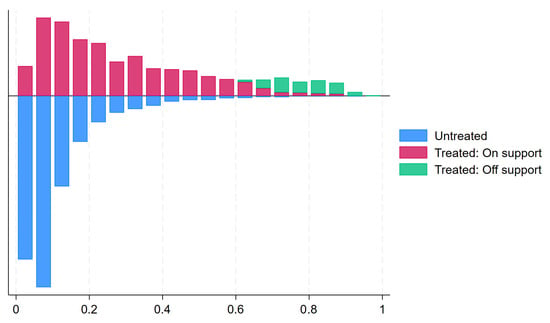
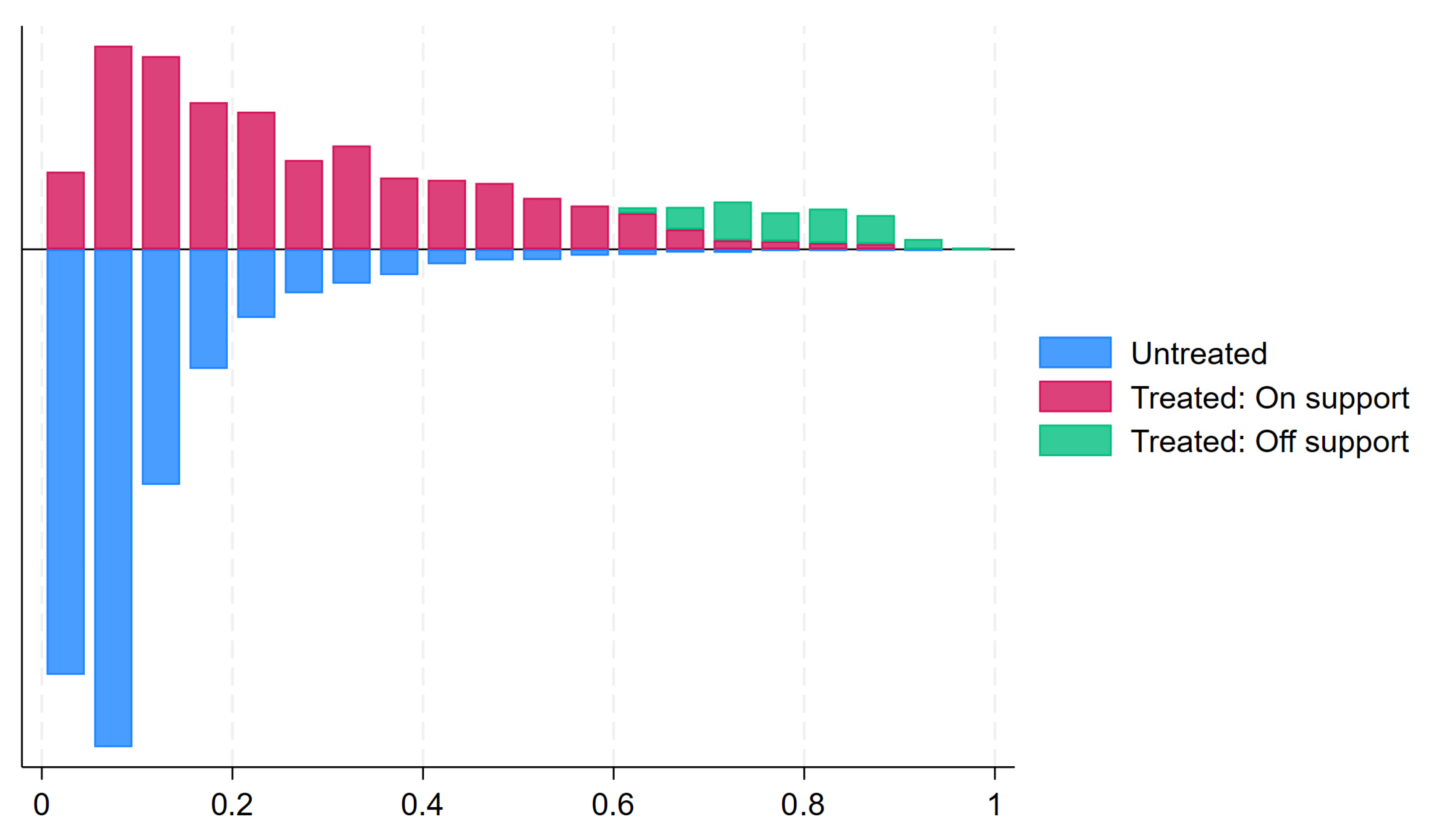
The t-tests for equality of means are statistically insignificant for all variables. This confirms that the observable characteristics between the treated and control groups are well-balanced, satisfying the balancing property and common support assumption. Visual inspection of the common support is provided in Figure 2.
Figure 2.
Propensity Score Distribution and Common Support. Note: The figure plots the distribution of propensity scores for the treated group (GRI adopters, top) and the control group (Non-adopters, bottom). Pink bars represent treated units that are “on support” (successfully matched), while green bars indicate treated units that are “off support” (discarded due to the lack of suitable matches within the 0.05 caliper). Blue bars represent the pool of untreated control units. The visual overlap confirms the validity of the common support assumption.
Regression Results (Panel B): Using this strictly matched sample (), we re-estimated the impact of GRI and Assurance on ESG performance. The results in Panel B offer a nuanced insight:
The Robustness of Assurance: The coefficient for Assurance remains positive and statistically significant . This reinforces our finding that third-party verification is a robust driver of substantive ESG performance, even when selection bias is strictly controlled.
The Attenuation of GRI: Interestingly, the coefficient for GRI becomes statistically insignificant in the matched sample.
Interpretation: This result suggests that while GRI adoption is associated with higher ESG scores in the full sample (Table 4), part of this effect may be driven by firm characteristics (selection bias). However, Assurance survives this rigorous test. This supports a “Substance over Form” interpretation: once firms are matched on fundamentals, the credibility signal provided by external assurance is a more decisive predictor of substantive ESG performance than the mere adoption of the reporting framework.
Inference: To ensure robust inference against cross-sectional and time-series dependence, standard errors in this specification are clustered at both the firm and year levels, consistent with rigorous econometric standards.
4.7. Heterogeneity Analysis
To examine whether the governance-enhancing effect of standardized reporting varies across different institutional contexts, we divided the full sample into State-Owned Enterprises (SOE) and Non-State-Owned Enterprises (Non-SOE) based on the nature of ultimate property rights. The subsample regression results are reported in Table 8.
Table 8.
Heterogeneity Analysis: Property Rights Nature.
Results: The coefficient for GRI is positive and statistically significant in both subsamples, confirming the universality of the framework’s benefits. However, a comparative analysis reveals that the magnitude of the effect is notably stronger for Non-SOE () compared to SOE (). Similarly, the impact of Assurance is substantially larger for non-state firms () than for their state-owned counterparts ().
Discussion: This heterogeneity supports the “Market Incentive Hypothesis.” SOE inherently enjoy political legitimacy and implicit government guarantees, which may weaken their marginal incentive to signal quality through voluntary disclosure standards. In contrast, Non-SOE, facing tighter financing constraints and greater information asymmetry, have stronger incentives to leverage international standards (GRI) and independent verification (Assurance) as credible signals to obtain resources and trust from stakeholders. Consequently, the marginal contribution of standardized reporting to internal governance is more pronounced in the private sector.
Inference: Consistent with our baseline model, standard errors in these subsample analyses are clustered at both the firm and year levels to ensure rigorous inference.
5. Discussion
This study empirically investigates the governance-enhancing effects of standardized reporting (GRI) and sustainability assurance within the Chinese capital market. By analyzing the dissociation between “form” (framework adoption) and “substance” (verification and operational performance), the results offer new insights into the functioning of ESG mechanisms in emerging economies.
5.1. The “Labeling Effect” and Systemic Improvements
The baseline results (Table 4) and robustness checks (Table 6) confirm that adopting the GRI framework is associated with significantly enhanced corporate ESG performance across Environmental, Social, and Governance pillars. This aligns with institutional theory, suggesting that standardized reporting operates as a mechanism for internal capacity building rather than mere window-dressing [12,18]. By adhering to the structured lexicon of GRI, firms are compelled to establish internal data collection systems, thereby reducing information asymmetry [13,16].
However, the mediation analysis (Table 5) reveals a critical disconnect: while GRI adoption is directly associated with increased firm value (Tobin’s Q), the indirect path through ESG performance scores is statistically insignificant. This finding points to a distinct “Labeling Effect.” Investors in China appear to utilize GRI adoption as a high-level heuristic signal of international alignment and legitimacy [25,27], rewarding the visible “label” of compliance immediately. Conversely, the market exhibits inefficiency in pricing the granular substance of ESG scores. This resonates with the critical view that in emerging markets, conspicuous signals of standardization often outweigh substantive performance metrics in determining short-term market valuation [9,19].
5.2. Valuation Latency: Operational Reality vs. Market Pricing
A key insight emerges from contrasting the market valuation results with accounting performance. While the impact of ESG performance on Tobin’s Q is insignificant (Table 4), its impact on ROA is positive and highly significant (Table 6).
This discrepancy implies a phenomenon of “Valuation Latency.” The significant ROA result demonstrates that standardized reporting generates tangible operational benefits—likely through improved resource efficiency and innovation capability [2,42]. Therefore, the lack of significance in Tobin’s Q does not indicate that ESG is value-irrelevant; rather, it suggests that external investors are currently underestimating the cash-flow implications of sustainability governance [4]. The market has not yet fully incorporated the “real” operational benefits of ESG into stock prices, highlighting a friction in the pricing mechanism of green finance in China [30,31]. This observation is consistent with prior literature suggesting that market recognition often lags behind actual corporate sustainability performance [34,40].
5.3. Substance over Form: The Critical Role of Assurance
The propensity score matching (PSM) analysis (Table 7) provides compelling evidence for the “Substance over Form” hypothesis. After strictly controlling for selection bias, the statistical significance of GRI adoption attenuates, whereas Sustainability Assurance remains a robust driver of ESG performance.
This finding suggests that while the GRI framework provides the necessary “infrastructure” for reporting, it is independent third-party verification that acts as the critical “credibility filter” [10,35]. Assurance mitigates the risks of symbolic reporting and greenwashing by ensuring data reliability [14,36]. The empirical evidence indicates a dual-track mechanism: while the “label” of GRI facilitates legitimacy [25], the “substance” of assurance drives actual governance quality. Given the relatively low adoption rate of assurance in China, combined with its high marginal effectiveness, it appears to serve as a differentiating signal for high-quality firms seeking to distinguish themselves from peers engaging in impression management [38,39].
5.4. Institutional Heterogeneity and Market Incentives
Finally, the heterogeneity analysis (Table 8) reveals that the governance-enhancing effects of standardized reporting and assurance are markedly stronger for Non-State-Owned Enterprises (Non-SOEs) compared to State-Owned Enterprises (SOEs). This evidence supports the “Legitimacy Deficit” hypothesis [16,25].
SOEs enjoy implicit government guarantees and political connections, which serve as inherent substitutes for external credibility signals [17]. Conversely, Non-SOEs face tighter financing constraints and greater information asymmetry. For private firms, adopting international standards (GRI) and engaging assurance services acts as a vital compensatory mechanism to bridge the trust gap with stakeholders [26,41]. Consequently, market-driven incentives for high-quality disclosure appear to be more potent in the private sector, where the marginal benefit of signaling “good governance” to obtain resources is significantly higher [27,32].
6. Conclusions
6.1. Research Findings
This study empirically examines the impact of standardized reporting (GRI) and independent assurance on ESG performance and firm value within the context of China’s emerging capital market. The analysis yields three primary conclusions.
First, the dissociation between “form” and “substance” is evident. While the adoption of the GRI framework is associated with improved ESG scores in the baseline analysis, rigorous propensity score matching (PSM) reveals that Sustainability Assurance is the more robust driver of substantive governance quality. This suggests that in the absence of external verification, framework adoption may serve primarily as a symbolic signal rather than a transformative governance tool.
Second, a phenomenon of “Valuation Latency” is documented. Substantive ESG improvements are found to significantly enhance accounting-based operational efficiency (ROA), yet these benefits are not immediately reflected in market valuation (Tobin’s Q). Investors appear to rely on the heuristic “label” of GRI adoption for valuation, overlooking the granular substance of performance improvements.
Third, institutional heterogeneity plays a critical moderating role. The governance-enhancing effects of standardized reporting and assurance are significantly more pronounced for Non-State-Owned Enterprises (Non-SOE). This indicates that private firms, lacking the inherent political legitimacy of SOE, rely more heavily on international standards and external verification to bridge the trust gap with stakeholders.
6.2. Theoretical Implications
This study contributes to Signaling Theory and Legitimacy Theory by distinguishing between the “Signal of Adoption” (GRI) and the “Signal of Verification” (Assurance). The findings suggest that in high-information-asymmetry markets, verification serves as the dominant “costly signal” for separating high-quality firms from those engaging in impression management. Furthermore, by identifying the disconnect between ROA and Tobin’s Q, this research offers empirical support for the “Market Inefficiency Hypothesis” regarding non-financial information in emerging economies, where the pricing of substantive ESG data lags behind its operational reality.
6.3. Policy and Practical Implications
The findings offer actionable insights for multiple stakeholders:
For Regulators: Policy efforts should evolve from merely encouraging report publication to incentivizing independent assurance. Given the observed “labeling effect,” regulators might consider mandating assurance for specific disclosure thresholds to mitigate greenwashing.
For Managers: Corporate leaders should recognize that while adopting GRI assists with external legitimacy, independent assurance is the critical lever for driving internal process improvements. However, expectations regarding immediate stock price reactions should be calibrated, with a focus instead on tangible operational gains (ROA).
For Investors: The results highlight a potential arbitrage opportunity. Investors capable of distinguishing between firms with mere “labels” and those with “verified substance” (Assurance) may identify undervalued companies that are generating higher operational returns before the market fully prices this information.
6.4. Limitations and Future Research
This study is subject to certain limitations. First, the focus on the Chinese market may limit the generalizability of the findings to developed economies with different institutional trust levels and market efficiencies. Second, while this study distinguishes between Big-4 and non-Big-4 audits, it does not granularly analyze the specific methodologies of different assurance providers (e.g., engineering firms vs. accounting firms). Future research could examine whether the observed “valuation latency” diminishes over time as market sophistication grows, and investigate how different assurance standards (e.g., AA1000 vs. ISAE 3000) differentially impact investor perception.
Author Contributions
Conceptualization, Y.W. (Yuanyuan Wang); methodology, Y.W. (Yuanyuan Wang); software, Y.W. (Yuanyuan Wang); validation, M.H.S., Y.W. (Yaoyao Wang) and I.U.; formal analysis, Y.W. (Yuanyuan Wang); investigation, Y.W. (Yuanyuan Wang); resources, Y.W. (Yuanyuan Wang); data curation, Y.W. (Yuanyuan Wang); writing—original draft preparation, Y.W. (Yuanyuan Wang); writing—review and editing, M.H.S. and I.U.; visualization, Y.W. (Yaoyao Wang); supervision, M.H.S.; project administration, Y.W. (Yuanyuan Wang); funding acquisition, Y.W. (Yuanyuan Wang). All authors have read and agreed to the published version of the manuscript.
Funding
This research received no external funding.
Institutional Review Board Statement
Not applicable.
Informed Consent Statement
Not applicable.
Data Availability Statement
Publicly available datasets were analyzed in this study. This data can be found here: [Wind, CSMAR Database].
Conflicts of Interest
The authors declare no conflicts of interest.
Abbreviations
| GRI | Global Reporting Initiative |
| ESG | Environmental, Social, and Governance |
| CSMAR | China Stock Market & Accounting Research Database |
| SOE | State-Owned Enterprise |
| Non-SOE | Non-State-Owned Enterprise |
| PSM | Propensity Score Matching |
| FE | Fixed Effects |
| OLS | Ordinary Least Squares |
| ROA | Return on Assets |
| EPS | Earnings Per Share |
| NED | Non-Executive Director |
| VIF | Variance Inflation Factor |
| ST | Special Treatment |
| PT | Particular Transfer |
References
- Dhaliwal, D.S.; Li, O.Z.; Tsang, A.; Yang, Y.G. Voluntary nonfinancial disclosure and the cost of equity capital: The initiation of corporate social responsibility reporting. Account. Rev. 2011, 86, 59–100. [Google Scholar] [CrossRef] [Scilit]
- Eccles, R.G.; Ioannou, I.; Serafeim, G. The impact of corporate sustainability on organizational processes and performance. Manag. Sci. 2014, 60, 2835–2857. [Google Scholar] [CrossRef] [Scilit]
- KPMG. The Time Has Come: The KPMG Survey of Sustainability Reporting 2022; KPMG International: Amstelveen, The Netherlands, 2022. [Google Scholar]
- Friede, G.; Busch, T.; Bassen, A. ESG and financial performance: Aggregated evidence from more than 2000 empirical studies. J. Sustain. Financ. Investig. 2015, 5, 210–233. [Google Scholar] [CrossRef] [Scilit]
- Amel-Zadeh, A.; Serafeim, G. Why and how investors use ESG information: Evidence from a global survey. Financ. Anal. J. 2018, 74, 87–103. [Google Scholar] [CrossRef] [Scilit]
- Yin, F.; Xiao, Y.; Cao, R.; Zhang, J. Impacts of ESG Disclosure on Corporate Carbon Performance: Empirical Evidence from Listed Companies in Heavy Pollution Industries. Sustainability 2023, 15, 15296. [Google Scholar] [CrossRef] [Scilit]
- Fatemi, A.; Glaum, M.; Kaiser, S. ESG performance and firm value: The moderating role of disclosure. Glob. Financ. J. 2018, 38, 45–64. [Google Scholar] [CrossRef] [Scilit]
- Tang, H.; Xiong, L.; Peng, R. The mediating role of investor confidence on ESG performance and firm value: Evidence from Chinese listed firms. Financ. Res. Lett. 2024, 61, 104988. [Google Scholar] [CrossRef] [Scilit]
- Boiral, O. Sustainability reports as simulacra? A counter-account of A and A+ GRI reports. Account. Audit. Account. J. 2013, 26, 1036–1071. [Google Scholar] [CrossRef] [Scilit]
- Carmichael, D.; Soonawalla, K.; Stroehle, J.C. Sustainability assurance as greenwashing. In Stanford Social Innovation Review; Stanford Center on Philanthropy and Civil Society: Stanford, CA, USA, 2023. [Google Scholar]
- Christensen, H.B.; Hail, L.; Leuz, C. Mandatory CSR and sustainability reporting: Economic analysis and literature review. Rev. Account. Stud. 2021, 26, 1176–1248. [Google Scholar] [CrossRef] [Scilit]
- Brown, H.S.; de Jong, M.; Levy, D.L. Building institutions based on information disclosure: Lessons from GRI’s sustainability reporting. J. Clean. Prod. 2009, 17, 571–580. [Google Scholar] [CrossRef] [Scilit]
- Bais, G.; Nassimbeni, G.; Orzes, G. Global Reporting Initiative: A systematic literature review and future research agenda. J. Clean. Prod. 2024, 471, 143428. [Google Scholar] [CrossRef] [Scilit]
- Simnett, R.; Vanstraelen, A.; Chua, W.F. Assurance on sustainability reports: An international comparison. Account. Rev. 2009, 84, 937–967. [Google Scholar] [CrossRef] [Scilit]
- Liu, Z.; Jubb, C.; Abhayawansa, S. Choice of financial audit firm and ESG assurance firm: The role of board of director characteristics. Br. Account. Rev. 2025, 57, 101505. [Google Scholar] [CrossRef] [Scilit]
- Hummel, K.; Schlick, C. The relationship between sustainability performance and sustainability disclosure—Reconciling voluntary disclosure theory and legitimacy theory. J. Account. Public Policy 2016, 35, 455–476. [Google Scholar] [CrossRef] [Scilit]
- Wu, S.; Li, X.; Du, X.; Li, Z. The impact of ESG performance on firm value: The moderating role of ownership structure. Sustainability 2022, 14, 14507. [Google Scholar] [CrossRef] [Scilit]
- Hahn, R.; Kühnen, M. Determinants of sustainability reporting: A review of results, trends, theory, and opportunities. J. Clean. Prod. 2013, 59, 5–21. [Google Scholar] [CrossRef] [Scilit]
- Michelon, G.; Pilonato, S.; Ricceri, F. CSR reporting practices and the quality of disclosure: An empirical analysis. Crit. Perspect. Account. 2015, 33, 59–78. [Google Scholar] [CrossRef] [Scilit]
- Luo, L.; Tang, Q. The real effects of ESG reporting and GRI standards on carbon mitigation: International evidence. Bus. Strategy Environ. 2023, 32, 2985–3000. [Google Scholar] [CrossRef] [Scilit]
- Chen, L.; Feldmann, A.; Tang, O. The relationship between disclosures of corporate social responsibility and financial performance: Evidence from GRI reports. Int. J. Prod. Econ. 2015, 170, 445–456. [Google Scholar] [CrossRef] [Scilit]
- Sun, Y.; Zhao, D.; Cao, Y. The impact of ESG performance, GRI framework adoption, and ESG reporting assurance on ESG disclosure tone: Evidence from Chinese listed firms. J. Clean. Prod. 2024, 466, 146298. [Google Scholar] [CrossRef] [Scilit]
- Li, B.; Duan, Z.; Cai, Q. Exploring the nexus between past financial performance and voluntary GRI adoption: The role of environmental certification. Financ. Res. Lett. 2024, 66, 105656. [Google Scholar] [CrossRef] [Scilit]
- Huang, X.; Watson, L. Corporate social responsibility research in accounting. J. Account. Lit. 2015, 34, 1–16. [Google Scholar] [CrossRef] [Scilit]
- Suchman, M.C. Managing legitimacy: Strategic and institutional approaches. Acad. Manag. Rev. 1995, 20, 571–610. [Google Scholar] [CrossRef] [Scilit]
- Spence, M. Job market signaling. Q. J. Econ. 1973, 87, 355–374. [Google Scholar] [CrossRef] [Scilit]
- Connelly, B.L.; Certo, S.T.; Ireland, R.D.; Reutzel, C.R. Signaling theory: A review and assessment. J. Manag. 2011, 37, 39–67. [Google Scholar] [CrossRef] [Scilit]
- Kotsantonis, S.; Pinney, C.; Serafeim, G. ESG integration in investment management: Myths and realities. J. Appl. Corp. Financ. 2016, 28, 10–16. [Google Scholar] [CrossRef] [Scilit]
- Krueger, P.; Sautner, Z.; Starks, L.T. The importance of climate risks for institutional investors. Rev. Financ. Stud. 2020, 33, 1067–1111. [Google Scholar] [CrossRef] [Scilit]
- Chen, Y.; Li, T.; Zeng, Q.; Zhu, B. Effect of ESG performance on the cost of equity capital: Evidence from China. Int. Rev. Econ. Financ. 2023, 83, 348–364. [Google Scholar] [CrossRef] [Scilit]
- Yu, X.; Xiao, K. Does ESG performance affect firm value? Evidence from a new ESG-scoring approach for Chinese enterprises. Sustainability 2022, 14, 16940. [Google Scholar] [CrossRef] [Scilit]
- Duan, Y.; Yang, F.; Xiong, L. Environmental, Social and Governance (ESG) Performance and Firm Value: Evidence from Chinese Manufacturing Firms. Sustainability 2023, 15, 12858. [Google Scholar] [CrossRef] [Scilit]
- Whelan, T.; Atz, U.; Van Holt, T.; Clark, C. ESG and Financial Performance: Uncovering the Relationship by Aggregating Evidence from 1000+ Studies Published Between 2015–2020; NYU Stern Center for Sustainable Business: New York, NY, USA, 2021. [Google Scholar]
- Zhou, J.; Sharpe, W.H.; Halabi, A.K.; Song, H.; Colombage, S. Unlock your firm value with ESG performance? Evidence from ASX-listed companies. J. Risk Financ. Manag. 2025, 18, 247. [Google Scholar] [CrossRef] [Scilit]
- Hazaea, S.A.; Zhu, J.; Khatib, S.F.A.; Bazhair, A.H.; Elamer, A.A. Sustainability assurance practices: A systematic review and future research agenda. Environ. Sci. Pollut. Res. 2022, 29, 4843–4864. [Google Scholar] [CrossRef] [Scilit]
- Hodge, K.; Subramaniam, N.; Stewart, J. Assurance of sustainability reports: Impact on users’ confidence and perceived credibility. Aust. Account. Rev. 2009, 19, 178–194. [Google Scholar] [CrossRef] [Scilit]
- Peters, G.F.; Romi, A.M. The association between sustainability governance characteristics and the assurance of corporate sustainability reports. Audit. J. Pract. Theory 2015, 34, 163–198. [Google Scholar] [CrossRef] [Scilit]
- García-Sánchez, I.-M.; Hussain, N.; Martínez-Ferrero, J.; Ruiz-Barbadillo, E. Impact of disclosure and assurance quality on corporate social responsibility reports. J. Bus. Ethics 2019, 155, 763–786. [Google Scholar]
- Kolk, A.; Perego, P. Determinants of the adoption of sustainability assurance statements: An international investigation. Bus. Strategy Environ. 2010, 19, 182–194. [Google Scholar] [CrossRef] [Scilit]
- Casey, R.J.; Grenier, J.H. Understanding and contributing to the enigma of corporate social responsibility (CSR) assurance in the United States. Audit. J. Pract. Theory 2015, 34, 97–130. [Google Scholar] [CrossRef] [Scilit]
- Cuadrado-Ballesteros, B.; Martínez-Ferrero, J.; García-Sánchez, I.-M. Mitigating information asymmetry through sustainability reporting. Int. Bus. Rev. 2017, 26, 1141–1156. [Google Scholar] [CrossRef] [Scilit]
- Li, Q.; Zhang, Y.; Yan, J. ESG: Resource or burden? Evidence from Chinese listed firms with Innovation Capability as the Mediating Mechanism. Systems 2025, 13, 831. [Google Scholar] [CrossRef] [Scilit]
- Kennedy, P. A Guide to Econometrics, 6th ed.; Blackwell Publishing: Malden, MA, USA, 2008. [Google Scholar]

Disclaimer/Publisher’s Note: The statements, opinions and data contained in all publications are solely those of the individual author(s) and contributor(s) and not of MDPI and/or the editor(s). MDPI and/or the editor(s) disclaim responsibility for any injury to people or property resulting from any ideas, methods, instructions or products referred to in the content. |
© 2026 by the authors. Licensee MDPI, Basel, Switzerland. This article is an open access article distributed under the terms and conditions of the Creative Commons Attribution (CC BY) license.