


Abstract
Grounded in the United Nations Sustainable Development Goal 4 (SDG4), specifically addressing the urgent need to increase relevant skills for decent work (Target 4.4) while ensuring inclusive access and quality (Targets 4.3, 4.5, 4.c), this study develops a province-level indicator system for the “talent chain” and “industry chain” and integrates entropy-weighted composite evaluation, a coupling coordination model, correlation tests, and mismatch typology classification to systematically assess the alignment between higher education talent formation and industrial demand across 31 Chinese provinces during 2000–2022. The analysis aims to characterize China’s phase-specific progress in SDG4-consistent development at the education–industry interface and to provide a theoretical and empirical basis for improving graduate job matching. The results show that (1) overall talent–industry matching improved steadily from 2000 to 2022, yet pronounced regional disparities persist, with eastern provinces generally outperforming central and western regions; (2) educational quality and structural inputs—such as faculty capacity, per-student expenditure, and the composition of human capital—are the primary drivers of talent-chain performance, whereas expansion-oriented indicators exhibit limited marginal contributions, implying that sustainable graduate job matching hinges more on quality upgrading and supply-structure optimization than on quantitative expansion alone; (3) industry-chain advancement is jointly driven by industrial scale, structural upgrading, and employment absorptive capacity, with the tertiary sector playing a particularly prominent role in shaping demand for higher-skilled labor; and (4) a divergence in driving mechanisms—quality- and structure-oriented on the education side versus scale- and structure-oriented on the industry side—combined with regional heterogeneity produces stage-specific mismatch typologies, suggesting remaining scope for structural alignment between higher education systems and industrial upgrading. Overall, strengthening regional coordination, integration, quality, and upgrading drives synergistic development, advancing SDG 4 targets by validating that quality-driven education reform is the key lever for sustainable employment in China.
1. Introduction
Amid the profound shifts brought about by global economic transformation and technological advancement, education has increasingly emerged as a cornerstone for sustainable development [1,2]. The United Nations’ 2030 Agenda for Sustainable Development designates “Quality Education” as Sustainable Development Goal (SDG) 4, emphasizing its pivotal role in ensuring inclusive, equitable quality education and promoting lifelong learning opportunities for all [3]. Specifically, Target 4.4 calls for substantially increasing the number of youth and adults who have relevant skills for employment and decent jobs. As highlighted by the International Labour Organization (ILO), despite a notable increase in global higher education enrollment (reflecting progress in SDG 4.3) over the past two decades, youth continue to struggle with employment challenges, leading to skills mismatches and underemployment [4]. This persistent gap between educational expansion and labor market absorption highlights a critical sustainability challenge: without effective alignment, the quantitative targets of education cannot translate into the qualitative goals of decent work.
In China, the higher education system has experienced exponential growth over the past few decades, producing the largest number of graduates globally. However, despite this expansion, a significant discrepancy remains between the qualifications of graduates and the evolving needs of the labor market [5]. A large number of graduates in China are employed in jobs unrelated to their academic fields, leading to inefficient allocation of human capital [6,7]. While the international literature extensively documents such frictions—distinguishing between “vertical mismatch” (overeducation) and “horizontal mismatch” [8]—most existing studies focus on micro-level consequences, such as wage penalties [9], occupational shortages [10], or subjective skill underutilization [11]. Recent work has also highlighted how sector-specific shocks, such as the COVID-19 pandemic, exacerbate these structural imbalances, creating simultaneous unemployment and labor shortages [12]. However, a macro-level diagnostic framework that links these skill-formation dynamics directly to industrial structural change remains less developed. Simultaneously, the accelerating pace of digitalization and technological transformation is reshaping the skills required by the labor market, further exacerbating the problem of skills depreciation [13,14,15]. Against this backdrop, the misalignment between higher education outputs and industrial demands has become an urgent issue. This disconnect not only hampers the effective utilization of human capital but also restricts the enhancement of national competitiveness and the realization of inclusive growth [16]. Therefore, there is an urgent need to construct a systematic framework to measure and improve the coupling and coordination between China’s higher education system and industrial development in order to support national competitiveness, job quality, and sustainable development goals.
In the context of the persistent mismatch between education systems and labor market absorption, many countries have adopted innovative practices that optimize their educational systems and promote deeper integration between education and industry. Initially, several nations have reformed their educational structures and curricula to improve the overall effectiveness of education and its alignment with labor market needs. For instance, the “2 + 2” transfer education model in the United States facilitates credit transfer between community colleges and universities through standardized course codes, effectively avoiding redundancy in coursework. This model integrates theoretical knowledge with practical skills, thereby enhancing the practical applicability of education [17].
In Germany, medical postgraduates undergo rotation training programs to acquire necessary hands-on skills, enabling them to meet the increasing healthcare demands [18]. These practices demonstrate that optimizing education systems internally can significantly improve the alignment between educational outcomes and labor market requirements. Building on this, as global technological and industrial transformations accelerate, countries have increasingly emphasized the integration of education with industry, particularly through vocational education and skills training to ensure the effective alignment of industry needs with educational supply.
Malaysia’s TVET system, for instance, enhances students’ employability by providing real-world work environments, nurturing positive professional attitudes, and building industry networks, thereby increasing the practical value of education and its relevance to industry [19]. In the United Kingdom, the cooperative education model integrates classroom learning with work experience, ensuring that the curriculum aligns with industry requirements and equipping students with the necessary skills for employment upon graduation [20]. In Japan, the government has reinforced industry-specific skill development through vocational education, resulting in vocational graduates having higher employment rates than university graduates in certain sectors [21]. Furthermore, Singapore’s Skills Future initiative encourages lifelong learning and skills enhancement, motivating workers to continually adapt their skills to meet industry demands, thereby filling gaps in the labor market and contributing to economic growth [22]. Although these countries have adopted different strategies, their common objective is to enhance the alignment between education systems and industry needs, optimize the structure of the labor market, and promote sustainable socio-economic development. These practices offer valuable lessons for other countries and underscore the critical importance of the close integration between education and industry in modern economic systems.
However, in China, despite being the world’s largest economy in terms of incremental growth, the country faces significant challenges in aligning its graduates with the labor market’s evolving needs. The transition to high-quality development has placed increased demands on the number, structure, and quality of technical skill talent due to the ongoing digitalization and greening of industries [23]. Although China produces the most new university graduates globally, the mismatch between the qualifications of these graduates and the job market remains profound [24]. Many graduates are employed in fields unrelated to their academic training, indicating low alignment between education and industry [25]. This misalignment is reflected in the coexistence of “employment difficulties” and “labor shortages” in the labor market, coupled with a mismatch between professional education programs and industrial upgrades [26]. This suggests a systemic imbalance between educational supply and industrial demand. As a response, China’s National Education Modernization Plan (2024–2035) has proposed “industry–education integration” and “vocational–general education integration”, aiming to optimize the development of high-level vocational schools and programs, creating a favorable environment for skilled talent growth [27]. However, despite ongoing efforts in TVET and educational reforms, several critical gaps persist that distinguish this study from the existing literature on education–industry coupling in China: First, while prior studies predominantly focus on the aggregate “scale” of education (e.g., enrollment rates), there is a lack of a quantitative mapping of structural “relevance” specifically aligned with SDG 4 sub-goals, making cross-regional and cross-temporal comparisons challenging. Second, although coupling coordination degree (CCD) models are widely applied, they often provide static or short-term snapshots. There is a dearth of long-term dynamic measurement that rigorously decomposes the sources of spatial disparities. Third, most empirical works assume linear associations, leaving the structural “breakpoints” and threshold mechanisms between education quality and industrial upgrading remain unidentified.
Against this backdrop, this study aims to construct a systematic analytical framework to evaluate the matching model between higher education and industrial development as a critical proxy for monitoring SDG 4 implementation efficacy. First, operationalizing the agenda to bridge the gap between education supply and work, we draw on four SDG 4 sub-dimensions directly relevant to higher education, namely access (4.3), relevant skills (4.4), equity (4.5), and teachers/resources (4.c); develop a provincial-level “talent chain” indicator system; and further build an “industry chain” indicator system incorporating employment and industrial production structures based on socio-economic statistics. Using these two systems, we measure the coupling and coordination degree across 31 provincial-level regions in China. Second, we examine the evolution of the talent chain, industry chain, and their coupling coordination from 2000 to 2022, identifying long-term trajectories and regional heterogeneities. Finally, we employ correlation and decomposition analyses to detect the sources and determinants of interprovincial disparities. The anticipated contributions of this study are threefold: (i) it proposes an integrated and SDG-aligned measurement framework linking higher education and industrial development; (ii) it generates a replicable provincial-level monitoring tool that enables cross-regional benchmarking and dynamic tracking; and (iii) it provides empirical evidence to inform the dynamic adjustment of academic program catalogues, the strengthening of university–industry collaboration, the promotion of regional coordinated governance, and the enhancement of high-quality employment outcomes. Collectively, this research offers a scalable empirical pathway for aligning higher education systems with national sustainable development strategies, demonstrating that the “talent–industry” coupling is not merely an economic metric but a fundamental mechanism for achieving the quality and equity targets of SDG 4.
2. Materials and Methods
2.1. Construction of the Talent Chain and Industry Chain Indicator Systems
This study constructs the talent chain indicator system based on the four core sub-goals of Sustainable Development Goal (SDG) 4, which are closely related to higher education. Specifically, 4.3 (accessibility) emphasizes ensuring equal access to affordable, quality higher education for all, 4.4 (relevant skills) focuses on aligning education with skills required for employment, decent work, and entrepreneurship, 4.5 (equity) aims to eliminate gender disparities in education and ensure educational opportunities for disadvantaged groups, and 4.c (faculty) emphasizes increasing the supply of qualified teachers and improving the allocation of educational resources [28]. Based on these sub-goals, this study further refines them into quantifiable tertiary indicators. These indicators not only effectively measure higher education performance across various dimensions but also illustrate how the education system influences talent cultivation and its alignment with industry needs, thus contributing to the overall socio-economic development. Correspondingly, the industry chain indicator system focuses on two key dimensions: employment and production value. The industry chain consists of six tertiary indicators: GDP of the primary sector and employment in the primary sector, GDP of the secondary sector and employment in the secondary sector, and GDP of the tertiary sector and employment in the tertiary sector. The GDP of each sector reflects the scale of value-added in agriculture, industry, and services, revealing the degree of industrial structural advancement. From a macro-structural perspective, these indicators provide a reliable proxy for the evolving skill requirements of the labor market. By capturing both the economic output (the “demand signal”) and the actual labor absorption (the “employment reality”), these indicators enable a systematic evaluation of whether provincial industrial upgrading is providing sufficient high-quality positions to match the graduate supply. Through these two dimensions, the industry chain indicators accurately reflect the economic structure and labor market demands across China’s provinces, offering essential data for analyzing the coupling and coordination between higher education and industrial development.
The relevant data used in this study are sourced from official Chinese statistical data. Specifically, data for the talent chain are derived from the China Education Statistical Yearbook, the Statistical Bulletin of Educational Development, and the China Statistical Yearbook; data for the industry chain come primarily from the China Statistical Yearbook, Provincial Statistical Yearbooks, and the National Bureau of Statistics’ “National Data” platform. Given that some years have missing data or statistical adjustments, this study employs appropriate data imputation methods, including reviewing provincial statistical bulletins, standardizing data across regions, and filling gaps to ensure comparability and continuity. These efforts ensure the integrity of the data and enhance the accuracy and reliability of the analysis.
The specific indicators and their meanings for the talent chain and industry chain are shown in Table 1.
Table 1.
Indicator system for talent chain and industry chain in Chinese higher education.
2.2. Weight Evaluation and Calculation of Indicators
It is assumed that the four core dimensions (accessibility, relevant skills, equity, and faculty) are equally indispensable for a high-quality higher education system under the SDG 4 framework. Following the Principle of Insufficient Reason (Laplace Principle), and consistent with recent regional assessment studies [29], we assign equal weights to these dimensions to minimize subjective bias. Therefore, the weights of the four dimensions in the talent chain are all set to 1/4. Since the industry chain is influenced by the socio-economic structure, the weights of the indicators related to production value and employment in the industry chain are calculated based on the average ratio of China’s primary, secondary, and tertiary sector values and employment numbers over the years.
The threshold method is used to standardize the data of each indicator, with the calculation method as follows [29]:
where is the standardized value of the indicator, represents the maximum value of indicator , represents the minimum value of indicator , represents the region, represents the time, represents the tertiary indicator.
The weight of the indicator for the year in the region is calculated as:
Next, we calculate the information entropy and redundancy of the indicator:
The weight of the j indicator is then computed as:
where represents the number of tertiary indicators in each dimension.
The comprehensive weights for the indicators in the talent chain and industry chain are calculated as:
Finally, using a multiple linear weighted function, the talent chain score and industry chain score for the region in the year are calculated as:
2.3. Coupling Coordination Degree
To evaluate the interaction and coordinated development between the higher education talent chain and the industry chain, this study employs a coupling coordination degree model. The general form is expressed as:
where denotes the coupling coordination degree between the talent chain and the industry chain, and represent their coupling value and overall development level, respectively. All values fall within the interval [0,1]. represent the development levels of the talent chain and industry chain in region , while and are weighting coefficients. Given the mutually reinforcing relationship between higher education and industrial development, where higher education contributes human capital and knowledge resources to industry, and industrial development feeds back through labor demand and technological upgrading, this study sets = = 0.5 to reflect their equal importance in the comprehensive evaluation. This equal weight allocation serves as a normative benchmark to objectively detect structural mismatches between the two systems; by assuming both chains are equally vital for sustainable regional development, any deficiency in the coordination score directly highlights an alignment gap rather than a pre-weighted systemic bias. Furthermore, this approach ensures methodological consistency and enables longitudinal and cross-provincial comparability, following established academic standards for dual-system coupling models in the Chinese context [30,31].
Finally, the coupling coordination degree is classified into different levels using an equal-interval distribution method (Table 2).
Table 2.
Coupling coordination degree classification.
2.4. Identifying Regional Mismatch Typologies
To characterize the relative spatial matching between provincial talent chains and industry chains and to identify mismatch typologies, this study constructs a binary grouping and quadrant-based classification framework using provincial talent-chain and industry-chain composite scores for 31 provinces from 2000 to 2022. The selection of the national full-sample mean as the threshold ensures rigorous comparability across different regions and time periods, providing a unified benchmark to detect systemic disparities. While individual provincial backgrounds vary, a consistent relative threshold is essential for identifying which regions deviate from the national development trajectory, thereby facilitating the classification of objective mismatch types without the interference of subjective or localized threshold settings. First, we compute full-sample mean thresholds for the talent-chain and industry-chain scores, denoted by and :
where is the talent-chain composite score of province in year , and is the industry-chain composite score of province in year ; = 31 and = 23 (2000–2022).
Second, using the full-sample means as thresholds, we classify each province-year observation into “high” versus “low” groups for both chains and assign binary values [1, −1]:
where and denote the dichotomized states of the talent and industry chains (high = 1, low = −1), respectively.
Finally, to obtain a compact spatial-matching variable suitable for mapping and comparison, we construct a matching index by summing the two binary states:
Because , [−1, 1], [−2, 2], corresponding to four mismatch quadrants: = −2: Low talent–low industry (dual-low constraints); = −1: Low talent–high industry (industry-leading/talent-lagging); = 1: High talent–low industry (talent-leading/industry-lagging); = 2: High talent–high industry (synergistic-leading basis).
3. Results
3.1. Spatial Distribution and Temporal Trends of Talent Chain Indicators in China
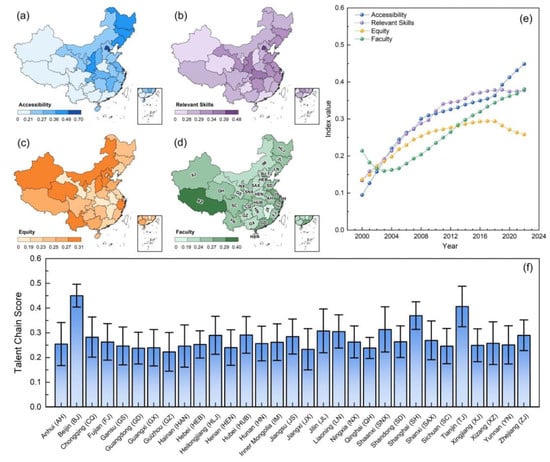
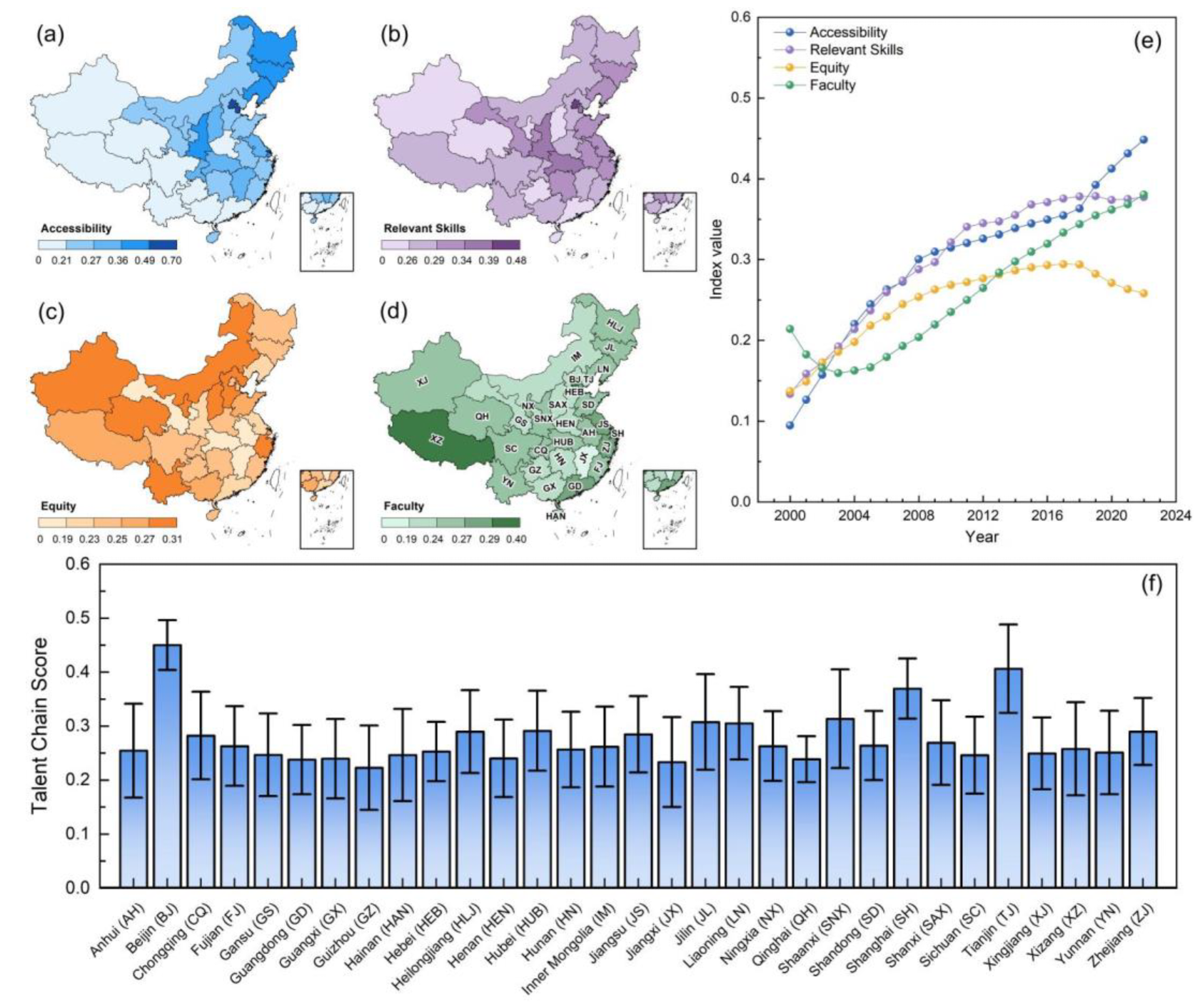
The four dimensions of the talent chain exhibit significant spatial distribution differences, reflecting the uneven development of higher education across regions in China. Specifically, the accessibility index of higher education shows a clear east-high, west-low distribution pattern. The economically developed eastern regions, such as Tianjin (TJ) and Beijing (BJ), have higher annual accessibility indices of 0.70 and 0.68, respectively, significantly outperforming other regions. This is closely related to the economic foundation, educational resources, and social investment in these cities. In contrast, the socio-economically disadvantaged western regions, particularly Guizhou (GZ), Yunnan (YN), and Xizang Autonomous Region (XZ), exhibit significantly lower accessibility indices, all below 0.17, reflecting a pronounced spatial concentration (Figure 1a). In terms of relevant skills, Beijing and Tianjin again lead, with scores of 0.48 and 0.39, respectively. In contrast, regions in the northwest, including Ningxia (NX), Xinjiang (XJ), and Qinghai (QH), score significantly lower (all below 0.26). The higher education in Beijing and Tianjin places strong emphasis on aligning educational content with industry demands, particularly in fields such as technology and management, which are highly in demand in the labor market. In contrast, the northwest regions have relatively simple and traditional industrial structures, lacking the diversified demand for high-skilled talent, which may explain the lower scores in skills relevance in these regions (Figure 1b). The equity index of higher education is highest in the western regions, particularly in Xinjiang (0.31) and Yunnan (0.30). This can be attributed to the Chinese government’s preferential education policies for ethnic minority areas, especially in the distribution of higher education resources. For example, the implementation of special education funding, subsidies, and the establishment of ethnic schools has effectively improved educational equity. Other ethnic minority autonomous regions, such as Ningxia (NX), Xizang, and Guangxi (GX), also show relatively high levels of educational equity, indicating the significant success of national policies in improving educational opportunities in these regions (Figure 1c). Regarding faculty, Beijing (0.40) and Shanghai (SH) (0.36) continue to lead, with high scores due to their internationalized backgrounds and the concentration of top-tier universities. Both cities attract large numbers of high-level scholars and professionals, contributing to their high faculty quality. Interestingly, despite Xizang’s lower economic development, its faculty score (0.34) is higher than expected. This is likely due to China’s policy initiatives in Xizang, such as the encouragement for teachers to work in rural and remote areas, which has improved the quality of education in this region through external support and policy assistance. In contrast, other regions generally have lower faculty scores, which are closely tied to insufficient local education funding and a lack of faculty training resources (Figure 1d).
Figure 1.
Talent chain indicators in Chinese higher education (a) spatial distribution of accessibility; (b) spatial distribution of relevant skills; (c) spatial distribution of equity; (d) spatial distribution of faculty; (e) temporal changes in each indicator; (f) comprehensive talent chain scores across regions.
From a temporal perspective, all four dimension indicators show a significant upward trend. Particularly, the accessibility index has increased substantially from 0.09 in 2000 to 0.45 in 2022, indicating a marked improvement in the accessibility of higher education in China. This trend reflects the increasing government investment in higher education, particularly in underdeveloped regions, ensuring that more eligible individuals can access higher education, thus contributing to talent cultivation and socio-economic development. However, the equity index peaked at 0.29 in 2017 and has since fluctuated downward, reaching 0.26 in 2022. Although the decline is not substantial, it still represents a potential obstacle to the further development of quality education in China. The decrease in educational equity may be linked to the uneven distribution of higher education resources and widening socio-economic disparities in some regions (Figure 1e).
In terms of comprehensive scores, the three municipalities directly under the central government—Beijing (0.45), Tianjin (0.40), and Shanghai (0.37)—have scores significantly higher than other regions. This reflects their concentration of higher education resources, economic development levels, and emphasis on education. Interestingly, Guangdong (GD), Jiangxi (JX), and Guizhou (GZ), three typical southern provinces, have the lowest scores in the talent chain. Guangdong and Jiangxi, with larger populations, have relatively limited per capita educational resources, while Guizhou is hindered by its low accessibility to higher education. This suggests that, despite rapid economic growth in some regions, insufficient educational resources remain a key constraint on their higher education development (Figure 1f).
3.2. Regional Disparities and Temporal Trends in China’s Industry Chain Development
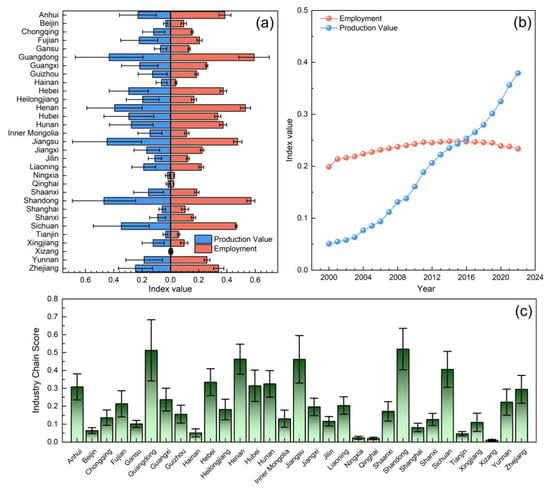
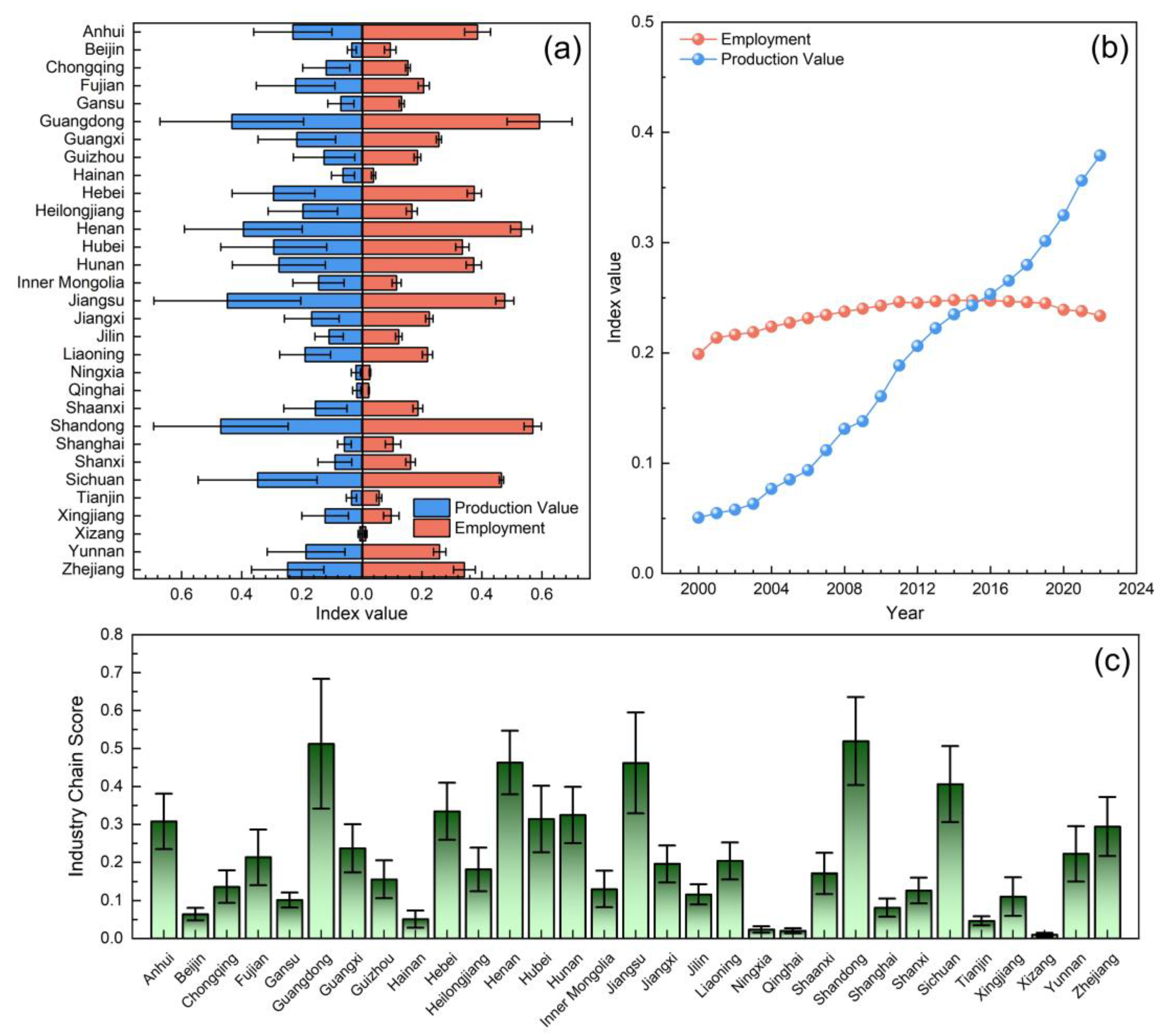
The regional distribution of the industry chain exhibits significant differences compared to the talent chain, reflecting disparities in the economic structure, industrial development, and labor markets across different regions in China. In terms of employment, the regions with higher scores are primarily large population provinces, particularly Guangdong (0.59), Shandong (0.57), and Henan (0.53). These provinces, benefiting from their large population bases, are able to offer abundant labor resources, which enhances their capacity to attract employment. Guangdong, in particular, as one of the most economically developed provinces in China, has a highly industrialized economy and ample employment opportunities, which enables its labor market to effectively absorb a large number of workers. In contrast, most other regions have employment scores below 0.50, with Ningxia, Qinghai, and Xizang exhibiting particularly low scores, all below 0.03. Notably, these three regions also have some of the lowest GDPs in China, which indicates that these areas not only face insufficient labor supply but also struggle with labor markets unable to effectively absorb young or highly skilled workers. This situation highlights the weak economic foundation, single industrial structure, and low labor mobility in these regions. Particularly in Xizang, geographical conditions and limited infrastructure exacerbate employment bottlenecks, leading to severe labor market constraints. Regarding production value, Shandong (0.47), Jiangsu (0.45), and Guangdong (0.43) are the top scorers. These provinces have high GDPs and well-developed industrial structures, particularly in the secondary (manufacturing) and tertiary (services) sectors. This allows them to maintain a complete and competitive industrial chain. In contrast, Ningxia, Qinghai, and Xizang score below 0.02, reflecting the relative underdevelopment of their industrial chains, which remain heavily reliant on agriculture and lack modern industry support. The economic structure dominated by agriculture limits their contribution to the overall industrial value, hindering the formation of a diversified and competitive industrial chain (Figure 2a).
Figure 2.
Changes in industry chain indicators in China: (a) distribution of employment and production value across regions; (b) temporal changes in employment and production value; (c) comprehensive industry chain indicator scores across regions.
Over the past two decades, China’s GDP has consistently grown, and the production value score has increased from 0.05 in 2000 to 0.38 in 2022, marking a growth of 650.24%. This demonstrates the significant achievements in China’s economic growth, driven by large-scale infrastructure development, industrial upgrading, and the rise in high-tech industries, which have further promoted the diversification and deepening of the industrial chain. However, it is concerning that the employment score has only increased from 0.20 to 0.23, a modest increase of 17.46%. This gap suggests a disconnect between economic growth and the demand in the employment market. Specifically, since 2018, the employment score has shown a downward trend, signaling the increasing pressure in China’s job market. Although China’s rapid economic growth and increased social productivity have somewhat mitigated the risk of labor market shortages, the tightening of the job market remains a potential social risk, especially as China faces accelerating population aging. The mismatch between labor supply and demand may worsen in the future, particularly in the central and western regions, where the contradiction between economic development and employment absorption capacity may become more pronounced (Figure 2b).
In terms of comprehensive industry chain scores, Shandong (0.52), Guangdong (0.51), Henan (0.46), Jiangsu (0.46), and Sichuan (0.41) all scored above 0.40, demonstrating significant advantages in the completeness of their industrial chains. A score above 0.40 indicates that these regions have relatively well-structured industrial chains capable of effectively absorbing and supporting substantial amounts of industrial capital and labor. In contrast, Ningxia, Qinghai, and Xizang, which have the lowest GDP and labor resources, continue to score the lowest in terms of the industry chain, indicating substantial structural challenges in their industrial chain development. Notably, Shanghai, Beijing, and Tianjin, which have the highest talent chain scores, have industry chain scores below 0.1, which is relatively low. This reveals a regional mismatch between China’s higher education talent chain and its industry chain. Despite being at the forefront in terms of higher education resources and talent chain development, these regions face industrial chain saturation, making it difficult to absorb additional specialized labor. This suggests that the overconcentration of higher education resources in these areas has led to an oversaturated industrial chain, with high-skilled labor needing to overflow into other regions to promote balance in the industrial chain. Therefore, the regional mismatch between talent and industry chains may restrict further economic growth in these regions and highlights the necessity of encouraging industrial chain spillovers to balance economic development across regions (Figure 2c).
3.3. Changes in Talent Chain and Industry Chain Coupling Coordination Degree
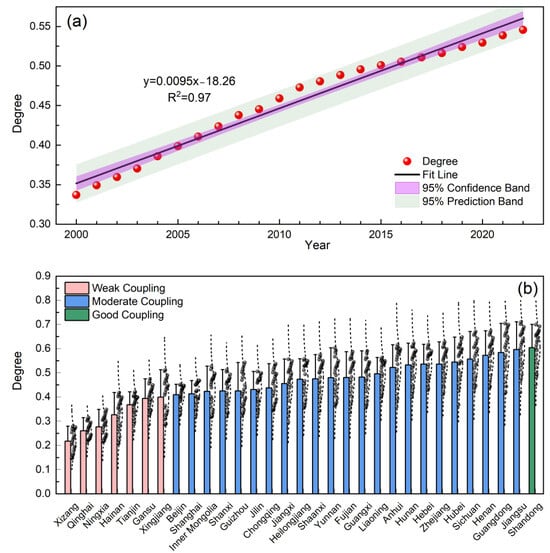
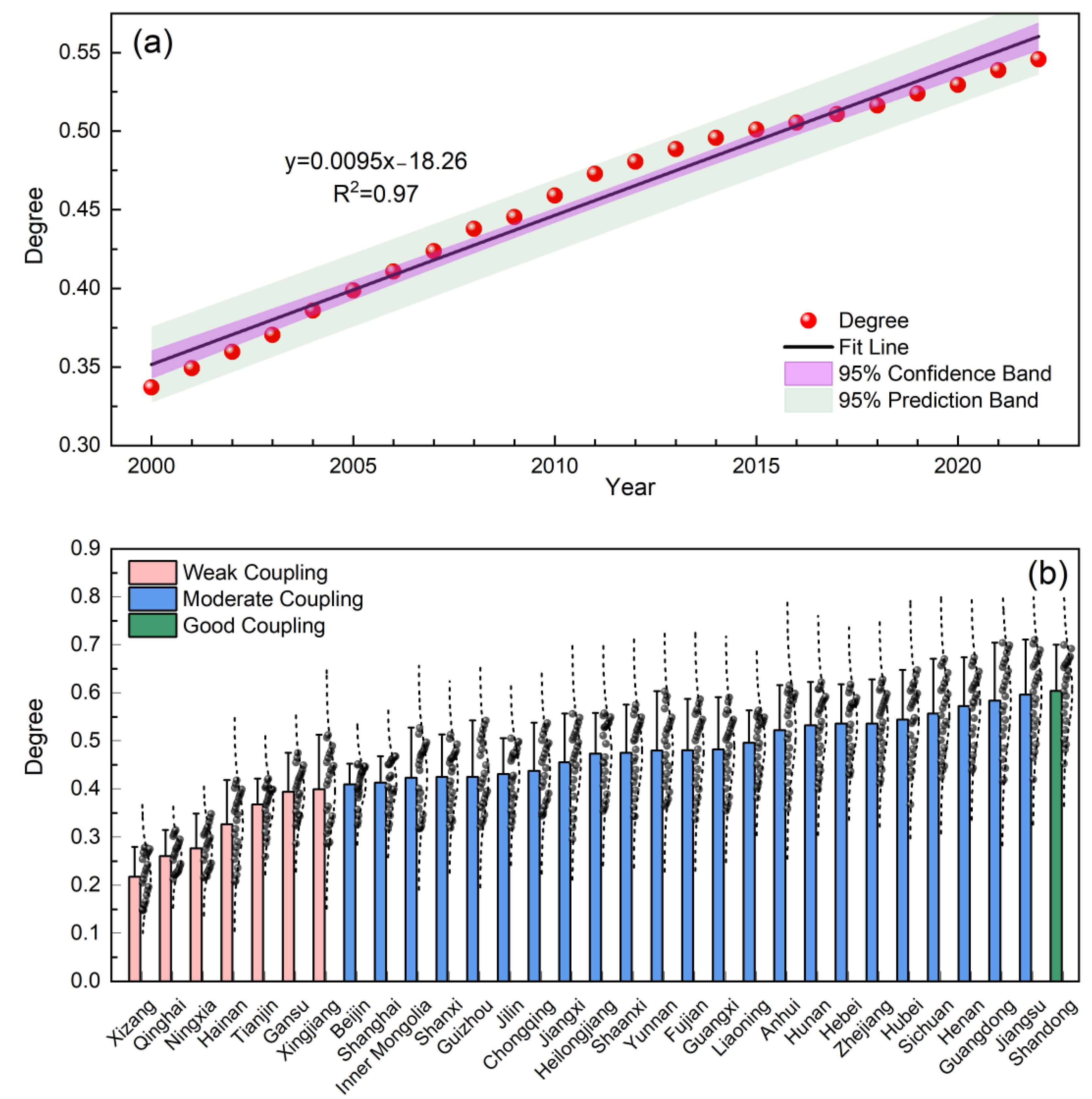
With the continuous development of China’s socio-economic landscape, the country has achieved significant progress in both higher education and industrial development. As a result, the coupling coordination between the talent chain and industry chain has steadily increased, from 0.34 (weak coupling) in 2000 to 0.55 (moderate coupling) in 2022. Moreover, the change in coupling coordination exhibits a strong linear trend (R2 = 0.97), with an annual growth rate of 0.0095, indicating that the alignment between higher education and industrial structures is continuously improving. This suggests that the talent produced by higher education is becoming increasingly well-suited to the needs of industrial development. However, the coupling coordination still remains at the moderate coupling level. If the current trend continues, it is expected that by 2028, the coupling between China’s higher education industry chain and talent chain will reach a good coupling state (Figure 3a).
Figure 3.
Matching degree of talent chain and industrial chain: (a) annual variation in coupling coordination degree; (b) distribution of coupling coordination degree in each region.
Regionally, Xizang (0.22), Qinghai (0.26), Ningxia (0.28), Hainan (0.33), Tianjin (0.38), Gansu (0.39), and Xinjiang (0.40) all remain in the weak coupling state. Among these, Xizang, Qinghai, Ningxia, Gansu, and Xinjiang are inland regions in China with relatively underdeveloped economies. These areas have lagged behind in both educational resources and industrial development. Despite Tianjin having high-quality educational resources, its relatively small population base prevents the formation of significant population dividends. This results in an abundance of educational resources but a saturated labor force, creating a mismatch between the availability of education and the demand for labor. Hainan faces significant constraints due to its geographical isolation, distant from the mainland, and its sparse population. As a result, its ability to attract higher education resources is weak, limiting its industrial development. The economy is primarily based on the tertiary sector, with a lack of high-skilled job opportunities, and the dual low levels of both the talent chain and industry chain contribute to the coupling imbalance. The only region currently in a good coupling state is Shandong (0.60). Additionally, regions such as Sichuan (0.56), Henan (0.57), Guangdong (0.58), and Jiangsu (0.59) are approaching a good coupling state. These provinces are major population hubs in China and boast large labor markets, which provide strong support for economic development. Furthermore, these regions have relatively high talent attraction, effectively drawing in skilled professionals (Figure 3b).
4. Discussion
4.1. Pathways Through Which Higher Education–Industry Alignment Shapes Coupling Coordination
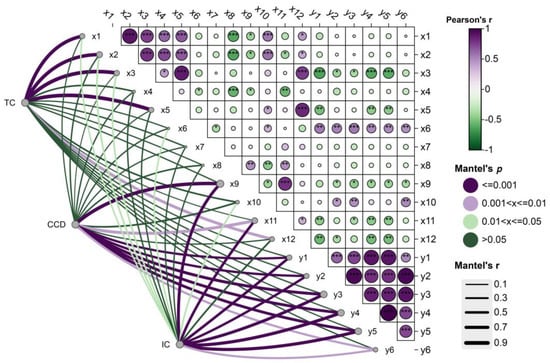
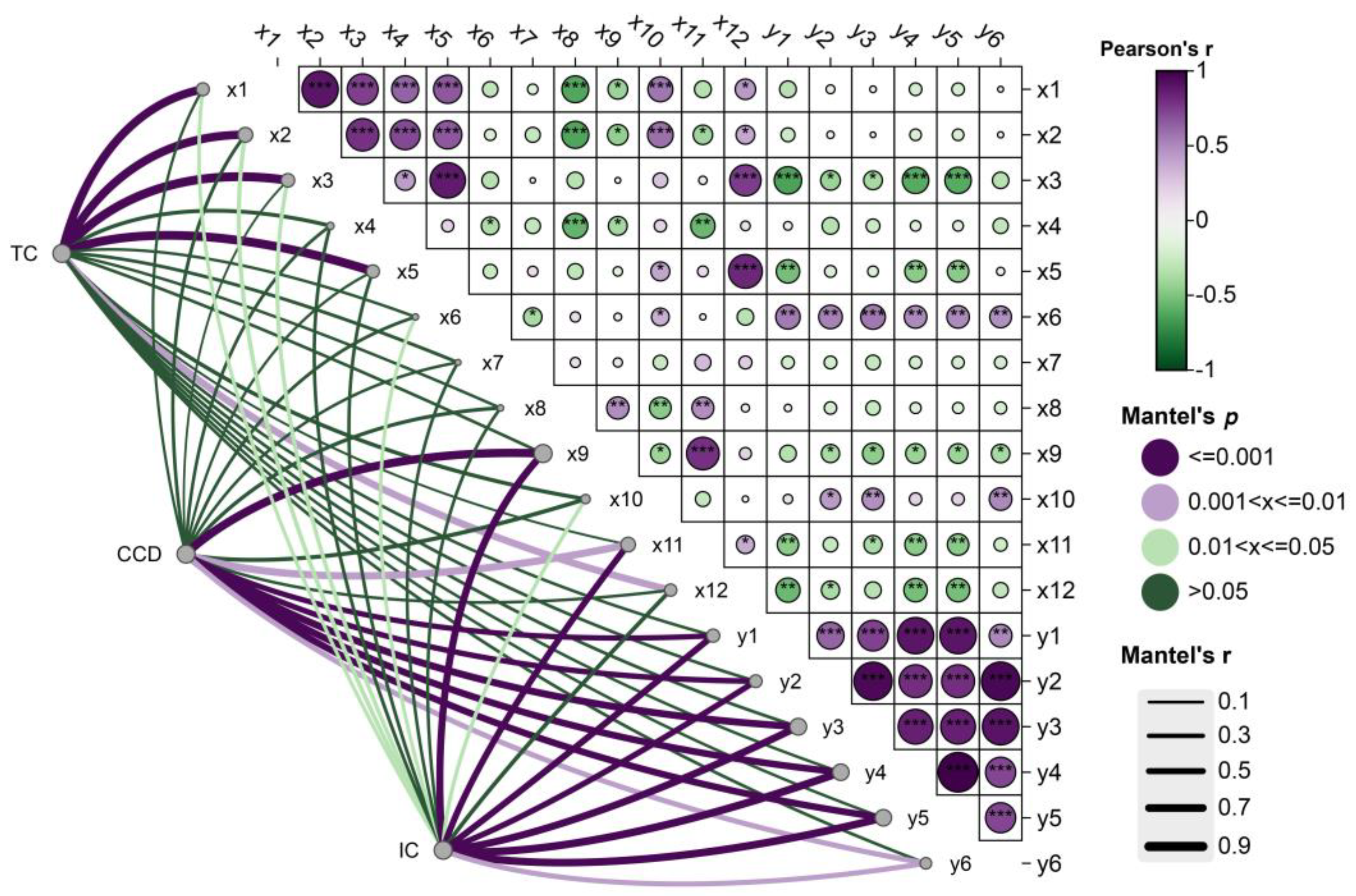
Determinants analysis indicates that provincial talent–industry alignment in China is closely associated with two sets of factors: (i) higher-education capacity and resource allocation, and (ii) regional industrial structure and employment absorptive capacity. On the talent-chain side, supply expansion remains a foundational element: the gross enrollment rate (x1, r = 0.79, p < 0.001), students per 100,000 people (x2, r = 0.79, p < 0.001), and university density (x3, r = 0.85, p < 0.001) exhibit the strongest substantive correlations, indicating that these scale factors are the primary determinants of talent-chain performance. Human-capital upgrading is equally important, as the share of workers with higher education (x5, r = 0.83, p < 0.001) shows a robust positive relationship, while faculty qualifications (x10) are marginally significant (p = 0.052), implying potential gains from continued improvements in teaching capacity. By contrast, equity-oriented indicators (x7, x8, x9) do not reach statistical significance for the overall talent-chain score (p > 0.05), which may suggest that their relationships operate through more indirect and longer-term channels rather than being fully captured by the composite index in the short run. For the industry chain, we observe a divergence between statistical significance and substantive relevance. While employment in the primary (y1, r = 0.53, p < 0.001), secondary sector (y2, r = 0.46, p < 0.001) shows moderate associations, the tertiary sector (y3, r = 0.64, p < 0.001) demonstrates a decidedly stronger substantive impact. The manuscript also reports a closely aligned estimate for tertiary employment (r = 0.62, p = 0.001), substantively underscoring the dominant role of services and knowledge-intensive activities in characterizing skilled-labor demand. Output-side indicators remain important as well: production values in the primary and secondary sectors show strong correlations with industry-chain performance (y4/y5: r = 0.69, p < 0.001), and production values across all three sectors are significant overall (p < 0.01). Together, these patterns are consistent with a steady transition in which new growth engines are strengthening while manufacturing and traditional sectors continue to provide a stabilizing foundation for labor absorption and upgrading (Figure 4).
Figure 4.
Correlation structure between talent chain, industry chain, coupling coordination degree, and key indicators. * p < 0.05, ** p < 0.01, *** p < 0.001.
Building on these results, the pathways through which higher education–industry alignment relates to coupling coordination can be summarized as follows. First, targeted policies and sustained investment are associated with improved synchrony between talent supply and industrial demand by improving both access and quality. The proportion of minority students enrolled in ethnic colleges (x9) shows the highest substantive association with the coupling coordination degree (r = 0.77, p = 0.001), and per-student education expenditure (x11) is also significantly positive (r = 0.65, p = 0.002). Notably, x11 is further positively related to industry-chain performance (r = 0.52, p = 0.001), jointly pointing to an “investment → capacity → matching” channel. Second, expansion alone is not sufficient: scale-oriented indicators such as x1, x2 and graduate/employment-related measures (x4, x5, x6) exhibit weak or insignificant relationships with coupling coordination (p > 0.05), suggesting that improved matching more often corresponds with program-structure adjustment, practice-oriented training, and sustained quality inputs aligned with industrial transformation. Third, stronger industrial upgrading and absorptive capacity is linked to transitions in higher education by orienting talent structures toward emerging demand, reinforcing a virtuous cycle of “industrial upgrading → demand pull → educational response → improved matching.” Overall, the evidence portrays a trajectory of steady progress; the remaining tensions are best interpreted as manageable needs for structural and quality rebalancing that can be addressed incrementally through coordinated governance.
4.2. Regional Heterogeneity and Identification of Mismatch Typologies
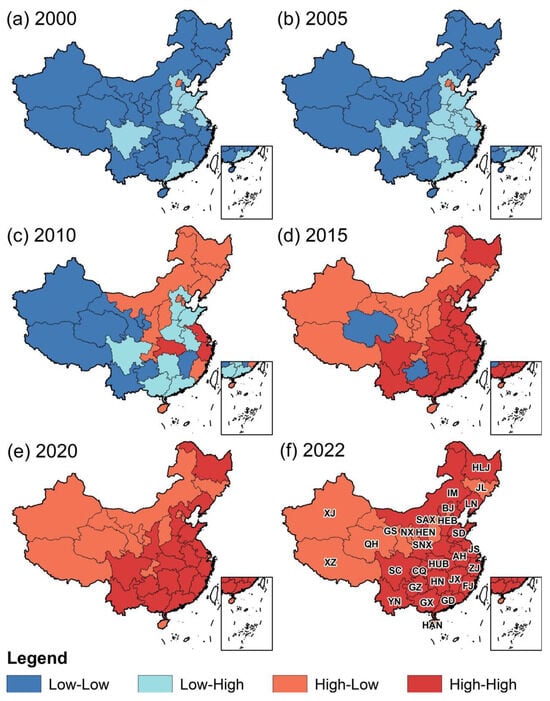
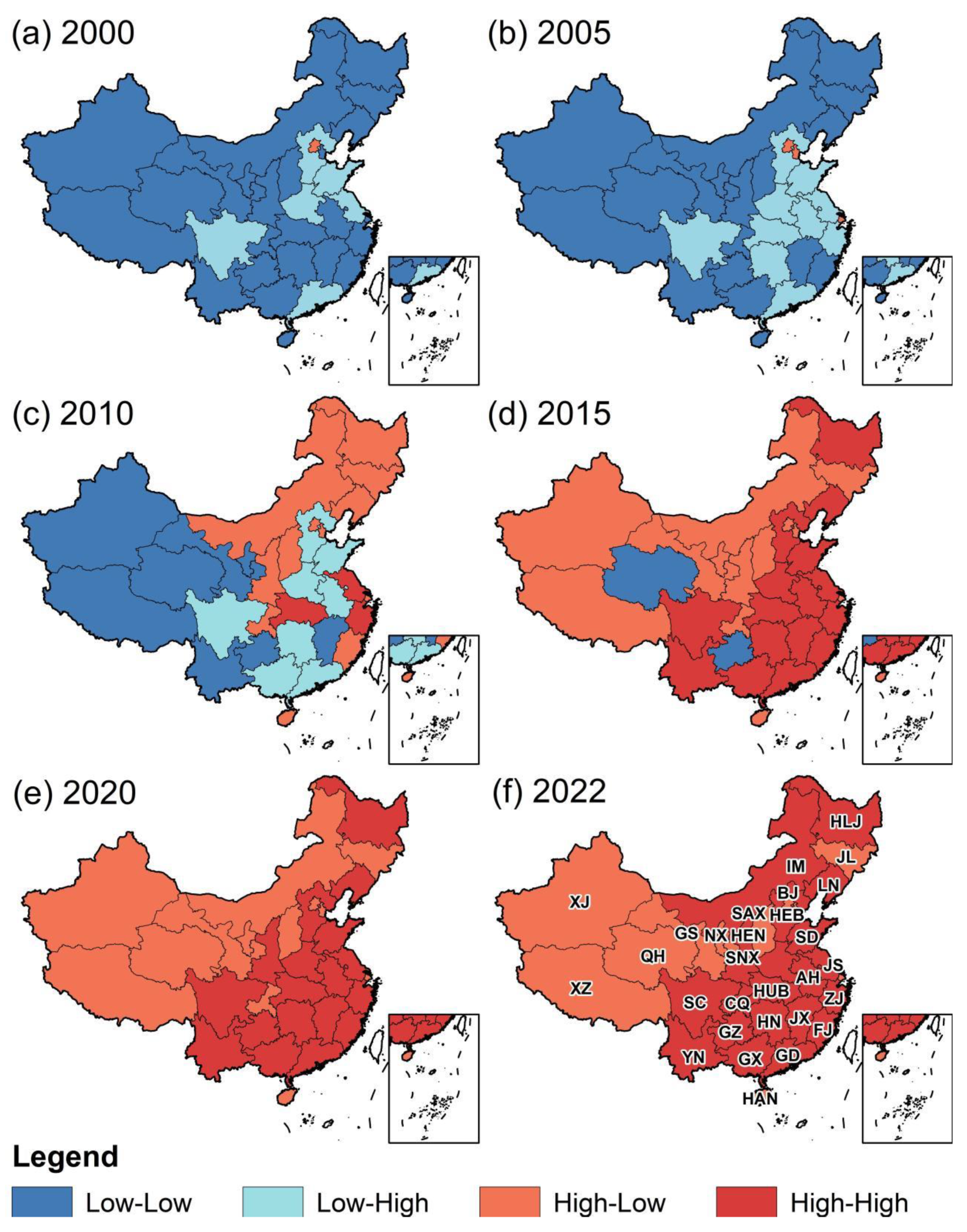
Provincial typologies exhibit a clear directional shift from dual-low constraints (low talent–low industry) toward a dual-high synergistic basis (high talent–high industry), indicating a gradual transition from constraints rooted in foundational capacity to challenges more closely related to structural fit. In 2000, 24 provinces were classified as dual-low, consistent with a period in which both talent formation capacity and industrial absorption were still developing in tandem. By 2015, all provinces except Guizhou (GZ) and Qinghai (QH) had moved into either a talent-leading position (high talent–low industry) or a dual-high position. In both 2020 and 2022, the distribution further concentrated in these two categories, suggesting that recent interprovincial differences are increasingly shaped by the pace of coordination and the degree of alignment between industrial structure and the composition of talent supply, rather than by deficits in basic development capacity.
Regional heterogeneity is most evident in the diverse transition pathways across provinces. Coastal and economically dynamic provinces are more likely to stabilize on a dual-high synergistic basis from 2015 onward—for example, Guangdong (GD), Fujian (FJ), Zhejiang (ZJ), and Shandong (SD). This pattern is broadly consistent with more diversified industrial structures and stronger employment absorptive capacity, which can more readily “meet” improvements in higher education provision and quality, thereby enabling concurrent progress on both the supply and demand sides of the talent–industry system. Importantly, this configuration should not be interpreted as a simple dichotomy of “leading” versus “lagging” regions. A more plausible interpretation is that provinces differ in the sequencing and tempo of industrial upgrading and job creation: where industrial transformation and employment expansion proceed more rapidly, educational improvements are more likely to translate into a dual-high configuration; where upgrading and high-quality job generation require longer accumulation, provinces may remain talent-leading for an extended period. Consistent with this interpretation, several inland, resource-based, and frontier provinces more frequently exhibit a talent-leading position in 2015, 2020, and 2022, including Gansu (GS), Ningxia (NX), Xinjiang (XJ), and Xizang (XZ). This typology is better understood as a transitional structural feature rather than an entrenched mismatch: educational provision and training quality continue to improve, while industrial diversification, high-quality job creation, and employment absorption often depend on longer cycles of industrial accumulation and market development. In such contexts, a talent-leading position tends to reflect two coexisting dynamics: (i) sustained expansion and quality enhancement in higher education, and (ii) continuing constraints on the industry side related to diversification, market accessibility, or agglomeration economies. Accordingly, this outcome is more appropriately interpreted as indicating scope for deeper synergy, rather than a persistent mismatch trap.
A related but distinct phenomenon concerns provinces that display a relatively stable talent-leading position across multiple time points. Beijing (BJ) remains talent-leading throughout 2000–2022; Shanghai (SH) and Tianjin (TJ) remain talent-leading from 2005 onward; and Hainan (HAN) remains talent-leading from 2010 onward. For these provinces, the typology likely reflects not only educational advantages but also how the industry-chain index captures “structure and scale.” Regions specialized in advanced services, headquarters functions, or other functional economic roles may exhibit a different mapping between industrial structure and talent absorption than manufacturing-centered provinces, which can yield a high-talent–low-industry combination under a relative-threshold framework. Therefore, a stable talent-leading position is best interpreted as evidence of structural specialization and potential for deeper alignment, rather than as an unfavorable imbalance. Intertemporal transitions further illustrate heterogeneous upgrading trajectories. Guizhou (GZ) and Qinghai (QH) remains dual-low from 2000 to 2015 but shifts into a dual-high synergistic basis in both 2020 and 2022. Such upward transitions from dual-low to higher-order states suggest that provinces can move from “capacity accumulation” toward improved structural matching when improvements in education provision occur alongside industry cultivation; differences in the timing and pathways of these transitions underscore that progress depends on the speed of coupling between educational upgrading and industrial transformation, as well as on the specific mode of structural alignment (Figure 5).
Figure 5.
Talent–industry chain matching patterns in China across selected periods.
Overall, the mismatch typology indicates a trajectory of steady improvement in China’s education–industry relationship, while regional differences primarily reflect alternative transition pathways: some provinces follow an “industry-pull” route toward dual-high synergy, whereas others display a “talent-first, industry-following” pattern. It should also be noted that because “high/low” is defined relative to the national mean over 2000–2022, these categories emphasize relative positioning and structural balance rather than absolute levels. Accordingly, the observed differences are best viewed as identifiable and manageable structural variations with clear policy relevance, rather than as destabilizing contradictions.
4.3. Policy Implication
This study reveals a systemic mismatch between the talent chain and the industrial chain in China, particularly across structural, qualitative, and scale dimensions. The results indicate a persistent gap between the regional supply of higher education and the evolving demands of industrial development. Advancing education reform for sustainable development requires an operational linkage between empirical evidence and normative commitments [32]. Against this backdrop, we propose a set of policy implications from four complementary angles—educational reform, industrial upgrading, regional coordination, and multi-stakeholder collaboration—to improve the quality of graduate job matching and support SDG-consistent development.
- (1)
- Strengthen regional coordination mechanisms to mitigate spatial mismatches between educational resources and industrial distribution.
Establishing regionally coordinated education–industry mechanisms can significantly reduce disparities in human capital distribution [33]. In China, the eastern provinces possess abundant educational resources but face saturation in industrial absorption capacity, while central and western regions exhibit a “weak education–weak industry” coexistence. Operationally, the central government should establish a “Cross-Provincial Educational Alliance” framework that incentives eastern universities to set up branch campuses or joint laboratories in western regions through fiscal transfer payments and land-use incentives. Furthermore, a national digital resource-sharing platform should be operationalized to bridge the quality gap in remote areas, facilitating the rational spatial flow of both talent and industries to narrow regional development gaps.
- (2)
- Build a collaborative governance framework among government, industry, academia, and research to improve the dynamic matching between talent cultivation and industrial demand.
Deep enterprise participation is key to addressing structural mismatches in talent development. Policies should encourage the co-design of curricula, establishment of industrial practice platforms, and implementation of project-based learning to strengthen the alignment between graduates’ skills and labor market needs [34]. To operationalize this, policymakers should implement an “Integration-of-Industry-and-Education” enterprise certification system, offering corporate income tax deductions (e.g., additional deductions for vocational education expenses) to certified firms. Additionally, universities should institutionalize a “dual-mentor” system, requiring professional degree students to undergo mentorship from both academic supervisors and industry experts, thereby ensuring that education–industry integration significantly improves graduate employment quality and skill relevance [35]. Moreover, dual support for education and industrial development in ethnic and underdeveloped regions should be intensified to enhance regional coupling performance [36].
- (3)
- Shift from expansion to structural optimization by prioritizing educational quality and systemic investment.
The findings indicate that educational quality and structural inputs, including faculty competence, per-student funding, and human capital structure, exert significant influence on the talent chain, whereas quantitative indicators such as enrollment rates and student population have limited marginal effects. Therefore, higher education reform in China should transition from “scale expansion” to “structural optimization.” Education authorities must institute a data-driven degree adjustment mechanism. This involves using graduate employment quality reports and industry talent shortage indices to dynamically increase quotas for STEM and emerging disciplines while sunsetting majors with low employment rates for three consecutive years. Funding models should also shift from headcount-based to performance-based allocation, rewarding institutions that demonstrate high industry relevance. Improving educational quality can substantially enhance employment alignment and skill adaptability [37]. Moreover, establishing a dynamic mechanism for updating academic programs would enable institutions to respond more rapidly to technological change and industrial transformation [38], while bridge-like frameworks that translate theory into practice (e.g., mandatory internships credits) should be further institutionalized [39].
- (4)
- Promote industrial upgrading and employment expansion to enhance the absorptive capacity of the industrial chain.
The strong correlations between the industrial chain and both industrial employment and output—particularly in the tertiary sector—demonstrate that industrial structure optimization is fundamental to improving talent–industry coupling. The expansion of the service and high-tech industries has been shown to generate higher demand for skilled labor and drive inclusive growth [40,41]. Accordingly, policies should target the “High-Tech SME” sector by creating innovation vouchers and R&D subsidies to lower the cost of hiring doctoral and master’s graduates. Furthermore, local governments should develop industrial clusters focused on modern producer services (e.g., industrial design, fintech) to create high-value jobs that match the aspirations of the expanding graduate cohort.
- (5)
- Provide a replicable diagnostic reference for other developing nations to navigate the “education–economy” interface.
While this study focuses on China, the challenges identified—specifically the structural lag between rapid educational expansion (Target 4.3) and labor market absorption—are prevalent across many emerging economies facing a “youth bulge.” Since this study’s evaluation framework is grounded in universal SDG 4 metrics and standard economic indicators, it possesses high methodological transferability. Practically, international organizations and developing nations can operationalize this framework by establishing national “Talent–Industry” monitoring dashboards to diagnose their own structural mismatches. Furthermore, China’s empirical trajectory offers a critical lesson for the Global South: avoiding the “expansion-first, matching-later” trap by prioritizing the synchronization of educational quality upgrading with industrial transformation from the onset.
4.4. Limitations and Future Research
Methodologically, this study relies on provincial-level macro indicators to ensure cross-regional comparability over a long-term horizon. However, we acknowledge that the current industry-chain indicators, such as sectoral GDP and total employment, serve as aggregate proxies and may not fully differentiate the nuanced demand for high-level specialized skills across various sub-sectors. Consequently, the analysis cannot fully capture micro-level matching processes and behavioral mechanisms at the graduate-employer interface. Furthermore, regarding the analytical framework, it is essential to recognize that the Coupling Coordination Degree (CCD) model quantifies the level of synchronization and structural consistency between systems but does not inherently establish causality. While our correlation analysis identifies factors associated with coordination, a high coupling score reflects a state of mutual alignment rather than a unidirectional causal impact. Therefore, the relationships identified in this study should be interpreted as characterizing the co-evolutionary process rather than proving definitive causal pathways. To address these issues, future research should integrate individual- or firm-level surveys and administrative data to refine skill-demand mapping. Moreover, to transcend the descriptive nature of the current coordination analysis, future inquiries could employ rigorous causal identification strategies—such as dynamic panel models, instrumental variable methods, or difference-in-differences designs—to verify the directional impact of educational inputs on industrial upgrading, thereby strengthening the empirical basis for policy intervention.
Regarding the depth of spatial analysis, while this study systematically characterizes regional heterogeneity through quadrant-based typologies and GIS visualization, it does not employ spatial econometric models to quantify inter-regional spillover effects. We recognize that regional coordination is a complex dynamic where the development of one province likely influences its neighbors. Although rigorous spatial econometric testing, such as the Spatial Durbin Model, exceeds the current scope of this macro-evaluation framework, we consider it a valuable direction for future research. Future studies could introduce such models to precisely measure how educational resources or industrial upgrading in one region ripple across provincial borders, thereby providing stronger empirical support for cross-regional governance mechanisms under the SDG 4 agenda. Furthermore, regarding the interpretative depth of provincial trajectories, this study prioritizes identifying macro-level evolutionary patterns over dissecting micro-level policy drivers. Given the extensive spatial-temporal scope (31 provinces over 23 years), attempting to attribute specific transitions to individual regional policies or economic events would exceed the capacity of the current quantitative framework. Future inquiries could adopt a “comparative case study” approach—selecting representative provinces from different mismatch typologies—to qualitatively trace how specific policy interventions drive the observed transitions, thereby enriching the causal narrative.
5. Conclusions
Grounded in the Sustainable Development Goal 4 (SDG4) framework on quality education, this study develops a coupling coordination model linking the “talent chain” and the “industry chain” to systematically examine the co-evolution of higher education systems and industrial structures across 31 Chinese provinces from 2000 to 2022, and to assess its implications for SDG-consistent development and graduate job matching. The main findings are as follows: (1) At the national level, the coupling coordination degree between higher education and industry increased from 0.34 to 0.55, indicating steady improvement, while the overall level remains moderate; pronounced regional divergence persists, with eastern provinces generally outperforming central and western regions. (2) Improvements in the talent chain are driven primarily by educational quality and structural investment, such as faculty capacity, per-student educational expenditure, and the composition of human capital, whereas expansion-oriented indicators (e.g., enrollment rates and student scale) exhibit relatively limited marginal effects. This suggests that improving graduate job matching requires more than quantitative expansion; it depends critically on enhancing training quality and the structural fit of talent supply. (3) Industry-chain performance is shaped mainly by industrial scale and structural upgrading: employment and output across the primary, secondary, and tertiary sectors are positively associated with industry-chain scores, with the tertiary sector playing a particularly prominent role, underscoring the importance of services and knowledge-intensive activities in absorbing skilled labor, supporting upgrading, and fostering inclusive growth. (4) The education side follows a quality- and structure-oriented mechanism, whereas the industry side follows a scale- and structure-oriented mechanism. This misalignment in driving forces constitutes an important source of regional higher education–industry mismatches. Meanwhile, provincial mismatch typologies evolve from being dominated by dual-low constraints in 2000 to being dominated by talent-leading and dual-high synergy configurations during 2020–2022, indicating that coordination is improving steadily, although structural differences still require further alignment.
These findings imply that neither expanding higher education in isolation nor enlarging industrial capacity alone is sufficient to address structural job mismatches. To translate higher education–industry coupling more effectively into tangible improvements in graduate job matching and SDG-consistent development, policy should prioritize the quality and structural optimization of higher education, deepen education–industry integration and collaborative governance, and better synchronize educational restructuring with industrial upgrading—particularly in service and knowledge-intensive sectors—while providing more targeted support to relatively lagging central and western regions to narrow regional gaps and expand the supply of high-quality jobs.
Author Contributions
Conceptualization, M.K.O.; Methodology, Q.Y.; Formal analysis, Q.Y.; Writing—original draft preparation, Q.Y.; Writing—review and editing, M.K.O.; Supervision, M.K.O. All authors have read and agreed to the published version of the manuscript.
Funding
This research received no external funding.
Institutional Review Board Statement
Not applicable.
Informed Consent Statement
Not applicable.
Data Availability Statement
The original contributions presented in this study are included in the article. Further inquiries can be directed to the corresponding author.
Acknowledgments
The authors are grateful to all of the authors’ contributions during the completion of this study. All individuals listed in this section have provided consent for their inclusion in the acknowledgment.
Conflicts of Interest
The authors declare no conflicts of interest.
References
- Nong, L.; Liao, C.; Ye, J.; Wei, C.; Zhao, C.; Nong, W. The STEAM learning performance and sustainable inquiry behavior of college students in China. Front. Psychol. 2022, 13, 75515. [Google Scholar] [CrossRef] [Scilit]
- Bui, H.T.M.; Bui, T.; Pham, B.T. The role of higher education in achieving sustainable development goals: An evaluation of motivation and capacity of Vietnamese institutions. Int. J. Manag. Educ. 2024, 22, 101088. [Google Scholar] [CrossRef] [Scilit]
- Shulla, K.; Filho, W.L.; Lardjane, S.; Sommer, J.H.; Borgemeister, C. Sustainable development education in the context of the 2030 Agenda for sustainable development. Int. J. Sustain. Dev. World Ecol. 2020, 27, 458–468. [Google Scholar] [CrossRef] [Scilit]
- International Labour Organisation. World Employment and Social Outlook: Trends 2025; International Labour Organisation: Geneva, Switzerland, 2025. [Google Scholar]
- International Monetary Fund. World Economic Outlook: Countering the Cost-of-Living Crisis; International Monetary Fund: Washington, DC, USA, 2022. [Google Scholar]
- Gu, X.; Mao, E. The impacts of academic stress on college students’ problematic smartphone use and Internet gaming disorder under the background of neijuan: Hierarchical regressions with mediational analysis on escape and coping motives. Front. Psychol. 2023, 13, 1032700. [Google Scholar] [CrossRef] [Scilit]
- Yang, L. Higher education expansion and post-college unemployment: Understanding the roles of fields of study in China. Int. J. Educ. Dev. 2018, 62, 62–74. [Google Scholar] [CrossRef] [Scilit]
- McGuinness, S.; Pouliakas, K.; Redmond, P. Skills mismatch: Concepts, measurement and policy approaches. J. Econ. Surv. 2018, 32, 985–1015. [Google Scholar] [CrossRef] [Scilit]
- Mavromaras, K.; McGuinness, S.; O’Leary, N.; Sloane, P.; Wei, Z. Job mismatches and labour market outcomes: Panel evidence on Australian university graduates. Econ. Rec. 2013, 89, 382–395. [Google Scholar] [CrossRef] [Scilit]
- Flisi, S.; Goglio, V.; Meroni, E.; Rodrigues, M.; Vera-Toscano, E. Occupational mismatch in Europe: Understanding the role of labour market shortages and rigidities. Labour Econ. 2017, 25, 123–140. [Google Scholar] [CrossRef]
- Pellizzari, M.; Fichen, A. A new measure of skill mismatch: Theory and evidence from PIAAC. IZA J. Labor Econ. 2017, 6, 1. [Google Scholar] [CrossRef] [Scilit]
- Birinci, S.; Mercan, Y.; See, K. Mismatch unemployment during COVID-19 and the post-pandemic labor shortages. J. Econ. Dyn. Control 2025, 178, 105142. [Google Scholar] [CrossRef] [Scilit]
- Schwab, K. The Fourth Industrial Revolution; Penguin Books: London, UK, 2022. [Google Scholar]
- Pirosca, G.I.; Serban-Oprescu, G.L.; Badea, L.; Stanef-Puica, M.R.; Valdebenito, C.R. Digitalization and Labor Market-A Perspective within the Framework of Pandemic Crisis. J. Theor. Appl. Electron. Commer. Res. 2021, 16, 2843–2857. [Google Scholar] [CrossRef] [Scilit]
- Kopackova, H.; Simonova, S.; Reimannova, I. Digital transformation leaders wanted: How to prepare students for the ever-changing demands of the labor market. Int. J. Manag. Educ. 2024, 22, 100943. [Google Scholar] [CrossRef] [Scilit]
- Dhrifi, A.; Alnahdi, S.; Jaziri, R. The Causal Links Among Economic Growth, Education and Health: Evidence from Developed and Developing Countries. J. Knowl. Econ. 2021, 12, 1477–1493. [Google Scholar] [CrossRef] [Scilit]
- McFarland, J.; Pape-Lindstrom, P. The pipeline of physiology courses in community colleges: To university, medical school, and beyond. Adv. Physiol. Educ. 2016, 40, 473–476. [Google Scholar] [CrossRef] [Scilit]
- Tornow, C.; Freyer Martins Pereira, J.; Mathias, E.; Chenot, J.-F. Postgraduate training in general practice in Germany: A narrative review. Ger. Med. Sci. 2025, 23, Doc08. [Google Scholar] [CrossRef] [Scilit]
- Yusop, S.R.M.; Rasul, M.S.; Mohamad Yasin, R.; Hashim, H.U.; Jalaludin, N.A. An Assessment Approaches and Learning Outcomes in Technical and Vocational Education: A Systematic Review Using PRISMA. Sustainability 2022, 14, 5225. [Google Scholar] [CrossRef] [Scilit]
- Gamroth, L.; Budgen, C.; Lougheed, M. Feasibility and outcomes of paid undergraduate student nurse positions. Nurs. Leadersh. 2006, 19, e1–e14. [Google Scholar] [CrossRef] [Scilit] [PubMed]
- Matsumoto, R.; Motomura, E.; Shiroyama, T.; Okada, M. Impact of the Japanese Government’s ‘General Principles of Suicide Prevention Policy’ on youth suicide from 2007 to 2022. BJPsych Open 2024, 10, e16. [Google Scholar] [CrossRef] [Scilit] [PubMed]
- Lee, H.; Hong, I. Quantifying the influence of vocational education and training with text embedding and similarity-based networks. PLoS ONE 2025, 20, e0329405. [Google Scholar] [CrossRef] [Scilit]
- Chen, L.; Huo, C. The Measurement and Influencing Factors of High-Quality Economic Development in China. Sustainability 2022, 14, 9293. [Google Scholar] [CrossRef] [Scilit]
- Chen, S.H.; Zhang, Q.Q.; Zhao, Q.; Deng, H.R.; Su, Y.S. Influencing Factors of University Relocation on College Students’ Intention to Engage in Local Entrepreneurship and Employment. Front. Psychol. 2021, 12, 50972. [Google Scholar] [CrossRef] [Scilit]
- Jiang, S.; Guo, Y. Reasons for college major-job mismatch and labor market outcomes: Evidence from China. China Econ. Rev. 2022, 74, 101822. [Google Scholar] [CrossRef] [Scilit]
- Zhang, S.; Li, X.; Zhang, C.; Luo, J.; Cheng, C.; Ge, W. Measurement of factor mismatch in industrial enterprises with labor skills heterogeneity. J. Bus. Res. 2023, 158, 113643. [Google Scholar] [CrossRef] [Scilit]
- Ministry of Education of the People’s Republic of China. China’s National Education Modernization Plan (2024–2035). 2025. Available online: http://www.moe.gov.cn/jyb_xxgk/moe_1777/moe_1778/202501/t20250119_1176193.html (accessed on 8 January 2026).
- United Nations. Transforming Our World: The 2030 Agenda for Sustainable Development. 2015. Available online: https://sdgs.un.org/2030agenda (accessed on 8 January 2026).
- Gao, X.; Hu, S.; Deng, X.; Feng, Q.; Li, Z. Integrating analyzing water retention and vulnerability on the Qinghai-Tibet Plateau for regional water security and sustainable development. J. Hydrol.-Reg. Stud. 2025, 58, 102299. [Google Scholar] [CrossRef] [Scilit]
- Tu, D.; Cai, Y.; Liu, M. Coupling coordination analysis and spatiotemporal heterogeneity between ecosystem services and new-type urbanization: A case study of the Yangtze River Economic Belt in China. Ecol. Indic. 2023, 154, 110535. [Google Scholar] [CrossRef] [Scilit]
- Guo, X.; Fang, C.; Mu, X.; Chen, D. Coupling and coordination analysis of urbanization and ecosystem service value in Beijing-Tianjin-Hebei urban agglomeration. Ecol. Indic. 2022, 137, 108782. [Google Scholar] [CrossRef] [Scilit]
- Hobusch, U.; Cerv, P.B.; Simon, U.K.; Heuckmann, B.; Torkar, G.; Stuppan, S.; Froehlich, D.E.; Johann, S.; Messenboeck, F.; Kluempen, N.S.; et al. Braiding Two-Eyed Seeing and Education for Sustainable Development in science teacher education: The One Health Teaching Clinic model. Sustain. Horiz. 2025, 16, 100150. [Google Scholar] [CrossRef] [Scilit]
- Ma, W.; Baek, J.; Qi, M.; Li, J.; Liu, B. The Influence of Overeducation on Chinese Workers’ Job Satisfaction from China Household Tracking Survey (2014–2018). Int. J. Environ. Res. Public Health 2022, 19, 16032. [Google Scholar] [CrossRef] [Scilit]
- Kenny, M.E.; Catraio, C.; Bempechat, J.; Minor, K.; Olle, C.; Blustein, D.L.; Seltzer, J. Preparation for Meaningful Work and Life: Urban High School Youth’s Reflections on Work-Based Learning 1 Year Post-Graduation. Front. Psychol. 2016, 7, 286. [Google Scholar] [CrossRef] [Scilit] [PubMed]
- Lin, H.; Li, X.; Zhang, J. Construction of indicator system of tourism professional skills evaluation system in the application-oriented Universities—A case study in Fujian, China. PLoS ONE 2025, 20, e0327785. [Google Scholar] [CrossRef] [Scilit]
- Wen, H.; Liu, Y.; Huang, Y. Place-Based Policies and Carbon Emission Efficiency: Quasi-Experiment in China’s Old Revolutionary Base Areas. Int. J. Environ. Res. Public Health 2023, 20, 2677. [Google Scholar] [CrossRef] [Scilit] [PubMed]
- Biswas, M.M.; Das, K.C.; Sheikh, I. Psychological implications of unemployment among higher educated migrant youth in Kolkata City, India. Sci. Rep. 2024, 14, 10171. [Google Scholar] [CrossRef] [Scilit] [PubMed]
- Arnout, B.I.A.; AlQahtani, T.S.; Melweth, H.A.L. Competitive capabilities of higher education institutions from their Employees’ perspectives: A case study of King Khalid University. PLoS ONE 2024, 19, e0302887. [Google Scholar] [CrossRef] [Scilit]
- Sjöström, J.; Clucas, P.; Eilks, I. Two-Eyed Seeing as a didaktik model in Education for Sustainability. Sustain. Horiz. 2025, 15, 100148. [Google Scholar] [CrossRef] [Scilit]
- Lee, N.; Clarke, S. Do low-skilled workers gain from high-tech employment growth? High-technology multipliers, employment and wages in Britain. Res. Policy 2019, 48, 103803. [Google Scholar] [CrossRef] [Scilit]
- Simonen, J.; Svento, R.; Juutinen, A. Specialization and diversity as drivers of economic growth: Evidence from HighTech industries. Pap. Reg. Sci. 2015, 94, 229–248. [Google Scholar] [CrossRef] [Scilit]

Disclaimer/Publisher’s Note: The statements, opinions and data contained in all publications are solely those of the individual author(s) and contributor(s) and not of MDPI and/or the editor(s). MDPI and/or the editor(s) disclaim responsibility for any injury to people or property resulting from any ideas, methods, instructions or products referred to in the content. |
© 2026 by the authors. Licensee MDPI, Basel, Switzerland. This article is an open access article distributed under the terms and conditions of the Creative Commons Attribution (CC BY) license.