


Abstract
This paper presents findings from an interview study conducted in seven different industrial manufacturing companies in Sweden. The purpose was to understand how industrial manufacturing companies currently work with the reduction in their environmental footprint and the transition into the circular economy. The operational sustainability and circular economy actions in the companies were investigated in relation to the sustainability reporting of the companies, particularly those aligned with the Greenhouse Gas Protocol scopes 1–3. The results showed that the reductions in Scopes 1 and 2 were well underway, while circular economy actions remained at an early stage, with most initiatives still being implemented on a limited scale. The paper discusses the reasons behind this. A key finding is that both corporate reporting and the scientific literature rarely differentiate between CO2 reductions achieved through operational sustainability actions and those resulting from circular economy strategies.
1. Introduction
There are expectations that the circular economy (CE) will gradually replace the linear economy and thereby bring down the load on the environment (Schöggl et al.) [1]. However, this will in many cases require alterations to the company’s business models to reach a higher degree of circularity for products, components, and materials, profoundly changing the way the company operates. For now, the easiest way to bring down the emissions is to work with the current operations and, for example, use CO2-free energy, use less harmful consumables, recycle office paper, and utilize green transport. These actions can be directly implemented and are similar to household actions, but on a larger scale. In this paper, these actions are termed “operational sustainability”, meaning the day-to-day actions that can be implemented without affecting the business model of the company. Actions that are aimed at the transition towards the CE are referred to as “CE actions”. This term refers to emission reductions obtained as a result of circularity. To the authors’ best knowledge, there are no generally accepted terms for these two different ways of addressing sustainability. Whereas operational sustainability actions can be readily measured since they involve the direct reduction in harmful emissions, it may be more difficult to measure the effect of the CE actions. These may involve several life cycles, and assessing what the effects are would be challenging. Moreover, CE actions will likely have a profound effect on the business models of the companies. According to Geissdoerfer et al. [2], operational sustainability and CE actions have, to a large degree, been used interchangeably in the literature. Publications on sustainability practices are readily found in the literature, for example, [3,4,5,6,7,8]. However, they do not always distinguish between the two types of actions. This study will distinguish between the two.
The purpose of this paper is to understand how industrial manufacturing companies currently work towards the reduction of their environmental footprint and the transition into the CE. Seven different companies in Sweden were interviewed to understand their current state of practice and how they are moving toward circular practices. The companies were primarily final product suppliers with in-house design and manufacturing capabilities for their products. As final product suppliers, they can take independent decisions regarding their future product portfolio and have a direct influence on the planning of the product life cycles for CE. This paper seeks to answer the question below:
RQ—What practical measures do industrial manufacturing companies take to reduce their ecological footprint and move towards circularity?
The paper also seeks to investigate the proportions between operational sustainability and CE actions. The findings suggest that the companies have made progress in reducing their ecological footprint. All companies also have planned targets and are issuing yearly reports on their progress. The operational sustainability actions dominate, but there are examples of products that have been designed for the CE transition and have been planned for reuse in several life cycles. However, this is still a small fraction of the total business. This paper contributes to theory by providing knowledge about how companies in practice work to reduce their ecological footprint and move towards circularity. The contribution to practitioners includes insights into how to accomplish and measure emissions reductions. The distinction between CE actions and operational sustainability is clarified in the paper. This distinction is crucial because circularity does not automatically lead to increased sustainability, partly through the circularity rebound (Zink et al.) [9]. Raising awareness of this issue within the industry is essential.
This paper is structured as follows: In Section 2, a literature review of the state of practice in industrial companies and the tools and methods used for the transition to CE is presented. The scientific method is described in Section 3, followed by a results section accounting for the interview answers in Section 4. The interpretation of the results is discussed in Section 5. The paper ends with the conclusions and future work in Section 6. Finally, there are some additional informative sections and the reference list.
2. The Literature
2.1. Sustainability
There exist two types of sustainability actions that have been examined by Geissdoerfer et al. [2]. Through an extensive literature study, they revealed that circularity is a condition for sustainability. This implies that increasing the circularity of the product’s life cycle will enhance the degree of sustainability; in other words, increased circularity generally leads to increased sustainability. In a systematic literature review by Zaman et al. [10], 58 papers were selected for detailed examination from a sample of over 1000. Findings from that study show that there is no generally accepted definition of sustainability, at least not among SMEs. The article also examined sustainability practices. According to the study, the sustainability practices vary. However, through a thematic analysis, the authors managed to establish six central themes for activities: Triple Bottom Line, Circular Economy, Corporate Social Responsibility, Innovation, Supply Chain Management, and Managerial/Entrepreneurial Practices.
2.2. Sustainability Practices in Industrial Companies
Studies on sustainability practices in industrial companies are still scarce (Cagno, Despiesse) [4,11]. However, some studies have been conducted, such as (Despiesse, Bassi, Kalar, Karuppiah, Khan, Mura) [3,4,5,6,7,8]. The study by Bassi et al. [3] has examined industrial manufacturing companies in 28 different European countries and looked at five different CE practices: water and energy use reduction, use of renewable energy, recycling of industrial waste (pre-consumer), and redesigning of products and services from a material perspective. The objective of the study was to determine the extent to which they have adopted these practices. The result was that 73.2% of the firms undertook at least one of the five CE activities in the past three years. The study’s findings also indicated that the situation varied significantly across the countries. The study did not distinguish between CE transition and operational sustainability. Cagno et al. [11] presented a survey study directed towards CE transition actions encompassing 239 companies in Europe. The survey included circularity practices and digital technologies. The study found that the most prevalent circular practice was “reduce”. All activities related to “reduce” were bundled under the same label. The paper identified several other bundles, such as repair and refurbish/recondition. However, the study was primarily quantitative and offered limited insight into how these practices were implemented. Other studies included all sustainability practices, such as Mura et al. [8]. The study investigated SMEs in Italy, using a multi-method approach that combined a limited number of interviews with a survey. Over 200 companies responded to the survey, and approximately 20 firms were interviewed regarding 20 different sustainability activities. The results showed that separated waste collection was the most common. In total, 84% of the companies practiced this, whereas 38% reduced and/or reused packaging, and 32% had programs for becoming more energy efficient. A further result of the study was that Life-Cycle Analysis (LCA) was positively correlated with nearly all of the activities. The reviewed articles did not distinguish between operational sustainability action and the CE action related to the transition.
2.3. The Effect of Sustainability Practices on Sustainability
Ahmadi et al. [12] investigated the effect of sustainability practices as part of a large-scale study involving several hundred manufacturing companies across 15 countries globally. Using hypothesis formulation and statistical analysis, the authors concluded that supply chain management, along with both internal and external cooperation, played a critical role in achieving the Sustainable Development Goals (SDGs).
2.4. Degree of Circularity
Several methods for assessing circularity are described in the literature. The methods have been evaluated, for example, by Ruiz-Pastor et al. [13]. They tested six different methods of CE assessment with quite consistent results. In Ko et al. [14], the limitations of CE assessment methods were examined. They reviewed current assessment methods in the literature for circular products and suggested several improvements. Moreover, Matschewsky et al. [15] provided a review of circularity indicators for healthcare plastic products. Similarly to the findings by Ko et al. [14] in the construction sector, Matschewsky et al. [15] concluded that no single assessment method could fully capture the circular performance of a proposed design.
2.5. Circular Business Models
Industrial companies in the EU have addressed their operational sustainability with varying degrees of ambition. At least, a minimum set of requirements has been met since there is now legislation in place, mandating reporting and reductions in CO2 emissions. Significant progress has been made in reducing emissions from operational activities, while efforts toward CE transition remain comparatively limited. However, according to Acerbi et al. [16], manufacturing companies are exploring CE strategies, with an emphasis on resource efficiency, waste minimization, and prolonged product life cycles. Through the literature review with a focus on circular manufacturing (CM) in the manufacturing sector, Acerbi et al. [16] found a number of recurring strategies: circular design, remanufacture, disassembly, reuse, recycle, resource efficiency, cleaner production, servitization-based business models, industrial symbiosis, and closed-loop supply chain. Findings showed that the existing literature mainly concerned two strands that supported strategies, namely technologies, assessment methods, and models.
Geissdoerfer et al. [17] presented a literature review of CE business models. The article clarified the concept of circular business models within the framework of four strategies: cycling, extending, intensifying, and dematerializing. These four strategies were originally described by Richardsson [18]. In Elia et al. [19], 98 companies belonging to the CE100 program of the Ellen MacArthur Foundation [20] were investigated. The companies represented a wide range of sectors, and all reported having begun the transition toward CE. The aim of this previous study was to investigate the relationship between the CE transition and supply chain integration. The findings indicated that supply chain integration was highly correlated with progress toward CE transition, suggesting that an integrated supply chain was essential for successful implementation.
A study by Diaz et al. [21] identified six key process factors allowing for the circular strategy to be incorporated into the product development. In Muñoz et al. [22], an assessment of the effect of the same circular strategies was presented. They presented a structured way of assessing the effect of circularity to overcome the challenges with traditional assessment methods by following the incorporation of the 9R strategies in the process and handling of the rebound effects. The literature also revealed that when products are manufactured, facilitating and inhibiting factors exist. In their literature review on the enablers and barriers for sustainable manufacturing practices in SMEs, Alayón et al. [23] proposed seven different categories of enablers and barriers derived from existing research studies. The paper also clarified the factors involved in the adoption of circular practices. Jaeger et al. [24] investigated the barriers to CE adoption and identified seven barriers: high start-up costs, complex supply chains, challenging B2B cooperation, lack of information on product design and production, lack of technical skills, quality compromise, and the disassembly of products being time-consuming and expensive. In a study by Joachimiak-Lechman [25], the objective was to identify to what extent the product life cycle was considered in the design phase. Among the companies studied, the main motivation for practicing eco-design was largely pragmatic, indicating that there was still limited incentive to prioritize eco-design.
The study found that the operational activities dominated over CE initiatives.
2.6. Reporting CO2 Emissions
Since 2024, industrial companies in the EU have been required to include sustainability information in their annual reports under the European Sustainability Reporting Standards (ESRS). Several other guides and standards on how to report sustainability also exist. Some examples of dominant ones are the Global Reporting Initiative (GRI), Sustainability Accounting Standards Board (SASB), and Task Force on Climate-related Financial Disclosures (TCFD). To fulfill the requirements for reporting greenhouse gas emissions, the GHG protocol (www.GHGProtocol.org) is often used. By reporting according to the GHG protocol, the reporting requirements of GRI and ESRS are met. Although GHG is widely adopted in corporate reporting, it is not widely used in scientific literature. However, Hertwich et al. [26] have proposed using the GHG scopes in future IPCC (Intergovernmental Panel on Climate Change) reports. The latest report, number 6 from 2023 [27], distinguished between consumption and production-driven emissions, but did not relate to the scopes. A study by Kamińska-Witkowska et al. [28], focusing on sustainability reporting in the automotive sector, revealed different interpretations of the reporting standards. The article concluded that this was addressed in the ESRS to meet the EU reporting requirements. However, the quality of the reporting seemed to vary according to the study. Moreover, in the investigation of the German manufacturing industry by Schneider et al. [29], they identified a shortfall of companies that met the ESRS requirements. Of the 329 companies investigated, only 35% ultimately met the ESRS requirements.
2.7. Design for Circular Business Models
The CE transition activities appear to be more challenging to implement than operational reductions, as they will likely involve changes to the business model. Circular product life cycles require planning, and products will need to be redesigned accordingly. This greatly adds to the complexity of the design task and has far-reaching implications for the product and its manufacturing. In the basic form, strategies involved slowing, closing, and narrowing the resource loops (Stahel) [30]. In a paper by Bocken et al. [31], this was exemplified by a number of consumer products. A central task was scheduling the different R-strategies in the product life cycle and planning for them to be carried out as conveniently and cost-efficiently as possible.
The R-strategies were first described by Potting et al. [32]. The strategies were placed in a falling order, placing refuse at the top and energy recovery at the bottom. This has since been elaborated, as for instance by Kurilova et al. [33], explaining that what would be considered the best course of action is determined by how much value can be added to the product by performing the R-activities. The set of R-strategies was seen as a value retention process (VRP). It was first described around 2018 by the International Resource Panel (www.unep.org) and then formalized by Russell et al. [34]. This is an important insight, as designing for circularity becomes an optimization challenge between balancing the cost of implementing R-strategies against the anticipated value added to the product. In a recent case study involving 19 organizations, Kortus et al. [35] found a limited understanding of how individual product development actions were aligned with the corporate sustainability goals. The study further revealed that companies were gradually developing the capability to identify both facilitating and inhibiting factors in this process.
2.8. Design Methods for Circularity
Based on the literature review by Hallstedt et al. [36], it was found that the existing design methods for the early stages did not give sufficient support. Thus, a proposal for an indicative tool to direct development in the early stages was developed. Some books on the topic of sustainable design are available, for example, Charter [37]. These present, for example, structured methods for sustainability and circularity scoring that have been tested in different sectors, such as aerospace and construction [13,38].
2.9. Information and Knowledge Management, Digital Technologies
Digital technologies, such as Artificial Intelligence (AI), Big Data analytics, Internet of Things (IoT), and blockchain, are considered drivers in the CE in the literature review by Ruiz-Pastor et al. [13]. This paper included a comprehensive view of how these technologies were being used in the different life-cycle phases. The article concluded that these technologies should not be viewed in isolation, as they interact in multiple ways. The same group of researchers followed up by studying specifically the effect of the technologies on sustainable product management (Schneider et al.) [29], giving a more elaborate view of how technologies covered different parts of product management.
Information management is central to the development of products for the CE. One main challenge is that information is spread across the value chain, making it difficult for organizations to keep it accessible and up-to-date for use in the development process [29,30]. The information challenge is mitigated by digital technologies, putting technologies such as AI, Big Data analytics, IoT, and blockchain to use (Ko et al.) [14]. Well-established tools, such as PDM/PLM, play an important role in the development of products for the CE as described by Matschewsky et al. [15]. In their study, data, process, and project management from a sustainability perspective were investigated in six global automotive manufacturing companies.
Conducting systematic sustainability assessments, most commonly through Life-Cycle Assessment (LCA), is essential for advancing sustainable product development.
In their systematic literature review, Popowicz et al. [39] examined how these technologies could support LCA. The study highlighted that AI and Machine Learning were frequently applied to facilitate LCA processes.
2.10. The Gap Identified in the Literature
Whereas studies on sustainability practices were identified in the literature, there was no evidence of studies that explicitly addressed the distinction between CE actions and operational sustainability actions in manufacturing companies. Additionally, there was also a lack of coherent terminology in the literature. In the literature, sustainability was still mostly discussed as a single entity. In light of this, the present study takes the initiative to categorize the actions and provide detailed insights into what is done in practice and how these actions are implemented.
3. Methods
All companies included in this study are headquartered in Sweden, although some development, production, and sales activities are carried out internationally. The companies were selected because they had full control over their future product portfolios and organized development, production, purchasing, logistics, and sales activities accordingly. All companies participated in a several-year-long research project with a focus on circularity in product development and production. Thus, they had previously committed to cooperating with the University and agreed to be interviewed. The study did not examine the companies as a whole; rather, it focused on specific units within them that specialize in particular products or market segments.
One interview with each of the companies was conducted, each lasting approximately 60 min. The interviews were of the “focus group” type as described by Williamsson [40] and employed a few broad questions aimed at initiating open discussions.
In the interviews, three different functions in the companies were covered, represented by different categories of staff. Two to five interviewees took part in each session. There were several different functions represented, encompassing general sustainability involving staff, both with an overview insight and with an active role in all current and planned sustainability work. The other functions were product and production development, and in some cases, sales, marketing, and logistics. The sampling rationale of the individuals was based on the preparation of the topic of the research project. Within each company, the key contact persons selected the participants for the interview based on their direct involvement in the topic of the study, as this ensured that respondents possessed relevant knowledge and experience. All interviews took place in person at the companies and were recorded using a recorder to produce a digital audio file (.mp4). After the interviews, all audio files were automatically transcribed using the “transcribe function” in MS Word. The transcribed sentences were interpreted and manually rewritten to ensure accuracy and clarity. This was performed manually while listening to the recordings simultaneously for support. Next, suitable headings were constructed, and sentences were organized under these headings to form a coherent text. This yielded detailed descriptions of the state of practice regarding circularity and sustainability within each company, as well as a general outlook.
The data was analyzed using thematic analysis. First, the authors read the transcripts several times to become familiar with the data. Thereafter, codes related to the topic of this study were identified. Codes were compared across the interviews and iteratively refined. Related codes were grouped in themes.
The study also involved the study of annual financial reports. They described the activities behind these emissions reductions. However, annual reports could only be used to elaborate on the interview answers. Currently, companies could be selective in their reporting, and the overall picture was not necessarily complete.
4. Results
4.1. Companies and the Interview Questions
The questions involved both the current operations and the development of new products for a reduced environmental footprint and CE transition. They addressed what circular strategies the companies engage in and how they use them. The questions were open-ended and aimed at starting two different discussions. The questions for the first discussion were as follows:
- What circular strategies are used in your present value chain?
- ○
- Where and how are they used?
- ○
- How are circular strategies used in your products and in your production?
The second set of questions was aimed at starting a discussion about the methods and models used to evaluate the degree of circularity. It read as follows:
- What methods and models are used to assess circularity and sustainability?
- ○
- In your present value chain?
- ○
- In product and production development?
The open-ended questions started the discussion. The interviewees were allowed to divert from the questions and elaborate on their corporate sustainability work and their pending CE transition.
4.2. Reporting Sustainability
Manufacturing companies need to measure their emissions to direct the reduction of their environmental impact. A common way to measure is across three different scopes, as outlined in the aforementioned Greenhouse Gas Protocol. Scope 1 includes direct emissions from owned or controlled sources, such as factory operations and company vehicles. Scope 2 covers indirect emissions from the generation of purchased electricity, steam, heating, and cooling. Scope 3 encompasses all indirect emissions that occur throughout the value chain, including those from suppliers, product use, and end-of-life disposal. An explanation of the scopes can be found on the website www.ghgprotocol.org. Addressing all three scopes is essential for a holistic approach to sustainability and for aligning with CE strategies.
The companies in the study regularly used the GHG protocol for reporting CO2 emissions. It was a consequence of the ESRS becoming mandatory. The GHG protocol was found to be a useful framework in the discussions with the companies. Understandably, the general sustainability representatives were particularly used to this terminology, being the ones responsible for sustainability reporting.
Scope 3 has several subsections, both up and downstream from the reporting organization. Even if they are not equivalent, there are similarities between Scopes 1–2 and operational sustainability and between Scope 3 and the CE transition. This is because CE involves the whole product life cycle, where parts of it inevitably will be outside the control of the individual company. Several actors will be involved in keeping products, components, and materials in the life cycle. However, Scope 3 actions can very well be of the operational type but are outside the control of the reporting company and therefore fall under Scope 3. The scopes are not equivalent to the two types of emissions reductions. This is clarified where needed in the paper.
4.3. Company Description and State of Practice
Table 1 presents the approximate turnover and number of employees for each of the companies studied. The table has been included to give an idea of the size and type of company, providing approximate values of revenues and the number of employees. Each of them has been given a fictitious name. The types of products they manufacture are described.
Table 1.
Interviewed companies, their size, and type of products manufactured.
All companies, except the Engine company, supplied directly to the end consumers. At each company, a few people representing different functions were interviewed in focus groups. The functions were general sustainability, product, production, and “other”. The “other” category comprised functions such as market, finance, purchasing, and logistics people. The general sustainability function was represented by a person who had an overview of the sustainability work, often with the responsibility for sustainability reporting. The representatives for the product function were typically designers or product developers. The production function was represented by production planners or production engineers. Table 2 shows how many representatives from each function were interviewed in each of the companies.
Table 2.
Number of interviewees in each function per company.
4.4. Reporting and Sustainability Targets
The interviews identified several activities that each company undertook to address circularity and sustainability. In particular, Scopes 1 and 2 emissions were commonly discussed. The Scope 3 emissions actions were less frequent.
All the companies in this study had reported on their sustainability for several years, as part of their annual financial reports. Some of them operated globally, and GRI had been their preferred base for reporting. As mentioned earlier, it is now mandatory in the EU to report according to ESRS. In Table 3, the reporting bases and targets used for 2024 can be seen. Table 3 also shows the percentage reductions from their base year up to the year 2024. All figures in the table have been taken from publicly available annual reports.
Table 3.
Reporting base, CO2e reductions, and targets.
The Engine and Safety companies used the Task Force on Climate-related Financial Disclosures, TCFD, which is a global standard and an alternative to GRI.
4.5. Sustainability Targets
The reporting according to ESRS meant that companies must have targets and timelines for the CO2 reduction to align with the overall +1.5 °C threshold for climate change. EU companies are also required to participate in the emissions trading system (ETS). In addition to the mandatory requirements, the companies in this study have, in several cases, opted to participate in non-mandatory initiatives, such as the Science Based Targets (SBTi), which are shown in Table 3. These companies have committed to being net-zero by 2050.
Scope 1 and 2
In this section, actions for CO2 reductions in Scopes 1 and 2 are accounted for. Here, the energy use, the recycling of pre-consumer materials, the use of post-consumer materials, the packaging, the transport, the production, and, finally, the design are reported.
4.6. Energy for Direct Use
Renewable energy was bought or produced using company-owned photovoltaic panels or wind turbines. Several companies had targets for the percentage of renewable energy. It was generally >85% for 2025 and even more in the coming years. One example from the Office company is their plan to install a thermo-electrical plant for the burning of waste biomaterials (sawdust) from production. The excess heat would be used for heating the plant and even for district heating of nearby residential areas. The produced electricity would be sold or used internally. The plant is expected to be operational in 2026.
Several companies reported trying to reduce energy consumption by keeping the lights on only when needed. In the Ventilation company, for example, electricity was saved by scheduling production in fewer days, negating the need to shut down and start up production lines.
4.7. Recycling Materials from Production
All companies managed the waste materials generated directly from production, such as sheet metal cut-offs, casting runners, and machining chips. This practice is referred to as post-industrial recycling, also known as pre-consumer recycling.
Materials that have undergone a product life cycle are called post-consumer. Some scrap materials are remelted directly, for example, in the casting process of the Outdoor company. Other scrap materials are taken care of by third parties who collect them, process them, and deliver them back as raw materials. This was especially practiced by the Engine company, where metal chips from the machining were made of alloys with high economic value. These metals were carefully kept in pure fractions, sent for remelting, and delivered back as raw material by an external supplier. Recycling plastic scraps from production was practiced, for example, by the Outdoor and Sports companies. Third-party suppliers collected the scraps and delivered them back as granules for injection molding in high-quality grades.
Use of Post-Consumer Recycled Materials
There are legislative and corporate goals for the total percentage of recycled materials in all products. The outdoor company is actively trying to increase the amount of post-consumer recycled plastics. In the interview, this was highlighted as problematic since there is a shortage of post-consumer high-grade plastic used in products. Post-consumer plastics are generally of lower quality because different grades have been mixed in the recycling process. There are markings on plastic parts, but they only show the general material, such as polypropylene (PP) or polyamide (PA). They may contain additives that are unknown to the recycler and can deteriorate the properties of the material. The materials can also contain impurities from the use phase. This makes them unsuitable for applications where consistent properties with minimal variation are required. However, simple grades are readily available if the material properties are not of particular importance. In high-end consumer products, this is rare. This was highlighted as one of the concerns for the Outdoor company.
4.8. Packaging
One common use of post-consumer plastics is as a packaging material. Among the companies studied, supplier boxes were reused by the Engine and Safety companies. For them, branded consumer packaging was not a consideration. The Engine company also shredded cardboard boxes from suppliers to be used as filling in the shipment boxes.
4.9. Transport
Transport is usually considered Scope 3, since it is often a bought service outside the direct control of the company. However, the Office company had taken control of the product distribution with its own fleet of trucks. This made it so that no single-use packaging material was used at all. Instead, the products were protected by multi-use fabrics. With control of the logistics, the Office company could plan the deliveries and the return of used products to the factory for refurbishment and remanufacture.
4.10. Production
All the companies interviewed strive to use fewer and more environmentally friendly consumables in production. This is partly driven by regulations, such as the mandatory phasing out of certain chemicals, calling for replacements or the redesign of the products to negate the need entirely. Some consumables were being reused, for example, by the Engine company. Blasting media was recovered and sold for use in processes where the requirements were lower. Further, experiments were performed to recover inert gases such as argon for reuse, which had already been used once as a protective atmosphere in welding processes.
The interviewed companies strive to select manufacturing processes with the lowest possible environmental impact during the product life cycle. Additive Manufacturing (AM) is emerging as an alternative for low-volume manufacturing since it negates the need for tooling. This was discussed as an opportunity for spare parts in the Safety company. The life cycles of the products of the Safety company are long, upwards of 30 years. Keeping inventory for such a time is costly. Additionally, their products undergo several upgrades during their operational phase. For these reasons, their spare parts were good candidates for manufacture by AM on demand when needed.
The products of the Engine company were repaired as part of manufacturing. After manufacturing, all parts were X-rayed, and any faults found were repaired. This went on until the part was flawless. This was necessary for their type of products, where no failure due to imperfections in the material could be accepted. Part repair was also performed as part of the maintenance program for the products. This meant that serviceability was an important consideration in design for the Engine company.
4.11. Design
Products with energy consumption in their life-cycle phase are, of course, as much as possible, designed for minimal consumption. However, this is a trade-off to other requirements, such as performance. This applied to the Engine, Armature, Safety, Outdoor, Ventilation, and, to some extent, also to the Sports company. In particular, fuel consumption was very important for the Engine company. This was why they put a lot of effort into saving weight. Low energy consumption was also of high importance for the Ventilation company. For them, efforts initially focused on addressing direct heat recovery, where the energy was essentially free. Secondly, heat pumps were employed to utilize lower-grade heat sources. Lastly, efforts were made to improve the efficiency of direct heating. This ensured minimal energy consumption throughout the life cycle. The companies also worked on upgrading products as technology advances towards more efficient components. This was practiced in design upgrades, as well as by the Armature and Ventilation companies, for upgrades to products in service. The Armature company experienced rapid development in LED light sources. This was seen in their products and the replacement programs.
The Outdoor company promoted green innovation and rewarded ideas at all levels that could be demonstrated to lead to reductions in CO2 emissions.
Scope 3 Activities
Activities that involve preparing for circularity, such as design for Re-x, are to some extent considered by the companies. This is reported under Scope 3 in the GHG protocol because realizing circularity requires the participation of several other actors and is therefore beyond the direct control of a single company. The Outdoor company designed products for several life cycles and, ultimately, facilitated convenient material recycling. Since the products were primarily sold through retail channels to consumers, the recycling was left to third-party companies specializing in recycling. The batteries were separated, and the metal parts were remelted into recycled ingots. The company had been considering taking control over end-of-life treatment and setting up reverse logistics for returning products, but it found that this was best left to specialized recycling companies. Moreover, the cost of material recovery was already covered by consumers through a mandatory EU fee on the products.
4.12. Standardization
Efforts were made in the companies to standardize product interfaces, thereby facilitating the use of universal components. The Outdoor company, for example, had a product line using an acknowledged standard interface for chargeable consumer batteries.
Circular Business Models
Activities belonging to CE are cycling, extending, intensifying, and dematerializing, as described by Geissdoerfer et al. [2]. All seven companies strived to reduce emissions by planning and developing more circular business models. Particularly, the Armature, the Outdoor, and the Office companies had already launched circular business models. However, it was still conducted on a modest scale and was in the initial stages. Circular business models still accounted for only a small fraction of their total turnover. None of the companies described itself as circular. The Outdoor company provided its products as services, offering first and second leasing contracts for one or more products. Leasing contracts were offered both to individuals and organizations. This was achieved by utilizing their network of retailers, which enabled the company to exert some control over the user experience. Spare parts from used products were recovered and traded between retailers using a web platform provided by the Outdoor company. Products for which the leasing period had expired were returned through the retailer network and assessed. Depending on their condition, some products went through a second leasing term, and others were sent for material recovery.
The Armature and Office companies chose a reverse logistics model, bringing back products for an upgrade or refurbishment. The Office company did not bring back all of its products but instead cooperated with small local companies that specialized in furniture refurbishment. However, the refurbishment was not an industrialized process. It can instead be seen as a network of upholsterers. The office company had, to some extent, industrialized the process by reusing post-consumer parts in production. A damaged board of a table could be used for a smaller table by cutting off the damaged part of it. This was possible because of the strictly modular dimensions of their furniture. The Armature company brought back used products for upgrading through reverse logistics. An upgrade was necessary because the performance of their products was increasing rapidly due to technical development. A product restored with the same technology as 10 years ago would be impossible to sell.
In the study, no observation was made about any distinctions between CE actions and operational sustainability operations in the participating companies. Hence, there was an awareness of circularity in the companies, but they did not, in their reporting, clearly distinguish between them.
5. Discussion
The contribution of this paper is a detailed understanding of the activities carried out for CO2 reduction. Many Scope 1 and 2 activities were already conducted in the participating companies in the study, such as energy saving, renewable energy production, reuse, and repurposing of packaging materials. One of the companies also controlled the distribution logistics. Energy and consumable savings were implemented in production, and post-industrial waste recycling was generally practiced. Moreover, post-consumer materials were also used in products in some cases. The findings showed that the companies addressed Scope 3 emissions both upstream and downstream. They did so by planning products for extended or multiple life cycles, reducing emissions during the user phase, and working to lower emissions across their supply chains. The results indicate that the companies have reduced their CO2 emissions since 2015, which represents the earliest baseline among those investigated. Some of the activities discussed in the interviews were also reflected in the sustainability reports, which, to some extent, elaborated on the interview findings. However, the need for a more detailed understanding of these activities underscores why studies of this type are necessary. Another reason is the current lack of distinction between the CE transition and operational sustainability. Clearly, the companies in this study are well on their way with operational sustainability. The next challenge for the companies is to continue the CE transition, which all of them have initiated, but they still have a long way to go before they can be considered circular. Managing this transition will require an objective assessment of the degree of circularity, and, as noted, the literature offers several suggestions for how such assessments can be conducted [13,14,15]. However, this study did not find that this was practiced by any of the companies.
One challenge with this study is the somewhat blurry distinction between the categories of CE actions and operational sustainability actions. It was useful to apply the GHG protocol scopes in this study, but they are, as mentioned, not equivalent to the categories. A Scope 3 emission up or downstream and outside the control of the company did not necessarily mean that it is aimed at the CE transition. The companies, while very used to the scopes, had not fully adopted this distinction. One example of uncertainty regarding this is the material recycling. Post-industrial recycling is frequently practiced and has been going on for a long time. However, it has nothing to do with the CE transition. Discarding perfect and unused materials of known grade would, of course, be very wasteful. Consequently, post-industrial recycling is very common and has also been observed in earlier studies, such as Mura et al. [8]. Many of the activities had previously been observed by Joachimiak-Lechman [25]. It is worth noting that the study only involved a select group of companies with similar research interests. It was not investigated what the situation would have been in a European or global context.
There is a similar situation with the repair and re-upholstering of furniture from the Office company. A high-quality product with value is usually recovered in a non-industrial manner. It is doubtful whether this should be considered a CE action, as it was not planned from the outset. The recovery of high-value products using non-industrial methods is a regular practice, regardless of the CE. It can be compared to the restoration of valuable and rare items using non-industrial methods.
Post-consumer recycling, on the other hand, presents several problems with the varying quality of the material. This type of recycling is part of the CE transition since the aim is to keep the materials in circulation. This suggests that there are two types of recycling depending on the purpose. There is a similar situation with “reduce”. It is used when saving energy and consumables in manufacturing, as well as in the use phase of the products, to reduce consumption and thereby emissions. A classification considering the purpose of the R-activity is perhaps needed.
During the interviews, it was also discussed that there were conflicting objectives in design. One such conflict was discussed with the Engine company involving weight saving versus recyclability. For the best recyclability, the materials should be kept in pure fractions and easily separable. However, to save weight, it was sometimes useful to fuse materials with different properties to become one, seamlessly integrating them. This saved weight, but the materials became more difficult to recycle. An LCA was used to determine which alternative was the least harmful. In addition, there are also many other aspects involved, such as the customer’s preference for low weight and consumption over high recyclability.
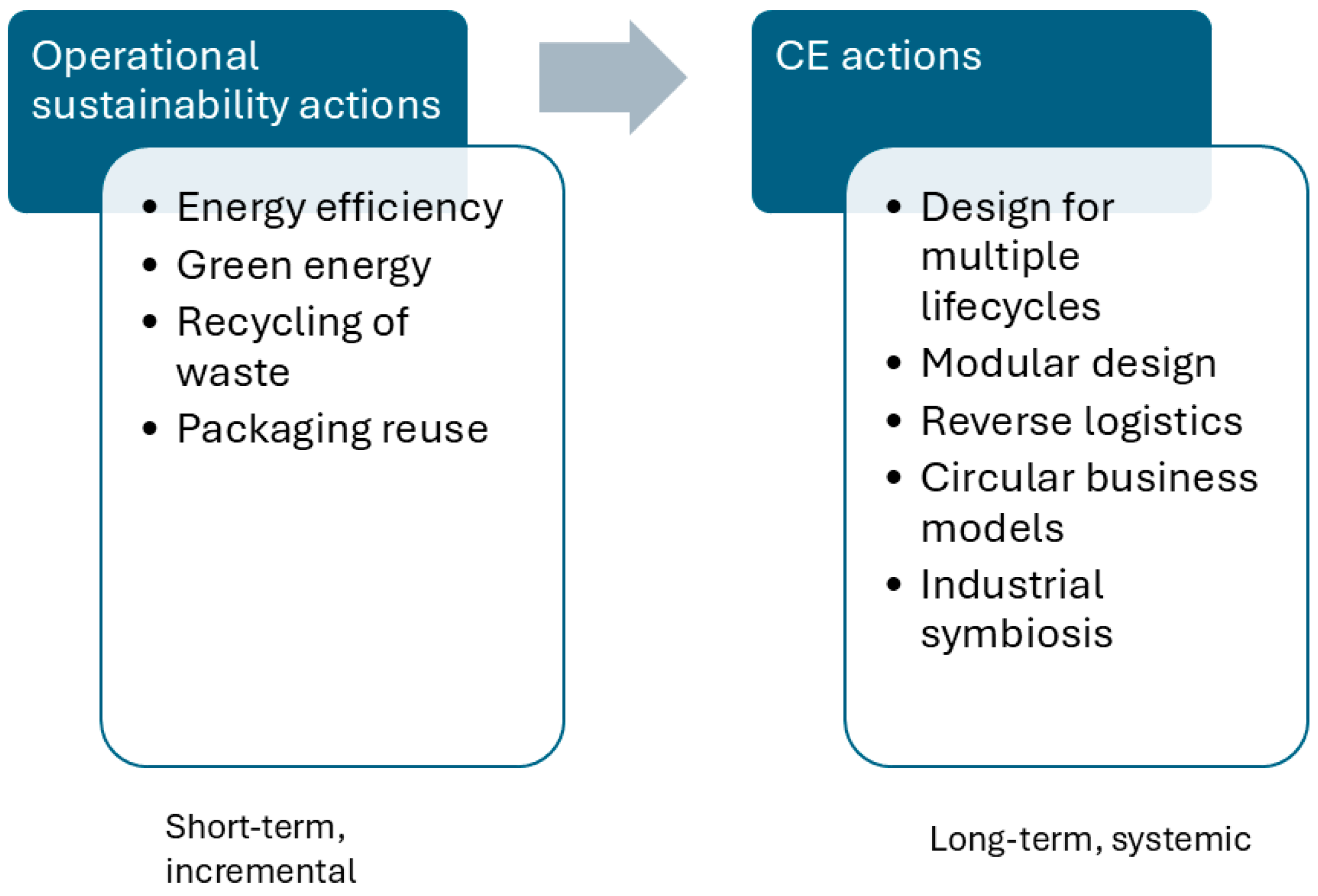
To clarify the contribution of this study, Figure 1 illustrates the distinction between operational sustainability actions and CE actions. Operational sustainability actions, such as energy efficiency, renewable energy adoption, and recycling of production waste, are typically short-term and incremental, requiring limited changes to business models. In contrast, CE actions, such as design for multiple life cycles, reverse logistics, and modular design, are systemic and long-term, often demanding significant organizational and supply chain transformation. Positioning these findings within transition frameworks reveals that the companies in this study are at an early stage of circular maturity, where operational improvements are dominant. This aligns with CE maturity models [16], which emphasize capability building and gradual progression toward integrated circular strategies. Looking at it from an innovation systems perspective, the small scale of CE actions showed that companies worked in limited networks, with few partnerships and little support from institutions. These are issues that are known barriers to adopting circular practices (Jaeger et al.) [24].
Figure 1.
Operational sustainability actions and CE actions.
The conceptual distinction proposed in Figure 1 can support both researchers and practitioners in assessing progress toward transition and identifying gaps in circularity. Future work can further develop the Figure and explore how companies can accelerate the transition from operational sustainability actions to CE actions.
The study had some limitations. One limitation was that the sample consisted of seven Swedish manufacturing companies, which may not reflect the broader manufacturing sector. Furthermore, the single-interview design limited the depth of insight and precluded triangulation across data sources. Due to this, the study cannot be generalized to all manufacturing companies globally. It is also worth noting that some of the interviews fell outside the focus group category, as they involved fewer than the required number of participants.
6. Conclusions and Future Work
This study found that activities for reducing emissions from operational sustainability are well established, whereas the CE transition is in a much earlier stage in the investigated companies, with only a small fraction of their operations so far. Previous studies have made little distinction between CE activities and operational sustainability actions. If these distinctions became widely adopted, the purpose behind the actions would be clearer. It is also worth noting that the categorizations were not directly observed at the companies, but the companies were aware of them. The absence of a clear distinction between operational sustainability and CE actions was observed in this study, both in practice and in the literature. This lack of differentiation makes it difficult to assess progress toward CE goals and may hinder strategic decision-making. For practitioners, the results underscore the need to move beyond incremental operational improvements and start integrating circular principles into product development.
The companies in this study are still operating according to linear business models, where circularity is mainly in the planning stage or in a limited number of products. In operational sustainability, the recycling of industrial post-industrial waste is the most common. Other activities involved the reuse/repurposing of packaging, the use of renewable energy, and energy conservation. A distinction between activities carried out to reduce CO2 emissions in operations and those aimed at the CE transition was missing in companies and largely in the literature. Future work should focus on the CE transition. Finding out at what pace and how companies are going, from operational CO2 reductions to CE transition activities. The literature review revealed that there is room for improvement in design methods for circular products as well as in the CE product assessment methods. The day-to-day savings can be quantified, whereas the contributions from activities directed toward circular activities are difficult to quantify.
For academics, this paper contributes to a deeper understanding of the current state of practice by documenting the current situation for companies and identifying future challenges in achieving a more circular manufacturing sector.
Future research should explore how companies can measure the transition from operational sustainability to CE practices, investigate methods for assessing circularity at both the product and system levels, and examine how to integrate circular practices into the product realization process.
Author Contributions
Conceptualization, R.S. and M.L.; methodology, R.S. and M.L.; validation, R.S. and M.L.; formal analysis, R.S. and M.L.; investigation, R.S. and M.L.; writing—original draft preparation, R.S.; writing—review and editing, R.S. and M.L.; visualization, R.S. and M.L.; project administration, R.S.; funding acquisition, R.S. All authors have read and agreed to the published version of the manuscript.
Funding
This research was funded by the Swedish Knowledge Foundation, grant number 20230037.
Institutional Review Board Statement
The objects studied are solely the manufacturing companies. All interviewees have agreed to be interviewed and have been given the opportunity to verify that their answers have been represented correctly in writing. This type of research does not need approval from an independent ethics committee at Jönköping University (JU), Sweden.
Informed Consent Statement
Informed consent was obtained from all subjects involved in the study.
Data Availability Statement
The interview data that this article is based upon cannot be disclosed because a non-disclosure agreement exists between the University and the companies taking part in the research project.
Acknowledgments
The authors express their gratitude for financial support from the Swedish Knowledge Foundation and the participating manufacturing companies. Other than GrammarlyTM version v1.2.221.1801, no AI tools have been used for the preparation of this manuscript.
Conflicts of Interest
The authors declare no conflicts of interest.
Abbreviations
The following abbreviations are used in this manuscript:
| CE | Circular economy |
| GHG | Greenhouse gas |
| ESRS | European sustainability reporting standards |
References
- Schöggl, J.P.; Stumpf, L.; Baumgartner, R.J. The narrative of sustainability and circular economy—A longitudinal review of two decades of research. Resour. Conserv. Recycl. 2020, 163, 105073. [Google Scholar] [CrossRef] [Scilit]
- Geissdoerfer, M.; Savaget, P.; Bocken, N.M.P.; Jan Hultink, E. The Circular Economy—A new sustainability paradigm? J. Clean. Prod. 2017, 143, 757–768. [Google Scholar] [CrossRef] [Scilit]
- Bassi, F.; Dias, J.G. The use of circular economy practices in SMEs across the EU. Resour. Conserv. Recycl. 2019, 146, 523–533. [Google Scholar] [CrossRef] [Scilit]
- Despeisse, M.; Mbaye, F.; Ball, P.; Levers, A. The emergence of sustainable manufacturing practices. Prod. Plan. Control. 2012, 23, 354–376. [Google Scholar] [CrossRef] [Scilit]
- Kalar, B.; Primc, K.; Erker, R.S.; Dominko, M.; Ogorevc, M. Circular economy practices in innovative and conservative stages of a firm’s evolution. Resour. Conserv. Recycl. 2021, 164, 105112. [Google Scholar] [CrossRef] [Scilit]
- Karuppiah, K.; Sankaranarayanan, B.; Lo, H.W. A systematic literature review on the evolution of sustainable manufacturing practices: Key findings and implications. Clean. Eng. Technol. 2024, 22, 100798. [Google Scholar] [CrossRef] [Scilit]
- Khan, M.; Majid, A.; Ahmed, A. Circular economy practices in manufacturing SMEs: A perspective of environmental management in developing countries. Sustain. Futures 2025, 9, 100418. [Google Scholar] [CrossRef] [Scilit]
- Mura, M.; Longo, M.; Zanni, S. Circular economy in Italian SMEs: A multi-method study. J. Clean. Prod. 2020, 245, 118821. [Google Scholar] [CrossRef] [Scilit]
- Zink, T.; Geyer, R. Circular Economy Rebound. J. Ind. Ecol. 2017, 21, 593–602. [Google Scholar] [CrossRef] [Scilit]
- Zaman, M.; Tanewski, G.; Ekanayake, G. What does sustainability mean for small and medium enterprises: A systematic literature review. J. Clean. Prod. 2025, 492, 144830. [Google Scholar] [CrossRef] [Scilit]
- Cagno, E.; Morioka, S.N.; Neri, A.; de Souza, E.L. Understanding how circular economy practices and digital technologies are adopted and interrelated: A broad empirical study in the manufacturing sector. Resour. Conserv. Recycl. 2025, 216, 108172. [Google Scholar] [CrossRef] [Scilit]
- Ahmadi-Gh, Z.; Bello-Pintado, A. Why is manufacturing not more sustainable? The effects of different sustainability practices on sustainability outcomes and competitive advantage. J. Clean. Prod. 2022, 337, 130392. [Google Scholar] [CrossRef] [Scilit]
- Ruiz-Pastor, L.; Altavilla, S.; Borgianni, Y. Design issues concerning circular economy assessment methods at the product level: A comparative analysis through a case study of a mobile tiny house. Des. Sci. 2024, 10, e12. [Google Scholar] [CrossRef] [Scilit]
- Ko, J.; Guedes, G.B.; Badurdeen, F.; Jawahir, I.; Morris, K.; Ferrero, V.; Hapuwatte, B.; Bradley, R.; Raihanian, A. A critical analysis of circular product attributes and limitations of product circularity assessment methods. Resour. Conserv. Recycl. Adv. 2024, 23, 200219. [Google Scholar] [CrossRef] [Scilit]
- Matschewsky, J.; Lingegård, S.; Martin, M.A. Circular economy indicators for the design and procurement of plastic products in the healthcare sector—A review. Procedia CIRP 2024, 122, 891–896. [Google Scholar] [CrossRef] [Scilit]
- Acerbi, F.; Taisch, M. A literature review on circular economy adoption in the manufacturing sector. J. Clean. Prod. 2020, 273, 123086. [Google Scholar] [CrossRef] [Scilit]
- Geissdoerfer, M.; Pieroni, M.P.; Pigosso, D.C.; Soufani, K. Circular business models: A review. J. Clean. Prod. 2020, 277, 123741. [Google Scholar] [CrossRef] [Scilit]
- Richardson, J. The business model: An integrative framework for strategy execution. Strateg. Change 2008, 17, 133–144. [Google Scholar] [CrossRef] [Scilit]
- Elia, V.; Gnoni, M.G.; Tornese, F. Evaluating the adoption of circular economy practices in industrial supply chains: An empirical analysis. J. Clean. Prod. 2020, 273, 122966. [Google Scholar] [CrossRef] [Scilit]
- Ellen Macarthur Foundation. 2025. Available online: https://www.ellenmacarthurfoundation.org/ (accessed on 20 December 2025).
- Diaz, A.; Reyes, T.; Baumgartner, R.J. Implementing circular economy strategies during product development. Resour. Conserv. Recycl. 2022, 184, 106344. [Google Scholar] [CrossRef] [Scilit]
- Muñoz, S.; Hosseini, M.R.; Crawford, R.H. Towards a holistic assessment of circular economy strategies: The 9R circularity index. Sustain. Prod. Consum. 2024, 47, 400–412. [Google Scholar] [CrossRef] [Scilit]
- Alayón, C.L.; Säfsten, K.; Johansson, G. Barriers and Enablers for the Adoption of Sustainable Manufacturing by Manufacturing SMEs. Sustainability 2022, 14, 2364. [Google Scholar] [CrossRef] [Scilit]
- Jaeger, B.; Upadhyay, A. Understanding barriers to circular economy: Cases from the manufacturing industry. J. Enterp. Inf. Manag. 2020, 33, 729–745. [Google Scholar] [CrossRef] [Scilit]
- Joachimiak-Lechman, K. Life cycle perspective in design and product development. Eng. Manag. Prod. Serv. 2024, 16, 143–156. [Google Scholar] [CrossRef] [Scilit]
- Hertwich, E.G.; Wood, R. The growing importance of scope 3 greenhouse gas emissions from industry. Environ. Res. Lett. 2018, 13, 104013. [Google Scholar] [CrossRef] [Scilit]
- IPCC. Sixth Assessment Report. 2025. Available online: https://www.ipcc.ch/assessment-report/ar6/ (accessed on 14 October 2025).
- Kamińska-Witkowska, A.; Kaźmierczak, M. Sustainability reporting in selected automotive companies. Eng. Manag. Prod. Serv. 2024, 16, 129–142. [Google Scholar] [CrossRef] [Scilit]
- Schneider, D.; Schüler, A.; Woerle, M.; Schneider, D.; Eisold, N.; Reinhart, G. Sustainability reporting and transitory environmental sustainability risks in manufacturing. Int. J. Sustain. Eng. 2025, 18, 2461565. [Google Scholar] [CrossRef] [Scilit]
- Stahel, W.R. The product life factor. In An Inquiry into the Nature of Sustainable Societies. The Role of the Private Sector; Houston Area Research Centre: Houston, TX, USA, 1982; pp. 72–105. [Google Scholar]
- Bocken, N.M.P.; de Pauw, I.; Bakker, C.; van der Grinten, B. Product design and business model strategies for a circular economy. J. Ind. Prod. Eng. 2016, 33, 308–320. [Google Scholar] [CrossRef] [Scilit]
- Potting, J.; Hekkert, M.; Worell, E.; Hanemaaijer, A. Circular Economy: Measuring Innovation in the Product Chain; PBL Publishing: The Hague, The Netherlands, 2017. [Google Scholar]
- Kurilova-Palisaitiene, J.; Sundin, E.; Sakao, T. Orienting around circular strategies (Rs): How to reach the longest and highest ride on the Retained Value Hill? J. Clean. Prod. 2023, 424, 138724. [Google Scholar] [CrossRef] [Scilit]
- Russell, J.; Nasr, N. Value-retention processes within the circular economy. In Remanufacturing in the Circular Economy: Operations, Engineering and Logistics; Wiley: Hoboken, NJ, USA, 2019; pp. 1–29. [Google Scholar]
- Kortus, L.; Gutmann, T. How do firms build dynamic capabilities to develop sustainable products? A multiple case study in the manufacturing industry. J. Clean. Prod. 2023, 415, 137887. [Google Scholar] [CrossRef] [Scilit]
- Hallstedt, S.I.; Villamil, C.; Lövdahl, J.; Nylander, J.W. Sustainability Fingerprint—Guiding companies in anticipating the sustainability direction in early design. Sustain. Prod. Consum. 2023, 37, 424–442. [Google Scholar] [CrossRef] [Scilit]
- Charter, M. Designing for the Circular Economy; Routledge: Oxfordshire, UK, 2018; pp. 1–396. [Google Scholar]
- Hallstedt, S.I.; Isaksson, O.; Nylander, J.W.; Andersson, P.; Knuts, S. Sustainable product development in aeroengine manufacturing: Challenges, opportunities and experiences from GKN Aerospace Engine System. Des. Sci. 2023, 9, e22. [Google Scholar] [CrossRef] [Scilit]
- Popowicz, M.; Katzer, N.J.; Kettele, M.; Schöggl, J.-P.; Baumgartner, R.J. Digital technologies for life cycle assessment: A review and integrated combination framework. Int. J. Life Cycle Assess. 2025, 30, 405–428. [Google Scholar] [CrossRef] [Scilit]
- Williamson, K. Research Methods for Students, Academics and Professionals: Information Management and Systems, 2nd ed.; Topics in Australian Library and Information Studies; Centre for Information Studies: Wagga Wagga, Australia, 2002; p. 20. [Google Scholar]

Disclaimer/Publisher’s Note: The statements, opinions and data contained in all publications are solely those of the individual author(s) and contributor(s) and not of MDPI and/or the editor(s). MDPI and/or the editor(s) disclaim responsibility for any injury to people or property resulting from any ideas, methods, instructions or products referred to in the content. |
© 2026 by the authors. Licensee MDPI, Basel, Switzerland. This article is an open access article distributed under the terms and conditions of the Creative Commons Attribution (CC BY) license.