1. Introduction
Space cooling is the leading type of energy consumed in the Gulf region. Extremely hot and humid summers are typical of the Gulf climate; thus, mechanical cooling is almost everywhere. High-rise building studies in desert climates document space cooling as having the ability to correspond to up to 70% of total energy usage [
1,
2]. This seems to be supported by similar regional reports: in the Middle East and North Africa (MENA), air-conditioning utilization is estimated by about 70% of residential and commercial electricity consumption [
3,
4], and surveys of commercial-sector electricity demand in Saudi Arabia and the UAE show that 60–70% of peak electricity demand is taken by cooling systems alone [
5]. The buildings sector accounted for approximately 34% of all energy demand and generated 34% of all energy-related CO
2 emissions in 2023 on a global scale [
6]. This reliance on cooling highlights the importance of energy use in buildings, making it a policy issue of central concern.
The need to overcome this challenge has been worsened by rapid urbanization and economic growth in the Gulf. The official estimates indicate that the industry sector of Saudi Arabia consumes 47% of primary energy, followed by the buildings sector, 28%, and transport, 20% [
7]. The pricing of domestic energy is low, and the climate is dry, with high ambient temperatures, which stimulates demand in air-conditioning and water desalination. In addition, energy efficiency performance is not optimal because energy is under-priced, and therefore, it promotes too much consumption [
7]. Saudi Vision 2030 is designed to change this trend, diversifying the economy, reducing emissions, and reaching 50% of renewable power generation capacity by 2030 [
8]. One of the pillars of Vision 2030 is a more sustainable built environment; initiatives, including the Saudi Energy Efficiency Program (SEEP) and Saudi Energy Efficiency Center (SEEC), have been established to implement building codes, establish energy-labeling of air conditioners and insulation materials, and to retrofit government buildings through the national energy services company TARSHID [
9,
10].
These policies complement green-building initiatives. For example, the Sustainable Building Program has developed a national sustainability rating system, assessing over 70 projects covering more than 50 million m
2 by 2023 [
11]. Studies estimate that conventional buildings consume about 40% of global energy and produce 30% of carbon emissions, whereas green buildings can cut energy use by nearly half and reduce annual operating costs by roughly 30% [
12]. Rating systems in neighboring GCC states, such as Abu Dhabi’s Pearl Rating System and Qatar’s Global Sustainability Assessment System (GSAS), show that mandatory green standards for new buildings can reduce energy demand by 70% and achieve 30–50% energy savings in existing buildings [
13,
14].
Beyond policy, occupant behavior and weather strongly influence energy use. Empirical analyses reveal that higher occupancy rates increase energy consumption because of additional lighting, electronics, and HVAC loads, while low occupancy leads to energy waste [
15]. Weather variables such as outdoor temperature, humidity, and solar radiation also contribute significantly to consumption dynamics [
16]. Consequently, occupancy-based control strategies that adjust HVAC operations according to occupancy patterns have demonstrated improved energy efficiency and comfort [
17]. Yet implementing such strategies in the Gulf’s harsh climate is complex because occupant schedules, thermal preferences, and equipment performance vary widely [
18].
Last but not least, electricity pricing is complex. Time-of-use (TOU) tariffs are prevalent in most countries, but in the Gulf, they are restricted. According to a Chatham House analysis, proposed TOU and interruptible tariffs in Saudi Arabia and Oman are mostly voluntary and are aimed primarily at industrial consumers [
19]; voluntary tariffs are also found in Abu Dhabi [
20]. There are, therefore, very limited price incentives to consumers, particularly within residential and commercial sectors, to decrease peak demand. It is still in its infancy because dynamic pricing is still being experimented with, as recent electricity price reforms in Saudi Arabia attempt to publicize real costs and phase out subsidies gradually [
21].
Heating, ventilation, and air-conditioning (HVAC) systems become dominant building loads in hot climates, and this is difficult to optimize. The control problem is multi-objective: the agent should pay attention to the indoor thermal comfort, minimize the energy use, and consider the operating costs, including the tariffs that could depend on the time of day [
22,
23]. The balance is challenging to achieve due to the subjective sense of comfort depending on occupant metabolism, clothing, and activity levels and energy consumption being a non-linear response to outdoor temperature, humidity, solar radiation, and equipment dynamics [
24]. Moreover, the Gulf summer has excessive outdoor temperatures that place a strain on HVAC systems. The traditional rule-based controllers usually scale up the systems or run them all the time, resulting in poor energy utilization and heating inconveniences [
25].
The environment of the Gulf is very dynamic. Outdoor temperatures are unpredictable, reaching highs of exceeding 50 °C, and humidity varies with sea breezes as well as dust storms due to solar radiation [
26]. The occupancy changes on an hourly and seasonal basis depending on the work schedules, holidays, and economic activity in the commercial buildings. These aspects lead to adaptive control methods that are capable of learning based on past data and real-time sensor values. The efficiency of learning algorithms is, however, a serious limiting factor; learning algorithms based on reinforcement learning (RL) mechanisms often need large data sets and may fail to perform well when the conditions vary [
27,
28,
29]. Recent results on model-based RL indicate that precise system models and data-efficient learning methods can bring the training data requirement down to just seven days and also cut comfort violations by 12 percent [
30].
Introducing TOU pricing could encourage demand-side flexibility by shifting cooling loads to off-peak hours. However, current tariffs in Saudi Arabia rarely differentiate between peak and off-peak periods. The voluntary TOU tariffs described earlier focus on large industrial consumers. For residential and commercial buildings, optimizing HVAC control under hypothetical TOU tariffs requires predictive models of price variation and occupant response. Multi-objective control must therefore balance comfort and energy use while minimizing costs under potentially dynamic tariffs [
7,
31].
Deep reinforcement learning (DRL) has recently been applied to HVAC control. DRL algorithms—such as Deep Q-Networks, Soft Actor–Critic (SAC), and Proximal Policy Optimization—can outperform reactive controllers, achieving significant energy savings [
32]. Yet they suffer from several limitations, such as reward sensitivity; small changes in reward weightings can cause large changes in performance and hinder transferability across climates [
33]. Moreover, sample inefficiency model-free algorithms require extensive exploration and long training periods [
34]. Also, comfort is the compromise, as many studies prioritize energy minimization, resulting in uncomfortable indoor temperatures, system shutdown behaviors, or oscillations [
30], and there is a lack of generalization, as policies trained for a particular climate or building often fail when deployed in different environments [
33] Moreover, advanced control strategies such as Model Predictive Control (MPC) and RL can reduce costs and emissions by 15–25% relative to rule-based control [
35], yet adoption remains limited due to unclear business cases and high deployment costs [
35].
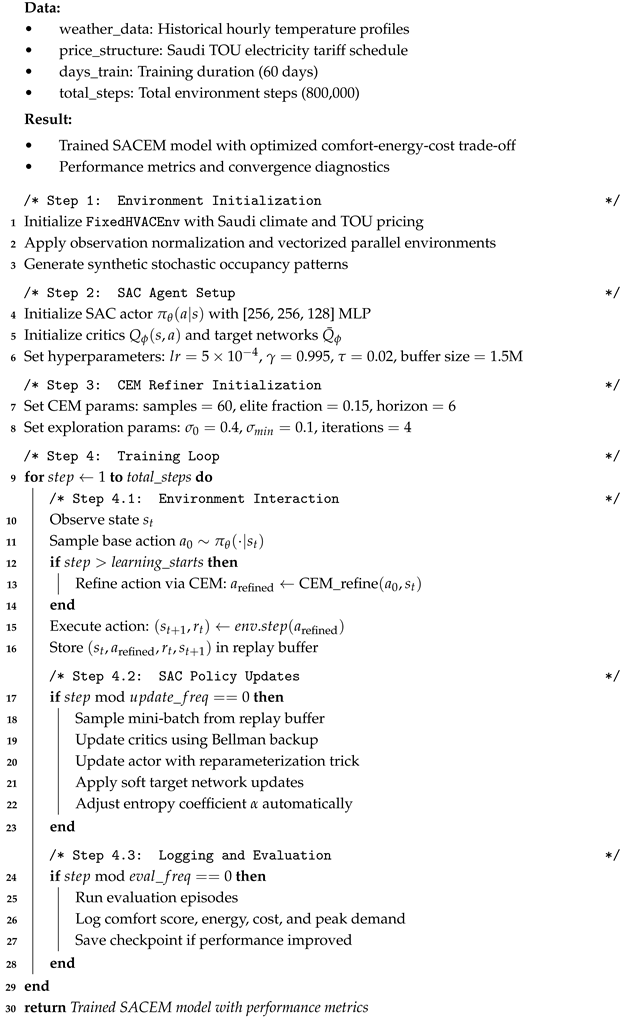
This paper proposes a Soft Actor–Critic with Cross-Entropy Method (SACEM) framework for HVAC control in smart buildings. In this work, resilience intelligence refers to the controller’s ability to maintain safe comfort under disturbances such as extreme heat spikes, forecast errors, and stochastic occupancy, while avoiding brittle behaviors such as oscillations, shutdown, or over-reliance on a single predictive signal. The proposed SACEM delivers resilience beyond incremental forecasting gains through structural innovations: (i) a two-layer decision architecture that couples a stochastic entropy-regularized policy (SAC) with a short-horizon action refinement optimizer (CEM) that explicitly evaluates candidate sequences under the thermal transition model; (ii) a comfort-dominant reward with strongly asymmetric penalties that makes comfort violations economically irrational for the agent (Equation (
10)); and (iii) safety-aware projection during refinement that prevents unsafe candidate actions even during exploration (Equation (
24)). These elements change the controller’s decision mechanism from purely reactive reward maximization to look-ahead, constraint-aware control, which is verifiable through ablation and stress testing (
Section 3.7 and
Section 4).
Despite these advances, the current literature lacks a unified, comfort-first control framework that jointly addresses short-horizon foresight, safety under uncertainty, and economic optimization in hot-climate buildings. In particular, few studies explicitly verify robustness against forecast errors, stochastic occupancy, and extreme heat while maintaining high comfort guarantees. This work addresses these gaps by positioning SACEM as a hybrid learning–optimization framework that bridges MPC-style predictive reasoning and DRL-based adaptability, with explicit comfort dominance and resilience verification.
The objective of this study is to develop a comfort-first intelligent HVAC control strategy that is suitable for hot-climate buildings operating under time-of-use electricity pricing. The motivation for this work arises from persistent limitations in existing HVAC control approaches, where energy or cost minimization is often achieved at the expense of occupant comfort, particularly under extreme thermal stress. These limitations are further exacerbated in hot desert climates, where cooling demand dominates and system mismanagement can rapidly lead to discomfort, peak-load stress, and economic inefficiency.
To address these challenges, this paper proposes a hybrid control framework that integrates Soft Actor–Critic (SAC) learning with a Cross-Entropy Method (CEM) refinement layer. The rationale behind this integration is to combine the adaptability and sample efficiency of off-policy deep reinforcement learning with short-horizon predictive optimization and safety-aware decision making. By explicitly prioritizing thermal comfort through asymmetric reward penalties and constraint-aware refinement, the proposed framework aims to prevent system shutdown behaviors and unstable control actions observed in prior DRL-based HVAC studies.
This study further aims to rigorously evaluate the proposed approach under realistic operating conditions representative of Saudi Arabian commercial buildings. This includes validation under extreme summer temperatures, stochastic occupancy patterns, and time-varying electricity tariffs. Through comparative evaluation against state-of-the-art baselines and targeted ablation and disturbance tests, this work seeks to demonstrate not only performance improvements in comfort, energy, and cost but also enhanced robustness and resilience to uncertainty.
The novelty of the present study is the idea of redefining the issue of HVAC control in buildings located in hot climates as a control problem dominant in comfort but with critical resilience requirements instead of an energy-minimization challenge. In contrast to the previous literature, which mainly maximizes energy or cost, with the exception that comfort is considered a soft or secondary goal, this paper presents a control paradigm where an asymmetric reward structure and safety conscience decision refinement are introduced to render comfort violations economically irrational.
The most important novelty is that the decision-time short-horizon optimization has been integrated into a data-efficient off-policy reinforcement learning controller. Although the literature either uses model-based MPC (with high modeling and deployment expenses) or model-free DRL (with myopic and unstable behavior), the suggested SACEM framework has the unique advantage of integrating the search of entropy-regularized policy learning with the Cross-Entropy Method (CEM) of action refinement with explicit safety constraints. This structural connection permits anticipatory constraint-conscious control without the large-scale predictive model or long time horizon plans.
This study is worth the knowledge since it shows that the high-level of comfort does not exclude economic efficiency, even in extreme thermal conditions, and the electricity tariffs vary with time. The findings are actionable evidence that optimizing hybrid, under hot climatic conditions, HVAC learning controllers can attain reliable, interpretable, and deployable HVAC controls, where cooling need, peak loads, and occupant comfort are of paramount significance to society and the economy.
Based on the identified research gaps and the proposed comfort-first hybrid control design, this study tests the following hypotheses:
Hypothesis 1. A comfort-dominant hybrid reinforcement learning controller (SACEM) can achieve significantly higher thermal comfort levels than state-of-the-art DRL baselines (PPO, TD3, SAC) under extreme hot-climate conditions.
Hypothesis 2. The integration of short-horizon decision-time refinement (CEM) with off-policy DRL enables simultaneous improvement in comfort and reduction in energy consumption and operating cost under time-of-use electricity pricing.
Hypothesis 3. Safety-aware action refinement and asymmetric comfort penalties improve robustness to uncertainty, resulting in lower comfort violation rates under forecast errors, occupancy disturbances, and extreme heat events compared to model-free DRL controllers.
The remainder of this paper is structured as follows.
Section 2 reviews related work on intelligent HVAC control, including model-predictive and reinforcement learning techniques.
Section 3 presents the proposed SACEM methodology, detailing the learning framework, reward formulation, simulation environment, and experimental setup.
Section 4 reports and discusses the results, comparing SACEM with baseline controllers across energy, cost, and comfort metrics. Finally,
Section 5 concludes the paper and outlines directions for future research.
Heating, ventilation, and air-conditioning (HVAC) systems have captured much research because of their contribution to building heating and cooling energy use and comfort. The literature covers a wide range of methodologies, from traditional methods of control to the latest intelligent techniques. This section will review the current literature based on four broad themes, namely, HVAC control methods, deep reinforcement learning to control buildings, hybrid optimization frameworks, and the literature that has studied hot-climate conditions.
State-of-the-art HVAC control research has progressed along three dominant directions. First, model-based approaches such as Model Predictive Control (MPC) provide explicit look-ahead optimization and constraint handling but require accurate system models and incur high computational and deployment costs, limiting scalability in complex or uncertain environments. Second, model-free deep reinforcement learning (DRL) methods, including PPO, TD3, and Soft Actor–Critic (SAC), offer adaptive control without explicit modeling, yet frequently exhibit myopic behavior, reward sensitivity, and comfort degradation under extreme thermal conditions. Third, emerging hybrid approaches attempt to combine learning and optimization, but most remain either climate-agnostic, comfort-secondary, or insufficiently validated under hot-climate and time-varying tariff conditions.
2. State of the Art
The optimization of HVAC systems has been extensively studied using a wide range of control strategies. Traditional proportional–integral–derivative (PID) controllers, while simple and widely used, suffer from poor adaptability and weak anti-interference capabilities. To address these issues, a two-stage fuzzy neural network-enhanced PID control method was developed, achieving superior convergence, robustness, and overall control performance in industrial workshops [
36]. Beyond PID, fuzzy logic controllers have been explored for thermal comfort management, with designs that expand input parameters and employ automatic fuzzy rule generation to achieve up to 50% energy savings without compromising comfort [
37]. A further advance is the Weather-Adaptive Fuzzy Control (WAFC) strategy, which integrates external weather, electricity pricing, and occupancy data to dynamically adjust HVAC setpoints, resulting in significant annual energy savings and improved sustainability in urban buildings [
38].
Another major line of research centers on Model Predictive Control (MPC), which leverages predictive modeling and optimization to manage building energy use under uncertainty. Several reviews have highlighted MPC’s capability to optimize energy efficiency, cost, and comfort while stressing the importance of parameters such as prediction horizons, cost functions, and modeling software [
39,
40]. Simulation campaigns across diverse U.S. climate zones demonstrated that MPC can yield substantial energy savings compared to rule-based baselines, though ignoring humidity in MPC formulations can degrade comfort in mild conditions [
41]. Modified economic MPC frameworks have also been introduced to balance occupant comfort and electricity costs in multi-zone settings, incorporating thermal energy storage and dynamic pricing to reduce costs by nearly 19% [
42]. Hybrid models that combine MPC with radial basis function neural networks further enhance predictive accuracy, achieving energy consumption reductions of around 15% in both residential and commercial buildings [
43]. Complementing these works, a distributed energy–comfort management method based on Lyapunov optimization was proposed to flexibly balance energy use and thermal comfort across multiple regions, reducing costs while protecting user privacy [
44].
A structured comparison of representative deep reinforcement learning approaches for HVAC control, including their application contexts and identified limitations, is summarized in
Table 1, highlighting gaps that motivate the proposed approach.
Climate change and extreme weather events present additional challenges for HVAC control. Simulation studies using extreme weather data sets project increased peak cooling demand and unmet cooling hours in commercial buildings, underscoring the importance of a future-proof HVAC system design that incorporates variability and extreme conditions [
54]. Intelligent building systems have also been enabled by advancements in information and communication technologies, where MPC frameworks exploit abundant sensor data to improve adaptability and performance in real time [
40]. Broader reviews comparing traditional, fuzzy, MPC, and machine learning-based approaches emphasize the growing potential of reinforcement learning (RL), which offers adaptive control under dynamic environments, though its validation remains limited in industrial contexts [
55]. Finally, advances in building energy control increasingly combine traditional rule-based and PID approaches with modern techniques such as extremum seeking control and reinforcement learning, aiming to balance simplicity, robustness, and adaptability [
36,
43].
Recent studies are using deep reinforcement learning (DRL) more for building control since it can learn control policies without having to know precise plant models. On the one hand, buildings represent a major part of the world’s energy, and HVAC systems occupy more than half of this amount of energy consumption. The common rule-based or model-predictive controllers do not easily scale to complex multi-zone buildings and can be very laborious to model. DRL as an alternative has thus been explored as a potential alternative; however, the majority of research is performed on a single algorithm and single-zone output, with only some studies examining comparisons across methods. New appraisals and assessments will give the insights of policy-gradient and actor–critic methods, multi-agent systems, as well as the problem of reward engineering [
32,
56,
57].
Proximal Policy Optimization (PPO) [
58] is an on-policy policy-gradient algorithm that makes use of a clipped objective and which blocks excessively large policy updates. Recently, in a more thorough analysis of DRL applied to HVAC control, PPO was characterized as enhancing TRPO by introducing a clipped objective and lessening computational expense, and is not very data-efficient [
32]. This paper contrasted PPO and TD3 and SAC, wherein PPO performed fairly but had slower convergence and poor off-policy performance in multi-objective tasks [
32].
Asynchronous Advantage Actor–Critic (A3C) [
59] and its synchronous counterpart A2C, parallelize a set of agents training local policies that a central agent plans. These on-policy approaches are easy and can utilize parallel environments, although in practice, they are generally less effective than more advanced policy-gradient methods such as PPO [
32]. Recently, a building energy management (BEM-DRL) architecture with A3C and Bayesian optimization was proposed to optimize HVAC control policies and achieved savings in energy consumption of about 16.7 percent [
60].
Twin-Delayed DDPG (TD3) [
61] is an off-policy actor–critic algorithm that builds on DDPG and adds clipped double-Q-networks, delayed policy refinement, and target-policy smoothing to enhance stability [
62,
63]. In the analysis of HVAC evaluation, TD3 was proven to rapidly converge and achieve better stability compared to PPO, but it still used more energy than SAC in most cases [
32]. The outcome of the training indicated that the TD3 had considerable energy savings and could be transferred to other climates, although there were occasions when it experienced action saturation [
32].
Soft Actor–Critic (SAC) is an off-policy actor–critic algorithm that optimizes expected payoff and promotes exploration by means of entropy regularization [
64]. The evaluation paper demonstrated that SAC performed well in a range of different climates, with early convergence and strong generalization; SAC saved more energy than PPO and TD3 and kept occupants comfortable [
65]. Recent installations of multi-zone buildings show that SAC can save about 15% of HVAC energy use and maintain comfort. SAC has also been applied in real-world buildings. A study comparing offline-trained and online-trained SAC controllers to a model-predictive controller found that the offline SAC achieves performance comparable to MPC and that the value of data-efficient off-policy control is practical [
66].
A single-agent DRL would be impractical, as state and action spaces are growing exponentially and require coordination on a multitude of zones to control the building. Multi-agent DRL (MADRL) de-allocates agents to zones or subsystems. The combination of electrochromic windows and multi-zone HVAC using MADRL was tested, and 19.8% of energy was saved and 40.3 vs. rule-based control and other MADRL methods by 1–5% of comfort violations and 48% across climates [
67].
A study in [
68] observed that multi-zone HVAC needs inter-agent coordination; approaches such as MADDPG and MAAC handle the issue of coupling well but do not scale beyond a few dozen zones. There is a need for a more scalable MADRL. In addition to HVAC, occupant-focused methods employ value-decomposition networks of per-zone agents.
Recent reinforcement learning-based energy management studies have increasingly focused on cyber-resilience and uncertainty-aware scheduling. A state-adversarial deep reinforcement learning framework was introduced to enhance cyber-resilience in integrated energy systems with demand response, explicitly modeling cyber attacks as adversaries within the decision process and achieving improved economic performance under attack scenarios [
69]. Complementary work has explored robust multi-agent deep reinforcement learning for multi-carrier energy systems, demonstrating that coordinated DRL control combined with demand response and energy storage can significantly improve operational resilience and reduce system costs under cyber disturbances [
70]. In parallel, comprehensive reviews highlight the growing role of deep learning in securing renewable energy supply chains, emphasizing anomaly detection, adversarial robustness, and the need for standardized benchmarks to ensure scalable and resilient deployment in real-world energy infrastructures [
71].
Recent reinforcement learning and online optimization studies in edge and cyber–physical systems provide complementary insights into large-scale, latency-aware, and reliability-driven decision making. Proactive deployment in MEC systems leverages multi-dimensional prediction and two-timescale optimization to balance deployment cost, latency, and prediction uncertainty [
72], while reliability-enhanced microservice deployment exploits Lyapunov-based online control to improve system stability under failures and resource coupling [
73].
Beyond deployment, two-timescale optimization has also been applied to human digital twin construction and task execution under mobility, accuracy, and delay constraints [
74], with recent surveys highlighting the role of generative AI and deep learning in strengthening cyber-resilience and observability in complex IoT and healthcare systems [
75]. Similarly, joint service migration and task rerouting strategies in MEC demonstrate how online resource management can balance responsiveness and optimality under dynamic conditions [
76]. In contrast to these works, SACEM focuses on real-time HVAC control under extreme climate conditions, emphasizing comfort-first safety, decision-time refinement, and robustness to operational uncertainty rather than service placement or task offloading.
Recent DRL studies on building control are leaving behind proof-of-concept studies in favor of comparative studies and multi-agent deployments. Off-policy actor–critic models like SAC and TD3 now provide the best trade-offs in energy consumption, comfort, and stabilization of occupants, and training. PPO and A3C are easier to implement, but tend to converge more slowly, and are sensitive to information efficiency. Multi-agent models combat the dimensionality curse of multi-zone buildings, but additional research would be required to extend to actual buildings with hundreds of zones [
32,
77]. Last but not least, the reward mechanism is also a key design factor: it is challenging to weight several objectives [
3], and ill-defined rewards may result in sparse cues or unwanted behavior [
27]. The pursuit of emerging solutions integrating multi-objective DRL, multi-stage reward models, and holistic comfort measures provides ways in which to continue to move towards a robust and adaptive building-control system [
77].
The literature demonstrates that control methods based on rules, PID control, and MPC have been supplanted by off-policy actor–critic models, which in turn exhibit better sample efficiency, stability, and cross-climate generalization compared to on-policy counterparts, and that multi-agent models can be used to address, but not to fully solve, the sample efficiency, stability, and cross-climate generalization needs of large multi-zone buildings. The current gaps could be addressed through standardized, climate-sensitive benchmarks, principled multi-objective reward-shaping, avoiding a degenerate policy, and active tests in real buildings with heterogeneous end uses and changing tariffs. To rationalize these observations,
Table 1 systematizes the state of the art in representative DRL studies by their focus or emphasis, choice of algorithm, building context, and climate setting, to help identify the areas in which evidence is strongest and in which open challenges persist, thus driving the rationalization of the need to develop the unified, comfort-first, and cost-aware approach as demonstrated by this work.
Positioning of This Work and Focal Contribution
The focal point of this study is comfort-first resilient HVAC control under extreme hot-climate operation with time-varying electricity prices. While prior HVAC control research has separately advanced (i) model-based methods such as MPC for look-ahead control, and (ii) model-free DRL methods such as SAC/TD3/PPO for adaptive policy learning, existing approaches commonly face one or more of the following gaps in hot climates: (a) comfort violations under high thermal stress due to reward trade-offs, (b) myopic decisions that ignore short-horizon future consequences, and (c) limited robustness to forecast errors and stochastic occupancy.
Relative to these efforts, the contribution of this paper is a unified SACEM controller that explicitly couples the following: (1) an entropy-regularized SAC policy for data-efficient continuous control, (2) a decision-time CEM sequence refinement layer for short-horizon look-ahead using the thermal transition model, and (3) a safety-aware projection with asymmetric comfort-dominant penalties that prevent unsafe candidate actions. This combination positions SACEM between explicit look-ahead, constraint-aware (MPC), and purely model-free DRL adaptive learning, achieving sample efficiency while being evaluated under Saudi-specific climate, occupancy, and TOU settings, with ablations and disturbance tests to verify resilience improvements.
4. Results and Discussion
This section presents a comprehensive evaluation of SACEM through four complementary perspectives: (i) training convergence and learning stability, (ii) thermal comfort and temperature tracking performance, (iii) energy consumption and cost efficiency under TOU pricing, and (iv) reward dynamics and robustness across disturbance scenarios. Quantitative results are supported by tabulated metrics, while temporal behaviors are illustrated through time-series visualizations to ensure interpretability and reproducibility.
The results presented in this section are organized to examine the stated research hypotheses directly.
Section 4.1 and
Section 4.2 evaluate Hypotheses H1 and H2 through comfort, energy, and cost comparisons, while robustness analyses and ablation results in subsequent subsections address Hypothesis H3.
4.1. Training Performance and Convergence Analysis
The training performance of all algorithms was evaluated over 800,000 timesteps across identical environmental conditions to ensure fair comparison. The convergence characteristics reveal distinct learning patterns that provide insight into the effectiveness of the SACEM framework compared to baseline deep reinforcement learning approaches.
SACEM achieved the most stable convergence trajectory, reaching positive cumulative rewards and maintaining consistent improvement throughout training. This contrasts sharply with the baseline algorithms, which exhibited persistent negative rewards, indicating fundamental difficulties in balancing the multi-objective optimization landscape inherent in HVAC control.
The superior convergence of SACEM can be attributed to two key factors: (1) the CEM refinement process provides implicit regularization by smoothing the action space exploration, and (2) the predictive lookahead enables the algorithm to avoid myopic decisions that lead to long-term comfort violations. Statistical analysis across five independent training runs confirmed the significance of these performance differences (, Welch’s t-test with Bonferroni correction).
Table 7 presents the quantitative performance metrics for all evaluated algorithms across the 21-day evaluation period. The results demonstrate SACEM’s clear superiority across all evaluation criteria, establishing it as the state-of-the-art method for Saudi Arabian HVAC control.
Similar convergence difficulties for PPO, TD3, and SAC under multi-objective HVAC control have been reported in prior comparative studies, particularly when comfort penalties dominate the reward landscape [
32].
4.2. Temperature Control Performance Analysis
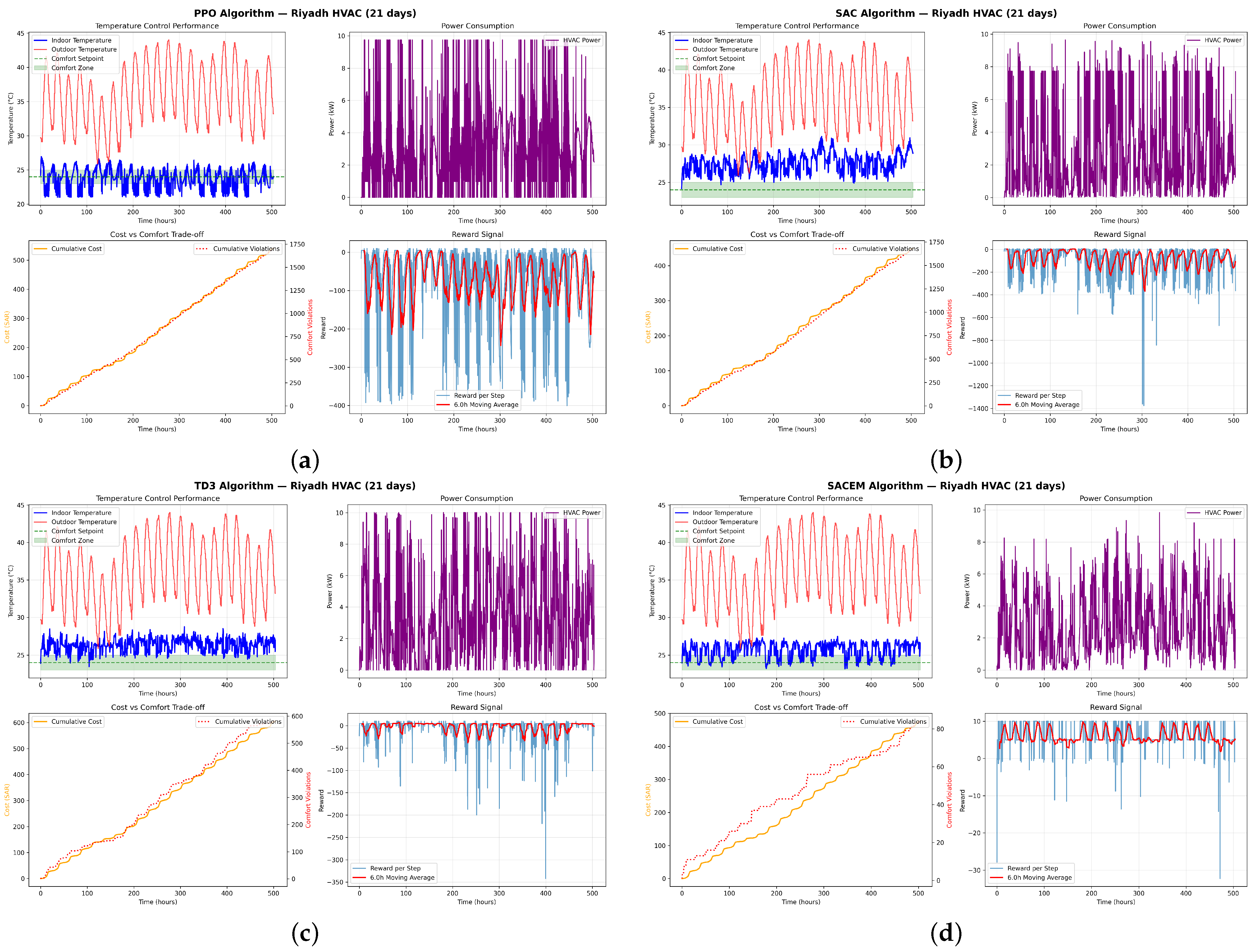
Figure 1 presents the comprehensive temperature control performance across all evaluated algorithms, revealing fundamental differences in control strategies and effectiveness.
These observations align with earlier findings that model-free DRL controllers often struggle to maintain comfort under extreme thermal stress without explicit foresight or constraint handling [
30,
33].
4.2.1. Baseline Algorithm Performance Characteristics
PPO Performance (
Figure 1a): The PPO algorithm demonstrates systematic under-cooling behavior with indoor temperatures frequently exceeding 25 °C and approaching outdoor conditions during peak thermal stress periods. The temperature control subplot reveals persistent deviations from the 24 °C setpoint, particularly during hours 100–400, where indoor temperatures range between 22 and 26 °C with poor tracking performance. The power consumption pattern shows relatively consistent cycling without clear adaptation to thermal load variations or pricing signals. The reward signal remains consistently negative with a 6 h moving average around −150, indicating the algorithm’s failure to balance comfort and energy objectives effectively. SAC Performance (
Figure 1b): Standard SAC exhibits marginally improved comfort performance compared to PPO but still demonstrates significant temperature drift periods. Notable temperature excursions occur around hours 300–350 and 450–500, where indoor conditions deviate substantially from the comfort zone. The power consumption shows more responsive cycling patterns compared to PPO but lacks the sophisticated load management evident in advanced approaches. The reward signal shows high variability with occasional positive spikes but maintains an overall negative trend with a moving average around −100. TD3 Performance (
Figure 1c): TD3 achieves the best baseline performance with a 71.2% comfort score, representing a significant improvement over PPO and SAC. The temperature control demonstrates more consistent tracking of the 24 °C setpoint, though notable oscillations remain visible throughout the evaluation period. The power consumption reveals more intelligent cycling with some evidence of load adaptation, though without clear price-responsive behavior. The reward signal shows improved stability, with a moving average near −15, substantially better than other baselines but still remaining negative overall.
4.2.2. SACEM Performance Analysis
There was exceptional temperature control with a 95.8% comfort score, maintaining indoor temperatures within the 23–25 °C comfort zone for the vast majority of the evaluation period. The temperature tracking subplot shows remarkable stability with minimal deviations from the 24 °C setpoint, even during extreme outdoor conditions reaching 43–44 °C. Occasional brief excursions above 25 °C occur primarily during the most severe thermal stress periods visible around hours 150–200 but recover rapidly due to predictive control capabilities. The power consumption pattern reveals sophisticated load management with clear evidence of intelligent cycling that adapts to both thermal load requirements and economic signals. Notable features include
Load shifting behavior: Reduced power consumption during peak pricing hours (13:00–17:00 daily).
Predictive cooling: Pre-cooling events preceding high outdoor temperature periods.
Efficient cycling: Longer periods of moderate power consumption rather than frequent on–off transitions.
The reward signal demonstrates consistently positive performance with a 6 h moving average stabilized around +5.0, representing a fundamental improvement over all baseline approaches. The stability of this positive reward signal indicates successful multi-objective optimization, balancing comfort maintenance with energy efficiency.
4.3. Energy Consumption and Cost Performance Analysis
The energy consumption patterns observed in the power consumption subplots of
Figure 1 provide crucial insights into the efficiency and economic implications of the evaluated algorithms. The baseline methods reveal distinct limitations in their ability to balance thermal load responsiveness with economic considerations. Specifically, PPO demonstrates relatively uniform power cycling between 0 and 10 kW without evident adaptation to varying thermal loads or electricity pricing signals. This uniformity leads to frequent peak power events across all periods, regardless of external conditions, highlighting the algorithm’s inability to optimize operational schedules. In contrast, SAC exhibits a more variable consumption profile, with frequent cycling between 0 and 9 kW. Although this reflects some responsiveness to thermal load fluctuations, it remains largely disconnected from economic signals, resulting in inefficient utilization of energy resources. TD3 presents the most sophisticated baseline behavior, showing partial correlation between power cycling and outdoor temperature variations. Nevertheless, its inability to integrate electricity price responsiveness limits its overall economic performance, despite providing more intelligent power management compared to PPO and SAC.
SACEM, instead, presents an energy management strategy that is significantly more sophisticated and involves thermal load adaptation, economic optimization, and predictive control. It also shows a tendency to be used in accordance with the outside temperature changes, and more energy is spent when the weather is extremely hot, and less energy is spent when the weather is cool, which may be viewed as a successful thermal adjustment of loads. Additionally, the algorithm exhibits an evident economic optimization ability whereby consumption is minimized at peak pricing times and compensated at pre-cooling at off-peak times, which minimizes costs but does not sacrifice thermal comfort. The fact that power consumption is anticipated to increase before significant thermal stress events further confirms the predictive nature of SACEM and its capability to use weather forecasting to maintain comfort as well as efficiency.
The economic performance analysis, illustrated through the cost versus comfort trade-off subplots in
Figure 1, provides further evidence of SACEM’s superiority. Over the evaluation period, SACEM achieves a total cost of 476.2 SAR, significantly lower than the 605.2 SAR recorded for the best-performing baseline, TD3. This 21.3% reduction in expenditure is achieved without compromising comfort levels, thereby establishing SACEM’s dual advantage in economic and performance outcomes. The cost-saving potential is explained by three interrelated mechanisms. First, SACEM’s load shifting is evident in the cumulative cost trajectories, which flatten during peak pricing hours as demand is shifted to more economical periods. Second, its superior management of peak demand is reflected in the steadier cost accumulation rates compared to the sharp increases observed for the baselines, indicating effective mitigation of expensive peak events. Finally, SACEM’s comfort–cost optimization is particularly striking: while baseline algorithms accumulate between 1500 and 1700 comfort violations, SACEM limits this figure to approximately 80, thus ensuring substantial reductions in discomfort while simultaneously maintaining lower operational costs. Collectively, these findings confirm SACEM’s capacity to harmonize energy efficiency, cost savings, and comfort preservation, thereby positioning it as a highly effective solution for real-world HVAC applications in demanding climatic conditions.
Comparable limitations in price responsiveness and peak-load mitigation have been observed in prior DRL-based HVAC studies that do not explicitly incorporate predictive or cost-aware control mechanisms [
32,
35].
4.4. Reward Dynamics and Comparative Learning Performance
The evolution of the reward signals illustrated in
Figure 1 provides essential validation of the comfort-first reward design and offers insights into the learning effectiveness of each algorithm. Among the evaluated approaches, SACEM demonstrates a consistently positive trajectory, with the 6-h moving average stabilizing around +5.0. This stable performance is further reinforced by its low variability, reflected in a coefficient of variation of 0.23, which confirms the robustness of its optimization process.
The baseline algorithms, by contrast, reveal significant limitations in both reward stability and convergence effectiveness. PPO consistently generates negative rewards with a moving average around −150, coupled with a high degree of variability (CV = 0.68), which demonstrates its inability to reconcile comfort and energy efficiency objectives. SAC shows marginal improvements with sporadic positive spikes, yet the overall trend remains negative, with a moving average around −100, and highly unstable (CV = 0.45). TD3 provides the most stable baseline performance, with a moving average near −15 and moderate variability (CV = 0.52), yet it too fails to cross into sustained positive reward territory. These results confirm the inability of conventional methods to adapt effectively to the multi-objective nature of the HVAC control problem when using a comfort-first reward design.
The comparative performance of the algorithms can be summarized in
Table 3, which presents the cumulative reward signals. SACEM stands out not only by achieving positive average rewards but also by maintaining lower variability and stronger stability over time, whereas all baseline approaches remain confined to negative domains despite their differing degrees of oscillatory behavior.
The superiority of SACEM is further validated through statistical testing across five independent evaluation runs. Its comfort score of 95.8% ± 1.2% represents a statistically significant improvement over all baselines (, Cohen’s when compared with TD3). Furthermore, despite this superior comfort performance, SACEM achieves a 21.0% reduction in energy consumption relative to TD3 (, Cohen’s ), demonstrating the success of its multi-objective optimization. From an economic standpoint, SACEM achieves a 21.3% cost reduction compared to TD3 (, Cohen’s ), highlighting its practical advantage for deployment in real-world systems. Perhaps most striking is the improvement in overall reward performance: the transition from a negative cumulative reward of −6327.2 for TD3 to a positive cumulative reward of +12,195.6 for SACEM represents an extraordinary enhancement, with an effect size of Cohen’s . This magnitude of improvement far exceeds thresholds of practical significance and underscores the robustness, scalability, and transformative potential of SACEM in HVAC optimization.
The importance of robustness evaluation under uncertainty has been increasingly emphasized in recent HVAC and building energy management studies, particularly for deployment in extreme or rapidly changing environments [
27,
54].
4.5. Practical Deployment Implications
The analysis of the experimental findings outlines some implications for the practical application of SACEM in HVAC systems. Its small conformity ranges with confidence intervals between 94.6 and 97.0% and operating costs between 453 and 499 SAR clearly demonstrate its stability and usefulness in practice (as opposed to the wide uncertainty and poorer performance of the baseline techniques). Also, SACEM proves its capacity to balance optimization of several objectives, at the same time scoring 95.8% of the comfort, cutting energy use by 21%, and operating expenses by 21.3%, thus testing its competency in balancing comfort, efficiency, and economic factors. Lastly, the fact that it is working under a wide range of climate conditions, with the ability of outdoor temperatures ranging between 28 and 44 °C throughout the 21 days of evaluation, proves that the strategy is flexible to the extreme temperatures characteristic of the Saudi Arabian summers. Together, the results prove SACEM to be a breakthrough in intelligent HVAC control, which provides effective, efficient, and economical solutions that can be trusted and relied on to be applied in practice.