


Abstract
International service-learning projects are opportunities for students to experientially learn about sustainable design engineering while they are focused on addressing specific community needs. When paired with auto-ethnographical research methods, students become co-creators in their pedagogical experience. This paper explores the impacts of attending a second international service learning trip for three sustainable design engineering students. Through a trio-ethnographic, ethics-approved study, a three-step reflexive framework was adopted to examine the experiences and the effects of participation in sustainable service learning projects that occurred in Honduras. By examining individual reflections and group discussions, three themes were identified by the students researchers: leadership development, the experience of returning, and enduring impacts on perceptions of sustainability and equity. Incorporating reflective activities before, during, and after international service learning experiences allow students to be more prepared, engaged, and reap long-term benefits. Engaging students in the conception, design, analysis, and writing of the research amplifies the learning experience. This article provides insights into how international service learning experiences shape professional trajectories and the personal growth of sustainable design engineering students. Additionally, it advocates for incorporating students as researchers in educational research.
1. Introduction
International engineering design experiences provide students with opportunities to see and practice “real-world” engineering in a different context, particularly for sustainable design projects. As a form of service learning, the experiences support community development, address academic learning objectives, and encourage reflection to foster personal and professional growth [1,2,3]. The projects provide opportunities to align with UNESCO’s Education for Sustainable Development (ESD) framework [4] and the United Nation’s Sustainable Development Goals (SDGs) [5]. Though many of the SDGs could apply, service learning is especially aligned with SDGs 4 and 17: quality education and partnerships for the goals [6,7]. By collaborating with international communities and broadening students’ learning, international engineering design experiences provide moments for meaningful discussions on sustainability. Additionally, the projects serve as personalized case studies to consider the four pillars of sustainability: environmental, social, economic, and cultural. Though originally proposed as three pillars, the fourth cultural pillar is especially pertinent in international service learning projects as students are introduced to new cultures. Zheng et al. [8] describe the importance of “treating culture as a separate dimension” as the fourth pillar to make “the concept more understandable and operable.”
By being temporarily rooted in an international setting, students experientially discover differences between cultural desires, community needs, and interpretations of sustainability. Importantly, they are confronted with the necessity to understand the problem from the community partners’ perspective to develop more appropriate solutions. Unlike remaining in a classroom, the unfamiliar setting helps students to realize that there are gaps in their knowledge and implicit assumptions. This Rumsfeldian recognition of their unknown unknowns forces them to ask more questions and spend more time understanding the problem before jumping to solutions.
Organizations have been developed to connect university students with communities seeking support. Through collaboration, design challenges are co-defined to contribute meaningfully to community goals while being constrained by the students’ capabilities and the short trip duration [9]. One such organization, Global Brigades, has provided opportunities for 83,000 students to participate in short-term, international service learning experiences in fields such as engineering, dentistry, public health, and medicine.
Researchers have documented the need to prepare students for international service learning experiences to ensure mutually beneficial outcomes for all collaborators [10]. In addition to preventing harm to students and community members, preparation encourages students to be reflective throughout the experience. One of the three elements of service learning, reflection, helps students to integrate the experience with their everyday reality and can influence their future decision-making [11]. Additionally, students have published their reflections to share what they learned and how they were impacted [9,10,12,13]. These accounts can help educators prepare students embarking on international service learning experiences. Also, the accounts convey the controversial nature of international service learning experiences, as community members can be negatively impacted [10,12,13]. Thus, it is necessary to make students aware of the moral complexity of the trips to mitigate harm, foster partnership, and encourage collaboration.
At the University of Prince Edward Island in Canada, sustainable design engineering students participated in two “engineering brigades” with Global Brigades over two years. In total, thirty students partnered with two rural communities in Honduras who sought access to clean water systems, aligning with SDG goal 6: clean water and sanitation. Working under the direction of Honduran professional engineers, they performed surveys to estimate the material costs for pipeline systems that deliver clean water to community members [9]. Three of the students (the first three authors of this article) found the first international service learning experience so meaningful that they felt compelled to participate in a second trip. However, they wanted to return as researchers to reflectively explore the impacts of returning on a second trip.
Informed by the literature, they were aware that there would be different lessons they would encounter throughout the second trip. First-hand accounts of students who returned for a second international service learning experience documented differences between the trips [10,12,13]. They recognized similarities from the first trip, but they also observed new elements, seeing deeper as a result of returning. For example, during his second trip, Garmroudi [12] recognized the ingenuity and resilience of people in a traumatic setting, whereas during the first trip, he was focused on their painful situation. Also, Howell [13] describes being conflicted upon her second trip “regarding the ethics of providing medical care to groups who might not otherwise have access to such care through the guise and in the pretense of religion.” Second trips offer new lessons. Documenting the authors’ experiences during the second trip would allow them to engage in the trip differently, and to be more observant and reflective.
Thus, under the guidance of their faculty advisor (the fourth author), the three sustainable design engineering students engaged in a trio-ethnographic study to be more intentional about reflection before, during, and after the second international service learning experience. Using a three-person form of autoethnography, the students were both researchers and participants in this qualitative study. They collectively analyzed their reflections to investigate the impacts of returning to a second international service learning project.
This study examines how a second international service-learning experience influences three students’ personal, educational, and leadership development using a trio-ethnographic methodology. The research objectives are to document their perceptions of the second experience by (1) delving deeper into motivations for returning, (2) examining differences between the trips, and (3) exploring long-term impacts as a result of the trip. The emphasis of this paper is not on the activities they engaged in during the trip but the collaborative examination of the impacts as sustainable design engineering students, especially in their personal, educational, and leadership development.
Findings can inform sustainability educators how to better prepare students for international service learning experiences so that partnerships with communities might be beneficial for all parties (aligning with SDG 17). Though international service learning experiences are documented in the literature, students are typically the participants. This research engages students as researchers, specifically sustainable design engineering students who have participated in multiple international experiences, an area rarely explored in the literature. Additionally, this paper advocates engaging students in auto-ethnographical pedagogical research to exponentially increase their engagement and long-term integration of impacts from service learning experiences.
1.1. Land Acknowledgement and Positionality Statement
Following the examples of Secules et al. [14] and Sefa Dei and Cacciavillani [15], we offer a land acknowledgement and positionality statement to contextualize the research, better understand researcher motivations, and participate in decolonization practices. We acknowledge that this research was performed on the lands of the Lenca and Mi’kmaq people. We are grateful for their stewardship and for the opportunity to be on their soil. All four authors identify as women of European descent and believe that though international experiences are morally complex, they have the potential to benefit all collaborators. Maddy and Deanna are leaders of the local Engineering Brigades chapter, and Katherine is a club member. Libby is their club advisor. We engage in reflective research to promote the integration of social justice within engineering education. This research and our participation in the international service learning project is due to Honduran community members who welcomed us and the Global Brigades staff and their dedication to long-term partnership with community members. This article is written from a Western-centric point of view and does not capture the perspective of our partners. We speak and synthesize only from our experiences, shaped by our cultural and personal biases and perceptions.
1.2. Background and Foundational Literature
1.2.1. Student Outcomes of International Service Learning Experiences
International service learning trips provide an opportunity for students to learn skills and competencies in addition to the technical content, such as cultural competency, civic responsibility, communication, and leadership. Wesner et al. [16] support the adoption of social justice in courses to shift students beyond the technical elements towards a more people-centered approach, and they suggest “Reimagining engineering education…by moving courses beyond campus and through deep engagements with marginalized communities.”
Cultural competency is a key outcome identified by students on international service learning trips [17,18]. Many educational institutions are beginning to believe that classroom education alone is not satisfactory in teaching engineering students the attributes of a global engineer [19]. Research found that participants of international service learning trips often become more committed to volunteering upon returning home [20]. In addition to promoting civic responsibility, many participants of international volunteering trips indicated that these experiences influence their future career goals [21].
Engineering students describe increases in confidence, critical thinking, communication, and improvement in technical skills as a result of the trips [18]. Similarly, Johnson et al. [22] highlighted that students develop their communication, teamwork, and leadership skills, as well as their assessment of social impact. The students identified that this trip was a valuable learning experience outside of the classroom.
A collaborative autoethnography performed by engineering educators Trent and Smith [23] determined that immersive project-based learning helped develop innovative attitudes, leadership, communication, and teamwork in engineering students. Yang and Luke [24] performed interviews with 13 students from Hong Kong who participated in international service learning experiences in Ghana and Thailand. They found that students were more satisfied with their experiences with transformational leaders over transactional leaders [24]. Whereas transformational leaders are collaborative, collegial, and inspire change through transforming individual personal objectives into shared organizational goals, transactional leaders are more hierarchal and motivate with rewards or punishments [24,25]. A literature review of 90 articles from leadership journals [26] found that transformational leadership was the most frequently discussed leadership style (36% of articles), and transactional leadership appeared in 12% of articles. Servant leadership, a leadership model that closely aligns with service learning [27], was present in 13% of articles. In servant leadership, the leader prioritizes collaborators’ needs over their own desires and is characterized by humility, authenticity, and empowerment [25]. Robinson et al. [27] analyzed reflections of 19 sports management students who participated in a service learning experience. They found that participants demonstrated an altruistic desire to help, empathy, genuine caring, and humility, which were identified as having a positive impact on their servant leadership development.
1.2.2. Ethical Volunteering
However, there are ethical concerns with short-term service learning trips for both students and community members. Students have identified barriers such as cost, time, medical issues, and family commitments as obstacles to participation [17]. One study found that international students were more likely to participate in international service learning trips [17] while other studies found that international students were less likely to participate [28,29]. Acquiring visas and securing time away from work can be significant barriers for international students, depending on their country of origin [30]. Additionally, Bimstein et al. [17] found that the experiences can be exclusive as participants were more likely to only recruit their friends for the international experiences.
Students who are able to participate in international service learning experiences have been described as “volunteer tourists” [31] who engage in “voluntourism” [32] or “volunteerism” [33], highlighting the short term nature of the experiences. Magrizos et al. [34] commented on the contradictory nature of volunteer tourism, particularly in students’ motivation to participate. Though students have altruistic motives to help underserved communities, they also seek to gain skills and enhance their resumes [34].
Voluntourism can propagate notions of “helping” instead of seeking systemic change as design for justice frameworks such as Reyante [35] promotes, which can contribute to reinforcing the white savior complex [36]. From a global perspective, there are substantial environmental and fiscal costs to sending large groups of students abroad. Funds may be better allocated if given directly to the communities [36].
The focus of the international service learning projects is often on the students instead of the communities. This is demonstrated in a literature review of 184 volunteer tourism articles in which 74% were devoted to volunteers and 20% to communities [31]. Similarly, studies have shown that some international service learning trips have harmed the local communities while only benefiting the students [19,32,37,38,39,40]. Chapman [41] found that most international service learning organizations and host universities do not have stringent requirements for volunteers, such as requiring background checks if they are working with minors. As a result, the differing standards can create unsafe and problematic practices. Ethnographic research by Palacios [42] found that participants felt that they did not always have the expertise needed nor the time required to make an impact. A lack of preparation and guidance can lead to unsafe situations and poor solutions for the students and the community members. Additionally, there is currently minimal ethical review required for international service learning projects. DeCamp [39] theorizes that this is because of the perspective that volunteering is altruistic, and thus volunteers will be inherently ethical. However, Heidebrecht and Balzer [43] describe an experience in Guatemala where people working for mining companies posed as volunteer tourists to gain access to a Mayan community. This demonstrates a major critique of voluntourism as a new form of colonialism which continues to exploit communities.
As described in Armstrong et al. [44], “The most prevalent questions are whether these projects have a sustainable and long-lasting impact on the communities and whether they are genuinely beneficial for all.” When there is a lack of long-term commitment, the short duration of projects can be obstacles to sustainable development of communities [31]. University timeframes can necessitate community members to adjust to university students’ constrained schedules [45]. If projects are not implemented with sustainability in mind, the communities can become dependent on volunteer-sending nations for ongoing maintenance and support, perpetuating neocolonialism [34].
These ethical concerns reinforce the need for students to engage in autoethnographic research. If they merely participate in the experiences without deeper reflection on the impacts to communities, then they can leave with false impressions. Completing research on their impact forces them to struggle with positive and negative aspects of the experience.
1.2.3. Pedagogical and Reflective Practices
To ensure international service learning trips are successful for all key interest holders, the literature recommends a multi-year time-frame and commitment to the project [28], cooperation with the local community [39], and community-initiated projects [41]. In other words, collaborate. Lavaux et al. explain [46], “universities seeking to scale or internationalize their service learning initiatives must avoid ‘one-size-fits-all’ models and instead engage in co-designing such processes with communities, ensuring that projects respond to specific social and cultural realities.”
Ventres et al. [37] documented the importance of the traveler’s attitude to the project’s success, promoting the practice of reflection. Through reflection, students can recognize the skills they are developing and the impact of the experience on their lives. However, reflection is more than a consideration of the self. To be justice-oriented, students should be encouraged perceive their own biases and to look beyond themselves to the “other” [47].
Global citizenship education is a pedagogical framework which emphasizes critical consciousness through six priorities: (1) fostering praxis and critical reflection/action, (2) encouraging reflexive dialogue, (3) introducing decolonial perspectives through reflective questions, group process and open-minded listening, (4) fostering caring ethics, (5) promoting ecocritical views, and (6) empowering students’ humanity [47]. Aligned with SDG target 4.7 which ensures that all learners can acquire knowledge and skills to promote sustainable development, a global citizenship education framework encourages collective action and adopting lifelong learning practices [48], which can support international service learning projects to ensure positive outcomes for all key interest holders.
Introducing decolonial perspectives is especially relevant for international service learning projects so students are aware of colonial practices implicit in the projects. According to Sefa Dei and Cacciavillani [15], decolonizing the curriculum is more prevalent in the humanities than STEM fields. They promote “encouraging critical engagement with diverse perspectives in all subject categories” [15], emphasizing the need for reflection during international service learning experiences. The ethically complex plane in which the projects exist creates liminal spaces for students to critically engage. Parent [49] explains “students are often seeking certainty, but part of decolonial praxis is that unsettling is often by nature a space of uncertainty.” As a future-oriented pedagogy, global citizenship education encourages values such as “tolerance, self-vigilance in knowledge acquisition, self-awareness, dialogical and deliberative democracy, and hermeneutics of suspicion” [50]. These contribute to the development of a self-reflective, globally aware student.
2. Materials and Methods
A trio-ethnographic approach was adopted, which is a collaborative form of autoethnography conducted by three researchers. In autoethnography, one researcher uses self-reflection and personal experience to connect to broader cultural, political, and social significance [51]. Trio-ethnography deepens the reflections through discussion. These reflective methodologies allow for collective and individual perspectives to be shared and analyzed simultaneously, enhancing the richness of the data. Some trio-ethnographic studies employ this methodology to embrace the messy outcomes of reflexive discomfort and avoid “tidy” work [52] or to investigate the lived experience generating personal understandings that are further benefitted from including multiple researchers [53]. Breault et al. [54] believe they have amassed some “insight, application, or challenge” that may have been less likely without the trio-ethnography. The experience of hearing each other’s observations and critically considering them has shaped their understanding of the subject matter differently than if they were researching independently. Their individual experiences took on a collective dimension, becoming more impactful and long-term.
In this trio-ethnographic approach, the three student researchers are both the participants and the researchers. Participating in both roles affords additional learnings and engages them more deeply in the research, giving them control over the interpretation and conclusions. Through obtaining Research Ethics Board approval for this study, the student researchers benefited from partaking in training on research involving human participants. If they were participants in a focus group, they may only have provided consent to participate, reflected on the experience, and their data would be analyzed by other people, namely the researchers. However, this trio-ethnographic methodology engaged the student researchers in the study design, ethics-approval process, analysis, and article composition. Thus, their reflection and additional learnings began before the study officially began and persisted until after the experience ended. The findings are deeply personal, and the researchers control the interpretation and conclusions differently than if they were solely participants.
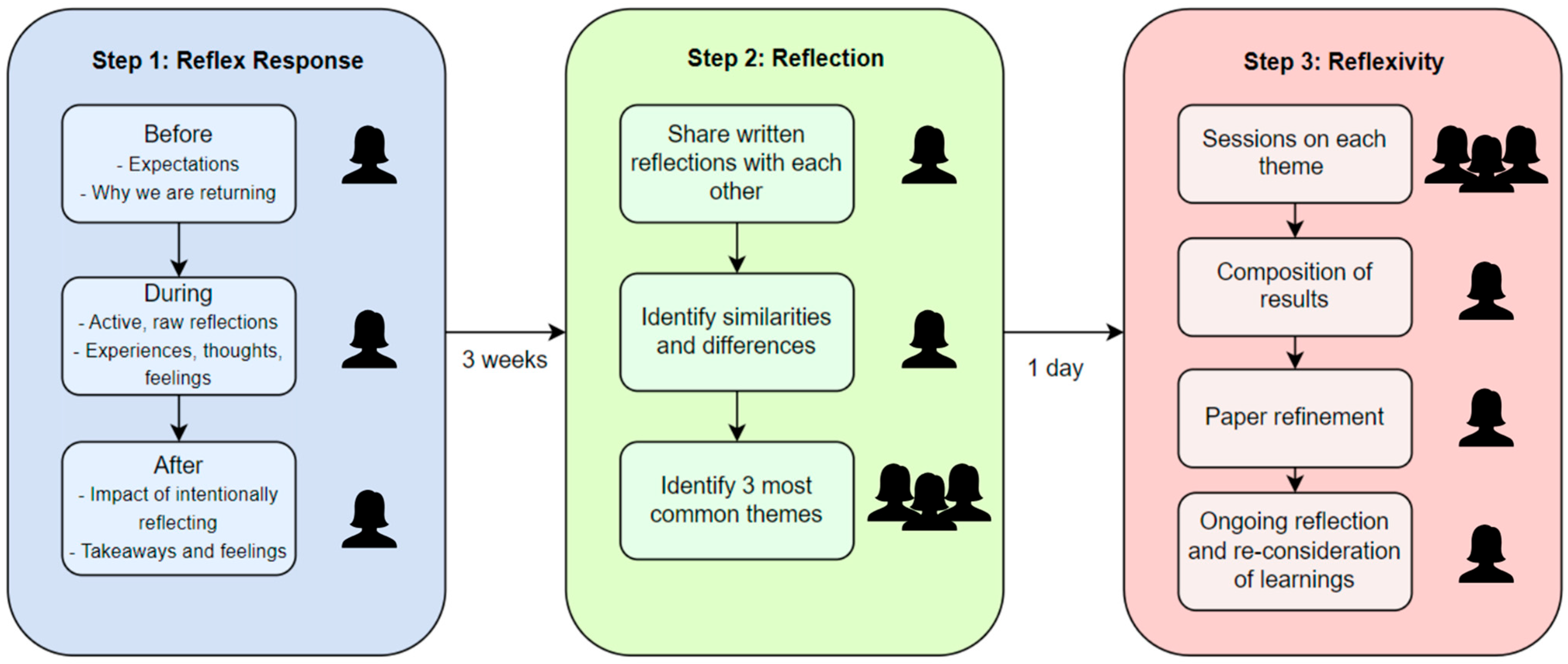
The reflexive framework developed by Cain et al. [55] was selected as the structure for the trio-ethnography and adapted as shown in Figure 1, differentiating which steps were performed separately and which were performed in groups. This method includes three main steps: (1) Reflex response: initial reactions and individual reflection, (2) Reflection: discursive, collaborative discussion, and (3) Reflexivity: ongoing re-consideration of the learnings [55]. This method provides a pathway for initial thoughts, active reflections, and post-experience reflexive practice to be organized individually and collaboratively.
Figure 1.
Data collection process using reflexive framework method.
Though Cain et al. completed the three steps in a 2 h session, the process was adapted to occur over two months through individual reflections, group discussion, and documentation. The reflex response stage occurred before, during, and after the international experience, mirroring Hadfield’s curriculum [10], with questions shown in Table 1.
Table 1.
Reflection guide.
Before the trip, individual reflections were performed on expectations and motivations for returning. As displayed in Table 1, this included five mandatory questions and four optional questions. Then, while in Honduras, individual reflections were completed during each of the four days spent in the communities. This included the four mandatory daily questions, three additional questions to be answered at least once during the trip, and four optional questions shown in Table 1. Researchers spent between 20 and 45 min independently completing reflections on a laptop at the end of each day. Rather than being a transcription of notes collected during the day, they were intended to be active, raw reflections of the day’s experiences, thoughts, and feelings. Upon returning from the trip, each researcher answered five mandatory questions, shown in Table 1. Then, researchers reviewed their own six reflections to make minor edits or omit overly personal details before sharing in the next stage.
The second step of reflection occurred a few weeks after returning to let the excitement of the trip settle, gain perspective, and enter a more reflective state. Researchers shared their six reflex response reflections from before, during, and after the trip, reading each other’s reflections and making notes on similarities, differences, and musings. An initial meeting occurred where common topics from personal reflections were discussed. Three themes were identified: leadership development, experience of returning, and enduring impacts on perceptions of sustainability and equity. Each theme was determined to be rich enough for a one-hour discussion and contained information relevant to research objectives.
In the third stage of reflexivity, each student researcher led a discussion on one of the three themes. They were each responsible for reviewing the reflections through the lens of that theme, preparing notes and questions for the meeting, facilitating the discussion, transcribing the recording, and summarizing the content. By sharing the leadership responsibilities, each researcher became more familiar with the chosen theme. To practice ongoing reflection as reflexivity entails, each student researcher composed the results section corresponding to their chosen theme. Throughout the process, the faculty advisor was present to keep student researchers on track, answer questions, and guide them through the research process.
In this trio-ethnographic study, the student researchers collected data in the form of their written reflections (step 1), notes comparing commonalities (step 2), and transcriptions from the discussions (step 3) as shown in Figure 1. This follows the research-ethics-board approved protocol. Their analysis was a recursive review of the reflections, notes, and transcriptions for commonality. Triangulation occurred during the preparation for the discussions and during the discussions themselves (steps 2 and 3) by comparing their findings. Limitations of this trio-ethnographic approach include subjectivity and generalizability. Because the researchers are also the participants, they may be less objective or aware of personal biases. To address this, their reflexivity was documented in the positionality statement above, the faculty advisor attempted to provide further confirmation of commonalities, and findings were validated against the literature. Additionally, as a form of auto-ethnography, findings are not intended to be generalizable for the whole population of engineering students attending international service learning experiences, which would be expected for quantitative studies in the form of statistical generalizability. Rather, analytical generalizability in quantitative analysis seeks to build on existing frameworks or theories to provide additional richness and deeper understanding. Generative AI was not used in any form throughout the study or dissemination process.
3. Results
After reviewing their reflections in step 1 from before, during and after the experience, the following three themes were selected in step 2 as the focus of the step 3 discussions: leadership development, experience of returning, and enduring impacts of perceptions of sustainability and equity. The following sections are the syntheses written by each of the student researchers from the discussion on the three themes. Direct quotes come from the reflections in step 1 and the discussions in step 3.
3.1. Leadership Development
During the leadership session, the discussion explored different forms of “good” leadership and how being a good leader can present in different ways. While some leaders are louder, more directive, and transactional, others have a quieter, guidance-based style in which they lead by example as servant leaders or inspire as transformational leaders. Deanna described “loud [leadership] is being more direct and [stating] ‘these are the things we need to do,’” whereas “quiet leadership as in the sense that you’re guiding… to give other people the opportunity for leadership.” Maddy added that leaders should not be controlling but instead “give people the chance to lead themselves.” Katherine described how leaders should exhibit humility by admitting, “I’m not always completely right. If there’s an issue, come to me and we’ll talk about it and then figure the best way to move forward.” Guidance, inspiration, and humility are elements of transformation and servant leadership styles.
Regardless of the particular style, the student researchers agreed that good leadership meant that everyone in the group or team is involved and leadership responsibilities are shared. During the discussion, Katherine described how the students made “sure that each individual in our team specifically had an opportunity to take part in all the activities that they wanted to and that nobody was really just standing off to the side and not having something that would help them feel fulfilled.”
In preparation for the experience, the students self-organized with traditional student club executive roles of president (Maddy) and chairs (Deanna) with specific functions such as fundraisings and social media. During the brigade, though the Global Brigades staff were the official leaders, they involved the student leader (Maddy) in decision making and conveying information. During the experience, faculty advisors were present in supportive roles, not in leadership positions. In the previous year, only the advisor had participated in a brigade before, and as the student leader, Maddy described feeling responsible to lead the team. In the second year, a large number of students were returning students, which meant that many people were familiar with the engineering brigade process. In her part 1 reflection, Maddy described,
“I noticed a huge jump in confidence in my peers that returned. I have been able to delegate tasks to other members easier and hearing them explain the processes to the new members is super cool. There were definitely some students who took a big step and were leaders for new members this year, which was really nice to see.”
Whereas in the first year, Maddy felt responsible for being a strong (solo) leader, she changed her leadership style in the second year to distribute tasks. During the first year, staff members explained to Maddy what was going to happen each day, and she explained the information to the students. The next year, a number of students felt confident to explain the steps for that day, such as how to make the posters for the final presentation. Two returning students who typically shied away from public speaking voluntarily coordinated the preparation for the final presentation to the community. They subdivided the group, delegated tasks, and decided on the presentation order. Deanna explained “quite a few people were just more confident versions of themselves.” These “unlikely leaders,” as they were described in the part 3 discussion, had a chance to practice leadership skills because they were encouraged through a transformational leadership style. Maddy described, “I just had full trust that they would [do well].” By sharing leadership responsibilities, returning students improved their leadership skills.
A transformational leadership style helped the new students to feel more comfortable as well, as they had many experienced students who could help with their Spanish, explain the mapping process, or describe the next steps of the brigade. During the part 3 discussion, Deanna described having a better understanding of what was expected of her, “Last year we relied on staff a lot more … this time we did a better job knowing what we’re supposed to be doing instead of waiting around to get told…I found I was a lot more comfortable this year.” Because returning students knew how the computer software worked or how to use the GPS mapping devices, they were described as “taking initiative” to show a new student how to use the tools, then step back to encourage the new student to exercise their agency. Thus, natural leadership roles developed for returning students.
Further, students who attended for the first time stepped up as leaders. On the first day, new students were already planning the next brigade, asking what more could be done to help the community and how they could keep the project moving forward. Because of the support and encouragement from returning students, the student researchers posited that the new students were able to feel more comfortable, involved, and eager to be leaders themselves. It was noted that whether a new student, club executive, or returning student, every member of the team demonstrated leadership.
3.2. Experience of Returning
The second discussion focused on differences noted between the two trips. By returning for a second experience, the student researchers heightened their awareness that Honduras is not a monolith. While on the first trip, students identified the differences between their home country and where they are visiting, a second trip allowed the researchers to see differences within the international location. Deanna explained, “Because of our past experience, we were able to notice this because we knew to look for it more.” Between the two trips, they spent time with three rural communities in Honduras, witnessing significant differences between them that were not evident during the first trip. For example, one of the communities was quite rural and most community members traveled far for work. In another community, members worked together in a coffee business located in the town, so they did not travel for work. The researchers Identified differences in the waste management, how pets were treated, schools, living conditions, and water system conditions.
Infrastructure and waste management was a large part of the discussion. Maddy expressed how a new participant was surprised to see a field “full of garbage.” Deanna described how the more rural community burned their garbage whereas the community closer to an urban center threw garbage “over a cliff.” They proposed reasons for the different waste management systems and compared it to their experience in Canada where Katherine identified, “we have issues with littering.” By returning for a second trip, they were more attentive to waste management between the two communities and the two countries.
Upon returning for a second trip, the student researchers were particularly attentive to how animals were treated. Deanna observed more violence to animals in the more rural community; she recalled the “puppy and dog were getting hit …it made me really uncomfortable watching the pigs chase after that dog.” Katherine added how her own feelings of discomfort from the previous trip integrated in her daily life. She said, “uncomfortability teaches you things. It makes you realize a lot more things than when you’re comfortable in an area. Last year I took away the fact that they were not super nice to these animals and that was something that I took home with me.” This speaks to how the experience had a lasting impact on her. Katherine compared this to how healthy the animals looked in less rural community describing animals as “companions.” She also explained how the cows seemed more healthy and well-fed.
The researchers noticed different standards of living between the communities. They attributed the difference to the coffee industry in the less rural setting. Katherine described that on “every spare place of land that anyone could own, there were coffee plants.” They saw mills, tarps with drying coffee beans, and distributors purchasing products. People could work in the town and did not have to travel. Deanna noted that “they had a lot of sanitation stations in school, a lot of kids, a lot of vehicles, and a lot of people had jobs.” Comparing this to the more remote, rural community, Maddy described, “They’re both an hour up a mountain, but because one is [also] two hours down the highway, they couldn’t even have an ambulance come in to save someone who was dying.” In the more rural community, a child’s appendix burst while the team was in their community, and the child died at home because the roads were not traversable for an ambulance. In the less rural, coffee-producing community, the researchers noted an ambulance and police officers coming to the community for non-emergent reasons. Because they returned, the researchers were able to see differences between the communities.
Comparing differences in the students during the two years, Deanna and Maddy noticed “a huge jump in confidence” in the returning students during the second year. This echoes the leadership conversation, but the differences were so prominent that it came up again Deanna and Katherine both reflected on how they felt that their own confidence levels increased on the second trip. In preparation for the second trip, Katherine described “practicing Spanish for 300 days at this point.” This also shows how the promise of a second experience motivated her to learn the language to be able to communicate better. Deanna described her desire to return as “investing in different communities.” Maddy described how she struggled with the appropriateness of returning, “I still have a battle in my head on whether it was ethical or not.” Because of the short-term nature of the project, the intended outcome was to provide communities with a stamped engineering water survey describing the project cost and needs. In partnership with Global Brigades, once the community could fund the project, a future team is identified to build the design to provide access to water. In her part 1 reflections written while she was in the community, Maddy explained her complex feelings with the limited project scope, saying “I felt almost guilty for being back and knowing we weren’t going to be actually building anything.” After the second experience ended, she described, “It made me feel better about it. Because the community seemed more open to what we were doing, there is a chance that the water system might be built.” Maddy was influenced by the two communities’ reception of the final product, an outcome that was a result of having multiple experiences. A further consideration of the ethics of returning, the researchers acknowledged the flight’s environmental cost of emissions and the economic potential the funds could have had if sent directly to the Honduran community instead of spent on travel.
Also, they noticed how their living accommodations impacted the trip. During the first year, they stayed in an isolated compound and had many more opportunities to interact with the Global Brigades staff and volunteers. Speaking with the staff was a highlight for most students. During the second trip, they stayed at an urban hotel that segregated students from the staff. This disconnect prevented students from engaging with staff during meals or from learning more about their lives as they did on the first trip. Maddy explained, “A big part of my trip experience last year was talking with [staff] and learning about different things about Honduras. They were so proud and they just always wanted to talk about it and tell us stories, their traditions, and about their culture.” It is unknown whether the staff preferred this separation, but by returning, the researchers noticed a difference in the number of Honduran residents they were able to connect with.
3.3. Enduring Impacts on Perceptions of Sustainability and Equity
In the third discussion, the long-term impacts were discussed. The experience of participating in an international service learning trip heightened their awareness as they became more mindful of disparities that exist. In their reflections and conversations, each researcher observed inequality within and between communities. For instance, in a reflection comparing two houses in the same community, Katherine explained, “The last house, furthest away from the main road, didn’t have any electricity, they had no running water, they had no door.” Compared to the house at the front of the community with an eco-stove, an electric stove, and diplomas on the wall, the disparity was noticeable. Also, Deanna noted that fewer opportunities were available to people living in rural communities, as she explained, “I’m more aware of my privilege.” While all three student researchers had the choice to pursue engineering, they acknowledged that individuals in the rural communities they visited may not have had similar options. From this heightened awareness of privilege and global disparities, they realized that being more aware allows them to have an expanded worldview, connect with people across the globe, and be more empathetic. By being more mindful in everyday life, they are more attuned to injustice and more determined to advocate for equality.
These experiences have also catalyzed noticeable behavioral changes, particularly in their approach to environmental sustainability. For example, Maddy mentioned, “I definitely have different thoughts with my consumption of things. After going last year, I definitely started to try to get more things secondhand instead of buying things new…When I’m using water, I try to save it. It’s things that I should have been doing already, but the trip made it a little bit more real.” Because the experience focused on access to clean water, their heightened awareness has led them to make environmentally conscious behaviour changes. Also, all three researchers noticed the prevalence of garbage left on the streets, highlighting the differences in infrastructure and public services between rural Honduras and Canada. Witnessing this has been a powerful reminder of the importance of sustainable practices, inspiring them to be more mindful of their waste.
Looking to the future, attending this trip influenced each of their prospective careers and instilled a greater openness to future service learning engineering projects. As Deanna described, “I’d be more open to [future] service learning because I had this experience and I felt safe during it.” These experiences expand their horizons to possibilities that would otherwise not be there. While, for the most part, their fundamental career goals remained unchanged, they acknowledged that they consider the values and priorities of potential employers more critically and take note of how the work each does impacts the environment and people. Katherine stated that this experience “definitely made me more aware of the opportunities that are there to do things on a longer-term basis or with a company that does this [positive work] regularly.” This exposure has motivated them to contemplate longer-term engagements with organizations that have a positive social impact, reflecting a shift towards more purposeful and ethical career choices.
Table 2 summarizes the part 3 discussion themes and topics within each discussion. Also, the associated SDGs and sustainability pillar for each theme and topic are listed.
Table 2.
Themes compared to SDGs and four pillars of sustainability.
4. Discussion
4.1. Long-Term and Broader Impacts of Returning
Perhaps aspirational, after participating in a service learning trip, each of the students would be forever changed and actively seek justice and sustainable solutions in every situation. Realistically, the lessons learned from the trip have shaped their perspectives and actions such as studying Spanish in between trips and reducing their water usage. What they realized and documented while applying the three-step reflexive framework was also found in the literature. For example, through their awareness of inequality, they developed their cultural competency, as in Bimstein et al. [17], and their assessment of social impact, as in Johnson et al. [22]. The discussions on leadership document how they increased their confidence, communication, teamwork, and leadership skills as in Anuar et al. [18] and Johnson et al. [22]. Maddy demonstrated a transformational leadership style by stepping back and encouraging others to take on leadership roles. In their discussion on enduring impacts on their perceptions on sustainability and equity, they identified being more committed to volunteering as in Kelly [29] and how it impacts their future goals as in Tiessen et al. [21]. The students became aware of some of their blind spots, which ultimately shaped the design solution. Acknowledging the need to better understand the problem is essential to becoming mature sustainable designers.
From a sustainability perspective, the student researchers considered all four pillars of sustainability in their reflections: cultural, environmental, economic, and social, as defined by Zheng et al. [8]. In the findings, they discussed ten of the SDGs, most notably education (4), infrastructure (9), reduced inequities (10), responsible consumption (12), life on land (15), and partnerships (17). They documented their ethical struggle to return, noting the cost of travel, impact on the environment, and small concrete benefit for community members, matching ethical volunteering literature [34,36]. Though noting these observations, they did not engage in deeper questions of ongoing colonization or more systemic justice issues. A reflexive design-for-justice framework [35] and global citizenship educational framework [47] could provide more targeted reflection for future research.
Additionally, the length of the long-term impacts of the experience documented in this article warrant further study. The step 2 discursive reflections occurred shortly after returning. The step 3 article preparation has lengthened the time spent reflecting on the experience. However, lasting impacts are yet to be understood. According to Couch and Georgeou [56], transformative effects are more short-term. In a study of 14 sociology students who travelled to Tibet, they reported feeling transformed two weeks after the experience, but none of the students felt the experience was “truly transformative” when polled five years later. As participants in the Couch and Georgeou [56] study instead of researchers, the impacts could have been more short-term. For student researchers in this article, engaging as researchers could mitigate waning transformative impacts. Future longitudinal autoethnographic exploration could affirm or refute how lasting the impacts are.
4.2. Reflection Through Engaging Students as Researchers
Through actively participating in a trio-ethnographic process, the student researchers were more reflective during their time in Honduras. Though this is unsurprising, it demonstrates the “observer effect” found in physics, where the act of observation changes the state. Because the students were simultaneously researchers throughout the experience, their heightened observations altered their experience. Similarly, Ventres et al. [37] described how reflection and attitude can shape the outcome of a project. The second trip was different because of this research. It has made the student researchers more aware and more observant, and the effect has lingered. As Deanna described during their conversation on lasting impacts, they don’t just want to “experience the experience but also remember the experience and be an active participant instead of just passively going through those moments.” They strive to actively remember, reflect, and engage with their experiences, ensuring they continue to influence their actions.
In this way, they practice ongoing reflexivity, the third step in Cain et al.’s framework [55], moving beyond the confines of the experience and permeating their lives “at home.” Katherine’s reflection on “uncomfortability” mirrors Parent’s [49] assertion that the unsettling nature of decolonial praxis lives in uncertain spaces. Additionally, their reflective dialogue fits within the global citizenship framework [47] which works towards SDG target 4.7. However, to be more justice-oriented, their reflections could have examined their own biases more extensively, as encouraged in Bosio and Waghid [47]. Also, they could have leaned into the discomfort to examine underlying reasons instead of staying in an observational mode. As this was their first experience as researchers in the field, the deeper observations would be appropriate for returning again for a third trip or a specific examination into impacts of their personal biases, harms they may have caused in the community, and larger systemic impacts of their involvement.
More than individually reflecting throughout the experience, the collective act added depth to their reflections. Engaging in this three-step reflexive framework allowed the students to consider the project as individuals and as a group. By utilizing trio-ethnography, they developed themes and had insights that would not have been as apparent if they were working individually through auto-ethnography, matching Breault et al.’s findings [54]. In addition to this article, they have reflections, transcripts, and videos to preserve their experiences and key learnings to revisit in the future. They recommend replicating this three-step process for educators to help students deepen their initial reflections (step 1 reflex responses) through group discussions (step 2 reflection) and become more reflexive in their daily lives (step 3). For example, a discussion on SDG 10 reduced inequities could help students to prepare for the experience and process their learnings upon returning through individual and collective reflections. As Breault [54] identified, the collective act of sharing deepened their reflections by considering each other’s experiences. This could enhance students’ willingness to dwell in “uncomfortability” [49] to challenge each other to discuss complex, systemic topics such as decolonization, global citizenship, and justice work. Alternatively, the collective act of sharing could cause students to be too shy to share or only willing to share what is socially acceptable, demonstrating a social desirability bias. Thus, it is important for student researchers to be training in autoethnographic techniques and to be encouraged to be reflexive, honest, and challenge their biases.
4.3. Implications for Educators
The findings offer insights for educators preparing students for similar experiences and encourage universities to provide international service learning experiences to help students develop their cultural competency, social impact, confidence, communication, teamwork, and perception on sustainability and equity [17,18,22]. Recalling Amadei et al. [19], being confined to the classroom is not sufficient for students to develop the attributes of a global engineer. By reflecting before, during, and after the service learning experience, then searching for common themes throughout their three sets of reflections, the student researchers demonstrated a desire for deep engagement within service learning experiences and a willingness to participate as partners in pedagogical research. Engaging students in research can shift their awareness of sustainable issues and alter lessons discovered in the research.
4.4. Limitations
In addition to the social desirability bias mentioned above, a potential limitation of the study is the generalizability of findings. Though quantitative studies seek statistical generalizability so that results are applicable to a population, in qualitative research, analytical generalizability connects the findings to existing theories. For this trio-ethnographical study, we utilized the reflexive framework to explore the experience of returning on an international trip more reflectively. Our intent was to provide more first-hand experiences to deepen understandings of students’ experiences and provide rich case studies. Findings are analytically generalizable, in that this research can be considered a case study which contributes to international service-learning literature.
Next, the subjectivity of the researchers as the participants could be considered a potential limitation, which is a common examination in auto-ethnographic research. Positionality statements in the introduction document the researchers’ awareness of their biases. For future studies, additional questions could be added to the reflection guide in Table 1 to encourage ongoing examinations of subjectivity and the step 2 discussion could be a form of peer debriefing to collectively consider their biases.
Lastly, the students’ reflections focused on their own learnings and observations and produced generally positive findings. A more robust consideration could have expanded the reflective prompts to include potential harms to the community, and students could have analyzed their missteps and biases more intentionally. Additionally, this auto-ethnographical research is framed within a Western-centric lens involving four women of European descent. Future research engaging students as researchers could incorporate more balanced ethical awareness, considering both the positive and negative aspects of international service learning projects.
5. Conclusions
This paper focuses on engaging students as researchers to explore impacts of attending a second international service learning experience on personal, educational, and professional development. The study aimed to contribute to the growing literature surrounding the implications of international service learning experiences by practicing a reflexive framework before, during, and after a second international design experience in Honduras.
Through the trio-ethnographic exploration, the student researchers produced 18 reflex responses, developed themes, and facilitated discussions on each of the three themes: leadership development, experience of returning, and enduring impacts on perceptions on sustainability and equity. During the trip, they practiced servant and transformational leadership that encouraged returning and new students to share leadership responsibilities. As it was a return experience, they recognized that Honduras is not a monolith, appreciated connecting with Global Brigades staff, and struggled with whether it was ethical to return on the trip. The exposure to different communities and recognition of global inequalities drove them to be attentive to their decision-making in everyday life, to live with growing awareness, and to prioritize working for companies whose values and priorities align with deepened appreciation for social and environmental responsibilities.
Through reflecting on their experiences, they now live with heightened awareness, and they seek to incorporate it into their daily lives, striving for a more just and equitable world. Ultimately, engaging students as researchers can intensify their understanding and commitment to sustainable practices, working toward SDG 4.7 to ensure learners acquire knowledge and skills to promote sustainable development.
Author Contributions
Conceptualization, M.C., D.M., K.A. and L.O.; methodology, M.C., D.M., K.A. and L.O.; formal analysis, M.C., D.M. and K.A.; writing—original draft preparation, M.C., D.M. and K.A.; writing—review and editing, L.O.; supervision, L.O. All authors have read and agreed to the published version of the manuscript.
Funding
This research received no external funding.
Institutional Review Board Statement
The study was conducted in accordance with the Declaration of Helsinki and approved by the Institutional Review Board of the University of Prince Edward Island (protocol code #6012379 on 8 January 2024).
Informed Consent Statement
Informed consent was obtained from all subjects involved in the study in writing.
Data Availability Statement
The original contributions presented in this study are included in the article. Further inquiries can be directed to the corresponding author.
Acknowledgments
We are grateful to our institution for their support in traveling to Honduras, particularly the Study Abroad office. We appreciate our partnership with Global Brigades staff, University of Prince Edward Island students, and the community members who welcomed us.
Conflicts of Interest
The authors declare no conflicts of interest.
References
- Reed, V.A.; Jernstedt, G.C.; Hawley, J.K.; Reber, E.S.; DuBois, C.A. Effects of a small-scale, very short-term service-learning experience on college students. J. Adolesc. 2005, 28, 359–368. [Google Scholar] [CrossRef] [Scilit] [PubMed]
- Levesque-Bristol, C.; Knapp, T.D.; Fisher, B.J. The effectiveness of service-learning: It’s not always what you think. J. Exp. Educ. 2011, 33, 208–224. [Google Scholar] [CrossRef] [Scilit]
- Weigert, K.M. Academic service learning: Its meaning and relevance. New Dir. Teach. Learn. 1998, 73, 3–10. [Google Scholar] [CrossRef] [Scilit]
- UNESCO. World Conference on Higher Education. Final Report. UNESCO 2009. Available online: https://unesdoc.unesco.org/ark:/48223/pf0000189242 (accessed on 17 December 2024).
- United Nations. Resolution Adopted by the General Assembly on 25 September 2015. A/RES/70/1. Available online: https://www.un.org/en/development/desa/population/migration/generalassembly/docs/globalcompact/A_RES_70_1_E.pdf (accessed on 11 November 2025).
- Tripon, C. Towards quality education for all: Integrating edtech, mentorship, and community in support of SDG 4. Educ. Sci. 2025, 15, 1184. [Google Scholar] [CrossRef] [Scilit]
- Ferrer-Juliá, M.; Pereira, I.; Cruz, J.A.; García-Meléndez, E. A service-learning project to acquire gis skills and knowledge: A case study for environmental undergraduate students. Sustainability 2025, 17, 2276. [Google Scholar] [CrossRef] [Scilit]
- Zheng, X.; Herman, S.S.B.; Salih, S.A.; Ismail, S.B. Sustainable characteristics of traditional villages: A systematic literature review based on the four-pillar theory of sustainable development. Sustainability 2024, 16, 10352. [Google Scholar] [CrossRef] [Scilit]
- Hulton, J.; O’Rielly, L.; Murdock, L.; Osgood, L. Reflecting on reflecting: How reflections were incorporated throughout a service-learning project in Honduras. Int. J. Serv. Learn. Eng. Humanit. Eng. Soc. Entrep. 2023, 18, 1–13. [Google Scholar] [CrossRef] [Scilit]
- Hadfield, D.A. A New Beginning for Short-Term Travel: Preparing Participants and Creating Mutually Beneficial Partnerships for Sustainable Cross-Cultural Development. Master’s Thesis, Northwest University, Kirkland, WA, USA, 2020. [Google Scholar]
- Osgood, L.; Power, C.P. Reflection in engineering design: Student perceptions on usefulness. In Proceedings of the 2024 American Society of Engineering Education St. Lawrence Section Annual Conference, Toronto, ON, Canada, 26–27 April 2024. [Google Scholar] [CrossRef] [Scilit]
- Garmroudi, A.R. Visiting the ‘Jungle’ camp in Calais as a student volunteer: Personal reflections. Fam. Relatsh. Soc. 2017, 6, 147–151. [Google Scholar] [CrossRef] [Scilit]
- Howell, E. Volunteer Tourism: Fulfilling the Needs for God and Medicine in Latin America. Master’s Thesis, University of South Florida, Tampa, FL, USA, 2017. [Google Scholar]
- Secules, S.; Gupta, A.; Elby, A.; Tanu, E. Supporting the narrative agency of a marginalized engineering student. J. Eng. Educ. 2018, 107, 186–218. [Google Scholar] [CrossRef] [Scilit]
- Sefa Dei, G.J.; Cacciavillani, A. Actualizing decolonization: A case for anticolonizing and indigenizing the curriculum. J. Philos. Educ. 2024, 58, 209–226. [Google Scholar] [CrossRef] [Scilit]
- Wesner, A.; Kadir, K.; Cushing, L. Educating socially responsible engineers through critical community-engaged pedagogy. Educ. Sci. 2025, 15, 1330. [Google Scholar] [CrossRef] [Scilit]
- Bimstein, E.; Gardner, Q.W.; Riley, J.L.; Gibson, R.W. Educational, personal, and cultural attributes of dental students’ humanitarian trips to Latin America. J. Dent. Educ. 2008, 72, 1493–1509. [Google Scholar] [CrossRef] [Scilit]
- Nor Anuar, A.; Syed Hassan, S.A.H.; Daud, M.F.; Abang Zaidel, D.N.; Phang, F.A.; Mohd-Yusof, K.; Yusof, Y.M.; Aziz, A.A.; Seo, Y. Impact of multi-disciplinary international engineering service learning in instilling global engineer attributes among undergraduates. ASEAN J. Eng. Educ. 2019, 3, 96–108. [Google Scholar] [CrossRef] [Scilit]
- Amadei, B.; Sandekian, R.; Thomas, E. A model for sustainable humanitarian engineering projects. Sustainability 2009, 1, 1087–1105. [Google Scholar] [CrossRef] [Scilit]
- Kelly, S.; Case, R. The Overseas Experience: A Passport to Improved Volunteerism. Report for the Knowledge Development Centre and Imagine Canada. 2008. Available online: https://forum-ids.org/he-overseas-experience-a-passport-to-improved-volunteerism/ (accessed on 1 July 2025).
- Tiessen, R.; Cassin, K.; Lough, B.J. International development volunteering as a catalyst for long- term prosocial behaviours of returned Canadian volunteers. Citizsh. Teach. Learn. 2021, 16, 95–114. [Google Scholar] [CrossRef] [Scilit]
- Johnson, P.D.; Johnson, P.W.; Johnson, N.S. Developing contemporary engineering skills through service learning in Peru. J. Community Engagem. Scholarsh. 2022, 1, 81–84. [Google Scholar] [CrossRef] [Scilit]
- Trent, N.M.; Smith, L. A collaborative autoethnography on cultivating innovative attitudes in undergraduate engineers through a co-curricular initiative. In Proceedings of the 2022 IEEE IFEES World Engineering Education Forum—Global Engineering Deans Council (WEEF-GEDC), Cape Town, South Africa, 27 November–1 December 2022; IEEE: New York, NY, USA, 2022; pp. 1–6. [Google Scholar] [CrossRef] [Scilit]
- Yang, M.; Luk, L. The role of international service learning in leadership development among students in higher education. J. Youth Stud. 2017, 20, 156–171. [Google Scholar] [CrossRef]
- Bonini, A.; Panari, C.; Caricati, L.; Mariani, M.G. The relationship between leadership and adaptive performance: A systematic review and meta-analysis. PLoS ONE 2024, 19, e0304720. [Google Scholar] [CrossRef] [Scilit]
- Hadziahmetovic, N.; Tandir, N.; Dzambić, A. A research review of leadership styles. Int. J. Acad. Res. Econ. Manag. Sci. 2023, 12, 188–206. [Google Scholar] [CrossRef] [Scilit]
- Robinson, G.M.; Magnusen, M.J. Developing servant leadership through experience and practice: A case study in service learning. Behav. Sci. 2024, 14, 801. [Google Scholar] [CrossRef] [Scilit] [PubMed]
- Kwenani, D.; Yu, X. Maximizing international students’ service-learning and community engagement experience: A case study of student voices on the benefits and barriers. J. High. Educ. Outreach Engagem. 2018, 22, 29–52. [Google Scholar]
- Lee, T.; Buchanan, E.; Berg, D. Issues of privilege in university service-learning. Int. J. Serv. Learn. Eng. Humanit. Eng. Soc. Entrep. 2019, 14, 1–13. [Google Scholar] [CrossRef] [Scilit]
- Sullivan, R.; Osgood, L. Do we design for people or to make things?: Student motivations, barriers and mindsets in an international humanitarian engineering experience. In Proceedings of the 2024 American Society of Engineering Education St. Lawrence Section Annual Conference, Toronto, ON, Canada, 26–27 April 2024. [Google Scholar] [CrossRef] [Scilit]
- Avolio, B.; Prados-Peña, M.B.; Pardo, E. Volunteer tourism: A systematic literature review. Sage Open 2024, 14, 1–38. [Google Scholar] [CrossRef] [Scilit]
- McGloin, C.; Georgeou, N. “Looks good on your cv”: The sociology of voluntourism recruitment in higher education. J. Sociol. 2015, 52, 403–417. [Google Scholar] [CrossRef] [Scilit]
- Estrera, E.B. The 3Cs in volunteerism: Proposing a model of service-learning in education. IAFOR J. Educ. 2024, 12, 79–104. [Google Scholar] [CrossRef] [Scilit]
- Magrizos, S.; Kostopoulos, I.; Powers, L. Volunteer tourism as a transformative experience: A mixed methods empirical study. J. Travel Res. 2021, 60, 878–895. [Google Scholar] [CrossRef] [Scilit]
- Reynante, B. Learning to design for social justice in community-engaged engineering. J. Eng. Educ. 2022, 111, 338–356. [Google Scholar] [CrossRef] [Scilit]
- Abrey, K.; Cronin, M.; Malone, D.; Osgood, L. International humanitarian trips: Objectionable or estimable? In Proceedings of the 2024 ASEE St. Lawrence Section Annual Conference; ASEE: Washington, DC, USA, 2024. [Google Scholar] [CrossRef] [Scilit]
- Ventres, W.B.; Wilson, C.L. Beyond ethical and curricular guidelines in global health: Attitudinal development on international service-learning trips. BMC Med. Educ. 2015, 15, 68. [Google Scholar] [CrossRef] [Scilit] [PubMed]
- Tissen, R.; Heron, B. Volunteering in the developing world: The perceived impacts of Canadian youth. Dev. Pract. 2012, 22, 44–56. [Google Scholar] [CrossRef] [Scilit]
- DeCamp, M. Ethical review of global short-term medical volunteerism. HEC Forum 2011, 23, 91–103. [Google Scholar] [CrossRef] [Scilit] [PubMed]
- Jordan, W. Creating a Sustainable Humanitarian Engineering Program. In Proceedings of the 2015 IEEE Canada International Humanitarian Technology Conference (IHTC), Ottawa, ON, Canada, 31 May–4 June 2015. [Google Scholar] [CrossRef] [Scilit]
- Chapman, D.D. The ethics of international service learning as a pedagogical development practice: A Canadian study. Third World Q. 2018, 39, 1899–1922. [Google Scholar] [CrossRef] [Scilit]
- Palacios, C.M. Volunteer tourism, development and education in a postcolonial world: Conceiving global connections beyond aid. J. Sustain. Tour. 2010, 18, 861–878. [Google Scholar] [CrossRef] [Scilit]
- Heidebrecht, L.; Balzer, G. Decolonial experimentations in international service learning research and practice: Learnings from Mayan Indigenous host communities. Mich. J. Community Serv. Learn. 2020, 26, 143–159. [Google Scholar] [CrossRef] [Scilit]
- Armstrong, A.G.; Mattson, C.A.; Lewis, R.S. Factors leading to sustainable social impact on the affected communities of engineering service learning projects. Dev. Eng. 2021, 6, 100066. [Google Scholar] [CrossRef] [Scilit]
- Natarajarathinam, M.; Qiu, S.; Lu, W. Community engagement in engineering education: A systematic literature review. J. Eng. Educ. 2021, 110, 1049–1077. [Google Scholar] [CrossRef] [Scilit]
- Lavaux, S.; Salas, J.I.; Chiappe, A.; Ramírez-Montoya, M.S. regional perspectives on service learning and implementation barriers: A systematic review. Appl. Sci. 2025, 15, 9058. [Google Scholar] [CrossRef] [Scilit]
- Bosio, E.; Waghid, Y. Cultivating students’ critical consciousness through global citizenship education: Six pedagogical priorities. Prospects 2025, 55, 131–142. [Google Scholar] [CrossRef] [Scilit]
- Witenstein, M.A.; Baxter, A.; Iyengar, R.; Schaller, E.U.; Bah, S. A scoping study of education for sustainable development and global citizenship education in higher education. Prospects 2025, 55, 165–183. [Google Scholar] [CrossRef] [Scilit]
- Parent, M. Thinking through decolonial pedagogies. Arc J. Sch. Relig. Stud. 2024, 51, 47–75. [Google Scholar] [CrossRef] [Scilit]
- Torres, C.A.; Bosio, E. Global citizenship education as a planetary ethics: Embracing humans and non-humans in the pursuit of global solidarity. Prospects 2025, 55, 31–49. [Google Scholar] [CrossRef] [Scilit]
- Ellis, C.; Adams, T.E.; Bochner, A.P. Autoethnography: An overview. Forum Qual. Soc. Res. 2011, 12, 273–290. [Google Scholar] [CrossRef]
- Howell, N.; Desjardins, A.; Fox, S. Cracks in the success narrative: Rethinking failure in design research through a retrospective trioethnography. ACM Trans. Comput.-Hum. Interact. 2021, 28, 42. [Google Scholar] [CrossRef] [Scilit]
- Jain, D.; Potluri, V.; Sharif, A. Navigating Graduate School with a Disability. In Proceedings of the ASSETS ‘20, Virtual, 26–28 October 2020. [Google Scholar] [CrossRef] [Scilit]
- Breault, R.; Hackler, R.; Bradley, R. Seeking rigor in the search for identity: A trioethnography. In Duoethnography; Norris, J., Sawyer, R.D., Lund, D., Eds.; Routledge: New York, NY, USA, 2012; pp. 115–136. [Google Scholar]
- Cain, A.; Hauge, E.; Rhodes-Dicker, L. Embedding a strengths-based approach in humanitarian engineering research through reflexive practice. J. Humanit. Eng. 2023. Available online: https://jhe.ewb.org.au/index.php/jhe/article/view/207 (accessed on 7 December 2025). [CrossRef] [Scilit]
- Couch, J.; Georgeou, N. Do immersion tours have long-term transformative impacts on students?: A study of Australian university students in a Tibetan host community in India. J. Appl. Youth Stud. 2017, 2, 18–35. [Google Scholar]

Disclaimer/Publisher’s Note: The statements, opinions and data contained in all publications are solely those of the individual author(s) and contributor(s) and not of MDPI and/or the editor(s). MDPI and/or the editor(s) disclaim responsibility for any injury to people or property resulting from any ideas, methods, instructions or products referred to in the content. |
© 2026 by the authors. Licensee MDPI, Basel, Switzerland. This article is an open access article distributed under the terms and conditions of the Creative Commons Attribution (CC BY) license.