


Abstract
The construction sector faces environmental pressures from material use, waste, energy and carbon emissions. Building Information Modelling (BIM) and Design for Manufacture and Assembly (DfMA) can support environmental improvement through more integrated design, production and assembly. However, environmental benefits are often attributed to BIM-enabled DfMA without direct assessment, and it remains unclear which outcomes have been demonstrated and which mechanisms are associated with them. This study addresses this gap through a systematic literature review of 43 studies published between 2018 and 2026. Using an evidence-based management lens, the review examined BIM–DfMA integration, the environmental outcomes and mechanisms reported, and their evidential basis. Material efficiency and waste reduction were the most frequently reported outcomes and had the largest directly assessed evidence base, whereas carbon reduction, energy efficiency and circularity were less frequently assessed. Design optimisation, reduced rework, standardisation and reduced component variation were the most frequently identified mechanisms. The review proposes a conceptual framework showing that BIM–DfMA adoption alone does not establish environmental improvement and that environmental performance needs to be considered in relation to environmental criteria embedded in decisions, the material and construction system, and the lifecycle stages assessed. BIM–DfMA workflows should therefore include measurable environmental criteria, defined baselines and appropriate assessment boundaries to support consistent evaluation of environmental claims.
1. Introduction
The building and construction sector remains one of the largest contributors to global environmental pressure, with substantial impacts associated with carbon emissions, energy demand, material extraction and waste generation [1]. At the same time, the industry is moving towards more industrialised forms of delivery, including prefabrication, modular construction and offsite manufacturing, in response to persistent concerns around productivity, quality and resource use. Design for Manufacture and Assembly (DfMA) has become an important part of this transition by bringing manufacturing and assembly requirements into design decisions and supporting more integrated approaches to production and construction [2,3,4].
Building Information Modelling (BIM) provides an important digital environment for implementing DfMA by enabling design information to be coordinated with manufacturing, fabrication and assembly requirements [5,6,7]. Recent applications have extended this integration through generative design, automated checking, optimisation and digital production workflows [8,9]. These developments have led to increasing claims that BIM-enabled DfMA can also contribute to environmental sustainability. These claims carry growing consequence as clients, funders and regulators increasingly require verifiable environmental performance through embodied-carbon targets, green procurement requirements and sustainability disclosure.
The strength of this environmental relationship, however, remains unclear. Some BIM–DfMA applications have quantified improvements in material use, waste, energy or carbon performance [10,11,12], while others associate environmental benefits with improvements in quantity information, coordination, rework reduction, production efficiency or lifecycle information without directly assessing the resulting environmental effect [5,13,14]. This distinction is important because improvements in coordination, manufacturability or production efficiency may provide plausible pathways to environmental improvement without constituting environmental evidence in themselves.
Existing reviews provide useful but partial perspectives on this issue. DfMA has been reviewed in relation to its principles and application in construction [2], BIM–DfMA integration has been examined in infrastructure [15], and the combined development of BIM, digital fabrication and offsite manufacturing has been synthesised more broadly [16]. Other reviews have considered smart and sustainable innovation in modular construction [17] and the contribution of DfMA and design for deconstruction to circular construction [18]. These studies establish the relevance of digitalisation, industrialised construction and DfMA to sustainability, but they do not systematically distinguish across the BIM-enabled DfMA literature between the environmental outcomes being reported, the mechanisms through which those outcomes are expected or demonstrated to occur, and the evidence supporting each relationship. As a result, it remains difficult to determine where environmental benefits have been directly assessed and where they are inferred from technical or process improvements. Where environmental benefits are asserted without direct assessment and then cited in subsequent studies, such claims may come to be treated as established findings. The need is therefore less for additional studies than for a systematic means of distinguishing demonstrated environmental performance from anticipated performance.
Accordingly, this study aims to systematically examine the environmental sustainability dimension of BIM-enabled DfMA in construction by consolidating the environmental outcomes reported in the literature, examining the mechanisms associated with these outcomes, and evaluating the evidential basis supporting the reported relationships. It also examines how BIM capabilities and DfMA principles are integrated across construction contexts and lifecycle stages to provide the broader context within which these environmental relationships are reported. The review is guided by the following three research questions:
- RQ1. How have BIM capabilities been integrated with DfMA principles across construction contexts and lifecycle stages?
- RQ2. Which environmental sustainability outcomes are reported for BIM-enabled DfMA, and through which mechanisms are these outcomes expected or demonstrated to occur?
- RQ3. What is the evidential basis of the reported relationships between BIM-enabled DfMA and environmental sustainability outcomes?
The study contributes to the literature in three ways. First, it provides a systematic synthesis of the environmental sustainability outcomes reported for BIM-enabled DfMA, consolidating a fragmented evidence base that has previously been examined mainly through broader reviews of DfMA, BIM integration, offsite construction and circularity. Second, it identifies the mechanisms associated with these outcomes and distinguishes process-level improvements, such as design optimisation, standardisation, reduced rework and production precision, from environmental performance itself. Third, it evaluates the evidential status of the reported environmental outcomes at the study–outcome level, distinguishing outcomes that have been directly assessed or quantified from those that are reported without direct assessment.
The remainder of the paper is organised as follows. Section 2 presents the background and theoretical framing. Section 3 explains the systematic review methodology, including the search strategy, study selection, coding framework, and evidence assessment. Section 4 reports the findings on BIM–DfMA integration across construction contexts and lifecycle stages, environmental sustainability outcomes and mechanisms, and the evidential basis of the reported relationships. Section 5 discusses the findings in relation to the three research questions and presents the theoretical and practical implications and the limitations of the review. Section 6 concludes the paper by summarising the main findings and contributions and identifying priorities for future research.
2. Background and Theoretical Framing
2.1. Environmental Sustainability in Construction
Environmental sustainability is a central challenge for the construction sector because buildings and infrastructure require large quantities of energy, materials, land, and labour across their lifecycle [17]. The environmental impact of construction is not limited to building operations. It also includes embodied carbon from material production, construction and demolition waste, resource depletion, transport-related emissions, manufacturing impacts, and end-of-life disposal [19]. As a result, sustainable construction requires attention to both the physical performance of buildings and the processes through which they are designed, manufactured, assembled, maintained and eventually disassembled or demolished.
This broader lifecycle view has become important as the sector moves from conventional site-based construction to industrialised, offsite and modular delivery [17,20]. These approaches are often promoted as more efficient and potentially more sustainable because they can improve quality control, reduce site disruption, shorten construction time and limit material waste [17,20]. However, they may also shift environmental implications beyond the construction site to manufacturing and transport processes [19,21,22]. Environmental sustainability therefore depends not only on whether a project uses an industrialised construction method, but on whether environmental impacts are considered across design, manufacturing, logistics, assembly, operation and end-of-life stages [13,18,19].
2.2. Design for Manufacture and Assembly
DfMA originated in manufacturing as an approach for improving the relationship between product design, production and assembly [4]. In construction, it has been adapted to support industrialised construction, offsite manufacturing, modular buildings and prefabricated components by bringing manufacturing and assembly requirements into the early design process [2].
DfMA is commonly associated with design simplification, standardisation, modularisation, improved interface design and early consideration of manufacturing and assembly requirements [2,3]. These principles can improve buildability, reduce rework and support more predictable production and delivery, while also creating pathways to material efficiency, waste reduction and more efficient use of prefabricated components [7,10,11,20]. However, these environmental benefits are not inherent to DfMA. Their realisation depends on material choices, production methods, logistics, assembly processes and end-of-life considerations. DfMA should therefore be understood as a design and delivery approach that can support environmental improvement when sustainability objectives are explicitly integrated and assessed.
2.3. BIM as an Enabler of DfMA
BIM provides a digital information environment through which DfMA requirements can be incorporated into design and coordinated with manufacturing and assembly processes. Its value lies in the ability to structure, update and exchange information on geometry, components, quantities, interfaces and production requirements within a shared model environment [5,6,7]. This is particularly important for DfMA, where manufacturing constraints and assembly requirements need to be considered early enough to influence design decisions. Parametric modelling allows component dimensions, interfaces and configuration rules to be embedded within the model and adjusted systematically as design requirements change. Rule-based and automated checking can test manufacturability, component compatibility, tolerances and assembly conditions before production. Model-derived quantities can further support material estimation and production planning, while digital production documentation, CNC-ready data and other forms of model-to-manufacturing information exchange can connect design information with fabrication. When extended through 4D modelling and logistics planning, BIM can also support sequencing, transport, installation and site assembly [6,7].
Recent applications have extended these capabilities through generative design, optimisation, product-platform approaches, ontology-based information structures, multi-criteria assessment and artificial intelligence-supported design workflows [8,9]. Within these applications, BIM provides structured project information and supports information exchange, while specialised computational methods generate, test or evaluate design alternatives. Lifecycle information can also remain associated with modelled components to support maintenance, replacement, disassembly and potential reuse [13].
The environmental relevance of these capabilities depends on how they are applied. Parametric modelling, automated checking and digital fabrication may improve coordination, manufacturability or production efficiency without demonstrating an environmental improvement. Environmental considerations become explicit when BIM-enabled DfMA workflows incorporate criteria such as material use, waste, energy, carbon or reuse potential into the evaluation of design and production alternatives [10,11,13]. BIM can therefore be understood as an information and integration backbone for digital DfMA workflows within which environmental objectives can be incorporated and assessed across project stages.
2.4. Evidence-Based Management and Sustainability Evidence
The preceding discussion establishes that BIM can enable DfMA processes with potential environmental value, but that improvements in digital integration, design and production should not be assumed to automatically translate into environmental benefits. Assessing this relationship therefore requires attention to the environmental outcomes associated with BIM-enabled DfMA, the mechanisms through which those outcomes are expected or demonstrated to occur, and the evidence used to support those relationships. Evidence-based management (EBMgt) provides the analytical lens for this review by emphasising that decisions should be informed by the best available evidence rather than by assumptions or accepted practices alone [23]. This perspective is particularly relevant to BIM-enabled DfMA, where environmental benefits are often associated with improvements in design, coordination, manufacturing and assembly, but the extent to which those benefits are supported by direct environmental evidence varies considerably across studies.
In this review, EBMgt is operationalised by distinguishing three dimensions: the environmental outcome reported, the mechanism associated with that outcome, and the evidential basis supporting the reported relationship. Evidential status is assessed at the study–outcome level by distinguishing outcomes that are directly assessed or quantified from those that are reported without direct assessment. The latter category includes environmental claims supported through reference to prior literature where the outcome is not directly assessed within the study itself. The underlying form of evidence is also recorded, including project or production evidence, computational modelling or optimisation, prototypes, and surveys or interviews. This framework enables environmental claims to be interpreted according to their evidential basis without assuming that the adoption of BIM-enabled DfMA or improvements in technical processes constitute evidence of environmental performance. EBMgt is therefore used to examine the evidential basis of environmental claims and not as a framework for ranking the methodological quality of heterogeneous research designs.
3. Methodology
3.1. Review Design and Search Strategy
A systematic literature review was conducted to examine how BIM-enabled DfMA has been applied in construction and how its environmental sustainability claims are supported. The review was informed by evidence-based management principles [24], with particular attention to the evidential basis supporting reported environmental outcomes. Study identification, screening and reporting followed PRISMA 2020 [25], and the completed PRISMA 2020 checklist is provided in the Supplementary Materials.
Scopus was selected as the bibliographic database for this review because of its broad coverage across construction management, construction information technology, engineering, architecture and manufacturing. Although systematic reviews may draw on several bibliographic databases, previous research has shown that Scopus provides broad journal coverage and, in construction-related fields, has been considered particularly suitable for research concerning BIM and construction information technology [26]. Comparative assessments of major bibliographic databases have also identified Scopus as having broader source coverage than Web of Science in several areas and strong coverage of more recent literature [27]. This was particularly relevant to the present review because BIM-enabled DfMA is a relatively recent and rapidly developing research domain. Scopus was therefore considered an appropriate primary source for identifying the multidisciplinary literature. The search was conducted in June 2026 using title, abstract and keyword fields:
TITLE-ABS-KEY
((“Building Information Modelling” OR “Building Information Modeling” OR BIM OR “building information modell*” OR “digital model*” OR “parametric model*”) AND (“Design for Manufacture and Assembly” OR “Design for Manufacturing and Assembly” OR DfMA OR DFMA OR “Design for Manufacture” OR “Design for Manufacturing” OR “Design for Assembly”))
Environmental terms were not required in the search strategy because their inclusion substantially narrowed the search results and risked excluding BIM–DfMA studies in which environmental implications were secondary or implicit. Environmental relevance was therefore assessed during screening and coding, with sustainability treated as an analytical focus rather than a required primary objective of the studies included. This allowed the review to capture potentially relevant improvements, such as material optimisation and reduced rework, while distinguishing demonstrated environmental outcomes from author-reported claims and environmental implications inferred by the reviewers.
3.2. Eligibility and Study Selection
The search was centred on explicit DfMA terminology, with prefabrication, modular, offsite and industrialised construction treated as application contexts where they were explicitly connected to DfMA in the retrieved studies. Environmental terminology was intentionally not included in the search because environmental sustainability was frequently reported as a secondary implication of BIM-enabled DfMA applications and was therefore assessed during screening and coding. Eligible studies were required either to report an environmental claim, outcome or mechanism associated with BIM-enabled DfMA, or to present a BIM–DfMA application containing a process or information change explicitly associated by the study with an environmental outcome. English-language journal articles, conference papers and book chapters were considered.
Studies were excluded when they focused on manufacturing outside construction, discussed BIM without a clear DfMA relationship, addressed DfMA without BIM or digital modelling, had only peripheral relevance, or lacked sufficient information for assessment.
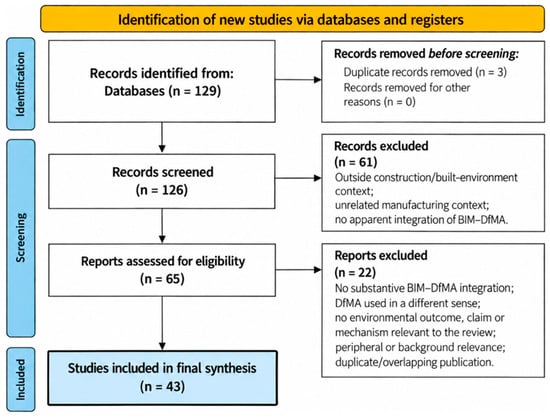
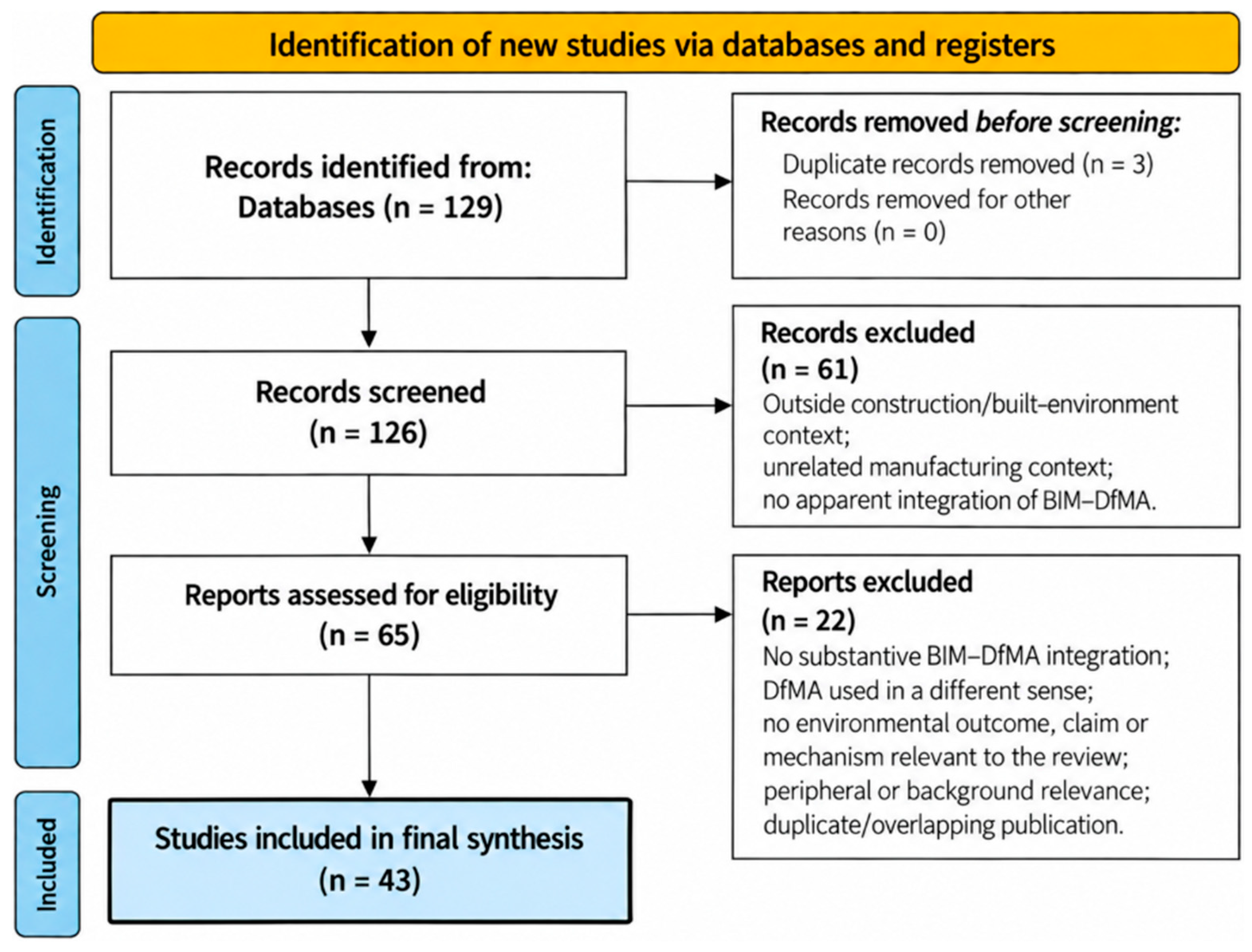
The search identified 129 records. After three duplicates were removed, 126 records were screened by title, abstract and bibliographic information. Title and abstract screening and subsequent eligibility assessment were conducted independently by the first two authors. Their screening decisions were then compared, and any disagreements regarding inclusion or exclusion were resolved through discussion and consensus. At this stage, 61 records were excluded, leaving 65 reports for eligibility assessment. A further 22 reports were excluded, resulting in a final corpus of 43 studies. The complete selection process is presented in Figure 1.
Figure 1.
PRISMA screening and eligibility summary.
3.3. Data Extraction and Coding
A structured spreadsheet was used to extract publication details, construction context, lifecycle stage, BIM capabilities, DfMA principles, environmental outcomes, proposed mechanisms, evidence basis and quantitative findings from each study.
The coding followed a hybrid deductive–inductive process. The higher-order dimensions were derived from the research questions and the EBMgt framing. These dimensions guided the extraction of information on BIM–DfMA integration, environmental outcome–mechanism relationships and supporting evidence. The specific outcome and mechanism categories were then developed inductively by comparing the terminology and explanatory relationships reported across the included studies. Data extraction and coding were undertaken by the first two authors, with coding decisions cross-checked between them and any discrepancies resolved through discussion and consensus.
Coding categories were non-exclusive, allowing one study to contribute to several areas of the synthesis. In line with the analytical framework, an environmental outcome was recorded only when it was explicitly claimed, modelled or measured. Technical or operational improvements, such as better coordination, faster modelling or improved buildability, were not treated as environmental outcomes unless the study linked them to an environmental effect. Similarly, a BIM capability or DfMA principle was coded as a mechanism only where a clear environmental pathway was reported. Where information was absent, the relevant entry was recorded as “Not explicitly stated in the paper”.
The classification of outcomes, mechanisms and evidence involved interpretive judgement. A formal inter-rater reliability statistic was not calculated because the coding process was iterative and collaborative, with the outcome and mechanism categories progressively refined during analysis. The coding was therefore not structured as two fully independent assessments against a fixed coding framework, which would be required to estimate statistical agreement.
3.4. Evidence Assessment and Synthesis
The evidential basis was assessed at the study–outcome level. For each environmental outcome, the review recorded whether it was not explicitly reported, reported but not directly assessed, or assessed or quantified within the study. “Reported but not directly assessed” was assigned where an environmental outcome was explicitly associated with BIM-enabled DfMA but was not evaluated within the study through measurement, modelling, simulation, optimisation or another analytical approach. This category also included outcomes supported through reference to prior literature without direct assessment in the study itself. For example, a study stating that its proposed BIM–DfMA approach reduces material waste without evaluating the resulting waste reduction was coded as “reported but not directly assessed”, irrespective of whether the claim was advanced by the authors or supported through previous literature. “Assessed or quantified” was assigned where the environmental outcome was directly evaluated within the study.
Separately, the underlying evidence basis of each study was recorded, including real project or production evidence, computational modelling or optimisation, prototypes, and surveys or interviews. Because the included studies employed highly heterogeneous research designs, a single formal quality or risk-of-bias appraisal framework was not considered suitable for consistent application across the corpus, as the criteria relevant to evaluating these different forms of evidence are not equivalent. The review therefore did not assign an overall methodological quality score or use study-level scores to weight the synthesis. Instead, consistent with the EBMgt framing and the purpose of RQ3, the evidential status of each environmental outcome was assessed according to whether it was directly assessed or quantified within the study, reported without direct assessment, or not explicitly reported. The underlying form of evidence was recorded separately. This approach does not constitute a formal methodological quality assessment of individual studies; it provides a structured basis for distinguishing the evidential support underlying the environmental claims synthesised in the review.
The synthesis was organised in three stages. First, BIM capabilities and DfMA principles were mapped across construction contexts and lifecycle stages. Second, reported environmental outcomes were examined alongside the mechanisms reported in association with them. Third, the reporting and assessment status of each environmental outcome was considered together with the underlying evidence basis of the relevant studies.
Frequency counts for environmental outcomes and mechanisms were based on the 43 included studies and used non-exclusive coding categories, while the narrative synthesis retained the study-specific context underlying those counts. All 43 included studies were re-examined for relevant quantitative environmental findings. Where such findings were identified, the original studies were checked for the stated comparator or baseline, unit or functional unit, assessment scope or system boundary, and data source. Where this information was not explicitly reported, no value was reconstructed or assumed.
4. Results and Evidence Synthesis
4.1. Descriptive Characteristics of the Reviewed Studies
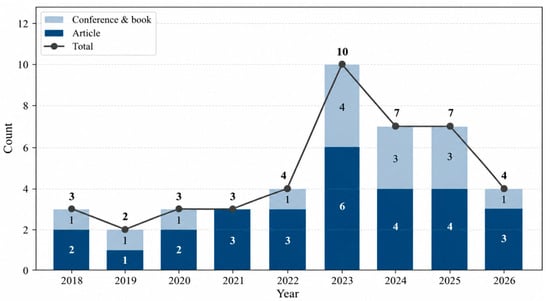
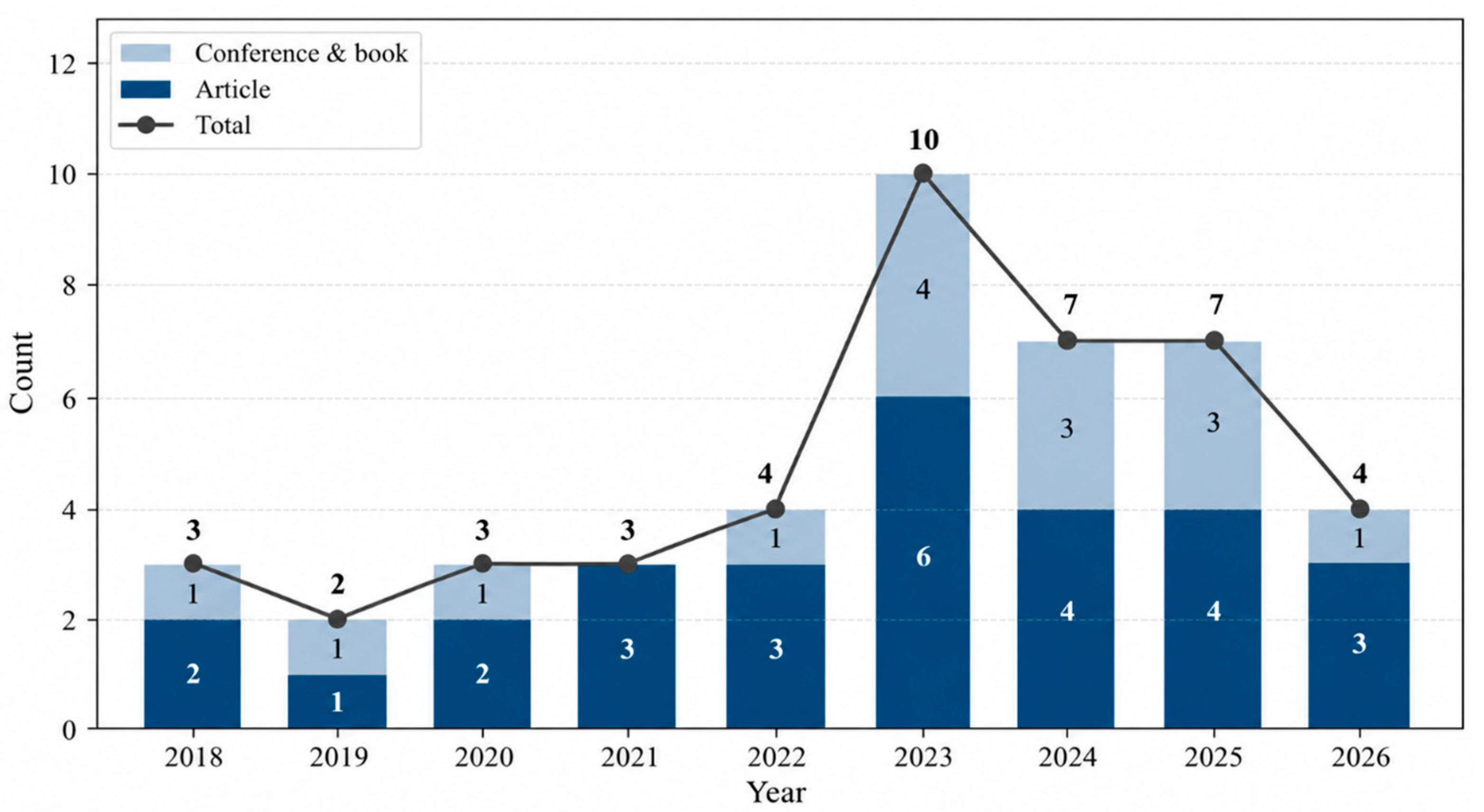
The 43 included studies were published between 2018 and 2026. As shown in Figure 2, journal articles accounted for 30 studies (69.8%), while conference papers and book chapters accounted for 13 studies (30.2%). Publication activity increased from three studies in 2018 to a peak of ten in 2023. Seven studies were published in each of 2024 and 2025, followed by four studies identified by the June 2026 search cut-off.
Figure 2.
Publications by year and type.
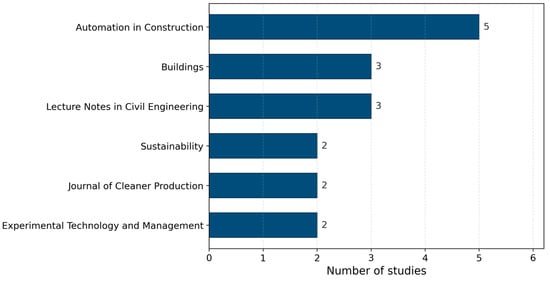
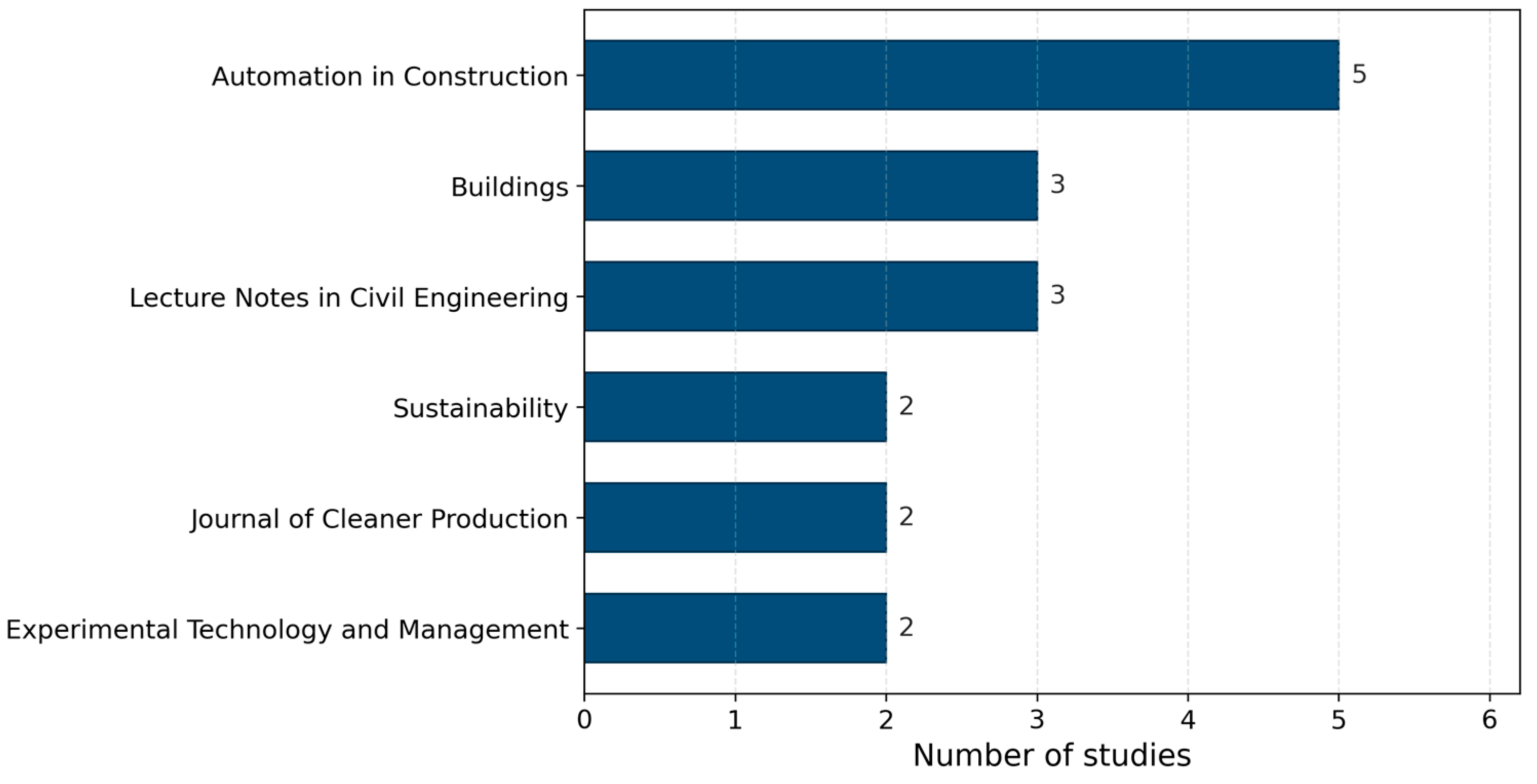
The 2026 count includes publications identified up to the search cut-off in June 2026 and therefore represents a partial year. The studies were distributed across a wide range of publication sources. Figure 3 presents sources represented by at least two studies. Automation in Construction was the most frequent source, with five studies, followed by Buildings and Lecture Notes in Civil Engineering, with three studies each. Experimental Technology and Management, Journal of Cleaner Production and Sustainability each contributed two studies. All remaining sources were represented by a single publication.
Figure 3.
Most frequently represented publication sources.
4.2. BIM-Enabled DfMA Integration Across Construction Contexts and Lifecycle Stages
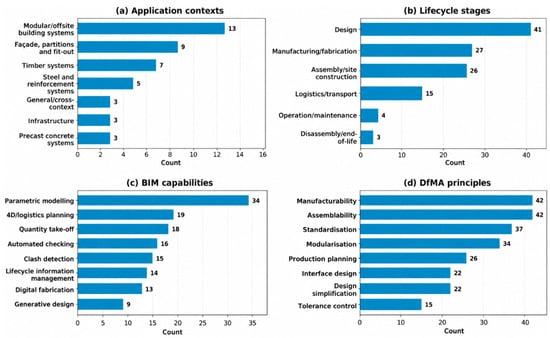
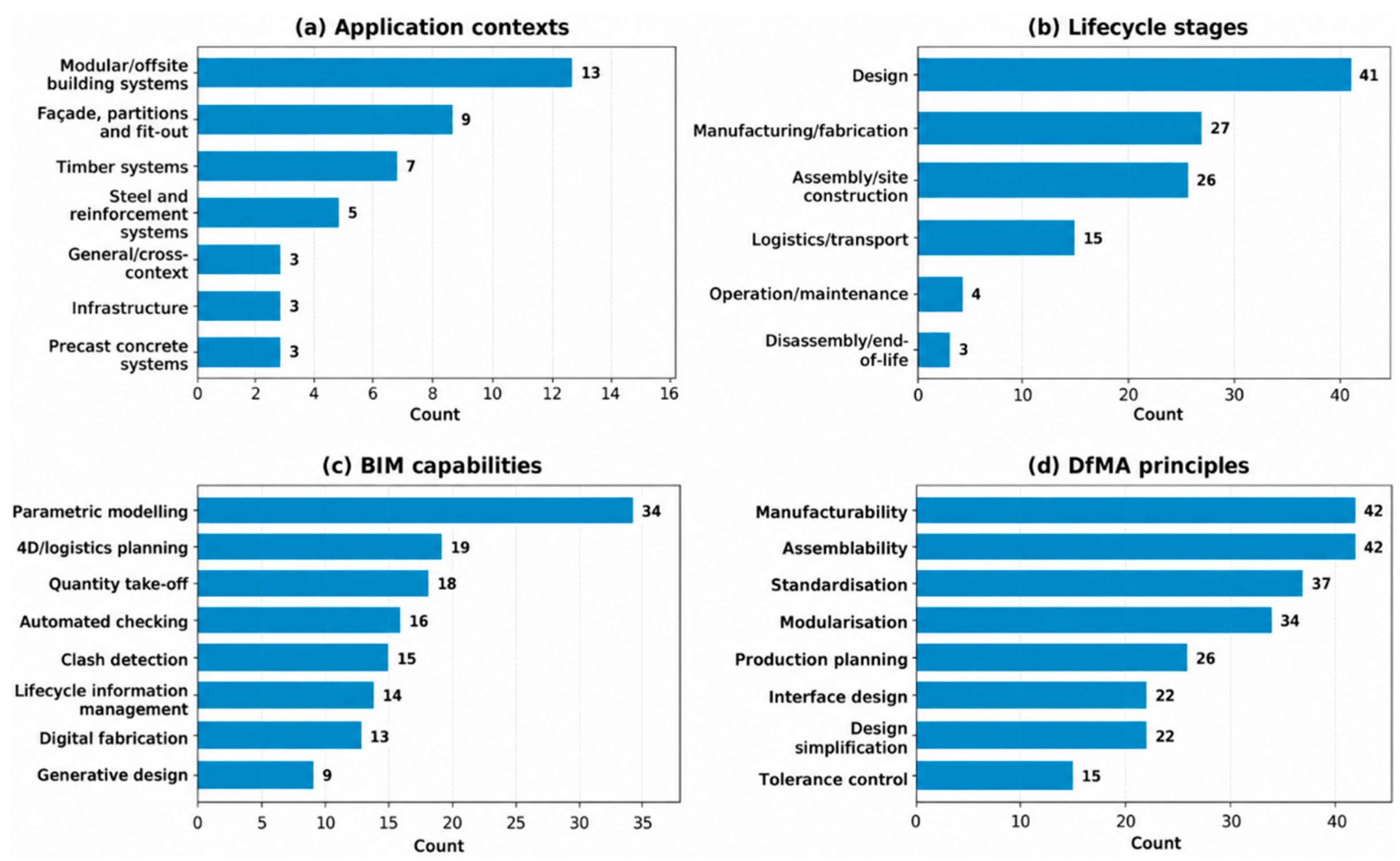
Addressing RQ1, the reviewed studies applied BIM-enabled DfMA across modular buildings, façades, timber and steel systems, precast components, fit-out works and infrastructure, as summarised in Figure 4. During design, BIM primarily provided the information environment through which manufacturing and assembly requirements were translated into model parameters, component rules and design alternatives, with parametric modelling and optimisation supporting the generation and evaluation of these alternatives. Yuan et al. [28], for example, developed standard parametric libraries for prefabricated components and used the resulting models for transportation, lifting and assembly simulations. Di Giuda et al. [29] generated alternative façade configurations through Dynamo and linked model-derived quantities with manufacturing procedures. For a special-shaped steel structure, Zou et al. [30] used parametric BIM and BIM–FEM conversion to organise components into standardised functional modules, develop connection details and incorporate assembly information into the model.
Figure 4.
Distribution of application contexts, lifecycle stages, BIM capabilities and DfMA principles across the reviewed studies.
Several studies then transferred this information from design into fabrication and site assembly. Rojas Wettling et al. [31] used parametric models for industrialised timber systems to produce CNC-ready files and coordinate manufacturing, transport and on-site assembly sequences. Underwood et al. [32] connected parametric component libraries with manufacturing software in a fit-out workflow, allowing model information to support automated checking, production and installation. In bridge construction, Nguyen et al. [33] combined rule-based parametric modelling with automated checks of component matching, connections and assembly tolerances before installation. Dong et al. [11] similarly linked a parametric precast-component library with quantities, reinforcement schedules, rule checking, production information and installation sequencing.
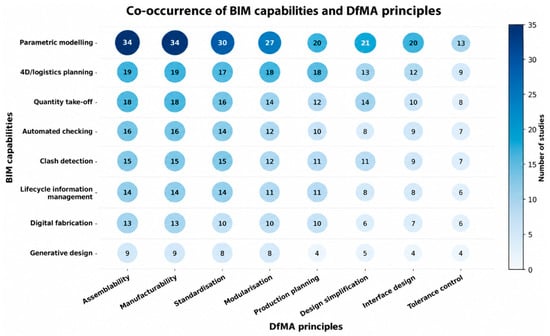
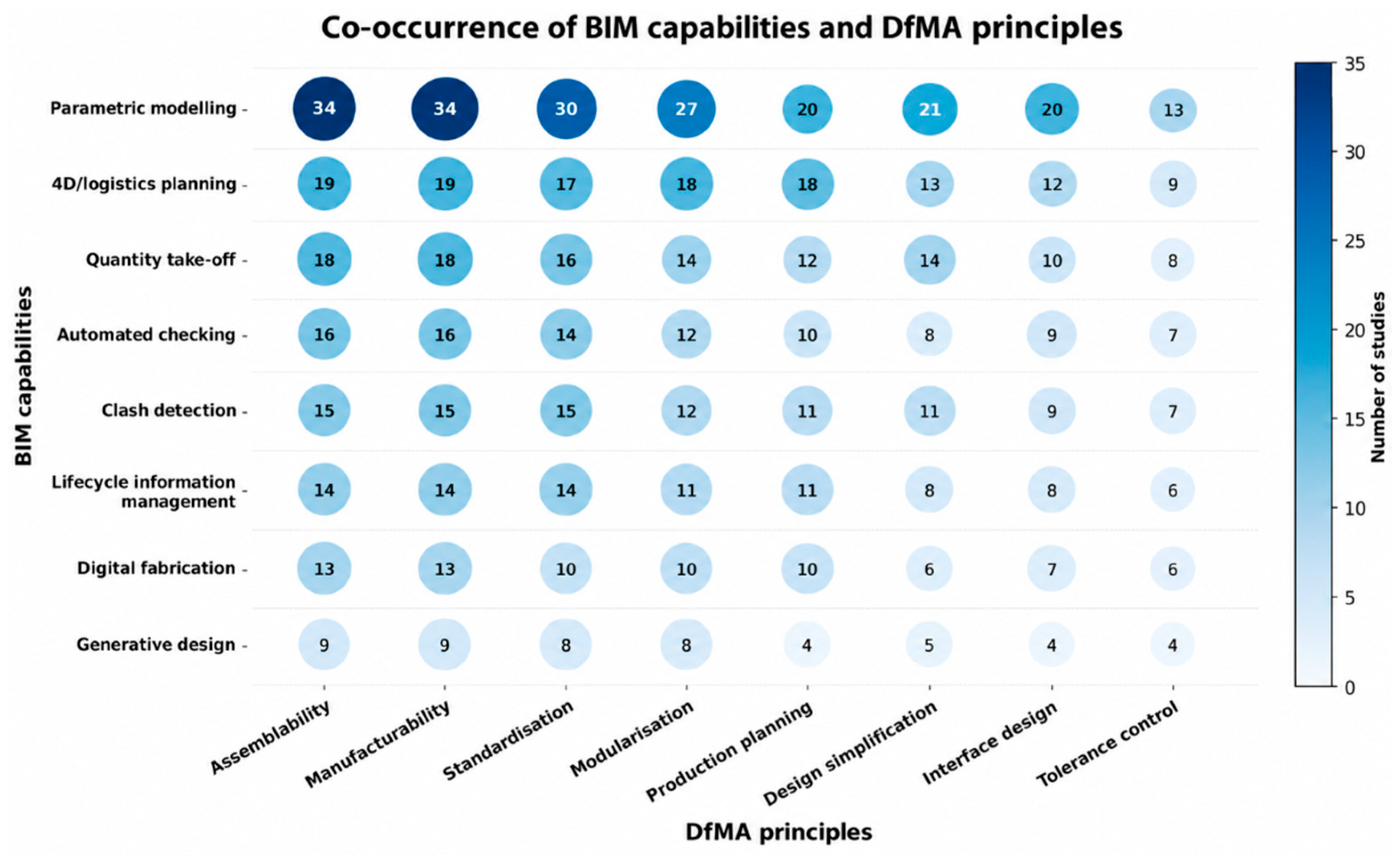
A smaller group of studies extended BIM–DfMA information beyond production and assembly. Alfieri et al. [5] connected parametric design and quantity information with CNC documentation, manufacturing schedules, just-in-time logistics and an as-built model containing maintenance and replacement information. Abrishami and Martín-Durán [13] integrated digital production information, 4D scheduling, logistics and component tracking with facilities-management data and assembly–disassembly considerations. Nahmad Vazquez and Garivani [34] extended digital timber design and fabrication towards component reuse and remanufacture. Figure 5 complements these applications by showing the study-level co-occurrence of BIM capabilities and DfMA principles: parametric modelling appeared across the broadest range of principles, while 4D and logistics planning frequently occurred alongside modularisation and production planning. These co-occurrences represent the joint presence of the categories within the same studies rather than a causal relationship.
Figure 5.
Study-level co-occurrence of BIM capabilities and DfMA principles.
4.3. Environmental Sustainability Outcomes and Underlying Mechanisms
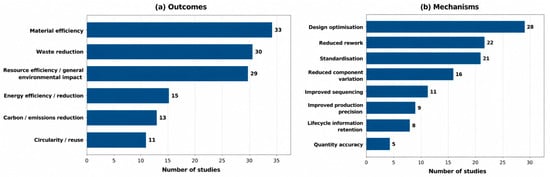
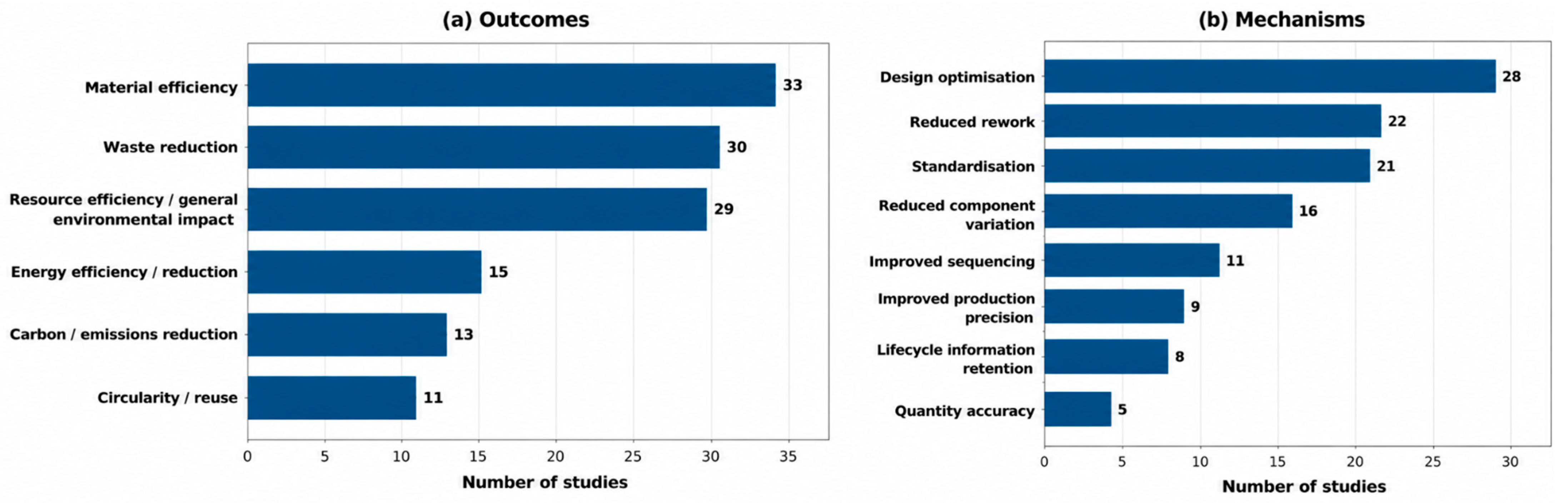
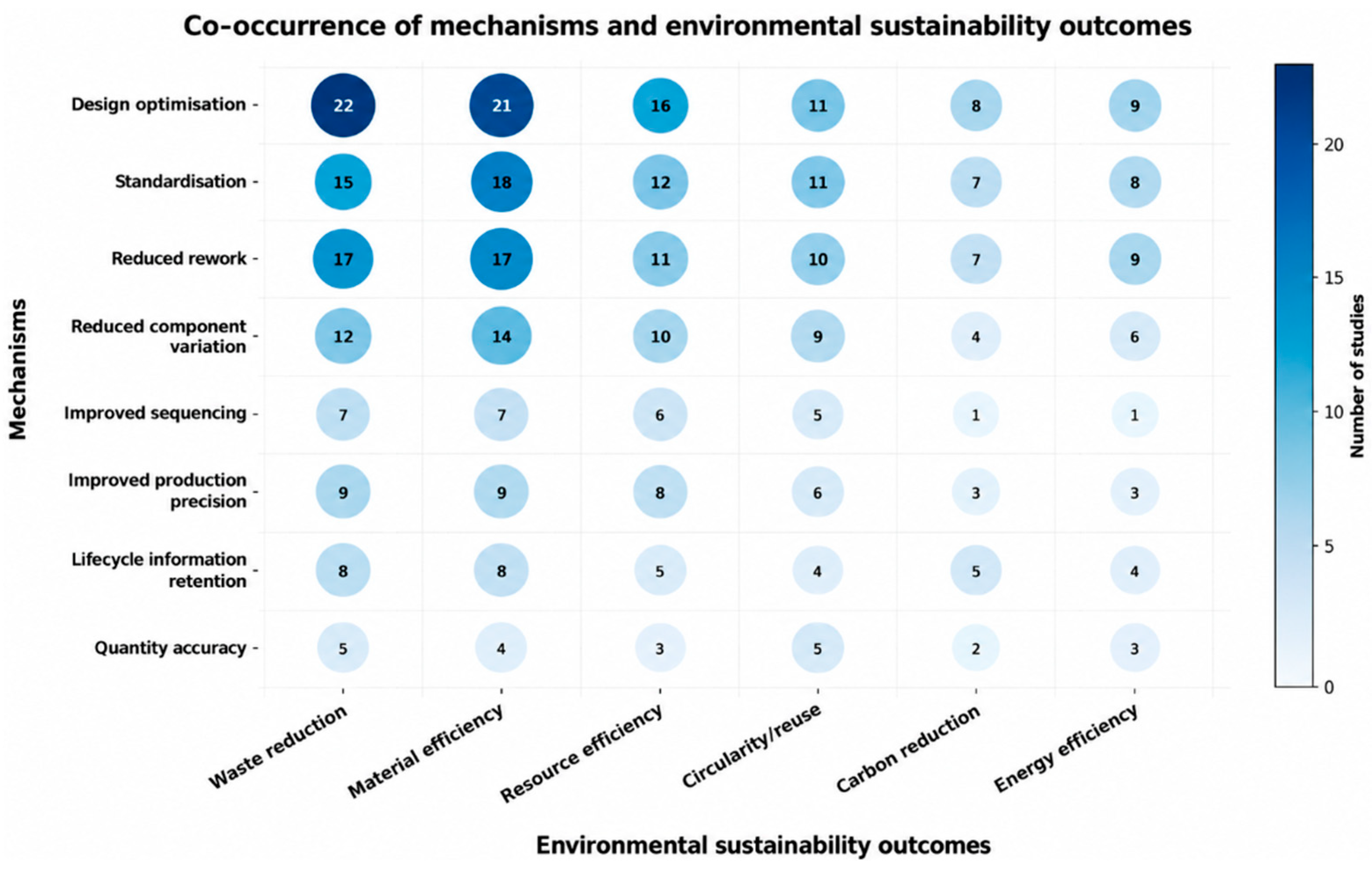
Addressing RQ2, Figure 6 shows that material efficiency was the most frequently represented environmental outcome, followed by waste reduction and resource efficiency or general environmental impact, while design optimisation, reduced rework and standardisation were the most frequently identified mechanisms linking BIM-enabled DfMA to these outcomes. In design-oriented applications, these mechanisms were primarily associated with changes to component dimensions, layouts, and material requirements before production. Ahankoob et al. [10], for example, used generative façade panelisation to compare alternative configurations, reporting a 38.17% waste rate for 1.85 × 2.5 m vertically oriented aluminium panels across six wall sections, compared with 57.09% for the same panel size in a horizontal orientation, and up to an 18.92% improvement in material efficiency relative to manual panelisation. Lin et al. [35] applied multi-objective optimisation to curved timber keels and reduced the number of partially utilised final sheets from 15 to six through secondary re-nesting. In complex steel construction, Heidenwolf et al. [36] reported that an enhanced cable-tensioned roof design required almost 20% less steel for the approximately 25,000 m2 stadium roof, although the reference design was not explicitly reported. These frequencies indicate how often particular outcomes and mechanisms were reported across the reviewed studies and do not indicate the strength or extent of the associated environmental improvement.
Figure 6.
Distribution of reported environmental sustainability outcomes and mechanisms across the reviewed studies.
Standardisation, reduced component variation and improved production precision were more visible in component-based and factory-production applications. Chen et al. [37] developed standard component types, composition rules and reusable BIM models for metro infrastructure; the resulting workflow reduced mould loss during component production by approximately 20%. However, the reference production condition and underlying calculation were not specified. In precast construction, Dong et al. [11] compared traditional 2D drawing-driven production with the proposed DFMA–BIM approach for 182 precast components on a standard floor of Building 5. The reported results included a reduction in the material-wastage rate from 5.6% to 0.8%, an approximately 4.8% saving in reinforcement steel, and an increase in mould reuse from 62.5% to 88.3%. These studies involved several mechanisms operating within the same workflow rather than a single isolated pathway.
To contextualise the quantitative evidence, Table 1 summarises the principal reported findings together with the comparator or reference condition and assessment boundary provided in the original studies. The heterogeneity in comparators, units and assessment boundaries limits direct cross-study comparison; the values are therefore interpreted as contextualised study-level findings rather than common effect estimates.
Table 1.
Contextualised quantitative environmental findings reported in the reviewed studies.
Other mechanisms were linked to outcomes beyond waste and material use. Wasim et al. [12] used whole-building simulation for a light-gauge steel building and reported a 31% reduction in annual energy consumption and a 31.6% reduction in operational GHG emissions relative to the conventional baseline configuration. Golański et al. [21] linked optimisation, standardisation, production precision and lifecycle-oriented information with material use, waste, energy and circularity in timber construction; however, the quantitative environmental values were derived from prior literature rather than generated through primary environmental assessment.
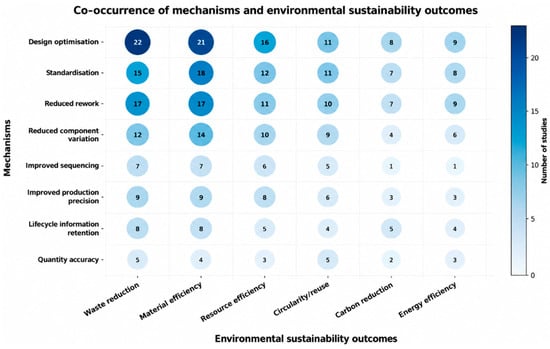
Figure 7 summarises how the eight mechanisms co-occurred with the six environmental outcomes across the corpus. Design optimisation co-occurred most often with waste reduction and material efficiency, while reduced rework, standardisation and reduced component variation also frequently co-occurred with these outcomes. The matrix reports joint occurrence within studies; the cited applications illustrate cases in which the mechanism–outcome pathway was explicitly described.
Figure 7.
Study-level co-occurrence of environmental sustainability outcomes and mechanisms.
4.4. Evidential Basis of Environmental Outcomes
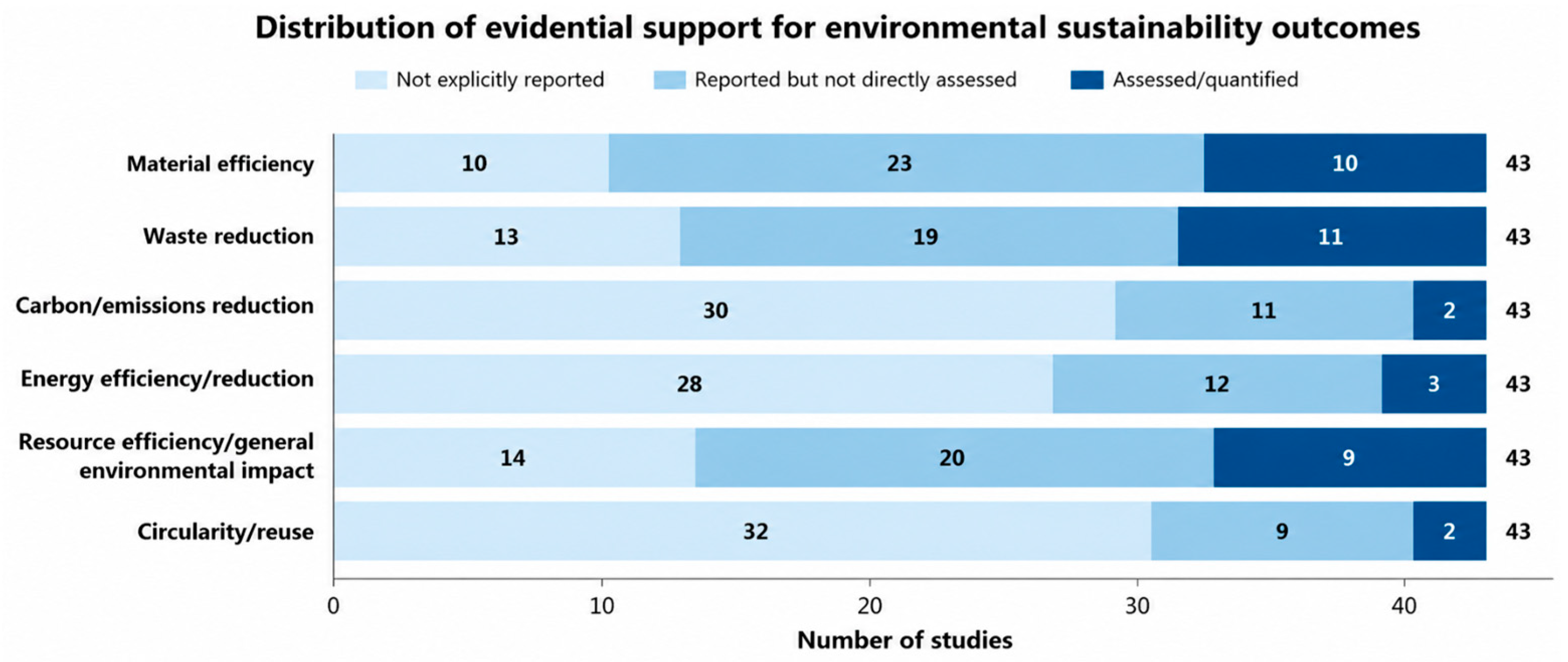
To address RQ3, the evidential status of each study–outcome relationship was examined separately from the frequency with which the outcome appeared in the literature. Each of the 43 studies was classified, for each environmental outcome, as: (1) not explicitly reporting the outcome; (2) reporting the outcome without direct assessment within the study; or (3) assessing or quantifying the outcome within the study. Claims supported through reference to prior literature without direct assessment in the study itself were included in the second category. These categories were mutually exclusive at the study–outcome level and therefore sum to the complete corpus of 43 studies for each environmental outcome.
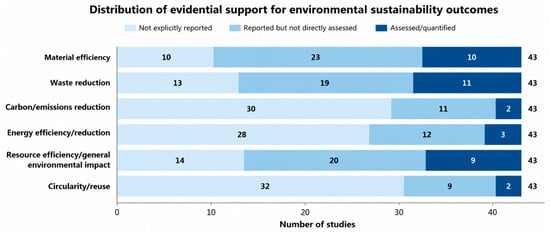
As shown in Figure 8, waste reduction had the largest directly assessed evidence base, with 11 studies assessing or quantifying this outcome, followed by material efficiency with 10 studies and resource efficiency or general environmental impact with nine. Energy efficiency was assessed or quantified in three studies, while only two studies each directly assessed carbon or emissions reduction and circularity or reuse. Reported but unassessed outcomes were considerably more common, particularly for material efficiency (23 studies), resource efficiency (20) and waste reduction (19). Carbon reduction and circularity or reuse remained the least frequently represented outcomes and were not explicitly reported in most of the reviewed studies (Figure 8).
Figure 8.
Distribution of evidential support for environmental sustainability outcomes across the 43 included studies.
The evidence basis underlying these outcomes was heterogeneous. Some studies drew on real project or production evidence, including precast applications [11,37] and an implemented stadium project [36]. Others relied on computational approaches, including parametric modelling [33], design and nesting optimisation [35], generative panelisation [10] and building-performance simulation [12]. Tan et al. [8], for example, combined BIM model data with expert-derived weighting in a multi-criteria sustainability assessment. Other studies used prototypes, surveys, interviews or combinations of stakeholder and project evidence. A summary of the included studies and their principal analytical characteristics, including construction context, BIM–DfMA focus, environmental aspects and evidence basis, is presented in Appendix A Table A1.
The presence of a real project, case study or prototype did not necessarily indicate that environmental performance had been assessed. In several studies, applied settings were used primarily to demonstrate or validate BIM–DfMA workflows, design methods or production processes, while the associated environmental outcomes remained unassessed. Conversely, environmental outcomes were also assessed through computational evidence. Building-performance simulation, for example, was used to assess carbon and energy outcomes [12], while optimisation-based approaches were used to assess material and waste implications [10,35].
Overall, assessed or quantified evidence was concentrated in material efficiency and waste reduction, while carbon, energy and circularity were less frequently evaluated directly. For every outcome category, studies reporting the outcome without directly assessing it outnumbered those that conducted explicit assessments, including instances where claims were based solely on findings reported in prior literature. In these cases, the environmental claim rested on an associated process improvement or on prior literature, not on an environmental measurement within the study.
5. Discussion
5.1. BIM–DfMA as a Coordination-Driven Integration Pathway (RQ1)
The findings indicate that BIM–DfMA integration is driven primarily by the need to maintain information continuity between design, manufacturing and assembly. BIM typically provides a shared information structure, while parametric modelling, automated checking, optimisation, fabrication tools and logistics processes extend the workflow around it. This explains why integration is strongest in the design and manufacturing stages, where geometric information, component rules, quantities and production requirements can directly influence downstream decisions. The pattern suggests that BIM–DfMA has developed principally around the practical demands of industrialised delivery rather than around environmental performance as an organising objective.
This distinction becomes important when considering the environmental role of these workflows. Extending digital information across project stages can create the conditions for material optimisation, reduced rework, improved production control and future component management, but environmental information is not routinely embedded within that information flow. The reviewed literature therefore points to a gap between digital integration and environmentally informed integration. Greater lifecycle connectivity alone does not ensure that environmental consequences influence decisions unless relevant data and performance criteria are incorporated into the workflow. The relatively limited integration observed beyond design and production reinforces this point and is consistent with previous observations that BIM–DfMA implementation remains concentrated in early project stages [15]. The next stage of development is therefore not simply deeper digital integration, but a stronger connection between the information carried through BIM–DfMA workflows and the environmental objectives against which design and production decisions are evaluated.
5.2. Mechanisms Linking BIM–DfMA to Environmental Outcomes (RQ2)
In the reviewed studies, the environmental contribution of BIM–DfMA was understood mainly through process mechanisms, principally design optimisation, reduced rework, standardisation, reduced component variation and improved production precision, which influence how much material is specified, processed or discarded. These mechanisms were typically introduced for production-related objectives, with environmental effects reported as associated benefits, so a more manufacturable design was often presented as a more sustainable one without that improvement being measured. The environmental case for BIM-enabled DfMA in the reviewed literature therefore rests mainly on resource efficiency and only marginally on demonstrated decarbonisation, with carbon reduction directly assessed in only two studies. Because most assessments were bounded at the design or production stage, potential offsets, such as more carbon-intensive materials, longer transport distances or higher factory energy use, generally remained outside the scope of evaluation.
The most clearly evidenced environmental patterns occur where BIM–DfMA mechanisms act directly on material use and waste, through changes in component geometry, quantities, production information and fabrication accuracy. Longer environmental pathways are less clearly evidenced: carbon and energy performance require information beyond design and manufacturing, while circularity depends on conditions extending to disassembly, recovery and reuse. The strength of the evidence therefore appears to depend on how directly a process change can be linked to an observable environmental outcome within the workflow. Environmental outcomes also rarely arise from a single mechanism; clearer effects were commonly associated with combinations of design optimisation, standardisation, quantity accuracy and improved production precision. This suggests an interconnected structure in which BIM-supported information and DfMA principles operate through multiple design and production mechanisms. These mechanisms may also involve trade-offs. Standardising façade panels to a single size, for example, simplifies production but can generate offcut waste where wall dimensions do not align with the standard module. Standardisation can therefore work against material optimisation in some applications, yet the reviewed studies rarely examined this tension, generally treating the two as complementary.
5.3. Evidential Basis and Assessment Boundaries (RQ3)
The evidence pattern indicates that what is known about the environmental performance of BIM–DfMA is shaped not only by what is measured, but also by the boundary within which it is measured. Material efficiency and waste reduction are comparatively well represented because they can be assessed within the design, component or production stages where BIM–DfMA workflows are already concentrated. Model-derived quantities, optimisation outputs and production data can provide relatively direct evidence of these outcomes. Carbon, energy and circularity require a broader evidence base, often extending into material production, operation, reuse or end-of-life, and are therefore less readily captured within the dominant scope of current BIM–DfMA applications.
This helps explain why technical demonstration is more mature than environmental verification. A workflow may successfully coordinate design and production, improve manufacturability or reduce process inefficiencies while still providing limited evidence of its overall environmental consequence. The distinction is particularly important for case-based research, where successful implementation can establish feasibility without establishing environmental superiority over a conventional alternative. The reviewed literature therefore reveals a gap between demonstrating that BIM–DfMA works as a delivery approach and demonstrating what environmental difference it makes.
Assessment boundaries also influence how environmental findings should be interpreted. Narrow boundaries can identify immediate changes in material use, waste or production efficiency, but may not capture effects arising elsewhere in the lifecycle. As the scope expands, manufacturing requirements, transport, operational performance and future reuse can alter the environmental interpretation of an otherwise favourable design decision. Variation in comparison baselines, units of analysis, assessment scopes and environmental boundaries limits direct comparison of quantitative findings across the reviewed studies. These values are therefore interpreted within the methodological and project context of the original studies and not as common estimates of environmental performance. The greater frequency of material efficiency and waste reduction reflects their prominence in the reviewed literature and should not be interpreted as evidence that BIM-enabled DfMA has a greater environmental effect on these outcomes than on carbon, energy or circularity.
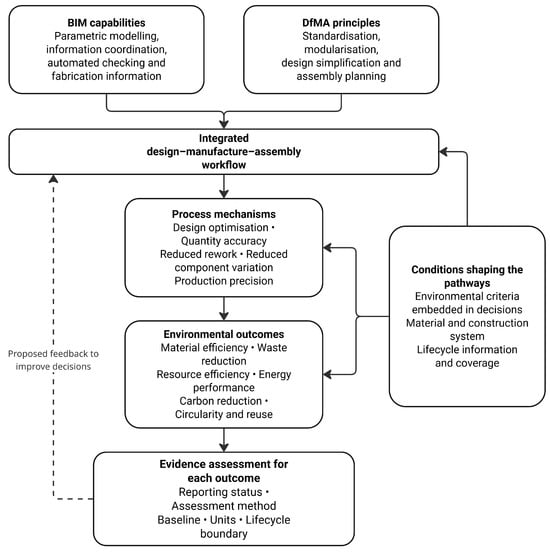
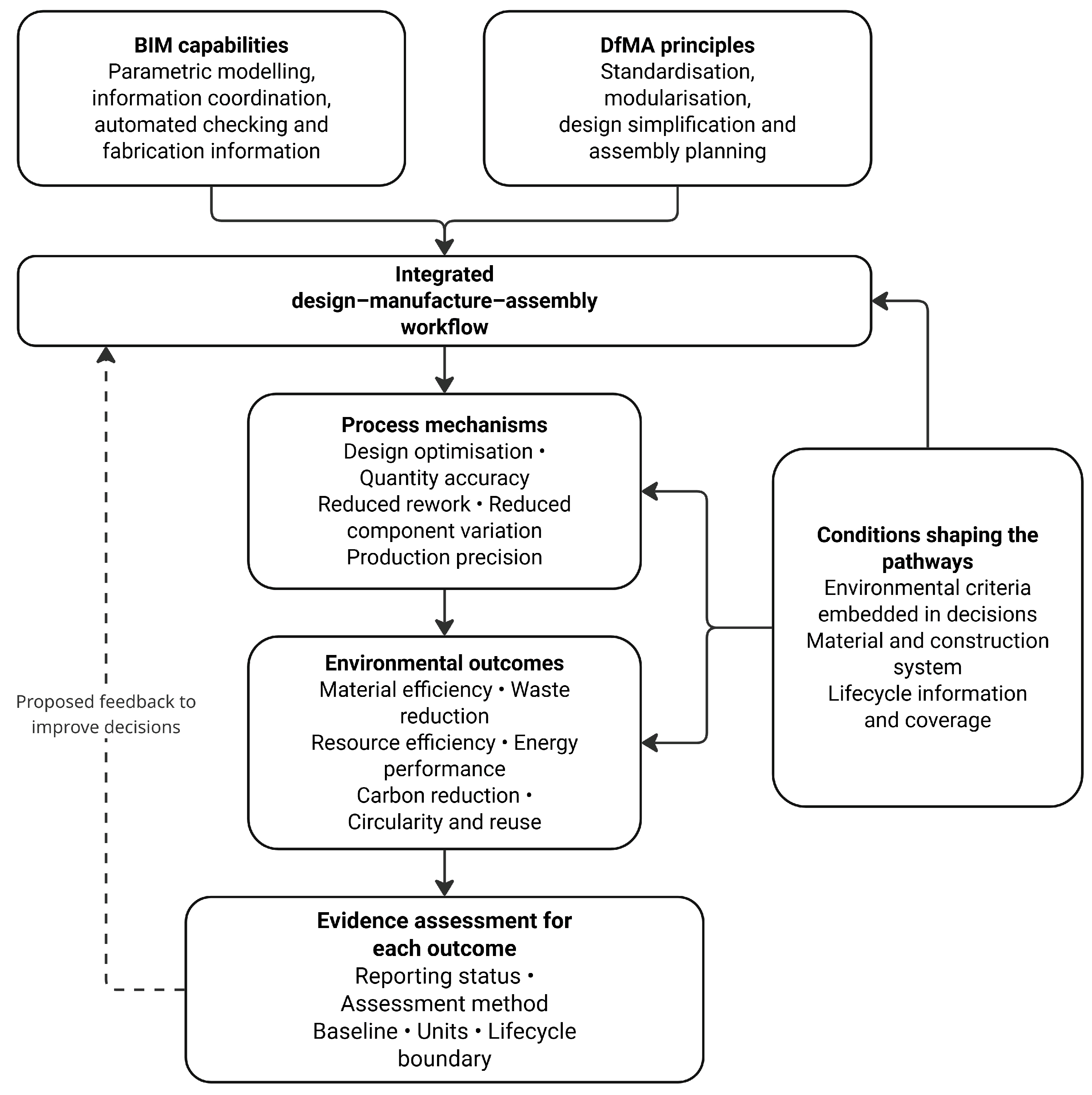
Figure 9 presents a proposed conceptual framework explaining how BIM-enabled DfMA may contribute to environmental sustainability. The framework positions BIM capabilities and DfMA principles as complementary enablers of integrated design–manufacture–assembly workflows. Their reported environmental contribution is associated with process mechanisms including design optimisation, quantity accuracy, reduced rework and production precision, and should not be assumed to arise automatically from their adoption. Whether these mechanisms translate into environmental improvements depends on the environmental criteria embedded in decisions, the material and construction system, and lifecycle information and coverage. Evidence assessment provides the basis for distinguishing anticipated or reported benefits from demonstrated outcomes, with attention to assessment methods, baselines and lifecycle boundaries. The proposed feedback loop connects this assessment to subsequent design and production decisions. The framework advances these relationships as propositions informed by the review and requiring further empirical testing.
Figure 9.
Proposed conceptual framework linking BIM-enabled DfMA to environmental outcomes through process mechanisms, contextual conditions and evidence assessment.
5.4. Theoretical Implications
The findings suggest that BIM, DfMA and environmental sustainability need to be treated as related but conceptually separate elements. BIM provides the digital and information infrastructure through which design, production and assembly decisions can be coordinated, while DfMA brings manufacturing and assembly requirements into design decisions. Environmental performance sits downstream of these capabilities. Its achievement depends on whether BIM-enabled DfMA processes produce changes that are environmentally meaningful and whether those changes are actually assessed.
This distinction is important because many studies associate design optimisation, standardisation, reduced rework or production precision with sustainability, even though these are process-level improvements. Their environmental significance depends on the pathway through which they influence material use, waste, energy, carbon or reuse. The review therefore supports a mechanism-based understanding of BIM-enabled DfMA, in which environmental outcomes emerge through specific process and information changes and under particular project and assessment conditions. This helps explain why similar BIM–DfMA applications can generate very different levels of environmental evidence.
The study also strengthens the use of evidence-based management in digital construction research by showing that technical capability and environmental performance should not be interpreted at the same evidential level. A workflow may be technically effective and still provide limited evidence of environmental improvement. Future research would benefit from examining the relationships among BIM capabilities and DfMA principles, the associated process mechanisms, measurable environmental outcomes, and the evidence used to support these relationships. This would provide a stronger theoretical basis for explaining when and under what conditions BIM-enabled DfMA contributes to environmental sustainability.
5.5. Practical Implications
For practice, the environmental outcomes identified in this review can be translated into project-level performance criteria for BIM-enabled DfMA. Material efficiency and waste reduction offer a practical starting point, as they can be measured within the design and production stages where BIM–DfMA workflows are concentrated and have the strongest base of direct assessment in the reviewed literature. Indicators such as material utilisation rates, production waste rates or model-derived quantity variances can be generated from information already contained in BIM–DfMA workflows. Carbon, energy and circularity outcomes, by contrast, depend on information extending into material production, operation and end-of-life, and therefore require explicitly defined assessment criteria and lifecycle boundaries before related claims can be substantiated. In both cases, project teams can use the outcome categories as benchmarking dimensions by defining a baseline and measurable indicators at the outset and then evaluating BIM–DfMA alternatives, as well as realised performance, against them.
Clients and procurement teams can reinforce this by specifying measurable environmental requirements for BIM-enabled DfMA in project briefs and tender documents, together with the baseline and assessment boundary against which performance will be evaluated. Requiring suppliers to state how environmental claims were assessed would help distinguish demonstrated benefits from anticipated ones, particularly for carbon, energy and circularity, where direct evidence is currently limited. Clearly evidenced outcomes would also support more credible environmental disclosure in project and organisational sustainability reporting.
For design and manufacturing teams, the review identifies design optimisation, reduced rework, standardisation, reduced component variation, quantity accuracy and production precision among the mechanisms reported in association with environmental outcomes. These mechanisms represent points at which environmental criteria can be embedded directly within BIM–DfMA workflows, for example by including material use or waste as explicit objectives in design optimisation, or by recording material quantities and production waste as components are standardised and manufactured. Doing so would allow the environmental effects of these process changes to be assessed within the workflow instead of being assumed.
For contractors and logistics teams, the findings show comparatively limited environmental assessment beyond design and factory production. Where transport, handling and site assembly are relevant to the outcome being examined, these activities should be included within the assessment boundary, supported by data on transport distances, handling operations, installation and on-site waste. Capturing such data would extend the evidence base beyond the design and production stages, where it is currently concentrated, and would enable carbon, energy and circularity claims to be assessed across the lifecycle stages relevant to each claim.
5.6. Limitations
The findings should be interpreted in light of several limitations. The review was restricted to Scopus, English-language publications and a defined set of BIM and DfMA search terms. Although this produced a focused corpus, relevant studies indexed elsewhere, published in other languages or using different terminology may not have been captured. The review should therefore be understood as a structured synthesis of the literature identified through the defined Scopus search strategy and does not claim to provide an exhaustive account of all research on BIM-enabled DfMA and environmental sustainability. The geographical coverage of the corpus may also be influenced by the restriction to English-language publications.
The corpus contains multiple publications from several research teams. Because the frequency analysis treats each publication as a separate study, research teams represented by multiple publications may contribute disproportionately to the observed frequencies of particular mechanisms, outcomes or application contexts. The frequency results should therefore be interpreted as patterns of reporting within the reviewed literature and not as the prevalence of these findings across independent research teams.
Although explicit coding rules, cross-checking and consensus between the first two authors were used to support consistency, some interpretive judgement may remain in the classification of outcomes, mechanisms and evidence. Entries coded as “not explicitly stated” indicate that the corresponding information was not identified in the published study and should not be interpreted as evidence that the outcome or mechanism was absent.
Moreover, considerable heterogeneity existed across project types, material systems, BIM applications, DfMA approaches, assessment methods and environmental boundaries. Accordingly, the findings indicate the evidential support available for environmental claims within the reviewed literature but should not be interpreted as an overall methodological quality assessment of the included studies. This heterogeneity limits direct comparison between studies, and frequency of reporting should not be interpreted as equivalent to the extent of environmental improvement. The review evaluates how environmental outcomes are represented, associated with BIM-enabled DfMA processes and supported within the literature; it does not establish how large the reported environmental improvements are in practice or whether they occur consistently across projects and contexts. This distinction is particularly important because findings based on component-level or production-stage assessments do not necessarily indicate environmental performance at the whole-building or lifecycle level.
6. Conclusions
BIM-enabled DfMA is increasingly associated with environmental sustainability, yet the existing literature has not clearly established which environmental outcomes are supported by direct assessment, how these outcomes are associated with BIM-enabled DfMA processes, or where the evidence remains limited. Much of the existing work has focused on digital integration, coordination, manufacturability and production efficiency, leaving uncertainty over which environmental outcomes are actually demonstrated and which remain inferred from process improvements. This review addressed that gap by examining how BIM capabilities and DfMA principles are integrated, the environmental outcomes and mechanisms reported across the literature, and the evidential basis supporting those relationships.
The review shows that BIM-enabled DfMA is applied mainly through design- and production-oriented workflows, with BIM serving primarily as an information and coordination infrastructure. Material efficiency and waste reduction were the most frequently represented outcomes and had the largest directly assessed evidence base, while direct evidence for carbon reduction, energy performance and circularity remained more limited. Design optimisation, reduced rework, standardisation and reduced component variation were the most frequently identified mechanisms and were primarily associated with changes in design and production processes. The environmental significance of these mechanisms is more clearly supported where the associated changes are linked to explicit environmental criteria and directly assessed.
The main contribution of this review is to provide a clearer conceptual and evidential account of the BIM–DfMA-sustainability relationship. It distinguishes BIM capabilities, DfMA principles, process mechanisms and environmental outcomes, and shows that environmental performance cannot be inferred from BIM or DfMA adoption alone. The review also demonstrates that the current evidence base is uneven across outcome categories, with stronger support for material and waste-related effects than for broader lifecycle outcomes.
These findings show how environmental outcomes, associated mechanisms and supporting evidence are represented in the existing BIM-enabled DfMA literature. They do not establish the magnitude of environmental improvements in practice or whether the reported benefits will occur consistently across projects and contexts. Nevertheless, the review provides a basis for a more rigorous next stage of research and practice. Given that many environmental outcomes are currently reported without direct assessment, environmental objectives should be embedded explicitly within BIM–DfMA workflows and evaluated through measurable indicators, comparable baselines and appropriate assessment methods. Future work should particularly investigate carbon, energy and circularity outcomes through direct assessment and examine more clearly the conditions under which BIM-enabled DfMA delivers environmental improvement.
Supplementary Materials
The following supporting information can be downloaded at: https://www.mdpi.com/article/10.3390/su18199996/s1, PRISMA Checklist.
Funding
This research received no external funding.
Institutional Review Board Statement
Not applicable.
Informed Consent Statement
Not applicable.
Data Availability Statement
Data will be available upon reasonable request.
Acknowledgments
Declaration of generative AI and AI-assisted technologies in the writing process. During the preparation of this manuscript, the authors used GPT-5.6 for proofreading and improving the clarity of the writing. The authors have reviewed and edited the output and take full responsibility for the content of this publication.
Conflicts of Interest
The authors declare no conflicts of interest.
Appendix A
Table A1.
Summary of the included studies, including construction context, BIM–DfMA focus, environmental aspects and evidence basis.
References
- United Nations Environment Programme. Global Status Report for Buildings and Construction 2025–2026; United Nations Environment Programme: Nairobi, Kenya, 2026. [Google Scholar]
- Gao, S.; Jin, R.; Lu, W. Design for manufacture and assembly in construction: A review. Build. Res. Inf. 2020, 48, 538–550. [Google Scholar] [CrossRef] [Scilit]
- Lu, W.; Tan, T.; Xu, J.; Wang, J.; Chen, K.; Gao, S.; Xue, F. Design for manufacture and assembly (DfMA) in construction: The old and the new. Archit. Eng. Des. Manag. 2021, 17, 77–91. [Google Scholar] [CrossRef] [Scilit]
- Bogue, R. Design for manufacture and assembly: Background, capabilities and applications. Assem. Autom. 2012, 32, 112–118. [Google Scholar] [CrossRef] [Scilit]
- Alfieri, E.; Seghezzi, E.; Sauchelli, M.; Di Giuda, G.M.; Masera, G. A BIM-based approach for DfMA in building construction: Framework and first results on an Italian case study. Archit. Eng. Des. Manag. 2020, 16, 247–269. [Google Scholar] [CrossRef] [Scilit]
- Bakhshi, S.; Chenaghlou, M.R.; Pour Rahimian, F.; Edwards, D.J.; Dawood, N. Integrated BIM and DfMA parametric and algorithmic design based collaboration for supporting client engagement within offsite construction. Autom. Constr. 2022, 133, 104015. [Google Scholar] [CrossRef] [Scilit]
- Qi, B.; Costin, A. BIM and Ontology-Based DfMA Framework for Prefabricated Component. Buildings 2023, 13, 394. [Google Scholar] [CrossRef] [Scilit]
- Tan, T.; Zheng, L.; Xue, F.; Bao, Z.; Fang, Z.; Liu, X. MIVES MULTI-CRITERIA FRAMEWORK TO SUSTAINABILITY INDEX OF DESIGN FOR MANUFACTURE AND ASSEMBLY. J. Civ. Eng. Manag. 2024, 30, 234–247. [Google Scholar] [CrossRef] [Scilit]
- Han, D.; Zhao, W.; Yin, H.; Qu, M.; Zhu, J.; Ma, F.; Ying, Y.; Pan, A. Large language models driven BIM-based DfMA method for free-form prefabricated buildings: Framework and a usefulness case study. J. Asian Archit. Build. Eng. 2025, 24, 1500–1517. [Google Scholar] [CrossRef] [Scilit]
- Ahankoob, A.; Calixto, V.; Abbasnejad, B.; Wong, P.S.P. A generative BIM approach for DfMA integration into building facade design. Int. J. Constr. Manag. 2025, 26, 1858–1878. [Google Scholar] [CrossRef] [Scilit]
- Dong, D.; Keer, C.; Jiang, Y.; Zou, Y.; Zhou, G. Parametric module library for automated design of precast concrete components integrating DFMA and BIM. J. Clean. Prod. 2026, 567, 148647. [Google Scholar] [CrossRef] [Scilit]
- Wasim, M.; Wang, K.; Yuan, Z.; Jin, M.; Abadel, A.; Nehdi, M.L. An optimized energy efficient design of a light gauge steel building. Case Stud. Constr. Mater. 2023, 19, e02398. [Google Scholar] [CrossRef] [Scilit]
- Abrishami, S.; Martín-Durán, R. BIM and DfMA: A paradigm of new opportunities. Sustainability 2021, 13, 9591. [Google Scholar] [CrossRef] [Scilit]
- Gbadamosi, A.-Q.; Mahamadu, A.-M.; Oyedele, L.O.; Akinade, O.O.; Manu, P.; Mahdjoubi, L.; Aigbavboa, C. Offsite construction: Developing a BIM-Based optimizer for assembly. J. Clean. Prod. 2019, 215, 1180–1190. [Google Scholar] [CrossRef] [Scilit]
- Widanage, C.; Kim, K.P. Integrating Design for Manufacture and Assembly (DfMA) with BIM for infrastructure. Autom. Constr. 2024, 167, 105705. [Google Scholar] [CrossRef] [Scilit]
- Mehdipoor, A.; Iordanova, I. Systematic literature review on the combination of digital fabrication, BIM and off-site manufacturing in construction—A research road map. In Proceedings of the Canadian Society of Civil Engineering Annual Conference, Virtual, 26–29 May 2021; pp. 283–296. [Google Scholar]
- Parracho, D.F.; Nour El-Din, M.; Esmaeili, I.; Freitas, S.S.; Rodrigues, L.; Poças Martins, J.; Corvacho, H.; Delgado, J.M.; Guimarães, A.S. Modular construction in the digital age: A systematic review on smart and sustainable innovations. Buildings 2025, 15, 765. [Google Scholar] [CrossRef] [Scilit]
- Kocaer, O.; Kul, A.; Aldemir, A. From principles to practice: A systematic literature review of design for manufacture and assembly and design for deconstruction strategies for a circular construction industry. Struct. Concr. 2026, 27, 5827–5852. [Google Scholar] [CrossRef] [Scilit]
- Tavares, V.; Lacerda, N.; Freire, F. Embodied energy and greenhouse gas emissions analysis of a prefabricated modular house: The “Moby” case study. J. Clean. Prod. 2019, 212, 1044–1053. [Google Scholar] [CrossRef] [Scilit]
- Langston, C.; Zhang, W. DfMA: Towards an integrated strategy for a more productive and sustainable construction industry in Australia. Sustainability 2021, 13, 9219. [Google Scholar] [CrossRef] [Scilit]
- Golański, M.; Juchimiuk, J.; Podlasek, A.; Starzyk, A. Design for Manufacturing and Assembly (DfMA) in Timber Construction: Advancing Energy Efficiency and Climate Neutrality in the Built Environment. Energies 2025, 18, 6332. [Google Scholar] [CrossRef] [Scilit]
- Vargas-Mosqueda, M.; Quitral Zapata, F.; Sepúlveda-Morales, J.; Paredes, C.; Benedetti, F. Developed of a modular product platform based on BIM, applied to multifamily mid-rise timber building; [Desarrollo de plataforma de producto modular basada en BIM, aplicada a viviendas multifamiliares de baja y mediana altura en madera]. Inf. Constr. 2026, 77, 7116. [Google Scholar] [CrossRef] [Scilit]
- Rousseau, D.M. Is there such a thing as “evidence-based management”? Acad. Manag. Rev. 2006, 31, 256–269. [Google Scholar] [CrossRef] [Scilit]
- Tranfield, D.; Denyer, D.; Smart, P. Towards a methodology for developing evidence-informed management knowledge by means of systematic review. Br. J. Manag. 2003, 14, 207–222. [Google Scholar] [CrossRef] [Scilit]
- Page, M.J.; McKenzie, J.E.; Bossuyt, P.M.; Boutron, I.; Hoffmann, T.C.; Mulrow, C.D.; Shamseer, L.; Tetzlaff, J.M.; Akl, E.A.; Brennan, S.E. The PRISMA 2020 statement: An updated guideline for reporting systematic reviews. BMJ 2021, 372, n71. [Google Scholar] [CrossRef] [Scilit] [PubMed]
- Oraee, M.; Hosseini, M.R.; Papadonikolaki, E.; Palliyaguru, R.; Arashpour, M. Collaboration in BIM-based construction networks: A bibliometric-qualitative literature review. Int. J. Proj. Manag. 2017, 35, 1288–1301. [Google Scholar] [CrossRef] [Scilit]
- Chadegani, A.A.; Salehi, H.; Yunus, M.M.; Farhadi, H.; Fooladi, M.; Farhadi, M.; Ebrahim, N.A. A comparison between two main academic literature collections: Web of Science and Scopus databases. arXiv 2013, arXiv:1305.0377. [Google Scholar]
- Yuan, Z.; Sun, C.; Wang, Y. Design for Manufacture and Assembly-oriented parametric design of prefabricated buildings. Autom. Constr. 2018, 88, 13–22. [Google Scholar] [CrossRef] [Scilit]
- Di Giuda, G.M.; Giana, P.E.; Masera, G.; Seghezzi, E.; Villa, V. A BIM-BASED APPROACH TO FAÇADE CLADDING OPTIMIZATION: GEOMETRICAL, ECONOMIC AND PRODUCTION CONTROL IN A DFMA PERSPECTIVE. In Proceedings of the European Conference on Computing in Construction, Chania, Crete, Greece, 10–12 July 2019; pp. 324–331. [Google Scholar] [CrossRef] [Scilit]
- Zou, Y.; Hu, F.; Yang, H.; Cai, J.; Pan, H.; Zhang, Q. Detailed Design of Special-Shaped Steel Structures Based on DfMA: The BIM-FEM Model Conversion Method. Buildings 2024, 14, 1320. [Google Scholar] [CrossRef] [Scilit]
- Rojas Wettling, C.; Mourgues Alvarez, C.; Guindos Bretones, P. IDM for the Conceptual Evaluation Process of Industrialized Timber Projects. Adv. Civ. Eng. 2023, 2023, 9200255. [Google Scholar] [CrossRef] [Scilit]
- Underwood, J.; Fleming, A.; Shelbourn, M.; Heywood, J.; Roberts, I. Streamlining a design, manufacture, and fitting workflow within a UK fit-out SME: A BIM implementation case study. In Contemporary Strategies and Approaches in 3-D Information Modeling; IGI Global: Hershey, PA, USA, 2018; pp. 242–266. [Google Scholar]
- Nguyen, D.-C.; Jeon, C.-H.; Roh, G.; Shim, C.-s. BIM-based preassembly analysis for design for manufacturing and assembly of prefabricated bridges. Autom. Constr. 2024, 160, 105338. [Google Scholar] [CrossRef] [Scilit]
- Nahmad Vazquez, A.; Garivani, S. From DfMA to DfR: Exploring a Digital and Physical Technological Stack to Enable Digital Timber for SMEs. In Lecture Notes in Mechanical Engineering; Springer: Cham, Switzerland, 2024; Volume Part F1562, pp. 837–858. [Google Scholar]
- Lin, L.; Wang, L.; Cheng, G.; Xu, B. DfMA-Oriented Optimal Design for Curved Wooden Keels Based on Multiobjective Optimization and BIM. J. Comput. Civ. Eng. 2025, 39, 04025082. [Google Scholar] [CrossRef] [Scilit]
- Heidenwolf, O.; Juhász, M.I.; Kocsis, A.B.; Gáncs, D.; Kézsmárki, Z.; Kis, A.; Szabó, I. The impact of the combined innovations at the Hungarian National Athletics Stadium steel roof structure construction. In Proceedings of the International Symposium on Automation and Robotics in Construction, Chennai, India, 5–7 July 2023; pp. 637–644. [Google Scholar] [CrossRef] [Scilit] [PubMed]
- Chen, G.; Dong, D.; Jiang, Y.; Wang, W. DFMA-oriented BIM parametric design of a metro component; [面向 DFMA 的某地铁停车场构件 BIM 参数化设计]. Exp. Technol. Manag. 2024, 41, 135–142. [Google Scholar] [CrossRef]
- Banks, C.; Kotecha, R.; Curtis, J.; Dee, C.; Pitt, N.; Papworth, R. Enhancing high-rise residential construction through design for manufacture and assembly—A UK case study. Proc. Inst. Civ. Eng. Manag. Procure. Law 2018, 171, 164–174. [Google Scholar] [CrossRef] [Scilit]
- Kalemi, E.V.; Cheung, F.; Tawil, A.-R.; Patlakas, P.; Alyania, K. ifcOWL-DfMA a new ontology for the offsite construction domain. CEUR Workshop Proc. 2020, 2636, 105–117. [Google Scholar]
- Nguyen, D.-C.; Shim, C.-S. Design for Manufacturing and Assembly-Oriented Parametric Modelling of Prefabricated Bridges. In Proceedings of the IABSE Symposium Prague, 2022: Challenges for Existing and Oncoming Structures—Report, Prague, Czech Republic, 25–27 May 2022; pp. 1345–1351. [Google Scholar]
- Dong, D.; Zou, Y.; Pan, H.; Zhou, G.; Feng, Y.; Tang, Y. DFMA-oriented modular and parametric design and secondary splitting of vertical PC components. Sci. Rep. 2023, 13, 3457. [Google Scholar] [CrossRef] [Scilit] [PubMed]
- Rehman, S.U.; Ryu, S.; Kim, I. An Analysis and Consolidation of DfMA Based Construction Guidelines and Its Validation Through a Korean Case Study. In Lecture Notes on Data Engineering and Communications Technologies; Springer: Cham, Switzerland, 2023; Volume 146, pp. 749–759. [Google Scholar]
- Wasim, M.; Oliveira, O. Efficient design of a prefabricated steel structure integrating design for manufacture and assembly concepts. Aust. J. Struct. Eng. 2022, 23, 356–369. [Google Scholar] [CrossRef] [Scilit]
- Bermond, C.; Polverino, S.; Morbiducci, R. Design for Manufacture and Assembly for Urban Regeneration: The Case Study of the Genoa Cornigliano Market. In Lecture Notes in Civil Engineering; Springer: Cham, Switzerland, 2025; pp. 694–712. [Google Scholar] [CrossRef] [Scilit]
- Abbasnejad, B.; Calixto, V.; Soltani, S.; Wong, P.S.P. Smart Design of Prefabricated Internal Wall Partitions: Integrating BIM Capabilities with DfMA Principles. In Lecture Notes in Civil Engineering; Springer: Singapore, 2025; pp. 183–196. [Google Scholar] [CrossRef] [Scilit]
- Laovisutthichai, V.; Lu, W.; Tam, K.L.; Lau, S.S.Y. Design for Manufacture and Assembly (DfMA) Communication Network and the Impact of COVID-19. In Lecture Notes in Operations Research; Springer: Singapore, 2023; Volume Part F3795, pp. 533–546. [Google Scholar]
- Li, M.; Wong, B.C.; Liu, Y.; Chan, C.M.; Gan, V.J.; Cheng, J.C. DfMA-oriented design optimization for steel reinforcement using BIM and hybrid metaheuristic algorithms. J. Build. Eng. 2021, 44, 103310. [Google Scholar] [CrossRef] [Scilit]
- Razak, M.I.A.; Khoiry, M.A.; Badaruzzaman, W.H.W.; Hussain, A.H.; Zain, M.Z.M. Development of Application Framework for Design for Manufacturing and Assembly Towards Digital and Sustainable Construction in Malaysia; [Pembangunan Kerangka Pelaksanaan Prinsip Rekabentuk Untuk Pembuatan Dan Pemasangan Ke Arah Pembinaan Secara Digital dan Mampan di Malaysia]. J. Kejuruter. 2023, 35, 351–360. [Google Scholar] [CrossRef] [Scilit] [PubMed]
- Hong, S.M.; Kim, G.; Gu, H.; Kim, T.; Choo, S. Development of Building Component Combination Algorithms for Generative Design-based DfMA Applications. In Proceedings of the International Conference on Education and Research in Computer Aided Architectural Design in Europe, Graz, Austria, 20–22 September 2023; Volume 2, pp. 207–216. [Google Scholar]
- Méndez, D.; Lorca, F.; Carpio, M. USING THE DFMA APPROACH IN THE EARLY INTEGRATION OF ACTORS FOR THE DESIGN OF AN INDUSTRIALIZED TIMBER BUILDING—CASE STUDY. In Proceedings of the 14th World Conference on Timber Engineering: Advancing Timber for the Future Built Environment, Brisbane, Australia, 22–26 June 2025; pp. 882–890. [Google Scholar] [CrossRef] [Scilit]
- Hong, S.M.; Kim, G.; Gu, H.; Choo, S. Development and Application of an Architectural Component Combination Algorithm for Generative Design-based DfMA Design Support. J. Archit. Inst. Korea 2024, 40, 53–64. [Google Scholar] [CrossRef]
- Minetto, C.; Reis, L.; Rangel, B. Parametric Design as an Optimiser for Modular Construction a Following DfMA Principles. In Lecture Notes in Civil Engineering; Springer: Singapore, 2026; pp. 355–363. [Google Scholar] [CrossRef] [Scilit]
- Potseluyko, L.; Pour Rahimian, F.; Dawood, N.; Elghaish, F.; Hajirasouli, A. Game-like interactive environment using BIM-based virtual reality for the timber frame self-build housing sector. Autom. Constr. 2022, 142, 104496. [Google Scholar] [CrossRef] [Scilit]
- Montazeri, S.; Odo, N.; Naqvi, S.A.W.; Lei, Z. Integrating Design for Manufacturing and Assembly Principles in Modular Home Construction: A Comprehensive Framework for Enhanced Efficiency and Sustainability. Buildings 2025, 15, 103, Correction in Buildings 2026, 16, 3323.. [Google Scholar] [CrossRef] [Scilit]
- Dong, D.; Zou, Y.; Tang, Y.; Pan, H.; Zhou, G.; Ye, X. Rapid modeling design and deepening application of prefabricated BIM irregular components oriented to DFMA; [面向 DFMA 的装配式异形 BIM 构件快速建模设计与深化应用]. Exp. Technol. Manag. 2023, 40, 157–165. [Google Scholar] [CrossRef]
- Gbadamosi, A.-Q.; Oyedele, L.; Mahamadu, A.-M.; Kusimo, H.; Bilal, M.; Davila Delgado, J.M.; Muhammed-Yakubu, N. Big data for Design Options Repository: Towards a DFMA approach for offsite construction. Autom. Constr. 2020, 120, 103388. [Google Scholar] [CrossRef] [Scilit]
- Kim, I.; Shin, J.; Shah, S.H.; Rehman, S.U. Client-centered detached modular housing: Natural language processing-enabled design recommender system. J. Comput. Des. Eng. 2024, 11, 137–157. [Google Scholar] [CrossRef] [Scilit]

Disclaimer/Publisher’s Note: The statements, opinions and data contained in all publications are solely those of the individual author(s) and contributor(s) and not of MDPI and/or the editor(s). MDPI and/or the editor(s) disclaim responsibility for any injury to people or property resulting from any ideas, methods, instructions or products referred to in the content. |
© 2026 by the authors. Licensee MDPI, Basel, Switzerland. This article is an open access article distributed under the terms and conditions of the Creative Commons Attribution (CC BY) license.