


Abstract
Coolants containing glycols, corrosion inhibitors and anti-foaming additives pose a significant environmental risk due to their limited susceptibility to natural degradation. At the same time, glycols are valuable raw materials widely used across industrial sectors, and global consumption of ethylene glycol, the principal component of most coolants, has been steadily increasing. Microbial biodegradation offers an economically and environmentally attractive route for treating spent coolants. In this study, fourteen environment-derived strains from a culture collection, thirteen bacteria and one yeast, were screened for the ability to grow on two chemically distinct industrial coolant matrices: an unused, ethylene-glycol-based product (Petrygo Q NEW) and a propylene-glycol-dominated spent fluid drained from an engine cooling system. Six strains (AC2/2, B3J, 5A, B9F, B16B and 17E) showing the highest growth potential were subjected to adaptive laboratory evolution (ALE) by serial passaging for ten transfers in a minimal medium containing 1.5 g L−1 yeast extract, in which the coolant provided the principal carbon and energy source. Growth dynamics of evolved and ancestral strains were compared by microplate cultivation, glycol depletion was quantified by high-performance liquid chromatography (HPLC) in shake-flask cultures, and tolerance was assessed by spot assays. Adaptation was strain-specific and was generally more pronounced on the spent, propylene-glycol-dominated fluid than on the unused, ethylene-glycol-based product. After selection, removal of ethylene glycol from the spent fluid within 96 h increased from 33.3% to 79.7% for Wickerhamomyces anomalus B16B and from 24.8% to 60.1% for Bacillus sp. B9F, while Pseudomonas sp. AC2/2 depleted 64.3% of the propylene glycol present that is 25.6 g L−1 and the largest mass removed from either matrix. In the unused, ethylene-glycol-based product, removal also increased after ALE, reaching 10.9 g L−1 for AC2/2 from an initial load of about 50 g L−1, but none of these differences were significant. To the best of our knowledge, this is the first application of ALE to an intact commercial coolant and to a spent fluid drained from an engine cooling system, and it demonstrates that non-modified environmental isolates can be improved for the treatment of this hazardous waste stream without genetic modification.
1. Introduction
Coolants are among the most important operating fluids in modern industry. They are characterized by tightly defined physicochemical properties, a low freezing point, a high boiling point and adequate thermal conductivity, that ensure efficient operation of heating and cooling systems. Their main functions are to absorb the thermal energy generated during system operation and to protect installation components against corrosion and deposits [1]. Ethylene glycol, the principal component of most coolant formulations [1], is also a major commodity chemical: its global consumption across all end uses rose from 18.27 million tons in 2007 to 26.66 million tons in 2016, an increase of about 46%, equivalent to an average annual growth of approximately 4.3% [2].
Such intensive use across industrial sectors increases the pressure on the natural environment because of the fluids’ toxic and ecological potential. Part of the coolant volume reaches the environment through leaks, improper waste disposal or surface run-off. When coolants or their components (e.g., glycols) enter the environment without prior treatment, they can harm aquatic ecosystems, reduce biodiversity and threaten human health by contaminating drinking-water sources [3,4]. Glycol spills can also locally lower soil pH, degrade the soil microflora and reduce soil fertility, affecting the availability of nutrients to plants [4]. For these reasons, spent coolants are classified as hazardous waste requiring dedicated treatment.
Disposal and treatment of waste coolants is problematic. The high water solubility of ethylene glycol, a main component, limits its removal in conventional wastewater treatment, and chemical oxidation has been proposed as a pre-treatment to improve the biodegradability of such effluents [5]; treatment is further complicated by a high chemical oxygen demand (COD) [6]. Although glycols are readily biodegradable, their microbial breakdown consumes large amounts of dissolved oxygen, raising the biochemical oxygen demand and potentially causing hypoxia and death of aquatic organisms [4]. Ethylene glycol is easily oxidized to organic acids, aldehydes, and ketones [7]; therefore, it can be expected that fluids that have been subjected to thermal stress during operation will contain such compounds in addition to their declared composition.
In response to rising glycol consumption and the associated growth in difficult-to-manage waste, more efficient disposal technologies have been developed, including sulfate-radical advanced oxidation activated by hydrodynamic cavitation [8], membrane filtration [9], sequencing reactors for propylene-glycol-contaminated wastewater [10], UV-C-activated hydrogen peroxide [11] and multistage chemical treatment [3]. Globally, the standard method for managing these fluids is incineration in rotary kilns at temperatures of at least 850 °C, a process that is both energy-intensive and economically costly [12]. Against this background, biological treatment that exploits the capacity of microorganisms to metabolize glycols is gaining increasing attention as a sustainable alternative. This approach enables the complete mineralization of glycol-based contaminants to environmentally benign end products, proceeds under low energy input without the addition of aggressive chemical reagents, and is amenable to in situ remediation [13].
1.1. Characteristics of Coolants
Glycols, mainly ethylene glycol and propylene glycol, constitute 30–60% of coolant formulations; other glycols (diethylene, triethylene, polyethylene, dipropylene, butylene) may also be used [1,14]. Ethylene glycol (EG) is a colorless, odorless, sweetish diol whose ingestion is a well-recognized cause of acute poisoning [15], with a high boiling point (197 °C), low freezing point (−12.9 °C) and density of ~1.11 g cm−3 at 20 °C [16]. It is a primary component of engine coolants and is also used in brake fluids, de-icing formulations and as a feedstock for polyesters such as poly(ethylene terephthalate) (PET) and poly(butylene terephthalate) (PBT) [1,17,18]. EG is classified as toxic; its toxicity arises mainly from metabolites (glycolic acid and oxalate), which can cause central nervous system depression, metabolic acidosis and acute renal failure [19].
Propylene glycol (PG) is a clear, viscous, nearly odorless, low-volatility liquid of low toxicity that is not considered carcinogenic [20]. It is readily degraded by microorganisms and higher organisms, does not bioaccumulate [21] and is approved by the FDA for pharmaceutical and food use, where it is known as additive E1520 [22]. PG is metabolized in the liver by alcohol dehydrogenase to lactic and then pyruvic acid [23].
1.2. Adaptive Laboratory Evolution (ALE)
Adaptive laboratory evolution (ALE) is a tool for studying adaptive change in microorganisms. It maintains microorganisms under tightly controlled conditions over extended periods, enabling gradual selection of populations with advantageous phenotypes [24]. Unlike classical genetic engineering, ALE allows microorganisms to adapt gradually to defined selective conditions, leading to the accumulation of beneficial mutations [25,26]. ALE has proven effective in designing and implementing many biotechnological production processes [25], improving both the use of poorly assimilated compounds and the efficiency of biosynthesis, e.g., squalene production in Yarrowia lipolytica [27]. Another application is improving microorganisms for the use of unconventional substrates such as xylose, glycerol or methanol; for example, Y. lipolytica MUCL 28849 was evolved for 520 generations on crude glycerol to enhance lipid accumulation [28]. In glycol biodegradation, laboratory evolution of Pseudomonas putida KT2440 markedly improved ethylene glycol utilization, activation of the glycerate pathway through mutations affecting the regulator GclR enabling growth on ethylene glycol as the sole carbon source [29]; the enzymes of this route, the pyrroloquinoline quinone (PQQ)-dependent dehydrogenases PedE and PedH and the downstream glycolate and glyoxylate steps, had been defined earlier in the same species [30].
1.3. Microbial Degradation of Glycols
Microbial breakdown of coolants is a complex cascade of enzymatic reactions involving diverse organisms, with the genus Pseudomonas attracting particular interest. Pseudomonas stutzeri biodegrades polyethylene glycol (PEG400), with the accompanying pH change indicating active metabolism [31], and Pseudomonas putida KT2440 has the genetic potential to degrade EG, although its natural efficiency is limited by strict transcriptional regulation [29]. Under anaerobic conditions, Acetobacterium woodii oxidizes EG to acetaldehyde and converts it further to ethanol and acetate via the Wood–Ljungdahl pathway [32]. Efficient degradation depends on initiating enzymes, an intact metabolic pathway, the necessary cofactors and precise gene regulation, as shown for Rhodococcus jostii RHA1, in which adh alcohol dehydrogenase genes, the glycolate oxidase complex (glcDEF) and glyoxylate-metabolism genes are co-ordinately up-regulated [33].
The recent literature reflects a paradigm shift in which microorganisms are increasingly viewed not only as biodegraders but as biocatalysts capable of converting glycols into high-value compounds [18]; for example, Yarrowia lipolytica converts EG to glycolic acid, enabling valorization of PET-degradation products [34].
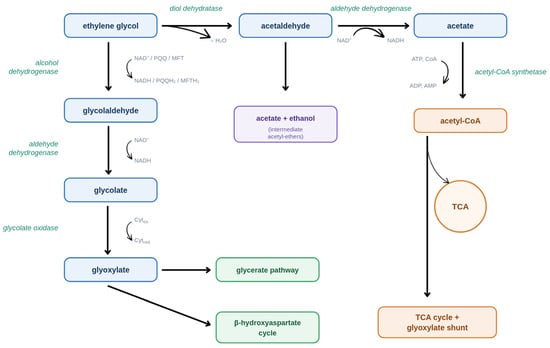
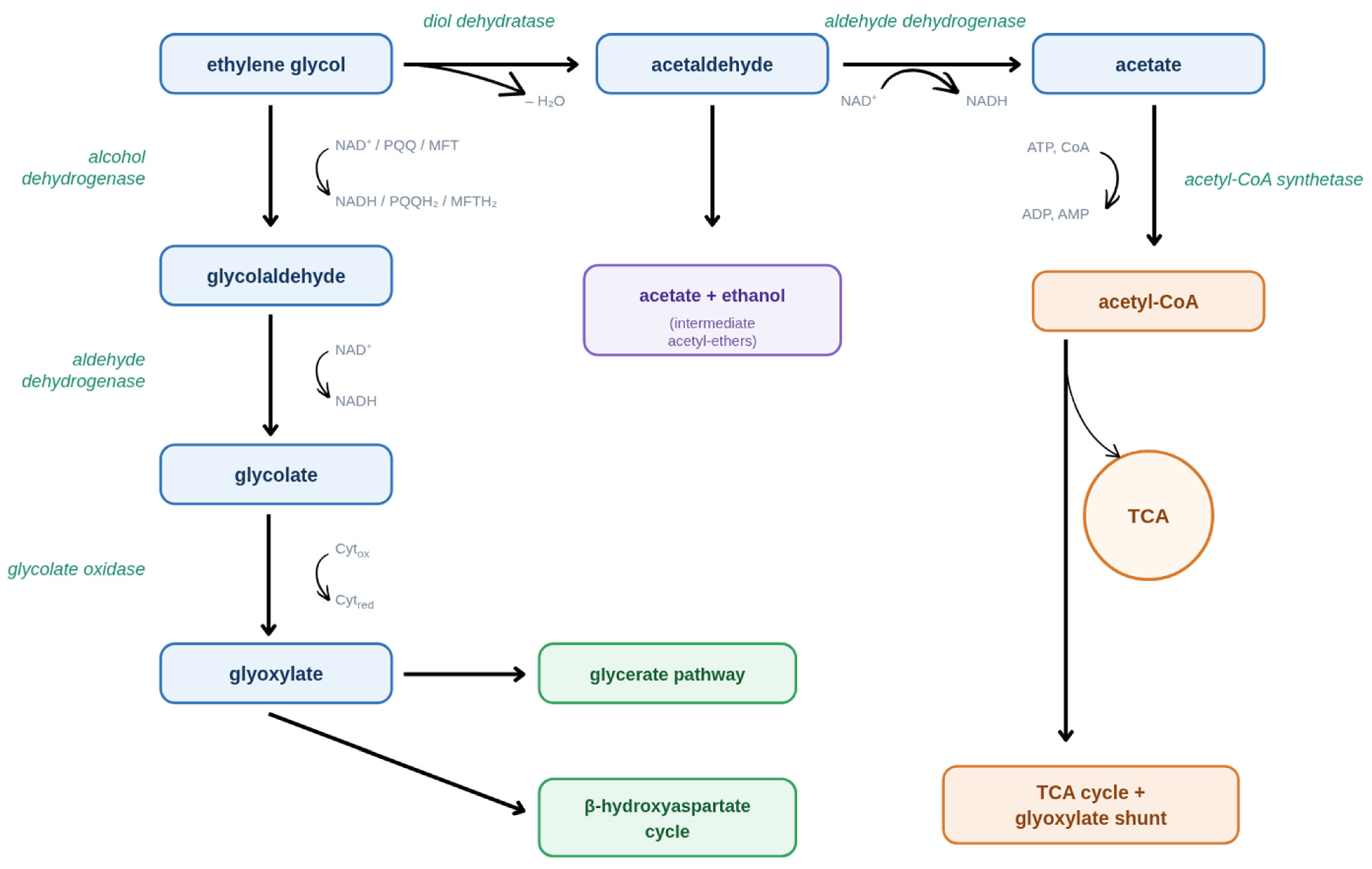
The catabolic pathway of glycols proceeds both aerobically and anaerobically. The aerobic route, best characterized in Escherichia coli and Pseudomonas putida, involves successive oxidation of the hydroxyl groups: EG dehydrogenase converts EG to glycolaldehyde, which aldehyde dehydrogenase oxidizes to glycolic acid; this is further metabolized to oxalic acid or glycine, which enter the Krebs cycle, ultimately mineralizing EG to CO2 and water (Figure 1).
Figure 1.
Metabolic pathways involved in the assimilation of ethylene glycol.
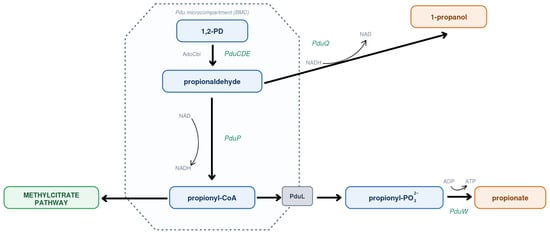
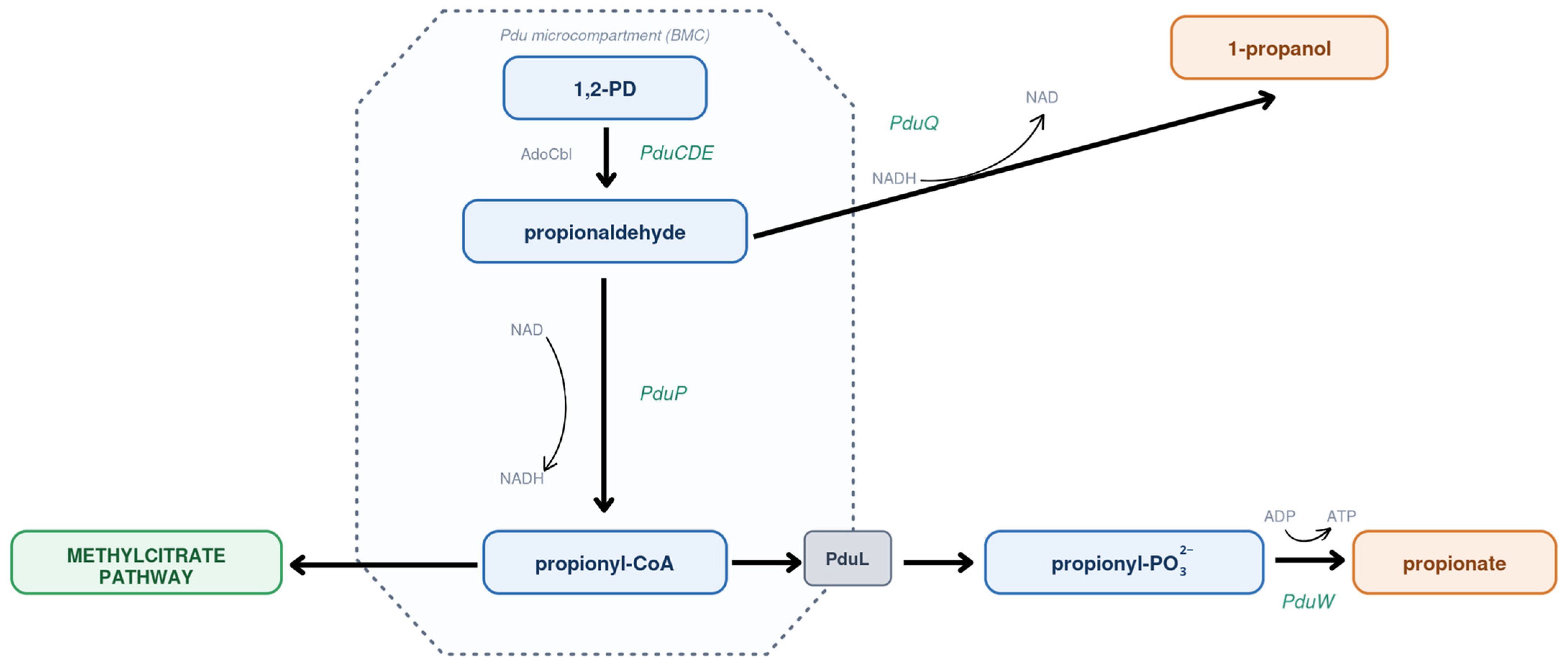
Glycolaldehyde is the most toxic intermediate. Anaerobically, EG is converted to glycolaldehyde and then to intermediates such as ethanol and formic acid. For PG the products differ: aerobically, PG dehydrogenase oxidizes PG to hydroxypropanal and then to lactic or pyruvic acid feeding the acetyl-CoA pathway and Krebs cycle, while the best-characterized route is the coenzyme-B12-dependent pdu pathway, in which 1,2-propanediol is converted to propionaldehyde and then to propionic acid and propanol (Figure 2) [35].
Figure 2.
Metabolic pathways involved in the assimilation of propylene glycol.
The main objective of this study was to use adaptive laboratory evolution (ALE) to enhance the ability of bacteria isolated from the natural environment to grow on spent coolants and to remove the glycol components they contain, as well as to quantitatively determine the extent of this removal under laboratory conditions. The specific objectives were: (i) to select strains with the highest growth efficiency in media containing fresh and used coolant; (ii) to perform ALE to increase tolerance to coolant components; (iii) to compare the growth of bacterial strains on coolants before and after ALE; and (iv) to quantify the removal of ethylene and propylene glycol from the culture medium by high-performance liquid chromatography (HPLC).
To date, the microbial degradation of glycols has been studied almost exclusively using purified ethylene glycol or propylene glycol supplied as a specific carbon source, mainly in laboratory model organisms: Pseudomonas putida KT2440, for which the metabolic and regulatory basis for ethylene glycol utilization has been elucidated through laboratory evolution and previous enzymatic studies [29,30], Pseudomonas stutzeri grown on polyethylene glycol [31], the acetogen Acetobacterium woodii [32], Rhodococcus jostii RHA1 [33], Yarrowia lipolytica, which converts ethylene glycol into glycolic acid [34], and soil bacteria exposed to an aqueous solution of propylene glycol [13]. Commercial coolants represent a different type of substrate: the diol is accompanied by corrosion inhibitors, anti-foaming agents, and dyes; in used coolants, there are additionally metal ions and products of thermal and oxidative stress, all of which act as additional selective pressure and potential inhibitors of the catabolic pathway. Adaptive evolution under laboratory conditions has so far been applied to single model substrates, such as crude glycerol [28] or purified ethylene glycol [29], as well as to improve biosynthetic efficiency [27]; however, to the best of our knowledge, it has not been applied to the intact composition of a commercial coolant or to used coolant drained from an engine cooling system. This study therefore differs from previous reports in four respects: (i) the selection factor is the complete industrial fluid, rather than a purified diol, allowing adaptation to occur in the presence of the full suite of additives; (ii) the strains are environmentally derived, unmodified isolates from cold soils of the South Shetland Islands and western Greenland, as well as from the intestines of Zophobas morio, habitats that have not previously been studied for glycol catabolism; (iii) two chemically distinct matrices are evolved in parallel and compared: an unused product based on ethylene glycol and a used fluid containing predominantly propylene glycol; and (iv) the outcome of adaptation is quantified as glycol removal by HPLC in both the ancestral and evolved lineages, rather than solely as an increase.
2. Materials and Methods
2.1. Microorganisms, Media and Culture Conditions
Fourteen bacterial and yeast strains from the collection of the Laboratory for Biosustainability of Wrocław University of Environmental and Life Sciences were used. The strains are maintained in that collection under the codes given in Table 1 and are available from the corresponding author on request. Strains were stored at −80 °C in glycerol-supplemented medium until use, then thawed and streaked onto solid LB agar (bacteria) or YPD agar (yeast). Plates were incubated in an incubator (IN55, MEMMERT GmbH + Co. KG, Büchenbach, Germany) for 24 h at 28 °C. The species, strains and isolate origins are listed in Table 1.
Table 1.
Microbial isolates evaluated for coolant biodegradation: species, strain codes and source of isolation.
Two chemically distinct commercial coolant matrices were tested. The first was an unused, ethylene-glycol-based product (trade name Petrygo Q NEW, Orlen, Płock, Poland) purchased at a filling station. The second was a spent fluid drained from a vehicle engine cooling system; its original formulation and service history were not documented, and its glycol profile identifies it as a propylene-glycol-based product. The fluid was transported in a sealed container and stored in the dark at room temperature. The two fluids are therefore not a single batch sampled before and after service, but two different industrial waste streams, and they are treated as separate substrates throughout this study. Glycol content was determined by HPLC: the unused fluid contained ethylene glycol only (501.9 g L−1), whereas the spent fluid contained predominantly propylene glycol (386.1 g L−1) together with a residual amount of ethylene glycol (12.8 g L−1). Both liquid solutions were tested as pure concentrates, while the concentrations at t = 0 were determined in a separate analytical series, directly in the prepared culture media. In the pure spent liquid, ethylene glycol constitutes a minor component whose concentration was determined alongside the propylene glycol signal, which is approximately thirty times greater; therefore, the value given here is approximate. The concentrations measured in the prepared culture media, in which both diols fall within the linear range of the calibration curves, serve as the reference values used throughout this study. The corrosion inhibitors, anti-foaming agents and other additives present in either fluid were not characterized. Any difference in microbial performance between the two matrices therefore reflects the combined effect of glycol identity and additive composition, and cannot be attributed to prior use alone. For brevity, the two substrates are referred to below as the unused (EG) and the spent (PG) coolant. The microbiological media and solutions used are listed in Table 2.
Table 2.
Composition of the microbiological media used in this study.
2.2. Screening of Bacteria for Glycol-Utilizing Strains
To pre-select strains with potential biodegradation properties, a growth study was conducted in the presence of coolants, with the criterion being the ability to grow on media enriched with coolant. Overnight pre-cultures of all 14 strains (AC2/1, AC2/2, AC2/3, B9F, B7B, 17E, 5A, 15A, B16B, B3J, 20F, 21E, 20G, 14I) were established in 5 mL liquid LB or YPD and grown for 24 h at 28 °C and 240 rpm on a rotary shaker (Eppendorf, New Brunswick Innova 44, Hamburg, Germany). Biomass was centrifuged (10 min, 4500 rpm), the supernatant discarded and the pellet washed twice with sterile PBS. Optical density was measured spectrophotometrically at 600 nm (OD600), and the volumes of cell suspension and PBS needed to obtain an initial OD600 = 0.1 were calculated. Degradation potential was assessed in vitro in sterile 96-well plates. The screening scheme, based on cultivation in a mineral medium supplemented with increasing concentrations of the coolant and on the comparison of growth kinetics with substrate-free controls, followed the general approach applied to the selection of glycol-degrading environmental isolates [13]. Media with coolant were prepared in FMM (or YPD for strain B16B) and tested at 1% fresh coolant and at 1% and 2% used coolant; LB and YPD without coolant served as controls. Plates were read in an Infinite M Nano reader (Tecan Group Ltd., Männedorf, Switzerland) for 24 h at 28 °C, with OD600 recorded every 30 min in three biological replicates. Strains with utilization potential were selected for ALE.
2.3. Adaptive Laboratory Evolution
Selected strains were adapted to the fresh and used coolant by serial passaging in 24-well deep-well plates. All evolutionary lineages were grown in FMM (bacteria) or YNB (yeast) supplemented with 2.5% (v/v) coolant (unused or spent). FMM contains 1.5 g L−1 yeast extract, which was required to support growth of these environment-derived isolates, so in the bacterial lineages the coolant was the principal but not the sole carbon and energy source. The same yeast extract concentration was present in every variant and in every control. YNB contains no organic carbon, so for the yeast strain B16B the coolant was the sole carbon and energy source. Passaging consisted of transferring 200 µL of active culture to wells with fresh medium every 96 h. Each transfer moved 200 µL of culture into 1.8 mL of fresh medium, a 1:10 dilution. Assuming regrowth to stationary phase within each 96 h cycle, this corresponds to approximately 3.3 generations per passage, so a complete series of ten transfers represents approximately 33 generations of selection. Plate cultures were incubated with shaking at 28 °C and 240 rpm (Eppendorf, New Brunswick Innova 44, Hamburg, Germany) for a series of ten consecutive passages. Sterile medium with the corresponding coolant variant, without inoculum, served as control. After each cycle, every evolved lineage was verified by streak plating to confirm microbiological purity and assess growth.
After ALE, evolved and ancestral strains were re-tested in microcultures with coolant to compare growth. Inoculum was prepared as in Section 2.2. Cultures were grown in 96-well microtiter plates in FMM supplemented with coolant at 1%, 2% and 5%, and incubated for 24 h at 28 °C in a Tecan microplate reader, with OD600 recorded every 30 min in three biological replicates. FMM with the corresponding coolant concentrations served as control. Growth curves represented changes in optical density over time.
2.4. Quantitative Analysis of Ethylene and Propylene Glycol by HPLC
Substrate consumption by strains before and after ALE was quantified in culture supernatants by high-performance liquid chromatography (HPLC). Pre-cultures (before and after ALE) were grown in 5 mL liquid LB or YPD for 24 h at 28 °C and 240 rpm (New Brunswick Innova 44). Cells were centrifuged (8000 rpm, 5 min), washed twice with PBS and resuspended in PBS. For each experiment, the inoculum was freshly prepared as described above and used to seed 20 mL shake-flask cultures. All cultures, both ancestral and evolved, were grown in minimal FMM supplemented with 1 g L−1 (NH4)2SO4 and 10% (v/v) unused or spent coolant, inoculated to an initial OD600 = 0.1. Three biological replicates were performed for each strain (before and after ALE). Cultures were grown for 96 h at 28 °C and 240 rpm. Samples (100 µL) were taken every 24 h starting from a zero sample; sterile FMM with (NH4)2SO4 incubated under the same conditions, served as a sterility control. FMM contains 1.5 g L−1 yeast extract, so in these flasks the coolant was not the only organic carbon source. Samples were centrifuged (10,000 rpm, 10 min; Eppendorf) and supernatants were diluted 10-fold in milliQ water in a 96-well plate. Analysis used an UltiMate 3000 UHPLC (Thermo Fisher Scientific, Waltham, MA, USA) under isocratic flow with 25 mM trifluoroacetic acid as eluent, at 0.6 mL min−1 on a HyperREZ XP Carbohydrate H+ column (300 × 7.7 mm). Ethylene glycol and propylene glycol were quantified with a refractive index detector, these compounds having no chromophore. A UV detector operated in series recorded the range 200 to 400 nm; the chromatograms were evaluated at 206 nm. Quantification was based on external calibration curves prepared in milliQ water from ethylene glycol (reagent grade, ≥99.5% by GC; Supelco, Merck, Darmstadt, Germany, cat. no. 109621) and propylene glycol (≥99.5% by GC; Sigma-Aldrich, St. Louis, MO, USA, cat. no. W294004); the identity of the peaks and the accuracy of the determination were verified against a certified reference material (Glycols in Water, cat. no. H10546070). Standards of glycolic acid (ReagentPlus, 99%; Sigma-Aldrich, cat. no. 124737) and glyoxylic acid monohydrate (98%; Sigma-Aldrich, cat. no. G10601) were run under the same conditions to establish their retention times for the UV channel at 206 nm.
2.5. Spot Assay
Strains obtained before and after ALE were inoculated into 5 mL LB or YPD and incubated for 24 h at 28 °C and 240 rpm (New Brunswick Innova 44, Hamburg, Germany). Inocula were centrifuged (8000 rpm, 5 min; Eppendorf) and washed twice with sterile PBS, and the suspension density was adjusted to OD600 = 0.1. Ten-fold serial dilutions were prepared and 5 µL of each was spotted onto solid FMM containing 10% of the tested coolant. Plates were incubated at 28 °C for 48 h (IN55, MEMMERT GmbH + Co. KG, Büchenbach, Germany). After incubation, colony growth intensity and the ability of strains to grow in the presence of coolant were assessed.
2.6. Statistical Analysis
Glycol concentrations are reported as the mean ± standard deviation of three biological replicates. Ancestral and evolved strains were compared at a single endpoint, glycol depletion at 96 h expressed as a percentage of the initial concentration measured at 0 h. Its standard deviation was derived from the means and standard deviations at 0 h and 96 h by first-order error propagation; the covariance between samples taken from the same flask was not included, which, if anything, overestimates the variance. Comparisons were made within each strain, coolant variant and glycol using Welch’s two-sided two-sample t-test, which does not assume equal variances. With three replicates per group, the normality of the underlying distributions cannot be verified, and rank-based alternatives cannot reach significance at this sample size; approximate normality was therefore assumed, as is conventional for replicate analytical measurements, and this is acknowledged as a limitation. p-values were adjusted by the Holm procedure separately within each of the three comparison families (unused coolant EG, spent coolant EG, spent coolant PG; six strains each). Adjusted p < 0.05 was considered significant. Growth curves are presented descriptively, without significance testing. Calculations were performed in Python 3.14.7 using SciPy 1.18.1 library.
3. Results
3.1. Screening for Glycol-Utilizing Strains
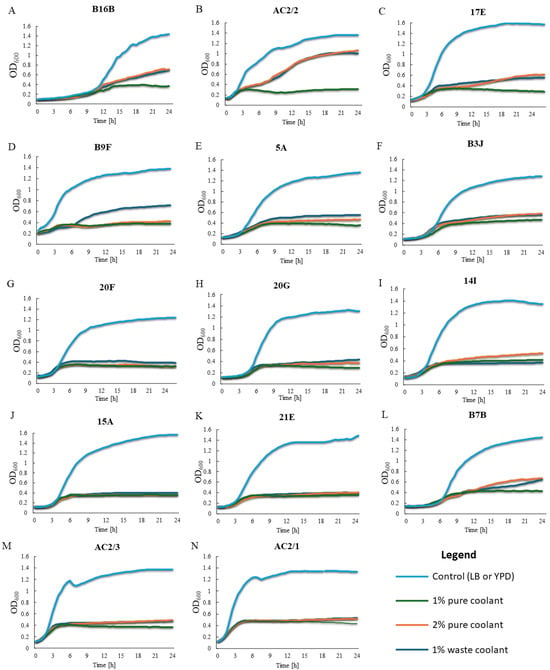
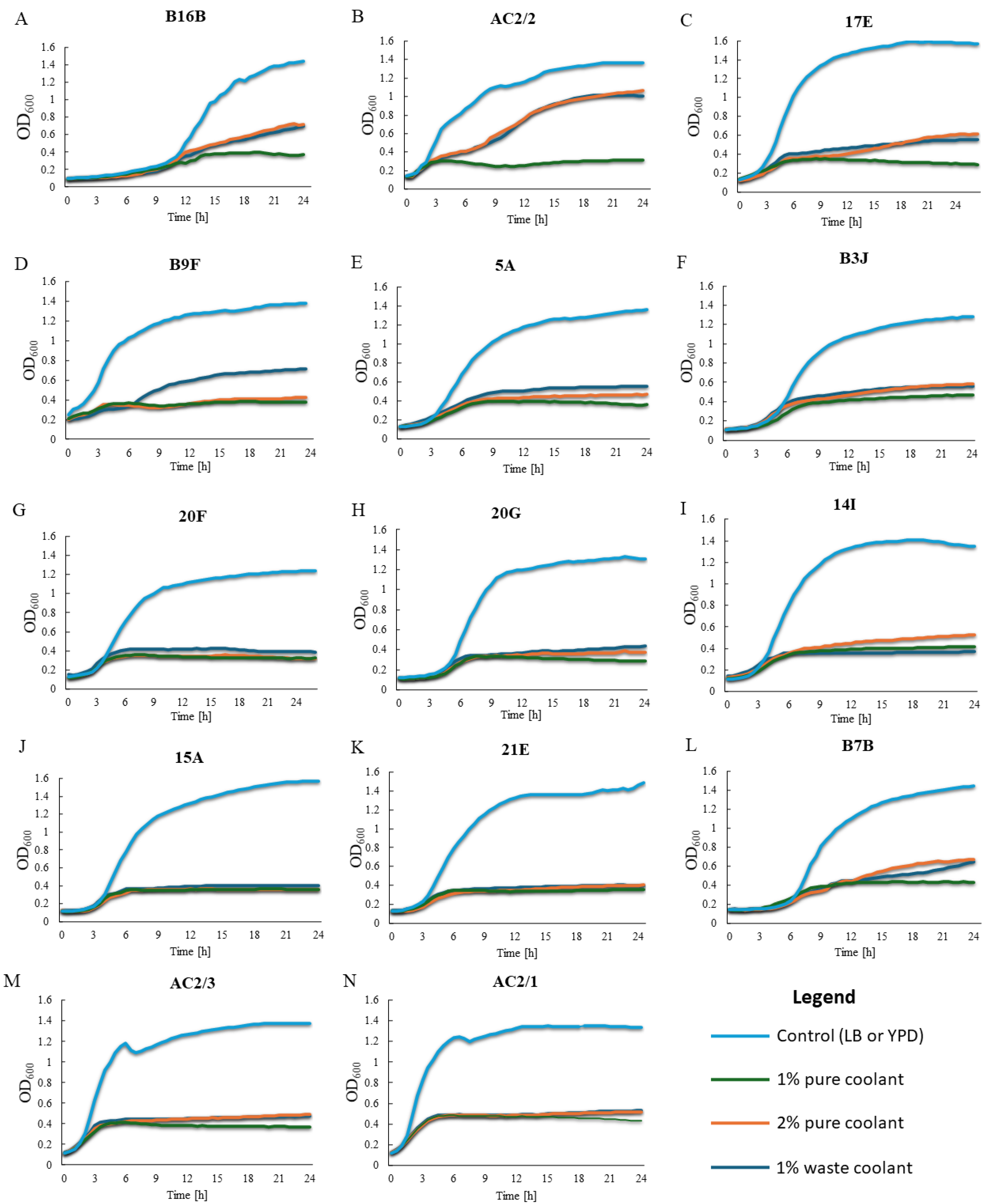
In the first stage, the 14 strains, comprising 13 bacteria and one yeast, were screened for growth in 1% (v/v) fresh coolant and 1% and 2% (v/v) used coolant. Growth-kinetics analysis showed that 6 of the 14 strains tolerated and had the potential to use and biodegrade coolant components. Tolerance did not follow taxonomic affiliation. Ten of the fourteen isolates belong to the genus Pseudomonas, which is well represented in the glycol biodegradation literature. Only four of them were among the six strains carried forward, while two of the six selected strains, Bacillus sp. B9F and the yeast W. anomalus B16B, belong to taxa for which glycol utilization has not been documented. Genus membership therefore did not predict the phenotype, and the strains were selected exclusively on the basis of measured growth. Wickerhamomyces anomalus B16B (Figure 3A) and Pseudomonas sp. AC2/2 (Figure 3B) showed the highest growth on coolant-containing media. AC2/2 grew rapidly on the used coolant (OD600 ≈ 0.9) and its growth curve was diauxic, indicating sequential use of two carbon sources. B16B grew efficiently on 2% used coolant but reached log phase only after 9 h. Strain 17E grew well on 1% used coolant, entering log phase after 5 h, with higher OD on used than on fresh coolant (Figure 3C). A diauxic curve was also recorded for B9F on 1% used coolant, reaching OD600 ≈ 0.65 in the second log phase (Figure 3D). Strain 5A reached OD600 ≈ 0.55 on 1% used coolant and slightly less (≈ 0.45) on 2% (Figure 3E). B3J was selected because on 2% used coolant it achieved a specific growth rate µ = 0.15 h−1 (0.13 h−1 on 1% used; 0.30 h−1 in the LB control) (Figure 3F). B7B grew slightly better on 2% than on 1% used coolant, and 14I reached OD600 > 0.5 at 2% versus ≈ 0.4 at 1%. The remaining, non-selected strains (Figure 3G–N) showed similar growth curves across all variants, with no difference between concentrations or degrees of use, and were not carried forward.
Figure 3.
Growth curves of strains in the presence of fresh and used coolant: (A) Wickerhamomyces anomalus B16B, (B) Pseudomonas sp. AC2/2, (C) Pseudomonas sp. 17E, (D) Bacillus sp. B9F, (E) Pseudomonas sp. 5A, (F) Pseudomonas sp. B3J, (G) Pseudomonas sp. 20F, (H) Pseudomonas frederiksbergensis 20G, (I) Pseudomonas sp. 14I, (J) Pseudomonas sp. 15A, (K) Pseudomonas sp. 21E, (L) Pseudomonas sp. B7B, (M) Enterobacter hormaechei AC2/3, (N) Klebsiella aerogenes AC2/1. Curves represent three biological replicates and are presented descriptively; no statistical hypothesis testing was applied to the growth data, and therefore no p-values are reported.
3.2. ALE and Assessment of Adaptation
Based on the first-stage results, strains AC2/2, B3J, 5A, B9F, B16B and 17E were selected for ALE and passaged at four-day intervals into fresh medium supplemented with the appropriate coolant. Most strains completed all ten transfers in both coolant variants, with two exceptions: B16B ceased to grow after only five passages in both fresh and used coolant, while B3J was carried through seven passages in fresh coolant and nine in used coolant before growth could no longer be sustained. Expressed as generations, AC2/2, 5A, B9F and 17E underwent approximately 33 generations of selection in both coolants, B3J approximately 23 generations in the unused and 30 in the spent coolant, and B16B approximately 17 generations in both.
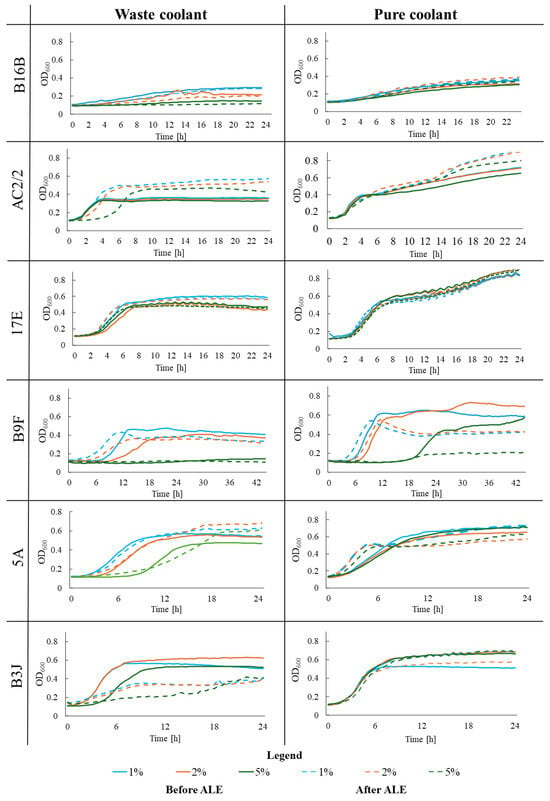
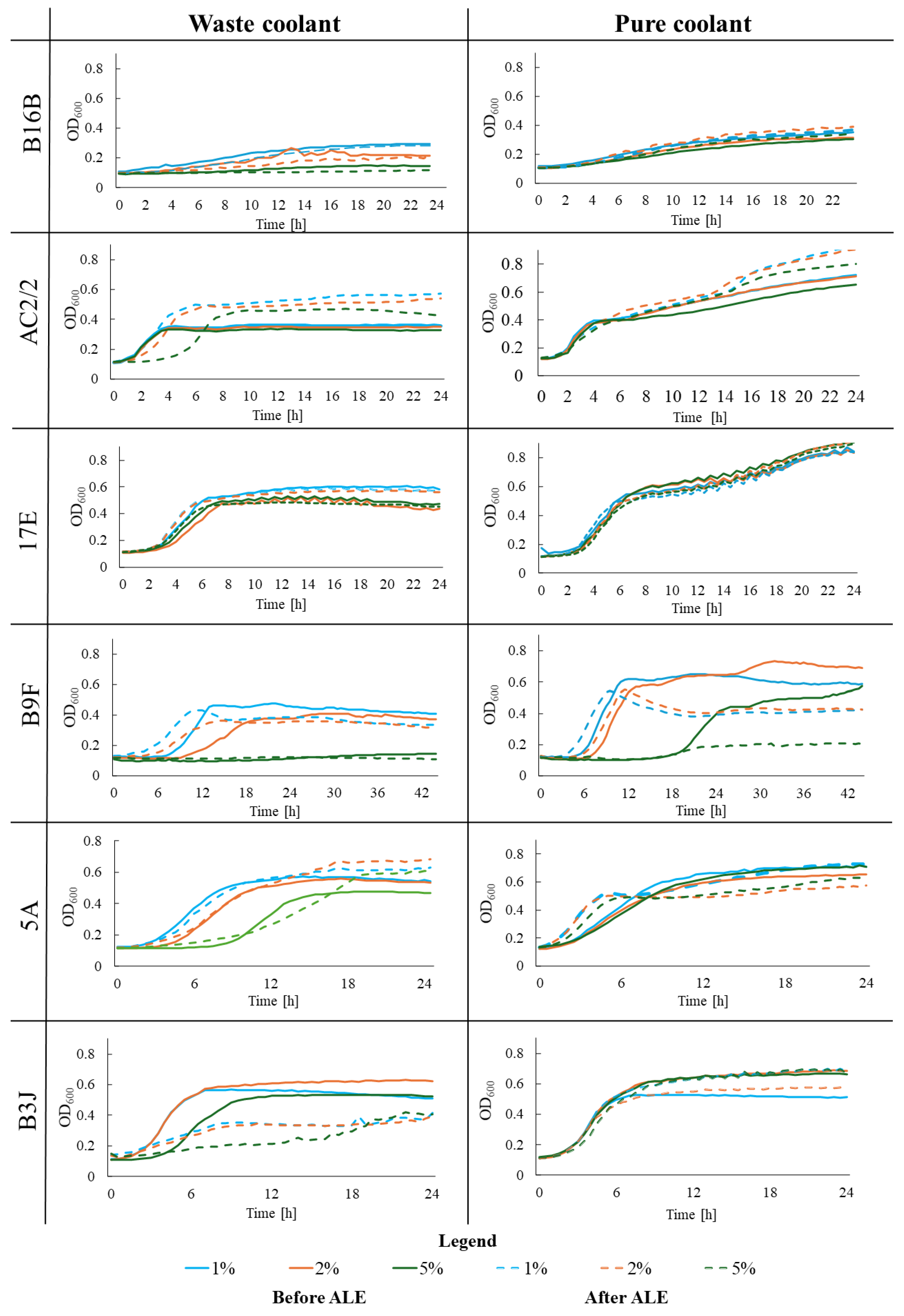
Growth dynamics of evolved and ancestral strains were then compared on FMM supplemented with fresh or used coolant at 1%, 2% and 5% (Figure 4). For strain 5A on used coolant, the lag phase shortened and log-phase dynamics increased relative to the ancestor, although maximum OD was lower at all used-coolant concentrations (Figure 4); on fresh coolant the lag phase was markedly longer (~4–5 h) regardless of ALE, but higher final OD was reached in stationary phase at all concentrations (Figure 4). For AC2/2 on used coolant, higher stationary-phase OD was reached after ALE at all concentrations, with diauxic curves; ALE did not clearly shorten the lag phase but extended the effective growth phase (Figure 4). On fresh coolant, AC2/2 reached higher OD at 1%, 2% and 5% after ALE despite a longer lag at 5% (Figure 4). For B9F, 1% and 2% used coolant after ALE markedly shortened the lag phase, whereas growth on 5% used coolant was clearly limited (Figure 4); similar trends occurred on fresh coolant, where 1% and 2% shortened adaptation but 5% inhibited growth (Figure 4). For B16B on 2% used coolant, the lag phase shortened and division rate increased; at 1%, OD was slightly higher after ALE, but on fresh coolant ALE did not produce effective adaptation (Figure 4). For B3J, ALE efficacy was evident on 1% used coolant (higher OD, lag phase unchanged), whereas fresh coolant at 1%, 2% and 5% reduced growth and lengthened the lag phase (Figure 4). Strain 17E showed diauxic curves on used coolant at all concentrations, with the highest efficiency at 1% (OD600 = 0.55); on fresh coolant, log phase was reached faster, with the largest biomass increase at 2% after ALE (Figure 4). A complementary spot assay was performed on solid FMM supplemented with coolant. Under these stationary conditions glycol utilization was weak overall, and no pronounced differences were observed between strains before and after ALE. All six strains selected for ALE, together with their ancestral counterparts, were then taken forward to shake-flask cultivation and HPLC analysis.
Figure 4.
Growth of strains before and after ALE in the presence of fresh and used coolant at 1%, 2% and 5%: Pseudomonas sp. 5A used/fresh; Pseudomonas sp. AC2/2 used/fresh; Bacillus sp. B9F used/fresh; Wickerhamomyces anomalus B16B used/fresh; Pseudomonas sp. B3J used/fresh; Pseudomonas sp. 17E used/fresh. Solid lines: strains before ALE; dashed lines: strains after ALE. Curves represent three biological replicates and are presented descriptively; no statistical hypothesis testing was applied to the growth data, and therefore no p-values are reported.
3.3. Quantitative Analysis of Glycols by HPLC
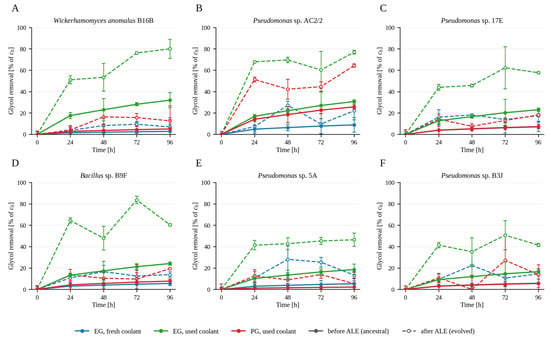
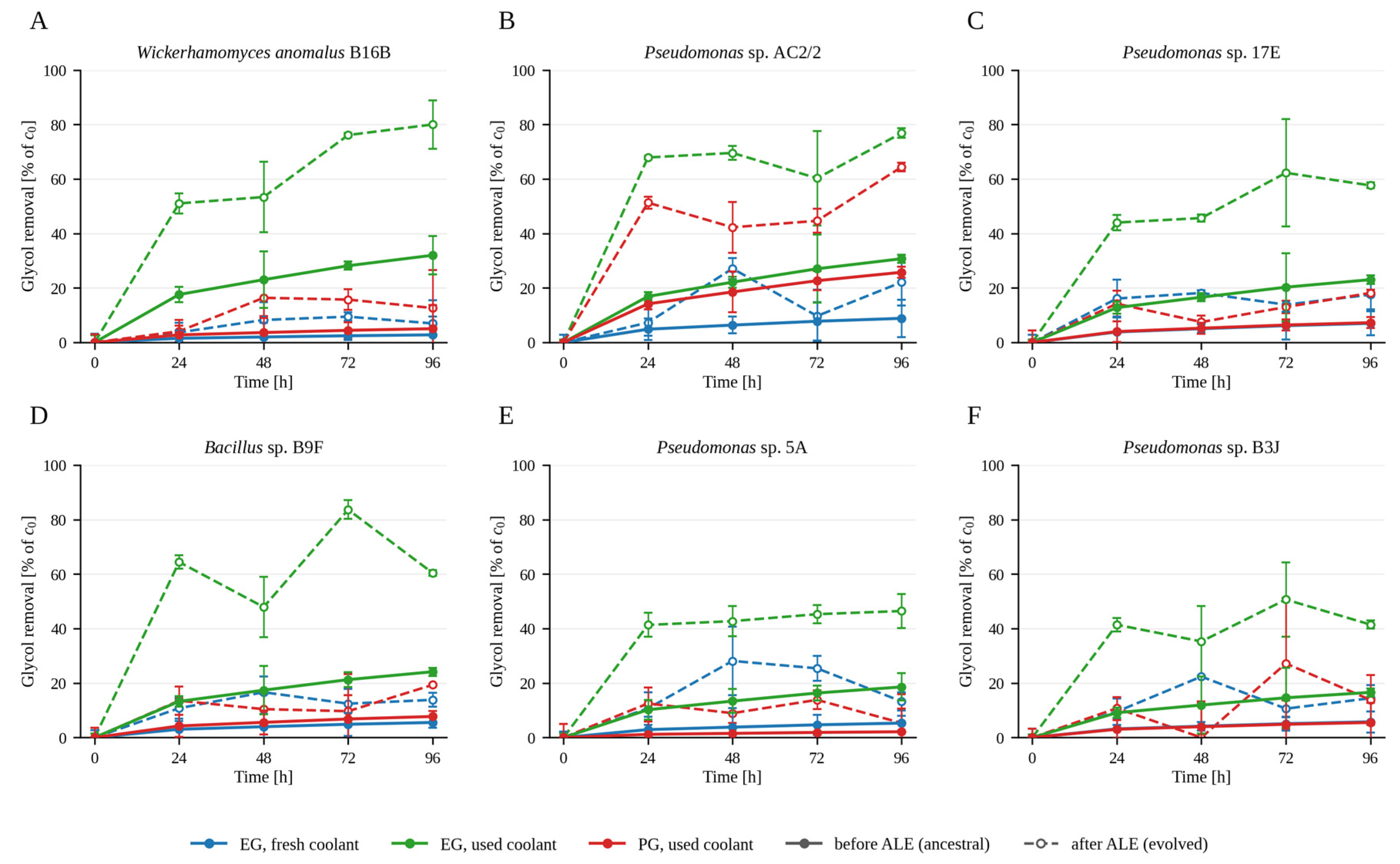
Ethylene glycol (EG) and propylene glycol (PG) concentrations were determined in the supernatants of shaken cultures maintained for 96 h on FMM minimal medium supplemented with 10% (v/v) fresh or used coolant, for strains before and after ALE (Table 3). The depletion of glycols, expressed as a percentage of the initial concentration, is shown in Figure 5, where the solid lines correspond to ancestral strains and the dashed lines to strains post-ALE.
Table 3.
Ethylene glycol (EG) and propylene glycol (PG) concentrations (g L−1) during 96 h shake-flask cultivation of the six selected strains before and after adaptive laboratory evolution (ALE), in minimal FMM medium supplemented with 10% (v/v) fresh or used coolant. Values are means of three biological replicates ± SD.
Figure 5.
Ethylene glycol (EG) and propylene glycol (PG) depletion during a 96 h shaken culture of six selected strains before and after adaptive laboratory evolution (ALE), in FMM minimal medium supplemented with 10% (v/v) of fresh or used coolant: (A) Wickerhamomyces anomalus B16B, (B) Pseudomonas sp. AC2/2, (C) Pseudomonas sp. 17E, (D) Bacillus sp. B9F, (E) Pseudomonas sp. 5A, (F) Pseudomonas sp. B3J. Decay was expressed as a percentage of the initial concentration (c0) measured at 0 h. Solid lines with filled dots—strains before ALE; dashed lines with empty dots—strains after ALE. Error bars represent the standard deviation from three biological replicates. Ancestral and evolved strains were compared at a single endpoint, the percentage of glycol remaining at 96 h, using Welch’s two-sided t-test with p-values adjusted by the Holm procedure within each coolant and glycol combination (Table S1). In the spent coolant, the residual ethylene glycol was significantly lower after ALE in all six strains (adjusted p ≤ 0.0071) and the residual propylene glycol was significantly lower only in Pseudomonas sp. AC2/2 (adjusted p < 0.001); in the unused coolant, none of the differences were significant (adjusted p ≥ 0.26).
Ancestral strains exhibited only a slight, steady decline in the concentration of both glycols, shown in Figure 5 as gently rising solid lines, which do not exceed a 34% loss in any of the panels. In fresh medium, the EG loss after 96 h did not exceed 9.3% (AC2/2), and the lowest value was recorded for Wickerhamomyces anomalus B16B (3.1%; Figure 5A). In the waste medium, the EG loss ranged from 16.9% to 33.3%, and the PG loss ranged from 2.8% to 26.0%. Pseudomonas sp. AC2/2 stood out as the only strain to remove PG to a measurable extent prior to ALE (26.0% after 96 h; Figure 5B). After ALE, glycol loss increased in all six strains and in all three systems; in Figure 5, the dashed lines lie above the solid lines at nearly all time points. The greatest improvement was observed for EG in the spent liquid (green lines), where the loss after 96 h changed from 33.3% to 79.7% for B16B (Figure 5A), from 31.5% to 76.8% for AC2/2 (Figure 5B), from 24.8% to 60.1% for Bacillus sp. B9F (Figure 5D), from 23.4% to 57.3% for 17E (Figure 5C), from 19.7% to 45.7% for 5A (Figure 5E), and from 16.9% to 40.9% for B3J (Figure 5F). For PG in the spent medium (red lines), a clear effect was observed only in AC2/2 (26.0 → 64.3%); in the other strains, PG loss at 96 h remained below 19% after ALE. In fresh medium (blue lines), the EG loss after ALE remained low and did not exceed 21.8% at 96 h (AC2/2), which is evident in Figure 5 as a clear separation of the blue series from the green series in all panels. Because the two matrices differ in the glycol load they supply, percentage depletion and the mass of glycol removed rank them differently. For ethylene glycol, the high relative depletion recorded in the spent fluid corresponds to a small mass, and residual ethylene glycol was present at about 2 g L−1: for AC2/2 after ALE, 1.5 g L−1 was removed by 96 h, compared to 10.9 g L−1 in the unused fluid, where the same strain faced about 50 g L−1. Counting both diols, however, the spent fluid is the matrix from which the larger mass was removed, because propylene glycol accounts for most of its glycol load: AC2/2 removed 27.2 g L−1 of glycol in total from the spent fluid by 96 h, approximately 2.5 times the mass removed from the unused product.
The largest portion of the loss occurred during the first 24 h of incubation, which corresponds to the steep segment of the curves between 0 and 24 h in Figure 5. After ALE, the loss of EG in the spent medium at 24 h ranged from 40.6% (5A) to 67.7% (AC2/2). In the following days, the rate of assimilation decreased markedly, and the curves flattened. The observed fluctuations in concentrations, including periodic values higher than those measured at the previous time point, most likely resulted from evaporation of the medium during long-term shaken cultivation and the associated concentration of the samples. These values are net changes in supernatant concentration and are not corrected for abiotic loss; the effect of ALE is assessed as the difference between ancestral and evolved strains cultivated under identical conditions. No further decrease in glycol concentration was observed in most strains between 72 and 96 h; the exception was AC2/2, in which the PG depletion continued to increase until the end of the culture, reaching 64.3% after 96 h (Figure 5B). Because these measurements report the net change in glycol concentration in the supernatant, and because individual time points showed increases relative to the preceding sample, the values are reported here as depletion rather than as mineralization. The chromatograms were also examined for the presence of products that would be expected to form as a result of the oxidation of diols. At no point during sampling were peaks corresponding to glycolic or glyoxylic acid detected in the supernatants, in either the ancestral or the evolved lineages.
Differences between the ancestral and evolved strains were tested at a single endpoint, the percentage of glycol remaining at 96 h (Table S1). In the spent coolant, less EG remained after ALE in all six strains, and the difference was significant in each case (for example, 66.7% versus 20.3% in B16B and 83.1% versus 59.1% in B3J; adjusted p ≤ 0.0071). For PG, the difference was significant only in AC2/2 (74.0% versus 35.7%; adjusted p < 0.001); in 17E and B9F the residual PG was lower after ALE, but the difference did not remain significant after correction for multiple testing. In the unused coolant, less EG remained after ALE in every strain, yet none of these differences were significant (adjusted p ≥ 0.26).
4. Discussion
The results of this study indicate that selection and adaptive laboratory evolution (ALE) of environment-derived microorganisms can enhance both their growth on coolant-containing media and the removal of the glycol components of those media. These are two distinct observations resting on two independent measurements: optical density in microplate cultures and HPLC quantification of ethylene and propylene glycol in shake-flask supernatants, the latter reporting the net change in the concentration of the parent diols in the supernatant. Strains with the highest glycol removal potential were first selected by screening; the efficacy of ALE was then evaluated by measuring changes in glycol concentration in culture supernatants and by comparing the growth of ancestral and evolved strains before and after adaptation. Because no clones were isolated and no genomes were sequenced, the genetic basis of the improved phenotypes was not tested, and the differences between ancestral and evolved lineages are reported at the phenotypic level only. Strains lacking the metabolic flexibility to sustain growth under such conditions were progressively eliminated, while serial passaging itself can introduce bottleneck effects that promote the loss of diversity and the stochastic elimination of less-adapted variants.
Both screening and post-ALE assessment confirmed greater biomass gain on used than on fresh coolant. Because the two fluids are different commercial formulations rather than two service stages of one product, this contrast cannot be ascribed to prior use. The spent fluid was propylene-glycol-dominated, and propylene glycol is the less toxic and more readily assimilated of the two diols, being metabolized by a wider range of microorganisms and lacking the toxic glycolaldehyde and oxalate intermediates associated with ethylene glycol [36]. The two matrices also differ in additive load, which was not characterized here. The higher biomass gain on the spent fluid is therefore most plausibly explained by the difference in glycol identity between the two products, with a possible contribution from their differing additive composition.
Of the 14 strains, 6 showed tolerance and biodegradative potential, consistent with the view that growth on complex hydrocarbon mixtures is a selective trait; for example, P. putida KT2440 grew on EG only above a 50 mM threshold [37]. The diauxic curve of AC2/2 on used coolant (OD600 ≈ 0.9) indicates sequential use of two carbon sources, a well-documented phenomenon in Pseudomonas arising from hierarchical carbon catabolite control [38,39]. The extended lag of W. anomalus B16B (log phase only at 9 h) is typical of yeast on unconventional substrates [40]. B3J was selected on the basis of µ = 0.15 h−1 (2% used) and 0.13 h−1 (1% used) versus 0.30 h−1 in LB, comparable to engineered P. putida KT2440 on EG [37]. The absence of substrate inhibition for B7B and 14I at 2% indicates that neither strain was limited by the coolant load at this concentration, while the high substrate tolerance reported for W. anomalus [41] is consistent with the behavior of B16B. Rejected strains, showing no OD difference between variants, most likely lack inducible catabolic pathways for coolant components, consistent with the restricted distribution of glycol catabolic routes among bacteria [18].
ALE effectively increased tolerance to glycol-based coolant components, although efficacy was clearly strain-dependent. The shortened lag of 5A, B9F and B16B on used coolant indicates acquired faster metabolic adaptation to the spent, propylene-glycol-dominated fluid, consistent with Toscano et al. [13]. The diauxic curves of AC2/2 and 17E suggest sequential use of two carbon sources, the glycol itself and partial-degradation products, as described by Udaykumar et al. [42], who identified three PG-biodegradation intermediates by HPLC; chromatographic separation of glycols and of their oxidation products is well established [43], although no such intermediates were detected in the supernatants under the chromatographic conditions applied here. The generally longer lag phase on the unused fluid is consistent with the higher toxicity of ethylene glycol relative to propylene glycol [19] and with the additive package of a fresh coolant formulation [1], but because the additive composition of neither matrix was determined, this remains an interpretation rather than a demonstrated cause. The lack of adaptation of B16B on fresh coolant and inhibition of B9F and B3J at 5% fresh coolant indicate a toxicity threshold above which the applied passaging scheme did not provide sufficient selective pressure to fix beneficial mutations. The faster entry of 5A into log phase on used coolant reflects microbial domestication, which for EG degradation in a continuous granular reactor required ~40 days before >85% COD removal [44].
The 96 h shake-flask cultures of all six strains in 10% coolant revealed variable EG and PG depletion, consistent with the large metabolic variability reported for these substrates [44,45]. Taken together, these results extend the existing glycol biodegradation literature, which rests largely on purified diols and on model organisms, to a spent industrial fluid processed by native, non-modified isolates. The clearest effect concerned EG in the spent coolant, where the loss at 96 h increased after ALE from 24.8% to 60.1% in B9F and from 33.3% to 79.7% in B16B, indicating acquisition of catabolic capacity; laboratory adaptation and metabolic modification of P. putida KT2440 likewise accelerated EG consumption to undetectable levels within 48–118 h [37]. In the unused, EG-based coolant the loss remained below 22% at 96 h in every strain even after ALE, which may reflect the higher glycol concentration and the additive load of that formulation, given that engineered E. coli consumed up to 20 g L−1 EG only after optimization of FucO and AldA expression [45]. PG removal from the spent coolant was strongest in AC2/2, which after ALE depleted 64.3% of the available PG by 96 h and was also the only ancestral strain with appreciable PG-degrading activity (26% at 96 h); full L-1,2-propanediol utilization depends on AldA in evolved E. coli [46], and the performance of this strain is consistent with a functionally complete pathway. Several individual time points showed concentrations higher than in the preceding sample, EG in the AC2/2 unused-coolant supernatant rose from 36.44 g L−1 at 48 h to 45.15 g L−1 at 72 h, and PG in the B3J spent-coolant culture from 29.13 g L−1 at 72 h to 34.47 g L−1 at 96 h. Such changes can most likely be attributed to the concentration of the culture medium resulting from evaporation during long-term cultivation with agitation, and possibly also to the release of intermediate compounds from the biomass, analogous to the release of intermediate compounds during the conversion of EG to glycolic acid bioconversion by Gluconobacter oxydans [47]. Overall, ALE may be an effective strategy to improve glycol degradation, but full evaluation requires longer cultivation and detailed kinetic analysis. Three characteristics of the experimental design suggest that the loss of glycol can be attributed to the activity of microorganisms. First, the diols were quantified directly in the supernatant, so the measurement reflects the substrate rather than the biomass. Second, uninoculated flasks containing the same medium, which were incubated and sampled in parallel, showed changes not exceeding 20% over 96 h, whereas the inoculated cultures of the evolved strains lost between 40.9 and 79.7% of the ethylene glycol present in the spent liquid after 72 h, a value clearly exceeding the abiotic reference level. Third, yeast extract added at a concentration of 1.5 g L−1 provides approximately 0.6 g L−1 of organic carbon, compared to approximately 19 g L−1 derived from diols in the 10% (v/v) cultures, and its concentration was the same in all variants and in each control; therefore, it cannot explain the loss of glycol nor reveal systematic differences between the ancestral and evolved lines. Consistent with the non-monotonic course of several curves, the values are reported as net changes in supernatant concentration rather than as degradation rates.
A notable strength of this study lies in its non-GMO approach: improved glycol removal was achieved solely through selection and adaptive laboratory evolution of native, environment-derived strains, without any genetic modification. This makes the resulting strains attractive candidates for environmental and industrial application, where the deployment of genetically modified organisms is often restricted. The evolution regime, ten transfers at four-day intervals, was a deliberate strategic choice rather than a constraint. Because passaging was carried out directly on spent coolant, a substrate that inherently limits bacterial growth, longer intervals between transfers were applied to give cells sufficient time to adapt to these demanding conditions and to express their degradative potential, rather than selecting merely for rapid growth on a permissive medium. This design reflects the wide range of ALE schedules and selection targets reported in the literature, from tolerance to inhibitors and to ethanol [48,49] to schemes spanning tens to hundreds of passages [50,51] and selection periods of several months [52] up to two years [53]; the extended intervals adopted here were intended to mitigate the bottleneck effects that can accompany serial passaging and lead to stochastic loss of less-adapted variants under harsh selection [54]. The regime applied here, approximately 33 generations over 40 days, is short by comparison with studies such as the 520-generation adaptation of Y. lipolytica MUCL 28849 on crude glycerol [28], and the phenotypes reported here should therefore be read as the outcome of a limited selection window rather than of a fully resolved adaptive trajectory. Building on these foundations, future work should incorporate high-throughput genome sequencing of the ancestral and evolved strains to resolve the mutations and genes governing glycol metabolism and efficient biodegradation, complemented by in silico modeling of the underlying metabolic pathways, by determination of biomass and identification of the reaction products with a method dedicated to short-chain organic acids, and by respirometry measurement of mineralization.
5. Conclusions
Selection combined with adaptive laboratory evolution (ALE) of environment-derived microorganisms yielded strains that both grow better on coolant-containing media and remove more of the glycol components of those media. Initial screening on the coolant variants identified the strains with the highest growth potential, the largest biomass increases being recorded for AC2/2, B3J, 5A, B9F, B16B and 17E. Comparison of growth before and after ALE revealed the most pronounced adaptation in strain 5A on used coolant and in strains AC2/2 and B9F on both fresh and used coolant. HPLC analysis of shake-flask cultures confirmed measurable, strain-dependent depletion of ethylene and propylene glycol from culture supernatants, which did not always parallel biomass gain, indicating that growth and degradative activity are not strictly coupled. Bacterial growth differed strongly between the two coolant matrices, with the propylene-glycol-dominated spent fluid supporting higher biomass than the unused ethylene-glycol-based product; because the two fluids are different commercial formulations, this difference reflects matrix composition rather than the degree of prior use. Taken together, these findings suggest that ALE promoted adaptive changes, plausibly through selection of beneficial mutations, altered regulation of degradative-enzyme expression and shifts in metabolic activity, although verification of these mechanisms will require targeted genomic and biochemical investigation. Further work should verify the heritability and the genetic basis of the improved phenotypes by whole-genome sequencing of the ancestral and evolved lineages, close the carbon balance by respirometry and total organic carbon measurement, and identify the short-chain organic acids formed during diol oxidation. The principal challenges for application are the toxicity threshold observed above 2% (v/v) of the unused formulation, the uncharacterized additive package of commercial fluids, the short selection window applied here, and the transfer of the process from shake flasks to continuous systems operating at higher loads on real waste streams.
Supplementary Materials
The following supporting information can be downloaded at https://www.mdpi.com/article/10.3390/su18199994/s1. Table S1: Glycol remaining at 96 h, expressed as a percentage of the initial concentration measured at 0 h, in ancestral and evolved strains (mean ± SD, n = 3). Ancestral and evolved strains were compared with Welch’s two-sided t-test; p-values were adjusted by the Holm procedure within each coolant and glycol combination (six comparisons each). Adjusted p < 0.05 is shown in bold. EG, ethylene glycol; PG, propylene glycol; ALE, adaptive laboratory evolution.
Author Contributions
Investigation, G.W., A.K.U., Z.C., J.A.D. and K.E.K.; formal analysis, K.E.K.; visualization, G.W., Z.C. and K.E.K.; writing—original draft preparation, G.W., A.K.U., J.A.D. and K.E.K.; writing—review and editing, A.K.U. and K.E.K.; supervision, A.K.U. and K.E.K.; conceptualization, K.E.K.; methodology, K.E.K.; resources, K.E.K. All authors have read and agreed to the published version of the manuscript.
Funding
This research was funded by Wrocław University of Environmental and Life Sciences. Katarzyna Ewa Kosiorowska was supported by the Foundation for Polish Science (FNP) under the START 2025 programme, agreement no. START 035/2025.
Institutional Review Board Statement
Not applicable.
Informed Consent Statement
Not applicable.
Data Availability Statement
The data presented in this study are available on request from the corresponding author due to privacy restrictions.
Conflicts of Interest
The authors declare no conflicts of interest.
References
- Stajuda, L.; Levchenko, D.; Kubiak, P.; Siczek, K.; Boguslawski, G.; Kuchar, M.; Wozniak, M.; Szymczyk, M.; Ozuna, G.; Siczek, K. Composition, features, problems, and treatment related to cooling fluid, a review. Combust. Engines 2024, 196, 106–125. [Google Scholar] [CrossRef] [Scilit]
- Yang, Q.; Yang, Q.; Xu, S.; Zhu, S.; Zhang, D. Technoeconomic and environmental analysis of ethylene glycol production from coal and natural gas compared with oil-based production. J. Clean. Prod. 2020, 273, 123120. [Google Scholar] [CrossRef] [Scilit]
- Mahmoud, A.S.; Khamis, E.; Mahmoud, M.S.; Mohamed, N.Y. Multistage treatment of industrial ethylene glycol (EG) effluent: Integrating chemical extraction, coagulation/precipitation, and decolouration for enhanced wastewater remediation. Sci. Rep. 2026, 16, 4088. [Google Scholar] [CrossRef] [Scilit] [PubMed]
- Staples, C.A.; Williams, J.B.; Craig, G.R.; Roberts, K.M. Fate, effects and potential environmental risks of ethylene glycol: A review. Chemosphere 2001, 43, 377–383. [Google Scholar] [CrossRef] [Scilit] [PubMed]
- Mantzavinos, D.; Psillakis, E. Enhancement of biodegradability of industrial wastewaters by chemical oxidation pre-treatment. J. Chem. Technol. Biotechnol. 2004, 79, 431–454. [Google Scholar] [CrossRef] [Scilit]
- Wang, Y.; Liu, M.; Miao, Q.; Wu, P.; He, J.; Liu, C.; Jiang, W. Rapid green degradation of ethylene glycol-based antifreeze wastewater via a coupled photolytic and photocatalytic double-pathway mechanism. J. Water Process Eng. 2025, 71, 107191. [Google Scholar] [CrossRef] [Scilit]
- Chauhan, N.L.; Juvekar, V.A.; Sarkar, A. Oxidation of ethylene glycol: Unity of chemical and electrochemical catalysis. Electrochem. Sci. Adv. 2022, 2, e2100092. [Google Scholar] [CrossRef] [Scilit]
- Srinivas, N.S.; Ramanan, K.K.; Rayappan, J.B.B.; Jegadeesan, G.B. Advanced oxidation of ethylene and propylene glycol in wastewater using hydrodynamic cavitation-activated persulfate: A kinetic and techno-economic study. Sci. Rep. 2025, 15, 42109. [Google Scholar] [CrossRef] [Scilit] [PubMed]
- Zhang, Y.; Huang, L.J.; Wang, Y.X.; Tang, J.G.; Wang, Y.; Cheng, M.M.; Du, Y.C.; Yang, K.; Kipper, M.J.; Hedayati, M. The preparation and study of ethylene glycol-modified graphene oxide membranes for water purification. Polymers 2019, 11, 188. [Google Scholar] [CrossRef] [Scilit] [PubMed]
- Ghaderi, M.; Tamadoni, A.; Mahdizadeh, A. Introducing an applied reactor for treatment of wastewater containing propylene glycol. SN Appl. Sci. 2019, 1, 1590. [Google Scholar] [CrossRef] [Scilit]
- Fazliev, T.; Lyulyukin, M.; Kozlov, D.; Selishchev, D. Kinetic aspects of ethylene glycol degradation using UV-C activated hydrogen peroxide (H2O2/UV-C). Molecules 2025, 30, 49. [Google Scholar] [CrossRef] [Scilit] [PubMed]
- Huber, F.; Blasenbauer, D.; Mallow, O.; Lederer, J.; Winter, F.; Fellner, J. Thermal co-treatment of combustible hazardous waste and waste incineration fly ash in a rotary kiln. Waste Manag. 2016, 58, 181–190. [Google Scholar] [CrossRef] [Scilit] [PubMed]
- Toscano, G.; Cavalca, L.; Colarieti, M.L.; Scelza, R.; Scotti, R.; Rao, M.A.; Andreoni, V.; Ciccazzo, S.; Greco, G. Aerobic biodegradation of propylene glycol by soil bacteria. Biodegradation 2013, 24, 603–613. [Google Scholar] [CrossRef] [Scilit] [PubMed]
- Neerup, R.; Fosbøl, P.L. Physicochemical properties of aqueous solutions of monoethylene glycol, diethylene glycol, triethylene glycol, and tetraethylene glycol at 293.15, 313.15, and 333.15 K. J. Solut. Chem. 2025, 54, 1595–1619. [Google Scholar] [CrossRef] [Scilit]
- Malhotra, A.; Mongelluzzo, G.; Wu, X.; Durand, D.; Kalra, V.; LeSar, B.; Liu, R. Ethylene glycol toxicity: MRI brain findings. Clin. Neuroradiol. 2017, 27, 109–113. [Google Scholar] [CrossRef] [Scilit] [PubMed]
- Garg, U.; Lowry, J.; Algren, D.A. Ethylene glycol and other glycols: Analytical and interpretation issues. In Critical Issues in Alcohol and Drugs of Abuse Testing, 2nd ed.; Dasgupta, A., Ed.; Elsevier: Amsterdam, The Netherlands, 2019; pp. 59–69. [Google Scholar] [CrossRef] [Scilit]
- Ethylene Glycol (MEG). GLI-THERM Sp. z o.o. Available online: https://glitherm.com/produkt/glikol-etylenowy-meg/ (accessed on 31 March 2026).
- Shimizu, T.; Inui, M. Novel aspects of ethylene glycol catabolism. Appl. Microbiol. Biotechnol. 2024, 108, 369. [Google Scholar] [CrossRef] [Scilit] [PubMed]
- Fowles, J.; Banton, M.; Klapacz, J.; Shen, H. A toxicological review of the ethylene glycol series: Commonalities and differences in toxicity and modes of action. Toxicol. Lett. 2017, 278, 66–83. [Google Scholar] [CrossRef] [Scilit] [PubMed]
- Fiume, M.M.; Bergfeld, W.F.; Belsito, D.V.; Hill, R.A.; Klaassen, C.D.; Liebler, D.; Marks, J.G.; Shank, R.C.; Slaga, T.J.; Snyder, P.W.; et al. Safety assessment of propylene glycol, tripropylene glycol, and PPGs as used in cosmetics. Int. J. Toxicol. 2012, 31, 245S–260S. [Google Scholar] [CrossRef] [Scilit] [PubMed]
- West, R.; Banton, M.; Hu, J.; Klapacz, J. The distribution, fate, and effects of propylene glycol substances in the environment. Rev. Environ. Contam. Toxicol. 2014, 232, 107–138. [Google Scholar] [CrossRef] [Scilit] [PubMed]
- Younes, M.; Aggett, P.; Aguilar, F.; Crebelli, R.; Dusemund, B.; Filipič, M.; EFSA Panel on Food Additives and Nutrient Sources Added to Food (ANS); Frutos, M.J.; Galtier, P.; Gott, D.; et al. Re-evaluation of propane-1,2-diol (E 1520) as a food additive. EFSA J. 2018, 16, e05235. [Google Scholar] [CrossRef] [Scilit] [PubMed]
- Agency for Toxic Substances and Disease Registry (ATSDR). Toxicological Profile for Ethylene Glycol and Propylene Glycol; ATSDR: Atlanta, GA, USA, 2008.
- Lee, S.; Kim, P. Current status and applications of adaptive laboratory evolution in industrial microorganisms. J. Microbiol. Biotechnol. 2020, 30, 793–803. [Google Scholar] [CrossRef] [Scilit] [PubMed]
- Dragosits, M.; Mattanovich, D. Adaptive laboratory evolution—Principles and applications for biotechnology. Microb. Cell Fact. 2013, 12, 64. [Google Scholar] [CrossRef] [Scilit] [PubMed]
- Sandberg, T.E.; Salazar, M.J.; Weng, L.L.; Palsson, B.O.; Feist, A.M. The emergence of adaptive laboratory evolution as an efficient tool for biological discovery and industrial biotechnology. Metab. Eng. 2019, 56, 1–16. [Google Scholar] [CrossRef] [Scilit] [PubMed]
- Zhao, Q.Q.; Hu, P.C.; Zhang, C.J.; Zhu, M.Y.; Tian, Y.; Yang, X.N.; Ji, X.J.; Li, C.Z.; Sun, X.M.; Lu, X.Y.; et al. Metabolic engineering and adaptive laboratory evolution enhance squalene production in Yarrowia lipolytica. Synth. Syst. Biotechnol. 2026, 13, 86–97. [Google Scholar] [CrossRef] [Scilit] [PubMed]
- Tsirigka, A.; Theodosiou, E.; Patsios, S.I.; Tsoureki, A.; Andreadelli, A.; Papa, E.; Aggeli, A.; Karabelas, A.J.; Makris, A.M. Novel evolved Yarrowia lipolytica strains for enhanced growth and lipid content under high concentrations of crude glycerol. Microb. Cell Fact. 2023, 22, 62. [Google Scholar] [CrossRef] [Scilit] [PubMed]
- Li, W.-J.; Jayakody, L.N.; Franden, M.A.; Wehrmann, M.; Daun, T.; Hauer, B.; Blank, L.M.; Beckham, G.T.; Klebensberger, J.; Wierckx, N. Laboratory evolution reveals the metabolic and regulatory basis of ethylene glycol metabolism by Pseudomonas putida KT2440. Environ. Microbiol. 2019, 21, 3669–3682. [Google Scholar] [CrossRef] [Scilit] [PubMed]
- Mückschel, B.; Simon, O.; Klebensberger, J.; Graf, N.; Rosche, B.; Altenbuchner, J.; Pfannstiel, J.; Huber, A.; Hauer, B. Ethylene glycol metabolism by Pseudomonas putida. Appl. Environ. Microbiol. 2012, 78, 8531–8539. [Google Scholar] [CrossRef] [Scilit] [PubMed]
- Reyes-Bocanegra, M.; Piundo-Ponce, E.; Bello-Yupanqui, F.; Rojas-Villacorta, W. Microbial transformation of PEG 400 by Pseudomonas stutzeri: Implications for environmental remediation. Front. Microbiol. 2025, 16, 1692604. [Google Scholar] [CrossRef] [Scilit] [PubMed]
- Trifunović, D.; Schuchmann, K.; Müller, V. Ethylene glycol metabolism in the acetogen Acetobacterium woodii. J. Bacteriol. 2016, 198, 1058–1065. [Google Scholar] [CrossRef] [Scilit] [PubMed]
- Roccor, R.; Wolf, M.E.; Liu, J.; Eltis, L.D. The catabolism of ethylene glycol by Rhodococcus jostii RHA1 and its dependence on mycofactocin. Appl. Environ. Microbiol. 2024, 90, e0041624. [Google Scholar] [CrossRef] [Scilit] [PubMed]
- Carniel, A.; Santos, A.G.; Chinelatto, L.S.; Castro, A.M.; Coelho, M.A.Z. Biotransformation of ethylene glycol to glycolic acid by Yarrowia lipolytica: A route for poly(ethylene terephthalate) (PET) upcycling. Biotechnol. J. 2023, 18, e2200521. [Google Scholar] [CrossRef] [Scilit] [PubMed]
- Liu, Y.; Leal, N.A.; Sampson, E.M.; Johnson, C.L.V.; Havemann, G.D.; Bobik, T.A. PduL is an evolutionarily distinct phosphotransacylase involved in B12-dependent 1,2-propanediol degradation by Salmonella enterica serovar Typhimurium LT2. J. Bacteriol. 2007, 189, 1589–1596. [Google Scholar] [CrossRef] [Scilit] [PubMed]
- Madera, M.; Höflinger, W.; Kadnar, R. Ion chromatographic identification and quantification of glycol degradation products. J. Chromatogr. A 2003, 997, 279–284. [Google Scholar] [CrossRef] [Scilit] [PubMed]
- Franden, M.A.; Jayakody, L.N.; Li, W.-J.; Wagner, N.J.; Cleveland, N.S.; Michener, W.E.; Hauer, B.; Blank, L.M.; Wierckx, N.; Klebensberger, J.; et al. Engineering Pseudomonas putida KT2440 for efficient ethylene glycol utilization. Metab. Eng. 2018, 48, 197–207, Erratum in Metab. Eng. 2021, 65, 263–265. https://doi.org/10.1016/j.ymben.2018.06.003. [Google Scholar] [CrossRef] [Scilit] [PubMed]
- Gao, H.; Tian, L.; Zhao, R.; Zhao, X.; Li, Y.; Ren, H.; Liu, R. A comparative study on diauxic growth of microorganisms of Pseudomonas species. Mater. Today Proc. 2022, 69, 460–465. [Google Scholar] [CrossRef] [Scilit]
- Zhou, L.; Jiang, Z.; Liao, X.; Tian, J.; Ye, B.-C. A newly isolated Pseudomonas putida S-1 strain for batch-mode propanethiol degradation and continuous treatment of propanethiol-containing waste gas. J. Hazard. Mater. 2015, 302, 232–240. [Google Scholar] [CrossRef] [Scilit] [PubMed]
- Ntaikou, I.; Antonopoulou, G.; Lyberatos, G. Sustainable second-generation bioethanol production from enzymatically hydrolyzed domestic food waste using Pichia anomala as biocatalyst. Sustainability 2021, 13, 259. [Google Scholar] [CrossRef] [Scilit]
- Deng, Y.-G.; Wang, H.; Li, S.; Guo, Y.; Huang, Z. Xylitol fermentation characteristics with a newly isolated yeast Wickerhamomyces anomalus WA. Fungal Biol. 2024, 128, 1823–1831. [Google Scholar] [CrossRef] [Scilit] [PubMed]
- Udaykumar, R.; Srinivas, N.S.; Jegadeesan, G.B. Biodegradation of propylene glycol wastewater using bacterial consortia isolated from municipal wastewater treatment sludge, process kinetics and optimization. Water Air Soil Pollut. 2020, 231, 286. [Google Scholar] [CrossRef] [Scilit]
- Nitschke, L.; Huber, L. Determination of glycols by HPLC with refractive index detection. Fresenius J. Anal. Chem. 1994, 349, 451–453. [Google Scholar] [CrossRef] [Scilit]
- Li, J.; Ding, L.-B.; Cai, A.; Huang, G.-X.; Horn, H. Biodegradation of real industrial wastewater containing ethylene glycol by using aerobic granular sludge in a continuous-flow reactor: Performance and resistance mechanism. Biochem. Eng. J. 2020, 164, 107711. [Google Scholar] [CrossRef] [Scilit]
- Huang, R.; Chen, H.; Zhou, W.; Ma, C.; Wei, D. Improving ethylene glycol utilization in Escherichia coli fermentation. Biochem. Eng. J. 2021, 168, 107957. [Google Scholar] [CrossRef] [Scilit]
- Aziz, R.K.; Monk, J.M.; Lewis, R.M.; Lerman, J.A.; Nagarajan, H.; Huynh, H.T.; Heinken, A.; Thiele, I.; Palsson, B.Ø.; Charusanti, P. The aldehyde dehydrogenase, AldA, is essential for L-1,2-propanediol utilization in laboratory-evolved Escherichia coli. Microbiol. Res. 2017, 194, 47–52. [Google Scholar] [CrossRef] [Scilit] [PubMed]
- Gao, C.; Xu, P.; Ye, C.; Chen, X.; Liu, L. Integrated process for scalable bioproduction of glycolic acid from cell catalysis of ethylene glycol. Bioresour. Technol. 2018, 268, 599–604. [Google Scholar] [CrossRef] [Scilit] [PubMed]
- Mavrommati, M.; Papanikolaou, S.; Aggelis, G. Improving ethanol tolerance of Saccharomyces cerevisiae through adaptive laboratory evolution using high ethanol concentrations as a selective pressure. Process Biochem. 2023, 124, 280–289. [Google Scholar] [CrossRef] [Scilit]
- Hemansi; Himanshu; Patel, A.K.; Saini, J.K.; Singhania, R.R. Development of multiple inhibitor tolerant yeast via adaptive laboratory evolution for sustainable bioethanol production. Bioresour. Technol. 2022, 344, 126247. [Google Scholar] [CrossRef] [Scilit] [PubMed]
- Wu, Y.; Jameel, A.; Xing, X.-H.; Zhang, C. Advanced strategies and tools to facilitate and streamline microbial adaptive laboratory evolution. Trends Biotechnol. 2022, 40, 38–59. [Google Scholar] [CrossRef] [Scilit] [PubMed]
- LaCroix, R.A.; Palsson, B.O.; Feist, A.M. A model for designing adaptive laboratory evolution experiments. Appl. Environ. Microbiol. 2017, 83, e03115-16. [Google Scholar] [CrossRef] [Scilit] [PubMed]
- Blaby, I.K.; Lyons, B.J.; Wroclawska-Hughes, E.; Phillips, G.C.F.; Pyle, T.P.; Chamberlin, S.G.; Benner, S.A.; Lyons, T.J.; de Crécy-Lagard, V.; de Crécy, E. Experimental evolution of a facultative thermophile from a mesophilic ancestor. Appl. Environ. Microbiol. 2012, 78, 144–155. [Google Scholar] [CrossRef] [Scilit] [PubMed]
- Rudolph, B.; Gebendorfer, K.M.; Buchner, J.; Winter, J. Evolution of Escherichia coli for growth at high temperatures. J. Biol. Chem. 2010, 285, 19029–19034. [Google Scholar] [CrossRef] [Scilit] [PubMed]
- Campos, P.R.A.; Wahl, L.M. The effects of population bottlenecks on clonal interference, and the adaptation effective population size. Evolution 2009, 63, 950–958. [Google Scholar] [CrossRef] [Scilit] [PubMed]

Disclaimer/Publisher’s Note: The statements, opinions and data contained in all publications are solely those of the individual author(s) and contributor(s) and not of MDPI and/or the editor(s). MDPI and/or the editor(s) disclaim responsibility for any injury to people or property resulting from any ideas, methods, instructions or products referred to in the content. |
© 2026 by the authors. Licensee MDPI, Basel, Switzerland. This article is an open access article distributed under the terms and conditions of the Creative Commons Attribution (CC BY) license.