


Abstract
Sustainable human development is a key component of sustainable economic development. It involves a combination of knowledge, a high standard of living and a healthy life. This research utilized the Human Development Index developed by the United Nations Development Programme in examining the main drivers of sustainable human development. The index measures development based on three dimensions of human development: knowledge, health and living standard. In this research, data from 15 ECOWAS countries covering the period of 2004 to 2022 were used. Methods of Moments Quantile Regression, Two-Stage Least Squares and Panel Correlation Standard Errors were employed to examine the effects of various determinants of sustainable human development. The results showed that digitalization, foreign direct investment, health expenditure and financial development are important determinants of sustainable human development. Employment presents asymmetric effects—negative influence in lower quantiles and positive influence in upper quantiles—showing the existence of thresholds in generating employment’s benefits for human development. Carbon emissions are also positively linked with human development, though the connection is strong in the lower quantiles and weak in the upper quantiles—validating the Environmental Kuznets Curve relationship. Nonetheless, renewable energy is counterproductive in advancing human development. These findings inform key policy implications for sustainable human development in ECOWAS.
1. Introduction
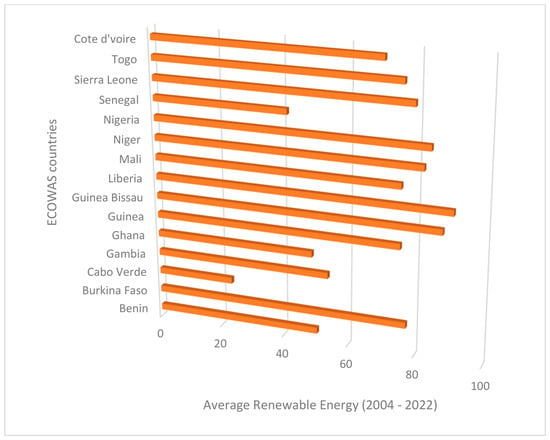
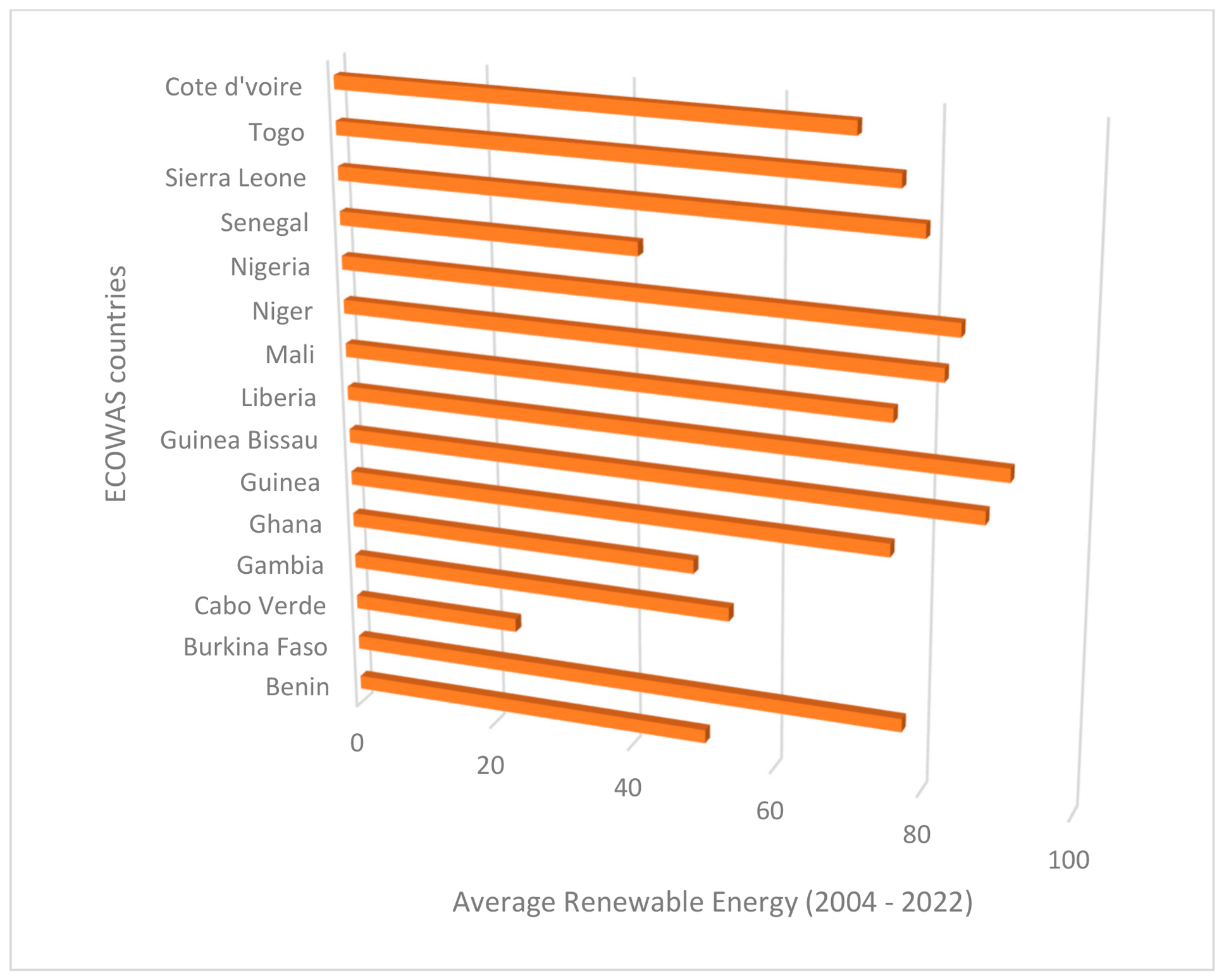
Sustainability is important in every economy as it ensures the promotion of economic development without causing significant harm to the environment. The African nations, including the West African nations (ECOWAS), strive to foster ecological sustainability (ES) with the use of energy sources that are less polluting. For instance, the World Bank (WB) data shows that the utilization of renewable energy (RE) in the ECOWAS is relatively high, with an average of 67.65% RE use among the fifteen ECOWAS countries from 2004 to 2022 [1]. This is supported by the information presented in Figure 1, which illustrates that the use of RE in the ECOWAS region is very high, with some countries, like Liberia, exhibiting a very high rate of more than 90% on average. Nonetheless, a few countries, like Cabo Verde, have very low levels of RE use (23.49% on average), and Senegal and Ghana have an average use of RE of less than 50% (Senegal 41.56%, Ghana 48.87%, see Figure 1). High use of RE in the ECOWAS countries indicates the commitment in supporting ES, considering the importance of RE in lowering the emissions of carbon dioxide (CO2) pollutants as caused by fossil fuels [2,3].
Figure 1.
Average RE use across ECOWAS countries between 2004 and 2022 (Data Source: World Bank).
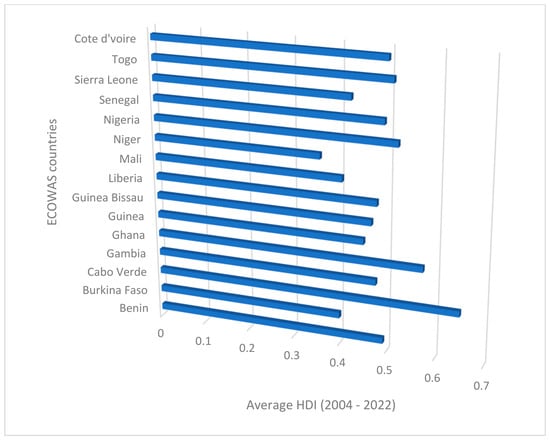
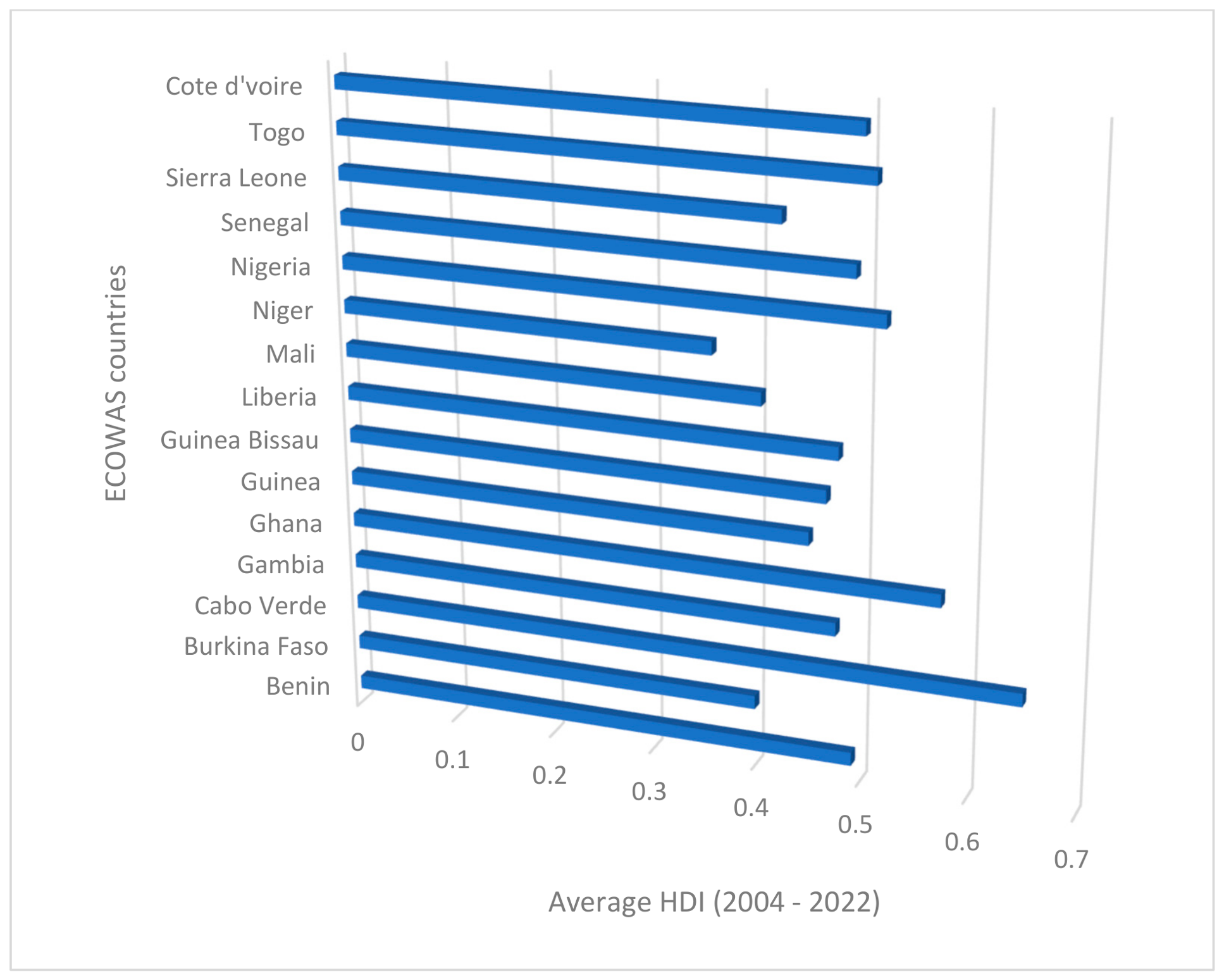
While countries in ECOWAS strive to protect the environment by using a greater percentage of RE, they are still struggling with the human development aspect of sustainable development. The ‘United Nations Development Programme’ (UNDP) reports that the Human Development Index (HDI) for ECOWAS countries between 2004 and 2022 is approximately 0.478 [4]. Figure 2 shows that the average HDI of each ECOWAS country is below 0.7. An HDI of below 0.7, according to the Global Footprint Network (GFN), is considered not sustainable [5]. The HDI is an important measure of sustainable development that takes into consideration the quality of life of people through improved health conditions, improved living standards through the provision of goods and services and the improvements in the literacy rate of people in the economy. Thus, the UNDP shows that the HDI of sustainable development is developed from three dimensions of being knowledgeable, improved standards of living and a healthy life [4]. Thus, this research shows that the ECOWAS nations need to endeavor to foster human development as they are falling short on this aspect, hence failing to foster sustainable development in their countries. Thus, this research brings new knowledge to the body of literature by examining the effects of various determinants of sustainable human development.
Figure 2.
Average HDI across ECOWAS countries between 2004 and 2022 (Data Source: UNDP).
This research notes the dearth of studies that explain how human development can be improved with key factors such as digitalization, health expenditures and financial development (FD), yet these factors are fundamental in supporting the healthy being, knowledge and standards of living of people. Regarding the influence of digitalization, few studies have examined how it supports sustainable development and ES [6,7,8,9]. Ref. [8] alludes to the great improvement of sustainable development through digitalization, which is very important given the inclusion of the HDI in sustainable development [10]. Thus, based on this evidence, one can note that digitalization can help foster human development. Yet, there is a need to present state-of-the-art studies that specifically address the direct connection between digitalization and human development. Similarly, this research observes the lack of studies that ascertain the influence of FD and health expenditures on human development. FD is, of course, observed to play a crucial role in improving the ES, another dimension of sustainable development, by supporting the development of green technologies and energy [11,12,13]. This is supported by the study of [14], which suggests that FD is essential in supporting technological innovations that lead to the development of green technologies. This will lead to sustainable growth, which supports improvements in the standards of living, and, finally, human development will be met. Health expenditure can also go a long way in ensuring that people attain a healthy, long life—the other dimension of the HDI—meaning significant improvements in human development will follow. These key areas are under-studied, especially in the developing nations, like the ECOWAS countries, that are struggling with maintaining a socially desirable level of human development, as shown by the average HDI of less than 0.7.
Therefore, the present research is designed to contribute to the literature on how human development can be maintained in the developing nations in four ways. Firstly, this research adopts the UNDP HDI, which accounts for a healthy life, knowledge, and quality of life through improved standards of living. Thus, unlike past studies that focused on economic growth—which is undoubtedly linked to the improvement in the standards of living of people—or on human capital (education) and other proxies that measure the health of people, like life expectancy and mortality rate, this research focuses on the HDI, which encompasses all these indicators in a single index. This is essential for developing policies that explain how a healthy life can be achieved while maintaining people’s knowledge and standard of living. Thus, this research answers the research questions regarding the various methods that can be employed to promote human development. Moreover, this research also looks into the various factors that hinder the achievement of human development for correct policymaking. Secondly, this research brings new knowledge to the body of literature by specifically addressing the relationship of human development and digitalization. Thus, the question of how digitalization affects human development is answered. Thirdly, this research presents new knowledge on the connection of FD and health expenditure with human development. Note that these factors are perceived as essential in fostering the various dimensions of human development yet there is a dearth of studies addressing this key relationship. Thus, this research answers the research questions on how FD and health expenditure foster human development. Fourth, this research methodologically contributes to the literature by adopting ‘second-generation’ (SG) methods that ensure the ‘heterogeneity’ and ‘cross-sectional dependence’ (CD) problems that exist in the panel data are corrected, leading to the presentation of robust findings that are reliable in policy implications. To this end, the SG method adopted in this research is the ‘Method of Moments Quantile Regression’ (MMQR), whose results will be checked for robustness with the ‘Panels Correlated Standard Errors’ (PCSE) method, following recent studies [3,15,16]. The Two-Stage Least Squares (2-SLS) technique is also employed to overcome endogeneity in the model [17]. This research uses the annual data of the ECOWAS countries, considering the time range from 2004 to 2022.
The research questions answered in this analysis are as follows:
- ➢
- What is the role of health expenditure and digitalization in driving human development in the ECOWAS?
- ➢
- Are FD and FDI fundamental in driving human development in the ECOWAS?
- ➢
- What is the role of carbon emissions and RE in supporting human development?
- ➢
- What ways can be adopted to make employment an anchor for human development in the ECOWAS?
This research is structured as follows: Section 2 that follows provides a brief review of the literature on this topic and provides the key research gaps that will be addressed in this analysis. Section 3 explains the research model, the data employed in the analysis and the various methods adopted for the analysis. Section 4 explains and discusses the results obtained using the main estimators employed. Afterwards, the conclusion of the research is presented, and policy recommendations are outlined.
2. Literature Review and Hypotheses Development
The literature shows that the relationship between human development and emissions is bidirectional, with significant feedback and neutrality patterns [18]. For instance, evidence from cross-country research on the nexus between emissions and development is positive in advanced economies, with significant threshold effects observed as well [19]. Moreover, evidence shows that the decoupling of human development from emissions is not automatic; rather, it is strengthened by institutional quality, efficiency, and RE [20,21,22]. Alternatively, high human development in lower- and middle-income economies is usually accompanied by high CO2 emissions, because energy consumption and demand increase with education, health, and income [23,24,25]. Evidence from empirical studies of developing or low-income economies shows that human development is associated with high emissions, whereas governance and RE tend to lessen the pressure [23]. However, evidence from other settings, like the G7, shows that human development reduces emissions of pollution, revealing that the direction of influence is subject to the energy structure and the stage of development of an entity.
H1.
Carbon emissions present a significant influence on human development—a positive influence when the level of pollution is within the assimilative capacity of the environment and because pollution is an inevitable byproduct of economic growth, and a negative effect in economies that have exceeded the assimilative capacity of the environment in harnessing pollution.
Health expenditure emerges as one of the main drivers of human development, though the influence is conditional. Evidence from the Pacific Island countries shows that mortality outcomes are strongly improved by public health expenditures [26]. More evidence from panel studies reveals that health spending is closely linked with human development, especially through child survival and life expectancy [27,28]. The interrelationships of sustainable development, human capital and health expenditures are ascertained in evidence from new EU member states, indicating the importance of human capital and health expenditures is advancing sustainability [29].
H2.
Health expenditure is positively associated with human development by improving the quality of life of people.
The influence of digitalization on human development is often positive, though uneven findings are present across stages of development and countries [30,31,32]. Evidence from West African economies supports the importance of internet use in human development [33], and OECD transition economies support the long-run positive effect of ICT penetration on human development [30]. The influence of ICT on human development significantly differs between developed and developing economies, but a positive effect is strongly supported [32]. Digitalization is also fundamental in fostering sustainable development [8,34,35]. However, other evidence in other settings shows the existence of mixed findings. For instance, in India, mobile density is favorable to the human development index (HDI), whereas globalization and internet density lower the HDI with respect to the direction of the shocks [36]. In the African context too, digitalization and human development are not directly linked, while the importance of digitalization significantly increased after the pandemic [37,38]. Overall, digitalization is fundamental for human development where it expands inclusion, skills and access, but in the absence if these, complements weak and uneven gains [31,39,40].
H3.
Digitalization is fundamental in advancing human development.
The FDI–human development nexus is conditional, though it is generally positive. FDI enhances human development to increase in the developing economies, and the relationship is enhanced in the presence of institutional quality [41]. The feedback effect is also evident in the two-way causal relationship between human capital and FDI, indicating a reinforcing relationship between FDI and human development [42]. Empirical evidence presents FD as a moderating or mediating factor that does not always cause a positive connection, rather than a direct force. On the one hand, empirical evidence indicates that FDI has significantly helped financial systems enhance welfare and growth [43]. On the other hand, heterogeneous results, subject to some threshold or with detrimental effects, are observed [44]. In the African context, the FDI–human development nexus is conditioned by FD, though the direction is subject to institutions or financial markets [44]. Therefore, when FDI is conditioned on productive sectors, financial depth, and good governance, it enhances human development [45,46].
H4.
FD and FDI significantly improve human development by providing the financial resources that are needed in fostering education, health and standards of living.
General evidence highlights the importance of employment in improving human development, though strong evidence is associated with labor market inclusion, sectoral structure and job quality, rather than the count of employment by itself [47,48]. Panel evidence has indicated that the HDI is raised with employment, among other various factors like life expectancy, education and green energy [47]. Overall, human development is supported with employment when it is inclusive, productive and connected to skills and infrastructure upgrades [31,47,48].
H5.
Employment presents a significant influence on human development, and the direction of influence depends on the type of employment; that is, improvements in the employment of skilled, smart and high-paying jobs improve human development, while employment in non-skilled, blue-collar and low-paying jobs reduces human development.
The importance of RE on human development is widely accepted across different contexts. The adoption of RE has significant importance in improving the HDI across income, education and health dimensions [49]. Similar findings are reported for studies in high-income, G7, Asian and BRICS economies, though feedback effects are highly noticeable [50,51,52,53]. The effect of RE is also strong when conditioned with string institutions, human capital and governance [54,55]. Exceptions and nonlinearities are also present in other studies; for instance, a study in the African context presents a negative association between RE use and HDI, with positive evidence revealed on clean fuels and cooking technologies [56]. More evidence from studies in the developing settings showed a significant U-shaped association between RE and the HDI [57]. Regardless of these nuances, the positive influence of RE on the HDI remains the dominant empirical pattern, especially where institutional capacity, affordability and accessibility are present [49,58].
H6.
RE has a significant effect on human development, a positive effect where it significantly contributes to environmental sustainability at low and affordable costs, and a negative influence in financially resource-strained economies that cannot afford the development of clean energy and technologies.
Overall, the literature on the drivers of human development remains limited, with most empirical studies having examined individual dimensions of human development. For instance, various studies have looked at how the health outcomes of people are promoted in an economy [59,60,61,62]. Moreover, other studies have looked at how economic growth is important in determining the living standards of people and highlighted the various factors that foster economic growth [63,64]. Another dimension of human development that is understudied is human capital, which reflects the knowledge of people; various studies look at how it improves economic development rather than how it can be developed.
3. Research Model, Data and Methods
3.1. Research Model and Data
This research takes the HDI of the UNDP as the endogenous variable in the model. The HDI is essential in representing sustainable human development in the model as it considers the level of living standards as represented by the level of income in a country, the healthy life and the knowledge level of humans. The UNDP articulates that the HDI is a very essential dimension of sustainable development. Specifically, [5] indicates that for a nation to be advancing sustainable development, its HDI should be greater than 0.7. Therefore, the HDI becomes a crucial factor to consider when examining the sustainability of countries. To that end, this study adopts the framework provided by the ‘Endogenous Growth Models’ (EGM) to develop a research framework that helps in understanding sustainability drivers that advance human development. The EGM shows that technological advancements, savings and investment are the key drivers in achieving sustained increases in the living standards of people, through persistent economic growth [65,66,67]. The EGM deviates from the postulations of the Solow Growth Model (SGM) [68] by showing that capital accumulation leads to economic growth. Thus, the EGM argues that the capital explained in the SGM should be broadly defined as human and physical capital, rather than just physical capital, which is subject to diminishing marginal returns [65]. Human capital is not subject to diminishing returns because knowledge does not diminish, as explained in the learning by doing and the knowledge spillover hypotheses [65]. Therefore, this research takes digitalization to represent technological advancement and employment to represent the human capital level that is being utilized towards the production of products meant to satisfy human needs. Moreover, this research adopts the FD and FDI as the major drivers in financing the technological advancements and various projects that can work towards providing products and services for human consumption. The adoption of FD and FDI in this study is supported by the Finance-Growth theory, which explains the importance of finance for economic development [69]. FD is crucial in advancing sustainability of countries, as indicated in the recent studies of [6]. FDI becomes crucial, especially in the developing nations with relatively less income, which may resort to capitalizing on the inflow of capital from foreign investment to support the development of their nations. Moreover, the health expenditure, representing the level of income that is dedicated towards improving the health system by building hospitals and clinics and providing health facilities, becomes an inevitable predictor in the model. Grossman’s model of health capital presents health as a consumption good that is important in improving the livelihood of people; hence, health expenditure is an important driver of humans [70]. This research also takes the emissions of CO2, considering that high pollution levels can lead to widespread diseases causing various health issues, hence deteriorating human development [71]. The Environmental Kuznets Curve (EKC) theory provides the theoretical basis of the possible link between human development and CO2 emissions. Developing economies improve economic growth by using fossil fuels that exacerbate pollution, and thus CO2 and human development may be positively related, that is, the upward-sloping part of the EKC. In the later stages, as pollution exceeds the assimilative capacity of the environment, CO2 emissions and human development will be negatively related, that is, the downward-sloping part of the EKC. RE is adopted considering its importance in correcting for the negative effects of pollution on the environment and in spreading diseases that tend to reduce human development [6]. Therefore, RE is expected to have a positive relationship with human development, though energy poverty due to a lack of financial resources for RE development may hinder this. Therefore, the research model of this study is specified in the statistical model shown in Equation (1).
where HD is the dependent variable (DV) in the model, representing sustainable human development. CE, HE, DIG, FD, RE, EMP, and FDI are independent variables (IVs) representing the CO2 emissions, health expenditures, digitalization, financial development, renewable energy, employment and foreign direct investment, respectively. is the model’s constant, is the error noise, and are the coefficients of the exogenous variables. The superscripts and are the time range of the data, that is, 2004 to 2022, and the number of countries (the 15 ECOWAS countries) considered in the analysis.
Therefore, this research uses the data of the 15 West African countries, commonly known as the ECOWAS countries, taking into account their annual data from 2004 to 2022. The data on the HDI is retrieved from the UNDP, data on FD is retrieved from the ‘International Monetary Fund’ (IMF) and data on the other exogenous variables is retrieved from the WB databases. Table 1 explains all the variables employed, including their units of measurement and expected signs of each IV, while Table 2 presents the descriptive statistics that summarize the variables’ measures of central tendency and dispersion.
Table 1.
Variables measurements and sources.
Table 2.
Descriptive statistics.
The results of descriptive statistics are provided for the raw data of the original dimensions/indicators retrieved from the original sources before any standardization procedures are applied because descriptive statistics offer a univariate analysis that examines the measures of central tendencies and dispersion for each indicator or dimension. For this reason, it is more logical to run the descriptive statistics before any standardization procedures are applied to understand the mean, standard deviation, minimum and/or maximum values of each indicator. The constructed indexes and normalized indicators explained in Table 1 are used for the regression analysis to obtain standardized coefficients, allowing for a direct comparison of the relative strength/impact of IVs measured in different units.
3.2. Methods
This research employs the recently developed MMQR method [72]. The MMQR has gained popularity in the analysis of longitudinal data because it presents heterogeneous results. This is necessitated by its ability in presenting different findings in different respective quantiles. Thus, the MMQR can inform policies related to countries in the lower, middle and upper quantiles. The MMQR method has been widely used in the recent studies, for instance, in [6,73]. The MMQR representation of the present research is illustrated in Equation (2).
where the factors shown on the right-hand side of the equation are similar to the factors presented in Equation (1). represents the conditional quantile of the DV (HD) in the model.
The MMQR method is also employed in this research because of the results of the preliminary tests undertaken in this research, whose results are presented in Appendix A. Firstly, the preliminary analysis shows that the variables and the model have significant CD; see the findings outlined in Table A1. Thus, in the presence of CD in the specified model and in the individual variables, a ‘second-generation’ (SG) method like the MMQR is the most favorite because it overcomes this problem. The [74] method is used for the CD test in the individual variables, while the [75,76,77] methods are used for examining CD in the model. Moreover, ‘heterogeneity’ that is present in the model, as shown in Table A1, according to the ‘slope heterogeneity’ tool of [78], makes the MMQR the preferred method since it overcome this problem. Secondly, the MMQR method is employed because of the presence of mixed ‘integration orders’ in the variables (I(0) and I(1)), as shown in the results presented in Table A2, from the ‘Cross-sectional Augmented Dickey–Fuller’ (CADF) method [79]. The CADF method is used in the analysis of the ‘unit root’ because of the CD that exists in the individual variables [16]. Thirdly, the existence of cointegration in the model, as shown in Table A4, as tested by the Pedroni and Kao methods after including the demean method, which subtracts ‘cross-sections’ because of CD in the model and variables, calls for the use of the MMQR method, which presents long-run findings. Lastly, the analysis of the specified model is necessitated by the absence of ‘multi-collinearity’ among the exogenous variables, as tested by the ‘Variance Inflation Factor’ (VIF) method and the findings presented in Table A3.
This research also adopts the ‘Panel Correlated Standard Errors’ (PCSE) method of [80] in providing a robustness check of the MMQR results. This method has the capacity to overcome CD as it considers the within-panel correlation [81]; hence, robust findings are presented.
Furthermore, the 2-SLS method is employed to overcome endogeneity due to reverse causality where the DV might in turn affect some of the IVs [82,83]. The theoretical and statistical approaches are employed to determine the IVs that are strongly endogenous in the model [84]. First, the Durbin–Wu–Hausman (DWH) test is employed as a preliminary statistical approach to identify endogenous and exogenous factors, and its results are presented in Table A5. The findings of the DWH test of endogeneity in Table A5 present insignificant Chi2 statistics at the 5% level of significance, which shows that all IVs are exogenous, and no endogenous variable is identified. Nonetheless, the theoretical approach shows that health expenditure and digitalization are strongly endogenous, while FD and employment are moderate to highly endogenous. Wagner’s law of public expenditure shows that high growth in the income of a country induces public expenditure, including a rise in health expenditure, and thus human development drives health expenditure [85]. Grossman’s model of health capital also presents health as a consumption good that makes people feel better, indicating the importance of health expenditure in driving human development [70]. These two theories combined show that human development and health expenditure have a bi-directional causality. The EGM explains that digitalization is strongly endogenous as it can be strongly affected by human development in reverse causality. The theory posits for the importance of investments in knowledge, innovation and human capital for economic growth [66,67]. Here, digitalization facilitates knowledge spillovers, while its adoption is influenced by the level of human capital in existence. Moreover, the Finance-Growth theory explains the endogeneity of FD in this model, where human development is driven by finance and a more sophisticated financial system is demanded by development [69]. The endogeneity of employment is explained by Okun’s law, which shows the existence of a negative correlation between employment and real GDP [65].
To ensure health expenditure, digitalization, FD and employment are endogenous and to ensure the appropriate instrumentation is adopted, the first-order 2-SLS diagnostic test is run, and the findings are presented in Table A6. The first-order 2-SLS diagnostic results show that the F-Statistic values of the four variables are significant at 1% level; hence, the model is correctly specified. Moreover, the Chi2 under identification statistics of Sanderson–Windmeijer (SW) are significant, implying that the model is not under-identified. The SW F-Statistic values of weak identification are also greater than 10—the rule of thumb—implying no weak identification issues in the model. Most importantly, the Kleibergen–Paap (KP) rk LM statistic of the overall model is significant, while the Hansen J statistic is insignificant, implying that the model is not under-identified or over-identified. The first-lagged and second-lagged values of the endogenous variables are specified as the model’s instruments, considering the difficulty in finding and supporting external instruments [86].
4. Results and Discussion
The findings of this study are presented in Table 3, according to the MMQR method, and in Table 4, according to the PCSE and 2-SLS methods that are used for robust checking.
Table 3.
Major findings with MMQR methods.
Table 4.
PCSE and 2-SLS findings.
The findings presented in this analysis present carbon emissions, health expenditure, digitalization, FD and FDI as the main drivers of human development in West Africa. The MMQR findings show that carbon emissions present a symmetric positive influence across all quantiles ( = 0.4677 in the 0.1 quantile to 0.253 in the 0.9 quantile; p-value < 0.05). These findings indicate that CE is associated with increasing human development in the ECOWAS, though the magnitude of influence decreases in ECOWAS countries with a high level of human development. This is evidenced by the relatively low coefficient value and the decreasing confidence interval in the upper quantiles. The findings show that, at a 95% confidence interval, human development increases by a magnitude that is between 0.2414 and 0.6941 units in the 0.1 quantile, and by a magnitude between 0.0473 and 0.4588 units in the 0.9 quantile when carbon emissions increase by 1 unit in the true population. The PCSE and 2-SLS support the positive influence of carbon emissions on human development ( = 0.3614 and 0.3629 respectively; p-value < 0.05). These findings align with evidence from cross-country research that shows that the relation of emissions and development is positive in advanced economies [19]. Carbon emissions are associated with increases in the human development because pollution is an inevitable byproduct of production of economic goods [71], and this validates H1 developed in this study. As the production of goods increases in order to improve the standards of living of people, pollution will also increase. The literature also shows that decoupling human development from emissions is not automatic, but is made stronger with institutional quality, efficiency and RE [20,22]. These findings are consistent with the upward-sloping part of the Environmental Kuznets Curve (EKC) hypothesis, where rising environmental stress is associated with increasing economic growth as economies engage in environmentally harmful activities to attain growth [87]. The decreasing influence of carbon emissions on human development in ECOWAS countries with a high level of human development explains how economies may become concerned about environmental quality when a certain level of development is attained and may seek to achieve economic prosperity by transitioning to clean energy use and eco-friendly technologies. The ECOWAS are recommended to adopt environmentally friendly policies and to transition to clean energy and technologies and ecofriendly activities, ensuring that rising human development is associated with improved environmental quality in the region.
Health expenditures exhibit an asymmetric influence on human development of the ECOWAS, with the MMQR showing insignificant effects in the lower and middle quantiles, but a significant positive influence in the upper quantile ( = 1.4759; p-value < 0.01). The PCSE method also supports the importance of health expenditure for human development in the ECOWAS ( = 0.513; p-value < 0.01), while the 2-SLS method shows that the relationship is insignificant. These findings shows that more spending in the health sector—by improving health facilities, medicine and medical equipment—is fundamental in advancing human development in the ECOWAS, validating H2. ECOWAS countries with low human development have not made significant investments that are necessary to induce human development to rise. Therefore, there are thresholds to the extent at which health expenditure can induce human development to significantly rise. This calls for the ECOWAS countries to support human development through health expenditure. Of course, health expenditure will direct influence one dimension of human development, a healthy life, and indirectly affect other dimensions, being knowledgeable and decent standards of living. Healthy citizens will have the ability to acquire the right knowledge in schools and will be able to work to generate income and improve their living standards.
Digitalization is also observed to present a significant symmetric positive influence on human development in the ECOWAS. The MMQR results show the importance of digitalization in driving human development across all quantiles ( = 0.245 in the 0.1 quantile to 0.1988 in the 0.9 quantile; p-value < 0.05). The PCSE and 2-SLS findings are also in support of the positive influence of digitalization ( = 0.2221 and 0.2258 respectively; p-value < 0.01), and this validates H3, which provides for the importance of digitalization for human development. Previous studies have shown that digitalization is fundamental toward supporting the educational levels, health qualities, as well as the standards of living in the economies [61,88,89]. This is so because with improved digitalization, the required technological advancements toward the production of goods and services are enhanced. Moreover, digitalization can be the driver towards green technological innovation, which ensures a quality environment is attained and hence reduces diseases, which tends to support an improvement in the healthy lives of people [3,6,7,71]. Moreover, the importance of digitalization in supporting sustainable development, according to past studies’ postulations, explains its favorable effects on human development in this research [8,90,91]. Therefore, countries in West Africa should advance technological advancement by investing in sophisticated clean technologies that are favorable for human development.
Additionally, the analysis of this study shows the importance of FD and FDI in driving human development in West Africa. The MMQR presents asymmetric effects, where FD significantly improves human development in the lower, middle and upper quantiles ( = 0.2941 in the 0.1 quantile, 0.2985 in 0.5 quantile and 0.3029 in 0.9 quantile; p-value < 0.01), and FDI significantly improves human development in the lower and middle quantiles ( = 0.2957 in the 0.1 quantile and 0.1573 in the 0.9 quantile; p-value < 0.01). The PCSE and 2-SLS findings support the importance of FD in driving human development ( = 0.2984 and 0.292 respectively; p-value < 0.01) and the importance of FDI ( = 0.1601 and 0.1506 respectively; p-value < 0.01). The importance of FD and FDI presented in the analysis of this study validates the postulations of H4 developed in this analysis. FD is by far the most important factor supporting improvements in the education levels, healthy lives, and standards of living of people by supporting green technologies and RE and reducing pollution [3,12,92]. With strong financial systems and institutions in the ECOWAS schools and other educational facilities, hospitals and clinics, as well as the medical facilities, can be provided to ensure citizens gain the right knowledge and achieve healthy lives. FD can also play a very crucial role in the production of goods and services by facilitating the use of latest technologies and inputs, which in turn will increase the income levels of people in the region, and hence the standards of living are advanced. The importance of FDI is also supported by empirical evidence that shows that it improves health outcomes and reduces death rates [61,88]. Therefore, the ECOWAS countries—the developing countries—with weak financial resources can capitalize on the influence of foreign investors to ensure the achievement of human development in their countries.
Employment presents mixed findings in this analysis. The MMQR shows that the influence of employment on human development is negative and positive, depending on the level of human development. However, the PCSE and 2-SLS methods are consistent in showing that employment’s influence is counterproductive in the ECOWAS. Specifically, the MMQR shows that the influence of employment on human development is negative in the 0.1 quantile ( = −0.5607; p-value < 0.01), weakly negative in the 0.5 quantile ( = −0.1498; p-value < 0.1) and strongly positive in the 0.9 quantile ( = 0.2522; p-value < 0.05). These findings show that employment presents asymmetric effects by reducing human development in ECOWAS economies with low-level human development and increasing it in high-level ones. These asymmetric effects are explained by the importance of human capital and types of jobs that people find themselves employed in. In countries with low human development, human capital is low and people are employed in low-paying labor-intensive jobs, while countries with high human development have high levels of human capital and people find employment in high-paying sophisticated jobs. Therefore, improved employment levels in the lower-quantile countries do not significantly raise income as people are employed in low-paying and harmful jobs, leading to reduced levels of human capital. This calls for the ECOWAS to improve the level of human capital in their countries and improve the pay rates. The PCSE findings show that increases in employment generally lead to decreases in human development in the ECOWAS ( = −0.158; p-value < 0.01), while the 2-SLS shows that the relationship is weakly negative ( = −0.1827; p-value < 0.1). These findings support the postulations of H5 and are consistent with the ECOWAS level of human development, which is generally low, with low levels of human capital, leading to the employment of people in low-paying and sometimes harmful jobs, which does not significantly foster human development. Generally, employment is essential in improving the income levels of people; hence, it promotes people’s standards of living—a key dimension of human development. Therefore, it is paramount for the ECOWAS countries to consider an improvement in the level of human capital, employment and the job market.
This research shows that RE is detrimental to human development in the ECOWAS region. According to the MMQR method, RE significantly reduces human development in the 0.5 to 0.9 quantiles ( = −0.147 and −0.3766 respectively; p-value < 0.05), but does not significantly affect it in the 0.1 quantile. The magnitude of RE in reducing human development in the ECOWAS region is observed to be increasing in the upper quantile, an indication that RE tends to strongly reduce human development in countries exhibiting high levels of human development. The results of the PCSE method also indicate that RE reduces human development ( = −0.1423; p-value < 0.01), while the 2-SLS findings show that the influence of RE is insignificant. The negative effect of RE on human development is consistent with H6, though it is a cause of concern, as RE has long been determined as the major driver promoting ES, as well as supporting green economic development [2,16,93]. The crowding-out effect, where RE investment competes with health and education expenditure for limited public budgets, explains the negative effect of RE on human development. Thus, as funds are channeled towards RE development, they exhaust the limited funds available to advance education, health and economic development, hence reducing human development. This is relevant to the ECOWAS settings, where energy poverty is rampant and the high costs of developing RE infrastructure in these low-income countries with limited financial resources lead to low levels of human development [94]. ECOWAS countries, when faced with high prices of developing RE, end up losing a great deal of funds that could be used to improve human development; hence, RE will lead to a negative effect on human development.
5. Conclusions
This research provides profound new knowledge on the road to sustainable development in the ECOWAS region by employing the HDI of the UNDP, in a quest to understand the various means that can be employed to foster human development in this region. The HDI employed in this research allows us to understand how the standards of living, healthy lives and knowledge levels in the ECOWAS region can be advanced. The utilization of MMQR and PCSE methods in this research allows for ensuring robust policies are developed by presenting robust findings free from CD and ‘heterogeneity’. 2-SLS is also employed to overcome potential endogeneity issues, hence for robust checking. Major research findings show that human development, in the ECOWAS, is raised by digitalization, health expenditure, carbon emissions, FDI and FD. Digital technology is important in ensuring improvements in the health and the education sector and in fostering economic development for improved standards of living. Health expenditure also improves the health system, which enables people to attain health lives, thereby indirectly improving the level of knowledge and people’s standards of living. FD and FDI are essential for providing the necessary finance required to invest in the health, education and production sectors, hence driving human development. The positive influence of carbon emissions is explained by the upward-sloping EKC, where rising economic growth is associated with environmental stress. Employment is observed to present mixed findings, negative in low-income countries and positive in high-income countries. This phenomenon is explained by the low-paying and sometimes harmful jobs in low-income countries with low-levels of human capital. Thus, with most of the ECOWAS economies exhibiting low-level human development, efforts towards advancing the level of human capital and improving the job market become essential. The negative influence of RE presented in this analysis is also explained by the high costs of RE development, which the ECOWAS developing economies with low financial resources find difficult to meet. The present research is limited to only the ECOWAS countries and to the human development dimension of sustainability. Additionally, these findings are limited to examining unidirectional relationships, that is, the influence of the IVs adopted on the DV (human development). Carbon emissions could be affected by human development, and that link is not examined in this analysis. Nonetheless, the findings presented are robust since 2-SLS, which overcomes potential endogeneity, is employed in the analysis. Future studies can consider researching sustainability in a way that captures the human and environmental aspects in a single indicator or examine the reverse causal link from human development to CO2 emissions. Moreover, these findings can be generalized to other developing countries across Africa, but cannot be generalized to other economies with different economic, social and political environments. This research therefore needs to be extended to other geographic locations for appropriate policy implications that are specific to such environments.
To this end, the following policies are recommended:
- Advancements in the digitalization of the ECOWAS countries should be prioritized in order for this region to advance human development. Digitalization is important as it is related to the technological innovations that are key in ensuring the production of economic goods that can work towards improving the standards of living of people in this region. Moreover, technological innovations as a result of digitalization can also work towards improvements in the educational systems as well as the health systems of the country; hence, human development is promoted.
- The ECOWAS countries should also maintain strong financial systems by improving the efficiency of the markets and their depth as well as promoting efficient financial institutions, which will enable the availability of funds in these economies. Such actions towards stabilizing and making the financial system efficient can foster improvements in the educational sector and health sector, as well as facilitating the production of more products.
- The ECOWAS countries should also ensure the availability of funds towards supporting the various health expenditures that are essential in improving the healthy lives of people and hence support human development. Such improvements in health expenditures can work towards building hospitals and clinics and the provision of health facilities in these clinics.
- Standards of living, which form part of human development, can also be fostered by improving the human capital level among the people of ECOWAS as well as creating high-paying and safe jobs in the region.
- It is also essential for the ECOWAS countries to promote foreign investment because of the low financial resources that are available in these countries to sustain human development. Thus, by capitalizing on the funds obtained through foreign investment, economies can work towards achieving human development.
- It is also essential for the ECOWAS countries to monitor the emissions of CO2 to ensure that they do not exceed the threshold that is within the assimilative capacity of the environment, which may end up causing diseases and hence reduce human development levels. A transition to the use of clean energy and technologies is important to attain the turning and downward parts of the EKC.
Author Contributions
Conceptualization, A.S. and W.M.S.K.; methodology, A.S.; validation, A.S. and W.M.S.K.; formal analysis, A.S.; resources, A.S. and W.M.S.K.; data curation, A.S.; writing—original draft preparation, A.S.; writing—review and editing, A.S. and W.M.S.K.; supervision, W.M.S.K. All authors have read and agreed to the published version of the manuscript.
Funding
No funding was received for conducting this study.
Institutional Review Board Statement
Not applicable.
Informed Consent Statement
Not applicable.
Data Availability Statement
The data presented in this study are available on request from the corresponding author.
Conflicts of Interest
The authors declare no conflicts of interest.
Appendix A
Table A1.
CD and heterogeneity outcomes.
Table A2.
CADF unit root outcomes.
Table A3.
VIF findings.
Table A4.
Cointegration outcomes.
Table A5.
DWH endogeneity results.
Table A6.
First-order 2-SLS diagnostic results.
References
- Afshar, M.S.; Deka, A.; Eyupoglu, S.Z. Advancing Sustainable Environments Through Digital Technology and Clean Energy Sources, via the Mediation of Green Finance and the Moderation of Institutional Quality. Sustainability 2026, 18, 5571. [Google Scholar] [CrossRef] [Scilit]
- Akinbode, S.O.; Dipeolu, A.O.; Bolarinwa, T.M.; Olukowi, O.B. Effect of health outcome on economic growth in sub-Saharan Africa: A system generalized method of moment approach. J. Econ. Dev. 2021, 23, 254–266. [Google Scholar] [CrossRef] [Scilit]
- Alsabhan, T.H.; Anas, M. Environmental Sustainability in the Gulf Cooperation Council (GCC) countries: The role of Digitalization and Planetary Adjusted Human Development. Sustain. Futures 2025, 9, 100630. [Google Scholar] [CrossRef] [Scilit]
- Asongu, S.A.; Odhiambo, N.M. Financial Access, Governance and Insurance Sector Development in Sub-Saharan Africa. J. Econ. Stud. 2020, 47, 849–875. [Google Scholar] [CrossRef] [Scilit]
- Bailey, D.; Katz, J.N. Implementing panel-corrected standard errors in R: The pcse package. J. Stat. Softw. 2011, 42, 1–11. [Google Scholar] [CrossRef] [Scilit]
- Beck, N.; Katz, J.N. What to do (and not to do) with time-series cross-section data. Am. Political Sci. Rev. 1995, 89, 634–647. [Google Scholar] [CrossRef] [Scilit]
- Becker, B.; Fischer, D. Promoting renewable electricity generation in emerging economies. Energy Policy 2013, 56, 446–455. [Google Scholar] [CrossRef] [Scilit]
- Bird, R.M. Wagner’s o law’of expanding state activity. Public Finance/Finance Publiques 1971, 26, 1–26. [Google Scholar]
- Byaro, M.; Mmbaga, N.F.; Mafwolo, G. Tackling energy poverty: Do clean fuels for cooking and access to electricity improve or worsen health outcomes in sub-Saharan Africa? World Dev. Sustain. 2024, 4, 100125. [Google Scholar] [CrossRef] [Scilit]
- Cavusoglu, B.; Saliminezhad, A.; Deka, A. Promoting Environmental Quality with Financial Development in Iran: An Asymmetric Analysis with NARDL Approach. In International Conference on Smart Environment and Green Technologies; Springer Nature: Cham, Switzerland, 2024; pp. 169–176. [Google Scholar]
- Deka, A. The effect of forest resources, energy efficiency, and renewable energy on environmental degradation—A comparative analysis of the less- and high-emitter sub-Saharan African countries. Environ. Sci. Pollut. Res. 2023, 30, 105781–105792. [Google Scholar] [CrossRef] [Scilit] [PubMed]
- Deka, A. The role of natural resources rent, trade openness and technological innovations on environmental sustainability—Evidence from resource-rich african nations. Resour. Policy 2024, 98, 105364. [Google Scholar] [CrossRef] [Scilit]
- Deka, A. Juxtaposing the role of effective capital, energy efficiency and technological innovations on environmental sustainability in the EU countries. Manag. Environ. Qual. Int. J. 2025, 37, 259–276. [Google Scholar] [CrossRef] [Scilit]
- Deka, A.; Dube, S.; Cavusoglu, B. The Role of Technological Innovation and Trade Openness in Promoting Environmental Sustainability in the GCC Nations. In International Conference on Smart Environment and Green Technologies; Springer Nature: Cham, Switzerland, 2024; pp. 485–492. [Google Scholar]
- Deka, A.; Kipulu, J.K.; Dube, S. Juxtaposing the influence of nuclear energy, human development index and research & development on economic performance of the European Union countries. Environ. Prog. Sustain. Energy 2025, 44, e14565. [Google Scholar] [CrossRef] [Scilit]
- Farhat, M.A.M.; Kareem, P.H.; Celebi, A. Do Digitalization, Green Finance and Financial Development Promote Sustainable Development in the African Countries? Sustain. Dev. 2026, 1–12. [Google Scholar] [CrossRef] [Scilit]
- Frees, E.W. Longitudinal and Panel Data: Analysis and Applications in the Social Sciences; Cambridge University Press: Cambridge, UK, 2004. [Google Scholar]
- Friedman, M. The use of ranks to avoid the assumption of normality implicit in the analysis of variance. J. Am. Stat. Assoc. 1937, 32, 675–701. [Google Scholar] [CrossRef]
- Global Footprint Network. Ecological Footprint vs. Biocapacity. 2025. Available online: https://data.footprintnetwork.org/#/countryTrends?cn=5001&type=BCtot,EFCtot (accessed on 21 October 2025).
- Grossman, M. On the concept of health capital and the demand for health. J. Political Econ. 1972, 80, 223–255. [Google Scholar] [CrossRef] [Scilit] [PubMed]
- Grossman, G.M.; Krueger, A.B. Economic growth and the environment. Q. J. Econ. 1995, 110, 353–377. [Google Scholar] [CrossRef] [Scilit]
- Hickel, J. The sustainable development index: Measuring the ecological efficiency of human development in the anthropocene. Ecol. Econ. 2020, 167, 106331. [Google Scholar] [CrossRef] [Scilit]
- Hussen, A.M. Principles of Environmental Economics; Routledge: Taylor & Francis: London, UK; New York, NY, USA, 2000. [Google Scholar]
- Ibrahim, R.L.; Al-Mulali, U.; Ajide, K.B.; Mohammed, A.; Bolarinwa, F.O. Investigating the Mediating Roles of Income Level and Technological Innovation in Africa’s Sustainability Pathways Amidst Energy Transition, Resource Abundance, and Financial Inclusion. Sustainability 2022, 14, 12212. [Google Scholar] [CrossRef] [Scilit]
- Immurana, M.; Iddrisu, A.-A.; Owusu, S.; Yusif, H.M. Foreign Direct Investment and child health outcomes in Africa. Cogent Econ. Financ. 2023, 11, 2164565. [Google Scholar] [CrossRef] [Scilit]
- Jarijari, T.; Deka, A.; Cavusoglu, B. The synergistic role of natural resources, green finance and green technological innovations in promoting environmental sustainability in Sub-Saharan Africa. Resour. Policy 2025, 105, 105598. [Google Scholar] [CrossRef] [Scilit]
- King, R.G.; Levine, R. Finance and growth: Schumpeter might be right. Q. J. Econ. 1993, 108, 717–737. [Google Scholar] [CrossRef] [Scilit]
- Li, Q.; Zhong, Z.; Ge, Q. Digital finance and sustainable development of commercial banks; insights from listed commercial banks. Int. Rev. Financ. Anal. 2025, 104, 104209. [Google Scholar] [CrossRef] [Scilit]
- Lv, Z.; Chen, L.; Ali, S.A.; Muda, I.; Alromaihi, A.; Boltayev, J.Y. Financial technologies, green technologies and natural resource nexus with sustainable development goals: Evidence from resource abundant economies using MMQR estimation. Resour. Policy 2024, 89, 104649. [Google Scholar] [CrossRef] [Scilit]
- Machado, J.A.F.; Santos Silva, J. Quantiles via moments. J. Econom. 2019, 213, 145–173. [Google Scholar] [CrossRef] [Scilit]
- Majeed, M.T.; Luni, T.; Zaka, G. Renewable energy consumption and health outcomes: Evidence from global panel data analysis. Pak. J. Commer. Soc. Sci. (PJCSS) 2021, 15, 58–93. [Google Scholar]
- Mankiw, N.G. Macroeconomics, 7th ed.; Worth Publishers: New York, NY, USA, 2010. [Google Scholar]
- Nagel, K.; Herzer, D.; Nunnenkamp, P. How Does FDI Affect Health? Int. Econ. J. 2015, 29, 655–679. [Google Scholar] [CrossRef] [Scilit]
- Nwaiwu, F. Digitalisation and sustainable energy transitions in Africa: Assessing the impact of policy and regulatory environments on the energy sector in Nigeria and South Africa. Energy Sustain. Soc. 2021, 11, 48. [Google Scholar] [CrossRef] [Scilit]
- Omri, A.; Kahia, M.; Kahouli, B. Does Good Governance Moderate the Financial Development-CO2 Emissions Relationship? Environ. Sci. Pollut. Res. 2021, 28, 47503–47516. [Google Scholar] [CrossRef] [Scilit] [PubMed]
- Osinubi, T.T.; Ajide, F.M.; Simatele, M. What role does digitalization play in the entrepreneurship-sustainable development nexus in Africa? J. Open Innov. Technol. Mark. Complex. 2025, 11, 100500. [Google Scholar] [CrossRef] [Scilit]
- Pesaran, M.H. General diagnostic tests for cross-sectional dependence in panels. Empir. Econ. 2021, 60, 13–50. [Google Scholar] [CrossRef] [Scilit]
- Pesaran, M.H. A simple panel unit root test in the presence of cross-section dependence. J. Appl. Econ. 2007, 22, 265–312. [Google Scholar] [CrossRef] [Scilit]
- Pesaran, M.H. Testing weak cross-sectional dependence in large panels. Econ. Rev. 2015, 34, 1089–1117. [Google Scholar] [CrossRef] [Scilit]
- Pesaran, M.H.; Yamagata, T. Testing slope homogeneity in large panels. J. Econ. 2008, 142, 50–93. [Google Scholar] [CrossRef] [Scilit]
- Rahman, M.; Zhao, X. Green technology adoption in emerging economies: A case study approach. Technol. Forecast. Soc. Change 2021, 170, 120889. [Google Scholar]
- Rashid, A.; Lee, C. Natural resource rents, financial development, and green growth: An empirical investigation. Resour. Policy 2023, 80, 102850. [Google Scholar]
- Reed, W.R. On the practice of lagging variables to avoid simultaneity. Oxf. Bull. Econ. Stat. 2015, 77, 897–905. [Google Scholar] [CrossRef] [Scilit]
- Romer, P.M. Increasing returns and long-run growth. J. Political Econ. 1986, 94, 1002–1037. [Google Scholar] [CrossRef] [Scilit] [PubMed]
- Romer, P.M. Endogenous technological change. J. Political Econ. 1990, 98, S71–S102. [Google Scholar] [CrossRef] [Scilit] [PubMed]
- Shuayb, A.S.S.; Dube, S.; Khalifa, W.; Deka, A.; Kareem, P.H.; Cavusoglu, B. The impact of natural resources rent, renewable energy, and governance on the environmental sustainability—Evidence from resource-rich countries. In Natural Resources Forum; Blackwell Publishing Ltd.: Oxford, UK, 2024. [Google Scholar]
- Sohail, M.T.; Ullah, S.; Ozturk, I.; Sohail, S. Energy justice, digital infrastructure, and sustainable development: A global analysis. Energy 2025, 319, 134999. [Google Scholar] [CrossRef] [Scilit]
- Solow, R.M. A contribution to the theory of economic growth. Q. J. Econ. 1956, 70, 65–94. [Google Scholar] [CrossRef] [Scilit]
- Theil, H. Economist Forecasts and Policy; North-Holland Publishing Company: Amsterdam, The Netherlands; London, UK, 1958. [Google Scholar]
- Theil, H. Some Developments of Economic thought in the Netherlands. Am. Econ. Rev. 1964, 54, 34–55. [Google Scholar]
- United Nations Development Programme. Human Development Index. 2025. Available online: https://hdr.undp.org/data-center/human-development-index#/indicies/HDI (accessed on 27 October 2025).
- Wali, M.F.A.; Kareem, P.H.; Çelebi, A.İ. Green Financial technology and institutional quality as pathways to environmental sustainability in Southern African countries facing severe ecological pressures. Sustainability 2025, 17, 9656. [Google Scholar] [CrossRef] [Scilit]
- Wang, X.; Duan, C.; Zhang, S. How public services affect human capital allocation—The regulatory effect of digital economy. Int. Rev. Econ. Financ. 2025, 100, 104102. [Google Scholar] [CrossRef] [Scilit]
- World Bank. World Bank Open Data. 2025. Available online: https://data.worldbank.org/ (accessed on 27 October 2025).
- Zafar, M.W.; Saud, S.; Hou, F. The Impact of Globalization and Financial Development on Environmental Quality: Evidence From Selected Countries in the Organization for Economic Co-Operation and Development (OECD). Environ. Sci. Pollut. Res. 2019, 26, 13246–13262. [Google Scholar] [CrossRef] [Scilit] [PubMed]
- Zhang, Q.; Liu, S.; Chen, H. Financial development and green innovation in emerging economies. J. Clean. Prod. 2023, 364, 132732. [Google Scholar]
- Zhao, J.; Liu, Y. Institutional quality, financial inclusion, and sustainable economic growth in BRICS countries. J. Environ. Manag. 2024, 335, 117473. [Google Scholar]
- Rahman, M.M.; Sultana, N. Nexus of human development and environmental quality in low-income and developing countries: Do renewable energy and good governance matter? Sustainability 2024, 16, 5382. [Google Scholar] [CrossRef] [Scilit]
- Nguyen, T.T.H.; Phan, G.Q.; Tran, T.K.; Bui, H.M. The role of renewable energy technologies in enhancing human development: Empirical evidence from selected countries. Case Stud. Chem. Environ. Eng. 2023, 8, 100496. [Google Scholar] [CrossRef] [Scilit]
- Güney, T. Renewable energy consumption and sustainable development in high-income countries. Int. J. Sustain. Dev. World Ecol. 2021, 28, 376–385. [Google Scholar] [CrossRef] [Scilit]
- Wang, Z.; Bui, Q.; Zhang, B.; Nawarathna, C.L.K.; Mombeuil, C. The nexus between renewable energy consumption and human development in BRICS countries: The moderating role of public debt. Renew. Energy 2021, 165, 381–390. [Google Scholar] [CrossRef] [Scilit]
- Miranda-Lescano, R.; Muinelo-Gallo, L.; Roca-Sagalés, O. Human development and decentralization: The importance of public health expenditure. Ann. Public Coop. Econ. 2023, 94, 191–219. [Google Scholar] [CrossRef] [Scilit]
- Wang, Z.; Rasool, Y.; Asghar, M.M.; Wang, B. Dynamic linkages among CO2 emissions, human development, financial development, and globalization: Empirical evidence based on PMG long-run panel estimation. Environ. Sci. Pollut. Res. 2019, 26, 36248–36263. [Google Scholar] [CrossRef] [Scilit] [PubMed]
- Bayar, Y.; Remeikienė, R.; Sart, G. ICT Penetration and human development: Empirical evidence from the EU transition economies. J. Knowl. Econ. 2024, 15, 2422–2438. [Google Scholar] [CrossRef] [Scilit]
- Karimi Alavijeh, N.; Ahmadi Shadmehri, M.T.; Esmaeili, P.; Dehdar, F. Asymmetric impacts of renewable energy on human development: Exploring the role of carbon emissions, economic growth, and urbanization in European Union Countries. J. Knowl. Econ. 2024, 15, 17188–17212. [Google Scholar] [CrossRef] [Scilit]
- Bedir, S.; Yilmaz, V.M. CO2 emissions and human development in OECD countries: Granger causality analysis with a panel data approach. Eurasian Econ. Rev. 2016, 6, 97–110. [Google Scholar] [CrossRef] [Scilit]
- Villegas Pocaterra, E.M.; Molero Oliva, L.E.; Rodríguez López, V.E.; Andino Chancay, T.S. Effects of the HDI on CO2 Emissions in Latin America and the Caribbean. Apunt. CENES 2022, 41, 141–175. [Google Scholar] [CrossRef] [Scilit]
- Pervaiz, R.; Faisal, F.; Rahman, S.U.; Chander, R.; Ali, A. Do health expenditure and human development index matter in the carbon emission function for ensuring sustainable development? Evidence from the heterogeneous panel. Air Qual. Atmos. Health 2021, 14, 1773–1784. [Google Scholar] [CrossRef] [Scilit] [PubMed]
- Gani, A. Health care financing and health outcomes in Pacific Island countries. Health Policy Plan. 2009, 24, 72–81. [Google Scholar] [CrossRef] [Scilit] [PubMed]
- Rana, R.H.; Alam, K.; Gow, J. Health expenditure, child and maternal mortality nexus: A comparative global analysis. BMC Int. Health Hum. Rights 2018, 18, 29. [Google Scholar] [CrossRef] [Scilit] [PubMed]
- Şentürk, C.; Sart, G.; Şaşmaz, M.Ü.; Bayar, Y. Health expenditures, human capital, and sustainable development: Panel evidence from the new EU member countries. Sustainability 2023, 15, 14514. [Google Scholar] [CrossRef] [Scilit]
- Gholami, R.; Higón, D.A.; Hanafizadeh, P.; Emrouznejad, A. Is ICT the key to development? J. Glob. Inf. Manag. (JGIM) 2010, 18, 66–83. [Google Scholar] [CrossRef] [Scilit]
- Behera, J.; Sahoo, D. Asymmetric relationships between information and communication technology (ICT), globalization, and human development in India: Evidence from non-linear ARDL analysis. J. Econ. Struct. 2022, 11, 10. [Google Scholar] [CrossRef] [Scilit]
- Zelenkov, Y.; Lashkevich, E. Does information and communication technology really affect human development? An empirical analysis. Inf. Technol. Dev. 2023, 29, 329–347. [Google Scholar] [CrossRef] [Scilit]
- Rezgui, S.; Bakari, S. The Impact of Digitalization on the Three Pillars of Sustainable Development: An Empirical Analysis in the Context of African Countries. Econ. Res. Guard. 2025, 15, 62–87. [Google Scholar]
- Ha, V.T.C.; Doan, T.; Holmes, M.J.; Tran, T.Q. Does institutional quality matter for foreign direct investment and human development? Eval. Rev. 2024, 48, 610–635. [Google Scholar] [CrossRef] [Scilit] [PubMed]
- Mintah, K.O.; Nakouwo, S.N.; Ahenkan, A.; Bawole, J.N. Does Financial Development Condition the Association Between Foreign Direct Investment and Human Development in Africa? Sustain. Dev. 2026. [Google Scholar] [CrossRef] [Scilit]
- Gohou, G.; Soumaré, I. Does foreign direct investment reduce poverty in Africa and are there regional differences? World Dev. 2012, 40, 75–95. [Google Scholar] [CrossRef] [Scilit]
- Azam, A.; Rafiq, M.; Shafique, M.; Yuan, J. Interpreting the dynamic nexus between green energy, employment, fossil fuel energy, and human development index: A panel data investigation. Energies 2023, 16, 3132. [Google Scholar] [CrossRef] [Scilit]
- Rathi, S.S.; Vermaak, C. Rural electrification, gender and the labor market: A cross-country study of India and South Africa. World Dev. 2018, 109, 346–359. [Google Scholar] [CrossRef] [Scilit]
- Azam, M.; Khan, F.; Ozturk, I.; Noor, S.; Yien, L.C.; Bah, M.M. Effects of renewable energy consumption on human development: Empirical evidence from Asian countries. J. Asian Afr. Stud. 2025, 60, 420–441. [Google Scholar] [CrossRef] [Scilit]
- Wang, Z.; Zhang, B.; Wang, B. Renewable energy consumption, economic growth and human development index in Pakistan: Evidence form simultaneous equation model. J. Clean. Prod. 2018, 184, 1081–1090. [Google Scholar] [CrossRef] [Scilit]
- Osakede, U.A.; Adeleke, O.K.; Osabohien, R.; Al-Faryan, M.A.S. Renewable energy consumption and human. Niger. J. Econ. Soc. Stud. 2024, 66, 481–503. [Google Scholar]
- Musolesi, A.; Mazzanti, M. Nonlinearity, heterogeneity and unobserved effects in the carbon dioxide emissions-economic development relation for advanced countries. Stud. Nonlinear Dyn. Econ. 2014, 18, 521–541. [Google Scholar] [CrossRef] [Scilit]
- Borowiec, J.; Papież, M. Convergence of CO2 emissions in countries at different stages of development. Do globalisation and environmental policies matter? Energy Policy 2024, 184, 113866. [Google Scholar] [CrossRef] [Scilit]
- Ejemeyovwi, J.; Adiat, Q.; Ekong, E. Energy usage, internet usage and human development in selected Western African countries. Int. J. Energy Econ. Policy 2019, 9, 316–321. [Google Scholar] [CrossRef] [Scilit]
- Oduniyi, O.S.; Adu, D. The impact of digital growth on human development in selected OECD countries. Discov. Sustain. 2026, 7, 1089. [Google Scholar] [CrossRef] [Scilit]
- Mia, A.; Hossain, I.; Sangwan, S. Determinants of digitalization: Evidence from Asia and the Pacific countries. Digit. Transform. Soc. 2024, 3, 340–358. [Google Scholar] [CrossRef] [Scilit]
- Gouvea, R.; Kapelianis, D.; Kassicieh, S. Assessing the nexus of sustainability and information & communications technology. Technol. Forecast. Soc. Change 2018, 130, 39–44. [Google Scholar] [CrossRef] [Scilit]
- Kheng, V.; Sun, S.; Anwar, S. Foreign direct investment and human capital in developing countries: A panel data approach. Econ. Change Restruct. 2017, 50, 341–365. [Google Scholar] [CrossRef] [Scilit]
- Choong, C.-K. Does domestic financial development enhance the linkages between foreign direct investment and economic growth? Empir. Econ. 2012, 42, 819–834. [Google Scholar] [CrossRef] [Scilit]
- Yiadom, E.B.; Mensah, L.; Bokpin, G.A. Environmental risk and foreign direct investment: The role of financial sector development. Environ. Chall. 2022, 9, 100611. [Google Scholar] [CrossRef] [Scilit]
- Hashemizadeh, A.; Bui, Q.; Zaidi, S.A.H. A blend of renewable and nonrenewable energy consumption in G-7 countries: The role of disaggregate energy in human development. Energy 2022, 241, 122520. [Google Scholar] [CrossRef] [Scilit]
- Sahu, M.; Alahdal, W.M.; Baatwah, S.R.; Elbanna, S. Governance and green energy: Unveiling their impact on sustainable development in OECD countries. Sustain. Dev. 2025, 33, 7185–7209. [Google Scholar] [CrossRef] [Scilit]

Disclaimer/Publisher’s Note: The statements, opinions and data contained in all publications are solely those of the individual author(s) and contributor(s) and not of MDPI and/or the editor(s). MDPI and/or the editor(s) disclaim responsibility for any injury to people or property resulting from any ideas, methods, instructions or products referred to in the content. |
© 2026 by the authors. Licensee MDPI, Basel, Switzerland. This article is an open access article distributed under the terms and conditions of the Creative Commons Attribution (CC BY) license.