


Abstract
The increase in global digitization increases the demand for data centers, and to provide a flexible and reliable service to end users, their continuous operation is of utmost priority. The continuous operation of data centers presents significant challenges, including rising electricity bills and carbon emissions, and data center microgrids (DCMGs) are an effective choice. However, their optimized operation, considering both operational costs and carbon emissions, needs to be addressed. Therefore, in this regard, this paper proposes an emission-aware operational-cost-optimized energy management framework for a data center microgrid, utilizing a newly developed alpha-refined memetic grey wolf optimizer (-MGWO) algorithm. The framework incorporates detailed data center load modeling, emission-aware cost-minimization modeling, and the formulation of an objective function aimed at reducing both the operational costs and carbon emissions of the DCMG. The results obtained using -MGWO are compared with other well-established metaheuristic algorithms. Furthermore, a numerical analysis, balanced scheduling decisions, and statistical and convergence analyses demonstrate the effectiveness of -MGWO for DCMG operation. Moreover, the effectiveness of -MGWO in achieving optimal energy management is evaluated through four different scenarios along with a sensitivity analysis based on a fixed market price and DCMG operation without renewable energy integration. The results indicate that the first scenario offers the most favorable conditions for DCMG operation, achieving an operational cost of 37,626.35 ($), carbon emissions of 294,392.08 (kg), and the highest renewable energy contribution of 50.71%. By jointly optimizing economic and environmental objectives and increasing renewable energy utilization, the proposed framework provides a quantitative approach to improving the sustainability of energy-intensive data center infrastructure.
1. Introduction
Data centers (DCs) have become essential components of today’s digital economy, playing a crucial role in handling vast amounts of data [1]. They ensure continuous access to a wide range of digital services and applications while maintaining the security and reliability of information technology (IT) infrastructures [2]. However, the seamless operation of DCs contributes not only to high electricity consumption but also to increased operational costs and significant carbon emissions [3]. In 2013, DCs in the US accounted for roughly 2% of the total power demand, and this percentage has been increasing by 15–20% annually [4]. Evidently, the high electricity consumption of DCs results in increased operational costs. Additionally, increased power consumption leads to significant carbon emissions, and it is estimated that DCs will be responsible for 2.6% of global carbon emissions [5]. In 2023, data centers located in Northern Virginia, USA, consumed approximately 2.6 gigawatts of electricity. According to the International Energy Agency (IEA), data centers account for about 1–1.5% of global electricity usage [6].
1.1. Background and Motivation
The rapid growth in energy demand within data centers has become a major concern due to high electricity costs, environmental impacts, and increased reliance on the main grid for power. To mitigate these challenges, data center microgrids (DCMGs) have recently emerged as a promising solution [7]. By enabling optimized energy management and efficient operation, DCMGs are capable of reducing electricity costs, lowering carbon emissions, and improving overall operational performance. Moreover, the integration of on-site renewable energy (RE) sources, dispatchable generation units, and energy storage (ES) systems enhances both sustainability and reliability [8]. Therefore, for improving the energy efficiency of data centers while increasing renewable energy utilization and reducing carbon emissions, there is an urgent need for minimizing energy cost and environmental impacts, and supporting the long-term sustainability of digital infrastructure.
1.2. Related Studies
In the literature, the focus has been on mitigating three primary challenges in DCMGs, namely, reducing operational costs, mitigating carbon emissions, and ensuring proper energy management. Several studies have been conducted to reduce the operating costs of DCMGs. These studies can be divided into two categories: those that focus on managing the energy consumption of data centers from the demand side [9,10,11] and those that deal with the scheduling of data center microgrids (DCMGs) on the supply side [12,13,14].
Moreover, to meet electricity demand and address environmental challenges, such as increased carbon footprint, global warming, and pollution, data center supply systems are integrated with renewable energy (RE) sources, including wind energy and solar photovoltaic (PV) systems [15]. These measures are adopted to promote green data centers. However, the uncertain nature of RE hinders its effective utilization and may lead to its curtailment or deficiency within the system. Therefore, to address these challenges associated with RE, several approaches have been introduced in the literature, such as electric energy storage systems (ESSs) [16], IT workload scheduling [17], and power transactions [18]. Chen et al. [16] suggest that a sufficiently sized ESS can effectively accommodate RE generation. Yu et al. [17] further suggest that the flexible operation of DCMGs can be achieved by scheduling the data center workload with support for RE accommodation. Ghamkhari et al. [18] demonstrate that power transaction approaches can effectively manage the variable nature of RE. This discussion suggests that careful consideration of the uncertain nature of RE is essential and that these challenges can be effectively addressed through ESS integration and proper energy management.
In addition to the cost reductions highlighted in the prior literature, DCMG operations increasingly emphasize environmental sustainability and carbon emission mitigation. DCMGs can reduce carbon emissions through three key strategies: minimizing total energy consumption, increasing the share of renewable energy sources, and adopting a proper energy management approach [19,20,21,22,23]. In this regard, Ding et al. [23] propose a multi-objective optimization framework to reduce both operational costs and carbon emissions by minimizing energy consumption while considering the sizing of wind and PV generation. Liu et al. [24] and Hao et al. [25] present emission-sensitive strategies for individual data centers, but they neglect the potential of renewable energy utilization and proper energy management. Wu et al. [26] and Yang et al. [5] present different emission-aware scheduling techniques for networks of data centers, but they do not consider reducing data center operational costs. Misaghian et al. [27] evaluate the flexibility associated with carbon-aware operation without developing actual scheduling approaches. Thompson et al. [28] present a battery energy storage system (BESS)-based sizing method for DCMGs to reduce both emissions and operational costs. Rahmani et al. [29] address the sizing of wind and PV generation to minimize the operational cost and carbon emissions of a green data center. In the literature, it has been shown that reducing either carbon emissions or operational costs alone does not guarantee optimal operation and proper energy management of DCMGs. Hence, considering both operational cost and carbon emissions as objective functions can provide better optimal operation and energy management of DCMGs.
Energy management in DCMGs plays a vital role in managing growing power demands, ensuring uninterrupted operation, and reducing carbon emissions [1,30]. In the literature, several studies have been presented on the energy management of data center microgrids. Rao et al. [31] presented a mixed-integer programming-based cost-minimization problem for internet data centers (IDCs) and solved it using Brenner’s fast polynomial-time algorithm by approximating the problem through linear programming. Ghamkhari et al. [32] proposed an analytical model incorporating service-level agreements between renewable energy (RE) generation, market electricity prices, and customers of DCs, and presented it as a profit maximization approach. Yu et al. [33] investigated an online algorithm for cloud data centers in smart microgrids. Cho et al. [34] presented an analytical approach for an energy-saving strategy considering the cooling system to achieve the goal of green data centers. Thompson et al. [28] proposed a strategy to optimize the investment cost of battery energy storage in data centers for managing peak demand and limited energy supply and investigated a maximization optimization approach for data centers in a microgrid. Qi et al. [35] presented an optimal planning approach for distributed IDCs. The main aim of the study was to determine the optimal site, capacity, server types, microgrid types, and the sizing and types of distributed energy sources under a single criterion. The above discussion concludes that the development of an energy management framework is necessary to operate DCMGs in an optimal manner.
Numerous recent studies have highlighted the use of metaheuristic algorithms for energy management, cost reduction, and optimal scheduling of various energy systems. Moreover, in recent decades, numerous metaheuristic algorithms inspired by natural behavioral patterns have been developed and adopted to solve various complex, nonlinear, and multivariable optimization problems. However, in terms of solving optimization problems, no single metaheuristic algorithm is capable of solving all optimization problems effectively. Additionally, the no free lunch theorem (NFL) states that each metaheuristic optimization algorithm has its own advantages and disadvantages when solving different optimization problems, thereby restricting its applicability depending on the nature and type of the problem [36,37]. In recent studies, metaheuristic algorithms have been adopted in various data center applications, including task scheduling, energy management, and multi-objective optimization problem formulation [1,36]. The energy management of a data center microgrid is a multivariable, nonlinear, mixed-integer, and complex optimization problem. Solving such problems involves two significant challenges, namely, premature convergence and entrapment in local minima.
1.3. Research Gaps and Contributions
From the above discussions related to server utilization in DCs, utilization of RE sources, emission and cost minimization, and the need for energy management in DCMGs, the existing literature can be summarized into the following main research areas:
- The first category involves modeling the components of a data center’s electrical load to evaluate its energy consumption. Generally, the literature considers only the IT workload as the primary contributor to power consumption in DCMGs. However, other loads, such as the power conditioning system, IT server farm system, cooling system, and miscellaneous power consumption, have not yet been considered in modeling the overall data center electrical load.
- The second category presents the consideration of operational costs and carbon emissions of different energy units in DCMGs. In the literature, the operational costs of a DG unit and the grid is generally considered, while other costs, such as switching, degradation, and curtailment costs, are often neglected. Moreover, the literature is limited in its ability to perform multi-objective optimization based on both operational cost and carbon emissions. There is still scope for research in joint optimization.
- The third category involves developing energy management approaches to utilize various energy sources effectively. The literature is limited to traditional approaches. The development and utilization of advanced algorithms is still a scope of research in DCMG energy management.
To address these gaps and support more efficient and environmentally sustainable DCMG operation, this paper proposes an emission-aware operational cost optimization framework for data center microgrids that jointly considers carbon emissions and operational costs while promoting effective utilization of renewable energy resources. The grey wolf optimizer (GWO) algorithm is hybridized with a memetic algorithm, and fine-tuning of the alpha solutions of the GWO algorithm is performed using a local optimizer. This alpha-based memetic GWO algorithm is adopted for the emission-aware, cost-minimization-based energy management framework of DCMG. Table 1 shows a comparison of the proposed work with existing research studies and highlights the major contributions of the proposed work. The major contributions of this work can be highlighted as follows:
Table 1.
Comparison of proposed work with existing studies.
- Presenting a detailed modeling of data center electrical load components, such as IT server farms, local server fans, rack power consumption, power conditioning systems, and cooling systems.
- Formulating an energy management framework to reduce the total cost and carbon emissions of DCMG operation, considering the detailed modeling of different energy units, such as on-site renewable, backup generators, and electrical storage systems, including their operation, switching, degradation, and curtailment costs.
- Development of an advanced alpha-refined memetic grey wolf optimization algorithm for energy management of DCMG for the effective scheduling of different energy sources to meet the overall DCMG demand.
- Presenting statistical, convergence, and box plot analyses for validating the robustness of the developed memetic grey wolf optimizer algorithm in performing effective energy management and emission and cost reduction in DCMGs.
Therefore, the proposed framework contributes to the sustainable operation of DCMG by jointly considering operational cost, carbon emissions, and renewable energy utilization in the energy management process. Moreover, the effective integration of renewable energy reduces dependence on conventional energy sources and supports low-carbon operation. Therefore, the proposed approach provides a quantitative basis for improving energy utilization, reducing environmental impact, and achieving more sustainable operation of data center microgrid.
The remainder of the paper is organized as follows: Section 2 presents the mathematical modeling and problem formulation for DCMG. Algorithm design for energy management of DCMG is explained in Section 3. Numerical study including the simulation setup, convergence, statistical and numerical analysis is presented in Section 4. Finally, Section 5 concludes the study.
2. Mathematical Modeling and Problem Formulation for Data Center Microgrid
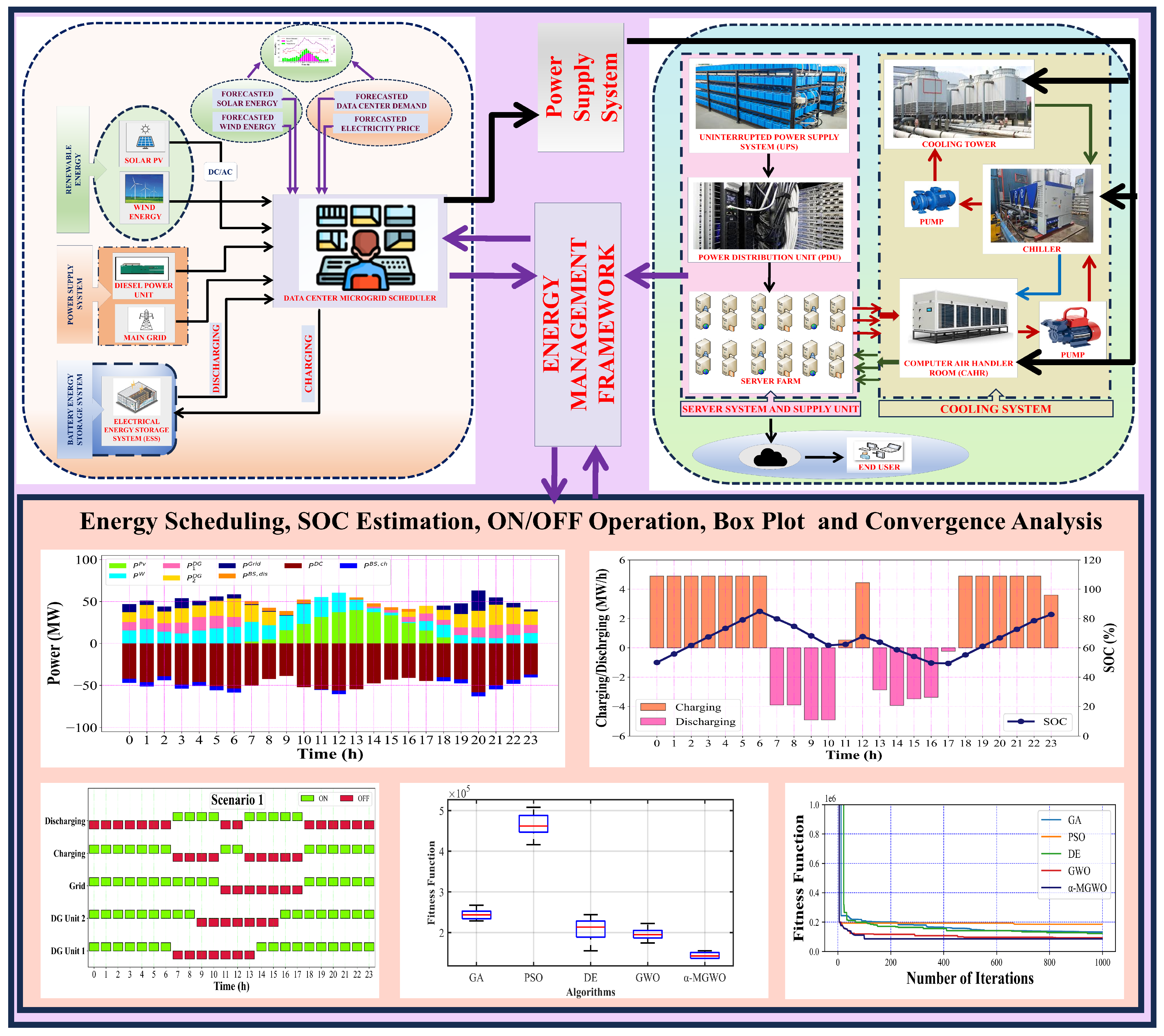
The structure of the DCMG is shown in Figure 1 and consists of two main components: the data center infrastructure and the power supply infrastructure. The data center infrastructure consists of a server farm, a power supply unit (PSU), a power distribution unit (PDU), and a cooling system, which collectively constitute the data center load. The data center facility primarily handles internet data and electrical loads. The electrical load of a data center facility is primarily determined by the amount of internet data being processed by its servers and is influenced by variations in server utilization. Moreover, the other components also play a crucial role in ensuring the reliable operation of the data center. The interconnection of these components is shown in Figure 1. The DCMG also consists of other important components that meet the overall demand of the data center facility, including the power supply infrastructure, whose interconnection is also presented in Figure 1. This power supply infrastructure consists of renewable generation, a conventional DG unit, the main grid, and an electrical energy storage unit to meet the overall DCMG load demand. It is assumed that the data center microgrid owner owns these units. An energy management system (EMS) for the DCMG is designed based on the alpha-refined memetic grey wolf optimizer to achieve optimal operation through a DCMG scheduler while meeting the overall load demand of the data center facility and the energy requirements of other components within the DCMG. Moreover, the EMS scheduling center collects forecasted information on electricity prices, data center loads, solar PV generation, wind generation, and other modeling parameters and constraints, and performs various scheduling operations. The detailed modeling of the data center facility electrical load, the data center microgrid, and the energy management strategy is presented in the following subsections.
Figure 1.
Schematic of data center microgrid energy management framework considering various energy units.
2.1. Modeling of Data Center Electrical Load
2.1.1. Modeling of IT Server Farm
The electrical utilization of the server farm is mainly determined on the basis of the number of servers and the utilization of the servers. The utilization of a server is considered as unitless and ranges from 0 to 1. Therefore, the amount of workload handled at any time instant t is calculated as follows [38,39,40]:
where , , and represent the total, real time, and delay-tolerable IT load at a particular server. The IT load capacity is constrained to its maximum capacity as follows:
The total server power consumption based on servers can be calculated as follows:
where , , and denote the idle and maximum ratings of the server and the power usage effectiveness, respectively.
2.1.2. Local Server Fans
The local cooling fans are integrated with each server to ensure reliable cooling system operation. The power consumption of the fan is calculated as follows [38,39,40]:
where , , , , and denote the cooling fan speed and constants.
2.1.3. Rack Power Consumption Model
The power consumed by the and servers and fans in a rack is determined as follows [38,39,40]:
where , , , and denote the rack power consumption, and the number of servers, racks, and local fans, respectively. The total IT load is then determined by aggregating the power consumed by the racks as follows [38]:
2.1.4. Modeling of Power Conditioning System (PCS)
A PCS consists of three main components, the PSU, PDU, and UPS. The modeling of the PSU is not the scope of this study and hence it is directly measured as 1% of the peak power consumption of data center. The power loss from the PDU and UPS can be evaluated as follows [38,39,40]:
where , , , and , , and denote the power losses, idle powers, and power loss coefficients for the UPS and PDU, respectively. The conduction loss in the cable section is determined as follows [38,39,40]:
where , , and denote the cable resistance, nominal voltage, and power factor, respectively. The total PCS consumption is given as follows [38,39,40]:
2.1.5. Modeling of Cooling System
The amount of electrical power required to remove the heat from a server farm is calculated as follows [38,39,40]:
where , , , , and denote the maximum server farm load, heat removal efficiency, utilization of all servers, air flow, and maximum standard air flow, respectively. The power consumed by a CRAH and chiller units are determined as follows [38,39,40]:
where and represent the idle and required power of CRAH unit, respectively. The power consumption by chiller plant is given as follows [38,39,40]:
where , , and are constants. The total cooling system power required at any instant of time t is calculated as follows [38,39,40]:
2.1.6. Miscellaneous Power Consumption
In data centers, the security system, lighting, monitoring and control, networking infrastructure, etc., consume about 6% of the maximum power demand. This is evaluated on the basis of physical size of data center. The miscellaneous power consumption in the data center is determined as follows [40,41]:
where denotes the maximum power demand of the data center.
2.1.7. Total Data Center Power Consumption
The total power consumption at any time instant t is given as
In the following subsection, the detailed modeling of the data center microgrid, considering various energy units such as diesel units, an energy storage system, a grid system, and a renewable energy system comprising solar PV and wind energy, is explained.
2.2. Modeling of Data Center Microgrid
2.2.1. Diesel Generator Unit and Grid System and Constraints
The diesel generator power output is constrained within its maximum and minimum operating boundaries as below [42,43]:
where denotes the power output from the i-th DG unit. and represent the minimum and maximum limits of the k-th DG unit. The ramp-up and ramp-down rates for the DG unit are described as follows [42,43]:
where denotes the power output of the k-th DG unit in MW at the -th time instant. and represent the ramp-up and ramp-down rates in MW/h, respectively, for the k-th DG unit. The power supplied by the main grid is constrained as follows [42,43]:
where represents the power supplied by the main grid in MW. and denote the maximum and minimum boundaries for the operation of the grid.
2.2.2. Battery Energy Storage System (BESS) and Constraints
In the BESS, the state of charge () is presented based on the following calculations [44]:
where and represent the states of charge at the t-th and -th instant of time, respectively. and denote the rates of discharging and charging, respectively, in MW/h. represents the capacity of the BESS in MWh. The operation of the BESS is constrained by the maximum and minimum limits of the energy storage capacity, state of charge, and discharging and charging rates at different intervals of time to ensure safe operation. The constraints are described as follows [42,43,44]:
where and are the maximum allowable discharging and charging rates in MW/h for the BESS. and represent the binary (OFF/ON) operation for discharging and charging, respectively. The BESS is not allowed to perform discharging and charging at the same instant of time; therefore, its operation is constrained as follows [42,43]:
2.2.3. Renewable Generation and Curtailment Constraints
The constraints of RE generation and RE curtailment for solar PV and wind generation are modeled as follows [42,43]:
where and denote the solar PV and wind generation available. and represent the maximum solar PV and wind power generation. Moreover, the RE curtailment is modeled as follows:
where and represent the solar PV and wind curtailment. and represent the solar PV and wind generation utilization meeting all types of demand. The constraints of the RE curtailments are represented as follows:
2.2.4. Power Balance Constraints
The power supply should be sufficient and satisfy the demand for all of the time intervals as follows [42,43]:
2.3. Optimization Framework for Energy Management System of Data Center Microgrid
The effective operation of the DCMG must ensure the fulfillment of the overall demands, with optimal scheduling of different integrated energy units, while meeting all the constraints of the DCMG. This study introduces an objective function that aims to minimize the net cost involved in the operation of the DCMG, subject to operation constraints. The proposed optimization framework integrates four different costs: operational, degradation, switching, and curtailment costs. The horizon of this optimization framework is set as 24 h, and it can be extended even longer than this by including more parameters based on the forecasted information. This study does not address the stochastic behavior and uncertainties related to renewable energy sources. These factors involve inherent variability and unpredictability, and handling such uncertainties requires advanced stochastic and robust optimization techniques, which are outside the scope of the current work. This study strictly focuses on reducing the operational cost and carbon emissions of DCMG based on the objective functions, formulated as follows:
and represent the total cost and carbon emissions involved in the overall operation of the DCMG. , , and represent the operational, degradation, and switching costs, respectively, for different energy units of the DCMG at the t-th time interval. represents the curtailment cost for renewable generation at interval t. and represent the emission from the DG units and the grid, respectively. The different types of costs are explained in the next subsections. For solving the multi-objective problem of energy management of the DCMG, it is converted into a weighted sum of both the objective functions and can be rewritten as
The objective functions and are normalized using the following equations:
where w denotes the weight of the objective function and ranges from 0 to 1. and represent the normalized cost and emission functions. and represent the minimum values of the cost and emission functions, whereas and represent the maximum values of the cost and emission functions, respectively.
2.3.1. Operational Cost
The operational cost involves the cost associated with operating different energy units at any time instant t, and is described as follows:
where ($) and ($/MW) represent the cost coefficient for operation of the DG units. , , and represent the operation cost associated with solar PV, wind generation, and the grid in ($/MW).
2.3.2. Degradation Cost
The degradation cost involves the degradation of the battery-based energy storage system. The degradation cost is evaluated as follows [44]:
where represents the degradation cost in ($/MW) associated with the BESS. The degradation cost of the BESS is calculated based on its capacity , round trip efficiency , discharging and charging, state of charge, capital value and residual value, and depth of discharge (). The degradation cost is evaluated as follows:
where A and D are empirical constants.
2.3.3. Switching Cost
The switching cost is associated with ON/OFF operation. It includes the start up and shut down costs and is evaluated as follows:
where , , and represent the start up and shut down of the DG unit at the t-th time instant, respectively.
2.3.4. Curtailment Cost
The curtailment cost is associated with the reduction in RE generation in case of oversupply or low demand in the DCMG. The curtailment cost is represented as follows:
where and represent the curtailment costs for solar PV and wind generation.
2.3.5. Emissions from DG Units and Grid
The emissions associated with the DG units and the grid are expressed as follows:
where represents the emissions (kg/MW) from the k-th DG unit and denotes the emissions (kg/MW) from the grid.
3. Algorithm Design for Energy Management of Data Center Microgrid
3.1. Grey Wolf Optimizer
The original GWO is a nature-inspired, population-based metaheuristic algorithm developed by Mirjalili et al. [45] in 2014. It simulates the social hierarchy and hunting behavior of grey wolves in nature. In GWO, the alpha, beta, and delta wolves lead the hunting process. The remaining wolves (omega) follow the leaders. The algorithm alternates between exploration (searching for prey) and exploitation (attacking prey). The alpha () solutions are considered the best solutions, whereas the beta () and delta () solutions are considered the second- and third-best solutions. Lastly, the leftover solutions are considered as omega () and they follow the mentioned three wolves. The modeling of the GWO algorithm proceeds as follows [45].
3.1.1. Encircling Prey
The hunting of grey wolves involves the encircling of the prey, which is modeled as follows:
where and denote the position vectors of the prey and the grey wolf. t denotes the current iteration count. and denote the coefficient vectors and are calculated as follows [45]:
where linearly decreases from 2 to 0 over the iteration course. and represent random vectors in .
3.1.2. Hunting
The following modeling equations are used in this regard [45]:
3.1.3. Attacking the Prey
Grey wolves complete hunting by attacking the prey when they become immobile. This process is replicated in GWO by decreasing the value of with the iteration course, which simultaneously narrows the range of . takes a random value in the range . This mechanism means that the wolves are guided by the best solutions found so far and move closer to optimal points in the search space. However, while this encircling and attack strategy enables exploitation, GWO can become trapped in local optima. Although the current approach offers some exploration capabilities, additional mechanisms are needed to further enhance the algorithm’s ability to search new regions and avoid stagnating in suboptimal solutions [45]. It may suffer from premature convergence and limited local search capability, especially in complex or high-dimensional optimization problems. Therefore, it is hybridized with a local optimizer for the fine-tuning of alpha values in the optimization results in the next subsection; this is termed the alpha-refined memetic grey wolf optimizer.
3.2. Alpha-Refined Memetic Grey Wolf Optimizer (-MGWO)
A memetic algorithm (MA) is a hybrid optimization method that combines a global search algorithm with local refinement strategies. The aim is to maintain the global exploration capability and improve the solution quality by intensifying the search around promising areas (exploitation). -MGWO enhances the standard GWO by integrating local search techniques within the optimization process. This hybridization aims to overcome GWO’s weaknesses and balance the exploration and exploitation trade-off more effectively. The process of development of a memetic algorithm includes the refinement of the best population and incorporates an adaptive strategy for enhanced convergence and robustness of the algorithm. In this paper, the best obtained solutions are refined using a local search strategy for further improvement in the results. In this study, the local optimizer is modeled as follows.
Consider a nonlinear objective function , where the vector of decision variables is represented as
and the corresponding optimization problem is expressed as
subject to the operational constraints of the data center microgrid. The best solution obtained by the grey wolf optimizer (alpha wolf) at the t-th iteration is denoted by
To enhance the exploitation capability of GWO, the alpha solution is refined using local search and local refinement; the problem is formulated as
subject to
where d denotes the local search radius, which is considered as 0.1 in this study, and and represent the inequality and equality constraints of the proposed DCMG energy management problem, respectively. The refined alpha solution is accepted according to
The updated alpha solution is then returned to the grey wolf optimizer for the next iteration. The pseudo code for developed -MGWO is presented in Algorithm 1.
| Algorithm 1 Alpha-Refined Memetic Grey Wolf Optimizer (-MGWO) |
|
4. Numerical Study: Results and Discussions
In this section, a detailed discussion of a DCMG system along with its emission-aware cost-minimization-based energy management framework is presented. The -MGWO algorithm and other four algorithms, genetic algorithm (GA), grey wolf optimizer (GWO), particle swarm optimization (PSO), and differential evolution (DE), are employed to solve the optimization problem of DCMG energy management. All formulations are performed on a computer with Intel(R) Core(TM) i7-1165G7 CPU@2.80 GHz and 16 GB memory. The details about the simulation setup, experimental settings, convergence and statistical analyses of the developed algorithm, scheduling of different scenarios, and a sensitivity analysis are discussed in the next subsections.
4.1. Simulation and Experimental Setup
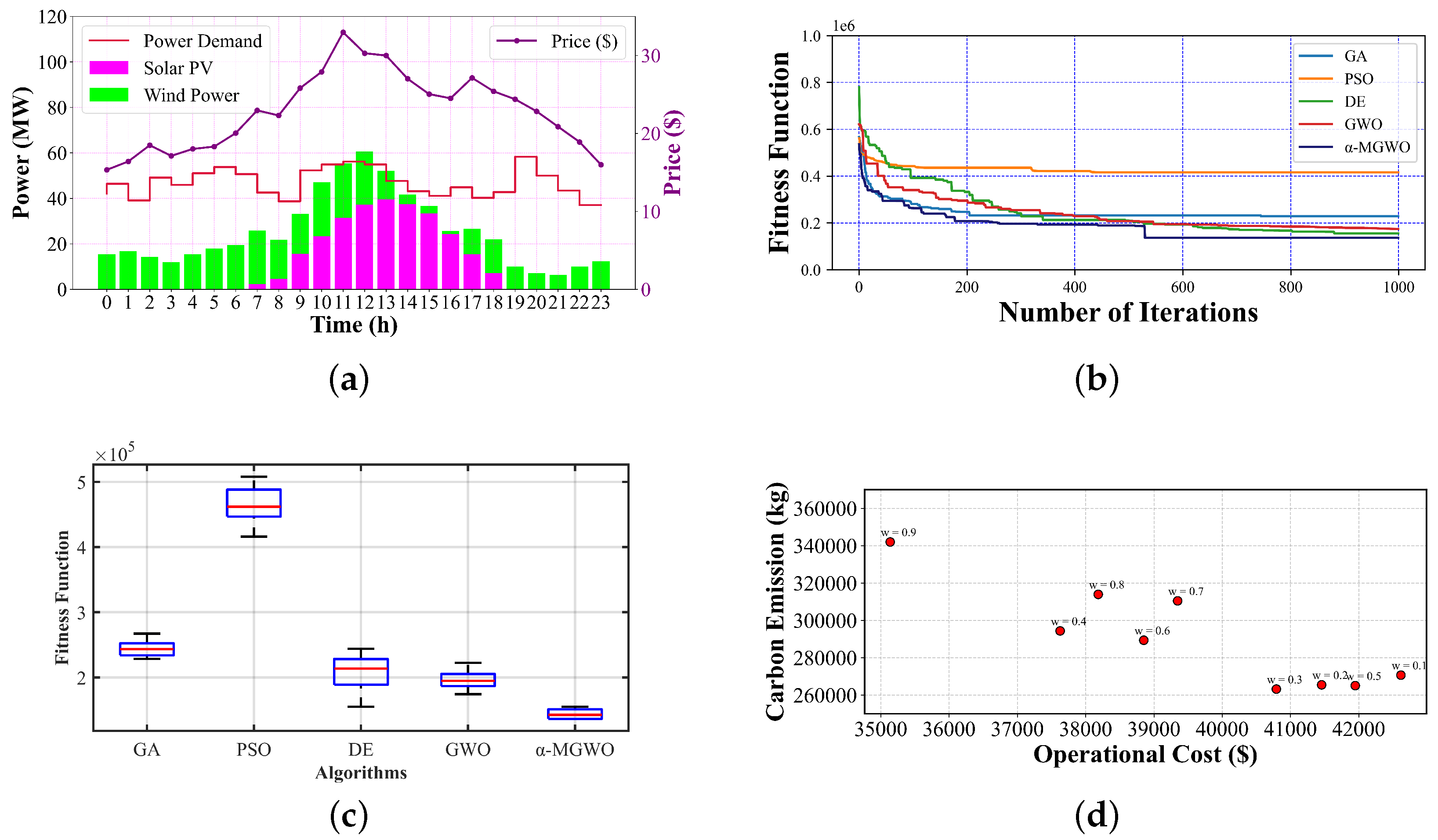
This subsection discusses the various steps involved in simulating and setting up the experimental settings for the developed energy management framework for a DCMG. In this work, various parameters for the data center, along with the IT workload dataset, were taken from [43,46]. There are a total of servers in the given data center, with a PUE value of 1.2. The peak power consumption of the given data center is (MW), and the total data center power demand is calculated based on (21)–(34). The profiles of the data center power demand, solar PV, and wind generation are illustrated in Figure 1 and have been taken from [43]. Moreover, the electricity price based on hourly variation is also shown in Figure 1 and has been taken from the PJM market [43]. The various parameters, along with operation cost, minimum and maximum operation limits of the DG units, the BESS, and the grid, are tabulated in Table 2, and were taken from [43]. Additionally, the costs for the operation of solar PV, wind, degradation of the BESS, and RE curtailment were obtained from [44]. The primary objective of the developed framework is to minimize the total day-ahead cost and carbon emissions of DCMG operations. Equation (37) presents the objective function and is formulated as the minimization of a weighted sum of both objective functions, i.e., operational cost and carbon emissions, as an optimization problem constrained to the operation of different energy units, as in (21)–(34). To solve the developed weighted sum optimization problem, an -MGWO algorithm is proposed, which hybridizes the GWO and a local optimizer for fine-tuning the results. The formulation of the developed -MGWO is presented in Algorithm 1 based on (50)–(63). The value of w is set at 0.4 and a sensitivity analysis based on variation of the weight w is presented in Figure 2d, where it can be seen that the optimum obtained value of w in the range 0 to 1 is 0.4. In this work, four scheduling scenarios are studied to show the impact of different scenarios on DCMG operation, and the value of w for each scenario is set at 0.4. The operational settings of these scenarios are as follows:
Table 2.
Operational and cost parameters for DCMG operation [38,40,44].
Figure 2.
(a) Data center power demand and market electricity price; (b) solar PV and wind generation; (c) box plot analysis using -MGWO and other algorithms for data center energy management; (d) analysis of weight factor (w) for carbon emission and operational cost.
- Scenario 1: Scenario 1 serves as a base case study that includes all energy units, such as DG units, the main grid, BESS, solar PV, and wind generation units, connected to the DCMG.
- Scenario 2: This scenario disconnects the solar PV unit from the power supply to the DCMG. The operating units are DG units, main grid, BESS, and wind generation units.
- Scenario 3: This scenario disconnects the wind power generation unit from the power supply to the DCMG. The operating units are DG units, main grid, BESS, and solar PV generation units.
- Scenario 4: This scenario operates only on the main grid and the BESS unit, disconnecting all other units, such as DG units, solar PV, and wind generation units, from the DCMG.
In this work, Scenario 1 serves as the base case study, and calculations of percentage increases in carbon emissions are made with respect to Scenario 1. Moreover, a sensitivity analysis based on the impact of a fixed market price and the operation of the DCMG without RE is also presented. The scheduling results for the different scenarios, convergence curves, and a statistical analysis are explained in the following subsections.
4.2. Convergence and Statistical Analyses
This subsection presents the convergence and statistical analyses for the DCMG optimization framework using -MGWO and other algorithms. This analysis is based on 30 independent simulations for each algorithm with the same population size (50) and iteration count (1000). The statistical analysis includes metrics such as the minimum (Min), maximum (Max), average, and standard deviation (Std. Dev) of the fitness function obtained for each algorithm, based on 30 simulations. These analyses are presented based on the fitness function presented in Equation (37) and are evaluated for Scenario 1. A convergence analysis is presented in Figure 2b and elucidates that -MGWO converges faster that the other algorithms and avoids local minima to reach to the optimal solution. Moreover, the original GWO fails to converge faster and becomes trapped in local minima. The GA, DE, and PSO algorithms exhibit premature convergence and also become trapped in local minima. In contrast, PSO shows the worst scenario of convergence, being far away from the optimal solution, and thus fails to reach the minimum optimal fitness. Therefore, the convergence analysis demonstrates the convergence speed of the -MGWO algorithm in reaching an optimal solution and effectively solving the DCMG energy management problem. Moreover, the results obtained by the -MGWO algorithm are compared with other hybrid metaheuristic algorithms like memetic grey wolf optimizer (MGWO); hybrid grey wolf optimizer (GWO) and Nelder–Mead (NM), known as GWO-NM; hybrid weighted means of vectors (INFO) and Nelder–Mead (NM), known as the INFONM algorithm; and hybrid grey wolf optimizer (GWO) and the whale optimization algorithm (WOA).
Additionally, the statistical analysis of -MGWO and the other algorithms is presented for the base case study, specifically Scenario 1. The statistical analysis includes the statistical metrics such as the minimum (Min), maximum (Max), average, and standard deviation (Std. Dev.) values for the fitness function presented in Equation (37) obtained using each algorithm. This analysis is based on 30 independent simulations for each algorithm. The best value among these 30 runs is considered the minimum value, while the worst value is considered the maximum value. Table 3 tabulates the statistical analysis for DCMG operation using -MGWO and the other metaheuristic algorithms, and it is observed that -MGWO obtains the optimal value for the fitness function among the algorithms. Also, it is observed that -MGWO obtains the lowest values for the other statistical measures (Max, Average, Std. Dev.) in comparison to the other algorithms. Furthermore, the analysis presented in Table 4 demonstrates that the -MGWO algorithm outperforms these algorithms and gives a lower value for all statistical indices. Further, the Friedman’s as well as Wilcoxon signed-rank test indicate that the -MGWO algorithm obtains the rank compared to the other algorithms, as shown in Table 5. Thus, this analysis demonstrates that -MGWO more effectively solves the DCMG energy management problem compared to the other algorithms.
Table 3.
Comparative analysis of different metaheuristic algorithms based on statistical indices.
Table 4.
Comparative analysis of different hybrid metaheuristic algorithms with -MGWO algorithm based on statistical indices.
Table 5.
Friedman’s rank as well as Wilcoxon rank test for different metaheuristic algorithms based on fitness function for energy management of data center microgrid.
4.3. Scheduling Results for Different Scenarios
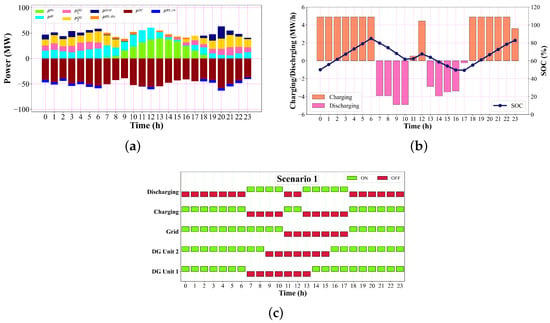
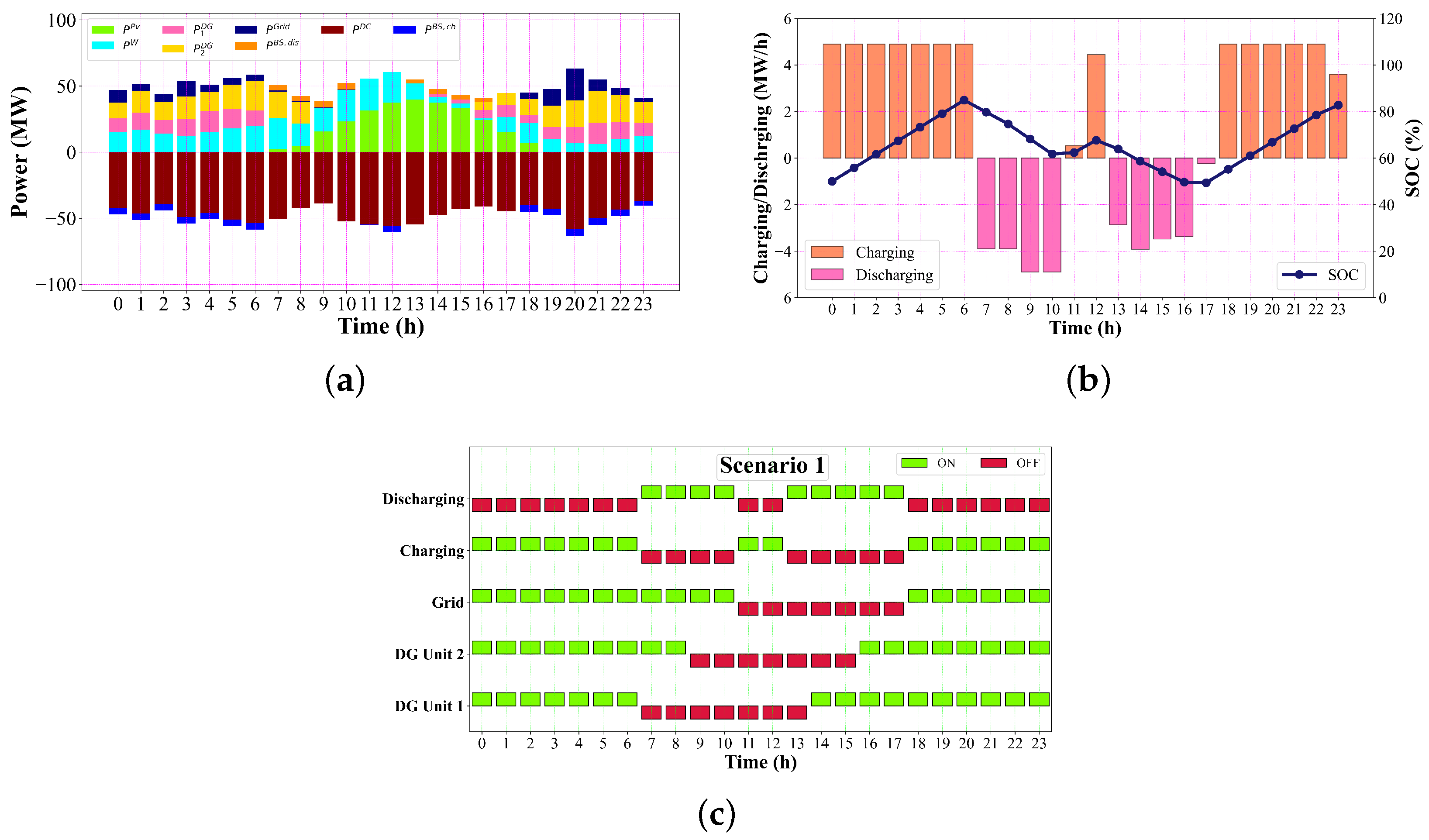
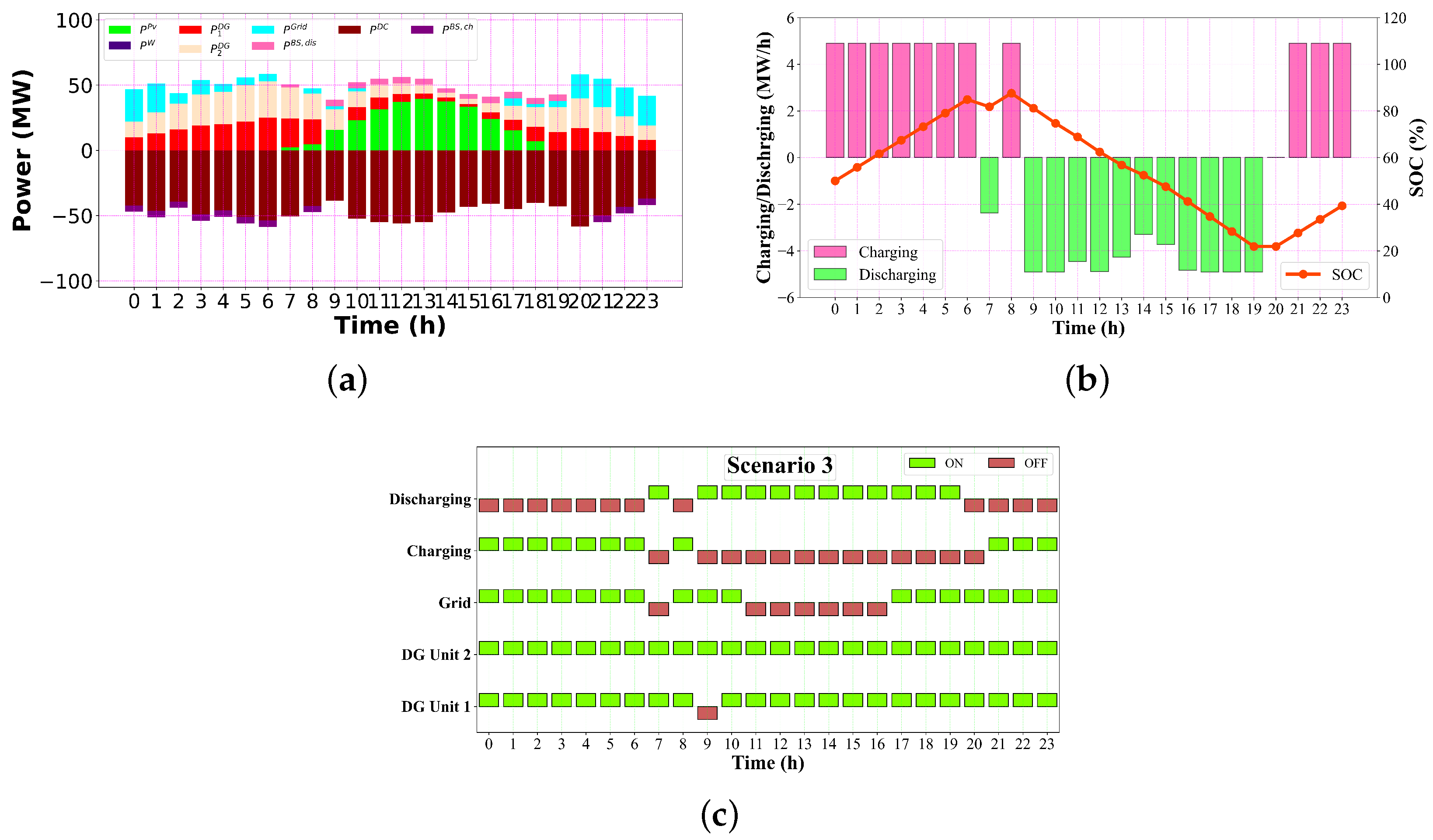
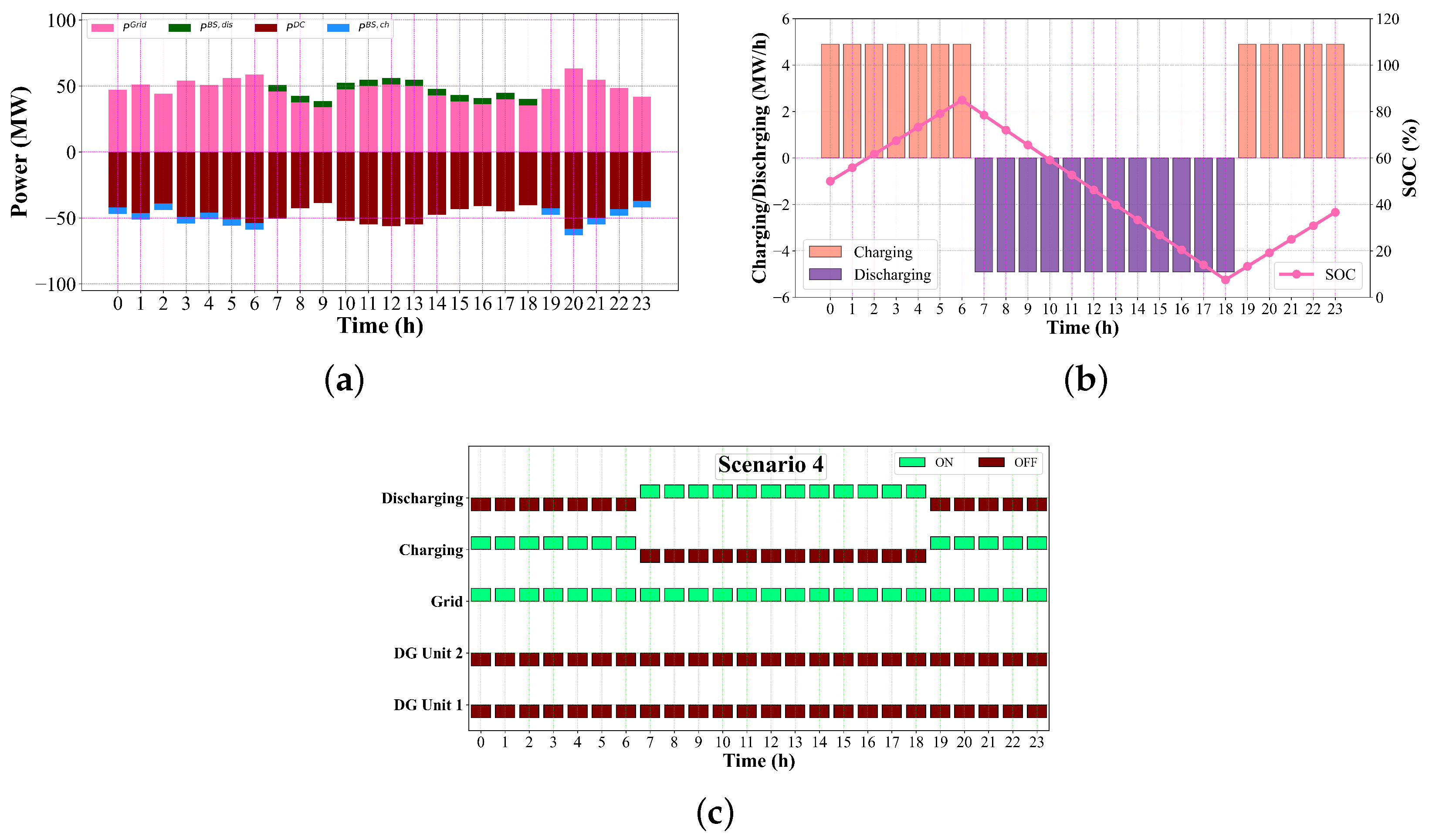
In this subsection, the day-ahead energy scheduling results for all four scenarios are discussed. All scenarios are simulated using the developed -MGWO algorithm. The results are tabulated in Table 6. The energy scheduling results, charging, discharging, SOC estimation, and switching operations for Scenarios 1, 2, 3, and 4 are presented in Figure 3, Figure 4, Figure 5 and Figure 6. It is observed from Figure 3a that a proper energy balance is achieved in all scenarios using the developed -MGWO-based energy management framework. Firstly, the results obtained in the first scenario, i.e., Scenario 1, which serves as the base case of the study, are discussed. The obtained total cost and carbon emissions of operation for this scenario are 37,626.35 ($) and 294,392.08 (kg). In Scenario 1, all energy units are used to fulfill the demand of DCMG operation. Since both solar PV and wind generation participate with full potential, the obtained RE share is observed to be 50.71%. The energy scheduling results, SOC estimation with charging and discharging of the BESS, and switching of different energy units are shown in Figure 3a, Figure 3b, and Figure 3c, respectively. From Figure 3b, it is observed that in Scenario 1, the BESS operates on charging mode during periods of lower grid electricity prices and available renewable generation (0–6 h, 11–12 h, and 18–23 h). The discharging mode of the BESS for Scenario 1 works only during periods of higher electricity prices. The also firstly increases during charging mode and then decreases during discharging mode, up to 40%, as shown in Figure 3b. Moreover, from Figure 3c, the DG units are in the OFF state during periods of lower grid prices and higher available renewable energy (7–15 h). In contrast, they operate in the ON state for the rest of the scheduling hours to fulfill the energy demand of the DCMG.
Table 6.
Results for obtained total cost, weighted objective function value, and emissions for different scenarios and sensitivity analysis.
Figure 3.
Scenario 1: (a) Scheduling of energy units; (b) SOC, charging and discharging of BESS; (c) switching operation of different energy units.
Figure 4.
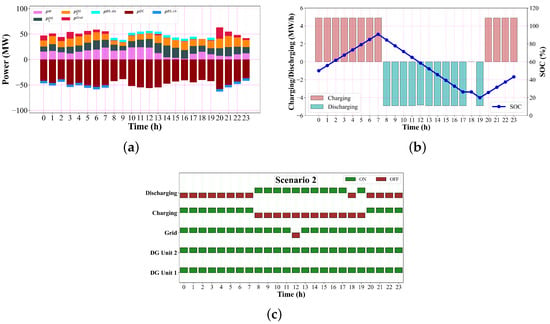
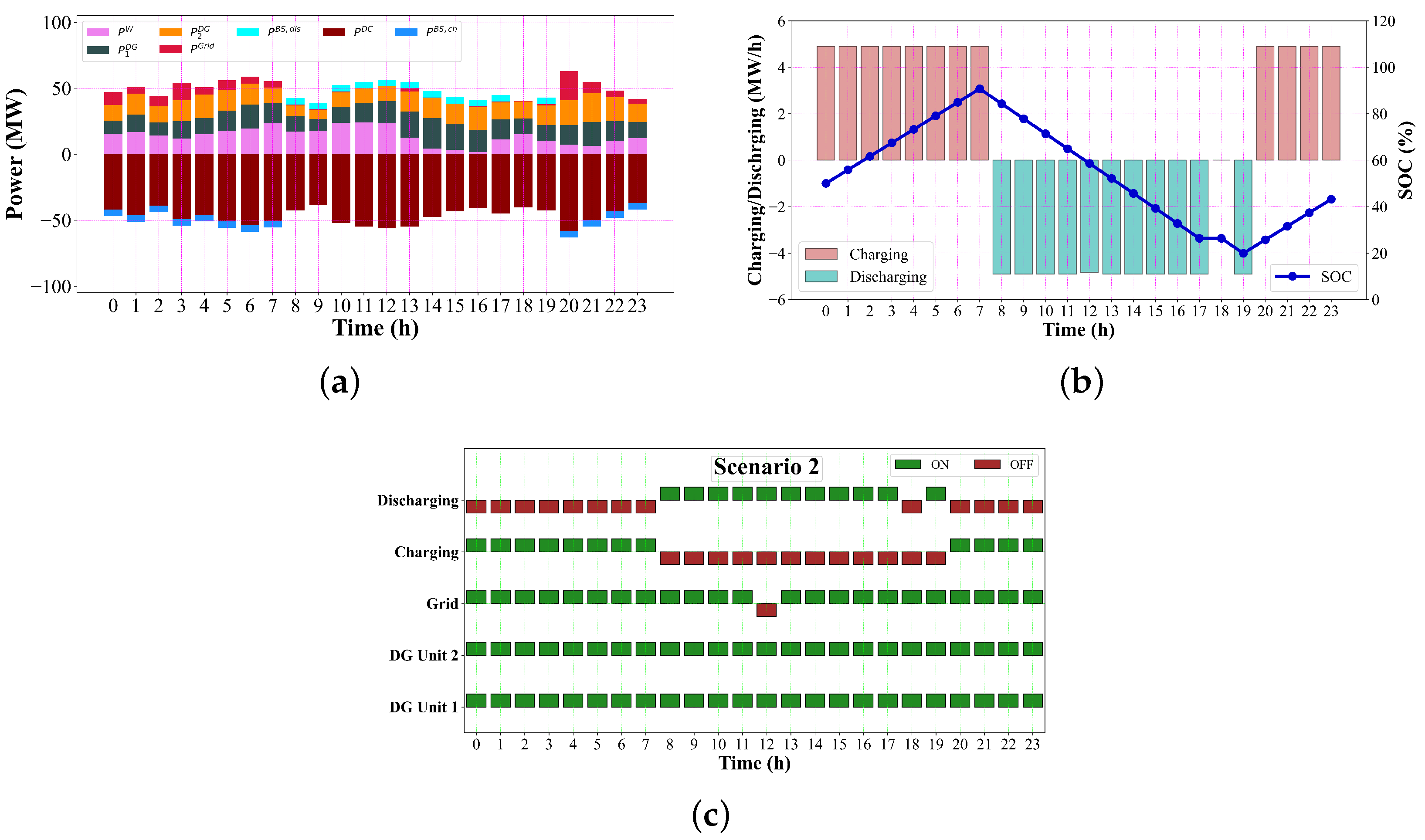
Scenario 2: (a) Scheduling of energy units; (b) SOC, charging and discharging of BESS; (c) switching operation of different energy units.
Figure 5.
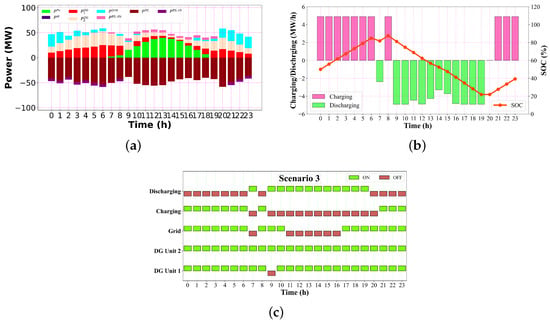
Scenario 3: (a) Scheduling of energy units; (b) SOC, charging and discharging of BESS; (c) switching operation of different energy units.
Figure 6.
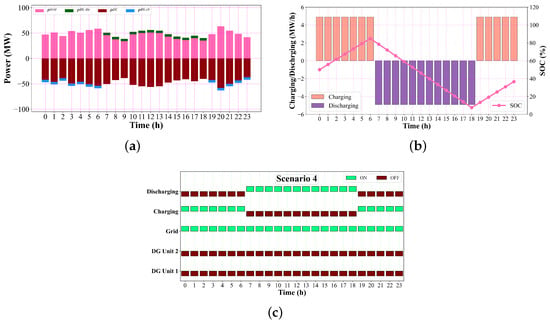
Scenario 4: (a) Scheduling of energy units; (b) SOC, charging and discharging of BESS; (c) switching operation of different energy units.
The scheduling results for Scenario 2 along with the SOC and switching operation are shown in Figure 4a, Figure 4b, and Figure 4c, respectively. The obtained total cost of operation for this scenario is 55,753.11 ($) and 392,439.54 (kg), which is an increase of 33.30% in terms of emissions with respect to Scenario 1. In this scenario, solar PV is not connected to fulfill the energy demand of the DCMG; therefore, the RE share is obtained as 28.17%. It is observed from Figure 4a that a proper energy balance is obtained using the -MGWO algorithm. In this scenario, the BESS shows a larger number of discharging operations than in Scenario 1 during periods of high electricity prices from the main grid (8–17 h and 19 h), as shown in Figure 4b. However, charging is observed in the periods 0–6 h and 20–23 h. It is observed from Figure 4c that the DG units remain in the ON state throughout the scheduling operation due to the limited availability of RE generation. Also, the main grid is in the ON state due to less available RE generation and the ramping constraints of the DG units.
Scenario 3 considers all the energy units except for wind generation, and the scheduling results along with SOC and switching operations are illustrated in Figure 5a, Figure 5b, and Figure 5c, respectively. The obtained total operation cost and carbon emissions of the DCMG are 55,267.78 ($) and 464,858.19 (kg), which is an increase of 57.9% in terms of emissions with respect to Scenario 1. In this scenario, solar PV acts as the only RE generation source; therefore, the percentage of RE share is obtained as 23.00%, which is a bit lower compared to Scenario 2. From Figure 5a, it is observed that a proper energy balance is obtained and meets the demands of DCMG operation. In this scenario, BESS charging and discharging are scheduled at different operation hours, as shown in Figure 5b. It is observed that the BESS discharges during high grid prices (7–19 h). From Figure 5c, it is observed that DG unit 1 is ON during the whole operation as the main grid is in the OFF state (11–15 h) during the same scheduling period. This is due to more available RE generation from the solar PV unit.
Scenario 4 considers only the BESS and the main grid connected to the DCMG, as all other components, such as the DG unit, solar PV, and wind generation units, are disconnected from the DCMG operation. The obtained total cost and carbon emissions of operation for this scenario are 27,562.93 ($) and 1,102,728.93 (kg), which is an increase of 274.57% in terms of emissions with respect to Scenario 1. Since neither solar PV nor wind generation units are connected to the DCMG operation, there is a zero-percentage RE share in this scenario. Figure 6a, Figure 6b, and Figure 6c present the scheduling, SOC, and switching operation of the grid and BESS, respectively. From Figure 6b, it is observed that the BESS performs its discharging operation during the period of peak electricity prices in the main grid (7–18 h). The SOC decreases up to 5% and linearly decreases during discharging mode. Moreover, from Figure 6c it is observed that the main grid remains in the ON state throughout the entire scheduling period, as the BESS alone is unable to fulfill the energy demand of DCMG operation.
4.4. Sensitivity Analysis
In the sensitivity analysis, the impact of a fixed market price and DCMG operation without RE generation is analyzed using the -MGWO. Firstly, DCMG operation without RE generation is discussed, and it includes the operation of DG units, BESS, and the main grid. The obtained total cost and carbon emissions are 61,249.02 ($) and 752,100.29 (kg) respectively, which is an increase of 155.47% in terms of carbon emissions with respect to Scenario 1 and has a zero-percentage RE share. From this, it is observed that there is a significant increase in operational cost and carbon emissions without RE compared to the base case, i.e., Scenario 1. This is because RE energy is available at a lower price than other energy units and does not contribute to any type of carbon emissions. Moreover, other units, such as DG units and the BESS, incorporate higher operation costs, switching costs, and degradation costs, which increases the operation cost of DCMG operation without RE and DG units and contributes for more carbon emissions. Additionally, due to fluctuating market prices, the operation of the DCMG involves the use of DG units and a BESS, along with the main grid, during periods of lower market prices. Secondly, the electricity market price is fixed and averaged over the entire variable market price. The DCMG operation is entirely based on Scenario 1, except that the market price is fixed. When the market price is fixed at the average value, the obtained total cost of DCMG operation is 40,500.96 ($) and 301,123.24 (kg), which is an increase of 2.28% in terms of emissions with respect to Scenario 1, with 49.71% from RE generation. Therefore, this analysis indicates that Scenario 1 is the most favorable scenario for the operation of the DCMG, offering lower costs and carbon emissions, and a higher contribution from RE generation.
5. Conclusions
In this paper, an emission-aware cost-minimization-based data center microgrid energy management framework that considers DG units, a BESS, and the main grid is formulated. Firstly, a detailed electrical load model for the data center is presented. An optimization framework for DCMG energy management is then developed using the newly proposed -MGWO algorithm. A multi-objective function, which considers the minimization of the day-ahead total cost and carbon emissions of DCMG operation, is formulated and solved using the developed -MGWO and other metaheuristic algorithms. Detailed convergence and statistical analyses reveal the convergence speed, effectiveness, and robustness of the developed -MGWO compared to the other algorithms. Four scenarios and a sensitivity analysis based on a fixed market price and DCMG operation without RE are considered to demonstrate the effectiveness of -MGWO in achieving optimal energy management. The analysis concludes that Scenario 1 is the most favorable scenario for the operation of the DCMG, offering lower carbon emissions and a higher contribution from RE generation. Moreover, the balanced scheduling of different energy units and the obtained analysis verify the effectiveness of -MGWO over other algorithms in solving the DCMG energy management problem. These results demonstrate the sustainability potential of the proposed DCMG energy management framework, by jointly considering operational cost, carbon emissions, and renewable energy utilization, and also the proposed approach provides a balanced assessment of the economic and environmental performance of DCMG operation. The higher contribution of renewable energy together with lower carbon emissions indicates that the proposed scheduling strategy can support more sustainable energy utilization while maintaining the operational constraints of the DCMG. The developed energy management optimization framework could be utilized to perform long-term operation of DCMGs and to analyze the flexibility of various components. The proposed energy management framework is based on a deterministic optimization model using the available forecasted solar PV generation, wind generation, electricity prices, and data center load over a 24 h scheduling horizon. A detailed consideration of uncertainty, using multiple real-world case studies, and a computational complexity analysis could be implemented in future studies for the development of robust optimization for DCMG energy management.
Author Contributions
Conceptualization, R.K. (Rahul Khajuria), R.K. (Rajesh Kumar), R.L., R.T., G.S. and V.R.; Methodology, R.K. (Rahul Khajuria); Validation, R.K. (Rahul Khajuria); Formal analysis, R.K. (Rahul Khajuria); Investigation, R.K. (Rahul Khajuria); Writing—original draft, R.K. (Rahul Khajuria); Writing—review & editing, Rahul Khajuria, R.K. (Rajesh Kumar), R.L., R.T., G.S. and V.R.; Visualization, R.K. (Rahul Khajuria). All authors have read and agreed to the published version of the manuscript.
Funding
This research received no external funding.
Institutional Review Board Statement
Not applicable.
Informed Consent Statement
Not applicable.
Data Availability Statement
The original contributions presented in this study are included in the article. Further inquiries can be directed to the corresponding author.
Conflicts of Interest
The authors declare no conflicts of interest.
References
- Khajuria, R.; Lamba, R.; Kumar, R. A Multi-Objective Approach for Energy Management of Data Center Microgrid Considering Carbon Emission and Operational Cost. In Proceedings of the 2024 IEEE International Conference on Power Electronics, Drives and Energy Systems (PEDES), Mangalore, India, 18–22 December 2024; IEEE: Piscataway, NJ, USA, 2024; pp. 1–6. [Google Scholar]
- Ding, Z.; Chen, S.; Sun, Y.; Shi, K.; Wang, J.; Chen, S.; Xiao, T.; Wang, Y.; Wei, X. Data Center Job Scheduling and Energy Management under Uncertain Environments. IEEE Trans. Ind. Appl. 2025, 61, 5489–5500. [Google Scholar] [CrossRef] [Scilit]
- He, Y.; Fan, J.; Lin, J.; Li, Z.; Zhang, J.; Tang, W.; Yang, Q. Two-stage robust planning of data center microgrid considering batch load flexibility and multi-energy complementarity. Energy Convers. Manag. X 2025, 28, 101266. [Google Scholar] [CrossRef] [Scilit]
- Cui, Y.; Cheng, Y.; Zhu, H.; Zhao, Y.; Zhong, W. Stochastic optimization for capacity configuration of data center microgrid thermal energy management equipment considering flexible resources. Int. J. Electr. Power Energy Syst. 2024, 160, 110132. [Google Scholar] [CrossRef] [Scilit]
- Yang, T.; Jiang, H.; Hou, Y.; Geng, Y. Carbon management of multi-datacenter based on spatio-temporal task migration. IEEE Trans. Cloud Comput. 2021, 11, 1078–1090. [Google Scholar] [CrossRef] [Scilit]
- Shehabi, A.; Hubbard, A.; Newkirk, A.; Lei, N.; Siddik, M.A.B.; Holecek, B.; Koomey, J.; Masanet, E.; Sartor, D.; Smith, S.J. 2024 United States Data Center Energy Usage Report; Lawrence Berkeley National Laboratory: Berkeley, CA, USA, 2024. [Google Scholar]
- Zhou, K.; Fei, Z.; Lu, X. Optimal energy management of internet data center with distributed energy resources. IEEE Trans. Cloud Comput. 2022, 11, 2285–2295. [Google Scholar] [CrossRef] [Scilit]
- Wang, Y.; Yang, Z.; Zhao, X.; Liu, H.; Wang, D.; Liu, C. Fine-grained modeling and coordinated scheduling of source-load with energy-intensive electro-fused magnesium loads. IEEE Access 2024, 12, 47702–47712. [Google Scholar] [CrossRef] [Scilit]
- Liu, L.; Shen, X.; Chen, Z.; Sun, Q.; Wennersten, R. Optimal energy management of data center micro-grid considering computing workloads shift. IEEE Access 2024, 12, 102061–102075. [Google Scholar] [CrossRef] [Scilit]
- Li, F.; Zhang, Y.; Xi, J.; Liu, Y.; Yan, M. Real-time Energy Management Method for Data Center Considering Shiftable Workload and Renewable Energy. Recent Adv. Electr. Electron. Eng. 2025, 18, 1372–1385. [Google Scholar] [CrossRef] [Scilit]
- Wang, R.; Wu, R.; Liu, L.; Yi, C.; Zhu, K.; Wang, P.; Niyato, D. Joint Energy and Computation Workload Management for Geo-distributed Data Centers. IEEE Trans. Green Commun. Netw. 2025, 9, 2115–2128. [Google Scholar] [CrossRef] [Scilit]
- Li, J.; Qi, W. Toward optimal operation of internet data center microgrid. IEEE Trans. Smart Grid 2016, 9, 971–979. [Google Scholar] [CrossRef] [Scilit]
- Wang, P.; Cao, Y.; Ding, Z. Resources planning strategies for data center microgrid considering water footprints. In Proceedings of the 2018 2nd IEEE Conference on Energy Internet and Energy System Integration (EI2), Beijing, China, 20–22 October 2018; IEEE: Piscataway, NJ, USA, 2018; pp. 1–6. [Google Scholar]
- Qi, W.; Li, J. Towards optimal coordinated operation of distributed internet data center microgrids. In Proceedings of the 2016 IEEE Power and Energy Society General Meeting (PESGM), Boston, MA, USA, 17–21 July 2016; IEEE: Piscataway, NJ, USA, 2016; pp. 1–5. [Google Scholar]
- Gnibga, W.E.; Blavette, A.; Orgerie, A.C. Renewable energy in data centers: The dilemma of electrical grid dependency and autonomy costs. IEEE Trans. Sustain. Comput. 2023, 9, 315–328. [Google Scholar] [CrossRef] [Scilit]
- Chen, T.; Zhang, Y.; Wang, X.; Giannakis, G.B. Robust workload and energy management for sustainable data centers. IEEE J. Sel. Areas Commun. 2016, 34, 651–664. [Google Scholar] [CrossRef] [Scilit]
- Yu, L.; Jiang, T.; Cao, Y.; Zhang, Q. Risk-constrained operation for Internet data centers in deregulated electricity markets. IEEE Trans. Parallel Distrib. Syst. 2014, 25, 1306–1316. [Google Scholar] [CrossRef] [Scilit]
- Ghamkhari, M.; Wierman, A.; Mohsenian-Rad, H. Energy portfolio optimization of data centers. IEEE Trans. Smart Grid 2016, 8, 1898–1910. [Google Scholar] [CrossRef] [Scilit]
- Wu, M.; Yan, R.; Zhang, J.; Fan, J.; Wang, J.; Bai, Z.; He, Y.; Cao, G.; Hu, K. An enhanced stochastic optimization for more flexibility on integrated energy system with flexible loads and a high penetration level of renewables. Renew. Energy 2024, 227, 120502. [Google Scholar] [CrossRef] [Scilit]
- Lin, W.T.; Chen, G.; Li, H. Carbon-aware load balance control of data centers with renewable generations. IEEE Trans. Cloud Comput. 2022, 11, 1111–1121. [Google Scholar] [CrossRef] [Scilit]
- Zhao, D.; Zhou, J. An energy and carbon-aware algorithm for renewable energy usage maximization in distributed cloud data centers. J. Parallel Distrib. Comput. 2022, 165, 156–166. [Google Scholar] [CrossRef] [Scilit]
- Chen, Y.T.; Luo, L.L.; Guo, D.K.; He, Q. Carbon-Aware Energy Cost Optimization of Data Analytics Across Geo-Distributed Data Centers. J. Comput. Sci. Technol. 2025, 40, 654–670. [Google Scholar] [CrossRef] [Scilit]
- Ding, Z.; Xie, L.; Lu, Y.; Wang, P.; Xia, S. Emission-aware stochastic resource planning scheme for data center microgrid considering batch workload scheduling and risk management. IEEE Trans. Ind. Appl. 2018, 54, 5599–5608. [Google Scholar] [CrossRef] [Scilit]
- Liu, J.; Xu, Z.; Wu, J.; Liu, K.; Sun, X.; Guan, X. Optimal planning of internet data centers decarbonized by hydrogen-water-based energy systems. IEEE Trans. Autom. Sci. Eng. 2022, 20, 1577–1590. [Google Scholar] [CrossRef] [Scilit]
- Hao, X.; Liu, P.; Deng, Y. Joint optimization of operational cost and carbon emission in multiple data center micro-grids. Front. Energy Res. 2024, 12, 1344837. [Google Scholar] [CrossRef] [Scilit]
- Wu, Z.; Chen, L.; Wang, J.; Zhou, M.; Li, G.; Xia, Q. Incentivizing the spatiotemporal flexibility of data centers toward power system coordination. IEEE Trans. Netw. Sci. Eng. 2023, 10, 1766–1778. [Google Scholar] [CrossRef] [Scilit]
- Misaghian, M.S.; Tardioli, G.; Cabrera, A.G.; Salerno, I.; Flynn, D.; Kerrigan, R. Assessment of carbon-aware flexibility measures from data centres using machine learning. IEEE Trans. Ind. Appl. 2022, 59, 70–80. [Google Scholar] [CrossRef] [Scilit]
- Thompson, C.C.; Oikonomou, P.K.; Etemadi, A.H.; Sorger, V.J. Optimization of data center battery storage investments for microgrid cost savings, emissions reduction, and reliability enhancement. IEEE Trans. Ind. Appl. 2016, 52, 2053–2060. [Google Scholar] [CrossRef]
- Rahmani, R.; Moser, I.; Cricenti, A.L. Modelling and optimisation of microgrid configuration for green data centres: A metaheuristic approach. Future Gener. Comput. Syst. 2020, 108, 742–750. [Google Scholar] [CrossRef] [Scilit]
- Liang, Z.; Chung, C.; Yin, X.; Fu, X.; Wang, Q.; Zhu, J. Robust Energy Management of Hybrid Microgrids via a Nonintrusive Load Monitoring Framework with Dual-Task Learning. IEEE Trans. Smart Grid 2026. early access. [Google Scholar] [CrossRef] [Scilit]
- Rao, L.; Liu, X.; Xie, L.; Liu, W. Coordinated energy cost management of distributed internet data centers in smart grid. IEEE Trans. Smart Grid 2011, 3, 50–58. [Google Scholar] [CrossRef] [Scilit]
- Ghamkhari, M.; Mohsenian-Rad, H. Energy and performance management of green data centers: A profit maximization approach. IEEE Trans. Smart Grid 2013, 4, 1017–1025. [Google Scholar] [CrossRef] [Scilit]
- Yu, L.; Jiang, T.; Zou, Y. Real-time energy management for cloud data centers in smart microgrids. IEEE Access 2016, 4, 941–950. [Google Scholar] [CrossRef] [Scilit]
- Cho, J.; Kim, Y. Improving energy efficiency of dedicated cooling system and its contribution towards meeting an energy-optimized data center. Appl. Energy 2016, 165, 967–982. [Google Scholar] [CrossRef] [Scilit]
- Qi, W.; Li, J.; Liu, Y.; Liu, C. Planning of distributed internet data center microgrids. IEEE Trans. Smart Grid 2017, 10, 762–771. [Google Scholar] [CrossRef] [Scilit]
- Khajuria, R.; Yelisetti, S.; Lamba, R.; Kumar, R. Optimal model parameter estimation and performance analysis of PEM electrolyzer using modified honey badger algorithm. Int. J. Hydrogen Energy 2024, 49, 238–259. [Google Scholar] [CrossRef] [Scilit]
- Khajuria, R.; Bukya, M.; Lamba, R.; Kumar, R. Optimal parameter extraction of PEM Fuel Cell using a Hybrid Weighted Mean of vectors and Nelder-Mead Simplex Method. IEEE Access 2024, 12, 121346–121367. [Google Scholar] [CrossRef] [Scilit]
- Dayarathna, M.; Wen, Y.; Fan, R. Data center energy consumption modeling: A survey. IEEE Commun. Surv. Tutor. 2015, 18, 732–794. [Google Scholar] [CrossRef] [Scilit]
- Ahmed, K.M.U. On the Energy Efficiency and Reliability of Data Centers in Operation. Master’s Thesis, Luleå University of Technology, Luleå, Sweden, 2023. [Google Scholar]
- Ahmed, K.M.U.; Alvarez, M.; Bollen, M.H. A novel reliability index to assess the computational resource adequacy in data centers. IEEE Access 2021, 9, 54530–54541. [Google Scholar] [CrossRef] [Scilit]
- Pelley, S.; Meisner, D.; Wenisch, T.F.; VanGilder, J.W. Understanding and abstracting total data center power. In Proceedings of the Workshop on Energy-Efficient Design, (WEED’09), Held in Conjunction with the 36th International Symposium on Computer Architecture (ISCA’09), Austin, TX, USA, 20 June 2009; pp. 1–6. [Google Scholar]
- Li, Y.; Huang, J.; Liu, Y.; Wang, H.; Wang, Y.; Ai, X. A multicriteria optimal operation framework for a data center microgrid considering renewable energy and waste heat recovery: Use of balanced decision making. IEEE Ind. Appl. Mag. 2023, 29, 23–38. [Google Scholar] [CrossRef] [Scilit]
- Li, Y.; Huang, J.; Liu, Y.; Wang, H.; Wang, Y.; Ai, X. A multi-criteria optimal operation framework for renewable energy integrated data center microgrid with waste heat recovery. In Proceedings of the 2021 IEEE/IAS 57th Industrial and Commercial Power Systems Technical Conference (I&CPS), Virtual, 27–30 April 2021; IEEE: Piscataway, NJ, USA, 2021; pp. 1–11. [Google Scholar]
- Abomazid, A.M.; El-Taweel, N.A.; Farag, H.E. Optimal energy management of hydrogen energy facility using integrated battery energy storage and solar photovoltaic systems. IEEE Trans. Sustain. Energy 2022, 13, 1457–1468. [Google Scholar] [CrossRef] [Scilit]
- Mirjalili, S.; Mirjalili, S.M.; Lewis, A. Grey wolf optimizer. Adv. Eng. Softw. 2014, 69, 46–61. [Google Scholar] [CrossRef] [Scilit]
- Yu, L.; Jiang, T.; Zou, Y. Distributed real-time energy management in data center microgrids. IEEE Trans. Smart Grid 2016, 9, 3748–3762. [Google Scholar] [CrossRef] [Scilit]

Disclaimer/Publisher’s Note: The statements, opinions and data contained in all publications are solely those of the individual author(s) and contributor(s) and not of MDPI and/or the editor(s). MDPI and/or the editor(s) disclaim responsibility for any injury to people or property resulting from any ideas, methods, instructions or products referred to in the content. |
© 2026 by the authors. Licensee MDPI, Basel, Switzerland. This article is an open access article distributed under the terms and conditions of the Creative Commons Attribution (CC BY) license.