


Abstract
As the construction sector seeks environmentally sustainable alternatives, bamboo has emerged globally as a highly renewable, fast-growing biomaterial with outstanding structural properties. Among bamboo species, Bambusa oldhamii—historically valued for its agricultural and culinary uses—holds considerable yet largely untapped potential as a construction resource in Mexico. However, this study reveals that its formal integration into the construction sector remains severely constrained. First, Mexico faces a significant regulatory gap, characterized by the absence of specific building codes and construction standards governing the use of bamboo. Second, despite its promising performance, there is a marked scarcity of scientific research providing a consistent and systematic characterization of the physical and mechanical properties of Bambusa oldhamii. Addressing these gaps establishes urgent research priorities, including the development of standardized national testing protocols to characterize the material’s properties, as well as the design and manufacture of novel bamboo-derived products for building applications. Overcoming these barriers is essential to facilitate the transition of Bambusa oldhamii from informal uses to standardized building practices, thereby contributing to sustainable development and supporting the livelihoods and resilience of rural communities.
1. Introduction
The rapid depletion of finite natural resources and the escalating global climate crisis have compelled the civil engineering and architectural communities to prioritize eco-friendly alternatives over conventional, carbon-intensive building materials like steel and concrete [1,2]. Because the built environment is a primary driver of global greenhouse gas emissions and energy consumption, transitioning to renewable biological resources represents a critical pathway toward sustainable development [3]. In this context, bamboo—a giant woody grass of the Poaceae family—has been identified as a promising candidate owing to its accelerated growth rate, continuous renewability, and outstanding specific strength [4,5]. Although botanical taxonomies recognize over 1600 bamboo species globally, only a restricted subset possesses the requisite geometric regularity and mechanical robustness to be utilized reliably in load-bearing structural applications [6,7].
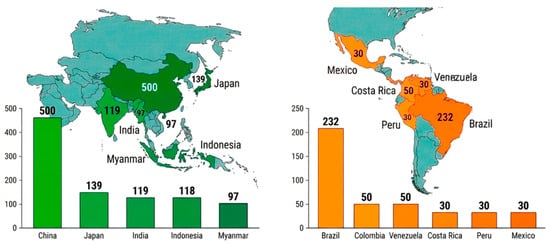
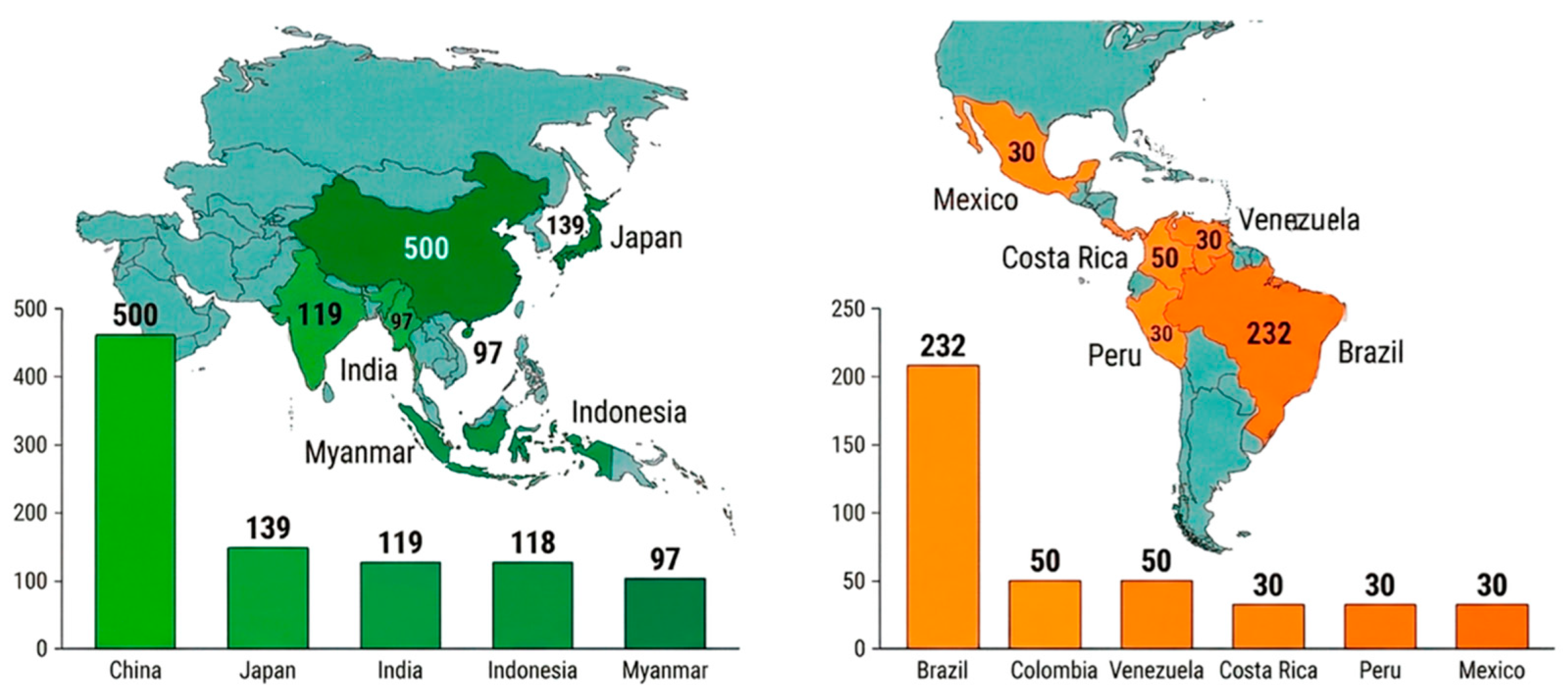
According to current botanical inventories, China possesses the most extensive bamboo species richness within the Asian continent, comprising 500 endemic varieties. This is sequentially succeeded by Japan (139), India (119), Indonesia (118), and Myanmar (97). Excluding Brazil, which hosts a substantial repository of 232 taxa, the majority of nations in Central and South America exhibit lower taxonomic diversity compared to Asian regions; specifically, Colombia and Venezuela maintain approximately 50 species each, whereas Costa Rica, Peru, and Mexico harbor roughly 30 [8] (see Figure 1, generated with Artificial Intelligence (AI), Gemini Pro, adapted from [8]).
Figure 1.
Global Bamboo Species Richness & Distribution. Generated with AI, Gemini Pro. Adapted from [8].
Among these structural species, Bambusa oldhamii Munro, commonly referred to as Giant Timber Bamboo or green bamboo, stands out as a highly promising sympodial (clumping) species indigenous to Taiwan and southern China [9,10]. While traditionally exploited for its nutritional shoots and durable timber, Bambusa oldhamii has been successfully introduced into diverse tropical and subtropical latitudes, including the establishment of significant commercial plantations in Latin American countries such as Mexico [11,12]. Architecturally, this species is highly valued for its tall, rectilinear culms that can attain heights of 16.5 m and diameters of up to 10 cm, rendering it structurally viable for modern applications [9]. Furthermore, its carbon capture and storage (CCS) capabilities are exceptionally high; empirical evidence suggests that bamboo ecosystems can assimilate 40% more carbon dioxide and release 35% more oxygen than comparable timber forests, underscoring its profound environmental value [13,14].
Despite its long history in vernacular construction, the formal integration of Bambusa oldhamii into contemporary architectural engineering is significantly hampered by a profound gap in literature and regulations [12,15]. While other giant structural bamboos, such as Guadua angustifolia, have extensive material characterizations and robust international building codes, Bambusa oldhamii currently lacks comprehensive species-specific structural design standards and industrialized manufacturing protocols [16,17]. This knowledge gap persists even though Bambusa oldhamii offers distinctive structural, geometric, and agronomic advantages that position it as a highly competitive biological alternative for modern engineering applications.
The development and structural application of this species represent a very viable opportunity in Mexico. In the northeastern mountains of Puebla, Bambusa oldhamii was introduced more than 15 years ago and has experienced rapid natural expansion driven by highly favorable soil and climatic conditions. The cultivation of this species in these highly marginalized areas provides a crucial agroforestry alternative to traditional crops with fluctuating economies, such as coffee, thus actively supporting local economic development. Furthermore, its implementation provides a lightweight, economical, and resistant building material, ideal for mitigating the housing deficit in areas of high seismic risk in Mexico.
Therefore, the main objective of this review is to consolidate and critically analyze the most recent literature on Bambusa oldhamii, highlighting its role as a highly productive but little-known species in the Puebla region. By examining its geometric properties, mechanical behavior, and construction applications, this work seeks to address the existing knowledge gap. Ultimately, with the available information, this review explores the potential viability of Bambusa oldhamii as a reliable structural material and, consequently, its integration into modern architectural technology and sustainable design in Mexico.
Beyond its architectural and structural applications, Bambusa oldhamii also presents significant potential for secondary valorization through the production of edible shoots, activated carbon [14], bio-oil, nanocellulose, and other bio-based products [3]. Although these applications fall outside the primary scope of this review, they reinforce the species’ relevance within a circular bioeconomy and highlight opportunities for future multidisciplinary research.
2. Methodology
2.1. Literature Search Strategy and Data Processing
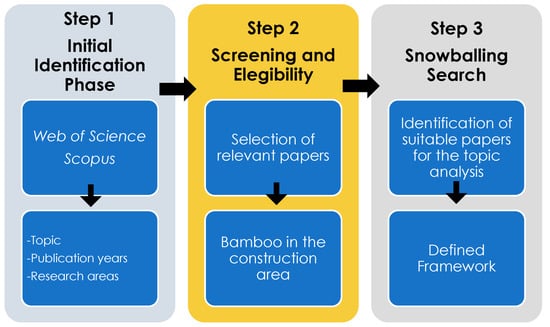
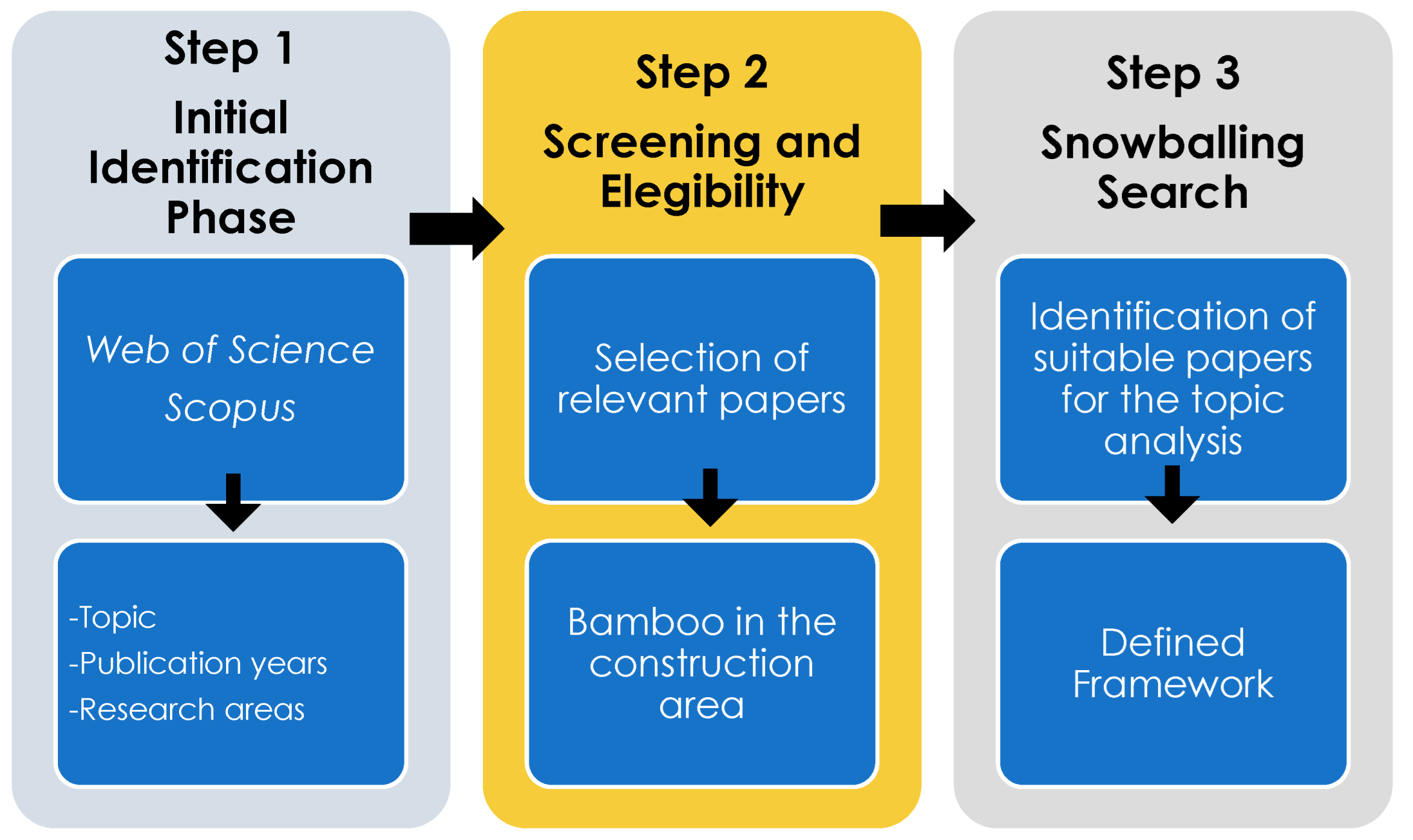
This review adopts a narrative-descriptive approach to deliver a rigorous and up-to-date state-of-the-art overview regarding the Bambusa oldhamii species and its technical viability within the structural and architectural building sectors. To minimize selection bias and establish a solid scientific foundation, the literature collection was made by a process similar to the PRISMA (Preferred Reporting Items for Systematic Reviews and Meta-Analyses) criteria, as illustrated in the flowchart in Figure 2.
Figure 2.
Studies search and selection process diagram.
The retrieval of academic literature was conducted electronically using the Scopus and Web of Science databases. The process was executed sequentially through the following operational phases:
- Step 1 Initial Identification Phase: The search strategy was implemented utilizing “Bambusa oldhamii” as the primary Topic search term (when Topic is search, the system finds only in title, abstract and keywords sections), expanding the publication timeline from 2000 to 2025, and limiting the results to the following research fields: forestry, agriculture, construction building technology, materials science, engineering, biodiversity conservation, mechanics and physics. This search yielded 144 papers.
- Step 2 Screening and Eligibility: The 144 retrieved papers were independently screened. Following a detailed assessment of titles, keywords, and abstracts, 118 papers were excluded because they were not directly related to the material physics, geometry, or mechanical performance of bamboo in the construction area, resulting in 26 eligible core papers.
- Step 3 Snowballing Search: Based on the bibliographic analysis of the 26 selected core papers, a backward and cascade search was performed. This process allowed the identification of 20 additional highly relevant articles indexed in Scopus or Web of Science, consolidating a final sample of 46 scientific references for synthesis.
2.2. Declaration on the Use of Generative AI Tools
During the preparation of this review, generative artificial intelligence (GenAI) tools were used to assist in the generation of certain graphical representations. Specifically, Gemini 3.1 Pro was used to generate Figures 1, 5–10 and 12, based on information derived from the scientific sources cited in the corresponding figure legends. The AI-generated outputs were subsequently reviewed and edited by the authors to ensure consistency with the cited scientific literature. Generative AI was not used to generate or analyze original research data or to draft the manuscript; it was used solely to prepare the specified figures.
3. Obtaining and Transformation Process
3.1. Cultivation and Production
To satisfy the high volumetric demands of the construction sector, the commercial utilization of Bambusa oldhamii depends on highly scalable propagation strategies. Traditional vegetative division is frequently insufficient for establishing large-scale plantations due to limited multiplication rates and material constraints [18]. Consequently, in most cases, the industry relies on in vitro micropropagation to achieve the massive production of standardized plantlets. For architectural purposes, this biotechnology is fundamental because it guarantees the large-scale deployment of disease-free, uniform materials, thereby ensuring strict quality control and a continuous, reliable supply of structural resources [10].
Once commercial plantations are established, Bambusa oldhamii demonstrates a rapid developmental cycle that supports high-volume resource availability. Field evaluations indicate that its net aerial primary production can achieve approximately 32.2 Mg ha−1 within 1 high production year, with the total aboveground biomass occasionally surpassing 103 Mg ha−1 [5,19]. Nevertheless, ensuring that the harvested culms meet the stringent mechanical standards required for engineering applications dictates strict control over the harvesting timeframe. The optimal cutting age for structural bamboo is restricted to a window of three to five years [20]. Culms harvested before reaching three years possess immature fibers that severely compromise their overall load-bearing capacity, while postponing the harvest beyond five years offers no significant mechanical improvements and exposes the material to higher risks of biological degradation [5,21].
Regarding the Bambusa oldhamii in Puebla, it is now appropriate to examine what defines the production dynamics of this species. The developmental behavior and growth ways of Bambusa oldhamii in the Northeastern Sierra of Puebla are fundamentally determined by the sympodial (clumping) architecture of its rhizomes, its intergenerational morphological expansion, and its high adaptability to local soil and climate conditions [22]. During the initial establishment phase, Bambusa oldhamii clumps exhibit an exponential increase in shoot emergence; empirical field data reveal that culm density can increase by 24% in the second year and up to 110% in the third [23]. However, as the clump becomes congested, competition for lateral space significantly reduces overall photosynthetic activity, leading to a decrease in new shoot production by the fourth year. Consequently, selective harvesting of mature culms becomes a technical imperative to create more space for growth and stimulate the continuous emergence of larger, more vigorous shoots [23].
A distinctive characteristic of young, highly productive Bambusa oldhamii plantations is the progressive dimensional increase across successive culm generations. Although individual bamboo culms lack secondary radial growth after emergence, the average height, diameter, and number of culms per plant increase exponentially with each new cohort during the first three years [23]. This aggressive morphological expansion results in an exceptional capacity for biomass accumulation. Thriving in the temperate-humid, fertile Andosol soils of Teziutlán, Puebla (1600 m altitude and 2350 mm annual precipitation), a four-year-old stand can yield an outstanding total aerial biomass of approximately 103.4 Mg ha−1, averaging an annual accumulation of 25 Mg ha−1 [23]. By continually optimizing its diameter growth and carbon fixation during its juvenile stages, Bambusa oldhamii demonstrates biomass productivity that significantly outperforms other regional structural species, such as Guadua angustifolia [23].
Therefore, it can be stated that the cultivation and production of Bambusa oldhamii must address several problems. First, there is the issue of overcrowding. The plant’s rapid sympodial growth can be a double-edged sword; if not managed properly, the mass will suffocate by the fourth year, losing photosynthetic activity. Second, there is the inflexible harvesting period, as the three-to-five-year interval is not optional but a critical technical constraint. Cutting too early impairs mechanical strength, cutting too late rots the material without providing any structural benefit. Ultimately, to successfully integrate this species into the engineering materials sector, the industry must move from passive cultivation to rigorous and chronologically precise harvesting protocols, ensuring that its biological vigor translates directly into reliable architectural performance.
3.2. Preservation and Treatment
As a biological material, freshly harvested bamboo contains substantial amounts of starch, sugars, and moisture, rendering it highly susceptible to biodegradation by fungi, termites, and borer insects [15]. Therefore, chemical or physical preservation is an indispensable phase of the transformation process. Traditional industrial preservation techniques frequently utilize the modified Boucherie method, applying pneumatic pressure to drive waterborne preservatives (e.g., boron or boric acid) through the culm’s vascular bundles [8].
In response to environmental concerns regarding chemical biocides, thermal modification techniques have gained significant traction. Exposing bamboo to high-temperature steam (ranging from 120 °C for caramelization to 200 °C for deep thermal modification) induces the thermal degradation of hemicellulose. This process not only depletes the nutritional source for pests but also diminishes the material’s hygroscopicity, thereby enhancing dimensional stability and decay resistance without severely compromising the structural integrity [15,24]. Moreover, pioneering surface treatments, such as eco-friendly in-situ mineralization, have recently been developed. Through cyclic vacuum impregnation, calcium carbonate (CaCO3) is precipitated within the porous structure of the bamboo, acting as a robust physical barrier that significantly improves both thermal stability and flame retardancy [25]. See Table 1 as a comparative analysis between these different treatments.
Table 1.
Comparative Analysis of Bamboo Preservation and Treatment Methods. Adapted from [8,15,24,25].
Although conventional chemical preservation and bleaching techniques deliver robust defense against biological decay and facilitate strong adhesive bonding for structural joints, their dependence on toxic biocides and non-recyclable hydrogen peroxide presents critical environmental hazards. These ecological drawbacks fundamentally restrict their application under modern green building standards, prompting the architectural and construction industries to increasingly transition toward sustainable preservation alternatives. Innovative methodologies, such as high-temperature thermal modification and eco-friendly in-situ mineralization, are highly advantageous for contemporary construction because they enhance dimensional stability, decrease hygroscopicity, and significantly improve flame retardancy without the ecological footprint of chemical agents. These enhanced structural properties make engineered bamboo a highly viable and ecologically responsible replacement for conventional mass timber in primary load-bearing architectural frameworks and fire-safe structural elements.
Despite these substantial architectural benefits, a critical evaluation reveals notable technological limitations that currently impact large-scale construction manufacturing. Thermal modification demands precise thermal regulation; while it effectively depletes nutritional sources for pests, excessive temperatures can severely degrade the bamboo’s modulus of rupture and flexural strength, thereby compromising load-bearing integrity. Conversely, in-situ mineralization relies on complex, time-intensive cyclic vacuum impregnation processes to achieve the dense calcium carbonate coverage required to comply with stringent smoke suppression and fire safety regulations. Interpreting these findings within the broader context of sustainable construction, future research directions must prioritize the optimization of these processing parameters. Advancing these eco-friendly treatments to balance mechanical reliability with manufacturing efficiency will be essential for solidifying engineered bamboo’s role in modern, fire-safe architectural design.
3.3. Manufacturing of Structural Bamboo Composites (SBCs)
The inherent geometric variability of natural bamboo culms—characterized by tapering diameters, varying internode lengths, and out-of-straightness—poses critical challenges for modern, standardized construction [21]. To circumvent these limitations, Bambusa oldhamii is extensively processed into advanced Structural Bamboo Composites (SBCs), most notably Laminated Bamboo Lumber (LBL) and Bamboo Scrimber (also known as Parallel Strand Bamboo) [15,26].
The fabrication of LBL involves cross-cutting and radial splitting of the raw culms. The highly hydrophobic, silica-rich outer cortex (epidermis) and the inner pith are mechanically removed via precision planing to expose the fiber-rich tissue and ensure optimal adhesive bonding [15,24]. These standardized strips are subsequently bleached or thermally treated, coated with structural-grade resins (predominantly Phenol-Formaldehyde, applied at spread rates of 150–300 g/m2), and consolidated under parallel or orthogonal hot-pressing [15,26].
Conversely, the production of bamboo scrimber relies on a sophisticated defibering mechanism. The bamboo strips are passed through specialized grooved rollers that crush the material, creating a network of loosely intertwined fiber bundles without completely destroying the inherent longitudinal matrix [27]. This micro-cracking facilitates deep resin impregnation (often exceeding 10% resin content). The resin-saturated bundles are then arranged unidirectionally and subjected to high-pressure compression molding (often up to 70–80 MPa) followed by thermal curing [15,27]. This thermo-mechanical densification yields a highly uniform, high-density composite material that exhibits exceptional tensile and compressive strengths, effectively substituting heavy timber and steel in demanding architectural applications [15,24].
Based on this information, it is important to highlight the contrast between the structural benefits of processed bamboo and its environmental, energy, and economic disadvantages. On the one hand, the ecological paradox of synthetic adhesives is striking, given that the manufacture of laminated bamboo lumber (LBL) and bamboo scrimber relies heavily on deep impregnation with structural resins, primarily phenol-formaldehyde (PF) [15,26]. A crucial problem to solve is that this high dependence on synthetic polymers significantly undermines the sustainable and ecological profile of natural bamboo. And since the use of formaldehyde poses serious environmental health problems and increases volatile organic compound (VOC) emissions, the transition to bio-based and formaldehyde-free adhesives becomes an urgent industrial imperative for achieving true sustainability.
Another point of concern is the high energy consumption and biomass waste generated. While engineered composites successfully mitigate the natural geometric variability of bamboo, their manufacturing processes consume excessive energy. Processes such as the compression molding required for laminated bamboo lumber (LBL) and subsequent heat curing generate a significant carbon footprint [15,26]. Furthermore, in LBL production, precision planing generates a huge amount of waste. This loss of raw material significantly increases production costs and decreases the overall efficiency of biomass utilization.
It is also important to weigh technological sophistication against economic viability, given that the high level of technological complexity required to transform raw bamboo into a standardized substitute for wood or steel [15,26] distances it from its origins as an accessible, low-impact construction alternative. This highly industrialized approach hinders its implementation in marginalized or developing regions, such as northeastern Puebla, where species like Bambusa oldhamii grow naturally, thus limiting the pace of local economic development. This is exacerbated by the lack of manufacturing protocols or regulatory frameworks.
As can be seen, despite the technical skill in the manufacture of bamboo composites, there are challenges that require attention, such as the introduction of eco-friendly adhesives, the minimization of processing waste, and the establishment of regulatory frameworks that the industry must address. If Bambusa oldhamii is to be championed for its high carbon sequestration capacity and eco-friendly profile, the heavy reliance on toxic polymers and the high energy consumption of SBC processing present a severe ecological problem to pay attention.
4. Anatomy
The physical and mechanical capabilities of bamboo species are directly governed by their anatomical organization [8,28]. In contrast to typical woody plants, bamboos do not undergo secondary radial growth; consequently, the culm emerges from the soil already displaying its maximum permanent diameter, depending entirely on its primary tissue composition to maintain its structural integrity and stability over its entire lifespan [8,28].
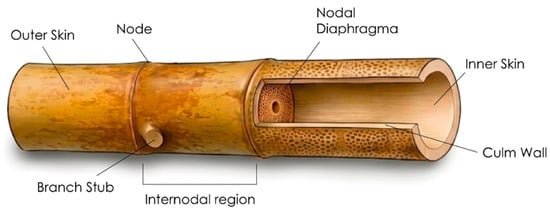
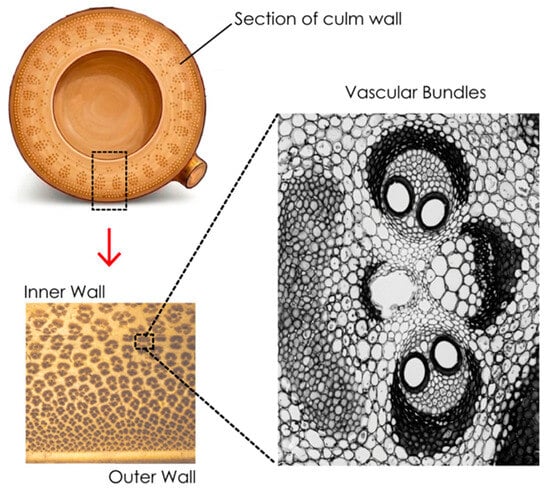
Macroscopically, a bamboo culm is configured as a hollow, tapered cylinder segmented by transverse nodal diaphragms that delineate the hollow internodal cavities [21,26]. The Figure 3 shows this structure [21]. From a structural engineering perspective, these solid nodes play a critical mechanical role by providing lateral restraint, thereby preventing localized buckling of the thin-walled internodes and arresting longitudinal crack propagation [6,21].
Figure 3.
Morphological structure of the bamboo stalk: diagrammatic representation of a specific culm section. Adapted from [21].
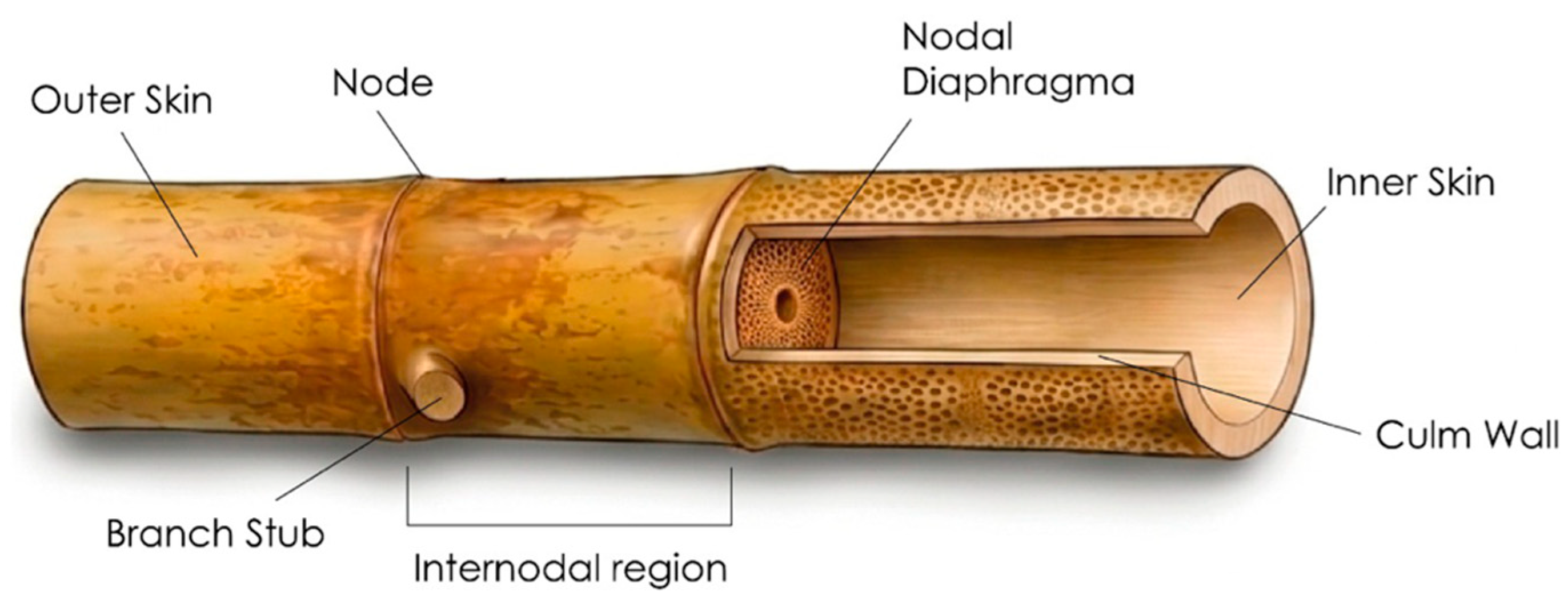
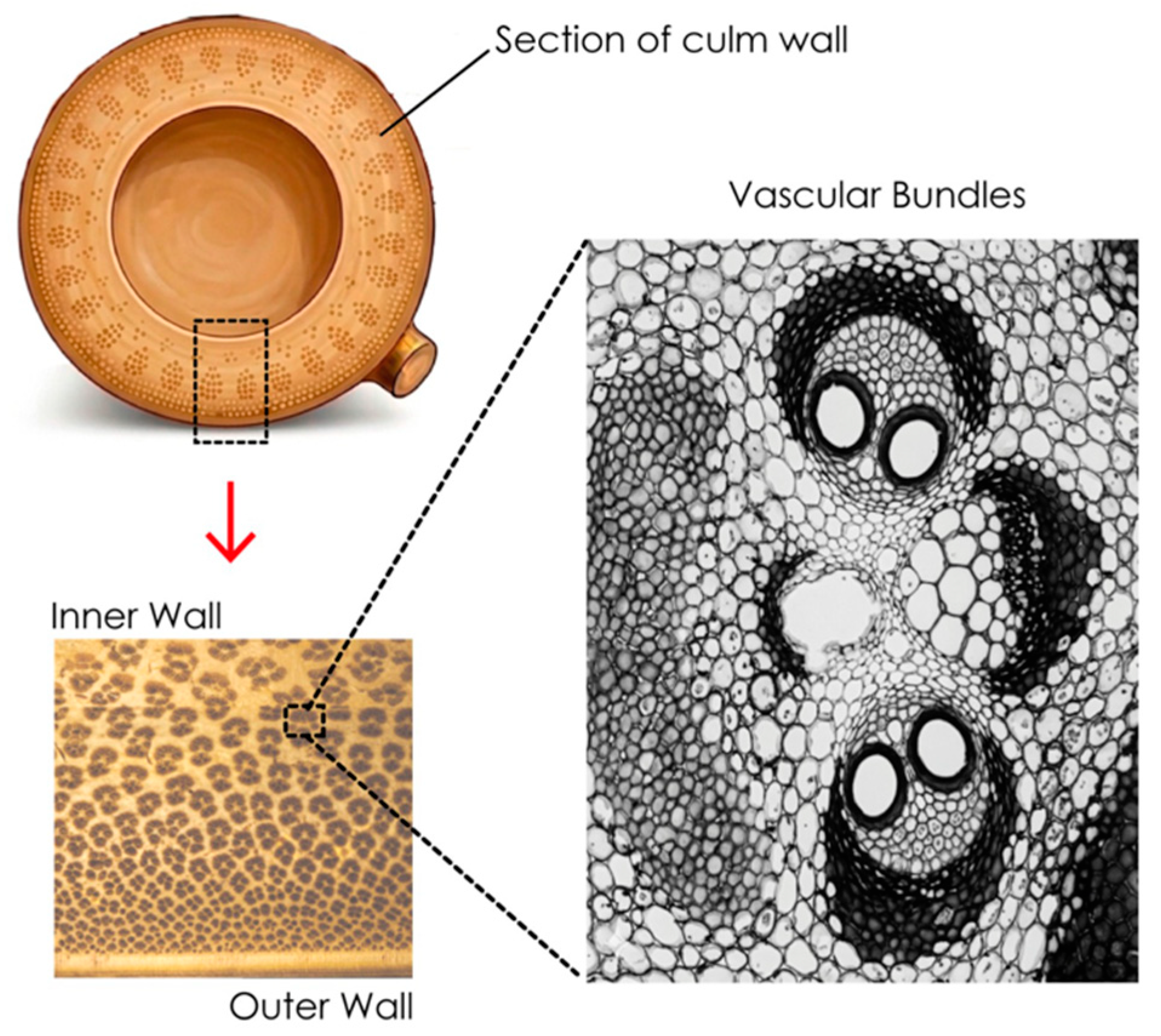
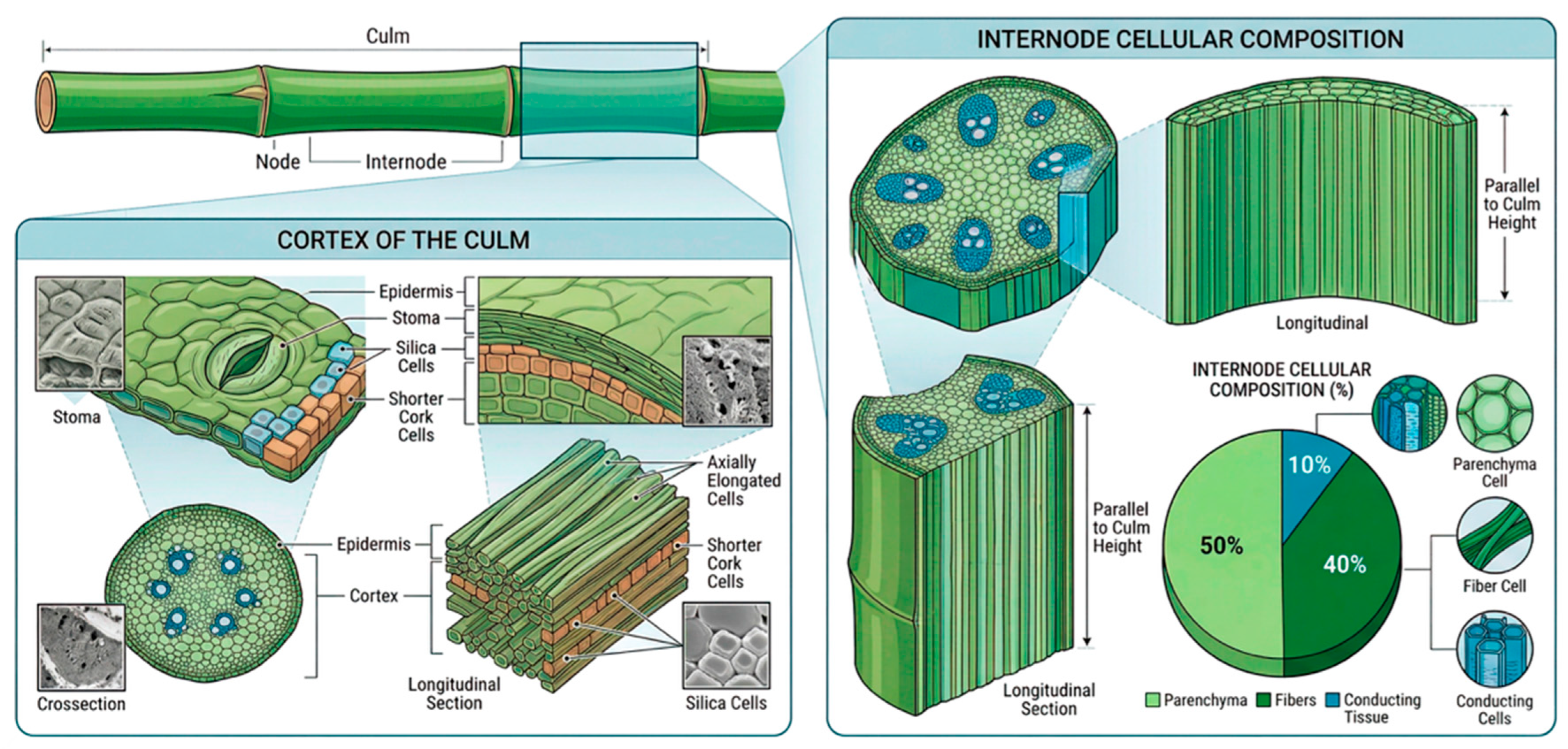
Microscopically, the culm wall of a bamboo functions as a naturally evolved, functionally graded material (FGM) [21,29]. It comprises a soft tissue matrix called parenchyma (50%) embedded with longitudinally oriented vascular bundles (10%) and high-strength cellulose fibers (40%) [21] (see Figure 4). The distribution of these elements is highly heterogeneous across the cross-section. The vascular bundles are smaller, denser, and highly concentrated near the hard outer cortex (epidermis), becoming progressively larger and more dispersed toward the inner wall [21,29] (see Figure 5, generated with AI, Gemini Pro, adapted from [8]). This evolutionary design strategically concentrates the stiffest, cellulose-rich fibers at the outer extreme of the cross-section, optimally maximizing the culm’s moment of inertia to resist natural wind-induced bending stresses [21].
Figure 4.
Structural organization of the bamboo stalk: transition from the culm wall cross-section to the internal distribution of vascular bundles. Adapted from [21].
Figure 5.
Anatomical organization of the bamboo culm. (Left) Microstructure of the outer cortex, displaying the epidermis, stomata, axially elongated cells, shorter cork cells, and silica cells; (right) Cellular composition of the internode wall, illustrating the longitudinal orientation and proportional distribution of parenchyma (50%), fibers (40%), and conducting tissue (10%). Generated with AI, Gemini Pro. Adapted from [8].
From a microstructural and genetic perspective, the stiff architecture of the plant cell wall relies on a tripartite composite consisting of 40–70% cellulose, 16–34% lignin, and 14–25% hemicellulose [30]. Furthermore, contemporary transcriptomic evaluations of bamboos have pinpointed particular genes that govern the production of lignin alongside other secondary metabolites. These findings illustrate the progressive enhancement of the lignification process during the plant’s developmental transition from a subterranean shoot into a rigid structural biomaterial [30].
Research indicates that hemicellulose enhances the thermodynamic and mechanical characteristics of the matrix, while lignin strengthens the interfacial bonding with cellulose microfibrils [31]. Consequently, the mechanical behavior and adhesion energies of the lignin-carbohydrate complex (LCC) are intermediate to those of its individual components [31]. The exceptional mechanical capabilities of hemicellulose arise from its abundance of hydroxyl groups, which substantially elevates the hydrogen bond energy density [31].
Although research exhaustively demonstrates that the physical and mechanical behavior of bamboos is directly determined by their functional microstructural matrix (FGM) [30], the current state of knowledge on Bambusa oldhamii reveals that species-specific studies are limited evidence for standardizing its structural performance. Therefore, the following are the specific research needs regarding Bambusa oldhamii in this respect:
- A.
- Effect on stiffness: Research establishes that the extraordinary stiffness of bamboo stems from its tripartite microstructural matrix [30]; however, there is a need to quantify how the specific soil and climate conditions of the Puebla region influence the lignification process and fiber density during the growth of Bambusa oldhamii. Exploring this data would be advisable to determine characteristic stiffness values that guarantee structural safety and reliability in buildings subjected to seismic loads.
- B.
- Effect on anisotropy: Although it is clear that anatomically the absence of secondary radial growth and the strictly unidirectional alignment of the fibers force the stem to rely heavily on its transverse nodal diaphragms to restrict local buckling and halt the propagation of longitudinal cracks [30], there is a lack of empirical studies that define the exact limits of tensile strength perpendicular to the fiber and transverse shear strength specifically for Bambusa oldhamii. Therefore, investigating this transverse vulnerability would be vital for developing standardized mechanical connection systems that prevent splitting failures.
- C.
- Effect on hygroscopic behavior: Research reveals that at the molecular level the material possesses high hygroscopic sensitivity [30]; however, there is a lack of industrialized drying and non-toxic chemical preservation protocols calibrated exclusively for the Bambusa oldhamii matrix. Such standardization would make it possible to guarantee long-term dimensional stability and prevent biodegradation in humid climates, such as in the northeastern region of Puebla, throughout the entire life cycle of a building.
- D.
- Effect on machining: Given the culm’s morphology, which features an extremely hard outer epidermis [30], rapid tool wear and high risks of delamination during machining will be present. Therefore, there is a clear need for applied research focused on developing machining methodologies adapted to the geometric variability and specific density of Bambusa oldhamii. This is a technological obstacle to overcome if the goal is to scale up its production in engineered structural composites (structural laminates) without generating large quantities of biomass waste.
The viability of this species as a modern architectural technology depends entirely on transcending generic anatomical knowledge. The success of its large-scale implementation will require future research aimed at translating these morphological complexities into unified design standards and manufacturing protocols specifically for Bambusa oldhamii.
5. Geometry
5.1. Bamboo Species
While the majority of bamboo varieties exhibit a predominantly circular cross-section, natural square variants (such as Chimonobambusa quadrangularis) and artificially shaped triangular profiles also exist [8]. The aerial stem, known as the culm, consists of alternating nodes and internodes, whose morphology and distribution are species-dependent [8]. The nodes act as transverse diaphragms that interconnect the culm wall, significantly enhancing its structural integrity [8]. Cellular orientation is radial at the nodes—akin to timber—whereas it is strictly longitudinal within the internodes. These internodal segments form hollow tubes characterized by a non-uniform wall thickness [8].
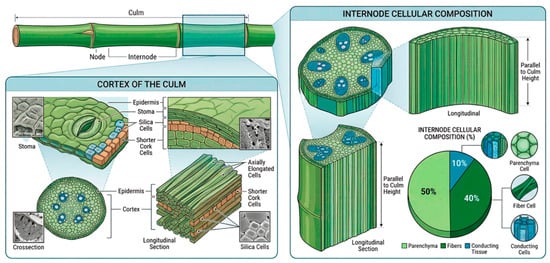
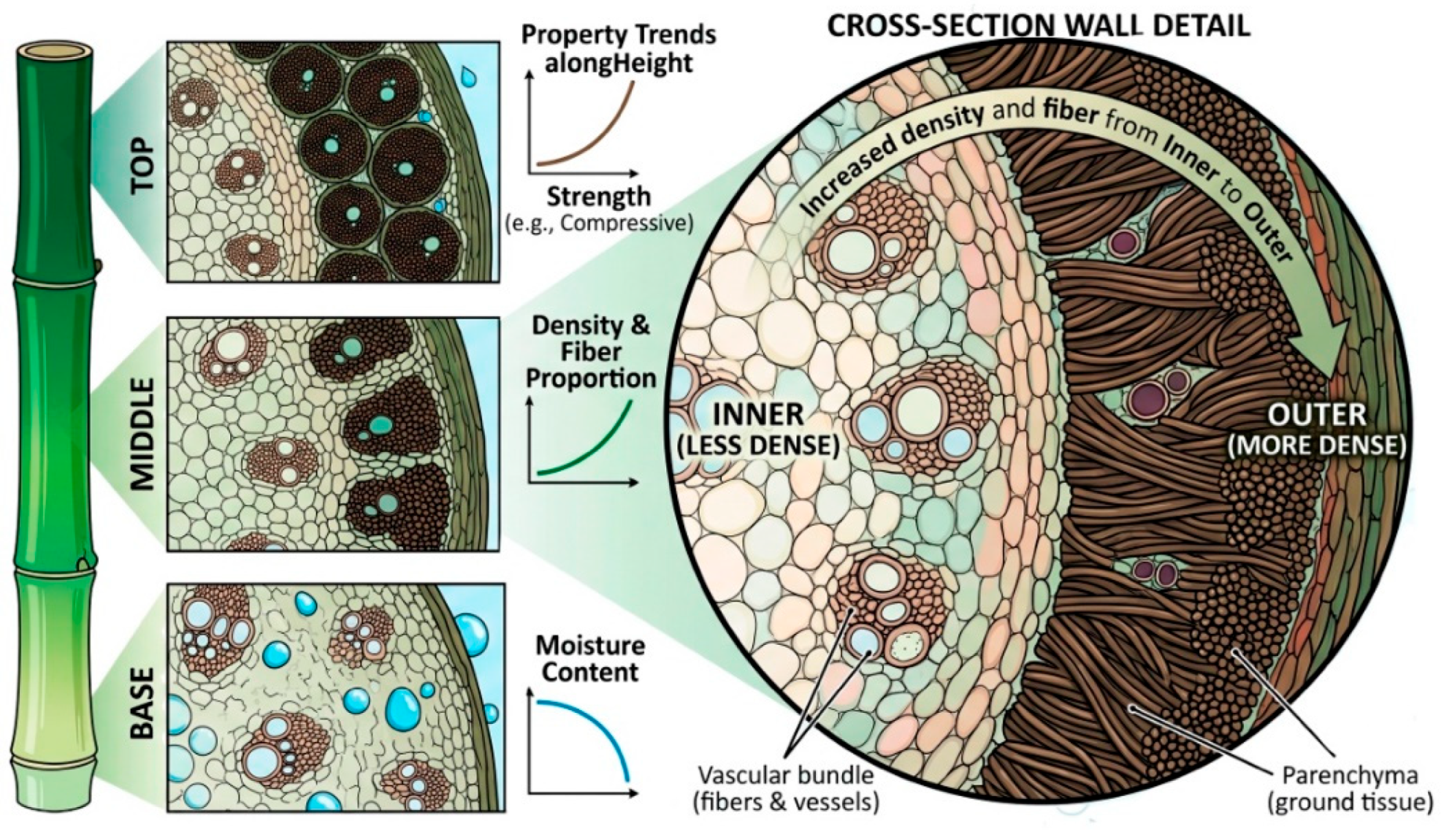
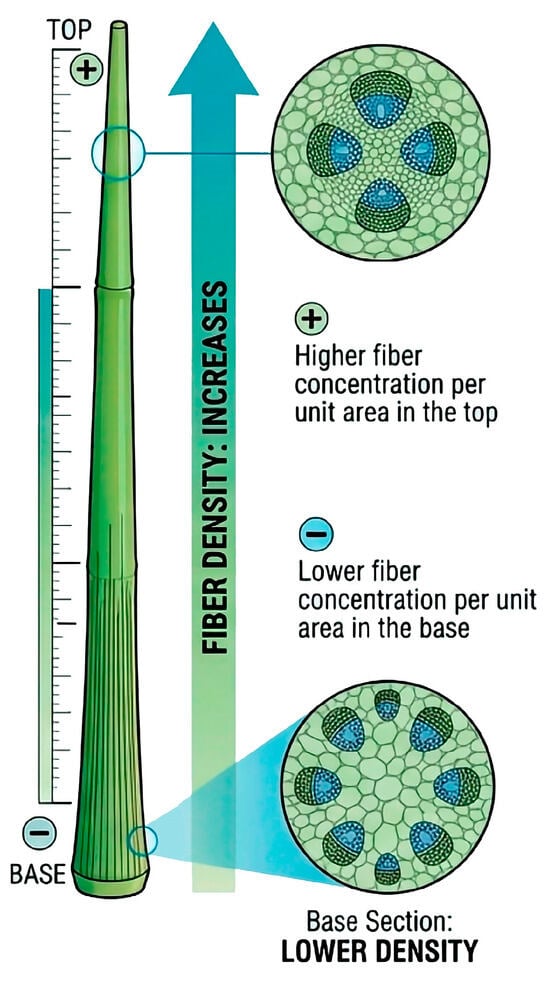
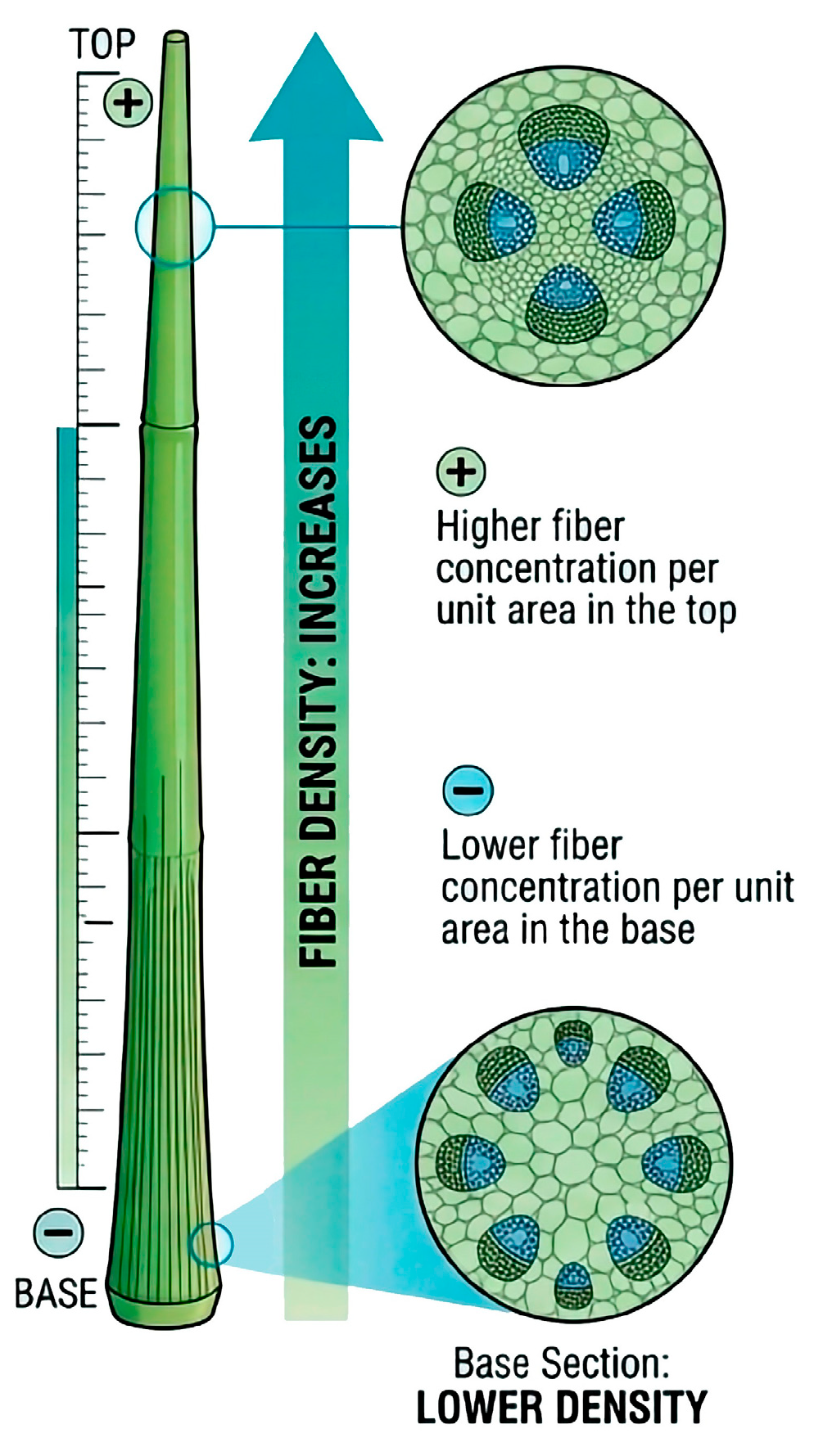
The outer cortex comprises stomata alongside short silica, cork, and axially elongated cells (see Figure 5) [32]. Within the internodes, the cellular arrangement aligns vertically and consists roughly of 50% parenchymal tissue, 40% fibers, and 10% vascular conducting elements [33]. Fiber distribution is highly heterogeneous; a dense accumulation at the exterior boundary progressively diminishes toward the interior surface. Furthermore, the natural narrowing of the bamboo stalk towards its apex causes a progressive thinning of the internodal walls; consequently, although the total count of vascular bundles drops, their relative concentration per unit area actually rises along the height of the culm [8,33], (see Figure 6 generated with AI, Gemini Pro, adapted from [21] and Figure 7 generated with AI, Gemini Pro, adapted from [8,21]). The aspect ratio (length-to-width) of these fibers ranges from 150 to 250, a geometric parameter determined primarily by the bamboo species and secondarily by the anatomical position of these fibers along the stem [33]. Structurally, bamboo acts as a natural functionally graded composite; its reinforcing fibers are strategically distributed within a parenchymal matrix—primarily concentrated at the outer periphery—to maximize flexural strength and stiffness, functioning similarly to steel reinforcement in concrete members [8].
Figure 6.
Variation according to bamboo culm height: density, moisture content and fiber proportion. Generated with AI, Gemini Pro. Adapted from [21].
Figure 7.
Variation of fiber density with bamboo culm height. Generated with AI, Gemini Pro. Adapted from [8,21].
The implementation of natural bamboo culms in mainstream architectural technology and mechanized fabrication is frequently hindered by their organic geometric variability. Unlike industrialized timber or steel, which are manufactured to precise dimensional tolerances, raw bamboo exhibits a highly heterogeneous morphological profile. This profile is characterized by a continuous decrease in external diameter from the base to the apex (tapering), varying culm wall thicknesses, irregular internodal distances, and longitudinal out-of-straightness [34]. These natural irregularities pose substantial challenges for calculating exact structural cross-sectional properties, predicting buckling behavior under axial compressive loads, and designing standardized structural connections [34]. Consequently, accurately defining and quantifying the geometric parameters of specific structural species is a critical prerequisite for their safe and efficient integration into formal building codes [34].
5.2. Bambusa oldhamii
Available studies suggest Bambusa oldhamii exhibits highly favorable geometric characteristics for structural and architectural applications. Biometric and digital evaluations conducted on commercial plantations across different regions in Mexico (e.g., Veracruz, Puebla, and Guerrero) reveal that mature Bambusa oldhamii culms possess an average external diameter ranging between 65 mm and 70 mm, accompanied by a relatively consistent wall thickness of approximately 7.0 mm to 8.7 mm [34]. Furthermore, Bambusa oldhamii is distinguished by a notably high average internode length, which frequently approaches 450 mm [34]. This extended internodal spacing not only facilitates the extraction of longer, uninterrupted strips for the manufacturing of engineered Structural Bamboo Composites (SBCs) but also reduces the frequency of nodal joints in raw culm applications, an aspect that directly influences the overall flexural behavior and failure mechanisms of the element [34].
When compared to other prominent structural bamboo species, such as Guadua angustifolia (native to South America) and Phyllostachys edulis (Moso bamboo, native to Asia), Bambusa oldhamii generally exhibits a more uniform diametric profile and a lower out-of-straightness ratio [34]. The superior longitudinal straightness of Bambusa oldhamii provides a significant structural advantage in construction by minimizing initial geometric eccentricities, thereby enhancing the culm’s resistance to global buckling when subjected to axial compression [34]. Nevertheless, structural engineers and architects must still rigorously account for the culm’s natural tapering. The gradual reduction in both diameter and wall thickness non-linearly diminishes the section modulus and the moment of inertia along the length of the culm [34].
To overcome the limitations of traditional analog measurement techniques and fully understand this material, recent advances in digital technology could be successfully applied to more accurately capture the organic geometry of Bambusa oldhamii [6]. Such is the case of the ZCB Bamboo Pavilion in Hong Kong [35], where the architecture and engineering team combined prototyping with digital tools to implement the solution for this architectural space. In this project, the geometric variability of the stems could be quantified in a digital framework by generating NURBS (Non-Uniform Rational B-Spline) surface models [35]. From the geometric data extracted from one of the created digital models, the basic two-dimensional architectural documents, such as plans, sections, and elevations, were derived. These planimetric resources proved fundamental for facilitating communication with clients and contractors during the public tender phase, as well as for the subsequent processing of operating permits. Additionally, this same three-dimensional database provided engineers with the necessary information to carry out the structural feasibility analysis of the project [35].
However, while incorporating more precise geometric data through advanced digitization could be an essential component in the development of safe structural systems made with materials like Bambusa oldhamii, it is important to point out that geometric variability is not simply a biological characteristic, but a key barrier to structural coding and industrial scalability. Therefore, the question remains of how to integrate such geometric variability into digital design and execution systems if the goal is to achieve widespread use non-industrialized materials within the construction industry.
Although Bambusa oldhamii demonstrates a favorable morphological profile compared to other species, its consolidation as a modern and sustainable architectural technology requires overcoming obstacles that transcend its biological attributes. Research indicates that the natural geometric variability of the culm remains the main obstacle to its industrial and regulatory standardization. Therefore, the question is whether it will be possible to move beyond mere biometric characterization to the development of workflows that assimilate this variability.
On the other hand, there are challenges that future research must address, such as:
- A.
- The effect of diametral reduction (tapering): While the literature recognizes and quantifies this phenomenon (progressive narrowing of the stem towards the apex), there is a significant methodological gap regarding how to mathematically integrate this specific reduction of Bambusa oldhamii into simplified structural calculation models. Thus, how can this nonlinear complexity be translated into accessible design tools and manuals that allow engineers to predict safe load capacities without relying on complex individual three-dimensional digitizations for each culm?
- B.
- Wall Thickness Effect: Research shows that, unlike other species, mature Bambusa oldhamii exhibits a remarkably constant wall thickness across its usable section. While this perimeter homogeneity represents a significant technical advantage for achieving predictable strength, the challenge lies in assembly. Therefore, it is a priority to investigate and standardize connection systems and mechanical fittings precisely calibrated for this thickness range. This would prevent failures due to local crushing and enable on-site installation that does not rely solely on manual labor.
- C.
- Internodal Distance Effect: Due to its long internodal spacing (approximately 450 mm [34]), the number of solid transverse diaphragms along the stem is reduced. However, while current research celebrates that this morphology facilitates the extraction of uninterrupted strips for the mechanized fabrication of structural composites (SBCs), the unresolved technical challenge is empirically quantifying how this free distance between nodes affects the tube wall’s susceptibility to local crushing or buckling under severe seismic loads.
Achieving widespread use of this material in industry will depend on future research bridging or closing the gap between the material’s geometric properties and the precise rigor demanded by the contemporary architectural industry.
6. Physical and Mechanical Properties
Despite the millennia-long global utilization of bamboo for load-bearing applications, scientific investigations aimed at characterizing its structural behavior remain relatively novel and limited [21]. Nevertheless, substantial normative progress has fostered a deeper understanding of bamboo’s physical and mechanical characteristics. A prime example of this progress is the UNE-ISO 22157 standard [36]. Furthermore, Latin America has pioneered structural design codes since 2011 [21], most notably the Colombian Seismic-Resistant Construction Regulation NSR-10 [37]. Specifically, Title G (Timber structures and Guadua structures) of this code, issued by the Colombian Association of Seismic Engineering (AIS), provides a comprehensive framework for structures built with particular bamboo species.
The UNE-ISO 22157 standard delineates precise testing methodologies applicable to full-culm circular bamboo specimens. The empirical data derived from these standardized protocols are intended to establish characteristic physical and mechanical parameters, which are essential for rigorous structural analysis and further academic research [21]. Table 2 summarizes the array of material properties that can be systematically evaluated employing these normative procedures.
Table 2.
Bamboo properties that can be evaluated according to UNE-ISO 22157. Adapted from [36].
To provide an approximate assessment of the state-of-the-art of each physical and mechanical property of Bambusa oldhamii under the UNE-ISO 22157, a classification was proposed by the authors to characterize the maturity of the available technical literature:
- A.
- Sufficiently Studied Properties (Development Level: 100%)
A physical or mechanical property is classified with a 100% development level when it simultaneously satisfies the following scientific criteria:
- Multiplicity of independent campaigns
- Statistical representativeness
- Standardized testing methodology
- Availability of design values and constitutive laws
- B.
- Properties Requiring More Specific Research or Exploration Data (Development Level: 10–30%/Assigned average: 20%)
A property is graded within this intermediate category when it meets the following technical conditions:
- Existence of analytical or numerical modeling
- Lack of direct experimental validation
- Exploratory studies
- C.
- Unstudied Properties (Development Level: 0%)
A property is assigned a 0% development level due to a complete scientific knowledge gap characterized by:
- Inexistence of quantitative data.
Conversely, Chapter G.12 of the NSR-10 regulation strictly defines the mandatory criteria for the structural engineering of facilities primarily employing Guadua angustifolia Kunth bamboo. This code asserts that any framework engineered under its provisions achieves a structural reliability and safety standard completely comparable to those of buildings constructed with conventional materials [37]. Table 3 outlines the specific boundaries and application scope of Chapter G.12 within the NSR-10 regulatory framework.
Table 3.
Scope of the NSR-10 for structural design with Guadua angustifolia Kunth. Adapted from [37].
Research concerning the physical and mechanical characteristics of Bambusa oldhamii remains scarce, this is due to the following:
- A.
- Availability and expansion of the resource. This species was recently introduced to Mexico and is currently localized within the Northeastern Mountain range of Puebla [41]. In this territory, the exploitation of bamboo has expanded significantly, driven by the economic instability associated with the devaluation of coffee (Coffea arabica L.), which historically served as the predominant revenue stream for local farmers. Consequently, cultivating bamboo has emerged as a viable agroforestry strategy for crop diversification, offering both ecological benefits and regional economic revitalization by integrating new native or exotic species. Nevertheless, the successful propagation of these plants is highly dependent on the contrasting local microclimates; for instance, Bambusa oldhamii requires extremely humid environments, whereas Guadua angustifolia adapts optimally to settings that are both warmer and highly humid [41]. Therefore, it remains necessary to propose systems that standardize the process from planting to harvesting of Bambusa oldhamii, in order to understand in detail the behavior of this resource and utilize it more effectively.
- B.
- Experimental characterization. Regarding the mechanical characterization of Bambusa oldhamii, a methodological framework was introduced in 2018 to assess the nominal interaction diagram—specifically the bending moment versus axial load curve—for columns fabricated from this species [12]. The research emphasizes that bamboo exhibits outstanding mechanical performance when subjected to compressive, tensile, and flexural stresses. Consequently, it presents substantial potential for application in load-bearing members, such as beams and columns, establishing itself as a viable structural alternative to conventional reinforced concrete elements [12]. The comparative advantages and technical drawbacks associated with implementing this material substitution are detailed in Table 4. However, although the research justifies the specific selection of Bambusa oldhamii by highlighting its superior ultimate axial stress capacity when contrasted with other bamboo varieties [12], further study of the parameters still pending for this species (see Table 2) is necessary to establish it as a safe material for structural systems in projects both within and outside the region.Table 4. Technical analysis of the properties of Bambusa oldhamii: (a) Advantages; (b) Disadvantages. Adapted from [12].
- C.
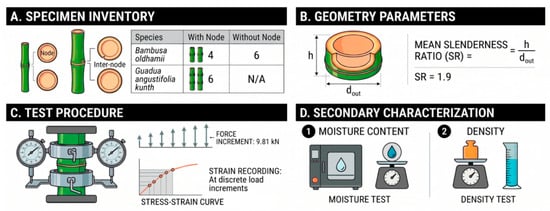
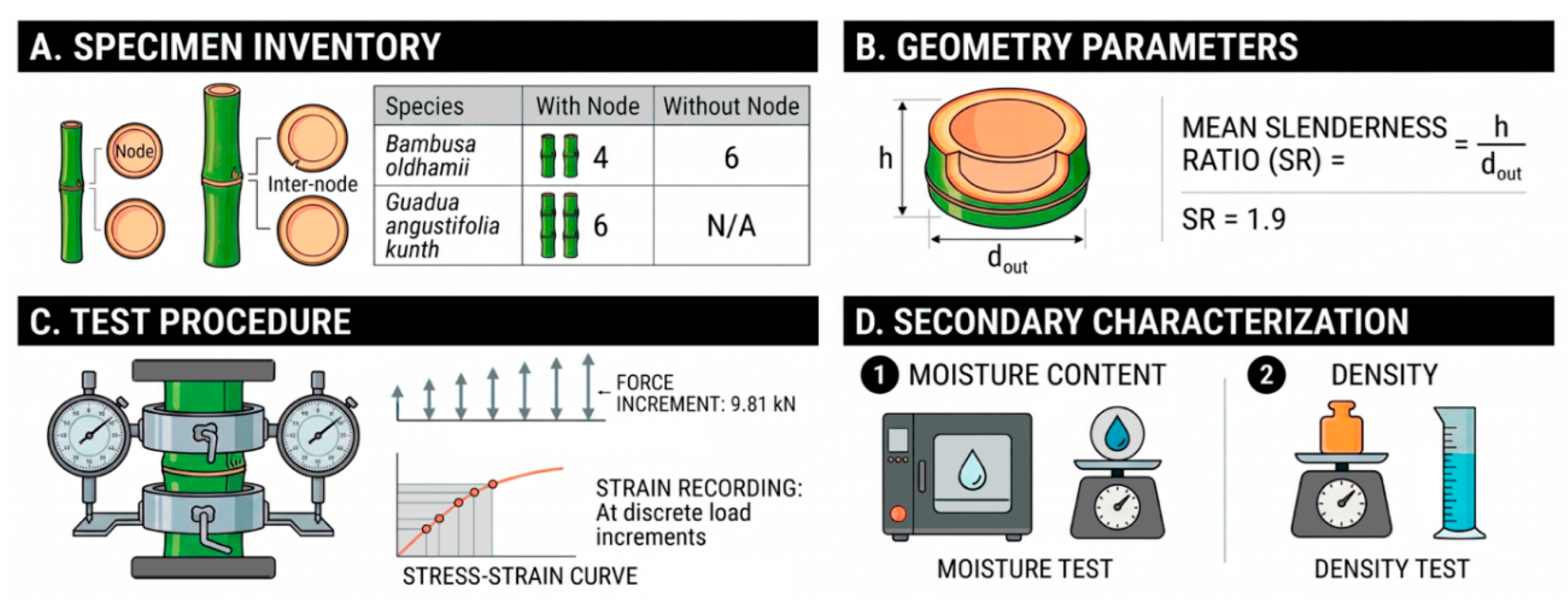
- Implications for construction. As a recently introduced material in Mexico, Bambusa oldhamii faces significant challenges for its use as a construction material and, consequently, for its widespread adoption. In 2019, a comparative experimental investigation was conducted in Mexico to evaluate the structural performance of Bambusa oldhamii against Guadua angustifolia Kunth [11]. The scope of the study was to determine the compression-tension stress curves against axial deformation in the direction parallel to the fiber, in tests made on Guadua angustifolia from Mexico, Colombia and Ecuador, as well as on Bambusa oldhamii from Mexico. The investigators analyzed the physical and mechanical traits of both species, employing the test specimens and parameters specified for compression strength in Figure 8, generated with AI, Gemini Pro, adapted from [11]. Additionally, experimental assessments were conducted to determine the specimens’ density and their corresponding moisture levels [11].Figure 8. Conditions of compression-tested specimens. Generated with AI, Gemini Pro. Adapted from [11].
An effective indicator for evaluating a material’s structural performance under seismic conditions is the ratio between its ultimate compressive strength and its specific weight [11]. This metric, often referred to in structural engineering as “specific strength” or “breaking length,” essentially measures how many meters of a material could be stacked vertically before the base crushes under its own weight. In the context of this research, these numerical parameters (average values) explain why bamboo is vastly superior to traditional building materials for earthquake-resistant design [11]:
- 1042 m (Concrete with f′c = 25 MPa [42]): This indicates that the material is extremely heavy in proportion to the structural resistance it provides.
- 3373 m (A-36 Steel): This demonstrates a much higher efficiency, offering significant strength without the excessive mass associated with concrete.
- 8664 m (Bambusa oldhamii): This impressive value proves that bamboo is exceptionally strong despite being incredibly lightweight. Its structural efficiency under this parameter is more than eight times greater than that of simple concrete, and over two and a half times that of structural steel.
This is easier to understand if the implications for seismic behavior are reviewed. The destructive forces an earthquake exerts on a building are directly proportional to the structure’s mass (Force = mass × acceleration). Using traditional concrete results in a very heavy building, which in turn attracts massive seismic forces. Conversely, by employing Bambusa oldhamii (with its 8664 m ratio), engineers obtain a material capable of withstanding enormous compressive loads while adding minimal mass to the overall building. This drastic reduction in dead weight subsequently minimizes the inertial forces acting on the structure, thereby ensuring outstanding stability and safety during a seismic event.
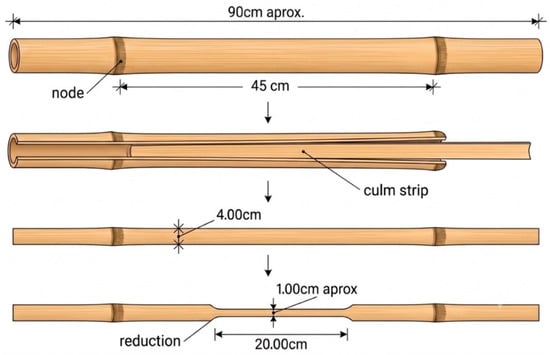
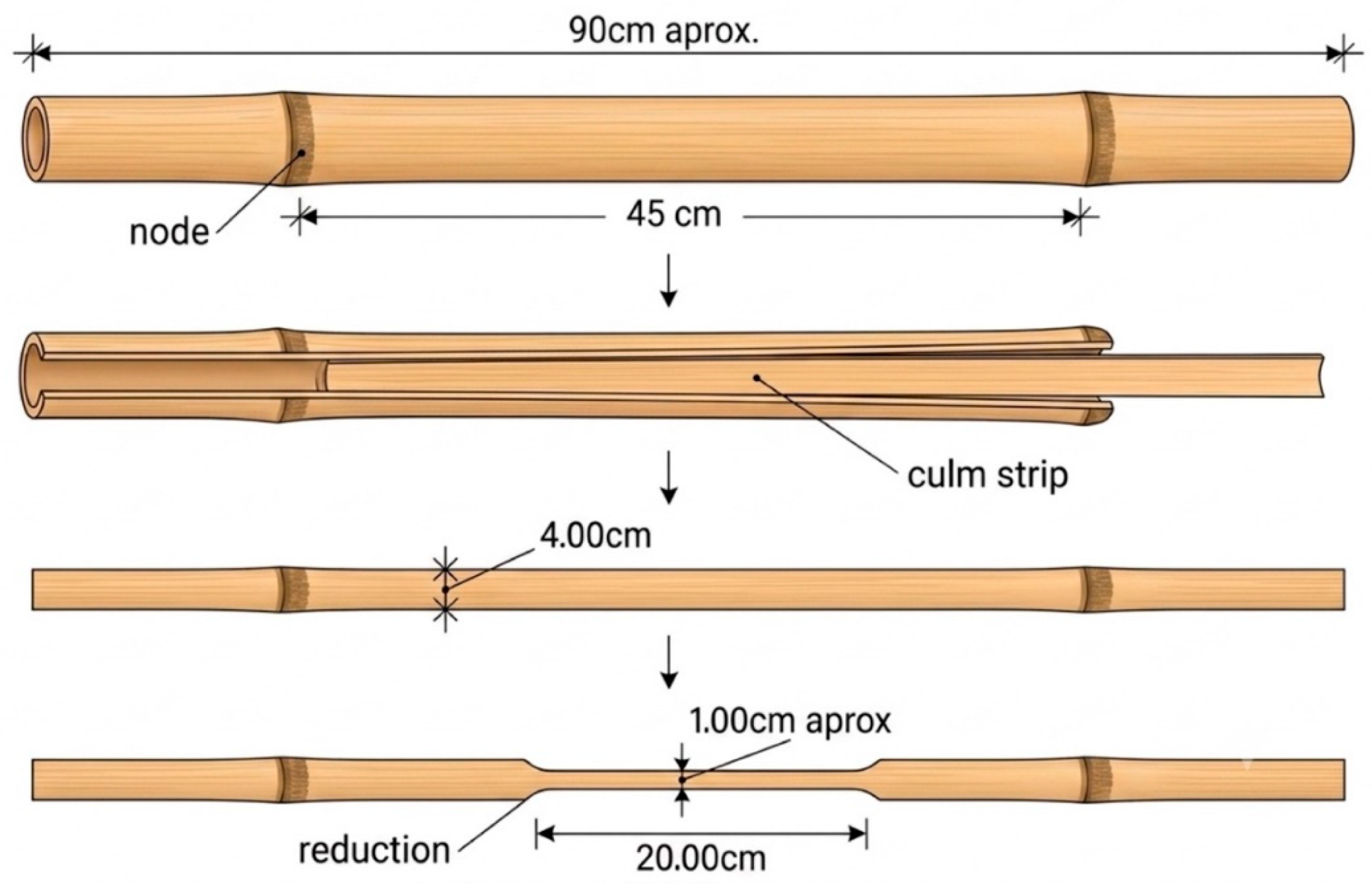
In the context of tensile testing, previous research conducted by Mendoza [43] documented the structural response of nine Bambusa oldhamii test specimens. These samples were systematically extracted from culm segments measuring 0.90 m in length; their specific geometric configuration and final morphology are visually detailed in Figure 9 generated with AI, Gemini Pro, adapted from [11].
Figure 9.
Tensile test specimen preparation. Generated with AI, Gemini Pro. Adapted from [11].
In pursuit of their research objectives, the investigators aggregated experimental data spanning various dates across the specified nations, analyzing a total of 16 samples originating from Mexico, 21 from Ecuador, and 20 from Colombia. Given the absence of localized normative frameworks for structural bamboo testing within the Mexican context, the experimental study is considered a preliminary and exploratory trial, as its methodological protocol was not conducted in accordance with the guidelines established by the ISO 22157-1:2004 standard. The empirical outcomes concerning both physical characterization and compressive behavior are detailed in Table 5. This summary delineates key metrics for every tested unit, including the slenderness ratio (SR), moisture content (MC), density (D), average compressive ultimate stress (σmc), and the observed failure mechanism (F). These failure modes were systematically categorized into three distinct typologies: (a) parallel shear to the fiber (PS), (b) crushing (C), and (c) a compound failure exhibiting both parallel shear and crushing (PSC) [11].
Table 5.
Results of Physical and compressive behavior tests. Adapted from [11].
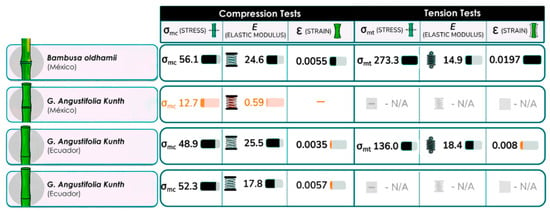
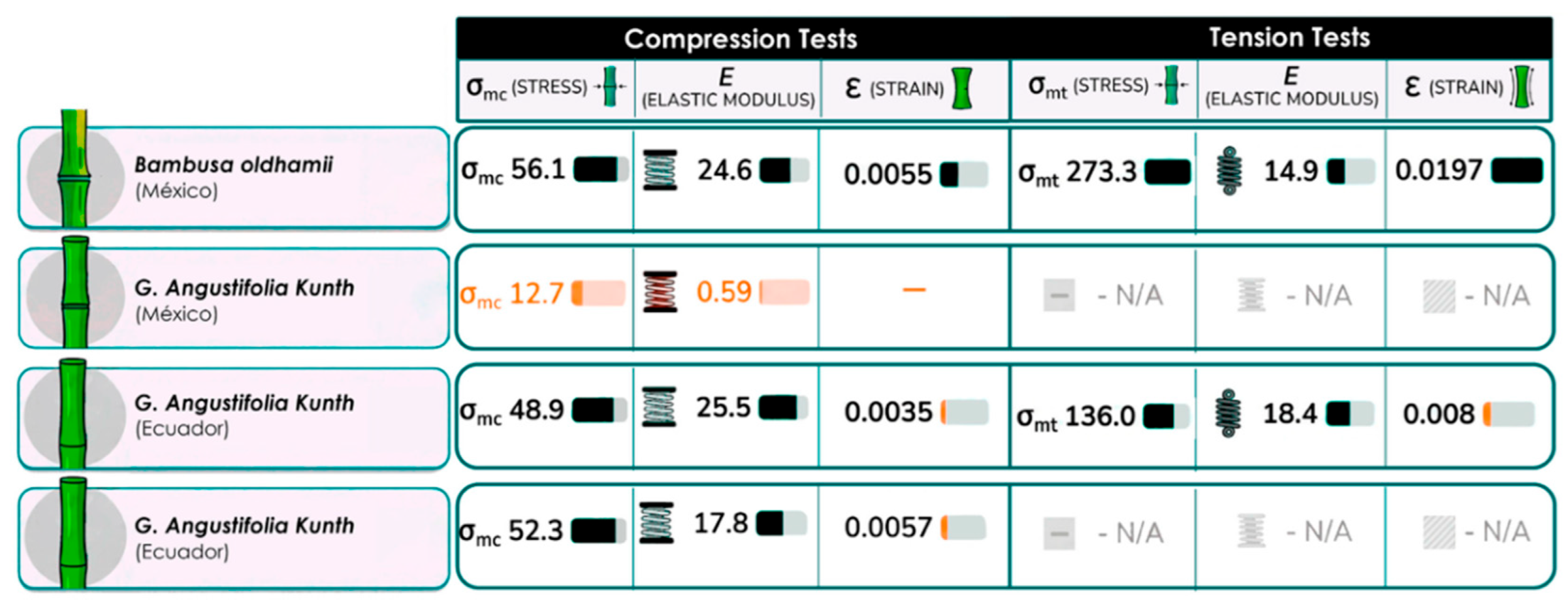
These experimental investigations showed that the Bambusa oldhamii species cultivated in Mexico exhibits a superior mechanical load-bearing capacity, reaching maximum compressive and tensile stresses of 56.1 MPa and 273.3 MPa, respectively, significantly outperforming the Guadua angustifolia assessed across various Latin American regions [11] (see Figure 10 generated with AI, Gemini Pro, adapted from [11]).
Figure 10.
Comparative mechanical properties of Bambusa oldhamii and Guadua angustifolia (maximum compressive and tensile stresses). Generated with AI, Gemini Pro. Adapted from [11].
Furthermore, a comparative analysis of stress-strain curves demonstrates that bamboo possesses structural ductility and strength surpassing those of unreinforced concrete, effectively matching the structural capabilities of high-strength concrete mixtures [11]. Additionally, the remarkable morphological consistency in the compressive behavior of Guadua angustifolia among test specimens from Mexico, Ecuador, and Colombia suggests the strong feasibility of developing structural design standardizations analogous to those existing for steel or concrete.
Nevertheless, despite these outstanding mechanical advantages, structural design utilizing bamboo continues to face critical challenges associated with its vulnerability to fire, biological deterioration, and the inherent uncertainty of its geometric variations.
Although these studies reported maximum compressive and tensile strengths of 56.1 MPa and 273.3 MPa, respectively, these values were obtained from specific experimental campaigns involving a limited number of test specimens and should not be interpreted as characteristic values for structural design. The mechanical performance of bamboo is strongly influenced by factors such as culm age, moisture content, growing conditions, sampling location along the culm, and the inherent biological variability of the material. Consequently, additional experimental studies involving larger sample sizes and robust statistical analyses are required before reliable characteristic values for structural design can be established.
Based on the analyzed evidence, it can be said that while Bambusa oldhamii demonstrates promising performance, surpassing even traditional materials, the documented research reveals a profound lag in the transition from empirical characterization to industrial and regulatory application in Mexico. The critical contrast lies in the fact that local academic efforts have almost exclusively focused on testing isolated pieces or small-scale specimens, leaving a massive void regarding unified technical frameworks.
When contrasting this reality with the landscape in Colombia, the technical gap becomes glaringly evident. While the Colombian construction ecosystem has successfully consolidated rigorous testing protocols and standardized regulations (such as the NSR-10 Code) for the structural calculation of its endemic species, Mexico completely lacks official building codes dictating how to safely test, visually grade, and assemble Bambusa oldhamii. Therefore, for this resource to shed its perception as an informal vernacular alternative and become an institutionalized modern technology, the primary gap to be resolved is regulatory. Future research in Mexico must transcend basic stress measurements and urgently focus on developing visual and mechanical grading methodologies, standardizing industrial preservation processes, and drafting exclusive seismic design standards for Bambusa oldhamii, thereby emulating the level of institutional maturity that bamboo has already achieved within Colombian structural engineering.
7. Applications in Construction
7.1. The Potential of Bamboo in Mexico
Unlike Guadua angustifolia, which has a widely recognized track record in the building sector, the introduction of Bambusa oldhamii in Mexico is a relatively recent phenomenon. Consequently, its integration into the architectural industry is just beginning to sprout. However, in the Northeastern Sierra of Puebla, specifically in the municipality of Cuetzalan, this landscape is rapidly evolving thanks to the efforts of Tosepan Ojtatsentekitinij—which translates from Nahuatl as “Together we work our bamboo”—a cooperative commonly known as Tosepan Bambú. This organization works hand in hand with the Masehual and Tutunaku indigenous communities to transform this giant grass into a catalyst for socio-economic and ecological development.
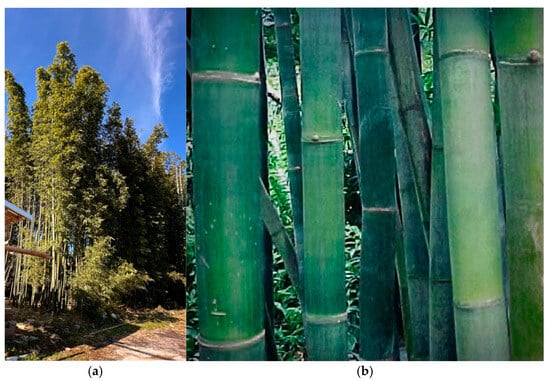
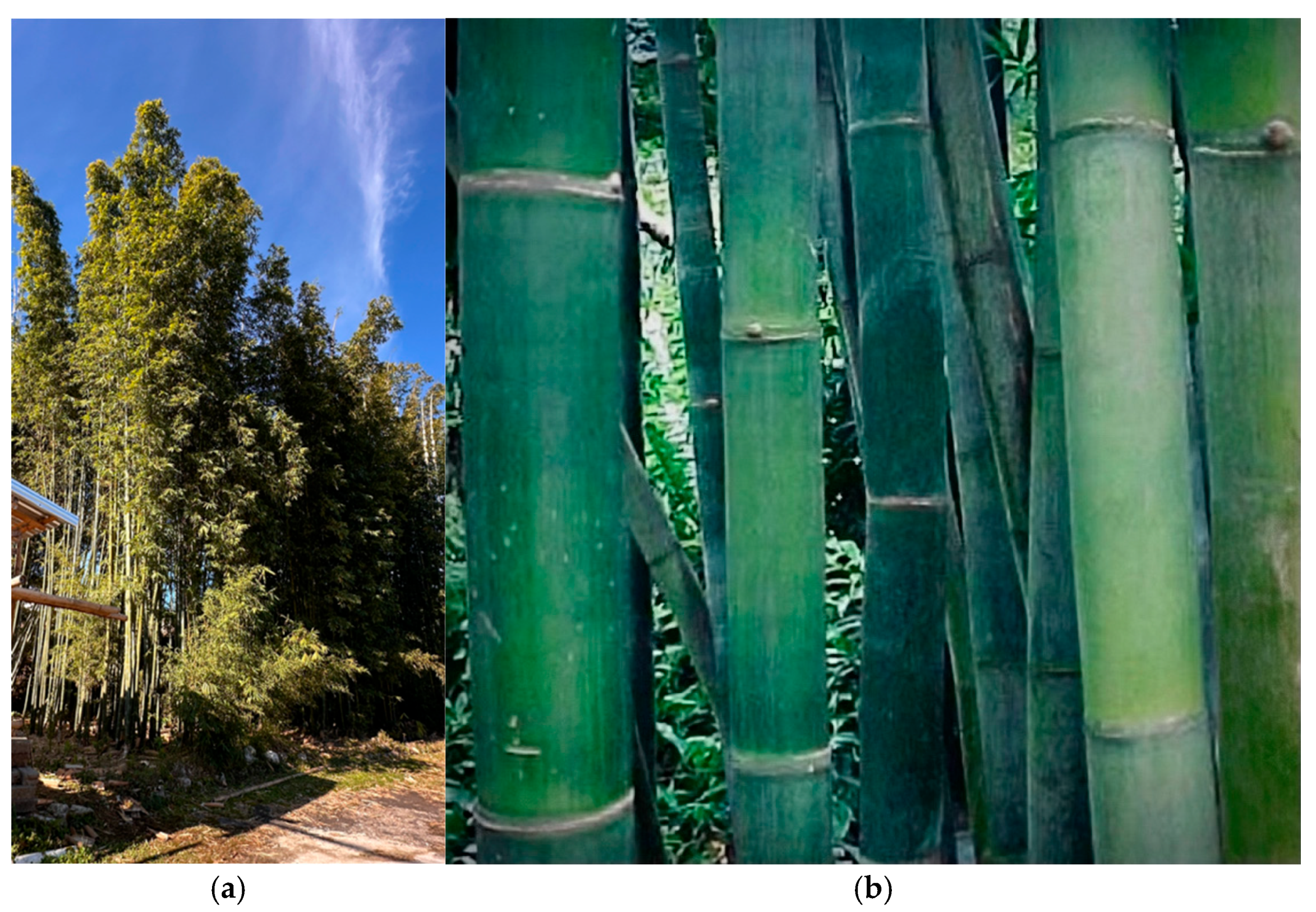
While Tosepan Bambú’s core mission encompasses bioconstruction, their greatest commercial impact to date has been in the manufacturing of furniture and decorative items. Nevertheless, the cooperative has already taken its first steps toward architecture by commercializing culms treated with basic preservation methods—including species such as Phyllostachys aurea, Guadua angustifolia, and Bambusa oldhamii—primarily intended for ephemeral structures and aesthetic finishes. Figure 11 shows the Bambusa oldhamii species from Cuetzalan at Tosepan Bambú, located in the northeastern region of Puebla, México.
Figure 11.
Bambusa oldhamii from Cuetzalan, Puebla: (a) Plantation at Tosepan Bambú; (b) Culms of 2.5 to 4 inches in diameter.
The true challenge lies in making a major technological leap. If Tosepan Bambú aims to realize its vision of becoming a leader in regional development through sustainable bioconstruction systems [44], it is absolutely essential to merge traditional knowledge with scientific rigor. Until now, the cooperative’s operations have been sustained by the invaluable empirical experience that local producers gain every day; however, there is a critical void regarding standardized manuals, mass-production protocols, and building regulations. There is an urgent need to thoroughly investigate the geometric, physical, and mechanical properties of Bambusa oldhamii, as it is the most suitable candidate for bearing structural loads.
For this reason, this section explores how bamboo is utilized on a global scale. The goal is to extract strategies, innovations, and guidelines that will allow us to transform Bambusa oldhamii into a safe, formal, and sustainable design and construction material, ready to be fully integrated into Mexico’s structural technology value chain.
7.2. Traditional and Structural Implementations
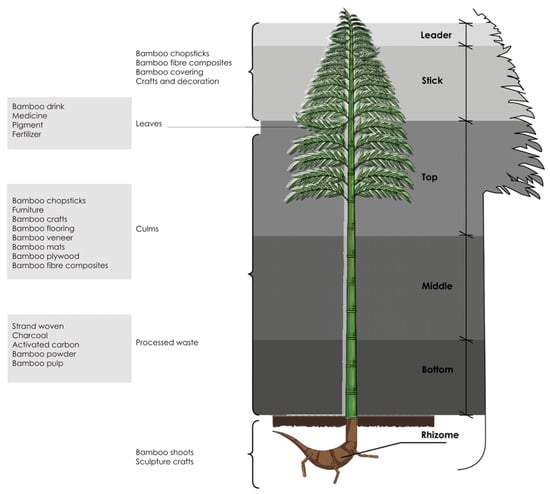
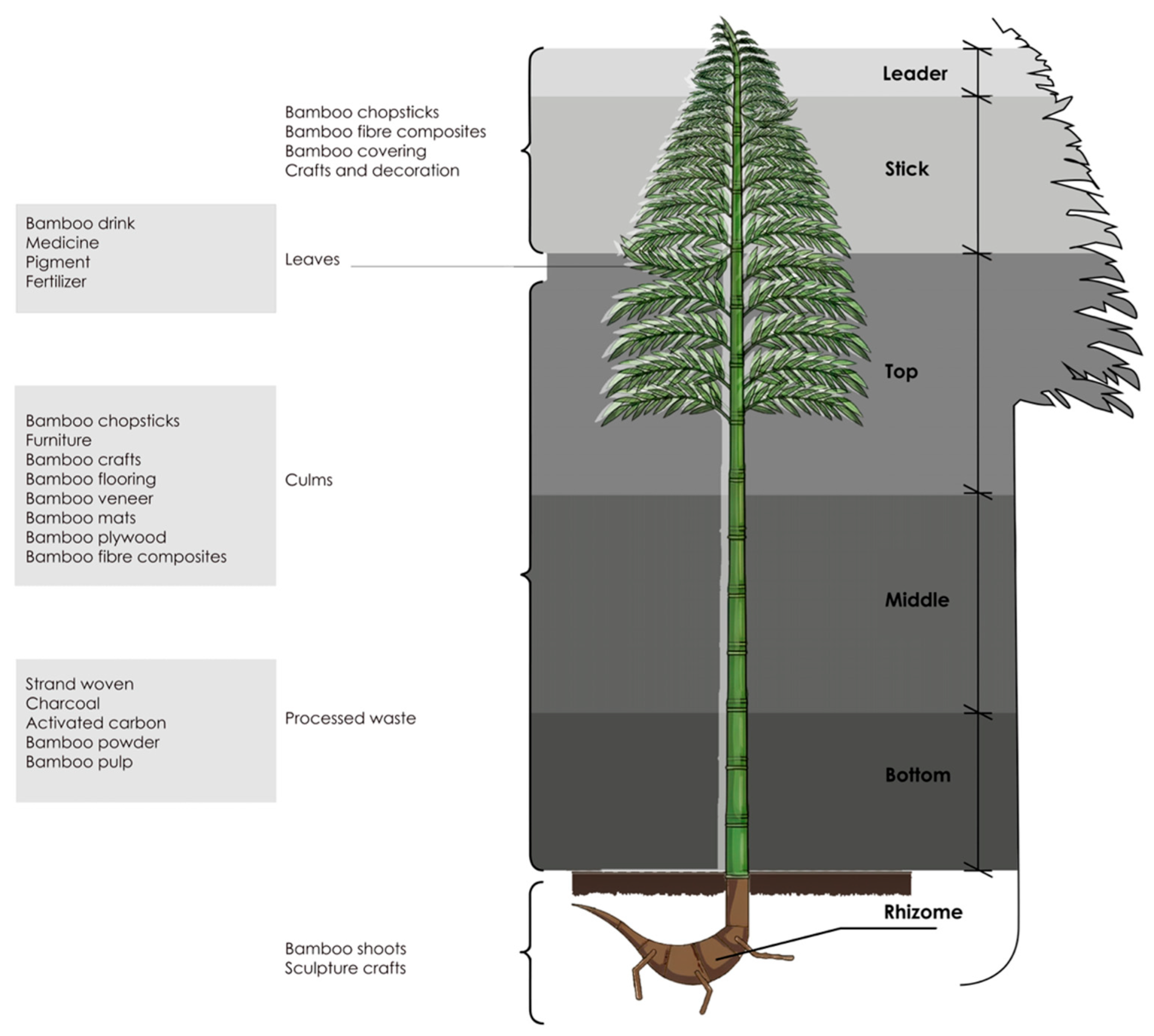
Bamboo exhibits an exceptionally high strength-to-weight ratio, making it a highly efficient biological material for load-bearing applications in the building sector [15,29]. In traditional construction, the main culm—specifically the middle and bottom sections—is primarily harvested to construct structural framing, flooring, and roof trusses [8,11]. Figure 12 (generated with AI, Gemini Pro, adapted from [8]) illustrates the anatomical segments of the bamboo plant alongside their corresponding structural and industrial utilizations [8]. To mitigate structural challenges arising from the natural geometric variability of raw bamboo, contemporary approaches employ 3D scanning and reverse engineering methodologies to accurately calculate geometric properties, thereby optimizing its integration into formal structural designs [6,11]. Furthermore, axial compressive and tensile stress-strain evaluations of species such as Guadua angustifolia and Bambusa oldhamii reveal a highly favorable elastoplastic behavior, confirming their structural efficacy for seismic-resistant masonry and sustainable low-income housing infrastructure [8,11,45].
Figure 12.
Integrated bamboo utilization and zoning schema. Generated with AI, Gemini Pro. Adapted from [8].
7.3. Engineered Bamboo Products
To counteract the inherent anisotropy and geometric irregularities of raw culms, the industry has advanced the development of engineered bamboo products, most notably glued-laminated bamboo (glubam) and bamboo scrimber [45,46]. These high-performance composites are manufactured by fracturing or splitting the raw culms into parallel fiber strands or thin strips, which are subsequently consolidated using structural adhesives under high thermal compression [24,26,45]. Engineered bamboo demonstrates mechanical and flexural properties that rival or surpass those of conventional timber, facilitating its reliable deployment in primary load-bearing members such as beams, load-bearing columns, and shear walls [24,26,45].
7.4. Composite and Prefabricated Components
Bamboo is extensively implemented in composite engineering, functioning synergistically with conventional materials like concrete, mortar, and fiber-reinforced polymers (FRP) to maximize structural performance [17]. Substituting standard steel rebars with treated bamboo splints inside concrete frameworks yields a lightweight, cost-effective structural reinforcement solution [17,47].
Additionally, enveloping raw bamboo columns in glass fiber-reinforced polymer (GFRP) or filling the hollow internodal cavities with cementitious mortar substantially increases buckling resistance, lateral stiffness, and overall load-carrying capacity [8,48,49]. Today, standardized bamboo culm components are progressively incorporated into prefabricated building systems, utilizing specialized stainless-steel metal hoops (e.g., U-hoops and 8-hoops) to ensure rigid, reliable connections and streamlined assembly processes [46].
The integration of bamboo into contemporary engineering and architecture—evolving from the traditional use of raw culms to engineered bamboo products and prefabricated components—has proven highly effective in overcoming its natural anisotropy and optimizing its load-bearing capacities (Barajas International Airport in Madrid, Spain case study) [24]. The structural synergy achieved by combining bamboo with concrete, cementitious mortar, or fiber-reinforced polymers (FRP) represents an undeniable technical advancement (Moso Bamboo Modern Technological Park, Anji, China case study) [24]. However, from a critical perspective, the industrialization of this biomaterial introduces profound sustainability paradoxes that current literature has yet to resolve.
The intensive processing and the addition of synthetic matrices force us to raise fundamental questions regarding the future of sustainable construction: What environmental cost does the manufacture of these resin-based composites actually entail? Does engineered bamboo remain a low-carbon footprint solution when it relies on energy-intensive thermo-mechanical compression processes? At the design and life-cycle levels, what happens regarding the disassembly and circularity of prefabricated elements? Ultimately, how does the permanent combination of biological and petrochemical materials affect the end-of-life disposal of the structural component? In addressing these knowledge gaps, it is imperative to caution that while hybrid systems may improve structural performance, they can simultaneously reduce recyclability, increase embodied impacts, and severely complicate end-of-life strategies (Rail stations in France and curtain wall, Klöckner Pentaplast, Montabaur, Germany cases studies) [24]. Consequently, future research directions must prioritize the development of bio-based adhesives and mechanically reversible connection systems to ensure that bamboo retains its status as a truly circular building material.
8. Conclusions
Based on a critical and comprehensive review of current literature regarding Bambusa oldhamii, this document consolidates its significant gap as a structural biomaterial capable of mitigating the environmental impact of contemporary construction. However, consistent with the objectives established at the onset of this research, analyzing the life cycle, geometry, and mechanics of this species—native to the Northeastern Sierra of Puebla (Mexico)—reveals a fundamental gap between its inherent properties and its industrial standardization. In response to this scenario, the following considerations, uncertainties, and knowledge gaps remain to be resolved by the scientific and technical community:
- A.
- There is compelling empirical evidence demonstrating that Bambusa oldhamii exhibits highly manageable sympodial growth, with biomass productivity and carbon sequestration capacity (up to 103.4 Mg ha−1 in the Northeastern Sierra of Puebla) that surpasses traditional species such as Guadua angustifolia [23]. Structurally, its transverse anatomy, acting as a functionally graded material, together with its geometric consistency (reduced taper and greater straightness), confers compressive and tensile strength parallel to the grain of the same order of magnitude as those of other conventional structural materials used in construction [6,11,21]. Furthermore, its viability to be processed into high-performance structural bamboo composites (SBCs), such as Laminated Bamboo Lumber (LBL) and Bamboo Scrimber, has been conclusively proven [15].
- B.
- Despite its remarkable load-bearing capacity, the true long-term sustainability of hybrid and engineered bamboo systems remains uncertain. Current literature does not resolve the ecological paradox generated by the intensive use of toxic resins (such as phenol-formaldehyde) and the high energy required for the thermo-pressing of SBCs, which could negate the low-carbon benefits of bamboo compared to industrialized materials [15,34]. Similarly, the exact durability and mechanical behavior of this species under pure bending, shear, and tension perpendicular to the grain during prolonged weathering conditions remain gray areas.
- C.
- To seamlessly integrate Bambusa oldhamii into modern architecture in Mexico, it is imperative to research and develop species-specific, non-linear constitutive models. Further investigation is needed into the possible adoption of 3D scanning technologies and parametric design (NURBS) that allow assimilating and predicting its natural geometric variability without generating excessive machining waste [6]. Likewise, the development of formaldehyde-free bio-based adhesives and mechanically reversible connection systems is urgently needed to ensure the circularity of prefabricated elements.
- D.
- The transition of bamboo from vernacular architecture to modern architectural technology in Mexico and other producing regions is hindered by structural deficiencies in both research and industry. Specifically, the following challenges must be resolved:
- Absence of regulations: Unlike Colombia, which has the NSR-10 code (Title G), Mexico lacks building codes that endorse, regulate, or standardize calculation methods for Bambusa oldhamii, relegating its use to informality.
- Unequal quality of evidence and experimental dispersion: Reported physical and mechanical tests often do not strictly adhere to international standards (such as UNE-ISO 22157), utilizing varied testing methodologies that preclude direct comparison and the derivation of reliable safety factors [11,21].
- Scarcity of specific studies: The vast majority of consolidated knowledge focuses on Guadua angustifolia or Phyllostachys edulis (Moso). Anatomical, connection, and degradation data exclusive to the microstructural matrix of Bambusa oldhamii are still insufficient [21].
- Difficulties in market transfer: The high technological complexity required to manufacture industrialized bamboo composites economically isolates marginalized agricultural communities (such as those in the Northeastern Sierra of Puebla) from formal value chains, preventing equitable economic development [23,34].
In conclusion, validating Bambusa oldhamii as a mainstream material in sustainable construction will require moving from simple, isolated biometric characterization to the creation of public policies, legal codes, and eco-efficient manufacturing protocols that harmonize the biological variability of the material with the rigor of modern engineering.
Author Contributions
Conceptualization, E.V.-Q., A.J.G.-C. and J.R.A.-Z.; methodology, E.V.-Q., A.J.G.-C. and J.R.A.-Z.; validation, A.J.G.-C. and J.R.A.-Z.; investigation, E.V.-Q., A.J.G.-C. and J.R.A.-Z.; resources, E.V.-Q.; writing—original draft preparation, E.V.-Q.; writing—review and editing, E.V.-Q.; visualization, E.V.-Q.; supervision, A.J.G.-C. and J.R.A.-Z.; project administration, A.J.G.-C. and J.R.A.-Z. All authors have read and agreed to the published version of the manuscript.
Funding
This research received no external funding.
Institutional Review Board Statement
Not applicable.
Informed Consent Statement
Not applicable.
Data Availability Statement
No new data were created or analyzed in this study. Data sharing is not applicable to this article.
Acknowledgments
During the preparation of this manuscript, the authors used Gemini 3.1 Pro to generate Figure 2, Figure 5, Figure 6, Figure 7, Figure 8, Figure 9 and Figure 10, based on information derived from the scientific sources cited in the corresponding figure legends. The authors have reviewed and edited the output and take full responsibility for the content of this publication.
Conflicts of Interest
The authors declare no conflict of interest.
References
- Xu, P.; Zhu, J.; Li, H.; Wei, Y.; Xiong, Z.; Xu, X. Are bamboo construction materials environmentally friendly? A life cycle environmental impact analysis. Environ. Impact Assess. Rev. 2022, 96, 106853. [Google Scholar] [CrossRef] [Scilit]
- Van der Lugt, P.; Van den Dobbelsteen, A.; Abrahams, R. Bamboo as a building material alternative for Western Europe? A study of the environmental performance, costs and bottlenecks of the use of bamboo (products) in Western Europe. J. Bamboo Ratt. 2003, 2, 205–223. [Google Scholar] [CrossRef] [Scilit]
- Huang, B.; Chen, L.; Wang, X.; Ma, X.; Liu, H.; Zhang, X.; Sun, F.; Fei, B.; Fang, C. Eco-friendly, high-utilization, and easy-manufacturing bamboo units for engineered bamboo products: Processing and mechanical characterization. Compos. B. Eng. 2023, 267, 111073. [Google Scholar] [CrossRef] [Scilit]
- Lin, Y.J.; Ho, C.L.; Wu, S.R. Production and properties of bio-oils from the fast pyrolysis of ma bamboo (Dendrocalamus latiflorus) and green bamboo (Bambusa oldhamii) in Taiwan. Taiwan J. For. Sci. 2018, 33, 31–48. [Google Scholar]
- Castañeda-Mendoza, A.; Vargas-Hernández, J.J.; Gómez-Guerrero, A. Components of net aerial primary production in a Bambusa oldhamii plantation. Agrociencia 2012, 46, 63–74. [Google Scholar]
- Lorenzo, R.; Mimendi, L.; Godina, M.; Li, H. Digital analysis of the geometric variability of Guadua, Moso and Oldhamii bamboo. Constr. Build. Mater. 2020, 236, 117535. [Google Scholar] [CrossRef] [Scilit]
- He, Y.; Cao, X.; Pan, K.; Shi, W.; Ying, Y. Integrated Transcriptome and Metabolome Analyses Provided Insight into the Variation in Quality of Green Bamboo (Bambusa oldhamii) Shoots at Different Growth Stages. Forests 2024, 15, 1582. [Google Scholar] [CrossRef] [Scilit]
- Correal, F.F. Bamboo design and construction. In Nonconventional and Vernacular Construction Materials; Woodhead Publishing: Sawston, UK, 2020; pp. 522–559. [Google Scholar] [CrossRef] [Scilit]
- Jiao, Y.; Zeng, H.; Xia, H.; Wang, Y.; Wang, J.; Jin, C. RNA-seq and phytohormone analysis reveals the culm color variation of Bambusa oldhamii Munro. PeerJ 2022, 10, e12796. [Google Scholar] [CrossRef] [Scilit] [PubMed]
- Pasqualini, A.P.A.; dos Santos, M.C.; Sant’aNna-Santos, B.F.; Fraga, H.P.d.F.; Quoirin, M. In vitro culture and diversity of endophytic fungi in Bambusa oldhamii. Pesq. Agropec. Trop. 2019, 49, e53760. [Google Scholar] [CrossRef] [Scilit]
- Sánchez Tizapa, S.; Vázquez Jiménez, R.; Cuevas Sandoval, A. Axial Stress-Strain curves for two bamboo species (Guadua angustifolia Kunth and Bambusa oldhamii). Espac. I+D Innov. Desarro. 2019, 8, 97–117. [Google Scholar] [CrossRef] [Scilit]
- López-Valle, I.; Sánchez-Tizapa, S. Propuesta metodológica para evaluar la curva resistente momento-carga axial nominal en columnas de bambú de la especie Bambusa oldhamii. Foro Estud. Guerr. 2018, 3, 167–172. [Google Scholar]
- Kleinhenz, V.; Gosbee, M.; Elsmore, S.; Lyall, T.W.; Blackburn, K.; Harrower, K.; Midmore, D.J. Storage methods for extending shelf life of fresh, edible bamboo shoots [Bambusa oldhamii (Munro)]. Postharvest Biol. Technol. 2000, 19, 253–264. [Google Scholar] [CrossRef] [Scilit]
- González, P.G.; Pliego-Cuervo, Y.B. Physicochemical and microtextural characterization of activated carbons produced from water steam activation of three bamboo species. J. Anal. Appl. Pyrolysis 2013, 99, 32–39. [Google Scholar] [CrossRef] [Scilit]
- Kelkar, B.U.; Shukla, S.R.; Nagraik, P.; Paul, B.N. Structural bamboo composites: A review of processing, factors affecting properties and recent advances. Adv. Bamboo Sci. 2023, 3, 100026. [Google Scholar] [CrossRef] [Scilit]
- Zea Escamilla, E.; Habert, G. Environmental impacts of bamboo-based construction materials representing global production diversity. J. Clean. Prod. 2014, 69, 117–127. [Google Scholar] [CrossRef] [Scilit]
- Chen, Z.; Ma, R.; Du, Y.; Wang, X. State-of-the-art review on research and application of original bamboo-based composite components in structural engineering. Structures 2022, 35, 1010–1029. [Google Scholar] [CrossRef] [Scilit]
- Lárraga-Sánchez, N.; Gutiérrez-Rangel, N.; López-Sánchez, H.; Pedraza-Santos, M.E.; Santos-Pérez, G.; Santos-Pérez, U.I.; Vargas-Hernández, J. Propagación vegetativa de tres especies de bambú. Ra Ximhai 2011, 7, 205–218. Available online: http://www.redalyc.org/articulo.oa?id=46119239005 (accessed on 14 February 2026). [CrossRef] [Scilit]
- Castañeda-Mendoza, A.; Vargas-Hernández, J.J.; Gómez-Guerrero, A.; Valdez-Hernández, J.I.; Vaquera-Huerta, H. Acumulación de carbono en la biomasa aérea de una plantación de Bambusa oldhamii. Agrociencia 2005, 39, 107–116. [Google Scholar]
- Awoyera, P.O.; Adesina, A. Structural integrity assessment of bamboo for construction purposes. In Reference Module in Materials Science and Materials Engineering; Elsevier: Amsterdam, The Netherlands, 2017; Volume 1, pp. 1–12. [Google Scholar] [CrossRef] [Scilit]
- Trujillo, D.J.; López, L.F. Bamboo material characterisation. In Nonconventional and Vernacular Construction Materials; Woodhead Publishing: Sawston, UK, 2019; pp. 491–520. [Google Scholar] [CrossRef] [Scilit]
- Sawarkar, A.D.; Shrimankar, D.D.; Kumar, A.; Kumar, A.; Singh, E.; Singh, L.; Kumar, S.; Kumar, R. Commercial clustering of sustainable bamboo species in India. Ind. Crop Prod. 2020, 154, 112693. [Google Scholar] [CrossRef] [Scilit]
- Aguirre-Cadena, J.F.; Ramírez-Valverde, B.; Cadena-Iñiguez, J.; Juárez-Sánchez, J.P.; Caso-Barrera, L.; Martínez-Carrera, D. Biomasa y carbono en Guadua angustifolia y Bambusa oldhamii en dos comunidades de la sierra Nororiental de Puebla, México. Rev. Biol. Trop. 2018, 66, 1701–1708. [Google Scholar] [CrossRef] [Scilit]
- Sharma, B.; van der Vegte, A. Engineered bamboo for structural applications. In Nonconventional and Vernacular Construction Materials; Woodhead Publishing: Cambridge, UK, 2016; pp. 597–625. [Google Scholar] [CrossRef] [Scilit]
- He, L.; Chen, L.; Shao, H.; Qi, J.; Jiang, Y.; Xiao, H.; Xie, J. Eco-friendly in-situ mineralization of bamboo for flame retardancy. Ind. Crops Prod. 2023, 197, 116644. [Google Scholar] [CrossRef] [Scilit]
- Shu, B.; Xiao, Z.; Hong, L.; Zhang, S.; Li, C.; Fu, N.; Lu, X. Review on the application of bamboo-based materials in construction engineering. J. Renew. Mater. 2020, 8, 1215–1242. [Google Scholar] [CrossRef] [Scilit]
- Huang, Y.; Ji, Y.; Yu, W. Development of bamboo scrimber: A literature review. J. Wood Sci. 2019, 65, 25. [Google Scholar] [CrossRef] [Scilit]
- Oliveira, T.F.C.S. Sustentabilidade e Arquitetura: Uma Reflexão Sobre o Uso do Bambu na Construção Civil. Master’s Thesis, Universidade Federal de Alagoas, Maceió, Brazil, 2006. [Google Scholar]
- Hu, J.; Zhang, Y.; He, Y.; Su, Z.; Lao, W.; Zhang, S.; Yu, Y.; Yu, W.; Huang, Y. Transformation of Bamboo: From Multiscale Fibers to Robust and Degradable Cellulose-Based Materials for Plastic Substitution. Small 2025, 21, 2411339. [Google Scholar] [CrossRef] [Scilit] [PubMed]
- Sun, H.; Di, X.; Gao, Z. Lignin Biosynthesis and Genetic Regulation in Bamboo: Toward Cell Wall Engineering for Sustainable Plastic Alternatives. Curr. For. Rep. 2025, 11, 22. [Google Scholar] [CrossRef] [Scilit]
- Youssefian, S.; Rahbar, N. Molecular Origin of Strength and Stiffness in Bamboo Fibrils. Sci. Rep. 2015, 5, 11116. [Google Scholar] [CrossRef] [Scilit] [PubMed]
- Liese, W. The anatomy of bamboo culms. In INBAR Technical Report No. 18; International Network for Bamboo and Rattan: Beijing, China, 1998. [Google Scholar]
- Liese, W. Bamboos—Biology, Silvics, Properties, Utilization; Deutsche Gesellschaft für Technische Zusammenarbeit (GTZ) GmbH: Bonn, Germany, 1985. [Google Scholar]
- Xu, P.; Tam, V.W.Y.; Li, H.; Zhu, J.; Xu, X. A critical review of bamboo construction materials for sustainability. Renew. Sustain. Energy Rev. 2025, 210, 115230. [Google Scholar] [CrossRef] [Scilit]
- Crolla, K. Building indeterminacy modelling—The ‘ZCB Bamboo Pavilion’ as a case study on nonstandard construction from natural materials. Vis. Eng. 2017, 5, 15. [Google Scholar] [CrossRef] [Scilit]
- UNE-ISO 22157; Estructuras de Bambú. Determinación de las Propiedades Físicas y Mecánicas de los Tallos de Bambú. Métodos de Ensayo. Asociación Española de Normalización: Madrid, España, 2024.
- NSR 10; Reglamento Colombiano de Construcción Sismo Resistente. Comisión Asesora Permanente para el Régimen de Construcciones Sismo Resistentes. Viceministerio de Vivienda y Desarrollo Territorial: Bogotá D.C., Colombia, 2010.
- NTC 5300; Cosecha y postcosecha del culmo de Guadua Angustifolia Kunth. Instituto Colombiano de Normas Técnicas y Certificación (ICONTEC): Bogotá, D.C., Colombia, 2008.
- NTC 5407; Uniones de estructuras con Guadua angustifolia Kunth. Instituto Colombiano de Normas Técnicas y Certificación (ICONTEC): Bogotá, D.C., Colombia, 2018.
- NTC 5525; Estructuras de bambú. Determinación de las propiedades físicas y mecánicas. Instituto Colombiano de Normas Técnicas y Certificación (ICONTEC): Bogotá, D.C., Colombia, 2021.
- Aguirre-Cadena, J.F.; Aguirre-Medina, J.F.; López-González, J.L.; Pérez-De la O, N.B. Social and economic importance of new bamboo species established in three municipalities of the North Eastern Mountain range of Puebla, Mexico. J. Bamboo Ratt. 2023, 22, 47–53. [Google Scholar] [CrossRef] [Scilit]
- Gobierno de la Ciudad de México. Normas Técnicas Complementarias de Diseño y Construcción de Estructuras de Concreto. CDMX. 2017. Available online: https://www.smig.org.mx/archivos/NTC2017/normas-tecnicas-complementarias-reglamento-construcciones-cdmx-2017.pdf (accessed on 29 April 2026).
- Mendoza, J.N. Propiedades Físicas y Mecánicas del Bambú: Perspectivas de Empleo para la Construcción de Viviendas Económicas. Doctoral Dissertation, Universidad Autónoma de Guerrero, Chilpancingo, México, 2014. [Google Scholar]
- Tosepan Bambú—Sobre Nosotros. Available online: https://www.tosepanbambu.com/sobre-nosotros (accessed on 30 June 2026).
- Ding, D.; Xian, M. Research trends and design strategies for bamboo architecture: A bibliometric and systematic review. Adv. Bamboo Sci. 2024, 8, 100094. [Google Scholar] [CrossRef] [Scilit]
- Shan, B.; Qiu, J.; Xu, H.; Li, T.; Xiao, Y.; Qin, S.; Gao, L.; Li, Z. Experimental research on standardized bamboo culm components for developing prefabricated bamboo building. Structures 2023, 50, 272–285. [Google Scholar] [CrossRef] [Scilit]
- Li, W.-T.; Long, Y.-L.; Huang, J.; Lin, Y. Axial load behavior of structural bamboo filled with concrete and cement mortar. Constr. Build. Mater. 2017, 148, 273–287. [Google Scholar] [CrossRef] [Scilit]
- Tian, L.-M.; Kou, Y.-F.; Hao, J.-P. Axial compressive behaviour of sprayed composite mortar–original bamboo composite columns. Constr. Build. Mater. 2019, 215, 726–736. [Google Scholar] [CrossRef] [Scilit]
- Huang, G.Q.; Huang, Z.; Deng, X.Y.; Jiang, J. Experimental study on carbon fiber polymer reinforced bamboos. In Proceedings of the International Conference On Civil Engineering And Urban Planning, Yantai, China, 18–20 August 2012; pp. 259–262. [Google Scholar] [CrossRef] [Scilit]

Disclaimer/Publisher’s Note: The statements, opinions and data contained in all publications are solely those of the individual author(s) and contributor(s) and not of MDPI and/or the editor(s). MDPI and/or the editor(s) disclaim responsibility for any injury to people or property resulting from any ideas, methods, instructions or products referred to in the content. |
© 2026 by the authors. Licensee MDPI, Basel, Switzerland. This article is an open access article distributed under the terms and conditions of the Creative Commons Attribution (CC BY) license.