


Abstract
This article investigates the Thessaloniki International Fair (TIF) as a socio-spatial, symbolic and cultural formation within the urban landscape of Thessaloniki and considers its implications for socially sustainable urban development. The study examines how the Fair is collectively represented, what meanings residents, visitors, exhibitors and institutional actors attribute to it, and how institutional narratives interact with everyday urban experiences. Drawing on socio-spatial dialectics and cultural hegemony, the research adopts a sequential mixed-methods design combining a survey of 1066 residents conducted in 2019, 103 semi-structured interviews with exhibitors and visitors conducted in 2019, and 15 interviews with institutional and political stakeholders conducted in 2020. The findings reveal the hybrid character of the TIF as an economic platform, cultural event and political stage. Exhibition participation and perceived impacts vary significantly across demographic and residential groups, while qualitative evidence highlights both the Fair’s contribution to urban vitality and the pressures it generates in relation to mobility and everyday urban life. The study demonstrates that recurring, centrally located exhibitions operate simultaneously as spaces of institutional representation and lived negotiation. By linking these processes to questions of accessibility, inclusion, public-space use and urban governance, the paper contributes to debates on the social and spatial dimensions of urban sustainability and on the sustainable integration of major event infrastructures into host cities.
1. Introduction
Exhibitions constitute a distinct yet underexamined component of contemporary urban life, serving as important cultural infrastructures and symbolic landscapes rather than merely commercial gatherings [1,2,3]. Far from peripheral, they operate as dense socio-spatial formations through which institutional priorities, identity narratives and ideological meanings are articulated [4,5], contributing to the production of symbolic landscapes and cultural meanings within the urban environment [6]. Their spatial arrangements, representational strategies and public visibility situate them as key arenas for analysing how urban imaginaries, cultural meanings and socio-spatial relations are produced and reproduced within the city [7,8,9,10]. In the context of growing competition over visibility and attractiveness, cities increasingly seek to enrich and diversify their cultural and tourism offers, using events as a principal means of achieving such positioning [11].
From the perspective of urban sustainability, however, the significance of exhibition infrastructures extends beyond their economic contribution. Their central location, accessibility, relationship with public space, capacity to generate social interaction and simultaneous production of congestion and environmental pressures raise questions concerning the balanced integration of major events into urban life. Sustainable urban development therefore requires attention not only to economic performance but also to social inclusion, spatial accessibility, quality of everyday life and the capacity of urban institutions to reconcile competing uses and interests. Previous research on Thessaloniki has shown that trade-fair activity can be understood as a socio-spatial intervention whose sustainability implications emerge through the interaction of economic benefits, social cohesion and environmental pressures [12]. The present study complements this perspective by focusing specifically on the symbolic, representational and hegemonic processes through which such impacts acquire meaning within the city.
The theoretical traditions of socio-spatial dialectics and cultural hegemony offer a productive framework for approaching exhibitions in these terms. Following Lefebvre’s [7] triadic conception of space and its development in the work of Harvey [13,14,15] and Soja [8,16], urban space emerges as an active terrain shaped through the interaction of spatial practices, institutional representations and lived experiences. Exhibitions exemplify these dynamics: they are conceived through institutional and technical imaginaries, materialised through architectural and organisational forms, and experienced through embodied, affective and symbolic engagements [17,18,19,20,21]. At the same time, cultural-hegemonic perspectives illuminate how exhibitions operate as ideological and representational apparatuses, articulating narratives of progress, innovation, identity and collective aspiration [2,3,4,22,23,24], while contemporary analyses underscore the negotiated and uneven forms of legitimacy embedded in such cultural infrastructures [25,26,27].
Within this context, the Thessaloniki International Fair (TIF) represents a particularly illuminating case. Its long institutional trajectory, central urban location and persistent symbolic visibility have embedded the Fair deeply within the socio-spatial fabric of the city, positioning it simultaneously as an economic platform, a political stage and a cultural signifier [28,29,30]. Its spatial and historical characteristics, together with the distinctive institutional morphology of the surrounding area, are discussed in Section 3.1.
The economic role of the Fair can also be situated within wider processes of globalization. Sassen’s analysis emphasises that global economic processes continue to depend on specific strategic urban sites where flows of capital, information, services and organisational capacities are concentrated [31,32]. Although Thessaloniki should not be equated with the paradigmatic global cities examined by Sassen, the TIF performs an intermediary function at a different urban scale, temporarily connecting the city to national and international circuits of business exchange, institutional interaction and symbolic visibility.
Accordingly, the study addresses three research questions:
RQ1. How is the Thessaloniki International Fair represented within the city’s collective imagination?
RQ2. What social, cultural, economic and political meanings are attributed to the Fair by residents, visitors, exhibitors and institutional actors?
RQ3. How do institutional strategies, spatial configurations and lived experiences interact in shaping the TIF as a site of hegemonic articulation, socio-spatial negotiation and urban sustainability?
These questions acquire particular significance given the research gap in existing scholarship: although world expos and mega-events have attracted substantial academic attention [33,34,35], a growing literature has also examined trade fairs as arenas in which symbolic representations and institutional legitimacy are constructed [36], as well as the relationships between Thessaloniki’s exhibition activity, urban governance, participation and sustainable urban development [12,28,29,30,37]. Research on urban amenities and socio-spatial differentiation further demonstrates the relevance of accessibility and differentiated urban experience to sustainable urban governance [38]. Nevertheless, less attention has been paid to the simultaneous operation of recurring fairs as materially produced spaces, lived environments and arenas of hegemonic negotiation. The added contribution of the present study lies in connecting these dimensions through the combined analytical lenses of socio-spatial dialectics and cultural hegemony.
Addressing this gap, the study adopts a mixed-methods design that integrates quantitative and qualitative approaches to examine both the symbolic constructions and the lived cultural experiences associated with the Fair. In doing so, it advances a novel conceptual synthesis that brings together socio-spatial dialectics and cultural hegemony to interpret the TIF as a complex socio-spatial and ideological formation. This integrative perspective allows for a relational understanding of exhibitions as representational urban spaces where material infrastructures, cultural performances and political narratives intersect in the production of urban meaning and collective imaginaries.
2. Theoretical Framework
2.1. Socio-Spatial Dialectics and the Production of Urban Space
Urban space is increasingly conceptualised not as a neutral backdrop to human activity but as an active and contested medium through which social relations, political strategies and cultural practices are produced and reproduced [39]. The socio-spatial dialectic articulated by Lefebvre [7] remains a foundational starting point for analysing complex urban environments such as exhibitions, fairs and large-scale public events. Lefebvre’s triadic schema: spatial practices, representations of space and representational spaces, foregrounds the relational nature of spatial production. Spatial practices refer to the routines and movements that structure everyday life; representations of space correspond to the conceptual and technical understandings produced by planners, designers and institutions; and representational spaces encapsulate the symbolic, affective and lived dimensions of the urban environment [17,18], reflecting broader cultural-geographical understandings of how places acquire meaning through everyday experience [40]. Exhibitionary settings embody the convergence of these three modalities: they are orchestrated through institutional visions, materialised through architectural and infrastructural interventions, and experienced through the sensory, emotional and symbolic engagements of visitors and participants.
This relational understanding of space is further reinforced by Massey’s conceptualisation of spatiality [41]. Massey challenges the notion of space as a fixed or passive container within which social processes simply occur. Instead, space is relational, continuously produced through interactions and always open to multiplicity and change. Social relations produce spatial configurations, while spatial configurations simultaneously condition subsequent forms of interaction. This approach is particularly relevant to exhibition environments, whose meanings cannot be separated from the shifting relations among institutions, businesses, visitors, residents and the wider city. The socio-spatial fabric surrounding the TIF is therefore treated here not as a static physical setting but as an evolving configuration of material arrangements, social relations and competing interpretations.
The expansion of socio-spatial thought by Soja [8,16] reinforces the inseparability of spatial form and social transformation. Exhibitions can be understood as hybrid spatial assemblages that generate their own rhythms, circulations, and territorialities [19,20]. Their organization produces specific pathways of movement, zones of density, and patterns of attention that shape how individuals encounter one another and engage with material and symbolic content [21]. At the same time, these spaces embed broader institutional logics, encompassing commercial imperatives to cultural diplomacy [14]. The socio-spatial dialectic therefore highlights how exhibitions are simultaneously conceived, perceived and lived, comprising multiple layers of spatial meaning that are constantly negotiated.
Harvey’s analysis of urban political economy [13,14,15] situate exhibitionary infrastructures within shifting regimes of entrepreneurial urban governance. Exhibitions often serve as vehicles for stimulating local economies, attracting investment, and aligning cities with global circuits of trade, technology and culture [1,42]. González [5] similarly show how urban spaces mobilised for events contribute to processes of competitive city branding and territorial repositioning. Recent empirical research deepens this perspective: Wang et al. [43] demonstrate how particular spatial configurations support innovation-oriented development strategies, while Salazar-Miranda et al. [44] illustrate how technologically mediated forms of public interaction reshape the social life of urban environments. These contributions underscore that exhibitions are embedded within broader spatial strategies and socio-technical transformations that extend far beyond the temporal limits of the events themselves.
Sassen’s work provides an additional perspective on the economic role of strategic urban spaces [31,32]. Globalization does not render place irrelevant; rather, it produces new forms of spatial concentration through which global and interurban flows are organised. Within this framework, the TIF may be interpreted as a temporary node where firms, institutions, technologies and business networks converge within a centrally located urban site. Its “economic platform” function therefore involves not only transactions within the exhibition grounds but also the temporary incorporation of Thessaloniki into broader circuits of exchange and visibility.
Taken together, socio-spatial dialectics provides a conceptual foundation for analysing exhibitions as dynamic environments shaped by institutional planning, material design, technological mediation and embodied experience. It reveals how such events both reflect and shape the social, economic and cultural geographies within which they are embedded.
2.2. Cultural Hegemony and the Politics of Representation
While socio-spatial dialectics explains how exhibitions organise spatial relations, the concept of cultural hegemony clarifies how they produce meaning, legitimacy and public consent. Gramsci’s theory of hegemony [22] highlights the ways in which dominant groups cultivate leadership by naturalising particular values, identities and visions of social order. Cultural forms, symbolic practices and urban spaces all contribute to the organisation of consent by embedding ideological structures into the fabric of everyday life, a dynamic widely explored within critical cultural geography [45]. The work of Williams [23] and Hall [24] further demonstrates that cultural practices simultaneously support and destabilise dominant ideologies, making hegemony a process that is always negotiated rather than imposed.
Exhibitions exemplify this dialectic of power and meaning. Bennett’s seminal account of the “exhibitionary complex” [4,46] illustrates how exhibitions historically functioned as pedagogical institutions, shaping public conduct and constructing narratives of progress, modernity and collective identity. Through their spatial arrangements, curatorial choices and regimes of display, exhibitions articulated specific visions of citizenship, technological advancement and national belonging. Although contemporary exhibitions operate within more diverse and commercialised cultural economies, they continue to serve as symbolic infrastructures that communicate political and economic priorities, organise public perceptions and cultivate legitimising narratives [2,3].
Recent research underscores that cultural hegemony in the present era is increasingly sustained through forms of managed participation and negotiated pluralism. Sokka et al. [25], for instance, demonstrate how participatory approaches in cultural governance can reinforce institutional legitimacy even as they ostensibly democratise decision-making. Contemporary analyses of cultural production emphasise that hegemonic formations are never monolithic [26]. Applied studies of urban events show that exhibitions can legitimise redevelopment projects [47], shape public understandings of identity, heritage and place-making [48], and serve as platforms for cultural diplomacy and the projection of state narratives [49]. At the same time, such environments can reproduce symbolic and spatial inequalities through differentiated access, visibility and participation [27].
Globalization also complicates the relationship between citizenship, identity and belonging. Research on citizenship and the global city suggests that urban membership and participation are increasingly negotiated through multiple scales, practices and identities rather than being reducible to formal national citizenship alone [50]. Cultural infrastructures and major events can contribute to this process by creating temporary forms of collective identification and by staging particular versions of who belongs to the city and how the city represents itself externally. At the same time, these representations remain selective, because different groups possess unequal opportunities to participate in, identify with or benefit from highly visible urban events. In this study, citizenship and belonging are therefore understood as negotiated socio-spatial relationships rather than fixed categories.
Through this lens, exhibitions appear not simply as cultural events but as ideological formations that construct and circulate narratives about progress, development, citizenship and belonging. Cultural hegemony therefore provides a critical framework for analysing how exhibitions shape the cultural politics of urban life and mediate relations between institutions and publics.
2.3. Exhibitions as Socio-Spatial and Performative Assemblages
Combining socio-spatial dialectics with cultural hegemony allows exhibitions to be understood as socio-spatial and performative assemblages in which material infrastructures, symbolic practices and ideological processes intersect. Exhibitions operate as spaces of representation in the Lefebvrian sense, materialising symbolic landscapes through visual, spatial and narrative forms [51]. Curated routes, thematic pavilions, aesthetic choices and sensory atmospheres translate political-economic visions into embodied experience, shaping how visitors perceive themselves and the world around them [9].
Exhibitions also function as performative arenas in which narratives about development, identity and collective aspiration are enacted. Rituals such as opening ceremonies, official speeches, award presentations and commemorative events constitute performative acts through which hegemonic meanings are enacted and stabilised. Stevenson [52] shows that such performances contribute to the naturalisation of political and economic priorities by transforming them into shared cultural experiences. At the same time, research by García [53], Quinn [54] and Miles [55] demonstrate that these spaces remain open to alternative interpretations, informal practices and subcultural appropriations that may subtly resist or reconfigure official narratives.
Recent contributions highlight the material and design-driven dimensions of exhibitionary practices. Monclús and Díez-Medina [56] argue that international exhibitions have historically shaped global paradigms of urban design and public space, functioning as experimental grounds where new spatial configurations and aesthetic principles emerge. Recent work on the material and spatial dimensions of exhibitionary environments highlights that built form, display arrangements and the physical configuration of objects actively shape interpretation, rather than simply housing symbolic content. Such analyses foreground the agency of material settings and emphasise that meaning emerges through an embodied and spatialised encounter between visitors, objects and architectural form [10].
Exhibitions, therefore, cannot be reduced to cultural performances or economic mechanisms alone. They must be conceptualised as multidimensional spaces in which institutional visions, spatial practices, material infrastructures and public experiences converge. Their hybrid character, simultaneously symbolic and concrete, planned and emergent, hegemonic and contested, renders them critical arenas for understanding the dynamic relationship between spatial organisation, cultural production and ideological power.
2.4. Theoretical Implications and Analytical Orientation
The synthesis of socio-spatial dialectics and cultural hegemony provides a coherent analytical foundation for examining exhibitions as complex urban formations.
The combination of Lefebvre and Gramsci should not be understood as an assumption that the two theoretical traditions are identical. Rather, their analytical tension is productive for the present study. Lefebvre foregrounds the openness of spatial production: urban space is continuously produced through practices, representations and lived appropriations and therefore remains multiple and potentially unpredictable. Gramscian hegemony, by contrast, directs attention to structured attempts by dominant institutions to stabilise particular interpretations, values and political meanings. Bringing the two together enables the analysis to examine both processes simultaneously. Exhibition space can be institutionally organised to communicate preferred narratives of progress, development and national or urban identity, while lived practices can reproduce, reinterpret or challenge these narratives. Hegemony is therefore treated not as complete ideological closure but as an ongoing and spatially situated process of negotiation.
This theoretical synthesis also has implications for urban sustainability. Sustainable urban development requires more than the physical or environmental upgrading of event infrastructures; it also concerns how public meaning, access, participation and competing claims to urban space are negotiated. Sustainability is therefore approached here as both a material and socio-political question.
3. Materials and Methods
3.1. Study Area and Spatial Context of the Thessaloniki International Fair
Thessaloniki is the second-largest urban centre in Greece and has historically developed as a major commercial, administrative and cultural node in Southeastern Europe. Its contemporary urban structure has been strongly shaped by successive historical transformations, particularly the Great Fire of 1917, which destroyed a substantial part of the historic centre. The subsequent reconstruction was guided by the urban planning proposals developed under Ernest Hébrard. Although the Hébrard Plan was not implemented in its entirety, it substantially influenced the modern morphology and spatial identity of central Thessaloniki [57].
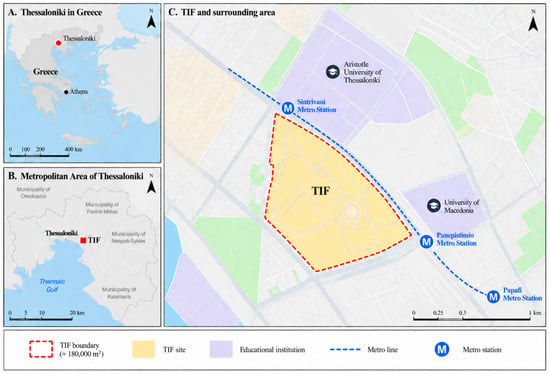
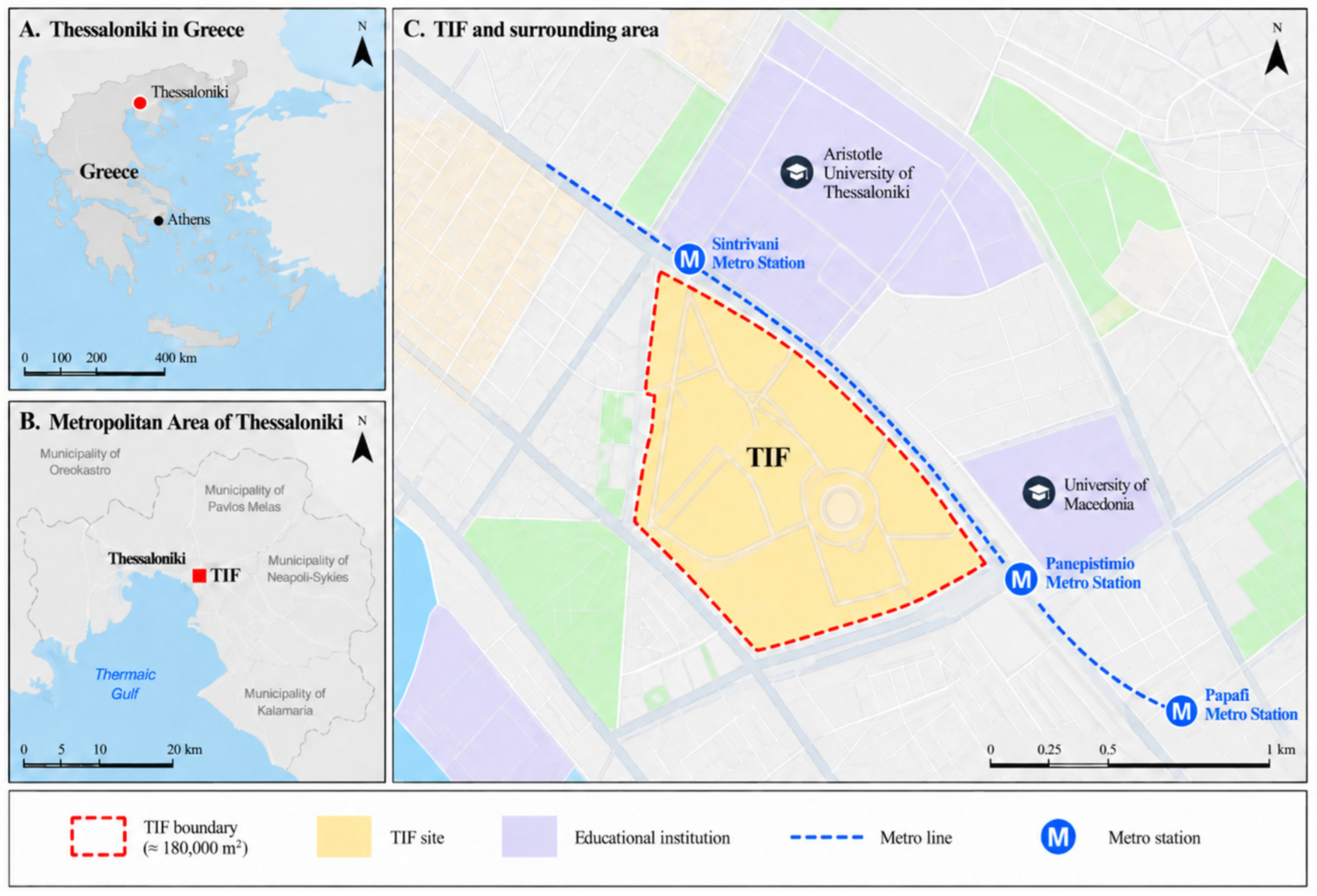
The Thessaloniki International Fair developed within this rapidly transforming urban context. The first TIF was inaugurated on 3 October 1926 at the Field of Ares (Pedion tou Areos), initially occupying approximately 7000 m2 [58]. As the exhibition expanded, the original site soon became inadequate. In 1940, the Fair was transferred to its present location (Figure 1), where the 15th TIF was held before exhibition activity was interrupted by the Second World War [58]. The post-war operation of the Fair resumed in 1951, while specialised sectoral exhibitions started to develop alongside the TIF from 1973 onwards [58].
Figure 1.
Research design.
The exhibition centre covers approximately 180,000 m2 and comprises 17 pavilions with approximately 62,000 m2 of covered exhibition space, together with conference, cultural, recreational, parking and supporting facilities [59].
The present exhibition grounds occupy a strategically important position between the historic city centre and the eastern part of the metropolitan area. The site is directly adjacent to major institutional and public functions, including the campus of Aristotle University of Thessaloniki, military facilities, cultural institutions and some of the city’s principal traffic arteries. This combination gives the area a distinctive urban morphology. Unlike the continuous residential blocks that characterise much of central Thessaloniki, the TIF forms part of a broader zone of large institutional plots and relatively extensive open or semi-open spaces.
Its centrality is therefore not merely geographical. The TIF is embedded in a dense network of economic, educational, administrative and cultural activities and occupies a highly visible position within everyday urban life.
An additional dimension concerns public-transport accessibility. The survey data analysed in this study were collected in July 2019, before the operation of the Thessaloniki Metro. The Metro entered commercial operation on 30 November 2024 [60]. Consequently, the mobility patterns captured by the empirical research reflect the pre-Metro transport structure of the city. The current network includes nearby stations such as Sintrivani and Panepistimio, with Papafi serving the wider eastern side of the area [60]. This transformation should be taken into account when interpreting the spatial patterns reported in the study and provides an important basis for future comparative research.
3.2. Research Design and Relationship Between the TIF and the Wider Exhibition System
3.2.1. Overall Mixed-Methods Design and Analytical Scope
The TIF constitutes the primary analytical case of this study. However, the empirical strategy also draws on evidence concerning Thessaloniki’s wider exhibition activity. This distinction is important because the annual TIF forms part of a broader, locally embedded exhibition ecosystem organised around the same exhibition infrastructure and institutional setting. The population survey therefore captured residents’ engagement with exhibitions in Thessaloniki more generally, while allowing the dominant position of the TIF within this system to be identified. Similarly, interviews with exhibitors and visitors conducted during Zootechnia and Detrop were used to investigate experiences of the exhibition–city relationship arising within the same physical and organisational environment. These materials are not treated as direct evidence of attitudes towards the annual TIF where the relevant question did not specifically concern the TIF. Instead, they provide contextual and comparative evidence on how the central exhibition complex is experienced during different exhibition formats. TIF-specific interpretations are derived primarily from questions explicitly referring to the TIF and from interviews with institutional stakeholders concerning the Fair.
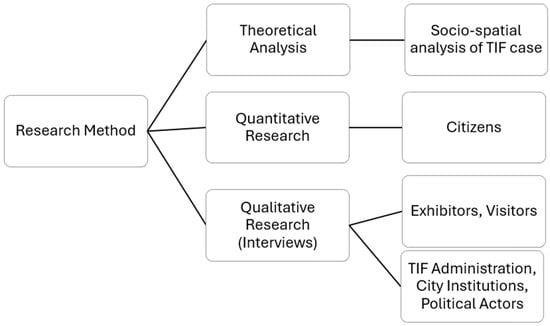
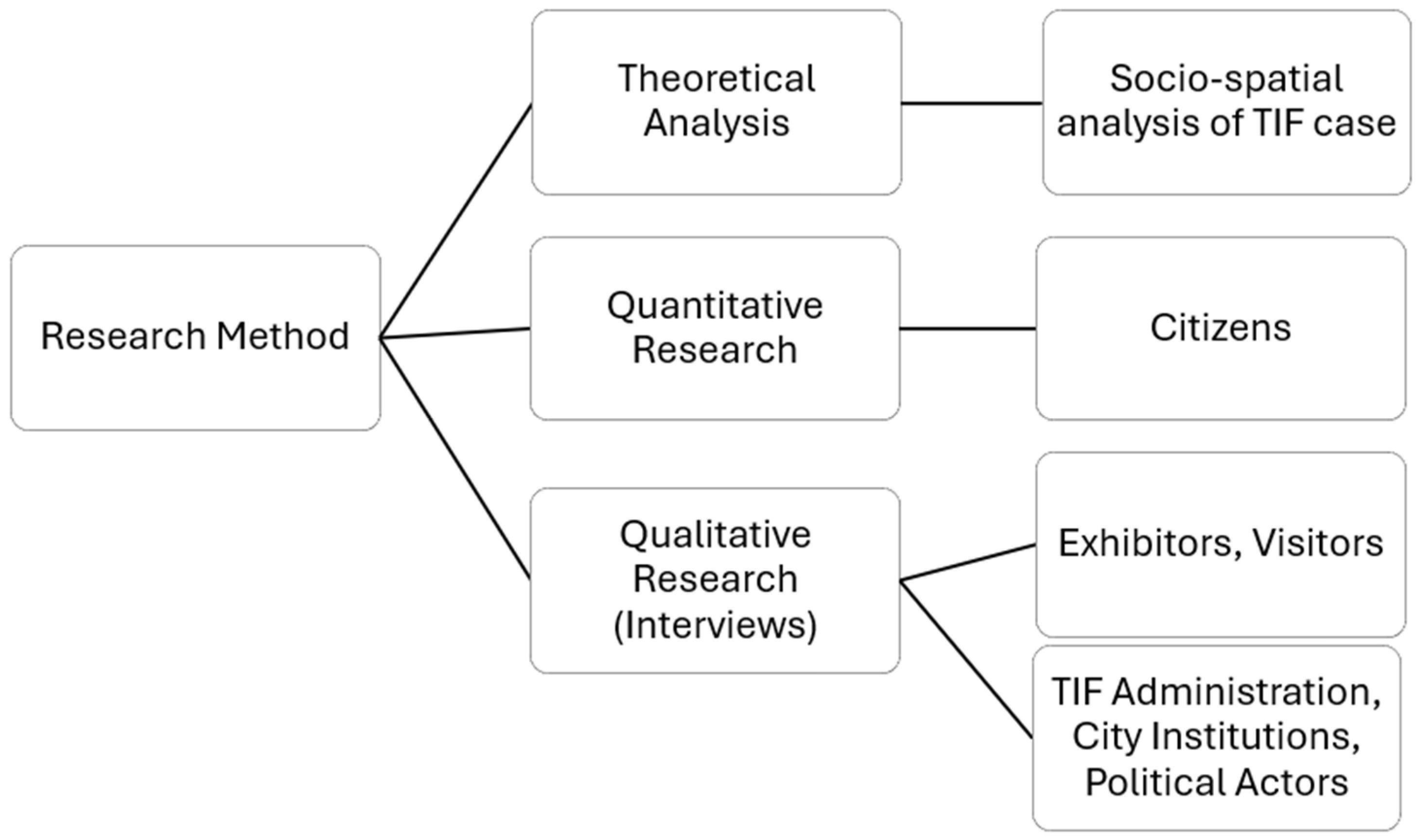
The study adopted a sequential mixed-methods design. Initial qualitative fieldwork with exhibitors and visitors preceded the population survey and contributed to refining the issues subsequently examined quantitatively. The survey then provided a broader metropolitan-level assessment of participation patterns, perceptions and representations, while a later qualitative phase involving institutional and political stakeholders enabled these findings to be interpreted in relation to governance, policy and institutional narratives. The overall methodological sequence and the relationship between the qualitative and quantitative components are summarised in Figure 2.
Figure 2.
Research design.
3.2.2. Quantitative Survey of Thessaloniki Residents
The quantitative component of the study was designed to investigate public attitudes, perceptions and representational understandings of the relationship between exhibition activity and the city.
The survey instrument comprised 13 principal questions, including dichotomous items, single- and multiple-choice questions, Likert-type scales and an open-ended question. Before the main survey, a pilot study was conducted between 3 and 5 July 2019 with 27 participants. The pilot study was used to assess the formulation of the questions and the construction of the measurement scales. Three questions were subsequently reformulated in response to difficulties identified during the pilot phase. Reliability assessment of the continuous-scale items produced a Cronbach’s alpha of 0.874, indicating high internal consistency.
The target population consisted of residents of the Metropolitan Area of Thessaloniki. A stratified random sampling procedure was employed, with strata defined by gender, age group and area of residence. Fieldwork was conducted at selected central locations across the study area. Within each survey location, researchers approached every third passer-by, introducing a systematic random-selection procedure while maintaining the predefined demographic and spatial structure of the sample. Data collection was conducted between 8 and 21 July 2019 and yielded 1066 completed questionnaires. Participation was voluntary. The number of valid responses varies for individual variables because of item non-response; valid N is therefore reported separately where appropriate.
3.2.3. Qualitative Interviews with Exhibitors and Visitors
The first qualitative component consisted of 103 semi-structured interviews with exhibitors and visitors during two major sectoral exhibitions held within the Thessaloniki exhibition complex: Zootechnia and Detrop. These fairs were selected because they are long-established sectoral exhibitions and constitute established components of Thessaloniki’s exhibition activity. Of the 103 interviews, 52 were conducted with exhibitors and 51 with visitors.
At Zootechnia, 58 interviews were conducted on 31 January and 1 February 2019, comprising 30 exhibitors and 28 visitors. At Detrop, 45 interviews were conducted on 3 and 4 March 2019, comprising 22 exhibitors and 23 visitors. Quota sampling was employed to achieve broad spatial coverage of the exhibition environment. Approximately two interviewees were selected from each pavilion so that the different parts of the exhibition grounds would be represented. At Zootechnia, interviews were conducted in Pavilions 2, 3, 5, 7, 8, 9, 10, 12, 13, 14, 15 and 16, as well as in outdoor exhibition areas. At Detrop, interviews covered Pavilions 8, 9, 10, 12, 13, 15 and 16 and the outdoor areas.
Separate semi-structured interview guides were developed for exhibitors and visitors. The guides were organised into four thematic sections addressing participant characteristics, participation in and evaluation of the exhibition, the relationship between exhibition activity and the city, and attitudes towards participation in exhibition planning and organisation. The exhibitor guide contained 18 principal questions, several of which included follow-up prompts.
Before each interview, participants were informed about the objectives of the research and participated voluntarily. Separate consent was requested for audio recording. Where recording permission was granted, the interview was recorded; where such permission was not provided, detailed written notes were taken instead.
Following completion of the interviews, the qualitative material was systematically organised and coded. The principal points from each interview were entered into a structured spreadsheet, with responses organised according to interview question and participant. This procedure generated a coded qualitative database that facilitated the identification of recurrent themes and patterns across exhibitors and visitors. The resulting thematic categories were subsequently interpreted through the analytical framework of socio-spatial dialectics and cultural hegemony.
3.2.4. Institutional and Political Stakeholder Interviews
A second qualitative phase consisted of 15 interviews with representatives of TIF-HELEXPO, local and regional institutions and political actors. Participants were selected purposively because of their direct involvement in the organisation, governance or wider urban implications of exhibition activity in Thessaloniki.
The interviews were conducted between 31 March and 15 April 2020. As this period coincided with restrictive measures associated with the COVID-19 pandemic, a combination of interview modes was employed: ten interviews were conducted through videoconferencing, two by telephone, two through written responses and one face-to-face. Interview duration ranged from 13 to 90 min. Participants were contacted in advance, informed about the research objectives and provided with the interview guide. Participation was voluntary and informed consent was obtained prior to the interview. Separate consent was requested for audio or video recording.
3.2.5. Integration of the Mixed-Methods Evidence
The quantitative and qualitative strands were integrated throughout the research process rather than treated as independent studies. The initial interviews with exhibitors and visitors contributed to refining the conceptual focus of the subsequent population survey. Quantitative analysis was then used to identify broader patterns in participation, motivations and perceived impacts across the metropolitan population. Qualitative evidence from exhibitors, visitors and institutional stakeholders was subsequently used to interpret how these patterns were experienced, narrated and institutionally framed. Convergence between the empirical strands strengthened interpretations where survey patterns and interview accounts pointed in the same direction, whereas divergence was retained as an analytically meaningful finding rather than resolved artificially.
The integration of the empirical material followed a combined deductive–inductive analytical procedure. Lefebvre’s three spatial categories provided the initial deductive structure, while the questionnaire’s open-ended responses and the semi-structured interviews informed the identification and refinement of recurrent themes. Practices associated primarily with economic transactions, circulation and organised activities were interpreted as spatial practices; references to public image, status and the collective role of the Fair were treated as collective or socio-spatial representations; and affective, symbolic, political and experiential themes were interpreted as representational or lived spaces. This procedure enabled the quantitative and qualitative evidence to be analysed within a common theoretical framework while preserving the distinct contribution of each empirical component.
4. Results
4.1. Socio-Spatial Dialectics and the Thessaloniki International Fair
As one of the oldest and most symbolically embedded exhibitionary institutions in Greece, the Thessaloniki International Fair (TIF) provides a particularly rich terrain for examining how socio-spatial processes unfold through large-scale public events. Its long history, central urban location, diverse cultural and economic functions, and strong political visibility render it a unique case in which spatial practices, symbolic representations and lived experiences intersect [28,29,30]. Drawing on Lefebvre’s triadic conception of space, the following analysis interprets the empirical material captured in Table 1 and examines how the TIF operates as a socio-spatial assemblage where economic activity, cultural meaning and political performance converge.
Table 1.
Socio-spatial dimensions of the Thessaloniki International Fair (TIF).
Table 1 presents three interrelated dimensions (spatial practices, collective/socio-spatial representations and representational spaces) as they manifest in the context of the Fair. Taken together, these dimensions highlight the ways in which the TIF produces, organises and expresses relationships between space, society and power. The results described below synthesise these three levels and demonstrate how the Fair becomes a dynamic environment where institutional strategies, public imaginaries and embodied experiences continuously interact.
The first dimension concerns the spatial practices that structure the Fair as an economic and organisational field. These practices include the promotion of businesses, the circulation of goods, economic transactions, technological showcases, tourism promotion and the staging of political announcements. The results show that the Fair operates as a dense hub of commercial activity, bringing together firms, institutions, visitors and international actors in ways that stimulate market visibility and foster entrepreneurial networks. These practices illustrate how the Fair participates in urban economic restructuring: it channels flows of capital and innovation, supports local enterprises, and aligns the city with national and international circuits of trade and technology. Through these spatial practices, the Fair acquires a tangible organisational form that structures movement, interaction and exchange.
The second dimension refers to collective and socio-spatial representations: how the Fair is imagined, narrated and symbolically positioned within broader social and political frameworks. The results reveal that the TIF is widely understood as an emblematic site of urban vitality, contributing to the city’s economic, cultural and social image. It is perceived as a symbol of prestige for local enterprises, as well as a platform through which the city asserts its role as a centre of economic and political life. Residents and visitors alike interpret the Fair as a moment of heightened activity and interaction, reinforcing a sense of openness, dynamism and connection. These symbolic narratives, rooted in public discourse and institutional communication, demonstrate how the Fair contributes to the construction of urban identity and the circulation of legitimising stories about development, innovation and cultural significance.
The third dimension concerns representational spaces: the lived, affective and experiential aspects of the Fair that exceed formal narratives and institutional intentions. The results show that the TIF is not only a site of commerce and representation but also a sensory and emotional landscape. Participants describe it as a place of entertainment, nostalgia and spectacle, where childhood memories, leisure activities, architectural landmarks and sensory stimuli produce multifaceted experiences.
The material dimension of these lived representations is reinforced by recognisable elements of the exhibition complex. The pavilions, the Alexandreio sports hall, the Ioannis Vellidis Congress Centre and other characteristic structures contribute to the visual identity of the site and act as spatial reference points within the city. Their significance is not only functional: through repeated exposure across successive exhibitions and public events, they form part of the collective memory and recognisability of the TIF landscape.
At the same time, the Fair functions as a stage for political performance: government announcements, party strategies, rallies and demonstrations materialise within the exhibition grounds, turning them into a contested arena where authority is both asserted and challenged. These lived experiences highlight how the Fair becomes a symbolic and affective environment in which dominant narratives are reproduced, negotiated or resisted.
These findings also illuminate the operation of cultural hegemony within the Fair. Narratives of technological progress, economic modernisation, national representation and urban prestige do not appear merely as descriptive themes; they constitute recurrent frameworks through which the institutional significance of the TIF is legitimised. The annual concentration of governmental announcements, official ceremonies, corporate displays and national or international representations reinforces the association between the exhibition grounds and particular visions of development and collective progress. At the same time, demonstrations, political mobilisation, informal uses and participants’ own memories introduce alternative meanings into the same space. The empirical material therefore points not to complete ideological dominance but to a hegemonic process in which institutional meanings are repeatedly asserted, encountered, negotiated and sometimes challenged.
The political role of the TIF can be differentiated into several interconnected dimensions. First, the Fair functions as a highly visible national political stage through the annual presence of central government and the articulation of policy priorities. Second, party activities and extensive media coverage transform the event into a temporary arena of political communication and agenda-setting. Third, demonstrations and organised protests around the exhibition site create a counter-public dimension in which governmental and institutional narratives may be openly contested. Finally, the TIF is embedded in local governance processes concerning mobility, public space, exhibition infrastructure and the future development of the site. Its political character therefore extends beyond ceremonial visibility and is produced through the interaction of national representation, political communication, protest and urban governance.
Together, the results indicate that the Thessaloniki International Fair embodies the socio-spatial dialectic in ways that are both structured and emergent. Its spatial practices organise economic activity; its collective representations construct meanings that consolidate its role within the city; and its representational spaces produce lived experiences that broaden, complicate or disrupt official narratives. The Fair thus emerges not as a static event but as a dynamic socio-spatial formation where material infrastructures, symbolic imaginaries and everyday practices converge. This layered configuration underscores the Fair’s significance as a site through which economic logics, cultural identities and political performances are enacted and contested within the urban fabric.
4.2. Patterns of Exhibition Engagement in the City
4.2.1. Demographic and Socio-Spatial Profile of Respondents
A total of 1066 questionnaires were collected for the quantitative component of the study. As shown in Table 2, the gender distribution is relatively balanced, with women representing a slightly higher proportion of the sample (52.6%) compared to men (47.4%). Age composition indicates substantial representation of both younger and older adults, with the largest groups being respondents aged 30–44 (27.9%) and 45–64 (29.6%), followed by a significant proportion aged 65+ (19.3%).
Table 2.
Demographic and Socio-spatial Characteristics of the Sample.
Educational attainment in the valid responses is generally high:
In total, 66.1% of respondents who provided information on education reported post-secondary, higher-education or postgraduate qualifications. University graduates accounted for 30.4%, while respondents with postgraduate or doctoral qualifications accounted for 13.4% of valid responses. These figures describe the educational profile of the sample but should not be interpreted as a direct measure of either cultural or social capital.
The valid sample size differs across variables because some respondents did not provide information on education or occupation. Educational-level percentages are based on N = 1020 valid responses, while occupation percentages are based on N = 1017. Gender, age and area-of-residence distributions are based on the full sample of N = 1066.
Employment status reflects a diverse occupational profile, with public and private sector employees comprising the largest share (40.3%), followed by retirees (23.7%) and self-employed individuals (16.1%).
Finally, the spatial distribution of residence highlights broad coverage across the metropolitan area. Most respondents reside in the Eastern districts (38.6%) and Western districts (33.9%).
The residential categories distinguish the city centre, eastern and western districts of the continuous urban area, and the more peripheral eastern and western suburbs. They therefore capture different positions relative to the central exhibition grounds rather than constituting direct measures of social status. These categories are used to examine whether engagement with exhibition activity varies according to respondents’ location within the metropolitan structure. Figure 1 provides the geographical context required to interpret these residential categories and the central position of the TIF within the metropolitan area.
4.2.2. Exhibition Attendance, Motivations and Perceived Impacts
Table 3 summarises the core quantitative findings regarding exhibition attendance, motivations for visiting, perceived impacts on the city and the socio-spatial representations associated with Thessaloniki’s exhibitions.
Table 3.
Descriptive Results on Exhibition Engagement.
To contextualise the survey results, it is useful to note that Thessaloniki hosts a wide range of specialised trade fairs in addition to the TIF, including sectoral exhibitions on agriculture (Agrotica, Zootechnia), food and beverages (Detrop, Oenos, Artozyma), tourism (Philoxenia, Hotelia), jewellery (Kosmima), culture and art (Book Fair, Art Thessaloniki), construction (Infacoma) and fresh produce (Freskon). These events differ significantly in scale, audience and purpose, which helps explain the distribution of attendance patterns shown below.
The results indicate that participation in local exhibitions is notably widespread: 78.4% of respondents reported attending at least one exhibition in the city, with the Thessaloniki International Fair (TIF) overwhelmingly dominating visitation patterns (89.7% of those who attended). Other major exhibitions, such as Agrotica/Zootechnia, Philoxenia/Hotelia, and the Book Fair, also attracted substantial segments of the public.
As shown in Table 4, exhibition attendance is significantly associated with age (χ2(4) = 98.198, p < 0.001), educational level (χ2(4) = 27.892, p < 0.001), occupation (χ2(5) = 90.235, p < 0.001) and area of residence (χ2(4) = 11.161, p = 0.025). By contrast, the association between gender and exhibition attendance is not statistically significant (χ2(1) = 1.697, p = 0.193). These results demonstrate socio-demographic and spatial differentiation in reported exhibition attendance. They should not, however, be interpreted as direct evidence of causal mechanisms such as mobility constraints, cultural capital or socio-spatial inequality, since these mechanisms were not measured directly by the questionnaire.
Table 4.
Chi-square Tests on Exhibition Attendance.
An important temporal qualification concerns urban accessibility. The survey was conducted in July 2019, before the Thessaloniki Metro entered operation. The observed association between residential area and exhibition attendance therefore reflects the pre-Metro mobility context and should not be interpreted as representative of current accessibility conditions. The subsequent introduction of Metro services near the exhibition area creates an important opportunity for future research to test whether improved public-transport accessibility has altered attendance patterns across different parts of the metropolitan area.
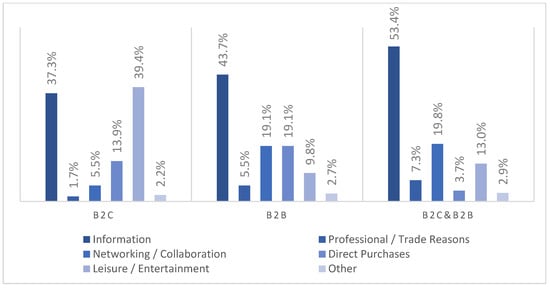
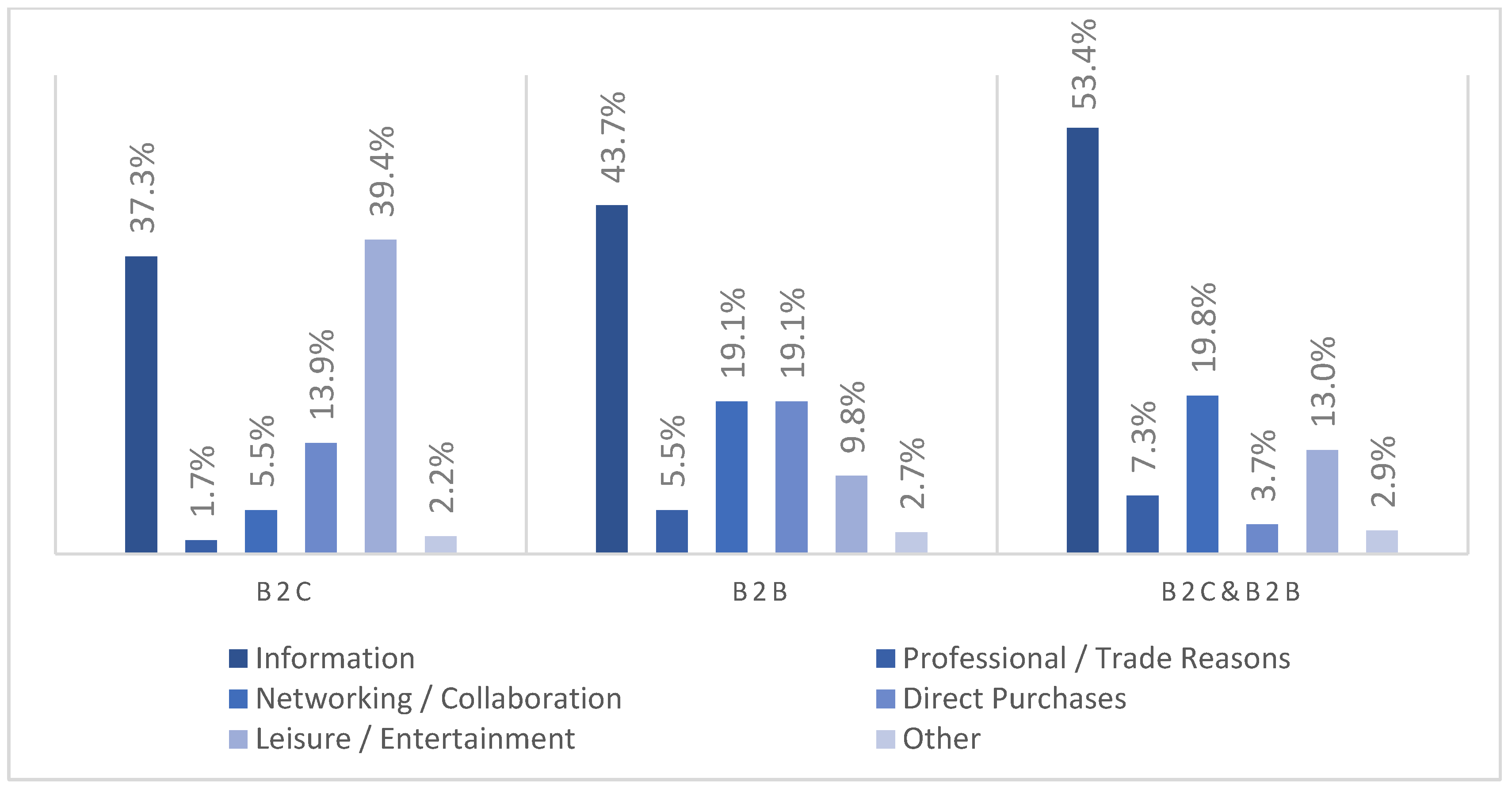
Motivations for attending exhibitions appear strongly dual in character, reflecting both instrumental and experiential dimensions. As shown in Figure 3, respondents primarily visited exhibitions for information (73.3%), leisure and entertainment (70.7%), and direct purchases (31.8%), while a smaller share engaged for professional or networking reasons. This blend of consumption, sociality and practical engagement echoes the socio-spatial dialectics identified in the theoretical analysis, where exhibitions operate simultaneously as economic infrastructures, cultural stages and spaces of everyday urban experience.
Figure 3.
Reasons for attending exhibitions by exhibition type.
Motivations for attending exhibitions also vary significantly depending on the type of event. As summarised in Figure 2, B2C exhibitions attract visitors primarily for leisure, entertainment and general information, whereas B2B exhibitions are visited predominantly for information, networking and professional purposes. Mixed B2C/B2B events display a hybrid pattern, with information-seeking dominating but networking and collaboration also playing a central role. Finally, “other” events, given their thematic heterogeneity, show a more dispersed distribution of motivations. This differentiated pattern reinforces the socio-spatial dialectics highlighted earlier, illustrating how different exhibition formats operate simultaneously as consumer spaces, professional infrastructures and urban cultural experiences.
4.3. Perceived Socio-Spatial Impacts: City, Everyday Life and Urban Pressures
Table 5 shows that respondents overwhelmingly assessed exhibitions as having a positive impact on the city (88.7%). Positive representations highlighted progress, innovation, tourism reinforcement, cultural vitality and entertainment; negative representations emphasised congestion, overcrowding and urban stress.
Table 5.
Perceived City Impact and Urban Representations.
As shown in Table 6, perceptions of how exhibition activity affects everyday life also vary significantly by age (χ2(8) = 30.803, p < 0.001), educational level (χ2(8) = 18.452, p = 0.018), occupation (χ2(10) = 39.219, p < 0.001) and area of residence (χ2(8) = 35.659, p < 0.001). Gender differences are not statistically significant (χ2(2) = 2.068, p = 0.356). These associations demonstrate differentiated perceptions across the metropolitan population; however, the present data do not directly identify the causal mechanisms underlying these differences. Factors such as accessibility, mobility practices, occupational structure or frequency of city-centre use may be relevant and should be examined explicitly in future research rather than inferred from the present cross-tabulations.
Table 6.
Chi-square Tests on General Impact.
Finally, the questionnaire included an open-ended question in which respondents described what exhibitions in Thessaloniki represent for them. These qualitative responses were subsequently coded and categorised into positive, neutral and negative representations (Table 5). Most characterisations were positive, emphasising entertainment, progress, innovation, tourism promotion, city reputation, cultural value and communal memory. Neutral comments included indifference or triviality, while negative representations centred on traffic congestion and overcrowding. These findings further illustrate how exhibitions function as socio-spatial symbols, reinforcing positive urban imaginaries while simultaneously reflecting everyday frustrations embedded in the city’s spatial dynamics.
4.4. Lived Experiences of the Thessaloniki International Fair
4.4.1. Exhibitors’ Perspectives: The Exhibition and the City
Across the interviews with exhibitors, the Thessaloniki International Fair (TIF) emerges as a space with strong perceived contributions to the city’s economic vitality, entrepreneurial activity and visitor flows. Exhibitors consistently described the Fair as a catalyst for urban life, generating commercial movement, tourism and wider activity in the city centre. As one participant noted: “It helps. It becomes like a festival. Both the shops and the entertainment venues get very busy.” (IN.EX.22).
The exhibitors emphasised the central location of the exhibition grounds as a key operational advantage, reinforcing accessibility and enabling the Fair to intersect with everyday urban routines. They also highlighted the interdependence between entrepreneurship and tourism, suggesting that the Fair draws visitors who subsequently contribute to hospitality, food services and retail spending.
A recurring theme is the idea of Thessaloniki functioning as a space of representations: a city whose atmosphere and cultural identity amplify the attractiveness of the exhibition. As an exhibitor explained: “Thessaloniki plays a role, because people come from all over Greece and want to have a good time.” (IN.EX.11).
4.4.2. Visitors’ Perspectives: Experience, City Life and Impacts
Visitors emphasised the combined experience of attending the Fair and engaging with the city’s broader urban offerings, including shopping, dining and nightlife. Many interviewees framed the Fair as part of a broader urban leisure itinerary, reinforcing Thessaloniki’s image as a hospitable and socially vibrant destination: “Thessaloniki is a beloved place, and I have many friends here, so I had both the exhibition and social outings, coffee, food, drinks, nightlife.” (IN.VI.37).
Visitors overwhelmingly perceived the Fair as having positive effects on the city, particularly in relation to tourism, urban animation and cultural visibility. However, they also acknowledged negative externalities, especially related to congestion and parking shortages: “The chaos in Thessaloniki is pretty well-known, whether there is an exhibition or not, it doesn’t get solved. It’s constant.” (IN.VI.05).
This dual structure of impact reflects the broader socio-spatial dialectics surrounding the TIF: while the Fair animates the city and reinforces its cultural identity, it simultaneously intensifies everyday urban pressures.
4.4.3. Perspectives of TIF Management and City Stakeholders
Interviews with representatives of TIF-HELEXPO, city authorities and political actors underscored the Fair’s macro-level contributions to Thessaloniki’s development. From an economic standpoint, stakeholders stressed that the Fair enhances employment, drives intersectoral linkages and supports local supply chains: “Of course it does. Primarily for the city’s economy, which is very important. It contributes to intersectoral cooperation, employment and job creation.” (TIF HELEXPO CEO, 1 April 2020).
Stakeholders also recognised negative impacts, largely concentrated in environmental and mobility concerns. Traffic congestion and increased emissions were mentioned as recurring challenges associated with large-scale events: “… but it also has negative impacts, such as heavy traffic congestion and increased pollution.” (Member of Parliament for Thessaloniki, 6 April 2020).
Interestingly, city stakeholders viewed the Fair not only as an economic instrument but also as a symbolic resource, shaping the external image of Thessaloniki and reinforcing narratives of progress, innovation and openness.
4.5. Integration of Quantitative and Qualitative Findings
The quantitative and qualitative findings converge on several central dimensions of the exhibition–city relationship. First, the widespread attendance reported in the population survey corresponds with interview narratives that portray exhibition activity as closely embedded in the rhythms of Thessaloniki’s urban life. The quantitative prominence of information and leisure as motivations is similarly reflected in visitors’ descriptions of combining exhibition attendance with socialising, dining, shopping and other city-centre activities.
Second, the high proportion of respondents assigning positive meanings to exhibitions is consistent with exhibitors’ and institutional actors’ emphasis on economic activity, tourism, employment and city visibility. At the same time, both strands reveal a parallel set of negative externalities. Survey respondents refer particularly to congestion and overcrowding, while visitors and institutional stakeholders identify traffic, parking and environmental pressures. The convergence between these findings demonstrates that positive symbolic representations coexist with practical urban costs.
Third, the qualitative material helps interpret political and symbolic dimensions that cannot be captured adequately through descriptive survey distributions. Institutional narratives of progress, innovation and economic development are reproduced through official performances and the highly visible role of the Fair within the city. Yet the interviews and wider empirical material also point to competing experiences and forms of contestation. Mixed-methods integration therefore shows that the TIF is simultaneously experienced as an economic resource, an urban cultural practice and a politically negotiated space.
5. Discussion
5.1. Collective Urban Imaginaries and Representational Meanings
The findings address RQ1 by showing that the TIF occupies a highly visible position within Thessaloniki’s collective urban imagination. Survey responses associate exhibition activity primarily with progress, innovation, tourism, entertainment and urban vitality, while qualitative accounts add dimensions of memory, familiarity and everyday urban experience. These findings support the interpretation of the Fair as a representational space whose significance extends beyond its economic function. They also resonate with research showing that exhibitions and cultural-economic infrastructures produce symbolic narratives through which economic practices, institutional identities and urban aspirations are legitimised [3,36].
5.2. Multiple Actor Perspectives and the Hybrid Role of the TIF
Regarding RQ2, the results demonstrate that the meanings attributed to the exhibition complex vary among different actors. Exhibitors emphasise commercial visibility, networking and economic circulation; visitors emphasise leisure, social interaction and engagement with the wider city; and institutional stakeholders highlight economic development, employment, city image and political visibility. Residents’ survey responses similarly combine positive symbolic associations with practical concerns such as congestion and overcrowding. These perspectives are not mutually exclusive. Rather, they reveal the Fair as a hybrid institution whose economic, cultural, experiential and political meanings overlap. The broader exhibition data used in the study should therefore be understood as contextual evidence concerning Thessaloniki’s exhibition ecosystem, while conclusions specifically concerning the annual TIF are drawn from TIF-specific responses and institutional material.
5.3. Socio-Spatial Dialectics, Cultural Hegemony and Political Contestation
RQ3 concerns the interaction between institutional strategies, spatial configurations and lived experience. Here, the combination of socio-spatial dialectics and cultural hegemony provides explanatory value that neither framework offers alone. Lefebvre’s approach makes visible the relationship between organised spatial practices, institutional representations and lived appropriation. A purely Lefebvrian interpretation, however, says less about why particular meanings acquire greater institutional authority than others. The Gramscian perspective addresses this issue by directing attention to how narratives of progress, innovation, national visibility and economic development are repeatedly produced and legitimised through official ceremonies, corporate displays, governmental announcements and media attention. At the same time, Lefebvre’s emphasis on lived space prevents this hegemonic process from being interpreted as complete. Visitors’ experiences, memories, informal practices and political protests continually introduce plurality into the exhibition environment. The theoretical contribution of the study therefore lies in conceptualising exhibition space as simultaneously produced and hegemonically organised, yet never fully closed to reinterpretation and contestation.
The political character of the TIF illustrates this interaction particularly clearly. Its role as a national stage for government announcements and party-political communication associates the exhibition with institutional authority and policy agenda-setting. Yet the concentration of political visibility also generates demonstrations, protests and counter-public performances. The same spatial setting can consequently support both the projection of authority and its contestation. Cultural hegemony is thus expressed not through the elimination of opposition but through an ongoing struggle over the meanings attached to a highly visible urban institution [25,27].
5.4. Implications for Urban Sustainability
These findings also have implications for urban sustainability. The case demonstrates that the sustainability of major event infrastructures cannot be assessed only through economic benefits or environmental performance. Social accessibility, everyday mobility, inclusion, public-space pressures, legitimacy and the distribution of perceived benefits are also relevant [12,38]. The statistically differentiated patterns observed across age, education, occupation and residential categories indicate that an urban institution may possess strong collective symbolism without being experienced identically throughout the metropolitan population. Sustainable event governance therefore requires attention to how infrastructure, access and public meaning are distributed across social and spatial groups. This interpretation complements previous research on the TIF and sustainable urban development [12,37] by demonstrating that sustainability is also mediated through symbolic representation and lived socio-spatial experience.
5.5. Limitations and Future Research
Several limitations must be acknowledged. First, the exhibitor and visitor interviews and the population survey were conducted in 2019, while the institutional stakeholder interviews were conducted in 2020. The findings therefore describe the TIF and Thessaloniki’s exhibition environment during that period and should not be read as a direct measurement of current conditions. Second, the Thessaloniki Metro was not yet operational when the population survey was conducted, meaning that current accessibility patterns may differ substantially from those captured in the data. Third, the survey identifies associations among demographic, spatial and perceptual variables but does not directly measure causal mechanisms such as individual mobility, cultural capital or social capital. Finally, although the use of sectoral fairs provides valuable evidence concerning the shared exhibition environment, the distinction between the annual TIF and Thessaloniki’s broader exhibition activity must be maintained when interpreting specific findings.
Future research should therefore replicate the population survey under current transport conditions and directly examine whether Metro accessibility has changed exhibition participation across residential areas. Longitudinal research could investigate how changes in exhibition infrastructure and the wider redevelopment of the site affect public perceptions, accessibility, social inclusion and environmental pressures. Comparative research with other recurrent urban exhibition centres would further help determine whether the interaction between hegemonic representation, lived spatiality and sustainability identified in Thessaloniki is specific to the TIF or reflects a broader characteristic of centrally embedded exhibition infrastructures.
6. Conclusions
This study examined the Thessaloniki International Fair as a socio-spatial, cultural and political institution embedded in the urban landscape of Thessaloniki. Based on empirical material collected in 2019–2020, the findings show that the Fair and the exhibition environment surrounding it were strongly associated with progress, innovation, tourism, economic activity and urban vitality, while also carrying affective meanings connected with leisure, memory and everyday city life. These representations coexist with practical concerns regarding congestion, accessibility and other pressures generated by large-scale events.
The study further demonstrates that exhibition engagement is not uniform across the metropolitan population. Attendance and perceptions vary significantly according to age, educational level, occupation and area of residence. These statistical associations demonstrate differentiation but should not be interpreted as direct evidence of underlying causal mechanisms that were not measured in the survey. In particular, the data precede the operation of the Thessaloniki Metro and therefore reflect the mobility and accessibility conditions prevailing at the time of data collection.
The principal theoretical contribution lies in combining socio-spatial dialectics with cultural hegemony. The former explains how the exhibition is produced through spatial practices, institutional representations and lived experience, while the latter clarifies how some narratives—particularly those concerning progress, development, innovation and political authority—are institutionally privileged and repeatedly legitimised. Their combination shows that the TIF can simultaneously operate as a space of hegemonic narration and as an open arena in which meanings are appropriated, diversified and contested.
This interpretation also extends the relevance of the study to urban sustainability. The sustainable integration of exhibition infrastructures into host cities depends not only on economic performance or environmental improvements but also on accessibility, inclusion, everyday quality of life, public-space management and the legitimacy of institutional decision-making. Recurring exhibitions should therefore be approached as long-term urban infrastructures whose social, cultural and spatial effects form part of sustainable urban governance.
Because the empirical evidence refers primarily to 2019–2020, future research should reassess these relationships under the transformed transport and urban conditions of contemporary Thessaloniki. Particular attention should be given to post-Metro mobility patterns, changes in spatial accessibility, evolving public perceptions and the effects of future transformations of the exhibition site. Comparative studies across recurrent urban trade fairs would further test the applicability of the proposed socio-spatial and hegemonic framework to other cities and contribute to a broader understanding of socially sustainable event infrastructures.
Author Contributions
Conceptualization, D.K., A.S., E.K. and I.F.; methodology, D.K.; investigation, D.K. and A.S.; formal analysis, D.K.; writing—original draft preparation, D.K.; writing—review and editing, A.S., E.K. and I.F.; supervision, I.F. All authors have read and agreed to the published version of the manuscript.
Funding
This research received no external funding.
Institutional Review Board Statement
The study was conducted in accordance with the Declaration of Helsinki and approved by the Ethics Department of Business & Exhibition Research and Development Institute (IEE) (Registration Number: 01/2019, date: 7 January 2019).
Informed Consent Statement
Informed consent was obtained from all subjects involved in the study. Participation in both the survey and interviews was voluntary, and all responses were anonymized and used exclusively for research purposes.
Data Availability Statement
The raw data supporting the conclusions of this article will be made available by the authors on request.
Conflicts of Interest
The authors declare no conflicts of interest.
References
- Gotham, K.F. World’s fairs as mega-events. In The Blackwell Encyclopedia of Sociology; Wiley-Blackwell: Oxford, UK, 2015. [Google Scholar]
- Greenhalgh, P. Fair World: A History of World’s Fairs and Expositions; Papadakis: London, UK, 2011. [Google Scholar]
- Rydell, R. World of Fairs: The Century-of-Progress Expositions; University of Chicago Press: Chicago, IL, USA, 1993. [Google Scholar]
- Bennett, T. The exhibitionary complex. In Grasping the World; Preziosi, D., Farago, C., Eds.; Routledge: London, UK, 2004; pp. 413–441. [Google Scholar]
- González, S. Bilbao and Barcelona ‘in motion’: How urban regeneration ‘models’ travel and mutate in the global flows of policy tourism. Urban Stud. 2011, 48, 1397–1418. [Google Scholar] [CrossRef] [Scilit]
- Cosgrove, D.E. Social Formation and Symbolic Landscape, 2nd ed.; University of Wisconsin Press: Madison, WI, USA, 1998. [Google Scholar]
- Lefebvre, H. The Production of Space; Nicholson-Smith, D., Translator; Blackwell: Oxford, UK, 1991. [Google Scholar]
- Soja, E.W. Thirdspace: Journeys to Los Angeles and Other Real-and-Imagined Places; Blackwell: Oxford, UK, 1998. [Google Scholar]
- Richards, G.; Palmer, R. Eventful Cities: Cultural Management and Urban Revitalisation; Routledge: London, UK, 2010. [Google Scholar] [CrossRef] [Scilit]
- MacLeod, S. Museum Architecture: A New Biography; Routledge: London, UK, 2013. [Google Scholar]
- Tsiftelidou, S.; Kourkouridis, D.; Xanthopoulou-Tsitsoni, V. Assessment of impact-contribution of cultural festival in the tourism development of Thessaloniki. In Tourism, Culture and Heritage in a Smart Economy; Springer: Cham, Switzerland, 2017; pp. 411–424. [Google Scholar] [CrossRef] [Scilit]
- Kourkouridis, D.; Frangopoulos, Y.; Kapitsinis, N. Trade fair activity and sustainable urban development, through the lens of Thessaloniki International Fair. Int. J. Urban Sustain. Dev. 2024, 16, 330–342. [Google Scholar] [CrossRef] [Scilit]
- Harvey, D. From managerialism to entrepreneurialism: The transformation in urban governance in late capitalism. Geogr. Ann. B 1989, 71, 3–17. [Google Scholar] [CrossRef]
- Harvey, D. Globalization and the ‘spatial fix’. Geogr. Rev. 2001, 3, 23–30. [Google Scholar]
- Harvey, D. The right to the city. New Left Rev. 2008, 53, 23–40. [Google Scholar] [CrossRef] [Scilit]
- Soja, E.W. The socio-spatial dialectic. Ann. Assoc. Am. Geogr. 1980, 70, 207–225. [Google Scholar] [CrossRef] [Scilit]
- Butler, C. Critical legal studies and the politics of space. Soc. Leg. Stud. 2009, 18, 313–332. [Google Scholar] [CrossRef] [Scilit]
- Charnock, G.; Ribera-Fumaz, R. A new space for knowledge and people? Henri Lefebvre, representations of space, and the production of 22@barcelona. Environ. Plan. D. Soc. Space 2011, 29, 613–632. [Google Scholar] [CrossRef] [Scilit]
- Buser, M. The production of space in metropolitan regions: A Lefebvrian analysis of governance and spatial change. Plan. Theory 2012, 11, 279–298. [Google Scholar] [CrossRef] [Scilit]
- Mtolo, S. Rhodes University through Henri Lefebvre’s spatial triad: How do ‘Rhodians’ experience Rhodes University as place through its visual culture? Area 2020, 53, 143–150. [Google Scholar] [CrossRef] [Scilit]
- Ropo, A.; Höykinpuro, R. Narrating organizational spaces. J. Organ. Change Manag. 2017, 30, 357–366. [Google Scholar] [CrossRef] [Scilit]
- Gramsci, A. Selections from the Prison Notebooks; International Publishers: New York, NY, USA, 1971. [Google Scholar]
- Williams, R. Marxism and Literature; Oxford University Press: Oxford, UK, 1977. [Google Scholar]
- Hall, S. Cultural studies: Two paradigms. Media Cult. Soc. 1980, 2, 57–72. [Google Scholar] [CrossRef] [Scilit]
- Sokka, S.; Badia, F.; Kangas, A.; Donato, F. Governance of cultural heritage: Towards participatory approaches. Eur. J. Cult. Manag. Policy 2021, 11, 4–19. [Google Scholar] [CrossRef] [Scilit]
- Hesmondhalgh, D. The Cultural Industries, 4th ed.; Sage: London, UK, 2020. [Google Scholar]
- Stevens, Q.; Dovey, K. Appropriating the spectacle: Play and politics in a leisure landscape. J. Urban Des. 2004, 9, 351–365. [Google Scholar] [CrossRef] [Scilit]
- Kourkouridis, D.; Dalkrani, V.; Pozrikidis, K.; Frangopoulos, I. Hosted buyers program (HBP) tourism development and the city: TIF-HELEXPO HBP for the period 2014–2016. In Innovative Approaches to Tourism and Leisure; Katsoni, V., Velander, K., Eds.; Springer: Cham, Switzerland, 2018; pp. 407–420. [Google Scholar] [CrossRef] [Scilit]
- Kourkouridis, D.; Frangopoulos, I.; Salepaki, A. Post-pandemic trade fair dynamics: A longitudinal study of exhibitors’ views on digital and hybrid trade fairs. Geoj. Tour. Geosites 2024, 55, 1174–1185. [Google Scholar] [CrossRef] [Scilit]
- Kourkouridis, D.; Frangopoulos, I.; Salepaki, A. Business travel motivations and objectives of trade fairs visitors: Experience from the trade fairs in Thessaloniki, Greece. Geoj. Tour. Geosites 2024, 53, 442–453. [Google Scholar] [CrossRef] [Scilit]
- Sassen, S. The Global City: New York, London, Tokyo, 2nd ed.; Princeton University Press: Princeton, NJ, USA, 2001. [Google Scholar] [CrossRef] [Scilit]
- Sassen, S. Locating cities on global circuits. Environ. Urban. 2002, 14, 13–30. [Google Scholar] [CrossRef]
- Minner, J.S.; Zhou, G.Y.; Toy, B. Global city patterns in the wake of world expos: A typology and framework for equitable urban development post mega-event. Land Use Policy 2022, 119, 106163. [Google Scholar] [CrossRef] [Scilit]
- Richards, G. Reviewing the effects of world expos: Pulsar events for the eventful city? Tur. Vidékfejlesztési Tanulmányok 2022, 8, 70–87. [Google Scholar] [CrossRef]
- Wheatley, M.C. The impact of mega-events on urban development: A review. Prem. J. Soc. Sci. 2024, 1, 100001. [Google Scholar] [CrossRef] [Scilit]
- Gebesmair, A.; Ebner-Zarl, A.; Musik, C. Symbolic representations of cultural industries at content trade fairs: Bourdieu’s “economic world reversed” revisited. Poetics 2022, 92, 101614. [Google Scholar] [CrossRef] [Scilit]
- Kourkouridis, D.; Frangopoulos, I.; Kapitsinis, N. Urban governance and participatory planning in organizing and planning trade fairs. The case of Thessaloniki trade fair. Cities 2024, 154, 105374. [Google Scholar] [CrossRef] [Scilit]
- Jiang, X.; Li, Z.; Cheng, P. Impacts of urban amenities on socio-spatial differentiation: A multiscale analysis in Beijing. Sustainability 2026, 18, 6183. [Google Scholar] [CrossRef] [Scilit]
- Rodgers, S.; Barnett, C.; Cochrane, A. Media practices and urban politics: Conceptualizing the powers of the media-urban nexus. Environ. Plan. D. Soc. Space 2014, 32, 1054–1070. [Google Scholar] [CrossRef] [Scilit]
- Cresswell, T. Place: An Introduction, 2nd ed.; Wiley Blackwell: Malden, MA, USA, 2015. [Google Scholar]
- Massey, D. For Space; Sage: London, UK, 2005. [Google Scholar]
- Yufan, C.; Fangjie, H. The investigation and image of foreign exhibitions in Zhoushan pilot free trade zone. Int. J. Humanit. Soc. Sci. Educ. 2019, 6, 66–72. [Google Scholar] [CrossRef] [Scilit]
- Wang, S.; Liu, H.; Li, Y.; Hu, M. Exploring the innovation potential of urban space at the micro scale: A case study of Suzhou’s main urban area. Humanit. Soc. Sci. Commun. 2025, 12, 80. [Google Scholar] [CrossRef] [Scilit]
- Salazar-Miranda, A.; Fan, Z.; Baick, M.; Hampton, K.N.; Duarte, F.; Loo, B.P.Y.; Ratti, C. Exploring the social life of urban spaces through AI. Proc. Natl. Acad. Sci. USA 2025, 122, e2424662122. [Google Scholar] [CrossRef] [Scilit]
- Mitchell, D. Cultural Geography: A Critical Introduction; Blackwell: Oxford, UK, 2000. [Google Scholar]
- Bennett, T. The Birth of the Museum: History, Theory, Politics; Routledge: London, UK, 1995. [Google Scholar] [CrossRef] [Scilit]
- Smith, A. Events and Urban Regeneration: The Strategic Use of Events to Revitalise Cities; Routledge: London, UK, 2012. [Google Scholar] [CrossRef] [Scilit]
- Kong, L. Cultural icons and urban development in Asia: Economic imperative, national identity, and global city status. Political Geogr. 2007, 26, 383–404. [Google Scholar] [CrossRef] [Scilit]
- Gienow-Hecht, J.C.E.; Donfried, M.C. (Eds.) Searching for a Cultural Diplomacy; Berghahn: New York, NY, USA, 2010. [Google Scholar] [CrossRef] [Scilit]
- Isin, E.F. (Ed.) Democracy, Citizenship and the Global City; Routledge: London, UK; New York, NY, USA, 2000. [Google Scholar]
- Daniels, S. Marxism, culture and the duplicity of landscape. In The Iconography of Landscape; Cosgrove, D., Daniels, S., Eds.; Cambridge University Press: Cambridge, UK, 1989; pp. 196–220. [Google Scholar]
- Stevenson, D. Cities of Culture: A Global Perspective; Routledge: London, UK, 2013. [Google Scholar] [CrossRef] [Scilit]
- García, B. Cultural policy and urban regeneration in Western European cities: Lessons from experience, prospects for the future. Local Econ. 2004, 19, 312–326. [Google Scholar] [CrossRef] [Scilit]
- Quinn, B. Arts festivals and the city. Urban Stud. 2005, 42, 927–943. [Google Scholar] [CrossRef] [Scilit]
- Miles, S. ‘Our Tyne’: Iconic regeneration and the revitalisation of identity in NewcastleGateshead. Urban Stud. 2005, 42, 913–926. [Google Scholar] [CrossRef] [Scilit]
- Monclús, J.; Díez-Medina, C. International exhibitions and open public spaces: Echoes of the times or forerunners? Plan. Perspect. 2025, 40, 1481–1506. [Google Scholar] [CrossRef] [Scilit]
- Gerolympos, A.K. The Redesign of Thessaloniki after the Fire of 1917; University Studio Press: Thessaloniki, Greece, 1995. [Google Scholar]
- TIF-HELEXPO. Digitization, Documentation and Promotion of the Historical-Cultural Heritage of HELEXPO–TIF; TIF-HELEXPO: Thessaloniki, Greece; Available online: https://www.legacy.helexpo.gr/en/ (accessed on 17 September 2026).
- TIF-HELEXPO. Thessaloniki International Exhibition & Conference Centre—Technical Characteristics; TIF-HELEXPO: Thessaloniki, Greece; Available online: https://helexpo.gr/en/exhibition-spaces/ (accessed on 17 September 2026).
- Elliniko Metro S.A. Handing over of the Thessaloniki Metro System for Revenue Service. 30 November 2024. Available online: https://www.emetro.gr/?lang=en&p=32779 (accessed on 17 September 2026).

Disclaimer/Publisher’s Note: The statements, opinions and data contained in all publications are solely those of the individual author(s) and contributor(s) and not of MDPI and/or the editor(s). MDPI and/or the editor(s) disclaim responsibility for any injury to people or property resulting from any ideas, methods, instructions or products referred to in the content. |
© 2026 by the authors. Licensee MDPI, Basel, Switzerland. This article is an open access article distributed under the terms and conditions of the Creative Commons Attribution (CC BY) license.