


Abstract
Solar stills provide a simple, sustainable method for producing freshwater in arid, coastal, and remote regions where conventional desalination is often impractical. This study experimentally evaluated a tubular solar still fabricated from locally available materials under controlled indoor conditions. The thermal performance and freshwater productivity were analyzed with respect to ambient air temperature (Ta), humid air temperature (Tha), cover temperature (Tc), trough temperature (Tt), water temperature (Tw), relative humidity, artificial solar radiation intensity (Sr), and associated temperature differentials. Pearson correlation, linear regression, and principal component analysis (PCA) were employed to investigate the relationships among the measured variables. Water and trough temperatures increased rapidly and reached steady-state values of approximately 46 °C after 2 h, whereas the maximum freshwater yield reached 14.3 g/h. Freshwater yield exhibited strong positive linear relationships with the principal thermal driving forces, including Tw − Ta (R2 = 0.996), Tw − Tc (R2 = 0.989), Tha − Ta (R2 = 0.980), and Tha − Tc (R2 = 0.940), while showing a strong inverse relationship with the relative humidity difference (RHha − RHa; R2 = 0.964). The high thermal efficiency (about 75% prior to accounting for salinity effects) achieved under steady-state conditions proves that precise irradiance control minimizes heat loss. Pearson correlation analysis confirmed significant positive correlations between freshwater yield and the thermal variables (r = 0.957–0.998, p < 0.01) and significant negative correlations with the relative humidity parameters (r = −0.761 to −0.951, p < 0.01). PCA showed that the first principal component explained 83.55% of the total variance, representing the dominant thermal behavior of the system, while the first four principal components together accounted for 98.47% of the dataset variability. These findings demonstrate that freshwater productivity is primarily governed by internal thermal gradients rather than radiation intensity alone and highlight the importance of optimizing heat and mass transfer processes to improve the performance of low-cost tubular solar stills for sustainable desalination applications. These findings provide useful insight for the optimization and scale-up of tubular solar still systems for sustainable desalination applications in water-scarce regions, providing a sustainable framework to produce low-cost potable water from seawater via renewable solar energy.
1. Introduction
Remote communities in arid, coastal, and isolated locales in many countries (e.g., USA, China, Sudan, Bangladesh, and India) and other regions of the earth (e.g., Africa, Australia, and Latin America) often face challenges with water that is tainted by heavy metals (e.g., arsenic), iron, salts, and pathogenic microorganisms. Although traditional methods of desalination, such as reverse osmosis (RO), electrodialysis, ultrafiltration, nanofiltration, disinfection, and water softening are available, they often come with high costs, generate excessive wastewater or brine or fail to eliminate all harmful residues [1]. Given that brine disposal accounts for up to a third of a desalination plant’s expenditures [2], recent focus has shifted toward viewing brine as a potential resource rather than a mere waste stream [3]. Panagopoulos et al. [4] evaluated the environmental implications of desalination and brine treatment and proposed effective mitigation strategies. Therefore, the solar water distillation technique has become popular as a sustainable approach in dry, seaside, and isolated areas.
Solar distillation has emerged as an attractive sustainable alternative because it utilizes renewable solar energy to produce freshwater with minimal environmental impact and low operating costs [5]. Conventional basin-type solar stills remain the simplest and most widely investigated configuration; however, their practical application is often constrained by relatively low freshwater productivity resulting from limited evaporation and condensation rates. Consequently, numerous modifications have been proposed to enhance thermal performance, including improved absorber materials, phase-change materials, nanofluids, external condensers, reflectors, solar collectors, and optimized geometric configurations [6]. Hanson et al. [1] presented the efficiency of single-basin solar stills in eliminating a specific set of inorganic, bacteriological, and organic pollutants. Both laboratory and field experiments were conducted on these stills in the USA. Das et al. [7] experimentally analyzed and optimized the performance of a double-slope solar still enhanced by incorporating nanoparticles into phase change materials. Complementing this, Dhivagar et al. [8] conducted an extensive evaluation of a scalable double-slope solar still, assessing its efficiency through energy, exergy, economic, and environmental lenses, along with sensitivity and distillate output analyses. Sharma et al. [9] also studied exergy energy and financial evaluation of an active solar still.
Among these configurations, tubular solar stills (TSSs) have attracted increasing attention because of their compact geometry, larger condensation surface area, reduced heat losses, and ability to maintain relatively uniform thermal conditions [10]. Previous studies have demonstrated that tubular configurations can improve condensation efficiency while maintaining simple construction and relatively low fabrication costs [11]. Islam et al. [12] experimentally evaluated a tubular solar still under outdoor conditions and demonstrated stable freshwater production using a simple cylindrical configuration. Murugavel et al. [13] investigated laboratory-controlled evaporation and condensation processes and highlighted the importance of thermal gradients in determining freshwater productivity. More recent studies have focused on enhancing tubular solar still performance through improved absorber configurations, evacuated tube collectors, phase-change materials, nanomaterials, reflectors, and hybrid thermal systems, resulting in significant improvements in freshwater productivity and thermal efficiency.
Recent advancements in solar distillation have focused primarily on four key domains: geometric modifications, material enhancements, hybrid energy integration, and multivariate performance modeling. In terms of geometry, innovations such as rotating mechanisms [14], pyramid–parabolic combinations [15], and tubular reflector systems [16] have successfully expanded evaporation surface areas and improved condensate collection. However, these structural modifications often increase mechanical complexity and footprint without addressing fundamental heat dissipation losses. Regarding material-based enhancements, incorporating basin water additives [17], steel fiber thermal matrices [18], and hybrid nanofluids paired with fractional modeling [19] significantly improves thermal absorption and yield. Nevertheless, the long-term chemical stability and practical operational costs of these media remain under-evaluated. In hybrid and energy storage systems, coupling tubular stills with evacuated tube collectors [20] or bi-phase change materials [21] effectively prolongs distillation cycles past off-sun hours, though at the expense of higher initial capital expenditure. Finally, recent literature reflects a growing emphasis on multivariate and predictive modeling, utilizing 4E (energy, exergy, exergoeconomic, and exergoenvironmental) sustainability frameworks [18,19,22] and neutrosophic fuzzy evaluations for regional feasibility [23]. While these studies offer robust analytical and environmental insight, most existing evaluations rely heavily on outdoor ambient fluctuations or complex active setups. Consequently, a clear research gap remains for indoor, controlled solar stills that achieve high thermal efficiency strictly through precise localized irradiance tuning and strict heat loss control.
Recent advances in solar-driven evaporation technologies have expanded the range of approaches for sustainable freshwater production, including conventional bulk-heating solar stills, interfacial solar evaporation, floating photothermal evaporators, and process-heat-supplied evaporation technologies [24,25,26,27]. Among these, interfacial solar evaporation has attracted considerable attention because localized heating at the air–water interface minimizes heat loss and enables high solar-to-vapor conversion efficiency [28]. However, the widespread implementation of these systems is constrained by their reliance on advanced photothermal materials, complex fabrication processes, and effective salt-management strategies [29]. In contrast, conventional basin and tubular solar stills remain attractive owing to their simple design, low cost, and ease of operation, although their performance is strongly influenced by coupled heat- and mass-transfer processes involving water, vapor, condenser, and ambient temperatures, as well as relative humidity [30]. Process-heat-assisted evaporation can further enhance freshwater productivity by utilizing external thermal energy sources, but typically requires more complex system integration and higher operating costs [31]. Despite these advances, most studies have focused on material development and structural optimization, while comparatively limited attention has been given to quantitatively elucidating the multivariate coupling among thermal and environmental variables governing evaporation and condensation, which is essential for optimizing the performance of practical solar desalination systems. Al-Ragehi et al. [32] reported the distillate water-quality analysis with the cost analysis of a solar still integrated with an external condenser and internal heating system.
Multivariable analysis has emerged as a valuable tool for improving the evaluation and optimization of solar still performance. Unlike conventional single-factor analyses, multivariate approaches simultaneously consider the complex interactions among climatic conditions, thermal parameters, and design variables that collectively influence the evaporation and condensation processes. By accounting for these coupled effects, multivariable analysis provides a more comprehensive understanding of system behavior, facilitates the identification of the most influential operating variables, and supports the development of more efficient and reliable solar desalination systems. Artificial intelligence and machine learning techniques, including artificial neural networks (ANNs), adaptive neuro-fuzzy inference systems (ANFISs), support vector machines (SVMs), random forests (RFs), gradient boosting, and deep learning models, have been extensively employed to predict freshwater productivity, thermal efficiency, and distillate yield using multiple input variables such as solar irradiance, ambient temperature, basin water temperature, glass cover temperature, wind speed, relative humidity, and water depth [33,34]. Although numerous studies have employed machine learning and optimization techniques to predict and enhance solar still performance, the application of multivariate statistical methods such as principal component analysis (PCA) to elucidate the coupled relationships among thermal variables and freshwater productivity remains limited.
To address this gap, the present study designs, fabricates, and experimentally evaluates the indoor performance of a simple tubular solar still constructed from low-cost, locally available materials. Furthermore, PCA is employed to elucidate the coupled relationships among the key thermal and environmental variables and to identify the dominant factors governing the evaporation–condensation process and freshwater production in the tubular solar still. Specifically, the objectives of this study are to (i) examine the time-dependent variation in key thermal parameters, including ambient air temperature (Ta), humid air temperature inside the still (Tha), cover temperature (Tc), trough temperature (Tt), water temperature (Tw), and simulated artificial solar radiation intensity generated by the electric bulbs (Sr), together with distillate yield (Y) and relative humidity parameters outside (ambient air) and inside (humid air) the still (RHa and RHha); (ii) develop quantitative linear relationships between distillate yield and the main thermal driving forces, particularly the temperature differences Tw − Tc, Tw − Ta, Tha − Ta, and Tha − Tc, as well as the relative humidity differential (RHha − RHa); (iii) assess the inverse coupling between increasing system temperatures and internal relative humidity and its impact on the evaporation–condensation process; and (iv) employ Pearson correlation and PCA to identify the dominant controlling variables and simplify system behavior into key thermal components. The findings of this research may support the development of full-scale solar stills for deployment in environments where alternative desalination methods are impractical, offering a sustainable, zero-carbon emission pathway to produce potable water from seawater at a low-cost using renewable solar energy.
2. Methodology
Desalination in indoor environment is important when the weather is cloudy, the season is monsoon and the sunshine hours are less, especially in cold region countries. Indoor or controlled-environment desalination becomes essential when outdoor solar irradiance drops below the operational threshold required for conventional passive still. Relying strictly on direct sunlight may yield negligible output in high-latitude regions, monsoon seasons or prolonged cloudy weather.
2.1. Experimental Setup of the Indoor Solar Still and Operation
Locally available and low-cost materials were used to fabricate a simple tubular solar still for indoor performance evaluation. The still consisted of a tubular frame constructed from several plastic sticks, fixed between two identical circular lids at both ends of the structure. The external surface of the frame was then covered with a transparent polythene sheet to create an enclosed evaporation–condensation chamber. Inside the chamber, a trough wrapped with polythene was installed to hold the feed water. The fabricated still was tested under controlled indoor conditions to evaluate its thermal and water production performance.
The system was heated using electric incandescent bulbs (about 200 W) positioned above the still to provide repeatable thermal conditions independent of outdoor weather fluctuations. These bulbs served as a controlled thermal energy source to simulate the heat input required for water evaporation. Although the spectral distribution of the bulbs differs from natural sunlight, the arrangement enabled stable and reproducible operating conditions for investigating the thermal relationships among the measured variables.
The length and diameter of the still are about 55 and 12.5 cm, respectively. The vertical distance between the electric bulbs and the water surface was maintained at about 22 cm throughout the experiment. A constant initial water depth (about 2.5 cm) into the evaporation trough was maintained before each experimental run. The effective surface area of the trough and condensing cover were approximately 150 and 1100 cm2, respectively. The condensed water flowed along the inner surface of the cover and was collected continuously in a collection vessel for freshwater yield measurements.
2.2. Experimental Procedure
The indoor solar still performance was evaluated over a period of 4 h, during which all measurements were recorded at 5 min intervals to investigate the temporal variation in thermal behavior and distillate yield. Prior to each experiment, the tubular solar still was assembled to ensure identical operating conditions. The predetermined volume of feed water was introduced into the evaporation trough, after which the electric bulbs were switched on to initiate heating. During the experiment, several environmental and operational parameters were continuously monitored using a digital data acquisition system. These included Tw, Tc, Tha, Tt, Ta, RHa, RHha, Y and Sr. Measurements were recorded at 5 min intervals from the start of the experiment immediately after the electric bulbs were switched on, and all parameters were monitored simultaneously using a multi-channel data logger. However, Y was measured at 1 h intervals, as the change in collected water volume over a 5 min period was negligible and could not be measured accurately. Sr was measured in mV, where the conversion factor is 7 mV/kW/m2 (details in Supplementary Materials). The water yield for any given interval (e.g., 5 min) can be calculated based on the observed water yield as shown in Figure S1 (in Supplementary Materials). The effects of feed water salinity on the thermal efficiency of a solar still are presented in Figure S2 (in Supplementary Materials). It is assumed that the effects of feed water salinity on the thermal efficiency of a solar still may align closely with the findings of Layek [35].
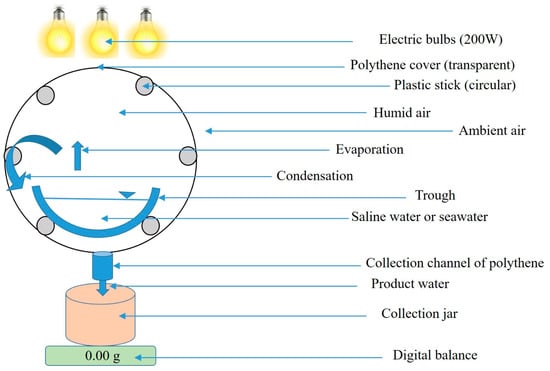
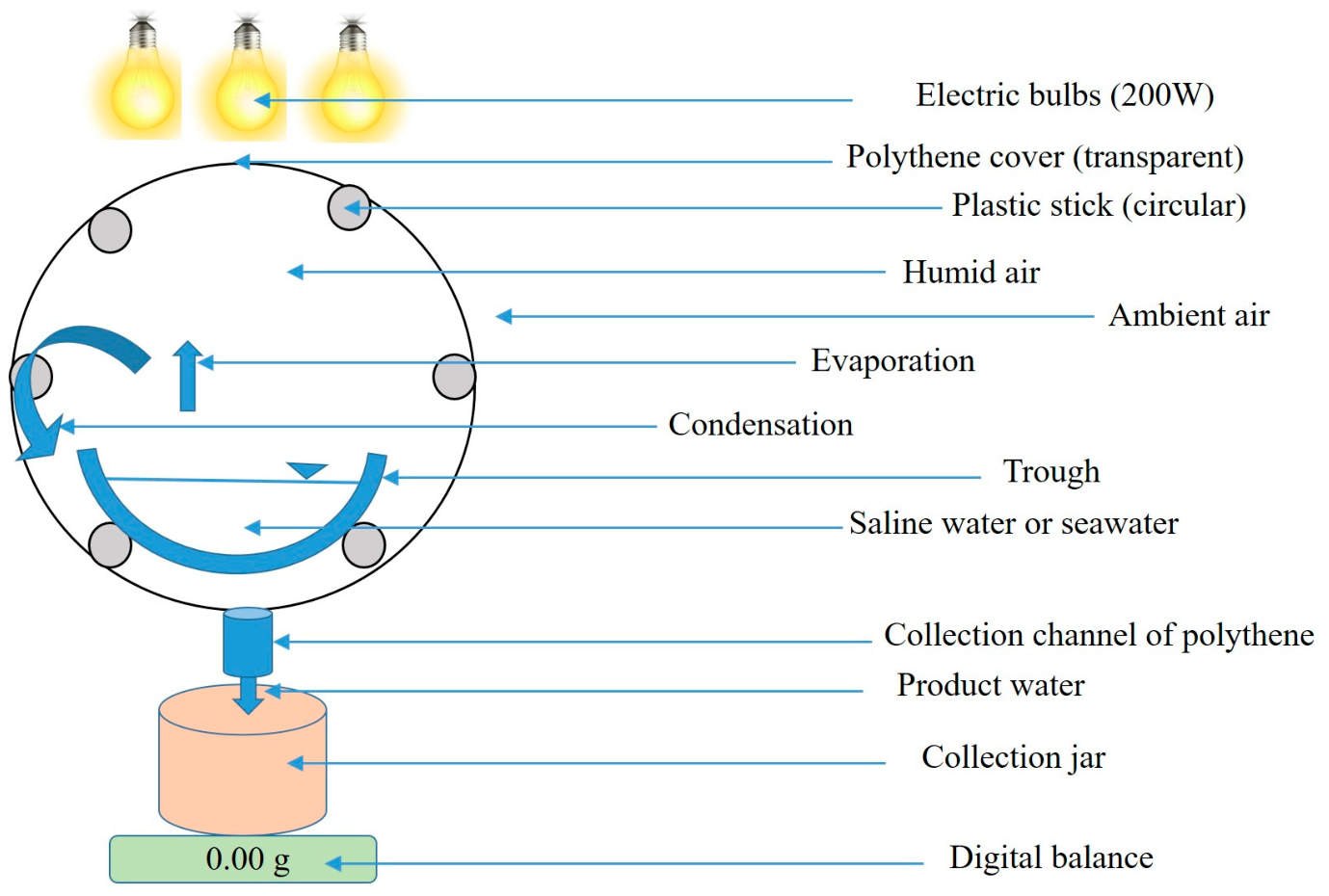
Temperature measurements were obtained using thermocouples with a measurement range of 0–100 °C and an accuracy of ±2%. Relative humidity was monitored using thermo-hygrometers with a range of 0–100% and an accuracy of ±2%. The simulated solar radiation intensity was measured using a pyranometer with a range of 0–1400 W/m2 and an accuracy of ±2%. Freshwater production was determined using a digital balance with a measurement capacity of 0–500 g and an accuracy of ±1 g. The experimental setup enabled simultaneous monitoring of thermal and humidity conditions within the still, which are important factors influencing evaporation and condensation processes. A schematic representation of the indoor experimental setup of the tubular solar still is shown in Figure 1. Experimental setup of the solar still is shown in Figure S3 (in Supplementary Materials).
Figure 1.
Schematic of a tubular solar still (sensors are placed in ambient air, humid air, trough, water and cover).
To evaluate experimental reproducibility, temperature measurements (e.g., Tw, Tha, Tc, and Ta) were performed in duplicate using two or more thermocouples under the identical operating conditions. Measurements of Sr, RHa, RHha, and Y were obtained once per experimental run due to instrumentation and resource limitations. For graphical presentation, the reported values represent the overall trends to improve figure clarity and readability. However, all statistical analyses, including correlation analysis, PCA, and significance testing, were performed using the complete dataset recorded at 5 min intervals throughout the 4 h experimental period.
2.3. Pearson Correlation Analysis
Pearson correlation analysis was employed to quantify the strength and direction of the linear relationships between freshwater yield and the measured thermal variables, including Tw, Tc, Tha, Tt, Ta, RHa, RHha, Y and Sr. The calculated freshwater yield data is applied here, which is derived from the observed ones using a regression analysis. The Pearson correlation coefficient (r) ranges from −1 to +1, where values approaching ±1 indicate strong linear relationships, while values close to zero indicate weak correlations. Statistical significance was evaluated at the 95% confidence level (p < 0.05). Confidence intervals for the principal regression relationships were also determined to assess the robustness of the statistical models.
2.4. Principal Component Analysis (PCA)
PCA is a multivariate statistical technique used to reduce the dimensionality of a dataset while retaining the maximum amount of information from the original variables. It transforms correlated variables into a smaller number of mutually uncorrelated principal components (PCs), with each component represented as a linear combination of the original variables. The first principal component (PC1) explains the greatest proportion of variance, while subsequent components account for progressively smaller proportions of the remaining variance and are orthogonal to one another [36]. In the present study, PCA was performed on a data matrix comprising 49 observations and 14 variables. Principal components with eigenvalues > 1 were retained for further interpretation. A factor loading of ≥0.75 was considered strong, 0.50–0.75 moderate, and 0.30–0.50 weak. Components explaining a cumulative variance of approximately 80% or more were considered to provide an adequate representation of the original dataset [36]. PCA was performed using PAST version 4.03, a freely available statistical software package (https://past.en.lo4d.com/windows (accessed on 1 September 2026)).
3. Results and Discussion
3.1. Variation in Temperatures and Relative Humidity
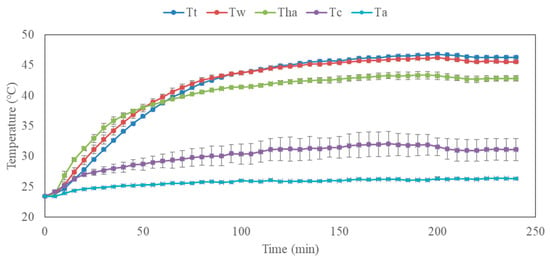
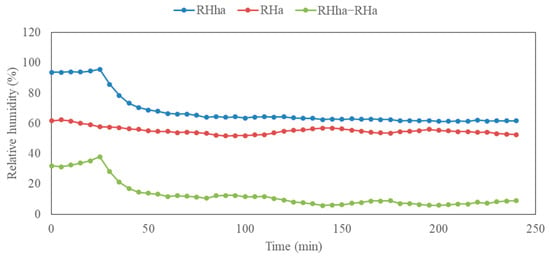
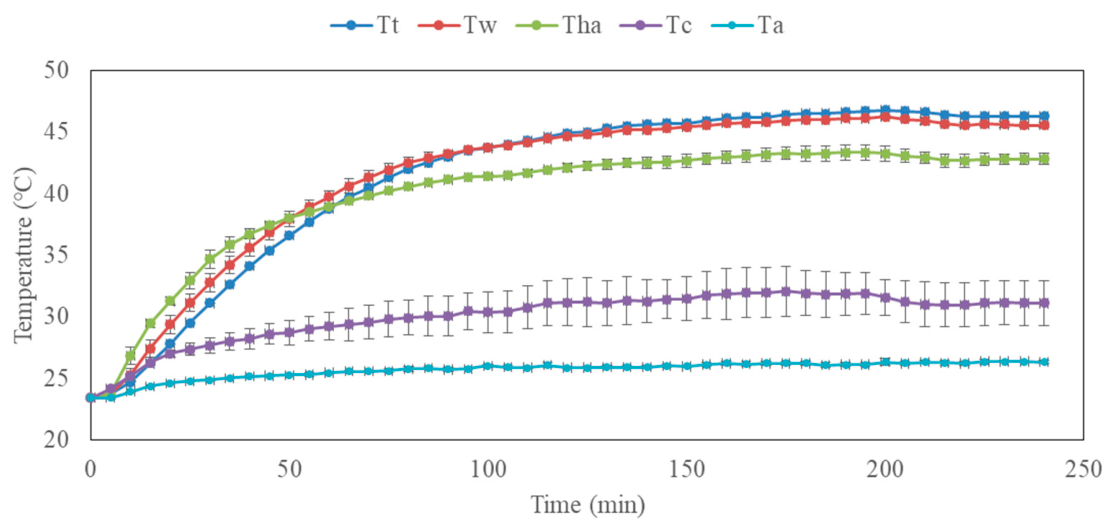
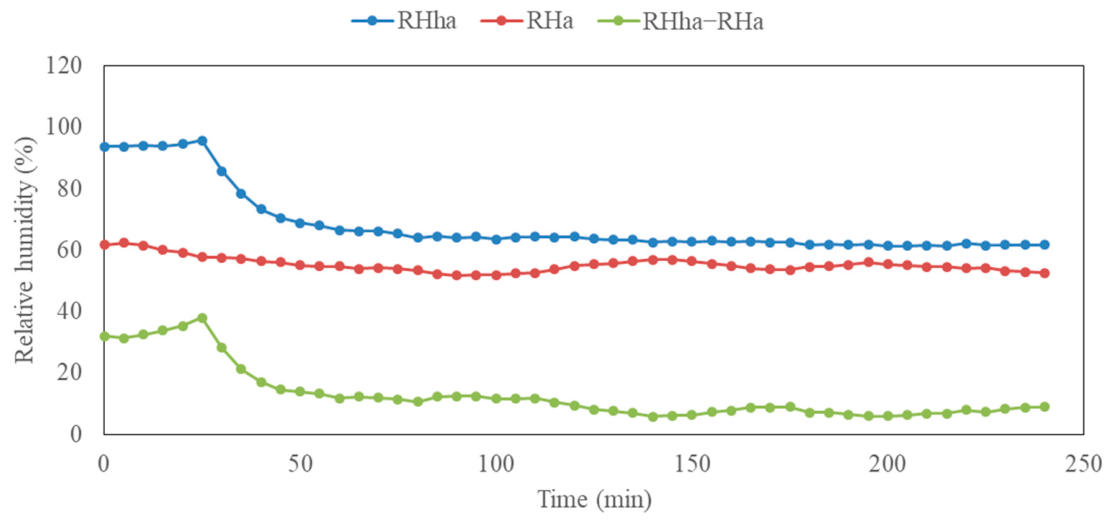
Figure 2 presents the temperature and relative humidity profiles over the 4 h operational period. The temperature at the beginning of the experiment was approximately 23.2 °C, indicating full thermal equilibrium at the onset. Tt and Tw increased rapidly during the first hour and reached approximately 46 °C by hour 2, remaining steady until 4 h. Tha followed a similar trajectory, reaching approximately 42.8 °C after 2 h. Tc increased more steadily, reaching approximately 33 °C at steady state. Ta remained essentially constant throughout the experiment, varying only marginally between 23.4 °C and 26.2 °C. Overall, it was observed that all temperatures reached steady-state conditions after 2 h and remained stable until 4 h. The rapid, concurrent rise in Tw and Tt during the initial phase reflects the effective absorption of solar energy by the tubular solar stills.
Figure 2.
Variation in temperatures and relative humidities with elapsed time.
The stabilization of the temperature profiles after approximately two hours indicates that the system had reached thermal equilibrium under the applied operating conditions. At this stage, further increases in water temperature were limited because the absorbed heat was largely balanced by latent heat associated with evaporation together with convective and radiative heat dissipation. Similar thermal behavior has been reported for laboratory-controlled solar stills, in which rapid heating is followed by a quasi-steady operating period as the energy balance stabilizes [12,13]. RHha declined sharply from approximately 94% at the beginning to approximately 66% by 1 h. Subsequently, it remained steady at that level until 4 h. RHa decreased more steadily from approximately 62% to 53%. Consequently, the differential (RHha − RHa) decreased from approximately 32 percentage points at 0 h to approximately 8–10% at 1 h.
3.2. Water Yield and Artificial Solar Radiation Intensity
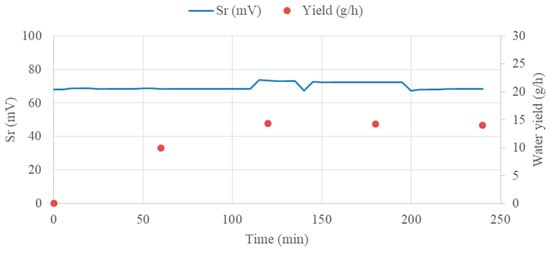
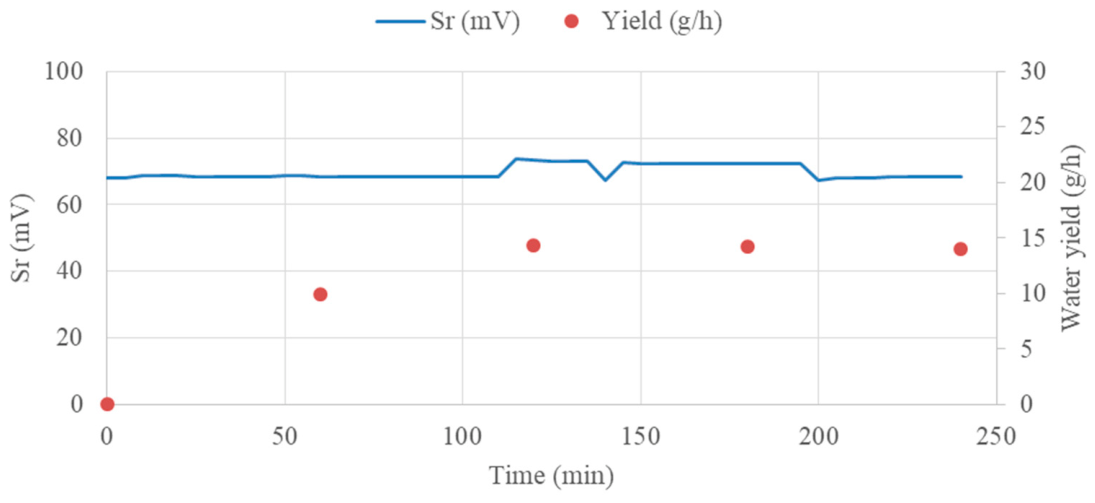
Figure 3 illustrates the evolution of hourly water yield and artificial solar radiation intensity over the experimental period. Water yield increased sharply from 0 g/h at 0 h to approximately 9.9 g/h at 1 h and 14.3 g/h at 2 h, and subsequently remained nearly constant at approximately 14.1–14.0 g/h through hours 3 and 4. The artificial solar radiation intensity remained nearly constant at approximately 68–69 mV during the first 2 h, indicating stable operating conditions under artificial illumination. At around 2–3 h, the radiation intensity was intentionally increased to approximately 71–74 mV, resulting in enhanced thermal energy input to the tubular solar still. Subsequently, the radiation intensity was reduced to about 67–68 mV for the remainder of the experiment. The rapid increase in water yield was associated with rising temperature differences, which enhanced condensation. Peak yield occurred at 2 h, corresponding to maximum artificial solar radiation. However, water yield remained relatively high (≈14 g/h) even after artificial solar radiation decreased, indicating that the solar still stored thermal energy and gradually released it to sustain the evaporation–condensation process. The positioning of the electric bulbs and the pyranometer influenced the Sr values. Because the electric bulbs acted as localized heat sources, small variations in the relative positions of the bulbs and pyranometer influenced the measured irradiance due to differences in the angle of incidence and spatial distribution of the emitted radiation. It is important to incorporate energy accounting for the entire system to clarify the system’s efficiency. The thermal efficiency of the still (η) is about 75%, prior to accounting for salinity effects, which are presented in detail in Supplementary Materials. Murugavel et al. [13] investigated the system under a range of constant input conditions, in which a heater supplied thermal energy until the system reached steady-state conditions. In their laboratory experiments, the production rate increased with increasing constant energy input from 1200 to 1500 W. In the present study, electric bulbs were used instead of a heater in the basin, and similar results were observed.
Figure 3.
Water yield and artificial solar radiation intensity over time.
The maximum freshwater productivity achieved in the present study was 14.3 g/h, which is comparable to values reported for laboratory-scale tubular solar stills under similar operating conditions. For example, Chen et al. [37] reported a freshwater production rate of 16.2 g/h in a compact tubular solar still. Similar productivity trends and thermal behavior have also been reported for tubular solar stills operating under natural artificial solar radiation [12] and laboratory conditions with artificial heating [13]. Although direct comparisons are influenced by differences in solar intensity, heating source, absorber geometry, basin area, and operating conditions, these findings indicate that the thermal performance and freshwater productivity of the proposed tubular solar still are consistent with those reported in previous studies.
3.3. Temperature Differentials Governing System
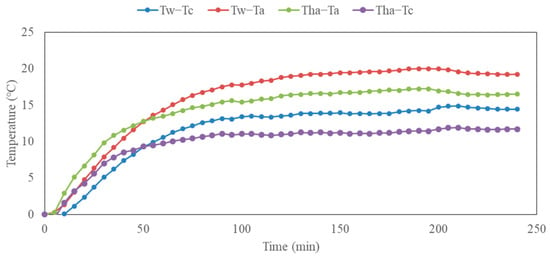
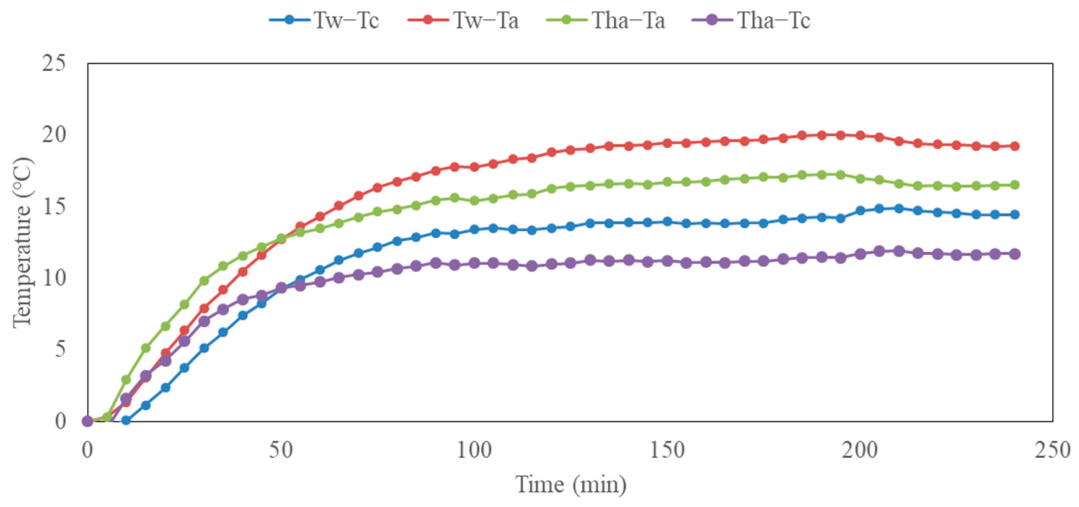
Figure 4 depicts the evolution of the four principal temperature differentials governing the system’s thermodynamic performance. All differentials commenced at zero at 0 h, confirming thermal equilibrium. The water-to-ambient temperature differential (Tw − Ta) reached approximately 20 °C at steady state after 4 h. The second-highest differential was observed for the humid air-to-ambient differential (Tha − Ta), reaching approximately 16.7 °C. The water-to-cover differential (Tw − Tc) was approximately 13 °C, while the humid air-to-cover differential (Tha − Tc) was approximately 10 °C.
Figure 4.
Temperature differentials over time.
The differential Tw − Ta represents the primary thermodynamic driving force for evaporation from the water surface. The highest differential magnitude (~20 °C) at steady state indicates consistently high rates of water vapor generation throughout the experiment. The differential Tha − Tc was the lowest, although it is directly related to condensation yield. The stabilization of all differentials after 2–3 h indicates that the system attained a thermodynamic quasi-steady state in which energy inputs and dissipative losses were balanced. These findings indicate that the temperature differences Tw − Ta and Tha − Tc are closely associated with freshwater productivity. Larger temperature gradients promote evaporation and condensation by increasing the vapor pressure difference and enhancing heat and mass transfer within the tubular solar still. However, the present study did not investigate specific design modifications, such as enhanced condenser cooling or increased absorber area. Therefore, these results should be interpreted as demonstrating the importance of maintaining favorable thermal gradients under the tested operating conditions rather than validating particular design strategies.
3.4. Pearson Correlation Matrix
Table 1 presents the Pearson correlation matrix of the operational, thermal, humidity, and yield parameters of the tubular solar still system. Strong positive correlations were observed among all temperature-related variables, including Tt, Tw, Tha and Tc with correlation coefficients generally exceeding 0.98. These results indicate high synchronization of the system’s thermal behavior during operation. Water yield also showed very strong positive correlations with Tw (r = 0.997), Tc (r = 0.997), Tt (r = 0.998), and the temperature differentials Tw − Ta (r = 0.989) and Tw − Tc (r = 0.996), demonstrating that enhanced thermal gradients significantly promoted evaporation and condensation processes. In contrast, RHha, RHa and their differential (RHha − RHa) exhibited strong negative correlations with most temperature parameters and yield (r ≈ −0.761 to −0.951). This inverse relationship suggests that increasing system temperature reduced internal relative humidity due to intensified evaporation and moisture transport.
Table 1.
Pearson correlation matrix of all measured and derived variables.
Sr showed low positive correlations with temperatures and yield (r = 0.330–0.423), indicating that although solar input initiated the heating process, the sustained thermal performance of the system was also influenced by internal heat storage and transfer mechanisms. Overall, the correlation analysis confirms that water production was primarily governed by thermal conditions and temperature differentials within the solar still. The strong interdependence among temperature variables further suggests stable thermodynamic coupling between evaporation and condensation processes throughout the experiment.
3.5. Water Yield and Key Driving Variables
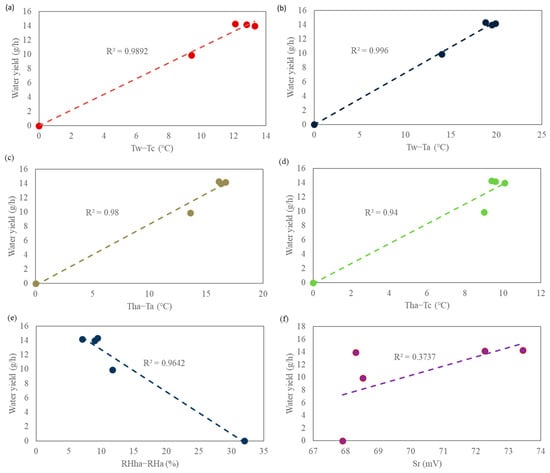
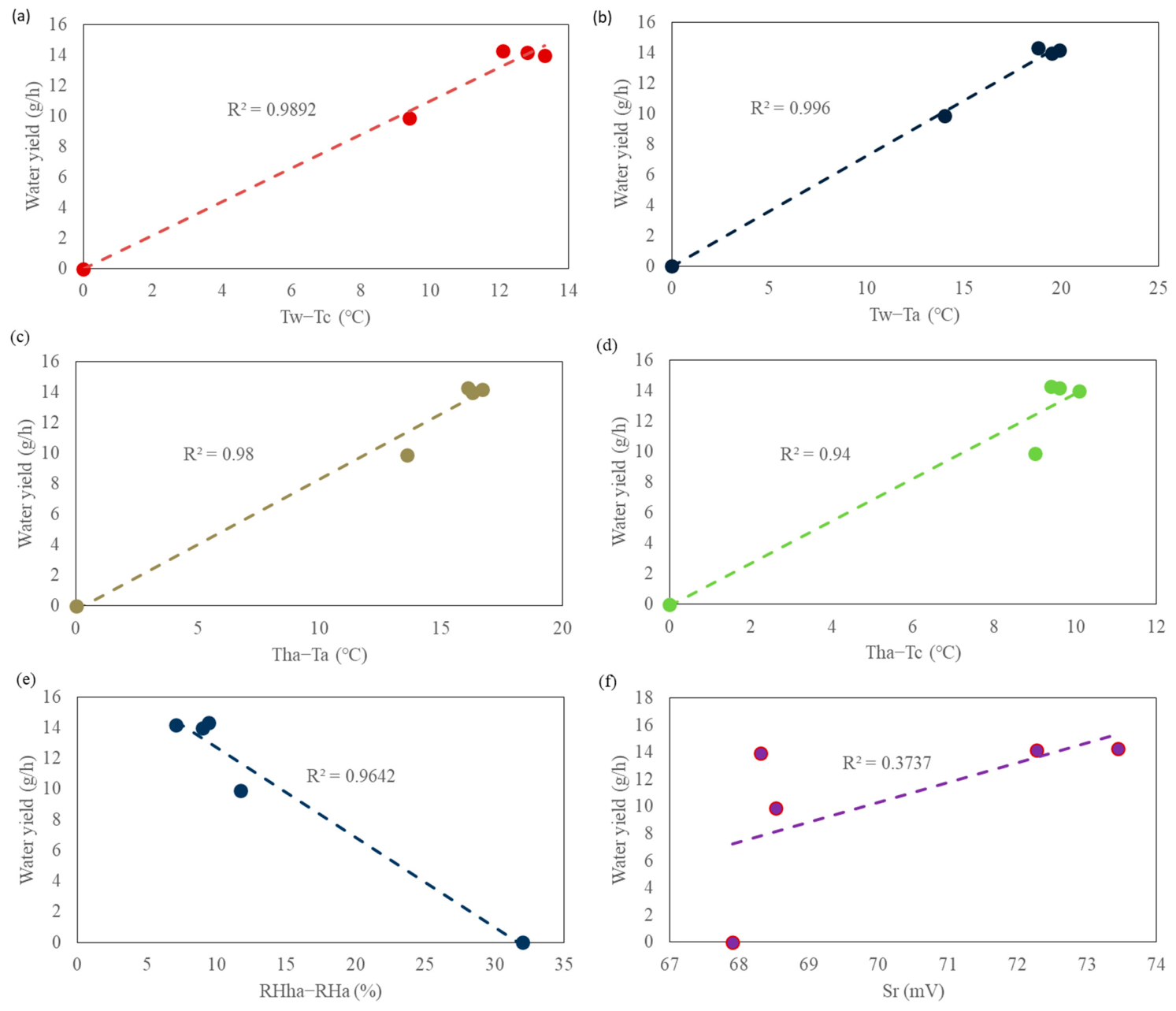
Figure 5 presents the relationship between water yield and six major driving variables: the temperature differences Tw − Tc, Tw − Ta, Tha − Ta, Tha − Tc; RHha − Rha; and Sr. The regression analyses obtained demonstrate that the freshwater productivity of the tubular solar still was strongly dependent on the thermal gradients developed within the system. Most of the thermal-difference parameters showed strong linear correlations with water yield, indicating that enhanced evaporation-condensation mechanisms were primarily governed by the temperature differences between the water surface, humid air, cover, and the ambient environment.
Figure 5.
Relationship between water yield and key driving variables; (a) Y vs. Tw − Tc; (b) Y vs. Tw − Ta; (c) Y vs. Tha − Ta; (d) Y vs. Tha − Tc; (e) Y vs. RHha − RHa; and (f) Y vs. Sr.
Figure 5a shows a strong positive linear relationship (regression coefficient (R2) = 0.9892) between Tw − Tc and Y. Y increased from nearly 10 to 14 g/h with an increase in Tw − Tc from approximately 9 to 13 °C, indicating that a larger thermal difference between the water and the condensing cover significantly enhanced vapor generation and condensation rates. Murugavel et al. [13] found that yield was enhanced at higher water and glass (cover) temperatures. They also reported that the production rate improved due to the widening of the temperature differences between the cover and the water, as well as between the cover and the ambient air. However, at elevated operating temperatures, the yield rose despite a decreasing temperature difference between the cover and water.
Similarly, Figure 5b shows a strong linear relationship (R2 = 0.996) between Tw − Ta and Y. As Tw − Ta increased from around 14 to 20 °C, the yield increased from approximately 10 to 14 g/h. The higher Tw − Ta enhanced the stored thermal energy in the still and intensified evaporation, thereby increasing freshwater production.
The influences of Tha − Ta and Tha − Tc on Y are presented in Figure 5c and Figure 5d, respectively. Both parameters exhibited positive linear relationships with water yield, with R2 values of 0.98 and 0.94, respectively. The yield increased steadily with increasing humid air temperature difference, confirming that warmer, humid air inside the still further improved the moisture-carrying capacity and promoted vapor transport toward the condensing surface—consequently, this enhanced condensation and freshwater collection.
Figure 5e reveals an inverse relationship between RHha − Rha and Y. R2 value of 0.9642 indicates a strong negative linear correlation. The yield decreased as the humidity difference increased, suggesting that excessive humidity accumulation within the still reduced the condensation-driving force. Lower relative-humidity differences favored more effective vapor condensation on the cover surface, thereby improving freshwater productivity.
Figure 5f illustrates the relationship between Sr and Y. Compared with the thermal driving parameters, the correlation between artificial solar radiation and yield was relatively weak (R2 = 0.3737). Although a generally increasing trend in yield with increasing artificial solar radiation intensity was observed, the scattered distribution of the data suggests that artificial solar radiation alone did not directly govern freshwater productivity during the experimental period. Instead, the effect of artificial solar radiation was indirectly reflected through the thermal gradients established within the system, particularly the temperature differences between water, humid air, cover, and ambient air. Similar observations have been reported in previous studies, in which solar still productivity was found to depend more strongly on internal heat and mass transfer processes than on artificial solar radiation intensity alone [38]. The water–glass temperature difference is one of the major operational parameters controlling evaporation and condensation in solar stills. Standard theoretical frameworks (e.g., Dunkle’s internal heat and mass transfer model [39]) typically predict thermal efficiencies between 35% and 50% for passive conventional solar stills due to unmitigated convective and sidewall thermal losses. Kabeel et al. [40], Shanmugan et al. [41] and Sathyamurthy et al. [42] presented the still efficiencies of 60.5, 59 and 70.1%, respectively, using hybrid systems. In contrast, the high thermal efficiency (about 75% prior to accounting for salinity effects) achieved in this study under steady-state conditions demonstrates that localized irradiance tuning combined with strict thermal boundary control significantly reduces parasitic heat dissipation beyond baseline theoretical limits. Table S1 presents the comparative analysis with extant solar desalination studies in Supplementary Materials.
The effects of numerous innovative techniques and parameters on the productivity of still are reported [38,43,44,45]. Khalifa and Hamood [46] showed that thermodynamic and operational conditions significantly influence productivity in addition to artificial solar radiation. Furthermore, previous studies reported that the internal heat and mass transfer mechanisms primarily determine distillate productivity [47,48]. Therefore, the present findings suggest that the internal thermodynamic conditions of the tubular solar still, especially the established temperature differentials, played a more dominant role in determining freshwater production than artificial solar radiation intensity itself. It is assumed that the distillate water quality may align closely with the findings of Al-Ragehi et al. [32]. The thermal performance of various solar stills was investigated by many researchers considering outdoor and indoor conditions (e.g., [49,50]). Limitations of indoor study, practical implications and strategies for real-world implementation are presented in Supplementary Materials.
3.6. Principal Component Analysis (PCA) of the Dataset
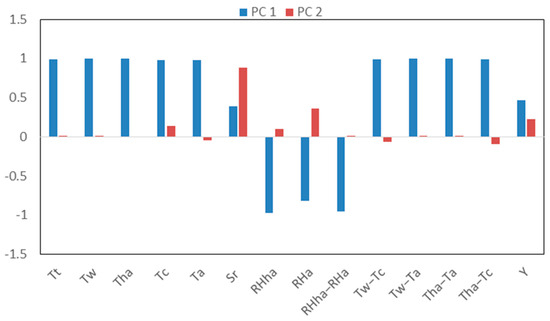
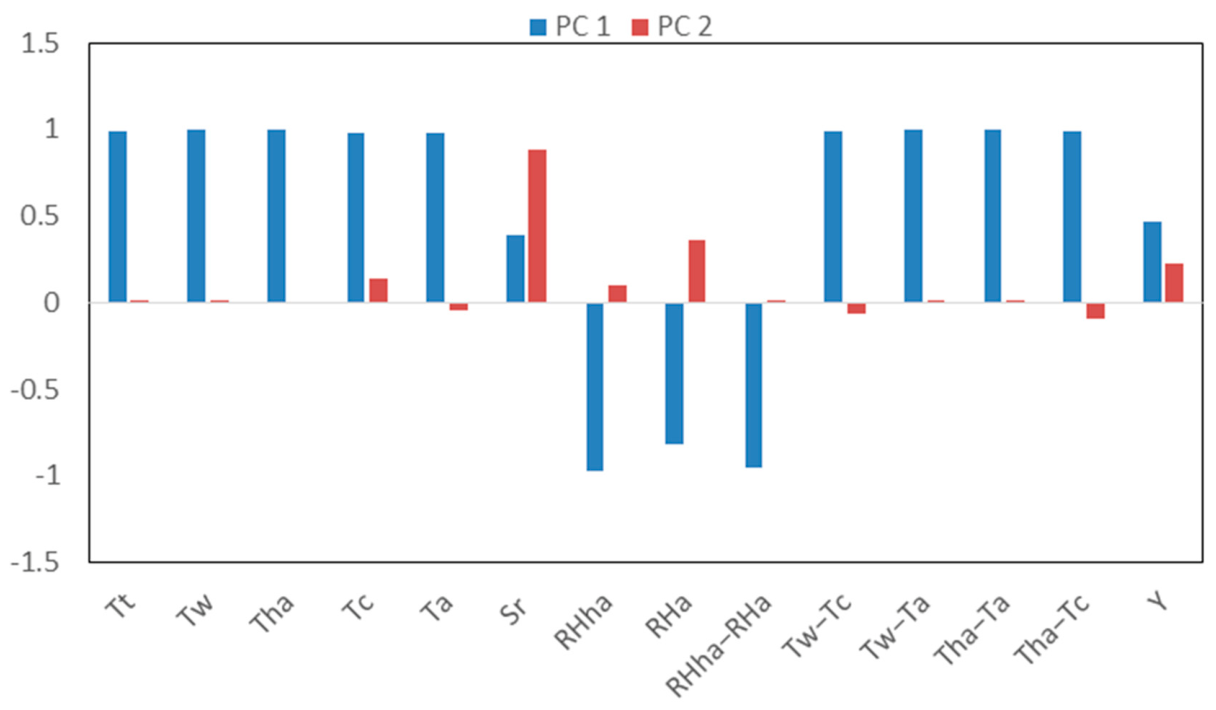
PCA was performed using the complete dataset (49 observations) to evaluate the relationships among the measured thermal and environmental variables. The first four principal components explained 98.47% of the total variance, indicating that the selected variables adequately represented the experimental system. Table 2 presents the rotated principal component loading matrix obtained from the PCA, together with the corresponding eigenvalues and the percentage of variance explained by each principal component. Figure 6 illustrates the factor loadings of the first two principal components (PC1 and PC2). The first principal component (PC1) accounted for 83.55% of the total variance and was characterized by strong positive loadings for the temperature-related variables, including tubular temperature (Tt, 0.988), water temperature (Tw, 0.996), humid air temperature (Tha, 0.995), cover temperature (Tc, 0.981), ambient temperature (Ta, 0.982), and the temperature difference parameters (0.985–0.996). In contrast, humid air relative humidity (RHha, −0.970), ambient relative humidity (RHa, −0.819), and the humidity difference (RHha − RHa, −0.948) exhibited strong negative loadings. These results indicate that humidity variations inside the system were mainly controlled by temperature changes rather than by independent moisture sources. As temperature increases, the air can hold more water vapor, causing relative humidity to decrease even when the actual moisture content remains nearly constant. Therefore, RHha can be considered a response variable influenced by the system’s thermal conditions rather than an independent factor controlling freshwater productivity.
Table 2.
Rotated principal component matrix on the solar still experimental data.
Figure 6.
Factor loading of PC1 and PC2 on the solar still experimental data.
The second principal component (PC2) explained 7.18% of the total variance and was dominated by radiation intensity (Sr, 0.883), while the remaining variables showed relatively small loadings. This positive loading indicates that artificial solar radiation does not directly control solar still performance; rather, its effect is indirectly reflected through the thermal gradients established within the system. Furthermore, the moderate positive loading of Sr in PC1 indicates that Sr acts as the primary external factor driving the temperature increase. The third principal component (PC3) accounted for 5.91% of the total variance and was primarily associated with freshwater yield (0.850). The relatively weak loadings of the other variables on PC3 indicate that freshwater production reflects an additional dimension of system performance that is not entirely captured by the instantaneous thermal measurements. This observation is consistent with the cumulative nature of distillate production, which depends on the integrated effects of heat transfer and evaporation over time. The fourth principal component (PC4) explained only 1.83% of the total variance, with all variables exhibiting low loadings, indicating that it contributed little additional information to the interpretation of the dataset.
Overall, the PCA confirms that the experimental dataset is primarily governed by a common thermal process, with temperature variables exhibiting strong positive correlations and relative humidity variables showing inverse relationships. Solar radiation intensity contributes as a secondary independent factor, while freshwater yield forms a separate performance-related component. The PCA results have important implications for simplifying the prediction of solar still dynamics.
Since PC1 explains most of the total variance, the system can be represented by a single thermal factor without losing significant information. Overall, PCA confirms that the indoor solar still system is mainly controlled by a dominant thermal process, while secondary spatial and random effects have only minor influence. This interpretation is consistent with the Pearson correlation analysis, which demonstrated strong positive correlations among temperature variables and inverse correlations with relative humidity.
4. Conclusions
This study experimentally evaluated the thermal behavior and freshwater productivity of a low-cost tubular solar still under controlled indoor conditions using simulated solar radiation. Water temperature and trough temperature increased rapidly and reached approximately 46 °C after about 2 h, while the humid air and cover temperatures stabilized at approximately 42.8 °C and 33 °C, respectively. The maximum freshwater yield achieved was 14.3 g/h. Statistical analyses demonstrated that freshwater production was governed primarily by the internal thermal conditions of the system. Strong positive linear relationships were obtained between freshwater yield and the major temperature differences, with R2 values of 0.989 (Tw − Tc), 0.996 (Tw − Ta), 0.980 (Tha − Ta), and 0.940 (Tha − Tc). Conversely, the relative humidity difference (RHha − RHa) exhibited a strong inverse relationship with freshwater yield (R2 = 0.964). Reaching nearly 75% thermal efficiency, prior to accounting for salinity effects, proves that targeted irradiance and strict thermal control effectively minimize heat loss. Pearson correlation analysis further confirmed significant positive correlations between freshwater yield and temperature-related variables (r = 0.957–0.998, p < 0.01) and significant negative correlations with the relative humidity parameters (r = −0.761 to −0.951, p < 0.01). Principal component analysis showed that the first principal component explained 83.55% of the total variance, while the first four principal components together accounted for 98.47%, confirming that the thermal variables dominated the experimental system. The results demonstrate the importance of maintaining favorable thermal gradients to enhance evaporation and condensation in tubular solar stills. Rather than supporting scale-up directly, the findings provide a quantitative understanding of the relationships among temperature, humidity, and freshwater production that can inform the design and optimization of future tubular solar still systems.
The present study was conducted under controlled indoor laboratory conditions using simulated solar radiation, which may not fully represent the complex environmental conditions encountered during outdoor operation, including fluctuations in solar irradiance, wind speed, and ambient weather. Therefore, the findings should be interpreted within the context of the experimental conditions investigated. Future research should validate the identified thermal relationships under natural outdoor climatic conditions and investigate the influence of variable solar irradiance, wind speed, and ambient temperature on system performance. In addition, the effects of condenser cooling, absorber design modifications, and thermal energy storage materials on the critical temperature gradients governing freshwater productivity should be systematically evaluated. Furthermore, statistically designed experiments employing advanced multivariate techniques, such as Response Surface Methodology (RSM) and Analysis of Variance (ANOVA), are recommended to quantify the interaction effects among operating variables and identify optimal operating conditions for enhancing tubular solar still performance. Further indoor and outdoor studies on the solar still are recommended to obtain the accurate data of various parameters (temperature, humidity, solar radiation, wind speed, atmospheric pressure and water production), and to confirm the relationships between them and to establish new ones. The convective heat loss should be taken into account in further studies. To ensure a completely stable testing environment, performing indoor experiments within a thermostatic chamber is recommended.
Supplementary Materials
The following supporting information can be downloaded at: https://www.mdpi.com/article/10.3390/su18199714/s1, Figure S1: Water yield over elapsed time; Figure S2: Variations of highest thermal efficiency with salinity in a solar still; Figure S3: Experimental setup of the solar still; Table S1: Comparative analysis with extant solar desalination studies.
Author Contributions
Conceptualization, methodology, investigation, data curation, A.A. (Amimul Ahsan); resources, software, formal analysis, A.A. (Amimul Ahsan) and M.S.; visualization, validation, M.S., A.A. (Amimul Ahsan) and S.S.A.; writing—original draft preparation, A.A. (Amimul Ahsan) and M.S.; writing—review and editing, A.A. (Amimul Ahsan), M.S., S.S.A., M.A., H.H., A.A. (Abdulaziz Alharbi) and H.Z.; supervision, M.S., A.A. (Amimul Ahsan) and S.S.A.; project administration, funding acquisition, S.S.A., M.S. and A.A. (Amimul Ahsan). All authors have read and agreed to the published version of the manuscript.
Funding
This research was funded by the Deputyship for Research & Innovation, Ministry of Education, Saudi Arabia under project number (QU-IF-1-3-2) and support by Qassim University.
Institutional Review Board Statement
Not applicable.
Informed Consent Statement
Not applicable.
Data Availability Statement
The datasets generated and/or analyzed during the current study may be available from the corresponding author upon reasonable request.
Acknowledgments
The authors extend their appreciation to Deputyship for Research & Innovation, Ministry of Education, Saudi Arabia for funding this research work through the project number (QU-IF-1-3-2). The authors also thank to the technical support of Qassim University.
Conflicts of Interest
The authors declare no conflicts of interest.
Nomenclature
| Symbol | Description | Unit |
| p | Probability value | – |
| Ta | Ambient air temperature | °C |
| Tha | Humid air temperature inside the still | °C |
| Tc | Cover temperature | °C |
| Tw | Water temperature | °C |
| Tt | Trough temperature | °C |
| RHa | Ambient relative humidity | % |
| RHha | Relative humidity inside the still | % |
| R2 | Regression coefficient | – |
| r | Pearson’s correlation coefficient | – |
| Sr | Simulated radiation intensity | mV |
| Y | Freshwater yield | g/h |
| PCA | Principal Component Analysis | – |
| PC | Principal Component | – |
| PCM | Phase Change Material | – |
References
- Hanson, A.; Zachritz, W.; Stevens, K.; Mimbela, L.; Polka, R.; Cisneros, L. Distillate water quality of a single-basin solar still: Laboratory and field studies. Sol. Energy 2004, 76, 635–645. [Google Scholar] [CrossRef] [Scilit]
- Cornejo-Ponce, L.; Moraga-Contreras, C.; Vilca-Salinas, P. Analysis of Chilean legal regime for brine obtained from desalination processes. Desalin. Water Treat. 2020, 203, 91–103. [Google Scholar] [CrossRef] [Scilit]
- Morgante, C.; Herrero-Gonzalez, M.; Lopez, J.; Imholze, J.; Boffa, V.; Ibañez, R.; Cortina, J.L. A global outlook of the desalination industry and state-of-the-art technologies for brine valorisation. Desalination 2026, 621, 119718. [Google Scholar] [CrossRef] [Scilit]
- Panagopoulos, A.; Haralambous, K.J. Environmental impacts of desalination and brine treatment-Challenges and mitigation measures. Mar. Pollut. Bull. 2020, 161, 111773. [Google Scholar] [CrossRef] [Scilit]
- Khalaf, M.O.; Özdemir, M.R.; Sultan, H.S. A Comprehensive Review of Solar Still Technologies and Cost: Innovations in Materials, Design, and Techniques for Enhanced Water Desalination Efficiency. Water 2025, 17, 1515. [Google Scholar] [CrossRef] [Scilit]
- Alwan, N.T.; Ali, B.M.; Alomar, O.R.; Abdulrazzaq, N.M.; Ali, O.M.; Abed, R.M. Performance of solar still units and enhancement techniques: A review investigation. Heliyon 2024, 10, 37693. [Google Scholar] [CrossRef] [Scilit]
- Das, P.; Mohtasim, M.S.; Paul, U.K.; Hossain, M.S.; Das, B.K.; Saha, A.; Kibria, M.G. Experimental investigation and performance optimization of a double slope solar still integrated with nanoparticles in phase change materials. Therm. Sci. Eng. Prog. 2026, 69, 104460. [Google Scholar] [CrossRef] [Scilit]
- Dhivagar, R.; Jidhesh, P.; Kim, S.C.; Balasubramanian, D.; Kale, U.; Kilikevičius, A. Sustainable and scalable double slope solar still: A comprehensive experimental assessment of energy, exergy, economic, environmental, sensitivity and distillate performance. Sci. Rep. 2026, 16, 11168. [Google Scholar] [CrossRef] [Scilit]
- Sharma, S.K.; Singh, D.B.; Tiwari, G.N. Energy, exergy and economic assessments of novel sustainable solar powered evacuated tube collector integrated active desalination system. Desalin. Water Treat. 2023, 295, 12–28. [Google Scholar]
- Sambare, R.K.; Dewangan, S.K.; Gupta, P.K.; Joshi, S. Productivity enhancement techniques for tubular solar still—A review. Environ. Prog. Sustain. Energy 2024, 43, 14345. [Google Scholar] [CrossRef] [Scilit]
- Hemmatian, A.; Kargarsharifabad, H.; Esfahlani, A.A.; Rahbar, N.; Shoeibi, S. Improving solar still performance with heat pipe/pulsating heat pipe evacuated tube solar collectors and PCM: An experimental and environmental analysis. Sol. Energy 2024, 269, 112371. [Google Scholar] [CrossRef] [Scilit]
- Islam, K.; Biswas, B.C.; Molla, R.I.; Rab, M.A.; Saha, A.K.; Khatun, H.; Bokshi, A. Performance study on tubular solar still. J. Eng. Sci. 2012, 3, 79–85. [Google Scholar]
- Murugavel, K.K.; Chockalingam, K.K.; Srithar, K. Modeling and verification of double slope single basin solar still using laboratory and actual solar conditions. Jordan J. Mech. Ind. Eng. 2009, 3, 228–235. [Google Scholar]
- Rashid, F.L.; Mohammed, H.I.; Al Maimuri, N.M.; Abdalrahem, M.K.; Ameen, A.; Hammoodi, K.A.; Kadhim, S.A.; Ashour, A.M.; Bouabidi, A.; Agyekum, E.B. Rotating-part solar stills: A review of configurations, mathematical modelling, and efficiency analysis. Desalin. Water Treat. 2026, 325, 101699. [Google Scholar] [CrossRef] [Scilit]
- Mohammed, A.H.; Shmroukh, A.N.; Ghazaly, N.M.; Kabeel, A.E. Performance analysis of an SPD integrated with a stepped pyramid solar still: Experimental study. Environ. Dev. Sustain. 2026, 28, 7917–7936. [Google Scholar]
- Sambare, R.K.; Joshi, S. Productivity improvement of a tubular solar still using reflectors and photovoltaics. Appl. Therm. Eng. 2026, 292, 130358. [Google Scholar] [CrossRef] [Scilit]
- Marzouk, S.A.; Alzaben, H.; Aljabr, A.; Almehmadi, F.A.; Sharaf, M.A.; Ayane, D. Enhancing solar still efficiency using different basin water additives. Energy Rep. 2026, 15, 109127. [Google Scholar] [CrossRef] [Scilit]
- Kadhim, S.A.; Ashour, A.M.; Bouabidi, A.; Hasan, H.A.; Rashid, F.L.; Hammoodi, K.A. Experimental 4E assessment of a single-slope solar still enhanced with different steel fiber configurations. Water Conserv. Sci. Eng. 2026, 11, 23. [Google Scholar] [CrossRef] [Scilit]
- El-Gazar, E.F.; Yousef, M.S.; Elshaer, A.M.; Khattab, M.A.; Mouneer, T.A.; Hawwash, A.A. Enhancing solar still performance with hybrid nanofluid: A comprehensive assessment of energy, exergy, economics, and environmental impact using a novel fractional model. Environ. Dev. Sustain. 2026, 28, 8717–8744. [Google Scholar]
- Elsaid, A.M.; Nour, A.; Sharshir, S.W.; Ahmed, M.S. Productivity, energy, and economic feasibility analysis of a developed tubular solar still coupled with evacuated tube collectors. Appl. Therm. Eng. 2026, 290, 130054. [Google Scholar] [CrossRef] [Scilit]
- Jeevadason, A.W.; Krishnapriya, S.; Attia, M.E.; Saravanan, K.; Manivannan, R.; Rajendran, V. Techno-economic performance analysis of twin wedge solar still with bio-PCM under the influence of varying water depth, PCM mass and container distribution. Int. Commun. Heat Mass Transf. 2026, 172, 110365. [Google Scholar] [CrossRef] [Scilit]
- Abdullah, A.S.; Joseph, A.; Aljaghtham, M.; Sharshir, S.W. Performance assessment of an innovative multi-enhanced tubular solar still using local materials: 4E evaluation. Sol. Energy Mater. Sol. Cells 2026, 294, 113913. [Google Scholar] [CrossRef] [Scilit]
- Alrasheedi, N.H.; Kumar, D.T.; Panchal, H.; Shanmugan, S. Enhancing solar still evaporative yield through precise neutrosophic fuzzy modeling: Regional assessment in Indian coastal regions. J. Therm. Anal. Calorim. 2026, 151, 795–807. [Google Scholar] [CrossRef] [Scilit]
- Cui, L.; Wang, P.; Che, H.; Chen, J.; Liu, B.; Ao, Y. Solar-driven interfacial water evaporation for wastewater purification: Recent advances and challenges. Chem. Eng. J. 2023, 477, 147158. [Google Scholar] [CrossRef] [Scilit]
- Lu, X.; Mu, C.; Liu, Y.; Wu, L.; Tong, Z.; Huang, K. Recent advances in solar-driven interfacial evaporation coupling systems: Energy conversion, water purification, and seawater resource extraction. Nano Energy 2024, 120, 109180. [Google Scholar] [CrossRef] [Scilit]
- Chen, L.; Ren, J.; Gong, J.; Qu, J.; Niu, R. Cost-effective, scalable fabrication of self-floating xerogel foam for simultaneous photothermal water evaporation and thermoelectric power generation. Chem. Eng. J. 2023, 454, 140383. [Google Scholar] [CrossRef] [Scilit]
- Yu, J.; Xia, Y.; Chen, L.; Yan, W.; Liu, B.; Jin, S. Full recovery of brines at normal temperature with process-heat-supplied coupled air-carried evaporating separation (ACES) cycle. npj Clean Water 2024, 7, 133. [Google Scholar] [CrossRef] [Scilit]
- Yao, J.; Zhong, Q.; Zhang, J.; Zhao, J.; Wang, Z. Interfacial solar evaporation for zero liquid discharge desalination. Commun. Mater. 2024, 5, 103. [Google Scholar] [CrossRef] [Scilit]
- Rahimi-Ahar, Z.; Mastani, M.; Ghareghashi, J.A.; Moradi, S.; Babapoor, A. Solar-assisted desalination based on photothermal conversion effect: A review. Renew. Sustain. Energy Rev. 2025, 217, 115731. [Google Scholar] [CrossRef] [Scilit]
- Ahmed, M.M.Z.; Alshammari, F.; Abdullah, A.S.; Elashmawy, M. Basin and tubular solar distillation systems: A review. Process Saf. Environ. Prot. 2021, 150, 157–178. [Google Scholar] [CrossRef] [Scilit]
- Yang, B.; Wang, C.; Ji, X.; Nie, J.; Mao, J.; Yang, Y. All-day Joule-heat assisted photothermal interfacial water evaporation system with porous network hydrogel. Appl. Therm. Eng. 2025, 274, 126837. [Google Scholar] [CrossRef] [Scilit]
- Al-Ragehi, H.; Al-Qadami, E.; Ahsan, A.; Razi, M.A.; Shah, S.M.; Aljaradin, M.; Shafiquzzaman, M.; Idrus, S.; Imteaz, M. Performance enhancement of a double slope solar still integrated with external condenser and internal heating system. Environ. Prog. Sustain. Energy 2026, 45, e70179. [Google Scholar] [CrossRef] [Scilit]
- Abdullah, A.S.; Joseph, A.; Kandeal, A.W.; Alawee, W.H.; Peng, G.; Thakur, A.K.; Sharshir, S.W. Application of machine learning modeling in prediction of solar still performance: A comprehensive survey. Results Eng. 2024, 21, 101800. [Google Scholar] [CrossRef] [Scilit]
- Li, R.; Wang, C.; He, C.; Nam, H.N.; Wang, J.; Mao, Y.; Zhu, X.; Liu, W.; Kim, M.; Yamauchi, Y. Solar stills: The future enabled by machine learning. J. Mater. Chem. A 2024, 12, 33448–33469. [Google Scholar] [CrossRef] [Scilit]
- Layek, A. Effect of depth and salinity of basin water on performance of solar still. In Proceedings of the TENCON 2017-2017 IEEE Region 10 Conference; IEEE: Piscataway, NJ, USA, 2017; pp. 1087–1091. Available online: https://ieeexplore.ieee.org/document/8228019/metrics#metrics (accessed on 10 September 2026).
- Liu, J.; Zhang, D.; Tang, Q.; Xu, H.; Huang, S.; Shang, D.; Liu, R. Water quality assessment and source identification of the Shuangji River (China) using multivariate statistical methods. PLoS ONE 2021, 16, e0245525. [Google Scholar] [CrossRef] [Scilit]
- Chen, M.; Li, G.; Wang, Q.; Zhu, Z.; Jiang, Y.; Zheng, H.; Li, Z. Evaluation of solar energy transmission and heat-mass transfer in a floating solar concentrated distillation configuration. Sustain. Energy Technol. Assess. 2022, 52, 102327. [Google Scholar] [CrossRef] [Scilit]
- Velmurugan, V.; Srithar, K. Performance analysis of solar stills based on various factors affecting the productivity—A review. Renew. Sustain. Energy Rev. 2011, 15, 1294–1304. [Google Scholar] [CrossRef] [Scilit]
- Dunkle, R.V. Solar water distillation: The roof type still and a multiple effect diffusion still. Int. Dev. Heat Transf. 1961, 5, 895–902. [Google Scholar]
- Kabeel, A.E.; Abdelgaied, M.; Eisa, A. Enhancing the performance of single basin solar still using high thermal conductivity sensible storage materials. J. Clean. Prod. 2018, 183, 20–25. [Google Scholar] [CrossRef] [Scilit]
- Shanmugan, S.; Palani, S.; Janarthanan, B. Productivity enhancement of solar still by PCM and Nanoparticles miscellaneous basin absorbing materials. Desalination 2018, 433, 186–198. [Google Scholar] [CrossRef] [Scilit]
- Sathyamurthy, R.; El-Maghlany, W.M.; Attia, M.E.H.; Kabeel, A.E.; Abdelgaied, M.; Abdel-Aziz, M.M.; Abdullah, A.S.; Vasanthaseelan, S. Hemispherical Solar Distiller Performance Utilizing Hybrid Storage Media, Paraffin Wax with Nanoparticles: An Experimental Study. Molecules 2022, 27, 8988. [Google Scholar] [CrossRef] [Scilit]
- Kumar, N.; Kumar, A. Effect of various factors and advanced techniques on solar still performance: A comprehensive review. J. Therm. Anal. Calorim. 2025, 150, 18043–18088. [Google Scholar] [CrossRef] [Scilit]
- Kabeel, A.E.; Elazab, M.A.; Almetwally, E.M.; Al-Moisheer, A.S.; Ayman, M.; Elshaarawy, M.K. Solar Distiller Efficiency Enhancement via Optical Concentration and Thermal Storage: Challenges, Materials, and Future Directions. Case Stud. Therm. Eng. 2026, 79, 107659. [Google Scholar] [CrossRef] [Scilit]
- Sampathkumar, K.; Arjunan, T.V.; Pitchandi, P.; Senthilkumar, P. Active solar distillation—A detailed review. Renew. Sustain. Energy Rev. 2010, 14, 1503–1526. [Google Scholar] [CrossRef] [Scilit]
- Khalifa, A.J.N.; Hamood, A.M. On the verification of the effect of water depth on the performance of basin type solar stills. Sol. Energy 2009, 83, 1312–1321. [Google Scholar] [CrossRef] [Scilit]
- Yadav, P.; Prakash, O. Productivity Enhancement of Solar Stills: A Review on Factors Affecting the Performance of Solar Still. Process Integr. Optim. Sustain. 2023, 7, 1055–1079. [Google Scholar] [CrossRef] [Scilit]
- Medugu, D.W.; Ndatuwong, L. Theoretical analysis of water distillation using solar still. Int. J. Phys. Sci. 2009, 4, 705–712. [Google Scholar]
- Tiwari, G.N.; Sahota, L. Advanced Solar Distillation Systems: Basic Principles, Thermal Modeling, and Its Application; Springer Science & Business Media: London, UK, 2017. [Google Scholar]
- Sharshir, S.W.; Peng, G.; Wu, L.; Yang, N.; Kabeel, A.E.; Zang, J. Thermal performance and yield enhancement of solar still using graphite nanofluids under simulated indoor radiation. Energy Convers. Manag. 2017, 144, 70–79. [Google Scholar]

Disclaimer/Publisher’s Note: The statements, opinions and data contained in all publications are solely those of the individual author(s) and contributor(s) and not of MDPI and/or the editor(s). MDPI and/or the editor(s) disclaim responsibility for any injury to people or property resulting from any ideas, methods, instructions or products referred to in the content. |
© 2026 by the authors. Licensee MDPI, Basel, Switzerland. This article is an open access article distributed under the terms and conditions of the Creative Commons Attribution (CC BY) license.