


Abstract
Generative artificial intelligence (GenAI) can accelerate the production of digital teaching materials, but long-term use also requires provenance, reproducibility, and maintainable resource workflows. In a single-account 30-day longitudinal case study, we generated images of the moss Pleurozium schreberi with ChatGPT and Gemini under persistent-thread (P) and new-thread (N) conditions and assessed structural similarity (SSIM), perceptual distance (LPIPS), and CLIP embedding distance. The experimental contrast concerned visible persistent-thread continuity versus newly opened conversations; account-level memory, personalisation, model routing, and other provider-side state were not independently controlled. Under the primary preprocessing, within-day P-N divergence was greater in the observed ChatGPT series than in Gemini for perceptual and CLIP-embedding distance. The LPIPS contrast remained robust under padding-free preprocessing, whereas the structural SSIM cross-platform contrast was strongly preprocessing-sensitive; equivalent geometric-preprocessing sensitivity was not assessed for CLIP. Persistent-thread outputs showed greater observed day-to-day similarity for ChatGPT at structural and perceptual levels, while Gemini showed smaller but consistent P-N differences. Padding-free sensitivity analyses preserved the perceptual within-day contrast and the principal day-to-day thread-condition patterns but showed that the cross-platform within-day SSIM result depended strongly on image preprocessing. The study did not measure learning outcomes, botanical accuracy, energy use, carbon emissions, educator time, or monetary cost; the sustainability implications are therefore limited to provenance-aware digital-resource management and should not be interpreted as demonstrated environmental or economic benefits. Prompt-only documentation was insufficient for recovering a stable visual asset; AI-generated visuals intended for educational reuse should therefore be archived and versioned with their prompt, platform, date, and thread context, while content quality requires separate botanical and pedagogical validation.
1. Introduction
Sustainable digital education is increasingly concerned not only with access to technology but also with the quality, continuity, reusability, and long-term governance of digitally mediated learning resources. Recent studies in Sustainability link sustainable digital education to educator adoption and pedagogical value in virtual laboratories, responsible AI-supported lesson design, and continuity of learning practices rather than to technology adoption as an end in itself [1,2,3]. In this perspective, sustainability concerns whether digital educational practices can remain useful, accountable, adaptable, and pedagogically controlled over time.
This long-term perspective is particularly relevant to generative artificial intelligence (GenAI). AI-supported resource optimization has been discussed as a potential component of sustainable science education [4], while sustainable AI literacy emphasizes the ability to evaluate, use, and govern AI critically rather than merely operate it [5]. Work already published in the present Special Issue similarly positions sustainable AI practice in terms of accountability, intervention capacity, and governance rather than technical performance alone [6]. At the same time, value-critical scholarship cautions against equating educational sustainability with technological efficiency: AI contributes to sustainable education only when its use remains subordinate to educational purpose, ethical oversight, and epistemic quality [7].
In the present study, we therefore separate four related but distinct concepts. Reproducibility refers to the observed similarity and stability of repeatedly generated outputs under defined conditions; it is treated here as an empirical property of the generated image series, not as an indicator of educational, environmental, or economic sustainability. Sustainability refers to the broader capacity for accountable, maintainable, and provenance-aware management of digital educational resources and is not treated here as a directly measured environmental or economic outcome. Resource optimisation is considered a downstream hypothesis concerning potential reductions in repeated generation, curation effort, computational demand, or cost, none of which were measured directly. Educational effectiveness refers to pedagogical suitability and learning outcomes; these were outside the study’s scope and cannot be inferred from image similarity.
These concerns become concrete when GenAI is used to create visual learning materials. In environmental and biological education, digital media can expand access to representations of organisms and environments, but critical digital-literacy approaches stress that such media are mediated and situated resources rather than neutral reproductions of reality [8,9]. A generated plant image may be visually fluent and immediately usable in a presentation or worksheet, yet its value as a durable digital resource also depends on whether the exact asset can be documented, recovered, compared, and quality-controlled across repeated use.
Text-to-image generation is inherently stochastic. Diffusion models provide a well-established example in which outputs are sampled from conditional distributions rather than produced by a deterministic prompt-to-image mapping [10,11], and prompt formulation can substantially influence the resulting image [12]. Commercial systems add further uncertainty because model revisions, routing decisions, and evaluation benchmarks may change over time [13]. More generally, reproducibility in machine-learning research is constrained when systems depend on evolving software or inaccessible infrastructure [14], and black-box application programming interfaces complicate the attribution of observed changes to a specific underlying mechanism [15]. Consequently, storing an identical prompt does not guarantee recovery of a comparable visual artefact at a later time.
Conversation-based interfaces introduce an additional provenance variable. A generation request may be made within an ongoing thread that contains previous prompts and outputs or within a newly opened thread. Multi-turn text-to-image research explicitly uses dialogue history to maintain coherence across iterative generations [16]. This does not establish how commercial services internally use conversation history, but it supports treating thread continuity as a plausible experimental variable rather than assuming that persistent-thread and new-thread requests are equivalent implementations of the same prompt. If thread condition alters output reproducibility, an educator who archives only the prompt may be unable to reconstruct the visual resource used previously.
Taken together, previous research establishes that text-to-image generation is stochastic, that commercial generation pipelines may change over time, and that dialogue history can support coherence in multi-turn image generation [10,11,12,13,14,15,16]. However, these strands of research leave a specific empirical gap: it remains unclear whether an invariant prompt used repeatedly through an ordinary commercial interface exhibits different longitudinal reproducibility profiles when generation occurs within a persistent conversation thread versus newly opened conversations. It is also unclear whether any such thread-condition differences are expressed consistently across structural, perceptual, and embedding-space similarity. This gap concerns the temporal recoverability and provenance of AI-generated visual assets rather than image quality, prompt optimisation, or botanical correctness. Methodologically, the contribution lies in integrating persistent-thread and new-thread conditions with repeated longitudinal generation, cross-platform comparison, and complementary structural, perceptual, and embedding-space similarity measures within the same controlled design.
Reproducibility must also be assessed at more than one visual level. The Structural Similarity Index (SSIM) captures luminance, contrast, and spatial structure [17]. Learned Perceptual Image Patch Similarity (LPIPS) estimates divergence in deep-feature space and was developed to correspond more closely to human perceptual similarity than simple pixel-wise differences [18]. CLIP-based embeddings provide a complementary measure of representational proximity, although they should not be interpreted as direct measures of taxonomic or educational correctness [19]. These measures are complementary rather than interchangeable: SSIM characterises local structural similarity, LPIPS characterises perceptual similarity in learned feature space, and CLIP cosine distance characterises proximity in a broader image-representation space. Reproducibility was therefore operationalised as the degree of repeated-image similarity across these distinct dimensions rather than as a single composite property; agreement among metrics indicates multidimensional stability, whereas disagreement identifies dimension-specific reproducibility.
This study addresses this gap using a species-specific botanical prompt as a controlled case to test the temporal reproducibility of AI-generated visual resources under persistent-thread and new-thread conditions. We selected a species-level botanical case to provide a stable, information-rich content domain in which the prompt could be anchored in multiple published morphological descriptors rather than a generic or primarily aesthetic image request. It is a single-account longitudinal case study, not an independent replication across users, accounts, or model instances. Accordingly, the study evaluates reproducibility and provenance directly, whereas sustainability and resource-optimisation implications are restricted to workflow-level considerations rather than measured environmental, economic, or educational outcomes. The study therefore makes three bounded contributions: it jointly evaluates persistent-thread and new-thread conditions across two commercial platforms in a repeated 30-day design using structural, perceptual, and embedding-space similarity measures; tests the robustness of the principal findings to native image-format variation and alternative padding-free preprocessing; and derives provenance requirements for reusable AI-generated educational assets. Two primary research questions were specified, followed by two secondary exploratory questions used to contextualise the main within-run findings:
- RQ1. To what extent does within-day divergence between persistent-thread and new-thread image generations differ between the observed ChatGPT and Gemini series?
- RQ2. Within the observed 30-day series, does day-to-day reproducibility differ between persistent-thread and new-thread conditions across structural, perceptual, and CLIP-embedding dimensions?
- EQ1. Within each thread condition, how do the observed ChatGPT and Gemini series differ in day-to-day structural, perceptual, and CLIP-embedding reproducibility?
- EQ2. To what extent are perceptual divergence measured by LPIPS and CLIP embedding-space divergence associated within the observed within-day and day-to-day series?
2. Materials and Methods
2.1. Study Design, Scope, and Educational-Use Rationale
The study used a single-account longitudinal repeated-generation case design spanning 30 consecutive days, from 19 January to 17 February 2026. The moss Pleurozium schreberi (Willd. ex Brid.) Mitt. was selected as a biologically constrained case because its published descriptions provide several explicit morphological and ecological attributes—including growth form, branching pattern, leaf arrangement, costa characteristics, and habitat—that can be translated into a detailed, invariant, species-oriented prompt [20,21]. This allowed us to use a content-rich biological stimulus rather than a generic plant request while keeping the semantic input constant across all study days, platforms, and thread conditions. The species therefore served as a controlled content domain for evaluating reproducibility and provenance, not as a representative of botanical taxa in general or as a test of botanical accuracy or pedagogical suitability. The design provides repeated observations within one account and one 30-day service window; it does not provide independent replication across accounts, users, or underlying model instances. For the persistent-thread condition, the longitudinal conversation trajectory was the experimental unit at the thread-condition replication level, whereas images generated on successive days were repeated observational units within that trajectory. The new-thread condition comprised separately initiated one-off conversations on successive days. The analytical unit depended on the comparison. For RQ1, the analytical observation was the within-day P-N image-similarity value calculated separately for each platform and study day; ChatGPT and Gemini values were paired by the same calendar day. For RQ2, the analytical observation was the day-to-day similarity value calculated for a transition from day d-1 to day d within a given platform × thread-condition series; p and n values were paired by the same transition day within each platform. These analytical observations are repeated longitudinal measurements within the observed run, not independent thread-level replications. Accordingly, inference is restricted to the observed single-account longitudinal trajectories and does not represent independent replication of platform or thread-condition effects.
The prompt was constructed from published taxonomic descriptions [20,21] and copied verbatim on every study day: “Pleurozium schreberi is a pleurocarpous moss forming extensive, loose mats. Its shoots are long and profusely branched, with a clearly defined arrangement of lateral branches. Paraphyllia and pseudoparaphyllia are absent. Leaves are ovate-lanceolate, loosely imbricate, giving the stems and branches a somewhat julaceous appearance; they are narrowed towards the apex. The costa is double and very short or reaches at most halfway up the leaf; the leaf margins are entire. This species is most frequently recorded in coniferous forests, mainly pine, as well as in mixed forests.” No prompt edits were made during the experiment. The overall workflow of the 30-day repeated-generation study is summarised in Table 1.
Table 1.
Workflow for the 30-day assessment of AI-generated plant-image reproducibility.
2.2. Image Generation and Thread Conditions
Images were generated in the Mozilla Firefox browser (version 147.0.4) ((Mozilla Corporation, San Francisco, CA, USA) using the web interfaces of ChatGPT Plus (OpenAI, San Francisco, CA, USA) and Google Gemini Plus (Google LLC, Mountain View, CA, USA). The user-facing interface labels recorded during the experiment were “5.2 Thinking/advanced thinking” for ChatGPT and “Pro mode” for Gemini. These labels are reported as interface states rather than verified image-model identifiers because the commercial services did not expose the complete underlying generation pipeline. Generation times were not standardised and varied across days, and the daily order of platform/condition execution was not randomised. Thread condition was therefore treated as an operational contrast rather than an isolated causal manipulation: time of day, execution order, model routing, transient service state, and provider-side changes could have partially overlapped with the observed P-N differences. No manual style, quality, or format adjustments were made, and no post-generation cropping, retouching, filtering, or other image editing was applied.
Condition P (persistent thread) consisted of pasting the identical prompt into the same ongoing conversation initiated on day 1. Condition N (new thread) consisted of opening a new conversation on the same day and pasting the same prompt. The term ‘new thread’ denotes only the initiation of a newly opened conversation and does not imply the absence of account-level memory, personalisation, model-routing effects, or other provider-side state, none of which could be independently excluded. Accordingly, the operational contrast was limited to visible conversation-thread continuity versus a newly opened conversation, rather than to the presence versus absence of all contextual information.
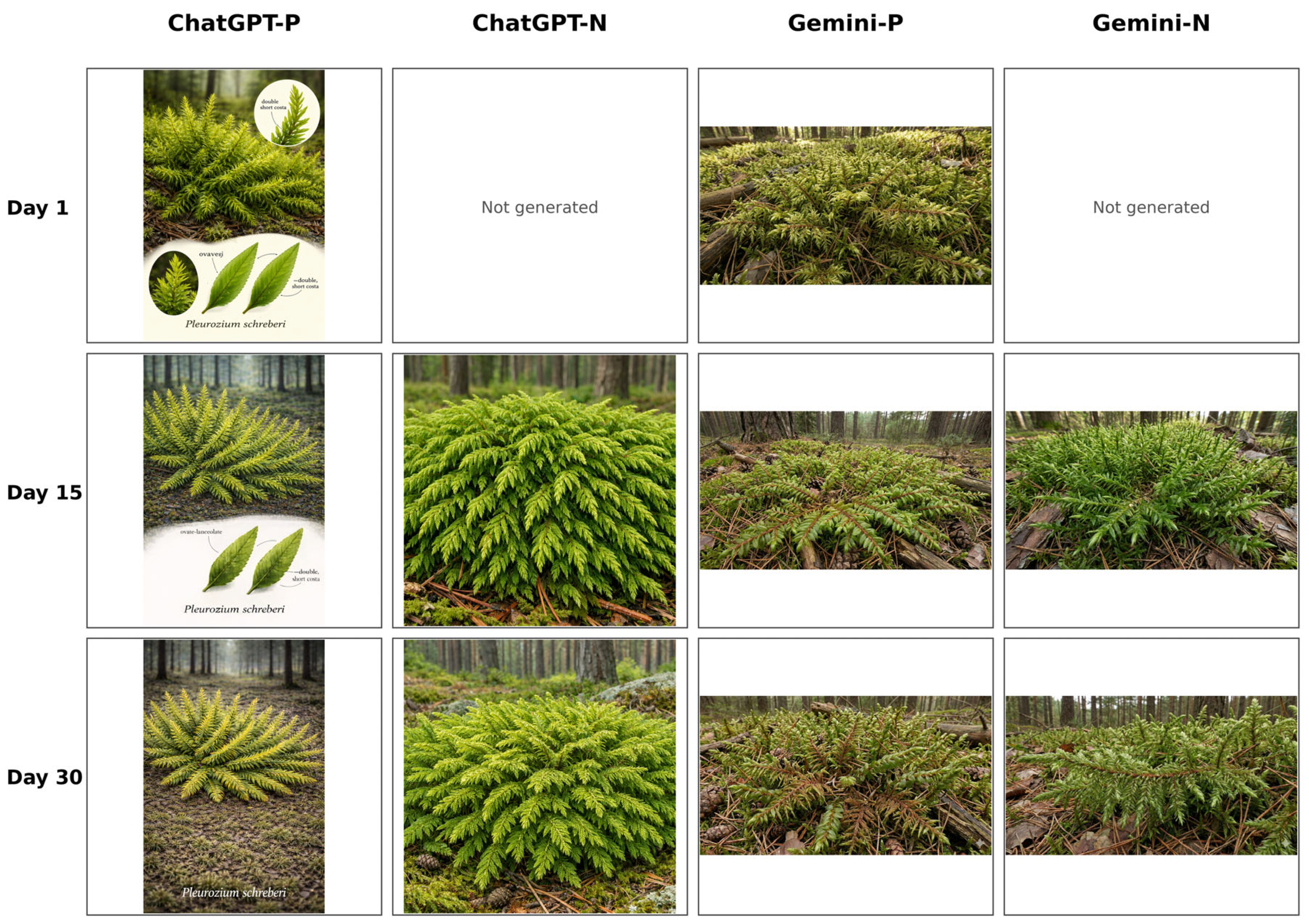
Each day produced four intended outputs: ChatGPT-P, ChatGPT-N, Gemini-P, and Gemini-N. We generated only one image for each platform × thread-condition combination on a given day; we did not collect additional same-day replicate generations. On day 1, no independent N image was generated; the initial generation established the P thread. Consequently, within-day P-N analyses used days 2–30. For comparisons requiring matched day-to-day transitions in P and N, days 3–30 were used. We archived each PNG file with its study-day identifier, platform, condition, filename, native dimensions, and checksum. Representative outputs from days 1, 15, and 30 under both thread conditions are shown in Figure 1.
Figure 1.
Representative outputs generated using ChatGPT Plus and Google Gemini Plus from the invariant Pleurozium schreberi prompt on days 1, 15, and 30 under persistent-thread (P) and new-thread (N) conditions. On day 1, independent N images were not generated.
2.3. Image Preprocessing
For image-level comparisons, each original image was resized while maintaining its aspect ratio so that the longer side fitted within 256 pixels and was then placed on a 256 × 256 pixel canvas with a constant white background (RGB 255, 255, 255). Images were converted to grayscale luminance for SSIM. For LPIPS, the standardized RGB images were normalized to the range [−1, 1] according to the implementation requirements. Native image dimensions differed systematically among platform × thread-condition series. We treated this as a methodological limitation because the aspect-ratio-preserving resize-and-pad procedure could couple native-format differences to SSIM and LPIPS values through unequal proportions of white background. We therefore evaluated the potential influence of this preprocessing choice in the post hoc sensitivity analyses described below.
CLIP embeddings were also derived from the same standardized 256 × 256 RGB images. The standardized image was passed through the default OpenCLIP preprocessing pipeline for the ViT-B/32 architecture with “openai” pretrained weights; image feature vectors were L2-normalized and cosine distance was calculated between paired embeddings. Thus, SSIM, LPIPS, and CLIP comparisons shared the same initial geometric standardization, after which metric-specific preprocessing was applied. The complete preprocessing and image-similarity analysis code is publicly available in Zenodo. We used bicubic interpolation for image resizing. Because the amount of white padding varied systematically with native aspect ratio, we also evaluated the robustness of the structural and perceptual findings to this preprocessing choice using padding-free procedures described in Section 2.6.
2.4. Similarity Measures
We used SSIM to quantify local structural similarity based on luminance, contrast, and spatial structure, with values closer to 1 indicating greater similarity [17]. We used LPIPS with an AlexNet backbone to quantify perceptual distance in learned deep-feature space, with lower values indicating greater perceptual similarity [18]. CLIP cosine distance was used to quantify representational proximity between image embeddings, with lower values indicating greater proximity in embedding space [19]. We used the three metrics jointly because reproducibility of generated images may manifest differently at structural, perceptual, and representational levels, and no single metric captures all three dimensions. We therefore interpreted them separately rather than combining them into a composite reproducibility score. Higher SSIM and lower LPIPS or CLIP cosine distance were interpreted as greater similarity within the corresponding dimension. These measures characterise similarity between images; they do not establish botanical fidelity, correctness of diagnostic features, pedagogical suitability, or educational effectiveness. Reproducibility was therefore treated as a technical quality-assurance property rather than as evidence of educational-content quality.
Two primary analytical perspectives were specified. Within-day divergence compared P and N images generated on the same platform and day. Day-to-day reproducibility compared the image generated on day d with the preceding image generated on day d-1 within the same platform x condition series. Successive day-to-day similarity observations were not independent because adjacent transitions shared one generated image, and the persistent-thread series additionally represented repeated observations along the same conversation trajectory. Only one image was generated per platform × thread-condition combination on each day; therefore, no within-day repeat-generation baseline was available. Accordingly, we use day-to-day reproducibility as an operational description of observed sequential similarity and do not isolate between-day change from ordinary short-interval stochastic generation variability. We treated cross-platform day-to-day contrasts as secondary exploratory analyses corresponding to EQ1 rather than additional primary outcomes. Associations between LPIPS and CLIP cosine distance were likewise treated as exploratory and corresponded to EQ2.
2.5. Statistical Analysis
All tests were two-sided. We analysed the primary contrasts using paired Wilcoxon signed-rank tests because the study questions concerned matched within-run differences rather than comparisons between independent groups, and the analysis did not rely on a normality assumption for the paired metric differences. For RQ1, within-day P-N divergence values were compared between ChatGPT and Gemini with calendar day as the pairing factor (days 2–30; n = 29 paired daily observations). For RQ2, day-to-day similarity values for P and N were compared separately within each platform, with the same day-to-day transition (d-1 to d) as the pairing factor (days 3–30; n = 28 paired transitions). We reported rank-biserial correlation alongside the Wilcoxon tests to quantify the direction and consistency of paired effects independently of p-values. Rank-biserial correlation reflects the consistency and direction of paired differences rather than their absolute magnitude in the original metric units; we therefore interpreted it alongside medians, interquartile ranges, and bootstrap confidence intervals for median paired differences. Holm adjustment was applied separately to the three within-day cross-platform metric tests and to each platform-specific family of three P-versus-N day-to-day tests. Secondary cross-platform day-to-day contrasts were adjusted within each thread condition across the three metrics. We used Holm adjustment to control the family-wise error rate within each prespecified family of related metric comparisons while retaining greater power than a simple Bonferroni correction.
For exploratory question EQ2, we assessed the association between LPIPS and CLIP cosine distance using Spearman rank correlation to quantify monotonic correspondence between two distance measures without assuming a linear relationship or normally distributed values. Multiplicity across these six correlations was controlled using Holm adjustment. We report descriptive results as medians and interquartile ranges (IQR), and use rank-biserial correlations to characterise the magnitude of paired effects. The observations were collected sequentially within a single longitudinal run and do not constitute independent thread-level replications; accordingly, p-values summarise the consistency of within-run contrasts across days and are not interpreted as population-level tests of platform or thread-condition effects. The moving-block bootstrap addresses serial dependence within the observed time series but does not provide independent replication at the conversation-trajectory level. The statistical analyses address reproducibility only; no statistical test was used to infer sustainability outcomes, educational effectiveness, or environmental resource savings.
The statistical and sensitivity-analysis scripts are provided in the same public Zenodo repository, enabling independent reproduction of the reported descriptive summaries, effect sizes, adjusted p-values, and confidence intervals. Supplementary Tables S1–S3 provide the image manifest and raw similarity metrics, Table S4 reports native-format and serial-dependence robustness analyses, Table S5 presents the exploratory cross-platform day-to-day contrasts, and Table S6 reports the padding-free preprocessing sensitivity analyses.
2.6. Robustness and Sensitivity Analyses
Native image dimensions were inspected because the white-padding procedure could couple aspect-ratio differences to SSIM and LPIPS. All ChatGPT-P images were 1024 × 1536 pixels, whereas ChatGPT-N contained 11 images at 1024 × 1536 and 18 images at 1024 × 1024; Gemini-P and Gemini-N were consistently 2816 × 1536. An initial post hoc analysis repeated the within-day ChatGPT-versus-Gemini comparison on the 11 days when ChatGPT P and N had matching native dimensions; we applied a Holm adjustment across the three metrics in this matched-dimension analysis. Matching dimensions within the N series alone does not ensure equivalent aspect ratios between corresponding P and N day-to-day transitions, so the original day-to-day native-format subset was not treated as a sufficient control for padding-related confounding. We therefore performed two additional padding-free sensitivity analyses on the complete dataset. First, we centre-cropped each native image to the largest possible square and resized it to 256 × 256 pixels using bicubic interpolation, preserving the geometry of the retained image region. Second, we resized the full native image directly to 256 × 256 pixels using the same interpolation method, preserving the full image content at the cost of aspect-ratio distortion. We recalculated SSIM and LPIPS under both strategies and repeated the primary RQ1 and RQ2 comparisons using the same paired Wilcoxon tests and rank-biserial effect sizes. We applied Holm adjustment across SSIM and LPIPS within each padding-free sensitivity family. To account for serial dependence in the recalculated metric series, we additionally applied the same moving-block bootstrap procedure to each padding-free paired-difference series (10,000 resamples; block length = 3) and obtained 95% confidence intervals for the median paired differences. CLIP cosine distance was not recalculated under these alternative geometric preprocessing strategies; therefore, the robustness of the CLIP findings to padding removal and alternative aspect-ratio handling remains untested. The Wilcoxon p-values were therefore interpreted together with the effect sizes, absolute paired differences, and block-bootstrap confidence intervals. Results are reported in Supplementary Table S6.
For the primary padded contrasts, the same moving-block bootstrap procedure was applied to the paired metric-difference series (10,000 resamples; block length = 3) to obtain 95% confidence intervals for the median paired difference. We used a block-based rather than an ordinary independent bootstrap because the observations were sequential and local temporal dependence could not be assumed absent. These confidence intervals quantify uncertainty around median paired differences conditional on the observed longitudinal trajectory; the moving-block bootstrap does not provide independent thread-level replication or extend inference beyond the studied run. Block lengths from 2 to 5 were checked as a robustness range and produced the same qualitative zero-exclusion pattern. These analyses are reported in Supplementary Table S4.
3. Results
3.1. Within-Day Divergence Between Thread Conditions
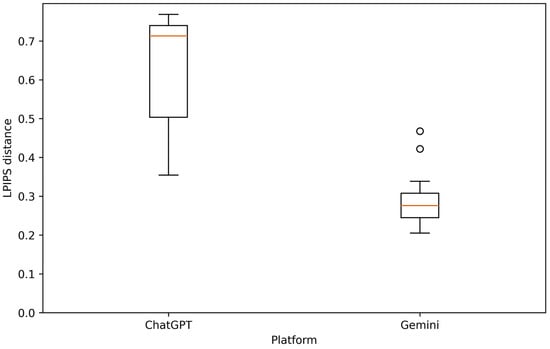
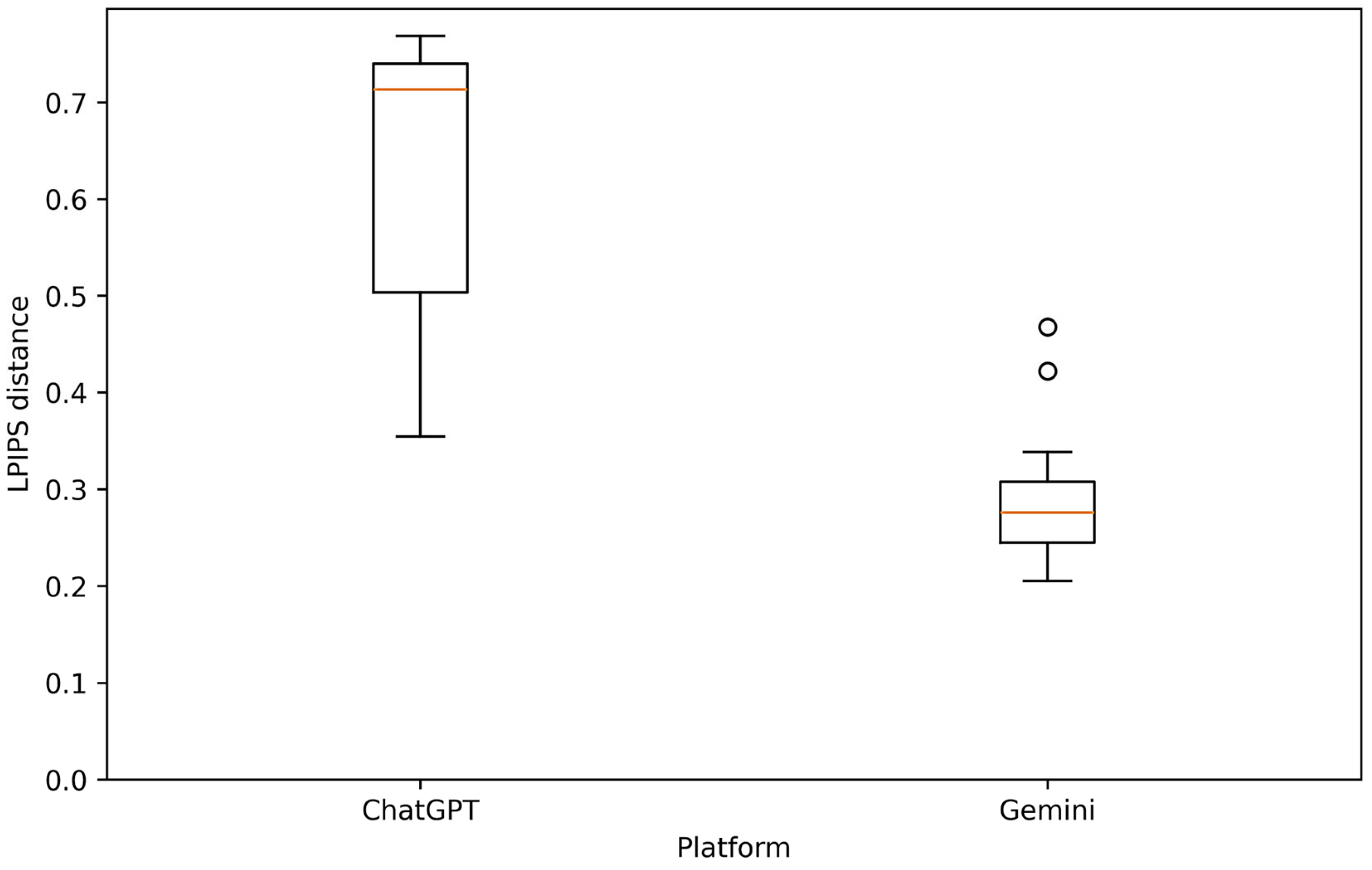
Under the primary padded preprocessing, within-day P-N divergence was greater in the observed ChatGPT series than in Gemini across all three metrics; however, the subsequent padding-free sensitivity analyses showed that this cross-platform pattern was robust for LPIPS but not for SSIM. Median P-N SSIM was 0.048 for ChatGPT and 0.476 for Gemini, indicating markedly lower structural similarity between the two ChatGPT conditions. Median LPIPS was 0.713 for ChatGPT and 0.276 for Gemini, while median CLIP cosine distance was 0.255 and 0.068, respectively. Each cross-platform difference remained significant after Holm adjustment (all adjusted p < 0.001; Table 2). The corresponding distribution of within-day perceptual divergence measured by LPIPS is shown in Figure 2.
Table 2.
Within-day divergence between persistent-thread and new-thread images, compared between platforms (days 2–30; n = 29 paired days).
Figure 2.
Within-day perceptual divergence (LPIPS) between persistent-thread and new-thread outputs for ChatGPT and Gemini.
Padding-free sensitivity analyses showed that the cross-platform RQ1 pattern depended on the metric. The greater perceptual P-N divergence in ChatGPT was preserved for LPIPS under both centre-crop preprocessing (median 0.642 vs. 0.444; rank-biserial r = 1.000; Holm-adjusted p < 0.001) and direct resizing without padding (0.626 vs. 0.463; r = 0.931; adjusted p < 0.001). In contrast, the SSIM cross-platform result was highly sensitive to preprocessing. After centre cropping, median SSIM was 0.034 for ChatGPT and 0.032 for Gemini, and the paired difference was not significant (adjusted p = 0.143). After direct resizing, SSIM was slightly higher for ChatGPT than Gemini (0.041 vs. 0.035; r = 0.549; adjusted p = 0.0086), opposite the direction observed with padded preprocessing. Thus, the strong cross-platform structural contrast observed in the primary analysis should not be interpreted as preprocessing-invariant, whereas the LPIPS result was robust to both padding-free strategies (Supplementary Table S6).
These results answer RQ1 by showing that the observed thread-condition divergence differed between platforms and similarity dimensions. The greater ChatGPT P-N divergence was robust for LPIPS, whereas the cross-platform SSIM contrast depended strongly on preprocessing; the corresponding CLIP contrast was evaluated only under the primary padded preprocessing and should not be interpreted as preprocessing-invariant.
In the format-matched sensitivity subset (11 days on which ChatGPT-P and ChatGPT-N were both 1024 × 1536 pixels), the cross-platform pattern remained. Median within-day SSIM was 0.349 for ChatGPT versus 0.478 for Gemini, LPIPS was 0.493 versus 0.276, and CLIP cosine distance was 0.252 versus 0.068. All three paired comparisons remained significant after Holm adjustment (adjusted p = 0.0029; |rank-biserial r| = 1.000). Thus, native-format variation amplified the full-sample ChatGPT contrasts but showed that native-dimension variation alone did not explain the padded-analysis contrasts; however, the additional padding-free analyses demonstrated that the SSIM component of RQ1 remained strongly preprocessing-dependent (Supplementary Table S4).
Moving-block-bootstrap confidence intervals led to the same substantive interpretation. Under center-crop preprocessing, the median paired ChatGPT-Gemini SSIM difference was 0.00274 (95% CI: −0.00049 to 0.00885), whereas the LPIPS difference was 0.19360 (95% CI: 0.13406 to 0.23846). Under direct resizing, the corresponding differences were 0.00727 for SSIM (95% CI: 0.00356 to 0.01108) and 0.16122 for LPIPS (95% CI: 0.08784 to 0.18780; Supplementary Table S6E). Thus, the center-crop SSIM contrast remained unsupported after accounting for local serial dependence, whereas the perceptual LPIPS contrast remained clearly separated from zero under both padding-free strategies.
3.2. Day-to-Day Reproducibility Within Platforms
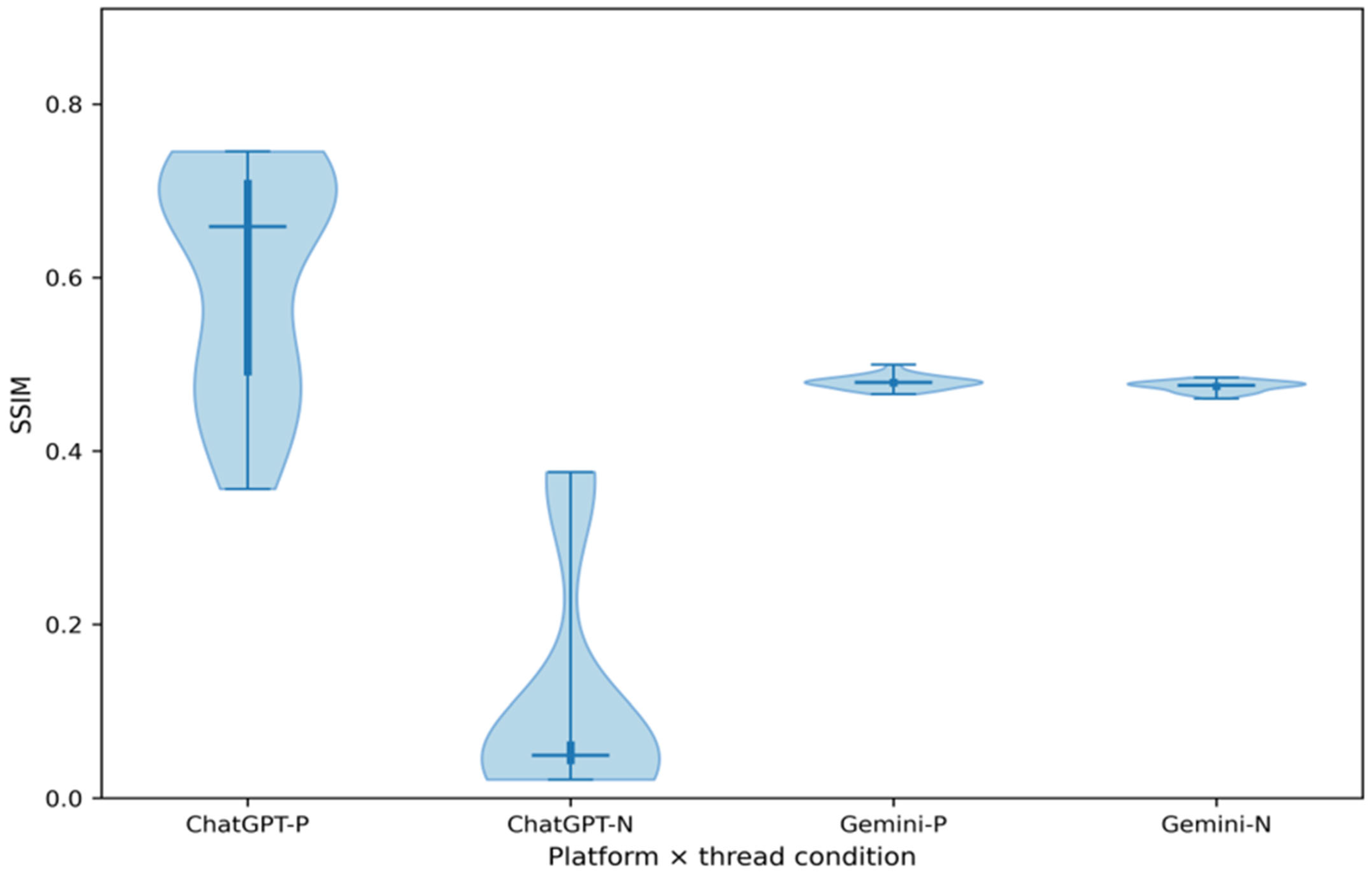
Observed day-to-day similarity differed strongly between thread conditions in the ChatGPT series. These comparisons characterise sequential output stability within the observed series and do not separate between-day variation from ordinary within-day stochastic variability. Across the 28 transitions available in both conditions, persistent-thread images had a median SSIM of 0.659 compared with 0.049 for new-thread images, and median LPIPS was 0.077 compared with 0.395. The paired effects were very large (SSIM: rank-biserial r = 1.000; LPIPS: r = −0.985), and the moving-block-bootstrap 95% confidence intervals for the median paired differences excluded zero (SSIM: 0.383 to 0.611; LPIPS: −0.484 to −0.220; Supplementary Table S4). The ChatGPT P-N contrast in CLIP cosine distance was smaller (0.024 vs. 0.041; rank-biserial r = −0.246), and its moving-block-bootstrap 95% confidence interval included zero (−0.0345 to 0.0237), indicating substantially weaker within-run evidence than for SSIM or LPIPS.
In Gemini, the structural P-N contrast was small in absolute magnitude (median SSIM 0.479 vs. 0.476; rank-biserial r = 0.498; moving-block-bootstrap median difference = 0.00314, 95% CI 0.00136 to 0.00972). Although the direction of this difference was consistent across the observed series, its absolute magnitude was very small, and the present study provides no empirical basis for interpreting a SSIM difference of this size as perceptually or educationally meaningful. Larger paired effects were observed for LPIPS (0.213 vs. 0.275; r = −0.709; bootstrap 95% CI for the median difference: −0.0990 to −0.0125) and CLIP cosine distance (0.033 vs. 0.086; r = −0.773; 95% CI: −0.0913 to −0.00913). Holm-adjusted p-values are reported in Table 3. These larger numerical contrasts should likewise be interpreted as differences in metric space rather than direct evidence of perceptual or educational importance. RQ2 therefore yielded a metric- and platform-specific pattern rather than a uniform persistent-thread effect.
Table 3.
Day-to-day reproducibility in persistent-thread (P) and new-thread (N) series within each platform (paired transitions, days 3–30; n = 28).
The principal day-to-day findings were preserved under both padding-free preprocessing strategies. For ChatGPT, persistent-thread images remained substantially more reproducible than new-thread images for both SSIM and LPIPS after center cropping (SSIM: 0.378 vs. 0.043; LPIPS: 0.178 vs. 0.369; both adjusted p < 0.001) and direct resizing (SSIM: 0.474 vs. 0.046; LPIPS: 0.123 vs. 0.373; both adjusted p < 0.001). The smaller Gemini P-N differences were also preserved under center cropping (SSIM: 0.036 vs. 0.031, adjusted p = 0.0056; LPIPS: 0.379 vs. 0.449, adjusted p < 0.001) and direct resizing (SSIM: 0.038 vs. 0.033, adjusted p = 0.0056; LPIPS: 0.397 vs. 0.476, adjusted p < 0.001). Thus, the structural and perceptual RQ2 patterns were not explained by the white-padding procedure (Supplementary Table S6). The padding-free sensitivity analyses did not include CLIP, so the robustness of the day-to-day CLIP contrasts to alternative geometric preprocessing was not evaluated. Supplementary Figures S1–S3 show the corresponding day-to-day trajectories, providing descriptive temporal context for these paired summary statistics. Moving-block bootstrap confidence intervals likewise excluded zero for the within-day platform contrasts, ChatGPT SSIM/LPIPS, and all three Gemini P-N contrasts, while including zero for ChatGPT CLIP. The zero-exclusion pattern was unchanged for block lengths 2–5 (Supplementary Table S4).
The moving-block-bootstrap analysis of the recalculated day-to-day series also supported the principal padding-free RQ2 patterns: the 95% confidence intervals for ChatGPT SSIM and LPIPS and for Gemini LPIPS excluded zero under both preprocessing strategies (Supplementary Table S6E). The small Gemini SSIM paired differences also excluded zero with the prespecified block length of 3, although the direct-resize contrast was sensitive to block-length choice, with the block-length-2 interval including zero. This reinforces the need to interpret the very small Gemini structural contrast primarily in terms of absolute magnitude rather than statistical detectability. The temporal distribution of day-to-day SSIM values across the four platform × thread-condition series is shown in Figure 3.
Figure 3.
Day-to-day structural similarity (SSIM) across platform × thread-condition series. The figure shows the temporal distribution of observed SSIM values; Table 3 and Supplementary Table S4 report numerical effect sizes, median paired differences, confidence intervals, and Holm-adjusted p-values.
3.3. Exploratory Cross-Platform Day-to-Day Patterns (EQ1)
Secondary cross-platform day-to-day contrasts showed that neither platform was uniformly more reproducible. Under the persistent-thread condition, the observed ChatGPT series had higher SSIM and lower LPIPS than Gemini, whereas CLIP distance did not differ significantly. Under the new-thread condition, Gemini had much higher SSIM and lower LPIPS than ChatGPT, while ChatGPT had lower CLIP distance than Gemini. Detailed medians, effect sizes, and Holm-adjusted p-values are provided in Supplementary Table S5. These contrasts are exploratory and do not imply stable platform rankings beyond the account, time window, and interface states studied.
The pattern is important for interpretation because structural and perceptual continuity did not necessarily imply equivalent continuity in CLIP embedding space. A series could retain relatively stable visual structure while moving more strongly in embedding space, or preserve embedding proximity while changing composition and appearance.
Given the preprocessing sensitivity identified for cross-platform SSIM in RQ1 and the absence of an equivalent padding-free sensitivity analysis for CLIP, these secondary cross-platform contrasts should be interpreted within the primary preprocessing framework rather than as preprocessing-invariant platform differences.
3.4. Exploratory Association Between Perceptual and CLIP-Embedding Divergence (EQ2)
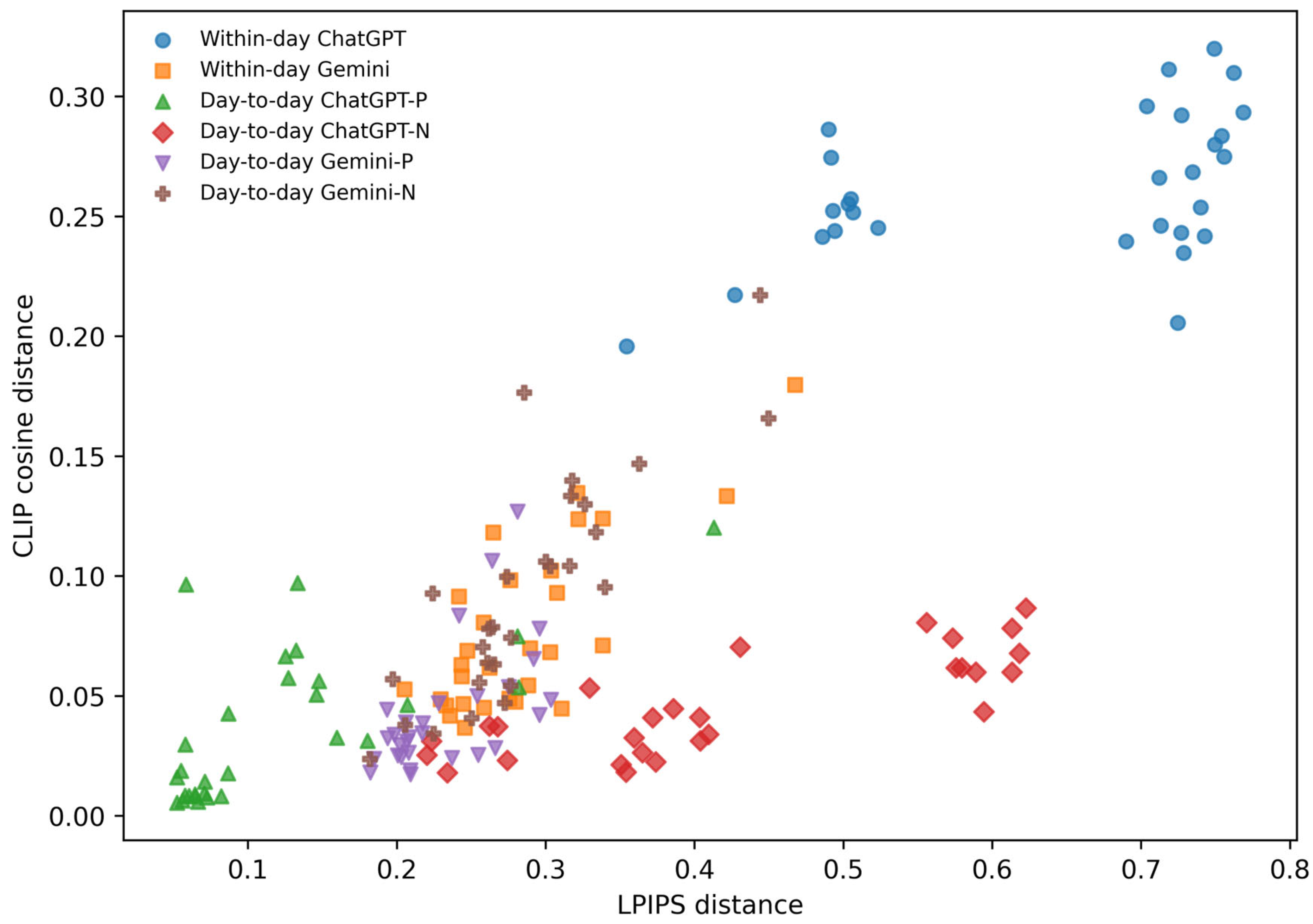
LPIPS and CLIP cosine distance were positively correlated in every analytical series. Within-day correlations were rho = 0.466 for ChatGPT and rho = 0.625 for Gemini. Day-to-day correlations were rho = 0.658 for ChatGPT-P, 0.772 for ChatGPT-N, 0.596 for Gemini-P, and 0.839 for Gemini-N. All six associations remained significant after Holm adjustment (Table 4), indicating that greater perceptual divergence generally co-occurred with greater divergence in CLIP embedding space, although the measures were not interchangeable. The relationship between LPIPS and CLIP cosine distance across the analysed series is visualised in Figure 4.
Table 4.
Spearman correlations between LPIPS and CLIP cosine distance.
Figure 4.
Relationship between LPIPS and CLIP cosine distance in the within-day and day-to-day analytical perspectives. Correlation coefficients and adjusted significance values are reported in Table 4.
4. Discussion
4.1. Conversation-Thread Condition as a Reproducibility Variable
The results show that reproducibility profiles differed between persistent-thread and new-thread conditions within this single-account repeated-generation run. An invariant botanical description did not define a stable output, and the difference between persistent and new threads varied markedly by platform. The strongest pattern within the observed ChatGPT trajectory was the substantially greater day-to-day structural and perceptual similarity of persistent-thread images relative to new-thread images. However, because repeated generations were not obtained within the same day and condition, the observed day-to-day divergence cannot be partitioned into ordinary stochastic generation variability and variation associated with changes across days. Gemini showed less dramatic structural separation, but persistent threads were nevertheless associated with lower perceptual and CLIP-embedding divergence. The Gemini SSIM contrast requires particular caution: the median P-N difference was approximately 0.003, indicating high directional consistency but very small absolute separation in SSIM space. No perceptual or educational threshold for a SSIM difference of this magnitude was established here, so statistical detectability should not be equated with practical importance.
This result is compatible with the probabilistic basis of generative image synthesis [10,11] and with multi-turn text-to-image work in which dialogue history is used to support coherence across successive generations [16]. The observed associations should not, however, be interpreted as direct evidence that visible conversation history was the sole causal mechanism or that either commercial platform intentionally reused earlier images. Generation time, execution order, model routing, hidden state, personalisation, transient service conditions, and provider-side updates were not independently controlled and may have partially overlapped with thread condition [13,14,15]. The expanded sensitivity analyses refine this interpretation. The day-to-day P-N differences in SSIM and LPIPS remained under both padding-free strategies, indicating that the principal within-platform temporal thread-condition patterns were not produced by the white-padding procedure. In contrast, the large cross-platform within-day SSIM difference observed under padded preprocessing disappeared after centre cropping and changed direction after direct resizing. Structural cross-platform divergence is therefore preprocessing-dependent, whereas the perceptual LPIPS contrast was considerably more robust. CLIP was not included in the padding-free sensitivity analyses; accordingly, CLIP-based cross-platform and thread-condition findings remain conditional on the primary geometric preprocessing pipeline. The operational conclusion is therefore narrow: persistent-thread and new-thread conditions showed different reproducibility profiles under the specific account and service conditions studied. The statistical summaries characterise the magnitude and temporal consistency of contrasts within these observed trajectories; they do not convert the single longitudinal run into independently replicated evidence about platform-level behaviour. The three similarity dimensions should therefore be intepreted separately. SSIM characterises structural similarity, LPIPS characterises perceptual similarity in learned feature space, and CLIP cosine distance characterises proximity in embedding space; agreement among them therefore reflects convergence across distinct dimensions rather than repeated measurement of a single property. Conversely, divergence among the metrics should not be interpreted as inconsistency, because each captures a different aspect of image similarity. None of these measures evaluates whether the generated image correctly represents the diagnostic botanical features of P. schreberi, so reproducibility and botanical accuracy remain analytically distinct.
4.2. Reproducibility as a Quality-Assurance Dimension of Sustainable Digital Education
The principal sustainability-related implication is procedural and concerns the long-term management of digital educational resources rather than a directly measured environmental or economic outcome. Sustainable digital education requires more than rapid content creation; it also depends on quality, continuity, accountable use, and the capacity to preserve and revise digital resources without losing provenance or pedagogical control [1,2,3,5,6,7]. In the present experiment, the identical prompt did not function as a reliable substitute for the actual image file. Prompt-only documentation is therefore insufficient whenever an AI-generated visual is expected to remain comparable across semesters, instructors, learner groups, or subsequent revisions.
Accordingly, reproducibility can be treated as one technical quality-assurance dimension of AI-assisted educational-resource management, distinct from botanical correctness and pedagogical quality. The present similarity metrics quantify technical reproducibility rather than pedagogical importance; accordingly, the minimum reusable unit is not the prompt alone but the specific output together with its provenance: image file, exact prompt, platform, date and time, thread condition, and any post-processing. Before reuse, however, the archived output must independently pass domain-specific and pedagogical review; the present study did not validate botanical correctness. This provenance-centered approach is consistent with sustainable AI literacy [5] and governance-oriented work in this Special Issue that frames sustainable AI practice in terms of accountability and control [6], while preserving the value-critical principle that educational purpose and epistemic quality take precedence over technological efficiency [7].
4.3. Provenance-Aware Reuse, Resource Optimization, and Long-Term Viability
Within sustainable digital education, resource optimisation and the long-term viability of digital infrastructure are relevant dimensions of responsible digital transformation. The present experiment supports only limited workflow-level inference: repeated regeneration was not equivalent to recovering a previously used asset. If an educator needs visual continuity, reusing an archived resource that has already passed independent botanical and pedagogical review avoids reliance on uncertain regeneration and the associated need to select, compare, and re-curate a replacement asset. This is a workflow-level rationale for provenance-aware reuse, not a measured environmental benefit.
The study did not measure electricity consumption, carbon emissions, server utilisation, monetary cost, or educator time and therefore cannot demonstrate environmental or economic savings from persistent-thread generation or archived reuse. Resource optimisation is consequently treated as a testable downstream hypothesis: future work must determine whether versioned reuse actually reduces computational demand, curation time, or cost. This distinction is especially important because science-education research has linked AI with resource optimization [4], whereas critical perspectives caution that efficiency claims should not be equated with sustainability outcomes unless they are directly measured [7]. The observed findings, recommended digital practices, and their bounded sustainability implications are summarised in Table 5.
Table 5.
Reproducibility findings and bounded implications for sustainable digital-resource management.
4.4. AI Literacy, Governance, and Educator Mediation
The observed variability also has implications for AI literacy. Sustainable AI literacy should include an understanding that generative outputs are contingent, model-mediated artefacts rather than deterministic products of text input [5]. For educators, this expands the skill set from “writing a good prompt” to documenting provenance, recognizing stochastic variation, verifying content, and deciding when an independently reviewed archived output should be reused rather than regenerated. These competencies parallel broader arguments for accountable AI governance [6] and critical examination of digital media in environmental education [8,9].
Pedagogical judgment remains essential. Research on AI-integrated science lesson design indicates that the value of AI depends on how outputs are positioned within instructional activity rather than on their mere presence [2]. Similarly, educators discussing sustainable use of GenAI emphasize ethical awareness, purposeful integration, and continued human judgment [3]. The current experiment adds a narrower technical condition: before questions of learning effectiveness are considered, educators need to know which version of an AI-generated visual is being used and whether it can be recovered reliably.
4.5. Botanical Visuals as a Domain-Specific Case
The use of P. schreberi provided a domain-specific case in which the prompt encoded growth form, branching pattern, leaf arrangement, costa, and habitat. This specificity made it possible to test repeated generation with an invariant biological description rather than a generic aesthetic request. Nevertheless, the present metrics assessed similarity among outputs, not correspondence with botanical characters. A highly reproducible image can still be biologically incorrect, while a variable series can contain individually plausible images. Reproducibility and fidelity must therefore remain analytically separate. Accordingly, the educational relevance demonstrated here concerns provenance, reproducible asset management, and controlled reuse, not the botanical or pedagogical quality of the generated images themselves.
This distinction is particularly important for sustainable digital content ecosystems. Long-term reuse is beneficial only when an archived resource has first passed appropriate domain and pedagogical validation. Reproducibility is therefore one layer of quality assurance rather than a substitute for expert review, pedagogical suitability assessment, or direct observation of biological material.
4.6. Limitations and Future Research
Several limitations delimit the conclusions. First, this was a single-account longitudinal case study with one persistent thread per platform, one species-specific prompt, and one 30-day service window. Days provide repeated observations within the run, not independent replications of the persistent-thread condition or of ChatGPT or Gemini as platforms; population-level generalisation is therefore not warranted. Future studies should therefore include multiple independently initiated persistent-thread trajectories per platform, ideally replicated across accounts and service windows, to provide genuine thread-level replication. In addition, only one image was generated per platform × thread-condition combination per day, so the study provides no within-day replicate baseline for estimating ordinary short-term stochastic generation variability. Consequently, the observed day-to-day distances cannot be attributed uniquely to temporal change; they may reflect a combination of inherent stochastic variability and changes occurring across days in the service state or generation context. Second, underlying model versions and provider-side updates were not independently controlled, and the user-facing interface labels do not identify the complete generation pipeline. Third, generation times were not standardised, and the daily order of platform/condition execution was not randomised. Time-of-day effects, execution order, model routing, transient system state, and provider-side changes could therefore have partially overlapped with thread condition, preventing the observed P-N differences from being attributed exclusively to conversation continuity. Fourth, new-thread generation cannot be assumed to remove all account-level memory or personalization. Fifth, native image dimensions differed systematically among some platform × condition series, and the original standardisation introduced different proportions of white padding. The padding-free sensitivity analyses showed that the principal day-to-day SSIM and LPIPS thread-condition patterns were robust, whereas the large cross-platform within-day SSIM contrast was not preprocessing-invariant. CLIP embeddings were derived from the same initially padded standardized images, but CLIP was not recomputed under the two padding-free preprocessing strategies. The robustness of the CLIP findings to alternative geometric preprocessing therefore remains untested. Structural platform comparisons should therefore be interpreted with particular caution and jointly with the padding-free sensitivity results. Sixth, consecutive observations showed serial dependence in some metric series. The same moving-block-bootstrap procedure was also applied to the recalculated padding-free SSIM and LPIPS series, so interpretation of these sensitivity analyses was not based on conventional Wilcoxon p-values alone. For the very small direct-resize Gemini SSIM contrast, however, zero exclusion was not fully stable across block lengths 2–5, further limiting its practical interpretation. We therefore used moving-block-bootstrap confidence intervals to assess uncertainty around within-run median differences while retaining local temporal dependence. These intervals do not compensate for the absence of independent thread-level replication and should not be interpreted as extending inference beyond the observed trajectories; the short time series also limits more formal time-series modelling. Seventh, SSIM has known limitations as a general-purpose quality measure [22], while LPIPS and CLIP-based measures can inherit representation-specific biases [23,24] and do not assess botanical accuracy.
The study also did not establish minimal practically important differences for SSIM, LPIPS, or CLIP distance. Consequently, small but statistically consistent metric differences, such as the Gemini SSIM contrast, cannot be assumed to have perceptual or educational relevance without external validation.
Finally, the study included no teachers, learners, independent botanical expert ratings, pedagogical suitability assessment, learning outcomes, energy measurements, or cost measurements. Accordingly, any proposed benefits of archived reuse for computational demand, educator workload, monetary cost, or environmental impact remain untested downstream implications rather than empirical outcomes of this study. Educational implications are therefore limited to reproducibility, provenance, technical quality assurance, and digital-resource workflow design; they should not be interpreted as evidence of botanical correctness or pedagogical effectiveness. Future research should incorporate multiple repeated generations within each platform × thread-condition combination on each study day to estimate within-day stochastic variability and distinguish it from between-day change. The design should then be replicated across accounts, languages, prompt families, taxa, randomised generation orders, and independently identified model versions; compare preprocessing schemes; combine longitudinal generation with independently designed expert botanical validation and educator/learner studies; and directly measure computational energy, time, and cost. Such work would allow the proposed connection between reproducibility, resource optimization, and sustainable digital infrastructure to be tested empirically rather than inferred procedurally. Future work should also link image-similarity metrics to human perceptual judgments and educational-task outcomes to establish empirically meaningful thresholds for practical relevance.
5. Conclusions
Within this single-account 30-day case study, an identical botanical prompt did not define a stable visual asset across time. Observed reproducibility profiles differed by conversation-thread condition, platform, and similarity dimension. Persistent-thread outputs showed greater observed day-to-day structural and perceptual similarity than new-thread outputs in the ChatGPT series. In the observed Gemini series, the persistent-thread condition showed only a very small absolute structural advantage in SSIM, while larger differences were observed in perceptual and CLIP embedding-space metrics; the practical perceptual or educational importance of these numerical differences was not established. Padding-free sensitivity analyses preserved the principal structural and perceptual day-to-day thread-condition patterns, but demonstrated that the cross-platform within-day SSIM contrast depended strongly on preprocessing. The perceptual LPIPS contrast was substantially more robust to alternative image standardisation. Equivalent geometric-preprocessing sensitivity was not assessed for CLIP, so CLIP-based findings should be interpreted as conditional on the primary preprocessing pipeline.
For sustainable digital education, the defensible implication is a resource-management principle rather than a claim of measured environmental savings: AI-generated visuals intended for repeated use should be managed as versioned digital assets, not assumed to be recoverable from a saved prompt. The empirical contribution therefore concerns reproducibility and provenance, whereas potential reductions in regeneration effort, computational demand, cost, or environmental burden remain hypotheses requiring direct measurement. This conclusion concerns provenance and reproducible resource management rather than the botanical correctness or pedagogical quality of the generated visuals. Archiving the specific output together with its prompt, platform, date, thread condition, and post-processing history strengthens provenance and controlled reuse, provided that the asset has also passed independent content and pedagogical validation. Such practices may reduce reliance on redundant regeneration and re-curation, but energy, emissions, time, and cost must be measured directly before resource-saving claims can be made. Reproducibility is therefore one bounded quality-assurance component of sustainable AI integration, alongside epistemic validation, educator judgment, governance, and environmental assessment.
Supplementary Materials
The following supporting information can be downloaded at: https://www.mdpi.com/article/10.3390/su181910052/s1, Table S1, Generated-image manifest, native image dimensions, and MD5 checksums used to verify source-file integrity; Table S2, Raw metric values for within-day persistent-thread versus new-thread comparisons (days 2–30); Table S3, Raw metric values for day-to-day comparisons within platform × thread-condition series; Table S4, Robustness analyses addressing native image-format variation and serial dependence; Table S5, Exploratory cross-platform day-to-day contrasts; Table S6, Padding-free preprocessing sensitivity analyses for the primary structural and perceptual comparisons; Figure S1, Day-to-day SSIM values across the four platform × thread-condition series; Figure S2, Day-to-day LPIPS values across the four platform × thread-condition series; Figure S3, Day-to-day CLIP cosine-distance values across the four platform × thread-condition series; Figure S4, Day-to-day CLIP embedding-space divergence (cosine distance) across the four series. The complete generated-image archive, raw analytical data, and reproducible analysis code are publicly available in Zenodo (DOI: 10.5281/zenodo.22836466).
Author Contributions
Conceptualization, P.Ś.; methodology, P.Ś.; software, P.Ś.; validation, M.R.; formal analysis, P.Ś.; investigation, P.Ś.; data curation, P.Ś. and M.R.; writing—original draft preparation, P.Ś.; writing—review and editing, P.Ś., M.L., G.J.W. and M.R.; visualization, P.Ś.; supervision, M.R.; project administration, P.Ś. All authors have read and agreed to the published version of the manuscript.
Funding
This research received no external funding.
Institutional Review Board Statement
Not applicable. The study involved no human participants, animals, personal data, or field sampling.
Informed Consent Statement
Not applicable.
Data Availability Statement
All 118 generated images, raw similarity metrics, image metadata, preprocessing and image-analysis code, statistical analysis scripts, and sensitivity-analysis materials supporting this study are publicly available in Zenodo (DOI: 10.5281/zenodo.22836466). The Supplementary Materials accompanying this article additionally provide the image manifest, native dimensions, MD5 checksums, raw metric tables, robustness analyses, and Supplementary Figures.
Acknowledgments
ChatGPT Plus and Google Gemini Plus were used as the experimental image-generation systems described in Section 2.2. All AI-generated outputs included in the study were inspected and curated by the authors for consistency with the study records; no independent botanical validation was performed. The authors take full responsibility for the content of this publication. The underlying provider-side model routing was not independently verifiable beyond the user-facing interface labels reported in the Methods.
Conflicts of Interest
The authors declare no conflicts of interest.
Abbreviations
AI—artificial intelligence; CLIP—Contrastive Language-Image Pre-Training; GenAI—generative artificial intelligence; IQR—interquartile range; LPIPS—Learned Perceptual Image Patch Similarity; N—new-thread condition; P—persistent-thread condition; SDG—Sustainable Development Goal; SSIM—Structural Similarity Index.
References
- Dafli, E.; Dratsiou, I.; Nisiforou, E.; Mylona, P.; Puig, B.; Lazar, G.; Nicolaou, P.; Bamidis, P.D.; Nicolaou, S.A. Toward Sustainable Digital Education in Biology: Evaluating Educators’ Perceptions and Adoption Intentions for a Virtual Laboratory Toolkit from Four European Contexts. Sustainability 2026, 18, 6445. [Google Scholar] [CrossRef] [Scilit]
- Lee, J. How Pre-Service Elementary Teachers Develop Scientific Concepts in AI-Integrated Lesson Designs: Implications for Sustainable Teacher Education. Sustainability 2026, 18, 5211. [Google Scholar] [CrossRef] [Scilit]
- Lardhi, J.S.; Ismail, A.F. Generative Artificial Intelligence for SDG 4: Enhancing Sustainable Quality Learning. Sustainability 2026, 18, 2498. [Google Scholar] [CrossRef] [Scilit]
- Restović, I.; Jurić, J.; Kević, N. AI-Driven Resource Optimization in Science Education: Assessing Pre-Service Teachers’ Readiness for Sustainable Teaching Practices and Environmental Literacy. Sustainability 2026, 18, 6786. [Google Scholar] [CrossRef] [Scilit]
- Bae, J.-S.; Ko, K.-M.; Park, H.-J. Toward Sustainable AI Literacy in Higher Education: A Delphi-AHP Approach to Identifying Key Components of AI/Data Extracurricular Programs. Sustainability 2026, 18, 8050. [Google Scholar] [CrossRef] [Scilit]
- Osadchyi, V.; Shantyr, A.; Zinchenko, O.; Bondarchuk, A.; Lashchevska, N.; Osadcha, K. Educating Managers to Govern Artificial Intelligence. Sustainability 2026, 18, 5590. [Google Scholar] [CrossRef] [Scilit]
- Alsuhaymi, A.O.; Atallah, F.A. Sustainable Education in the Age of Artificial Intelligence and Digitalization: A Value-Critical Approach. Sustainability 2026, 18, 1257. [Google Scholar] [CrossRef] [Scilit]
- Lowan-Trudeau, G. Digital Technologies and Environmental Education. J. Environ. Educ. 2023, 54, 1–7. [Google Scholar] [CrossRef] [Scilit]
- López, A. Seeing Microplastic Clouds: Using Ecomedia Literacy for Digital Technology in Environmental Education. J. Environ. Educ. 2023, 54, 46–57. [Google Scholar] [CrossRef] [Scilit]
- Ho, J.; Jain, A.; Abbeel, P. Denoising Diffusion Probabilistic Models. Adv. Neural Inf. Process. Syst. 2020, 33, 6840–6851. [Google Scholar]
- Rombach, R.; Blattmann, A.; Lorenz, D.; Esser, P.; Ommer, B. High-Resolution Image Synthesis with Latent Diffusion Models. In Proceedings of the IEEE/CVF Conference on Computer Vision and Pattern Recognition (CVPR), New Orleans, LA, USA, 18–24 June 2022; pp. 10684–10695. [Google Scholar] [CrossRef] [Scilit]
- Mahajan, S.; Rahman, T.; Yi, K.M.; Sigal, L. Prompting Hard or Hardly Prompting: Prompt Inversion for Text-to-Image Diffusion Models. In Proceedings of the IEEE/CVF Conference on Computer Vision and Pattern Recognition (CVPR), Seattle, WA, USA, 16–22 June 2024; pp. 6808–6817. [Google Scholar] [CrossRef] [Scilit]
- Kamath, A.; Chang, K.-W.; Krishna, R.; Zettlemoyer, L.; Hu, Y.; Ghazvininejad, M. GenEval 2: Addressing Benchmark Drift in Text-to-Image Evaluation. arXiv 2025, arXiv:2512.16853. [Google Scholar] [CrossRef] [Scilit]
- Pineau, J.; Vincent-Lamarre, P.; Sinha, K.; Larivière, V.; Beygelzimer, A.; d’Alché-Buc, F.; Fox, E.; Larochelle, H. Improving Reproducibility in Machine Learning Research. J. Mach. Learn. Res. 2021, 22, 1–20. [Google Scholar]
- Pozzobon, L.; Ermiş, B.; Lewis, P.; Hooker, S. On the Challenges of Using Black-Box APIs for Toxicity Evaluation in Research. In Proceedings of the 2023 Conference on Empirical Methods in Natural Language Processing, Singapore, 6–10 December 2023; pp. 7595–7609. [Google Scholar] [CrossRef] [Scilit]
- Huang, M.; Long, Y.; Deng, X.; Chu, R.; Xiong, J.; Liang, X.; Cheng, H.; Lu, Q.; Liu, W. DialogGen: Multi-Modal Interactive Dialogue System with Multi-Turn Text-Image Generation. In Findings of the Association for Computational Linguistics: NAACL 2025, Albuquerque, NM, USA, 29 April–4 May 2025; Association for Computational Linguistics: Stroudsburg, PA, USA, 2025; pp. 411–426. [Google Scholar] [CrossRef] [Scilit]
- Wang, Z.; Bovik, A.C.; Sheikh, H.R.; Simoncelli, E.P. Image Quality Assessment: From Error Visibility to Structural Similarity. IEEE Trans. Image Process. 2004, 13, 600–612. [Google Scholar] [CrossRef] [Scilit]
- Zhang, R.; Isola, P.; Efros, A.A.; Shechtman, E.; Wang, O. The Unreasonable Effectiveness of Deep Features as a Perceptual Metric. In Proceedings of the IEEE/CVF Conference on Computer Vision and Pattern Recognition (CVPR), Salt Lake City, UT, USA, 18–23 June 2018; pp. 586–595. [Google Scholar] [CrossRef] [Scilit]
- Radford, A.; Kim, J.W.; Hallacy, C.; Ramesh, A.; Goh, G.; Agarwal, S.; Sastry, G.; Askell, A.; Mishkin, P.; Clark, J.; et al. Learning Transferable Visual Models from Natural Language Supervision. Proc. Mach. Learn. Res. 2021, 139, 8748–8763. [Google Scholar]
- Smith, A.J.E. The Moss Flora of Britain and Ireland, 2nd ed.; Cambridge University Press: Cambridge, UK, 2004. [Google Scholar]
- Wolski, G.J.; Kobylińska, A.; Sadowska, B.; Podsędek, A.; Kajszczak, D.; Fol, M. Influence of Phytocenosis on the Medical Potential of Moss Extracts: The Pleurozium schreberi (Willd. ex Brid.) Mitt. Case. Sci. Rep. 2023, 13, 20293. [Google Scholar] [CrossRef] [Scilit]
- Pambrun, J.-F.; Noumeir, R. Limitations of the SSIM Quality Metric in the Context of Diagnostic Imaging. In Proceedings of the 2015 IEEE International Conference on Image Processing (ICIP), Quebec City, QC, Canada, 27–30 September 2015; pp. 2960–2963. [Google Scholar] [CrossRef] [Scilit]
- Tanjim, M.M.; Singh, K.K.; Kafle, K.; Sinha, R.; Cottrell, G.W. Discovering and Mitigating Biases in CLIP-Based Image Editing. In Proceedings of the 2024 IEEE/CVF Winter Conference on Applications of Computer Vision (WACV), Waikoloa, HI, USA, 3–8 January 2024; pp. 2972–2981. [Google Scholar] [CrossRef] [Scilit]
- Zhang, Z.; Liu, Z.; Feng, M.; Xu, C. Can CLIP Count Stars? An Empirical Study on Quantity Bias in CLIP. In Findings of the Association for Computational Linguistics: EMNLP 2024, Miami, FL, USA, 12–16 November 2024; Association for Computational Linguistics: Stroudsburg, PA, USA, 2024; pp. 1081–1086. [Google Scholar] [CrossRef] [Scilit]

Disclaimer/Publisher’s Note: The statements, opinions and data contained in all publications are solely those of the individual author(s) and contributor(s) and not of MDPI and/or the editor(s). MDPI and/or the editor(s) disclaim responsibility for any injury to people or property resulting from any ideas, methods, instructions or products referred to in the content. |
© 2026 by the authors. Licensee MDPI, Basel, Switzerland. This article is an open access article distributed under the terms and conditions of the Creative Commons Attribution (CC BY) license.