


Abstract
Carbon sequestration and emission reduction via biochar represent a promising approach for carbon storage. Continuously collected roadway fallen leaves serve as an attractive precursor for biochar-based carbon sequestration. However, the realistic carbon sequestration potential (derived from biochar production) of these urban waste resources remains poorly quantified and deserves further investigation. Against the backdrop of global sustainability goals, this study estimated the potential of using roadway fallen leaves for carbon sequestration at the urban scale of Hangzhou, based on government reports and pyrolysis experiments. Results indicated that there were a total of 691,472 roadway trees in Hangzhou. If the fallen leaves of the roadway trees in Hangzhou were subjected to oxygen-limited pyrolysis at a temperature of 300 °C for carbon sequestration purposes, the potential total carbon sequestration capacity was estimated to be 2273 ± 55 tons of carbon, equivalent to 8334 ± 200 tons of carbon dioxide. Leaf-derived biochar carbon sequestration index (LBCS) was established for potential use in the future Certified Emission Reduction (CCER). Different leaf types and pyrolysis conditions correspond to different LBCS values. LBCS for Camphor tree (300 °C) was 3.64 . Thermal maps of carbon sequestration potential of roadside leaf resources in 13 counties and districts of Hangzhou made by this study provided a reference for potential future practices. It was further estimated that with one-third of the tree leaves used for leaf-derived biochar (300 °C) carbon sequestration between 2027 and 2060, the cumulative carbon sequestration potential could reach up to 18.96 billion tons CO2-eq by 2060, contributing 29–68% of the global GHGs emission reduction goal for bioenergy with carbon capture and storage (BECCS). We noted that this long-term cumulative estimate relied on linear extrapolation assumptions and contained uncertainties. This research offered new insights and quantitative baseline data for advancing negative-carbon technology using urban leaf waste, supporting local waste recycling practices and the urban implementation of the United Nations 2030 Agenda toward carbon-neutrality objectives.
1. Introduction
Global warming is a critical issue facing society today [1]. In recent years, the intensification of the global greenhouse effect has triggered natural disasters such as the melting of polar glaciers, super-strong hurricanes, and severe floods, resulting in adverse consequences such as grain reduction and ecological imbalance [2,3]. Excessive fossil fuel burning and other anthropogenic activities have greatly increased the atmospheric greenhouse gas concentration, which is the main reason for the intensification of the global greenhouse effect [4]. The reports of the Intergovernmental Panel on Climate Change (IPCC) and the Global Energy Assessment Unit [5,6] showed that atmospheric CO2 concentration has risen from 280 ppm before the first Industrial Revolution to 408 ppm in 2018. Based on observational data from the Mauna Loa Observatory in Hawaii, the UK Met Office reported that the atmospheric carbon dioxide concentration rose by an average of 3.58 ppm from 2023 to 2024, the largest annual increase recorded over the observatory’s 67-year measurement period. According to the United Nations Intergovernmental Panel on Climate Change, the increase in atmospheric carbon dioxide concentration needs to be slowed to 1.8 ppm per year if the global temperature rise is to be limited to 1.5 °C [6]. It is urgent to control the concentration of atmospheric greenhouse gases, mainly CO2.
Biochar sequestration is a promising carbon-negative technology, which may contribute to urban waste sustainability [7,8]. Biomass conversion to biochar prevents CO2 from being released back into the atmosphere through microbial degradation, as the resulting biochar is chemically inert [9,10]. Biochar carbon sequestration technology has greatly extended the residence time of the temporary carbon sink of synthetic biomass due to photosynthesis in the non-atmospheric sphere, compared to direct biomass incineration or natural decomposition in the soil [11,12]. Researchers usually use waste biomass such as rice straw, corn straw, animal manure, wood, or bamboo chips to produce biochar by oxygen-limited pyrolysis carbonization [13,14], and apply it to the soil for multi-advantages beyond carbon sequestration, which can simultaneously increase the soil organic matter content, decrease the metabolic rate of soil organic carbon, improve acidic soil, promote crop growth by increasing soil nutrient retention, and prevent the migration and transformation of soil pollutants [15,16]. Carbon in biochar can also be sequestered for non-combustion uses such as permanent art or building bricks [17]. Either way, carbon in biochar is stably preserved, equivalent to humans storing atmospheric carbon dioxide in biochar solids through a coupling of natural photosynthesis and anthropogenic pyrolysis, which can happen in a controlled and continuous way.
When the pyrolysis temperature of biochar is different, the key parameters such as pyrolysis yield and carbon content obtained from the pyrolysis process vary, and the stability of the carbon stabilized is also significantly different, which will thus affect the proportion of its microbial decomposition in soil and the soil organic carbon priming effect [18,19]. When the bulk density of biomass is low, the adsorbed oxygen carried in the micropore space of the carbon skeleton of fragments will convert part of biochar into ash, reducing the yield and carbon sequestration rate [20]. Therefore, when estimating the carbon sequestration potential of biochar production process, it is necessary to consider the difference in key parameters of carbon sequestration by different biomass [21]. Due to the high complexity and numerous influencing factors of the biochar pyrolysis and application process, evaluating the carbon sequestration potential of biochar production and biochar application has become the focus of relevant research in recent years, and it is necessary to consider the actual application scenarios and influencing factors under each typical scenario [22]. Earlier optimistic estimates by Lehmann suggested that biochar could absorb up to about 1 billion tons of greenhouse gases per year, more than 10% of the total 2007 emissions of 8.5 billion tons [23]. Then, in 2010, Woolf proposed that without impact on food security and ecosystems, biochar could fix 1.8 billion tons of CO2-C per year, equivalent to 12% of annual anthropogenic greenhouse gas emissions [24]. Recently, Yang estimated through the whole life cycle assessment that if 73% of China’s agricultural residues from 2020 to 2030 were used for thermal cracking to produce biochar for carbon sequestration and soil carbon storage, the cumulative greenhouse gas emission reduction by 2050 could reach 8.62 Gt CO2-eq. It was equivalent to 13–31% of the global BECCS emission reduction target and 4.56 Gt CO2-eq higher than China’s BECCS target [25].
Roadway fallen leaves are solid waste that need to be cleaned up every day on urban roads, and there are still a large number of fallen leaves left in the roadway grass to decompose, constantly releasing carbon dioxide back into the atmosphere to maintain the balance of carbon cycle [26]. However, the carbon in fallen leaves is actually a potential stabilizable carbon sink that has been ignored and underestimated for a long time, which is expected to be used to offset some of the government’s carbon emissions. The realistic carbon sequestration potential (derived from biochar production) of these urban waste resources remains poorly quantified and deserves further investigation, against the backdrop of global sustainability goals [27]. Moreover, the roadway fallen leaves themselves need to be cleaned up and transported, which naturally reduces additional disposal costs, and the tree leaves are produced every year and can be naturally air dried on the road, saving pre-treatment costs. Based on the above analysis, it is urgent to evaluate the feasibility and potential of carbon sequestration by oxygen-limited pyrolysis carbonization of roadway fallen leaves [28], by considering the parameters of the carbon sequestration matching the pyrolysis of different types of fallen leaves, providing theoretical and scientific basis for the development of this potential carbon sink.
This study aimed to evaluate the carbon sequestration of pyrolysis and carbonization of roadway fallen leaves in Hangzhou City, and provided a scientific basis for clarifying the feasibility, potential and contribution rate of fallen leaves carbon sink in urban carbon neutrality. Therefore, this study (1) investigated the number and distribution of roadway trees in Hangzhou through basic data collection; (2) estimated the fallen leaves production coefficient of typical tree species by four estimation models; (3) studied the key parameters such as yield and carbon content using pyrolysis experiments; (4) obtained the carbon sequestration potential map of roadway fallen leaves in Hangzhou and each district of Hangzhou; and (5) analyzed the feasibility of carbon sequestration by roadway fallen leaves and its contribution rate to carbon neutrality. This study provided innovative ideas and a sound basis for developing biochar carbon sinks based on roadway fallen leaves to enhance carbon sequestration potential and mitigate climate change.
2. Material and Methods
2.1. Sample Collection and Pre-Treatment
Based on data from the Hangzhou Greening Bureau regarding the number of different types of roadway trees, this study classified typical fallen leaves in Hangzhou into 6 major categories, Camphor trees leaves, Plane trees leaves, Ginkgo biloba trees leaves, Sapindus mukorossi leaves, Liquidambar formosana leaves, and “other tree” leaves. The fallen leaves of Camphor were collected from Shaoxing Road, Gongshu district, Hangzhou. The fallen leaves of Plane tree were collected from Daguanyuan Road, Gongshu district, Hangzhou. The fallen leaves of Ginkgo biloba were collected from Kaixuan Road, Shangcheng District, Hangzhou. The fallen leaves of Sapindus mukorossi were collected from Xixi Road, Xihu District, Hangzhou. The fallen leaves of Liquidambar formosana were collected from Zhijiang Road, Xihu District, Hangzhou. The fallen leaves of “other tree” were a mixture of various unidentified fallen leaves collected randomly in Hangzhou. The classification method established in this study was not the only one. We were aware that different classification methods would lead to differences in the results of final carbon sequestration potential. In future studies, other scientific and reasonable classification methods were also encouraged to research on this issue. We once again emphasize that the quantitative conclusions of this study were all based on this classification method.
The intact and air-dried leaves (usually a dull yellow color) scattered on the roadway were carefully collected using forceps into plastic self-sealing bags. Then samples were immediately taken back to the laboratory, washed with water to remove surface dust, then dried in a 105 °C oven for 8 h until the weight remained constant. After cooling, leaf samples were ground in a mortar and sieved through a 5-mesh screen, and stored in glass wide-mouth bottles for further use.
2.2. Data for Roadway Tree Resources in Hangzhou
Based on data from the Hangzhou Urban Greening Bureau, the Garden Administration Bureau, and the Statistics Bureau, etc., the numbers of roadway trees in Hangzhou were estimated. Specifically, the numbers of roadway trees in Shangcheng District, Xihu District, Binjiang District, Xiaoshan District and Linping District were obtained from Hangzhou Municipal Bureau of Landscape and Cultural Relics, respectively. The number of roadway trees in Gongshu District was obtained from Gongshu District Bureau of Comprehensive Administrative Law Enforcement. The number of roadway trees in Yuhang District was obtained from Yuhang District Bureau of Comprehensive Administrative Law Enforcement. The number of roadway trees in Qiantang District was obtained from Qiantang District Bureau of Comprehensive Administrative Law Enforcement. The number of roadway trees in Fuyang District was obtained from Fuyang District Bureau of Comprehensive Administrative Law Enforcement. The number of roadway trees in Lin’an District was obtained from Lin’an District Bureau of Comprehensive Administrative Law Enforcement. The number of roadway trees in Tonglu County was obtained from Tonglu County Housing and Urban-Rural Development Bureau. The number of roadway trees in Chun’an County was obtained from Chun’an County Housing and Urban-Rural Development Bureau. The number of roadway trees in Jiande City was obtained from Jiande City Housing and Urban-Rural Development Bureau.
2.3. Estimation Method for Roadway Fallen Leaf Resources in Hangzhou
The fallen leaves of trees were considered as typical debris of roadway trees in this study. The annual production of fallen leaves of different tree species in Hangzhou was estimated based on the biomass model manual for major forest tree species in China [29] and the number of roadway trees in Hangzhou City, which was calculated using four models below (Equations (1)–(5)). The average values of the four models were used to estimate the annual mass of the dry fallen leaves for each tree species estimated. Equation (1) reflected the relationship between organ biomass and diameter at breast height (DBH) and tree height in Chinese broad-leaved trees, Wi-a (kg) was an estimate of the total dry weight of all the leaves on a tree by model a. Equation (2) reflected the general relationship between organ biomass and DBH and tree height in Chinese forest trees, Wi-b (kg) was an estimate of the total dry weight of all the leaves on a tree by model b. Equation (3) reflected the general relationship between organ biomass and diameter at breast height of broad-leaved trees in China, Wi-c (kg) was an estimate of the total dry weight of all the leaves on a tree by model c. Equation (4) reflected the general relationship between organ biomass and diameter at breast height of Chinese forest trees, Wi-d (kg) was an estimate of the total dry weight of all the leaves on a tree by model d. D is the diameter of the tree (cm), H is the height of the tree (m). The parameters of height and DBH of typical roadway trees in Hangzhou are shown in the Table 1, according to previous research [30]. Roadway tree fallen leaf resources (biomass) were estimated according to Equation (5). Mi was the amount of fallen leaf resources from a certain type of roadway tree in Hangzhou (tons), Ni was the number of a certain type roadway trees in Hangzhou. Wi-average (kg) represented the estimated mass (dry weight) of all the leaves on a certain tree, which was calculated by the average value of model a to d. In Equation (5), 0.001 was the unit conversion factor.
Wi-a = 14.4012 × (D2 × H)0.4483
Wi-b = 15.6001 × (D2 × H)0.4897
Wi-c = 0.0987 × D1.4916
Wi-d = 0.1220 × D1.4585
Mi = Ni × Wi-average × 0.001
Table 1.
The average value and error of height and DBH of different types of trees.
2.4. Fallen Leaves Pyrolysis and Carbonization Test
The carbon sequestration potential of urban roadway fallen leaves via oxygen-limited pyrolysis was estimated to depend on key parameters such as biochar yield and carbon content [31,32]. In this study, the yield and carbon content data of different types of roadway fallen leaves in Hangzhou were obtained through pyrolysis experiments. Specifically, a certain mass (mbiomass-i, the value of i ranges from 1 to 6, representing Camphor tree leaves, Plane tree leaves, Ginkgo biloba tree leaves, Sapindus mukorossi leaves, Liquidambar formosana leaves and “other tree” species’ leaves) of different types of fallen leaves were pyrolyzed into biochar at 300, 400, and 500 °C in a tube furnace (OTF-1200X-III, Hefei Kejing Materials Technology Co., Ltd., Hefei, China), and the mass of the prepared biochar (mbiochar-i, the value of i ranges from 1 to 6, representing Camphor tree leaves, Plane tree leaves, Ginkgo biloba tree leaves, Sapindus mukorossi leaves, Liquidambar formosana leaves and “other tree” species’ leaves) was weighed and the carbon content of each biochar was determined (Detailed data were listed in Table S1). Leaf biomass was heated in a tube furnace at a rate of 5 °C per minute until it reached the target temperature, and then it was maintained at the target temperature for 2 h. During the entire pyrolysis process, nitrogen gas was continuously introduced to maintain an oxygen-limited environment. In summary, mainly pyrolysis conditions were set to common parameters in this field as follows: (1) the heating rate was set at 5 °C/min, (2) the pyrolysis duration was 2 h.
The yield of biochar was calculated using Equation (6), and the carbon content of the biochar was determined through elemental analysis [33]. Yi represented the yield rate of biochar from the fallen leaves of a certain type of roadway trees in Hangzhou.
Yi = mbiochar-i/mbiomass-i
2.5. Estimation of the Potential for Carbon Sequestration of City Roadway Fallen Leaves in Hangzhou
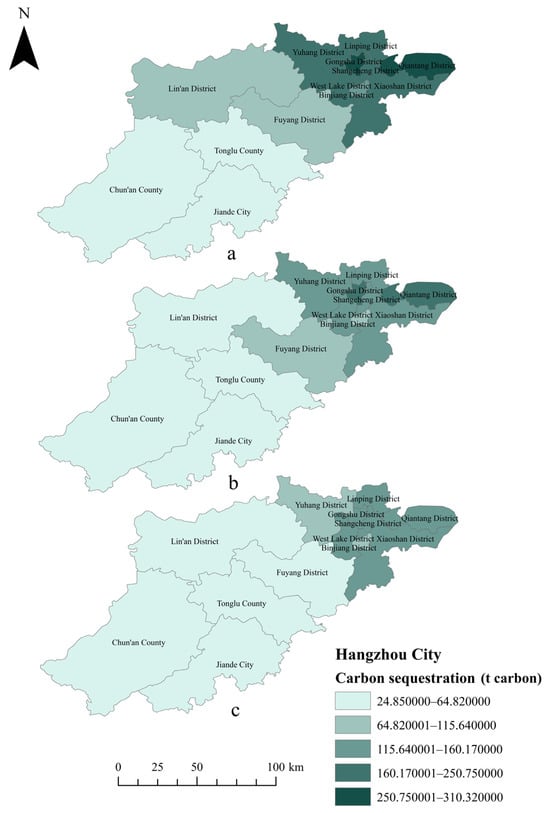
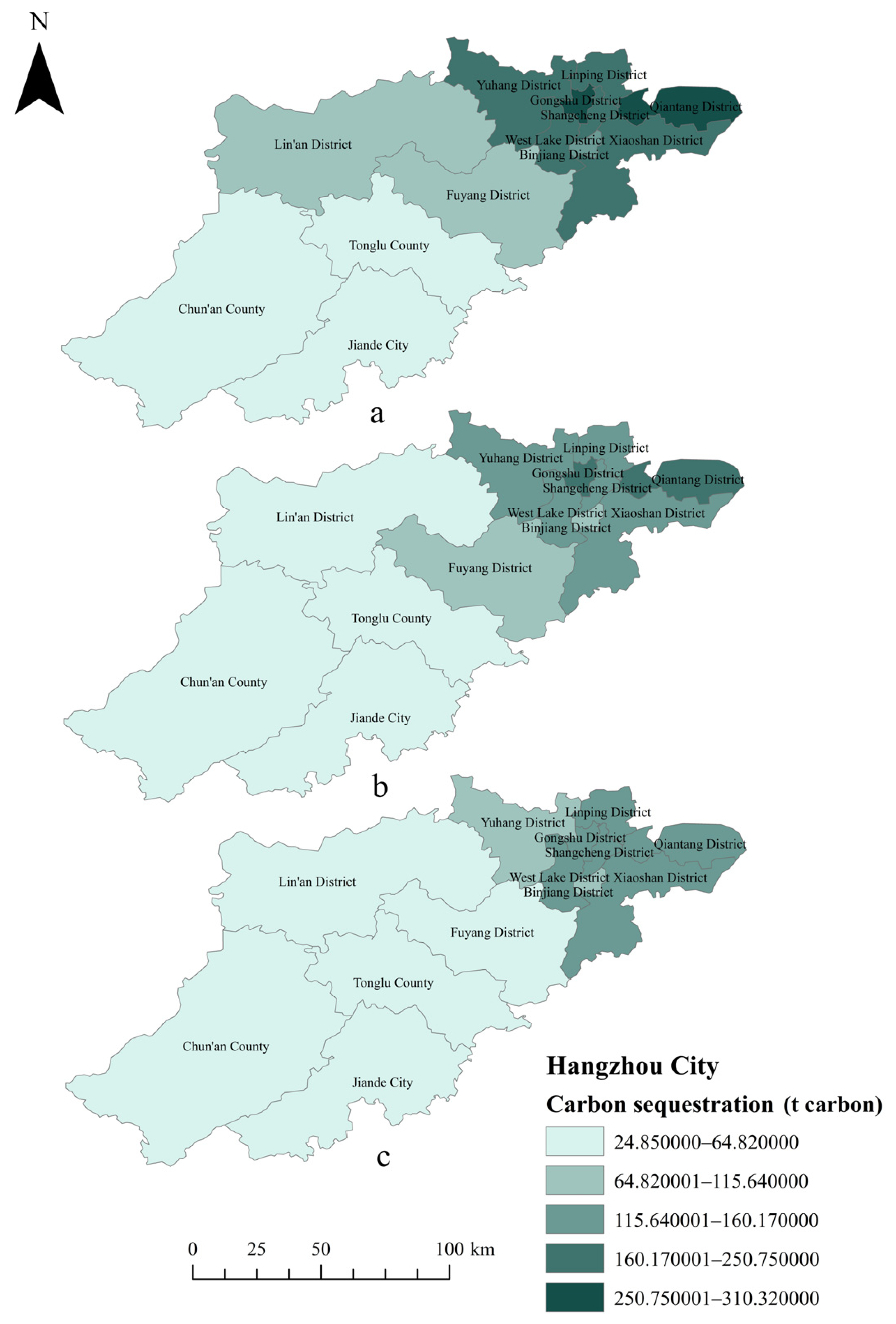
The carbon-negative attribute of biochar was generally based on non-combustion applications. The full life cycle carbon footprint and comparison with the baseline scenario were not considered in this study. This study only investigated the theoretical pyrolysis carbon sequestration potential, provided as a data reference for subsequent research. The carbon sequestration potential of city fallen leaves in Hangzhou was calculated via Equations (7) and (8), according to [34]. Ci denotes the carbon content of the biochar from the fallen leaves of a certain type of roadway trees in Hangzhou, Pi denotes the total carbon sequestration potential for a certain type of roadway fallen leaves in Hangzhou (tons). In Equation (8), Pt denotes the total potential for carbon sequestration of city fallen leaves in Hangzhou (tons), the value of i ranges from 1 to 6, representing Camphor tree leaves, Plane tree leaves, Ginkgo biloba tree leaves, Sapindus mukorossi leaves, Liquidambar formosana leaves and “other tree” species’ leaves. Furthermore, this study also calculated the Pt values for different districts and counties in Hangzhou separately. A potential distribution map of the utilization of street tree fallen leaves for the production of biochar for carbon sequestration in the urban counties of Hangzhou was drawn. Specifically, the county-level administrative boundary dataset was obtained from the National Geomatics Center of China. The total carbon sequestration value was assigned to each corresponding administrative polygon as a thematic attribute. The Jenks Natural Breaks classification method was applied to divide the carbon sequestration potential into five intervals [35], and the final spatial distribution map was generated through graded color rendering. All mapping operations were implemented in ArcGIS 10.8.
Pi = Mi × Yi × Ci
2.6. Calculation of Leaf-Derived Biochar Carbon Sequestration Index (LBCS)
The leaf-derived biochar carbon sequestration index (using LBCS as the abbreviation) represented the reference value of the annual carbon sequestration potential of different types of tree’s fallen leaves by carbonization , which was calculated by Equation (9).
2.7. Data and Analysis
In the pyrolysis and carbonization experiments of fallen leaves, each sample test was repeated three times. All data were analyzed by SPSS 11.0. All figures were drawn by Origin Pro 8.0. A classical one-way analysis of variance was performed. Unavailable data were extracted from figures by Engauge Digitizer 11.3 version. To quantify the uncertainty induced by the selection of allometric leaf litter models, a scenario-based sensitivity analysis was performed in this study. The four litter yield empirical models adopted in this work were originally established under different climatic conditions, which may introduce parameter bias when applied to urban street trees in Hangzhou. Three quantitative scenarios were constructed based on the outputs of the four models: (1) the conservative scenario, using the minimum single-tree leaf litter biomass estimated from the four models; (2) the baseline scenario, adopting the mean value of the four model predictions as the core calculation parameter; (3) the optimistic scenario, using the maximum litter yield derived from the four models. All subsequent calculations, including total urban leaf litter resources, biochar production, and carbon sequestration potential, were recalculated under the three scenarios. The variation range of carbon sequestration results was compared and analyzed to evaluate the robustness and uncertainty of the estimation outcomes.
3. Results and Discussion
3.1. Quantity of Roadway Tree Resources in Hangzhou
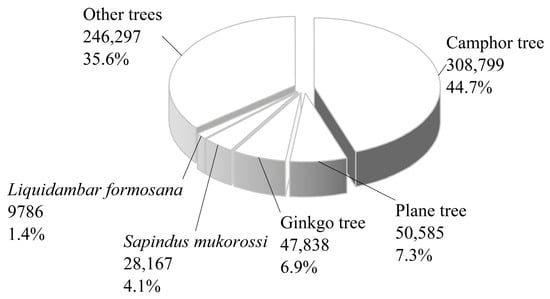
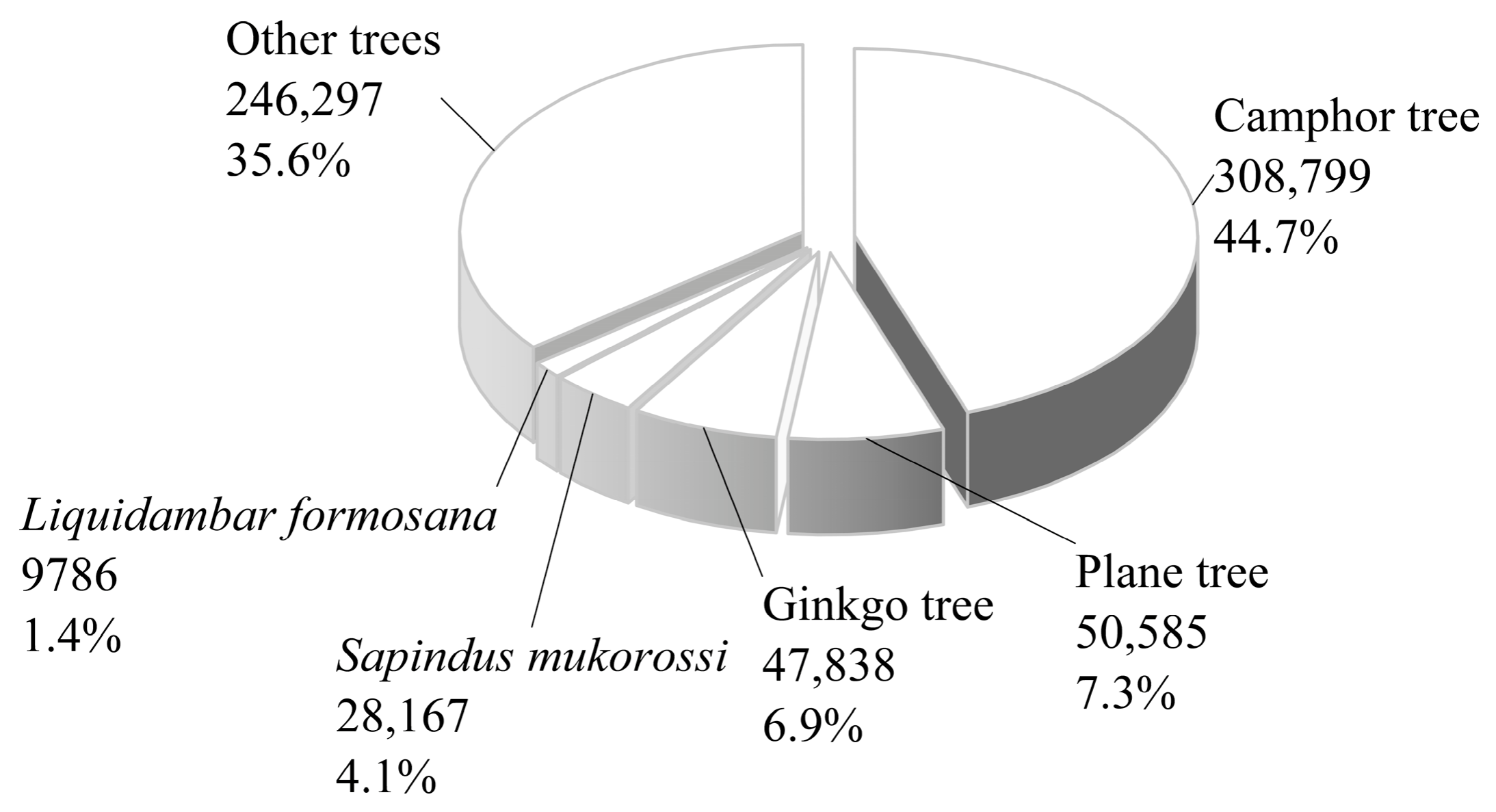
Based on the latest data from the Hangzhou Urban Greening Bureau, the Garden Administration Bureau, and the Statistics Bureau, etc., the types and proportions of typical roadway trees in Hangzhou are shown in Figure 1. There were a total of 691,472 roadway trees in Hangzhou. The roadway tree resources in Hangzhou showed a significantly unbalanced distribution feature. Camphor trees ranked first with 308,799 trees, far exceeding other tree species. The number of Plane trees, Ginkgo biloba trees and Sapindus mukorossi trees decreased in sequence, approximately 50,585, 47,838, and 28,167, respectively. The number of Liquidambar formosana was relatively small, with only 9786 plants. The total number of other tree species (such as Sophora japonica, Paulownia chinensis, Liriodendron chinensis, etc.) was approximately 246,297. From the perspective of relative proportion in Figure 1, the roadway trees in Hangzhou presented a typical structure dominated by a single dominant species and supplemented by multiple species, which was consistent with previous studies [36]. The proportion of Camphor trees was as high as 44.7%, approaching half of the total number of roadway trees in the city, making Camphor trees the absolute backbone tree species for urban greening. The dominance of Camphor trees (Cinnamomum camphora) in Hangzhou’s urban greening is consistent with broader patterns in subtropical East Asian cities, where this species is widely used due to its ornamental value and adaptability. Hou et al. (2026) demonstrated that leaf endophytic diazotroph communities in mangrove ecosystems exhibit biogeographic patterns influenced by host species and environmental factors [37]. Similarly, the leaf litter quality of Camphor trees—influenced by their chemical composition, including volatile oils—affects their pyrolysis behavior and carbon sequestration potential.
Figure 1.
The types and proportions of typical roadside trees in Hangzhou.
The proportions of Plane trees, Ginkgo biloba trees, Sapindus mukorossi trees, and Liquidambar formosana trees were 7.3%, 6.9%, 4.1%, and 1.4%, respectively, accounting for only 19.7% in total. They were secondary or characteristic ornamental tree species in urban greening.
It could be analyzed from Figure 1 that Camphor trees, as native evergreen broad-leaved tree species in subtropical regions, have become the preferred tree species for urban greening in Hangzhou due to their long-lasting landscape effects and significant ecological functions [38,39]. Although this structure, dominated by a single dominant species, was conducive to the uniformity of urban landscapes and the convenience of management, there were also potential problems such as insufficient ecosystem stability and a relatively high risk of pest and disease outbreaks. Meanwhile, the structure of this tree species directly determined the total amount and component characteristics of urban fallen leaves: the combined proportion of Camphor trees and other types of tree species exceeded 80%, and their fallen leaves would become the core raw material source for the preparation of biochar and the utilization of carbon sequestration in Hangzhou [40]. Therefore, the carbon sequestration potential of fallen leaves of roadway trees in Hangzhou would be closely related to the distribution characteristics of tree species. Future planning, such as optimizing the types of tree species and their distribution proportions, might all affect this carbon sequestration potential [41].
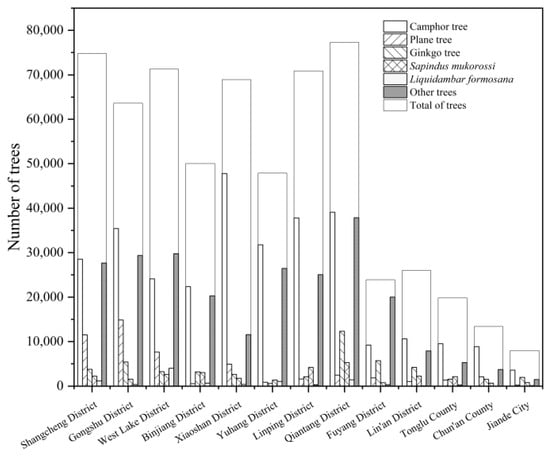
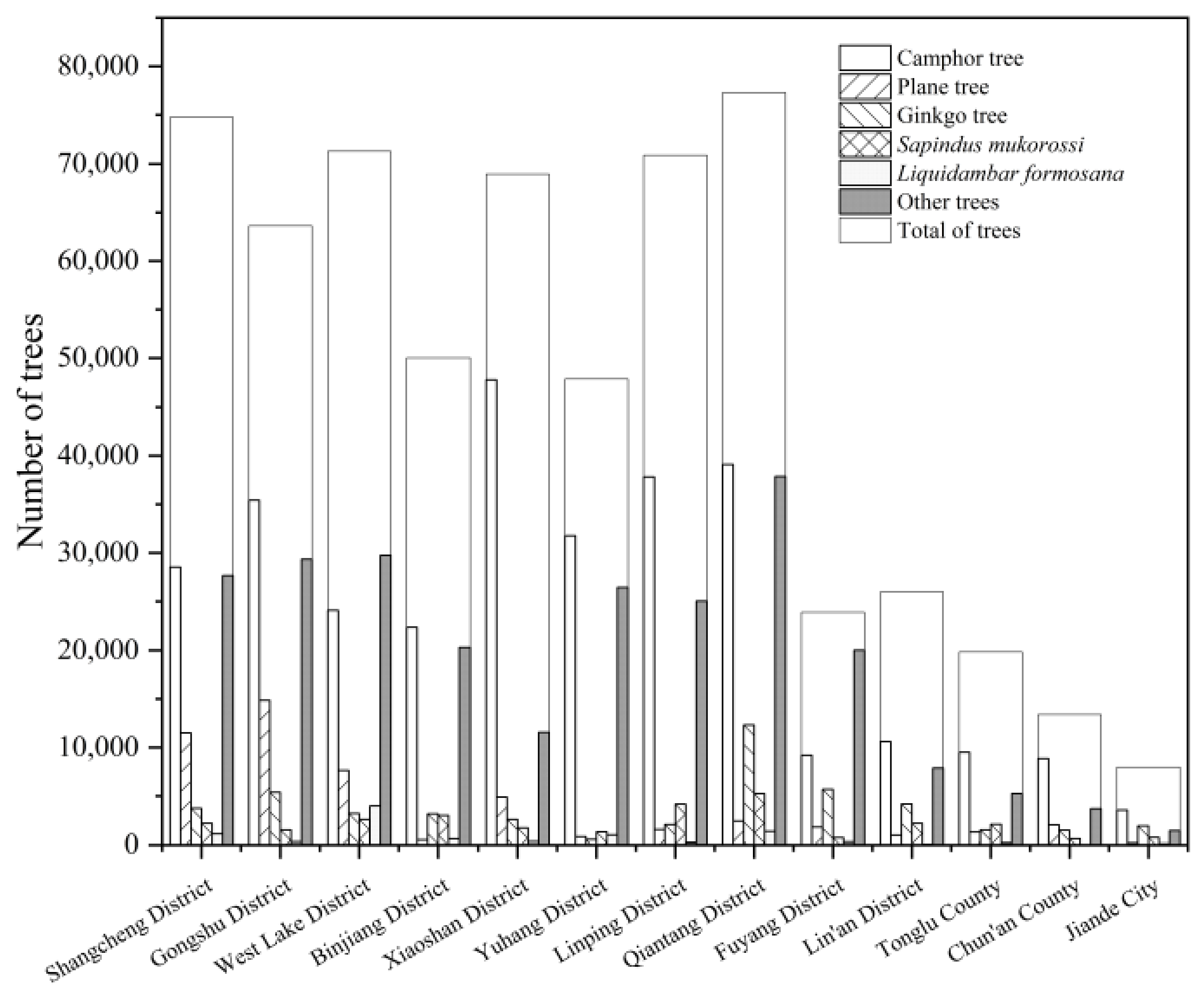
Figure 2 shows the spatial distribution pattern of roadway trees in 13 counties and districts of Hangzhou City, providing basic data for the formulation of regional strategies for the resource utilization of fallen and withered materials. Overall, the roadway tree resources in Hangzhou exhibited the characteristics of “central concentration and decreasing circle layers”, which were highly coupled with the scale of the urban built-up area: the total numbers of trees in the main urban area and its suburbs (such as Qiantang District and Shangcheng District) both exceeded 70,000, with Qiantang District leading with approximately 77,500 trees. The resource volume in the far suburban counties (cities) was significantly low, with only about 8500 plants in Jiande City. It was clear that Camphor trees were the dominant tree species in the city, with an extremely high proportion in the suburban areas such as Xiaoshan District, Linping District, Qiantang District and Yuhang District. The Plane trees showed the feature of “concentration in the old urban area”, with a concentrated distribution in Shangcheng District and Gongshu District. Ginkgo biloba trees had formed characteristic concentration areas in Qiantang District, Fuyang District, Lin’an District, and other places. The overall quantity of Sapindus mukorossi and Liquidambar formosana was scarce and their distribution was sparse. Figure 2 could guide the selection of locations for the industrialized high-value utilization facilities for roadway tree waste and provide a data foundation for our subsequent research.
Figure 2.
The number of typical roadside trees in each district and county of Hangzhou.
3.2. Estimation of Roadway Fallen Leaf Resources in Hangzhou
The leaf biomass of different trees was calculated using four models, and it was assumed that these leaves would eventually fall. The estimated results of leaf quantities per tree for various tree species are shown in Table 2, and the total leaf quantities of different tree species in Hangzhou are presented in Table 3. According to the data from Table 2, the tree with the highest total dry weight of leaves was the Plane tree, which produced 16.32 ± 0.99 kg of dry leaves per tree each year. In descending order, Liquidambar formosana, other trees, Camphor tree, Ginkgo biloba tree, and Sapindus mukorossi produced 13.04 ± 0.90, 11.24 ± 0.61, 10.84 ± 0.79, 8.97 ± 0.50, and 7.64 ± 0.37 kg of dry leaves per tree each year, respectively. Although the number of Camphor trees was the largest, the number of leaves on each tree was at a medium level. Data showed that the leaf biomass of the Plane trees was very large and numerous, making it an important tree species for the production of fallen leaf resources (Figure 2 and Table 2).
Table 2.
Total leaf mass (dry weight) per unit of tree quantity.
Table 3.
Estimation of the total annual leaf production of each type of tree in a certain area.
The annual total leaf biomass of each tree species in a certain area is summarized in Table 3. Among the roadway trees in Hangzhou, the total weight of the leaves of Camphor trees was the highest at 3347.45 tons, which was much higher than that of Plane trees, Ginkgo biloba trees, and other types of trees. Among them, Xiaoshan District produced approximately 518.51 ± 37.68 tons of Camphor tree leaves annually, making it the district with the largest annual production of Camphor tree leaves. Linping District produced 410.10 ± 29.80tons, Qiantang District produced 423.95 ± 30.81 tons, while the districts of Shangcheng, Gongshu, Xihu, Binjiang, and Yuhang each produced between 200 and 390 tons. Districts and counties such as Jiande, Chun’an, Tonglu, Lin’an, and Fuyang produced less, ranging from 35 to 120 tons each. There were obvious differences in the number of sycamore tree leaves among different districts and counties in Hangzhou. The yields of Sapindus mukorossi, Liquidambar formosana, and “other tree” leaves in Hangzhou were relatively low, and their distribution was also rather sparse.
From a regional perspective, the total amount of roadway leaves in Qiantang District was the highest at 1057.75 ± 60.79 tons. The total amount of roadway leaves in Gongshu District ranked second, reaching 1020.54 ± 61.10 tons. The total amount of roadway leaves in Shangcheng District and Xihu District was 872.97 ± 52.15 tons and 821.37 ± 48.88 tons, respectively. The total amount of roadway leaves in four districts and counties including Lin’an District, Jiande County, Chun’an County, and Tonglu County totaled 763.16 ± 44.57 tons. The leaf amounts in the remaining districts and counties were at a medium level. Based on the above estimated results, it was necessary to consider setting up thermal decomposition processing stations in the suburbs of Qiantang District and Gongshu District, taking into account the transportation radius and costs.
3.3. Research on Key Parameters for Carbon Sequestration
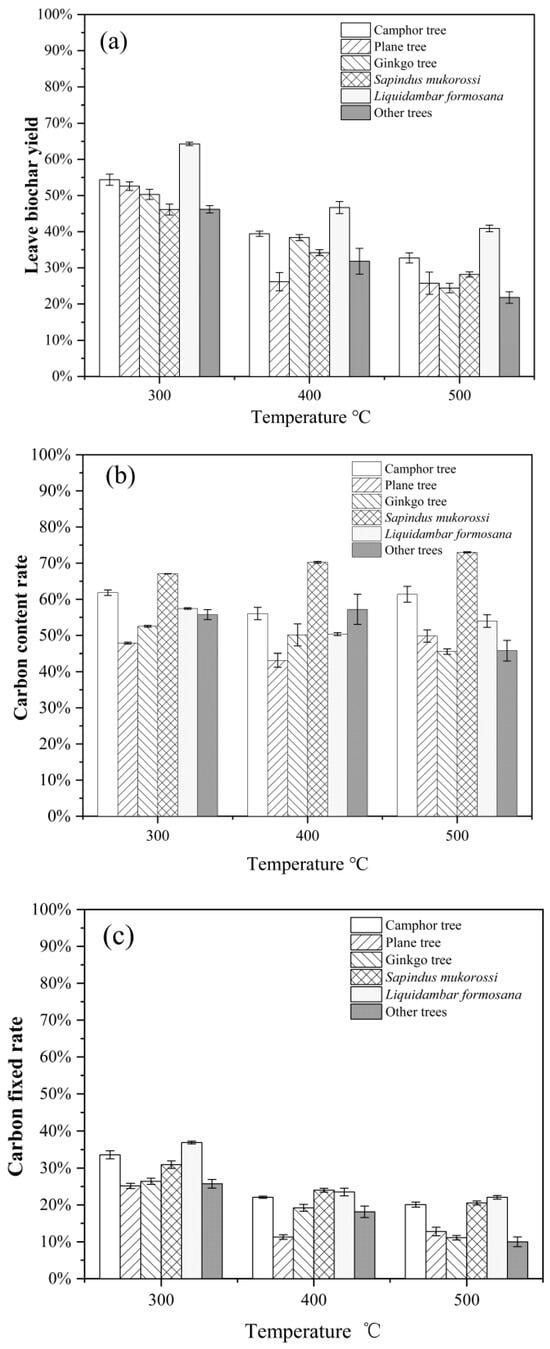
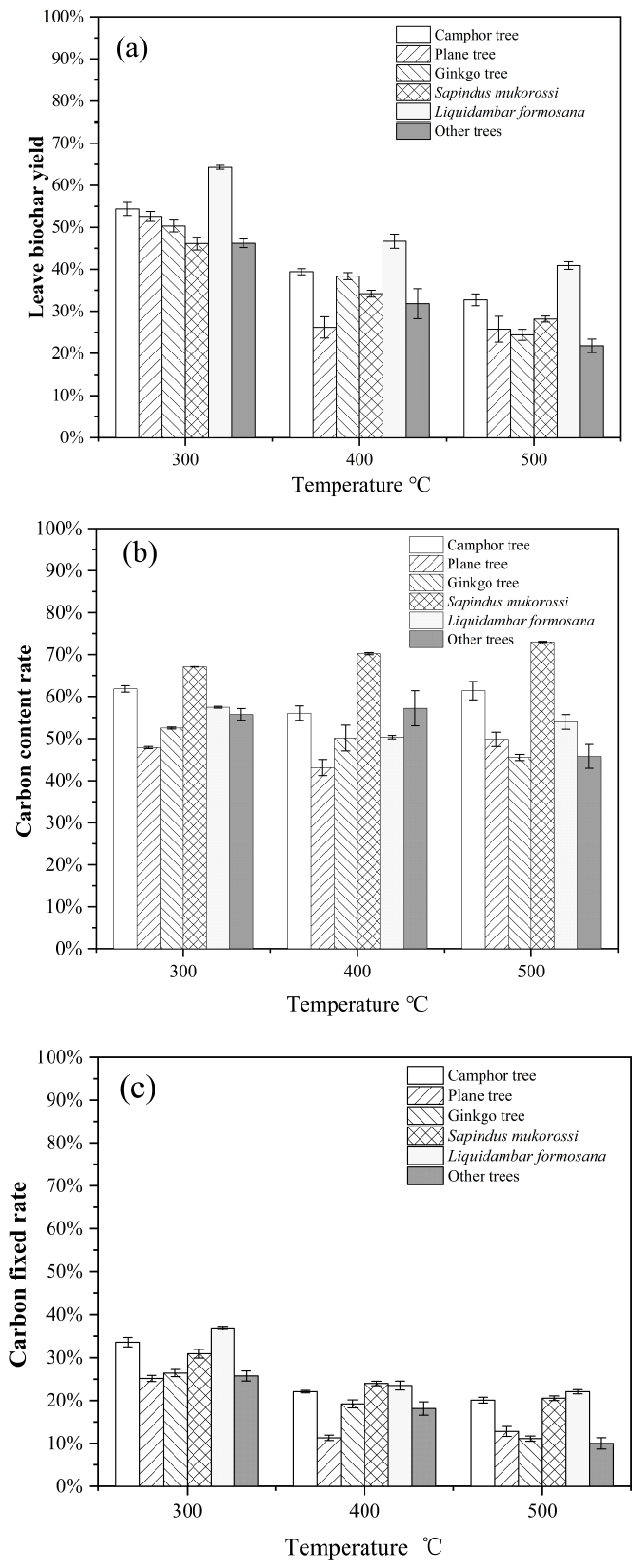
This study investigated the yield, carbon content, and carbon sequestration rate of biochar at three temperatures of 300 °C, 400 °C, and 500 °C, as shown in Figure 3a–c. As shown in Figure 3a, as the temperature rose, the yield of leaf biochar showed a decreasing trend [42]. For the pyrolysis of leaves at 300 °C, 400 °C, and 500 °C, the yields of different leaf biochars ranged from 45 to 65%, 26 to 47%, and 21 to 41% (Figure 3a), the carbon content of different leaf biochars ranged from 47 to 68%, 43 to 71%, and 45 to 73% (Figure 3b), the carbon fixed (sequestration) rate ranged from 25 to 37%, 11 to 24%, and 10 to 22% (Figure 3c). From the data in Figure 3, it could be analyzed that the yield and carbon sequestration rate of biochar changed obviously with temperature, while the carbon content changed inconspicuously with temperature. The quantity of leaves from Camphor trees was the largest among the six categories listed in this study, and their carbon fixation rate during the pyrolysis process was also significantly higher than that of Plane trees and Ginkgo biloba trees. When the temperature rose from 300 °C to 400 °C, the carbon fixation rate of Camphor tree leaves during the pyrolysis process decreased by approximately 34.3%, but there was no significant difference in the carbon fixation rate of Camphor tree leaves between 400 °C and 500 °C. Taking into account the cost, the magnitude of key parameters for carbon sequestration rate, and feasibility, without considering the stability of biochar or the final application scenarios of biochar, the production of leaf biochar at a low temperature of 300 °C was more suitable for achieving carbon sequestration.
Figure 3.
Key parameters required for carbon sequestration accounting of biochar: (a) leaf biochar yield, (b) carbon content rate, (c) carbon sequestration rate.
At different temperatures (300, 400, and 500 °C), the carbon sequestration rate of Liquidambar formosana was higher than that of the other groups. However, the planting of Liquidambar formosana along the roads in Hangzhou was not concentrated and the planting volume was not large. Therefore, the overall potential contribution of these roadway trees’ fallen leaves to carbon sequestration might not be significant. Overall, it was recommended to utilize the fallen leaves of Camphor trees for pyrolysis to achieve carbon sequestration, in order to optimize the carbon sequestration potential of fallen leaves at the urban scale.
3.4. Estimation of Carbon Sequestration Potential of Roadway Fallen Leaves in Hangzhou
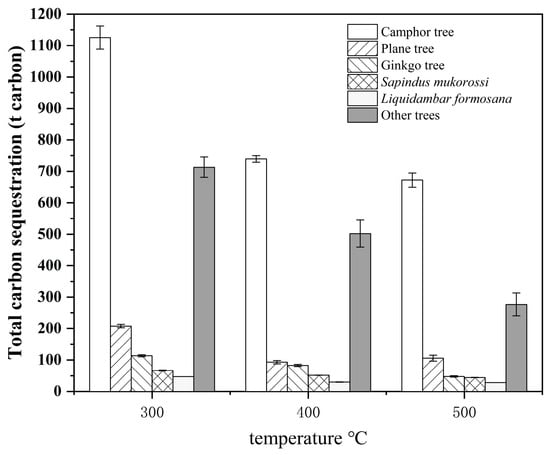
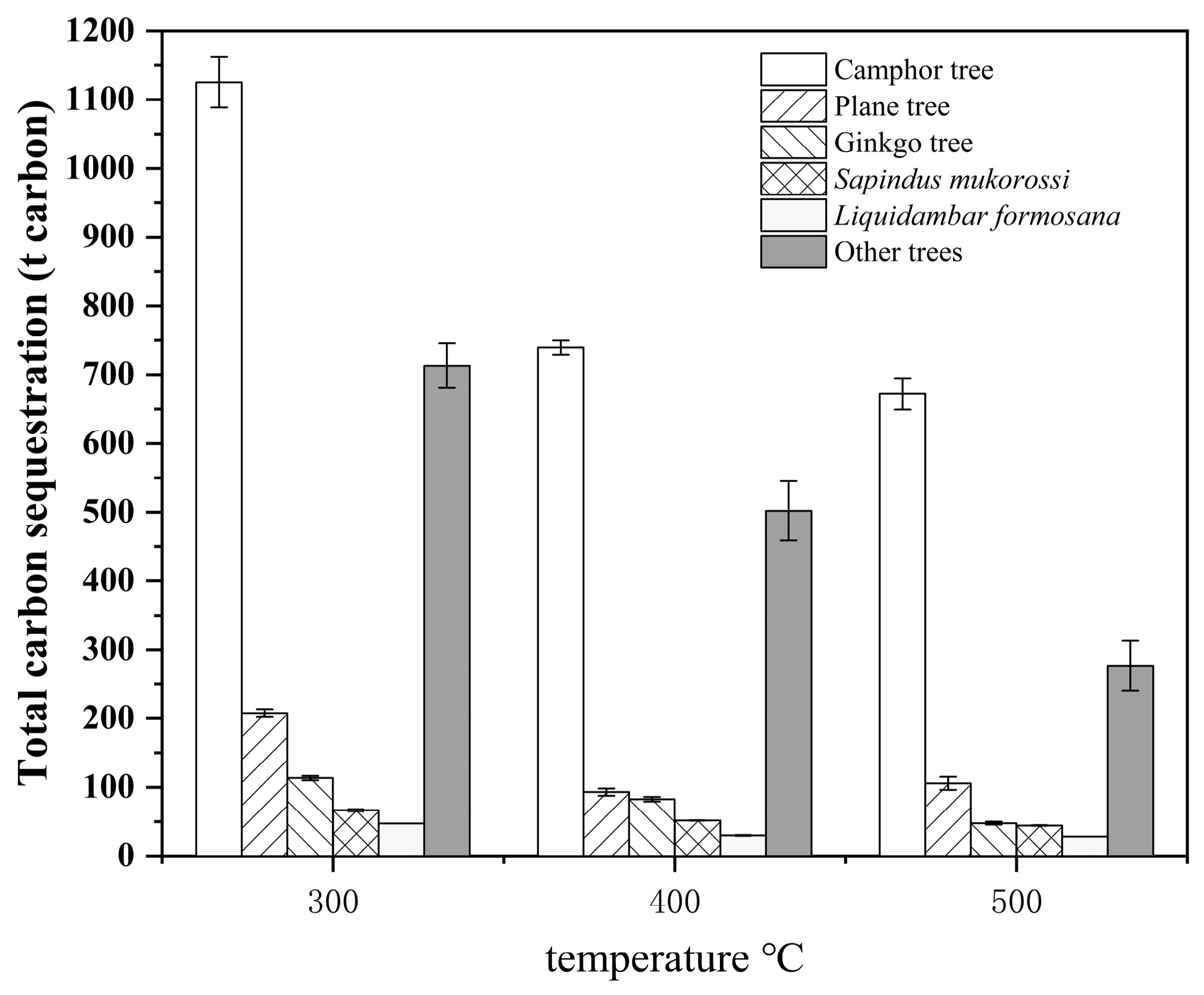
Figure 4 presents the total potential for carbon sequestration through the use of fallen leaves on the roadsides in Hangzhou. Previous studies have mainly focused on estimating the carbon sequestration potential of using straw, forestry, and industrial waste, etc. [43]. However, there have been very few studies on the carbon sequestration potential of fallen leaves from urban roadway trees [44]. It was found that if the fallen leaves of the roadway trees in Hangzhou were subjected to oxygen-limited pyrolysis at a temperature of 300 °C for carbon sequestration purposes, the potential total carbon sequestration capacity could reach 2273 ± 55 tons of carbon, equivalent to 8334 ± 200 tons of carbon dioxide. Among them, Camphor trees, Plane trees, Ginkgo biloba trees, Sapindus mukorossi trees, Liquidambar formosana trees, and other fallen leaves could sequester approximately 1125, 208, 113, 67, 47, and 713 tons of carbon, respectively, contributing approximately 49.5%, 9.2%, 5.0%, 2.9%, 2.0%, and 31.4%. As the pyrolysis temperature increased, the stability of leaf biochar might be enhanced [42]. However, when the pyrolysis cost rose significantly, the carbon sequestration potential value decreased markedly, and the feasibility of industrial application was low [45]. Therefore, this study focused on analyzing the carbon sequestration potential of fallen leaves at 300 °C.
Figure 4.
The total carbon sequestration potential through pyrolysis of fallen leaves of different types of roadside trees in Hangzhou under various temperatures.
To provide a reference for carbon sequestration practices using roadway fallen leaves at the urban scale, we generated a spatial distribution map of their carbon sequestration potential, as shown in Figure 5. From the perspective of the overall spatial distribution, the carbon sequestration of roadway tree biochar in Hangzhou showed a significant pattern of high values of northeast and low values of southwest, urban agglomeration, sparse suburban circle differentiation characteristics, and the pattern remained highly stable at different temperatures, which was highly coupled with the spatial distribution of the scale of urban built-up areas and the total amount of roadway tree resources [46]. Qiantang District, Linping District, Xiaoshan District, Yuhang District, and other eastern and northern suburban new areas were in the high value echelon of carbon sequestration of roadway leaf biochar, while Chun ‘an County, Jiande City, western Lin ‘an District, and other southwestern suburban areas fell into the lowest tier of carbon sequestration of roadway leaf biochar. The core driving factor of this pattern was the spatial difference of the roadway tree resource base. The eastern region was the main urban area of Hangzhou, with high construction intensity, dense road network, large planting scale of roadway trees, and sufficient total roadway leaf resources [47], which provided a sufficient raw material basis for biochar carbon sequestration. The southwestern outskirts were dominated by mountainous natural forest land. The urban built-up area was small, and the total amount of roadway tree resources was limited, so the total amount of carbon sequestration was generally low. Therefore, the southwestern area of Hangzhou had abundant greenery resources, but the potential for carbon sequestration through fallen leaves of roadway trees was relatively low [48,49]. This contradictory phenomenon might be due to the limitations of the urbanization rate. Therefore, as urbanization progressed, there was a great potential for the increase of carbon sequestration capacity of fallen leaves of roadway trees from these areas [50].
Figure 5.
Thermal maps of carbon sequestration potential of roadside leaf resources in 13 counties and districts of Hangzhou: (a) 300 °C approach, (b) 400 °C approach, (c) 500 °C approach.
The spatial differentiation of carbon sequestration potential from fallen leaves of roadway trees in Hangzhou had a clear practical guiding significance for the management of urban fallen leaf resources. The pyrolysis and carbon sequestration of roadway fallen leaves in Hangzhou should follow the principle of zoning policy and gradient layout. The eastern main urban area had concentrated resources and large total carbon sequestration of roadway leaf biochar, which was suitable for the construction of large-scale centralized pyrolysis treatment centers to achieve economies of scale. The resources of roadway leaves in the outer suburbs of Southwest China were sparse, and it was advisable to jointly process forestry waste and other green waste, in order to enhance the comprehensive benefits of resource utilization. In terms of process selection, the 300 °C low-temperature pyrolysis scheme was recommended in the whole region, which could maximize total carbon sequestration potential of roadway leaf biochar in the city [51]. Future research should be conducted to explore methods for enhancing the stability of leaf biochar produced under low-temperature conditions (300 °C), and to strengthen the development of negative-carbon application scenarios for leaf biochar produced under such low-temperature conditions (300 °C).
Sensitivity analysis across conservative, baseline, and optimistic scenarios revealed that the annual carbon sequestration potential via low-temperature (300 °C) biochar derived from roadway tree leaf litter in Hangzhou ranged from 2134.07 to 2470.73 t C·a−1, with a relative variation of −6.1% to 8.7% compared with the baseline estimate (Table S2). Such variation mainly stemmed from the four allometric litter-yield models adopted in this study. Since these empirical models were originally developed under different climatic backgrounds, direct application to Hangzhou urban roadway trees inevitably introduces parameter uncertainty. Notably, even under the conservative scenario using the minimum litter output from the four models, roadway tree litter represented a promising feedstock for biochar-based carbon mitigation, which remained robust and was not fundamentally altered by the choice of litter-estimation models. This uncertainty highlighted the limitation of applying off-site empirical models for urban litter resource assessment. Large-scale in situ litter measurements for dominant roadway tree species in Hangzhou were not available in the present work. Future field monitoring should be carried out to develop local species-specific litter yield models, which would further reduce estimation bias and improve the reliability of resource and carbon sequestration potential evaluation.
A comprehensive assessment of biochar carbon sequestration should consider the entire life cycle, including collection, transport, and pyrolysis energy inputs. Hu et al. (2022) demonstrated that saline land reclamation using “Raised Field-Shallow Trench” patterns requires careful analysis of energy and water balances to ensure net environmental benefits [52]. Similarly, Zeng et al. (2024) showed that biophotoelectrochemical pathways can enhance nutrient cycling but require energy inputs that must be accounted for in net carbon assessments [53]. Therefore, if in the future, we want to package the carbon sequestration of the fallen leaves as a potential negative-carbon technology and incorporate it into CCER for more in-depth and comprehensive carbon accounting, further full life cycle carbon accounting needs to be carried out. It was also emphasized that adding biochar to the soil for carbon sequestration was a multi-win environmental strategy, while the decomposition of biochar and the resulting soil organic carbon priming effect should be considered. This study revealed that the biochar produced at 300 °C had a relatively high carbon sequestration rate during the pyrolysis process. However, its potential for carbon sequestration in soil might be limited due to its poor stability, resulting in a shorter retention time compared with high temperature leaf-derived biochar, which merited further investigation in future studies. It was worth noting that apart from soil amendment, leaf-derived biochar also had other carbon-negative application options available.
From the perspective of sustainability, this study delivered a city-level quantitative assessment tool for urban horticultural waste management. Converting roadway tree fallen leaves to biochar addressed two intertwined urban sustainability challenges: landfill-derived greenhouse gas emissions and low-value treatment of massive urban green waste. Our numerical estimation linked local municipal waste practices to global targets of the United Nations 2030 Agenda for Sustainable Development, corresponding to SDG 11 (sustainable cities and communities), SDG 12 (responsible consumption and production), and SDG 13 (climate action). Beyond pure technical analysis, the finding could inform local urban green waste policy-making, which fits the scope of sustainability-related applications. Nevertheless, we emphasized scenario-based uncertainties in our estimation. It should be noted that the carbon sequestration estimation in this study adopted IPCC default emission factors combined with locally derived parameters, and scaled-up species-specific leaf litter mass to the whole urban roadway ecosystem. Although this framework was reasonable, the outcomes were inherently estimative. The static assumption of leaf litter production, regional transfer of empirical parameters, and laboratory-derived biochar conversion efficiency might introduce uncertainties into the final carbon-sequestration potential results. Therefore, the present quantitative outputs should be interpreted as indicative potential values rather than precise definitive measurements. Further field monitoring and dynamic modelling are encouraged to reduce such estimation biases in future research.
3.5. Leaf-Derived Biochar Carbon Sequestration Index (LBCS)
Based on this study, the leaf-derived biochar carbon sequestration index (LBCS) which represents the reference value of the carbon sequestration potential of different types of trees’ fallen leaves through carbonization each year is shown in Table 4. Stabilizing the carbon in the neglected leaf carbon sink by locking it up through oxygen-limited pyrolysis for carbon sequestration was a theoretically feasible carbon sequestration method [54]. The resulting negative-carbon potential was of great significance for carbon neutrality initiatives. The study of urban leaf carbon sinks was based on the fact that leaves in cities were naturally cleared and partially collected [55], making it inherently feasible. Once this novel approach was included in the CCER project in the future, a large number of quantitative calculation models and corresponding data would be required. The leaf-derived biochar carbon sequestration index was a standardized carbon sequestration indicator for the future China Certified Emission Reduction (CCER) [56].
Table 4.
Leaf−derived biochar carbon sequestration index.
The contribution of biochar carbon sequestration to regional carbon neutrality goals can be assessed by comparing biochar carbon storage with urban carbon emissions. Lu and Yoon (2026) demonstrated that urban-rural integrated development significantly promotes eco-environmental quality in China, providing a framework for assessing the contribution of green infrastructure to environmental goals [57]. Similarly, the leaf-derived biochar carbon sequestration potential in Hangzhou should be contextualized within the city’s overall carbon emission profile.
The leaf-derived biochar carbon sequestration index was a standardized metric of universal applicability that was calculated based on relevant data from the entire city. The LBCS index provided the foundation for establishing a standardized parameter database, and could be fully applied to the estimation of carbon sequestration potential outside of Hangzhou, as researchers could choose different tree species and their corresponding LBCS values according to their needs. The LBCS indicators have the following uncertainties and limitations: (1) the LBCS values obtained based on limited experimental data or of low quality may have significant uncertainties and limitations; (2) leaf-derived biochar pyrolyzed at a certain temperature but with different pyrolysis conditions (such as with different heating rate or biochar resident time) may result in different LBCS values. Currently, the early stage of the development and application of this parameter has led to an insufficiently detailed database. In the future, as more and more recognized experts join and the cooperation becomes more mature, the LBCS data will become increasingly complete, covering all sub-conditions. For example, the leaf-derived biochar carbon sequestration index of the biochar obtained by pyrolyzing Camphor tree leaves at 300 °C was 3.64 . The leaf-derived biochar carbon sequestration index of the biochar obtained by pyrolyzing Plane tree leaves at 300 °C was 4.11 . In terms of leaf-derived biochar carbon sequestration index, the unit-year carbon sequestration potential of Plane tree leaves at 300 °C was higher than that of Camphor tree leaves at the same temperature, which might be related to the size of the tree, the quantity of leaves, and the composition of the leaves [58]. Overall, this study provided the value of “leaf-derived biochar carbon sequestration index” based on all the sample data from Hangzhou City at 300 °C, which was 3.20. Using the above data, a rough estimation of the total leaf-derived biochar carbon sequestration potential of Hangzhou City was approximately 2213 tons, which was very close to the 2273 tons obtained in this study, with a deviation of less than 3%.
Based on the total number of trees across China being approximately 142.6 ± 3.5 billion [59], we then made a rough estimate of the theoretical potential for carbon sequestration in an optimistic scenario from fallen leaves across the country, which was approximately 0.46 billion tons of carbon equivalent per year for 300 °C pyrolysis. Then potential for carbon sequestration in a moderate scenario from fallen leaves across the country, was approximately 0.30 billion tons of carbon equivalent per year for 400 °C pyrolysis. Finally potential for carbon sequestration in a conservative scenario from fallen leaves across the country, was approximately 0.24 billion tons of carbon equivalent per year for 500 °C pyrolysis. With one third of the tree leaves used for leaf-derived biochar (300 °C) carbon sequestration between 2027 and 2060, the cumulative carbon sequestration potential could reach up to 18.96 billion tons CO2-eq by 2060, contributing 29–68% of the global GHG emission reduction target for BECCS. The optimistic scenario cumulative carbon sequestration of 18.96 billion tons CO2-eq by 2060 was derived by linear extrapolation of annual sequestration potential across 2027–2060. This calculation relied on idealized assumptions: stable biomass supply, constant biochar conversion performance, and the ideal scenario where biochar does not decompose during application. Our multi-scenario sensitivity analysis suggested that cumulative sequestration potential could range from 9.97 to 18.96 billion tons CO2-eq by 2060, representing a relative variation of −20.0% to 52.1% relative to the moderate scenario. The major sources of uncertainty may include biomass feedstock and pyrolysis temperature.
3.6. Conclusions and Implications for Future Study
The carbon sequestration and emission reduction potential by pyrolysis and carbonization of roadway fallen leaves in Hangzhou city was evaluated by data obtained through Hangzhou government agencies, literature, and experiments in Hangzhou. There were a total of 691,472 roadway trees in Hangzhou. If the fallen leaves of the roadway trees in Hangzhou were subjected to oxygen-limited pyrolysis at a temperature of 300 °C for carbon sequestration purposes, the potential total carbon sequestration capacity was estimated to be 2273 ± 55 tons of carbon, equivalent to 8334 ± 200 tons of carbon dioxide. Leaf-derived biochar carbon sequestration index was established for the potential use in future China Certified Emission Reduction (CCER). It was further estimated that with one-third of the tree leaves used for leaf-derived biochar (300 °C) carbon sequestration between 2027 and 2060, the cumulative carbon sequestration potential could reach up to 18.96 billion tons CO2-eq by 2060, contributing 29–68% of the global GHGs emission reduction goal for BECCS.
It is worth noting that the quantitative analysis of the carbon sequestration potential in this study was based on our classification method for tree species. The results of this study indicated that there was great potential for using fallen leaves to sequester carbon and contribute to carbon neutrality in the future. However, there were still some issues that needed to be resolved. Firstly, future research should be conducted to explore methods for enhancing the stability of leaf biochar produced under low-temperature conditions (300 °C), and to strengthen the development of negative-carbon application scenarios for leaf biochar produced under such low-temperature conditions (300 °C). Secondly, in the future practice of utilizing fallen leaves to contribute to carbon neutrality, suitable tree species with appropriate LBCS index values could be selected as needed. Lastly, this study only provided the LBCS data for slow pyrolysis under oxygen limitation. In the future, it is necessary to supplement the LBCS values corresponding to the carbon fixation potential under other pyrolysis methods (such as hydrothermal carbonization, rapid pyrolysis under different pyrolysis conditions, or atmosphere furnaces, tubular furnaces, etc., under different oxygen limitation conditions). This estimated sequestration capacity reveals the sustainability potential hidden in otherwise discarded urban roadway tree litter resources. This work also provides quantitative support for transforming urban waste into biochar-based carbon sequestration solutions, which can inform future circular-economy and carbon-neutral practices for comparable megacities.
Supplementary Materials
The following supporting information can be downloaded at: https://www.mdpi.com/article/10.3390/su18179130/s1, Table S1: Pyrolysis related data; Table S2: Sensitivity analysis of Mi and Pt values under different models.
Author Contributions
L.W.: Conceptualization, investigation, methodology, data curation, writing—original draft, software. B.Z.: Methodology, writing—review and editing, investigation, software. F.L.: Methodology, writing—review and editing, investigation. H.C.: Methodology, investigation. Y.L.: Conceptualization, writing—review and editing. X.C.: Conceptualization, writing—review and editing. L.Z.: Conceptualization, methodology, writing—review and editing. J.Z.: Conceptualization, writing—review and editing. All authors have read and agreed to the published version of the manuscript.
Funding
This work was supported by the Key Program of the National Natural Science Foundation of China (Grant No. 22436006).
Institutional Review Board Statement
Not applicable.
Informed Consent Statement
Not applicable.
Data Availability Statement
The original contributions presented in this study are included in the article. Further inquiries can be directed to the corresponding author.
Conflicts of Interest
The authors declare no conflicts of interest.
References
- Supran, G.; Rahmstorf, S.; Oreskes, N. Assessing ExxonMobil’s global warming projections. Science 2023, 379, eabk0063. [Google Scholar] [CrossRef] [Scilit] [PubMed]
- Lu, Q.B. Critical Review on Radiative Forcing and Climate Models for Global Climate Change since 1970. Atmosphere 2023, 14, 1232. [Google Scholar] [CrossRef] [Scilit]
- Sala, O.E.; Chapin, F.S.; Armesto, J.J.; Berlow, E.; Bloomfield, J.; Dirzo, R.; Huber-Sanwald, E.; Huenneke, L.F.; Jackson, R.B.; Kinzig, A.; et al. Biodiversity-Global biodiversity scenarios for the year 2100. Science 2000, 287, 1770–1774. [Google Scholar] [CrossRef] [Scilit] [PubMed]
- Parmesan, C. Ecological and evolutionary responses to recent climate change. Annu. Rev. Ecol. Evol. Syst. 2006, 37, 637–669. [Google Scholar] [CrossRef] [Scilit]
- IPCC. Climate Change 2014: Synthesis Report. Contribution of Working Groups I, II and III to the Fifth Assessment Report of the Intergovernmental Panel on Climate Change; Core Writing Team, Pachauri, R.K., Meyer, L.A., Eds.; IPCC: Geneva, Switzerland, 2014; pp. 40–44. [Google Scholar]
- Friedlingstein, P.; O’Sullivan, M.; Jones, M.W.; Andrew, R.M.; Gregor, L.; Hauck, J.; Le Quéré, C.; Luijkx, I.T.; Olsen, A.; Peters, G.P.; et al. Global carbon budget 2022. Earth Syst. Sci. Data 2022, 14, 4811–4900. [Google Scholar] [CrossRef] [Scilit]
- Shoudho, K.N.; Khan, T.H.; Ara, U.R.; Khan, M.R.; Shawon, Z.B.Z.; Hoque, E. Biochar in global carbon cycle: Towards sustainable development goals. Curr. Res. Green Sustain. Chem. 2024, 8, 100409. [Google Scholar] [CrossRef] [Scilit]
- Ayaz, M.; Muntaha, S.T.; Baltrėnaitė-Gedienė, E.; Kriaučiūnienė, Z. Biochar and carbon-negative technologies: Exploring opportunities for climate change mitigation. Biochar 2025, 7, 17. [Google Scholar] [CrossRef] [Scilit]
- Li, X.; Li, L.; Huang, Z.; Chang, Z.; Tu, Z.; Tian, L.; Du, W.; Li, H.; Zhang, P.; Pan, B. Enhancing the stability and heavy metal immobilization of co-pyrolysis biochar through biomass and red mud co-pyrolysis: A synergistic mechanism. J. Environ. Manag. 2025, 376, 124422. [Google Scholar] [CrossRef] [Scilit] [PubMed]
- Yang, Z.; Wang, Z.; Charoenkal, K.; Xu, Y.; Li, T.; Xu, T.; Li, Q.; Sun, X.; Lin, S.; Cao, H. Enhanced imidacloprid adsorption using boron-modified biochar: Insights into molecular mechanisms and environmental stability. Chem. Eng. J. 2025, 505, 159729. [Google Scholar] [CrossRef] [Scilit]
- Li, T.; Wei, G.; Liu, H. Comparative study on environmental and economic assessment of straw heating across administrative areas scale of rural China. Int. J. Life Cycle Assess. 2024, 29, 2094–2106. [Google Scholar] [CrossRef] [Scilit]
- Zhang, F.; Lu, W.; Jin, F. Chemical Recalcitrance Rather Than Soil Microbial Community Determined Short-Term Biochar Stability in a Poplar Plantation Soil. Forest 2024, 15, 622. [Google Scholar] [CrossRef] [Scilit]
- Shao, M.; Zhang, C.; Chen, Q.; Wu, H.; Dong, Z.; Bai, X.; Wang, N.; Xu, Q. Hydrothermal-enhanced pyrolysis for efficient NOX reduction and biochar valorization from food waste digestate. Waste Manag. 2024, 183, 112–122. [Google Scholar] [CrossRef] [Scilit] [PubMed]
- Zhang, J.; Ge, X.; Qiu, X.; Liu, L.; Mulder, J.; Duan, L. Estimation of carbon sequestration potential and air quality impacts of biochar production from straw in China. Environ. Pollut. 2024, 363, 125304. [Google Scholar] [CrossRef] [Scilit] [PubMed]
- Kamali, M.; Sweygers, N.; Al-Salem, S.; Appels, L.; Aminabhavi, T.M.; Dewil, R. Biochar for soil applications-sustainability aspects, challenges and future prospects. Chem. Eng. J. 2022, 428, 131189. [Google Scholar] [CrossRef] [Scilit]
- Pradhan, S.; Parthasarathy, P.; Mackey, H.R.; Al-Ansari, T.; McKay, G. Effect of Pistachio Shell Biochar and Organic Cow Manure Application on Plant Growth, Water Retention Capacity and Nutrient Stress Mitigatio. Waste Biomass Valorization 2024, 16, 761–772. [Google Scholar] [CrossRef] [Scilit]
- Jiang, X.; Qu, F.; Zhang, Y.; Zhu, X.; Leung, A.Y.; Poon, C.S.; Tsang, D.C. Cold-bonded biochar-cement lightweight aggregates for evaporation-enhanced permeable bricks. J. Clean. Prod. 2025, 493, 144886. [Google Scholar] [CrossRef] [Scilit]
- Chen, Y.; Zhan, B.; Guo, B.; Wang, C.; Li, H.; Tian, D.; Dai, S.; Ye, P.; Qin, H.; Gao, P.; et al. Accelerated carbonation curing of biochar-cement mortar: Effects of biochar pyrolysis temperatures on carbon sequestration, mechanical properties and microstructure. Constr. Build. Mater. 2024, 449, 138446. [Google Scholar] [CrossRef] [Scilit]
- de Oliveira Paiva, I.; de Morais, E.G.; Jindo, K.; Silva, C.A. Biochar N Content, Pools and Aromaticity as Affected by Feedstock and Pyrolysis Temperatur. Waste Biomass Valorization 2024, 15, 3599–3619. [Google Scholar] [CrossRef] [Scilit]
- Korus, A.; Jagiello, J.; Jensen, C.D.; Sárossy, Z.; Ravenni, G.; Benedini, L. Advantages of dual CO2 & O2 adsorption model for assessment of micropore development in biochar during two-stage gasification. Renew. Energy 2024, 225, 120293. [Google Scholar] [CrossRef] [Scilit]
- Zhang, Y.; Lei, B.; Mahdaviarab, A.; Wang, X.; Liu, Z. Robust biochar yield and composition prediction via uncertainty-aware ResNet-based autoencoder. Biochar 2025, 7, 61. [Google Scholar] [CrossRef] [Scilit]
- Ahmed, S.F.; Mehejabin, F.; Chowdhury, A.A.; Almomani, F.; Khan, N.A.; Badruddin, I.A.; Kamangar, S. Biochar produced from waste-based feedstocks: Mechanisms, affecting factors, economy, utilization, challenges, and prospects. Glob. Change Biol. Bioenergy 2024, 16, e13175. [Google Scholar] [CrossRef] [Scilit]
- Lehmann, J. A handful of carbon. Nature 2007, 447, 143–144. [Google Scholar] [CrossRef] [Scilit] [PubMed]
- Woolf, D.; Amonette, J.E.; Perrott, A.S.; Lehmann, J.; Joseph, S. Sustainable biochar to mitigate global climate change. Nat. Commun. 2010, 1, 56. [Google Scholar] [CrossRef] [Scilit] [PubMed]
- Yang, Q.; Zhou, H.W.; Bartocci, P.; Fantozzi, F.; Masek, O.; Agbelvor, F.A.; Wei, Z.Y.; Yang, H.P.; Chen, H.P.; Lu, X.; et al. Prospective contributions of biomass pyrolysis to China’s 2050 carbon reduction and renewable energy goals. Nat. Commun. 2021, 12, 169. [Google Scholar] [CrossRef] [Scilit] [PubMed]
- Wang, D.; Yuan, F.; Xie, W.; Zuo, J.; Zhou, H. Effects of Leaf Size and Defensive Traits on the Contribution of Soil Fauna to Litter Decomposition. Forests 2024, 15, 481. [Google Scholar] [CrossRef] [Scilit]
- Song, S.; Liu, S.; Liu, Y.; Shi, W.; Ma, H. Structural characteristics and Adsorption of Phosphorus by Pineapple Leaf Biochar at Different Pyrolysis Temperatures. Agronomy 2024, 14, 2923. [Google Scholar] [CrossRef] [Scilit]
- Pantoja, F.; Beszédes, S.; Gyulavári, T.; Illés, E.; Kozma, G.; László, Z. Impact of Pyrolysis Temperature on the Physical and Chemical Properties of Non-Modified Biochar Produced from Banana Leaves: A Case Study on Ammonium lon Adsorption. Materlals 2024, 17, 3180. [Google Scholar] [CrossRef] [Scilit] [PubMed]
- Luo, Y.; Wang, X.; Ouyang, Z.; Lu, F.; Feng, L.; Tao, J. A review of biomass equations for China’s tree species. Earth Syst. Sci. 2020, 12, 21–40. [Google Scholar] [CrossRef] [Scilit]
- Hu, Y.; Wang, H.; Yan, H.; Han, Q.; Nan, X.; Zhao, K.; Bao, Z. Alternative scenarios for urban tree surveys: Investigating the species, structures, and diversities of street trees using street view imagery. Sci. Total Environ. 2023, 895, 165175. [Google Scholar] [CrossRef] [Scilit] [PubMed]
- Datta, A.; Dutta, S.; Sharma, S.; Rahman, M. Spatial variation of biochar production potential from surplus crop residues in India. Curr. Res. Environ. Sustain. 2025, 9, 100279. [Google Scholar] [CrossRef] [Scilit]
- Matarru, A.A.; Shin, D. Biochar production technology as a negative emission strategy: A Review. Energy 2025, 18, 4898. [Google Scholar] [CrossRef] [Scilit]
- Nan, Q.; Speth, D.R.; Qin, Y.; Chi, W.; Milucka, J.; Gu, B.; Wu, W. Biochar application using recycled annual rice straw reduces long-term greenhouse gas emissions from paddy fields with economic benefits. Nat. Food 2025, 6, 456–476. [Google Scholar] [CrossRef] [Scilit] [PubMed]
- Wang, L.; Chen, D.; Zhu, L. Biochar carbon sequestration potential rectification in soils: Synthesis effects of biochar on soil CO2, CH4 and N2O emissions. Sci. Total Environ. 2023, 904, 167047. [Google Scholar] [CrossRef] [Scilit] [PubMed]
- Gui, R.; Song, W.; Lv, J.; Lu, Y.; Liu, H.; Feng, T.; Linghu, S. Digital Elevation Model-Driven River Channel Boundary Monitoring Using the Natural Breaks (Jenks) Method. Remote Sens. 2023, 15, 2836. [Google Scholar]
- Chen, Y.; Ge, Y.; Wu, Z.; Ouyang, Y.; Yang, G.; Du, Y.; Pan, K.; Chang, J. Homogenization of tree species diversity in urban green spaces along a temperature gradient in eastern China. Urban For. Urban Green. 2021, 66, 127388. [Google Scholar] [CrossRef] [Scilit]
- Hou, Q.; Nethmini, R.T.; Qi, F.; Pan, L.; Shi, X.; Huang, L.; He, Q.; Chen, Q.; Li, X.; Jiang, G.; et al. Biogeography and community stability of leaf endophytic diazotrophs in mangrove Kandelia obovata. Commun. Biol. 2026, 9, 976. [Google Scholar] [CrossRef] [Scilit] [PubMed]
- Li, Z.; Wu, Q.; Peng, Y.; Lei, J.; Liu, S.; Mao, C.; Liu, X.; Wang, J.; Yan, W.; Chen, X. Diurnal, Seasonal, and Vertical Changes in Photosynthetic Rates in Cinamomum camphora Forests in Subtropical China. Forests 2024, 15, 183. [Google Scholar] [CrossRef] [Scilit]
- Long, S.; Jiang, J.; Lin, H. Whole-Genome Identification and Expression Profiles of WRKY Genes Related to the Leaf Expansion Period in the Camphor Tree. Forests 2025, 16, 266. [Google Scholar] [CrossRef] [Scilit]
- Cao, Y.; Li, X.; Li, Y.; Guo, J.; Qi, Y. Quantification and Proxy Indicators of the Carbon Pool in Urban Tree Litterfall: A Case Study of Urban Green Spaces in Beijing. Forests 2024, 15, 144. [Google Scholar] [CrossRef] [Scilit]
- Liu, H.; Zhang, J.; Wang, Z. Assessing and optimizing the potential for climate change mitigation and carbon sequestration in urban residential green spaces: Energizing sustainable cities. Front. Environ. Sci. 2025, 13, 1519297. [Google Scholar] [CrossRef] [Scilit]
- Zhang, S.; Jia, X.; Wang, X.; Chen, J.; Cheng, C.; Jia, X.; Hu, H. Using the Conditional Process Analysis Model to Characterize the Evolution of Carbon Structure in Taxodium ascendens Biochar with Varied Pyrolysis Temperature and Holding Time. Plants 2024, 13, 460. [Google Scholar] [CrossRef] [Scilit] [PubMed]
- Deng, X.; Teng, F.; Chen, M.; Du, Z.; Wang, B.; Li, R.; Wang, P. Exploring negative emission potential of biochar to achieve carbon neutrality goal in China. Nat. Commun. 2024, 15, 1085. [Google Scholar] [CrossRef] [Scilit] [PubMed]
- Kang, K.; Zhang, T.; Sun, G.; Zhu, M.; Li, K.; Li, D. Valorization of tree leaves waste using microwave-assisted hydrothermal carbonization process. GCB Bioenergy 2021, 13, 1690–1703. [Google Scholar] [CrossRef] [Scilit]
- Tang, Y.; Wilson, P.; Cockerill, T.T. Marginal Cost of Carbon Sequestration Using Straw−Based Biochar in Great Britain. Environ. Sci. Technol. 2026, 60, 2420–2432. [Google Scholar] [CrossRef] [Scilit] [PubMed]
- Zhang, D.; Liu, H.; Yu, Z. Analysis on the Rationality of Urban Green Space Distribution in Hangzhou City Based on GF-1 Data. Sustainability 2023, 15, 12027. [Google Scholar] [CrossRef] [Scilit]
- Pavesi, R.; Orsi, L.; Zanderighi, L. Enhancing Circularity in Urban Waste Management: A Case Study on Biochar from Urban Pruning. Environments 2025, 12, 5. [Google Scholar] [CrossRef] [Scilit]
- Wang, Z.; Xu, L.; Shi, Y.; Ma, Q.; Wu, Y.; Lu, Z.; Mao, L.; Pang, E.; Zhang, Q. Impact of land use change on vegetation carbon storage during rapid urbanization: A case study of Hangzhou, China. Chin. Geogr. Sci. 2021, 31, 209–222. [Google Scholar] [CrossRef] [Scilit]
- Yao, J.; Chen, N.; Guo, F.; Liu, M.; Chen, W.; He, X. Variation in ecosystem services of street tree assemblages can guide sustainable urban development. J. Plant Ecol. 2022, 15, 1241–1256. [Google Scholar] [CrossRef] [Scilit]
- Shen, Y.; Fang, Y.; Vancov, T.; Sun, X.; Du, H.; Li, Y.; Yu, B.; Chang, S.X.; Cai, Y. Surface soil organic carbon accumulation in urban parks increases with urbanization intensity: A case study for Hangzhou, China. Plant Soil 2025, 513, 673–690. [Google Scholar] [CrossRef] [Scilit]
- de Jesus Paula, R.; de Almeida Pereira, V.; Latorre, F.L.; de Souza Nogueira, C.O.; de Almeida, I.A.; Silva, P.A.F.E.; Ferreira, O.E.; de Lima, R.P.; da Silva Bezerra, A.C.; Rodrigues, A. Teixeira Machado Pyrolysis converts urban pruning waste into biochar with soil and climate benefits. Sci. Rep. 2025, 15, 45071. [Google Scholar] [CrossRef] [Scilit] [PubMed]
- Hu, Q.; Zhao, Y.; Hu, X.; Qi, J.; Suo, L.; Pan, Y.; Song, B.; Chen, X. Effect of saline land reclamation by constructing the “Raised Field–Shallow Trench” pattern on agroecosystems in Yellow River Delta. Agric. Water Manag. 2022, 261, 107345. [Google Scholar] [CrossRef] [Scilit]
- Zeng, Y.; Wang, H.; Hu, J.; Zhang, J.; Wang, F.; Wang, T.; Zhou, Q.; Dahlgren, R.A.; Gao, M.; Gao, H.; et al. Illuminated fulvic acid stimulates denitrification and As(III) immobilization in flooded paddy soils via an enhanced biophotoelectrochemical pathway. Sci. Total Environ. 2024, 912, 169670. [Google Scholar] [CrossRef] [Scilit] [PubMed]
- Acevedo-Sandoval, O.A.; Romero-Natale, A.; Romo-Gómez, C.; Camacho-López, C.; Leyva-Morales, J.B.; Salas-Martínez, F.; González-Ramírez, C.A. Carbon fraction distribution in forest soils and leaf litter across vegetation types in El Chico National Park, Mexico. Sustainability 2025, 17, 11028. [Google Scholar] [CrossRef] [Scilit]
- Zhang, X.; Liu, H.; Liu, C.; Zhao, Z.; Han, W.; Yin, L.; Guo, A. Design and Analysis of Small Fallen Leaf Collection, Crushing, and Recycling Vehicle. Processes 2024, 12, 2011. [Google Scholar] [CrossRef] [Scilit]
- Lungkadee, T.; Katongtung, T.; Pokkanta, P.-R.; Onsree, T.; Jaroenkhasemmeesuk, C.; Tippayawong, N. Current technology landscape of biochar in carbon capture and storage research via bibliometric analysis. AIMS Energy 2024, 12, 277–303. [Google Scholar] [CrossRef] [Scilit]
- Lu, F.; Yoon, S.J. Does Urban–Rural Integrated Development Promote Eco-Environmental Quality? Evidence from China. Sustainability 2026, 18, 3090. [Google Scholar] [CrossRef] [Scilit]
- Jin, Z.; Matsumoto, Y.; Shao, S.; Akiyama, T.; Iiyama, K.; Watanabe, S. Leaf litter decomposition of selected urban tree species during mulching. Bull. Tokyo Univ. For. 2006, 115, 37–50. [Google Scholar]
- Cheng, K.; Yang, H.; Chen, Y.; Yang, Z.; Ren, Y.; Zhang, Y.; Lin, D.; Liu, W.; Huang, G.; Xu, J.; et al. How many trees are there in China? Sci. Bull. 2025, 70, 1076–1079. [Google Scholar] [CrossRef] [Scilit] [PubMed]

Disclaimer/Publisher’s Note: The statements, opinions and data contained in all publications are solely those of the individual author(s) and contributor(s) and not of MDPI and/or the editor(s). MDPI and/or the editor(s) disclaim responsibility for any injury to people or property resulting from any ideas, methods, instructions or products referred to in the content. |
© 2026 by the authors. Licensee MDPI, Basel, Switzerland. This article is an open access article distributed under the terms and conditions of the Creative Commons Attribution (CC BY) license.