1. Introduction
1.1. Global Transformation Toward Sustainable and AI-Enabled Apparel Manufacturing
The apparel industry is shifting from standardized mass production toward customized, high-mix, low-volume manufacturing. This transition has increased product variety, shortened product life cycles, intensified operational uncertainty, and created pressure for more resilient and resource-efficient supply chains.
Customer customization has significantly increased operational complexity by generating frequent style changes, fluctuating demand, shorter production runs, urgent orders, and repeated production rescheduling. These changes have made conventional production planning increasingly ineffective and have intensified uncertainty throughout manufacturing operations and supply chain management [
1,
2,
3,
4,
5].
Meanwhile, recent advances in artificial intelligence (AI), big data analytics, and digital technologies have transformed production planning, demand forecasting, inventory management, and operational visibility. AI-supported systems enable organizations to process large volumes of operational data in real time and improve decision quality through enhanced analytical capabilities. Nevertheless, digital technologies alone cannot ensure agile organizational responses or sustainable operational performance. Particularly within labor-intensive manufacturing industries such as apparel production, managerial experience, contextual judgment, organizational coordination, and human expertise remain indispensable for responding effectively to operational uncertainty and supply chain disruptions [
6,
7,
8,
9].
These developments raise an important organizational question: how can AI-enabled operational intelligence be combined with human expertise and organizational flexibility to support agile and sustainable responses under highly uncertain customized manufacturing conditions?
The Central American apparel manufacturing industry provides a particularly relevant empirical setting for examining this question. Guatemala, Honduras, Nicaragua, and El Salvador have developed as important nearshoring production locations serving the U.S. apparel market. Geographic proximity can support shorter lead times and faster replenishment, but it also intensifies expectations for rapid response to changing buyer requirements. At the same time, apparel production in the region remains highly labor-intensive and is frequently characterized by style changes, shorter production runs, customized orders, workforce constraints, and recurrent production rescheduling. These conditions make the region particularly suitable for examining how digital decision-support capabilities interact with managerial judgment, manufacturing flexibility, and organizational coordination under conditions of operational uncertainty.
1.2. Practical Problem
Despite improved digital planning and visibility, apparel manufacturers still struggle to convert operational information into rapid and coordinated responses under customized HMLV conditions.
Although AI-enabled systems have substantially improved demand forecasting, production planning, inventory management, and operational visibility, technological capability alone does not automatically generate agile or sustainable operational responses. AI can rapidly process production data, identify potential bottlenecks, and recommend alternative production schedules. However, many operational situations also involve contextual decisions concerning customer priorities, supplier relationships, workforce capability, production-line reconfiguration, and cross-functional coordination that may not be fully resolved through analytical systems alone.
Previous research therefore raises an important question regarding the role of human expertise and organizational coordination in translating AI-supported information into operational action. In labor-intensive apparel manufacturing, unexpected disruptions frequently require simultaneous adjustments involving production scheduling, workforce allocation, material sourcing, logistics coordination, and customer communication. Yet the organizational process through which digital intelligence is interpreted and combined with these human and organizational capabilities remains insufficiently understood.
From a sustainability perspective, this issue is particularly important because ineffective operational responses may lead to unnecessary material waste, excess inventory, expedited transportation, production inefficiencies, and workforce pressure. Accordingly, further investigation is needed to understand how AI-enabled operational intelligence, human expertise, and organizational flexibility interact in ways that may support both operational responsiveness and more sustainable resource use.
The practical problem addressed in this study therefore concerns not simply the availability of digital technologies, but the organizational process through which AI-generated operational information is interpreted, evaluated, and translated into coordinated action under customized manufacturing conditions. Examining this process may provide a more context-sensitive understanding of how digital transformation can support resilient, resource-efficient, and sustainable operations in labor-intensive customized manufacturing.
1.3. Research Gap
Despite the growing body of research on artificial intelligence (AI), supply chain agility, strategic flexibility, and manufacturing flexibility, several important theoretical and practical gaps remain.
First, AI research has increasingly examined forecasting, visibility, analytical capability, and AI-supported operations, yet empirical understanding of how AI-generated information is interpreted and converted into coordinated organizational action remains comparatively limited [
6,
10].
Second, strategic flexibility and manufacturing flexibility have often been treated independently or interchangeably, leaving their distinct but complementary roles in organizational adaptation and execution insufficiently explained [
11,
12,
13,
14].
Third, supply chain agility has commonly been examined as an organizational capability or performance outcome. Less attention has been given to the organizational process through which information is interpreted, priorities are revised, manufacturing resources are reconfigured, and coordinated responses are implemented.
Fourth, sustainability research has paid comparatively limited attention to the human and organizational mechanisms through which AI-supported operations may contribute simultaneously to resource efficiency, organizational resilience, and responsible managerial decision-making [
15,
16,
17].
Finally, qualitative evidence examining these organizational processes within labor-intensive Central American apparel manufacturing remains scarce. [
1,
2,
18].
Taken together, these gaps leave an unresolved question concerning how AI-enabled operational intelligence, human expertise, strategic flexibility, manufacturing flexibility, and organizational coordination interact in practice under conditions of customer-driven operational uncertainty. To address this gap, the present study adopts a qualitative approach to examine how these organizational capabilities are enacted and combined within AI-enabled customized apparel manufacturing. Human-Centered Supply Chain Agility (HCSA) is used in this study not as a replacement for the established concept of supply chain agility or as a new universal construct, but as an empirically grounded interpretive framework for examining how established agility capabilities are enacted through the interaction of digital intelligence, human expertise, organizational flexibility, and coordinated action within the context studied.
1.4. Research Purpose and Research Questions
This study explores how participants understand and describe customer customization and operational uncertainty and how they experience the roles of strategic flexibility, manufacturing flexibility, AI-enabled operational intelligence, human expertise, and coordinated organizational response within customized apparel manufacturing.
To achieve these objectives, a qualitative research approach based on semi-structured interviews with experienced industry practitioners was adopted. Accordingly, this study addresses the following research questions:
RQ1. How do participants describe the relationship between increasing customer customization and operational uncertainty in AI-enabled customized apparel production?
RQ2. How are strategic flexibility and manufacturing flexibility enacted in organizational responses to operational uncertainty?
RQ3. How do participants describe the interaction between AI-enabled operational intelligence and human expertise in organizational decision-making and coordinated response?
RQ4. In what ways, if any, are AI-enabled operational intelligence, organizational flexibility, and human expertise associated with resilient and sustainable supply chain management within the context examined?
1.5. Intended Contributions and Analytical Focus
This study is designed to contribute to the literature in three related ways.
First, rather than proposing a new theory of supply chain agility, the study seeks to provide an empirical basis for examining how established agility capabilities are enacted within AI-enabled customized apparel manufacturing. The analysis focuses on the organizational processes through which operational information is interpreted, priorities are revised, manufacturing resources are reconfigured, and coordinated responses are implemented.
Second, the study seeks to clarify the distinct yet complementary roles of strategic flexibility and manufacturing flexibility. In particular, the analysis examines how strategic flexibility relates to the revision of priorities and allocation of organizational resources in response to changing conditions, while manufacturing flexibility concerns the operational implementation of such adjustments through production-line changes, workforce redeployment, scheduling modification, and related forms of reconfiguration.
Third, the study examines how AI-enabled operational intelligence functions as a decision-support capability in interaction with human expertise and cross-functional coordination. In doing so, the study provides an empirical basis for considering how these interactions may inform current discussions of Human-Centered AI and socio-technical operations. Particular attention is also given to participants’ accounts of resource utilization, operational disruption and waste, organizational resilience, and responsible managerial decision-making within the empirical context examined.
2. Literature Review
2.1. Theoretical Foundation
This study draws on two complementary theoretical perspectives: Socio-Technical Systems (STS) Theory and Dynamic Capabilities Theory. These perspectives provide an analytical foundation for examining how technological, human, and organizational capabilities may interact within AI-enabled customized manufacturing.
STS Theory emphasizes that organizational outcomes depend on the joint functioning of technological and social systems rather than on technological capability alone. In manufacturing environments, digital systems can enhance information processing, operational visibility, and analytical support, while managers and employees contribute contextual knowledge, experience, communication, and practical judgment. This perspective is particularly relevant to labor-intensive apparel manufacturing, where operational decisions frequently depend on information that cannot be fully codified within digital systems.
Dynamic Capabilities Theory explains how organizations sense changes in their environments, respond to emerging opportunities or threats, and reconfigure organizational resources under conditions of uncertainty [
19,
20,
21]. Within customized apparel manufacturing, these processes may involve recognizing changes in buyer requirements, revising production priorities, reallocating resources, and modifying manufacturing arrangements. Strategic flexibility and manufacturing flexibility can therefore be examined as related but distinct mechanisms through which organizational adaptation may occur.
Together, these theoretical perspectives provide a sensitizing lens for examining the interactions among AI-enabled operational intelligence, human expertise, strategic flexibility, manufacturing flexibility, and organizational coordination. The present study uses these perspectives to guide qualitative inquiry rather than to specify predetermined causal relationships among the focal concepts.
2.2. Transformation Toward AI-Enabled Customized Apparel Production
Customized high-mix, low-volume (HMLV) apparel production combines high product variety, small production lots, frequent style changes, and compressed delivery schedules, creating operational interdependence across production planning, sourcing, workforce allocation, and logistics [
1,
3,
5].
Under HMLV conditions, operational uncertainty can propagate across interdependent activities. A design modification may alter material requirements; material delays may disrupt production sequencing; and urgent delivery requests may require rescheduling, overtime, subcontracting, or expedited transportation. Operational uncertainty is therefore distributed across buyers, suppliers, factories, logistics providers, and headquarters rather than confined to a single manufacturing activity.
Digital technologies can improve visibility and planning under these conditions, but improved information processing does not necessarily explain how organizations interpret competing priorities and implement coordinated responses. This distinction between information availability and organizational action represents a central issue for AI-enabled customized manufacturing.
This issue is particularly relevant in Central American apparel production, where geographically dispersed manufacturing networks serve major international buyers and frequently require cross-border coordination among factories, suppliers, logistics providers, and customers. International sourcing, labor-intensive production, buyer-driven scheduling, transportation constraints, and customs procedures can increase the organizational complexity associated with rapid production adjustment.
Customized production may reduce overproduction by aligning production more closely with demand, but poorly coordinated operational changes may also increase material waste, production inefficiencies, and reliance on expedited logistics.
2.3. Supply Chain Agility
Supply chain agility refers to an organization’s capability to sense, interpret, and respond rapidly and effectively to changes in customer requirements, competitive conditions, and operational environments. Prior studies identify information integration, flexibility, collaboration, and responsiveness as important antecedents [
22,
23,
24,
25,
26,
27].
Much of the existing literature has examined supply chain agility either as an organizational capability or as an operational outcome associated with firm performance. These approaches provide important evidence regarding the antecedents and consequences of agility but offer less explanation of the organizational process through which information is interpreted and converted into coordinated action. In particular, the interaction among digital information, managerial interpretation, strategic adaptation, production reconfiguration, and cross-functional coordination remains comparatively underexplored.
In AI-enabled manufacturing, the relationship between digital capability and supply chain agility therefore requires closer examination. Although AI can improve visibility and analytical speed, existing research provides more limited insight into how such information is evaluated, combined with organizational flexibility, and converted into coordinated responses. The present study investigates this process without assuming that digital capability directly produces agility.
The sustainability implications of agility may also depend on how responsiveness is achieved, particularly whether rapid adjustment improves resource efficiency or instead relies on excessive overtime, material waste, or expedited transportation.
2.4. Strategic and Manufacturing Flexibility
Strategic flexibility refers to an organization’s capacity to revise priorities and reallocate resources in response to changing environmental conditions, whereas manufacturing flexibility concerns the ability to adjust product mix, volume, schedules, processes, and workforce allocation without disproportionate losses in cost, quality, or time [
12,
13,
14,
28]. Although closely related, the two forms of flexibility operate at different organizational levels.
Strategic flexibility concerns decisions about what should change and where organizational attention and resources should be directed. In customized apparel manufacturing, this may involve reprioritizing customer orders, revising sourcing arrangements, reallocating production across facilities, or mobilizing alternative logistics options. Manufacturing flexibility concerns how such decisions can be operationally implemented through line reconfiguration, workforce redeployment, schedule adjustment, process modification, and coordination across production facilities.
This distinction is analytically important because strategic adaptation does not necessarily ensure operational execution. A decision to prioritize an urgent order, for example, can only be implemented when production resources, workforce skills, materials, and schedules can be reconfigured accordingly. Conversely, operational flexibility without clear prioritization may produce fragmented responses. Existing research has established the importance of both forms of flexibility, but their interaction within AI-supported, highly customized manufacturing remains less clearly understood.
In labor-intensive apparel manufacturing, these dimensions are highly interconnected. Introducing a new product style may require new production sequences, worker retraining, line rebalancing, different quality procedures, and revised material flows. Consequently, manufacturing flexibility cannot be achieved solely through equipment or digital systems. It also depends on workforce capability, supervisory experience, tacit and standardized knowledge, and organizational learning.
This distinction suggests that strategic flexibility and manufacturing flexibility can be understood as distinct but complementary organizational capabilities. Strategic flexibility without manufacturing flexibility may produce decisions that cannot be executed. Manufacturing flexibility without strategic direction may produce isolated operational changes that are inconsistent with broader organizational priorities. Supply chain agility may therefore be supported by alignment between the two.
Manufacturing flexibility may also contribute to sustainability. Flexible production systems can improve resource utilization, reduce idle time, limit excess inventory, and avoid unnecessary overproduction by adjusting output more closely to actual demand. Multi-skilled workers and adaptable production lines may reduce the need for duplicate capacity and enable firms to recover more quickly from disruption.
However, flexibility may also generate sustainability risks when it is achieved through excessive overtime, unstable employment, repeated urgent changes, or dependence on costly expedited transportation. Sustainable manufacturing flexibility should therefore be based on workforce development, process standardization, responsible capacity planning, and balanced decision-making rather than continual operational pressure.
2.5. AI-Enabled Operational Intelligence
In this study, AI-enabled operational intelligence refers specifically to analytical capabilities used to support demand forecasting, production scheduling, anomaly detection, predictive analysis, and managerial decision-making [
6,
7,
10,
29].
This concept is distinguished from other digital production technologies. Enterprise Resource Planning (ERP) systems primarily integrate enterprise-wide information and resource planning, Manufacturing Execution Systems (MES) support shop-floor execution and production control, and real-time monitoring systems improve operational visibility. AI-enabled operational intelligence, by contrast, refers to analytical and predictive functions that assist managers in evaluating possible operational responses. These technologies may operate together, but they should not be treated as equivalent.
In customized apparel production, AI-enabled operational intelligence can support the detection of schedule deviations, anticipation of material shortages, and improvement of real-time visibility across factories.
AI-generated recommendations do not themselves constitute organizational action. Their practical relevance may depend on contextual factors—including workforce capability, supplier reliability, buyer priorities, infrastructure constraints, and local operating conditions—that are not always fully represented in formal data. Recent empirical research similarly indicates that organizational benefits depend on implementation conditions and integration into operational decision-making [
6].
Human oversight may therefore be important for evaluating whether analytically efficient recommendations are also operationally feasible and consistent with broader organizational and sustainability considerations. Accordingly, this study treats AI-enabled operational intelligence as a decision-support capability rather than as an autonomous source of supply chain agility.
2.6. Human Expertise, Human-Centered AI, and Responsible AI
Human expertise comprises tacit knowledge, contextual judgment, relational understanding, and practical problem-solving developed through experience.
AI systems can process data, identify patterns, and compare alternatives rapidly, whereas experienced managers may contribute contextual interpretation, negotiation, exception handling, and responsibility for implementation [
6]. Human-Centered AI therefore emphasizes augmentation rather than simple substitution, reflecting the broader automation–augmentation tension in AI-enabled management [
30].
This distinction is particularly important in apparel manufacturing, where fabric characteristics, worker skills, line conditions, supplier reliability, and buyer priorities may be difficult to represent fully in formal data and analytical models.
Because supply chain disruptions frequently span production, sourcing, logistics, quality, and customer management, operational responses also require coordination across organizational functions.
Related discussions of Responsible AI and human–-AI teaming emphasize transparency, accountability, appropriate human oversight, human control, and responsibility in AI-supported decision-making [
31]. AI Governance further concerns the organizational arrangements through which AI-generated recommendations are evaluated, authorized, modified, and monitored. These perspectives are relevant to customized manufacturing because operational recommendations may affect not only efficiency and delivery performance but also workforce conditions, resource utilization, and organizational responsibility.
Human-Centered Supply Chain Agility is not intended to replace these perspectives. STS Theory provides a broad explanation of interaction between technological and social systems, Human-Centered AI focuses on collaboration between intelligent systems and human actors, and Responsible AI and AI Governance emphasize responsible oversight and accountability. The present study focuses more specifically on how AI-supported operational information may be interpreted and combined with strategic flexibility, manufacturing flexibility, human expertise, and organizational coordination in the enactment of supply chain responses.
2.7. Sustainable Manufacturing and Supply Chain Resilience
Sustainable manufacturing integrates economic continuity with resource efficiency, waste reduction, workforce responsibility, and environmental performance.
In customized apparel production, sustainability involves interconnected environmental, social, and economic considerations. Environmentally, inaccurate planning and repeated production changes may increase defects, unused materials, excess inventory, and expedited transportation. Socially, persistent schedule instability and reliance on overtime may affect workforce well-being and organizational learning. Economically, delivery reliability, resource utilization, customer relationships, and organizational resilience influence long-term competitiveness.
Digital technologies may support sustainability by improving demand accuracy, information processing, cross-functional integration, and resource allocation [
32,
33]. Previous empirical research has linked big-data and AI capabilities with green supply-chain integration and environmental performance [
34], while AI-supported decision capabilities may contribute to supply chain resilience under disruption [
16].
However, the sustainability value of digital technologies is not automatic. Improved forecasting does not reduce waste unless production decisions and resource allocations are adjusted accordingly. Real-time visibility does not improve resilience unless organizations can coordinate an effective response.
Agile responses can contribute to resilience by reducing disruption duration and enabling resource reconfiguration.
In apparel supply chains, resilience may be supported by alternative suppliers, geographically dispersed production facilities, multi-skilled workers, flexible production lines, collaborative buyer relationships, digital visibility, and experienced managers.
The emerging Industry 5.0 perspective further strengthens the relevance of integrating technological capability with human-centered and sustainability considerations. Industry 5.0 has been conceptualized around the combined objectives of resilience, sustainability, and human-centricity rather than technological automation alone [
17,
35]. What remains less clear is how these technological, human, and organizational capabilities are combined in practice and how their interaction may produce different sustainability consequences.
Nevertheless, sustainable resilience should not be defined solely as the organization’s ability to maintain output. Responses that repeatedly depend on excessive overtime, unstable subcontracting, or emergency transportation may protect short-term delivery performance while creating negative social and environmental outcomes. The major research concepts used in this study are summarized in
Table 1.
2.8. Integrative Literature Review and Preliminary Analytical Framework
Existing research separately explains customization, supply chain agility, organizational flexibility, AI-enabled decision support, human expertise, and sustainability. However, these research streams provide more limited explanations of how digital information, managerial interpretation, strategic adaptation, operational reconfiguration, and organizational coordination interact within the same response process.
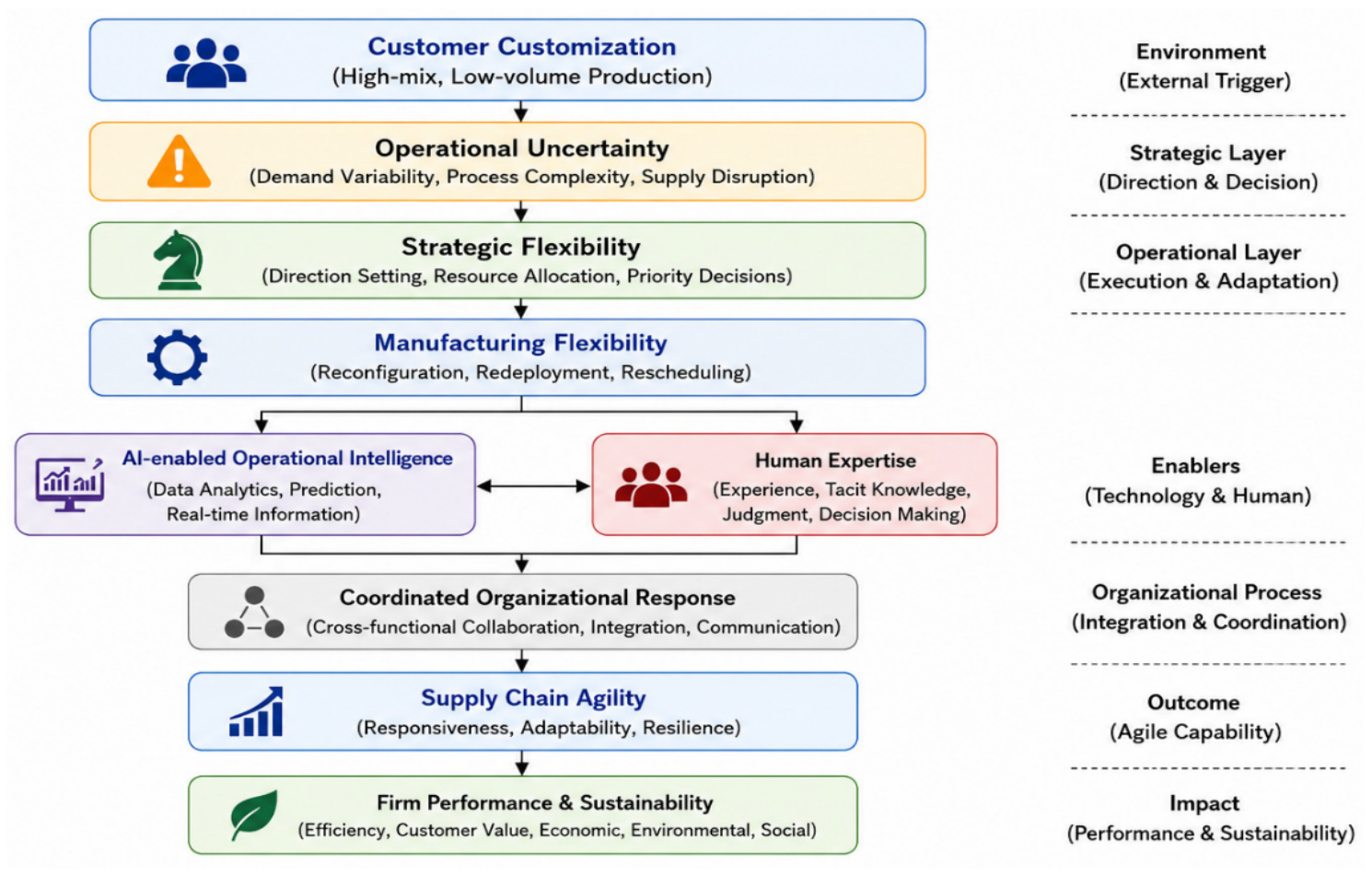
The preliminary analytical framework in
Figure 1 was developed from the literature to provide a broad orientation for the qualitative inquiry. Customer customization and operational uncertainty represent the external and operational conditions motivating organizational response; strategic and manufacturing flexibility represent potential forms of organizational adaptation; and AI-enabled operational intelligence and human expertise represent technological and human decision-support resources. The directional arrows in
Figure 1 should not be interpreted as statistically validated causal relationships. Rather, they represent preliminary analytical associations derived from the literature and used to organize the qualitative investigation. The framework functioned as a sensitizing perspective for participant selection, interview design, and initial inquiry while allowing additional relationships and themes to emerge from the interview data.
3. Materials and Methods
3.1. Research Design
This study employed an exploratory qualitative design and semi-structured expert interviews to examine how experienced managers interpret operational uncertainty and coordinate agile responses. Context-rich qualitative and case-based approaches are well established in operations management research [
36,
37,
38,
39]. An interpretivist perspective was adopted because agility was treated as an emergent organizational process rather than a predetermined variable. The conceptual framework served as a sensitizing device that guided data collection while allowing inductive themes to emerge. The qualitative design was selected because the purpose of the study was not to test predetermined causal relationships among the focal concepts, but to explore how organizational actors interpreted, negotiated, and implemented responses to operational uncertainty in practice. The preliminary analytical framework therefore provided a broad orientation for the inquiry rather than a fixed model to be confirmed.
3.2. Research Context
The study was conducted in the export-oriented Central American apparel industry, where HMLV production, frequent buyer changes, labor-intensive operations, and geographically dispersed supply chains create substantial operational uncertainty. The regional production system is characterized by cross-border manufacturing networks linking factories, suppliers, logistics providers, customs processes, and international buyers across Guatemala, Honduras, Nicaragua, and El Salvador. Fabrics, accessories, semi-finished products, and production orders may move across national boundaries before final export, making production planning dependent not only on factory-level efficiency but also on transportation infrastructure, customs clearance, supplier coordination, and buyer communication.
The region is also characterized by strong dependence on labor-intensive manufacturing and relatively concentrated relationships with large international apparel buyers. Consequently, changes in buyer specifications, quantities, or delivery priorities can require rapid adjustments in production schedules, workforce allocation, sourcing, and logistics. This setting was considered appropriate for examining how digital decision support, managerial judgment, organizational flexibility, and cross-functional coordination interact within complex customized manufacturing operations.
3.3. Participant Selection
This study employed purposive sampling to recruit participants possessing substantial professional experience in apparel manufacturing and supply chain management.
Purposive sampling is widely recommended in qualitative research because it enables researchers to select information-rich participants capable of providing detailed knowledge regarding the phenomenon under investigation [
40,
41].
Participants were selected based on five criteria: (1) extensive managerial experience in apparel manufacturing; (2) responsibility for production or supply chain decision-making; (3) experience in HMLV customized production, (4) familiarity with digital manufacturing technologies such as ERP, MES, and AI-supported planning systems; and (5) professional experience in Central American apparel manufacturing.
Because the research questions focused on organizational decision-making, strategic adaptation, production coordination, and supply chain management, senior managers and executives were intentionally selected as key informants. Their positions required regular coordination across production planning, sourcing, logistics, buyer communication, workforce management, and digital decision-support activities. Accordingly, the findings should primarily be interpreted as managerial perspectives on organizational processes rather than as direct representations of frontline employees’ day-to-day experiences.
All participants were Korean expatriate senior managers or executives working in Korean-owned or Korean-operated apparel manufacturing companies in Guatemala, Honduras, Nicaragua, or El Salvador. Their shared Korean managerial background may have influenced perspectives on organizational culture, leadership, communication, and technology adoption, while their 15–40 years of industry experience provided extensive familiarity with Central American manufacturing environments.
Although all participants had experience with digital production or supply chain systems, the level and type of technology adoption differed across organizations. For example, P7 reported direct experience with ERP-supported operational information and AI-assisted demand forecasting and production planning, while P6 described real-time production visibility and data- and AI-supported forecasting and planning. P9 described AI as a support tool for production planning and operational decision-making, whereas some other participants primarily referred to production data, ERP, MES, or real-time monitoring rather than direct AI use. This variation was retained in the analysis rather than treating all forms of digital technology as equivalent.
Based on these criteria, thirteen senior industry professionals were selected for participation. Their professional experience ranged from 15 to 40 years, representing a highly experienced group of practitioners with extensive knowledge of apparel manufacturing operations and international supply chain management.
The participants included factory managers, supply chain managers, chief executive officers, vice presidents, and operations directors representing apparel manufacturers operating in Guatemala, Honduras, Nicaragua, and El Salvador. Collectively, these participants provided extensive experience across OEM, ODM, and OBM production systems while working with major international apparel buyers.
To accommodate participants’ geographical locations and business schedules, data were collected through face-to-face interviews, video conferencing, or written responses using the same semi-structured interview protocol. Face-to-face and video interviews generally lasted approximately 40–60 min and were conducted in Korean, while written responses followed the same interview domains and questions. Data collection was conducted between 2 May and 30 May 2026. All participants were anonymized using identification codes (P1–P13), and all personally identifiable and commercially sensitive information was removed prior to analysis.
The final sample was considered analytically adequate because it combined substantial diversity in managerial positions, organizational responsibilities, firm types, and national operating environments with a shared focus on customized apparel manufacturing and supply chain management. Sample adequacy was evaluated in terms of information richness, professional relevance, contextual diversity, and the recurrence of meaningful analytical patterns rather than through a predetermined numerical threshold. As data collection and analysis progressed iteratively, later interviews primarily reinforced and refined the developing thematic structure rather than generating substantively new central themes relevant to the research questions. Participant characteristics are summarized in
Table 2.
3.4. Development of the Interview Protocol
The semi-structured interview protocol was informed by the research questions and preliminary analytical framework, but it was designed as a sensitizing guide for discussion rather than as a predetermined coding structure. It covered seven broad domains: customization, operational uncertainty, strategic flexibility, manufacturing flexibility, AI-enabled operational intelligence, human expertise, and organizational coordination. These domains reflected issues identified in the literature and provided consistency across interviews; however, the questions were intentionally open-ended, and participants were encouraged to introduce additional experiences, practices, tensions, and interpretations.
The interview protocol consisted of seven principal sections.
Although the sequence of discussion varied across interviews, all participants addressed the same seven research domains, providing a shared basis for inquiry while allowing participants to emphasize different experiences, perspectives, and interpretations.
The interview areas shown in
Table 3 indicate topics of inquiry rather than predetermined analytical themes. The final themes were developed through the iterative analytical process described in
Section 3.6. The complete interview protocol and interview procedure are provided in
Appendix A and
Appendix B, respectively, and the coding and theme development process is summarized in
Appendix C.
3.5. Data Collection Procedures
Korean was used because all participants were Korean expatriate managers and because conducting the interviews in their primary professional language enabled more detailed discussion of complex operational experiences, contextual judgments, and managerial decision-making. All interviews and initial analytical work were conducted in Korean to preserve participants’ intended meanings. Representative quotations selected for publication were subsequently translated into English by the researchers, with emphasis on conceptual equivalence rather than literal word-for-word translation.
Data collection and preliminary analysis proceeded iteratively. Following each interview, the researcher reviewed the interview record, prepared analytical notes, and compared newly obtained information with developing codes and preliminary themes.
Data were collected from 2 to 30 May 2026 through face-to-face interviews, video conferencing, or written responses using the same semi-structured protocol. With participants’ permission, interviews were audio-recorded and subsequently transcribed; where recording was not permitted, detailed field notes and written interview records were used for analysis.
Participants were given opportunities to review interview summaries and confirm the accuracy of their responses where appropriate.
All interview materials were securely stored, anonymized, and used exclusively for academic research purposes.
The use of a consistent interview protocol together with multiple data collection methods enhanced the completeness and credibility of the collected data.
3.6. Data Analysis
The interview data were analyzed using reflexive thematic analysis following the analytical principles proposed by Braun and Clarke [
42,
43,
44,
45]. Thematic analysis was selected because it enableds researchers to identify recurring patterns across multiple participants while preserving the contextual richness of qualitative interview data.
Rather than seeking statistical frequency, the analysis focused on identifying meaningful patterns in how participants described operational uncertainty, digital decision support, managerial interpretation, organizational adaptation, and coordinated response within customized apparel manufacturing.
The analytical process consisted of six sequential stages.
Stage 1: Familiarization with the Data
Following each interview, the researcher repeatedly reviewed the interview records and prepared analytical memos to identify preliminary ideas and recurring operational patterns.
Stage 2: Initial Coding
Examples of initial codes included frequent style changes, urgent customer requests, production schedule revisions, AI forecasting, and managerial judgment.
Initial codes were kept close to participants’ descriptions wherever possible and were revised through repeated comparison across interview records.
Stage 3: Development of Analytical Categories
Conceptually related codes were grouped into broader analytical categories such as Operational Uncertainty and Manufacturing Flexibility.
At this stage, similarities, differences, and contextual variations across participants were examined rather than assuming that all accounts reflected a single organizational pattern.
Stage 4: Theme Development
Several broad areas—including customer customization, strategic flexibility, manufacturing flexibility, AI-enabled operational intelligence, and human expertise—were informed by the preliminary framework and interview protocol. However, the final thematic organization was not predetermined. Themes such as AI–Human Complementarity and Coordinated Organizational Response were progressively refined through repeated comparison and interpretation of participants’ accounts.
The analytical categories were subsequently synthesized into broader empirical themes that explained organizational responses to customized production environments.
Repeated comparison across all thirteen participants resulted in the identification of seven principal themes.
- (1)
Customer Customization and Operational Uncertainty;
- (2)
Strategic Flexibility;
- (3)
Manufacturing Flexibility;
- (4)
AI-Enabled Operational Intelligence;
- (5)
Human Expertise;
- (6)
AI–Human Complementarity;
- (7)
Coordinated Organizational Response.
These themes represented recurring organizational mechanisms rather than isolated interview topics. Throughout the analytical process, the researcher repeatedly compared the emerging codes and categories with the original interview records and analytical memos. Initial interpretations were refined when participants’ accounts suggested different emphases or alternative explanations. Conceptually related initial codes were progressively grouped into broader analytical categories, which were then compared across participants and refined into the final themes. This iterative process helped ensure that the final thematic structure remained grounded in participants’ accounts while allowing variation and alternative interpretations to be retained rather than forced into a uniform pattern.
Stage 5: Theme Refinement
Emerging themes were repeatedly compared with the original interview records and with accounts from different participants, countries, firm types, and managerial roles. Later interviews largely reinforced the principal patterns already identified while providing additional examples and contextual variation. No substantively new central theme emerged during the final stage of analysis, and the dataset was therefore judged to provide sufficient analytical depth and thematic coverage for addressing the research questions.
Stage 6: Development of the Final Interpretive Framework
Final themes were defined and organized to reflect recurring organizational patterns while preserving important contextual differences. Representative quotations were selected to illustrate the connection between participants’ accounts and the researchers’ interpretation. Broader theoretical interpretation was subsequently developed in the Discussion rather than embedded within the descriptive presentation of the Results.
Coding and primary interpretation were conducted by the first author. No qualitative data analysis software was used. Coding, memo writing, analytical category development, theme refinement, and iterative comparison were conducted manually, allowing close engagement with the complete set of 13 interview records [
42,
43].
The final themes were interpreted in relation to the conceptual framework and previous literature to explain the organizational mechanisms underlying supply chain agility. The coding structure and theme development are illustrated in
Table 4.
3.7. Researcher Reflexivity
The first author’s more than 30 years of professional experience in the Central American apparel industry facilitated participant access and supported contextual understanding of operational terminology and practices. At the same time, this professional familiarity created the possibility that prior assumptions could influence interpretation. Reflexive memos were therefore maintained throughout the analytical process, emerging interpretations were repeatedly compared with the original interview records, and alternative interpretations were actively considered.
3.8. Trustworthiness
Trustworthiness was supported through reflexive engagement with the data, transparent documentation of the analytical process, rich contextual description, repeated engagement with the original interview records, and consideration of alternative interpretations. These practices were used to enhance the transparency and reflexive grounding of the qualitative interpretation rather than to establish coding reliability or researcher-independent reproducibility.
Table 5 summarizes the strategies used to support transparency and reflexive qualitative interpretation.
The interpretive process involved repeated engagement with the 13 interview records and comparison of recurring patterns as well as meaningful variations among participants. This process helped the researcher remain closely engaged with participants’ accounts while avoiding overreliance on isolated quotations or single organizational experiences. Sample adequacy was assessed in relation to the richness and breadth of the dataset and its capacity to address the research questions rather than through claims of complete or universal saturation.
3.9. Ethical Considerations
This study adhered to generally accepted ethical principles for qualitative research involving human participants.
Before each interview, participants received information regarding the purpose of the study, the voluntary nature of participation, the intended use of the interview data, and the protection of confidentiality. Participation was entirely voluntary, and informed consent was obtained from all participants before data collection commenced.
To protect participants’ privacy, all interview data were anonymized prior to analysis. Individual names, company names, buyer identities, and other commercially sensitive information were removed from the interview records and replaced with anonymous participant identifiers (P1–P13).
Because the participants occupied senior managerial positions within internationally competitive apparel manufacturing companies, particular attention was devoted to protecting confidential business information throughout data collection, analysis, and reporting.
Interview records were securely maintained by the researcher and used exclusively for academic research purposes.
4. Results
4.1. Overview of the Findings
The analysis identified seven interrelated themes: customer customization and operational uncertainty, strategic flexibility, manufacturing flexibility, AI-enabled operational intelligence, human expertise, AI–Human Complementarity, and coordinated organizational response. The themes reported below represent the outcome of iterative qualitative interpretation rather than predetermined analytical categories. Although the preliminary analytical framework informed the broad focus of the inquiry, the final thematic organization was refined through repeated comparison of participants’ accounts. The Results section first presents the empirical patterns identified across the interviews; their broader theoretical significance is considered subsequently in the Discussion.
4.2. Theme 1: Customer Customization and Operational Uncertainty
Participants repeatedly associated increasing customer customization with greater operational uncertainty, particularly through smaller production batches, shorter lead times, frequent style changes, and post-confirmation revisions to order quantities or specifications.
Participants explained that production environments have become considerably more dynamic during the past decade. Long production runs have gradually been replaced by smaller production batches requiring continuous production planning adjustments. Consequently, operational uncertainty has become a normal organizational condition rather than an occasional disruption.
One factory manager explained that rapid seasonal changes within the U.S. apparel market frequently require repeated revisions of production priorities.
“Production schedules have become highly unstable because seasonal demand in the U.S. market changes very rapidly. Production priorities often need to be adjusted several times within a single day.”
(P1)
Similarly, a supply chain manager emphasized that buyers increasingly expect manufacturers to accommodate both shorter lead times and greater product variety simultaneously.
“Buyers now expect rapid supply chain responsiveness together with small production lots. Even after production begins, requests for style modifications and quantity adjustments occur frequently.”
(P2)
Senior executives expressed similar concerns regarding the structural transformation of buyer requirements. One participant explained that production stability has declined substantially because customer requirements continue to change throughout the manufacturing process rather than before production begins.
“Order specifications, colors, and production quantities are frequently revised after orders have already been confirmed. Unless the entire supply chain responds quickly, it becomes extremely difficult to satisfy customer expectations.”
(P10)
Participants from Nicaragua, Guatemala, and El Salvador independently described comparable experiences. They noted that buyers increasingly divide large seasonal orders into multiple smaller production batches to minimize inventory risk while simultaneously requesting faster delivery. Although these practices reduce inventory exposure for retailers, they substantially increase operational complexity for manufacturers.
Across the interviews, managers described customization as transferring part of the inventory and market risk toward manufacturers. Smaller and more frequently revised orders allowed buyers to reduce inventory exposure, while manufacturers absorbed the operational consequences through repeated rescheduling, line changes, workforce reassignment, material adjustments, and supplier coordination. Participants therefore described a recurring tension between maintaining production efficiency and preserving responsiveness to important customers.
Interviewees further explained that customer customization creates cascading operational effects throughout manufacturing systems. Frequent style changes require repeated production line reconfiguration, worker reassignment, material rescheduling, supplier coordination, and logistics adjustments. As a result, operational uncertainty extends beyond production planning and affects virtually every functional area within the organization.
Collectively, these accounts indicate that customer-driven changes were associated with recurring adjustments across production planning, workforce allocation, sourcing, and logistics. The effects of customization were therefore experienced across multiple organizational functions rather than within production scheduling alone.
4.3. Theme 2: Strategic Flexibility in Managerial Adaptation
Participants described strategic flexibility primarily through repeated revisions of production priorities, sourcing decisions, resource allocation, and inter-factory coordination in response to changing customer and operating conditions. Rather than following production plans without modification, managers reported that priorities were frequently reconsidered as new information became available.
One chief executive explained that supply chain stability has been replaced by continuous strategic adjustment.
“Supply chain stability has declined significantly. Production plans change frequently because of customer customization and high-mix, low-volume production. Production sites now operate in a state of constant adjustment.”
(P10)
Similarly, another executive emphasized that production flexibility can no longer be limited to individual factories but must extend across geographically dispersed manufacturing networks.
“When urgent delivery requests occur, production planning, material management, workforce allocation, and logistics all have to be adjusted simultaneously. In many cases, production volume must even be redistributed among factories in different countries.”
(P4)
Participants repeatedly described strategic decision-making as increasingly proactive rather than reactive. Instead of waiting for operational disruptions to occur, managers continuously monitor customer requirements, production progress, and supplier conditions in order to anticipate potential changes before they develop into operational problems.
One participant described this proactive management approach as follows:
“Our role is no longer simply to execute production plans. We constantly review requirements, production progress, and supply conditions so that adjustments can be made before problems become critical.”
(P2)
Several executives also emphasized that strategic flexibility increasingly depends upon cross-functional coordination rather than isolated managerial decisions. Marketing, production, procurement, logistics, and supply chain management departments must rapidly exchange information and jointly revise organizational priorities whenever customer requirements change.
Another participant explained:
“Supply chain responsiveness today requires rapid coordination across multiple organizational functions. Individual departments cannot respond independently because every production change influences procurement, logistics, and factory operations simultaneously.”
(P6)
The interviews further revealed that strategic flexibility extends beyond individual organizational boundaries. Several participants described the importance of coordinating production among factories located in Guatemala, Honduras, Nicaragua, and El Salvador. Such international coordination allows organizations to redistribute production capacity, reduce bottlenecks, and maintain delivery commitments despite frequent disruptions.
Interestingly, respondents consistently argued that strategic flexibility has become a fundamental competitive capability rather than an emergency management practice. Under traditional mass-production systems, production planning could remain relatively stable for extended periods. In contrast, participants described today’s customized manufacturing environment as one in which continuous adaptation has become the normal operating condition.
Collectively, these interview accounts indicate that managers frequently revised production priorities and resource allocations in response to changing customer requirements and operating constraints. Strategic adaptation was therefore described as a recurring managerial practice rather than an exceptional response reserved for major disruptions.
4.4. Theme 3: Manufacturing Flexibility in Operational Adjustment
Participants described manufacturing flexibility through repeated production-line reconfiguration, workforce reassignment, scheduling revision, and the redistribution of production across facilities or subcontractors. These adjustments were reported as routine responses to changing styles, order volumes, workforce availability, and delivery requirements.
Across the interviews, respondents explained that production systems are increasingly required to accommodate frequent style changes, fluctuating order volumes, and compressed delivery schedules. Consequently, manufacturing flexibility has evolved from a desirable operational capability into an essential organizational requirement.
One factory manager described how production line reconfiguration has become a routine aspect of daily operations.
“When buyers request style changes after production has already begun, we must reorganize production lines and reassign workers immediately. Otherwise, productivity declines and delivery schedules cannot be maintained.”
(P1)
A production executive similarly explained that manufacturing flexibility extends beyond physical production lines to include the rapid reallocation of human resources.
“The greatest challenge is not simply changing the production line itself but relocating experienced workers to appropriate operations. Without skilled workers, production efficiency decreases immediately after style changes.”
(P5)
Several participants emphasized that workforce flexibility has become inseparable from manufacturing flexibility. As product variety continues to increase, operators must possess multiple technical skills that enable them to move efficiently between different production processes.
One participant noted:
“Frequent changes in production priorities require workers who can perform multiple operations. Multi-skilled employees significantly improve our ability to respond to unexpected production changes.”
(P8)
Interviewees also described manufacturing flexibility as extending beyond internal factory operations. During periods of severe production disruption, organizations frequently redistribute production across subcontractors or affiliated factories located in different countries.
A senior executive explained this broader perspective.
“When production capacity becomes insufficient, some manufacturing processes are transferred to partner factories or subcontractors. This allows us to satisfy delivery commitments despite unexpected operational disruptions.”
(P9)
Similarly, participants managing multinational production networks explained that production flexibility increasingly depends upon coordination among geographically dispersed manufacturing facilities.
“Production is no longer managed independently at a single factory. Capacity is continuously adjusted across different countries depending on customer requirements and production conditions.”
(P10)
Another important finding concerns the relationship between manufacturing flexibility and production planning. Rather than following fixed production schedules, participants reported that production plans are revised continuously in response to changing customer requirements. Consequently, production supervisors regularly modify production sequences, allocate additional manpower, and reprioritize manufacturing orders throughout the production process.
Several respondents acknowledged that these adjustments inevitably increased managerial workload and operational complexity. Nevertheless, they considered manufacturing flexibility indispensable for maintaining competitiveness within the contemporary apparel industry.
A more detailed example illustrates the operational trade-offs involved in manufacturing flexibility. P6 described an urgent order from a major U.S. buyer that required the firm to interrupt the existing production sequence and prioritize a new style. Responding to the request required production-line reconfiguration, worker retraining, emergency procurement of some materials through air transportation, weekend work, and the use of external subcontracting capacity. Although the firm ultimately met the delivery requirement, the response created substantial operational burden. This account illustrates how rapid delivery responsiveness may require simultaneous adjustments in workforce deployment, production configuration, logistics, and external capacity, creating tensions between immediate responsiveness, operational stability, and resource requirements.
Overall, the interviews indicate that manufacturing adjustment involved both technical and human-resource changes. Production-line reconfiguration, worker reassignment, schedule revision, and external capacity were repeatedly used in combination, while managers also considered the consequences of these adjustments for efficiency, quality, delivery, and workforce capacity.
4.5. Theme 4: AI-Enabled Operational Intelligence as Decision Support
Participants described digital technologies as supporting operational visibility, monitoring, forecasting, and planning, although the systems and levels of digital adoption differed across organizations. Importantly, the interviews distinguished between ERP, MES, real-time monitoring platforms, and AI-assisted analytical tools rather than treating these technologies as equivalent.
ERP systems were primarily described in relation to enterprise-wide order, purchasing, inventory, and resource information; MES and monitoring platforms supported shop-floor visibility and production execution; and AI-assisted applications were reported in connection with demand forecasting, scheduling, predictive analysis, and managerial decision support.
Participant-level technology use also varied. P7 reported the use of ERP-supported operational information together with AI-assisted demand forecasting and production-planning optimization. P6 described real-time production visibility and data- and AI-supported forecasting and planning, but did not specifically identify MES use in the interview evidence reviewed for this study. P9 described AI as potentially supporting production planning and operational decision-making while emphasizing the continuing importance of experienced management. By contrast, P3 emphasized the growing importance of production data and data-supported planning rather than explicitly identifying a specific AI system.
Across the interviews, respondents explained that the role of AI extends beyond production automation. Instead, AI is primarily utilized to improve production planning, monitor operational performance, analyze production data, and increase supply chain visibility. These capabilities enable managers to detect operational disruptions earlier and respond more rapidly to changing customer requirements.
One senior executive explained that data-driven operations have become a fundamental competitive capability in global apparel manufacturing.
“Data-based operational capability and supply chain agility have become far more important competitive advantages than production efficiency alone. We actively utilize AI-supported production management systems and continuously invest in strengthening our customization capabilities.”
(P7)
Another participant emphasized that digital technologies improve organizational awareness by providing real-time operational information.
“Real-time supply chain visibility has become increasingly important. Data-based decision-making enables managers to identify production issues much earlier than before.”
(P7)
Participants also described AI as improving coordination across geographically dispersed production facilities. Rather than relying solely on periodic reports, managers increasingly monitor production progress, inventory status, and delivery schedules through integrated digital systems, allowing faster organizational responses to unexpected disruptions.
One executive responsible for multinational operations explained:
“Production is coordinated continuously across multiple factories. Digital information enables us to evaluate operational conditions quickly and redistribute production capacity whenever necessary.”
(P6)
Similarly, another participant observed that market uncertainty has made production forecasting considerably more difficult, increasing the importance of data-supported planning.
“Demand forecasting has become much more difficult because buyers frequently place small test orders. Production can no longer rely solely on managerial experience; production data have become increasingly important.”
(P3)
Several respondents further explained that AI contributes to production scheduling by improving production monitoring, identifying bottlenecks, and supporting resource allocation. However, they consistently emphasized that AI recommendations require managerial interpretation because unexpected production disruptions frequently involve contextual factors that cannot be fully captured by algorithms alone.
Participants generally described AI-enabled operational intelligence as decision support rather than autonomous decision-making. They reported using digital information to identify risks and evaluate alternatives while retaining managerial responsibility for final operational decisions.
The extent of digital adoption varied across participating organizations. Some participants reported direct use of AI-assisted forecasting or planning tools, whereas others described greater reliance on ERP, MES, monitoring systems, and experienced managerial judgment. Accordingly, findings concerning AI-specific roles and AI–human complementarity should be interpreted primarily in relation to participants who reported direct experience with AI-assisted tools, while the broader sample provides evidence concerning digital information systems and managerial decision-making more generally.
Among participants who reported direct experience with AI-assisted tools, the accounts suggest that AI-enabled operational intelligence primarily supported earlier detection of operational problems, improved visibility, forecasting, and planning. Final production decisions, however, continued to involve managerial evaluation of customer priorities, workforce conditions, production feasibility, and supply chain constraints.
4.6. Theme 5: Human Expertise in Contextual Interpretation
Participants repeatedly described human expertise as important in situations involving ambiguity, exceptions, and operational conditions that were difficult to represent fully in digital systems. Their accounts emphasized contextual judgment concerning workforce capability, production feasibility, supplier conditions, customer relationships, and competing operational priorities.
Across all interviews, respondents explained that customized apparel manufacturing involves numerous complex situations that cannot be fully anticipated or standardized. Frequent style modifications, urgent delivery requests, supplier delays, workforce shortages, and unexpected production problems require contextual judgment that extends beyond algorithmic decision-making.
One factory manager described how operational disruptions require immediate managerial intervention.
“When buyers request style changes after production has already started, experienced managers must immediately reorganize production lines and reassign workers. These decisions depend on practical experience rather than predetermined procedures.”
(P1)
Similarly, another participant explained that workforce capability remains one of the most important determinants of manufacturing performance.
“A shortage of skilled workers immediately reduces productivity whenever production styles change. Experienced employees are essential because they adapt much more quickly to operational changes.”
(P8)
Several executives further emphasized that operational disruptions rarely occur in isolation. Instead, managers must simultaneously consider production scheduling, workforce allocation, material availability, logistics coordination, and customer expectations when making operational decisions.
One chief executive explained:
“When urgent delivery requests occur, there is no single solution. Managers must evaluate production capacity, supplier conditions, workforce availability, and customer priorities simultaneously before deciding how production should be reorganized.”
(P10)
Participants also stressed that experienced managers possess tacit knowledge accumulated through years of operational practice. Such knowledge enables them to recognize subtle production problems, anticipate operational risks, and identify practical solutions that are difficult to formalize within AI systems.
Another executive observed:
“Ultimately, operational success depends on experienced people. Digital systems provide valuable information, but experienced managers determine how that information should be interpreted and applied.”
(P6)
The interviews further revealed that experienced managers perform an important coordination function during periods of operational uncertainty. Rather than making isolated decisions, they integrate information from production, procurement, logistics, quality control, and customer service to develop coordinated organizational responses.
Participants commonly distinguished between the availability of operational information and the contextual judgment required to use that information. Digital systems were valued for timely information and visibility, while experienced managers were described as evaluating whether proposed actions were feasible within specific production and organizational conditions.
Several participants also described knowledge sharing between experienced managers, production supervisors, and employees as an important part of adaptation. Repeated experience with production disruptions was reported to inform subsequent decisions and improve familiarity with recurring operational problems.
Taken together, these accounts indicate that human expertise was particularly relevant when operational decisions involved contextual information, competing priorities, or exceptions that could not be resolved through standardized digital recommendations alone.
4.7. Theme 6: AI–Human Complementarity in Operational Decision-Making
A recurring pattern across the interviews was that digital information and human judgment were used together during operational decision-making. Among participants who reported direct experience with AI-assisted tools, AI-supported information was described as providing visibility, analytical support, or alternative options, while experienced managers evaluated contextual feasibility before final actions were selected.
Participants did not describe managerial responses to digital recommendations as a uniform process of acceptance, modification, or rejection. Rather, their accounts emphasized that digital and AI-supported information was interpreted in relation to changing operational conditions. Managers considered workforce availability, customer priorities, supplier conditions, production feasibility, and other contextual constraints when determining feasible organizational responses.
Rather than perceiving AI as a replacement for human expertise, respondents viewed digital technologies as decision-support mechanisms that improve the speed and quality of managerial responses. AI enables organizations to process large volumes of operational data, monitor production performance in real time, and identify emerging disruptions. However, translating these analytical insights into effective operational actions continues to depend upon experienced human judgment.
One senior executive explained that digital technologies significantly improve operational awareness but cannot substitute for practical managerial experience.
“AI helps us understand what is happening across production sites much more quickly. However, deciding how to respond still depends on experienced managers who understand the operational realities behind the data.”
(P7)
Similarly, another participant emphasized that production disruptions rarely follow predictable patterns.
“Every urgent order is different. Digital systems provide useful information, but managers must evaluate each situation based on customer priorities, workforce capability, supplier conditions, and production capacity.”
(P11)
Several respondents described AI as enhancing managerial confidence rather than replacing managerial authority. By providing accurate production information and improving supply chain visibility, AI enables managers to make faster and better-informed decisions without eliminating the need for human interpretation.
One executive stated:
“Digital information reduces uncertainty, but experience determines the quality of the final decision. AI supports managers; it does not replace them.”
(P3)
Participants also highlighted the complementary relationship between AI-generated information and tacit organizational knowledge. While AI identifies operational abnormalities and predicts potential disruptions, experienced managers evaluate practical feasibility, organizational priorities, and customer relationships before implementing corrective actions.
Another participant explained:
“Production management combines analytical information with practical experience. Successful operational decisions require both digital systems and experienced people working together.”
(P13)
The accounts of participants who discussed AI-assisted tools further suggested that AI–human complementarity may extend beyond individual decision-makers. More broadly, participants described organizational responsiveness as involving collaboration among managers, production supervisors, planning specialists, supply chain personnel, and digital information systems. These accounts suggest that organizational responsiveness may be better understood as a collective organizational process rather than as the outcome of technological or human resources independently.
Collectively, these accounts indicate that participants relied on both digital information and experienced managerial judgment when responding to operational uncertainty. Among participants reporting direct AI-assisted experience, AI-supported systems were described as providing analytical information and operational visibility, while managers provided contextual interpretation and coordinated implementation across organizational functions.
4.8. Theme 7: Coordinated Organizational Response
The final theme concerned coordination across organizational functions and supply chain partners. Participants repeatedly explained that customer-driven changes affected production planning, procurement, manufacturing, logistics, quality management, and customer communication simultaneously, requiring these functions to exchange information and adjust activities in parallel.
One senior executive described this organizational integration as follows:
“A production change immediately affects purchasing, logistics, quality control, and delivery schedules. Every department must respond together because isolated decisions create additional operational problems.”
(P10)
Similarly, another participant emphasized that cross-functional communication has become increasingly important under high-mix, low-volume production environments.
“Production planning is no longer the responsibility of a single department. Manufacturing, procurement, logistics, and customer service continuously exchange information so that production adjustments can be implemented without delay.”
(P6)
Several interviewees further explained that organizational coordination increasingly extends beyond individual firms. Suppliers, subcontractors, logistics providers, and overseas manufacturing facilities frequently collaborate to maintain production continuity despite unexpected disruptions.
One executive responsible for multinational production networks stated:
“We work closely with suppliers, subcontractors, and factories located in different countries. Agility depends upon how effectively the entire supply chain coordinates its response rather than how efficiently one factory performs.”
(P13)
Participants also observed that AI contributes significantly to organizational coordination by providing shared operational information across multiple organizational levels. Real-time production data, inventory visibility, and digital communication platforms improve information consistency and enable departments to coordinate operational decisions more effectively.
Participants nevertheless emphasized that shared digital information did not eliminate the need for managerial coordination. Managers remained responsible for establishing priorities, resolving competing demands, and coordinating actions across organizational functions.
One participant summarized this relationship succinctly:
“Technology connects information, but people connect organizations. Effective supply chain responsiveness depends on both.”
(P7)
Participants also described learning from repeated disruption responses. Experience with earlier production problems was reported to improve subsequent communication, coordination, and problem-solving routines, suggesting a feedback relationship between operational experience and later organizational responses.
P10 provided a concrete example of cross-location operational coordination. In response to an urgent delivery request, the firm had to reconsider material allocation, production-line configuration, workforce deployment, and logistics arrangements simultaneously. The response ultimately involved reallocating part of the production volume between facilities in Guatemala and Honduras and activating an urgent coordination process involving supply-chain partners. P10 further noted that data-based visibility enabled managers to assess production conditions and delivery flows more rapidly, while unexpected contingencies still required managerial experience and operational judgment.
Taken together, the interview accounts indicate that coordinated responses involved interaction across production, procurement, logistics, quality, customers, suppliers, and managerial functions. Digital information supported shared visibility, while managers coordinated priorities and implementation across organizational boundaries. Repeated experience with these responses also informed subsequent organizational routines and decision-making.
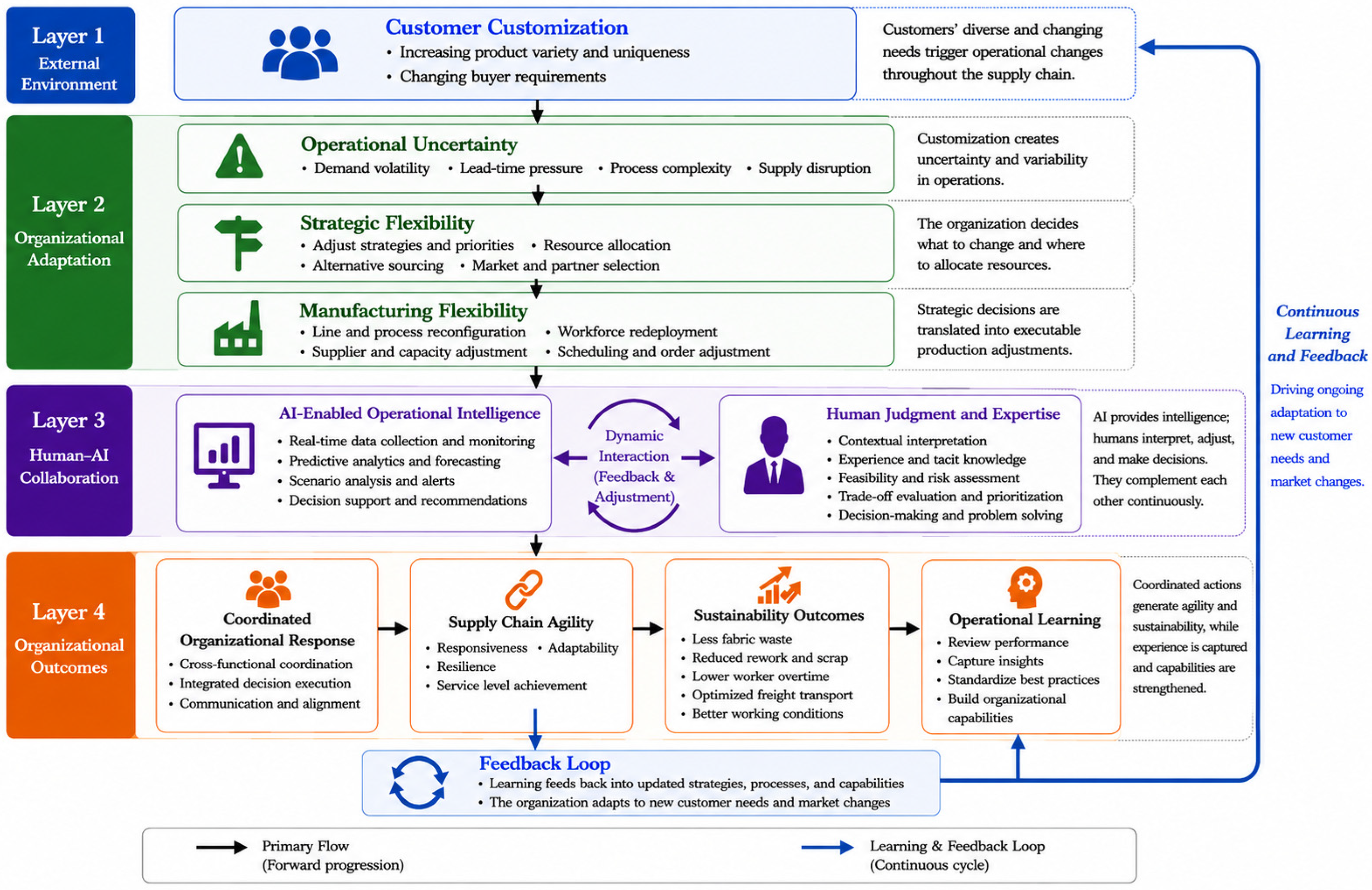
4.9. Summary of Results
Figure 2 and
Table 6 synthesize the principal empirical relationships identified across the seven themes. Participants associated customer customization with recurring operational uncertainty; described strategic and manufacturing adjustments as responses to changing conditions; used digital systems to improve information visibility and analytical support; relied on human expertise for contextual interpretation; and emphasized cross-functional coordination during implementation. The findings also revealed an iterative rather than purely linear pattern. Operational experience informed subsequent decisions through learning and feedback, while digital information and human judgment interacted throughout the decision process, including AI-supported information where such tools were used. The directional relationships in
Figure 2 therefore summarize empirically interpreted organizational processes rather than statistically validated causal paths. Across the themes, participants also associated these organizational processes with sustainability-related considerations involving resource utilization, production waste, overtime and operational burden, delivery reliability, and organizational resilience.
5. Discussion
5.1. Findings That Confirm Previous Research
The qualitative findings provide a process-oriented perspective on how established supply chain agility capabilities are enacted within AI-enabled customized apparel manufacturing. Rather than suggesting that supply chain agility originates from AI–human interaction, the findings indicate how digital information, managerial interpretation, strategic adaptation, manufacturing reconfiguration, and organizational coordination were connected within the empirical context examined.
Several findings are consistent with established research on supply chain agility and manufacturing flexibility. First, participants’ accounts reinforce the importance of responsiveness under conditions of volatile demand, shorter product cycles, and increasing product variety. This is broadly consistent with established supply chain agility research emphasizing the ability to respond rapidly to environmental and customer change [
22,
23,
46].
Second, the findings confirm the operational importance of manufacturing flexibility. Earlier research has emphasized the ability to modify production volume, processes, routing, and resource configurations in response to uncertainty [
12,
13]. The interview evidence similarly showed repeated line reconfiguration, workforce reassignment, schedule modification, subcontracting, and capacity redistribution.
Third, the findings are consistent with previous research that identifies information sharing and cross-functional coordination as important elements of supply chain agility. Participants repeatedly described coordination among production, procurement, logistics, quality management, customer communication, suppliers, and external factories when responding to disruptions.
5.2. Findings That Extend Previous Research
Beyond confirming established relationships, the findings extend previous research in three important respects. First, they provide a more differentiated explanation of the roles of strategic flexibility and manufacturing flexibility. Strategic flexibility was reflected in reprioritizing customers, reallocating resources, revising sourcing arrangements, and redistributing production, whereas manufacturing flexibility involved line reconfiguration, workforce redeployment, scheduling changes, and the practical use of alternative production capacity.
This distinction suggests that the two forms of flexibility are complementary but not interchangeable. Strategic flexibility concerns the organizational question of what should be changed and where resources should be directed, whereas manufacturing flexibility concerns how the resulting decisions can be implemented in production.
Second, the findings extend the rapidly developing literature on AI-enabled supply chain management by clarifying the organizational role of AI-supported information. Existing research documents expanding predictive, analytical, and decision-support applications while continuing to identify implementation and organizational integration as important issues [
6,
10,
29]. In the present study, digital and AI-supported information was interpreted in conjunction with workforce conditions, customer priorities, supplier constraints, production feasibility, logistics conditions, and managerial experience. The findings therefore suggest that the organizational value of digital decision support lies not in the automatic implementation of system recommendations, but in its integration with contextual managerial judgment and operational coordination.
Third, the findings extend previous research by highlighting organizational coordination as a critical mechanism linking information and implementation. Identifying an operational problem and selecting an appropriate response are not sufficient unless production, procurement, logistics, quality, suppliers, and customer-facing functions can coordinate implementation.
Table 7 summarizes these comparisons with recent literature.
5.3. Human-Centered Supply Chain Agility as an Interpretive Framework
The Human-Centered Supply Chain Agility (HCSA) framework proposed in this study should not be interpreted as a new universal theory of supply chain agility or as a replacement for established agility concepts. Rather, it provides an empirically grounded interpretive framework for understanding how established agility capabilities were enacted within the specific context of AI-enabled customized apparel manufacturing.
The framework draws on, but is distinguishable from, several established theoretical perspectives. Dynamic Capabilities Theory explains how organizations sense change, respond to emerging conditions, and reconfigure resources. Socio-Technical Systems Theory emphasizes the joint functioning of technological and social systems. Human-Centered AI emphasizes augmentation, interaction, and meaningful human involvement in AI-supported decision-making. The present findings do not replace these perspectives; instead, they provide a context-specific explanation of how elements associated with these perspectives were connected within an operational response process.
Within the empirical context examined, the interpretive process can be summarized as follows: customer-driven change was associated with operational uncertainty; managers reconsidered strategic priorities; manufacturing resources were reconfigured; digital systems provided additional visibility and analytical information, including AI-supported capabilities where such tools were used; human expertise contributed contextual interpretation and exception handling; and cross-functional coordination supported implementation. Importantly, these relationships should be understood as iterative and mutually influencing rather than as a deterministic linear sequence.
From a dynamic capabilities perspective, the findings illustrate how the conventional sensing–seizing–reconfiguring logic may be enacted through specific organizational activities in the context examined. Digital information supported sensing, including AI-assisted information among participants who reported using such tools; managerial interpretation and strategic reprioritization contributed to response selection; manufacturing flexibility supported resource reconfiguration; and cross-functional coordination enabled implementation.
From a socio-technical perspective, digital systems provided analytical speed and visibility, while managers contributed contextual understanding, practical judgment, and responsibility for implementation. This interpretation is consistent with the automation-augmentation paradox in AI-enabled management [
30].
The findings are also relevant to Human-Centered AI, Responsible AI, and AI Governance. With respect to Human-Centered AI, AI-enabled operational intelligence is interpreted as an augmentation and decision-support capability rather than as an autonomous decision-maker. Human expertise remains important for contextual interpretation, exception handling, priority setting, and final operational judgment.
From a Responsible AI perspective, the findings highlight the importance of human oversight, managerial accountability, and contextual judgment. Participants described AI-supported recommendations as being evaluated rather than automatically accepted before operational implementation.
From an AI Governance perspective, the findings highlight the importance of organizational arrangements governing who reviews AI-generated recommendations, who may modify or reject them, how decision authority is assigned, and where final responsibility resides.
Figure 3 summarizes the contrast between technology-centered and human-centered perspectives on supply chain agility.
5.4. Sustainability and Practical Implications
The findings have implications for environmental, social, and economic sustainability, although these outcomes were not quantitatively measured in the present study. Participants’ accounts suggest several operational pathways through which more coordinated decision-making may support sustainable manufacturing.
From an environmental perspective, improved production visibility and earlier identification of disruptions may help reduce unnecessary production, specification errors, rework, and material waste when followed by timely managerial action. More reliable production and delivery planning may also reduce reliance on emergency transportation, including expedited or air freight, although the present qualitative design does not estimate the magnitude of these effects. This interpretation is broadly aligned with studies linking AI-enabled analytical capabilities with green supply-chain integration and environmental performance [
34].
From a social sustainability perspective, the interviews highlighted the tension between rapid responsiveness and workforce well-being. Overtime and workforce redeployment can provide short-term flexibility, but repeated dependence on these practices may increase fatigue, reduce morale, and undermine workforce stability. Sustainable flexibility therefore requires cross-training, workload balancing, and workforce capability development rather than continual reliance on emergency adjustments.
From an economic perspective, coordinated planning, improved visibility, and flexible resource allocation may support delivery reliability, customer responsiveness, resource utilization, and organizational resilience. This interpretation is consistent with recent evidence that AI-supported decision capabilities can contribute to supply chain resilience when integrated into broader organizational response mechanisms [
16]. The emerging Industry 5.0 perspective similarly emphasizes resilience, sustainability, and human-centricity as interconnected objectives [
17,
35].
For firms at an early stage of digital maturity, the priority should be reliable data collection, basic ERP or production-monitoring integration, standardized operating procedures, and workforce capability development. For firms with established ERP, MES, or real-time monitoring systems, the next priority is to strengthen cross-functional information sharing and introduce AI-assisted forecasting, scheduling, or anomaly-detection tools where they address clearly identified operational problems. For digitally advanced firms, the emphasis should shift toward integrated AI governance and continuous organizational learning.
Organizations should establish clear governance procedures defining who reviews AI-generated recommendations, who has authority to modify or reject them, and how final operational responsibility is assigned. Investments in manufacturing flexibility should extend beyond equipment to cross-training, standardized line-change procedures, modular production arrangements, flexible workforce allocation, alternative sourcing options, and clearly defined inter-factory transfer procedures. Cross-functional coordination should be institutionalized through regular information exchange among production planning, procurement, logistics, quality, customer service, and supply chain management. The practical implications are summarized in
Table 8, and
Figure 4 presents the corresponding human–AI collaboration model.
5.5. Limitations and Future Research
Despite its theoretical and practical contributions, this study has several limitations that should be acknowledged.
First, the empirical evidence is based on interviews with 13 senior managers and executives. These participants were intentionally selected because the research focused on organizational decision-making, strategic adaptation, production coordination, and supply chain management. However, their accounts primarily represent a senior managerial perspective. Production supervisors, planners, quality personnel, logistics staff, sewing operators, supplier representatives, and other frontline actors may experience digital technologies and organizational flexibility differently. Future qualitative research should adopt multi-level designs that compare the perspectives of executives, middle managers, supervisors, and frontline employees.
Second, all participants were Korean expatriate managers working within Korean-owned or Korean-operated apparel firms in Central America. Their long professional experience provided substantial familiarity with the regional manufacturing environment, but their shared managerial and cultural background may also have influenced how organizational practices, leadership, communication, and technology adoption were interpreted. Future studies incorporating local Central American managers and employees would provide an important comparative perspective.
Third, the study was conducted within the specific context of customized apparel manufacturing in Central America. Labor-intensive production, frequent style changes, buyer-driven scheduling, cross-border manufacturing networks, and regional infrastructure conditions may differ substantially from those found in highly automated industries or sectors characterized by more stable demand. Accordingly, the findings are intended to provide context-dependent explanation rather than statistical generalization. The potential contribution beyond this setting lies in analytical transferability rather than universal applicability.
Fourth, the study employed reflexive thematic analysis, and the findings therefore represent interpretive explanations developed through engagement between the empirical material and the researchers’ analytical perspective. Although reflexive memo writing, repeated comparison with interview records, transparent documentation, and consideration of alternative interpretations were used to strengthen analytical rigor, different qualitative approaches or researchers could emphasize different aspects of the same organizational experiences.
Fifth, the study examined participants’ perceptions of operational responsiveness and sustainability-related considerations rather than directly measuring objective performance outcomes. The interviews identified potential relationships involving waste, rework, overtime, delivery reliability, resource utilization, and organizational resilience, but the study did not quantify these outcomes. The present findings therefore should not be interpreted as causal evidence that HCSA directly improves environmental, social, or financial performance.
Finally, AI technologies and their organizational applications continue to evolve rapidly. Longitudinal research would be valuable for examining how AI–human interaction, decision authority, governance, and organizational learning evolve over time. Future research should further examine, refine, and test the interpretive relationships identified in the HCSA framework through comparative qualitative, quantitative, longitudinal, and mixed-method studies across industries and regions. Future studies may also examine how these organizational processes relate to emerging Industry 5.0 discussions concerning human-centered manufacturing, responsible AI, workforce capability, and sustainable production systems. These limitations and future research directions are summarized in
Table 9.
6. Conclusions
This study explored how supply chain agility is enacted within AI-enabled customized apparel manufacturing through qualitative interviews with 13 senior managers and executives working in Guatemala, Honduras, Nicaragua, and El Salvador. The study focused on an operational environment characterized by high-mix, low-volume production, recurring customer-driven changes, compressed lead times, labor-intensive operations, and cross-border supply chain coordination.
The analysis identified seven interrelated themes: customer customization and operational uncertainty, strategic flexibility, manufacturing flexibility, AI-enabled operational intelligence, human expertise, AI–human complementarity, and coordinated organizational response. Together, these themes provide an empirical account of how managers interpreted changing operating conditions, revised priorities, reconfigured manufacturing resources, used digital information, exercised contextual judgment, and coordinated organizational responses.
Among participants who reported direct experience with AI-assisted tools, AI-enabled operational intelligence was primarily described as a decision-support capability. More broadly, participants described digital systems as supporting visibility, forecasting, monitoring, and analytical decision support, while experienced managers retained responsibility for contextual interpretation, feasibility assessment, exception handling, and final operational decisions. The qualitative evidence therefore suggests that the organizational value of AI and broader digital systems depends on how digitally generated information is interpreted and integrated with human expertise and coordinated organizational action.
Based on these findings, Human-Centered Supply Chain Agility is presented as an empirically grounded interpretive framework rather than as a new universal theory of supply chain agility. The framework provides a process-oriented explanation of how established organizational capabilities may be enacted through interactions among strategic adaptation, manufacturing reconfiguration, AI-enabled operational intelligence, human expertise, cross-functional coordination, and organizational learning within the context examined.
The findings also suggest that the organizational processes associated with agility may have implications for sustainability. Participants associated improved planning and coordination with more efficient resource use and reduced operational waste; workforce development and more balanced use of overtime with social sustainability considerations; and delivery reliability and organizational resilience with longer-term economic sustainability. These relationships reflect participants’ perceptions and qualitative interpretation rather than objectively measured sustainability effects and therefore require further empirical examination.
For managers, the findings support a balanced approach to digital transformation. Investment in AI should be accompanied by workforce capability development, manufacturing flexibility, clearly defined decision authority, cross-functional coordination, and mechanisms for reviewing and learning from AI-supported recommendations. The appropriate sequence of implementation may vary according to each organization’s level of digital maturity.
Future research should evaluate the transferability of the framework across different organizational levels, industries, cultural settings, and technological environments using comparative qualitative, quantitative, longitudinal, and mixed-method designs. Overall, the findings suggest that AI-enabled customized manufacturing should be approached as a socio-technical organizational challenge rather than as a technological substitution problem. Within the context examined, agile and sustainable responses were associated with the complementary use of digital intelligence, human expertise, organizational flexibility, coordination, and learning.