


Abstract
Low-impact development (LID) and nonpoint-source pollution reduction facilities are increasingly expected to function as long-term components of urban infrastructure rather than as isolated environmental features. Their sustainability depends not only on technical design but also on institutional review, construction assurance, operation and maintenance, performance verification, information continuity, and adaptive policy learning. This study comparatively examines the content and structure of three major South Korean guidance documents issued in 2013, 2016, and 2020: the national LID Technology-Element Guideline, Seoul’s Guidance for the LID Prior-Consultation System, and the national Manual for the Installation and Management/Operation of Nonpoint-Source Pollution Reduction Facilities. A directed qualitative content analysis was conducted using seven literature-informed lifecycle-governance dimensions covering problem framing, planning and approval, facility selection and sizing, installation and construction control, operation and maintenance, monitoring and performance verification, and adaptive feedback. Documentary provisions were assessed using a four-level ordinal scale ranging from absent to strong coverage. The analysis indicates a functional expansion of governance provisions across the three documents, from LID principles and technology selection to pre-permit review, quantitative runoff-management requirements, installation guidance, operation and maintenance, monitoring, and performance testing. However, the documents collectively show discontinuities between approval and construction verification, construction and long-term operation, maintenance and compliance, monitoring and policy learning, and lifecycle information management. In response, this study proposes a six-stage lifecycle-governance framework linking planning, pre-permit verification, construction commissioning, asset registration, risk-based maintenance and monitoring, and adaptive policy learning. The framework is presented as an analytical and normative synthesis rather than an empirically validated governance model. Because the study is limited to documentary analysis, the findings do not demonstrate actual implementation effectiveness, regulatory compliance, maintenance quality, or environmental performance and should be validated through future empirical and comparative research.
1. Introduction
Urbanization alters natural hydrologic processes by replacing permeable soils and vegetation with impervious surfaces, increasing runoff volume and peak flow while reducing infiltration and groundwater recharge. These changes can intensify urban flooding, stream degradation, and the transport of nonpoint-source pollutants. Climate change further complicates stormwater management through changes in rainfall intensity and storm frequency. Low-impact development (LID), green infrastructure (GI), sustainable drainage systems (SuDS), and water-sensitive urban design (WSUD) respond to these challenges by managing rainfall near its source through infiltration, detention, filtration, evapotranspiration, storage, and reuse [1,2,3,4,5,6].
The sustainability of LID infrastructure, however, depends on more than technical design. Long-term performance requires effective planning and approval, construction verification, operation and maintenance, monitoring, institutional responsibility, and continuing information management. Previous studies have identified fragmented responsibilities, regulatory and institutional barriers, financing constraints, insufficient technical capacity, and weak stakeholder coordination as major challenges to sustainable stormwater management [2,3,5,7,8,9,10,11]. Research on green-infrastructure governance further emphasizes the importance of appropriate policy instruments, institutional coordination, asset management, and adaptive decision-making [12,13,14,15,16,17,18]. These findings indicate that technically effective facilities may still provide limited long-term value when responsibilities, records, maintenance requirements, and performance information are not connected across infrastructure lifecycle stages.
South Korea provides a useful case for examining this challenge. Korean water policy historically emphasized water-supply development, river management, and flood control, but gradually expanded toward water-quality protection, ecological restoration, integrated water management, and decentralized stormwater approaches [19]. Within this transition, LID gained policy attention as a means of reducing urban runoff and nonpoint-source pollution while restoring hydrologic functions [20]. However, integration into mainstream urban planning has developed unevenly. Kang et al. [21] found limited and inconsistent incorporation of LID principles into major Korean municipal comprehensive plans, while subsequent studies emphasized the need to incorporate water cycle and LID considerations more explicitly into urban master planning and district-level development processes [22,23]. Seoul represents a particularly relevant municipal case because its broader green-infrastructure and water cycle policies have increasingly incorporated rainwater management and LID principles [24].
This institutional evolution is reflected in three governmental guidance documents examined in this study. The 2013 national LID Technology-Element Guideline establishes LID principles and provides guidance on planning, facility selection, installation, and basic maintenance [1]. Seoul’s 2016 Guidance for the LID Prior-Consultation System introduces a pre-development administrative procedure linking quantitative runoff-management requirements to project approval [25]. The 2020 national Manual for the Installation and Management/Operation of Nonpoint-Source Pollution Reduction Facilities expands attention to installation, operation, maintenance, monitoring, safety, and performance testing [26]. Because these documents were issued by different governmental bodies and for different administrative purposes, they are not treated as a formally coordinated policy sequence.
Although previous research has examined LID implementation, governance barriers, maintenance, policy instruments, infrastructure performance, and adaptive management [2,3,4,5,6,7,8,9,10,11,12,13,14,15,16,17,18], less attention has been given to whether responsibility, information, compliance evidence, maintenance records, and monitoring results remain connected across the full infrastructure lifecycle. This study addresses this gap through the concept of lifecycle-governance continuity, defined as the continuous linkage of responsibility, information, performance standards, compliance verification, and policy learning from planning and approval through construction, operation, monitoring, and future policy revision.
2. Research Objectives
The study addresses three research questions: (1) How do the three Korean guidance documents differ in their governance functions, regulatory mechanisms, technical requirements, and operational provisions? (2) To what extent do they collectively cover the full lifecycle of LID and nonpoint-source pollution reduction infrastructure? (3) What institutional, informational, and operational discontinuities limit lifecycle-governance continuity? Accordingly, the study has three objectives: (1) to compare the governance functions of the three documents; (2) to evaluate the strength and continuity of lifecycle coverage using an explicit coding framework; and (3) to develop an integrated lifecycle-governance framework linking planning and approval, construction verification, asset management, maintenance, monitoring, and adaptive policy learning.
The empirical contribution of this study is a structured qualitative comparison of three major Korean governmental guidance documents rather than the generation of a new implementation or performance dataset. Its principal conceptual contribution is the introduction of lifecycle-governance continuity, defined as the continuous linkage of responsibility, information, performance standards, compliance verification, and policy learning across infrastructure lifecycle stages. Methodologically, the study provides a seven-dimension coding framework and an ordinal documentary-coverage scale for examining how governance functions are distributed and connected across agencies, administrative levels, and policy documents. Although this framework may be relevant to jurisdictions facing similar coordination challenges, its transferability beyond the Korean context remains to be demonstrated through future comparative empirical research.
3. Background and Analytical Framework
3.1. LID as Sustainable Urban Infrastructure
LID is commonly characterized by decentralized practices such as bioretention, green roofs, tree-box filters, planter boxes, vegetated swales, vegetated filter strips, infiltration trenches, dry wells, permeable pavement, sand filters, and rain barrels. The 2013 Korean guideline presents these practices as a portfolio rather than a single technology, allowing combinations to respond to land use, watershed characteristics, soil, pollutant sources, available space, and project constraints [1]. Reported international performance ranges summarized in the guidelines indicate that runoff reductions vary substantially by practice and site conditions, reinforcing the need for context-specific selection rather than universal design assumptions.
From a sustainability perspective, LID can produce multiple benefits. Environmental benefits include runoff reduction, pollutant removal, groundwater recharge, temperature moderation, habitat, and improved receiving-water conditions. Economic benefits may include avoided or deferred gray-infrastructure expansion, reduced drainage costs, energy savings, and increased asset or neighborhood value. Social benefits may include aesthetics, recreation, environmental education, and reduced exposure to flood hazards. The U.S. EPA’s economic case-study synthesis emphasizes that these benefits should be assessed through broader lifecycle and triple-bottom-line approaches rather than by capital cost alone [6].
These benefits are conditional. Poorly selected or maintained facilities may clog, pond for excessive periods, lose vegetation, create safety concerns, or bypass treatment during storms. A lifecycle perspective is therefore necessary. Maintenance scholarship has identified fragmented responsibility, limited budgets, lack of specialist knowledge, unclear standards, and weak coordination between engineering, landscape, and municipal actors as persistent barriers [3].
3.2. Governance and Institutional Dimensions of Sustainable Stormwater Management
Research on low-impact development (LID), green infrastructure (GI), sustainable drainage systems (SuDS), and water-sensitive urban design (WSUD) has increasingly moved beyond questions of hydraulic and water-quality performance toward the institutional conditions required for sustained implementation. Although decentralized stormwater practices can reduce runoff volumes, attenuate peak flows, and improve water quality, their long-term effectiveness depends on the governance systems through which facilities are planned, approved, constructed, operated, maintained, monitored, and rehabilitated. In this sense, the sustainability of stormwater infrastructure is not solely a technical issue; it is also a problem of institutional responsibility, coordination, regulation, financing, information management, and organizational capacity [2,3,4,5,6,7,8].
Early comparative research demonstrated that barriers to sustainable stormwater management are often institutional rather than technological. Roy et al. [7], comparing experiences in Australia and the United States, identified fragmented responsibilities, inadequate institutional capacity, insufficient legislative mandates, funding constraints, uncertain performance expectations, and resistance to organizational change as major impediments to watershed-scale stormwater management. These findings are important because they show that the availability of technically effective practices does not necessarily lead to their systematic implementation. Brown and Farrelly [8] reached a similar conclusion in their review of sustainable urban water management, finding that implementation barriers are predominantly socio-institutional and involve responsibility, knowledge, resources, coordination, commitment, and organizational vision. Sustainable urban water management therefore requires integrated, adaptive, coordinated, and participatory institutional arrangements rather than reliance on isolated technical interventions.
Subsequent research has reinforced this governance perspective. Dhakal and Chevalier [9] examined green-infrastructure implementation across ten U.S. cities and identified numerous barriers associated with cognitive limitations and socio-institutional arrangements. Their findings demonstrate that mainstream adoption is influenced by regulations, organizational structures, public and professional knowledge, financial mechanisms, institutional incentives, and coordination among actors. Similarly, Qiao et al. [10], through a review of 44 peer-reviewed studies, identified unclear leadership and responsibilities, inadequate financing, limited knowledge, inconsistent guidelines, insufficient stakeholder participation, and institutional fragmentation as persistent barriers to sustainable stormwater management. These studies suggest that the transition from conventional drainage to decentralized stormwater management requires changes not only in physical infrastructure but also in the rules, responsibilities, resources, and relationships governing that infrastructure.
International experience further demonstrates that these institutional challenges are not unique to one governance system. In the United Kingdom, O’Donnell et al. [11] identified multiple barriers to implementing Blue–Green Infrastructure through interviews with professional stakeholders in Newcastle, emphasizing the need for stronger cross-departmental collaboration and better recognition of infrastructure benefits across different municipal functions. Research on SuDS implementation has likewise shown that technical knowledge alone is insufficient where institutional responsibilities, financing, regulatory requirements, and organizational incentives are poorly aligned [11,12]. These findings are particularly relevant to LID because decentralized facilities often cross conventional administrative boundaries between drainage engineering, environmental management, landscape maintenance, transportation, planning, private development, and public works.
Recent scholarship has further formalized the importance of governance in stormwater management. Novaes and Marques [2] organize this problem around the interaction of policies, institutions, and regulations, arguing that alignment among these elements is necessary for sustainable stormwater services. Their review highlights the complexity created by multiple actors, formal and informal rules, institutional path dependence, funding requirements, and responsibilities extending from infrastructure delivery to operation and maintenance. Importantly, they identify gaps in how stormwater governance is evaluated over time, particularly regarding the relationship among institutional arrangements, financing, service outcomes, and long-term infrastructure management. This perspective supports treating stormwater governance as a continuous institutional process rather than as a series of independent technical decisions.
Green-infrastructure research has also begun to examine governance processes and policy instruments more systematically. Van der Jagt et al. [13], in a systematic review of governance assessment for urban nature-based solutions, demonstrate that successful implementation depends on governance processes involving participation, knowledge, institutional coordination, resources, leadership, and continuing evaluation. Zabel and Häusler [14] similarly show that green-infrastructure implementation depends on combinations of regulatory, economic, informational, planning, and cooperative policy instruments rather than on a single policy mechanism. Together, these studies reinforce the argument that technically viable infrastructure must be embedded within institutional systems capable of assigning responsibility, mobilizing resources, maintaining information, and responding to changing conditions.
3.3. Operation, Maintenance, Asset Management, and Lifecycle Continuity
The governance challenge becomes especially important after construction. Unlike conventional infrastructure that may have relatively standardized inspection and rehabilitation systems, decentralized stormwater facilities are frequently distributed across public and private properties, integrated with landscapes and transportation systems, and maintained by organizations with different levels of technical expertise. Consequently, responsibility for long-term performance can become fragmented after project approval and construction.
Maintenance research consistently identifies this post-construction stage as a critical weakness in sustainable stormwater management. Knapik et al. [3] show that maintenance barriers include unclear responsibilities, limited resources, insufficient technical knowledge, institutional fragmentation, inconsistent maintenance practices, and coordination difficulties among the actors responsible for stormwater systems. These problems can progressively reduce infrastructure performance even when facilities were appropriately designed and constructed. Maintenance should therefore be understood not simply as a technical activity such as removing sediment or replacing vegetation, but as an institutional function requiring assigned responsibility, adequate funding, inspection schedules, documentation, trained personnel, and mechanisms for corrective action.
This interpretation is consistent with infrastructure asset-management principles. Contemporary asset management emphasizes systematic management of assets across their lifecycles and links organizational objectives to asset condition, performance, risk, expenditure, information, and decision-making. ISO 55000 describes asset management as a structured approach through which organizations realize value from assets over their lifecycles, while ISO 55001 emphasizes balancing performance, risk, and expenditure through an integrated management system [15,16]. These principles are directly relevant to LID and nonpoint-source pollution reduction facilities because long-term environmental benefits cannot be sustained if facilities are approved and constructed without subsequently being registered, inspected, maintained, evaluated, and rehabilitated as managed infrastructure assets.
From an asset-management perspective, continuity of information is particularly important. Planning and approval processes generate runoff targets, facility-selection rationales, design calculations, drawings, capacities, and maintenance assumptions. Construction generates material records, inspection results, as-built conditions, and commissioning information. Operation generates inspection histories, maintenance records, work orders, complaints, and repair data, while monitoring can produce hydraulic, water-quality, ecological, and condition information. If these datasets remain institutionally or technically separated, decision-makers may be unable to determine whether an approved asset was constructed as intended, whether it has been maintained appropriately, whether performance has deteriorated, or whether rehabilitation is necessary. The growing emphasis within asset-management standards on lifecycle information and asset data reinforces the importance of maintaining these connections rather than treating each lifecycle stage as an independent administrative activity [15,16].
Empirical studies of LID performance provide additional justification for this lifecycle perspective. Yang et al. [4] demonstrate that the performance of LID practices varies according to rainfall characteristics, facility configuration, site conditions, and other contextual factors. Such variability means that design-stage assumptions cannot necessarily be treated as permanent indicators of future performance. Long-term governance must therefore include mechanisms for observation, inspection, monitoring, and corrective action. A facility that satisfies design criteria at approval may perform differently after sediment accumulation, vegetation loss, clogging, catchment modification, or repeated extreme rainfall events. The governance system must consequently preserve the connection between original design expectations and subsequent evidence of asset condition and performance.
This need for continuity also distinguishes lifecycle governance from conventional project-based compliance. Project-based regulation often emphasizes whether a proposed design satisfies applicable standards at the time of approval. Lifecycle governance asks an additional set of questions: whether the approved facility was built according to those assumptions; whether responsibility was formally transferred to an identifiable owner or operator; whether inspections and maintenance were completed and documented; whether performance remained acceptable; and whether evidence of repeated deficiencies informed rehabilitation or future regulatory decisions. These questions shift attention from the presence of technical requirements toward the continuity of accountability and information throughout the service life of the infrastructure.
3.4. Adaptive Governance, Monitoring, and Policy Learning
Lifecycle governance also requires an adaptive component because stormwater infrastructure operates under changing environmental, technical, and institutional conditions. Climate variability, urban redevelopment, changing drainage areas, facility aging, new materials, evolving monitoring technologies, and accumulated performance evidence can all affect whether original design assumptions remain appropriate. Governance systems must therefore be capable not only of enforcing existing requirements but also of learning from implementation experience.
The adaptive governance literature emphasizes the importance of learning, institutional flexibility, coordination, and feedback when environmental systems are characterized by uncertainty and change. Rijke et al. [17] argue that resilient urban water systems require combinations of centralized and decentralized as well as formal and informal governance arrangements, with institutional configurations changing as water systems move through different stages of adaptation and transition. Their findings indicate that governance arrangements should not be treated as static: institutional systems must be capable of responding to new information, changing conditions, and evolving infrastructure needs.
This principle has been applied specifically to green infrastructure. Hsu et al. [18], examining implementation in Philadelphia, highlight the challenges associated with translating the concepts of adaptive management and adaptive governance into urban green-infrastructure practice. The value of adaptive management lies in connecting monitoring and implementation experience with subsequent decisions rather than treating monitoring as an endpoint. In a lifecycle-governance system, inspection and monitoring data should therefore have an identified administrative pathway through which they can trigger maintenance, rehabilitation, changes in inspection frequency, reconsideration of design assumptions, or modification of future guidance.
This feedback function is particularly important because monitoring has limited governance value when information is collected but not connected to decisions. Hydraulic measurements, pollutant-removal observations, maintenance histories, complaints, failure records, and condition assessments can generate institutional learning only when they are retained, evaluated, aggregated, and communicated to actors with authority to change management practices or technical standards. Adaptive governance therefore complements infrastructure asset management: asset management provides continuity of responsibility, records, performance, and risk at the facility level, whereas adaptive governance provides mechanisms for translating accumulated evidence into organizational and policy change.
These relationships also help clarify the distinction between adaptive management and the concept of lifecycle-governance continuity proposed in this study. Adaptive management primarily emphasizes iterative learning and the adjustment of management actions in response to new evidence. Asset management emphasizes the systematic realization of value from assets through coordinated lifecycle decisions concerning performance, cost, and risk. Policy integration emphasizes coherence among policy objectives and instruments. Lifecycle-governance continuity draws on these related concepts but focuses specifically on whether responsibility, information, performance standards, compliance evidence, and institutional learning remain connected as an infrastructure asset moves from planning and approval through construction, operation, maintenance, monitoring, rehabilitation, and future policy revision. Thus, lifecycle-governance continuity does not replace existing concepts; rather, it provides an analytical lens for examining whether their essential governance functions remain connected across infrastructure lifecycle stages.
3.5. Research Gap and Conceptual Contribution
The literature therefore demonstrates substantial progress in understanding sustainable stormwater governance. Previous studies have identified institutional barriers to LID and GI implementation [7,8,9,10,11], examined policy and regulatory arrangements [2,14], documented persistent maintenance challenges [3], evaluated infrastructure performance [4], developed governance indicators for nature-based solutions [13], and emphasized adaptive approaches to urban water management [17,18]. Collectively, this scholarship demonstrates that sustainable stormwater infrastructure depends on more than technical design.
However, these research streams have generally concentrated on particular governance problems, policy instruments, infrastructure stages, or implementation barriers. Less attention has been directed toward whether the institutional functions identified across these bodies of literature remain continuously connected across the full infrastructure lifecycle. For example, implementation research may evaluate barriers to initial adoption, maintenance research may examine post-construction challenges, performance studies may assess hydraulic or water-quality outcomes, and adaptive-governance research may emphasize institutional learning. Yet an infrastructure system can contain all of these functions individually while still lacking a formal pathway connecting approval information to as-built verification, construction records to asset ownership, maintenance histories to continuing compliance, monitoring data to rehabilitation decisions, and accumulated performance evidence to future standards and policies.
This gap is especially important for decentralized stormwater infrastructure because governance responsibilities are commonly distributed across multiple organizations, administrative levels, professional disciplines, and phases of development. Fragmentation between these stages can create discontinuities even where individual technical documents are detailed. The central analytical question is therefore not simply whether guidance exists for planning, design, maintenance, or monitoring, but whether documentary provisions establish an auditable institutional and informational chain connecting those activities.
Accordingly, this study introduces lifecycle-governance continuity as the continuous linkage of responsibility, information, performance standards, compliance verification, and policy learning across the infrastructure lifecycle. Based on the preceding literature, seven interconnected dimensions are used to operationalize this concept: (1) problem framing and sustainability objectives; (2) planning and approval; (3) facility selection and sizing; (4) installation and construction control; (5) operation and maintenance; (6) monitoring and performance verification; and (7) feedback and adaptive management. These dimensions synthesize concepts drawn from stormwater governance, green-infrastructure implementation, infrastructure asset management, maintenance, performance assessment, and adaptive-governance scholarship. They are therefore used as theoretically informed analytical categories rather than being treated as self-evident characteristics of the Korean guidance documents.
The South Korean case provides a useful setting for applying this perspective because relevant governance functions are distributed across guidance documents developed for different administrative purposes and lifecycle stages. Rather than assuming that these documents constitute a formally integrated policy sequence, the present study evaluates whether their provisions collectively establish the institutional and informational connections required for continuous lifecycle governance. This approach allows the analysis to distinguish between technical coverage, meaning the existence of detailed requirements within an individual lifecycle stage, and governance continuity, meaning the transfer of responsibility, information, and performance evidence between stages. The distinction provides the conceptual basis for identifying lifecycle discontinuities and for developing the integrated governance framework proposed later in this study.
3.6. Analytical Dimensions of Lifecycle Governance
The seven lifecycle-governance dimensions identified in Section 3.5 were operationalized as the coding framework for comparative document analysis. As summarized in Table 1, each dimension is defined by its conceptual meaning, principal documentary indicators, and theoretical basis. The dimensions were treated as complementary analytical categories representing distinct but interconnected governance functions across the infrastructure lifecycle, rather than as independent measures of governance performance. They were subsequently applied to the three Korean guidance documents through directed qualitative content analysis. Institutional responsibility and information continuity were treated as cross-cutting attributes across all seven dimensions because they influence whether governance functions, records, and accountability remain connected from planning and approval through construction, operation and maintenance, monitoring, and policy learning.
Table 1.
Conceptual definitions, documentary indicators, and theoretical foundations of the seven lifecycle-governance dimensions.
4. Materials and Methods
4.1. Document Identification and Selection
This study employed purposive document selection to examine major national and municipal guidance documents governing LID and nonpoint-source pollution reduction facilities in South Korea. The document-identification process focused on publicly issued guidance that addressed at least one of the following functions: LID planning and technology selection, pre-development stormwater review, facility installation, operation and maintenance, monitoring, or performance testing.
The three documents were retained because they represent complementary governance functions rather than because they form a formally unified policy series. The 2013 national guideline provides the broadest guidance on LID principles and technology elements. The 2016 Seoul guidance establishes an administrative prior-consultation procedure for applying runoff-management requirements before project approval. The 2020 national manual provides detailed requirements for the installation, operation, monitoring, safety, and performance testing of nonpoint-source pollution reduction facilities.
Seoul was selected as the municipal case because the prior-consultation guidance provides a clearly documented mechanism that links stormwater requirements to the development-approval process. The analysis does not assume that Seoul represents all Korean municipalities. Instead, it is treated as an institutionally advanced municipal example that can be compared with national technical and operational guidance.
Documents were included when they met the following criteria:
- They were issued by a national or municipal government body;
- They contained substantive guidance on LID or nonpoint-source pollution reduction;
- They addressed one or more infrastructure lifecycle stages;
- Their full text was available for review;
- They provided sufficient technical or procedural detail for comparative coding.
Laws, short public-information brochures, academic articles, manufacturer specifications, and project-specific reports were excluded because the objective was to compare major governmental guidance documents rather than all legal and technical instruments related to stormwater management. Table 2 indicates the characteristics and governance functions of the three analyzed documents.
Table 2.
Characteristics and governance functions of the three analyzed documents.
4.2. Unit of Analysis and Coding Framework
A directed qualitative content-analysis approach was used to compare the three Korean guidance documents [1,25,26]. The seven lifecycle-governance dimensions developed in Section 3 served as the initial coding categories: problem framing and sustainability objectives, planning and approval, facility selection and sizing, installation and construction control, operation and maintenance, monitoring and performance verification, and adaptive feedback and policy learning. These dimensions were derived from the governance, maintenance, asset-management, performance-management, and adaptive-governance literature discussed in Section 3.2, Section 3.3, Section 3.4 and Section 3.5 [2,3,4,5,6,7,8,9,10,11,12,13,14,15,16,17,18].
The unit of analysis was an identifiable documentary provision within the three guidance documents [1,25,26]. Relevant provisions included narrative requirements, administrative procedures, formulas and quantitative thresholds, facility-selection and design criteria, technical specifications, installation requirements, inspection and maintenance provisions, monitoring requirements, performance-testing procedures, responsible actors, documentation requirements, and procedures linking one lifecycle stage to another. The analysis distinguished explicit documentary content from analytical interpretation. Requirements, formulas, procedures, facility categories, and maintenance or monitoring provisions were coded only when they were explicitly identifiable in the source documents [1,25,26].
All three authors participated collaboratively in the coding and review of the three documents. Each document was reviewed against the seven lifecycle-governance dimensions, with particular attention to objectives, mandatory or advisory language, responsible actors, quantitative requirements, technical and administrative procedures, documentation requirements, operation and maintenance provisions, monitoring and performance-verification procedures, and evidence of linkage between lifecycle stages. The conceptual definitions presented in Table 1 and the four-level ordinal criteria presented in Table 3 were used as common decision rules to support coding consistency.
Table 3.
Four-level ordinal coding scale and operational definitions.
Coding decisions and ambiguous provisions were reviewed collaboratively by the three authors. When a provision could reasonably relate to more than one lifecycle dimension, its primary governance function was used for classification, while relevant cross-cutting implications were considered during the comparative interpretation. Differences or uncertainties in interpretation were resolved through discussion and consensus before the final documentary-coverage ratings were assigned.
No formal intercoder-reliability statistic was calculated because the analysis was conducted collaboratively as a directed qualitative document analysis rather than as an independent frequency-based content analysis. Coding consistency was instead supported through the predefined lifecycle-governance dimensions, the common operational definitions in Table 1, the ordinal scoring criteria in Table 3, repeated review of the documentary evidence in the three source documents [1,25,26], and consensus resolution of ambiguous cases. Accordingly, the resulting scores represent the strength of explicit documentary coverage rather than quantitative measures of implementation effectiveness, regulatory compliance, maintenance quality, or environmental performance.
5. Results
5.1. Functional Expansion of Governance Coverage
When examined together, the three documents indicate a functional expansion in the governance of LID and nonpoint-source pollution reduction facilities. This expansion should not be interpreted as evidence that the documents were designed as a formally coordinated policy sequence. Rather, each document adds a distinct governance function.
The 2013 guideline primarily establishes the environmental and hydrologic rationale for LID and introduces a broad portfolio of decentralized practices. Its dominant policy mechanism is technical guidance. The 2016 Seoul document adds an administrative mechanism by requiring prior consultation and quantitative demonstration of runoff-management capacity before designated project approvals. The 2020 manual extends documentary coverage toward installation, operation, monitoring, safety, and performance testing.
The collective pattern can therefore be described as a transition in emphasis from technical selection to approval-stage accountability, and finally to operational reliability. However, the documents provide only limited evidence that information and responsibility are systematically transferred across these stages.
5.2. Planning, Approval, and Quantitative Accountability
The Seoul prior-consultation system is the strongest institutional mechanism among the three documents. It requires coordination before development approval and specifies that permits should not be granted before completion of the consultation process. The review period is generally seven days, with a limited extension where unavoidable [25]. This timing is significant because it moves stormwater decisions upstream, when site layout, open-space allocation, roof treatment, parking design, and grading can still be modified.
The Seoul guidance introduces a runoff-sharing concept: each project must manage a target quantity of rainfall at the source to restore the urban water cycle and reduce surface runoff. It also specifies the use of an average saturated hydraulic conductivity, while permitting field-test results where supported by geotechnical documentation. A representative calculation in the guidance expresses unit design infiltration as 0.81 multiplied by saturated hydraulic conductivity and unit infiltration capacity [25] (p. 33). Storage and reuse facilities are converted into equivalent management capacity through storage coefficients and catchment-area relationships.
This quantitative approach improves auditability because the applicant must show that installed management capacity meets or exceeds required capacity. An illustrative calculation presented in the Seoul guidance reports a required capacity of 68.9 m3/h and a proposed capacity of 73.2 m3/h, demonstrating how compliance is evaluated within the consultation procedure [25] (p. 19). Nevertheless, the calculation remains primarily an approval-stage demonstration. The document provides less detail on how the approved capacity is revalidated after construction, after years of clogging, or after site alterations.
5.3. Facility Selection and Design Integration
The 2013 guideline provides the broadest LID technology portfolio. Selection is linked to land use, runoff and pollutant-management capability, watershed characteristics, soil and groundwater conditions, site constraints, proximity to structures, safety, public complaints, and maintenance accessibility [1]. It also emphasizes the importance of preliminary surveys, including planning-document review, watershed and hydrologic analysis, geotechnical investigation, land use, and detailed soil assessment.
The technology portfolio supports treatment-train design. Vegetated and infiltration practices may provide overlapping detention, infiltration, filtration, and biological functions. The guideline recognizes, for example, that bioretention can perform detention, infiltration, and vegetated-treatment functions, while vegetated swales can combine infiltration, vegetation, and filtration [1]. This multifunctionality is consistent with sustainability objectives but complicates accountability because a facility may need several performance indicators rather than a single removal percentage.
The 2016 guidance adds land-use-specific installation examples for buildings, apartment developments, schools, playgrounds, parking areas, roads, and parks [25]. It shows how roof runoff can be disconnected and directed to gravel or landscaped infiltration zones, how surface runoff can be pretreated before infiltration, and how curb openings and vegetated swales can reconnect paved surfaces to pervious areas. These details translate policy targets into site-planning actions.
The 2020 manual expands the facility classification to natural and manufactured systems and provides a more explicit decision basis for capacity and pollutant treatment. Its chapters include retention facilities, infiltration facilities, vegetated facilities, constructed wetlands, filtration systems, hydrodynamic separators, screens, and other treatment systems [26]. This broad scope is valuable for regulated nonpoint-source control, although it also increases the need for facility-specific asset data, operator competence, and performance testing.
5.4. Operation, Maintenance, and Reliability
The 2013 guideline acknowledges that LID facilities require recurring maintenance rather than occasional landscape care. For bioretention, it calls for the following: routine removal of weeds, debris, and trash; semiannual replacement of dead plants and replenishment of soil or gravel; monitoring of runoff and pollutant conditions when needed; and safety inspections after monsoons, typhoons, or major storms [1]. For vegetated swales, it calls for the following: periodic checks of drainage, sediment accumulation, vegetation density, and growth; removal of deposited material; replacement of dead vegetation; immediate repair of erosion; and corrective action where drainage remains poor for more than 48 h.
These provisions demonstrate awareness of common failure modes: clogged pretreatment zones, sediment loading, vegetation loss, erosion, standing water, and impaired infiltration. However, the guidance often describes frequencies using qualitative terms such as routinely, periodically, or as needed. Such language allows adaptation to local conditions but may produce inconsistent service levels unless translated into asset-specific maintenance plans.
The 2020 manual provides a stronger lifecycle structure by separating facility selection, installation and management, monitoring plans, safety standards, and performance tests [26]. This organization recognizes that hydraulic capacity and pollutant removal must be preserved after commissioning. It also broadens safety considerations beyond treatment performance. Even so, the manual’s effectiveness depends on how operators are assigned, funded, trained, audited, and required to retain records.
Maintenance research indicates that sustainable stormwater systems often fail institutionally before they fail technically. Barriers include unclear ownership, separation of capital and operating budgets, limited workforce knowledge, conflicts between engineering and landscape practices, and the absence of reliable asset inventories [3]. The Korean documents address many technical tasks but provide less explicit integration of budgets, workforce qualifications, interdepartmental responsibilities, and public or private owner accountability across the entire service life.
5.5. Monitoring, Performance Verification, and Data Continuity
The documents recognize performance measurement but at different levels. The 2013 guideline summarizes runoff and pollutant-removal efficiencies from domestic and international references and suggests monitoring runoff quantity and pollutant concentrations when necessary [1]. This information supports initial technology selection, but published efficiency ranges are not a substitute for site-specific verification.
The 2020 manual explicitly includes a monitoring-plan chapter and a performance-test chapter [26]. This represents a major advance because it treats monitoring as a planned activity rather than an optional research exercise. Performance verification can identify whether underperformance results from inappropriate sizing, construction defects, changed catchment conditions, clogging, vegetation decline, or extreme events.
The principal integration gap is data continuity. Approval documents contain target quantities, design assumptions, drawings, and facility capacities; maintenance programs generate inspection and work-order records; and monitoring programs produce hydraulic and water-quality data. The three document systems do not clearly establish a common digital asset identifier or mandatory data pathway linking these records. Without such continuity, regulators may know that a facility was approved but not whether it was built as approved, maintained on schedule, or still achieves its intended function.
Performance studies show that LID effectiveness varies with rainfall, site conditions, facility dimensions, drainage area, soil, and maintenance condition [4]. A sustainable governance system should therefore combine design compliance with measured or observable condition indicators and should update maintenance and rehabilitation priorities as evidence accumulates.
5.6. Lifecycle-Governance Discontinuities
Although the three documents collectively address most stages of the LID and nonpoint-source pollution reduction facility lifecycle, their provisions are not fully connected across those stages. The analysis shows that technical requirements, administrative procedures, and operational guidance are generally presented within separate institutional and functional contexts. As a result, information, responsibility, and performance evidence are not always transferred consistently from project approval to construction, operation, monitoring, and policy revision. To clarify these gaps, the comparative analysis identified five principal lifecycle-governance discontinuities:
- Approval-to-construction discontinuity occurs because approval-stage calculations, proposed facility capacities, and site layouts are not consistently linked to mandatory as-built verification and commissioning records.
- Construction-to-operation discontinuity occurs when responsibility for long-term inspection, maintenance funding, and corrective action is not clearly transferred from project proponents and contractors to asset owners or operators.
- Maintenance-to-compliance discontinuity occurs because inspection and work-order records are not explicitly connected to continuing regulatory compliance or permit conditions.
- Monitoring-to-policy discontinuity occurs when hydraulic, water-quality, and condition-monitoring results are not systematically aggregated and used to revise design coefficients, maintenance frequencies, approved materials, or regulatory priorities.
- Information discontinuity occurs because the documents do not establish a common digital asset identifier connecting approval documents, as-built information, inspection records, maintenance activities, monitoring data, and rehabilitation decisions.
These discontinuities indicate that the principal weakness of the collective framework is not necessarily a lack of technical guidance. Rather, it is the absence of a continuous institutional and informational chain across lifecycle stages.
5.7. Comparative Coverage Matrix
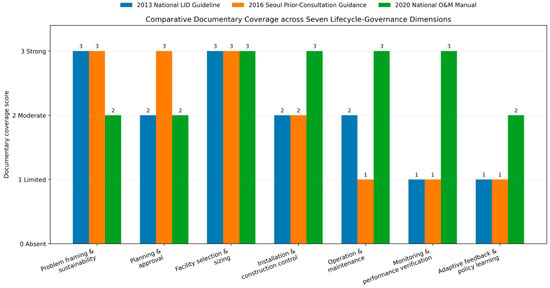
Each document was evaluated using a four-level ordinal scale to support a transparent and consistent qualitative comparison of lifecycle-governance coverage. The scores were used only to indicate the strength of explicit documentary provisions and were not treated as interval-level measurements, combined into composite indices, or interpreted as measures of implementation effectiveness. Table 4 summarizes the comparative coverage of the seven lifecycle-governance dimensions across the three documents.
Table 4.
Comparative coverage of lifecycle-governance dimensions.
Figure 1 visually compares documentary coverage across the seven lifecycle-governance dimensions, highlighting stronger planning and approval provisions in the 2016 Seoul guidance and stronger post-construction, maintenance, and monitoring provisions in the 2020 national manual. Table 4 defines the four-level ordinal scale used for coding: 0 = absent, 1 = limited, 2 = moderate, and 3 = strong. Higher scores indicate more explicit, detailed, and systematically connected documentary provisions.
Figure 1.
Comparative documentary coverage across seven lifecycle-governance dimensions.
The scale was used only to support consistent qualitative comparison among the three documents. The scores do not represent quantitative measures of governance effectiveness, regulatory compliance, or environmental performance; rather, they indicate the strength of explicit documentary coverage.
6. Integrated Lifecycle-Governance Framework
6.1. Strengths of the Collective Documentary Framework
The documents demonstrate a complementary distribution of governance functions rather than merely repeating similar technical guidance. Collectively, they address different lifecycle stages and administrative needs, including technology selection, pre-permit review, installation, maintenance, monitoring, and performance testing.
Another important strength is the upstream integration of stormwater requirements into development planning. Seoul’s prior-consultation procedure creates an institutional opportunity to revise site layout, impervious-area distribution, roof drainage, parking design, and open-space allocation before project approval.
The framework also supports quantitative accountability during the approval stage. Runoff-management and infiltration-capacity calculations provide a transparent basis for comparing required capacity with the capacity proposed by project applicants.
Facility diversity represents an additional strength. The documents recognize that LID and nonpoint-source pollution control require context-specific combinations of infiltration, storage, filtration, vegetation, and manufactured treatment systems rather than reliance on a single standardized solution.
The documents also show increasing attention to facility reliability after construction. In particular, the 2020 manual extends the framework beyond design and installation by incorporating monitoring plans, safety requirements, operation and maintenance procedures, and performance testing.
6.2. Gaps in Lifecycle-Governance Continuity
The comparison demonstrates that technical completeness does not necessarily result in governance continuity. Although the three documents collectively address most stages of the infrastructure lifecycle, the transfer of responsibility, information, and performance evidence between those stages remains incomplete. As a result, technically detailed requirements may still operate as separate administrative components rather than as parts of a continuous asset-management system.
The documents do not establish a unified chain of accountability extending from project approval through construction, operation, rehabilitation, and eventual asset replacement. Approval-stage design capacities are also not consistently connected to as-built surveys, material documentation, infiltration testing, or commissioning results. This weakens the ability of regulators and asset owners to confirm whether constructed facilities match the conditions originally reviewed and approved. Maintenance provisions generally identify necessary inspection and corrective tasks, but they provide limited detail regarding long-term funding responsibility, workforce qualifications, escalation procedures, record retention, and enforcement consequences. In addition, monitoring data are not clearly integrated into compliance evaluations, rehabilitation decisions, or systematic policy revision.
These gaps indicate that the central sustainability challenge extends beyond whether a facility is designed in accordance with technical guidance. Long-term sustainability also depends on whether the facility remains identifiable, accountable, inspectable, maintainable, and verifiable throughout its service life. Achieving lifecycle-governance continuity therefore requires stronger institutional and informational links among approval records, construction verification, maintenance activities, monitoring results, and future regulatory decisions. Table 5 summarizes the principal lifecycle-governance discontinuities identified in the document analysis and links each gap to a corresponding governance response. The proposed responses illustrate how weaknesses in post-construction verification, long-term responsibility, compliance linkage, monitoring feedback, information continuity, and climate adaptation could be addressed through more integrated lifecycle-management mechanisms.
Table 5.
Relationship between identified governance gaps and proposed lifecycle responses.
6.3. Proposed Integrated Lifecycle Governance Model
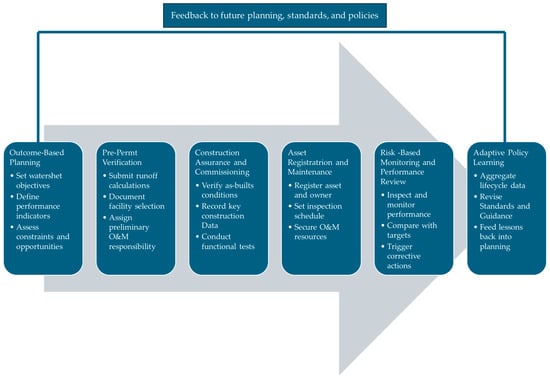
Based on the governance discontinuities identified in the comparative analysis, this study proposes an integrated lifecycle-governance framework for LID and nonpoint-source pollution reduction infrastructure. The framework consists of six connected lifecycle stages supported by four cross-cutting foundations. The stages are designed as a continuous and iterative process rather than as a one-directional project sequence. Monitoring and policy-learning results are therefore expected to feed back into future planning, approval, design, and maintenance decisions.
As illustrated in Figure 2, the framework integrates six lifecycle stages: outcome-based planning, pre-permit verification, construction assurance and commissioning, asset registration and maintenance, risk-based monitoring and performance review, and adaptive policy learning. These stages are supported by four cross-cutting foundations: institutional responsibility, digital information continuity, lifecycle funding and workforce capacity, and environmental, economic, social, and institutional performance indicators.
Figure 2.
Integrated lifecycle-governance framework for LID and nonpoint-source pollution reduction infrastructure.
The proposed framework is not presented as an existing Korean governance arrangement or as an empirically validated model. It is a normative analytical synthesis developed from two sources: the lifecycle discontinuities identified through comparative document analysis and governance principles identified in the broader stormwater, green-infrastructure, infrastructure-management, and adaptive-governance literature. Based on the identified discontinuities, this study proposes an integrated lifecycle-governance model consisting of six connected stages:
- Stage 1—Outcome-based planning. Project- and watershed-level objectives should be defined using measurable indicators for runoff volume, peak flow, water quality, groundwater recharge, thermal conditions, ecological function, and public safety.
- Stage 2—Pre-permit verification. Applicants should submit quantitative capacity calculations, facility-selection rationale, preliminary lifecycle cost estimates, proposed maintenance responsibility, and a monitoring classification appropriate to facility risk.
- Stage 3—Construction assurance and commissioning. Approved design assumptions should be reconciled with surveyed as-built conditions. Construction records should verify elevations, materials, underdrains, pretreatment components, overflow pathways, contributing drainage area, and infiltration or functional performance.
- Stage 4—Asset registration and operational accountability. Each facility should receive a unique digital identifier and be assigned an owner, responsible operator, inspection frequency, maintenance budget, failure thresholds, and emergency-response contact.
- Stage 5—Risk-based monitoring and performance review. Inspection and monitoring intensity should reflect facility type, drainage-area loading, sediment exposure, flood consequence, public safety, and observed deterioration. Results should be compared with approval conditions and commissioning benchmarks.
- Stage 6—Adaptive policy learning. Aggregated performance data should be used to revise design coefficients, approved technologies, maintenance intervals, training requirements, inspection priorities, enforcement procedures, and capital-investment programs.
The six stages should not operate as a linear one-time process. Monitoring and policy-learning results should feed back into future planning, approval, design, and maintenance decisions.
6.4. Policy Implications for South Korean LID Governance
The findings suggest several policy priorities for strengthening lifecycle governance of LID and nonpoint-source pollution reduction facilities in South Korea. Approval-stage requirements should be more directly connected to post-construction verification. Municipal and national guidance could require as-built documentation, commissioning records, and functional verification to confirm that constructed facilities match approved designs, capacities, and site conditions. This would help reduce the approval-to-construction discontinuity identified in the document analysis.
A standardized digital asset-registration system could also improve information continuity across planning, construction, operation, maintenance, and monitoring. Each facility could be assigned a unique identifier linked to approved drawings, as-built records, responsible owners or operators, inspection schedules, maintenance histories, and monitoring results. Such a system would improve long-term traceability and reduce fragmentation among agencies and lifecycle stages.
Long-term operation and maintenance responsibilities should be clearly assigned before project approval or commissioning. Guidance should identify the responsible owner or operator, minimum inspection and maintenance requirements, funding responsibility, record-retention procedures, and corrective-action obligations. Maintenance records should also be linked to continuing compliance so that repeated deficiencies can trigger follow-up inspections, rehabilitation, or other administrative actions.
Monitoring and performance data should be used systematically to support policy learning. Aggregated information on facility condition, maintenance needs, hydraulic performance, water-quality performance, and recurring failure modes could inform revisions to design criteria, maintenance frequencies, approved technologies, inspection priorities, and training requirements. Institutionalizing this feedback process would help move LID governance from project-based approval toward a continuous and adaptive infrastructure-management system.
6.5. Implications for Sustainability and the SDGs
The proposed lifecycle-governance framework has potential relevance to SDGs 6, 11, 13, and 15. SDG 6 emphasizes water quality and sustainable water management, while SDG 11 focuses on resilient and sustainable urban settlements. SDG 13 addresses adaptation and resilience to climate-related hazards, and SDG 15 emphasizes the protection and restoration of terrestrial ecosystems and biodiversity [27,28,29,30]. Within this context, the framework’s emphasis on water-quality protection, pollutant-load reduction, infiltration, long-term stormwater management, infrastructure resilience, adaptive performance review, vegetation-based systems, groundwater recharge, and ecological functions is conceptually consistent with these goals. The Korean guidance documents analyzed in this study also contain provisions related to runoff reduction, infiltration, pollutant control, vegetation-based systems, monitoring, and facility performance [1,25,26]. These relationships should, however, be interpreted as areas of potential alignment rather than as demonstrated SDG outcomes because the documents do not consistently translate broad sustainability objectives into measurable project-level indicators, reporting requirements, or performance thresholds.
SDG alignment should be evaluated through operational and measurable indicators rather than through general policy statements alone. Environmental indicators may include retained runoff volume, peak-flow reduction, pollutant-load reduction, drawdown time, infiltration performance, vegetation survival, and receiving-water conditions. Institutional indicators may include inspection completion rates, maintenance-response times, data completeness, operator training, corrective-action closure rates, and the frequency of technical-standard updates. Economic indicators may include lifecycle costs, avoided flood damages, maintenance backlogs, rehabilitation costs, and deferred investment in conventional drainage infrastructure. Social indicators may address public safety, access to green space, heat exposure, neighborhood amenity, community complaints, and the distribution of infrastructure benefits. These indicators should be applied where reliable data, clearly assigned responsibilities, and feasible monitoring procedures are available. Table 6 summarizes the potential alignment between lifecycle-governance functions and selected SDGs, together with possible indicators and required evidence.
Table 6.
Potential alignment of lifecycle governance with selected sustainable development goals (SDGs).
7. Study Limitations
This study has several limitations. The analysis was limited to three South Korean governmental guidance documents issued by different agencies, at different administrative levels, and for different regulatory and technical purposes. Therefore, the documents should not be interpreted as a formally unified governance system. In addition, the Seoul prior-consultation guidance represents one municipal example and may not reflect the policies, administrative capacity, or practices of other Korean municipalities.
The study is also limited to documentary analysis. The presence of a provision does not confirm that it is consistently implemented or enforced, while the absence of a provision does not necessarily mean that the practice does not occur through other regulations or administrative procedures. No interviews, field inspections, compliance records, asset inventories, maintenance databases, monitoring datasets, or environmental performance data were analyzed. Accordingly, the ordinal scores represent the strength of documentary coverage rather than actual governance effectiveness or infrastructure performance.
The proposed lifecycle-governance framework is a conceptual and normative synthesis and has not yet been empirically validated. Future research should test the framework through stakeholder interviews, comparisons of approved and as-built conditions, maintenance and inspection records, asset-management databases, and long-term hydraulic and water-quality monitoring. Comparative studies across Korean municipalities and other international stormwater-management systems would also help assess its broader applicability.
8. Conclusions
This study comparatively analyzed three major South Korean guidance documents as complementary components of the governance framework for low-impact development (LID) and nonpoint-source pollution reduction facilities. The 2013 national guideline establishes the environmental and hydrologic rationale for LID while providing planning considerations, technology-selection criteria, installation guidance, and basic maintenance provisions. Seoul’s 2016 prior-consultation guidance introduces an approval-stage mechanism through which designated development projects must demonstrate quantitative runoff-management and infiltration capacity before receiving approval. The 2020 national manual further expands the framework by providing more detailed requirements for facility-specific installation, operation and maintenance, monitoring, safety management, and performance testing.
When considered collectively, the three documents demonstrate a functional expansion from general technical guidance toward approval-stage accountability and post-construction operational reliability. This progression reflects increasing recognition that LID performance depends not only on appropriate design and facility selection but also on administrative review, construction verification, maintenance, monitoring, and long-term asset management. Nevertheless, the documents do not yet form a fully continuous lifecycle-governance system. The most significant gaps involve the transfer of approved design information into as-built verification and commissioning, the assignment of clear post-construction responsibility, the connection of inspection and maintenance records to regulatory compliance, the integration of monitoring data across individual assets, and the systematic use of performance evidence to revise technical standards and policy requirements.
The principal conceptual contribution of this study is the introduction of lifecycle-governance continuity. This concept emphasizes that sustainable LID infrastructure requires continuity across five interrelated areas: institutional responsibility, information management, performance standards, compliance verification, and policy learning. A technically adequate facility may still underperform over time if responsibility is unclear, records are fragmented, maintenance is delayed, or monitoring results are not linked to corrective action. Sustainable performance therefore depends on maintaining an auditable connection among project approval, construction, operation, inspection, rehabilitation, and policy revision.
Methodologically, the study also demonstrates how a seven-dimension coding framework and four-level ordinal scale can be used to compare the strength and continuity of explicit governance provisions across multiple policy and technical documents. These contributions should be understood within the study’s qualitative documentary scope rather than as evidence of observed implementation effectiveness.
On this basis, the study proposes a six-stage lifecycle-governance framework linking outcome-based planning, pre-permit verification, construction assurance and commissioning, digital asset registration, risk-based maintenance and performance monitoring, and adaptive policy learning. The framework also highlights the importance of cross-cutting institutional foundations, including clear ownership, continuous data management, lifecycle funding, qualified personnel, and measurable environmental, economic, social, and institutional indicators. By connecting these elements, the proposed framework shifts LID management from a project-based compliance approach toward a long-term infrastructure asset-management system.
The findings should not be interpreted as evidence of actual implementation failure or inadequate environmental performance. This study evaluates the content, structure, and continuity of the selected guidance documents rather than field compliance, enforcement effectiveness, maintenance quality, or measured hydrologic and water-quality outcomes. The conclusions are therefore limited to the design of the documentary governance framework. Future research should test the proposed model through interviews with regulators, designers, contractors, asset owners, maintenance personnel, and facility operators. Additional evidence could be obtained through audits comparing approved designs with as-built conditions, analysis of inspection and work-order records, evaluation of maintenance funding and responsibility, and field monitoring across different facility types and land-use contexts.
Comparative studies involving other Korean municipalities would help determine whether the institutional mechanisms identified in Seoul are transferable to different administrative and environmental settings. International comparisons with green-infrastructure and stormwater-governance systems in other countries could also clarify which elements of the proposed framework are context-specific and which are broadly applicable. Such empirical and comparative work would strengthen our understanding of how technically detailed guidance can be transformed into an integrated, accountable, and adaptive governance system capable of sustaining LID performance throughout the infrastructure lifecycle.
Supplementary Materials
The following supporting information can be downloaded at: https://www.mdpi.com/article/10.3390/su18178866/s1, Documentary Evidence Supporting the Lifecycle-Governance Coverage Ratings.
Author Contributions
Conceptualization, J.K.; Methodology, J.K. and D.J.; Data curation, S.M.; Writing—original draft, J.K.; Writing—review & editing, S.M. and D.J.; Visualization, D.J.; Project administration, D.J. All authors have read and agreed to the published version of the manuscript.
Funding
This research was funded by the Ministry of Science and ICT in South Korea under Grant No. 20260161-001, “Development of Digital Urban Flood Control Technology for the Realization of Flood Safety City”.
Institutional Review Board Statement
Not applicable.
Informed Consent Statement
Not applicable.
Data Availability Statement
The study analyzed three publicly issued Korean governmental guidance documents listed in the References. All data used in this study were derived from these publicly available documents. The coding framework and comparative evidence matrix developed for this study are available in the Supplementary Materials.
Acknowledgments
I used GPT-5.6 only for English grammar and structure purposes.
Conflicts of Interest
The authors declare no conflicts of interest.
References
- Ministry of Environment; Korea Environment Corporation. Low Impact Development (LID) Technology-Element Guideline; Ministry of Environment: Sejong, Republic of Korea, 2013. (In Korean) [Google Scholar]
- Novaes, C.; Marques, R.C. Policy, Institutions and Regulation in Stormwater Management: A Hybrid Literature Review. Water 2024, 16, 186. [Google Scholar] [CrossRef] [Scilit]
- Knapik, E.; Brandimarte, L.; Usher, M. Maintenance in Sustainable Stormwater Management: Issues, Barriers and Challenges. J. Environ. Plan. Manag. 2025, 68, 2769–2795. [Google Scholar] [CrossRef] [Scilit]
- Yang, W.; Brüggemann, K.; Seguya, K.D.; Ahmed, E.; Kaeseberg, T.; Dai, H.; Hua, P.; Zhang, J.; Krebs, P. Measuring Performance of Low Impact Development Practices for the Surface Runoff Management. Environ. Sci. Ecotechnol. 2020, 1, 100010. [Google Scholar] [CrossRef] [Scilit] [PubMed]
- Sun, Q.; Kushner, H.; Yang, Y. Identifying Barriers to Decentralized Stormwater Infrastructure Implementation at Different Levels of Urban Flood Governance—A Case Study in Eastern Pennsylvania, US. Environ. Sci. Policy 2024, 154, 103686. [Google Scholar] [CrossRef] [Scilit]
- U.S. Environmental Protection Agency. Case Studies Analyzing the Economic Benefits of Low Impact Development and Green Infrastructure Programs; EPA 841-R-13-004; U.S. Environmental Protection Agency: Washington, DC, USA, 2013. Available online: https://www.epa.gov/sites/default/files/2015-10/documents/lid-gi-programs_report_8-6-13_combined.pdf (accessed on 17 August 2026).
- Roy, A.H.; Wenger, S.J.; Fletcher, T.D.; Walsh, C.J.; Ladson, A.R.; Shuster, W.D.; Thurston, H.W.; Brown, R.R. Impediments and Solutions to Sustainable, Watershed-Scale Urban Stormwater Management: Lessons from Australia and the United States. Environ. Manag. 2008, 42, 344–359. [Google Scholar] [CrossRef] [Scilit] [PubMed]
- Brown, R.R.; Farrelly, M.A. Delivering Sustainable Urban Water Management: A Review of the Hurdles We Face. Water Sci. Technol. 2009, 59, 839–846. [Google Scholar] [CrossRef] [Scilit] [PubMed]
- Dhakal, K.P.; Chevalier, L.R. Managing Urban Stormwater for Urban Sustainability: Barriers and Policy Solutions for Green Infrastructure Application. J. Environ. Manag. 2017, 203, 171–181. [Google Scholar] [CrossRef] [Scilit] [PubMed]
- Qiao, X.-J.; Kristoffersson, A.; Randrup, T.B. Challenges to Implementing Urban Sustainable Stormwater Management from a Governance Perspective: A Literature Review. J. Clean. Prod. 2018, 196, 943–952. [Google Scholar] [CrossRef] [Scilit]
- O’Donnell, E.C.; Lamond, J.E.; Thorne, C.R. Recognising Barriers to Implementation of Blue-Green Infrastructure: A Newcastle Case Study. Urban Water J. 2017, 14, 964–971. [Google Scholar] [CrossRef] [Scilit]
- Shkaruba, A.; Skryhan, H.; Likhacheva, O.; Katona, A.; Maryskevych, O.; Kireyeu, V.; Sepp, K.; Shpakivska, I. Development of Sustainable Urban Drainage Systems in Eastern Europe: An Analytical Overview of the Constraints and Enabling Conditions. J. Environ. Plan. Manag. 2021, 64, 2435–2458. [Google Scholar] [CrossRef] [Scilit]
- Van der Jagt, A.P.N.; Buijs, A.E.; Dobbs, C.; van Lierop, M.; Pauleit, S.; Randrup, T.B.; Skiba, A.; Wild, T. With the Process Comes the Progress: A Systematic Review to Support Governance Assessment of Urban Nature-Based Solutions. Urban For. Urban Green. 2023, 87, 128067. [Google Scholar] [CrossRef] [Scilit]
- Zabel, A.; Häusler, M.-M. Policy Instruments for Green Infrastructure. Landsc. Urban Plan. 2024, 242, 104929. [Google Scholar] [CrossRef] [Scilit]
- ISO 55000:2024; Asset Management—Vocabulary, Overview and Principles. ISO: Geneva, Switzerland, 2024. Available online: https://www.iso.org/standard/83053.html (accessed on 17 August 2026).
- ISO 55001:2024; Asset Management—Asset Management System—Requirements. ISO: Geneva, Switzerland, 2024. Available online: https://www.iso.org/standard/83054.html (accessed on 17 August 2026).
- Rijke, J.; Farrelly, M.; Brown, R.; Zevenbergen, C. Configuring Transformative Governance to Enhance Resilient Urban Water Systems. Environ. Sci. Policy 2013, 25, 62–72. [Google Scholar] [CrossRef] [Scilit]
- Hsu, D.; Lim, T.C.; Meng, T. Rocky Steps towards Adaptive Management and Adaptive Governance in Implementing Green Infrastructure at Urban Scale in Philadelphia. Urban For. Urban Green. 2020, 55, 126791. [Google Scholar] [CrossRef] [Scilit]
- Choi, I.-C.; Shin, H.-J.; Nguyen, T.T.; Tenhunen, J. Water Policy Reforms in South Korea: A Historical Review and Ongoing Challenges for Sustainable Water Governance and Management. Water 2017, 9, 717. [Google Scholar] [CrossRef] [Scilit]
- Shafique, M.; Kim, R. Recent Progress in Low-Impact Development in South Korea: Water-Management Policies, Challenges and Opportunities. Water 2018, 10, 435. [Google Scholar] [CrossRef] [Scilit]
- Kang, J.E.; Hyun, K.H.; Park, J.B. Assessment of Low Impact Development (LID) Integrated in Local Comprehensive Plans for Improving Urban Water Cycle. J. Korean Soc. Civ. Eng. 2014, 34, 1625–1638. [Google Scholar] [CrossRef] [Scilit]
- Son, C.H.; Ban, Y.U.; Jin, G.H. Suggesting Revised Guidelines for Urban Master Planning in Order to Establish Water Cycle and Low Impact Development (LID) Plans. Crisisonomy 2022, 18, 123–138. [Google Scholar] [CrossRef] [Scilit]
- Son, C.H.; Hyun, K.H.; Kim, D.; Baek, J.I.; Ban, Y.U. Development and Application of a Low Impact Development (LID)-Based District Unit Planning Model. Sustainability 2017, 9, 145. [Google Scholar] [CrossRef] [Scilit]
- Choi, J.; Kim, G. History of Seoul’s Parks and Green Space Policies: Focusing on Policy Changes in Urban Development. Land 2022, 11, 474. [Google Scholar] [CrossRef] [Scilit]
- Seoul Metropolitan Government. Guidance for the Low Impact Development Prior-Consultation System; Water Circulation Policy Division; Seoul Metropolitan Government: Seoul, Republic of Korea, 2016. (In Korean) [Google Scholar]
- Ministry of Environment. Manual for the Installation and Management/Operation of Nonpoint-Source Pollution Reduction Facilities; Ministry of Environment: Sejong, Republic of Korea, 2020. (In Korean) [Google Scholar]
- United Nations. Goal 6: Ensure Availability and Sustainable Management of Water and Sanitation for All; United Nations Department of Economic and Social Affairs: New York, NY, USA, 2015; Available online: https://sdgs.un.org/goals/goal6 (accessed on 17 August 2026).
- United Nations. Goal 11: Make Cities and Human Settlements Inclusive, Safe, Resilient and Sustainable; United Nations Department of Economic and Social Affairs: New York, NY, USA, 2015; Available online: https://sdgs.un.org/goals/goal11 (accessed on 17 August 2026).
- United Nations. Goal 13: Take Urgent Action to Combat Climate Change and Its Impacts; United Nations Department of Economic and Social Affairs: New York, NY, USA, 2015; Available online: https://sdgs.un.org/goals/goal13 (accessed on 17 August 2026).
- United Nations. Goal 15: Protect, Restore and Promote Sustainable Use of Terrestrial Ecosystems, Sustainably Manage Forests, Combat Desertification, and Halt and Reverse Land Degradation and Biodiversity Loss; United Nations Department of Economic and Social Affairs: New York, NY, USA, 2015; Available online: https://sdgs.un.org/goals/goal15 (accessed on 17 August 2026).

Disclaimer/Publisher’s Note: The statements, opinions and data contained in all publications are solely those of the individual author(s) and contributor(s) and not of MDPI and/or the editor(s). MDPI and/or the editor(s) disclaim responsibility for any injury to people or property resulting from any ideas, methods, instructions or products referred to in the content. |
© 2026 by the authors. Licensee MDPI, Basel, Switzerland. This article is an open access article distributed under the terms and conditions of the Creative Commons Attribution (CC BY) license.